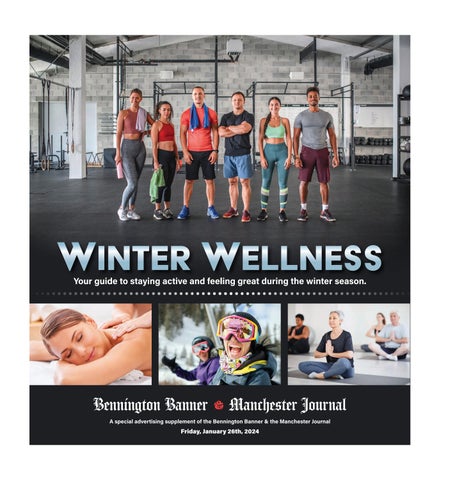
Your guide to staying active and feeling great during the winter season. &
A special advertising supplement of the Bennington Banner & the Manchester Journal Friday, January 26th, 2024
W H Y C H O O S E U S
VNAHSR provides advanced medical care with skill, compassion, and expertise to Vermont residents where they’re most comfortable and can heal the fastest in their home. Our staff is made up of local clinicians you know and trust, providing clinically excellent care through programs that span a lifetime: from prenatal care, to care for young families, to post-surgery rehabilitation, to long-term care, to end-of-life care
Tips to maintain your commitment to exercise
At one point or another, millions of adults across the globe have resolved to be more physically active. The benefits of routine exercise are too numerous to cite, but some of the more notable ones include a lower risk for chronic disease and illness, improved self-esteem and greater overall health.
With so much to gain from routine exercise, it’s no wonder so many people aspire to be more physically active. But it’s easy to lose motivation when aspiring to exercise more. Each year, one of the most popular New Year’s resolutions is to exercise more. In fact, Statista conducted a survey regarding New Year’s resolutions for 2023 and found that exercising more was the most popular resolution. However, a 2021 study published in the International Journal of Environment Research and Public Health found that 64 percent of people abandon their New Year’s resolutions within a month of making them. Exercising more requires commitment, and there are some ways to make it a little easier to maintain that commitment over the long haul.
• Break it up. The Harvard T.H. Chan School of Public Health notes that people don’t need to exercise all at once to reap the rewards of physical activity. If time is tight, break up a
workout over the course of your day. Some strength-training exercises in the morning can be followed up with a brisk walk or run over a lunch break. This approach makes it easier to fit a full workout into your daily routine.
• Employ the buddy system
The Centers for Disease Control and Prevention suggests that working out with a partner increases exercise motivation and encourages individuals to be more consistent with their exercise routine so they do not let their partners down. The authors behind a 2019 study published in the International Journal of Research in Exercise Physiology suggested the efficacy of the buddy system may require further study before researchers can definitively say it’s an effective motivation strategy for people who want to exercise more. But there’s no denying that many individuals feel that they are more likely to exercise with a friend than they are if they go solo.
• Schedule exercise time. Busy professionals book work meetings, family obligations and other daily tasks in their schedules, and the T.H. Chan School of Public Health recommends doing the same with exercise. Allotting time to exercise each day may decrease the likelihood that you’ll skip a work-
out, and once results start to manifest you may be more motivated to stay the course.
• Identify what progress may look like. It’s easy to become discouraged if a commitment to routine exercise does not produce visible results. But just because your abs are not becoming chiseled a month into a workout routine or the scale is not reflecting significant weight loss does not mean your routine is not working. As the human body ages, it becomes more difficult to transform it. So a workout routine that left you looking lean and chiseled in your twenties may not produce the same body in your forties. But that
does not mean the exercise isn’t working and ultimately helping you get healthier. Adults are urged to speak with their physicians and identify what progress with a workout routine might look like for someone their age. Progress may look different than it did years ago, but if the end result is a healthier you, then that should be all the motivation you need to keep going.
It’s no secret that making a commitment to routine exercise can be difficult. But various strategies can increase the likelihood that individuals will stay the course as they seek to exercise more frequently.
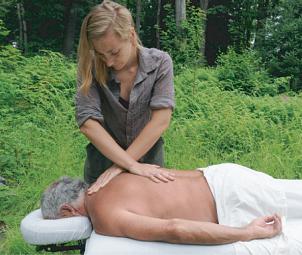
*Chronic Pain *Misalignment *Headaches *Tightness & Stiffness *Sciatica *Back Pain *Limited Mobility *TMJ *Post Surgery Tightness *Anxiety *Depression *Traumatic or Painful Memories *Unresolved Grief *Phobias *Emotional Enmeshment *Addiction *Internal Conflicts *Shocking Images *Negative Internal Voice *And Much More
DANI GRANAROLI
Coaching and Reiki is available in-person or remote
7254 MAIN STREET, MANCHESTER, VERMONT (413) 313-9317 DANI@GREENMTNMB.COM GREENMTNMB.COM
METRO CREATIVE CONNECTION
Managing Aches & Pains In Cold Weather
Submitted by Aunt Bonnie’s Natural Remedies & Gift Shop
Do cold temperatures cause slow, achy joints that make it difficult for you to get moving? A cold front can cause joints to expand, which may result in pain. Low temps may also increase the thickness of the synovial fluid that acts as the joint’s shock absorber, which makes joints stiff and more sensitive to pain. If you get stiff, achy joints in the wintertime, CBD may help keep you moving throughout the winter season.
WHAT IS CBD?
CBD, or cannabidiol, is a compound found primarily in the hemp flowers and leaves of the hemp plant. CBD is known for supporting the body and mind in various ways.
WHAT ARE THE OTHER BENEFITS OF CBD?
Some of the main benefits are: support for regular sleep cycles, a sense of calm for focus; relief from everyday stresses; help in recovery from sore achy joints and pains.
HOW DO YOU TAKE CBD FOR ACHES AND PAINS?
Many people find that including CBD once or twice daily into their routine is best. CBD is often used in the morning for all day relief and an hour or two before bed to increase for better sleep. CBD is available in many forms. It can be taken orally as an oil, tincture, gummy or soft gel, it can also be applied topically as a lotion. For daily support on targeted aches and pains a topical is the most popular.
DOES CBD HELP WITH ARTHRITIS PAIN?
According to the Arthritis Foundation, “Animal studies have suggested that CBD has pain-relieving and anti-inflammatory properties, but these effects have not been validated in quality studies in humans. Anecdotally, some people with arthritis who have tried CBD report noticeable pain relief, sleep improvement and/or anxiety reduction. However, like any medication for arthritis, some people do not report any symptom improvements when taking CBD.”
Cold temperatures are inevitable in Vermont during the winter months. Some other ways to keep your achy pains at a minimum are to stay hydrated, eat a balanced diet filled with fruits and vegetables, exercise and stretch regularly, and layer up to keep warm.
Fill up on healthy eating pointers for 2024
Diet and exercise are the key components of maintaining a healthy weight and protecting yourself against chronic disease. According to the Missouri Department of Health & Senior Services, eating smart and being active have similar effects, including reducing the risk for heart disease, high blood pressure, stroke, some cancers, and diabetes. In addition, these healthy living strategies can improve personal appearance and improve overall well-being — helping people live longer and maintain their independence.
People may wonder how to eat better when faced with many diets, each of which promises great results. It can be confusing when navigating all of the options, and there is no magic formula to eating better. Common sense can come into play when attempting to eat better, and individuals also can consider these strategies to make diet work for them as they seek to live healthier.
• Eat colorful, varied, nutritionally dense foods. Medical News Today says each meal should be 50 percent fruit and vegetables, 25 percent whole grains, and 25 percent protein. Select an array of colorful foods that will provide most of the nutrients needed.
• Choose fiber-rich foods. Fresh fruits and vegetables, whole grains, nuts, and legumes are good sources of fiber. Fiber helps people maintain digestive health and can help you to feel fuller longer, reducing the potential for overeating, according to the Centers for Disease Control and Prevention.
• Note how you feel after eating. Create a food journal where you jot down notes about how you feel after eating certain foods. If you notice that certain foods or ingredients trigger adverse reactions, it may be worth avoiding that type of food or looking for an alternative. Stomach upset or bloating after eating dairy, for example, may indicate an intolerance for lactose.
• Explore the Mediterranean diet. While you should avoid fad diets that often produce shortterm but unsustainable results, a Mediterranean diet has stood the test of time. According to the authors of a new study published in JAMA Network Open in October 2023, middle-aged and older adults with overweight or obesity and metabolic syndrome lost visceral fat (belly fat) and showed a greater reduction in the percentage of total fat while adhering to a Mediterranean diet. They also had delayed loss of lean body mass, which often comes with aging. Mediterranean diets prioritize legumes, seafood, vegetables, and ‘good’ fats like olive oil.
• Control portion sizes. Sometimes it’s not what you eat but how much you eat that affects health. Weighing and measuring food can help you control portions and understand how many calories you’re consuming each day. The National Institutes of Health says eating plans that favor 1,200 to 1,500 calories per day for women and 1,500 to 1,800 for men are good targets to lose weight at a healthy pace when combined with moderate exercise.
Balanced eating is a major component of a healthy lifestyle. While there are many fad diets, eating plans with a proven track record that are supported by the medical community may be your best bet.
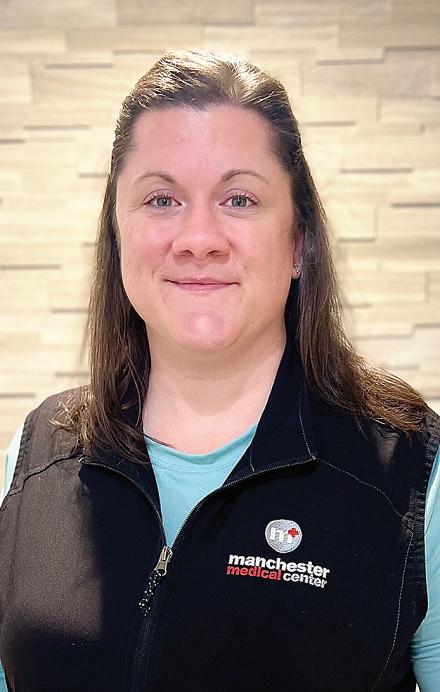
Manchester Medical Center Hires New Physician
w ith Patient Satisfaction as Top Priority
Kathleen hawes Vermont News & Media correspondent
MAN CH E S TER Manchester Med ica l Center (MMC) Primary Care is proud to announce its newest team member, Dr Ma r y K at her i ne ( K ate) Howa rd MD Dr Howard has been Board-Certi fied in Fami ly Medicine for over a decade She received her underg raduate deg ree i n Chem ica l Eng i neering from the University of Arkansas, after which she completed her Medical Doctorate at the University of Arkansas for Medical Sciences, fi nishing up her residency in Family Medicine in Pine Bluff, AR. She spent the first seven years as a Family Medicine physician in Arkansas seeing patients that range from newborn to geriatric before moving to Vermont in 2020 She continues her work as a family medicine physician in southern Vermont and will be joining Manchester Medical Center as of March 2024
“I’m so excited to have the opportunity to work with Manchester Medical Center and assist in developing their primary care program,” Says Dr Howard.” I am hoping it leads to more informed patient care and education, which will ultimately result in a healthier Vermont.”
The rest of the MMC Team is thrilled to welcome Dr Howard as she will be crucial to the future development of the practice, especially now, as they expand their services to help the greater needs of the community.
MMC Founders, Dr Thomas Sterling and Dr Janel Kittredge both live in the Manchester VT area, a place where the two closest hospitals are both more than 20 miles away. It did not take long for them to recognize the area’s dire need for urgent medical care and so, in 2019, they opened their own facility: Manchester Medical Center (MMC) Urgent Care. Since then, they have strived to improve healthcare in their community
After operating the Urgent Care Center for four years, MMC has expanded, now offering primary care services, and making patient satis-
faction top priority Dr Sterling and Dr. Kittredge understand that the steady decline of health insurance reimbursements paired with increased costs of labor and supplies has put pressure on many primary care providers to see an unrealistic number of patients per day. They also know it’s the patient who bears much of the brunt of this problem; long wait times and increased healthcare costs, to name a few.
With patient satisfaction as their goal, Kittredge and Sterling chose to make MMC a membership-based program. The cost? $480 dollars per year ($40 per month), which is about the same as one take-out meal a month, or two cups of Dunkin’ a week.
The benefits? Dramatically reduced wait times and increased flexibility with scheduling. Patients will also get increased access to their providers, which means more facetime with physicians and nurse practitioners, making appointments relaxed, unhurried, and thorough. In sum, although differing in many ways from a concierge program, a membership program allows the practice to limit
the number of patients scheduled, ultimately providing the patient with the most personal and comprehensive care possible
The Primary Care office has continued to grow with the hiring of two family nurse practitioners, Lia Braico, FNP-BC and Morgan Bazyk FNPCB. MMC also has onsite laboratory services and onsite x-ray, which means less travel for patients requiring those services The practice is willing to train medical assistants and is always on the lookout for Certified Paramedics that want to work in a clinical setting. Currently, MMC seeks interns at both the college and high school level curious about the field of medicine and interested in working alongside their team towards a healthier Vermont.
To learn more about the MMC Primary Care Membership Program, visit: https://www.manchestermedicalcenter.com/primary-care-medicine Primary Care: (802)766-0159
To learn more about MMC Urgent Care: https://www.manchester medicalcenter.com/#services
Urgent Care: (802)768-1718
To learn more out more about internships with MMC: https://www. manchester medicalcenter.com/internships-scholarships
To learn more about jobs at MMC, call: (802)768-1718 or email your resume to reception@mmcvt.com
Manchester Medical Center 34 Bonnet St. Manchester Center, VT 05225
PHOTO PROVIDED Doctor Kate Howard
PHOTO PROVIDED
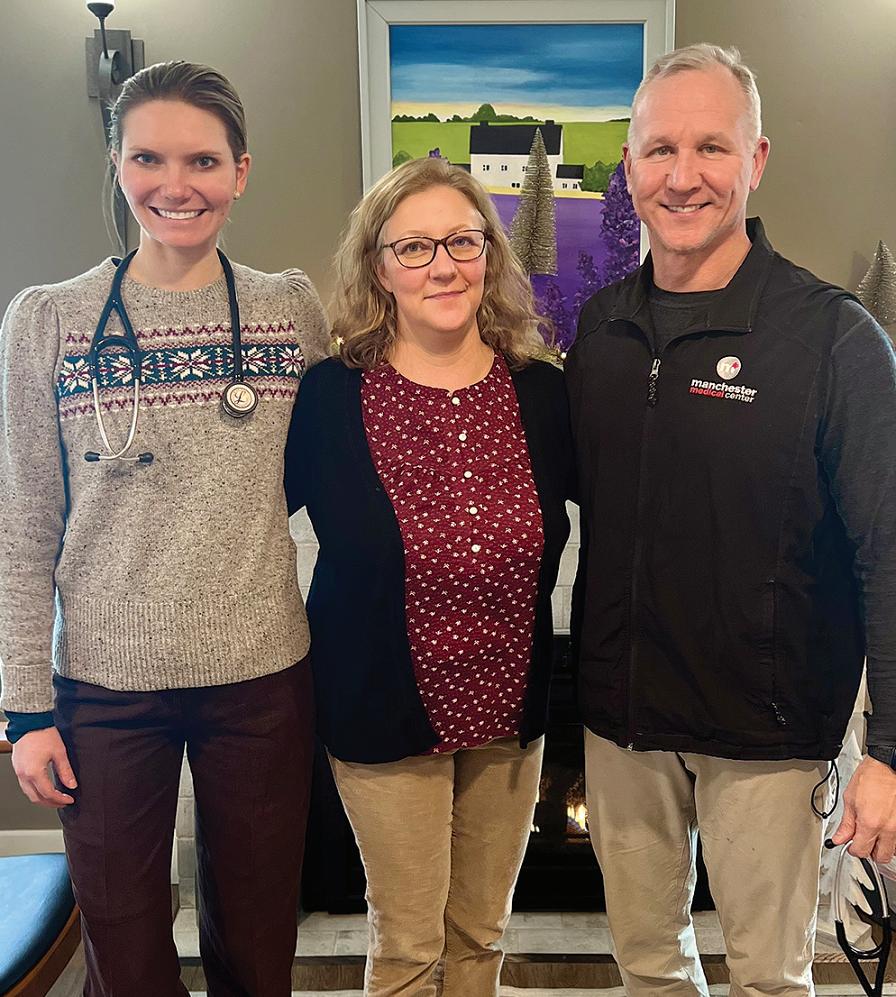
Left to right: Morgan Bazyk, FNP, Lia Braico, FNP, Dr Thomas Sterling, D O
Vermont’s Area Agencies on Aging Leverage Resources through the Vermont Aging Network Consortium
Vermont’s five Area Agencies on Aging (AAAs) announce their new affiliation, called the Vermont Aging Network Consortium (VANC). Boards of directors from each of the AAAs have approved the affiliation.
This new consortium will positively impact the overall cost of health care by leveraging economies of scale, combining resources, and reducing duplication within the community-provider network of home- and community-based services. A focus on establishing future contracts with payers & healthcare systems is expected to further enhance financial sustainability for aging services as they evolve.
The Vermont Aging Network Consortium will be a separate nonprofit entity within which the individual AAAs will remain active and independent nonprofits as they continue to serve clients in their communities. It will help the AAAs create a sustainable financial model of service by leveraging their strengths, their buying power, and their highquality systems of service. The AAAs trade association, the Vermont Association of Agencies on Aging (V4A) will continue to separately serve as the lobbying, advocacy, and educational organization for the AAAs.
“We are coming together as AAAs to ensure we are prudent financial stewards for our future, which is the central focus of all of
our strategic plans. Our mission is to serve more clients in the future, with a sustainable operations model at each agency, and this is a way to help us create an efficient and integrated system to help each other do just that,” says Susan Gordon, Vermont Aging Network Consortium’s Board President.
This initiative will support the Vermont area agencies on aging as a unified entity providing a high standard of services throughout the state. It will promote the pursuit of best practices within our case management, nutrition, and caregiver support programs, to list just a few, and will strengthen the role of the AAAs as community partners in delivering critical services that reach a growing population of older Vermonters.
The leaders of the five AAAs have been diligently collaborating with their respective boards of directors to conclude agreements for the establishment of the consortium. This includes finalizing the governance structure through the formation of a new ten-member board of directors and overseeing the recruitment process for the new VANC executive.
To quote AAA Executives on their support of the new consortium:
“In Vermont, with the second highest median age in the nation, the aging consortium squarely
embraces the importance of this growing demographic sector in our state. Raising the bar on our statewide service delivery system through this affiliation is the right thing to do,” says Mark Boutwell, Executive Director of Senior Solutions, the area agency on aging for Southeastern Vermont.
“The consortium will provide a way for the Area Agencies on Aging to build on the robust services and better meet the needs of elders in our state together. As more people are aging, the consortium will build the necessary infrastructure to further develop the goal of Vermont being the best place to grow old with dignity and respect,” says Meg Burmeister, Executive Director of Northeast Kingdom Council on Aging.
Jane Catton, CEO of Age Well, says, “This new entity is an exciting path forward for our agencies. We know that our ability to be the strongest possible network of service for older Vermonters is to ensure that we work closely together and leverage our strengths and our numbers, with quality service at the core of our mission.”
“This is such an opportunity for our collective agencies to increase and enhance services to Vermont’s aging population. Twenty-four percent of Vermont’s residents are expected to be over the age of 65 by 2030, and this is an opportunity to prepare for the need so that our
residents can maintain living in the setting of their choice with independence and dignity,” says Rosemary Greene, Executive Director of Southwestern Vermont Council on Aging.
John Mandeville, Executive Director at Central Vermont Council on Aging, says: “The creation of the Vermont Aging Network Consortium will allow its constituent members to better serve older Vermonters throughout the state. By conserving financial resources, we will be able to continue to provide our clients with high-quality services and assistance and even expand them beyond what we already offer. As Vermont’s aging population is second, only to Maine it is clear that there will be even greater demands for our help in the years ahead. The consortium will help us to meet that increased demand.”
To learn more about the Vermont Area Agencies on Aging, visit: Age Well: www.agewellvt.org
Central Vermont Council on Aging: www.cvcoa.org
Northeast Kingdom Council on Aging: www.nekcouncil.org
Senior Solutions: www.seniorsolutionsvt.org
Southwestern Vermont Council on Aging: www.svcoa.org
Vermont Association of Area Agencies on Aging: www.vermont4a.org
Esoterica , mysticism, shamanism, astrology, religion, nature , poe tr y, philosophy, ancient cultures , modern physics , gods & goddesses , wicca , druidr y and 300+ tarot and oracle deck s!
Ser vices - Classes - Courses
One Main Street Nor th Bennington, V T 0525 7 (802) 688–3208
The Center for Women, Wellness and WealthSM
Provides Comprehensive Expertise to Build a Future Enriched with Financial Stability, Balance, and Growth
Women Face Unique Challenges
86% of women say that achieving financial security is very important
Yet, only 12% are very confident they will have enough saved to live comfortably in retirement.
Individuals who plan ahead financially report experiencing an increase in their financial well-being.
AARP**
Women outlive men on average by 5 years
Many will be solely responsible for their personal finances later in life.
70% of women change financial advisors after their partner’s death to better align with their personal goals and needs. McKinsey*
The Center for Women, Wellness and Wealth encourages active participation in financial decision making to help women understand their personal finances, feel more confident about money, and develop an active working plan to ensure a promising future.
Our team of advisors have exceptional expertise in managing investments and will customize portfolios that align with your unique objectives, values, and risk tolerance with innovation and personal guidance improving your overall wellness.