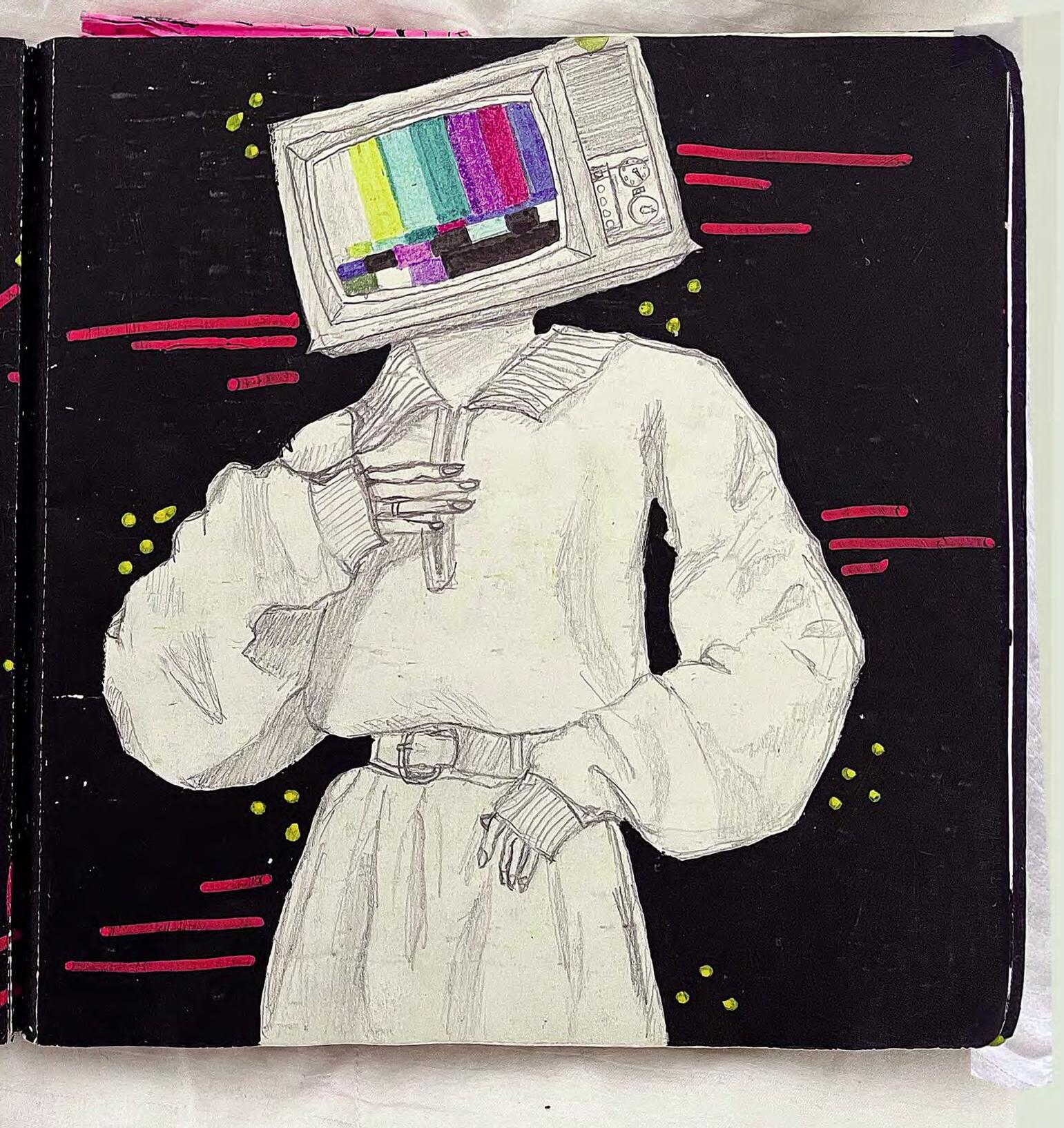
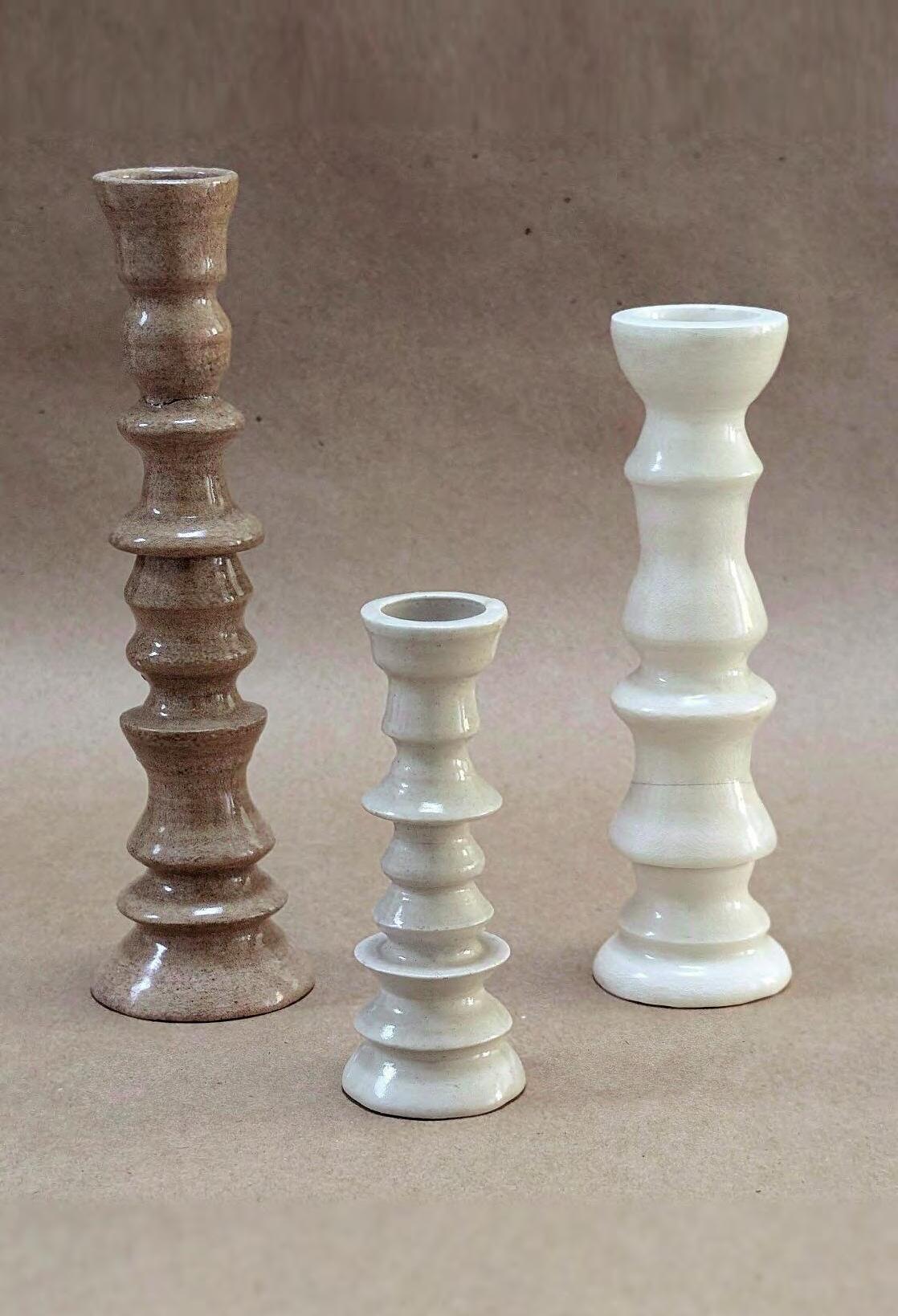
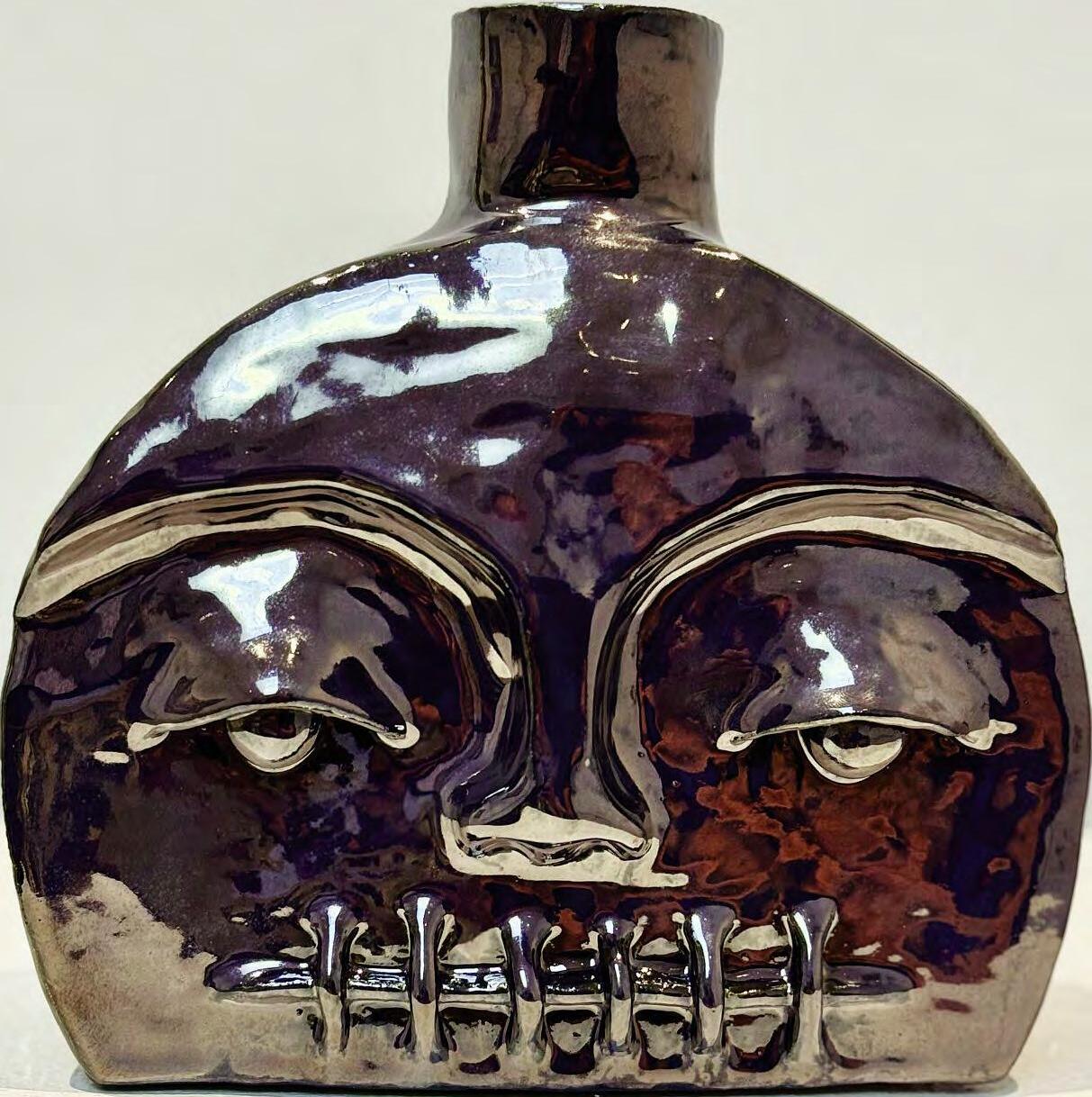
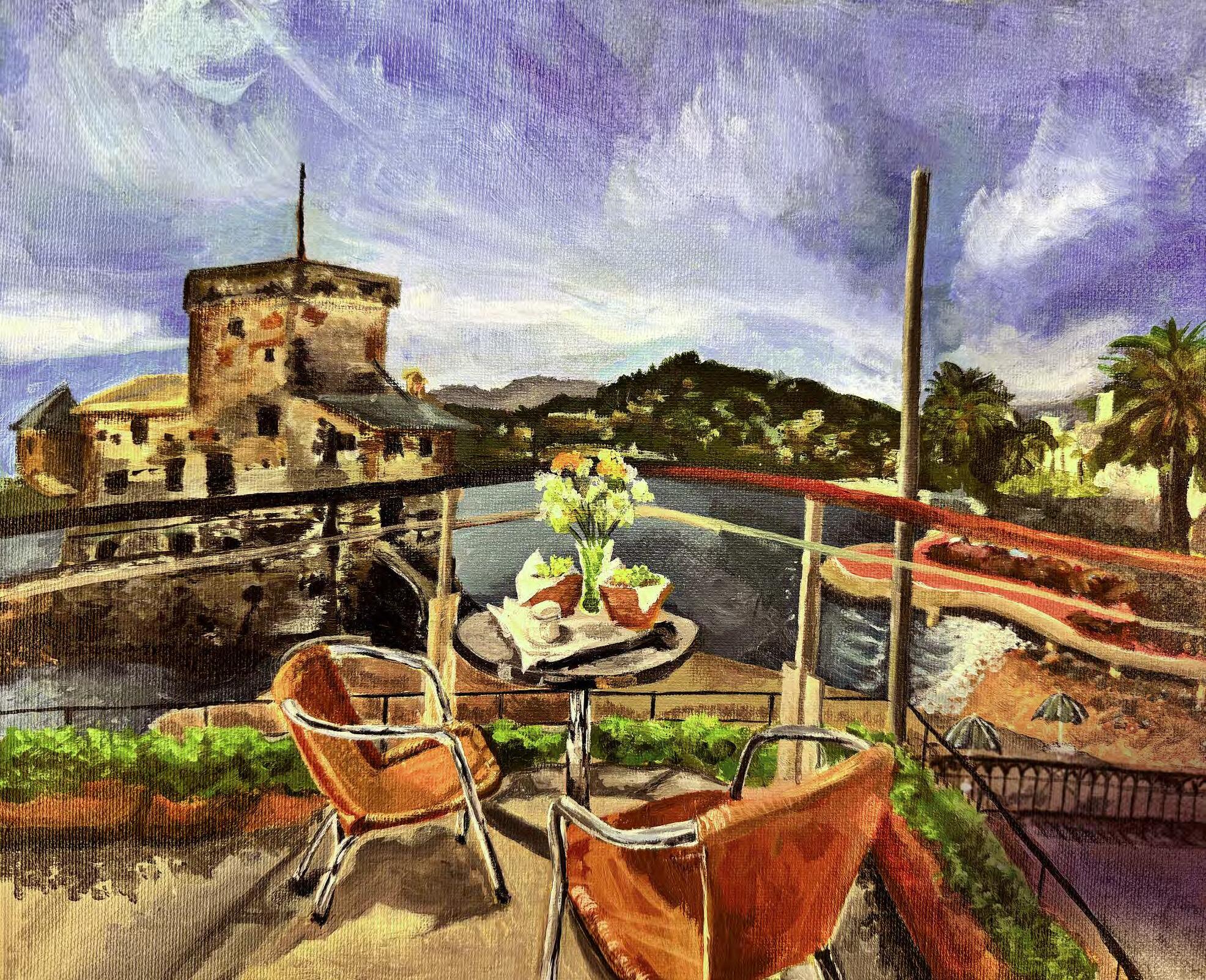
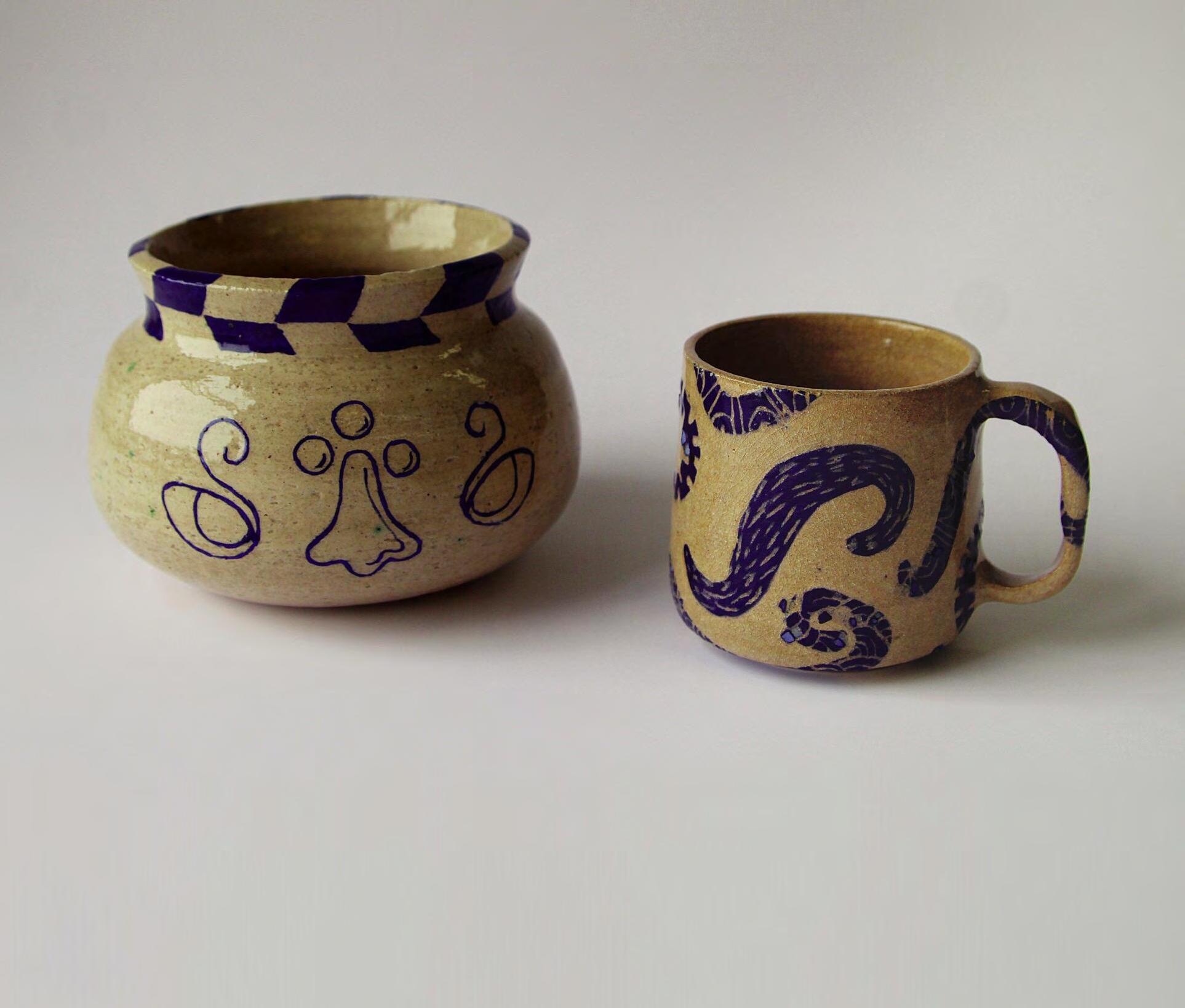
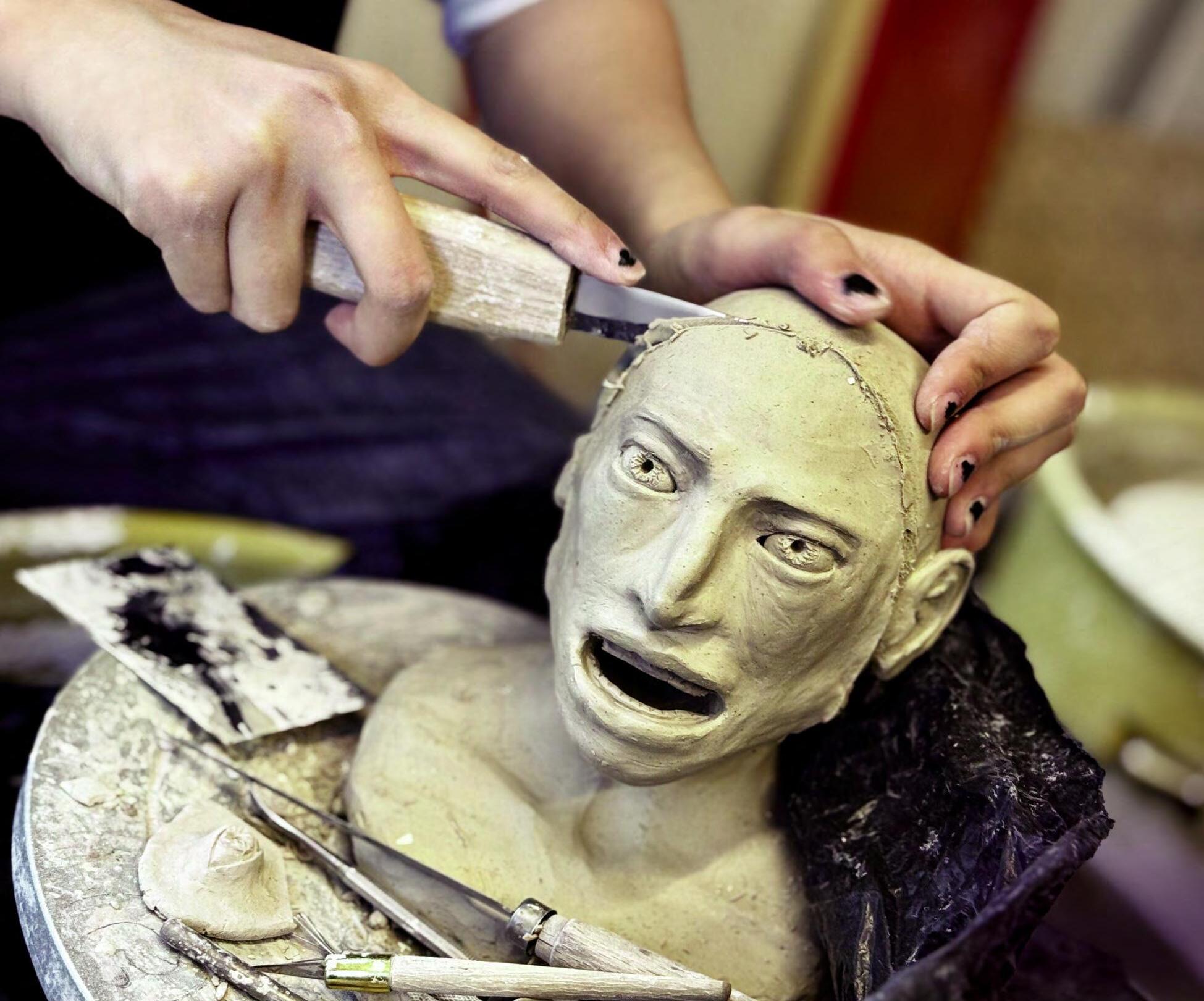
Reflections , the annual literary and arts magazine of The Berkeley Carroll Upper School, seeks to tap into the vibrant, creative energy circulating in the classrooms and hallways of our school. Berkeley Carroll’s mission is to foster an environment of critical, ethical, and global thinking; Reflections contributes by making space for artistic conversation and collaboration, in our meetings and in this volume.
Reflections
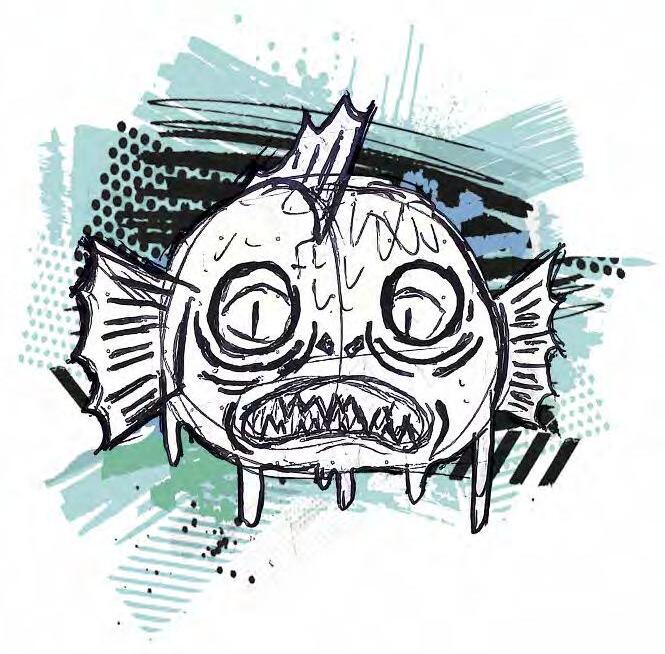
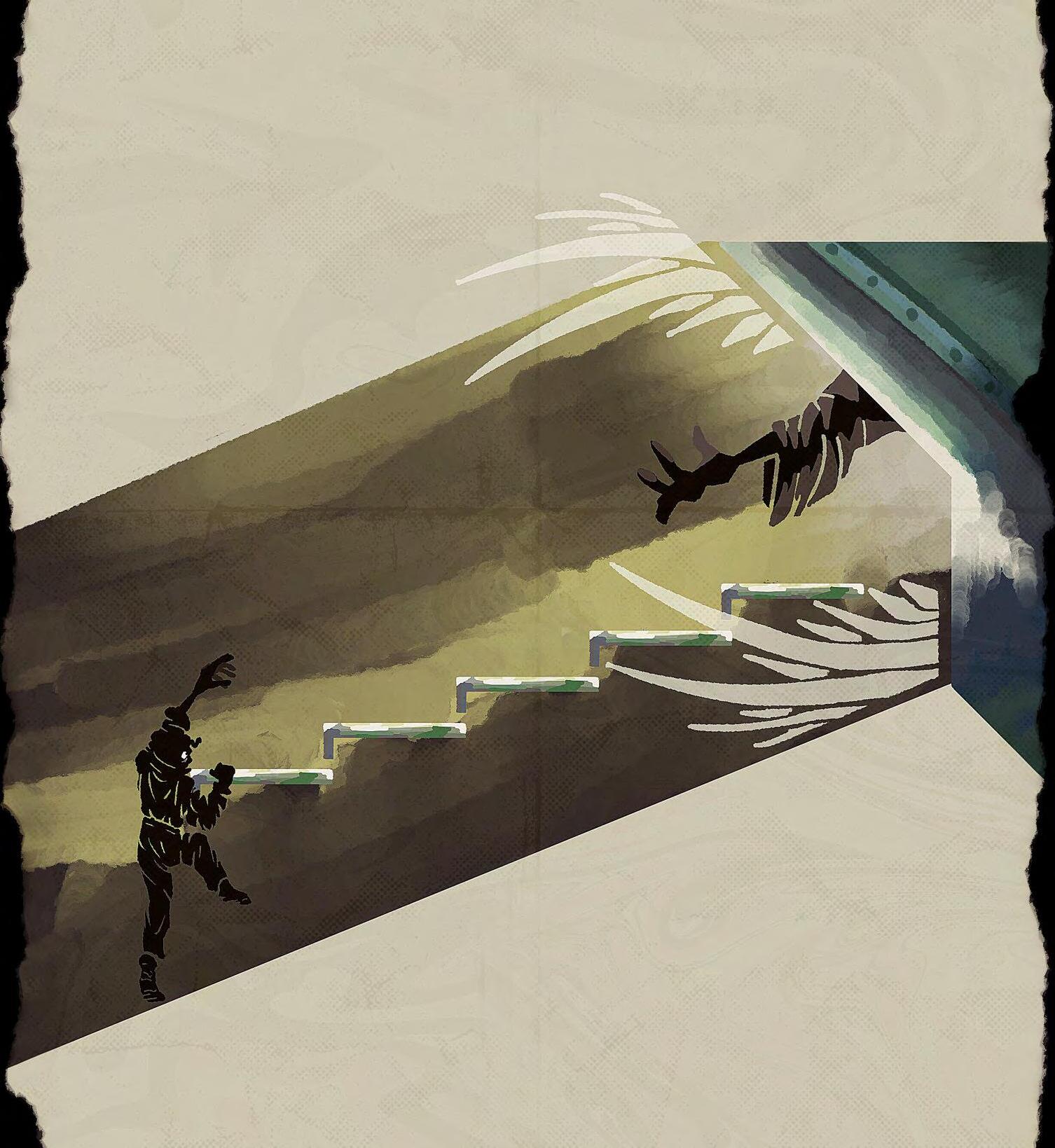
What’s in a name? “Reflection” implies both a mirroring and a distortion: something recognizably strange and strangely recognizable. In selecting and arranging the visual and written work in this magazine, we seek to create this experience of broken mirrors: reflections that are just a bit off, refracted and bent to reveal unexpected resemblances. Notice, for example, August A’s “In the Jaws of an Angler” paired with Clare M’s “L x W.” At first glance, this pairing— August’s rectangle-filled piece next to Clare’s rectangle-hating essay—feels cruelly ironic. Yet a closer look at August’s art reveals a tiny figure fighting to escape a massive anglerfish, much as Clare, in her essay, simultaneously swims and seeks to escape from the pool. And while August’s image includes a few lines as harsh and unforgiving as the lanes in Clare’s essay, its torn and jagged edges suggest the irregularity and escape she is craving. We hope that, as you page through the magazine, you will notice many similar odd connections.
Editorial Policy and Procedures
The Reflections staff is a small, dedicated group of students that meets biweekly over popcorn, wasabi peas, and freeze-dried Skittles to discuss and develop a shared interest in art and literature. In the fall, Reflections members establish the magazine’s high standards, solicit submissions, and refine their own works in progress. In February, the editors preside over small groups who read and critique anonymous student art and literature submissions. After the preliminary critiques—and with helpful suggestions from the art department—the editors carefully consider feedback from the entire Reflections team before choosing and editing the final selections and laying out the magazine, including selecting and designing the spreads. Editors then submit all materials to our fantastic printer, review the proofs, and distribute copies of our beautiful magazine—through our library, as summer reading for our writing courses, at admissions events, and to anyone lucky enough to find the pdf on our school website.
Reflections is a student-run, -led, and -organized coterie; neither the editors nor the staff receive class credit for their work. We are proud members of the Columbia Scholastic Press Association. The striking artwork and writing in this magazine were all crafted by Berkeley Carroll Upper School students, sometimes to fulfill class assignments, but always from the engines of their own creativity.
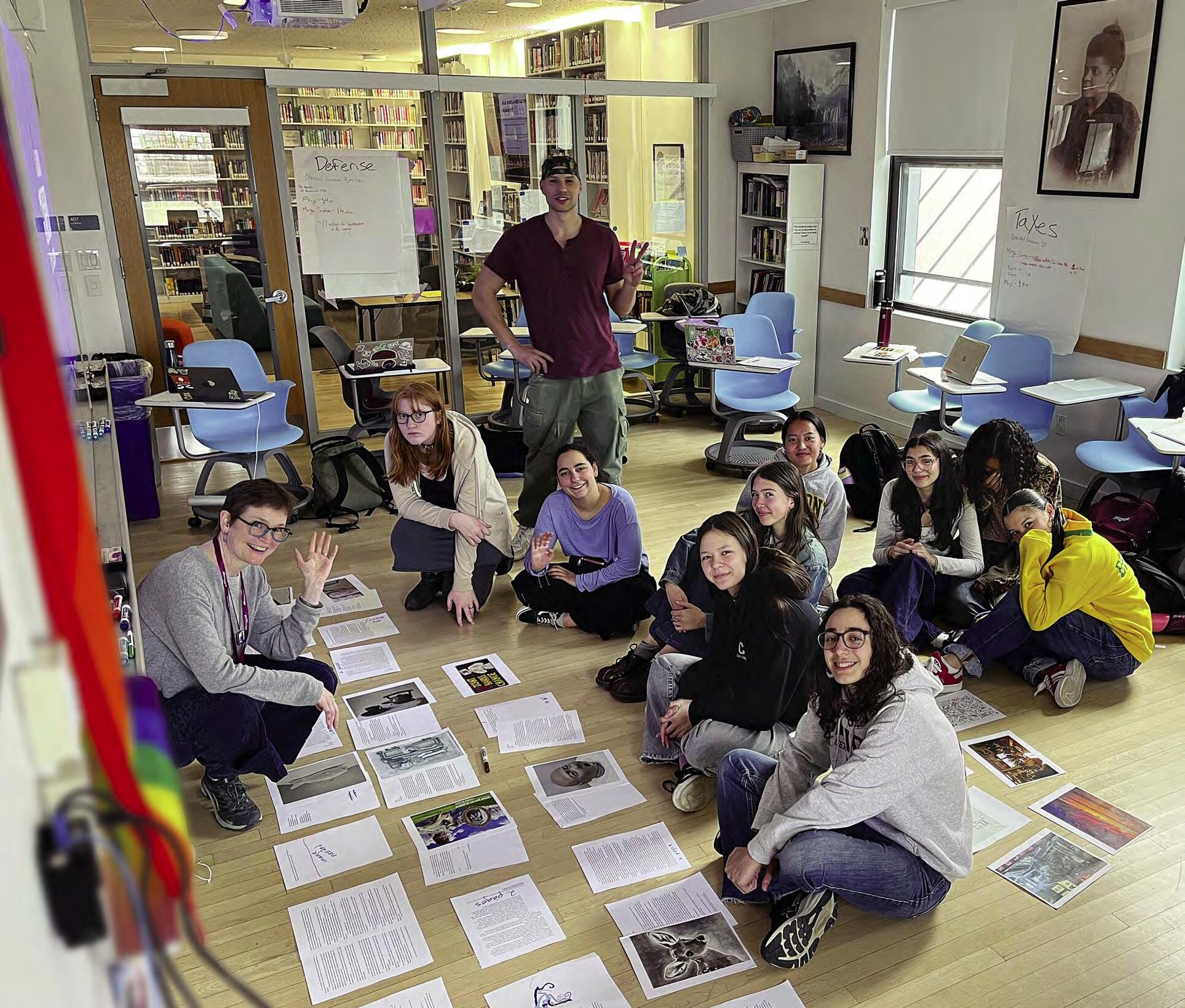
At Reflections, our layout process is old-school. We like to move words and images around on paper until everything looks right.
.Staff
Editor in Chief
DEVRA G
Arts Editor
ALEXIS SG
Assistant Arts Editor
AARJU F
Assistant Editor
ELLE C
Faculty Advisors
MS. DREZNER
MR. GAVRYUSHENKO
Editor’s Statement
Welcome to the 54th edition of Reflections !This beautiful book that you’re holding in your hands is made up entirely of art and writing created by our own BC Upper School community, and it’s the culmination of weeks and weeks of hard work. The Reflections staff spent the spring laying out hundreds of little pieces of paper on the ground every day after school—ordering and reordering, pairing and repairing, scribbling and re-scribbling. This book is made up of the challenges that we overcame as a team and the joy we found in spending time with one another. There is no one without the other; this coexistence is the magic of creation.
This year’s Reflections would not have been possible without our faculty advisors, Ms. Drezner and Mr. Gavryushenko; our talented designer, Bob Lane, at Studio Lane; and the support of our faculty in the art and English
Staff
AUGUST A
HANNAH H
JESSIE-PEARL L
JULIANA M
OSARIEMEN O
RILEY R
TESSA G
ULA K
VERONICA M
departments. And of course, Reflections would be blank without the thoughtful writing and intricate artwork that our students share with us each year.
Every spring, Reflections finds new ways to harness the creativity and passion at the heart of the Berkeley Carroll community. This is this year’s endeavor. We hope that you love it.
DEVRA G, ALEXIS SG Editing Team, Spring 2025
zPoetry
11 Fraying at the Shores
OSARIEMEN O, Grade 9
18 argentina
STELLA R,Grade 11
32 Pantoum: a Tryst with Resilience
EMILE C, Grade 10
48 AFNG
ALEXIS SG, Grade 12
70 Ode to a Paper Clip
OLI E, Grade 9
78 Clouds, Not Smoke
OSARIEMEN O, Grade 9
87 oh to escape
DEVRA G, Grade 12
106 Pathetic!
ALEXIS SG, Grade 12
Brutal Music
ALEXIS SG GRADE 12, PEN
Personal Essay
and Trimmed
R, Grade 12
P, Grade 10
S, Grade 11
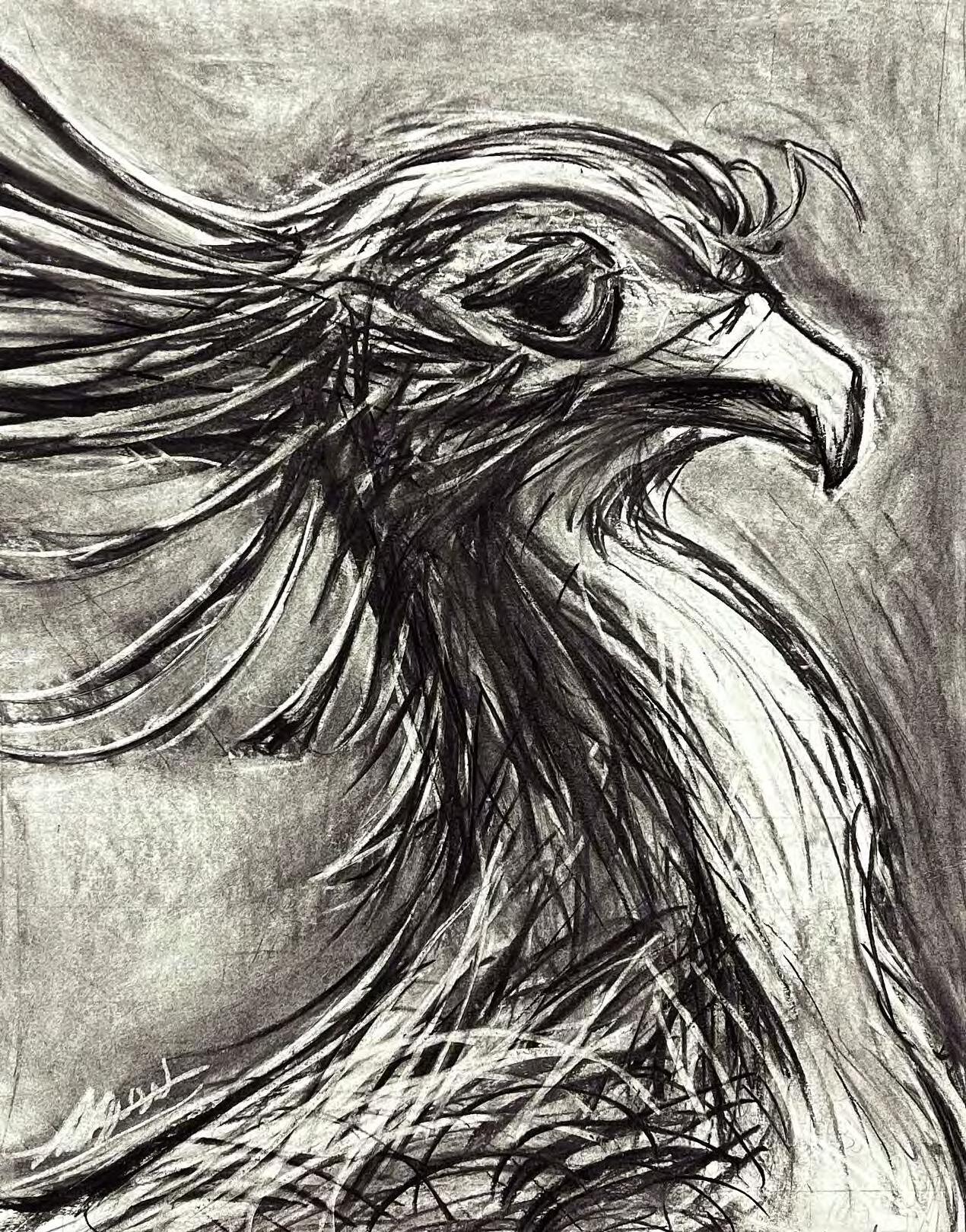
Portrait of a Secretary Bird
A, Grade 9
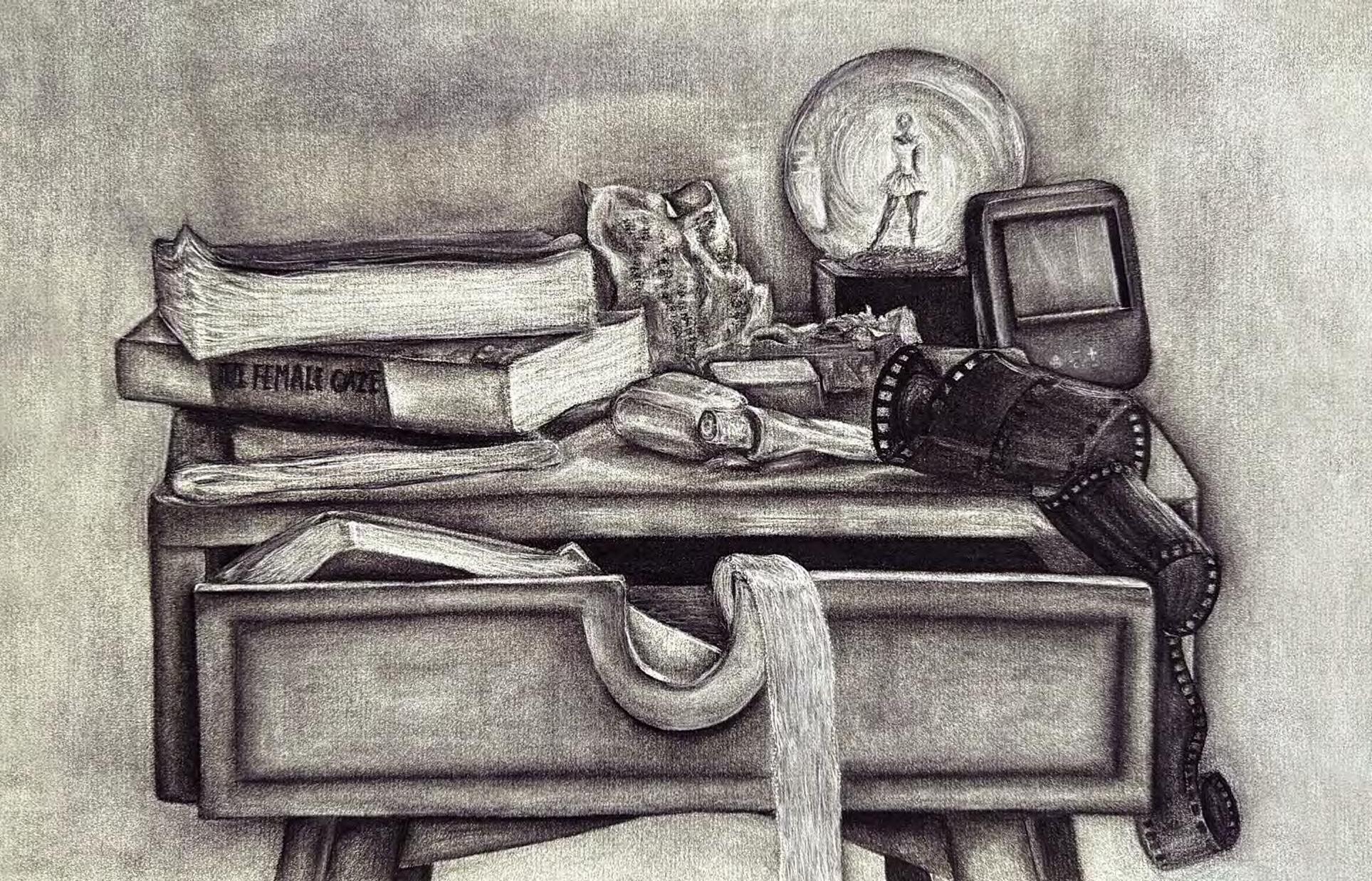
Chaotic Good AARJU F, Grade 11
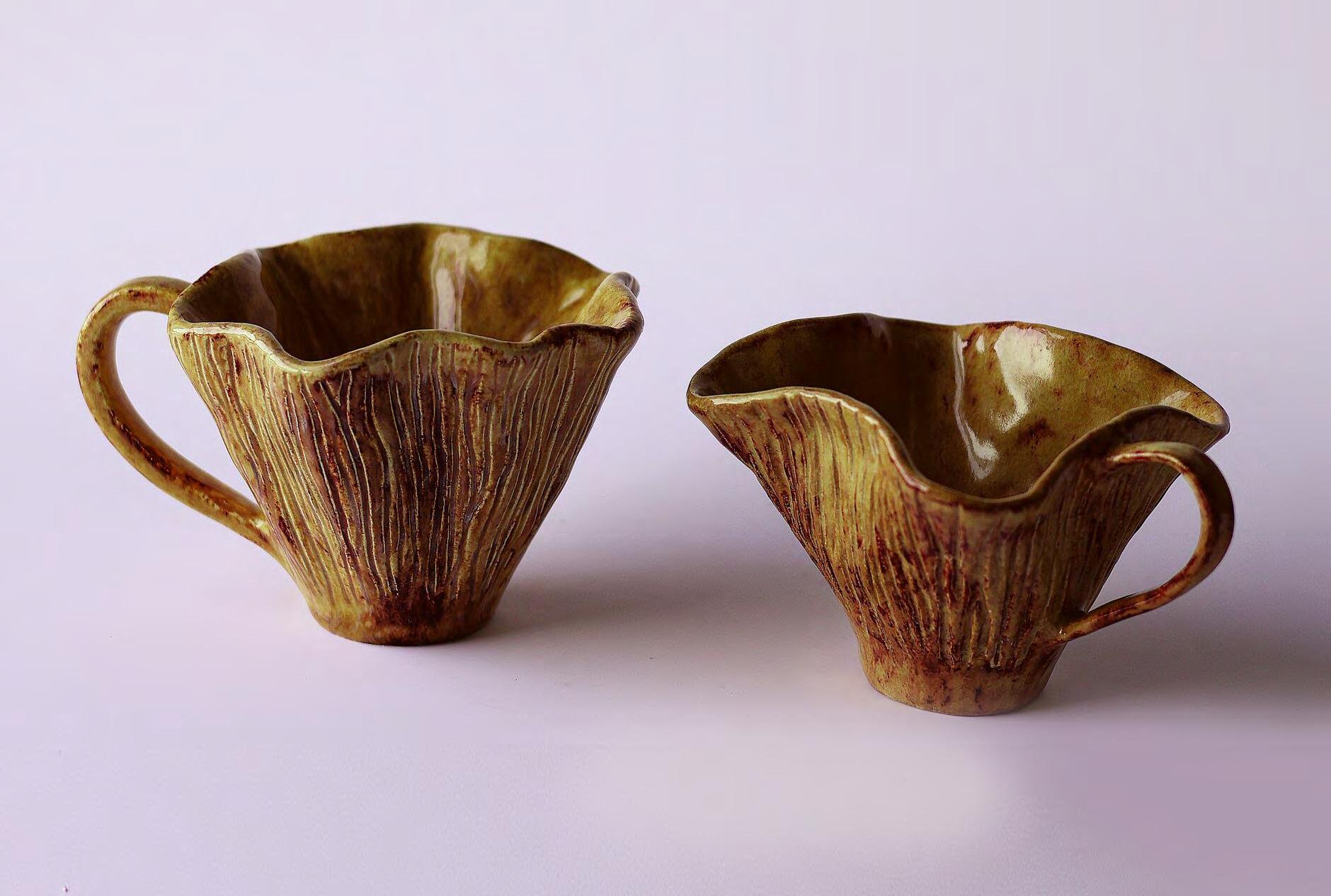
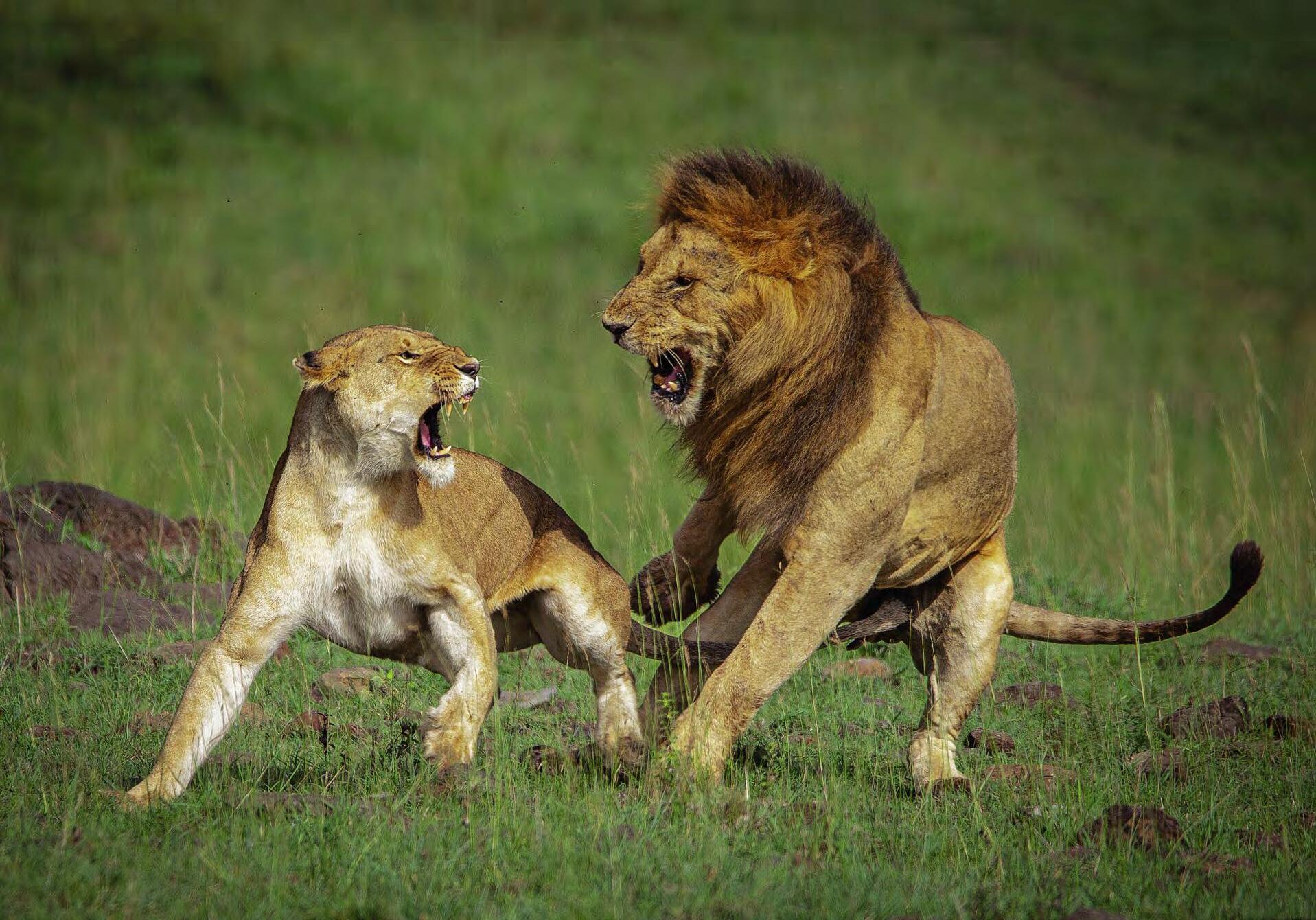
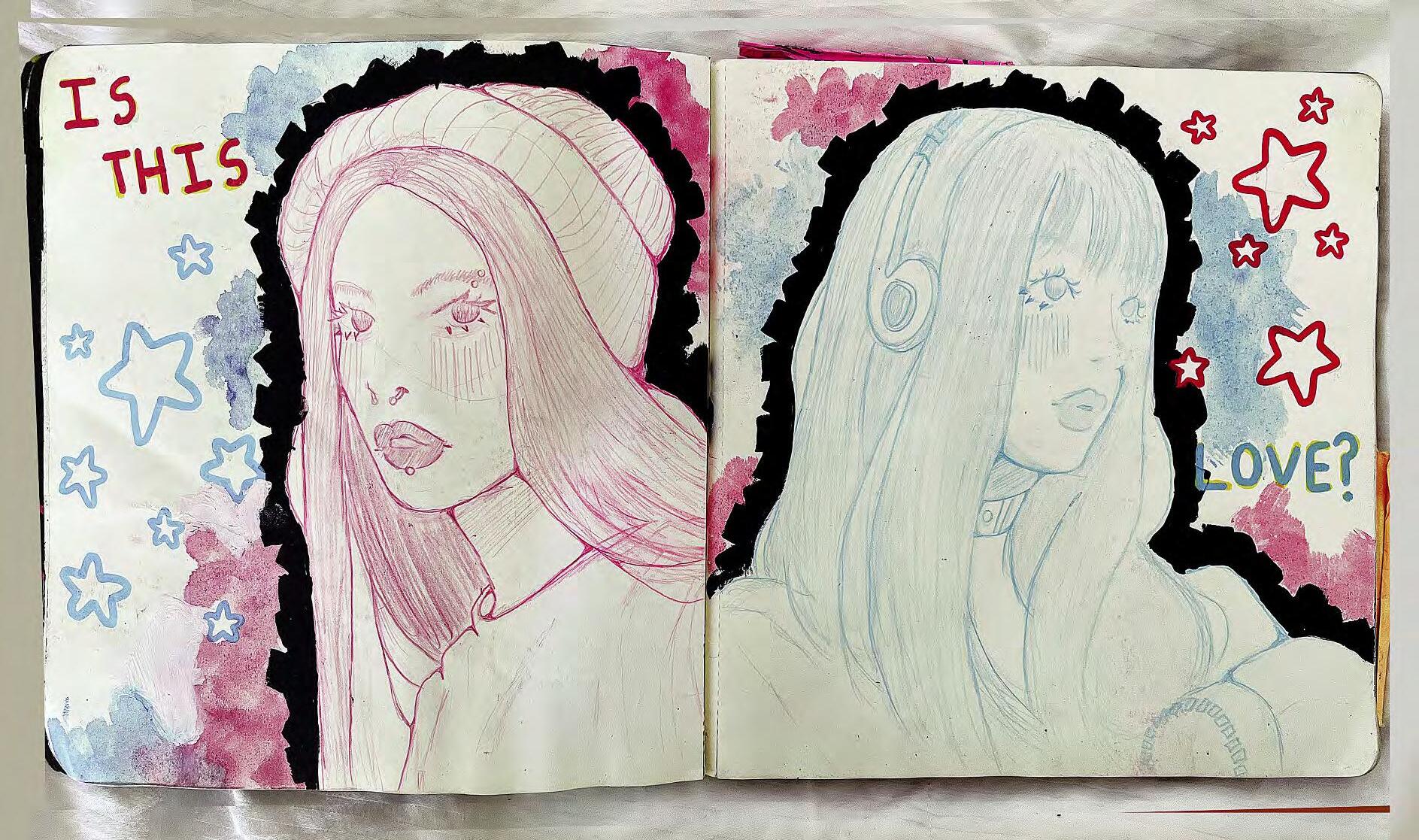
Handmade Botanical Teacups ECHO M, Grade 12 47 Domestic Argument SAM B, Grade 11 49 Is This Love? ZO D, Grade 10
Periscope
C, Grade 9
M, Grade 12 58 I Can’t Handle Change
D, Grade 10 62 Back Up
B, Grade 11
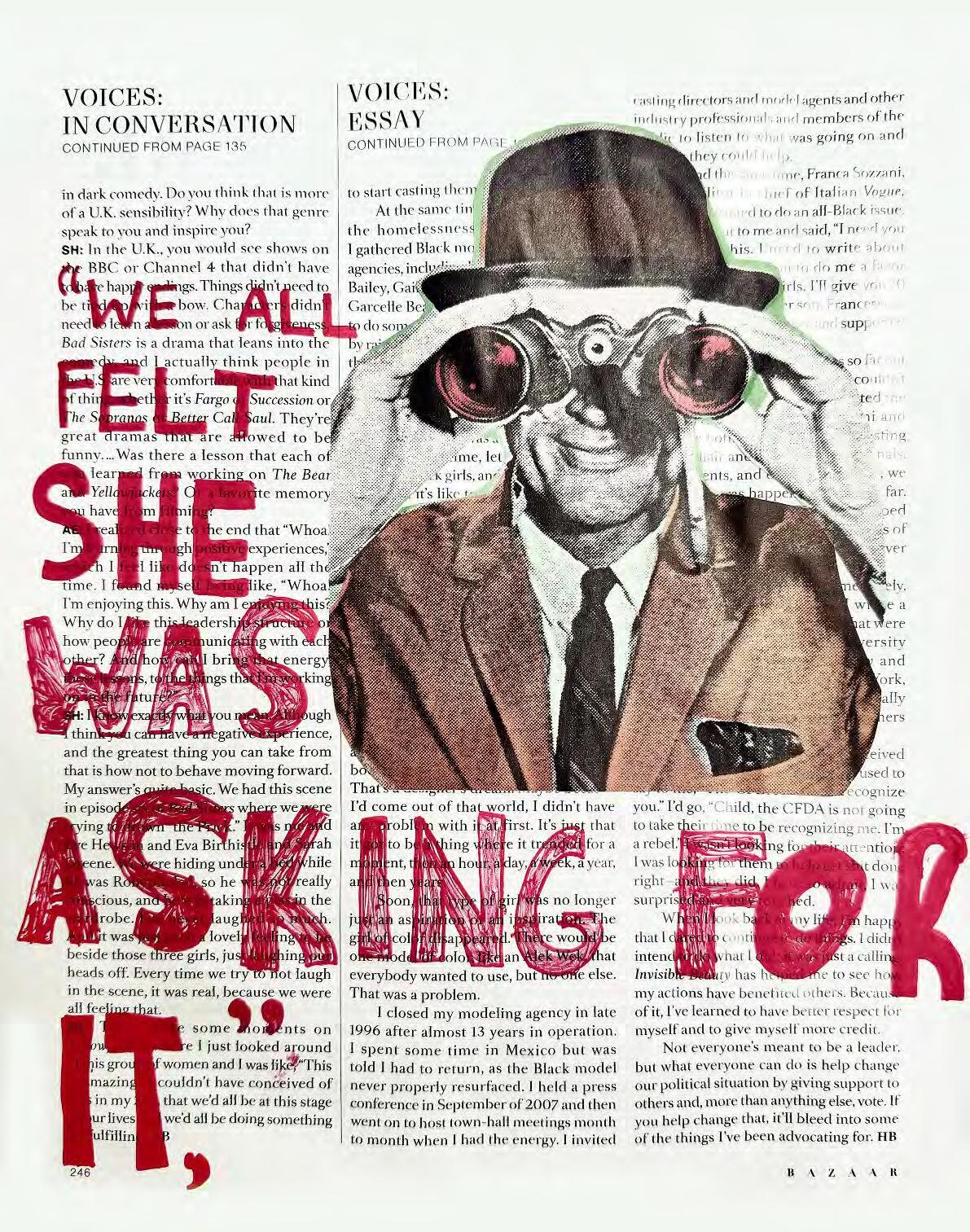
We All Felt She was Asking for It
L, Grade 10
It’s Giving Italy
G, Grade 11
Underglazed Cups with Deconstructed Faces
G andJADA S, Grade 12 & Grade 11
Not Your Evil Cousin, but I Could Be If You Wanted
Kinda
K, Grade 12
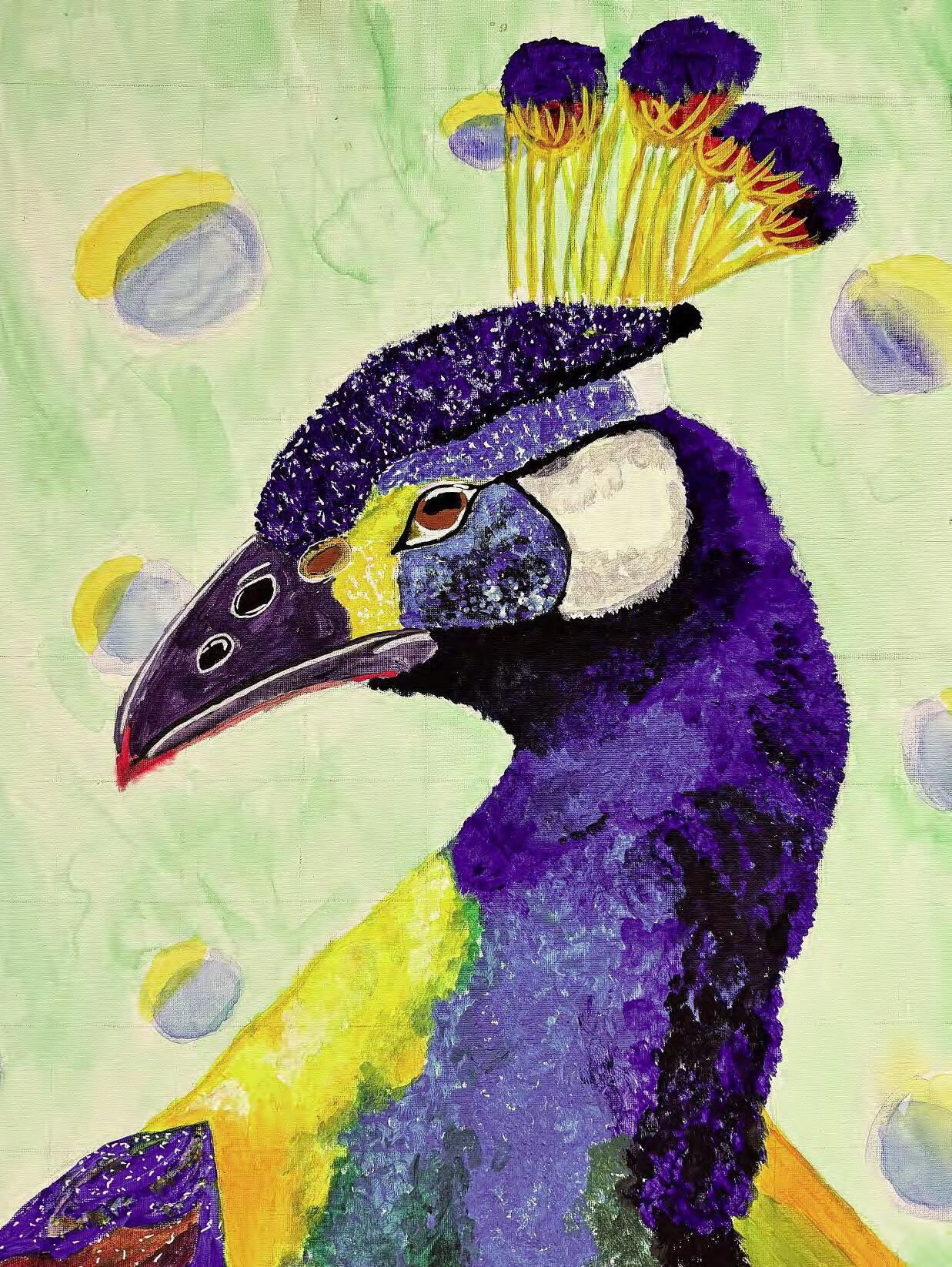
93 Pointillist Peacock CLAUDIA R, Grade 12 98 College Essay
ATHING IS ONLY ITSELF FOR SO LONG. Bread left on the counter turns to stone, stone left in the river turns to sand, sand left in the wind is nothing at all. The sea knows this. It gnaws at shipwrecks like a dog chewing a bone, licks names from the lips of the drowned, swallowing prayers and coughing them up as foam. It is patient. It knows that even the strongest things go weak in time.
A fisherman drags his net through the water, and the sea takes a thread from his sleeve. A child presses an ear to a shell, hearing the sound of fabric thinning, a shirt worn too many times, unraveling at the seams.
Once, a Deity waded in, believing himself woven from something stronger. Something sturdier. Believing himself to be so tightly woven that even the sea could not undo his pattern. The water climbed his shins, his ribs, his mouth, and still, he stood. But the tide is a slow rip, pulling at hems, fraying edges. When the sea let him go, there was nothing left but the current, carrying scraps of divinity out to sea.
And still, as the world keeps ending, the sea goes on.
Tiny People
SOEFI E GRADE 12, FICTION
WE WERE BORN IN THE GROUND.
We feel it’s important to be clear here, for it’s our beginning. We were born in the hard, grotty dirt with no fingernails. We were born dewy and brown and sneezing.
We were a small people. A people fabricated from the dust and skin of our relatives who dwelled on the surface. A fraction of the earth split into our souls and seeped into our marrow when the first of us was marinated against the warm soft loam. And we were content, as well, living among the geckos and eating the ants that God had gifted us. We much preferred being small, for we had heard stories of our larger kin, and all of the smog and plague that ailed them.
But not all of us can be unified, always, even if we wish it were so.
One fall evening, while we heard the wind whistle above us, a baby was born. She was larger than usual, the size of a ginkgo nut at birth. Her mother was weakened by the blow.
None of us knew why the baby was so large. Our priests figured it was either a gift or a reckoning from our gods, meant to teach us an ultimate lesson. Our conspiracists said she was a
transplant from the surface dwellers, meant to expose our home and send us all to death. Her mother, a small woman even for our size, said that she must be the dawn of a new era.
“I’ll tell you, I was endlessly hungry during my pregnancy, and now I see why,” she was heard telling her friends, “I was carrying our savior.”
That girl grew to be very large. As big as the squirrels who sometimes dug into the ground and ate us. When she was five, she was the size of a queen ant. When she was eleven, she was the size of a weevil. She grew petulant, for she could not fit in the walls we had built, and we all molded our lives around her, afraid she might destroy us.
It was winter, a bitter one, with nothing but our hair to warm us, when she got wise.
“Why do we never leave the ground?” she asked us.
None of us had an answer, but some of us tried. Ms. Wheeler said:
“Because up top, the birds would eat us.”
The girl responded:
“But I am soon the size of a bird, and I have fashioned a knife in order to kill those who try to do the same to me.”
.We exchanged nervous looks. Mr. Baker said: “Well, our counterparts—big and strong— may step on us.”
The girl blew out a breath, and the walls trembled. “But what if they don’t?”
As she grew older and bigger, her questions were full of wonderment we could not contain. By the time she was meant to start her secondary schooling, she had the wild notion she would leave us. She figured we were a stupid people for not wishing to explore the things that would extinguish us.
One morning her mother, tired with not enough food to give, found her digging up into the ceiling. She then lined the girl’s room with tin, but she was stronger than us and peeled it off with ease.
Her mother was not the only one who was weary. We were pulled from our families, trying to give her a life as good as anyone else’s, but aiming to keep her from our children, despite their insatiable curiosity about the fourteen-year old-girl who stood two feet tall. We attempted to raise our walls, but there was nowhere for the dirt to fall except for atop our heads. And besides, did we mention, she kept on growing? It seemed endless, and we wondered if she would grow to be the size of the Earth. No matter how much we expanded our home, she would wake the next day and would not fit.
And despite our efforts, we also knew, this was no life for a child. It was evident in her face, when she chewed on the small grains we had to give, when we could not give her the answers she vied for.
“I will leave by the time I’m eighteen,” she would boast, like a warning.
But this was not a threat to us. Some of us claimed she would grow to be as big as those on the surface, and she would doom us all. Some of us wanted her exiled. Her leaving would be welcomed, yet we still feared how it might come. Not one of us could remember a time someone left the ground.
NO MATTER HOW MUCH WE EXPANDED OUR HOME, SHE WOULD WAKE THE NEXT DAY AND WOULD NOT FIT. ,,
Of course, her departure was inevitable as she decreed. In fall, on her eighteenth birthday, she dug her way out in fifteen large scoops. It would have taken any one of us a year.
By now, she was the length of a cat. She was forced to crawl through our dark halls, for there was no room for her to stand. When she saw the light from above, she stood and stretched her hands above her head tall, and we scrambled away, fearful she might forget our size and step on us.
Her mother attempted to call her back, but it was in vain—she could not hear us from so far up. When her feet touched the grass, she crouched down to poke her face in the hole she had made and said:
“It’s beautiful!”
She had a very big impact on our children. They all were excited, had never thought it possible to leave, and now they wanted to follow in her steps. But we were all skeptical. We shouted back:
“It’s beautiful down here, too!” And attempted to cover the hole. But she dug it straight back, stuck her hand down, and tried to grasp us by the hands, by the stomachs, by the hundreds.
“You must see it,” she insisted. “It’s blue and green and brown and white! And there are things here that move—not just the ants and ourselves! Things more than birds and squirrels, which crawl and fly and dance and jump!”
We shook our heads. It was not the life for us. But she would not leave us be.
She eventually left for somewhere we could not see, bored and curious, but she always came back. She would not leave us for more than a month. Reached her hand back into the dirt and felt around if we were still there. Begged us to explore with her. “I miss you all,” she would say into the hole. But in her absence, we forgot the girl we had all raised. We became convinced it was a ploy. We believed she wanted to eat us— she was part of the surface, now, and she could no longer see us as kin.
Two years had passed without her return. We had repaired the hole, and we figured she understood the divide and had resigned herself to find something better and bigger to eat. We held a celebration on her birthday for the fact that she was gone.
But she came back, like she always did. She punched into the ground, searching for us. She came back with her hair shortened and foreign clothes. She came back without dirt on her face. She came back hollering. She came back more human than we ever were.
“I can’t stand to know my people suffer without knowing it!”
She destroyed our home. She pulled the dirt from the earth and tore roots to get to us. She
.stuck her arm in our town and pulled us up by the hair. We screamed and bit, and she held us firm and fast.
“You must understand! Look!”
We looked. The light blinded us, and even then, we knew—it was beautiful. More beautiful than our home. Everything was filled with color, with life, all sustained from our place in the ground. But that scared us. We felt vulnerable, naked with the wind against us where the warmth of the dirt had cradled us. We felt we might freeze. She wrapped us in soft cotton and placed us on her shoulders and the top of her head.
We yelled and hit and screeched. We awed and oohed and kicked and punched. We shuddered and we felt at home and we felt so far from home and we finally felt like we were part of something greater.
A lot of us jumped from her shoulders, clawing at the ground to try to get back. But it was no use, and many of us died in the air, from the shock and the fear, and more of us died on the ground, splat, trying to get in it.
We died splintering, splayed, with the wind between our tendons.
Those of us watching pulled the girl’s hair and pinched her cheek and demanded she let us go. Those of us watching cried and gasped. Those of us watching looked at the birds, and saw them swoop too close.
Our small hearts could not take what hers could; this she did not understand. Our bodies exploded in chunks, our skin turned white with the cold, our limbs fell clean off the bone, our brains told us we had a choice:
Return to the dirt, or perish.
So we perished. For she would not let us go.
And we died in the air, in her arms, falling from the top of her head and her shoulders, in wonderment, in fear, in anger, in sadness, in nostalgia, in hope.
The girl, still a girl, remember, cried at the death of her people. Guilt flooded her and poured out of her eyes, drowning our limp bodies. Her tears flowed into a crater of the earth, picked up our bodies, and dumped us back in the ground, where we began.
PURPLE
argentina
STELLA R GRADE 11, POETRY
ABANDONMENT UNTOUCHED, dim, however, bright, vines joining the roots of shrubs, a lack of adoption, leaves trailing up the concrete.
comfort folded close, waiting to be harmed, a plop a plump a slump, screaming come collapse, still following the path of the wind, a wrap a shield a bundle.
Screeching Violins in F Minor
MIRA G GRADE 10, HUMOR
PICTURE THIS: IT IS 5:15 p.m. on a Tuesday evening, and you have just found the will to start your homework. You collapse into the couch, perfectly poised to go on Spotify and click your playlist: a chaotically curated blend of indie pop, indie rock, and my-sister-found-thison-TikTok. And then suddenly, and without warning, you hear your dad say: Alexa, play WQXR radio.
That name may sound unfamiliar to those of you who are lucky enough to have normal fathers, listeners of Billy Joel, Bruce Springsteen, or Stevie Nicks. WQXR is THE classical music radio station, best listened to while drinking a cup of lukewarm water and writing with an unsharpened nub of a number two pencil.
Classical music is awful. It stresses me out— give me blaring drums and scream-metal any day. When I’m studying for a Mandarin test, I would much rather listen to German techno than screeching violins. All of the strings and minor keys of classical music end up giving eternal purgatory energy. Imagine that your nice little homework room turned into a combo grandparent’s moldy living room/doctors’ office waiting room. Also, what is up with the titles of these clas-
sical music pieces? Hearing “Some String Instrument Sonata 3462 In G-Minor” does not tell me anything about a song. And that is because of a little secret I’m going to let you in on: they all sound the same. Oh sure, there might be a mood switch recognizable to the more musically gifted—snobs—but for all I know, “So and So in G-Minor” could be in A-flat-majorminor and I would not bat an eye.
There is no nuance in classical music artists, either. All of the artists sound the same. Every song consists of: build up, fall down, bam on the keys. While trying to listen to classical music to annoy myself for this piece, I only managed to
WHEN I’M STUDYING FOR A MANDARIN TEST, I WOULD MUCH RATHER LISTEN TO GERMAN TECHNO THAN SCREECHING VIOLINS.
.make it 17 seconds through Mahler’s unfinished symphony before I crammed my earbuds into my ears and blasted Charli XCX at full volume to cleanse my soul.
Classical music just sounds bad. No matter the sound quality of the speakers, classical music sounds like it is being played on a halfcracked CD player embedded in a mountain surrounded by wasps next to a loaf of white bread. What is the appeal of that?
But the worst thing about classical music isn’t the stress-inducing screeching—no, the worst thing is classical music enthusiasts. Classical music enthusiasts think that they have immaculate music taste, and that they MUST pass it on. And those poor little babies raised on classical music can never listen to anything else: no drums, no beat, no voices that aren’t soft and quiet.
This terrible effect of what I call classicalmusicitis is directly backed up by firsthand evidence! When my dad was a child, he too was subjected to classical music. While he lay on the living room floor doing his homework, his parents would play WQXR on their radio—sound familiar? As a child, my father did not especially like the Beethoven, Bach, and Schubert that his parents would play for him. But now that he is
an adult, the effects of this abysmal musical education have fully sunk in. When I am listening to music with my father, I have to skip almost every single song on my playlist. Any song I put on is going to have too strong a beat, too many drums, too-loud singing, too much guitar, or even just “ungrammatical lyrics.” 1
But this raises a disturbing question. Will the effects of classicalmusicitis set in for me, too? Is this whole hatred of classical music meaningless, and only delaying the inevitable onset of classicalmusicitis in my middle age? There is no way to know for sure, but I believe that I can be the Goldhaber to break the curse.
Now that I have established that I would rather drown in a tub of room-temperature strawberry Jell-O than listen to classical music, I have a few suggestions for how to fix it. A recent and beloved discovery of mine is techno remixes of classical music. Turns out that adding a beat REALLY makes a difference—who could have guessed? But there are so many other variations on classical music. There are amazing pianists who combine hip-hop and classical. There is artpop classical (thank you, Bjork!). And, after all this, what if you still really really want to listen to some lovely instrumental music?
Just listen to jazz.
1 He got especially offended by a line in one of my favorite Remi Wolf songs—“We can lay around”—because it used the word lay instead of lie. This is incorrect because lay only takes an object, you can’t LAY around, you have to lay something somewhere. The correct way to say this sentence would be “We can lie around.”
Topaz MADELEINE K
GRADE 9 ACRYLIC
L xW
CLARE M GRADE 12, PERSONAL ESSAY
I’VE COME TO FEEL CONFINED within the distinct lines of my neighborhood: Flatbush Avenue, Prospect Park West, Prospect Expressway, and Fourth Avenue, which I used to cross in fourth grade with my friend, Sydney, to go to Staples. Neither of us were allowed to leave Park Slope. I felt rebellious. But it’s not that I don’t love home,1 Park Slope,2 or my High School, Berkeley Carroll.3 It’s about my contempt for rectangles,4 tiles, 90° angles, routine, and homogeneity.
I developed this feeling at the beginning of my competitive swimming career, a sport I allowed to become characterized by its playing field, a water-filled, imprisoning rectangular cavity. Pools were the first quadrilateral I demonized—for several reasons, some completely invalid and others less so. But I noticed rectangles as a pattern that followed or trapped me in my everyday life.
The LIU pool,5 where I trained five nights a week and one early morning, made me feel like every time I dove into the water, it would solidify
above me, leaving me trapped. I swam backstroke looking up at the fluorescent lights and realized that the scariest thing would be coming back tomorrow, and then the day after. I prayed I would fall sick with pneumonia or something else that sounded serious.
Swimming was a distinct part of my identity, and a distinct rectangle you could draw around ages ten to fifteen if you were to write all the years I’ve completed in chronological order. I never found comfort in the set distances and
I PRAYED I WOULD FALL SICK WITH PNEUMONIA OR SOMETHING ELSE THAT SOUNDED SERIOUS.
In theJaws of anAngler AUGUST A GRADE 9, DIGITAL
walls of the various pools around the city.6 Instead, the smell corroded my nostrils and burned my throat. The transitions were always too jarring within such a confined and uniform space. From block to air to deep water. From 0 to 25 meters to flip to 50. From hands on the wall to hoisting myself up, exposing my shivering body to those around me. From walking to diving, kicking, pulling, stroking, and turning. From Park Slope to Fort Greene or Medgar Evers. I would escape from the water-filled, rectangular cavity to thrust my body against the bathroom’s heavy doors,7 so I could sink into a stall and stare up at the green and white tiles8 surrounding me—just to breathe for a moment, without the pressure of water.
I was a mediocre swimmer at best—which, given my generally insecure and anxious personality, made for a pretty intense period of constant self-deprecation.
But the issue was never really swimming, it was pools.9 I found it nauseating and pointless to swim back and forth in a yard pool. I quite literally felt stuck: in the sport, the routine, and in the shallow connections I had on my team— where the girls were funny, but we were middle schoolers at our cores, insecure and catty. I spent my laps looking down at the thick tile line
to my left,10 thinking about my own sense of belonging. Everything around me was sickeningly familiar: the relentless tick of the clock and the cycle of practices, meets, and recovery, the pep talks from coaches begging me to give all that I could, when I had lost all drive.
I quit the swim team in my freshman year of high school. I sat down for dinner with my parents one night, and they asked me how swimming was going. The conversation ended in tears. I’d stayed so long because I was afraid to
7 80" x 36"
8 2" x 2" 9 25 m × 18.29 m / 50 m x 25 yd 10 .5 x 25 m
Everything around me was sickeningly
familiar: the relentless tick of the clock and the cycle of practices, meets, and recovery, the pep talks from coaches begging me to give all that I could, when I had lost all drive.
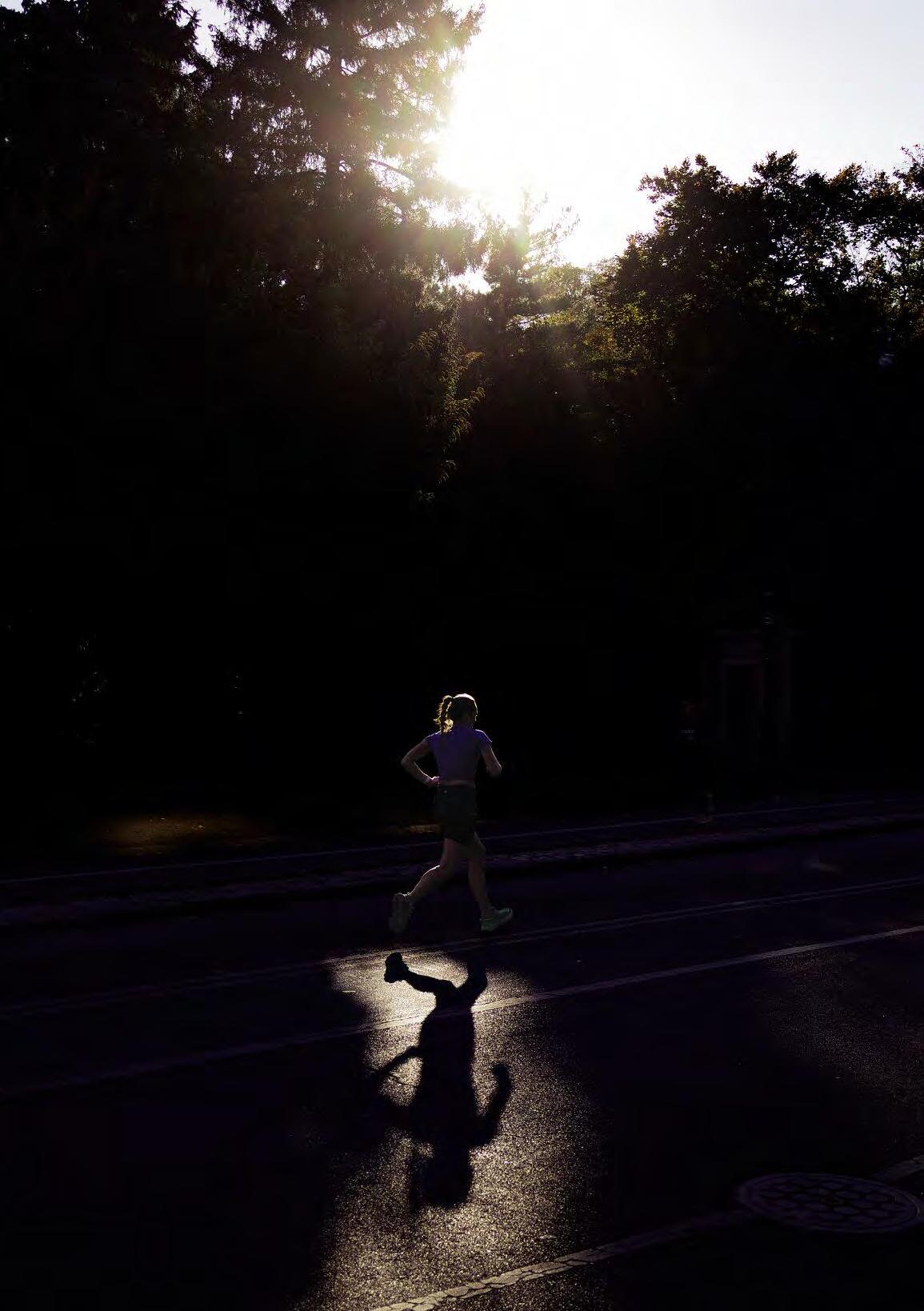
Running Through the Light
ARMAN
PHOTOGRAPH
let go, afraid to walk away from something I had invested years in. We crafted an email to my coach that night explaining: “Clare has decided to quit swimming,” and “it was a tough decision,” but it’s “ultimately best for her health.” I felt guilty—like I had led the sport on.
When I quit swimming, I didn’t realize that it wasn’t the sport itself but the sense of being confined to a pattern, or a rigid routine of competing, comparing, and conforming. When I slid into the local YMCA pool “MEDIUM-FAST” lane,11 it was no different. There was no real pressure or stakes. Yet I couldn’t shake the feeling that I was somehow out of place or unwelcome.
I’m still wearing my too-small-freshman year hot-pink swimsuit and a white latex cap. I am fast compared to middle-aged men with bare hairy chests, and so, so much slower than the tall girl in the “FAST” lane to my right. I feel like I’m back at LIU. I’ll swim for 20 minutes and race the girl beside me, but she won’t know.
Outside of any rigidity or routine, swimming in the ocean is one of my favorite things. The vast horizon and continuous waves couldn’t be more different than rectangular prisms. Every late August I spend my afternoons playing with
eight-year-old Eve, my cousin, and four-year-old Everly, her friend from day camp. I lift them over waves and guide them through their first experiences on our family’s well-loved boogie board. I can’t understand a word that Everly says. But when we stand together in the white waters of the waves, and she raises her hands high above her head and squeals, I respond by lifting her up to eye level. Then, we have done all the communicating we need.
This summer, I began swimming with my brother and grandfather to the far buoy about a quarter mile from shore. I remember getting my first invitation to swim to the buoy. It was as if
I remember gettingmy first invitation to
swim to
the buoy. It was as if my father had cracked open a cool Narragansett beer and invited me to the driving range.
11 25 x 18.5 yd
my father had cracked open a cool Narragansett beer and invited me to the driving range. It is the ultimate symbol of coming of age. My cousin William, age 12, will ask to come but will not be allowed. We swam with our heads out of the water, usually talking about what was for lunch that day as we moved farther from the tall white lifeguard chairs and the tall white boys standing on them. We were only a quarter mile out, and we could swim for hours without touching, or seeing anything. I watched the shore: the yellow and white umbrellas and young children running across the sand while chasing each other with sticks, torn from the fence separating the beach from the dunes. It felt so much simpler by the buoy.
Back in Park Slope, I can’t just swim away. There’s a concrete and asphalt grid, outlined in grey on my phone’s map. From Flatbush Avenue, Prospect Park West, and Prospect Expressway to Fourth Avenue. Berkeley Carroll, YMCA, home, flip, and double-hand-touch. From hands on the railing to calculus. From swim to Park Slope, kicking, pulling, stroking, and turning.
There’s no vast horizon, or deep water, to sink into. That is, unless I wanted to take a dip in the Gowanus Canal, a Superfund site where the
Only a quarter mile out, and we could swim for hours without touching, or seeing anything. I watched the shore: the yellow and white umbrellas and young children running across the sand while chasing each other with sticks, torn from the fence separating the beach from the dunes.
backstroke comes with a side of chemical runoff. But there’s something about Prospect Park, past the Prospect Park West border, that feels like it might offer the same kind of escape. At its core, the winding trails and lack of boundaries are far from rigid.
So I spend 4:00–6:00 p.m. on weekdays outside of my rectangle.12 Once I break the border of Prospect Park West—which sometimes requires an acrobatic move over the limestone border—I
12 ~6,336' x ~5,280'
13 17,688'
Glimpse
focus on hurtling up Prospect Park’s half-mile-hill and weaving in and out of the park on the edge of Windsor Terrace. Part of it is that, well, I am on the cross country team and if I miss another practice Mr. Huffman might just send me another Google calendar invite to a meeting where I promise: “Yes. . .I’ll start filling out the absent form” or “Sorry. . .I won’t miss any more practices.” Terrifying. But, the other part is that Prospect Park feels distinctly far from home.
Once I cross my final corner and enter Prospect Park’s 3.35-mile loop,13 my inertia is continuous; I don’t stop and turn, flip, and double-hand-touch. Instead, I visualize the map of the park—the trails, lakes, and paved paths— mentally planning my route for the number of miles I’ve set out to complete that day; never out and back, never lapping, and never straight lines.
Maybe, sometimes, I lap. But only on bikes. Last spring, I would ride up to four laps of the park, just over 13 miles, where all I did was try to think about how fast I could go and how my fingers were growing numb. Sometimes I audibly cried rolling down the hill starting at 15th Street, turning my handlebars ever so slightly left, counting my loops, and declining my father’s calls. By mile 6.7 my breathing had usually evened; my movements became fluid, and the cadence of my pedals shifted into even strokes. From outside my rectangular room, pill box, neighborhood, and school, I’ve broken my confinement. I turn my head over my left shoulder, and I look back at the hill I’ve just completed, checking for other cyclists before I turn.
.Pantoum: A Tryst with Resilience
EMILE C GRADE 10, POETRY
THE RED, THE BLUE, THE ORANGE, PAINTINGS OF STRUGGLE, ENDEAVOR.
Burning light, ashes contoured to believe.
The red, the blue, the orange, paintings of home.
Distorting the darkness with hope to prevail, Etchmiadzin the sanctuary.
Burning light, ashes contoured to believe.
Scents and aromas escaping through the desert, Deir ez-Zor.
Distorting the darkness with hope to prevail.
Luminescence from a candle, only visible in wavelengths.
Scents and aromas escaping through the desert, Deir ez-Zor.
Radiance from the blaze, only initiated by ignition.
Luminescence from a candle, only visible with wavelengths.
Element of destruction, given to humanity through a sacrifice, Prometheus, the creator.
Radiance from the blaze, only initiated by ignition.
The wax wilts toward the catcher, and the smoke blows toward the heavens.
Underlying element, given to humanity through a sacrifice, Prometheus, the creator.
The red, the blue, the orange, paintings of home.
One of Us
LAKE SP GRADE 12, PERSONAL ESSAY
IMET JACK SHEEHAN IN 2021, my first year of high school. He was 6'4", with a lethal collection of streetwear that left a cloud of swag behind him everywhere he went, like the fragrance of WT McRae;1 from the moment I first saw him, I wanted to be him.
I was 15, which means it must have been the latter part of the school year when I initiated diplomacy with the (then) junior;2 perhaps it was March or April, by the lockers outside BC’s cafeteria doors, when I noticed the young man taking comically large strides in his True Religion jeans, jeans I felt compelled to compliment him on. In response, he squeezed out a high-pitched, “You like ‘em brouu?”3 through the nearlyclenched teeth in his face that formed a massive grin, appearing as though he were priming his face to break out into laughter.4 “SEVEN BUCKS,” he continued, one and two-fifths of his hands spread open to communicate their cost to me visually. “L-TRAIN, bro.” I didn’t know they
sold anything for that cheap in Park Slope,5 let alone a gem like Trueys. My jaw dropped, and my face creased into a smile. I let out a “NAH, WHAT,” stumbling as a wave of middle schoolers pushed the two of us back on our journeys through the passing-period.
I DIDN’T KNOW THEY SOLD ANYTHING FOR THAT CHEAP IN PARK SLOPE, LET ALONE A GEM LIKE TRUEYS. MY JAW DROPPED, AND MY FACE CREASED INTO A SMILE.
1 They wear pungent cologne or perfume. I don’t know how WT actually smells.
2 My birthday is in February, the 27th if you feel like wishing me blessings.
3 /’brō-oo/
4 That may have been, and may still be, his favorite facial expression.
5 Hyperbole.
The Urge to Create Stuff
ALEXIS SG GRADE 12
PIXEL ART
.During the following weeks, Jack and I started a volley of sartorial kudos—introducing each other formally and revealing more of our personalities to each another at each path-crossed exchange of flattery. One day, as I was walking back from my Intro to Acting class at Sterling place, he invited me to eat lunch with his friends at the conservatory. Naturally, enchanted, I agreed.
My only memory of the lunch period is a visual of Jack’s friends giggling at some joke I crafted meticulously, an image quite telling about how I perceived the situation. For 15-yearold-me, this lunch was an audition. I wanted a part in this dude’s life, and getting it solely depended on the group’s reaction to me. Whatever success I had in that front would prove worth in my character; it meant I would get to pretend like I wasn’t younger than they were.
(*w*)
I’d venture to say that as a high schooler, it is universally ego-boosting to be accepted by a group of kids older than you, worthier, higher status than the rest of your cohort. As a freshman, being underclass (mind the context) was palpable for me. I, alongside most people 17 and 18 now, was intimidated and confused three years ago; older kids seemed so sure of them-
selves in comparison to me, so having the opportunity to cosplay as one felt like a cheatcode to self possession. I mean, it mostly was! I was used to a kind of perpetually joking way of carrying myself, having once or twice undergone introspective conversation with my freshman friends. Jack’s group took things more seriously than I was used to. In assimilation, I started to treat conversation with more respect, entering them more and more often prepared to listen to something my peers were struggling with.
Being in Jack’s group felt like being drafted into some exclusive league of steez, a space
,,For 15-year-old-me, this lunch was an audition. I wanted a part in this dude’s life, and getting it solely depended on the group’s reaction to me. Whatever success I had in that front would prove worth in my character; it meant I would get to pretend like I wasn’t younger than they were.
where every exchange carried an unspoken acknowledgment of your belonging. It wasn’t just the laughs or the inside jokes, though those were currency too—it was the sense that I was one of them; I was sharp enough to volley banter and genuine enough to share the weight of conversations that mattered. Walking the hallways with them felt different, like each of my footsteps carried a little more weight, a little more rhythm. It wasn’t that I stopped caring what people thought of me; moreso, I started believing I was their version of me, and that brought me more worth. I was one of them.
Saying “I just feel . . . *sigh* more mature than the other guys my age” has never looked cool (and I hesitate to believe it’s ever been true), but, in starting to hang out with them, I started to think it of myself. Let me say that I no longer hold this opinion, and I do hold that my supposed maturity was fallacious;
This is for two main reasons:
1. My “maturity” only existed externally, fueled by a collection of opinions about me that I consciously tried to control. For the first while of hanging out with Jack and Co., I only presented the most cerebral corners of my personality, which
6 I watched Wicked for the second time this weekend. I cried half as many times as the first viewing (two and a half times).
I was sharp enough to volley banter and genuine enough to share the weight of conversations that mattered. Walking the hallways with them felt different, like each of my footsteps carried a little more weight, a little more rhythm.
is genuinely so amusing to think about; like, when they would share something serious with me I would act all, “That really pains me to hear. Myea.” Like Galinda or something.6 Genuine reactions like that would be someone’s response to serious experiences, someone feeling intense hurt in connection with the subject; my reaction was merely to appear as such.
2. I’m not even that mature now!7 I mean, unlike my freshman-year self, I can exist in a vulnerable space without the need to crack a joke, but I still don’t have a clue how to respond when someone tells me their dog died, or their parents are divorced; my lack of discipline makes it so I have to wake up early and finish writing essays while my regular morning alarm goes off; I really want to be 6'1",8 and I honestly can’t picture myself befriending a freshman. (*_*)
Within a year or so of meeting Jack, my conversational performativity started to melt. I could be immature with him and his friends, and they’d love me for it, finding particular amusement in banter of competitive stupidity between Jack and me:
“Guys, I just peed completely silently. It was so tough,” I once said, flicking Jack’s bathroom sink water on his shaved head.
“Yo. That was MAD SILENT of you.” Jack responded, clapping.
I suppose all this is to say that the group’s willingness to accept me separates them from most 17-year-olds, myself included. In writing this essay, I’ve come back, again and again, to the question, “Why did Jack invite me to lunch? I would not have randomly befriended a freshman last year.” So I texted and asked him, to which he replied,
“idk, u were lowkey chill.”
“No like fr”
“Lmao bra what do u want me to say”
“Well wouldn’t it be like embarrassing to befriend an underclassman? Thats what im tryna get at”
“Ig if you’re looking at them like an underclassman.” (…)
7 Saying that may be more mature.
8 Not even 6'4" just 6'1", God, please?
BE SELF[ISH/LESS]
KADEN W
GRADE 12 COLLAGE
Chaotic Good
AARJU F GRADE 11, CHARCOAL
Proud
ELLE C GRADE 10, PERSONAL ESSAY
DAD TAKES THE BEST SPOT FOR getting work done. It doesn’t matter that there are nearly identical places to sit around literally the exact same table—that’s the best one. His fingers race against the keyboard; clicks can be heard from a few feet away. Heavy notebooks and folders—my school supplies—fill my arms, until I dump them all on the table beside him. I study, he works; I get distracted, he doesn’t; I go back to my homework. Hours pass. We get up and he makes us both eggs for lunch while I flop dramatically into a tall, black chair at the counter as if I hadn’t been sitting in one right behind it less than one minute ago.
“Productive morning?” he asks.
“Yup. Feeling confident on math but unsure about science.”
“You’ll keep working until you get it.” That’s not a question. It’s not even a command. It’s simply his prediction of what will happen, an acknowledgment of an attitude toward work I’ve watched over and over that I wish came naturally—I’ve tried so hard to adopt it. When he says it, I feels like I have. He gives me a smile before returning his gaze to the stove. Here, I can tell that he’s proud of me.
It’s 7:00 a.m. on a Saturday, but Dad and I are both awake because I inherited his sucky sleep schedule, and anyway there’s a soon-to-be-barking dog that needs to go on a walk and play way more fetch than can possibly be perceived as reasonable. So I grab my oversized sweatshirt, and he puts on a winter hat, even if it’s 55 degrees outside. (He’s a self-described “cold baby”.) Off we go! As the dog pulls us to Central Park, I tell Dad about my classes. He smiles, nods, and asks questions, and offers unasked for and shrugged-off advice, the type I’ll begrudg-
IT’S 7 A.M.ON A SATURDAY, BUT DAD AND I ARE BOTH AWAKE BECAUSE I INHERITED HIS SUCKY SLEEP SCHEDULE. . . ,,
ingly come back to later. He sings a little for no particular reason, off tune and to the wrong lyrics. I make fun of him, but we both know I can’t do any better. Eventually, I ask him about his investment firm. It takes a while to get here since I like to talk about myself, and he likes to listen to me. He starts telling me about a deal he’s working on; I ask about costs and margins— something he’s taught me about in the past—and he smiles. Here, I can tell that he’s proud of me.
Dad and I are waiting on our comfy couch for the other half of our slowpoke family. We’ve claimed the two best spots, the corners facing the TV, and I’ve claimed the wonderfully soft orange fluffy blanket.
“Where are they?” Dad grumbles, eager for them to arrive so that we can watch the best TV show in existence: Survivor.
“I know.” I share his impatience.
I pick up my phone and incorrectly text the family group chat: “Guys! Hurry up! We’re board! And Uncle Mike said the new episode is fablous! (my word not his)”
Dad peers at me from under his reading glasses. “Elle, honey,” he says in a concerned, but not unkind, tone of voice, “You used the wrong type of ‘bored.’”
“Oh.”
“And ‘fabulous’ was spelled wrong too.”
“Oh.” Damn it. His tone sharpens slightly, “You have to work on your spelling, honey.”
“Okay, Dad.” I mutter into my phone, slouching against the couch cushions. I stare at Pinterest but don’t process it, shame tight in my stomach. It’s not a big deal. It’s good he pointed it out. It won’t happen again. Oh, who am I kidding? I always make those mistakes, and he always comments and I can’t seem to get better, so why am I trying? But it’s fine, spelling isn’t important, and even with this glaringly obvious fault I can still make him proud, right?
A few seconds pass; Dad rubs his hand against his face, his equivalent of asking the universe, “How do I fix this?”
“I really didn’t mean to upset you honey.”
“It’s fine Dad.” I’m still staring at my phone.
“I just. . .”
I make eye contact.
“I know, Dad.” I say, tone softening. He sighs, continuing his search for the right words. I’m surprised he’s trying—he hates conversations like this.
He lands on, “It’s fine if you’re not great at spelling. Everyone has strengths and weaknesses.”
I smile, “I know, Dad, thank you.” I might not always be perfect, but that’s okay. Here, I can tell that he’s always proud of me.
Handmade Botanical Teacups
ECHO M
GRADE 12, CERAMIC
House of Swing
TESSA G GRADE 10, PERSONAL ESSAY
THE MUSIC SWELLED AROUND ME, each note unexpected, every song emerging like a butterfly from the chrysalis—beautiful and unrecognizable except for the melody at its heart. He had in fact played a song about every major American city besides New York. Still, I was entranced.
In a vague sense, I’ve always known jazz. For as long as I can remember, it’s been what my dad plays as we eat breakfast or dinner; it’s in the background, yet somehow still swirling around us as we discuss what we’re going to do or did with our days. I wish I could say this instilled a lifelong love, or at least appreciation, for the genre, but that really isn’t the case. Sure, I can hum “Take the ‘A’ train” and sing “Autumn Leaves.” Such good that does me. It was only recently that I began to truly listen to jazz.
I started with Laufey—let’s not argue about if she’s actually jazz—then moved on to Ella Fitzgerald, Nina Simone, and a whole host of jazz standards. I shockingly discovered that I don’t hate men singing as a whole, just in pop music. I even made my 2024 goal to learn how to scat, which clearly hasn’t happened, but I’ll do
it next year! So, when my aunt came to celebrate my 15th birthday with an eclectic list of possible adventures, I jumped at the opportunity to see a live jazz performance. We took an hour-long subway ride to see the Joshua Redman Group at Jazz at Lincoln Center, “the House of Swing.”
Jazz at Lincoln Center is not, in fact, at Lincoln Center. Upon arriving at the plaza, we were told the performance was actually in a building a good ten minutes away, although we of course made it in five since we’re New Yorkers. Despite the added stress, I was relieved to get away from the sparkling opera and ballet
JAZZ AT LINCOLN CENTER IS NOT, IN FACT, AT LINCOLN CENTER.
houses. I’d already begun to imagine the ways I would be out of place, fixating on a worry I’d had for a while. What if I just liked the pretty tunes? What if I couldn’t appreciate the actual complexities? My musical education has told me it takes a great deal of talent to play and sing jazz, and if I couldn’t play it, maybe I couldn’t really enjoy it. But my thoughts were cut short as we rushed to our seats. From the far back of the rafters, the whole theater was below us. It felt like I could reach up and touch one of the dimming lights.
A single note floated through the air, electrifying with its possibility, and the band began to play. It was mostly Joshua Redman on the saxophone, hitting high notes that should have been squeaks, playing them in rapid succession. This was the type of music that would make me say “wow” before asking my Dad to play something less intense during our meal. It’s different, I realized, to listen to jazz in person. I was impressed, but as the first song ended I felt like something was missing.
As if to answer my feelings, he picked up the microphone, and I groaned internally while he told an ostensibly relevant, but exceedingly boring, story about himself and used the word ostensibly three times. I concluded that his words were the least interesting thing about him.
One chord from the piano, and Gabrielle began to sing. Immediately it clicked for me. This was the missing piece; this was what I needed.
Then, he introduced the band. It was the regular shtick: “on the piano, on the drums, on the bass,” until he pointed to the singer. “Gabrielle Cavassa. From that microphone, she sings poetry.”
I am self aware enough to know when to eat my words.
One chord from the piano, and Gabrielle began to sing. Immediately it clicked for me. This was the missing piece; this was what I needed. On paper her melodies were simple, but they wouldn’t be on paper because she was absolutely riffing and improvising them. It didn’t matter if what she sang was simple; her voice was gorgeous. She flitted naturally up and down the octave, somehow keeping the same smooth-light
tone throughout. Nothing she sang was particularly high, but her bottom notes had a rich timber, and on the top notes her voice seemed to float around us, carrying through the louder saxophone and constant drum beat.
In choir, we’re warned against creating a wall of sound, where the technically correct music comes at you straight on, with no variations from the transcribed volume. Yet this loudness was anything but. It felt more like a wave, ebbing and flowing, coming to a peak near the end of each song. It was always followed by a dissolve back into layered melodies, ending on high notes that
What mattered was that I, along with everyone else in the room, was listening, feeling the emotions of every piece and enjoying every moment. That’s the price of entry. Emotion.
I could only listen to in amazement.
For the next thirty or so minutes, I was falling in and out of a dream state. I let the music wash over me, resurfacing when Joshua played a particularly spicy measure, or Gabrielle sang something which made me come to the conclusion that I was quite possibly in love with her. I felt like I could understand the spirit of the music, like I got it. I didn’t need to understand the technical elements or be able to sing jazz myself. What mattered was that I, along with everyone else in the room, was listening, feeling the emotions of every piece and enjoying every moment. That’s the price of entry. Emotion.
And then it was over. They played their last chord, and the audience rose for a standing ovation. I sat there, shocked. What. How could it be over?
As we stepped outside into the cold air, I felt like the melodies were still swimming in my head. The crunchy harmonies of honking cars. The beat of a subway rumbling below our feet.
Sensing my tiredness, my aunt decided to be kind and let us hail a taxi. As the nearest cab slowed to a stop, I heard what the driver was listening to.
You must take the A train . . .
Domestic Argument
AFNG
ALEXIS SG GRADE 12, POETRY
ONE YEAR,
I was an oscillating depression of attraction. I found two cures and learned to echolocate. They were a canyon I could smile in.
Kiss-marks on circuitboards is no way to live. You are the half a fang that mangles itself. You are stronger than me.
You are the 1950 film Rashomon to me. You are air in Chicago.
I still kiss circuit boards.
Kiss-marks on circuit boards is no way to live. You are the half a fang that pierces food. You are stronger than me.
You are ink on paper to me. You are Adonis himself.
I still kiss circuit boards.
This canyon was a sinkhole between two tectonic plates.
Echolocation is no way to live.
Echolocation is how bats catch bugs.
Echolocation is how girls catch feelings.
WATERCOLOR, ACRYLIC, AND COLORED PENCIL
Periscope
They Could Never Make Me Hate You
DEVRA G GRADE 12, PERSONAL ESSAY
MANGO STICKY RICE WAS ALL I COULD think about,” said the pretty woman in a soft, calm voice-over, “so I just decided to make it myself.”
Yum. I sat on my bedroom floor, transfixed, as the woman on my screen sliced and blended mangoes; whisked them with cream and sugar; poured coconut milk into her rice; and plated the sticky rice, homemade mango ice cream, and fresh mango slices—all while extremely pregnant and dressed in an extravagant yellow ball gown. As the TikTok looped, I was filled with a burning question: Who is this diva?
Naturally, I clicked on the comments. They were filled with praise; jokes; and one strange, repeating refrain: “nara smith they could never make me hate you.”
My curiosity was officially piqued. Who was this Nara Smith? And why should (or shouldn’t?) I hate her?
In search of answers, I clicked on her account to find almost 11 million followers. A quick scroll
through her videos revealed a common setup: her toddlers1 or husband 2 supposedly requested a certain food, dish, or snack (SpaghettiOs, Flaming Hot Cheetos, blueberry bagels), and instead of going to the store, Nara decided to show the world how to make the meal from scratch. Also constants: her soft, soothing voiceovers and elaborate designer outfits. These howtos often bordered on absurdity, as when Nara said in her signature soothing deadpan, “We just landed after a ten-hour flight, and the first thing
AS THE
TIKTOK
LOOPED, I WAS FILLED WITH A BURNING QUESTION: WHO IS THIS DIVA?
1 Memorably named Rumble Honey, Slim Easy, and Whimsy Lou—oh my god???
2 Named Lucky Blue. I’m seeing a theme with this family. The theme is horse names.
my husband requested was a hot dog, so instead of running to the store I just decided to make it myself.” She proceeded to make hot dogs. And their buns. From scratch. In a strapless red designer dress. After a 10-hour flight. (Frequent comment: “girl how far is the store?”)
Hypnotized by her ASMR-y voice and yummy visuals, I let Nara teach me how to make cereal, Capri Sun, sunscreen, potato chips, toothpaste, bubble gum, Coca-Cola, and soap from scratch. Then I snapped to attention. It had been an hour.
I fled TikTok to the world of Safari, where I conducted more research into Nara Smith. Three new Wikipedia revelations:
1) Nara Smith is a wealthy fashion model.
2) Nara Smith is 23.
3) Nara Smith is married to fellow model Lucky Blue Smith, who is known for looking like Draco Malfoy and being a Mormon.
Wait. Mormon.
A sinking feeling washed over me. Was Nara Smith . . . a tradwife?
Some context if you are not aware: tradwives (“traditional wives”) are young female influencers who promote an idealized 1950sesque traditional housewife life of cooking, cleaning, religion (mostly Mormonism, which is its own essay), and having babies. These videos
are often relaxing, highly curated, and aspirational, burying their conservative values in aesthetic “cottagecore” visuals. The most prominent example of this trend is Hannah Neeleman of Ballerina Farm, a former Juilliard ballerina who gave up her dancing dreams to become a devout Mormon stay-at-home mother of eight. She lives on a farm with her husband, the multimillionaire JetBlue nepo baby Daniel Neeleman. That’s another aspect behind these tradwife videos: they’re often silently supported by lots (and lots) of money, despite their
,,The Black, glamorous, non-American Nara Smith slipped through my TikTok defenses without protection—but it only took a moment’s searching to find a video collaboration between Nara and Ballerina Farm. It was official: Nara Smith was a tradwife.
intended appearance of everyday traditional American living.
I’d heard of tradwives, but I always imagined them like Hannah Neeleman: white, rural outwardly religious ultra-American farm-dwelling mothers of many. The Black, glamorous, nonAmerican Nara Smith slipped through my TikTok defenses without protection—but it only took a moment’s searching to find a video collaboration between Nara and Ballerina Farm. It was official: Nara Smith was a tradwife.
Back to TikTok. I scrolled through Nara’s page again, searching for little gotcha details. But honestly, there wasn’t much. Mostly, Nara just seemed like a rich, somewhat out-of-touch momfluencer. Her videos were stupid, but they were also fun. Who doesn’t want to watch a model make Jolly Ranchers from scratch sometimes? Why not?
Which led me to a second question: Was I being brainwashed?
If you search Google, there are dozens of think-pieces arguing about this very topic: tradwives, Nara Smith herself, a post-Dobbs online shift to idealizing old-fashioned gender roles, social media and its subliminal messaging, the dangers of glamorizing motherhood. What’s the difference between a stay-at-home mom and a tradwife? Is the tradwife movement really as ominous as it’s portrayed to be? Is it simply a
There have been no confirmations about Nara herself, but Lucky Blue has been recently outed online as a longtime Trump supporter. There was a lot of shock, and also a lot of hello, duh. Glamorously detached or not, Nara Smith lives in this universe.
new way of policing women online? What’s the relationship between whiteness and tradwifeness? If they are near-synonymous, then what space does Nara Smith occupy? Is she even a tradwife? Is she even trying to be a tradwife? Can you be a tradwife without trying? Can you spread messages you don’t believe in? Is it even that deep?
Some articles argue that Nara and her ilk are vehicles to spread right-wing messaging, the canaries in the coal mine of a second Trump presidency. (There have been no confirmations about Nara herself, but Lucky Blue has been recently outed online as a longtime Trump supporter.
There was a lot of shock, and also a lot of hello, duh. Glamorously detached or not, Nara Smith lives in this universe. She does not exist in a vacuum. She exists in 2025.) Yet still others—like her comment section—simply refuse to hate Nara Smith.
As for me? Well, I’m not surprised that Nara came up on my for-you page. I’ve always been partial to cooking videos, and I watch a lot of ASMR. I don’t think feminism is incompatible with plaid gingham picnic dresses (which I own) or with stay-at-home mom-ness in general. I also see how the tradwife trend is indicative of a larger social longing for perfection: in home, family, and food. It’s easy to long for the idealized world that Nara Smith presents without clocking the political implications behind it. And I don’t see myself as being truly influenced by any of these so-called influencers, but doesn’t everyone think that?
Is it a cop-out to say I don’t know where I stand? Like many of my peers, I had a not-like-
other-girls phase; I refused to wear dresses for years, claimed hatred of the color pink, and complained constantly about “girly girls.” Later, also like many of my peers, I explored my gender identity (and queerness) more seriously in lockdown. I experimented with pronouns. I cut my hair. And when I looked in the mirror—at my short hair, my broad shoulders, my T-shirts and jeans and button-up-shirts—I found myself longing for dresses. So I started painting my nails, thrifting vintage gowns, growing my hair and my earring collection. I don’t wear makeup, mostly for lack of ever having learned. I don’t cook, but my mom does. I am definitely not in support of the tradwife movement, but when a Nara Smith video pops up on my FYP, I usually watch it.
There are worse guilty pleasures than fromscratch Oreos.
I think it’s probably fine.
Son
Service Delays
ZACHARY K GRADE 10, HUMOR
AHH, THE SUBWAY.
The fastest way to get from point A to point B. That is, if it comes in the first place. Seriously, I should not have to wait 15 minutes for a train to show up with no space, no air conditioning, and people who refuse to move even an inch out of the way so I can squeeze in. And when we’re packed in like sardines, can we have a size limit for bags like on an airplane? You don’t need to bring your golf bag on the 2 train during rush hour. Your sand wedge is poking my arm. Besides, considering how slow our train is going, your buddies are going to be on the 5th hole by the time you get there anyway.
Somehow, the horror show New York attempts to pass off as a transit system is even worse when the car is empty. When it is 2:45 in the afternoon and the train pulls up with five people on it, including the conductor, you don’t need to shove past me to get a seat. Every single seat is empty and, I assure you, I’ll get out of your way. Is it really that hard to look up from your phone for three seconds so I don’t get run
.over and end up with iced coffee spilled all over my new sweatshirt? Your TikTok will still be there, Jessica. In addition, whatever is on your phone doesn’t even matter because for some unknown reason we can’t get cell service on the subway.
For anyone who says “You’re underground, that makes sense!”—we put men on the moon
FOR ANYONE WHO SAYS “YOU’RE UNDERGROUND, THAT MAKES SENSE!”— WE PUT MEN ON THE MOON OVER 50 YEARS AGO; WE SHOULD HAVE SERVICE IN THE SUBWAY TUNNEL.
over 50 years ago; we should have service in the subway tunnel. I will admit, I don’t need service to watch TikTok. However, I do need it for more important things. Like when we mysteriously stop in between stations, and I can’t figure out what happened because I haven’t had service since I went through the turnstile. My phone should work without having a stroke.
Oh, and can someone tell me what the point of having the subway is if I have to walk a quarter of a mile to transfer? I’m looking at you Fulton Street. I want—no, I dare anyone to walk through Fulton Street without getting lost. It’s impossible.
“Just follow the signs.” Follow the signs yourself. Have you looked at the signs?! Do you have any idea what an arrow pointing in three different directions means? because I certainly don’t. I have wasted years of my life trying to go between platforms. If you can’t afford a gym membership, just pay $2.90 to get into the Fulton Street Station and go from the 2 train to the 4. I promise you, it’s better than a StairMaster. Plus, it’s like American Ninja Warrior, with all the obstacles you have to dodge: morons staring at their phones, the newsstand trying to sell a bag
of M&M’s for 12 dollars because “It’s New York,” the tour groups from a country I didn’t know existed who are all shocked that we have a McDonald’s in a subway station, and the finance bro who thinks his suit looks more expensive than it is. You’re not fooling anyone with a TJ Maxx tag sticking out of your collar, Tanner.
And did the MTA really have to raise the fare fifteen cents? At least invest some of that money in cleaning the train. I should not have to strategically decide where to place my hand on the pole to avoid gum, spit, and what I really hope is mud. Don’t even get me started on the stench. Getting on in the rain? Might as well bring a hazmat suit. I shouldn’t need a personal air filtration system for the subway, but without it the wet-dog smell would kill me.
So is there a solution for this? Probably, but I don’t get paid the big bucks to figure it out. For the love of God, can we fix it? Or maybe not, because I really like to complain, and sometimes I need an excuse for why I’m not in school at 8:30, even if I left the house 10 minutes late. And did I mention they are raising the fare again? I hate the subway.
Cooking, Clothes, and Crime: Times with Grandma
RILEY R GRADE 10, PERSONAL ESSAY
GRANDMA’S KITCHEN.
It’s a typical Friday afternoon, and my grandma opens the door with a smile. “What’s for dinner?” immediately comes out of my mouth.
“Cheeseburgers!”
I silently celebrate.
She approaches the stove and attends to the sizzling pan. Her kitchen hardware is orange, her signature color. The unused cookware is mounted to the wall in an orderly fashion. Parallel to this, a cooking board I bought for her hangs with the engraving, Grandma’s Kitchen. She swiftly moves from the stove to the table, making it evident she feels at home.
“Do you need help, Grandma?” I offer, as it is almost impossible to not match her energy. She spins around quickly: “Chop this lettuce!”
I chop lettuce while she goes on about the cheese she bought, emphasizing the importance of this ingredient. “I couldn’t find this anywhere, and I know you don’t like the other brand,” she points out. I grin.
I finish chopping lettuce and notice the pattern on the chairs is different. Where there once were deep-blue polka dots, there’s now a light-
gray chevron print. I say nothing and allow her the opportunity to rave about her latest Amazon find: “Did you see the new chair covers?” I knew it.
She sings Motown, swinging her spatula around as if it were a microphone. Of course she sneaks in the story about how the Amazon guy delivered her precious package to her neighbor. She has the worst luck with online shopping, yet she perseveres.
She presents my meal in song, placing it rhythmically in front of me, simultaneously urging me to try her new garlic sauce. Without giving me much choice, she dollops a spoonful onto the burger bun. Curiously, I take a huge bite as my grandma awaits my reaction. I smile with a
SHE SINGS MOTOWN, SWINGING HER SPATULA AROUND AS IF IT WERE A MICROPHONE.
mouthful of food. “Was I right? Or was I right?” she grins. I realize that although she’s pushy, her intentions are good, partly because I’m the only grandchild who isn’t picky, and mostly because we share an equal love for cooking and experimenting with food.
THE FASHIONISTAS
I watch as my grandma carefully turns the page of her new fashion catalog, completely immersed in the designs and color palettes. She points at something in the book, and I know exactly what she’s going to say. “Look at how pretty this blouse is!” she exclaims. I don’t think my grandma has ever said the word shirt in her life. The top is white, with zigzagged stitching running down the middle. “It is, and it would look nice on you,” I reply. She holds her hand out, immediately expecting a high five. We continue to browse through the clothing catalog, carefully pulling each page and examining every item. When I was younger, my grandma decided that I was her model because I took her input very seriously. From berets to big boots and glittery headbands, she dressed me up in all of it. Every time my mom made a clothing purchase for me, my initial instinct was to race to the basement, where my grandma stayed with my family three days a week. “Grandma, does this look good?” and as usual her response would be, “Fabulous, darling.”
THE SCENE OF THE CRIME
I enter the living room, searching for some needed downtime after a long day. I wedge myself in between my grandma, who sits with her legs crossed, and my younger sister who is spread out across the couch. My grandma is glued to the cushion, captivated by the television screen. I look up and smirk. She’s watching A&E again, the channel that dominates her life. “How many crime documentaries do you watch?” I ask playfully.
“It’s just the programs that air on this channel,” she replies. I can’t help but feel nostalgic, having been fascinated by true crime since I was little. This interest is definitely a product of my grandma’s television addiction.
We commonly watched these unsolved mysteries together in my basement. After getting cozy and ready for bed, I would go downstairs into her air conditioning. Although it was cold, I always felt comfortable snuggled with my grandma, snacking on cookies, and invested in a crime documentary that an eight-year-old had no business watching.
On any day, my grandma’s explanation of the crime tops the documentary’s. She waves her arms passionately, describing the moments that infuriate her and bragging about how she solved the case before the detectives. I remind her that she’s the reason I might pursue this as a career. Her face lights up, and in typical grandma fashion she says, “Groovy, baby!”
Abandonment
HESHEL R GRADE 12, FICTION
ALIGHT SNOWFALL DESCENDED FROM the Midwest sky, peppering the countryside.
Yet the air was far from bitter; the wind had abandoned the snow, and the mood outside was quite pleasant. I sat on the front porch of the homestead, rocking my chair back and forth with a steady cadence, pausing every so often and raising my mug to my mouth. I was never too fond of herbal tea, but I heard it was good for the heart. I set the now empty mug down— the tea bag inside quick to freeze over—and pressed firmly on the arms of the chair, hoisting myself up.
“You really need to stand up straighter, darling.”
Daisy stepped onto the porch, the door creaking shut behind her. She was right. Too many months bent over my desk had done me in. Business overseas had worn me out. My grey eyes, which Daisy had fallen for years before, now seemed dull against my pale skin.
“The midwife stopped by earlier. . .everything looks healthy,” she said. “Our little one is going to need a strong, tall papa.”
Daisy smiled, her dimples dipping into her red cheeks, and stared up at me.
SHE WAS SIX MONTHS ALONG, YET STILL SLENDER; HER FIGURE SHIELDED HER PREGNANCY, ONLY DISCERNIBLE BY THE SOFT KICKS DRUMMING AGAINST HER SUBTLE BUMP.
“I’m going to be here this time,” I said. “Here. With you—”
I pressed my palm against Daisy’s swelling stomach, tracing my fingers around her belly button, mapping her circular shape. She was six months along, yet still slender; her figure shielded her pregnancy, only discernible by the soft kicks drumming against her subtle bump. This would have been our second, though our daughter had died shortly after coming into the world. I didn’t get the chance to meet my baby—I was overseas.
.“I know you will.”
Daisy picked up my mug and turned to walk inside. I closed my eyes and inhaled. The crisp air smelled faintly of the wet pine we burned each cold spell. The world fell hushed, the dulled patter of snowfall cut by the occasional chirp of a winter bird. A low, yet honeyed voice splintered my trance.
“What are you doing, Tom? You travel once to India now you think you’re the Buddha.”
“You’re a bit early for dinner, Harry,” I said.
“Never too early to see an old friend,” he said. “And I don’t like talking business while I eat.”
“Well, what are you waiting out in the cold for? Come on in.”
I’d already known he kept food and business separate when I had invited him to dinner two months before. It would be laughable to say I reveled in his company, though I needed his official word on our agreement. The deal had already been consummated—this was a mere formality. To be honest I expected the rich sloth to show up late. He liked money too much and wouldn’t dare miss a meal.
Harry had gotten filthy rich after stumbling into a hundred mile stretch of oil clusters in the Middle East. He’d assumed a decent fortune after his father’d passed, yet less than half a year later had burned through the wealth recklessly on lavish estate parties. In a desperate bid to
grasp hold of his fleeting means, he had poured the rest into an overseas land auction. He says it was foresight. I think it was dumb luck. Whatever it may have been, it was clear that money didn’t suit him too well. The man satiated himself with meal after meal, his means funneling into folds of flesh spilling from his girthy neck and supple waist.
Harry hobbled up the steps, huffing with each pace.
“Hard to breathe in this winter air,” he said.
I nodded and held out my hand. He grabbed it, his doughy, knobby fingers dampening my winter-cracked skin, and shook it with a curious strength. I opened the door and followed as he staggered through the entryway and into the foyer.
“I’ll tell Daisy you’re here—” I said.
“No need. I’ll greet her myself later. We should be quick.”
He peeled off his woolen overcoat and tossed it on my chest.
“I suppose so.”
I hung up his coat on a hook and turned back around, but he had already disappeared into my office on the left.
The room was fashioned entirely from a deep-brown oak, save the shined marble floor and stone fireplace. It was dim and vast, extending down the length of the home, yet choked by shelves crowded with countertop lamps, antique
pieces from the Victorian Era. An olive-colored carpet, embroidered with geometric constellations, led down shallow steps to a depressed lounge in the center of the room.
Harry paused his stride and reached into his back pocket, pulling out a pipe.
“Got this from the Arabs,” he said. “Hand carved, from ivory.”
He reached into a small pouch, pulling out a clump of tobacco, and began stuffing it into the pipe.
“I only smoke the European stuff though—it’s cleaner. Spare me a light, old friend?”
I grabbed a lighter off the shelf and handed it to him. Harry lit his pipe and took a heavy drag, blowing a gloomy cloud, before offering the pipe to me.
“You know I’ve quit smoking,” I said.
“I leave you for two months, and you’ve become a woman.”
Harry reared his arm back and took another puff, a complacent grin now plastered on his round face.
“How about we get this deal done?” I said.
“No time for pleasantries with you, ah Tom? You’re too eager to get started. Let me give you a piece of advice—no one deals with a man who has a stick up his ass.”
Harry’s eyes bulged, his face now pink, and bellowed out a hefty laugh. I humored the foolish man and chuckled softly, just loud enough for
He says it was foresight. I think it was dumb luck. Whatever it may have been, it was clear that money didn’t suit him too well. The man satiated himself with meal after meal, his means funneling into folds of flesh spilling from his girthy neck and supple waist.
him to hear until his incessant bout sputtered out.
“Awfully sorry,” he said, wiping water from his eyes. “But you’re right. Let’s. I was hungry anyways.”
With that, Harry shifted his gaze away from me and scoured the thin room.
“Another lesson for you—a good man only does business when he’s made comfortable. You really could learn a thing or two from me.”
He lumbered along the sage green carpet and toward the pit in the center of the room. I trailed behind, following him down the short steps, until he collapsed on the near couch.
Wheel-Thrown and Trimmed
“Start some kindling; winter can’t tell inside or outside apart.”
I said nothing but nodded my head, stepping out of the pit and over to the heath.
“And while you’re at it, how about some of that scotch?”
The fire had long since burned out, and the once green pine branches were reduced to glowing embers. I reached for a log, slanted against the stone fireplace, and set it gently against the half-consumed remains of another. The fire surged into a reborn flame. Harry, still wearing boots, kicked his feet up onto the couch and stretched his arms behind his head.
“I’ll say—I don’t have a clue how you stay satisfied,” he said.
I pulled a glass bottle and two tumblers from the drawer underneath my desk.
“What do you mean?”
“I just can never commit to one,” he said. “The ladies at the whore house have grown quite fond of me. Pitfall of man—ha!”
Harry broke into a wheezing laughter once more.
“I’m happy for you, Harry. I really am, but Daisy is due in three months.”
I poured myself a short glass, before filling the other to the brim.
“Of course, let me not forget to say congratulations.”
“Thank you—”
“Fatherhood will look good on you. I reckon it’s too much responsibility for me,” Harry said. “You do need to lighten up a bit before, though.”
“No really, I’m fine.”
I ambled toward the pit and onto the couch opposite him, placing his glass on the end table beside him. He gripped the glass and raised it to his mouth, swigging a quarter of the drink down in a single sip.
“Nonsense. I’ll treat you next time you’re in the city,” Harry said. The ladies will love you. You’ll love the ladies.”
Harry smirked, then swallowed another quarter of the drink.
“Let it rest. I love Daisy and no one else.”
“It’s bad manners to turn down a gift from a close friend. You’ll come around.”
There was no use arguing with the arrogant heap of a man.
“We really should be getting to business,” I said.
“So it’s set!”
Harry clasped his hands together.
“But, you’re right. We’ve wasted enough time as is. Remind me how much you’re paying me?” he said.
“Do I need to say it again? You’re no fool. This deal has been in the works since October.”
“Humor me, Tom. I like hearing the number roll off your tongue.”
Harry put the glass down and took a drag of his pipe.
“Just under two thousand acres in Persia . . . At two point five thousand per, you’re looking at an even five million.”
A smile crept across his face, creasing his plump cheeks. He clamped his hands together and began fidgeting his thumbs against each other.
“So what are we waiting for?” he said. “This is all formality, no? Nothing but a nice excuse to see an old friend.”
“Of course. Let’s make it official. No need to keep Daisy waiting.”
I stood up off the couch and extended my hand out to Harry, but he remained seated, sinking further into the cushioning.
“I just need one favor before I shake your hand,” he said.
“Sure—”
“I can only go through with this if we move the transaction up . . . to January or February.”
“Next month? You can’t be serious, Harry. Once I buy the land, I have to be there to oversee it. I can’t go overseas.”
I slumped back onto the couch and grabbed my near-empty glass.
“Yes, I know. But my mens’ contract ends sooner than I had anticipated,” he said. “It must have slipped my mind. I can’t hold the land all winter without a team working it. I truly meant to tell you back in October.”
“Your pockets are already stuffed full,” I said. “I’m having a child . . . Daisy needs me to stay. The transaction was set for May. We had a deal.”
“It’s a dog-eat-dog world, old friend. I’m going to make you richer than you ever dreamed of. Sacrifices must be made—”
For a moment, the air was consumed by a stinging silence.
“I have people that would jump on this opportunity if you intend to waste my time.”
I stood up, hesitating, and reached my arm out.
“Good man,” Harry said.
With a great effort, he hoisted himself off the couch, his face turning from its usual flushed pink to a deep purple.
“And really do reconsider coming to the brothel. This calls for a celebration—on me, old friend.”
I looked dead into his scheming eyes and pulled back my outstretched hand.
Ode to a Paper Clip
OLI E GRADE 9, POETRY
THE DURABLE paper clip, folded precisely to its perfect shape.
Strong like the stack of paper it binds, like a snake to its prey, pinned down with force, but gently, like tension in a meeting that never bursts.
How many secrets, have you clasped, contracts, complaints, copies, calculations, cover letters, maybe even poems never read?
.Nobody writes an ode to those who hold a story together. But here you are, bent, brilliant, necessary.
Muted Vase
JADA S GRADE 11 CERAMIC
a Secretary Bird
AUGUST A
Portrait of
Kennedy Adventure
ECHO M GRADE 12, HUMOR
ICOULD HAVE BEEN A KENNEDY—LET’S TALK ABOUT IT.
This is a story about my Granny Gilda. Some things you need to know include the fact that she was a businesswoman in the 1950s, 60s, 70s, 80s, and 90s. If you were in New York’s media or public relations industry from the 60s through the 90s, you knew Gilda—a professional trailblazer for women in the spirit of feminine icon Mary Tyler Moore. Gilda loved glamour and would never have been caught un-accessorized, even
in sneakers. She loved a good hat, especially one specific broad-brimmed sun hat with a pink ribbon, but only if it didn’t mess with her hair. She rocked chunky gold earrings and bracelets, blingy necklaces, and bedazzled broaches—anything you would consider tacky now was most definitely a staple in her closet.
She also loved John F. Kennedy. Right as you walk into her apartment, where with others you might find a family photo or a crucifix, my Granny
had an eleven-by-fourteen, framed, black-andwhite portrait of JFK, his pearly whites consistently shining through the glass.
What comes next is paraphrased directly from her archives. She typed up her most interesting stories and compiled them into boxes to be unpacked at a later date by her two sons.
This story is titled: “Kennedy Adventure”
IT WAS 1960, THE YEAR OF A BIG PRESIDENTIAL ELECTION— KENNEDY VERSUS NIXON. AT 25, GILDA WAS AN ENTHUSIASTIC KENNEDY SUPPORTER, READ EVERYTHING ABOUT HIM, AND WAS ACTIVE IN THE TILDEN DEMOCRATIC CLUB.
It was 1960, the year of a big presidential election—Kennedy versus Nixon. At twenty-five, Gilda was an enthusiastic Kennedy supporter, read everything about him, and was active in the Tilden Democratic Club. On the professional track in the public relations agency Ruder & Finn, one Saturday morning she found herself at the Biltmore Hotel, Democratic Headquarters in New York City. There, she ran into Tom Fitzgerald, the treasurer of the local Democratic Party. He said he was going to a fundraising meeting with Senator Kennedy and invited
her to “come along.” According to her writing, there were about a dozen men in the room, and Kennedy gave a short speech. She writes that she was thrilled and got his autograph on a small piece of paper, which she has since lost. The day before, her boss had been to a Kennedy event and had press credentials that he gave to her. It was while she was wearing these credentials that she met a photographer who asked her if she was going on Kennedy’s bus trip to New England that was happening soon. She said no, but he replied that with those credentials she could go.
And go she did. First to a giant rally in the Bronx, then to Providence; New Hampshire; and, ultimately, Boston. The other guys on the bus at that point knew his speeches by heart, but she clung to every word. She went to a rally in Columbus Circle near the end of the campaign where JFK spoke from an elevated platform. When he finished his speech, he walked down the steps and approached Gilda, seated under his podium, first row. “Are you coming with us on the rest of the trip?” he asked. Keep in mind this is now three days before the election. She responded emphatically, naturally keeping her cool: “Yes!”
Since she was away from her office, she sent a telegram to her boss, Charlie Lipton, that read,
INVITED BY SENATOR KENNEDY
PERSONALLY TO TRAVEL WITH HIS PARTY REMAINDER CAMPAIGN [stop] COULDN’T RESIST [stop] KNEW YOU’D UNDERSTAND [stop]
WILL TRY TO CALL MONDAY, MAY BE DIFFICULT [stop] PARTY ALWAYS ON MOVE [stop] IN MAINE TONIGHTPROVIDENCE NEW HAMPSHIRE
BOSTON TOMORROW HYANNISPORT TUESDAY [stop] STAYING STATLER HILTON BOSTON
MONDAY NIGHT [stop] VERY EXCITING [stop] FEEL LIKE CINDERELLA [stop] GILDA
He replied,
YOUR ACTION ALMOST PERSUADES ME TO VOTE FOR NIXON
Her supervisor, Harry Levine, telegraphed, YOU’RE GOING TO BE IN HOT WATER IF NIXON WINS
The next evening she arrived at Grand Central Station, where she found her name on the staff list. The group took a bus to Boston, where her seatmate was an elderly gentleman, a friend of Senator Kennedy’s. When they got off the bus, he said he was going to see the senator and asked her if she’d like to come with him.
In a short time, the two of them were headed to Kennedy’s suite in the hotel. She wrote that it seemed like the longest room she had ever seen and Kennedy was at the end of it. Suddenly, she was alone with him—except for a steward who was preparing a lobster. I feel that it is important to mention here that lobster is classically known
And go she did. First to a giant rally in the Bronx, then to Providence, New Hampshire, and ultimately to Boston. The other guys on the bus at that point knew his speeches by heart, but she clung to every word. She went to a rally in Columbus Circle near the end of the campaign where JFK spoke from an elevated platform.
to be a romantic food, and more important, an aphrodisiac. I honestly can’t imagine what she could have been thinking at this point but, for my Granny, I’m not entirely sure that it held either appeal. Regardless, in her archives, she wrote:
He was very handsome and tan with steely blue or green eyes. I asked him “if he was going to win” and he said, “It would be a close election.” He asked if I was “going to Washington with the group,” and I said, “No.” I said “I was
from New Jersey,” to which he said he “knew exactly who I was and where I was from.” We chatted a little more about the election until he was called out of the room.
Now, had she been alone with JFK on any Tuesday night this would have been crazy. Not to mention the fact that he was already married to Jackie, with kids, but there she was, alone in his hotel suite, with nothing standing between them but a lobster, only a few hours before his last campaign rally at the famous Boston Garden, in front of 20,000 people.
In less than twelve hours, John F. Kennedy would be elected 35th president of the United States.
When she got back to Ruder & Finn, one of her coworkers had her hold a press conference to tell her story. There were many innuendos about why Kennedy invited her, but she wrote that she was too innocent to understand. While reading her archive, I was struck by this sentence:
Now, I’m writing this fifty-three years later, and after all I have heard about Kennedy’s womanizing I have come to believe that he was hitting on me but, at the time, I was too naïve to realize it. A few years ago a book by Mimi Alvond, a teen intern of the President, wrote about an affair she had with JFK, which had some similarities to how I came to meet the President.
Like most encounters she left with her head held high, dressed fashionably, and with the things important to her intact—her vision to pursue a successful career in business and her true love for the Democratic Party.
I know that I opened this very tongue-incheek, but in looking back and considering her experience at the time, I can now see so much of her through her remarkable knack for seizing the
moment while simultaneously following her instinct. Like most encounters she left with her head held high, dressed fashionably, and with the things important to her intact—her vision to pursue a successful career in business and her true love for the Democratic Party.
This vibrant woman, though different from the Granny I grew up with, embodies authenticity and independence. I love that this is the woman she was, true to herself, as always. Had I known this rich lore surrounding my Granny, I probably would have been more eager to visit her in New Jersey all these years, yearning for the stories that now ignite my curiosity, but alas. Here’s to my Granny Gilda, the glamour queen who, scandalously, nearly surfed the political wave with JFK!
We All Felt She was Asking for It.
JESSIE-PEARL L
GRADE 10 COLLAGE
Clouds, Not Smoke
OSARIEMEN O GRADE 9, POETRY
IT BEGAN WITH THE HUSH OF A STALE WIND:
stale like something sat too long, forgotten, and the sky, drunk on distance bends low to sip the gray rise curling from the earth’s open wound, not knowing, not caring whether it was an offer or an escape or a warning; we chose not to name it.
Dust gathers on windows (not the kind you brush away, the kind that settles on the memory) soft, granular, like an echo, like something to forget.
Still the sky cooed, What a lovely veil the world wears, when it means to end itself.
How many times have we named it something harmless?
Just to sleep through the night, just to dream in color, just to pretend the ash in our window sills was only dust
We called it weather and called it cloudwork and the hush before the storm and something holy, something harmless, something distant, something sacred and slow and not ours to see— to bear, just to pretend that it wasn’t ours.
It’s Giving Italy
SORAYA G GRADE 11, ACRYLIC
Underglazed Cups with Deconstructed Faces
GRADE 12 & GRADE 11
DAHLIA G & JADA S
CERAMIC
Hollowing SOEFI E GRADE 12 STONEWARE CLAY
MIND THE GAP, PLEASE . . .
AARON A GRADE 12, PERSONAL ESSAY
ONE HUNDRED SEVENTY ONE THOUSAND, ONE HUNDRED FORTY ONE WORDS. That is how many individual words exist in the English language—excluding another forty seven thousand, one hundred fifty six words most scholars consider to be “obsolete,” thus creating a near-infinite number of sentences, to convey an approximate near-infinite number of ideas. As I love to tell so many other people: I am a writer. Yes. I am. To achieve this status one must be two things: 1. Completely insane so as to even think about grappling with the intangibility of words to try and create characters with stories and complex ideas, from scratch, for fun; and 2. Be good with words.
As I am decent with words, I find myself delving deeper into the insanity as I try to figure out how to say what I can’t. Despite being literate and very capably articulate, I find myself sometimes having trouble saying what I mean, specifically in regard to some emotions. I can process and name basic emotions like joy, disgust, sadness, anger, and anxiety but not the deeper ones like . . . well . . . that’s the point: I can’t describe them.
So what is it? What is it that renders me
sometimes unable to speak, assert, declare, articulate my exact meaning? Anxiety? No, see, that starts in my chest and works its way down to each nerve ending in my body. Fear? Nope, see, fear starts in the temples of my head and knits itself tightly around my face like a mask, then travels, migrates, commutes, navigates down to my throat and cuts my air supply. Stress? No not that either. See, stress works
I CAN PROCESS AND NAME BASIC EMOTIONS LIKE JOY, DISGUST, SADNESS, ANGER, AND ANXIETY BUT NOT THE DEEPER ONES LIKE. . .WELL. . . THAT’S THE POINT: I CAN’T DESCRIBE THEM.
more into my stomach, like the butterflies that were once floating, buzzing, flapping, fluttering because of a girl I had liked, but that have died or maybe just hibernated, with their surprisingly heavy mass creating a divot in my stomach. Not one of these individually, yet, all in tandem, can create the thing I am afraid of: my inability to name it. Yes, I mean my inability to characterize, name, indicate, express the one thing I fear. But, as Hermione Granger in Harry Potter and the Chamber of Secrets puts it, “Fear of a name only increases fear of the thing itself,” so to spite IT I am going to characterize, name, indicate, express the one thing I fear.
It comes when I least expect it. It comes when I least want it. It renders me unable to coherently illustrate the relevant actions occurring in the still working part of my synapses. It is always ushered in along with a wave of emotion, and it stalls my basic motor skills. These bouts of intense, overwhelming, heightened emotion caused me to forget my words. While normally the words would all be within an arm’s length, there for me to reach out and grasp, utilize, bend to my will, they have now become largely inaccessible during a time of need. It’s as if the wave
of my emotions being dragged in created a large canyon separating me from my lexemic allies; and against all common reason I jump, without minding The Gap, hoping to clear the distance and once again be reunited with my articulate nature.
So, TheGap comes when I least expect it. The Gap comes when I least want it. The Gap, then, therefore, renders me unable to coherently illustrate the relevant actions occurring in the still working part of my synapses. The Gap in language is between what I feel and what I can say. The Gap is everywhere, too. Between the station platform and the trains, between my two front teeth, and between the seat cushions where batteries tend to get lost. How, then, do I say, declare, articulate, express, something intangible? What materials do I need to bridge or avoid The Gap, and connect my deepest emotions, and my connecting language? Lyn Hejinian examines this dilemma partially in her essay “Rejection of Closure.” She says, “To prevent the work from disintegrating into its separate parts—scattering sentence-rubble haphazardly on the waste heap—I used various syntactic devices to foreground or create the conjunction between ideas. Statements become interconnected by being grammatically
.congruent; unlike things, made alike grammatically, become meaningful in common and jointly.” But this doesn’t exactly solve the problem, as grammar can’t be spoken, and in order to “foreground or create the conjunction between ideas” I need to know what it is I am connecting to. Enter: The Bouts of Intense Emotion.
For a long amount of time, language in our brains was thought to be controlled by the left hemisphere of the brain, specifically in two areas: First Broca’s area, which is associated with speech production and articulation; and then Wernicke’s area, more related to comprehension. However, now a study shows that words are associated with different regions of the brain, depending on their subjects or meaning. Language is actually processed all throughout the left and right hemispheres depending upon specific word association. In contrast, the emotions of humans are processed, and then interpreted, in the amygdala—a small almond-shaped region in the bottom backside of our brains. But emotion is still relative and open to interpretation. In the 1970s, anthropologist Paul Ekman first noted that humans only had six functioning emotions: disgust, joy, sadness, anger, fear, and surprise. However it is still often disputed how many there are. Some say there are only four, while others count up to 27.
The Gap arrived once when I was talking to my mother. To say why would be no simpler feat
than finding conclusive evidence of the meaning of life. It was late one night (or early morning) as I struggled to stay awake while reading yet another chapter of Lord of the Flies. Though one of my favorite novels, now it caused me some bouts of intense emotion that I could not express. The overwhelming stressful moment of needing to abide by a deadline, coupled with my mothers lurking “supportive” presence, in tandem with the end of William Golding’s novel still about fifty pages away—I wanted to quit. I wanted to carefully rip out every page, fold it into an airplane, and throw them off my roof. I wanted to let the comfort of my bed whisk away all my sorrows that emanated from between the covers of that book. All of these feelings I wanted to express, and so much more, but they were unfortunately drowned by the rageful tears that shot my eyes and stained the pages of the novel. As I jumped into The Gap trying to grasp at words, I only cried harder. I was crying not only because I was tired, 10 and (at this time) probably tempted to run away, but because the newfound confusion of jumping into The Gap left me angry and wondering. “Why am I crying? Why can’t I speak? What should I say? Is there anything I can say?” I never got any answers that night, and the questions never left me—neither did The Gap.
The Gap wedged itself between me and words once more while I was talking to a friend.
I never got any answers that night, and the questions never left me—neither did The Gap.
Though I must admit that the word “friend” seems insufficient. It serves its purpose but does not nearly do any justice to what this friend means to me. I had realized this when hanging out one day. As we walked with the cool dusk air brushing our faces and the gold, orange, and purple hues of the sunset blessing our eyes and talked of nothing important, I really wish that there was something I could have said. As I was thinking of what to say, “I love you,” “I really admire you,” and, “You’re such a good friend” all came up as possibilities. But with the slew of unrelenting emotions teetering between love and partial anxiety, I once again found myself immersed within the depths of The Gap. And so I stayed: silent, muted, noiseless, quiet.
Language is processed in the left and right hemispheres of our brain and emotions in the amygdala. Does my minding The Gap mean I have a larger sensitivity to my emotions or smaller for not quite understanding them? Humans
are designed with similar brain functions—we all have nerves, synapses, two brain hemispheres, gyri, and an amygdala. But are we all of the same mind? If I were a different person, could I have said something to stop the tears? If I were different would I have been able to find the words to share with my friend? Or would I have thought “I love you” was enough? Though I have no answers, I have some comfort and a new hypothesis: our connection between emotion and language is disconnected by The Gap. Along the way it was decided that fear is the feeling you get when something is scaring you. Also along the way a similar decision was made that joy was what happened when you see a distant friend and you still share a bond. And along the way decisions are still being made to signify new emotions. The language is young and can be shaped, changed, improved, questioned. The questions do not leave, and neither does The Gap. Next time I ride the subway I will pay more attention to the sign on the yellow tape.
Eternal Cascades
MAYA P
GRADE 11
PHOTOGRAPH
oh to escape
DEVRA G GRADE 12, POETRY
LIKE DAPHNEfled apollo: by becoming something stagnant, skin blossoming into brilliant branches, hair spinning into looping leaves, legs stretching into ready roots, and when he tried
to grab her she was already gone—in a blur of motion she rendered the god meaningless, nothing but negative space in her shadow, and daphne smiled, because she had won, and oh, she was grand and oh, she was mighty, and oh! she was no longer beautiful.
I’m Not Your Evil Cousin, but I Could Be If You Wanted
This Lady’s Kinda
ULA K
GRADE
SILVERPOINT
Do I Got This?
ELLE C GRADE 10, PERSONAL ESSAY
THE WALLS PRESSED IN AROUND ME AS I stood in the center of the Cafe Regular, questioning all my life choices. Or some anyway. Why did I get so caught up in my fantasies of becoming a star interviewer that I declared to my friend Julius that I would interview a stranger? How did I forget that interviewing strangers involves talking to strangers?
I have two qualities to blame for my predicament: I’m both a dreamer and a fan of This American Life.
This American Life is an interview podcast, but of random people instead of celebrities. The producers exceptionally edit interesting stories, loosely tie them to broad themes, and share them with 3.5 million fans. The result? An entertaining podcast and my undying admiration. And on Friday, November 8, my new ambitions and terrible challenge—could I master my fears and find interesting stories from strangers?
The Cafe Regular is tiny. As in, take one step from the entryway and you’re already in a fastpaced line, and if you’re unaware of this speed because you have your head down scribbling notes on a class handout in order to avoid mak-
ing eye contact with anyone, the barista will need to call “next!” a few times before you notice you’re holding everyone up.
As I waited for my coffee, I looked around for possible interviewees. I spotted two duos, one of which was quietly discussing politics—not ideal. Everyone else seemed absorbed in their own technologies, drowning out the rest of the world—also not ideal. No one screamed, “Approach me, random stranger!” Odd. I must have thought that’s what would happen because
NO ONE SCREAMED, “APPROACH ME, RANDOM STRANGER!” ODD. I MUST HAVE THOUGHT THAT’S WHAT WOULD HAPPEN BECAUSE ONLY THEN DID MY TOTALLY RATIONAL FEAR COME CREEPING UP ON ME.
only then did my totally rational fear come creeping up on me.
Yet I had run out of reasons to procrastinate (always a terrible moment). The duo not discussing politics felt like the safest bet. I took a step forward. And another. And I wanted to take another because it would have enhanced the Hollywood-style montage I was building in my head, but tragically, there was not enough room.
“Hi! Hi. Can I please interview you for a school project?”
“Yes! Of course, oh that’s so fun. Please sit.” Phew.
Their names were Chelsey and Eleanor, and they could chat endlessly. They recount their own stories of approaching strangers: each other. If they hadn’t “been friendly little cats,” they would still be sitting in their favorite cafe all alone. I learned how there were many regulars who were now a close-knit group of friends from “cross sections of people [who] wouldn’t normally meet.” Their faces glowed as they answered my questions and laughed—soon, I was laughing too. I walked out bragging to Julius about an interaction that actually did occur.
Back in class, I decided I would conduct another interview in another random cafe. My teacher and I confirmed it: interview two would certainly happen. Yet it didn’t sink in until two
My teacher and I confirmed it: interview two would certainly happen.
Yet it didn’t sink in until two weeks later, when she asked when this interview would occur. Immediately, the nerves came back in full force.
weeks later, when she asked when this interview would occur. Immediately, the nerves came back in full force. Instead of taking deep breaths, I thought of ways to control everything possible.
Before my interview I decided to:
● Not reveal the actual assignment (Why? Wonderful question)
● Create a fake assignment beforehand as the reason for the interview
● Create a fake handout for said fake assignment (that no one even asked to see!)
● Avoid anyone sitting alone
● Not bother anyone obviously working d
The dreaded day arrived. Armed with my fake handout and favorite pen, a light-blue erasable, I speed walked to a random cafe near my apartment. I took one step in and immediately detected the massive flaw in my extremely careful planning: only one customer sat in the cafe. And she was working.
I calmly ordered a coffee and settled into a table far from my fellow cafe-goer. I took some totally necessary notes on how I was feeling and whatnot. Please ignore the one saying “I’m procrastinating.”
I breathed, then approached: “Hi! Could I interview you for, uh, a school project?” She did not look impressed. “I have a handout?”
“Fine. But be quick. I’m busy.”
“It’s okay, really, I’m sorry to disturb you. . .”
“No, it’s fine, just don’t take too long.”
“Thank you so much.” I sat; we shook hands. Her name was Marsha Jacobson; she was 70, with glasses, white hair that didn’t go past her ears, and a cast on her arm from an old injury.
For every question I asked, Marsha answered enough for three. As my notes expanded, so did my curiosity. She referenced a class she took; I asked about her relationship with the teacher. She mentioned living in different countries; I asked which stuck with her the most. She said she frequents the cafe we sat in; I asked if she’s
friends with any of the other regulars.
As she talked, I found myself instinctively sitting up straighter. I took care in spacing my notes out well and constantly rechecked my speaking volume. When she praised the way I took notes by hand, I couldn’t help but mentally cheer. Yet there was something I really wanted her to commend: my writing.
Marsha is an author. Her memoir, The Wrong Calamity, came out last year and has won three literary awards.
I love writing. I have spent a great deal of time developing a voice and a style, attempting to improve more and more. I have many pieces I’ve worked hard on and am extremely proud of. My dream is to become an author.
Marsha complimented me.
She appreciated my deep, thoughtful questions. She said, “You seem like a good writer.”
A good writer. Me.
I keep smiling at the memory. Her voice has joined my collection of small moments to replay whenever I doubt my writing capabilities. It’s another piece of evidence for the braver side of me, forever stuck arguing with the side attempting to run from strangers. But maybe, maybe, the part making random declarations can win. Maybe I can believe that I can be a good writer.
Pointillist
Peacock
CLAUDIA R GRADE 12
ACRYLIC
For Now
ADDISON R GRADE 12, PERSONAL ESSAY
IT’S INCREDIBLE HOW LITTLE GENETIC
mutations can change a human being so that living with others becomes complicated and fraught. Mutations in up to seven genes can cause Noonan Syndrome, or NS. People with NS often have square-shaped faces, widely spaced eyes, short stature, a deep groove between the nose and the mouth, a smaller lower jaw, a short neck, and poor teeth. They are prone to heart disease, bleeding problems, and seizures. Developmentally, they have anxiety, poor self esteem, depression, panic attacks, and intellectual disabilities—like my aunt.
About six years ago, my aunt Lila went to the hospital for a brain bleed. When I called her on the phone, she thought I was her cousin. Lila didn’t sound energetic or playful anymore, like I remembered. When I was little, she used to run around the house and play hide and seek with me, she used to be my student when I played school, and she played Candyland with me and my babysitter at restaurants.
A year after the phone call, when I was in the seventh grade, my mom told me that Lila needed to take a break because she was unhappy in Alabama, where she lived with her caregiver,
Diane. She came to visit us, but she would sulk on the couch, and I would avoid any conversation with her because I was afraid of how depressed she was. Additionally, I wasn’t sure if she knew I was her niece or thought I was some other friend.
One Saturday, I was alone in the apartment with her. I stood in front of my bed, scrolling through Instagram reels, with the door wide open. “Addie, I did it again,” Lila cried from the bathroom. I imagined bloody lines on her wrists.
Why did I assume that she was hurting herself? Did I know because my mom told me she was in a vulnerable mental state? Or was it because I was also hurting myself, though no one else knew? I began to gasp for air as my chest constricted with each breath. Tears dripped off my chin as I scanned the room for an answer. I didn’t want to be the person she went to for this, but I also didn’t want to be the person who ignored her when she was crying for help. I sat on my bed while I pressed my palms onto my eyes, asking myself what to do. At last, I tapped the door closed. I didn’t help her.
Later that afternoon, my mom and I argued over something unimportant, and she lost her
WHY DID I ASSUME THAT SHE WAS HURTING HERSELF? DID I KNOW BECAUSE MY MOM TOLD ME SHE WAS IN A VULNERABLE MENTAL STATE? OR WAS IT BECAUSE I WAS ALSO HURTING MYSELF, THOUGH NO ONE ELSE KNEW?
temper at my attitude. In an attempt to defend myself, I told her, “Lila and I were alone in the house, and she just invited me to look at what she had done to herself.”
My mom responded, “That’s what happens when you have an aunt who suffers.”
My mom did not ask me if I was okay, if I needed to process it, if Lila went into my room, if I needed someone to talk to, nothing. I went blank. There was no point in talking to her further. In the silence, I imagined her telling me to
have sympathy for Lila; she was just staying with us for now. I left the room, and she didn’t come after me. I let myself disconnect—from my mom, from Lila, from the situation, and from myself.
As is true of many people with NS, Lila has the mental capacity of a first grader and needs assistance with everyday tasks. She is eager to be useful and always wants to help, but she lacks coordination for simple tasks like tying her shoes, buttoning shirts, or anything with fine motor movements. Additionally, she cannot cook, make food for herself, or travel alone farther than a block or two away from home.
For most of her adulthood, Lila lived with her caregiver, Diane. Two years ago, Diane retired, and at that point, my mom and Diane put Lila in a residential home in Boston with other people who have disabilities. When the home closed eight months later, Lila came to New York to live with us. Shortly after Lila arrived, Diane passed away.
At that time, Lila acted like a black hole, sucking the positive energy out of the room.
When I’d come home from school, she wouldn’t acknowledge me. When I asked her how she was, she would reply with one word. When I asked if she wanted to go to the playground or
.play Sorry!, she’d say “I’m fine” and stare at the black-screen TV.
After a few months, Diane’s son invited Lila to visit him in Los Angeles. She returned more engaged, cheerful, and motivated to spend time with me and my mom. Now I didn’t have to drag her out of the house to spend time with me. She would ask me to go to the movies or would sit on my bed while I did my homework. She was finally back to her old self.
A year later, everything changed because my sister and brother moved back into the house. Since Lila had been staying in my sister’s room, she then had to move into my mom’s room, onto a mattress. As a form of protest, she slept on the couch. I’d hear the rapid thumps of her footsteps up and down the hallway and her grumbling, “I’m going to move to LA,” and “I hate Jenny” (my mom). I asked her what was wrong, invited her to the park, and offered to read a book with her, but she continued saying no. When Lila would threaten to leave, my mom would tell her to do whatever she wanted, but I knew my mom was devastated because she had just become Lila’s legal guardian, and there was nowhere else for her to stay. My mom said this was Lila’s reaction, for now, but she would get used to it and her behavior would pass. Lila would walk around the house yelling-whispering my mom’s name, my name, and my babysitter’s name as well as other words I couldn’t completely understand
because they were mumbled.
Schizophrenia is a psychiatric disorder that can make people have disorganized speech, hallucinations, delusions, trouble with thinking, and a lack of motivation. It affects less than one percent of the United States population, but Lila was diagnosed when she was 18. She takes medication for it and normally enjoys all her favorite activities, such as basketball, dancing, and theater. After she had to move out of my sister’s room, though, she refused to leave the house no matter what anyone said, sleeping three hours a night and taking naps all day.
One day, I was doing my math homework and felt a graze on my arm. I looked up and Lila was standing right beside me, her eyes bulging with intensity, her eyebrows raised, her lips tapping repetitively. “What are we going to do with Diane’s ashes?” she whispered.
I’d never been asked a question like that before. I replied that we would figure it out. In the following nights, I’d hear footsteps creaking up and down the hallway. When I would peek out my door, I would see her carrying a portion of Diane's ashes, which were in a small jar attached to a cross. She would knock on our bedroom doors after midnight while whispering our names and repeating phrases like, “I am autistic” (she’s not); “I need Adderall” (she doesn’t); “I’m not going to take my medication anymore” (no way); “I want to live with Diane”
(who’s dead); and “I miss my friends” (she doesn’t have any).
When a person enters a state of psychosis, they have difficulty comprehending what’s real and what’s not, and sometimes they even have hallucinations and delusions. One night, Lila left the house at 2:00 a.m. and walked around the streets until my older brother coincidentally bumped into her and brought her home. After my mother took away her keys, we would find her in the building’s staircase in the middle of the
night, claiming that a woman she knew in LA was going to pick her up; that David, Diane’s son, was going to pick her up; and that a limousine was going to pick her up. During the day, we would interrupt the conversations she was having with people who weren’t there. She’d speak briefly to us and then return to her imaginary conversation. We finally brought her to a hospital on 34th street. Upon arrival, she bolted out of the door, and a security guard and my mom sprinted after her.
One day, I was doing my math homework and felt a graze on my arm. I looked up and Lila was standing right beside me, her eyes bulging with intensity, her eyebrows raised, her lips tapping repetitively.
“What are we going to do with Diane’s ashes?” she whispered.
According to the New York State Mental Hygiene law, the standard for voluntary admission is that a person must have a mental illness that the hospital can take care of and treat. For involuntary admission, the law states that the care and treatment for the person is “essential” for their wel-being, that their judgement is “impaired” and that they can’t understand why they need treatment; and, finally, that because of their mental illness, they pose a “substantial threat of harm” to themselves or to other people. Lila did not want to be there and didn’t meet all of the criteria for involuntary admission because she wasn’t a threat toward herself or other people. Therefore, the hospital held her until the next morning and then released her.
My mom began searching for residential facilities, but finding one that Lila liked would take a long time. For now, we have put a new bed in the office, where I used to do my homework, so that
College Essay
ULA
COLORED PENCIL
Lila can have her own private space. At first, she refused to sleep there, but after a week she accepted it. I began volunteering at the theater program she had been attending so I could encourage her to return to it. I’d take her, and over the following weeks she would cry and run out of the room sporadically. Over time, I’d encourage her to raise her hand more often and to dance during certain acts of the show. To convince her to return to her basketball lessons, I went with her to the gym on the Upper West Side. She’d cry on our way to the subway about how much she wanted to live back in Alabama and see her former therapist from Montgomery. I would hold her hand and ask her questions as I led her to the subway. We would take the train together and I’d let her play Drawing Animals, a coloring app I’d downloaded for her on my phone. Before we got to the gym, I would text her coach that we were going to be late because
it took some time to convince her to go. After we would check in, she’d begin to pout, so I’d tell her I’d squash her in a game one on one. She would smile and spring out of her chair laughing, telling me she’d sweep me.
After a couple of months, she stopped panicking and enjoyed basketball and dancing again. Finally, I could make her laugh again. It really did take waiting out her behavior and encouraging her, to get back the Aunt Lila who would break dance to Michael Jackson, make fart jokes, claim that she can beat me in a race, and sit with me while I do my makeup. Now we watch The Cleveland Show together, listen to Biggie Smalls, and write our Christmas cards together. Our family is lucky that we have the resources to take care of Lila, and we know that she is happiest at home with us. We will always be figuring it out. Every solution we have is for now.
Skinless
SARAH R GRADE 12, PERSONAL ESSAY
LIFT A CRISP SHEET OF METAL, FLIMSY
beneath the pressure of a thumb, but substantial enough to puncture the waxy surface. Slide it along the almost indistinguishable edge beneath the first layer of raw flesh. The flay must be thick enough to free the fruit from its seeds, but transparent enough for you to see the gleam of silver through the red film. Dissect with a light grip: pull steadily downward, imagining a weak magnetic force between you and the blade. The elegant movements wash over your thoughts—a focus so intense it smooths every wrinkle in your brain.
There are three standards by which the skinned fruit is measured. The first is obvious: appropriate depth. There must remain a continuous slimy face, vulnerable without any shielding barrier and uninterrupted by a rogue seed. Meanwhile you must be minimally invasive of the flesh; lose as little redness as possible. Second: fidelity to the original form. We must preserve the shape that the fruit naturally grew into. Minimize polygonal edges, resistant to the instinctual vertical edge of the knife. Last: low fluid loss. We are looking for scant mess on the work surface. Be precise and intentional. The more of the precious juices lost, the less power-
ful the flavor experience in the end. These three parameters determine the caliber of your peeled strawberry.
There are a couple of scenarios in which it is appropriate to peel a strawberry (at least in my experience—you may [and I encourage this] think of more strawberry-peeling situations). The first is in one of those pristine high-end restaurants that is snotty in its prestige. The business model is backed by a constant striving for a more elite clientele, a task that requires an infinite increase in the inventiveness of the experience in order to temporarily entertain the rich folk. Or in the rarer case, provide a level of luxury in order to make the more reasonably rich feel unreasonably so. This model involves the service of fussy foods that you sometimes have to convince yourself to like in order to justify the price. Examples include fish-flavored foam, duck fat, a plate of grapefruit curds, and peeled strawberries.
The second situation is only plausible in the case that you wake up particularly optimistic on a certain Wednesday morning and decide to use your free period to go to your high school, where a sculpture class is taking place in an eclectic ceramics room with a certain bald, buff,
.and often philosophical teacher who gives you the assignment to peel a strawberry. This one, I admit, is quite niche. If you do happen to find yourself in this scenario, I implore you to revel in it. Take your time. Despite multiple desperate pleas from the philosophical teacher toward the class to complete this task with patience, the majority will not.
Be different. Observe the form. Run your finger along the curves. Feel the slightly bristly texture, the divots where the seeds clutch the plush fruit. Plan ahead. What is the state of your berry? Are there any browning spots where you can anticipate a mushy surface? If so, take them as omens of your future hurdles. Compare the quality to that of your neighbor (your competition). Think of time management. Does yours have more surface area? More inconsistencies? Is it more ripe? (This could be your downfall.) Less?
You wedge the blade under the final strip of skin, peeling back to reveal a beautifully coherent surface. You delicately grip the green leaves suspended above the berry to avoid the slick surface between your fingers, the right side of your mouth slightly crooked upward in satisfaction of your masterful work.
The time has come to taste the slippery strawberry. It has been described as a novel sensation, superior and new to the novice strawberry eater. You could’ve been sleeping right now. You could’ve gone to a cafe and gotten a hot
BE DIFFERENT. OBSERVE THE FORM. RUN YOUR FINGER ALONG THE CURVES. FEEL THE SLIGHTLY BRISTLY TEXTURE, THE DIVOTS WHERE THE SEEDS CLUTCH THE PLUSH FRUIT. PLAN AHEAD.
cup of coffee and a pastry to ease yourself into the day. You probably should be working on your English essay or finishing your college application due in two days. But you’re here, staring at this naked, labored-over strawberry, anticipating its flavor.
The first bite is surprising and pleasant. A burst of fruity sweetness and slight tang uninterrupted by the waxy skin. As you chew, the consistent texture and lack of crunch is delightful. But as the flavor fades and the pulp left behind slides down your throat; it is still just a strawberry. A slightly speedier delivery of flavor and amusing mouth feel, yes, but was it worth the tedious task? Would I peel another strawberry?
To be honest, probably not. But am I sorry I did it?
Definitely not.
The New York Public Health Fire Safety Department
SOEFI E GRADE 12, FICTION
IT SMELLS OF ANTISEPTIC.
It’s an underwhelming thought to have, maybe, being on your roof for the first time, but what do you expect? You live in Brooklyn; there’s not going to be anything more magical than cancer coming out of your vents.
But, hey, shut up, stop being so pessimistic, just soak it in, because there is magic in the air— you can taste it: it’s metallic and on the tip of your tongue and, oh, God, it’s getting in your eyes, and it burns a little. But hey, that’s magic.
Back to the antiseptic. It’s strange, because nothing in your house ever smells so clean. There’s always the smell of germs, even though your family hates it, and wishes they could be minimalistic and clean clean clean all the time. But it’s true, in the apartments below you, there’s always a personal smell, dead skin and hair balled up and turned to dust in the corners and underneath the furniture.
But up here, it’s sterile. There’s nothing but the salt-licked rain and the quiet twinkling stars, and the bubbling of something that is bound to kill.
So you’re a little concerned. Because it’s a little. . .murderous. . .up here. And you never pegged your family for secret evils, but there’s always room for something hidden. Your mother and her mother have always stressed the necessity of secrets, of keeping your cards close to your chest, of doling out trust like it was about to go extinct.
There’s not a single room in your entire apartment building that you have never been in,
BUT UP HERE, IT’S STERILE. THERE’S NOTHING BUT THE SALT-LICKED RAIN AND THE QUIET TWINKLING STARS, AND THE BUBBLING OF SOMETHING THAT IS BOUND TO KILL.
yet the rooftop is forever elusive. When you ask your mom if you’re allowed to go up here, she looks affronted and says: “Of course not!”
So now you see why. Hear why. Smell why. The trees rustle and crack toward you, breaking their bones in a swift sound that probably feels so good. It sounds of whispers and joints, of cold winded breath and breaching a nonofficial NDA.
“I swear, I won’t tell!”
Well, where has that gotten you, ever?
Everything is decomposing. You can hear the flies buzzing their last attempts at freedom, from the digestive mouths of the two most popular carnivorous plants in the Americas. The water sloshes in the torrent of wind, laps up the sides and hits you, cold, in the calves.
This is bitter, this is cold, this is sterile, this is dirty, this is decomposing, this is digesting, this is exclusionary, this is natural, this is your nature.
The moon is setting, and you want sleep.
And, though all these years you have agonized over your mother tongue and disconnect and linguistics and studying, what a laughable thing, you move across the rooftop in swift, sure
This
is bitter, this is cold, this is sterile, this is dirty, this is decomposing, this is digesting, this is exclusionary, this is natural, this is your nature.
movements. You scoop the cold bones off the ground and feel them, small against your palm, and pop two into bubbling death, which turns a little tangy, and three in your mouth. They scrape against your teeth before they settle against your molars like second skin, and suddenly you know.
Pathetic!
ALEXIS SG GRADE 12, POETRY
THERE’S NO REVENGE FOR ME TO WISH FOR IN THE FIRST PLACE.
I am at your mercy with the prerequisite belief that there is none to speak of.
You’re boys and girls. Children.
I have nostalgia for memories that haven’t happened yet and might not.
What am I sentenced to for my preposterous arrogance?
You don’t know the fear that pours and drapes around the little lungs of a subway rat when one of us sees you. You’re terrifying.
Visions of high heels stepping, pressing down onto my tiny skull. Stilettos piercing into my brain. Stilettos mangling my head.
Lipstick marks. I wish when I bit you it left lipstick marks.
Messrs. Rossi
ELI R GRADE 10, PERSONAL ESSAY
NEW BEGINNINGS
Thump thump thump.
The hallway shakes as my dad rumbles down the long bare hallway into the large, also bare, living room.
“Eli! chair!!” I spring up and slide him the black stool from the corner of the room, watching as he sets down the desktop he’s been heaving through the hallway. After he plugs a keyboard and mouse into the desktop-stool creation, we awkwardly settle down on the stiff, wooden floor.
“How are we supposed to watch a movie on this?” I ask.
“Trust me, we don’t need a TV.” He shuffles through his millions of video files, swearing he knows where his almost two-decade-old film is located.
“Look, right there!” We dim the lights, and begin watching Le Cirque: A Table in Heaven in the new, naked apartment.
A Table in Heaven was my dad’s first “new beginning” in life, his first movie after leaving law school to fully commit to filmmaking. My first “new beginning” in life is this night—my
first night with two houses, two lives, and two families.
We wrap ourselves together in one blanket, insufficient in the dead of January. The food in the restaurant-documentary takes our minds off of the chilly climate, but it still looks much better than the leftovers we’re munching on. “This chef was an even better cook than your grandfather, Mr. Eli.”
BALLLL
“Dad.” He doesn’t hear me. He’s had a hearing aid for three years. “Dad!” He walks back into my sight. “It’s the first game of the season.” He rolls in my sister’s now-matured-TV-watchingchair and slumps down next to me.
“How was the gym?” I ask. The top two reasons he goes out is for the gym or to restock the almost-always-empty fridge. I can also scent his black sweatpants and shirt that he weirdly keeps on after his workout.
His first question of many is who’s playing. I point to the abbreviations, “BAL” and “KC.”
“Ballll,” he takes a long pause, searching for a word that starts with Bal.
“Balenciaga!” he shouts.
I remember that just last week he finished shooting his series about Demna Gvasalia, the artistic director of Balenciaga. “Balenciaga versus KC.” He begins to laugh hysterically, overpowering the noise from the TV. A few more “Balenciagas!” later, he takes out his phone, and snaps a picture of the 60-something inch TV that’s squeezed against the walls. “I have to send this to Demna!” His reaction is funnier than the joke.
As he pulls down his phone, I begin to think. Why is he texting the artistic director of Balenciaga at 10:00 p.m. on a Thursday?
TRADITIONS
The candle-stained affogato and flash from my dad’s camera flicker in my eyes. After the “Happy Birthdays” end, my dad begins his typical dinner-spiel, discussing how important 15 was for him.
“What!?” No one can hear him, and he can’t hear anyone. The roaring restaurant chatter circling us overpowers our conversations. His thoughts are passed around the table to me like the game telephone, and my grandfather is the middleman.
As we de-candle the frozen affogato in a large martini glass, our waiter slings out the rest
of the desserts: baked chocolate cake, melon frozen yogurt, and Sicilian date cake. My sister and I immediately dig in, whipping our spoons through every dish. My father and grandfather, the self proclaimed connoisseurs of the group, delicately approach the desserts.
“So did you like it guys!?” My dad yells from across the table, only appropriate in the loud restaurant ambiance. My sister and I quickly glance at each other, knowing the answer he wants. “Yeah, but not as good as Parioli!” I shout back.
Parioli Romanissimo, my grandfather’s fancy Italian restaurant he used to own when my dad was a kid, has become almost like a meme on the Rossi side of the family. Though my sister and I have only ever seen outdated photos of it, it’s all my grandfather and father talk about when we’re together at the dinner table.
“I agree, Eli!” my grandfather says to me. He and my dad love being Italian and the traditions they carry with it. With each generation, they pass on their own trademarks, slightly changing with each wave, like the game Telephone.
Stepping out of the restaurant, we exchange our cheerful goodbye-hugs, and stroll to the subway we once took here just a few hours earlier.
“Hope you had a good birthday, Mr. Eli.”
Taking Up Space
MIRA G GRADE 10, PERSONAL ESSAY
ILAY SPRAWLED OUT ON THE FLOOR, my newfound height taking up the entire width of the enormous school hallway. The culprits behind this sprawl—pink, fluffy, with 5-inch platforms—were swallowing my feet. People were staring from around the corner. How on earth had I thought this was a good idea?
My decision to wear five-inch-hot-pink-fluffyplatform-boots to school came out of a deapseated desire to be tall. I probably base too much of my personality on my 5'1 ¼" height. As a result, I have always been curious about platforms. Curiosity about platforms, however, was nowhere near enough of a motivator to get me to actually BUY platforms. Historically, I haven’t typically tried to stand out with what I wear. For all of ninth grade, I wore the same hand-medown ugly gray hoodie and an endless cycle of disgusting outdated jeans. I just recently stopped wearing my hair in a low ponytail every day. So, when I decided to wear “giant pink shoes” and then write about the experience for an English essay, I wasn’t thinking about the mortification that those shoes would entail or whether height would be the biggest experience to come out of wearing fluffy pink boots.
.When the boots came in the mail, I was horrified. They weren’t light pink like in the photos I
had seen online—they were pink. They had a little cleft halfway through the middle of the body of the boot that made them look like part of a school mascot costume, and they were furry. I was half hoping that they wouldn’t fit so that I could have an excuse not to wear them. They fit perfectly.
It took me until lunchtime to muster the courage to change from my trusty sneakers into boots. I was considering calling it all off, finding a new essay topic, and letting myself have a peaceful afternoon. That was until I looked at my phone and spotted no fewer than 12 pissed-off texts from my sister telling me to get my ass to the first-floor lockers now before she let her friends take the shoes.
Reluctantly, I headed to the lockers, where I saw my sister handing the boots to various friends of hers to try on. One friend, Sofia, was strutting down the hallway. She didn’t seem to care that her red lipstick clashed wildly with the boots. My sister’s other friends were all cheering her on. Meanwhile, I waited for my turn, growing more and more worried about my boot-filled afternoon. Gulping, I slipped them on.
When I stood up, I was suddenly about 5'6".
My friend, now inches below my eye level, told me to “Give us your best model walk!” I
.obliged—well, I tried to oblige—but I just ended up speed walking to the end of the hallway. I could see people staring. “Now strut back!” I tried to imitate the confident way that I had seen Sofia walking, but I just ended up biting my lower lip and looking mildly confused. My friend paused. “Well, um, maybe not.”
I sank to the floor in an attempt to hide. Unfortunately, as I tried to find a comfortable way to sit, my body slid until I was just lying on the floor. I could see people walk by and do double takes as I picked myself up into a sitting position. I knew that it wasn’t my height that made them look—it was the damn boots! I didn’t realize until hours later that some of the people standing closest to me hadn’t even noticed my falling; it wasn’t as mortifying as it felt at the time.
Most of the discomfort I felt came from my own anxieties. As I traveled between classes, I felt like there was a spotlight on me. I couldn’t fade into the crowd as much as I normally might—there were fewer people to hide behind. Going down the stairs in the boots felt borderline hazardous, so I took the fire stairwell in order to have a direct route to class. And to avoid people. I walked into class feeling extremely self conscious and was immediately greeted with “Mira, what’s up with your shoes?” I responded that it was for my experience essay, and I didn’t know why I’d chosen these shoes.
Well, I do know why. I chose the shoes because I thought they would be awesome. And
sitting there, I knew they were awesome—but not on me! Normally, I could fade into the background if I felt small. But in these boots, I was forced to take up space. In theory, that sounded great, but in reality it just made my insecurities louder. Turned out, the only thing worse for me than feeling invisible was being the center of attention.
So I tried to hide my shoes by keeping them within the desk. It was hopeless, and I ended up untucking my jeans from my shoes and bringing them over the boot. I regretted leaving my sneakers in my locker. I continued to avoid most people until I got back to the lockers. I had 45 minutes left in the school day.
And at that point, I thought: What the hell? I’ve been wearing these outrageous shoes all afternoon anyway. If I’m trying to do something new and outside of my comfort zone, I need to actually stand tall and commit to taking up space. I’m already wearing these shoes—I might as well have fun with them. What do I have left to lose?
So I rolled my jeans back up and prepared for questions. I brought up my shoes in conversation because it turned out that half the time people didn’t even notice I was wearing them. I relished the feeling of being almost at eye level with my sister. I noticed the compliments: being told to wear them every day, people saying my outfit was impeccably matched. A kid asked to pet my boots, and I thought it was hilarious.
VERONICA M
0.04 Seconds
JORDANA R GRADE 12, PERSONAL ESSAY
HE’S SPENT FOUR YEARS TRAINING FOR the moment of his life. Three practices a day, a lift, and sleep: that’s all he ran on for four years. When you’re an athlete, there’s no consideration for your mental health, only your physical health, because that’s all that matters.
He only gets one shot—50 seconds, that’s all it takes.
You’ve been going to your brother’s swim meets for your entire life. Ever since he was little, you’ve been his number-one supporter (but not the other way around). He hasn’t always been the nicest, and most loving, but swimming was his first love, and he didn’t have the capacity for anything else. Competitive swimming took your brother away from you. Between world championships in Hungary, Japan, and Qatar, to swimming fifty two weeks a year for college—all for the Olympics. It’s all he’s thought of since he was nine months old, diving into the deep end at his first swimming lesson.
You don’t go to the first week of Olympic trials because it’s too stressful, and your life matters too. You know the feeling of being in the
.stands, your dad’s leg bouncing up and down, hands in face, as your mom places her headphones on to block out the noise. Instead, you should go to volleyball practice, work, and not watch the finals of the 200 meter butterfly1 because you knew he won’t make it in that event. Instead, you text him good luck, don’t say you’ll be there watching him (that’s too much pressure), and tell him you love him and hope he’s doing well. All of these moments will lead to success. (They have to).
That night, you’ll go on YouTube and watch the two hundred meter finals to see him absolutely devastated, but he still has another chance to make it, so you sleep. The video repeats in your head as you drift off, seeing how he faded at the end, hoping he won’t have to feel this devastation again. The next day you make your way to Indianapolis, Indiana (you hate it here) and sit alone on the flight, texting your parents who are frightened out of their minds, Wishing you the best of luck today! as you won’t be there for prelims.2
1 Although not his top event, he received fourth overall in the United States, but it’s not enough.
2 The least stressful time of the day—take a breath.
Pallas
Athena AURORA P GRADE 9 ACRYLIC
.When you get off the plane, all there is plastered on the walls is the Olympic trials. You take a picture of your brother’s face on the side of the moving escalator (you always forget he’s kind of popular) and send it to the family group chat to lighten the mood. You know your dad is stressed out of his mind, telling your brother how to perform better, to eat a healthy meal, to rest. But as a twenty-one-year-old, he thinks this to be a waste of his time. When you finally arrive at your hotel, your brother will ask you to get dinner because the mood at the hotel could not be more solemn.
Every single one of his teammates has lost. Everyone is going home because they aren’t going directly to Paris afterward.
He feels terrible for them, but has to focus on himself.
He strives for an escape because he hasn’t lost and doesn’t want to feel like he has, ever. You don’t wear your USA jacket to dinner because it could be bad luck or extra pressure. Instead you wear neutral colors because he hadn’t made the USA national team yet. At dinner, you talk about life; you don’t talk about swimming or the Olympics. You talk about childhood because the last thing an athlete wants to talk about is their sport; knowing this from personal experience is something most won’t ever under-
stand. You talk about family trips every summer, daily train rides together to swimming practice, and your daily rowdy fights.
When prelims rolls around the corner, you put on your California swimming shirt, not the USA, because you don’t want to jinx it. You believe that these little details can make him win. Ever since he began swimming, your family and you have been doing this. In part, you believe it’s because of your anxiety, but now’s not the time to fix your anxiety—there are other things at stake. You don’t text in the morning. Instead, you say a prayer for him because you know how much it means to you. If you text, he won’t respond anyway; he’s so locked in at that moment and feels pressure to succeed and do well for his family and not for himself. You know he’s lost his love for swimming slowly but surely, but he does it to make his family proud. He forces himself to wake up at four in the morning for practice, lugging himself to competitions across the country and never returning home, other than for Christmas.
You sit at the top of the stadium, overlooking the fifty-meter pool, because the coordinators couldn’t care less for the families of the swimmers, and especially Black swimmers.3 You watch in silence for the first ten events, looking at the time every once in a while, making sure you
3 Your brother is one of the only Black swimmers at this event, and Black swimmers aren’t loved in this sport.
THE SECOND DAY (SEMIFINALS),
YOU DO THE SAME THING AS THE DAY BEFORE, BECAUSE YOUR ENTIRE FAMILY HAS OCD.4
don’t leave in crucial moments. You bounce your leg up and down, anxiously yawning every so often (not from being tired). You distract your parents from thinking about your brother; you talk about school, summer, and trips because all they are focused on is Paris.
His event pops up on the lofty black screen hanging over the Lucas Oil Stadium in Indianapolis. Your body tenses up, nervous, not for him to succeed, but for him. He always has the most awkward introduction video—he crosses his arms and points at the audience through the screen looking around confused. You let a smile arise from your lips knowing he probably hated every moment of recording it. He walks out in style, shoulders back, chin up, and slowly. He makes everyone wait for him. Your dad loves this.
You watch him take four deep breaths.
And he dives. Fifty seconds from start to finish. Nothing is said in these seconds; instead, you watch in detail, your heart pounding. ll you can see is water splashing; all you can hear the commentators yelling. You don’t look over at your parents because it’ll stress you out even more. When he finishes his race, you immediately look up at the black score board because it’s too fast to tell whether or not he made the semifinals.
Once you see he made it, you look over at your parents taking a sigh of relief, leaning back in their seats and onto their phones. Immediately after, you leave because you don’t even like swimming; you just love your brother.
The second day (semifinals), you do the same thing as the day before because your entire family has OCD.4 Your family runs on nerves, and so these rituals help you feel in control of your life. You wake up at the same time, (9:00 a.m.), put on the same clothes, eat the same food, and do the exact same things. It’s scorching hot when you leave the hotel, and you take a twenty-minute treacherous walk to the stadium to relieve your stress and delay what might be inevitable. Once you make it to the stadium, you stop talking, the air becomes thick, and the only scents are popcorn and chlorine. You make your way to the absolute top of the stadium, legs shaking at every
4 Like actual OCD, not just organizing things. Ever since you were born you knew something wasn’t right, you just didn’t know it was an actual condition.
.single step of the escalator because you’re afraid for him. You sit down and rest your back against the hard, plastic green chairs as the opening ceremony starts.
It’s the same shit every day.
It takes an hour to get to his event. It’s 7:04 p.m., exactly. The cringe video begins playing, introducing him to the audience; he does the exact same walk as he did the day before, in style, shoulders back, chin up, and slowly. But you know he’s shaking inside, scared out of his mind because he only has one shot to make the finals.
He dives once again as his number-one rival, Caeleb Dressel, is right there in the lane next to him. “GO DARE! COME ON” You hear your dad yell, as your heart drops because he might not make it. Your dad is the only one who knows swimming, so when he begins to panic, you should too.
His specialty is the hundred-meter butterfly, one of the shortest events. There’s only two laps and fifty seconds. Any longer than that and you don’t make it. He makes his flip turn swiftly and smoothly. You look over at your dad nodding his head (this means something good). He takes his last lap as you close your eyes and ears because it’s too much; you don’t want to know if he makes the finals or not. You feel your dad shaking you as you take your hands off your ears and open your eyes looking at the large jumbotron
hung up in the stadium.
Dare Rose: 1. He won. He’s going to the finals.
You don’t smile, and you don’t cheer; you just feel relief hanging over your body telling your parents you want to go back to the hotel because you know tomorrow will be the same feeling of worry and anticipation. You should be excited for your brother to be in the semifinals, within arms length of the Olympics, but you can’t shake off the feeling of not being able to see him until Christmas (It’s July).
Only the top two swimmers make it to the Olympics—fifty seconds, 100 meters.
Your family and you are wearing the exact same outfits from yesterday (because he did well). You had on a maroon and red tank top, black jeans, and Adidas sneakers. Although scorching hot outside, you couldn’t risk your brother losing. You sit in the same seats. Your brother puts his sunglasses in the same spot, and you cross your legs the same way, to the left.
He stands up on the platform, taking four deep breaths before taking his stance. All he needs to get is second, not even first, but it’ll need to be fast. You close your eyes in anticipation and fear, as your dad begins tapping his leg up and down, shaking the green seats. It makes you nervous. Your stomach is a washing machine
at high speed, as you take deep breaths to calm yourself down (it doesn’t work)
He dives.
All you can see is the water splashing again as his stroke is smooth and lengthy. He’s moving in slow motion. His arms come over his head, as his butterfly kicks come shortly after, gliding along the water. You look over at your mom with her noise-canceling headphones on, eyes closed and tearing up out of stress. Your dad is up out of his seat, leaning over the edge to get a better look, fist pumping, and yelling at the top of his lungs.
“COME ON DARE!! GO! MOVE FASTER!” he yells.
Dare usually is an entire head in front of the other swimmers and at ease. He’s falling behind and looks sluggish. When he turns at the 50meter mark, he’s in sixth (Damn). All you can think about is defeat: the look on his face after not making the Olympics, how devastated your parents will be, and how he will never recover from this moment. He will isolate himself in his room, get drunk on every occasion possible, and have dreams about it every night (more like nightmares).
But he begins moving faster (maybe this is some strategy that you had no idea was happening.) He begins catching up to everyone else, arms moving faster, the splashing getting more intense. You close your eyes and ears once again,
hearing muffled screaming and yelling as you intently try to block out all the noise. It’s too much. Your vision is blurring. The race is extremely close, too close to tell. He puts his head down for the last 25 meters and you hold your breath with him. He’s in second. All he has to do is keep his pace the same and remain calm—all he needs to get is second. Your dad is still standing, hands held tightly on the metal bar in front of him. And then he touches the wall; you couldn't even process what happened. Fifty seconds and it’s over, but it’s like forever. Looking up at the jumbotron once again, you search for his name.
Dare Rose: 3. 50.84 seconds. He didn’t make it. You look at second place: 50.80 seconds.
Losing by 0.04 seconds, now he doesn’t get to go to the Olympics.
You look over at your dad: “This can’t be real,” he exclaims, eyebrows furrowed in confusion, because how did he not make it? No one was expecting another outcome, other than for him to win. You sit there in shock, as you sigh, finally releasing your breath. Your entire family puts their heads down, in disbelief. You look up at your brother on the jumbotron, as the two winners jump into his lane, celebrating and rubbing it in his face.
He just stares at the board, blinking a couple of times, as he sighs, looking absolutely devastated. Your heart hurts. You know how much it meant to him, and his face kills you. He stays in
Biking. . .Solo
AARON A
GRADE 12, PHOTOGRAPH
the pool for awhile. He just can’t believe it. Your heart is being ripped out of your chest. It hurts. You sit there for around ten minutes before abruptly getting up from your seat, ignoring every single parent who attempts to congratulate you (on his swim), but what’s there to congratulate?
All he wanted was to make the Olympics. He’s been dreaming of this moment since he was a little kid, and now it’s as if his dream was snatched right in front of him.
He usually hides his emotions well, but you don’t think he’s ever had a more devastating moment than this one right now.
You just miss him on the way out of the grand Lucas Oil Stadium, as his car dashes off to his hotel. Your dad tries to chase him down the street but then looks back, shaking his head.
Fuck this, you think to yourself. The hotel is a ten-minute drive, but in this moment it’s a fiveminute sprint. You take off with your dad shortly behind you, as everyone looks at you confused, but you don’t even care. All you could think about is your brother.
Flinging the hotel doors open, you rest your hands on your knees bending over, picking up your sweaty phone to call him, taking short breaths, attempting to catch a break. Ten phone
calls, until he answers, quietly. You can barely pick up his voice.
He doesn’t want to be seen by everyone else. He’s embarrassed, ashamed, and still in shock. He immediately ran out of the Olympic Trials stadium, hood up and eyes down, making sure he didn’t run into anyone he knew.
You find a secluded area, and when he slowly makes his way downstairs, shoulders down, he sluggishly walks toward you. Immediately, you’re out of your seat; you look into his eyes. He stops in his tracks, looking at you once more before gasping for a full breath of air, the tears stream down his face, as they begin streaming down yours.
You embrace him, tightly but comfortably, also gasping for air; your chest tight. You can hear his rapid breaths, while his head drops on your shoulder in defeat. You’ve never seen your brother cry, so you know the hurt he’s feeling is too much to handle. But you don’t care about his vulnerability at this moment—all you care about is him. Because he'll fall out of love not only with his sport but also with himself, which is like looking in a mirror. The Olympics would be another event taking him away from his sister, so in a way, you are oddly content with the results.
Transparent
SARAH R
GRADE 12, CERAMIC
Circles
DEVRA G GRADE 12, FICTION
THE WOMAN WAKES UP AND GOES TO work and comes home and eats her dinner and gives the dog a bone and goes to sleep.
The dog wakes up and waits and waits and wags his tail and chews the bone and goes to sleep.
Outside the window, the seasons are passing. Spring blushes pink and yellow petals and ripens into summer, which slips into autumn, which plunges into winter.
One day, the woman does not come home. The dog waits and waits by the door, even though it’s the coldest place in the house. Outside the window, the sun is setting, blue sky melting like butter into gold and pink and orange. The dog doesn’t wag his tail. He doesn’t chew the bone. He doesn’t go to sleep. The sunset fades into a sea of dusk, then navy, then black. The dog keeps waiting. It begins to snow.
In the morning, everything outside is blanketed under a heavy layer of white. The dog scratches the front door with his claws until the wood chips off. Soon there is a hole in the door big enough for the dog to squeeze through: first his head, then his front paws, then his body, then his hind legs, and finally his tail (which wags when it is free).
The dog barks. The sound snaps through the frigid early morning. He barks again and it soars down the street.
The dog trots down the block, his front legs crunching through the fresh snow. He continues to bark, louder and louder. The barks sound like knocks on a door.
“Ruff!” Woman, come back home!
“Ruff!” Woman, I miss you!
“Ruff!” I’m so cold!
When he reaches the corner, he stops and sniffs: left, then right. Then he looks straight ahead.
THE SUNSET FADES INTO A SEA OF DUSK, THEN NAVY, THEN BLACK. THE DOG KEEPS WAITING. IT BEGINS TO SNOW.
.Huge puffy pink winter coat.
Fuzzy thick woolen scarf.
Big loud clunky snow boots.
It’s the woman, just across the street.
The dog barks more rapidly this time. The woman’s face pales. “Oh no.”
“Ruff!” says the dog. I found you!
The woman is not alone. Beside her stands a very tall man. And between the two stands a little girl with fuzzy hair. They look like a family. They are all holding hands.
“What are you doing here?” the woman shouts. “You were supposed to wait at home!”
“Ruff!” says the dog. I’m so happy!
“Rex, you’ve lost the story! It’s all happening too early! You are a bad, bad boy!”
“Ruff.” The dog deflates. I thought I was a good boy.
“Rex, go home,” says the tall man. “That way, the woman will return, and give you a bone and a belly rub. And one day soon, she will come home from work with me, and you will jump up to say hello but only reach my knee, and I will sleep over every night, and we will throw a big party and exchange rings, and one day we will come home with a baby, who has a fuzzy head of hair.”
“Ruff,” says the dog. I’m confused.
“You clawed a hole where you weren’t sup-
posed to,” says the woman. “Now everything is happening at once. Now we can all see that it is a story.”
The woman and the tall man and the little girl all look around and see a story, in the quiet of the snow and the still of the block. The sky is very white, leached of color, as though the world is hardly breathing.
The dog doesn’t see a story. The dog sees his woman, and he begins to run.
“Wait!” calls the woman. “It’s the end of a flash fiction piece! Something terrible is going to happen!”
The dog does not know what flash fiction is. He gallops into the street.
“Stop!” shouts the woman. She races toward him.
Just in time: the honk of a truck.
The tall man screams.
The woman gasps.
And all at once, she freezes, arms out, still in the middle of the street. The truck freezes too.
The tall man freezes mid-scream; the little girl freezes mid-laugh; the snowflakes freeze in midair. The story freezes mid-story. Everybody waits for the end.
Except for Rex. The dog is tired of waiting. He runs in circles, chasing his tail.