Sam Rabin – A biographical
note
In 1901, Jacob Rabin, a hat-maker, decided to emigrate from Russia with his wife and firstborn child to join a fellow countryman who had established himself as a hat manufacturer in Manchester.
Later, when Jacob spoke of the years he spent in the Jewish community of Vitebsk, he liked to recall that he had had as a neighbour a very poor family whose father worked in a herring cannery. This Chagall family had eight children. He remembered Marc, a singular boy, frail and clumsy in everything, who, at fourteen, was passionate only about painting and dreamed of studying in Saint Petersburg. Sam Rabin's first stroke of luck was being born in 1908 in a city of great literary and musical culture. Manchester, famous for its industries, was indeed home to a renowned university, and the city counted among its citizens many celebrated artists and great writers.
It was in a community of Russian émigrés, raised in a Jewish community on a street in the large industrial city, that Sam grew up. The singularity attached to his destiny dictates that a great novelist, Louis Golding, took as the subject of one of his most famous novels the story of this community established along the odd-numbered side of this street, which he named "Magnolia Street" (it would give its title to the novel), facing the "gentile" community established on the even-numbered side. Sam's father, disguised as a furrier, is one of the protagonists of this beautiful story that plays on the relationship between the two communities. The ending shows the rabbi's son returning from America a world boxing champion, married to the most beautiful heiress from the "gentile" side of Magnolia Street. The Rabin family was poor. But they were a happy family. "My childhood," Sam would say, "was steeped in music. My father was passionate about bel canto." But for as long as I can remember, it's mostly my mother's voice I hear, a beautiful natural contralto. When, as was her custom, she sang while doing housework, we all listened, marvelling at the beauty of her voice.
Joseph, the eldest son, studied violin under the tutelage of the first violinist of the Hallé Orchestra. When he practiced in the attic of the house, the little people of Magnolia Street would stop to listen to the child prodigy. And prodigy he was, since the boy had also revealed exceptional talent for drawing. After school, he would lead his friends to the family home, which, for a few hours, was transformed into a drawing academy. Sam remembers these sessions, where his role was to distribute the drawing paper to the young artists. One of them, Joseph's best friend, having been his companion at Waterloo Road School, was now a student at Manchester Grammar School. He wrote poems that were published in the school newspaper. Joseph set one of them to music. Accompanied on the piano by his sister Jay, Sam
sang it with joy. The young poet would go on to Queen's College, Oxford. Twenty years later, he would publish "Magnolia Street," which would make the name of Louis Golding famous.
One evening, Joseph placed a pencil in his little brother's fingers. Sam would never forget that first lesson. Four years later, the boy, in turn, displayed such talent for drawing that at eleven, he became the youngest scholarship recipient ever admitted to the Manchester School of Art. There, he was fortunate enough to find a remarkable teacher, a Frenchman from Marseille, Adolphe Valette, whose merits were extolled by the great painter Lowry, who had been his pupil, in his memoirs. In turn, Sam would be considered a child prodigy, and when his schooling was complete, his teachers advised Mr. Rabin to send his son to continue his studies in London. Perhaps Mr. Rabin was then thinking of the fate of the young Chagall, who, after studying in Saint Petersburg, had gone to Paris and returned only to be propelled by the Revolution to the post of Commissar for Fine Arts in the city of Vitebsk. Despite the poverty in which his family still lived, Sam was sent to London where he was to be admitted to the Slade School of Art at the University of London. For three years he received instruction there from the renowned Professor Tonks.
Upon graduating from Slade, Sam, like most young artists of the time, left for Paris. He managed to escape from the École des Beaux-Arts in time. For a year he lived freely in Paris in 1925. There, he had the good fortune to meet someone who would forever illuminate his life: the sculptor Despiau.
Returning to London, Sam decided to settle there. He would move in circles of artists and writers where he forged valuable relationships: the sculptor Epstein, the filmmaker Eisenstein, the writer Middleton Mury, and the novelist D.H. Lawrence. He devoted himself to sculpture and collaborated with Epstein and Henry Moore. One of his busts will be acquired for the Tate Gallery. A well-regarded young artist, he will suddenly become famous by realizing this childhood dream, the fulfilment of which will give his artistic destiny its exceptional character.
In his early years, Sam was so frail that for a long time it was believed he would never reach manhood. Around the age of ten, faced with his brilliant older brother, he will have the reaction of a younger sibling: he decided that he wanted to become the strongest man in the world. To this end, much to his father's astonishment, he would spend years training in physical conditioning using exercises of his own invention. He developed his muscles so well that ten years later, stepping into the ring to face the British wrestling champion, he triumphed over his opponent in record time. London gave a triumphant welcome to this already fashionable young artist, who was selected to represent Great Britain at the 1928 Amsterdam Olympic Games. For ten years, wrestling and boxing allowed Sam to pursue his artistic studies. The film industry would soon take notice.
Alexander Korda, directing his film "The Private Life of Henry VIII," called upon him to play opposite Charles Laughton in the wrestling match between the King of France and the King of England. Korda called him again to play Mendoza, the most famous boxer of all time, in "The Scarlet Pimpernel" opposite Leslie Howard.
He was the man of the moment. T.S. Eliot dedicated a poem to him.
However, for Sam, sport would always remain not an end, but a means before becoming a source for his art.
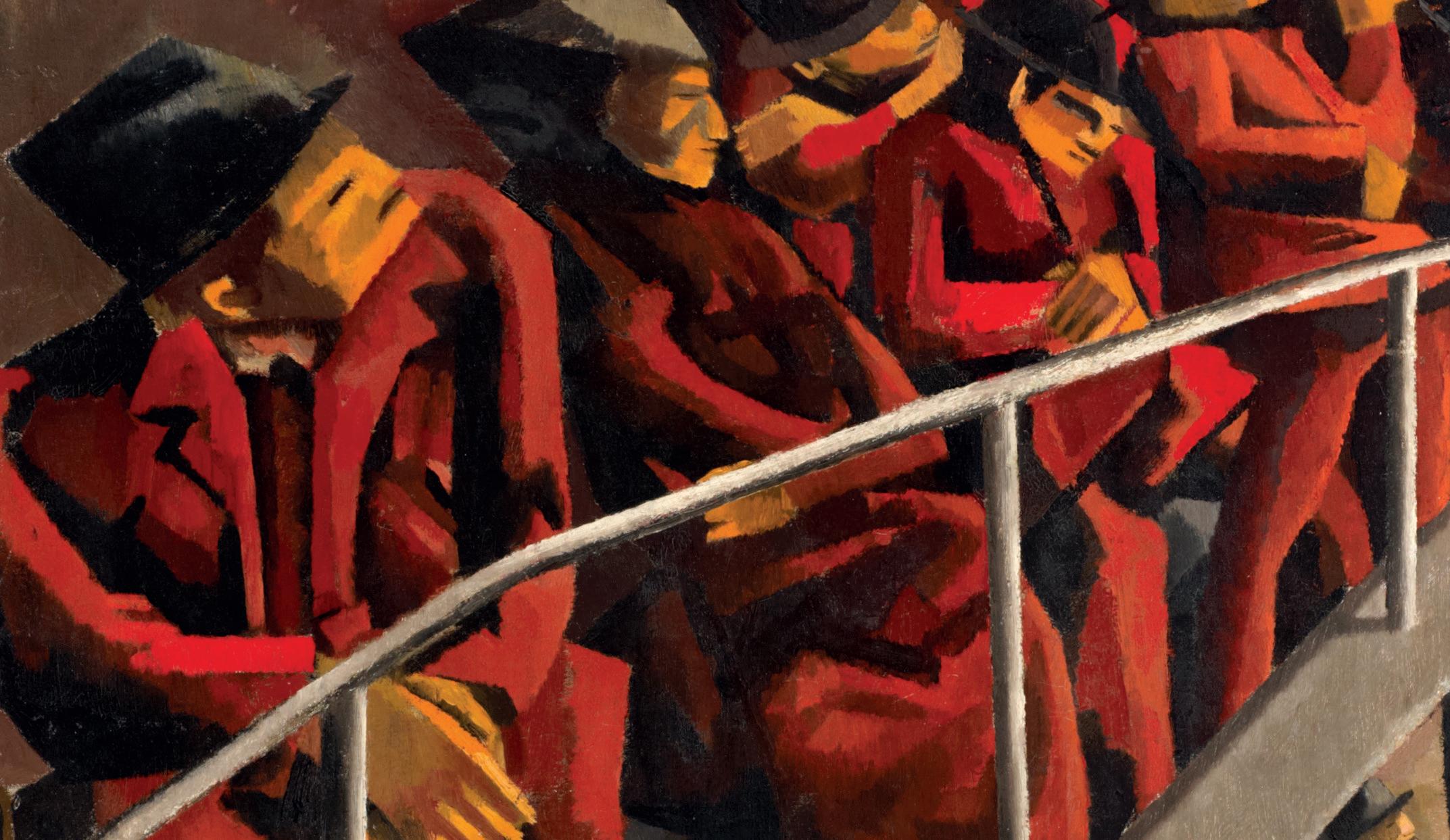
"At the same time as I was deepening my knowledge of drawing, I became increasingly aware of the wonderful source that boxing rings could represent for a painter. During those years, tirelessly, I accumulated studies relating to boxers and life in the ring."
In fact, Sam Rabin would never be drawn to competition. Boxing would remain on his agenda: that of a pretext for art but it is the experience of the athlete that will reveal to the artist the countless afflictions with intimately attuned.
With the war, Sam's life will take an unexpected turn.
From his mother, he had inherited the gift of singing. Already, renowned singers had noticed his voice. In 1939, mobilized in the civil defence, he met Oscar Natzke, a bass singer.
A distinguished professor, captivated by his voice, introduced him to Albert Garcia, an eminent teacher who would work with Sam until he enlisted in the fighting at the end of 1940. The War Office had just formed a trio of musicians, under the title "The Army Classical Music Group," tasked with giving chamber music concerts for the armed forces. They were looking for a voice to add vocal interludes. Thus, Sam joined this trio, composed of pianist and composer Edmund Rubbra, cellist William Pleeth, and the renowned violinist Joshua Glasier. The trio's tours were highly acclaimed, and following the army after the Normandy landings, its peaceful, conquering musicians accompanied the victorious soldiers all the way to Berlin.
Rabin's reputation as a bass singer became so well established that, as soon as hostilities ended, he was hired by the BBC. He will be presented as a soloist by conductor Walter Goehr. With Edmund Rubbra's trio, Sam will participate in concerts throughout Great Britain. Myra Hess, the famous pianist, will come to hear him at a concert given in the National Gallery. Everything suggested that Sam would pursue a musical career in which he was already established in a leading position. "Singing," Sam would say, "is for me a need as vital and natural as breathing. It is an integral part of my life. But, at the end of all that, drawing
and painting being my true life, it is this path that I have followed." By a sudden decision, Sam withdrew from the stage to return to the solitude of painting. Edmund Rubbra spoke of the regret his decision would cause in the musical world: “Sam Rabin possesses a truly unique bass voice, of such power and range that it retains its qualities in both the lyrical and dramatic registers. He would have been destined to become a great opera singer had he not chosen to continue developing his great talents as a painter.”
No sooner had Sam returned to “his true life” than the Principal of Goldsmiths College, a highly talented artist, offered him the position of professor of figure drawing. Then, for several years, he pursued a teaching career that quickly propelled him to the top. Alongside his work at Goldsmiths, he was invited to teach at Hornsey College of Art and Camberwell. He was considered the most eminent teacher in the United Kingdom.
Goldsmith trained teachers. The letters he received from all corners of the world from former students who had become established artists or teachers trained in his teaching methods testified to the affection, admiration, and respect he had inspired during those years of teaching. In a letter dated 1969, Sir Ross Chesterman, Goldsmith's Warden, wrote to him: "Without any hesitation, I consider you the foremost among drawing teachers in Europe, and I know that such an opinion is shared by many others."
In 1951, Sam Rabin presented twelve paintings in a group exhibition at the Wildenstein Gallery in London. The catalogue recorded “Rabin is without a doubt the most astonishing discovery of a hitherto unknown artist that I have had the opportunity to make (...). The maturity of these accomplished works, such intensely pursued research, moves the critic and elevates him.” And the illustrious playwright exclaims, “Go and see, and if you can, buy. Sooner or later, this work inspired by fights in the ring will be recognized and consecrated in terms of artistic value. Sam Rabin will remain the poet of the ring as Mendoza was the ring itself.”
In 1956, Sam Rabin exhibited at the Whitechapel Gallery.
Louis Golding was then one of the most famous boxing columnists. Having seen the exhibition, he wrote to the artist: “Aren’t you the Sam Rabin who emerges from the depths of a distant past from my Doomington? (the name given by the author to the city of Manchester in ‘Magnolia Street’). If you are, how often have I evoked the memory of your father and your elder brother! In fact, for a year or two your father haunted my imagination as a novelist in this work, which may be familiar to you.”
Europe’s leading museum and research centre on the Jewish, Refugee and wide Immigrant contribution to British Art since 1900 seamlessly engaging with our collections, exhibitions and research library.
80+ Online and 3D Exhibitions
100+ School and Family programmes
100+ Arts and Mental Health interventions
125+ Podcasts & interviews
250+ Films and artist insights
400+ Collection artist biographies
400+ Research papers, essays, catalogues and PhD theses
600+ Archive exhibitions records
900+ Collection artworks on benuricollection.org.uk
3300+ Reseach Unit profiles on buru.org.uk / diaspora-artists.net
10,000 Pages of archives from 1915
Benuri.org & Buru.org.uk open 24/7 to suit you Gallery exhibitions open every Wednesday to Friday at Boundary Road, London NW8
Recording the Refugee and Immigrant contribution to British visual culture since 1900