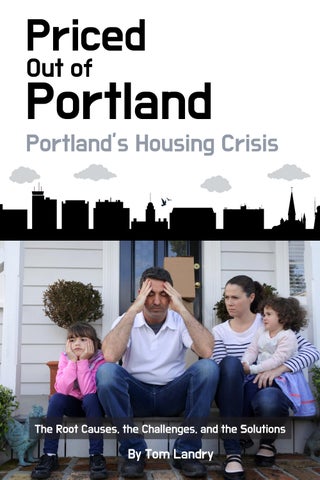
Portland Out of
Portland’s Housing Crisis


The Root Causes, the Challenges, and the Solutions
By Tom Landry
About the Author

Tom is a Maine native who lives with his wife and daughter in a Victorian home he restored off Portland’s Back Cove. They love all things Portland, give back to a host of local non-profits and charities, and buy local whenever possible.
A small business owner, Realtor®, developer, contractor, and consultant, Tom Landry is one of the most accomplished and respected real estate professionals in Maine. As the founder of both Benchmark Real Estate and CornerStone Building and Restoration, Tom brings a rare breadth and depth of knowledge to every purchase, sale, development, restoration, or remodel project he undertakes. In his main focus of real estate sales, he has been one of Maine’s top-producing agents and Portland’s #1 Listing/Selling Realtor® for over two decades.
Tom has over 30 years of practical real estate experience as a Realtor®, buyer, seller, developer, investor, multi-unit building owner, building/ restoration/development consultant, general contractor, and more. He has the firsthand knowledge, integrity, proven negotiating skills, and attention to detail to help even the most complex real estate deals succeed. With a corporate background in marketing, sales, process improvement, management, and client service, Tom and the professionals on his team provide the very best service and results to every client.
Contact Tom: (207) 775-0248 / tomlandry@benchmarkmaine.com
Why Listen to Me?
“You are not entitled to your opinion. You are entitled to your informed opinion. No one is entitled to be ignorant.”
― Harlan Ellison
I have made local real estate my life’s work. In my capacity as a Realtor®, historic home renovation/restoration expert, builder, developer, landlord, consultant, real estate marketing expert, and process improvement trainer and facilitator, I approach the subject of housing and zoning in a truly informed manner. I have been a member of the MEREDA presentation committee, founder of YIMBY Portland, chair of the Priced Out of Portland Forum (2019), a participant in the 2023 Housing Supply Bootcamp, moderator of ‘The Crystal Ball Conversation’ at 2024 ClimateWork Maine, and a student of best practices in zoning,
land use, and development. My background makes me uniquely qualified to assess and offer suggestions to help Maine’s largest city address its housing challenges. While the information and recommendations here are my own opinions, they were the result of extensive consultation and collaboration with industry experts.
Along with my work as Portland’s #1 listing/selling agent and one of the most active real estate agents in Maine, I have been an active developer over the last three decades. In fact, I’ve just recently navigated the approval of a new mixed-use development. I have firsthand knowledge of the strengths and shortcomings of the current system. Putting on my process improvement hat, I can’t help but think of ways to make things work better for all stakeholders.
I hope you find this information informative and that it inspires you to take action to make our city a better place.

Exclusive Property of Tom Landry and Benchmark. Sharing/dissemination in any way is strictly prohibited. ConfidentialAll rights reserved-2024 © Copyright, Tom Landry, 2024.
ISBN: 979-8-218-53007-5
All profits go toward increasing housing in Greater Portland. Cover and Book Design by Katrina James.
Priced Out of Portland
“Look not mournfully into the past, it comes not back again. Wisely improve the present, it is thine. Go forth to meet the shadowy future without fear…”
- Henry Wadsworth Longfellow

Portland is in a housing crisis! Rents and sale prices are at record levels and seem to be going nowhere but up. This is the case despite rent control and sustained high interest rates. So how did we get here and what can we do about it? This quick read is designed to provide you with context, facts, solutions, and a call to action.
Why you should care! Portland is struggling to meet the housing needs of its growing population due to several significant challenges. These include inclusionary zoning policies, outdated land-use regulations, soaring construction loan interest rates,
the high cost of suitable housing sites, and lengthy, expensive permitting processes. All of these obstacles have made it increasingly difficult for Portland to keep pace with demand. If we add in work-from-home trends and climate migration (which is already happening now and will dramatically increase over the next decades), we are facing a perfect storm.
Want to…
• Pay lower taxes? We need more housing in Portland!
• Ensure rents are more affordable? We need more housing in Portland!
• Protect the environment? We need more housing in Portland!
• Preserve farms and forests? We need more housing in Portland!
• Offset the inflation we can’t control? We need more housing in Portland!
• Address racial and economic disparity? We need more housing in Portland!
Take action right now! Portland’s Department of Urban Planning and Development has put forth the most comprehensive update to zoning in over a century. The current proposal is a terrific start and represents a significant improvement, but it is nowhere near as ambitious as we need to effectively address either the city’s housing issues at hand or what we will face in coming years. There is also a proposal to realign Franklin Arterial and return much of this land to housing. This effort will go a long way toward righting a wrong that happened during urban renewal, returning housing to this urban area.
The Planning Board is seeking public input before turning their zoning update over to the City Council for a vote. The Planning Department, Planning Board, and City Council need to hear your opinions and suggestions on how we can solve the housing crisis.
The Facts Are The Facts
“Facts are stubborn things; and whatever may be our wishes, our inclinations, or the dictates of our passion, they cannot alter the state of facts and evidence.”
― John Adams

• Nationwide and here in Greater Portland, the two largest segments of the population—boomers and millennials—are both choosing to live in more urban locations. As a result, southern Maine, the Greater Portland area, and especially the city of Portland, have seen unprecedented in-migration and population growth in recent years.
• Following a national trend, companies/universities such as WEX, Sun Life, Covetrus, Roux, and many more are opening headquarters and campuses in urban centers.
• Maine Health is the largest employer in the state with its flagship campus, Maine Medical Center, located in Portland.
• Portland is on the map and for good reason. Our small city is consistently ranked on the top of many lists, including the best places to retire, raise a family, and start a business, as well as named one of the best foodie cities in the U.S.
• The “work from home and live anywhere you want” trend is here to stay, and many remote workers are choosing Portland. In fact, Portland has been named the #1 city in the U.S. to work remotely (#7 worldwide) by remote.com.
• According to Bankrate.com, Maine is the 4th most climateresistant state in America.
• Residential construction of all types has lagged and not kept pace with re-urbanization trends and in-migrations, leading to a dramatic imbalance between supply and demand.
• As other parts of the country face one climate crisis after another, Maine will continue to be seen as a relatively stable place to live, attracting climate migrants from across the country. Climate scientists predict that Maine’s population and economy will continue to grow while those of many other states shrink.
• According to the “State of Maine Housing Production Needs Study” by HR&A, the average Maine household needs to make over $100,000 to afford the median home price in Maine—almost double what it was before the pandemic.
• According to local mortgage broker Ed Gosselin of Total Mortgage, lenders historically capped the percentage of a buyer’s income used for housing at 28%. To offset rising prices, these ratios have been increased to 45%. In other words, a buyer might have to spend as much as 45% of their income on housing. The numbers are even worse for renters.
• Many of Portland’s land-use regulations were written nearly 100 years ago and reflect a very different time. A century ago, commercial/industrial zones needed significant
space from residential zones to buffer noise and polluting activities. Today, commercial and industrial activities are much cleaner and quieter, allowing the city to embrace mixed-use neighborhoods.
• The 1950s ushered in a time of suburban sprawl and urban decline/decay, which was followed by urban renewal efforts. During this time, exclusionary zones like R3 were established and represent the largest and one of the most limiting residential zones in Portland.
• By some estimates, 90% of Portland’s land mass is not zoned for multi-unit residential development. This includes the majority of land in Portland’s urban core, the peninsula.
• Fueled by a Not-In-My-Backyard (NIMBY) mentality, a small number of organized, highly vocal residents have fought nearly every development.
• The passage of the Green New Deal, with its 25% inclusionary housing requirements, has added significant cost to projects and made most large-scale construction financially infeasible.
• There is a perception that Portland is anti-developer and anti-development which has led to many in this community to vow to ‘never build in Portland.’
• The cost of land, construction, and building is higher than it’s been in the last 20 years.
The result is a dramatic imbalance between housing supply and demand.
Let’s Set The Scene
“Numbers have an important story to tell. They rely on you to give them a voice.”
– Stephen Few
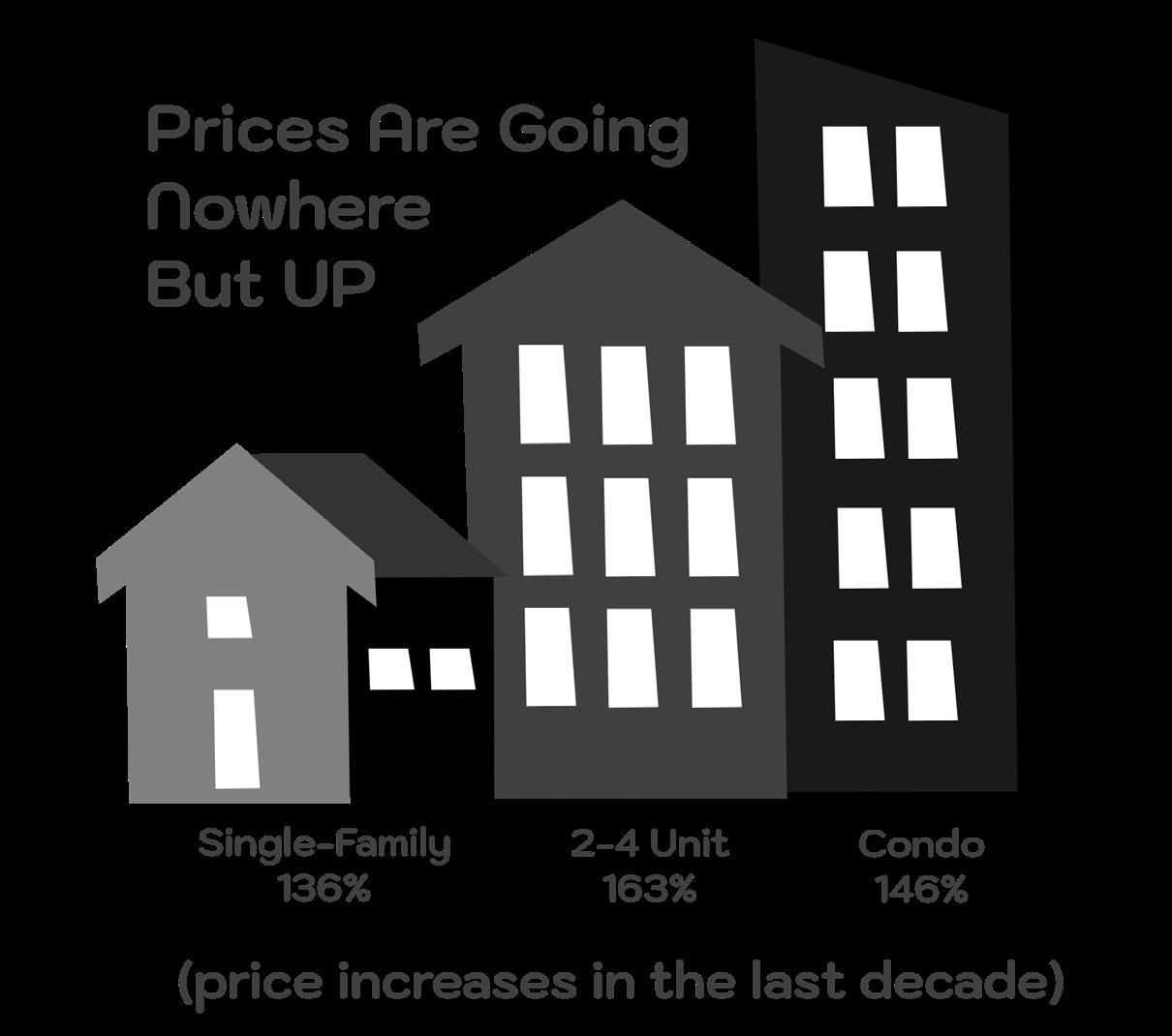
Let’s examine data that highlights the severity of the situation and the housing shortage across all types in Maine’s largest city. (All data sourced from Maine Real Estate Information System, Inc.)
Single-family homes have seen a median sale price increase in Portland of:
• 12% in the last year, from $490,000 in 2022 to $550,000 in 2023.
• 74% in the last 5 years, from $316,500 in 2018 to $550,000 in 2023.
• 136% in the last 10 years, from $232,950 in 2013 to $550,000 in 2023.
At this rate, the median price of a single-family home in Portland in 2030 could be $1,235,000.1
Condos have seen a median sale price increase in Portland of:
• 15% in the last year, from $455,000 in 2022 to $525,000 in 2023.
• 58% in the last 5 years, from $332,450 in 2018 to $525,000 in 2023.
• 163% in the last 10 years, from $200,000 in 2013 to $525,000 in 2023.
At this rate, the median price of a condo in Portland in 2030 could be $1,430,000.
Two- to four-unit multi-family homes have seen a median sale price increase in Portland of:
• 6% in the last year, from $707,500 in 2022 to $750,000 in 2023
• 56% in the last 5 years, from $480,000 in 2018 to $750,000 in 2023.
• 146% in the last 10 years, from $304,375 in 2013 to $750,000 in 2023.
At this rate, the median price of a two- to four-unit multi-family home in Portland in 2030 could be $1,128,000.
The situation isn’t better for Portland renters.
• According to Zillow, the median rent for all unit types in Portland is $2,700, which is 26% ($555 per month) higher than the national median.
• According to the State of Maine Housing Production Needs Study, Portland is 38,500 units short due to historic underproduction. Even with recent large-scale developments and as many as 700 housing units in the pipeline, Portland’s supply of apartments will be 45,800 units behind demand by 2030.
1These are strictly examples and are not intended to be financial advice.
Based on information from the Maine Real Estate Information System, Inc. (d/b/a Maine Listings) for the period Jan. 2013 through July 2023. © 2024 Maine Listings.
The Green New Deal
“It’s presented a whole new set of challenges that has caused us to move our focus outside of Portland, unfortunately… We love Portland and it’s been a wonderful market for us, but it’s a really hard place to do business and it’s only gotten harder.”
– A local developer
In 2020, residents narrowly passed a referendum that has had far reaching, albeit unintended, negative consequences. The opinion of many experts working in the industry is that the Green New Deal has done more to negatively impact housing supply than rising interest rates, record-high costs for construction, restrictive zoning, and a complicated and costly permitting process combined. In the first two years after the passage of the Green New Deal, the number of permits for multi-unit developments dropped by 82%, according to city permit records. Why? The cost implications for both for-rent and for-sale units make the construction of larger developments cost-prohibitive. Under the Green New Deal, developments of ten or more units must meet a 25% workforce housing requirement and therefore sell for under-construction costs. If a developer wishes to forgo providing these units, they must pay a fee in lieu. For 2024, that fee is $177,559 per unit.
Another surprising result of the Green New Deal is that all new construction falls under the ruling, including the conversion of offices or warehouses into housing. With commercial office use and occupancy in decline because of work-from-home trends, many experts have speculated that converting these commercial spaces to residential units might be an answer to the housing crisis. Unfortunately, the Green New Deal requires those hoping to do this to comply with workforce housing requirements, thereby pushing the already staggering cost of converting these spaces over the top.
The Green New Deal has resulted in fewer permits, less new housing of all types, and an incentivization to construct buildings with fewer than 10 units to avoid the need to comply with workforce requirements. Since the enactment of the Green New Deal, we have seen ever-increasing rents and a 43% increase in residential real estate prices.
We are not alone, and we need only look to municipalities that have enacted inclusionary housing over the last several decades to see why this is a failed policy. Inclusionary zoning hurts more
than it helps! That is the primary takeaway from Emily Hamilton’s 2019 deep dive into the negative consequences of inclusionary housing across the US.
In New York City, inclusionary housing produced only 172 units in its first 25 years according to Alain Bertaud, Order without Design.
How do we negate the negative consequences of the Green New Deal? If we streamline the process from planning to permitting, eliminate disincentives (such as inclusionary housing), up-zone, and re-zone to allow for larger buildings in many more areas, the free market will respond, and we will see a housing boom.
Historic Preservation
“If today’s rules for historical preservation had been in place in the past, the buildings that some now want to preserve would never have been built at all.”
– Alex Taborrok
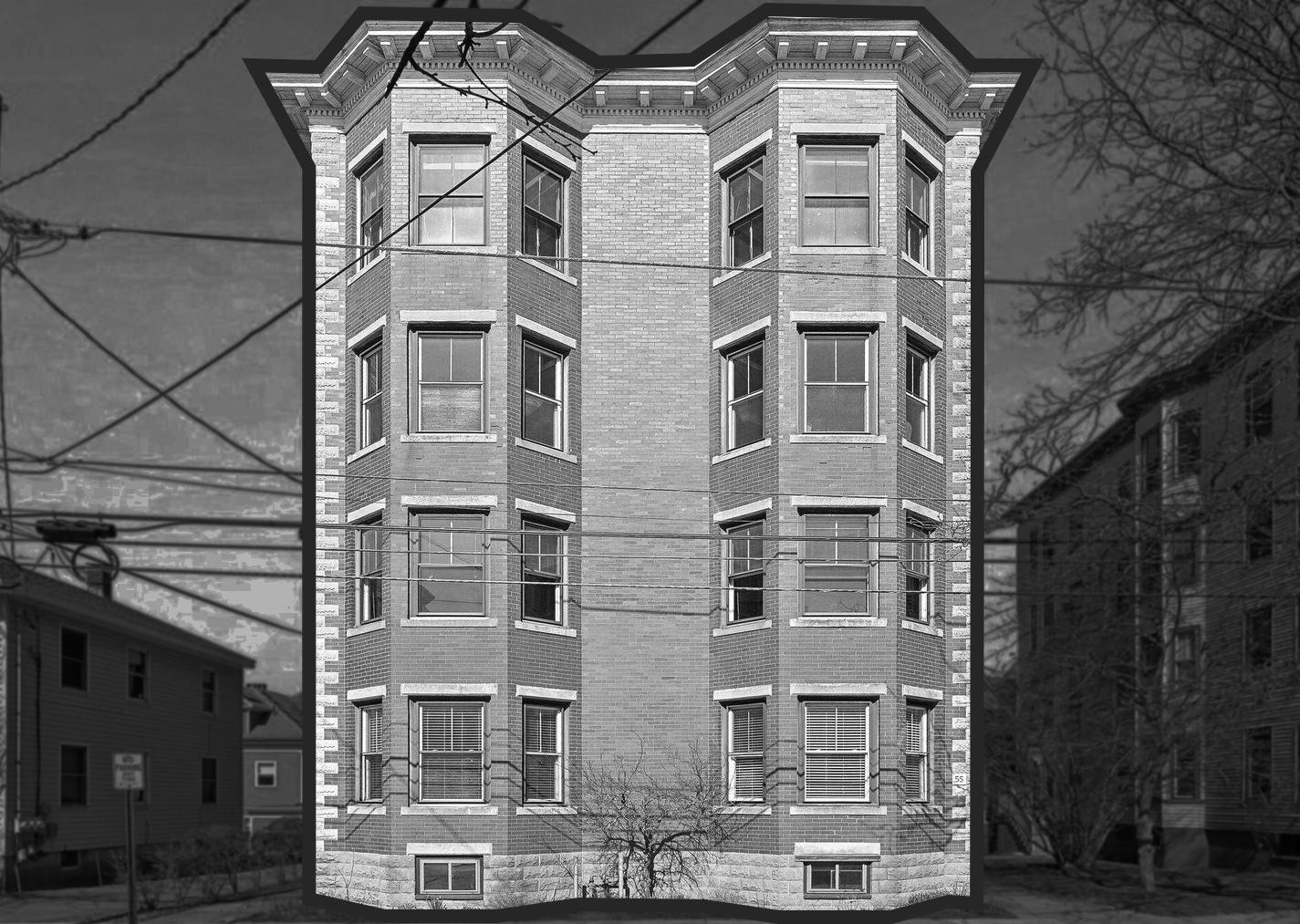
55 Morning St. on Munjoy Hill
(This beloved four-story historic building could not be built today)
We can all agree that Portland’s unique architectural history must be preserved. From individual landmarks to entire neighborhoods, the preservation of unique places is paramount. In 1973, the first historic districts in Portland were listed on the National Register of Historic Districts. In 1990, the city adopted a historic preservation ordinance, and, in the last several years, the amount of land preserved has expanded greatly, with the addition of much of Munjoy Hill. Today, approximately 20% of the landmass on Portland’s peninsula is in designated historic districts, and nearly one-third of all Portland residents live in a historic district.
So, what does this have to do with housing? A lot! Every property within a designated historic district falls under a unique set of rules and limitations. This means that any changes to the property must be approved by the city and meet certain criteria. On its face, this makes sense when talking about ensuring historic properties retain the characteristics of the past. However, such strict rules and regulations negatively impact new housing developments. Of course, in nearly every instance, demolition is not permitted in historic districts. This usually means that the construction of a larger building with more units on the same lot is almost impossible. Without such strict demolition rules, a developer might look to a vacant lot in a historic district to create housing. However, since the new structure will be in a historic district, any plans must be run through the city’s historic preservation department as well as the historic preservation board. It is a time-consuming and costly process. Unfortunately, the result is that few, if any, developers building at scale will venture into these waters.
Climate Change & Housing
“What you do makes a difference, and you have to decide what kind of difference you want to make.”
– Dr. Jane Goodall

Climate change is here, and it is wreaking havoc on communities around the globe. From extreme heat and droughts to atmospheric rivers, devastating floods, and once-in-a-generation storms—now occuring yearly—we are facing a new and deeply troubling reality. Communities are bracing for extreme weather by becoming more “climate resilient.” This can take many forms, from building new sea walls and pumping stations to the implementation of new building codes. These efforts and many more are urgent and important, but they fall short of a more comprehensive approach.
Where you build is as important as what you build. No, I’m not talking about the basic strategies of avoiding lowlands or coastal plains subject to flooding or storm surge—realities we will all
grapple with over the decades to come. I’m referring to building in urban areas versus rural/suburban areas. The rationale for building in more urban areas is threefold:
1. Transportation is the #1 carbon-emitting activity, and Mainers commute the furthest of any state in the country.
2. Maine is already feeling the impact and strain of climate migration, and this is just the beginning.
3. For Maine and other communities to retain their small, rural feel and less suburban sprawl, we need our cities to significantly up-zone their community centers.
Since the dawn of modern civilization, people have gathered and lived in densely populated towns and cities. Around them were vast, open, and nearly untouched farms, fields, and forests. With the advent of the automobile and post-war suburbanization, that all changed. People fled cities in search of the American Dream of homeownership. Around countless cul-de-sacs sprouted strip malls, highway spurs, and shopping centers. In the half-century since then, we have seen the largest transformation of open land to housing the world has ever seen. In some ways, the growth of the suburbs has been terrific; it has led to a corresponding economic boom, and many of us have wonderful memories of growing up and living in these areas. So, where does this fall short and how should those of us in Portland and other smaller cities look at housing in this time of climate change and climate migration?
According to HUDUser.gov, “low-density suburban environments generate more emissions than compact environments in the same city, and the more a city is marked by sprawl overall, the more emissions it generates.” If we hope to combat climate change and retain our unique quality of life—one in which you can move from our most densely populated areas to rural areas within minutes— we need to act now.
Some facts about our population growth:
• Since 2013, Maine’s population has increased by 67,179.2
• From April 2020 to July 2022, Maine had a cumulative population growth of 1.7%, the 14th highest in the United States.3
• From July 1, 2022 to July 2023, Maine’s population increased by 6,384, making Maine the fastest-growing state in New England.4
• From April 1, 2020 to July 1, 2023, Portland saw a 1% population increase.5
Predictions for 2030:
• Statewide, Maine’s total population is projected to increase by 2.6% for the decade between 2020 and 2030.
• According to recent studies, 84,000 new homes will be needed to account for the current short supply and expected population growth.
• The Portland metro area is where this population growth will be concentrated.
Given the current shortage and projected population increases, we needed to start building yesterday. The Governor’s signing of LD2003 is a terrific step that overrides municipal zoning to allow for more density, but more is needed. To meet this moment and prepare for a population boom, Portland and other Maine cities must dramatically up-zone and re-zone. These efforts will decrease the development pressure on suburban and rural communities, in Portland and Greater Portland, and ensure that farms, fields, and forests are kept in their carbon-sequestering state. This will also provide housing where it’s needed (close to employment centers), leading to less commuting and reduced CO2 emissions. (Of course, there is also a need for a corresponding zoning change in our suburban and rural communities, but that is a topic for another time…)
2 https://www.macrotrends.net/global-metrics/states/maine/population’>Maine Population 1900-2023
3 https://www.maine.gov/dafs/economist/sites/maine.gov.dafs.economist/files/inline-files/2022%20 Year%20in%20Review.pdf
4 https://www.maine.gov/dafs/economist/sites/maine.gov.dafs.economist/files/releases/2023%20 Year%20in%20Review.pdf
5 https://www.census.gov/quickfacts/fact/table/portlandcitymaine/PST120223
The Blame Game
“Concern yourself more with accepting responsibility than with assigning blame. Let the possibilities inspire you more than the obstacles discourage you.”
— Ralph Marston

There are many reasons we find ourselves in the housing situation we are in, and I’ve outlined several of them already. However, I often hear people assigning blame.
A few examples:
• “It’s people moving here from larger cities.”
• “It’s greedy landlords making Portland unaffordable by raising rents.”
• “It’s the city and their lack of planning.”
• “It’s immigrants coming here and taking up all the housing.”
• “It’s the fact that we allow short-term rentals.”
• “It’s baby boomers who are driving up the prices.”
• “It’s high interest rates.”
• “It’s those greedy developers.”
• “It’s the fact that the city has become too desirable.”
• “It’s the publications that put us at the top of the most desirable places to live.”
• “It’s sellers who purchased years ago for pennies and want to sell for millions.”
• “It’s companies that aren’t paying a livable wage.”
• “It’s gentrification.” …and so on and so on…
But playing the blame game doesn’t help anyone. That is scapegoating—focusing on assigning blame instead of looking for a solution. When special interest groups, who all have their own agendas, attempt to implement solutions for the wrong problems, we wind up with unintended consequences. We need only look at rent control and the Green New Deal. The first has had no impact on rental rates and the latter has led to fewer building permits. Right now, there are efforts to further curtail short-term rentals. These and more are solutions to the wrong problem that often hurt those they intend to help.
The answer is to significantly up-zone and re-zone to meet the needs of today and tomorrow.
• Want to reduce the sting of inflation? Up-zone & Re-zone!
• Want to offset the cost of housing? Up-zone & Re-zone!
• Want to ensure people make a livable wage by reducing the cost of living? Up-zone & Re-zone!
• Want to create an economically diverse city? Up-zone & Re-zone!
• Want to have housing closer to employment centers? Up-zone & Re-zone!
• Want to help people save and invest? Up-zone & Re-zone!
• Want to counterbalance high interest rates? Up-zone & Re-zone!
• Want to have a positive impact on the environment? Up-zone & Re-zone!
What does up-zoning and re-zoning look like in Portland?
• We will have more housing of all types and for all budgets.
• Rents will stabilize and come down.
• Open spaces will be preserved.
• Suburban areas (West End, East End, and nearly everything off-peninsula) will remain as they are and how we love them.
• Portlanders will wake up to a more walkable, bikeable, public-transportation-commutable, livable, and much more affordable city.
We Must...
“Change will not come if we wait for some other person or some other time. We are the ones we’ve been waiting for. We are the change that we seek.”
— Barack Obama

1. We must take bold and immediate actions to increase housing supply of all types.
2. We must expedite and streamline the process from pre-application to permit-in-hand.
3. We must break down the silos between departments and simplify and streamline the process from planning to permit-in-hand.
4. We must create a culture of collaboration with the development community.
5. We must solve the housing crisis in a climate-conscious and people-conscious way.
6. We must remove obstacles that disincentivize development and have unintended consequences.
7. We must go beyond affordable housing as the answer to a place of knowing that more housing is the answer to ensuring there is more affordable housing.
8. We must identify city-owned properties that can be re-zoned and up-zoned and put them out for RFP.
9. We must go beyond the idea that ADUs, adding a few 2-4 units here and there, and building a few 300’ skyscrapers on the peninsula will solve the problem.
10. We must dramatically re-zone and up-zone current business zones, most of the land on the peninsula, in neighborhood centers, and along busy arterials.
11. We must re-zone and up-zone industrial land on and off the peninsula.
12. We must look at ways to mitigate the potentially negative impacts as we implement LD2003 in our residential areas (R3 zones).
13. We must ensure all residents are a short walk to all they need for daily living. Let’s make every location a complete neighborhood and eliminate all food deserts.
14. We must look for best practices locally, regionally, nationally, and internationally.
15. We must vote for politicians who make increasing housing supply a top priority.
So, It’s an Emergency... What Can We Do About It?
“One of the tests of leadership is the ability to recognize a problem before it becomes an emergency.”
— Arnold H. Glasow
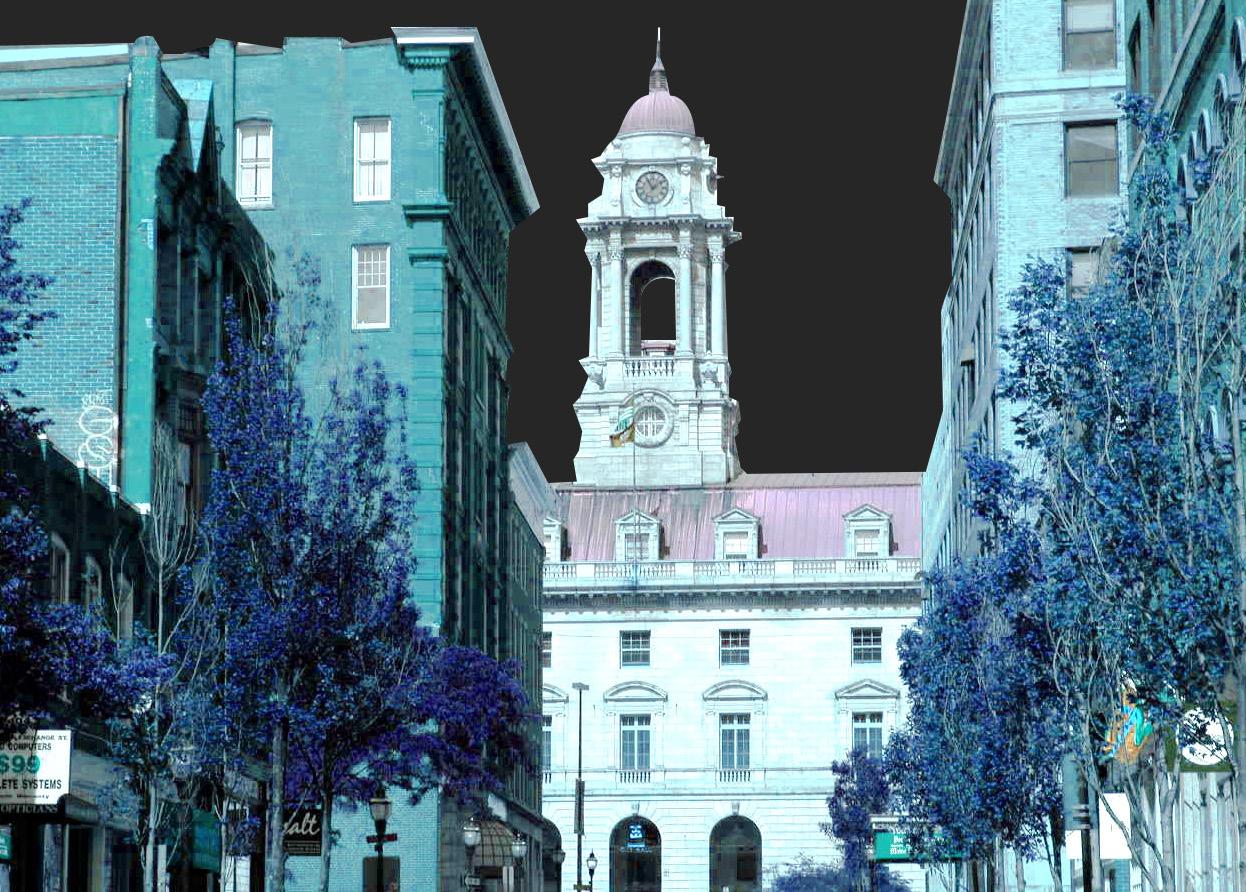
Establish a Mayoral Taskforce. Portland’s Mayor and/or City Council should immediately establish a task force to address the imbalance between housing supply and demand. This 12-member group would be made up of 6 developers (4 market rate and 2 affordable) who have built in Portland over the last two years. It would include two architects and two civil engineers with approved Portland projects in the last two years, and it would include two related stakeholders. It would be facilitated by outside consultants (much like the Zoning Bootcamp but with developer input and ideas at the forefront) with city staff in attendance.
This group would have 60 days to do two things:
1. Improve ReCode before implementation.
2. Generate a list of short-, medium-, and longer-term ways to solve the housing crisis.
ReCode Portland.
Sexy? No! Important? Hell Yes!
“The most consequential document the city has produced in the last 100 years!”
— Tom Landry
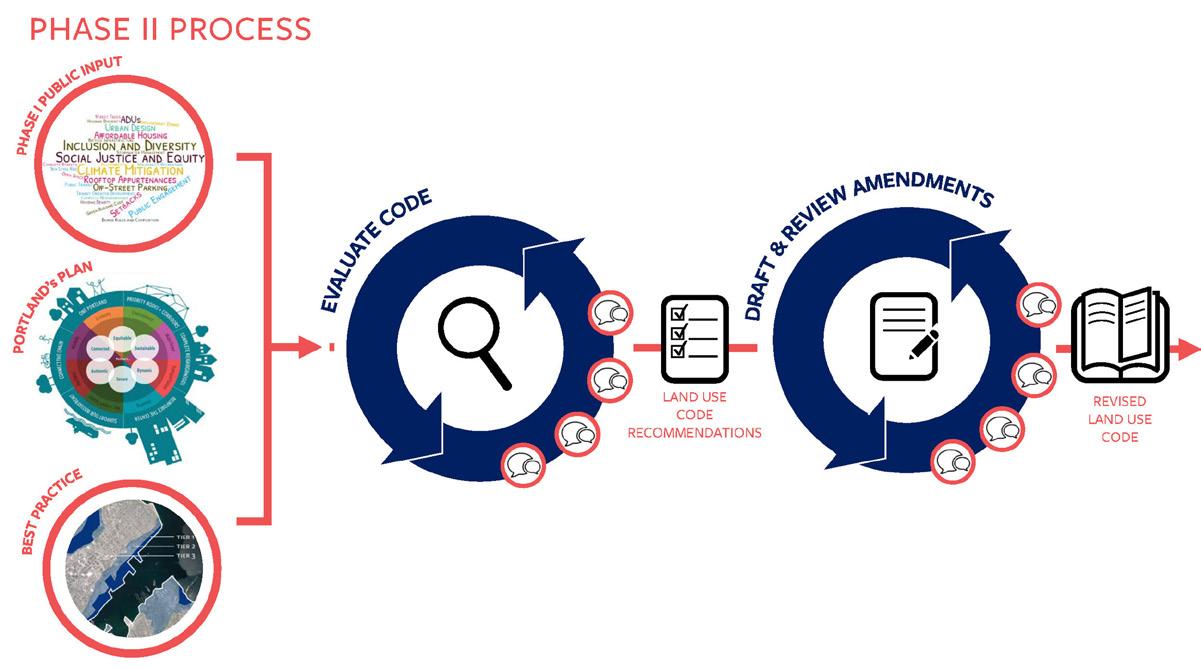
Questions & Consequences. Will we have enough housing of all types to support all income levels? Will local businesses have locations to set up shop, expand, and grow? Will more of us be able to open our doors and walk to the salons, shops, bars, breweries, boutiques, parks, and playgrounds we love? Will Maine’s largest city allow more density and height and embrace the responsibility to protect our farms and fields from suburban Phase 2 Process. ReCode Portland. www.recodeportland.me
After years of work, a document that will mark the course of our city’s future for the next 50 years is set to become law. And you likely haven’t heard about it! Land use might not sound sexy or even interesting, but it is the very underpinning of our community.
sprawl? How we answer these questions, now and as part of ReCode, will determine our city’s future and that of the state. The time is now!
More Is Needed. I commend and congratulate current and past city staff including Nell Donaldson, Kevin Kraft, Christine Grimando, and Jeff Levine on their work. However, we need to be much more ambitious. Right now, the ball is in our court—yours and mine—as residents of this city. The city wants to hear from you, and I encourage you to learn more and let your voice be heard. Change is hard. But change is needed to make a difference in both policy and community mindset. The primary way to address the housing crisis and protect our rural lands is to build more in urban areas.
Let your voice be heard. This is the time to jump in, learn more, and speak up. The city released a map of proposed zoning changes and is asking for public input before it sends the proposal to the Planning Board and on to the City Council.
What you can do
RIGHT NOW:
SEND AN EMAIL TO:
• recodeportland@portlandmaine.gov
• planning@portlandmaine.gov
• planningboard@portlandmaine.gov (Feel free to use my text in “Let’s Do ReCode Right” as a guide. You can easily copy/ paste this letter from homewithtomlandry.com/priced-outof-portland under View Letter To ReCode.)
LEARN MORE:
• Visit the City of Portland website for additional information: www.recodeportland.me
• Contact me, Tom Landry, at (207) 775-0248 or tomlandry@benchmarkmaine.com.
• Read Cracking the ‘ReCode’ that could decide Portland’s housing future in the Portland Press Herald.
Let’s Do ReCode Right!
“It takes less time to do a thing right than to explain why you did it wrong.”
— Henry Wadsworth Longfellow

I encourage you to dive into ReCode for yourself and borrow from my suggestions below.
Dear Team ReCode Portland,
Thank you for your efforts to improve our city through zoning simplification and improvements. The current proposal is a terrific start and meets the moment in many ways. That said, it falls short
of a forward-thinking roadmap to manage growth in a rapidly evolving city. Over the last decade, Portland has felt the impact of the influx of new residents and re-urbanization. Due to antiquated zoning, large swaths of the city being deemed historic, rent control, increases in inclusionary housing requirements, anti-development/ developer sentiments, a complicated and costly permitting process, and skyrocketing costs for borrowing and building, we find ourselves in a housing crisis of epic proportions.
To solve this, we must look for ways to immediately and dramatically increase housing supply—of all types and at all levels—to meet the demands of today and tomorrow. To do this, we must up-zone urban areas and transportation corridors and simplify and streamline the permitting process. The suggestions below come from a place of deep understanding and experience as a local developer, real estate agent, and student of land use and zoning. Through these lenses, I’ve taken a deep dive into the proposed changes under ReCode and offer the following improvements.
Allow more height & density. More height and density should be allowed along all major corridors and neighborhood centers. The current ReCode proposal calls for skyscrapers downtown. This is great, but it doesn’t go far enough, and only a few will ever be built. I suggest converting all current business B1-B4 zones to a new B5B zone. This would allow all B5 uses but provide a boost in height to 80’ with 10’ of allowable appurtenance. These activated roofs are perfect for residential use, solar panels, and more. This new zone simplifies an overly complex patchwork of business zones and allows for more height in existing commercial areas. Even in the proposed ReCode, some sections of streets have piecemeal allowable uses. For example, inner Washington Ave. between Congress and I-295 has four different B zones and a sliver of residential zoning. This should all be B5B with an additional height bonus. My proposal incentivizes development in existing urban and busy locations and relieves the demand to develop in residential zones.
Establish property overlays (the closest thing in proposed phase 2 ReCode is: TOD Zone 2). For centuries, before the automobile and subsequent suburban sprawl, residents were able to walk to everything they needed for daily life. We need to get back to the walkable, bikeable neighborhood centers our city enjoyed 100 years ago. Numerous public policy research studies show that complete neighborhoods are good for local businesses, public health, and the environment, and we have a chance to create them here in Portland. Creating “opportunity zones” in specific sections of our most traveled corridors and neighborhood nodes/centers where infrastructure and public transportation exist will boost development where it should be. Property overlays are a way to spur this kind of positive development. While ReCode includes some, these areas need to be expanded, the allowable heights need to be increased, the density must be improved, and the process for permitting must be streamlined. I would refer to these areas as B5BPO with all the allowable uses of the B5B above and additional bonuses of 100’ with 10’ overrides on roofs.
Make all of the following streets and areas/neighborhood centers
TOD-2+ with no step-backs on side or rear.
Streets and areas/neighborhood centers would include:
• Forest Ave.–from Congress to Warren Ave.
• Washington Ave.–from Congress to Veranda
• Washington Ave./Auburn St.–from Gertrude Ave. to Lyseth Moore Dr.
• Allen Ave.–from Forest Ave. to Northport Dr.
• Congress St.–from Munjoy St. to the city limits
• Veranda St.–from Baxter Blvd. to the city limits
• Presumpscot St. in its entirety
• ILB Zones – on the peninsula (a large portion of East Bayside)
• Approximately 400’ along any major road of the following
intersections: Woodfords Corner, Morrill’s Corner, Bradley’s Corner, Lunt’s Corner, Brighton Corner, and Nason’s Corner
Note: Many of these streets and areas are in historic districts, giving them additional protections. As a result, existing buildings in these historic areas, such as most of Congress Street, would be protected/remain unchanged.
Within neighborhood centers/nodes (TOD Zone 2), identify sites for parking garages. We can all agree that we want development in existing community centers. These areas are already businessfocused in nature and represent the best opportunity to create more complete neighborhoods throughout the city. These areas can and should be serviced by better, faster, cleaner, and cheaper public transportation. Maybe we bring back trollies?
That said, the automobile isn’t going away and with more people and more development, we must plan for more cars. One way to offset this impact is to form public and private partnerships to build parking garages in and around neighborhood centers. This helps with congestion and lessens the burden on developers to build parking over more housing. These structures should be on scale with their surroundings and mixed-use (instead of just a garage). With ground-level retail, housing, activated roofs (open areas for public enjoyment), and a bus/trolly/train stop, these buildings would complement the community, stimulate development and increase housing. We need only to look at the Ocean Gateway garage as an example.
Change the IL (industrial light), IM, IMB, and IH zones to IL/B5. By some estimates, as much as 90% of Portland’s landmass and 70% of the peninsula isn’t zoned for multi-family or mixed use. Areas such as East Bayside, where we now find coffee shops, breweries, and shops, are zoned IL (Industrial Light) and don’t allow for residential uses. Off the peninsula, there are hundreds of acres zoned for industrial uses that lay fallow. My proposal opens vast tracts of vacant and
underutilized land that currently lies in waiting for industrial users. The idea that we must keep commercial and light industry away from residential areas is antiquated. This separation was valid, justified, and prudent 50-100 years ago, but it’s not necessary in this time of quieter and cleaner industry. Besides, we are not in a warehouse or industrial space crisis. We are in a housing crisis. So, let’s open this land to development.
Edit the proposed RN5 (formerly R6). For context, this zone is in the most populated part of the peninsula and was intended to be the area in which most of the residential real estate development and housing would be. In the last decade, what can be built in R6 was modified and made more restrictive. Further, the majority of R6 was placed under historic preservation. This eliminated the ability to demolish neglected one-, two- and three-family homes and replace them with larger buildings. It also added unnecessary complexity, expense, delay, and oversight. Those seeking to build in these areas today, even on a vacant lot, must navigate the historic preservation board, which can take up to six months and cost developers tens of thousands of dollars. In fact, the current R6 is so limiting that many of the historic homes we all love could not be constructed today. The proposed RN5 down-zones these urban residential areas and needs to be revised.
I’d propose the following edits to RN5 (formerly R6):
1. Reduce side setbacks to 10’ total with 2’ required on one side and 8’ on the other. This allows for a buffer on one side and a drive aisle on the other. This is the rhythm/layout of most of the current neighborhoods.
2. Reduce rear setbacks to 5’.
3. Allow 80% lot coverage that would include the primary structure and outbuildings and eliminate any reference to maximum building lengths.
4. Increase the allowed height of structures from 45’ to 60’. This will allow for four stories and offset efforts underway to adjust/
lower how we determine average grade (building heights). This also increases the likelihood of occupants in spaces with greater volume and those high ceilings we all love.
5. Allow 10’ for roof appurtenances. The current and proposed zoning does not address this, and it’s a big miss. Past changes eliminated the ability to create activated, livable roofs with amenities such as rooftop gardens with elevator and stairwell access.
Re-zone and sell city-owned land for mixed-use development. The city owns two golf courses and many parcels that would be ideal for residential and mixed-use development. Identify parcels to sell and put out an RFP (request for proposal), then award the sale based on the establishment of a mixed-use development with a variety of residential living options and price points. For larger parcels (such as these golf courses), award the sale based on the developer who proposes the establishment of a new complete community with parks, playgrounds, trails, housing (rental and for-sale), retail space, and more (the new IL/B5 zone).
Further develop the Portland technology park. Located off Rand Road, this 26-acre site was intended to lure businesses into the state’s growing life-sciences industry. To date, only one of the seven sites is being utilized by a tenant, with just two others under contract. This entire 26-acre area, which has been severely underutilized over the last 13 years, should be put to its highest and best use. Let’s turn this into a mixed-use development of housing, office, warehouse, and what I’m calling IL/B5. This would be the perfect place for people to live, work, and play—just what residents and businesses want.
Offer private & public partnerships. For any sites that the city sells through the RFP process, the city should immediately collaborate with and co-present the proposed project to neighbors and the Planning Board. These projects will receive priority status and expedited permitting.
Simplify & streamline permitting. From Historic and Planning Board approvals to permit-in-hand, this process needs to be simplified and streamlined.
Establish pre-approved development types. These would bypass public meetings and both Historic and Planning Board approvals as well as receive a building permit upon planning staff approval.
Remove parking minimums and maximums. Concerning what can and should be built, the government should allow the free market to drive these decisions. As with inclusionary housing, once a minimum or maximum is set, there will be consequences. That usually means less housing.
Edit maximum lot coverage, setbacks, and related to mitigate the potentially negative impacts (demolition, size, scale, massing [how one property is related to others in the immediate area], context, rhythm) as we implement LD2003 into our residential areas (R3 zones).
Thank you for taking the time to read my comments and for your tireless work.

Tom
Landry Broker/Owner
tomlandry@benchmarkmaine.com (207) 775-0248
Franklin Arterial [bonus section]
“That’s our North Star in this work—that Franklin can be a vibrant street where people can work and play and live and cross the street safely and also where cars can move.”
— Markos Miller
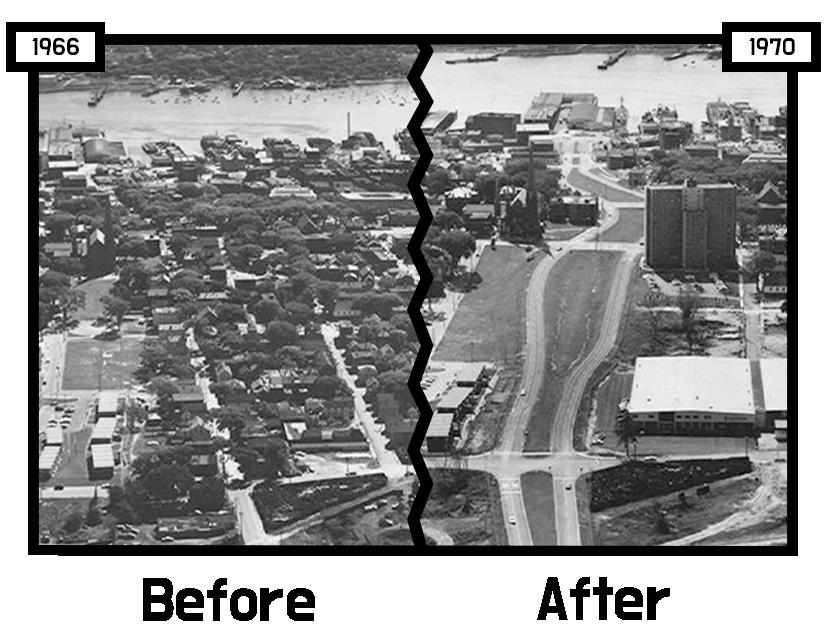
Franklin Arterial Project, 1966 vs. 1970. Sourced from Portland Old Port. www.portlandoldport.com/future-friday-franklin-street-.arterial
Nearly 15 years ago, I attended a visioning session for Franklin Street. In a large room, city staff created an interactive environment where members of the public could share ideas and learn. As a lifelong resident of Greater Portland and someone who has lived in the city since the 1990s, I was shocked at what I didn’t know. I had no idea that this river of roads that now divides the peninsula was once home to thousands of residents. I had no idea that, in 1951, there was something called the Slum Clearance and Redevelopment Authority that, coupled with the broader urban renewal movement, led to some of Portland’s darker and most destructive days. You only have to look at old images1 of these once-vibrant neighborhoods to see for yourself.
In 2015, some six years after that initial brainstorming session, the city released the Franklin St Master Plan 2015 Final Report. This was later updated in 2023: Franklin Street Update 2023 Council Wkshp PPT Sept 11 2023 FINAL.
The Portland Press Herald revisited this subject in February with a terrific article: “Could a revamped Franklin Street once again anchor a lively Portland neighborhood?”
As we move into the next phase toward construction (pending funding) in the next five or so years, I encourage you to learn more and let your voice be heard. The righting of a wrong is long overdue, and reclaiming this land for residents will help mitigate our housing crisis.
Send comments and questions to: Jeremiah Bartlett; jbartlett@portlandmaine.gov
P.S. A BIG thank you to Markos Miller for his tireless work to keep this alive!
1 https://www.portlandlandmarks.org/blog/2020/4/28/historic-preservation-in-the-urban-renewal-era
Let Your Voice Be Heard
“The world as we have created it is a process of our thinking. It cannot be changed without changing our thinking.”
— Albert Einstein

What You Can Do:
1. Attend and speak in favor of new housing developments presented to neighborhoods and boards such as Historic Preservation and Planning.
2. Volunteer to be on boards such as Planning, Historic Preservation, Zoning Board of Appeals, and others, and speak up for more housing.
3. VOTE NO on housing referendums—this is no way to set housing policy.
4. Share the message that increasing supply is the best solution to our housing shortage.
5. Contact these people—right now:
• City Counselors: council@portlandmaine.gov
• City Manager: citymanager@portlandmaine.gov
• City Clerk: cityclerk@portlandmaine.gov
• Housing & Community Development Division Director: mpd@portlandmaine.gov
• Assessor’s Office: assessors@portlandmaine.gov
• Planning Division: planning@portlandmaine.gov
• Rent Board: rentboard@portlandmaine.gov
• Zoning Administration: zoning@portlandmaine.gov
• Ethan Hipple, Director of Parks and Rec: ehipple@portlandmaine.gov
• Ameriz Gamez, Planner: agamez@portlandmaine.gov
• Bruce Hyman, Transportation Program Manager: bhyman@portlandmaine.gov
• Eric Freeman, Planner: efreeman@portlandmaine.gov
• Evan Schueckler, Historic Preservation Program Manager: evans@portlandmaine.gov
• Helen Donaldson, Acting Deputy Director: hcd@portlandmaine.gov
• Jennifer Munson, Office Manager: jmy@portlandmaine.gov
• Kevin Kraft, Acting Department Director: kkraft@portlandmaine.gov
• Matthew Grooms, Development Review Services Manager: mgrooms@portlandmaine.gov
• Maxwell Martin, Development Review Coordinator: mjmartin@portlandmaine.gov
• Maya Balassa, Planner: mbalassa@portlandmaine.gov
• Megan Cindrich, Principal Administrative Officer: mcindrich@portlandmaine.gov
• Natasha Kypfer, Senior Planner: nkypfer@portlandmaine.gov
• Robert Wiener, Associate Preservation Planner: rwiener@portlandmaine.gov
• Sean King (PLA), Urban Designer: sking@portlandmaine.gov
• Talor Colbeth, Administrative Assistant: tcolbeth@portlandmaine.gov
• Zachary Powell, Senior Planner: zpowell@portlandmaine.gov
• Mark Dion, Mayor: mdion@portlandmaine.gov
Draw & Describe Your Ideal Portland
Use this page to draw and describe your ideas for the best Portland possible. When done, take a picture and email it to landryteam@benchmarkmaine.com. We will post and share.
Resources
• Portland Maine - www.portlandmaine.gov
• Portland’s Plan 2030 - portlandmaine.gov/484/Portlands-Plan-2030
• ReCode Portland - www.recodeportland.me
• Congress For The New Urbanism - www.cnu.org
• American Planning Association - www.planning.org
• Urban Land Institute - uli.org
• Mercatus Center - www.mercatus.org
• Housing Supply Accelerator Playbook - planning.org/publications/ document/9289884
• Strong Towns - www.strongtowns.org
• Smart Growth America - smartgrowthamerica.org
• Market Urbanism - www.marketurbanism.com
• GrowSmart Maine - growsmartmaine.org
• Urbanist Coalition of Portland - urbanistportland.me
• YIMBY Portland - yimbyportland.me
• Build Maine - www.build-maine.com
• National Housing Conference/Housing Recourse Center - hrc.nhc.org
• Governing - www.governing.com
• The Dark Side of Historic Preservation - www.discoursemagazine. com/p/the-dark-side-of-historic-preservation
• Historic Preservation Is Great, Except When It Isn’t - www.governing. com/community/historic-preservation-is-great-except-when-it-isnt. html
• News Center Maine: “Maine Needs Nearly 80,000 New Homes By 2030” - www.newscentermaine.com
An Exclusive Interview with Bangor Daily News

In this book, I explore the root causes of Maine’s housing crisis and present bold solutions to help resolve it. From eliminating inclusionary zoning to increasing density in downtown areas, I believe these changes are critical for meeting our housing demand. Below are some key thoughts I’ve shared in an interview with Zara Norman with Bangor Daily News.
BDN: Your book is called “Priced out of Portland,” but a lot of what you write can be extrapolated and applied to other cities and other towns all across Maine. Why have communities of all sizes been so unable to respond to the changing market conditions of the last few years? Why are we so ill-equipped to meet this moment?
“It’s a very valid question. I think that gets to the frustration people have, right? However, the population of Maine hasn’t increased except in the last several years. We’ve been chugging along, with maybe Cumberland County doing fairly well but still nowhere near the growth other places have seen.
You don’t build housing in advance of the need, so I think it’s OK to let ourselves off the hook. We weren’t going to build on spec when there was no demand. But now there’s demand, which really started because of COVID and the “work wherever you want, live wherever you want” trend. Now you add in climate change, climate
migration, and you wind up with this perfect storm. We need to act swiftly. Nobody’s to blame, but we need to do something now.” - Tom Landry
BDN: That’s something you explore in your book: How do we build all this housing without worsening our climate crisis? For you, the answer to that is density.
“Oh, absolutely. We have to build significantly taller.
I think rural communities have much more at stake here, because if they can look at their downtowns and up-zone and rezone them, they’re going to create walkable environments. They’re going to create these vibrant downtowns which we saw 70 or 80 years ago, before the flight of people out of urban areas, before the automobile took over. I think we need to just get back to that. These rural areas need to think about their zoning, and some of the worst zoning that they have is 4-acre minimum [lots]. The idea was to keep growth away. Well, it just created sprawl, and it’s just terrible for the environment, terrible for our way of life, and also is one of the things that we do that has the worst carbon impact. The zoning needs to change.” - Tom Landry
BDN: You write that, in meeting our housing goals, we need to “go beyond” affordable housing and unleash market forces to fill that void. But if we don’t mandate affordable housing construction, how are we going to sort of ensure that affordable units get built?
“To me, that’s just a fundamental misunderstanding about how this works. The free market is going to apply. When municipalities do inclusionary zoning, you have consequences. It adds a level of complexity — usually cost — and it causes [developers] to pause. So how do you do it? You really try to streamline the process for building and building more of any type.” - Tom Landry
BDN: Does that also hold outside of southern Maine, where there’s less private demand?
“Absolutely. It’s supply and demand, fundamental economics. If
you increase supply, anything at any price point, it’s going to help meet that demand and drive prices down.” - Tom Landry
BDN: How big a role do you think the not-in-my-backyard phenomenon plays in our low housing inventory?
“It is a huge thing. We say to ourselves, “Yeah, I’m all for housing, but,” you know? “Not by me,” or, “not if it affects my view.”
To me, the thing that’s going to help with the whole “NIMBY” thing is if municipalities up-zoned in places which are not going to cause consternation. If we build in the business zones, in the downtowns, those are already commercial areas.
That’s less chance for people to say, “Well, I don’t like that because it’s blocking my light or my view,” because it was always a business area. Let’s think strategically.” - Tom Landry
BDN: What do you hope reading your book inspires people to do?
“I hope they get involved. I hope they say, “I have agency, I can go down to City Hall and talk to my planning department and talk to my economic development folks and say, “What are we doing right now, to plan ahead, not be reactive?
We are in a reactionary mode. That’s fine, but we need to take fairly bold action because the demand is there. We know it’s there, we’re on the backside of that. We probably haven’t done enough and quickly enough. So, what are we doing right now?
I hope that people realize that they have a voice in this. We’re going to have [sprawl] if we don’t plan ahead and start to really rethink our zoning statewide.” - Tom Landry

Zara Norman znorman@bangordailynews.com
news@bangordailynews.com
Invest Local connects you with real estate investment opportunities throughout the state.
Shifting your investments from Wall Street to Main Street creates jobs, provides homes, and supports the local economy.

Advice for buyers, sellers, investors, developers, current and potential property owners, agents and anyone interested in real estate. Tom talks about sales, building, remodeling, restoration, development, financing, marketing, what he loves locally and more. No matter your interest, Home with Tom Landry can help. A Realtor®, developer, business owner, and entrepreneur, Tom Landry is one of the most accomplished and respected real estate professionals in Maine. Welcome Home With Tom Landry! homewithtomlandry.com



WORK WITH THE BEST
When you work with Benchmark Real Estate, expect the highest level of service, an exceptional experience, and outstanding results. Led by Portland Maine’s top Realtor for over two decades, our team of local market experts provide concierge-level service from the first interaction to long after closing. If you’re buying, selling, investing, or developing in Greater Portland, work with the best.
benchmarkmaine.com

COMMERCIAL & RESIDENTIAL CONSTRUCTION
As design professionals, general contractors and builders, we provide a full spectrum of design, building, restoration, and renovation services throughout Maine. From ground-up construction of high-tech commercial spaces and modern condos, to full scale historic restorations and construction of the finest residential buildings, we provide unparalleled service and results.
cornerstonebr.com
Praise for Priced Out of Portland
“Tom is spot on. Portland hasn’t been allowing enough housing to be built, and the environmental, economic, and equity impacts are only going to get worse unless we make it a lot easier to build housing and focus on more walkability and bikeability, especially along our corridors.”
- Liz Trice, Portland resident
“Tom’s experience as a real estate broker, developer, and businessman gives him a unique perspective to call from when breaking down the complex issue of housing. This digestible overview of the housing crisis and associated practicable solutions should be taken seriously. The development community is ready to get to work building new homes under smart growth principles, and Mainers who are looking for stable, attainable housing can’t wait any longer. The time to act is now.”
- Sam Lebel, Civil Engineer
“Don’t let the colorful cover fool you. Tom provides a comprehensive yet quick-moving look at a highly complex issue. More importantly, he offers some surprisingly simple solutions.”
- J. Baldwin
“Good land use is a tide that raises all boats. Whether you care about housing affordability, equity, the environment, transit, or economic growth, more is possible when we make room for people. This call for a bold ReCode is a once-in-a-generation chance to get our land use right, not just for today, but for the next generation.”
- Todd Morse, President, Urbanist Coalition of Portland
“Priced Out of Portland offers a compelling agenda to get housing production and affordability back on track. We urge all policymakers to take the recommendations seriously so that Portland can build once again.”
- Portland Regional Chamber of Commerce
“Priced Out of Portland should be required reading for any city staff involved in housing, the city council, the Mayor, Manager and anyone running for local office.”
- C. Collins
“Tom is right that Portland has seen in recent years that the most well-intentioned aspirations for housing creation will not come to fruition unless the city’s land use ordinance matches its stated ambitions for housing creation in Portland’s Plan 2030*. ReCode presents a unique opportunity to align the city’s goals with the actual laws in place. Tom’s insights should be read by everyone engaged in ReCode and taken to heart.”
- MEREDA (Maine Real Estate Development Association)