The Parking Dilemma
by Will Sandor ’27 and Brandon Li ’26
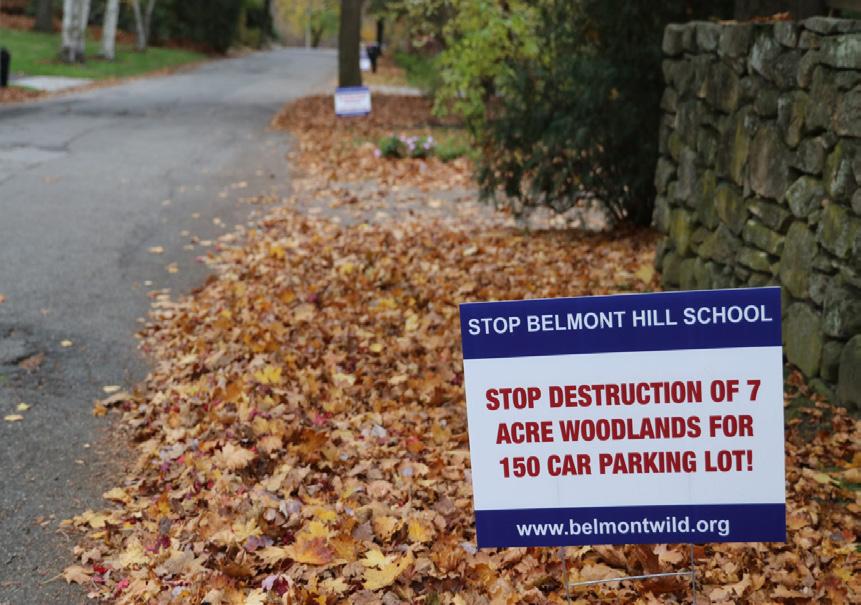
You may have noticed the large banners hanging on fences surrounding Belmont Hill’s campus, or the yard signs scattered across Belmont on sidewalks and lawns. One sign declares, “99 YEARS TO




BUILD A REPUTATION,
1 YEAR
TO DESTROY!”
Another sign reads, “F FOR ENVIRONMENTAL STUDIES.” As it turns out, these bitter messages refer to a dispute between Belmont Hill and its neighbors, one that has inflamed our school’s relations with the surrounding locals.
Belmont Hill has always been associated with sports – one of the first things that come to mind when talking about our school are the sports programs. The support for these programs is overwhelming, and countless friends and families of student-athletes come to watch them play every week. However, these sporting events often overwhelm our relatively small parking lot, resulting in frustration for would-be spectators unable to find a place to park. Because of this lack of parking, during the average BH sports event, between 29-75 cars are parked along neighborhood streets, which often results in angry complaints from locals. As a result, the school administration has decided to construct three new parking lots on unused land across the roundabout near the main entrance to the school. This would provide space for three new parking lots with around 150 spaces, along with a new facilities building. Although this idea may seem fairly straightforward and uncontroversial at first, local communities have protested the decision for various reasons.
The main argument used by local opposition to the new construction plan has rested on the negative effects of the 1.7 acres of deforestation that will be necessary to clear the land, both on an economic and moral level. On an economic level, clearing trees will decrease property values, since people tend to like living near nature. The town of Belmont has always prided itself on being filled with trees and wildlife, especially given its proximity to Boston. Some residents believe that allowing us to construct this parking lot would set a precedent for more deforestation for non-residential purposes, ultimately taking away Belmont’s appeal as a heavily-forested town of homes. On a moral level, those opposed to the project argue that the deforestation will push out local wildlife, along with contributing to climate change. A quick visit to one of the websites set up by the local opposition, “belmontwild.org,” will reveal just how much the culture of natural preservation and “tree-loving” among Belmont’s residents has influenced their decision to protest – the website repeatedly states that the construction project “does not represent the values of Belmont.” Our school has always maintained good relations with its neighbors. Even so, the new proposal has caused some in the local community to view this act as a betrayal of trust, shifting our public image from a “good neighbor” to a “greedy, self-serving private institution that throws money around to do whatever its whims tell it to.”
However, from the perspective of those that support our school, the deforestation argument can be pretty unconvincing. In terms of wildlife, it’s unlikely that the deforestation of 1.7 acres of land will have a significant impact on wildlife in Belmont, which is heavily forested and covers 3008 acres. The new complex will be filled with shrubs and trees, which will help to offset the environmental impacts clearing the land will cause. Concerns about climate change, while well-founded, are almost certainly impractical – hundreds of thousands of acres of forest are destroyed elsewhere in the world every single day, and the effects blocking the project would have on reducing global emissions would be negligible. The relatively small impact that stopping the project would have on environmental issues makes it clear that the locals resisting the change are not as concerned about the actual health of the environment as they are about the aesthetics of the environment surrounding their homes. This makes the issue much more personal, and more difficult to solve as a result.
of giving back to the community and supporting the town of Belmont. One example of this has been the free access to school facilities Belmont locals enjoy, whether it be athletic facilities for youth sports teams or meeting spaces for local organizations. Our community has also been heavily involved in community service in the area, ranging from mentoring at local schools to frequent participation in local charity drives. In addition, we spend over $285,000 each year on goods and services from local businesses, greatly contributing to the local economy. In all cases, Belmont Hill’s reputation as a neighbor should not be “destroyed” as some locals are suggesting; the aesthetic value of the trees surrounding a few homes should pale in comparison to the services and economic benefits our school provides to the town as a whole.
Locals who are opposed to this project have found various ways to protest this project. Some have set up yard signs and hung up banners decrying Belmont Hill’s “hypocrisy” in teaching students the importance of moral virtue and environmental conservation, then going on to violate these principles themselves. Others have sent letters to the local planning board expressing their disapproval of the project. One group of around twenty protesters, composed of adults and children alike, gathered at the entrance to Belmont Hill on the night of the “100 Years of Arts” celebration to voice their concerns. Notably, one protester was dressed as the Lorax, referencing the Dr. Seuss story for children that has recently experienced a resurgence in popularity among climate activists. In addition, protesters have used the Internet to spread awareness about the topic, including a Change.org petition asking planning board officials to block the project that has received over 2,700 signatures, a GoFundMe that seeks to use the money obtained to pursue legal action against Belmont Hill, and countless videos and messages across social media websites expressing resistance to the new project.
Even if our school is doing something locals don’t like at the moment, it has a history
Overall, there are good arguments for both sides in this scenario. From the locals’ perspective, the greedy and self-serving Belmont Hill school is violating the town’s historic values as “nature and tree lovers,” which might set a precedent for more deforestation and industrialization. However, from the perspective of those in support of our school, a group of entitled locals is trying to meddle in Belmont Hill’s affairs on their own land, using impractical moral arguments as a smokescreen to disguise the true nature of their disagreement. It’s likely that if our school was located anywhere besides Belmont, this plan would go through without much resistance. However, we must respect local values while searching for a compromise, recognizing that it’s pretty important to have your neighbor like you instead of dislike you. Regardless, the whole affair remains frustrating for school officials; Headmaster Schneider has recently stated, “We feel like we did exactly what the town has asked us to do, and we’ve tried to really navigate the public process as transparently as possible.”
April 4, 2023 A Student Publication of the Belmont Hill School Issue #3
Varsity Wrestling’s Historic Season
 by Jaiden Lee ’26
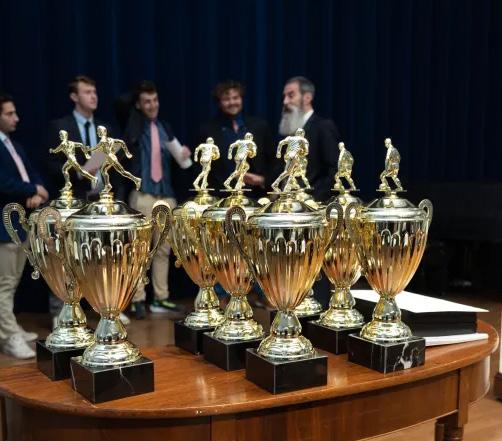
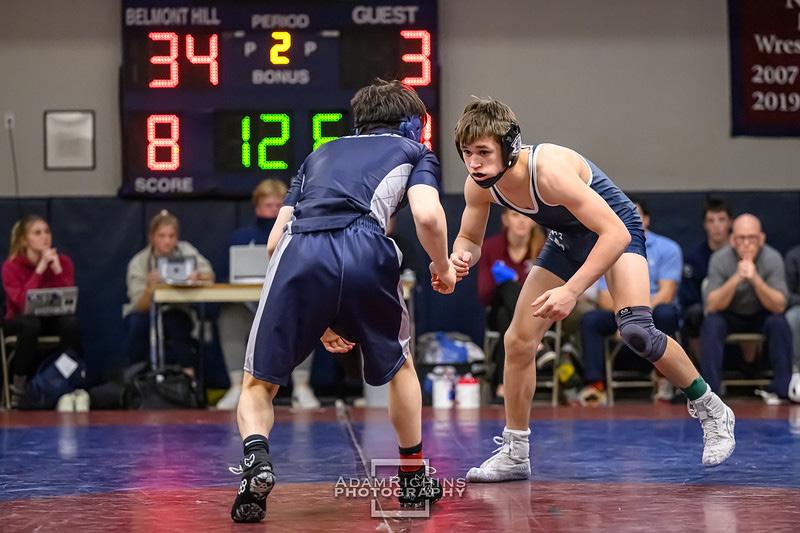
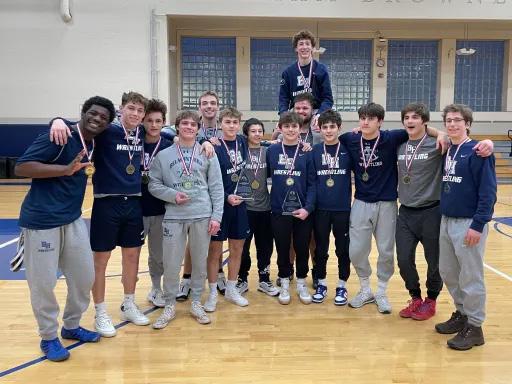
The Belmont Hill Varsity Wrestling team recently concluded another fantastic winter season, finishing the season with a record of 24-1. The team dominated the annual Graves Kelsey (ISL) tournament hosted at BB&N, with all 14 Belmont Hill wrestlers advancing to the finals–and 12 of them finishing as champions. The “Most and Least” trophy for pinning all of his opponents in the least amount of time was awarded to Cord Vallis ’24, and the Globe All-Scholastic Award for being the finest athlete and representative of the sport was given to Freddy Pimental ’23.
Additionally, Belmont Hill placed 3rd at the extremely competitive New England Championships hosted at Phillips Andover, right behind Green Farms Academy and Northfield Mt. Hermon. 13 of the team’s wrestlers placed themselves in the top 6 of the tournament and made the qualification cut for the National Prep Tournament. Scotty Moreau ’26 and Alex Gavronsky ’23 placed 1st as champions. Isaac Novod ’27, Jack Dragoumanos ’26, Cord Vallis ’24, Freddy Pimental ’23, and Turner Rayment ’23 all placed second. Andrew Pimental ’25, Aaron Stanger ’24, and Haden Bottiglieri ’24 took 3rd. Will Stewart ’24 placed 4th, Josh Houston-Davis ’23 took 5th, and Bennett Carroll ’ 23 6th. The New England Coaching Association recognized Coach Davis as the “Assistant Coach of the Year.”
At the Winter Athletic Awards chapel, the William “Bingo” Emerson wrestling trophy for greatest improvement in the sport was awarded to Josh Houston-Davis and Dave LoGrasso, and the Gilbert S. Jordan Athletic Achievement Award in Wrestling for greatest contribution to the team was presented to Alex Gavronsky, Freddy Pimental, and Turner Rayment. Cord Vallis and Alex White were given the Henry B. Sawer sportsmanship awards.
10 wrestlers made the trip to National Preps: Isaac Novod ’27, Jack Dragoumanos ’26, Scotty Moreau ’26, Andrew Pimental ’25, Haden Bottiglieri ’24, Cord Vallis ’24, Josh Houston-Davis ’23, Alex Gavronsky ’23, Freddy Pimental ’23, and Turner Rayment ’23. Alex Gavronsky and Haden Bottiglieri made the top 8 to become All-Americans, placing 5th and 7th respectively. Alex was also honored individually with the “Most Pins in the Least Time” during the tournament. The team as a whole finished 11th out of 128 teams, the best finish to date at National Preps.

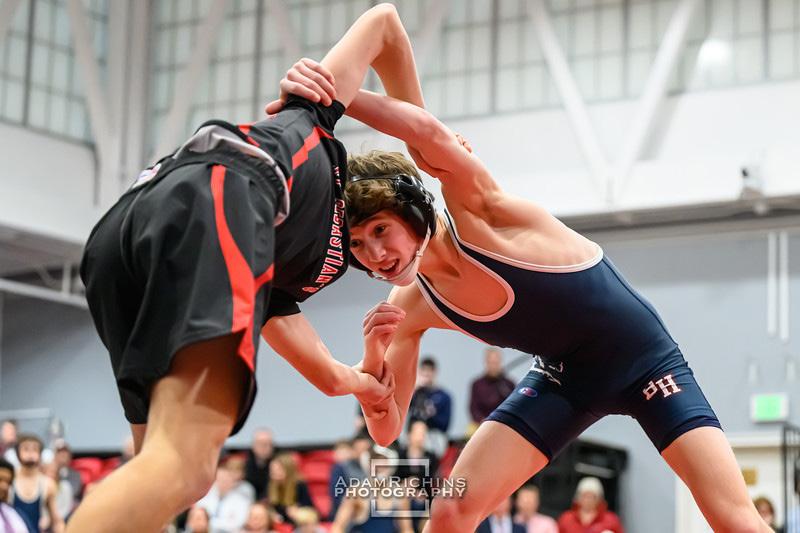
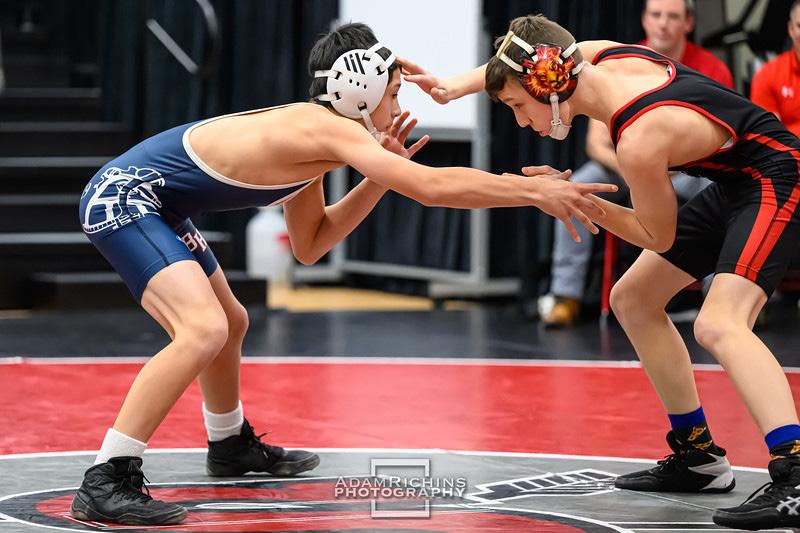
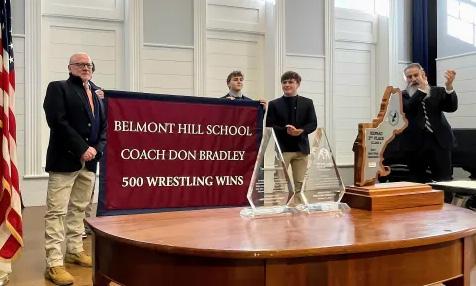
Finally, on January 22, 2022, in a match against Roxbury Latin, Head Coach Don Bradley achieved his 500th wrestling victory as the Head Coach at Belmont Hill, and to commemorate this accomplishment a huge banner was unveiled to be hung on the wrestling room wall until his next milestone is reached.
BH WRESTLING Page 2 The Hill
The Legacy of BH Crew
by Connor Lynch ‘27, and Alex Chen ‘27
Crew has been an integral part of Belmont Hill since its introduction to the school in 1924, only one year after the founding of the school itself. The first head coach, Dr. Howe, who also served as the headmaster at the time, worked hard to start the crew program. Dr. Howe got a four-oared shell donated and purchased a four-oared barge and oars from Harvard. A boathouse was also built on Mystic Lake in October of 1923. With these resources, on top of another four-oared shell the school already owned, Belmont Hill’s crew team began practicing on Mystic Lake. With only three coaches and nine members, the team was small to start out, but extremely successful. The crew team helped enforce some of the core values that Belmont Hill is based upon, including leadership, teamwork and grit. The official history catalog reads that, “A racing crew is five people acting as one. It is a unit in itself. There can be no star player. If it wins, they all win. If it loses, ‘Well, we should have done better.’”
For thirteen years, the team continued to practice on Mystic Lake, having switched to predominately rowing in eights in 1928. It was not until 1934 that the team started experimenting rowing on the Charles River, and until 1936 that the decision to move permanently to the Charles was settled. By then, the team was at its pinnacle of success, winning scores of races against Roxbury Latin, Groton and Browne & Nichols, one of the two schools that later merged to form what we know as BB&N today. Belmont Hill bounced between boat houses though until 1947 when according to the 1947 yearbook, “We moved into our own boathouse on the Charles near Gerry’s Landing.” This boathouse was constructed and remains on the Charles. With this new boathouse and the gradual addition of new boats, the crew pushed itself to new heights. The team shared the New England championship with Browne & Nichols in 1959, while also making their first appearance at the Royal Henley Regatta in England. Their participation in the Henley was in particular a respected achievement for the team, which faced other experienced crews. Through the crew’s toiling, they managed to still win their first two races. In 1967, Charles “Kim” Bassett became the head coach, a position he retained until 1984. Bassett’s success as a coach reflected the success of the team at that point. Not only did he win 4 New England Championships and 2 Canadian School Boy Championships but in the words of Coach Tim Wood ’71, “By my best estimate, over 60 of his oarsmen went on from Belmont Hill to row in college, more than 15 went on to coach rowing at the high school or college level, seven became National team members, and three became Olympians.”




It was during this time period that Mark Milley, one of the school’s most famous alumni in modern times, served as a manager on the team. In 1986, after dominating during the regular season, the crew entered in the Princess Elizabeth Cup, an event that featured powerful crews from the United Kingdom and beyond. The last Belmont Hill race in the Princess Elizabeth Cup was 25 years prior. Belmont won their races leading to the finals. Unfortunately, the Belmont crew lost by a measly two seconds. Despite the demotivating loss, Belmont Hill proved themselves as a persevering force. In 1987, Belmont Hill returned to the Princess Elizabeth Cup after another smooth sailing regular season. The boat was very similar to last year, and the Belmont crew found themselves in the finals against the British crew who defeated them the previous year. In an identical turn of events, Belmont Hill were victorious by two seconds. The clutch win demonstrates the interwoven nature of teamwork and determination, even after a disappointing loss.
With all the aforementioned accomplishments of crew at Belmont Hill, there is no end in sight for greater success. The Belmont Hill community possesses all of the vital values for success on the river. We, students of Belmont Hill, do not rely on star contributors to effortlessly obtain victory. We, students of Belmont Hill, remain as one, work as one, and succeed as one. At the end of the day, crew is not just a water sport, it’s a battlefield of core values and effective mindsets.

BH CREW Page 3 The Hill
Chinese Spy Ballons
by Nathan Zhang ‘26 and T.Z. Snail ‘26
At just about 2:39 EST on February 5th, Joe Biden ordered the downing of the so-called “Chinese spy balloon.” As the U.S. put it; sensing a threat, they shot down the balloon over the Atlantic Ocean as it hovered over the skies from Montana to South Carolina. Claimed by China to be a weather airship, the balloon first entered the United States airspace on January 28th, before traveling into Canadian airspace on January 30th, and returning to the U.S. airspace the following day.
The balloon was able to maneuver and make deliberate turns, bringing it to a spot in Montana, home to some of the US arsenal of silo-based nuclear intercontinental ballistic missiles. Obviously, with this being an issue, the US have taken necessary response measures and are still trying to find the exact reason for the usage of such a device. If it was indeed a spy balloon, this episode would raise many questions surrounding China’s thought process and decision-making in Beijing, as it would be predictable for the balloon to be seen and shot down. So why would it ever try to spy on foreign countries?
Indian defenses have also come out to say that, over a year ago, a similar object was witnessed in the skies over the Andaman and Nicobar territories. Despite their suspicions, lack of proper information led to no official action on such matters. Another balloon was reported floating around South America, and China claimed responsibility for it; but also stated that it was once again, only for civilian use.
Despite multiple claims arguing against these statements, Chinese weather balloon manufacturer Zhuzhou Rubber Research and Design Institute has continued to say it has no connection to the
shot down balloon and was not a military manufacturer either. Zhuzhou claimed that the balloon is “used for daily weather forecasting by weather stations, and does NOT have any connection with the so-called and reported U.S. balloon incident.”

This Chinese diplomatic response increased tensions between the US and China, bringing us closer to a potential China/Taiwan war. China played the victim, claiming that the US was in the wrong for shooting down the balloon.
After the paranoia caused by the Chinese spy balloon, the United States reported many UFO sightings over numerous states. However, this was most likely just due to hysteria and none of these UFOs had any relation to the Chinese. One such “UFO,” was a recreational balloon made by balloon hobbyists to experiment with a new radio. The new increase of UFOs have also been attributed to improved radar systems being installed to prevent future attacks like that of the Chinese spy balloon. As an unintended consequence, the radar has been picking up a lot of small airborne objects and space debris. These occurrences are very common but have not been noticed until recently, and with the fear of spy balloons, the impact of these sightings have been amplified.
Gun Violence In America
by Thomas Danahy ‘26
America prides itself on leading the charge in many fields and setting an example for other countries to follow. However, there is one thing America does more than any country that Americans are not proud of. America is one of the world’s largest culprits of gun violence. In the past 3 years, the US has averaged nearly two mass shootings per day, and we have seen an influx in mass shootings in recent months. 2023 has already amassed 108 shootings (by March 11) including two Southern California shootings; 2 days apart and killing 19 people. It seems as if Americans have become numb to the violence, as no real changes have been brought forth on a federal level to stop it. In the past year, America has seen horrific atrocities like the Robb Elementary School shooting in Uvalde, killing 19 children and 2 teachers, and the Buffalo supermarket shooting killing 11. Since then only one gun control bill has been approved by congress, which only strengthened gun laws slightly. President Biden has pushed for the ban of assault weapons, which were used in Uvalde and in Buffalo, but congress has not been able to make this change due to high partisanship. This brings up the question so many Americans have asked themselves. How can we stop gun violence and mass shootings? There are two main directions our country can take this situation in, and they are listed below.
A. Banning assault weapons
The first decision the government could make would be to ban assault weapons, which are semi-automatic firearms that are configured for combat use and rapid fire. These are the kind of guns that have been the
perpetrators of almost all of the worst shootings in US history due to their high fire rate and large ammunition storage. A ban on assault weapons would very likely reduce mass gun violence significantly. However, this outcome is unlikely, due to disagreement in congress. This topic has been discussed on Capitol Hill multiple times, but no restriction has ever been put forward. Unless congress can agree to stop weapons of war from ending up in our streets, these guns will continue to be used to devastate our nation.
B. Imposing a federal requirement for gun sale background checks
Another possible solution is to instate mandatory background checks on any person buying a gun in the US. A large percentage of gun violence is done by people with mental health problems and histories of violence. Fourteen US states already require background checks at the point of sale of any firearm, but in all 36 other states, it is easy for people with records of violence, crime and mental disability to buy a powerful firearm. Instating this rule would keep guns out of the wrong hands and reduce the number of guns in use in America. Even so, this such bill would likely have to be passed on a state level rather than on a federal level, as congressional gridlock on gun laws have prevented these kinds of bills from passing.
The solution to ending gun violence in America remains to be seen, but Americans hope that our politicians can put their partisanship aside to stop senseless mass shootings from continuing.


DOMESTIC Page 4 The Hill
ChatGPT, A Faulty Dream?

A new era of artificial intelligence and technology rapidly approaches, and many interesting websites and applications are created every day. One of the newest websites which have taken the world by storm happens to be ChatGPT. ChatGPT is a piece of software that takes in inputs and uses artificial intelligence to output answers which may solve a lot of the world’s questions. ChatGPT has many great features to it which often make it a great tool to answer simple and very straightforward questions. However, ChatGPT has many necessary goals which are not met. Since ChatGPT is a machine learning model, it uses inputs from both users and also from the web to develop an answer to
 by Ethan Xie ‘26
output. But, the sources which ChatGPT uses are often incorrect or have strong political biases within them. Furthermore, ChatGPT’s inability to differentiate a “correct” answer from a “wrong” answer can lead this piece of AI to be incapable of solving even the most basic questions. Theoretically, with enough “wrong” inputs and false information on the web, ChatGPT would be able to be tricked into giving out completely incorrect answers because it is incapable of detecting any errors in its output. The shortcomings of AI put on full display that it is extremely difficult to fully develop an unbiased, correct, and direct piece of software for answering simple and complex questions.
In order to do this, an AI would need to be able to not only take in mass data and be able to fact check said inputs, but it would also need to find credible sources online and determine whether or not they are biased toward a particular agenda before creating an answer. Creating an AI language model capable of solving such complex problems would be a major stepping stone in artificial intelligence and many of the world’s hardest solutions would soon just be a few clicks away. Nevertheless, the current state of ChatGPT is still quite impressive, and it will be intriguing to see what the future of AI may hold.

South Carolina Community Service Trip
Over the first week of break, a group of students and I took a trip to South Carolina where we experienced many events that changed my perspective of how I live. As a whole, the trip was meant for sightseeing and more importantly, community service activities. Although there were many of both, three main activities stuck with me, teaching us lessons which we will never forget. On Monday, we traveled to a place that housed four families at a time. These families had young children, and were homeless. In order to join, they had to complete an application process and by the end of their stay, the parents would need to find a sustainable job. Our task was to clean the outsides of the building. At first, I didn’t feel anything different, we were washing the front doors and porch. But after a short lunch break, we began to clean the backyard, a small fenced area with a grill and worn down basketball hoop. Only after cleaning this did I realize the first main lesson: how fortunate I am to go to Belmont Hill, have a stable home and family situation, and to always have running water, electricity and food. For many of the families who ended up there, their lives changed almost overnight, and by hearing some of their stories, I just had to take a moment to reflect on my life. I never really thought much about whether I would come home to see an eviction notice on my front door, or to come home to both my parents crying after losing their jobs. This changed something in me, and now I try to make the best of everything.
The second place that was very important to me, was when we drove over an hour to a boat launch. Here we were given gloves, trash bags, and
by T.Z. Snail ’26
grabbers and were told to pick up as much trash as we could. Seeing it as a competition, many of the kids, including me, ran off to find as many bottles, cigarettes, wrappers, etc., as possible. As I was doing this, I didn’t realize how full my bag was getting and how heavy it was. It was only after we had piled all the trash collected and weighed it that I realized the immense amount of trash we collected. One-hundred and fifty-seven pounds of trash to be exact. This brings me to my next big takeaway, the fact that we come to a clean school everyday. Although it may not seem very prominent, the cleaning crew at our school plays a huge role in our day-to-day lives. They work day and night to present BH as the cleanest it can be, making it more attractive, and a better place to be in. Many times, we don’t think about the work these crews do and I think that we should all take a moment to thank them for their hard work.
The third activity was a place called Habitat for Humanity. This is a place that brings in furniture, books, and other house-
hold items, and sells them for low prices. In addition, they build houses for the homeless. Our group was assigned to many tasks, unpacking new shipments, powerwashing, washing down the items, and bringing in the bigger couches and tables. I was mostly focussed on finishing the work at hand and only after we had completed everything did I learn the last lesson. Similar to the first, I was introduced to how I never had to worry about many things in my life, like having a fully functioning and furnished home, having parents who know how to take care of our money and belongings, or even just having time to relax or see friends. Overall, from all these experiences and activities, I think the main takeaway is to appreciate the life you are in, and how there is always someone out there who has it worse. To appreciate the people who make your life clean, healthy, etc., and the people who mean the most to you. And finally, that we should use our resources to give back to those who are less fortunate than us.

COMMUNITY Page 5 The Hill
According to Google Trends, the popularity of looking up “Chess.com,” a website that allows the user to play chess for free online, reached an all-time high in the week of January 22 - 28. Chess, as we know it today, has been around for over a millennium and globally well-known since the 19th century, yet just now is the new generation picking up on it. From October 2020 to April 2022, the number of monthly active users on Chess.com doubled from around 8 million to almost 17 million. A

Chess Boom
by Benjamin Gong ‘26
possible explanation for such a sudden surge in the popularity of an old-fashioned game is the boredom during lockdown. Many other board games’ sales increased significantly, with chess following suit.
New players might have been influenced to engage in chess through many factors. Recently, chess grandmasters such as Magnus Carlsen and Hikaru Nakamura have gained many views on social media platforms, fascinating viewers by showcas-

ing their unique chess skills, and many other content creators, like Levy Rozman (known as GothamChess). Additionally, the Netflix series The Queen’s Gambit was a huge hit: The popular television series, which premiered in late 2020, has played a significant role in introducing chess to a wider audience. The show follows the story of a young female chess prodigy, and has been credited with inspiring many people to take up the game. Others may have taken interest in the game just to follow the bandwagon, or simply because they want to beat their friends.

Whatever the inspiration, the population of active chess players has certainly dramatically increased over the last year. As history has shown, such a creative and thought-provoking game will never get old; the popularity of the game will only continue to grow, as with the emergence of online chess, players do not even need a chess board or pieces to play anymore. However, it remains to be seen if people will ever grow tired
of playing chess. After all, unlike video games, chess cannot be “updated.” Even so, there’s something distinctly appealing about that: a timeless game, floating in and out of popularity over the course of millennia, witnessing the rise and fall of countless civilizations and empires, and puzzled upon by Persian kings and intrepid 21st-century middle schoolers alike.
Chess Worlds Airthings Masters
by Teo Riviera-Wills ‘27 and Ryan Chang-Wu ‘27
Recently, in the world of chess, the Airthings tournament came to a climactic conclusion when two former speed chess world champions engaged in a showdown in Armageddon chess. (Armageddon chess is a variant of classical rapid play in which two players bid for black by giving up clock time. Reason being, that if the game is drawn, the player with the black pieces is counted as the winner.) The aforementioned match took place between Hikaru Nakamura and Magnus Carlsen (two of the most prominent figures in the chess world.) In the bid for black, Hikaru seemingly thought one step ahead of Magnus by bidding 8:59 (as he assumed that Magnus would bid 9:00 minutes), but Magnus was actually two steps ahead… HE BID 8:58! He pulled a move similar to that of a poker grandmaster, and outsmarted Hikaru, giving Magnus the advantage as black.
The game began with Hika-
ru moving his knight to f3 in a reverse King’s Indian Defense in which Hikaru hoped for a closed position (a position where both players’ development is severely limited) in order to utilize his time advantage against Magnus. Hikaru’s methodical opening set a clean pace by taking territory whilst avoiding material exchanges. When the 11-minute mark was reached, Hikaru had taken the lead against Magnus and commanded a fantastic position with a multitude of outlets for attack
and three of his outermost pawns pushing forward.
Hikaru’s proposed locked position on equal footing by evening the
Unfortunately for Hikaru, even with a seismic developmental advantage, his opponent was still Magnus Carlsen. Towards the middle of the game, Magnus increased his tempo and found a pivotal move by pushing his f-pawn into the center of the board thus weakening Hikaru’s flank while simultaneously pressuring his pawn structure. Magnus would then go on to accept
original time advantage. The two eventually decided the game was drawn, and, as stated above, in Armageddon Chess when a game is drawn the win goes to black. So, in conclusion, Magnus Carlsen won the Airthings Tournament and reminded us why he is still the GOAT.

CHESS Page 6 The Hill
Google Trends - Popularity of Search Term “chess.com”
With the NFL Draft less than 2 months away, NFL teams are preparing to meet their positional needs with the newest class of top prospects. This year features another top-heavy class, with some generational talent at the top, but not much depth for later rounds. The teams with top 10 picks are: 1) The Panthers, who embarrassingly badly need QB, 2) the Texans, who could use every position, 3) the Cardinals who are missing an OL, EDGE, or LB 4) the Colts, who really need a QB but could also use an OT or WR, 5) the Seahawks via the Broncos, needing anyone on defense, 6) the Lions who lack a franchise QB, DL, and CB, 7) the Raiders who do not have a satisfactory OL or secondary, 8) the Falcons who could use any position, 9) the Bears who need any position but QB, and finally 10) the Eagles who need a second-


NFL Draft Preview
 by Henry Ramanathan ‘26 and Thomas Danahy ‘26
and Panthers recently swapped their picks while the Bears also received DJ Moore, two second round picks, and a future first. There are 4 teams with multiple draft picks, including: The Texans, Seahawks, Lions, and Eagles all from trades. All of these teams also possess a top ten pick, so they have plenty of strong capital this draft. This class is strong at the QB position, with Bryce Young being the main highlight. Despite height concerns, his precise accuracy is part of the reason why he won the heisman 2 years ago. CJ Stroud and Will Levis are also locks in the first round, with Stroud being a great game manager and Levis having great athleticism. This class also presents a very weak WR class with only Jordan Addison being a lock in the first, but Jaxon Smith-Njigba could be a sleeper. Bijan Robinson is arguably one of the best
RB prospects since Saquon Barkley, with elite hands, but the rest of this RB class is quite poor. The TE class presents one great TE prospect in Michael Mayer, and OL Peter Skoronski and Broderick Jones are enticing for teams with holes in their offensive line. Moving on to the defense, Edge Will Anderson Jr. is considered one of the best prospects in this class and some even describe him as a ‘generational talent’. Along with Anderson are Tyree Wilson and Myles Murphy, two strong prospects likely to be selected around the top 10. On the DL, Jordan Davis stands far above the rest as another ‘generational talent’, and in the secondary CBs Christian Gonzalez and Kelee Ringo stand out, yet no LBs or Safeties seem too notable.
MLB Season Preview
Springtime is here and Major League Baseball is back! With everything from rule changes to trades to free agent signings, the 2023 season is bound to be an exciting one. First and foremost, this season will see the introduction of the pitch clock. Implemented to cut down the time of games by almost a half hour, and to prevent excruciatingly long periods of time between pitches, it will be interesting to see what effect the pitch clock will have on pitchers and the game as a whole. But the pitch clock is not the only change coming to MLB in 2023. The bases have been expanded from 15 to 18 inches in diameter, which hopefully will result in less injuries and more stolen bases. The ghost runner is also permanent, and while some old-school fans will call this fake baseball, the runner on second in extra innings does a good job at preventing long games. But the anticipation for the new rule changes pale in comparison to the excitement caused by this year’s offseason. Nine players inked deals for over 100 million dollars, and quite a few big name ballplayers switched teams. One of the first big names to fall off the market was Trea Turner, a perennial MVP candidate and 2022 Silver Slugger Award winner, who signed with the World Series runner-ups, the Phillies, for 300 million dollars over 11 years. Shortly after, the Yankees re-signed Aaron Judge, coming off his historic season where he won MVP and broke the American League record for home runs with 62,
‘26 for 9 years and 360 million. The Yankees also signed Carlos Rodon, a Cy Young candidate the past two years, to a 160 million dollar deal. The Texas Rangers, who have spent almost a billion dollars in the last two seasons, signed the best pitcher in baseball, Jacob deGrom, to a five year contract worth 185 million. Red Sox fans were dealt a blow when Xander Bogaerts, the longtime franchise shortstop and five time Silver Slugger, signed with the Padres for 11 years and 280 million. One of the main storylines this offseason was the Carlos Correa situation, as the 2015 Rookie of the Year and former number one overall pick originally signed for the Giants for 350 million dollars, before flunking his physical and then signing for the Mets for 315 million, before his bad ankle caused him to fail his physical again, whereupon he resigned with the Twins for 200 million. Heading into the season, it is clear that the overall pecking order in MLB has changed. In the AL East, it looks to be once again the most hotly contested for the title, with all five teams having a shot at winning. The Baltimore Orioles will be an especially interesting team to watch. In 2022, after coming off three consecutive 100+ loss seasons, they won 83 games on the back of Adley Rutschman, the former first overall pick and top prospect. The AL Central also projects to be an interesting division, with the White Sox, Guardians, and Twins all vying for the division title. The AL West looks like possibly the most
by Bradford Adams
interesting division in baseball, as the World Series Champion Astros look to defend their title from challenges by the young Seattle Mariners, led by Rookie of the Year Julio Rodriguez, the Texas Rangers, and the Los Angeles Angels, who possess the two best players in all of baseball in Mike Trout and Shohei Ohtnai, but finished in a disappointing third place in 2022. Over in the National League, the NL East is yet again going to be a close race between the Mets, who have the highest payroll in the league thanks to their owner Steve Cohen, who has declared this season as the year they expect to win the World Series. The Phillies, led by Bryce Harper, hope to make another World Series run, as well as 2021 Champions Atlanta Braves. The NL Central will yet again be a close race between the Brewers and Cardinals, who possess Nolan Arenado, who has won ten consecutive gold gloves at the hot corner. Finally, the NL West might finally see the Los Angeles Dodgers dethroned after winning their division 9 times in the last ten years. The San Diego Padres hope to win their first division title since 2006 on the backs of young superstars Juan Soto and Fernado Tatis Jr, as well as veterans Xander Bogaerts and Manny Machado, the MVP runner up last season. But no matter what happens next season, whether we see our first Perfect Game since 2012 or an improbable World Series win, it is bound to be filled with excitement and full of history.
SPORTS Page 7 The Hill
Ant Man 3 and the Future of the MCU
Ant Man and The Wasp: Quantumania was produced essentially so that audiences could have a broader introduction to Kang and who he is. Why it was decided that Ant-Man was the best medium through which to achieve this, will always be a mystery. Everybody likes Ant-Man but he is traditionally a more “realistic” (for lack of a better word) character than the others, dealing with less world-threatening issues. Yes, he helped in the battle against Thanos, but so did everybody else. His solo films however have been action-comedy films in which AntMan is usually pitted against a small-scale enemy with, comparatively to other MCU films, small scale goals. So it’s a little weird that Ant-Man is now being pitted against an antagonist who is essentially the next Thanos. As such, I went into Ant Man 3 not expecting anything that great, and I was kind of right and kind of wrong.
Ant-Man 3 is by no means the worst Marvel film (by a long shot), and it’s able to be entertaining. However, that doesn’t necessarily make it good. It was fun to see in the theater, but I’m not sure that I will ever want to see it again. In fact, I think the theater experience actually made the film a lot more enjoyable. I suspect that if I had watched it at home, I may have been a little less interested. There is something about the big screen that pulls you in more.

It’s that time of year and Formula 1 is back and better than ever! The 10 teams and 20 drivers we all know and love are returning for another season sure to be filled with suprises controversy. After an offseason that saw many notable moves, including Sebastian Vettels retirement, Fernando Alonso replacing him, and rookie drivers Oscar Piastri, Logan Sargeant, and Nyck De Vries all joining the grid, everyone was excited to see how the season would go. Preseason testing gave us a sneak peek into the season, and Aston Martin looked surprisingly quick, and McLaren looked uncharacteristically slow. Heading into the first race however, nobody quite new what was going to happen, as many times before, weak teams in testing show much better speed when the season starts. The first race was held at the Bahrain International Circuit in Bahrain, in front of a sold out crows of 210,000. In qualifying on Saturday, Aston Martin surprised everyone, when Fernando Alonso qualified 5th on the grid, in a car that only managed to finish 7th last year. McLaren fans were dealt a blow when highly anticipated Australian rookie Oscar Piasstri struggled, and only managed to qualify in 18.

 by William Achtmeyer ‘26
So the film is entertaining, but it’s not strictly speaking “good.” Ant Man 3 is torn between being a poignant tale about family, with characters being pitted against a ruthless, genocide commiting conquerer, and being a comedy film. These two contrasting emotional goals give the movie a weird feel. There are some scenes that could be interesting, with characters that could be intimidating, but they are always interrupted by that Marvel humor we all know and “love.” Sarcastic jokes and quips will be made during the heat of battle. It’s almost like Disney is utterly afraid of doing anything that holds any weight anymore. In the Infinity Saga, the films were a little more serious, they felt like they had more purpose because their events held more weight. Modern Marvel is like a sitcom, with almost every movie returning to the same status-quo by the end, with its characters having suffered no consequences and not having changed in the slightest. New, modern Marvel characters (I’m not talking about Ant-Man anymore) all start out as perfect, flawless people and end their character arcs as perfect, flawless people. The only exception to this rule so far has been Moon-Knight, but every other new character that has been introduced since endgame doesn’t really follow a character arc. As such, their stories are very hard to get engaged with and the viewer is left uninterested. At one point, big CGI fights become boring, as is the case with everything you see too much. At the beginning of Marvel, it may have been ok to have a bland character, because the viewer was so blown away by the action. Now we’ve essentially seen the same action sequence a hundred times in a hundred movies.
Formula 1 First Race
by Bradford Adams ‘26
On raceday on Sunday March 5th, the Red Bulls were followed by the Ferrari’s in 3rd and 4th, the Scuderia hoping to improve off of a disappointing 2022 season after hiring a new team Principle, the French Frederic Vassuer. After the lights went out, we were treated to a surprisingly clean first lap, with Charles Leclerc, the exceptionally talented Ferrari superstar, managing to get past 2nd Place “Checo” Perez to put pressure on reigning Champion Red Bull driver Max Verstappen. In the Midfield, the Williams cars of American Logan Sargeant and Alex Albon had a super start, each gaining 4 places, a surprising feat considering that the team finished last the previous year. After ten laps, the drivers went in for the first set of pit stops, with the McLaren car of Lando Norris taking an exceptionally long stop do to an issue. In the other McLaren car, Oscar Piastri had to retire from his first career race due to an engine issue. On the insuing laps, Fernando Alonso surprised everyone when he made incredible overtakes on both the Mercedes cars of George Russel and Sir Lewis Hamilton to slide into 5th place behind the Ferraris, and the Red Bulls, who were separating from the pack and cruising towards a victory. During this time, Alpine driver Esteban Ocon was given 4 separate penalties totalling 35 seconds, a record number which completely ruined his race.
That, combined with an overused and empty formula that inhabits generic bland characters, leads to a movie that you forget about the second you leave the theater. Maybe you had fun while you were watching it, but the next morning you won’t remember a thing. The movie will bleed in with everything else. As you start to think about the movie, it will begin to fall apart in your head. You’ll start to realize that it wasn’t that great, the veil of the theater will be lifted, leaving only the true product underneath. If you play it right, you can make poop look like a pearl, but it doesn’t change the fact that it’s poop. No matter what you do to its outward appearance, no matter how much CGI and action you add, it’s still a piece of poop.
In the end, Ant Man 3 was fun to see in the theater, but was forgettable overall. It had great music, pretty solid acting (especially from Jonathan Majors) and a weird CGI head named M.O.D.O.K. that made me laugh out loud whenever it appeared on screen. Also, Luis wasn’t in it, so honestly what’s the point? 5.5/10

On lap 40, familiar tragedy struck Ferrari fans, as championship Charles Leclerc retired after an engine issue. Only a few laps later, the Tifosi were dealt another blow when Fernando Alonso surprised everyone and managed to overtake the Ferrari of fellow Spaniard Carlos Sainz to go into the podium positions (1st3rd place). The race ended after 57 laps, and Max Verstappen took victory, with his teammate Checo Perez taking 2nd, after an impressive display bt the Red Bulls. Fernando Alonso secured his fist podium in year by taking 3rd, followed by Sainz and the Mercedes cars split by Lance Stroll, Alonso’s teammate. Former Mercedes Driver Valterri Bottas finished 8th, followed by Pierre Gasly in 9th, grabbing two point on his Alpine debut after spending 5 years in the Red Bull teams(Alpha Tauri and Red Bull Racing). Williams also grabbed a point in an impressive display by both drivers. Although the season has just started, it will be extremely exciting to see how it will finish, and it is sure to be a highly competitive season, as is seems that four teams will be able to win on any given day, compared to previous years of dominance by usually only two teams.

ENTERTAINMENT Page 8 The Hill
SPORTS TRIVIA
by Jaiden Lee ’26
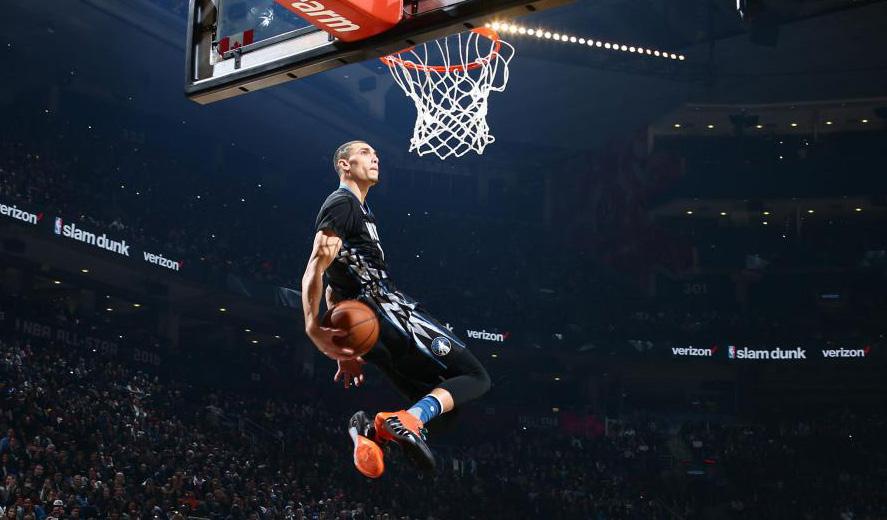
1. What’s the diameter of a basketball hoop in inches?
a) 12 inches
b) 14 inches
c) 16 inches
d) 18 inches
e) 20 inches
2. Which boxer fought against Muhammad Ali and won?
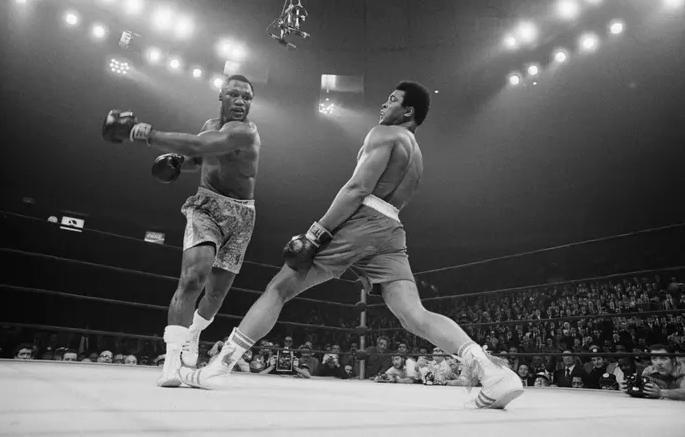
a) Mike Tyson
b) Sugar Ray Robinson
c) Joe Frazier
d) Canelo Alvarez
e) Manny Pacquiao
3. What sports team was originally called the “New York Titans?”
a) The New York Yankees
b) The New York Knicks
c) The New York Jets
d) The New York Mets
e) The New York Rangers
The Hill
EDITOR-IN-CHIEF
Jaiden Lee ’26
Benjamin Gong ’26
EDITORS
William Achtmeyer ’26, Brandon Li ’26, Ethan Xie ’26, and Nathan Zhang ’26
STAFF WRITERS
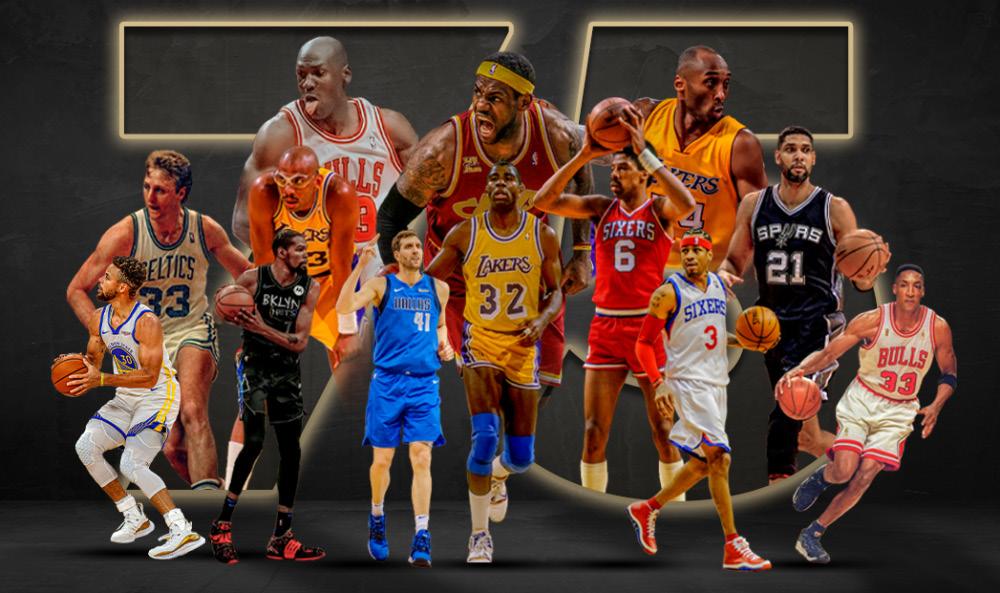
4. Which team has the longest victory streak in the NBA?
a) The Boston Celtics
b) The LA Lakers
c) The Indiana Pacers
d) The Cleveland Cavaliers
e) The Golden State Warriors
5. Who was the first British soccer player to win league titles in four countries?
a) David Beckham
b) Wayne Rooney

c) Bobby Moore
d) Ashley Cole
e) Harry Kane
6. Who was the first MLB pitcher to throw a pitch over a 100 mph?

a) Aroldis Chapman
b) Nolan Ryan
c) Clayton Kershaw
d) Roger Clemens
e) Randy Johnson
Bradford Adams, ’26, Alex Chen ’27, Thomas Danahy ’26, Connor Lynch, ’27, Henry Ramanathan ’26, , Teo Riviera-Wills ’26, Will Sandor ’27, TZ Snail ’26, and Ryan Chang-Wu ’27
Faculty Advisor
Mr. Conway
Trivia Answer Key: d), c), c), b), a), b)

The Back Page Page 9 The Hill
