Developing a Collaborative Mentorship Program to Anchor Culture Change in Nursing Education Yazdani, S., BSN, RN, PMH-BC, Morse, E., DNP, MPH, FNP-BC, Phillippi, R. D., PhD, & Montgomery, A. S., M.Ed., Belmont University Doctor of Nursing Practice Program
BACKGROUND
KEY FINDINGS
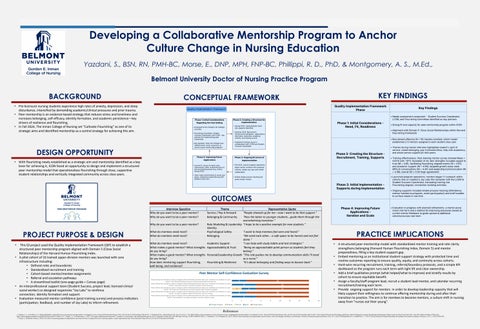
CONCEPTUAL FRAMEWORK
• Pre-licensure nursing students experience high rates of anxiety, depression, and sleep disturbance, intensified by demanding academic/clinical pressures and prior trauma. • Peer mentorship is an evidence-based strategy that reduces stress and loneliness and increases belonging, self-efficacy, identity formation, and academic persistence—key drivers of resilience and flourishing. • In Fall 2024, The Inman College of Nursing set "Cultivate Flourishing" as one of its strategic aims and identified mentorship as a central strategy for achieving this aim.
DESIGN OPPORTUNITY • With flourishing newly established as a strategic aim and mentorship identified as a key lever for achieving it, ICON faced an opportunity to design and implement a structured peer mentorship model that operationalizes flourishing through close, supportive student relationships and vertically integrated community across class years.
OUTCOMES Interview Question Why do you want to be a peer mentor? Why do you want to be a peer mentor?
PROJECT PURPOSE & DESIGN •
This QI project used the Quality Implementation Framework (QIF) to establish a structured peer mentorship program aligned with Domain 5 (Close Social Relationships) of the Harvard Human Flourishing Index. • A pilot cohort of 16 trained upper-division mentors was launched with core infrastructure including: • Defined roles and boundaries • Standardized recruitment and training • Cohort-based mentor/mentee assignments • Referral and escalation pathways • A streamlined toolkit (one-page guide + Canvas page) • An interprofessional support team (Student Success, project lead, licensed clinical social worker) co-designed responsive “Joy Labs” to reinforce connection, identity formation and support. • Evaluation measured mentor confidence (post-training survey) and process indicators (participation, feedback, and number of Joy Labs) to inform refinement.
Theme Service / Pay-it-forward Belonging & Community
Representative Quote "People showed up for me—now I want to be that support." "Pass the baton to younger students...guide them through the overwhelming transition." Why do you want to be a peer mentor? Role Modeling & Leadership "I hope to be a positive example for new students." Identity What do mentees need most? Psychological Safety "I want to help mentees feel seen and heard.” What do mentees need most? Belonging "We need each other… a safe space to be honest and not feel alone." What do mentees need most? Academic Support “I can help with study habits and test strategies.” What makes a good mentor? What strengths Approachability & Trust “Being an approachable point person so students feel they do you bring? belong.” What makes a good mentor? What strengths Personal/Leadership Growth “This role pushes me to develop communication skills I’ll need do you bring? as a nurse.” How does mentoring support flourishing, Flourishing & Resilience “It’s about belonging and finding ways to bounce back.” well-being, and resilience?
Peer Mentor Self-Confidence Evaluation Survey Please indicate how strongly you agree or disagree with the following statements about your confidence and readiness as a peer 0 mentor: I can effectively facilitate discussions about professionalism and self-care. Please indicate how strongly you agree or disagree with the following statements about your confidence and readiness as a peer 0 mentor: I know when to refer my mentee to faculty or other resources. Please indicate how strongly you agree or disagree with the following statements about your confidence and readiness as a peer mentor: I have improved my leadership and communication skills through this program. Please indicate how strongly you agree or disagree with the following statements about your confidence and readiness as a peer 0 mentor: I am able to establish rapport and build trust with my mentees. Please indicate how strongly you agree or disagree with the following statements about your confidence and readiness as a peer 0 mentor: I feel confident in my ability to support a mentee’s academic needs.
5 2
Disagree
11 3
11
3
13 5
0 Strongly Disagree
13
3
2 Neutral
11 4
Agree
6 Strongly Agree
8
10
12
14
16
18
PRACTICE IMPLICATIONS • A structured peer-mentorship model with standardized mentor training and role clarity strengthens belonging (Harvard Human Flourishing Index, Domain 5) and mentor preparedness, filling a key student-support gap. • Embed mentoring as an institutional student-support strategy with protected time and routine outcomes reporting to ensure quality, equity, and continuity across cohorts. • Hard-wire recurring recruitment, training, referral/boundary protocols, and a simple KPI dashboard so the program runs each term with light lift and clear ownership. • Add a brief qualitative prompt (what helped/what to improve) and stratify results by cohort to ensure equitable benefit. • Assign a faculty/staff program lead, recruit a student lead mentor, and calendar recurring recruitment/training each term. • Provide ongoing support for mentors in order to develop leadership capacity that will likely support their willingness to continue offering mentorship during and after their transition to practice. The aim is for mentees to become mentors, a culture shift in nursing away from "nurses eat their young".
References 1. Charlton, C. A., & Wofford, L. G. (2022). Maladaptive coping behaviors in pre-licensure nursing students: An integrative review. Journal of Professional Nursing, 39(1), 156-164. doi:10.1016/j.profnurs.2022.01.011. 2. Katchaturoff, M., Caboral-Stevens, M., Gee, M., & Lan, V. M. (2020). Effects of peer-mentoring on stress and anxiety levels of undergraduate nursing students: An integrative review. Journal of Professional Nursing, 36(1), 223 228. doi:10.1016/j.profnurs.2019.12.007. 3. Kern National Network for Flourishing in Medicine. (2024). Scaling the movement: Broadening and Deepening, Progress report for the period of July 2023 - June 2024. Medical College of Wisconsin. https://knncaringcharactermedicine.org/KNN/Framework.htm 4. Meyers, D. C., Durlak, J. A., & Wandersman, A. (2012). The quality implementation framework: A synthesis of critical steps in the implementation process. Am J Community Psychol 50(1), 462-480. https://doi.org/ 10.1007/s10464-012-9522-x. 5. Raymond, J. M., & Sheppard, K. (2017). Effects of peer mentoring on nursing students' perceived stress, sense of belonging, self-efficacy, and loneliness. Journal of Nursing Education and Practice, 8(1), 16-23. doi:10.5430/jnepv8n1p16. 6. VanderWeele, J. T. (2017). On the promotion of human flourishing. Proceedings of the National Academy of Sciences, U.S.A., 114(31), 8148-8156. 7. Yuksel, A., & Bahadir-Yilmaz, E. (2019). The effect of mentoring program on adjustment to university and ways of coping with stress in nursing students: A quasi-experimental study. Nurse Education Today, 80(1), 52-58. doi:10.1016/j.nedt.2019.06.006