Caring for Caregivers: Fostering Empathetic Educational Practices Among Undergraduate Nursing Faculty Karlee Hedrick, BSN, RN; Kaylyn Bourne, DNP, APRN; David Phillippi, PhD, MS; Angela Lane, DNP, CPNP Belmont University Doctor of Nursing Practice Program
PROBLEM
OUTCOMES
CONCEPTUAL FRAMEWORK
• Re-traumatization occurs in academic settings, impacting students’ well-being and learning. Nursing students are more at risk for this due to higher rates of adverse childhood experiences compared to the general population.1 • Faculty often lack training to recognize and use trauma-informed strategies, potentially limiting their ability to effectively support students who have experienced trauma.2,3
PURPOSE / AIM To improve undergraduate nursing faculty’s knowledge and attitudes toward trauma-informed care (TIC) by implementing a two-fold educational intervention.
PROJECT DESIGN Design: Quality Improvement Setting: Urban, private university Intervention: 1. Four-part virtual course from a credible, traumainformed organization. 2. Caring for Caregivers: A Guide for Empathetic Education virtual toolkit developed by project lead.
Caring for Caregivers logo (left) and homepage (right), developed to support nurse educators with implementing trauma-informed practices.
QUALITATIVE EXCERPTS “I had no idea these were trauma-informed practices—it’s more broad than I realized,”
one participant reflected after learning that strategies like using specific praise, explaining the “why” behind classroom activities, and allowing students to summarize or create questions align with trauma-informed education.
“This is a good reminder to realize that we should meet each student where they are to facilitate safe learning.”
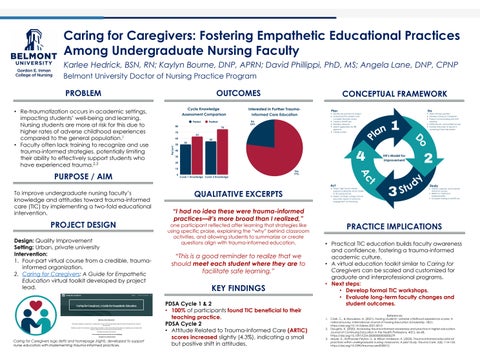
KEY FINDINGS PDSA Cycle 1 & 2 • 100% of participants found TIC beneficial to their teaching practice. PDSA Cycle 2 • Attitude Related to Trauma-Informed Care (ARTIC) scores increased slightly (4.3%), indicating a small but positive shift in attitudes.
PRACTICE IMPLICATIONS • Practical TIC education builds faculty awareness and confidence, fostering a trauma-informed academic culture. • A virtual education toolkit similar to Caring for Caregivers can be scaled and customized for graduate and interprofessional programs. • Next steps: • Develop formal TIC workshops. • Evaluate long-term faculty changes and student outcomes. References 1. Clark, C., & Aboueissa, A. (2021). Nursing students’ adverse childhood experience scores: A national survey. International Journal of Nursing Education Scholarship, 18(1). https://doi.org/10.1515/ijnes-2021-0013 2. Doughty, K. (2020). Increasing trauma-informed awareness and practice in higher education. Journal of Continuing Education in the Health Professions, 40(1), 66–68. https://doi.org/10.1097/CEH.00000000000000279 3. Mayer, K., Rothacker-Peyton, S., & Wilson-Anderson, K. (2023). Trauma-informed educational practices within undergraduate nursing classrooms: A pilot study. Trauma Care, 3(3), 114–125. https://doi.org/10.3390/traumacare3030012