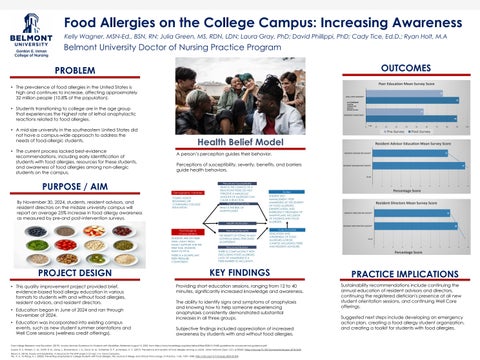

Food Allergies on the College Campus: Increasing Awareness
Kelly Wagner, MSN-Ed., BSN, RN; Julia Green, MS, RDN, LDN; Laura Gray, PhD; David Phillippi, PhD; Cady Tice, Ed.D.; Ryan Holt, M.A
Belmont University Doctor of Nursing Practice Program
PROBLEM
• The prevalence of food allergies in the United States is high and continues to increase, affecting approximately 32 million people (10.8% of the population).
• Students transitioning to college are in the age group that experiences the highest rate of lethal anaphylactic reactions related to food allergies.
• A mid-size university in the southeastern United States did not have a campus-wide approach to address the needs of food-allergic students.
• The current process lacked best-evidence recommendations, including early identification of students with food allergies, resources for these students, and awareness of food allergies among non-allergic students on the campus
PURPOSE / AIM
By November 30, 2024, students, resident advisors, and resident directors on the midsize university campus will report an average 25% increase in food allergy awareness as measured by pre-and post-intervention surveys.

PROJECT DESIGN
• This quality improvement project provided brief, evidence-based food allergy education in various formats to students with and without food allergies, resident advisors, and resident directors.
• Education began in June of 2024 and ran through November of 2024.
• Education was incorporated into existing campus events, such as new student summer orientations and Well Core sessions (wellness credit offerings).

Health Belief Model
A person’s perception guides their behavior.
Perceptions of susceptibility, severity, benefits, and barriers guide health behaviors.
Demographic Variables
YOUNG ADULTS BEGINNING OR CONTINUING COLLEGE EDUCATION. Psychological Characteristics
STUDENTS ARE ON THEIR OWN, AWAY FROM FAMILY SUPPORT FOR THE FIRST TIME. STUDENTS WANT TO FIT IN. THERE IS A SIGNIFICANT PEER PRESSURE COMPONENT.
Perceived Susceptibility
WHAT IS THE CHANCE OF A REACTION? PEERS DO NOT PERCEIVE A MINUSCULE AMOUNT OF ALLERGEN CAN CAUSE A REACTION.
Perceived Severity
WHAT IS THE RISK OF ANAPHYLAXIS?
Perceived Benefits
THE BENEFIT OF FITTING IN MAY OUTWEIGH BEING PERCEIVED AS DIFFERENT
Perceived Barriers
THERE IS COMPLACENCY WITH DISCLOSING FOOD ALLERGIES. LACK OF AWARENESS IS A PEER BARRIER TO INCLUSIVITY.
KEY FINDINGS
Action
STUDENT SELFMANAGEMENT. PEER AWARENESS OF THE SEVERITY OF FOOD ALLERGIES, IDENTIFICATION, AND EMERGENCY TREATMENT OF ANAPHYLAXIS. INCLUSION OF STUDENTS WITH FOOD ALLERGIES.
Cues to Action EDUCATION AND AWARENESS OF FOOD ALLERGIES ACROSS CAMPUS, INCLUDING PEERS AND RESIDENT ADVISORS
OUTCOMES
Providing short education sessions, ranging from 12 to 40 minutes, significantly increased knowledge and awareness.
The ability to identify signs and symptoms of anaphylaxis and knowing how to help someone experiencing anaphylaxis consistently demonstrated substantial increases in all three groups.
Subjective findings included appreciation of increased awareness by students with and without food allergies.
PRACTICE IMPLICATIONS
Sustainability recommendations include continuing the annual education of resident advisors and directors, continuing the registered dietician's presence at all new student orientation sessions, and continuing Well Core offerings.
Suggested next steps include developing an emergency action plan, creating a food allergy student organization, and creating a toolkit for students with food allergies.