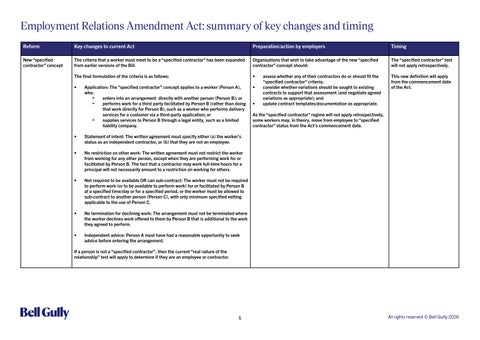
Employment Relations Amendment Act: summary of key changes and timing
Preparation/action by employers
New “specified contractor” concept
The criteria that a worker must meet to be a “specified contractor” has been expanded from earlier versions of the Bill.
The final formulation of the criteria is as follows:
• Application: The “specified contractor” concept applies to a worker (Person A), who:
ᵒ enters into an arrangement directly with another person (Person B); or
ᵒ performs work for a third party facilitated by Person B (rather than doing that work directly for Person B), such as a worker who performs delivery services for a customer via a third-party application; or
ᵒ supplies services to Person B through a legal entity, such as a limited liability company.
• Statement of intent: The written agreement must specify either (a) the worker’s status as an independent contractor, or (b) that they are not an employee.
• No restriction on other work: The written agreement must not restrict the worker from working for any other person, except when they are performing work for or facilitated by Person B. The fact that a contractor may work full-time hours for a principal will not necessarily amount to a restriction on working for others.
• Not required to be available OR can sub-contract: The worker must not be required to perform work (or to be available to perform work) for or facilitated by Person B at a specified time/day or for a specified period, or the worker must be allowed to sub-contract to another person (Person C), with only minimum specified vetting applicable to the use of Person C.
• No termination for declining work: The arrangement must not be terminated where the worker declines work offered to them by Person B that is additional to the work they agreed to perform.
• Independent advice: Person A must have had a reasonable opportunity to seek advice before entering the arrangement.
If a person is not a “specified contractor”, then the current “real nature of the relationship” test will apply to determine if they are an employee or contractor.
Organisations that wish to take advantage of the new “specified contractor” concept should:
• assess whether any of their contractors do or should fit the “specified contractor” criteria;
• consider whether variations should be sought to existing contracts to support that assessment (and negotiate agreed variations as appropriate); and
• update contract templates/documentation as appropriate.
As the “specified contractor” regime will not apply retrospectively, some workers may, in theory, move from employee to “specified contractor” status from the Act’s commencement date.
The “specified contractor” test will not apply retrospectively.
This new definition will apply from the commencement date of the Act.

Reform Key changes to current Act
Changes to personal grievance remedy awards
• If an employee’s action(s) contribute to a situation giving rise to their personal grievance, they will not be entitled to reinstatement, or compensation for injury to feelings or loss of benefits.
• If an employee’s action(s) amount to serious misconduct and they contribute to a situation giving rise to their personal grievance, they will not be entitled to any remedies.
• Available remedies may be reduced by up to 100% if there is contributing behaviour by an employee.
Reform Key changes to current Act
High-income threshold for unjustified dismissal claims
If an employee’s annual remuneration meets or exceeds NZ$200,000 (threshold to be updated annually, but not before 1 July 2027), then the employee cannot raise any personal grievance in respect of their dismissal.
There is a 12-month transition period before this new threshold applies to existing employees. During that time, an employer and employee must negotiate in good faith about any contractual arrangements that may apply.
Preparation/action by employers
In some cases, processes may be expedited where an employer is confident that serious misconduct has occurred – however, proceed with caution.
Serious misconduct is not defined in the Act, and we anticipate this will be the subject of litigation (as it has a material impact on available remedies).
On the commencement date of the Act.
For employers who are partway through a process at the time the Act takes effect, the new remedies regime will apply to any actions taken after commencement.
Preparation/action by employers
Unless parties “opt in” to the personal grievance regime in respect of a dismissal, employers may bypass procedural and substantive requirements when dismissing high-income employees. This will, however, be subject to anything that the employer and employee have agreed contractually, including any employer policies that are incorporated into the contract.
Employers should:
• identify high-income threshold employees;
• review their employment agreements and policies to assess whether they have agreed to follow particular employment processes;
• assess whether the employer wishes to negotiate to remove those provisions or “opt in” to these aspects of the personal grievance regime – and amend current and template agreements accordingly; and
• engage with current employees in good faith.
Policies that are intended to apply across all employees should be updated so that they do not automatically apply to high income threshold employees (if that is the employer’s intended policy position).
High-income threshold employees may seek to negotiate various contractual protections, including longer notice periods and potential “no fault termination” clauses (providing for an enhanced payment on termination).
For new employees: on the commencement date of the Act.
For current employees: 12 months after the commencement date unless agreed earlier.

30-day rule

Employers will no longer need to employ non-union member employees whose work would fall within the coverage of an applicable collective agreement on terms and conditions based on that collective agreement for the first 30-days of their employment.
Employers are also no longer required to provide new employees with certain information provided by the union, or to share new employee information with applicable unions.
Preparation/action by employers
Employers should review collective agreements to assess whether they have contractually agreed to the 30-day rule and other union-related processes, notwithstanding this change.
If the 30-day rule is not contractual, employers are able to employ non-union members on an individual employment agreement from the outset, where there is an applicable collective agreement(s) that covers the employee’s work. However, employers must still inform new employees about any relevant collective agreement and union.
Employers should update their offer documentation accordingly.
On the commencement date of the Act.