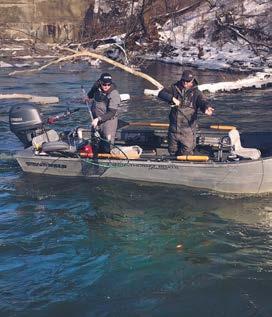
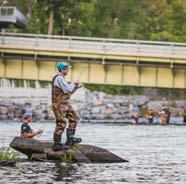
Booking a drift boat trip is easily the best way to explore every mile of the wild Salmon River. Fishing from a boat gives you access to less pressured sections of the river, and you’ll stay warm and dry floating above the water’s surface. Listen to your guide, and you’re sure to learn some of the nuances of steelhead angling that will help you immensely the next time you set out to chase these incredible fish! MORE
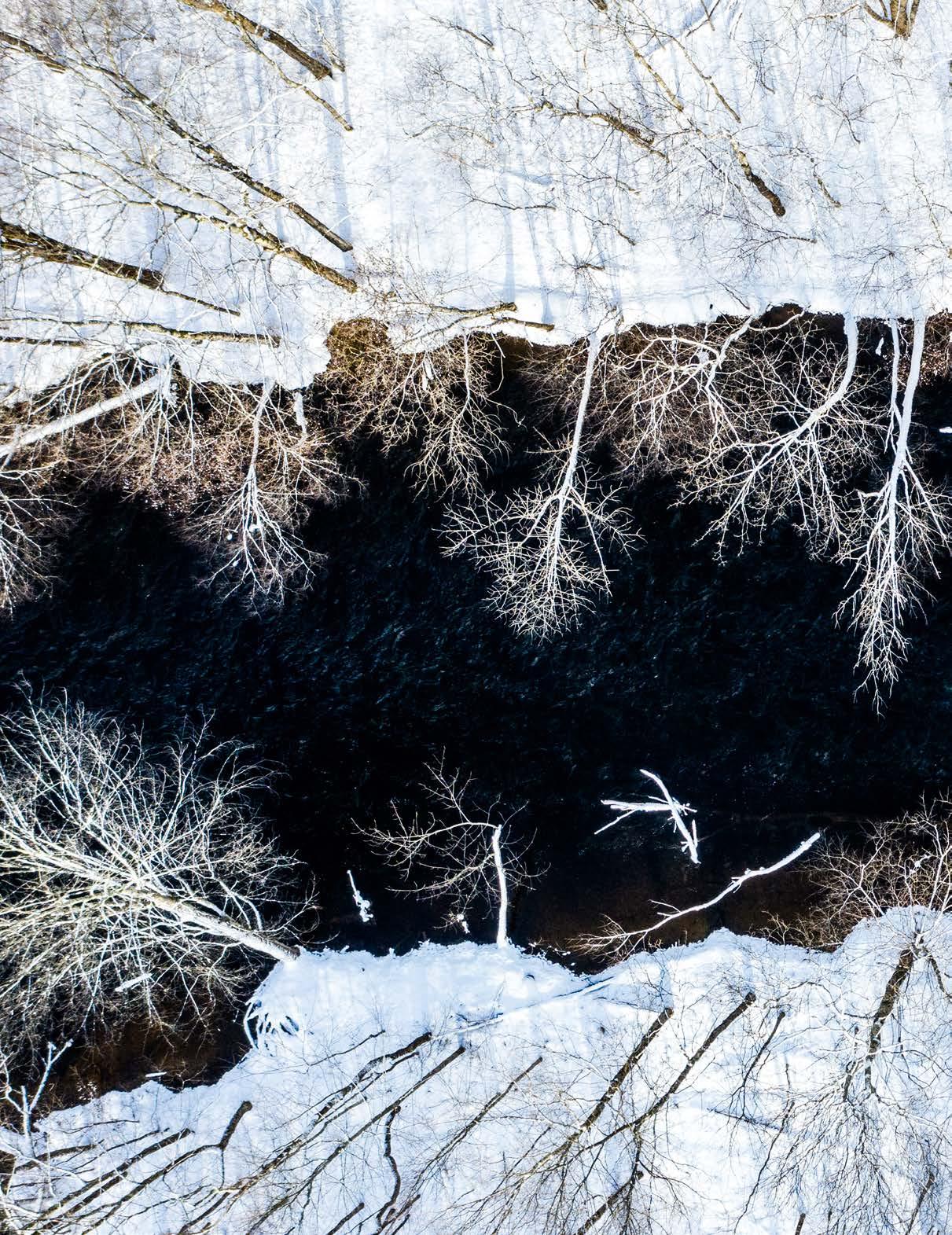
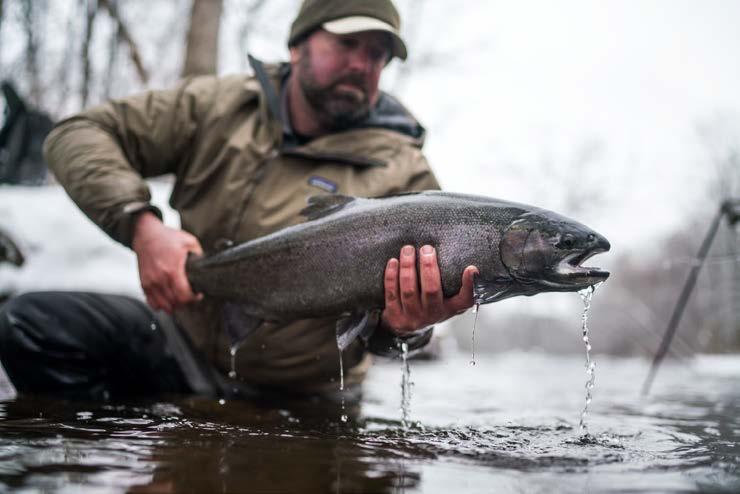
Photo By Flylords
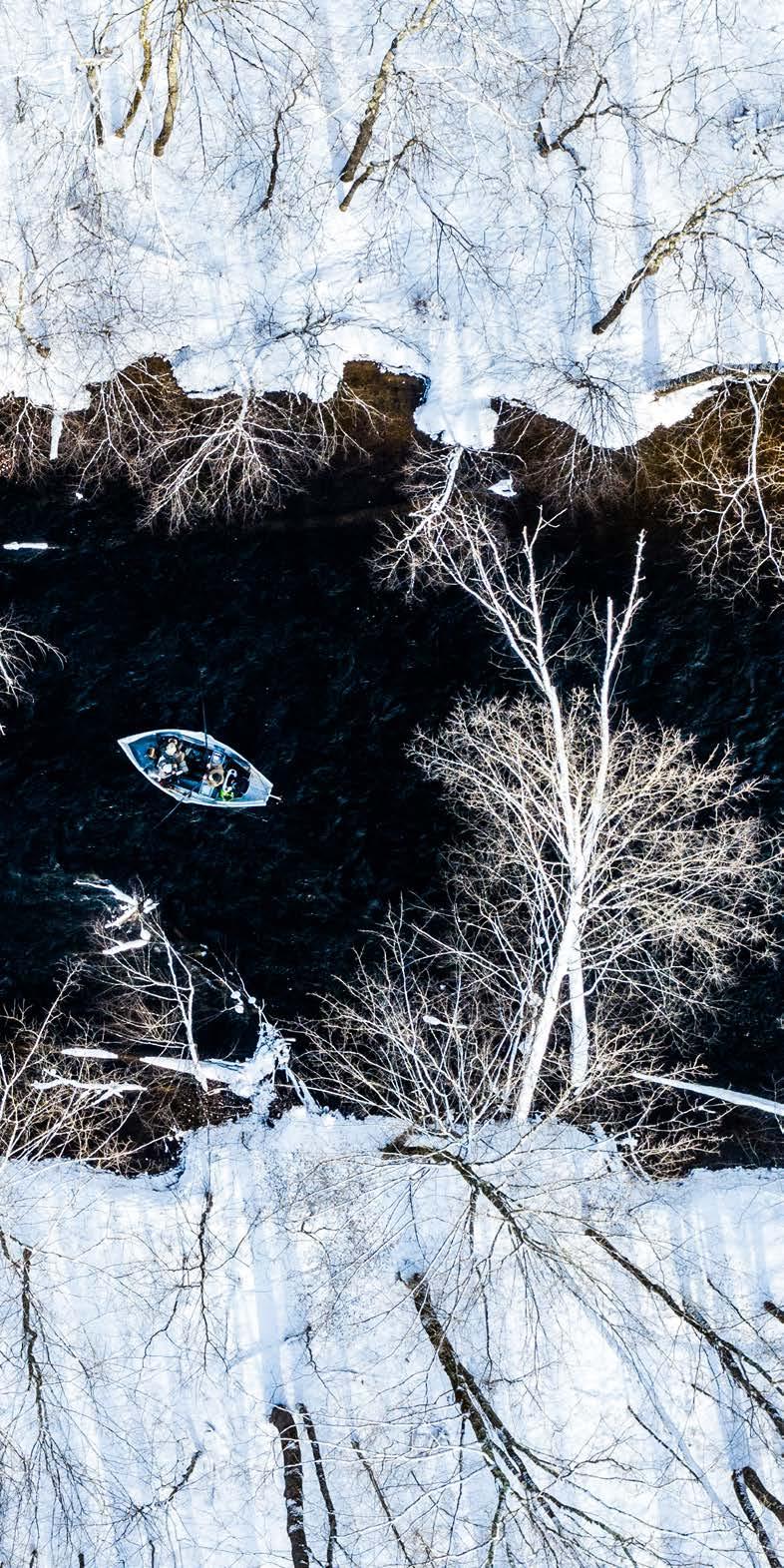
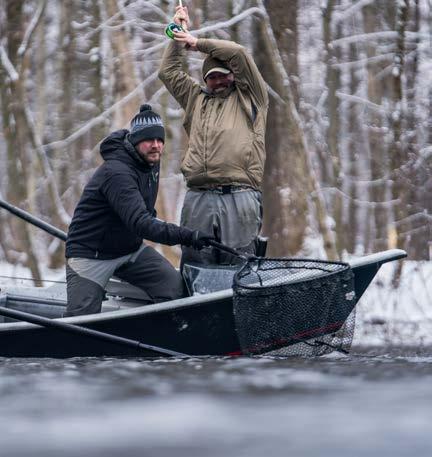
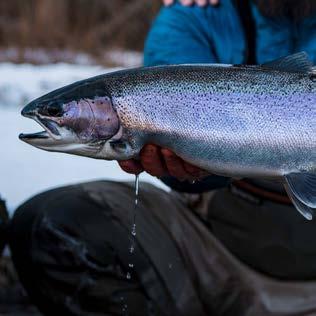
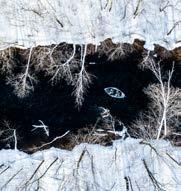
The “Bovines” are hallowed ground on the Salmon River. Here, the Salmon River spreads out into deep braided channels and takes on an entirely different personality with steep, wooded banks creating a canopy over the water. During the winter, the steelhead take full advantage of the low light to fill the section without worry of being spotted from above. Using the undercut wooded banks for shelter, steelhead pack into the deep waters to feed and hold.
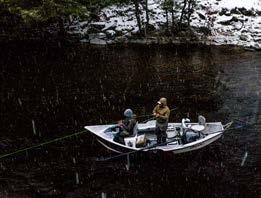
This section can be accessed on foot but is perhaps best enjoyed on the bow of your guide’s drift boat. As you float beneath the snowy canopy, keep an eye on your line and be ready to wrestle a steelhead off the bank and into the net. In the intimate channels, an exciting close-quarters battle is sure to ensue.
MORE STEELHEAD INFO: P. 16
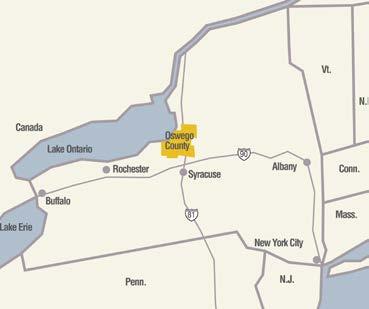
Welcome to Oswego County, New York!
Our world has seen many changes, but fortunately some things have remained the same.
Our corner of the planet, on the southeastern shore of Great Lake Ontario, still offers some of the finest and most diverse fishing opportunities in North America.
We still provide a refuge to those with a sense of adventure – whether it’s trolling for trophy trout, salmon, and walleye on breathtaking lakes, chasing steelhead on the legendary Salmon River, drifting the churning whitewater of the Oswego River, or casting for wild brook trout on the Tug Hill Plateau.
Explore thousands of acres of pristine public lands for signs of whitetail deer, wild turkey, waterfowl, and small game.
We have all the ingredients you need to create lasting memories. Professional fishing charters, guides, lodging, campgrounds, marinas, restaurants, and tackle shops are conveniently located near fishing hotspots and hidden retreats.
Let this be your year to experience Oswego County’s great outdoors!

Daniel Breitweg DEPUTY DIRECTOR OF TOURISM

TOURISM STAFF
Director of Community Development, Tourism & Planning:
Tim Stahl
Deputy Director of Tourism
Daniel Breitweg
STAFF:
Kelly Jordal
David Owens
Jennifer Longley
Savannah Wyckoff
Linda Forsythe
SPECIAL THANKS TO THE FOLLOWING CONTRIBUTORS
Aaron Abrams
Andy Bliss
Garrett Brancy
Nate Blasczienski
Ryan Chelius
Gary Edwards
David Fadden
Stacy Furgal
Brenden Gallagher
Wendy Gonyea
Brien Hansen
Fiska Media

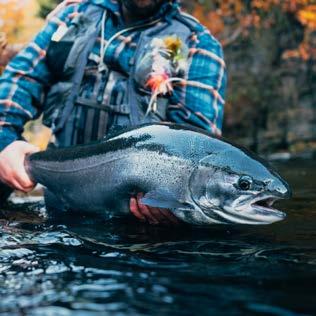
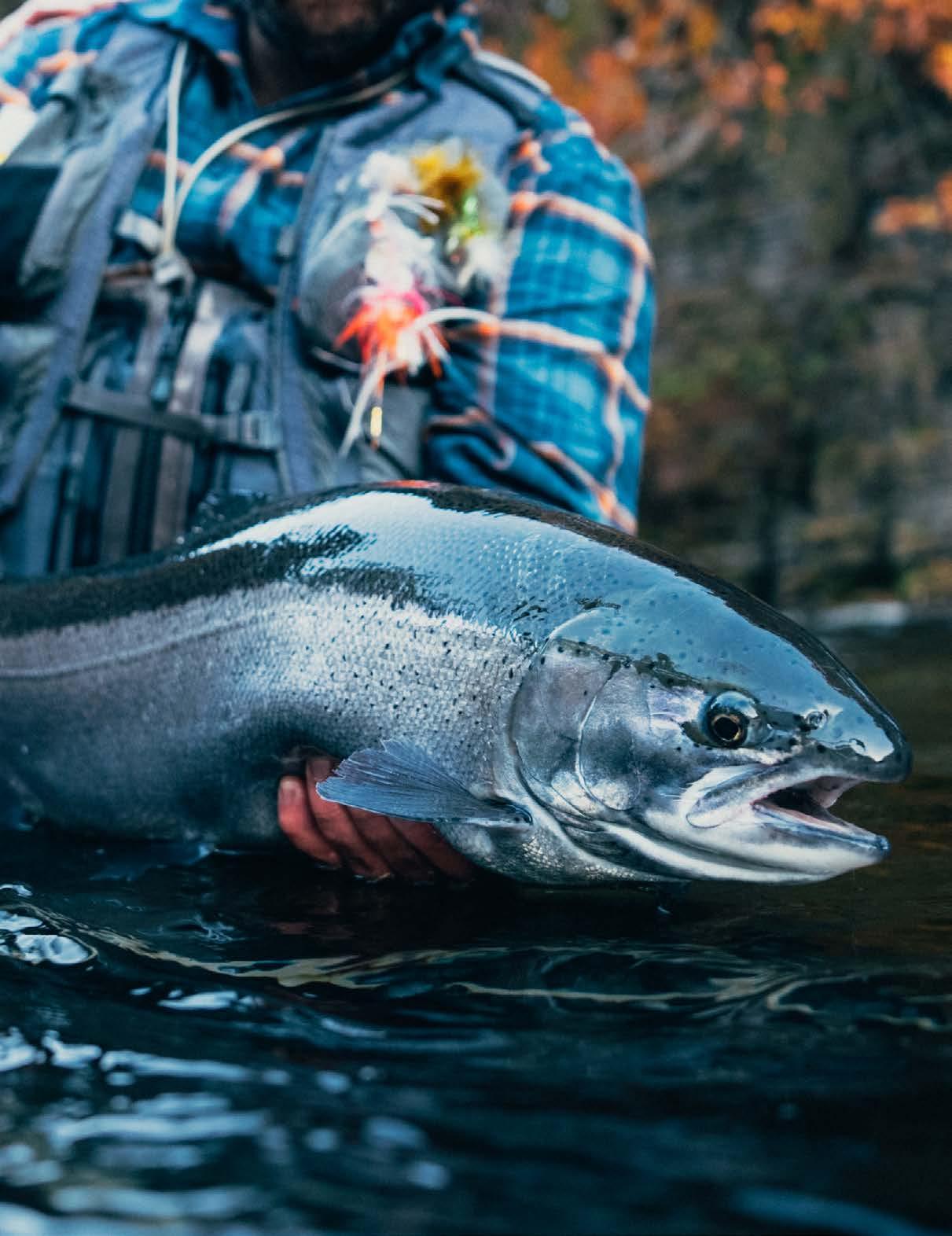
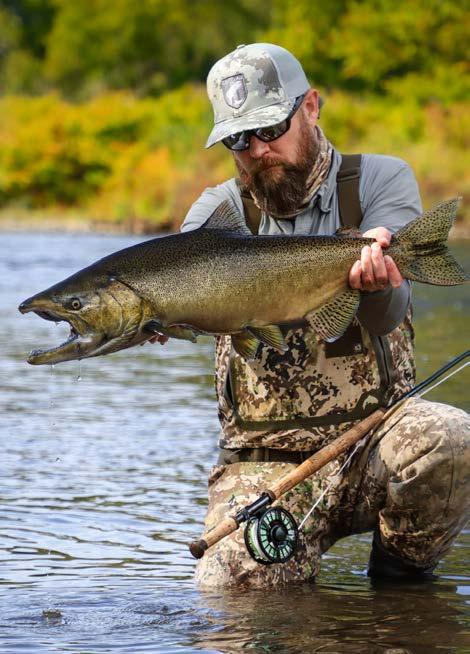
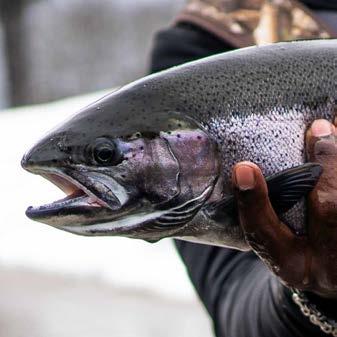
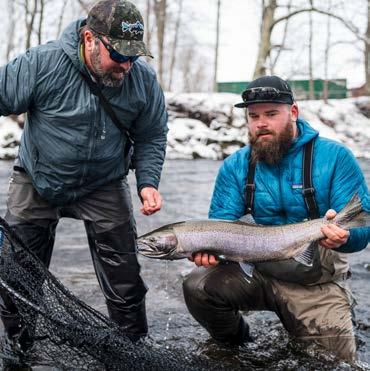
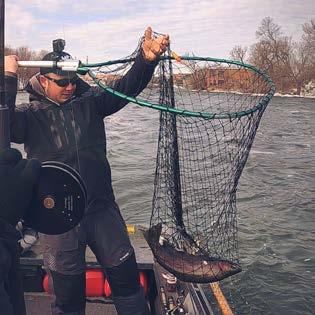
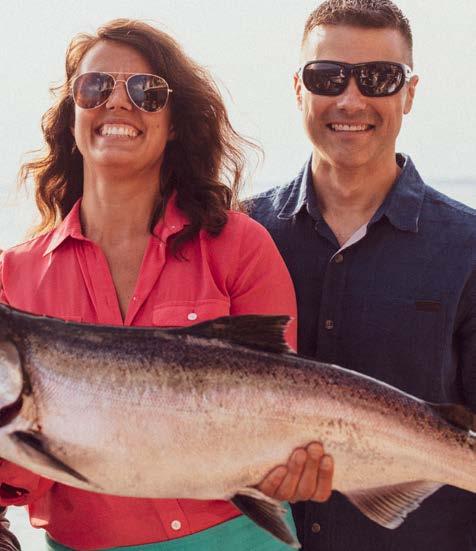
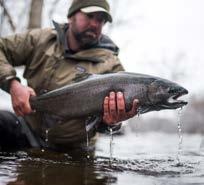
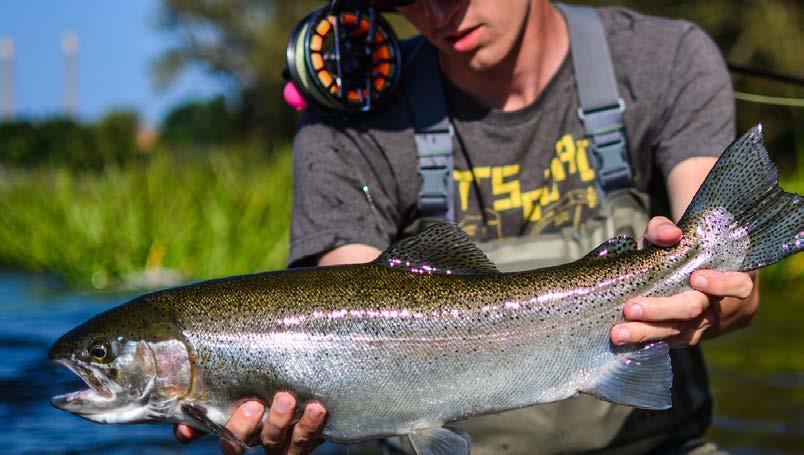
This beautiful steelhead was caught on the famous Salmon River
® I LOVE NEW YORK is a registered trademark and service mark of the New York State Department of Economic Development; used with permission.
Flylords Media
Jacqueline McManus
NYS DEC
Karen Noyes
Brookfield Power
David Rath
Brandon Schwerdt
Emily Studdert
Fran Verdoliva
Dan Zazworsky
We strive to use sustainable printing processes for our brochure printing. Such as soy-based inks and recycled paper.
DISCLAIMER: This guide was developed as a marketing tool and is meant to provide an overview of the fishing and hunting opportunities in Oswego County, New York. Oswego County Tourism does not specifically endorse any fishing guide, charter, outfitter, advertiser, or location. Nor does Oswego County Tourism accept any liability for trips to the area based on the contents of this guide. Additionally, users should always refer to the NYS DEC for any specific questions regarding hunting or fishing regulations.
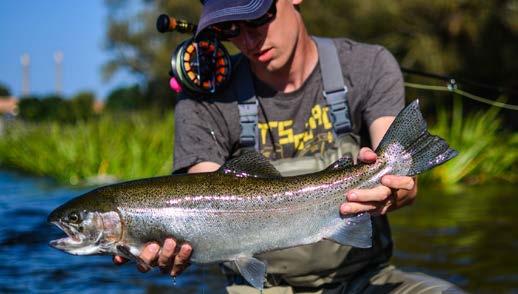



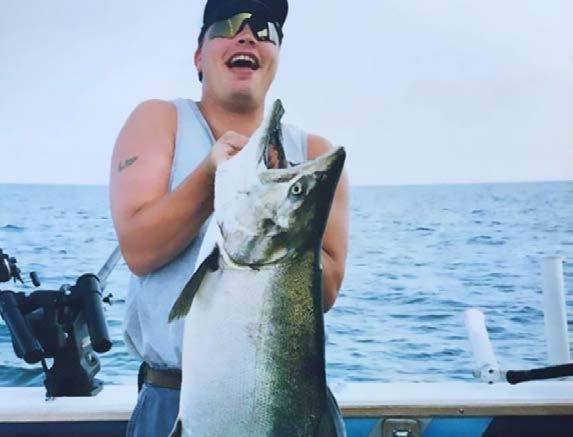
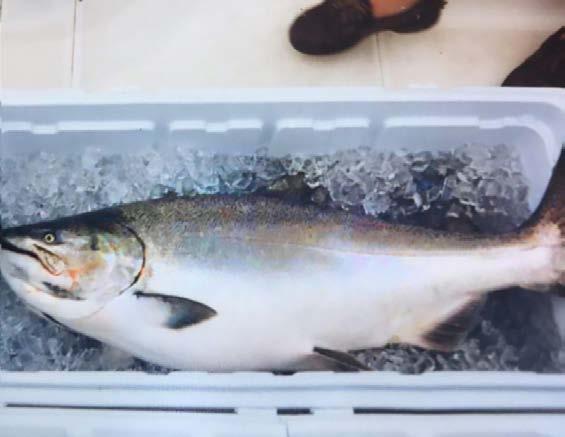
Capt. Mike Stilin’s clients were having a very good day Aug. 13, 1998, fishing off Oswego Harbor. They had netted some nice salmon when Stephen Sheets Jr. of Woolrich, PA landed another big fish using cut bait with an A-Tom-Mik bait head. Stilin recalls the fish looked too large to be a coho but didn’t look like a Chinook. They headed back to Oswego to meet DEC biologist Les Wedge. After several tests and using certified scales borrowed from the Oswego Speedway, that afternoon Wedge announced a new 33-lb., 7-oz. record coho.
(The IGFA recognizes the world record coho as Jerry Lifton’s 33-lb 4-oz. fish caught in the Salmon River in 1989. Either way, both fish came from Oswego County’s territorial waters and are larger than their Pacific Ocean relatives.)
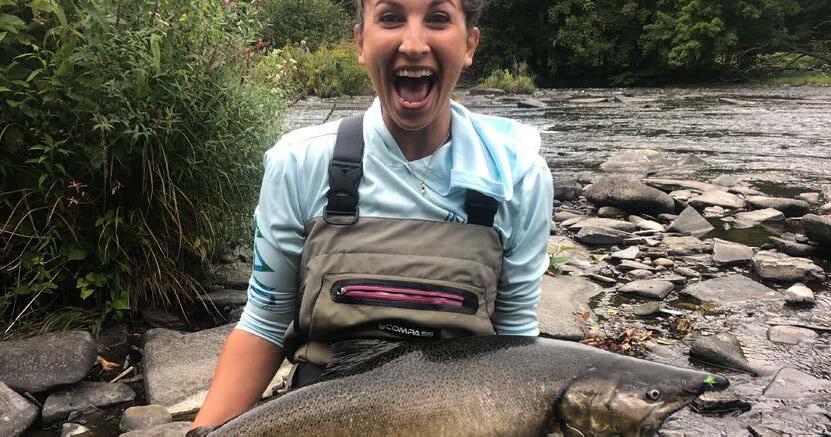
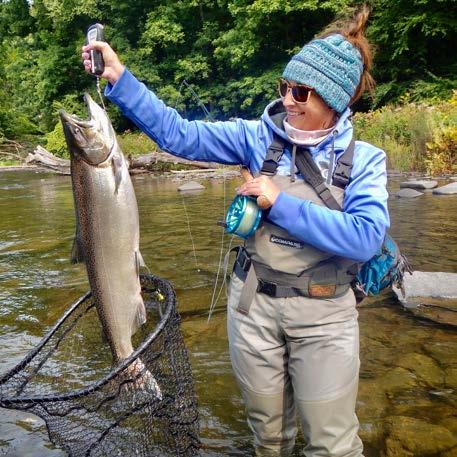
T heresa Caputo travelled more than 1,000 miles from Florida to Pulaski in September 2020, determined to earn a spot in the IGFA record books. Within a few days, Theresa had two new world records. She caught her first world-record Chinook – at 15 lbs., 12 oz. on an 8-lb. tippet Sept. 15, 2020, on the Salmon River. Two days later, she landed her second record-breaker at 20 lbs., 1 oz. When asked why she comes to fish the Salmon River, Theresa replied, “Every year, I would see photos of people with big smiles and even bigger kings. I heard stories of tail-walking salmon and needed a piece of the action. I made my first trip in 2015 and I’ve been hooked ever since!” Both records were officially confirmed by the IGFA in November 2020.


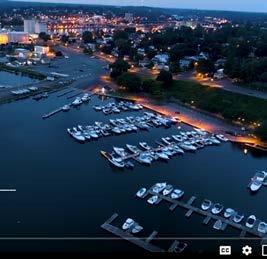

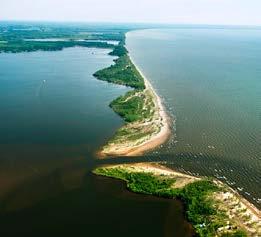

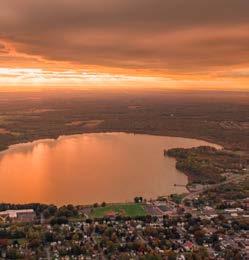

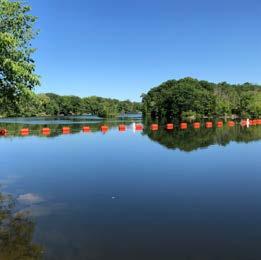

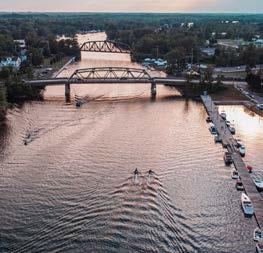

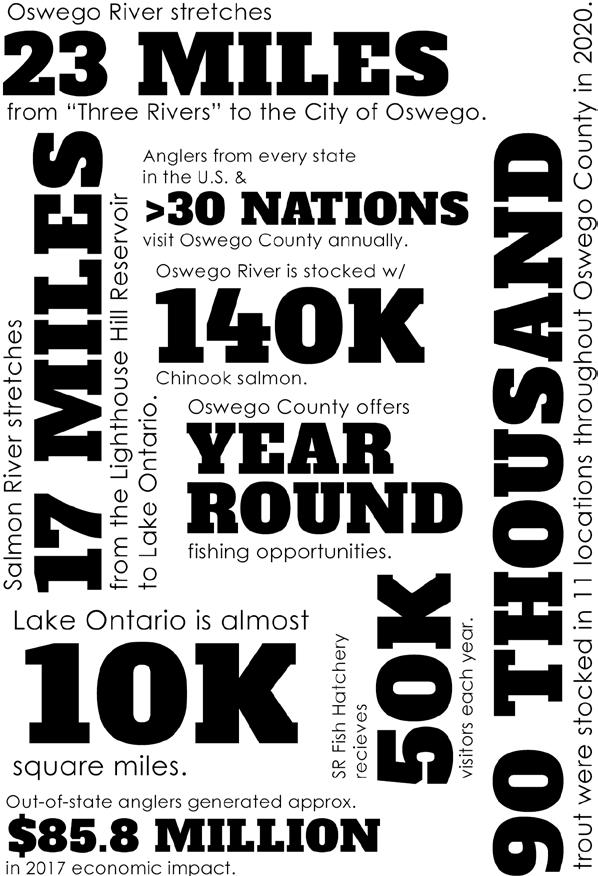
Oswego County’s fishery is no accident. It’s the result of outstanding natural resources carefully managed by local, state, and federal partners, combined with respectful conservation practices.
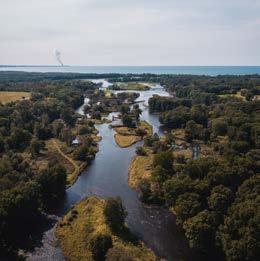
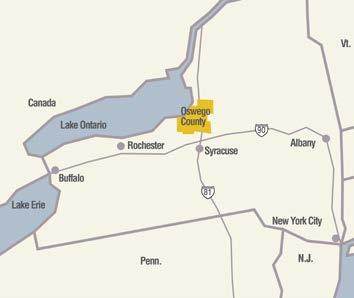
Within the county’s 968 square miles are portions of three large river systems, numerous smaller streams, and 160 lakes and ponds. Much of the county’s boundary lines are natural waterways.

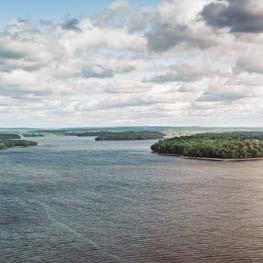
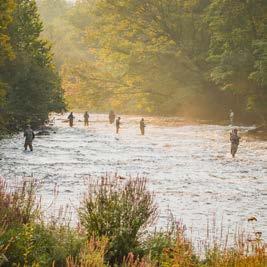
All this expanse of fresh water not only provides amazing fishing; it creates opportunities for birding, paddling, hunting, and other outdoor activities.



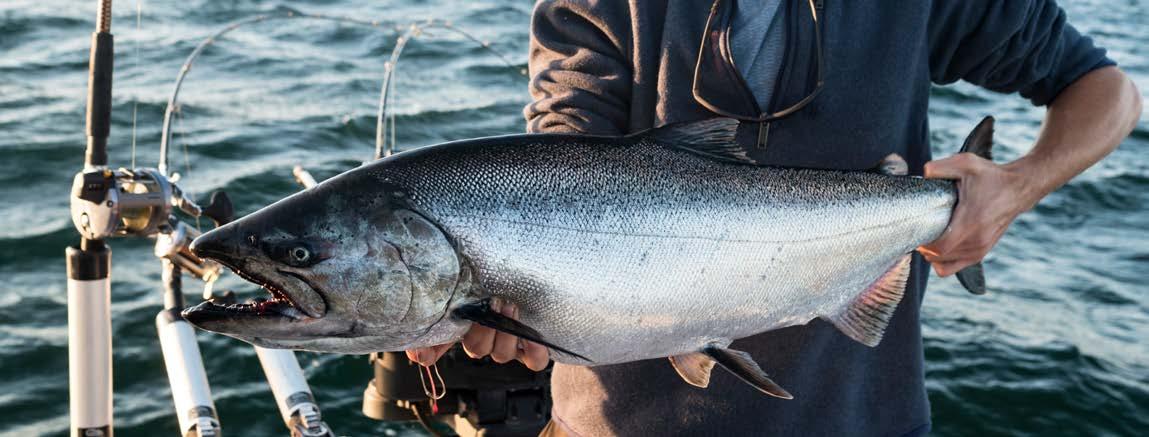
Lake Ontario charters offer trips for Chinook and coho salmon, lake and brown trout, and steelhead. Most Oswego County charter captains operate from about April until October. Early season trips for lake and brown trout run early April into May. Some anglers prefer the more moderate weather experienced May through September. July and August are popular months for targeting Chinooks, while earlier months are prime for brown trout and lake trout. Outings should be booked early to secure a spot. Mild fall temperatures allow some charter captains to continue scheduling trips on the lake until mid- to late October. SEE P. 30 FOR FOR MORE INFORMATION ON POPULAR SPECIES, OR SEE P. 36 FOR A LIST OF CHARTERS.
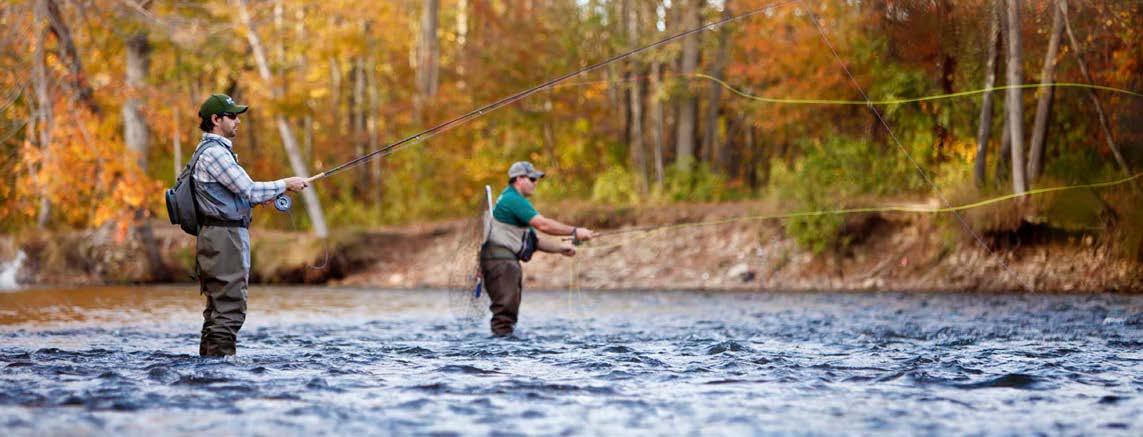
Both the Salmon River and the Oswego River offer year-round fishing. The Salmon River runs over 17 miles from Altmar to Port Ontario, with 12 miles of public fishing rights along its shoreline. Chinook salmon, coho salmon, and Atlantic salmon are abundant from mid-August through mid-October. Brown trout are primarily available from September to November and steelhead are the main catch from November to April. The Oswego River is the second largest Lake Ontario tributary. While the fall salmon run is popular, walleye, steelhead, bass, and several other species also make the Oswego River their home. SEE P. 44 FOR MORE INFORMATION ABOUT “THE SALMON RUN.”
FOR THE LATEST REPORT: visitoswegocounty.com
OR CALL:
1-800-248-4FUN (4386) and choose option 1.
CREEKS & STREAMS p14
DAMS & RESERVOIRS
Caughdenoy Dam p12
Salmon River Reservoirs p15, p20, p48, p49
LAKES & PONDS
Kasoag Lake p20
Lake Neatahwanta p12, p20, p21
Lake Ontario p7, p22, p27, p31, p48, p64
Long Pond p20
Oneida Lake p20, p21, p28, p29, p48, p64
Panther Lake p20
Sandy Ponds p20, p21
St. Mary’s Pond p20
Whitney Pond p20
RIVERS
Little Salmon River p14
Oneida River p12
Oswego River p12, p19, p48, p50-51
Salmon River p2-3, p7, p16-18, p23-24, p44-49, p64
MULTIPLE LOCATIONS
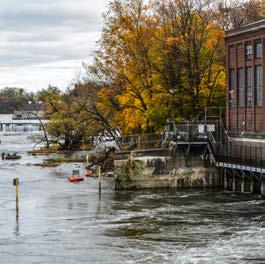
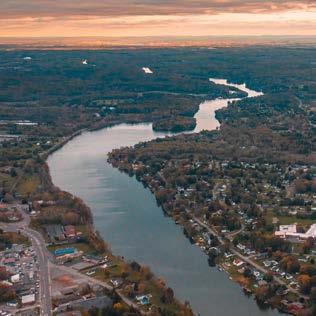
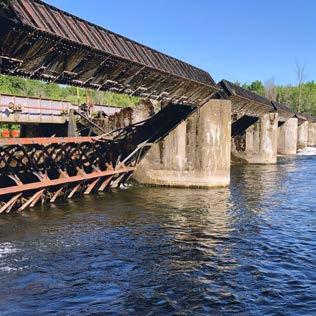
The character of the Oswego River changes above the dam, heading south. The fast waters near hydropower dams in Minetto, Fulton, and Phoenix attract many species not found in the lower part of the dam. MAP OF THE OSWEGO: P.51
FULTON NY
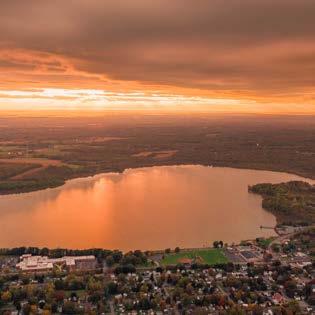
A perfect year-round fishery. Spring sees anglers catching bullhead dinners. Summer brings Northern pike, largemouth bass, perch, crappie, and bowfin. Autumn days send fish on feeding binges, and ice fishing in winter is popular.
HASTINGS NY
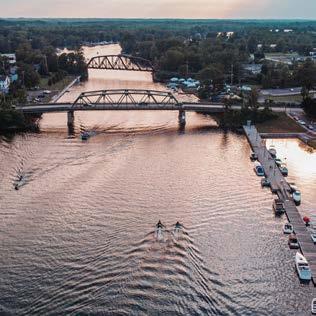
Shore fishing access above and below the dam along Co. Rte. 12. The plunge pool is rich in warm water species like walleyes, smallies, sheepshead, perch, and gar pike. Parking along Co. Rte. 12 or Caughdenoy Marina.
MULTIPLE LOCATIONS / TOWNS
The Oneida River meanders several miles before converging with the Seneca and Oswego rivers at Three Rivers. Public access at the Brewerton North Wall east of the Rt. 11 bridge, Caughdenoy Dam and Big Bend in Schroeppel.




40
You need a fishing license if you are 16 years and older and fishing for:
dec.ny.gov/regulatory/permits-licenses/sporting-and-use/sporting dec.ny.gov/regulatory/permits-licenses/sporting-and-use/sporting
•Freshwater fish by angling, spearing, hooking, longbow, and tip-ups.
•Frog species by spearing, catching with hands, or by use of a club or hook.
•Freshwater baitfish for personal use.
Licenses are available at many bait and tackle shops, sporting goods retailers, town and city clerks’ offices, and can be purchased online at WWW.DEC.NY.GOV/permits or by phone at 866.933.2257. H
unters are required to have the necessary Hunter Education Certificate to legally buy a license or permit to hunt. Buy the license through the New York State Department of Environmental Conservation website or a state approved agent.
LICENSES ARE GOOD FROM SEPT. 1 TO AUG. 31 OF THE NEXT YEAR.
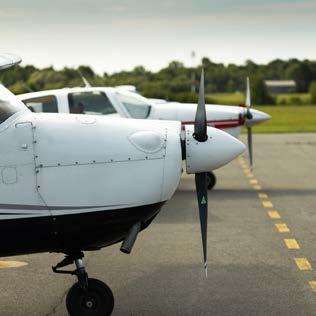
Whether you own your own plane or charter a flight with a group of friends, the Oswego County Airport is here to accommodate all your needs.
We are a general aviation airport ready to assist when you arrive and can accommodate most private and charter aircraft. Arrange to have your charter captain, hunting guide, friend, or rental car waiting for you when you arrive. Lake Ontario, the Oswego River, Salmon River and Oneida Lake all lie within short drives of the airport.
Call us at 315.591.9130 or visit OSWEGOCOUNTYAIRPORT.COM and we will be happy to assist you in bringing home that trophy catch!
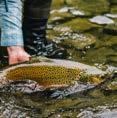
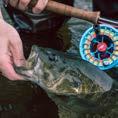
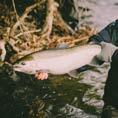
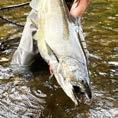
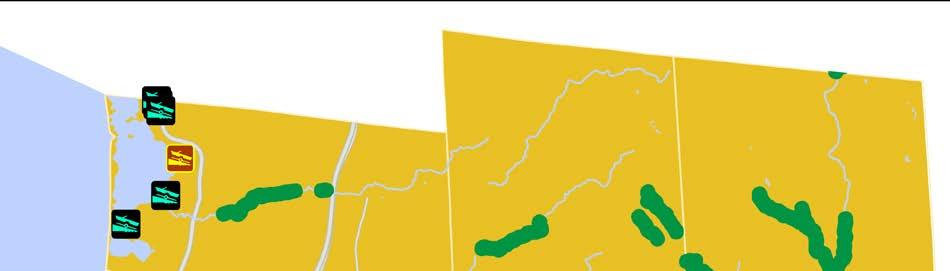
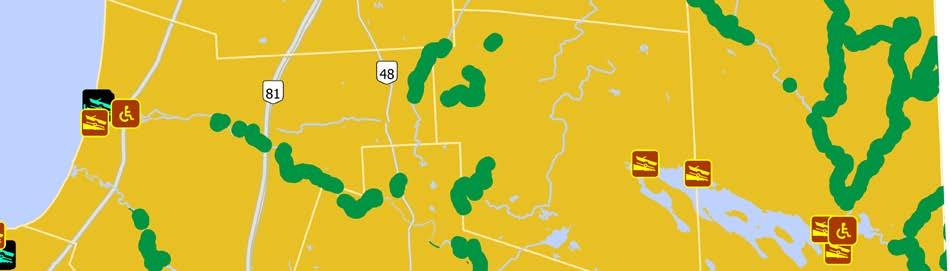
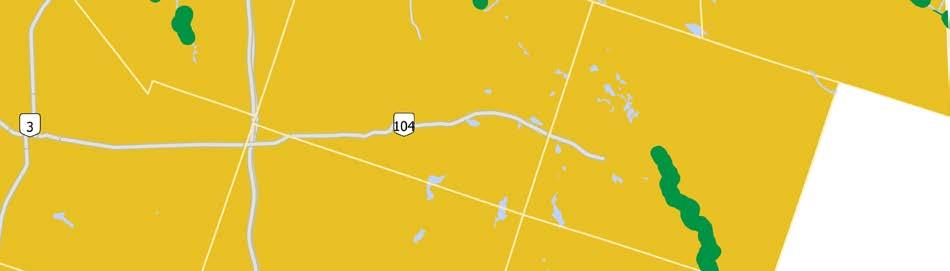
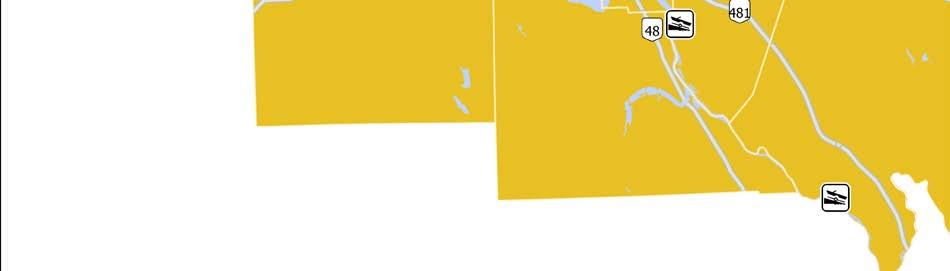
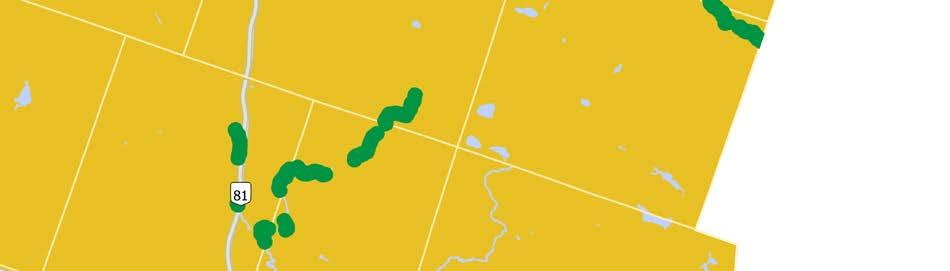
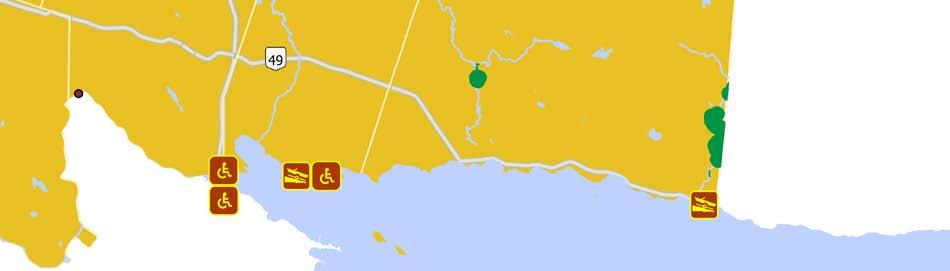
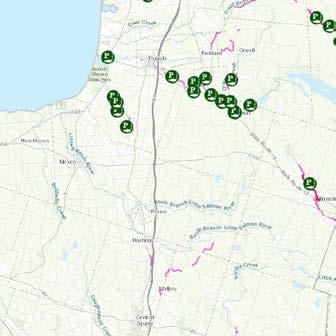
Thanks to the efforts of the NYS Department of Environmental Conservation, anglers have public fishing access, and can fish for trout, steelhead, and salmon in streams across Oswego County. Even better, the DEC stocks many of these streams and ponds with trout. (See map inset below).
Near the village of Cleveland on the border of Oswego and Oneida counties, Black Creek has 1.6 miles of public fishing rights.
Flowing across the western Tug Hill in Oswego, Jefferson and Lewis counties, there are more than 6.6 miles of public access along this stream.
Small brush-lined creeks in the Town of Hastings. Anglers can fish along six miles of access on Big Bay Creek and one mile on Dykeman Creek.
GRINDSTONE CREEK
The mouth of Grindstone Creek can be accessed from the large parking lot in Selkirk Shores State Park or state parking lots on Co. Rte. 28, on Krebs Road, and NYS Rte. 48.
Anglers can fish for wild brook trout on more than six miles of publicly accessible land.
The east branch of the Salmon River in Redfield contains about five miles of public fishing rights.
Public access includes the Mexico Point boat launch and Mexico Point State Park. Also, Yogi Bear’s Jellystone Park Campground allows guests access.
LITTLE
Anglers can fish Little Sandy Creek in the village of Sandy Creek and on designated public fishing access points just west of the village along Norton Road and Lake Street. Designated parking areas are also located there.
Located in Redfield, the north branch of the Salmon River provides nearly nine miles of public fishing rights.
Orwell Brook contains 2.9 miles of public fishing rights and Pekin Brook contains ½ mile.
Located in the town of Constantia. There are 0.6 miles of public fishing rights along Scriba Creek and 0.06 miles along Spring Brook.
&
Both brooks in the town of Richland contain several miles of public fishing rights.
Near the border of Oswego and Lewis counties, Prince Brook contains ½ mile of public fishing rights and Stony Brook contains one mile.
The west branch of Fish Creek contains several miles of public access in the town of Williamstown.
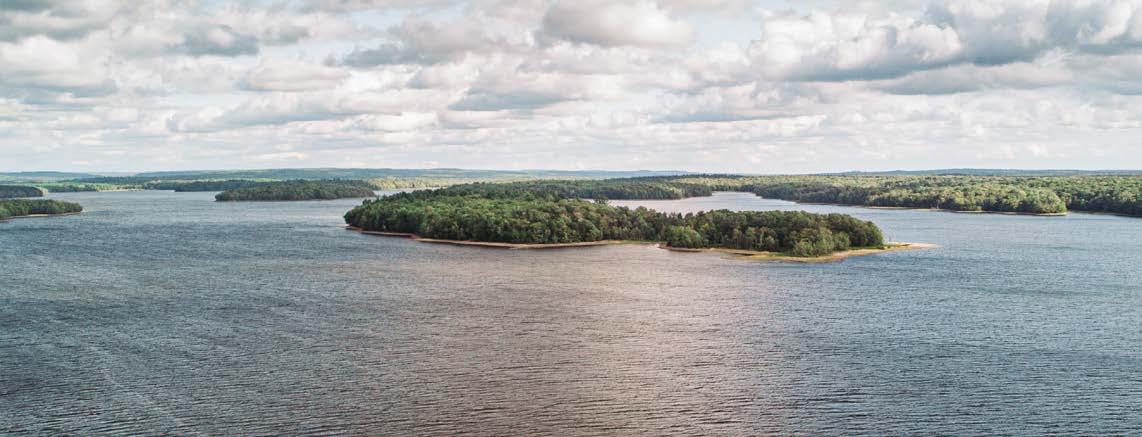
LOWER RESERVOIR (LIGHTHOUSE HILL)
The reservoir dam covers 164 acres. Parking and shore fishing are accessible between the two bridges at Bennett Bridges. No motorized boats are allowed on the Lower Reservoir.
UPPER RESERVOIR
Also called Redfield Reservoir. Trout season is open year-round and ice fishing is popular. Parking available on CCC Rd., Jackson Rd., and Co. Rte. 17.
FALLS ROAD DAY USE PROJECT
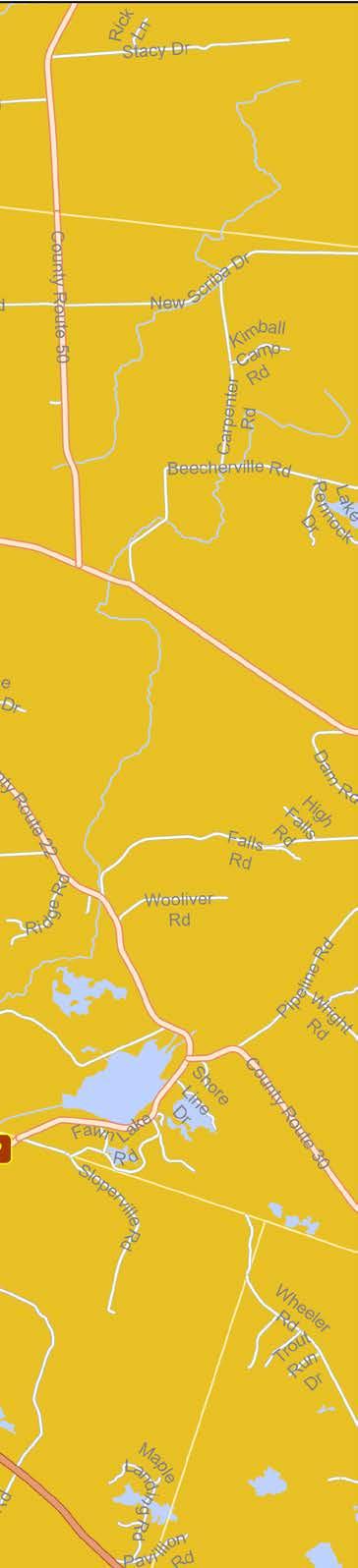
Beach launch, picnic facilities, shore fishing access and parking. Take Co. Rt. 2 east out of Pulaski for nine miles; turn right onto Dam Rd., then left at four corners.
JACKSON ROAD PUBLIC ACCESS
Paved ramp, parking, and shore fishing access. 9.5 miles east of Pulaski on Co. Rte. 2.
LITTLE AMERICA PUBLIC ACCESS
Parking and shore fishing access. Continue past Jackson Road Access one mile, turn right onto CCC Dr.
REDFIELD PUBLIC ACCESS
Parking, beach launch, and handicapped accessible fishing platform. Off Co. Rt. 17, at the south end of the hamlet.
O’HARA STATE FOREST PUBLIC ACCESS
Shore fishing access and parking. Take Co. Rt. 22 north out of Altmar for 3.2 miles. Turn right onto Co. Rt. 30 for 0.3 miles. Turn left onto Pipeline Rd. for 2.2 miles.
By Daniel Zazworsky
Photos By @Flylords
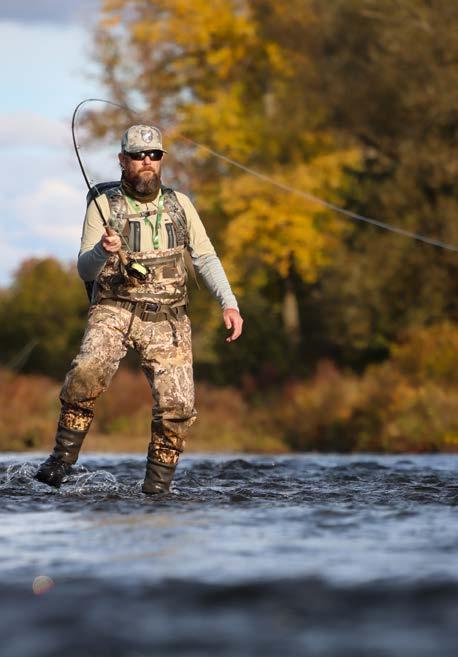
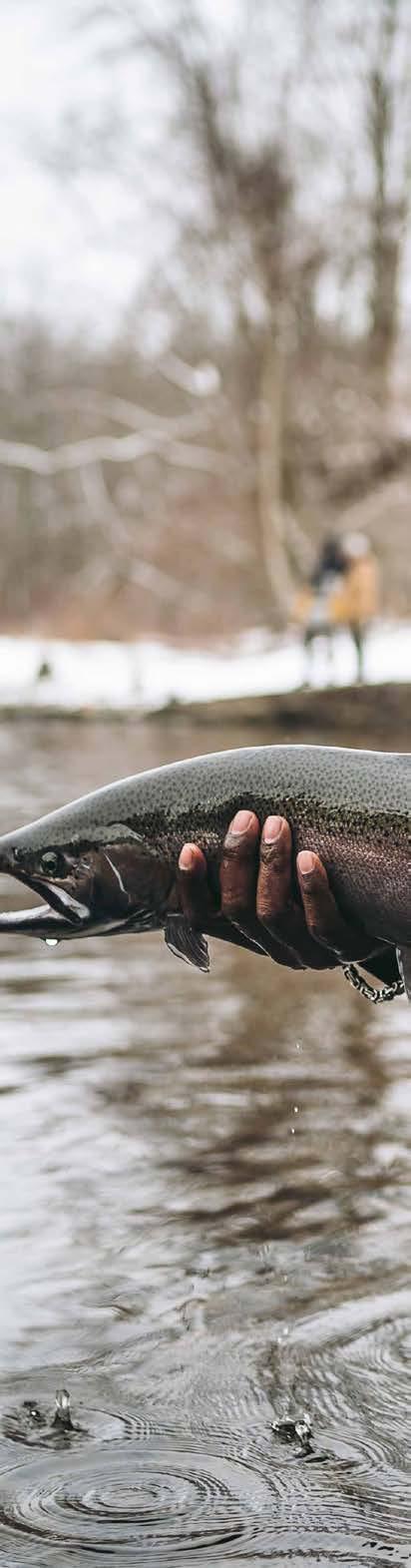
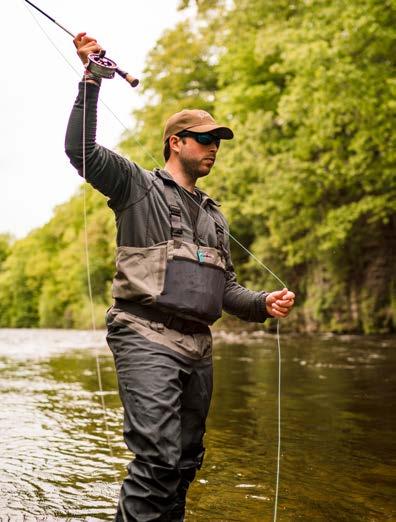
for Salmon River steelhead is a time-honored tradition once the cool winter temperatures come to Great Lake Ontario’s southeastern shores. After the salmon run, steelhead pour into the river for the winter, feeding and running upstream to spawn in the early spring.
Unlike the lake’s salmon, steelhead make multiple spawning runs in their lifetimes. The Salmon River’s steelhead season typically runs from November to April, depending on the temperatures and river conditions. During these months, fewer anglers are on the water and fishing pressure diminishes.
Early season steelhead are aggressive and voracious as they pack on the pounds to help car- ry them through the winter. As they run up - stream, they are the most fun you can have with a fishing rod in your hand. After spawning in late March and early April, the fish make a 180-degree turn and head downstream to the cool- er waters of Lake Ontar- io. “Drop-back season,” as it’s known, is a wonderful time to be on the river; the fish are hungry and aggressive, chasing down food to regain strength after spawning.
‘Drop-back season,’ as it’s known, is a wonderful time to be on the river; the fish are hungry and aggressive, chasing down food to regain strength after spawning.
Powerful fighters no matter the season, feeling the thump-thump-thump of a headshaking 10-pound fish will warm any angler’s cold hands, moments before they start chasing their speeding prize downstream. Steelhead will happily eat a variety of lures, baits, and flies, which is why they are so beloved and sought after by a diverse group of anglers.
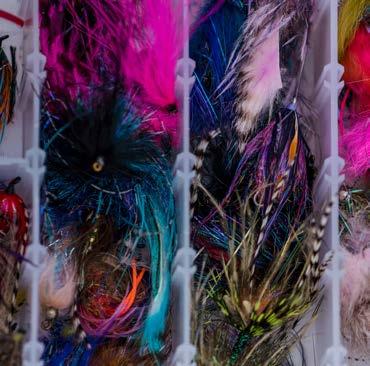
Steelhead have earned the nickname of “the fish of 1,000 casts” in many circles, but if you can find the fish and what they’re feeding on, we’re confident you can make them “the fish of less than 100.” Steelheading is not for the faint of heart, they run during the coldest, harshest months of the year, and solid preparation before your first trip out is key to making your adventure memorable for years to come.

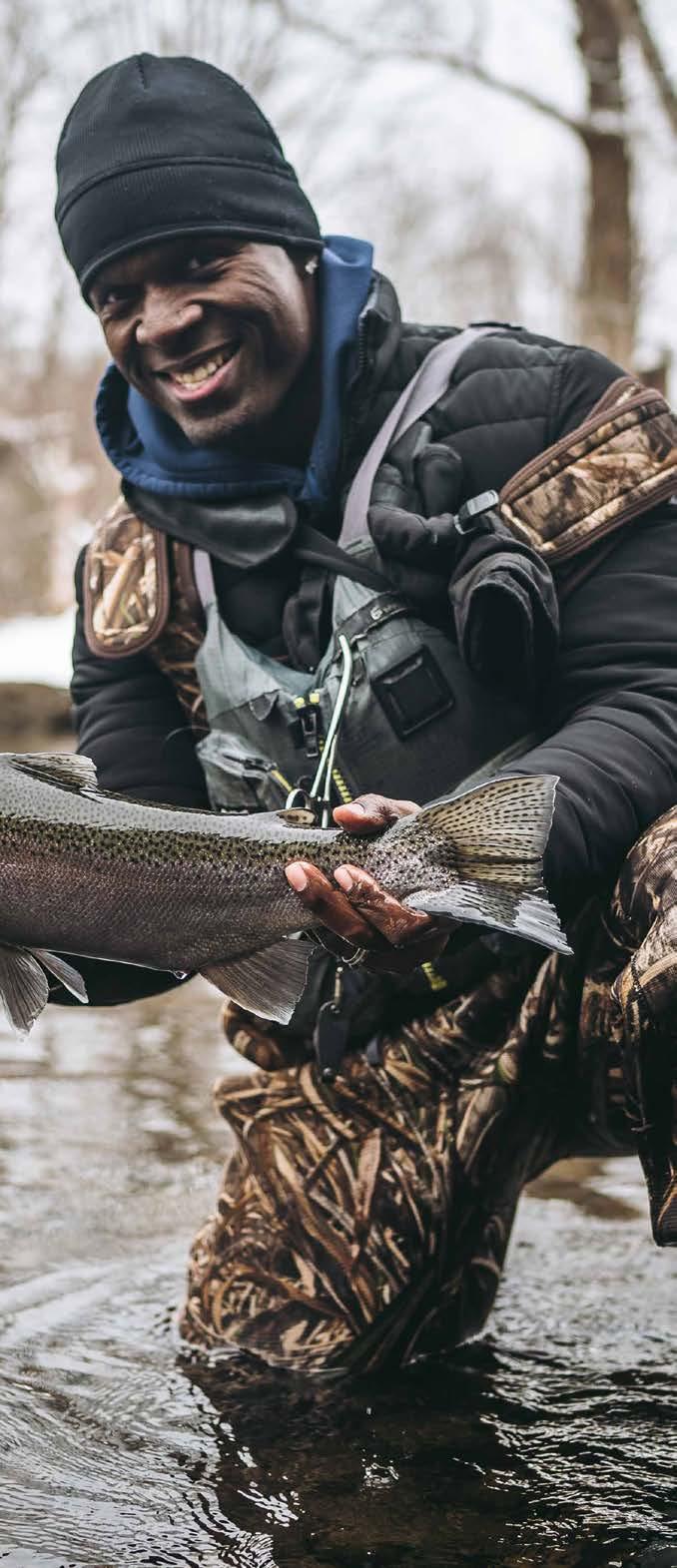

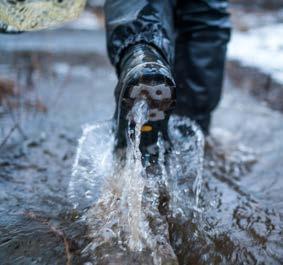
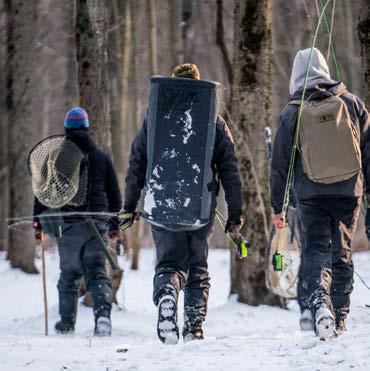
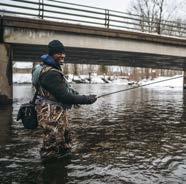
Great Lakes weather can shift with little warning, going from bright bluebird skies to a snow squall in minutes. Proper layering and cold-weather gear are key to staying on the water longer, maximizing your chances at landing steelhead. Waders and waterand wind-resistant jackets are a requirement and should be worn over warm, breathable layers.
Most steelhead anglers have specific river flows that they prefer, but steelhead feed no matter the water speed. Check the USGS gauge before arrival so you know what sections to fish and where to avoid. During high flows wading gets tough. Be safe and avoid wading past your comfort zone.
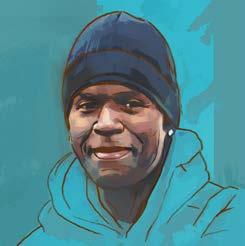
FEATURED ANGLER: TOM
” “
It’s just an awesome experience to be able to catch these type of fish in this body of water. It breaks up the winter for me, it keeps me busy, and it’s tranquil. I love it. I can’t think of anything else I’d rather do.
3 5 7 4 6
A plan of action can make the difference between a fruitful Salmon River journey and one spent wondering where the fish are. Having a plan of action will help you avoid the headaches and find new water, should your first spot be crowded or fishless. Having spots in mind keeps things interesting and will result in a less-stressful experience!
While die-hard anglers swear by the first light and last light bites, steelhead often don’t warm up and begin feeding until later in the day, especially during the depths of winter. Steelhead are lazy fish that aim to use as little energy as possible when feeding; the warmer the winter water gets, the more active they become, taking full advantage to go on the feed.
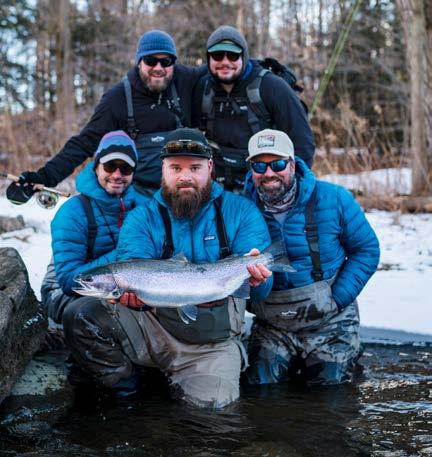
Steelheading is best enjoyed with a crew of friends around to fill in the gaps between battling fish and to console you after the big one gets away. Bringing friends along will not only ensure that you have company on the water, but will also make sure you always have someone to make a pizza and wings run while you hold down your fishing spot!
Staying warm, battling steelhead, and wading are all far more enjoyable with a full stomach! Keep a supply of snacks like granola bars and fruit on hand to keep spirits and energy levels high throughout your fishing day, or grab some warm grub from one of the many restaurants lining the river.
If this steelhead season is to be your first, the best way to climb the learning curve is with one of the river’s many professional steelhead guide services. No matter what tackle and tactics you prefer, there is a guide that will put you on plenty of fish. Not only will their advice land you fish that day, but armed with that knowledge, you can take on the entirety of the Salmon River steelhead run!
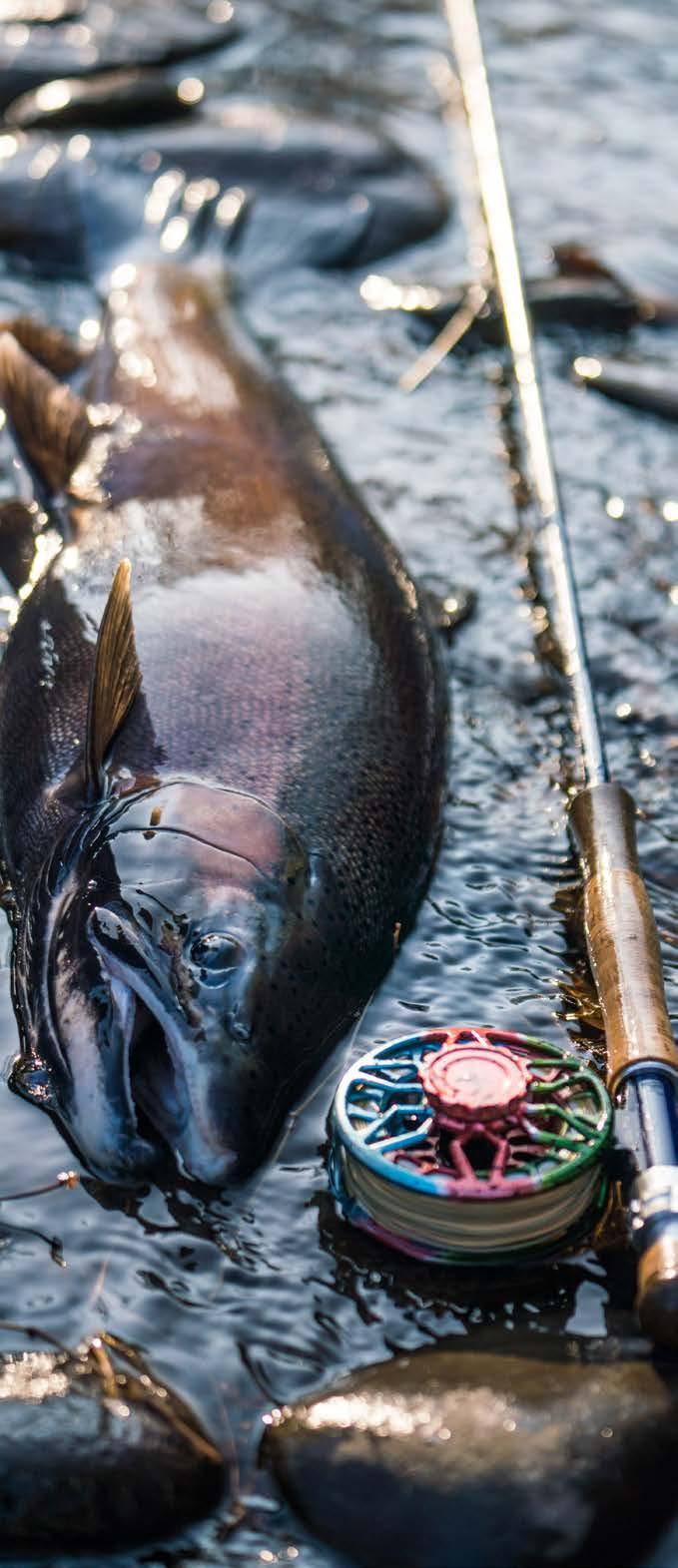
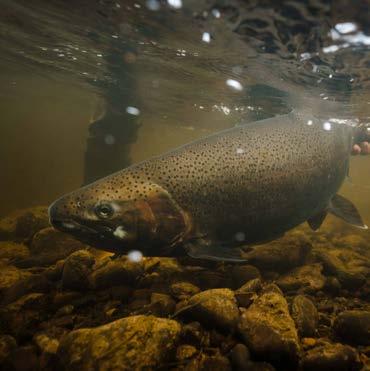
Steelhead are migratory, spending most of their lives in large bodies of water like the ocean or Lake Ontario and returning to freshwater tributaries to spawn. Although they are a sub-species of rainbow trout, steelhead grow larger and more powerful than their resident cousins.
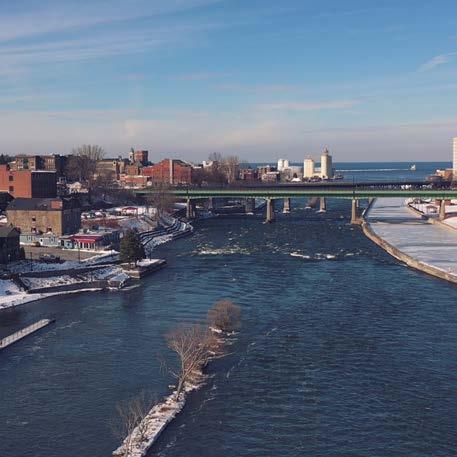
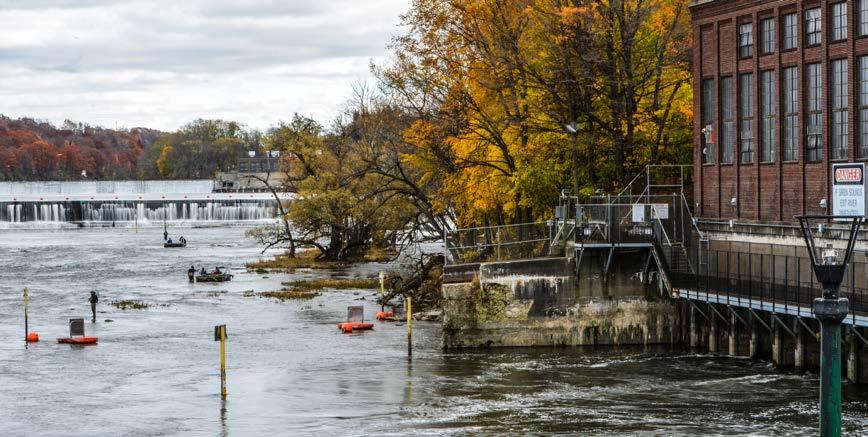
The waders and the wall anglers lovingly refer to the Oswego River as the “Mighty Oz.” The fishable section begins at the outflow of the dam and runs until it meets the lake. Once the steelhead begin running up this tributary, they’ll stack by the dam and in the various holes and pockets.
Along the river’s western bank, an accessible, handrail walkway, dubbed “The Wall” by enthusiasts, creates easy access for all who wish to try their hand at fooling the river’s steelies. When flows permit, the river can be waded, but it’s required that you wear a PFD. For gear anglers, perhaps the best way to fish this river is by hiring a guide to run you up on their drift boat, opening tons of fishable water and opportunities at all the running species found in Lake Ontario.
OSWEGO RIVER MAP ON P.51
By Jacqueline McManus
Photos By David Owens, Jacqueline McManus & Brad P. Smith
Oswego County provides numerous locations that are ideal for ice fishing. The season varies widely as it is dependent on weather and ice safety. Remember to have the proper safety equipment and use the buddy system. Avoid areas near running water such as creeks and streams.
The first places to freeze are areas higher in elevation with a smaller surface area. Kasoag Lake and Long Pond are often some of the first fishable ice. The smaller lakes are best known for panfish but also have Northern pike and largemouth bass.
Oneida Lake offers some great ice fishing opportunities near the north shore. Three Mile Bay, Taft Bay and Cleveland are all great public access spots. Both walleye and perch can be found throughout the season and often are found together.
The Big Bay area offers public access which is accessible by foot. Big Bay is best known for mostly panfish, pickerel and the occasional walleye which can be found in the shallow weedy areas.
North Sandy Pond is home to great perch, panfish and Northern pike fish ing. Many access points make this a good option for those with machines and on foot.
The New York State DEC recommends a minimum of four inches of solid clear ice as the general rule for safely walking. Ice should be at least five inches thick for snowmobiles or ATVs. You can check ice thickness by drilling holes at regular intervals.
Don’t fish alone. Carry ice safety picks as a precaution to help you get out of the water if you fall through.
Ice fishing methods include “jigging” with short, light fishing rods, and using tip-ups. The tip-up holds a baited line that hangs through a hole in the ice. When the bait is taken by a fish, the pull on the line is signaled by a flag. The fish is then brought in by pulling the line in by hand.
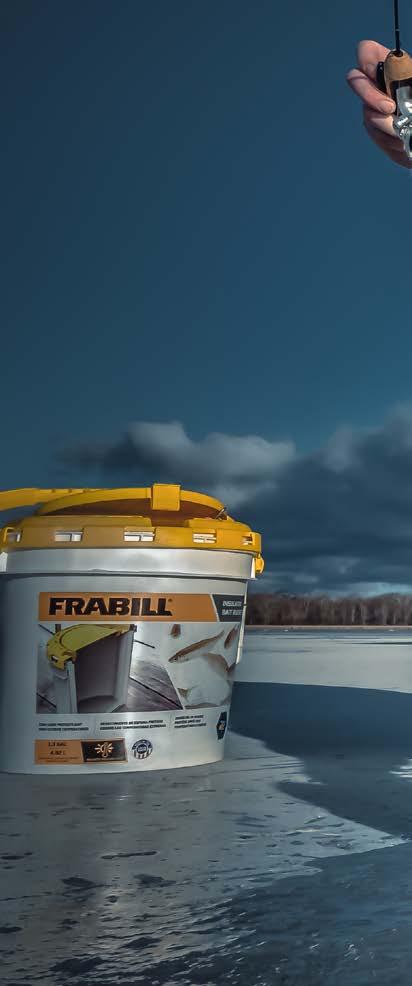

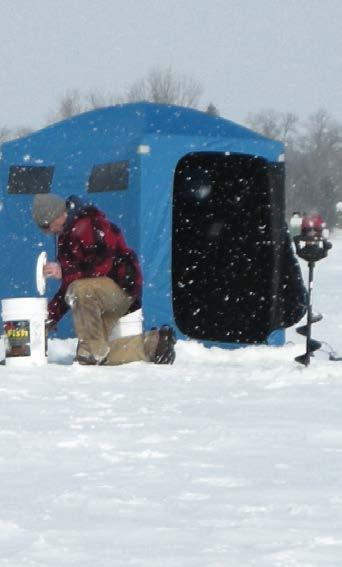
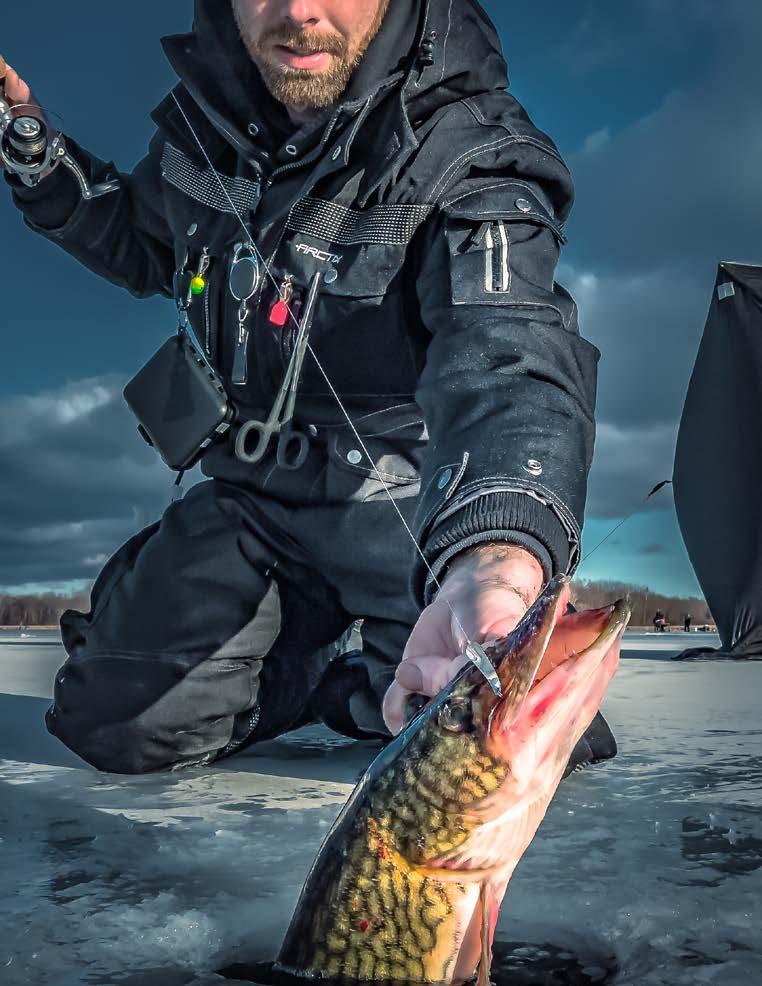
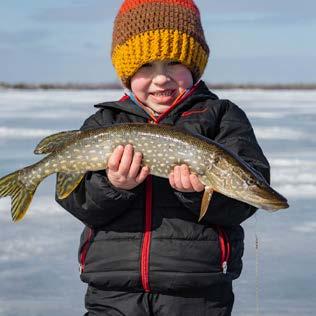
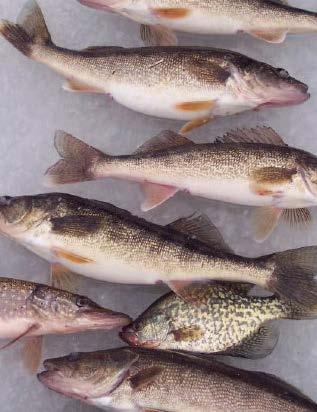
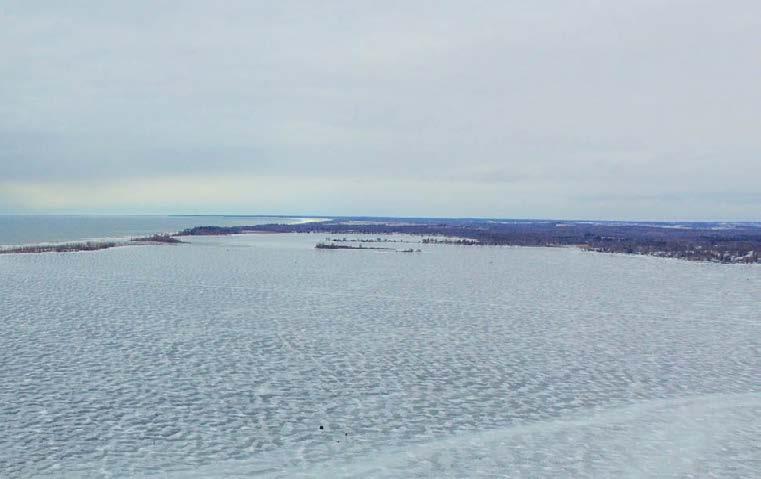
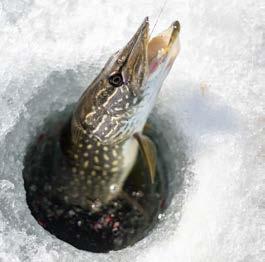
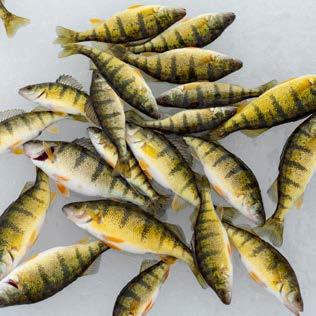
Ice fishing for Northern pike and yellow perch is very popular on the ponds, with anglers reeling in pike as big as 15 pounds.
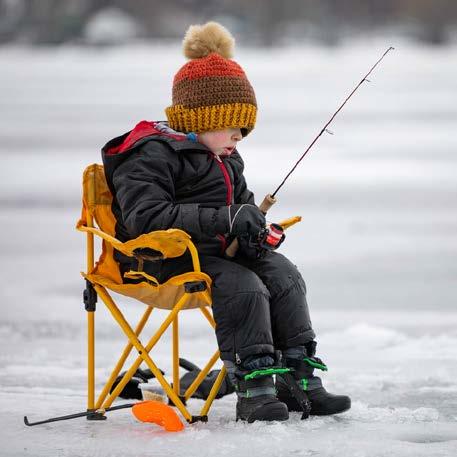
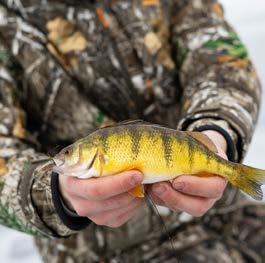
With a maximum depth of 12 feet, Lake Neatahwanta typically freezes during a normal CNY winter. Panfish, especially black crappie and common carp are abundant.
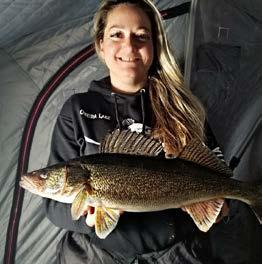
Ice fishing for yellow perch is very popular on Oneida Lake and normally takes place around deep-water flats in 3040 feet of water.
By Gary Edwards
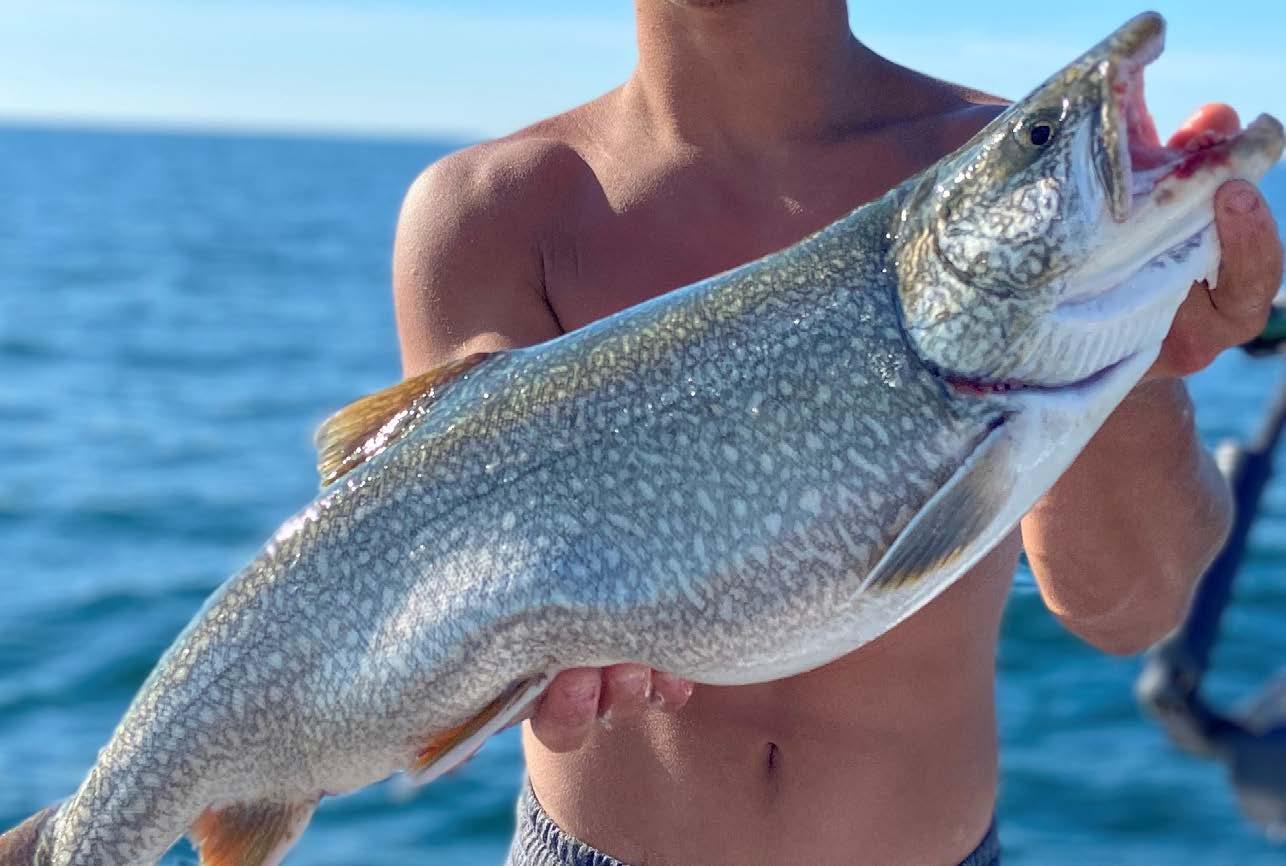
the lake. Both locations have ample parking and are good places to fish from shore.
If you would rather fish from a boat, you can launch at the Mexico Point boat launch and troll west towards Oswego, or north towards the mouth of the Salmon River at Port Ontario. Anywhere from the Oswego Harbor to Port Ontario is “the Honey Hole.” Charter boats are also available from Port Ontario or Oswego Harbor. (see pages 36-38 for a diectory of captains)
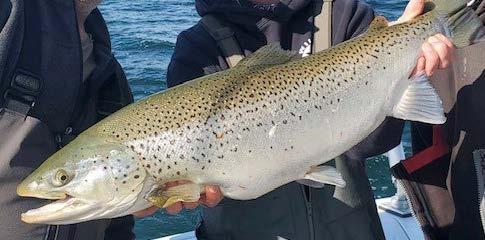
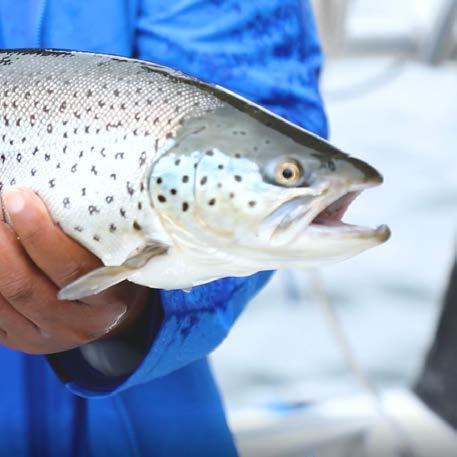
So, what’s the moral of the story? If you want a chance to catch giant brown trout, gear up and get to Oswego County in the fall or spring and be ready to catch one for the record books!
and run through October. Licensed USCG captains not only provide the boat and expertise but all the necessary tackle to catch the big ones! Remember to book early as dates fill up quickly. (See pgs. 36-38 for a list of charter captains.)

By Daniel Zazworsky
Photos By @Flylords

“
“ SMALLMOUTH CAN HOLD IN VERY SHALLOW AND FAST WATER....” 1 2
DROP-OFFS AND TRANSITION WATER WILL ALMOST ALWAYS HOLD BIG FISH....”
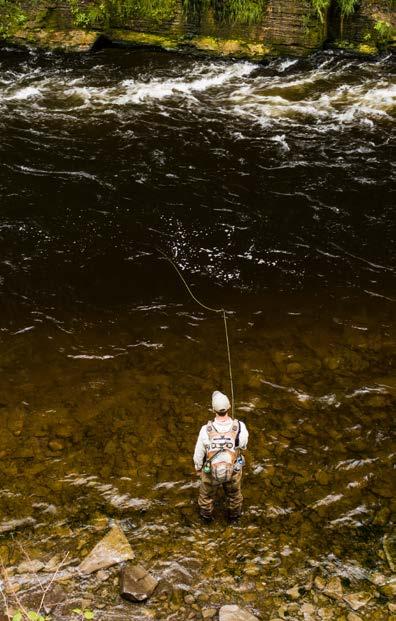
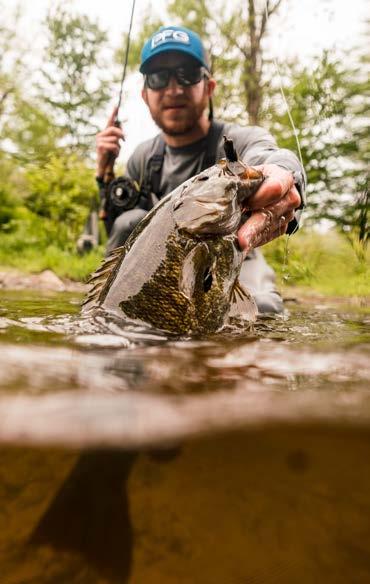
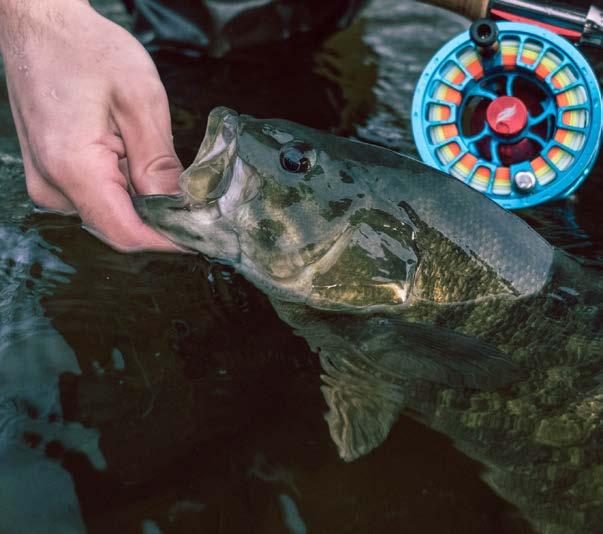
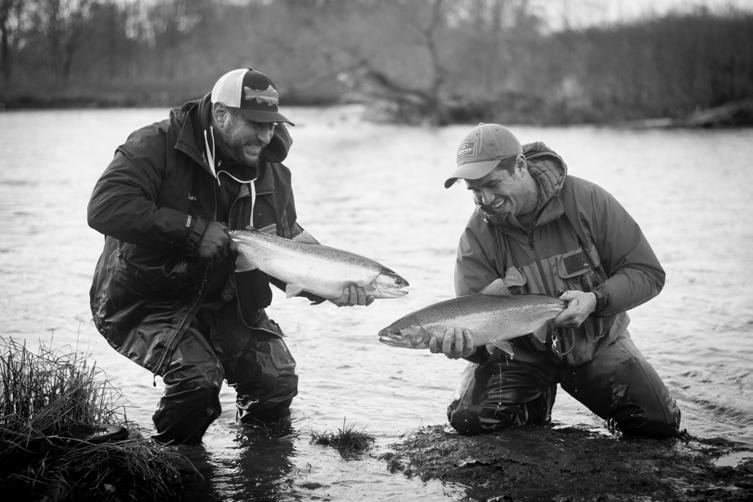
Smallmouth, by nature, tend to be lazy fish when they are in a river, and prefer to use as little energy as possible when they are on the hunt. Like trout, they like to sit in places where they will be out of the current but can shoot out and feed quickly and aggressively. Drop-offs and transition water will almost always hold big fish. (The photo shows anglers working a seam where the water goes from light to dark as it swirls in a big Salmon River pool.) Smallies use the dark water to both hide from predators and as a means of hiding out until an unsuspecting piece of prey washes downstream into their hungry jaws.
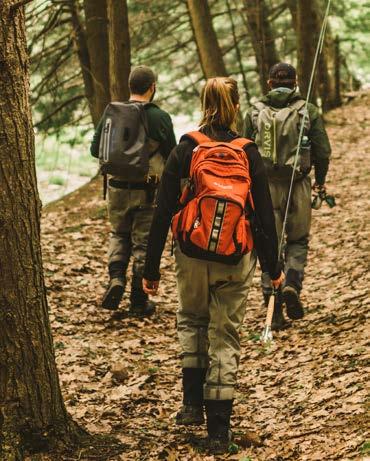
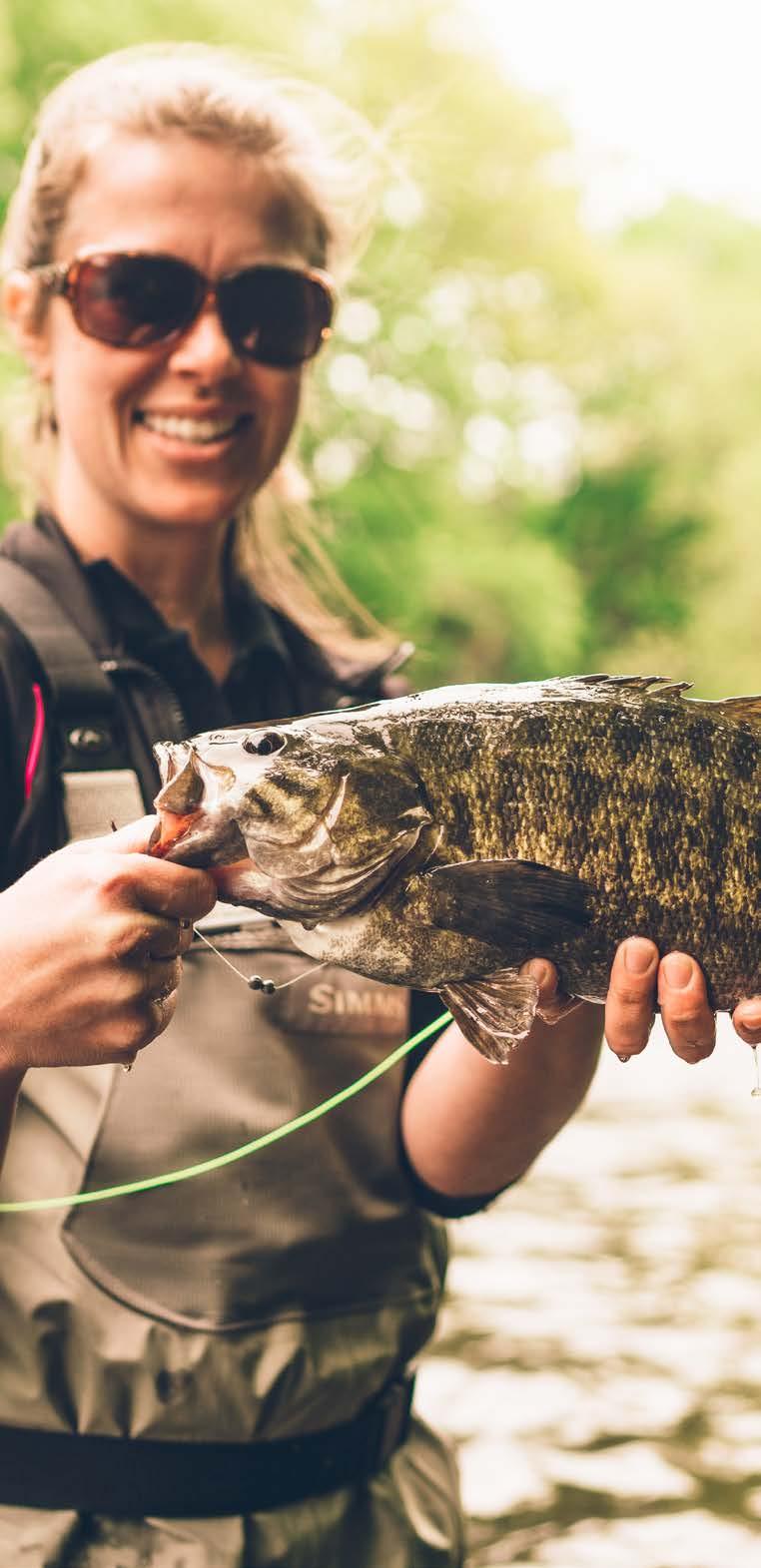
As we were walking along the river on a recent trip to the Douglaston Salmon Run, we initially walked by spots which held the biggest fish of our days on the water. Smallmouth can hold in very shallow and fast water, behind rocks and in current seams. A fish was hiding behind a big boulder right at the top of a fast riffle and shot out to inhale the fly as it swung past. With the river full of post-spawn smallies, each fish will fight to hold its feeding position and defend it aggressively, so don’t be afraid to throw some bigger patterns to get a big reaction strike.
“
....”
When we fished, the water levels were up a little high, but that didn’t seem to bother the smallies at all. We could see them rolling deep in the fast current. Even with weighted flies, the current was a bit too quick, but the Scientific Anglers Sonar Cold Sink 25 was just what we needed to get our flies down to them. Casting our streamers upstream of where we saw the fish, we allowed the flies to sink and then started our strip-strippause retrieve and waited for the telltale thump and head shakes of a big smallie.
“ D OUBLING UP ON FAT BASS IS PRETTY MUCH THE NORM....”
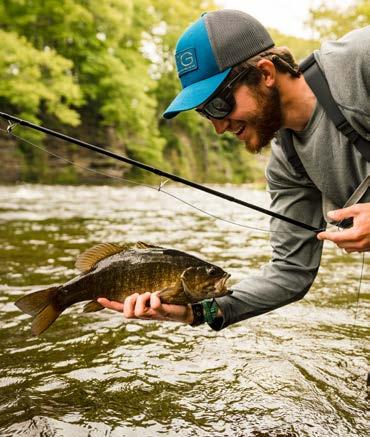
When the smallie bite is on, doubling up on fat bass is pretty much the norm. Once we found a hungry school of fish, it was nothing but “fish on!” answered quickly by “me too!” Because these fish are aggressive and not at all shy, they are the perfect way to get your fly-curious friend to pick up the old 6-weight and start chucking big flies out into the current to catch their first fish on the fly. Just don’t forget to remind them to strip set!
“
E ACH DIFFERENT FLY SEEMED TO ELICIT DIFFERENT RESPONSES FROM THE FISH.”
While smallmouth bass aren’t always the pickiest of eaters, having a good mix of flies can be key. We fished a variety of Shultz’s red-eyed leeches, clousers, crayfish, and wooly buggers. In different sections, each different fly seemed to elicit different responses from the fish. In the deep pools, they wanted the crayfish and leeches bounced off the bottom, but in the riffles, we dead-drifted streamers around rocks to find our fish. Having a box with various flies is also important depending on the river bottom. Unweighted flies produced fish when swung through the riffles and then as we entered the deeper runs and pools, we switched up our presentation to heavier flies to get down to the fish.

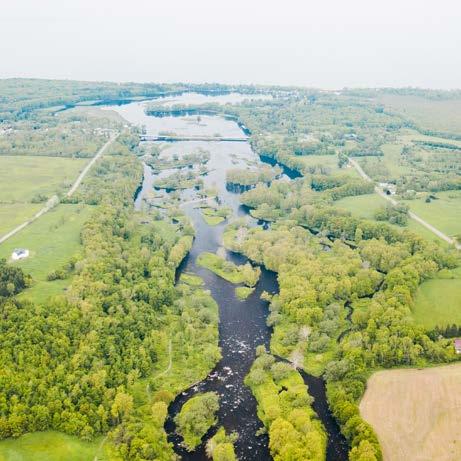
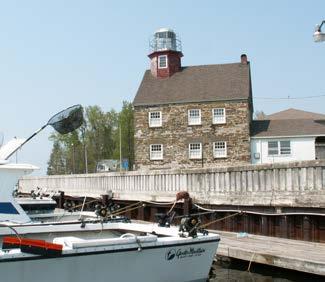
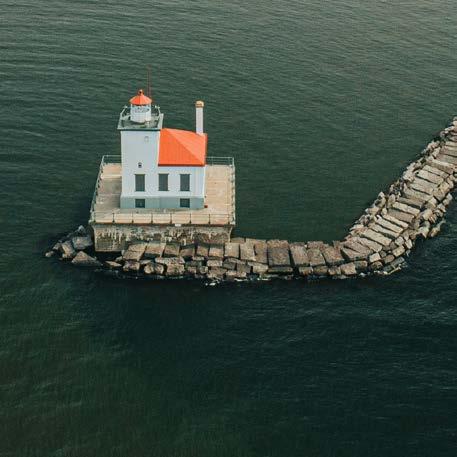
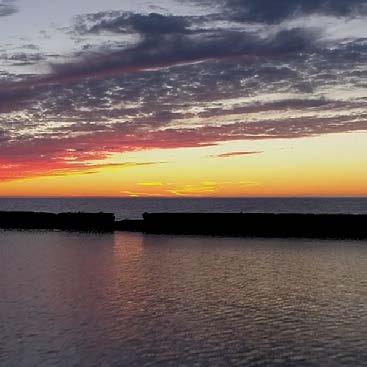
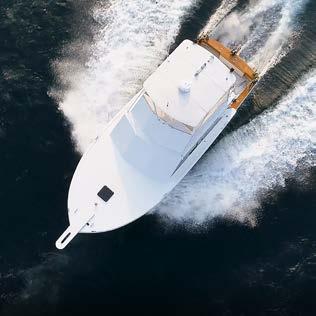

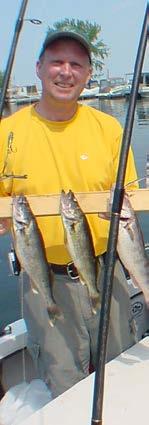
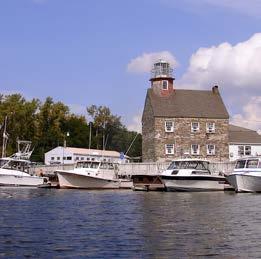
It is not just the fishery on Lake Ontario that makes travel to Oswego County so desirable. The picturesque view from the lake is unmatched. Early morning sunrises and world-renowned sunsets paint the sky with incredible colors. The West Pierhead Lighthouse in the Oswego Harbor offers tours and makes a beautiful backdrop for photographs. The Salmon River Lighthouse overlooks a Port Ontario marina and is available to rent for overnight stays.
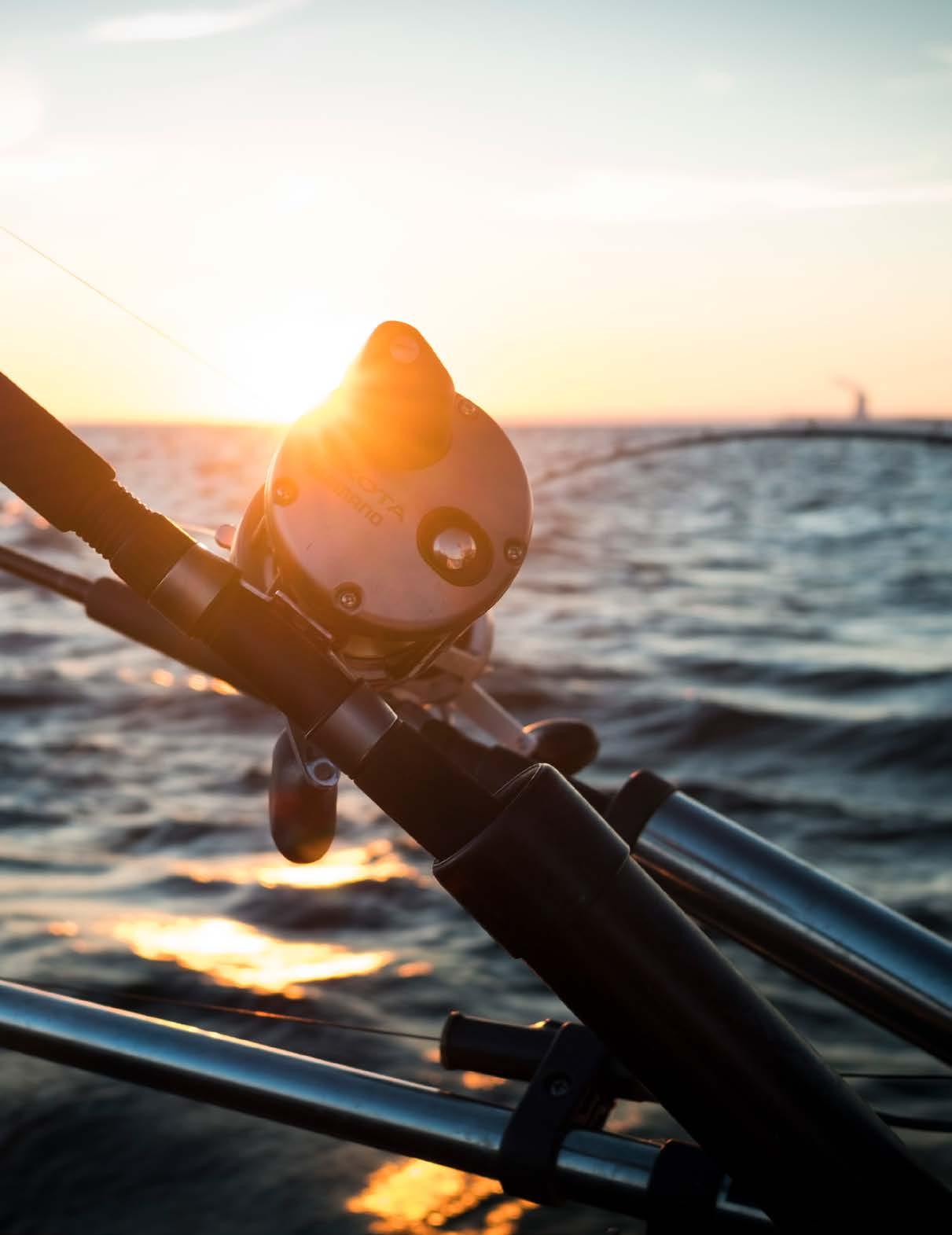
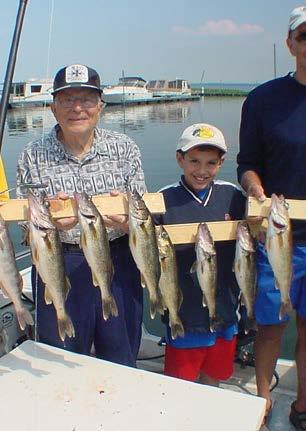
thousands of anglers flock to Oswego County for incredible and diverse fishing experiences.
With more than 50 licensed charter captains operating out of marinas in Oswego, Mexico Point, and Port Ontario, there is no shortage of opportunity. Visitors of all ages can enjoy a half- or full-day charter trip targeting a variety of different species.
Lake Ontario holds healthy populations of Chinook and coho salmon, brown trout, lake trout, rainbow trout, and the elusive Atlantic salmon. Anglers head out to deeper depths and are often rewarded with beautiful fish, sometimes over 25 pounds!
COUNTY NY
A variety of trolling methods, including downriggers, planer boards, and wire lines, are used to catch salmon during the summer. Trolling techniques are extremely precise and depend on wind speed, depth, weather, location and many other factors.
The excitement of a downrigger releasing and the reel screaming as a salmon fights with every ounce of its strength is second to none. Lake trips often start in the dark at the dock to make sure lines are in the water as the sun rises. There is a collective anxiousness in the boat as everyone awaits the first bite. When it comes, suspense is replaced with adrenaline, excitement, smiles, and of course, fish!
Although many anglers target salmonids, there is no shortage of bass, walleye, perch, pickerel, panfish and other species
During the summer months, large and smallmouth bass can be caught throughout the Oswego River. Look for bass below dams and around shoreline structure. Anglers also target walleye, Northern pike, carp, brown trout, and many other species found in Great Lakes tributaries.
Oneida Lake is well-known for its fantastic walleye, yellow perch and bass fishing. Restoration of the Cleveland Dock on the north shore provides outstanding access for shoreline fishing. (see page 28 for details)
Look for pickerel, Northern pike, walleye, musky, large and smallmouth bass, perch, panfish, brown bullhead, channel catfish, and carp in the Oneida River and Sandy Pond. Fishing with cut-bait or night crawlers works well for channel catfish below the Caughdenoy Dam.
Check out the Salmon River Reservoir for large and smallmouth bass, walleye, brown trout, brook trout, rainbow trout, perch, bullhead and panfish. SEE MAP ON PAGES 8 AND 9 FOR MORE FISHING LOCATIONS.
Many anglers love to combine the outdoor pursuits of fishing and camping. You’ll find numerous campgrounds conveniently located near Lake Ontario, Grindstone Creek, the Salmon River, Little Salmon River, Oneida Lake, and Lake Neatahwanta.
is the largest lake contained entirely within New York state. This 23-mile-long lake forms the southeastern corner of Oswego County. It feeds the Oneida River, a tributary of the Oswego River, which flows into Lake Ontario. From the earliest times until the opening of the Erie Canal in 1825, the lake was part of an important waterway connecting the Atlantic seaboard of North America to the continental interior.
Species found in Oneida Lake include walleye, largemouth bass, smallmouth bass, Northern pike, tiger musky, rock bass, yellow perch, freshwater drum, longnose gar, and others.
More than two dozen public and private boat access sites, numerous private marinas and several tackle shops are located on Oneida Lake’s shoreline. Interstate 90 is just minutes away, while I-81 crosses its outlet.
Oneida Lake is only 22-feet deep so its surface freezes solidly in winter. It is popular for the winter sports of ice fishing and snowmobiling.
Oneida Lake has hosted a variety of televised fishing tournaments, such as the Outdoor Channel’s Ultimate Match College Tournament and the ESPN Bassmaster Memorial, affirming Oneida Lakes excellent fishery.
Oneida Lake is the main egg collection location for walleye in New York State.
The NYSDEC Oneida Fish Hatchery in Constantia collects over 300 million walleye eggs a year from Oneida Lake. The resulting walleye fry and fingerlings are stocked throughout New York State. Oneida Lake is stocked annually with around 150 million walleye fry. Lake sturgeon have been periodically stocked into Oneida Lake since 1995. Along with the DEC, both Cornell University and SUNY Environmental Science and Forestry School (ESF) do numerous research projects on the lake each year.
Oneida Lake has hosted a variety of televised fishing tournaments, such as the Outdoor Channel’s Ultimate Match College Tournament and the ESPN Bassmaster Memorial...
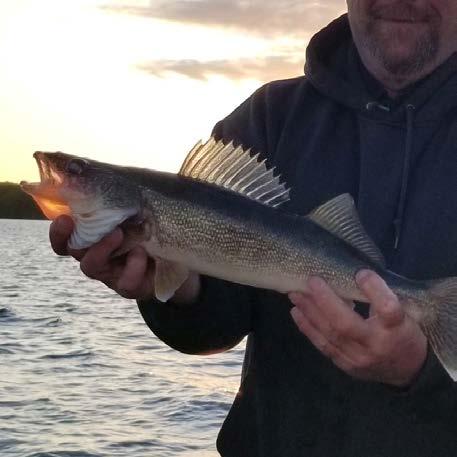
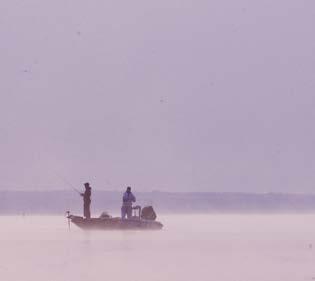
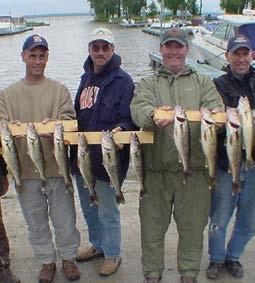


The most popular species caught here are Smallmouth bass, Northern pike, and Largemouth bass. Ice fishing access is located on NYS Rt., 2 ½ miles east of the village of Constantia.
Located off NYS Rte. 49, five miles southeast of the village of Central Square, is the Three Mile Bay Wildlife Management Area. A fishing access site on Phillips Point provides fisherman access to Oneida Lake. Beach launching is available. Parking for 20 cars and trailers.
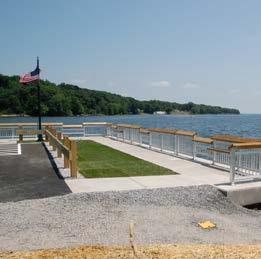
An accessible fishing platform is located at Toad Harbor on the northern shore of Oneida Lake. The shaded platform overlooks a narrow deep cut canal that extends inland from the lake. There is a large parking lot which can accommodate up to 30 vehicles.
On NYS Rte. 49 in the village of Cleveland, the historic dock has recently undergone major restoration and rehabilitation by the NYS Department of Environmental Conservation. The dock and fishing pier provide access to open water fishing, ice fishing and mooring for boats.
3 HATCHERY RD, CONSTANTIA NY
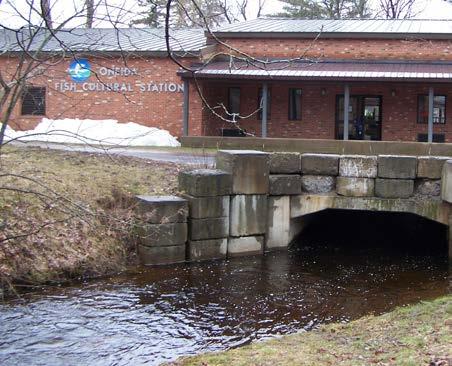
The DEC’s Oneida Hatchery is located in the village of Constantia on the north shore of Oneida Lake.
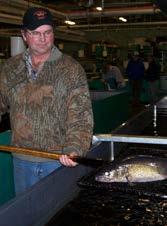
The rearing program is focused on walleye and includes egg collections from Oneida Lake (200-300 million eggs per year) and stocking of millions of walleye fry and about 220,000 advanced walleye fingerlings (four to six inches long).
Experimental culture of rare or threatened fishes, such as round whitefish, lake sturgeon, and paddlefish, also occurs here. Annual fish production is approximately 6,000 pounds. The hatchery is open to the public from April 1 to Sept. 30, 8 a.m. to 3:30 p.m., and may be reached at 315.623.7311
Swamp Road at the I-81 crossing. Shore access. North shore and south shore fishing areas have separate parking areas. From Exit 31, follow DOT signs for Fishing Access North and/or South.
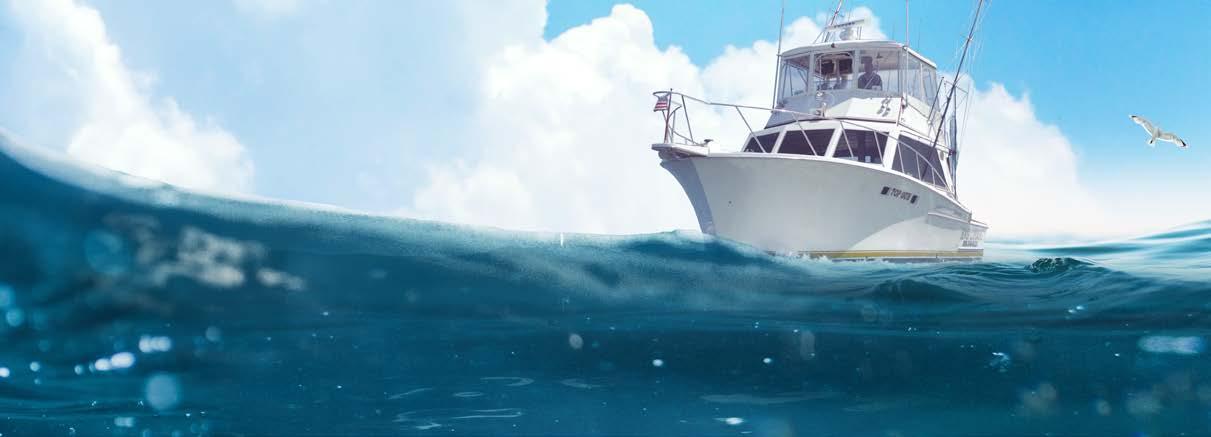
Summer is a great time to experience the thrill of sport fishing on Lake Ontario. While all the species pictured below are available, the Chinook, a.k.a. king salmon, is the biggest, most sought-after trophy of them all. Kings average 20 to 35 pounds, but 40-plus pound giants are caught every summer! Check the chart on pg. 10 for info on the best time to target your next trophy.
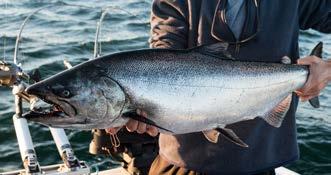
A.k.a. “King Salmon” are an aggressive, hard-hitting predator. This is the big boy most anglers hope to catch. Chinooks average 18 to 28 pounds but the state record is 47 lbs., 13 oz. Hooking a king is like hooking onto the bumper of a Mack truck. Make sure your reel has a good drag -chances are you’ll need it!
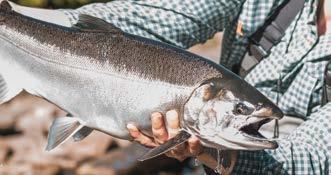
A.k.a. “Silvers” may not be a big as their cousins, the king salmon, but they make up for their smaller size by fighting twice as hard. If a king is like hooking onto a Mack truck, hooking a coho is like hooking onto a muscle car. Plenty of power and more maneuverability. (average size is 8 to 15 lbs., NYS record 33 lbs., 7 oz.)
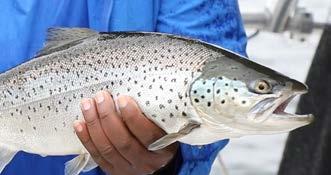
Brown trout in the lake look a lot like Atlantic salmon. But that’s where the similarity ends. Browns are aggressive pack hunters that work a bait pod much like bluefish in the ocean. Chances are you’ll know when you hook a brown, as they tend to pull hard with an unmistakable violent head shake trying to throw the hook! (average size is 6-14 lbs., NYS
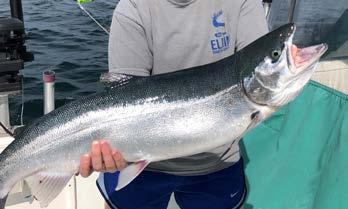
Pound for pound, steelhead must be the strongest, hardest fighting fish Lake Ontario has to offer. If a kiing is a Mack truck and a coho is a muscle car, then a steelhead is like hooking onto a turbo-charged Ferrari! They have incredible speed, agility, and power all in one package! (average size is 8 to 15 lbs., NYS record 31 lbs., 3 oz.)
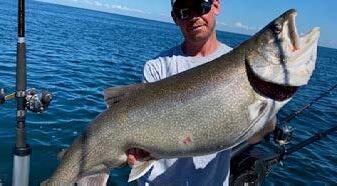
Lake trout, “Old Reliable,” are a staple in any charter captain’s game plan. For decades, lakers have been the go-to fish when other species are “playing hard to get.” They tend to stay in deeper water and often feel like dead weight on the initial hook-up. That is, until they realize they’re on your line. Then the fight and the fun begin! (average size is 7 to 15 lbs., NYS record 41 lbs., 8 oz.)
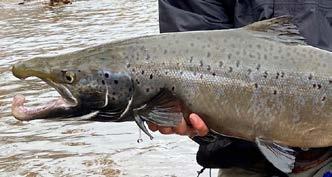
Like all salmon species, the Atlantics are hard fighters that generally offer a lot more in the way of acrobatics when they come to the surface. Whether it’s in the SR in the fall or on the lake in the summer, Atlantic salmon will give you quite a thrill before they come to the net. (average size is 7 to 15 lbs., NYS record 24 lbs., 15 oz.)

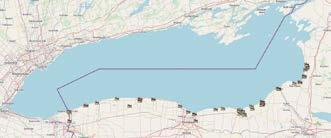
The word “Ontario” is believed to originate from an Iroquois word meaning “beautiful lake” or “big body of water.” The smallest of the Great Lakes, Lake Ontario is known for its magnificent sunsets and legendary “lake effect” snows.
Its waters contain an abundance of freshwater marine life and a wealth of history. For centuries, the lake dominated trade and military strategy as the natural route between the St. Lawrence River and the western interior of North America.
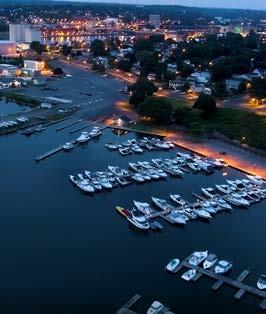
Oswego County’s northern border stretches along 37 miles of Lake Ontario shoreline. Navigators are still guided by lighthouses at Oswego Harbor (1934) and Port Ontario (1838).
Based on its cultural and historic significance -- including 64 submerged shipwrecks -- the southeastern corner of Lake Ontario was designated as a National Marine Sanctuary by NAA in 2024.
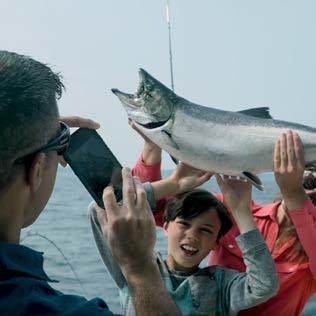
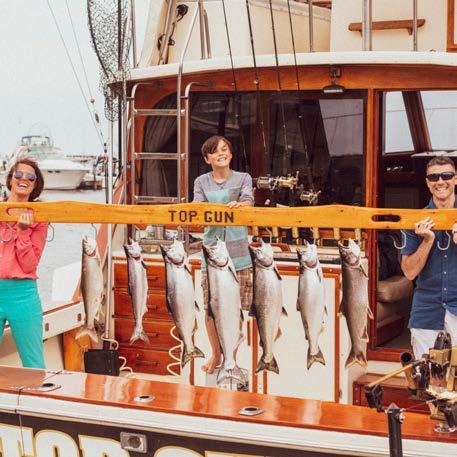
Fishing is for everyone! Young or old, fishing for the first time or a lifetime, anyone can enjoy fishing. Why not plan a family charter trip? Many charters will take kids as young as six years old, although some prefer 12 and older. Check with the charter captain for rules specific to their vessel.
What to bring:
•Drinking water – hydration is critical
• Sunscreen and a hat
• Motion sickness prevention
• Snacks
• Sunglasses or protective eyewear
• Jacket or sweatshirt – it can get windy on the water
• Fishing license for anyone 16 years or older
• A camera to document the day
• Cooler in your vehicle to take home your catch
43º North Marina
8 Weber Rd., Central Square 315.676.3531
43northmarina.com
Bayview Marina / Sandy Pond Resorts
21 Lakeshore Rd., Pulaski
315.387.5318
sandypondresorts.com/bayviewmarina
Burt Goodnough’s Marina East, Inc.
9245 NYS Rte. 3, Sandy Creek
315.387.5894
www.burtgoodnoughsmarina.com
Canal Landing Marina
141 S. First St., Fulton 315.598.4399
www.waterwayguide.com/marina/ canal-landing-marina
Charley’s Boat Livery 82 McCloud Rd., West Monroe 315.668.6341 oneidalakefishin.com
43
Clark’s Marina
803 Lake St., Pulaski 315.298.5832
Dockside Bar and Grill
24 E. 1st St., Oswego
315.343.7700 www.alexsonthewater.com
Greene Point Marina, LLC
206 Greene Point Rd., Mannsville 315.387.3513 / 315.387.5226 gpmarina.com
43
Johnson Bay Marina
136 McCloud Rd., West Monroe
315.561.3909
43
Mike’s Marina East & West
266 NYS Rte. 104B, Mexico
315.963.3119
mikesmarina.com
North Sandy Pond Marina & Campground
3303 Co. Rte. 15, Sandy Creek
315.387.3522
Oswego International Marina
21 Lake St., Oswego
315.342.4212
www.oswegony.org/government/ waterfront
Salmon Country Marina & Campgrounds
58 Mexico Pt. Dr. W., Mexico
315.963.8049 salmoncountryinc.com
Salmon River Lighthouse & Marina
5 Lake Rd. Extension, Pulaski 315.509.4208 / 757.287.0426 SalmonRiverLighthouseMarina. com
Seber Shores Marina
18 Marina Rd., Sandy Creek
315.387.5502
Winter Harbor Marina
604 Co. Rte. 37, Brewerton
315.676.9276 winterharborllc.com
Wright’s Landing Marina
29 Lake St., Oswego
315.343.8430 oswegony.org/sites/Wright-sLanding
L A K E O N T A R I O
O S W E G O , N Y
W O R L D C L A S S F I S H I N G
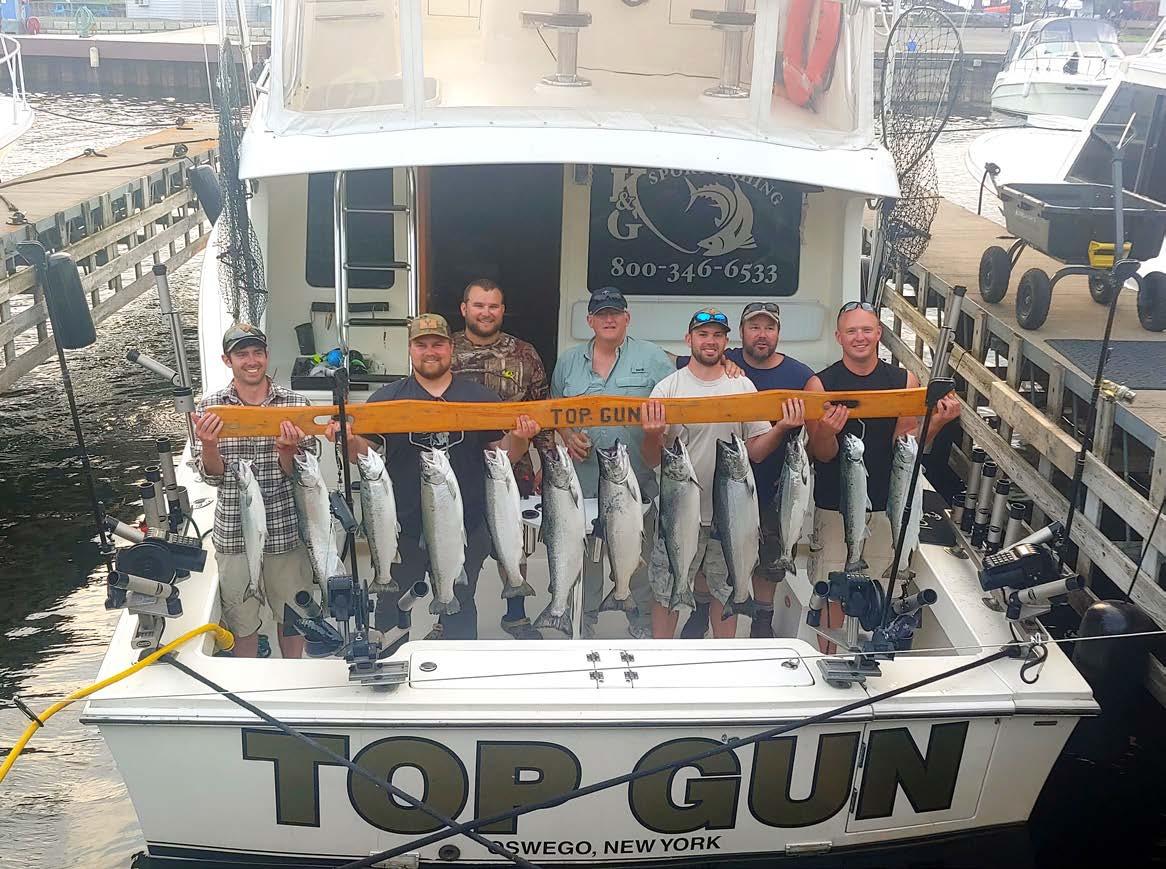
E x p e r i e n c e t h e # 1 p r o f e s s i o n a l f u l l - s e r v i c e c h a r t e r
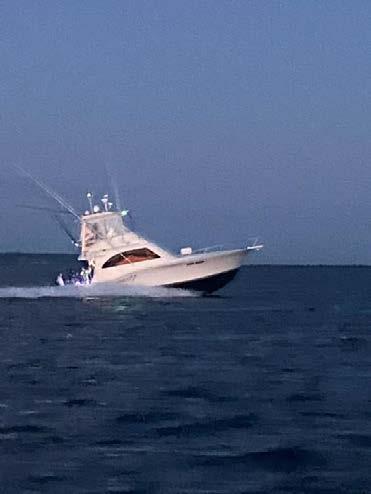
f i s h i n g a d v e n t u r e o n L a k e O n t a r i o a b o a r d T O P G U N
a n d S O N O F A G U N . W i t h t h e l a r g e s t b o a t s , d e c a d e s
o f k n o w l e d g e , a n d s t a t e - o f - t h e - a r t e q u i p m e n t , w e
h a v e w h a t a n y a n g l e r w o u l d d r e a m o f f o r a d a y o n
C a p t a i n G r e g a n d h i s s o n , C a p t a i n C h a d , h a v e
o v e r 5 0 y e a r s o f p r o f e s s i o n a l c h a r t e r f i s h i n g
e x p e r i e n c e o n L a k e O n t a r i o
E n j o y c a t c h i n g t r o p h y K i n g a n d C o h o S a l m o n ,
S t e e l h e a d , B r o w n T r o u t a n d L a k e T r o u t
S p a c i o u s 4 1 ' A l b e m e r l e & 4 0 ' J e r s e y
4 , 6 , 8 & 1 0 h o u r c h a r t e r s - u p t o 6 g u e s t s
G r e a t f o r b e g i n n e r s , k i d s , f a m i l i e s o r p r o s
F u l l s i z e b a t h r o o m o n b o a r d
O f

t h e w a t e r w i t h m e m o r i e s t o l a s t a l i f e t i m e . 1 - 3 1 5 - 3 4 3 - 8 1 7 1 1 - 8 0 0 - 3 4 6 - 6 5 3 3
w w w . k g l o d g e . c o m
f i s h i n g @ k g l o d g e . c o m
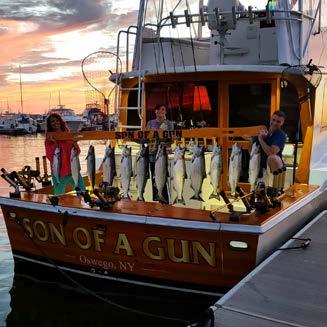
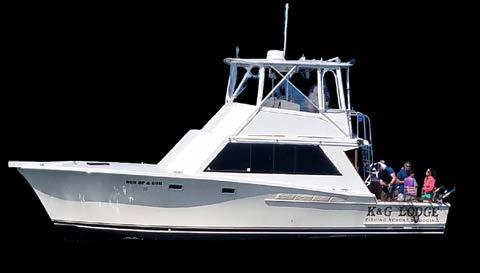
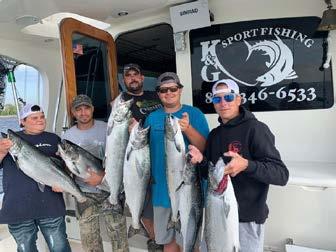


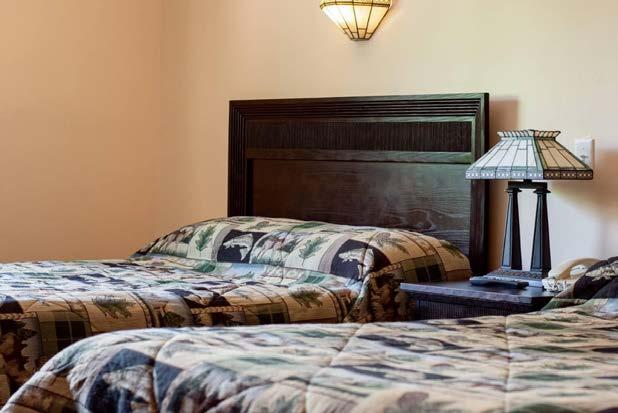
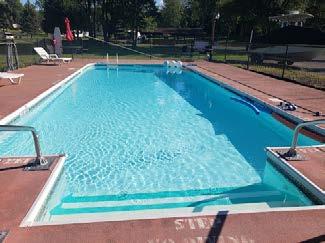
Our 35+ year reputation has grown to include guests from around the world. Whether you are preparing for the critical business meeting, or entertaining, hosting family reunions or preparing for that fishing trip of a lifetime, K&G Lodge is prepared to accommodate your needs.
3rd Alarm Fishing Charters
Capt. Matt Trombley
802.345.7949 lakechamplainfishingcharters.com
Adirondack TrOutfitters
Ryan Baker
203.233.3306 adirondacktroutfitters.com
Ace Charters
Capt. Jimmy Samia
413.346.7675 www.acecharters.com
Black Jack Charters
Capt. Matt Bell
570.495.3527 fvblackjackcharters.com
BP Adventures
Capt. Brad Perkins
802.363.6752 bpadventures.com
Broad Horizons Guide & Charter Service
Capt. Andrew Grisenthwait
315.527.3652 www.broadhorizoncharters.com
Cannonball Runner
Capt. Ed Monette
315.952.6200 www.cannonballrunner.com
Capt. Dan’s Sportfishing
Capt. Dan Burdick
315.868.4977
Captain Dave Wilson’s Fishing Charters
Capt. Dave Wilson
315.481.5716 www.captaindavewilson.com
Pulaski
SC = Sandy Creek
Catfish Creek & Flying Fish Charters
Capt. Wallace Kimmel 315.963.7310 catfishcreek.com/charters.php
Chance of a Lifetime Charters
Capt. Steve Coby 914.443.8706 letsgocatchsomefish.com/lake-ontario
Chasin’ Tail Adventures
Capt. Andy Bliss 315.591.4578 www.chasintailadventures.com
Cobble Creek Outfitters Lake Ontario Charter
Capt. Andrew Sponable 315.791.8048 cobblecreekoutfitters.com
Cold Steel Sportfishing
Capt. Tom Burke
315.298.2500 / 315.391.8079 www.coldsteelsportfishing.com
Crazy Yankee Sportfishing
Capt. Rick Hajecki 585.704.7996 crazyyankeesportfishing.com
Dirty Goose Sportfishing
Capt. Casey Prisco
845.234.5024 dirtygoose-sportfishing.com
DNA Fishing
Capt. Donald Lavoie
207.227.6807
Down ‘n’ Tight Sportfishing
Capt. Mike Deslandes 802.999.4631 downntightsportfishing.com
Driftwater Sportfishing
Capt. Mark Ledden
315.529.4204 driftwaterfishing.com
Eagle Charters LLC Sport Fishing
Capt. Bruce Mattison
802.558.9675 eaglechartersllc.com
Finhooker Charters
Capt. Mike Klikus
315.591.1345 www.finhookercharters.com
FishChopper Charters
Capt. Kevin Keller
315.729.7602 www.fishchoppercharters.com
Fish On! Motel & Blood Vessel Charters
Capt. Mike Fiumano
315.298.3847 fishonmotel.com/the-boats
Full House Charters
Capt. Andrew Masuicca
315.963.3271
Full Moon Outdoors Sportfishing
Capt. Joshua Denny
315.806.8213
Full Tank Charters
Capt. Michael Tankersley
315.436.9825 www.fulltankcharters.com
Good Times Sportfishing
Capt. Nick Lee & Capt. Richie Thomas 315.778.8245 good-times-sportfishing.com
Hat Trick Charters
Capt. Jimmy Staves
800.724.8325 or 315.342.6458 www.hattrick-charters.com
High Adventure Sportfishing
Capt. Troy Creasy
315.243.2389 www.highadventurefishing.com
Hotliner Sportfishing Charters
Capt. Victor Minotti
315.447.5070 hotlinercharters.com
Irish Knots, LLC
Capt. Chris Yard 315.263.7661 www.irishknotsfishing.com
Capt. Greg Gehrig 315.343.8171 / 800.346.6533 kgsportfishing.com
LATER On Fishing Charters
Capt. Jim McKemmie 413.345.1728
Lip Ripper Charters, LLC
Capt. Kenneth Krott
484.769.1499 liprippercharters.com
Locked with Lorensen Ryan Lorensen 518.256.4318 lockedwithlorensen.com
Midway Charters
Capt. James Fetterhoff, Sr. 570.640.9861 midwaycharters.com
Never Forgotten Fishing Charters
Capt. Skylar Tuttle 315.778.2588
Northeastern Sportfishing
Capt. Adam Deslandes
802.487.4821 northeasternsportfishing.com
NY Fishtales, Inc.
Capts. John & Andrea Wisgo 315.591.6967 nyfishtalesinc.com
NY Guide Service
Capt. Richard Demong
315.436.8171 nyguideservice.com
Orca Charters
Capt. Jeff Federko
607.759.1674 www.orcacharters.com
Other Woman Fishing Charters
Capt. Edward Hogan II 315.532.0693
Over The Rail Sportfishing
Capt. Justin Irving 518.380.4279 overtherailsportfishing.com
Praying Mantis Sport Fishing
Capt. Richard Nau 203.912.9915 mantisfishing@yahoo.com
Prime Time Sportfishing Charters
Capt. Pete Lahosky 610.442.4572 primetimesportfishing.net
Pura Vida Charters
Capt. Elaine Supp 518.944.4412
Rayno’s Fishing Excursions
Capt. Zak Rayno 518.222.3027 www.fishwithzack.com
Reel Addicted Charters & Guide Service
Capt. Michael Ford 845.594.3301 reel-addictedfishing.com
Reel Adventure Charters
Capt. Glen Gervais 413.731.0650 / 413.519.3019 reeladventurecharters.net
Reel Attack Outfitters
Capt. Mike, Capt. Shawn & Capt. Steven Segouin 315.591.1049 reelattackfishingcharters.com
Reel Naturalz Charters
Capt. Jason Dzikiewicz 607.279.3022 reelnaturalzguideservice.com
Reel Silver Charters
Capt. Dave Steel
315.271.8773 www.reelsilvercharters.com
Salmonboy Sportfishing
Capt. Joe Oakes
716.200.3614 salmonboysportfishing.com
Salmon Tracker Sports Fishing & Guide Service
Capt. John Koby 315.751.7170 salmon-tracker.com
Scriba Fishing Charters
Capt. Chris Scriba 315.675.3358 / 315.380.6484 scribafishingcharters.com
Second Nature Sportfishing
Capt. Eric King 315.529.7821 secondnaturesportfishing.com
Son of a Gun
Capt. Chad Gehrig 315.529.0248 www.kgsportfishing.com
Squirrelly Sportfishing Charters
Capt. Richard Converse 315.591.3252
Strike Zone Charters
Capts. Todd & Robin Sheltra
315.298.2074 www.strikezonefishing.com
SunMoon Adventures, LLC
Master Capt. Kenneth Ruskiewicz 315.877.5567 SunMoonAdventures.com
T-K Charters
Capts. Tom & Bob Pultorak 315.796.2166 tkcharters.com
Trout One Charters
Capt. Bryan Kopala 413.281.6456 www.troutonecharters.com
TSI Charters
Capt. Joseph Orsen 607.725.3881 www.tsicharters.com
Wilsey’s Fins & Feathers Guide Service
Capt. Eric Wilsey 315.516.6253
Chasin’ Tail Adventures
Capt. Andy Bliss
315.591.4578
www.chasintailadventures.com
Cold Steel Sportfishing
Capt. Tom Burke
315.298.2500 / 315.391.8079 www.coldsteelsportfishing.com
Dan’s Salmon River Guide Service
Dan Peschler
315.298.3614 or 315.870.4351 www.danssalmonriverguide.com
Dirty Bill’s Guide Service
Michael Deyo
315.529.4034 www.dirtybillsguidesvc.com
Douglaston Salmon Run multiple guides
315.298.6672 www.douglastonsalmonrun.com
Down River Guide Service
Nick Jones 607.221.9479 www.downriverguideservice.com
Driftwater Sportfishing
Capt. Mark Ledden
315.529.4204 driftwaterfishing.com
Fly Fishing Guide
Brian Lansing
315.481.5788 brianonthefly.com
Grateful Adventures
Marcus McGivney
352.348.7720
Guide on the Side
John Ryan Lutz
315.402.4350 linktr.ee/guideontheside
Healy Outdoors
Michael Healy
845.608.3299 www.healyoutdoors.com
High Adventure Sportfishing
Capt. Troy Creasy
315.243.2389 www.highadventurefishing.com
HighHook Guide Service
Brian Ferman
315.396.1179
Jay Peck Guides
Jay Peck 585.233.0436 jaypeckguidesflyfishing.com
Joe’s Outdoor & Fishing Adventures
Joseph Fragomeni 860.982.8392 joesoutdoorandfishingadventures.com
King
LaSorte
Capt.
607.427.7335
Salmon River Guide
Shane & David Thomas 315.298.4530 thesalmonriverguide.com
Salmon River Outfitters
Christopher Dever 315.298.5442 www.fishsalmonriverny.com
Salmon Tracker Sports Fishing & Guide Service
Capt. John Koby
315.751.7170 salmon-tracker.com
Shear Water Guide Service
Chris Currie 315.240.7062
Sich’s Guide Service
Joseph Sicherman 315.399.8030 www.joesichguideservice.com
Steve Bowman Guide Service Steve Bowman 315.289.7380
Strike Zone Charters
Capts. Todd and Capt. Robin Sheltra
315.298.2074 strikezonefishing.com
STS Guide Service
Stephen Shen
315.382.5238 stsfishguide.com
SWAT Fishing Eric Geary 315.395.5358 www.salmonriverswat.com
UFlyFish.com Guide Service
James S. Zervos
607.759.0110 www.uflyfish.com
Up N Adam Guide Service
Nate “Redbeard” Adam 315.256.3283 www.upnadam.us
Wack ‘em Guide Service
Josh Day
484.239.9399 wackemguideservice.com
Wayne-o’s Guide Service
Wilsey’s Fins & Feathers Guide Service
Yankee Angler Salmon River Fishing Guide
Randy Jones
315.963.2065 yankeeangler.com
Zero Limit Adventures
Mike & Matt DeRosa
585.766.2421 zerolimitadventures.com
caughdenoymarinany.com
By Gary Edwards
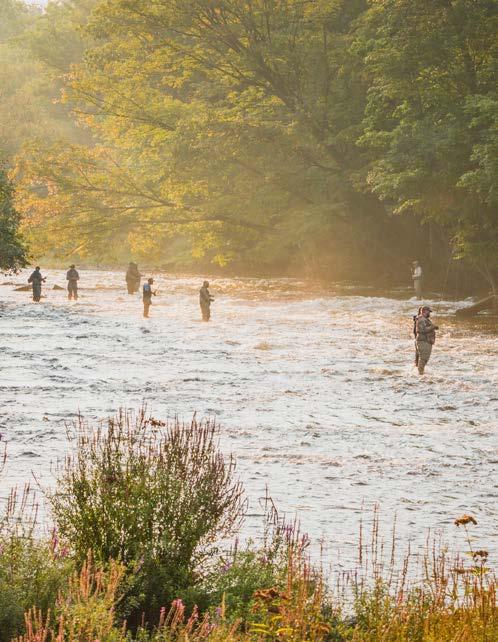
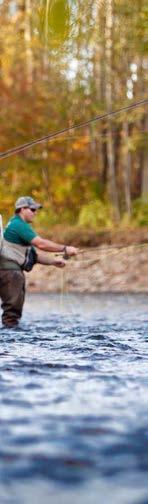
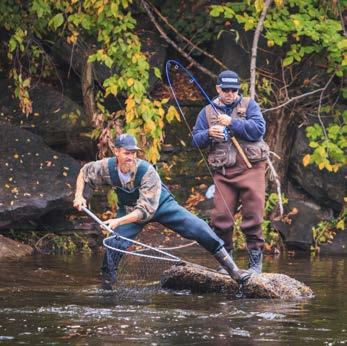
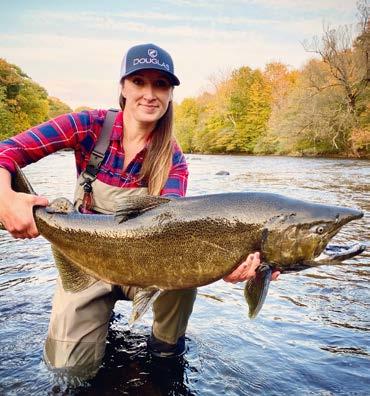
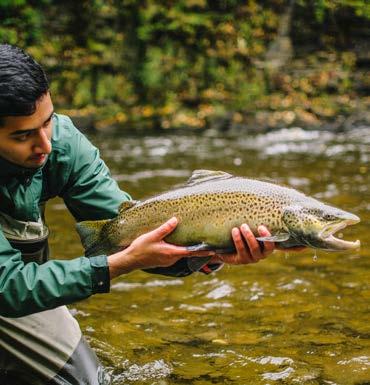
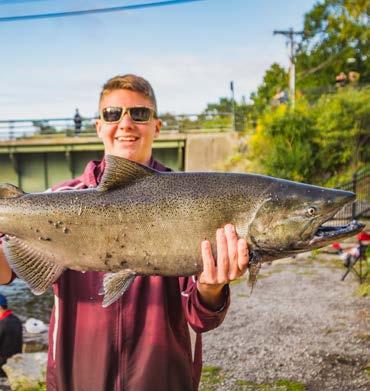
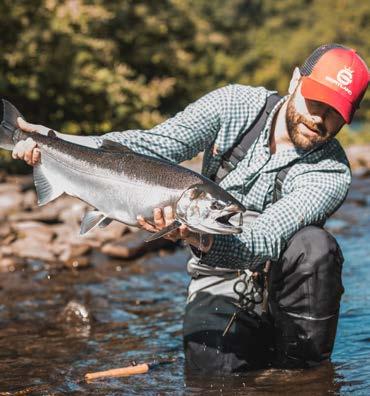
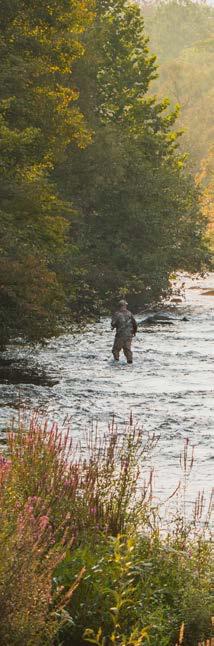
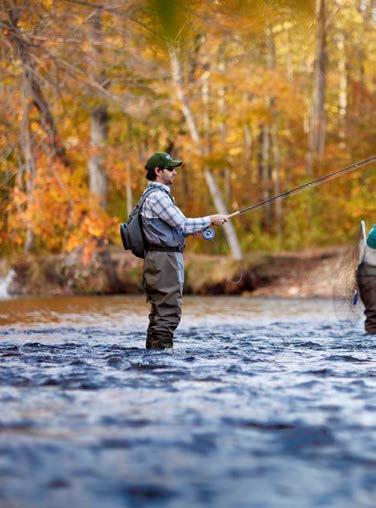
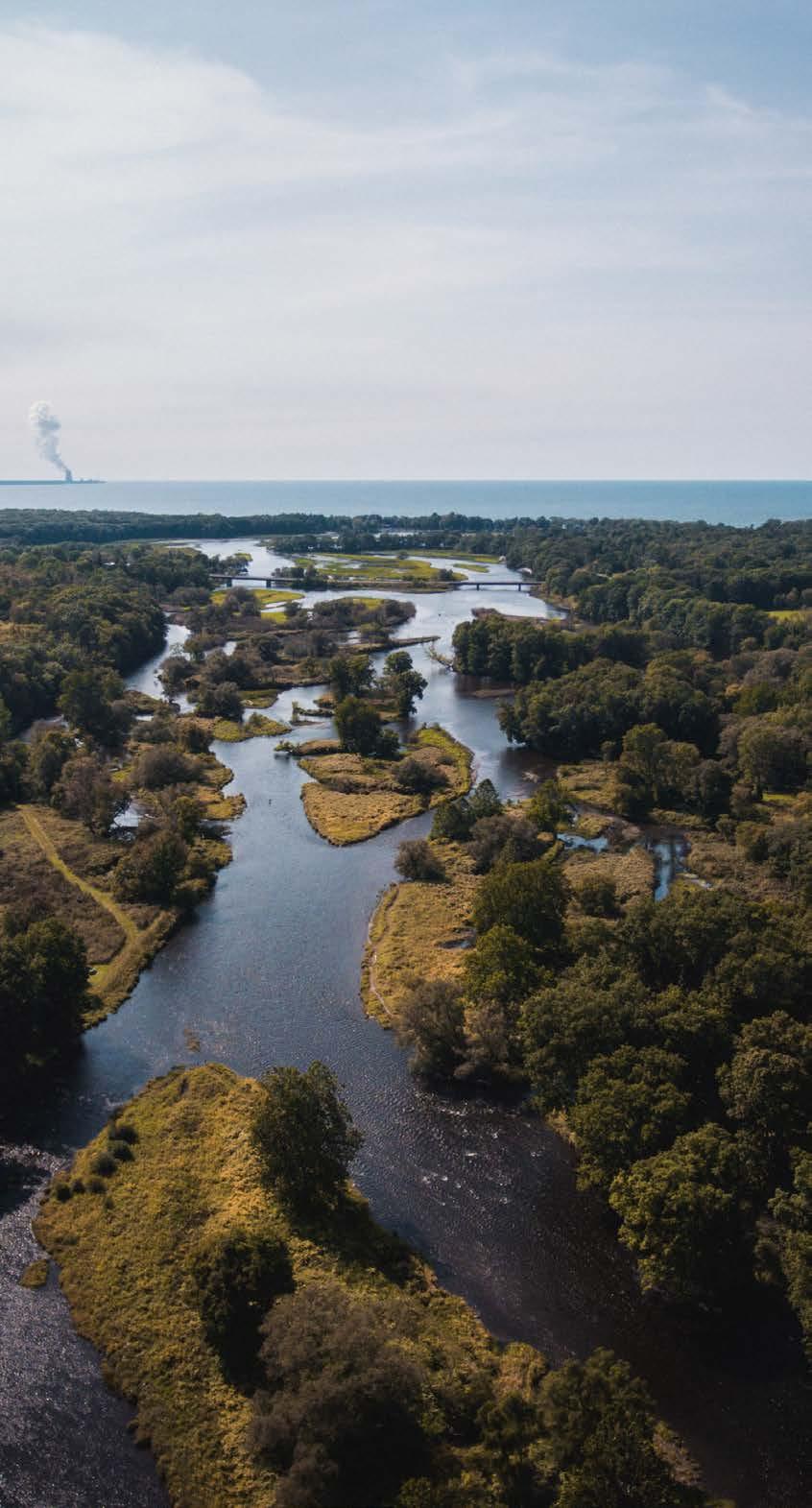
decades, the Salmon River has evolved into a truly world-class fishery, producing 11 world and New York State record catches. It is undoubtedly the only place in the country where an angler can catch the ultimate Grand Slam of cold-water fish - Chinook, coho, and Atlantic salmon, as well as trophy steelhead and brown trout, on any given day in the fall.
In the mid-1960s, William Pierce of the state Department of Environmental Conservation piloted an experimental stocking program of Pacific salmon (coho and Chinook). Pierce traded walleye eggs, of which NY had an abundance, for coho salmon eggs from his counterparts in the west. After successfully hatching the eggs, they were stocked into the Salmon River. Three years later, much to his delight, the fingerlings returned to the Salmon River in great numbers. Chinooks were next. Then steelhead. And as the saying goes, “the rest is history!”
While there is no official “opening day” of salmon season, there are usually good numbers of returning fish in both the Salmon and Oswego rivers by Labor Day weekend. The “run” generally starts by Sept. 1 and continues through mid- to late October. However, it can start as early as mid-August and last into November, weather and water flow permitting. Generally, by Oct. 1, trophy-size steelhead and brown trout have entered the rivers hungry for salmon eggs. The steelhead feed on salmon eggs through the fall and winter, spawning in March and April before returning to Lake Ontario. Brown trout spawn in the fall and return to Lake Ontario. Atlantic salmon, once native to the Salmon River, were stocked in limited numbers over the last 25 years, adding yet another exciting opportunity for anglers to catch “salmon fever!”
FEATURED WRITER

LATE AUGUST - EARLY SEPTEMBER
Maturing Pacific salmon begin to “stage” off the river mouths from mid- to late August. Anglers arriving early in the season have the advantage of great weather without crowds.
Edwards is a life-long avid angler and Salmon River enthusiast. His fishing style and techniques have been featured in Fly Fisherman, Outdoor Life, Sports Afield, Field & Stream, the New York Times, and numerous regional publications. He lectures extensively at outdoor trade shows and Trout Unlimited chapters.

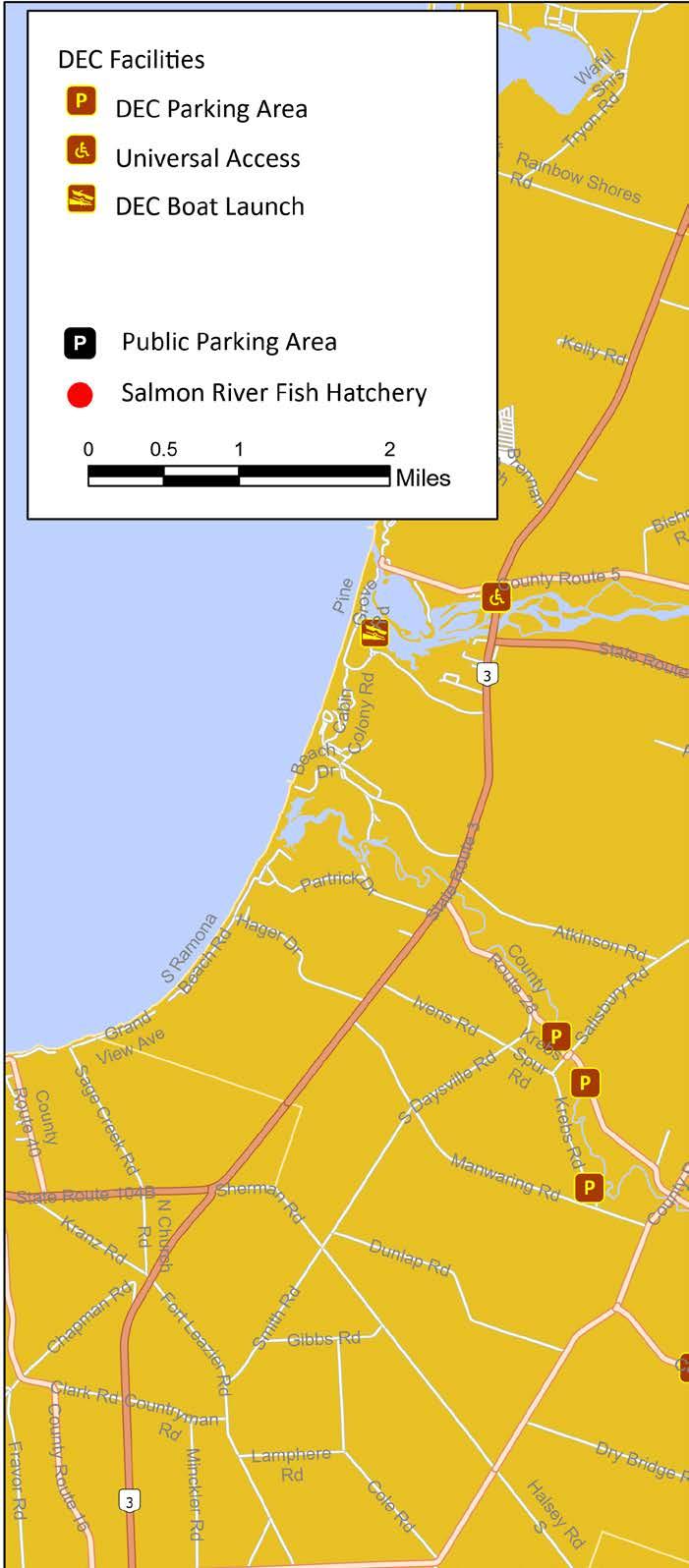
Paid Access
Lodge Guest Access Only
Lodge Guest Access Only
Lodge Guest Access Only
Lodge Guest Access Only
Various Marinas/launches
Village of Pulaski DPWRiverview Dr. or Bridge St.
Parking: upper dirt lot. and next to Pulaski town barn.
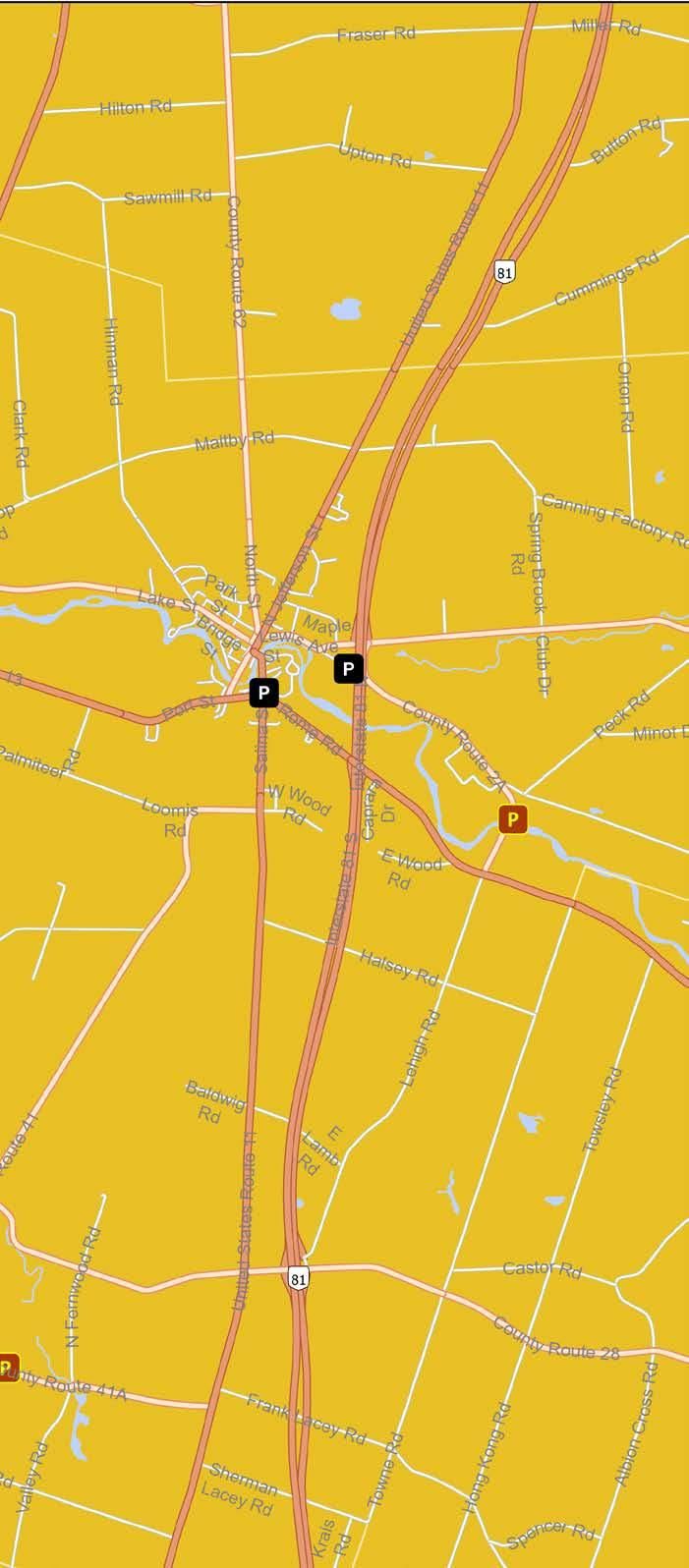
S. Jefferson St. - downstream of Long Bridge; Forest Dr. at end of James St.
Parking: handicap only Downtown Pulaski. Parking: off Maple Ave.
Channel between mainland and island off Lewis St.
Parking: public lot (Village of Pulaski)
Parking area is located below the Solid Waste Station on Route 2a with a drift boat launch
Rd.
Rte. 13
Parking area on Co. Rte. 48 with drift boat launch. Sheepskin
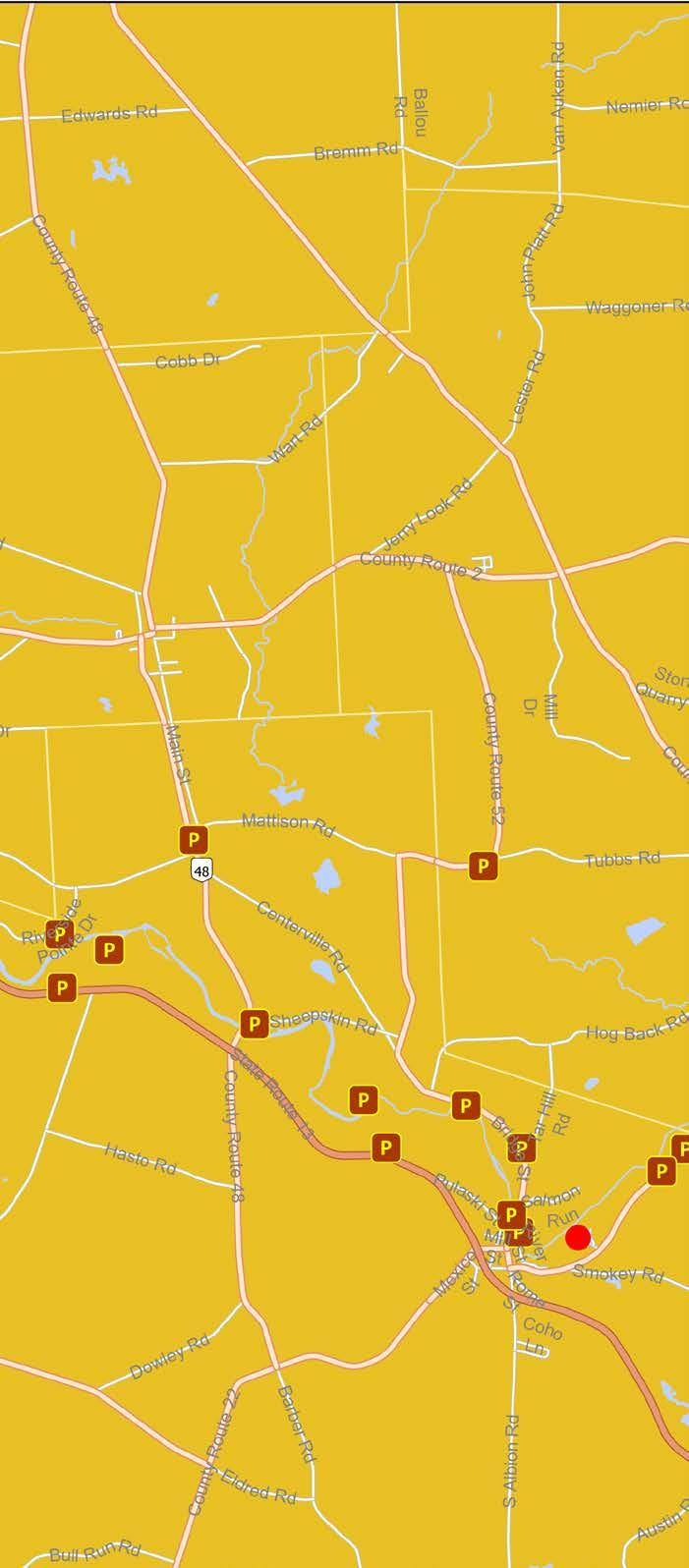
Downriver from Altmar on Co. Rte. 52
Lower Salmon River - state access via powerlines at junction of Co. Rte. 52. and Tarhill Rd.
Parking: Co. Rte. 52
From hatchery boundary to .6 mile north of hatchery Open season April 1 through November 30
.6 mile starting at Centerville Rd. Bridge Parking: Co. Rte. 48
North of Altmar, Co. Rte. 52
There are 2.9 miles of public fishing rights 2133 Co. Rte. 22, Altmar FOR
LIGHTHOUSE MARINA
















These QR codes provide directions to parking areas for many of the fishing locations on pages 46 and 47. Every effort has been made to provide current and accurate information. Please follow NYS Department of Environmental Conservation regulations and respect public and private lands. FOR ACCOMMODATIONS AND VISITOR INFORMATION,VISIT WWW.VISITOSWEGOCOUNTY.COM.
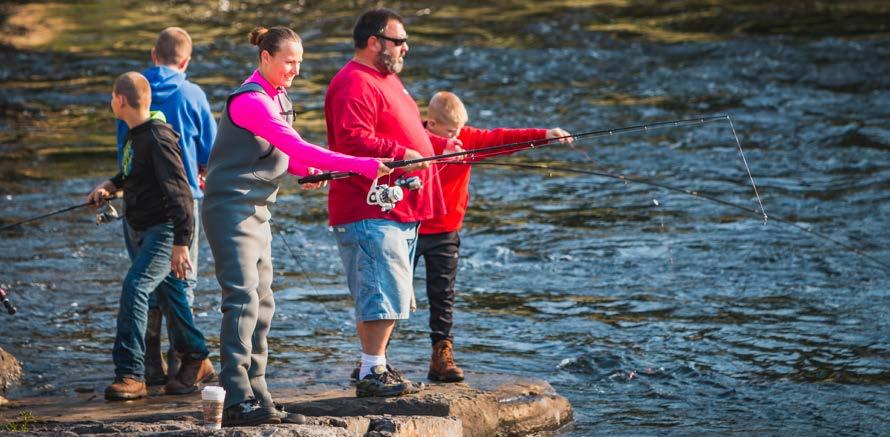
We strive to make sure everyone who visits Oswego County has access to all activities they wish to pursue.
Accessible lodging is available at hotels, motels, cabins, and campgrounds around the county.
Many of our charters and guides can safely accommodate people with accessibility requirements, offering adaptive equipment and modifications for boarding charter boats. We also have several NYS DEC designated accessible fishing locations in the county. They include:
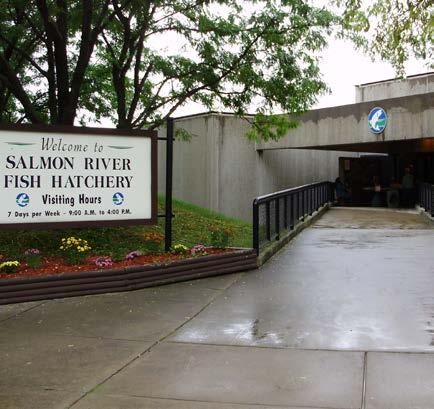
2133 COUNTY RTE 22, ALTMAR NY
Concrete pier at Selkirk Shores State Park in Pulaski.
Wheelchair access to fishing deck at Swamp Road at the I-81 crossing in Hastings.
Fishing deck off Shaw Road from Toad Harbor.
East and West Linear Parks.
Wheelchair access to observation/fishing deck on County Route 17 in Redfield.
Wheelchair access to fishing deck off NYS Rte. 3, Town of Richland.
Each year, the NYS DEC releases over one million pounds of fish into more than 1,200 public streams, rivers, lakes, and ponds across the state. These fish are stocked for two main purposes – to restore native species and to enhance recreational fishing.
Located in Altmar, NY, the Salmon River Fish Hatchery supplies fish for more than 100 public waters, including Lake Ontario. Each year, the hatchery stocks 3.5 million trout and salmon, and nine million walleye fry. Serving an 11-county area, hatchery personnel travel many miles delivering fish to their designated stocking sites.
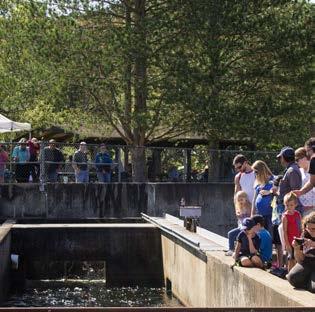
Weather permitting, the hatchery is open to the public from April 1 to Nov. 30. Annual open house takes place on the fourth Saturday in September. 315.298.5051
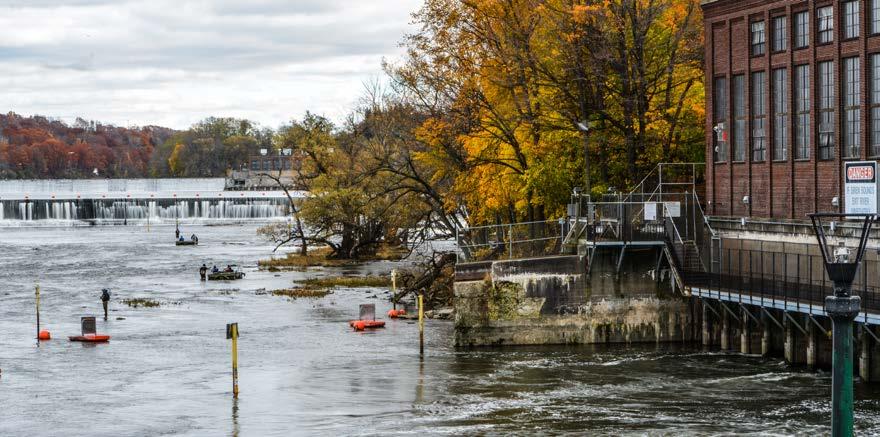
The Oswego River stretches nearly 24 miles from the union of the Seneca and Oneida Rivers at Three Rivers Point to Oswego. It ranks as Lake Ontario’s second largest tributary. From its mouth to the Varick Dam in Oswego, Lake Ontario’s vast variety of fish species move in and out with the seasons. The city of Oswego has developed outstanding public fishing access along the Oswego River. A concrete walkway and railing line both sides of the river, with riverside parking, restrooms, and fish-cleaning stations.
The mouth of the Oswego River is a year-round fishery. The fall run begins with king and coho salmon as they enter the river to spawn. By late October the river also contains brown trout and hungry steelhead, which follow the salmon eggs. Both brown trout and steelhead are plentiful all winter. They come to feed, bask in the river’s slightly warmer temperatures, and spawn in the spring, when they are often referred to as “drop backs.”
Atlantic salmon can be caught from June through March. These once dominant but now elusive fish are often referred to as “unicorns.” SEE THE “PRIME TRIP” PLANNING CHART ON P.10 FOR
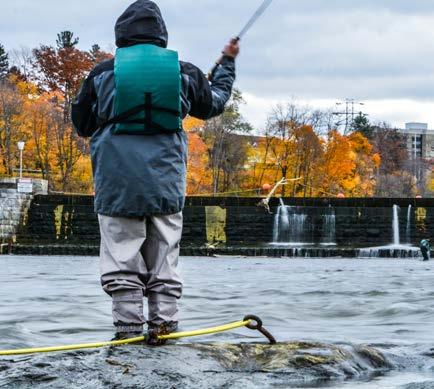
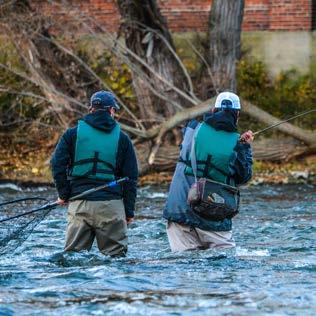
Steelhead can be found up to the Varick Dam. Oswego River City of Oswego NY
CREATE AND FOLLOW A PLAN
BEFORE ENTERING THE RIVER:
•Put on a US Coast Guard- Approved Life Vest (MANDATORY)
•Wear boots with cleats or nonslip soles
•Understand dangers associated with the river
•Know your limitations
•Plan your exit strategy (p.51)
Life jackets can be borrowed from the East Side Fire Station, 35 E Cayuga St., Oswego.
WHILE IN THE RIVER:
•Exit the river immediately if the water begins to rise, the siren sounds or lights flash
•Obey posted warning signs, and voice alerts
•Stay alert to changing water levels
•Never fish alone
•Consider using a wading staff
Help keep the river clean. Carry in/carry out trash and all your belongings.
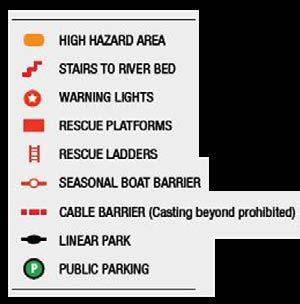




When sirens sound and red lights flash in this area, waders must exit the river immediately as flow will be increasing.
Waders may not reenter until yellow light flashes.
Wading is prohibitedBoat Access only.
When sirens sound and red lights flash in this area, waders must exit the river immediately as flow will be increasing.







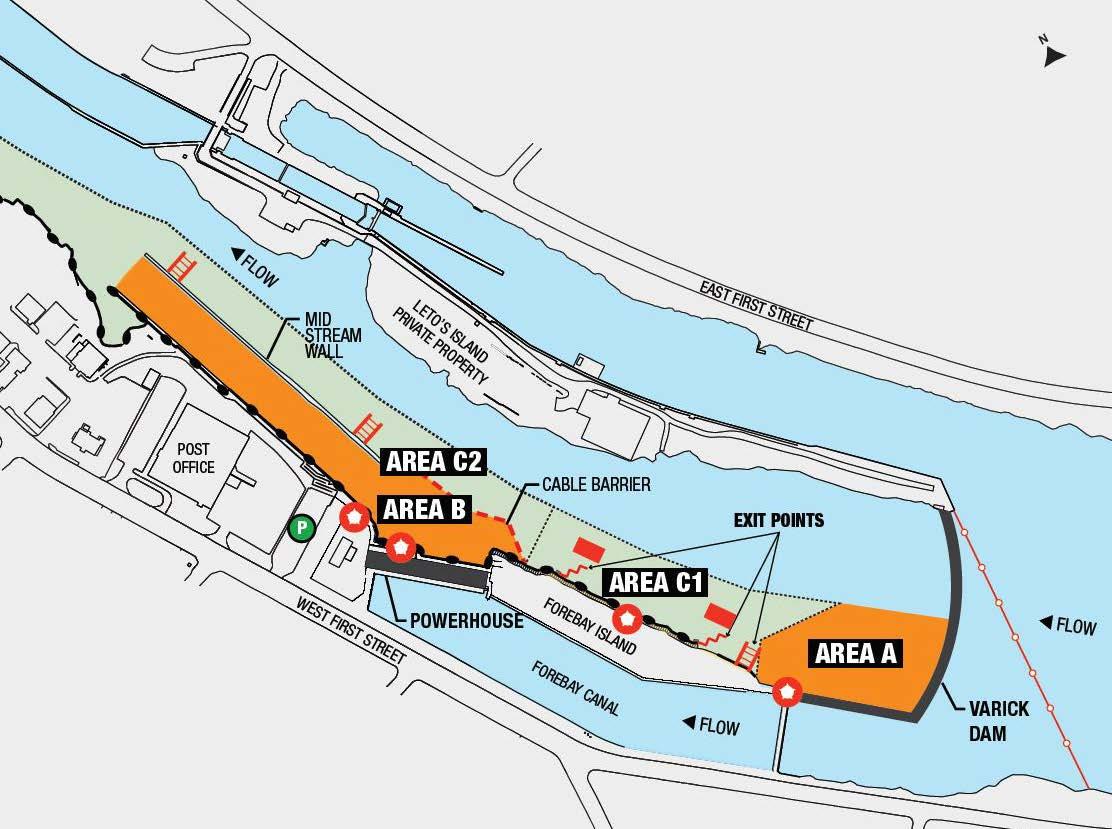
Waders may not reenter until yellow light flashes.
Waders may not reenter until yellow light flashes.
When sirens sound and red lights flash in this area, waders must exit the river immediately as flow will be increasing.
Casting beyond the cable barrier is prohibited
Note: as of October 2025 portions of the high wall remain closed in Area C2.
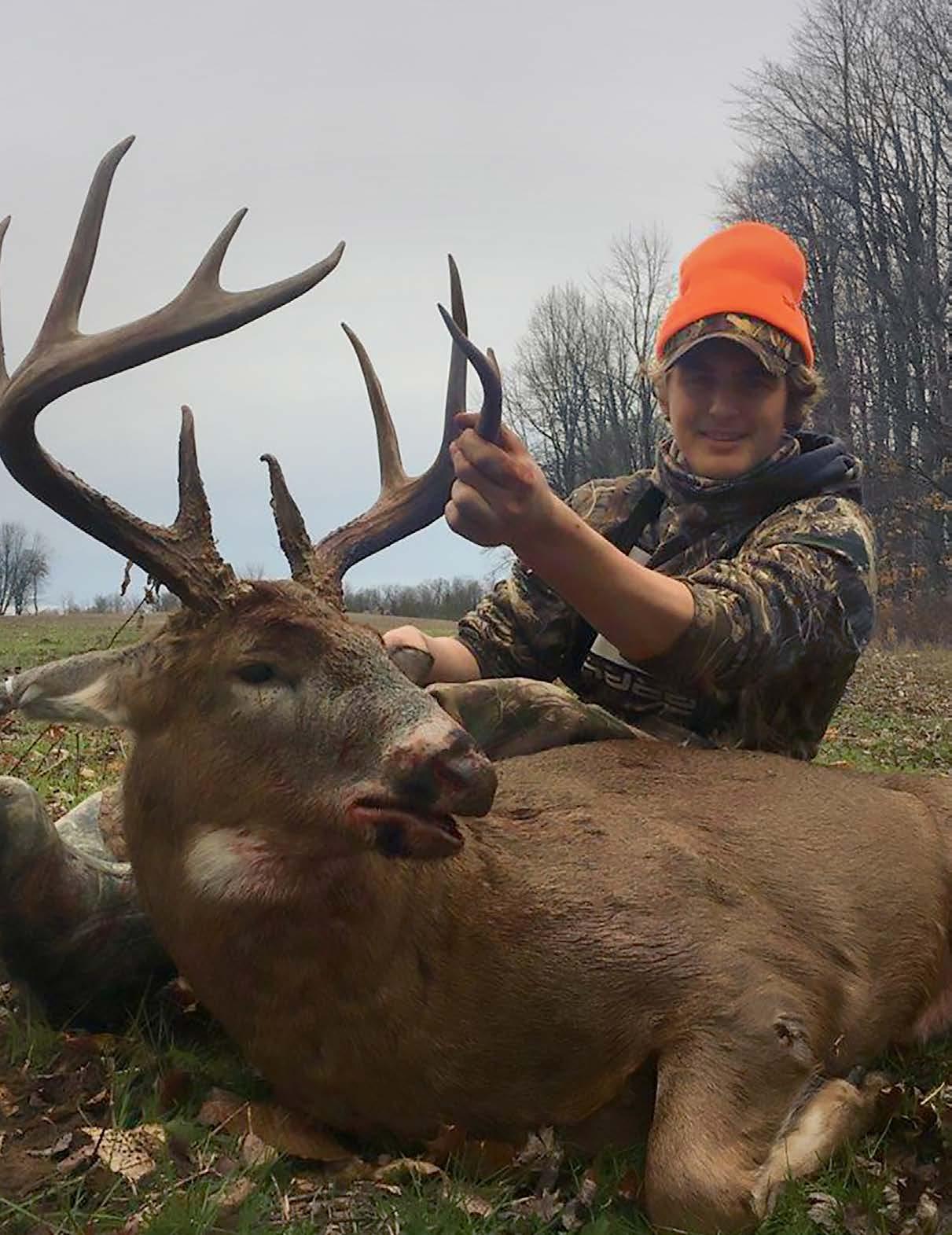
by Troy Creasy, John Scheuermann, SPlitreed, and Nate Blasczienski
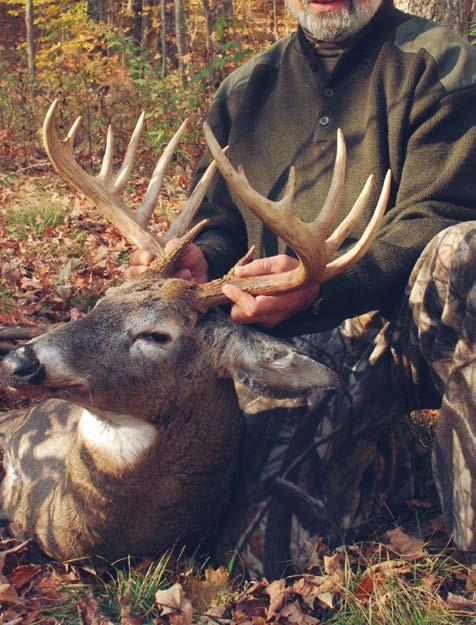
in both the northern and southern hunting zones designated by the state Department of Environmental Conservation. The extended seasons provide many opportunities for a variety of game.
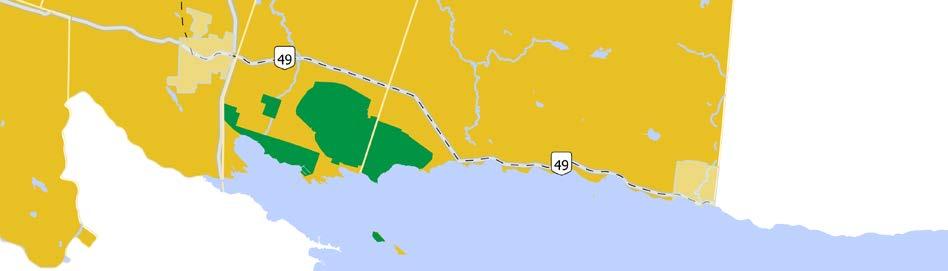
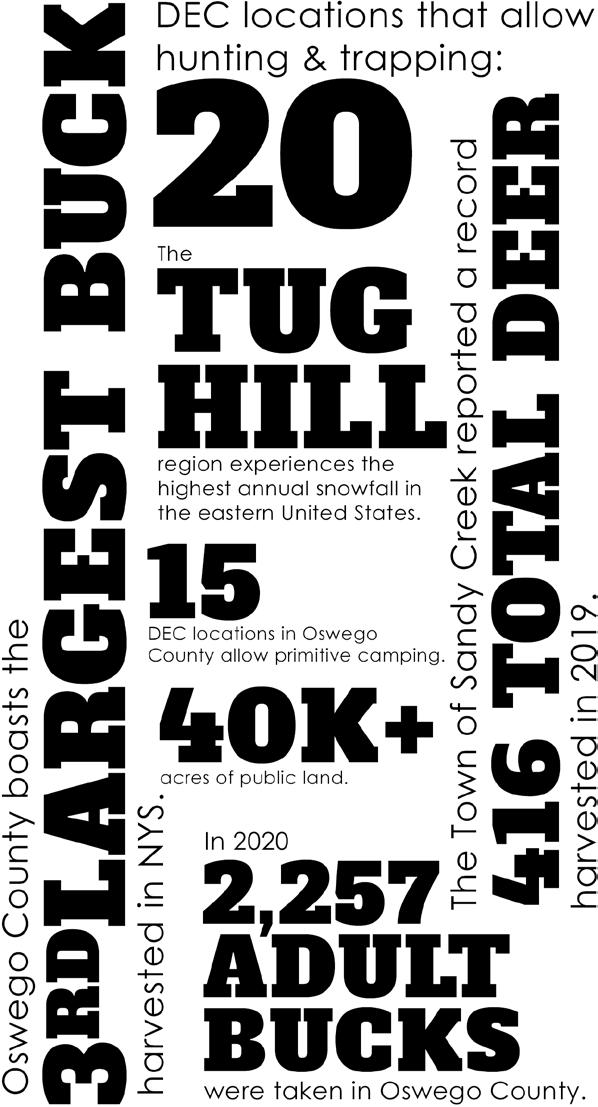
Rich in vast land and water areas, hunters are drawn by abundant deer, turkey, waterfowl, and small game. Huge tracts of land -- 22 wildlife management areas and state forests -- managed by the state DEC, encompass more than 50,000 acres within Oswego County’s boundaries and offer convenient access to hunters.
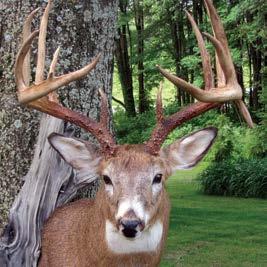
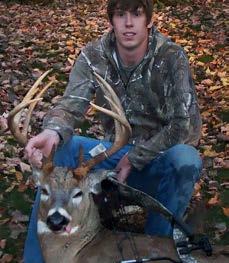
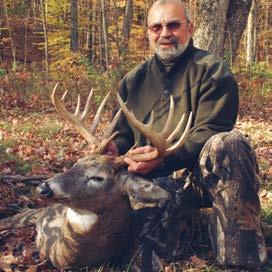
Record whitetail bucks have been harvested in the county. In fact, New York State’s third largest buck was taken in 2012 by Ray Swope near the end of the regular southern zone season. Swope was hunting with a friend in a typical Oswego County snowstorm and visibility was getting poor, when he spotted the buck coming out of a swamp.
Swope said the 13-pointer dressed out at 178 pounds. The official Boone and Crockett scoring put him in third place overall for all-time typical whitetail in New York State. He is the largest buck on record in Oswego County, breaking the previous record set in 1939.
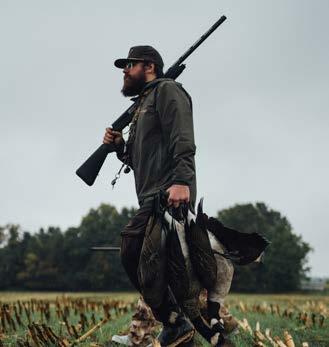
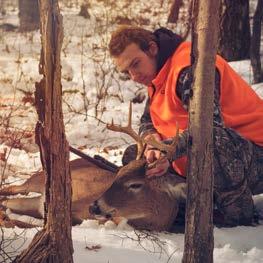
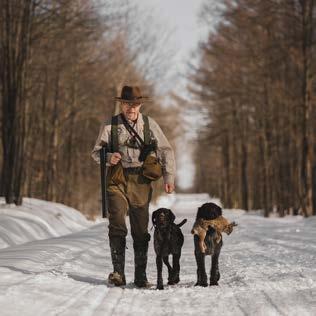
White-tail deer can be found in all areas of Oswego County, which falls in the Eastern Lake Plains and Central New York wildlife management unit sections. Bow, crossbow, muzzleloader, handgun, shotgun, and rifle are allowed during various seasons as regulated by the DEC. Doe permits are also available.
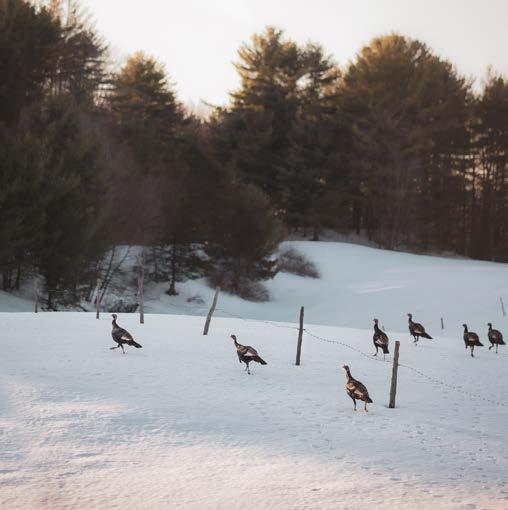
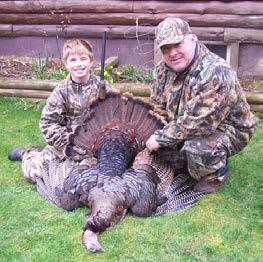
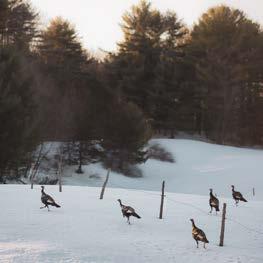
Turkey are frequently sighted. The turkey population varies, as weather conditions dictate the size of the flocks every spring. As with the deer herds, scouting in advance will pay off.
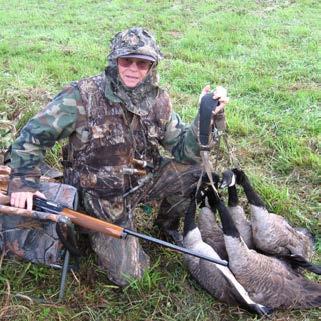
Waterfowl hunting is excellent on and near Lake Ontario, especially during late fall when the flight birds arrive from the North Country. Bag limits vary due to the size of the flocks. Early Canada goose season during the month of September is a good way to get started.
Small game – rabbits, squirrels, and game birds – are also numerous throughout the county.
Snowshoe hare can be found in the thousands of acres of forest on the Tug Hill. Try Happy Valley and Little John wildlife management areas and Salmon River State Forest.
The Oswego County Legislature has adopted a local law to allow 12- and 13-year-old licensed hunters to hunt deer with a rifle, crossbow, shotgun, or muzzleloading firearm in areas where these firearms may be used during hunting seasons. Please read the complete regulations on the NYS DEC website: DEC.NY.GOV/OUTDOOR/46245.HTML

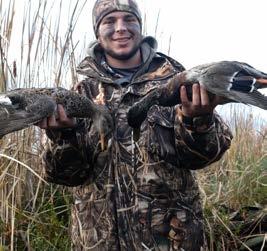

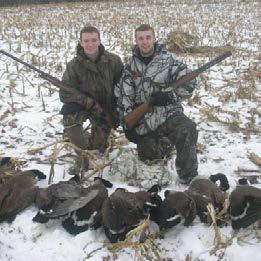


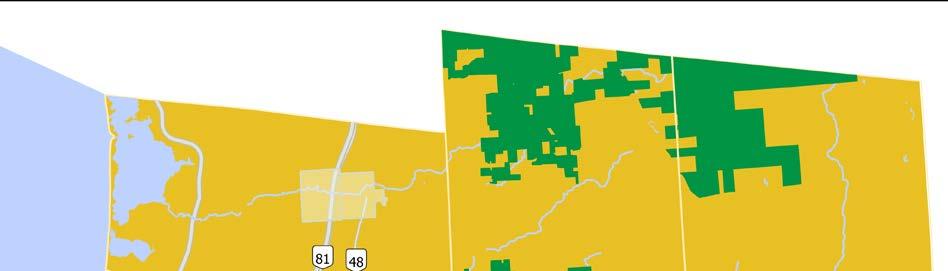
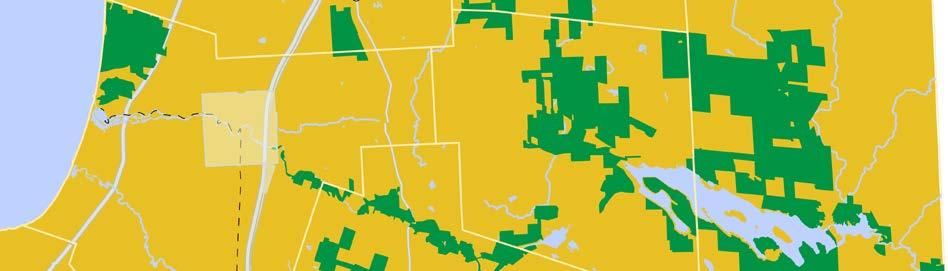
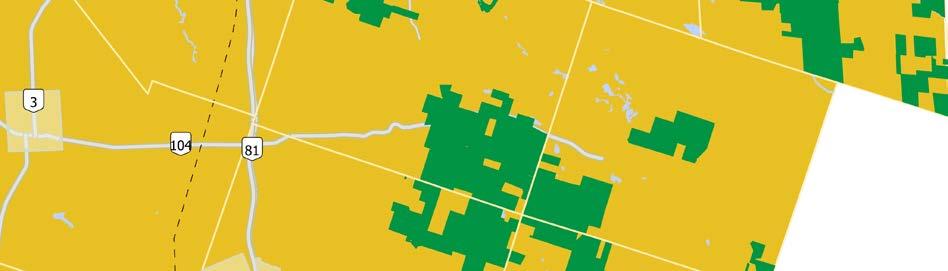



From reforested farmland to interior state forests and lake plains, Oswego County is blessed with thousands of acres of public lands that are accessible to hunters. The county is one of a few in New York State that has sections in both the northern and southern zones, giving hunters a longer season in the field.

Wildlife Management Units (WMUs) are the geographical markers that DEC uses to set hunting and trapping seasons in New York State. There are four Wildlife Management Units encompassing Oswego County: 6G, 6K, 6N, and 7A.



WWW.DEC.NY.GOV/outdoor/7792.html
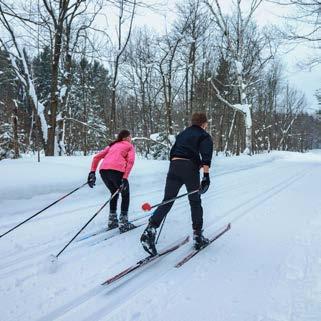
In 1615, French explorer Samuel de Champlain described Oswego County’s landscape as “a very pleasing and fine country, watered by numerous small streams, two small rivers which empty into said lake [Ontario] and a number of ponds and prairies...” His description still holds true four centuries later. Oswego County remains the perfect place to explore the great outdoors.
Hunting and trapping are permitted on 20 designated New York State forest and wildlife management areas. Other permitted uses include fishing, paddling, winter exploring on skis and snowshoes, and primitive camping.
* Consult DEC website at dec.ny.gov for information on DEC Motorized Access Program for People with Disabilities. ** NYS DEC primitive camping regulations apply. *** Snowmobiling access is restricted to town roads in most WMAs.
WMA: Wildlife Management Area
Altmar State Forest encompasses 926 acres of land. Visitors may enjoy hunting, trapping, fishing, informal hiking, and snowmobiling within the rustic environment of this property. Primitive camping is allowed. There are two sections of snowmobile trail on the forest covering about 1.1 miles. With a dense, wild, and relatively undisturbed landscape, Altmar State Forest provides excellent habitat for many different species of plants and animals.
The primary purposes of Curtiss Gale Wildlife Management Area (WMA) are for wildlife management, wildlife habitat management, and wildlife-dependent recreation. This WMA covers 46.3 acres and lies on the eastern side of the Oswego River, sandwiched between the river and Co. Rte. 57. The property was donated to DEC, and the deed restrictions do not allow hunting, trapping, or tree cutting.
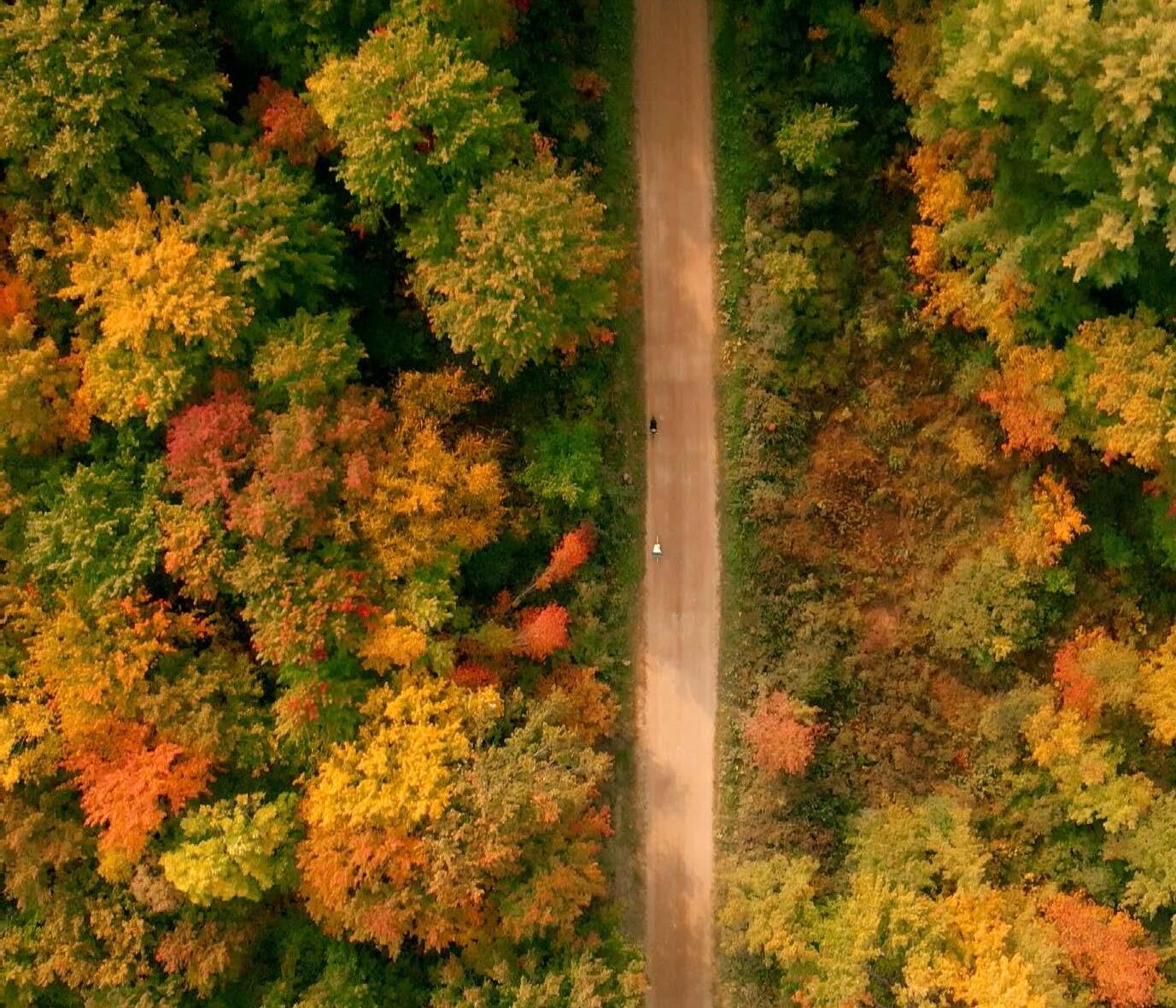
A good system of town roads and some maintenance roads provide access for big game, small game, and waterfowl hunting during good weather months. These activities are controlled by statewide regulations. White-tailed deer, waterfowl, and a variety of small game species offer ample hunting and trapping opportunities.
Like most of the state’s Wildlife Management Areas, Happy Valley WMA is managed by DEC’s Division of Fish and Wildlife for wildlife conservation and wildlifeassociated recreation (hunting, trapping, wildlife viewing, and photography).
The soils are generally stony-fine field loam or sandy knolls. Due to the area’s proximity to Lake Ontario, snow depths average about 125 inches annually.
Kasoag State Forest encompasses 1,057 acres. While it is remote and somewhat primitive, it is a great place for activities such as hiking, hunting, trapping, and fishing. Fish Creek and Indian Camp Brook join within the property to form a diverse swamp habitat.
O’Hara State Forest encompasses approximately 1,402 acres of land. Activities enjoyed here include hunting, hiking, trapping and nature observation. There is one 3/4-mile hiking trail off O’Hara Road, which is seasonally maintained. Primitive camping is allowed.
Orton Hollow State Forest encompasses 507 acres. Rugged and rustic, this forest is a good place for activities such as hunting and trapping. There is only one short trail on the forest which allows motorized access for people with mobility impairments and a DEC issued permit.
The 110-foot Salmon River Falls and the scenic gorge are the popular attractions on this wonderful parcel of state land. The Falls Trail is accessible and features two overlook areas. The steep 600 foot Gorge Trail is suited only for the physically fit.
Klondike State Forest encompasses 875 acres of diverse landscape. Recreational activities such as hunting, fishing, hiking, trapping, and nature observation are frequently enjoyed on the property. There is a multi-purpose trail that can be used for hiking or cross-country skiing. Primitive camping is allowed.
Little John WMA lies on the northwest slope of the Tug Hill Plateau. Most of the area lies between 1,400 and 1,500 feet above sea level, resulting in a gently rolling topography, which is never quite flat, transected by many long, narrow serpentine swampy areas and numerous small depressions.
Salmon River State Forest encompasses 2,763 acres of land. Hiking, hunting, trapping, fishing, snowshoeing, snowmobiling and cross-country skiing are best suited for this state forest. An abundance of wildlife makes both hunting and trapping particularly enjoyable. This area closely preserves the raw natural beauty that once covered the terrain.
Sandy Creek State Forest encompasses 538 acres. Activities such as hunting, trapping, and nature observation are all popular at this state forest on the edge of the Tug Hill Plateau. Sandy Creek has no designated recreation trails but does have a fishing access site with parking on Cummings Road.
The scenic Salmon River in northern Oswego County is a tributary to Lake Ontario and home to one of the nation’s most intensively used fisheries for trophysized trout and salmon. The substantial numbers of mature fish returning to the river and miles of publicly accessible fishing opportunities combine to produce this incredible fishery.
Stave Mill State Forest covers an area of 3,127 acres on the edge of the Tug Hill Plateau. Visitors may hike, fish, cross-country ski, snowshoe, hunt, and trap within the forest. Kenny Brook provides excellent fishing opportunities and is a picturesque place for a picnic.
Dependable Lake Effect snow and miles of well-maintained trails are the perfect ingredients for winter adventures.
Winona Forest Boylston NY
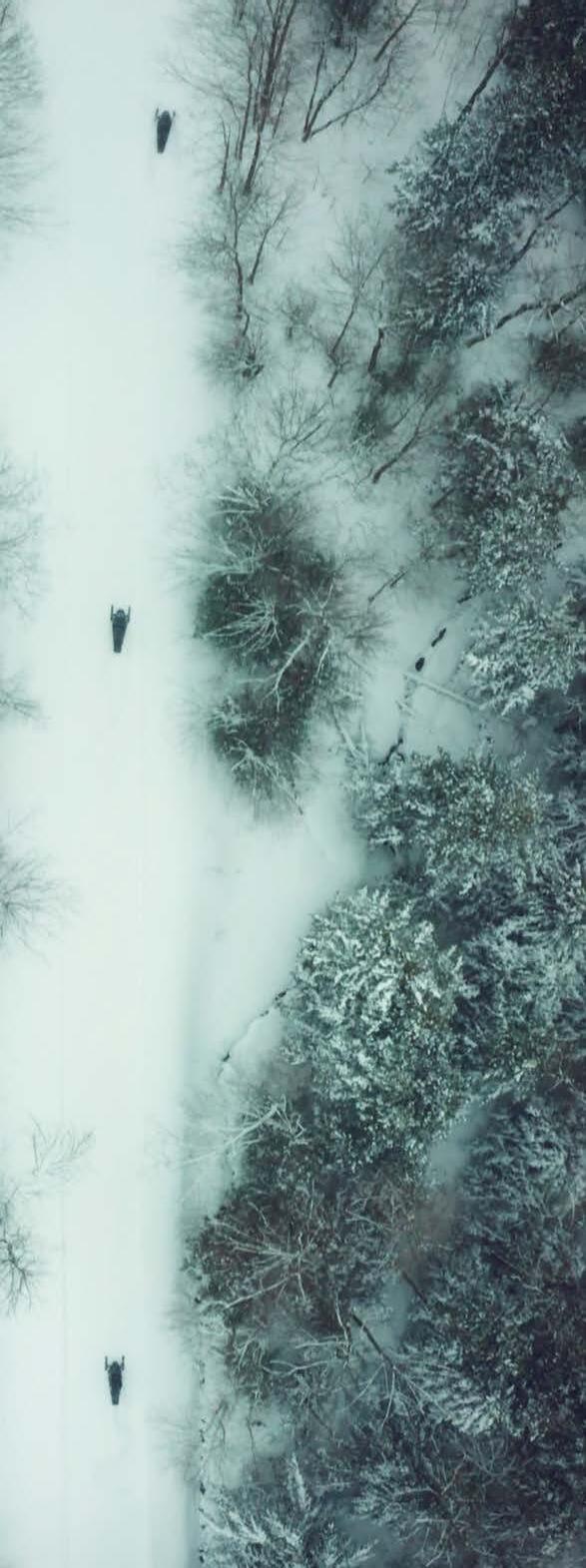
Stone Hill State Forest encompasses 1,025 acres of land. This is a primitive forest, ideal for hunting and trapping. There is a 1/2-mile hiking trail off stone Hill Road. Primitive camping is allowed. Cross-country skiing and snowshoeing are permitted on all hiking trails.
This WMA is 3,966 acres in size and is adjacent to Three Mile Bay on Oneida Lake’s north shore. It is situated in southern Oswego County. A fishing access site on Phillips Point provides fisherman access to Oneida Lake.
Trout Brook State Forest encompasses 622 acres. It is secluded and scenic and is a great place for recreational activities such as hunting, trapping, and fishing. There are no trails on this state forest. Trout Brook makes its way along the western edge of the property.
West Osceola State Forest covers 1,900 acres of forested landscape. Activities such as hunting, trapping, and snowmobiling are best suited for the remote and primitive nature of this state forest. Trout are found in some of the streams. Various salmon and trout are found in the Salmon River.
Its 9,233-acres are shared between southern Jefferson County and northern Oswego County on the western edge of the Tug Hill Plateau. The area contains 31.1 miles of cross-country ski trails, 8.7 miles of snowmobile trails (some designated NYS Snowmobile Corridor Trails), 9.9 miles of forest roads, and four parking lots.
Winona State Forest has three designated primitive campsites on Bargy Road. Hiking is allowed anywhere unless posted otherwise. Horseback riding is allowed on many of the trails. Winona State Forest has become of New York’s premiere venues for outdoor recreation while continuing to provide for active timber management.
By Ryan Chelius
Photos By Max Inchausti
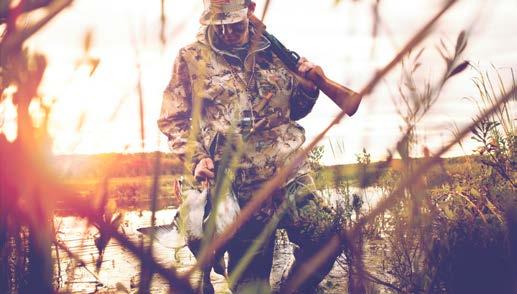
of waterfowl hunters look forward to the migration every year with the hope of experiencing new adventures in the marshes, swamps, and wetlands. Duck hunting on public land can be hectic and crowded—especially on opening day. Although, if you can find a “honey hole” away from the traffic and pick your days right, public land can provide some of the best hunts of your life.
On the shores of Lake Ontario, Oswego County encompasses an abundance of public waterfowl hunting opportunities. These include wetlands, marshes, swamps, and Lake On- tario waters, where hunters can pursue a wide variety of species. It isn’t often you get an area that includes mul- tiple waterfowl zones, as well as quality puddle and diver duck hunting. The county overlaps with both of New York’s northeastern and western waterfowl hunting zones. This means an ex- tra opening day and more opportunities for hunters.
Padding under the stars, waiting for shooting light and greenheads swinging into the decoys -- a bond only waterfowl hunters share. ” “
The area is a major stopping point on the Atlantic Flyway. Avid hunters will find mallards, wood ducks, black ducks, and teal, as well as a variety of other waterfowl. Public access is plentiful, with opportunities for paddle, walk-in, and motorized hunts.
Finding under-pressured hot spots on public land can be a challenge. Still, with dedicated scouting, strategic hunts, and a willingness to put in the extra work, Oswego County waterfowlers can be rewarded.
A good day in the marsh is something that can’t be replicated. Padding under the stars, waiting for shooting light and greenheads swinging into the decoys -- a bond only waterfowl hunters share.
Oswego County provides hunters with the opportunity for their next DIY adventure and a chance to create waterfowling memories that will last a lifetime.

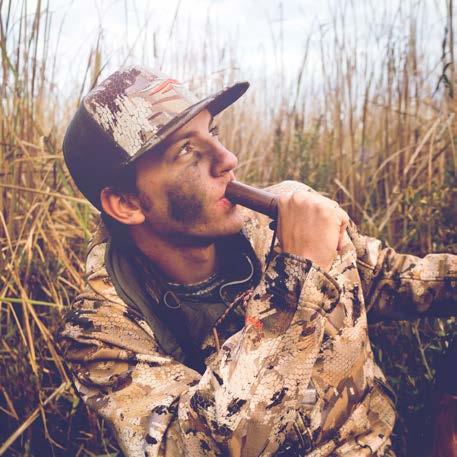
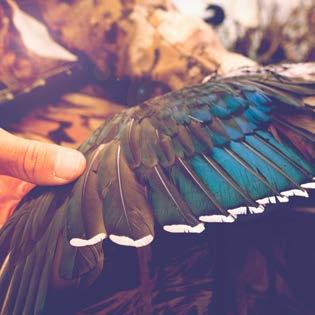

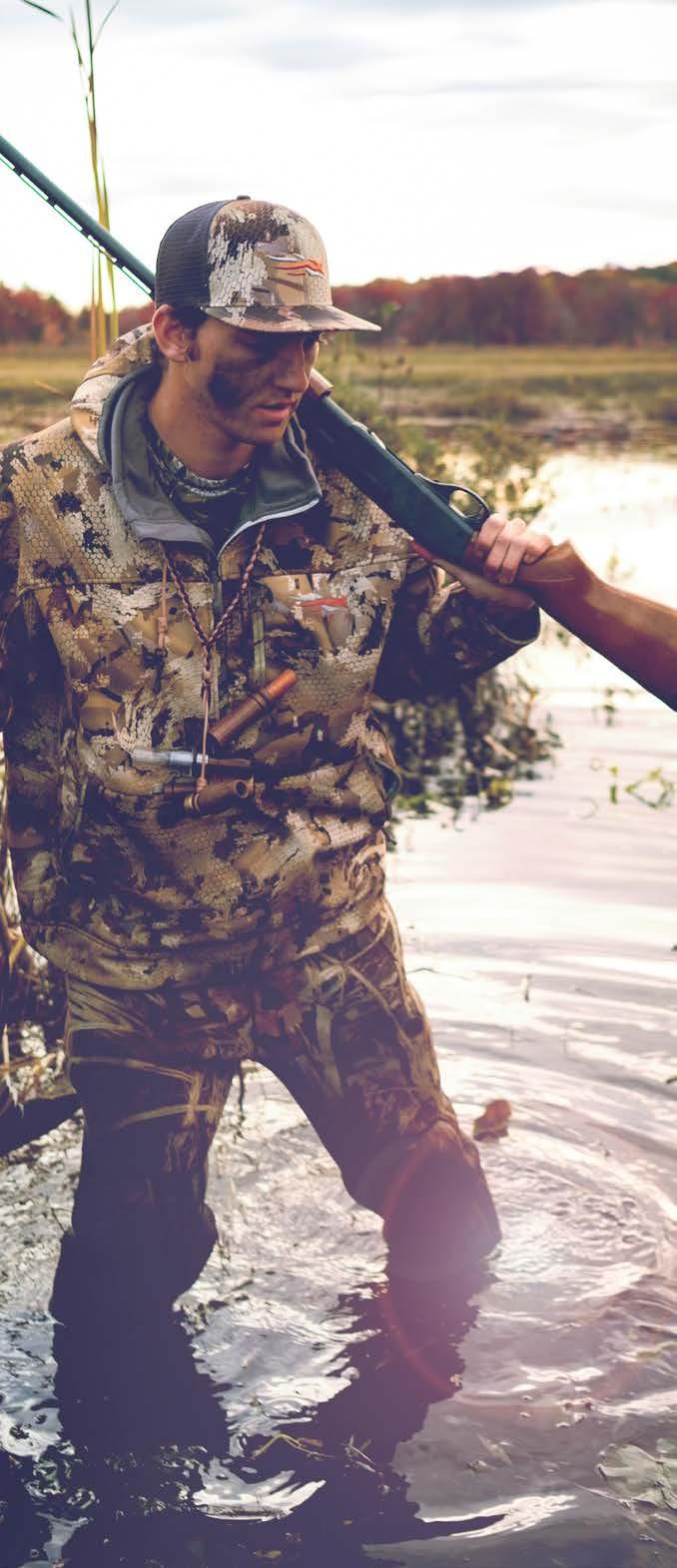
New York’s northeast waterfowl zone opens at the beginning of October, giving Oswego County hunters the chance to get an early jump on the season. Some popular areas include Deer Creek WMA, Happy Valley WMA, and Three Mile Bay WMA. All these locations draw a density of hunters, but for those willing to make the hike or paddle, the crowds can be left behind with ducks backpedaling in the decoys.
In late October, New York’s western waterfowl zone opens, attracting hunters from across the region. One of the later opening days in the year, the western zone can bring an abundance of ducks both inland and on the lake. Oswego County hunters can enjoy quality diver duck hunting on Lake Ontario. Popular targeted species include goldeneye, bufflehead, lesser scaup, greater scaup, ringnecks, mergansers, long tails, redheads, and canvasback.
“D
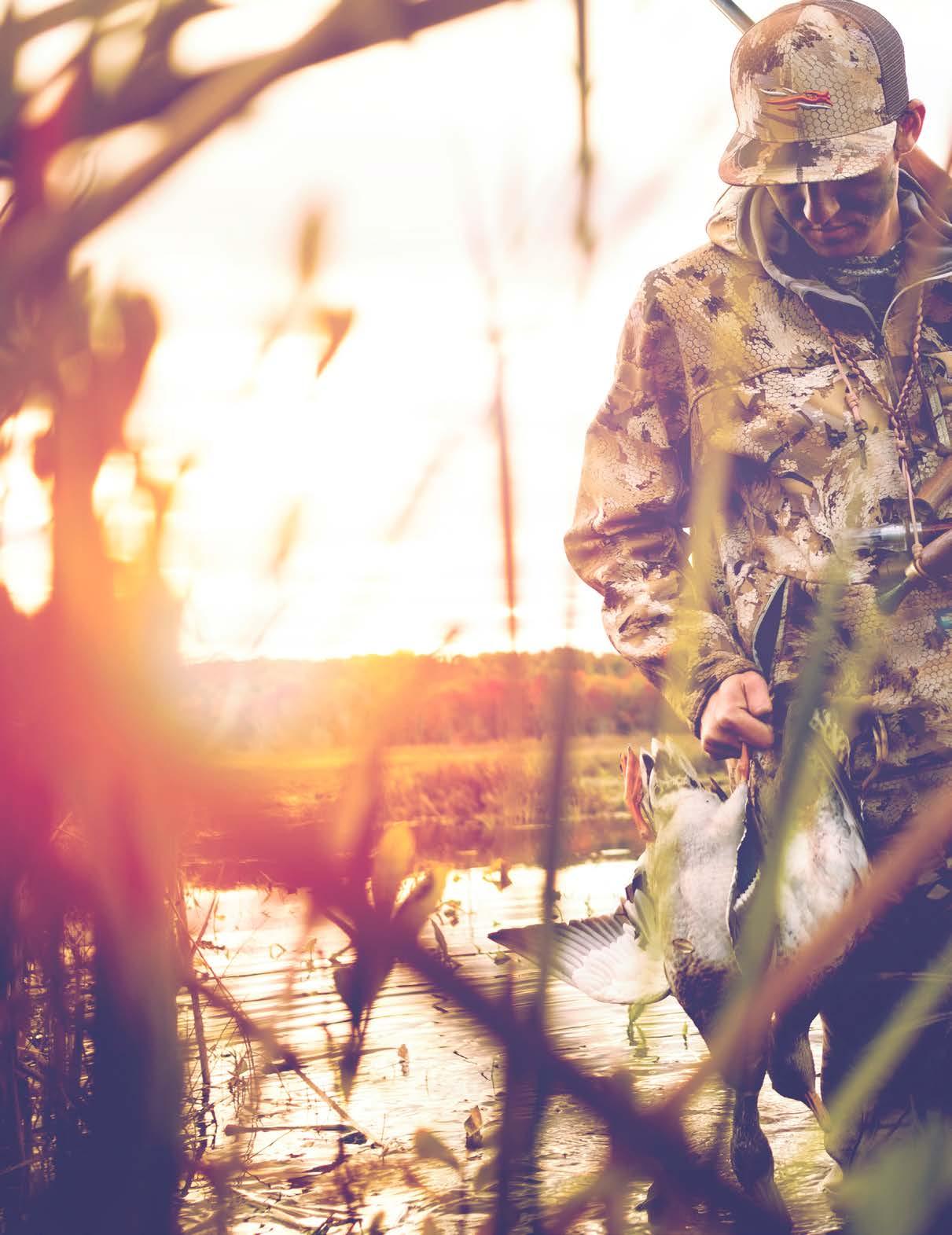
uring the second week of the northeastern zone, I had the chance to hunt Deer Creek WMA. We made the paddle in well before dark and got the decoys set and kayaks hidden. Shooting time arrived with the sky full of birds. Groups of mallards, black ducks and wood ducks continued to dive-bomb our spread all morning. A bonus gadwall topped off the day, and the paddle out was all smiles. It was a morning every duck hunter dreams of.
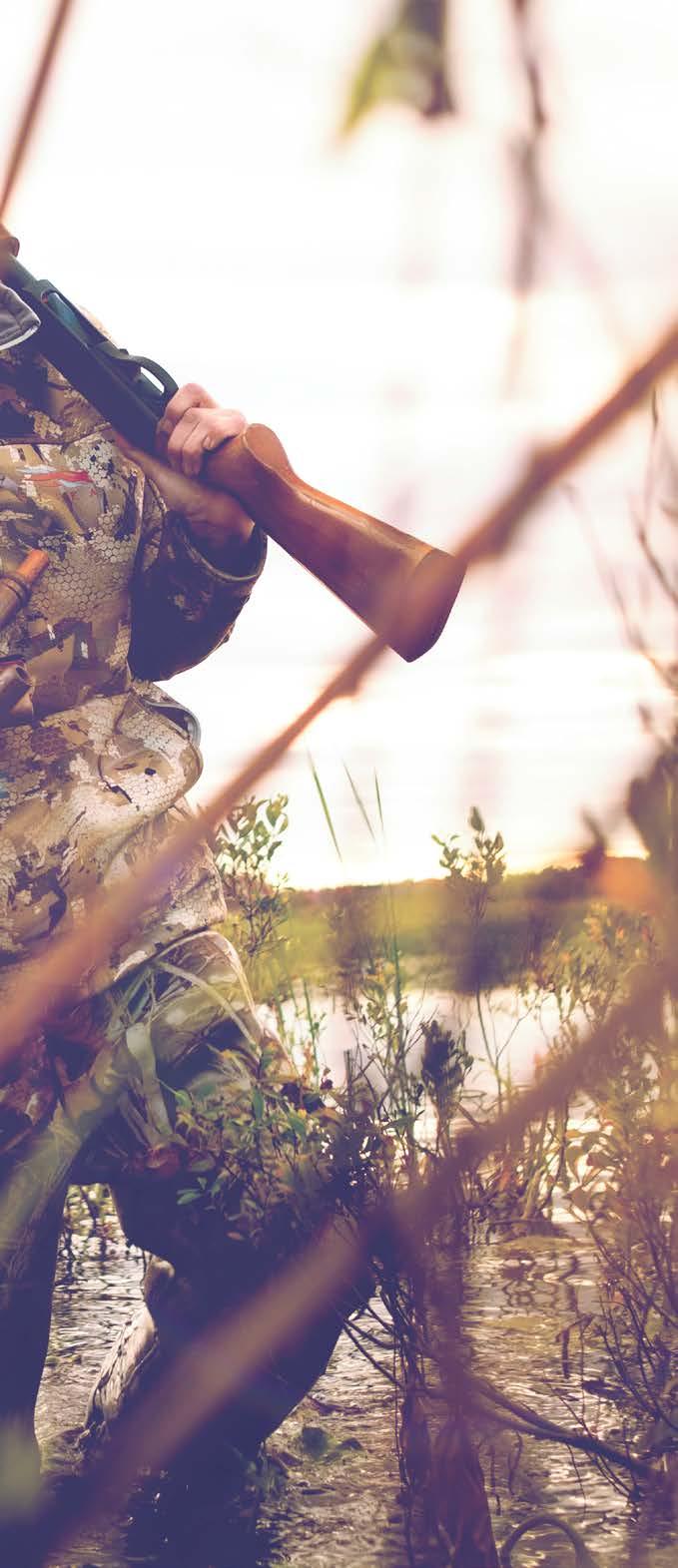
Duck hunting on public land is no easy task. But the most essential thing hunters can do is scout. Find the birds and be where they want to be. Hunt during weekdays, if possible, it’s less pressure and the birds work better. Look for weather and hunt during, and right after, cold fronts. As temperatures drop and cold fronts move in, so do fresh birds that aren’t decoy and call shy.

Ryan Chelius is an avid hunter, angler, freelance writer and photographer whose work has appeared in numerous publications, including Field & Stream, Outdoor Life, American Angler and other outdoor publications. He enjoys sharing his adventures and stories with hopes to inspire other outdoorsmen and women.
With year-round attractions and activities, there’s something for everyone in Oswego County. Check out these “Top 10 Picks,” sure to satisfy curiosities and thrill adventure-seekers.
Our abundant natural resources are renown, drawing outdoor enthusiasts in every season for birding, boating, sledding, scuba diving, and more. Take a hike, grab a paddle or strap on a pair of snowshoes and discover our “great outdoors.”
Explore Oswego County’s fascinating heritage and learn about the people and places that helped shape American history.
Family fun abounds with an amusement park, drive-in movie theater, go-carts, mini-golf, and water wars. Gather your group for some paintball play or hit the lanes for cosmic bowling.
Pamper yourself with a spa day, a relaxing round of golf or a creative art class. Tour our extensive mural collection or explore other unique experiences with a local guide.
Whether you love to play in the great outdoors, explore significant historic sites or simply relax on white sandy beaches and watch a spectacular sunset, see what awaits you in Oswego County!
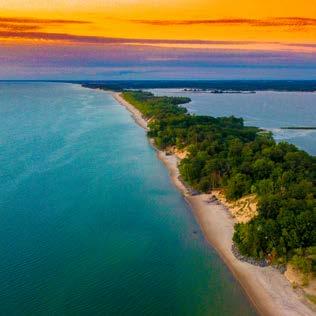
Lake Ontario, its tributaries and inlets provide endless recreation opportunities. Paddle the Oswego Harbor and Sandy Pond, watch wildlife at Derby Hill and Deer Creek and relax on the white sandy beaches of Mexico Point and Sandy Island to take in breath-taking sunsets.
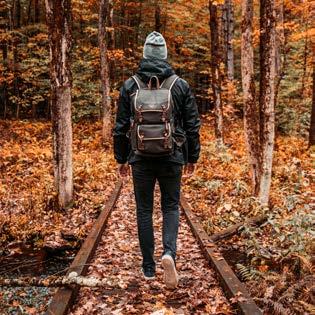
CHATEAUGAY FOREST, ORWELL, NY
Located between Great Lake Ontario and the Adirondack Mountains, the Tug Hill region is 2,100 square miles of year-round outdoor adventure. Summer fun turns to breath-taking fall foliage which becomes a winter wonderland with record snowfalls.
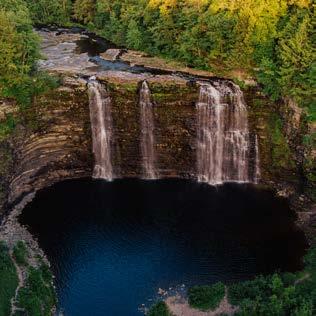
The Salmon River provides both peaceful serenity and thrilling adventure. Battle the rushing rapids on this Class III river and catch your breath on its calming currents. Hike the Salmon River Falls Unique Area and visit the Salmon River Fish Hatchery.

The largest lake lying wholly within New York State, Oneida Lake is part of the historic Erie Canal. Restaurants, marinas, and boat launches make it a haven for boating and recreation.

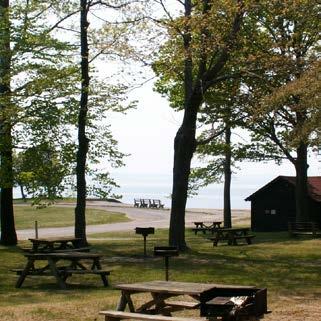
Explore our rich heritage in museums and historic sites across the county. Learn about the Oswego Canal, the Underground Railroad, and the only U.S. shelter for Holocaust survivors. Visit Fort Ontario State Historic Site which played a part in every U.S. war.

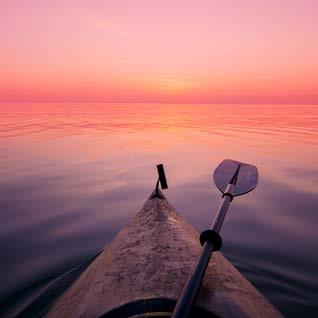
Miles of scenic waterways provide opportunities for paddlers of all skill levels. Boat safely as you look for historic landmarks, “lock through” the Oswego Canal, and watch for bald eagles and heron along our pristine rivers and reservoirs.

From mud bogs to bridges, across rolling hills and forests, riders can explore nearly 200 miles of family-friendly trails in Oswego County. Visit our website for more information on ATV trails.
Start your engines and get your heart thumping with the thrill of the race! From high-powered supermodifieds to dirt-kicking big blocks, to go-carts and motocross, racing is in our veins. Legendary speedways dot the landscape with weekly racing schedules.
Choose from thousands of sites! From rustic wilderness to calming waterfronts, experience camping in your own style. Take on the challenge of tenting in the backwoods or enjoy all the comforts of home in a spacious RV.
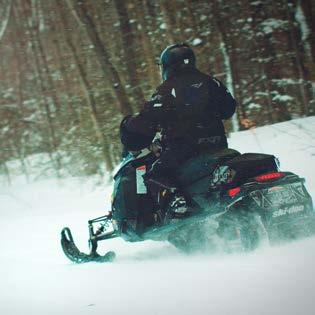
With the highest snowfall east of the Rockies, the Tug Hill Plateau beckons snow enthusiasts from across the region. Famous “lake effect” snow offers exceptional conditions for skiing, snowshoeing, and snowmobiling. Trails connect to a large statewide trail network.


By Wendy Gonyea
the arrival of Europeans to the lands of the Haudenosaunee, a way of life existed following the natural rhythms of earth’s seasonal changes. The earth provided all the necessities for sustaining life. The longhouses of the Mohawk, Oneida, Onondaga, Cayuga, and Seneca, known as the Haudenosaunee Confederacy, extended across the lands that are today mostly designated as New York State. These Indigenous Nations remain today, with the Onondaga Nation at the center of the Confederacy.
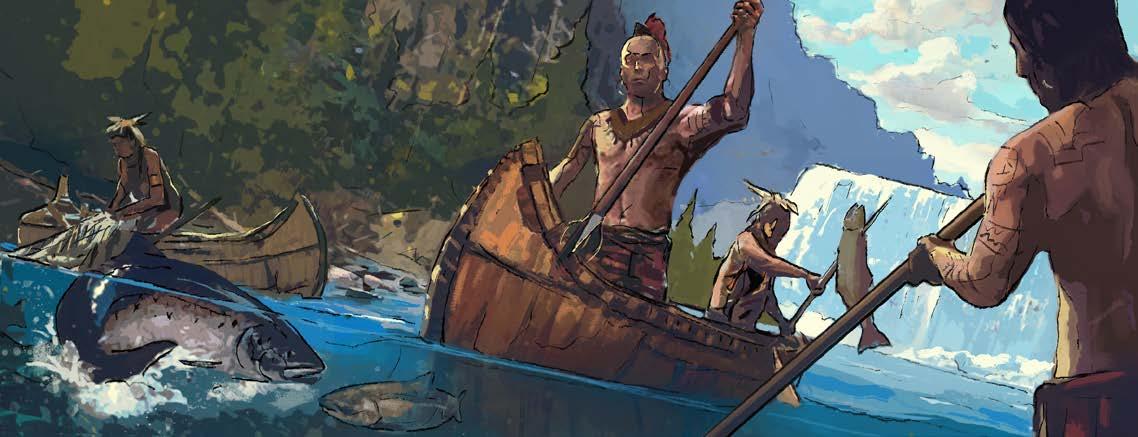
Our ancestors maintained a balance with the natural world giving thanksgivings and respect to the many gifts of creation. Forests provided foods and shelter, plants provided fruits and medicines, and waters provided a wide variety of fish life. We acknowledged the waters, as we still do today, from the small ponds and streams, the underground springs, the creeks and rushing rivers, the big waters, and lakes. From the waters came a primary food source to sustain healthy lives; fish broth to nourish babies, salmon for cooking fires, whitefish, eels, trout, and crabs to keep a village fed.
Our ancestors were skilled fishermen and women. Fishing tools were fashioned from elements found in the natural world. Watchful of signs around them, they were prepared for fish runs. They created harpoons for spearing fish in shallow waters. They made fish weirs from stone and wood, lines and nets woven from plants, and drying racks for preserving fish. They were the pre-cursors of ‘favorite fishing spots’ still used by fishermen and women today, along the Salmon River and throughout Central New York.
Along with a thanksgiving for this abundance of gifts, an important teaching still carried on is to pass by the first ‘catch’, (or the first deer spotted, or the first berry patch.) Rather, we are taught to leave it, pass it by to ensure this gift will not be depleted, but will continue to provide for those yet to come. Today, this might be called ‘catch and release,’ having its roots in a conservation mandate of the Haudenosaunee.
Many trails of our ancestors have become highways. Lands have been developed to make room for increasing settlement. Dams have been built and some waters have been polluted. In spite of these changes to the landscape, fish life continues. Those ancestors of long ago took great care so life would continue.
Today state and federal agencies purposefully work to preserve and protect our environment for all those who live on the land, and so important, for coming generations of the future.
Massive numbers of landlocked Atlantic salmon ran the length of the Salmon River until the late 19th century. Atlantics were an important food source for Indigenous peoples, who targeted them with spears and nets.

is a Beaver Clan Mother of the Onondaga Nation. She is dedicated to carrying on the traditions and ceremonies of the Onondaga people. She holds degrees in counseling, guidance, and elementary education, and has published numerous articles. She lives on the Onondaga Nation where she speaks and writes on behalf of her community.