e e e e B B
r r u u O O
t t s s e e u u G G
BEE HOTEL
in a
Did you know that there are nearly 20,000 bee species in the world? Over 4,000 of those bees are native to North America.
WHAT IS A BEE HOTEL?
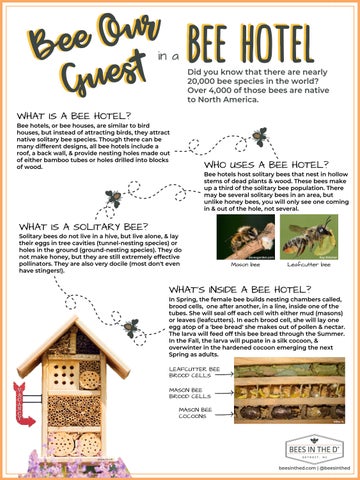
Bee hotels, or bee houses, are similar to bird houses, but instead of attracting birds, they attract native solitary bee species. Though there can be many different designs, all bee hotels include a roof, a back wall, & provide nesting holes made out of either bamboo tubes or holes drilled into blocks of wood.
WHO USES A BEE HOTEL?
Bee hotels host solitary bees that nest in hollow stems of dead plants & wood. These bees make up a third of the solitary bee population. There may be several solitary bees in an area, but unlike honey bees, you will only see one coming in & out of the hole, not several.
WHAT IS A SOLITARY BEE?
Solitary bees do not live in a hive, but live alone, & lay their eggs in tree cavities (tunnel-nesting species) or holes in the ground (ground-nesting species). They do not make honey, but they are still extremely effective pollinators. They are also very docile (most don't even have stingers!).
davesgarden.com
Mason bee
Roy Rimmer
Leafcutter bee
WHAT'S INSIDE A BEE HOTEL?
In Spring, the female bee builds nesting chambers called, brood cells, one after another, in a line, inside one of the tubes. She will seal off each cell with either mud (masons) or leaves (leafcutters). In each brood cell, she will lay one egg atop of a 'bee bread' she makes out of pollen & nectar. The larva will feed off this bee bread through the Summer. In the Fall, the larva will pupate in a silk cocoon, & overwinter in the hardened cocoon emerging the next Spring as adults. LEAFCUTTER BEE BROOD CELLS MASON BEE BROOD CELLS MASON BEE COCOONS
Mike N.
saga.co.uk
beesinthed.com | @beesinthed