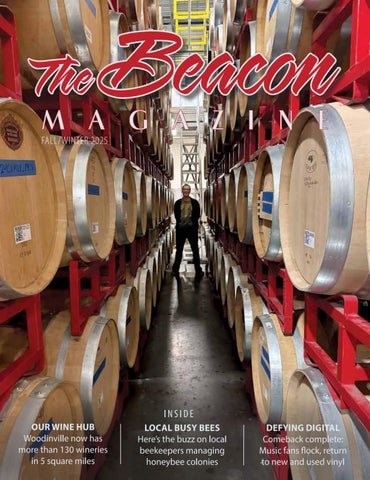
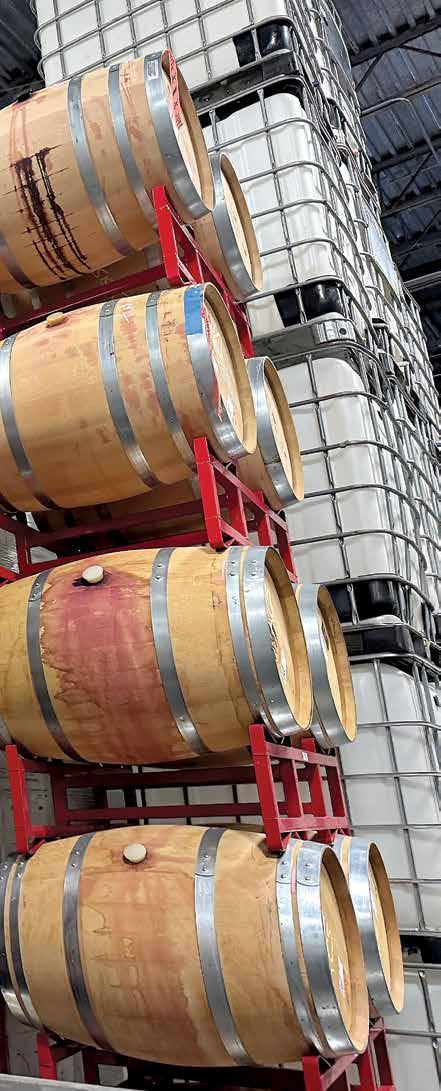
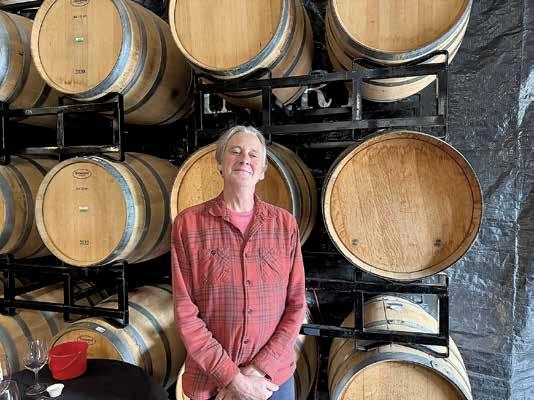
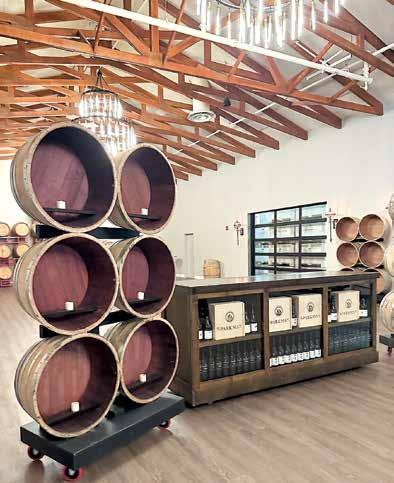
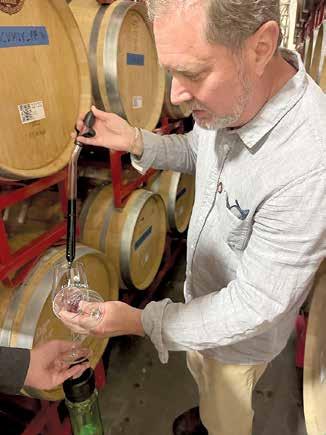
Woodinville now has more than 130 wineries in 5 square miles
INSIDE
LOCAL BUSY BEES
Here’s the buzz on local beekeepers managing honeybee colonies
DEFYING DIGITAL
Comeback complete: Music fans flock, return to new and used vinyl
Our Contributors
Come On In Fall/Winter 2025
A natural buzz
4
Local beekeepers love their work, even though it can be expensive. And in addition to fighting urban sprawl, there’s the destructor mite. Despite the challenges, beekeeping can be rewarding.
Spin masters
9 It should be clear to all that vinyl records are now king when it comes to physical sales. Read what some record store owners say about their popularity. Next up? The cassette boom.
Artist’s Corner
13
Glass artist Colin Satterfield’s work combining Old World skill and modern innovation is one reason his work is collected worldwide. Don’t miss a demonstration when he come to local art centers.
Wine – and more
14
With increased competition and consumers drinking less alcohol, Woodinville’s wineries are reinventing their offerings, including non-alcoholic options. But wine remains king.
A Day in the Life
20
Ally Kutz loves being a firefighter at the downtown Edmonds Fire Station. But as the majority of her work is as a first-responder, she has a lot on her checklist to take care of every day.
Go play inside
25
The Puget Sound’s Big Dark doesn’t mean you give up your favorite outdoor sports. There are plenty of locations in south Snohomish County where you can get your game on.
Business Directory
28-29 Our advertisers contact information.
Season to Taste
Debbie Magill Design & Layout
Maria A. Montalvo Freelance Writer
Rick Sinnett Freelance Writer
Julia Fiene Bowman photo
By Paul Archipley
ith apologies to André Previn, certain stories just cry out for puns. So in a tale about beekeepers, one can’t help but borrow from his “Jesus Christ, Superstar” tune and ask, “What’s the buzz, tell me what’s a-happening.” The little buzzers, hard-working and clannish, aren’t much on people’s minds most of the time.
But when a semitruck carrying millions of honeybees overturned in Whatcom County last May, spilling its load and creating a giant swarm, news stories gave readers a stinging reminder that bees are very much necessary, even, perhaps, to our very survival. A few years earlier, an unknown number of Asian giant hornets traveled uninvited into Washington. Honeybees were on their menu, causing widespread alarm in the agriculture community.
A male specimen was found near Marysville in 2021. But the state launched a sting operation, and there were no confirmed sightings in either 2023 or 2024, so officials declared the hornets eradicated from North America. Bees and their keepers hummed a sigh of relief. Except for the occasional headline buzz about bees, the pollinators and their keepers quietly do their thing.
Here are some numbers:
A Flow Hive
For Don and Candi Doran of Mukilteo, their beekeeping adventure started by accident. Their youngest son, Sean, a grown man, still has some of that boyish charm in him, Don said. “Sean came to me and said, Dad, I’ve got a great idea. All I need is your yard.” He wanted to get a beehive. It was a variation of that well-known child’s plea, “Can I have a puppy? I promise I’ll feed it and walk it and pick up its poop!”
• There are about 2.99 million managed colonies of bees in the United States; the managers number from 115,000 –125,000. Most of them are hobbyists.
• A typical colony ranges from just under 20,000 bees in the wintertime to 50,000-60,000 in the summertime. So, at peak, an estimated 150-180+ billion honeybees are racing in and out of managed hives, collecting pollen and pollinating.
Closer to home, there are about 100,000 managed
Don said no way. For starters, he’s allergic to bee stings. Candi, separately, gave Sean the green light. Guess who prevailed? Sean showed them a video of a beehive invented in Australia, called a Flow Hive, and it comes with a tap at the bottom that you simply turn and, voilá! Honey! It’s popular with beginners, but expensive. And, like most products that sound too good to be true, it was. All three Doran children chipped in to help buy the $1,000 Flow Hive, Candi said. But then, as Don recalled, a couple of weeks later, they said, “The beehive is gonna be here, and we’re gonna need to put it together. Well, there’s about a billion parts. I looked at my two sons, and thought, yeah, they’re not putting this thing together.”
Don came to admit the Flow Hive was a pretty cool invention, but it was plastic, and was designed differently from traditional hives, neither a feature that the bees particularly like. “So technically, Sean was right,” he admitted. “However, Australia is not Washington. We have a relatively short growing season where bees are able to fill that Flow Hive.” And it wasn’t true that you just had to set it up and wait for the honey to begin flowing. It needed maintenance, just like all hives do.
then there are the hobbyists. Bee-lieve it or
The couple began doing their due diligence, watching YouTube and attending classes. And they were beginning to get to know their bees. Even seemingly little things, like the color of their “house,” make a difference. “They’re very particular,” Candi said. “If they don’t like something, they just leave.”
Learning curve
I
n the early going, the learning curve was steep. “The first couple of years, we were working pretty hard on this,” Don said, “and I was getting more and more resentful because the kids said they were going to help. They were going to be full partners in this.” But, of course, Don and Candi ended up “walking the dog.”
The school of hard knocks (honey knocks?) included learning about the plague of mites, which wiped out their hive one year, and the curse of yellowjackets, which like to feast on bees. And Don, despite his allergy, had to get used to being stung on a regular basis – more than a dozen times so far this year.
But a funny thing happened on the hell road to honey heaven: Don and Candi came to love their beehive. They propped a couple of lawn chairs nearby to watch as thousands of bees come and go all day long. Don, using a pair of heavy-duty gloves, de-stresses by pounding yellowjackets into oblivion. And this year the couple has
Julia Fiene Bowman photo
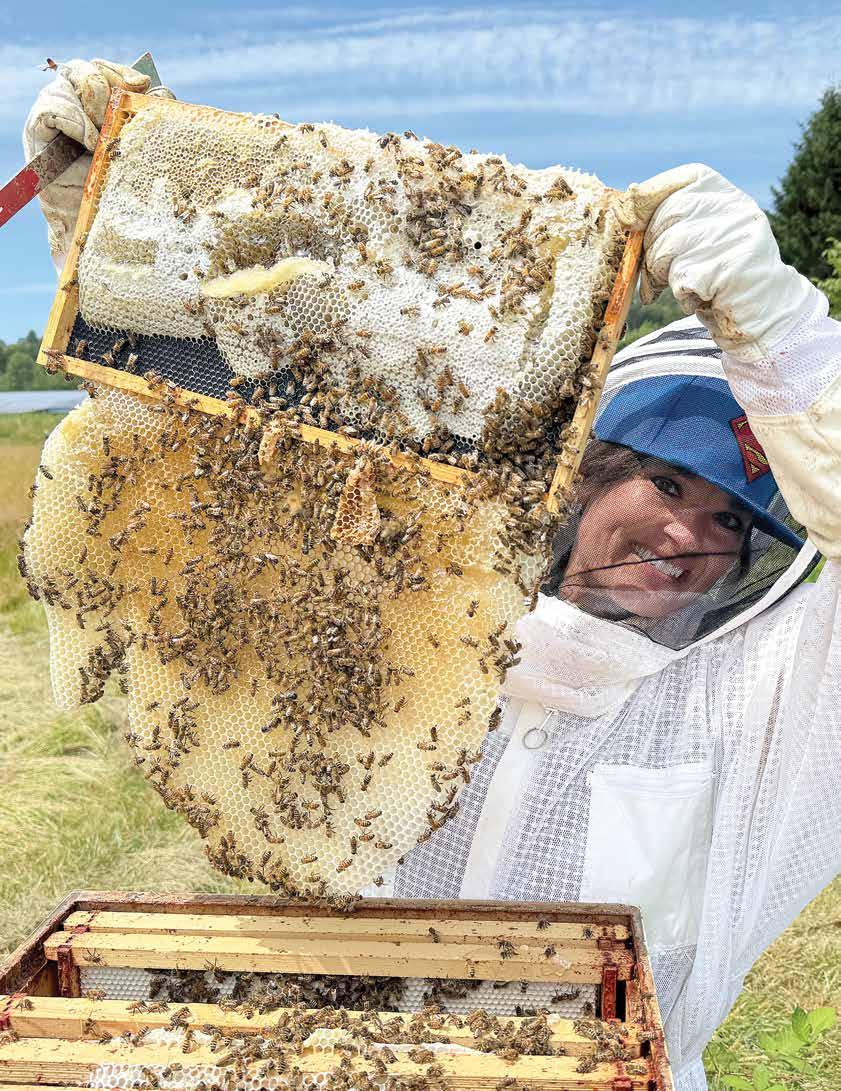
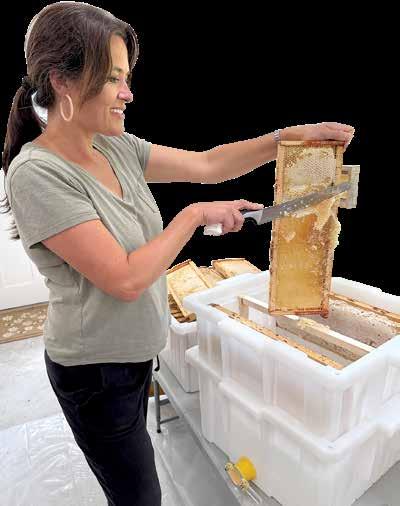
Julia Fiene Bowman demonstrates the process of extracting and decapping, which are sequential beekeeping processes to harvest honey. Decapping, here, is removing the thin layer of beeswax (“capping”) that seals the cells of honey-filled combs, while extracting is using a honey extractor to spin the combs and force the liquid honey out. Opposite page: Julia Fiene Bowman of Edmonds holds up a frame and honeycomb from one of her hives on property near Snohomish.
reaped a generous supply of honey. Sean, who does help out occasionally, gets an honorable mention for naming their sweet product “Bee-tchin’ Honey.”
Unlike the Dorans, Julia Fiene Bowman of Edmonds had long wanted to be a beekeeper. She grew up in Wisconsin, went to many a state fair, and was drawn to the bee booths where she asked questions and marveled at the exhibits. But it wasn’t until Covid, when everyone isolated at home, that she finally had an opportunity to jump in.
“I was a teacher, but in-person teaching stopped, and I was home-schooling my three kids,” she said. “We had property on Lake Roesiger where there’s not a lot or people. It’s pretty rural, so it’s a great place to keep bees. So it started as a home school project with my son and two daughters, and I just fell in love with it. I read ‘Beekeeping for Dummies,’ cover to cover, taking notes.”
She joined a local club, attended online meetings, and bought her first two hives. Today she has 10. She loves the work, being outdoors, and giving back to the environment. “We need bees for survival, and other pollinators, of course. They actually pollinate about one-third of the food that we eat.” Her children are still at home, so she enlists their help, too. “I love that I can do it with my children. I love getting the honey and being able to share that with friends and family. There are so many things I love about it.”
Like other beekeepers, she’s well aware of the challenges bees face today. Washington state’s winters, for example, are hard on bees. “It’s difficult to get them through the winter,” Bowman said. “And partly that’s because of a mite that’s very difficult for the bees to handle.”
Known as the Varroa destructor mite, it poses a massive
threat to honeybees, beekeepers and honey producers, and agricultural sectors that largely rely on bees to pollinate crops worldwide. They reproduce and feed upon developing baby bees, and can also spread potentially lethal honeybee pathogens such as deformed wing virus.
Suburban sprawl is taking its toll, too. Contrary to popular belief, Bowman said, honeybees don’t take nectar from
any old flower. “That’s sort of a myth. They prefer specific types of flowers. So the place we have in Lake Roesiger is becoming more difficult for my bees because a lot of that farmland is now housing.”
In town, homeowners can help by minimizing or eliminating the use of pesticides and insecticides and, in general, keeping their property as natural as possible. If you want to help honeybees in particular, plant sunflowers, lilacs, and marigolds. They love apple trees, too, and – big surprise – blackberries.
And if you want to eat the real thing, don’t buy honey at the big box stores. Some of what they pass off isn’t even honey, or a poor substitute. Honey from China, for instance, comes from bees that are fed sugar water rather than obtaining nectar on their own. And then sweeteners may be added. The real deal is at the farmers’ markets. It’s local, more flavorful and healthier.
Bowman doesn’t plan to quit her hobby anytime soon, despite the challenges – even putting up with the stings. She’s allergic. “A few years ago, I got stung. It was just one bee sting. I had been stung in the past, obviously, but this one sting I had a reaction to, and my whole face blew
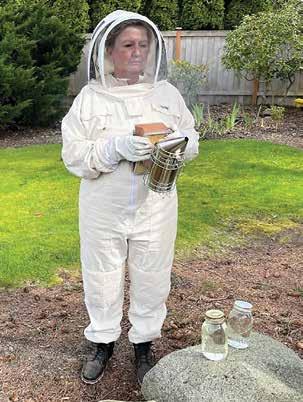
Candi Doran is suited up for working on the beehive she and her husband Don maintain in their backyard in Mukilteo. What started out as a favor for the couple’s three adult children turned into a muchloved hobby.
Candi Doran photo
up, including my eyes shut,” she said. “I couldn’t work. I couldn’t do much for several days. It was scary. My choice at that point was either to quit beekeeping or continue with treatment.”
Not willing to give it up, she regularly gets bee venom shots to help with the reaction. “So it’s kind of a story that demonstrates how sort of crazy I am to continue doing something like this.”
If some readers are attracted to that kind of crazy, a good place to start would be at one of the state fairs. During a visit to the recent Evergreen State Fair in Monroe, journeyman beekeeper Tim Ade of Snohomish showed visitors the various exhibits, including a mesh-sided bee tent where he placed one of his 10 hives for viewing. He’ll go in without a protective suit and pull out the frames on which the bees build their honeycombs to show visitors.
Like Bowman, Ade is a Wisconsinite transplant. He had a great uncle who was a commercial beekeeper, sparking his interest. “Also, I had an uncle with a hive box who gave me a delicious jar of honey. It was really cool,” he said. Later, Ade’s wife bought him an apprenticeship course. “I was hooked,” he said. Ade said anyone interested should start by taking classes. “First, you have to decide, are you sure you want to get into this?” he asked.
If you decide to dive in, get involved with some of the many beekeeper associations. Ade said he and other like-minded keepers meet regularly to discuss their successes and failures.
Regional clubs & resources include:
• Northwest District Beekeepers Association (NWDBA) serves Snohomish County and nearby regions with free meetings, mentoring, and public education.
• Stanwood Camano Beekeepers Association caters to North Snohomish and adjacent areas as a 501(c)(3) nonprofit.
• Snohomish Bee Company, located in the City of Snohomish, offers apiary supplies, package bees, and raw honey.
• The Washington State Beekeepers Association (WASBA) provides statewide support—including for Snohomish— through education programs, hive registration encouragement, and club facilitation.
Hobbyists aren’t into beekeeping for the money. In fact, they’re mostly a money drain.
“Yes, it is expensive,” Bowman said, “and I did not realize that. I don’t think my husband realized that either. It is an expensive hobby.” And it can be disappointing. Some hobbyists, like the Dorans, love their “girls” (almost all the bees in the hive are female) as much as any pet. The year they lost their hive was hard.
If your bees don’t survive the mites, the yellow jackets, or the winter weather, you’ll have to buy another package of 10,000 bees and a queen for up to $350. Then there’s the bee boxes, the frames, the smoker, the hive tools. But the honey! Mmmmm. So good. So, with apologies to the Bard, you have to ask yourself: To bee or not to bee? n
LISTENING With Intentionality
The Explosive Rise in Vinyl is Complete
By Brian Soergel
This is not another story on vinyl’s comeback. That’s old news.
The Recording Industry Association of America has tracked double-digit growth in records the past four years, with 2024 marking its highest sales since 1988.
To no one’s surprise, vinyl sales now outpace CD sales. Instead, this story looks at four record stores in Snohomish County, including one that’s sold discs for 35 years and another that recently opened, and how they navigate analog’s growth in a digital world.
Why vinyl? A recent New Yorker cartoon showed two men in front of an elaborate record player system, with huge speakers to the side and dozens of vinyl albums stacked below. “What really drew me to vinyl,” the owner says to his friend, “were the expense and the inconvenience.” Yes. With Spotify offering virtually all recorded music (for a subscription) – and AI now generating music on demand – why would anyone invest in vinyl?
Also, cassettes are making a comeback? We’ll get to that, too.
It’s a big world of music
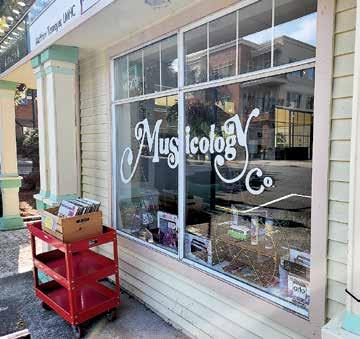
“T here is room for both streaming and physical media,” said Rachel Gardner, who opened Musicology in Edmonds in 2024. She said the interest in vinyl, CDs, and cassettes connects to an entirely different
experience. “Listening to an album in its entirety with intentionality is quite different than letting an algorithm choose music for you. I believe that, especially as AI gets more involved in music generation.”
To counterpoint the New Yorker cartoon, Gardner added: “There is more of a draw to hear the slight imperfections and crackles of vinyl. The so-called inconvenience of listening to records is also what makes it enjoyable; there is an element of presence that you must have to be part of the listening experience. It brings it back to the physical vs digital.”
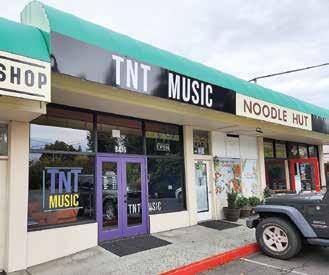
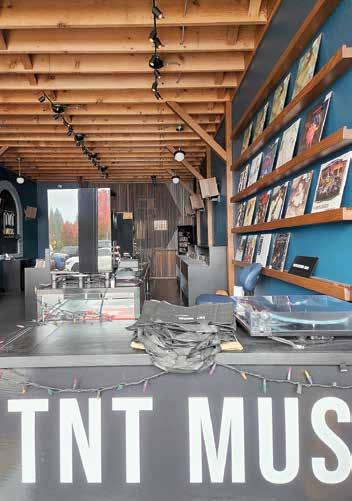
Just up the road from Musicology is Edmonds’ second record shop, TNT Music, which Tammy Snow and Tre Tolman-Snow opened in September in the Five Corners strip mall. Like many audiophiles, she points to vinyl’s excellent sound. “The sound quality is superior to digital,” Tammy Snow said, “and vinyl is physical and tangible and holds an aesthetic appeal.” But what about the cost of
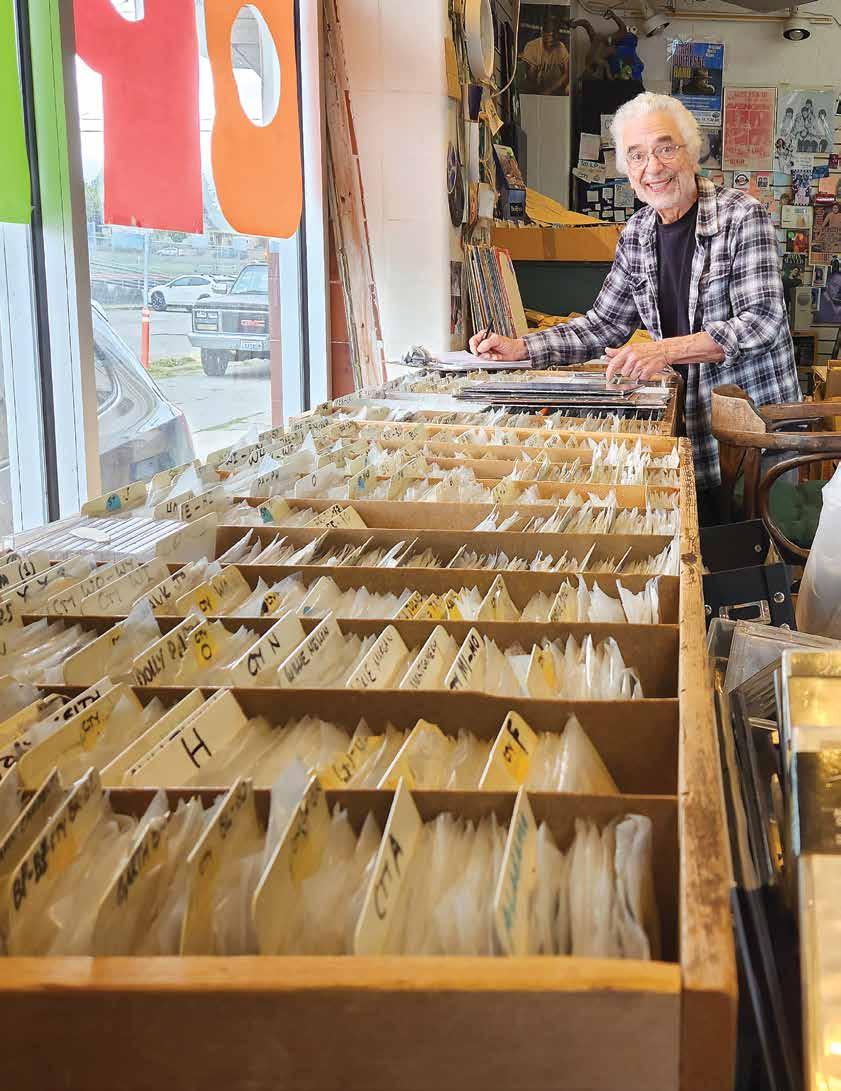
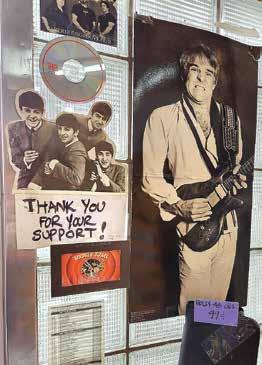
Gordy Arlin, longtime owner of Bargain CDs, Records, & Tapes in Everett, still catalogs his sales by hand. But he does rely on online sources to help set prices on his merch. The Beatles are always a big seller.
new vinyl? Those who remember $10 new albums may cringe at the cost today, which can run $30 and up.
“The data shows that it doesn’t deter people,” said Snow, who discovered vinyl in 2019, bought a turntable, and was hooked. “Since 2016, vinyl sales have increased by 300%. In the last year, they’ve increased by 7%; that’s 18 years of continued growth.”
Gardner said the cost of new vinyl may deter some, but she stocks a variety of price points at Musicology so every budget can find something. “We often will hide some gems in our $1 or $3 bins for the searcher to come across, and we put together fun mystery bundles for $5 to give accessible options to different budgets. New vinyl is more expensive than in the past, but the costs to press are also quite high. Many rising artists would love to press vinyl, but it can be cost-prohibitive to do so. I think when you see how expensive it is to make vinyl, the pricing makes sense.”
Gardner explains that the process of getting an album onto vinyl is time-intensive. Getting through the master lacquer to the pressing of hundreds or thousands of albums has a long lead time. “I think this is why you see a mix of when and how artists release,” she said. “There is also a trend over recent years for artists to release several singles on streaming and then hold back a few songs for the physical release.”
It’s not just top-selling artists such as Taylor Swift or Post Malone who release vinyl, often with several versions in different colors. Taylor Meier of Caamp, a folkpop band from Ohio, has a second band, Sumbuck, whose music is only available on vinyl and Spotify. No CDs.
Who buys records?
The sexy storyline goes that it’s the younger generation stocking up on physical records. In part, that’s true. “According to market data, there are a variety of buyer types,” Snow said. “The biggest growth is with Gen Z, who are motivated to buy vinyl for the physical medium, and millennials who are drawn to vinyl due to a blend of nostalgia and lifestyle.”
But stop at a longtime record store in Everett and you’ll spot Boomers and Gen X’ers flipping through vinyl alongside whatever generation is current. You won’t find a mix of new and used records like Musicology; it’s not like TNT Music’s focus on new vinyl.
No. There’s old school, then there’s Gordy Arlin, proud proprietor of Bargain CDs, Records, & Tapes in Everett, where generations collide. His store, now in its second location, recently celebrated 35 years. Arlin, a lifelong musician and drummer, opened his shop in December 1989, initially focusing on what was then a novelty: CDs.
He spent 11 years before that honing his craft at two of Seattle’s largest used record stores, Cellophane Square and Golden Oldies Records. His passion for music started much earlier; in 1976, he became a professional musician, performing as a drummer and even working as the first disco DJ in Snohomish County.
Arlin is as genial as they come. He’ll steer you in the right direction, but you can only catch him at the store on Sundays. He’s 78. Arlin recalls a time in the mid-1990s when the popularity of CDs surged, leaving his shop with a vast, unsold inventory of vinyl LPs. The store went through some hard times, but the rediscovery of vinyl transformed his previously stagnant inventory into sought-after treasures.
“There was just no action on LPs, and then the shift came about 10 years ago,” he said. “The thought that vinyl sounded better, that just sort of caught on. And to my good fortune, those 18 copies that I had of the Led Zeppelin IV album that I couldn’t
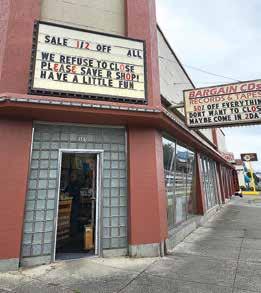
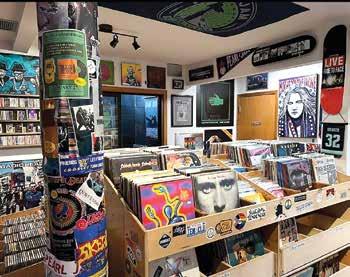
Top: While Bargain CDs, Records, & Tapes has an overflowing inventory to peruse, you can spend much time looking at memorabilia on the walls. Bottom left: Stargazer Records in Snohomish opened in February 2023. Bottom right: TNT Music opened in December in the Five Corners neighborhood of Edmonds.
Brian Soergel photos
Stargazer Records photo
sell were actually suddenly in demand. It was a pleasant surprise.”
Arlin may be old school – the store has no website, unlike newer ones where you shop online as well – but he uses online resources like Discogs and eBay to set prices. He said this has built trust with customers, who can verify prices on their phones. Arlin also credits the internet with providing free advertising, as search engines now easily direct music lovers to his store, a happy jumble of not only vinyl but also CDs, and DVDs.
“Everybody who comes through the door is happy,” Arlin said, who added that ’50s and ’60s rock, R&B, and metal –yes, metal – are top sellers. “We see every social group come through the door, because music is universal. Customers are either being good to themselves and getting themselves a little something, or they’re being good to someone they love and getting them a little something. It’s a wonderful place, and the social interaction is great. Everybody’s upbeat, kind of taking a break from their life.” Room for everyone?
Wthey have to be more than just a place to get vinyl.
Before opening Musicology, musician Gardner had already been active in the local music scene, performing locally and supporting musicians. “The space has now been a continuation of that passion, offering a gathering space for those who love music,” she said. “I like to think of it as a welcoming place for all; it's a way to connect with your favorite artists or to learn about new ones.”
hile business owners like Arlin have an established clientele (and Google search), some record stores realize that
Musicology has monthly songwriter meetups, open mic and DJ nights, weekly live music, jam sessions, album signings and more. You can also browse the online store for music and merch and
In addition to stocking vinyl, Musicology Co. owner Rachel Gardner hosts a number of live in-store performances.
Brian Soergel photos
Reach thousands of engaged readers across Edmonds, Mukilteo & Mill Creek with each issue of The Beacon Magazine.
pick them up at the store. But Gardner says not all record stores are the same. “Some of my favorite shops focus solely on their curated collections and do zero events. And yes, I still go crate digging at other shops on a regular basis for my personal collection. I love vinyl and supporting local shops wherever I go.”
TNT Music also has live events.
Father and son
Alittle east, one block north of First Street in historical downtown Snohomish, Stargazer Records is a family-owned business filled with music. Derek and Mark Florian opened the store in February 2023. They carry both new and used records, cassettes, and CDs.
What’s popular? “Artists like Tyler the Creator, Alice in Chains, Pearl Jam, really the whole ’90s Seattle scene is huge,” Derek said. “Sabrina Carpenter, Kendrick Lamar. Vinyl resurgence can be attributed to many factors – I could write a book. Sound quality, the packaging of records in great jackets that are almost artwork in their own right. Also, can’t discount the interest from the young people today, making it a cool thing to own.”
Stargazer stocks a variety of genres in various formats. “We also have a wide selection of rare and hard-to-find records. We take donations, trade, and also buy. We pay top prices with cash, then and there. Please call the store to make sure Derek or Mark is in the store before bringing items for consideration.”
One last thing
So, cassettes? Yes – it seems the more things change, the more … you know. Yes, yes, and yes!” Gardner said. “Cassettes are making a comeback. We carry both used and new cassettes and new cassette players. We are seeing a lot of artists releasing their music on cassette (as well as vinyl and CD). Some local labels are even releasing straight to cassette.”
Who wants to borrow a Walkman? n
Brian Soergel photo
Tiffany Snow of TNT Music in Edmonds says vinyl’s sound quality is superior to digital.
Artist's Corner
Colin Satterfield, Capitol Hill
CAbout the Artist: PNW Glass
olin Satterfield, who frequently demonstrates his work at the Schack Art Center in Everett, creates hand-blown glass art that blends elegant forms with bold, vibrant color. Each piece is a unique, one-of-a-kind work that reflects both traditional craftsmanship and contemporary design.
His journey began in 2003 in Dallas, where he first discovered the allure of molten glass. Chasing a dream, he relocated to Seattle – the epicenter of the American Studio Glass Movement. Immersed in this thriving community, he worked alongside some of the most respected figures in the field. In 2007, Colin joined the renowned Glass House Studio, quickly rising to the role of gaffer, leading a professional glassblowing team.
His pursuit of mastery has taken him across Europe, working at historic glass furnaces and studying centuries-old techniques. These experiences have shaped his signature style – marrying Old World skill with modern innovation.
Today, his work is collected worldwide, celebrated for its fluid forms, luminous colors, and meticulous detail.
“I enjoy the ongoing dialogue with glass,” he said. “It’s an ever-changing interplay of color, form, and light. Finding balance between these elements is a driving force in my work.”
Coin Satterfield photos
WOODINVILLE’S
A NEW ERA IN WASHINGTON’S WINE COUNTRY
By Maria A. Montalvo
With more than 900 wineries in the state, Washington is the second largest wine producer in the country. And not all wineries are east of the Cascades.
Woodinville offers a great option for wine enthusiasts who can’t make it to Walla Walla on a Saturday afternoon. The town combines charming walkable areas with winding roads, lush evergreens alongside open fields, and – of course – a lot of wineries. In Woodinville, you can taste your way through more than 130 wineries in just over 5 square miles.
For years, Woodinville has embraced a thoroughly modern approach to the wine business, where both established icons and upstart vintners worked side by side. Woodinville is an epicenter of creativity and innovation, about passion and tenacity, and most of all, about community and friendship.
“It’s all about the people,” said Al, a patron of Stevens Winery, when asked what makes the Woodinville wine scene different. His friend, Miles, added, “The winemakers themselves keep it feeling like the original Woodinville.”
Woodinville’s wine roots stretch back to the 1970s, when Washington’s oldest winery, Chateau Ste. Michelle, decided to establish a presence close to Seattle, purchasing a historic farm and renaming the French-style chateau on the property. The success of Chateau led other winemakers to settle in Woodinville, capitalizing on the region’s growing density of wine lovers and entrepreneurial spirit.
By the late 1990s, Woodinville was home to more than a dozen well-respected wineries, like Matthews Cellars, Facelli, Columbia Crest, as well as Chateau Ste. Michelle. By the early 2000s, several imaginative, upstart winemakers, like Tim and Paige Stevens of Stevens Winery and Kelly and Chris Sparkman of Sparkman Cellars, were translating their growing wine knowledge into winemaking realities. These winemakers, along with tasting rooms for wineries from eastern Washington, were opening up all over Woodinville. Innovation in the cellar and beyond
T he winemakers from Woodinville became known as much for their experimentation as for their commitment to each other and the community they were growing. In 2003, there were about a dozen wineries in
Woodinville, but, as Paige Stevens said, “The wine industry is tough, but in Woodinville, people help each other.” Winemakers offered new varietals and winemaking techniques, crafting bold expressions of Washington grapes – Cabernet Sauvignon, Merlot, Syrah, Riesling, and more – and embracing lesser-known varietals that thrived in local soils, and even unheard of blends like Syrah and Viognier. Woodinville winemakers, especially the “Grape Killers” and other early vintners from Woodinville, didn’t just break the mold, they reinterpreted the art altogether.
The 'Grape Killers'
A group of Woodinville winemakers so-named for their experimentation and commitment to their craft, as well as their spirited wine gatherings. Established in the late 2000s and officially named in 2010 by seven groundbreaking wineries: Stevens, Sparkman Cellars, Mark Ryan, Darby, Guardian Cellars, Baer, and Gorman.
The science behind the grapes: Stevens Winery T im Stevens had been studying to be a teacher, but found himself working for Matt Luso at Matthew Cellars, where he learned a lot about grapes, and soon opened his own winery with his wife, Paige, in 2002. Stevens Winery still operates in the Artisan Hill area of the Warehouse District, with a small and welcoming tasting room for true wine geeks. They started with just 100 cases of Cab Franc and have consistently produced about 2,000 cases per year for more than 15 years. Stevens is known for his attention to detail and magical ability to create recognizable wines.
“I think that the magic is partially me and the other half is the people we have been connected to for 20 years,” says Stevens.
Stevens prefers grapes from Zillah, Washington, saying the region’s cooler temperatures give the fruit a bit more acid and less tannin than those from Red Mountain or western Washington. The acid preserves the wine and makes it age well, something his wines are also known for. Word on the street is that other winemakers check to see when Stevens is picking his fruit and follow his lead.
Wine Scene
“I have to walk it, and feel it, and look at the fruit,” said Stevens. “Over the last two weeks, I have driven my four-wheeler around the vineyards to see how the grapes change and when they reach that perfect ripeness.”
Growing the passion: Sparkman Cellars
A nother grape killer/winemaking pair, Kelly and Chris Sparkman, have been in Woodinville nearly as long as Stevens. They produced 289 cases and three labels in 2004 from a small warehouse. They hired their first employee in 2009, and that employee, Bryan Keay, vice president/general manager, is still with them today. “They did it themselves,” Keay said. “They bottled and hand-labeled those days and still lead every step in the pressing and blending process to achieve the best they can each year.”
In 2020, Sparkman relocated to the former Redhook facility, which boasts over 30,000 square feet of winery and production areas, as well as beautiful tasting rooms and event space. Walking in is an experience in itself. It is the Hollywood District, after all, but their impressive digs are a testament to their commitment to the wine itself.
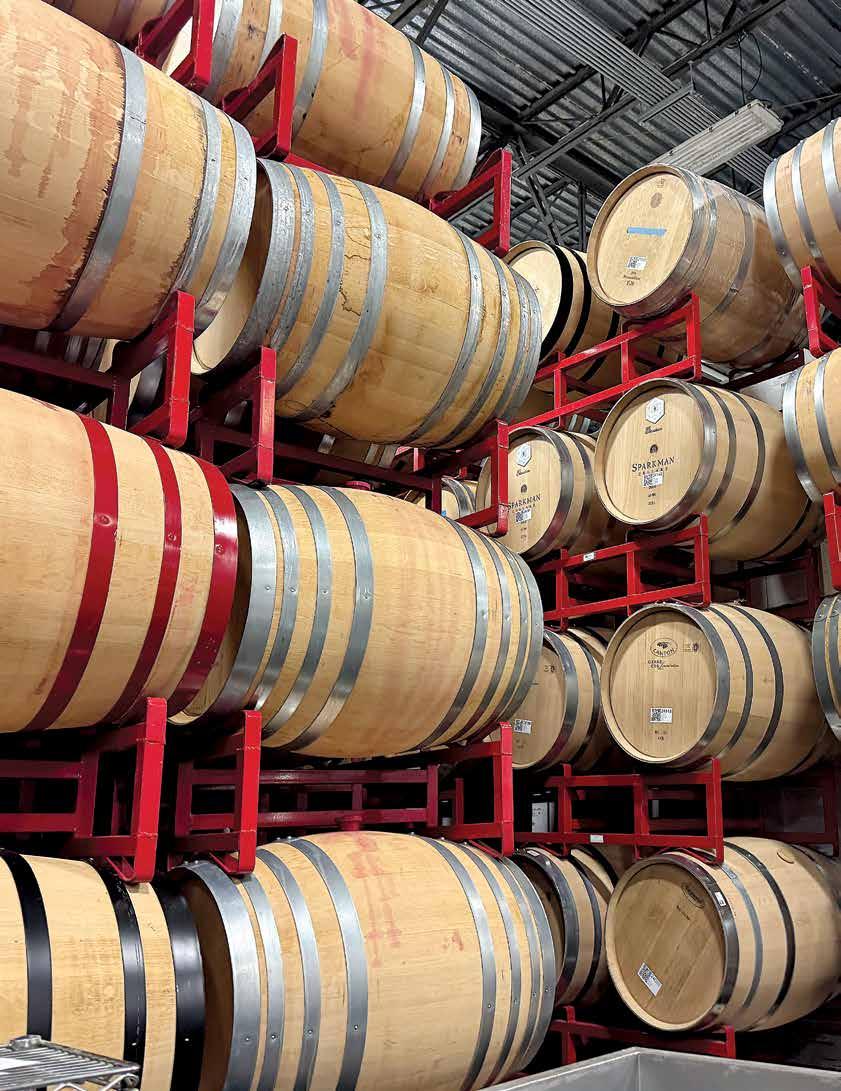
Everything from the grapes, to the equipment (they have two grape presses, one named Elvis and one named Presscilla), to the type of wood in the barrel to the size of the barrel, impacts the flavor of the wine. The team at Sparkman toils over every detail. “We make great wine,” Keay said, “but there is a lot of great wine in Woodinville. As we grow, it is the people who make the difference. Locals still come here because we are part of this community.”
Innovation beyond the cellar
The Woodinville wine community is not immune to the disruptions that swept across the globe in the past few years, but it is also operating amid decades-long lows of Americans drinking alcohol, according to numerous sources, including Time and Forbes.
With shifting consumer expectations, fierce competition
Tim Stevens stands among the barrels at Stevens Winery in the Artisan Hill area of the Warehouse District.
Maria A. Montalvo photos
from other wine regions, and the explosion of distilleries and cocktail culture, Woodinville’s hard-earned vibrancy faltered a bit after 2020. Wine tourism to Woodinville is down since its heyday in the mid-2010s, and wine sales are slowing across Washington overall, according to Axios Washington. Younger generations, particularly Gen Z, are drinking significantly less alcohol than in previous years. They drink about 20% less than millennials, with many abstaining altogether. Businesses like the wine industry face a new reality of only about 54%-58% of American adults saying they drink sometimes, down from the long-time national trend of about 65% of American adults who consume alcohol. Different generations also have preferences for different beverages, and wine is becoming less popular. Beer is once again the winner among the younger generation, and wine is last on the list (after beer and spirits) for all but Baby Boomers.
So what does that mean for Woodinville? Continued reinvention.
Woodinville’s community is coming together as it always has, as a collective effort. Vintners, brewers, distillers, and restaurateurs share resources, cross-promote events, and advocate for sustainable growth. Annual events like the Celebrate Woodinville and Chateau Ste. Michelle summer concert series brings thousands to the area. Tasting rooms are even catering to families and non-drinkers, offering non-alcoholic pairings, local ciders and beers, and kid-friendly activities. This inclusive approach has broadened Woodinville’s appeal, making it a destination where everyone can savor the experience.
Woodinville wines are still among the best in the state and the nation, with more 90-plus rated vintages than any wine region in the world. Wineries host experiential events – from grape-stomping harvest parties to artist showcases – that blend culture, food, and wine, but the focus is still mostly on the quality of the wine.
“The winemakers still interact with people,” said Al, the Stevens Winery patron. “They are a wealth of information and want to share what they know about the industry and the wine. They remember you.”
Woodinville wine districts
Woodinville’s wineries spread across four districts, each with its own personality. The Hollywood District is alive with high-end restaurants and tasting rooms, the Warehouse District gives you a behind-thescenes look at wine production, the West Valley District offers a relaxed pace, while the Downtown District offers a range of food, drink, and shopping.
Hollywood: A true Northwest setting, Hollywood is home to Chateau Ste. Michelle, but there is so much more in this area known for its beautiful vistas, al fresco dining and tasting, bike trails, destination restaurants, and a gold-rated Condé Nast lodge. Try wines from the largest and more glamorous locations, as well as micro and boutique wineries. A few not to miss include:
Sparkman Cellars: Big personality, approachable staff, and a fun lineup that ranges from serious cabernets to easy-drinking whites.
DeLille Cellars: Renowned for Bordeaux-style wines, located in a former brewery site, this is a “cult wine” favorite.
JM Cellars: A cozy winery on a wooded hillside, this feels
You can taste the many varieties of wine at the Sparkman Cellars tasting room.
Maria A. Montalvo photo
like a getaway, with beautiful gardens and firepits – perfect for a summer evening tasting.
Gorman Winery: Rock ‘n’ roll–themed tasting room pouring intense, powerful reds, and yet another cult favorite.
Warehouse: This area is all about the wine (and some beer and spirits) – no fluff. It is home to more boutique wineries per square foot than any wine region in the world, and many of its small, garage-style wineries make just a few hundred cases a year. It’s one of the best places to taste experimental or rare bottlings.
The district is so filled with winemakers that it’s broken into four sub-neighborhoods: The Warehouse Wineries, The Gateway, The Junction, and Artisan Hill. The list is long, but a few wineries to try include:
Stevens Winery: A family-owned winery set in stunning industrial-style tasting rooms, known and loved by wine connoisseurs.
Adrice Wines: Woman-owned and known for small-batch bottlings and a welcoming, “come hang out” atmosphere.
Efeste: Family-run, making bold reds and interesting Rhône-style blends, not to be missed.
Baer Winery: One of Woodinville’s true hidden gems, making elegant blends that often earn big ratings but remain under-the-radar with casual visitors
Damsel Cellars: Award-winning wines paired with curated cheese plates in a charming tasting room.
Avennia Wine: Industrial-chic, critically acclaimed but still relatively low-profile – their Bordeaux- and Rhône-style wines are consistently excellent.
West Valley: This fast-growing district is newly settled by boutique wineries and distillers along the west side of the Sammamish River. It offers a more wide-open, relaxed atmosphere
All roads lead to the wineries and breweries of Woodinville.
Maria A. Montalvo photo
for food, wine, and spirits (Woodinville Whiskey or Grapeworks Distilling, anyone?) With a diverse selection, here are just a few of the big and small names:
Januik / Novelty Hill: A sleek, modern spot with an innovative edge, especially for people who love contemporary architecture alongside excellent cabernet.
Matthews Winery: Slightly outside the main clusters, but renowned for Bordeaux-style blends and a top-100 Wine Spectator feature.
Ambassador Wines of Washington: Known for lush Red Mountain reds, and not usually on first-time visitors’ lists, so give them a shot.
Woodinville Wine Estates: A boutique winery that features events and music, as well as multiple labels in their tasting room, including Dussek, Kennedy Shah, and Hudson Shah.
Downtown: With so many delicious restaurant options, downtown Woodinville has become a lively hub to start your wine exploration. No wineries are officially located within the Downtown District, but you can taste your way through some of Woodinville’s most recognizable wines with the Downtown Wine Pass to access tasting rooms throughout Creek Village and Wine Alley.
A toast to reinvention
Woodinville’s wine scene is a testament to resilience, creativity, and the power of community. Growing from the roots of its vineyards, the city is transforming into a destination, one that honors its legacy while embracing change. For wine lovers, adventurers, and anyone seeking the true Pacific Northwest wine experience, Woodinville uncorks Washington’s wine magic.
To learn more about Woodinville wines: woodinvillewinecountry.com. n
Friends toast to the wine at Sparkman Cellars.
Maria A. Montalvo photo
Tidbits about Washington wines in Woodinville
Not where the grapes grow
Almost no grapes are grown in Woodinville – it’s too cool and wet. The grapes come mainly from eastern Washington (Yakima, Walla Walla, Red Mountain, Columbia Valley), but the wineries bring them west to make and pour the wine near Seattle.
Wine and tech crossover
Because it’s so close to Seattle, many Woodinville wineries were founded by former Microsoft and Amazon employees who traded tech careers for winemaking dreams, such as Novelty Hill/Januik, Avennia, Three of Cups, and Qui-di-ty.
Wine and cherries connection
Before wine took off, many of Washington’s vineyards were actually orchards for apples and cherries. Some pioneering winemakers even planted grapes in old orchard land, which helped launch today’s booming industry. n
Bryan Keay, vice president/general manager at Sparkman Cellars, takes a taste from an aging barrel.
Maria A. Montalvo photo
From Athlete and Youth Pastor to FIREFIGHTER
A Day in the Life
Alison Kutz finds her life’s calling at Fire Station 16
By Rick Sinnett
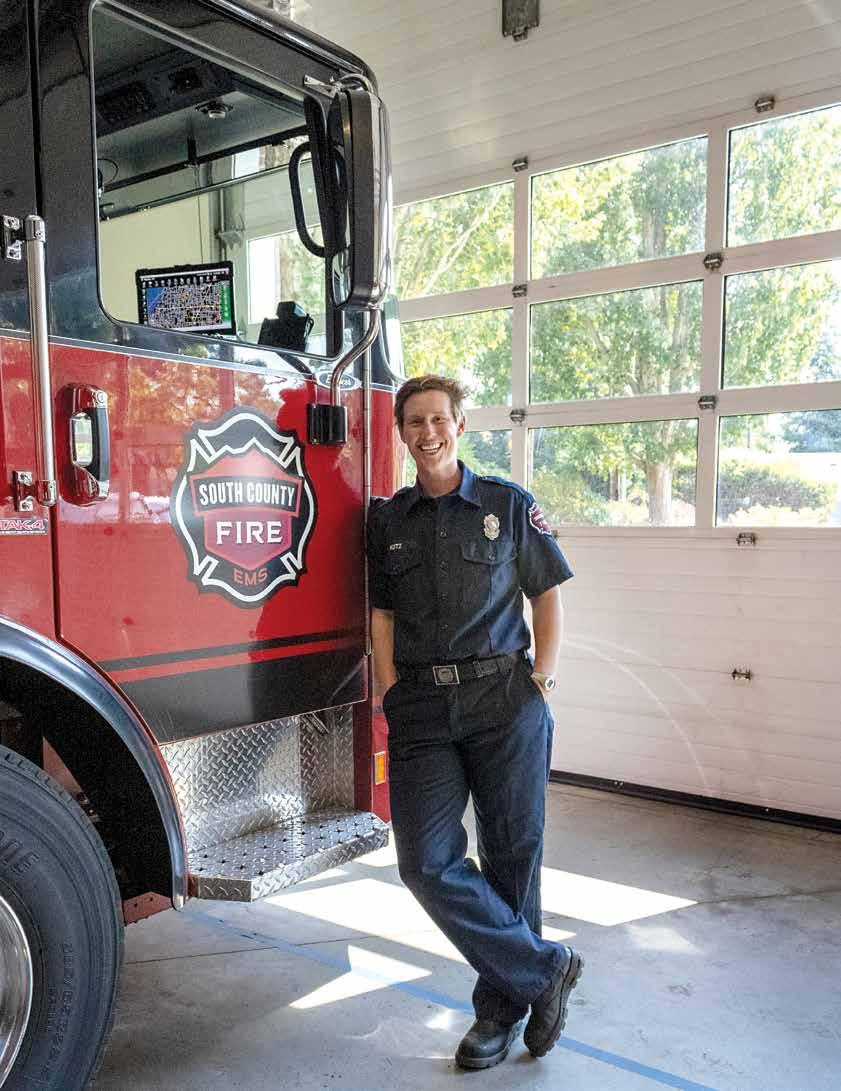
Firefighter Alison “Ally” Kutz of Fire Station 16 in Edmonds starts her day like everyone else –depending on which alarm wakes her up. Most of us have an alarm clock system to ensure we’re up on time, possibly a series of alarms for those regularly too comfortable to get out of bed. However, firefighters can also wake up to an emergency alarm, Kutz said, which is why some fire station crews adapt their sleep patterns to better match the call volume of their area.
“I love my job,” she says with a wide grin. That includes the dorm-like environment of the station. Everyone takes turns cooking, cleaning, and pitching in for groceries, and there have been times when the crew sat in a circle building medical kits. You’d be right to guess they go through a few. She also enjoys participating in community outreach. National Night Out is a favorite. Kutz, a youth pastor at CTK Hope Church in Burlington and the youth director at ReImagine Ministry in Mount Vernon, enjoys interacting with the community and seeing the excitement in children’s faces when they spot firetrucks and their accompanying equipment.
Born in Everett and raised in Mount Vernon, Kutz, 34, started on a path far from that as a first responder. In her teens, she was a star athlete at Mount Vernon High School. She was a starting softball catcher for four years, serving as a two-year captain and earning three-time first team All-Northwest League honors. She earned a bachelor’s degree in exercise and sport science in 2013 from Oregon State University. After graduation, she coached softball at the University of North Dakota. She was also a starting guard for the basketball team, a second-team All-North-
Firefighter Ally Kurtz enjoys the good vibes of Edmonds Fire Station 16 – at least when it’s quiet. Rick Sinnett photo
west Conference selection, and a two-time academic state champion. Her progression to coaching was natural and assumed by many, but something was missing, something that coaching the Fighting Hawks didn’t fulfill.
“I can’t just work a job to work it,” she said.
As a person of faith, she prayed for guidance on finding happiness and spiritual fulfillment. The answer was to return home to Puget Sound and become a firefighter. She was one of 20 recruits to start the South County Fire Academy in 2022, and has served the community since.
Rig rundown
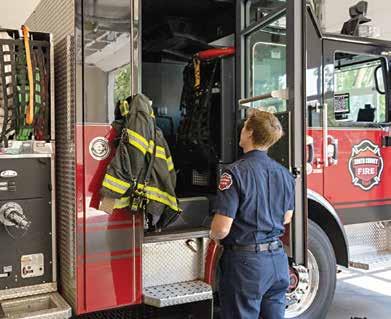
The first thing Kutz does after her morning coffee is what is called a rig rundown. Every piece of equipment, even the truck’s design, is used to protect or save lives, including those of the responders.
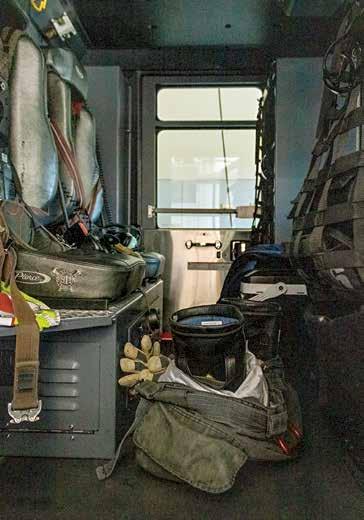
Everything from seat belts to door latches is checked, along with the extensive inventory. Bandages, buckets, gauze, gloves, fire suits, a chain saw, air tanks, and much more are inspected and inventoried before a truck leaves the station, packing 500 gallons of water. Kutz said larger trucks haul 750 gallons.
The Fire Station 16 crew goes through many medical kits, which leads to frequent restocking.
“When you’re on a call, you’re not keeping track of your supplies; you’re focused on helping the patient,” Kutz said. “Stuff goes flying everywhere.”
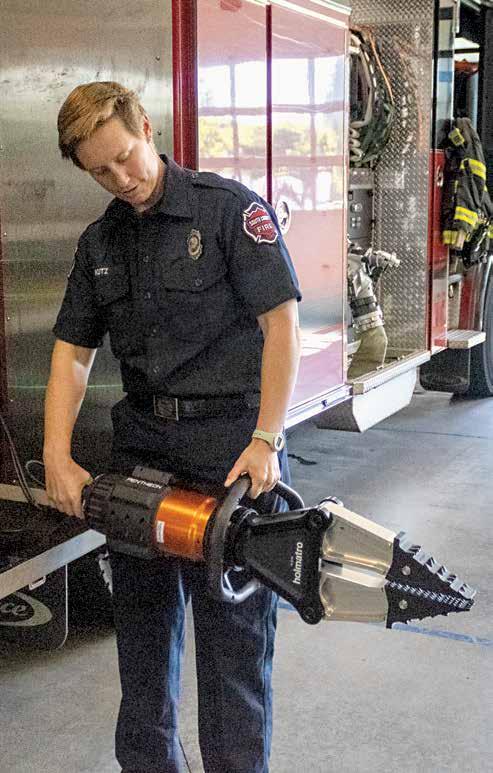
Two pieces of equipment that would catch anybody’s interest are what appear to be parts from a large robot. A large pair of powered shears and a device called a “spreader” are, interchangeably, the Jaws of Life. Properly referred to as hydraulic rescue tools, they have separate functions: one cuts, while the other pulls the steel apart.
The cutting tool can slice through a car’s main support post, and the spreader, resembling a claw, is designed to open rather than grasp. It’s most often used to open stuck vehicle doors. Once fitted, it uses a hydraulic force powerful enough to bend a vehicle’s steel beams and doors. And if the hydraulic tools can’t cut it, a circular saw with a blade about a foot and a half wide will.
When not maintaining equipment, there is also training on new gear and techniques, reviews of established skills, and drill exercises
KATIE BOCK: An Edmonds Kind of Insurance Advisor
Ally Kurtz tests a spreader – the Jaws of Life – as part of the daily rig rundown.
Rick Sinnett photo
at a training tower in Everett. However, Kutz said keeping in physical shape is up to the firefighter.
When asked if strength or cardio training was more important, Kutz said, “Both.” A firefighter’s kit can weigh from 45 to over 100 pounds, depending on which tools are needed. Also, the air bottles the fighters use only have about 20 to 30
Fighting fires
Of the equipment inspected on fire rigs, air tanks are a key component of several pieces of gear that protect firefighters. When responders use the tanks, it means the air is unsafe due to smoke or other airborne toxins.
Fighting fires is Kutz’s favorite part of her job, but she knows how dangerous it is. Ceilings and floors weakened by the flames could collapse. Responders could get separated from their crew due to smoke or fallen debris, making teamwork crucial.
Although building fires are dangerous, they are easier to extinguish, use less water, and are typically less toxic than electric vehicle fires. She said the vehicle’s lithium battery pack emits toxic fumes as it burns and requires up to three times the water needed to extinguish a house fire.
What makes an electric fire more dangerous is how prone it is to reigniting. Kutz said that, in the past, some batteries would reignite while being towed, which is why a specially designed wrap is used.
The wrap goes over the car, extinguishing open flames and preventing reignition by depriving the heat source and materials of oxygen. This allows the vehicle to be safely towed.
However, dealing with fires is just 9.2% of the calls South County Fire receives.
The multi-tool of responders
There are many aspects of being a firefighter that make it difficult to explain an average day. An average week may be more appropriate. The location of the firehouse could dictate when and what kind of calls are received.
Medical-related emergencies make up the majority of a firefighter’s calls, Kutz said. The South County Fire 2024 annual report showed 84% of the calls to South County Fire are medi-
Ally Kurtz loves fighting fires, although she knows it’s only a small part of a firefighter’s daily life.
Rick Sinnett photo
cal, which helps explain chronically depleted medical kits.
Kutz explained that, although they may not look like it, firetrucks are outfitted with the same lifesaving equipment as an ambulance; it’s just not able to transport patients. “We’re there to keep them stable until the paramedics arrive.”
Fire crews are the first on the scene of an emergency because of the equipment they have available. Paramedics have specialized gear to deal with medical emergencies, but they do not have equipment to protect them from hazardous chemicals or to free someone from an enclosed space, such as an elevator or car.
Firefighters even receive basic self-defense training, not for literal fisticuffs with flames, but to defend themselves from people. Much like how a drowning person can unintentionally take their rescuer down with them by acting out of terror, first responders could accidentally be harmed by those they are trying to help. Chemicals could make some people aggravated – or someone in an altered mental state from trauma could irrationally strike out, Kutz said. Further, if drugs or alcohol are involved in the emergency, the person may have no rational awareness at all.
However, Kutz said that contributing to the community while answering a calling that ended up being a job she loves is something she couldn’t have dreamed of. And it seems that the flame continues to the next generation.
A little boy dressed up as a firefighter came to the station one day to see if the garage was open and to get a peek at the trucks. As luck would have it, Kurtz noticed the boy and his father and gave them a tour of the garage and the rig. And as a bonus, the little boy got his own South County Fire baseball cap. “The smile on his face,” she said. “That made his day, and that makes it all worth it.” n
The inside of a South County Fire rig is a mix of firefighting and EMT gear.
Rick Sinnett photo
Play INSIDE – A guide to the area’s indoor sports
When the Weather is BAD Go
By Rick Sinnett
Athletes don’t need to go home when it rains or snows this year – they can take it indoors at their local sports arena.
Sports like running, tennis, pickleball, basketball, and volleyball can grudgingly be played in a light sprinkle, or as some jokingly call it, liquid sunshine. However, nobody is going to play any of those sports in slushy snow, outside of a social media stunt.
While online influencers make content, you can make gains in your sport of choice or find a new one at one of the local indoor sports facilities this winter.
Basketball and volleyball
Invented in 1891 by Dr. James Naismith at the International YMCA Training School, now Springfield College, in Springfield, Massachusetts, basketball was meant to give students a sport they could play during the harsh Northeastern winters.
More than 130 years later, it has become one of the most popular indoor sports, not just in the United States, but worldwide. The Mukilteo and Mill Creek YMCA locations have swimming, basketball, and volleyball year-round, with leagues forming regularly.
Mukilteo YMCA: 10601 47th Pl. W, Mukilteo.
Mill Creek YMCA: 13723 Puget Park Dr., Everett.
Gymnastics, obstacle courses, trampolines and dodgeball
For those looking to test their agility or want their kids to stop doing parkour in the living room, a trampoline and obstacle arena might be up your alley. Both Elevated Sportz Trampoline Park and Event Center and Sky Zone also have
challenge courses and dodgeball.
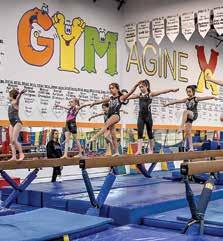
If you’re looking to sign up a child for gymnastics, Gymagine has classes and playtimes available.
Elevated Sportz: 18311 Bothell-Everett Hwy, Suite 140, Bothell. Sky Zone: 24000 Van Ry Blvd., Mountlake Terrace.
Gymagine: 3616 S Rd., Suite B3, Mukilteo.
Ice skating and hockey
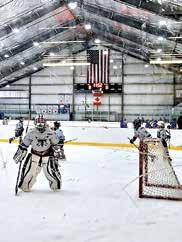
The winter may be cold, but that doesn’t mean the many lakes in the area will freeze thick enough to skate on. The Olympic View Arena offers figure skating and hockey for both youth and adults, with no risk of falling through the ice.
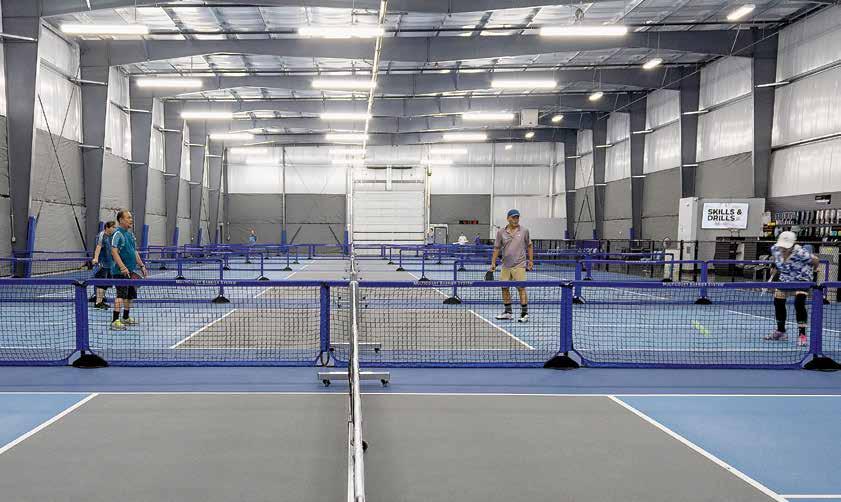
Pickleball is a silly name, but it has some serious fans.
Invented in 1965 by Washington residents Joel Pritchard, Bill Bell, and Barney McCallum, the game is played with a paddle, like table tennis, but also incorporates elements of tennis.
Pickleball courts are one-quarter the size of a tennis court, but you still need to be prepared to move quickly.
Pickleball Kingdom: 3115 196th St. SW, Lynnwood.
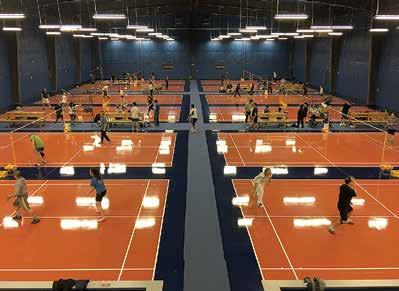
Bellevue Badminton: 3616 South Rd., Building D, Mukilteo. Side Out Pickleball Center: 2716 119th St. SW, Everett.
Rock climbing
The Pacific Northwest boasts some of the most beautiful mountains, but during the winter, be prepared for ice climbing, assuming the passes aren’t snowed in. Rather than driving out to Snoqualmie Pass, Leavenworth, Mount Baker,
Rick Sinnett photo
Above: Players try their skills at Sideout Pickleball in Everett near Paine Field.
There’s a huge difference in the kind of in-home care you can receive from someone who really understands what your life is like as a senior. Our loving and compassionate caregivers are there to help.
& Errands
info@SnoKingSeniorCare.com Our Care Services At A Glance Companionship & Socialization Meal Preparation
Light Housekeeping
Personal Care
Pet Care & More!
Let’s connect today!
Go with a good neighbor
Being a good neighbor means being there for my community. As your local State Farm® agent, I'm ready to help whenever you need me. Give me a call.
Matt Martin
Agent 12308 Mukilteo Speedway, Suite 4 Mukilteo, WA 98275
Bus: 425-743-2600
matt.martin.lozz@statefarm.com www.mattmartin.biz
or Mount Shuksan, consider driving to Lynnwood instead.
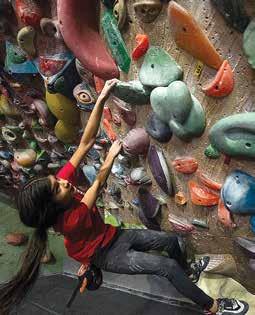
Vertical World is an indoor climbing gym offering a range of youth and adult activities and classes. So rather than needing to pack your climbing gear and hope the weather holds up, you can climb in a climate-controlled room in a T-shirt and shorts.
Vertical World: 12300 Beverly Park Rd., Lynnwood. Soccer
The FIFA 2025 World Cup is right around the corner, and if you’re a soccer fan – football to the rest of the world – you may want to summon your inner Lionel Messi or Clint Dempsey on an indoor field.
Arena Sports offers not only a soccer field, but an arcade and a rope and zip line course as well. For those focused on only playing soccer, TOCA Football offers leagues, classes and camps for youth and adults.
Arena Sports: 13500 Bothell-Everett Hwy, Suite A, Mill Creek. TOCA Football: 18021 Alderwood Mall Pkwy, Lynnwood.
Wallyball
If you ever wondered what it’s like to be inside a pinball machine, Wallyball is the sport for you. Created in 1971, Wallyball combines volleyball and racquetball, allowing players to use the walls in their shots.
The Mountlake Terrace Recreation Pavilion is one of the few locations in Snohomish County that offers Wallyball, along with racquetball and pickleball.
Mountlake Terrace Recreation Pavilion: 5303 228th St. SW, Mountlake Terrace.
Don’t let the weather get you down.
Get out (or in) there! n
Colder weather doesn’t mean you have to give up sports. There are plenty of options to choose from.
ADVERTISING / MEDIA
Beacon Publishing, Inc.
The Beacon Magazine
Mukilteo Beacon
Edmonds Beacon
Mill Creek Beacon
728 3rd Street, Suite D Mukilteo, WA 98275 | 425-347-5634 thebeaconmagazine.com
Snohomish County Airport 9901 24th Place W, Suite A Everett, WA 98204 | 425-388-5125 painefield.com
AUTO GLASS
John’s Auto Glass 11324 Mukilteo Speedway Mukilteo, WA 98275 | 425-742-9408 johns-auto-glass.com
BANKING
1st Security Bank Edmonds Branch | 425-774-5144 fsbwa.com
Business Directory
DISTILLERY / SPIRITS
James Bay Distillers 3101 111th Street SW, Suite B Everett, WA 98204 | 425-212-9135 johns-auto-glass.com
EDUCATION
Edmonds College 20000 68th Ave. W. Lynnwood, WA 98036 | 425-640-1697 edmonds.edu
HOME IMPROVEMENT
Core Contractors, LLC 19707 44th Avenue W, Suite 207 Lynnwood, WA 98036 | 425-737-7893 corecontractorsllc.com
Northlight Custom Builders, LLC 9800 Harbour Place, Suite 201 Mukilteo, WA 98275 | 425-977-9661 northlightcustom.com
INSURANCE
Katie Bock
USI Insurance Services Edmonds, WA 98026 | 206-508-6051 linkedin.com/in/katie-bock
Matt Martin
State Farm Insurance 12308 Mukilteo Speedway #4 Mukilteo, WA 98275 | 425-743-2600 mattmartin.biz
JEWELRY DESIGNS
Irden Designs 605 Main Street Edmonds, WA 98020 | 425-780-6849 irdendesigns.com
LANDSCAPING
Edmonds Garden Rescue Edmonds, WA 98020 | 425-329-5934
MED SPA
RD Med 631 5th Street, Suite 202 Mukilteo, WA 98275 | 425-879-3640 vagaro.com/rdmed
ORTHODONTIST
Pellegrini Orthodontics 827 128th Street SW, Suite B Everett, WA 98204 | 425-374-8218 everettbraces.com
PET SUPPLY
Jester’s Pet Supply
172 Sunset Avenue
Edmonds, WA 98020 | 425-405-5751 jesterspetsupply.com
PUBLISHING
Barbara Kindness Communications Edmonds, WA edkbooksanddistribution.com
REAL ESTATE
Aranka Fruehauf
Windermere Real Estate North, Inc. Mukilteo, WA 98275 | 425-478-7270 HomesByAranka.com
Coldwell Banker Bain 512 Bell Street
Edmonds, WA 98020 coldwellbankerhomes.com/ wa/edmonds/agents wa/mill-creek/agents
RETAIL
Best Kept Secret 3616 South Road, Suite B-2 Mukilteo, WA 98275 | 425-822-6600 mukilteosamplestore.com
Hodge Podge 413 Lincoln Avenue Mukilteo, WA 98275 | 206-601-2789
Maje Gallery 409 Main Street Edmonds, WA 98020 | 425-776-3778 majegallery.com
SENIOR LIVING
Chateau Bothell Landing 17543 102nd Avenue NE Bothell, WA 98011 | 425-485-1155 chateauretirement.com
Chateau Pacific 3333 148th Street SW Lynnwood, WA 98087 | 425-787-9693 chateauretirement.com
Chateau Valley Center 4450 Davis Avenue S Renton, WA 98055 | 425-251-6677 chateauretirement.com
Cogir Senior Living 10605 NE 185th Street Bothell, WA 98011 | 425-600-7457
21500 72nd Avenue W Edmonds, WA 98026 | 425-504-8342
14905 Bothell-Everett Hwy Mill Creek, WA 98012 | 425-361-0963
cogirseniorliving.com
Quail Park of Lynnwood 4015 164th Street SW Lynnwood, WA 98087 | 425-287-5742
quailparkoflynnwood.com
Seniors Helping Seniors Shoreline, WA 98155 | 206-542-4743
snokingseniorcare.com
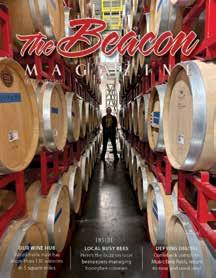
ABOUT THE COVER:
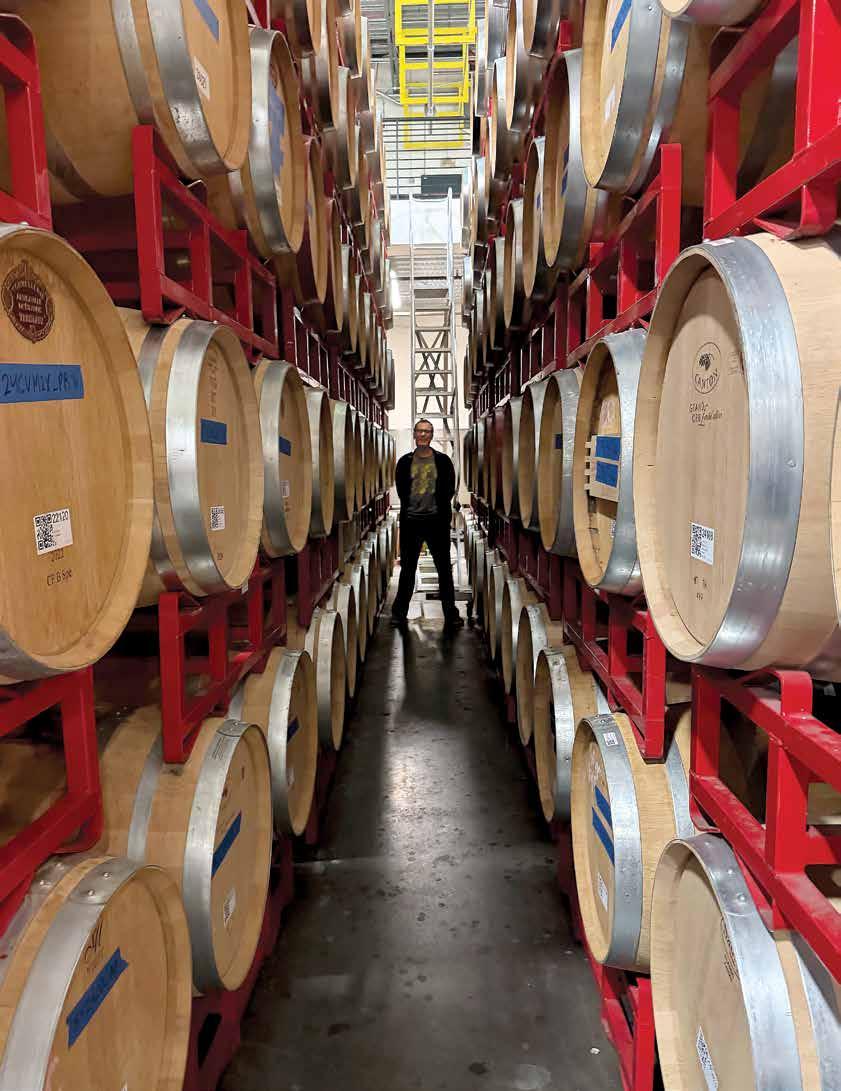
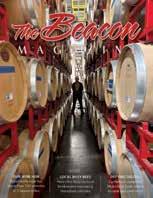
Bryan Karrick checks out the wine barrels at Sparkman Cellars in Woodinville during a tour. The Hollywood District winery has been in business for more than 20 years.
Maria A. Montalvo photo
to SeasonTaste
Grilled Chicken Bundt with Pumpkin Crumble Grilled Chicken Bundt with Pumpkin Crumble
Grilled Chicken Bundt
SERVINGS: 4-6
Ingredients
• 4 potatoes
• 2 carrots
• 8 Brussels sprouts
• oil
• 2 tablespoons garlic powder, divided
Directions
• 2 tablespoons onion powder, divided
• 2 teaspoons salt, divided
• 1/2 teaspoon pepper
• 1 whole chicken (4-5 pounds)
• 1/2 stick butter, softened
1. Heat the grill to 350 F with one burner off for indirect heat.
2. Cut potatoes, carrots and Brussels sprouts into bite-sized pieces. Drizzle with oil and mix in 1 tablespoon garlic powder, 1 tablespoon onion powder, 1 teaspoon salt and ½ teaspoon pepper; set aside.
3. Remove giblets from the chicken cavity. Pat the chicken dry.
4. Rub the outside of the chicken with softened butter, remaining garlic powder, remaining onion powder and remaining salt. Sprinkle the inside of the cavity generously with salt and pepper.
5. Place some veggies in bottom of bundt pan. Place chicken on top of chimney or tube of bundt pan. Fill pan with remaining veggies.
6. Place pan over indirect heat and grill 1 hour, 30 minutes, or until chicken reaches internal temperature of 165 F.
OVEN VARIATION: Heat oven to 425 F. Cover the center cone of the bundt pan with thick foil and spray it with non-stick cooking spray. Place the bundt pan on a rimmed baking sheet and bake for approximately 1 hour, 15 minutes, or until chicken reaches internal temperature of 165 F. If the chicken is browning too quickly after 30 minutes, tent it with foil for the remaining cooking time.
Pumpkin Crumble
SERVINGS: 8-12
Ingredients
• 1 can pumpkin
• 1 can evaporated milk
• 1 cup brown sugar
• 2 eggs
• 1 tablespoon pumpkin spice
• 1 teaspoon cinnamon
Whipped Cream:
• 1 cup heavy whipping cream
• 2 tablespoons sugar
Directions
1. Heat the oven to 350 F.
• 1 box cake mix (yellow, white or spice)
• 3/4 cup chopped pecans
• 3/4 cup chopped white chocolate chips
• 1 1/2 cups melted butter
2. In bowl, mix pumpkin, evaporated milk, brown sugar, eggs, pumpkin spice and cinnamon. Pour into greased 9-by-11-inch baking dish.
3. In separate bowl, mix cake mix, pecans and white chocolate chips. Sprinkle over pumpkin mixture. Pour butter evenly over top. Do not mix or stir. Bake 1 hour.
4. To make whipped cream: Using hand mixer, whip heavy whipping cream and sugar until thick.