FREE
2 classrooms at Thermal elementary school clear of mold
Riverside County flies 13 large dogs to Seattle Humane
PG 02
PG 27
MONDAY, DECEMBER 22-DECEMBER 28, 2025
VISIT HEYSOCAL.COM
The shakedown: Trump’s DOJ pressured lawyers to ‘find’ evidence that UCLA had illegally tolerated antisemitism By Peter Elkind, ProPublica, and Katherine Mangan, The Chronicle of Higher Education This story was originally published by ProPublica. ProPublica is a nonprofit newsroom that investigates abuses of power. Sign up to receive their biggest stories as soon as they’re published.
O
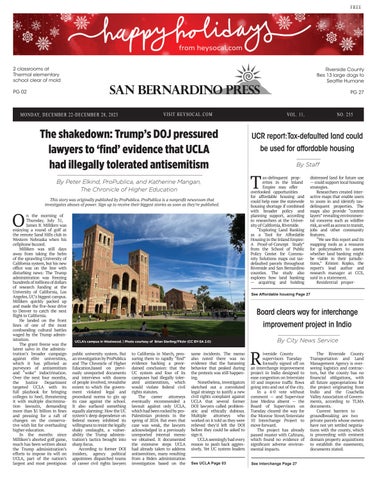
n the morning of Thursday, July 31, James B. Milliken was enjoying a round of golf at the remote Sand Hills club in Western Nebraska when his cellphone buzzed. Milliken was still days away from taking the helm of the sprawling University of California system, but his new office was on the line with disturbing news: The Trump administration was freezing hundreds of millions of dollars of research funding at the University of California, Los Angeles, UC’s biggest campus. Milliken quickly packed up and made the five-hour drive to Denver to catch the next flight to California. He landed on the front lines of one of the most confounding cultural battles waged by the Trump administration. The grant freeze was the latest salvo in the administration’s broader campaign against elite universities, which it has pilloried as purveyors of antisemitism and “woke” indoctrination. Over the next four months, the Justice Department targeted UCLA with its full playbook for bringing colleges to heel, threatening it with multiple discrimination lawsuits, demanding more than $1 billion in fines and pressing for a raft of changes on the conservative wish list for overhauling higher education. In the months since Milliken’s aborted golf game, much has been written about the Trump administration’s efforts to impose its will on UCLA, part of the nation’s largest and most prestigious
NO. 255
VOL. 11,
UCR report:Tax-defaulted land could be used for affordable housing By Staff
T
ax-delinquent properties in the Inland Empire may offer overlooked opportunities for affordable housing and could help ease the statewide housing shortage if combined with broader policy and planning support, according to researchers at the University of California, Riverside. “Exploring Land Banking as a Tool for Affordable Housing in the Inland Empire: A Proof-of-Concept Study” from the School of Public Policy Center for Community Solutions maps out taxdefaulted parcels throughout Riverside and San Bernardino counties. The study also explores how land banking — acquiring and holding
distressed land for future use — could support local housing strategies. Researchers created interactive maps that enable users to zoom in and identify taxdelinquent properties. The maps also provide “context layers” revealing environmental concerns such as wildfire risk, as well as access to transit, jobs and other community features. “We see this report and its mapping tools as a resource for policymakers to assess whether land banking might be viable in their jurisdictions,” Kristen Kopko, the report’s lead author and research manager at CCS, said in a statement. Residential proper-
See Affordable housing Page 27
Board clears way for interchange improvement project in Indio By City News Service
UCLA’s campus in Westwood. | Photo courtesy of Brian Sterling/Flickr (CC BY-SA 2.0)
public university system. But an investigation by ProPublica and The Chronicle of Higher Education,based on previously unreported documents and interviews with dozens of people involved, revealsthe extent to which the government violated legal and procedural norms to gin up its case against the school. It also surfaced something equally alarming: How the UC system’s deep dependence on federal money inhibited its willingness to resist the legally shaky onslaught, a vulnerability the Trump administration’s tactics brought into sharp focus. According to former DOJ insiders, agency political appointees dispatched teams of career civil rights lawyers
to California in March, pressuring them to rapidly “find” evidence backing a preordained conclusion: that the UC system and four of its campuses had illegally tolerated antisemitism, which would violate federal civil rights statutes. The career attorneys eventually recommended a lawsuit against only UCLA, which had been rocked by proPalestinian protests in the spring of 2024. But even that case was weak, the lawyers acknowledged in a previously unreported internal memo we obtained. It documented the extensive steps UCLA had already taken to address antisemitism, many resulting from a Biden administration investigation based on the
same incidents. The memo also noted there was no evidence that the harassing behavior that peaked during the protests was still happening. Nonetheless, investigators sketched out a convoluted legal strategy to justify a new civil rights complaint against UCLA that several former DOJ lawyers called problematic and ethically dubious. Multiple attorneys who worked on it told us they were relieved they’d left the DOJ before they could be asked to sign it. UCLA seemingly had every reason to push back aggressively. Yet UC system leaders See UCLA Page 03
R
iverside County supervisors Tuesday formally signed off on an interchange improvement project in Indio designed to ease congestion on Interstate 10 and improve traffic flows going into and out of the city. In a 4-0 vote without comment — and Supervisor Jose Medina absent — the Board of Supervisors on Tuesday cleared the way for the Monroe Street/Interstate 10 Interchange Project to move forward. The project has already passed muster with Caltrans, which found no evidence of significant adverse environmental impacts. See Interchange Page 27
The Riverside County Transportation and Land Management Agency is overseeing logistics and contractors, but the county has no financial obligations, with all future appropriations for the project originating from Indio and the Coachella Valley Association of Governments, according to TLMA documents. Current barriers to groundbreaking are two private parcels whose owners have not yet settled negotiations with the county, which is proceeding with eminent domain property acquisitions to establish the easements, documents stated.