FREE
Fired SoCalGas controllers allege supervisors spied on homeless with security cameras
California to crack down on extreme speeding on highways
PG 02
PG 06
MONDAY, DECEMBER 29, 2025-JANUARY 04, 2026
VISIT HEYSOCAL.COM
NO. 256
VOL. 14,
Trump says federal deployments make cities safer; local officials disagree
Sheriff Luna drops LASD personnel records lawsuit By City News Service
By Beth Schwartzapfel for The Marshall Project via Stacker
| Photo courtesy of Adil Khan Marwat/Pexels
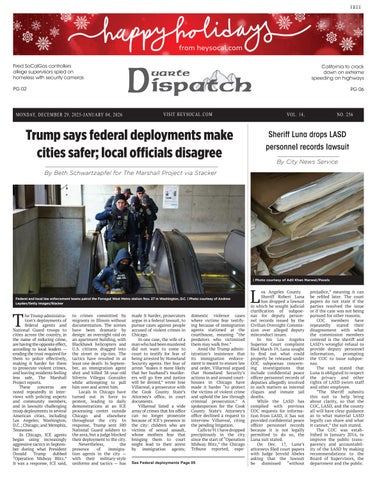
Federal and local law enforcement teams patrol the Farragut West Metro station Nov. 27 in Washington, D.C. | Photo courtesy of Andrew Leyden/Getty Images/Stacker
T
he Trump administration’s deployments of federal agents and National Guard troops to cities across the country, in the name of reducing crime, are having the opposite effect, according to local leaders — eroding the trust required for them to police effectively, making it harder for them to prosecute violent crimes, and leaving residents feeling less safe, The Marshall Project reports. These concerns are noted repeatedly in interviews with policing experts and community members, and in lawsuits challenging troop deployments in several American cities, including Los Angeles; Washington, D.C.; Chicago; and Memphis, Tennessee. In Chicago, ICE agents began using increasingly aggressive tactics in September during what President Donald Trump dubbed “Operation Midway Blitz.” It was a response, ICE said,
to crimes committed by migrants in Illinois without documentation. The scenes have been dramatic by design: an overnight raid on an apartment building, with Blackhawk helicopters and U.S. citizens dragged into the street in zip-ties. The tactics have resulted in at least one death: In September, an immigration agent shot and killed 38-year-old Silverio Villegas González while attempting to pull him over and arrest him. Locals in Chicago have turned out in force to protest, leading to daily demonstrations at an ICE processing center outside Chicago and elsewhere throughout the city. In response, Trump sent 500 National Guard soldiers to the area, but a judge blocked their deployment to the city. Nevertheless, the presence of immigration agents in the city — with their military-style uniforms and tactics — has
made it harder, prosecutors argue in a federal lawsuit, to pursue cases against people accused of violent crimes in Chicago. In one case, the wife of a man who had been murdered did not want to come to court to testify for fear of being arrested by Homeland Security agents. Her fear of arrest “makes it more likely that her husband’s murderers will go free and justice will be denied,” wrote Jose Villarreal, a prosecutor with the Cook County State’s Attorney’s office, in court documents. Villarreal listed a wide array of crimes that his office can no longer prosecute because of ICE’s presence in the city: children who are victims of sexual assault, whose mothers fear that bringing them to court might lead to their arrest by immigration agents;
domestic violence cases where victims fear testifying because of immigration agents stationed at the courthouse, meaning “the predators who victimized them may walk free.” Amid the Trump administration’s insistence that its immigration enforcement is meant to ensure law and order, Villarreal argued that Homeland Security’s actions in and around courthouses in Chicago have made it harder “to protect the victims of violent crime and uphold the law through criminal prosecution.” A spokesperson for the Cook County State’s Attorney’s office declined a request to interview Villarreal, citing the pending litigation. Calls to 911 have dropped precipitously in the city since the start of “Operation Midway Blitz,” the Chicago Tribune reported, espe-
See Federal deployments Page 05
L
os Angeles County Sheriff Robert Luna has dropped a lawsuit in which he sought judicial clarification of subpoenas for deputy personnel records issued by the Civilian Oversight Commission over alleged deputy misconduct issues. In his Los Angeles Superior Court complaint filed March 19, Luna sought to find out what could properly be released under COC subpoenas concerning investigations that include confidential peace officer personnel records of deputies allegedly involved in such matters as internal cliques and inmate jail deaths. While the LASD has complied with previous COC requests for information from LASD, it has not provided confidential peace officer personnel records because it is not legally permitted to do so, the Luna suit stated. On Dec. 17, Luna’s attorneys filed court papers with Judge Jerrold Abeles asking that the lawsuit be dismissed “without
prejudice,” meaning it can be refiled later. The court papers do not state if the parties resolved the issue or if the case was not being pursued for other reasons. COC members have repeatedly stated their disagreement with what the commission members contend is the sheriff and LASD’s wrongful refusal to provide deputy personnel information, prompting the COC to issue subpoenas. The suit stated that Luna is obligated to respect the privacy and other rights of LASD sworn staff and other employee. “The Sheriff submits this suit to help bring about clarity, so that the COC, LASD, and the county all will have clear guidance as to what material LASD legally can share and what it cannot,” the suit stated. The COC was established in January 2016, to improve the public transparency and accountability of the LASD by making recommendations to the Board of Supervisors, the department and the public.
HEYSOCAL.COM
2 DECEMBER 29, 2025-JANUARY 04, 2026
Fired SoCalGas controllers allege supervisors spied on homeless with security cameras By City News Service
F
our former controllers at the East Los Angeles office of Southern California Gas Co. are suing the utility, alleging their managers misused security cameras to watch homeless people nearby engaging in intimate behavior as well as using drugs. Kenneth Huber, Brad Buddy, Francisco Lopez and Kyle Nelson are the plaintiffs in the Los Angeles Superior Court lawsuit that alleges retaliation, harassment and failure to prevent discrimination and harassment. The four seek unspecified compensatory and punitive damages, including those to compensate them for
emotional distress as well as lost wages and benefits. A SoCalGas representative did not immediately reply to a request for comment on the suit filed Dec. 18. According to the suit, the SoCalGas facility that housed the gas control room was a secured building with both stationary and movable security cameras that monitored activities outside the facility in order to alert employees of possible threats. Control room employees had access and control over the cameras and three bosses, including the plaintiffs’ supervisor, abused the privilege daily by using the
| Image courtesy of PRNewsfoto/Southern California Gas Company
camera controls to zoom in on “sexual, vulgar and inappropriate images” immediately outside of the facility, the suit alleges. As an example, the supervisors zoomed in on
unhoused people masturbating on the streets, having sex in their cars and engaging in intravenous drug use, the suit states. Plaintiff Buddy contends that the trio’s boss had an
obsession with a homeless woman camped nearby and played images of her sleeping, eating, changing, using drugs and relieving herself, the suit further alleges. The supervisors also sexually harassed a female controller who is not a plaintiff and they repeatedly boasted about their sexual escapades to the plaintiffs and other control room employees, the suit states. A manager later admitted to the four plaintiffs that he believed that assigning a woman to the team would make the three bosses “less harassing, vulgar and profane,” according to the
complaint. The supervisors called Buddy a “gay race car driver” because he wore driving gloves to work and they openly teased a Black employee because of his race, the suit further states. The plaintiffs complained about the working environment and were fired in retaliation for doing so in May 2024, according to the suit, which further states that plaintiff Nelson thought he was being called into a human resources meeting to hear management’s plan for correcting the problems and instead found himself out of a job.
Fed appeals panel refuses to stay preliminary injunction in LA Press Club case By City News Service
A
n appeals panel has denied a Trump administration bid to stay a preliminary injunction stopping federal law enforcement from using excessive force against journalists reporting on protests in the district, according to court papers obtained Dec. 19. The three-judge panel of the U.S. 9th Circuit Court of Appeals on Dec. 18 rejected the attempt by the U.S. Department of Homeland Security to put the injunction on hold. In September, U.S. District Judge Hernán D. Vera issued the preliminary injunction blocking DHS -- which
includes U.S. Immigration and Customs Enforcement and U.S. Customs and Border Protection -- from retaliating against peaceful protesters, legal observers and journalists. The injunction stems from a lawsuit brought against DHS, DHS Secretary Kristi Noem and others in June by the Los Angeles Press Club, the NewsGuild-Communications Workers of America, three journalists, two protesters and a legal observer, alleging that the DHS use of force at immigration demonstrations over the summer punishes and suppresses the exercise of First Amendment-protected
rights. According to the complaint, DHS misuses weaponry, including chemical agents such as tear gas, rubber bullets, impact munitions, pepper balls, pepper spray, exploding grenades, batons and fists to retaliate against protesters, legal observers and reporters to create a violent spectacle the administration of President Donald Trump used as a pretext to turn the military against Californians. In a 45-page opinion in September, Vera determined that “the record includes detailed and credible declarations from nearly 50 journalists, legal observers and
protesters,” which showed DHS retaliation against people for protesting against and reporting on the violent immigration raids in Southern California. Since then, the defendants moved to have the court dismiss the case, arguing that allegations in the first amended complaint are factually and legally insufficient to support a claim. While plaintiffs may have been subject to force in the past, it is not established that “the same plaintiffs will be subject to force again in the future,” according to the defense motion.
| Image courtesy of the Los Angeles Press Club
BofA commits $10M in loans for residents, businesses impacted by wildfires By City News Service
B
ank of America last week announced $10 million in zero-interest loans to Community Development Financial Institutions for housing, nonprofit facilities and small business recovery following the Eaton and Palisades wildfires. The loans will be managed through three West Coast CDFIs involved in the region’s disaster recovery efforts. -- Clearinghouse CDFI will use its fire-designated funding to finance property acquisition or single-family home development by
nonprofits. It will also make funds available to small businesses for rebuilding expenses that outpace insurance proceeds and for resuming operations; -- Genesis LA will provide loans to support homeownership, economic development, and nonprofit facilities in the Altadena and Pasadena areas. It is working with various Altadena groups to acquire vacant lots for redevelopment, with nonprofit developers working with local residents to rebuild multiple homes simultaneously, and
local businesses rebuilding their storefronts; and -- Pacific Community Ventures’ RESTORE LA Fund will offer no-fee loans to small businesses of $10,000 to $100,000 at a 3% interest rate that can be used to replace damaged property or equipment, support worker retention or payroll expenses, and fund other recovery needs. Businesses also receive pro bono technical assistance and access PCV’s climate resilience lending program. “Having extensive experience supporting clients and
communities through various disasters over the years, Bank of America is uniquely positioned with the expertise, capital and connections to support LA’s next chapter,” Raul Anaya, head of Local Markets Strategy and President, BofA Los Angeles, said in a statement. “Today’s $10 million capital investment will be allocated by our CDFI partners who have been on the ground supporting these impacted communities. As Angelenos continue our long-term recovery follow-
| Photo courtesy of Rubaitul Azad/Unsplash
ing the January fires, our zero-percent capital helps the CDFIs offer lower interest
financing for families and business owners to recover and rebuild.”
HEYSOCAL.COM
DECEMBER 29, 2025-JANUARY 04, 2026 3
Top DOJ official shut down enforcement against crypto companies while holding more than $150,000 in crypto investments
Editorial editorial@beaconmedianews.com editor@hlrmedia.com Graphics/Production production@beaconmedianews.com production@hlrmedia.com Advertising advertising@beaconmedianews.com advertising@hlrmedia.com Legal Advertising legals@beaconmedianews.com legals@hlrmedia.com
By Corey G. Johnson and Al Shaw, ProPublica
Business accounting@beaconmedianews.com accounting@hlrmedia.com
BEACON MEDIA ADDRESS:
820 S. Myrtle Ave. Monrovia, CA 91016 PHONE: (626) 301-1010 WEBSITE
This story was originally published by ProPublica. ProPublica is a nonprofit newsroom that investigates abuses of power. Sign up to receive their biggest stories as soon as they’re published.
SanGabriel Sun A Beacon Media, Inc. Publication
www.beaconmedianews.com
HLR MEDIA ADDRESS:
820 S. Myrtle Ave. Monrovia, CA 91016 PHONE: (626) 301-1010 www.HLRmedia.com
PRESS RELEASE SUBMISSIONS editor@beaconmedianews.com editor@hlrmedia.com
Rosemead Reader A Beacon Media, Inc. Publication
SUBMISSIONS POLICY
Beacon Media, Inc. and HLR Media, LLC All contents herein are copyrighted and may not be reproduced in any manner, either in whole or in part, without the express written consent of the publisher. The Views and opinions expressed in this paper are not necessarily that of the management and staff at Beacon Media, Inc. or HLR Media, LLC.
AI IN THE NEWSROOM
HeySoCal editors periodically utilize HeyWire AI’s tools for research and writing assistance for some articles. No article is ever published without human editorial supervision and approval. The Arcadia Weekly has been adjudicated as a newspaper of general circulation in court case number GS 004333 for the City of Arcadia, County of Los Angeles, State of California. The Monrovia Weekly has been adjudicated as a newspaper of General Circulation in Court Case GS 004759 City of Monrovia, County of Los Angeles, State of California. The Temple City Tribune has been adjudicated as a newspaper of general circulation in court case number GS 012440 City of Temple City, County of Los Angeles, State of California. The El Monte Examiner has been adjudicated as a newspaper of general circulation in court case number KS 015872 City of El Monte, County of Los Angeles, State of California.
Alhambra PRESS Baldwin Park
The Azusa Beacon has been adjudicated as a newspaper of general circulation in court case number KS 015970 City of Azusa, County of Los Angeles, State of California. The San Gabriel Sun has been adjudicated as a newspaper of general circulation in court case number GS 013808 City of San Gabriel, County of Los Angeles, State of California.
INDEPENDENT
The Duarte Dispatch has been adjudicated as a newspaper of general circulation in court case number GS 013893 City of Duarte, County of Los Angeles, State of California. The Rosemead Reader has been adjudicated as a newspaper of general circulation in court case number GS 048894 City of Rosemead, County of Los Angeles, State of California. The Alhambra Press has been adjudicated as a newspaper of general circulation in court case number ES016581 City of Alhambra, County of Los Angeles, State of California. The Baldwin Park Press has been adjudicated as a newspaper of general circulation in court case number KS017174 City of Baldwin Park, County of Los Angeles, State of California. The Burbank Independent has been adjudicated as a newspaper of general circulation in court case number ES016728 City of Burbank, County of Los Angeles, State of California. The Glendale Independent has been adjudicated as a newspaper of general circulation in court case number ES016579 City of Glendale, County of Los Angeles, State of California. The Monterey Park Press has been adjudicated as a newspaper of general circulation in court case number ES016580 City of Monterey Park, County of Los Angeles, State of California. The West Covina Press has been adjudicated as a newspaper of general circulation in court case number KS017304 City of West Covina, County of Los Angeles, State of California. The San Bernardino Press has been adjudicated as a newspaper of general circulation in court case number CIVDS 1506881 City of San Bernardino, County of San Bernardino, State of California. The Riverside Independent has been adjudicated as a newspaper of general circulation in court case number RIC1505351 City of Riverside, County of Riverside, State of California. The Pasadena Press has been adjudicated as a newspaper of general circulation in court case number ES018815 City of Pasadena, County of Los Angeles, State of California. The Belmont Beacon has been adjudicated as a newspaper of general circulation in court case number NSO30275 City of Long Beach, County of Los Angeles, State of California. The Anaheim Press has been adjudicated as a newspaper of general circulation in court case number 30-2017-00942735-CU-PT-CJC City of Anaheim, County of Orange, State of California. The Ontario News Press has been adjudicated as a newspaper of general circulation in court case number CIVDS 1506881 City of Ontario, County of San Bernardino, State of California. The Corona News Press has been adjudicated as a newspaper of general circulation in court case number RIC1723524 City of Corona, County of Riverside, State of California.
INDEPENDENT
B
efore Todd Blanche could be confirmed as the second-highest official at the Justice Department, he had to satisfy the concerns of ethics officials. Blanche, President Donald Trump’s personal attorney during his New York criminal trial last year, was a cryptocurrency investor with holdings of between $159,000 and $485,000, records show. To prevent possible violations of the federal conflicts of interest statute, Blanche promised to dump his digital assets no later than 90 days after his Senate confirmation in March, according to his government ethics agreement. He also pledged not to participate in any matter that could have a “direct and predictable effect on my financial interests in the virtual currency” until his Bitcoin and other crypto-related products were sold. But about a month into the job — before divesting — Blanche issued a memo that ordered an end to investigations into crypto companies, dealers and exchanges launched during President Joe Biden’s term. He also eliminated an enforcement team dedicated to looking for crypto-related fraud and moneylaundering schemes. And his memo said the Justice Department would assist Trump’s crypto working group of experts and Cabinet members that went on to issue a list of recommendations aimed at making the United States the global leader in digital coins. Blanche’s directives, while he still owned significant crypto investments, violated the conflicts of interest law and his ethics agreement, legal experts and former federal ethics officials told ProPublica. “If you are invested in that industry and now making a decision that could affect whether or not the DOJ is gonna pursue prosecutions, that’s an obvious conflict of interest,” said Virginia Canter, who served as an ethics lawyer at the White House, Treasury Department and Securities and Exchange Commission during the presidencies of George H.W. Bush, Bill Clinton, George W. Bush and Barack Obama. Even when he did ultimately divest his crypto interests, Blanche’s ethics records
Todd Blanche exiting a press conference outside Manhattan Criminal Courthouse where his client President Donald Trump was charged with 34 felony counts in 2023. | Photo by BruceSchaff / CC BY-SA 4.0 via Wikimedia Commons
show he did so by transferring them to his adult children and a grandchild, a move the experts said is technically legal but at odds with the spirit and intent of the law. Blanche’s actions illustrate the ethical problems posed as the Trump administration relaxes regulation of digital money to make good on the president’s vow to make the U.S. “the crypto capital of the world.” In less than a year, Trump has nominated at least 216 political appointees who owned — either by themselves or with their spouses — cryptocurrency investments worth between $175 million and $340 million at the time of their nomination, a ProPublica review of federal financial disclosure records found. By contrast, in the first two years of his presidency, Biden appointed about two dozen people who, combined, held less than $7 million in crypto investments. Trump’s crypto-friendly appointees include several who head agencies with regulatory authority over the industry. Among them is Commerce Secretary Howard Lutnick. Until this year, Lutnick was CEO of Cantor Fitzgerald, a financial services firm with billions in crypto investments. The firm is also the primary banker for Tether, among the world’s largest issuers of stablecoins — a type of crypto pegged to the dollar or another asset to avoid wild swings in value. After signing an ethics agreement, Lutnick trans-
ferred his stake in Cantor Fitzgerald to his children, including his two adult sons who now run the firm. The transfer was completed in October. By then, Lutnick had taken several pro-crypto steps — announcing that Trump would create a bitcoin strategic reserve, having his department take part in the president’s crypto working group and publishing economic data on nine key blockchains, a move designed to foster more trust in the digital market. (The blockchain is a digital ledger that underlies cryptocurrencies like Bitcoin.) A Commerce Department spokesperson noted that Lutnick was given a limited waiver from the White House allowing him to work on general issues that could affect Cantor Fitzgerald while the transfer of his stake in the firm was pending. The waiver was dated July 8, nearly five months after he was sworn in. The spokesperson said Lutnick “fully complied with the terms of his ethics agreement” and did not have any “economic gains or losses associated” with the transfer of his stake in the firm. Another crypto-friendly appointee is Paul Atkins, chair of the SEC, whose ethics records show he owned stakes of up to $6 million in cryptorelated businesses before his confirmation in April. Since Trump took office, Atkins’ agency has dropped or settled enforcement cases with crypto See Crypto companies Page 04
companies. Atkins signed an ethics agreement promising to sell a crypto investment fund and equity in two crypto companies. He has since filed paperwork saying he complied with the agreement and listed millions of dollars worth of investments he sold, but those do not mention any cryptorelated sales. An SEC spokesman said Atkins complied with his ethics obligations but would not say when he sold his crypto-related assets. A staffer for Blanche said he and the Justice Department would not comment. Trump has led the way on ethical conflicts connected to crypto. During last year’s election campaign, he pledged to the crypto industry he would end Biden’s strict approach toward regulation. In turn, the industry heavily bet on Trump, spending millions to support his election and those of other Republican candidates. On the eve of the election, Trump promised he would be America’s “crypto president” if he won a second term. He and his sons launched their own cryptocurrency business, World Liberty Financial, and after his election victory, Trump and his wife, Melania, issued a pair of meme coins, allowing anyone to use crypto to enrich the incoming president. Within days of taking office in January, Trump signed a presidential action promoting the growth of
HEYSOCAL.COM
4 DECEMBER 29, 2025-JANUARY 04, 2026
Crypto companies digital assets and started nominating government officials to fulfill his goal. James Thurber, a former congressional staffer who worked on federal ethics reforms and is now professor emeritus at American University, characterized the Trump administration’s disregard of traditional government ethics as unprecedented. He contrasted Trump’s sale of crypto coins to the example set by President Jimmy Carter, who announced he was putting his peanut farm into a blind trust when he took office. Thurber noted that Obama and Biden required their appointees to comply with an ethics pledge to avoid conflicts of interest. On the day of his inauguration in January, Trump rescinded Biden’s ethics pledge requirements for appointees. “The conflicts of interest in this administration are blatant and hugely against the public interest.” Thurber said. Trump’s press secretary, Karoline Leavitt, said in a statement to ProPublica that the “administration is fulfilling the President’s promise to make the United States the crypto capital of the world by driving innovation and
economic opportunity for all Americans.” “Neither the President nor his family have ever engaged, or will ever engage, in conflicts of interest,” she added. Tonya Evans, a former professor at Penn State Dickinson Law who now consults on the digital economy, said the increase in crypto investors serving in the executive branch under Trump is a measure of the industry’s success in taking over regulatory bodies that were previously hostile to them. She compared the industry’s newfound power to how Goldman Sachs alums — such as Treasury Secretary Steven Mnuchin during Trump’s first term or Biden’s SEC chair, Gary Gensler — held prominent government positions and were able to exert outsized influence on shaping financial policy. “My concern is not so much that people who understand crypto are in leadership positions,” she wrote in an email to ProPublica, “but that ethics frameworks may not yet meet this critical fork in the road of development, especially if ‘divestiture’ takes the form of passing to family. We are a long way from President Carter’s peanut farm!”
Crypto Conflicts Blanche rose to prominence in recent years as Trump’s main defender in criminal court. A former federal prosecutor for the Southern District of New York, Blanche, 51, was his lead attorney in the Manhattan trial that resulted in Trump being convicted of 34 felonies stemming from his hush-money payment to a pornographic actress, Stormy Daniels. Blanche also defended Trump against criminal charges accusing him of conspiring to subvert the 2020 election and retaining highly classified documents. (Those two cases were dropped after Trump was elected president.) Since gaining Senate confirmation on March 5, Blanche has helped lead a massive remaking of the Department of Justice, shifting the emphasis from long-standing priorities, like the protection of civil rights. Thousands of employees have been terminated or resigned as the new administration ended police misconduct prosecutions, environmental abuse lawsuits and abortion access cases. Blanche has pushed for tougher border control enforcement and the use of fraud statutes to
prosecute institutions with diversity-and-inclusionrelated policies. As news of Trump’s ties to the disgraced financier Jeffrey Epstein gained momentum this year, it was Blanche who personally interviewed Ghislaine Maxwell, Epstein’s longtime confidante now serving a 20-year prison sentence for helping him sexually abuse underage girls. When Blanche issued the sweeping memo ending the department’s Bidenera crypto enforcement approach, he effectively ended a three-year effort aimed at penetrating the shadowy world of transnational criminals. The agency’s National Cryptocurrency Enforcement Team, as it was called, had won the conviction of a man who defrauded crypto investors out of $110 million; a guilty plea from a Russian man who processed more than $700 million through an online market place for drug trafficking, money laundering and other crimes; and the conviction of a cryptocurrency exchange operator that helped launder billions from hackers, ransomware attacks, identity theft schemes and narcotics distribution rings. The team also assisted a multiagency probe of Binance, the world’s largest cryptocurrency exchange. The investigation found, among other things, that Binance failed to report and prevent suspicious financial transactions for Hamas, al-Qaida and other terrorist organizations. Federal prosecutors charged the company’s founder, Changpeng Zhao, with violating U.S. anti-money-laundering laws, and to settle the case, Zhao pleaded guilty, resigned as company chief executive and served a four-month prison sentence. He also agreed to pay the U.S. $4.3 billion in
penalties. (Trump pardoned Zhao in October. Months earlier, Binance had used a stablecoin developed by the Trump-owned World Liberty Financial to fund a $2 billion deal.) In his April 7 memo titled “Ending Regulation by Prosecution,” Blanche scoffed at the Biden Justice Department’s approach toward crypto, calling it “a reckless strategy of regulation by prosecution, which was ill conceived and poorly executed.” He said the agency would now target only the terrorists and drug traffickers who illicitly used crypto, not the platforms that hosted them. He announced the disbanding of the National Cryptocurrency Enforcement Team. “The digital assets industry is critical to the Nation’s economic development and innovation,” Blanche wrote. “President Trump has also made clear that ‘[w]e are going to end the regulatory weaponization against digital assets.’” The market reacted favorably; crypto trading spiked. At the time, Blanche hadn’t relinquished his Bitcoin worth between $100,000 and $250,000, nor his investments in the cryptocurrencies Solana and Ethereum or his stock holdings in Coinbase. Blanche should have recused himself from the decision, experts told ProPublica. Under the federal conflicts of interest statute, government officials are forbidden from taking part in a “particular matter” that can financially benefit them or their immediate family, unless they have a special waiver from the government. The penalties range from up to one year in jail or a civil fine of up to $50,000 all the way to as much as five years in prison if someone willfully violates the law.
Blanche’s wide-ranging memo benefited the industry broadly, including his own investments, ethics experts said. In an ethics filing he electronically signed in June, Blanche said his Bitcoin and other cryptocurrency investments — including Solana, Cardano and Ethereum — “were gifted in their entirety to my grandchild and adult children.” Financial disclosure records don’t provide exact amounts but instead a broad range for the worth of a government official’s investment. At that point, Blanche’s records show his transfers to his family members were worth between $116,000 and $315,000. He said he sold additional crypto-related investments worth between $5,000 and $75,000. The divestment took place in late May and early June, the ethics filing said. Legal experts noted that the federal conflict-of-interest law prohibits government officials from using their position in a way that would financially benefit a spouse or a minor child; it does not mention adult children or grandchildren. Still, even if legal, giving assets like these to a relative doesn’t satisfy the ethical concern that a government official could act in a way that helps their family financially, they said. “The purpose of the law is to eliminate even the appearance that an official’s decisions are influenced by their financial interests,” said Kedric Payne, a former deputy chief counsel for the Office of Congressional Ethics who is senior ethics director at the Campaign Legal Center. “That purpose is defeated when an official simply gives conflicted assets to adult children.” Republished with Creative Commons License (CC BY-NC-ND 3.0).
HEYSOCAL.COM
DECEMBER 29, 2025-JANUARY 04, 2026 5
Federal deployments cially in the predominantly Mexican-American neighborhood of Little Village. “They don’t really want to call the police because they associate the police with ICE,” Dolores Castañeda, a community activist, told the Tribune. As a result, residents “are feeling more unsafe than ever before.” After the Trump administration began to flood Memphis with both National Guardsmen and other federal law enforcement agents in October, residents said that traffic stops by officers armed with assault rifles dressed in military garb made them feel less safe. “It makes everyone feel like a criminal. So you just literally criminalize the whole of Memphis,” said Keedran Franklin, a community organizer there. In Memphis, where local police have struggled to build trust with communities of color — under the Biden administration, the Memphis Police Department was under investigation for using excessive force and racially profiling Black and brown residents — local police officers have been working side-by-side with the federal agents, doing traffic stops and executing warrants. In one case, a woman was dragged out of her house naked while federal agents searched for someone who didn’t live there. “That’s only made the relationship even more strained,” said Amber Sherman, a community activist and a member of a police reform task force in the city. “And I didn’t think there was a chance of repair anyways, but I definitely don’t think there is one now. Just because of the level of trauma that’s being inflicted every single day.” The Memphis Police Department did not respond to a request to comment on Sherman’s concerns.
The playbook in Memphis was different from the other cities, because unlike governors in California and Illinois, Tennessee Gov. Bill Lee, a Republican, supported the move. Several hundred federal law enforcement officers — from the National Guard and a wide range of other federal agencies, including the Drug Enforcement Administration and the Bureau of Alcohol Tobacco, Firearms and Explosives — arrived to participate in an action the government called “Memphis Safe Task Force.” But the county’s Democratic mayor, Lee Harris, has since sued the governor and others. The enormous influx of troops led to over 1,000 arrests, and local jails do not have the capacity to hold that many people. Weeks after the task force began operating, Harris declared a state of emergency to deal with overcrowding in the jails. By the end of October, troops were still there and had made hundreds of additional arrests. In Los Angeles, where the Trump administration began deploying troops in June, Trump said that the aim was to protect federal employees and property from protesters who objected to ICE’s aggressive tactics when they descended on the city in tactical gear, conducting large-scale workplace raids. In response, California Gov. Gavin Newsom and other state officials sued the Trump administration, arguing that military presence would “only escalate tensions” and “erode public trust.” Their warnings were prescient. When the National Guard arrived, protesters redoubled their efforts, briefly blocking access to U.S. Highway 101 and amassing at a downtown jail, where officers with the
National Guard, ICE and Homeland Security deployed tear gas to clear them. “Soldiers patrolling the streets of Los Angeles have not made anyone safer; indeed, the opposite is true,” according to court filings in California’s lawsuit to end the National Guard deployment. The Trump administration’s “confrontational decision to deploy the military in a civilian city serves only to spread fear and heighten tensions in Los Angeles. If anything, the presence of the military threatens to further destabilize the community and escalate a situation that calls for cool heads and steady hands.” About 100 troops remain stationed there, according to military officials. In interviews with The Marshall Project and in court documents, police experts argue that National Guard troops and other militarized federal law enforcement make it harder for police to keep cities safe. “For some chiefs, this is their worst nightmare,” said Christy Lopez, a Georgetown Law professor who oversaw Constitutional policing enforcement at the Justice Department during the Obama administration. “They’ve been working with communities for years — decades — building trust with immigrant communities, marginalized communities. All it takes is one raid to destroy years of goodwill,” she said. That’s because modernday policing depends on trust. To prevent and solve crimes, police need community members to call them in emergencies and to cooperate in investigations — actions the public won’t take if they don’t trust that their concerns will be taken seriously. “True public safety is only possible when the community believes
Subscribe to our for local SCAN TOnewsletter VIEW OUR news, HOLIDAY giveaways,GUIDE and updates
that their police department exists to serve them with fairness, equity, and respect,” wrote U. Renee Hall, former Dallas police chief, in a declaration filed in the Washington D.C., litigation, which began in early September, weeks after troops began patrolling the city with fatigues and armored vehicles. Many people don’t differentiate between Immigration and Customs Enforcement, Homeland Security agents, National Guard troops and local officers, Lopez, the Georgetown professor, said. “It’s all just people with guns who can tell you what to do.” Federal agents often wear tactical vests that say “POLICE” — although technically they are not — which further confuses people, said Peter Moskos, a professor at John Jay College of Criminal Justice and a former police officer. “I don’t want the line blurred, because I don’t want ICE giving a bad name to police departments.” Since the end of the Civil War, the idea that the military should not intervene in the country’s civil government — except in emergencies — has been enshrined in both law and
our national values. A handful of such emergencies took place during the civil rights movement, when the federal government sent the National Guard to Southern states to assist with desegregating schools, at times over segregationist governors’ objections. The last time the National Guard was called into an American city was in 1992, when California’s governor requested assistance in Los Angeles amid riots after the acquittal of the White police officers caught on videotape beating Rodney King. But certainly the most infamous example of the National Guard being used to quell protests was at Kent State University in 1970. Amid escalating demonstrations against the Vietnam War, including a building on campus set ablaze, the mayor of Kent, Ohio, asked the state’s governor to send in troops. Shortly after arriving on campus, soldiers opened fire on a crowd, killing four college students. In October, federal circuit court Judge Ronald M. Gould warned in a written dissent that “to have an armed military
faced off against civilian protesters, whatever the motivation of the President, threatens to produce another tragedy, such as that occurring at Kent State University in 1970.” A majority of his colleagues on the Ninth Circuit Court of Appeals allowed Trump to continue with troop deployments in Los Angeles. And this trend may yet continue. A Pentagon memo drafted in October outlined plans to train tens of thousands of National Guard troops across all 50 states to respond to civil unrest and be ready to deploy to American cities. And last week, speaking on an aircraft carrier near Tokyo. Trump told U.S. troops that deploying the National Guard to U.S. cities was just the beginning of his plans for dealing with crime. “If we need more than the National Guard, we’ll send more than the National Guard, because we’re going to have safe cities.” This story was produced by The Marshall Project and reviewed and distributed by Stacker. The article was copy edited from its original version. Republished with CC BY-NC 4.0 license.
HEYSOCAL.COM
6 DECEMBER 29, 2025-JANUARY 04, 2026
California to crack down on extreme speeding on highways By City News Service
I
n an effort to crack down on excessive speeding and prevent deadly vehicle collisions, the California State Transportation Agency announced a pilot program last week to immediately review drivers cited for driving more than 100 mph. The state transportation agency is working with the Department of Motor Vehicles and California Highway Patrol on the initiative known as Forwarded Actions for Speeding Tickets, or FAST. It’s part of a statewide effort to reverse what state officials describe as an alarming rise in traffic fatalities. Under the pilot initiative, citations for excessive speeding will be automatically forwarded to the DMV’s
Driver Safety Branch -- no matter their prior record. The DMV will then review the case and the driver’s history to determine next steps, which could include suspension or revocation of their driver’s license. This administrative process can happen independently of any court conviction, according to CalSTA. The pilot program builds on the DMV’s existing Driver Safety Branch enforcement and Negligent Operator Treatment System partnership with CHP. “The FAST pilot reflects our commitment to innovation, accountability and prevention -- using real-time information to intervene before dangerous driving turns deadly,” California Transportation Secretary
Toks Omishakin said in a statement. “This is about protecting lives and delivering on our shared responsibilities to make our roads safer for everyone.” According to CalSTA, CHP officers issue about 1,600 citations per month to drivers caught speeding more than 100 mph. In 2024, CHP officers issued more than 18,000 of such citations. The CHP recently deployed a new fleet of lowprofile specifically marked patrol cars on the state’s busiest and high-risk roads, in part, to catch speeding drivers. “We want to take immediate action against dangerous drivers before their carelessness leads to a deadly crash,” DMV Director Steve Gordon said in a statement.
Photo by Ludovic Charlet on Unsplash
“We’re being proactive, and together with our CHP partners, we’re ready to put the brakes on this reckless behavior.”
Speeding remains a major factor in traffic deaths statewide, contributing to 32% of all fatalities, according to CalSTA officials.
The DMV will evaluate the program’s impact by comparing citation and outcome data to the same period in the previous year.
Roblox cites free speech in seeking dismissal from play addiction suits By City News Service
T
he gaming platform Roblox Corp. is seeking dismissal of multiple lawsuits brought by plaintiffs who allege addiction and personality changes among their children due to the company’s failure to warn users of such potential complications. In papers filed with Los Angeles Superior Court Judge Lawrence Riff, who held a brief conference on the cases Dec. 19, Roblox attorneys contend that the plaintiffs’ suits violate the platform’s right to free speech. “Plaintiffs’ attempts to constrain the publication and distribution of expressive works fails as a matter of law,” according to the Roblox antiSLAPP (Strategic Lawsuit Against Public Participation) motion, which adds that it is “well-established that video games are creative works entitled to First Amendment protection.” The state’s anti-SLAPP law is intended to prevent people from using courts, and potential threats of a lawsuit, to intimidate those who are exercising their First Amendment rights. The families also have
not sufficiently explained how Roblox’s conduct caused their minors’ alleged injuries, the Roblox lawyers further contend in their pleadings. The Roblox lawyers cite the allegations of three of the plaintiffs. In one, a mother says her child uses the platform five to eight hours daily in a “compulsive and disordered” manner and that the child’s alleged addiction arose from playing Minecraft and unidentified games available on the Roblox platform on a personal computer and on gaming consoles such as Xbox One. Another mother says her 12-year-old child’s alleged addiction began with unidentified games available on the Roblox platform which the child began accessing on Xbox at age 8. She says the child continues using the products “at an increasing, uncontrollable, compulsive, and/or addictive pace.” The third mother cited by the Roblox lawyers is a parent of the original plaintiff and contends that her child began playing video games as a pre-teen, used
the Roblox platform as well as Fortnite and Minecraft and remains addicted at age 15. The suit contends the games have been marketed to minors without implementing adequate parental controls, warnings or opt-in limits on time minors can spend on the games. The suit further states that the litigation “is not a war on fun” and does not have a goal of “curtailing the creation and enjoyment of entertaining video games,” but instead means to hold companies accountable for not advising users of addiction issues that have long been associated with game playing. The Roblox lawyers state that the three plaintiffs and the others suing are claiming liability based on an alleged failure to warn users of the harmful nature of playing the games and, secondly, that Roblox facilitates the creation of games and makes those games available for users such as the minor plaintiffs to access and play. However, the only way Roblox “could even attempt to comply with a purported
Photo by Oberon Copeland @veryinformed.com on Unsplash
duty to label addictive gaming products or warn or inform the public of their risks would be to monitor every user-generated game to try to decide which ones might be addictive to some users or contain allegedly addictive content,” accord-
VISIT HEYSOCAL.COM
ing to the Roblox lawyers’ court papers. In any event, all of the plaintiffs’ claims against Roblox “fall squarely within ... the anti-SLAPP statute,” according to the Roblox attorneys’ court papers. Roblox has filed an addi-
tional dismissal motion in case the anti-SLAPP motion is denied and it challenges the sufficiency of the facts in the complaint. Co-defendants Microsoft Corp. and Sony Interactive Entertainment LLC have filed similar motions.
LEGALS
HEYSOCAL.COM
MAYOR: SANDRA ARMENTA
MAYOR PRO TEM: POLLY LOW
of Rosemead File yourCity DBA with us at filedba.com
COUNCIL MEMBERS: MARGARET CLARK SEAN DANG STEVEN LY
8838 E. VALLEY BOULEVARD ROSEMEAD, CALIFORNIA 91770 TELEPHONE (626) 569-2100
Rosemead City Notices NOTICE OF PUBLIC HEARING BEFORE THE CITY HEARING COUNCIL NOTICE OF PUBLIC OF THE CITY ROSEMEAD BEFORE THE OF CITY COUNCIL JANUARY 13, 2026 OFON THE CITY OF ROSEMEAD ON JANUARY 13, 2026
NOTICE IS HEREBY GIVEN that the Rosemead City Council will conduct a public hearing on Tuesday, January 13, 2026,GIVEN at 7:00 that PM,the at Rosemead Rosemead City Hall, located at 8838 Easthearing Valley on Boulevard, NOTICE IS HEREBY City Council will conduct a public Tuesday, Rosemead, regarding the adoption of Ordinance 1030, amending Title 15 Buildings and Construction January 13, 2026, at 7:00 PM, at Rosemead City Hall, located at 8838 East Valley Boulevard, Rosemead, and adopting by reference, the 2025 California Building Standards Code, as amended and adopted by regarding the adoption of Ordinance 1030, amending Title 15 Buildings and Construction and adopting by Los Angeles County including Building, Residential, Electrical, Plumbing, Mechanical, Green Building, reference,Buildings, the 2025 Energy, Californiaand Building Standards Code, as amended and adopted by Los Angeles County Existing Historical Buildings Codes, with certain amendments, additions, and including thereto. Building, Residential, Electrical, Plumbing, Mechanical, Green Building, Existing Buildings, deletions Energy, and Historical Buildings Codes, with certain amendments, additions, and deletions thereto. FURTHER NOTICE IS HEREBY GIVEN that a copy of Ordinance 1030 and the code relative to the FURTHER NOTICE IS HEREBY GIVEN that a copy of Ordinance 1030 and the code relative to the ordinance are on file in the Office of the City Clerk, and that said document is open for public inspection ordinance are onbusiness file in thehours OfficeofofMonday the City through Clerk, and that said document is open for public inspectionand during during regular Thursday or online at www.rosemeadca.gov the regular business hours of Monday through Thursday or online at www.rosemeadca.gov and the following links: following links: California Building Standards Code • https://www.dgs.ca.gov/BSC/Codes Los Angeles County Amendments • County Code, Title 26 - Building Code Amendment https://file.lacounty.gov/SDSInter/bos/supdoc s/208791.pdf •
County Code, Title 27 - Electrical Code amendment https://file.lacounty.gov/SDSInter/bos/supdoc s/208789.pdf
•
County Code, Title 28 - Plumbing Code Amendment https://file.lacounty.gov/SDSInter/bos/supdoc s/208794.pdf
•
County Code, Title 29 - Mechanical Code Amendment https://file.lacounty.gov/SDSInter/bos/supdoc s/208796.pdf
•
County Code, Title 30 - Residential Code Amendment https://file.lacounty.gov/SDSInter/bos/supdoc s/208798.pdf
•
County Code, Title 31 - Green Building Standards Code Amendment https://file.lacounty.gov/SDSInter/bos/supdoc s/208800.pdf
•
County Code, Title 33 - Existing Building Code Amendment https://file.lacounty.gov/SDSInter/bos/supdoc s/208802.pdf
ENVIRONMENTAL DETERMINATION: Ordinance No. 1030 is exempt from the California ENVIRONMENTAL DETERMINATION: Ordinance No.15061(b)(3) 1030 is exempt from that the California EnvironEnvironmental Quality Act (CEQA) pursuant to Section as a project has no potential for mental Act (CEQA) to SectionThis 15061(b)(3) as a project no potential for causing Quality a significant effect onpursuant the environment. action involves updates that and has revisions to existing causing a significant on the involves updates revisions to existing regulations consistent effect with State lawenvironment. and will notThis resultaction in any direct or indirectand physical changes to the regulations environment.consistent with State law and will not result in any direct or indirect physical changes to the environment. Pursuant to Government Code Section 65009(b), if this matter is subsequently challenged in court, the Pursuant Government 65009(b), thispublic matterhearing is subsequently the challenge to may be limited toCode only Section those issues raised atif the described inchallenged this notice in or court, in written challenge may be limitedtotothe only those issues raised theto, public hearing described in this notice or in correspondence delivered City of Rosemead at, or at prior the public hearing. written correspondence delivered to the City of Rosemead at, or prior to, the public hearing. In addition to being able to provide oral public comments at the public hearing, remote public comments will In to provide public comments at the public hearing, remote public combe addition received to bybeing callingable (626) 569-2100oral or via email at publiccomment@rosemeadca.gov by 5:00 p.m. on ments received calling email at by Januarywill 13,be 2026. A liveby phone call(626) option569-2100 may also or be via requested by publiccomment@rosemeadca.gov calling the number provided above. All 5:00 p.m. on 13, 2026. A live phone call option may alsoof bethe requested byhave calling the number comments are January public record and will be recorded in the official record City. If you a request for an provided above.under All comments are public record and will be recorded in the official record of the City. accommodation the ADA, please contact Ericka Hernandez, City Clerk, at (626) 569-2100. If you have a request for an accommodation under the ADA, please contact Ericka Hernandez, City Clerk, at (626) 569-2100. Publish December 29, 2025 ROSEMEAD READER
Probate Notices NOTICE OF PETITION TO ADMINISTER ESTATE OF YASUKO TAKE Case No. 25STPB10990
To all heirs, beneficiaries, creditors, contingent creditors, and persons who may otherwise be interested in the will or estate, or both, of YASUKO TAKE A PETITION FOR PROBATE has been filed by William D. Johnson, Esq. in the Superior Court of California, County of LOS ANGELES. THE PETITION FOR PROBATE requests that William D. Johnson, Esq. be appointed as personal representative to administer the estate of the decedent. THE PETITION requests authority to administer the estate under the Independent Administration of Estates Act. (This authority will allow the personal representative to take many actions without obtaining court approval. Before taking certain very important actions, however, the personal representative will be required to give notice to interested persons unless they have waived notice or consented to the proposed action.) The independent administration authority will be granted unless an interested person files an objection to the petition and shows good cause why the court should not grant the authority. A HEARING on the petition will be held on January 9, 2026 at 8:30 AM in Dept. No. 5 located at 111 N.
Hill St., Los Angeles, CA 90012. IF YOU OBJECT to the granting of the petition, you should appear at the hearing and state your objections or file written objections with the court before the hearing. Your appearance may be in person or by your attorney. IF YOU ARE A CREDITOR or a contingent creditor of the decedent, you must file your claim with the court and mail a copy to the personal representative appointed by the court within the later of either (1) four months from the date of first issu-ance of letters to a general personal representative, as defined in section 58(b) of the California Probate Code, or (2) 60 days from the date of mailing or personal delivery to you of a notice under section 9052 of the California Probate Code. Other California statutes and legal authority may affect your rights as a creditor. You may want to consult with an attorney knowledgeable in California law. YOU MAY EXAMINE the file kept by the court. If you are a person interested in the estate, you may file with the court a Request for Special Notice (form DE-154) of the filing of an inventory and appraisal of estate assets or of any petition or account as provided in Probate Code section 1250. A Request for Special Notice form is available from the court clerk. Attorney for petitioner: DOUGLAS A CROWDER ESQ SBN 140130 CROWDER LAW CENTER 303 N GLENOAKS BLVD STE 200
GLENDALE CA 91502 CN122905 TAKE Dec 18,22,25, 2025 ARCADIA WEEKLY
NOTICE OF PETITION TO ADMINISTER ESTATE OF: JIAN GONG CASE NO. 25STPB13830
To all heirs, beneficiaries, creditors, contingent creditors, and persons who may otherwise be interested in the WILL or estate, or both of JIAN GONG. A PETITION FOR PROBATE has been filed by FENGYAN LI in the Superior Court of California, County of LOS ANGELES. THE PETITION FOR PROBATE requests that FENGYAN LI be appointed as personal representative to administer the estate of the decedent. THE PETITION requests authority to administer the estate under the Independent Administration of Estates Act. (This authority will allow the personal representative to take many actions without obtaining court approval. Before taking certain very important actions, however, the personal representative will be required to give notice to interested persons unless they have waived notice or consented to the proposed action.) The independent administration authority will be granted unless an interested person files an objection to the petition and shows good cause why the court should not grant the authority. A HEARING on the petition will
be held in this court as follows: 01/09/26 at 8:30AM in Dept. 5 located at 111 N. HILL ST., LOS ANGELES, CA 90012 IF YOU OBJECT to the granting of the petition, you should appear at the hearing and state your objections or file written objections with the court before the hearing. Your appearance may be in person or by your attorney. IF YOU ARE A CREDITOR or a contingent creditor of the decedent, you must file your claim with the court and mail a copy to the personal representative appointed by the court within the later of either (1) four months from the date of first issuance of letters to a general personal representative, as defined in section 58(b) of the California Probate Code, or (2) 60 days from the date of mailing or personal delivery to you of a notice under section 9052 of the California Probate Code. Other California statutes and legal authority may affect your rights as a creditor. You may want to consult with an attorney knowledgeable in California law. YOU MAY EXAMINE the file kept by the court. If you are a person interested in the estate, you may file with the court a Request for Special Notice (form DE-154) of the filing of an inventory and appraisal of estate assets or of any petition or account as provided in Probate Code section 1250. A Request for Special Notice form is available from the court clerk. Attorney for Petitioner CHANG LIU - SBN 332926 SCL LAW FIRM PC 17890 CASTLETON ST., STE. 289 CITY OF INDUSTRY CA 91748 TELEPHONE: (840) 777-8877 12/18, 12/22, 12/25/25 CNS-3994860# EL MONTE EXAMINER
NOTICE OF PETITION TO ADMINISTER ESTATE OF MARIE E. JACOBO Case No. 25STPB10588
To all heirs, beneficiaries, creditors, contingent creditors, and persons who may otherwise be interested in the will or estate, or both, of MARIE E. JACOBO A PETITION FOR PROBATE has been filed by Raymond Lopez in the Superior Court of California, County of LOS ANGELES. THE PETITION FOR PROBATE requests that Raymond Lopez be appointed as personal representative to administer the estate of the decedent. THE PETITION requests the decedent’s will and codicils, if any, be admitted to probate. The will and any codicils are available for examination in the file kept by the court. THE PETITION requests authority to administer the estate under the Independent Administration of Estates Act. (This authority will allow the personal representative to take many actions without obtaining court approval. Before taking certain very important actions, however, the personal representative will be required to give notice to interested persons unless they have waived notice or consented to the proposed action.) The independent administration authority will be granted unless an interested person files an objection to the petition and shows good cause why the court should not grant the authority. A HEARING on the petition will be held on March 19, 2026 at 8:30 AM in Dept. No. 44 located at 111 N. Hill St., Los Angeles, CA 90012. IF YOU OBJECT to the granting of the petition, you should appear at the hearing and state your objections or file written objections with the court before the hearing. Your appearance may be in person or by your attorney. IF YOU ARE A CREDITOR or a contingent creditor of the decedent, you must file your claim with the court and mail a copy to the personal representative appointed by the court within the later of either (1) four months from the date of first issu-ance of letters to a general personal representative, as defined in section 58(b) of the California Probate Code, or (2) 60 days from the date of mailing or personal delivery to you of a notice under section 9052 of the California Probate Code. Other California statutes and legal authority may affect your rights as a creditor. You may want to consult with an attorney knowledgeable in California law. YOU MAY EXAMINE the file kept by the court. If you are a person interested in the estate, you may file with the court a Request for Special
DECEMBER 29, 2025-JANUARY 04, 2026 7 Notice (form DE-154) of the filing of an inventory and appraisal of estate assets or of any petition or account as provided in Probate Code section 1250. A Request for Special Notice form is available from the court clerk. Attorney for petitioner: GREGORY R RYAN ESQ SBN 99541 RYAN & ASSOCIATES 1712 W BEVERLY BLVD SUITE 201 MONTEBELLO, CA 90640 CN122940 JACOBO Dec 18,22,25, 2025 EL MONTE EXAMINER
NOTICE OF PETITION TO ADMINISTER ESTATE OF WENDY ANN WRIGHT Case No. 25STPB13737
To all heirs, beneficiaries, cred-itors, contingent creditors, and persons who may otherwise be interested in the will or estate, or both, of WENDY ANN WRIGHT A PETITION FOR PROBATE has been filed by Ryan Burns in the Superior Court of California, County of LOS ANGELES. THE PETITION FOR PROBATE requests that Ryan Burns be ap-pointed as personal representative to administer the estate of the dece-dent. THE PETITION requests authority to administer the estate under the Independent Administration of Estates Act. (This authority will allow the personal representative to take many actions without obtaining court approval. Before taking certain very important actions, however, the personal representative will be required to give notice to interested persons unless they have waived notice or consented to the proposed action.) The independent administra-tion authority will be granted unless an interested person files an objec-tion to the petition and shows good cause why the court should not grant the authority. A HEARING on the petition will be held on January 9, 2026 at 8:30 AM in Dept. No. 9 located at 111 N. Hill St., Los Angeles, CA 90012. IF YOU OBJECT to the granting of the petition, you should appear at the hearing and state your objections or file written objections with the court before the hearing. Your ap-pearance may be in person or by your attorney. IF YOU ARE A CREDITOR or a contingent creditor of the decedent, you must file your claim with the court and mail a copy to the personal representative appointed by the court within the later of either (1) four months from the date of first issu-ance of letters to a general personal representative, as defined in section 58(b) of the California Probate Code, or (2) 60 days from the date of mailing or personal delivery to you of a notice under section 9052 of the California Probate Code. Other California statutes and legal authority may affect your rights as a creditor. You may want to consult with an attorney knowl-edgeable in California law. YOU MAY EXAMINE the file kept by the court. If you are a person interested in the estate, you may file with the court a Request for Special Notice (form DE-154) of the filing of an inventory and appraisal of estate assets or of any petition or account as provided in Probate Code section 1250. A Request for Special Notice form is available from the court clerk. Attorney for petitioner: DARRELL G BROOKE ESQ SBN 118071 THE BROOKE LAW GROUP PC 525 S MYRTLE AVE STE 204 MONROVIA CA 91016 CN122957 WRIGHT Dec 22,25,29, 2025 MONROVIA WEEKLY
NOTICE OF PETITION TO ADMINISTER ESTATE OF: ERIC TAN VUONG CASE NO. 25STPB13710
To all heirs, beneficiaries, creditors, contingent creditors, and persons who may otherwise be interested in the WILL or estate, or both of ERIC TAN VUONG. A PETITION FOR PROBATE has been filed by JEANETTE DIEMTRANG VUONG in the Superior Court of California, County of LOS ANGELES. THE PETITION FOR PROBATE requests that JEANETTE DIEMTRANG VUONG be appointed as
personal representative to administer the estate of the decedent. THE PETITION requests authority to administer the estate under the Independent Administration of Estates Act with limited authority. (This authority will allow the personal representative to take many actions without obtaining court approval. Before taking certain very important actions, however, the personal representative will be required to give notice to interested persons unless they have waived notice or consented to the proposed action.) The independent administration authority will be granted unless an interested person files an objection to the petition and shows good cause why the court should not grant the authority. A HEARING on the petition will be held in this court as follows: 01/20/26 at 8:30AM in Dept. 44 located at 111 N. HILL ST., LOS ANGELES, CA 90012 IF YOU OBJECT to the granting of the petition, you should appear at the hearing and state your objections or file written objections with the court before the hearing. Your appearance may be in person or by your attorney. IF YOU ARE A CREDITOR or a contingent creditor of the decedent, you must file your claim with the court and mail a copy to the personal representative appointed by the court within the later of either (1) four months from the date of first issuance of letters to a general personal representative, as defined in section 58(b) of the California Probate Code, or (2) 60 days from the date of mailing or personal delivery to you of a notice under section 9052 of the California Probate Code. Other California statutes and legal authority may affect your rights as a creditor. You may want to consult with an attorney knowledgeable in California law. YOU MAY EXAMINE the file kept by the court. If you are a person interested in the estate, you may file with the court a Request for Special Notice (form DE-154) of the filing of an inventory and appraisal of estate assets or of any petition or account as provided in Probate Code section 1250. A Request for Special Notice form is available from the court clerk. Attorney for Petitioner PATRICK T. GREEN - SBN 157300 LAW OFFICE OF PATRICK T. GREEN 301 E. COLORADO BLVD., STE. 720 PASADENA CA 91106 Telephone (626) 449-8433 12/22, 12/25, 12/29/25 CNS-3995006# DUARTE DISPATCH
NOTICE OF PETITION TO ADMINISTER ESTATE OF: ADRIANA VEDA SHEPHERD CASE NO. 25STPB12045
To all heirs, beneficiaries, creditors, contingent creditors, and persons who may otherwise be interested in the WILL or estate, or both of ADRIANA VEDA SHEPHERD. A PETITION FOR PROBATE has been filed by JOANNE C. HERNANDEZ in the Superior Court of California, County of LOS ANGELES. THE PETITION FOR PROBATE requests that JOANNE C. HERNANDEZ be appointed as personal representative to administer the estate of the decedent. THE PETITION requests authority to administer the estate under the Independent Administration of Estates Act. (This authority will allow the personal representative to take many actions without obtaining court approval. Before taking certain very important actions, however, the personal representative will be required to give notice to interested persons unless they have waived notice or consented to the proposed action.) The independent administration authority will be granted unless an interested person files an objection to the petition and shows good cause why the court should not grant the authority. A HEARING on the petition will be held in this court as follows: 02/02/26 at 10:30AM in Dept. 2D located at 111 N. HILL ST., LOS ANGELES, CA 90012 IF YOU OBJECT to the granting of the petition, you should appear at the hearing and state your objections or file written objections with the court before the hearing. Your appearance may be in person or by your attorney. IF YOU ARE A CREDITOR or a contingent creditor of the decedent, you must file your claim with the court and mail a copy to the personal rep-
8 DECEMBER 29, 2025-JANUARY 04, 2026 resentative appointed by the court within the later of either (1) four months from the date of first issuance of letters to a general personal representative, as defined in section 58(b) of the California Probate Code, or (2) 60 days from the date of mailing or personal delivery to you of a notice under section 9052 of the California Probate Code. Other California statutes and legal authority may affect your rights as a creditor. You may want to consult with an attorney knowledgeable in California law. YOU MAY EXAMINE the file kept by the court. If you are a person interested in the estate, you may file with the court a Request for Special Notice (form DE-154) of the filing of an inventory and appraisal of estate assets or of any petition or account as provided in Probate Code section 1250. A Request for Special Notice form is available from the court clerk. In Pro Per Petitioner JOANNE C. HERNANDEZ 236 S. VIRGNIA AVENUE AZUSA, CA 91702 12/25, 12/29/25, 1/1/26 CNS-3997933# AZUSA BEACON
NOTICE OF PETITION TO ADMINISTER ESTATE OF: WILLIAM MICHAEL MAES CASE NO. 24STPB13038
To all heirs, beneficiaries, creditors, contingent creditors, and persons who may otherwise be interested in the WILL or estate, or both of WILLIAM MICHAEL MAES. A PETITION FOR PROBATE has been filed by GLADYS B. HERNANDEZ in the Superior Court of California, County of LOS ANGELES. THE PETITION FOR PROBATE requests that GLADYS B. HERNANDEZ be appointed as personal representative to administer the estate of the decedent. THE PETITION requests authority to administer the estate under the Independent Administration of Estates Act. (This authority will allow the personal representative to take many actions without obtaining court approval. Before taking certain very important actions, however, the personal representative will be required to give notice to interested persons unless they have waived notice or consented to the proposed action.) The independent administration authority will be granted unless an interested person files an objection to the petition and shows good cause why the court should not grant the authority. A HEARING on the petition will be held in this court as follows: 01/23/26 at 8:30AM in Dept. 44 located at 111 N. HILL ST., LOS ANGELES, CA 90012 IF YOU OBJECT to the granting of the petition, you should appear at the hearing and state your objections or file written objections with the court before the hearing. Your appearance may be in person or by your attorney. IF YOU ARE A CREDITOR or a contingent creditor of the decedent, you must file your claim with the court and mail a copy to the personal representative appointed by the court within the later of either (1) four months from the date of first issuance of letters to a general personal representative, as defined in section 58(b) of the California Probate Code, or (2) 60 days from the date of mailing or personal delivery to you of a notice under section 9052 of the California Probate Code. Other California statutes and legal authority may affect your rights as a creditor. You may want to consult with an attorney knowledgeable in California law. YOU MAY EXAMINE the file kept by the court. If you are a person interested in the estate, you may file with the court a Request for Special Notice (form DE-154) of the filing of an inventory and appraisal of estate assets or of any petition or account as provided in Probate Code section 1250. A Request for Special Notice form is available from the court clerk. Attorney for Petitioner VICTORIA P. MARTIN - SBN 277116 ARCHANGEL TRUST AND PROBATE SERVICES, APC 16191 KAMANA RD., STE. 202 APPLE VALLEY CA 92307 Telephone (760) 946-2233 12/25, 12/29/25, 1/1/26 CNS-3998015# ROSEMEAD READER
Public Notices SUMMONS (CITACION JUDICIAL) CASE NUMBER (Número del Caso): 30-2025-01472133-CL-BC-CJC NOTICE TO DEFENDANT (AVISO AL DEMANDADO): BAOHONG TANG; UNIVERSAL PLASTICS RECYCLING INC.; and DOES 1 TO 20, inclusive YOU ARE BEING SUED BY PLAINTIFF (LO ESTÁ DEMANDANDO EL DEMANDANTE): CUMMINS & WHITE, LLP NOTICE! You have been sued. The court may decide against you without your being heard unless you respond within 30 days. Read the information below. You have 30 CALENDAR DAYS after this summons and legal papers are served on you to file a written response at this court and have a copy served on the plaintiff. A letter or phone call will not protect you. Your written response must be in proper legal form if you want the court to hear your case. There may be a court form that you can use for your response. You can find these court forms and more information at the California Courts Online Self-Help Center (www.courtinfo.ca.gov/selfhelp), your county law library, or the courthouse nearest you. If you cannot pay the filing fee, ask the court clerk for a fee waiver form. If you do not file your response on time, you may lose the case by default, and your wages, money, and property may be taken without further warning from the court. There are other legal requirements. You may want to call an attorney right away. If you do not know an attorney, you may want to call an attorney referral service. If you cannot afford an attorney, you may be eligible for free legal services from a nonprofit legal services program. You can locate these nonprofit groups at the California Legal Services Web site (www. lawhelpcalifornia.org), the California Courts Online Self-Help Center (www. courtinfo.ca.gov/selfhelp), or by contacting your local court or county bar association. NOTE: The court has a statutory lien for waived fees and costs on any settlement or arbitration award of $10,000 or more in a civil case. The court’s lien must be paid before the court will dismiss the case. ¡AVISO! Lo han demandado. Si no responde dentro de 30 días, la corte puede decidir en su contra sin escuchar su versión. Lea la información a continuación. Tiene 30 DÍAS DE CALENDARIO después de que le entreguen esta citación y papeles legales para presentar una respuesta por escrito en esta corte y hacer que se entregue una copia al demandante. Una carta o una llamada telefónica no lo protegen. Su respuesta por escrito tiene que estar en formato legal correcto si desea que procesen su caso en la corte. Es posible que haya un formulario que usted pueda usar para su respuesta. Puede encontrar estos formularios de la corte y más información en el Centro de Ayuda de las Cortes de California (www.sucorte.ca.gov), en la biblioteca de leyes de su condado o en la corte que le quede más cerca. Si no puede pagar la cuota de presentación, pida al secretario de la corte que le dé un formulario de exención de pago de cuotas. Si no presenta su respuesta a tiempo, puede perder el caso por incumplimiento y la corte le podrá quitar su sueldo, dinero y bienes sin más advertencia. Hay otros requisitos legales. Es recomendable que llame a un abogado inmediatamente. Si no conoce a un abogado, puede llamar a un servicio de remisión a abogados. Si no puede pagar a un abogado, es posible que cumpla con los requisitos para obtener servicios legales gratuitos de un programa de servicios legales sin fines de lucro. Puede encontrar estos grupos sin fines de lucro en el sitio web de California Legal Services, (www.lawhelpcalifornia. org), en el Centro de Ayuda de las Cortes de California, (www.sucorte.ca.gov) o poniéndose en contacto con la corte o el colegio de abogados locales. AVISO: Por ley, la corte tiene derecho a reclamar las cuotas y los costos exentos por imponer un gravamen sobre cualquier recuperación de $10,000 ó más de valor recibida mediante un acuerdo o una concesión de arbitraje en un caso de derecho civil. Tiene que pagar el gravamen de la corte antes de que la corte pueda desechar el caso. The name and address of the court is (El nombre y dirección de la corte es): SUPERIOR COURT OF CALIFORNIA County of Orange 700 Civic Center Drive West Santa Ana, CA 92701 CENTRAL JUSTICE CENTER The name, address, and telephone number of plaintiff’s attorney, or plaintiff without an attorney, is (El nombre, la dirección y el número de teléfono del abogado del demandante, o del demandante que no tiene abogado, es): Hwui Lee SBN:335331 949852-1800 (T) 949-852-8510 (F) CUMMINS & WHITE, LLP 2424 S. E Bristol Street, Suite 300, Newport Beach, CA 92660 DATE (Fecha): 04/02/2025 David H. Yamasaki, Clerk (Secretario), by H. Mitchell, Deputy (Adjunto) (SEAL) 12/8, 12/15, 12/22, 12/29/25 CNS-3992077# ARCADIA WEEKLY Notice of Lawsuit TO: NESTOR Armendariz Case name: Marco Leal and Nancy Leal v. Eutides Alberto Velasquez-Flores, Nestor Armendariz, and DOES 1 through 50, inclusive. Case No.: 25PSCV01615 Court: Superior Court of California, County of Los Angeles (West Covina Courthouse) Case Type: Personal Injury, unlimited jurisdiction NOTICE: Please be advised that a lawsuit was filed against you on May 5, 2025, by plaintiffs Marco Leal and Nancy Leal regarding
LEGALS personal injuries sustained in a motor vehicle accident on September 29, 2024. Plaintiffs are seeking damages excess of $35,000.00 in this matter according to proof. . The court may decide against you without your being heard unless you respond within 30 days. You have 30 CALENDAR DAYS after this summons and legal papers are served on you to file a written response at this court and have a copy served on the plaintiff. A letter or phone call will not protect you. Your written response must be in proper legal form if you want the court to hear your case. There may be a court form that you can use for your response. You can find these court forms and more information at the California Courts Online Self-Help Center (www. courtinfo.ca.gov/selfhelp), your county law library, or the courthouse nearest you. If you cannot pay the filing fee, ask the court clerk for a fee waiver form. If you do not file your response on time, you may lose the case by default, and your wages, money, and property may be taken without further warning from the court. There are other legal requirements. You may want to call an attorney right away. If you do not know an attorney, you may want to call an attorney referral service. If you cannot afford an attorney, you may be eligible for free legal services from a nonprofit legal services program. You can locate these nonprofit groups at the California Legal Services Web site (www. lawhelpcalifornia.org), the California Courts Online Self-Help Center (www.courtinfo.ca.gov/selfhelp), or by contacting your local court or county bar association. Publish December 8, 15, 22, 29, 2025 AZUSA BEACON CASE NUMBER: (Numero del Caso): 23STCV05601 SUMMONS (CITACION JUDICIAL) NOTICE TO DEFENDANT: (AVISO AL DEMANDADO): YIN HANG, and DOES 1 – 25 Inclusive Plaintiff’s Title Thereto. YOU ARE BEING SUED BY PLAINTIFF: (LO ESTA DEMANDANDO EL DEMANDANTE): NEXT GEN DEVELOPMENTS I LLC NOTICE! You have been sued. The court may decide against you without your being heard unless you respond within 30 days. Read the information below. You have 30 CALENDAR DAYS after this summons and legal papers are served on you to file a written response at this court and have a copy served on the plaintiff. A letter or phone call will not protect you. Your written response must be in proper legal form if you want the court to hear your case. There may be a court form that you can use for your re-sponse. You can find these court forms and more information at the California Courts Online Self-Help Center (www.courtinfo.ca.gov/ selfhelp), your county law library, or the courthouse nearest you. If you cannot pay the filing fee, ask the court clerk for a fee waiver form. If you do not file your response on time, you may lose the case by default, and your wages, money, and property may be taken without further warning from the court. There are other legal requirements. You may want to call an attorney right away. If you do not know an attorney, you may want to call an attorney referral service. If you cannot af-ford an attorney, you may be eligible for free legal services from a nonprofit legal services program. You can locate these nonprofit groups at the California Legal Services Web site (www.lawhelpcalifornia.org), the Califor-nia Courts Online Self-Help Center (www.courtinfo.ca.gov/selfhelp), or by con-tacting your local court or county bar associa-tion. NOTE: The court has a statutory lien for waived fees and costs on any settlement or arbitration award of $10,000 or more in a civil case. The court’s lien must be paid before the court will dismiss the case. ¡AVISO! Lo han demandado. Si no responde dentro de 30 días, la corte puede decidir en su contra sin escuchar su versión. Lea la infor-mación a continuación. Tiene 30 DÍAS DE CALENDARIO después de que le entreguen esta citación y papeles legales para presentar una respuesta por escrito en esta corte y hacer que se entregue una copia al de-mandante. Una carta o una llamada telefónica no lo protegen. Su respuesta por escrito tiene que estar en formato legal correcto si desea que procesen su caso en la corte. Es posible que haya un formulario que usted pueda usar para su respuesta. Puede encontrar estos formularios de la corte y más información en el Centro de Ayuda de las Cortes de Califor-nia (www.sucorte.ca.gov), en la biblioteca de leyes de su condado o en la corte que le quede más cerca. Si no puede pagar la cuota de presentación, pida al secretario de la corte que le dé un formulario de exención de pago de cuotas. Si no presenta su respuesta a tiempo, puede perder el caso por incumpli-miento y la corte le podrá quitar su sueldo, dinero y bienes sin más advertencia. Hay otros requisitos legales. Es recomenda-ble que llame a un abogado inmediatamente. Si no conoce a un abogado, puede llamar a un servicio de remisión a abogados. Si no puede pagar a un abogado, es posible que cumpla con los requisitos para obtener servicios le-gales gratuitos de un programa de servicios legales sin fines de lucro. Puede encontrar estos grupos sin fines de lucro en el sitio web de California Legal Services, (www.lawhelpcalifornia. org), en el Centro de Ayuda de las Cortes de California, (www.sucorte.ca.gov) o poniéndose en con-tacto con la corte o el colegio de abogados locales. AVISO: Por ley, la corte tiene derecho a reclamar las cuotas y los costos exentos por imponer un gravamen sobre cualquier recuperación de $10,000 ó más de valor reci-bida mediante un acuerdo o una concesión de
arbitraje en un caso de derecho civil. Tiene que pagar el gravamen de la corte antes de que la corte pueda desechar el caso. The name and address of the court is: (El nombre y direccion de la corte es): Stan-ley Mosk Courthouse, 111 N. Hill Street, Los Angeles, Ca 90012 The name, address and telephone num-ber of plaintiff’s attorney, or plaintiff without an attorney is: (El nombre, la direccion y el nu-mero de telefono del abogado del demandan-te, o del demandante que no tiene abogado, es): Robert Alan Fine, 7122 Beverly Blvd, Suite A, Los Angeles, Ca 90036 323-842-4963 Date: (Fecha) December 6, 2025 David W. Slayton, Clerk (Secretario) By: D. Kim, Deputy (Adjunto) You are served December 15, 22, 29, 2025, January 5, 2026 EL MONTE EXAMINER ORDER TO SHOW CAUSE FOR CHANGE OF NAME PETITION OF Isaac Giovanni Berrios guardian ad litem by and through Brenda Asturias FOR CHANGE OF NAME CASE NUMBER: 25VECP00662 Superior Court of California, County of Los Angeles 6230 Sylmar Ave, Van Nuys, Ca 91401, Northwest Judicial District TO ALL INTERESTED PERSONS: 1. Petitioner Isaac Giovanni Berrios filed a petition with this court for a decree changing names as follows: Present name a. OF Isaac Giovanni Berrios to Proposed name Isaac Perez Asturias 2. THE COURT ORDERS that all persons interested in this matter shall appear before this court at the hearing indicated below to show cause, if any, why the petition for change of name should not be granted. Any person objecting to the name changes described above must file a written objection that includes the reason for the objection at least two court days before the matter is scheduled to be heard and must appear at the hearing to show cause why the petition should not be granted. If no written objection is timely filed, the court may grant the petition without a hearing NOTICE OF HEARING a. Date: 01/23/2026 Time: 8:30AM Dept: B. Room: 530 The address of the court is same as noted above. 3. a. A copy of this Order to Show Cause shall be published at least once each week for four successive weeks prior to the day set for hearing on the petition in the following newspaper of general circulation, printed in this county: Monrovia Weekly DATED: December 5, 2025 Shirley K. Watkins JUDGE OF THE SUPERIOR COURT Pub. December 22, 29, 2025, January 5, 12, 2026 MONROVIA WEEKLY NOTICE TO CREDITORS OF BULK SALE BY AUCTION (SECS. 6105, 6108 U.C.C.) Notice is hereby given to creditors of the within named seller that a bulk sale by auction is about to be made of the assets described below. The names and business addresses of the seller are: HUTCHINS MANUFACTURING COMPANY 12326 DENHOLM DR. EL MONTE, CA 91732 As listed by the seller, all other business names and addresses used by the seller within three years before the date such list was delivered or sent to the auctioneer are: NONE The assets to be sold are described in general as: MACHINERY & EQUIPMENT and are located at: 12326 DENHOLM DR., EL MONTE, CA 91732 The name of the auctioneer is: TAUBERARONS, INC. / ANTHONY P. ARONS The auction will be held on JANUARY 21, 2026 at 11:00 o’clock A.M., at 12326 DENHOLM DR., EL MONTE, CA 91732. Dated: DECEMBER 21, 2025 S/ Anthony P. Arons 12/29/25 CNS-3998126# EL MONTE EXAMINER ORDER TO SHOW CAUSE FOR CHANGE OF NAME PETITION OF Chun-Hsiang Yang FOR CHANGE OF NAME CASE NUMBER: 25PSCP00637 Superior Court of California, County of Los Angeles 400 Civic Center Plaza, Pomona, Ca 91766, East Judicial District TO ALL INTERESTED PERSONS: 1. Petitioner Chun-Hsiang Yang filed a petition with this court for a decree changing names as follows: Present name a. OF Chun-Hsiang Yang to Proposed name Tony Chun Yang 2. THE COURT ORDERS that all persons interested in this matter shall appear before this court at the hearing indicated below to show cause, if any, why the petition for change of name should not be granted. Any person objecting to the name changes described above must file a written objection that includes the reason for the objection at least two court days before the matter is scheduled to be heard and must appear at the hearing to show cause why the petition should not be granted. If no written objection is timely filed, the court may grant the petition without a hearing NOTICE OF HEARING a. Date: 02/20/2026 Time: 9:00AM Dept: A. The address of the court is same as noted above. 3. a. A copy of this Order to Show Cause shall be published at least once each week for four successive weeks prior to the day set for hearing on the petition in the following newspaper of general circulation, printed in this county: Arcadia Weekly DATED: December 19, 2025 Bryant Y. Yang JUDGE OF THE SUPERIOR COURT Pub. December 29, 2025, January 5, 12, 19, 2026 ARCADIA WEEKLY NOTICE TO CREDITORS OF BULK SALE (UCC Sec. 6105) Escrow No. 12261-TP NOTICE IS HEREBY GIVEN that a bulk sale is about to be made. The name(s) and business address(es) of the Seller(s) are: SUSHI NAKATA INC, 110 E. LIME AVE.,
HEYSOCAL.COM MONROVIA, CA 91060 Doing Business as: SUSHI NAKATA BENTO All other business name(s) and address(es) used by the Seller(s) within three years, as stated by the Seller(s), is/ are: NONE The location in California of the Chief Executive Officer of the Seller(s) is: 108 E. LIME AVE., MONROVIA, CA 91016 The name(s) and address of the Buyer(s) is/are: FISHWIVES LLC, 11858 KILLIMORE AVE., PORTER RANCH, CA 91326 The assets to be sold are described in general as: EQUIPMENT, FIXTURES AND FURNITURE, GOODWILL, LEASE AND LEASEHOLD IMPROVEMENT and are located at: 110 E. LIME AVE., MONROVIA, CA 91060 The bulk sale is intended to be consummated at the office of: TIME ESCROW INC, 3055 WILSHIRE BLVD, # 1150, LOS ANGELES, CA 90010 and the anticipated sale date is JANUARY 15, 2026 The bulk sale IS subject to California Uniform Commercial Code Section 6106.2.. The name and address of the person with whom claims may be filed is: TIME ESCROW INC, 3055 WILSHIRE BLVD, # 1150, LOS ANGELES, CA 90010 and the last date for filing claims shall be JANUARY 14, 2026 which is the business day before the sale date specified above. Dated: FISHWIVES LLC, Buyer(s) ORD-4542132 MONROVIA WEEKLY 12/29/25
Trustee Notices T.S. No.: 25-14328 Loan No.: **8586 APN: 8221-019-026 NOTICE OF TRUSTEE’S SALE YOU ARE IN DEFAULT UNDER A DEED OF TRUST DATED 8/31/2006. UNLESS YOU TAKE ACTION TO PROTECT YOUR PROPERTY, IT MAY BE SOLD AT A PUBLIC SALE. IF YOU NEED AN EXPLANATION OF THE NATURE OF THE PROCEEDING AGAINST YOU, YOU SHOULD CONTACT A LAWYER. A public auction sale to the highest bidder for cash, cashier’s check drawn on a state or national bank, check drawn by a state or federal credit union, or a check drawn by a state or federal savings and loan association, or savings association, or savings bank specified in Section 5102 of the Financial Code and authorized to do business in this state will be held by the duly appointed trustee as shown below, of all right, title, and interest conveyed to and now held by the trustee in the hereinafter described property under and pursuant to a Deed of Trust described below. The sale will be made, but without covenant or warranty, expressed or implied, regarding title, possession, or encumbrances, to pay the remaining principal sum of the note(s) secured by the Deed of Trust, with interest and late charges thereon, as provided in the note(s), advances, under the terms of the Deed of Trust, interest thereon, fees, charges and expenses of the Trustee for the total amount (at the time of the initial publication of the Notice of Sale) reasonably estimated to be set forth below. The amount may be greater on the day of sale. Trustor: Barbara Jo Baiz, An Unmarried Woman Duly Appointed Trustee: Prestige Default Services, LLC Recorded 9/5/2006 as Instrument No. 06 1968104 The subject Deed of Trust was modified by Loan Modification recorded on 04/22/2016 as Instrument No. 20160458603 of Official Records in the office of the Recorder of Los Angeles County, California, Date of Sale: 1/5/2026 at 11:00 AM Place of Sale:Behind the fountain located in Civic Center Plaza 400 Civic Center Plaza, Pomona, CA 91766 Amount of unpaid balance and other charges: $927,425.66 Street Address or other common designation of real property: 14773 TAMARIX DRIVE Hacienda Heights, California 91745 A.P.N.: 8221-019-026 The undersigned Trustee disclaims any liability for any incorrectness of the street address or other common designation, if any, shown above. If no street address or other common designation is shown, directions to the location of the property may be obtained by sending a written request to the beneficiary within 10 days of the date of first publication of this Notice of Sale. NOTICE TO POTENTIAL BIDDERS: If you are considering bidding on this property lien, you should understand that there are risks involved in bidding at a trustee auction. You will be bidding on a lien, not on the property itself. Placing the highest bid at a trustee auction does not automatically entitle you to free and clear ownership of the property. You should also be aware that the lien being auctioned off may be a junior lien. If you are the highest bidder at the auction, you are or may be responsible for paying off all liens senior to the lien being auctioned off, before you can receive clear title to the property. You are encouraged to investigate the existence, priority, and size of outstanding liens that may exist on this property by contacting the county recorder’s office or a title insurance company, either of which may charge you a fee for this information. If you consult either of these resources, you should be aware that the same lender may hold more than one mortgage or deed of trust on the property. All checks payable to Prestige Default Services, LLC. NOTICE TO PROPERTY OWNER: The sale date shown on this notice of sale may be postponed one or more times by the mortgagee, beneficiary, trustee, or a court, pursuant to Section 2924g of the California Civil Code. The law requires that information about trustee sale postponements be made available to you and to the public, as a courtesy to those not present at the sale. If you wish to learn whether your sale date has been postponed, and, if applicable, the rescheduled time and date for the sale of
this property, you may call (949) 776-4697 or visit this Internet Website https://prestigepostandpub.com, using the file number assigned to this case 25-14328. Information about postponements that are very short in duration or that occur close in time to the scheduled sale may not immediately be reflected in the telephone information or on the Internet Web site. The best way to verify postponement information is to attend the scheduled sale. NOTICE TO TENANT: You may have a right to purchase this property after the trustee auction pursuant to Section 2924m of the California Civil Code. If you are an “eligible tenant buyer,” you can purchase the property if you match the last and highest bid placed at the trustee auction. If you are an “eligible bidder,” you may be able to purchase the property if you exceed the last and highest bid placed at the trustee auction. There are three steps to exercising this right of purchase. First, 48 hours after the date of the trustee sale, you can call (949) 7764697, or visit this internet website https:// prestigepostandpub.com, using the file number assigned to this case 25-14328 to find the date on which the trustee’s sale was held, the amount of the last and highest bid, and the address of the trustee. Second, you must send a written notice of intent to place a bid so that the trustee receives it no more than 15 days after the trustee’s sale. Third, you must submit a bid so that the trustee receives it no more than 45 days after the trustee’s sale. If you think you may qualify as an “eligible tenant buyer” or “eligible bidder,” you should consider contacting an attorney or appropriate real estate professional immediately for advice regarding this potential right to purchase. Date: 12/3/2025 Prestige Default Services, LLC 1920 Old Tustin Ave. Santa Ana, California 92705 Questions: 949-427-2010 Sale Line: (949) 776-4697 Nida Taylor, Foreclosure Coordinator PPP #25-009155 12/15/2025, 12/22/2025, 12/29/2025 EL MONTE EXAMINER NOTICE OF TRUSTEE’S SALE T.S. No. 25-20151 -SP-CA Title No. 250349385-CAVOI A.P.N. 5815-023-024 YOU ARE IN DEFAULT UNDER A DEED OF TRUST DATED 06/25/2007. UNLESS YOU TAKE ACTION TO PROTECT YOUR PROPERTY, IT MAY BE SOLD AT A PUBLIC SALE. IF YOU NEED AN EXPLANATION OF THE NATURE OF THE PROCEEDING AGAINST YOU, YOU SHOULD CONTACT A LAWYER. A public auction sale to the highest bidder for cash, cashier’s check(s) drawn on a state or national bank must be made payable to National Default Servicing Corporation, a check drawn by a state or federal credit union, or a check drawn by a state or federal savings and loan association, savings association, or savings bank specified in Section 5162 of the Financial Code and authorized to do business in this state; will be held by the duly appointed trustee as shown below, of all right, title, and interest conveyed to and now held by the trustee in the hereinafter described property under and pursuant to a Deed of Trust described below. The sale will be made in an “as is” condition, but without covenant or warranty, expressed or implied, regarding title, possession, er encumbrances, to pay the remaining principal sum of the note(s) secured by the Deed of Trust, with interest and late charges thereon, as provided in the note(s), advances, under the terms of the Deed of Trust, interest thereon, fees, charges and expenses Of the Trustee for the total amount (at the time of the initial publication of the Notice of Sale) reasonably estimated to be set forth below. The amount may be greater on the day of sale. Trustor: Joan Thaclcray, an unmarried Woman Duly Appointed Trustee: National Default Servicing Corporation Recorded 07/02/2007 as Instrument No, 20071574257 (or Book, Page) of the Official Records of Los Angeles County, California. Date of Sale:: 01/09/2026 at 11:00 AM Place of Sale: At The Courtyard located at 400 Civic Center Plaza, Pomona, CA 91766 Estimated amount of unpaid balance and other charges: $2,136,037.16 Street Address or other common designation of real property: 4701 Gould Avenue, La-Canada Flintridge, CA 91011 A.P.N.: 5815-023-024 The undersigned! Trustee disclaims any liability for any incorrectness of the street address or other common designation, if any, shown above. If no street address or other common designation is shown, directions to the location of the property may be obtained by sending a written request to the beneficiary within 10 days of the date of first publication of this Notice of Sale. If the Trustee is unable to convey title for any reason, the successful bidder’s sole and exclusive remedy shall be the return of monies paid to the Trustee, and the successful bidder shall have no further recourse. The requirements of California Civil Code Section 2923,5(b)/2923.55(c) were fulfilled when the Notice of Default was recorded, NOTICE TO POTENTIAL BIDDERS; If you are considering bidding on this properly lien, you should understand that there arc risks involved in bidding at a trustee auction. You will be bidding on a lien, not on the property itself. Placing the highest bid at a trustee auction does not automatically entitle you to free and clear ownership of the property. You should also be aware that the lien being auctioned off may be a junior lien. If you are the highest bidder at the auction, you are or may be responsible for paying off all liens senior to the lien being auctioned off before you can receive clear title to the property. You are encouraged to investigate the existence, priority, and size of outstanding liens that may exist on this property by contacting the county recorder’s office or a title insurance company, either of which may charge you a fee for this information. If you consult either of these resources, you should be aware that the same lender may hold more than one mortgage or deed of trust on the property. NOTICE TO PROPERTY OWNER: The sale date shown on this notice of sale may be postponed one or more times by the mortgagee, benefi-
LEGALS
HEYSOCAL.COM ciary, trustee, or a court, pursuant to Section 2924g of the California Civil Code. The law requires that information about trustee sale postponements be made available to you and to the public, as a courtesy to those not present at the sale. If you wish to learn whether your sale date has been postponed, and, if applicable, the rescheduled time and date for the sale of this property, you may call 714-730-2727 Or visit this internet website www.ndscorp.com/sales, using the file number assigned to this case 25-20151-SPCA. Information about postponements that are very’ short in duration or that occur close in time to the scheduled sale may not immediately be reflected in the telephone information or on the internet website; The best way to verify postponement information is to attend the scheduled sale. NOTICE TO TENANT*: You may have a right to purchase this property after the trustee auction pursuant to Section 2924m of the California Civil Code. If you are a “representative of all eligible tenant buyers” you may be able to purchase the property if you match the last and highest bid placed at the trustee auction. If you arc an “eligible bidder,” you may be able to purchase the property if you exceed the last and highest bid placed at the trustee auction. There are three steps to exercising this right of purchase. First, 48 hours after the date of the trustee sale, you can call 888-264-4010, or visit this internet website www.ndscorp.com, using the file number assigned to this case 25-20151-SP-CA to find the date on which the trustee’s sale was held, the amount of the last and highest bid. and the address of the trustee. Second, you must send a written notice of intent to place a bid so that the trustee receives it no more than 15 days after the trustee’s sale. Third, you must submit a bid so that the trustee receives it no more than 45 days after the trustee’s sale. If you think you may qualify as a “representative of all eligible tenant buyers” or “eligible bidder,” you should consider contacting an attorney or appropriate real estate professional immediately for advice regarding this potential right to purchase. * Pursuant to Section 2924m of the California Civil Code, the potential rights described herein shall apply only to public auctions taking place on or after January 1, 2021, through December 31, 2025, unless later extended. Date: 12/03/2025 National Default Servicing Corporation c/o Tiffany and Bosco, P.A., its agent, 1455 Frazee Road, Suite 820 San Diego, CA 92108 Toll Free Phone: 888-2644010 Sales Line 714-730-2727; Sales Website: www.ndscorp.com Connie Hernandez, Trustee Sales Representative A-4859928 12/15/2025, 12/22/2025, 12/29/2025 ARCADIA WEEKLY APN: 5376-033-013 Order: LTTSG2500624 TS-250820 NOTICE OF TRUSTEE’S SALE UNDER DEED OF TRUST YOU ARE IN DEFAULT UNDER A DEED OF TRUST, DATED 3/06/2025 UNLESS YOU TAKE ACTION TO PROTECT YOUR PROPERTY, IT MAY BE SOLD AT A PUBLIC SALE. IF YOU NEED AN EXPLANATION OF THE NATURE OF THE PROCEEDING AGAINST YOU, YOU SHOULD CONTACT A LAWYER. NOTICE is hereby given that C.N.A. FORECLOSURE SERVICES, INC. A CALIFORNIA CORPORATION, as trustee, or successor trustee, or substituted trustee pursuant to the Deed of Trust executed by Jonelle Jean Bruno Declaration of Trust dated September 5, 2013, and any amendments thereto, Jonelle Jean Bruno, Trustee Recorded on 3/10/2025 as Instrument No. 20250150771, of Official records in the office of the County Recorder of Los Angeles County, California, and pursuant to the Notice of Default and Election to Sell thereunder recorded 9/09/2025 as Instrument No. 20250617397 of said Official Records, WILL SELL on 1/06/2026 In the Courtyard located in Civic Center Plaza, 400 Civic Center Plaza, Pomona, CA 91766 at 10:00 a.m. AT PUBLIC AUCTION TO THE HIGHEST BIDDER FOR CASH (payable at the time of sale in lawful money of the United States), all right, title and interest conveyed to and now held by it under said Deed of Trust in the property situated in said County and State hereinafter described. The property address and other common designation, if any, of the real property described above is purposed to be: 6741 Rockhold Avenue, San Gabriel, CA The undersigned Trustee disclaims any liability for any incorrectness of the property address and other common designation, if any, shown herein. The total amount of unpaid balance of the obligation secured by the property to be sold and reasonable estimated costs, expenses and advances at the time of the initial publication of the Notice of Sale is: $57,740.67 (estimated). In addition to cash, the Trustee will accept a cashier’s check made payable to C.N.A. Foreclosure Services, Inc., drawn by a state or federal credit union or a check drawn by state or federal savings and loan association, savings association or savings bank specified in Section 5102 of the Financial Code and authorized to do business in this state. In the event tender other than cash is accepted the Trustee may withhold the issuance of the Trustee’s Deed until funds become available to the payee or endorsee as a matter of right. ¬¬¬¬¬¬¬¬¬¬¬¬¬¬¬¬¬¬¬¬¬¬¬¬¬ Said sale will be made, but without covenant or warranty, express or implied regarding title, possession or encumbrances, to satisfy the indebtedness secured by said Deed, advances thereunder, with interest as provided therein, and the unpaid principal balance of the Note secured by said Deed with interest thereon as provided in said Note, fees, charges and expenses of the trustee and the trusts created by said Deed of Trust. NOTICE TO POTENTIAL BIDDERS: If you are considering bidding on this property lien, you should understand that there are risks involved in bidding at a trustee auction. You will be bidding on a lien, not on the property itself. Placing the highest bid at a trustee auction does not automatically entitle you to free and clear ownership of the property. You should also be aware that the lien being auctioned off may be a junior lien. If you are the highest bidder at the auction, you are or may be responsible for paying off all liens senior to the lien being auctioned off, before
you can receive clear title to the property. You are encouraged to investigate the existence, priority, and size of outstanding liens that may exist on this property by contacting the county recorder’s office or a title insurance company, either of which may charge you a fee for this information. If you consult either of these resources, you should be aware that the same lender may hold more than one mortgage or deed of trust on the property. NOTICE TO PROPERTY OWNER: The sale date shown on this notice of sale may be postponed one or more times by the mortgagee, beneficiary, trustee, or a court, pursuant to Section 2924g of the California Civil Code. The law requires that information about trustee sale postponements be made available to you and to the public, as a courtesy to those not present at the sale. If you wish to learn whether your sale date has been postponed, and, if applicable, the rescheduled time and date for the sale of this property, you may call 916-939-0772 or visit this internet website www.nationwideposting.com, using the file number assigned to this case 250820 Information about postponements that are very short in duration or that occur close in time to the scheduled sale may not immediately be reflected in the telephone information or on the internet website. The best way to verify postponement information is to attend the scheduled sale. NOTICE TO TENANT: You may have a right to purchase this property after the trustee auction, pursuant to Section 2924m of the California Civil Code. If you are an “eligible tenant buyer,” you can purchase the property if you match the last and highest bid placed at the trustee auction. If you are an “eligible bidder,” you may be able to purchase the property if you exceed the last and highest bid placed at the trustee auction. There are three steps to exercising this right of purchase. First, 48 hours after the date of the trustee sale, you can call 916-939-0772, or visit this internet website www.nationwideposting.com, using the file number assigned to this case 250820 to find the date on which the trustee’s sale was held, the amount of the last and highest bid, and the address of the trustee. Second, you must send a written notice of intent to place a bid so that the trustee receives it no more than 15 days after the trustee’s sale. Third, you must submit a bid so that the trustee receives it no more than 45 days after the trustee’s sale. If you think you may qualify as an “eligible tenant buyer” or eligible bidder,” you should consider contacting an attorney or appropriate real estate professional immediately for advise regarding potential right to purchase.” FOR SALES INFORMATION CALL : 916-939-0772 C/O C.N.A. Foreclosure Services, Inc., a California Corporation as said Trustee. 2020 Camino Del Rio N. #230 San Diego, CA 92108 (619) 297-6740 DATE: 12/08/2025 C.N.A. Foreclosure Services, Inc., a California Corporation Kimberly Curran, Trustee Sale Officer NPP0482120 To: SAN GABRIEL SUN 12/15/2025, 12/22/2025, 12/29/2025 T.S. No. 138784-CA APN: 8620-006-089 NOTICE OF TRUSTEE’S SALE IMPORTANT NOTICE TO PROPERTY OWNER: YOU ARE IN DEFAULT UNDER A DEED OF TRUST, DATED 6/25/2024. UNLESS YOU TAKE ACTION TO PROTECT YOUR PROPERTY, IT MAY BE SOLD AT A PUBLIC SALE. IF YOU NEED AN EXPLANATION OF THE NATURE OF THE PROCEEDING AGAINST YOU, YOU SHOULD CONTACT A LAWYER On 1/22/2026 at 9:00 AM, CLEAR RECON CORP, as duly appointed trustee under and pursuant to Deed of Trust recorded 7/1/2024 as Instrument No. 20240428885 of Official Records in the office of the County Recorder of Los Angeles County, State of CALIFORNIA executed by: CESAR CUATE PULIDO, A MARRIED MAN AS HIS SOLE AND SEPARATE PROPERTY WILL SELL AT PUBLIC AUCTION TO HIGHEST BIDDER FOR CASH, CASHIER’S CHECK DRAWN ON A STATE OR NATIONAL BANK, A CHECK DRAWN BY A STATE OR FEDERAL CREDIT UNION, OR A CHECK DRAWN BY A STATE OR FEDERAL SAVINGS AND LOAN ASSOCIATION, SAVINGS ASSOCIATION, OR SAVINGS BANK SPECIFIED IN SECTION 5102 OF THE FINANCIAL CODE AND AUTHORIZED TO DO BUSINESS IN THIS STATE; VINEYARD BALLROOM, DOUBLETREE HOTEL LOS ANGELES - NORWALK, 13111 SYCAMORE DRIVE, NORWALK, CA 90650 all right, title and interest conveyed to and now held by it under said Deed of Trust in the property situated in said County and State described as: MORE FULLY DESCRIBED ON SAID DEED OF TRUST The street address and other common designation, if any, of the real property described above is purported to be: 713 SOUTH AZUSA AVENUE #A, AZUSA, CA 91702 The undersigned Trustee disclaims any liability for any incorrectness of the street address and other common designation, if any, shown herein. Said sale will be held, but without covenant or warranty, express or implied, regarding title, possession, condition, or encumbrances, including fees, charges and expenses of the Trustee and of the trusts created by said Deed of Trust, to pay the remaining principal sums of the note(s) secured by said Deed of Trust. The total amount of the unpaid balance of the obligation secured by the property to be sold and reasonable estimated costs, expenses and advances at the time of the initial publication of the Notice of Sale is: $585,779.04 If the Trustee is unable to convey title for any reason, the successful bidder’s sole and exclusive remedy shall be the return of monies paid to the Trustee, and the successful bidder shall have no further recourse. The beneficiary under said Deed of Trust heretofore executed and delivered to the undersigned a written Declaration of Default and Demand for Sale, and a written Notice of Default and Election to Sell. The undersigned or its predecessor caused said Notice of Default and Election to Sell to be recorded in the county where the real property is located. NOTICE TO POTENTIAL BIDDERS: If you are considering bidding on this property lien, you should understand that there are risks involved in bidding at a
trustee auction. You will be bidding on a lien, not on the property itself. Placing the highest bid at a trustee auction does not automatically entitle you to free and clear ownership of the property. You should also be aware that the lien being auctioned off may be a junior lien. If you are the highest bidder at the auction, you are or may be responsible for paying off all liens senior to the lien being auctioned off, before you can receive clear title to the property. You are encouraged to investigate the existence, priority, and size of outstanding liens that may exist on this property by contacting the county recorder’s office or a title insurance company, either of which may charge you a fee for this information. If you consult either of these resources, you should be aware that the same lender may hold more than one mortgage or deed of trust on the property. NOTICE TO PROPERTY OWNER: The sale date shown on this notice of sale may be postponed one or more times by the mortgagee, beneficiary, trustee, or a court, pursuant to Section 2924g of the California Civil Code. The law requires that information about trustee sale postponements be made available to you and to the public, as a courtesy to those not present at the sale. If you wish to learn whether your sale date has been postponed, and, if applicable, the rescheduled time and date for the sale of this property, you may call (855) 313-3319 or visit this Internet website www.clearreconcorp.com, using the file number assigned to this case 138784-CA. Information about postponements that are very short in duration or that occur close in time to the scheduled sale may not immediately be reflected in the telephone information or on the Internet Web site. The best way to verify postponement information is to attend the scheduled sale. NOTICE TO TENANT: Effective January 1, 2021, you may have a right to purchase this property after the trustee auction pursuant to Section 2924m of the California Civil Code. If you are an “eligible tenant buyer,” you can purchase the property if you match the last and highest bid placed at the trustee auction. If you are an “eligible bidder,” you may be able to purchase the property if you exceed the last and highest bid placed at the trustee auction. There are three steps to exercising this right of purchase. First, 48 hours after the date of the trustee sale, you can call (855) 313-3319, or visit this internet website www.clearreconcorp.com, using the file number assigned to this case 138784CA to find the date on which the trustee’s sale was held, the amount of the last and highest bid, and the address of the trustee. Second, you must send a written notice of intent to place a bid so that the trustee receives it no more than 15 days after the trustee’s sale. Third, you must submit a bid so that the trustee receives it no more than 45 days after the trustee’s sale. If you think you may qualify as an “eligible tenant buyer” or “eligible bidder,” you should consider contacting an attorney or appropriate real estate professional immediately for advice regarding this potential right to purchase. FOR SALES INFORMATION: (855) 313-3319 CLEAR RECON CORP 3333 Camino Del Rio South, Suite 225 San Diego, California 92108. 956378 / 138784-CA Azusa Beacon, 12-22-2025,12-29-2025,01-05-2026 AZUSA BEACON NOTICE OF TRUSTEE’S SALE T.S. No. 25-02461-SM-CA Title No. 250507277-CAVO1 A.P.N. 5383-003-048 YOU ARE IN DEFAULT UNDER A DEED OF TRUST DATED 05/20/2013. UNLESS YOU TAKE ACTION TO PROTECT YOUR PROPERTY, IT MAY BE SOLD AT A PUBLIC SALE. IF YOU NEED AN EXPLANATION OF THE NATURE OF THE PROCEEDING AGAINST YOU, YOU SHOULD CONTACT A LAWYER. A public auction sale to the highest bidder for cash, cashier’s check(s) drawn on a state or national bank must be made payable to National Default Servicing Corporation, a check drawn by a state or federal credit union, or a check drawn by a state or federal savings and loan association, savings association, or savings bank specified in Section 5102 of the Financial Code and authorized to do business in this state; will be held by the duly appointed trustee as shown below, of all right, title, and interest conveyed to and now held by the trustee in the hereinafter described property under and pursuant to a Deed of Trust described below. The sale will be made in an “as is” condition, but without covenant or warranty, expressed or implied, regarding title, possession, or encumbrances, to pay the remaining principal sum of the note(s) secured by the Deed of Trust, with interest and late charges thereon, as provided in the note(s), advances, under the terms of the Deed of Trust, interest thereon, fees, charges and expenses of the Trustee for the total amount (at the time of the initial publication of the Notice of Sale) reasonably estimated to be set forth below. The amount may be greater on the day of sale. Trustor: Shunqin Yun, a single man Duly Appointed Trustee: National Default Servicing Corporation Recorded 05/29/2013 as Instrument No. 20130797230 (or Book, Page) of the Official Records of Los Angeles County, California. Date of Sale: 01/16/2026 at 11:00 AM Place of Sale: At The Courtyard located at 400 Civic Center Plaza, Pomona, CA 91766 Estimated amount of unpaid balance and other charges: $684,437.54 Street Address or other common designation of real property: 9726 East Naomi Avenue, Arcadia, CA 91007 A.P.N.: 5383-003-048 The undersigned Trustee disclaims any liability for any incorrectness of the street address or other common designation, if any, shown above. If no street address or other common designation is shown, directions to the location of the property may be obtained by sending a written request to the beneficiary within 10 days of the date of first publication of this Notice of Sale. If the Trustee is unable to convey title for any reason, the successful bidder’s sole and exclusive remedy shall be the return of monies paid to the Trustee, and the successful bidder shall have no further recourse. The requirements of California Civil Code Section 2923.5(b)/2923.55(c) were fulfilled when the Notice of Default
was recorded. NOTICE TO POTENTIAL BIDDERS: If you are considering bidding on this property lien, you should understand that there are risks involved in bidding at a trustee auction. You will be bidding on a lien, not on the property itself. Placing the highest bid at a trustee auction does not automatically entitle you to free and clear ownership of the property. You should also be aware that the lien being auctioned off may be a junior lien. If you are the highest bidder at the auction, you are or may be responsible for paying off all liens senior to the lien being auctioned off, before you can receive clear title to the property. You are encouraged to investigate the existence, priority, and size of outstanding liens that may exist on this property by contacting the county recorder’s office or a title insurance company, either of which may charge you a fee for this information. If you consult either of these resources, you should be aware that the same lender may hold more than one mortgage or deed of trust on the property. NOTICE TO PROPERTY OWNER: The sale date shown on this notice of sale may be postponed one or more times by the mortgagee, beneficiary, trustee, or a court, pursuant to Section 2924g of the California Civil Code. The law requires that information about trustee sale postponements be made available to you and to the public, as a courtesy to those not present at the sale. If you wish to learn whether your sale date has been postponed, and, if applicable, the rescheduled time and date for the sale of this property, you may call 714-730-2727 or visit this internet website www.ndscorp.com/sales, using the file number assigned to this case 25-02461-SMCA. Information about postponements that are very short in duration or that occur close in time to the scheduled sale may not immediately be reflected in the telephone information or on the internet website. The best way to verify postponement information is to attend the scheduled sale. NOTICE TO TENANT: You may have a right to purchase this property after the trustee auction pursuant to Section 2924m of the California Civil Code. If you are a “representative of all eligible tenant buyers” you may be able to purchase the property if you match the last and highest bid placed at the trustee auction. If you are an “eligible bidder,” you may be able to purchase the property if you exceed the last and highest bid placed at the trustee auction. There are three steps to exercising this right of purchase. First, 48 hours after the date of the trustee sale, you can call 888-264-4010, or visit this internet website www.ndscorp.com, using the file number assigned to this case 25-02461-SM-CA to find the date on which the trustee’s sale was held, the amount of the last and highest bid, and the address of the trustee. Second, you must send a written notice of intent to place a bid so that the trustee receives it no more than 15 days after the trustee’s sale. Third, you must submit a bid so that the trustee receives it no more than 45 days after the trustee’s sale. If you think you may qualify as a “representative of all eligible tenant buyers” or “eligible bidder,” you should consider contacting an attorney or appropriate real estate professional immediately for advice regarding this potential right to purchase. Pursuant to Section 2924m of the California Civil Code, the potential rights described herein shall apply only to public auctions taking place on or after January 1, 2021, through December 31, 2025, unless later extended. Date: 12/15/2025 National Default Servicing Corporation c/o Tiffany and Bosco, P.A., its agent, 1455 Frazee Road, Suite 820 San Diego, CA 92108 Toll Free Phone: 888-264-4010 Sales Line 714-7302727; Sales Website: www.ndscorp.com Deandre Garland, Trustee Sales Representative A-4860907 12/22/2025, 12/29/2025, 01/05/2026 ARCADIA WEEKLY T.S. No.: 2025-01292-CA-REV A.P.N.:5324-014-011 Property Address: 274 MARGUERITA LANE, PASADENA, CA 91106 NOTICE OF TRUSTEE’S SALE PURSUANT TO CIVIL CODE § 2923.3(a) and (d), THE SUMMARY OF INFORMATION REFERRED TO BELOW IS NOT ATTACHED TO THE RECORDED COPY OF THIS DOCUMENT BUT ONLY TO THE COPIES PROVIDED TO THE TRUSTOR. NOTE: THERE IS A SUMMARY OF THE INFORMATION IN THIS DOCUMENT ATTACHED 注:本文件包含一个信息摘要 참고사항: 본 첨부 문서에 정보 요약서가 있습니다 NOTA: SE ADJUNTA UN RESUMEN DE LA INFORMACIÓN DE ESTE DOCUMENTO TALA: MAYROONG BUOD NG IMPORMASYON SA DOKUMENTONG ITO NA NAKALAKIP LƯU Ý: KÈM THEO ĐÂY LÀ BẢN TRÌNH BÀY TÓM LƯỢC VỀ THÔNG TIN TRONG TÀI LIỆU NÀY IMPORTANT NOTICE TO PROPERTY OWNER: YOU ARE IN DEFAULT UNDER A DEED OF TRUST DATED 06/12/2009. UNLESS YOU TAKE ACTION TO PROTECT YOUR PROPERTY, IT MAY BE SOLD AT A PUBLIC SALE. IF YOU NEED AN EXPLANATION OF THE NATURE OF THE PROCEEDING AGAINST YOU, YOU SHOULD CONTACT A LAWYER. Trustor: ELIZABETH DE CLIFFORD, AN UNMARRIED WOMAN Duly Appointed Trustee: Western Progressive, LLC Deed of Trust Recorded 06/18/2009 as Instrument No. 20090918040 and of Official Records in the office of the Recorder of Los Angeles County, California, Date of Sale: 01/22/2026 at 11:00 AM Place of Sale:BEHIND THE FOUNTAIN LOCATED IN CIVIC CENTER PLAZA, 400 CIVIC CENTER PLAZA, POMONA, CA 91766 Estimated amount of unpaid balance, reasonably estimated costs and other charges: $1,141,632.77 NOTICE OF TRUSTEE’S SALE THE TRUSTEE WILL SELL AT PUBLIC AUCTION TO HIGHEST BIDDER FOR CASH, CASHIER’S CHECK DRAWN ON
DECEMBER 29, 2025-JANUARY 04, 2026 9 A STATE OR NATIONAL BANK, A CHECK DRAWN BY A STATE OR FEDERAL CREDIT UNION, OR A CHECK DRAWN BY A STATE OR FEDERAL SAVINGS AND LOAN ASSOCIATION, A SAVINGS ASSOCIATION OR SAVINGS BANK SPECIFIED IN SECTION 5102 OF THE FINANCIAL CODE AND AUTHORIZED TO DO BUSINESS IN THIS STATE: All right, title, and interest conveyed to and now held by the trustee in the hereinafter described property under and pursuant to a Deed of Trust described as: More fully described in said Deed of Trust. Street Address or other common designation of real property: 274 MARGUERITA LANE, PASADENA, CA 91106 A.P.N.: 5324-014-011 The undersigned Trustee disclaims any liability for any incorrectness of the street address or other common designation, if any, shown above. The sale will be made, but without covenant or warranty, expressed or implied, regarding title, possession, or encumbrances, to pay the remaining principal sum of the note(s) secured by the Deed of Trust with interest thereon, as provided in said note(s), advances, under the terms of said Deed of Trust, fees, charges and expenses of the Trustee and of the trusts created by said Deed of Trust. The total amount of the unpaid balance of the obligation secured by the property to be sold and reasonable estimated costs, expenses and advances at the time of the initial publication of the Notice of Sale is: $1,141,632.77. Note: Because the Beneficiary reserves the right to bid less than the total debt owed, it is possible that at the time of the sale the opening bid may be less than the total debt. If the Trustee is unable to convey title for any reason, the successful bidder’s sole and exclusive remedy shall be the return of monies paid to the Trustee, and the successful bidder shall have no further recourse. The beneficiary of the Deed of Trust has executed and delivered to the undersigned a written request to commence foreclosure, and the undersigned caused a Notice of Default and Election to Sell to be recorded in the county where the real property is located. NOTICE OF TRUSTEE’S SALE NOTICE TO POTENTIAL BIDDERS: If you are considering bidding on this property lien, you should understand that there are risks involved in bidding at a trustee auction. You will be bidding on a lien, not on the property itself. Placing the highest bid at a trustee auction does not automatically entitle you to free and clear ownership of the property. You should also be aware that the lien being auctioned off may be a junior lien. If you are the highest bidder at the auction, you are or may be responsible for paying off all liens senior to the lien being auctioned off, before you can receive clear title to the property. You are encouraged to investigate the existence, priority, and size of outstanding liens that may exist on this property by contacting the county recorder’s office or a title insurance company, either of which may charge you a fee for this information. If you consult either of these resources, you should be aware that the same lender may hold more than one mortgage or deed of trust on this property. NOTICE TO PROPERTY OWNER: The sale date shown on this notice of sale may be postponed one or more times by the mortgagee, beneficiary, trustee, or a court, pursuant to Section 2924g of the California Civil Code. The law requires that information about trustee sale postponements be made available to you and to the public, as a courtesy to those not present at the sale. If you wish to learn whether your sale date has been postponed, and, if applicable, the rescheduled time and date for the sale of this property, you may call (866)-9608299 or visit this Internet Web site https:// www.altisource.com/loginpage.aspx using the file number assigned to this case 2025-01292-CA-REV. Information about postponements that are very short in duration or that occur close in time to the scheduled sale may not immediately be reflected in the telephone information or on the Internet Web site. The best way to verify postponement information is to attend the scheduled sale. NOTICE TO TENANT: You may have a right to purchase this property after the trustee auction, if conducted after January 1, 2021, pursuant to Section 2924m of the California Civil Code. If you are an “eligible tenant buyer,” you can purchase the property if you match the last and highest bid placed at the trustee auction. If you are an “eligible bidder,” you may be able to purchase the property if you exceed the last and highest bid placed at the trustee auction. There are three steps to exercising this right of purchase. First, 48 hours after the date of the trustee sale, you can call (855)-976-3916, or visit this internet website https://tracker.auction.com/sb1079, using the file number assigned to this case 2025-01292-CA-REV to find the date on which the trustee’s sale was held, the amount of the last and highest bid, and the address of the trustee. Second, you must send a written notice of intent to place a bid so that the trustee receives it no more than 15 days after the trustee’s sale. Third, you must submit a bid, by remitting the funds and affidavit described in Section 2924m(c) of the Civil Code, so that the trustee receives it no more than 45 days after the trustee’s sale. If you think you may qualify as an “eligible tenant buyer” or “eligible bidder,” you should consider contacting an attorney or appropriate real estate professional immediately for advice regarding this potential right to purchase. NOTICE OF TRUSTEE’S SALE Date: December 16, 2025 Western Progressive, LLC, as Trustee for beneficiary C/o 1500 Palma Drive, Suite 238 Ventura, CA 93003 Sale Information Line: (866) 960-8299 https://www.altisource.com/loginpage.aspx ____________ Trustee Sale Assistant. Run Dates: 12/22/2025, 12/29/2025, 01/05/2026 MONROVIA WEEKLY
Assessor’s Parcel No. 8594-006-018 Deed of Trust Instrument No. 20100037043 NOTICE OF TRUSTEE SALE UNDER DEEDS OF TRUST NOTE: THERE IS A SUMMARY OF THE INFORMATION IN THIS DOCUMENT ATTACHED. Mr. Michael Kin Wing Chui, YOU ARE IN DEFAULT UNDER A DEED OF TRUST, DATED 12/23/2009, RECORDED UNDER INSTRUMENT No. 20100037043; UNLESS YOU TAKE ACTION TO PROTECT YOUR PROPERTY, IT MAY BE SOLD AT A PUBLIC SALE. IF YOU NEED AN EXPLANATION OF THE NATURE OF THE PROCEEDING AGAINST YOU, YOU SHOULD CONTACT A LAWYER. NOTICE IS HEREBY GIVEN that the real property situated in Los Angeles County, California, known as 9333 Guess St., Rosemead, Ca 91770, having assessor’s Parcel # 8594-006-018, and described as The East Half of Lot 24, of Tract No. 7063, As per map recorded in Book 86, page(s) 61 and 62 of Maps, in the Office of the County Recorder of Said County. will be sold AT PUBLIC AUCTION at the small plaza containing a statute of children playing on a tree, located about 15 feet to the east of Rosemead Community Recreation Center at 3936 N. Muscatel Ave, Rosemead, Ca, 91770, on 1/19/2026, at 10:00 a.m., TO THE HIGHEST BIDDER for cash; cashier’s check drawn on a state or national bank; check drawn on a state or federal credit union, savings and loan association, savings association, or savings bank specified in Financial Code section 5102 and authorized to do business in California. The sale will be made without covenant or warranty of title, possession , or encumbrances to satisfy the obligation secured by the deeds of trust, all advances thereunder, interest provided therein, and fees, charges, and expenses of the trustee. The original sum stated in the deed of trust is $25,000, executed by Michael Kin Wing Chui, as original trustor, to James Li, trustee, for the benefit of James Li and/or Law Offices of James Li, beneficiary, and recorded on 1/11/2010, as Instrument No. 20100037043; in the Official Records of Los Angeles County, California. The total amount of the unpaid balance of the obligations secured by the real property to be sold is about $62,033, and the reasonably estimated costs, expenses, and advances at the time of initial publication of this notice is about $2,200, for a combined total of $64,233. NOTICE TO POTENTIAL BIDDERS: If you are considering bidding on this property lien, you should understand that there are risks involved in bidding at a trustee auction. You will be bidding on a lien, not on the property itself. Placing the highest bid at a trustee auction does not automatically entitle you to free and clear ownership of the property. You should also be aware that the liens being auctioned off may be junior liens. If you are the highest bidder at the auction, you are or may be responsible for paying off all liens senior to the lien being auctioned off, before you can receive clear title to the property. The trustor had executed 3 other separate deeds of trust with priority over this deed of trust securing the obligation being enforced non-judicially, and had similarly defaulted on all the obligations secured by those 3 higher-priority deeds of trust. You are encouraged to investigate the existence, priority, and size of outstanding liens that may exist on this property by contacting the county recorder’s office or a title insurance company, either of which may charge you a fee for this information. If you consult either of these resources, you should be aware that the same lender may hold more than one mortgage or deed of trust on the property. There has been significant litigation over the property known as 9333 Guess St., Rosemead, Ca 91770, since 2006, under Los Angeles County Superior Court case number GC038906. Moreover, there has been litigation over the effect of a recording in this property under Los Angeles County Superior Court case number GA113540, and additionally, an additional recording was made after initiation of the legal case. The property interest securing the deed of trust is on 50% of the property identified. The minimum acceptable bid will be $64,033. NOTICE TO PROPERTY OWNER: The sale date shown on this notice of sale may be postponed one or more times by the mortgagee, beneficiary, trustee, or a court, under Section 2924g of the California Civil Code. The law requires that information about trustee sale postponements be made available to you and to the public, as a courtesy to those not present at the sale. If you wish to learn whether your sale date has been postponed, and, if applicable, the rescheduled time and date for the sale of this property, you may call (626)322-5039 for information regarding trustee sale. The information is free of charge. Information about postponements that are very short in duration or that occur close in time to the scheduled sale may not immediately be reflected in the telephone information. The best way to verify postponement information is to attend the scheduled sale. A letter in compliance with California Civil Code 2924f sub (c)(3) has been mailed to you, if you want a copy, you may call (626)322-5039. NOTICE TO TENANT: You may have a right to purchase this property after the trustee auction pursuant to Section 2924m of the California Civil Code. If you are an “eligible tenant buyer,” you can purchase the property if you match the last and highest bid placed at the trustee auction. If you are an “eligible bidder,” you may be able to purchase the property if you exceed the last and highest bid placed at the trustee auction. There are three steps to exercising this right of purchase. First, 48 hours after the date of the trustee sale, you can call (626)322-5039 to find the date on which the trustee’s sale was held, the amount of the last and highest bid, and the address of the trustee. The information is free of charge. Second, you must send a written notice of intent to place a bid so that the trustee receives it no more
10 DECEMBER 29, 2025-JANUARY 04, 2026 than 15 days after the trustee’s sale. Third, you must submit a bid so that the trustee receives it no more than 45 days after the trustee’s sale. If you think you may qualify as an “eligible tenant buyer” or “eligible bidder,” you should consider contacting an attorney or appropriate real estate professional immediately for advice regarding this potential right to purchase. Notices of default and election to sell the described real property under the deeds of trust was recorded on 9/22/2025 as Instrument No. 20250650880, in the Official Records of Los Angeles County. Dated: James Li, Trustee __________________ If you have previously been discharged through bankruptcy, you may have been released of personal liability for this loan in which case this letter is intended to exercise the note holders’ rights against the real property only. James Li 922 N. Felicidad St. Anaheim, Ca 92801 (626)322-5039 12/22, 12/29, 1/5 ROSEMEAD READER T.S. No.: 2015-04219-CA A.P.N.:2448-019-007 Property Address: 718 NORTH PARISH PLACE, Burbank, CA 91506 NOTICE OF TRUSTEE’S SALE PURSUANT TO CIVIL CODE § 2923.3(a) and (d), THE SUMMARY OF INFORMATION REFERRED TO BELOW IS NOT ATTACHED TO THE RECORDED COPY OF THIS DOCUMENT BUT ONLY TO THE COPIES PROVIDED TO THE TRUSTOR. NOTE: THERE IS A SUMMARY OF THE INFORMATION IN THIS DOCUMENT ATTACHED 注:本文件包含一个信息摘要 참고사항: 본 첨부 문서에 정보 요약서가 있습니다 NOTA: SE ADJUNTA UN RESUMEN DE LA INFORMACIÓN DE ESTE DOCUMENTO TALA: MAYROONG BUOD NG IMPORMASYON SA DOKUMENTONG ITO NA NAKALAKIP LƯU Ý: KÈM THEO ĐÂY LÀ BẢN TRÌNH BÀY TÓM LƯỢC VỀ THÔNG TIN TRONG TÀI LIỆU NÀY IMPORTANT NOTICE TO PROPERTY OWNER: YOU ARE IN DEFAULT UNDER A DEED OF TRUST DATED 07/11/2002. UNLESS YOU TAKE ACTION TO PROTECT YOUR PROPERTY, IT MAY BE SOLD AT A PUBLIC SALE. IF YOU NEED AN EXPLANATION OF THE NATURE OF THE PROCEEDING AGAINST YOU, YOU SHOULD CONTACT A LAWYER. Trustor: Bela John Cseh and Francesca Deligio Cseh, Husband and Wife As Joint Tenants Duly Appointed Trustee: Western Progressive, LLC Deed of Trust Recorded 07/22/2002 as Instrument No. 02 1691376 in book ---, page-- and of Official Records in the office of the Recorder of Los Angeles County, California, Date of Sale: 02/05/2026 at 09:00 AM Place of Sale:VINEYARD BALLROOM, DOUBLETREE HOTEL LOS ANGELESNORWALK, 13111 SYCAMORE DRIVE, NORWALK, CA 90650 Estimated amount of unpaid balance, reasonably estimated costs and other charges: $ 400,332.74 NOTICE OF TRUSTEE’S SALE THE TRUSTEE WILL SELL AT PUBLIC AUCTION TO HIGHEST BIDDER FOR CASH, CASHIER’S CHECK DRAWN ON A STATE OR NATIONAL BANK, A CHECK DRAWN BY A STATE OR FEDERAL CREDIT UNION, OR A CHECK DRAWN BY A STATE OR FEDERAL SAVINGS AND LOAN ASSOCIATION, A SAVINGS ASSOCIATION OR SAVINGS BANK SPECIFIED IN SECTION 5102 OF THE FINANCIAL CODE AND AUTHORIZED TO DO BUSINESS IN THIS STATE: All right, title, and interest conveyed to and now held by the trustee in the hereinafter described property under and pursuant to a Deed of Trust described as: More fully described in said Deed of Trust. Street Address or other common designation of real property: 718 NORTH PARISH PLACE, Burbank, CA 91506 A.P.N.: 2448-019-007 The undersigned Trustee disclaims any liability for any incorrectness of the street address or other common designation, if any, shown above. The sale will be made, but without covenant or warranty, expressed or implied, regarding title, possession, or encumbrances, to pay the remaining principal sum of the note(s) secured by the Deed of Trust with interest thereon, as provided in said note(s), advances, under the terms of said Deed of Trust, fees, charges and expenses of the Trustee and of the trusts created by said Deed of Trust. The total amount of the unpaid balance of the obligation secured by the property to be sold and reasonable estimated costs, expenses and advances at the time of the initial publication of the Notice of Sale is: $ 400,332.74. Note: Because the Beneficiary reserves the right to bid less than the total debt owed, it is possible that at the time of the sale the opening bid may be less than the total debt. If the Trustee is unable to convey title for any reason, the successful bidder’s sole and exclusive remedy shall be the return of monies paid to the Trustee, and the successful bidder shall have no further recourse. The beneficiary of the Deed of Trust has executed and delivered to the undersigned a written request to commence foreclosure, and the undersigned caused a Notice of Default and Election to Sell to be recorded in the county where the real property is located. NOTICE OF TRUSTEE’S SALE NOTICE TO POTENTIAL BIDDERS: If you are considering bidding on this property lien, you should understand that there are risks involved in bidding at a trustee auction. You will be bidding on a lien, not on the property itself. Placing the highest bid at a trustee
auction does not automatically entitle you to free and clear ownership of the property. You should also be aware that the lien being auctioned off may be a junior lien. If you are the highest bidder at the auction, you are or may be responsible for paying off all liens senior to the lien being auctioned off, before you can receive clear title to the property. You are encouraged to investigate the existence, priority, and size of outstanding liens that may exist on this property by contacting the county recorder’s office or a title insurance company, either of which may charge you a fee for this information. If you consult either of these resources, you should be aware that the same lender may hold more than one mortgage or deed of trust on this property. NOTICE TO PROPERTY OWNER: The sale date shown on this notice of sale may be postponed one or more times by the mortgagee, beneficiary, trustee, or a court, pursuant to Section 2924g of the California Civil Code. The law requires that information about trustee sale postponements be made available to you and to the public, as a courtesy to those not present at the sale. If you wish to learn whether your sale date has been postponed, and, if applicable, the rescheduled time and date for the sale of this property, you may call (866)-960-8299 or visit this Internet Web site https://www. altisource.com/loginpage.aspx using the file number assigned to this case 2015-04219CA. Information about postponements that are very short in duration or that occur close in time to the scheduled sale may not immediately be reflected in the telephone information or on the Internet Web site. The best way to verify postponement information is to attend the scheduled sale. NOTICE OF TRUSTEE’S SALE NOTICE TO TENANT: You may have a right to purchase this property after the trustee auction, if conducted after January 1, 2021, pursuant to Section 2924m of the California Civil Code. If you are an “eligible tenant buyer,” you can purchase the property if you match the last and highest bid placed at the trustee auction. If you are an “eligible bidder,” you may be able to purchase the property if you exceed the last and highest bid placed at the trustee auction. There are three steps to exercising this right of purchase. First, 48 hours after the date of the trustee sale, you can call (855)-976-3916, or visit this internet website https://tracker. auction.com/sb1079, using the file number assigned to this case 2015-04219-CA to find the date on which the trustee’s sale was held, the amount of the last and highest bid, and the address of the trustee. Second, you must send a written notice of intent to place a bid so that the trustee receives it no more than 15 days after the trustee’s sale. Third, you must submit a bid, by remitting the funds and affidavit described in Section 2924m(c) of the Civil Code, so that the trustee receives it no more than 45 days after the trustee’s sale. If you think you may qualify as an “eligible tenant buyer” or “eligible bidder,” you should consider contacting an attorney or appropriate real estate professional immediately for advice regarding this potential right to purchase. Date: December 16, 2025 Western Progressive, LLC, as Trustee for beneficiary C/o 1500 Palma Drive, Suite 238 Ventura, CA 93003 Sale Information Line: (866) 960-8299 https://www.altisource.com/loginpage.aspx __________Trustee Sale Assistant Run Dates: 12/22/2025, 12/29/2025, 01/05/2026 MONROVIA WEEKLY T.S. No.: 2024-01249-CA-REV A.P.N.:8703-014-001 Property Address: 23817 DECORAH ROAD, DIAMOND BAR, CA 91765 NOTICE OF TRUSTEE’S SALE PURSUANT TO CIVIL CODE § 2923.3(a) and (d), THE SUMMARY OF INFORMATION REFERRED TO BELOW IS NOT ATTACHED TO THE RECORDED COPY OF THIS DOCUMENT BUT ONLY TO THE COPIES PROVIDED TO THE TRUSTOR. NOTE: THERE IS A SUMMARY OF THE INFORMATION IN THIS DOCUMENT ATTACHED 注:本文件包含一个信息摘要 참고사항: 본 첨부 문서에 정보 요약서가 있습니다 NOTA: SE ADJUNTA UN RESUMEN DE LA INFORMACIÓN DE ESTE DOCUMENTO TALA: MAYROONG BUOD NG IMPORMASYON SA DOKUMENTONG ITO NA NAKALAKIP LƯU Ý: KÈM THEO ĐÂY LÀ BẢN TRÌNH BÀY TÓM LƯỢC VỀ THÔNG TIN TRONG TÀI LIỆU NÀY IMPORTANT NOTICE TO PROPERTY OWNER: YOU ARE IN DEFAULT UNDER A DEED OF TRUST DATED 04/23/2013. UNLESS YOU TAKE ACTION TO PROTECT YOUR PROPERTY, IT MAY BE SOLD AT A PUBLIC SALE. IF YOU NEED AN EXPLANATION OF THE NATURE OF THE PROCEEDING AGAINST YOU, YOU SHOULD CONTACT A LAWYER. Trustor: MARGARET LINDA MOLANO, AN UNMARRIED WOMAN. Duly Appointed Trustee: Western Progressive, LLC Deed of Trust Recorded 05/02/2013 as Instrument No. 20130660490 of Official Records in the office of the Recorder of Los Angeles County, California, Date of Sale: 02/03/2026 at 11:00 AM Place of Sale:BEHIND THE FOUNTAIN LOCATED IN CIVIC CENTER PLAZA, 400 CIVIC CENTER PLAZA, POMONA, CA 91766 Estimated amount of unpaid balance, reasonably estimated costs and other charges: $ 732,914.61 NOTICE OF TRUSTEE’S SALE THE TRUSTEE WILL SELL AT PUBLIC AUCTION TO HIGHEST BIDDER FOR CASH, CASHIER’S CHECK DRAWN ON A STATE OR NATIONAL BANK, A CHECK DRAWN BY A STATE OR FEDERAL CREDIT UNION, OR A CHECK DRAWN BY A STATE OR FEDERAL SAVINGS AND LOAN ASSOCIATION, A SAVINGS ASSOCIATION OR SAVINGS BANK SPECIFIED
LEGALS
IN SECTION 5102 OF THE FINANCIAL CODE AND AUTHORIZED TO DO BUSINESS IN THIS STATE: All right, title, and interest conveyed to and now held by the trustee in the hereinafter described property under and pursuant to a Deed of Trust described as: More fully described in said Deed of Trust. Street Address or other common designation of real property: 23817 DECORAH ROAD, DIAMOND BAR, CA 91765 A.P.N.: 8703-014-001 The undersigned Trustee disclaims any liability for any incorrectness of the street address or other common designation, if any, shown above. The sale will be made, but without covenant or warranty, expressed or implied, regarding title, possession, or encumbrances, to pay the remaining principal sum of the note(s) secured by the Deed of Trust with interest thereon, as provided in said note(s), advances, under the terms of said Deed of Trust, fees, charges and expenses of the Trustee and of the trusts created by said Deed of Trust. The total amount of the unpaid balance of the obligation secured by the property to be sold and reasonable estimated costs, expenses and advances at the time of the initial publication of the Notice of Sale is: $ 732,914.61. Note: Because the Beneficiary reserves the right to bid less than the total debt owed, it is possible that at the time of the sale the opening bid may be less than the total debt. If the Trustee is unable to convey title for any reason, the successful bidder’s sole and exclusive remedy shall be the return of monies paid to the Trustee, and the successful bidder shall have no further recourse. The beneficiary of the Deed of Trust has executed and delivered to the undersigned a written request to commence foreclosure, and the undersigned caused a Notice of Default and Election to Sell to be recorded in the county where the real property is located. NOTICE OF TRUSTEE’S SALE NOTICE TO POTENTIAL BIDDERS: If you are considering bidding on this property lien, you should understand that there are risks involved in bidding at a trustee auction. You will be bidding on a lien, not on the property itself. Placing the highest bid at a trustee auction does not automatically entitle you to free and clear ownership of the property. You should also be aware that the lien being auctioned off may be a junior lien. If you are the highest bidder at the auction, you are or may be responsible for paying off all liens senior to the lien being auctioned off, before you can receive clear title to the property. You are encouraged to investigate the existence, priority, and size of outstanding liens that may exist on this property by contacting the county recorder’s office or a title insurance company, either of which may charge you a fee for this information. If you consult either of these resources, you should be aware that the same lender may hold more than one mortgage or deed of trust on this property. NOTICE TO PROPERTY OWNER: The sale date shown on this notice of sale may be postponed one or more times by the mortgagee, beneficiary, trustee, or a court, pursuant to Section 2924g of the California Civil Code. The law requires that information about trustee sale postponements be made available to you and to the public, as a courtesy to those not present at the sale. If you wish to learn whether your sale date has been postponed, and, if applicable, the rescheduled time and date for the sale of this property, you may call (866)-9608299 or visit this Internet Web site https:// www.altisource.com/loginpage.aspx using the file number assigned to this case 2024-01249-CA-REV. Information about postponements that are very short in duration or that occur close in time to the scheduled sale may not immediately be reflected in the telephone information or on the Internet Web site. The best way to verify postponement information is to attend the scheduled sale. NOTICE OF TRUSTEE’S SALE NOTICE TO TENANT: You may have a right to purchase this property after the trustee auction, if conducted after January 1, 2021, pursuant to Section 2924m of the California Civil Code. If you are an “eligible tenant buyer,” you can purchase the property if you match the last and highest bid placed at the trustee auction. If you are an “eligible bidder,” you may be able to purchase the property if you exceed the last and highest bid placed at the trustee auction. There are three steps to exercising this right of purchase. First, 48 hours after the date of the trustee sale, you can call (855)-976-3916, or visit this internet website https://tracker.auction.com/sb1079, using the file number assigned to this case 2024-01249-CA-REV to find the date on which the trustee’s sale was held, the amount of the last and highest bid, and the address of the trustee. Second, you must send a written notice of intent to place a bid so that the trustee receives it no more than 15 days after the trustee’s sale. Third, you must submit a bid, by remitting the funds and affidavit described in Section 2924m(c) of the Civil Code, so that the trustee receives it no more than 45 days after the trustee’s sale. If you think you may qualify as an “eligible tenant buyer” or “eligible bidder,” you should consider contacting an attorney or appropriate real estate professional immediately for advice regarding this potential right to purchase. Date: December 16, 2025 Western Progressive, LLC, as Trustee for beneficiary C/o 1500 Palma Drive, Suite 238 Ventura, CA 93003 Sale Information Line: (866) 960-8299 https://www.altisource.com/loginpage.aspx __________ Trustee Sale Assistant. Run Dates: 12/29/2025, 01/05/2026, 01/12/2026 AZUSA BEACON
NOTICE OF TRUSTEE’S SALE TS. No. 25-01160-RT-CA Title No. 250240127-CAVOI A.P.N. 2701-038-017 YOU ARE IN DEFAULT UNDER A DEED OF TRUST DATED 11/18/2005. UNLESS YOU TAKE ACTION TO PROTECT YOUR PROPERTY, IT MAY RE SOLD AT A PUBLIC
SALE. IF YOU NEED AN EXPLANATION OF THE NATURE OF THE PROCEEDING AGAINST YOU, YOU SHOULD CONTACT A LAWYER. A public auction sale to the highest bidder for cash, cashier’s Check(s) drawn on a state or national bank must be made payable to National Default Servicing Corporation, a check drawn by a state or federal credit union, or a check drawn by a state or federal savings and loan association, savings: association, or savings bank specified in Section 5102 of the Financial Code and authorized to do business in this state; will be held by the duly appointed trustee as shown below, of all right, title; and interest conveyed to and how held by the trustee in the hereinafter described property under and pursuant to a Deed of Trust described below. The sale will be made in ah “as is” condition, but without covenant or warranty, expressed or implied, regarding title, possession, or encumbrances, to pay the remaining principal sum of the note(s) secured by the Deed of Trust, with interest and late charges thereon, as provided in the note(s), advances, under the terms of the Deed of Trust, interest thereon, fees, charges and expenses of the Trustee for the total amount (at the time of the initial publication of the Notice of Sale) reasonably estimated to be set forth below- The amount may be greater on the day of sale. Trustor: Isagani N Garcia and Neria C Garcia husband and wife as joint tenants Duly Appointed Trustee: National Default Servicing Corporation Recorded 11/29/2005 as Instrument No. 05 2894476 (or Book, Page) of the Official Records of Los Angeles County, California. Date of Sale:.: 01/23/2026 at 11:00 AM Place of Sale: At The Courtyard located at 400 Civic Center Plaza, Pomona, CA 91766 Estimated amount of unpaid balance and other charges: $164,648.39 Street Address or other Common designation of real property: 11933 Mariposa Bay Lane, Northridge Area, GA 91326 A.P.N.: 2701-038-017 The undersigned Trustee disclaims any liability for atty incorrectness of the street address or other common designation, if any, shown above. If no street address or other common designation is shown, directions to the location of the property may be obtained by sending a written request to the beneficiary within 10 days of the date of first publication of this Notice of Sale. If the Trustee is unable to convey title for any reason, the successful bidder’s sole and exclusive remedy shall be the return, of monies paid to the Trustee, and: the successful bidder shall have no further recourse. The requirements of California Civil Code Section 2923.5(b)/2923.55(c) were fulfilled when the Notice of Default was recorded. NOTICE TO POTENTIAL BIDDERS: if you are considering bidding on this property lien, you should understand that there are risks involved in bidding at a trustee auction. You will be bidding on a lien, not on the property itself. Placing the highest bid at a trustee auction does not automatically entitle you to free and clear ownership of the property. You should also be aware that the lien being auctioned off may be a junior lien. If you are the highest bidder at the auction, you are or may be responsible for paying off all liens senior to the lien being auctioned off, before you can receive clear title to the property, You are encouraged to investigate the existence, priority, and size of outstanding liens that may exist on this property by contacting the county recorder’s office dr a title insurance company, either of which may charge you a fee for this information. If you consult either of these resources, you should be aware that the same lender may hold more than one mortgage or deed of trust on the property. NOTICE TO PROPERTY OWNER: The sale date shown on this notice of sale may be postponed one or more times by the mortgagee, beneficiary, trustee, or a court, pursuant to Section 2924g of the California Civil Code, The law requires that information about trustee sale postponements be made available to you and to the public, as a courtesy to those not present at the: sale. If you wish to learn whether your sale date has been postponed, and, if applicable, the rescheduled time and date for the sale of this property, you may call 714-730-2727 or visit this internet website www.ndscorp.com/sales, using the file number assigned to this case 25-01160-RTCA. Information about postponements that are very short in duration or that occur close in time to the scheduled sale may not immediately be reflected in the telephone information or on the internet website. The best way to verify postponement information is to attend the scheduled sale. NOTICE TO TENANT*: You may have a right to purchase this property after the trustee auction pursuant to Section 2924m of the California Civil Code. If you are a “representative of all eligible tenant buyers” you may be able to purchase the property if you match the last and highest bid placed at the trustee auction. If you are an “eligible bidder” you may be able to purchase the property if you Exceed the last and highest bid placed at the trustee auction. There are three steps to exercising this right of purchase. First, 48 hours after the date of the trustee sale, you can call 888-264-4010, or visit this internet website www.ndscorp.com, using the file number assigned to this case 25-01160-RTCA to find the date on which the trustee’s sale was held, the amount of the last and highest bid, and the address of the trustee, Second, you must send a written notice of intent to place a bid so that the trustee receives it no more than 15 days after the trustee’s sale. Third, you must submit a bid so that the trustee receives it no more than 45 days after the trustee’s sale. If you think you may qualify as a “representative of all eligible tenant buyers” or “eligible bidder,” you should consider contacting an attorney or appropriate real estate professional immediately for advice regarding this potential right to purchase. Pursuant to Section 2924m of the California Civil Code, the potential fights described herein shall apply only to public auctions taking place on or after January 1,2021, through December 31,2025, unless later extended. Date: 12/18/2025 National Default Servicing Corporationc/o Tiffany and Bosco, P.A., its agent, 1455 Frazee Road, Suite 820 San Diego, CA 92108 Toll Free Phone: 888-264-4010 Sales Line 714-730-
HEYSOCAL.COM 2727; Sales Website: www.ndscorp.com Deandre Garland, Trustee Sales Representative A-4861319 12/29/2025, 01/05/2026, 01/12/2026 ARCADIA WEEKLY T.S. No.: 2025-01401-CA A.P.N.:5752-008-033 Property Address: 3185 HERMANOS STREET, PASADENA, CA 91107 NOTICE OF TRUSTEE’S SALE PURSUANT TO CIVIL CODE § 2923.3(a) and (d), THE SUMMARY OF INFORMATION REFERRED TO BELOW IS NOT ATTACHED TO THE RECORDED COPY OF THIS DOCUMENT BUT ONLY TO THE COPIES PROVIDED TO THE TRUSTOR. NOTE: THERE IS A SUMMARY OF THE INFORMATION IN THIS DOCUMENT ATTACHED 注:本文件包含一个信息摘要 참고사항: 본 첨부 문서에 정보 요약서가 있습니다 NOTA: SE ADJUNTA UN RESUMEN DE LA INFORMACIÓN DE ESTE DOCUMENTO TALA: MAYROONG BUOD NG IMPORMASYON SA DOKUMENTONG ITO NA NAKALAKIP LƯU Ý: KÈM THEO ĐÂY LÀ BẢN TRÌNH BÀY TÓM LƯỢC VỀ THÔNG TIN TRONG TÀI LIỆU NÀY IMPORTANT NOTICE TO PROPERTY OWNER: YOU ARE IN DEFAULT UNDER A DEED OF TRUST DATED 09/11/1995. UNLESS YOU TAKE ACTION TO PROTECT YOUR PROPERTY, IT MAY BE SOLD AT A PUBLIC SALE. IF YOU NEED AN EXPLANATION OF THE NATURE OF THE PROCEEDING AGAINST YOU, YOU SHOULD CONTACT A LAWYER. Trustor: LIGIA ISELA HERNANDEZ, A SINGLE WOMAN MARY J GODINEZ, A SINGLE WOMAN, AS JOINT TENANTS Duly Appointed Trustee: Western Progressive, LLC Deed of Trust Recorded 09/18/1995 as Instrument No. 95-1513872 in book ---, page-- and of Official Records in the office of the Recorder of Los Angeles County, California, Date of Sale: 02/05/2026 at 09:00 AM Place of Sale:VINEYARD BALLROOM, DOUBLETREE HOTEL LOS ANGELESNORWALK, 13111 SYCAMORE DRIVE, NORWALK, CA 90650 Estimated amount of unpaid balance, reasonably estimated costs and other charges: $ 135,638.40 NOTICE OF TRUSTEE’S SALE THE TRUSTEE WILL SELL AT PUBLIC AUCTION TO HIGHEST BIDDER FOR CASH, CASHIER’S CHECK DRAWN ON A STATE OR NATIONAL BANK, A CHECK DRAWN BY A STATE OR FEDERAL CREDIT UNION, OR A CHECK DRAWN BY A STATE OR FEDERAL SAVINGS AND LOAN ASSOCIATION, A SAVINGS ASSOCIATION OR SAVINGS BANK SPECIFIED IN SECTION 5102 OF THE FINANCIAL CODE AND AUTHORIZED TO DO BUSINESS IN THIS STATE: All right, title, and interest conveyed to and now held by the trustee in the hereinafter described property under and pursuant to a Deed of Trust described as: More fully described in said Deed of Trust. Street Address or other common designation of real property: 3185 HERMANOS STREET, PASADENA, CA 91107 A.P.N.: 5752-008-033 The undersigned Trustee disclaims any liability for any incorrectness of the street address or other common designation, if any, shown above. The sale will be made, but without covenant or warranty, expressed or implied, regarding title, possession, or encumbrances, to pay the remaining principal sum of the note(s) secured by the Deed of Trust with interest thereon, as provided in said note(s), advances, under the terms of said Deed of Trust, fees, charges and expenses of the Trustee and of the trusts created by said Deed of Trust. The total amount of the unpaid balance of the obligation secured by the property to be sold and reasonable estimated costs, expenses and advances at the time of the initial publication of the Notice of Sale is: $ 135,638.40. Note: Because the Beneficiary reserves the right to bid less than the total debt owed, it is possible that at the time of the sale the opening bid may be less than the total debt. If the Trustee is unable to convey title for any reason, the successful bidder’s sole and exclusive remedy shall be the return of monies paid to the Trustee, and the successful bidder shall have no further recourse. The beneficiary of the Deed of Trust has executed and delivered to the undersigned a written request to commence foreclosure, and the undersigned caused a Notice of Default and Election to Sell to be recorded in the county where the real property is located. NOTICE OF TRUSTEE’S SALE NOTICE TO POTENTIAL BIDDERS: If you are considering bidding on this property lien, you should understand that there are risks involved in bidding at a trustee auction. You will be bidding on a lien, not on the property itself. Placing the highest bid at a trustee auction does not automatically entitle you to free and clear ownership of the property. You should also be aware that the lien being auctioned off may be a junior lien. If you are the highest bidder at the auction, you are or may be responsible for paying off all liens senior to the lien being auctioned off, before you can receive clear title to the property. You are encouraged to investigate the existence, priority, and size of outstanding liens that may exist on this property by contacting the county recorder’s office or a title insurance company, either of which may charge you a fee for this information. If you consult either of these resources, you should be aware that the same lender may hold more than one mortgage or deed of trust on this property. NOTICE TO PROPERTY OWNER: The sale date shown on this notice of sale may be postponed one or more times by the mortgagee, beneficiary, trustee, or a court, pursuant to Section 2924g of the California Civil Code. The law requires that information about trustee sale postponements be
made available to you and to the public, as a courtesy to those not present at the sale. If you wish to learn whether your sale date has been postponed, and, if applicable, the rescheduled time and date for the sale of this property, you may call (866)-960-8299 or visit this Internet Web site https://www. altisource.com/loginpage.aspx using the file number assigned to this case 2025-01401CA. Information about postponements that are very short in duration or that occur close in time to the scheduled sale may not immediately be reflected in the telephone information or on the Internet Web site. The best way to verify postponement information is to attend the scheduled sale. NOTICE OF TRUSTEE’S SALE NOTICE TO TENANT: You may have a right to purchase this property after the trustee auction, if conducted after January 1, 2021, pursuant to Section 2924m of the California Civil Code. If you are an “eligible tenant buyer,” you can purchase the property if you match the last and highest bid placed at the trustee auction. If you are an “eligible bidder,” you may be able to purchase the property if you exceed the last and highest bid placed at the trustee auction. There are three steps to exercising this right of purchase. First, 48 hours after the date of the trustee sale, you can call (855)-976-3916, or visit this internet website https://tracker. auction.com/sb1079, using the file number assigned to this case 2025-01401-CA to find the date on which the trustee’s sale was held, the amount of the last and highest bid, and the address of the trustee. Second, you must send a written notice of intent to place a bid so that the trustee receives it no more than 15 days after the trustee’s sale. Third, you must submit a bid, by remitting the funds and affidavit described in Section 2924m(c) of the Civil Code, so that the trustee receives it no more than 45 days after the trustee’s sale. If you think you may qualify as an “eligible tenant buyer” or “eligible bidder,” you should consider contacting an attorney or appropriate real estate professional immediately for advice regarding this potential right to purchase. Date: December 18, 2025 Western Progressive, LLC, as Trustee for beneficiary C/o 1500 Palma Drive, Suite 238 Ventura, CA 93003 Sale Information Line: (866) 960-8299 https://www.altisource.com/loginpage.aspx ____________ Trustee Sale Assistant. Run Dates: 12/29/2025, 01/05/2026, 01/12/2026 MONROVIA WEEKLY Trustee Sale No. 24-05-1014 Loan No. 3216011919 Title Order No. 2510284CAD APN 5372-013-046 NOTICE OF TRUSTEE’S SALE UNIFIED SALE YOU ARE IN DEFAULT UNDER A DEED OF TRUST DATED 02/15/2017. UNLESS YOU TAKE ACTION TO PROTECT YOUR PROPERTY, IT MAY BE SOLD AT A PUBLIC SALE. IF YOU NEED AN EXPLANATION OF THE NATURE OF THE PROCEEDINGS AGAINST YOU, YOU SHOULD CONTACT A LAWYER. On 01/21/2026 at 11:00AM, Lender’s Foreclosure Services as the duly appointed Trustee under and pursuant to Deed of Trust Recorded on 3/13/2017 as Document No. 20170285309 of official records in the Office of the Recorder of Los Angeles County, California, executed by: Pon Ching Liu, as Trustor, WILL SELL AT PUBLIC AUCTION TO THE HIGHEST BIDDER FOR CASH (payable at time of sale in lawful money of the United States, by cash, a cashier’s check drawn by a state or national bank, a check drawn by a state or federal credit union, or a check drawn by a state or federal savings and loan association, savings association, or savings bank specified in section 5102 of the Financial Code and authorized to do business in this state). At: BEHIND THE FOUNTAIN LOCATED IN CIVIC CENTER PLAZA, 400 CIVIC CENTER PLAZA, POMONA, CA 91766, all right, title and interest conveyed to and now held by it under said Deed of Trust in the property situated in said County, California, describing real property as more fully described in said deed of trust; and other collateral described as follows: ALL INVENTORY, CHATTEL PAPER, ACCOUNTS, EQUIPMENT, INSTRUMENTS, GENERAL INTANGIBLES AND FIXTURES, WHETHER ANY OF THE FOREGOING IS OWNED NOW OR ACQUIRED LATER; ALL ACCESSIONS, ADDITIONS, REPLACEMENTS, AND SUBSTITUTIONS RELATING TO ANY OF THE FOREGOING; ALL RECORDS OF ANY KIND RELATING TO ANY OF THE FOREGOING. The property heretofore described is being sold “as is”. The street address and other common designation, if any, of the real property described above is purported to be: 4550 Delta Ave., Rosemead, CA 91770. The undersigned Trustee disclaims any liability for any incorrectness of the street address and other common designation, if any, shown herein. If no street address or other common designation is shown, directions to the location of the property may be obtained by sending written request to the beneficiary within 10 days of the date of first publication of this Notice of Sale. Said sale will be made, but without covenant or warranty, expressed or implied, regarding title, possession, or encumbrances, to pay the remaining principal sum of the note(s) secured by said Deed of Trust, with interest thereon, as provided in said note(s), advances, if any, under the terms of the Deed of Trust, estimated fees, charges and expenses of the Trustee and of the trusts created by said Deed of Trust, towit: $1,788,923.70 (Estimated). Accrued interest and additional advances, if any, will increase this figure prior to sale. The Beneficiary may elect to bid less than the full credit bid. The beneficiary under said Deed of Trust heretofore executed and delivered to the undersigned a written Declaration of Default and Demand for Sale, and a written Notice of Default and Election to Sell. The undersigned caused said Notice of Default and Election to Sell to be recorded in the county where the real property is located and more than three months have elapsed since such recordation. NOTICE TO POTENTIAL BIDDERS: If you are considering bidding on this property lien, you should un-
LEGALS
HEYSOCAL.COM derstand that there are risks involved in bidding at a trustee auction. You will be bidding on a lien, not on the property itself. Placing the highest bid at a trustee auction does not automatically entitle you to free and clear ownership of the property. You should also be aware that the lien being auctioned off may be a junior lien. If you are the highest bidder at the auction, you are or may be responsible for paying off all liens senior to the lien being auctioned off, before you can receive clear title to the property. You are encouraged to investigate the existence, priority, and size of outstanding liens that may exist on this property by contacting the county recorder’s office or a title insurance company, either of which may charge you a fee for this information. If you consult either of these resources, you should be aware that the same lender may hold more than one mortgage or deed of trust on the property. NOTICE TO PROPERTY OWNER: The sale date shown on this notice of sale may be postponed one or more times by the mortgagee, beneficiary, trustee, or a court, pursuant to Section 2924g of the California Civil Code. The law requires that information about trustee sale postponements be made available to you and to the public, as a courtesy to those not present at the sale. If you wish to learn whether your sale date has been postponed, and, if applicable, the rescheduled time and date for the sale of this property, you may call (626) 579-5350 or visit www.lendersforeclosureservices.com, using the file number assigned to this case 24-05-1014. Information about postponements that are very short in duration or that occur close in time to the scheduled sale may not immediately be reflected in the telephone information or on the Internet Web site. The best way to verify postponement information is to attend the scheduled sale. If you are the owner of a residential real property containing no more than four dwelling units, the sale date shown on this notice of sale may be postponed ONCE for 45 days pursuant to Section 2924f of the California Civil Code, if the trustee receives from you, at least five business days before the scheduled date of sale, by certified mail with the United States Postal Service or by another overnight mail courier service with tracking information that confirms the recipient’s signature and the date and time of receipt and delivery, a listing agreement with a California licensed real estate broker to be placed in a publicly available marketing platform for the sale of the property. If the trustee receives from you, at least five business days before the scheduled date of sale, by certified mail with the United States Postal Service or by another overnight mail courier service with tracking information that confirms the recipient’s signature and the date and time of receipt and delivery, a copy of a purchase agreement for the sale of the property, the trustee shall postpone the scheduled date of sale to a date that is at least 45 days after the date on which the purchase agreement was received by the trustee. NOTICE TO TENANT: You may have a right to purchase this property after the trustee auction pursuant to Section 2924m of the California Civil Code. If you are an “eligible tenant buyer,” you can purchase the property if you match the last and highest bid placed at the trustee auction. If you are an “eligible bidder,” you may be able to purchase the property if you exceed the last and highest bid placed at the trustee auction. There are three steps to exercising this right of purchase. First, 48 hours after the date of the trustee sale, you can call 626-579-5350 or visit this internet website www.lendersforeclosureservices. com using the file number assigned to this case 24-05-1014 to find the date on which the trustee’s sale was held, the amount of the last and highest bid, and the address of the trustee. Second, you must send a written notice of intent to place a bid so that the trustee receives it no more than 15 days after the trustee’s sale. Third, you must submit a bid so that the trustee receives it no more than 45 days after the trustee’s sale. If you think you may qualify as an “eligible tenant buyer” or “eligible bidder,” you should consider contacting an attorney or appropriate real estate professional immediately for advice regarding this potential right to purchase. 12/23/25 Lender’s Foreclosure Services, As Trustee, Frank Shen, Trustee’s Sale Officer, 2158 Durfee Ave, El Monte, CA 91733 (626) 579-5350. 12/29/2025, 1/5/2026, 1/12/2026 ROSEMEAD READER
Fictitious Business Name Filings FICTITIOUS BUSINESS NAME STATEMENT FILE NO. 2025199110 NEW FILING. The following person(s) is (are) doing business as Headspace Spirits, 233 E Anaheim Blvd, Long Beach, CA 90813. This business is conducted by a limited liability company (llc). Registrant commenced to transact business under the fictitious business name or names listed herein on September 2025. Signed: Case By Case Canning (CA201803110203, 10822 Huston Street, North Hollywood, Ca 91601; Jordana Hazel, Managing Member. The statement was filed with the County Clerk of Los Angeles on November 12, 2025. NOTICE: This fictitious business name statement expires five years from the date it was filed in the office of the County Clerk. A new fictitious business name statement must be filed prior to that date. The filing of this statement does not of itself authorize the use in this state of a fictitious business name in violation of the rights of another under federal, state or common law (See Section 14400 et seq., Business and Professional Code). Pub. Monrovia Weekly 11/20/2025, 11/27/2025, 12/04/2025, 12/11/2025 FICTITIOUS BUSINESS NAME STATEMENT FILE NO. 2025215816 NEW FILING. The following person(s) is (are) doing
business as La Luz Del Dia Restaurant, 107 Paseo de la Plaza, Los Angeles, CA 90012. This business is conducted by a corporation. Registrant commenced to transact business under the fictitious business name or names listed herein on September 1959. Signed: J. Berber and Company, Inc. (CA-1031301, 107 Paseo de la Plaza, Los Angeles, CA 90012; Gregory M Berber, President. The statement was filed with the County Clerk of Los Angeles on October 15, 2025. NOTICE: This fictitious business name statement expires five years from the date it was filed in the office of the County Clerk. A new fictitious business name statement must be filed prior to that date. The filing of this statement does not of itself authorize the use in this state of a fictitious business name in violation of the rights of another under federal, state or common law (See Section 14400 et seq., Business and Professional Code). Pub. Monrovia Weekly 11/20/2025, 11/27/2025, 12/04/2025, 12/11/2025 FICTITIOUS BUSINESS NAME STATEMENT FILE NO. 2025257577 NEW FILING. The following person(s) is (are) doing business as Skye Weaver, 610 E California Blvd Apt 1, Pasadena, CA 91106. This business is conducted by a individual. Registrant commenced to transact business under the fictitious business name or names listed herein on January 2021. Signed: Skye Smith, 610 E California Blvd Apt 1, Pasadena, CA 91106 (Owner). The statement was filed with the County Clerk of Los Angeles on November 14, 2025. NOTICE: This fictitious business name statement expires five years from the date it was filed in the office of the County Clerk. A new fictitious business name statement must be filed prior to that date. The filing of this statement does not of itself authorize the use in this state of a fictitious business name in violation of the rights of another under federal, state or common law (See Section 14400 et seq., Business and Professional Code). Pub. Monrovia Weekly 11/20/2025, 11/27/2025, 12/04/2025, 12/11/2025 FICTITIOUS BUSINESS NAME STATEMENT FILE NO. 2025252088 NEW FILING. The following person(s) is (are) doing business as BLUEPEAK MORTGAGE, 248 Abogado Ave, Walnut, CA 91789. This business is conducted by a corporation. Registrant commenced to transact business under the fictitious business name or names listed herein on November 2025. Signed: BLUEPEAK MORTGAGE INC (CA-4023539, 248 Abogado Ave, Walnut, CA 91789; WILSON DENG, PRESIDENT. The statement was filed with the County Clerk of Los Angeles on November 7, 2025. NOTICE: This fictitious business name statement expires five years from the date it was filed in the office of the County Clerk. A new fictitious business name statement must be filed prior to that date. The filing of this statement does not of itself authorize the use in this state of a fictitious business name in violation of the rights of another under federal, state or common law (See Section 14400 et seq., Business and Professional Code). Pub. Monrovia Weekly 11/20/2025, 11/27/2025, 12/04/2025, 12/11/2025 FICTITIOUS BUSINESS NAME STATEMENT FILE NO. 2025256704 NEW FILING. The following person(s) is (are) doing business as Amy’s Real Estate Store, 147 W Rte 66 unit 502, Glendora, CA 91740. This business is conducted by a individual. Registrant commenced to transact business under the fictitious business name or names listed herein on November 2025. Signed: Amy Honeywell, 147 W Rte 66 unit 502, Glendora, CA 91740 (Owner). The statement was filed with the County Clerk of Los Angeles on November 14, 2025. NOTICE: This fictitious business name statement expires five years from the date it was filed in the office of the County Clerk. A new fictitious business name statement must be filed prior to that date. The filing of this statement does not of itself authorize the use in this state of a fictitious business name in violation of the rights of another under federal, state or common law (See Section 14400 et seq., Business and Professional Code). Pub. Monrovia Weekly 11/20/2025, 11/27/2025, 12/04/2025, 12/11/2025 ____________________ FICTITIOUS BUSINESS NAME STATEMENT 2025270510 The following person(s) is/are doing business as: PANINI PROMOS, 3406 CHARLOTTE AVE, ROSEMEAD, CA 91770 LOS ANGELES. Mailing address if different: N/A. The full name(s) of registrant(s) is/are: JUSTINE LY PHAM, 3406 CHARLOTTE AVE, ROSEMEAD, CA 91770. This business is conducted by: INDIVIDUAL. I declare that all information in this statement is true and correct. (A registrant who declares as true information which he or she knows to be false is guilty of a crime.) Signed: JUSTINE LY PHAM, OWNER. The registrant commenced to transact business under the fictitious business name listed above on (date): N/A. This statement was filed with the County Clerk of Los Angeles County on (Date) 12/04/2025. NOTICE: This fictitious name statement expires five years from the date it was filed in the office of the county clerk. A new fictitious business name statement must be filed before that time. The filing of this statement does not of itself authorize the use in this state of a fictitious business name in violation of the rights of another under federal, state, or common law (see Section 14411 et seq. Business and Professions Code). Publish:
12/08/2025, 12/15/2025, 12/29/2025. ARCADIA AAA1406911.
12/22/2025, WEEKLY.
FICTITIOUS BUSINESS NAME STATEMENT 2025241066 The following person(s) is/are doing business as: KADERIM INSURANCE AGENT, 11706 RAMONA BLVD 106, EL MONTE, CA 91732 LOS ANGELES. Mailing address if different: N/A. The full name(s) of registrant(s) is/are: SERGIO DAVID MACIAS, 11706 RAMONA BLVD 106, EL MONTE, CA 91732. This business is conducted by: INDIVIDUAL. I declare that all information in this statement is true and correct. (A registrant who declares as true information which he or she knows to be false is guilty of a crime.) Signed: SERGIO DAVID MACIAS, OWNER. The registrant commenced to transact business under the fictitious business name listed above on (date): 10/2025. This statement was filed with the County Clerk of Los Angeles County on (Date) 10/24/2025. NOTICE: This fictitious name statement expires five years from the date it was filed in the office of the county clerk. A new fictitious business name statement must be filed before that time. The filing of this statement does not of itself authorize the use in this state of a fictitious business name in violation of the rights of another under federal, state, or common law (see Section 14411 et seq. Business and Professions Code). Publish: 12/08/2025, 12/15/2025, 12/22/2025, 12/29/2025. ARCADIA WEEKLY. AAA1416163. FICTITIOUS BUSINESS NAME STATEMENT 2025244266 The following person(s) is/are doing business as: MIDPOINT MEALS, 20002 VIREO CT., CANYON COUNTRY, CA 91351 LOS ANGELES. Mailing address if different: N/A. The full name(s) of registrant(s) is/are: BRANDON TRAVILLION, 20002 VIREO CT, CANYON COUNTRY, CA 91351. This business is conducted by: INDIVIDUAL. I declare that all information in this statement is true and correct. (A registrant who declares as true information which he or she knows to be false is guilty of a crime.) Signed: BRANDON TRAVILLION, OWNER. The registrant commenced to transact business under the fictitious business name listed above on (date): 10/2025. This statement was filed with the County Clerk of Los Angeles County on (Date) 10/29/2025. NOTICE: This fictitious name statement expires five years from the date it was filed in the office of the county clerk. A new fictitious business name statement must be filed before that time. The filing of this statement does not of itself authorize the use in this state of a fictitious business name in violation of the rights of another under federal, state, or common law (see Section 14411 et seq. Business and Professions Code). Publish: 12/08/2025, 12/15/2025, 12/22/2025, 12/29/2025. ARCADIA WEEKLY. AAA1418021. FICTITIOUS BUSINESS NAME STATEMENT 2025245067 The following person(s) is/are doing business as: 1. FRESH & CLEAN CLEANING SERVICE, 2. FRESH AND CLEAN CLEANING SERVICE, 2916 W. 82ND PLACE, INGLEWOOD, CA 90305 LOS ANGELES. Mailing address if different: N/A. The full name(s) of registrant(s) is/are: NATHAN MOORE, 2916 W. 82ND PLACE, INGLEWOOD, CA 90305. This business is conducted by: INDIVIDUAL. I declare that all information in this statement is true and correct. (A registrant who declares as true information which he or she knows to be false is guilty of a crime.) Signed: NATHAN MOORE, OWNER. The registrant commenced to transact business under the fictitious business names listed above on (date): 01/2022. This statement was filed with the County Clerk of Los Angeles County on (Date) 10/29/2025. NOTICE: This fictitious name statement expires five years from the date it was filed in the office of the county clerk. A new fictitious business name statement must be filed before that time. The filing of this statement does not of itself authorize the use in this state of a fictitious business name in violation of the rights of another under federal, state, or common law (see Section 14411 et seq. Business and Professions Code). Publish: 12/08/2025, 12/15/2025, 12/22/2025, 12/29/2025. ARCADIA WEEKLY. AAA1418117. FICTITIOUS BUSINESS NAME STATEMENT 2025245337 The following person(s) is/are doing business as: 1. KLS LIMO SERVICE, 2. KEYVANIAN LIMOUSINE SERVICE, 3. KLSLIMO, 2545 HOLLISTER TERRACE, GLENDALE, CA 91206 LOS ANGELES. Mailing address if different: N/A. The full name(s) of registrant(s) is/are: KEYVANIAN ENTERPRISES INC., 2545 HOLLISTER TERRACE, GLENDALE, CA 91206 (State of Incorporation/ Organization: CA). This business is conducted by: CORPORATION. I declare that all information in this statement is true and correct. (A registrant who declares as true information which he or she knows to be false is guilty of a crime.) Signed: ARMAN KEYVANIAN, CEO. The registrant commenced to transact business under the fictitious business names listed above on (date): 01/2024. This statement was filed with the County Clerk of Los Angeles County on (Date) 10/30/2025. NOTICE: This fictitious name statement expires five years from the date it was filed in the office of the county clerk. A new fictitious business name statement must be filed before that time. The filing of this statement does not of itself authorize the use in this state of a fictitious business name in violation of the rights of another under federal, state, or common law (see Section 14411 et seq. Business and Professions Code). Publish: 12/08/2025,
DECEMBER 29, 2025-JANUARY 04, 2026 11
12/15/2025, 12/22/2025, 12/29/2025. ARCADIA WEEKLY. AAA1418134. FICTITIOUS BUSINESS NAME STATEMENT 2025246778 The following person(s) is/are doing business as: J&E SERVICES, 9125 CREBS AVE, NORTHRIDGE, CA 91324 LOS ANGELES. Mailing address if different: N/A. The full name(s) of registrant(s) is/are: JENNIFER HERNANDEZ, 9125 CREBS AVE, NORTHRIDGE, CA 91324. This business is conducted by: INDIVIDUAL. I declare that all information in this statement is true and correct. (A registrant who declares as true information which he or she knows to be false is guilty of a crime.) Signed: JENNIFER HERNANDEZ, OWNER. The registrant commenced to transact business under the fictitious business name listed above on (date): N/A. This statement was filed with the County Clerk of Los Angeles County on (Date) 10/31/2025. NOTICE: This fictitious name statement expires five years from the date it was filed in the office of the county clerk. A new fictitious business name statement must be filed before that time. The filing of this statement does not of itself authorize the use in this state of a fictitious business name in violation of the rights of another under federal, state, or common law (see Section 14411 et seq. Business and Professions Code). Publish: 12/08/2025, 12/15/2025, 12/22/2025, 12/29/2025. ARCADIA WEEKLY. AAA1418433. FICTITIOUS BUSINESS NAME STATEMENT 2025246329 The following person(s) is/are doing business as: POUR CHOICES, 4450 MURIETTA AVE APT 4, SHERMAN OAKS, CA 91423 LOS ANGELES. Mailing address if different: N/A. The full name(s) of registrant(s) is/are: NAVID KHOI, 4450 MURIETTA AVE APT 4, SHERMAN OAKS, CA 91423. This business is conducted by: INDIVIDUAL. I declare that all information in this statement is true and correct. (A registrant who declares as true information which he or she knows to be false is guilty of a crime.) Signed: NAVID KHOI, OWNER. The registrant commenced to transact business under the fictitious business name listed above on (date): 10/2025. This statement was filed with the County Clerk of Los Angeles County on (Date) 10/31/2025. NOTICE: This fictitious name statement expires five years from the date it was filed in the office of the county clerk. A new fictitious business name statement must be filed before that time. The filing of this statement does not of itself authorize the use in this state of a fictitious business name in violation of the rights of another under federal, state, or common law (see Section 14411 et seq. Business and Professions Code). Publish: 12/08/2025, 12/15/2025, 12/22/2025, 12/29/2025. ARCADIA WEEKLY. AAA1418454. FICTITIOUS BUSINESS NAME STATEMENT 2025247702 The following person(s) is/are doing business as: CABALLEROS HANDYMAN SERVICES, 20114 LONDELIUS STREET, WINNETKA, CA 91306 LOS ANGELES. Mailing address if different: N/A. The full name(s) of registrant(s) is/are: JOSE RAUL CABALLERO BENITEZ, 20114 LONDELIUS STREET, WINNETKA, CA 91306. This business is conducted by: INDIVIDUAL. I declare that all information in this statement is true and correct. (A registrant who declares as true information which he or she knows to be false is guilty of a crime.) Signed: JOSE RAUL CABALLERO BENITEZ, OWNER. The registrant commenced to transact business under the fictitious business name listed above on (date): 10/2025. This statement was filed with the County Clerk of Los Angeles County on (Date) 11/03/2025. NOTICE: This fictitious name statement expires five years from the date it was filed in the office of the county clerk. A new fictitious business name statement must be filed before that time. The filing of this statement does not of itself authorize the use in this state of a fictitious business name in violation of the rights of another under federal, state, or common law (see Section 14411 et seq. Business and Professions Code). Publish: 12/08/2025, 12/15/2025, 12/22/2025, 12/29/2025. ARCADIA WEEKLY. AAA1418713. FICTITIOUS BUSINESS NAME STATEMENT 2025249017 The following person(s) is/are doing business as: MINDFUL FEEDS, 133 VISTA DEL PARQUE, REDONDO BEACH, CA 90277 LOS ANGELES. Mailing address if different: N/A. The full name(s) of registrant(s) is/are: ERICA GLINSKY, 133 VISTA DEL PARQUE, REDONDO BEACH, CA 90277. This business is conducted by: INDIVIDUAL. I declare that all information in this statement is true and correct. (A registrant who declares as true information which he or she knows to be false is guilty of a crime.) Signed: ERICA GLINSKY, OWNER. The registrant commenced to transact business under the fictitious business name listed above on (date): N/A. This statement was filed with the County Clerk of Los Angeles County on (Date) 11/04/2025. NOTICE: This fictitious name statement expires five years from the date it was filed in the office of the county clerk. A new fictitious business name statement must be filed before that time. The filing of this statement does not of itself authorize the use in this state of a fictitious business name in violation of the rights of another under federal, state, or common law (see Section 14411 et seq. Business and Professions Code). Publish: 12/08/2025, 12/15/2025, 12/22/2025, 12/29/2025. ARCADIA WEEKLY. AAA1420033. FICTITIOUS
BUSINESS
NAME
STATEMENT 2025249108 The following person(s) is/are doing business as: BEACH CITIES NATIVE GARDENS, 419 PEARL ST, REDONDO BEACH, CA 90277 LOS ANGELES. Mailing address if different: N/A. The full name(s) of registrant(s) is/are: KELLY O’CONNOR, 419 PEARL ST, REDONDO BEACH, CA 90277, OLIVIA HOGAN, 419 PEARL ST, REDONDO BEACH, CA 90277. This business is conducted by: GENERAL PARTNERSHIP. I declare that all information in this statement is true and correct. (A registrant who declares as true information which he or she knows to be false is guilty of a crime.) Signed: KELLY O’CONNOR, GENERAL PARTNER. The registrant commenced to transact business under the fictitious business name listed above on (date): N/A. This statement was filed with the County Clerk of Los Angeles County on (Date) 11/04/2025. NOTICE: This fictitious name statement expires five years from the date it was filed in the office of the county clerk. A new fictitious business name statement must be filed before that time. The filing of this statement does not of itself authorize the use in this state of a fictitious business name in violation of the rights of another under federal, state, or common law (see Section 14411 et seq. Business and Professions Code). Publish: 12/08/2025, 12/15/2025, 12/22/2025, 12/29/2025. ARCADIA WEEKLY. AAA1420104. FICTITIOUS BUSINESS NAME STATEMENT 2025251071 The following person(s) is/are doing business as: AG..CONSTRUCTION, 19270 E. THELBORN ST, COVINA, CA 91723 LOS ANGELES. Mailing address if different: N/A. The full name(s) of registrant(s) is/are: ARNULFO GONZALEZ LEMUS, 19270 E THELBORN ST, COVINA, CA 91723. This business is conducted by: INDIVIDUAL. I declare that all information in this statement is true and correct. (A registrant who declares as true information which he or she knows to be false is guilty of a crime.) Signed: ARNULFO GONZALEZ LEMUS, OWNER. The registrant commenced to transact business under the fictitious business name listed above on (date): N/A. This statement was filed with the County Clerk of Los Angeles County on (Date) 11/06/2025. NOTICE: This fictitious name statement expires five years from the date it was filed in the office of the county clerk. A new fictitious business name statement must be filed before that time. The filing of this statement does not of itself authorize the use in this state of a fictitious business name in violation of the rights of another under federal, state, or common law (see Section 14411 et seq. Business and Professions Code). Publish: 12/08/2025, 12/15/2025, 12/22/2025, 12/29/2025. ARCADIA WEEKLY. AAA1420344. FICTITIOUS BUSINESS NAME STATEMENT 2025250756 The following person(s) is/are doing business as: HGM CONSTRUCTION, 17412 VENTURA BLVD STE 101, ENCINO, CA 91316 LOS ANGELES. Mailing address if different: N/A. The full name(s) of registrant(s) is/are: IBORO ESSANG, 17412 VENTURA BLVD STE 101, ENCINO, CA 91316. This business is conducted by: INDIVIDUAL. I declare that all information in this statement is true and correct. (A registrant who declares as true information which he or she knows to be false is guilty of a crime.) Signed: IBORO ESSANG, OWNER. The registrant commenced to transact business under the fictitious business name listed above on (date): 10/2025. This statement was filed with the County Clerk of Los Angeles County on (Date) 11/06/2025. NOTICE: This fictitious name statement expires five years from the date it was filed in the office of the county clerk. A new fictitious business name statement must be filed before that time. The filing of this statement does not of itself authorize the use in this state of a fictitious business name in violation of the rights of another under federal, state, or common law (see Section 14411 et seq. Business and Professions Code). Publish: 12/08/2025, 12/15/2025, 12/22/2025, 12/29/2025. ARCADIA WEEKLY. AAA1420364. FICTITIOUS BUSINESS NAME STATEMENT 2025252379 The following person(s) is/are doing business as: TIDY PEST CONTROL, 12513 DARE ST, NORWALK, CA 90650 LOS ANGELES. Mailing address if different: N/A. The full name(s) of registrant(s) is/are: TIDY PEST CONTROL CORP., 12513 DARE STREET, NORWALK, CA 90650 (State of Incorporation/Organization: CA). This business is conducted by: CORPORATION. I declare that all information in this statement is true and correct. (A registrant who declares as true information which he or she knows to be false is guilty of a crime.) Signed: SAMUEL SANTILLANO, SECRETARY. The registrant commenced to transact business under the fictitious business name listed above on (date): 10/2025. This statement was filed with the County Clerk of Los Angeles County on (Date) 11/07/2025. NOTICE: This fictitious name statement expires five years from the date it was filed in the office of the county clerk. A new fictitious business name statement must be filed before that time. The filing of this statement does not of itself authorize the use in this state of a fictitious business name in violation of the rights of another under federal, state, or common law (see Section 14411 et seq. Business and Professions Code). Publish: 12/08/2025, 12/15/2025, 12/22/2025, 12/29/2025. ARCADIA WEEKLY. AAA1420741. FICTITIOUS BUSINESS STATEMENT 2025252676
NAME
The following person(s) is/are doing business as: MODERN NAILS LA, 1436 S ROBERTSON BLVD, LOS ANGELES, CA 90035 LOS ANGELES. Mailing address if different: N/A. The full name(s) of registrant(s) is/are: MODERN NAIL SPA LLC, 1436 S ROBERTSON BLVD, LOS ANGELES, CA 91770 (State of Incorporation/Organization: CA). This business is conducted by: LIMITED LIABILITY COMPANY. I declare that all information in this statement is true and correct. (A registrant who declares as true information which he or she knows to be false is guilty of a crime.) Signed: THAO VO, MANAGING MEMBER. The registrant commenced to transact business under the fictitious business name listed above on (date): 10/2025. This statement was filed with the County Clerk of Los Angeles County on (Date) 11/10/2025. NOTICE: This fictitious name statement expires five years from the date it was filed in the office of the county clerk. A new fictitious business name statement must be filed before that time. The filing of this statement does not of itself authorize the use in this state of a fictitious business name in violation of the rights of another under federal, state, or common law (see Section 14411 et seq. Business and Professions Code). Publish: 12/08/2025, 12/15/2025, 12/22/2025, 12/29/2025. ARCADIA WEEKLY. AAA1420846. FICTITIOUS BUSINESS NAME STATEMENT 2025252770 The following person(s) is/are doing business as: LA CHAPINA Y ALGO MAS, 11126 LEADWELL ST, SUN VALLEY, CA 91352 LOS ANGELES. Mailing address if different: N/A. The full name(s) of registrant(s) is/are: JOSE ANTONIO AVILA RODAS, 11126 LEADWELL ST, SUN VALLEY, CA 91352. This business is conducted by: INDIVIDUAL. I declare that all information in this statement is true and correct. (A registrant who declares as true information which he or she knows to be false is guilty of a crime.) Signed: JOSE ANTONIO AVILA RODAS, OWNER. The registrant commenced to transact business under the fictitious business name listed above on (date): 11/2025. This statement was filed with the County Clerk of Los Angeles County on (Date) 11/10/2025. NOTICE: This fictitious name statement expires five years from the date it was filed in the office of the county clerk. A new fictitious business name statement must be filed before that time. The filing of this statement does not of itself authorize the use in this state of a fictitious business name in violation of the rights of another under federal, state, or common law (see Section 14411 et seq. Business and Professions Code). Publish: 12/08/2025, 12/15/2025, 12/22/2025, 12/29/2025. ARCADIA WEEKLY. AAA1420874. FICTITIOUS BUSINESS NAME STATEMENT 2025254015 The following person(s) is/are doing business as: JACKS LOCK & KEY, 18883 COLIMA RD. 91748, ROWLAND HEIGHTS, CA 91748-2940 LOS ANGELES. Mailing address if different: N/A. The full name(s) of registrant(s) is/ are: TERRY KUBICEK, 18883 COLIMA RD. 91748, ROWLAND HEIGHTS, CA 91748-2940. This business is conducted by: INDIVIDUAL. I declare that all information in this statement is true and correct. (A registrant who declares as true information which he or she knows to be false is guilty of a crime.) Signed: TERRY KUBICEK, OWNER. The registrant commenced to transact business under the fictitious business name listed above on (date): 11/2025. This statement was filed with the County Clerk of Los Angeles County on (Date) 11/12/2025. NOTICE: This fictitious name statement expires five years from the date it was filed in the office of the county clerk. A new fictitious business name statement must be filed before that time. The filing of this statement does not of itself authorize the use in this state of a fictitious business name in violation of the rights of another under federal, state, or common law (see Section 14411 et seq. Business and Professions Code). Publish: 12/08/2025, 12/15/2025, 12/22/2025, 12/29/2025. ARCADIA WEEKLY. AAA1421457. FICTITIOUS BUSINESS NAME STATEMENT 2025255416 The following person(s) is/are doing business as: HUMMUS FALAFEL & FUOL, 27409 COLDWATER DR, VALENCIA, CA 91354 LOS ANGELES. Mailing address if different: N/A. The full name(s) of registrant(s) is/are: RAED HATTAR, 27409 COLDWATER DR, VALENCIA, CA 91354. This business is conducted by: INDIVIDUAL. I declare that all information in this statement is true and correct. (A registrant who declares as true information which he or she knows to be false is guilty of a crime.) Signed: RAED HATTAR, OWNER. The registrant commenced to transact business under the fictitious business name listed above on (date): N/A. This statement was filed with the County Clerk of Los Angeles County on (Date) 11/13/2025. NOTICE: This fictitious name statement expires five years from the date it was filed in the office of the county clerk. A new fictitious business name statement must be filed before that time. The filing of this statement does not of itself authorize the use in this state of a fictitious business name in violation of the rights of another under federal, state, or common law (see Section 14411 et seq. Business and Professions Code). Publish: 12/08/2025, 12/15/2025, 12/22/2025, 12/29/2025. ARCADIA WEEKLY. AAA1421680. FICTITIOUS BUSINESS NAME STATEMENT 2025256631 The following person(s) is/are doing business as: ADOLFO TRUCKING, 13407 PINNEY ST, PACOIMA, CA 91331 LOS
12 DECEMBER 29, 2025-JANUARY 04, 2026 ANGELES. Mailing address if different: N/A. The full name(s) of registrant(s) is/ are: ADOLFO PEREZ GOMEZ, 13407 PINNEY ST, PACOIMA, CA 91331. This business is conducted by: INDIVIDUAL. I declare that all information in this statement is true and correct. (A registrant who declares as true information which he or she knows to be false is guilty of a crime.) Signed: ADOLFO PEREZ GOMEZ, OWNER. The registrant commenced to transact business under the fictitious business name listed above on (date): N/A. This statement was filed with the County Clerk of Los Angeles County on (Date) 11/14/2025. NOTICE: This fictitious name statement expires five years from the date it was filed in the office of the county clerk. A new fictitious business name statement must be filed before that time. The filing of this statement does not of itself authorize the use in this state of a fictitious business name in violation of the rights of another under federal, state, or common law (see Section 14411 et seq. Business and Professions Code). Publish: 12/08/2025, 12/15/2025, 12/22/2025, 12/29/2025. ARCADIA WEEKLY. AAA1421935. FICTITIOUS BUSINESS NAME STATEMENT 2025256478 The following person(s) is/are doing business as: MYSTRA LIGHT, 1100 W. OLIVE #127, BURBANK, CA 91506 LOS ANGELES. Mailing address if different: N/A. The full name(s) of registrant(s) is/ are: VERONICA CASTAGNINI, 1100 W OLIVE #127, BURBANK, CA 91506. This business is conducted by: INDIVIDUAL. I declare that all information in this statement is true and correct. (A registrant who declares as true information which he or she knows to be false is guilty of a crime.) Signed: VERONICA CASTAGNINI, OWNER. The registrant commenced to transact business under the fictitious business name listed above on (date): N/A. This statement was filed with the County Clerk of Los Angeles County on (Date) 11/13/2025. NOTICE: This fictitious name statement expires five years from the date it was filed in the office of the county clerk. A new fictitious business name statement must be filed before that time. The filing of this statement does not of itself authorize the use in this state of a fictitious business name in violation of the rights of another under federal, state, or common law (see Section 14411 et seq. Business and Professions Code). Publish: 12/08/2025, 12/15/2025, 12/22/2025, 12/29/2025. ARCADIA WEEKLY. AAA1421947. FICTITIOUS BUSINESS NAME STATEMENT 2025257638 The following person(s) is/are doing business as: SEEKNPURCHASE, 1258 N WILMINGTON BLVD, WILMINGTON, CA 90744 LOS ANGELES. Mailing address if different: N/A. The full name(s) of registrant(s) is/are: US SALES LLC, 1258 N WILMINGTON BLVD, WILMINGTON, CA 90744 (State of Incorporation/ Organization: CA). This business is conducted by: LIMITED LIABILITY COMPANY. I declare that all information in this statement is true and correct. (A registrant who declares as true information which he or she knows to be false is guilty of a crime.) Signed: DAGOBERTO GONZALEZ US, MANAGING MEMBER. The registrant commenced to transact business under the fictitious business name listed above on (date): 10/2025. This statement was filed with the County Clerk of Los Angeles County on (Date) 11/17/2025. NOTICE: This fictitious name statement expires five years from the date it was filed in the office of the county clerk. A new fictitious business name statement must be filed before that time. The filing of this statement does not of itself authorize the use in this state of a fictitious business name in violation of the rights of another under federal, state, or common law (see Section 14411 et seq. Business and Professions Code). Publish: 12/08/2025, 12/15/2025, 12/22/2025, 12/29/2025. ARCADIA WEEKLY. AAA1423492. FICTITIOUS BUSINESS NAME STATEMENT 2025257720 The following person(s) is/are doing business as: GONZALEZ TUTORING SERVICES, 9966 ILEX AVE., PACOIMA, CA 91331 LOS ANGELES. Mailing address if different: N/A. The full name(s) of registrant(s) is/are: JOVANY GONZALEZ, 9966 ILEX AVE., PACOIMA, CA 91331. This business is conducted by: INDIVIDUAL. I declare that all information in this statement is true and correct. (A registrant who declares as true information which he or she knows to be false is guilty of a crime.) Signed: JOVANY GONZALEZ, OWNER. The registrant commenced to transact business under the fictitious business name listed above on (date): 10/2025. This statement was filed with the County Clerk of Los Angeles County on (Date) 11/17/2025. NOTICE: This fictitious name statement expires five years from the date it was filed in the office of the county clerk. A new fictitious business name statement must be filed before that time. The filing of this statement does not of itself authorize the use in this state of a fictitious business name in violation of the rights of another under federal, state, or common law (see Section 14411 et seq. Business and Professions Code). Publish: 12/08/2025, 12/15/2025, 12/22/2025, 12/29/2025. ARCADIA WEEKLY. AAA1423513. FICTITIOUS BUSINESS NAME STATEMENT 2025257793 The following person(s) is/are doing business as: PEPPERLAND PUBLISHING, 10036 LEONA ST., TUJUNGA, CA 91042 LOS ANGELES. Mailing address if different: N/A. The full name(s) of registrant(s) is/are: MARISA TELLEZ, 10036 LEONA ST., TUJUNGA,
CA 91042. This business is conducted by: INDIVIDUAL. I declare that all information in this statement is true and correct. (A registrant who declares as true information which he or she knows to be false is guilty of a crime.) Signed: MARISA TELLEZ, OWNER. The registrant commenced to transact business under the fictitious business name listed above on (date): 10/2025. This statement was filed with the County Clerk of Los Angeles County on (Date) 11/17/2025. NOTICE: This fictitious name statement expires five years from the date it was filed in the office of the county clerk. A new fictitious business name statement must be filed before that time. The filing of this statement does not of itself authorize the use in this state of a fictitious business name in violation of the rights of another under federal, state, or common law (see Section 14411 et seq. Business and Professions Code). Publish: 12/08/2025, 12/15/2025, 12/22/2025, 12/29/2025. ARCADIA WEEKLY. AAA1423532. FICTITIOUS BUSINESS NAME STATEMENT 2025259099 The following person(s) is/are doing business as: HARDWOOD AND TILE DISCOUNTERS, 3005 PALOMA STREET, PASADENA, CA 91107 LOS ANGELES. Mailing address if different: N/A. The full name(s) of registrant(s) is/ are: MORTEZA HAMIDI, 3005 PALOMA STREET, PASADENA, CA 91107. This business is conducted by: INDIVIDUAL. I declare that all information in this statement is true and correct. (A registrant who declares as true information which he or she knows to be false is guilty of a crime.) Signed: MORTEZA HAMIDI, OWNER. The registrant commenced to transact business under the fictitious business name listed above on (date): 11/2025. This statement was filed with the County Clerk of Los Angeles County on (Date) 11/18/2025. NOTICE: This fictitious name statement expires five years from the date it was filed in the office of the county clerk. A new fictitious business name statement must be filed before that time. The filing of this statement does not of itself authorize the use in this state of a fictitious business name in violation of the rights of another under federal, state, or common law (see Section 14411 et seq. Business and Professions Code). Publish: 12/08/2025, 12/15/2025, 12/22/2025, 12/29/2025. ARCADIA WEEKLY. AAA1423788. FICTITIOUS BUSINESS NAME STATEMENT 2025259181 The following person(s) is/are doing business as: LUXE NAIL SOCIETY, 1794 KELTON AVE, LOS ANGELES, CA 90024 LOS ANGELES. Mailing address if different: N/A. The full name(s) of registrant(s) is/are: MARICARMEN RAMOS, 1794 KELTON AVE, LOS ANGELES, CA 90024. This business is conducted by: INDIVIDUAL. I declare that all information in this statement is true and correct. (A registrant who declares as true information which he or she knows to be false is guilty of a crime.) Signed: MARICARMEN RAMOS, OWNER. The registrant commenced to transact business under the fictitious business name listed above on (date): N/A. This statement was filed with the County Clerk of Los Angeles County on (Date) 11/18/2025. NOTICE: This fictitious name statement expires five years from the date it was filed in the office of the county clerk. A new fictitious business name statement must be filed before that time. The filing of this statement does not of itself authorize the use in this state of a fictitious business name in violation of the rights of another under federal, state, or common law (see Section 14411 et seq. Business and Professions Code). Publish: 12/08/2025, 12/15/2025, 12/22/2025, 12/29/2025. ARCADIA WEEKLY. AAA1423819.
LEGALS is conducted by: MARRIED COUPLE. I declare that all information in this statement is true and correct. (A registrant who declares as true information which he or she knows to be false is guilty of a crime.) Signed: JACQUELINE MANSOUR, WIFE. The registrant commenced to transact business under the fictitious business name listed above on (date): 10/2025. This statement was filed with the County Clerk of Los Angeles County on (Date) 11/19/2025. NOTICE: This fictitious name statement expires five years from the date it was filed in the office of the county clerk. A new fictitious business name statement must be filed before that time. The filing of this statement does not of itself authorize the use in this state of a fictitious business name in violation of the rights of another under federal, state, or common law (see Section 14411 et seq. Business and Professions Code). Publish: 12/08/2025, 12/15/2025, 12/22/2025, 12/29/2025. ARCADIA WEEKLY. AAA1424058. FICTITIOUS BUSINESS NAME STATEMENT 2025260929 The following person(s) is/are doing business as: MILLENNIAL LABS, 5817 KELVIN AVE, WOODLAND HILLS, CA 91367 LOS ANGELES. Mailing address if different: N/A. The full name(s) of registrant(s) is/are: JOHNNY HAN, 5817 KELVIN AVE, WOODLAND HILLS, CA 91367, MADISON HAN, 5817 KELVIN AVE, WOODLAND HILLS, CA 91367. This business is conducted by: MARRIED COUPLE. I declare that all information in this statement is true and correct. (A registrant who declares as true information which he or she knows to be false is guilty of a crime.) Signed: JOHNNY HAN, OWNER. The registrant commenced to transact business under the fictitious business name listed above on (date): N/A. This statement was filed with the County Clerk of Los Angeles County on (Date) 11/20/2025. NOTICE: This fictitious name statement expires five years from the date it was filed in the office of the county clerk. A new fictitious business name statement must be filed before that time. The filing of this statement does not of itself authorize the use in this state of a fictitious business name in violation of the rights of another under federal, state, or common law (see Section 14411 et seq. Business and Professions Code). Publish: 12/08/2025, 12/15/2025, 12/22/2025, 12/29/2025. ARCADIA WEEKLY. AAA1424121. FICTITIOUS BUSINESS NAME STATEMENT 2025261559 The following person(s) is/are doing business as: YASMINE ADULT DAY HEALTH CARE, 19531 PARTHENIA ST, NORTHRIDGE, CA 91324 LOS ANGELES. Mailing address if different: N/A. The full name(s) of registrant(s) is/are: YASMINE CORPORATION, 19531 PARTHENIA ST, NORTHRIDGE, CA 91324 (State of Incorporation/ Organization: CA). This business is conducted by: CORPORATION. I declare that all information in this statement is true and correct. (A registrant who declares as true information which he or she knows to be false is guilty of a crime.) Signed: JONATHAN K SUMEKH, CFO. The registrant commenced to transact business under the fictitious business name listed above on (date): N/A. This statement was filed with the County Clerk of Los Angeles County on (Date) 11/20/2025. NOTICE: This fictitious name statement expires five years from the date it was filed in the office of the county clerk. A new fictitious business name statement must be filed before that time. The filing of this statement does not of itself authorize the use in this state of a fictitious business name in violation of the rights of another under federal, state, or common law (see Section 14411 et seq. Business and Professions Code). Publish: 12/08/2025, 12/15/2025, 12/22/2025, 12/29/2025. ARCADIA WEEKLY. AAA1424222.
FICTITIOUS BUSINESS NAME STATEMENT 2025259721 The following person(s) is/are doing business as: TOGETHER WE CURE, 17518 STARE ST, NORTHRIDGE, CA 91325 LOS ANGELES. Mailing address if different: N/A. The full name(s) of registrant(s) is/are: LIFEDRIVEN FOUNDATION INC., 17518 STARE ST, NORTHRIDGE, CA 91325 (State of Incorporation/Organization: CA). This business is conducted by: CORPORATION. I declare that all information in this statement is true and correct. (A registrant who declares as true information which he or she knows to be false is guilty of a crime.) Signed: CHRIS ANGELO WORD, CEO. The registrant commenced to transact business under the fictitious business name listed above on (date): 11/2025. This statement was filed with the County Clerk of Los Angeles County on (Date) 11/19/2025. NOTICE: This fictitious name statement expires five years from the date it was filed in the office of the county clerk. A new fictitious business name statement must be filed before that time. The filing of this statement does not of itself authorize the use in this state of a fictitious business name in violation of the rights of another under federal, state, or common law (see Section 14411 et seq. Business and Professions Code). Publish: 12/08/2025, 12/15/2025, 12/22/2025, 12/29/2025. ARCADIA WEEKLY. AAA1423961.
FICTITIOUS BUSINESS NAME STATEMENT 2025261700 The following person(s) is/are doing business as: DULCERIA PROVIDENCIA PARTY SUPPLIES, 7225 TAMPA AVE., RESEDA, CA 91335 LOS ANGELES. Mailing address if different: N/A. The full name(s) of registrant(s) is/are: JOSE ANTONIO RIVERA ORTIZ, 7225 TAMPA AVE., RESEDA, CA 91335. This business is conducted by: INDIVIDUAL. I declare that all information in this statement is true and correct. (A registrant who declares as true information which he or she knows to be false is guilty of a crime.) Signed: JOSE ANTONIO RIVERA ORTIZ, OWNER. The registrant commenced to transact business under the fictitious business name listed above on (date): N/A. This statement was filed with the County Clerk of Los Angeles County on (Date) 11/20/2025. NOTICE: This fictitious name statement expires five years from the date it was filed in the office of the county clerk. A new fictitious business name statement must be filed before that time. The filing of this statement does not of itself authorize the use in this state of a fictitious business name in violation of the rights of another under federal, state, or common law (see Section 14411 et seq. Business and Professions Code). Publish: 12/08/2025, 12/15/2025, 12/22/2025, 12/29/2025. ARCADIA WEEKLY. AAA1424279.
FICTITIOUS BUSINESS NAME STATEMENT 2025260201 The following person(s) is/are doing business as: J&J LOPEZ TRANSPORT, 2637 MAINE AVE, LONG BEACH, CA 90806 LOS ANGELES. Mailing address if different: N/A. The full name(s) of registrant(s) is/are: JACQUELINE MANSOUR, 2637 MAINE AVE, LONG BEACH, CA 90806, JOSE DANIEL LOPEZ COLINA, 2637 MAINE AVE, LONG BEACH, CA 90806. This business
FICTITIOUS BUSINESS NAME STATEMENT 2025261751 The following person(s) is/are doing business as: 1. CUSTOM FURNITURE & CABINETS, 2. CFC, 3. CUSTOMFURNITURELA, 15220 TEXACO AVENUE, PARAMOUNT, CA 90723 LOS ANGELES. Mailing address if different: N/A. Articles of Incorporation or Organization Number: B20250340850. The full name(s) of registrant(s) is/are: CUSTOM FURNITURE COLLECTIVE,
15220 TEXACO AVENUE, PARAMOUNT, CA 90723 (State of Incorporation/ Organization: CA). This business is conducted by: CORPORATION. I declare that all information in this statement is true and correct. (A registrant who declares as true information which he or she knows to be false is guilty of a crime.) Signed: SANDRA MARIN, CFO. The registrant commenced to transact business under the fictitious business names listed above on (date): 11/2025. This statement was filed with the County Clerk of Los Angeles County on (Date) 11/20/2025. NOTICE: This fictitious name statement expires five years from the date it was filed in the office of the county clerk. A new fictitious business name statement must be filed before that time. The filing of this statement does not of itself authorize the use in this state of a fictitious business name in violation of the rights of another under federal, state, or common law (see Section 14411 et seq. Business and Professions Code). Publish: 12/08/2025, 12/15/2025, 12/22/2025, 12/29/2025. ARCADIA WEEKLY. AAA1424285. FICTITIOUS BUSINESS NAME STATEMENT 2025261884 The following person(s) is/are doing business as: LIVELY HOME ELDER CARE, 44334 LIVELY AVE, LANCASTER, CA 93536 LOS ANGELES. Mailing address if different: N/A. Articles of Incorporation or Organization Number: B20250118452. The full name(s) of registrant(s) is/are: COORDINATED CARE PARTNERS, LLC, 25127 GOLDEN MAPLE DR, SANTA CLARITA, CA 91387 (State of Incorporation/Organization: CALIFORNIA). This business is conducted by: LIMITED LIABILITY COMPANY. I declare that all information in this statement is true and correct. (A registrant who declares as true information which he or she knows to be false is guilty of a crime.) Signed: POCHOLO LINGAD, MANAGER. The registrant commenced to transact business under the fictitious business name listed above on (date): N/A. This statement was filed with the County Clerk of Los Angeles County on (Date) 11/20/2025. NOTICE: This fictitious name statement expires five years from the date it was filed in the office of the county clerk. A new fictitious business name statement must be filed before that time. The filing of this statement does not of itself authorize the use in this state of a fictitious business name in violation of the rights of another under federal, state, or common law (see Section 14411 et seq. Business and Professions Code). Publish: 12/08/2025, 12/15/2025, 12/22/2025, 12/29/2025. ARCADIA WEEKLY. AAA1424324. FICTITIOUS BUSINESS NAME STATEMENT 2025261887 The following person(s) is/are doing business as: TITAN BUILDER & DESIGN, 14729 SABINE DR, LAMIRADA, CA 90638 LOS ANGELES. Mailing address if different: N/A. The full name(s) of registrant(s) is/are: JASON SANFORD, 14729 SABINE DR, LAMIRADA, CA 90638. This business is conducted by: INDIVIDUAL. I declare that all information in this statement is true and correct. (A registrant who declares as true information which he or she knows to be false is guilty of a crime.) Signed: JASON SANFORD, OWNER. The registrant commenced to transact business under the fictitious business name listed above on (date): N/A. This statement was filed with the County Clerk of Los Angeles County on (Date) 11/20/2025. NOTICE: This fictitious name statement expires five years from the date it was filed in the office of the county clerk. A new fictitious business name statement must be filed before that time. The filing of this statement does not of itself authorize the use in this state of a fictitious business name in violation of the rights of another under federal, state, or common law (see Section 14411 et seq. Business and Professions Code). Publish: 12/08/2025, 12/15/2025, 12/22/2025, 12/29/2025. ARCADIA WEEKLY. AAA1424326. FICTITIOUS BUSINESS NAME STATEMENT 2025261937 The following person(s) is/are doing business as: PANGOLIN STRATEGIES, 4124 VINTON AVE., CULVER CITY, CA 90232 LOS ANGELES. Mailing address if different: N/A. Articles of Incorporation or Organization Number: B20250351154. The full name(s) of registrant(s) is/are: KASEY JANOUSEK LLC, 8605 SANTA MONICA BLVD #971873, WEST HOLLYWOOD, CA 90069 (State of Incorporation/ Organization: CALIFORNIA). This business is conducted by: LIMITED LIABILITY COMPANY. I declare that all information in this statement is true and correct. (A registrant who declares as true information which he or she knows to be false is guilty of a crime.) Signed: KASEY JANOUSEK, MANAGING MEMBER. The registrant commenced to transact business under the fictitious business name listed above on (date): N/A. This statement was filed with the County Clerk of Los Angeles County on (Date) 11/20/2025. NOTICE: This fictitious name statement expires five years from the date it was filed in the office of the county clerk. A new fictitious business name statement must be filed before that time. The filing of this statement does not of itself authorize the use in this state of a fictitious business name in violation of the rights of another under federal, state, or common law (see Section 14411 et seq. Business and Professions Code). Publish: 12/08/2025, 12/15/2025, 12/22/2025, 12/29/2025. ARCADIA WEEKLY. AAA1424342. FICTITIOUS BUSINESS NAME STATEMENT 2025262711 The following person(s) is/are doing
HEYSOCAL.COM business as: GOLDEN WAVE POOL CONSTRUCTION, 22533 NAPA ST, WEST HILLS, CA 91304 LOS ANGELES. Mailing address if different: N/A. The full name(s) of registrant(s) is/are: MARCO A SOLORZANO, 22533 NAPA ST, WEST HILLS, CA 91304. This business is conducted by: INDIVIDUAL. I declare that all information in this statement is true and correct. (A registrant who declares as true information which he or she knows to be false is guilty of a crime.) Signed: MARCO A SOLORZANO, OWNER. The registrant commenced to transact business under the fictitious business name listed above on (date): 11/2025. This statement was filed with the County Clerk of Los Angeles County on (Date) 11/21/2025. NOTICE: This fictitious name statement expires five years from the date it was filed in the office of the county clerk. A new fictitious business name statement must be filed before that time. The filing of this statement does not of itself authorize the use in this state of a fictitious business name in violation of the rights of another under federal, state, or common law (see Section 14411 et seq. Business and Professions Code). Publish: 12/08/2025, 12/15/2025, 12/22/2025, 12/29/2025. ARCADIA WEEKLY. AAA1424495. FICTITIOUS BUSINESS NAME STATEMENT 2025262889 The following person(s) is/are doing business as: 1. GULAABO, 2. BRICK LANE, 1331-1335 E. 6TH STREET, LOS ANGELES, CA 90021 LOS ANGELES. Mailing address if different: N/A. The full name(s) of registrant(s) is/are: R&S FOOD SERVICES, LLC, 7597 COASTAL VIEW DRIVE, LOS ANGELES, CA 90045 (State of Incorporation/Organization: CA). This business is conducted by: LIMITED LIABILITY COMPANY. I declare that all information in this statement is true and correct. (A registrant who declares as true information which he or she knows to be false is guilty of a crime.) Signed: RISHMA SHARIFF, MANAGING MEMBER. The registrant commenced to transact business under the fictitious business names listed above on (date): 11/2025. This statement was filed with the County Clerk of Los Angeles County on (Date) 11/24/2025. NOTICE: This fictitious name statement expires five years from the date it was filed in the office of the county clerk. A new fictitious business name statement must be filed before that time. The filing of this statement does not of itself authorize the use in this state of a fictitious business name in violation of the rights of another under federal, state, or common law (see Section 14411 et seq. Business and Professions Code). Publish: 12/08/2025, 12/15/2025, 12/22/2025, 12/29/2025. ARCADIA WEEKLY. AAA1424544. FICTITIOUS BUSINESS NAME STATEMENT 2025262935 The following person(s) is/are doing business as: MÉLTE COCOA BAR, 268 W DRYDEN ST APT#308, GLENDALE, CA 91202 LOS ANGELES. Mailing address if different: N/A. The full name(s) of registrant(s) is/are: OFELYA YEGHIAZARYAN, 268 W DRYDEN ST APT#308, GLENDALE, CA 91202, ASHOT PETROSYAN, 268 W DRYDEN ST APT#308, GLENDALE, CA 91202. This business is conducted by: MARRIED COUPLE. I declare that all information in this statement is true and correct. (A registrant who declares as true information which he or she knows to be false is guilty of a crime.) Signed: OFELYA YEGHIAZARYAN, PARTNER. The registrant commenced to transact business under the fictitious business name listed above on (date): N/A. This statement was filed with the County Clerk of Los Angeles County on (Date) 11/24/2025. NOTICE: This fictitious name statement expires five years from the date it was filed in the office of the county clerk. A new fictitious business name statement must be filed before that time. The filing of this statement does not of itself authorize the use in this state of a fictitious business name in violation of the rights of another under federal, state, or common law (see Section 14411 et seq. Business and Professions Code). Publish: 12/08/2025, 12/15/2025, 12/22/2025, 12/29/2025. ARCADIA WEEKLY. AAA1424587. FICTITIOUS BUSINESS NAME STATEMENT 2025264629 The following person(s) is/are doing business as: KINDNESS INSURANCE, 523 W LIME AVE, MONROVIA, CA 91016 LOS ANGELES. Mailing address if different: N/A. The full name(s) of registrant(s) is/are: EMMA ROSALES, 523 W LIME AVE, MONROVIA, CA 91016, JESSE RAFAEL ANGULO JR., 523 W LIME AVE, MONROVIA, CA 91016. This business is conducted by: GENERAL PARTNERSHIP. I declare that all information in this statement is true and correct. (A registrant who declares as true information which he or she knows to be false is guilty of a crime.) Signed: JESSE RAFAEL ANGULO JR., GENERAL PARTNER. The registrant commenced to transact business under the fictitious business name listed above on (date): 11/2025. This statement was filed with the County Clerk of Los Angeles County on (Date) 11/25/2025. NOTICE: This fictitious name statement expires five years from the date it was filed in the office of the county clerk. A new fictitious business name statement must be filed before that time. The filing of this statement does not of itself authorize the use in this state of a fictitious business name in violation of the rights of another under federal, state, or common law (see Section 14411 et seq. Business and Professions Code). Publish: 12/08/2025, 12/15/2025, 12/22/2025, 12/29/2025. ARCADIA WEEKLY. AAA1426129. FICTITIOUS
BUSINESS
NAME
STATEMENT 2025263790 The following person(s) is/are doing business as: JUNIORS SMOG CHECK, 22 RIO RANCHO RD BLD 2, POMONA, CA 91766 LA COUNTY. Mailing address if different: N/A. The full name(s) of registrant(s) is/are: FRANCISCO JAVIER RUANO JR, 22 RIO RANCHO RD BLD 2, POMONA, CA 91766. This business is conducted by: INDIVIDUAL. I declare that all information in this statement is true and correct. (A registrant who declares as true information which he or she knows to be false is guilty of a crime.) Signed: FRANCISCO JAVIER RUANO JR, OWNER. The registrant commenced to transact business under the fictitious business name listed above on (date): 06/2016. This statement was filed with the County Clerk of Los Angeles County on (Date) 11/24/2025. NOTICE: This fictitious name statement expires five years from the date it was filed in the office of the county clerk. A new fictitious business name statement must be filed before that time. The filing of this statement does not of itself authorize the use in this state of a fictitious business name in violation of the rights of another under federal, state, or common law (see Section 14411 et seq. Business and Professions Code). Publish: 12/08/2025, 12/15/2025, 12/22/2025, 12/29/2025. ARCADIA WEEKLY. AAA1426147. FICTITIOUS BUSINESS NAME STATEMENT 2025263895 The following person(s) is/are doing business as: MINDFUL FEEDS, 133 VISTA DEL PARQUE, REDONDO BEACH, CA 90277 LOS ANGELES. Mailing address if different: N/A. The full name(s) of registrant(s) is/are: MINDFUL FEEDS, LLC, 133 VISTA DEL PARQUE, REDONDO BEACH, CA 90277 (State of Incorporation/Organization: CA). This business is conducted by: LIMITED LIABILITY COMPANY. I declare that all information in this statement is true and correct. (A registrant who declares as true information which he or she knows to be false is guilty of a crime.) Signed: ERICA GLINSKY, MANAGING MEMBER. The registrant commenced to transact business under the fictitious business name listed above on (date): N/A. This statement was filed with the County Clerk of Los Angeles County on (Date) 11/24/2025. NOTICE: This fictitious name statement expires five years from the date it was filed in the office of the county clerk. A new fictitious business name statement must be filed before that time. The filing of this statement does not of itself authorize the use in this state of a fictitious business name in violation of the rights of another under federal, state, or common law (see Section 14411 et seq. Business and Professions Code). Publish: 12/08/2025, 12/15/2025, 12/22/2025, 12/29/2025. ARCADIA WEEKLY. AAA1426175. FICTITIOUS BUSINESS NAME STATEMENT 2025263908 The following person(s) is/are doing business as: AVARA PROPERTY MANAGEMENT, 10356 CHANEY AVENUE, DOWNEY, CA 90241 LOS ANGELES. Mailing address if different: N/A. The full name(s) of registrant(s) is/are: AVARA PROPERTY MANAGEMENT LLC, 10356 CHANEY AVENUE, DOWNEY, CA 90241 (State of Incorporation/Organization: CA). This business is conducted by: LIMITED LIABILITY COMPANY. I declare that all information in this statement is true and correct. (A registrant who declares as true information which he or she knows to be false is guilty of a crime.) Signed: MATTHEW AGUILAR, MANAGING MEMBER. The registrant commenced to transact business under the fictitious business name listed above on (date): N/A. This statement was filed with the County Clerk of Los Angeles County on (Date) 11/24/2025. NOTICE: This fictitious name statement expires five years from the date it was filed in the office of the county clerk. A new fictitious business name statement must be filed before that time. The filing of this statement does not of itself authorize the use in this state of a fictitious business name in violation of the rights of another under federal, state, or common law (see Section 14411 et seq. Business and Professions Code). Publish: 12/08/2025, 12/15/2025, 12/22/2025, 12/29/2025. ARCADIA WEEKLY. AAA1426181. FICTITIOUS BUSINESS NAME STATEMENT 2025266320 The following person(s) is/are doing business as: NORTH HOLLYWOOD TATTOO STUDIO, 5151 STROHM AVE, NORTH HOLLYWOOD, CA 91601 LOS ANGELES. Mailing address if different: N/A. The full name(s) of registrant(s) is/are: DANIEL VADILLO RUIZ, 5151 STROHM AVE, NORTH HOLLYWOOD, CA 91601. This business is conducted by: INDIVIDUAL. I declare that all information in this statement is true and correct. (A registrant who declares as true information which he or she knows to be false is guilty of a crime.) Signed: DANIEL VADILLO RUIZ, OWNER. The registrant commenced to transact business under the fictitious business name listed above on (date): 07/2023. This statement was filed with the County Clerk of Los Angeles County on (Date) 12/01/2025. NOTICE: This fictitious name statement expires five years from the date it was filed in the office of the county clerk. A new fictitious business name statement must be filed before that time. The filing of this statement does not of itself authorize the use in this state of a fictitious business name in violation of the rights of another under federal, state, or common law (see Section 14411 et seq. Business and Professions Code). Publish: 12/08/2025, 12/15/2025, 12/22/2025, 12/29/2025. ARCADIA WEEKLY. AAA1427641.
LEGALS
HEYSOCAL.COM
FICTITIOUS BUSINESS NAME STATEMENT 2025266130 The following person(s) is/are doing business as: LESLIE GROOMER, 858 S DUFF AVE, WEST COVINA, CA 91790 LOS ANGELES. Mailing address if different: N/A. The full name(s) of registrant(s) is/are: LESLIE JEANNETTE MORAGA REYES, 858 S DUFF AVE, WEST COVINA, CA 91790. This business is conducted by: INDIVIDUAL. I declare that all information in this statement is true and correct. (A registrant who declares as true information which he or she knows to be false is guilty of a crime.) Signed: LESLIE JEANNETTE MORAGA REYES, OWNER. The registrant commenced to transact business under the fictitious business name listed above on (date): 11/2025. This statement was filed with the County Clerk of Los Angeles County on (Date) 12/01/2025. NOTICE: This fictitious name statement expires five years from the date it was filed in the office of the county clerk. A new fictitious business name statement must be filed before that time. The filing of this statement does not of itself authorize the use in this state of a fictitious business name in violation of the rights of another under federal, state, or common law (see Section 14411 et seq. Business and Professions Code). Publish: 12/08/2025, 12/15/2025, 12/22/2025, 12/29/2025. ARCADIA WEEKLY. AAA1427682. FICTITIOUS BUSINESS NAME STATEMENT 2025266607 The following person(s) is/are doing business as: EAST LOS KEYS LOCKSMITH, 5923 WHITTIER BLVD, LOS ANGELES, CA 90022 LOS ANGELES. Mailing address if different: N/A. The full name(s) of registrant(s) is/ are: GERARDO JESUS RUIZ, 5923 WHITTIER BLVD, LOS ANGELES, CA 90022. This business is conducted by: INDIVIDUAL. I declare that all information in this statement is true and correct. (A registrant who declares as true information which he or she knows to be false is guilty of a crime.) Signed: GERARDO JESUS RUIZ, OWNER. The registrant commenced to transact business under the fictitious business name listed above on (date): N/A. This statement was filed with the County Clerk of Los Angeles County on (Date) 12/01/2025. NOTICE: This fictitious name statement expires five years from the date it was filed in the office of the county clerk. A new fictitious business name statement must be filed before that time. The filing of this statement does not of itself authorize the use in this state of a fictitious business name in violation of the rights of another under federal, state, or common law (see Section 14411 et seq. Business and Professions Code). Publish: 12/08/2025, 12/15/2025, 12/22/2025, 12/29/2025. ARCADIA WEEKLY. AAA1427776. FICTITIOUS BUSINESS NAME STATEMENT 2025269204 The following person(s) is/are doing business as: PEONY SKINCARE STUDIO, 17450 COLIMA RD STE 29, ROWLAND HEIGHTS, CA 91748 LOS ANGELES. Mailing address if different: N/A. Articles of Incorporation or Organization Number: 5157001. The full name(s) of registrant(s) is/are: PEONY EXPRESS INC, 978 W ARROW HWY UNIT D, UPLAND, CA 91786 (State of Incorporation/Organization: CALIFORNIA). This business is conducted by: CORPORATION. I declare that all information in this statement is true and correct. (A registrant who declares as true information which he or she knows to be false is guilty of a crime.) Signed: DONGXIA SHI, VICE PRESIDENT. The registrant commenced to transact business under the fictitious business name listed above on (date): N/A. This statement was filed with the County Clerk of Los Angeles County on (Date) 12/03/2025. NOTICE: This fictitious name statement expires five years from the date it was filed in the office of the county clerk. A new fictitious business name statement must be filed before that time. The filing of this statement does not of itself authorize the use in this state of a fictitious business name in violation of the rights of another under federal, state, or common law (see Section 14411 et seq. Business and Professions Code). Publish: 12/08/2025, 12/15/2025, 12/22/2025, 12/29/2025. ARCADIA WEEKLY. AAA1427804. FICTITIOUS BUSINESS NAME STATEMENT 2025268410 The following person(s) is/are doing business as: FAYMEL ELECTRIC, PMB #5096, 2054 S HACIENDA BOULEVARD, HACIENDA HEIGTHS, CA 91745 LOS ANGELES. Mailing address if different: N/A. The full name(s) of registrant(s) is/ are: DANIEL LOPEZ, 15429 FACILIDAD STREET, HACIENDA HEIGHTS, CA 91745. This business is conducted by: INDIVIDUAL. I declare that all information in this statement is true and correct. (A registrant who declares as true information which he or she knows to be false is guilty of a crime.) Signed: DANIEL LOPEZ, OWNER. The registrant commenced to transact business under the fictitious business name listed above on (date): N/A. This statement was filed with the County Clerk of Los Angeles County on (Date) 12/02/2025. NOTICE: This fictitious name statement expires five years from the date it was filed in the office of the county clerk. A new fictitious business name statement must be filed before that time. The filing of this statement does not of itself authorize the use in this state of a fictitious business name in violation of the rights of another under federal, state, or common law (see Section 14411 et seq. Business and Professions Code). Publish: 12/08/2025, 12/15/2025, 12/22/2025, 12/29/2025. ARCADIA WEEKLY.
AAA1427980. FICTITIOUS BUSINESS NAME STATEMENT 2025268629 The following person(s) is/are doing business as: CRUCIAL MUSIC SPAIN, 12031 VENTURA BLVD. STE 2, STUDIO CITY, CA 91604 LOS ANGELES COUNTY. Mailing address if different: N/A. The full name(s) of registrant(s) is/ are: CRUCIAL MUSIC CORPORATION, 12031 VENTURA BLVD. STE 2, STUDIO CITY, CA 91604 (State of Incorporation/ Organization: CA). This business is conducted by: CORPORATION. I declare that all information in this statement is true and correct. (A registrant who declares as true information which he or she knows to be false is guilty of a crime.) Signed: TANVI PATEL, CEO. The registrant commenced to transact business under the fictitious business name listed above on (date): 12/2025. This statement was filed with the County Clerk of Los Angeles County on (Date) 12/02/2025. NOTICE: This fictitious name statement expires five years from the date it was filed in the office of the county clerk. A new fictitious business name statement must be filed before that time. The filing of this statement does not of itself authorize the use in this state of a fictitious business name in violation of the rights of another under federal, state, or common law (see Section 14411 et seq. Business and Professions Code). Publish: 12/08/2025, 12/15/2025, 12/22/2025, 12/29/2025. ARCADIA WEEKLY. AAA1428050. FICTITIOUS BUSINESS NAME STATEMENT 2025268876 The following person(s) is/are doing business as: DEP, 4016 LOMBARDY AVE, CHINO, CA 91710 SAN BERNARDINO COUNTY. Mailing address if different: N/A. The full name(s) of registrant(s) is/ are: COMPO PACK LLC, 16801 GALE AVE UNIT E, CITY OF INDUSTRY, CA 91745. This business is conducted by: LIMITED LIABILITY COMPANY. I declare that all information in this statement is true and correct. (A registrant who declares as true information which he or she knows to be false is guilty of a crime.) Signed: REN WANG, MANAGER. The registrant commenced to transact business under the fictitious business name listed above on (date): 11/2025. This statement was filed with the County Clerk of Los Angeles County on (Date) 12/03/2025. NOTICE: This fictitious name statement expires five years from the date it was filed in the office of the county clerk. A new fictitious business name statement must be filed before that time. The filing of this statement does not of itself authorize the use in this state of a fictitious business name in violation of the rights of another under federal, state, or common law (see Section 14411 et seq. Business and Professions Code). Publish: 12/08/2025, 12/15/2025, 12/22/2025, 12/29/2025. ARCADIA WEEKLY. AAA1428129. FICTITIOUS BUSINESS NAME STATEMENT 2025269643 The following person(s) is/are doing business as: RS PROPERTIES, 1076 S GENESEE AVE #5, LOS ANGELES, CA 90019 LOS ANGELES. Mailing address if different: N/A. The full name(s) of registrant(s) is/are: ROBERT SEAVER, 1076 S GENESEE AVE #5, LOS ANGELES, CA 90019, STEPHANIE ALLAIRE, 1076 S GENESEE AVE #5, LOS ANGELES, CA 90019. This business is conducted by: GENERAL PARTNERSHIP. I declare that all information in this statement is true and correct. (A registrant who declares as true information which he or she knows to be false is guilty of a crime.) Signed: ROBERT SEAVER, GENERAL PARTNER. The registrant commenced to transact business under the fictitious business name listed above on (date): N/A. This statement was filed with the County Clerk of Los Angeles County on (Date) 12/03/2025. NOTICE: This fictitious name statement expires five years from the date it was filed in the office of the county clerk. A new fictitious business name statement must be filed before that time. The filing of this statement does not of itself authorize the use in this state of a fictitious business name in violation of the rights of another under federal, state, or common law (see Section 14411 et seq. Business and Professions Code). Publish: 12/08/2025, 12/15/2025, 12/22/2025, 12/29/2025. ARCADIA WEEKLY. AAA1428240. FICTITIOUS BUSINESS NAME STATEMENT 2025263619 The following person(s) is/are doing business as: 1. BEAUTY MAISON, 2. ESKA, 3. AESKIN, 4. LM BEAUTY LLC, 5. COLOR MAD, 6. LUXOREA, 7. LAMARCS, 1000 W 8TH ST STE 3108, LOS ANGELES, CA 90017 LOS ANGELES. Mailing address if different: N/A. Articles of Incorporation or Organization Number: 202250117457. The full name(s) of registrant(s) is/are: LM BEAUTY GROUP, LLC, 1000 W 8TH ST STE 3108, LOS ANGELES, CA 90017 (State of Incorporation/Organization: CA). This business is conducted by: LIMITED LIABILITY COMPANY. I declare that all information in this statement is true and correct. (A registrant who declares as true information which he or she knows to be false is guilty of a crime.) Signed: LYDIA MARCOS, CEO. The registrant commenced to transact business under the fictitious business names listed above on (date): N/A. This statement was filed with the County Clerk of Los Angeles County on (Date) 11/24/2025. NOTICE: This fictitious name statement expires five years from the date it was filed in the office of the county clerk. A new fictitious business name statement must be filed before that time. The filing of this statement does not of itself authorize the
use in this state of a fictitious business name in violation of the rights of another under federal, state, or common law (see Section 14411 et seq. Business and Professions Code). Publish: 12/08/2025, 12/15/2025, 12/22/2025, 12/29/2025. ARCADIA WEEKLY. AAA1428241. FICTITIOUS BUSINESS NAME STATEMENT 2025270555 The following person(s) is/are doing business as: EQUITY PARTNERS, 835 WILSHIRE BLVD 500, LOS ANGELES, CA 90017 LOS ANGELES. Mailing address if different: N/A. The full name(s) of registrant(s) is/are: RODNEY HARRELL, 835 WILSHIRE BLVD 500, LOS ANGELES, CA 90017. This business is conducted by: INDIVIDUAL. I declare that all information in this statement is true and correct. (A registrant who declares as true information which he or she knows to be false is guilty of a crime.) Signed: RODNEY HARRELL, OWNER. The registrant commenced to transact business under the fictitious business name listed above on (date): 11/2025. This statement was filed with the County Clerk of Los Angeles County on (Date) 12/04/2025. NOTICE: This fictitious name statement expires five years from the date it was filed in the office of the county clerk. A new fictitious business name statement must be filed before that time. The filing of this statement does not of itself authorize the use in this state of a fictitious business name in violation of the rights of another under federal, state, or common law (see Section 14411 et seq. Business and Professions Code). Publish: 12/08/2025, 12/15/2025, 12/22/2025, 12/29/2025. ARCADIA WEEKLY. AAA1428247. FICTITIOUS BUSINESS NAME STATEMENT 2025270558 The following person(s) is/are doing business as: 1. ROCKINBEAUTY, 2. LM BRANDS, 3. HAUTE BEAUTY, 4. HAUTE BRANDS, 5. LM&CO, 6. NEXTGEN BEAUTY, 7. LM BRANDS INC., 8. LM BEAUTY BRANDS, 9. BOLD VENTURES INC., 10. BOLD VENTURES CAPITAL, 11. HAUTE BEAUTY SHOP, 1000 W 8TH ST STE 3108, LOS ANGELES, CA 90017 LOS ANGELES. Mailing address if different: N/A. Articles of Incorporation or Organization Number: 202250117457. The full name(s) of registrant(s) is/are: LM BEAUTY GROUP, LLC, 1000 W 8TH ST STE 3108, LOS ANGELES, CA 90017 (State of Incorporation/Organization: CA). This business is conducted by: LIMITED LIABILITY COMPANY. I declare that all information in this statement is true and correct. (A registrant who declares as true information which he or she knows to be false is guilty of a crime.) Signed: LYDIA MARCOS, CEO. The registrant commenced to transact business under the fictitious business names listed above on (date): 01/2017. This statement was filed with the County Clerk of Los Angeles County on (Date) 12/04/2025. NOTICE: This fictitious name statement expires five years from the date it was filed in the office of the county clerk. A new fictitious business name statement must be filed before that time. The filing of this statement does not of itself authorize the use in this state of a fictitious business name in violation of the rights of another under federal, state, or common law (see Section 14411 et seq. Business and Professions Code). Publish: 12/08/2025, 12/15/2025, 12/22/2025, 12/29/2025. ARCADIA WEEKLY. AAA1428248. FICTITIOUS BUSINESS NAME STATEMENT FILE NO. 2025263281 NEW FILING. The following person(s) is (are) doing business as Mileo Rose Design, 847 Bejay Place, San Pedro, CA 90731. This business is conducted by a individual. Registrant has not yet begun to transact business under the fictitious business name or names listed herein. Signed: Shelby Kovac, 847 Bejay Place, San Pedro, CA 90731 (Owner). The statement was filed with the County Clerk of Los Angeles on November 24, 2025. NOTICE: This fictitious business name statement expires five years from the date it was filed in the office of the County Clerk. A new fictitious business name statement must be filed prior to that date. The filing of this statement does not of itself authorize the use in this state of a fictitious business name in violation of the rights of another under federal, state or common law (See Section 14400 et seq., Business and Professional Code). Pub. Monrovia Weekly 12/08/2025, 12/15/2025, 12/22/2025, 12/29/2025 FICTITIOUS BUSINESS NAME STATEMENT FILE NO. 2025270532 NEW FILING. The following person(s) is (are) doing business as Pristine Smiles, 500 E Olive Ave Suite 660, Burbank, CA 91501. This business is conducted by a corporation. Registrant commenced to transact business under the fictitious business name or names listed herein on December 2025. Signed: Nakashyan and Waki Dental Corp (CA-B20250351748, 3808 W Riverside Dr. Ste 204, Burbank, ca 91505; Vahe Nakashyan, CEO. The statement was filed with the County Clerk of Los Angeles on December 4, 2025. NOTICE: This fictitious business name statement expires five years from the date it was filed in the office of the County Clerk. A new fictitious business name statement must be filed prior to that date. The filing of this statement does not of itself authorize the use in this state of a fictitious business name in violation of the rights of another under federal, state or common law (See Section 14400 et seq., Business and Professional Code). Pub. Monrovia Weekly 12/08/2025, 12/15/2025, 12/22/2025, 12/29/2025 FICTITIOUS
BUSINESS
NAME
STATEMENT FILE NO. 2025 263218 NEW FILING. The following person(s) is (are) doing business as Sunset Park Plaza, 2602 Pico Blvd, Santa Monica, CA 90405. This business is conducted by a limited liability company (llc). Registrant commenced to transact business under the fictitious business name or names listed herein on November 1999. Signed: Sunset park plaza pico, llc (CA-BA20250779939, 3030 South Bundy Drive, Los Angeles, Ca 90066; Van Kelsey, Managing Member. The statement was filed with the County Clerk of Los Angeles on November 24, 2025. NOTICE: This fictitious business name statement expires five years from the date it was filed in the office of the County Clerk. A new fictitious business name statement must be filed prior to that date. The filing of this statement does not of itself authorize the use in this state of a fictitious business name in violation of the rights of another under federal, state or common law (See Section 14400 et seq., Business and Professional Code). Pub. Monrovia Weekly 12/08/2025, 12/15/2025, 12/22/2025, 12/29/2025 FICTITIOUS BUSINESS NAME STATEMENT FILE NO. 2025269549 NEW FILING. The following person(s) is (are) doing business as Lincoln Pawn, 2549 Lincoln Blvd, Venice, CA 90291. This business is conducted by a limited liability company (llc). Registrant commenced to transact business under the fictitious business name or names listed herein on November 2025. Signed: Luxury KBZ LLC (CA-B20250373933, 2304 S La Cienega Blvd, Los Angeles, Ca 90034; David Klass, President. The statement was filed with the County Clerk of Los Angeles on December 3, 2025. NOTICE: This fictitious business name statement expires five years from the date it was filed in the office of the County Clerk. A new fictitious business name statement must be filed prior to that date. The filing of this statement does not of itself authorize the use in this state of a fictitious business name in violation of the rights of another under federal, state or common law (See Section 14400 et seq., Business and Professional Code). Pub. Monrovia Weekly 12/08/2025, 12/15/2025, 12/22/2025, 12/29/2025 FICTITIOUS BUSINESS NAME STATEMENT FILE NO. 2025259823 NEW FILING. The following person(s) is (are) doing business as Tzintzuni Floral, 1602 East Amar Rd Apt F, West Covina, CA 91792. This business is conducted by a individual. Registrant commenced to transact business under the fictitious business name or names listed herein on November 2025. Signed: Alondra M Mateo Villasenor, 1602 East Amar Rd Apt F, West Covina, CA 91792 (Owner). The statement was filed with the County Clerk of Los Angeles on November 19, 2025. NOTICE: This fictitious business name statement expires five years from the date it was filed in the office of the County Clerk. A new fictitious business name statement must be filed prior to that date. The filing of this statement does not of itself authorize the use in this state of a fictitious business name in violation of the rights of another under federal, state or common law (See Section 14400 et seq., Business and Professional Code). Pub. Monrovia Weekly 12/08/2025, 12/15/2025, 12/22/2025, 12/29/2025 FICTITIOUS BUSINESS NAME STATEMENT FILE NO. 2025269145 NEW FILING. The following person(s) is (are) doing business as DAVTIAN, 1009 N Pacific Ave 4708, Glendale, CA 91202. This business is conducted by a limited liability company (llc). Registrant commenced to transact business under the fictitious business name or names listed herein on May 2025. Signed: DAVTIAN, LLC (CA-B20250151743, 1009 N Pacific Ave 4708, Glendale, CA 91202; Mary Karadolian, President. The statement was filed with the County Clerk of Los Angeles on December 3, 2025. NOTICE: This fictitious business name statement expires five years from the date it was filed in the office of the County Clerk. A new fictitious business name statement must be filed prior to that date. The filing of this statement does not of itself authorize the use in this state of a fictitious business name in violation of the rights of another under federal, state or common law (See Section 14400 et seq., Business and Professional Code). Pub. Monrovia Weekly 12/08/2025, 12/15/2025, 12/22/2025, 12/29/2025 FICTITIOUS BUSINESS NAME STATEMENT FILE NO. 202569311 NEW FILING. The following person(s) is (are) doing business as Grani-Tek, 13502 Whittier Blvd Suite # H -187, Whittier, CA 90605. This business is conducted by a limited liability company (llc). Registrant has not yet begun to transact business under the fictitious business name or names listed herein. Signed: Surfaces Innovation Development Group LLC (WY-BA20252340343, 1309 Coffen Ave Suite 1200, Sheridan, Wy 82801; Mark A Zevotek, Manager. The statement was filed with the County Clerk of Los Angeles on December 3, 2025. NOTICE: This fictitious business name statement expires five years from the date it was filed in the office of the County Clerk. A new fictitious business name statement must be filed prior to that date. The filing of this statement does not of itself authorize the use in this state of a fictitious business name in violation of the rights of another under federal, state or common law (See Section 14400 et seq., Business and Professional Code).
DECEMBER 29, 2025-JANUARY 04, 2026 13 Pub. Monrovia Weekly 12/08/2025, 12/15/2025, 12/22/2025, 12/29/2025 FICTITIOUS BUSINESS NAME STATEMENT FILE NO. 2 025268726 NEW FILING. The following person(s) is (are) doing business as (1). LAND ARCHITECTURE (2). URBANFORMS DEVELOPMENT INC (3). LANDARC CONSTRUCTION (4). LAND DESIGN CONSULTANT , 136 N Grand Ave 211, West Covina, CA 91791. This business is conducted by a corporation. Registrant commenced to transact business under the fictitious business name or names listed herein on November 2025. Signed: URBANFORMS INC (CA-4119223, 136 N Grand Ave 211, West Covina, CA 91791; SHIXIU WANG, PRESIDENT. The statement was filed with the County Clerk of Los Angeles on December 3, 2025. NOTICE: This fictitious business name statement expires five years from the date it was filed in the office of the County Clerk. A new fictitious business name statement must be filed prior to that date. The filing of this statement does not of itself authorize the use in this state of a fictitious business name in violation of the rights of another under federal, state or common law (See Section 14400 et seq., Business and Professional Code). Pub. Monrovia Weekly 12/08/2025, 12/15/2025, 12/22/2025, 12/29/2025 FICTITIOUS BUSINESS NAME STATEMENT FILE NO. 2025260174 NEW FILING. The following person(s) is (are) doing business as blunarwhale, 8357 Woodlawn Ave, San Gabriel, CA 91775. This business is conducted by a individual. Registrant commenced to transact business under the fictitious business name or names listed herein on November 2020. Signed: Ka Yun Lau, 8357 Woodlawn Ave, San Gabriel, CA 91775 (Owner). The statement was filed with the County Clerk of Los Angeles on November 19, 2025. NOTICE: This fictitious business name statement expires five years from the date it was filed in the office of the County Clerk. A new fictitious business name statement must be filed prior to that date. The filing of this statement does not of itself authorize the use in this state of a fictitious business name in violation of the rights of another under federal, state or common law (See Section 14400 et seq., Business and Professional Code). Pub. Monrovia Weekly 12/08/2025, 12/15/2025, 12/22/2025, 12/29/2025 FICTITIOUS BUSINESS NAME STATEMENT FILE NO. 2025248343 NEW FILING. The following person(s) is (are) doing business as Coast to Coast Hydraulics, 726 E Colorado Ave 45, Glendora, CA 91740. This business is conducted by a limited liability company (llc). Registrant has not yet begun to transact business under the fictitious business name or names listed herein. Signed: Izzy’s Mobile HosesLLC (CA-202461018834, 726 E Colorado Ave 45, Glendora, CA 91740; Anthony Grancich, CEO. The statement was filed with the County Clerk of Los Angeles on November 4, 2025. NOTICE: This fictitious business name statement expires five years from the date it was filed in the office of the County Clerk. A new fictitious business name statement must be filed prior to that date. The filing of this statement does not of itself authorize the use in this state of a fictitious business name in violation of the rights of another under federal, state or common law (See Section 14400 et seq., Business and Professional Code). Pub. Monrovia Weekly 12/08/2025, 12/15/2025, 12/22/2025, 12/29/2025 FICTITIOUS BUSINESS NAME STATEMENT FILE NO. 2025258499 NEW FILING. The following person(s) is (are) doing business as (1). KOALAS GOODIES (2). KOALAS DELIGHTS , 10913 Greyford Street, Whittier, CA 90606. This business is conducted by a limited liability company (llc). Registrant commenced to transact business under the fictitious business name or names listed herein on November 2025. Signed: CS ZEPEDA ENTERPRISES LLC (CA-B20250374381, 10913 Greyford Street, Whittier, CA 90606; CATHERINE S ZEPEDA, MANAGER. The statement was filed with the County Clerk of Los Angeles on November 17, 2025. NOTICE: This fictitious business name statement expires five years from the date it was filed in the office of the County Clerk. A new fictitious business name statement must be filed prior to that date. The filing of this statement does not of itself authorize the use in this state of a fictitious business name in violation of the rights of another under federal, state or common law (See Section 14400 et seq., Business and Professional Code). Pub. Monrovia Weekly 12/08/2025, 12/15/2025, 12/22/2025, 12/29/2025 FICTITIOUS BUSINESS NAME STATEMENT FILE NO. 2025217100 NEW FILING. The following person(s) is (are) doing business as Havenhaus Properties, 24903 Pacific Coast Highway Suite 200, Malibu, CA 90265. This business is conducted by a general partnership. Registrant has not yet begun to transact business under the fictitious business name or names listed herein. Signed: (1). LENA Cholakian, 24903 Pacific Coast Highway Suite 200, Malibu, CA 90265 (2). Lynette Bishop, 24903 Pacific Coast Highway Suite 200, Malibu, CA 90265 (General Partner). The statement was filed with the County Clerk of Los Angeles on December 1, 2025. NOTICE: This fictitious business name statement expires five years from the date it was filed in the office of the County Clerk. A new fictitious business
name statement must be filed prior to that date. The filing of this statement does not of itself authorize the use in this state of a fictitious business name in violation of the rights of another under federal, state or common law (See Section 14400 et seq., Business and Professional Code). Pub. Monrovia Weekly 12/08/2025, 12/15/2025, 12/22/2025, 12/29/2025 FICTITIOUS BUSINESS NAME STATEMENT FILE NO. 2025268774 NEW FILING. The following person(s) is (are) doing business as Nova Legal Support Services, 3243 Gleason Ave, Los Angeles, CA 90063. This business is conducted by a individual. Registrant has not yet begun to transact business under the fictitious business name or names listed herein. Signed: Mauro Jimenez, 3243 Gleason Ave, Los Angeles, CA 90063 (Owner). The statement was filed with the County Clerk of Los Angeles on December 3, 2025. NOTICE: This fictitious business name statement expires five years from the date it was filed in the office of the County Clerk. A new fictitious business name statement must be filed prior to that date. The filing of this statement does not of itself authorize the use in this state of a fictitious business name in violation of the rights of another under federal, state or common law (See Section 14400 et seq., Business and Professional Code). Pub. Monrovia Weekly 12/08/2025, 12/15/2025, 12/22/2025, 12/29/2025 FICTITIOUS BUSINESS NAME STATEMENT FILE NO. 2025253435 NEW FILING. The following person(s) is (are) doing business as Cal Trade, 190 Sierra Court Suite A-302, Palmdale, CA 93550. This business is conducted by a corporation. Registrant has not yet begun to transact business under the fictitious business name or names listed herein. Signed: Yi and Associates (CA-2958686, 190 Sierra Court Suite A-302, Palmdale, CA 93550; Linda Yi, Owner. The statement was filed with the County Clerk of Los Angeles on November 10, 2025. NOTICE: This fictitious business name statement expires five years from the date it was filed in the office of the County Clerk. A new fictitious business name statement must be filed prior to that date. The filing of this statement does not of itself authorize the use in this state of a fictitious business name in violation of the rights of another under federal, state or common law (See Section 14400 et seq., Business and Professional Code). Pub. Monrovia Weekly 12/08/2025, 12/15/2025, 12/22/2025, 12/29/2025 FICTITIOUS BUSINESS NAME STATEMENT FILE NO. 2025 266221 FIRST FILING. The following person(s) is (are) doing business as D J M Drywall Services, 824 W 120th St Apt 8, Los Angeles, CA 90044. This business is conducted by a individual. Registrant has not yet begun to transact business under the fictitious business name or names listed herein. Signed: Dani J Medina, 824 W 120th St Apt 8, Los Angeles, CA 90044 (Owner). The statement was filed with the County Clerk of Los Angeles on December 1, 2025. NOTICE: This fictitious business name statement expires five years from the date it was filed in the office of the County Clerk. A new fictitious business name statement must be filed prior to that date. The filing of this statement does not of itself authorize the use in this state of a fictitious business name in violation of the rights of another under federal, state or common law (See Section 14400 et seq., Business and Professional Code). Pub. Monrovia Weekly 12/08/2025, 12/15/2025, 12/22/2025, 12/29/2025 FICTITIOUS BUSINESS NAME STATEMENT FILE NO. 2025260864 NEW FILING. The following person(s) is (are) doing business as LPI Physical Therapy, 909 S Santa Anita Ave Unit A, Arcadia, CA 91006. This business is conducted by a corporation. Registrant commenced to transact business under the fictitious business name or names listed herein on November 2025. Signed: Longevity & Performance Institute (CA-4071254, 909 S Santa Anita Ave Unit A, Arcadia, CA 91006; Benjamin Yu, President. The statement was filed with the County Clerk of Los Angeles on November 20, 2025. NOTICE: This fictitious business name statement expires five years from the date it was filed in the office of the County Clerk. A new fictitious business name statement must be filed prior to that date. The filing of this statement does not of itself authorize the use in this state of a fictitious business name in violation of the rights of another under federal, state or common law (See Section 14400 et seq., Business and Professional Code). Pub. Monrovia Weekly 12/08/2025, 12/15/2025, 12/22/2025, 12/29/2025 FICTITIOUS BUSINESS NAME STATEMENT FILE NO. 2025268067 NEW FILING. The following person(s) is (are) doing business as Mix n Bru, 350 E California Blvd 307, Pasadena, CA 91106. This business is conducted by a individual. Registrant commenced to transact business under the fictitious business name or names listed herein on December 2025. Signed: Amanda Pennington, 350 E California Blvd 307, Pasadena, CA 91106 (Owner). The statement was filed with the County Clerk of Los Angeles on December 2, 2025. NOTICE: This fictitious business name statement expires five years from the date it was filed in the office of the County Clerk. A new fictitious business name statement must be filed prior to that date. The filing of this statement does not of itself authorize the use in this state of a
14 DECEMBER 29, 2025-JANUARY 04, 2026 fictitious business name in violation of the rights of another under federal, state or common law (See Section 14400 et seq., Business and Professional Code). Pub. Monrovia Weekly 12/08/2025, 12/15/2025, 12/22/2025, 12/29/2025
Business and Professional Code). Pub. Monrovia Weekly 12/08/2025, 12/15/2025, 12/22/2025, 12/29/2025
STATEMENT OF ABANDONMENT OF USE OF FICTITIOUS BUSINESS NAME 2025265892. The following person(s) have abandoned the use of the fictitious business name: Choices Counseling and Skills Center , Choices counseling center, 37 Auburn Avenue Suite 1, Sierra Madre, CA 91024. The fictitious business name referred to above was filed on: January 22, 2025 in the County of Los Angeles. Original File No. 2025013072. Signed: Patricia Gieselman Marriage and Family Therapy, Inc. (CA-C3171905, 126 S Michillinda Avenue, Sierra Madre, CA 91024; Patricia Gieselman, President. This business is conducted by: a corporation. This statement was filed with the Los Angeles County Registrar-Recorder on December 1, 2025. Pub. Monrovia Weekly 12/08/2025, 12/15/2025, 12/22/2025, 12/29/2025
FICTITIOUS BUSINESS NAME STATEMENT 2025247509 The following person(s) is/are doing business as: 1. BOIFRIENDS, 2. KYOTE, 4400 CEZANNE AVE, WOODLAND HILLS, CA 91364 LOS ANGELES. Mailing address if different: N/A. The full name(s) of registrant(s) is/are: AENON BOWIE, 4400 CEZANNE AVE, WOODLAND HILLS, CA 91364. This business is conducted by: INDIVIDUAL. I declare that all information in this statement is true and correct. (A registrant who declares as true information which he or she knows to be false is guilty of a crime.) Signed: AENON BOWIE, OWNER. The registrant commenced to transact business under the fictitious business names listed above on (date): 10/2025. This statement was filed with the County Clerk of Los Angeles County on (Date) 11/03/2025. NOTICE: This fictitious name statement expires five years from the date it was filed in the office of the county clerk. A new fictitious business name statement must be filed before that time. The filing of this statement does not of itself authorize the use in this state of a fictitious business name in violation of the rights of another under federal, state, or common law (see Section 14411 et seq. Business and Professions Code). Publish: 12/15/2025, 12/22/2025, 12/29/2025, 01/05/2026. ARCADIA WEEKLY. AAA1418666.
FICTITIOUS BUSINESS NAME STATEMENT FILE NO. 2025264051 NEW FILING. The following person(s) is (are) doing business as nabi, 19965 Eagle Ridge Ln Nabi, Porter Ranch, CA 91326. This business is conducted by a limited liability company (llc). Registrant commenced to transact business under the fictitious business name or names listed herein on January 2025. Signed: blumbru group llc (CA-394946934, 19965 Eagle Ridge Ln, Porter Ranch, CA 91326; Michael Park, CEO. The statement was filed with the County Clerk of Los Angeles on November 25, 2025. NOTICE: This fictitious business name statement expires five years from the date it was filed in the office of the County Clerk. A new fictitious business name statement must be filed prior to that date. The filing of this statement does not of itself authorize the use in this state of a fictitious business name in violation of the rights of another under federal, state or common law (See Section 14400 et seq., Business and Professional Code). Pub. Monrovia Weekly 12/08/2025, 12/15/2025, 12/22/2025, 12/29/2025 FICTITIOUS BUSINESS NAME STATEMENT FILE NO. 2025264051 NEW FILING. The following person(s) is (are) doing business as nabi, 19965 Eagle Ridge Ln Nabi, Porter Ranch, CA 91326. This business is conducted by a limited liability company (llc). Registrant commenced to transact business under the fictitious business name or names listed herein on January 2025. Signed: blumbru group llc (CA-394946934, 19965 Eagle Ridge Ln Nabi, Porter Ranch, CA 91326; Michael Park, CEO. The statement was filed with the County Clerk of Los Angeles on November 25, 2025. NOTICE: This fictitious business name statement expires five years from the date it was filed in the office of the County Clerk. A new fictitious business name statement must be filed prior to that date. The filing of this statement does not of itself authorize the use in this state of a fictitious business name in violation of the rights of another under federal, state or common law (See Section 14400 et seq., Business and Professional Code). Pub. Monrovia Weekly 12/08/2025, 12/15/2025, 12/22/2025, 12/29/2025 FICTITIOUS BUSINESS NAME STATEMENT FILE NO. 2025251183 NEW FILING. The following person(s) is (are) doing business as Sarahliz packaging solutions, 620 W Huntington Drive Unit #215, Arcadia, CA 91007. This business is conducted by a general partnership. Registrant commenced to transact business under the fictitious business name or names listed herein on February 2011. Signed: (1). Lucio Armando Avila Cladera, 620 W Huntington Drive Unit #215, Arcadia, CA 91007 (2). Maria De Los Angeles Pelayo Razo, 620 W Huntington Drive Unit #215, Arcadia, CA 91007 (General Partner). The statement was filed with the County Clerk of Los Angeles on November 6, 2025. NOTICE: This fictitious business name statement expires five years from the date it was filed in the office of the County Clerk. A new fictitious business name statement must be filed prior to that date. The filing of this statement does not of itself authorize the use in this state of a fictitious business name in violation of the rights of another under federal, state or common law (See Section 14400 et seq., Business and Professional Code). Pub. Monrovia Weekly 12/08/2025, 12/15/2025, 12/22/2025, 12/29/2025 FICTITIOUS BUSINESS NAME STATEMENT FILE NO. 2025270672 NEW FILING. The following person(s) is (are) doing business as Easy Consultation, 6 Sundance Dr, Pomona, CA 91766. This business is conducted by a individual. Registrant commenced to transact business under the fictitious business name or names listed herein on November 2025. Signed: Winnie Wong, 6 Sundance Dr, Pomona, CA 91766 (Owner). The statement was filed with the County Clerk of Los Angeles on December 4, 2025. NOTICE: This fictitious business name statement expires five years from the date it was filed in the office of the County Clerk. A new fictitious business name statement must be filed prior to that date. The filing of this statement does not of itself authorize the use in this state of a fictitious business name in violation of the rights of another under federal, state or common law (See Section 14400 et seq.,
________________
FICTITIOUS BUSINESS NAME STATEMENT 2025252188 The following person(s) is/are doing business as: SKYLINE HEALTH GROUP, 3939 ATLANTIC AVE STE #114, LONG BEACH, CA 90807 LOS ANGELES. Mailing address if different: N/A. The full name(s) of registrant(s) is/are: ANTHONY SILVA CHIROPRACTIC GROUP, INC., 3939 ATLANTIC AVE STE #114, LONG BEACH, CA 90807 (State of Incorporation/ Organization: CA). This business is conducted by: CORPORATION. I declare that all information in this statement is true and correct. (A registrant who declares as true information which he or she knows to be false is guilty of a crime.) Signed: ANTHONY A SILVA, PRESIDENT. The registrant commenced to transact business under the fictitious business name listed above on (date): 05/2010. This statement was filed with the County Clerk of Los Angeles County on (Date) 11/07/2025. NOTICE: This fictitious name statement expires five years from the date it was filed in the office of the county clerk. A new fictitious business name statement must be filed before that time. The filing of this statement does not of itself authorize the use in this state of a fictitious business name in violation of the rights of another under federal, state, or common law (see Section 14411 et seq. Business and Professions Code). Publish: 12/15/2025, 12/22/2025, 12/29/2025, 01/05/2026. ARCADIA WEEKLY. AAA1420660. FICTITIOUS BUSINESS NAME STATEMENT 2025252486 The following person(s) is/are doing business as: THOMAS RYAN, 4655 1/2 PICKFORD ST, LOS ANGELES, CA 90019 LOS ANGELES. Mailing address if different: N/A. The full name(s) of registrant(s) is/are: THOMAS RYAN SORENSEN, 4655 1/2 PICKFORD ST, LOS ANGELES, CA 90019. This business is conducted by: INDIVIDUAL. I declare that all information in this statement is true and correct. (A registrant who declares as true information which he or she knows to be false is guilty of a crime.) Signed: THOMAS RYAN SORENSEN, OWNER. The registrant commenced to transact business under the fictitious business name listed above on (date): 10/2025. This statement was filed with the County Clerk of Los Angeles County on (Date) 11/10/2025. NOTICE: This fictitious name statement expires five years from the date it was filed in the office of the county clerk. A new fictitious business name statement must be filed before that time. The filing of this statement does not of itself authorize the use in this state of a fictitious business name in violation of the rights of another under federal, state, or common law (see Section 14411 et seq. Business and Professions Code). Publish: 12/15/2025, 12/22/2025, 12/29/2025, 01/05/2026. ARCADIA WEEKLY. AAA1420702. FICTITIOUS BUSINESS NAME STATEMENT 2025255551 The following person(s) is/are doing business as: DIAMONDZ SOLUTIONS, 38832 4TH ST EAST 239, PALMDALE, CA 93550 LOS ANGELES. Mailing address if different: N/A. The full name(s) of registrant(s) is/are: CLEO R CARPENTER, 38832 4TH ST EAST 239, PALMDALE, CA 93550. This business is conducted by: INDIVIDUAL. I declare that all information in this statement is true and correct. (A registrant who declares as true information which he or she knows to be false is guilty of a crime.) Signed: CLEO R CARPENTER, OWNER. The registrant commenced to transact business under the fictitious business name listed above on (date): 11/2025. This statement was filed with the County Clerk of Los Angeles County on (Date) 11/13/2025. NOTICE: This fictitious name statement expires five years from the date it was filed in the office of the county clerk. A new fictitious business name statement must be filed before that time. The filing of this statement does not of itself authorize the use in this state of a fictitious business name in violation of the rights of another under federal, state, or common law (see Section 14411 et seq. Business and Professions Code). Publish: 12/15/2025,
LEGALS 12/22/2025, 12/29/2025, 01/05/2026. ARCADIA WEEKLY. AAA1421783. FICTITIOUS BUSINESS NAME STATEMENT 2025257647 The following person(s) is/are doing business as: ROBOGRILL, 4117 AMALFI DR, PALMDALE, CA 93552 LOS ANGELES. Mailing address if different: N/A. The full name(s) of registrant(s) is/ are: ROBERT ALAVERDYAN, 4117 AMALFI DR, PALMDALE, CA 93552. This business is conducted by: INDIVIDUAL. I declare that all information in this statement is true and correct. (A registrant who declares as true information which he or she knows to be false is guilty of a crime.) Signed: ROBERT ALAVERDYAN, OWNER. The registrant commenced to transact business under the fictitious business name listed above on (date): 11/2025. This statement was filed with the County Clerk of Los Angeles County on (Date) 11/17/2025. NOTICE: This fictitious name statement expires five years from the date it was filed in the office of the county clerk. A new fictitious business name statement must be filed before that time. The filing of this statement does not of itself authorize the use in this state of a fictitious business name in violation of the rights of another under federal, state, or common law (see Section 14411 et seq. Business and Professions Code). Publish: 12/15/2025, 12/22/2025, 12/29/2025, 01/05/2026. ARCADIA WEEKLY. AAA1423496. FICTITIOUS BUSINESS NAME STATEMENT 2025260606 The following person(s) is/are doing business as: SHIELD AND SIP, 11540 E. WASHINGTON BL, WHITTIER, CA 90606 LOS ANGELES. Mailing address if different: N/A. Articles of Incorporation or Organization Number: B20250366455. The full name(s) of registrant(s) is/are: SHIELD GUARD SECURITY INC., 11540 E. WASHINGTON BL C, WHITTIER, CA 90606 (State of Incorporation/ Organization: CA). This business is conducted by: CORPORATION. I declare that all information in this statement is true and correct. (A registrant who declares as true information which he or she knows to be false is guilty of a crime.) Signed: DAN PEREZ, PRESIDENT. The registrant commenced to transact business under the fictitious business name listed above on (date): N/A. This statement was filed with the County Clerk of Los Angeles County on (Date) 11/19/2025. NOTICE: This fictitious name statement expires five years from the date it was filed in the office of the county clerk. A new fictitious business name statement must be filed before that time. The filing of this statement does not of itself authorize the use in this state of a fictitious business name in violation of the rights of another under federal, state, or common law (see Section 14411 et seq. Business and Professions Code). Publish: 12/15/2025, 12/22/2025, 12/29/2025, 01/05/2026. ARCADIA WEEKLY. AAA1424095. FICTITIOUS BUSINESS NAME STATEMENT 2025262315 The following person(s) is/are doing business as: MURMUR SYSTEMS, 1614 AVALON STREET, LOS ANGELES, CA 90026 LOS ANGELES. Mailing address if different: N/A. The full name(s) of registrant(s) is/are: KONSTANTIN KAISER, 1614 AVALON STREET, LOS ANGELES, CA 90026. This business is conducted by: INDIVIDUAL. I declare that all information in this statement is true and correct. (A registrant who declares as true information which he or she knows to be false is guilty of a crime.) Signed: KONSTANTIN KAISER, OWNER. The registrant commenced to transact business under the fictitious business name listed above on (date): N/A. This statement was filed with the County Clerk of Los Angeles County on (Date) 11/21/2025. NOTICE: This fictitious name statement expires five years from the date it was filed in the office of the county clerk. A new fictitious business name statement must be filed before that time. The filing of this statement does not of itself authorize the use in this state of a fictitious business name in violation of the rights of another under federal, state, or common law (see Section 14411 et seq. Business and Professions Code). Publish: 12/15/2025, 12/22/2025, 12/29/2025, 01/05/2026. ARCADIA WEEKLY. AAA1424395. FICTITIOUS BUSINESS NAME STATEMENT 2025265266 The following person(s) is/are doing business as: 1. NOTRE DAME ACADEMY LOS ANGELES, 2. NDA LA, 3. NOTRE DAME ACADEMY COED, 4. NOTRE DAME ACADEMY ALLGIRLS, 2851 OVERLAND AVE, LOS ANGELES, CA 90064 LOS ANGELES. Mailing address if different: N/A. The full name(s) of registrant(s) is/are: NOTRE DAME ACADEMY SCHOOLS OF LOS ANGELES, 2851 OVERLAND AVE, LOS ANGELES, CA 90064 (State of Incorporation/Organization: CA). This business is conducted by: CORPORATION. I declare that all information in this statement is true and correct. (A registrant who declares as true information which he or she knows to be false is guilty of a crime.) Signed: RICHARD WILLIAMS, CFO. The registrant commenced to transact business under the fictitious business names listed above on (date): N/A. This statement was filed with the County Clerk of Los Angeles County on (Date) 11/26/2025. NOTICE: This fictitious name statement expires five years from the date it was filed in the office of the county clerk. A new fictitious business name statement must be filed before that time. The filing of this statement does not of itself authorize the use in this state of a fictitious business name in violation of the rights of another
under federal, state, or common law (see Section 14411 et seq. Business and Professions Code). Publish: 12/15/2025, 12/22/2025, 12/29/2025, 01/05/2026. ARCADIA WEEKLY. AAA1426400. FICTITIOUS BUSINESS NAME STATEMENT 2025265950 The following person(s) is/are doing business as: LOS ANGELES COUNSELING CENTER AND ASSOCIATES, 2347 EDGEWATER TER., LOS ANGELES, CA 90039 LOS ANGELES. Mailing address if different: N/A. The full name(s) of registrant(s) is/ are: ROLAND FRAUCHIGER, 2347 EDGEWATER TER., LOS ANGELES, CA 90039. This business is conducted by: INDIVIDUAL. I declare that all information in this statement is true and correct. (A registrant who declares as true information which he or she knows to be false is guilty of a crime.) Signed: ROLAND FRAUCHIGER, OWNER. The registrant commenced to transact business under the fictitious business name listed above on (date): N/A. This statement was filed with the County Clerk of Los Angeles County on (Date) 12/01/2025. NOTICE: This fictitious name statement expires five years from the date it was filed in the office of the county clerk. A new fictitious business name statement must be filed before that time. The filing of this statement does not of itself authorize the use in this state of a fictitious business name in violation of the rights of another under federal, state, or common law (see Section 14411 et seq. Business and Professions Code). Publish: 12/15/2025, 12/22/2025, 12/29/2025, 01/05/2026. ARCADIA WEEKLY. AAA1427578. FICTITIOUS BUSINESS NAME STATEMENT 2025266013 The following person(s) is/are doing business as: STUDIO 402, 135 E OLIVE AVE SUITE 303, BURBANK, CA 91502 LOS ANGELES. Mailing address if different: N/A. The full name(s) of registrant(s) is/are: AMY GOODRICH, 135 E OLIVE AVE SUITS 303, BURBANK, CA 91502. This business is conducted by: INDIVIDUAL. I declare that all information in this statement is true and correct. (A registrant who declares as true information which he or she knows to be false is guilty of a crime.) Signed: AMY GOODRICH, OWNER. The registrant commenced to transact business under the fictitious business name listed above on (date): N/A. This statement was filed with the County Clerk of Los Angeles County on (Date) 12/01/2025. NOTICE: This fictitious name statement expires five years from the date it was filed in the office of the county clerk. A new fictitious business name statement must be filed before that time. The filing of this statement does not of itself authorize the use in this state of a fictitious business name in violation of the rights of another under federal, state, or common law (see Section 14411 et seq. Business and Professions Code). Publish: 12/15/2025, 12/22/2025, 12/29/2025, 01/05/2026. ARCADIA WEEKLY. AAA1427617. FICTITIOUS BUSINESS NAME STATEMENT 2025267356 The following person(s) is/are doing business as: SANTANA`S PROPHECY MINISTRIES, 2821 FOLSOM ST, LOS ANGELES, CA 90033 LOS ANGELES. Mailing address if different: N/A. The full name(s) of registrant(s) is/are: SANTA SANTANA, 2821 FOLSOM ST, LOS ANGELES, CA 90033. This business is conducted by: INDIVIDUAL. I declare that all information in this statement is true and correct. (A registrant who declares as true information which he or she knows to be false is guilty of a crime.) Signed: SANTA SANTANA, OWNER. The registrant commenced to transact business under the fictitious business name listed above on (date): 12/2025. This statement was filed with the County Clerk of Los Angeles County on (Date) 12/01/2025. NOTICE: This fictitious name statement expires five years from the date it was filed in the office of the county clerk. A new fictitious business name statement must be filed before that time. The filing of this statement does not of itself authorize the use in this state of a fictitious business name in violation of the rights of another under federal, state, or common law (see Section 14411 et seq. Business and Professions Code). Publish: 12/15/2025, 12/22/2025, 12/29/2025, 01/05/2026. ARCADIA WEEKLY. AAA1427895. FICTITIOUS BUSINESS NAME STATEMENT 2025275465 The following person(s) is/are doing business as: ESCROW 220 A NONINDEPENDENT BROKER ESCROW, 251 N BRAND BLVD #202, GLENDALE, CA 91203 LOS ANGELES. Mailing address if different: N/A. Articles of Incorporation or Organization Number: B20250346831. The full name(s) of registrant(s) is/ are: REALTY 220 INC., 251 N BRAND BLVD #202, GLENDALE, CA 91203 (State of Incorporation/Organization: CALIFORNIA). This business is conducted by: CORPORATION. I declare that all information in this statement is true and correct. (A registrant who declares as true information which he or she knows to be false is guilty of a crime.) Signed: ALEXANDER THOMAS FERA, PRESIDENT. The registrant commenced to transact business under the fictitious business name listed above on (date): N/A. This statement was filed with the County Clerk of Los Angeles County on (Date) 12/11/2025. NOTICE: This fictitious name statement expires five years from the date it was filed in the office of the county clerk. A new fictitious business name statement must be filed before that time. The filing of this statement does not of itself authorize the use in this state of a fictitious business name in violation of the
HEYSOCAL.COM rights of another under federal, state, or common law (see Section 14411 et seq. Business and Professions Code). Publish: 12/15/2025, 12/22/2025, 12/29/2025, 01/05/2026. ARCADIA WEEKLY. AAA1428055. FICTITIOUS BUSINESS NAME STATEMENT 2025268777 The following person(s) is/are doing business as: R&V GARDENING SERVICES, 1746 MOLINO AVE, LONG BEACH, CA 90804 LOS ANGELES. Mailing address if different: N/A. The full name(s) of registrant(s) is/are: RAMON RAMIREZ, 1746 MOLINO AVE, LONG BEACH, CA 90804. This business is conducted by: INDIVIDUAL. I declare that all information in this statement is true and correct. (A registrant who declares as true information which he or she knows to be false is guilty of a crime.) Signed: RAMON RAMIREZ, OWNER. The registrant commenced to transact business under the fictitious business name listed above on (date): N/A. This statement was filed with the County Clerk of Los Angeles County on (Date) 12/03/2025. NOTICE: This fictitious name statement expires five years from the date it was filed in the office of the county clerk. A new fictitious business name statement must be filed before that time. The filing of this statement does not of itself authorize the use in this state of a fictitious business name in violation of the rights of another under federal, state, or common law (see Section 14411 et seq. Business and Professions Code). Publish: 12/15/2025, 12/22/2025, 12/29/2025, 01/05/2026. ARCADIA WEEKLY. AAA1428077. FICTITIOUS BUSINESS NAME STATEMENT 2025271494 The following person(s) is/are doing business as: 1. S&J DELI HOUSE, 2. S&J DELI HOUSE AND COFFEE, 10714 S. WESTERN AVE #102-B, LOS ANGELES, CA 90047 LOS ANGELES. Mailing address if different: N/A. The full name(s) of registrant(s) is/are: RENE ALIRIO TOBAR RIVAS, 10714 S. WESTERN AVE. #102-B, LOS ANGELES, CA 90047. This business is conducted by: INDIVIDUAL. I declare that all information in this statement is true and correct. (A registrant who declares as true information which he or she knows to be false is guilty of a crime.) Signed: RENE ALIRIO TOBAR RIVAS, OWNER. The registrant commenced to transact business under the fictitious business names listed above on (date): 07/2024. This statement was filed with the County Clerk of Los Angeles County on (Date) 12/05/2025. NOTICE: This fictitious name statement expires five years from the date it was filed in the office of the county clerk. A new fictitious business name statement must be filed before that time. The filing of this statement does not of itself authorize the use in this state of a fictitious business name in violation of the rights of another under federal, state, or common law (see Section 14411 et seq. Business and Professions Code). Publish: 12/15/2025, 12/22/2025, 12/29/2025, 01/05/2026. ARCADIA WEEKLY. AAA1428553. FICTITIOUS BUSINESS NAME STATEMENT 2025271243 The following person(s) is/are doing business as: V&A LAW FIRM, 16255 VENTURA BLVD. #400, ENCINO, CA 91436 LOS ANGELES. Mailing address if different: N/A. The full name(s) of registrant(s) is/are: VAHDAT & ASSOCIATES, INC., 16255 VENTURA BLVD. #400, ENCINO, CA 91436 (State of Incorporation/Organization: CA). This business is conducted by: CORPORATION. I declare that all information in this statement is true and correct. (A registrant who declares as true information which he or she knows to be false is guilty of a crime.) Signed: GHAZAL AMY VAHDAT, CEO. The registrant commenced to transact business under the fictitious business name listed above on (date): 01/2021. This statement was filed with the County Clerk of Los Angeles County on (Date) 12/05/2025. NOTICE: This fictitious name statement expires five years from the date it was filed in the office of the county clerk. A new fictitious business name statement must be filed before that time. The filing of this statement does not of itself authorize the use in this state of a fictitious business name in violation of the rights of another under federal, state, or common law (see Section 14411 et seq. Business and Professions Code). Publish: 12/15/2025, 12/22/2025, 12/29/2025, 01/05/2026. ARCADIA WEEKLY. AAA1428595. FICTITIOUS BUSINESS NAME STATEMENT 2025275462 The following person(s) is/are doing business as: SUPREME PARKING SERVICES, 10921 PARAMOUNT BLVD, DOWNEY, CA 90241 LOS ANGELES. Mailing address if different: N/A. Articles of Incorporation or Organization Number: 6061133. The full name(s) of registrant(s) is/are: HERITTAGE HOLDINGS, INC., 10921 PARAMOUNT BLVD, DOWNEY, CA 90241 (State of Incorporation/ Organization: CALIFORNIA). This business is conducted by: CORPORATION. I declare that all information in this statement is true and correct. (A registrant who declares as true information which he or she knows to be false is guilty of a crime.) Signed: ITZEL SORIA, PRESIDENT. The registrant commenced to transact business under the fictitious business name listed above on (date): 05/2025. This statement was filed with the County Clerk of Los Angeles County on (Date) 12/11/2025. NOTICE: This fictitious name statement expires five years from the date it was filed in the office of the county clerk. A new fictitious business name statement must be filed before that time. The filing of this
statement does not of itself authorize the use in this state of a fictitious business name in violation of the rights of another under federal, state, or common law (see Section 14411 et seq. Business and Professions Code). Publish: 12/15/2025, 12/22/2025, 12/29/2025, 01/05/2026. ARCADIA WEEKLY. AAA1428643. FICTITIOUS BUSINESS NAME STATEMENT 2025271609 The following person(s) is/are doing business as: AKHINYAN LEGAL SERVICES, 15846 LIGGETT STREET, NORTH HILLS, CA 91343 LOS ANGELES. Mailing address if different: N/A. The full name(s) of registrant(s) is/are: AKHINYAN RAMELA, 15846 LIGGETT STREET, NORTH HILLS, CA 91343 (State of Incorporation/ Organization: CA). This business is conducted by: INDIVIDUAL. I declare that all information in this statement is true and correct. (A registrant who declares as true information which he or she knows to be false is guilty of a crime.) Signed: AKHINYAN RAMELA, OWNER. The registrant commenced to transact business under the fictitious business name listed above on (date): N/A. This statement was filed with the County Clerk of Los Angeles County on (Date) 12/05/2025. NOTICE: This fictitious name statement expires five years from the date it was filed in the office of the county clerk. A new fictitious business name statement must be filed before that time. The filing of this statement does not of itself authorize the use in this state of a fictitious business name in violation of the rights of another under federal, state, or common law (see Section 14411 et seq. Business and Professions Code). Publish: 12/15/2025, 12/22/2025, 12/29/2025, 01/05/2026. ARCADIA WEEKLY. AAA1429054. FICTITIOUS BUSINESS NAME STATEMENT 2025271704 The following person(s) is/are doing business as: THE SINGING WHISK, 25450 FAY AVE, MORENO VALLEY, CA 92551-4510 RIVERSIDE. Mailing address if different: N/A. The full name(s) of registrant(s) is/are: KRISTINA WALKER, 25450 FAY AVENUE, MORENO VALLEY, CA 92551-4510. This business is conducted by: INDIVIDUAL. I declare that all information in this statement is true and correct. (A registrant who declares as true information which he or she knows to be false is guilty of a crime.) Signed: KRISTINA WALKER, OWNER. The registrant commenced to transact business under the fictitious business name listed above on (date): 10/2025. This statement was filed with the County Clerk of Los Angeles County on (Date) 12/05/2025. NOTICE: This fictitious name statement expires five years from the date it was filed in the office of the county clerk. A new fictitious business name statement must be filed before that time. The filing of this statement does not of itself authorize the use in this state of a fictitious business name in violation of the rights of another under federal, state, or common law (see Section 14411 et seq. Business and Professions Code). Publish: 12/15/2025, 12/22/2025, 12/29/2025, 01/05/2026. ARCADIA WEEKLY. AAA1429329. FICTITIOUS BUSINESS NAME STATEMENT 2025271888 The following person(s) is/are doing business as: PACIFIC ELECTRIC, 1729 NAUD STREET, LOS ANGELES, CA 90012 LOS ANGELES COUNTY. Mailing address if different: N/A. Articles of Incorporation or Organization Number: 202463416026. The full name(s) of registrant(s) is/are: LA VENUE GROUP NAUD ST LLC, 36 EAST 12TH STREET FLOOR 4, NEW YORK, NY 10003 (State of Incorporation/Organization: DE). This business is conducted by: LIMITED LIABILITY COMPANY. I declare that all information in this statement is true and correct. (A registrant who declares as true information which he or she knows to be false is guilty of a crime.) Signed: DANIEL PINE, MANAGER. The registrant commenced to transact business under the fictitious business name listed above on (date): N/A. This statement was filed with the County Clerk of Los Angeles County on (Date) 12/08/2025. NOTICE: This fictitious name statement expires five years from the date it was filed in the office of the county clerk. A new fictitious business name statement must be filed before that time. The filing of this statement does not of itself authorize the use in this state of a fictitious business name in violation of the rights of another under federal, state, or common law (see Section 14411 et seq. Business and Professions Code). Publish: 12/15/2025, 12/22/2025, 12/29/2025, 01/05/2026. ARCADIA WEEKLY. AAA1429376. FICTITIOUS BUSINESS NAME STATEMENT 2025272421 The following person(s) is/are doing business as: BRICK & CO. REAL ESTATE, 13601 WHITTIER BLVD STE 402, WHITTIER, CA 90605-1902 LOS ANGELES. Mailing address if different: N/A. The full name(s) of registrant(s) is/ are: AKA AMES INC, 13601 WHITTIER BLVD STE 402, WHITTIER, CA 906051902 (State of Incorporation/Organization: CA). This business is conducted by: CORPORATION. I declare that all information in this statement is true and correct. (A registrant who declares as true information which he or she knows to be false is guilty of a crime.) Signed: AMY ELIZABETH BRICK, PRESIDENT. The registrant commenced to transact business under the fictitious business name listed above on (date): N/A. This statement was filed with the County Clerk of Los Angeles County on (Date) 12/08/2025. NOTICE: This fictitious name statement expires five years from the date it was filed in the office of the county clerk.
LEGALS
HEYSOCAL.COM A new fictitious business name statement must be filed before that time. The filing of this statement does not of itself authorize the use in this state of a fictitious business name in violation of the rights of another under federal, state, or common law (see Section 14411 et seq. Business and Professions Code). Publish: 12/15/2025, 12/22/2025, 12/29/2025, 01/05/2026. ARCADIA WEEKLY. AAA1429468. FICTITIOUS BUSINESS NAME STATEMENT 2025273250 The following person(s) is/are doing business as: DE MI SEÑOR GENERAL CONTRACTOR, 11444 MAZA ST, NORWALK, CA 90650 LOS ANGELES. Mailing address if different: N/A. The full name(s) of registrant(s) is/are: HECTOR ANTONIO PEREZ RINCON, 11444 MAZA ST, NORWALK, CA 90650. This business is conducted by: INDIVIDUAL. I declare that all information in this statement is true and correct. (A registrant who declares as true information which he or she knows to be false is guilty of a crime.) Signed: HECTOR ANTONIO PEREZ RINCON, OWNER. The registrant commenced to transact business under the fictitious business name listed above on (date): 12/2025. This statement was filed with the County Clerk of Los Angeles County on (Date) 12/09/2025. NOTICE: This fictitious name statement expires five years from the date it was filed in the office of the county clerk. A new fictitious business name statement must be filed before that time. The filing of this statement does not of itself authorize the use in this state of a fictitious business name in violation of the rights of another under federal, state, or common law (see Section 14411 et seq. Business and Professions Code). Publish: 12/15/2025, 12/22/2025, 12/29/2025, 01/05/2026. ARCADIA WEEKLY. AAA1429511. STATEMENT OF ABANDONMENT OF USE OF FICTITIOUS BUSINESS NAME 2025273006 The following person(s) has abandoned the use of the fictitious business name(s): DERMAL MEDIX, 12100 WILSHIRE BLVD, 8TH FLR, LOS ANGELES, CA 90025 . The fictitious business name(s) referred to above was filed on: JANUARY 21, 2022 in the County of Los Angeles. Original File No. 2022014734. Full name of Registrant(s): CALIFORNIA SKIN PRODUCTS, LLC, 23371 MULHOLLAND DR, STE 304, WOODLAND HILLS, CA 91364 (State of Incorporation/Organization: CA). This business is conducted by: LIMITED LIABILITY COMPANY. I declare that all information in this statement is true and correct. (A registrant who declares as true, information which he or she knows to be false, is guilty of a crime.) Signed: MARC KALLICK, CFO. This statement was filed with the Los Angeles County Clerk on 12/09/2025. Publish: 12/15/2025, 12/22/2025, 12/29/2025, 01/05/2026. ARCADIA WEEKLY. AAA1429643. FICTITIOUS BUSINESS NAME STATEMENT 2025274234 The following person(s) is/are doing business as: CARE FOR LIFE FAMILY DAYCARE, 17403 PRONDALL CT., CARSON, CA 90746 LOS ANGELES. Mailing address if different: N/A. The full name(s) of registrant(s) is/are: SHERYL EUGENIA ADAMS, 17403 PRONDALL CT., CARSON, CA 90746. This business is conducted by: INDIVIDUAL. I declare that all information in this statement is true and correct. (A registrant who declares as true information which he or she knows to be false is guilty of a crime.) Signed: SHERYL EUGENIA ADAMS, OWNER. The registrant commenced to transact business under the fictitious business name listed above on (date): 07/2013. This statement was filed with the County Clerk of Los Angeles County on (Date) 12/10/2025. NOTICE: This fictitious name statement expires five years from the date it was filed in the office of the county clerk. A new fictitious business name statement must be filed before that time. The filing of this statement does not of itself authorize the use in this state of a fictitious business name in violation of the rights of another under federal, state, or common law (see Section 14411 et seq. Business and Professions Code). Publish: 12/15/2025, 12/22/2025, 12/29/2025, 01/05/2026. ARCADIA WEEKLY. AAA1429721. STATEMENT OF ABANDONMENT OF USE OF FICTITIOUS BUSINESS NAME 2025274243 The following person(s) has abandoned the use of the fictitious business name(s): UNIFY HEALTH LABS, 22647 VENTURA BLVD, STE 2016, WOODLAND HILLS, CA 91364 . The fictitious business name(s) referred to above was filed on: JULY 23, 2024 in the County of Los Angeles. Original File No. 2024154234. Full name of Registrant(s): HD WELLNESS, LLC, 21781 VENTURA BLVD., STE. 319, WOODLAND HILLS, CA 91364 (State of Incorporation/Organization: CA). This business is conducted by: LIMITED LIABILITY COMPANY. I declare that all information in this statement is true and correct. (A registrant who declares as true, information which he or she knows to be false, is guilty of a crime.) Signed: MARC KALLICK, CFO. This statement was filed with the Los Angeles County Clerk on 12/10/2025. Publish: 12/15/2025, 12/22/2025, 12/29/2025, 01/05/2026. ARCADIA WEEKLY. AAA1429722. FICTITIOUS BUSINESS NAME STATEMENT 2025274255 The following person(s) is/are doing business as: LAN-LINE SYSTEMS, 1302 W. 51ST PL, LOS ANGELES, CA 90037 LOS ANGELES. Mailing address if different: N/A. The full name(s) of registrant(s) is/are: SHANEACE RENEE LEWIS, 1302 W. 51ST PL, LOS
ANGELES, CA 90037. This business is conducted by: INDIVIDUAL. I declare that all information in this statement is true and correct. (A registrant who declares as true information which he or she knows to be false is guilty of a crime.) Signed: SHANEACE RENEE LEWIS, OWNER. The registrant commenced to transact business under the fictitious business name listed above on (date): 11/2025. This statement was filed with the County Clerk of Los Angeles County on (Date) 12/10/2025. NOTICE: This fictitious name statement expires five years from the date it was filed in the office of the county clerk. A new fictitious business name statement must be filed before that time. The filing of this statement does not of itself authorize the use in this state of a fictitious business name in violation of the rights of another under federal, state, or common law (see Section 14411 et seq. Business and Professions Code). Publish: 12/15/2025, 12/22/2025, 12/29/2025, 01/05/2026. ARCADIA WEEKLY. AAA1429723. FICTITIOUS BUSINESS NAME STATEMENT 2025274309 The following person(s) is/are doing business as: C LANGUAGE, 16252 SANTA BIANCA DR, HACIENDA HEIGHTS, CA 91745 LOS ANGELES. Mailing address if different: N/A. The full name(s) of registrant(s) is/are: HOT SHOP HH INC, 16252 SANTA BIANCA DR, HACIENDA HEIGHTS, CA 91745 (State of Incorporation/Organization: CA). This business is conducted by: CORPORATION. I declare that all information in this statement is true and correct. (A registrant who declares as true information which he or she knows to be false is guilty of a crime.) Signed: YUEN HOI JAMES WONG, PRESIDENT. The registrant commenced to transact business under the fictitious business name listed above on (date): N/A. This statement was filed with the County Clerk of Los Angeles County on (Date) 12/10/2025. NOTICE: This fictitious name statement expires five years from the date it was filed in the office of the county clerk. A new fictitious business name statement must be filed before that time. The filing of this statement does not of itself authorize the use in this state of a fictitious business name in violation of the rights of another under federal, state, or common law (see Section 14411 et seq. Business and Professions Code). Publish: 12/15/2025, 12/22/2025, 12/29/2025, 01/05/2026. ARCADIA WEEKLY. AAA1429726. FICTITIOUS BUSINESS NAME STATEMENT 2025274457 The following person(s) is/are doing business as: LUV’N DONUTS, 27051 MCBEAN PKWY, SUITE 103, VALENCIA, CA 91355 LOS ANGELES. Mailing address if different: N/A. Articles of Incorporation or Organization Number: 201509310251. The full name(s) of registrant(s) is/are: M & C LLC, 29461 THE OLD ROAD, CASTAIC, CA 91384 (State of Incorporation/Organization: CALIFORNIA). This business is conducted by: LIMITED LIABILITY COMPANY. I declare that all information in this statement is true and correct. (A registrant who declares as true information which he or she knows to be false is guilty of a crime.) Signed: CHENG LIM, MEMBER. The registrant commenced to transact business under the fictitious business name listed above on (date): 12/2017. This statement was filed with the County Clerk of Los Angeles County on (Date) 12/10/2025. NOTICE: This fictitious name statement expires five years from the date it was filed in the office of the county clerk. A new fictitious business name statement must be filed before that time. The filing of this statement does not of itself authorize the use in this state of a fictitious business name in violation of the rights of another under federal, state, or common law (see Section 14411 et seq. Business and Professions Code). Publish: 12/15/2025, 12/22/2025, 12/29/2025, 01/05/2026. ARCADIA WEEKLY. AAA1429727.
91364 LOS ANGELES. Mailing address if different: N/A. The full name(s) of registrant(s) is/are: CHRISTOPHER MICHAEL GATS, 22835 PERA, WOODLAND HILLS, CA 91364. This business is conducted by: INDIVIDUAL. I declare that all information in this statement is true and correct. (A registrant who declares as true information which he or she knows to be false is guilty of a crime.) Signed: CHRISTOPHER MICHAEL GATS, OWNER. The registrant commenced to transact business under the fictitious business names listed above on (date): N/A. This statement was filed with the County Clerk of Los Angeles County on (Date) 12/09/2025. NOTICE: This fictitious name statement expires five years from the date it was filed in the office of the county clerk. A new fictitious business name statement must be filed before that time. The filing of this statement does not of itself authorize the use in this state of a fictitious business name in violation of the rights of another under federal, state, or common law (see Section 14411 et seq. Business and Professions Code). Publish: 12/15/2025, 12/22/2025, 12/29/2025, 01/05/2026. ARCADIA WEEKLY. AAA1429767. FICTITIOUS BUSINESS NAME STATEMENT 2025274305 The following person(s) is/are doing business as: 1. CITYWIDE PERFORMANCE INSURANCE AGENCY, 2. WEST VALLEY PROCESSING, 3000 W. VALLEY BLVD STE B, ALHAMBRA, CA 91803 LOS ANGELES. Mailing address if different: N/A. The full name(s) of registrant(s) is/are: ANA R. GONZALEZ, 3000 W. VALLEY STE B, ALHAMBRA, CA 91803. This business is conducted by: INDIVIDUAL. I declare that all information in this statement is true and correct. (A registrant who declares as true information which he or she knows to be false is guilty of a crime.) Signed: ANA R. GONZALEZ, OWNER. The registrant commenced to transact business under the fictitious business names listed above on (date): N/A. This statement was filed with the County Clerk of Los Angeles County on (Date) 12/10/2025. NOTICE: This fictitious name statement expires five years from the date it was filed in the office of the county clerk. A new fictitious business name statement must be filed before that time. The filing of this statement does not of itself authorize the use in this state of a fictitious business name in violation of the rights of another under federal, state, or common law (see Section 14411 et seq. Business and Professions Code). Publish: 12/15/2025, 12/22/2025, 12/29/2025, 01/05/2026. ARCADIA WEEKLY. AAA1429789. FICTITIOUS BUSINESS NAME STATEMENT 2025274826 The following person(s) is/are doing business as: NJ TAXES, 1518 E ALONDRA BLVD, COMPTON, CA 90221 LOS ANGELES. Mailing address if different: N/A. The full name(s) of registrant(s) is/are: NATALY J BELTRAN, 1518 E ALONDRA BLVD, COMPTON, CA 90221. This business is conducted by: INDIVIDUAL. I declare that all information in this statement is true and correct. (A registrant who declares as true information which he or she knows to be false is guilty of a crime.) Signed: NATALY J BELTRAN, OWNER. The registrant commenced to transact business under the fictitious business name listed above on (date): N/A. This statement was filed with the County Clerk of Los Angeles County on (Date) 12/10/2025. NOTICE: This fictitious name statement expires five years from the date it was filed in the office of the county clerk. A new fictitious business name statement must be filed before that time. The filing of this statement does not of itself authorize the use in this state of a fictitious business name in violation of the rights of another under federal, state, or common law (see Section 14411 et seq. Business and Professions Code). Publish: 12/15/2025, 12/22/2025, 12/29/2025, 01/05/2026. ARCADIA WEEKLY. AAA1429918.
FICTITIOUS BUSINESS NAME STATEMENT 2025274454 The following person(s) is/are doing business as: GARDENA TERRACE INN, 15902 S. WESTERN AVE, GARDENA, CA 90247 LOS ANGELES. Mailing address if different: N/A. The full name(s) of registrant(s) is/are: MAHAKALI HOSPITALITY LLC, 15902 S. WESTERN AVE, GARDENA, CA 90247 (State of Incorporation/Organization: CA). This business is conducted by: CORPORATION. I declare that all information in this statement is true and correct. (A registrant who declares as true information which he or she knows to be false is guilty of a crime.) Signed: JAYKUMAR AHIR, MANAGER. The registrant commenced to transact business under the fictitious business name listed above on (date): N/A. This statement was filed with the County Clerk of Los Angeles County on (Date) 12/10/2025. NOTICE: This fictitious name statement expires five years from the date it was filed in the office of the county clerk. A new fictitious business name statement must be filed before that time. The filing of this statement does not of itself authorize the use in this state of a fictitious business name in violation of the rights of another under federal, state, or common law (see Section 14411 et seq. Business and Professions Code). Publish: 12/15/2025, 12/22/2025, 12/29/2025, 01/05/2026. ARCADIA WEEKLY. AAA1429728.
FICTITIOUS BUSINESS NAME STATEMENT 2025274809 The following person(s) is/are doing business as: MINA’S CASA DE ARTES, 1133 W 50 THST, LOS ANGELES, CA 90037 LOS ANGELES. Mailing address if different: N/A. The full name(s) of registrant(s) is/are: LILIANA ALVARADO ESPARZA, 1133 W 50TH ST, LOS ANGELES, CA 90037. This business is conducted by: INDIVIDUAL. I declare that all information in this statement is true and correct. (A registrant who declares as true information which he or she knows to be false is guilty of a crime.) Signed: LILIANA ALVARADO ESPARZA, OWNER. The registrant commenced to transact business under the fictitious business name listed above on (date): N/A. This statement was filed with the County Clerk of Los Angeles County on (Date) 12/10/2025. NOTICE: This fictitious name statement expires five years from the date it was filed in the office of the county clerk. A new fictitious business name statement must be filed before that time. The filing of this statement does not of itself authorize the use in this state of a fictitious business name in violation of the rights of another under federal, state, or common law (see Section 14411 et seq. Business and Professions Code). Publish: 12/15/2025, 12/22/2025, 12/29/2025, 01/05/2026. ARCADIA WEEKLY. AAA1429919.
FICTITIOUS BUSINESS NAME STATEMENT 2025273762 The following person(s) is/are doing business as: 1. GATS DESIGN AND BUILD, 2. GATS DESIGN AND REMODEL, 3. GATS BUILD AND REMODEL, 23241 VENTURA BLVD SUITE 224A, WOODLAND HILLS, CA
FICTITIOUS BUSINESS NAME STATEMENT 2025275004 The following person(s) is/are doing business as: FOUR SEASONS MERCHANDISE, 12512 VICTORY BLVD. SUITE B, NORTH HOLLYWOOD, CA 91605 LOS ANGELES. Mailing address if different: N/A. The full
name(s) of registrant(s) is/are: ZINAIDA MIKAYELYAN, 12512 VICTORY BLVD UNIT B, NORTH HOLLYWOOD, CA 91605. This business is conducted by: INDIVIDUAL. I declare that all information in this statement is true and correct. (A registrant who declares as true information which he or she knows to be false is guilty of a crime.) Signed: ZINAIDA MIKAYELYAN, OWNER. The registrant commenced to transact business under the fictitious business name listed above on (date): 11/2025. This statement was filed with the County Clerk of Los Angeles County on (Date) 12/11/2025. NOTICE: This fictitious name statement expires five years from the date it was filed in the office of the county clerk. A new fictitious business name statement must be filed before that time. The filing of this statement does not of itself authorize the use in this state of a fictitious business name in violation of the rights of another under federal, state, or common law (see Section 14411 et seq. Business and Professions Code). Publish: 12/15/2025, 12/22/2025, 12/29/2025, 01/05/2026. ARCADIA WEEKLY. AAA1429922. FICTITIOUS BUSINESS NAME STATEMENT 2025274659 The following person(s) is/are doing business as: 1. STATUS WINDOW CLEANING, 2. STATUS WINDOW CLEANERS, 4102 CLAUDIA AVE, ROSEMEAD, CA 91770 LOS ANGELES. Mailing address if different: N/A. The full name(s) of registrant(s) is/are: SABASTIAN SORTO, 4102 CLAUDIA AVE, ROSEMEAD, CA 91770, MARLON GEOVANNY SORTO, 4102 CLAUDIA AVE, ROSEMEAD, CA 91770. This business is conducted by: GENERAL PARTNERSHIP. I declare that all information in this statement is true and correct. (A registrant who declares as true information which he or she knows to be false is guilty of a crime.) Signed: SABASTIAN SORTO, GENERAL PARTNER. The registrant commenced to transact business under the fictitious business names listed above on (date): 12/2025. This statement was filed with the County Clerk of Los Angeles County on (Date) 12/10/2025. NOTICE: This fictitious name statement expires five years from the date it was filed in the office of the county clerk. A new fictitious business name statement must be filed before that time. The filing of this statement does not of itself authorize the use in this state of a fictitious business name in violation of the rights of another under federal, state, or common law (see Section 14411 et seq. Business and Professions Code). Publish: 12/15/2025, 12/22/2025, 12/29/2025, 01/05/2026. ARCADIA WEEKLY. AAA1429923. FICTITIOUS BUSINESS NAME STATEMENT 2025275299 The following person(s) is/are doing business as: SENSE REALTY, 5728 RIDGEBROOK DR, AGOURA HILLS, CA 91301 LOS ANGELES. Mailing address if different: N/A. Articles of Incorporation or Organization Number: B20250354084. The full name(s) of registrant(s) is/are: SENSE REALTY INC, 5728 RIDGEBROOK DR, AGOURA HILLS, CA 91301 (State of Incorporation/ Organization: CALIFORNIA). This business is conducted by: CORPORATION. I declare that all information in this statement is true and correct. (A registrant who declares as true information which he or she knows to be false is guilty of a crime.) Signed: SHENOLL BAJRAMI, PRESIDENT. The registrant commenced to transact business under the fictitious business name listed above on (date): N/A. This statement was filed with the County Clerk of Los Angeles County on (Date) 12/11/2025. NOTICE: This fictitious name statement expires five years from the date it was filed in the office of the county clerk. A new fictitious business name statement must be filed before that time. The filing of this statement does not of itself authorize the use in this state of a fictitious business name in violation of the rights of another under federal, state, or common law (see Section 14411 et seq. Business and Professions Code). Publish: 12/15/2025, 12/22/2025, 12/29/2025, 01/05/2026. ARCADIA WEEKLY. AAA1429924. FICTITIOUS BUSINESS NAME STATEMENT 2025275296 The following person(s) is/are doing business as: NEXT STEP ABILITY SERVICES, 6255 GENTRY AVE, NORTH HOLLYWOOD, CA 91606 LOS ANGELES. Mailing address if different: N/A. Articles of Incorporation or Organization Number: B20250390927. The full name(s) of registrant(s) is/are: NEXT STEP ABILITY SERVICES INC, 6255 GENTRY AVE, NORTH HOLLYWOOD, CA 91606 (State of Incorporation/Organization: CALIFORNIA). This business is conducted by: CORPORATION. I declare that all information in this statement is true and correct. (A registrant who declares as true information which he or she knows to be false is guilty of a crime.) Signed: GEVORG ZURNACHYAN, PRESIDENT. The registrant commenced to transact business under the fictitious business name listed above on (date): N/A. This statement was filed with the County Clerk of Los Angeles County on (Date) 12/11/2025. NOTICE: This fictitious name statement expires five years from the date it was filed in the office of the county clerk. A new fictitious business name statement must be filed before that time. The filing of this statement does not of itself authorize the use in this state of a fictitious business name in violation of the rights of another under federal, state, or common law (see Section 14411 et seq. Business and Professions Code). Publish: 12/15/2025, 12/22/2025, 12/29/2025, 01/05/2026. ARCADIA WEEKLY. AAA1429925.
DECEMBER 29, 2025-JANUARY 04, 2026 15
FICTITIOUS BUSINESS NAME STATEMENT 2025275513 The following person(s) is/are doing business as: THE PRIME SUMMIT, 1411 DELTA AVE, ROSEMEAD, CA 91770 LOS ANGELES. Mailing address if different: N/A. The full name(s) of registrant(s) is/ are: SCOTT LAM, 1411 DELTA AVE, ROSEMEAD, CA 91770. This business is conducted by: INDIVIDUAL. I declare that all information in this statement is true and correct. (A registrant who declares as true information which he or she knows to be false is guilty of a crime.) Signed: SCOTT LAM, OWNER. The registrant commenced to transact business under the fictitious business name listed above on (date): 12/2025. This statement was filed with the County Clerk of Los Angeles County on (Date) 12/11/2025. NOTICE: This fictitious name statement expires five years from the date it was filed in the office of the county clerk. A new fictitious business name statement must be filed before that time. The filing of this statement does not of itself authorize the use in this state of a fictitious business name in violation of the rights of another under federal, state, or common law (see Section 14411 et seq. Business and Professions Code). Publish: 12/15/2025, 12/22/2025, 12/29/2025, 01/05/2026. ARCADIA WEEKLY. AAA1429926. FICTITIOUS BUSINESS NAME STATEMENT 2025275591 The following person(s) is/are doing business as: LUCKY BAMBOO MASSAGE, 8668 N LINDLEY AVE, NORTHRIDGE, CA 91325 LOS ANGELES. Mailing address if different: N/A. The full name(s) of registrant(s) is/are: YONGGANG XU, 8668 N LINDLEY AVE, NORTHRIDGE, CA 91325. This business is conducted by: INDIVIDUAL. I declare that all information in this statement is true and correct. (A registrant who declares as true information which he or she knows to be false is guilty of a crime.) Signed: YONGGANG XU, OWNER. The registrant commenced to transact business under the fictitious business name listed above on (date): 12/2025. This statement was filed with the County Clerk of Los Angeles County on (Date) 12/11/2025. NOTICE: This fictitious name statement expires five years from the date it was filed in the office of the county clerk. A new fictitious business name statement must be filed before that time. The filing of this statement does not of itself authorize the use in this state of a fictitious business name in violation of the rights of another under federal, state, or common law (see Section 14411 et seq. Business and Professions Code). Publish: 12/15/2025, 12/22/2025, 12/29/2025, 01/05/2026. ARCADIA WEEKLY. AAA1429928. FICTITIOUS BUSINESS NAME STATEMENT FILE NO. 2025 266304 NEW FILING. The following person(s) is (are) doing business as A Fab Welding and Fabrication, 765 N Loren Ave, Azusa, CA 91702. This business is conducted by a individual. Registrant commenced to transact business under the fictitious business name or names listed herein on May 2021. Signed: David Harry Ruckel, 765 N Loren Ave, Azusa, CA 91702 (Owner). The statement was filed with the County Clerk of Los Angeles on December 1, 2025. NOTICE: This fictitious business name statement expires five years from the date it was filed in the office of the County Clerk. A new fictitious business name statement must be filed prior to that date. The filing of this statement does not of itself authorize the use in this state of a fictitious business name in violation of the rights of another under federal, state or common law (See Section 14400 et seq., Business and Professional Code). Pub. Monrovia Weekly 12/15/2025, 12/22/2025, 12/29/2025, 01/05/2026 sc FICTITIOUS BUSINESS NAME STATEMENT FILE NO. 2025 266318 NEW FILING. The following person(s) is (are) doing business as A Leash a pet Service, 3737 Revere Ave, Los Angeles, CA 90039. This business is conducted by a individual. Registrant commenced to transact business under the fictitious business name or names listed herein on July 2021. Signed: Alesha I Reyes, Po Box 7015, Burbank, Ca 91510 (Owner). The statement was filed with the County Clerk of Los Angeles on December 1, 2025. NOTICE: This fictitious business name statement expires five years from the date it was filed in the office of the County Clerk. A new fictitious business name statement must be filed prior to that date. The filing of this statement does not of itself authorize the use in this state of a fictitious business name in violation of the rights of another under federal, state or common law (See Section 14400 et seq., Business and Professional Code). Pub. Monrovia Weekly 12/15/2025, 12/22/2025, 12/29/2025, 01/05/2026 sc FICTITIOUS BUSINESS NAME STATEMENT FILE NO. 2025 266302 NEW FILING. The following person(s) is (are) doing business as EQ Pure Drinking Water to go, 4213 Rosemead Blvd #G, Rosemead, CA 91770. This business is conducted by a individual. Registrant commenced to transact business under the fictitious business name or names listed herein on December 2001. Signed: Minh Chi Ha, 4213 Rosemead Blvd #G, Rosemead, CA 91770 (Owner). The statement was filed with the County Clerk of Los Angeles on December 1, 2025. NOTICE: This fictitious business name statement expires five years from the date it was filed
in the office of the County Clerk. A new fictitious business name statement must be filed prior to that date. The filing of this statement does not of itself authorize the use in this state of a fictitious business name in violation of the rights of another under federal, state or common law (See Section 14400 et seq., Business and Professional Code). Pub. Monrovia Weekly 12/15/2025, 12/22/2025, 12/29/2025, 01/05/2026 sc FICTITIOUS BUSINESS NAME STATEMENT FILE NO. 2025 266310 NEW FILING. The following person(s) is (are) doing business as J.M. Plumbing, 9438 Sandusky Ave, Pacoima, CA 91331. This business is conducted by a individual. Registrant commenced to transact business under the fictitious business name or names listed herein on June 2021. Signed: Juan Jose Machic Villegas, 9438 Sandusky Ave, Pacoima, CA 91331 (Owner). The statement was filed with the County Clerk of Los Angeles on December 1, 2025. NOTICE: This fictitious business name statement expires five years from the date it was filed in the office of the County Clerk. A new fictitious business name statement must be filed prior to that date. The filing of this statement does not of itself authorize the use in this state of a fictitious business name in violation of the rights of another under federal, state or common law (See Section 14400 et seq., Business and Professional Code). Pub. Monrovia Weekly 12/15/2025, 12/22/2025, 12/29/2025, 01/05/2026 sc FICTITIOUS BUSINESS NAME STATEMENT FILE NO. 2025 266320 NEW FILING. The following person(s) is (are) doing business as North Hollywood Tattoo Studio, 5151 Strohm Ave, North Hollywood, CA 91601. This business is conducted by a individual. Registrant commenced to transact business under the fictitious business name or names listed herein on July 2023. Signed: Daniel Vadillo Ruiz, 5151 Strohm Ave, North Hollywood, CA 91601 (Owner). The statement was filed with the County Clerk of Los Angeles on December 1, 2025. NOTICE: This fictitious business name statement expires five years from the date it was filed in the office of the County Clerk. A new fictitious business name statement must be filed prior to that date. The filing of this statement does not of itself authorize the use in this state of a fictitious business name in violation of the rights of another under federal, state or common law (See Section 14400 et seq., Business and Professional Code). Pub. Monrovia Weekly 12/15/2025, 12/22/2025, 12/29/2025, 01/05/2026 sc FICTITIOUS BUSINESS NAME STATEMENT FILE NO. 2025 266316 NEW FILING. The following person(s) is (are) doing business as Randy’s Home Design, 21800 Main St, Carson, CA 90745. This business is conducted by a individual. Registrant commenced to transact business under the fictitious business name or names listed herein on March 2016. Signed: Randy Vasquez Dagalea, 21800 Main St, Carson, CA 90745 (Owner). The statement was filed with the County Clerk of Los Angeles on December 1, 2025. NOTICE: This fictitious business name statement expires five years from the date it was filed in the office of the County Clerk. A new fictitious business name statement must be filed prior to that date. The filing of this statement does not of itself authorize the use in this state of a fictitious business name in violation of the rights of another under federal, state or common law (See Section 14400 et seq., Business and Professional Code). Pub. Monrovia Weekly 12/15/2025, 12/22/2025, 12/29/2025, 01/05/2026 sc FICTITIOUS BUSINESS NAME STATEMENT FILE NO. 2025 266332 NEW FILING. The following person(s) is (are) doing business as Romeos Distributing Co, 746 Omar Street, Glendale, CA 91202. This business is conducted by a individual. Registrant commenced to transact business under the fictitious business name or names listed herein on December 2012. Signed: Hovanes John Kanimian, 746 Omar Street, Glendale, CA 91202 (Owner). The statement was filed with the County Clerk of Los Angeles on December 1, 2025. NOTICE: This fictitious business name statement expires five years from the date it was filed in the office of the County Clerk. A new fictitious business name statement must be filed prior to that date. The filing of this statement does not of itself authorize the use in this state of a fictitious business name in violation of the rights of another under federal, state or common law (See Section 14400 et seq., Business and Professional Code). Pub. Monrovia Weekly 12/15/2025, 12/22/2025, 12/29/2025, 01/05/2026 sc FICTITIOUS BUSINESS NAME STATEMENT FILE NO. 2025274470 NEW FILING. The following person(s) is (are) doing business as Mystic Amusement, 17412 Ventura Blvd 277, Encino, CA 91316. This business is conducted by a individual. Registrant commenced to transact business under the fictitious business name or names listed herein on December 2025. Signed: Robert B Gilbreath, 17412 Ventura Blvd, Encino, CA 91316 (Owner). The statement was filed with the County Clerk of Los Angeles on December 10, 2025. NOTICE: This fictitious business
LEGALS
16 DECEMBER 29, 2025-JANUARY 04, 2026 name statement expires five years from the date it was filed in the office of the County Clerk. A new fictitious business name statement must be filed prior to that date. The filing of this statement does not of itself authorize the use in this state of a fictitious business name in violation of the rights of another under federal, state or common law (See Section 14400 et seq., Business and Professional Code). Pub. Monrovia Weekly 12/15/2025, 12/22/2025, 12/29/2025, 01/05/2026 FICTITIOUS BUSINESS NAME STATEMENT FILE NO. 2025274527 NEW FILING. The following person(s) is (are) doing business as Ag motors, 11103 Burton Street, Sun Valley, CA 91352. This business is conducted by a individual. Registrant commenced to transact business under the fictitious business name or names listed herein on August 2018. Signed: Armen Grigoryan, 11103 Burton Street, Sun Valley, CA 91352 (Owner). The statement was filed with the County Clerk of Los Angeles on December 10, 2025. NOTICE: This fictitious business name statement expires five years from the date it was filed in the office of the County Clerk. A new fictitious business name statement must be filed prior to that date. The filing of this statement does not of itself authorize the use in this state of a fictitious business name in violation of the rights of another under federal, state or common law (See Section 14400 et seq., Business and Professional Code). Pub. Monrovia Weekly 12/15/2025, 12/22/2025, 12/29/2025, 01/05/2026 FICTITIOUS BUSINESS NAME STATEMENT FILE NO. 2025274284 NEW FILING. The following person(s) is (are) doing business as Rock of help Motors Roca de Ayuda L.L.C., 6360 Van Nuys Blvd suite 11, Van nuys, CA 91401. This business is conducted by a limited liability company (llc). Registrant commenced to transact business under the fictitious business name or names listed herein on November 2025. Signed: Rock of help Motors Roca de Ayuda L.L.C. (CA-B20250398453, 6360 Van Nuys Blvd suite 11, Van nuys, CA 91401; Alejandro Martinez, President. The statement was filed with the County Clerk of Los Angeles on December 10, 2025. NOTICE: This fictitious business name statement expires five years from the date it was filed in the office of the County Clerk. A new fictitious business name statement must be filed prior to that date. The filing of this statement does not of itself authorize the use in this state of a fictitious business name in violation of the rights of another under federal, state or common law (See Section 14400 et seq., Business and Professional Code). Pub. Monrovia Weekly 12/15/2025, 12/22/2025, 12/29/2025, 01/05/2026 FICTITIOUS BUSINESS NAME STATEMENT FILE NO. 2025274189 NEW FILING. The following person(s) is (are) doing business as (1). La Puente’s Finest (2). LPF , 16117 Meadowside St, Valinda, CA 91744. This business is conducted by a individual. Registrant has not yet begun to transact business under the fictitious business name or names listed herein. Signed: Kelly Marie Maldonado, 16117 Meadowside St, Valinda, CA 91744 (Owner). The statement was filed with the County Clerk of Los Angeles on December 10, 2025. NOTICE: This fictitious business name statement expires five years from the date it was filed in the office of the County Clerk. A new fictitious business name statement must be filed prior to that date. The filing of this statement does not of itself authorize the use in this state of a fictitious business name in violation of the rights of another under federal, state or common law (See Section 14400 et seq., Business and Professional Code). Pub. Monrovia Weekly 12/15/2025, 12/22/2025, 12/29/2025, 01/05/2026 FICTITIOUS BUSINESS NAME STATEMENT FILE NO. 2025273329 NEW FILING. The following person(s) is (are) doing business as Enc kids, 116 Amethyst Circle, Gardena, CA 90248. This business is conducted by a individual. Registrant commenced to transact business under the fictitious business name or names listed herein on December 2025. Signed: Eric Chon, 116 Amethyst Circle, Gardena, CA 90248 (Owner). The statement was filed with the County Clerk of Los Angeles on December 9, 2025. NOTICE: This fictitious business name statement expires five years from the date it was filed in the office of the County Clerk. A new fictitious business name statement must be filed prior to that date. The filing of this statement does not of itself authorize the use in this state of a fictitious business name in violation of the rights of another under federal, state or common law (See Section 14400 et seq., Business and Professional Code). Pub. Monrovia Weekly 12/15/2025, 12/22/2025, 12/29/2025, 01/05/2026 FICTITIOUS BUSINESS NAME STATEMENT FILE NO. 2025265466 NEW FILING. The following person(s) is (are) doing business as The Jellie Room, 18702 Vista Del Canon Unit B, Newhall, CA 91321. This business is conducted by a individual. Registrant commenced to transact business under the fictitious business name or names listed herein on November 2025. Signed: Maria Angelica Santos, 18702 Vista Del Canon Unit B, Newhall, CA 91321 (Owner). The statement was filed with the County Clerk of Los Angeles on November 26, 2025. NOTICE: This fictitious business name statement expires five years from
the date it was filed in the office of the County Clerk. A new fictitious business name statement must be filed prior to that date. The filing of this statement does not of itself authorize the use in this state of a fictitious business name in violation of the rights of another under federal, state or common law (See Section 14400 et seq., Business and Professional Code). Pub. Monrovia Weekly 12/15/2025, 12/22/2025, 12/29/2025, 01/05/2026 FICTITIOUS BUSINESS NAME STATEMENT FILE NO. 2025262189 NEW FILING. The following person(s) is (are) doing business as EDRO ENGINEERING, 20500 CARREY ROAD, WALNUT, CA 91789. This business is conducted by a limited liability company (llc). Registrant commenced to transact business under the fictitious business name or names listed herein on November 2025. Signed: Voestalpine High Performance Metals LLC (IL-202354217166, 2505 Millennium Drive, Elgin, Il 60124; EVELYN DORANTES, MANAGER. The statement was filed with the County Clerk of Los Angeles on November 21, 2025. NOTICE: This fictitious business name statement expires five years from the date it was filed in the office of the County Clerk. A new fictitious business name statement must be filed prior to that date. The filing of this statement does not of itself authorize the use in this state of a fictitious business name in violation of the rights of another under federal, state or common law (See Section 14400 et seq., Business and Professional Code). Pub. Monrovia Weekly 12/15/2025, 12/22/2025, 12/29/2025, 01/05/2026 FICTITIOUS BUSINESS NAME STATEMENT FILE NO. 2025270793 NEW FILING. The following person(s) is (are) doing business as SERVPRO-LEGAL, 14241 FIRESTONE BLVD SUITE 215, LA MIRADA, CA 90638. This business is conducted by a corporation. Registrant commenced to transact business under the fictitious business name or names listed herein on January 1993. Signed: ELECTRONIC DOCUMENT PROCESSING, INC (CA-1842047, 14241 FIRESTONE BLVD SUITE 215, LA MIRADA, CA 90638; john collins, PRESIDENT. The statement was filed with the County Clerk of Los Angeles on December 4, 2025. NOTICE: This fictitious business name statement expires five years from the date it was filed in the office of the County Clerk. A new fictitious business name statement must be filed prior to that date. The filing of this statement does not of itself authorize the use in this state of a fictitious business name in violation of the rights of another under federal, state or common law (See Section 14400 et seq., Business and Professional Code). Pub. Monrovia Weekly 12/15/2025, 12/22/2025, 12/29/2025, 01/05/2026 FICTITIOUS BUSINESS NAME STATEMENT FILE NO. 2025271812 NEW FILING. The following person(s) is (are) doing business as Pavé Bakery, 825 East 4th St Apt 506, Los Angeles, CA 90013. This business is conducted by a general partnership. Registrant commenced to transact business under the fictitious business name or names listed herein on November 2020. Signed: (1). Christina Hanks, 825 East 4th St Apt 506, Los Angeles, CA 90013 (2). Jacob Fraijo, 825 East 4th St Apt 506, Los Angeles, CA 90013 (General Partner). The statement was filed with the County Clerk of Los Angeles on December 8, 2025. NOTICE: This fictitious business name statement expires five years from the date it was filed in the office of the County Clerk. A new fictitious business name statement must be filed prior to that date. The filing of this statement does not of itself authorize the use in this state of a fictitious business name in violation of the rights of another under federal, state or common law (See Section 14400 et seq., Business and Professional Code). Pub. Monrovia Weekly 12/15/2025, 12/22/2025, 12/29/2025, 01/05/2026 FICTITIOUS BUSINESS NAME STATEMENT FILE NO. 2025273590 NEW FILING. The following person(s) is (are) doing business as Ghazarian Implant Clinic La, 14241 Ventura Blvd 203, Sherman oaks, CA 91423. This business is conducted by a corporation. Registrant has not yet begun to transact business under the fictitious business name or names listed herein. Signed: Anahit Ghazarian DDS INC (CA-B20250381447, 14241 Ventura Blvd 203, Sherman oaks, CA 91423; ANAHIT GHAZARIAN, CEO. The statement was filed with the County Clerk of Los Angeles on December 9, 2025. NOTICE: This fictitious business name statement expires five years from the date it was filed in the office of the County Clerk. A new fictitious business name statement must be filed prior to that date. The filing of this statement does not of itself authorize the use in this state of a fictitious business name in violation of the rights of another under federal, state or common law (See Section 14400 et seq., Business and Professional Code). Pub. Monrovia Weekly 12/15/2025, 12/22/2025, 12/29/2025, 01/05/2026 FICTITIOUS BUSINESS NAME STATEMENT FILE NO. 2025271619 NEW FILING. The following person(s) is (are) doing business as Sol Spine and Injury, 1510 W Verdugo Ave Suite E, Burbank, CA 91506. This business is conducted by a corporation. Registrant commenced to transact business under the fictitious business name or names listed herein
on December 2020. Signed: Kazandjian Chiropractic Health center Inc (CA2955996, 1510 W Verdugo Ave Suite E, Burbank, CA 91506; Tsolag J Kazandjian, President. The statement was filed with the County Clerk of Los Angeles on December 5, 2025. NOTICE: This fictitious business name statement expires five years from the date it was filed in the office of the County Clerk. A new fictitious business name statement must be filed prior to that date. The filing of this statement does not of itself authorize the use in this state of a fictitious business name in violation of the rights of another under federal, state or common law (See Section 14400 et seq., Business and Professional Code). Pub. Monrovia Weekly 12/15/2025, 12/22/2025, 12/29/2025, 01/05/2026 FICTITIOUS BUSINESS NAME STATEMENT FILE NO. 2025268854 NEW FILING. The following person(s) is (are) doing business as Belle Vie Construction & Consulting, 528 S Glenwood Pl, Burbank, CA 91506. This business is conducted by a corporation. Registrant has not yet begun to transact business under the fictitious business name or names listed herein. Signed: PLAP GROUP CORP (CA-B20250098170, 528 S Glenwood Pl, Burbank, CA 91506; HIYAM WILEY, CEO. The statement was filed with the County Clerk of Los Angeles on December 3, 2025. NOTICE: This fictitious business name statement expires five years from the date it was filed in the office of the County Clerk. A new fictitious business name statement must be filed prior to that date. The filing of this statement does not of itself authorize the use in this state of a fictitious business name in violation of the rights of another under federal, state or common law (See Section 14400 et seq., Business and Professional Code). Pub. Monrovia Weekly 12/15/2025, 12/22/2025, 12/29/2025, 01/05/2026 FICTITIOUS BUSINESS NAME STATEMENT FILE NO. 2025271655 NEW FILING. The following person(s) is (are) doing business as Sol Wellness Center, 1510 W Verdugo Ave Suite E, Burbank, CA 91506. This business is conducted by a corporation. Registrant commenced to transact business under the fictitious business name or names listed herein on December 2013. Signed: Kazandjian Chiropractic Health Center Inc (CA2955996, 1510 W Verdugo Ave Suite E, Burbank, CA 91506; Tsolag Kazandjian, President. The statement was filed with the County Clerk of Los Angeles on December 5, 2025. NOTICE: This fictitious business name statement expires five years from the date it was filed in the office of the County Clerk. A new fictitious business name statement must be filed prior to that date. The filing of this statement does not of itself authorize the use in this state of a fictitious business name in violation of the rights of another under federal, state or common law (See Section 14400 et seq., Business and Professional Code). Pub. Monrovia Weekly 12/15/2025, 12/22/2025, 12/29/2025, 01/05/2026 FICTITIOUS BUSINESS NAME STATEMENT FILE NO. 2025273043 NEW FILING. The following person(s) is (are) doing business as D&A Love Dress Boutique, 1241 S Leland Ave, West Covina, CA 91790. This business is conducted by a individual. Registrant commenced to transact business under the fictitious business name or names listed herein on December 2025. Signed: Laura Medina, 1241 S Leland Ave, West Covina, CA 91790 (Owner). The statement was filed with the County Clerk of Los Angeles on December 9, 2025. NOTICE: This fictitious business name statement expires five years from the date it was filed in the office of the County Clerk. A new fictitious business name statement must be filed prior to that date. The filing of this statement does not of itself authorize the use in this state of a fictitious business name in violation of the rights of another under federal, state or common law (See Section 14400 et seq., Business and Professional Code). Pub. Monrovia Weekly 12/15/2025, 12/22/2025, 12/29/2025, 01/05/2026 ________________ FICTITIOUS BUSINESS NAME STATEMENT 2025254250 The following person(s) is/are doing business as: FILTHY GORGEOUS, 3945 SAWTELLE BLVD # 219, LOS ANGELES, CA 90066 LOS ANGELES. Mailing address if different: N/A. The full name(s) of registrant(s) is/are: KEES CANGER, 3945 SAWTELLE BLVD # 219, LOS ANGELES, CA 90066. This business is conducted by: INDIVIDUAL. I declare that all information in this statement is true and correct. (A registrant who declares as true information which he or she knows to be false is guilty of a crime.) Signed: KEES CANGER, OWNER. The registrant commenced to transact business under the fictitious business name listed above on (date): N/A. This statement was filed with the County Clerk of Los Angeles County on (Date) 11/12/2025. NOTICE: This fictitious name statement expires five years from the date it was filed in the office of the county clerk. A new fictitious business name statement must be filed before that time. The filing of this statement does not of itself authorize the use in this state of a fictitious business name in violation of the rights of another under federal, state, or common law (see Section 14411 et seq. Business and Professions Code). Publish: 12/22/2025, 12/29/2025, 01/05/2026, 01/12/2026. ARCADIA WEEKLY. AAA1421403.
HEYSOCAL.COM
FICTITIOUS BUSINESS NAME STATEMENT 2025256535 The following person(s) is/are doing business as: ANGHA PERIO, 1509 PANDORA AVE, LOS ANGELES, CA 90024 LOS ANGELES. Mailing address if different: N/A. The full name(s) of registrant(s) is/are: SARVENAZ ANGHA, D.D.S., INC., 1509 PANDORA AVE, LOS ANGELES, CA 90024 (State of Incorporation/Organization: CA). This business is conducted by: CORPORATION. I declare that all information in this statement is true and correct. (A registrant who declares as true information which he or she knows to be false is guilty of a crime.) Signed: SARVENAZ ANGHA, PRESIDENT. The registrant commenced to transact business under the fictitious business name listed above on (date): N/A. This statement was filed with the County Clerk of Los Angeles County on (Date) 11/14/2025. NOTICE: This fictitious name statement expires five years from the date it was filed in the office of the county clerk. A new fictitious business name statement must be filed before that time. The filing of this statement does not of itself authorize the use in this state of a fictitious business name in violation of the rights of another under federal, state, or common law (see Section 14411 et seq. Business and Professions Code). Publish: 12/22/2025, 12/29/2025, 01/05/2026, 01/12/2026. ARCADIA WEEKLY. AAA1421867. FICTITIOUS BUSINESS NAME STATEMENT 2025258113 The following person(s) is/are doing business as: ALL-STAR ELECTRONICS, 3897 HEPBURN AVE, LOS ANGELES, CA 90008 LOS ANGELES. Mailing address if different: N/A. The full name(s) of registrant(s) is/are: JORDAN LAWS, 3897 HEPBURN AVE, LOS ANGELES, CA 90008. This business is conducted by: INDIVIDUAL. I declare that all information in this statement is true and correct. (A registrant who declares as true information which he or she knows to be false is guilty of a crime.) Signed: JORDAN LAWS, OWNER. The registrant commenced to transact business under the fictitious business name listed above on (date): 10/2025. This statement was filed with the County Clerk of Los Angeles County on (Date) 11/17/2025. NOTICE: This fictitious name statement expires five years from the date it was filed in the office of the county clerk. A new fictitious business name statement must be filed before that time. The filing of this statement does not of itself authorize the use in this state of a fictitious business name in violation of the rights of another under federal, state, or common law (see Section 14411 et seq. Business and Professions Code). Publish: 12/22/2025, 12/29/2025, 01/05/2026, 01/12/2026. ARCADIA WEEKLY. AAA1423555. FICTITIOUS BUSINESS NAME STATEMENT 2025259897 The following person(s) is/are doing business as: JP BEAUTY SUPPLY, 2837 HARBOUR TOWN TRAIL, ONTARIO, CA 91761 SAN BERNARDINO. Mailing address if different: N/A. The full name(s) of registrant(s) is/are: JESSICA PADRON, 2837 HARBOUR TOWN TRAIL, ONTARIO, CA 91761. This business is conducted by: INDIVIDUAL. I declare that all information in this statement is true and correct. (A registrant who declares as true information which he or she knows to be false is guilty of a crime.) Signed: JESSICA PADRON, OWNER. The registrant commenced to transact business under the fictitious business name listed above on (date): N/A. This statement was filed with the County Clerk of Los Angeles County on (Date) 11/19/2025. NOTICE: This fictitious name statement expires five years from the date it was filed in the office of the county clerk. A new fictitious business name statement must be filed before that time. The filing of this statement does not of itself authorize the use in this state of a fictitious business name in violation of the rights of another under federal, state, or common law (see Section 14411 et seq. Business and Professions Code). Publish: 12/22/2025, 12/29/2025, 01/05/2026, 01/12/2026. ARCADIA WEEKLY. AAA1423962. FICTITIOUS BUSINESS NAME STATEMENT 2025260368 The following person(s) is/are doing business as: QUALITY HOME-DECOR, 2230 VIA VERITA AVE., HACIENDA HEIGHTS, CA 91745 LOS ANGELES. Mailing address if different: N/A. The full name(s) of registrant(s) is/are: MARIA THERESA MESA, 2230 VIA VERITA AVE., HACIENDA HEIGHTS, CA 91745. This business is conducted by: INDIVIDUAL. I declare that all information in this statement is true and correct. (A registrant who declares as true information which he or she knows to be false is guilty of a crime.) Signed: MARIA THERESA MESA, OWNER. The registrant commenced to transact business under the fictitious business name listed above on (date): 11/2025. This statement was filed with the County Clerk of Los Angeles County on (Date) 11/19/2025. NOTICE: This fictitious name statement expires five years from the date it was filed in the office of the county clerk. A new fictitious business name statement must be filed before that time. The filing of this statement does not of itself authorize the use in this state of a fictitious business name in violation of the rights of another under federal, state, or common law (see Section 14411 et seq. Business and Professions Code). Publish: 12/22/2025, 12/29/2025, 01/05/2026, 01/12/2026. ARCADIA WEEKLY. AAA1424017. FICTITIOUS BUSINESS STATEMENT 2025260147 The following person(s)
NAME is/are
doing business as: JENNELLE G’S PHOTOGRAPHY, 9645 SCHOOLING RD, PICO RIVERA, CA 90660 LOS ANGELES. Mailing address if different: N/A. The full name(s) of registrant(s) is/are: JENNELLE GONZALEZ, 9645 SCHOOLING RD, PICO RIVERA, CA 90660. This business is conducted by: INDIVIDUAL. I declare that all information in this statement is true and correct. (A registrant who declares as true information which he or she knows to be false is guilty of a crime.) Signed: JENNELLE GONZALEZ, OWNER. The registrant commenced to transact business under the fictitious business name listed above on (date): 11/2025. This statement was filed with the County Clerk of Los Angeles County on (Date) 11/19/2025. NOTICE: This fictitious name statement expires five years from the date it was filed in the office of the county clerk. A new fictitious business name statement must be filed before that time. The filing of this statement does not of itself authorize the use in this state of a fictitious business name in violation of the rights of another under federal, state, or common law (see Section 14411 et seq. Business and Professions Code). Publish: 12/22/2025, 12/29/2025, 01/05/2026, 01/12/2026. ARCADIA WEEKLY. AAA1424042. FICTITIOUS BUSINESS NAME STATEMENT 2025265138 The following person(s) is/are doing business as: QAYTEN USA, 608 SILVER SPUR ROAD UNIT 310, ROLLING HILLS ESTATES, CA 90274 LA COUNTY. Mailing address if different: N/A. Articles of Incorporation or Organization Number: 2472811. The full name(s) of registrant(s) is/are: BAGGINS, INC., 608 SILVER SPUR ROAD UNIT 310, ROLLING HILLS ESTATES, CA 90274 (State of Incorporation/Organization: CA). This business is conducted by: CORPORATION. I declare that all information in this statement is true and correct. (A registrant who declares as true information which he or she knows to be false is guilty of a crime.) Signed: ANIL MALOO, PRESIDENT. The registrant commenced to transact business under the fictitious business name listed above on (date): 11/2020. This statement was filed with the County Clerk of Los Angeles County on (Date) 11/26/2025. NOTICE: This fictitious name statement expires five years from the date it was filed in the office of the county clerk. A new fictitious business name statement must be filed before that time. The filing of this statement does not of itself authorize the use in this state of a fictitious business name in violation of the rights of another under federal, state, or common law (see Section 14411 et seq. Business and Professions Code). Publish: 12/22/2025, 12/29/2025, 01/05/2026, 01/12/2026. ARCADIA WEEKLY. AAA1426376.
The following person(s) is/are doing business as: OSAKA OHSHO, 2129 SAWTELLE BLVD, LOS ANGELES, CA 90025 LOS ANGELES. Mailing address if different: N/A. The full name(s) of registrant(s) is/are: EAT&MS USA INC., 3510 TORRANCE BLVD SUITE 103, TORRANCE, CA 90503 (State of Incorporation/Organization: DE). This business is conducted by: CORPORATION. I declare that all information in this statement is true and correct. (A registrant who declares as true information which he or she knows to be false is guilty of a crime.) Signed: NAOFUMI MATSUZAKI, CEO. The registrant commenced to transact business under the fictitious business name listed above on (date): N/A. This statement was filed with the County Clerk of Los Angeles County on (Date) 12/05/2025. NOTICE: This fictitious name statement expires five years from the date it was filed in the office of the county clerk. A new fictitious business name statement must be filed before that time. The filing of this statement does not of itself authorize the use in this state of a fictitious business name in violation of the rights of another under federal, state, or common law (see Section 14411 et seq. Business and Professions Code). Publish: 12/22/2025, 12/29/2025, 01/05/2026, 01/12/2026. ARCADIA WEEKLY. AAA1428537. FICTITIOUS BUSINESS NAME STATEMENT 2025270926 The following person(s) is/are doing business as: THE BLACK HAND ENT., 1354 N. HARPER AVE. SUITE 302, WEST HOLLYWOOD, CA 90046 LOS ANGELES. Mailing address if different: N/A. The full name(s) of registrant(s) is/ are: DAVID MICHAEL CASPER, 1354 N. HARPER AVE SUITE 302, WEST HOLLYWOOD, CA 90046. This business is conducted by: INDIVIDUAL. I declare that all information in this statement is true and correct. (A registrant who declares as true information which he or she knows to be false is guilty of a crime.) Signed: DAVID MICHAEL CASPER, OWNER. The registrant commenced to transact business under the fictitious business name listed above on (date): 12/2025. This statement was filed with the County Clerk of Los Angeles County on (Date) 12/05/2025. NOTICE: This fictitious name statement expires five years from the date it was filed in the office of the county clerk. A new fictitious business name statement must be filed before that time. The filing of this statement does not of itself authorize the use in this state of a fictitious business name in violation of the rights of another under federal, state, or common law (see Section 14411 et seq. Business and Professions Code). Publish: 12/22/2025, 12/29/2025, 01/05/2026, 01/12/2026. ARCADIA WEEKLY. AAA1428577.
FICTITIOUS BUSINESS NAME STATEMENT 2025269917 The following person(s) is/are doing business as: THE JUNE BREW, 2613 YEARLING ST, LAKEWOOD, CA 90712 LOS ANGELES. Mailing address if different: N/A. The full name(s) of registrant(s) is/are: MICHELSON GUTIERREZ, 2613 YEARLING ST, LAKEWOOD, CA 90712, CARMELA ROSE AQUINO, 2613 YEARLING ST, LAKEWOOD, CA 90712. This business is conducted by: MARRIED COUPLE. I declare that all information in this statement is true and correct. (A registrant who declares as true information which he or she knows to be false is guilty of a crime.) Signed: CARMELA ROSE AQUINO, WIFE. The registrant commenced to transact business under the fictitious business name listed above on (date): 12/2025. This statement was filed with the County Clerk of Los Angeles County on (Date) 12/04/2025. NOTICE: This fictitious name statement expires five years from the date it was filed in the office of the county clerk. A new fictitious business name statement must be filed before that time. The filing of this statement does not of itself authorize the use in this state of a fictitious business name in violation of the rights of another under federal, state, or common law (see Section 14411 et seq. Business and Professions Code). Publish: 12/22/2025, 12/29/2025, 01/05/2026, 01/12/2026. ARCADIA WEEKLY. AAA1428323.
FICTITIOUS BUSINESS NAME STATEMENT 2025271746 The following person(s) is/are doing business as: INFORMED MOVEMENT, 340 PATTON ST 504, LOS ANGELES, CA 90026 LOS ANGELES. Mailing address if different: N/A. The full name(s) of registrant(s) is/are: SEANFERGUSONFITNESS, LLC, 340 PATTON ST 504, LOS ANGELES, CA 90026 (State of Incorporation/ Organization: CA). This business is conducted by: LIMITED LIABILITY COMPANY. I declare that all information in this statement is true and correct. (A registrant who declares as true information which he or she knows to be false is guilty of a crime.) Signed: SEAN FERGUSON, CEO. The registrant commenced to transact business under the fictitious business name listed above on (date): 12/2025. This statement was filed with the County Clerk of Los Angeles County on (Date) 12/08/2025. NOTICE: This fictitious name statement expires five years from the date it was filed in the office of the county clerk. A new fictitious business name statement must be filed before that time. The filing of this statement does not of itself authorize the use in this state of a fictitious business name in violation of the rights of another under federal, state, or common law (see Section 14411 et seq. Business and Professions Code). Publish: 12/22/2025, 12/29/2025, 01/05/2026, 01/12/2026. ARCADIA WEEKLY. AAA1429339.
FICTITIOUS BUSINESS NAME STATEMENT 2025270357 The following person(s) is/are doing business as: APX PEST AND TERMITE SOLUTIONS, 1553 W. 111TH PL, LOS ANGELES, CA 90027 LOS ANGELES. Mailing address if different: N/A. The full name(s) of registrant(s) is/are: MICHAEL DE LA O, 1553 W 111TH PL, LOS ANGELES, CA 90047. This business is conducted by: INDIVIDUAL. I declare that all information in this statement is true and correct. (A registrant who declares as true information which he or she knows to be false is guilty of a crime.) Signed: MICHAEL DE LA O, OWNER. The registrant commenced to transact business under the fictitious business name listed above on (date): N/A. This statement was filed with the County Clerk of Los Angeles County on (Date) 12/04/2025. NOTICE: This fictitious name statement expires five years from the date it was filed in the office of the county clerk. A new fictitious business name statement must be filed before that time. The filing of this statement does not of itself authorize the use in this state of a fictitious business name in violation of the rights of another under federal, state, or common law (see Section 14411 et seq. Business and Professions Code). Publish: 12/22/2025, 12/29/2025, 01/05/2026, 01/12/2026. ARCADIA WEEKLY. AAA1428450.
FICTITIOUS BUSINESS NAME STATEMENT 2025272337 The following person(s) is/are doing business as: 1. B&M TOWING & TRANSPORTATION, 2. MONROY TOWING & TRANSPORTATION, 3. BM TOWING &TRANSPORTATION, 4625 SOUTH AVALON BOULEVARD, LOS ANGELES, CA 90011 LOS ANGELES. Mailing address if different: N/A. The full name(s) of registrant(s) is/ are: FRANCISCO MONROY, 7145 VIA FLORES ST, HESPERIA, CA 92345. This business is conducted by: INDIVIDUAL. I declare that all information in this statement is true and correct. (A registrant who declares as true information which he or she knows to be false is guilty of a crime.) Signed: FRANCISCO MONROY, OWNER. The registrant commenced to transact business under the fictitious business names listed above on (date): 12/2025. This statement was filed with the County Clerk of Los Angeles County on (Date) 12/08/2025. NOTICE: This fictitious name statement expires five years from the date it was filed in the office of the county clerk. A new fictitious business name statement must be filed before that time. The filing of this statement does not of itself authorize the use in this state of a fictitious business name in violation of the rights of another under federal, state, or common law (see Section 14411 et seq. Business and Professions Code). Publish: 12/22/2025, 12/29/2025, 01/05/2026, 01/12/2026. ARCADIA WEEKLY.
FICTITIOUS BUSINESS STATEMENT 2025270883
NAME
LEGALS
HEYSOCAL.COM AAA1429429. FICTITIOUS BUSINESS NAME STATEMENT 2025273276 The following person(s) is/are doing business as: CATCHUP EDUCATION, 121 E ROUTE 66 APT 450, GLENDORA, CA 91740 LOS ANGELES. Mailing address if different: N/A. The full name(s) of registrant(s) is/are: KAIYUAN CHEN, 5853 VIZCAINO WY, NEWARK, CA 94560. This business is conducted by: INDIVIDUAL. I declare that all information in this statement is true and correct. (A registrant who declares as true information which he or she knows to be false is guilty of a crime.) Signed: KAIYUAN CHEN, OWNER. The registrant commenced to transact business under the fictitious business name listed above on (date): N/A. This statement was filed with the County Clerk of Los Angeles County on (Date) 12/09/2025. NOTICE: This fictitious name statement expires five years from the date it was filed in the office of the county clerk. A new fictitious business name statement must be filed before that time. The filing of this statement does not of itself authorize the use in this state of a fictitious business name in violation of the rights of another under federal, state, or common law (see Section 14411 et seq. Business and Professions Code). Publish: 12/22/2025, 12/29/2025, 01/05/2026, 01/12/2026. ARCADIA WEEKLY. AAA1429599. FICTITIOUS BUSINESS NAME STATEMENT 2025273992 The following person(s) is/are doing business as: SUSANS HOUSEKEEPING, 18531 COLIMA RD APT D, ROWLAND HEIGHTS, CA 91748 LOS ANGELES. Mailing address if different: N/A. The full name(s) of registrant(s) is/are: SHU CHING HSU, 18531 COLIMA RD APT D, ROWLAND HEIGHTS, CA 91748. This business is conducted by: INDIVIDUAL. I declare that all information in this statement is true and correct. (A registrant who declares as true information which he or she knows to be false is guilty of a crime.) Signed: SHU CHING HSU, OWNER. The registrant commenced to transact business under the fictitious business name listed above on (date): 12/2025. This statement was filed with the County Clerk of Los Angeles County on (Date) 12/10/2025. NOTICE: This fictitious name statement expires five years from the date it was filed in the office of the county clerk. A new fictitious business name statement must be filed before that time. The filing of this statement does not of itself authorize the use in this state of a fictitious business name in violation of the rights of another under federal, state, or common law (see Section 14411 et seq. Business and Professions Code). Publish: 12/22/2025, 12/29/2025, 01/05/2026, 01/12/2026. ARCADIA WEEKLY. AAA1429768. FICTITIOUS BUSINESS NAME STATEMENT 2025273784 The following person(s) is/are doing business as: 1. TOTAL AUTO ACCIDENT SUPPORT, 2. TOTAL ACCIDENT SUPPORT, 3. HOLIDAY FLASH DEALS, 4. LAWSUIT WINNING SUPPORT, 5. LAWSUIT WINNING USA, 6. LEGAL CLAIM FINDER, 7. NATIONAL FINAL COVERAGE, 8. YOUR HOME SERVICE EXPERTS, 23929 VALENCIA BLVD SUITE 404, VALENCIA, CA 91355 VALENCIA. Mailing address if different: N/A. Articles of Incorporation or Organization Number: 201322510098. The full name(s) of registrant(s) is/are: ADMEDIARY, LLC, 23929 VALENCIA BLVD, VALENCIA, CA 91355 (State of Incorporation/Organization: CA). This business is conducted by: LIMITED LIABILITY COMPANY. I declare that all information in this statement is true and correct. (A registrant who declares as true information which he or she knows to be false is guilty of a crime.) Signed: MARTHA E ORTEGA-LEON, CFO. The registrant commenced to transact business under the fictitious business names listed above on (date): 01/2019. This statement was filed with the County Clerk of Los Angeles County on (Date) 12/09/2025. NOTICE: This fictitious name statement expires five years from the date it was filed in the office of the county clerk. A new fictitious business name statement must be filed before that time. The filing of this statement does not of itself authorize the use in this state of a fictitious business name in violation of the rights of another under federal, state, or common law (see Section 14411 et seq. Business and Professions Code). Publish: 12/22/2025, 12/29/2025, 01/05/2026, 01/12/2026. ARCADIA WEEKLY. AAA1429781. FICTITIOUS BUSINESS NAME STATEMENT 2025273820 The following person(s) is/are doing business as: STEVEN’S HANDYMAN, 3038 POTRERO AVE, EL MONTE, CA 91733 LA COUNTY. Mailing address if different: N/A. The full name(s) of registrant(s) is/are: FREDI A RODRIGUEZ RIVERA, 3038 POTRERO AVE, EL MONTE, CA 91733. This business is conducted by: INDIVIDUAL. I declare that all information in this statement is true and correct. (A registrant who declares as true information which he or she knows to be false is guilty of a crime.) Signed: FREDI A RODRIGUEZ RIVERA, OWNER. The registrant commenced to transact business under the fictitious business name listed above on (date): 11/2020. This statement was filed with the County Clerk of Los Angeles County on (Date) 12/09/2025. NOTICE: This fictitious name statement expires five years from the date it was filed in the office of the county clerk. A new fictitious business name statement must be filed before that time. The filing of this statement does not of itself authorize the use in this state of a fictitious business
name in violation of the rights of another under federal, state, or common law (see Section 14411 et seq. Business and Professions Code). Publish: 12/22/2025, 12/29/2025, 01/05/2026, 01/12/2026. ARCADIA WEEKLY. AAA1429796. FICTITIOUS BUSINESS NAME STATEMENT 2025274663 The following person(s) is/are doing business as: ULU GRAPHIX, 8170 REDLANDS ST. APT 312, PLAYA DEL REY, CA 90293 LOS ANGELES. Mailing address if different: N/A. The full name(s) of registrant(s) is/are: DAVID JOHNSON, 8170 REDLANDS ST. APT 312, PLAYA DEL REY, CA 90293. This business is conducted by: INDIVIDUAL. I declare that all information in this statement is true and correct. (A registrant who declares as true information which he or she knows to be false is guilty of a crime.) Signed: DAVID JOHNSON, OWNER. The registrant commenced to transact business under the fictitious business name listed above on (date): 01/2015. This statement was filed with the County Clerk of Los Angeles County on (Date) 12/10/2025. NOTICE: This fictitious name statement expires five years from the date it was filed in the office of the county clerk. A new fictitious business name statement must be filed before that time. The filing of this statement does not of itself authorize the use in this state of a fictitious business name in violation of the rights of another under federal, state, or common law (see Section 14411 et seq. Business and Professions Code). Publish: 12/22/2025, 12/29/2025, 01/05/2026, 01/12/2026. ARCADIA WEEKLY. AAA1429947. FICTITIOUS BUSINESS NAME STATEMENT 2025275024 The following person(s) is/are doing business as: MORENO’S MOBILE MECHANICS, 820 CHESTNUT AVENUE APT 3, LOS ANGELES, CA 90042 LOS ANGELES. Mailing address if different: N/A. The full name(s) of registrant(s) is/ are: ADRIAN MORENO, 820 CHESTNUT AVENUE APT 3, LOS ANGELES, CA 90042. This business is conducted by: INDIVIDUAL. I declare that all information in this statement is true and correct. (A registrant who declares as true information which he or she knows to be false is guilty of a crime.) Signed: ADRIAN MORENO, OWNER. The registrant commenced to transact business under the fictitious business name listed above on (date): 12/2025. This statement was filed with the County Clerk of Los Angeles County on (Date) 12/11/2025. NOTICE: This fictitious name statement expires five years from the date it was filed in the office of the county clerk. A new fictitious business name statement must be filed before that time. The filing of this statement does not of itself authorize the use in this state of a fictitious business name in violation of the rights of another under federal, state, or common law (see Section 14411 et seq. Business and Professions Code). Publish: 12/22/2025, 12/29/2025, 01/05/2026, 01/12/2026. ARCADIA WEEKLY. AAA1429976. FICTITIOUS BUSINESS NAME STATEMENT 2025280683 The following person(s) is/are doing business as: HAVEN121 HEALTH SERVICES, 16735 TULSA ST, GRANADA HILLS, CA 91344 LOS ANGELES. Mailing address if different: N/A. The full name(s) of registrant(s) is/ are: JEZREIH LARA, 16735 TULSA ST, GRANADA HILLS, CA 91344. This business is conducted by: INDIVIDUAL. I declare that all information in this statement is true and correct. (A registrant who declares as true information which he or she knows to be false is guilty of a crime.) Signed: JEZREIH LARA, OWNER. The registrant commenced to transact business under the fictitious business name listed above on (date): N/A. This statement was filed with the County Clerk of Los Angeles County on (Date) 12/18/2025. NOTICE: This fictitious name statement expires five years from the date it was filed in the office of the county clerk. A new fictitious business name statement must be filed before that time. The filing of this statement does not of itself authorize the use in this state of a fictitious business name in violation of the rights of another under federal, state, or common law (see Section 14411 et seq. Business and Professions Code). Publish: 12/22/2025, 12/29/2025, 01/05/2026, 01/12/2026. ARCADIA WEEKLY. AAA1430146. FICTITIOUS BUSINESS NAME STATEMENT 2025275992 The following person(s) is/are doing business as: ONE HIP CAT, 4106 CLAYTON AVE, LOS ANGELES, CA 90027 LOS ANGELES. Mailing address if different: N/A. The full name(s) of registrant(s) is/are: DAWN CHABAN, 4106 CLAYTON AVE, LOS ANGELES, CA 90027. This business is conducted by: INDIVIDUAL. I declare that all information in this statement is true and correct. (A registrant who declares as true information which he or she knows to be false is guilty of a crime.) Signed: DAWN CHABAN, OWNER. The registrant commenced to transact business under the fictitious business name listed above on (date): N/A. This statement was filed with the County Clerk of Los Angeles County on (Date) 12/12/2025. NOTICE: This fictitious name statement expires five years from the date it was filed in the office of the county clerk. A new fictitious business name statement must be filed before that time. The filing of this statement does not of itself authorize the use in this state of a fictitious business name in violation of the rights of another under federal, state, or common law (see Section 14411 et seq. Business and Professions Code). Publish: 12/22/2025, 12/29/2025, 01/05/2026, 01/12/2026. ARCADIA WEEKLY.
AAA1430194. FICTITIOUS BUSINESS NAME STATEMENT 2025277116 The following person(s) is/are doing business as: JEE TRUCKING, 1449 S SYDNEY DR, COMMERCE, CA 90040 LOS ANGELES. Mailing address if different: N/A. The full name(s) of registrant(s) is/are: JOEL ENAMORADO, 1449 S SYDNEY DR, COMMERCE, CA 90040. This business is conducted by: INDIVIDUAL. I declare that all information in this statement is true and correct. (A registrant who declares as true information which he or she knows to be false is guilty of a crime.) Signed: JOEL ENAMORADO, OWNER. The registrant commenced to transact business under the fictitious business name listed above on (date): N/A. This statement was filed with the County Clerk of Los Angeles County on (Date) 12/15/2025. NOTICE: This fictitious name statement expires five years from the date it was filed in the office of the county clerk. A new fictitious business name statement must be filed before that time. The filing of this statement does not of itself authorize the use in this state of a fictitious business name in violation of the rights of another under federal, state, or common law (see Section 14411 et seq. Business and Professions Code). Publish: 12/22/2025, 12/29/2025, 01/05/2026, 01/12/2026. ARCADIA WEEKLY. AAA1430531. FICTITIOUS BUSINESS NAME STATEMENT 2025277746 The following person(s) is/are doing business as: H & M NOTARY AND OFFICE SERVICES, 8714 E AVENUE T UNIT I, LITTLEROCK, CA 93543 LOS ANGELES. Mailing address if different: N/A. The full name(s) of registrant(s) is/ are: HUGO ESTRADA, 8714 E AVENUE T UNIT I, LITTLEROCK, CA 93543. This business is conducted by: INDIVIDUAL. I declare that all information in this statement is true and correct. (A registrant who declares as true information which he or she knows to be false is guilty of a crime.) Signed: HUGO ESTRADA, OWNER. The registrant commenced to transact business under the fictitious business name listed above on (date): 12/2025. This statement was filed with the County Clerk of Los Angeles County on (Date) 12/15/2025. NOTICE: This fictitious name statement expires five years from the date it was filed in the office of the county clerk. A new fictitious business name statement must be filed before that time. The filing of this statement does not of itself authorize the use in this state of a fictitious business name in violation of the rights of another under federal, state, or common law (see Section 14411 et seq. Business and Professions Code). Publish: 12/22/2025, 12/29/2025, 01/05/2026, 01/12/2026. ARCADIA WEEKLY. AAA1430626. FICTITIOUS BUSINESS NAME STATEMENT 2025278379 The following person(s) is/are doing business as: NIGHT OWL SMOKEHOUSE, 1201 WALNUT ST, SAN GABRIEL, CA 91776 LOS ANGELES. Mailing address if different: N/A. The full name(s) of registrant(s) is/are: HENRY HUYNH TRAN, 1201 WALNUT ST, SAN GABRIEL, CA 91776. This business is conducted by: INDIVIDUAL. I declare that all information in this statement is true and correct. (A registrant who declares as true information which he or she knows to be false is guilty of a crime.) Signed: HENRY HUYNH TRAN, OWNER. The registrant commenced to transact business under the fictitious business name listed above on (date): N/A. This statement was filed with the County Clerk of Los Angeles County on (Date) 12/16/2025. NOTICE: This fictitious name statement expires five years from the date it was filed in the office of the county clerk. A new fictitious business name statement must be filed before that time. The filing of this statement does not of itself authorize the use in this state of a fictitious business name in violation of the rights of another under federal, state, or common law (see Section 14411 et seq. Business and Professions Code). Publish: 12/22/2025, 12/29/2025, 01/05/2026, 01/12/2026. ARCADIA WEEKLY. AAA1430662. FICTITIOUS BUSINESS NAME STATEMENT 2025278243 The following person(s) is/are doing business as: TOTAL HEALTH WELLNESS CLINIC, 20709 GOLDEN SPRINGS DRIVE, SUITE 105, DIAMOND BAR, CA 91789 LOS ANGELES. Mailing address if different: N/A. The full name(s) of registrant(s) is/are: ROBERT S. TSENG, CHIROPRACTIC CORP., 20709 GOLDEN SPRINGS DRIVE UNIT 105, WALNUT, CA 91789 (State of Incorporation/ Organization: CA). This business is conducted by: CORPORATION. I declare that all information in this statement is true and correct. (A registrant who declares as true information which he or she knows to be false is guilty of a crime.) Signed: ROBERT SHIH-CHAN TSENG, CEO. The registrant commenced to transact business under the fictitious business name listed above on (date): N/A. This statement was filed with the County Clerk of Los Angeles County on (Date) 12/16/2025. NOTICE: This fictitious name statement expires five years from the date it was filed in the office of the county clerk. A new fictitious business name statement must be filed before that time. The filing of this statement does not of itself authorize the use in this state of a fictitious business name in violation of the rights of another under federal, state, or common law (see Section 14411 et seq. Business and Professions Code). Publish: 12/22/2025, 12/29/2025, 01/05/2026, 01/12/2026. ARCADIA WEEKLY. AAA1430807.
FICTITIOUS BUSINESS NAME STATEMENT 2025280005 The following person(s) is/are doing business as: THE FISH N’ FOOLS, 19751 TRAMMELL LANE, CHATSWORTH, CA 91311 LOS ANGELES. Mailing address if different: N/A. Articles of Incorporation or Organization Number: B20250408850. The full name(s) of registrant(s) is/ are: SHENG SPORTFISHING SUPPLY INC., 19751 TRAMMELL LANE, CHATSWORTH, CA 91311 (State of Incorporation/Organization: CA). This business is conducted by: CORPORATION. I declare that all information in this statement is true and correct. (A registrant who declares as true information which he or she knows to be false is guilty of a crime.) Signed: RYAN SHENG, CEO. The registrant commenced to transact business under the fictitious business name listed above on (date): N/A. This statement was filed with the County Clerk of Los Angeles County on (Date) 12/17/2025. NOTICE: This fictitious name statement expires five years from the date it was filed in the office of the county clerk. A new fictitious business name statement must be filed before that time. The filing of this statement does not of itself authorize the use in this state of a fictitious business name in violation of the rights of another under federal, state, or common law (see Section 14411 et seq. Business and Professions Code). Publish: 12/22/2025, 12/29/2025, 01/05/2026, 01/12/2026. ARCADIA WEEKLY. AAA1430842. FICTITIOUS BUSINESS NAME STATEMENT 2025279583 The following person(s) is/are doing business as: COAST AUTO CENTER, 550 E PACIFIC COAST HIGHWAY, LONG BEACH, CA 90806 LOS ANGELES. Mailing address if different: N/A. The full name(s) of registrant(s) is/are: COAST AUTO CENTER LLC, 600 E OCEAN BLV 705, LONG BEACH, CA 90802 (State of Incorporation/Organization: CA). This business is conducted by: LIMITED LIABILITY COMPANY. I declare that all information in this statement is true and correct. (A registrant who declares as true information which he or she knows to be false is guilty of a crime.) Signed: MOHAMED E ABOSELIM, PRESIDENT. The registrant commenced to transact business under the fictitious business name listed above on (date): 12/2025. This statement was filed with the County Clerk of Los Angeles County on (Date) 12/17/2025. NOTICE: This fictitious name statement expires five years from the date it was filed in the office of the county clerk. A new fictitious business name statement must be filed before that time. The filing of this statement does not of itself authorize the use in this state of a fictitious business name in violation of the rights of another under federal, state, or common law (see Section 14411 et seq. Business and Professions Code). Publish: 12/22/2025, 12/29/2025, 01/05/2026, 01/12/2026. ARCADIA WEEKLY. AAA1430923. FICTITIOUS BUSINESS NAME STATEMENT 2025279500 The following person(s) is/are doing business as: LAUNDRY LAND LAVANDERIA, 15105 LAKEWOOD BLVD, UNIT B, PARAMOUNT, CA 90723 LOS ANGELES. Mailing address if different: N/A. The full name(s) of registrant(s) is/are: LAUNDRY LAND PARAMOUNT, INC, 11507 BINGHAM ST, CERRITOS, CA 90703. This business is conducted by: CORPORATION. I declare that all information in this statement is true and correct. (A registrant who declares as true information which he or she knows to be false is guilty of a crime.) Signed: YONG IL CHO, SECRETARY. The registrant commenced to transact business under the fictitious business name listed above on (date): 12/2025. This statement was filed with the County Clerk of Los Angeles County on (Date) 12/17/2025. NOTICE: This fictitious name statement expires five years from the date it was filed in the office of the county clerk. A new fictitious business name statement must be filed before that time. The filing of this statement does not of itself authorize the use in this state of a fictitious business name in violation of the rights of another under federal, state, or common law (see Section 14411 et seq. Business and Professions Code). Publish: 12/22/2025, 12/29/2025, 01/05/2026, 01/12/2026. ARCADIA WEEKLY. AAA1431015. FICTITIOUS BUSINESS NAME STATEMENT 2025279522 The following person(s) is/are doing business as: LAUNDRY LAND, 6005 ATLANTIC AVE, LONG BEACH, CA 90805 LOS ANELES. Mailing address if different: N/A. The full name(s) of registrant(s) is/are: LAUNDRY LAND LONG BEACH, INC, 11507 BINGHAM ST, CERRITOS, CA 90703. This business is conducted by: CORPORATION. I declare that all information in this statement is true and correct. (A registrant who declares as true information which he or she knows to be false is guilty of a crime.) Signed: YONG IL CHO, SECRETARY. The registrant commenced to transact business under the fictitious business name listed above on (date): 01/2019. This statement was filed with the County Clerk of Los Angeles County on (Date) 12/17/2025. NOTICE: This fictitious name statement expires five years from the date it was filed in the office of the county clerk. A new fictitious business name statement must be filed before that time. The filing of this statement does not of itself authorize the use in this state of a fictitious business name in violation of the rights of another under federal, state, or common law (see Section 14411 et seq. Business and Professions Code). Publish: 12/22/2025, 12/29/2025, 01/05/2026, 01/12/2026. ARCADIA WEEKLY. AAA1431019.
DECEMBER 29, 2025-JANUARY 04, 2026 17
FICTITIOUS BUSINESS NAME STATEMENT 2025274567 The following person(s) is/are doing business as: ROOFING, INC., 16342 SAN FERNANDO MISSION BLVD, GRANADA HILLS, CA 91344 LOS ANGELES. Mailing address if different: N/A. Articles of Incorporation or Organization Number: B20250389553. The full name(s) of registrant(s) is/are: ROOFING, INC., 16342 SAN FERNANDO MISSION BLVD, GRANADA HILLS, CA 91344 (State of Incorporation/Organization: CALIFORNIA). This business is conducted by: CORPORATION. I declare that all information in this statement is true and correct. (A registrant who declares as true information which he or she knows to be false is guilty of a crime.) Signed: ITZAYAN ELPIDIO PALACIOS JIMENEZ, CEO. The registrant commenced to transact business under the fictitious business name listed above on (date): 11/2025. This statement was filed with the County Clerk of Los Angeles County on (Date) 12/10/2025. NOTICE: This fictitious name statement expires five years from the date it was filed in the office of the county clerk. A new fictitious business name statement must be filed before that time. The filing of this statement does not of itself authorize the use in this state of a fictitious business name in violation of the rights of another under federal, state, or common law (see Section 14411 et seq. Business and Professions Code). Publish: 12/22/2025, 12/29/2025, 01/05/2026, 01/12/2026. ARCADIA WEEKLY. AAA1431826. FICTITIOUS BUSINESS NAME STATEMENT 2025280126 The following person(s) is/are doing business as: CENTRO BOTANERO, 7110 EASTERN AVE, BELL GARDENS, CA 90201 LOS ANGELES. Mailing address if different: N/A. The full name(s) of registrant(s) is/are: BREADSHARP CRISTOPHER DELGADILLO, 7110 EASTERN AVE, BELL GARDENS, CA 90201. This business is conducted by: INDIVIDUAL. I declare that all information in this statement is true and correct. (A registrant who declares as true information which he or she knows to be false is guilty of a crime.) Signed: BREADSHARP CRISTOPHER DELGADILLO, OWNER. The registrant commenced to transact business under the fictitious business name listed above on (date): 12/2025. This statement was filed with the County Clerk of Los Angeles County on (Date) 12/17/2025. NOTICE: This fictitious name statement expires five years from the date it was filed in the office of the county clerk. A new fictitious business name statement must be filed before that time. The filing of this statement does not of itself authorize the use in this state of a fictitious business name in violation of the rights of another under federal, state, or common law (see Section 14411 et seq. Business and Professions Code). Publish: 12/22/2025, 12/29/2025, 01/05/2026, 01/12/2026. ARCADIA WEEKLY. AAA1432223. FICTITIOUS BUSINESS NAME STATEMENT 2025269872 The following person(s) is/are doing business as: RMF DESIGN STUDIO, 8446 ALAMEDA STREET, DOWNEY, CA 90242 LA COUNTY. Mailing address if different: N/A. The full name(s) of registrant(s) is/are: RICARDO MIGUEL FIGUEROA, 8446 ALAMEDA STREET, DOWNEY, CA 90242. This business is conducted by: INDIVIDUAL. I declare that all information in this statement is true and correct. (A registrant who declares as true information which he or she knows to be false is guilty of a crime.) Signed: RICARDO MIGUEL FIGUEROA, OWNER. The registrant commenced to transact business under the fictitious business name listed above on (date): N/A. This statement was filed with the County Clerk of Los Angeles County on (Date) 12/04/2025. NOTICE: This fictitious name statement expires five years from the date it was filed in the office of the county clerk. A new fictitious business name statement must be filed before that time. The filing of this statement does not of itself authorize the use in this state of a fictitious business name in violation of the rights of another under federal, state, or common law (see Section 14411 et seq. Business and Professions Code). Publish: 12/22/2025, 12/29/2025, 01/05/2026, 01/12/2026. ARCADIA WEEKLY. AAA1432224. FICTITIOUS BUSINESS NAME STATEMENT 2025280784 The following person(s) is/are doing business as: NEW LEVEL UP, 1139 ALAMEDA AVENUE #7, GLENDALE, CA 91201 LOS ANGELES. Mailing address if different: N/A. The full name(s) of registrant(s) is/are: AKSEL PATATANYAN, 1139 ALAMEDA AVENUE #7, GLENDALE, CA 91201. This business is conducted by: INDIVIDUAL. I declare that all information in this statement is true and correct. (A registrant who declares as true information which he or she knows to be false is guilty of a crime.) Signed: AKSEL PATATANYAN, OWNER. The registrant commenced to transact business under the fictitious business name listed above on (date): 12/2025. This statement was filed with the County Clerk of Los Angeles County on (Date) 12/18/2025. NOTICE: This fictitious name statement expires five years from the date it was filed in the office of the county clerk. A new fictitious business name statement must be filed before that time. The filing of this statement does not of itself authorize the use in this state of a fictitious business name in violation of the rights of another under federal, state, or common law (see Section 14411 et seq. Business and Professions Code). Publish: 12/22/2025, 12/29/2025, 01/05/2026, 01/12/2026.
ARCADIA WEEKLY. AAA1432229. FICTITIOUS BUSINESS NAME STATEMENT 2025281096 The following person(s) is/are doing business as: STZ, 2517 DAROCA AVE, ROSEMEAD, CA 91770 LA. Mailing address if different: N/A. The full name(s) of registrant(s) is/are: SHUNTONG ZHOU, 2517 DAROCA AVE, ROSEMEAD, CA 91770. This business is conducted by: INDIVIDUAL. I declare that all information in this statement is true and correct. (A registrant who declares as true information which he or she knows to be false is guilty of a crime.) Signed: SHUNTONG ZHOU, OWNER. The registrant commenced to transact business under the fictitious business name listed above on (date): N/A. This statement was filed with the County Clerk of Los Angeles County on (Date) 12/18/2025. NOTICE: This fictitious name statement expires five years from the date it was filed in the office of the county clerk. A new fictitious business name statement must be filed before that time. The filing of this statement does not of itself authorize the use in this state of a fictitious business name in violation of the rights of another under federal, state, or common law (see Section 14411 et seq. Business and Professions Code). Publish: 12/22/2025, 12/29/2025, 01/05/2026, 01/12/2026. ARCADIA WEEKLY. AAA1432386. FICTITIOUS BUSINESS NAME STATEMENT 2025281222 The following person(s) is/are doing business as: JOYERIA BAQUIAX ANGYS, 427 S GRAND VIEW ST APT 201, LOS ANGELES, CA 90057 LOS ANGELES. Mailing address if different: N/A. The full name(s) of registrant(s) is/ are: JERONIMO NICOLAS VASQUEZ, 427 S GRAND VIEW ST APT 201, LOS ANGELES, CA 90057. This business is conducted by: INDIVIDUAL. I declare that all information in this statement is true and correct. (A registrant who declares as true information which he or she knows to be false is guilty of a crime.) Signed: JERONIMO NICOLAS VASQUEZ, OWNER. The registrant commenced to transact business under the fictitious business name listed above on (date): N/A. This statement was filed with the County Clerk of Los Angeles County on (Date) 12/18/2025. NOTICE: This fictitious name statement expires five years from the date it was filed in the office of the county clerk. A new fictitious business name statement must be filed before that time. The filing of this statement does not of itself authorize the use in this state of a fictitious business name in violation of the rights of another under federal, state, or common law (see Section 14411 et seq. Business and Professions Code). Publish: 12/22/2025, 12/29/2025, 01/05/2026, 01/12/2026. ARCADIA WEEKLY. AAA1432387. FICTITIOUS BUSINESS NAME STATEMENT FILE NO. 2025280549 NEW FILING. The following person(s) is (are) doing business as Isabella’s Beauty and More, 15437 Parthenia Blvd, North Hills, CA 91343. This business is conducted by a limited liability company (llc). Registrant commenced to transact business under the fictitious business name or names listed herein on December 2025. Signed: Isabella’s Beauty and More, LLC (CAB20250410758, 15437 Parthenia Blvd, North Hills, CA 91343; Jorge Ramos, President. The statement was filed with the County Clerk of Los Angeles on December 18, 2025. NOTICE: This fictitious business name statement expires five years from the date it was filed in the office of the County Clerk. A new fictitious business name statement must be filed prior to that date. The filing of this statement does not of itself authorize the use in this state of a fictitious business name in violation of the rights of another under federal, state or common law (See Section 14400 et seq., Business and Professional Code). Pub. Monrovia Weekly 12/22/2025, 12/29/2025, 01/05/2026, 01/12/2026 FICTITIOUS BUSINESS NAME STATEMENT FILE NO. 2025280685 NEW FILING. The following person(s) is (are) doing business as ARIN CARE, 4325 Perlita Avenue, Los Angeles, CA 90039. This business is conducted by a individual. Registrant has not yet begun to transact business under the fictitious business name or names listed herein. Signed: Christine Hau, 4325 Perlita Avenue, Los Angeles, CA 90039 (Owner). The statement was filed with the County Clerk of Los Angeles on December 18, 2025. NOTICE: This fictitious business name statement expires five years from the date it was filed in the office of the County Clerk. A new fictitious business name statement must be filed prior to that date. The filing of this statement does not of itself authorize the use in this state of a fictitious business name in violation of the rights of another under federal, state or common law (See Section 14400 et seq., Business and Professional Code). Pub. Monrovia Weekly 12/22/2025, 12/29/2025, 01/05/2026, 01/12/2026 FICTITIOUS BUSINESS NAME STATEMENT FILE NO. 2025276978 NEW FILING. The following person(s) is (are) doing business as MP LIEM BOOKKEEPING, 205 N MOORE Ave Apt A, Monterey Park, CA 91754. This business is conducted by a individual. Registrant commenced to transact business under the fictitious business name or names listed herein on December 2025. Signed: Moza Liem, 205 N MOORE Ave Apt A, Monterey Park, CA 91754 (Owner). The statement was filed with the County Clerk of Los
18 DECEMBER 29, 2025-JANUARY 04, 2026 Angeles on December 15, 2025. NOTICE: This fictitious business name statement expires five years from the date it was filed in the office of the County Clerk. A new fictitious business name statement must be filed prior to that date. The filing of this statement does not of itself authorize the use in this state of a fictitious business name in violation of the rights of another under federal, state or common law (See Section 14400 et seq., Business and Professional Code). Pub. Monrovia Weekly 12/22/2025, 12/29/2025, 01/05/2026, 01/12/2026
Clerk of Los Angeles on December 12, 2025. NOTICE: This fictitious business name statement expires five years from the date it was filed in the office of the County Clerk. A new fictitious business name statement must be filed prior to that date. The filing of this statement does not of itself authorize the use in this state of a fictitious business name in violation of the rights of another under federal, state or common law (See Section 14400 et seq., Business and Professional Code). Pub. Monrovia Weekly 12/22/2025, 12/29/2025, 01/05/2026, 01/12/2026
FICTITIOUS BUSINESS NAME STATEMENT FILE NO. 2025216928 NEW FILING. The following person(s) is (are) doing business as (1). PiersPro (2). Steelframebuilds (3). EcoSmart Demolition (4). HydroThermProtect (5). Verdalab , 6018 Washington Ave, Whittier, CA 90601. This business is conducted by a corporation. Registrant has not yet begun to transact business under the fictitious business name or names listed herein. Signed: Skill See Services, Inc (CA5049950, 6018 Washington Ave, Whittier, CA 90601; Dmitrii Kravchuk, President. The statement was filed with the County Clerk of Los Angeles on December 16, 2025. NOTICE: This fictitious business name statement expires five years from the date it was filed in the office of the County Clerk. A new fictitious business name statement must be filed prior to that date. The filing of this statement does not of itself authorize the use in this state of a fictitious business name in violation of the rights of another under federal, state or common law (See Section 14400 et seq., Business and Professional Code). Pub. Monrovia Weekly 12/22/2025, 12/29/2025, 01/05/2026, 01/12/2026
FICTITIOUS BUSINESS NAME STATEMENT FILE NO. 2025279175 NEW FILING. The following person(s) is (are) doing business as Jersey Mike’s Subs, 333 E Main St Ste A, Alhambra, CA 91801. This business is conducted by a limited liability company (llc). Registrant has not yet begun to transact business under the fictitious business name or names listed herein. Signed: Ketcha LLC (CA201621110177, 333 E Main St Ste A, Alhambra, CA 91801; Juancarlos Chacon, CEO. The statement was filed with the County Clerk of Los Angeles on December 17, 2025. NOTICE: This fictitious business name statement expires five years from the date it was filed in the office of the County Clerk. A new fictitious business name statement must be filed prior to that date. The filing of this statement does not of itself authorize the use in this state of a fictitious business name in violation of the rights of another under federal, state or common law (See Section 14400 et seq., Business and Professional Code). Pub. Monrovia Weekly 12/22/2025, 12/29/2025, 01/05/2026, 01/12/2026
FICTITIOUS BUSINESS NAME STATEMENT FILE NO. 2025264288 NEW FILING. The following person(s) is (are) doing business as Parkway Calabasas Storage, 5038 PARKWAY CALABASS, Calabasas, CA 91302. This business is conducted by a individual. Registrant has not yet begun to transact business under the fictitious business name or names listed herein. Signed: Selene Kepila, 5038 PARKWAY CALABASS, Calabasas, CA 91302 (Owner). The statement was filed with the County Clerk of Los Angeles on November 25, 2025. NOTICE: This fictitious business name statement expires five years from the date it was filed in the office of the County Clerk. A new fictitious business name statement must be filed prior to that date. The filing of this statement does not of itself authorize the use in this state of a fictitious business name in violation of the rights of another under federal, state or common law (See Section 14400 et seq., Business and Professional Code). Pub. Monrovia Weekly 12/22/2025, 12/29/2025, 01/05/2026, 01/12/2026
FICTITIOUS BUSINESS NAME STATEMENT FILE NO. 2025268696 NEW FILING. The following person(s) is (are) doing business as Certify Express, 12263 La Mirada Blvd Unit 219, La Mirada, CA 90638. This business is conducted by a limited liability company (llc). Registrant has not yet begun to transact business under the fictitious business name or names listed herein. Signed: Toparch LLC (CA-B20250393573, 12263 La Mirada Blvd Unit 219, La Mirada, CA 90638; Mykola Kuzmenko, Manager. The statement was filed with the County Clerk of Los Angeles on December 3, 2025. NOTICE: This fictitious business name statement expires five years from the date it was filed in the office of the County Clerk. A new fictitious business name statement must be filed prior to that date. The filing of this statement does not of itself authorize the use in this state of a fictitious business name in violation of the rights of another under federal, state or common law (See Section 14400 et seq., Business and Professional Code). Pub. Monrovia Weekly 12/22/2025, 12/29/2025, 01/05/2026, 01/12/2026
FICTITIOUS BUSINESS NAME STATEMENT FILE NO. 2025277421 NEW FILING. The following person(s) is (are) doing business as CHIC-FLOWERS-21, 172 N AZUSA ZVE, AZUSA, CA 91702. This business is conducted by a individual. Registrant commenced to transact business under the fictitious business name or names listed herein on January 2025. Signed: VIANEY RODRIGUEZ VERGARA, 172 N AZUSA ZVE, AZUSA, CA 91702 (Owner). The statement was filed with the County Clerk of Los Angeles on December 15, 2025. NOTICE: This fictitious business name statement expires five years from the date it was filed in the office of the County Clerk. A new fictitious business name statement must be filed prior to that date. The filing of this statement does not of itself authorize the use in this state of a fictitious business name in violation of the rights of another under federal, state or common law (See Section 14400 et seq., Business and Professional Code). Pub. Monrovia Weekly 12/22/2025, 12/29/2025, 01/05/2026, 01/12/2026
FICTITIOUS BUSINESS NAME STATEMENT FILE NO. 2025279502 NEW FILING. The following person(s) is (are) doing business as Annmade Creations, 2060 Tierra Loma Drive, Diamond Bar, CA 91765. This business is conducted by a individual. Registrant commenced to transact business under the fictitious business name or names listed herein on January 2025. Signed: Ann Prieto, 2060 Tierra Loma Drive, Diamond Bar, CA 91765 (Owner). The statement was filed with the County Clerk of Los Angeles on December 17, 2025. NOTICE: This fictitious business name statement expires five years from the date it was filed in the office of the County Clerk. A new fictitious business name statement must be filed prior to that date. The filing of this statement does not of itself authorize the use in this state of a fictitious business name in violation of the rights of another under federal, state or common law (See Section 14400 et seq., Business and Professional Code). Pub. Monrovia Weekly 12/22/2025, 12/29/2025, 01/05/2026, 01/12/2026
FICTITIOUS BUSINESS NAME STATEMENT FILE NO. 2025279128 NEW FILING. The following person(s) is (are) doing business as Marinos Consulting, 139 Alta St APT E, Arcadia, CA 91006. This business is conducted by a individual. Registrant commenced to transact business under the fictitious business name or names listed herein on December 2025. Signed: DAOQIN LIU, 139 Alta St APT E, Arcadia, CA 91006 (Owner). The statement was filed with the County Clerk of Los Angeles on December 16, 2025. NOTICE: This fictitious business name statement expires five years from the date it was filed in the office of the County Clerk. A new fictitious business name statement must be filed prior to that date. The filing of this statement does not of itself authorize the use in this state of a fictitious business name in violation of the rights of another under federal, state or common law (See Section 14400 et seq., Business and Professional Code). Pub. Monrovia Weekly 12/22/2025, 12/29/2025, 01/05/2026, 01/12/2026
FICTITIOUS BUSINESS NAME STATEMENT FILE NO. 2025274008 NEW FILING. The following person(s) is (are) doing business as (1). RVIL Jewelry (2). Rhizic , 2308 Marshallfield Lane Unit A, Redondo Beach, CA 90278. This business is conducted by a individual. Registrant commenced to transact business under the fictitious business name or names listed herein on December 2025. Signed: Mikah Oliver, 2308 Marshallfield Lane Unit A, Redondo Beach, CA 90278 (Owner). The statement was filed with the County Clerk of Los Angeles on December 10, 2025. NOTICE: This fictitious business name statement expires five years from the date it was filed in the office of the County Clerk. A new fictitious business name statement must be filed prior to that date. The filing of this statement does not of itself authorize the use in this state of a fictitious business name in violation of the rights of another under federal, state or common law (See Section 14400 et seq., Business and Professional Code). Pub. Monrovia Weekly 12/22/2025, 12/29/2025, 01/05/2026, 01/12/2026
FICTITIOUS BUSINESS NAME STATEMENT FILE NO. 2025276493 NEW FILING. The following person(s) is (are) doing business as Jonathans Mobile Detailing, 212 East Olive Avenue, Monrovia, CA 91016. This business is conducted by a individual. Registrant commenced to transact business under the fictitious business name or names listed herein on November 2025. Signed: JMD Detailing Group LLC (CA-B20250391381, 212 East Olive Avenue, Monrovia, CA 91016; Jonathan Barkanov, Manager (Owner). The statement was filed with the County
FICTITIOUS BUSINESS NAME STATEMENT FILE NO. 2025272720 NEW FILING. The following person(s) is (are) doing business as FAMILY LAW, CHILD CUSTODY, & DEPENDENCY ATTORNEYS, 22418 Sherman Way 206, Canoga Park, CA 91303. This business is conducted by a corporation. Registrant has not yet begun to transact business under the fictitious business name or names listed herein. Signed: Law office of Mark L. Tseselsky, APC (CA-4103972, 22418 Sherman Way 206, Canoga Park, CA
LEGALS 91303; MARK TSESELSKY, President. The statement was filed with the County Clerk of Los Angeles on December 9, 2025. NOTICE: This fictitious business name statement expires five years from the date it was filed in the office of the County Clerk. A new fictitious business name statement must be filed prior to that date. The filing of this statement does not of itself authorize the use in this state of a fictitious business name in violation of the rights of another under federal, state or common law (See Section 14400 et seq., Business and Professional Code). Pub. Monrovia Weekly 12/22/2025, 12/29/2025, 01/05/2026, 01/12/2026 FICTITIOUS BUSINESS NAME STATEMENT FILE NO. 2025272239 NEW FILING. The following person(s) is (are) doing business as REDFIRE, 3220 Sawtelle Blvd APT 306, Los Angeles, CA 90066. This business is conducted by a limited liability company (llc). Registrant has not yet begun to transact business under the fictitious business name or names listed herein. Signed: EBAN LLC (CA202356615166, 3220 Sawtelle Blvd APT 306, Los Angeles, CA 90066; SON QUANG NGUYEN, MANAGER. The statement was filed with the County Clerk of Los Angeles on December 8, 2025. NOTICE: This fictitious business name statement expires five years from the date it was filed in the office of the County Clerk. A new fictitious business name statement must be filed prior to that date. The filing of this statement does not of itself authorize the use in this state of a fictitious business name in violation of the rights of another under federal, state or common law (See Section 14400 et seq., Business and Professional Code). Pub. Monrovia Weekly 12/22/2025, 12/29/2025, 01/05/2026, 01/12/2026 FICTITIOUS BUSINESS NAME STATEMENT FILE NO. 2025271842 NEW FILING. The following person(s) is (are) doing business as Mathnasium of Sherman Oaks, 14452 Burbank Blvd, Sherman Oaks, CA 91423. This business is conducted by a limited liability company (llc). Registrant commenced to transact business under the fictitious business name or names listed herein on March 2016. Signed: Weiss Math Centers 1, LLC (CA-201014010116, 12720 Burbank Blvd Unit #112, Valley Village, Ca 91607; Barry Weiss, Managing Member. The statement was filed with the County Clerk of Los Angeles on December 8, 2025. NOTICE: This fictitious business name statement expires five years from the date it was filed in the office of the County Clerk. A new fictitious business name statement must be filed prior to that date. The filing of this statement does not of itself authorize the use in this state of a fictitious business name in violation of the rights of another under federal, state or common law (See Section 14400 et seq., Business and Professional Code). Pub. Monrovia Weekly 12/22/2025, 12/29/2025, 01/05/2026, 01/12/2026 FICTITIOUS BUSINESS NAME STATEMENT FILE NO. 2025279520 NEW FILING. The following person(s) is (are) doing business as Antiquake, 1448 Thompson Avenue, Glendale, CA 91201. This business is conducted by a individual. Registrant commenced to transact business under the fictitious business name or names listed herein on December 2025. Signed: Hrach Arjoyan, 1448 Thompson Avenue, Glendale, CA 91201 (Owner). The statement was filed with the County Clerk of Los Angeles on December 17, 2025. NOTICE: This fictitious business name statement expires five years from the date it was filed in the office of the County Clerk. A new fictitious business name statement must be filed prior to that date. The filing of this statement does not of itself authorize the use in this state of a fictitious business name in violation of the rights of another under federal, state or common law (See Section 14400 et seq., Business and Professional Code). Pub. Monrovia Weekly 12/22/2025, 12/29/2025, 01/05/2026, 01/12/2026 FICTITIOUS BUSINESS NAME STATEMENT FILE NO. 2025279536 NEW FILING. The following person(s) is (are) doing business as EasyShop, 949 W VALLEY BLVD, ALHAMBRA, CA 91803. This business is conducted by a individual. Registrant has not yet begun to transact business under the fictitious business name or names listed herein. Signed: Vincent Lei, 949 W VALLEY BLVD, ALHAMBRA, CA 91803 (Owner). The statement was filed with the County Clerk of Los Angeles on December 17, 2025. NOTICE: This fictitious business name statement expires five years from the date it was filed in the office of the County Clerk. A new fictitious business name statement must be filed prior to that date. The filing of this statement does not of itself authorize the use in this state of a fictitious business name in violation of the rights of another under federal, state or common law (See Section 14400 et seq., Business and Professional Code). Pub. Monrovia Weekly 12/22/2025, 12/29/2025, 01/05/2026, 01/12/2026 FICTITIOUS BUSINESS NAME STATEMENT FILE NO. 2025279552 NEW FILING. The following person(s) is (are) doing business as Ohana Fitness, 701 S Brea Canyon Rd Suite 12, Walnut, CA 91789. This business is conducted by a corporation. Registrant commenced to transact business under the fictitious business name or names listed herein on September 2025. Signed: Ashley Vierra Fitness Inc (CA-4779730, 701 S Brea
Canyon Rd Suite 12, Walnut, CA 91789; AShley Ann Kimie Vierra, President. The statement was filed with the County Clerk of Los Angeles on December 17, 2025. NOTICE: This fictitious business name statement expires five years from the date it was filed in the office of the County Clerk. A new fictitious business name statement must be filed prior to that date. The filing of this statement does not of itself authorize the use in this state of a fictitious business name in violation of the rights of another under federal, state or common law (See Section 14400 et seq., Business and Professional Code). Pub. Monrovia Weekly 12/22/2025, 12/29/2025, 01/05/2026, 01/12/2026 FICTITIOUS BUSINESS NAME STATEMENT FILE NO. 2025279498 NEW FILING. The following person(s) is (are) doing business as The Grass Patch, 1528 S Ethel Ave, Alhambra, CA 91803. This business is conducted by a individual. Registrant has not yet begun to transact business under the fictitious business name or names listed herein. Signed: Ivan Yu, 1528 S Ethel Ave, Alhambra, CA 91803 (Owner). The statement was filed with the County Clerk of Los Angeles on December 17, 2025. NOTICE: This fictitious business name statement expires five years from the date it was filed in the office of the County Clerk. A new fictitious business name statement must be filed prior to that date. The filing of this statement does not of itself authorize the use in this state of a fictitious business name in violation of the rights of another under federal, state or common law (See Section 14400 et seq., Business and Professional Code). Pub. Monrovia Weekly 12/22/2025, 12/29/2025, 01/05/2026, 01/12/2026 FICTITIOUS BUSINESS NAME STATEMENT FILE NO. 2025278879 NEW FILING. The following person(s) is (are) doing business as JIAN-TAI ACUPUNCTURE CLINIC, 3133 S Hacienda Blvd, Hacienda Heights, CA 91745. This business is conducted by a corporation. Registrant commenced to transact business under the fictitious business name or names listed herein on December 2025. Signed: PULSYNERGY INSTITUTE OF CHINESE MEDICINE (CA-6020731, 3592 Rosemead Blvd Unit 212, Rosemead, Ca 91770; ANNIE L MENG, CEO. The statement was filed with the County Clerk of Los Angeles on December 16, 2025. NOTICE: This fictitious business name statement expires five years from the date it was filed in the office of the County Clerk. A new fictitious business name statement must be filed prior to that date. The filing of this statement does not of itself authorize the use in this state of a fictitious business name in violation of the rights of another under federal, state or common law (See Section 14400 et seq., Business and Professional Code). Pub. Monrovia Weekly 12/22/2025, 12/29/2025, 01/05/2026, 01/12/2026 ____________________ FICTITIOUS BUSINESS NAME STATEMENT FILE NO. 2025283540 NEW FILING. The following person(s) is (are) doing business as (1). Sand + Stone Real Estate Group (2). SAND AND STONE REAL ESTATE GROUP , 2664 S Averill Ave, San Pedro, CA 90731. This business is conducted by a individual. Registrant commenced to transact business under the fictitious business name or names listed herein on December 2025. Signed: Matthew Boelk, 2664 S Averill Ave, San Pedro, CA 90731 (Owner). The statement was filed with the County Clerk of Los Angeles on December 23, 2025. NOTICE: This fictitious business name statement expires five years from the date it was filed in the office of the County Clerk. A new fictitious business name statement must be filed prior to that date. The filing of this statement does not of itself authorize the use in this state of a fictitious business name in violation of the rights of another under federal, state or common law (See Section 14400 et seq., Business and Professional Code). Pub. Monrovia Weekly 12/29/2025, 01/05/2026, 01/12/2026, 01/19/2026 FICTITIOUS BUSINESS NAME STATEMENT FILE NO. 2025280312 NEW FILING. The following person(s) is (are) doing business as EA Superior Services, 122A E. Foothill Blvd. # 129, Arcadia, CA 91006-5635. This business is conducted by a married couple. Registrant commenced to transact business under the fictitious business name or names listed herein on March 2016. Signed: (1). Emmanuel Valencia, 122A E. Foothill Blvd. # 129, Arcadia, CA 91006-5635 (2). Alma Valencia, 122A E. Foothill Blvd. # 129, Arcadia, CA 91006-5635 (Wife). The statement was filed with the County Clerk of Los Angeles on December 18, 2025. NOTICE: This fictitious business name statement expires five years from the date it was filed in the office of the County Clerk. A new fictitious business name statement must be filed prior to that date. The filing of this statement does not of itself authorize the use in this state of a fictitious business name in violation of the rights of another under federal, state or common law (See Section 14400 et seq., Business and Professional Code). Pub. Monrovia Weekly 12/29/2025, 01/05/2026, 01/12/2026, 01/19/2026 FICTITIOUS BUSINESS NAME STATEMENT FILE NO. 2025285463 NEW FILING. The following person(s) is (are) doing business as Curated Kitchen and Bathh,
HEYSOCAL.COM 28386 Constellation Road, Valencia, CA 91355. This business is conducted by a limited liability company (llc). Registrant commenced to transact business under the fictitious business name or names listed herein on August 2025. Signed: Curated Kitchen and Bath LLC (CAB20250121777, 28386 Constellation Road, Valencia, CA 91355; Mayreen Burk, Member. The statement was filed with the County Clerk of Los Angeles on December 22, 2025. NOTICE: This fictitious business name statement expires five years from the date it was filed in the office of the County Clerk. A new fictitious business name statement must be filed prior to that date. The filing of this statement does not of itself authorize the use in this state of a fictitious business name in violation of the rights of another under federal, state or common law (See Section 14400 et seq., Business and Professional Code). Pub. Monrovia Weekly 12/29/2025, 01/05/2026, 01/12/2026, 01/19/2026 FICTITIOUS BUSINESS NAME STATEMENT FILE NO. 2025269904 NEW FILING. The following person(s) is (are) doing business as Elite Design Haus, 10341 S Harvard Blvd, Los Angeles, CA 90047. This business is conducted by a limited liability company (llc). Registrant has not yet begun to transact business under the fictitious business name or names listed herein. Signed: Precise Home Services LLC (CA-202250015026, 10341 S Harvard Blvd, Los Angeles, CA 90047; Jose David Gutierrez, Managing Member. The statement was filed with the County Clerk of Los Angeles on December 4, 2025. NOTICE: This fictitious business name statement expires five years from the date it was filed in the office of the County Clerk. A new fictitious business name statement must be filed prior to that date. The filing of this statement does not of itself authorize the use in this state of a fictitious business name in violation of the rights of another under federal, state or common law (See Section 14400 et seq., Business and Professional Code). Pub. Monrovia Weekly 12/29/2025, 01/05/2026, 01/12/2026, 01/19/2026 FICTITIOUS BUSINESS NAME STATEMENT FILE NO. 2025273001 NEW FILING. The following person(s) is (are) doing business as Amadeus Heating & Air, 17144 Enadia Way, van nuys, CA 91406. This business is conducted by a individual. Registrant commenced to transact business under the fictitious business name or names listed herein on December 2025. Signed: steven javier garcia, 17144 Enadia Way, van nuys, CA 91406 (Owner). The statement was filed with the County Clerk of Los Angeles on December 9, 2025. NOTICE: This fictitious business name statement expires five years from the date it was filed in the office of the County Clerk. A new fictitious business name statement must be filed prior to that date. The filing of this statement does not of itself authorize the use in this state of a fictitious business name in violation of the rights of another under federal, state or common law (See Section 14400 et seq., Business and Professional Code). Pub. Monrovia Weekly 12/29/2025, 01/05/2026, 01/12/2026, 01/19/2026 FICTITIOUS BUSINESS NAME STATEMENT FILE NO. 2020280946 NEW FILING. The following person(s) is (are) doing business as (1). Intellidot (2). Method 26 , 4242 W. Sunset Blvd, Suite #9, Los Angeles, CA 90029-2175. This business is conducted by a general partnership. Registrant commenced to transact business under the fictitious business name or names listed herein on November 2012. Signed: (1). Michelle C. Chilczuk, 4242 W. Sunset Blvd, Suite #9, Los Angeles, CA 90029-2175 (2). Ariel l Chilczuk, 4242 W. Sunset Blvd, Suite #9, Los Angeles, CA 90029-2175 (General Partner). The statement was filed with the County Clerk of Los Angeles on December 18, 2025. NOTICE: This fictitious business name statement expires five years from the date it was filed in the office of the County Clerk. A new fictitious business name statement must be filed prior to that date. The filing of this statement does not of itself authorize the use in this state of a fictitious business name in violation of the rights of another under federal, state or common law (See Section 14400 et seq., Business and Professional Code). Pub. Monrovia Weekly 12/29/2025, 01/05/2026, 01/12/2026, 01/19/2026 FICTITIOUS BUSINESS NAME STATEMENT FILE NO. 2025278035 NEW FILING. The following person(s) is (are) doing business as (1). Elite Installation (2). Elite Appliance Installation , 1621 First St. Unit 12, San Fernando, CA 91340. This business is conducted by a limited liability company (llc). Registrant commenced to transact business under the fictitious business name or names listed herein on April 2022. Signed: Elite Machines LLC (CA-200931310054, 1621 First St. Unit 12, San Fernando, CA 91340; Natalie Gutierrez, President. The statement was filed with the County Clerk of Los Angeles on December 16, 2025. NOTICE: This fictitious business name statement expires five years from the date it was filed in the office of the County Clerk. A new fictitious business name statement must be filed prior to that date. The filing of this statement does not of itself authorize the use in this state of a fictitious business name in violation of the rights of another under federal, state or common law (See Section 14400 et seq., Business and Professional Code). Pub. Monrovia Weekly 12/29/2025, 01/05/2026, 01/12/2026, 01/19/2026
FICTITIOUS BUSINESS NAME STATEMENT FILE NO. 2025283330 NEW FILING. The following person(s) is (are) doing business as Everywhere Dog, 6847 Radford Ave #3, N Hollywood, CA 91605. This business is conducted by a individual. Registrant has not yet begun to transact business under the fictitious business name or names listed herein. Signed: Mikell Vallette, 6847 Radford Ave #3, N Hollywood, CA 91605 (Owner). The statement was filed with the County Clerk of Los Angeles on December 23, 2025. NOTICE: This fictitious business name statement expires five years from the date it was filed in the office of the County Clerk. A new fictitious business name statement must be filed prior to that date. The filing of this statement does not of itself authorize the use in this state of a fictitious business name in violation of the rights of another under federal, state or common law (See Section 14400 et seq., Business and Professional Code). Pub. Monrovia Weekly 12/29/2025, 01/05/2026, 01/12/2026, 01/19/2026 FICTITIOUS BUSINESS NAME STATEMENT FILE NO. 2025282618 NEW FILING. The following person(s) is (are) doing business as Humble Creations 4 U, 12623 Longworth Ave, Norwalk, CA 90650. This business is conducted by a individual. Registrant commenced to transact business under the fictitious business name or names listed herein on November 2025. Signed: Edith Casillas, 12623 Longworth Ave, Norwalk, CA 90650 (Owner). The statement was filed with the County Clerk of Los Angeles on December 22, 2025. NOTICE: This fictitious business name statement expires five years from the date it was filed in the office of the County Clerk. A new fictitious business name statement must be filed prior to that date. The filing of this statement does not of itself authorize the use in this state of a fictitious business name in violation of the rights of another under federal, state or common law (See Section 14400 et seq., Business and Professional Code). Pub. Monrovia Weekly 12/29/2025, 01/05/2026, 01/12/2026, 01/19/2026 FICTITIOUS BUSINESS NAME STATEMENT FILE NO. 2025283096 NEW FILING. The following person(s) is (are) doing business as AA One Auto, 13931 Oval Dr, Whittier, CA 90605. This business is conducted by a individual. Registrant commenced to transact business under the fictitious business name or names listed herein on November 2025. Signed: Luis R Magana, 13931 Oval Dr, Whittier, CA 90605 (Owner). The statement was filed with the County Clerk of Los Angeles on December 22, 2025. NOTICE: This fictitious business name statement expires five years from the date it was filed in the office of the County Clerk. A new fictitious business name statement must be filed prior to that date. The filing of this statement does not of itself authorize the use in this state of a fictitious business name in violation of the rights of another under federal, state or common law (See Section 14400 et seq., Business and Professional Code). Pub. Monrovia Weekly 12/29/2025, 01/05/2026, 01/12/2026, 01/19/2026 FICTITIOUS BUSINESS NAME STATEMENT FILE NO. 2025281367 NEW FILING. The following person(s) is (are) doing business as Tacomawheels.com, 14321 Los Angeles Street, Baldwin Park, CA 91706. This business is conducted by a limited liability company (llc). Registrant commenced to transact business under the fictitious business name or names listed herein on November 2025. Signed: Wheels, LLC (CA-B20250392144, 14321 Los Angeles Street, Baldwin Park, CA 91706; Jason Korson, President. The statement was filed with the County Clerk of Los Angeles on December 19, 2025. NOTICE: This fictitious business name statement expires five years from the date it was filed in the office of the County Clerk. A new fictitious business name statement must be filed prior to that date. The filing of this statement does not of itself authorize the use in this state of a fictitious business name in violation of the rights of another under federal, state or common law (See Section 14400 et seq., Business and Professional Code). Pub. Monrovia Weekly 12/29/2025, 01/05/2026, 01/12/2026, 01/19/2026 FICTITIOUS BUSINESS NAME STATEMENT FILE NO. 2025284169 NEW FILING. The following person(s) is (are) doing business as (1). PRANCING PRACTICE SOLUTIONS (2). FLUX PRACTICE SOLUTIONS , 412 W Broadway Ste 300, Glendale, CA 91204. This business is conducted by a corporation. Registrant has not yet begun to transact business under the fictitious business name or names listed herein. Signed: Armzone Consulting, Inc. (CA-6038189, 412 W Broadway Ste 300, Glendale, CA 91204; Ashot Antonyan, CEO. The statement was filed with the County Clerk of Los Angeles on December 23, 2025. NOTICE: This fictitious business name statement expires five years from the date it was filed in the office of the County Clerk. A new fictitious business name statement must be filed prior to that date. The filing of this statement does not of itself authorize the use in this state of a fictitious business name in violation of the rights of another under federal, state or common law (See Section 14400 et seq., Business and Professional Code). Pub. Monrovia Weekly 12/29/2025, 01/05/2026, 01/12/2026, 01/19/2026
LEGALS
HEYSOCAL.COM
Starting a new business?
ba.com
Go to filed Probate Notices NOTICE OF PETITION TO ADMINISTER ESTATE OF: NORMA JEAN PETERSEN CASE NO. 30-2025-01531991-PR-PWCMC
To all heirs, beneficiaries, creditors, contingent creditors, and persons who may otherwise be interested in the lost WILL or estate, or both of NORMA JEAN PETERSEN. A PETITION FOR PROBATE has been filed by MARK T. PETERSEN in the Superior Court of California, County of ORANGE. THE PETITION FOR PROBATE requests that MARK T. PETERSEN be appointed as personal representative to administer the estate of the decedent. THE PETITION requests the decedent’s lost WILL and codicils, if any, be admitted to probate. The lost WILL and any codicils are available for examination in the file kept by the court. THE PETITION requests authority to administer the estate under the Independent Administration of Estates Act. (This authority will allow the personal representative to take many actions without obtaining court approval. Before taking certain very important actions, however, the personal representative will be required to give notice to interested persons unless they have waived notice or consented to the proposed action.) The independent administration authority will be granted unless an interested person files an objection to the petition and shows good cause why the court should not grant the authority. A HEARING on the petition will be held in this court as follows: 02/18/26 at 1:30PM in Dept. CM08 located at 3390 HARBOR BLVD., COSTA MESA, CA 92626 NOTICE IN PROBATE CASES The court is providing the convenience to appear for hearing by video using the court’s designated video platform. This is a no cost service to the public. Go to the Court’s website at The Superior Court of California - County of Orange (occourts.org) to appear remotely for Probate hearings and for remote hearing instructions. If you have difficulty connecting or are unable to connect to your remote hearing, call 657-622-8452 for assistance. If you prefer to appear in-person, you can appear in the department on the day/time set for your hearing. IF YOU OBJECT to the granting of the petition, you should appear at the hearing and state your objections or file written objections with the court before the hearing. Your appearance may be in person or by your attorney. IF YOU ARE A CREDITOR or a contingent creditor of the decedent, you must file your claim with the court and mail a copy to the personal representative appointed by the court within the later of either (1) four months from the date of first issuance of letters to a general personal representative, as defined in section 58(b) of the California Probate Code, or (2) 60 days from the date of mailing or personal delivery to you of a notice under section 9052 of the California Probate Code. Other California statutes and legal authority may affect your rights as a creditor. You may want to consult with an attorney knowledgeable in California law. YOU MAY EXAMINE the file kept by the court. If you are a person interested in the estate, you may file with the court a Request for Special Notice (form DE-154) of the filing of an inventory and appraisal of estate assets or of any petition or account as provided in Probate Code section 1250. A Request for Special Notice form is available from the court clerk. Attorney for Petitioner KARIANN M. VOORHEES - SBN 295290 VOORHEES LAW GROUP 13831 ROSWELL AVE., SUITE D CHINO CA 91710 Telephone (909) 334-1425 12/25, 12/29/25, 1/1/26
CNS-3996804# ANAHEIM PRESS
NOTICE OF PETITION TO ADMINISTER ESTATE OF: MARYANNE DUARTE CASE NO. 30-2025-01533808-PR-LACMC
To all heirs, beneficiaries, creditors, contingent creditors, and persons who may otherwise be interested in the WILL or estate, or both of MARYANNE DUARTE. A PETITION FOR PROBATE has been filed by CARL F. DUARTE in the Superior Court of California, County of ORANGE. THE PETITION FOR PROBATE requests that CARL F. DUARTE be appointed as personal representative to administer the estate of the decedent. THE PETITION requests authority to administer the estate under the Independent Administration of Estates Act. (This authority will allow the personal representative to take many actions without obtaining court approval. Before taking certain very important actions, however, the personal representative will be required to give notice to interested persons unless they have waived notice or consented to the proposed action.) The independent administration authority will be granted unless an interested person files an objection to the petition and shows good cause why the court should not grant the authority. A HEARING on the petition will be held in this court as follows: 03/04/26 at 1:30PM in Dept. CM08 located at 3390 HARBOR BLVD., COSTA MESA, CA 92626 NOTICE IN PROBATE CASES The court is providing the convenience to appear for hearing by video using the court’s designated video platform. This is a no cost service to the public. Go to the Court’s website at The Superior Court of California - County of Orange (occourts.org) to appear remotely for Probate hearings and for remote hearing instructions. If you have difficulty connecting or are unable to connect to your remote hearing, call 657-622-8452 for assistance. If you prefer to appear in-person, you can appear in the department on the day/time set for your hearing. IF YOU OBJECT to the granting of the petition, you should appear at the hearing and state your objections or file written objections with the court before the hearing. Your appearance may be in person or by your attorney. IF YOU ARE A CREDITOR or a contingent creditor of the decedent, you must file your claim with the court and mail a copy to the personal representative appointed by the court within the later of either (1) four months from the date of first issuance of letters to a general personal representative, as defined in section 58(b) of the California Probate Code, or (2) 60 days from the date of mailing or personal delivery to you of a notice under section 9052 of the California Probate Code. Other California statutes and legal authority may affect your rights as a creditor. You may want to consult with an attorney knowledgeable in California law. YOU MAY EXAMINE the file kept by the court. If you are a person interested in the estate, you may file with the court a Request for Special Notice (form DE-154) of the filing of an inventory and appraisal of estate assets or of any petition or account as provided in Probate Code section 1250. A Request for Special Notice form is available from the court clerk. Attorney for Petitioner PAULO I. MENEZES - SBN 248864 THE LAW OFFICES OF DUARTE AND MENEZES, LLP 17215 STUDEBAKER RD., STE. 240 CERRITOS CA 90703 Telephone (562) 860-1900 12/25, 12/29/25, 1/1/26 CNS-3997088# ANAHEIM PRESS
NOTICE OF PETITION TO ADMINISTER ESTATE OF HECTOR GUILLERMO FALCONI aka HECTOR G. FALCONI Case No. 25STPB14217
To all heirs, beneficiaries, cred-itors, contingent creditors, and persons who may otherwise be interested in the will or estate, or both, of HECTOR GUILLERMO FALCONI aka HECTOR G. FALCONI A PETITION FOR PROBATE has been filed by Duke Delmar Falconi in the Superior Court of California, County of LOS ANGELES. THE PETITION FOR PROBATE requests that Duke Delmar Falconi be appointed as personal repre-sentative to administer the estate of the decedent. THE PETITION requests authority to administer the estate under the Independent Administration of Estates Act. (This authority will allow the personal representative to take many actions without obtaining court approval. Before taking certain very important actions, however, the personal representative will be required to give notice to interested persons unless they have waived notice or consented to the proposed action.) The independent administra-tion authority will be granted unless an interested person files an objec-tion to the petition and shows good cause why the court should not grant the authority. A HEARING on the petition will be held on January 20, 2026 at 8:30 AM in Dept. No. 11 located at 111 N. Hill St., Los Angeles, CA 90012. IF YOU OBJECT to the granting of the petition, you should appear at the hearing and state your objections or file written objections with the court before the hearing. Your ap-pearance may be in person or by your attorney. IF YOU ARE A CREDITOR or a contingent creditor of the decedent, you must file your claim with the court and mail a copy to the personal representative appointed by the court within the later of either (1) four months from the date of first issu-ance of letters to a general personal representative, as defined in section 58(b) of the California Probate Code, or (2) 60 days from the date of mailing or personal delivery to you of a notice under section 9052 of the California Probate Code. Other California statutes and legal authority may affect your rights as a creditor. You may want to consult with an attorney knowledgeable in California law. YOU MAY EXAMINE the file kept by the court. If you are a person interested in the estate, you may file with the court a Request for Special Notice (form DE-154) of the filing of an inventory and appraisal of estate assets or of any petition or account as provided in Probate Code section 1250. A Request for Special Notice form is available from the court clerk. Attorney for petitioner: TROY WERNER ESQ SBN 265907 GRACE LIM-AYRES ESQ SBN 321004 THE WERNER LAW FIRM 27433 TOURNEY RD STE 200 SANTA CLARITA CA 91355 CN123082 FALCONI Dec 29, 2025, Jan 1,5, 2026 GLENDALE INDEPENDENT
NOTICE OF PETITION TO ADMINISTER ESTATE OF: ELSA S. RODRIGUEZ CASE NO. 25STPB11698
To all heirs, beneficiaries, creditors, contingent creditors, and persons who may otherwise be interested in the WILL or estate, or both of ELSA S. RODRIGUEZ. A PETITION FOR PROBATE has been filed by ELSA JANSEN in the Superior Court of California, County of LOS ANGELES. THE PETITION FOR PROBATE requests that ELSA JANSEN be appointed as personal representative to administer the estate of the decedent. THE PETITION requests authority to administer the estate under the Independent Administration of Estates Act. (This authority will allow the personal representative to take many actions without obtaining court approval. Before taking certain very important actions, however, the personal representa-
tive will be required to give notice to interested persons unless they have waived notice or consented to the proposed action.) The independent administration authority will be granted unless an interested person files an objection to the petition and shows good cause why the court should not grant the authority. A HEARING on the petition will be held in this court as follows: 01/20/26 at 8:30AM in Dept. 2D located at 111 N. HILL ST., LOS ANGELES, CA 90012 IF YOU OBJECT to the granting of the petition, you should appear at the hearing and state your objections or file written objections with the court before the hearing. Your appearance may be in person or by your attorney. IF YOU ARE A CREDITOR or a contingent creditor of the decedent, you must file your claim with the court and mail a copy to the personal representative appointed by the court within the later of either (1) four months from the date of first issuance of letters to a general personal representative, as defined in section 58(b) of the California Probate Code, or (2) 60 days from the date of mailing or personal delivery to you of a notice under section 9052 of the California Probate Code. Other California statutes and legal authority may affect your rights as a creditor. You may want to consult with an attorney knowledgeable in California law. YOU MAY EXAMINE the file kept by the court. If you are a person interested in the estate, you may file with the court a Request for Special Notice (form DE-154) of the filing of an inventory and appraisal of estate assets or of any petition or account as provided in Probate Code section 1250. A Request for Special Notice form is available from the court clerk. Attorney for Petitioner ANN E. O’HARA - SBN 242709 SHERAK LAW GROUP, ALC 4400 MACARTHUR BLVD., SUITE 900 NEWPORT BEACH CA 92660 Telephone (949) 988-7553 BSC 227845 12/29/25, 1/1, 1/5/26 CNS-3997928# BALDWIN PARK PRESS
NOTICE OF PETITION TO ADMINISTER ESTATE OF: FRED MARTEL CASE NO. 25STPB14195
To all heirs, beneficiaries, creditors, contingent creditors, and persons who may otherwise be interested in the WILL or estate, or both of FRED MARTEL. A PETITION FOR PROBATE has been filed by FRANCINE MARTEL in the Superior Court of California, County of LOS ANGELES. THE PETITION FOR PROBATE requests that FRANCINE MARTEL be appointed as personal representative to administer the estate of the decedent. THE PETITION requests authority to administer the estate under the Independent Administration of Estates Act. (This authority will allow the personal representative to take many actions without obtaining court approval. Before taking certain very important actions, however, the personal representative will be required to give notice to interested persons unless they have waived notice or consented to the proposed action.) The independent administration authority will be granted unless an interested person files an objection to the petition and shows good cause why the court should not grant the authority. A HEARING on the petition will be held in this court as follows: 01/20/26 at 8:30AM in Dept. 2D located at 111 N. HILL ST., LOS ANGELES, CA 90012 IF YOU OBJECT to the granting of the petition, you should appear at the hearing and state your objections or file written objections with the court before the hearing. Your appearance may be in person or by your attorney. IF YOU ARE A CREDITOR or a contingent creditor of the decedent, you must file your claim with the court and mail a copy to the personal representative appointed by the court within the later of either (1) four months from the date of first issuance of letters to a general personal representative, as defined in section 58(b) of the California Probate Code, or (2) 60 days from the date of mailing or personal de-
DECEMBER 29, 2025-JANUARY 04, 2026 19 livery to you of a notice under section 9052 of the California Probate Code. Other California statutes and legal authority may affect your rights as a creditor. You may want to consult with an attorney knowledgeable in California law. YOU MAY EXAMINE the file kept by the court. If you are a person interested in the estate, you may file with the court a Request for Special Notice (form DE-154) of the filing of an inventory and appraisal of estate assets or of any petition or account as provided in Probate Code section 1250. A Request for Special Notice form is available from the court clerk. Attorney for Petitioner C. TRACY KAYSER - SBN 230022 KAYSER LAW GROUP, APC 1407 N. BATAVIA ST., SUITE 103 ORANGE CA 92867 Telephone (714) 984-2004 BSC 227849 12/25, 12/29/25, 1/1/26 CNS-3997953# PASADENA PRESS
NOTICE OF PETITION TO ADMINISTER ESTATE OF Janet Lynn Chaney Case No. PROVA2500983
To all heirs, beneficiaries, creditors, contingent creditors, and persons who may otherwise be interested in the will or estate, or both, of Janet Lynn Chaney A PETITION FOR PROBATE has been filed by Steven A. Casillas in the Superior Court of California, County of SAN BERNARDINO. THE PETITION FOR PROBATE requests that Steven A. Casillas be appointed as personal representative to administer the estate of the decedent. THE PETITION requests authority to administer the estate under the Independent Administration of Estates Act. (This authority will allow the personal representative to take many actions without obtaining court approval. Before taking certain very important actions, however, the personal representative will be required to give notice to interested persons unless they have waived notice or consented to the proposed action.) The independent administration authority will be granted unless an interested person files an objection to the petition and shows good cause why the court should not grant the authority. A HEARING on the petition will be held on January 27, 2026 at 9:00 AM in Dept. F2. located at 17780 Arrow Boulevard, Fontana, Ca 92335. IF YOU OBJECT to the granting of the petition, you should appear at the hearing and state your objections or file written objections with the court before the hearing. Your appearance may be in person or by your attorney. IF YOU ARE A CREDITOR or a contingent creditor of the decedent, you must file your claim with the court and mail a copy to the personal representative appointed by the court within the later of either (1) four months from the date of first issuance of letters to a general personal representative, as defined in section 58(b) of the California Probate Code, or (2) 60 days from the date of mailing or personal delivery to you of a notice under section 9052 of the California Probate Code. Other California statutes and legal authority may affect your rights as a creditor. You may want to consult with an attorney knowledgeable in California law. YOU MAY EXAMINE the file kept by the court. If you are a person interested in the estate, you may file with the court a Request for Special Notice (form DE-154) of the filing of an inventory and appraisal of estate assets or of any petition or account as provided in Probate Code section 1250. A Request for Special Notice form is available from the court clerk. Attorney for Petitioner: KRISTINE M. BORGIA (SB#276777) KRISTINE M. BORGIA LAW CORPORATION 3963 11TH STREET SUITE 202 RIVERSIDE, CA 92501 951.823.5138 DECEMBER 25, 29, 2025, JANUARY 1, 2026 SAN BERNARDINO PRESS
Public Notices ORDER TO SHOW CAUSE FOR CHANGE OF NAME PETITION OF Yishi Meng Hooper FOR CHANGE OF NAME CASE NUMBER: 25NNCP00907 Superior Court of California, County of Los Angeles 150 West Commonwealth Ave, Alhambra, Ca 91801, Northeast Judicial District TO ALL INTERESTED PERSONS: 1. Petitioner Yishi Meng Hooper filed a petition with this court for a decree changing names as follows: Present name a. OF Yishi Meng Hooper to Proposed name Yishi Meng 2. THE COURT ORDERS that all persons interested in this matter shall appear before this court at the hearing indicated below to show cause, if any, why the petition for change of name should not be granted. Any person objecting to the name changes described above must file a written objection that includes the reasson for the objection at least two court days before the matter is scheduled to be heard and must appear at the hearing to show cause why the petition should not be granted. If no written objection is timely filed, the court may grant the petition without a hearing NOTICE OF HEARING a. Date: 02/23/2026 Time: 8:30AM Dept: T. The address of the court is same as noted above. 3. a. A copy of this Order to Show Cause shall be published at least once each week for four successive weeks prior to the day set for hearing on the petition in the following newspaper of general circulation, printed in this county: Alhambra Press DATED: December 10, 2025 Roberto Longoria JUDGE OF THE SUPERIOR COURT Pub. December 15, 22, 29, 2025, January 5, 2026 ALHAMBRA PRESS ORDER TO SHOW CAUSE FOR CHANGE OF NAME CASE # CIVSB2534895 TO ALL INTERESTED PERSONS: Petitioner: Ashley Nichole Bruce, filed a petition with this court for a decree changing names as follows: Present Name(s): Kaliope Mariana Kayleen Friesen to Proposed name: Kaliope Mariana Kayleen Bruce 2, THE COURT ORDERS that all persons interested in this matter appear before this court at the hearing indicated below to show cause, if any, why the petition for change of name should not be granted. Any person objecting to the name changes described above must file a written objection that includes the reasons for the objection at least two court days before the matter is scheduled to be heard and must appear at the hearing to show cause why the petition should be granted. If no written objection is timely filed, the court may grant the petition without a hearing. NOTICE OF HEARING Date: 01/272026 Time: 8:30 am Dept.:Civil Room S.37 The address of the court is: Superior Court of California, County of San Bernardino, San Bernardino District Civil Division 247 West Third Street, San Bernardino, CA 92415-0210 A copy of this Order to Show Cause shall be published at least once a week for four successive weeks prior to the date set for hearing on the petition in the following newspaper of general circulation printed in this county: San Bernardino Press Newspaper. Date: December 16, 2025 STAMPED/s/: Gilbert G Ochoa, Judge of the Superior Court Publish Dates: 12/22/2025, 12/29/2025, 1/5/2026, 1/12/2026 SAN BERNARDINO PRESS ORDER TO SHOW CAUSE FOR CHANGE OF NAME PETITION OF Pascal Heiduk, Andreea loana Florescu FOR CHANGE OF NAME CASE NUMBER: 25SMCP00641 Superior Court of California, County of Los Angeles 1725 Main Street, Santa Monica, Ca 90401, West Judicial District TO ALL INTERESTED PERSONS: 1. Petitioner Pascal Heiduk filed a petition with this court for a decree changing names as follows: Present name a. OF Amina Heiduk to Proposed name Amina loana lancu-Heiduk 2. THE COURT ORDERS that all persons interested in this matter shall appear before this court at the hearing indicated below to show cause, if any, why the petition for change of name should not be granted. Any person objecting to the name changes described above must file a written objection that includes the reason for the objection at least two court days before the matter is scheduled to be heard and must appear at the hearing to show cause why the petition should not be granted. If no written objection is timely filed, the court may grant the petition without a hearing NOTICE OF HEARING a. Date: 01/23/2026 Time: 8:30AM Dept: K. The address of the court is same as noted above. 3. a. A copy of this Order to Show Cause shall be published at least once each week for four successive weeks prior to the day set for hearing on the petition in the following newspaper of general circulation, printed in this county: Burbank Independent DATED: December 16, 2025 Lawrence H. Cho JUDGE OF THE SUPERIOR COURT Pub. December 22, 29, 2025, January 5, 12, 2026 BURBANK INDEPENDENT ORDER TO SHOW CAUSE FOR CHANGE OF NAME PETITION OF Xindi Zhao FOR CHANGE OF NAME CASE NUMBER: 25NNCP00918 Superior Court of California, County of Los Angeles 300 East Walnut St, Pasadena, Ca 91101, Northeast Central Judicial District TO ALL INTERESTED PERSONS: 1. Petitioner Xindi Zhao filed a petition with this court for a decree changing names as follows: Present name a. OF Xindi Zhao to Proposed name Evelyn Zhao 2. THE COURT ORDERS that all persons interested in this matter shall appear before this court at the hearing indicated below to show cause, if any, why the petition for change of name should not be granted. Any person objecting to the name changes described above
20 DECEMBER 29, 2025-JANUARY 04, 2026 must file a written objection that includes the reason for the objection at least two court days before the matter is scheduled to be heard and must appear at the hearing to show cause why the petition should not be granted. If no written objection is timely filed, the court may grant the petition without a hearing NOTICE OF HEARING a. Date: 02/20/2026 Time: 8:30AM Dept: P. The address of the court is same as noted above. 3. a. A copy of this Order to Show Cause shall be published at least once each week for four successive weeks prior to the day set for hearing on the petition in the following newspaper of general circulation, printed in this county: Alhambra Press DATED: December 16, 2025 Roberto Longoria JUDGE OF THE SUPERIOR COURT Pub. December 22, 29, 2025, January 5, 12, 2026 ALHAMBRA PRESS ORDER TO SHOW CAUSE FOR CHANGE OF NAME PETITION OF Gustavo Garcia Ramirez FOR CHANGE OF NAME CASE NUMBER: 25VECP00076 Superior Court of California, County of Los Angeles 6230 Sylmar Avenue, Room 107, Van Nuys, Ca 91401, Northwest Judicial District TO ALL INTERESTED PERSONS: 1. Petitioner Gustavo Garcia Ramirez filed a petition with this court for a decree changing names as follows: Present name a. OF Gustavo Garcia Ramirez to Proposed name Gustavo Ramirez 2. THE COURT ORDERS that all persons interested in this matter shall appear before this court at the hearing indicated below to show cause, if any, why the petition for change of name should not be granted. Any person objecting to the name changes described above must file a written objection that includes the reason for the objection at least two court days before the matter is scheduled to be heard and must appear at the hearing to show cause why the petition should not be granted. If no written objection is timely filed, the court may grant the petition without a hearing NOTICE OF HEARING a. Date: 02/06/2026 Time: 8:30AM Dept: A. Room: 510 The address of the court is same as noted above. 3. a. A copy of this Order to Show Cause shall be published at least once each week for four successive weeks prior to the day set for hearing on the petition in the following newspaper of general circulation, printed in this county: Pasadena Press DATED: October 27, 2025 Huey P. Cotton JUDGE OF THE SUPERIOR COURT Pub. December 22, 29, 2025, January 5, 12, 2026 PASADENA PRESS NOTICE OF HEARING TO CONDUCT MASSAGE ESTABLISHMENT NOTICE IS HEREBY GIVEN THAT APPLICATION HAS BEEN MADE TO THE LOS ANGELES COUNTY BUSINESS LICENSE COMMISSION TO CONDUCT ADDRESS OF PREMISES: 3700 EAST COLORADO BOULEVARD PASADENA, CA 91107 NAME OF APPLICANT: RELAX SPA DATE OF HEARING: 01/14/2026 TIME OF HEARING: 09:15 A.M. ``ANY PERSON HAVING OBJECTIONS TO THE GRANTING OF THE LICENSE MAY, AT ANY TIME PRIOR TO THE ABOVE DATE, FILE WITH THE BUSINESS LICENSE COMMISSION OBJECTIONS IN WRITING GIVING REASONS THEREFOR, AND MAY APPEAR AT THE TIME AND PLACE OF THE HEARING AND BE HEARD RELATIVE THERETO`` OFFICE OF THE COMMISSION: BUSINESS LICENSE COMMISSION 500 W. TEMPLE STREET, RM 374 LOS ANGELES, CA 90012 CN120663 Dec 29, 2025, Jan 5,8, 2026 PASADENA PRESS NOTICE OF LIEN SALE StorQuest– Pomona/ Towne Center Dr. Notice is hereby given, StorQuest Self Storage– 863 Towne Center Dr., Pomona, CA 91767 will sell at public sale by competitive bidding the personal property of: Kamillah Tate, James Noblitt, Maria O Arce. Property to be sold: Misc. household goods, furniture, tools, clothes, boxes, personal contents.Auctioneer Company: www.storagetreasures.com. The Sale will conclude at 11am on January 22, 2026. Goods must be paid in CASH and removed at time of sale. Sale is subject to cancellation in the event of settlement between owner and obligated party. Published December 29, 2025 & January 5, 2026 in the WEST COVINA PRESS
Trustee Notices T.S. No.: 25-15417 Loan No.: ******5571 APN: 2401-048-007 NOTICE OF TRUSTEE’S SALE YOU ARE IN DEFAULT UNDER A DEED OF TRUST DATED 2/22/2024. UNLESS YOU TAKE ACTION TO PROTECT YOUR PROPERTY, IT MAY BE SOLD AT A PUBLIC SALE. IF YOU NEED AN EXPLANATION OF THE NATURE OF THE PROCEEDING AGAINST YOU, YOU SHOULD CONTACT A LAWYER. A public auction sale to the highest bidder for cash, cashier’s check drawn on a state or national bank, check drawn by a state or federal credit union, or a check drawn by a state or federal savings and loan association, or savings association, or savings bank specified in Section 5102 of the Financial Code and authorized to do business in this state will be held by the duly appointed trustee as shown below, of all right, title, and interest conveyed to and now held by the trustee in the hereinafter described property under and pursuant to a Deed of Trust described below. The
sale will be made, but without covenant or warranty, expressed or implied, regarding title, possession, or encumbrances, to pay the remaining principal sum of the note(s) secured by the Deed of Trust, with interest and late charges thereon, as provided in the note(s), advances, under the terms of the Deed of Trust, interest thereon, fees, charges and expenses of the Trustee for the total amount (at the time of the initial publication of the Notice of Sale) reasonably estimated to be set forth below. The amount may be greater on the day of sale. Trustor: ANI GEVORGYAN, A SINGLE WOMAN Duly Appointed Trustee: Prestige Default Services, LLC Recorded 2/23/2024 as Instrument No. 20240119344 of Official Records in the office of the Recorder of Los Angeles County, California, Date of Sale: 1/5/2026 at 11:00 AM Place of Sale: Behind the fountain located in Civic Center Plaza, 400 Civic Center Plaza, Pomona, CA 91766 Amount of unpaid balance and other charges: $767,132.31 Street Address or other common designation of real property: 9564 VIA BERNARDO (BURBANK AREA) LOS ANGELES, California 91504 A.P.N.: 2401-048-007 The undersigned Trustee disclaims any liability for any incorrectness of the street address or other common designation, if any, shown above. If no street address or other common designation is shown, directions to the location of the property may be obtained by sending a written request to the beneficiary within 10 days of the date of first publication of this Notice of Sale. NOTICE TO POTENTIAL BIDDERS: If you are considering bidding on this property lien, you should understand that there are risks involved in bidding at a trustee auction. You will be bidding on a lien, not on the property itself. Placing the highest bid at a trustee auction does not automatically entitle you to free and clear ownership of the property. You should also be aware that the lien being auctioned off may be a junior lien. If you are the highest bidder at the auction, you are or may be responsible for paying off all liens senior to the lien being auctioned off, before you can receive clear title to the property. You are encouraged to investigate the existence, priority, and size of outstanding liens that may exist on this property by contacting the county recorder’s office or a title insurance company, either of which may charge you a fee for this information. If you consult either of these resources, you should be aware that the same lender may hold more than one mortgage or deed of trust on the property. All checks payable to Prestige Default Services, LLC. NOTICE TO PROPERTY OWNER: The sale date shown on this notice of sale may be postponed one or more times by the mortgagee, beneficiary, trustee, or a court, pursuant to Section 2924g of the California Civil Code. The law requires that information about trustee sale postponements be made available to you and to the public, as a courtesy to those not present at the sale. If you wish to learn whether your sale date has been postponed, and, if applicable, the rescheduled time and date for the sale of this property, you may call (949) 776-4697 or visit this Internet Website https://prestigepostandpub.com, using the file number assigned to this case 25-15417. Information about postponements that are very short in duration or that occur close in time to the scheduled sale may not immediately be reflected in the telephone information or on the Internet Web site. The best way to verify postponement information is to attend the scheduled sale. NOTICE TO TENANT: You may have a right to purchase this property after the trustee auction pursuant to Section 2924m of the California Civil Code. If you are an “eligible tenant buyer,” you can purchase the property if you match the last and highest bid placed at the trustee auction. If you are an “eligible bidder,” you may be able to purchase the property if you exceed the last and highest bid placed at the trustee auction. There are three steps to exercising this right of purchase. First, 48 hours after the date of the trustee sale, you can call (949) 7764697, or visit this internet website https:// prestigepostandpub.com, using the file number assigned to this case 25-15417 to find the date on which the trustee’s sale was held, the amount of the last and highest bid, and the address of the trustee. Second, you must send a written notice of intent to place a bid so that the trustee receives it no more than 15 days after the trustee’s sale. Third, you must submit a bid so that the trustee receives it no more than 45 days after the trustee’s sale. If you think you may qualify as an “eligible tenant buyer” or “eligible bidder,” you should consider contacting an attorney or appropriate real estate professional immediately for advice regarding this potential right to purchase. Date: 12/7/2025 Prestige Default Services, LLC 1920 Old Tustin Ave. Santa Ana, California 92705 Questions: 949-427-2010 Sale Line: (949) 776-4697 Martha Nuno, Senior Foreclosure Coordinator PPP #25-009243 12/15/25, 12/22/25, 12/29/25 BURBANK INDEPENDENT NOTICE OF TRUSTEE’S SALE T.S. No. 25-02027-SM-CA Title No. 250419897-CA-VOI APN. 7135-011-007 YOU ARE IN DEFAULT UNDER A DEED OF TRUST DATED 08/23/2005. UNLESS YOU TAKE ACTION TO PROTECT YOUR PROPERTY, IT MAY BE SOLD
LEGALS
AT A PUBLIC SALE. IF YOU NEED AN EXPLANATION OF THE NATURE OF THE PROCEEDING AGAINST YOU, YOU SHOULD CONTACT A LAWYER. A public auction sale to the highest bidder for cash, cashier’s check(s) drawn on a state or national bank must be made payable to National Default Servicing Corporation, a check drawn by a state or federal credit union, or a check drawn by a state or federal savings and loan association, savings association, or savings bank specified in Section 5102 of the Financial Code and authorized to do business in this state; will be held by the duly appointed trustee as shown below, of all right, title, and interest conveyed to and now held by the trustee in the hereinafter described property under and pursuant to a Deed of Trust described below. The sale will be made in an “as is” condition, but without covenant or warranty, expressed or implied, regarding title, possession, or encumbrances, to pay the remaining principal sum of the note(s) secured by the Deed of Trust, with interest and late charges thereon, as provided in the note(s), advances, under the terms of the Deed of Trust, interest thereon, fees, charges and expenses of the Trustee for the total amount (at the time of the initial publication of the Notice of Sale) reasonably estimated to be set forth below. The amount may be greater on the day of sale. Trustor: Bruce A Reed, and Celia Anglon-Reed, husband and wife as joint tenants Duly Appointed Trustee: National Default Servicing Corporation Recorded 08/31/2005 as Instrument No. 05 2094698 (or Book, Page) of the Official Records of Los Angeles County, California. Date of Sale: : 01/22/2026 at 9:00 AM Place of Sale: Doubletree Hotel Los Angeles-Norwalk, Vineyard Ballroom, 13111 Sycamore Drive, Norwalk, CA 90650 Estimated amount of unpaid balance and other charges: $297,999.78 Street Address or other common designation of real property: 1106 E 46th St, Long Beach, CA 90807-1004 A.P.N.: 7135-011-007 The undersigned Trustee disclaims any liability for any incorrectness of the street address or other common designation, if any, shown above. If no street address or other common designation is shown, directions to the location of the property may be obtained by sending a written request to the beneficiary within 10 days of the date of first publication of this Notice of Sale. If the Trustee is unable to convey title for any reason, the successful bidder’s sole and exclusive remedy shall be the return of monies paid to the Trustee, and the successful bidder shall have no further recourse. The requirements of California Civil Code Section 2923.5(b)/2923.55(c) were fulfilled when the Notice of Default was recorded. NOTICE TO POTENTIAL BIDDERS: If you are considering bidding on this property lien, you should understand that there are risks involved in bidding at a trustee auction. You will be bidding on a lien, not on the property itself. Placing the highest bid at a trustee auction does not automatically entitle you to free and clear ownership of the property. You should also be aware that the lien being auctioned off may be a junior lien. If you are the highest bidder at the auction, you are or may be responsible for paying off all liens senior to the lien being auctioned off, before you can receive clear title to the property. You are encouraged to investigate the existence, priority, and size of outstanding liens that may exist on this property by contacting the county recorder’s office or a title insurance company, either of which may charge you a fee for this information. If you consult either of these resources, you should be aware that the same lender may hold more than one mortgage or deed of trust on the property. NOTICE TO PROPERTY OWNER: The sale date shown on this notice of sale may be postponed one or more times by the mortgagee, beneficiary, trustee, or a court, pursuant to Section 2924g of the California Civil Code. The law requires that information about trustee sale postponements be made available to you and to the public, as a courtesy to those not present at the sale. If you wish to learn whether your sale date has been postponed, and, if applicable, the rescheduled time and date for the sale of this property, you may call 800-280-2832 or visit this internet website www.ndscorp.com/ sales, using the file number assigned to this case 25-02027-SM-CA. Information about postponements that are very short in duration or that occur close in time to the scheduled sale may not immediately be reflected in the telephone information or on the internet website. The best way to verify postponement information is to attend the scheduled sale. NOTICE TO TENANT*: You may have a right to purchase this property after the trustee auction pursuant to Section 2924m of the California Civil Code. If you are a “representative of all eligible tenant buyers” you may be able to purchase the property if you match the last and highest bid placed at the trustee auction. If you are an “eligible bidder,” you may be able to purchase the property if you exceed the last and highest bid placed at the trustee auction. There are three steps to exercising this right of purchase. First, 48 hours after the date of the trustee sale, you can call 888264-4010, or visit this internet website www.ndscorp.com, using the file number assigned to this case 25-02027-SM-CA to find the date on which the trustee’s sale was held, the amount of the last and highest bid, and the address of the trustee. Second, you must send a written notice of intent to place a bid so that the trustee receives it no more than 15 days after the trustee’s sale. Third, you must submit a bid so that the trustee receives it no more than 45 days after the trustee’s sale. If you think you may qualify as a “representative of all eligible tenant buyers” or “eligible bidder,” you should consider con-
tacting an attorney or appropriate real estate professional immediately for advice regarding this potential right to purchase. *Pursuant to Section 2924m of the California Civil Code, the potential rights described herein shall apply only to public auctions taking place on or after January 1, 2021, through December 31, 2025, unless later extended. Date: 12/09/2025 National Default Servicing Corporation c/o Tiffany and Bosco, P.A,, its agent, 1455 Frazee Road, Suite 820 San Diego, CA 92108 Toll Free Phone: 888-264-4010 Sales Line 800-280-2832; Sales Website: www.ndscorp.com Connie Hernandez, Trustee Sales Representative A-4860391 12/15/2025, 12/22/2025, 12/29/2025 BELMONT BEACON Loan No.: Barnett TS no. 2025-11574 APN: 2435-003-004 and 2435-003-005 NOTICE OF TRUSTEE’S SALE UNDER DEED OF TRUST YOU ARE IN DEFAULT UNDER A DEED OF TRUST, DATED 6/15/2023, UNLESS YOU TAKE ACTION TO PROTECT YOUR PROPERTY, IT MAY BE SOLD AT A PUBLIC SALE. IF YOU NEED AN EXPLANATION OF THE NATURE OF THE PROCEEDING AGAINST YOU, YOU SHOULD CONTACT A LAWYER. NOTICE IS HEREBY GIVEN, that on 1/6/2026, at 10:00 AM of said day, In the Courtyard located in Civic Center Plaza, 400 Civic Center Plaza, Pomona, CA 91766, The Strunzo Development Corporation of California, a California Corporation, as duly appointed Trustee under and pursuant to the power of sale conferred in that certain Deed of Trust executed by Douglas C. Barnett, or Successor Trustee, as Trustee under the Declaration of Trust of the Douglas C. Barnett Family Trust, Dated December 6, 2018 recorded on 6/28/2023 in Book n/a of Official Records of LOS ANGELES County, at page n/a, Recorder’s Instrument No. 20230421780, by reason of a breach or default in payment or performance of the obligations secured thereby, including that breach or default, Notice of which was recorded 9/9/2025 as Recorder’s Instrument No. 20250613195, in Book n/a, at page n/a, WILL SELL AT PUBLIC AUCTION TO THE HIGHEST BIDDER FOR CASH, lawful money of the United States, evidenced by a Cashier’s Check drawn on a state or national bank, or the equivalent thereof drawn on any other financial institution specified in section 5102 of the California Financial Code, authorized to do business in the State of California, ALL PAYABLE AT THE TIME OF SALE, all right, title and interest held by it as Trustee, in that real property situated in said County and State, described as follows: Lot 377, Tract 9597, per Map, Book 132, Pages 89-91 of Maps; and Lot 378, Tract 9597, per Map, Book 132, Pages 89-91 of Maps. The street address or other common designation of the real property hereinabove described is purported to be: 4306 - 4310 West Victory Blvd., Burbank, CA 91505. The undersigned disclaims all liability for any incorrectness in said street address or other common designation. Said sale will be made without warranty, express or implied regarding title, possession, or other encumbrances, to satisfy the unpaid obligations secured by said Deed of Trust, with interest and other sums as provided therein; plus advances, if any, thereunder and interest thereon; and plus fees, charges, and expenses of the Trustee and of the trusts created by said Deed of Trust. The total amount of said obligations at the time of initial publication of this Notice is $1,166,062.03. In the event that the deed of trust described in this Notice of Trustee’s Sale is secured by real property containing from one to four single-family residences, the following notices are provided pursuant to the provisions of Civil Code section 2924f: NOTICE TO POTENTIAL BIDDERS: If you are considering bidding on this property lien, you should understand that there are risks involved in bidding at a trustee auction. You will be bidding on a lien, not on the property itself. Placing the highest bid at a trustee auction does not automatically entitle you to free and clear ownership of the property. You should also be aware that the lien being auctioned off may be a junior lien. If you are the highest bidder at the auction, you are or may be responsible for paying off all liens senior to the lien being auctioned off, before you can receive clear title to the property. You are encouraged to investigate the existence, priority, and size of outstanding liens that may exist on this property by contacting the county recorder’s office or a title insurance company, either of which may charge you a fee for this information. If you consult either of these resources, you should be aware that the same lender may hold more than one mortgage or deed of trust on the property. NOTICE TO PROPERTY OWNER: The sale date shown on this notice of sale may be postponed one or more times by the mortgagee, beneficiary, trustee, or a court, pursuant to Section 2924g of the California Civil Code. The law requires that information about trustee’s sale postponements be made available to you and to the public, as a courtesy to those not present at the sale. If you wish to learn whether your sale date has been postponed, and, if applicable, the rescheduled time and date for the sale of this property, you may call 916-939-0772 or visit this internet website www.nationwideposting.com, using the file number assigned to this case 2025-11574. Information about postponements that are very short in duration or that occur close in time to the scheduled sale may not be immediately reflected in the telephone information or on the internet website. The best way to verify postponement information is to attend the scheduled sale. NOTICE TO TENANT: You may have a right to purchase this property after the trustee auction pursu-
HEYSOCAL.COM ant to Section 2924m of the California Civil Code. If you are an “eligible tenant buyer,” you can purchase the property if you match the last and highest bid placed at the trustee auction. If you are an “eligible bidder,” you may be able to purchase the property if you exceed the last and highest bid placed at the trustee auction. There are three steps to exercising this right of purchase. First, 48 hours after the date of the trustee sale, you can call 916939-0772, or visit this internet website www.nationwideposting.com, using the file number assigned to this case 202511574 to find the date on which the trustee’s sale was held, the amount of the last and highest bid, and the address of the trustee. Second, you must send a written notice of intent to place a bid so that the trustee receives it no more than 15 days after the trustee’s sale. Third, you must submit a bid, by remitting the funds and affidavit or declaration described in Section 2924m(c) of the Civil Code, so that the trustee receives it no more than 45 days after the trustee’s sale. If you think you may qualify as an “eligible tenant buyer” or “eligible bidder,” you should consider contacting an attorney or appropriate real estate professional immediately for advice regarding this potential right to purchase. Dated: December 10, 2025 The Strunzo Development Corporation of California, a California Corporation, as Trustee By: Ashwood TD Services LLC, a California Limited Liability Company, its Agent Christopher Loria, Trustee’s Sale Officer 231 E. Alessandro Blvd., Ste. 6A693, Riverside, CA 92508 Tel.: (951) 2150069 Fax: (805) 323-9054 Trustee’s Sale Information: (916) 939-0772 or www. nationwideposting.com NPP0482314 To: BURBANK INDEPENDENT 12/15/2025, 12/22/2025, 12/29/2025 BURBANK INDEPENDENT T.S. No.: 2025-01409-CA A.P.N.:241-063-09 Property Address: 10422 REXFORD DR, CYPRESS, CA 90630 NOTICE OF TRUSTEE’S SALE PURSUANT TO CIVIL CODE § 2923.3(a) and (d), THE SUMMARY OF INFORMATION REFERRED TO BELOW IS NOT ATTACHED TO THE RECORDED COPY OF THIS DOCUMENT BUT ONLY TO THE COPIES PROVIDED TO THE TRUSTOR. NOTE: THERE IS A SUMMARY OF THE INFORMATION IN THIS DOCUMENT ATTACHED 注:本文件包含一个信息摘要 참고사항: 본 첨부 문서에 정보 요약서가 있습니다 NOTA: SE ADJUNTA UN RESUMEN DE LA INFORMACIÓN DE ESTE DOCUMENTO TALA: MAYROONG BUOD NG IMPORMASYON SA DOKUMENTONG ITO NA NAKALAKIP LƯU Ý: KÈM THEO ĐÂY LÀ BẢN TRÌNH BÀY TÓM LƯỢC VỀ THÔNG TIN TRONG TÀI LIỆU NÀY IMPORTANT NOTICE TO PROPERTY OWNER: YOU ARE IN DEFAULT UNDER A DEED OF TRUST DATED 10/06/2005. UNLESS YOU TAKE ACTION TO PROTECT YOUR PROPERTY, IT MAY BE SOLD AT A PUBLIC SALE. IF YOU NEED AN EXPLANATION OF THE NATURE OF THE PROCEEDING AGAINST YOU, YOU SHOULD CONTACT A LAWYER. Trustor: RICHARD CASTELLANOS AND CAROLYN ANN CASTELLANOS, HUSBAND AND WIFE, AS JOINT TENANTS Duly Appointed Trustee: Western Progressive, LLC Deed of Trust Recorded 11/17/2005 as Instrument No. 2005000926057 in book ---, page--- and of Official Records in the office of the Recorder of Orange County, California, Date of Sale: 01/28/2026 at 03:00 PM Place of Sale: ON THE FRONT STEPS TO THE ENTRANCE OF THE ORANGE CIVIC CENTER, 300 E. CHAPMAN AVENUE, ORANGE, CA 92866 Estimated amount of unpaid balance, reasonably estimated costs and other charges: $ 278,321.37 NOTICE OF TRUSTEE’S SALE THE TRUSTEE WILL SELL AT PUBLIC AUCTION TO HIGHEST BIDDER FOR CASH, CASHIER’S CHECK DRAWN ON A STATE OR NATIONAL BANK, A CHECK DRAWN BY A STATE OR FEDERAL CREDIT UNION, OR A CHECK DRAWN BY A STATE OR FEDERAL SAVINGS AND LOAN ASSOCIATION, A SAVINGS ASSOCIATION OR SAVINGS BANK SPECIFIED IN SECTION 5102 OF THE FINANCIAL CODE AND AUTHORIZED TO DO BUSINESS IN THIS STATE: All right, title, and interest conveyed to and now held by the trustee in the hereinafter described property under and pursuant to a Deed of Trust described as: More fully described in said Deed of Trust. Street Address or other common designation of real property: 10422 REXFORD DR, CYPRESS, CA 90630 A.P.N.: 241-063-09 The undersigned Trustee disclaims any liability for any incorrectness of the street address or other common designation, if any, shown above. The sale will be made, but without covenant or warranty, expressed or implied, regarding title, possession, or encumbrances, to pay the remaining principal sum of the note(s) secured by the Deed of Trust with interest thereon, as provided in said note(s), advances, under the terms of said Deed of Trust, fees, charges and expenses of the Trustee and of the trusts created by said Deed of Trust. The total amount of the unpaid balance of the obligation secured by the property to be sold and reasonable estimated costs, expenses and advances at the time of the initial publication of the Notice of Sale is: $ 278,321.37.
Note: Because the Beneficiary reserves the right to bid less than the total debt owed, it is possible that at the time of the sale the opening bid may be less than the total debt. If the Trustee is unable to convey title for any reason, the successful bidder’s sole and exclusive remedy shall be the return of monies paid to the Trustee, and the successful bidder shall have no further recourse. The beneficiary of the Deed of Trust has executed and delivered to the undersigned a written request to commence foreclosure, and the undersigned caused a Notice of Default and Election to Sell to be recorded in the county where the real property is located. NOTICE OF TRUSTEE’S SALE NOTICE TO POTENTIAL BIDDERS: If you are considering bidding on this property lien, you should understand that there are risks involved in bidding at a trustee auction. You will be bidding on a lien, not on the property itself. Placing the highest bid at a trustee auction does not automatically entitle you to free and clear ownership of the property. You should also be aware that the lien being auctioned off may be a junior lien. If you are the highest bidder at the auction, you are or may be responsible for paying off all liens senior to the lien being auctioned off, before you can receive clear title to the property. You are encouraged to investigate the existence, priority, and size of outstanding liens that may exist on this property by contacting the county recorder’s office or a title insurance company, either of which may charge you a fee for this information. If you consult either of these resources, you should be aware that the same lender may hold more than one mortgage or deed of trust on this property. NOTICE TO PROPERTY OWNER: The sale date shown on this notice of sale may be postponed one or more times by the mortgagee, beneficiary, trustee, or a court, pursuant to Section 2924g of the California Civil Code. The law requires that information about trustee sale postponements be made available to you and to the public, as a courtesy to those not present at the sale. If you wish to learn whether your sale date has been postponed, and, if applicable, the rescheduled time and date for the sale of this property, you may call (866)-960-8299 or visit this Internet Web site https://www.altisource. com/loginpage.aspx using the file number assigned to this case 2025-01409-CA. Information about postponements that are very short in duration or that occur close in time to the scheduled sale may not immediately be reflected in the telephone information or on the Internet Web site. The best way to verify postponement information is to attend the scheduled sale. NOTICE OF TRUSTEE’S SALE NOTICE TO TENANT: You may have a right to purchase this property after the trustee auction, if conducted after January 1, 2021, pursuant to Section 2924m of the California Civil Code. If you are an “eligible tenant buyer,” you can purchase the property if you match the last and highest bid placed at the trustee auction. If you are an “eligible bidder,” you may be able to purchase the property if you exceed the last and highest bid placed at the trustee auction. There are three steps to exercising this right of purchase. First, 48 hours after the date of the trustee sale, you can call (866)-960-8299, or visit this internet website https://www.altisource. com/loginpage.aspx, using the file number assigned to this case 2025-01409-CA to find the date on which the trustee’s sale was held, the amount of the last and highest bid, and the address of the trustee. Second, you must send a written notice of intent to place a bid so that the trustee receives it no more than 15 days after the trustee’s sale. Third, you must submit a bid, by remitting the funds and affidavit described in Section 2924m(c) of the Civil Code, so that the trustee receives it no more than 45 days after the trustee’s sale. If you think you may qualify as an “eligible tenant buyer” or “eligible bidder,” you should consider contacting an attorney or appropriate real estate professional immediately for advice regarding this potential right to purchase. Date: December 10, 2025 Western Progressive, LLC, as Trustee for beneficiary C/o 1500 Palma Drive, Suite 238 Ventura, CA 93003 Sale Information Line: (866) 960-8299 https://www.altisource.com/loginpage. aspx ___________ Trustee Sale Assistant. Run Dates: 12/15/2025, 12/22/2025, 12/29/2025 ANAHEIM PRESS T.S. No.: 2025-01344-CA A.P.N.:0398-174-04-0-000 Property Address: 7815 PEACH AVENUE, HESPERIA, CA 92345 NOTICE OF TRUSTEE’S SALE PURSUANT TO CIVIL CODE § 2923.3(a) and (d), THE SUMMARY OF INFORMATION REFERRED TO BELOW IS NOT ATTACHED TO THE RECORDED COPY OF THIS DOCUMENT BUT ONLY TO THE COPIES PROVIDED TO THE TRUSTOR. NOTE: THERE IS A SUMMARY OF THE INFORMATION IN THIS DOCUMENT ATTACHED 注:本文件包含一个信息摘要 참고사항: 본 첨부 문서에 정보 요약서가 있습니다 NOTA: SE ADJUNTA UN RESUMEN DE LA INFORMACIÓN DE ESTE DOCUMENTO TALA: MAYROONG BUOD NG IMPORMASYON SA DOKUMENTONG ITO NA NAKALAKIP LƯU Ý: KÈM THEO ĐÂY LÀ BẢN TRÌNH BÀY TÓM LƯỢC VỀ THÔNG TIN TRONG TÀI LIỆU NÀY IMPORTANT NOTICE TO PROPERTY OWNER: YOU ARE IN DEFAULT UNDER A DEED
HEYSOCAL.COM OF TRUST DATED 06/19/2006. UNLESS YOU TAKE ACTION TO PROTECT YOUR PROPERTY, IT MAY BE SOLD AT A PUBLIC SALE. IF YOU NEED AN EXPLANATION OF THE NATURE OF THE PROCEEDING AGAINST YOU, YOU SHOULD CONTACT A LAWYER. Trustor: Kevin H. Hensley and Janel Hensley, Husband and Wife as Joint Tenants Duly Appointed Trustee: Western Progressive, LLC Deed of Trust Recorded 06/30/2006 as Instrument No. 2006-0447350 in book ---, page--- and of Official Records in the office of the Recorder of San Bernardino County, California, Date of Sale: 02/03/2026 at 09:00 AM Place of Sale: N O R T H WEST ENTRANCE IN THE COURTYARD, CHINO MUNICIPAL COURT, 13260 CENTRAL AVENUE, CHINO, CA 91710 Estimated amount of unpaid balance, reasonably estimated costs and other charges: $ 268,372.40 NOTICE OF TRUSTEE’S SALE THE TRUSTEE WILL SELL AT PUBLIC AUCTION TO HIGHEST BIDDER FOR CASH, CASHIER’S CHECK DRAWN ON A STATE OR NATIONAL BANK, A CHECK DRAWN BY A STATE OR FEDERAL CREDIT UNION, OR A CHECK DRAWN BY A STATE OR FEDERAL SAVINGS AND LOAN ASSOCIATION, A SAVINGS ASSOCIATION OR SAVINGS BANK SPECIFIED IN SECTION 5102 OF THE FINANCIAL CODE AND AUTHORIZED TO DO BUSINESS IN THIS STATE: All right, title, and interest conveyed to and now held by the trustee in the hereinafter described property under and pursuant to a Deed of Trust described as: More fully described in said Deed of Trust. Street Address or other common designation of real property: 7815 PEACH AVENUE, HESPERIA, CA 92345 A.P.N.: 0398-174-04-0-000 The undersigned Trustee disclaims any liability for any incorrectness of the street address or other common designation, if any, shown above. The sale will be made, but without covenant or warranty, expressed or implied, regarding title, possession, or encumbrances, to pay the remaining principal sum of the note(s) secured by the Deed of Trust with interest thereon, as provided in said note(s), advances, under the terms of said Deed of Trust, fees, charges and expenses of the Trustee and of the trusts created by said Deed of Trust. The total amount of the unpaid balance of the obligation secured by the property to be sold and reasonable estimated costs, expenses and advances at the time of the initial publication of the Notice of Sale is: $ 268,372.40. Note: Because the Beneficiary reserves the right to bid less than the total debt owed, it is possible that at the time of the sale the opening bid may be less than the total debt. If the Trustee is unable to convey title for any reason, the successful bidder’s sole and exclusive remedy shall be the return of monies paid to the Trustee, and the successful bidder shall have no further recourse. The beneficiary of the Deed of Trust has executed and delivered to the undersigned a written request to commence foreclosure, and the undersigned caused a Notice of Default and Election to Sell to be recorded in the county where the real property is located. NOTICE OF TRUSTEE’S SALE NOTICE TO POTENTIAL BIDDERS: If you are considering bidding on this property lien, you should understand that there are risks involved in bidding at a trustee auction. You will be bidding on a lien, not on the property itself. Placing the highest bid at a trustee auction does not automatically entitle you to free and clear ownership of the property. You should also be aware that the lien being auctioned off may be a junior lien. If you are the highest bidder at the auction, you are or may be responsible for paying off all liens senior to the lien being auctioned off, before you can receive clear title to the property. You are encouraged to investigate the existence, priority, and size of outstanding liens that may exist on this property by contacting the county recorder’s office or a title insurance company, either of which may charge you a fee for this information. If you consult either of these resources, you should be aware that the same lender may hold more than one mortgage or deed of trust on this property. NOTICE TO PROPERTY OWNER: The sale date shown on this notice of sale may be postponed one or more times by the mortgagee, beneficiary, trustee, or a court, pursuant to Section 2924g of the California Civil Code. The law requires that information about trustee sale postponements be made available to you and to the public, as a courtesy to those not present at the sale. If you wish to learn whether your sale date has been postponed, and, if applicable, the rescheduled time and date for the sale of this property, you may call (866)-960-8299 or visit this Internet Web site https://www. altisource.com/loginpage.aspx using the file number assigned to this case 202501344-CA. Information about postponements that are very short in duration or that occur close in time to the scheduled sale may not immediately be reflected in the telephone information or on the Internet Web site. The best way to verify postponement information is to attend the scheduled sale. NOTICE OF TRUSTEE’S SALE NOTICE TO TENANT: You may have a right to purchase this property after the trustee auction, if conducted after January 1, 2021, pursuant to Section 2924m of the California Civil Code. If you are an
“eligible tenant buyer,” you can purchase the property if you match the last and highest bid placed at the trustee auction. If you are an “eligible bidder,” you may be able to purchase the property if you exceed the last and highest bid placed at the trustee auction. There are three steps to exercising this right of purchase. First, 48 hours after the date of the trustee sale, you can call (855)-976-3916, or visit this internet website https://tracker.auction. com/sb1079, using the file number assigned to this case 2025-01344-CA to find the date on which the trustee’s sale was held, the amount of the last and highest bid, and the address of the trustee. Second, you must send a written notice of intent to place a bid so that the trustee receives it no more than 15 days after the trustee’s sale. Third, you must submit a bid, by remitting the funds and affidavit described in Section 2924m(c) of the Civil Code, so that the trustee receives it no more than 45 days after the trustee’s sale. If you think you may qualify as an “eligible tenant buyer” or “eligible bidder,” you should consider contacting an attorney or appropriate real estate professional immediately for advice regarding this potential right to purchase. Date: December 10, 2025 Western Progressive, LLC, as Trustee for beneficiary C/o 1500 Palma Drive, Suite 238 Ventura, CA 93003 Sale Information Line: (866) 960-8299 https://www.altisource.com/loginpage. aspx ______________ Trustee Sale Assistant. Run Dates: 12/15/2025, 12/22/2025, 12/29/2025 ONTARIO NEWS PRESS T.S. No.: 2025-00961-CA A.P.N.:0193-612-23-0000 Property Address: 15838 FIDDLELEAF ROAD, FONTANA, CA 92337 NOTICE OF TRUSTEE’S SALE PURSUANT TO CIVIL CODE § 2923.3(a) and (d), THE SUMMARY OF INFORMATION REFERRED TO BELOW IS NOT ATTACHED TO THE RECORDED COPY OF THIS DOCUMENT BUT ONLY TO THE COPIES PROVIDED TO THE TRUSTOR. NOTE: THERE IS A SUMMARY OF THE INFORMATION IN THIS DOCUMENT ATTACHED 注:本文件包含一个信息摘要 참고사항: 본 첨부 문서에 정보 요약서가 있습니다 NOTA: SE ADJUNTA UN RESUMEN DE LA INFORMACIÓN DE ESTE DOCUMENTO TALA: MAYROONG BUOD NG IMPORMASYON SA DOKUMENTONG ITO NA NAKALAKIP LƯU Ý: KÈM THEO ĐÂY LÀ BẢN TRÌNH BÀY TÓM LƯỢC VỀ THÔNG TIN TRONG TÀI LIỆU NÀY IMPORTANT NOTICE TO PROPERTY OWNER: YOU ARE IN DEFAULT UNDER A DEED OF TRUST DATED 12/21/2005. UNLESS YOU TAKE ACTION TO PROTECT YOUR PROPERTY, IT MAY BE SOLD AT A PUBLIC SALE. IF YOU NEED AN EXPLANATION OF THE NATURE OF THE PROCEEDING AGAINST YOU, YOU SHOULD CONTACT A LAWYER. Trustor: ELLA BEATRICE HILL, A SINGLE WOMAN Duly Appointed Trustee: Western Progressive, LLC Deed of Trust Recorded 12/30/2005 as Instrument No. 2005-0990813 in book ---, page--- and further modified by that certain Loan Modification Agreement recorded 08/29/2008, as Instrument No. 2008-0397355 of Official Records in the office of the Recorder of San Bernardino County, California, Date of Sale: 02/03/2026 at 09:00 AM Place of Sale: NORTH WEST ENTRANCE IN THE COURTYARD, CHINO MUNICIPAL COURT, 13260 CENTRAL AVENUE, CHINO, CA 91710 Estimated amount of unpaid balance, reasonably estimated costs and other charges: $ 242,876.10 NOTICE OF TRUSTEE’S SALE THE TRUSTEE WILL SELL AT PUBLIC AUCTION TO HIGHEST BIDDER FOR CASH, CASHIER’S CHECK DRAWN ON A STATE OR NATIONAL BANK, A CHECK DRAWN BY A STATE OR FEDERAL CREDIT UNION, OR A CHECK DRAWN BY A STATE OR FEDERAL SAVINGS AND LOAN ASSOCIATION, A SAVINGS ASSOCIATION OR SAVINGS BANK SPECIFIED IN SECTION 5102 OF THE FINANCIAL CODE AND AUTHORIZED TO DO BUSINESS IN THIS STATE: All right, title, and interest conveyed to and now held by the trustee in the hereinafter described property under and pursuant to a Deed of Trust described as: More fully described in said Deed of Trust. Street Address or other common designation of real property: 15838 FIDDLELEAF ROAD, FONTANA, CA 92337 A.P.N.: 0193-612-23-0000 The undersigned Trustee disclaims any liability for any incorrectness of the street address or other common designation, if any, shown above. The sale will be made, but without covenant or warranty, expressed or implied, regarding title, possession, or encumbrances, to pay the remaining principal sum of the note(s) secured by the Deed of Trust with interest thereon, as provided in said note(s), advances, under the terms of said Deed of Trust, fees, charges and expenses of the Trustee and of the trusts created by said Deed of Trust. The total amount of the unpaid balance of the obligation secured by the property to be sold and reasonable estimated costs, expenses and advances at the time of the initial publication of the Notice of Sale is: $ 242,876.10. Note: Because the Beneficiary reserves the right to bid less than the total debt owed, it is possible that at the time of the
LEGALS
sale the opening bid may be less than the total debt. If the Trustee is unable to convey title for any reason, the successful bidder’s sole and exclusive remedy shall be the return of monies paid to the Trustee, and the successful bidder shall have no further recourse. The beneficiary of the Deed of Trust has executed and delivered to the undersigned a written request to commence foreclosure, and the undersigned caused a Notice of Default and Election to Sell to be recorded in the county where the real property is located. NOTICE OF TRUSTEE’S SALE NOTICE TO POTENTIAL BIDDERS: If you are considering bidding on this property lien, you should understand that there are risks involved in bidding at a trustee auction. You will be bidding on a lien, not on the property itself. Placing the highest bid at a trustee auction does not automatically entitle you to free and clear ownership of the property. You should also be aware that the lien being auctioned off may be a junior lien. If you are the highest bidder at the auction, you are or may be responsible for paying off all liens senior to the lien being auctioned off, before you can receive clear title to the property. You are encouraged to investigate the existence, priority, and size of outstanding liens that may exist on this property by contacting the county recorder’s office or a title insurance company, either of which may charge you a fee for this information. If you consult either of these resources, you should be aware that the same lender may hold more than one mortgage or deed of trust on this property. NOTICE TO PROPERTY OWNER: The sale date shown on this notice of sale may be postponed one or more times by the mortgagee, beneficiary, trustee, or a court, pursuant to Section 2924g of the California Civil Code. The law requires that information about trustee sale postponements be made available to you and to the public, as a courtesy to those not present at the sale. If you wish to learn whether your sale date has been postponed, and, if applicable, the rescheduled time and date for the sale of this property, you may call (866)-960-8299 or visit this Internet Web site https://www.altisource. com/loginpage.aspx using the file number assigned to this case 2025-00961-CA. Information about postponements that are very short in duration or that occur close in time to the scheduled sale may not immediately be reflected in the telephone information or on the Internet Web site. The best way to verify postponement information is to attend the scheduled sale. NOTICE OF TRUSTEE’S SALE NOTICE TO TENANT: You may have a right to purchase this property after the trustee auction, if conducted after January 1, 2021, pursuant to Section 2924m of the California Civil Code. If you are an “eligible tenant buyer,” you can purchase the property if you match the last and highest bid placed at the trustee auction. If you are an “eligible bidder,” you may be able to purchase the property if you exceed the last and highest bid placed at the trustee auction. There are three steps to exercising this right of purchase. First, 48 hours after the date of the trustee sale, you can call (855)-976-3916, or visit this internet website https://tracker.auction. com/sb1079, using the file number assigned to this case 2025-00961-CA to find the date on which the trustee’s sale was held, the amount of the last and highest bid, and the address of the trustee. Second, you must send a written notice of intent to place a bid so that the trustee receives it no more than 15 days after the trustee’s sale. Third, you must submit a bid, by remitting the funds and affidavit described in Section 2924m(c) of the Civil Code, so that the trustee receives it no more than 45 days after the trustee’s sale. If you think you may qualify as an “eligible tenant buyer” or “eligible bidder,” you should consider contacting an attorney or appropriate real estate professional immediately for advice regarding this potential right to purchase. Date: December 11, 2025 Western Progressive, LLC, as Trustee for beneficiary C/o 1500 Palma Drive, Suite 238 Ventura, CA 93003 Sale Information Line: (866) 960-8299 https://www.altisource.com/loginpage. aspx ____________ Trustee Sale Assistant. Run Dates: 12/15/2025, 12/22/2025, 12/29/2025 SAN BERNARDINO PRESS
T.S. No. 105906-CA APN: 5628-015-002 NOTICE OF TRUSTEE’S SALE IMPORTANT NOTICE TO PROPERTY OWNER: YOU ARE IN DEFAULT UNDER A DEED OF TRUST, DATED 10/1/2005. UNLESS YOU TAKE ACTION TO PROTECT YOUR PROPERTY, IT MAY BE SOLD AT A PUBLIC SALE. IF YOU NEED AN EXPLANATION OF THE NATURE OF THE PROCEEDING AGAINST YOU, YOU SHOULD CONTACT A LAWYER On 1/20/2026 at 10:30 AM, CLEAR RECON CORP, as duly appointed trustee under and pursuant to Deed of Trust recorded 10/11/2005 as Instrument No. 052440457 of Official Records in the office of the County Recorder of Los Angeles County, State of CALIFORNIA executed by: MARIA LOURDES OBREGON, A SINGLE WOMAN WILL SELL AT PUBLIC AUCTION TO HIGHEST BIDDER FOR CASH, CASHIER’S CHECK DRAWN ON A STATE OR NATIONAL BANK, A CHECK DRAWN BY A STATE OR FEDERAL CREDIT UNION, OR A CHECK DRAWN BY A STATE OR FEDERAL SAVINGS AND LOAN ASSOCIATION, SAVINGS ASSOCIATION, OR SAVINGS BANK SPECIFIED IN SECTION 5102 OF THE FINANCIAL CODE AND AUTHORIZED TO DO BUSINESS IN THIS STATE; BEHIND THE FOUNTAIN LOCATED IN CIVIC CENTER PLAZA, 400 CIVIC CENTER PLAZA, POMONA,
CA 91766 all right, title and interest conveyed to and now held by it under said Deed of Trust in the property situated in said County and State described as: MORE FULLY DESCRIBED ON SAID DEED OF TRUST The street address and other common designation, if any, of the real property described above is purported to be: 1115 HIGHLAND AVENUE, GLENDALE, CA 91202 The undersigned Trustee disclaims any liability for any incorrectness of the street address and other common designation, if any, shown herein. Said sale will be held, but without covenant or warranty, express or implied, regarding title, possession, condition, or encumbrances, including fees, charges and expenses of the Trustee and of the trusts created by said Deed of Trust, to pay the remaining principal sums of the note(s) secured by said Deed of Trust. The total amount of the unpaid balance of the obligation secured by the property to be sold and reasonable estimated costs, expenses and advances at the time of the initial publication of the Notice of Sale is: $695,825.22 If the Trustee is unable to convey title for any reason, the successful bidder’s sole and exclusive remedy shall be the return of monies paid to the Trustee, and the successful bidder shall have no further recourse. The beneficiary under said Deed of Trust heretofore executed and delivered to the undersigned a written Declaration of Default and Demand for Sale, and a written Notice of Default and Election to Sell. The undersigned or its predecessor caused said Notice of Default and Election to Sell to be recorded in the county where the real property is located. NOTICE TO POTENTIAL BIDDERS: If you are considering bidding on this property lien, you should understand that there are risks involved in bidding at a trustee auction. You will be bidding on a lien, not on the property itself. Placing the highest bid at a trustee auction does not automatically entitle you to free and clear ownership of the property. You should also be aware that the lien being auctioned off may be a junior lien. If you are the highest bidder at the auction, you are or may be responsible for paying off all liens senior to the lien being auctioned off, before you can receive clear title to the property. You are encouraged to investigate the existence, priority, and size of outstanding liens that may exist on this property by contacting the county recorder’s office or a title insurance company, either of which may charge you a fee for this information. If you consult either of these resources, you should be aware that the same lender may hold more than one mortgage or deed of trust on the property. NOTICE TO PROPERTY OWNER: The sale date shown on this notice of sale may be postponed one or more times by the mortgagee, beneficiary, trustee, or a court, pursuant to Section 2924g of the California Civil Code. The law requires that information about trustee sale postponements be made available to you and to the public, as a courtesy to those not present at the sale. If you wish to learn whether your sale date has been postponed, and, if applicable, the rescheduled time and date for the sale of this property, you may call (855) 3133319 or visit this Internet website www. clearreconcorp.com, using the file number assigned to this case 105906-CA. Information about postponements that are very short in duration or that occur close in time to the scheduled sale may not immediately be reflected in the telephone information or on the Internet Web site. The best way to verify postponement information is to attend the scheduled sale. NOTICE TO TENANT: Effective January 1, 2021, you may have a right to purchase this property after the trustee auction pursuant to Section 2924m of the California Civil Code. If you are an “eligible tenant buyer,” you can purchase the property if you match the last and highest bid placed at the trustee auction. If you are an “eligible bidder,” you may be able to purchase the property if you exceed the last and highest bid placed at the trustee auction. There are three steps to exercising this right of purchase. First, 48 hours after the date of the trustee sale, you can call (855) 313-3319, or visit this internet website www.clearreconcorp.com, using the file number assigned to this case 105906-CA to find the date on which the trustee’s sale was held, the amount of the last and highest bid, and the address of the trustee. Second, you must send a written notice of intent to place a bid so that the trustee receives it no more than 15 days after the trustee’s sale. Third, you must submit a bid so that the trustee receives it no more than 45 days after the trustee’s sale. If you think you may qualify as an “eligible tenant buyer” or “eligible bidder,” you should consider contacting an attorney or appropriate real estate professional immediately for advice regarding this potential right to purchase. FOR SALES INFORMATION: (855) 313-3319 CLEAR RECON CORP 3333 Camino Del Rio South, Suite 225 San Diego, California 92108. 956355 / 105906-CA, Glendale - Glendale Independent, 1222-2025,12-29-2025,01-05-2026 GLENDALE INDEPENDENT APN: 5601-003-003 TS No.: 25-09715CA TSG Order No.: 2525342CAD NOTICE OF TRUSTEE SALE UNDER DEED OF TRUST YOU ARE IN DEFAULT UNDER A DEED OF TRUST DATED APRIL 19, 2021. UNLESS YOU TAKE ACTION TO PROTECT YOUR PROPERTY, IT MAY BE SOLD AT A PUBLIC SALE. IF YOU NEED AN EXPLANATION OF THE NATURE OF THE PROCEEDING AGAINST YOU, YOU SHOULD CONTACT A LAWYER. Affinia Default Services, LLC, as the duly appointed Trustee, under and pursuant to the power of sale contained in that certain Deed of Trust Recorded May 27, 2021 as Document No.: 20210854954 of
DECEMBER 29, 2025-JANUARY 04, 2026 Official Records in the office of the Recorder of Los Angeles County, California, executed by: Vigen Khachatourian, a married man, as his sole and separate property, as Trustor, will be sold AT PUBLIC AUCTION TO THE HIGHEST BIDDER for cash (payable in full at time of sale by cash, a cashier’s check drawn by a state or national bank, a check drawn by a state or federal credit union, or a check drawn by a state or federal savings and loan association, savings association, or savings bank specified in section 5102 of the Financial Code and authorized to do business in this state). All right, title and interest conveyed to and now held by it under said deed of trust in the property situated in said county and state, and as more fully described in the above referenced deed of trust. Sale Date: January 13, 2026 Sale Time: 10:00 AM Sale Location: In the Courtyard located in Civic Center Plaza, 400 Civic Center Plaza, Pomona, CA 91766 2 File No.:25-09715CA The street address and other common designation, if any, of the real property described above is purported to be: 5025 Glencove Ave, Glendale, CA 91214. The undersigned Trustee disclaims any liability for any incorrectness of the street address and other common designation, if any, shown herein. Said sale will be made in an “AS IS” condition, but without covenant or warranty, expressed or implied, regarding title, possession, or encumbrances, to pay the remaining principal sum of the note(s) secured by said Deed of Trust, with interest thereon, as provided in said note(s), advances, if any, under the terms of the Deed of Trust, estimated fees, charges and expenses of the Trustee and of the trusts created by said Deed of Trust, towit: $175,356.09 (Estimated). Accrued interest and additional advances, if any, will increase this figure prior to sale. It is possible that at the time of sale the opening bid may be less than the total indebtedness due. NOTICE TO POTENTIAL BIDDERS: If you are considering bidding on this property lien, you should understand that there are risks involved in bidding at a trustee auction. You will be bidding on a lien, not on the property itself. Placing the highest bid at a trustee auction does not automatically entitle you to free and clear ownership of the property. You should also be aware that the lien being auctioned off may be a junior lien. If you are the highest bidder at the auction, you are or may be responsible for paying off all liens senior to the lien being auctioned off, before you can receive clear title to the property. You are encouraged to investigate the existence, priority, and size of outstanding liens that may exist on this property by contacting the county recorder’s office or a title insurance company, either of which may charge you a fee for this information. If you consult either of these resources, you should be aware that the same lender may hold more than one mortgage or deed of trust on the property. NOTICE TO PROPERTY OWNER: The sale date shown on this notice of sale may be postponed one or more times by the mortgagee, beneficiary, trustee, or a court, pursuant to Section 2924g of the California Civil Code. The law requires that information about trustee sale postponements be made available to you and to the public, as a courtesy to those not present at the sale. If you wish to learn whether your sale date has been postponed, and, if applicable, the rescheduled time and date for the sale of this property, you may call, (916) 939-0772 for information regarding the trustee’s sale or visit this internet website, www.nationwideposting.com, for information regarding the sale of this property, using the file number assigned to this case, T.S.# 25-09715CA. Information about postponements that are very short in duration or that occur close in time to the scheduled sale may not immediately be reflected in the telephone information or on the internet website. The best way to verify postponement information is to attend the scheduled sale. NOTICE TO TENANT: You may have a right to purchase this property after the trustee auction pursuant to Section 2924m of the California Civil Code. If you are an “eligible tenant buyer,” you can purchase the property if you match the last and highest bid placed at the trustee auction. If you are an “eligible bidder,” you may be able to purchase the property if you exceed the last and highest bid placed at the trustee auction. There are three steps to exercising this right of purchase. First, 48 hours after the date of the trustee sale, you can call (916) 939-0772, or visit this internet website www.nationwideposting.com, using the file number assigned to this case 2509715CA to find the date on which the trustee’s sale was held, the amount of the last and highest bid, and the address of the trustee. Second, you must send a written notice of intent to place a bid so that the trustee receives it no more than 15 days after the trustee’s sale. Third, you must submit a bid so that the trustee receives it no more than 45 days after the trustee’s sale. If you think you may qualify as an “eligible tenant buyer” or “eligible bidder,” you should consider contacting an attorney or appropriate real estate professional immediately for advice regarding this potential right to purchase. 3 File No.:25-09715CA If the Trustee is unable to convey title for any reason, the successful bidder’s sole and exclusive remedy shall be the return of monies paid to the Trustee and the successful bidder shall have no further recourse. For Pre Sale Information Log On To: www.nationwideposting.com or Call: (916) 939-0772. For Post Sale Results please visit www. affiniadefault.com or Call (866) 932-0360 Dated: December 11, 2025 By: Omar Solorzano Foreclosure Associate Affinia Default Services, LLC 301 E. Ocean Blvd., Suite 1720 Long Beach, CA 90802 (833)
21
290-7452 NPP0482232 To: GLENDALE INDEPENDENT 12/22/2025, 12/29/2025, 01/05/2026 GLENDALE INDEPENDENT T.S. No.: 201-019759 Title Order No. 91231501 APN: 2485-001-048 Property Address: 225 NORTH ROSE STREET #104, BURBANK, CA 91305 NOTICE OF TRUSTEE’S SALE YOU ARE IN DEFAULT UNDER A DEED OF TRUST DATED 5/2/2023. UNLESS YOU TAKE ACTION TO PROTECT YOUR PROPERTY, IT MAY BE SOLD AT A PUBLIC SALE. IF YOU NEED AN EXPLANATION OF THE NATURE OF THE PROCEEDING AGAINST YOU, YOU SHOULD CONTACT A LAWYER. A public auction sale of the Trustor’s interest will be made to the highest bidder for lawful money of the United States, payable at the time of sale in cash, cashier’s check drawn on a state or national bank, cashier’s check drawn by a state or federal credit union, or a cashier’s check drawn by a state or federal savings and loan association, or savings association, or savings bank specified in Section 5102 of the Financial Code and authorized to do business in this state will be held by the duly appointed trustee as shown below, of all right, title, and interest conveyed to and now held by the trustee in the hereinafter described property under and pursuant to a Deed of Trust described below. The sale will be made, but without covenant or warranty, expressed or implied, regarding title, possession, or encumbrances, to pay the remaining principal sum of the note(s) secured by the Deed of Trust, with interest and late charges thereon, as provided in the note(s), advances, under the terms of the Deed of Trust, interest thereon, fees, charges and expenses of the Trustee for the total amount (at the time of the initial publication of the Notice of Sale) reasonably estimated to be set forth below. The amount may be greater on the day of sale. Trustor: STEPHEN C. SZEKELY, A SINGLE MAN Duly Appointed Trustee: PLM LOAN MANAGEMENT SERVICES, INC. Recorded 5/12/2023, as Instrument No. 20230310604, of Official Records in the office of the Recorder of Los Angeles County, California, Date of Sale: 1/13/2026 at 10:00 AM Place of Sale: In the Courtyard located in Civic Center Plaza, 400 Civic Center Plaza, Pomona, CA 91766 Amount of unpaid balance and other charges: $364,090.24 (estimated as of the first publication date) Street Address or other common designation of real property: 225 NORTH ROSE STREET #104 BURBANK, CA 91305 The undersigned Trustee disclaims any liability for any incorrectness of the street address or other common designation, if any, shown above. The property heretofore described is being sold “as is”. If the Trustee is unable to convey title for any reason, the successful bidder’s sole and exclusive remedy shall be the return of monies paid to the Trustee, and the successful bidder shall have no further recourse. If no street address or other common designation is shown, directions to the location of the property may be obtained by sending a written request to the beneficiary within 10 days of the date of first publication of this Notice of Sale. The following statements; NOTICE TO POTENTIAL BIDDERS and NOTICE TO PROPERTY OWNER are statutory notices for all one to four single family residences and a courtesy notice for all other types of properties. NOTICE TO POTENTIAL BIDDERS: If you are considering bidding on this property lien, you should understand that there are risks involved in bidding at a trustee auction. You will be bidding on a lien, not on the property itself. Placing the highest bid at a trustee auction does not automatically entitle you to free and clear ownership of the property. You should also be aware that the lien being auctioned off may be a junior lien. If you are the highest bidder at the auction, you are or may be responsible for paying off all liens senior to the lien being auctioned off, before you can receive clear title to the property. You are encouraged to investigate the existence, priority, and size of outstanding liens that may exist on this property by contacting the county recorder’s office or a title insurance company, either of which may charge you a fee for this information. If you consult either of these resources, you should be aware that the same lender may hold more than one mortgage or deed of trust on the property. NOTICE TO PROPERTY OWNER: The sale date shown on this notice of sale may be postponed one or more times by the mortgagee, beneficiary, trustee, or a court, pursuant to Section 2924g of the California Civil Code. The law requires that information about trustee sale postponements be made available to you and to the public, as a courtesy to those not present at the sale. If you wish to learn whether your sale date has been postponed, and, if applicable, the rescheduled time and date for the sale of this property, you may call (916) 939-0772 or visit this Internet Website http://www.nationwideposting. com/, using the file number assigned to this case 201-019759. Information about postponements that are very short in duration or that occur close in time to the scheduled sale may not immediately be reflected in the telephone information or on the Internet Website. The best way to verify postponement information is to attend the scheduled sale. NOTICE TO TENANT: You may have a right to purchase this property after the trustee auction pursuant to Section 2924m of the California Civil Code. If you are an “eligible tenant buyer,” you can purchase the property if you match the last and highest bid placed at the trustee auction. If you are an “eligible bidder,” you may be able to purchase the property if you exceed the last and highest bid placed at the trustee auction. There are three steps to
LEGALS
22 DECEMBER 29, 2025-JANUARY 04, 2026
Fictitious Business Name Filings The following person(s) is (are) doing business as N3xt Lvl F1x 35251 SLATER AVE Winchester, CA 92596 Riverside County Avilas Group LLC (CA, 35251 SLATER AVE, Winchester, CA 92596 Riverside County This business is conducted by: a limited liability company (llc). Registrant has not yet begun to transact business under the fictitious business name or names listed herein. I declare that all the information in this statement is true and correct. (A registrant who declares as true any material matter pursuant to Section 17913 of the Business and Professions Code, that the registrant knows to be false, is guilty of a misdemeanor punishable by a fine not to exceed one thousands dollars ($1000).) s. Fernando Avila Perez, CEO Statement filed with the County of Riverside on September 17, 2025 NOTICE: In accordance with subdivision (a) of section 17920, a fictitious name statement generally expires at the end of the five years from the date on which it was filed in the office of the county clerk, except, as provided in subdivision (b) of section 17920, where it expires 40 days after any changes in the facts set forth in the statement pursuant to section 17913 other than a change in the residence address of a registered owner. A new Fictitious Business Name Statement must be filed before the expiration. The filing of this statement does not of itself authorize the use this state of a fictitious business name in violation of the rights of another under federal, state, or common law (see Section 14411 Et Seq., business and professions code). I hereby certify that this copy is a correct copy of the original statement on file in my office. Peter Aldana, County, Clerk File# R-202511589 Pub. 09/25/2025, 10/02/2025, 10/09/2025, 10/16/2025 Riverside Independent The following person(s) is (are) doing business as Royal IV Hydration Incorporated 1749 South Euclid Avenue, suite A Ontario, CA 91764 Riverside County Royal IV Hydration Incorporated (CA, 1749 South Euclid Avenue Ste A, Ontario, CA 91764 Riverside County This business is conducted by: a corporation. Registrant commenced to transact business under the fictitious business name or names listed herein on December 20, 2023. I declare that all the information in this statement is true and correct. (A registrant who declares as true any material matter pursuant to Section 17913 of the Business and Professions Code, that the registrant knows to be false, is guilty of a misdemeanor punishable by a fine not to exceed one thousands dollars ($1000).) s. Ky-Anne Faith Roye, CFO Statement filed with the County of Riverside on August 20, 2025 NOTICE: In accordance with subdivision (a) of section 17920, a fictitious name statement generally expires at the end of the five years from the date on which it was filed in the office of the county clerk, except, as provided in subdivision (b) of section 17920, where it expires 40 days after any changes in the facts set forth in the statement pursuant to section 17913 other than a change in the residence address of a registered owner. A new Fictitious Business Name Statement must be filed before the expiration. The filing of this statement does not of itself authorize the use this state of a fictitious business name in violation of the rights of another under federal, state, or common law (see Section 14411 Et Seq., business and professions code). I hereby certify that this copy is a correct copy of the original statement on file in my office.
Peter Aldana, County, Clerk File# R-202510323 Pub. 09/22/2025, 09/29/2025, 10/06/2025, 10/13/2025 Riverside Independent _________________ The following person(s) is (are) doing business as Inland Industrial Scale 3433 Elmwood Ct Riverside, CA 92506 Riverside County Timothy A Cosner, 3433 Elmwood Ct, Riverside, CA 92506 Riverside County This business is conducted by: a individual. Registrant has not yet begun to transact business under the fictitious business name or names listed herein. I declare that all the information in this statement is true and correct. (A registrant who declares as true any material matter pursuant to Section 17913 of the Business and Professions Code, that the registrant knows to be false, is guilty of a misdemeanor punishable by a fine not to exceed one thousands dollars ($1000).) s. Timothy A Cosner Statement filed with the County of Riverside on December 1, 2025 NOTICE: In accordance with subdivision (a) of section 17920, a fictitious name statement generally expires at the end of the five years from the date on which it was filed in the office of the county clerk, except, as provided in subdivision (b) of section 17920, where it expires 40 days after any changes in the facts set forth in the statement pursuant to section 17913 other than a change in the residence address of a registered owner. A new Fictitious Business Name Statement must be filed before the expiration. The filing of this statement does not of itself authorize the use this state of a fictitious business name in violation of the rights of another under federal, state, or common law (see Section 14411 Et Seq., business and professions code). I hereby certify that this copy is a correct copy of the original statement on file in my office. Peter Aldana, County, Clerk File# R-202514211 Pub. 12/08/2025, 12/15/2025, 12/22/2025, 12/29/2025 Riverside Independent FILE NO. FBN20250011173 FILED: December 2, 2025 FICTITIOUS BUSINESS NAME STATEMENT ABANDONMENT: County of Original Filing: San Bernardino Date of Original Filing: September 11, 2025 File No.: FBN20250008588 Fictitious Business Name(s): Makeup & Hairstyle by NC 1101 S Milliken Ave ste E Ontario, CA 91761 Mailing Address, 6865 Shelton Ct, Rancho Cucamonga, CA 91701. Name of Registrant: (1). Ana G Navarro, 6865 Shelton Ct, Rancho Cucamonga, CA 91701 (2). Raul E. Navarro, 6865 Shelton Ct, Rancho Cucamonga, CA 91701 This business is/was conducted by: a married couple Registrant commenced to transact business under the fictitious business name or names listed herein on May 20, 2025 BY SIGNING BELOW, I DECLARE THAT I HAVE READ AND UNDERSTAND THE REVERSE SIDE OF THIS FORM AND THAT ALL INFORMATION IN THIS STATEMENT IS TRUE AND CORRECT. (A registrant who declares as true any material matter pursuant to Section 17913 of the Business and Professions Code that the registrant knows to be false is guilty of a misdemeanor punishable by a fine not to exceed one thousand dollars ($1,000).) I am also aware that all information on this statement becomes public record upon filing pursuant to the California Public Records Act (Government Code Sections 6250-6277). /s/ Raul E. Navarro Amaya 12/08/2025, 12/15/2025, 12/22/2025, 12/29/2025 San Bernardino Press The following person(s) is (are) doing business as C & G Certified Home Inspector 29953 Berryessa Dr Menifee, CA 92585 Riverside County Clarence Gloss, 29953 Berryessa Dr, Menifee, CA 92585 Riverside County This business is conducted by: a individual. Registrant has not yet begun to transact business under the fictitious business name or names listed herein. I declare that all the information in this statement is true and correct. (A registrant who declares as true any material matter pursuant to Section 17913 of the Business and Professions Code, that the registrant knows to be false, is guilty of a misdemeanor punishable by a fine not to exceed one thousands dollars ($1000).) s. Clarence Gloss, Owner Statement filed with the County of Riverside on November 26, 2025
NOTICE: In accordance with subdivision (a) of section 17920, a fictitious name statement generally expires at the end of the five years from the date on which it was filed in the office of the county clerk, except, as provided in subdivision (b) of section 17920, where it expires 40 days after any changes in the facts set forth in the statement pursuant to section 17913 other than a change in the residence address of a registered owner. A new Fictitious Business Name Statement must be filed before the expiration. The filing of this statement does not of itself authorize the use this state of a fictitious business name in violation of the rights of another under federal, state, or common law (see Section 14411 Et Seq., business and professions code). I hereby certify that this copy is a correct copy of the original statement on file in my office. Peter Aldana, County, File# R-202514184 Pub. 12/08/2025, 12/15/2025, 12/22/2025, 12/29/2025 Riverside Independent ____________________
The following person(s) is (are) doing business as The Coyote Den Social Club 3485 University Ave Studio 24/25 Riverside, CA 92501 Riverside County Ronald Vincent Talley, 3485 University Ave Studio 24/25, Riverside, CA 92501 Riverside County This business is conducted by: a individual. Registrant has not yet begun to transact business under the fictitious business name or names listed herein. I declare that all the information in this statement is true and correct. (A registrant who declares as true any material matter pursuant to Section 17913 of the Business and Professions Code, that the registrant knows to be false, is guilty of a misdemeanor punishable by a fine not to exceed one thousands dollars ($1000).) s. Ronald Talley Statement filed with the County of Riverside on December 8, 2025 NOTICE: In accordance with subdivision (a) of section 17920, a fictitious name statement generally expires at the end of the five years from the date on which it was filed in the office of the county clerk, except, as provided in subdivision (b) of section 17920, where it expires 40 days after any changes in the facts set forth in the statement pursuant to section 17913 other than a change in the residence address of a registered owner. A new Fictitious Business Name Statement must be filed before the expiration. The filing of this statement does not of itself authorize the use this state of a fictitious business name in violation of the rights of another under federal, state, or common law (see Section 14411 Et Seq., business and professions code). I hereby certify that this copy is a correct copy of the original statement on file in my office. Peter Aldana, County, Clerk File# R-202514472 Pub. 12/15/2025, 12/22/2025, 12/29/2025, 01/05/2026 Riverside Independent FICTITIOUS BUSINESS NAME STATEMENT 20256730206. The following person(s) is (are) doing business as: (1). Catalyst – Orange County (2). Catalyst Orange County (3). Catalyst Cannabis Co. – Orange County (4). Catalyst Cannabis – Orange County (5). Catalyst Cannabis Dispensary Orange County (6). Catalyst – OC (7). Catalyst OC (8). Catalyst Cannabis OC (9). Catalyst Cannabis – OC (10). Catalyst Cannabis Co. – OC (11). Catalyst Cannabis Orange County (12). Catalyst Cannabis Dispensary OC , 3400 W Warner Ave Unit A, Santa Ana, CA 92704. Mailing Address, 401 Pine Ave, Long Beach, CA 90802 . Full Name of Registrant(s) Catalyst – Fountain Valley LLC (CA, 401 Pine Ave, Long Beach, CA 90802. This business is conducted by a limited liability company (llc). Registrant has not yet begun to transact business under the fictitious business name or names listed herein. Catalyst – Fountain Valley LLC. /S/ Elliot Lewis, Managing Member. This statement was filed with the County Clerk of Orange County on December 1, 2025. Publish: Anaheim Press 12/15/2025, 12/22/2025, 12/29/2025, 01/05/2026 _______________________ The following person(s) is (are) doing business as PA Investments 43880 Adria Dr Indio, CA 92203 Riverside County Mailing Address, Po Box 6091, La Quinta, CA 92253. Riverside County Patrick Anthony, Po Box 6091, La quinta, CA 92253 Riverside County This business is conducted by: a individual. Registrant commenced to transact business under the fictitious business name or names listed herein on December 7, 2025. I declare that all the information in this statement
is true and correct. (A registrant who declares as true any material matter pursuant to Section 17913 of the Business and Professions Code, that the registrant knows to be false, is guilty of a misdemeanor punishable by a fine not to exceed one thousands dollars ($1000).) s. Patrick Anthony Statement filed with the County of Riverside on December 17, 2025 NOTICE: In accordance with subdivision (a) of section 17920, a fictitious name statement generally expires at the end of the five years from the date on which it was filed in the office of the county clerk, except, as provided in subdivision (b) of section 17920, where it expires 40 days after any changes in the facts set forth in the statement pursuant to section 17913 other than a change in the residence address of a registered owner. A new Fictitious Business Name Statement must be filed before the expiration. The filing of this statement does not of itself authorize the use this state of a fictitious business name in violation of the rights of another under federal, state, or common law (see Section 14411 Et Seq., business and professions code). I hereby certify that this copy is a correct copy of the original statement on file in my office. Peter Aldana, County, Clerk File# R-202515056 Pub. 12/22/2025, 12/29/2025, 01/05/2026, 01/12/2026 Riverside Independent The following person(s) is (are) doing business as Brisk & Ribs Kitchen 25060 Hancock Ave Suite 107 Murrieta, CA 92562 Riverside County Mailing Address, 27316 Fielder Road, Menifee, CA 92584. Riverside County Thai2go, LLC (CA, 27316 Fielder Road, Menifee, CA 92584 Riverside County This business is conducted by: a limited liability company (llc). Registrant commenced to transact business under the fictitious business name or names listed herein on August 1, 2022. I declare that all the information in this statement is true and correct. (A registrant who declares as true any material matter pursuant to Section 17913 of the Business and Professions Code, that the registrant knows to be false, is guilty of a misdemeanor punishable by a fine not to exceed one thousands dollars ($1000).) s. Melissa Long, Managing Member Statement filed with the County of Riverside on December 17, 2025 NOTICE: In accordance with subdivision (a) of section 17920, a fictitious name statement generally expires at the end of the five years from the date on which it was filed in the office of the county clerk, except, as provided in subdivision (b) of section 17920, where it expires 40 days after any changes in the facts set forth in the statement pursuant to section 17913 other than a change in the residence address of a registered owner. A new Fictitious Business Name Statement must be filed before the expiration. The filing of this statement does not of itself authorize the use this state of a fictitious business name in violation of the rights of another under federal, state, or common law (see Section 14411 Et Seq., business and professions code). I hereby certify that this copy is a correct copy of the original statement on file in my office. Peter Aldana, County, Clerk File# R-202515099 Pub. 12/22/2025, 12/29/2025, 01/05/2026, 01/12/2026 Riverside Independent FICTITIOUS BUSINESS NAME STATEMENT File No. FBN20250011575 The following persons are doing business as: URBAN PLANET, 500 INLAND DRIVE, UNIT 200, San Bernardino, CA 92408. Mailing Address, 5901 West side ave suite 500, north nergen, NJ 07047. CR CALIFORNIA (2019) LLC, (DE 201910710520, 50 Dufflaw Road, Toronto, On M62 1W1; Stuart Eustace, CFO. County of Principal Place of Business: San Bernardino This business is conducted by: a limited liability company (llc). Registrant has not yet begun to transact business under the fictitious business name or names listed herein. By signing below, I declare that I have read and understand the reverse side of this form and that all information in this statement is true and correct. A registrant who declares as true any material matter pursuant to Section 17913 of the Business and Professions Code that the registrant knows to be false is guilty of a misdemeanor punishable by a fine not to exceed one thousand dollars ($1,000). I am also aware that all information on this statement becomes Public Record upon filing pursuant to the California Public Records Act (Government Code Sections 6250- 6277). /s/ Stuart Eustace, CFO. This statement was filed with the County Clerk of San Bernardino on December 11, 2025 Notice- In accordance with subdivision (a) of Section 17920. A Fictitious Name Statement generally expires at the end of five years from the date on which
it was filed in the office of the County Clerk, except, as provided in subdivision (b) of Section 17920, where it expires 40 days after any change in the facts set forth in the statement pursuant to Section 17913 other than a change in the residence address of a registered owner. A new Fictitious Business Name Statement must be filed before the expiration. The filing of this statement does not of itself authorize the use in this state of a fictitious business name in violation of the rights of another under federal, state, or common law (see Section 14411 et seq., Business and Professions Code) File#: FBN20250011575 Pub: 12/22/2025, 12/29/2025, 01/05/2026, 01/12/2026 San Bernardino Press FICTITIOUS BUSINESS NAME STATEMENT File No. FBN20250011509 The following persons are doing business as: Surujini Intuitive Guide, 16379 E Preserve Loop Unit 1876, Chino, CA 91708. Mailing Address, 16379 E Preserve Loop Unit 1876, Chino, CA 91708. # of Employees 0. Surujini C Acosta, 16379 E Preserve Loop Unit 1876, Chino, CA 91708. County of Principal Place of Business: San Bernardino This business is conducted by: a individual. Registrant has not yet begun to transact business under the fictitious business name or names listed herein. By signing below, I declare that I have read and understand the reverse side of this form and that all information in this statement is true and correct. A registrant who declares as true any material matter pursuant to Section 17913 of the Business and Professions Code that the registrant knows to be false is guilty of a misdemeanor punishable by a fine not to exceed one thousand dollars ($1,000). I am also aware that all information on this statement becomes Public Record upon filing pursuant to the California Public Records Act (Government Code Sections 6250- 6277). /s/ Surujini C Acosta, Owner. This statement was filed with the County Clerk of San Bernardino on December 10, 2025 Notice- In accordance with subdivision (a) of Section 17920. A Fictitious Name Statement generally expires at the end of five years from the date on which it was filed in the office of the County Clerk, except, as provided in subdivision (b) of Section 17920, where it expires 40 days after any change in the facts set forth in the statement pursuant to Section 17913 other than a change in the residence address of a registered owner. A new Fictitious Business Name Statement must be filed before the expiration. The filing of this statement does not of itself authorize the use in this state of a fictitious business name in violation of the rights of another under federal, state, or common law (see Section 14411 et seq., Business and Professions Code) File#: FBN20250011509 Pub: 12/22/2025, 12/29/2025, 01/05/2026, 01/12/2026 San Bernardino Press The following person(s) is (are) doing business as OptiVida 5750 Division St Suite 101 Riverside, CA 92506 Riverside County Mailing Address, 678 S. Indian Hill Blvd. Suite 220, Claremont, CA 91711. Riverside County Foothill AIDS Project (CA, 678 S. Indian Hill Blvd., Claremont, CA 91711 Riverside County This business is conducted by: a corporation. Registrant has not yet begun to transact business under the fictitious business name or names listed herein. I declare that all the information in this statement is true and correct. (A registrant who declares as true any material matter pursuant to Section 17913 of the Business and Professions Code, that the registrant knows to be false, is guilty of a misdemeanor punishable by a fine not to exceed one thousands dollars ($1000).) s. La Monica Stowers, CEO Statement filed with the County of Riverside on December 23, 2025 NOTICE: In accordance with subdivision (a) of section 17920, a fictitious name statement generally expires at the end of the five years from the date on which it was filed in the office of the county clerk, except, as provided in subdivision (b) of section 17920, where it expires 40 days after any changes in the facts set forth in the statement pursuant to section 17913 other than a change in the residence address of a registered owner. A new Fictitious Business Name Statement must be filed before the expiration. The filing of this statement does not of itself authorize the use this state of a fictitious business name in violation of the rights of another under federal, state, or common law (see Section 14411 Et Seq., business and professions code). I hereby certify that this copy is a correct copy of the original statement on file in my office. Peter Aldana, County, Clerk File# R-202515331 Pub. 12/29/2025, 01/05/2026, 01/12/2026, 01/19/2026 Riverside Independent
www.Notiecfiling.com
exercising this right of purchase. First, 48 hours after the date of the trustee sale, you can call (916) 939-0772, or visit this internet website http://www.nationwideposting.com/, using the file number assigned to this case 201-019759 to find the date on which the trustee’s sale was held, the amount of the last and highest bid, and the address of the trustee. Second, you must send a written notice of intent to place a bid so that the trustee receives it no more than 15 days after the trustee’s sale. Third, you must submit a bid so that the trustee receives it no more than 45 days after the trustee’s sale. If you think you may qualify as an “eligible tenant buyer” or “eligible bidder,” you should consider contacting an attorney or appropriate real estate professional immediately for advice regarding this potential right to purchase. Date: 12/16/2025 PLM LOAN MANAGEMENT SERVICES, INC., as Trustee Phone: 408-370-4030 5446 Thornwood Drive, Second Floor San Jose, California 95123 Elizabeth Godbey, Vice President NPP0482511 To: BURBANK INDEPENDENT 12/22/2025, 12/29/2025, 01/05/2026 BURBANK INDEPENDENT
HEYSOCAL.COM
HEYSOCAL.COM
DECEMBER 29, 2025-JANUARY 04, 2026
23
Winter 2026 event roundup By Staff JANUARY “The Notebook” Hollywood Pantages Theatre - Broadway in Hollywood 6233 Hollywood Blvd., Los Angeles, CA 90028 https://www.broadwayinhollywood.com/ Jan. 6 – 25, 2026 Segerstrom Center for the Arts 300 Town Center Drive, Costa Mesa, 92626 scfta.org Jan. 27 – Feb. 8, 2026 Based on the best-selling novel that inspired the iconic film, “The Notebook” tells the story of Allie and Noah, both from different worlds, who share a lifetime of love despite the forces that threaten to pull them apart. “The Notebook” is a moving portrait of the enduring power of love. “The Wiz” Jan. 13 – 25, 2026 Segerstrom Center for the Arts 300 Town Center Drive, Costa Mesa, 92626 scfta.org The Tony Awardwinning Best Musical that took the world by storm is back. “The Wiz” returns to stages across America in an all-new Broadway tour. This groundbreaking twist on “The Wizard of Oz” changed the face of Broadway—from its score packed with soul, gospel, rock, and ‘70s funk to its stirring tale of Dorothy’s journey to find her place in a contemporary world. With direction by Schele Williams (The Notebook, revival of Disney’s Aida), choreography by JaQuel Knight (Beyoncé’s “Single Ladies,” Black Is King) and additional material by Tonynominated and Emmynominated writer and TV host Amber Ruffin (“The Amber Ruffin Show,” “Late Night with Seth Meyers”), this dynamite infusion of ballet, jazz, and modern pop brings a whole new groove to easing on down the road. Everybody rejoice! Family Fest – Lunar New Year Jan. 17, 2026, 11 a.m. to 2 p.m. “The Great Race” from Honolulu Theatre for Youth Jan. 17, 2026, Two performances 11 a.m. and 2 p.m. The Wallis 9390 N. Santa Monica Blvd., Beverly Hills, CA 90210 https://thewallis.org/ Family Fest -- The Wallis is celebrating Lunar New Year (the year of the horse) on Saturday, January 17 with a free outdoor festival
celebration from 11 a.m. to 2 p.m. on the grounds of the Wallis Annenberg Center for the Performing Arts. The entire family is invited admission free to this event filled with activities, festive music, dance, and foods inspired by this rich cultural tradition. Family Fest comes alive with the sights, sounds, and traditions of the Chinese New Year, also known as Spring Festival. From colorful traditions and lively performances to immersive arts and crafts and fun activities, there’s something for everyone to explore. Whether making a lucky lantern, making music, or simply soaking up the festive atmosphere, it’s the perfect way to start the year together. “The Great Race” -- That same day in the indoor Lovelace Studio Theatre, paired with the Family Fest Lunar New Year, The Wallis presents “The Great Race” by the Honolulu Theatre for Youth telling the story of the Chinese Zodiac, directed and written by Reiko Ho. “The Great Race” is a ticketed performance with all seats priced at $20. For information and tickets for “The Great Race,” visit www.thewallis.org. The show weaves a family celebration of Lunar New Year with a retelling of one of the most beloved tales in Chinese folklore. Through traditional movement, music, and martial arts, the audience learns how each animal earned its place in the 12-year cycle. When the Jade Emperor needs a way to tell time, he decrees that there will be a Great Race. The first twelve animals to cross the mighty river will have a year named after them. This 12-year cycle will mark the passage of time. Which animals win the race? What are the traits that help them cross the river? This re-telling of one of the most beloved tales in Chinese folklore features traditional Chinese music, Jingju and martial arts. Scott Dunn Orchestra “Monsters, Murders, Spies, And Space: Those Fabulous Films Of The Seventies” Jan. 17, 2026 The Wallis 9390 N. Santa Monica Blvd., Beverly Hills, CA 90210 https://thewallis.org/ Join the Scott Dunn Orchestra on this deep dive into the iconic films of the ‘70s such as “Star Wars,” “The Godfather (I&II),” “Chinatown,” “The Sting,”
“Diamonds are Forever,” “Taxi Driver,” and “Murder on the Orient Express.” The evening will feature music by Jerry Goldsmith, Michel Legrand, Marvin Hamlisch, David Shire, Richard Rodney Bennett, John Barry, Nina Rota, and John Williams during this concert of Hollywood’s third musical Golden Age. More Miracles - 3 Original One-Act Plays Jan. 22 - Feb. 21, 2026 “Nun Fight” by Willa Fossum “16 Summers” by Ayindé Howell “In Recovery” by Mary Eileen O’Donnell The Actors’ Gang 9070 Venice Blvd., Culver City, CA 90232 https://theactorsgang. com/ Three original one acts written and directed by Actors’ Gang members are presented in More Miracles, Jan. 22 to Feb. 21, 2026. The plays were developed by The Actors’ Gang during the 2025 10-minute play festival, “Night Miracles: Nun Fight” written and directed by Willa Fossum; “Sixteen Summers,” written by Ayinde Howell and directed by Gloria Briseno; and “In Recovery,” written by Mary Eileen O’Donnell and directed by VJ Foster. Margaret Cho Jan. 23, 2026 The Wallis 9390 N. Santa Monica Blvd., Beverly Hills, CA 90210 https://thewallis.org/ “This will be my most blistering and brutally honest show yet! Let’s tear down racism, homophobia and sexism with all that we have. We have to fight for what we have now, because if we wait any longer, it might be too late to save ourselves” says Cho. A pioneer amongst women in comedy, Cho doesn’t take anything for granted as she continues to tackle difficult subjects with sensitivity and her razor sharp insight with her takes on addiction, abuse, activism and Asianness. It’s all about the politics of disgust and what is disgusting about politics. Arooj Aftab Jan. 24, 2026 The Wallis 9390 N. Santa Monica Blvd., Beverly Hills, CA 90210 https://thewallis.org/ A voice of limitless depth, Arooj Aftab transforms stillness into song, weaving together jazz, ambient soundscapes, and centuries-old ghazals into
Arooj Aftab. | Photo by Ravi Smits
something wholly her own. Declared “the coolest rock star in the world right now” by UNCUT, she continues to redefine genre, risk, and beauty. Her music shimmers with longing and revelation as she explores love, shelter, and the irresistible pull of the unknown. Her position at the vanguard of creative music has earned her a GRAMMY award and multiple nominations, including Best New Artist and Best Alternative Jazz Album. Eddie Izzard in Shakespeare’s “Hamlet” Jan. 22 - 31, 2026 adapted by Mark Izzard and directed by Selina Cadell The Montalban Theatre 1615 Vine Street, Los Angeles CA 90028 TICKETMASTER.COM Following a thrice extended engagement in New York, a box office record-breaking two-week run in Chicago, San Francisco, and Seattle, and a six-week London run— which Dame Judi Dench called ‘Spectacular’—Tony Award-nominated Eddie Izzard brings Shakespeare’s “Hamlet” to life in a dynamic new staging of the iconic play, adapted by
Mark Izzard and directed by Selina Cadell. Izzard says, “I have always gravitated towards playing complex and challenging characters and Hamlet is the ultimate. This is a production for everyone, a timeless drama with an accidental hero. Selina, Mark, and I want audiences to see and hear an accessible, touching, tragic, and dramatic Hamlet.” 20th Anniversary Los Angeles Ballet Jan. 29 – 31, 2026 The Wallis 9390 N. Santa Monica Blvd., Beverly Hills, CA 90210 https://thewallis.org/ For nearly 20 years, the Los Angeles Ballet has captivated the City of Angels with its daring creativity, elegance, and breathtaking artistry. Now, LAB prepares for this milestone with a triple bill of iconic works and undaunted new beginnings. The evening includes Balanchine’s jazz-infused delight “Rubies”—an energetic reprise from LAB’s first-ever season. Hans Van Manen’s “Frank Bridge Variations” pairs Benjamin See Events Page 24
Britten’s lush score with an abstract expression of sensuality and, at times, explosive emotion. It is a powerful blend of classicism, spirited wit, and modern intensity. Finally, in a moment charged with anticipation, LAB’s Artistic Director Melissa Barak unveils a world premiere, showcasing the forward-motion that continues to define the company. Crash Out Queens A Tiffany Townsend Recital Jan. 31 – Feb. 1, 2026 Long Beach Opera Altar Society, 230 Pine Ave., Long Beach www.longbeachopera. com Soprano Tiffany Townsend officially kicks off the season with a bold recital developed in close collaboration with LBO. Conceived as both a recital and a dramatic exploration, the program traces a journey through opera’s most iconic moments of reckoning–examining the inner lives of women pushed to their psychological and emotional limits. Through scenes that bring to life
HEYSOCAL.COM
24 DECEMBER 29, 2025-JANUARY 04, 2026
Events some of the operatic repertoire’s most powerful female figures, Townsend brings these arias into the present with an empathetic, reimagined lens. Featuring scenic, dance, and instrumental collaborators, this performance invites audiences to experience the full scope of her evolving artistry and creative imagination. FEBRUARY Cheyenne Jackson Feb. 5, 2026 The Wallis 9390 N. Santa Monica Blvd., Beverly Hills, CA 90210 https://thewallis.org/ Emmy and GRAMMYnominated Cheyenne Jackson brings his powerhouse vocals to the stage with “Signs of Life,” a musical meditation on art, love, fatherhood, and the cosmic twists that have shaped his remarkable path. In “Signs of Life,” Jackson invites audiences on a deeply personal and uproariously funny exploration of the universe’s subtle cues. The evening features music spanning Sam Cooke and Elvis Presley to Lady Gaga and Chappell Roan to Cheyenne’s own song “Ok” about his father’s unconditional love for his gay son. From toe-tapping melodies to saucy showbiz anecdotes, prepare for an unforgettable journey filled with whimsy, laughter, and the sheer joy of a perfectly imperfect night of shared experience. “Here Lies Love” Feb. 11 - March 22, 2026 Mark Taper Forum 135 N Grand Ave, Los Angeles, CA 90012 https://www.centertheatregroup.org/showstickets/venues/mark-taperforum/ “Here Lies Love” is a groundbreaking musical about former First Lady of the Philippines Imelda Marcos and her family’s rise to power and subsequent fall at the hands of the Philippine People Power Revolution. The show goes beyond Marcos’s nearmythic obsession with shoes to explore true questions of authoritarian rule and responsibility. It is a story fueled by greed, power, and disco that feels as timely today as ever.
Tony Award Winner Jefferson Mays and Broadway’s Sam Clemmett star in Pasadena Playhouse’s revival of Peter Shaffer’s “Amadeus.” | Photo by Jeff Lorch
Amadeus Feb. 11 - March 8, 2026 Pasadena Playhouse 39 S. El Molino Avenue, Pasadena, CA 91101 https://www.pasadenaplayhouse.org/ The stage is set for a riveting rivalry between two composers: Antonio Salieri, the court’s celebrated musician, and Wolfgang Amadeus Mozart, the vulgar prodigy whose brilliance threatens everything Salieri holds dear. Tony Awardwinner Jefferson Mays stars as Salieri under the masterful direction of Tony Awardwinner Darko Tresnjak. This Tony and Oscar-winning masterpiece dives deep into ambition, envy, and the price of greatness. Michael Feinstein’s Valentine with the Carnegie Hall Big Band Feb. 14, 2026 Segerstrom Center for the Arts 300 Town Center Drive, Costa Mesa, 92626 scfta.org Celebrate Valentine’s Day with Michael Feinstein as he returns to Segerstrom Center for the Arts, this time in Segerstrom Hall for an unforgettable evening of romance, elegance, and song. Joined by the renowned Carnegie Hall Ensemble and a lineup of special guest artists to be announced, Feinstein brings his signature warmth, charm, and impeccable artistry to a night filled with timeless love songs and lush orchestrations. Compagnie Hervé
READERS’ CHOICE 2025 IS HERE
Koubi: “Sol Invictus” Feb. 19 - 21, 2026 The Wallis 9390 N. Santa Monica Blvd. Beverly Hills, CA 90210 https://thewallis.org/ With their show “Sol Invictus,” Compagnie Hervé Koubi delivers a baroque dreamscape. Muscular and sublime, the dancers move through light and shadow, echoing the chiaroscuro of Caravaggio and the raw physicality of street dance. Koubi is known for his fusion of classical dance, capoeira, hip-hop, and martial arts. He draws on these influences and his French-Algerian roots to gather a collective of dancers from across the Mediterranean. They unite to explore resilience. Named for the ancient Roman “Unconquered Sun” deity, Sol Invictus is a call for unity. “Here,” says Koubi, “sun and dance will emerge victorious.” Monty Python’s “Spamalot” Feb. 17 -22, 2026 Segerstrom Center for the Arts 300 Town Center Drive, Costa Mesa, 92626 scfta.org “Spamalot,” which first galloped onto Broadway in 2005, features a book and lyrics by Eric Idle and music by John Du Prez and Eric Idle. The original Broadway production was nominated for fourteen Tony Awards and won three, including Best Musical. The musical comedy, lovingly ripped off from the film classic “Monty
Python and the Holy Grail,” has everything that makes a great knight at the theatre, from flying cows to killer rabbits, British royalty to French taunters, dancing girls, rubbery shrubbery, and of course, the Lady of the Lake. Patti LuPone “Matters of the Heart” Feb. 18, 2026 Segerstrom Center for the Arts 300 Town Center Drive, Costa Mesa, 92626 scfta.org There are Broadway stars, and then there is Patti LuPone. She is, of course, a three-time Tony Award winner for her performances as Joanne in Marianne Elliott’s awardwinning production of the Stephen Sondheim-George Furth musical “Company,” Madame Rose in the 2008 Broadway revival of the Jule Styne-Stephen SondheimArthur Laurents classic “Gypsy” and the title role in the original Broadway production of Andrew Lloyd Webber and Tim Rice’s “Evita.” In “Matters of the Heart,” LuPone takes the audience on an exploration of the crimes, affairs and the mysteries of the heart, with performances of over two dozen love songs ranging from Broadway favorites to works by today’s top contemporary songwriters. Norbert Leo Butz Feb. 26 - 28, 2026 Segerstrom Center for the Arts 300 Town Center Drive,
Costa Mesa, 92626 scfta.org Norbert Leo Butz is a two-time Tony Award winner for Best Actor in a Musical and is one of only nine actors ever to have won the award twice as lead actor. In this special evening of story and song, Butz sings highlights from his storied three decades on the boards of Broadway - from his humble beginning as the 7th of 11 children to his Tony triumphs and everything in between. MARCH “The Adding Machine” March 5- April 18, 2026 The Actors Gang 9070 Venice Blvd., Culver City, CA 90232 https://theactorsgang. com/ The Actors’ Gang then presents a new production of Elmer Rice’s 1923 “The Adding Machine,” directed by Cihan Sahin. The play is a classic that warns of and satirizes the future we find ourselves currently living in. The central character, Mr. Zero, an oppressed and abused ‘wage-slave,’ has been fired after a quarter century of loyal service as a bookkeeper. He has been replaced by an adding machine. Zero snaps and murders his boss; then tried, found guilty, and executed. Act two finds him in the stand-in for Heaven, Elysian Fields, where he operates an even larger computer (with his big toe), recording the output of downtrodden miners – until he is told that he is a waste
of space and sent back to Earth for re-use. “SIX” March 10-15, 2026 Segerstrom Center for the Arts 300 Town Center Drive, Costa Mesa, 92626 scfta.org From Tudor queens to pop icons, the “SIX” wives of Henry VIII take the microphone to remix 500 years of historical heartbreak into a celebration of 21st century girl power. “SIX” won 23 awards in the 2021/2022 Broadway season, including the Tony Award for Best Original Score (Music and Lyrics) and the Outer Critics Circle Award for Best Musical. Matthew Morrison March 19-21, 2026 Segerstrom Center for the Arts 300 Town Center Drive, Costa Mesa, 92626 scfta.org Matthew Morrison, known for his standout role as Will Schuester on “Glee,” is a dynamic performer whose charisma and versatility have captivated audiences for years. With a background in musical theater, Morrison blends his vocal talents with a strong acting presence, bringing depth and charm to all his performances. “Kim’s Convenience” March 21-April 19, 2026 Ahmanson Theatre 135 N. Grand Ave., Los Angeles, 90012 https://www.centertheatregroup.org/shows-tickets “Kim’s Convenience” began life as a play when it originally premiered in 2011 at the Toronto Fringe Festival. “Kim’s Convenience” became a very popular television series that ran for five seasons on CBC Television and Netflix. In “Kim’s Convenience,” Mr. Kim works hard to support his wife and children with his Toronto convenience store. As he evaluates his future, he faces both a changing neighborhood landscape and the gap between his values and those of his Canada-born son and daughter. Playwright Ins Choi calls “Kim’s Convenience” his “love letter to his parents and to all first-generation immigrants who call Canada their home.”
DON’T MISS THIS YEAR’S TOP PICKS! HEYSOCAL.COM