Discover The Katahdin Region 2026

Page 1


DISCOVER THE KATAHDIN REGION

A HIKE IN BAXTER:

VISITING “BUZZ’S CAMP”

THROUGH THE LENS: HOW PHOTOS FORMED THE KATAHDIN REGION

CASTING INTO SPRING: A STORY OF AN UNFORGETTABLE FISHING TRIP

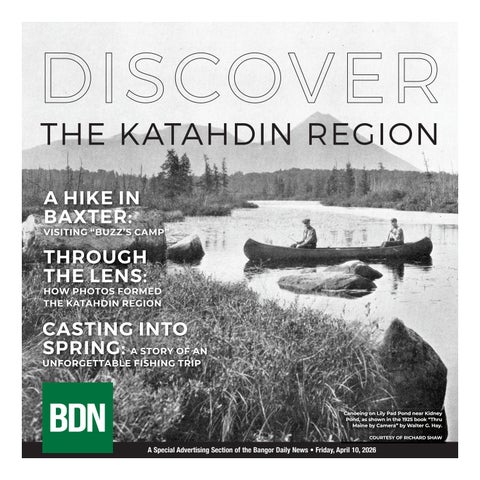
Pond, as shown in the 1925 book “Thru Maine by Camera” by Walter G. Hay.

Baxter Bound with BUZZ

AYEAR AGO, I joined a group of friends for what I have termed our Meandering Mondays, where we explore and soak up nature around our state. One Monday the plan was to stop by “Buzz’s camp” to hike some trails on his Corinth property.

I hadn’t realized Buzz was a man I had interviewed countless times in my role as a broadcast journalist back when he was park director of Baxter State Park. Irvin “Buzz” Caverly was a ranger, then director, from 1960 to 2005.

H e was first introduced to Baxter State Park while attending Lee Academy. He was hooked forever after. Buzz’s knowledge of Maine’s majestic Mount Katahdin, Baxter State Park, and its vast wilderness is in his veins.

B uzz, now 87 years old, hasn’t slowed down since

his retirement. He built what he calls Nature at Peace, transforming 10 acres of his property into a network of trails, creating his own personal park.

H is cabin’s pine walls are dotted with black and white photos of Baxter State Park and graced with framed letters from Governor Percival Baxter, the founding force behind the park of over 200,000 acres and more than 215 miles of trails.

T ELLING TALES

A s we all nestled on his camp porch, Buzz took a center seat and began with a story of his late wife Jan. Between teary eyes of sadness and joy, he spoke of their honeymoon destination at remote Russell Pond. Their love for each other and nature spanned 53 years. He went on to speak of his now wife Louise who was Jan’s long-time friend.

B uzz took us down memory lane as a part-time seasonal worker with the park. His eyes gleamed as he admitted he should be “embarrassed by the way he acted sometimes,” like telling his immediate boss he was “old and needed some young help.” In time, Buzz’s persistence and dedication led to an accomplished career spanning 45 years.

E motions were reflected as he shared about the 1963 loss of his friend and colleague Ranger Ralph Heath, who perished during a failed rescue mission. Buzz said Ralph was like a brother to him.

O n the lighter side, his early days as a ranger at Daicey Pond taught him about a quick trick of trout fishermen. Once the men came on shore, he told them, “I’ve got these new binoculars and I think they work quite well,” knowing they were catching over the legal limit.

STORY & PHOTOS BY ANNE GABBIANELLI
at the iconic rock Buzz’s first picture

W hile the fishermen went to relieve themselves, Buzz’s inspection of the boat turned up empty. He later learned “the fishermen were not going to the bathroom, but going to dump the fish from their pant legs to come back and get them later,” he chuckled. “I got stumped by the oldest trick in the book.”

A nother tale involved the National Guard flying building materials into Russell Pond. The guard’s colonel got word of the hard work of his crew and flew in with food and libations as a thank you. The guardsmen were not alone though.

“ There was a bear that smelled a good meal, so it clawed its way into the cabin,” Buzz said. The ranger on scene was quick to dispatch the bear, which dropped to the floor near the sleeping colonel. “He never stirred.”

T he challenge then, Buzz continued, was to remove the beast.

“ So the crew came up with the idea of airlifting it to ‘over by Russell Pond.’ The ranger said, ‘That’s the

When I die, all these stories about Governor Baxter will die too.
– IRVIN “BUZZ” CAVERLY

main trail in here from Roaring Brook. What if a camper reports a bear dropping out of the sky?’”

B AXTER BOUND

L ast fall a few of us were Baxter bound with Buzz. We hopped in his truck sporting a front bumper engraved ‘Happy Trails,’ ready for a guided tour full of insight, reflections, and memories.

O ur first stop was Caverly Pond, named in Buzz’s honor. He said that’s where he proposed to Louise with a picnic lunch on the ice.

Apparently once we entered the park, word spread fast that Buzz was back. While we enjoyed lunch with Daicy Pond as our backdrop, Buzz enjoyed conversation with a long-time ranger. Further down the road, another employee stopped roadside to greet Buzz.

T raveling the 65 miles from gate to gate, Buzz spoke of the fatal lightning strikes due to the amount of iron in the mountainous terrain, as well as the failed introduction of caribou to the park, and the

Overlooking Caverly Pomd

fire of 1977 that claimed 3,000 acres.

W ith each corner, we caught glimpses of Mount Katahdin as the fog lifted and snow blanketed the ridges and peaks. We came to Ledge Falls where Buzz told a story of how he jumped in to rescue a child who was being swept away, and he too fell victim and needed to be rescued.

T raversing in and out of various campsites, Buzz shared more stories of hosting Governor Baxter in the park. Buzz’s passion and dedication, which is ingrained in his fabric, aligned with the governor’s mantra of preserving wilderness.

“ When I die, all these stories about Governor Baxter will die too,” he said.

A s we departed that day, Buzz sprung the idea of hiking Chimney Pond come spring. While that trip awaits us, we have enjoyed many hikes and snowshoeing adventures over the past year on his property, graced with his wit and yet more tales of his love affair with nature and Baxter State Park.

HOW PHOTOGRAPHY BUILT THE KATAHDIN REGION

S TORY & PHOTOS COURTESY OF RICHARD SHAW

BEFORE TOURISTS VENTURED

INTO BAXTER STATE PARK , and onto its mile-high peak named Katahdin, there were the photographs. Black and white — and eventually color — postcards and other views captured the park’s now more than 200,000 acres in all four seasons. Popular locales were Katahdin Stream Campground, Chimney Pond, and Nesowadnehunk Stream.

L ugging large-format field cameras up Abol Trail and other paths to the summit was hard work, but stereographer A.L. Hinds managed to capture the Knife Edge, circa 1870 — arguably the first such photo taken.

C offee table books selling the wilderness’ “forever wild” grandeur followed. Before former Gov. Percival Baxter donated the first nearly 6,000 park acres in 1931, “Thru Maine By Camera,” by Walter G. Hay, published in 1925, featured wide-angle views of the Katahdin region. At the same time, the Bangor & Aroostook Railroad’s magazine, In the Maine Woods, chronicled the area with illustrated hunting and fishing articles.

O ther publications picturing Daicey Pond campground and hikers clinging to Index Rock followed. Marion J. Bradshaw, a Bangor Theological Seminary philosophy professor, published three of the best in the 1940s: “The Maine Land,” “The Nature of Maine,” and “The Maine Scene.” Long out of print, readers can find these books in libraries and on auction sites.

M oving into the 21st century, Arcadia Publishing came out with two photorich pictorials of the region. “Baxter State Park and the Allagash River,” by Frank H. Sleeper, and “Baxter State Park and Katahdin,” by John W. Neff and Howard R. Whitcomb, show the area in glorious black and white. Many of the views are postcard images dating to the 1930s.

T oday’s jumbo-size color postcards of the Katahdin region may be glossier, but earlier cards, now collector’s items, were just as alluring. Such Maine photographers as Dexter’s Bert Call, who scaled the mountain 16 times, and his successor, Paul Knaut Jr., of Dover-Foxcroft, were two of the industry’s hardestworking lens men. Now deceased, their work lives on.

Dangerous moment on Index Rock in Baxter State Park, as shown in the 1947 book “The Maine Scene” by Marion J. Bradshaw.
State of Maine Camp at Chimney Pond as shown in the 1925 book “Thru Maine by Camera” by Walter G. Hay. A postcard of Katahdin Stream Campground circa 1940, courtesy of the Richard Shaw Collection.

CREATIVE ARTS IN RURAL MAINE

B OREAL THEATER INTENT ON BRINGING ARTS AND CULTURE T O THE KATAHDIN REGION

BY J UDY HARRISON

VISITORS TO THE KATAHDIN REGION now have the opportunity to enjoy an art show, a concert, or a play after spending time outdoors in the shadow of the majestic mountain.

Boreal Theater, located at 215 Penobscot Ave., has art shows, outdoor painting opportunities, concerts, and a theater production planned for this spring and summer.

The theater aspires to bring cultural enrichment and engagement to the local community through the performing and visual arts, according to its mission statement. Its vision is to deepen the presence of the creative arts as an essential part of community life in Millinocket and the surrounding region.

Randy Jackson, a retired physician’s assistant who’s lived in Millinocket since 1976, bought the empty downtown building in 2020, intent on transforming it into an arts and cultural center for the region. The building previously housed retail and office space.

“I think the arts are as important for rural Maine as they

are for Bangor or Portland,” Jackson said. “I want to promote the arts and enable the kids in the region to spend a day in Millinocket instead of having to travel, when the cost can be prohibitive for families, to be exposed to the arts and culture. … Kids who are exposed to the arts grow up to be patrons of the arts.”

The 49-seat black box accessible theater and event space opened in 2021 for “bare bones” operations. A grand opening was held two years later. In 2024, it hosted 56 performing and visual arts offerings. Last year it hired Amanda Albanese of Millinocket as its first program director, a part-time position. Her background is in the visual arts.

“I do a little bit of everything — updating the website, posting on social media, advertising, planning art exhibits,” she said. “Randy and I work on bookings and sponsorships. We have artists and musicians here and we welcome the opportunity for them to use the space.”

The Boreal has coordinated with art teachers in the area to put up a show of their students’ work. On May 22, the theater will hold a donors event during the opening of a show of the works of Frank Sullivan, an art professor at the University of Maine at Presque Isle. A bluegrass music festival will be held in the vacant lot next to the building in a tent on May 23.

Over the summer, Albanese will focus on the work of Frederic Edwin Church, a 19th century landscape painter, who worked in the summers from his camp on Millinocket Lake. The Boreal will hold an outdoor painting event at Rhodora, Church’s lakeside retreat.

Theater camps for local kids culminating in productions will be held this summer. A community theater company is forming to perform “An Allagash Haunting” by Tim Caverly later in the year.

The building where the theater is located also houses the Katahdin Gear Library and the Yum Bake Shop. The library “is a gear-lending library, outdoor adventure hub, and community space for people of all ages to access equipment, information, and support to connect with people around a common interest in outdoor adventure and recreation.”

The bakery is open Thursday through Saturday, serving soups, quiches, and meat pies along with cookies, cakes, muffins, brownies, and more.

Jackson said that he is happy to share the building and looking forward to getting the theater’s sprinkler system working. That will allow seating capacity inside to reach 70.

“We have a lot of work behind us and a lot still to do,” Jackson said.

UPCOMING BOREAL THEATER EVENTS

• MAY 22 – Boreal Donor Night

• MAY 22 – Frank Sullivan Art Opening

• MAY 23, 12-5 P.M. – Boreal Music Festival

• JUNE 3, 9 A.M.-2 P.M. – Reflections: In the Footsteps of Frederic Edwin Church Plein Air High School Painting Event at Rhodora, Millinocket Lake

• JULY 20-24 – Boreal Theater Camp

• AUGUST 16, 3–5 P.M. – Anni Clark Musical Performance

• AUGUST 23 – Reflections: In the Footsteps of Frederic Edwin Church Plein Air Adult Painting Event at Rhodora, Millinocket Lake

• LATE SUMMER/EARLY FALL – An Allagash Haunting Theater Production — TBA

THE WATER BARELY MOVED, just a soft, steady lap against the aluminum hull of my 12-foot boat as the wind pushed across the mouth of the river. It wasn’t silence, exactly. It was that low, patient sound of water touching metal on a calm evening. The sound a fisherman thinks about while watching winter do its worst.

I kept the boat tight to the shoreline. A hundred yards out, the main lake was still locked in a steady sheet of ice, stretching from bank to horizon. From where I sat, it looked solid and unbroken, a white ceiling laid down over everything beyond the river’s reach.

The only open water was here, where the current carved a dark lane into the lake and the water went deep blue, almost tar-black — the kind that swallows your fly line and makes you really pay attention.

I had two 9-foot fly rods out, both rigged with a sinking line. My 5-weight off one side of the boat and an 8-weight off the other, trolling just outside the seam, 5 to 7 feet down. Governor Aiken. Purple Smelt. Grey Ghost. The Supervisor. Old fly patterns that still earn their

A SPRING FISHING DAY W ORTH REMEMBERING

keep when the water’s cold and the smelt are moving.

Most of the mid-afternoon passed without much sign of life. Then, around five o’clock, a single rise ring opened near the seam. Not dramatic. Just a quiet circle widening in that dark water.

A little while later, a hit came clean on my 5-weight. For the first few seconds, that fish owned me.

The rod folded into a smooth arc and the tip pulsed with each head shake. A landlocked salmon doesn’t typically bulldog like a lake trout. It runs. Fast and hard. Line slipped tight through the guides before the drag fully found its voice.

Then it turned broadside as I was able to get settled, and I felt it. All muscle and current. The reel gave in and the drag began to have its work cut out for it. The boat rocked lightly beneath me as I fought the fish, and I was suddenly aware of how small 12 feet of aluminum feels in open water.

I kept the pressure steady and let it run when it wanted. The salmon cut toward the surface and came out of the water in a flash of chrome, throwing spray

against a sky that still looked more like winter than spring. For a split second the line went slack and my stomach climbed into my throat. Then it landed and the rod bucked again. Phew. Still there.

Five pounds doesn’t sound massive until it’s tied to nothing more than a thin tippet and hope. Every surge feels amplified. No cushion besides the bend of the rod and your own hands adjusting pressure in real time.

When it finally circled under the boat, tired but not finished, I saw the broad silver side just below the surface. The net slid under it and my hands were shaking. Earlier in the afternoon I’d lost a bigger salmon in the motor’s wake because I couldn’t get the boat to sit straight in the slight current and I hadn’t bothered to get the net ready in time. Always put your motor into neutral when fighting a fish while trolling, kids. That one earned its freedom. This time I wasn’t making the same mistake.

I checked the tape. Twenty-three and three-quarters inches. Legal. Thick across the back. Just over 5 pounds. I cut the gills and bled it immediately, and I headed

back to my campsite. Cold water washed against me as I worked, and by the time I cleaned it, my fingers had gone stiff and numb. Thirty-six degree air and cold water don’t give you much grace. But when I finished gutting and filleting, it was worth it.

Deep orange. Dense. Clean.

I built the fire the way I was taught growing up. Birch bark and a few sticks of spruce to get it started, just enough flame to wake the coals. Then hardwood. Split maple I’d dried since fall.

There’s a rule about cooking over open flame that doesn’t get talked about enough. Softwoods will start your fire, but they shouldn’t finish it. Pine, fir, spruce, cedar — they burn hot and fast, and throw sap into the smoke. It turns thick and bitter and it will crawl straight into your food. Hardwood burns steady and clean, and will add a little flavor. If you’re going to keep a fish, the best thing you can do for yourself is clean and cook it properly.

When the coals settled into a red, breathing bed, I set the cast iron over them and let it heat. Moments later, I put a drop of water in which skittered and vanished. Butter went in first. It melted, foamed, then quieted down just before it thought about burning.

The fillets went skin side down. Salt, more than feels necessary. Pepper. A pinch of dill. Fish that fresh doesn’t need anything complicated.

Right about then the wind shifted.

Smoke always seems to have a sense of humor. I leaned left. It went left. I stepped back. It followed. Eyes watering, trying to look composed in front of absolutely no one. There’s something humbling about coughing over your own campfire while dinner sizzles along like it doesn’t need you at all.

The first bite was clean and lean. Not oily, not gamey. It didn’t coat your mouth. It filled it. A little sweetness. A faint mineral edge that only fresh cold water seems to give. The kind of flavor that makes you chew a bit slower without even realising.

I sat there eating with smoke still clinging to my wool jacket. The cast iron ticked as it cooled. The fire settled into coals. Out on the main lake, the ice still held from shore to horizon. But here where the river meets the lake, the season has opened just enough.

The lake gave something up that evening. I did my best to return the favor with care.

Small waves folded into the shoreline in front of my camp site. Somewhere out past the edge of the open water, a loon called. Not eerie. Not lonely. Just clear and strong, like it had all the room in the world. I caught myself smiling at it. Good to know I wasn’t the only one out there working for a meal.

When the skin released on its own, I flipped the fillets. No forcing it. The deep orange had turned pale coral halfway up the sides. Steam lifted into the cold air, carrying the smells of butter and dill with it. I pulled it before it over-seared.

WHY NEOC IS A DIFFERENT KIND OF BASECAMP

COURTESY OF NEOC

IN MOST PLACES, a basecamp is simply where you begin your adventure. At NEOC, it’s part of the experience itself. Mornings begin with mist lifting off Millinocket Lake and the silhouette of Katahdin standing tall beyond the pines. Within minutes, you can be whitewater rafting on the West Branch of the Penobscot River, hiking in Baxter State Park, pedaling through miles of singletrack, or simply watching wildlife move through the North Woods. The pace is quieter here, but the adventures run deep. This is a place where the wild shapes the rhythm of the day, and where adventure doesn’t begin when you leave the cabin; it begins the moment you arrive.

One word of advice as you plan your next adventure in the Katahdin Region: Leave time at the end of the day to step outside and watch the stars come out. The skies here are some of the darkest in the Northeast, and on the right night, the aurora borealis quietly dances above Katahdin. Moments like these are a clear reminder of why this is a sacred place for so many.

Turn static files into dynamic content formats.

Create a flipbook