BOSTON COLLEGE WINTER 2017
MAGAZI NE
interior design The soul of a residence hall by   zachary jason
P R O L O G UE housing authority
S
o far as I can determine, the most lucid history of college dormitories ever published appeared in December 1934 and January 1935 in a now-defunct journal sponsored by a now-defunct learned society. Flatly titled “The History of Student Residential Housing I and II,” the essays, comprising some 12,000 words, were the work of Ohio State psychology professor William Harold Cowley (1899–1978), who later held an endowed chair in education at Stanford and gained a reputation for, among other things, writing books over and over and never publishing any version. (Two of his three important monographs were published posthumously, with editors assuming co-authorship.) Hal to his friends, W.H. Cowley to his readers, and (at his insistence) Mr. Cowley to his students at Stanford, Cowley was a working-class kid from Brooklyn who, like his childhood idol Horatio Alger, compelled his own way in the world, earning the money and scholarships that brought him first to Dartmouth and then the University of Chicago, where he earned a doctorate in psychology and became one of those tireless—he had a lifetime habit of working all day and writing through the night—intellectual adventurers who bumps into a new discipline and carries it home before anyone else gets wind of the discovery. In Cowley’s case, it was higher education studies, where his specialty became “student personnel,” which we now call student affairs, and which he pretty much invented and ruled. While at Stanford he trained 70 or so doctoral students who would become the second and third generation of faculty who taught higher education studies—more than a dozen of them also rising to college and university presidencies. And while it became a source of frustration to Cowley (and his many admirers) that he was never able to give up on or nail down the “taxonomy” of college education that was his Holy Grail, he produced and collected over his working life enough memos, articles, variant manuscripts, speeches, letters, instruction manuals, and research materials to leave Stanford a bequest of 200 linear feet of archival material. cowley’s story of college dormitories begins in the 12th century and carries into the 20th. Over that time, he makes clear, only in rare circumstances—e.g., Oxford, Cambridge, and their New England imitators; American women’s colleges; and such freethinking outliers as Chicago—did colleges and universities do anything but shun responsibility for their students’ lived lives.
And when some did take an interest, it was generally under political or economic pressure, as in 15th- and 16thcentury Europe, when the good burghers of such college towns as Paris and Bologna—who had enriched themselves for centuries by tending to student appetites—declared they could no longer put up with what armies of unsupervised young men did in the nighttime streets and alleyways. But the institutionally managed dormitories that were established in old Europe really suited nobody. Faculty (there were no “student personnel”) despised their forced role as sheriffs, and students found their way around their busy overseers. Came the Reformation and French Revolution, and European universities sensibly took advantage of distraction to do away with dormitories. Only at Oxford and Cambridge, relatively untouched by these cataclysms, did the dormitory system stick, which is how it came to travel to Massachusetts Hall, in Harvard Yard, in 1718. According to Cowley, save for the instances noted above, dormitories did not root well in the United States. For one, they were usually built on the cheap—Massachusetts Hall had no piped water or any light source but for whale oil lamps until the 1860s—and students found more salubrious accommodations in boarding, private, and shared houses. Fraternities and sororities, founded for social reasons, easily turned to providing room and board. Moreover, many American universities, particularly in the Midwest and West, preferred to work on the German, not British, model, which favored investments in faculty, laboratories, and libraries. At Michigan, in 1852, there was no objection from students when a president without warning turned the college’s only dormitory into a classroom building, noting that young men who were separated “from the influences of domestic circles are . . . led to contract evil habits.” That comprehension began to change following the turn of the 20th century, most importantly because of a new understanding—later strongly advanced by Cowley and today a truism—that students are educated outside the classroom as well as within. Also driving the rise of residency was a new social concept called “college life,” which had to do with football, school colors, cheers, and close friendships. At some institutions with no history of residency (e.g., Columbia), alumni joined students in demanding dormitories and a real college atmosphere. So says Mr. Cowley, and I believe him, even without evidence of a taxonomy. Our story on the new Thomas More Apartments begins on page 30. —ben birnbaum
Contents
boston college magazine
2 Letters 4 Linden Lane
From “The Legacy,” pg. 24
F E AT UR E S 12 FIRST CHAIRS Inaugural holders of a new University title—the endowed assistant professor— define their interests
A new program helps sophomores in the liberal arts think about the future • An English class gets inside Ulysses, with goggles • Two Jacobs biographies, nourished by a University collection
42 C21 Notes As times change, shouldn’t seminaries?
Photographs by Gary Wayne Gilbert
By Zachary Jason Photographs by Lee Pellegrini
Medicine was a respectable profession during the Renaissance. But just barely • Down on the organic farm
50 Class Notes 80 Inquiring Minds Caves hold stories of climate change
81 Works & Days
GET THE FULL STORY, AT BCM ONLINE:
bc.edu/bcm
30 ENCOUNTERS The Thomas More Apartments promise more than beds, desks, and vending machines
45 End Notes
Light keeper Bob Gallagher ’82, MA’84
24 THE LEGACY When Séamus Connolly retired from Boston College in 2015, he left behind a personal contribution to the near-three-century-old effort to preserve traditional Irish music. As with his predecessors, what he’s saved is what he’s loved By Mick Moloney
vol. 77 no. 1 winter 2017
Explore the Séamus Connolly Collection of Irish Music (pg. 24) • View the lecture on the Francis pontificate by Richard Gaillardetz, the Joseph Professor of Catholic Systematic Theology (pg. 42) • View the talk on American seminaries by Katarina Schuth, OSC (pg. 42) • Order Everyday Renaissances (pg. 46), by associate professor of history Sarah Gwyneth Ross; and Organic Futures (pg. 48), by associate professor of sociology Brian Gareau and Connor Fitzmaurice ’10, at a discount from the Boston College Bookstore. also:
on the cover: The Eagle Model UN political affairs team meets in a second-floor lounge of the Thomas More Apartments. Photograph by Lee Pellegrini
• reader’s list: Books by alumni, faculty, and staff • headliners: Alumni in the news
MAGAZINE
LETTERS
VOLUME 77 NUMBER 1 WINTER 2017
EDITOR
Ben Birnbaum DEPUTY EDITOR
Anna Marie Murphy SENIOR EDITOR
Thomas Cooper ART DIRECTOR
Keith Ake PHOTOGRAPHY EDITOR
Gary Wayne Gilbert SENIOR PHOTOGRAPHER
Lee Pellegrini EDITORIAL ASSISTANT
Zachary Jason ’11 CONTRIBUTING WRITER
William Bole BCM ONLINE PRODUCERS
Ravi Jain, Miles Benson BUSINESS MANAGER
Tatiana Flis INTERNS
Katie Daniels ’17, Alexandra Rae Hunt ’17, Anthony Perasso ’17 Readers, please send address changes to: Development Information Services Cadigan Alumni Center, 140 Commonwealth Ave. Chestnut Hill, MA 02467 (617) 552–3440, Fax: (617) 552–0077 bc.edu/bcm/address/ Please send editorial correspondence to: Boston College Magazine 140 Commonwealth Ave. Chestnut Hill, MA 02467 bcm@bc.edu Boston College Magazine is published quarterly (Winter, Spring, Summer, Fall) by Boston College, with editorial offices at the Office of University Communications, (617) 552–4820, Fax: (617) 552–2441 ISSN 0885–2049 Periodicals postage paid at Boston, MA, and additional mailing offices. Postmaster: Send address corrections to Boston College Magazine Development Information Services Cadigan Alumni Center, 140 Commonwealth Ave. Chestnut Hill, MA 02467 Copyright 2017 Trustees of Boston College. Printed in U.S.A. All publications rights reserved. BCM is distributed free of charge to alumni, faculty, staff, donors, and parents of undergraduate students. It is also available by paid subscription at the rate of $20 for one year (four issues). Please send check or money order, payable to Boston College Magazine, to: Subscriptions, Boston College Magazine 140 Commonwealth Ave. Chestnut Hill, MA 02467 Please direct Class Notes queries to: Class Notes editor Cadigan Alumni Center 140 Commonwealth Ave. Chestnut Hill, MA 02467 email: classnotes@bc.edu phone: (617) 552–4700
2
bcm v winte r 2017
ART WORK
Re “Illumination,” by Jane Whitehead (Fall 2016): In the early 1970s the recently appointed 24th President of Boston College, J. Donald Monan, SJ, visited Los Angeles and offered a group of alumni his vision for the University. First, he would focus on stabilizing its financial underpinnings, and then he hoped to establish centers, institutes, and a museum. These were the hallmarks of the great European universities where he had studied. My involvement with the McMullen Museum began when my wife and I returned in the winter of 1999 to see the Caravaggio exhibition. Since then we have attended all McMullen openings and have joined the growing list of patrons. The new museum conveys excitement, beauty, and tranquility. Visiting the recent exhibition, Beyond Words: Illuminated Manuscripts in Boston Collections, and looking at books made by monks and nuns more than nine centuries ago, was a humbling experience. Nancy Netzer, the museum director for more than 25 years, put her heart and soul into quarterbacking the design and completion of this stunning home for art on the Boston College campus. It is gratifying to see record attendance by students and members of the Boston community, including busloads of children from neighboring schools coming to enjoy a day of art and fun. Robert L. Winston ’60 Los Angeles, California The writer served on the Board of Trustees from 2006 to 2010. The photograph of the new McMullen Museum on the cover of the Fall 2016 issue was spectacular. I recall a 1993 conversation with then-University President J. Donald Monan, SJ, who said, “A great university can’t exist without a great art museum.” Well, the new museum is a breathtaking display of Boston College’s prominence. It is a wonderful addi-
tion to the University’s arts program and to the greater Boston community. Congratulations to Fr. Monan, President William P. Leahy, SJ, the McMullen family, the Board of Trustees, and museum director Nancy Netzer and her colleagues for a masterpiece in every respect. Christopher J. Toomey ’78 Santa Barbara, California From an art gallery on the campus of Newton College, to space in Devlin Hall, to the expanded facility on the Brighton Campus, the current McMullen Museum has been a journey some 40 years in the making. Key to its success at all these stages has been its focus as a teaching museum, where the majority of the exhibitions have been initiated and curated by University faculty from various disciplines under the leadership of museum director Nancy Netzer. Peg Dwyer, M.Ed’56, H’98 Wellesley Hills, Massachusetts The writer served the University as a vice president from 1975 to 1997. The opening of the new McMullen Museum is a triumph. It reminds me that in the 1930s there was in Chestnut Hill an obscure but highly disciplined institution focused on the learning of Latin, theology, and philosophy. On one side of that institution, called Boston College, was the sumptuous Liggett mansion, owned by the founder of the Rexall drug store company. On the opposite side was the magnificent mansion of the archbishop of Boston. Today the Liggett mansion is O’Connell House, and the archbishop’s mansion is the McMullen Museum. So as that once obscure institution has grown, it has absorbed the edifices built by those who maintained both our physical and our spiritual well-being. A fine testament to the University’s great purpose. Mike Hirrel ’73 Arlington, Virginia
WITNESS STAND
Re “And Now,” by Zachary Jason (Fall 2016): Thank you for the powerful story about Boston Marathon bombing survivors Patrick Downes ’05 and Jessica Kensky. I remember their statement during the sentencing phase of bombing suspect Dzhokhar Tsarnaev’s trial. “In our darkest moments and deepest sadness,” they wrote, “we think of inflicting the same types of harm on him. . . . If there is anyone who deserves the ultimate punishment, it is the defendant. However, we must overcome the impulse for vengeance” (Boston Globe, April 20, 2015). They went on to ask that the defendant be spared the death penalty. Their example offers a profound lesson to us all and bears prophetic witness to a society where vengeance is too often the norm. If they, who have lost so much at the hands of violence, can resist the impulse for vengeance, can we not find it in our hearts to do the same? They are a shining example of what it means to break the cycle of violence and build a more benevolent world. Nancy Small ’84 Worcester, Massachusetts MATCHMAKING
Re “June 28, 2016,” by Zachary Jason (Summer 2016): At lunch in the Eagle’s Nest one day during my sophomore year, a roommate tossed me a flier about a summer position in Boston College’s undergraduate admission office. Little did I know how that summer jobwould change my life. I fell in love with the workand the peoplein Devlin Hall, and I spent the remainder of mytime atBoston College with the student admission program. Working with John Mahoney Jr. ’79 and his teamturned me into an admission “lifer.” I now work as the director of college counseling at an independent school in Northern California. I have held tight to what the Boston College admission office taught me: how to encourage kids (and, please, not their parents) to ask the tough questionsand how to help them identify the pulse that runs through the community to see if it resonates. Kudos to Boston College for staying strong to the idea that you should be unafraid to be different. Application
totals are one thing;getting the right students to apply is another. Matt Lane ’98 San Francisco, California Visiting my daughter (’06) in Boston, I happened to be on campus the day your article chronicles and witnessed many of the events it describes. I graduated in 1972, a time of turbulence on the Chestnut Hill Campus that left me with mixed recollections and emotions. My daughter’s experiences at Boston College, however, provided wonderful recognitions of how the University has evolved into a premier institution. Dr. Phil Bayer ’72 Carmel, New York PERSONAL EFECTS
Thank you for two essays published in recent issues. The first, “Side Effects” (Spring 2015), was written by an undergraduate, Meaghan Leahy ’15, whose sister is developmentally challenged. The second, “Unplanned” (Spring 2016), was an account by English professor emeritus Dennis Taylor about his grandson George. These two beautifully written pieces expressed a depth of feeling and love that touches one’s soul. Both authors wrote about their daily struggles and the choices they made. The essayists chose to find acceptance, peace, delight, and love in their situations. This is what I admire about Boston College: the fostering of the whole person to create strong, steadfast, and compassionate citizens. These two stories provide examples of how our Jesuit values are flourishing in the world. They remind us what life is about—loving and caring for one another. Michele Boccia, MA’99 Bay Shore, New York RIGHTS WATCH
I was grateful for Zachary Jason’s article “Best Friend” (Summer 2016), about attorney Justin Marceau ’00. His work on behalf of animal rights and also persons sentenced to the death penalty reminds me of the connection I’ve made between animal and human suffering, one that led me to the Boston College School of Social Work. Because I grew up on a family hog farm—about 20 percent of feeder pigs
die before reaching the slaughterhouse floor, literally suffering to death—I developed an acute awareness of beliefs and systems that reinforce unjust institutions. Although I was not religious, the Jesuit tradition of service and social justice is why I chose Boston College. Mr. Marceau’s animal rights work may raise some eyebrows, but Pope Francis’s 2015 encyclical Laudato Si’—which he addressed to “every person living on this planet”—proves Marceau’s work is congruent with the Jesuit tradition underlying Boston College. Pope Francis said, “Every act of cruelty towards any creature is contrary to human dignity.” Thank you for profiling an alumnus whose life’s work is in accord with these principles and inspires others to reject unnecessary violence toward animals. Kelly A. Olsen, MSW’96 Fayetteville, Arkansas OUTLOOK
Zachary Jason’s “Elegy for Edmond’s” (Summer 2016) ushered in many fond memories. My first two years at Boston College, I was housed in Mod 43A, where my bedroom window gave me a view of the construction of Edmond’s Hall (the “Rezzies”). My second two years were spent in suites 53W and 733W, respectively, of the Rezzies. Now that the Rezzies are gone from Lower Campus and Mod 43A has long since been removed to accommodate outdoor tennis courts, I guess, in the words of the Steely Dan song, “I’m never going back to my old school.” However, I remain pleased to return to the school of my daughters (Carol ’08, Constance ’11, and Canon ’18). Peter Crummey ’78 Albany, New York
BCM welcomes letters from readers. Letters may be edited for length and clarity, and must be signed to be published. Our fax number is (617) 552–2441; our email address is bcm@bc.edu.
Facebook “f ” Logo
GET CONNECTED ON FACEBOOK CMYK / .ai
Facebook “f ” Logo
CMYK / .ai
FOR SPECIAL CONTENT AND MULTIMEDIA UPDATES FROM @BC AND FRONT ROW.
w i n t e r 2017 v b c m
3
CONTE NT S
Linden Lane
6 What’s my line?
A new program helps sopho-
mores in the liberal arts think about the future
An English class gets inside Ulysses, with goggles 9 What she left
Two Jacobs biographies, nourished by a University collection
4
bcm v w i n t e r 201 7
CAMPUS DIGEST
8 Joyceland
Bapst Library was named one of the country’s most beautiful college libraries by Town and Country, which avoided the now-familiar comparisons to Hogwarts and more reverently noted, “It almost resembles a Medieval church.” z Undergraduate admission offered early-action entry to 2,900 of 9,000 applicants. z Colloquium, a political science journal edited by undergraduates, debuted, offering articles on “Colonial Legacies of Economic Growth—A Comparative Analysis of Hong Kong and the Democratic Republic of the Congo,” by editor Cesar Garcia ’17, and “Cognitive Misers: How People Calculate the Worth of Their Vote,” by Olivia McCaffrey ’17. z The Norfolk Prison Debating Society defeated Boston College’s Fulton Debating Society. Meeting in an auditorium at the medium-security facility (there are no away matches for the Norfolk squad), the teams collided over “Resolved: The United States should impose a carbon tax on greenhouse gas emissions,” with Norfolk taking the affirmative position. Founded in 1933, the Norfolk team has over the years defeated West Point, Harvard, Yale, Oxford, and Princeton. Among inmates on earlier teams was Malcolm Little, later known as Malcolm X. z “The Environment and Society” was the theme of the University’s annual research symposium. Keynote speaker Nathaniel Stinnett, JD’05, founder of the Environmental Voter Project, discussed low voter turnout among self-described supporters of environmental issues.
z Martin O’Malley, ex-governor of Maryland and 2016 presidential candidate, is the inaugural Jerome Lyle Rappaport Visiting Professor at the Law School. In a January lecture on the state of U.S. democracy he said, “We have become bored with our own politics, so bored in fact that most of us would rather be entertained by it than read about it.” z Associate professor of psychology Liane Young was honored by the Foundation for Social and Personality Psychology for her work on moral psychology. z The Connell School of Nursing celebrated its 70th anniversary with a lecture, an exhibition of nursing artifacts from the University archives, and the raffle of a pair of CSON scrubs. z On Sunday, January 29, University President William P. Leahy, SJ, executive vice president Michael Lochhead, and provost David Quigley cosigned a message emailed to the Boston College community stating their objections to the executive order signed on January 27 suspending entry to the United States by refugees and by citizens of seven Middle Eastern and African countries. Citing Pope Francis (who declared, “It’s hypocrisy to call yourself a Christian and chase away a refugee”), they wrote, “Boston College was founded in 1863 to educate the children of immigrants and, like our nation, has gained so much from the presence and contributions of faculty, students, and staff born in other countries.” University offices are assisting any affected community members. z A cost-benefit analysis of City Connects, a program created by the
earthworks—The earth and environmental sciences department recently opened a facility in Devlin Hall for isotope geochemistry. The 1,350-squarefoot lab includes an ultra clean room (in which virtually all airborne contaminants are filtered out) and a climate-controlled room housing instrumentation that measures the isotopic composition of rock. Above, from left, are Anne Haws ’19, center codirector and department chair Ethan Baxter, graduate student Thomas Farrell, and Justin Mistikawy ’17, in the ultra clean lab. They are preparing samples of garnet (from the mountains of Spain and New Hampshire) and seabed sediment (from Madagascar) for isotope analysis.
Lynch School of Education that provides support networks for at-need students, their families, and their schools (currently more than 30,000 students in 84 schools), found that the program produces $3 in savings to society for every dollar invested. The New York Times commented that if City Connects were a company, “Warren Buffett would snatch it up.” z Professor of physics Krzysztof Kempa was elected a fellow of the American Physical Society in recognition of his work on the properties and applications of electronic nanomaterials and devices. z A U.S. News & World Report review of salary-to-debt ratio among graduates of private law schools found that Boston College Law provided its alumni with the “best chance of paying off their student debt.” z Angela Jin, a senior in the Carroll School of Manage-
photograph: Gary Wayne Gilbert
ment and cofounder with a hometown friend of 1950 Collective, which creates clothing for teen girls—with many of the ideas crowdsourced and a portion of sales donated to charity—was featured in Seventeen magazine. z A Heights survey of the winter break activities of faculty found them variously writing articles and books (one author took to a cabin in the woods), studying television news programs (and feeling overwhelmed by pharmaceutical ads), and leading a service trip to Haiti. The newspaper noted that history department professors appear “most likely to respond to unsolicited emails from college newspaper reporters.” z Women’s basketball guard Kelly Hughes ’17 scored her 301st three-point shot, setting the Eagle record for women and men. z Connell School professor
Ann Burgess was the featured speaker at the 16th annual Veterans Remembrance Ceremony, on November 11. Burgess is an authority on the treatment of trauma victims and director of the Collegiate Warrior Athlete Initiative, a program that pairs University student-athletes (from football, swimming, and field hockey) with veterans of the Afghanistan and Iraq wars for twice-weekly 90-minute training sessions followed by discussions on issues of wellness led by University faculty and staff. z Some 400 students packed the Rat in Lyons Hall to hear K-pop phenom Eric Nam ’11 talk about his career path and sing a few songs, including “Can’t Help Myself,” a Korean, English mash-up (with a sing-along), and to join him for selfies. The air was heavy with admiration. —Thomas Cooper
w i n t e r 201 7 v bcm
5
Kathleen Woodward ’83, JD’88 (left), a senior attorney for the Environmental Protection Agency, talks with students in the Eagle’s Nest.
What’s my line? By Zachary Jason
A new program helps sophomores in the liberal arts think about the future
I
n mid-January, 203 sophomores cut short their winter break and returned to campus for three days of “career exploration.” They came for the one-year-old Endeavor program, organized by the Career Center and designed for liberal arts majors in their second year—students with a full two and a half years left to develop their skills and build professional connections. Endeavor’s aim, according to Rachel Greenberg, associate director of the Career Center, is not to produce a definitive “career decision,” but to help students focus on their options. Day One was an in-house affair—a period of preparation for meetings, on Day Two, with 61 visiting alumni volunteers who would be talking with students frankly and in some detail about their working lives. It was a day for students to share thoughts about why they were there and what they hoped to achieve. Liam Rogers, a biology major from Amesbury, Massachusetts, explained, “I want to work
6
bcm v w i n t e r 201 7
on talking about myself [to employers]. I don’t know what people want to hear.” Julia Cardwell, a Maryland native who was considering a “sharp turn” from biology to English, was seeking reassurance that “becoming an English major wasn’t going to leave me broke and unemployed for the rest of my life.” A few students confessed that Endeavor had been the excuse to escape from home a few days early. Many more said they wanted to find faculty and alumni mentors. It was also a day for faculty and administrators to share their expertise. To that end, students heard Stefane Cahill Farella, associate director of the University’s office of employee development, deliver a pep talk in Gasson 100 on networking and the top “currencies” for a productive first meeting: curiosity, open body language, and “generosity of spirit.” Breakout sessions followed in upstairs classrooms— more sessions than time allowed—and students pored over 11 précis to choose
three apiece. Topics ranged from “Building Cultural Competency,” presented by the Thea Bowman AHANA and Intercultural Center, to “Study Abroad—How to Explore Careers and Build Skills,” offered by the Office of International Programs. A communication professor, Lisa Cuklanz, and an assistant professor of the practice in the biology department, Danielle Taghian, led “How to Connect with Faculty” (for starters, said the biologist, “Don’t begin a note with ‘Hey Danielle’”). Twenty students attended “Networking for Introverts,” presented by Ali Joyce, a self-described introvert who is an assistant director of the Career Center. Chatting with strangers about jobs can feel “painfully awkward,” Joyce noted, but the vast majority of employers hire through networking; some three-quarters of all job openings are never published. She asked the students to share their greatest concerns about networking, easing them into talking about it by first taking an anonymous text-message survey. The top results, displayed live on a projection screen: “I never know what to say” (63 percent), followed by “I’m afraid of imposing.” Joyce suggested the students think of networking more as investigating, and that they prepare questions in advance to ask the alumni the next day. Over in “Exploring and Changing Majors,” Academic Advising Center staff tried to allay the worries of students feeling “pulled toward every direction,” as biochemistry major Nnamdi Onochie put it. “Your diploma from Boston College is more important than your major,” assistant director Rebecca Schmitz told them. day two began at 10:00 a.m. in Robsham Theater with a keynote talk by Arivee Vargas Rozier-Byrd ’05, JD’08, a one-time litigator who recently joined the in-house counsel at Vertex Pharmaceuticals in Boston. Her topic was the value of reflection as a tool for career navigation. She drew as many questions from alumni as from students. A young alumnus asked when she knew she wanted to practice law. The former sociology and Latin American studies major said that before law school she’d seriously considered teaching. “But when I told my dad, a
photograph: Gary Wayne Gilbert
Dominican immigrant, he said, ‘How dare you. Who’s going to pay your loans? It’s a slap in the face to take a job that pays less than what I made when I got to America.’ For me, that was it. Expectations are huge, especially from immigrant parents.” At that, Wynndell Bishop ’00, MBA’07, a white flower pinned to his blazer’s breast pocket, approached the audience microphone with counter advice. “I would just add that in the end you have to do what makes you happy,” said Bishop, director of strategic sourcing at Emerson College. “You don’t want to make a lot of money and be miserable.” Rozier-Byrd expanded: “I chose to make money to be able to have freedoms my parents never had. . . . Whatever you do, you have to be honest with yourself about why you’re doing it.” On this day also, there was a profusion of breakout sessions in Gasson—14 in all—led this time by panels of alumni. They were organized into career clusters, with topics ranging from “arts, sports, and entertainment” to “technology, startups, and entrepreneurship.” Again, students narrowed their selections to three. In the “communications, media, and marketing” meeting, a female student asked the panel, “What are some unglamorous aspects of your jobs?” Daron Manoogian ’88, communications director of the Harvard Art Museums, said, “Often in marketing, a lot of the work gets none of the credit for success, and all of the credit for failure.” Dave Levy ’06, an account director at a PR firm, asked the students a question. “How many of you hate group projects?” Nineteen of 22 students raised their hands. “Group projects are the rest of your career, and life. So, dig into them now.” Additional wisdom, from members of the “financial services, accounting, and real estate” panel over lunch with students: “At some point your boss won’t be as smart as you,” said Cynthia Campobasso ’07, a former communication major and vice president of a Boston-based real estate firm. “But you never want to be in a room in which you’re the smartest person,” added Ed Reynolds ’07, a private equity administrator at State Street. “Complacency will breed misery.” Reynolds, who previously
taught high school English and consulted for Google, recommended that liberal arts students “future-proof” their employment by taking courses in finance and computer science. At 2:45, alumni and students walked uphill to McElroy Commons for a period of informal networking in the Eagle’s Nest. Some students kept their counsel near a buffet table laden with spring rolls, but most chatted with alumni; a few from Networking for Introverts approached in pairs. Many asked about money. A female student asked Brendan Coffey ’94, a senior reporter at Bloomberg News (who at 6’6” towered over the half-dozen young women gathered around him), whether it was wise to wait to become a journalist until after her loans were paid off. Coffey, who’d been an English major, cautioned, “If you take a job that starts at $70,000 or $80,000, you will get used to that. And it will get harder and harder to switch to writing.” Political science major Ben Wolters asked Joseph Manning ’14, who works at Ceres, a Boston-based sustainability advocacy organization, if he finds it stressful pursuing his passion at the risk of financial insecurity. “No,” Manning said matter-of-factly. “The lifestyle of environmentalism and long-term happiness were the most important things to me.” For an hour, the students veered among conversations with social workers, healthcare administrators, software engineers, and others. The alumni spoke of their professional crises and triumphs and offered business cards and tips on extracurriculars (many recommended service organizations such as Arrupe). Although not a stated goal of Endeavor, last year such encounters resulted in several internships. on day three, career center staff led groups of 10 to 20 students to local workplaces, ranging from the whiteshoe law firm WilmerHale to the nonprofit Cradles to Crayons, a provider of school supplies and clothing to underprivileged children—14 sites in all. Sixteen students, most of whom had attended a career cluster panel on “government, law, and public policy” the day before, traveled to the gold-domed
Massachusetts State House on Beacon Hill. In a floral-carpeted hearing room with a marble fireplace, they heard from six legislative employees, half of them alumni. Students expressed surprise that many of them had not studied political science, and that some, like Martha Kwasnik ’07 (English and history), JD’13, now associate counsel to the Senate Committee on Ways and Means, professed to have “no bandwidth for politics at all.” It’s the immense range of policy work that Kwasnik finds rewarding, she said: improving elevator standards one day, learning the difference between sanitizing and sterilizing musical instruments at public schools the next, and “being able to say, ‘Hey, Mom, I helped raise the minimum wage.’” The students sat in pews opposite the panelists’ semicircular bench and asked questions such as what makes a good intern (“being able to answer the phone; it’s a lost art” said legislative aide Cam Stoker ’14) and which courses would best prepare them for government work. “Follow the news, and if there are any issues you don’t understand, take courses that fill those gaps,” said Mike Cannella ’08 (political science and biology), now legislative director and counsel to State Senator James Welch. By the end of Endeavor, said Rachel Greenberg, the program’s primary organizer, the hope is that sophomores are more comfortable networking and articulating how the skills they’re acquiring through the liberal arts “translate into the workplace.” They should also come to the understanding that they may find “multiple, meaningful careers in their lives.” Clint Keaveny, a sophomore from Wisconsin, said he had signed up to hear how alumni in the liberal arts “leveraged their degrees.” Talking with alumni such as pro bono immigration attorney Sheila Corkhill ’88, MSW’89, confirmed the political science major’s interests in public policy and law, he said. He added, “Few of the grads I spoke with had a simple linear career path, yet they were all doing very well, which was very encouraging.” Corkhill recommended several organizations that Keaveny might approach for an internship this summer. For good measure, Keaveny grabbed an application on his way out of the State House. n
w i n t e r 201 7 v bcm
7
Joyceland By Christopher Amenta
An English class gets inside Ulysses, with goggles
E
verybody’s seated, and that was a problem. Leopold Bloom, Martin Cunningham, Jack Power, and Simon Dedalus sit in the carriage that will carry them to Paddy Dignam’s funeral in Episode 6—“Hades”—of James Joyce’s 1922 novel, Ulysses. For Joseph Nugent, associate professor of the practice in the English department, and for the students in his “Analyzing James Joyce: A Digital Adventure” fall class, the question was: Where in the carriage should the visitor from the 21st century go? Nugent and his class are the creators of Joycestick, a digital project to reengineer and animate selected Ulysses scenes, settings, and events in interactive virtual reality. Since May, the 20 students, one teaching assistant, one project director, and four part- and full-time faculty have been designing, coding, mixing sound, composing music, and poring over the book in an effort to create an environment that will allow users to feel as though they’ve entered the novel. “Is it going to seem absurd,” Nugent asked his students on a Monday night in November in a classroom in Carney Hall, “to have the user standing up beside four people who are seated?” One student suggested putting the user in a chair. You can’t assume users are carrying chairs with them, a second responded. Maybe the user should just be seated throughout the program, someone else said. Nugent tabled the issue. “It’s a concern we’ll have to think through.” There were other concerns to consider: how to render the 3D environment of the carriage, create the sound as “wheels rattled rolling over the cobbled causeway,” map the route down Dublin’s Tritonville Road, and create and deliver details, such as the “blackbearded figure, bent on a
8
bcm v w i n t e r 201 7
stick,” that would animate the scene outside the carriage window. “We began ex nil, from nothing, quite literally,” Nugent said, sitting in his office on the top floor of Connolly House a few days later. “Last April, there was nothing except a copy of Ulysses.” Nugent, who teaches modern Irish literature, has been at Boston College since 2004 and has frequently sought new ways to get students interested in a writer infamous for verbosity, wordplay, dizzying narration, fragmented sentences, and stream-of-consciousness. In 2010–11 he and his students built Walking Ulysses, a website that allows users to follow Bloom and Stephen Dedalus through the novel, hearing what the two might have heard on a given Dublin street (“a heavy tramcar honking its gong,” for instance), fixing on details of the city curated by the class. The following year, another class built JoyceWays, a smartphone app that offers a tour of Joyce’s Dublin, drawn from Ulysses and from Dubliners, the author’s 1914 short story collection. “[I’m] looking for ways to make Ulysses more and more exciting to my students,” Nugent said. “Joyce always wanted this very difficult book to be something the ordinary person could read, despite all the complexities within it. And anything that can assist with that, I’m down with.” Ryan Reede ’16, Nugent’s teaching assistant in the fall, recalls that they’d considered having the class create a 3D tool for Finnegans Wake but ultimately agreed that the text was too challenging. “Ulysses was kind of just right for virtual reality,” says Reede, who majored in computer science and graduated in December. Sitting in Nugent’s office, a carpeted space flooded with daylight from an oversized skylight, Reede recounted telling his thenskeptical professor, “If you can get students who can dig deep enough into the text to
pull out a virtual reality narrative, then it’s totally doable.” That was in April of 2016. Within days, they’d agreed on a concept that would be supported by academic offices at Boston College representing teaching innovation, technology, undergraduate research, and the liberal arts. The funding helped cover the costs of equipment and educational resources. Last spring, Reede and Nugent recruited 21 students, most from Boston College, but some also from Berklee College of Music and Northeastern University. “I’ve never before had a class with six computer science majors,” Nugent says. The class met once a week for two and a half hours; then the students worked independently, sharing progress and swapping ideas and questions online. (Nugent says between 400 and 700 messages were exchanged each week.) Slated for fall 2016, the class began meeting the preceding May so the students could determine which projects—sound design, story-boarding, coding, mapping—each would tackle. Ross Tetzloff ’17, an English major, led the mapping team. “Reading Ulysses for locations is a lot different than reading other books for locations because there’s just so much of it and it’s so dense,” he said. “Ideally we’d go through all the streets, find all the landmarks, and make 3D models, and extrude them to sit on top of a map. We might do that with some of the more important travel scenes.” Laura McLaughlin ’17, also an English major, was reading for objects in Ulysses, particularly those featured in advertisements, which gave her a sense of the materialism that pervades the book. “It was sort of the beginning of the commodity culture,” she said of the early 20th century, “the beginning of advertising as a powerful force.” Ryan Bradley ’18, an English and political science major, was responsible for creating and mixing sound, a role he says forced him “to understand Ulysses in a sensory way,” which, he says, enhanced his “experience” of the book. The work required strong fluency in the novel on the part of all, and the students looked to Nugent to help unpack the text. With Nugent guiding the project (“sometimes it seems like I’m more of a producer and director,” he said) the class had, by mid-October, created a workable demo.
“Volumetric light,” said computer science major Evan Otero ’18, referring to a digital effect that creates a partially-transparent beam of light to serve as a beacon. “And that might be doable?” “It is possible,” Otero said. “We just need to learn how to do it.”
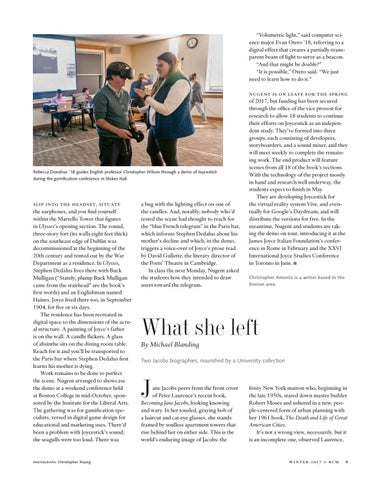
Rebecca Donahue ’18 guides English professor Christopher Wilson through a demo of Joycestick during the gamification conference in Stokes Hall.
slip into the headset, situate the earphones, and you find yourself within the Martello Tower that figures in Ulysses’s opening section. The round, three-story fort (its walls eight feet thick) on the southeast edge of Dublin was decommissioned at the beginning of the 20th century and rented out by the War Department as a residence. In Ulysses, Stephen Dedalus lives there with Buck Mulligan (“Stately, plump Buck Mulligan came from the stairhead” are the book’s first words) and an Englishman named Haines. Joyce lived there too, in September 1904, for five or six days. The residence has been recreated in digital space to the dimensions of the actual structure. A painting of Joyce’s father is on the wall. A candle flickers. A glass of absinthe sits on the dining room table. Reach for it and you’ll be transported to the Paris bar where Stephen Dedalus first learns his mother is dying. Work remains to be done to perfect the scene. Nugent arranged to showcase the demo at a weekend conference held at Boston College in mid-October, sponsored by the Institute for the Liberal Arts. The gathering was for gamification specialists, versed in digital game design for educational and marketing uses. There’d been a problem with Joycestick’s sound; the seagulls were too loud. There was
photograph: Christopher Huang
a bug with the lighting effect on one of the candles. And, notably, nobody who’d tested the scene had thought to reach for the “blue French telegram” in the Paris bar, which informs Stephen Dedalus about his mother’s decline and which, in the demo, triggers a voice-over of Joyce’s prose read by David Gullette, the literary director of the Poets’ Theatre in Cambridge. In class the next Monday, Nugent asked the students how they intended to draw users toward the telegram.
nugent is on leave for the spring of 2017, but funding has been secured through the office of the vice provost for research to allow 18 students to continue their efforts on Joycestick as an independent study. They’ve formed into three groups, each consisting of developers, storyboarders, and a sound mixer, and they will meet weekly to complete the remaining work. The end product will feature scenes from all 18 of the book’s sections. With the technology of the project mostly in hand and research well underway, the students expect to finish in May. They are developing Joycestick for the virtual reality system Vive, and eventually for Google’s Daydream, and will distribute the versions for free. In the meantime, Nugent and students are taking the demo on tour, introducing it at the James Joyce Italian Foundation’s conference in Rome in February and the XXVI International Joyce Studies Conference in Toronto in June. n Christopher Amenta is a writer based in the Boston area.
What she left By Michael Blanding
Two Jacobs biographies, nourished by a University collection
J
ane Jacobs peers from the front cover of Peter Laurence’s recent book, Becoming Jane Jacobs, looking knowing and wary. In her tousled, graying bob of a haircut and cat-eye glasses, she stands framed by soulless apartment towers that rise behind her on either side. This is the world’s enduring image of Jacobs: the
feisty New York matron who, beginning in the late 1950s, stared down master builder Robert Moses and ushered in a new, people-centered form of urban planning with her 1961 book, The Death and Life of Great American Cities. It’s not a wrong view, necessarily, but it is an incomplete one, observed Laurence,
w i n t e r 201 7 v bcm
9
a professor of architectural hisory at Clemson University, during a talk he gave in Devlin Hall on November 17. The deification of Jacobs as the amateur activist in a David-and-Goliath struggle with Moses has obscured an appreciation of Jacobs as a deep thinker who formed her social philosophies over decades of work. “Not only have I tried to put forward Jane Jacobs the intellectual,” Laurence told an attentive audience of about 100 people, “but I have tried to show how the activist work and the intellectual work were part of the same enterprise.” Laurence’s book is one of a pair of new books published in 2016, the hundredth anniversary of Jacobs’s birth, that have reexamined the evolution of her system of thought before and after her confrontation with Moses. Becoming Jane Jacobs focuses on the years from her childhood in Scranton, Pennsylvania, until the publication of Death and Life. Another book, by science writer Robert Kanigel, titled Eyes on the Street: The Life of Jane Jacobs, provides a more sweeping timeline, including extensive examination of the seven books in four decades that Jacobs wrote after her magnum opus, which generally receive short shrift. “This is not a book about city planning, this is a book about Jane’s mind,” Kanigel said in a talk on October 12 in the Thompson Room of the Burns Library. “A mind that just happened to change the world.” Both his and Laurence’s books draw heavily from the Jane Jacobs Papers at the Burns Library, which the author donated before her death. Jacobs was first invited to speak at Boston College in the 1970s by Carroll School of Management senior associate dean Richard Keeley, who was then the director of PULSE, an undergraduate program that focuses on social justice and responsibility, where Jacobs’s books were and remain part of the curriculum. The papers include early drafts of Jacobs’s books, as well as photos, articles, and correspondence that demonstrate her wide-ranging mind. One of Kanigel’s favorite items is a long letter Jacobs wrote her mother about the political economy of the Cayman Islands after she took a trip there in 1971. In it, she goes on about a single family farm’s crops and livestock
10
bcm v w i n t e r 20 1 7
Jacobs at a community meeting in New York’s Washington Square Park on August 24, 1963.
(and what the animals ate) and the water supply and the family’s trials with bulb breeding. “I found an infinite number of Janes in the archive,” Kanigel said. Laurence first visited the Burns Library some 20 years ago when, as an architecture student at the Harvard Graduate School of Design, he wrote his thesis on Jacobs’s work (he gave a copy to Jacobs that is in the collection). “The Jacobs Papers offer a window into her life and work like no other,” he said. “The papers are really nothing less than a time machine, and one that, as I continue studying her work and ideas, I expect to step back into in the future.” jacobs left scranton for new York in 1934, during the height of the Depression, and took classes at Columbia University. She never earned a degree. Her real education came as a writer, starting in 1941 at the Iron Age, a trade magazine for the metals industry. Her activism was tied to her writing from the beginning, said Laurence. During World War II, she published stories in the magazine about the decline of manufacturing and the loss of jobs in Scranton, also speaking out at rallies and successfully persuading several companies involved in the war effort to move to the struggling mining and steel town. After the war, she wrote for Amerika, a magazine published by the State
Department to disseminate U.S. news to the Soviet Union, before eventually finding a job as an editor at Architectural Forum in 1952. New York at the time was in an exciting moment of architectural change. Traditional and modernist architects alike agreed the city was in decline, said Laurence, “slum-filled, blighted, congested, diseased, overpopulated, and cancerous.” Modernist planners began pushing for renewal in the form of huge clearance projects to level neighborhoods and create superblocks of tall towers surrounded by open space to entice the middle class to stay in the city. In examining archives at the State Department and at the Rockefeller Archive Center (Jacobs received early research support from the Rockefeller Foundation’s urban planning program), Laurence was surprised to discover Jacobs had originally been a champion of such full-bore redevelopment, writing an early comprehensive article on the phenomenon in 1950 for Amerika, and continuing to sing its praises in articles at Architectural Forum. “She seems to have come rather late to her activism” and to her awareness of what was happening “in her own backyard,” Laurence noted. “[Not the person] you’d suspect of battling Robert Moses in the future.” Two seminal events changed that: In 1955, Kanigel related, Jacobs toured
photograph: Fred W. McDarrah / Getty Images
Philadelphia with a city official to examine before and after scenes of urban renewal. Streets that the official called blighted struck Jacobs as vibrant and full of life, with residents crowding the sidewalks and sitting out on their stoops. By contrast, the post-renewal streets seemed quiet and dead. “Where are all the people?” Jacobs asked, according to Kanigel. “What bothered her,” he continued, “wasn’t just that [the official] didn’t have an answer, but that he didn’t seem curious about the question.” A year later, an activist named William Kirk came into the offices of Architectural Forum incensed about Robert Moses’s ongoing efforts to bulldoze his East Harlem neighborhood. Already, 57 acres had been leveled to make room for 10 housing complexes, with more planned. At the time, nearly everyone at the magazine, as well as the public at large, supported the project, and a senior editor pawned Kirk off on Jacobs as a way to get rid of him. But Jacobs took Kirk seriously. “Jane listened, and when Jane listened, she really listened,” said Kanigel. Later, she toured the neighborhood with him, seeing the vitality of the community through his eyes. “Out of this, Jane saw a hidden order to the streets.” Jacobs gave a talk at Harvard shortly afterward, defending the traditional urban fabric over the chill of urban renewal, and became a celebrity in academic circles overnight. Legend has it that her masterwork, The Death and Life of Great American Cities, sprang from her mind fully formed, but she labored over the book for more than two years, at one point despairing that she had anything to say, said Laurence. In it, she railed against clearance projects and advocated for densely populated, diverse neighborhoods, where “eyes on the street” could help enforce order and foster community. The book had a mixed reception in the press. What clinched Jacobs’s fame was her activism, as she stepped to the forefront of the movement to save her own neighborhood of Greenwich Village from Moses’s plan for a Lower Manhattan Expressway, which threated to displace 2,000 families and 800 businesses and destroy Washington Square, a public park since 1827. While stories of “Mother Jacobs” chaining herself to buildings made head-
photograph: Lee Pellegrini
lines, that popular mythology is also incomplete. Behind the public image was a thoughtful tactician, who used her reporting skills to sleuth out documents exposing political corruption at the Planning Commission and Housing and Redevelopment Board; and who, along with her fellow activists, helped design plans for the West Village Houses, a cluster of five-story walkups built to human scale, which still exist. After she won the fight to save Greenwich Village, Jacobs continued to develop her philosophy in several books about the economics of cities and countries, as well as a more conceptual book called Systems of Survival, published in
1992. That book, said Kanigel, is organized as a Socratic dialogue, with a group of people discussing two competing moral philosophies she calls the Guardian Syndrome and the Commerce Syndrome (espousers of both have to work together to create a healthy society). “Of course, they were all just expressions of herself,” said Kanigel. Those books were not nearly as influential as Death and Life, but they show a mind constantly wrestling with new ideas, still working to change and improve the way we all live. n Michael Blanding is a Boston-based writer and author of The Map Thief (2014).
The singer JoJo David (1966–2016) A campus minister and a leader of the Liturgy Arts Group since 2003, JoJo David died at noon on October 18, 2016. He was 50 and had just undergone cardiac surgery (not his first experience of it) and was clinging to a heart-transplant waiting list. I met JoJo in 1996, when he was the vocal coach for the BC bOp! jazz ensemble, and my oldest son played piano in the band. JoJo was a delight, a man who encouraged high artistry as well as deep generosity in his students; a man of faith, love, laughter, and of course music. And then in the summer of 1998, at age 33, he was diagnosed with a savage variety of non-Hodgkin’s lymphoma. Over 14 months, while enduring nine rounds of chemo and 28 of radiation and a Hail Mary bone marrow transplant, JoJo sent regular emails to about 160 friends, keeping us informed of his ever-changing circumstances. Each began with “Hello my friends” and delivered the medical news—blood counts, pneumonia, hospitalizations—but always with humor. “If I hear the words ‘Plan B’ one more time, anger will ensue. At last count, we’re actually on Plan G.” It got worse, but if he had days of despair, as he must have had, he never showed it in his communications. A selection of the emails was published in the Spring 2000 edition of BCM, under the title “Hello My Friends: The Medical Bulletins of JoJo David.” JoJo’s medical people killed the cancer and saved him but warned he’d never be able to sing again. He proved them wrong, recording an album of jazz and pop standards five years later. Their second prediction, that his heart would fail as a consequence of the treatment he’d received, proved sadly prescient. He leaves his wife, Anne Marie, his daughter, Madeline, his mother, Zenaida David, and his brothers Robert and Lonnie David. JoJo David’s ministry was music, and it so happened that music was his life calling, which made his life—as a singer, composer, teacher, pop musician, liturgical musician—a ministry in its entire. A concert and vigil service in St. Ignatius Church drew about 500 people, most of whom, it became clear, knew how to sing. Someone played a Baptist hymn on the church organ. “Thro’ all the tumult and the strife / I hear the music ringing; / It finds an echo in my soul— / How can I keep from sing—Ben Birnbaum ing?” That was JoJo.
w i n t e r 20 1 7 v bcm
11
First chairs photographs by gary wayne gilbert
A
Penelope Ismay
mong the innovations established
12
bcm v w i n t e r 20 1 7
History Cooney Family Assistant Professor Morrissey College of Arts and Sciences Ph.D.: University of California, Berkeley Representative publication: “Between Providence and Risk: Odd Fellows, Benevolence and the Social Limits of Actuarial Science, 1820s–1880s,” Past & Present (February 2015) A Michigan native, Ismay arrived at Boston College in 2013. She is the past recipient of a Mellon Fellowship and an Anglo-American Fellowship at Cambridge University. A graduate of the U.S. Naval Academy, she served five years at sea with two tours in the Persian Gulf, as an officer of the deck on a destroyer and an aircraft carrier.
“
I’m interested in questions of social responsibility, in particular the question of who owes what to whom in a society, and why. My focus is Britain in the late 18th century, when the Industrial Revolution was shifting the economic base from agriculture to manufacturing and triggering a large migration of people from rural areas to cities like Manchester and Liverpool. This massive movement of people whose understanding of their rights and responsibilities had been parish-based—where the rich owed charity to the poor, and the poor owed the rich hard work and deference—threw the well-established social network into disarray. To understand how people in that era created new forms of reciprocity, I study mutual aid organizations like the Odd Fellows and the Ancient Order of Foresters, so-called friendly societies that by the 1870s had four million members. They were trying to figure how to provide a safety net in a world where the needy were no longer one’s neighbors, grappling with the problem of how do you trust strangers? It’s an important issue today, and not only because of immigration. Modern societies are so complex; being among strangers is the norm.
“
by the recently completed $1.6 billion Light the World campaign were 12 endowed professorships reserved for assistant professors. Unlike most academic chairs, which honor high-achieving senior faculty, these positions, appointed by the University president on the recommendation of the provost, recognize emerging academic stars and provide funding to support their research projects. The position is held until the faculty member is (or is not) awarded promotion to associate professor and tenure. Endowed professorships have a long history in this country. The Hollis Professorship of Divinity, the oldest endowed chair in North America, was established at Harvard in 1721 by an English merchant (among its perks is the right to graze a cow in Harvard Yard). The named assistant professorship, a more recent invention, has been established at such universities as Brown, MIT, and the University of Pennsylvania for the purpose of attracting exceptional young faculty and anchoring them, the better to fend off poaching efforts by competitors. At Boston College between 2006 and 2016, the count of tenured and tenure-track faculty grew by 143, to a total of 782 full, associate, and assistant professors. Included in this figure are 67 additional assistant professorships (for a total of 214). In their own words, the first six endowed assistant professors—six positions remain to be awarded—describe their interests. —Thomas Cooper
w i n t e r 20 1 7 v bcm
13
14
bcm v w i n t e r 20 1 7
Jennifer Erickson Political science White Family Assistant Professor Morrissey College of Arts and Sciences Ph.D.: Cornell University Representative publication: Dangerous Trade—Arms Exports, Human Rights, and International Reputation, Columbia University Press (2015) Before coming to Boston College in 2010, Erickson, a native of Minnesota, was a postdoctoral research fellow at the John Sloan Dickey Center for International Understanding at Dartmouth College. In 2015 she received a Catalytic Research Grant from the International Studies Association. For the 2016–17 academic year, she is a Nuclear Security Faculty Fellow at the Center for International Security and Cooperation at Stanford University. In July 2016, Boston College promoted her to associate professor with tenure.
“
I study the international politics of weapons. My last project was on the UN Arms Trade Treaty of 2014 and agreements by other international institutions that seek to establish rules to guide how countries conduct their conventional arms trade. These rules are meant to stop weapons shipments to countries that would undermine peace or use them to commit human rights violations. The term is ‘humanitarian arms export controls.’ Why, despite decades of rejecting cooperation over arms export controls, did countries change their minds? We don’t necessarily think of cooperation as the default in international politics. And yet it’s happened on this issue since the end of the Cold War, and in particular since 2000. My current project starts with the observation that every time we get a major shift in weapons technology—from the atomic bomb at the end of World War II to the emergence of cyber weapons and drone technologies today—it prompts debates about what is legal, what is moral, what is politically savvy, what is militarily effective, and who gets to decide. I’m looking at contemporary debates, as well as two historical examples, beginning with World War I, when countries debated whether to ban both poison gas and submarines as ‘inhumane’ weapons. w i n t e r 20 1 7 v bcm
15
“
16
bcm v w i n t e r 20 1 7
John Christianson Psychology Gianinno Family Assistant Professor Morrissey College of Arts and Sciences Ph.D.: University of New Hampshire Representative publication: “Posterior Insular Cortex is Necessary for Conditioned Inhibition of Fear” (with Allison Foilb, Johanna Flyer-Adams, and Steven Maier), Neurobiology of Learning and Memory (August 2016) A Connecticut native, Christianson joined Boston College in 2013, following seven years as a research associate at the University of Colorado, Boulder, Center for Neuroscience. His research has received funding from the National Institute of Mental Health, the Brain and Behavior Research Foundation, and the Eric and Irene Simon Foundation.
“
I am a neuroscientist, and my aim is to identify connections between biological processes and behaviors. With diseases such as autism and schizophrenia in mind, I look at the brain mechanisms that permit us to control our emotional responses—determining when it’s appropriate to be afraid, when to feel safe—and to identify emotions in others. Studying rats, whose brains are similar on a lot of levels to humans’, my lab asks, How is it that one animal is able to detect that another has experienced something stressful? We focus on the brain area called the insular cortex, which is just above the ear. It receives input from all our senses and is connected to structures such as the amygdala that tell us how to react to stimuli: Is a situation safe or not? We seek to link characteristics of an individual cell’s ‘action potentials’—the neural impulses that are fundamental to cellular communication in the brain—to sophisticated behaviors and decisions, and our lab is a melting pot of technologies and disciplines. We have a biochemistry bench, we use genetic tools that allow us to interrogate specific populations of neurons, and we employ a range of behavioral and pharmacological approaches. This integrated methodology is reflected in our students, whose majors include psychology, biology, biochemistry, and physics. w i n t e r 20 1 7 v bcm
17
“
Natalya Shnitser Business law David and Pamela Donohue Assistant Professor Boston College Law School JD: Yale University Representative publication: “Trusts No More—Rethinking the Regulation of Retirement Savings in the United States,” Brigham Young University Law Review (Summer 2016) Shnitser is a graduate of Stanford University, and she served as editor-in-chief of the Yale Journal on Regulation at Yale Law School. After a stint at a law firm in New York, she returned to New Haven as an associate research scholar and as the executive director of the Yale Center for the Study of Corporate Law. Shnitser came to Boston College in 2014.
“
I’m interested in retirement security and the legal institutions that support it. We have a federal law in the United States—the Employee Retirement Income Security Act of 1974—that governs how private sector pension plans are structured and funded. There is no such overarching regime for the public sector. You basically have 50 different sets of rules across the states. That struck me as a really fruitful area for empirical research. I did a study of the governance mechanisms for more than 100 public pension plans. For example, how is the annual contribution to the plan determined? Is the amount set in statute or does the statute delegate control to a pension system board? It turned out delegation was associated with better funding discipline. I’m working on a project now that looks at how states and municipalities approach retiree health benefits. In general, we’re seeing a period of experimentation in this country at the state and local level. Whereas employers have been the traditional intermediaries in setting up retirement plans for workers, a number of states—including California and Illinois—are in the process of setting up state-administered plans for private sector workers. My hope is that new developments will draw on and contribute to research on plan design and governance.
“
18
bcm v w i n t e r 20 1 7
w i n t e r 20 1 7 v bcm
19
Hristina Nikolova Marketing Diane Harkins Coughlin and Christopher J. Coughlin Sesquicentennial Assistant Professor Carroll School of Management Ph.D.: University of Pittsburgh Representative publication: “Men and the Middle—Gender Differences in Dyadic Compromise Effects” (with Cait Lamberton), Journal of Consumer Research (October 2016) Bulgarian-born Nikolova came to the United States alone when she was 18, to attend Ramapo College. She is the recipient of the American Marketing Association’s SIG Rising Star Award and her research has been supported by the Academy of Marketing Science. She joined the Carroll School in 2014.
“
Most consumer behavior research has focused on individual decision-making. I’m interested in joint decision-making. My dissertation examined how couples make decisions that involve an element of self-control—say, managing their finances. People expect that if one partner has strong self-control, the pair will make more disciplined decisions. But we found that ‘mixed’ couples, in which one partner has demonstrably low self-control, while the other is highly disciplined, are as bad at decision-making as pairs in which both parties possess the trait of poor self-control. It turns out the more-disciplined individual is willing to agree with his or her partner for the sake of long-term harmony. I’ve also looked at decision-making in pairs with various gender compositions. It’s been well-documented that solo consumers tend to select a middle option when given a set of choices—middle price, middle safety—when shopping for a car, for instance. In my research, I demonstrated that two women also exhibit this tendency, as do mixed-gender pairs. When two men make a decision jointly, however, they choose extreme options more often than any pair or any individual. I have started by studying the smallest group possible, two. But my long-term plan is to explore the decision process in bigger groups—groups of friends, management teams, faculty committees.
bcm v w i n t e r 20 1 7
“
20
w i n t e r 20 1 7 v bcm
21
22
bcm v w i n t e r 20 1 7
David Miele Counseling, developmental, and educational psychology Buehler Assistant Professor Lynch School of Education Ph.D.: Northwestern University Representative publication: “How Students’ Perceptions of the Source of Effort Influence Their Ability Evaluations of Other Students” (with Muenks and Wigfield), Journal of Educational Psychology (April 2016) Born in Manhattan, Miele studied philosophy as an undergraduate at Columbia University. He subsequently worked at the Columbia Center for New Media Teaching and Learning and for a New York-based educational software company. He has received funding from the Society for Personality and Social Psychology and from the Teagle Foundation, which supports research on liberal arts education. Miele joined Boston College in 2013.
“
In my research I examine students’ beliefs about their ability, learning, and motivation, as well as how these beliefs influence their engagement in academic tasks. I primarily study college students, but I’m also interested in the developmental period of late elementary school, between third and fifth grade. In a typical study, we might give students text passages to read or math problems to solve, measure how much effort they are willing to devote to the task, and assess their beliefs about ability. There has been much research on ‘fixed mindsets’— the belief that intellectual ability is innate and cannot be changed—versus ‘growth mindsets’, which hold that ability can be improved through hard work. Students with a growth mindset exhibit more adaptive and resilient behavior in the face of challenge or failure. In addition to looking at how these mindsets work in students, I have begun to examine how the mindsets of elementary school teachers might affect the ways in which they interact with their students. I’m also involved in a collaborative grant from the James S. McDonnell Foundation, with researchers at five other universities. My role is to determine what motivates students to use certain study habits—self-testing, for instance—that we know are effective. w i n t e r 20 1 7 v bcm
23
“
The
Legacy 24
bcm v w i n t e r 20 1 7
When Séamus Connolly retired from Boston College in 2015, he left behind a personal contribution to the near-three-century-old effort to preserve traditional Irish music. As with his predecessors, what he’s saved is what he’s loved
by mick moloney Connolly, third from left, on fiddle, and fellow Irish musicians rehearse for the 1991 documentary The Music Makers: Séamus Connolly and Friends.
photograph: Higgins and Ross / John J. Burns Library
w i n t e r 20 1 7 v bcm
25
I
rish music is among the most
prominent global representations of Irishness. Genres range across traditional, popular, and classical music—the fifes, drums, flutes, and lambegs of the Northern Unionists; the rock sounds of bands such as U2 and the Pogues; the musical fusions created by composers such as Bill Whelan, of Riverdance; and the magisterial collaborations between traditional and classical musicians spearheaded by innovators like Mícheál Ó Súilleabháin and Shaun Davey. But it is traditional Irish instrumental music that remains the core: music played on instruments such as the fiddle, uilleann (pronounced “illen”) pipes, flute, concertina, accordion, tenor banjo, harp, and tin whistle—music that’s been preserved for centuries in efforts dating back to 1724, when the father-and-son team of John and William Neal of Dublin, instrument makers and concert promoters, published the first volume of Irish traditional music, the 49-melody A Collection of the Most Celebrated Irish Tunes: Proper for the Violin, German Flute or Hautboy. Nearly 300 years later, a new work of preservation and dissemination, The Séamus Connolly Collection of Irish Music, has been published by the Boston College Libraries. Launched in October 2016, this online compilation features traditional music collected and curated by master fiddle player Séamus Connolly. A renowned teacher, impresario, and composer, Connolly was the Sullivan Artist in Residence at Boston College at the Burns Library from 2004 until his retirement in 2015. He is also a legendary player of 20th-century Irish traditional music, winning 10 all-Ireland solo championships, an achievement that seems unlikely to be surpassed. In 2013, the country he adopted in 1976 declared him a National Heritage Fellow, the most distinguished award bestowed by the United States upon practitioners of traditional arts. The collection developed by Boston College offers 338 audio recordings, featuring more than 130 musicians, with accompanying commentary, stories, musical transcriptions,
During the 19th century, Irish antiquarians hurried to preserve a national art that appeared to be in danger of disappearing. Their collections, and others published in the 20th century, have been a primary resource for the global renaissance of Irish music. 26
bcm v w i n t e r 20 1 7
and several specialized essays by scholars and music journalists. While the largest Irish music archives in Ireland are severely constrained by copyright law, the materials on the Connolly Collection site can be downloaded or printed under a Creative Commons license, thanks to the foresight of Connolly and his librarian collaborators. Scores of traditional music collections have been produced since the publication of the Neal volume. During the 19th century, inspired by the nationalistic movements sweeping Europe, earnest Irish antiquarians hurried to preserve a national art that appeared to be in danger of disappearing. Their work was not in vain. Over the past 50 years, these collections, and others published in the 20th century, have been a primary resource for the global renaissance of Irish music. It’s not volume that makes the Connolly Collection special. The 338-piece grouping is dwarfed by 1909’s Pigot Collection—“842 Irish Airs and Songs Hitherto Unpublished”—which was assembled by Dublin lawyer John Edward Pigot (1822–71). And the tunes amassed by Canon James Goodman (1822–96), a Church of Ireland minister who himself played the pipes and preached in Gaelic, number nearly 2,500. What the Connolly Collection offers, however, is depth, Connolly’s singular taste, and a manifestation of its time, which is pretty much the span of the 72-year-old Connolly’s life, at least from the moment when he first heard Irish music performed as a young child and, according to family lore, climbed a stage to stand with the musicians and pretend to play a fiddle with them. The music is sorted by categories. In dance: reels, barn dances, flings, jigs, slides, highlands, schottisches, clog dances, strathspeys, waltzes, polkas, hornpipes. In non-dance: airs, marches, planxties. The most arcane category is that of galliard, a form popular in Europe during the 16th century. A few songs are also offered and one instance of “mouth music”—a form of vocalizing that mimics the sound of instruments. The audio recordings are sometimes field samples but more frequently were made by contemporary performers selected and enlisted by Connolly. These range from such eminences as the globally renowned Clare fiddler Martin Hayes to gifted locals, such as the Maine flute player Nicole Rabata. Complementing the entries, Connolly offers musical transcriptions and a reflection on each tune or song, which more often than not involves a meeting with the composer or the person from whom he learned the music or both. though often thought to be representative, collections of Irish music assembled over the past two centuries have invariably been filtered through the aesthetic sensibilities of the curators. If the Irish painter George Petrie
photographs: (clockwise from top left) John J. Burns Library; Higgins and Ross / John J. Burns Library;
clockwise from top left: (1790–1866) thought a song or tune was Connolly, rather, adheres to an aesThe Connolly Collection includes weak, he simply did not include it in his thetic rooted in what some musicians call recordings by Dan Sullivan’s important 1855 Collection of the Ancient “The Pure Drop”—the perceived core of Shamrock Band (with five songs), Music of Ireland. Likewise, when the classithe tradition. And judgment in this arena seen here circa 1928; button accorcal musician Edward Bunting (1773–1843), of Irish music, which is without an inherdionist Paddy O’Brien (six reels), another devotee of “ancient Irish music,” ited canon of formal criticism such as seated with Connolly, circa 1973; Len Graham (a song of farewell), thought a tune to be an inferior recent comexists for Western classical music, comes bearded, with fellow Northern position, he left it out of the seminal threedown to an individual’s informed taste and Ireland singer Joe Holmes in 1977; volume collection he published between discernment. and Laurel Martin (one jig and one 1796 and 1840. polka), playing alongside Connolly, Working in that tradition, what Connolly identifying the pure drop can be circa 1990. offers is a selection of tunes and songs fila quixotic, even puzzling adventure. The tered through the aesthetic sensibility of a late Frank Harte, one of Ireland’s most master musician with impeccable taste. Seekers of top-40 noted 20th-century singers, had an exquisite sense of Irish folk tunes, or songs that Irish traditional musicians taste when it came to styles in Irish traditional singing. might consider common or overplayed, should look elseOrnamentation was important, he would say to me, but only where. in some songs. Slow songs might need a different approach
:Joe Dowdall / Irish Traditional Music Archive; Harry Brett / John J. Burns Library
w i n t e r 20 1 7 v bcm
27
clockwise from top left: than fast songs. But not always. Tone, timantiquarian. There are as many new comFlutist Peadar O’Loughlin, bre, and pitch might be important, but they positions and songs in his collection as Connolly, and Paddy Canny (1919– were not the main thing. Harte didn’t care there are ancient ones, and as many young 2008), in the late 1980s. Singer too much for “pretty” or over stylized singmusicians as veterans. Robbie McMahon (1926–2012), in ing, but then he would make exceptions for 2012. The author, on banjo, and Connolly, in 1981. Julia (1914–97) certain singers. After maintaining that the the séamus connolly collection and John Clifford (1915–81) in quality of voice wasn’t really that important is a record not just of music and its social 1963, the year Julia won an allin traditional Irish singing, he would then and historical contexts, but of Connolly’s Ireland fiddle championship. describe somebody as having a “good hard life as a musician. The recordings themvoice.” selves manifest the relationships Connolly Similar considerations are in play when one is trying to built with fellow players over the decades. These friendships come to terms with the notion of excellence in traditional are why the participants agreed to donate their talents, to instrumental playing. Virtuosity, ornamentation, tone, techcreate original performances, and to make their art available nique, and intonation are among the variables, but how they without charge. are valued depends on one’s taste—and hopefully a sensibilAmong the recordings are some that seem to me parity that has been honed by years and experience. ticularly important. Of the great musicians who played Irish As did Harte, Connolly has such years and such expemusic in Boston over the past century, none was more celrience. It should be noted, however, that Connolly is no ebrated that Dan Sullivan (1874–1948) who was a Tin Pan
28
bcm v w i n t e r 20 1 7
photographs: (clockwise from top left) Higgins and Ross / John J. Burns Library; Colm Keating;
Alley songwriter, piano player, and leader of Dan Sullivan’s Shamrock Band, which recorded prodigiously in the 1920s and early 1930s. His band members numbered some of the finest Boston musicians of the early 20th century. The Connolly collection brings his music alive through no fewer than five stellar recordings dating from the 1920s, and new recordings of pieces such as “Dan Sullivan’s Favorite,” played beautifully by New York uilleann piper Jerry O’Sullivan who also plays on nine other pieces in the collection. On both sides of the Atlantic, Irish traditional music was essentially a male-dominated tradition up to the 1970s. One of the few women musicians who played Irish music in public prior to that time was Julia Clifford, a redoubtable County Kerry woman with the strongest of personalities. The first piece of dance music in the Connolly collection features her playing a lovely reel called “Old Torn Petticoat.” The story Connolly tells of the effect on his life of meeting her underscores, I think, his main rationale for spending more than a decade on this challenging project: gratitude. He writes on the website, “I believe it is important to feature master fiddle player Julia Clifford and her son Billy playing the first dance tune in this collection. It was the first reel that they recorded for me that night in Tralee over 50 years ago, when Julia invited me to record herself and Billy playing tunes she thought I might not have. When they played a tune I admitted to never having heard, she would ask me in surprise, ‘You don’t have it, do you?’” Connolly continues: “As I look back now, I realise that it was an act of musical generosity to a young musician, which perhaps contained within it the inspiration not only for this project, but also for how I, throughout my life as a musician and teacher, have been driven and encouraged to do my utmost in passing along to others this incredible and astonishing oral and aural tradition.” The collection also features four songs from the charismatic singer Robbie McMahon, who like Connolly came from east County Clare, including “Spancilhill,” one of the Clare anthems of the emigrant experience. Connolly is again poignant both in his knowledge of the music and in his warm recollection of his past. “Spancilhill in east County Clare gives its name to this song which I first heard around 1958, sung by Robbie McMahon, who was himself from that very same neighbourhood. Robbie gave us his updated rendition during a wonderful afternoon of singing in his home a few years ago, after Mrs. Maura McMahon, in her usual manner of hospitality, served us a fine Irish meal. Robbie told my friends and me that Michael Considine from Spancilhill wrote the song. Mr. Considine was born around 1850 and immigrated to America as a young man. His intent was to bring his sweetheart to America when he had saved enough money for her passage. He passed away around 1873, in California, but the :John J. Burns Library; Brian Shuel / Redferns / Getty
Connolly adheres to an aesthetic rooted in what some musicians call “The Pure Drop”—the perceived core of the tradition. And judgment in this arena comes down to an individual’s informed taste and discernment. song found its way back to County Clare and was popularised by McMahon’s singing of it.” Connolly concludes his essay on how the collection came to be, and the troubled stages he went through during a decade of work on the project, with a reflection on “The Parting Glass,” a classic song of farewell popularized by Tommy Makem and the Clancy Brothers in the 1960s, but with roots that are believed to date back to 17th-century Scotland. It is performed for the collection by legendary Northern Ireland singer Len Graham. “‘The Parting Glass,’” Connolly writes, “[brings] to mind many wonderful moments of joy and laughter as I reminisce on the years of recording and collecting for this project. These memories, the songs and music, will forever remain in my heart. Not wanting to say goodbye, I would prefer something a little more upbeat, in the spirit of what my father always said to me as I was leaving home: ‘Never say goodbye, always say Cheerio.’ So, I have chosen Len’s song as a way of saying not goodbye, but for now, Cheerio.” Who will benefit most from this treasury? To some degree anyone interested in Irish and Irish-American history and culture. But its enduring beneficiaries are likely to be scholars of Irish music and musicians and singers. Connolly has built a storehouse of tunes he personally respects—that seem to him well worth preserving—and while many of the tunes will be unfamiliar to listeners, the fact is that many will now end up in the repertoires, recordings, and concert performances of musicians over the next decades, who will then themselves determine what should be passed on. This is the folkloric tradition at work. n Mick Moloney is a folklorist, musician, and professor of music and Irish studies at New York University. He is the author of Far From the Shamrock Shore: The Story of Irish Immigration Through Song (2002) and Across the Western Ocean: Songs of Leaving and Arriving (2016). The Séamus Connolly Collection of Irish Music project team at Boston College Libraries included Irish music librarian Elizabeth Sweeney, digital archives specialist Jack Kearney, digital publishing assistant Nancy Adams, senior digital scholarship librarian Anna Kijas, web design and communication specialist Chris Houston-Ponchak, and web applications developer Ben Florin. The Séamus Connolly Collection may be accessed at connollymusiccollection.bc.edu.
w i n t e r 20 1 7 v bcm
29
ENCOU 30
bcm v w i n t e r 20 1 7
 N T E R S THE THOMAS MORE APARTMENTS PROMISE MORE THAN BEDS, DESKS, AND VENDING MACHINES BY ZACHARY JASON
PHOTOGRAPHS BY LEE PELLEGRINI w i n t e r 20 1 7 v bcm
31
32
bcm v w i n t e r 20 1 7
STANDING IN A GLASS-WALLED STUDY LOUNGE IN THE recently opened Thomas More Apartments, George Arey points toward the rubble remains of Edmond’s Hall, which was demolished last summer. “We don’t like to use the term dorm, we say residence hall,” says Arey, associate vice president and director of the Office of Residential Life. “But Edmond’s was a true dorm.” Opened in 1975, the 240,000-square-foot Edmond’s housed 790 students and a single study lounge. The five-story Thomas More, located at the corner of Commonwealth Avenue and St. Thomas More Drive, has the same square footage, but houses slightly more than half that number—490 students—and features 11 study rooms, six two-story lounges, three soundproof practice rooms, two seminar rooms, a reflection and prayer room, and a 90-seat conference room. These spaces are open to residents and may be reserved by student groups. Most contain floorto-ceiling windows with views of Lower Campus, Gasson Tower, and Brighton Campus. The two buildings illustrate the evolution of housing on the Heights. Since the first three brick-and-timber, barracksstyle dormitories (Claver, Loyola, and Xavier) were built on Upper Campus in 1955, the University has inched toward a more “formative” approach to its students’ living spaces. in march 1963, joseph appleyard, sj, ’53, ph.l .’58 (and now H’12), was the prefect of Gonzaga Hall. He wrote a letter to the president’s office that addressed deficiencies he saw in Boston College undergraduates. They were “unimaginative and lacking in initiative,” “intellectually passive,” “waste[d] enormous amounts of time,” and “immoderately conformist.” According to Appleyard, these flaws were not rooted in academic programs or in the University’s Jesuit mission. Rather, he said, “many of these problems can be traced to the corridor-type of construction” of the residence halls. By then the University offered eight dormitories, all clustered around O’Connell House, and most of them lacked common spaces save for dim, narrow hallways full of “noise and
previous pages, clockwise from top left: Meetings of Eagle Model UN (Lounge 215), the Own It Summit (Commons 109), the Asian Caucus (Seminar Room 119), and Arrupe Dominican Republic team (Lounge 215). opposite page, clockwise from top left: Taken, during study days—Lounge 516A, Study Room 502, Lounge 516, the fifth-floor central corridor, Lounge 416 at 7:30 p.m., and 45 minutes earlier.
disturbance” and “indiscriminate vandalism.” “It is very difficult,” Appleyard punned, “to conceive of anything but a ‘common life’ being lived in this situation.” Moreover, there had been a tradition of Jesuit prefects regimenting times to rise and retire, eat, attend Mass, and study, during which “students must avoid all unnecessary moving about and remain in their rooms,” according to a 1955 handbook. Forbidden were “books of questionable character” and all “lady visitors, even mothers and sisters.” Appleyard, who later became an English professor and the University’s first vice president for mission and ministry, suggested loosening some of the more severe rules, including residents’ nightly sign-in. The young Jesuit also proposed improvements for future residence halls. To help foster “intellectual maturity,” each should offer “quiet refuges for study and reading” and recreation rooms for a “diverse program of activities . . . discussions, musical groups, workshops.” Over the next half century, the University seemed to heed this instruction, albeit in fits and starts. While plans for twin 22-story towers on Lower Campus were eliminated a month after they were unveiled in 1969, the ramshackle (and beloved) Mods, a “temporary” solution to a housing shortage in 1970, still offer shower closets and bedrooms with one shared desk. But 1988 brought Vouté and Gabelli and their duplexes with spacious living rooms. Vanderslice and 90 St. Thomas More Drive, both built in 1993, include top-floor lounges, a piano room, and a study room on every floor. The granite and limestone Stayer, the last residence hall built before Thomas More, in 2004, features a top-floor, sky-lit commons and two stacks of glass study lounges from the second floor to the sixth floor. Since 2013, the University has renovated 15 residence halls, adding rooms dedicated to study, formal meetings, and reflection. Completed in the spring of 2016 on the former site of More Hall, Thomas More Apartments is a product of the Light the World campaign’s strategic initiative to improve student formation, which Appleyard co-led. Portraits of this residence’s life follow. w i n t e r 20 1 7 v bcm
33
BREAKING THE BUBBLE 7:00–7:45 p.m., November 3, Commons 109 Training session for the third annual Own It Summit, a student-run day of panel discussions and workshops on personal and professional development for women
Just off the Thomas More Apartments’ main lobby, the 1,400-square-foot commons is the largest gathering space in the new residence hall. It features 25-foot-high ceilings, a catering station, a 65-inch flat-screen TV, creamy walls still awaiting decisions on art, and alcoves lined with beige felt lounge chairs. At the center of the commons are eight mahogany veneer tables set up in a rectangle at which a score or so of undergraduate women sit and introduce themselves with “fun facts.” Ali Willet, a junior from Columbus, Ohio, says she can name every U.S. president, one to 44. “But I’m not going to do it now.” “Oh, yes you are,” says Isabella Valentini ’17, cochair of the summit. Willet rattles them off rapid-fire, 34
bcm v w i n t e r 20 1 7
“PolkTaylorFillmorePierce.” Not everyone pays attention. Some study the meeting agenda. But the applause and whoops bounce off the cavernous ceiling at the recital’s conclusion. Among other facts that emerge: Bea Lynch ’18, a premed student and theology major from Connecticut, has never eaten a hamburger; Scituate, Massachusetts native Sam Murphy ’19 has never eaten a hot dog. And an infant Valentini once modeled for Huggies. The women work through the agenda: what to do as volunteers. The four cochairs explain how to direct participants from the keynote address (Riham Osman of the Muslim Public Affairs Council, on “owning” her Muslim-American identity) to the various workshops (e.g., “Fight Imposter Syndrome to Boost Your Confidence and Career” and “How to Turn a Passion into a Post-College Profession”). They brainstorm questions to ask student registrants at roundtables during the summit’s luncheon: What does owning your life mean to you? What’s one thing from the keynote that you can apply to your life? Who do you know who owns her life, and how does she do it? Thirty of 330 total tickets to the event remain unclaimed, and Valentini, gesticulating with a pen, challenges each volunteer to recruit at least one
opposite: The glass doors open onto the building’s central courtyard. Behind the rear wall is a catering prep station for larger functions. above: From left—Lily Peng ’17, Bea Lynch ’18, Lara Lasic ’18, and Isabella Valentini ’17. left: From left—Molly Davis ’18, Lasic, Rose Anderson ’19, and Ali Willet ’18 after the meeting.
student in the next 24 hours. Fellow cochair Lily Peng ’17 explains the summit’s schedule. English and communication major Rose Anderson ’19 stretches her arms wide when she says last year’s summit pulled her from the “BC bubble” and
“opened my vision to the future.” The room’s floor-to-ceiling interior windows open onto a hallway on the second floor, where the occasional male student glides by at a sloth’s pace to take a gander at the scene below. At 7:45, the women disperse. One walks out to the main lobby. She tosses her pink bookbag, with a blue “I’m With Her” button pinned to the back, on one lounge chair, curls up on another, and pulls out a highlighter and a printout from Scientific American. w i n t e r 20 1 7 v bcm
35
36
bcm v w i n t e r 20 1 7
ELECTION RESULTS 5:30–7:30 p.m., November 11, Seminar Room 119 Asian Caucus executive board weekly meeting, open to representatives of the Chinese Students Association, Japan Club, Korean Students Association, Philippine Society, South Asian Student Association, Southeast Asian Student Association, Taiwanese Cultural Organization, and Vietnamese Students Association
As they arrive, the 13 board members push some of the rolling white tables to the walls of the 860-square-foot room and arrange the rest into an intimate square. Out come laptops festooned with New England Patriots stickers, the flag of Thailand, and sayings like “Smile More” and “Death by Pizza,” this one on the laptop of Simi Siddalingaiah ’19, who, as it happens, is eating pizza. Tomorrow is caucus copresident Seok Won (Steve) Hong’s birthday. To celebrate, the group—seven women and six men—lob chocolate covered blueberries across the room in high arcs at each other’s mouths (only a third of the pitches miss their mark). As is often the case in these window-walled meeting rooms, passing friends occasionally stop to knock on the glass and wave. “Ignore them,” instructs Hong ’17. They move into discussion of the evening’s main agenda item: how, if at all, should the Asian Caucus respond to the election of Donald Trump? Gaoyuan Liu ’18, codirector of policy and political initiatives, notes that FACES, a student organization that hosts dialogues on race, invited the Caucus, as the point of connection for eight student organizations, to join several other cultural clubs for an on-campus “solidarity” march the following week. “It’s not against [Trump’s] presidency,” he says, “but unity against what he’s said about minorities.” An English and economics major from Massachusetts, Liu is a member of the Chinese Students Association. “We should make it clear to the Caucus that it’s about solidarity, not a protest,” says freshman formation codirector and Taiwanese-American Jin (Frank) Huang ’17. “We don’t want to marginalize any Trump supporters.” “It may help if we release our statement before the march,” says copresident Yoon-Shin (Clara) Lee ’17, a sociology and applied psychology major from San Jose, California, who sits cross-legged and barefoot on her chair. At that, they turn to their screens and open a shared Google Doc, on which Lee has drafted a post-election statement to the full Caucus. opposite, above: From left are Henry Jun 19, Minna Wang ’19, and Simi Siddalingaiah ’19. opposite, below: Gaoyuan Liu ’18 (gray hat) brings up a post-election “solidarity” march.
“What’s the point of a mutual statement like this?” asks Huang, sitting upright with his hands on the top of his head. “If we’re not saying anything substantive, why say anything?” Hong agrees, observing that post-election emails have already been distributed by the deans of the Carroll School of Management and the Morrissey College of Arts and Sciences (other deans also communicated with their students). “There are plenty of messages out there,” he says. “We’re already three days out. We shouldn’t just say something for the sake of saying it.” “But Asian-Americans don’t have that many outlets of support, or many voices speaking for them,” says a softspoken Liu. “I think just offering ourselves as a safe space of support for everyone is a statement itself.” “But I think the word support is taking a side,” says media chair and finance and information systems major Henry Yun ’17, tugging the hood of his blue sweatshirt more tightly around his head. They reach an impasse. Lee decides to work through the rest of tonight’s to-do list, which includes planning a holiday charity drive, deciding which colors the Caucus should wear for their upcoming yearbook portrait (black, white, and maroon as always), which faculty members they should invite to speak at a gathering during study days about AsianAmericans and mental health (psychologists Ramsay Liem and Liane Young), and how to promote a panel discussion on Asian representation in Hollywood (create a video for social media, send the Heights a letter to the editor). Service and education director Alexander Thu ’19 sips alternately from bottles of milk, water, and Coke (he will finish all three before the meeting’s over). Community relations director Joon Yoo ’17, who lives in the building, scoots out with a white mesh bag in hand to move her laundry from a washer to a dryer. The group waits for her to return before they take up the election again. They share stories of acidic in-class arguments between students—one professor, it’s said, had ended class early when a female Clinton supporter and a female Trump supporter engaged in a shouting match. “Our duty is to be a resource to our community,” says Lee. “I think the purpose of our message is that we’re here for everyone.” On Sunday night, the executive board released a 300word statement via email and Facebook. In addition to directing students to resources including the Women’s Center, University Counseling Services, and Campus Ministry, the board wrote, “Whatever emotions you may be feeling at this time, they are valid. But also, we must shy away from marginalizing people for their beliefs. . . . We must remember that diversity is not synonymous [with] division. At this time, we must evaluate how this all affects the Asian-American community, and how we continue to move forward as one.” w i n t e r 20 1 7 v bcm
37
SHUTTLE DIPLOMACY 2:00–3:30 p.m., November 13, Lounge 215 Model United Nations political affairs team biweekly meeting
Hunched in a tan leather lounge chair, grapefruit-sized headphones covering his ears, a lone student types on a laptop. The 550-square-foot, two-story glass cube on the second floor is all his. Out the floor-to-ceiling windows the view is peaceful—burgundy-leafed tulip trees in the building’s courtyard, the knobby spires of Ford Tower peeking through beyond. Then the 11-person UN delegation—dressed in yoga pants, sweats, and slippers—files in through the double doors. They’ve got a reservation. The student gets the boot. They push the lounge chairs into a circle in the center of the room. Someone flicks on the flatscreen and puts the Broncos-Saints game on mute. Another lowers the electriccontrolled blinds. Since last April, the team has met every other week to plan the fifth annual Eagle Model UN Conference for 38
bcm v w i n t e r 20 1 7
high school students (March 17–19 at the Westin Copley Place Hotel). Creating 40 consecutive hours of international summits and global crisis simulations (from stockmarket crashes to cybersecurity attacks) for 650 students from some 35 high schools in the United States, United Kingdom, India, and Panama requires writing more than 1,000 pages of rules and background guides, filming dozens of introductory videos, and building several mobile apps and websites. Under-secretary-general of political affairs Jack Massih ’17, sporting a dark gray EagleMUNC pullover fleece, introduces today’s focus: brainstorming ways to “build as much hype as possible,” i.e., keep the excitement level high throughout the conference. Andres Garcia ’19, director of the Mexican-American War simulation, suggests that a camera drone could fly into the mock European Union’s conference room to introduce a drone-attack crisis. International studies major Deven Bhattacharya ’19 says that the chairs in the mock British Parliament’s conference room could be arranged the same the way as the House of Commons chamber. They debate theme songs to play as each council arrives to the conference—Samuel Barber’s “Adagio for Strings” for the UN genocide committee, and, for the International
opposite: Francisco Ruela ’18 (at right, in glasses) proposes songs to accompany the arrival of participants. above: Eric Sporel ’17 (red), Helene Snyder ’18 (white), Conor Feick ’19 (black), and Lara Lasic ’18 (gray). left: Under-secretarygeneral of political affairs Jack Massih ’17 (right).
Monetary Fund, Biggie Smalls’s “Get Money.” Massih proposes a “candy bribing system” for students playing the role of multinational corporate lobbyists—representing a defense contractor, homegoods provider, and telecommu-
nications conglomerate, among 17 others. To advance their interests they can offer government representatives various treats: One lollipop = $5 million. The group rapidly volleys ideas, speaking Model-UNese: “midnight crises,” “ideal paths for NGOs,” “hybrid committees should emphasize crisis speed, not portfolio powers.” The meeting closes at 3:30. The ejected scholar did not venture far. He’s working from a lounge chair in the central corridor. A sheet of paper taped to the lounge door notes that the room will be free until 7:00, when the student-run Dialogues on Race holds its weekly meeting. As the delegates disperse, the student heads to reclaim his territory. w i n t e r 20 1 7 v bcm
39
TEAM BUILDING 7:15–9:00 p.m., November 14, Lounge 215 Weekly meeting of the Arrupe International Immersion Program’s Dominican Republic team
As the rest of the team pushes the tan lounge chairs and red love seats into a circle, co-leaders Sean O’Rourke ’17 and Amanda Kusztos ’17 set the coffee table with care—yellow-and-red floral table cloth, then a lit pillar candle, white string lights, two printed paintings of a crucified Christ, and a Mason jar filled with folded index cards, on which the group of 13 undergraduates previously recorded their hopes for the academic year. The idea, O’Rourke says, is to create a “reflection space” in which the team is “fully there and not anywhere else.” On January 1, the group will fly to the Dominican Republic for a 10-day, Jesuit-led tour of Santo Domingo and 40
bcm v w i n t e r 20 1 7
Jimaní, where they will meet with Dominican farm workers and Haitian immigrants. Marilu Del Toro, who directs Arrupe for Campus Ministry, says the goal of the 26-year-
opposite, top: From left are Joseph Carle ’17, Ellen Boettcher ’17, and Amanda Kusztos ’17. left: Robyn Narragon ’19 shares the “opening prayer” video, beside Sean O’Rourke ’17. above: O’Rourke and Kusztos prepare the “reflection space.”
old program “is to help students understand how they can live in solidarity with others who are experiencing marginalization.” (In all of Arrupe this year, 125 undergraduates will visit nine locations throughout Latin America.) Team DR has been meeting each week since last March to discuss social justice, faith and Dominican history and culture, to organize fundraisers, and to build camaraderie. Robyn Naragon ’19, a bespectacled communication major from California, has been assigned this week’s opening prayer. She opens her laptop and plays a YouTube video about a stranger who makes a sign for a blind beggar. The students then conduct their weekly icebreaker. This time it’s a couple of rounds of the game Crack the Code, in which one person leaves the room and returns to ask questions and guess the “code” the rest of the group created in his or her absence. For example, when tall, buzz-cutted Joey Szopinski ’17 steps out, the rest decide that all men will answer Szopinski’s questions directly, which the women will
respond in the form of a question. The information systems major asks eight questions before correctly guessing the code. Kusztos then asks whether the group would rather discuss the previous week’s presidential election or share their “high and low” moments of the past week. When they bow their heads and close their eyes for an anonymous vote, all but one raise their hands to recount highs and lows. Highs include a job offer in Seattle (“Do it!” the group encourages. “You’d fit right in in the Pacific Northwest”) and a macaroniand-cheese dinner with an old friend. Lows include a broken leg, the election itself (one student says that when he called home the day after to commiserate “I didn’t feel supported by my mother for the first time in my life”), and the death of a childhood friend to a sudden illness. They bow their heads again in silence for a full minute before moving on to the next student. To close the meeting, they turn off the lights and turn on the 65-inch flat-screen to watch the hour-long PBS documentary Black in Latin America: Haiti and the Dominican Republic, part of a series directed by Harvard’s Henry Louis Gates Jr. on African cultural influences in the Americas. The leaders keep their laptops open to take notes. n w i n t e r 20 1 7 v bcm
41
QUOT AB L E
C21 Notes
“Each pope brings something
of himself to the papal office. But few do so in a way that fundamentally reconfigures our understanding of the
papacy. Karol Wojtyła brought his charisma, a flair for the dramatic, and a sweeping global vision. Josef Ratzinger brought his theological acumen, baroque aesthetic sensibility, and personal shyness. And Jorge Bergoglio has brought
In training By Katie Daniels ’17
As times change, shouldn’t seminaries?
his personal humility, Ignatian spirituality, and refreshing informality. Is what we are witnessing with our current pope simply a different style of leadership? Or is the pope subtly reconfiguring the papacy in a way that might have a lasting impact on the exercise of the office itself?” —From “The Francis Pontificate: Historical Anomaly or the Beginnings of a Postmodern Papacy?”, a talk delivered by Richard Gaillardetz, Boston College’s Joseph Professor of Catholic Systematic Theology, on November 10, 2016, in the Heights Room, cosponsored by the Church in the 21st Century Center and the School of Theology and Ministry. View the entire lecture at Full Story, via bc.edu/bcm.
42
bcm v w i n t e r 20 1 7
I
n a classroom filled with students, faculty, and priests at the School of Theology and Ministry (STM) one rainy evening in November, Katarina Schuth, OSF, began her talk with a parable from the Gospel of Luke: Jesus reminded the crowd “gathered by the thousands” that when they see clouds rising they know it is going to rain. “You hypocrites!” Jesus exclaimed. “You know how to interpret the appearance of earth and sky, but why do you not know how to interpret the present time?” A sociologist of religion and holder of an endowed professorship from St. Paul Seminary School of Divinity at the University of St. Thomas (Minnesota), Schuth has spent much of her career collecting and interpreting data—historical, demographic, curricular—on U.S. seminaries. She published her first of five books on the topic in 1989, after crisscrossing the country to interview faculty and students at more than 40 seminaries. Her newest
book, Seminary Formation: Recent History, Current Circumstances, New Directions, published weeks before her visit, analyzes data she collected from 1985 to 2015, a period that saw the number of U.S. priests decline by 20 percent. In her talk, sponsored by the Church in the 21st Century Center, she presented her findings. In the early 1960s, there were approximately 60,000 priests in the United States, and 134 seminaries. In 2016, Schuth said, standing before projections of charts from her book and other sources, the count of priests was 38,000, and seminaries numbered 39, with enrollment down from some 8,000 to 3,500. During roughly the same span, the number of Catholics in the United States increased from 47 million to 70 million, swelled by the rising Hispanic population. “These tectonic shifts”— toward a larger, more diverse Catholic populace and a priesthood stretched thin— “require program changes and [seminary] faculty and administrators who will be able
Theology class at Mundelein Seminary in Mundelein, Illinois. September 21, 2016.
to prepare future ordained and lay ministers for a different Church,” said Schuth. for 400-plus years, until the Second Vatican Council in 1965, the model of priestly training, Schuth related, was “amazingly” constant, an adherence to “the rigid regimen and residential life” decreed by the Council of Trent. The 1563 synod at Trento in northern Italy called for establishing a training college in every diocese to receive students as young as 12, “before habits of vice have taken possession of the whole man.” Seminaries, said Schuth, were shaped by the conviction that candidates for the priesthood required isolation and protection “from the dangers of the world.” The Trent canon required seminarians to “always at once wear the tonsure and the clerical dress; they shall learn grammar, singing, ecclesiastical computation, and the other liberal arts; they shall be instructed in sacred Scripture; ecclesiastical works; the homilies of the
saints; the manner of administering the sacraments . . . and the forms of the rites and ceremonies.” It wasn’t until the fall of 1965, toward the end of Vatican II, noted Schuth, that the Church updated the decree of Trent on seminary training. Responding to the “changed conditions of our times,” Optatam Totius (translated literally as “the desired [renewal] of the whole,” but called in English the “Decree on Priestly Training”) mandated that a council of bishops in each country be appointed to draw up a “program of priestly training,” to be revised “from time to time” with approval from the Vatican. (It also called for introducing “the newer findings of sound psychology and pedagogy” alongside the “norms of Christian education.”) Since 1971, the U.S. Conference of Catholic Bishops has published five editions of its guidelines for American seminaries, each titled “Program of Priestly Formation.” Reviewing the texts, Schuth
photograph: George Simon / Courtesy of Mundelein Seminary
found that the number of instances in which Vatican II documents, including Optatam Totius, and the Council more generally, were cited decreased with each edition, from 104 citations in 1971 to 53 in the most recent, 2005, edition. (The next is due in 2020.) As Schuth pointed out, the bishops who wrote the 2005 program would have been, on average, 16 years old in 1965. In 2005, she said, the program’s “guiding document became the code of canon law,” issued in 1983 and cited no less than 91 times. The result, according to Schuth, has been a growing inattention to “modern culture” and to the makeup of the Church “as it exists today.” A look at the education of seminary rectors may be telling: “Early on,” Schuth said, “many had pastoral theology backgrounds. Now, canon law is much more common.” schuth identified specific points of stress in the Church in the United States that challenge seminaries today.
w i n t e r 20 1 7 v bcm
43
As the number of priests has declined, she noted, the number of deacons and lay ministers has risen. In 2016, there were an estimated 40,000 lay ecclesial ministers across the country, up from fewer than 3,000 in 1965. “I have often thought that if it weren’t for the generosity of lay people in this day and age,” she said, “we would be a very sorry Church.” But she added that this boon has also brought with it “patterns of separation and competition.” In the period between 2010 and 2015, according to Schuth, some 54 percent of seminarians were younger than 30, while 37 percent of Catholics studying to become lay ecclesial ministers were older than 50. She notes a “polarization . . . not only between lay ministers and priests, especially younger priests, but between younger priests and older priests, as well. They just don’t come with the same idea of what ministry should be.” Seminarians need to understand secular culture, Schuth observed, especially the concerns of millennials. More than a third (35 percent) of millennials raised as Catholic identify as “nones,” according to a Pew Research Center study in 2014. Earlier studies conducted by Catholic University researcher William D’Antonio and colleagues indicate that 47 percent of millennial Catholics have a low level of Catholic identity (based on measures such as parish participation and on responses to statements such as “I could be just as happy in some other church”). Only 7 percent of self-described millennial Catholics can claim a high Catholic identity. Most new seminarians stand within that 7 percent, said Schuth. As such, their sense of the Church is different from that of their peers. “Church teachings need a translation into language that is intelligible and relevant” to young Catholics, said Schuth. She called Pope Francis an advocate for this type of ministry, citing his encyclical Evangelii Gaudium (“The Joy of the Gospel”), in which he calls on Catholics to “be bold and creative in this task of rethinking the goals, structures, style, and methods of evangelization in their respective communities.” Schuth counts the rising number of lay faculty who teach in seminaries as a positive development: “They have more immediate knowledge of family life,
44
bcm v w i n t e r 20 1 7
experience as parishioners, and direct understanding of the problems associated with living in a secular environment.” And she pointed to new approaches being tried in the placement of seminarians in parishes. For instance, a seminarian at St. Paul, where Schuth teaches, is assigned to the same parish for four years and receives critiques from a committee of 12—“a teaching parish committee, it’s called.” The committee’s makeup is “representative of the parish—about four couples of different ages, with young children and
not, a few younger people not married, a few other singles, occasionally a religious sister.” The title of Schuth’s first book on seminaries was Reason for the Hope: The Futures of Roman Catholic Theologates, and Schuth said she is often asked if she still has hope for their future in this country. “As a person of faith,” she says, “the answer is always yes.” n To watch a video of Schuth’s talk, go to Full Story at bc.edu/bcm.
From the Church in the 21st Century Center La cuaresma como camino de integración espiritual y humano (Lent as a path of spiritual and human integration) February 25 | Workshop Presenter: Felix Palazzi Von Buren, visiting associate professor at the School of Theology and Ministry Location/Time: St. Ignatius Church, Lannon Chapel, 10:00 a.m.–1:30 p.m.
Sentido histórico y teológico de la Pasión de Jesús (Historical and theological meaning of the Passion of Jesus) March 25 | Workshop Presenter: Rafael Luciani, visiting associate professor at the School of Theology and Ministry Location/Time: St. Ignatius Church, Lannon Chapel, 10:00 a.m.–1:30 p.m.
How to Truly Love Yourself March 15 | Lecture Presenter: Ron Rolheiser, OMI, president of the Oblate School of Theology Location/Time: McGuinn Hall 121, 5:30 p.m.
Race in the American Catholic Imagination March 27 | Lecture Presenter: George Murry, SJ, bishop of the diocese of Youngstown, Ohio Location/Time: Gasson Hall 100, 5:00 p.m.
Opening the Horizons of Priesthood and Ministry March 16 | Lecture Presenter: Rev. Eamonn Conway, professor and head of theology and religious studies at Mary Immaculate College, University of Limerick Location/Time: Simboli Hall 100, 5:30 p.m. Conscience: The Challenge of Pope Francis March 22 | Lecture Presenter: Simone Campbell, SSS, executive director of NETWORK, a Washington, D.C., lobby for Catholic social justice Location/Time: St. Ignatius Church, Upper Church, 7:00 p.m. Cosponsor: Campus Ministry
Women’s Voices Series: Conscience and the Role of Women Religious into the Future March 30 | Lecture Presenter: Teresa Maya, CCVI, presidentelect of the Leadership Conference of Women Religious Location/Time: Cadigan Alumni Center, 6:00 p.m. Cosponsors: Boston College Women’s Center, School of Theology and Ministry Women’s Group, and the Council for Women of Boston College For details of these and other events, consult the Church in the 21st Century Center’s website at bc.edu/church21.
CON TE NT S
End Notes
46 The physician’s manifesto
Medicine was a respectable But just barely 48 Seedbed
Down on the organic farm
photograph: Lisa Kessler
From the O’Neill Library
profession during the Renaissance.
Chair is one of 15 color photographs by Lisa Kessler, a lecturer in studio art, on display last fall in the O’Neill Level Three Gallery. The exhibition, titled Seeing Pink, drew from a series of some 80 photographs started in 2007 to capture appearances of the color, which Kessler describes as “jam-packed with all kinds of meanings, many of them conflicting.” Also pictured were cakes, neon signs, a picket fence, and the all-pink opposing men’s locker room at the University of Iowa’s Kinnick Stadium. Chair was taken in 2012 with a point-and-shoot camera. It was a “turn-the-cararound” encounter according to Kessler, who spotted this scene on a back road in western Massachusetts a few days before the Fourth of July.
w i n t e r 20 1 7 v bcm
45
THE PHYSICIAN’S MANIFEST O By Sarah Gwyneth Ross Medicine was a respectable profession during the Renaissance. But just barely
O
n march 28, 1574, the physician francesco longo summoned a notary to his house in the tiny parish of San Marcilian, at the northwestern edge of the city of Venice. Longo remained sound in body and mind even at the age of 68—a remarkably good run for the era, as he conceded. Now, on his sickbed, it was time to make his final will and testament, always an unpleasant task. Even the most straightforward part of this endeavor, arranging the disposition of his property, raised anxious questions: What if his heirs should fight, as so many did, over their inheritances? How could he be sure that the written word, however carefully chosen, would convey his precise meaning? As a man of learning, he knew that every syllable has a vast semantic range. Longo had taken his first doctorate in the liberal arts at the University of Padua in 1530 and his second in medicine, also at Padua, in 1535. Like most of his colleagues, he could have written this document in his own hand and even in Latin, but he didn’t have the strength. Longo had also made a testament 22 years previously, during an illness. He knew how to go about the task then, but life had become more difficult in the meantime. And his personality further complicated the undertaking. Like all testators, Longo aimed to put his property in order, but for him “legacy” meant ethical precepts as much as cash or household goods. Who surrounded the old physician as he embarked on his final testament? The notary Giovanni Girolamo Longin appeared at Longo’s bedside that day, fortunately with ample supplies. Most testators, from tile workers to doges, had little to say. In a few sentences or, at most, a few pages, they bequeathed their property to wives, husbands, and children, leaving perhaps a ducat or two to one of the city’s charitable foundations after Longin had prodded them on the point, as Venetian notaries were required by law to do. Longo, however, was that rarer client who took an expansive approach to the testament; he would take not the usual single sheet of paper but almost 10 to make his wishes known. Longin’s hand would cramp before the job was done. Two other men appeared to serve as witnesses, verifying the speaker’s identity and, in due course, attesting that the written text matched the dictation. As usual, the witnesses were colleagues and friends of the testator. In this case, they were Adrian Vidal, a pharmacist who ran the apothecary shop once owned by Longo’s father, Pietro, and Flamino de Ca’ de Mezzo, a nobleman whose friendship Longo had made thanks to the ascent along the social ladder that the medical profession initiated. Since the testament existed as a secret trust between testator, notary, and witnesses until the postmortem publication of the document, these four men were the protagonists of the event. But for Longo, as for many testators, family and friends were present in
46
bcm v w i n t e r 20 1 7
mind if not the room. By this point in his long life, he had lost many of his closest family members, including his wife, Marietta, who had died nine years earlier, and his younger brother, Girardo, who had passed away long before that, probably in the plague of 1555. Yet many other people remained to be considered. Longo’s daughter, Virginia, had taken her vows at the nearby convent of Corpus Domini around 1562, but he continued to look after her. He also had three sons. Pietro, the eldest, had taken his medical degree from the College of Physicians in Venice in 1556 and was now a practicing physician in his own right. Longo’s youngest, Nonio Cornelio, had aspirations as an entrepreneur. These two young men would be the old doctor’s principal heirs. Giulio, Longo’s middle son, elicited fatherly concern but could not be a major beneficiary, because he had suffered an incapacitating ailment or accident. Francesco Longo had a share of worries equal to those of most testators, but he dictated a will on that March day that modeled Stoic equanimity and emotional equilibrium. Longo’s testament is an unusual, but not a unique, document. Like some artisans, merchants, priests, and especially physicians, this doctor used his testament to construct a monument of character and learning. He shared with other testamentary humanists the determination to insert claims to cultural legitimacy even within constraints of notarial boilerplate. The difference was Longo chose to make these claims less in fretful passages of self-glorification and more through philosophical lessons. The pedagogical and ethical qualities of Longo’s last recorded thoughts strike the reader from the outset. Early-modern testators were expected to begin by bequeathing their souls, humbly and with penitence, to God. Longo eventually made that spiritual bequest, but he began with himself and a display of his learning. He made elegant rhetoric and moral reflections out of what was customarily a legalistic preamble: I have often been moved to consider a subject that no one can ever ponder too often and that few people ever consider sufficiently— that is, our end, or death. This train of thought, this meditation, can never be unnecessary, nor can it ever be too carefully pondered. Knowing that death is a certainty for everyone, but our final hour impossible to guess, I have thought it both useful and proper for each person to ponder their affairs before death strikes—death, which forebodes her imminent presence to us through the myriad and various moments of doubt we feel in the midst of our daily business. Yet many people brush aside these warnings, not realizing that death is quite near to them, even though they are young, not in their dotage, as I am, having by God’s grace lived 68 years sound in body and in mind. And so I have set out to put in order both myself and my possessions, and wish to organize everything in this my final will—though, to tell the truth, my belongings are so few and so tri-
Woodcut illustration from a medical book printed in Venice in 1494.
fling that I am almost ashamed to mention them in a testament. Still, rich and poor alike worry about their possessions, however unequal their estates may be.
Longo thus traced his philosophy, putting himself forward as a model testator and pointing out the dangerous negligence of
illustration: The Metropolitan Museum of Art
others. He had begun by dispensing advice to an imagined audience that no doubt included his immediate heirs, Pietro and Nonio Cornelio, but his phrasing and use of the first-person plural rather than the second alerts us that he had more than these young men in mind; his vision of audience encompassed posterity in its fullest
w i n t e r 20 1 7 v bcm
47
sense. He declared to himself, his sons, the notary, witnesses, other family, and anyone else who might then or at any time see this stack of paper that “we” must attend to the odd moments of uncertainty in the midst of day-to-day business. And he paused to reflect on the equality of rich and poor: We all worry about our possessions and legacies. Longo’s claim to belong to the ranks of the poor, terming his estate a collection of “trifles,” did stretch the truth. He was no land magnate, but among his possessions were a residence, two rental apartments, and small plots on the terraferma beyond the lagoon city, as well as modest investments, including his wife’s artisan level dowry of 1,500 ducats. Like many testators, Longo undervalued his possessions to reduce the notarial fees (usually a portion of the total value of the estate) as well as the taxes his heirs would have to pay. Still, by the standards of his wealthy city, Longo’s financial situation, even at a generous estimate, put him on the low end of the middling ranks. Longo’s textual wealth, by contrast, was considerable. Here we have a man who was “cash poor, but culturally rich.” Longo displayed from the outset evidence of his intellectual and literary assets. His first sentences draw out universal meaning from an individual case (himself, as it happened), a characteristic manner of working for a thinker and, given the precepts he derived, a moral philosopher.
they enjoyed uncommon talent. Yet ordinary people also participated energetically, most notably in collecting (or borrowing) books—and attending to the middle class offers a sharper picture of the era’s intellectual and literary ferment. Physicians became an unexpected focus of my research, growing out of a chance encounter with the uncharacteristically wordy, semiautobiographical testaments of Francesco Longo (1506–76). Why would a physician seem so hungry to be recognized as a man of wide experience and learning? Why did Longo not feel that as a medical doctor he had sufficient honor or cultural legitimacy? His university credentials surely brought considerable prestige. And the long tradition of literary attacks on physicians as manual laborers with delusions of grandeur had subsided by the 16th century. Medicine had achieved a reasonably stable place, alongside the law, as a civil profession. Yet on closer inspection, physicians protested a good deal, about their humanistic learning and the need for society to give their profession more credit as a liberal art. It was as if they feared that their contemporaries still viewed their work as baser than the other learned professions, in part owing to its unavoidable contact with human bodies. Medicine, it seems, was still fighting for recognition as scientia and ars. n
Like all testators, the physician aimed to put his property in order, but for him “legacy” meant ethical precepts as much as cash or household goods.
i write about venetian men and women living outside the circles of power, and the Renaissance they experienced. Scholars and broader audiences alike tend to level charges of elitism at “the Renaissance” as a cultural phenomenon, and with some justice. Patrons of culture had uncommon wealth. And even if most producers of paintings and sculpture had relatively humble origins
Sarah Gwyneth Ross is an associate professor of history at Boston College and the author of The Birth of Feminism: Woman as Intellect in Renaissance Italy and England (2009). Her essay here is drawn and adapted from her latest book, Everyday Renaissances: The Quest for Cultural Legitimacy in Venice, by permission of Harvard University Press (Copyright © 2016 by the President and Fellows of Harvard College). All rights reserved. The book may be ordered at a discount from the Boston College Bookstore via bc.edu/bcm.
SEEDBED By Connor Fitzmaurice and Brian Gareau Down on the organic farm
S
cenic view farm is a usda-certified organic farm situated on the urban fringe about 60 miles outside of Boston. It is a “family farm,” which its principal operators, John and Katie, rent from John’s parents and run together. John and Katie transitioned into agriculture; John has a liberal arts degree, and Katie was once a professional dancer. Despite lacking active farming backgrounds, at Scenic View the New England natives
48
bcm v w i n t e r 20 1 7
have built a farming business that has been successful for more than 10 years. Scenic View is smaller than the average farm in the region, with four fields totaling just over six acres, under cultivation. By contrast, the 2012 Census of Agriculture found that the average farm size in Massachusetts was 68 acres. Scenic View’s annual net sales are higher than those of most farms in the region, averaging
Scenic View Farm, drawn from the authors’ field notes.
approximately $85,000. By comparison, 75 percent of U.S. farms have agricultural sales under $50,000. Like most organic farms in New England, Scenic View is engaged in crop, rather than livestock, production. In 2007, 264 of Massachusetts’s 319 organic farms were in crop production. Scenic View grows a variety of vegetables as well as herbs and cut flowers. Most of the produce is marketed through a Community Supported Agriculture (CSA) operation. CSA programs offer consumers shares in a farm’s output before the growing season begins. Over the course of the season, shareholders receive regular deliveries of goods, with each delivery’s contents dependent on what had recently been harvested. In 2007, some 3 percent of farms in Massachusetts reported utilizing a CSA. By 2012, that proportion had expanded to 6 percent, making Massachusetts the state with the highest percentage of farms selling goods through CSA arrangements. Like many New England farms, Scenic View relies on nonagricultural income to supplement its farm sales. In 2012, approximately 53 percent of the region’s farmers did not consider farming their primary occupation, and 40 percent of farm operators worked 200 or more days off-farm. At Scenic View, farmworkers are seasonal employees, but the principal operators work full-time all year. However, they do generate non-farm income by renting out a cottage and guest house.
illustration: Connor Fitzmaurice
Anyone who has driven through the great agricultural states knows what a 200,000-acre farm looks like. While the seas of corn in Iowa and the majestic wheat fields of the Palouse in eastern Washington captivate the eye, Scenic View is more like a nature preserve than a landscape, the farm’s fields nestled into place on a property composed of interlaced meadows, swamps, woods, streams, ponds, and agricultural fields. So many birdsongs can be heard while one is working, that identifying birds from their sound is a popular way to pass time in the fields. Herons fly overhead, their immense wings casting shadows on the ground, on their way to stalk fish and small frogs in the ponds. Catbirds can be seen watching the comings and goings of the farmworkers, and baby toads the size of pebbles hop to avoid the hands and knees of workers weeding between rows. Owls can be heard calling from the woods at night, and one can sometimes glimpse a coyote as it runs through the thickets on the field margins. n Drawn and adapted from Organic Futures: Struggling for Sustainability on the Small Farm, by doctoral student Connor J. Fitzmaurice ‘10 and associate professor of sociology Brian J. Gareau. Copyright © 2016 by Yale University. Reprinted by permission of Yale University Press. The book is available at a discount from the Boston College Bookstore via bc.edu/bcm.
w i n t e r 20 1 7 v bcm
49
Inquiring Minds
W E AT H E R U N DE RGROU N D By Bill Donahue Caves hold stories of climate change
A
s you read this, water is dripping onto the floors of caves, seeping through tiny rock fissures and beds of pebbles and sand into the absolute dark of the underground. It’s a commonplace, yet each drop carries clues to the local climate in which it formed. Over millennia, the drops have picked up carbon dioxide and minerals to create stalagmites that, like tree rings, tell how climate has changed. Trees rings rarely go back more than 1,000 years. And other climate proxies—ice cores (absent in warm climates), marine sediments (absent on land), and pollen deposits (not very precise)— likewise have limitations. So do stalagmites; they exist only in caves formed in carbonate terrains (limestone bedrock, for instance). But, says Corinne Wong, an assistant professor of earth and environmental sciences, stalagmites are “the go-to proxies for reconstructing terrestrial climate on long time scales.” Wong has studied stalagmites in central Texas in an effort to unravel, as she puts it, “the climate processes governing precipitation variability” in a region plagued by drought. And, supported by a midsix-figure grant from the National Science Foundation, she is engaged in a three-year research project to tease out the local climates around five caves across Brazil’s Amazon rainforest during the Holocene epoch (the 11,700 years from the end of the most recent ice age to the present day). With research colleague Lucas Silva, an environmental scientist at the University of California, Davis, and several Brazilian colleagues, she ventured into her first four Brazilian caves last summer, hunting as far down as 230 feet for what she calls “pristine” stalagmites—little towers of calcium carbonate (CaCO3) devoid of gunk, such as mud washed in from an ancient flood, that might corrupt lab tests. “The ideal sample,” says Wong, “is translucent. You can shine a light through it.” A brownish gray sample that passes the test sits on a shelf in Wong’s Devlin Hall lab. It weighs about 20 pounds and is the size of a large zucchini. The team found it dislodged from the floor of a cave near Tamboril in far eastern Brazil. Wong saws the rock samples in half and extracts tiny specimens roughly the size of a grain of salt, at one-millimeter (.04-inch) intervals. She uranium-dates each fleck, grinds it into powder, dissolves
80
bcm v w i n t e r 20 1 7
the powder in phosphoric acid, and then, with an isotope ratio mass spectrometer, analyzes the carbon dioxide released. The spectrometer uses a magnet to separate molecules of different weights, enabling Wong to find the ratio of a specimen’s “heavy” oxygen (O-18) to typical oxygen (O-16). Heavy oxygen is composed of eight protons and 10 neutrons instead of the typical eight/eight arrangement, and it predominates in wet climates. The more O-18, the rainier the time period of the sample. While oxygen records are excellent for decoding regional climate, they do not as precisely capture the nuances of local climates, so Wong also tests the ratio of strontium-87 to strontium-86 in each specimen. Strontium-87 is more prevalent in soil, as opposed to bedrock; in a wet climate, where water percolates faster through the saturated bedrock, the 87/86 ratio is higher. Wong is analyzing historical monsoon intensities at caves shaped, climatologically, by the South American Monsoon System, a massive circulation that broods over most of Brazil, all of Bolivia, and parts of Uruguay, Argentina, and Paraguay. The caves are far apart, spanning the breadth of Brazil. Over the last 10,000 years, a wobble of the earth’s rotational axis has caused solar radiation to increase in the Southern Hemisphere. With land heating more than ocean, the stronger land-to-sea temperature gradient has increased monsoon intensity over the Amazon. But what about distinct local responses? Wong expects the skies above each cave to have reacted uniquely to global and regional warming as clouds drifted in from the South Atlantic, and she will weigh any such variations alongside data accumulated by Silva delineating fluctuations in vegetation outside the caves (e.g., between savanna and forest). As she explains, the important questions are: “What is the sensitivity of local ecosystems to climate change?” Is there a “feedback loop”—such that, as vegetation adapts to local climate change, the climate itself is affected? “We’re looking at climates reacting to global warming,” says Wong, who is also analyzing stalagmites collected by scientists from the North American Arctic to assess the response of permafrost to climate change. n Bill Donahue is a writer based in New Hampshire.
illustration: Polly Becker (from a photograph of Corinne Wong by Peter Sprouse)
Works & Days
Gallagher, on the beach south of his home.
Ashore By Zachary Jason Light keeper Bob Gallagher ’82, MA’84
photograph: Gary Wayne Gilbert
Bob Gallagher, keeper of Massachusetts’s Scituate Lighthouse, rocks on his boots and a 16-inch-wide pine floorboard creaks. “I like to start tours here,” he says, in his living room. Seagull squawks echo down the chimney, waves pound the boulder breakwater on three sides of the shingled cottage with adjoining 50-foot-tall octagonal lighthouse. Both home and light were built in 1811 (the lighthouse of granite and brick), and the pine is original. “How big a tree would get us these boards? Gigantic,” he says. “Well, that takes us to the 1600s.” When the town of Scituate posted the opening for caretaker in 2008, there were more than 100 respondents; 26 showed up for interviews after it became clear the job was unpaid. In fact, Gallagher pays $900 in monthly rent, which goes into a maintenance fund. Along his tour, he points out windows, doors, and portions of exterior walls he’s replaced, and re-replaced, after storms. Other duties include shoveling off stones the sea throws into the yard. Gallagher, his wife, Julie, and their teenage daughter are stewards of several historical artifacts, and he enthusiastically relates the tale of one, a small, dented fife. The first keeper’s daughters had played it, along with a never-found drum, with such martial vigor that two British war-
ships were deterred from landing in 1814. Now the public beach 40 feet outside the family’s door draws tens of thousands of tourists a year. Gallagher is required to provide an open-house tour, which can draw 600 visitors, five days a year. In his application to the town’s historical society, he wrote of the appealing benefit “for my [then-nineyear-old] daughter, to have people from all over the world come to our home.” And he said he was “corny enough to want to give back to my hometown.” The lifelong Scituate resident paid his way through his BA and MA in political science by working at the local sub shop Maria’s (“an institution”), which he would later manage for 18 years. Since 1999, he has been a U.S. history teacher at nearby Marshfield High School. Gallagher is coauthor of Legendary Locals of Scituate (2013) and has developed school programs centered on local landmarks such as a grist mill from 1650. The lighthouse tour ends 32 spiral steps and two ladders up, in the lantern room. Gallagher checks thrice weekly that the 500-watt automated beacon flashes every 15 seconds and that the public webcams he installed haven’t frozen. During hurricanes and blizzards, “this is the place to be,” he says, smiling. “You feel like you’re inside a popcorn machine.”
Your support warms the Heights in every season. Discover more on p. 78.
BCM back cover 011817 Final.indd 1
Gary Wayne Gilbert
For NOW. For ALWAYS.
2/2/17 1:24 PM