ipent, also received the Doherty Award for best thesis from an English major. The Florida native played defensive back for the Eagles for four years, and was vice president of the student faith group Athletes in Action. alice e. bourneuf thesis award Since 1981, given to a “senior in economics based on achievement in both major and non-major courses, strength of curriculum, quality of written and creative work, and attitude toward the study of economics.” By the time she became the fi st woman appointed full professor in the College of Arts and Sciences in 1959 and was tasked with turning a teaching-focused economics department into a modern research engine, Alice Bourneuf was accustomed to bulldozing obstacles. In 1914, when Bourneuf was two, her father, a carpenter, died, leaving her mother to raise 11 children (of which Alice was the 10th) in Haverhill, Massachusetts. At 24, after graduating from Radcliffe, Bourneuf earned her master’s in economics at Harvard, despite being relegated to the back of the classroom and prohibited from speaking in seminars (along with the program’s few other women). She was 27 and a year into researching her doctoral dissertation in Belgium when Germany invaded. During the war she worked for the U.S. Offi e of Price Administration,
setting import-export prices, and then the Federal Reserve Board, helping to create international monetary plans. Bourneuf was one of two female economists present at the 1944 Bretton Woods Conference, where the World Bank and International Monetary Fund were established. From 1948 to 1953 she served as a representative of the U.S. Marshall Plan in Paris and Oslo, helping to rebuild Western Europe’s war-ravaged economies. After finis ing her Ph.D. at age 41, and teaching for two years at the University of California, Berkeley, she arrived at Boston College in 1959. Her biographical profi e in Notable American Women (2004) describes Bourneuf’s presence on the Heights, which wouldn’t admit women into the College of Arts and Sciences until 1970: It “must have seemed, if not like a hurricane, at least like a grade 3 tropical storm. Aside from Bourneuf’s expertise, energy, and creative public research in the fi ld of macroeconomics, her major asset was guileless devotion to excellence.” Bourneuf hired more than a dozen faculty and founded the economics graduate program (U.S. News today ranks the department 25th nationally). Diagnosed with cancer in 1977, she retired to the coast of Maine, still enjoying “a good stiff drink before lunch,” she joked to the Heights in 1979. Bourneuf died in 1980, at 68, and her department created the award the following year.
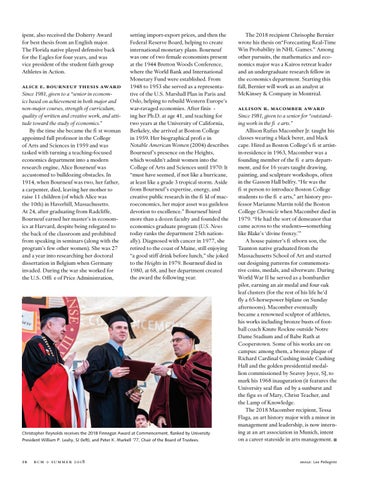
Christopher Reynolds receives the 2018 Finnegan Award at Commencement, flanked by University President William P. Leahy, SJ (left), and Peter K. Markell ’77, Chair of the Board of Trustees.
16
bcm v su m m e r 2018
The 2018 recipient Chrisophe Bernier wrote his thesis on“Forecasting Real-Time Win Probability in NHL Games.” Among other pursuits, the mathematics and economics major was a Kairos retreat leader and an undergraduate research fellow in the economics department. Starting this fall, Bernier will work as an analyst at McKinsey & Company in Montréal. allison r. macomber award Since 1981, given to a senior for “outstanding work in the fi e arts.” Allison Rufus Macomber Jr. taught his classes wearing a black beret, and black cape. Hired as Boston College’s fi st artistin-residence in 1963, Macomber was a founding member of the fi e arts department, and for 16 years taught drawing, painting, and sculpture workshops, often in the Gasson Hall belfry. “He was the fi st person to introduce Boston College students to the fi e arts,” art history professor Marianne Martin told the Boston College Chronicle when Macomber died in 1979. “He had the sort of demeanor that came across to the students—something like Blake’s ‘divine frenzy.’” A house painter’s fi stborn son, the Taunton native graduated from the Massachusetts School of Art and started out designing patterns for commemorative coins, medals, and silverware. During World War II he served as a bombardier pilot, earning an air medal and four oak leaf clusters (for the rest of his life he’d fly a 65-horsepower biplane on Sunday afternoons). Macomber eventually became a renowned sculptor of athletes, his works including bronze busts of football coach Knute Rockne outside Notre Dame Stadium and of Babe Ruth at Cooperstown. Some of his works are on campus: among them, a bronze plaque of Richard Cardinal Cushing inside Cushing Hall and the golden presidential medallion commissioned by Seavey Joyce, SJ, to mark his 1968 inauguration (it features the University seal flan ed by a sunburst and the figu es of Mary, Christ Teacher, and the Lamp of Knowledge. The 2018 Macomber recipient, Tessa Flaga, an art history major with a minor in management and leadership, is now interning at an art association in Munich, intent on a career stateside in arts management. n
image: Lee Pellegrini