COLLECTIVE Issue No.31-2025

Page 1


Beyond the blueprint: BCDA and the courage of alive transformation

Integrating sustainability is no longer an option; it’s at the forefront of every development, and it shows in how BCDA develops and builds.

INSIDE THIS ISSUE

Sustainability at the center of the board

As expectations shift, a leader must steer the entire institution toward embedding sustainability into every decision.

Manong Steve: The soil whisperer of Camp John Hay

Meet the steward of Camp John Hay’s forested corners—Manong Steve, who cultivates a greener future through steady acts.

Rethinking waste, redefining power: The idea of a man powering affordable energy

The Philippines takes a big leap to sustainability with its first large-scale waste-to-energy facility, proving that the potential of conservation goes further.

COLLECTIVE

is a quarterly publication of the Bases Conversion and Development Authority.

TABLE OF CONTENTS

Revolutionizing Philippine farming, one harvest at a time

Beyond the blueprint: BCDA and the courage of alive transformation

Closing the year with triumph: Driving investment, jobs, and sustainable growth

A sweet journey from farm to fork

Sustainability at the center of the board

Rethinking waste, redefining power: The idea of a man powering affordable energy

Building food resilience in Clark

The soil whisperer of Camp John Hay

Play, gather, thrive: Inside Poro Point’s dynamic new space

Kaluguran da ka, Pampanga!

Lisbon: A city built on continuous planning and connectivity

Atty. Hilario B. Paredes CHAIRPERSON

Engr. Joshua M. Bingcang PRESIDENT AND CEO

EDITOR-IN-CHIEF Leilani Barlongay-Macasaet

EXECUTIVE EDITOR Denver A. Moreno

MANAGING EDITOR Janine Alexis P. Miguel

CREATIVE DIRECTOR Zilpah I. Tabanera

CONTRIBUTORS Alyza Joyce Y. Alvarez, January Guia Caringal, Jan Vincent Galatierra, Maricar Gay Savella-Villamil, Mariedel Irish U. Catilogo, Mary Grace C. Padin, Sia Palitayan, Michelle Anne P. Soliman

PHOTOS John Emil C. Flores, Samuel Luke M. Galivo, Department of Trade and Industry, Kapampangan Traveller, John Hay Management Corporation

ABOUT BCDA

BCDA is a development corporation vested with corporate powers under Republic Act (RA) 7227 or Bases Conversion and Development Act of 1992. The BCDA Charter was amended by RA 7917 in 1995, and further amended by RA 9400 in 2007. Mandated to help strengthen the Armed Forces while building great cities, BCDA remains as a major force in creating economic opportunities in the country through its establishment of integrated developments, dynamic business centers and vibrant communities.

ON THE COVER

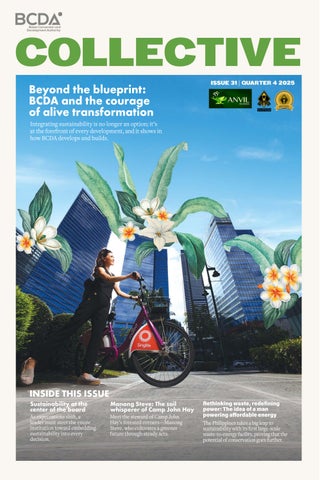
Gracing the issue’s cover is a reminder that sustainability need not be loud. Featuring a woman with a bicycle set against bustling skyscrapers, of Bonifacio Global City, it captures the idea that development doesn’t mean compromising the environment. Instead, it shows how progress and sustainability can move seamlessly.

EDITORIAL ADDRESS

BCDA Corporate Center 2/F, Bonifacio Technology Center 31st Street cor. 2nd Ave. Bonifacio Global City Taguig City, Philippines

CONTACT NO. (632) 8575-1700

FAX (632) 8816-0996

bcda@bcda.gov.ph

SUSTAINABILITY

is no longer optional; it drives the way we live, plan, and build for the future. While green initiatives may require higher upfront investments, they are undertaken regardless of the cost, for the environment and for generations to come.

For the Bases Conversion and Development Authority (BCDA), sustainability is central to everything it does. It manifests in every project, from Metro Manila to Central and Northern Luzon, where careful planning and innovative designs converge.

Through the repurposing of spaces for greater impact, BCDA has long proven that sustainability is not an afterthought, but a responsibility that shapes developments and the future they are meant to serve.

Revolutionizing Philippine farming, one harvest at a time

What people choose to eat and how that food comes to their tables is changing with the times. Advances in food technology and agricultural practices are reshaping the landscape of nourishment, guiding societies toward choices that promise greater sustainability and a more mindful approach to health.

For Jovy Hernandez, president and chief executive officer of Metro Pacific Agro Ventures Inc., the project is an attempt to reshape the Filipino plate by returning to real, whole, and fresh food grown and sourced within the country, without sacrificing consistency in quality or supply.

“The model of the greenhouse is to build the capacity for maximum production producing quality consistent yield,” Hernandez said.

The Vegetable Greenhouse Project, situated on a 22-hectare property in San Rafael, Bulacan, is a complex of modern facilities that now stands as the largest vegetable greenhouse

operation in the Philippines, producing premium vegetables throughout the year.

At full capacity, the greenhouse facility yields roughly 60,000 heads of lettuce every month or about 144 metric tons of leafy greens annually.

The greenhouse is powered by agricultural technology developed by LR Group, an Israeli agribusiness firm, where precision replaces excess. Leafy greens such as lettuce are grown through a nutrient film technique, while other vegetables rely on drip irrigation—systems that allow crops to thrive while consuming a fraction of the water and land used in conventional farming. In all, resource use is reduced by as much as 90 percent.

SUSTAINABLE FARMING

As consumers grow more discerning about what they eat, the demand for transparency in food sourcing has reached an unprecedented level. People increasingly want to know where their food comes from, how it is produced, and what kind of imprint it leaves on the environment.

“Here, the quality is consistent—that is what we strive for,” he said. “There is a new wave of consumers, particularly among the young, who are reshaping buying behavior. They are willing to pay a premium, as long as they are confident in the quality of what they are purchasing.”

Looking ahead, Hernandez said the company is exploring the possibility of developing a greenhouse facility within BCDA property in New Clark City, a move that could

reinforce food security across Central Luzon.

“We are interested in Clark, but market studies are essential,” he said. “A Clark location would naturally serve hotels and restaurants, and potentially markets even beyond the region.”

Rooted in agribusiness, the venture underscores Metro Pacific Agro Venture’s determination to serve as a catalyst for a more sustainable Philippines—one capable of securing its own food systems and, ultimately, achieving food independence

In doing so, the project aligns with the national government’s broader commitment to the United Nations Sustainable Development Goals, particularly Goal 2, which calls for ending hunger and promoting food security, improved nutrition, and sustainable agriculture.

BEYOND THE BLUEPRINT: BCDA and the courage of alive transformation

LONG BEFORE THE TERM SUSTAINABILITY WAS COINED, HISTORICAL RECORDS REVEAL THAT THE ENVIRONMENT— ALBEIT AT A SLOWER PACE—WAS ALREADY SHOWING SIGNS OF DEGRADATION.

Despite limited documentation, some ancient yet forward-thinking authors, dating as far back as 500 BC, expressed concern over environmental deterioration caused by human activity and advocated for less harmful practices. While the language we use today did not yet exist, discussions about what we now recognize as sustainable choices were already taking shape.

It was not until the late 20th century, however, that the concept of sustainable development gained significant traction. In 1987, the Brundtland Report, Our Common Future, offered a defining framework, describing sustainable development as “development that meets the needs of the present without compromising the ability of future generations to meet their own needs.”

By the 1990s, sustainability had become a widely

Morethanchange ortransformation, sustainabilitycallsfor aremembering:ofwhat itmeanstobehumanin relationshipwiththe worldweinhabit.

BGC embodies the BCDA’s vision for sustainable urban growth. Through smart masterplanning and pedestrian-first design, it remains the gold standard for eco-conscious, world-class living.

recognized principle, increasingly embedded in policymaking and shaping national agendas aimed at balancing economic growth with social well-being and environmental protection.

Yet nowhere is this balance more urgent than in climate-vulnerable countries like the Philippines.

For Filipinos, sustainability is not an abstract ideal, rather, a matter of survival. The administration of President Ferdinand R. Marcos, Jr. regards sustainability as an insurance policy for economic growth. The logic is simple: a country cannot sustain an upper-middle-income economy if a single typhoon can erase two percent of its economic output in a single weekend.

Sustainability, then, is no longer a niche concern or a corporate checkbox. It has evolved into a complex framework for reimagining our collective future–one that

asks us to see ourselves not as separate from nature or one another, but as interconnected participants in a living, interdependent system.

OUR GREEN PRINT

For the Bases Conversion and Development Authority (BCDA), sustainability–often dismissed as a buzzword–lies at the core of how communities are planned, built, and stewarded. From Bonifacio Global City (BGC) to New Clark City and Camp John Hay, BCDA’s approach reflects a deliberate effort to translate sustainability from principle into practice.

Today, both BGC and Camp John Hay are undergoing updates to their master development plans. In BGC, the revised plan serves as a forward-looking guide for the district’s next phase of growth, ensuring that development remains inclusive, resilient,

and responsive to evolving urban needs. In Camp John Hay, the focus is on harmonizing people-centric design with the preservation

In this spirit, BCDA planted more than 1,500

soil erosion, stabilize river-adjacent land, and serve as living reservoirs of carbon.

RESILIENCE AMID CHANGE

Resilience and modernization sit at the heart of the country’s development agenda, shaped in large part by the profound disruptions of the COVID-19 pandemic. The Philippine Development Plan 2023–2028 places strong emphasis on digital and social infrastructure, climate action, and innovation—signaling a shift away from growth driven solely by consumption or overseas remittances, and toward a more adaptive, future-ready economy. Aligned with this national direction,

BCDA’s work seeks to ensure that progress does not come at the expense of heritage or inclusion. Recognizing indigenous peoples as stewards of land and knowledge, BCDA partnered with Pampanga State Agricultural University and the Department of Agriculture Regional Field Office III to establish the 10-hectare Ayta Ethno-Botanical Center. The center functions as both sanctuary and training ground, where indigenous wisdom, sustainable agriculture, and entrepreneurship converge. Public spaces in New Clark City are also expanding through projects that integrate design, ecology, and long-term resilience. BCDA has broken ground on Malyari Park, a

one-hectare pocket park along One Clark Boulevard designed as both a recreational space and a model of sustainable urban design. Native landscaping, biodiversity protection, water-efficient systems, and solar-powered lighting are embedded into the park’s design, reinforcing sustainability as a lived experience rather than an abstract goal.

As flooding continues to disrupt communities across the country, BGC offers a glimpse of what forward-thinking urban development can achieve. Beneath Burgos

Circle lies an advanced underground drainage system capable of storing up to 22,000 cubic meters of floodwater. Combined with green spaces designed to absorb rainwater and limit runoff, this system allows the district to withstand heavy rains with minimal disruption. More broadly, BGC demonstrates how investing in resilient infrastructure today creates safer, more livable, and more competitive cities for the future.

Artist's render of the Malyari Park in New Clark City

THE BOTTOMLINE IS…

Perhaps the world stands at a crossroads today. Sustainability, as we understand it, is deeply paradoxical. Maybe we need to move forward by seeing this “buzzless buzzword” as more than a metric to be managed, a brand to be worn, or a product to be purchased–because it is not. Rather, we must have the courage to shift how we inhabit the Earth.

This means looking beyond the sterile quick fixes of corporate reports and international summits, and toward the answers already living in the soil—in the lands that safeguard our seeds, the communal systems that protect forests, and

the ancestral wisdom that treats nature as a relative rather than a resource. It also means using technology not as a shield against change, but as a tool to amplify regenerative practices and strengthen local sovereignty.

True transformation is rarely comfortable, but it is alive and possible. While the world debates frameworks in air-conditioned offices, the future is being built by those defending water, preserving ancestral lands, and risking everything to protect what is sacred.

For BCDA, the urgent task is not merely to plan for sustainability, but to become active participants in regeneration.

Beneath the lush canopy of Burgos Circle, BGC’s massive five-storey deep cistern quietly guards the city, turning a scenic park into its most vital defense against the rains.

Closing with year triumph: the

Driving investment, jobs, and sustainable growth

The year 2025 marked a milestone for the Bases Conversion and Development Authority (BCDA) as it reinforced its role as a key driver of national development and investment-led growth. BCDA delivered strong results across investments, jobs, sustainability and community-focused initiatives.

Driving the bulk of these investments were from New Clark City and Camp John Hay. New Clark City accounted for approximately Php63.45 billion in investments, while Camp John Hay contributed around Php1.1 billion. Both zones continue to attract both local and international investors, owing to their strategic locations, modern infrastructure, and clear long-term development vision.

The year closed with BCDA generating a total of Php64.48 billion in investments, nearly double the Php33.07 billion recorded in 2024. These approved projects are expected to create approximately 8,558 jobs nationwide–marking a 24.7 percent increase from the previous year.

Strong revenues and support for national priorities

Complementing its strong investment performance, BCDA closed 2025 with Php14.1 billion in cash revenues, surpassing its Php10

billion target by more than 40 percent and exceeding the Php11.66 billion recorded in 2024 by 20.9 percent. This position reflects BCDA’s keen asset management and increased privatesector activity across its economic zones. From the Php14.1 billion generated, an estimated Php3.29 billion is expected to be remitted to support the Armed Forces of the Philippines (AFP) Modernization Program. This adds to BCDA’s cumulative Php103 billion contribution to AFP modernization and military facilities replication since 1993, in line with Republic Act No. 7227.

Transformative projects in New Clark City

One of the most notable deals was the Php5.1billion investment by South Korea’s Korea Real Estate Investment & Trust (KOREIT) Asset Management and Sky Blue New Clark City Golf & Resort Corp. The 150-hectare golf and residential villa estate is expected to generate around 1,200 direct and indirect jobs while positioning New Clark City as a rising sports and lifestyle destination. Commercial operations of the golf course are targeted to begin by the first quarter of 2026.

Equally transformative is the soon-to-rise first large-scale waste-to-energy (WTE) plant in New Clark City, developed with a FilipinoIndian consortium led by ATD Waste-to-Energy Corp., Global Heavy Equipment & Construction Corp., and Uttamenergy Ltd. With a Php4billion investment, the facility will convert 600 metric tons of waste per day into 12 megawatts of electricity, enough to power more than 10,000 homes. Beyond energy generation, the project addresses solid waste management challenges, and supports flood mitigation efforts.

The new metropolis also strengthened its role as the country’s premier sports hub. Through a partnership with the Philippine S ports Commission, national athletes now enjoy yearround access to world-class facilities such as the Athletics Stadium, Aquatics Center, and Athletes’ Village. This ensures consistent training and maximizes the value of the sports infrastructure.

Php64.48B

investments generated

Over

8,000

jobs generated

Revitalizing Camp John Hay and Poro Point Freeport Zone

In Camp John Hay, BCDA advanced projects that blend tourism, sustainability, and community development. A Php500-million expansion of the Le Monet Hotel will add at least 70 rooms and create more jobs within the zone.

BCDA and its subsidiary John Hay Management Corporation also partnered with ACMobility to roll out electric vehicle charging stations across Camp John Hay. Equipped with fast and standard chargers, including Baguio City’s only DC fast charger to date, the initiative promotes sustainable tourism and supports the country’s transition to cleaner mobility.

Beyond these zones, BCDA expanded its impact in Northern Luzon through a partnership with the Department of Public Works and Highways and Poro Point Management Corporation to redevelop the Poro Point Baywalk in La Union into a multi-purpose sports and recreation complex. The project is expected to boost tourism, create livelihood opportunities, and provide an inclusive community space by the sea.

Building a future for champions

In 2025, BCDA continues to reinforce its role in advancing sports by supporting national initiatives such as the Administrative Order 38 and the creation of the National Sports Tourism Inter-Agency Committee. Continued investments in training facilities, and competition venues is BCDA’s contribution in positioning the Philippines as a hub for worldclass events and Filipino athletic excellence.

BCDA is also investing in education through its partnership with the Provincial Government of Tarlac to establish the Tarlac Community College in New Clark City—a five-hectare campus that will expand access to affordable, quality education for young people in Central Luzon.

“It has always been important for us to put community impact at the center of our projects. We make sure that it creates real opportunities, growth, and lasting benefits,” BCDA PCEO Bingcang said. Together, these efforts reflect BCDA’s broader direction: transforming land into opportunities that drive growth, and long-term benefits for communities and the country.

from farm to fork journey sweet A

For Chef Rhea Sycip, great food comes from a combination of thoughtful process and a deep respect for farmers who pour their hearts to produce quality ingredients.

This passion and advocacy is reflected in Chef Rhea’s newest venture, Flour Pot Bistro and Bakery, which recently opened its doors in Bonifacio Global City, Taguig City. Every layer of cake, every crumble of pastry, and every bite of savory dish serves as a testament to Chef Rhea’s devotion to cooking and commitment to sustainability.

A quaint little cafe brushed in a gentle shade of yellow, Flour Pot exudes comfort from its cozy interior to delectable offerings, including specialty cakes, signature pastries, hearty dishes, and pantry must-haves. Customers are greeted with the sweet aroma of freshly baked treats. The counter is lined

with an array of confections, backdropped by beautifully crafted cakes bathed in gentle light. Each creation has a unique story and origin, crafted by dedicated bakers and chefs, and made possible by ingredients from Filipino farmers.

Units 3 & 4, Verve Tower 2, 27th St. corner 7th Ave., Bonifacio Global City, Taguig.

Scan the QR Code to see more about Flour Pot Bistro and Bakery
Flour Pot Bistro and Bakery

Tres Leches, a personal favorite, is an explosion of sweetness, made with carabao’s milk sourced from Tarlac, and topped with strawberries from local farms.

The Rosa Cake may not appeal to everyone, with the strong flavor of lychee overpowering the delicate notes of rose.

A hidden gem among Flour Pot’s cake selection is the Ube Kinampay, perfectly balancing the earthy and creamy richness of kinampay halaya from the rich soils of Bohol and a subtle, lingering sweetness.

The Tableya Chocolate Cake is rich and decadent, crafted from singleorigin Mindanao chocolate, with bold, dark chocolate flavor in every bite.

The Strawberry Brioche Donut, another popular pick, is a feast for the senses, with its pillowy soft dough, silky sugar glaze, and juicy, handpicked strawberries from the mountains of the Cordilleras.

The Emelie Cake, one of its best-sellers, is a visual and flavorful treat—a towering cake, adorned by delicate flowers on top and layered with fresh mango and deep raspberry jam.

By Mariedel Irish U. Catilogo

Sustainability need not be complicated.

For Bases Conversion and Development Authority (BCDA) Chairperson Atty. Larry B. Paredes, it is simply about preparing for the future while protecting what people have today. Sometimes, it begins on the most ordinary days—by caring for resources in small ways, like turning the water off when it is no longer needed.

But as chairperson of the board, his role goes beyond simple acts. He provides policy direction and oversight to management, ensuring that the organization remains faithful to its mandate of building smart, sustainable, resilient, and livable cities.

So how does the board of directors determine which projects to prioritize, particularly those supporting the country’s sustainability goals?

At the board level, profitability is only a part of the equation. Every issue presented prompts two critical questions: Will this improve

people’s lives? Will it protect the environment? The answers guide decisions whether approving contracts, offering recommendations, or embedding safeguards within agreements.

“[The] goal is for sustainability to be embedded in all contracts so that we balance financial discipline and environmental responsibility, social impact, and strategic value,”Chairperson Paredes said.

The BCDA plays a unique role in positioning the country as a leader in sustainable urban development. With its mandate to transform former US military installations and surrounding properties into premier centers of economic growth—such as Bonifacio Global City, Newport City, and the Clark Freeport Zone— BCDA is given a rare opportunity to embed green initiatives at every level of development.

“If we do this right, we can inspire not just local governments, but even our neighbors in the region,” he said.

DEVELOPMENTS

THAT DON’T JUST LOOK IMPRESSIVE, BUT REGENERATIVE THAT WILL TRULY SERVE COMMUNITIES
“WE WANT AND STAND THE TEST OF TIME.”

Even so, sustainability is often dismissed as expensive, especially in the context of infrastructure and buildings. But for Chairperson Paredes, good governance is measured not by short-term savings, but by long-term value created for the public.

“Green infrastructure may cost upfront but when we factor in the energy savings, disaster resilience, lower maintenance, and stronger investor confidence, the equation changes completely,” he added.

When asked what he hopes will be the lasting

green thumbprint of his chairmanship, Atty. Paredes spoke of building systems designed to last and practices that will continue to nurture sustainability long after his term ends.

“In the future, when our leaders in BCDA would approve or look into certain projects, they would always think, will this benefit the future generation? Will this be good for the environment? If we have that kind of system in our DNA, in BCDA, then that would be a good legacy for me. Then that means I would already have done my part.”

Rethinking Waste, Redefining Power: The Idea of a Man Powering Affordable Energy

Good governance is critical to sustainability. Through the years, the country has experienced the ill effects of climate change and have triggered massive efforts from the government to catch up and cope. The waste problem is not just an environmental issue—but a challenge to public safety, governance, and sustainability.

One of the long-term solutions seen to address these is the adoption of waste-to-energy (WTE) technology. The much needed push for this comes from President Ferdinand R. Marcos, Jr., who during his state visit in India brought home potential investments reaching up to USD 5.8 billion in

“Waste is not just garbage—it is a resource.

A resource that, when managed responsibly and creatively, can power homes, fuel progress, and protect our planet.”

sectors such as healthcare, digital infrastructure, and renewable energy.

Among invitees of the state event in India was the Bases Conversion and Development Authority (BCDA) and a Filipino-Indian consortium composed of ATD Waste to Energy Corp., Global Heavy Equipment and Construction Corp., and India-based Uttamenergy Ltd.

ATD President Amando Diaz, heads the consortium, which has partnered

Mr. Amando Diaz President and CEO ATD Waste to Energy Corporation
ATD Waste to Energy Corporation President and CEO Amando Diaz (standing, second from left) together with the President of the Republic of the Philippines Ferdinand R. Marcos, Jr. (seated, center) during the Philippine-India Business Forum.

with BCDA, in establishing the first large-scale WTE facility in the Philippines. They are currently leasing a four-hectare property in New Clark City for the establishment of a modern WTE facility that will advance sustainable waste management and clean energy generation in the Philippines.

Valued at Php4 billion, this investment enables the conversion of 600 metric tons of waste per day into 12 megawatts of electricity that can power over 10,000 homes. In producing clean energy from local sources such as garbage, the facility not only helps reduce solid wastes but even directly generates around 400 jobs.

FROM RURAL ELECTRIFICATION TO RENEWABLE ENERGY

Mr. Diaz’s journey into sustainability though did not begin with waste-to-energy. Raised in an entrepreneurial family in Nueva Ecija, he was exposed early to businesses rooted in agriculture, trading, construction and community-based enterprise. His professional career began as an electrical contractor under the country’s

Rural Electrification Program, working in provinces such as Laguna and Nueva Ecija.

Coming from a family of elected public officials, he was raised as one who is sensitive to the needs of the people. This value embodied his work as a public servant–then as board member, and subsequently as a member of the Sangguniang Panlalawigan of Nueva Ecija, and vice president of an electric cooperative.

In the nineties, there were three-day power outages that could eve cripple local businesses and communities. Recognizing that this crisis stemmed from an aging coal-reliant grid, Mr. Diaz leveraged his electrical expertise to research solutions on realiable power that could transform the local economy. This move allowed him to venture into hydropower plants, harnessing natural water resources for 24/7, fuel-free electricity with minimal environmental impact.

He emphasized, “When you are in a position of leadership, it is inherent upon you to always genuinely think about the welfare of people we serve and who we are with."

THOSE CHALLENGING FIVE YEARS

During a trip to China five years ago, he encountered WTE technology in action. Seeing a 12 MW plant operating just an hour from the city—using technology already three decades old— inspired him to bring this missing solution to the Philippines.

As a pioneer, Mr. Diaz faced difficulties in securing funding and navigating regulatory constraints. Challenges caused by natural disasters, and man-made threats to the environment and public safety persisted and yet, he still saw governance as a viable path towards a solution.

Mr. Diaz is grateful that the national government is now prioritizing climate action. He views the rising interest in WTE as a vital step in aligning the

BCDA and the consortium of ATD Waste to Energy Corporation, Global Heavy Equipment and Construction Corporation, and Uttamenergy Limited are moving forward with the establishment of the Php4-billion WTE facility in New Clark City, which will be able to transform 600 metric tons of waste per day into 12 megawatts of electricity.
Photo reference for the proposed waste-to-energy facility in New Clark City.

Philippines with global standards for renewable energy and waste management. “Focus and do not be distracted.” This is his simple message to those in governance because as for him, he never lost his vision. Mr. Diaz knew that inaction carries far greater risks and the time is now.

WHY BCDA AND NEW CLARK CITY

“This project represents a significant leap forward in the country’s environmental strategy, addressing two of the most pressing national concerns: waste management and energy generation.” Building on this statement, Mr. Diaz also expressed how he envisions the WTE facility to be one of the highlights of New Clark City–complementing operations of the Clark International Airport, benefiting the local government and the community. With BCDA as their partner, he sees an alignment of purpose that is anchored on that core value of innovation. BCDA has the mandate of building future-ready, climateresilient communities, and provides the

governance framework, and long-term vision necessary for sustainability projects to succeed. New Clark City, on the other hand, is an ideal location for WTE that is designed as a sustainable and resilient metropolis.

Mr. Diaz shared that he wanted BCDA to grow bigger in terms of its impact to the country foreseeing how it will make use of the WTE technology in supporting the growing needs of its people-centric developments. These will continue to draw more people towards the region outside Manila through the ongoing completion of new transport infrastructure.

Indeed, waste-to-energy technologies can model much-awaited long-term solutions to the persisting problem of solid waste management in the country.

For Mr. Amando Diaz, successful innovations that will boost environmental resilience and public safety require unwavering focus and sound partnerships. These are best achieved when done in cooperation with a government that is committed to lasting sustainability.

Where the skyline meets the peaks: New Clark City at golden hour.

Building food resilience in C r l a k

ood security is felt most clearly in everyday life—at public markets, in family kitchens, and in the livelihoods of farmers and fisherfolk who work to keep food on Filipino tables. Behind every meal is a system that determines how food is produced, stored, transported, and delivered, and how fairly the people who grow and harvest it are supported.

In Central Luzon, Clark is taking on a growing role in strengthening these connections. Long recognized as a gateway for trade, logistics, and mobility, the area is now emerging as a platform for initiatives that directly affect people’s daily lives. Through its infrastructure and development programs, the Clark International Airport Corporation (CIAC) is expanding its mandate beyond aviation to help build a more resilient and efficient food ecosystem. Central to this effort is the Clark National Food Hub (CNFH), a flagship project designed to modernize agri-logistics

and strengthen the country’s food supply chain.

The vision for the CNFH moved closer to reality as CIAC and Food Terminal Inc. (FTI) formally sealed their partnership to develop the project. More than a collaboration between institutions, the partnership reflects a shared goal: to make the journey of food from producers to consumers more efficient, transparent, and equitable.

For the Department of Agriculture (DA), the CNFH is part of a broader national effort to stabilize markets and reduce long-standing inefficiencies in food distribution. “This is one of several mega food hubs the DA will develop to ensure stable markets and long-term food security,” Agriculture Secretary Francisco Tiu Laurel, Jr. said “It supports the vision of President Ferdinand Marcos, Jr. of giving farmers and fisherfolk fair access to markets through strategically located food terminals.”

Clark’s strategic location gives the project a distinct advantage. Situated at the heart of Central

Luzon and connected to major roads, air, and logistics networks, it allows food to move quickly and efficiently across regions. In this way, the CNFH aligns with the national government’s Build Better More program and the Luzon Economic Corridor initiative, frameworks that aim to ensure infrastructure investments translate into real, everyday benefits for communities.

As it takes shape, the CNFH is envisioned as an integrated ecosystem rather than a traditional trading center. It will house facilities for wholesale trading, cold and dry storage, food processing, logistics, and agri-tourism, bringing critical services together in one location.

This integration is expected to improve food safety standards, extend shelf life, and significantly reduce post-harvest losses, just a few of the persistent challenges that affect both producer incomes and consumer prices.

For farmers and fisherfolk, these improvements mean better access to markets, fewer intermediaries, and lower logistics costs. For families, they translate into safer food, steadier supply, and more stable prices. For agri-enterprises, the hub creates opportunities for value-adding activities and innovation across the supply chain.

At its core, the CNFH responds to a longstanding concern: a fragmented food distribution system that leaves producers vulnerable and consumers exposed to supply disruptions and price volatility. By centralizing services and modernizing logistics, the project helps build a more inclusive and resilient food network—

We continue to pursue initiatives that contribute to increasing agricultural production and improving the food logistics chain. The Clark National Food Hub is a step in this direction, and we look forward to its successful establishment as a sustainable food security solution."

one that works for people at every stage of the journey from farm and coast to market and home.

For CIAC, the food hub reflects Clark’s evolving role in national development. Beyond serving as a gateway for passengers and cargo, Clark is increasingly becoming a place where infrastructure investments respond directly to people’s needs, where livelihoods are supported, communities are strengthened, and sustainable growth remains at the core.

More than a physical complex, the establishment of CNFH is an investment in everyday life. From the gateway of the Philippines, it strengthens the links between producers and consumers, supports those who feed the nation, and helps secure a more stable, inclusive, and sustainable food future for generations to come.

The soil whisperer of The soil whisperer of

Camp John Hay

IntheheartofCamp JohnHay,wheretoweringpineswhisperstoriesofresilienceand renewal,PaulStevenAnanayostandsasaquietforceofnature,cultivatingnotjustsoil butalegacyoffertilitythatendures.

Since 2011, Manong Steve, as he is fondly called, has immersed himself in the forested corners of Camp John Hay. For over a decade, he has tended compost bins, gathered pine needles and fallen leaves, and watched for worms and insects, the signs of healthy, fertile compost.

Before his journey at the camp began, Manong Steve co-owned a restaurant in Negros Occidental. Yet life had other plans. In what can only be described as a beautiful detour, he discovered his true calling not in the kitchens of his hometown, but in the forested land of Camp John Hay.

He began as the head of Camp John Hay’s tree-marking activity, a five-month role that gave him intimate knowledge of nearly every tree standing tall in the camp. He later joined the fireline maintenance team, actively participating in the government’s annual Fire Prevention Month and regularly supporting the corporation’s tree-planting initiatives.

With hands well-acquainted with every type of soil, Manong Steve vividly recalls his first lesson in crafting the right mix to help plants thrive. His composting methods are both simple and profound: organic materials such as food scraps, garden waste, grass clippings, and other biodegradable matter are finely chopped, layered with soil, watered periodically to maintain moisture, and covered with nylon sheets to trap heat and shield against rain.

This cycle is repeated each year, ensuring a

“What we take, we must replenish.”
— Manong Steve

steady supply of nutrient-rich compost. Even invasive Calliandra leaves and fruit peels from camp kitchens are repurposed, transforming waste into nourishment. After six months to a year, the compost reaches maturity. Manong Steve then blends it with black soil to create the ideal mix for strong root development and healthy seedlings.

This transformative practice breathes life into the soil and sustains Camp John Hay’s nursery, which produces 4,000 to 6,000 potted pine seedlings annually. Beyond pine, the nursery also cultivates native plant species and Arabica coffee seedlings. Once ready, these saplings are either planted within the camp or distributed to organizations and agencies, providing a sustainable way to expand Camp John Hay’s green canopy beyond its borders.“It’s about giving back to the environment,” Manong Steve said.

Today, his dedication is driven by three core motivations: his family, a supportive workplace, and the encouragement of his team. At the center of it all is his child’s educational achievements, which inspire him each day and fuel his passion, strengthened further by the forest’s quiet resilience and the camaraderie he shares with his colleagues.

In a world facing ecological uncertainty, Manong Steve’s story shines as a grounded source of hope. Though his hands are covered in soil, his work nurtures something far deeper: resilience and the enduring belief that small, steady acts can shape a greener future.

PL Y GATHER THRIVE

INSIDE PORO POINT'S DYNAMIC NEW

SPACE a

Along the Poro Point Baywalk, a new development is taking shape—one that reflects both Poro Point Management Corporation’s (PPMC) vision for sustainable growth and its commitment to creating longterm value for stakeholders. In partnership with the Department of Public Works and Highways-Region 1 and the Bases Conversion and Development Authority, the Multi-Purpose Facility represents a strategic investment in infrastructure that serves both community needs and responsible estate management.

Scheduled for completion in the third quarter of 2026, the Multi-Purpose Facility will redefine the 2,538.32-square-meter baywalk area as a dynamic, integrated development that brings recreation, organized activities, and community engagement into one vibrant space. By consolidating multiple functions within a single site, the project ensures efficient land use, streamlined operations, and a welcoming environment for diverse stakeholders.

Once completed, the development will serve as a central hub for leisure and public activities within the Freeport Zone. Its design includes a

regular-sized basketball court and a multi-use skate course that can also accommodate emerging sports such as pickleball and tennis. Surrounding park areas and landscaped grass spaces will provide flexible venues for informal gatherings and organized events, enhancing the attractiveness and usability of the baywalk area. Supporting infrastructure, including administrative offices, a first aid clinic, and comfort rooms located within a central grandstand, will ensure safe, orderly, and efficient facility operations.

Sustainability considerations are integral to the project’s design and implementation. The facility will be equipped with solar panel

systems with inverters to address on-site energy requirements, as well as solar-powered streetlights to improve safety and visibility. These renewable energy measures are expected to reduce operational costs, improve energy efficiency, and contribute to lower carbon emissions, reinforcing PPMC’s commitment to environmental stewardship and climate-resilient infrastructure.

As construction progresses, the upcoming facility stands as a clear example of how infrastructure development can balance functionality, sustainability, and community impact. Through this initiative, PPMC reinforces its commitment to strategic, responsible development by delivering shared spaces that balance community use with long-term sustainability and value creation.

More than an infrastructure project, it is a symbol of inclusive growth—designed to foster unity, encourage active lifestyles, and strengthen the community’s connection to its shared spaces.

Artist's render of the Multi-Purpose Facility's Basketball Court.

da ka,

aluguranK Pampanga!

Nasubukan mo na bang magmaneho sa maluwag at maaliwalas na kalsada ng SCTEX? Ituloy ang byahe patungong Gitnang Luzon? Tanawin ang Bundok ng Arayat mula sa kalayuan? O kaya nama’y igugugol ang iyong buong araw sa Pampanga? Para sa maraming Pilipino, madalas dinadaanan lang ang Pampanga—isang lugar na nilalagpasan sa biyahe papuntang Norte. Pero kung ikaw ay maglalaan ng isang araw, matutuklasan mong ito ay higit pa sa isang stopover. Mula sa likas na pahingahan hanggang sa kainan at kulturang Kapampangan, handa ang Pampanga na ipakilala ang sarili nito sa mga hindi pa talaga nakakakilala rito.

Grounds,

Mag-ehersisyo sa Clark

Simulan ang araw sa masiglang paggalaw. Ihanda ang sapatos, tuwalya, at magbaon ng enerhiya. Ang unang aktibidad na bubuo sa umaga ay ang mga pisikal na gawain na siyang naging laman ng kuwento ng pamilya’t pagkakaibigan sa bawat sariwang damuhan ng Clark Parade Grounds. Namnamin ang tama ng sikat ng araw sa iyong mukha habang ika’y tumatakbo, naglalakad, o kaya nama’y bumabalanse sa bisikleta. Damhin ang paghilom ng iyong katawan, mula pisikal hanggang kalusugang mental. Dito mo rin maririnig ang halakhakan ng isang pamilyang masaya, makikita ang takbuhan ng mga batang may bitbit na saranggola, at hilera ng bahay-kamalig na pare-pareho ang porma.

Magpahinga sa Puning

Pagkatapos sa matinding pisikal, paniguradong pahinga ang hanap ng katawan, at ang sagot dito ay ang Puning Hot Spring at ang Sand and Mud Spa ng Angeles, Pampanga. Sa pamamagitan ng pagtampisaw sa mainit na bukal, tila ba kaginhawaan agad ang iyong mararamdaman. Ayon sa mga pag-aaral, ang tubig dito ay ligtas para sa balat. Umaabot sa 40 hanggang 70 digri ang temperatura ng mga bukal, kaya nasa sa iyong desisyon kung aling bukal ang pinakaangkop sa pangangailangan ng iyong katawan. Hindi mo rin maaaring palampasin ang kakaibang karanasan na ibinabaon ang iyong katawan sa buhangin na nagmula sa lava ng pagputok ng Bulkang Pinatubo at kasabay nito ay ang dahan-dahang

Clark Parade
Clark Freeport Zone, Pampanga
Puning Hot Spring, Angeles, Pampanga

pagdagan sa’yo ng mga masahista. Pagkatapos nito, babalutin ng mainit na putik ang iyong katawan, at dito mo unti-unting mararamdaman ang kakaibang ginhawa na para bang niyayakap ka ng isang malambot at mainit na kumot. At hindi lamang ito para sa relaxation ng katawan, kundi marami rin itong benepisyong dulot gaya ng pagpapabuti ng sirkulasyon ng dugo at pag-alis ng pananakit ng kasukasuhan.

Tuklasin ang Tutulari

Kung nabawi na ang iyong lakas, ihanda naman ang sarili para sa mahaba-habang lakaran. Lakaran na tila ba ika’y nasa isang panaginip. Ihanda ang sarili sa kamanghamanghang ganda ng Tutulari Avatar Gorge. Isang pasyalang nadiskubre at pinangalagaan ng mga Aeta, na ngayo’y representasyon ng kanilang lupang sinilangan. Halos isang oras

at kalahati ang lakaran dito, ngunit hindi mo mamalayan ang bawat oras o minuto kapag ika’y nasa loob na nito. Habang ika’y papalapit, ang unang bubungad sa’yo ay ang dumudungaw na sinag ng araw mula sa itaas. Mahiwaga ang bawat sandali, tila ba pumasok ka sa isang paraisong puno ng matatayog na luntiang bato na magpaparamdam sa’yo na ika’y nasa ibang mundo. Masarap sa tainga ang tunog ng bawat patak ng tubig na dahan-dahang umaagos sa sahig, masarap pakinggan ang huni ng mga ibong umalingawngaw sa buong paligid. Kakaibang emosyon ang mararamdaman mo rito, kalmado at payapa. Maaaring sumakit ang iyong mga paa, ngunit papawiin ng lugar na ito ang pagod na iyong nadarama. Kaya’t huwag mo ring kalimutang magdala ng kamera para kuhanan ang bawat alaala na ika’y nakapasok sa ipinagmamalaking hiyas ng Pampanga.

Sumakay sa El Kabayo

Pagsapit naman ng hapon, tila kapanapanabik namang karanasan ang dapat mong subukan, at ito ang horseback riding sa El Kabayo Riding Stables, isang natatanging replika ng isang lumang Western Town na nagbibigay-buhay sa alaala ng seryeng Bonanza. Tahanan ito ng mga thoroughbred, quarter horses, at maliliit na kabayo na minsang umusbong at naging bahagi ng kasaysayan ng American Cavalry sa Clark. Kung ang mga naunang aktibidad ay kalmado, dito makararamdam ka ng kaunting kaba ngunit mayroong saya. Siguraduhin munang mayroon kang lakas ng loob, i-relax ang balikat, at bahagyang iluhod ang tuhod. Sumabay ka sa indayog ng kabayo habang ika’y nakasakay rito; damhin ang hangin at araw na humahampas sa iyong mukha. Iikot ka nito sa iba’t ibang bahagi ng Clark, at dito mo mapagtatantong tama nga— na isa ang Clark sa lugar na dapat mong balikbalikan. Bago bumaba, huwag mong kalimutang magpasalamat sa kabayong naging parte ng iyong paglalakbay—paglalakbay na makulay.

Tikman ang Matam-ih

At siyempre, hindi buo ang araw kung hindi mo titikman ang mga pagkaing ipinagmamalaki ng

mga Kapampangan sa sikat na-sikat na Matamih Restaurant. Sa salitang Aeta, ang Matamih ay nangangahulugang “masarap,” na siya nga namang walang pagdududa lalo na kapag natikman mo ang katakam-takam, malambot, nanunot sa asim, at mainit-init na sinigang na baboy. Isama mo pa ang makrema at sagana sa mani na kare-kareng buntot ng baka, banayad sa simula, malinamnam sa gitna, at may kasamang alat ng alamang na nag-iiwan ng kakaibang bakas sa panlasa. Iilan lamang iyan sa mga dapat mong matikman na lutong Kapampangan. Bukod pa rito, tiyak na matutuwa ka sa tribo ng mga Aeta na iyong makakasalamuha. Dito mo rin makikita ang kanilang kakaibang talento sa sining dahil sa taglay na disenyo ng kainang ito na mala-African art and patterns. Higit pa ito sa isang kainan kung maituturing, sapagkat isa itong pagdiriwang ng mayamang kulturang Kapampangan. Lokal ka man o hindi, siguradong naghihintay sa’yo ang mainit na pagtanggap ng Matam-ih. Maaaring bitin ang isang araw, ngunit hindi bitin ang panahon para bumalik ka rito. At sigurado akong aalis ka na bitbit ang bawat saya, paghanga, pag-ibig, at sasambiting—Kaluguran da ka, Pampanga!

Lisbon

A city built on continuous planning and connectivity

A green city, marked by tree-lined avenues, numerous parks and open spaces, Lisbon offers both locals and travelers a space to breathe and appreciate nature amidst daily routine. Courtyards, pocket gardens and water features are integrated within the design of modern buildings to bring nature in.

The Portuguese heritage and culture are well-preserved not only in its ornately designed tiled historic buildings, limestone sidewalks, towering monuments and water fountains, but also in their cuisine and general way of life.

Lisbon is the epitome of a 15-minute city—where everything can be reached by foot or by car within 15 minutes (at least

Lisbon is surprisingly disarmingly enchanting, and vibrant, and beautiful. It is an interesting mix of the old and the new worlds—characterized by adherence to its urban planning and

based on my experience). The government and its people has rebuilt the city from the debris of the devastating earthquake of 1755, to become one of the wealthiest cities in Portugal—the devastation becoming an opportunity to plan, build and renew.

Planning, Planning, Planning

Urban revitalization is at the heart of the efforts of the Lisbon City Council’s Urban Planning Department to renew and improve old areas of Lisbon, with the intention of bringing in developments, new investments, and an influx of people that would spur economic progress, in what could have been

an otherwise unproductive piece of land.

One such development is the site of the 1998 World Expo located in eastern Lisbon, which has been transformed into the Parques das Nacoes, a new economic district and center of cultural activities. The design of the World Expo was purposive, retaining areas for commerce, hotels, restaurants, business centers, and public spaces for continued use and development after the world event.

Working within a 20-30 year time frame, the City Council takes on a holistic approach in planning road and transportation networks, flood control, and water and sewage utilities, among others. The 2012 Master Plan of Lisbon is currently being revised (in 2025) to include and incorporate new concepts, designs and technology, that would serve the city’s infrastructure and utility requirements until 2040.

Connect, Connect, Connect

Connectivity is integral to the master plan, with roads and transport constantly being assessed and built to support development. The key is to improve connections to and from the city. The most recent plan is to close the current airport in 10 years and open a

new airport farther away from the city. The supporting road and transport infrastructure for the new airport will also be built. The subway/ metro will be extended, a tunnel will be built, and connection to speed trains to other parts of Portugal will be improved. This development will open new opportunities for land use that will transform the old airport into a public park.

Lisbon is a key economic center in Portugal—a growing economy anchored on finance, tourism and technology industries—that offers a high quality of life to those who could afford. It has its share of challenges, but it is a city that continues to evolve based on a plan and vision for the future. It continues to cope with new technologies and development and apply such to the improvement and expansion of the city and its services.

The story of Lisbon, with its master planning and urban revitalization strategies, is a blueprint which the Philippines can apply in its own urban planning scheme. Planning should be taken as a whole, to carefully take into consideration the overall environment that will contribute to the implementation of efficient road and transportation networks, flood control programs, and other utilities. A holistic and integrated master plan will result in a more efficient urban renewal.

FOR MORE COLLECTIVE ISSUES SCAN QR CODE

Smart Mobility BGC E-Bus

BGC Bus is advancing its sustainability goals by integrating the all-electric Higer Model (KLQ6126GEV) into its fleet. This shift to zero-emission technology directly supports BGC’s commitment to a greener urban environment by eliminating tailpipe pollutants and significantly reducing the district's carbon footprint.

Turn static files into dynamic content formats.

Create a flipbook