Boston College will welcome the most competitive class of undergraduates in University history, reflecting BC’s continued success in attracting outstanding students from the United States and elsewhere in the world.
The Office of Undergraduate Admission reported that the University has offered admission to 12.7 percent of a record 41,898 applicants for the Class of 2030. The number of applicants, surpassing the previous high of 40,477—set four years ago by this year’s graduating class—represents a 5.6 percent increase over last year.
The admitted students come from all 50 states and Washington, D.C., as well as Guam and the U.S. Virgin Islands, and 89 countries. Nine percent are international citizens, and 11 percent will be the first in their family to attend college. The gender
ratio of 52 percent female to 48 percent male continues recent trends.
Students who were offered admission for the Class of 2030 also represent the strong academic profile of recent classes, with 95 percent ranking within the top 10 percent of their high school class and average SAT/ACT scores of admitted students at 1500 and 34, respectively.
Dean of Undergraduate Admission and Financial Aid Grant Gosselin said BC’s ability to garner the interest of high-achieving students stems from its propensity to locate the classic Jesuit, Catholic liberal arts tradition in a modern setting.
“Prospective students and their families resonate with BC’s conviction that college is not simply a means to an end,” he explained. “They appreciate that BC values intellectual, personal, and moral development for its own sake, and that a foundation of the BC education is its cura
Continued on page 6
A Focus on AI at the Heights
An array of events and resources is available to help BC faculty and staff learn more about generative artificial intelligence
BY ELLEN SEAWARD SPECIAL TO THE CHRONICLE
Generative artificial intelligence is in the spotlight at Boston College, with a wide range of events and resources providing opportunities for faculty and staff to explore and experiment with the technology, from ongoing information sessions to a handson AI “test kitchen” series.
As the technology continues to grow rapidly, a collaboration between the AI Campus Steering Committee—which consists of faculty, staff, and students—Information Technology Services (ITS), the Center for Teaching Excellence (CTE), and the Center for Digital Innovation in Learning (CDIL) invites faculty and staff to shape the future of generative artificial intelligence at BC. The goal is a communityoriented approach with different kinds of
programs that meet faculty where they are, said Vice Provost for Faculties Billy Soo.
“Everyone has different levels of knowledge and comfort with AI. Everyone, regardless of whether they consider themselves a novice, expert, advocate, or opponent, can be involved with discussions on how to best use AI.”
AI Lunch & Learn
An AI Lunch and Learn series hosted by the Campus AI Steering Committee showcases how faculty are attending to the challenges of teaching and working in the AI context.
“Working at BC in an Age of AI: Using AI for Productivity,” on April 15 at noon in Gasson 100, invites faculty and staff to share examples of how they are using AI in their work to streamline repetitive tasks and assist with complex challenges.
Finance and Economics Remain BC’s Top Majors
BY PHIL GLOUDEMANS STAFF WRITER
The profile of Boston College’s most popular undergraduate majors echoes national trends, according to annual statistics recently released by the University’s Office of Institutional Research and Planning.
Finance—with 1,552 majors—is in the top spot for the fourth consecutive year, a figure that mirrors the nearly 19 percent of all United States undergraduate degrees conferred in 2021-2022 that were either for finance, marketing, or management, according to the National Center for Education Statistics (NCES).
Economics—which relinquished the top spot to finance in 2022 after 15 years—held steady in its strong runner-up position with 1,474 majors.
“The Seidner Department of Finance has a lot going for it: Elite faculty, great students, a superior location—given the Boston-New York corridor’s position as a global center of excellence for finance—plus extremely loyal and suc-
cessful alumni,” said Andy Boynton, the John and Linda Powers Family Dean of the Carroll School of Management. “The icing on the cake is that more than half of our finance majors are also earning minors or majors in the liberal arts, blending the best of a Boston College educational, formative experience.”
For the 10th consecutive year, biology
Continued on page 3
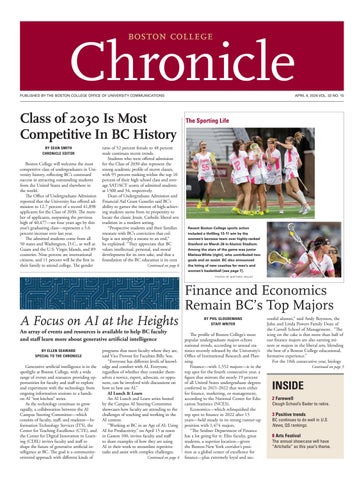
Recent Boston College sports action included a thrilling 13-11 win by the women’s lacrosse team over highly-ranked Stanford on March 26 in Alumni Stadium. Among the stars of the game was junior Marissa White (right), who contributed two goals and an assist. BC also announced the hiring of new coaches for men’s and women’s basketball [see page 7].
photos by matthew healey
Bader, an Architect of the CSTM, Prepares to Retire
BY KATHLEEN SULLIVAN STAFF WRITER
Clough School of Theology and Ministry Associate Dean for Academic Affairs
Jennifer Bader, who was part of the senior leadership team that helped establish the Clough School, will be stepping down from her position in June after 23 years at the University.
A respected academic administrator, Bader has overseen the development and assessment of academic programs since the Clough School was founded in 2008. She also served as interim dean, and later acting dean, for several months during 2016.
Bader joined Boston College in 2003 just weeks after earning a doctorate from The Catholic University of America. She served as associate director for academic affairs at BC’s Institute for Religious Education and Pastoral Ministry (IREPM). In that role, she chaired the admissions committee, taught courses, developed curricula, and conducted academic advising.
In 2008, Weston Jesuit School of Theology reaffiliated with Boston College and combined with IREPM to become the School of Theology and Ministry (renamed the Gloria L. and Charles I. Clough School of Theology and Ministry in 2024).
“That was a big transition,” said Bader, looking back at the creation of CSTM, at the time the first new school established at the University in more than 50 years. “It was very complex. It was even difficult at times, but it was exciting.
“Building a new school from the ground up and being on that leadership team was amazing,” she recalled. “Everyone had a very similar sense of mission.”
Bader was tasked with creating the school’s academic policies. She also chaired a committee that put together the mission statement for the new school. She remembers having to select the code for the school so it could be officially entered into the University’s registration system.
“I find it challenging to imagine the CSTM without Jen Bader because her presence, touch, and positive influence are evident in every corner of our school,” said Associate Professor of Pastoral Care and Counseling Melissa Kelley. “From the school’s very start, Jen has been a vital anchor and innovative thinker, creating policies and procedures—often from the ground up—in ways that have profoundly shaped the strong school and wonderful community that we are today.”
ASSOCIATE VICE PRESIDENT FOR UNIVERSITY COMMUNICATIONS
Jack Dunn
SENIOR DIRECTOR FOR UNIVERSITY COMMUNICATIONS
Patricia Delaney
EDITOR
Sean Smith
Bader works closely with the faculty and is engaged in the assessment of academic programs. A national priority was placed on assessing student learning about the time CSTM was formed and that mandate matched well with Bader’s natural instincts as an “academic who loves meetings.” She served on a committee charged with creating a plan to assess student learning, a multi-year process, then worked with the faculty on implementing the plan.
“Our faculty are forming people for ministry, so that meant inviting the faculty to consider desired outcomes. That involves asking faculty questions like ‘Who is it that you envision when you’re teaching your course?’ ‘What is it that you want a student to be able to do by the end of
I love working with the faculty and my colleagues on the administrative team. I love coming to work and asking the question: ‘How do we best educate for ministry in the Church?’ That’s been my driving force.”
“I deeply value the opportunity to consult with Jen on various matters, as I know I will be met with openness, creativity, and wonderful colleagueship,” said Kelley. “I will miss Jen’s kind and caring presence among us very much. If ever there were a person and a position that were meant to come together for the good of so many, I think Jen’s incredible work and ministry at the CSTM demonstrate such a match. I’m grateful to God for Jen’s many accomplished years at the CSTM and for her generosity in sharing so much of herself.”
“I’ve been immersed in BC’s Jesuit, Catholic culture and that has really formed me,” says Clough School of Theology and Ministry Associate Dean Jennifer Bader, “and for that, I’m incredibly grateful.”
the class?’ ‘How do you want our students to approach their ministry after graduation?’”
Once objectives are written and incorporated into the syllabus, outcomes are measured. Bader sits on every program review committee, a comprehensive process that assesses degree programs to see if they are meeting their student learning outcomes. “We aggregate the data to determine trends. My role is to ask really good questions so that the faculty can use assessment data to continuously improve programs.
“I’ve come to recognize that my vocation has been to academic administration.
CONTRIBUTING STAFF
Phil Gloudemans
Ed Hayward
Audrey Loyack
Rosanne Pellegrini
Kathleen Sullivan
PHOTOGRAPHERS
Caitlin Cunningham
Matthew Healey
“Jen’s service as the chief officer for academic affairs since the CSTM was established in 2008, and a few years more prior to that, has been simply remarkable,” added Professor of Theology and Religious Education Hosffman Ospino. “Whether accompanying students with utmost care, supporting faculty, or pioneering processes to ensure the school achieves academic success, she has embodied Boston College’s renowned motto ‘Ever to Excel.’”
Bader said one of the highlights of her career came in 2024 when met Pope Francis after traveling to Rome with CSTM Dean Michael McCarthy, S.J., and Professor of Systematic Theology Richard
Lennan for a conference. The pontiff gave an address and personally greeted every participant. “Meeting Pope Francis and taking part in the conference were an incredible privilege. To be with people from all over the world doing what we are doing and seeing the global reality of the Church in action, in terms of theology and higher education, was very special.”
Bader has also found joy in working with students. “I usually see the students who are struggling in some way. I find meaning in helping those students, whether it is advocating for them with faculty or connecting them to University resources. And then, seeing over time how they get back on track is so fulfilling. I’m thinking of one student right now in particular: When I called out her name at a recent graduation, it was just lovely to see her walk across that stage and get her moment.”
“Jen cares deeply about our students and their success,” said Religious Education Professor of the Practice Theresa O’Keefe, who has known Bader since O’Keefe was a doctoral student at IREPM. “Whenever I have any concern about a student, whether for health or academic performance, I know that Jen’s the point person I can go to. She figures out how we can legitimately meet the needs of the degree program but also serve this student in particular. She is always really thoughtful about the best way forward.”
Bader expressed gratitude for the University’s offerings related to leadership development, such as Management Development Perspectives, and to Ignatian spirituality.
“I have been steeped in Ignatian spirituality since coming to BC through programs such as Intersections and the Ignatian Leadership Development Program. I’ve taken advantage of the many resources of the Center for Ignatian Spirituality,” said Bader, who made an Ignatian pilgrimage to Spain and Rome last summer. “I’ve been immersed in BC’s Jesuit, Catholic culture and that has really formed me, and for that, I’m incredibly grateful.”
When asked what she will miss most, Bader quickly responded: “My colleagues. We all come to work with a shared sense of mission. It’s hard to imagine my world without them.
“I’ve spent my entire career at Boston College, and I have been very blessed to work here.”
The Boston College Chronicle (USPS 009491), the internal newspaper for faculty and staff, is published biweekly from September to May by Boston College, with editorial offices at the Office of University Communications, 3 Lake Street, Brighton, MA 02135 (617)552-3350. Distributed free to faculty and staff offices and other locations on campus.
Periodicals postage paid at Boston, MA and additional mailing offices.
POSTMASTER: send address changes to The Boston College Chronicle, Office of University Communications, 3 Lake Street, Brighton, MA 02135.
A flipbook edition of Chronicle is available via e-mail.
Send requests to chronicle@bc.edu.
photo by caitlin cunningham
Good News for BC in Latest U.S. News, QS Rankings
BY JACK DUNN ASSOCIATE VICE PRESIDENT FOR UNIVERSITY COMMUNICATIONS
Boston College Law School, the Lynch School of Education and Human Development, and the Carroll School of Management all saw gains in the 2027 U.S. News Graduate School rankings, released on April 7.
BC Law experienced the most dramatic improvement among BC’s schools, rising five points to 20th overall—its highest ranking in U.S News since its all-time high of 19th in 1993.
The Lynch School and Carroll School’s part-time dual MA/MBA program also improved in this year’s ranking, each rising one point to 19th and 16th, respectively.
The Connell School’s Doctor of Nursing Practice program ranked 21st this year, and its Master of Science in Nursing program placed 29th.
The Carroll School’s full time MBA program was ranked 53rd.
BC graduate schools also performed well in this year’s specialty rankings category, reflecting the University’s strong academic reputation among the nation’s top universities.
BC Law improved to eighth in tax law, 16th in the “most grads in big firms” category, 25th in corporate law, 26th in constitutional law, 27th in intellectual prop-
erty law, and 29th in clinical training.
The Lynch School saw six of its specialty programs ranked in the top 20, including student counseling (11th), curriculum and instruction (12th), educational administration (13th), and elementary, secondary, and higher education (all 17th).
Also, the Connell School’s Nurse Anesthesia program rose to 20th.
In this year’s U.S. News rankings of math and science programs, the Morrissey College of Arts and Sciences’ mathematics program improved to 61st overall, while chemistry placed 67th, physics 73rd, and biology 104th.
In an off-year for rankings of schools of social work, the Boston College School of Social Work retained its placement of eighth overall.
According to U.S News, its rankings are based on “expert opinion about program excellence, and statistical indicators that measure the quality of a school’s faculty, research and students.”
In addition, in the QS Global Rankings of schools of theology, divinity, and religious studies released on March 25, the Clough School of Theology and Ministry and the Theology Department in the Morrissey College placed fifth overall, matching their highest ranking to date [see story at right].
A full listing of this year’s U.S. News graduate school rankings can be found at www.usnews.com.
Finance Again Top Choice Among Majors and Minors
Continued from page 1 (830) and political science (768) garnered the third and fourth spots, respectively— also reflecting the same positions in national rankings according to NCES, as each one captured seven percent of majors among all U.S. colleges.
Psychology (556) was ranked fifth overall among BC majors; when merged with neuroscience, a joint department at BC since 2020, it totals 980 enrollees.
In contrast, the number of computer science majors at BC decreased from 533 to 384, a 28 percent reduction, dropping it from the sixth to the 10th most popular, and reversing a trend that saw it rise from 68 majors in 2009 to 420 in 2018. Since 2014, computer science had experienced a 141 percent enrollment increase, one of the largest gains among disciplines with at least 10 students registered in a major.
The current downward drift reflects results from a fall 2025 Computing Research Association survey of computing academic units indicating that undergraduate computing enrollments are declining at most programs. It noted, however, that several other computing disciplines experienced growth, including computer engineering, cybersecurity, and artificial intelligence.
According to Daniel J. Fitzgerald Profes-
sor George O. Mohler, chair of the Computer Science Department, the development of a new AI concentration within the major is designed to attract more students.
“While CS major enrollments have decreased across the U.S., there has been an increase in students studying AI and data science to meet current demands in industry,” said Mohler. “Our new AI concentration within the CS major, as well as the recently launched data science minor, offer BC students pathways toward these in-demand fields.”
Rounding out BC’s top 10 majors were communication (447)—returning to the sixth spot after a one-year decline—and neuroscience (424), which rose two levels over last year. Nursing (412) and applied psychology and human development (408) filled the eighth and ninth slots, respectively.
Among the most popular minors, finance (701) retained its grip on the top spot for the eighth consecutive year, while general business (269)—launched three years ago—surpassed marketing (222) for second.
Managing for Social Impact—up to 196 this year from 182—leaped one slot ahead of Management and Leadership
BY KATHLEEN SULLIVAN STAFF WRITER
Boston College is ranked fifth among universities worldwide in the prestigious 2026 QS World University Rankings of the top places to study theology, divinity, and religious studies—matching the University’s highest ranking ever in the subject category, which was introduced in 2017.
Released March 25 in London, the QS Rankings are prepared by the British firm Quacquarelli Symonds, considered among the most influential providers of international university rankings.
Boston College’s ranking is reflective of the joint contributions of its Clough School of Theology and Ministry and Department of Theology in the Morrissey College of Arts and Sciences. The QS rankings are based on academic and employer reputation and global research impact.
Boston College was the highest ranked Jesuit university in the world. BC, the University of Notre Dame, and KU Leuven were the only Catholic institutions ranked in the top 10 in the global survey.
Clough School of Theology and Ministry Dean Michael C. McCarthy, S.J., said BC’s strong showing in the QS rankings is a testament to the school’s dedicated and missiondriven faculty.
“At the Clough School, we are committed to offering a world-class theological education—one that is especially attentive
to ministerial contexts in which so many of our students will work,” said Fr. McCarthy. “Our faculty includes excellent scholars, teachers, and mentors. We know who we are as an institution and what our mission is. It’s nice that, in a global context, our approach is recognized.”
Theology Department Chair Andrea Vicini, S.J., the Michael P. Walsh, S.J., Professor of Bioethics, said that the rankings affirm the academic excellence of faculty and students.
“The 2026 QS ranking is a greatly appreciated international recognition of the commitment of our Theology Department to foster academically rigorous theological discourse, creative scholarship, high quality teaching, and formative pathways. This ranking highlights the remarkable dedication and competence of our faculty and students.
“With renewed energy, both globally and at Boston College, we are confirmed in our mission to foster our engagement with other disciplines, as well as with the Church, religions, culture, and society, striving to promote dialogue and collaborative interactions.”
The top 10 schools in this year’s survey of theology, divinity, and religious studies are (in order): University of Notre Dame, University of Oxford (UK), Harvard University, Durham University (UK), Boston College, University of Chicago, University of Cambridge (UK), KU Leuven (Belgium), Duke University, and Yale University.
(195), while philosophy (154) stayed steady at sixth. Applied psychology and human development rose from 118 minors in 2024-2025 to 135 this year, capturing seventh place, and history (135) remained at eighth. Medical humanities and global public health tied at 97 for ninth and 10th.
Although the pre-medical track (1,651) overwhelmingly prevailed as the Univer-
sity’s most popular program of study, the pre-dental course experienced a 19.5-percent increase, rising from 87 to 104 enrollees. Pre-law enrollment rose from 1,248 to 1,398, a 12-percent increase.
The data were assembled during the fall 2025 semester by IR&P as part of its annual compendium of facts and figures for administrators, faculty, staff and students.
The popularity of finance, economics, biology, political science, and psychology majors among BC undergraduates reflect national trends.
photo by caitlin cunningham
University Provides Opportunities to Learn About AI
Continued from page 1
Catherine Conahan of the Connell School of Nursing, Lynn Berkley of Facilities Management, Stef Cahill Farrella and Caitlin Aubuchon of Human Resources will lead the session. Register at bit.ly/AI-Lunchand-Learn-April-15.
Previous sessions in the series included “Teaching at BC in an Age of AI: Experiences Teaching Writing” and “Research at BC in an Age of AI: AI as a Tool in the Researchers Toolkit.”
AI Test Kitchen
The CDIL also offers the Test Kitchen [bit.ly/BC-AI-Test-Kitchen], a hands-on environment where faculty engage in experiential learning about AI, according to CDIL Assistant Director for Design Innovation Timothy Lindgren. No previous technological experience is required to attend; the workshops use a design thinking approach that emphasizes learning how to effectively frame questions and use plain language to create and direct a custom AI assistant, Lindgren explained.
“By creating a low-pressure space to experiment, fail, and iterate, participants learn that building a custom AI assistant is less about coding and more about shaping behavior with natural language, or the words we use every day. They walk away not just with a concrete prototype, but with a deeper, hands-on understanding of AI’s possibilities and limitations.”
Nearly 100 members of the BC community have participated in a Test Kitchen event so far, representing eight of BC’s schools and colleges, and various divisions, offices, and centers including Student Affairs, Human Resources, and Institutional Research and Planning.
Among participants was Professor of the Practice in Economics Can Erbil, who was interested in creating an AI assistant for his large introductory course, Principles of Economics.
AI Learning Exchange
The CDIL is offering ongoing, exploratory AI events for faculty and staff, including the AI Learning Exchange [bit.ly/ BC-AI-Learning-Exchange], a communitybased session that meets throughout the academic year on Zoom where faculty can share AI use cases and connect about recent developments in AI.
The next AI Learning Exchange sessions will take place on April 10 and April 24, both at 2 p.m. on Zoom.
Erbil has been experimenting with an AI oral-assessment platform called Professr. io that allows instructors to create a coursespecific AI interviewer trained on their own materials. The AI tool can then conduct short, conversational interviews with students about course concepts, asking followup questions and probing their reasoning.
What surprised Erbil most in building the AI assistant was how much design thinking happens before anything technical. “I expected the hardest part to be the technical side, but instead I found myself spending the most time thinking carefully about the role of the chatbot. In other words, it’s less about coding and more about shaping behavior with words.
“Compared to simply reading about AI assistants, the Test Kitchen was especially helpful. The hands-on loop of testing student-style questions, capturing misses, and tightening prompts, was far more instructive.”
BC School of Social Work Assistant Professor of the Practice Carolyn Romano came to the Test Kitchen interested in an AI assistant that could offer meaningful support in her Solution-Focused Therapy course, which is based in simulation techniques, like role-playing, to help social work students practice leading interventions.
While Romano had considered companies that offer simulation training, most are cost prohibitive. BC’s AI Test Kitchen presented an in-house opportunity to design a simulation completely within parameters and with prompts that Romano got to set herself, all as part of the Google Gemini system, which BC offers to all faculty and staff.
Through the Test Kitchen, Romano started building an AI assistant that acts like a mentor and roleplaying partner for her students. Students, roleplaying as a therapist, first answer some questions about their experience with solutions-based therapy. Then they ask the AI assistant questions like “What brings you in today?” ultimately working towards the “Miracle Question”—a solution-focused therapy technique. And like any roleplaying partner, the AI assistant is even trained to stop the simulation if the student misses something, such as not validating the client.
“It was more didactic than I thought,” said Romano, describing the AI assistant, which can interact by texting or talking with students. “I want my students to walk out of the M.S.W. program as good critical thinkers. The Test Kitchen gave me the basics to think about AI in a different way and gave me tangible skills to start playing with.”
Although she hasn’t rolled out the AI assistant for classroom use yet, Romano said that her students have shown enthusiasm for the tool.
A community-oriented approach
Vice President for Information Technology Services Scott Cann noted that the interdisciplinary nature of BC’s approach to AI is critical to the University’s conversation around the technology.
“The collaboration between ITS, CDIL, CTE, and the Campus AI Steering Committee continues to be a very effective approach to guiding the practical and intentional applications of AI in teaching, learning, research, and administration,” said Cann.
There’s no right way to use AI in higher education, which is why this responsive approach works well, said Associate Vice Provost for Digital Learning Brian Salerno. Instead, CDIL is creating community- and curiosity-centered spaces where faculty can engage and experiment with AI tools in a meaningful way to their teaching and disciplines—not just as a technical challenge, but as a design and pedagogical one, grounded in institutional shared values and
commitment to student learning.
“We’ve found that BC faculty are best supported when they can situate their thinking in conversation with colleagues, rather than feeling like they have to navigate these powerful and potentially disruptive technologies on their own,” Salerno added.
Additional support for faculty interested in how AI can support their teaching is available through the CTE, which helps faculty think about what their goals are for teaching and the best way to get those things done, said Sarah Castricum, CTE associate director for teaching, learning, and technology.
“The stakes around AI, and the challenges it raises to student learning and academic integrity, are huge. So we start with learning. In some cases that means learning about AI tools that can serve students well, and sometimes it’s more about how to protect the spaces where student learning is happening and preclude AI use from them.”
Faculty can access individual consulting at CTE, which also frequently connects faculty with campus partners such as CDIL and the libraries when questions about specific AI tools or projects arise. Because of AI’s continuous evolution, it can be hard to keep up with what the landscape looks like, added Castricum.
“Being able to collaborate with campus partners is critical to ensuring that we, collectively, bring the best information to campus that we can.”
All faculty and staff interested in learning how AI has evolved and how AI can support their work are invited to upcoming University programming around generative artificial intelligence. For more information, go to bc.edu/genai, bc.edu/its, or bc.edu/cdil.
Ellen Seaward is a senior digital content writer in the Office of University Communications
Billy Soo: “Everyone, regardless of whether they consider themselves a novice, expert, advocate, or opponent, can be involved with discussions on how to best use AI.”
photo by caitlin cunningham
Brian Salerno: “BC faculty are best supported when they can situate their thinking in conversation with colleagues, rather than feeling like they have to navigate these powerful and potentially disruptive technologies on their own.”
photo by lee pellegrini
photo by gretchen ertl
A special guest was on hand for the University Advancement Easter Party on March 28 in Cadigan Alumni Center.
Writings Offer Insight into Legacy of PoliSci’s Faulkner
BY SEAN SMITH CHRONICLE EDITOR
Boston College Professor of Political Science Robert Faulkner (1934-2023) was a universally respected scholar of modern political philosophy and American political and legal thought who earned praise from BC colleagues and students alike, and from across academia.
Now, a recently published book of his writings has brought Faulkner’s legacy into focus.
Politics, Progress, and the Constitution: Essays in Political Philosophy consists of 17 studies spanning his career, and his interest in great thinkers like Aristotle, Machiavelli, Plato, Francis Bacon, Xenophon, John Locke, John Marshall, and Alexander Bickel. These essays examine the theory and practice of constitutional government, the philosophical foundations of modern republicanism, and the principles of great statesmanship as embodied by George Washington, Thomas Jefferson, and Abraham Lincoln, among others.
“Robert Faulkner was, of course, a professor of political science, and he was interested in both parts of that subject: the political and the scientific,” said Behrakis Professor of Hellenic Political Studies Robert Bartlett, the book’s editor.
“Put another way, he had a keen and lifelong interest in the everyday workings of politics, but he was also interested in science broadly understood: What is it that we can know about ourselves and the world? I think his studies were informed by Aristotle’s famous dicta that a human being is by nature a political animal and a rational animal. But how—how well—does our potential rationality sit with our political nature? To what extent can our politics re-
Professor of Political Science Robert Faulkner (shown in 2013): “He had a keen and lifelong interest in the everyday workings of politics, but he was also interested in science broadly understood: What is it that we can know about ourselves and the world?” says his former colleague Robert Bartlett, editor of a newly published book of Faulkner’s essays.
photo by lee pellegrini
writings.”
Bartlett notes that he had the fortune to have been both a student of Faulkner— who sat on Bartlett’s doctoral dissertation committee—and later, a colleague. “I thought it would be a worthwhile service to others and—I hope—a fitting tribute to him to put together a representative sample of his scholarship. So the book is partly a ‘thank you’ to a mentor and friend, partly also a gift to others.”
Faulkner’s studies broadened and deepened over time, according to Bartlett: first concentrating on early modern political philosophy and the roots of the American republic—particularly focusing on Locke—and then transitioning to an extensive investigation of Bacon, a less-explored figure in political science circles.
ally be rational?”
Faulkner, who joined the BC faculty in 1968 and continued to work as a research professor following his retirement in 2014, was attuned to the foundational, classical, and historical aspects of political science.
He dealt with such topics as Lincoln’s prescriptions for liberal democracy; the differences between Xenophon’s and Herodotus’s biographies of Cyrus the Great; Aristotle’s doubts about executive power; Locke’s republicanism and critique of religion; and Bacon’s scientific method and use of the essay as a literary form.
His books included The Case for Greatness: Honorable Ambition and Its Critics,
proposing “a reasonable understanding of excellence” associated with the quality of ambition—which, he argued, had come to be regarded as a negative trait for leaders; and Francis Bacon and the Project of Progress, in which he cast Bacon as a key architect of the Enlightenment and one of the seminal founders of modernity.
“In putting the book together, I read most all of Bob’s writings, the articles especially,” said Bartlett. “I selected from these many writings those that I thought were representative of the stages of his research and interest and that didn’t overlap so much with his books. I have also included in the book a complete bibliography of his
Faulkner saw that modernity was a carefully thought-out project to bring philosophy—now known as science—to bear on everyday life, “making it easier, safer, longer,” said Bartlett, with technology as the change agent. The central architect for this endeavor was Bacon, and Faulkner “was instrumental in bringing Bacon’s thought to the attention of political science and political theory especially,” according to Bartlett.
“Bob appreciated Bacon’s jaw-dropping ambition to remake the world, even as he had some reservations about its late fruits.”
Bartlett sums up Faulkner as “a wonderful teacher, a fine scholar, and a thoroughly decent human being.
“He had a clear sense of what really mattered, in politics and in life, and he devoted himself to serious things—all the while maintaining a great sense of humor that enlivened his conversation and made his company a real pleasure. He could be pugnacious in print, but he was always a gentleman in person.”
Trustees Chair to Be Honored at Wall St. Tribute Dinner
Boston College Board of Trustees Chair John F. Fish, a respected voice and thought leader in business and construction communities, will be honored at the 36th annual Boston College Wall Street Business Leadership Council Tribute Dinner on April 23. The event will take place at the newly renovated and restored Waldorf Astoria Hotel in New York City. Organized by the Wall Street Business Leadership Council—a network of more than 2,000 BC alumni, parents, and friends who work in and represent the New York financial community—the dinner provides financial aid for BC’s Gabelli Presidential Scholars Program, a four-year honors program that combines rigorous coursework, community service, international experience, and internships. Over the past 35 years, the event has raised more than $60 million in scholarship funds.
During the program, University President William P. Leahy, S.J., will present Fish with the President’s Medal for Excellence in recognition of his life’s work and contributions to society.
Currently serving his second nonconsecutive term as chair of the Boston College Board of Trustees, Fish is the first BC non-alumnus to serve in that role. He has been active on the BC board since 2006 and has also served as chair of the University’s Board of Regents. He is co-chair of the Soaring Higher capital campaign for Boston College and has spearheaded the dramatic increase in revenue generated from BC’s annual Pops on the Heights Barbara and Jim Cleary Scholarship Gala, which raises money for financial aid.
Under his leadership as chairman and CEO of Suffolk, a national contractor that builds, innovates, and invests, the company has become one of the nation’s leading privately held builders, generating more than $9 billion in annual revenue and ranking 23rd on Engineering News Record’s “Top 400 Contractors.”
He is former chair of the Real Estate Roundtable, a national public policy advocate for the United States commercial real estate industry, a founding member and director of the Massachusetts Competitive
Partnership, and a former chairman of the Federal Reserve Bank of Boston. He also serves on the Real Estate Board of New York, the Partnership for New York City, and the National Business Roundtable. He chairs Brigham and Women’s Hospital, serves as vice chair of the Mass General Brigham executive committee, and is on the board of the Feinstein Institutes for Medical Research.
A graduate of Bowdoin College, Fish holds a bachelor’s degree in political science. He received an honorary doctorate of engineering technology from Wentworth Institute of Technology, and holds honorary degrees from Regis College and Curry College.
He and his wife, Cyndy, are the parents of Christina J.D. ’13, Jennifer M.B.A. ’18, and Caroline ’23.
Find more about the Wall Street Business Leadership Council Tribute Dinner and ticket information at tributedinner. bc.edu.
—University Communications
John Fish
photo by jamey stillings
UGBC Leadership Team for 2026-2027 Is Finalized
BY AUDREY LOYACK STAFF WRITER
Last month’s Undergraduate Government of Boston College (UGBC) election saw Boston College undergraduates choose juniors Jonah Renz and Addie Weiss as UGBC president and vice president, respectively, for the 2026-2027 academic year. They will begin their terms later this semester, succeeding seniors Cameron (Cami) Kulbieda and Reagan Marino.
“It’s truly an honor,” said Renz and Weiss in a joint statement. “Both of our lives have been defined by leadership in various ways and we are constantly pursuing new opportunities to grow in our abilities as leaders. It’s extremely rewarding to know that the students see us as a good fit for these positions, and we’re excited to use our roles to better the student experience over the course of next year.
In their campaign, Renz and Weiss focused on a five-pillar policy—community building, belonging and dialogue, service and social impact, campus life, and internal improvement—all of which they said were grounded in the conviction of community. Their top three priorities for their leadership term will emphasize this community, as well as transparency and service.
Renz, a Milton, Mass., native in the Carroll School of Management with a double major in accounting and business analytics and a Managing for Social Impact minor, began his journey to student
government after relentlessly searching for purpose and affinity during his early years on the Heights. This past summer, Renz worked on campus as an orientation leader, where he found his stride in giving back to students on a similar quest as him.
“That role instilled in me a love for helping other students and building community on campus,” said Renz, who currently serves as UGBC’s coordinator of student initiatives. “Having felt a version of struggle that some students express, I ran for president primarily because I want
BC Admits Class of 2030
Continued from page 1
personalis—care of the individual. They are drawn by BC’s deep-seated intention to support student citizenship in the world.”
BC’s commitment to meeting 100 percent of demonstrated need for all domestic students is another attraction for families, said Gosselin, who notes that last year the University raised undergraduate financial aid by 7.5 percent to $190 million. More than 67 percent of Boston College undergraduates receive financial aid.
The financial aid staff has worked diligently to finalize financial aid awards for admitted students, said Gosselin, and will continue to work closely with additional families who will complete their financial aid applications in the weeks ahead.
“The work our Enrollment Analytics colleagues have done has provided us with a sense of confidence that the offers we’ve extended will produce an exceptional entering class. Further, the Office of University Communications has created an impressive portfolio of resources to assist our admitted students in making their decisions. We are deeply grateful to all our campus colleagues as we work together to enroll BC’s Class of 2030.”
This year’s Admitted Eagle Days will be held on April 12 and 19. Throughout the month of April, off-campus admitted student receptions will be held in 17 cities across the country. A series of virtual events
will also take place to supplement the University’s in-person programs. Admitted students have until May 1, the Candidate’s Reply Date, to accept their place in the class.
Recent years have seen increased scrutiny of higher education and the value it holds for the emerging generation of young adults, but such examination isn’t uniformly antagonistic, said Gosselin: There is genuine interest in seeing how colleges and universities address compelling issues of the time, notably the artificial intelligence boom.
“Families across the country are increasingly curious, and understandably so, as to what AI means for their student’s career post-graduation prospects,” he explained. “Artificial intelligence is a topic explored throughout Boston College: in classrooms and research labs; among administrators, faculty, and staff; and through the great range of disciplines that make up the liberal arts tradition. [see related story on page 1]
“A liberal arts education helps students navigate ambiguity, use research to draw conclusions, develop effective communication skills, and use an ethical framework to make decisions that impact the world around them. Boston College aims to equip its students with the necessary tools to answer many of the questions AI is raising.”
Renz and Weiss agree that diverse leadership will be vital in bringing unique viewpoints to meetings and discussions across UGBC’s seven divisions and three committees. By making this a priority, they hope that every student on campus feels their interests are shared by all members of the student government, and that UGBC is a resource to turn to when they need change or advocacy.
When it comes to allocating resources in the form of time, effort, and money, the president and VP-elect say their ultimate goal is to build a community of thoughtful discussion where all voices are heard.
“The balancing act between members spending intentional time within their own respective group and interacting across other divisions and committees will be a challenge. We hope for a combination of both in our [leadership] efforts, allowing cross-divisional collaboration and ensuring that each division is strong on its own.
to use my final year at BC to give back to other students, helping them find that sense of belonging to not only push past their struggles but also find a true love for Boston College.”
Weiss, a sociology major in the Morrissey College of Arts and Sciences with minors in International and Hispanic studies, first discovered a love for advocacy participating in student government at her high school in Green Bay, Wisc. The first QuestBridge scholar to be elected to the UGBC Executive Council, she realized during her first year at the Heights that UGBC offered a similar opportunity for service.
“My love for UGBC, the senate, and the potential of the organization has grown in the years since then,” said Weiss. “I felt drawn to the role of vice president because it allows me to facilitate the many moving parts of the senate and hopefully make it the most cohesive, effective space it can be.”
“We also plan to engage in open dialogue with division directors and committee chairs about how they can be best supported in this manner and with other issues that are division- or committeespecific.”
Renz said he hopes that, by the end of his term, UGBC “has helped students find their place and a sense of love for BC. I hope people see UGBC as an organization that is there to help students and not one that operates in the shadows.”
Weiss sees her legacy as all about success that is shaped by passion and love.
“Success in this role to me means making every member love being a part of this organization. That love will show through in their initiatives and be apparent to the students who benefit from them. I want to look back at this upcoming year with full confidence in the next generation of student leaders to grow and spread love through the work that UGBC does.”
Incoming Undergraduate Government of Boston College President Jonah Renz ’27, right, and Vice President Addie Weiss ’27.
The March 23 Connell School of Nursing Pinnacle Lecture featured a panel discussion on GLP-1 therapies and their role in shaping health care, with (L-R) moderator CSON Assistant Professor Patricia Underwood; Ariana Chao ’10, M.S.’11, Johns Hopkins School of Nursing; Alexander Turchin, M.D., Harvard Medical School and Brigham and Women’s Hospital; and Katelyn O’Brien, Boston Medical Center.
Snapshot Pinnacle Lecture
photo by caitlin cunningham
Eagles Welcome New Coaches for Men’s, Women’s Basketball
William V. Campbell Director of Athletics Blake James recently announced new leadership for the Boston College men’s and women’s basketball programs.
Luke Murray, an assistant coach with the University of Connecticut men’s basketball team, was named the Clement and Elizabeth Izzi Family Head Men’s Basketball Coach at Boston College.
In addition, Kate Popovec-Goss was appointed as head coach of the BC women’s basketball team after having led the Bradley University women’s hoops program for the past four years.
Murray played an integral role in UConn’s reemergence as a national power during the past five years, culminating this season in its third appearance in the NCAA Final Four since 2021. He is widely recognized for his ability to design topperforming offenses and develop all-conference and NBA-caliber players, as well as an elite recruiter of young basketball talent.
Prior to UConn, Murray held assistant coaching roles at Louisville, Xavier, Rhode Island, Towson, and Wagner.
“In Luke Murray, we have found a leader who does not just understand the
IVC to Honor Three BC Alums
Ignatian Volunteer Corps New England will honor three Boston College alumni at its annual Madonna Della Strada Award Ceremony on April 26 at Boston College High School.
The awards will be presented to:
•Bill Reiser, S.J., ’82, a theological scholar, Jesuit priest, and professor at the College of the Holy Cross who has demonstrated a long commitment to pastoral care and teaching in Worcester and Bolivia.
•Salve Regina University President Kelli Armstrong Ph.D. ’96, who from 2004-2018 served as the University’s first director of institutional research at Boston College and guided efforts to inform the University’s planning and decisionmaking processes. Armstrong’s mother Carol, an emergency room nurse who has worked as an IVC volunteer, will also be
OBITUARY
honored.
•Jeff Thielman ’85, J.D. ’92, president and CEO of the International Institute of New England and an advocate for immigrants and refugees. He co-founded the Cristo Rey network of schools while serving as a Jesuit International Volunteer in Peru, and is a former president of Cristo Rey Boston.
The Ignatian Volunteer Corps is a national nonprofit that connects adults 50 years old and above with communitybased organizations serving people on the margins. Rooted in Ignatian spirituality, IVC members integrate their faith, skills, and life experience to bring hope, dignity, and compassion to those in need.
For more about the event, go to ivcusa.org/news-events/new-england-madonna-della-strada-award-ceremony-2026.
—University Communications
Sociologist Michael Malec, 85
Retired Professor of Sociology Michael Malec, who taught at Boston College for 50 years, died on March 31 in Newton, Mass. He was 85.
A funeral Mass for Dr. Malec was celebrated Tuesday at Sacred Heart Church in Newton.
A native of Chicago, Dr. Malec received a bachelor of science degree from Loyola University in 1962 and a doctorate from Purdue University in 1968. He joined the faculty of Boston College in 1969 and retired after the 2017-2018 academic year.
During his time at BC, he taught courses including Statistics, Data Analysis, and Sociology of Sport. He spent time as chair of the Sociology Department, advised countless undergraduate and graduate students, and led many service trips to Nicaragua, for which he was recognized with the 2016 Boston College Community Service Award.
“He will always be loved, remembered, and cherished,” said his son Thomas Malec, a director for computing support in Information Technology Services at BC.
Dr. Malec is survived by his wife of over 60 years, Myrna (King) Malec; his sons and their wives, Timothy and Sandy Malec of Newton and Thomas and Barbara Malec
of Milton; his grandchildren Matthew, Maria, Will, and James Malec; and his siblings Jim Malec, Judy Kelch, and John Malec. He enjoyed traveling and spending time with his family, combining the two whenever possible. He was a devoted Chicago Cubs fan, a BC basketball season ticket owner, and a longtime pickup basketball player at the Flynn Recreation Complex.
—University Communications
modern landscape of college basketball— he has helped define it,” said James. “His role in building a national championship caliber program, his sophisticated offensive vision, and his relentless pursuit of excellence make him the perfect fit to lead our student-athletes. We are thrilled to welcome Luke, his wife, Kara, and their family to the BC community.”
“I am deeply honored and incredibly grateful to lead the Boston College Men’s Basketball program,” said Murray in a statement when his hiring was announced. “BC is a university with a prestigious academic reputation and a storied basketball tradition. Boston College alumni and fans will find our program defined by a standard of excellence, and our team will play an unselfish, tough, and highly competitive brand of basketball. I am excited to get to work to build this proud program.”
During Popovec-Goss’s tenure at Bradley, the Braves’ win total grew from four in 2022-2023 to 20 this past season, which saw the team earn a Women’s National Invitation Tournament bid—only the second postseason appearance in program history. As head coach, she showed her expertise in player development, her players receiving multiple Missouri Valley All-Conference and all-freshman team selections, and the first Newcomer of the Year honoree in program history.
Prior to her arrival at Bradley, PopovecGoss served as associate head coach and re-
Jobs
The following are among the recent positions posted by the Department of Human Resources. For more information on employment opportunities at Boston College, see www.bc.edu/jobs or scan the QR code at right.
Research Systems Administrator Third Cook Waitstaff
Senior Associate Director of Stewardship and Donor Engagement
Assistant Director, Corporate & Foundation Communications & Proposal Development
Senior Research Compliance Specialist
Laboratory Safety Specialist
International Student Advisor
Administrative Assistant, Research Program on Children and Adversity
Associate Director, Budget, Operations & Systems
Senior Research Associate - Whitney Laboratory
Senior Executive Education & Advisory Associate
Senior Research Associate, Center for Earth System Science and Global Sustainability
Manager, Financial Reporting & Cash Services
cruiting coordinator at Northwestern from 2017 to 2022. The Wildcats competed in the postseason in five of her six seasons with the program and were also the 2020 Big Ten Tournament champions. PopovecGoss was responsible for nationally ranked recruiting classes, including the 2021 class which ranked top-10 nationally by ESPN. Popovec-Goss’s coaching experience also includes roles at Colgate and La Salle.
“Kate Popovec-Goss is a proven winner and transformational leader; we are excited to welcome her to Boston College,” said James. “Her track record including recent success in rebuilding Bradley aligns with our vision. We believe she has the drive and experience necessary to lead our program moving forward.”
“I am incredibly honored to be named the head coach at Boston College, one of the most prestigious institutions in the country, in one of the best cities in the nation,” said Popovec-Goss, who expressed her gratitude to James, University President William P. Leahy, S.J., and Senior Associate Athletics Director Reshauna Cobb. “This is a special opportunity, and I’m excited to build a program that reflects the excellence, integrity, and tradition that define BC. It is evident that BC believes in building a championship experience both on the court and off it, which aligns with my mission as coach. I can’t wait to get to work.” —Boston College Athletics
Assistant Director, PeopleSoft Financial Management Systems
Network Systems Engineer
Director, Nanofabrication & Cleanroom Facility
Postdoctoral Fellow, University Counseling
Applications Systems Analyst
Associate Director, Academic Services
General Service Worker
Research Associate
Associate Director, Companions Program Operations
Research Associate - School of Social Work
Teacher Assistant
photo by peter julian
BC Arts
April 23-25
Arts Festival Will Adopt ‘Artchella’ Theme for 2026
BY ROSANNE PELLEGRINI STAFF WRITER
This year’s Boston College Arts Festival—which runs from April 23-25—will sport the theme “Artchella,” in tribute to the popular Coachella music and arts extravaganza.
BC’s annual Arts Festival, a celebration of the variety and vibrancy of campus arts, features some 50 family-friendly events— most free and open to the public—showcases dance ensembles, the work of studio art students, as well as music, theater, film, creative writers, and more.
Discussing the “Artchella” theme, Arts Festival Director Kara Robbins said, “When you attend a festival like Coachella, whether it’s for one day or multiple days, you hear your favorite bands, create art with a community of new friends, and take time to nurture your soul. That’s what we’re inviting our audience to experience: to immerse themselves in art of all disciplines, form new connections, and take care of one another.”
“The launch of April always gets me excited for the Arts Festival, the opportunity to venture into warmer weather and enjoy the variety of arts experiences this campus community has to offer,” said BC Arts Council Chair Crystal Tiala, a Theatre Department professor and Music Department chair. “Fresh creative ideas spring up from the hundreds of performers you are likely to see. I hope everyone does themselves a favor and comes to the many wonderful events we have in store.”
The festival’s 28th edition will involve some 1,500 faculty, students, staff, and alumni artists, and more than 100 volunteers. Centered on Lower Campus, the festival’s Main Performance Tent is in the Mod Lot behind Robsham Theater Arts Center (RTAC), and an art gallery exhibition will be on display in the theater lobby. Other venues include the RTAC’s Bonn Studio, Gasson 100, Vanderslice Hall Cabaret Room, Burns Library, and Carney Hall’s Gallery 203.
Art Awards Ceremony
Twin brothers and 2006 alumni Will and Anthony Nunziata, both critically acclaimed arts professionals, will be feted as this year’s Alumni Artist Award winners. A highlight of the festival, the awards recognize graduates who have demonstrated creativity, innovation, leadership, and vision through contributions to the arts, and serve as role models to BC student artists.
The Nunziatas will discuss their professional and personal journeys and formation at the Arts Awards Ceremony on April 23 at 4:30 p.m. in Gasson 100. They also will meet with students in the respective disciplines of film, theater, and music.
Active in theater at BC, following grad-
uation the talented duo rose to professional prominence in the arts, in New York and beyond. The brothers performed together for two decades, touring nationally and internationally, and had the distinction of co-headlining Carnegie Hall with the New York Pops Symphony Orchestra.
Will is a New York City-based awardwinning filmmaker, theater director, and writer [www.WillNunziata.com] whose directorial short film debut, “The Old Guitarist,” garnered over a dozen national and international awards in London, New York City, and Paris. He will make his feature film directorial debut later this year with his psychological horror screenplay “The Kept,” which won Best Horror Screenplay at the 2025 Melbourne International Screenplay Festival. Will has directed stage productions on both sides of the Atlantic, with several off-Broadway credits, and had his West End debut directing at the prestigious London Palladium in 2025.
Anthony [www.AnthonyNunziata.com] is a Nashville-based singer, songwriter, actor, and entertainer dubbed by Broadwayworld as “America’s new romantic singing sensation,” who brings his soulful voice to classic jazz, pop stanadards, Italian arias, and his original music—which has included collaborations with prominent artists, and been featured on MTV, Comedy Central, CBS and NBC News. He has performed in over 400 concerts at performing arts centers, theaters, concert halls, jazz clubs, and private events around the world. Anthony, who also trained in improv comedy at the famed Upright Citizens Brigade, is most proud of his “Arts Matter!” Educational Outreach Initiative and Master Class Workshops, which educate and inspire students to pursue their passions.
The Arts Awards Ceremony also will include presentation of BC student and faculty art awards to honor accomplishments in and contributions to the arts.
Among those being recognized is Theatre Department Chair and Professor of the Practice Luke Jorgensen, whose scholarship centers on theater education, actor training, new play development, and the work of Augustus Boal and the Theatre of the Oppressed. He serves as a First Year Experience director and consultant, and as faculty advisor for My Mother’s Fleabag and Hello Shovelhead! His directorial credits at the University include “The Servant of Two Masters,” “A Midsummer Night’s Dream,” “Picasso at the Lapin Agile,” “Metamorphoses” (a Kennedy Center American College Theater Festival Ensemble Award winner), and his original “Codemonkey,” a semi-finalist in the NY Musical Theatre New Works.
Student Award winners include seniors Charlotte Caine, Lola Ellis, Lucy Farran, Marko Grgurevich, Lauren Heinzelman, Barry Spoto, Avery Suza, Amoggrajat
Venkat, Simon Xie, and Elyza Tuan. (The winner of the Jeffery Howe Art History Award was not available at press time.)
Full biographies of all Arts Awards winners are available at bc.edu/artsfestival.
Elsewhere at the festival
Other Arts Festival highlights include a new look for The Gallery in the RTAC lobby, where Studio Art faculty members will curate an exhibit showcasing the work of senior majors which previews the respective artists’ upcoming thesis exhibits. Burns Library, meanwhile, will be the venue for Creative Writing Concentration Readings on April 24 at 3 p.m.
The BC Symphony Orchestra’s familyfriendly concert on April 25 at 11 a.m. features music from “KPop Demon Hunters,” “How to Train Your Dragon,” “Jurassic Park,” and more. At 8 p.m. that evening, BC’s Middle East music ensemble Astaza! will present “One Thousand and One Nights” in the Main Tent.
In conjunction with the Arts Festival, the Theatre Department/RTAC will present “Legally Blonde: The Musical” on
the main stage from April 23-26. For performance times and information go to bc.edu/theatre. For tickets, see bc.edu/ tickets or call ext. 2-4002.
The McMullen Museum of Art’s current exhibition, “Collaborating in Conflict: The Yeats Family and the Public Arts,” is on display through May 31 in the Daley Family and Monan Galleries. For more on the exhibition, see mcmullenmuseum.bc.edu.
Organized by the Arts Council, the BC Arts Festival includes sponsorship from the offices of the President and the Provost and Dean of Faculties, the Arts Council committees, Student Affairs, and the Dean’s Office of the Morrissey College of Arts and Sciences, with support from the Alumni Association, the Boston College Police Department, the Boston College Bookstore, and BC Facilities and grounds crew members.
The schedule (subject to change) with event days, times, and locations is available at bc.edu/artsfestival. Events with admission costs are indicated.
Will (left) and Anthony Nunziata, the 2026 Alumni Artist Award winners.
Dance and musical performances featuring students are a staple of the annual Boston College Arts Festival.