Page 2
Around Campus
An unforgettable spring break for University Chorale; registration to begin for Community Engagement Summit
Page 3
New Program
Woods College will introduce Writing & The Human Condition this fall.
the
Page 2
Around Campus
An unforgettable spring break for University Chorale; registration to begin for Community Engagement Summit
Page 3
New Program
Woods College will introduce Writing & The Human Condition this fall.
the
2026 MLK, Romero Scholarship winners express gratitude for opportunities to serve, lead, and grow
BY AUDREY LOYACK STAFF WRITER
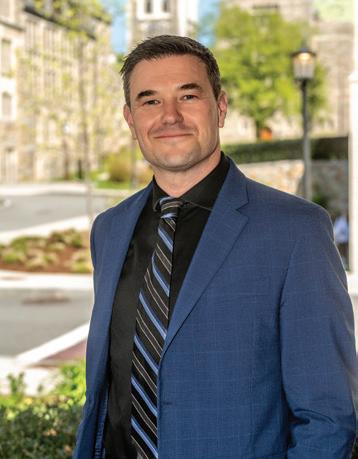
In the small town of Ivanhoe, Va., situated along the New River in the Appalachian Mountains and home to approximately 500 residents, Boston College junior Brian Davids had his first opportunity to serve and give back to a community in need during a high school service trip. In the years that followed, service and civic engagement became an instrumental part of Davids’ life, and one that guided his decision to apply to Boston College.
On March 11, from his bedroom thousands of miles from BC, Davids dialed into the 44th annual Martin Luther King Jr. Scholarship Banquet and heard his name announced as this year’s Martin Luther King Jr. Scholarship winner. The emotion he felt? “Love,” he said.
“So many people reached out to me,” recalled Davids, who is studying in Madrid
BY PHIL GLOUDEMANS STAFF WRITER
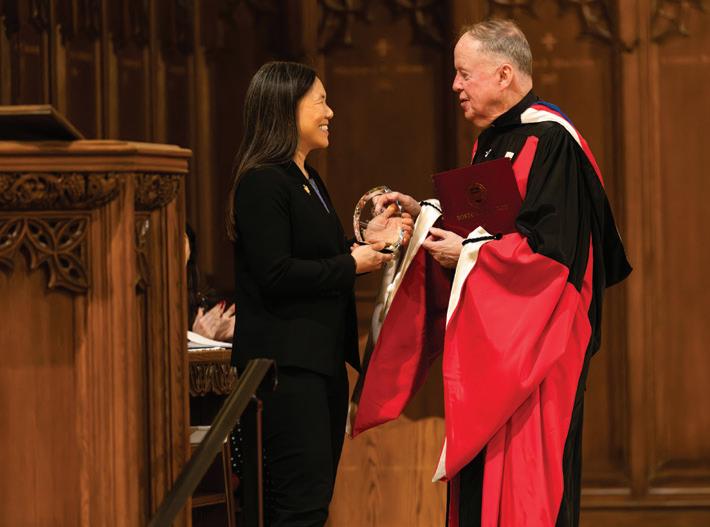
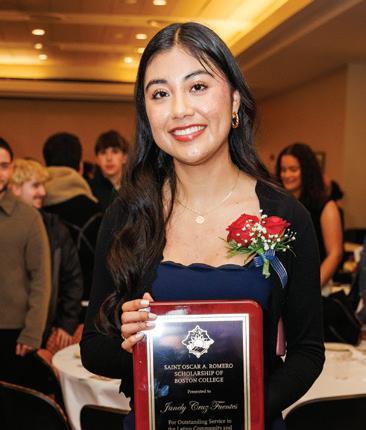
Janely Cruz Fuentes, co-president of the Boston College Mexican Association of Students and a Bowman Advocate, was awarded the 2026 Saint Oscar A. Romero Scholarship by University President William P. Leahy, S.J., at the Yawkey Athletic Center Murray Room on March 14.
The annual award recognizes a BC junior whose life demonstrates the values and ideals of the martyred Salvadoran archbishop. Finalists are chosen based on superior academic achievement, extracurricular leadership, community service, and involvement with the Hispanic/Latinx community and issues both on and off campus. The winner receives up to $40,000 toward senior-year tuition, and a $1,000 BC Bookstore gift certificate.
Cruz Fuentes, a political science major, serves as a teaching assistant for the Applications of Learning Theory class, a specialized
Page 8
Burns Scholar
Ray Cashman to speak about Irish funerary traditions
Boston College will host the inauguration of its 26th president, Jack Butler, S.J., on October 15-17, with a three-day celebration that will include an academic symposium, a Mass in Conte Forum, a formal inauguration ceremony, and a football game on the Chestnut Hill campus.
Winston Provost and Dean of Faculties David Quigley, chair of the Inauguration Planning Committee, has asked the University community to save the dates to honor the wishes of the president-elect for a “Celebration of the BC Community,” including faculty, staff, students, alumni, and parents.
Quigley said that Thursday, October 15, will feature an academic symposium and panel discussion. Friday, October 16, will feature a Mass, inauguration ceremony, reception, and other special events.
Saturday, October 17, will include campus festivities in advance of a football game against the University of Pittsburgh.
“October’s events will offer the University community the opportunity to reflect on our heritage and recent history, and to mark the significance of Fr. Butler’s inauguration,” said Quigley. “The committee and I
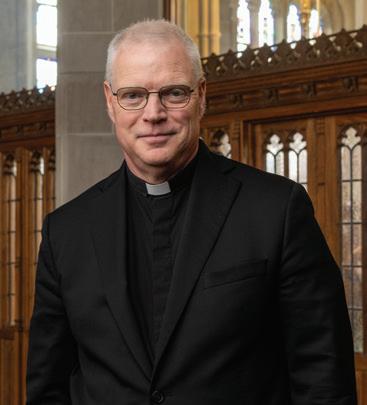
are focused on organizing three memorable days that celebrate the best of Boston College.”
Additional information and a website will be released as details are finalized.
—Jack Dunn
BY ELLEN SEAWARD SPECIAL TO THE CHRONICLE
An academic-yearlong series on journalism and climate change hosted by the Schiller Institute for Integrated Science and Society will conclude early next month with a panel discussion on the business end of climate change coverage.
“The Business of Climate,” which takes place on April 8 at noon at 245 Beacon Street in the Schiller Institute Convening Space (room 501), will feature remarks by Associate Professor of Economics Edson Severnini, a Schiller Core faculty member; Carroll School of Management Market-
ing Professor Gergana Nenkov; SuperCool co-founder Josh Dorfman, host of the company’s podcast; and National Public Radio Climate Desk correspondent Michael Copley. Anissa Gardizy, a San Francisco-based reporter at The Information, will serve as moderator.
The panelists will discuss how journalists can incorporate climate coverage into business and economic stories such as shifting insurance markets, the fate of electric vehicles, and the consequences of consumer habits.
“The Business of Climate” is the final event of “Climate is Every Story,” a four-
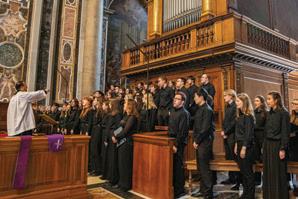
A trip to Italy which culminated in their voices ringing out in the Vatican, where they sang for a Mass at the Papal Altar in St. Peter’s Basilica, gave members of the University Chorale of Boston College a memorable and formative spring break experience.
Under the direction of Riikka Pietiläinen Caffrey, the group performed in this masterpiece of Renaissance architecture— recognized as the largest Catholic church in the world—which also houses masterpieces such as the Pietà, Michelangelo’s renowned sculpture, and Bernini’s massive bronze Baldachin.
“I am still struggling to find the words to describe the week we spent in Italy,” said Pietiläinen Caffrey, associate professor of the practice in music and director of choral and vocal performance.
“We sang in some of the most historical and amazing venues in the world, and many families, students currently abroad, and even a former exchange student joined us; these reunions made it even more special. Our singers shared not just their music, but stories behind the songs and their hearts with enthralled audiences. The trip was much more than music—we sang of course, a great deal in fact—but we also
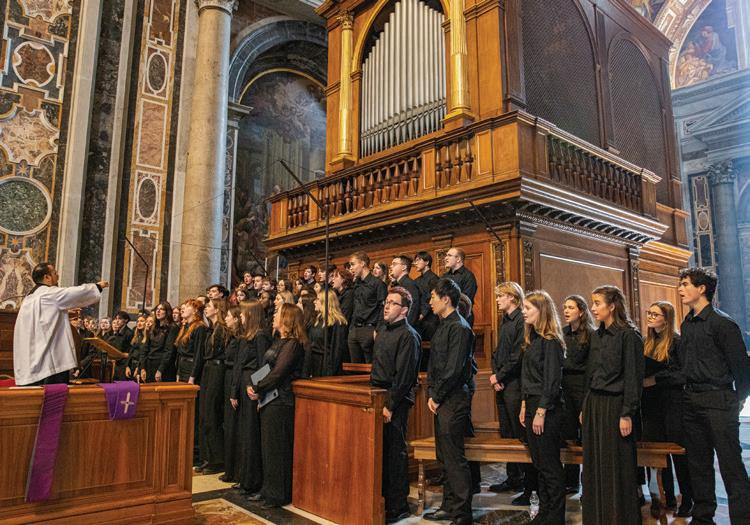
walked, rehearsed, studied history, laughed, cried, and grew together.”
The Chorale also performed a concert of sacred music with the Sant’Agnese Choir in Rome’s Church of St. Ignatius of Loyola. The event was a significant musical and cultural encounter between choral realities of different origins, united by the
tradition of the sacred repertoire and the desire to offer the public an experience of high artistic and spiritual profile, according to Italian organizers. The Sant’Agnese Choir, directed by Maestro Paolo Teodori, is inspired by the guiding idea that music is poetry of emotions.
That performance was attended by BC
Registration will begin on April 6 for the 11th Boston College Community Engagement Summit, which will be held on May 20.
As colleges and universities nationwide reassess how they support their communities, Boston College remains dedicated to engaging its administrators, faculty, and staff in pursuing knowledge, seeking truth, and living in service to others. The strategic work and partnership across campus of the Office of the Vice President for Human Resources (OVPHR) is committed to cultivating a culture of care, accountability, and compassion, according to organizers, “grounded in the belief that the strength of the Boston College community is connected to how we support one another, how we lead, and how we advance and sustain a campus community promoting hope in our daily actions.”
nity Engagement Summit—organized by OVPHR in collaboration with the members of the Summit Planning Committee representing various campus strategic partners—will take place from 8:30 a.m.-3:30 p.m. in Gasson 100. This year’s theme, “Hope-in-Action: Commitment to Inclusion and Belonging,” offers a full day of collaborative learning, reflective dialogue, and practical skill building. Participants will be encouraged to serve as accountability partners, supporting the University community’s shared work to build a campus where every person feels welcome, respected, and able to flourish.
Advancing Studies Dean David Goodman serving as moderator. This event will explore how the University’s vision and mission come to life in daily practice, examining the human dimensions of leadership, the role of accountability as an expression of care, and the power of compassion to shape how we teach, collaborate, and serve.
Vice Provost for Global Engagement and Canisius Professor James Keenan, S.J., who was leading a delegation in Rome to meet with Catholic Church leaders. Fr. Keenan and the BC delegates, Chorale members included, were honored at the event.
“As a Boston College student, this trip brought me much closer to some of the core aspects of St. Ignatius and Jesuit education,” said Chorale president Barry Spoto ’26. “Performing at the Church of St. Ignatius was a surreal moment: It tied the tenets of what I have learned about spirituality over my four years on the Heights with the music I have grown to love and the fellow singers I am lucky enough to call my family.
“I was inspired by the growth of our group as a community of performers, and that was exemplified in all of our concerts and performances—from the Basilica of Santa Trinita in Florence to St. Peter’s Basilica,” he added.
Annual spring break trips abroad are defining experiences for members, according to Chorale organizers, presenting an opportunity to perform in some of the most famous venues in the world, enjoy the sights and architecture of Europe, and promote bonding among the students.
Reflecting this spirit, the Commu-
ASSOCIATE VICE PRESIDENT FOR UNIVERSITY COMMUNICATIONS
Jack Dunn
SENIOR DIRECTOR FOR UNIVERSITY COMMUNICATIONS
Patricia Delaney
EDITOR
Sean Smith
A highlight will be a fireside chat, “Leading with Care, Working with Purpose, Teaching with Compassion,” featuring Connell School of Nursing Dean Katherine Gregory and Clough School of Theology and Ministry Dean Michael C. McCarthy, S.J., with Woods College of
CONTRIBUTING STAFF
Phil Gloudemans
Ed Hayward
Audrey Loyack
Rosanne Pellegrini
Kathleen Sullivan
PHOTOGRAPHERS
Caitlin Cunningham
Matthew Healey
The morning program will also include concurrent educational sessions highlighting a cross-section of academic, missiondriven, operational, and community-based initiatives. In the afternoon, a series of Express Talks will feature nine five-minute presentations on practical strategies, research insights, and campus initiatives. The talks will be organized into sets of three, each followed by a facilitated discussion to identify key themes, emerging questions, and opportunities for collaboration.
To register, and for additional information regarding the full schedule, see the summit website at www.bc.edu/bc-web/ offices/human-resources/sites/oid.html.
—University Communications
In addition to their time in Rome— where they toured the Piazza Navona, the Pantheon, the Colosseum, the Trevi Fountain, and the Spanish Steps—the group visited and performed in Florence and toured Siena, where they also took in the scenery, art, and architecture.
“The artistry, community, and representation of BC values culminated in these performances on this trip, but the foundations are built in our classrooms across the disciplines,” said Pietiläinen Caffrey. “It takes a village to grow and nurture an ensemble, I get to be the one traveling with these amazing people and singers, but I am filled with immense gratitude to the entire BC community for making trips like this possible.”
—Rosanne Pellegrini
The Boston College Chronicle (USPS 009491), the internal newspaper for faculty and staff, is published biweekly from September to May by Boston College, with editorial offices at the Office of University Communications, 3 Lake Street, Brighton, MA 02135 (617)552-3350.
Distributed free to faculty and staff offices and other locations on campus.
Periodicals postage paid at Boston, MA and additional mailing offices.
POSTMASTER: send address changes to The Boston College Chronicle, Office of University Communications, 3 Lake Street, Brighton, MA 02135.
A flipbook edition of Chronicle is available via e-mail.
Send requests to chronicle@bc.edu.
BY KATHLEEN SULLIVAN STAFF WRITER
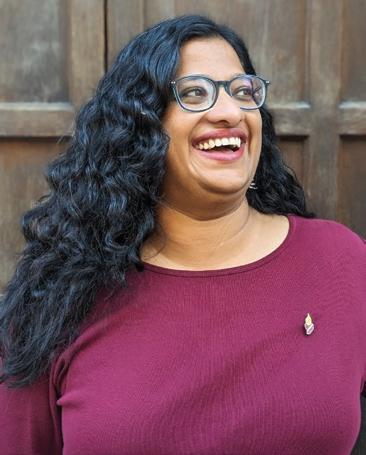
The Clough School of Theology and Ministry will present its Young Alumni Leadership in Ministry Award to JoAnn Melina Lopez, who serves as the lay pastoral associate at St. Basil’s Catholic Parish in Toronto. Lopez will receive the honor this Saturday at CSTM’s annual Evelyn Underhill Lecture in Christian Spirituality.
Marquette University Associate Professor of Theology Ryan G. Duns, S.J., who earned a master of theological studies degree from the Clough School and a doctorate from the Morrissey College of Arts and Sciences, will deliver the Underhill Lecture, “Consecrated Ruptures: Finding the Mystical in Ordinary Life,” in Gasson 100 beginning at 10 a.m.
Established in 2024, the Young Alumni Leadership in Ministry Award honors a young CSTM graduate who demonstrates outstanding leadership in their field, and celebrates the ways they live out the school’s Jesuit mission to be persons for
Great writers, across genres, are often likened to psychologists in their ability to understand the complexity of human emotions, motivations, and behavior.
A new graduate program at the Woods College of Advancing Studies will enable aspiring writers to sharpen their own insights into the human condition while also honing their technical skills.
The Master of Arts (M.A.) in Writing & the Human Condition program, slated to welcome its first students this fall, will blend psychological humanities and literary craft to inspire students to write with depth and purpose, while helping them to transform their ideas and experiences into well-structured, compellingly articulated, and insightful narratives.
Its interdisciplinary 10-course curriculum—to be taught by prominent contemporary authors as well as by Boston College faculty from across disciplines—will provide a rigorous focus on structure and technique while also drawing deeply from philosophy, psychology, and modern literature, making the program well suited to students with a humanities background, as well as to working professionals in all fields with an interest in writing for personal fulfillment, creative expression, or publication.
Humanities based-course areas include writing as a psychological endeavor, the psychology of both tragedy and comedy, writing the mind, the healing power of writing, psychological realism, the subconscious in storytelling, and life as literature.
Notably, in contrast to writing-intensive graduate programs that have a high-
and with others. Award winners exemplify what the CSTM stands for: creativity, commitment, pastoral outreach, and theological acumen. A model for their peers and current CSTM students, the honoree shows a commitment to the field of ministry and an ability to meet the changing needs of their community.
Lopez, who earned a master of divinity degree from CSTM in 2015, credits her time spent as a student for her love for the Word, and enjoys preaching, writing scripture reflections, and breaking open the Word with those she serves. Since her graduation, Lopez has been dedicated to service to the CSTM, mentoring current and prospective students with a particular commitment to accompanying women in the master of divinity program. Her ministry, previously as a campus minister at Seattle University and now in parish life, is focused on cultivating spaces of belonging, encounter, growth, and transformation for people of all ages through faith formation, prayer, and community-building initiatives.
residency requirement, the Woods College program will offer a hybrid format that combines the flexibility of online learning with opportunities for personal engagement through small class sizes, workshops, and retreats.
The program’s emphasis on psychology also makes it an appealing choice for clinicians, psychotherapists, and other health care professionals interested in improving their writing or tapping into their own training and experience as a source of inspiration. Many professionals and clinicians feel they have stories worth telling, program administrators say, but require the tools and community to do so meaningfully, as well as a flexible program that can accommodate their schedules.
“Everyone has a compelling story to tell,” said Woods College Dean David Goodman. “Particularly those working in the fields that care for others in their suffering and need. What such potential authors—and all aspiring writers—need is the time and space to focus on the craft of storytelling, while simultaneously cultivating the kinds of keen insights into the mind and the human condition that only
She has been featured on Catholic Women Preach, an online resource for homilies, and her preaching was selected for publication in Catholic Women Preach: Raising Voices, Renewing the Church – Cycle
B. She is a member of the inaugural cohort of PROCLAIM, a groundbreaking twoyear formation program designed to equip lay women as ministers of the Word, funded by a Compelling Preaching Grant from Lilly Endowment, through a partnership between Discerning Deacons, The Center for the Study of Spirituality at Saint Mary’s College, and the McGrath Institute for Church Life.
Since 2023, Lopez has been engaged in the work and mission of Discerning Deacons to strengthen and expand the diaconate. She traveled to Rome with Discerning Deacons twice on a pilgrimage for the opening of the general assemblies of the Synod on Synodality and was part of a delegation of women in ministry from around the world who met with Pope Francis on the eve of the Synod in October 2024. Advance registration is required. For more information, go to the Clough School’s Continuing Education webpage: www.bc.edu/content/bc-web/schools/stm/ continuing-education/featured-events. html.
from great thought. This program is designed to teach you both.”
great literature can provide. This program offers just such a space. It is a truly novel approach, unlike any other writing program out there.”
Goodman, who holds a doctoral degree in clinical psychology, has published extensively as both an author and editor, and oversees two book series that highlight the creative work being done at the intersec-
tion of psychology and the disciplines relevant to the human psyche, emphasizes that the coursework for this degree is grounded in the psychological humanities, a field that weds the best insights from psychology with the rich intellectual traditions of philosophy, theology, literature, and art.
“There is no question that reading theorists like Freud alongside novels by authors such as Tolstoy, Proust, and Dostoevsky will make you a better thinker,” he said. “And great writing always flows downstream from great thought. This program is designed to teach you both.”
For more information, see the M.A. in Writing & the Human Condition website [bit.ly/WCAS-writing-humancondition].
—University Communications
Modern Caribbean coral reef food chains are getting significantly shorter, an international team of researchers reports
BY ED HAYWARD STAFF WRITER
Human activity has lessened the resilience of modern coral reefs by restricting the food-fueled energy flow that moves through the food chains of these critical ecosystems, an international team including Boston College Earth and Environmental Sciences researchers reported in the journal Nature
Examining otoliths—fish ear stones that are preserved in marine sediments across millennia—the team developed and applied a nitrogen isotope method to 7,000-year-old fossils to reconstruct ancient reef food webs directly for the first time, according to Senior Research Associate Jessica Lueders-Dumont, lead researcher on the project.
The new analysis highlights underappreciated dimensions of modern coral reef degradation, said Lueders-Dumont, of the department’s Stable Isotope Biogeochemistry Lab.
Compared to “pristine” coral reef ecosystems from time periods before widespread human impacts, today’s Caribbean coral reefs host food chains that are 60-70 percent shorter and fishes that are 20-70 percent less functionally diverse, the study found.
“We discovered that on healthier Caribbean reefs, fish communities drew on a wider variety of food sources,” she said. “On degraded reefs, diets have become homogenized—different fish are increasingly eating the same limited set of resources. In the past, individual fish could afford to be choosy; today many are left with whatever is available. It’s like going from a vibrant neighborhood of restaurants to a single, stripped-down menu.”
This loss of functional diversity means that modern coral reef ecosystems are more prone to collapse. Biodiversity hotspots that support at least a quarter of marine species, coral reefs are being degraded by human-driven factors such as rising temperatures, overfishing, and nutrient runoff.
Because these impacts began long before systematic monitoring, scientists have lacked a clear ecological baseline of an undisturbed reef food web. Such a measuring stick is essential for setting realistic conservation goals.
Lueders-Dumont and colleagues developed a new approach using chemical signals preserved in fossil fish ear stones and corals to estimate trophic level—the position of fishes in the food chain—on Caribbean reefs of the mid-Holocene (about 7,000 years ago) and compare it with today’s food web.
The team examined unique fossil deposits in Panama and in the Dominican Republic in the Caribbean Sea, one of the most degraded coral reef ecosystems where stony coral cover has decreased by more than 50 percent in recent decades.
In these coral reef deposits, there is a great diversity of fossil shells, corals, otoliths, sea urchin spines, and many other
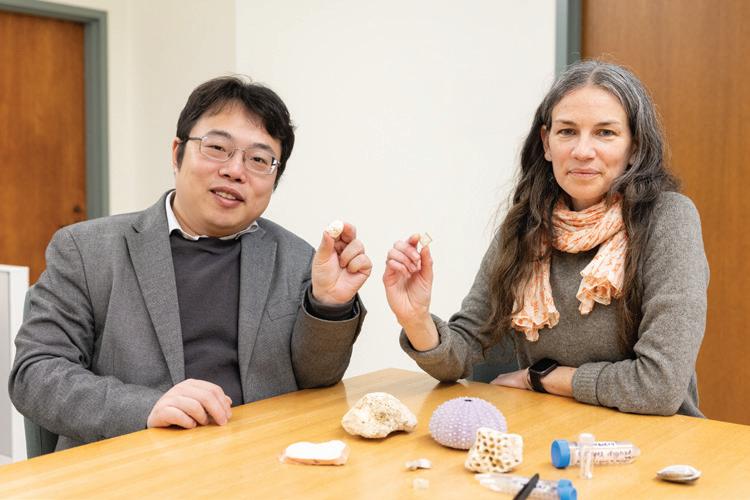
Wang and Lueders-Dumont.
To gain insight into what natural reef food webs were like before human influence and thus learn how human activities have altered modern coral reefs, they measured the trophic levels of ancient and modern fish. Trophic level is a key ecological metric, measuring an animal’s role in the ecosystem.
Researchers were surprised to observe changes even among fish at the lowest levels of the food chain.
“These results show that human impacts such as removing top predators, reducing the connections between different habitat types, and reductions in coral reef structural complexity—among other factors affecting modern coral reefs—have all altered energy flow to all levels of the food webs,” said Lueders-Dumont, who began the project as a postdoctoral fellow at the Smithsonian Tropical Research Institute and has continued the work across multiple institutions.
vestiges of the mid-Holocene coral reefs that fringe Caribbean coastlines. For a comparative fossil record, the researchers sifted through sediments nearby, which contain a similar “modern” record of the same types of shells, corals, otoliths, and other “hard parts” deposited by modern animals, according to the report.
The researchers conducted nitrogen isotope analysis on proteins bound within fossil and modern otoliths and coral skeletons, which can preserve trophic information in the past, said Assistant Professor of Earth and Environmental Sciences Xingchen (Tony) Wang, a co-author of the report.
“Because these isotopic signals reflect an organism’s position in the food chain, analyzing multiple groups of fish and corals from the same fossil reefs enables us to quantitatively reconstruct reef food-chain structure before major human impacts,” said Wang, who directs the Stable Isotope Biogeochemistry Lab [the lab website is xingchentonywang.com].
“This approach was previously constrained by the tiny amounts of protein preserved in fossils, but recent advances in our methods now make it possible to apply it to fossil reef assemblages for the first time. It’s like ancient DNA, but instead of genes, we’re using the chemical signatures locked in ancient proteins.”
Using this approach, the researchers— including colleagues from Academia Sinica, Princeton University, Smithsonian Tropical Research Institute, and the University of California-Berkeley—analyzed 136 fish otoliths and dozens of corals.
Otoliths, formed from calcium carbonate, are an important part of the vestibular system that enables hearing and balance in all bony fishes in the teleost group. Otoliths can also preserve well in the fossil record, and have species-specific shapes that allow for taxonomic identification, Lueders-Dumont said.
Lueders-Dumont said the analysis focused on the most abundant fish groups preserved in the fossil record, including gobies, silversides, and cardinalfish.
“These fishes are fundamental prey items on reefs—essentially the ‘potato chips of the reef,’” said Lueders-Dumont. “Across millennia, they have been eaten and their otoliths excreted to accumulate in the sediment record.”
By comparing specimens from fossil archives from reefs dating back approximately 7,000 years in Panama and the Dominican Republic with modern reefs at the same locations, the researchers reconstructed long-term changes in the food chain with unprecedented precision, according to
Reconstructing a baseline of the conditions for marine life thousands of years ago is almost like a form of time travel, said Lueders-Dumont.
The results highlight the promise of fossil-based isotope methods for examining how coral reef ecosystems responded to past environmental change—and what those responses mean for reefs experiencing accelerating climate change today.
“We can now glimpse what pristine coral reef ecosystems looked like before human impacts,” she said. “Because our previous benchmarks for conservation have been shaped by already-degraded modern reefs, the ability to reconstruct ancient baselines offers an entirely new perspective on what healthy reef ecosystems are—and how we might restore them.”
Continued from page 1
course within the Morrissey College of Arts and Sciences designed to improve academic performance through evidence-based strategies, part of an initiative to support student success.
As a Bowman Advocate—inspired by Sister Thea Bowman’s legacy of support for racial justice—she facilitates cross-cultural dialogue and workshops to foster a more inclusive campus community. She also coordinates events and mentoring sessions for student groups as co-president of BC’s Mexican Association of Students.
For the past two summers, Cruz Fuentes worked as a legal assistant at Guerrero & Rosengarten LLP, a personal injury law firm located in New York City. During the 20242025 academic year, she volunteered at the Boston Green Academy, where she assisted teachers in science, Spanish, humanities, biology, and civic classes, and mentored high school students aspiring to attend college.
She also was a program assistant for two summers at Breakthrough New York, a nonprofit college access and success organization that supports motivated students from lowincome backgrounds.
“What drew me to the scholarship was the life and witness of St. Oscar Romero,” said Cruz Fuentes during her acceptance speech, in which she quoted an excerpt of the Romero Prayer: “We are workers, not master builders, ministers not messiahs, we are the prophets of the future not our own.”
Continued from page 1
this semester. “The other finalists reached out, my friends, my parents, and my grandma sent me the video. So just love is what I experienced, really.”
The MLK Scholarship is awarded to the BC junior who has demonstrated superior academic achievement, extracurricular leadership, community service, and involvement with the African American community and African American issues both on and off campus. Davids was one of five finalists for the annual scholarship award [see sidebar]. He will receive $35,000 towards his senior year tuition and a $1,000 gift certificate to the BC Bookstore.
Reflecting on his life thus far and the many people who have had an impact on it, Davids noted that his greatest mentor has been his father, and so it was Conrad Davids who accepted the award for his son in Brian’s absence.
“Growing up, my dad wanted me to learn from him. He was always honest with me, selfless in his actions, and always there. Whether it was as my soccer coach or being a leader in the church I grew up in, watching him in leadership roles throughout my life has really inspired me to work hard and strive for greatness always, because he has given me these opportunities through sacrifice and dedication.”
Davids, a Glendale, Md., native and finance major in the Carroll School of Management, is co-founder of Black in Business at BC—a pre-professional club that aids Black students interested in business careers—a Big Brothers Big Sisters of Boston mentor, a member of the Black
“His life reminds us that faith is not only something we believe but something that we live through—how we stand with others, especially those whose voices are often unheard,” she said. “So much of my experience at BC has been shaped by that same call to be a person for others, a Jesuit value that closely parallels Romero’s example. For me, that call has been building community, advocating for others, and creating spaces for people, especially Latino students, who feel unsupported.
“I’ve tried to give back to the community that welcomed me. I care deeply about the communities that I’m a part of. When I first came to BC, I was very shy. But I made a point of being intentional about building relationships and meeting others while staying
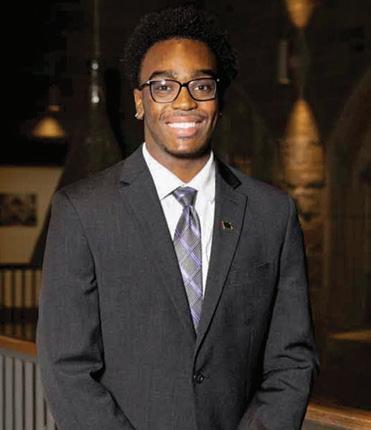
Student Forum, and a resident assistant.
While Davids makes an impact on the BC community through these endeavors every day, he relishes the experiences that have had a positive effect on him, and the people who helped him realize that his work makes a difference. One such person is Michael Davidson, S.J., program director of the University’s Montserrat Coalition, and leader of the Jamaica Magis service trip.
“I was influenced by Fr. Michael to take advantage of all the opportunities BC has to offer,” said Davids. “Given that my parents are Jamaican immigrants, Fr. Michael helped me understand the importance of going back and serving in a community that I find to be familiar.”
Working with the elderly in nursing homes and with teen mothers in the Mustard Seed Communities, Davids said the Jamaica Magis experience taught him
true to who I am. If I can now be that same familiar face for other students, someone they feel comfortable coming to with questions, guidance or simply support, then I feel that I’ve succeeded.”
Cruz Fuentes, who plans to become an immigration attorney—with a particular focus on amplifying the voices of Latino communities and promoting justice through advocacy and legal reform—said the Romero Scholarship encourages her “to continue the work of advocating for greater equity for the Latino community both here at BC and beyond. Romero’s life reminds us that real change happens through courage, faith and solidarity with others, and I hope to carry those values forward in my own journey.”
The other finalists were Andres I. Garcia, an economics and International Studies major, and Connell School of Nursing student Naomi Sosa.
Garcia has been active in the Puerto Rican Student Association, promoting engagement and coalition building to support underrepresented students. In Puerto Rico, he’s worked on education policy research and federal grant management, while at BC he’s contributed to research on adolescent behavior during the COVID-19 pandemic, and pediatric health outcomes.
As service chair of a nonprofit that deals with health challenges in Guatemala, Ecuador, and the Dominican Republic, Sosa organized medical trips where she mentored young Hispanic nurses for improved translation systems in hospitals, ensuring that patients were heard and treated with dignity.
about humility and perseverance. “I think it has shaped my experience at Boston College in terms of how I view my privilege and opportunities, and how I want to be able to give back in a greater capacity going forward.”
Last semester, Davids used these lessons to give back to his community through the student-facilitated Kairos retreat. He recalls the amount of preparation needed to be a Kairos leader and how it showed him that talking about life experiences with others can be beneficial.
“Kairos made it real for me that I have something to offer. People appreciated my experiences. The relatability aspect is important, too. As humans, we all go through similar stuff and being able to open up with one another is underrated; we don’t do it enough. I feel like many times we have surface-level, basic conversations with our friends and we’re not even really checking in on them in the ways we should. Kairos showed me that I can be impactful and make a difference by sharing my experiences.”
Davids said he is eager to accept the challenge this award signifies and will do so by taking on more leadership responsibilities within the clubs of which he is a member. He also hopes to lead another immersive service experience, such as Jamaica Magis, next winter. Upon his return from Madrid, Davids will join investment banking firm Evercore as an intern, where he will learn everything from how to think like an investor to world affairs.
As for incoming BC students, Davids has some advice.
“Put yourself in environments where you’re not going to be distracted, where
“Their great accomplishments, hard work, and dedication demonstrate a profound commitment to the service and values of Saint Oscar Romero,” said Assistant Director of Information Technology Services Human Resources Marcela V. Norton, Romero Scholarship Committee co-chair. “Their journey reminds us that dedication is not just about reaching a goal but about lifting others along the way.”
Yvonne C. Castañeda M.S.W. ’18, was honored with the Rev. John A. Dinneen, S.J., Hispanic Alumni Community Service Award, which recognizes a BC alumnus of Latin American descent whose work and service reflects both Archbishop Romero’s ideals and the late Fr. Dinneen’s commitment, leadership, and service to the Latino community.
“It is really a profound honor to receive an award that venerates St. Oscar Romero,” said Castañeda, director of CommunityBased Initiatives at the BC School of Social Work. “His life and his legacy truly inspire me because they call forth the very best version of myself. There is one thing about his legacy that truly anchors me: He believed that true faith requires that we stand with those who are suffering, even when it comes with a great deal of personal risk. I try to do this every single day, and it’s not easy, and I’m not perfect at it, but nevertheless, I’m not going to quit.”
The event’s keynote speaker was Clough School of Theology and Ministry Professor Hosffman Ospino, chair of the Religious Education and Pastoral Ministry Department.
you’re able to exercise the habits that are necessary to succeed in school. Don’t say no to any involvement. Do everything you can possibly do to put yourself in as many high-achieving groups as possible because, naturally, opportunities are going to flow through them. When you match those opportunities with your preparedness, you’ll be ready to handle anything that comes your way.”
Mohamed Dirar: economics major, finance minor; Jamaica Magis service trip; Carroll School of Management Catalyst Program; will work this summer as analyst in PNC Bank’s Investment Banking Division.
Timileyin Faba: biology major, pre-med track; research associate at STEM for All Academy; vice president of Black Student Forum; club swim team member; interned for leading academic medical center Hospital for Special Surgery; owner of personalized coaching business TimiFabaLifts. Kaitlyn Gyamfi: finance major, African Studies minor; administrative assistant, African & African Diaspora Studies Department; member of Black Student Forum, Black in Business, The Essence Project, and Females Incorporating Sisterhood Through Steps (FISTS); Carroll School mentor; recipient of the Winston Center for Leadership and Ethics Travel Grant and Amanda V. Houston Traveling Fellowship Award. Gabrielle Keeley: accounting and sociology major; financial peer advisor, Black in Business; resident assistant; staff member, Boston College Women’s Center; team member, Cura program; student leader, 2026 Arrupe immersion trip to the Philippines; incoming summer analyst at Bank of America.
Ph.D. student co-edits book that reveals other side to antiwitch zealot of Massachusetts
BY SEAN SMITH CHRONICLE EDITOR
Everybody knows who Cotton Mather was.
He was the Boston-born Puritan minister whose name became synonymous with the phrase “witch hunt” for his connection to the notorious Salem Witch Trials of 1692-1693, who zealously fulminated against witchcraft and all those alleged to practice it—regardless of evidence to the contrary—and over time became an archetypal bad guy in the public imagination.
This image of Mather also entered pop culture. Marvel Comics once introduced a gaunt, scary-eyed supervillain with mystical powers named Cotton Mather (alias “The Witch-Slayer”) who brought the super-heroine Scarlet Witch back to 17thcentury Salem in an unsuccessful attempt to execute her. The 2014-2017 supernatural horror TV series “Salem,” very loosely based on the Salem Witch Trials, portrayed Mather as caught between his Puritan faith—the source of his anti-witch fervor— and lustful desires; he winds up seduced by, then married to a witch.
Boston College doctoral student Andrew Juchno understands that this unfavorable interpretation of Mather is widespread. But a recently published book he co-edited, Cotton Mather’s Curiosa Americana: Scientific Letters to the Royal Society, offers a reminder of Mather’s other legacy: his widely acknowledged contributions to medicine and science, notably his advocacy for smallpox inoculation.
The book comprises Mather’s dispatches between 1712 and 1724 to the Royal Society of London, a distinguished academy established in 1660 to promote excellence in science for the benefit of humanity. The more than 80 letters, known
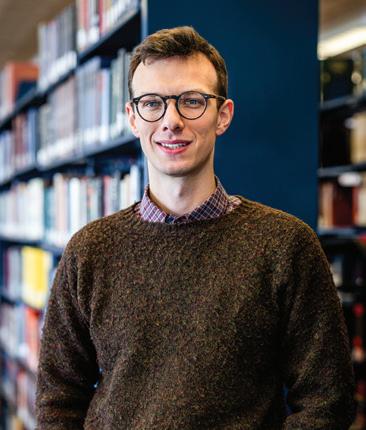
cana correspondence from several different sources, including the Royal Society, the Massachusetts Historical Society, and Harvard University. While historians have long written about and referenced Mather’s letters, the book represents the first complete, edited, and annotated collection.
To understand Mather, according to Juchno, it is useful to remember that the Enlightenment bridged philosophy, science, literature, history, economics, and other disciplines. Despite the Enlightenment’s largely secular character, even a devoutly religious man like the Harvardeducated Mather found a place within the movement.
healthy person: The recipient would usually develop a mild case of pox that conferred lifetime immunity. Mather convinced a doctor to try this technique, and all but six of the 247 people he inoculated survived.
A storm of controversy followed Mather’s call for smallpox inoculation, with numerous doctors and local officials denouncing the procedure. At one point, someone hurled a lighted grenade into Mather’s house, but the device did not detonate. History did largely validate Mather, however, and it would be more than 75 years before Edward Jenner developed the cowpox vaccine that became the standard anti-smallpox treatment.
collectively as Curiosa Americana, contain Mather’s observations and theories related to natural sciences, astronomy, botany, medicine, and the nascent fields of embryology and epidemiology.
Mather presents a classic dilemma for historians and others who research and write about controversial figures: How to square a person’s positive contributions and good works with the troubling, objectionable aspects of his or her life? Cotton Mather’s Curiosa Americana: Scientific Letters to the Royal Society is not intended to minimize Mather’s part in the hysteria over witchcraft, says Juchno—cautioning that Mather’s role in the witch trials has often been misrepresented—but rather to depict him as a prototypical Age of Enlightenment figure.
Juchno and his co-editors, Georgia State University Professor Emeritus of English Reiner Smolinski and Yale University Jonathan Edwards Center Director Kenneth Minkema, assembled the Curiosa Ameri-
Mather was greatly interested in microscopical anatomy, note Juchno and his co-editors, and having his own microscope enabled him to follow debates among European scholars on subjects such as how organisms like the “animalcules” (germs) in the blood, semen, or seeds of plants originated. He also weighed in on curious phenomena like Potentia imaginativa, the formative power of the imagination and its psychosomatic impact on pregnant mothers: He sought to explain how the imagination—especially with violent emotions such as anger, fear, revulsion, or unfulfilled cravings—exerted harmful vibrations on a fetus developing in a mother’s womb.
“The Royal Society was dedicated to gathering knowledge about the physical world and invited people from the colonies to share their thoughts about subjects related to weather, vegetation, and animal behavior, among many other things,” said Juchno. “Mather was very industrious in his correspondence, and offered detailed observations about natural phenomena, which the Royal Society appreciated.”
Among the more famous Mather letters concerned his efforts to combat the 1721 smallpox epidemic in Boston. A man he had enslaved, Onesimus, had told him of a long-used West African procedure which involved rubbing or scraping dried pus from a smallpox patient into the skin of a
“Mather was brilliant in many ways, a polymath who could read in eight languages,” said Juchno. “He also was relentlessly driven by his religious views, and everything was refracted through his faith. That set him somewhat apart from the members of the Royal Society.
“For example, Mather studied thunder and lightning, and he gathered data on storms that was very useful. But then he added a second layer to it, which involved examples of divine providence and the evidence of sin. He wasn’t an outlier in his interests, but the force with which he communicated through his religious beliefs was quite profound.”
Juchno doesn’t expect the public image of Mather to be rehabilitated by Curiosa Americana, but then that isn’t the purpose of the book.
“The best we can do is to identify the instances where Mather helps push ahead our understanding of science and nature, even as he bears responsibility for reinforcing some unenlightened views. But the judgment of his actions and beliefs also has to be rendered in the context of that time— not as a way to excuse the behavior, but as a way of understanding human existence.”
For more on Cotton Mather’s Curiosa Americana: Scientific Letters to the Royal Society, go to bit.ly/Cotton-Mather-CuriosaAmericana-2026
Continued from page 1
part series aimed at fostering dialogue among leading journalists and Boston College faculty and students on how to cover the climate crisis. Other events in the series have included “Public Health, Common Good”; “The Climate Crisis is Local News”; and “Forced Migration and Changing Communities.”
Among the panelists were BC alumni: Reuters immigration reporter Ted Hesson ’02, New York Times Senior Editor Amber Williams ’10, and New York Times Economy Editor Patrick McGroarty ’06. Other guest speakers included Boston Globe climate reporter Sabrina Shankman, National Public Radio correspondent Jason Beaubien, and freelance journalist and author Meera Subramanian.
Faculty and representatives from the BC School of Social Work, Engineering Department, Earth and Environmental Sciences Department, Program for Global Public
journalists could look when they need smart people to talk about tough topics. We wanted students to be able to incorporate climate into any beat. And we wanted to bring journalists to campus to meet and interact with students and faculty.”
The program model has been successful, Nanos added, because there’s no bigger story than climate right now.
“To succeed in this business, you need to have tactical opportunities,” Nanos said. “That means building a network, getting in the door and getting internships, and knowing how to think critically about stories.”
For Madeleine Mulligan ’27, the series has been a chance to write and grow her portfolio, gain reporting experience, and form industry connections. Mulligan, who’s studying English, political science, and journalism, published articles on the series’ microsite about the lectures, including a profile of McGroarty; the two have stayed in touch
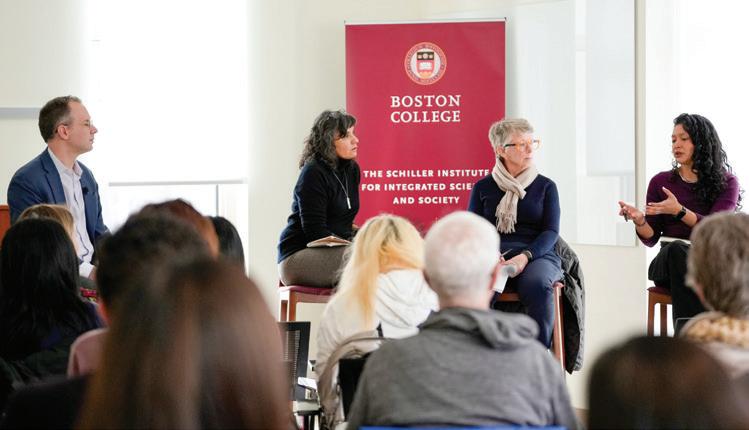
An earlier event in the “Climate Is Every Story” initiative featured a panel discussion with (L-R) Reuters immigration reporter Ted Hesson '02; freelance journalist Meera Subramanian; Maryanne Loughry, senior advisor for the Jesuit Refugee Service in the Office of Global Engagement; and Boston College School of Social Work Associate Professor María Fernanda Piñeros-Leaño.
Health and the Common Good, Corcoran Center for Real Estate and Urban Action, and Office of Global Education took part in the previous panels.
BC journalism students were able to cover the events, getting clips for their portfolios and freelance fees in the process.
The idea for “Climate Is Every Story” came from two faculty members in BC’s Journalism Program who were leading media training at the Schiller Institute: program Associate Director Scott Helman, a long-time Boston Globe executive producer, creative leader, and editor, and staff writer, among other positions; and Janelle Nanos, journalism fellow at the Institute for the Liberal Arts (ILA) and Boston Globe assistant business editor.
Wanting to support the journalism program while underscoring that climate change is central to every beat, Nanos and Helman assembled a group of co-sponsors on a grant from the ILA, including nowformer Schiller Institute Executive Director Laura Steinberg and Environmental Studies Program Director Tara Pisani Gareau.
The goal was to build a program that was a win-win-win, Nanos said. “We wanted to establish BC as a place where working
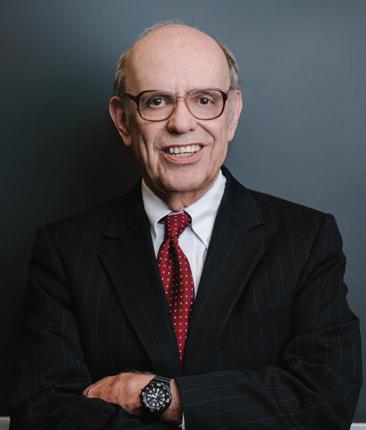
Retired Boston College Law School faculty member and administrator George Brown, an influential scholar, teacher, and admired legal authority, died on March 12. He was 85.
A funeral Mass for Dr. Brown was celebrated Monday in Trinity Chapel on Newton Campus. The Law School will host a Celebration of Life event on April 24; details will be announced at a later date.
Dr. Brown, who joined BC Law in 1971, was an expert in issues of government ethics and professional responsibility and a specialist in the field of federal-state relations. He was particularly known for his work on the jurisdiction of federal courts and on the federal grant-in-aid system. His proposal for the use of state law in mail fraud prosecutions was adopted by the United States Court of Appeals for the Fifth Circuit in a major anti-corruption decision.
In 2003, Dr. Brown was appointed as associate dean for academic affairs at the Law School. He worked with the dean and faculty in areas of curriculum review, program development, faculty appointment, and research, and oversaw the delivery of academic services to students.
Three years later, Dr. Brown became the inaugural holder of the Robert F. Drinan, S.J., Endowed Chair, established in honor of the former dean and congressman who was one of the most influential and beloved figures at BC Law.
“Fr. Drinan’s exemplary career spans so many fields—public service, scholarship, and academic leadership, for example—that it makes holding the chair named for him a special privilege and challenge,” said Dr. Brown at the time of the announcement.
Dr. Brown, who served as interim dean of BC Law from 2010-2011, retired in
2021 but continued researching and publishing in law reviews as the Drinan Professor of Law Emeritus.
Prior to joining the Law School, Dr. Brown served as legislative assistant to the governor and as assistant attorney general of Massachusetts. In 1994, Governor William Weld appointed him chairman of the Massachusetts State Ethics Commission. He also served as chairman of the Section on Federal Courts of the Association of American Law Schools.
In addition to his wife, Patricia (McCarthy), Dr. Brown is survived by his son, Nathaniel (husband of Caitlin); his daughters, Meridith Welch (wife of Mark Fine) and Heather Welch (wife of Jason Murphy); and grandchildren Nora and Rowan Fine; Colin, Elisabeth, and Neve Murphy; and Emmett and Cora Brown; sister-in-law, Mary Jane Lukas; brother-in-law, Robert; and many nieces and nephews.
In lieu of flowers, donations may be made in Dr. Brown’s name to Good Shepherd Community Care, 160 Wells Ave., Newton, MA 02459.
Read an in-depth reminiscence of Dr. Brown in BC Law Magazine at https:// lawmagazine.bc.edu/2026/03/a-paragon-ofintegrity.
—University Communications
and McGroarty has provided Mulligan with some mentoring.
“Pursuing a field that is highly competitive is a very stressful experience, but having mentors like those I’ve met through this series has been beyond helpful and rewarding,” Mulligan said.
Schiller Institute Director of Finance and Operations Gregory Adelsberger said one of the institute’s goals is to create programming that brings together the existing expertise at the University in new and collaborative ways with the aim of addressing the world’s most pressing challenges.
“This series has offered a great opportunity to do that, and the Journalism and Earth and Environmental Studies programs have been ideal partners. At the onset of the series, we collectively sought to center Boston College as an institution whose faculty are engaged in groundbreaking climate research and help prepare those faculty to share their findings with the world.”
To register for “The Business of Climate,” to watch previous event recordings, or to explore student reporting on “Climate is Every Story,” go to bit.ly/climate-is-every-story.
Ellen Seaward is a senior digital content writer in the Office of University Communications
The following are among the recent positions posted by the Department of Human Resources. For more information on employment opportunities at Boston College, see www.bc.edu/jobs or scan the QR code at right.
Research Systems Administrator Third Cook Waitstaff
Senior Associate Director of Stewardship and Donor Engagement
Assistant Director, Corporate & Foundation Communications & Proposal Development
Postdoctoral Fellow, University Counseling
Laboratory Safety Specialist
International Student Advisor Patrol Officer
Associate Director, Budget, Operations & Systems

Associate Vice President, Schools, Units, and Organizational Giving
Administrative & Program Specialist, Career Center
Administrative & Program Specialist, Dean of Students Office
Network Systems Engineer
Director, Nanofabrication & Cleanroom Facility
Associate Director, Career Advising & Programming
Burns Scholar looks at Irish funerary traditions
BY SEAN SMITH CHRONICLE EDITOR
It sounds like a morbid research project: interviewing people involved in after-death care, including undertakers, funeral directors, embalmers, clergy, and both humanist and civil celebrants.
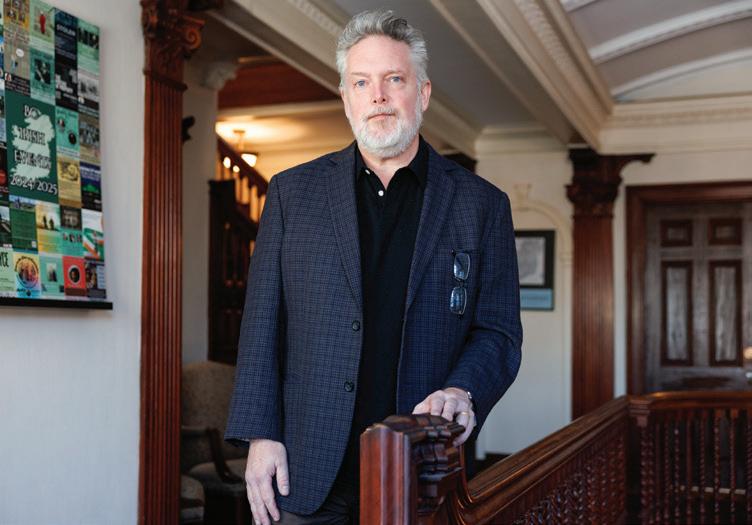
But not for Ray Cashman, a folklorist who is the Burns Visiting Scholar in Irish Studies at Boston College this semester. Caring for the dead is as old as humanity itself, he says, and offers important insights into the beliefs, concerns, and values of the living. The fact that, over time, many societies have entrusted to others—and professionalized—this task outside the immediate family is revealing in and of itself, he adds.
Now, through his recently launched study of death care workers in Ireland—for a book project titled “The Dead Don’t Bury Themselves”: Irish Funerary Traditions in a Changing World—Cashman seeks to shine a light on the evolving customs, attitudes, ideas, and practices surrounding death within the profession and, by extension, society itself.
Cashman will discuss his research at the Burns Visiting Scholar Lecture, on April 8 at 6 p.m. in the Burns Library Thompson Room. A 5 p.m. reception will precede the event, which is free and open to the public.
Ireland is a decidedly apt subject for his study, says Cashman: It has the only museum in the world devoted to wakes and funerary traditions; many Irish keep daily track of death notices via radio and the Internet; and whatever their faith, or lack of it, Irish people routinely attend wakes, visitations, and funerals even without an invitation, to honor the deceased and support the bereaved.
“In the United States, death tends to be an uncomfortable topic, often a very private matter,” said Cashman, the Provost Professor of Folklore at Indiana University-Bloomington. “But in Ireland, there is a long tradition of acknowledging death through various rituals and events, not just for family but the community as well. These are important rites of passage, because they help people live up to the best affirmations of themselves.
“Irish death care workers, by virtue of their jobs, have developed a shared occupational lore around the existence or nonexistence of spirits, the afterlife, and other unexplained mysteries related to death. What do their stories say about the wider human experience?”
A collaboration between the Irish Studies Program and University Libraries, the Burns Scholar program brings outstanding academics, writers, journalists, librarians, and other notable figures to the University. Burns Scholars typically spend a semester at BC teaching courses, offering public
explanations don’t always comport with our experiences.”
Cashman cites atheist Billy Mag Fhloinn, among the growing number of “humanist celebrants” who officiate at funerals, weddings, memorials, and other such events. Although Mag Fhloinn—the source of the book’s primary title—does not observe a traditional faith, notes Cashman, he recognizes that many customs and rites surrounding death, even in an increasingly secular society, pre-suppose the existence of a soul and an afterlife.
In an interview with Cashman, Mag Fhloinn noted that “rational, secular people do things in a funeral space that are concretizations of abstract ideas—we’re saying goodbye to the person, even though we know they can’t hear us. We might put flowers in the grave, or we might speak directly to the body at the wake. We know they can’t hear us. They’re dead, they’re gone.”
lectures, and working with the resources of the Burns Library in their ongoing research, writing, and creative endeavors related to Irish history, art, and culture.
With a background in religious studies and anthropology, Cashman—who holds degrees from Williams College and Indiana-Bloomington—integrates ethnographic, historical, and literary approaches to Irish folklore and vernacular culture. His research and teaching focus on oral traditions, poetics and performance, custom and ritual, material culture, and the relationship between folklore, history, and memory. His ethnographic work in the Irish borderlands such as the counties of Donegal and Tyrone pays particular attention to the politics of culture, identity, tradition, and place.
Cashman acknowledges that the word “folklore” often carries an antiquarian association, suggesting an interest in things that seem outmoded, even quaint, but he begs to differ.
“Folklore speaks the past and the present in the same breath,” he said. “Folklore
studies, as a field, straddles literature, history, and anthropology: It’s the humanities of everyday life; the people’s knowledge, learned within the family and community, and a means to find common ground. Of course, some aspects of our lives change over time and the ‘old way’ of doing things may recede—but then new ways fill the space.”
As a case in point relevant to his project, Cashman notes that livestream funerals have become increasingly common in Ireland. “It seems hypermodern but is an example of an innovation that helps people to follow deeply held beliefs and practices. In this case, livestreaming fulfills the impulse to gather as many people as possible to share loss in a meaningful way.”
Such shifts in customs and practices are observed by and discussed among death care workers, who are hardly uniform in their views on death. “When it comes to, say, the existence of a soul or the afterlife, those who strongly believe or disbelieve are in the minority. Instead, there’s a lot of ambivalence and uncertainty, because rational
Indulging in such symbolic thinking and ritualized thought and behavior help us “come to terms much more viscerally with the idea that [the deceased is] in this in-between state, in this liminal space,” Mag Fhloinn told Cashman. “They’re in front of us, but something’s gone from them. And that halfway stage, psychologically, I think is hugely important.”
Having access to the Burns Library’s extensive archives is already paying off for Cashman. “I recently found the correspondence of the very first Catholic undertaker in Boston, a native of Ireland. It’s the kind of day-to-day historical and comparative perspective that will be invaluable to my work.”
Cashman also is teaching the course Irish Folklore to a combined class of undergraduate and graduate students. Instead of traditions of the distant past, he is focused on those documented from the 19th century to the present—a period in which folklore inspired an Irish literary revival, aided the newly independent Irish Republic’s attempt at nation building, and continues to foment creative responses to modernity.
For more on the Burns Visiting Scholar program, see libguides.bc.edu/burnsscholars