Student-led BC Coalition for the Homeless contributes to public health and policy research
BY KATHLEEN SULLIVAN STAFF WRITER
A woman experiencing homelessness puts her tired, achy feet in a tub of warm, soapy water. That simple moment of care and comfort, offered by Boston College students in a local shelter, has quickly evolved into a new student-led program that not only provides direct care to the homeless in three Boston locations but also produces public health and policy research.
The Boston College Coalition for the Homeless (BCCH) is dedicated to improving the lives of homeless individuals in Boston through service, education, and social justice. Its guiding principle is that health care for the unhoused should be dignified, relationship-centered, and trauma-informed.
The program got its start as the sophomore social justice project for the Class of 2027 students in the Gabelli Presidential Scholars Program (GPSP). The scholars established a foot clinic at the Women’s
The Emergence of Cooperation
BC researchers look at how fairness, trustworthiness, honesty, forgiveness develop in children across diverse populations
BY ED HAYWARD STAFF WRITER
Children across the globe engage in a constellation of behaviors that support cooperation, an action critical to the survival of the human species, a team of Boston College researchers recently reported in the journal Science Advances
The team from Associate Professor of Psychology Katherine McAuliffe’s Cooperation Lab surveyed children in the urban United States, rural Uganda, Canada, and Peru, and the hunter-horticulturalist indigenous Shuar of Ecuador.
The researchers found there are crosscultural regularities in some aspects of the development of cooperation—namely, that younger children tend to be self-interested,
Lunch Place (WLP), a day shelter in Boston. Foot clinics provide essential care to unhoused individuals who often have foot health issues, such as fungal and bacterial infections and diabetic foot ulcers.
Since its launch in September 2024, more than 600 foot-soaks have been administered by BC students at the weekly WLP foot clinic. In addition to inspecting and caring for feet, BC students often connect their patients to additional resources, such as health insurance or prenatal vitamins.
“I found the most valuable thing we did was listen,” said BCCH Co-President Catherine May ’27, a neuroscience major. “What do these women talk about when they only have 20 minutes to reflect throughout their whole week? They talk about the people they love. That’s what we hear about more than anything.
“I think of this one woman, Tammy, who I see at Women’s Lunch Place all the time. Tammy has a son who’s eight years old, and he lives with a foster family. Tammy never learned to read or write, but when she comes to the foot clinic, she asks our team to help her write letters to her son. So we get out a piece of notebook pa-
Continued on page 5
and that as children get older their behavior starts to reflect local norms, according to the report.
The researchers examined the development of four cooperative behaviors—fairness, trustworthiness, forgiveness, and honesty—in more than 400 children aged 5 to 13 from five societies. They also collected
Continued on page 4
Clough School Program Offers ‘Tools for Vocational Discernment’
BY KATHLEEN SULLIVAN STAFF WRITER
The Clough School of Theology and Ministry’s admission team accompanies prospective students throughout their graduate school discernment process. But what would happen if the team extended that accompaniment before then—to young people who were only beginning to contemplate a career in ministry or theological education at the graduate level?
That was the idea behind Emmaus, a two-day experience that invites participants ages 19 to 29 to explore graduate theological studies through a particular encounter with CSTM students, faculty, and staff.
Launched in 2024, Emmaus brings a small group of participants to campus in the fall for an immersive experience. They sit in on classes, attend the weekly schoolwide Mass and repast, and participate in a discernment workshop, among other activities.
“We introduce the participants to tools for vocational discernment and invite them to reflect on key moments from their own life story,” said CSTM Associate Dean for Graduate Enrollment Management Anthony Russo, who oversees Emmaus. “The goal is to help them locate where their gifts
Continued on page 4
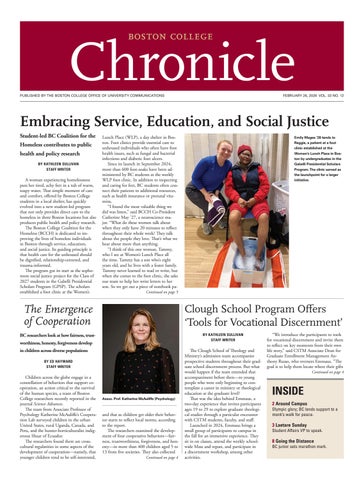
Emily Magee ’28 tends to Reggie, a patient at a foot clinic established at the Women’s Lunch Place in Boston by undergraduates in the Gabelli Presidential Scholars Program. The clinic served as the launchpoint for a larger initiative.
Assoc. Prof. Katherine McAuliffe (Psychology)
Around Campus
Half a World Away, BC Coach Savors a Former Player’s Olympic Moment
The world was watching last Thursday as 2019 Boston College alumna Megan Keller scored the game-winning goal in overtime that gave the United States Olympic women’s hockey team a hard-fought overtime win over Canada, earning the U.S. a gold medal.
Keller took a long pass from teammate Taylor Heise, out-maneuvered Canadian defender Claire Thompson—nudging the puck to Thompson’s right, then quickly skating around Thompson’s left to retrieve it—and poked the winning shot past goaltender Ann-Renée Desbiens.
(Three days later, the U.S. men’s hockey team, including former BC players Matt Boldy and Noah Hanifin, won the gold medal with its own 2-1 win over Canada.)
For Katie King Crowley, the Jane Rattigan Head Women’s Hockey Coach at BC, it was a very familiar sight, one that she’d seen often during the four years Keller was under her tutelage at the Heights.
“Megan is a tremendous hockey player,” said Crowley. “When I watch that play, she reads that Canada is changing [making a player substitution] and goes to the far blue
line to make it challenging for them to defend. And then she uses her long reach and great hands to come around the Canadian player and put it by the goalie on the backhand. Her patience and poise are elite: You can see it in that play, she never panics, she controls the puck and controls the play.”
Keller was a mainstay on an Eagles squad that made it to the NCAA Tournament in her first three years at BC, reaching the
BC Community Bolsters Monk’s Walk for Peace
Earlier this month, more than 100 members of the Boston College community dedicated their morning workouts, lunchtime strolls, and evening spin classes to a Buddhist monk who suffered a tragic accident last fall after embarking on a 2,300-mile walk for peace.
Phra Ajarn Maha Dam of Atlanta was one of about two dozen monks participating in the Huong Dao Vipassana Bhavana Center’s Walk for Peace, a 110-day journey from Texas to Washington, D.C., meant to “bring blessings to countless lives in a world filled with uncertainty and restlessness.” After setting out last October, the monks had traveled roughly 300 miles when Maha Dam was struck by a car, suffering injuries that forced doctors to amputate his leg.
Part-time English faculty member Kim Garcia learned of the walk, and Maha Dam’s accident, through her online meditation group and started brainstorming ways to get the BC community involved from afar. On February 10, as the monks neared the end of their journey, she launched an initiative inviting BC faculty, staff, students, and alumni to submit their miles in honor of Maha Dam, with a goal of 2,000.
ASSOCIATE
Jack Dunn
SENIOR
Patricia Delaney
EDITOR
Sean Smith
“Even though we can’t be part of it, we can still join the effort toward peace by walking the steps he can’t walk,” explained Garcia, an award-winning poet whose work has explored the personal and political aspects of war.
Right away, community members answered the call, submitting more than 2,100 miles in just five days through a Google form. People from as far away as Australia, the United Kingdom, Scotland, and Alaska participated in the initiative, which was featured in a Boston Globe article.
In an email to participants, Garcia’s husband, BC Law Professor Frank Garcia, said the couple plans to contact Maha Dam and his fellow monks to tell them about the initiative, so that they may carry the support of Boston College with them moving forward.
“[The monks] have now returned to the Bhavana Center, and their website says ‘The Walk for Peace continues in the heart,’” Garcia wrote. “May that be true for us all.”
Alix Hackett is a senior digital content writer in the Office of University Communications
championship round in her second year. After taking time off to play for U.S. women’s hockey in the 2018 Winter Olympics—and collecting her first gold medal—she returned to BC as a senior in 2018-2019 as the Eagles once again went to the NCAA Tournament. She finished as BC’s all-time leader in defenseman scoring with 158 career points on 45 goals and 113 assists and, among numerous other honors, was a three-time finalist for the Patty Kazmaier Award as the nation’s best player in women’s college hockey. Keller—who now plays for the Boston Fleet in the Women’s Professional Hockey League—had all the tools when she first suited up for the Eagles, recalled Crowley.
“Her size, skating, and hockey IQ were very strong. We just tried to help her develop all of those things so she could play at
the next level. When you want to play at that level, you will have to do things quicker, process quicker, move pucks quicker, and she has adapted extremely well to that. She is fun to watch.”
Like Keller, Crowley is a three-time Olympian, and over the years she’s had the pleasure of seeing a number of her former players suit up for the Winter Olympics: Besides Keller, this year’s U.S. squad included Cayla Barnes ’23, Hannah Bilka ’23, and Alex Carpenter ’16.
According to Crowley, there are not a lot of insights for her to share with BC Olympians like Keller.
“At this point, Megan and the others are pros at it. They are calm, cool, and collected when it comes to pressure situations. Besides saying ‘Good luck,’ I usually just encourage them to enjoy all of the moments when you’re there, because it’s an extra special time in your lives.”
Those special times stay with you, too, she adds.
“Watching the Olympics brings back so many great memories,” said Crowley. “My teammates from 1998 are in a group chat and continue to talk during the Games and bring back lots of memories. Watching the opening and closing ceremonies, just seeing the photos of the players enjoying time with their teammates is extra special and brings back memories of spending time with teammates who have helped shape my life.”
—Sean Smith
CONTRIBUTING STAFF
Phil Gloudemans
Ed Hayward
Audrey Loyack
Rosanne Pellegrini
Kathleen Sullivan
PHOTOGRAPHERS
Caitlin Cunningham
Matthew Healey
photo by matthew healey
Megan Keller’s winning goal against Canada in the women’s hockey Olympic final last week.
photo by jared c tilton/getty images
The African Student Organization held its annual fashion show on February 14 at 300 Hammond Pond Parkway, with “Cup of Nations” as this year’s theme. The event also included interactive games, comedy skits, and a performance by the student dance group PATU (Presenting Africa to U).
March 15, Conte Forum
Student Affairs VP to Speak at Laetare Sunday
BY AUDREY LOYACK STAFF WRITER
Boston College’s 75th annual celebration of Laetare Sunday, marking the midway point of the penitential season, will take place on March 15 in Conte Forum with an address by Vice President for Student Affairs Shawna Cooper Whitehead.
Laetare Sunday is celebrated on the fourth Sunday of Lent and is the oldest tradition of the BC Alumni Association.
University President William P. Leahy, S.J., will preside over Mass beginning at 9:30 a.m., followed immediately by a celebratory brunch and Cooper Whitehead’s talk.
“Laetare Sunday, situated in the heart of Lent, invites us into joy. Not a superficial joy, but a deep and abiding hope grounded in our faith,” said Cooper Whitehead. “At Boston College, our Jesuit, Catholic heritage calls us to be women and men for and with others, to pursue excellence in all things, and to remain attentive to the needs of our community and the world.
“In Student Affairs, we are privileged to accompany students in their intellectual, spiritual, and personal formation. Celebrations like Laetare Sunday remind us that our work is not only about programs and services but also about cultivating belonging, purpose, and a faith that does justice. It is an honor to reflect with our community on how joy sustains us, even in chal-
lenging times.”
Cooper Whitehead, who joined BC in 2021, serves as a member on the National Association of Student Personnel Administrators James E. Scott Academy Board— the professional network for the field of student affairs. She holds a doctoral degree in education from Boston University, a master’s degree in education from National Louis University, and a bachelor’s degree in science from the University of Illinois.
Brunch will be complimentary for members of the class of 1976 and their guests, all current BC students, and children 12 years or younger. The event is free for all BC students, but pre-registration by March 9 is required. To register, go to bc.edu/laetare. For questions about the event, email bcspirit@bc.edu or call 617552-1607.
Despite Fulbright Program’s Woes, BC Still Among Its Top Producers
Boston College remains one of the United States’ top producers of Fulbright Scholarship winners, according to data released recently by the U.S. Department of State’s Bureau of Educational and Cultural Affairs—although the Fulbright program itself has been wracked by considerable uncertainty due to last year’s funding freeze by the federal government.
Eleven BC students received Fulbrights for the 2025-2026 academic year out of 62 applicants. The Fulbright recipients are studying or teaching in Austria, Taiwan, Turkey, Poland, South Korea, Brazil, Cameroon, Spain, Lithuania, India, and Vietnam.
The Fulbright U.S. Student Program— the U.S. State Department’s flagship international academic exchange program— provides grants to recent college graduates, graduate students, and early-career professionals who participate in study and research programs or serve as English teaching assistants abroad. Its goal is to increase mutual understanding and support friendly and peaceful relations between the people of the United States and the people of other countries. The U.S. government oversees an extensive suite of fellowships and scholarships in partnership with more than 160 countries worldwide.
Last year was a fraught one for Fulbright recipients at BC and elsewhere, however, as the Trump administration announced in February it would halt funding for the program until further notice.
“The entire process was disrupted and in limbo for quite a long time,” said Paul Christensen, a professor of the practice in Political Science who is the Fulbright Pro-
gram advisor for BC. “At first, it was unclear if Fulbright was going to make any selections at all, given the funding uncertainties. Then, once the semi-finalists were announced, it wasn’t clear if the final decisions were going to come through. Even after the awards were given, it was unclear if the grantees would actually get to go to the countries in question. In the end, they did, but it was a nervewracking couple of months for them; most didn’t know until summer.”
Unfortunately, Christensen continued, the upheaval has continued into the 20262027 Fulbright application cycle. Unclear as to whether the program was going to run, many BC students did not finish their applications or even start them at all: The number of students who opened applications was down by almost half, he said, and the number of recommended students was equally lower as a result.
“We don’t know if any of those recommended students are going to get grants this year; we’ll be lucky to get more than a couple this time around,” said Christensen. “It is the same everywhere, from what I’ve heard.”
But Christensen noted that the uncertainty of the past year has since been resolved, and the Fulbright program is back to its regular operation.
“We’re encouraging students to apply,” he said. “I hope that some of the students who understandably didn’t apply last year will decide to complete their applications this time around.”
See the complete list of top Fulbright-producing institutions at fulbrightprogram.org/tpi
—Sean Smith
University to Host ‘Rule of Law and the Common Good’ March 12-13
BY PHIL GLOUDEMANS STAFF WRITER
An upcoming Boston College-hosted conference—focused on a deeper understanding of the rule of law as a key contributor to human flourishing—will examine the commitment to institutions and norms that deliver accountability, just law, open government, and accessible and impartial justice by engaging legal theory and Catholic social thought.
“The Rule of Law and the Common Good,” which takes place March 12 and 13 in Gasson 100, is being co-organized by Morrissey College of Arts and Sciences Dean Gregory Kalscheur, S.J., and Darald and Juliet Libby Millennium Professor of Law and Theology Cathleen Kaveny, and will feature leading legal scholars and experts on the Catholic Church’s teaching on matters of social ethics.
“Protecting the rule of law and safeguarding human dignity are intertwined goals,” said Kaveny. “Legal scholars and experts in Catholic social thought need to work together to achieve them in these troubling times.”
“The Catholic social thought tradition is committed to promoting the common
good by building communities in which the flourishing and fundamental dignity of all persons are protected,” Fr. Kalscheur explained. “The accountability of governmental actors and access to equal justice under the law are central components of the rule of law that would also seem to make essential contributions to human flourishing within the community. At a moment in history when the rule of law is under stress, the Catholic social thought tradition may well offer resources that can energize a renewed commitment to the principle.”
The keynote panel, starting at 4 p.m. on March 12, will address the definition of the rule of law, the Catholic Church’s position on the foundation of a fair, free, and democratic society, and the current challenges to the principle that everyone, including the government, is accountable to the same fair, public, and equally enforced laws.
Moderated by Robert L. and Judith T. Winston Provost and Dean of Faculties David Quigley, the discussion will include remarks by Jedediah Purdy, the Raphael Lemkin Distinguished Professor of Law at Duke University; Georgetown University Professor of Law and Philosophy David Luban; and Mary Ellen O’Connell, the Robert & Marion Short Professor of Law and profes-
sor of international peace studies at the University of Notre Dame Kroc Institute. The panelists will provide a broad overview of the rule of law, highlighting key elements in its development and articulation, setting the stage for the structured conversations scheduled for the following day.
The first working panel, focused on defining the rule of law and moderated by Kaveny, will kick off at 9 a.m. on March 13, with Brian Tamanaha, the John S. Lehmann University Professor and Professor of Law at Washington University, as the opening speaker. Respondents include Nicholas Hayes-Mota, an assistant professor of religious studies at Santa Clara University; Anna Rowlands, the St. Hilda Chair of Catholic Social Thought and Practice at Durham University; and Aristotle Papanikolaou, the Archbishop Demetrios Chair in Orthodox Theology and Culture and codirector of Orthodox Christian Studies at Fordham University.
Following lunch, Fr. Kalscheur will lead the second panel, “Catholic Social Thought on the Rule of Law—What is There to Say?,” with opening speaker Patrick Riordan, S.J., senior fellow in political philosophy and Catholic social thought at the University of Oxford Campion Hall. Re-
spondents include John Coughlin, O.F.M., the Global Distinguished Professor of Religious Studies and Law at New York University Abu Dhabi (UAE), and College of the Holy Cross President Vincent Rougeau, former BC Law School dean.
Odette Lienau, the Marianne D. Short, Esq. Dean of the BC Law School will moderate the closing panel, “Contemporary Challenges to the Rule of Law—What Must We Do Now?” The main speaker will be J. Donald Monan, S.J., University Professor of Law and Government Aziz Rana, and respondents include Thomas Massaro, S.J., the Laurence J. McGinley Professor of Religion and Society at Fordham University; University of Würzburg Christian Social Ethics Chair Michelle Becka; and Frank Brennan, S.J., an adjunct research professor of law at the Australian Centre for Christianity and Culture at the Australian Catholic University.
The conference is sponsored by the Office of the Provost, Boston College Law School, the Morrissey College of Arts and Sciences, the Jesuit Institute at Boston College, and the Porticus Foundation. Its website is www.eventbrite.com/e/ the-rule-of-law-and-the-common-goodtickets-1980411920365.
Shawna Cooper Whitehead
photo by lee pellegrini
Emmaus Shows CSTM’s Strengths in Hospitality and Discernment
Continued from
intersect with a sense of call to serve the Church and the world.”
The program’s name is drawn from Luke’s gospel where the Risen Christ encounters two disciples on the road to Emmaus. In the passage, the disciples do not initially realize they are walking with Jesus but reflect later that while with him “their hearts were burning.” According to Russo, the Emmaus story grounds the program’s aim of helping participants be attentive to God’s presence in their own lives and identify what makes their own hearts “burn.”
During Emmaus, participants hear from CSTM Dean Michael C. McCarthy, S.J., as well as CSTM faculty and students who reflect on their own journey into theological education. Current students engage in small group discussions with the Emmaus participants, each of whom is matched with a faculty or staff member— a conversation partner to help them sift through what they have learned and experienced over the two-day visit.
According to Russo, Emmaus brings together two strengths of CSTM Admissions: a culture of hospitality and a commitment to discernment. “We view our work as a discernment ministry,” he said. “And our culture of hospitality is very much animated by our identity as a faith community and is one that we take a lot of pride in.”
The Emmaus group is limited to about 18 participants to make it an intentionally intimate experience. All travel and lodging expenses are paid for by the Clough School. A second cohort of Emmaus participants visited campus last year and a
third session is planned for the coming fall.
Ten participants from the 2024 cohort ultimately applied to the Clough School, with seven enrolling.
“I was drawn to the program particularly because of the opportunities to actually sit in on courses and to meet with professors and current students,” said 2024 participant Katie Dutton, who is currently pursuing a master of divinity degree at CSTM.
“Even though BC had not really been on my radar prior to this program, it led me to look at the website and read extensively about their offerings. I was especially hoping to discover if the community was somewhere I could feel at home in, as well as if the courses truly excited me and made me want to study theology further.”
“Emmaus was a lovely opportunity to gain information about graduate studies, but also to pray and be in community with people who shared many of my questions,” said CSTM M.Div. student Madeline Lenius, who also took part in 2024. “My favorite parts were the many opportunities to get to know current CSTM students. Hearing stories of how they felt called to graduate theological studies and their experiences here helped me understand the diverse experiences, backgrounds, and goals of CSTM students. I was able to see myself in the students and imagine myself as a part of this community.”
According to the admission team, Emmaus was designed in part to address the shrinkage in traditional pathways that would lead prospective students to graduate theological studies. Colleges across the
country have seen a reduction in theology majors, while the landscape of post-graduate service programs has been significantly impacted by the pandemic.
Another reality cited by Russo is the need to expand the sense of imagination of the possibilities toward which a theological education can lead students. The best way to do this, say organizers, is for those in the early stages of exploring a degree in theology and ministry to come and see for themselves. Emmaus provides space for participants to discern the path to which God is calling them and the place of theological education in pursuing that path.
Russo calls Emmaus “a labor of love” for the entire admissions team and expressed gratitude for the support the program has garnered from Fr. McCarthy and the entire
CSTM community.
During Emmaus, Dutton, who plans on a career in chaplaincy most likely in a hospital setting, was paired with Melissa Kelley, CSTM associate professor of pastoral care and counseling. “Dr. Kelley provided invaluable insight into not only the world of the CSTM, but also the world of pastoral care,” she said. “This was something I had not yet had the chance to connect with someone about, and her insight truly shaped my decision to apply for the M.Div. [program] and to see the ways that the CSTM might help to jumpstart my career in chaplaincy.
“Emmaus is a one-of-a-kind opportunity to be immersed in a community of inquisitive, kind, and caring people, and it is truly possible to leave changed.”
BC Researchers Studying Cooperation Across Cultures
normative judgments from more than 160 peers and nearly 90 adults from each community.
“Cooperation is crucial to the success of our species,” said McAuliffe. “We were interested in how behaviors related to cooperation—fairness, trustworthiness, honesty, and forgiveness—emerge with age across diverse populations. We found some similarities, such as fairness and trustworthiness behaviors aligning with adult norms over age across societies. And we found some differences, such as variations in the norms themselves.”
“There are cross-cultural regularities in some aspects of the development of cooperation—namely, that younger children tend to be self-interested, and that as children get older their behavior starts to reflect the norms of their broader society,” said co-author Dorsa Amir, a former postdoctoral researcher in McAuliffe’s lab and now an assistant professor of psychology and neuroscience at Duke University.
“We find cross-cultural differences in the norms themselves,” Amir said. For instance, adults across cultures have different ideas of what constitutes ‘fair’ behav-
ior. Our study shows that children seem to be sensitive to those specific differences and tend to bring their behavior in line with them over time.”
The team worked with five- to 13-yearold children and adults in Canada, Ecuador, Peru, Uganda, and the U.S. They designed four different child-friendly activi-
Both adults and children seemed to endorse forgiveness over punishment, says McAuliffe. “It’s possible that, in past work, we have overestimated how much people want punishment because we haven’t given them alternative options such as forgiveness.”
ties to measure fairness, trustworthiness, forgiveness, and honesty. For example, in the fairness activity, children used an intuitive wooden apparatus to make decisions about whether to accept or reject uneven divisions of candies between themselves and a peer.
The research found substantial variation in cooperative behaviors and norms across populations, but, more generally, that children’s behaviors and norms tend to converge toward community-specific norms in middle childhood.
The team also identified three cooperative strategies—maximization, generic cooperation, and partner-contingent cooperation—that become more prevalent with age and differ across societies. All told, the findings show how the differences and similarities present as cooperative behavior develops within and across cultures.
McAuliffe said the study, undertaken with funding from the John Templeton Foundation, built on previous work that had looked at children’s sharing and fairness behavior across societies to understand a broader suite of cooperative behaviors.
“By including a ‘cooperative task battery’ we were in a good position to explore how cooperative behaviors relate to one another,” said McAuliffe, referring to the collection of activities and tasks they administered during their sessions with participants in the study.
McAuliffe said the researchers were
most surprised by the findings about the role of forgiveness.
“Our lab has done a lot of work on punishment behavior, finding punishment to be a common response to transgressions across societies,” she said. “Yet here, both adults and children seemed to endorse forgiveness over punishment. It’s possible that, in past work, we have overestimated how much people want punishment because we haven’t given them alternative options such as forgiveness.”
McAuliffe and her team are working on a follow-up report from four of these same countries that looks at the mechanisms of norm transmission.
“Specifically, we are comparing the influence of adult and peer models in influencing children’s fairness and trustworthiness behavior,” she said. “This is an important extension of the current work because it goes beyond showing that children vary in their cooperative behavior and looks at how that variation may come about.”
The report is available at www.science. org/doi/10.1126/sciadv.adw9995
Clough School Associate Dean for Graduate Enrollment Management Anthony Russo speaks to participants in the school’s Emmaus program: “The goal is to help them locate where their gifts intersect with a sense of call to serve the Church and the world.”
Student Project Becomes a Multifaceted Initiative
per and she will tell us what to write. Usually it’s three lines: ‘I love you, I miss you, and I’m so proud of you.’
“Yes, Tammy is a homeless woman,” May added, “but before that, she’s a mom and the most important thing about her life is how much she loves her son, and the way she loves her son is the same way my mom loves me.”
The WLP foot clinic’s success spurred the expansion of the social justice initiative into the BC Coalition for the Homeless, which now involves 40 BC students in and outside of the GPSP. In the fall, the group partnered with the Pine Street Inn to open a foot clinic in PSI’s men’s emergency shelter. Their clientele consists mainly of men with disabilities, veterans, and patients who use wheelchairs. The BCCH team treated 100 patients at Pine Street in its first three months of operations.
Creating “a space”
“A big part of what we do is create a space that allows them to tell their story and embrace their own humanity,” said Presidential Scholar Connor Nicholas ’27, a biochemistry major who manages the foot clinic at Pine Street. “We see many of the same people each week, and week by week they get more talkative and get to know us better. They smile when they walk into the clinic. I have little inside jokes with a lot of the guys who come in.
“When I first volunteered with the homeless population, the only thoughts in my mind were the stereotypes that society gives us about the homeless,” Nicholas continued. “But through my work with BCCH, I have learned that at the end of the day we are all the same. I have the same conversations with the people I meet in the clinic as I do with my roommates. The only thing that is different is the way life panned out for them.”
Presidential Scholar Callie Walsh ’27, a political science and philosophy major, expressed a similar sentiment. “The homeless population is more diverse and nuanced than I ever could have imagined. Working at the foot clinic, I met women with master’s degrees and doctorates, women who had extremely successful careers and vibrant social lives, and women who most would never suspect were homeless at first glance.
and population would be most vulnerable to federal funding cuts. The BC School of Social Work has been supporting this project.
Another public policy research project involves examining data collection from various cities’ standardized homeless count. Because the surveys differ among cities, BC students are looking at the data and will make recommendations to the Boston Public Health Commission about possibly introducing new questions to the Boston survey to get a better understanding of homelessness. BCSSW Associate Professor Thomas Byrne has been advising on this project.
ership. “The Gabelli Program gives students who have leadership skills, and want to make change, the opportunity and the platform to do so. [GPSP Director] Kathy Bailey and [GPSP Associate Director] Jennie Thomas have been wildly helpful and incredible advocates.”
Learn, grow, and serve
May believes the work being done by students through BCCH could not happen anywhere but at Boston College.
“When you go to a homeless shelter in Boston as a college student volunteer, everyone assumes you go to BC,” said May. “We have that reputation, which I think is amazing.
BCCH opened my eyes to how much just a few individuals can do to make a difference in homelessness. At the end of the day, mitigating homelessness starts with consistently being there for our unhoused neighbors.”
In January, BCCH opened a third foot clinic at Rosie’s Place, a homeless shelter for women. In addition to providing the care at all three foot clinics, BCCH has raised over $30,000 to fully finance each of the clinics’ operations, including the purchase of antifungal cream, socks, and other necessities, and the installation of a sink.
The BCCH foot clinics operate under the medical supervision of Boston Health Care for the Homeless Program (BHCHP). Anytime a student encounters a patient with a case that needs intervention, the matter is referred to a BHCHP nurse.
In addition to providing the care at all three foot clinics, BCCH has raised over $30,000 to fully finance each of the clinics’ operations, including the purchase of antifungal cream, socks, and other necessities.
“I’ve learned that to be a successful advocate for this community, I have to intentionally resist the assumptions and stereotypes I relied on before BCCH, and instead, be open to hearing each individual’s story and appreciate the uniqueness of their experience.”
BCCH Co-President Aalok Bhattacharya ’27, a biology and German Studies major, said that the various service placements he has undertaken at BC have made him realize how various interconnected factors can contribute to make homelessness a daunting issue to tackle. “But
Beyond providing direct care to the homeless, BCCH is also conducting public health and public policy research. BCCH students are running a clinical study to examine the efficacy of the WLP foot clinic at connecting homeless women with health care, and—in partnership with Bridge Over Troubled Waters—surveying and interviewing homeless young people in Boston, mostly ages 18-22, on the social, physical, and financial barriers to health care access.
In addition to publishing in academic outlets, this project yielded “Stories from the Shelter,” a narrative about youth homelessness in Boston. Global Public Health and the Common Good Director Philip Landrigan, M.D., is the faculty advisor.
BCCH’s public policy research is focused on nonprofit funding practices in the Boston area, determining which services
“I hope that BCCH can help more Boston College students consider the unhoused population with more intention,” said Walsh, who serves as BCCH’s policy research director. “This could mean spending time doing direct service work, nodding hello to someone you walk past on the street, or questioning how you can use what you learn in the classroom to advocate for the unhoused population. Ultimately, I hope BCCH can foster a campus culture where homelessness is met with compassion and action instead of indifference.”
May says BCCH has gotten support from BCSSW Dean Gautam Yadama, Connell School of Nursing Dean Katherine Gregory, and Campus Ministry Associate Director Joseph Citera. The PULSE Program for Service Learning has added the WLP foot clinic as placement. Other foot clinics are being considered for PULSE or 4Boston placements.
May expressed gratitude to the Gabelli Presidential Scholars Program and its lead-
“BC is very grounded in the idea that you come here, you learn, you grow, and then you use your gifts to serve—whatever that looks like. We have conversations in the classroom about what does it mean to stand with vulnerable people. I don’t think it happens at any other university. Boston College isn’t a perfect place, but I am so grateful for our mission. I’m proud to go to this school where what we do best is accompany and advocate for people who don’t have the power to do that themselves.”
“If BCCH can inspire others to make a difference in the homelessness crisis, that multiplier effect is one of the best outcomes I could hope for,” added Bhattacharya. “I hope we can light a fire in the core of future health care professionals to dedicate their future time to serving unhoused individuals in some capacity. I hope future legal professionals who interact with BCCH decide that their career will involve helping homeless populations with the numerous legal barriers that exist to gaining stable housing.
“Most of all, I hope we can convince people who might not necessarily directly serve homeless populations with their career that reducing homelessness is a cause worth giving their effort towards, whether that’s volunteer time or donations. Everyone needs a home, and if our community comes together with a will to make it happen, everyone might be able to have a home.”
To learn more about BCCH, see the group’s website at www.bcforthehomeless.org
Dennis J. Wieboldt III ’22, M.A. ’23 speaks during “Constructing the Constitutional Imagination” last Friday in the Yawkey Athletic Center Murray Room. The symposium explored the work of late Political Science Professor Ken I. Kersch and featured talks by distinguished scholars including Monan Professor of Law and Government Aziz Rana and O’Neill Professor of American Politics R. Shep Melnick. photo by matthew healey
Stocking up supplies at the foot clinic. “At the end of the day,” says one BC volunteer, “mitigating homelessness starts with consistently being there for our unhoused neighbors.”
BC Mathematician Awarded Prestigious Fellowships
BY SEAN SMITH CHRONICLE EDITOR
Assistant Professor of Mathematics
Spencer Leslie has been selected for two prestigious professional awards, a Sloan Research Fellowship and a Von Neumann Fellowship, only months after having won a coveted National Science Foundation CAREER Award.
Leslie, who earned master’s and doctoral degrees in mathematics from Boston College, has been a member of the Mathematics faculty since 2022. His work focuses on automorphic forms, highly symmetrical functions or objects that play a significant role in various areas of mathematics, including number theory, representation theory, and algebraic geometry. One of his particular interests is the Langlands program, a set of conjectures connecting different areas of math.
The two-year $75,000 Sloan fellowships are awarded annually by the Alfred P. Sloan Foundation to early-career researchers “whose creativity, innovation, and research accomplishments make them stand out as the next generation of leaders,” according to the foundation, “and who have the potential to revolutionize their fields of study.” The funds may be used for any expense judged supportive of the fellow’s research including staffing, professional travel, lab expenses, equipment, or summer salary support.
Through the Von Neumann Fellowship, Leslie will spend the 2026-2027 academic year at the Mathematics Department of
Spencer Leslie: “I hope that, as a result of the fellowships and grants my departmental colleagues and I have been fortunate to win, more graduate students will see BC as the place to go for mathematics.”
the Institute for Advanced Studies, a renowned center for theoretical research and intellectual inquiry in Princeton, NJ, that has hosted eminent scholars such as Albert Einstein, J. Robert Oppenheimer, George F. Kennan, and Emmy Noether. He and his fellow Von Neumann Fellows—the institute typically hosts up to eight a year— will participate in ongoing seminars and serve as mentors for post-docs.
“To be awarded two distinguished fellowships like this is an incredible honor,” said Leslie. “The Sloan Fellowships are very competitive: They require you to be nominated by your department and include external letters of support. The Institute for Advanced Studies, of course, has a distinguished reputation, and to be in a research environment like that is an exciting prospect.”
He added that the Sloan Fellowship will enable him to organize workshops and other professional development opportunities for BC mathematics graduate students.
“I hope that, as a result of the fellowships and grants my departmental colleagues and I have been fortunate to win, more graduate students will see BC as the place to go for mathematics,” he said.
Professor and Mathematics Department Chair Renato Mirollo offered praise for Leslie’s latest accomplishment. “This string of three major awards in a year’s period is truly impressive. We are delighted to see Spencer gain recognition for his groundbreaking research on the Langlands program and look forward to additional accolades as his research program develops and deepens going forward. It’s especially gratifying to me and my colleagues to see one of our own Ph.D. program alumni achieve such great success.”
James P. McIntyre Professor of Mathematics Sol Friedberg added his compliments.
“Spencer Leslie is already responsible for a major program that will influence parts of number theory and representation theory for a generation. His development of relative endoscopy for symmetric spaces was frankly unexpected by most leaders in the field, and doing so has required an enormous range of new ideas. Speaking as his colleague as well as his former dissertation advisor, I am confident that this is only the beginning.”
Shrayer’s Poetry Collection ‘a Book of War, Love, Despair and Mourning’
BY ROSANNE PELLEGRINI STAFF WRITER
Zion Square, a new poetry collection, is described as “a book of war, love, despair, and mourning,” by its author, Professor of Russian, English, and Jewish Studies Maxim D. Shrayer.
Shrayer worked on the poems while violence and conflict raged in Ukraine—the birthland of his grandfathers and maternal grandmother—and Shrayer’s spiritual homeland of Israel, places that hold deep meaning for him, his ancestors, and descendants.
Zion Square is “a meditation on writing about wars while living between languages and cultures,” he said. The collection took its final shape after a 2024 trip to Israel, where Shrayer lectured, gave readings, volunteered, and spent time with family and friends.
The book comprises 30 shorter and longer poems on universal themes, in three sections titled “My Woven Kipa” (which includes the book’s title poem “Zion Square,” the focal point of cultural life in downtown Jerusalem), “Verses about a Burned Passport,” and “Peculiarities of the National Pilgrimage.” It includes English versions of three poems Shrayer first wrote
in Russian, but mainly poems he composed in English, during 2023-2025.
“I really like the way ‘Zion Square’ refers not only to a famous place in Jerusalem but also to a meeting place of Jewish ideas about the world,” Shrayer said. “I hope my collection is such a literary meeting place.”
A review in Jewish Journal said the collection “contains the pain and dreams of a Jew with his heart in Israel, roots in Europe, and branches in the United States.”
“I think there is room in our culture for more poetry that deals with the roots of some of today’s biggest conflicts,” Shrayer said in a Cape Cod Chronicle interview.
“Among the people who can shed light on these conflicts are immigrant poets who are between worlds, who are rooted in two worlds. Poets who, like myself, came from the former Soviet empire but have made a life here in America—and also in the English language.”
The volume has received accolades from Shrayer’s literary peers.
David Biespiel, author of A Self-Portrait in the Year of the High Commission on Love, said that “Maxim D. Shrayer’s voice speaks across generations. With a stubborn belief that poetry must be healing, Shrayer writes poems that break through boundaries and
fears, accept defeat, and yearn for pleasure.”
“The memories [Shrayer] carries burn in carefully crafted verses as if to contain his furies and his love,” said Rodger Kamenetz, author of The Missing Jew: Poems 19762022. “These are poems to savor and to learn.”
Natania Rosenfeld (The Blue Bed) described Zion Square as “a book of unabashed loyalties, outspoken in its political commitments, at moments bitingly satirical, at others, tender,” while Yerra Sugarman
(Aunt Bird) said, “These haunted poems movingly try to make sense of our current world that is, Shrayer passionately reminds us, seeped in tragedy.”
Published in October 2025 by Ben Yehuda Press, the book is dedicated to Shrayer’s father David Shrayer-Petrov, a writer, medical doctor, and a refusenik activist who passed away in 2024.
“His departure created an incredible void, and writing poems, both in Russian and in English, was one of the few things I could meaningfully do as a writer for the entire summer after his death,” Shrayer said in a “Books Q&A” interview [available at deborahkalbbooks.blogspot. com/2025/09/q-with-maxim-d-shrayer. html?m=1].
“The new book ends with the poem ‘Mourning,’ in which I expressed my sense of loss and my hope that memory is stronger than death.”
Its final line reads: “There’s no end to lineage/as long as there’s memory and universal language.”
Shrayer, a bilingual writer and translator, has published more than 30 books, including memoirs, a novella collection, biography and criticism, travelogues, and poetry collections. His works have been translated into 13 languages. [More at shrayer.com]
photo by caitlin cunningham
Maxim D. Shrayer
photo by lee pellegrini
Gerald Bilodeau, 96; Was a Mainstay of Mathematics Department
Gerald Gustave Bilodeau, a longtime Boston College mathematics professor and a former chair of the department, died on February 15 at his Newton residence. He was 96.
A funeral Mass was celebrated for Dr. Bilodeau at Our Lady Help of Christians Church on February 20.
In 1960, Dr. Bilodeau launched what would be a 38-year career as a muchbeloved mathematics professor at BC. His son Mark ’88 noted that Dr. Bilodeau found his academic calling as a graduate student at Harvard University and while teaching courses at Carnegie Mellon University in Pittsburgh.
“He was a dedicated academic mathematician and a passionate teacher, exuding his love for the material and his joy in sharing that love with others,” he said.
In 1992, Dr. Bilodeau was selected as the most outstanding faculty member in the College of Arts and Sciences by the Boston College chapter of the national honor society Phi Beta Kappa. It was a particularly meaningful honor, he told Boston College Chronicle, since the award was student generated.
“It was a pleasant surprise to receive the award,” he said. “After 33 years, I still enjoy coming to work each day and facing my classes. I try to make the logic clear and to give the students some insight as to why things are done as they are.”
Economics Professor Richard W. Tresch, then president of the Phi Beta Kappa chapter, noted that Dr. Bilodeau’s name stood out among the nominations,
Snapshot
even though—as a mathematics professor—he didn’t have a large base of students upon which to draw.
“He’s perceived as a real friend to students in his department, in addition to being good in the classroom,” Tresch told Chronicle when the award was announced. “He is constantly available and is an excellent advisor.”
In 1985, Dr. Bilodeau received a $5,000 grant from the Andrew Mellon Foundation, often regarded as premier
funding in the humanities and arts, to support his research on Bernstein’s theorem on absolutely monotonic functions.
Thomas Mulvoy ’64, a former managing editor of The Boston Globe, shared a fond recollection of his former professor.
“It was 66 years ago when Professor Bilodeau stood at the door of a classroom in BC’s Lyons Hall and told me, a freshman baffled into utter embarrassment by calculus, that ‘you don’t have to be a mathematician to take in the majesty and logic of numbers. Just do your best, and life will be good to you.’ I should have written to him at some point later to tell him how buoyed I felt by his solicitude—at the time—and up to today. Such a fine man.”
“In a department that had more than its share of excellent teachers, Gerry stood out,” said retired Associate Professor of Mathematics Robert Bond ’66, who was both a student and colleague of Dr. Bilodeau. “He always came to class well prepared of course, wearing his signature (at the time) bow tie, but it was his affable manner and understated good humor that made his classes so pleasurable. He always seemed glad to be there. I found that my undergraduate experience in mathematics at BC prepared me well for the rigors of a Ph.D. program.
“Over the years that he taught at BC, Gerry was one of the top two or three persons most influential in setting the direction of the department and maintaining its commitment to excellence, both in teaching and research.”
Dr. Bilodeau retired from BC at the
Jobs
The following are among the recent positions posted by the Department of Human Resources. For more information on employment opportunities at Boston College, see www.bc.edu/jobs or scan the QR code at right.
Research Systems Administrator
Applications Developer Waitstaff
Development Assistant, Principal Giving
Alumni Relations Assistant
Laboratory Safety Specialist
Director for Major & Leadership Giving/Associate Athletics Director Patrol Officer
Associate Director, Budget, Operations & Systems
Associate Vice President, Schools, Units, and Organizational Giving
Supervisor, Arena, Certified Ice Technician
Network Systems Engineer
Admissions Assistant, School of Social Work
Associate Director, Career Advising &
end of the 1997-1998 academic year. Born in 1929 into a French-speaking home in Waterville, Me., Dr. Bilodeau graduated with honors from the University of Maine in 1950 with a degree in mathematics.
In 1955 he joined Westinghouse Atomic Power, whose Bettis Laboratories in Pittsburgh built nuclear reactors for the United States Navy. After four years, he returned to Boston to join Sylvania Electronic Systems and earned a doctorate in mathematics from Harvard a year later.
Mark Bilodeau underscored that his father was devoted to his Catholic faith and a staunch advocate for Christian values, regularly attending Mass at Newton’s Our Lady Help of Christians Church and serving as a lector and CCD teacher.
“He set an example as a deeply principled, humble, and caring person.”
Dr. Bilodeau was married to his wife Madelyn (NC ’51) for 69 years until her death last October. He is survived by his children: Gerald E. (husband of Sharon); Thomas (Karen); Francis ’83, Matthew ’84, Mark ’88 (Kate) and Anne Pickett ’92 (wife of John); and grandchildren Rebecca, Gerry ’13, Tommy, Brian, Tim, Jake, Teddy, Jack ’28, and Madelyn. He was the son of the late Pierre J. Bilodeau and Mabel M. (La Combe) Bilodeau and was preceded in death by his brother Roland.
Interment took place in St. Mary’s Cemetery in Needham.
—Phil Gloudemans
Programming Manager, Jesuit Institute
Associate Director, Academic Services
Producer, Broadcast Operations
Work Order & Preventative Maintenance Representative
Teacher Assistant
Public Safety Dispatcher
Temporary Fiscal & Procurement Assistant
Temporary Late Night Supervisor, Dining Services
Fiscal Assistant, Law School
Utility Worker
Gerald Bilodeau taught for 38 years at Boston College, including a stint as chair of the Mathematics Department.
The Church in the 21st Century Center hosted “A Conversation on Reconciliation” with Most Reverend Richard G. Henning, Archbishop of Boston, on February 17 in the Corcoran Commons Heights Room.
A Visit from the Archbishop
PHOTO BY CAITLIN CUNNINGHAM
‘Officially Amazing’
James Redding ’27 took up running a little over six years ago. Now he’s in the record books.
BY ALIX HACKETT SPECIAL TO THE CHRONICLE
What does it take to set a world record? For James Redding ’27, it was a combination of hard work, the right relationships, and on two occasions, the luck of the draw.
Last September, Redding became the youngest male athlete to complete the original six world major marathons, running 26.2 miles in Boston, Chicago, New York, Tokyo, London, and Berlin in a span of less than two years. When he crossed the finish line in Germany in September, he was exactly 20 years, four months, and 20 days old, nearly three months younger than the previous record holder.
“I tried to treat it like just another marathon, just go out there and run my race,” he said. “Getting the world record at the end felt incredible—when they say you’re ‘officially amazing,’ you really do feel officially amazing.”
Even without the record, which was certified at the finish line by a representative from Guinness World Records, Redding would have been on cloud nine. His goal—to complete the six major marathons by graduation—was one he set his freshman year, after running the Boston Marathon for charity. The crowds and energy were unlike anything he’d experienced in previous races, and he wanted more.
“I went home and started Googling all the other major marathons,” he recalled. “I’m someone who, if something’s unfinished, it’s got to get finished. I got one of them, now let’s get the rest.”
For many, running is a solitary sport, but Redding took it up as a way to get healthy with his mom, a member of BC’s Class of 1994. The pair ran their first 5K in 2019 in Old Orchard Beach when Redding was still in high school, and decided to run one per month thereafter. When COVID put a stop to organized races, they found three-mile loops to “race” on their own, sometimes at the Chestnut Hill Reservoir just a mile from
where Redding grew up.
“At that point, three miles was a lot for both of us,” said Redding, “but after a year we did a 10K, and we started studying how to run longer distances—the right shoes, nutrition, stretching, all that stuff—and I said, ‘Hey, let’s go bigger, let’s run a half marathon.’”
They were barely across the finish line of the Newburyport Half Marathon in 2021 when Redding took it even further.
“‘I said ‘Mom, we’re doing a marathon,’ and she said ‘Whoa, pump the brakes,’” he recalled with a smile. “To this day she still
a patient, drove her to training runs along the course, and cheered from the sidelines on Marathon Monday. Five months later, Redding ran the Maine Marathon in Portland, with his mom there to meet him at the finish.
When he first arrived at Boston College, Redding wasn’t in marathon shape anymore. A hockey player all through high school, he’d taken a break from running after his first marathon to focus on the sport and enjoy his senior year. But then he met Holden Williamson ’27, an aspiring marathoner, and suddenly he was back in training mode. The pair completed the Clearwater Marathon in Florida that
says I forced her to do it.”
Most marathons require participants to be at least 18, so 17-year-old Redding poured all his energy into supporting his mom’s marathon journey. He helped her land a spot on the Boston Marathon charity team affiliated with the Dana-Farber Cancer Institute, where she had once been
winter, cheered on by a few of their BC friends, and when they returned, Redding received a text from his mom: the Brookline Education Foundation was looking for charity runners for the 2024 Boston Marathon. How could he say no?
After Boston, which he completed in just over four hours (with one of his fastest splits coming at BC’s Mile 21) Redding knew he wanted to be a Six Star Finisher—someone who completes all six of the original Abbott World Marathon Majors—by the time he graduated. To do so, he would need to navigate the complex and highly competitive entry process for five of the most popular marathons in the world, so he pulled out his laptop and got to work.
For the Chicago Marathon, Redding landed a spot on a charity team raising funds for Huntington’s Disease, a rare and fatal neurodegenerative disorder. That October, he set a personal best on the mostly flat course, with a time of 3 hours and 43 minutes. Three weeks later, he ran the New York City Marathon wearing a bib he secured through his job as a hockey coach at New Balance’s Warrior Ice Arena in Brighton (New Balance is a major sponsor of the New York City Marathon). Back on the Heights, he kept up the momentum, entering the lottery for the 2025 Tokyo Marathon. Fewer than five percent of applicants received entry to Tokyo that year, but to his utter amazement, Redding was one of them.
With his mom and two aunts in tow, Redding flew to Japan for an extended spring break, visiting Tokyo and Kyoto, catching glimpses of Mt. Fuji from the window of a bullet train, and immersing himself
in a new culture. The night before the marathon, his family dined at a Japanese Italian restaurant, where the waiter insisted that Redding enjoy his meatballs and spaghetti separately, as an appetizer and entree.
“It’s so insightful to see how other people live,” said Redding. “To me it was simple; I just wanted pasta and meatballs, but for them this is the custom, this is what they do. The whole trip was an amazing cultural experience.”
After returning home, Redding entered the lottery for the Berlin Marathon, was rejected, and then received a bib in a surprise second-round drawing. Realizing that a world record could be in the cards, he reached back out to the team at New Balance, which is also a major sponsor of the London Marathon, to see if they could help him gain entry to his sixth and final race. A few weeks later, he received an email that his employee number was ready, and Redding was fired up.
“I remember thinking, ‘We’re in. Now we just gotta run.’”
On September 18, Redding flew to Berlin for the final stop on his six-star journey. The Friday before the race, he joined other six-star hopefuls under the Brandenburg Gate for a ceremony hosted by Abbott. Runners posed for photos with flags and swapped stories of the years of planning and training it had taken to get to this moment. Redding was the youngest person there, sometimes by a decade or more.
“For most of them, this was a 10-plus year thing, and kind of a life-changing milestone,” he said. “I met some people who had overcome drug addiction, or depression, who started running as an escape and a way to better their lives. Hearing those stories was incredibly inspiring.”
The 2025 Berlin Marathon was the hottest on record, with temperatures exceeding 80 degrees, but Redding battled his way to the finish line with a time of 4 hours and 43 minutes, where he received the coveted sixstar medal and was presented with his world record. Greeting him shortly after the finish were classmates Elizabeth Kane ’27 and Williamson, who also ran Berlin.
“Seeing him cross that finish line was a full-circle moment for both of us, and I’m grateful I could witness it,” said Williamson. “James is one of the kindest, most humble, and most determined people I know—I doubt this will be the last record he sets in the running world.”
Not surprisingly, despite racing more than 150 miles in a year and a half, Redding has no interest in slowing down.
One item on his bucket list: running a marathon with his original training partner, who has driven him to countless training runs and cheered him on from sidelines all over the world.
“My mom and I still haven’t run a marathon together—I’ve watched one of hers and she’s watched seven of mine,” he said. “Once she’s ready, I’ll start pushing for it.”
Alix Hackett is a senior digital content writer in the Office of University Communications
James Redding holds the Guinness World Record certificate he received for completing six world major marathons.
photo by ariana cho
The Morrissey College of Arts and Sciences recently honored the 2026 inductees in the Order of the Cross and Crown. Established in 1937, the order is the college’s honor society for seniors who, while achieving academic excellence, have established records of extraordinary service and leadership on campus. photo by caitlin cunningham