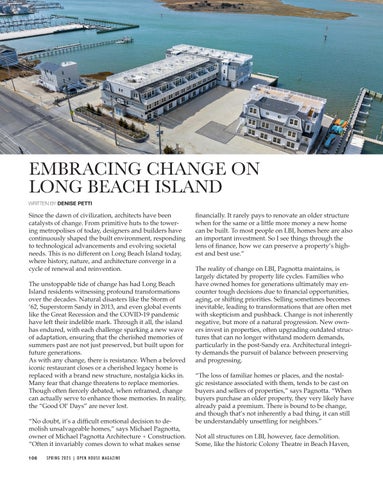
EMBRACING CHANGE ON LONG BEACH ISLAND WRITTEN BY DENISE PETTI
Since the dawn of civilization, architects have been catalysts of change. From primitive huts to the towering metropolises of today, designers and builders have continuously shaped the built environment, responding to technological advancements and evolving societal needs. This is no different on Long Beach Island today, where history, nature, and architecture converge in a cycle of renewal and reinvention. The unstoppable tide of change has had Long Beach Island residents witnessing profound transformations over the decades. Natural disasters like the Storm of ‘62, Superstorm Sandy in 2013, and even global events like the Great Recession and the COVID-19 pandemic have left their indelible mark. Through it all, the island has endured, with each challenge sparking a new wave of adaptation, ensuring that the cherished memories of summers past are not just preserved, but built upon for future generations. As with any change, there is resistance. When a beloved iconic restaurant closes or a cherished legacy home is replaced with a brand new structure, nostalgia kicks in. Many fear that change threatens to replace memories. Though often fiercely debated, when reframed, change can actually serve to enhance those memories. In reality, the “Good Ol’ Days” are never lost. “No doubt, it’s a difficult emotional decision to demolish unsalvageable homes,” says Michael Pagnotta, owner of Michael Pagnotta Architecture + Construction. “Often it invariably comes down to what makes sense 106
SPRING 2025 | OPEN HOUSE MAGAZINE
financially. It rarely pays to renovate an older structure when for the same or a little more money a new home can be built. To most people on LBI, homes here are also an important investment. So I see things through the lens of finance, how we can preserve a property’s highest and best use.” The reality of change on LBI, Pagnotta maintains, is largely dictated by property life cycles. Families who have owned homes for generations ultimately may encounter tough decisions due to financial opportunities, aging, or shifting priorities. Selling sometimes becomes inevitable, leading to transformations that are often met with skepticism and pushback. Change is not inherently negative, but more of a natural progression. New owners invest in properties, often upgrading outdated structures that can no longer withstand modern demands, particularly in the post-Sandy era. Architectural integrity demands the pursuit of balance between preserving and progressing. “The loss of familiar homes or places, and the nostalgic resistance associated with them, tends to be cast on buyers and sellers of properties,” says Pagnotta. “When buyers purchase an older property, they very likely have already paid a premium. There is bound to be change, and though that’s not inherently a bad thing, it can still be understandably unsettling for neighbors.” Not all structures on LBI, however, face demolition. Some, like the historic Colony Theatre in Beach Haven,