
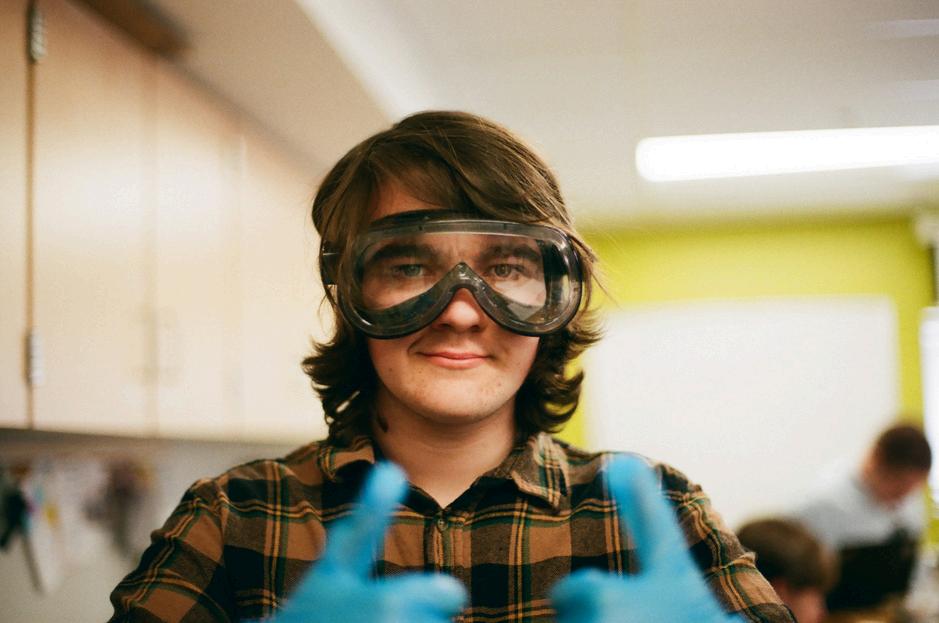
Inquiry leads learning at Baxter Academy for Technology and Science, a public charter high school, free to students. Our projectbased STEM curriculum emphasizes realworld problem-solving and is paired with a humanities program that connects ideas across disciplines and cultivates strong communication skills. Students design innovative projects through Flex Friday, a unique program that requires initiative, perseverance, and collaboration, as well as reflection on the work and its impact on the community.
100% of Baxter Faculty are trained: to use CAD via Fusion360 to use public data sets to drive student inquiry across all content areas in Python and basic robotics
As a public charter school, we are tuition-free. We are able to provide programming through the Maine Department of Education and important sponsors such Bangor Savings Bank, Revision Energy, the Gulf of Maine Research Institute, The Casco Bay Estuary Project, The Wells Reserve at Laudholm, PackGen, Partners for World Health, and many other gifts from our community of individual and organizational supporters.
Baxter Academy is a rigorous, college and career-preparatory high school that promotes student ownership of learning. Students study complex, real-world problems, using and building technological and social answers to humanity’s challenges in a collaborative environment with scientists, engineers, and other professionals. The school sets high expectations for all students, promotes innovation and creativity, and produces graduates with a 21st-century global perspective. Baxter’s engaging and challenging curriculum is taught by innovative teachers, who help guide students to be passionate, self-directed learners. Baxter was founded in 2013 and is located in Maine’s largest urban center, which provides partnerships and resources to connect student learning with real-world work and needs. Our campus abuts Portland’s Back Cove, a tidal basin ringed by a Frederick Law Olmsted National Historic Site-a green space with 3 miles of trails used for oceanfront walking, biking, and student research.
A Baxter student will take foundational core courses and will select courses that target their areas of interest, especially as they become Junior and Senior students. A third of a student's academic program consists of core Baxter courses; our program offerings are rich with STEM and additional academic options to tailor the student's journey to their exploratory and focal interests. A minimum enrollment of 5 courses during each semester of school is required, except with the express approval of the school's administration. Class of 2027 and earlier should refer to the 2023-2024 Course of Studies for Math and Science Sequence.
Core Baxter Courses
4 years of Flex Friday and Advisory
4 years of Mathematics
4 years of laboratory science study
3 years of Humanities
1 5 years of Design
1 year of Fine Art
World Language to level ELE at minimum
3 years of Electives at minimum
At Baxter, there's no single right path Students spend four years honing their skills, deepening their knowledge, and finding their voice so they can be active members in building stronger communities The five suggested tracks below are examples of how students have connected rigorous coursework with community partnerships around shared areas of interest They offer a suggested sequence of electives for students who want a focus area to guide their choices They're here to spark ideas, not to box you in. Many Baxter students draw from multiple tracks or build something entirely their own that reflects their unique curiosity. Use them as a starting point, or let your interests lead the way.
Schedule for a 9th grade student:
In their first year, Baxter students enroll in a core curriculum for math, science, humanities, world language, and design. See above for some possible courses of study for students with particular areas of interest. Student Flex Friday programs can be tailored to student inquiry, supported by a Baxter educator as a coach; we encourage student Flex Friday projects to be collaborative.
Mathematics
Baxter students commit to a rigorous academic journey and perform with clear expectations Through their classes, students gain content and skills These expectations, as named by standards, have overlaps across the curriculum and allow a student to pursue increasing rigor
Algebra Functions
Seeing Structure in Expressions
Creating Equations
Reasoning with Equations and Inequalities
Arithmetic with Polynomical & Rational Functions
Complex Number System
Science
Geometry & Spatial Reasoning
Interpreting Functions Building Functions
Modeling with Functions
Force & Motion Matter & Energy
F&M Sci & Engineering Practices
F&M Cross Cutting Concepts Interactions
F&M
M&E Sci & Engineering Practices
M&E Crosscutting Concepts Reaction Structure
English Across the Curriculum
Conguence
Similarity, Right Triangles, Trigonometry
Expressing Geometric Properties w/ Equations
Geometric Measurement & Dimension
Statistics and Probability
Interpreting Categorical & Quantative Data
Making Inferences & Justifying Conclusions
Conditional
Probability & Rules of Probability
Probability in Decision Making
Heredity & Evolution Climate
H&E Sci & Engineering Practices
H&E Crosscutting Concepts
Inheritance & Variation
Structure, Function & Development
CC Sci & Engineering Practices
CC Crosscutting Concepts Cycles Systems
Voice, Audience & Style Conventions
Cohesion/ Organization Development Ideas
Presentation
Discussion
Craft & Structure
Key Ideas & Details Citing Evidence
Design Process Computer Science CAD
Analyze Optimize Develop Solutions Identify Problems
Code Design Information Technology
Professional Practices Programming Techniques
Civics & Government Economics
Policy
Civics Government
Tools Materials
Asacollegepreparatorys high-expectationnormsf
Studentscarryobligatio
Showingupforeach duringclasstimesor activelyengageintea evenstepuptolead?
Preparation-AmIc tothenextclassasa community?
Deadlines&Expect andexpectations,an whatIamresponsibl Discourse&Commu discourse(listening, practiceprofessional writingcommunicat Careforpeers-Am learningenvironmen socialmanagement?
Studentscarryobligat
Responsibleformeetingcommitments-HowdoI maintainpositivesocial-emotionalwellness,including bynotaccruingover-duedeadlinedebt?
Heterogeneity(SelfAcceptance)-DoIacceptmyself formyuniquecharacterandneeds,butalso understandthatIlive,serve,andworkinacommunity?
Advocacy-HowdoIidentifythehelpIneed,know wheretolook,andaskforit?
Note-taking-HowdoImaintainrecordsandprocess notesformylearningsothatIcantakeownershipof mylearning?
Studyskillsforassessments-HowdoIstructurea waytohonemyknowledgeandskillsforupcoming presentationsofmywork?
Qualified Juniors and Seniors may work at an internship through our Flex Friday program that gives insight into a career or academic focus.
Students who have achieved advancing in standards may consider dual enrollment through our partnering universities for up to 12 college credits.
The kids love having a day per week dedicated to one project. It helps them feel a purpose and accomplishment that is all their own.” - Baxter Academy Parent
At Baxter, students find a supportive and caring adult and a community of other students in advisory Baxter students enroll in Advisory, a pass/fail course, for every year they are Baxter students The 9th and 10th grade focuses on executive functioning, self awareness and community building; 11th and 12th will focus on college and career planning Students keep the same advisory group for all four years
Mondays: Students check their grades and set goals around their academic performance. Advisors can work directly with students to meet their academic goals.
Tuesdays: Students have Intervention and Enrichment This is a time for them to meet with teachers to get extra support or enrichment in their classes There are many Baxt l b d ti iti that run during I&E time as w
Wednesdays: A student-led T Wednesday, once per month joins together to acknowledg other's accomplishments and opportunities.
Thursdays: Instead of adviso their Flex Friday coach to set
Friday: The curriculum focus wellness.
A Topic Spotlight for Bright Futures in Advisory is Financial Literacy- Sources of wealth and income
Compound Interest
Start Your Own Business
Wages- Salaries and Banking
Property- On Car and Home
Students saw what a daily $7 drink could mean to them in 30 years; they learned about how keeping the car you have now, rather than buying a new one in 2026, could save you $565,000 by the time they are 65 In summary, students learned about ways to increase their options by considering long-term and short-term planning
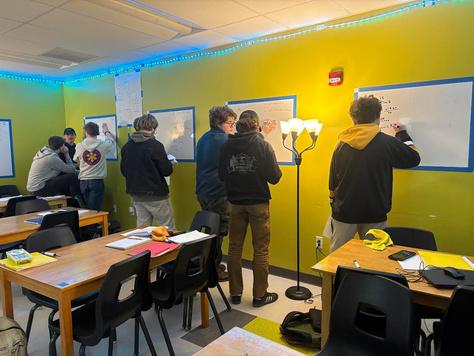
Learning mathematics at Baxter Academy is deeply rooted in inquiry and problem-solving. Students build and expand their mathematical understanding and abilities, making connections to prior mathematical knowledge and other subjects or disciplines. Baxter teachers strive to engage students in interesting and challenging mathematics that will prepare them for future study. Baxter students take a minimum of 4 full years of Math with the option for additional study.
Competency Benchmark gives access to upper level courses
*Students may enter 9th grade placed in this course
Math Standards X Algebra
Geometry/Spatial Reasoning
Functions
Statistics
MAT 110
This course introduces mathematical objects such as expressions, equations and inequalities We will examine techniques for evaluating, solving, simplifying and rearranging these objects, as well as translating literal phrases into mathematical statements. Linear equations, ratios and proportions, inequalities, and other algebraic objects will be explored with their broader applications in the sciences If time allows a brief introduction to qualitative statistics may be explored. Standards assessed: EN in Algebra and Functions
This course is the second semester of a full-year course
The emphasis will on consolidating algebra skills already developed, especially algebraic manipulation, and moving on to further topics in algebra with applications to geometry. The following topics will be covered: understanding variables, graphs of linear and quadratic functions, systems of equations & inequalities. Advanced topics for the end of the semester will be chosen according to student interest. Standards assessed: PR in Algebra and Functions
This course is for students with strong Algebra 1 skills who are ready to accelerate in math as 9th grade students. The focus of the course will be solving algebra problems by algebraic manipulation as well as by graphical methods. The primary skills to be developed include: multiplication of polynomials, factoring, simplification of algebraic fractions, properties of roots, solving linear, quadratic, and irrational equations, together with corresponding word problems. The elements of the theory of functions, algebraic geometry, and trigonometry will be covered, with occasional problems in the geometry and trigonometry of triangles and circles and some basic statistics. Exceptionally challenging problems will be provided for interested students. This course is in place of MAT 100, 201, 301, and 323 Prerequisites: Strong Algebra 1 background and recommendation of current math teacher Standards Assessed: CB in Algebra & Functions, PR in Statistics & Geometry.
MAT 301
This course follows STEM Math in the Algebra and Functions sequence Designed for students who finish the STEM class at the progressing level for Algebra Topics of study include quadratic functions and applications, solving quadratic equations, finding different forms of quadratic functions, and working with zeros and factors. Additional work with polynomials and complex number solutions to quadratic equations will be introduced as time allows. This course may be taken concurrently with MAT 315. Prerequisite: PR in Algebra.
Standards Assessed: CB in Algebra
MAT 323
Students continue learning about families of functions and the algebra supporting them Function families will extend from the familiar linear, exponential, and quadratic to rational, polynomial, absolute value, and square root. Function families will be developed, explored, and applied to appropriate contexts.
Prerequisites: successful completion of Algebraic Techniques & 2D Geometry.
Standards Assessed: CB in Functions & Algebra
MAT 315
Geometry is the study of shape and size This class will focus on properties and definitions of one- and twodimensional shapes : lines, angles, polygons, and circles Geometric transformations using coordinate geometry lead to concepts of congruence and similarity and lay the foundation for transformation of functions in MAT 400.
Familiar geometric theorems will be explored and proven using deductive reasoning. This course may be taken concurrently with MAT 301.
Prerequisite: PR in Algebra.
Standard Assessed: CB in Geometry
MAT 410
Students will extend their knowledge of geometry by investigating the three-dimensional analogs of twodimensional concepts. This includes the properties of three-dimensional shapes, creating orthogonal and isomorphic projections, and applying their learning to architectural and design situations. Students will study the effects of scaling up or scaling down and how to fill or pack space efficiently Students will extend their understanding of symmetry by visualizing slices through objects and analyzing the shape of the resulting slice
Prerequisite: CB in Geometry
Standard Assessed: AD/EX in Geometry.
MAT 330
This course will include statistical studies and survey techniques Topics include a review of descriptive statistics, normal distributions, types of statistical studies, random variables, sampling distributions, confidence intervals, hypothesis testing, two-way tables, and conditional probability.
Prerequisites: PR in Algebra.
Standards Assessed: CB in Statistics.
MAT 435
Students will deepen their learning of statistics by creating statistical models and analyzing how well those models represent the data. Extended methods of statistical inference will be explored. Students will learn the basics of R programming, a language developed by statisticians for the purposes of statistical analysis
Prerequisite: CB in Statistics
Standards Assessed: AD/EX in Statistics
MAT 355
The focus of this course is understanding the events in each student’s life that will impact them financially. Students will use algebraic and graphical analysis to assess their costs, their sources of income, and how to build a solid financial future. Major projects for this course focus around understanding job markets and the costs and benefits of college, creating and managing a budget, and planning for taxes and retirement
Throughout the course, students will practice algebraic thinking and create, use, and interpret linear and exponential functions as models for financial situations.
Prerequisites: CB in Algebra.
Standards Assessed: CB for Research, Economics, & Functions.
MAT 400, Full Year
Intensive review of function families with the addition of trigonometric, logarithmic, parametric functions, and function inverses Students will use algebraic manipulation to solve equations involving polynomial, trigonometric, exponential, logarithmic, and rational functions The mathematics of complex numbers will be developed and applied in algebraic and geometric contexts. Topics will also include conic sections (circle, ellipses, parabolas, and hyperbolas) from their geometric definitions and extending their algebraic representations. Prerequisites: CB in Algebra, Functions, and Geometry. Standards Assessed: AD in Algebra, Functions, and Geometry
401, Full Year
This course is a study of advanced algebra, trigonometry, geometry, and statistics The goal is to prepare students for calculus, while boosting their problem solving ability and their written and oral mathematical presentation skills. The first few weeks of the course will be used to consolidate student’s skills in algebraic manipulation, including advanced algebraic simplification and the solving of linear and quadratic equations and word problems. Precalculus topics will include: the elements of number theory, polynomials, rational expressions, trigonometric functions and identities, inverse trigonometric functions, exponential and logarithmic functions, solution of trigonometric, exponential, logarithmic, and irrational equations Problems in twodimensional and three-dimensional geometry will be incorporated into daily work. Statistics material includes probability distributions and hypothesis testing. A very strong algebra foundation is a prerequisite. This course follows MAT 340 and covers same material as MAT 315, 330, and 400. Prerequisites: Successful completion of MAT 340 or CB in Algebra & Functions Standards assessed: AD in Algebra & Functions, CB in Geometry & Statistics
MAT 500, Full Year
Calculus introduces the concept of limit and applies it to the definition of derivative and integral of a function of one variable The rules of differentiation and properties of the integral are emphasized, as well as applications of the derivative and integral. Additional topics include techniques of integration, indeterminate forms and L'Hôpital's Rule, improper integrals, infinite series, conic sections, parametric equations, and polar coordinates. Prerequisites: AD in Algebra, Functions & Geometry. Standards Assessed: EX in Algebra, Functions & Geometry
MAT 500, Full Year
A year-long introduction to topics that are typically covered in the first two years of college. The course will emphasize first and second order differential equations, and advanced problem solving with matrices and determinants Standards Assessed: BA in Functions & Algebra
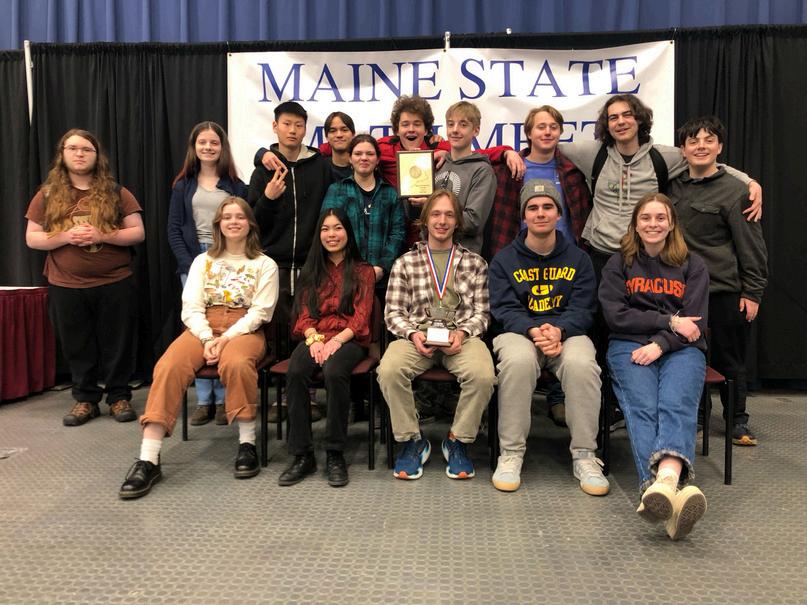
Math Team Success for 2024-25: Team ranked 30 statewide for regular season th Placed 13 at State Math Meet th Student ranked 8 statewide th 33 students competed in American Mathematics Competion
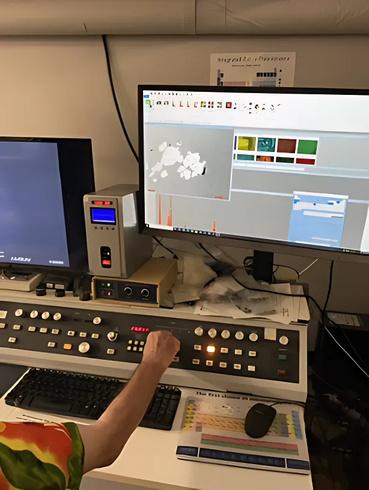
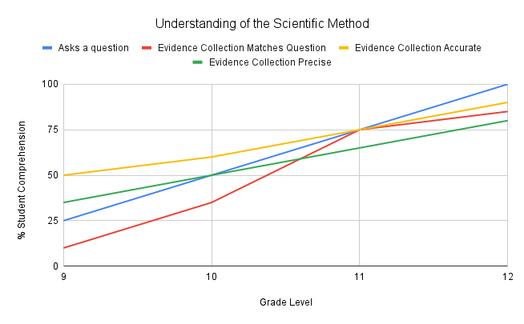
The mission of science instruction at Baxter Academy for Technology and Science is to prepare students to be knowledgeable, scientifically literate, and responsible citizens who think critically and solve problems in an increasingly complex and interconnected world Through competency-based learning aligned with NGSS standards, students build strong foundations in chemistry, biology, physics, and climate and earth systems while cultivating curiosity, disciplined inquiry, and real-world understanding As juniors and seniors, they deepen their interests through a rigorous selection of advanced electives including AP Chemistry, Immunology, Genetics, Marine Biology, Physics, Calculus-Based Physics, and more, that prepare them for STEM pathways in higher education and beyond Throughout their time at Baxter, students engage fully in the scientific process by designing investigations, analyzing data, and communicating evidence-based conclusions
Competency Benchmark gives access to upper level courses
Human Anatomy & Physiology
Marine Bio: Microfauna
Marine Bio: Macrofauna
Electricity and Energy
Advanced Biology (fy) AP Chemistry (fy)
Calculus Based Physics (fy)
Science Standards
X Science Practices
Heredity & Evolution
Matter & Energy
Forces & Motion
Climate & Earth Systems
Starting with the Class of 2028, all 9th grade students will be taking the two first year courses listed below.
SCI 250
A lab course focused on the basics of chemistry. The course will cover ionic reactions, stoichiometry, electron configurations, precipitation reactions, models of the atom and periodic trends. A semester course focused on the connection between chemistry and our impact on earth Students will be connecting their knowledge of chemistry to learn about and propose solution surrounding alternative energy sources Standards Assessed: EN/PR Matter & Energy.
SCI 255
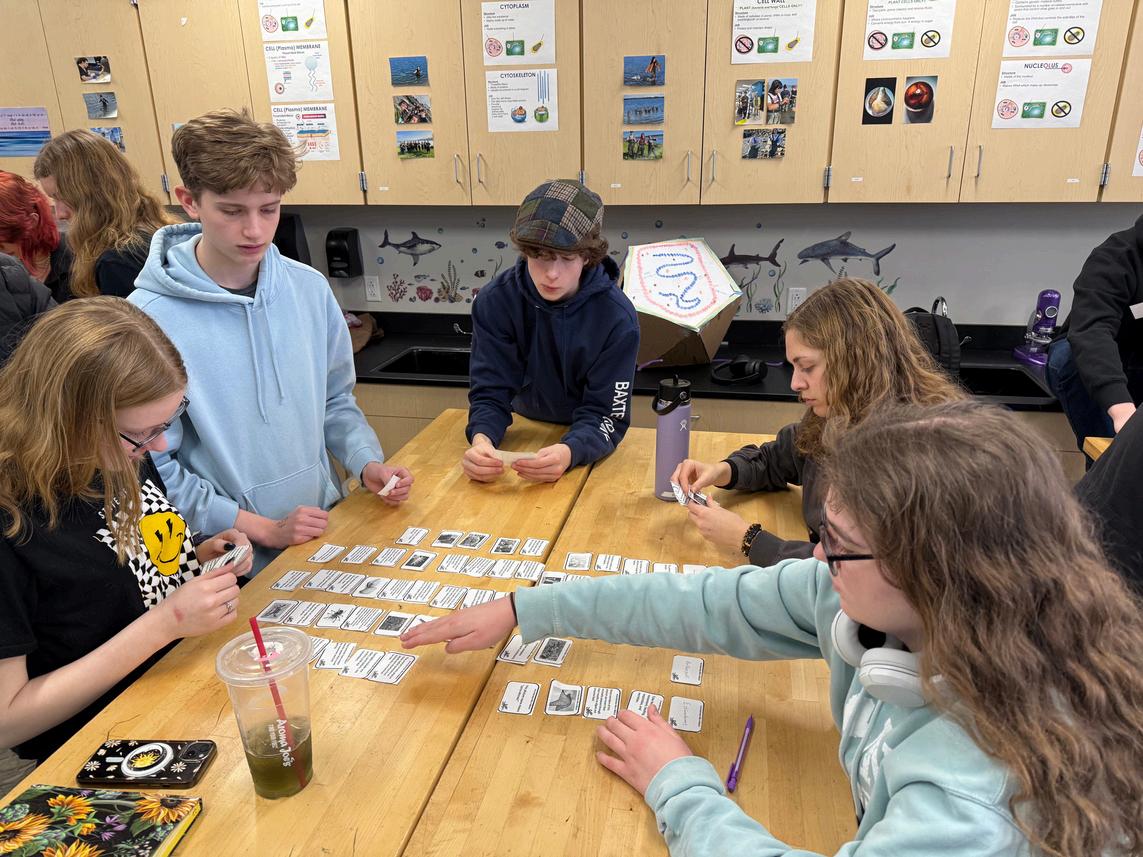
This course is designed to introduce students to the fundamental concepts of life science and illustrate the application of these principles. The curriculum will focus on actively engaging students with the world around them using the scientific method as the basis of discovery Topics include the building blocks of life, cell biology, cellular processes, and transcription and translation Standards Assessed: EN/PR Heredity & Evolution, Climate & Earth Systems.
Three core Sciences: All students will be at the competency benchmark upon completing these courses.
SCI 360
A course exploring key concepts in chemistry, including chemical reactions, acid-base interactions, stoichiometry, and solution chemistry. Students will investigate nuclear chemistry and its relationship to climate change, as well as thermochemistry and energy changes in chemical reactions Emphasis will be placed on applying chemical principles to real-world contexts, developing problem-solving skills, and connecting theory to laboratory experiments. Standards Assessed: PR/CB in Matter & Energy, Climate & Earth Systems.
SCI 365
Biology provides students with a comprehensive introduction to patterns of inheritance, diversity of life, populations and communities, and the Biosphere. Lab based inquiry will be enforced through experimentation while highlighting data collection and analysis Interactions among organisms and their biophysical environment will be an overarching theme throughout this course. Standards Assessed: PR/CB Heredity & Evolution, Climate & Earth Systems.
SCI 370
An introductory course to core concepts in physics. Optics, electromagnetism, electricity, optics, and forces and motion will be covered throughout the semester. Standards Assessed: PR/CB Forces & Motion.
Prerequisites for the courses below include competency benchmark in the three core sciences listed above.
SCI 420
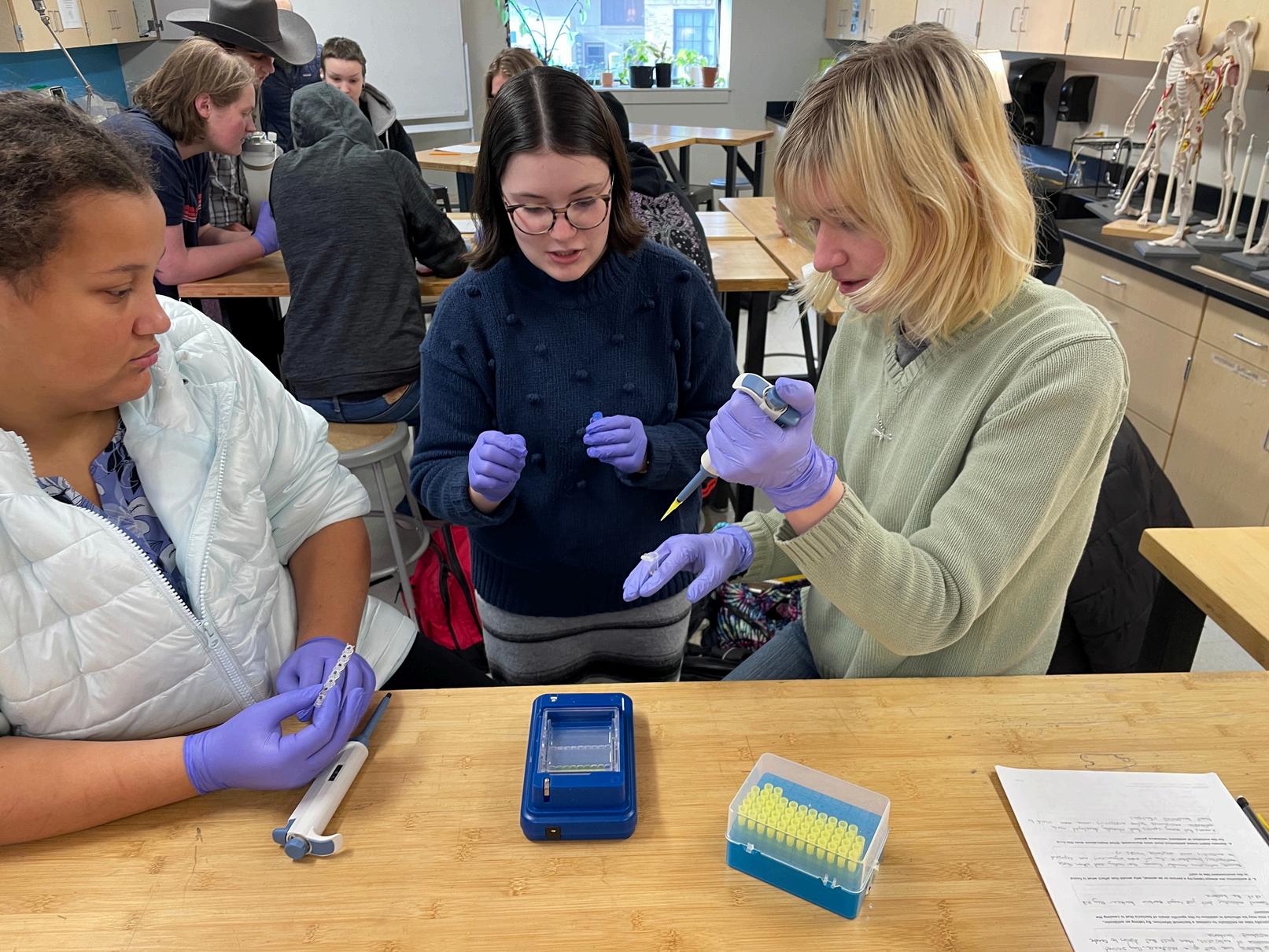
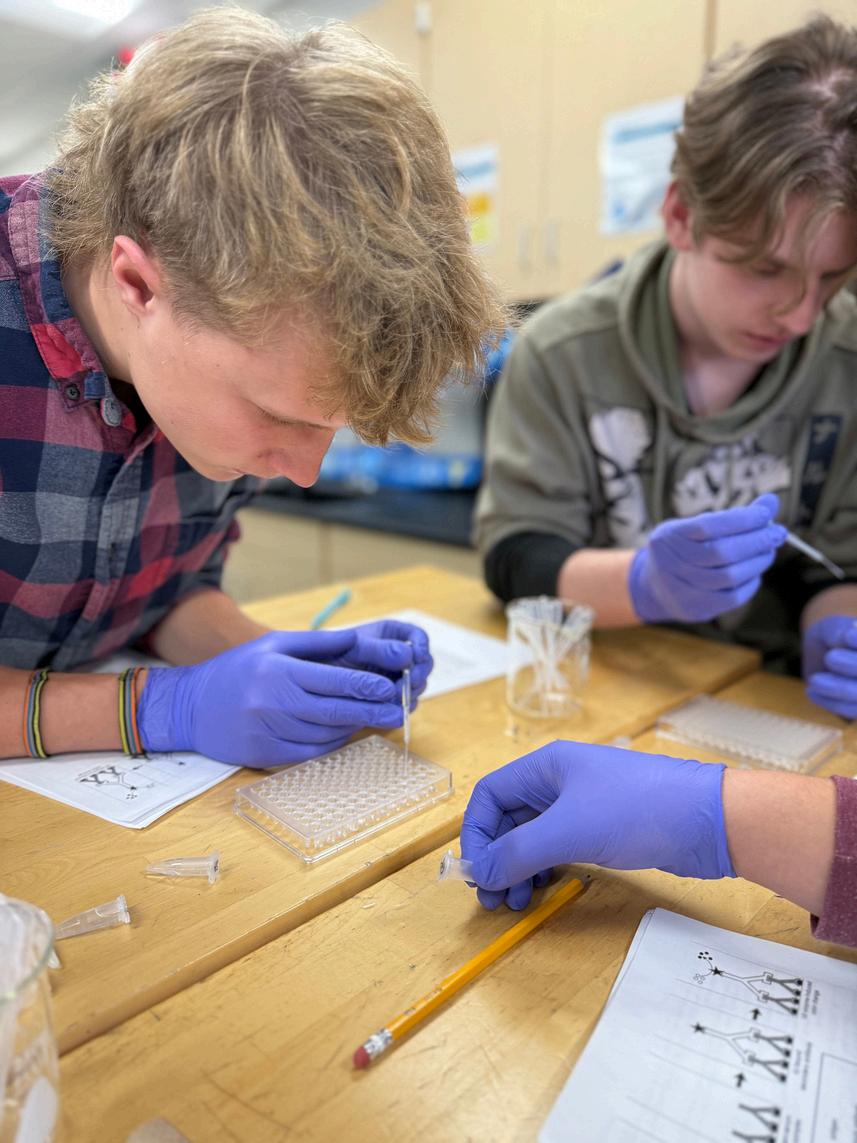
Our genetics course immerses students in modern human genetics, genomics, and personalized medicine through an integrated curriculum of molecular laboratory methods, bioinformatics, and ethical inquiry. Rooted in hands-on experimentation, students learn to use authentic laboratory techniques, such as DNA extraction, PCR, gel electrophoresis, and sequence analysis to explore human genetic variation and perform genotyping assays using real human gene targets. Complementing laboratory work, learners engage with computational tools to analyze DNA, RNA, and protein sequence data, developing skills in bioinformatics that mirror authentic scientific workflows Standards Assessed: CB/AD Heredity & Evolution
SCI 425
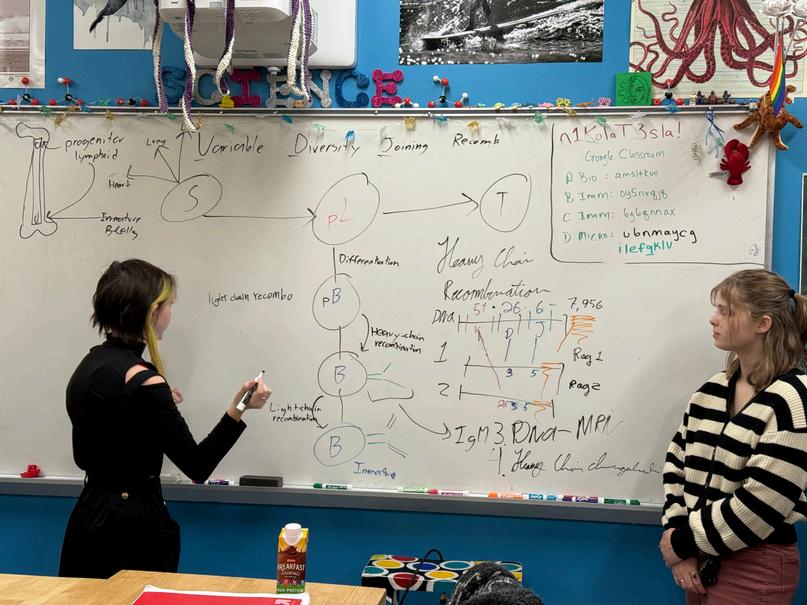
Students will learn about the immune response, the cell biology of the immune system, the nature of antigens, antibodies, B and T cells. The nature of tumor immunology and cancer development will also be covered, with an emphasis on the role of the immune system to maintain homeostasis in an organism. Standards Assessed: CB/AD Heredity & Evolution, Matter & Energy.
SCI 430
An algebra-based physics course covering a wide range of classical and modern physics concepts. Topics include: Optics, electromagnetic radiation, orbital dynamics, stellar evolution, and cosmology. Standards assessed: CB/AD Forces & Motion
SCI 435
This course addresses the EQ?s through the lens of Maine’s varied and complex ecosystems Students will learn about ecological relationships, as well as the ways in which energy, matter, and information flow within and between ecosystems. There will be an emphasis on identifying and addressing ways in which humans can alter their impact on the environment. Standards Assessed: CB/AD Heredity & Evolution, Climate & Earth System.
SCI 440
This chemical engineering course will focus on clean energy and energy transformations By studying chemical reactions, we will learn how to create sustainable energy We will discuss methods for converting matter from one source to another with out creating net positive carbon output. We will also analyze the structure of various materials. Standards Assessed: CB/AD Forces & Motion, Matter & Energy
SCI 445
Human Anatomy and Physiology is a lab course that investigates the forms, processes, and systems of the human body Students will study the basic organization of the body, the biochemical composition and interactions, the parts of the major body systems as well as how they work together. Case studies of infectious and genetic diseases and current discoveries in medicine will enhance our study. This class is designed for students who are interested in the health field and for students who want to learn more about their bodies and how to maintain a healthy lifestyle. Standards Assessed: CB/AD Heredity & Evolution
SCI 455
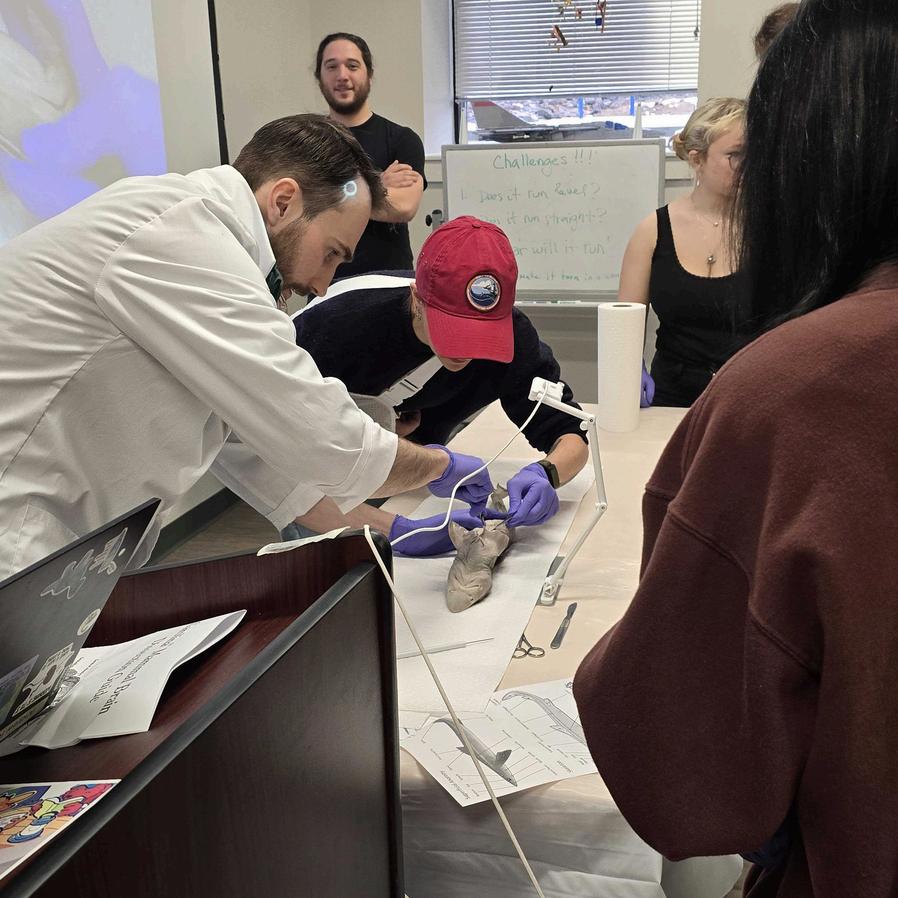
Marine biology focuses on life in the ocean This course introduces students to the many types of plants and animals that live in the ocean, on a macro level An ongoing focus will be the impacts of climate change on the oceans, and what our environmental impact has been. Laboratory activities reinforce the concepts and principles stated, as well as field trips, dissections, projects, and independent research. Specific topics covered are fishes, marine mammals, and specific marine habitats. Standards assessed: CB/AD Heredity & Evolution, Climate & Earth Systems
SCI 460
Marine biology focuses on life in the ocean This course introduces students to the many types of plants and animals that live in the ocean, on a micro level. It will emphasize the relationships between all organisms and how they are suited to live in their habitats, specifically in Maine. An ongoing focus throughout the year will be the impacts of climate change on oceans, and human environmental impact Laboratory activities reinforce the concepts and principles stated, as well as field trips, dissections, projects, and independent research Specific topics cover water chemistry, plankton, and invertebrates. Standards assessed: CB/AD Heredity & Evolution, Climate & Earth Systems.
SCI 465
Electricity and Energy focuses on renewable energy technologies and the electronics involved in producing and converting solar and wind-powered energy. Through hands-on labs, demonstrations, and studentdriven projects, students will learn key electrical principles such as voltage, current, and resistance, as well as practical skills like wiring, safety in household energy systems, and converting DC voltage to AC voltage for power grid integration. Students will build and test simple circuits using electronic instruments, gaining a solid understanding of electronic components and systems. Each student will complete work focused on renewable or clean energy innovations. This course prepares students to be future innovators in sustainable energy and infrastructure CB/AD Heredity & Evolution, Climate & Earth Systems, Forces & Motion, Matter & Energy
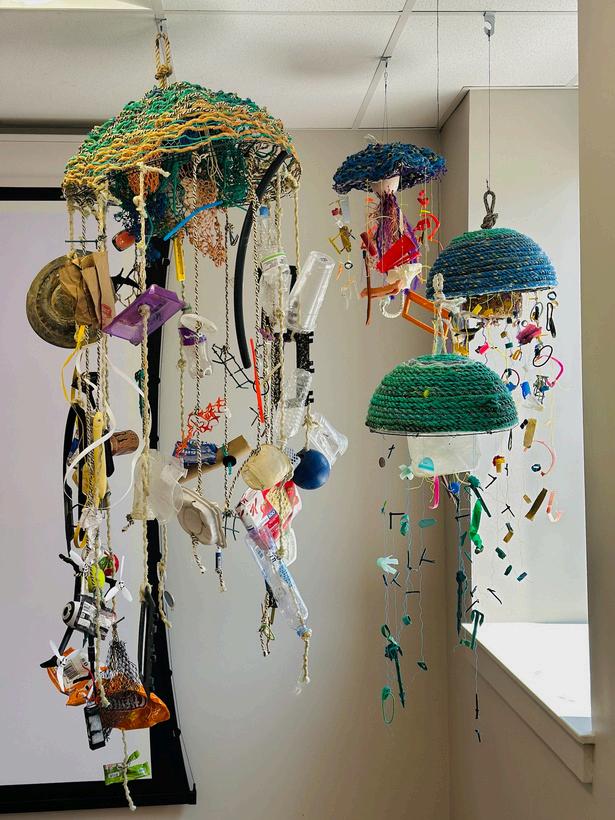
Baxter students have led at the Maine State Science Fair In 2024–2025, Baxter students earned full and partial tuition scholarships for standout projects on water quality, genetics, the Baxter Plastics Project, and more!
SCI 400, Full year
A lab science course for students who have the desire to explore advanced biology topics at the advancing and excelling level This course will focus on topics at the intersection of molecular biology, ecology, microbiology, genetics, biochemistry, physiology, biotechnology, and developmental biology Prerequisite: Life science, Biology. Standards Assessed: CB/AD Heredity & Evolution.
formerly Advanced Chemistry
SCI 405, Full year
This course offers students a college-level foundation to prepare them for more advanced chemistry studies. Through inquiry-driven investigations, students deepen their knowledge in areas such as atomic and compound structure, properties of substances and mixtures, chemical reactions, kinetics, thermochemistry, equilibrium, acids and bases, thermodynamics, and electrochemistry To enroll, students must have completed an introductory high school chemistry course (Chem I) and Algebra II, or a comparable course. A significant component of this course involves laboratory work, accounting for 25% of class time, where students engage in hands-on experiments, with at least 10 labs, including six inquiry-based investigations, to demonstrate key chemistry concepts and apply scientific practices Standards Assessed: CB/AD Matter & Energy
SCI 410, Full year
A calculus-based physics course aligned to the first semester of a college physics course The focus is on solving challenging mechanics problems, to prepare students to be successful in a first-year college physics course. The course will include some labs, with an emphasis on error analysis. Prerequisite: Calculus and CB in Forces & Motion. Standards Assessed: AD/EX Forces & Motion.
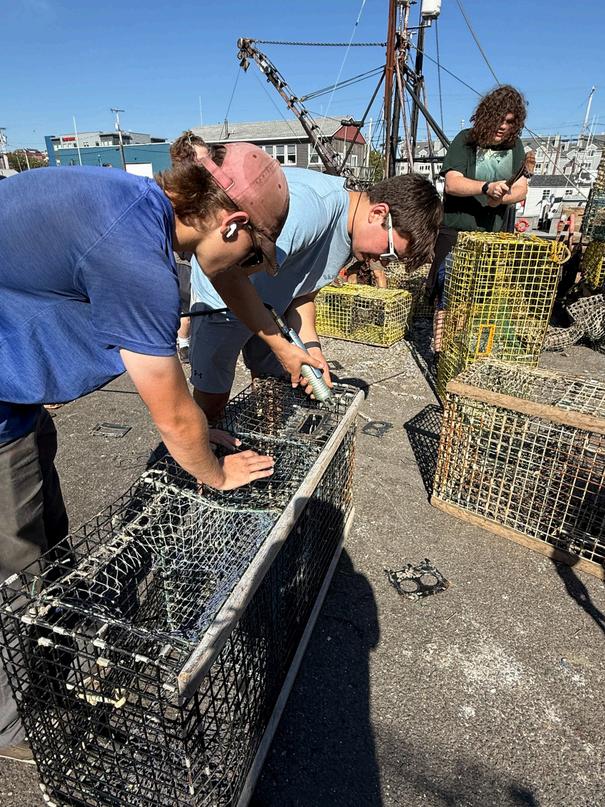
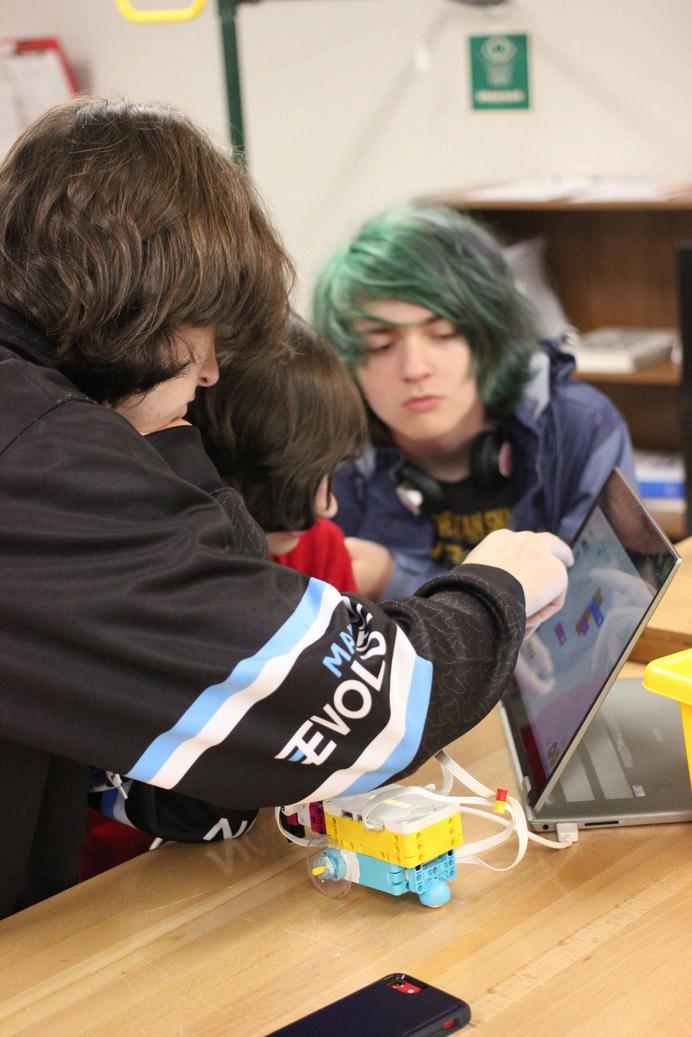
I feel like the variety of classes helps students stand out and the level of education is higher than a standard public school. This will make students more likely to get accepted into their preferred college as well as get scholarships.”
- Baxter Academy Parent
SWhat stories are at play here?
PWhat possibilities are here?
AWhat assets do I bring? C How does this impact the community?

What engages my curiosity?
Baxter Academy for Technology and Science is committed to providing an equitable learning community for its students and all of its members. We value diversity in all its forms, including but not limited to linguistic, ethnic, ability, family structure, gender, race, religion, sexual orientation, and socio-economic status. We help students develop an understanding of their responsibility as active citizens in a multicultural, democratic society. Through our students, our school is an agent of change; our school is an equity project that seeks to interrupt and transform systemic inequity toward a more loving, just, equitable, and peaceful world. This critical work is the ongoing responsibility of every member of our community.
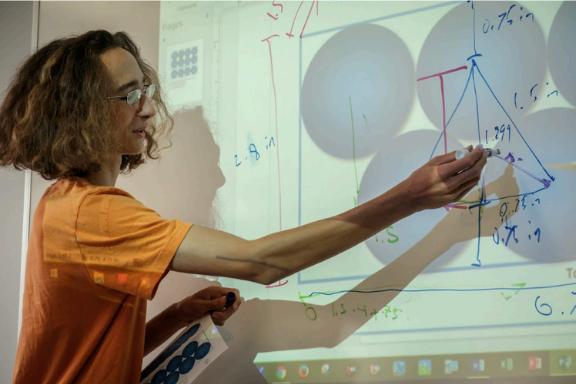
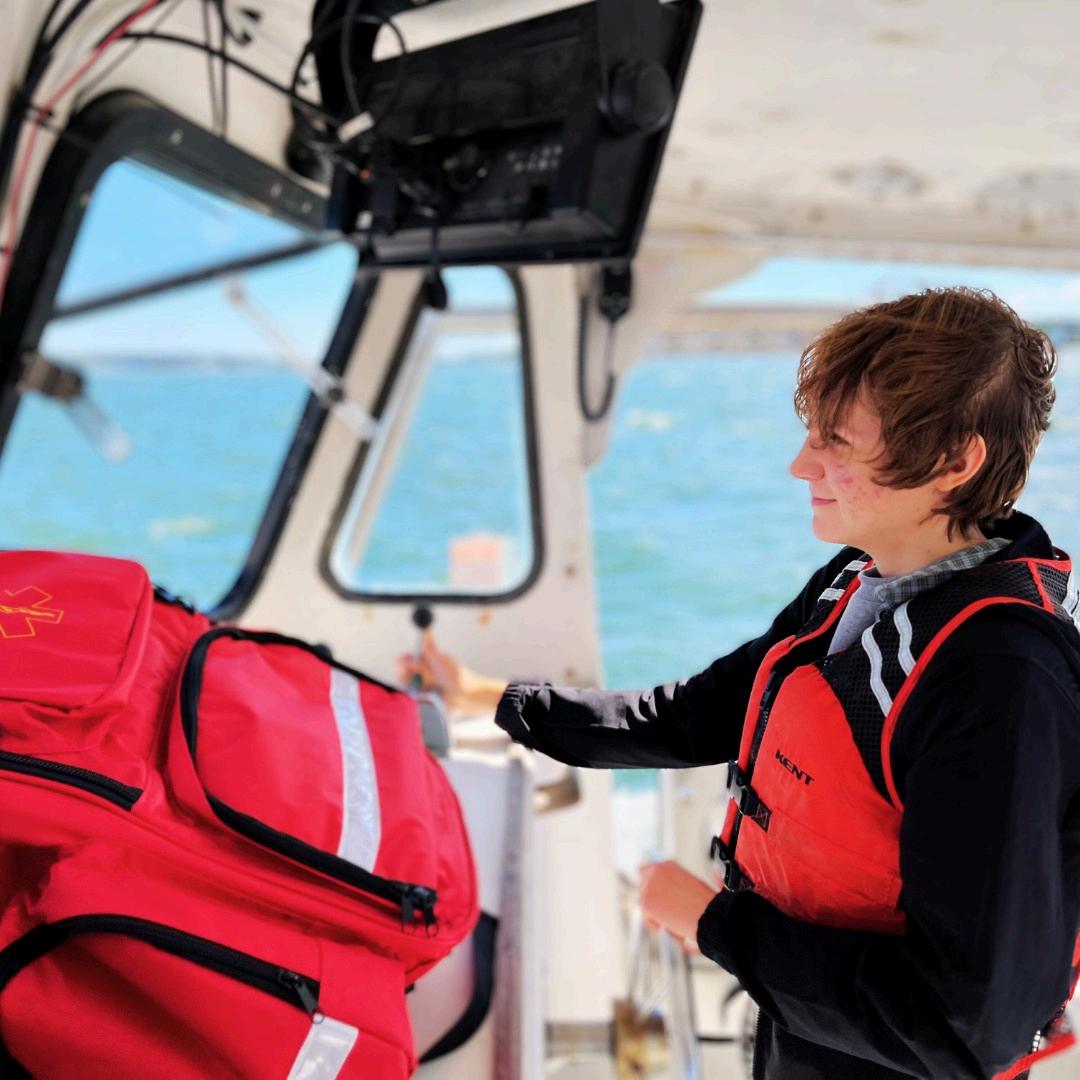
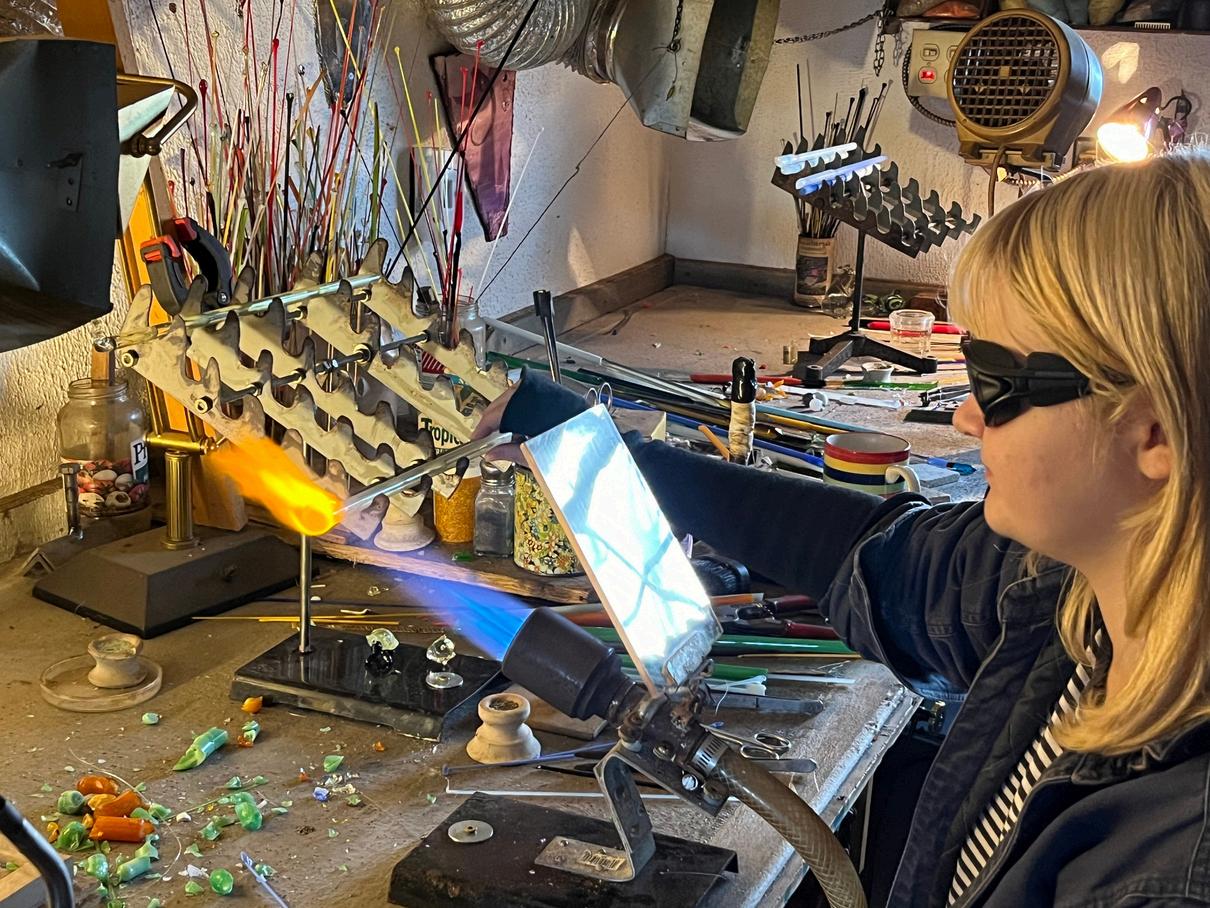
Baxter’s design department is committed to preparing students with the skills and knowledge to be successful in college and career. Student work centers around two foundational goals: to creatively solve open-ended problems and to be prepared with real-world skills that go beyond the classroom. Whether creating a circuit board, writing software, or designing a robot, students learn the core skills to succeed in a constantly changing world.
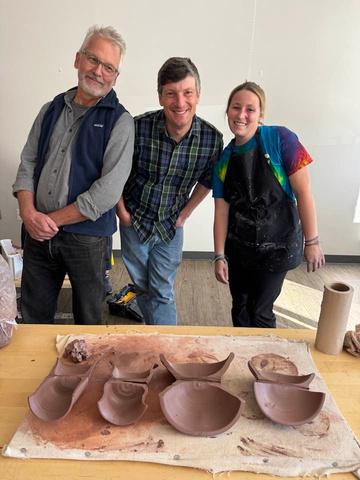
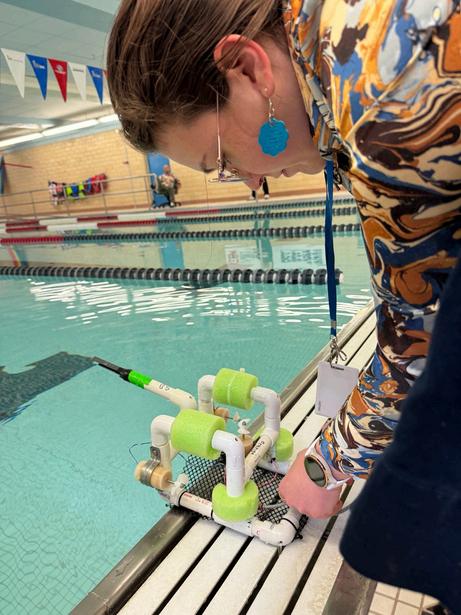
Baxter Academy is a unique school in that the design process is a standard for graduation. We use a model of the design process developed by Stanford’s D school as a method for teaching critical thinking, divergent and convergent thought, human-centered design, and prototype fabrication.
Our curriculum and the design process provide students with a way of breaking down the creative problem-solving process. Students start with a blank piece of paper and develop their own innovative solutions. We solve problems by inferring and observing problems and then create multiple solutions.
The Visual and Performing arts classes focus primarily on the Aesthetics and Meaning standard. All students experience art and learn to apply the elements of design in an Art Fundamentals course and then dive into deeper meaning through higher-level courses. Students may also choose to experience art through music classes where they learn to perform, respond to others, and compose original music.
Competency
Art Fundamentals Drawing I
Capella Guitar Lab
Ensemble
Music Comp and Tech
Printmaking Drawing II
Graphic Design II Animation
Dioramas & Props
Artists of Maine
Media Arts Standards
Aesthetics & Meaning Visual Arts

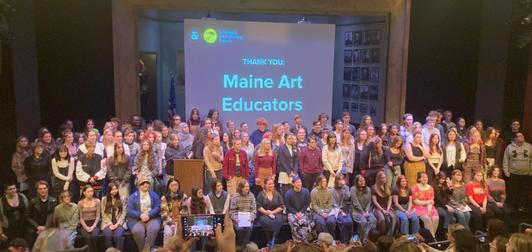
Baxter Students Won 28 Maine Scholastic Art & Writing Awards in 2025
DES 200
An introduction to the Design Thinking process, engineering, and fabrication concepts and practices. Standards Assessed: EN in Speaking & Listening and PR Fabrication, PR in the Design Process.
DES 206
In this class, students learn how to use CAD and how to utilize it as a Design Tool. Students start by learning foundational tools, and then move on to more creative design problems. Students also learn the fundamentals of Euclidean geometry through design projects that use CAD. Standards Assessed: CB in CAD
DES 205
How to use engineering tools and principles to understand the world around us. This class is for students who want to understand the technology around us and to practice the engineering mindset Standards Assessed: PR Engineering, Design Process.
DES 300, Full year
Students will learn to work through larger engineering problems To solve these problems, students will have to apply the design process. They will learn a variety of design tools including CAD, Excel, and 3D printers. In semester 2 the problems will also explore micro-controllers and basic programming. The course will culminate in a final project where students develop solutions for a real world problem. Prerequisites: CAD, Intro Des Standards Assessed: CB in Engineering, Design Process., CB CAD.
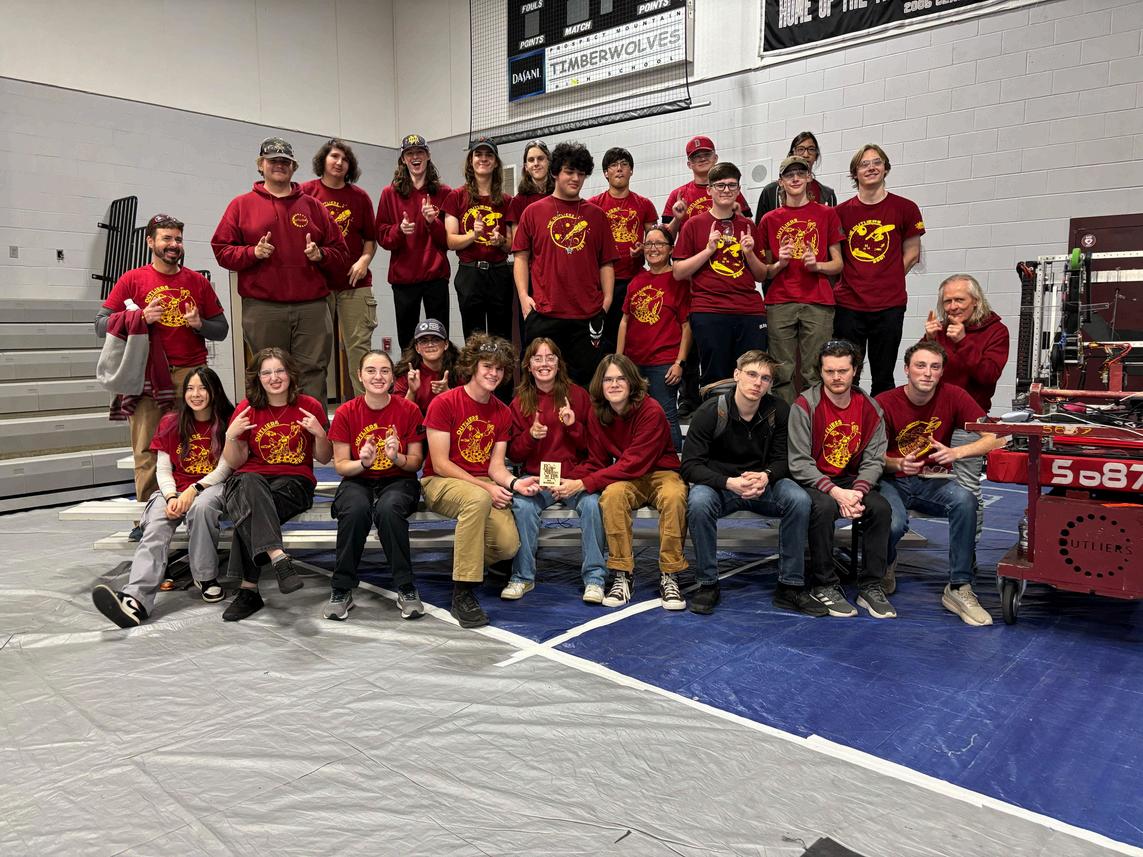
Baxter students have had years of success in Robotics
In 2024-2025 Baxter Students:
Won Inaugural Girls Behind the Glass
Won Southern Maine and Pine Tree District
Qualified in New England District Championship
Eligible for World Championships
Part of First US Team to Win Brilliant Blue Challenge
DES 500, Full year
The class centers around preparing students for college-level Engineering. We will study college-level problems in the areas of statics, mechanics of materials, etc. Students will work through complex problems that require them to build their design tools using programming and CAD. Students will need an understanding of Calculus. Prerequisites: CAD, Engineering I and II Standards: EX in Design Process, Engineering
DES 210
Learn basic electronic concepts. Use an online circuit simulator to design, build, and test electronic circuit concepts. Standards Assessed: PR in Design Process.
DES 330
This course focuses on techniques of visualization and representation (freehand drawing skills and model making) as they pertain to beginning design Students will explore form development and refine design skills through orthographic drawing (plan, section & elevation), perspective drawing, model making, and diagramming Prerequisites: Intro Des Standards Assessed: CB Design Process, CB Fabrication, PR Aesthetics and Meaning
“One of the huge positives of Baxter is the diversity of the student body and faculty despite the homogeneous nature of Maine. In addition, by allowing students greater independence in their educational opportunities Baxter is fostering self direction, self empowerment and the importance of collaboration.”
-Baxter Academy Parent
COS201
Designedforstudentswhohavenopriorcoding experience.Itteachesthebasicsofprogramming logic,discretemathematics,codingsyntax,and structure.Studentswilllearnhowtowriteand debugsimpleproceduralprogramswhichwillbuild theskillsneededforhigher-levelprogramming. StandardsAssessed:PRinCS
COS301
Extendsthebasicsofprogramming,includingdata structures,fileI/O,andobject-oriented programming(OOP).Studentswillbuildupthe skillsneededforhigher-levelprogrammingandbe preparedfortheAPComputerScienceAExam. StandardsAssessed:CBinCS
COS302
Self-directedprojectswithafocusonusingthetools andtechniquesofprofessionalprogramming StandardsAssessed:ADinCSandCBinDP
COS302
Self-directedprogrammingwithopportunitiesto leadgroupprojects.StandardsAssessed:ADinCS andADinDP
InformationTechnologyI
COS304
Learningthescienceofcomputers,operating systems,andtheinternet Hardware,client-server, cloud StandardsAssessed:CBinDPandCS
InformationTechnologyII
COS404
Advancedtopicsinthescienceofcomputers: networking,encryption,withpotentialroadto certifications.StandardsAssessed:AD/EXinDPand CS.
DES321
Self-directedprojectsfocusingonthedesignprocessand understandingtraditionalwoodworkingjoineryandtools. StandardsAssessed:CBinDPandF.
DES323
Studentswilllearntoworkwithfabricswhilecreatingavariety ofpersonalprojectsfromfashion-baseddesignstoflexible structures,kites,andsails Thecoursewillfocusonsketching, patternsaswellascomputer-cutCNCcomponentsformore advancedmakers StandardsAssessed:CBinF&DP
DES324
AcourseinDesignThinking,thedesignprocess,andmodel making.StudentswillusetheFabLabtocreateanditerateon theirproducts.StandardsAssessed:CBinF,DP, andPRinCAD.
DES325
Self-directedprojectsfocusingonunderstandingcomposite structures,tooling,andmold-making StandardsAssessed:CB DPandF
DES420
AnintroductiontoComputer-AidedMachining:CNCrouters, CNCverticalMachiningcenter,Laserengravingand3d Printing.StandardsAssessed:ADDesignProcessand Fabrication,CBEandADinCAD.
DES421
Musicalinstrumentconstructionandrepairaswellasother advancedwoodworkingtechniques Thiscourserunsevery otheryear.StandardsAssessed:ADinDesignProcessandADin Fabrication. Woodworkingisaprerequisiteforthiscourse.
ART 100
An introduction to visual arts concepts and practices. Focus is on a half semester of analog art and a half semester of digital art. Standards Assessed: EN in AM & VA
ART 300
Explore the fundamentals of graphic design including shapes, color, texture, typography, and imagery, and then use this to produce original commercial work Standards Assessed: CB in AM & VA
ART 305
Detail-oriented course in both the technical and creative aspects of drawing practices. Assignments are based on the principles of design. Prerequisites: EN in Visual Arts and Aesthetics and Meaning. Standards Assessed: PR/CB in AM & VA.
ART 306
Through advanced exploration of the designeraudience relationship, students will develop type, logos, and layouts for specific purposes, including branding and packaging. Prerequisites: CB in Graphic Design I. Standards Assessed: CB in AM & VA.
ART 307
Students will develop a high level of proficiency with Adobe Suite products and produce multiple, original pieces demonstrating their knowledge and ability Standards Assessed: CB in AM & VA
Illustration
ART 320
Curriculum focuses on interpretation of existing text or material in a visual presentation with consideration to the author’s vision. Prerequisites: CB in Drawing I. Standards Assessed: CB in AM & VA
Drawing II
ART 401
Advanced instruction on observational and design drawing practices, and encourages independent development toward areas of interest Prerequisites: CB in Drawing I Standards Assessed: CB in AM & VA
ART 402
Covering monoprints, relief prints, gelatin prints, intaglio, collagraph and reduction printmaking. Prerequisites: CB in Drawing I. Standards Assessed: CB in AM & VA.
ART 404
This class is based on skills that were once common but are now quickly disappearing, such things as calligraphy, bookbinding, embroidery, stone carving, and other handwork Students study many disciplines based on regional histories and multicultural art mediums from around the world Outside experts will support different cultural art forms in live demonstrations for the class. Standards Assessed: AD in AM & VA.
ART 405
This is a class in designing, constructing, and painting both miniature dioramas as well as full-scale objects that fit into the “movie prop” category. Creations would involve careful study of images and other objects to be replicated in different materials that would be indistinguishable from the real thing Students would have the chance to build from their imaginations as well as have a physical piece to show at the end of the class. These pieces could be purely sculptural in nature or incorporated into film or theater projects or even in tabletop games such as Dungeons and Dragons or other miniatures-based games. Standards Assessed: AD in AM & VA.
ART 401
This class will introduce students to a handful of artists who have spent time in Maine during the course of their creative lives Maine has a rich history of art and artists and many students are unaware of the contribution our state has played in the art world in general The course consists of 6 individual Units with each unit focusing on a single artist and their respective medium with each unit running roughly 2 weeks.
MUS ENS
Students pursue an instrument of their choice and participate in a musical ensemble to learn songs together and perform for the school and possibly outside audiences Our ensemble will explore various genres of music; anything students are passionate about performing We welcome guitarists, keyboardists, violinists, DJs, singers, and drummers. Students will need to provide their instrument & gear for this class. Standards assessed: EN-CB Music Electives and Aesthetics and Meaning.
MUS GUI
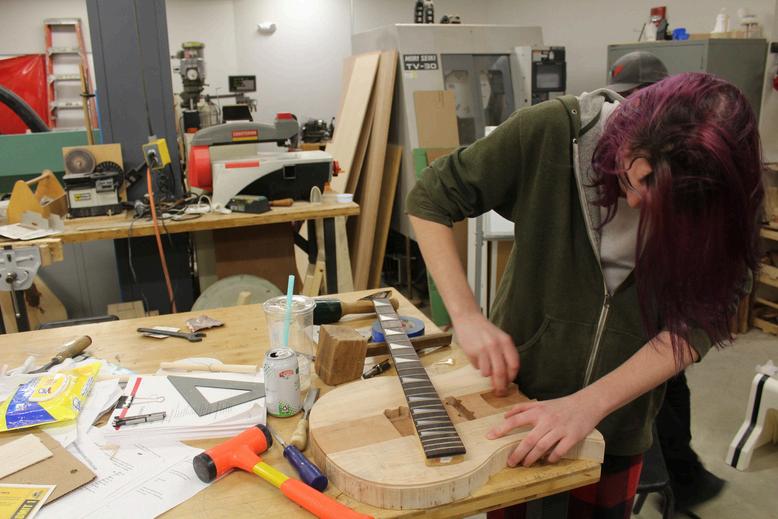
Students will receive guidance and direction in creative problem-solving related to playing the guitar at a beginning level and will learn many of the different styles, skills, and techniques required to become a successful guitarist No previous guitar experience needed Areas of concentration include: correct posture, chart reading, aural skills, rhythmic patterns, chord study, musical forms, improvisation, and performing experiences Standards assessed: EN-PR Music Electives and Aesthetics & Meaning
MUS MCT
Introduction to music composition using a Digital Audio
Workstation (DAW). Students are guided through a series of increasingly complex projects, putting music fundamentals into practice while building a portfolio of work. No musical experience is necessary for this course. Course may be repeated in order to work on more complex projects and topics Standards assessed: EN/PR Music Electives and Aesthetics & Meaning
MUS MCTII
A continuation of Music, Comp, & Tech I. Students are guided through a series of increasingly complex projects, putting advanced music fundamentals into practice while building a portfolio of work. MCT I is a necessary prerequisite for this course. Course may be repeated in order to work on more complex projects and topics. Standards assessed: EN/CB Music Electives and Aesthetics & Meaning
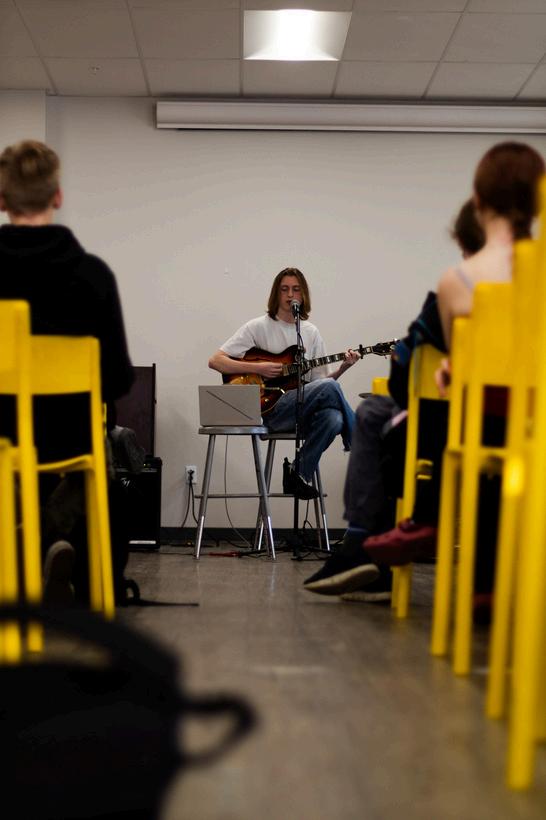
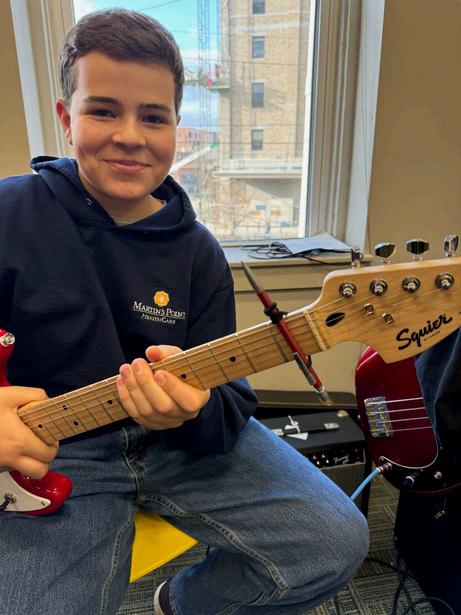
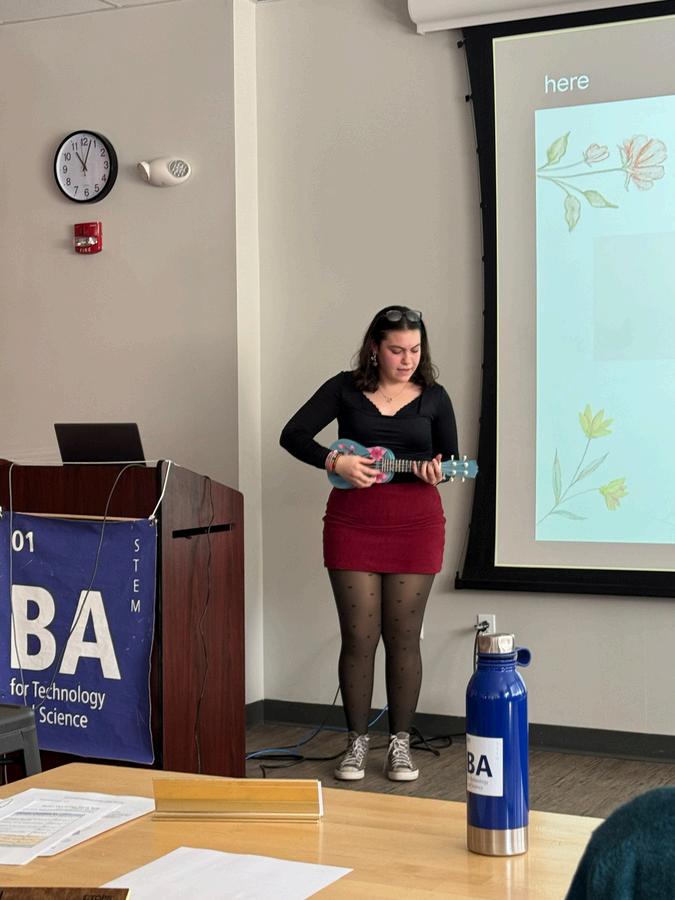
Baxter Academy recognizes and highlights the importance of humanities alongside our STEM mission, acknowledging its pivotal role in cultivating science communicators. Humanities at Baxter fosters a unique approach, emphasizing the development of a human narrative within the realm of science. By analyzing both fiction and nonfiction, students gain a broader perspective and build empathy, using texts as tools to explore and respond to real-world issues. Baxter scholars actively engage with their peers through student-driven discussions and build community as they hone their written and spoken communication skills. Our humanities courses facilitate rich exploration of history and culture so that students can assess how the past has shaped the world they live in today, how historical forces and systems impact their lives and the lives of others, and how they can bring about change. In 2024, BA celebrated 2 published student authors.
Maine’s Housing Crisis
Confronting Genocide
& Frenemies
Addiction, & Violence Advanced Creative
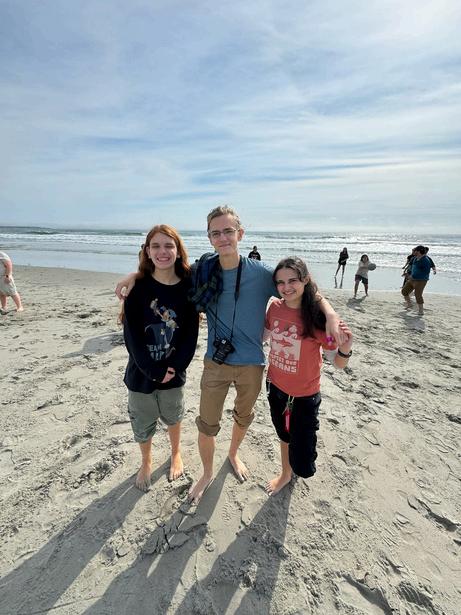
“Because of humanities at Baxter, I became more empathetic as a writer... and learned how to better write about myself. Because of humanities at Baxter I can put my math skills to use in the context of my community.”
-Baxter Academy Student
ENG 100
Students will address themes related to social contracts and power and work to answer questions about their identities, beliefs, and the formation of societies. Students will master the reading skills of citing appropriate evidence from fiction and non-fiction texts and use the writing process (including outlines and peer revision) to develop claims and formulate well-structured pieces of writing that synthesize big ideas. Students will also participate in multiple whole and small group discussions to learn how to participate in high-level text-based conversations. Standards Assessed: EN in Reading, Writing, and Speaking & Listening.
ENG 203
This course offers a rigorous exploration of American literature of the 20th century from modernism to postmodernism, analyzing how shifting historical contexts, artistic movements, and media influence the construction of identity and reality Students will critically engage with literary texts, modern art, and evolving mass media to examine the fluid boundaries between fact and fiction, self and society Through close reading and analytical writing, they will deconstruct authorial intent, narrative structure, and thematic complexity Writing assignments will require nuanced argumentation, compelling claims, and well-supported analysis that synthesizes ideas across multiple texts Additionally, student-led discussions and structured academic discourse will develop students’ ability to engage in sophisticated, evidence-based conversations This course demands advanced skills in Reading Writing and
ENG 204
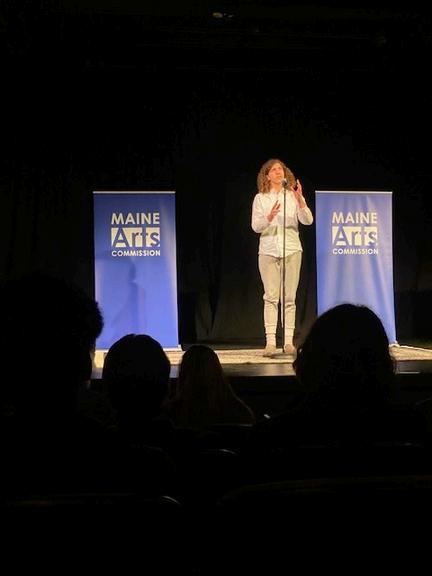
This course combines traditional literature studies with a deep dive into performance art, theater, and media analysis. Students will explore classic and contemporary works, with an emphasis on plays, screenplays, and multimedia texts, analyzing how themes, characters, and settings are brought to life on stage and screen Through reading, performance, and discussion, students will examine the power of storytelling across various media, gaining an understanding of how choices in performance and production impact the meaning of a work. Projects will include performing scenes, writing screenplays, and analyzing media to foster skills in critical thinking, creative expression, and media literacy. Standards Assessed: PR in Reading, Writing, and Speaking & Listening.
ENG 260 is an elective; ENG 203 or 204 is required
In this course, students will learn the craft of creative writing. Students will be expected to produce and share their own original work, and analyze and consider how published poets and fiction writers effectively use literary devices The course will primarily focus on the genres of poetry, the short story, and flash fiction functions as well as other topics, as time allows. Prerequisites: English II.
Standards assessed: PR/CB in reading, writing, S & L
ENG 300
In this course, we will be exploring short works as both readers and writers. Through short works, such as short fiction, personal narratives, opinion pieces, and more, we will explore how writers use literary tools to shape the tone and meaning of their works As we use our reading as a guide to investigate how authors employ literary techniques, we will work on strengthening our own writing English II Standards Assessed: CB Writing, Reading, and Speaking & Listening
ENG 301
This course provides a rigorous, analytical exploration of social awareness, systemic structures, and individual agency through the study of Science Fiction and Dystopian/Utopian literature. Students will critically examine how perspective shapes historical narratives, literary formation, and social relationships while engaging in close reading to deconstruct an author’s craft, structure, and thematic intent. Writing assignments will demand sophisticated reasoning, strong claims, and well-supported arguments that synthesize insights across texts Through student-facilitated discussions and structured text-based discourse, students will refine their ability to engage in nuanced, evidence-driven conversations. This academically demanding course assesses advanced skills in Reading, Writing, and Speaking & Listening.
ENG302
Through diverse texts and videos, we will consider how communities struggle against forces of oppression and colonization. Assignments will include literary analysis, personal and creative writing, short presentations, and seminar-style discussions. Formerly Multicultural Literature. Standards Assessed: CB Writing, Reading, and Speaking & Listening
ENG 305
Through an examination of Ancient Greek mythology and modern retellings, students will work to understand how ideas from ancient literature persist in the stories we tell today Students will search for throughlines of significance and reflect on how stories and myth reflect aspects of our own experience. We will explore how various forms of storytelling impact how we engage with a story’s ideas and interrogate what it means to define “classics” and myths. Standards Assessed: CB Writing, Reading, and Speaking & Listening
ENG 360
In this course, students will continue the work of crafting creative writing. In word, sound, and image, students will critique and create digital narratives to inform and inspire our community. Students will practice a range of approaches, such as podcasting, animation, and video production for publication in and out of school through The Baxterian, Baxter Buzz, Blunt Youth Radio, the NPR podcast challenge, and other publications Prerequisites: Creative Writing I
ENG 401
Students will address themes related to their social and ethical impact and address questions about their rights, responsibilities, and responses to pressing issues in today's world. Students will read personal essays as mentor texts, work to develop their unique voices, and use these experiences to write their own, original narratives. Then, students will read and discuss non-fiction texts related to current science and technology issues. Students will engage in close reading practices, expanding upon their knowledge of craft, structure, author's purpose, and theme Students will plan and lead text-based discussions Standards Assessed: CB/AD in Writing, Reading, and Speaking & Listening, with Research option.
ENG 403
In this survey course, students will explore literary eras through the friendships and rivalries of great authors We will delve into the writing communities that shaped each period and investigate how interpersonal relationships influence artistic movements. Along the way, we may find the answer to such questions as: How did Emerson's and Thoreau's friendship lead to the transcendentalism that revolutionized American literature? Who didn’t Hemingway have beef with? Were the Brontës just jealous of Jane Austen's success? How did these feuds affect society's impression of these authors, and how can our friendships shape the future of literature? Prerequisites: English I, 200-level English, 300-level English. Standards Assessed: CB, AD, EX in Writing, Reading, and Speaking & Listening with Research option.
ENG 404
AP Literature and Composition is a rigorous, college-level course designed for students who are passionate about reading, analyzing, and interpreting complex literary texts. Through an intensive study of fiction, poetry, and drama from various time periods and cultures, students will develop advanced critical thinking, close reading, and analytical writing skills Emphasis is placed on deep literary analysis, sophisticated argumentation, and precise, evidence-based writing Students will engage in thoughtful discussions, timed essays, and intensive revision processes to refine their style and clarity. This demanding course prepares students for the AP exam and for the intellectual challenges of college-level literary study. Prerequisite: English III. Standards Assessed: CB/AD in Writing, Reading, and Speaking & Listening. Optional - Research
ENG405
In this course, students will dissect influential TV/Film scripts, analyze storytelling conventions and intent, learn industry-standard scriptwriting structure, and write original short film scripts Students will write, share, and revise their original work from pitch to pre-production. Discourse will focus on popular tropes, representation in film, directorial authorship, and the controversies of page-to-screen adaptations. The course aims to introduce students to both technical and creative sides of the medium, and, through continuous collaboration and analysis, strengthen writing and critical thinking skills Prerequisite: English 300 completion at CB level
SOC 100
This course will focus on basic research and the introduction to historical thought. In addition, students will understand how early societies organized themselves to make decisions, solve problems, and produce goods Students will do this through the study of early civilizations Standards Assessed: EN in Civics & Government, Historical Thinking, and Economics
SOC 200
This course will focus on the analysis of historical documents and founding ideals of the United States. In addition, students will examine the American experience from the perspective of groups that historically lacked access to power/resources. Standards Assessed: PR in Civics & Government, Historical Thinking and Economics
*This course is a ME state requirement*
SOC 300
Students in this course will expand their skills with historical thought and advanced research. Students will focus on the global transfer of goods and wealth and the political implications thereof. Standards Assessed: CB in Historical Thinking, Research, Economics, and Civics & Government.
SOC 415
Students will explore the biological and environmental factors of addiction and violence We will look at how global, US, and local policies impact a society’s addiction and violence burden Standards Assessed: AD/EX Civics and Government and Historical Context
MAT 355
The focus of this course is understanding the events in each student's life that will impact them financially. Students will use algebraic and graphical analysis to assess their costs, their sources of income, and how to build a solid financial future. Major projects for this course will focus on understanding job markets and the costs and benefits of college, creating and managing a budget, and planning for taxes and retirement Students will practice algebraic thinking and create, use, and interpret linear and exponential functions as models for financial situations. Prerequisites: CB in Algebra. Standards Assessed: CB for Research and Economics, CB in Functions.
SOC 405
We will study the rights and responsibilities of people living in, or impacted by the institutions of, the USA, in theory and practice. We will explore identity, power, privilege, and community, working towards learning how we can interact with our political, social, environmental, and economic systems to affect change Standards Assessed: AD in Historical Thinking, Research, Civics & Government, and Economics.
SOC 455
This course will introduce students to the genocides of the 20th century. Students will explore four genocide case studies: Armenian, the Holocaust, Cambodia, and Rwanda to understand the genocides, their historical context, and the U S and international responses to the genocides Additionally, students will explore the treatment of Native Americans in the United States and Canada as a means of learning about the concept of cultural genocide.? This foundation will provide a historical lens as students analyze possible genocide policies and present their solutions to confronting genocide. Standards Assessed: CB/AD Civics & Government and Historical Context
SOC 456
Portland, Maine is in the midst of a housing crisis. This is a data and research course designed to familiarize students with research methods, data analysis and visualization, and presentation skills. Students will apply these research and data skills to develop an understanding of the housing crisis, one of the biggest challenges facing Portland and many other parts of the state and country This course emphasizes the collection and analysis of both quantitative and qualitative data, as well as collaboration between our Baxter community and the government agencies, social services providers, nonprofits, advocates, and residents of the wider Portland community. What are the causes of this housing crisis? What are its impacts on individuals, families, institutions, and communities? Prerequisite: American Studies Standards assessed: CB-EX in humanities
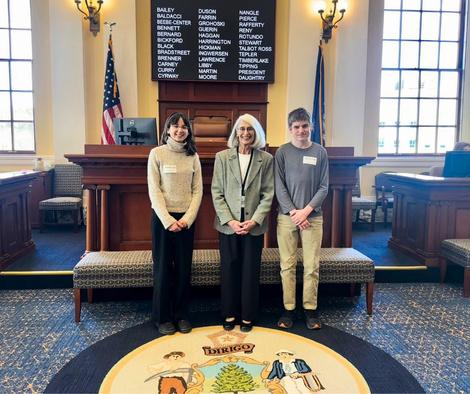
Studying a world language alongside STEM provides our students with the tools to communicate and problem solve across the globe. By learning another language, students build empathy for others, allowing them to understand and address global issues with their skills in innovation. Baxter’s world language educators recognize the responsibility of preparing our students to enter college and the workforce as empathetic and informed global citizens within our home communities and around the world. As such, language classes at Baxter are built using the latest research in language acquisition and informed by the proficiency levels put forth by the American Council for the Teaching of Foreign Languages (ACTFL).

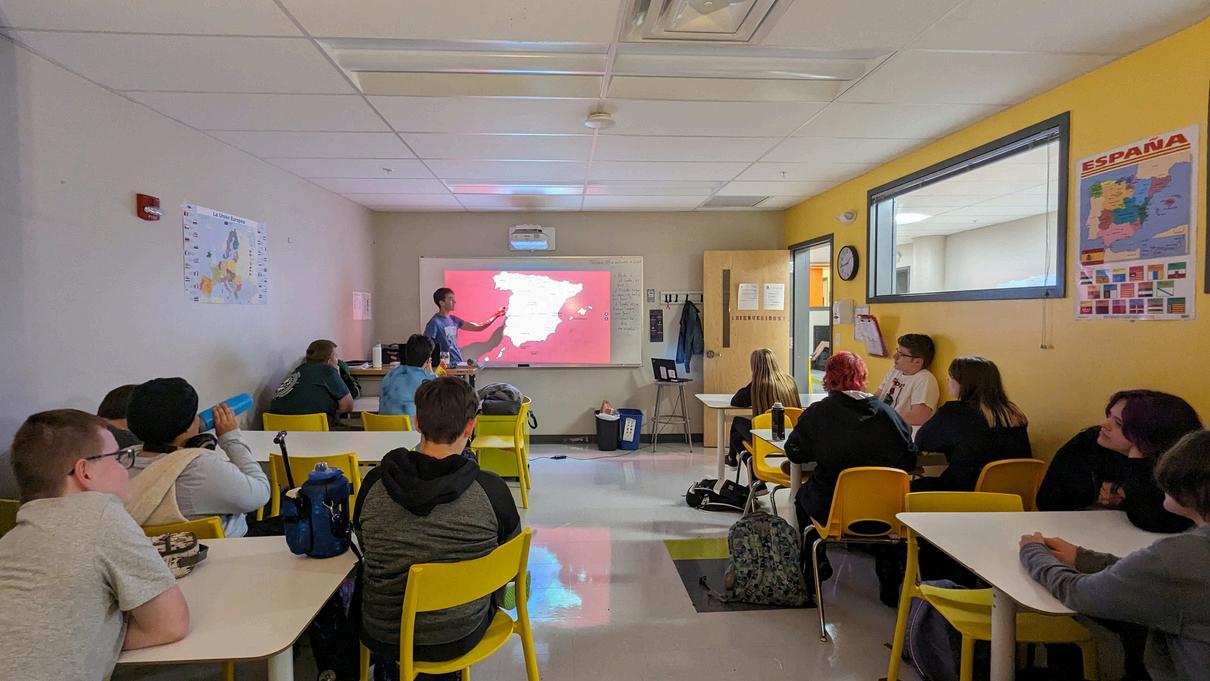
MAN BGN, Full year
Introductory course for beginners emphasizing the development of active language learner skills. Students will become familiar with the sound landscape and cultivate a comfort level with the unique intonation. The class is designed using comprehensible input (CI), prioritizing language acquisition over traditional study of grammar to help students acquire language naturally rather than learning it consciously. Standards assessed: PR in Interpersonal and Interpretive Communication.
MAN ELE
Continuation of language acquisition through cultural awareness. Class blends authentic materials and discussion on topics relating to the Chinese-speaking world. Students develop a familiarity with listening and responding in the target language and continue to hone their active language learner skills. Standards assessed: CB in Interpersonal, Interpretive, and Presentational Communication.
MAN INT
Course for motivated learners accessing a deeper understanding of language and culture Through frequent references to current events, social movements, and cultural traditions, students explore a deeper appreciation of the speakers of the language and the language itself. Standards assessed: AD in Interpersonal, Interpretive, and Presentational Communication.
Formerly Mandarin Upper-Intermediate (Mandarin IV)
MAN AP was MAN UP, Full year
This nuanced course emphasizes student-driven topics, allowing learners to guide discussions while exploring authentic materials related to complex cultural issues and current events Standards assessed include Interpersonal, Interpretive, and Presentational Communication (EX)
SPA BGN, Full year
Introductory course for beginners emphasizing the development of active language learner skills. Students will become familiar with the sound landscape and cultivate comfort with the unique intonation. Class is designed to be comprehensible (CI) prioritizing language acquisition over the traditional study of grammar. This method helps students acquire language naturally rather than learning it consciously. Standards assessed: PR in interpersonal and interpretive communication.
SPA ELE
Continuation of language acquisition through cultural awareness. Class blends authentic materials and discussion on topics relating to the Spanish-speaking world. Students develop a familiarity with listening and responding in the target language and continue to hone their active language learner skills. Standards assessed: CB in Interpersonal, Interpretive, and Presentational Communication.
SPA INT
Course for motivated learners accessing a deeper understanding of language and culture. Through frequent references to current events, social movements, and cultural traditions, students explore a deeper appreciation of the speakers of the language and the language itself. Standards Assessed: AD in Interpersonal, Interpretive and Presentational Communi cation.
SPA UP
Nuanced course incorporating an emphasis on studentinitiated topics of study Student choice drives the direction of discussion while exploring authentic materials on complex cultural issues and current events Standards Assessed: EX Interpersonal Interpretive, and Presentational
Online Learning of World Language Options is possible as electives upon completion of in-person language learning: Arabic, Dutch, Filipino, Greek, Hebrew, Hindi, Irish, Japanese, Korean, Latin, Persian, Polish, Portuguese, Russian, Swedish, Turkish
Guided by the Maine Health Learning Standards, we partner with local organizations such as Boys to Men and Prevention-Action-Change to provide rich and interactive programming. Students are connected to our community health partners through our advisory program. In addition to meeting these standards through community partnerships and in the classroom, students work on longterm and short-term goals, increase self-advocacy skills, and reflect on their learning during Flex Friday and student-led conferences.
Baxter students are engaged in a health and wellness program through a multi-pronged approach. Advisory serves as a micro community anchor for small groups of students.
External partnerships play a role in the general education of all students and also play a role for higher need students who need special care. The culture of academics and educator orientation plays a large role in the ongoing health and wellness of our students.
The school counseling program offers educational, preventative programs, goal setting, as well as responsive programs for student care. There are many outside influences and barriers facing our students today There will be a small group discussion and curriculum with the advisor and counselors, including digital citizenship and conflict management Students may achieve First Aid Certification.
Health
Connections & Influences Decision Making & Goal Setting Physical Fitness Knowledge
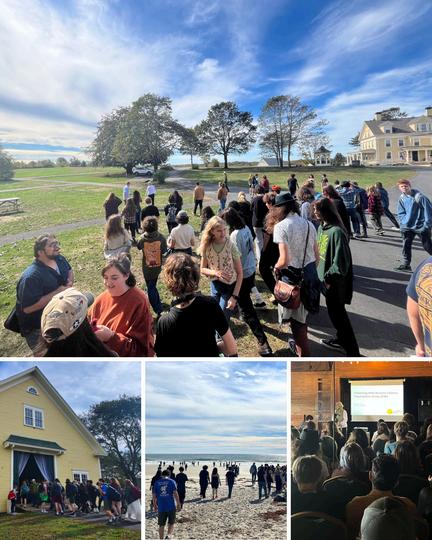
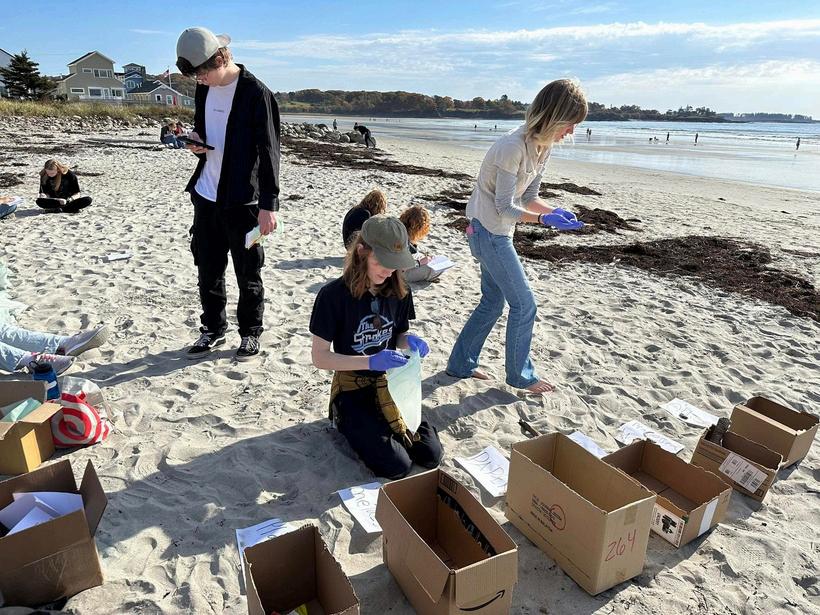
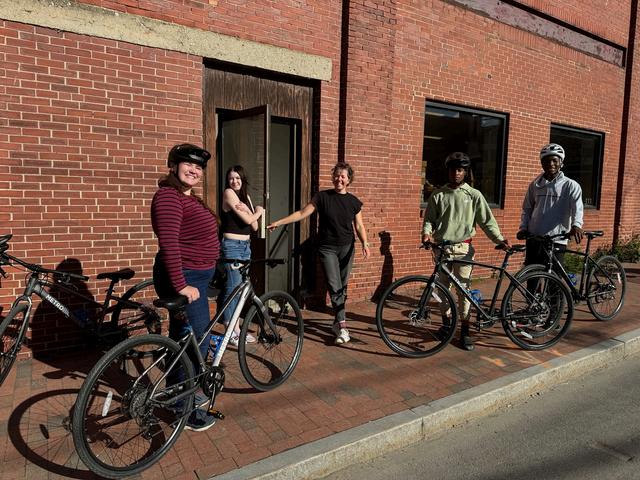
The 9th Grade Experience at Baxter gives incoming students the tools they'll need to succeed in the later years of Flex Friday at Baxter. To support this mission, students venture into Portland to engage with real-world challenges and community experiences, exploring the environment, technology, arts, and society. Examples include: East End Beach: To measure water quality and microplastics in the sand and ocean.
EcoMaine: To learn where our trash and recycling go, and how to think responsibly about the waste we create.
Portland Museum of Art: To learn about ancient and contemporary art, and make some art and poetry of our own.
Fore River Sanctuary Preserve: To hike and learn scientific documentation practices. Wells Reserve & Laudholm Trust: To expand knowledge about coasts and estuaries, while exploring conservation efforts.
Back on campus, students learn to make and code remotely operated vehicles as a design response to the needs that they’ve identified in the community.
On Flex Fridays in the Fall, 9th-grade students take three classes in the areas of writing/presentation, project management, and community connections.
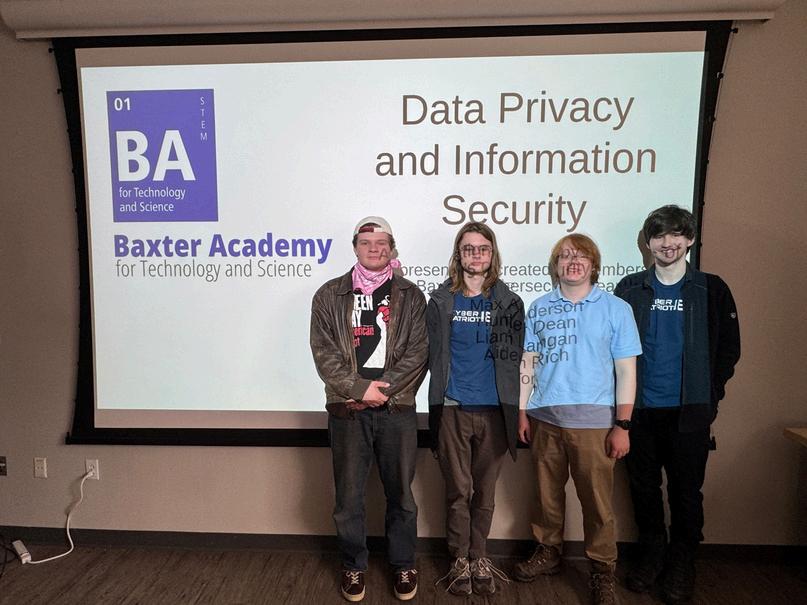
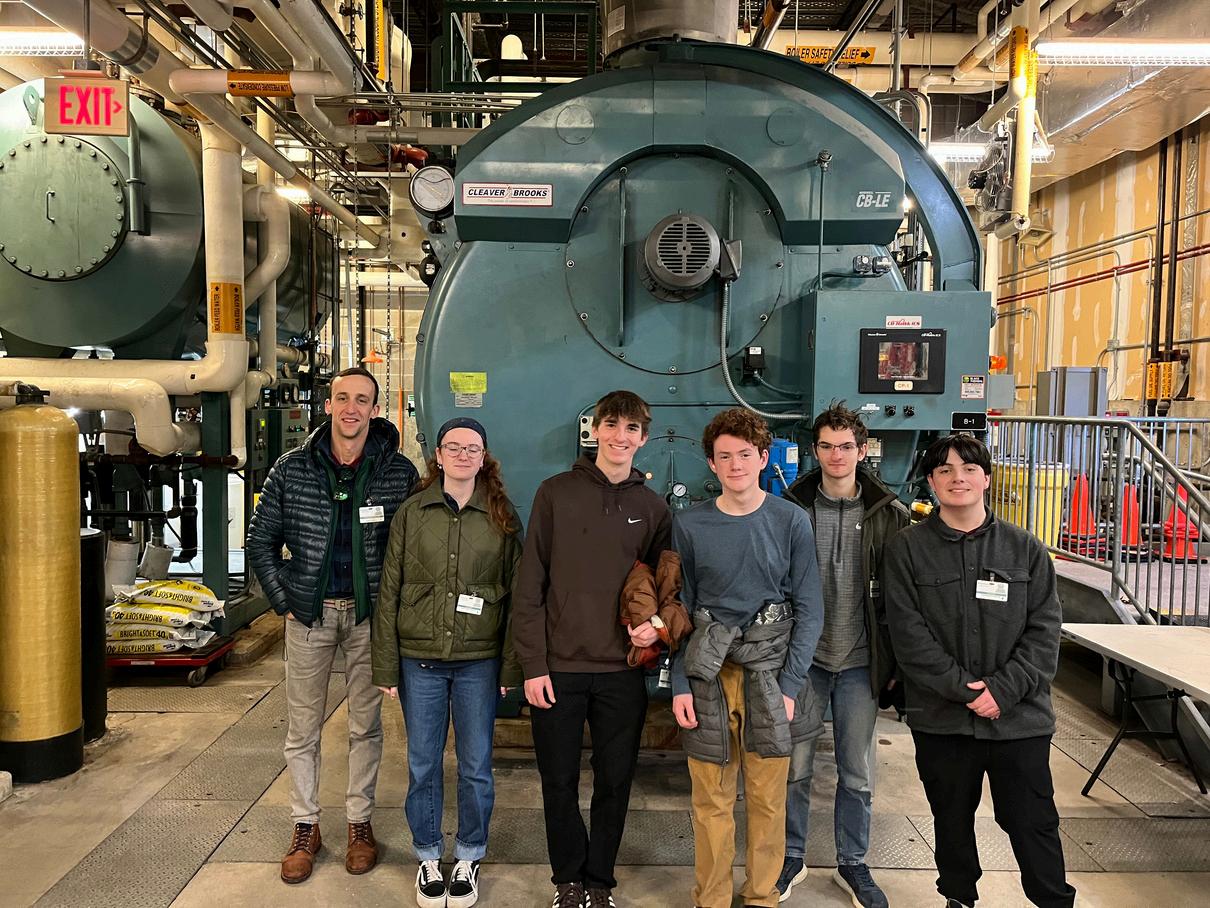
Pictured left, members of Baxter’s Cybersecurity team address whole classes in the Great Room on protecting themselves with data privacy and information security.
Although every project is unique, there are unifying threads across all cohorts and projects The Flex Friday pyramid visualizes key components necessary for every project.
Flex Friday Projects are studentinspired and managed, educatorcoached, long-term work. Proposals are presented to a hearing committee for approval Projects must be ethical, STEM-related and meet a community need; the goals, objectives, and schedule proposed must indicate a pathway to success. Students earn a 1-4 grade, included in the student's GPA.
Community Connections: The project meets an identified community need Relationships with community partners are nurtured, and authentic audiences or stake holders are identified and included
Daily Skills: Students hone specified skills that are transferable to long-term goals beyond project Eg: CAD, interviewing skills, lab skills, graphic design, programming, carpentry, editing, social and emotional skills, etc )
Project Planning: Goal setting, charting progress, breaking down tasks, establishing deadlines, choosing and implementing specific strategies, monitoring and adjusting to solve problems
Process Journal: Weekly intentional reflection on process. Students note progress towards goals, skills acquisition, group work challenges and successes, as well as other discoveries using a consistent platform
Cluster Culture: Presence, accountability, and adherence to coach expectations contribute to a positive cluster culture Consistent productive student habits, feedback for peers, collaboration and receptivity to coaching also play a role in positive cluster culture
Flex Friday helps students foster skills such as these for students to achieve their goals:
Innovation
Academic Rigor
Time Management
Responsibility
Creativity
Collaboration
Flex Friday connects students to their community's needs: Connects students to the local and global community. Investigation of real-world problems serves as a vehicle for deep learning.
Flex Friday encourages risk-taking and trying something outside of a student's comfort zone. Some of the most exciting learning happens when a student who has tried hard at something new ends up with an unplanned outcome. Success happens when students feel the freedom to make mistakes and try new things. In Flex Friday, students have the freedom to problem solve in nonlinear ways, using multiple possibilities for refining their thinking. These projects invite collaboration, feedback, support, and interdependence.
The Flex Friday Learning Standards are adapted from the Maine Learning Results Guiding Principles and the Baxter expectations. The course provides students with opportunities to grow their skills in the following standard areas:
Initiative and Perseverance
Collaboration
Inquiry and Investigation
Problem Solving
Information Processing
Integration
Communication
Reflection
Civic Awareness
Baxter Academy offers a unique chess program taught by US Chess Master Majur Jurac from South Sudan. This rare opportunity will engage novice and experienced players alike. Students will have the opportunity to join a global community in a game that is over 1500 years old While the international chess federation (FIDE) host teams from 180 countries STEM programmers continue to develop artificial intelligence that can challenge evolving World Chess Masters This will be an ongoing battle In 2020, e-sport teams began signing players for the first time
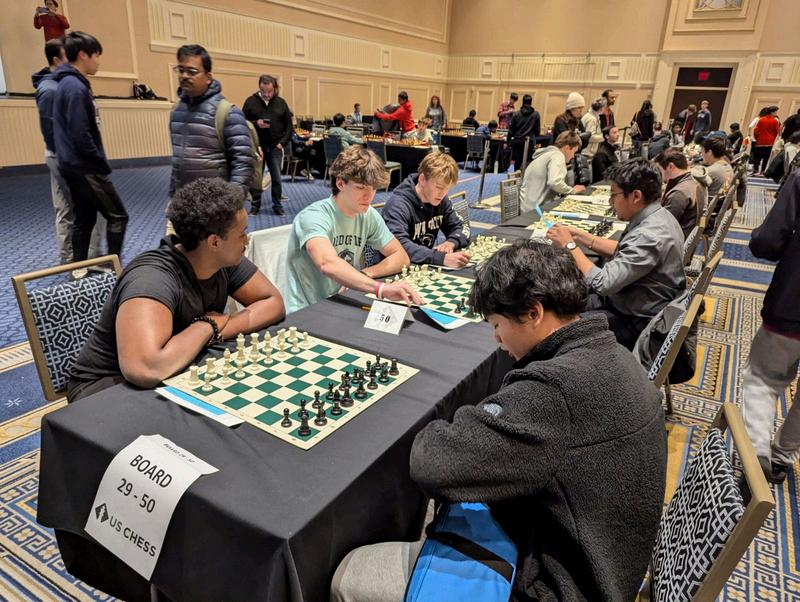
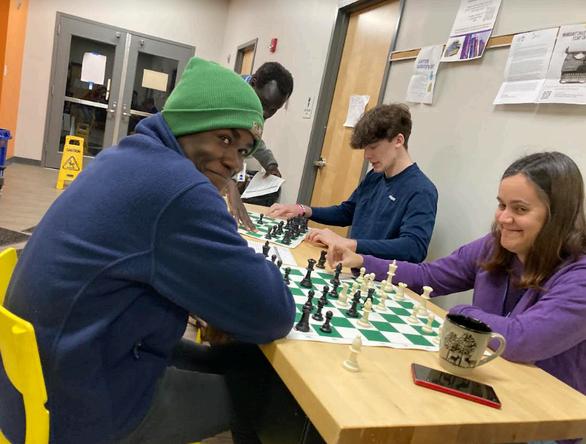
Students will learn the fundamentals of the game, including increasing concentration and strategic thinking. Students will learn include the basics of coordinates, logic, strategy, executive functioning, and predicting a variety of outcomes. Students will learn rapid decision-making under timed conditions, evaluate alternatives, and learn many ways to win through instruction and opportunities to play opponents in the classroom The mechanics of official chess tournaments will be learned. Students should expect to learn about chess, play chess, and reflect on their learning across the semester.
Baxter attracts experts from various STEM fields Every year, over 35 STEM speakers are brought in for school-wide weekly events, helping to grow our students’ professional network. In addition to this, classroom teachers also bring in special speakers. Some classes go on field trips to local industries including engineering firms, universities, art studios, and museums. We offer special courses to enrich student experience outside of the standards track.
Building on the strategy learning from Chess I. Students should expect to be challenged by their peers in tactical thinking, planning long term strategies, and be capable of challenging their peers in class, in school, or at Baxter Chess Tournaments, If interested, students may be prepared to play competitively in ranked chess matches
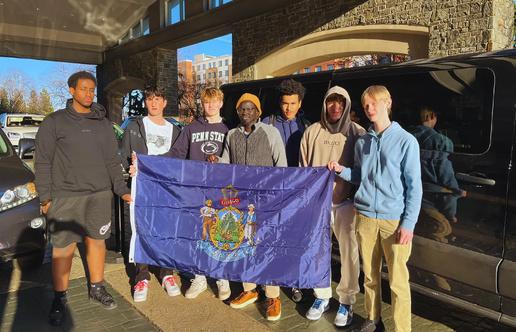
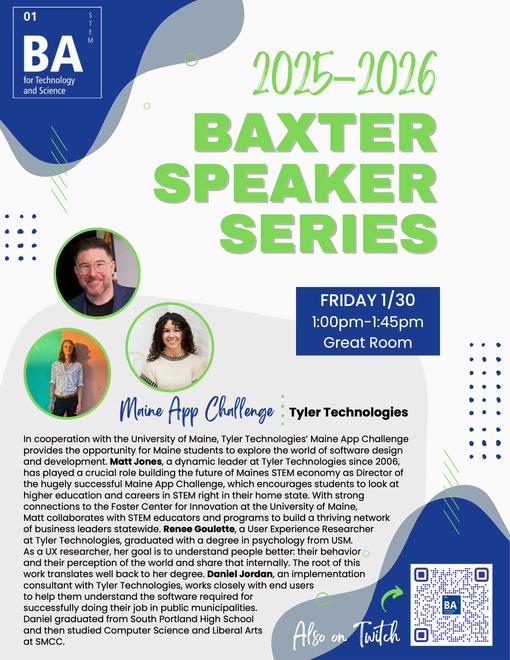
Baxter's motto is "The real world starts now." One of the ways that we try to connect our students with real-world applications of the content and skills that they learn in the classroom is through our Speaker Series. Each Friday during the school year, we host short presentations by individuals and organizations who are doing interesting work that connects with Baxter's STEM mission. Below you will find a sampling of the 2025-2026 Speaker Series presenters who have come to share their insights and experiences with Baxter’s students.
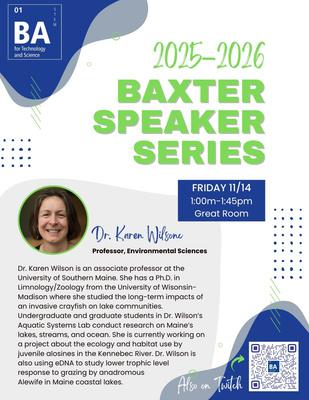
1:00pm-1:45pm
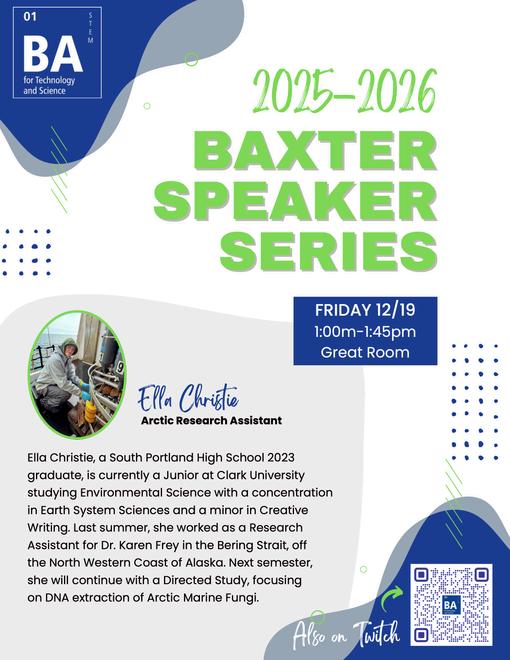
1:00pm-1:45pm
BaxterAcademyholdsallstudentstohighstandards ofacademicintegrity.Ourcommunityexpectseach membertohonortheprinciplesofacademicand personalhonestyandauthenticity. Muchofstudent workisdonenotmerelyforgradebooks,butforrealworldbenefit.Thebarforethicalandresponsible academiccontributionishighatBaxterasour student'sworkholdsrealvalueforourcommunity.
Progressreportsareissuedmid-semester Semester reportcardsareissuedattheendofeachsemester. Thesereports,alongwithregulareducatorupdatesof nolessthaneverytwoweeks,areusedtohelp studentsandfamiliesstayinformedandcollaborate withBaxterasneededtosupportstudentsuccess. Specificdatesforprogressreportsandreportcards willbesharedontheschoolcalendar.Transcriptsare permanentrecordsandreportonlyfinalstandards andgrades
TheBaxtertranscriptmarksastudent'sprogresson standardsandreportsstudentachievementlevelsin theircourses.Eachstudent'sFlexFridayproject descriptionisalsoreportedannuallyonastudent's officialtranscript.TheGPAisderivedfromevaluation bycourse.
Studentgradesforcoursesareaveragedtoconfigure theiroverallGradePointAverageattheendofeach semester.BaxterdoesnotuseGPAtoreportclass rank.
Baxter courses increase in rigor as a student moves from level 100 to 200 to 300, 400, and beyond. They are challenged to meet academic standards demanded by higher education and the workplace.
Students will complete 4 years of high school courses to meet proficiency in the standards and indicators of Baxter’s academic program (competency benchmark at minimum); a third of a student's academic journey consists of core courses, and the remaining is uniquely tailored to the student's exploratory and concentration interests, as guided by Baxter mentors and coaches. Baxter's Academic program of studies offers the following means to achieve graduation requirements:
4 years of Flex Friday
4 years of Mathematics
4 years of Science
3 years of Humanities
1 year of Art
1.5 years of Design
1.5 years of World Language
3 years of electives to concentrate/explore
4 years of Advisory
Students must be enrolled in Flex Friday, Advisory, and 5 courses at Baxter for each semester.
A two-week add/drop period at the beginning of each semester allows a student to fine-tune their academic program without a record on the student's transcript Students can initiate an add/drop by meeting with their counselor, who will investigate approvals with appropriate parties, including sending and receiving teachers, and the department chair
If a course change is made, students are responsible for making up work that they have missed in the first two weeks of the course, as required by the teacher Without the expressed consent of the administration, after the first progress report is released, a W will appear on a student's transcript for a dropped course, and courses may not be added at this time Students with extenuating circumstances may appeal to the administration to add a course in exchange for a dropped course after the first progress report
Juniors and Seniors are eligible to take up to 2 semesters of college courses per year in lieu of Baxter courses Eligibility is determined by standards proficiency College transcripts will be issued along with Baxter transcripts Early College Courses do not contribute to a student's GPA.
Using a new student's transcript from their sending school, students are awarded standards and courses as applicable.
At the time of publication, we made a reasonable effort for the accuracy of information. This publication does not contain all of the policies, procedures, rules, regulations, and academic requirements of Baxter. Changes or additions may be made to policies, procedures, rules, regulations, and academic requirements without prior notice When an academic requirement is made, it is not made retroactive unless the change is of benefit to the student and is achievable
Baxter acts in accordance with the Family Education Rights and Privacy Act (FERPA) The parent/guardian rights to student records transfer to students once they turn 18 or attend a school beyond high school. Baxter will give full rights under the Act to either parent/guardian unless provided with evidence of a court order, State statute or legally binding document relating to divorce, separation, or custody, that specifically revokes these rights. A copy of such a document will be filed with the counselor in the student's record
Sign up for AP testing by November Students are not required to take the AP test if they take an AP class
Baxter graduates its seniors annually in June Confirmation of graduation for the following school year begins at the end of the Fall semester of a student's junior year, or 18 months in advance of graduation.
Graduating seniors have the ability to earn Baxter Distinguished Scholars designation on their diploma. Applications for Distinguished scholars are due by the end of the second semester of a student’s junior year Students interested in a Baxter Distinguished Scholar designation on their diploma will assemble a portfolio to support their candidacy. For more details, please see Baxter's Head of School or Assistant Principal, with whom rests the final decision for promoting a candidate to a Baxter Distinguished Scholar. Distinguished Baxter scholars are those students who have demonstrated strong authenticity, critical thinking, agency, collaboration, voice and leadership in the following four ways
I. Competitive external exhibitions with successful participation (MSSF, Robotics competition, other competitive STEM organizations)
II. Academic Concentration -demonstrated evidence of concentrated study with significant elective study in the area.
III. Internship relevant to their area of academic concentration.
IV. Demonstrated leadership for at least 10th to 12th grade during their years at Baxter; evidence of initiating and participating in leadership.
V. Academics in service - Student has applied their academic studies, particularly their area of concentration, in service hours to their community or a community organization.
“I can genuinely say that coming into the hallways here that my passion for teaching has been reignited and I am by far, having the most fun that I have ever had teaching at any school. Period.”
- Baxter Teacher
Your counselors at Baxter are here to help guide you on your next steps after high school We at Baxter believe there are many different ways to path your success. Although we are a college preparatory school, we also prepare you for the real world. So no matter what your next steps will be, we are there to support and guide you.
General Guidelines for Colleges and Universities
If you plan to go to a four-year liberal arts college, you should consider these electives:
Upper-level full-year lab science courses
Additional Humanities electives in both English & Social Studies
World Language through level 3 at minimum and level 4 preferred
(A sequence of one language is preferred, and many schools require 2 years of language study )
Additional concentration and exploration electives in the highest rigor right-fit courses for you- this means reaching for additional Baxter 300 and 400-level courses.
If you are planning to attend a science or engineering college, you should take these electives:
Strong selection of Math and Science Courses, including full-year lab science
Humanities English & Social Studies
World Language through level 3 at minimum and level 4 preferred
(A sequence of one language is preferred, and many schools rarely require 2 years of language study )
Additional concentration and exploration electives in the highest rigor right-fit courses for you- this means reaching for additional 300 and 400-level courses.
If you are planning to go to a two-year college or technical school, you should consider these electives:
Humanities English
Continued Math Studies
Dual Enrollment
Get College credit at Baxter Academy!
Students who have achieved advancement in standards may consider dual enrollment through our partnering universities for up to 12 college credits.
Students are eligible to take college classes at many Maine Colleges and Universities tuition-free. Eligible students are allowed to take 12 credits per academic year for free each fiscal year (July-June). Students may be responsible for purchasing any books/materials required for their classes. Parental approval is required for registration Baxter students should achieve (at least) Competency Benchmark in the areas they plan to take college classes in before enrolling in the Early College program Availability is also guided by prerequisites determined by the college/university at their discretion. Baxter Counselors are available to help with class selection, navigating prerequisites, and the scheduling and registration process. Standards and GPA will not be counted for Graduation Requirements or Baxter GPA. Higher educational institutions will issue a transcript for all classes.
9th Grade:
Exploring interests
Meet your counselor
Think about life after Baxter
10th Grade:
Meet your Counselor
Take PSATs
Attend College/Career Fairs
Take Rigorous Courses
11th Grade:
Create College List
Take PSATs again and SAT
Tour Schools
Attend Info Sessions
Meet your Counselor
Keep high rigor
Junior Meetings
12th Grade:
Senior Seminar
Narrow down college list
Meet your Counselor
Take SAT in Fall if needed
Request Recommendations
Complete Applications
Send SAT scores if needed
Receive Admissions
Decisions
Deposit!
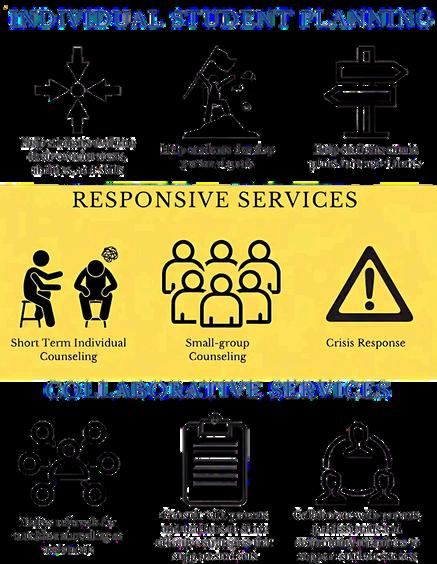
Academic records give us a view of a student’s journey and growth. Students and families can access records to view the regular updates provided by educators in PowerSchool Formal progress reports are issued mid-semester, with snap shot progress sent out monthly. Reports issued at each semester's end will be used for transcripts.
evaluation by
Students earn a grade for each course based on their progress toward meeting the requirements of the graded elements. Grades on the transcript can appear as increments of 0.1 from 1-4.
4.0
Transcends Course or Assessment Expectations
The student pushed beyond the course expectations in skill and/or content mastery and potentially reached higher standards of the course and added deep personal and community connection
Meets Course or Assessment Expectations
Student learning is determined by progress toward the standards associated with a course The level of achievement depends on the complexity of the course (is it an introductory course, or an advanced one?)
3.0
2.0
The student is prepared for the next course in the sequence and has met the expectations in the graded elements of the course or assessment
Satisfies Course or Assessment Expectations
The student is minimally prepared for the next course in the sequence The student could use greater practice in a skill and/or demonstrate greater knowledge or content mastery on graded elements Able to move to the next class in the sequence for 100-200 level classes; 2 5 needed for upper level classes
Excelling (400+ level course)
The student demonstrated a high level of complexity, sophistication, originality, depth, synthesis in application of course
Advancing (400 level course)
The student demonstrated complexity, sophistication, originality, depth, synthesis in application of course.
Competency Benchmark (300 level course)
1.0
Does Not Satisfy Course Expectations
The student is not sufficiently prepared for the next course in the sequence The student will need to repeat the class
GPAs are determined by course evaluations
We use numbers to communicate grades clearly to secondary institutions, students, and families This is how the rest of the world sees our GPA
The student has consistently demonstrated understanding at the level required for all Baxter graduates
Progressing (200 level course)
The student has acquired a deeper understanding of the standard, well on the way to benchmark, but is not quite there
Entering (100 level course)
The student has demonstrated a basic or introductory understanding of the skills and content of the standard
Students may offer evidence that is Beyond Assessment (BA) of rubric expectations Some students may also earn an evaluation of No Evidence (NE) For 300 level courses the standards target the competency benchmark; a student who earns competency benchmark on standards for a 300 level course would not be assessed lower than a 3 by the end of the course Likewise, for full year classes
Graduation is determined by successful completion of course of studies, which holds the appropriate standards
Mahmuda Alam
Science
BA Mount Holyoke College
MPH, U. Southern Maine
Nicole Anderson
Health
BA U Conn
MPH, U Southern Maine
Matt Barnes
Media Arts
BA Notre Dame College
Tyler Beaulieu
Data & Enrollment Manager
BA Alfred University
Chris Bertelsen
Humanities
BA Colby College
Emmanuel Billys
Maintenance
Shiho Burnham
Mathematics
BS U Southern Maine
MS U Southern Maine
Mary Cardillo
Front Office Manager
BA Loyola U
MA New York University
David Connor
Media Arts & Fabrications
BA U Maine Orono
MAT U Southern Maine
Amos Cooper
Information Technology
BA Susquehanna University
185 Lancaster Street Portland, ME 04101 207-699-5500
www..baxter-academy.org
CEEB:200818
Lauren Dickson
Mathematics
BS, MS, U Maine Orono
Matthew Donovan
Mathematics
BA U Maine Orono
Leah Douglass
Humanities
BA U Maine Farmington
Ernie Easter
Educational Technician
BS U Maine Orono
Jeremy Floyd
BA U Maine Farmington
M.Ed. Citadel College
Debra Gagne
Social Worker
MSW U Southern Maine
Kevin Guzmán
Mathematics
BS Framingham State U.
MS U Maine Orono
Eli Hersey Powers Humanities
BA Pomona College
Jasmine Holland
Business Manager
U Maine Augusta
Majur Juac
National Chess MasterUnited States
Eric Kawamoto
Computer Science
BS California Institute Tech
MA Harvard University
PhD Harvard University
Anna Klein-Christie
Executive Director
BA Kenyon College
Charlie Koch
Counselor
BA Trinity College
MS U Southern Maine
Dustin LeVasseur
Music & Media Arts
BA U. Southern Maine
MA Columbia University
Enyue Li
Mandarin
Shanxi Normal College
Irene Lopez
Spanish
MS, University of Alcala
Rory Lowe Science
BA Colorado College
Laura Parks
Director of Special Ed
BA Wheelock College
MEd U Southern Maine
Ruby Peterman
Mathematics
BS Harvey Mudd College
Amber McKenzie
Special Education
BA U Maine Farmington
Peter Moxhay
Mathematics
BA Brown University
PhD U of Minnesota
Wiley Muller
Engineering
BA Univ of Tennessee
MEd U Southern Maine
Savanna Pettengill
Special Education
BFA Maine College of Art
MS CUNY Brooklyn College
Ruby Peterman
Design
BA Harvey Mudd College
Cicy Po
Head of School
BA Skidmore College
MEd Harvard University
EdD Boston College
Eric Poulin
Special Education
BA U of MO, Columbia
Golsin Rashid
Science
BS College of Technology
Kirkuk, Iraq
Andrew Ritter
Science
BS Hobart College
Kiara Rivera
Spanish and Multilingual
University of Puerto Rico
Mayaguez
Jorge Rodriguez
Mathematics
BS, BA Drexel University
MEd National University
Kate Strait
Science
BA University of NE
MA University of NH
Sunny Stutzman
Fabrication/Design
BA U Maine Farmington
AS Art Institute of Pittsburgh
Billy Wall
Special Education
BA U. Southern Maine
Samantha Waielewski
Science
BS U Maine Augusta
Alex Waters
Humanities
BA Dartmouth College
MAT Sacred Heart U
John Wensman
Humanities
BA Univ of Minnesota
MAT Brown University