

Preface Introduction
CONFERENCE PARTICIPANTS
Sarah Akigbogun
A Dream of Azurest: An Étude from ‘Beyond Urban Tragedy’ –An Allegorical Approach to Exploring Race, Women, Architecture and the City
Fawzeyah Alsabah
Her West End: Khaleeji Women in London’s Department Stores, 1975–2025
Oliver Brax
Mobile Imperialism: French Experiments in Prefabricated Construction, 1830–1900
Lubaba Fakeih
Fragmenting the Crowd: A Journey in Socio-Spatial Clustering
Mona Ghoreshinejad
Mapping Spatial Narratives of Everyday Heritage: A Space Syntax Study of Historic Town Squares in British Counties
Jessica In
Anamnesis House + Indexical Drift
Ahmed Jawdat
Hybrid Third Places and the Evolution of Urban Dynamics: A Culturally Rooted Investigation Amid Global Technological Advancements, Explored Within the Context of Saudi Arabia
Tanjina Khan
Between Plan and Life: A Co-formal Architectural Adaptation of Uttara, Dhaka
Zijiao Li
Racing Towards Modernity: Racecourse Urbanism in China, 1842–Present
Thomas Parker
The Aesthetics of Noise: Operations in the Post-Lenticular and Latent Fields of Potential Architecture
Divya Priyesh Shah
Landscape Perspectives of the Indian Rural: Ecological and Place Sensibilities in the Forest Hamlets of a Monsoon Biome, the Western Ghats Mountains, India
Mine Sak-Acur
Spatial Aspects of Play and Playful Aspects of Space: The Role of Space in the Social Context of Children’s Games
Dr Jhono Bennett
Locating Southern Architectures: Situating a Reparative Practice Through a Post-Post City
Dr Sebastian Buser
Developing a Transpoetic Architectural History and Theory of WANC (1998–2011) Through Site-Visitations
Dr Pol Esteve Castelló
The Emergence of the Architectural Genre of the Discotheque in Francoist Spain, 1951–1973
Dr Fernando P. Ferreira
Factory of Stories: An Architectural Texere from Vale do Ave
Dr Emma Louise Gribble
Architectural Briefing and Argumentation: An Instrumental Case Study on the New University Campus at UCL East (RIBA Stages 1–3)
Dr Danielle Hewitt
Tracing the Erratic Movements of London’s Bombsites: On the Architectural History of Destruction, 1940–Present
Dr Sheng-Yang (William) Huang
On the Architectural Rationality of Connectionist Design
Dr Melih Kamaoğlu
Evolution and Computation in Architecture: A Critique of Bio-Digital Design
Dr Emma-Kate Matthews
Spatiosonic Constructs: Exploring Resonance In-Between Architecture and Experimental Music
Dr Hamish Muir
The Theatre of Waste: Circular Playwriting as a Methodology for Sustainable Theatre and Spaces for Performance
Dr Thi Phuong-Trâm Nguyen
Anamorphosis: Drawing Spatial Practices
Dr Tom Ó Caollaí
Alternative Arrangements: A Topographic Practice Along, Across, and With the Irish Borderlands
Dr Diana Salazar
Co-Producing an Environmental History of La Guajira: Building Solidarity through Decolonising Narratives
Dr Petra Seitz
Where Do You Cry in an Open Plan Office? Commercial Office Interiors and the Labour Process
Dr Wiltrud Simbürger
Climatic Landscapes and Interior Weathers
Dr Yichang Sun
The Everyday Life of Small Urban Places: An Enquiry Into the Morphological Transformation of Inner-City Nanjing, 1920s–2020s
Dr Sé Malaïka Tunnacliffe
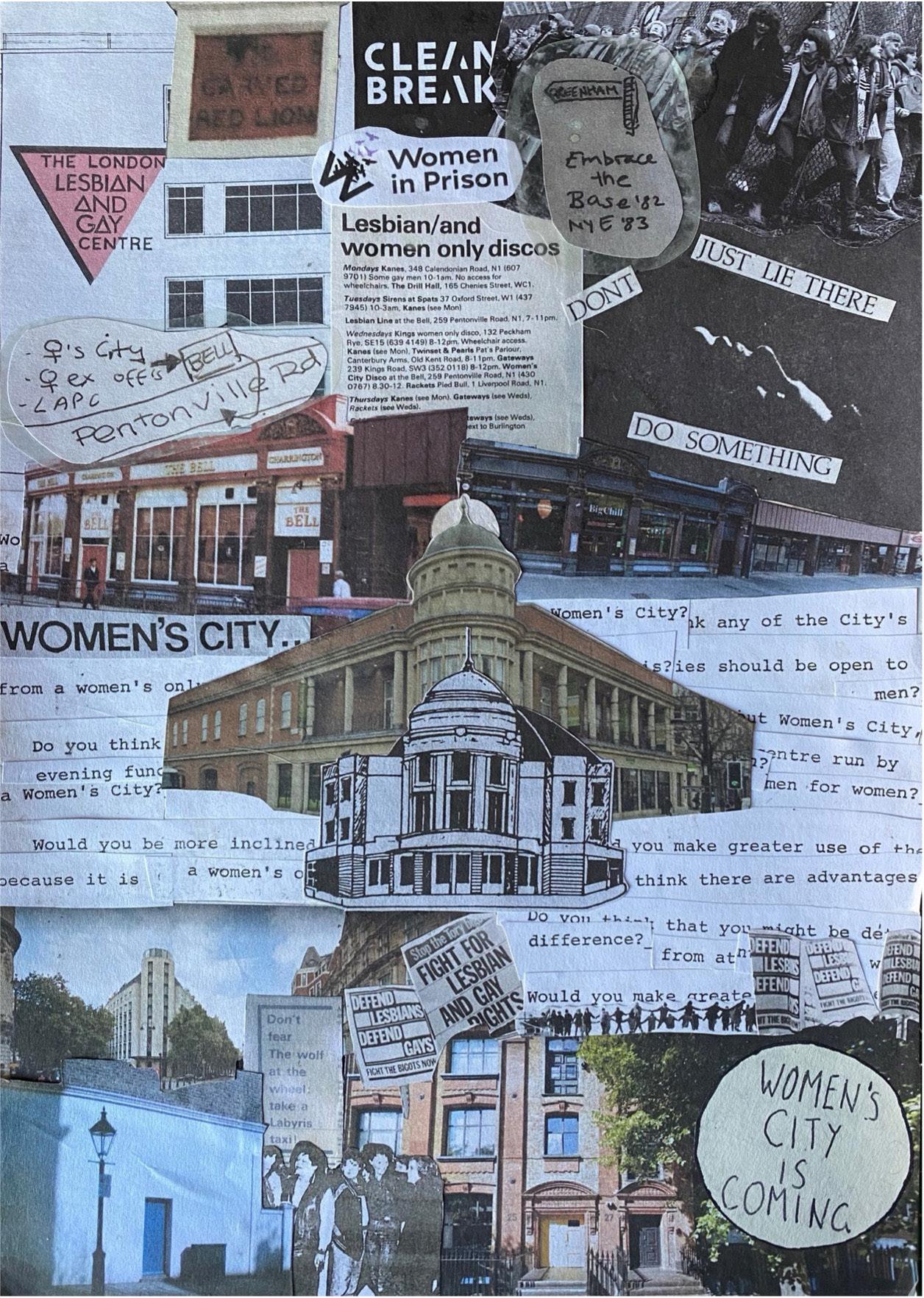
A Queer Practice of Placemaking: Tracing London’s Lesbian Asterisms from the 1980s
Dr Dingyi Wei
Deviations: Exploring Intended and Deviated Visitor Experiences with Museum Exhibitions
Dr Azadeh Zaferani
Domestic Agents: Doweries, Homes, Infrastructures (Iran, 1925–2013)
20 YEARS LATER: FROM PHD RESEARCH PROJECTS TO BOOKS
Conference Participants’ Biographies Recent Graduates’ Biographies
Dr Stylianos Giamarelos and Dr Azadeh Zaferani
Co-ordinators, MPhil/PhD Architectural Design, Architectural and Urban History & Theory
Dr Stamatis Zografos
Acting Director, MPhil/PhD Architectural Design
Professor Tania Sengupta
Director, MPhil/PhD Architectural and Urban History & Theory
Professor Ava Fatah gen. Schieck Director, MPhil/PhD Architectural Space & Computation
Professor Mario Carpo Director, MPhil/PhD Architecture & Digital Theory
Professor Murray Fraser Director, MPhil/PhD Architectural Practice
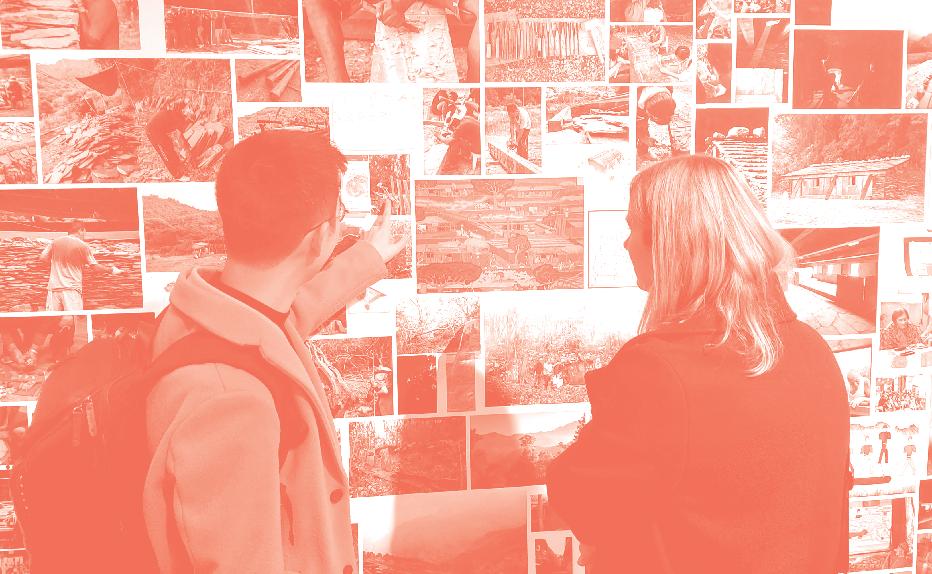
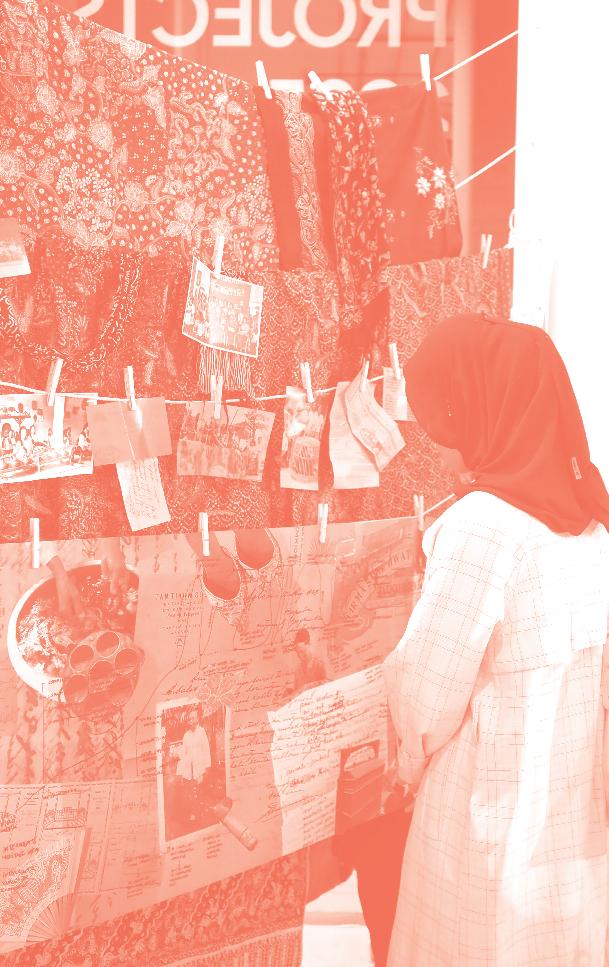
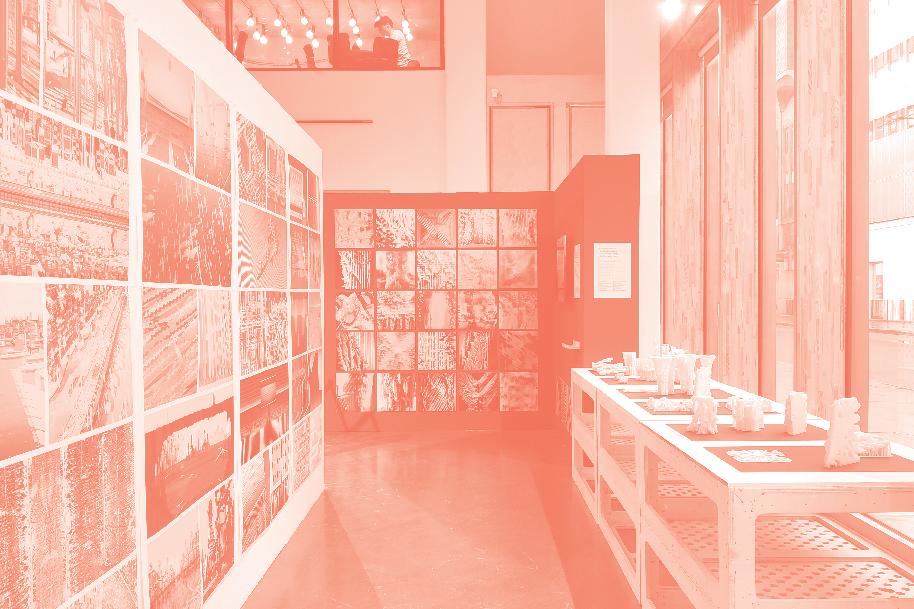
PhD Research Projects 2026 is the 20th annual conference and exhibition related to doctoral research at the Bartlett School of Architecture, UCL. The event is open to the public and customarily involves presentations by students undertaking doctoral programmes in Architectural Design, Architectural and Urban History & Theory, Architectural Space & Computation, Architecture & Digital Theory, and Architectural Practice. This year, we also have a contribution from the Bartlett School of Planning MPhil/ PhD programme.
Leading to a PhD in Architecture, the Bartlett School of Architecture’s doctoral programmes encourage originality and creativity. Over 130 students are currently enrolled on these programmes, and the range of research subjects undertaken is broad. Each annual PhD conference and exhibition focuses on a smaller selection of presentations from students who are developing or concluding their research.
The purpose of the conference and exhibition is to encourage productive discussions between presenters, exhibitors, staff, students, critics, and the audience. Organised and curated by Dr Stylianos Giamarelos and Dr Azadeh Zaferani, PhD Research Projects 2026 has seven invited reviewers: Professor Swati Chattopadhyay, University of California, Santa Barbara; Dr Barnabas Calder, University of Liverpool; Professor Catalina Ortiz, the Bartlett Development Planning Unit; Dr Neal Shasore, independent scholar, Founder of the School of Building; Dr John BinghamHall, Paris School of Architecture; Dr Natalia Romik, Wissenschaftskolleg zu Berlin; and Dr Lidia Gasperoni, the Bartlett School of Architecture.
Presenting this year are: Sarah Akigbogun, Fawzeyah Alsabah, Oliver Brax, Lubaba Fakeih, Mona Ghoreshinejad, Jessica In, Ahmed Jawdat, Tanjina Khan, Zijiao Li, Thomas Parker, Divya Priyesh Shah, and Mine Sak-Acur.
This year’s conference, catalogue, and exhibition form part of a tripartite celebration: the bicentenary of UCL’s foundation; the 25th anniversary of the first student graduation on the MPhil/ PhD Architectural Design programme; and the 20th anniversary of PhD Research Projects. Joining these celebrations, the last section of the catalogue features completed doctoral projects that were first presented in the annual conferences and exhibitions of the past two decades and have now been published in book form, constituting important contributions to global architectural scholarship and practice.
Oliver Brax
[…] for they say, if money go before, all ways do lie open.
— William Shakespeare, The Merry Wives of Windsor
Introduction is an unpleasant term. As any student will know, writing one is a daunting task, though its function seems, in theory, quite straightforward. Ideally, it should warn the reader as to what the overarching structure, the objectives and the methods of a given work are, and therefore allow for an immediate and prodigious leap into the subtleties of its succeeding pages. It can sweep across a vast array of existing literature, give birth to unexpected associations of ideas, and formulate decisive interrogations. Yet in the worst of cases, it can also appear as nothing more than a perfunctory opening, reconstructing a posteriori the artificial unity of incoherent or diverging paths. The papers you are about to read perfectly ‘introduce’ themselves.
They are indeed testimonies to the great variety of topics, tools, and sources that can be mobilised in a doctoral thesis. Why, then, shower them with what might seem like vague and conventional formulae?
Condensing years of reading and writing in succinct form is no simple task, nor is the completion of a thesis. Speaking from personal experience, I could elaborate on some of the disappointing episodes which punctuate this strange endeavour: the completion of a PhD. Some would be purely related to the ordinary development of a research project, others are of a rather different and worrying nature, including: a national library exposed to a cyberattack; institutions having to rely on self-redundancy (or its more appealing
nickname ‘voluntary leave’) to make ends meet; or the struggle of obtaining funding after long and extremely competitive processes for grants that are fewer and further between, since some partnerships are no longer able to provide studentships. There is no free ride into the realm of ideas; just think of the price of an academic hardback, or that of a fieldtrip abroad. In many instances, the access to scholarly articles comes at a price for someone along the line, and even in the case of exceptional weather in an ideal location, not many a conference-goer sleeps under the stars. It is no doubt safer to take these inconveniences with a pinch of humour. All of this should also bring one to reflect upon the conditions of possibility of what is being presented in this catalogue, and to bear in mind the material grounding of intellectual work, its very concrete conditions.
However, an introduction should also emphasise the much hopedfor achievement which spurs on all prospective students, namely that of producing interesting research even when resources are scarce, time is limited, or money is tight. This issue is by no means trivial. Although they may occupy the mind both day and night, doctoral courses are often undertaken alongside another professional occupation. More broadly, these are not idyllic times for academia, as the shadow of monetary restrictions looms large; the American situation may be the most remarkable example of this current tendency, yet it is by no means unique. One could retort that there will no doubt always be brilliant work produced in spite of various shortages, financial cuts or a potentially hostile political climate, but this response does not amount to a desirable solution. That scholarship of great quality can emerge despite these constraints is definitely worth highlighting. So maybe the habitual compliments are not in vain, after all.
If there is one thing that the following abstracts bring to the fore, it is that the ‘architectural object’, as such, does not stand alone; its study is informed by a wide range of intellectual interests. History, theory, design or computation are not mere appurtenances, and their contribution to research on the built environment, as the following papers show, can reach out beyond the academic world. Technological and digital innovations take part in the evolutions of architectural practice, whereas unearthing overlooked episodes or marginalised voices allows one to grapple with the theoretical implications of past productions, as well as with the legacies of colonialism, imperialism, and the numerous atrocities which they have inflicted on human beings. One need not insist on contemporary resonances here.
René Descartes famously — and slyly — declared ‘good sense’ to be the most evenly distributed thing in the world. Although everyone is capable to generate insights, only rigour can distinguish convincing and well-constructed arguments from rhetorical sleights of hand. Discourse may be everywhere, but interesting research strives for something other than idle talk or fashionable buzzwords. Careful writing is no gift from above; it is a craft, and as such, it requires propitious material circumstances. A certain independence from economic imperatives is hence essential. If this sine qua non condition is satisfied, then we can all, as much as possible, continue to take part in the collective production of knowledge. Those are much more pleasant terms to work with.
Sarah Akigbogun
MPhil/PhD Architectural and Urban History & Theory
Supervisors: Professor Penelope Haralambidou · Dr Fiona Zisch
In Octavia Butler’s seminal 1970s sci-fi novel Kindred, time travel becomes a device for exploring the history of slavery. Adopting a similar method, this designled research project constructs a play that shifts geo-temporally to explore spaces of women from the African diaspora and their embodied experiences of them. The script becomes a device that facilitates uncovering these neglected historiographies — using the compressed space of allegory to explore themes of power, oppression and liberation, and speculative spatial futures. Situating itself in critical, decolonising, feminist design practice, the project adopts West African Women’s forms of representation and storytelling: drawing on magical realist literary techniques, remembered and imagined worlds are captured in Adire-blue cyanotypes. The narrative is unlocked through portals in a ruined Victorian house, shifting from sites such as London’s Stone Asylum (in 1905) across the Black Atlantic to Azurest South (in the 1930s), Virginia home of architect Amaza Lee Meredith, and from there on to an imagined 2050.
This Étude explores the central thesis of my doctoral research: namely, that in the urban fabric unfold tragedies, akin to those of classical tragedy, in which architecture is complicit. This is the Urban Tragedy that my project seeks to disrupt, operating between ‘madness’, confinement and liberation by focusing on two women whose lives existed on either side of that line: The City of Others’ Caroline Brodigan (an Antigone?) who would die in Stone Asylum, and Amaza Lee Meredith who built a literal house of her own on the Grounds of Virginia State University. Amaza’s Azurest thus becomes talismanic, a dream glimpsed, a ‘what if?’.
The study has taken the form of archival research, including auto-ethnographic and performance studies, alongside explorations in design, representation, and making. To build the world of the play, objects which hold traces of embodied experience are captured from the physical world, translated to the digital, and remade. Combined with virtual space, they create a form of scenography.
Àdìre-Cyno Print Detail
(Author: Sarah Akigbogun, 2024)

MPhil/PhD Architectural and Urban History & Theory
Supervisors:
Professor Barbara Penner · Professor Jane Rendell
This research project critically examines the representation and experiences of Gulf women in London’s West End. Between 1975 and 2025, Gulf women in London have been scrutinised, racially profiled, and biasedly represented. They have also been excluded from scholarly histories of London’s department stores, which extensively explore how these spaces emancipated European women, while showing little curiosity about those from other cultures. This study creates another narrative which asserts the presence and importance of Gulf women to West End department stores.
The study also engages with crucial but challenging questions: why has it proved so difficult to discuss Gulf women beyond biased assumptions? Does their veil represent subordination, silence and invisibility, or is it merely an ironic western journalistic claim? Where do the narratives
of Gulf women fit within the spatial histories of these stores and how do they in turn change those histories?
To address these questions, this research project seeks to explore the experiences and voices of Gulf women in West End stores for the first time through literature and oral histories. The thesis is structured into three parts. It begins with fictional stories by Gulf female novelists who faced repercussions for their writings on ‘female’ spaces and spatial confinement. The second part involves interviews that highlight how Gulf women navigate and perform their identity within department stores, and how architecture influences and is influenced by them. The final part reflects on the spatial practices of Gulf identity in high-end department stores and considers where I, as a Kuwaiti Gulf woman, fit within the broader construction of architectural history, ultimately unveiling Her West End.
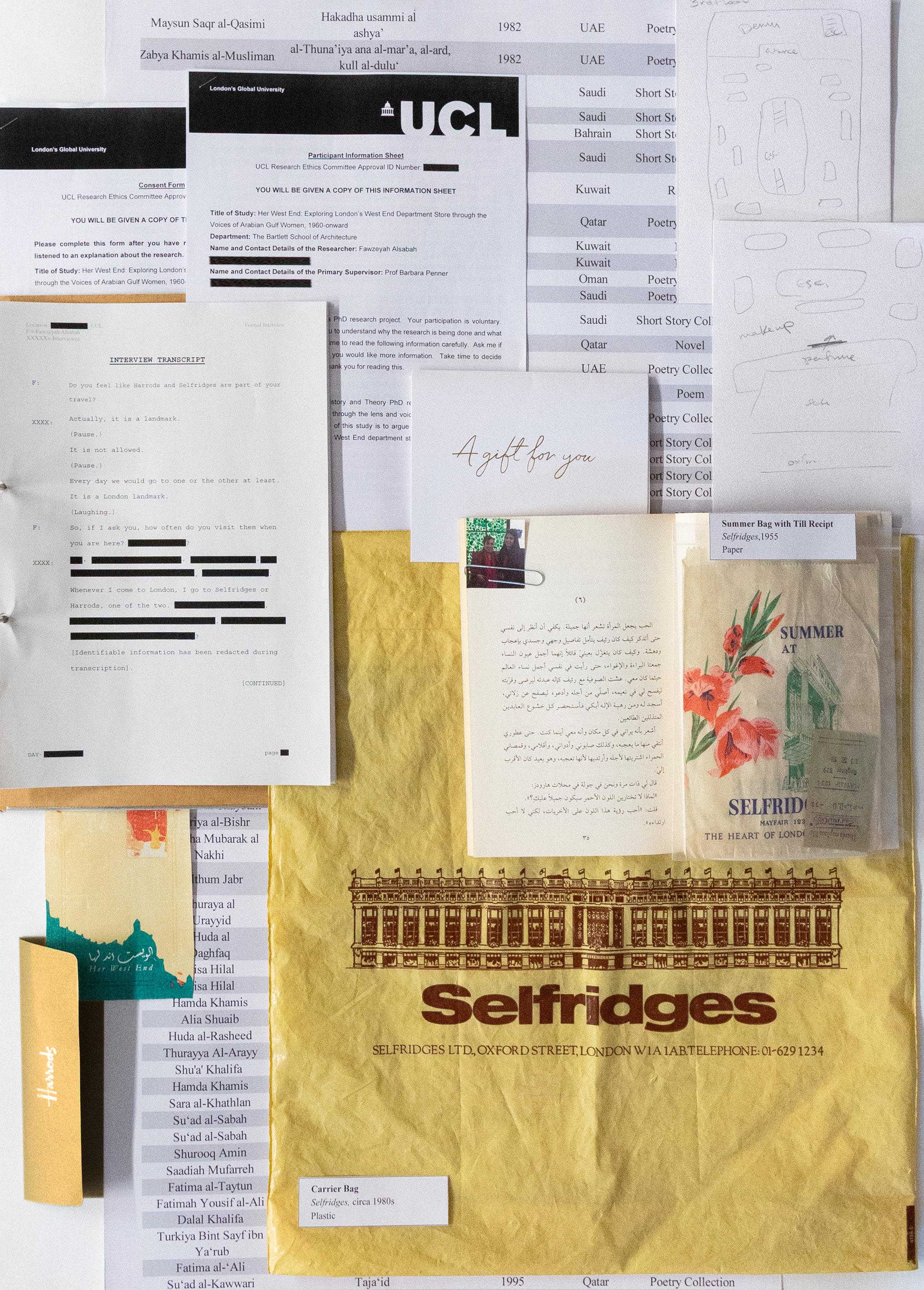
Silent testimonies, photographic collage (Author: Fawzeyah Alsabah, 2025)
Oliver Brax
MPhil/PhD
Architectural and Urban History & Theory
Supervisors: Professor Murray Fraser · Professor Barbara Penner
Funding: Arts and Humanities Research Council, London Arts & Humanities Partnership (LAHP)
The relation between the development of industrial prefabrication on the one hand, and of British or American colonial settlements on the other, has been well established by historians. Likewise, experiments in prefabricated construction were intimately linked to the development of French colonisation. Although the term was not used at the time, such structures became increasingly more elaborate from the 1830s onwards. Generally referred to as ‘transportable’, ‘demountable’ or ‘mobile’ houses, these buildings were conceived by engineers, industrialists and architects who often boasted of their many potential uses. In effect, these structures played an important part in the establishment of a French presence overseas.
This new market involved both a large variety of architectural devices and a limited set of recurring characteristics: a modular structure, wooden or metallic elements, stereotypical facades. Economic considerations largely influenced their applications, since these buildings were first and foremost a product. Some of these prefabricated homes, initially built for a wealthy public in search of a leisurely retreat in the countryside, were later suggested as a solution to the shortage
in workers’ dwellings; others took part in the imposition of an ephemeral colonial architecture, ranging from agricultural and military settlements in Algeria to penal institutions in French Guiana. These forerunners of modern-day ‘préfabrication ’ suggest an underlying connection between the history of military expansion, industrial development and housing design in France. Although their commercial success was limited, the inherent contradictions of these innovative buildings warrant consideration. Adaptable by essence, their actual functions were limited in practice, and their standardised construction did not prove suited to all circumstances. Serving both as built space and commodity, these structures constituted a peculiar domestic space, oscillating between a search for individuality and the constraints of mass production, but also between the intimacy of the home and the collective nature of the barrack.
Mobile house of 7×4 metres for temporary housing, offices, etc. by engineer and constructor C. A. Oppermann (Print: V. Derouet, 1877)

MPhil/PhD Architectural Space & Computation
Supervisors: Dr Tasos Varoudis · Dr Stephen Law
Funding: UCL-Res
This research project examines what movement can reveal about culture: how people occupy space, what they approach, what they avoid, and what these patterns suggest about social expectations. Cyan Waterpark in Jeddah, Saudi Arabia, forms the central case study, operating on alternating mixed-gender and female-only admission days. This framework creates a rare experimental setting where the same spatial layout hosts different social configurations, allowing movement itself to become measurable cultural data. Here visitors’ behaviour is read not through the customary shortest path logic, but through comfort, perception, and social expectation. In this context, machine learning models are used to detect and reproduce these behavioural signatures at scale, treating movement as a sequence that carries agency, preference, and meaning.
Two core strands guide this study. The first is sociological, focusing on the cultural logic that underlies movement. Spatial theories such as Space Syntax represent natural movement potential, while prospect theory helps explain divergence from that potential when comfort, risk, or demographic composition shift. Movement is therefore approached as both a spatial
response and a cultural signal, with the Saudi context providing a uniquely charged setting where gendered mobility and public leisure norms can be directly observed.
The second research strand is computational, advancing a privacypreserving pipeline for large-scale movement capture in a context where anonymity is key. Custom machine-learning tools automate detection, tracking and transformation of movement into structured datasets, which are then clustered and modelled using techniques adapted from natural-language sequence learning. This framework enables the identification of subtle behavioural patterns that manual observation would struggle to detect.
The long-term aim is to establish a language of movement: a system capable of reading culture through motion, modelling behaviour at scale, and translating spatial traces into patterns that are interpretable and, ultimately, informative.
Automated data-processing pipeline for the ‘Lockers’ CCTV view at Cyan Waterpark, showing the transformation from raw video to movement analytics (Author: Lubaba Fakeih, 2025)

Mona Ghoreshinejad
MPhil/PhD
Architectural Space & Computation
Supervisors: Dr Sam Griffiths · Professor Kayvan Karimi
This research project undertakes a spatial, social, and morphological analysis to examine the transformation of historic English town squares as sites of everyday heritage. While English town squares have long served as central points of civic and cultural life, their configuration and use have been subject to significant transformations since the late nineteenth century. A key challenge in studying these environments lies in their fragmented morphology, while the limited availability of longitudinal morphological data complicates comparative analysis of spatial configuration, use patterns, and overall performance of pedestrianised streetscapes. This study addresses this challenge by conceptualising town squares as ‘everyday heritage’, and examining both their role as mediators between past and present, and the ways in which they adapt within the evolving urban fabric.
A primary objective is to enhance the understanding of ‘ordinary’ heritage by emphasising the holistic relationship between people and place. The project employs a people-centred methodology to analyse forty county towns, including four in-depth case studies. The methodological framework combines archival research
and ethnographic fieldwork with advanced Space Syntax techniques, including Isovist Analysis, Segment Angular Analysis, and Visibility Graph Analysis (VGA). Spatial interpretation utilises core Space Syntax concepts such as Convex Space and Linear Space to categorise town spaces based on morphology, historical context, and syntactic layers.
Preliminary findings indicate the emergence of interconnected networks that link formerly distinct squares and streets within an increasingly integrated urban system, with the marketplace continuing to serve as the anchor of civic life. Identified typologies of transformation reveal specific patterns of continuity and change in function, integration, and symbolic identity. By foregrounding the morphology of spaces between buildings, this research contributes to morphogenetic studies of urban form and aims to inform heritage conservation strategies consistent with UNESCO’s principles for sustainable, inclusive, and adaptable public space planning.
Bedford Circus and Exeter city centre in the 1930s (top) and in 1953 (bottom) (© Historic England. Aerofilms Collection)

MPhil/PhD Architectural Design
Supervisors: Professor Penelope Haralambidou · Professor Sean Hanna
Funding: Bartlett Staff Award
This research investigates the transformation of architectural representation through machine learning models, examining how AI-generated outputs fundamentally alter our understanding of space, memory, and experience. Through two interconnected works — Anamnesis House and Indexical Drift — the research questions what happens when we rely on large language models and diffusion models to represent architecture, and what occurs when we adopt their visual vocabulary as architectural truth.
Anamnesis House uses video interpolation to task an AI model with reconstructing the experience of moving through domestic space from static photographs. The resulting synthetic video produces spatially impossible architecture — with gardens, streets, and rooms folding into one another in defiance of physical coherence. By treating these AI hallucinations as serious spatial representations, translating them into architectural plan drawings and 3D-printed ‘slit scan’ models, the work exposes the profound limitations of traditional orthographic representation when confronted with algorithmically generated space.
Indexical Drift traces a journey from personal memory to computational reconstruction. Un-doctored photographs from a 2007 backpacking trip across Europe (to visit sites by Bernard Tschumi, Piet Blom, and Antoni Gaudí) are processed through photogrammetry, Gaussian splatting, and video diffusion models. Each translation introduces its own logic and distortions, charting the distance between indexical photography (light touching sensor) and synthetic generation (statistical probability). The work reveals how both human and machine memory are partial and constructed. But where human recollection fades fluidly, AI memory is bounded by training data: in this case, architectural representation is determined by image frequency rather than experiential ‘truth’. Taken together, these projects document the vanishing point between memory and model, index and synthesis, questioning whether the representational tools of our discipline can adequately capture spaces that exist only as algorithmic probability, and what we lose when we surrender spatial understanding to computational recollection.
Indexical Drift [Folie No. 7], physical model: polyjet 3D print, plywood, mirror (Author: Jessica In, 2025)

Ahmed Jawdat
MPhil/PhD Urban Planning & Design
Supervisors: Professor Susan Moore · Professor Peter Bishop · Professor Andy Hudson-Smith
Funding: Cultural Scholarship Program, Kingdom of Saudi Arabia
Through rapid technological advancements, digital life has become an integral part of everyday experiences. In this context, the dynamics of social interactions in cities are evolving, introducing critical layers for urban research and practice. Ray Oldenburg’s concept of ‘third places’, referring to settings that support social interactions beyond home and work, offers a comprehensive lens for investigating these shifts, particularly as scholars have started to argue that certain social media platforms now function as ‘digital third places’ that affect how physical ones are used and experienced. Whether physical, digital, or hybrid, these settings are central to community life and well-being and reflect local cultural practices. Understanding their shifting dynamics therefore requires an approach rooted in place, which can capture cultural nuances and evolving urban behaviours. This research project focuses on the Saudi context.
In the Kingdom of Saudi Arabia, urban and cultural transformations have been unfolding since the discovery of oil in 1939, with third places continuously evolving in meaning and form in response to these changes. More recently, the launch of Vision 2030 in 2016 marked a key turning
point within this evolution, contributing to increased attention and presence of public social life, with its manifestations across physical and digital settings. Additionally, with Saudi social media use ranking among the highest globally, this specific context becomes a unique stage for this investigation.
Accordingly, this research explores how digital third places and emerging technologies are affecting the meaning, function, and experience of physical third places by reshaping urban behaviours, and how these evolving dynamics relate to placemaking, culture, and social life in cities. The research methodology combines digital tools, site observations, semi-structured interviews, and informal discussions with users and experts between Riyadh and AlUla, in order to inform a culturally rooted urban design and planning research and practice that can respond to both local and global contemporary urban dynamics.
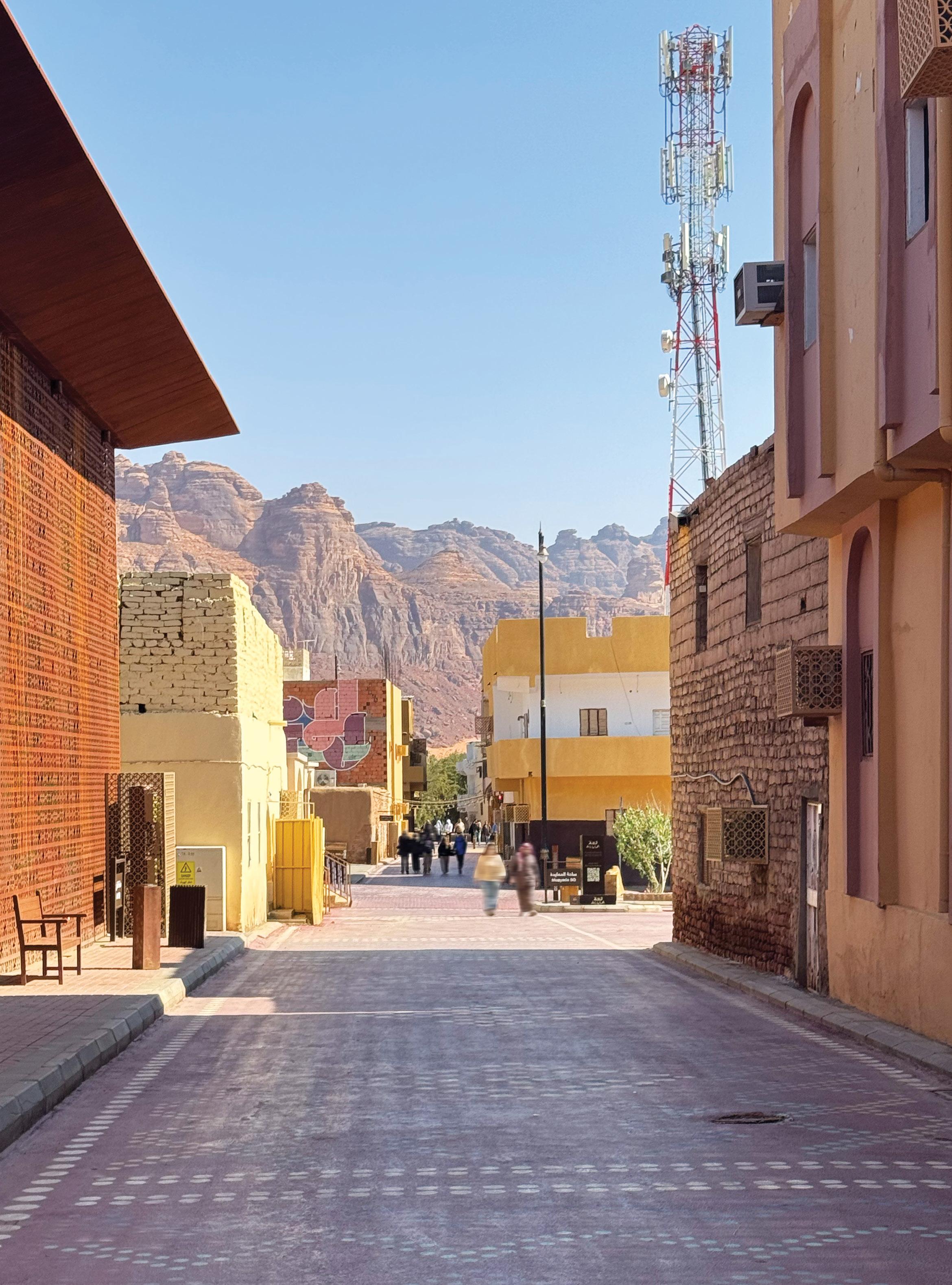
AlJadidah’s Regenerated Setting – Urban Carpet 1: Enabling Third Place Emergence, AlUla, Saudi Arabia (Author: Ahmed Jawdat, 2025)
Tanjina Khan
MPhil/PhD
Architectural Design
Supervisors: Professor Peter Bishop · Professor Eva Branscome
Funding: Prime Minister Fellowship, Bangladesh
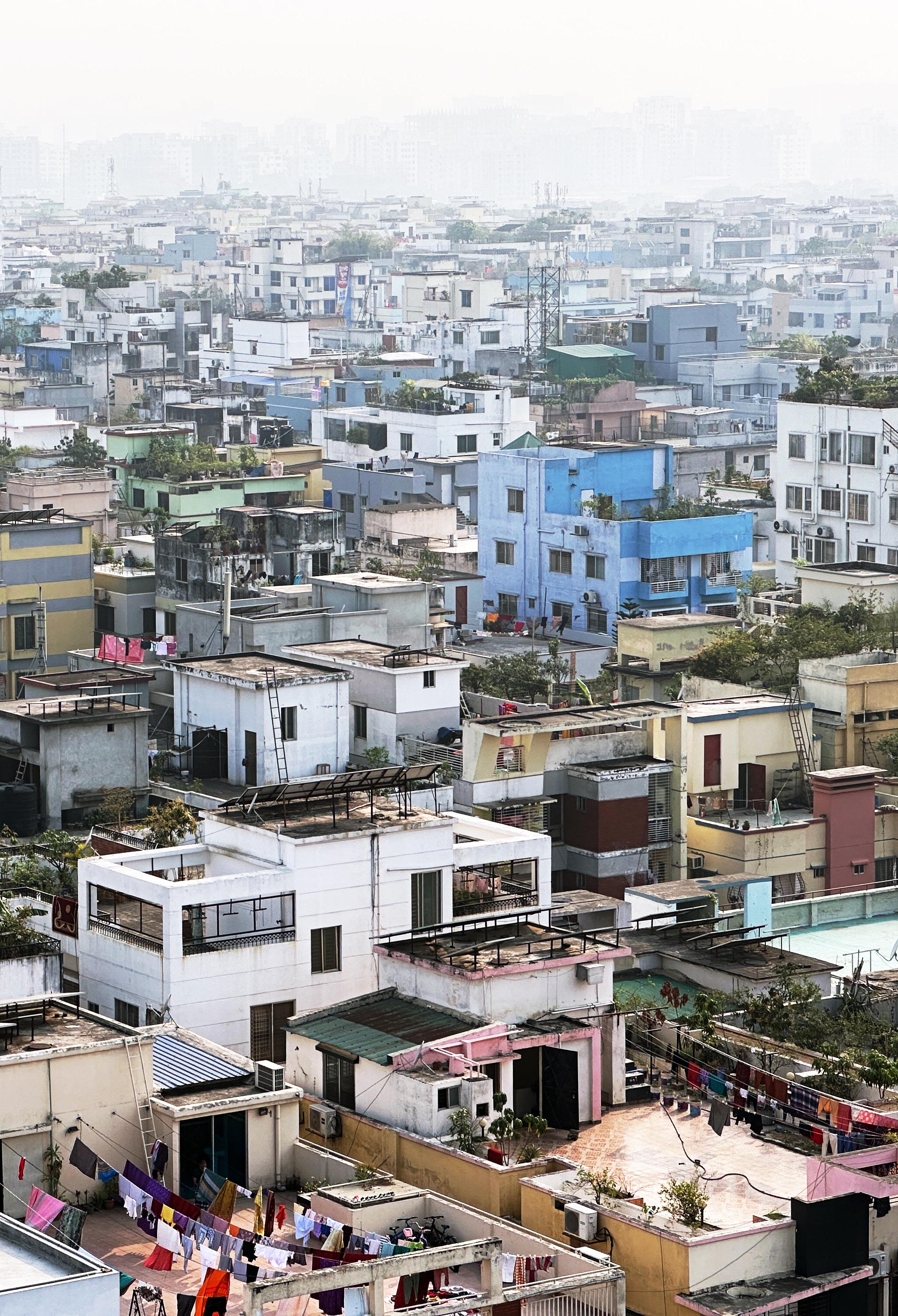
This research project investigates the everyday architectural adaptations unfolding within Uttara Model Town, Dhaka, to reveal how planned residential environments are continuously reshaped by informal functional transformation. While the city’s planning apparatus imagines fixed zoning, residential separation, and orderly urban form, lived realities in Dhaka challenge these expectations. Apartments are often converted into schools, clinics, hostels, restaurants, offices, and storage spaces; streets recalibrate around new rhythms of commerce and mobility; and residents, professionals, and officials negotiate the shifting boundaries of legality and use. These ongoing transitions expose both a profound tension and a productive interplay between the planned city and the lived city.
The study traces the historical formation of Uttara as a satellite town, the rise of real estate development, and the architecture of the apartment block as a unit of expectation whose missing programmes fuel widespread informal adaptation. Using a mixed methodology grounded in architectural anthropology, bilingual interviews, mapping, drawing, documentary study, and systematic thematic analysis,
the study examines both the spatial transformations and the social, economic and regulatory negotiations that sustain this practice. In this context, adaptation is understood as a strategy of resilience and a design practice, one that retains embodied carbon, supports economic mobility, and responds to the pressures of density, while simultaneously generating risks related to safety, congestion, and governance. Initial design findings from the related fieldwork elaborate on the concept of ‘co-formality’ which rejects the binary of formality and informality. It argues that cities like Dhaka emerge through their constant co-production; formal plans and informal practices co-exist, collide, and co-evolve, producing hybrid architectures and flexible urban orders. Through this lens, architectural adaptation becomes a shared agency involving users, designers, regulators, and institutions. Ultimately, the project aims to advance a new design pedagogy that reframes regulation through the lens of lived relationships, opening pathways for an adaptable, resilient practice.
In co-formal layers, architecture finds its adaptation (Photography: Tanjina Khan, 2025)
MPhil/PhD Architectural and Urban History & Theory
Supervisors: Professor Peg Rawes · Professor Iain Borden
Funding: Arts and Humanities Research Council, London Arts & Humanities Partnership (LAHP)
This doctoral project examines the 180-year transformation of racecourses in mainland China to illuminate the distinctive trajectories of Chinese modernity and urban development. By proposing the concept of Chinese racecourse urbanism, the study positions racecourses as contested sites where colonial encounters, capitalist entertainment cultures, socialist reconstruction, and contemporary leisure economies intersect. It argues that racecourses have played an influential yet overlooked role in shaping China’s modern history, urbanisation, social cultures, and national and civic identities.
Racecourses first emerged as urban mega-projects and hybrid zones in treatyport cities after the 1842 Treaty of Nanjing; they reached their peak in the 1930s when cities such as Shanghai and Wuhan hosted multiple courses. After 1949, the Chinese Communist Party banned horseracing due to its associations with gambling, colonialism, and bourgeois decadence,
repurposing racecourse grounds and buildings into civic infrastructures within broader socialist urban reforms. These sites subsequently became sensitive spaces in China’s urban memory until the 2020s, when new equestrian facilities began proliferating in response to rising middleclass consumption and state-directed sports development.
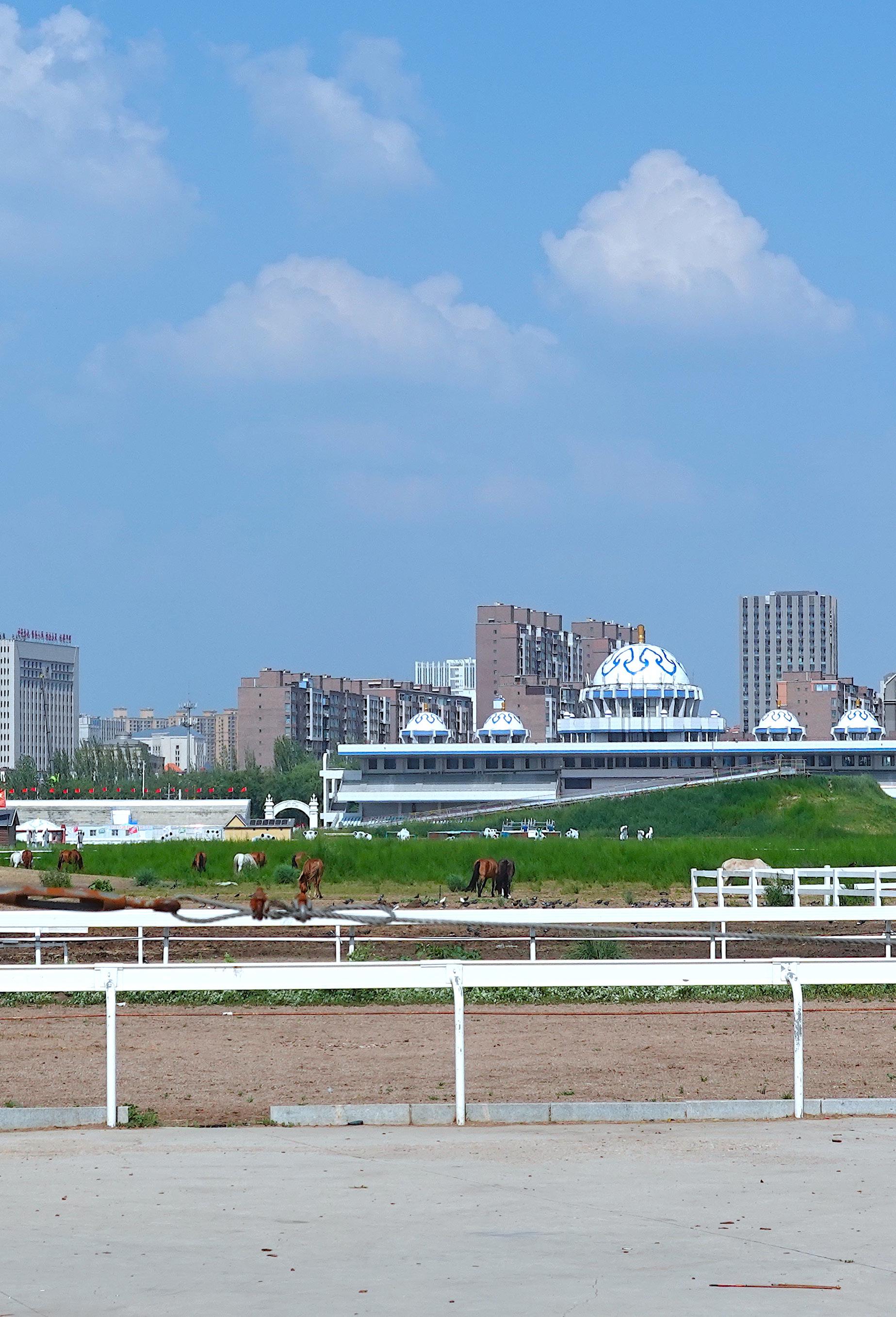
Through six case-study cities (Shanghai, Wuhan, Qingdao, Harbin, Hohhot, and Guangzhou), this project examines both the histories and afterlives of historical racecourses and the political-economic motivations underlying recently constructed ones. Drawing upon extensive fieldwork, archival material and interviews, the thesis reinterprets the historiography of Chinese racecourses and demonstrates how these spaces serve as a critical lens for understanding China’s architectural and urban narratives, particularly in relation to urban regeneration, shifting policy regimes, and evolving socio-cultural values.
Horses owned by the local Teenager’s Equestrian Training Schools on the obsolete Inner Mongolia Racecourse, Hohhot, China (Photography: Zijiao Li, 2025)
Thomas Parker MPhil/PhD Architectural Design
Supervisors: Professor Nat Chard · Dr Christopher Leung · Professor Marjan Colletti
Funding: Arts and Humanities Research Council, London Arts & Humanities Partnership (LAHP)
This research project is concerned with investigating and discovering the creative potential of the aesthetics of noise in emerging forms of post-lenticular operations in architectural design, measurement, and representation. Historically, architectural design and representation have been fundamentally interwoven with human (optical) perception, but these principles are being challenged by the rapidly evolving field of generative AI. image models. Trained on the artefacts of human perception, but statistical in nature, these images are fast, and rarely do we discuss the paradoxical means of their production. Underpinning these systems is a stochastic variable, noise. But noise avoids simple classification. Fluctuating between different definitions and domains across disciplines, it is contextual, aesthetic, and subjective. Moving beyond simple definitions of unwanted sound or erroneous information, this study positions noise as a convoluted but latent field of creative potential.
To investigate this potential, the project investigates the operational role of artificial images in existing forms of measurement
practices (photogrammetry) and their contemporary alternative AI. methodologies (radiance fields). Within these systems of spatial reconstruction and measurement, noise operates simultaneously as both information uncertainty in measured position, and epistemic agent in the iterative training process of representation. This paradoxical position of noise challenges the conventionally held views of representational certainty, embedding within these representations statistical principles of contingency, uncertainty, and disruption. Beginning with the reinvention of pioneering lunar photographer James Nasmyth, my design-led research situates an array of investigations into noise, through non-geosynchronous orbits around a lunar celestial body. It draws into its orbit the epistemic constraints of AI, lunar craters, a flesh-like moon, the reincarnation of a murderer in Michelangelo Antonioni’s BlowUp, and the post-lenticular baroque studies of the imagination. Along these iterative and translation orbits, what new forms of architecture can be drawn out through the study of noise?
Reconstructing Nasmyth: Study Model #04, plan (Author: Thomas Parker, 2024)

Divya Priyesh Shah
MPhil/PhD Architectural and Urban History & Theory
Supervisors: Professor Tania Sengupta · Professor Tim Waterman
Funding: Arts and Humanities Research Council, London Arts & Humanities Partnership (LAHP) and UCL’s Doctoral School
Indigenous landscapes are often understood and represented through dominant and colonial knowledge systems. My research project challenges this epistemic practice by reframing such environments as holistic cultural-ecological ‘biomes’. It looks at the forest hamlets of an adivasi (original inhabitants) community: the Kanikkarans in the Agasthyamalai ranges of the Western Ghats mountains and the monsoonal (seasonal rainfall) system in India. Historically, Kanikkarans have been peripatetic, traversing diverse landscapes with multiple entanglements across spaces, species, and time, until in the 1970s the Indian government forcibly settled them under a colonial-era forest act from the 1920s.
This study explores how Kanikkarans bring their wider imagination and generational knowledge to their situated spatial practices and place sensibilities. It seeks alternative and speculative forms of representation, working with Kanikkarans and illuminating their plural and relational lifeworlds. Crossing disciplinary boundaries and drawing out ‘emic’ lived experiences, the research is grounded in landscape studies, local spatial histories, and anthropology. Methods include ethnography, drawings, and fieldwork, including personally retracing on foot Kanikkarans’ trajectories within the Ghats, its monsoonal forests, and their multispecies worlds.
Life of a rainforest clearing (Author: Divya Priyesh Shah, 2025)

Mine Sak-Acur
MPhil/PhD Architectural Space & Computation
Supervisors: Professor Kerstin Sailer · Professor Alan Penn · Dr Ed Baines
Funding: Ministry of National Education, Republic of Türkiye
Lev Vygotsky’s concept of mediation emphasises that cognitive development is essentially social, facilitated through tools, signs, and interactions within society. Play is central in this development, wherein children learn and internalise cultural tools and social norms. During play, children do not merely engage in spontaneous actions but actively interact with meanings, whilst navigating societal relationships and rules embedded in their environments.
Building on Vygotsky’s view of cultural tools as mediators, this research project considers playground spaces as environmental ‘tools’ that provide possibilities and constraints for cognitive and social engagement. Michel de Certeau’s concept of tactics provides a critical lens on agency within the spatial constraints shaped by these tools, highlighting how people who lack control over systems employ creative ways, or tactics, to achieve desired outcomes. As children in playgrounds creatively reappropriate spatial elements, tactical navigation becomes evident in their games. Such tactics allow them to negotiate both social and spatial constraints, often adapting areas of the playground to serve new purposes that align with their gamespecific goals.
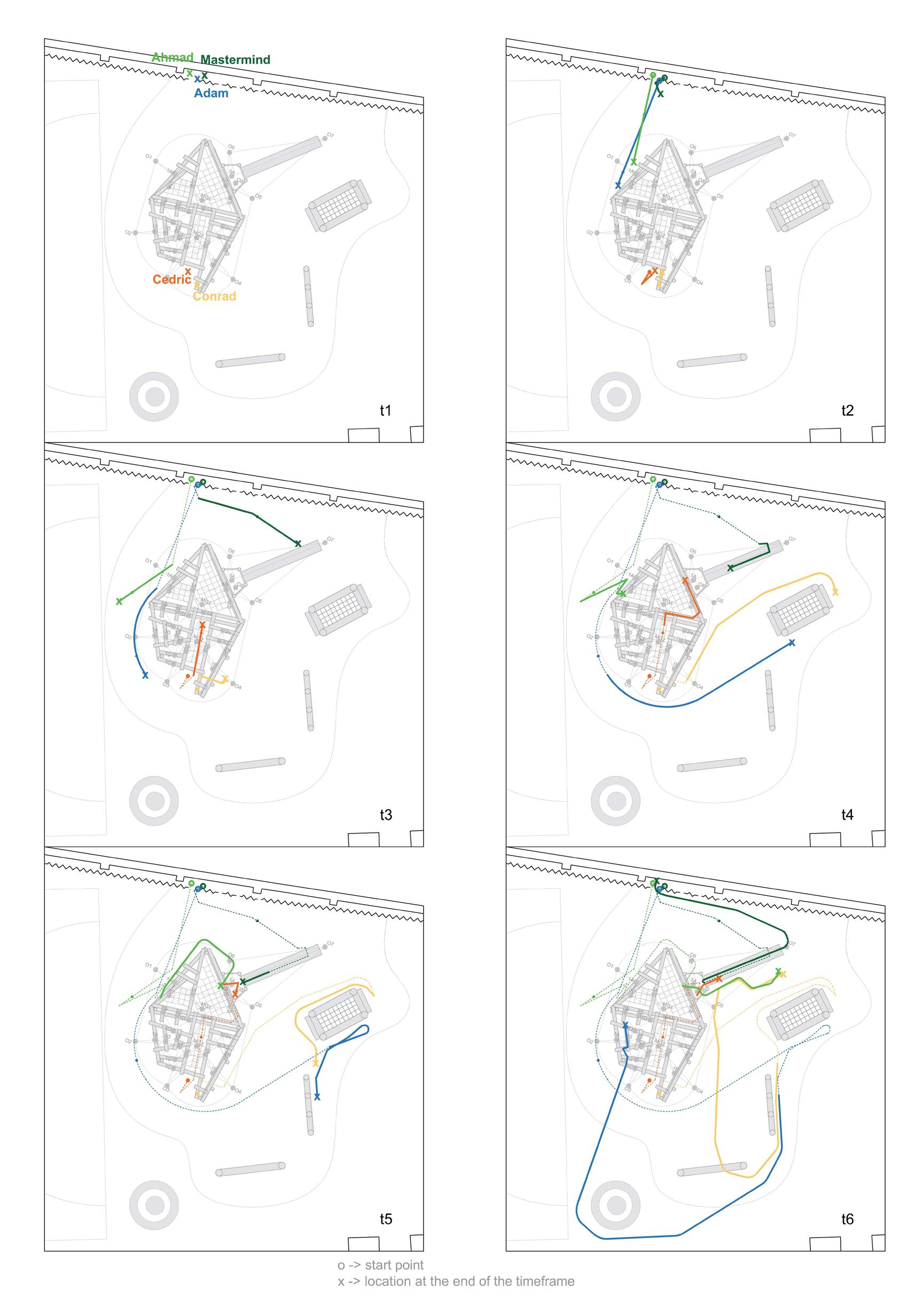
This study positions playgrounds not simply as passive backgrounds but as active mediators in children’s development, which both shape and are being shaped by interactions. Using a mixed-methods approach, two London-based primary school playgrounds serve as case studies to explore how physical settings influence children’s spatial understanding and social interactions. Walking-and-talking interviews were conducted to allow children to explain their games in real time, while video recordings captured gameplay to map movement patterns and game dynamics. Findings suggest an interplay between spatial structures and game structures, each influencing the other during gameplay. Children limit or modify areas by changing game rules to facilitate complex social actions. They actively make spatial decisions to creatively structure their roles and transform spaces to align with their game purposes, showing that games are not played in isolation but are deeply intertwined with their surroundings.
Mapped movement traces of the gameplay (Author: Mine Sak-Acur, 2025)
Dr Jhono Bennett
MPhil/PhD Architectural Design
Supervisors: Professor Peg Rawes · Professor Jane Rendell
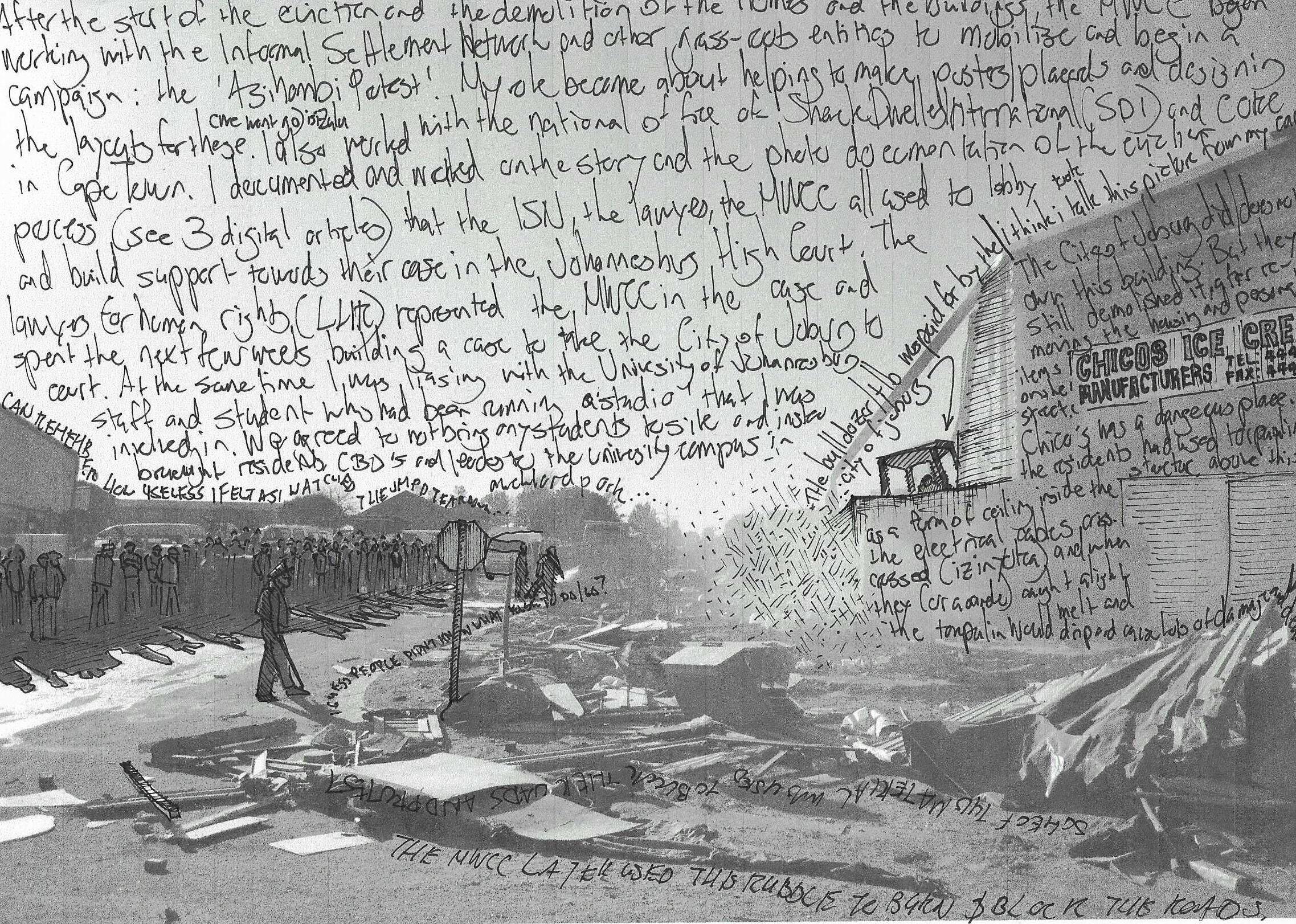
This dissertation examines how spatial design practice in South Africa can respond more effectively to the complexities of what is termed the ‘post-post city’— a contemporary condition shaped by layered histories, systemic inequality, and enduring spatial contradictions. Drawing from South Africa’s socio-spatial context and over a decade of practice-led work, the thesis proposes a framework that understands Johannesburg and similar urban environments through situated concepts such as the ‘post-post’, the ‘what-what’, and ‘jus’tice’. These culturally embedded phrases offer grounded ways of reading the temporal, relational, and tacit dimensions of South African urbanism.
The research is structured around three primary design outputs — The Kist, The Spatial Phrase Book, and The Repair Manual — each developed as a digital tool. These artefacts explore the shaping of spatial practitioners, methods for engaging with complex urban conditions, and propositions for operating within the postpost city. They are supported by a series of secondary design outputs and a protoportfolio, iKhathalogi: Auto-Kritiek (my KaK), which documents reflective and visual research processes.
Methodologically, the study employs a situated, design-based approach informed by reflective practice, visual storytelling, and cross-locational analysis. Using methods of locating, revisiting, engaging, discussing, and making, the thesis develops a practiceoriented mode of inquiry attentive to positionality and tacit forms of knowledge. The thesis argues that spatial design practice in South Africa must grapple with the interpersonal, systemic, and interscalar dynamics that constitute Southern cities. It proposes ‘relational repair’ as a framework for practice — an approach that recognises the embedded nature of spatial bias, acknowledges the partiality of practitioner knowledge, and situates design as an iterative process operating between the self and the city. Through this lens, the study contributes new insights for practice methods, architectural education, and the evolving field of Southern Urbanist spatial design.
Marlboro South – Site Writing (Author: Jhono Bennett, 2019)

Dr Sebastian Buser
MPhil/PhD Architectural and Urban History & Theory
Supervisors: Professor Jane Rendell · Professor Ben Campkin
Funding: Arts and Humanities Research Council, London Arts & Humanities Partnership (LAHP)
This dissertation responds to archival silences within London’s LGBTQ+ histories by producing a history of the Women’s Anarchist Nuisance Café (WANC) — a DIY, trans-inclusive, queer feminist space, which operated in London from 1998 to 2011. While existing research explores trans experiences in space (Nash 2010) and design (Crawford 2010), there is a scarcity of research on trans-inclusive DIY community spaces. This study addresses the paucity of trans approaches to the discipline of architectural history, by asking which methods are needed to practise a transarchitectural history and theory. It proposes that these can be developed through the concepts of transing (Stryker et al. 2008), poesis (Stryker 2008), autopoiesis (Braidotti 2011, Simpkins 2017), affect (Massumi 2002, Ahmed 2014), and the ‘attunement’ (Massumi 2015) that occurs between the researcher’s own body and the spaces and people of WANC. Situating trans-architectural history at the intersection of trans studies, feminist philosophy, and architecture, the thesis constructs a transpoetic framework and a new ‘site-visitation’ method for practising trans architectural history and theory. Site-visitations merge archiving and embodiment to generate subjective
and collective knowledge, engaging the researcher’s body, archives, and affective forms of writing.
The research developed through three iterative phases: phase one constructed a WANC archive through new primary evidence (oral histories, site visits, and collection of ephemera); phase two explored the relation of the archive to embodied research and to theoretical concepts, producing reflexive writing and creative-critical texts to enact a transpoetic architectural history of WANC; and phase three synthesised these processes to provide a new methodological framework through which trans architectural history and theory can be practised. The dissertation presents these phases interchangeably through four WANC ‘site-visitations’ that demonstrate how site-visitation methods continuously change in practice and generate new insights.
WANC flyer (front), @ The Radical Dairy, Stoke Newington, London (Courtesy of Caro Smart, 2002)

MPhil/PhD Architectural and Urban History & Theory
Supervisors: Professor Iain Borden · Professor Penelope Haralambidou
Funding: Architecture Research Grant, the Bartlett (UCL)
This thesis traces a genealogy of the discotheque on the Mediterranean coast of Spain between the 1950s and the 1970s. The discotheque is seen as both a symptom and a catalyser of the cultural shift in postWWII Europe, with the expansion of the leisure economy, economic liberalism, and consumer society.
From a Foucauldian perspective nuanced by its later gender, media, and technological readings, the discotheque is understood as a biopolitical tool, linked to the development of the tourism industry and its associated process of urbanisation; it also played a key role in the introduction of new social and governmental paradigms based on the management of desire.
The architectural analysis is grounded in specific case studies (a series of discotheques in Platja d’Aro, Costa Brava) as the thesis examines how electronic and chemical technologies, many of which originally developed as military instruments, were repurposed for leisure and introduced into spatial design in the 1960s. Specifically looking at the role of lighting, sound, and psychotropic technologies, the text portrays the emergence of an ‘architecture of waves’ as an instrument for the production of subjectivity.
The study traces the relationship between geopolitics, transnational infrastructures and flows, spatiotemporal leisure products, perceptual techniques, and systems of production, consumption and representation of the body, to analyse the expansion of the discotheque along the coast as a ‘super-mass-media-architecture’. The thesis demonstrates how the discotheque introduced experiential and aesthetic regimes that supported a displacement from the disciplinary forms of governance prevalent during the first half of the twentieth century, towards the fluid, flexible, and body-centred forms of control and production of desire characteristic of postindustrialism and late capitalism. The dissertation is rooted in extensive primary research, including mostly unpublished materials that are brought together here for the first time to support the main argument.
(top) Group of people holding balloons dancing on a podium in the discotheque Tiffany’s after the extension, Platja d’Aro, 1966 (Photography: Narcís Sans Prat, courtesy of SGDAP, 1969); (bottom) Interior view of the discotheque Maddox, Platja d’Aro(Courtesy of Carmenati Family Archive, 1967)

Dr Fernando P. Ferreira
MPhil/PhD Architectural Design
Supervisors: Professor Yeoryia Manolopoulou · Professor Nina Vollenbröker
Funding: Fundação para a Ciência e a Tecnologia (FCT), Portugal
This thesis explores how the entanglements between textile-making, storytelling, and architecture can offer innovative research methodologies for architects to approach and reimagine the design of textile factory sites. The study departs from Vale do Ave, a post industrial region in the northwest of Portugal, whose social and spatial realm endures under the shadow of recent deindustrialisation, to focus on Coelima, a textile factory which was founded in 1922 but has been under ongoing dismantlement since 1991.
Building upon stories from the factory’s life, the dissertation proposes to explore the concept of ‘texere’ as a practice for architectural design. This practice combines site-specific processes and tools, both textile and scriptive, to foster new forms of collaborative design involving Coelima’s buildings, its history, administration, workers, and local agents, in order to sustain an equitable relationship between these entities’ interests for the factory’s future. Texere is conducted as practice-led research developed through five design projects which are rooted in the theoretical framework of the ‘poethical’ (Heaney 1989, Retallack 2004). I borrow the concept of poetics with an added ‘h’ to argue that
envisioning architectural futures for Coelima comprises a poetical and ethical wager, in which the architect’s responsibility and taking care of the relations between factories, humans, machines, work, and the world are constantly at stake.
Methodologically, the thesis is propositional and self-reflective, constantly shifting its spatial and geographical position in, around, and outside of Coelima. It employs archival research, long-term and interdisciplinary collaboration, oral history, artefacts’ design, and ethical principles that resonate with textile art, storytelling, and architecture. The combination of five projects developed in the thesis offers an ‘Architectural Texere’: a tryptic methodology for architecture to collect, thread, and co-write stories in the early stages of design. I argue that these story-based yet cautionary methods can enrich the creation and communication of potential future design briefs for Coelima and beyond.
Detail of stitching the cloth map, Pevidém, Portugal (Photography: Fernando P. Ferreira, 2021)
Dr Emma Louise Gribble
MPhil/PhD Architectural Space & Computation
Supervisors: Professor Alan Penn · Professor Peter McLennan
Best practice guidance on architectural briefing makes two commonly accepted recommendations: the design team should have a single point of contact with the client ‘to prevent any misunderstanding or cross communication’, and there should be ‘early and on-going engagement with end users’ to ensure that new buildings meet the needs of the people who will use them.
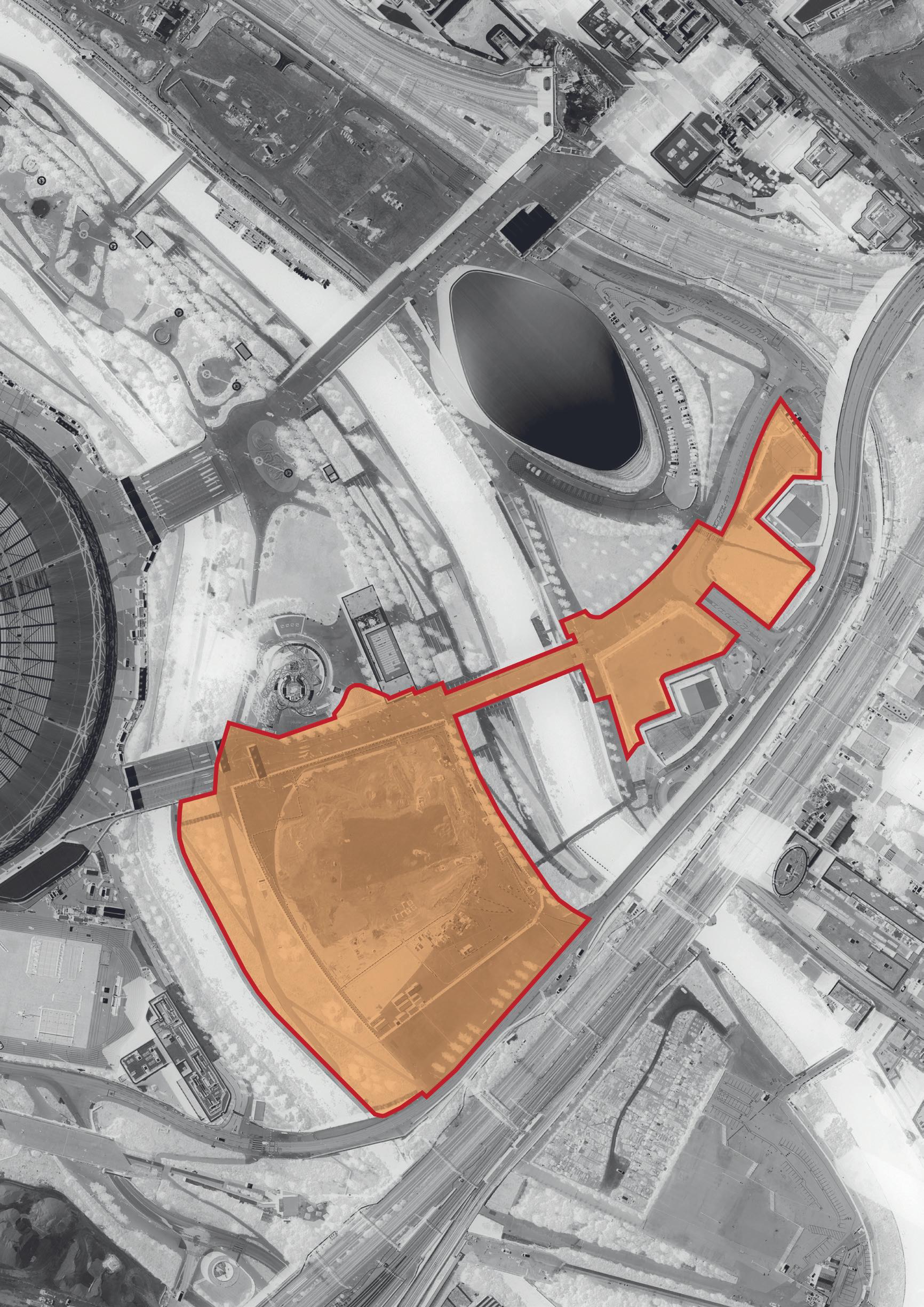
However, there is scant research into how these two apparently contradictory pieces of advice are reconciled in practice. This thesis is a study of the briefing process for a new university campus on the Queen Elizabeth Olympic Park in East London. It asks how internal stakeholders engage with the briefing process in the early stages of architectural projects (RIBA Stages 1–3) and focuses on intra-client argumentation.
The research methodology is Situational Analysis and the research methods include interviews with key stakeholders, nonparticipant observation of project meetings, and document analysis.
Internal stakeholders were found to differ on a number of issues including
the decision to build, the strategic brief, project governance, and the virtual building (the developing building design), and there were many ways in which things could have been otherwise. Stakeholders deployed a variety of strategies and tactics to justify or contest design decisions and enrolled a heterogeneous range of actors, such as contaminated soil, specialist teaching practices and university strategy documents, to support their positions.
This dissertation argues that architectural briefing is an inherently social process. The study draws on insights from diverse scholars to develop a conceptual framework which links three interrelated aspects of architectural projects (the strategic brief, project governance, and the virtual building) to nine areas of potential disagreement — areas where argumentation may inform design outcomes. Lastly, the thesis proposes a set of sensitising questions based on this framework to support practitioner and client reflectionin-action (Schön 1991).
Aerial photograph of UCL East campus site after planning approval and prior to start of construction (Author: Emma Louise Gribble, 2019)

Dr Danielle Hewitt
MPhil/PhD Architectural and Urban History & Theory
Supervisors: Dr Robin Wilson · Professor Jane Rendell
Funding: Society of Architectural Historians of Great Britain
Through archival restearch and an artistic historiographical practice, this dissertation On the Architectural History of Destruction reveals various diverse movements of materials and knowledge from London’s Second World War bombsites. The thesis comprises artworks and critical, theorised writing. It proposes an artistic historiographical practice, in which the aim and form of each artistic work is driven by attempts to make the apparently absent, bombed landscape ‘tangible’ (Stoler 2013): historically, in the present landscape, and in a present moment that is still marked by the violence of aerial bombardment.
The study responds to W. G. Sebald’s question of what constitutes ‘a natural history of destruction’ (Sebald 2004 and 1999) and his problematic of how a landscape produced by the violence of aerial bombing can be accounted for. The thesis makes a critique of architectural history’s construction of the ‘postwar’ (Azoulay 2019) by moving the focus away from the bombed landscape as merely a precursor to ‘postwar’ reconstruction. The bombsites are revealed as landscapes that were active and generative of: bureaucratic structures and new material economies via the salvage and movement of debris;
new, humanly modified ground and new botanical natures; disciplinary knowledges; military infrastructures; and the calculation of vulnerability and its suppression. Through a centring of the bombsite debris and its material and immaterial movements, the metaphor of the erratic — a geological fragment that moves from one location to another — is introduced. From this, a material and indexical practice is developed, which traces and enacts the displacement of the bombed landscape — spatially, temporally, and in historical discourse. The dissertation is divided into four sections, each comprising artistic work (digital, analogue, and camera-less photography; artists’ films; and lecture performance) and a corresponding chapter essay, each of which chart a discursive movement between the artwork and its archival, historical and theoretical relations.
(top) Made ground and buried debris, Lower Lea Valley (Photography: Danielle Hewitt, 2023); (bottom) Still from + 27,169 (Erratic), lecture performance, Arromanches-les-Bains, Normandy (Photography: Danielle Hewitt, 2019)
MPhil/PhD Architecture & Digital Theory
Supervisors: Professor Mario Carpo · Professor Frédéric Migayrou
Funding: Government Scholarship for Studying Abroad (GSSA), Ministry of Education, Republic of China (Taiwan)
My study examines the conceptual transformation of architectural rationality brought about by Connectionist AI, focusing on how its probabilistic, datadriven mechanisms reshape architectural design, design cognition, and computational reasoning. It begins from the premise that latent space functions as a flexible alternative to symbolic systems, operating as a form of data compression in which types and styles are encoded as statistical distributions rather than fixed categories. This reframes connectionism as a methodological transition from fixed, predefined typological structures to statistically inferred patterns, allowing design reasoning to operate through adaptation and variation rather than predetermined formal schemata.
The thesis is organised in two parts. The first provides a historical and theoretical account of the emergence of connectionism in computational design, conceptualising it as a synthesis of architectural theory and probability theory. The second examines a series of case studies—including my own projects and selected peer-reviewed works— to analyse how connectionist approaches transform processes of representation, cognition, and computation. Across these
cases, the dissertation demonstrates that differentiable latent spaces allow designers to construct, adapt, and recombine design schemata within an encoded, vector-based creative field, generating diverse outcomes by navigating relationships embedded in compressed data. The findings further show that compression–decompression errors, combined with the inherent stochasticity of neural networks, introduce substantial variation that expands the space of possible designs. Methods such as latent walks produce hybridised stylistic configurations, shifting style from a stable classificatory label to a temporary, emergent condition shaped by a probabilistic structure. Overall, the thesis argues that connectionism produces a fundamental reconfiguration of architectural rationality—one that privileges fluidity, variability, relationality and exploratory computation over fixed typological order.
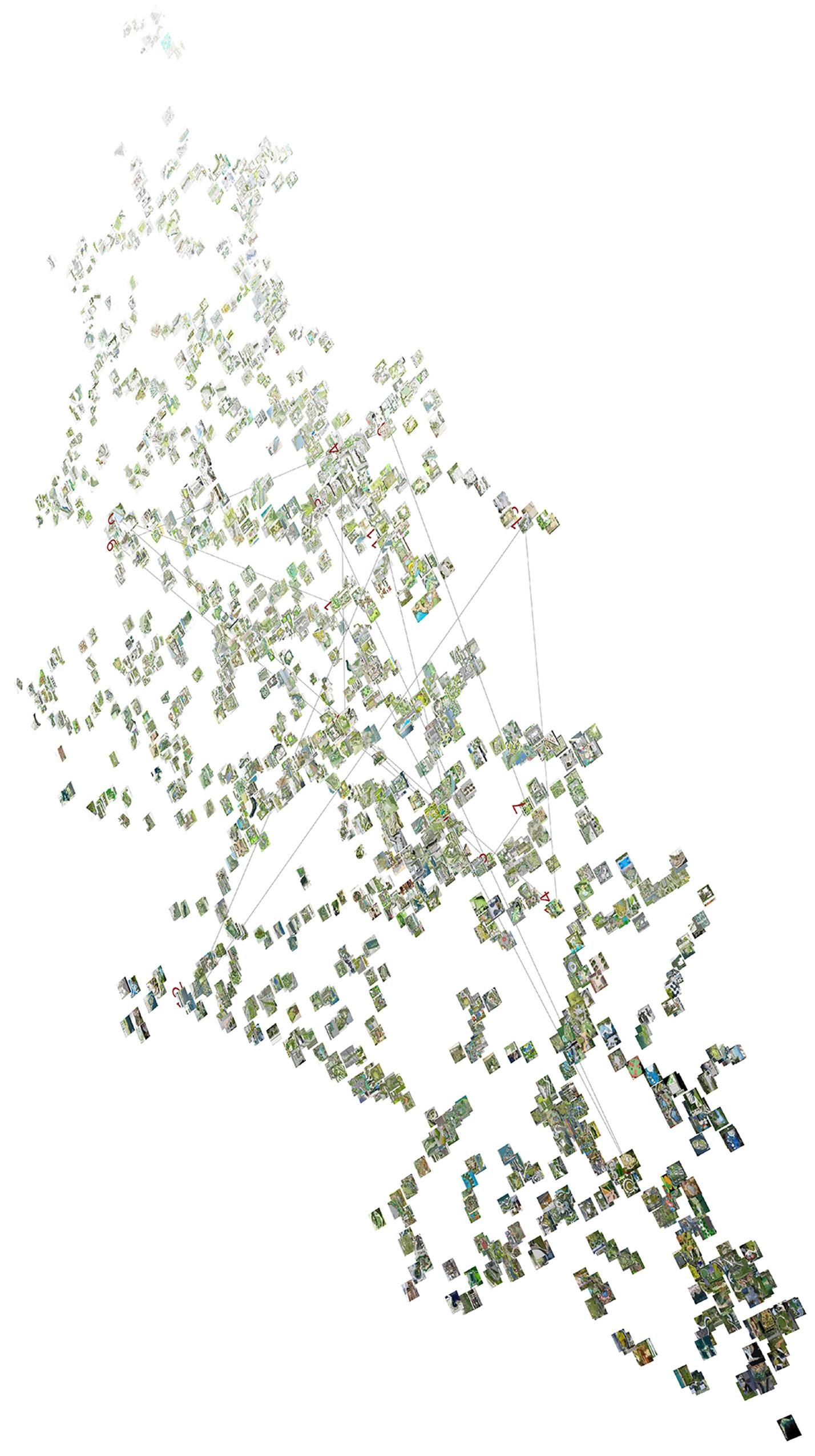
A visualisation of a latent-space walk within a landscape-generation model. Along the trajectory, each point can be decoded (decompressed) to produce output variations that reveal previously unseen design possibilities (Author: Sheng-Yang Huang, 2023)
Dr Melih Kamaoğlu MPhil/PhD Architecture & Digital Theory
Supervisors:
Dr Roberto Bottazzi · Dr Claudia Pasquero
Throughout history, nature has proved to be a model for architects by demonstrating various types of intelligence, creativity, and solutions. How humans make sense of nature and how they design buildings have been thoroughly interrelated. Philosophers and scientists generally considered all living creatures static, unchanging and non-transformable beings. After Charles Darwin’s revolutionary work, living beings have started to be seen as changing, evolving, and developing dynamic entities. Evolution theory has been accepted as the interpretive power of biology after discussions and objections among scientists. In time, genetics provided the working principles of evolution from single organisms to entire environments. More recently, computation has been used to simulate nature’s evolutionary logic, and architects have applied evolutionary principles in design theories and methodologies since the 1990s.
Although there are studies on technical and practical features of computational evolutionary tools in architectural design, there is still little research on their historical, theoretical and philosophical foundations, foregrounding the critical role of computation as an interface between evolution and architectural design. This doctoral dissertation aims to fill this gap by instrumentalising the philosophy and theory of computation to critically review the penetration of biological evolution in digital architecture theories and practices since the early 1990s. The thesis proposes an intellectual framework to understand and conceptualise various integrations of biological evolution into architectural design processes through computation by shedding light on their limitations, shortcomings, and potential.
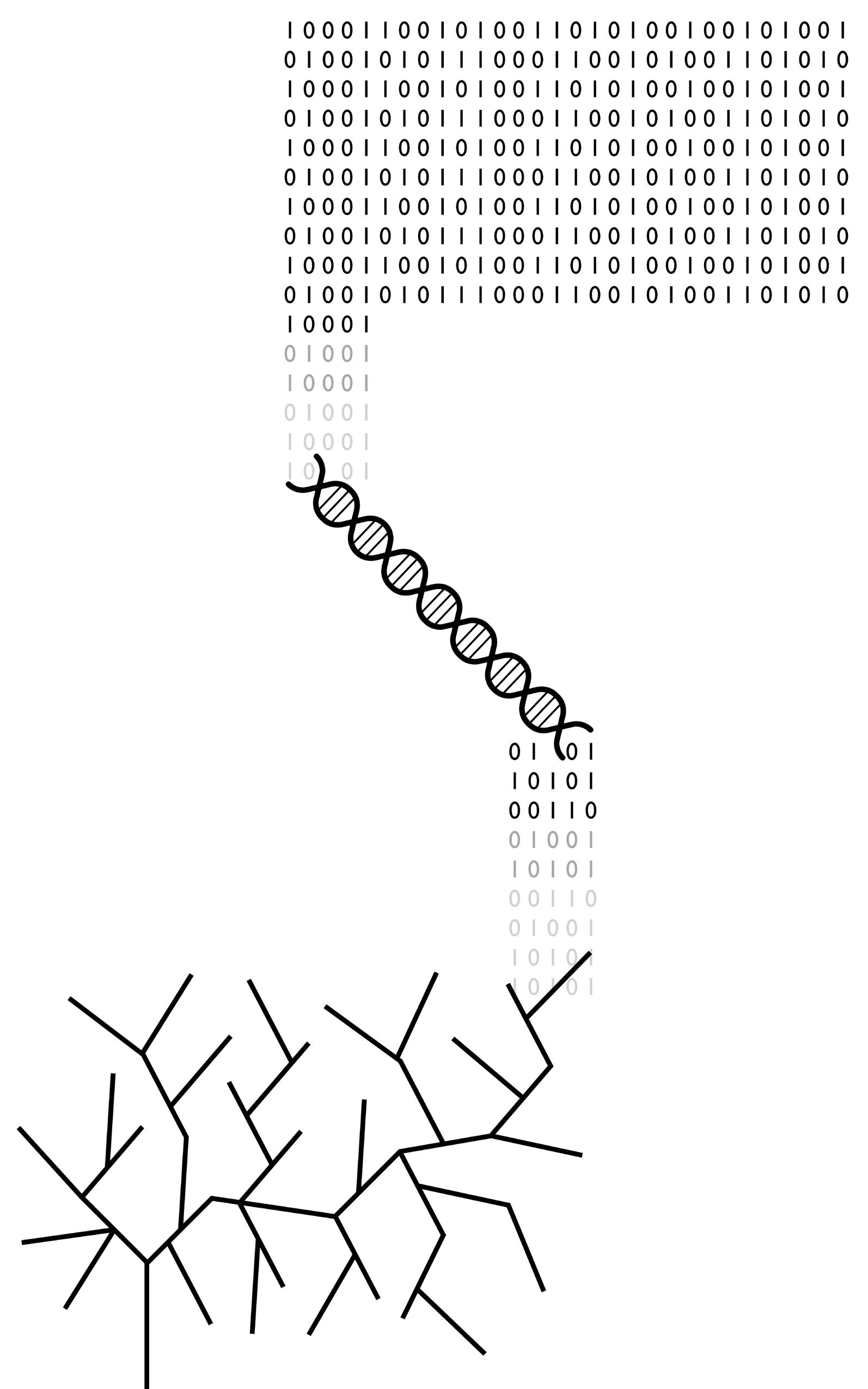
A representation of bio-digital design in digital architecture as a collaboration between evolution, genetics, and computation (Author: Melih Kamaoğlu, 2023)

Dr Emma-Kate Matthews
MPhil/PhD Architectural Design
Supervisors: Professor Yeoryia Manolopoulou · Professor Bob Sheil · Professor Neil Heyde
Funding: Arts and Humanities Research Council, London Arts & Humanities Partnership (LAHP)
This practice-based research explores the intersection of spatial and sonic fields, developing poetic and practical resonances through site-specific experimental composition and performance. Architecture and music have long shared a symbiotic relationship, with architecture shaping musical expression and buildings adapting to accommodate musical desires. However, this interaction has been increasingly constrained by rigid frameworks of acoustic measurement, diminishing the intuitive and creative engagement between the two disciplines. In the mid-twentieth century, composer Henry Brant challenged this trend by treating space as an active compositional parameter. Whilst his approach moved beyond simple mappings between geometric and musical structures, it left open questions about how space and sound might interact beyond established conventions.
This thesis revisits some of the above questions, offering a progress report in its conclusion. In formulating its response, the study introduces spatiosonic practice, a transdisciplinary mode of working that reframes space and sound as fluid, interdependent fields that actively inform and shape one another. Through
the composition and performance of spatialised, acoustically responsive music, this work explores how architectural and musical tools, vocabularies, and methodologies can be co-opted, hybridised, and expanded to cultivate collaboration. Prioritising insights drawn from tacit knowledge, sensory perception, and embodied experience, it challenges the tendency to overlook intangible phenomena that resist quantification. Musical timbre articulates abstract spatial relationships, whilst architectural tools such as 3D scanning, digital modelling, and acoustic simulation are repurposed as compositional aids. The outputs are examined through 3D audio recording, listening practices, and spectral analysis. The core contribution of this research is the formulation of spatiosonic practice as a conceptual and methodological framework. By rethinking how music ‘makes space’ and how architecture ‘listens’, this research proposes a new paradigm for spatial composition—one that encourages architecture and music to engage in reciprocal, co-creative dialogue.
Resonant Bodies at Shoreham-by-Sea, for Brighton Festival (Photography: Emma-Kate Matthews, 2022)
Dr Hamish Muir MPhil/PhD Architectural Design
Supervisors: Professor Yeoryia Manolopoulou · Dr Jan Kattein · Dr Simon Donger
This dissertation outlines a circular economy methodology for theatre and the performing arts. Its central focus is the role of the play-script, and especially how it can act as an environmental ethicaesthetic-thematic gestalt, in theatre practice. In this context, the script is examined for its impact on material waste caused by its staging. Waste is treated here simultaneously as a conceptual, aesthetic object and as an ecological, functionalist concern. I therefore ask how the script can constructively transform the relationship between the page and the stage towards a circular economy.
Three positions of the play-script are presented, which form a new theoretical term: ‘The Theatre of Waste’. The Prescript considers authorial power, ecological agency, genre, and the design of the play-script. The Intra-script asks how the play-script can elevate the role of waste as a non-human agent in the making of theatre, and in doing so, repurpose waste material created by theatre. Central to this
is a chronotopic definition of waste, which is explored using literary theorist Mikhail Bakhtin’s term, the chronotope. The Postscript considers how the play-script can speak to the afterlife of theatre through the performativity of disposal and by treating waste as a dramaturgical device.
My research methods include a critical review of sustainable theatre and practiceled playwriting experiments. I collaborated with the National Theatre, London, and undertook fieldwork there following a production from beginning to end. This enabled me to observe how waste is thought about and managed in context. Waste data collected on site and a study of the architecture and organisation were used to develop the methodology. The National Theatre situates my research in a specific example of an urban mainstream theatre in the London industry, but the circular economy method presented here aims to be applicable beyond this and further into the fields of ecocritical drama, spatially-driven theatre, and sustainable design.
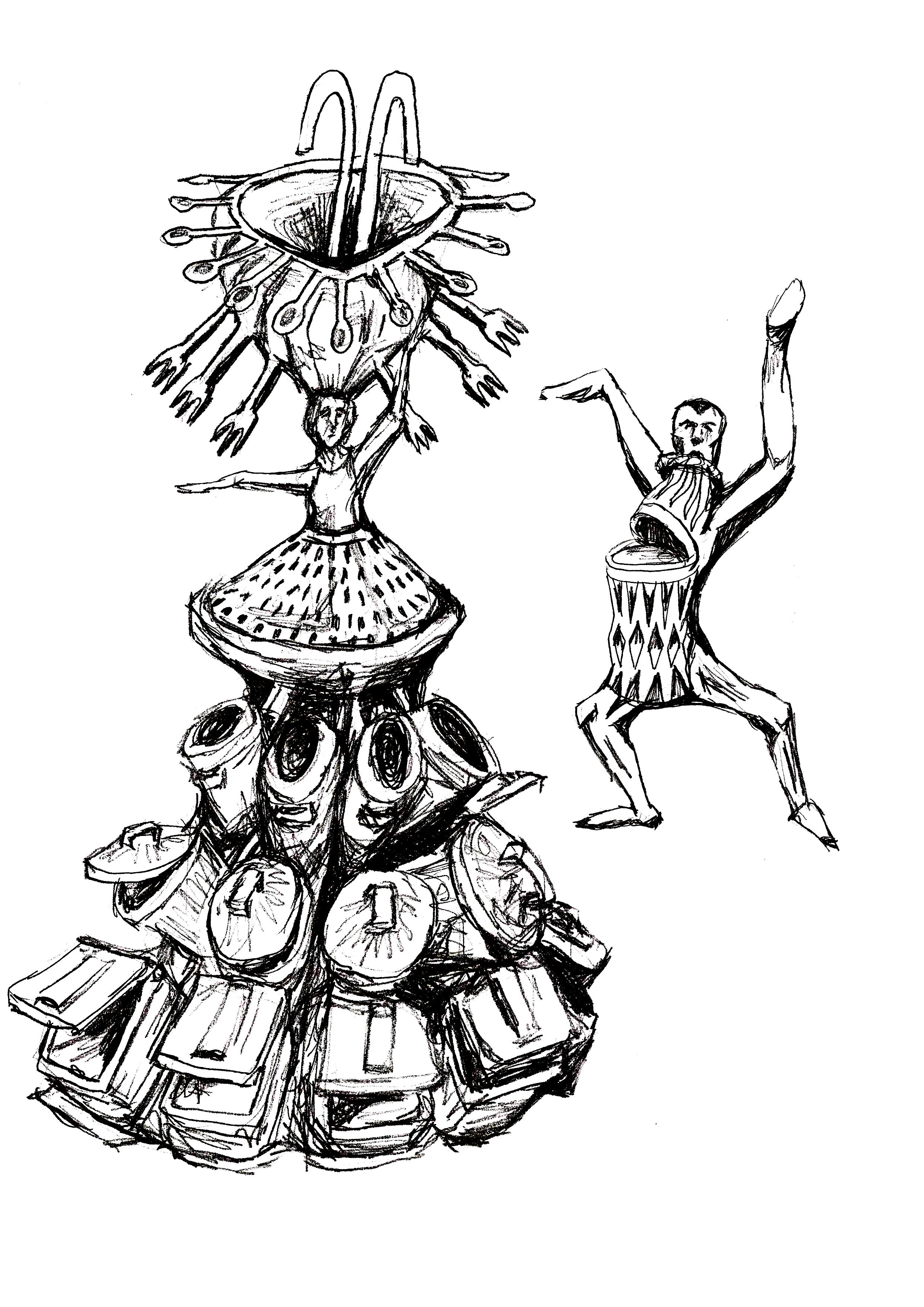
Costume designs for The Rag and Bone Rhapsody (Author: Hamish Muir, 2019)
MPhil/PhD Architectural Design
Supervisors: Professor Penelope Haralambidou · Professor Nat Chard
From the Greek ‘ana-’ (again or back) and ‘morphe’ (shape or form), anamorphosis is a projection technique requiring a specific vantage point to reconstitute the appearance and opening up of a space for discovery in the physical encounter with an image. This thesis studies the delineation and experience of anamorphic images in the work of the friars belonging to the Order of Minims in seventeenth-century Italy — and especially,, the work of Jean-François Niceron (1613–1646). More specifically, I am interested in how the Minims explored theoretical concerns about invisible phenomena of light and vision through physical experimentation. Their work, I suggest, resonates with contemporary architectural practice-based research, where the emphasis resides on the situatedness of the process.
By challenging the gaze and opening towards the space of perception, anamorphic images actively question the role of representation in architecture. This thesis aims to bring forth the anamorphic construction explored by the Minims as a
methodology to shift the conversation in architectural practice from what drawing represents to how it makes space present. Through a series of projects, I re-enact Niceron’s experiments in three cycles. The first cycle studies the history of the technique by creating an optical table as a model of the anamorphic construction to scale. In the second cycle, the table serves as a tool to re-perform Niceron’s drawing instructions on site, introducing the researcher’s body into the space of representation. The encounter with anamorphosis then becomes fictionalised through scriptwriting for a play. For the third and final cycle, I return to the Roman convent where Niceron developed his interest in anamorphic transformation. By re-activating anvd inhabiting the historical practice of anamorphosis, this thesis enables an embodiment of the past into the present, inviting us to reflect on our position in history while also projecting possible futures.
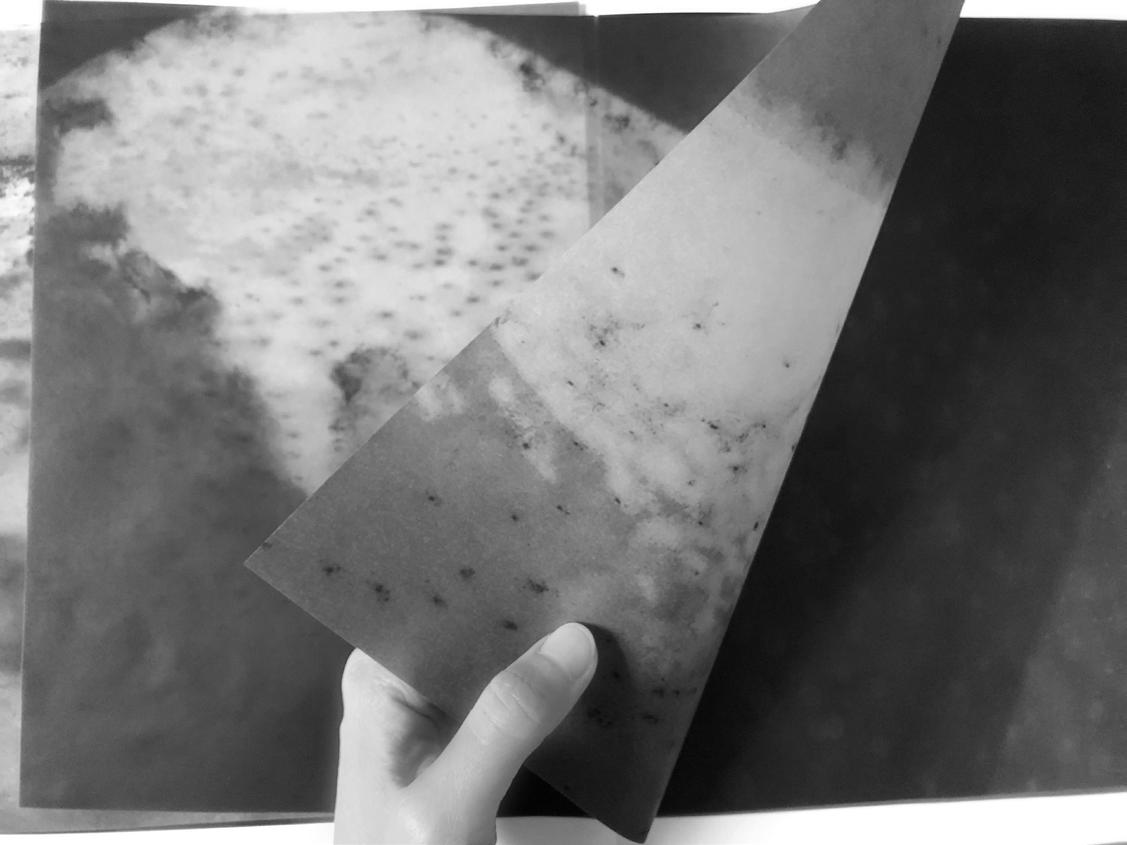
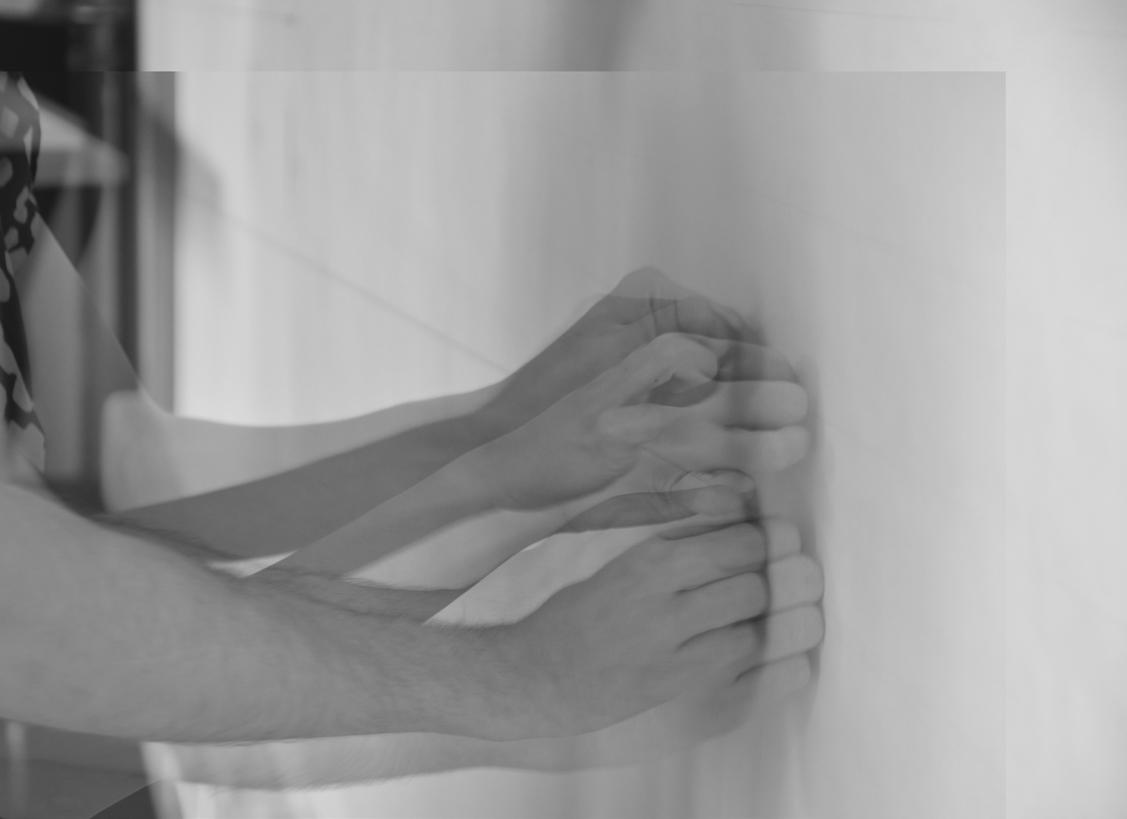
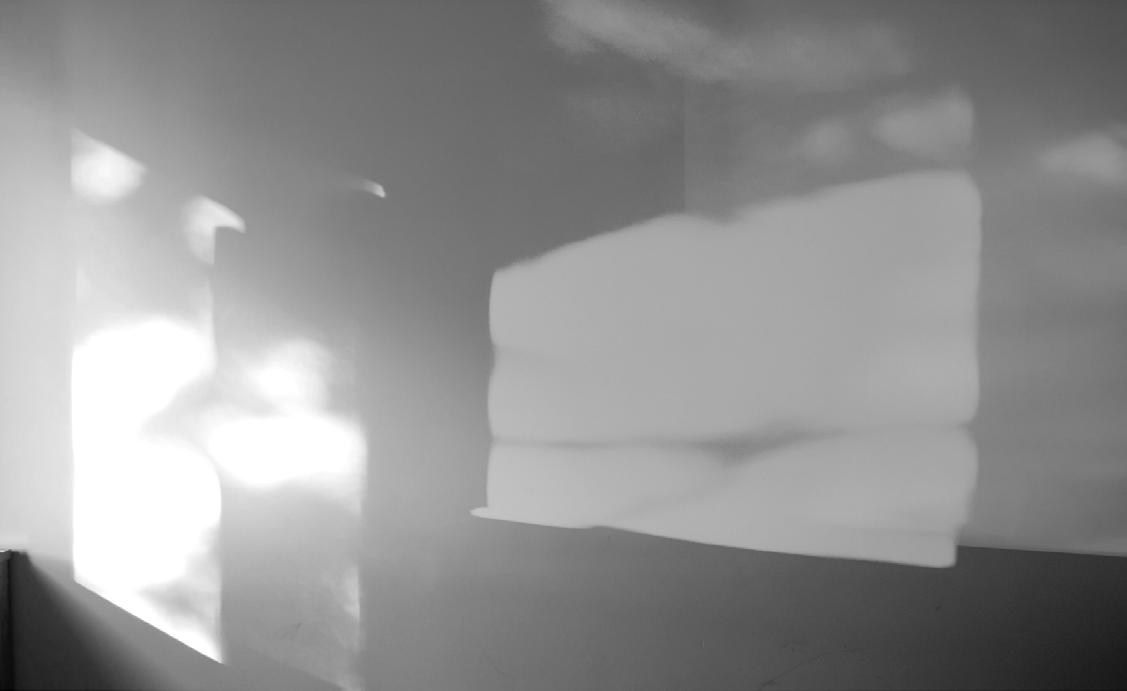
(top to bottom) Hand and The Inventory of Shimmers (Author: Thi Phuong-Trâm Nguyen, 2022); layered encounters during the re-enactment by Anna Ulrikke Andersen and Sevcan Ercan (Photography: Thi Phuong-Trâm Nguyen, 2016); Superposition in Rome (Author: Thi Phuong-Trâm Nguyen, 2018)

Dr Tom Ó Caollaí
MPhil/PhD Architectural Design
Supervisors: Professor Jane Rendell · Professor Barbara Penner
Funding: Arts and Humanities Research Council, London Arts & Humanities Partnership (LAHP)
This thesis asks how architectures and landscapes of the Irish borderlands tell the stories of its pasts and presents. It draws out and responds to ‘polysituated’ (Kinsella 2017) sites and histories of the contested border on the island of Ireland through a practiceled method of ‘alternative arrangement’ as a form of ‘critical spatial practice’ (Rendell 2003). It tests and argues for a ‘topographic practice’ that uses architectural and landscape historiography as a form of artistic output; one that employs ‘bordering practices’ (Hafeda 2019) to break down the binary of the border.
The contested border on the island of Ireland runs 500 kilometres from Lough Foyle to the Irish Sea and has divided the six counties in the North from what is now the Republic since 1921. This study produces an alternative reading at a critical juncture on the centenary of Partition and as the UK leaves the European Union. While the Brady Amendment of the UK’s European Union (Withdrawal) Act 2018 called for ‘alternative arrangements’ (HC Deb 29 January 2019) to the so-called ‘Irish
backstop’, this thesis shifts the emphasis from ‘alternative arrangements’ for goods and services to making ‘alternative arrangements’ of contested historical, material, and spatial ‘sites’ and ‘non-sites’ (Smithson 1968).
The thesis contextualises and documents three ‘alternative arrangements’ produced in the making of three journeys across, along, and with the borderlands: a drive, a walk, and an itinerant ‘hedge school’. This topographic practice extends other forms of ‘altering practice’ (Petrescu 2007) by specifically locating alterity in the practice of arranging unofficial histories with official histories, and following Svetlana Alexievich, understanding these as ‘polyphonic’ (Alexievich 2016). Through situated and topographic practices of photography, mapping, performance, and installation, these ‘alternative arrangements’ reconfigure the power dynamics of peripheral architectures, landscapes, and histories, creating a space to imagine the island differently.
Alternative Arrangement 3, Claí na Muice Duibhe (Black Pig’s Dyke) (Photography: Tom Ó Caollaí, 2023)

Dr Diana Salazar
MPhil/PhD Architectural and Urban History & Theory
Supervisors: Professor Jane Rendell · Dr Liza Griffin · Professor Robert Biel
Funding:
ESRC scholarship (UBEL DPT)
This thesis contributes to the field of environmental history by drawing on Ramachandra Guha’s (1998) decolonial study of environmental transformation through his research into social struggles in colonial India. Focusing on the case of Wayuu and African-descent people in La Guajira, Colombia, resisting coal extraction from the Cerrejon mine, this thesis develops a decolonial methodology that explores practices of co-production and the use of daily life testimonies (Molano 2001). It does so to weave the complex entanglement of global, political and economic issues with understandings of the lived experience of territorial transformation.
The study has three aims. First, to produce a decolonial environmental history of La Guajira. Second, to develop a practice of solidarity by co-producing research with communities in La Guajira, involving the creation of artefacts for popular education (Fals Borda & Rahman 1991), which can be used in campaigns to support the communities’ struggle and communicate their voices to a wider audience. Lastly,
it proposes a practice for environmental history that combines various kinds of writing — critical and creative, sole and co-authored, word and image, visual and sonic, including theory and co-produced artefacts — which, when taken together, create a ‘new’ method for making a decolonial environmental history that practises solidarity.
The dissertation is divided into five parts, beginning with the introduction and ending with the conclusion; the second part introduces the conceptual framework and methodology, while the third and fourth parts, drawn directly from my fieldwork, are in dialogue with one another. Each of these third and fourth parts adopts a specific tripartite structure to convey an argument: first, a scene with voices taken directly from the fieldwork; second, a presentation of, and commentary on, the research conducted in the field, connected to arguments in related literature; and lastly, a co-produced artefact for popular education.
Histories of Resistance (Image: Diana Salazar, 2024)

MPhil/PhD Architectural and Urban History & Theory
Supervisors: Professor Barbara Penner · Professor Kerstin Sailer
Funding: Society for the Study of Labour History
Where Do You Cry in an Open Plan Office? explores the space of the commercial office. While the COVID-19 pandemic has placed the design, use, and future of office space under unprecedented scrutiny, decades-old assumptions regarding office spaces remain unquestioned. Extant literature frequently characterises the history of the commercial office as one of continuous positive evolution, suggesting that office spaces have been transformed from controlling Taylorist workhouses to well-lit, comfortable, humane centres of high-tech work.
Rooted in the Marxian tradition, this dissertation uses labour process theory (Braverman 1974) to interrogate dominant office history narratives, examining the office first and foremost as a site for capitalistic extraction of labour. This wider history of the office is contextualised through analysis of three key time periods and three related case studies: the turn of the twentieth century, Scientific Management, and the birth of the commercial office as a discrete spatial type (Frank Lloyd Wright’s 1904 Larkin
Administration Building); the middle of the twentieth century and the emergence of Theory Y (Robert Propst’s 1968 Action Office); and the early twenty-first century and the rise of the technology worker (a contemporary Midwestern technology headquarters).
The dissertation suggests that the history of the commercial office can most accurately be described as one of continuity—with the same office design, the open office, being repackaged and repeated throughout history. Continuity of office design, it is argued, emerges from the continuous influence and pressures of capitalism upon the space, place, and operations of the office. From the factory to the Googleplex, capital’s never-ending quest for profit has dictated the possibilities and realities of physical work spaces, shaping the very foundations of our understanding of what the office is and might be. It is only though a refutation of capitalism, the dissertation concludes, that we will achieve fully human spaces of work.
(top to bottom) Supervisor Work Area and Director Work Area, depicted in a Herman Miller promotional brochure (Herman Miller Archives, Zeeland, Michigan. VJ1501, AO2 Promo, Folder 94, n.d.)
MPhil/PhD Architectural Design
Supervisors: Professor Jonathan Hill · Professor Peg Rawes
An architectural designer’s study of the relationship between climate, atmosphere, and architecture, this dissertation looks at three villas from the Italian Renaissance: Francesco Trento’s Villa Aeolia, Andrea Palladio’s La Rotonda, and Vincenzo Scamozzi’s La Rocca Pisana. It analyses the climatic environments of the villas, their interior climates, and the atmospheres — understood as affective manifestations of climate — that they convey to the inhabitant. The thesis studies the design decisions, as well as the climate conceptions on which these decisions were based, as revealed through the architects’ writings and the canonical treatises available during their lifetime.
Climate and atmosphere are key topics in today’s architectural discourse. The thesis understands them as facets of the overlying debate on anthropogenic climate change that has reshaped our relationship to the climatic environment. My approach is an attempt to address the split between two specific perspectives in the discourse: on the one hand, techno-scientific approaches understand climate in a functional way and
focus on ecological sustainability; on the other, atmospheric approaches focus on designing specific climatic conditions in building interiors (e.g. of temperature, air movement, or humidity) to emphasise the bodily experience of climate. By studying a set of historical examples, I aimed to show how such disparate manifestations of climate can be braided together into rich climate-aware building designs. I propose this braiding as a contemporary architectural design strategy that responds to our reshaped relationship with the climatic environment.
The chosen research methodology reflects my conviction that studying climate and atmosphere by looking at historical buildings cannot be based on historical research and spatial analysis alone; it needs to include insights gained from bodily experiences. To this end, I developed the method of ‘perceptual drawing’, which oscillates between visual analysis and sensual engagement, allowing me to discuss climate and atmosphere simultaneously.
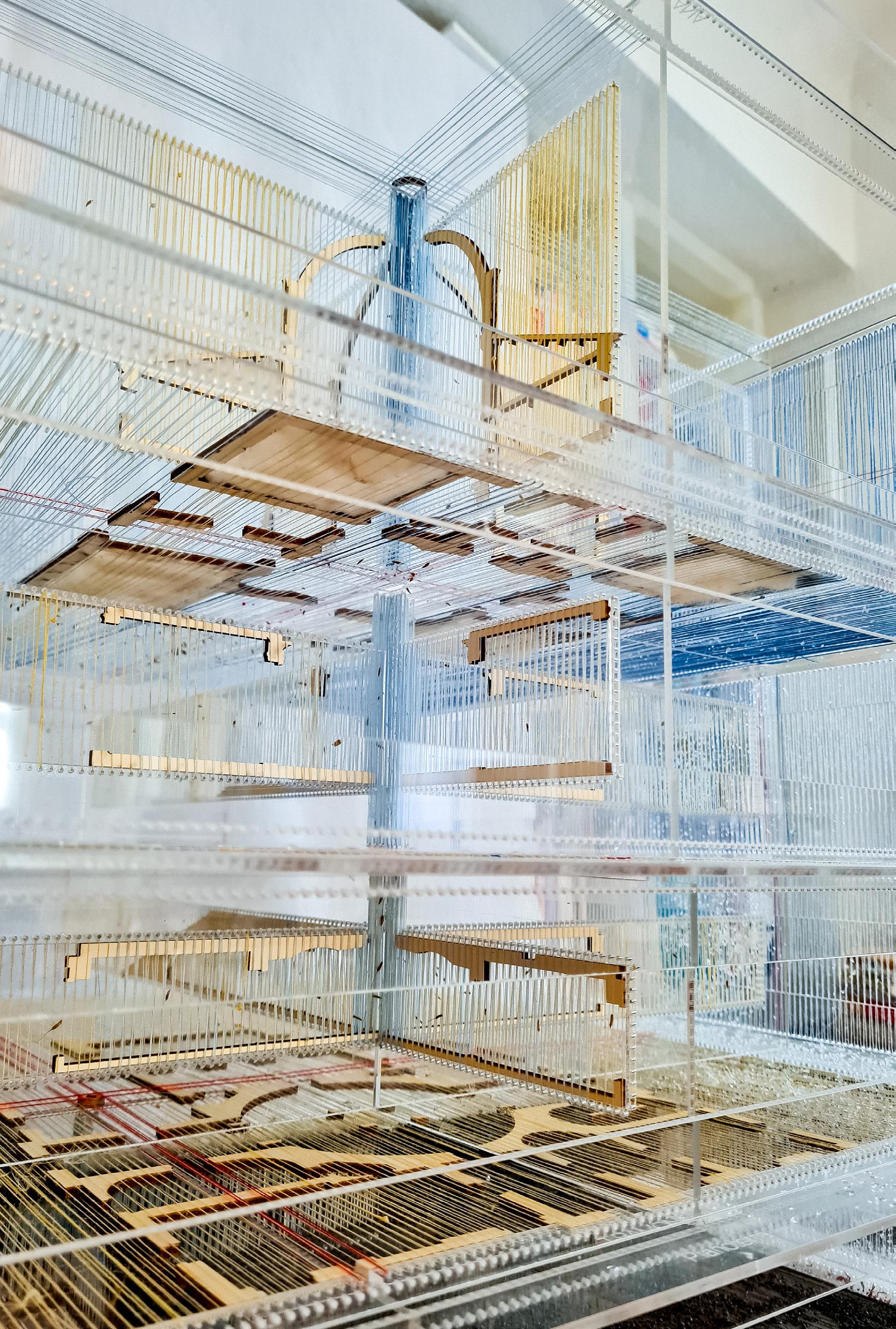
La Rocca Pisana, Interior Weather (Author: Wiltrud Simbürger, 2024)

Dr Yichang Sun
MPhil/PhD Architectural Space & Computation
Supervisors: Professor Laura Vaughan · Dr Sam Griffiths
This thesis presents a study of the Taiping South Road (TPS) area, a neighbourhood in central Nanjing, China, characterised by its diverse land uses and social/economic activities. As the ‘first commercial street’ of early twentieth-century Nanjing, TPS has sustained its prosperity over the past century. Adopting a place-based approach, the study offers a historical investigation into guilds and small businesses in the city and this neighbourhood during the pivotal period of the 1920s and the 1930s, and into non-domestic patterns of the same area in the 1930s. In parallel, it traces the richly mixed uses and activities within the TPS alleyways and their surroundings in the 2020s, situating these observations within a wider temporal framework that spans a century of urban change.
This study examines: first, the shifting spatial patterns of each type of small urban places across scales over time; and second, whether and to what extent the spatial morphology can explain or facilitate the shifting patterns of private-to-public relations in people’s social-economic activities and everyday practices. The dissertation seeks to bridge the theoretical and methodological gaps between urban form and everyday life studies. The findings
reveal that small urban places embedded within networks of streets and alleyways exhibit distinct spatial and trans-spatial cultures, characterised by a great mixture of numerous uses and everyday activities, while — methodologically — a fine-grained micromorphological approach can enhance our understanding of the everyday meshing of co-presence and micro-rituals.
Building on the concept of co-presence, the study proposes an interdisciplinary framework of Space Syntax, urban morphology, Historical GIS (HGIS), and temporal analysis. Combining extensive historical-archival research with contemporary fieldwork, this thesis traces the everyday settings over a century of urban transformation. This re-examination of people and place, it is argued, shows that small urban places could play a vital role in shaping and maintaining urban diversity and sustainability today.
Four alleyway cases, their adjacent streets, and surrounding streets in the 1930s, overlapped with modern-day alley views (Author: Yichang Sun, 2023, based on Cadastral Map Series of Nanjing (surveyed between 1928 and 1936), CC BY Ministry of the Interior and Academia Sinica)
Dr Sé Malaïka Tunnacliffe
MPhil/PhD Architectural and Urban History & Theory
Supervisors: Professor Iain Borden · Professor Ben Campkin
This thesis explores the spatialised activist practices of lesbians in 1980s London. It studies how their stories and histories are made known, shared, and used in the built environment. While queer urban studies have been present in various spatial disciplines since the 1990s, the dissertation contributes to a renewed interest in uncovering and documenting lesbian histories and the materiality of lesbian spaces. This study draws from urban studies, queer history and theory, as well as queer, feminist and lesbian geographies, to interrogate the plurality of connections between lesbian organising and placemaking. Building on the metaphor of ‘constellations’ in urban theory, ‘asterisms’ is proposed as a framework for understanding lesbian connections to places and placemaking practices.
Three examples of asterisms that emerge from walking interviews, cognitive mapping, focused interviews, and archival research are presented: Women’s City (1982–1983),
a lesbian-led project for a women-only centre in North London; Lesbians Support the Printworkers (1986–1987), lesbian solidarity actions during the Wapping Dispute; and Lesbians Against Clause 28 (1988), five lesbian-led direct actions across London. Collaging is used as a means of processing and representing the different temporal and spatial dimensions, and the people, practices, and places encompassed within these asterisms. Through an interdisciplinary approach, this study aims to challenge existing academic and urban planning discourses on placemaking by exploring new understandings and methodologies. By establishing a framework for a queer practice of placemaking, this thesis seeks not only to contribute to discussions on lesbian, gay, bisexual, transgender, and queer urban experiences but also to broaden these to encompass the history and complexity of London lesbian spatial practices from the 1980s.
Women’s City, 1982–1983
(Author: Sé M. Tunnacliffe, 2023)

Dr Dingyi Wei MPhil/PhD Architectural Space & Computation
Supervisors: Professor Ava Fatah gen. Schieck · Professor Nicolai Marquardt
Museum exhibitions in the twenty-first century are increasingly involving exhibits in a variety of forms, such as interactive interfaces and multimedia installations. Visitor experiences are becoming more complex regarding their interactions with the exhibitions and the outcomes of these interactions. Considering such complexity, this thesis raises the question of whether actual visitor experiences are consistent with the intentions of museum professionals, such as curators and designers who curate and deliver these exhibitions. Although existing studies have acknowledged the differences between professionals’ intentions and visitors’ actual experiences, there is a lack of systematic studies investigating them and an absence of theoretical frameworks to describe and explain such differences.
Building on existing knowledge from human-computer interaction and museum studies, this dissertation defines the differences between the professionals’ intentions and actual visitor experiences
as Deviations and the visitor experiences as Deviated Visitor Experiences. It proposes a deviation model that represents deviations and presents four case studies that address deviations as well as their underlying factors from multiple perspectives. Based on the analyses of systematic observations and surveys of visitors’ experiences and through interviews with professionals in selected case studies, this study extends the deviation model and proposes a three-step framework that can be adopted to describe deviations in a variety of contexts. It then summarises and discusses the factors that lead to deviations. The thesis contributes to museum studies by offering methods and insights to help museum professionals and scholars better understand exhibition visitors and their experiences, which invite them to rethink the relationship between contemporary museum exhibitions and visitors. The proposed deviation model and framework will also contribute to studying deviated user experiences in HumanComputer Interaction studies.
A visitor engaging with the installation ‘Flowing Mist’ at the Science Museum, London (Author: Dingyi Wei, 2020)
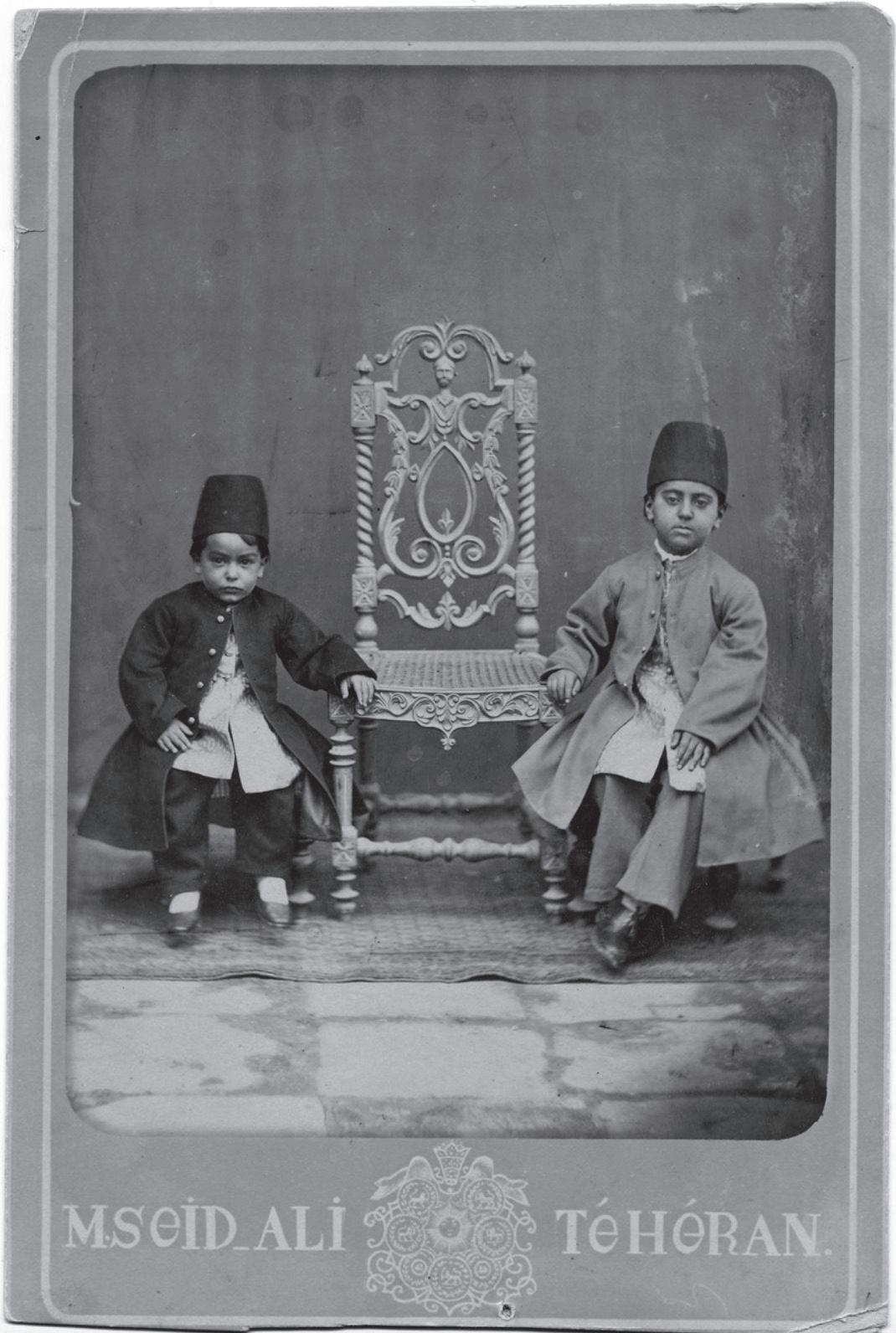
Dr Azadeh Zaferani
MPhil/PhD Architectural and Urban History & Theory
Supervisors: Professor Barbara Penner · Dr Nina Vollenbröker
Domestic Agents: Doweries, Homes, Infrastructures examines the process of homemaking in Tehran from 1925 to 2013, a period framed by the rise and fall of the Pahlavi dynasty, the 1979 Revolution, and the eventual decline of Iran’s welfare state under Mahmoud Ahmadinejad. It argues that the domestic realm serves as a critical site where both state strategies and everyday tactics are negotiated, reflecting wider political, economic, and social transformations in Iran over the twentieth and early twenty-first centuries.
Focusing on domestic objects through the lens of dowries, the dissertation traces how material cultures mediate between top-down modernisation efforts and bottom-up forms of resistance. Through analysis of materials, brands, aesthetics, and spatial practices, the study reveals how homemaking has been shaped by local and global forces, from western-inspired modernisation and Cold War politics to
post-revolutionary welfare policies and emerging non-western imperial influences.
The thesis is structured in two parts. Part I explores Iran’s state-led modernisation under the Pahlavis, situating domestic change within the contexts of World Wars and Cold War geopolitics. Part II investigates the post-revolutionary turn towards welfare and later privatisation, highlighting how South-South political alignments influenced Iranian domestic life. Throughout, the study demonstrates that homemaking is simultaneously an act of home unmaking; a dynamic process through which individuals and the state continually redefine belonging, ideology, and identity within the intimate space of the home. By centring the material and experiential dimensions of domesticity, this study contributes to wider discussions of modernity, resistance, and everyday life in non-western contexts.
Brothers from different mothers: (left to right) Aman Allah and Ghulam Riza Ardalan (Courtesy of Houri Mostofi Moghadam’s collection in Women’s World in Qaja Iran Digital Archive, Harvard University, Middle Eastern Division, Boston, USA)

IOS Press, 2014
Therapeutic architecture can be described as the people-centred, evidence-based discipline of the built environment, which aims to identify and support ways of incorporating those spatial elements that interact with people physiologically and psychologically into design. Architecture is an important factor in people’s lives when they are well; when they experience ill health and are less able to cope, it becomes even more important. This book explores the design of specialised residential architecture for people with mental health problems. It sets out to show how building design can support medical and health-related procedures and practices, leading to better therapeutic outcomes and an enhanced quality of life. Based on almost two decades of research, it aims to understand how architectural design interacts with the therapeutic milieu, the care programmes, and the experience of actually living in the spaces. In so doing, it provides a fascinating insight into the effect that architectural design can have on all of us, but particularly on those living with mental health problems.
The Empty Place: Democracy and Public Space
Routledge, 2014
In The Empty Place: Democracy and Public Space, Teresa Hoskyns explores the relationship of public space to democracy by relating different theories of democracy in political philosophy to spatial theory and spatial and political practice.
Establishing the theoretical basis for the study of public space, Hoskyns examines the rise of representative democracy and investigates contemporary theories for the future of democracy, focusing on Chantal Mouffe’s agonistic model and Jürgen Habermas’s civil society model. She argues that these models of participatory democracy can co-exist and are necessarily spatial.
The book then provides diverse perspectives on how the role of physical public space is articulated through three modes of participatory spatial practice. The first focuses on issues of participation in architectural practice through a set of projects exploring the ‘open spaces’ of a postwar housing estate in Euston. The second examines the role of space in the construction of democratic identity through a feminist architecture/art collective, producing space through writing, performance, and events. The third explores participatory political democratic practice through social forums at global, European, and city levels. Hoskyns concludes that participatory democracy requires a conception of public space as the empty place, allowing different models and practices of democracy to co-exist.
Architecture, Travellers and Writers: Constructing Histories of Perception
1640–1950
Routledge, 2014
Does the way in which buildings are looked at, and made sense of, change over the course of time? How can we find out about this? By looking at a selection of travel writings spanning four centuries, Anne Hultzsch suggests that it is language, the description of architecture, which offers answers to such questions. The words that authors use to transcribe what they see for the reader to re-imagine offer glimpses at modes of perception specific to one moment, place, and person.
Hultzsch constructs an intriguing patchwork of local and often fragmentary narratives discussing texts as diverse as the seventeenth-century diary of John Evelyn, Daniel Defoe’s Robinson Crusoe (1719) and an 1855 art guide by Swiss art historian Jacob Burckhardt. Further authors considered include seventeenth-century collector John Bargrave, eighteenth-century novelist Tobias Smollett, poet Johann Wolfgang von Goethe, critic John Ruskin as well as the twentieth-century architectural historian Nikolaus Pevsner.
The Architecture Chronicle: Diary of an Architectural Practice
Routledge, 2014
During the last 30 years, technological, social, economic and environmental changes have brought about the most dramatic evolution to architectural practice that has taken place since the profession emerged during the Italian Renaissance. Whilst these changes have transformed the way in which architects work, few contemporary books discuss architectural practice. The Architecture Chronicle sets out to define the role of the contemporary architect in the light of these changes.
Most books on architecture start when a building is complete, carefully editing out any evidence of the design and production process. The Architecture Chronicle engages precisely with the design and production process. It investigates how and by whom design decisions are made and executed. Chapter 1 is a diary reporting on the design and realisation of five stage sets and one urban intervention over a period of four years, starting on 16 December 2003. The diary is intercepted by references that are, where appropriate, carefully integrated in the overall narrative. Chapter 2 reflects on the diary to discover patterns and crossreferences and to draw conclusions.
The contemporary architect can be defined as three distinct characters. The architectinventor challenges conventions and questions the social status quo. The architect-activist transgresses the boundary of the profession and enters the construction process. The architect-arbitrator engages the audience to realise the ambitious project. The Architecture Chronicle concludes that the contemporary architect still draws and writes, but that it is often the architect’s ability to engage and direct that asserts their status. To assert their status in the design team, the architect’s ability to talk and to act is more important than their ability to draw and to write.
China’s rise as an economic superpower has been inescapable. Statistical hyperbole has been accompanied by a plethora of highly publicised architectural forms that brand the regeneration of its increasingly globalised urban centres. Despite the sizeable body of literature that has accompanied China’s modernisation, the essence and trajectory of its contemporary cityscape remains difficult to grasp. This volume addresses a less explored aspect of China’s urban rejuvenation — the prominence of the shopping mall as a keystone of its public spaces. Here, the presence of the built form most representative of western capitalism’s excess is one that makes explicit the tensions between China’s Communist state and its ascent within the ‘free’ market.
This book examines how these interrelationships are manifested in the culturally hybrid built form of the shopping mall and its role in contesting the ‘public’ space of the modern Chinese city. By viewing these interrelationships as collisions of global and local narratives, a more nuanced understanding of the shopping mall typology is explored. Much architectural criticism has failed to address the levels of meaning implicit within the shopping mall, yet it is a building type whose public popularity has guaranteed its endurance. Consequently, if architecture is to remain a relevant social art, a more holistic understanding of this phenomenon will be indispensable to the process of adapting to globalising forces. This examination of Chinese shopping malls offers a timely and relevant case study of what is happening in all our cities today.
Museum Space: Where Architecture
Meets Museology
Routledge, 2015
Museums are among the iconic buildings of the twenty-first century, as remarkable for their architectural diversity as for the variety of collections they display. But how does the architecture of museums affect our experience as visitors? This book proposes that by seeing space as common ground between architecture and museology, and so between the museum building and its display, we can illuminate the individuality of each museum and the distinctive experience it offers - for example, how some museums create a sense of personal exploration, while others are more intensely didactic, and how the visit in some cases is transformed into a spatial experience and in other cases into a more social event.
The book starts with an overview of the history of museum buildings and display strategies, and a discussion of theoretical and critical approaches. It then focuses on specific museums as in-depth case studies, and uses methods of spatial analysis to look at the key design choices available to architects and curators, and their effects on visitors’ behaviour. Theoretically grounded, methodologically original, and richly illustrated, this book will equip its readers with a guide for studying museums and a theoretical framework for their interpretation.
Routledge, 2015
Image, Text, Architecture brings a radical and detailed analysis of the modern and contemporary architectural media, addressing issues of architectural criticism, architectural photography, and the role of journal editors. It covers examples as diverse as an article by British artist Paul Nash in The Architectural Review (1940), an early project by French architects Lacaton & Vassal published in the journal 2G (2001), and recent photography by Hisao Suzuki for the Spanish journal El Croquis
At the intersection of image and text the book also reveals the role of the utopian impulse within the architectural media, drawing on theories of utopian discourse from the work of the French semiotician and art theorist Louis Marin, and the American Marxist critic Fredric Jameson. Through this it builds a fresh theoretical approach to journal studies, revealing a hitherto unexplored dimension of ‘latent’ or ‘unconscious’ discourse within the media portrait of architecture. The purpose of this enquiry is to highlight moments where a different type of critical voice emerges on the architectural journal page, indicating the possibility of a more progressive engagement with the media as a platform for critical and speculative thinking about architecture,and to rethink the journals’ role within architectural history.
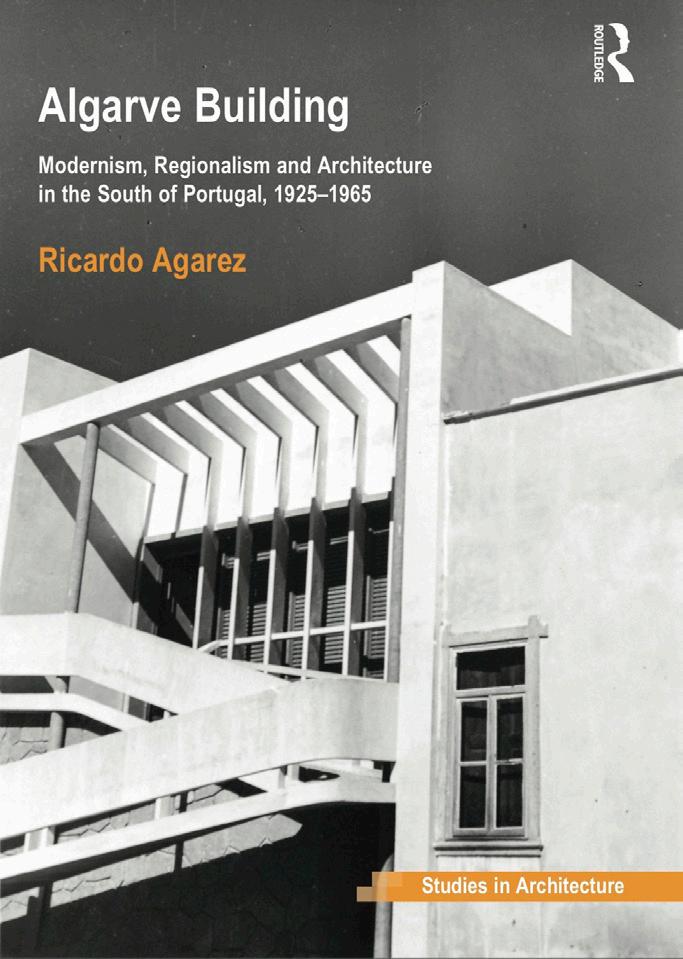
Algarve Building: Modernism, Regionalism and Architecture in the South of Portugal, 1925–1965
Routledge, 2016
The Algarve is not only Portugal’s foremost tourism region. Uniquely Mediterranean in an Atlantic country, its building customs have long been markers of historical and cultural specificity, attracting both picturesque-driven conservatives and modernists seeking their lineage. Modernism, regionalism, and the ‘vernacular’ — three essential tropes of twentieth-century architecture culture — converged in the region’s building identity construct and, often the subject of strictly metropolitan elaborations, they are examined here from a peripheral standpoint instead.
Drawing on work that won the RIBA President’s Award for Outstanding PhD Thesis in 2013, Algarve Building challenges the conventional inclusion of Portuguese modern architecture in ‘Critical Regionalism’ narratives. A fine-grain reconstruction of the debates and cultures at play locally exposes the extra-architectural and widely participated antecedents of the much-celebrated mid-century shift towards the regional. Uncelebrated architects and a cast of other players (clients, officials, engineers, and builders) contributed to maturing a regional strand of modern architecture that, more than being the heroic outcome of a hard-fought ‘battle’ by engaged designers against a conservative establishment, became truly popular in the Algarve.
Algarve Building shows, more broadly, what the processes that have been appropriated by the canon of architectural history and theory — such as the presence of folk traditions and regional variation in learned architecture — stand to gain when observed in local everyday practices. The grand narratives and petites histoires of architecture can be enriched, questioned, revised, and confirmed by an unprejudiced return to its facts and sources — the buildings, the documents, the discourses, the agents, and the archives.

Paris Under Construction: Building Sites and Urban Transformation in the 1960s
Routledge, 2016
During the 1960s, building sites in Paris became spaces that expressed preoccupations about urban transformation, labour immigration, and national identity. As new buildings and infrastructure changed the city, building sites revealed the substandard living and working conditions of migrant construction workers in France. Moreover, construction was the touchstone in debates about the dangers of urban life, and triggered action in communities whose districts faced demolition.
Paris Under Construction explores the social, political, and cultural responses to construction work and urban transformation in the Paris metropolitan region during the 1960s. This examination of a decade of intensive building work considers the ways in which the experience of construction was mediated, produced and reproduced through a range of complex and sometimes contradictory representations. The building sites that produced the new Paris are no longer visible, and were perhaps never intended to be seen, yet different groups closely observed and recorded construction, giving it meanings that went beyond specific building activities. The research draws extensively on French newspaper, television and radio archives, and delves into rarely examined trade union material. Paris Under Construction gives voice to the witnesses of—and participants in—urban transformation who are usually excluded from architectural and urban history.
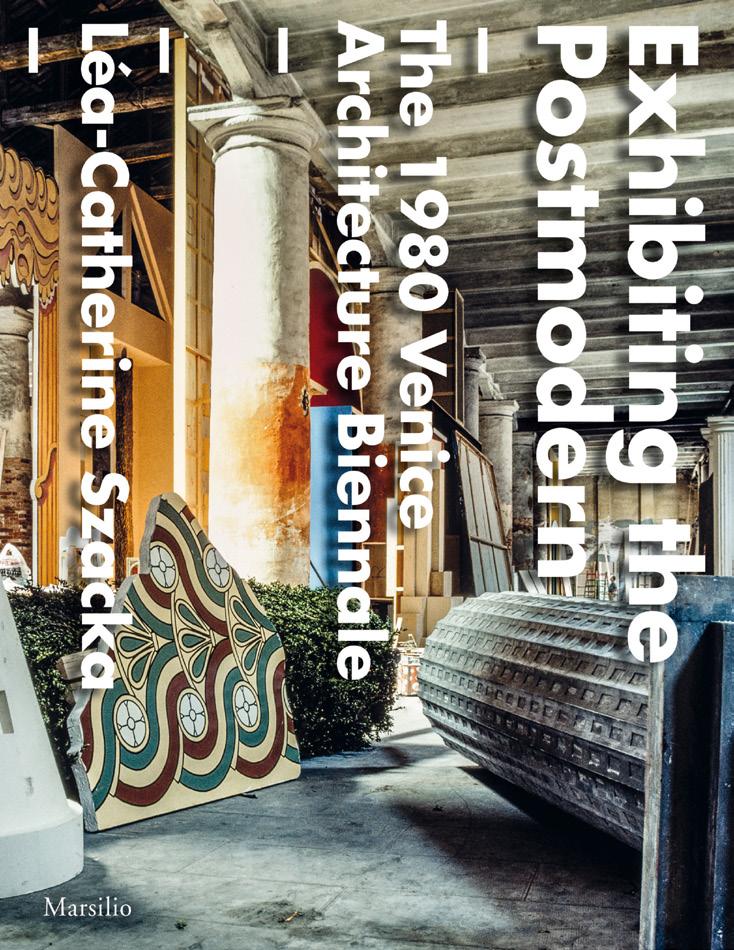
Léa-Catherine Szacka
Exhibiting the Postmodern: The 1980 Venice Architecture Biennale Marsilio, 2016
Exhibiting the Postmodern traces the origins and significance of the First International Architecture Exhibition of the Venice Biennale. Situating the 1980 exhibition ‘The Presence of the Past’ against the larger historical backdrop in which architecture exhibitions appear, and considering their proliferation in the postmodern era, this book claims that the exhibition, beyond heralding a shift in the history of curating, marked both the beginning of the end, and the end of the beginning of the postmodern turn in architecture.
Looking at the institutional changes, exhibitions techniques, and exhibitions spaces, as well as the discourse and controversies between advocates of modern and postmodern architecture, this book narrates the development of architectural exhibitions as a ‘genre’ of culture manifestations, while expanding on both the history of the Venice Architecture Biennale — and, more generally, the Italian architecture in the 1970s — and the history of postmodernism. It also reveals how the 1980 Venice Architecture Biennale announced a changing relationship between the worlds of art and architecture, and the consequent transformation of the architectural product as end object.
ART AND ARCHITECTURE IN AUSTRIA, 1958-1985

Hans Hollein and Postmodernism: Art and Architecture in Austria, 1958–1985 Routledge, 2017
Set within the broader context of post war Austria and the re-education initiatives set up by the Allied forces, particularly the US, this book investigates the art and architecture scene in Vienna to ask how this can inform our broader understanding of architectural Postmodernism.
The book focuses on the outputs of the Austrian artist and architect, Hans Hollein, and on his appropriation as a Postmodernist figure. In Vienna, the circles of radical art and architecture were not distinct, and Hollein’s claim that ‘Everything is Architecture’ was symptomatic of this intermixing of creative practices. Austria’s proximity to the so-called ‘Iron Curtain’ and its post war history of four-power occupation gave a heightened sense of menace that emerged strongly in Viennese art in the Cold War era. Seen as a collective entity, Hans Hollein’s works across architecture, art, writing, exhibition design and publishing clearly require a more diverse, complex, and culturally nuanced account of architectural Postmodernism than that offered by critics at the time. Across the five chapters, Hollein’s outputs are viewed not as individual projects, but as symptomatic of Austria’s attempts to come to terms with its Nazi past and to establish a post-war identity.
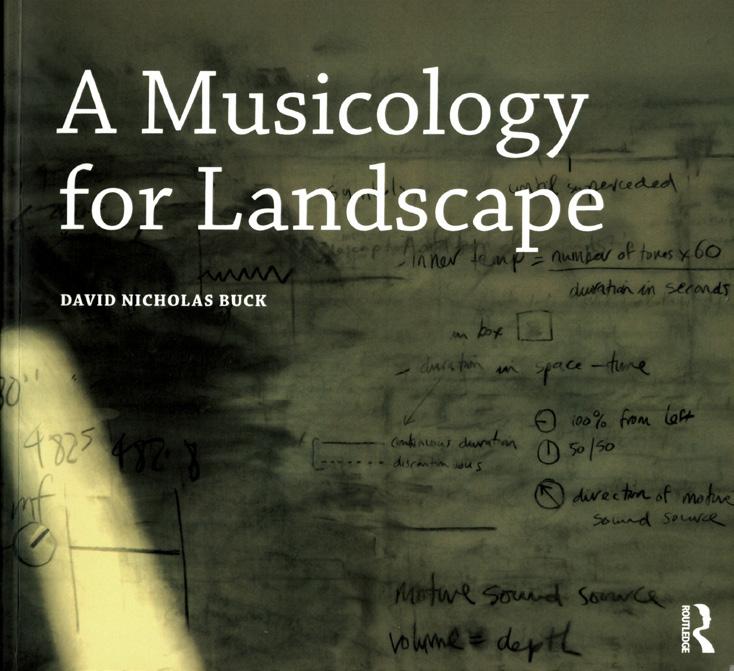
A Musicology for Landscape Routledge, 2017
Drawing conceptually and directly on music notation, this book investigates landscape architecture’s inherent temporality. It argues that the rich history of notating time in music provides a critical model for this under-researched and under-theorised aspect of landscape architecture, while also ennobling sound in the sensory appreciation of landscape.
A Musicology for Landscape makes available to a wider landscape architecture and urban design audience the works of three influential composers — Morton Feldman, György Ligeti, and Michael Finnissy — presenting a critical evaluation of their work within music, as well as a means in which it might be used in design research. Each of the musical scores is juxtaposed with design representations by Kevin Appleyard, Bernard Tschumi, and William Kent, before the author examines four landscape spaces through the development of new landscape architectural notations. In doing so, this work offers valuable insights into the methods used by landscape architects for the benefit of musicians, and by bringing together musical composition and landscape architecture through notation, it affords a focused and sensitive exploration of temporality and sound in both fields.
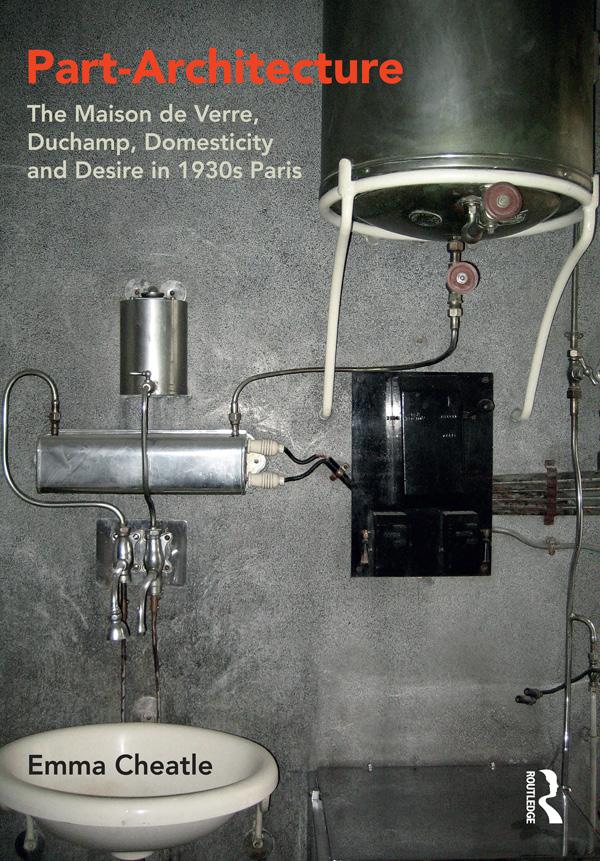
Part-Architecture: The Maison de Verre, Duchamp, Domesticity and Desire in 1930s Paris Routledge, 2017
Part-Architecture presents a detailed and original study of Pierre Chareau’s Maison de Verre through another seminal modernist artwork, Marcel Duchamp’s The Large Glass. Aligning the two works materially, historically, and conceptually, the book challenges the accepted architectural descriptions of Maison de Verre, makes original spatial and social accounts of its inhabitation in 1930s Paris, and presents new architectural readings of The Large Glass. Through a rich analysis, which incorporates creative projects into history and theory research, the book establishes new ways of writing about architecture.
Designed for politically progressive gynaecologist Dr Jean Dalsace and his avant-garde wife, Annie Dalsace, Maison de Verre combines a family home with a gynaecology clinic into a ‘free-plan’ layout. Screened only by glass walls, the presence of the clinic in the home suggests an untold dialogue on 1930s sexuality. The text explores Maison de Verre through another radical glass construction, The Large Glass, where Duchamp’s complex depiction of unconsummated sexual relations across the glass planes reveals his resistance to the marital conventions of 1920s Paris. This and other analyses of The Large Glass are used as a framework to examine Maison de Verre as a register of the changing history of women’s domestic and maternal choices, reclaiming the building as a piece of female social architectural history.
The process used to uncover and write the accounts in the book is termed ‘partarchitecture’. Derived from psychoanalytic theory, part-architecture fuses analytical, descriptive, and creative processes to produce a unique social and architectural critique. As a whole, the book contributes important and unique spatial readings to existing scholarship and expands definitions of architectural design and history.
Routledge, 2017
This book explores China’s encounter with architecture and modernity in the tumultuous epoch before Communism — an encounter that was mediated not by a singular notion of modernism emanating from the west, but that was uniquely multifarious, deriving from a variety of sources both from the west and, importantly, from the east. The heterogeneous origins of modernity in China are what make its experience distinctive and its architectural encounters exceptional.
These experiences are investigated through a re-evaluation of established knowledge of the subject within the wider landscape of modern art practices in China. The study draws on original archival and photographic material from different artistic genres and, architecturally, concentrates on China’s engagement with the west through the treaty ports and leased territories, the emergence of architecture as a profession in China, and Japan’s omnipresence, not least in Manchuria, which reached its apogee in the puppet state of Manchukuo.
The study’s geographically, temporally, and architecturally inclusive approach framed by the concept of multiple modernities questions the application of conventional theories of modernity or post colonialism to the Chinese situation. By challenging conventional modernist historiography that has marginalised the experiences of the west’s other for much of the last century, this book proposes different ways of grappling with and comprehending the distinction and complexity of China’s experiences and its encounter with architectural modernity.

The Syntax
City Space: American Urban Grids Routledge, 2018
Many people see American cities as a radical departure in the history of town planning, owing to their planned nature based on the geometrical division of the land. However, other cities of the world also began as planned towns with geometric layouts, so American cities are not unique. Why did the regular grid come to so pervasively characterise American urbanism? Are American cities really so different?
The Syntax of City Space: American Urban Grids answers these questions and many more by exploring the urban morphology of American cities. It argues that American cities do represent a radical departure in the history of town planning while, simultaneously, still being subject to the same processes linking the street network and function found in other types of cities around the world. A historical preference for regularity in town planning had a profound influence on American urbanism, which endures to this day.
Negotiating Conflict in Lebanon: Bordering Practices in a Divided Beirut Bloomsbury, 2019
Drawing on innovative research into sectarian-political struggle in Beirut, Mohamad Hafeda shows how boundaries in a divided city are much more than simple physical divisions and reveals the ways in which city dwellers both experience them and subvert them in unexpected ways.
Through research based on interviews, documentation of various media representations such as maps, visual imagery, and gallery installations, Negotiating Conflict in Lebanon exposes the methods through which sectarian narratives are constructed — arguing for the need to question, deconstruct, and transform these constructions. Hafeda expands upon the definition of bordering practice by considering artistic research as a critical spatial practice which allows self-reflection and transformation of border positions. This study offers an alternative view to the mainstream narratives of what is meant by a border, and provides insights, methods, and lessons that may be applied to other cities around the world affected by conflict and political-sectarian segregation.
Alessandro Zambelli
Spurbuchverlag Baunach, 2019
If architecture is a design-centred discipline which proceeds by suggesting propositional constructions, then, Zambelli argues, archaeology also designs, but in the form of reconstructions. He proposes that whilst practitioners of architecture and archaeology generally purport to practise in future-facing and past-facing modes respectively, elements of these disciplines also resemble one another.
Zambelli speculates that whilst some of these resemblances have remained explicit and revealed, others have become occluded with time, but that all such resemblances share homological similarities of interconnected disciplinary origin making available in the scandalous space between them a logically underpinned, visually analogical form of practice.
Antarctica, Art and Archive
Bloomsbury, 2020
Antarctica, that icy wasteland and extreme environment at the ends of the earth, was — at the beginning of the twentieth century — the last frontier of Victorian imperialism, a territory subjected to heroic and sometimes desperate exploration. Now, at the start of the twenty-first century, Antarctica is the vulnerable landscape behind iconic images of climate change. In this genre-crossing narrative, Gould takes us on a journey to the South Pole, through art and archive.
Through the life and tragic death of Edward Wilson — polar explorer, doctor, scientist and artist — and his watercolours, and through the work of a pioneer of modern anthropology and opponent of scientific racism, Franz Boas, Gould exposes the legacies of colonialism and racial and gendered identities of the time. Antarctica, the White Continent, far from being a blank — and white — canvas, is revealed to be full of colour. Gould argues that the medium matters and that the practices of observation in art, anthropology, and science determine how we see and what we know. Stories of exploration and open-air watercolour painting, of weather experiments and ethnographic collecting, of evolution and extinction, are interwoven here to raise important questions for our times. Revisiting Antarctica through the archive becomes the urgent endeavour to imagine an inhabitable planetary future.
Architecture as a Way of Seeing and Learning: The Built Environment as an Added Educator in East African Refugee Camps
UCL Press, 2021
At the beginning of 2020, 66 long-term refugee camps existed along the East African Rift. Millions of young children have been born at the camps and have grown up there, yet it is unknown how their surrounding built environments affect their learning and development. Architecture as a Way of Seeing and Learning presents an architect’s take on questions that many academics and humanitarians ask. Is it relevant to look at camps through an urban lens and focus on their built environment? Which analytical benefits can architectural and design tools provide to refugee assistance and specifically to young children’s learning? And which advantages can assemblage thinking and situated knowledge bring about in analysing, understanding, and transforming long-term refugee camps?
Responding to the extreme lack of information about East African camps, Nerea Amorós Elorduy has built contextualised knowledge — nuanced, situated and participatory, — to describe, study, and transform the East African long-term camps, and uncover hidden agencies in refugee assistance. She uses architecture as a means to create new knowledge collectively, include more local voices, and speculate on how to improve the educational landscape for young children. With this book, Amorós Elorduy brings nuance, contextualisation, and empathy to the study and management of long-term refugee camps in East Africa. It is empathy, she argues, that will help change mindsets, and decolonise humanitarian refugee assistance and its study.

Skateboarding in Seoul: A Sensory Ethnography
University of Groningen Press, 2021
As skaters increasingly engage with and respond to socio-political surges across the globe, skateboarding begins to refract into a multiplicity of situated practices. This includes a new wave of collectives and communities who re-imagine what cities could sound, feel, and be like.
Combining filmmaking with ethnographic writing, Sander Hölsgens traces the lived experience of a small group of skaters in South Korea. As a skater among skaters, he unravels the site-specific nuances and relational meanings of skateboarding in Seoul — working towards an intimate portrait of a growing community.
Post-Landfill Park
Routledge, 2021
Waste and Urban Regeneration examines the Nanjido region of Seoul and its transformation from Nanjido Landfill to the World Cup Park, and its relation to the urban ecology within the context of the city’s urban development during the late twentieth and early twenty-first centuries.
The study analyses the urban ecological meanings of the site’s two distinct forms by consolidating them with the urban theory of Henri Lefebvre and relational ecological theories. This book looks at environmental transformations and their link to South Korea’s political and economic changes; how Seoul City controlled waste populations; the borderline characterisations of the inhabited landfill and its community; the regeneration of the landfill into the post-landfill park; and site-specific artworks which explored the conflict between the invisible presence of the landfill’s garbage and its history.
Following Norberg-Schulz: An Architectural History Through the Essay Film Bloomsbury, 2022
This book examines the ‘window’ in the life and work of the seminal architectural thinker Christian Norberg-Schulz (1926–2000). It draws new attention to his architectural designs and re-examines his acclaimed theoretical work on the phenomenology of architecture and place within the context of a biography of his life, linking him with other historical figures such as Helen Keller and Rainer Maria Rilke, and framing him within the modernist tradition of the latter.
Taking a novel, experimental approach, the book also explores the potential of the essay film as an innovative new approach to producing architectural history. Bridging archival research and artistic exploration, its ten chapters, written by an architectural historian who is also a filmmaker, are each accompanied by a short documentary film, hosted online and linked from within the chapter, which use the medium of film to creatively explore and delve deeper into little-known aspects of Norberg-Schulz’s theory of genius loci and the phenomenology of architecture. The book questions what it means to ‘follow’ those who came before, exploring the positionality of the architectural historian/filmmaker.
Offering an insightful account of the life, work, and theory of a key thinker, Following Norberg-Schulz is also essential reading for those interested in practice-led research methodologies, particularly in the practice of filmmaking and the essay film, providing a highly innovative example of scholarly research which bridges the text-film gap.
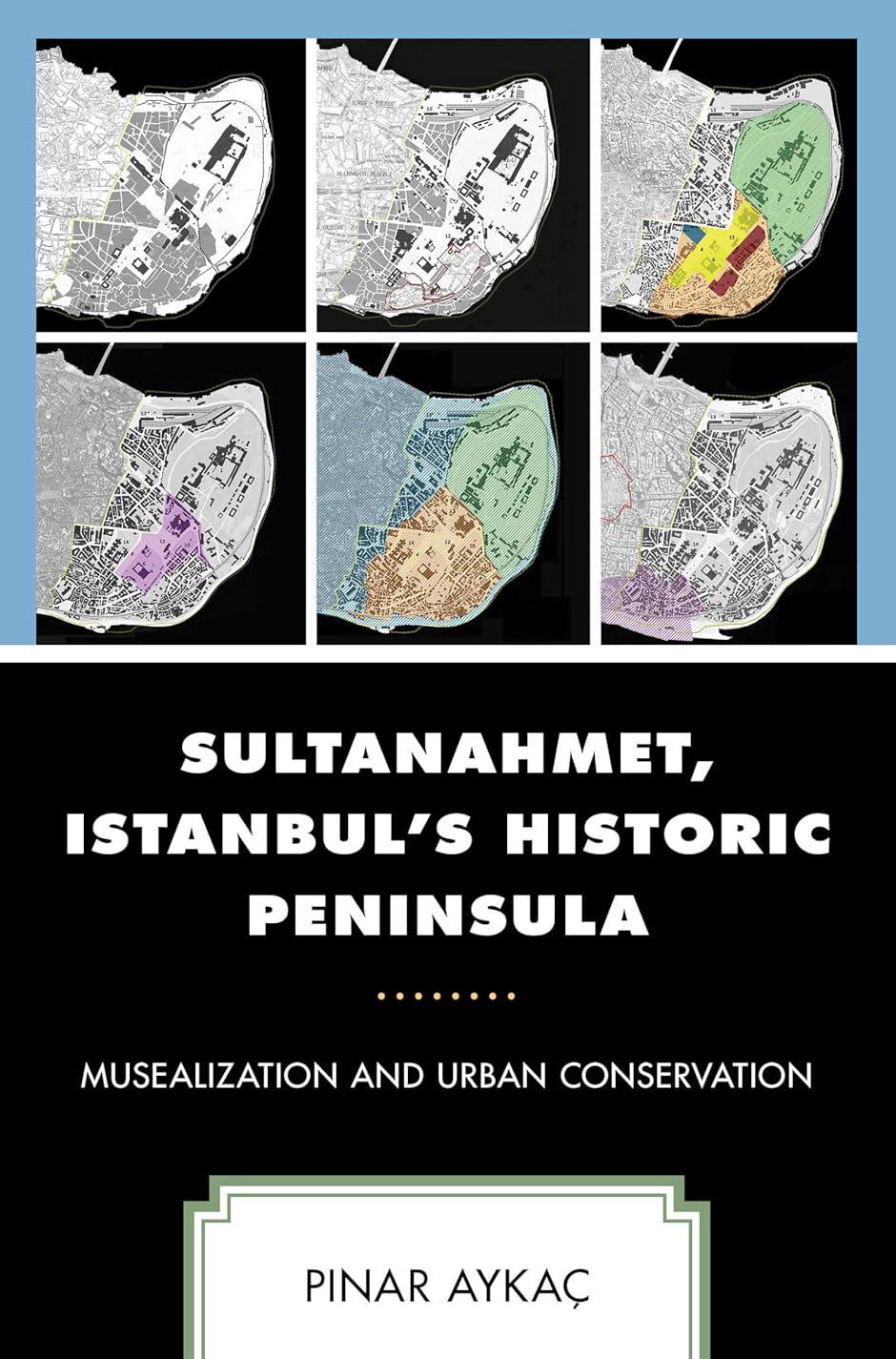
Sultanahmet, Istanbul’s Historic Peninsula: Musealisation and Urban Conservation Bloomsbury, 2022
This book explores how the museum concept has expanded beyond the boundaries of a single building into the historic city itself through musealisation. Articulating the musealisation of historic cities as a specific urban process, the book here presents a study of the transformation of the Sultanahmet district on Istanbul’s historic peninsula, which has been the major focus of planning, conservation and museological studies in Turkey since the nineteenth century as the public face of the city.
Aykaç offers empirically grounded and context-specific insight into the role of museums in the regeneration of historic cities. Musealisation as an urban process varies in different geographical, cultural, and ideological contexts, and across different time periods. By discussing the Sultanahmet district as a specific context of yet another city subjected to the musealisation process, this book provides further insights into this important global phenomenon.
Architecture: The 586-year-old
Spiritello in Il Regno Digitale
UCL Press, 2022
Experiments with Body Agent Architecture puts forward the notion of body agents: non-ideal, animate, and highly specific figures integrated with design to enact particular notions of embodied subjectivity in architecture. Body agents present opportunities for architects to increase imaginative and empathic qualities in their designs, particularly amidst a posthuman condition.
Beginning with narrative writing from the viewpoint of a body agent, an estranged ‘quattrocento spiritello’ who finds himself uncomfortably inhabiting a digital milieu (or, as the spiritello calls it, ‘Il Regno Digitale’), the book combines speculative historical fiction and original design experiments. It focuses on the process of creating the multimedia design experiments, moving from the design of the body itself as an original prosthetic to architectural proposals emanating from the body.
A fragmented history of the figure in architecture is charted and woven into the designs, with chapters examining Michelangelo’s enigmatic figures in his drawings for the New Sacristy in the early sixteenth century, Gian Lorenzo Bernini’s physically ephemeral ‘putti’ adorning chapels and churches in the seventeenth century, and Austrian artistarchitect Walter Pichler’s personal and prescient figures of the twentieth century.

Following the crisis of the Special Period, Cuba promoted urban agriculture throughout its towns and cities to address food sovereignty and security. Through the adoption of state recommended design strategies, these gardens have become places of social and economic exchange throughout Cuba.
This book maps the lived experiences surrounding three urban farms in Havana to construct a deeper understanding about the everyday life of this city. Using narratives and drawings, this study uncovers these sites as places where education, intimacy, entrepreneurism, wellbeing, and culture are interwoven alongside food production. Henri Lefebvre’s latent work on rhythmanalysis is used as a research method to capture the everyday beats, particular to Havana, which surround these sites. This book maps the many ways in which these spaces shift power away from the state to become places that are co-created by the community to serve as a crucial hinge point between the ongoing collapse of the city and its future wellbeing.
Resisting Postmodern Architecture: Critical Regionalism Before Globalisation
UCL Press, 2022
Since its first appearance in 1981, critical regionalism has enjoyed a celebrated worldwide reception. The 1990s increased its pertinence as an architectural theory that defends the cultural identity of a place resisting the homogenising onslaught of globalisation. Today, its main principles (such as acknowledging the climate, history, materials, culture, and topography of a specific place) are integrated in architects’ education across the globe. But at the same time, the richer cross-cultural history of critical regionalism has been reduced to schematic juxtapositions of ‘the global’ with ‘the local’.
Retrieving both the globalising branches and the overlooked cross-cultural roots of critical regionalism, Resisting Postmodern Architecture resituates critical regionalism within the wider framework of debates around postmodern architecture, the diverse contexts from which it emerged, and the cultural media complex that conditioned its reception. In so doing, it explores the intersection of three areas of growing historical and theoretical interest: postmodernism, critical regionalism, and globalisation.
Based on more than 50 interviews and previously unpublished archival material from six countries, the book transgresses existing barriers to integrate sources in other languages into anglophone architectural scholarship. In so doing, it shows how the ‘periphery’ was not just a passive recipient, but also an active generator of architectural theory and practice.
Stylianos Giamarelos challenges long-held ‘central’ notions of supposedly ‘international’ discourses of the recent past, and outlines critical regionalism as an unfinished project apposite for the twenty-first century on the fronts of architectural theory, history, and historiography.
The City in the City: Architecture and Change in London’s Financial District
MIT Press, 2023
In The City in the City, Amy Thomas offers the first in-depth architectural and urban history of London’s financial district, the City of London, from the period of rebuilding after World War II to the explosive climax of financial deregulation in the 1980s and its long aftermath. Thomas examines abstract financial ideas, political ideology, and invisible markets as concrete realities; working on four spatial scales—city, street, facade, and interior—the book explores the grand plans, hidden alleys, neo-Georgian elevations, and sweaty dealing floors that have made the financial centre work.
Moving from politics to sociology, institutions to bodies, development plans to office desks, Thomas unravels the rich entanglements between the structure of the UK’s financial system and the structure of the environment in which it operates. Despite its physical and political centrality, this period of the City’s architectural history occupies an academic lacuna. Longstanding prejudices about developer-led architecture and the real estate industry have obscured the post-war City’s relevance. The book shows how, as currents of local government reform, nation-building, and globalisation swept across Britain, the City became an ideological battleground for debates between politicians and financial institutions, real estate developers and architects, preservationists and so-called ‘proactive’ planners throughout the latter half of the century.
The City of London is a place steeped in rich cultural and architectural heritage of immense national significance, yet it is also a highly privileged citadel at the core of global financial networks. The City in the City is both a critique and a celebration of this unique and complex place.
Urban Surfaces, Graffiti, and the Right to the City Routledge, 2024
This landmark book focuses on urban surfaces, on exploring their authorship and management, and on their role in struggles for the right to the city. Graffiti, pristine walls, advertising posters, and municipal signage all compete on city surfaces to establish and imprint their values on our environments. It is the first time that the surfacescapes of our cities are granted the entire attention of a book as material, visual, and legal territories.
The book includes a critical history of graffiti and street art as contested surface discourses and argues for surfaces as sites of resistance against private property, neoliberal creativity, and the imposition of urban order. It also proposes a seven-point manual for a semiotics of urban surfaces, laying the ground for a new discipline: surface studies. Page after page and layer after layer, surfaces become porous and political and emerge as key spatial conditions for rethinking and re-practising urban dwelling and spatial justice. They become what the author terms the surface commons.
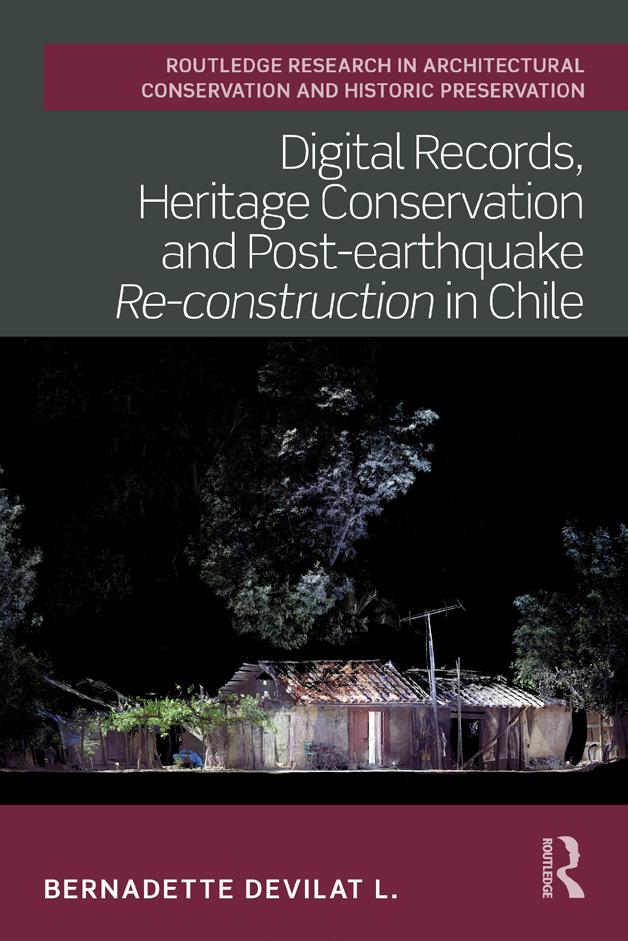
Digital Records, Heritage Conservation and Post-earthquake
in Chile
Routledge, 2025
The conservation of built heritage implies constant intervention. One form of intervention is reconstruction, which, in the context of disasters, usually tries to bring buildings and places back to their previous state and is contested in heritage discourses. This book challenges reconstruction as a replica to physically preserve damaged built heritage by critically examining a context of constant change resulting from earthquakes — Chile — advocating for the digital record to be an analytical basis for design, following the principles embedded in historical domestic architecture.
Beyond monumental heritage, the focus is on the living heritage of the historical settlements of Tarapacá, Zúñiga, and Lolol, built with local resources and sustainable techniques. The book proposes re-construction as an alternative methodology, based on 3D-laser scanning, photography, and questionnaires, to analyse the as-built condition of earthquake-affected buildings, consider risk mitigation, and recognise adaptation to earthquakes and subsequent reconstructions. This is relevant for seismic-prone areas and built heritage at risk in general.
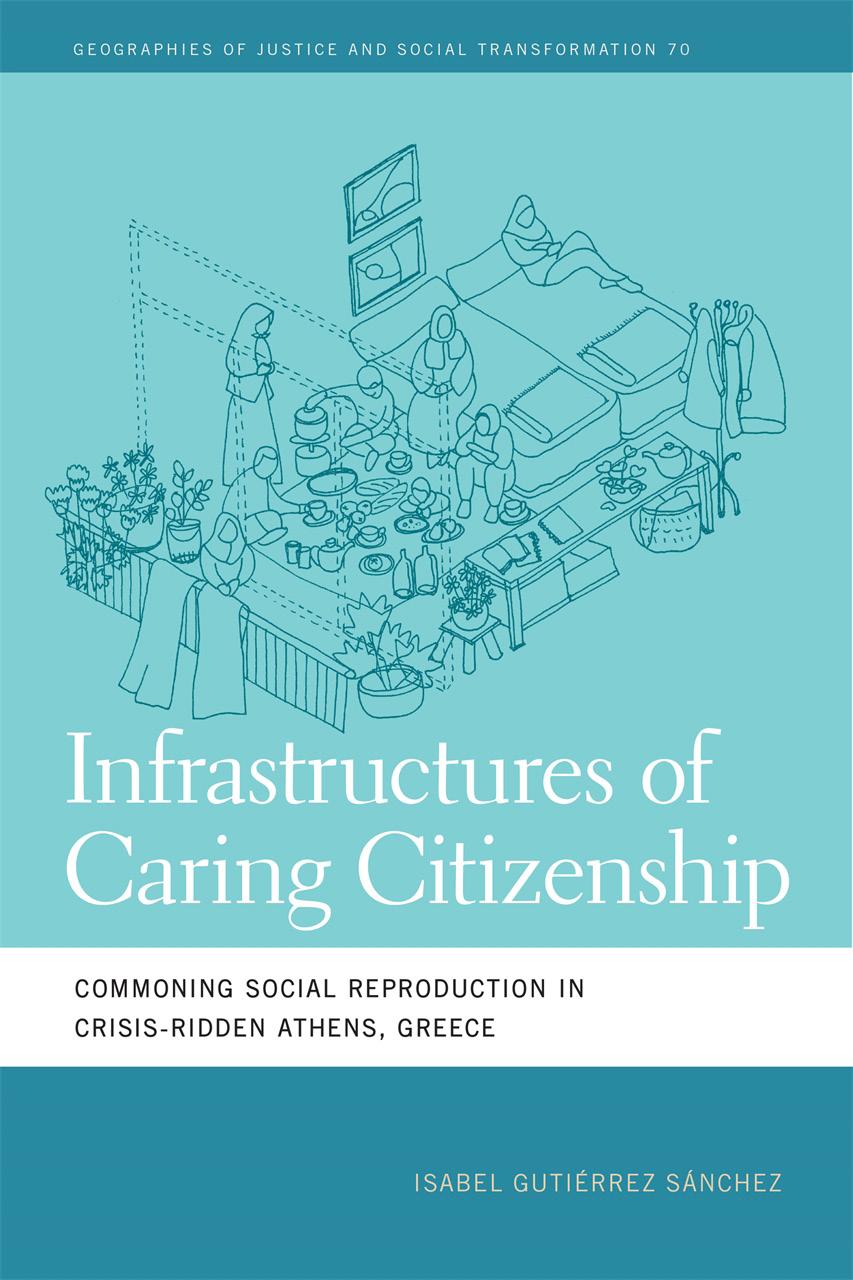
Infrastructures of Caring Citizenship: Commoning Social Reproduction in CrisisRidden Athens, Greece
University of Georgia Press, 2025
Infrastructures of Caring Citizenship examines instances of collective struggle and (re-) organisation of social reproduction against the backdrop of the crisis that followed the international banking crash in 2008. Drawing on a long-term engagement with four grassroots initiatives (a social kitchen, a social clinic, an accommodation centre with refugees, and a community centre), Gutiérrez Sánchez introduces the concept of Infrastructures of Caring Citizenship (ICCs) as a theoretical tool for the examination of spaces of collective resistance where new commons are formed that enable the sustenance of everyday life. Furthermore, the book unpacks how such resistance challenges crisis governmentalities, shedding light on how self-organised groups understand the stakes of their practices and the potential for radical social change embedded in them.
Making a unique contribution to debates connecting care and the commons, this book offers a theoretical framework grounded in a compelling narrative, inspiring insights for a new social imagination and practice beyond the conventional view of chronic crisis.
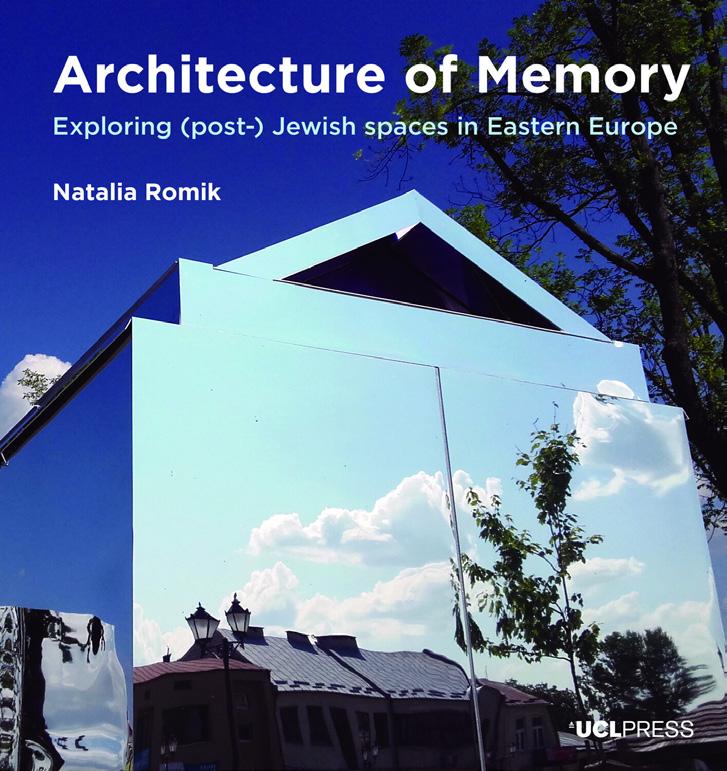
UCL Press, 2025
Architecture of Memory explores architectural disappearance, urban remembrance, and functional change amid social upheaval. Using archival, architectural, and artistic methods, Natalia Romik investigates the spectral architecture of former shtetls — predominantly Jewish towns in Central and Eastern Europe before the Second World War. After the war, these towns were repopulated by people of other nationalities, who reused former Jewish properties. Today, traces of the Jewish populations have nearly vanished from urban reality and public discourse. Romik’s work seeks to discover new ways to develop abandoned shtetl architecture, focusing on Jewish heritage sites like synagogue ruins and ritual baths.
Through an interdisciplinary approach that merges architectural design, contemporary art, and Jewish studies, Romik’s experimental research addresses the complex social issues of former shtetls by combining theoretical discussions with artistic performances and architectural interventions. The book documents projects ranging from subtle, mirror-clad interventions — such as the Nomadic Shtetl Archive, JAD, and Hurdy-Gurdy — to practical renovations that transform derelict synagogues and Jewish pre-burial houses into historical museums and cultural centres. These efforts confront the ‘present absence’ of these towns by merging theoretical discourse with archival research, artistic performances, and architectural interventions, aimed at investigating the lost Jewish communities’ spectral architecture.
Salted Earth: Poetics of Place and Migration Through Four Artistic Journeys
Intellect Books, 2026
This book combines art, history, and cultural studies, by way of a series of journeys on which the author and others make artworks. Each of these journeys resulted from an investigation into the meaning of an everyday substance, salt, in very different places — South Africa, Lithuania and Russia, Portugal and Haiti. Katy Beinart explores cultural meanings and everyday rituals of salt in these four journeys that link migration, trade, empire, slavery, and colonialism.
Histories of salt have showed how it has been central to trade, power, and capitalism, but these histories don’t offer a way of understanding salt’s poetics. Drawing on fiction, poetry, and art, Beinart weaves together an argument that develops a material poetics of salt, understanding how salt artworks can symbolise relationships, mobilities, migrations, memory, and intercultural connections from the past and present.
The book begins with a search for family history, and combines family memoir, travel stories, trade histories, auto-ethnographic reflection, and artistic process. The journeys, artistic practices, and embodied engagements with place and people that this book narrates are a way into a different understanding of material entanglements and relations through sensory experience which opens up other ways of knowing.
Rethinking the Pavilion: Shared Experience at the Vajrasana Buddhist Retreat Centre
UCL Press, 2026
Rethinking the Pavilion investigates one unique project in detail, the Vajrasana Buddhist Retreat Centre in rural Suffolk, completed by Walters and Cohen Architects in 2018. The result was an innovative building typology that has never been designed before in any western country. The process by which the Vajrasana project came into existence has come to define and shape the way in which the practice makes architecture, through a deepened understanding of how buildings can exert powerful social impacts on all who use them.
It was the Vajrasana Buddhist Retreat Centre project that enabled Walters and Cohen Architects to shift the focus away from the ideal pavilion to the social pavilion. While pavilions are usually seen as finished objects, this book argues that they can be seen as a process, namely a social process. The book describes how shared experience defines a new way of working towards an architecture that rediscovers and enriches its communal purpose. The ethos of Walters and Cohen’s practice has thus become one that encourages a broader conversation about architecture, with buildings seeking to convey a raw sense of place, and to reduce the many complexities of site and programme to the simplest arrangement and expression.
Sarah Akigbogun is an architect, filmmaker, writer, and educator. She currently teaches at The Royal College of Art and the Architectural Association , and is the founder of Studio Aki, a Wallpaper Emerging Practice of 2021. Trained as an actor at the Drama Centre London, Central St Martins, Sarah is artistic director of Appropri8 Theatre, through which she uses performance as a way of provoking conversation about the built environment.
Part of Sarah’s work is advocacy within the profession; she is a former representative to the RIBA Council, Vice Chair of Women in Architecture, and founder of The XXAOC (Female Architects of Colour) Project.
Fawzeyah Alsabah is an architect, architectural historian, and interpreter-translator, specialising in immigration and family law. She holds a BA in Architecture from Kuwait University and an MA in Architectural History from the Bartlett School of Architecture, UCL. She is currently a PhD candidate in Architectural and Urban History & Theory at the Bartlett, where her research adopts a transdisciplinary approach to examine
the historical invisibility of Arabian Gulf women in architectural history. Her work engages with themes of archival erasure, narrative bias, fiction as spatial critique, and feminist historiography.
Oliver Brax qualified as an architect at the École Nationale Supérieure d’Architecture de Paris Belleville, and is currently a PhD student in Architectural and Urban History & Theory at the Bartlett School of Architecture, UCL. His research focuses on the history of workers’ housing in France, and more broadly with the interactions between architectural design and political discourse. He has previously taught as an assistant tutor in history and graphic arts at BA and MA levels. He is the recipient of the London Arts and Humanities Partnership (LAHP) studentship
Lubaba Fakeih is a PhD candidate in Architectural Space & Computation at the Bartlett School of Architecture, UCL. Her research focuses on crowd dynamics, spatial behaviour, and the intersection of AI and socio-spatial analysis. With a background
in architecture, computer science, urban design, and space syntax, her work combines spatial network modelling with AI-based movement tracking to develop more nuanced frameworks for understanding human navigation. Her current research examines gendered movement patterns in Saudi Arabia through a case study at Cyan Waterpark, integrating computer vision, geospatial analysis, and unsupervised clustering to uncover socio-cultural influences embedded in spatial behaviour.
Mona Ghoreshinejad is a PhD student in the Space Syntax Lab at the Bartlett School of Architecture, UCL. Having worked as an architect in Iran and as an architectural assistant in the UK, she has consistently prioritised users’ needs, preferences, and behaviours in the design process. Her academic and professional commitment to user-centred design led her to join the Space Syntax Lab, where she now investigates the relationship between urban spatial form and human behaviour. Her research focuses on understanding how town squares serve as sites of everyday heritage and how design can better support meaningful, everyday experiences for diverse communities in British counties.
Jessica In is an architect, creative coder, and educator investigating AI in creative design practice. Her work explores computation, machine learning, interaction, and performance within architectural design. Through an autoethnographic approach, she examines how machine-learning models — and especially large language models and diffusion models — function in architectural design. Rigorously critical of AI while maintaining optimism about humanity and design’s role within it, her research questions how generative AI systems affect
authorship and agency, through a series of artificial artefacts that rewrite memories, experiences, and spatial representations
Ahmed Jawdat is an architect, urban designer, and planner. He completed his undergraduate and graduate studies in the United States between Miami and New York City, receiving his MSci in Architecture and Urban Design from Columbia University. Before starting his PhD at the Bartlett School of Planning, UCL, Ahmed worked on projects across the Kingdom of Saudi Arabia that are part of the country’s ambitious Vision 2030 and contribute to its transforming urban landscape. Ahmed’s research interests include the evolution of urban dynamics and social interactions in cities amid global technological advancements, with his PhD exploring this topic within the Saudi context.
Tanjina Khan is a Bangladeshi architect, educator, and doctoral candidate at the Bartlett School of Architecture, UCL. She holds a an MSci from The University of Sydney as an Endeavour Award recipient and a BA in Architecture from BRAC University, where she was awarded with a gold medal. Funded by the Prime Minister Fellowship, Bangladesh, her PhD investigates how oral and experiential knowledge can illuminate the formal-informal dichotomy in architectural adaptation within dense urban contexts of the Global South. Tanjina cofounded the Bartlett Doctoral Co-Formality Network, works as a postgraduate teaching assistant, and remains engaged in publishing, teaching, research collaborations, and civic discourse on architecture and urbanism
Zijiao Li is a PhD candidate in the Architectural and Urban History & Theory programme at the Bartlett School of Architecture, UCL, following her MA in Architectural History. She also holds a BA in Art History and Studio Art from Bard College. Zijiao’s research interests include Chinese urban history and culture, architectural ecologies of human and animal life, and Wanghong urbanism in China. She is the recipient of the AHRC studentship (2024-26) and UCL Doctoral School funding.
Thomas Parker is an architectural designer, metrologist, and media artist whose research intersects the fields of 3D scanning, computer vision, and artificial intelligence. Thomas’s design-led research specialises in forms of experimental representation and manufacturing, focusing on the critical overlap between digital technologies of space sensing, and their analogue counterparts. Thomas is Associate Professor and Director of Media at the Bartlett School of Architecture, UCL, leveraging over a decade of 3D -scanning experience in industry to lead cutting-edge teaching and design research around the future of sustainable and adaptive urban environments.
Divya Priyesh Shah is a landscape researcher and academic from India. Her research focuses on collective ways of gathering place narratives, knowings and situated spatial practices of monsoon geographies through embodied and immersive fieldwork. She has taught at CEPT University, Ahmedabad, leading landscape design studios. Her doctoral research examines how the Kanikkarans, an earlier peripatetic Indigenous community of the Southern Western Ghats, bring an expansive and generational understanding of their mountain-monsoon-forest biome to their
present-day, more sedentary lives, rituals, and spatial practices. Funded by the LAHP, her PhD is also supported by UCL’s Doctoral School funding.
Mine Sak-Acur holds a BArch from Istanbul Technical University and an MA in Architectural History from the Bartlett School of Architecture, UCL, where she is now a PhD candidate. Her research explores how playground design shapes children’s game-making processes and social interactions. Through her teaching, she supports the Space Syntax programme at UCL, leading weekly site visits around London to investigate the social life within buildings. She also contributes to interdisciplinary research projects, including PaRCEL at UCL’s Institute of Education and Building4Belonging at Leiden University, Delft, and the University of Twente, Enschede, in collaboration with psychologists, psychiatrists, and computer scientists. Previously, she practised as an architect and researcher in Istanbul.
Dr Jhono Bennett is a South African architect and researcher whose work examines spatial practice, design processes, and the role of the architect within complex and rapidly changing urban environments. He is the co-founder of 1to1 – Agency of Engagement and has led a range of multi-scalar projects across South Africa, with a focus on Johannesburg and its evolving spatial conditions. His academic work explores spatial histories, tacit knowledge, and designerly methods for understanding contemporary city-making. Jhono completed his PhD at the Bartlett School of Architecture, UCL, where his research developed new approaches to situated architectural practice.
Dr Sebastian Buser works at the intersection of creative practice, spatial research, and community projects, exploring queer DIY spaces through trans theory, queer theory, feminist philosophy, and exploratory academic writing. He has contributed to the exhibition ‘Queer Spaces: London, 1980s–Today’ at the Whitechapel Gallery (2019) and the edited volume Queer Spaces: An Atlas of LGBTQIA+ Places and Stories (Furman & Mardell, 2022). He is currently employed by IMPACT at the University of Birmingham to facilitate a project with Newham Council in London, examining ways to improve adult social care for LGBTQIA+ communities
Dr Pol Esteve Castelló is an architect, researcher, and educator whose practice explores the relationship between space, technology, and the body, with a focus on noncanonical histories, collective architectures, non-normative bodies, and aesthetics as a political tool. They are the author of the book Arquitecturas Peligrosas (Puente Editores, 2025), a collection of essays that explores
sexuality, comfort, gender, pleasure, and health in relation to architecture. They are the cofounder of the design studio GOIG, which won the FAD Prize for Spain and Portugal (2022, 2024, 2025). They are affiliated with the Architectural Association and the Chair of Architecture and Care at ETH Zurich.
Dr Fernando P. Ferreira is an architect and researcher based in Porto, Portugal. His practiceled research interweaves architecture with art, writing, and performance to interrogate spatial, political, and ecological issues in the built environment. He holds an MA from The School of Architecture, Art and Design (EAAD) at the University of Minho and a PhD in Architectural Design from the Bartlett School of Architecture, UCL. He teaches at the University of Porto and the University of Minho, and is the co-founder of Space Transcribers, with which he took part in the exhibition ‘Fertile Futures’, representing Portugal at the Venice Biennale of Architecture in 2023. Fernando was the curator of three researchcultural projects for Braga 25, Portuguese Capital of Culture 2025.
Dr Emma Louise Gribble developed her PhD proposal after working for architectural practices embedded in a national charity and a London Borough, and a practice specialising in clientcentred design and consultation. Building on her MSc thesis which looked at generic briefs prepared by three government organisations, her doctoral research explores the live briefing process for a one-off, socially complex architectural project. Her research interests include client-side argumentation as it impacts on design decisions, the co-evolution of institutions and the buildings that accommodate them, and the application of social research methodologies to the study of architecture
Dr Danielle Hewitt is an artist and historian with a BA in Fine Art Practice from Goldsmiths and an MA and a PhD in Architectural History from the Bartlett School of Architecture, UCL. Her historical and artistic research has been supported by the Society of Architectural Historians of Great Britain, the British Council, and the British Archive for Contemporary Writing at the University of East Anglia. During 2026, Danielle is in receipt of a Postdoctoral Fellowship from the Paul Mellon Centre for Studies in British Art. Danielle teaches at the Bartlett School of Architecture, UCL, and London Metropolitan University.
Dr Sheng-Yang (William) Huang is a Design lecturer at the Bartlett School of Architecture, UCL, and a Landscape Urbanism tutor at the Architectural Association. He received his PhD in Architecture & Digital Theory from the Bartlett School of Architecture, UCL. His research spans digital design, architectural and digital theory, design computation, and cognitive science, focusing on how connectionism reshapes architectural rationality and advances datacentric, probabilistic strategies for emergent form. Huang is a Fellow of the Royal Society of Arts (FRSA) and a member of RIBA.
Dr Melih Kamaoğlu is an architectural historian and theorist. He is an assistant professor in the Department of Architecture at Karadeniz Technical University. In 2023 he was a visiting scholar at Yale University. In 2025, he received his PhD in Architecture & Digital Theory from the Bartlett School of Architecture, UCL. He completed his BArch and his MArch at Karadeniz Technical University (in 2017 and 2020, respectively). His primary research interests include bio-digital design, computation, evolutionary theory, and the philosophy of
nature. His doctoral research was funded by the Ministry of National Education of the Republic of Türkiye.
Dr Emma-Kate Matthews is an architect, composer, musician, and researcher. She is also the founder of EKM Works, which explores spatiosonic practice. Her work has been exhibited internationally. Her music has been performed at the Sagrada Familia, the Barbican, and the Southbank Centre, released on labels such as Algebra and NMC, and broadcast on BBC Radio 3 and Radio Tokyo. Her research has been published in the journals Humanities & Social Sciences Communications, Organised Sound and Drawing. She is an associate professor at the Bartlett School of Architecture, UCL. She is also the lead editor of The Routledge Companion to the Sound of Space. Emma-Kate hosts a monthly radio show on RTM.FM.
Dr Hamish Muir is a researcher, playwright, and artist. He holds MAs in Civil and Environmental Engineering and History of Art. In each of these subject areas, he developed an interest in theatre and sustainable design, which were the foundations for his doctoral research at the Bartlett School of Architecture, UCL. Hamish has collaborated and consulted with major theatres and theatre organisations in the UK, including the National Theatre. He recently edited A Guide to Sustainable Materials for Theatre Design for the Society of British Theatre Designers. In 2017, he set up Arctic Lion Theatre, which produces experimental performances by testing environmental design methodologies.
Dr Thi Phuong-Trâm Nguyen is a trained architect in Canada, a researcher and educator. She holds an MA in Architectural History & Theory from McGill University and completed her PhD in Architectural Design at the Bartlett School of Architecture, UCL, in 2025. Funded by the FRSCQ, her practice-led research addresses the temporality of the gesture of looking through the study of anamorphic constructions. Her design work explores different modes of attentiveness to the perceived with drawing, filmmaking, and writing. She is currently teaching studio and drawing at Université de Montréal and UQAM.
Dr Tom Ó Caollaí is an artist using a researchled ‘topographic practice’ to write and rethink architectural and landscape histories. This practice generates site-specific outputs ranging from writing, printed matter, and photography to film, installation, and performance. His work has been exhibited internationally, published widely (Places Journal, The Architectural Review, MacGuffin, Domus), and is held in the collections of the National Irish Visual Arts Library (NIVAL), National Art Library, London, and the School of Architecture Library at Princeton University. He is a lecturer at the Bartlett School of Architecture, UCL, and at the Cork Centre for Architectural Education.
Dr Diana Salazar is an ecologist who has been teaching MA programmes at UCL for ten years. Diana’s research addresses environmental justice and she specifically works with communities affected by mining in Latin America. She has written about the political ecology of seed cultivation in Colombia and the energy landscape in Maputo, Mozambique. Her current research links postcolonial theory with history, extractivism, and activism
Dr Petra Seitz is a design and architectural historian exploring the political economy of architecture and design. She holds a PhD from the Bartlett School of Architecture, UCL, an MA in History of Design from the Royal College of Art/Victoria & Albert Museum, and a BA in Politics from Oberlin College. Petra has taught at the University of Greenwich and the Bartlett School of Architecture, UCL, alongside her work as a founder and primary investigator on the Chandigarh Chairs project, an independent research endeavour studying Chandigarh’s modernist furniture and the operations of design markets.
Dr Wiltrud Simbürger is an independent architectural researcher and consultant who advises clients on thoughtful architectural responses to climate change. Her research critiques the prevailing reliance on ecological sustainability as a false panacea for a crisis of global and geological scale, and advances design research methods that engage with the broader discourse of the Anthropocene, instead. Wiltrud earned a diploma in Physics from the Ludwig- Maximilians-Universität in Munich and holds degrees in Architecture and Design Research from the University of Michigan, Ann Arbor. She is also the co-founder and coorganiser of the Dream-Play-Challenge Project.
Dr Yichang Sun is a Research Fellow in the Space Syntax Laboratory at the Bartlett School of Architecture, UCL. Grounded in space syntax, her research straddles urban morphology, urban history, spatial cultures, and community co-production. With a specific focus on mapping and the relationship between people and place, she has worked with the Tools of Knowledge, Congruence Engine, Healthy Urban Places, and Roads from London projects. Taking a place-
based approach, her doctoral research explores how urban form and everyday life intertwine across space and time in Nanjing from the twentieth century onwards.
Dr Sé Malaïka Tunnacliffe is a researcher, writer, and multidisciplinary creative exploring place, belonging, and identity. Their work combines academic research with collage, photography, film, and creative writing, focusing on public interventions and activism. Projects include studies of environmentally engaged street art, artists’ roles in Accra’s informal settlements, mental health in urban environments, and how lesbians used activism to shape and inhabit urban space in 1980s London. Across their practice, they examine how communities create meaning, connection, and resistance through placemaking. In 2025, they founded the Margate Queer Library & Archive and are researching the Walpole Tidal Pool as trans architecture.
Dr Dingyi Wei holds a BA in Architecture from Shandong University, Jinan. She then pursued an MArch in Design for Performance & Interaction at the Bartlett School of Architecture, UCL, focusing on experience curation in virtual reality. In January 2025, she received her PhD in Architectural Space & Computation, researching the ‘deviations’ between intended and actual museum visitor experiences. Her work combines digital technology with art and science curation, leveraging her architectural background and programming skills to investigate and create interactive, site-specific installations.
Dr Azadeh Zaferani is a lecturer at the Bartlett School of Architecture, UCL, and codirector of the Ab-Anbar Gallery in London. Working at the intersection of design, history and theory, her research examines the political agency of architecture through the lenses of material culture and biopolitics.
Supervisors of current MPhil/PhD students
Dr Allen Abramson (UCL Anthropology), Professor Peter Bishop (Bartlett), Professor Camillo Boano (Bartlett Development Planning Unit), Professor Iain Borden (Bartlett), Dr Roberto Bottazzi (Bartlett), Professor Eva Branscome (Bartlett), Professor Barbara Campbell-Lange (Bartlett), Professor Ben Campkin (Bartlett), Professor Brent Carnell (Bartlett), Professor Mario Carpo (Bartlett), Professor Nat Chard (Bartlett), Professor Marjan Colletti (Bartlett), Dr Ludovic Coupaye (UCL Anthropology), Professor Marcos Cruz (Bartlett), Professor Edward Denison (Bartlett), Professor Ava Fatah gen. Schieck (Bartlett), Professor Murray Fraser (Bartlett), Professor Stephen Gage (Bartlett), Professor Nick Gallent (Bartlett School of Planning), Dr Jin Gao (UCL Information Studies), Dr Lidia Gasperoni (Bartlett), Dr Stylianos Giamarelos (Bartlett), Dr Jane Gilbert (UCL School of European Languages, Culture and Society), Dr Sam Griffiths (Bartlett), Dr Kostas Grigoriadis (Bartlett), Professor François Guesnet (UCL Hebrew & Jewish Studies), Peter Guillery (Bartlett), Professor Sean Hanna (Bartlett), Professor Penelope Haralambidou (Bartlett), Dr Duncan Hay (Bartlett CASA), Professor Andy Hudson-Smith (Bartlett), Professor Tariq Jazeel (UCL Geography), Dr Rebecca Jennings (UCL History), Professor Simon Julier (UCL Computer Science), Professor Kayvan Karimi (Bartlett),
Dr Jan Kattein (Bartlett), Dr Kimon Krenz (Bartlett), Dr Stephen Law (UCL Geography), Dr Guan Lee (Bartlett), Dr Chris Leung (Bartlett), Dr Barbara Lipietz (Bartlett), Dr Emily Mann (Bartlett), Professor Yeoryia Manolopoulou (Bartlett), Peter McLennan (Bartlett School of Planning), Professor Clare Melhuish (UCL Urban Lab), Professor Mark Miodownik (UCL Mechanical Engineering), Professor Mehran Moazen (UCL Mechanical Engineering), Professor Sharon Morris (Slade), Dr Michal Murawski (School of Slavonic & East European Studies), Dr Shaun Murray (Bartlett), Professor Catalina Ortiz (Bartlett Development Planning Unit), Dr Brenda Parker (UCL Biochemical Engineering), Dr Claudia Pasquero (Bartlett), Dr Luke Pearson (Bartlett), Professor Alan Penn (Bartlett), Professor Barbara Penner (Bartlett), Professor Sophia Psarra (Bartlett), Dr Lakshmi Priya Rajendran (Bartlett), Professor Peg Rawes (Bartlett), Guang Yu Ren (Bartlett), Professor Jane Rendell (Bartlett), Dr David Roberts (Bartlett), Dr Daniela Romano (UCL Information Studies), Professor Kerstin Sailer (Bartlett), Professor Pablo Sendra (Bartlett School of Planning), Professor Tania Sengupta (Bartlett), Professor Bob Sheil (Bartlett), Professor Alan Smith (UCL Space & Climate Physics), Professor Philip Steadman (Bartlett), Dr Dean Sully (UCL Institute of Archaeology), Colin Thom (Bartlett), Dr Tasos Varoudis (Bartlett), Professor Laura
Vaughan (Bartlett), Dr Nina Vollenbröker (Bartlett), Professor Tim Waterman (Bartlett), Dr Robin Wilson (Bartlett), Professor Oliver Wilton (Bartlett), Dr Filipa Wunderlich (Bartlett), Dr Fiona Zisch (Bartlett), Dr Stamatis Zografos (Bartlett).
Current Architectural Design MPhil/PhD students
Sarah Akigbogun, Lena Asai, Sarah Aziz, Kirsty Badenoch, Richard Beckett, Laurence BlackwellThale, Jessica Buckle, William Victor Camilleri, Niccolo Casas, Jingwen Chen, Giorgos Christofi, Nichola Czyz, Xiaowen Fu, Naomi Gibson, Beatriz Gomes-Martin, Felix Graf, Wisnu Hardiansyah, Jessica In, Marianna Janowicz, Nikoletta Karastathi, Tanjina Khan, Paul King, Mike Kwok, Dionysia Kypraiou, Alexandra Lacatusu, Rebecca Loewen, Elin Eyborg Lund, Mengdi Mao, Luke Marriot, Nyima Murry, Giles Nartey, Aisling O’Carroll, Daniel Ovalle Costal, Annarita Papeschi, Thomas Parker, Matthew Poon, Zoe Quick, Sayan Skandarajah, Elin Lund, Ben Spong, Jonathan Tyrrell, Jiayi (Silver) Wang, Jocelyn Wang, Stuart Watson, Hangchuan Wei, Jordan Whitewood-Neal, Anna Wild, Henrietta Williams, Eric Wong, Ruining Xie, Sandra Youkhana, Nona Zakoyan.
Current Architectural and Urban History & Theory MPhil/PhD students
Alena Agafonova, Atheer Al Mulla, Fawzeyah Alsabah, Reza Arlianda, Oliver Brax, Thomas Callan, Paola Camasso, Canyang Cheng, Isabelle Donetch, James Dunbar, Olivia Duncan, Kirti Durelle, Christiane Felber, Harry Foley, Christina Garbi, Vaishnavi Gondane, Aylin Gürel, Yuxin Huang, Rían Kearney, Adarsh Lanka, Hanchun Li, Zijiao Li, Te-Chen Lu, Duy Mac, Manish Mandhar, Guy Mannes-Abbott, Yekaterina Martinez Panina, Ana Mayoral Moratilla, Johanna Muszbek, Bashayer Kadhim, Deníz Ozbek Kocak, Divya Priyesh Shah, Patricia Rodrigues Ferreira da Silva, Xinyue Tian, Kivilcim Göksu Toprak, Carla Tosi Seppe, Maria Venegas Raba, Junzhe Yuan, Katerina Zacharopoulou, Vid Znidarsic.
Current Architectural Space & Computation
MPhil/PhD students
Victoria Barker, Busra Berber, Qu Boyu, Tian Chen, Constance Desenfant, Lubaba Fakeih, Seyedehmona Ghoreshinejad, Demin Hu, Liang Jiadong, Abdulkadir Kacan, Efstathia Kostopoulou, Lian Lei, Marc Levinson, Tairan Li, Jiadong Liang, Pham Vu Hoang Linh, Yubo Liu, Velina Mirincheva, Besnik Murati, Merve Okkali Alsavada, Duygu Ozden, Sayon Pramanik, Stamatios Psarras, Boyu Qu, Mine Sak-Acur, Daniel Tang, Chen Tian, Nikolaus von Rönne, Bek Wa Goro, Chunling Wu, Liu Yubo, Yancheng Zhu.
Current Architecture & Digital Theory MPhil/PhD students
Xinyu Chen, Ioana Drogeanu, Zahira El Nazer, Alberto Fernández González, Mark Garcia, Thomas Holberton, Balaji Rajasekaran, Elly Selby, Meng Xia.
Current Architectural Practice MPhil/PhD students
Shibo Chen, Tumpa Husna Yasmin Fellows, Abdulbari Kutbi, Feysa Amalia Poetry, Michiko Sumi, James Tait, Aymée Thorne Clarke.
Submitted and/or completed doctorates in 2025
Omar Abolnaga, Vasileios Aronidis, Yichuan Chen, Stephannie Fell, Melih Kamaoğlu, Chenyang Li, Feinan Li, Xiaoming Li, Xiuzheng Li, Yiming Liu, Yuxing Liu, Emma-Kate Matthews, Petra Seitz, Yichang Sun, Anna Talvi, Henrietta Williams, Sepehr Zhand.
This catalogue has been produced to accompany PhD Research Projects 2026, the 20th annual conference devoted to doctoral research at the Bartlett School of Architecture, UCL, 24 February 2026. Edited by Stylianos Giamarelos and Oliver Brax.
Copyright © 2026 the Bartlett School of Architecture, UCL.
All rights reserved. No part of this publication may be reproduced or transmitted in any form or by any means, electronic or mechanic, including photocopy, recording, or any information storage and retrieval system without permission in writing from the publisher. www.ucl.ac.uk/bartlett/
SARAH AKIGBOGUN
FAWZEYAH ALSABAH
OLIVER BRAX
LUBABA FAKEIH
MONA GHORESHINEJAD
JESSICA IN AHMED JAWDAT
TANJINA KHAN
ZIJIAO LI
THOMAS PARKER
DIVYA PRIYESH SHAH
MINE SAK-ACUR
Cover image: Reconstructing Nasmyth (RN), ‘Illustration of Nasmyth’s Hand - Study #01 - Plan’. Neural Radiance Field representation (Author: Thomas Parker, 2024)