
![]()


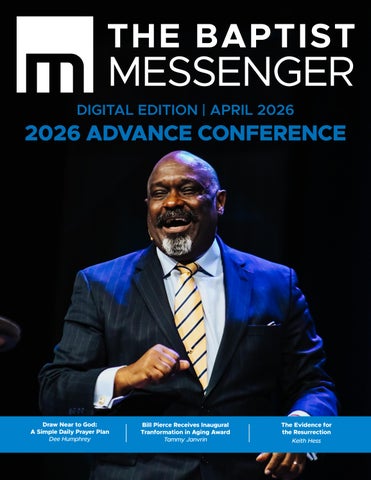
MOORE — Hundreds of Oklahoma Baptists attended the annual Advance Conference, March 2-3 at Moore, First. This annual event focuses on equipping pastors and church leaders with skills and methods to improve Gospel ministry in their churches.
Mon., March 2 began with registration at 9:30 a.m. Then, Alan Quigley opened the first session by welcoming everyone and highlighting the speakers who were about to present and the breakouts that were to be held on March 3. After that, Oklahoma City, Quail Springs’ worship team led in praise.
Monty Patton, Arizona Mission Network, spoke during the first session of the Advance Conference from John and Peter. He focused on instructing pastors in finding the “one” person to minister to. The core of missions is taking the Gospel to those who haven’t heard it and make disciples.
“We are all called to be disciple-makers,” Patton said.
Another advantage to discipling one person or a group of people is that pastors can find the person they want to replace them. The next generation of disciple makers can only be made by those who are willing to make disciples.
Patton warned pastors not to take on more than they are prepared for and only focus on the important things.
“Successful people don’t let unimportant things become important and don’t let the important things become unimportant,” Patton said.
Todd Sanders, Oklahoma Baptists Youth Ministry partner and Falls Creek program director, then led a moment of reflection on the previous sermon.
Following a lunch break, Oklahoma City, Quail Springs pastor Connor Bales called pastors to focus more on disability ministry. As a father who has two children with disabilities, Bales is dedicated to reaching those in the church who are often unreached.
“We are to minister to the families in our care, that includes those with disabilities,” Bales said. “95 percent of families marked with disability are unchurched.”
Another set of worship was led by Oklahoma City, Quail Springs before Bales returned for the second session. He emphasized the importance of listening to what the Lord is saying and baptism. He also encouraged pastors to not stay silent, saying that words are required to preach the Gospel.
After a short break and time of worship, Mark Croston, National Director of Black Church Ministries for Lifeway, spoke on the steps of discipling: Teach, Train, Tutor, Test, Repeat. Croston said that the average church goer is not good at discipling, but by following the steps they can get better. He also said that pastors can only get better at discipling by following Jesus, the Master Discipler, and being more open.
“You can only become a discipler when you allow people into your personal space and personal life,” Croston said. He concluded the third session by encouraging pastors not to give up and to stay motivated through all seasons of life.
“Don’t ever deflate,” he said. “Just shake the dust off your feet and stay on mission for Jesus.”
Following a dinner break, Sarah Hagar, Oklahoma Baptists Children’s Ministry Partner hosted a panel with Emily Townley, Karen Kennemur and Charlie Blount on how to reach children with the Gospel.
Then Zack Randles, pastor at Washington, D.C., Waterfront, delivered the final sermon for Monday. Randles focused on what the Gospel was made for, sinners, and that pastors need to be willing to get their hands dirty to reach those who are lost.
“The Gospel cannot advance unless we are willing to get our hands dirty,” he said. “The shed blood of Jesus Christ is the only thing that can make us clean.”
Randles also told pastors not to get impatient as it often takes time for movements to begin. God calls us to be patient and even great evangelists had to remain patient and remain faithful in prayer.
“We are called to have patience with the world, the same patience God had for us,” Randles said.
The next day, Tues., March 3, began with numerous breakout sessions that covered all areas of ministry. Topics included children’s ministry, artificial intelligence usage in the church, how to evangelize and more. After two sets of breakouts, attendees took a lunch break before returning for the final session of the Advance Conference.
Joe Sherrer opened the pre-session with guidance on how pastors should structure their Sunday Schools. He said that classes should focus on teaching, outreach and ministry, being genuine in wanting to teach those who attend.
“If you do not care for the people, no matter how quality the Bible teaching or your Gospel centered outreach, if they figure you are just in it for the numbers, they will quickly depart,” Sherrer said.
Finally, Robert Smith, Distinguished Professor of Divinity at Beeson Divinity School of Samford University, spoke for the final session of the Advance Conference. He opened with an explanation of “imago dei,” image of God, and “missio dei,” the mission of God. Smith reminded pastors that they must be focused on both by proclaiming the Gospel and magnifying Who God is. The best way to do this, Smith said, is by deeply studying the Word, trusting the Word and preaching the Word, throwing off the things that are keeping pastors from being God bearers.
For more information on Advance Conference, visit oklahomabaptists.org/evangelism/advance-conference/.


by Dee Humphrey, Women’s Ministry Leader at Grove, First

“The prayer of a righteous person is powerful and effective.” - James 5:16
There are days when I pray that I don’t always know what to say (I know, shockers). I truly love God, but my thoughts often get scattered.
We all know that prayer isn’t about saying everything perfectly. It is about being present with the Lord, who already knows our hearts. To help me move from hurried words to steady communion, I developed this simple daily prayer plan. It’s not a formula, but a pathway in letting the Holy Spirit guide us to draw near to God.
1. Begin with Praise
We first need to acknowledge God for who He is before asking for things. Psalm 145:3 tells us, “Great is the Lord, and greatly to be praised, and His greatness is unsearchable.” Let us fix our eyes on God’s holy character daily. It will help us move from self-focused to Savior-focused.
2. Give Thanks
Next, let gratitude soften our hearts. Psalm 100:4 tells us to, “Enter His gates with thanksgiving.” And being grateful is a must for all believers. Every good gift we have comes from God. We can even thank Him for the lessons learned in those difficult seasons. Afterall, He gave us salvation through Jesus.
3. Examine and Confess
Getting close to God requires an honest “Search me, God, and know my heart.” -Psalm 139:23 It also involves asking the Lord to reveal anything that needs repentance. Let us not forget that confession is not condemnation. It’s restoration. Only then can we draw close to God and be forgiven.
4. Read His Word and Reflect
When reading Scripture, ask God for understanding and to “Open my eyes that I may see wonderful things.” – Psalm 119:18 Then ask: What does this teach me about God? How does this point to Jesus? Is there a sin to confess? A promise to trust? A command to obey? Then pause. Listening is also part of prayer. John 10:27 echoes this truth: “My sheep listen to my voice.” Then let His Word shape your response.
5. Surrender and Take Action
James 1:22 reminds us, “Do not merely listen to the word…
Do what it says.” If the Spirit convicts you, surrender. If He comforts you, thank Him. Whenever He prompts you, quickly obey and take action.
6. Intercede and Bring Your Requests
1 Timothy 2:1 reminds us, “I urge… that prayers and intercession be made for all people.” Believers are to pray for Kingdom issues (lost souls, revival, and unity). We’re also to bring our own needs to the Lord. 1 Peter 5:7 says, “Cast all your anxiety on Him because He cares for you.” No burden is too heavy for God. And there is no request too small.
End the prayer where you began. Let us praise and acknowledge who God is and what Christ has done. 1 Timothy 2:5 proclaims, “For there is One mediator between God and mankind, the man Christ Jesus.” Scripture always points us to the powerful truth. God hears and receives our prayers through Jesus. He is the only Way. Our relationship grows when we faithfully draw near to God in prayer. Some days we will feel focused. On other days, we may be distracted, but keep coming. He is near.
If you’re looking for more ways to connect, I want to invite you to the Oklahoma Baptist Women’s Retreat, “Drawing Near,” on April 17–18, 2026. Together, we will gather to pray, worship, and seek God’s presence through His Word. So, join us as we draw near.


April 17-18, 2026
oklahomabaptists.org/women
by Tammy Janvrin, BVC Director of Communications
Long-serving President and CEO of Baptist Village Communities (BVC), Dr. Bill Pierce, was recognized with the inaugural Dr. Bill Pierce Transformation in Aging Award at the 2026 LeadingAge Oklahoma Annual Conference. Pierce has served for 35 years, leading BVC through decades of growth and innovation in senior housing and services.
Pierce was honored by Claire Dowers-Nichols, Chief Executive Officer of LeadingAge Oklahoma, who recognized his extraordinary contributions to senior adult services in Oklahoma and across the nation. She said, “I’ve seen firsthand the impact he’s made, and the way he truly cares for people. It’s a testament to his service and leadership.” Dowers-Nichols noted Pierce’s visionary leadership and guidance and highlighted that Pierce was an intricate part of growing Baptist Village Communities to be ranked among the nation’s top 50 largest not-for-profit multi-site senior living organizations in the LeadingAge Ziegler 200 (LZ 200) ranking and analysis.
Leading Age Oklahoma is the state association of notfor-profit and mission-driven organizations dedicated to establishing the highest standards of excellence for services to the aging, frail, and vulnerable in Oklahoma.
During the award presentation, several of Pierce’s peers and leadership partners shared reflections on his leadership, compassion, and sincerity. Steve Thomas, Senior Vice President of Baptist Village Communities, remarked, “Dr. Pierce instills in us the belief that what we do in aging services matters and can change the world.” Thomas added that Pierce has a unique gift “to see around the corner and prepare for what’s coming ahead.”
Pierce attributes his leadership journey to a calling to serve and emphasized both the challenges and opportunities within a rapidly evolving senior services landscape. “We are all pioneers in senior adult services,” Pierce said. He shared that scripture has anchored his approach throughout his career, citing Philippians 3:14: “I press on toward the goal for the prize of the upward calling of God in Christ Jesus.”
Pierce will retire at the end of 2026, concluding a remarkable chapter of day-to-day executive leadership at Baptist Village Communities. His impact and dedication will continue through his ongoing work with the Bill and Susan Pierce Institute for Transforming Life Expectancies, where he will remain focused on advancing resources, training, and thought leadership that strengthen services for older adults and the professionals who serve them.


by Keith Hess, Associate Professor of Philosophy and Apologetics Oklahoma Baptist University
What would you do if, hypothetically, you found out that Jesus did not rise from the dead? I am not sure what evidence would even be sufficient for that conclusion, but suppose the evidence was very strong.
Personally, I would be forced to leave Christianity. And I think Paul the Apostle would too. In I Corinthians 15:17, he says that “if Christ has not been raised, your faith is worthless” (CSB). In other words, the resurrection is so central to Christianity, that if it didn’t happen, then Christianity is false. Yet, thanks be to God, Christ did indeed rise from the dead, and your faith is not worthless!
How do we know? In the same chapter of I Corinthians, Paul tells us the answer. He starts out by reciting an early church creed in verses 3-7 that testifies to the resurrection and provides testimonial evidence that it occurred. Paul says,
“For I passed on to you as most important what I also received: that Christ died for our sins according to the Scriptures, that he was buried, that he was raised on the third day according to the Scriptures, and that he appeared to Cephas, then to the Twelve. Then he appeared to over five hundred brothers and sisters at one time; most of them are still alive, but some have fallen asleep. Then he appeared to James, then to all the apostles.”
And then he adds in verse 8: “Last of all, as to one born at the wrong time, he also appeared to me.”
Based on this confession, we know that Christ’s death, burial and resurrection were prophesied in the Old Testament, that Christ fulfilled these prophecies, and that there is eyewitness testimony to verify this.
Paul says that he received this message, which means that he did not invent it, but that the church believed it before him. In fact, scholars date this Christian creed to within just a few years after the death of Jesus or even earlier. So, from very early on, Christians professed the resurrection of Christ, as well as the testimonial evidence supporting it.
Some skeptical scholars attempt to give naturalistic explanations to account for this evidence, such as the hallucination hypothesis. They say that the eyewitnesses did not really see Jesus alive after his death, but instead experienced grief-induced hallucinations of him.
While this may be plausible in Peter’s case, it does not fit much of the other eyewitness testimony. For example, Paul says that Jesus appeared to more than 500 people at once, but hallucinations do not happen to groups. Further, Paul himself did not grieve Jesus’ death, so was not primed to hallucinate him. Yet, he saw the risen Jesus and became one of Christianity’s most ardent witnesses.
There are, of course, many other points of evidence that prove Jesus rose from the dead. If you are interested in investigating the evidence for the resurrection for yourself, I recommend starting with Gary Habermas and Mike Licona’s The Case for the Resurrection of Jesus (Kregel Publications, 2004).
I think that at the end of your investigation, you will be more confident in the resurrection, not less. And you will be able to say with all the saints: “Christ is risen, indeed!”


Jimmy Anderson died March 2. Anderson was a nationally-known Native American evangelist and preacher who served for more than 60 years. He pastored at and planted many Native American churches and led numerous mission trips all over the world. Anderson surrended to ministry in 1956, was ordained in 1961 and retired in June 2022.
Don Clark died March 6. He was pastor at Dewar, First and Lone Grove, First, an evangelist and former DOM/AMS at Enon and Johnston-Marshall associations. He founded Don Clark Ministries and served at evangelistic meetings in numerous countries, as well as in 15 states. He had a weekly radio program, “A Moment with the Book,” on KQCV in Oklahoma and KVSO in Alaska.
On Sat., March 7, Ada, First Indian celebrated their 75 year anniversary. Oklahoma Baptists Native American ministry partner Emerson Falls presented the church with a certificate in recognition of this milestone. “The Lord has brought us a long way from our start as a mission under Ada First Baptist in 1951,” the church wrote in a Facebook post. “We are grateful for the blessings we have received over the years and look forward to the Lord’s plans for us in the next 75 years.”
After establishing a $60,000 giving goal for the Lottie Moon Christmas Offering, Inola, First surpassed the mark by collecting almost $88,000. Much of the effort comes from the church’s lively auction, as well as from prayer-driven fellowship and knowing they are the home church to current International Mission Board (IMB) missionaries serving in South Asia. Pastor Justin Sampler explained the heartbeat behind the success. “When you learn how Southern Baptists came together in 1925 to form the Cooperative Program, you understand we can do more together than we can individually,” he said. “That’s been a gamechanger for us.” (Written by IMB Staff)
WELLSTON, TRINITY SEES 700 ATTENDEES AT ‘BEAST FEAST’
On Fri., March 13, Wellston, First held their annual ‘Beast Feast’ which had over 700 attendees. This event brought together the Wellston community for fellowship, prize giveaways and an exotic meat dinner. Pott-Lincoln Baptist Associational Missions Strategist James Wilder spoke during the event.


Baptist Village Communities is prayerfully seeking its next President and Chief Executive Officer to lead the organization into its next chapter of mission-focused service and growth.
This leadership opportunity is ideal for an experienced executive who is deeply committed to Christian ministry and passionate about serving older adults with dignity, compassion, and excellence. Reporting to the Board of Directors, the President and CEO will provide strategic leadership for Baptist Village Communities’ statewide organization, guiding operations, financial stewardship, executive leadership, and key external relationships while ensuring continued alignment with BVC’s mission and long-term vision.
The ideal candidate will bring demonstrated senior leadership experience in senior living, healthcare, or a closely related field, along with strong operational insight, financial acumen, and the ability to lead with wisdom, humility, and integrity in a complex and evolving environment. This individual must affirm the most recent version of the Baptist Faith and Message and be a member of a cooperating Southern Baptist Church.
As a servant leader, the next President and CEO will play a vital role in strengthening Baptist Village Communities’ impact across Oklahoma while building upon its legacy of faith-based care.
Qualified candidates with experience in senior living, healthcare, nonprofit leadership, or faith-based organizations are encouraged to apply at baptistvillage.org/president/