

Tosaíon Cruthaitheacht Anseo

Throughout your studies, you will submit assignments on different dates during the year. Depending on the course of study these assignments may be practical in nature, or they may be presented in the form of written work. Your module teacher will provide you with the assessment information for your module. Here are some tips to guide you when presenting your work for grading.
Important: Unless requested otherwise, written work should be submitted as a Word document only, so that it can be checked for plagiarism using plagiarism detection software such as ‘Turnitin’.
When working on an assignment you will be given a brief. The assignment brief outlines what is required of you for that particular assignment. Treat your assignment brief as a long ‘to do’ list. Break it down into tasks and tackle each one at a time.
Depending on the course of study, assignment briefs may include a marking scheme which outlines what you need in order to meet your learning outcomes and achieve a good grade, double and triple check these requirements to ensure you have not missed or forgotten an element.
Important: When you are presented with an assignment brief take some time to read and digest it. If you do not understand what is being asked of you, it is up to you to ask your module teacher to explain it further. Always question, we are here to support you on your learning journey.
When presenting work ALWAYS name your files. Your file name should consist of the following parts:
1. Student Full Name
2. Course Code
3. Module Name
4. Assignment Title
Here is an example of the order your file name should follow.
Example:
John_Smith_ELT_Communications:_Structured_Report
It is very important that you regularly backup of all your digital work. A backup is a copy of important data that is stored on an alternative location, so it can be recovered if deleted or it becomes corrupted. You need to back up your data as hard drives crash, files can accidentally be deleted or become corrupt, viruses can corrupt or delete files, you may need to upgrade to a new computer and need to move your files and most importantly your module teacher may request an additional copy. You can create a backup of your data by coping your files to an alternative data source such as a cloud-based account like OneDrive which forms part of Office 365.
Most importantly you need to retain a full separate digital copy of all your final assessment work in case an additional copy is required.
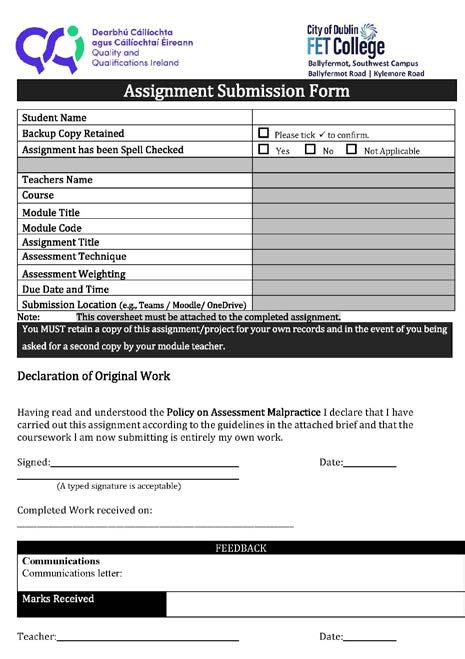
Depending on the module you may be asked to use an assignment cover page. Regardless of what the cover page looks like you must have the following details on the front page of any assignment submission.
▶ Your name
▶ Name of module
▶ Name of module teacher name (the teacher the assignment is being submitted to) Assignment title
▶ Assignment due date and submission date
Here is a recommended format for submitting written work.
Header: Name:
Class:
Date: Font Size Headings: 16
Sub-Headings: 14
Text: 12
Font Style: Arial Spacing: 1.5
Margins: Justified Pages Numbered: After the Introduction Sections and Subsections: numbered
Being able to make good notes efficiently is a key skill for studying at at college.
▶ You will need to make notes in different situations: in lectures, seminars and tutorials; when working in groups; when planning and writing essays; on field trips and placements and when revising for exams.
▶ You should take note of important information for use in your academic studies including essay writing and revision.
Note taking can help you:
▶ Keep a record of your learning and where you obtained your information from, as this will help when it comes time to write your bibliography.
▶ Plan and organise essays, assignments and presentations.
▶ Focus on a specific subject and remember key facts.
▶ Revise effectively for your exams.
▶ Create a study timetable for yourself to include your class schedule and any parttime work you may be doing. This will help you tackle your course work in a manageable way.
▶ Remember to take regular breaks, get up from the desk, stretch your legs, and most importantly get some fresh air.
▶ Create or choose an environment which suits your learning needs.
▶ Limit noise and distractions.
▶ Ensure you are comfortable that the room temperature is not too hot or too cold and that you are in a supportive chair.
▶ Good lighting is key.
▶ Break large tasks into smaller more manageable chunks. Treating your assignment brief like a to do list can make the tasks less daunting.
▶ Maintain a healthy balanced diet and drink plenty of water. It’s next to impossible to focus with a dehydrated or hungry body.
▶ Use technology to help you: From meditation apps to dictation tools like Otter, use freely accessible technology to make your life easier.
The college uses the Harvard Style of Citing and Referencing as standard on all courses.
The Harvard referencing style enables you to:
▶ to show the depth and scope of the research you have undertaken
▶ to acknowledge others’ ideas and research (thereby avoiding plagiarism and comply with copyright laws)
▶ to provide readers with quick access to the source material you reference
As part of your coursework, you will be asked to produce reports, essays and other written texts, and you will need to back up your writing with reference to supporting evidence published in books, newspaper articles, films, documentaries, journal articles, web pages and web sites, etc.
It is important to record the details of all the sources of information that you use to produce these written assignments. This record will help you when referencing sources in your written work.
You must reference sources twice in your written work:
▶ In-text Citation
When the source is first referred to within your text Format: (Surname, Year, Page Number)
▶ Reference list
When you compile a list of referenced sources at the end of your text
You will need to cite the sources for every quotation, statistic, opinion, concept or specific idea that you use.
Short quotations of no more than three lines or 20-25 words, may be incorporated into your texts and enclosed by quotation marks.
Example:
According to Bryman (2012, p.120), “referencing the work of others is an important academic convention because it emphasises that you are aware of the historical development of your subject.”
Longer quotations should be entered without quotation marks, as a separate paragraph, indented on both sides with single line spacing.
Example:
Exploring different ways stereotypes have been employed in media discourse, O’Sullivan et al. argue that:
In media studies the term stereotype has had many different applications including as: a label which involves a process of categorisation and evaluation. Although it may refer to situations or places, it is most often used in conjunction with representations of social groups. In its simplest terms, an easily grasped characteristic (usually negative) is presumed to belong to a whole group, e.g. estate agents are insincere, devious and smooth talking. In ideological terms, stereotyping is a means by which support is provided for one group’s differential (often discriminatory) treatment of another. (O’Sullivan et al, 2003, p.78)
At the end of your assignment, you must include a detailed list of all the in-text citations. This reference list should be organised alphabetically according to the authors’ or editors’ surnames and adhering to the following formats:
(A) To Reference a Book :
Format:
Author(s) surname(s) and first initial(s) Date of publication in brackets Title italicized +full stop
Example:
Edition (if not the first) +full stop
Place of publication +colon
Publisher’s name +full stop
O’Sullivan, T., Dutton, B., Rayner, P., (2003) Studying the Media. London: Hodder Arnold.
(B) To Reference a Website:
Format:
Website author(s) Year published/Last updated Title of the internet site italicized URL Date of access in brackets
Example:
Ballyfermot College of Further Education (2025) Ballyfermot College of Further Education Available at: http://www.bcfe.ie (accessed 1 February 2025)
(C) To Reference an Online Newspaper Article
Format:
Author(s) surname(s) and first initial(s) Year of publication in brackets
Example:
‘Article Title’ +comma Title of publication in italics+ comma
Date of publication, Day/ month +full stop
Available at: URL + full stop Date of access in brackets + full stop
Hoare, P (2021) ‘Such a chore: men and women differ widely over who does bulk of work’, The Irish Examiner, 22 June. Available at: https://www.irishexaminer.com/news/ arid-40319624.html. (Accessed: 22 June 2021).
(D) To Reference a Talk on YouTube
Speaker’s surname, and first initials. Year of posting in brackets ‘Title’ of talk in italics
Example:
Available at: URL [Date of access]
Cuddy, A. (2012) ‘Your body language may shape who you are | Amy Cuddy | TED’ Available at: https://www.youtube.com/watch?v=Ks-_Mh1QhMc (Accessed: 22 June 2022).


The Create 2025 website showcases the work of students from over 30 courses in City of Dublin FET College Ballyfermot, Ballyfermot Road | Kylemore Road, Southwest Campus, from the following faculties: Arts, Humanities and Creative Media; Business, Administration and Law; Education, Adult and Community; Health and Welfare; Social Sciences, Journalism and Information



An Roinn Breisoideachais agus Ardoideachais, Taighde, Nuálaíochta agus Eolaíochta Department of Further and Higher Education, Research, Innovation and Science