What Is RTP and How It Impacts Your Betting Strategy
Have you ever wondered why some bets feel riskier than others, even when the odds seem similar? Whether you're spinning the reels of a digital slot or placing a live sports wager, there's a mathematical concept quietly working behind the scenes: RTP. This figure, often overlooked by casual players, could very well be the difference between a lucky streak and a costly losing session. On platforms like https://stawki07.bet/ understanding RTP is essential not only for maximizing your potential return but also for building a smarter, long-term strategy that turns chance into skill. This article explores what RTP is, how it works, and why it should matter to anyone serious about their betting game.

What Does RTP Mean?
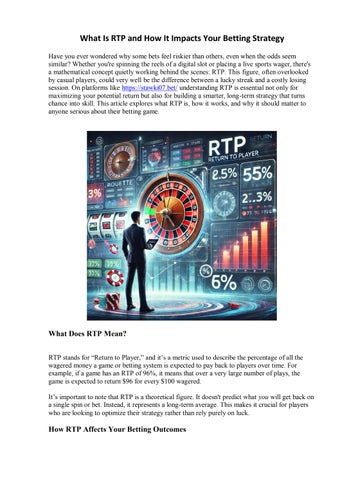
RTP stands for “Return to Player,” and it’s a metric used to describe the percentage of all the wagered money a game or betting system is expected to pay back to players over time. For example, if a game has an RTP of 96%, it means that over a very large number of plays, the game is expected to return $96 for every $100 wagered.
It’s important to note that RTP is a theoretical figure. It doesn't predict what you will get back on a single spin or bet. Instead, it represents a long-term average. This makes it crucial for players who are looking to optimize their strategy rather than rely purely on luck.
How RTP Affects Your Betting Outcomes
When it comes to choosing games or even sports markets to bet on, understanding RTP can guide your decision-making. Here’s how:
1. RTP and House Edge
RTP is the inverse of the house edge. A game with a 95% RTP has a 5% house edge, meaning that the casino statistically earns $5 from every $100 bet. The higher the RTP, the lower the edge for the house and the better it is for the player.
2. Game Selection
Not all games are created equal. Slots often have RTPs ranging from 90% to 98%, while table games like blackjack can have RTPs as high as 99.5%, assuming optimal strategy. Sports betting markets don't always advertise RTP directly, but odds and margin calculations can help you estimate it.
3. Volatility vs. RTP
High RTP doesn't always mean high payouts. Some high-RTP games can be extremely volatile, meaning you'll win less often but in bigger chunks. Conversely, low-volatility games offer smaller, more frequent payouts. Understanding this balance is key to aligning your bets with your risk tolerance.
RTP in Sports Betting
Unlike casino games, where RTP is often fixed and transparent, sports betting RTP can fluctuate dramatically based on the market, odds provider, and type of bet. However, calculating your effective RTP in sports betting is still possible by analyzing the bookmaker’s margin.
For example, if odds are significantly lower than the “true” probability of an event, then the RTP is effectively lower. Bettors who seek “value bets” wagers where the probability of winning is higher than the implied probability from the odds are essentially trying to beat the RTP system in sports betting.
Why RTP Isn’t Everything
While RTP is crucial, it’s not the only factor you should consider:
Game Mechanics: Features like bonuses, wilds, and free spins can affect how a game pays out.
Session Length: RTP applies over the long term. In the short term, anything can happen.
Psychology: The human element chasing losses or betting on impulse often derails even the most RTP-optimized strategy.
Understanding RTP should be part of a larger framework that includes bankroll management, risk control, and informed decision-making.
Exploring Stawki Bet: A Betting Platform with More Than Just Odds
If you're looking for a user-friendly betting experience that combines a wide range of options with transparency, Stawki bet is worth exploring. It offers not just sports betting across popular and niche markets but also a selection of online games, giving players a versatile playground for strategy and fun. The site is designed to make both casual and professional bettors feel at home, with intuitive interfaces and insightful statistics that empower smarter bets.
What sets Stawki bet apart is its commitment to fair play and its educational approach. For instance, players can access breakdowns of betting mechanics, RTP explanations, and expert tips directly on the platform. This makes it more than just a place to wager it’s a hub for learning, testing, and evolving your betting strategies in real-time.
Case Study: RTP in Action
Imagine two online slot games:
Game A: RTP of 92%
Game B: RTP of 97%
Over 1,000 spins at $1 per spin:
Game A would theoretically return $920
Game B would return $970
That’s a $50 difference just based on RTP. Over time, this compounds, making the higher-RTP game far more attractive. The same principle applies to sportsbooks: consistently finding highervalue bets will make your bankroll go further.
Myths About RTP
Let’s clear up some misconceptions:
1. “RTP is a guarantee.” False. It’s a long-term average, not a promise.
2. “RTP resets every day.” Not true. RTP is built into the game algorithm and doesn’t change based on daily usage.
3. “High RTP = More wins.” Not necessarily. You might win less often but get bigger payouts with high RTP games.
Tips to Maximize RTP Benefits
Research before playing. Know the RTP of games or markets you engage in.
Use bonuses wisely. Bonuses can offset lower RTP if used strategically.
Avoid novelty bets. These often have lower RTPs designed to favor the house.
Track your performance. This helps in estimating your personal RTP over time and adjusting strategies accordingly.
Make RTP Your Betting Companion
RTP may not be the most glamorous aspect of gambling, but it’s undoubtedly one of the most powerful. It turns random wagers into informed decisions, luck into strategy, and impulse into discipline. Whether you're spinning slots or betting on your favorite team at Stawki bet, understanding RTP gives you an edge that many overlook.