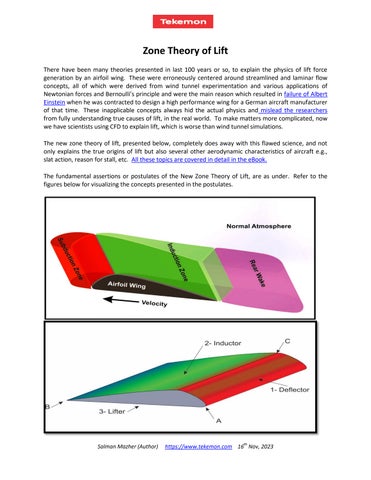
Zone Theory of Lift There have been many theories presented in last 100 years or so, to explain the physics of lift force generation by an airfoil wing. These were erroneously centered around streamlined and laminar flow concepts, all of which were derived from wind tunnel experimentation and various applications of Newtonian forces and Bernoulli’s principle and were the main reason which resulted in failure of Albert Einstein when he was contracted to design a high performance wing for a German aircraft manufacturer of that time. These inapplicable concepts always hid the actual physics and mislead the researchers from fully understanding true causes of lift, in the real world. To make matters more complicated, now we have scientists using CFD to explain lift, which is worse than wind tunnel simulations. The new zone theory of lift, presented below, completely does away with this flawed science, and not only explains the true origins of lift but also several other aerodynamic characteristics of aircraft e.g., slat action, reason for stall, etc. All these topics are covered in detail in the eBook. The fundamental assertions or postulates of the New Zone Theory of Lift, are as under. Refer to the figures below for visualizing the concepts presented in the postulates.
Salman Mazher (Author)
th
https://www.tekemon.com 16 Nov, 2023
Theory Postulates Postulate-1 Aerodynamic Lift is not the result of any kind of reaction force on wing due to its angle of attack. Lift is the vertical component of the pneumatic suction force F-aero which acts perpendicularly to the Inductor Surface of the airfoil.
F-aero resolves into the vertical lift vector and a horizontal vector F-exp or expansion force. This expansion force F-exp is countered by thrust which causes expansion of air above the airfoil inductor surface. All the energy produced by the engines goes into expanding the air in the induction zone, and a much smaller fraction of the thrust is used in overcoming the friction or drag. Postulate-2 An airfoil wing moving in air creates two distinct regions of different pressures, over its top surface. These are called the forward Subduction-Zone and the rear Induction-Zone. The Subduction-Zone is a region immediately around the leading edge, and extends backwards up to the zero-slope line on the airfoil. The pressure in the Subduction-Zone is above atmospheric pressure. The Induction-Zone is a region of less than normal atmospheric pressure between the zero-slope line and the trailing edge. These pressure zones are illustrated in figure above. The creation these two zones by a moving object is a manifestation of the Salman Effect.
Salman Mazher (Author)
th
https://www.tekemon.com 16 Nov, 2023
Postulate-3 During flight there is no flow of any kind, either streamlined or laminar over and under an air foil wing. For all practical purposes, the air mass surrounding the wing is stationary. Consequently, the aerodynamic lift generation action of the airfoil is not attributable to any kind of motion of air. Postulate-4 There is essentially random turbulence on the top surface of an airfoil wing i.e., between the leading and trailing edges, as shown in figure below. This is due to the random motion of the atmospheric air mass which rushes in rapidly towards the wing from all directions, to normalize the pressure back to atmospheric conditions.
Postulate-5 There’s no such thing as a boundary layer adhering to the wing surfaces. Even if there is, it doesn’t take any part in lift generation. Unlike water, air does not wet the wing. Postulate-6 The Coanda Effect applies to air flowing over still objects, but not to objects moving in still air. The Salman Effect of Aerodynamics relates to the creation of two distinct regions of different pressures, one called the Subduction-Zone ahead of a moving object, and the other Induction-Zone behind the same object. The forward Subduction-Zone has higher then atmospheric pressure, and the rear Induction Zone has a less then atmospheric pressure. For the case of the airfoil, the Induction Zone is in the space immediately over the rear slope or the Inductor surface of the wing. The Subduction-Zone is created immediately ahead of the leading edge, as shown in figures above in the beginning. Salman Mazher (Author)
th
https://www.tekemon.com 16 Nov, 2023