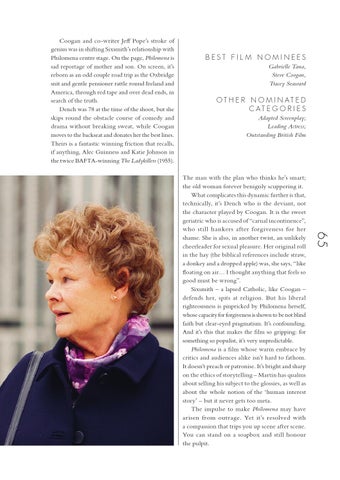
Coogan and co-writer Jeff Pope’s stroke of genius was in shifting Sixsmith’s relationship with Philomena centre stage. On the page, Philomena is sad reportage of mother and son. On screen, it’s reborn as an odd couple road trip as the Oxbridge snit and gentle pensioner rattle round Ireland and America, through red tape and over dead ends, in search of the truth. Dench was 78 at the time of the shoot, but she skips round the obstacle course of comedy and drama without breaking sweat, while Coogan moves to the backseat and donates her the best lines. Theirs is a fantastic winning friction that recalls, if anything, Alec Guinness and Katie Johnson in the twice BAFTA-winning The Ladykillers (1955).
BEST FILM NOMINEES Gabrielle Tana, Steve Coogan, Tracey Seaward
OTH ER N O M I N ATED CATEGORIES Adapted Screenplay; Leading Actress; Outstanding British Film
65
The man with the plan who thinks he’s smart; the old woman forever benignly scuppering it. What complicates this dynamic further is that, technically, it’s Dench who is the deviant, not the character played by Coogan. It is the sweet geriatric who is accused of “carnal incontinence”, who still hankers after forgiveness for her shame. She is also, in another twist, an unlikely cheerleader for sexual pleasure. Her original roll in the hay (the biblical references include straw, a donkey and a dropped apple) was, she says, “like floating on air… I thought anything that feels so good must be wrong”. Sixsmith – a lapsed Catholic, like Coogan – defends her, spits at religion. But his liberal righteousness is pinpricked by Philomena herself, whose capacity for forgiveness is shown to be not blind faith but clear-eyed pragmatism. It’s confounding. And it’s this that makes the film so gripping: for something so populist, it’s very unpredictable. Philomena is a fi lm whose warm embrace by critics and audiences alike isn’t hard to fathom. It doesn’t preach or patronise. It’s bright and sharp on the ethics of storytelling – Martin has qualms about selling his subject to the glossies, as well as about the whole notion of the ‘human interest story’ – but it never gets too meta. The impulse to make Philomena may have arisen from outrage. Yet it’s resolved with a compassion that trips you up scene after scene. You can stand on a soapbox and still honour the pulpit.