
FOCUS WINTER 2025
FOCUS WINTER 2025
Stories from across the sector including member news and legislative changes
08 BAFSA Conference
Report on BAFSA’s first CPD conference at Forest of Arden Hotel in November
10 Systems maintenance
Stewart Kidd outlines the key roles and responsibilities required when an AFFS becomes impaired
14 Ask Joe
Joe McCafferty rounds up some of the main technical queries that he has addressed over the last few months
18 Counterfeit sprinklers
Mark Fessenden from IFSA looks at the growing problem of counterfeit sprinkler components
22 Skills & qualifications
Isn’t it time the sector supported a new entrants qualification? Ruth Oliver poses the question
26 Sprinkler Saves
Nick Coleshill gives a round up of some of the sprinkler activations that have been reported to us over recent months
30 Sprinklers in schools
An interview with headteacher Lorna Blanchenot of the Derby infant school that suffered a devastating fire in 2020
32 Training
Alan Crichton provides an overview of a new high-rise sprinkler course coming on stream in 2026.
CHIEF EXECUTIVE
I’m writing this a couple of weeks after BAFSA’s Conference, AGM and seminar. The AGM provides an opportunity to pause, review the year and give a bit of space to reflect on everything we’ve achieved together.
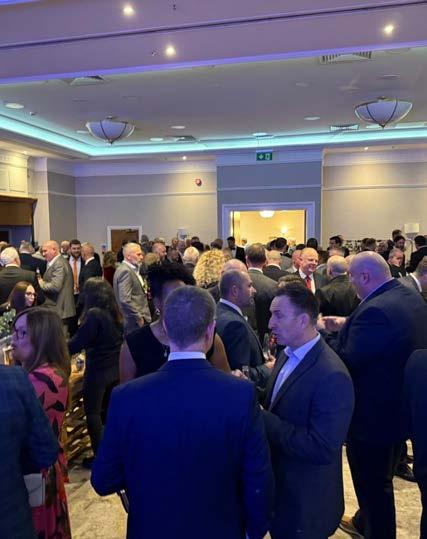
We had around 140 people at the seminar, and all the sessions were recorded for members -they’ll be available soon on the members’ section of the BAFSA website. About 280 guests joined us for the dinner, which was a brilliant opportunity to catch up, make new connections and celebrate the work of our lifesaving industry.
At the AGM, I shared some of the progress we’ve made: our new website and booking portal, our LinkedIn following growing from 850 to over 3,000 in just two and a half years, and course enrolments rising from around 150 a year to over 1,000 in the past 12 months. We’re also dealing with more technical queries, recording more sprinkler saves, and taking an active role in shaping multiple standards through BSI and CEN committees.
We’re raising the profile of the industry - and we’re seeing real regulatory change as a result.
I couldn’t be prouder of the progress BAFSA is making, and of our members, our council and the whole BAFSA team, bring on 2026!
Ali Perry Chief Executive BAFSA
Sprinkler FOCUS is the biannual magazine of the British Automatic Fire Sprinkler Association. It is the only UK publication which has automatic fire sprinklers at its core with current news, features and opinions along with case studies and product updates.
BAFSA Focus is published by BAFSA, PO Box 28683, EDINBURGH EH4 9GN info@bafsa.org.uk www.bafsa.org.uk ISBN – 978-0-9571838-9-6
Reprints of articles are available on request. Designed and printed in the UK by RIASCA
Disclaimer: The British Automatic Fire Sprinkler Association Ltd and/or its Council, directors, officers or employees are in no way responsible or legally liable for any error or anomalies made within the editorial by our authors. The opinions expressed in the articles are those of the authors and not BAFSA itself, unless otherwise stated.
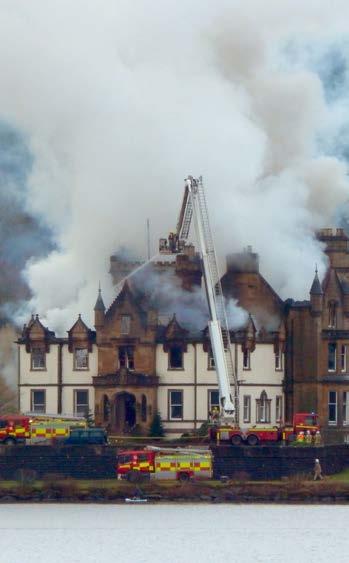
In a landmark move for fire safety, the Scottish Government has introduced new legislation called ‘Simon and Richard’s Law’ that would make sprinkler systems compulsory in traditional or historic buildings newly converted into hotels.
The proposed law follows the 2017 fatal fire at Cameron House Hotel, which claimed the lives of Simon Midgley (32) and his partner Richard Dyson (38). The move is a direct implementation of recommendation 4 from the Fatal Accident Inquiry (FAI) into the blaze. If passed, the changes will require applications for building warrants for hotel conversions of traditional premises to include automatic fire suppression (sprinkler) systems.
The law also extends to a ban on combustible external wall cladding systems to cover hotels, guest houses, hostels, and boarding houses, tightening fire safety regulations. Subject to parliamentary approval, the changes are scheduled to come into force on 6 April 2026.
Stewart Kidd is the recipient of the 2025
Stewart Kidd (MA, MSc, FIFireE, FIFSM, FSyI, FSA Scot, CPP) is a highly respected figure in UK fire protection and security. He currently serves in Special Projects for BAFSA and is chair of its Water Mist Working Group. He is also a Chartered Security Professional and a Vice President of both the Security Institute and the Institute of Fire Safety Managers.

Stewart’s career includes roles such as Director of the Fire Protection Association (1989–1997)and Secretary General of BAFSA (2000–2015). Since 1998, he has been Director of Loss Prevention Consultancy Ltd, where he works as a consultant and expert witness.
He is particularly known for his expertise in heritage and historic buildings, advising on fire protection for listed buildings, museums, churches, and other culturally significant structures. He has authored eight books on fire and security, including guidance for heritage fire safety and Scottish building standards.
BAFSA’s ongoing commitment to promoting best practices in fire safety has resulted in the development of a new, free CPD-accredited, online learning programme aimed at owners and occupiers of buildings where a sprinkler system is fitted.
The Owners & Occupiers Guide to Automatic Fire Sprinkler Systems course offers accessible training aimed at those with an interest in improving their understanding of compliance with critical fire safety systems and their legislative obligations.
The self-paced program covers a wide range of essential topics, including:
The purpose and function of automatic fire sprinkler systems
Testing, inspection, and maintenance requirements
Pumps and system components
Recognising and mitigating hazards
Applicable standards and regulations
Procedures for shut downs and emergency scenarios
System activations and postactivation actions
Roles and responsibilities of owners and occupiers
Structured across six modules, the course provides approximately 90 minutes of engaging content that learners can complete at their convenience. To earn a CPD serviceendorsed certificate, participants must complete all modules and pass a short multiple-choice assessment.
This initiative forms part of BAFSA’s ongoing commitment to promoting best practices, safety, and professional development within the fire protection industry and support those responsible for the maintenance of automatic fire suppression systems.
“Once a fire sprinkler system is handed over to its owners the responsibility for the equipment will rest with them and the UK legislative system imposes significant liabilities on those who fail to maintain fire safety equipment intended for the protection of life from fire,” says Ruth Oliver BAFSA’s head of skills and development.

A new report has called for greater consideration of accessibility for older and disabled residents when implementing fire safety measures in housing.
The study, conducted by the University of Stirling in partnership with the Housing Learning and Improvement Network, warns that current fire safety regulations are being applied “at the
A coordinated programme to test and evaluate waterbased fire suppression systems against lithium-ion battery fires, spearheaded by the British Automatic Fire Sprinkler Association (BAFSA), has just secured funding from the Electrical Safety Fund.
The initiative will bring together the nation’s leading fire safety organisations in a unique, evidence-driven project and comprises partner organisations including the Fire Protection Association (FPA), Building Research Establishment (BRE), RISCAuthority, National Fire Chiefs Council (NFCC) – offering operational guidance and national fire safety leadership, National Fire Sprinkler Network (NFSN) – connecting with practitioners and the fire protection industry and Sprinkler Saves UK.
Lithium-ion battery fires are one of the UK’s fastest-growing fire risks, particularly in sectors such as logistics, transport, and technology storage. The project will combine controlled laboratory testing, validation from the Building Research Establishment (BRE), engagement with insurers via RISCAuthority, and real-world case study analysis through Sprinkler Saves UK.
“This funding enables us to provide clear, robust evidence for the effectiveness of water-based suppression systems against a rapidly emerging threat,” said Ali Perry chief executive of BAFSA. “By combining scientific testing with real-world case studies, we aim to offer practical guidance to policymakers, insurers, and fire safety practitioners across the UK.”
expense of accessibility.” Researchers gathered insights from 12 housing and health professionals in Scotland and 140 community peer researchers across the UK who are older or disabled. Their findings suggest that while fire safety measures are legally required and designed to protect residents, they can inadvertently leave older and disabled people “trapped in their own homes.”
One of the key concerns highlighted is the impact of heavy, self-closing fire doors, which can create “daily barriers and sometimes injuries for people with mobility issues.”
The report outlines five key recommendations: the creation of a national multi-agency forum to align fire safety, accessibility, and housing policy; improved training and education; sharing of best practices; centralised advice hubs; and putting residents’ voices at the center of design and decision-making.
The first is the BAFSA Course Accreditation Scheme (CAS) gives your vocational training the official seal of approval from the UK’s leading trade association for the fire sprinkler industry, meanwhile, the BAFSA Training Accreditation Scheme (TAS) provides BAFSA members with a recognised mark of quality that formally acknowledges the in-house vocational training delivered within their organisations.
Ruth Oliver, BAFSA Skills and Qualifications Adviser says: “BAFSA’s accreditation scheme was developed to allay concerns about the quality of delivery of training within the fire sprinkler industry. It is BAFSA’s intention to recognise high quality training and endorse it with the aim of increasing the availability and quality of training available to everyone who works in the sector.”
She adds that: “Training is matched to industry standards or best practice, which specify standards of performance that people are expected to achieve and the knowledge and skills they need to perform effectively providing the evidence to providers, trainers, employers and learners that training is being delivered to the highest possible standards. With accredited training, learners have assurance of receiving a quality education as well as gaining recognition by employers.”
For further details on the application process and associated costs visit the Accreditation Services page on the the BAFSA website www.bafsa.org.uk

A long and influential chapter in parliamentary fire-safety advocacy closed in October as Ronnie King stepped down as Secretary to the All-Party Parliamentary Group for Fire Safety and Rescue (APPG). King, who has been at the heart of the APPG since 2012, is widely recognised across the fire sector for his tireless commitment to improving fire safety including his steadfast support for the wider use of automatic fire sprinklers.
Throughout his 64-year career, King has been a consistent and powerful voice ensuring that sprinklers remain firmly on the political agenda. His understanding of both fire safety and the parliamentary process has been instrumental in securing progress on a wide range of safety issues.
BAFSA joins the wider fire community in thanking him for his extraordinary contribution and wishing him a welldeserved retirement.
Succeeding him is Steve McGuirk, Executive Director of the Fire Sector
Confederation (formerly the Fire Sector Federation), now operating as a UKregistered charity. The Confederation brings together expertise from across the fire and built-environment sectors from the UK Fire and Rescue Service to construction, manufacturing, and insurance making it a key voice in future policy development.
As the new APPG Secretary, McGuirk is expected to draw on this collaborative, cross-sector perspective to ensure vital issues including the role of sprinklers in mitigating fire risk continue to be strongly represented in Parliament.
Reflecting on his appointment, McGuirk said: “Ronnie King OBE has set an exceptional standard through his years of dedicated service, combining professional authority with humility, humour, and an unwavering commitment to public safety. His work has not only shaped better legislation and policy but has also saved lives and strengthened confidence in fire safety
“Ronnie King OBE has set an exceptional standard through his years of dedicated service”
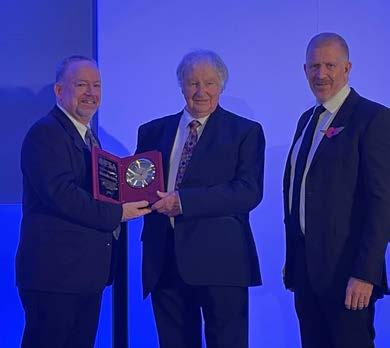
Ronnie King OBE has been named the IFSA’s 2026 H.W. Marriott Award recipient – the association’s highest honour.
The award recognises individuals who demonstrate exceptional service, visionary leadership, and a lifelong commitment to advancing fire protection and safeguarding communities.
King was presented the award by Jim Drake from IFSA during BAFSA’s annual dinner on 6th of November at The Forest of Arden Hotel, nr Birmingham.
across the country. It will be no easy task to succeed someone who has given so much and done it so well, but I look forward to building on Ronnie’s remarkable legacy”
BAFSA member Rapidrop has received a significant multi-million pound investment from BFG to support the company’s growth.
Since 2017, Rapidrop has doubled in size. With BGF’s backing, Rapidrop will be well positioned to accelerate its international expansion into new European and global markets. Additionally, access to BGF’s extensive network and value creation expertise will bolster Rapidrop’s position as a global leader in fire safety solutions.
“BGF’s investment and support will enable us to remain focused on driving product innovation and expanding our global footprint. I look forward to working closely with them and the entire Rapidrop team, to deliver the next chapter of the company’s success.” says Chris Shelley CEO of Rapidrop Global.
BGF’s investment comes as the fire suppression market is experiencing significant expansion, driven by tightening regulations, increasing urbanisation and global construction projects. The market for sprinkler systems alone is projected to grow at a compound annual growth rate of over 8% through to 2030, underpinned by fire safety regulations and a greater focus on risk mitigation.
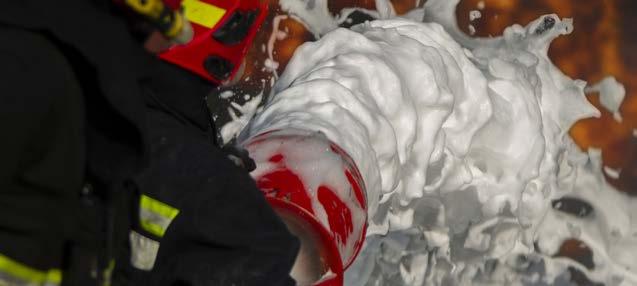
Alpine Fire is urging facilities managers and compliance officers to respond to the UK HSE consultation on further PFAS restrictions in firefighting foams. C8 foam, containing PFOA, was banned in July 2025, and attention is now turning to C6 foam, still used in high-hazard sectors such as oil, gas, petrochemical and offshore. “This consultation is another major step in the UK’s move away from PFAS-based agents,” said Mark Thewlis, Senior Engineer at Alpine Fire. He noted that while C6 foam may remain necessary in some specialist settings, its long-term use is under review.
Further regulation is expected, and although Alpine Fire does not support continued widespread C6 use, the company stresses that a well-managed transition to fluorine-free foam (F3) is essential. F3 behaves differently to PFAS foams, meaning some systems will need modification. “Our role is to help clients transition safely and in line with upcoming regulation,” Thewlis added.
To support stakeholders, Alpine Fire is launching an awareness campaign promoting the public consultation, open until 18 February 2026.
For more information or support with removing C8 and C6 foams, visit www.alpinefire.co.uk.
BAFSA e-portal will close to new qualification enrolments ie ABBE L2, L3 and L5 on Friday 12th December and reopen on Monday 12th January. Existing candidates will be unaffected and able to access their learning programmes. IT support and assessment of evidence will be limited during this time.
Photographic ID will be required on enrolment to ABBE L2, L3 and L5 qualification programmes as from January 2026. Details will appear on the e-portal. Impersonating a candidate or attempting to take an exam on the candidate’s behalf will be investigated as malpractice.
ABBE Level 2 Certificate in Fire Sprinkler Installation online time allocated to candidates will reduce to 20 weeks from January 2026 providing a four week window for final assessment and feedback of evidence by assessors. Candidates will be permitted to resubmit evidence during those four weeks where they have not met required assessment criteria.
ABBE LEVEL 3 EXAM
ABBE L3 Inspection & Commissioning of Commercial Fire Sprinkler Systems (online) will have the full final exam available via the e-portal from January 2026. Candidates will access the exam through their ‘My Course’ on the e-portal. Resit opportunities will also
be available, for a fee, to candidates through ‘My Course’.
A new CPD programme is in development: Fire Suppression Systems; Sprinklers & Watermist is to be available early 2026.
Submission to the Skills Partnership has been accepted for a Black CSCS card to be available to those who achieve ABBE L5 Diploma in System Classification & Design of Pre-Calculated Commercial Fire Sprinkler Systems.
www.bafsa.org.uk
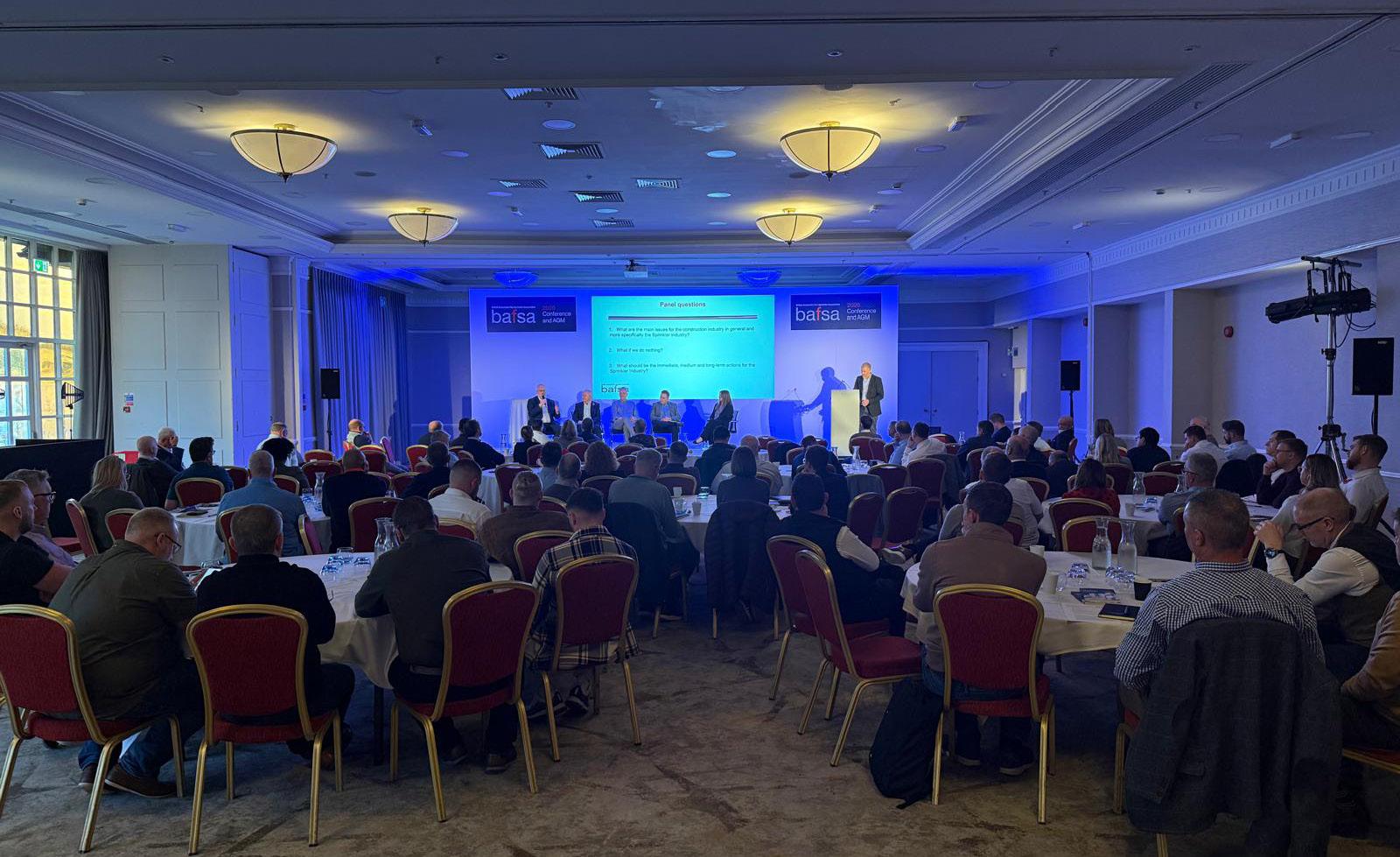
Forest of Arden Hotel, 6 November 2025
The British Automatic Fire Sprinkler Association (BAFSA) hosted a timely and forward-thinking CPD seminar on 6th November at the Forest of Arden Hotel, near Birmingham, with nearly 150 members in attendance. With the dual pressures of Net Zero construction and increasing public scrutiny of fire-safety competence, the event brought together academics, industry leaders, and practitioners for what felt like an added call for a cultural shift within the construction sector.
The seminar opened with a stark reminder from Professor Mike Leonard of the long and troubled history of learning fire-safety lessons only in the aftermath of tragedy. Referencing examples from the Great Fire of London, Kings Cross, Lakanal House, and ultimately Grenfell, Leonard underscored a pattern that has repeated through centuries: regulatory intervention only comes after catastrophe. His message was unequivocal: “Grenfell must never happen again – and that means abandoning the race to the
bottom.” With mass-timber construction expanding rapidly, his warning felt particularly pertinent. The industry cannot afford to repeat historical mistakes in a new construction era dominated by combustible structural materials.
In the second key-note delivered by Professor Jim Glockling, he explored the evolving role of automatic fire suppression systems in a world where sustainability is no longer optional. His key message was that sprinklers need to no longer solely be thought of as life-safety systems, the message for the future is that they are essential infrastructure for property resilience, structural preservation, and insurability – particularly with the rise of timber-based construction. He discussed how mass-timber buildings, though essential for carbon reduction, create new fire challenges and if mass timber is to become mainstream, fire suppression must evolve with it.
He went on to say that sprinkler systems are fundamental enablers of safe, resilient, low-carbon mass-timber buildings. Those in the industry that will be moving forward with the times will be those who provide transparent data, deliver low-carbon
solutions, and demonstrate credible whole-life performance aligned with Net Zero requirements.
The centre point of the event however, was the interview between the National Fire Sprinkler Network’s Terry McDermott and headteacher of Ravensdale Infant School, Lorna Blanchenot, about the fire that devasted the Derby school in 2020. Lorna was visibly moved by a video shown of that night as fire crews struggled to tackle the blaze in the unsprinklered school. It took two years to get the children back into a new building by which time a large proportion of staff had moved to other schools. This example demonstrates the wide impact of fires on the school community. Read our interview with Lorna on page 30.
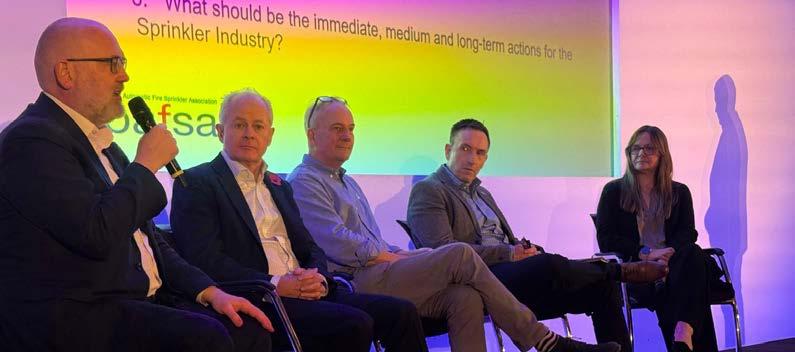
The seminar closed with a lively and candid panel discussion featuring, Alan Brinson, European Fire Sprinkler Network. Richard Harrell, CABE, Sarah Colwell of BRE and Jim Glockling, Dale Kinnersley which brought the day’s themes into sharp focus. Attendees described the panel as “refreshingly blunt” and “the most honest discussion BAFSA has hosted in years.”
Ali Perry BAFSA’s chief executive officer in his presentation during the BAFSA AGM outlined the work that BAFSA is doing to address some of the issues raised in the day’s sessions. Including new training opportunities for sprinkler installers, a focus on affordable and accessible CPD learning opportunities for those within and outside the industry and a continued momentem to push sprinklers onto the legislative agenda.
BAFSA awarded five student of the year awards at its conference and AGM this year. Many congratulations to all of the students for their hard work.
The winners are:
Stefan Pacurici of AB Fire Ltd who achieved the ABBE L2 Certificate in Fire Sprinkler Installation (Commercial). He was nominated by Alan Hughes, Course Assessor at Llandrillo College. Alan says: “Stefan just got on with the course following all instructions and produced good solid evidence.”
Sandy Christie of Nucore Group, who achieved the ABBE L2 Certificate in Fire Sprinkler Installation (Residential )They were also nominated by Alan Hughes, Course Assessor who says: “Sandy worked through the modules following the e-portal instruction to the completion of his course and provided good video evidence within a reasonable time frame.
Grant Rawlinson of Utilitarian Ltd who achieved the ABBE L2 Certificate in Fire Sprinkler Installation (Residential & Commercial). Alan Hughes, Course Assessor (Llandrillo College) says: “Grant was in regular communication with me and worked well to overcome any difficulties he had, whilst openly admitting the thought of doing the course filled him with fear.”
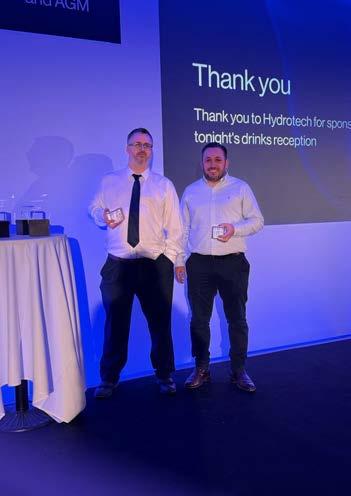
Aaron Arnold of Alpine Fire who achieved the ABBE L3 Inspection & Commissioning in Commercial Fire Sprinkler Systems. He was nominated by Alan Crichton who says: “Out of the 2024-2025 candidate cohort Aaron achieved the highest score in the exams year showing a good knowledge base. He is therefore my choice for this award.”
Erjon Corapi a self employed sub contractor achieved the ABBE L2 Certificate in Fire Sprinkler Installation (Residential ) and was nominated again by Alan Hughes, Course Assessor for BAFSA. Alan says: “Erjon Corapi produced very good clear evidence and he followed the portal instructions to the completion of his course, he also had good clear communication with his assessor and asked questions when he needed anything to be explained or clarified.He put his mind to the task and completed it in five weeks.”
Attendees described the panel as “refreshingly blunt” and “the most honest discussion BAFSA has hosted in years.”

Stewart Kidd, BAFSA’s special projects advisor, looks at the necessary roles and responsibilities should an AFFS become impaired
Where premises are fitted with automatic fire suppression systems (AFSS) whether for the safety of occupants or the protection of property, any situation where these systems are impaired needs to trigger a range of responses from the property occupier and/or owners.
Where systems are installed for the safety of occupants, then it’s likely that any system impairment which results in injury may render the property owner or responsible person
liable to prosecution.1 (See Note 1 for actual wording). The extension of legislation to cover requirements for AFSS in much residential accommodation means that where the systems are not immediately available then a criminal offence may be committed.
Where the fire strategy for a building is dependent on the presence of an AFSS, its non-availability usually means that the premises should be closed until the system impairment is rectified. (This is why the UK version of BSEN 12845 includes an Annex F
which sets out additional design measures to reduce the possibility of a sprinkler system being out of service during maintenance).
Where protection is liable to be non-operational for some hours there are several actions which must be taken by the owner of the protected premises or persons employed by them. Where suppression systems are installed for insurance purposes, underwriters will be particularly concerned should protection not be available.
Property insurers invariably impose obligations on insured persons via policy wording, either as a warranty or a condition precedent2, in respect of any impairment of a sprinkler or other fire suppression system. There are two specified duties which will be a feature of all insurance policy wordings where the presence of sprinklers is mandated or where a premium discount has been allowed in respect of the fitting of sprinklers. Note that all standard policy wordings will also include a requirement to ensure that the sprinkler system is subject to regular checks and tests by a competent person and ‘maintained in good working order at all times’ implicitly or explicitly in conformity with published standards’.3
All policy wordings will refer at least to the following actions to be complied with by an insured person when a sprinkler system is not available:
1. To advise the local fire and rescue service; and 2. To inform the insurers.
There are other actions which can usefully be taken because of unplanned shutdowns, and these are summarised in Annex J of
BS EN 12845:2019. For projects where compliance with the LPC Rules for Automatic Sprinkler Installations are called up then the contents of TB203-6 should be complied with in addition to the requirements of Annex J, notwithstanding the references to ‘Maintenance’ in the TB.
In respect of water mist installations, any specific requirements in the system’s Design, Operation and Maintenance Manual should be complied with and the guidance in Annex J of BS 12845 should be followed where relevant.
Sensible precautions include the following:
Inform insurers and fire authority and tenants/neighbours
Implement planned shutdown procedures
Minimise the possibility of a fire occurring
Patrol the area affected continuously
Prohibit hot work
Impose a strict permit system on all other maintenance
Prohibit smoking and naked lights in the vicinity of the building
Minimise the possibility of a fire spreading by closing fire doors and shutters
Augment the availability of fire extinguishers and ensure that there are sufficient trained personnel available to handle them.
Recent civil cases determined under English Law (see also Note 2) have gone further than Annex J and there is a consensus among fire protection experts in the UK that the following obligations should be complied with in the event of a sprinkler system impairment:
A formal, written procedure must be in place to deal with any impairment of the fire protection systems

These procedures should be based around the guidelines contained in Annex J of BS EN 12845 (2019)
Continuous patrols by security guards/competent staff etc
Cessation of hazardous activities including all hot work and any routine maintenance activity
Operation of power equipment including cranes, conveyors, forklift trucks etc.
Notification of interested parties including insurers/tenants
Ensure that all fire detection and alarm systems are in working order and that links to alarm receiving centres are tested
Consider whether the premises should be closed or their use by visitors restricted
Responsibility for managing system impairments
In respect of legislation compliance, the ‘Responsible Person’ or duty holder is deemed to have the onus of managing all fire safety matters, including the Article 17 responsibilities for maintenance (See Note 1 below). However, this may be a shared duty in some properties or businesses, and modern commercial property management approaches may complicate things further.
The November 2005 fire at a 40,000m2 warehouse at Magna Park, Lutterworth encapsulates the issues admirably.
The warehouse building was co-owned by a pension fund, administered by an insurer and the actual building was insured by a different company
Primark were tenants therefore the contents of the building were insured by different underwriters
The whole facility was operated by TNT, their liability limited by contract.
Warehouse operations, safety and security, M&E services, building maintenance and cleaning were all contracted to third party providers by TNT.
Overall site security, site access, grounds maintenance and sprinkler and hydrant firefighting water was provided by Magna Park Ltd. The fire systems maintenance was outsourced to three separate companies.
“Where protection is liable to be nonoperational for some hours there are several actions which must be taken by the owners”
The sprinkler system failed to operate as the common water supply was disconnected due to damage to underground pipes serving the warehouse.
Note that the fire which reportedly caused damage to the building and contents costing more than £100 million occurred before the Fire Safety Order came into effect.
Note 1:
“17.—(1) Where necessary in order to safeguard the safety of relevant persons the responsible person must ensure that the premises and any facilities, equipment and devices provided in respect of the premises under this Order … are subject to a suitable system of maintenance and are maintained in an efficient state, in efficient working order and in good repair”.
Note 2:
The 2023 US case of Frankenmuth Mutual insurance Co. v. Fun F/X II Inc. and Cao Enterprises II LLC [601 F. Supp. 3d 330, 343–44 (N.D. Ind. 2022)] found that the property insurer was not liable to indemnify the claimants following a 2019 fire. The insurers relying on a policy exclusion for failing to inform the insurer of impairments in the protective systems - the sprinkler system water supply had been disconnected. The judgment was confirmed on appeal. While not directly binding on a UK court this precedent would be very persuasive in similar circumstances.
1. Article 17(1) Regulatory Reform (Fire Safety) Order 2005. The devolved governments have similar legislation.
2. Non-compliance with a condition precedent allows an insurer to void cover.
3. Such as BS EN 12845 for industrial and commercial sprinkler systems or BS EN 14972 for water mist systems.






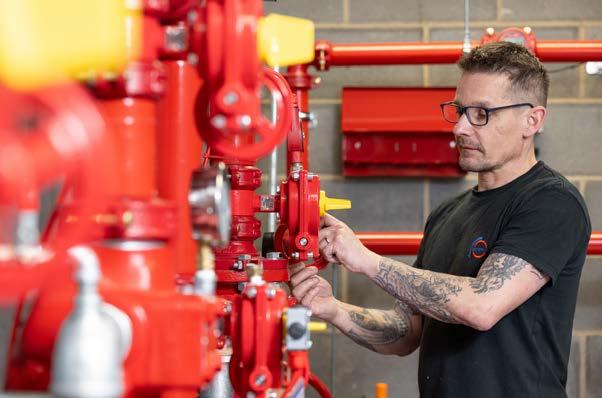
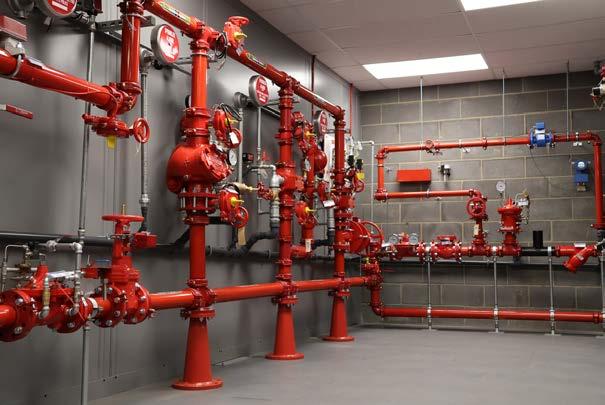





Joe McCafferty BAFSA technical advisor highlights some of the technical queries he has received over the last few months which incude placing sprinklers in electrical rooms, care homes and BESS areas
Note: Sometimes it is necessary to reply to enquiries by giving ‘an opinion’ rather than referring to any hard and fast stipulation in the sprinkler rules, either UK, European or American.
Question: We’re currently facing some challenges regarding the fire protection solution for our electrical rooms in a residential building. Could you please share what the common practice is in such cases? Is it typical to use water sprinklers, or is a clean agent system the preferred solution?
Joe: The following extracts from BS EN 12845:2015+1A:2019 and BS 5306-0:2020 explain the options and reassurance of sprinklers in such rooms.
BS EN 12845: Paragraph 5.1.3 Necessary exceptions
Sprinkler protection shall not be provided in the following areas of a building or plant:
a) silos or bins containing substances which expand on contact with water.
b) in the vicinity of industrial furnaces or kilns, salt baths, smelting ladles or similar equipment if the hazard would be increased by the use of water in extinguishing a fire.
c) areas, rooms or places where water discharge might present a hazard.
NOTE In these cases, other automatic extinguishing systems should be considered, (e.g. gas or powder).
BS 5306-0 Paragraph 15 Electricity and Firefighting:
Concerns about the dangers of using water as a firefighting media on fires involving live electrical equipment usually relate to the possible risks of electrocution. This theoretical risk (the HSE have not recorded any such actual injuries) probably originates in tests undertaken by the Paris Fire Brigade in the 1930s and replicated in a piece of demonstration equipment at the Fire Service College. Gaseous systems are electrically non-conductive and are ideal for use in electrical installations. There have been several instances where fires have started in server rooms but have been extinguished by a single sprinkler head, preventing any fire spread from the room of origin. At the time of publication of this part of BS 5306, the standards for sprinklers and water mist systems allow these to be omitted in “areas or rooms where water discharge might present a hazard”. For sprinklers in particular, BS EN 12845:2015, 5.1.3 c) is used to justify omission of coverage in switch rooms, server rooms and transformer chambers. Given that the risk of electrocution is considered to be minimal, where a full sprinkler system is being installed, it is recommended that sprinklers be provided in electrical plant rooms [except high voltage (HV) electrical rooms], unless there are reasons to the contrary (e.g. key equipment which cannot be wetted). If sprinkler protection is to be omitted, an alternative solution should be chosen, e.g. a gaseous, water spray or water mist system, or, at the very least,
the provision of dry powder and/or carbon dioxide portables adjacent to electrical equipment. Guidance on portable fire extinguishers using water-based media and electrical risk is given in BS 5306-8. BS EN 3-7 includes a test for dielectric safety. Where wet systems are clearly unacceptable because of the risk to personal safety or collateral damage to property, it has been normal practice to install inert or chemical gas flooding systems where automatic fire suppression is essential. With regard to water-based systems in general, power generation companies make extensive use of water-based fire suppression equipment to protect turbo-alternators, switch gear and transformers at voltages up to 400 kV and involving significant currents (typically 20 000 MVA). Provided that such systems are designed and installed in accordance with the appropriate standards, it is expected that they will function as designed.
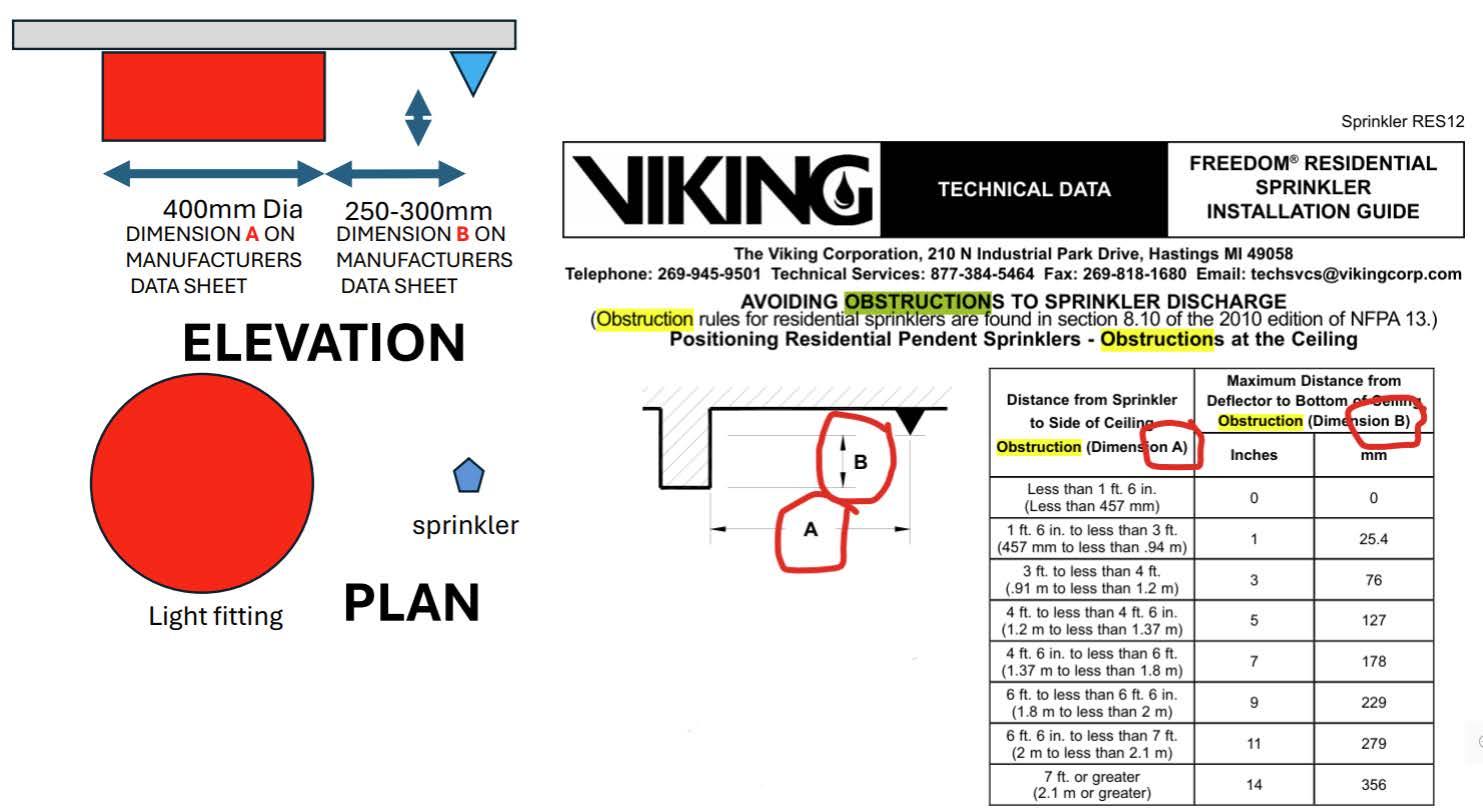
Question: I have a new build care home project that has a sprinkler system installed. I have concerns regarding the light fitting proximity to the sprinkler heads. These light fittings project down around 100mm and measure 400mm in diameter. The sprinkler heads are currently placed around 250mm to 300mm away from the edge of the light fittings. Can you advise what the minimum distance would be for the sprinkler heads to function correctly and not be affected by said light fittings?

Joe: Residential and domestic sprinkler head spacing is normally dictated by the manufacturer of the sprinkler head in their data sheet which may be unique to each sprinkler head. You need to know which head is installed and look up the data sheet online. I have attached a sketch (see illustration below) of what I think you have explained below. I have included the relevant extract from ONE manufacturers’ data sheet – in this case – Viking Sprinklers (note this may not be the same as the head installed on your site). But it will give you an idea of how to check.
As the light is circular, the obstruction to water discharge pattern is less than if it were a rectangular fitting.
Question: What are the requirements are for the frequency of inspection and maintenance for a residential sprinkler system installed about 10 years ago?
Joe: The sprinkler would probably been designed and installed to BS 9251:2014 sprinkler rules. The following is generally what the current edition of BS 9251:2021 mentions (not a full extract due to copyright of the standard):
7.1.2 Yearly routine
• the system should be visually inspected for leaks.
• have any modifications been carried out in accordance with this British Standard.
• If there has been any increase in fire loading or a change to include vulnerable occupants Is the Category of system still appropriate
• Check all sprinklers and any cover plates for damage etc.
• All valves should be exercised to ensure free movement and monitoring function.
• Are supply water mains still functioning as designed?
• Are all alarms functioning as designed?
• Is all remote monitoring functioning correctly.
• Are all tank heaters and/or trace heating on pipework functioning correctly.
• water storage tank checks debris and defects, damage or corrosion, low water level alarm internally inspection and if necessary, drained and cleaned, automatic infill for reduced capacity tanks, the infill flow rate should be verified.
NOTES: The buildings fire safety management strategy may ask for more frequent inspections. Some components, eg pumps, might require more frequent testing in accordance with the manufacturer’s recommendations. All systems require maintenance. Maintenance of system equipment and devices, eg sprinkler systems,
provided in connection with general fire precautions are requirements under the Regulatory Reform (Fire Safety) Order 2005. It might also be a requirement of the building fire strategy.
You can find third party accredited sprinkler system installers on the BAFSA website www.bafsa.org.uk under our members directory. You can search by postcode so you may find one near you.
Question: What sprinkler systems do you have for installations of BESSS (battery parks)?
Joe: Here’s an extract from the RISC Authority guide titled Need to Know Guide RE1 Battery energy storage systems: commercial lithium-ion battery installations about fire sprinklers and BESSS areas: “BESS areas within sprinklered buildings and all BESS installations where sprinkler protection forms part of the fire strategy, should be provided with sprinkler protection, designed to provide a minimum density of discharge of 12.2mm/min over an assumed f ire area of 230m2 (or area of room if smaller). BESS rooms and enclosures should be provided with suitably designed explosion overpressure venting. Suitable procedures shall be implemented to routinely inspect and test BESS thermal runaway and fire mitigation alarms and systems.”
Primary reference: NFPA 855 Standard for the Installation of Stationary Energy Storage Systems, 2020.
Greater separation distances may be appropriate from critical buildings and installations and to meet specified strategic spatial fire separation expectations. Whilst automatic fire suppression is unlikely to extinguish fire in individual battery cells that are undergoing thermal runaway, fire suppression can reduce fire intensity and assist in slowing and limiting fire propagation across battery modules and racks. It may be acceptable to reduce some of the above risk control measures where large-scale testing, such as testing to UL9540A or equivalent, demonstrates that adjusted mitigation measures are adequate.
Question: I have a technical enquiry about the use of AFFF C8 in sprinkler systems. Can it still be used or do we need to have it replaced?
Joe: AFFF C-8 used in firefighting systems/ extinguishers discontinued on 4th July 2025 and they must be replaced by more environmentally safe products. The company servicing the foam sprinkler system you mentioned to me should have been advising their client long before the deadline on what needs to be done. There is a good Fire Industry Association document on the
subject on their website – www.fia.uk.com.
Also have a look at the British Safety Council’s website (www.britsafe.org) where it states the following in regard to the C8 foam ban: “From 4 July, the use of fire extinguishers and suppression systems containing the ‘forever chemical’ perfluorooctanoic acid (PFOA) will be prohibited, meaning duty holders need to move fast to ensure compliance with the law. As of 4 July 2025, all firefighting foams with the C8 chemical composition will be banned. C8 firefighting foams, specifically aqueous film-forming foams (more commonly referred to as AFFF), are used in the kind of fire extinguishers that suppress flammable liquid fires (or Class B fires). However, these foams have been proven to be detrimental to human and animal health, as well as the wider environment, so over the past decade, they have slowly but surely been phased out by extinguisher manufacturers in favour of the less harmful C6 firefighting foams.”
Question: We have spare ductile iron pipe can we use it for our dry riser installation? Joe: Ductile iron is a robust pipe and is commonly used for underground runs (even for dry/wet riser underground runs). It probably has the durability for riser pipe even though it does not mention ductile iron pipe in BS 9990. Nor does BS9990 specify an exact standard for steel pipe only that it should
be heavy quality. Ductile iron can come in various grades so you should see if you can work out what grade (it’s pressure capability) it is before using it. Ductile iron is more brittle than steel pipe so maybe consider where you are locating pipe runs so they are not susceptible to being damaged by trucks/ traffic. There is a document on Water UK www.water.org.uk that gives a good insight to Ductile iron and its specifications: IGN 4-21-01 I suggest that it would be best to run it by the AHJ for their opinion/approval so no problems later.
To submit an enquiry or questions to Joe visit the BAFSA website www.bafsa.org.uk
Mark Fessenden, Managing Director of the International Fire Suppression Alliance (IFSA) looks
at the challenges of counterfeit equipment in the sector
In the fire protection industry, system reliability is not a convenience; it’s a life safety imperative. Fire sprinklers are designed to activate automatically during the earliest stages of a fire, suppressing flames, reducing property damage and saving lives. But a growing and dangerous problem is threatening the integrity of these systems: counterfeit fire sprinklers.
Counterfeit fire sprinklers are unauthorised replicas or imitations of certified sprinkler heads, often falsely marked with logos and certification labels from trusted manufacturers, such as Tyco, Viking, Victaulic or Reliable. These uncertified and counterfeit products are not tested to the rigorous standards of UL, FM, VdS, LPCB, or equivalent third-party agencies. Even worse, they can be indistinguishable to the untrained eye and may fail catastrophically during a fire.
Legitimate fire sprinklers undergo extensive testing to ensure they activate under specific conditions, deliver proper water distribution, and resist corrosion over decades. Counterfeit products lack this testing and may:
Fail to activate during a fire.
Activate at the wrong temperature.
Distribute water ineffectively, rendering them useless in fire suppression.
Corrode prematurely, compromising long-term reliability.
A fire sprinkler that doesn’t function as intended can turn a survivable fire into a deadly catastrophe.
While comprehensive global data is limited, fire protection professionals and regulatory bodies have documented numerous incidents of counterfeit sprinklers in warehouses, hotels, residential complexes and even government facilities. In 2015, the International Fire Suppression Alliance (IFSA) issued a Safety Alert after noncertified sprinklers labeled as Early Suppression Fast Response (ESFR) devices were proposed for use in a storage facility in China. At IFSA’s request, UL tested the sprinkler samples and found they lacked the critical performance characteristics of true ESFR sprinklers. Significant deficiencies were identified in both water distribution and long-term reliability, rendering the devices unsuitable for their intended purpose.
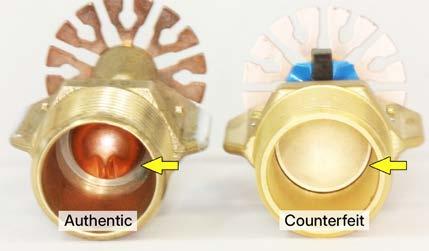
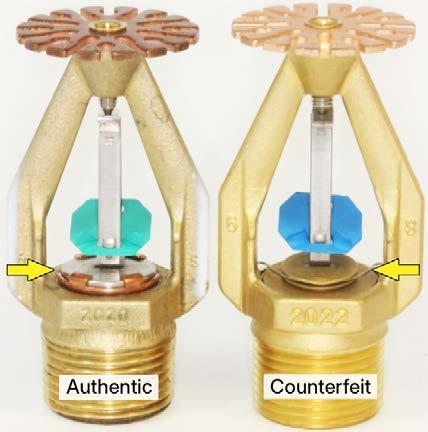
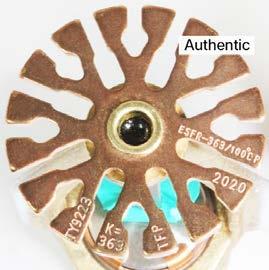
In another notable case, FM Approvals issued a product alert warning about counterfeit Tyco TY9223 sprinklers found in the Brazilian market. These knockoffs, shown in Figure 1, bore counterfeit Tyco logos and certification marks but were never manufactured or approved by Tyco. The sprinklers appear very similar, and the most noticeable difference is the colour and shape of the orifice cap (the part indicated by the yellow arrows). The cap assembly in the authentic sprinkler consists of a copper cap with a stainless-steel insert, whereas the cap in the counterfeit appears to be solid brass. The counterfeit also includes a bent wire installed through a groove in the cap (typically known as an ejection spring or kick spring). Authentic TY9223 sprinklers do not use an ejection spring. The white paint on the frame arms of the authentic example indicates the intermediate temperature classification of this example.
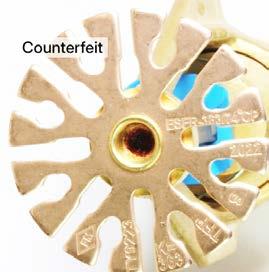
Authentic TY9223 sprinklers may also come without painted frame arms in the ordinary temperature range.
The inlet side of the orifice cap in the authentic TY9223 (left) is domed and made of copper, while the counterfeit (right) has a flat profile and appears to be brass. The PTFE-lined spring washer-type seal is visible around the outside of the cap in the authentic sprinkler. The counterfeit sprinkler has no visible portion of the seal. These counterfeit sprinklers also feature O-ring style water seals. O-ring type seals are not used in any current FM-approved or UL-listed
“Tests showed that the load placed on the sprinkler bulbs exceeded acceptable safety margins, raising the risk of accidental water discharge in the absence of a fire. Such false activations often result in systems being shut off to avoid water damage, leaving them unavailable during actual emergencies”
sprinklers and have not been generally used since 2003. Additionally, the stampings on the deflectors are nearly identical and in the same relative positions, but are significantly shallower on the counterfeit deflector. The deflector materials are different but look very similar to the eye. Because the authentic sprinkler is from a slightly older year of manufacture (2020), it does not have the FM marking; however, authentic versions from 2021 and newer do, and in the same relative position as the counterfeit deflector.
In 2016, IFSA partnered with the Brazilian Sprinkler Association (ABSpk) to remove and test hundreds of non-certified sprinklers from two buildings in São Paulo. Brazil, which closely monitors sprinkler imports, has reported a troubling rise in the presence of non-certified products in recent years.
The buildings in question — a public parking garage and a high-rise office tower — had fire sprinklers explicitly installed to protect occupants. Sprinklers from both sites were carefully extracted and submitted to accredited testing laboratories for evaluation.
FM Approvals compared the sprinklers extracted from the high-rise office building against their test requirements in 13 areas.
They found deficiencies in performance related to half of the regions examined: materials analysis, water distribution characteristics, resistance to rough use and abuse, potential hang-up of operating parts (lodgments), assembly load versus frame strength, and resistance to salt spray corrosion. The lodgment tests were of special concern, with a cumulative failure rate of 47.5% among 40 samples tested. Up to 100% of samples experienced a hang-up of operating parts in at least one combination of configuration and pressure. These hang-up results suggest that the sprinklers would not be able to develop an effective water distribution pattern in the event of a fire, severely compromising their effectiveness.
The comparison of assembly loads to frame strength was also concerning. Tests showed that the load placed on the sprinkler bulbs exceeded acceptable safety margins, raising the risk of accidental water discharge in the absence of a fire. Such false activations often result in systems being shut off to avoid water damage, leaving them unavailable during actual emergencies.
UL also identified significant deficiencies in the sprinklers removed from the São Paulo parking garage. Both upright and pendent models used O-ring style water seals — a design prohibited within UL’s testing standards since 2003 due to its unreliability in the field. UL was the first standards body to prohibit dynamic O-ring style water seals at the time. These seals can adhere to mating surfaces, preventing water discharge during a fire. Unsurprisingly, the sprinklers failed to operate at low water pressures and exhibited poor performance in several key areas, including partial clogging, substandard spray patterns and inadequate fire control. Critically, they failed the standard wood crib fire test, a benchmark assessment of a sprinkler’s ability to extinguish or control fire.
The non-certified sprinklers removed from both buildings posed a clear public safety hazard. They were replaced with certified devices, but it remains unknown how many other properties still house dangerous, noncertified sprinklers that could fail when lives depend on them most.
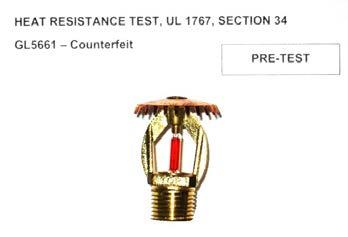
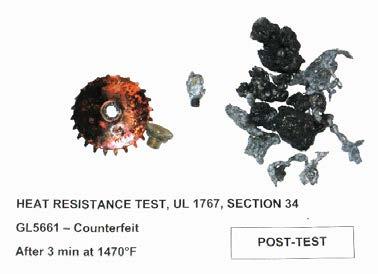
In other instances, testing has revealed that some non-certified sprinklers are made with substandard materials that are incapable of withstanding the thermal demands of a fire. ISO 6182-1 requires sprinkler frames to withstand a temperature of 800°C for 15 minutes. The frame of the counterfeit sprinkler, as shown in Figure 2, melted away within three minutes. The consequences of using noncertified sprinklers can range from property damage to life safety failures.
Many counterfeit products are distributed through online marketplaces, unauthorised dealers, or secondary surplus sellers. Global e-commerce marketplaces like Alibaba and AliExpress, Mercado Libre, Flipkart and Noon all offer sprinklers with questionable certifications, or none at all. Amazon has taken action to reduce the frequency of this issue on its US platforms, but international platforms continue to pose a challenge.
Spotting a counterfeit sprinkler requires careful attention to:
Manufacturer details: Verify that the model number, logo and certification marks match official product catalogues.
Packaging: Authentic sprinklers are typically sold in factory-sealed boxes with matching serial numbers and date codes.
Markings: Look for inconsistencies in font, misspellings or misaligned labels.
Purchase channel: Always purchase from authorised distributors. Avoid third-party sellers on online marketplaces.
FM Approvals and UL also encourage users to report suspicious products and refer to their official alerts and counterfeit bulletins for known models.
1. Source from reputable suppliers: Only purchase fire sprinklers and components from authorised manufacturers and distributors. Verify credentials before making a purchase, especially when sourcing large quantities or replacements.
2. Train your team: Educate installers, inspectors and purchasing staff on the risks and warning signs of counterfeit components.
3. Inspect shipments: Upon delivery, verify the packaging, markings and documentation against manufacturer specifications.
4. Report suspected products: If a sprinkler looks questionable, don’t install it. Please report it to the manufacturer, your AHJ, and relevant certification bodies like UL, FM, VdS, LPCB, or the IFSA.
5. Document everything: Maintain purchase records, including invoices and delivery documentation, to show due diligence in sourcing certified components.
To help publicise the issue, the IFSA has produced a video, available in English, Spanish, Portuguese and Mandarin Chinese, which can be found at ifsaglobal.org.
The fire protection industry is built on trust - in systems, standards and suppliers. Counterfeit sprinklers undermine that trust and put lives and property at risk. As fire safety professionals, we must remain vigilant, informed and proactive in protecting the integrity of the systems we design, install and inspect.
By raising awareness, strengthening procurement practices and demanding accountability from suppliers and platforms, we can work to eliminate counterfeit fire sprinklers from the global supply chain and uphold the life-saving reliability that fire protection systems promise.
This article originally appeared in the issue 67 of Fire Middle East magazine (www.firemiddleeastmag.com) and is reproduced with kind permission.

Less joints to minimise risk of leaks
Unique HydroSMART reed switch
Fully monitored and compliant with BS 9251:2021
Twin ports for switch options
Continuity of cast design for all sizes
Bespoke assemblies available including check valves, PRVs, CPVC adaptors
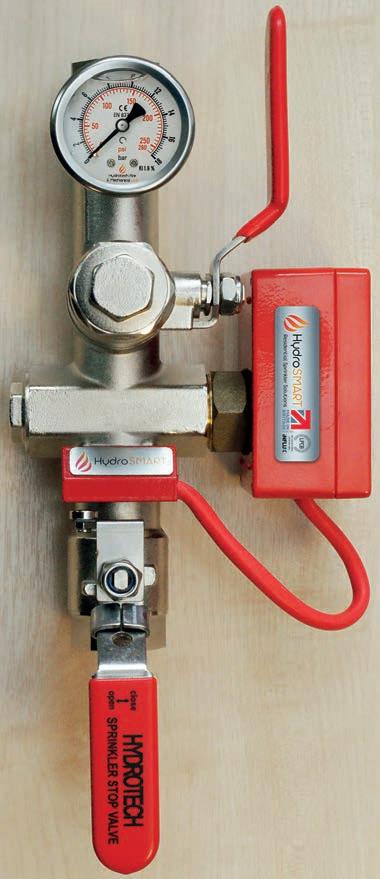


SPFS and SPFSi models available
Robust case design with embedded screws

LPCB approved in line with EN 12259-5
Integrated monitoring available 20 bar max working pressure with IP65 rating
Manufactured and designed in the UK


Should BAFSA develop a new qualification for new entrants to the sector? Ruth Oliver BAFSA’s skills and qualifications adviser asks the question
All too often I hear the cry ‘we need a qualification’ but do we and should we use precious financial resources to satisfy a perceived demand from what at times could be just a few loud voices.
With the completion of a Labour Market Survey recently undertaken by BAFSA the findings should assist in that decision making process. After all there is little point developing anything without significant support, not just in terms of voices, but without the hard evidence to take to ABBE, BAFSA ‘s Preferred Awarding Organisation who will be required to certificate any qualification developed. To support the creation of any new regulated qualification, a strong business case is required by the Awarding Organisation.
Let’s be honest here, qualification development is time consuming and costly to the developer, in this case BAFSA and to the Awarding Organisation. It is not to be taken lightly and involves significant undertaking. Planning the life cycle of a qualification needs to be undertaken from design and content to assessment, delivery and regulatory approval. Development costs can only be recovered through course enrolment fees. In plain speaking that means ‘take up’ by the industry.
At this point I should point out that the original L2 Certificate in Fire Sprinkler
Installation was developed with industry representatives setting the content and assessment criteria, to assist recruitment to the ‘installer’ sector and was not intended for experienced workers. The new qualification was delivered at the request of the industry in key areas ie Manchester College, London South East College, Glasgow College, Neath Port Talbot College and Llandrillo College thereby providing UK coverage. BAFSA and BAFSA members contributed to the equipping of the training rooms, large launch events were held with respective dignitaries and honourable persons being invited.
However, despite pledges of support of take up from industry, recruitment to the sector was low, evidenced through a Labour Market Survey, and only 12 recruits over a two year period were put forward to undertake the qualification. It was not surprising when Manchester College and London South East College closed their training rooms and made their tutors redundant as the course was considered unviable. USE IT OR LOSE IT springs to mind.
The development of any new qualification is triggered by a variety of factors and it is readily accepted that a new qualification is often developed to address a gap in market skills or to formalise new learning. Qualifications benefit individuals by demonstrating competence, enhancing
career prospects and increasing earning potential. For organisations a competent workforce can provide a framework for high quality assessment and even a competitive edge.
However, we must be realistic in that for any qualification to be successful there needs engagement with employer contacts. BAFSA has such contacts within its Skills & Development Committee who will identify the purpose of a qualification, one which can be taken to the Awarding Organisation as part of the required rationale for development.
This Committee, comprised entirely from BAFSA member organisations working representatives across the FSI, will shape the content and areas that the qualification will assess. After all we must bear in mind that for a qualification to meet the purpose of industry then who better to develop that industry themselves. Committee members will provide insight into the key areas for assessment and how content may need to differ to cover different employer and stakeholder requirements. Different requirements can be accommodated using pathways (as with the ABBE L2 Certificate in Fire Sprinkler Installation) or Optional Units. Qualifications come in different guises such as awards, certificates, diplomas and can be different sizes and levels, but they all

must conform to regulatory standards when classifying those sizes and levels. It all sounds extremely complicated, but BAFSA working in conjunction with ABBE, will navigate the complexity and ensure that any qualification developed meets the sector requirements and is compliant with regulations.
Submission to an Awarding Organisation for Ofqual* approval will be required and a plan for a qualification launch will need consideration. This will involve getting the message out to stakeholders through email, social media and events that the qualification is approved and a date for delivery is set.
However, whilst approval of the qualification is to be celebrated, approval is just the beginning as training providers, ie BAFSA must gain approval from the Awarding Organisation to deliver the qualification, and the necessary checks will be made to ensure that centre has capacity and expertise to deliver the qualification requirements. Learning materials, online modules, question banks, assessment processes and procedures all must developed and put in place. Assessors will need to be recruited with the appropriate skills and knowledge. Again, time consuming and significant financial resources will be drawn on.
During 2024 BAFSA, with the assistance of Alan Crichton, Fire Sprinkler Academy developed the ABBE L3 and ABBE L5 qualifications and despite numerous calls from the industry for these qualifications, courses were cancelled through lack of enrolments. However, this year has seen an increase in take up although possibly due to the change from BRE but a situation that reminds you that the voice for qualification development is not always the voice of enrolment.
As an industry and just as ten years ago the question remains – how do you recruit
“We must be realistic in that for any qualification to be successful there needs engagement with employer contacts”
the next generation of installers, engineers, designers etc? Below is an extract from BAFSA Year Book 2015 written by Mike Green, BAFSA Vice Chair:
One such challenge for the future is an ageing workforce. An ageing workforce means people retiring from the industry, taking their skills, knowledge and vast experience with them. With little or no widespread and industry led focus on the development of skills and qualifications there is an urgent need to attract a new generation of young people into all areas of industry including installation, design, project management and maintenance. In doing so we will be ensuring that the workforce remains fit for purpose and ready for the challenges ahead.
BAFSA has already established that there is a shortage of young people within our industry and therefore focus is needed now to ensure the industry raises its profile to encourage and show those looking for job opportunities that the Fire Sprinkler Industry is a career to look forward to with clear career pathways offering potential recruits a glimpse of the diverse range of opportunities within the industry.
So here we are 10 years on and significant qualification development has
taken place (just a blank sheet of paper existed 10 years ago!)
BAFSA recently secured funding which has allowed the development of a video, hosted on BAFSA YouTube, which invites people to consider the FSI as a potential career. A resource that can be used by all, even placed on organisation websites. So in encouraging new recruits what is it that we can offer in terms of qualifications for these new entrants? At present nothing.
The case for qualification development can usually be found. However the pledges of support for the qualification i.e. take up from the industry are harder to ascertain. It is easy to find the case as to why individuals should undertake qualifications, but 30 years experience of working in workplace education has shown it is far easier to find the excuse not to undertake a qualification … believe me I could write a book on the excuses.
So, I caution and ask the question should we develop a new qualification? If we are, then as an industry will you support it –not just in terms of a voice but in terms of enrolments ?
* Office of Qualifications & Regulation


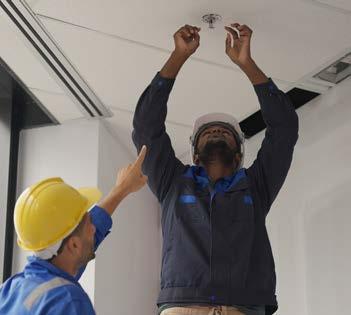

Would you like to pass on your skills and support the next generation of installers?
This is a rare opportunity to become an Assessor with a leading trade association – The British Automatic Fire Sprinkler Association.
Home based, with hours to suit, you will join a team that delivers training and assessment to installers, assessing candidates’ video evidence of competency through appropriate skills, knowledge and behaviours needed to succeed in one of the UK’s growing sectors.
You will assess experienced installers, working to gain their Level 2 qualification in fire sprinkler installation – residential and commercial. Evidence is primarily provided through video recordings and completion of online modules, including multiple choice questions.
Ideally you will have an assessor award, if not BAFSA will support you to gain certification.

For further information please contact Ruth
Nick Coleshill provides a round up of some of the major incidents reported to Sprinkler Saves over the last quarter and provides some new insights into activations from Greater Manchester Fire and Rescue Service
Across the country recent incidents have once again demonstrated how automatic water suppression systems (AWSS) are saving lives, protecting property and reducing risk to firefighters.
From residential tower blocks to underground stations and industrial warehouses, these systems have repeatedly proven their effectiveness in containing or extinguishing fires before they can spread. The following cases, reported by Fire and Rescue Services across the UK to BAFSA’s Sprinkler Saves highlight the life-saving impact of sprinklers in action.
A kitchen fire in a Bristol high-rise flat was swiftly contained by a single sprinkler head, preventing injury and extensive damage.
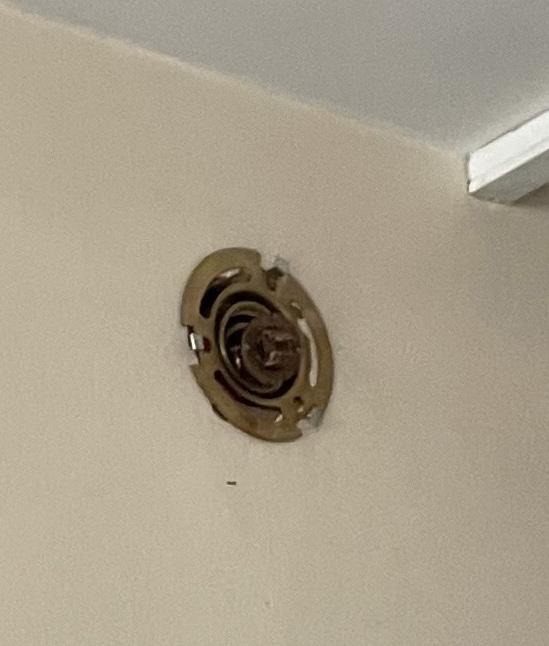
Firefighters were called to the 10-storey residential block at 13:06, where a fire on the eighth floor had been caused by a frying pan left on the cooker. A sidewall sprinkler head activated, controlling the blaze before it could spread. Crews wearing breathing apparatus confirmed the fire had been extinguished, with only minor smoke staining above the cooker. No injuries were reported.
Richard Bobruk, Business Fire Safety Officer for Avon Fire & Rescue Service, said:
“This incident clearly demonstrates the benefits of retrofitting life-safety sprinkler systems in tall residential buildings. Without Bristol City Council’s decision to install sprinklers across all 62 of its tower blocks, this incident could have had a very different outcome.”
The sprinkler system, installed to BS 9251 standards, reduced heat and smoke production, allowing extra time for residents to escape safely.
A fire in an escalator motor room on the London Underground was successfully controlled by the Escalator Water Suppression System (EWSS) before firefighters arrived.
Crews from the London Fire Brigade (LFB) responded after heat from an electrical motor brake drum ignited debris in a sub-surface escalator chamber. The EWSS activated automatically, containing and cooling the fire. Firefighters wearing breathing apparatus confirmed full extinguishment and ensured the area was safe. No injuries were reported, and the station reopened shortly afterwards.
The EWSS developed specifically for the Underground network provides complete
protection along escalator inclines, machinery spaces, and dust trays. It was one of several safety upgrades introduced following the King’s Cross fire in 1987, which claimed 31 lives.
This incident reinforces how automatic suppression systems can control fire risk in challenging environments, protecting passengers, staff, and firefighters while limiting service disruption.
A sprinkler system has been credited with preventing the destruction of a warehouse in Staffordshire, after a fire was contained and extinguished before firefighters arrived.
Crews from Staffordshire Fire & Rescue Service (SFRS) attended a fire on 1 August 2025 at a single-storey industrial unit. The blaze, involving a lead-acid forklift battery, triggered the activation of four sprinkler heads which successfully controlled and extinguished the fire.
Ian Read, head of Prevent, Protect and Partnerships at SFRS, said: “At Staffordshire Fire and Rescue Service, we champion the use of automatic sprinklers. This incident shows exactly why they’re an invaluable resource for our crews and can make the difference between a minor incident and a total loss.”
The fire was confined to approximately 25m², avoiding significant damage or disruption.
This case supports national research by Optimal Economics for the NFCC, showing sprinklers are 99% effective in controlling or extinguishing fires. By contrast, a nonsprinklered warehouse fire in Coventry in 2021 required ten fire appliances and seventy firefighters, resulting in the building’s complete loss.
A retrofitted sprinkler system in a 15-storey residential building in Greater Manchester prevented a major incident when a fire broke out in a flat on the eleventh floor.
Greater Manchester Fire and Rescue Service (GMFRS) attended the fire on 17 July 2025, which started in upholstered furniture due to careless disposal of smoking materials.
Before firefighters arrived, a single sprinkler head activated, containing and extinguishing the blaze. Fire damage was limited to 5m² within the room of origin, and no injuries occurred.
Housing provider The Guinness Partnership has pledged to retrofit sprinklers in all buildings over 18 metres - a move strongly supported by fire professionals advocating for national retrofitting requirements.
A single sprinkler head extinguished a fire in a converted six-storey building in London on 11 July 2025, marking the second successful activation at the same property in less than two years.
The fire began when a charging laptop ignited inside a studio flat. Fire crews from London Fire Brigade (LFB) arrived to find the sprinkler system had already done its jobextinguishing the flames and limiting damage to the item first ignited. No injuries were reported.
The sprinkler system, designed to BS 9251:2014 Category 2, includes a dedicated tank and pump providing a 30-minute water supply.
An LFB spokesperson said: “This incident shows how a well-designed and maintained sprinkler system can significantly reduce heat and smoke, providing occupants with precious time to escape safely.”
Without sprinklers, the outcome could have been far more severe. The incident supports calls from the NFCC and fire sector leaders for government action to expand sprinkler requirements, particularly in buildings housing vulnerable occupants such as care homes, hostels, and sheltered housing.

Each of these incidents reinforces one message - sprinklers work Whether in homes, workplaces, or public transport systems, automatic suppression systems have repeatedly prevented fires from escalating, protected lives, and reduced operational demand on fire and rescue services.
As the National Fire Chiefs Council (NFCC) and fire safety professionals continue to advocate, sprinklers should become the norm – not the exception.
Sprinkler Saves UK encourages all Fire and Rescue Services, businesses, and housing providers to report sprinkler activations. Collecting real-world evidence strengthens the case for wider installation and helps create a comprehensive national record of incidents where sprinklers have saved lives, property, and communities.
A residential sprinkler system installed in a converted Grade II-listed mill in West Yorkshire has been credited with preventing a potentially serious fire from spreading reinforcing the life-saving value of such systems.
At 14:02 on 8 October 2025, West Yorkshire Fire and Rescue Service crews were called to reports of a fire in a selfcontained apartment within the renovated mill complex. On arrival, firefighters found that the building’s sprinkler system had already activated, containing the blaze to the kitchen area.
Four residents had safely self-evacuated prior to the arrival of the fire crews.
Firefighters confirmed that a single sprinkler head had effectively controlled and extinguished a fire involving cooking oils, limiting fire damage to the room of origin. No injuries were reported.
A spokesperson for West Yorkshire Fire and Rescue Service said: “West Yorkshire Fire and Rescue Service strongly supports the use of sprinkler systems as a proven lifesaving and property-protecting measure. Sprinklers activate automatically in response to heat, suppressing fires before they can spread, which not only protects occupants and firefighters but also limits damage to buildings and their contents.”
The prompt activation of the system in this case prevented extensive damage to the historic building and avoided what could have been a far more serious outcomedemonstrating once again that sprinklers save lives, protect property, and preserve heritage.
“Fire sprinklers provide communities with an essential layer of fire protection. Their effectiveness is demonstrated by their role in saving lives, reducing injuries, and safeguarding businesses from fire-related losses.” Scott Harrison, Senior Fire Safety Inspector at Greater Manchester Fire & Rescue Service.
NumberDate
Greater Manchester Fire and Rescue Service (GMFRS) provided primary fire data from their incident recording system and additional sources for the period April to July, documenting cases where Automatic Water Suppression Systems (AFSS) were present and had an impact within Greater Manchester. The term AWSS refers to
1July 2025EcclesDwelling Purpose Built Flats/ maisonettes - 10 or more storeys
and raised the alarm
2July 2025SalfordDwelling Purpose Built Flats/ maisonettes - 10 or more storeys Yes, and raised the alarm
3July 2025BroughtonNon residential Purpose Built Flats/ maisonettes - 10 or more storeys
4July 2025HeywoodNon residential Leisure Centre
and raised the alarm
and raised the alarm
sprinklers and water mist systems. A sprinkler save is categorised as an event where one or more sprinkler heads have activated and contained, controlled, or, in some cases, extinguished a fire. This review further substantiates the role and advantages of AWSS within the built environment.
In room of origin
In room of origin Extinguished
In room of origin
5August 2025 WythenshaweNon residential Takeaway, fast foodNo In room of origin Other
Table 1, IRS primary fire data where AFSS were present, having an impact
Out of the 13 incidents reported
AWSS activations were reported
involved water mist systems
The fire was: extinguished on two occasions, contained or controlled on five occasions, categorised as ‘other’ once.
Out of the 5 incidents where AWSS did not activate the reasons given were as follows: 1. Insufficient heat to actuate the head, 2. Fire located outside system coverage 3 Cause undetermined.
Supplementary evidence provided by GMFRS allowed full reviews to be completed for two incidents.
A fire occurred in a refuse bin in the undercroft car park (21000m²) and was controlled after one sprinkler head activated. Firefighters extinguished it with a water backpack. Following instructions from the incident commander, the system was isolated, and the store stayed closed until the sprinkler system was reinstated.
Three pumping appliances, one hose layer, and an aerial platform responded to a fire at a paper mill. The incident commander identified that the fire was located on the first floor of a two-storey building and had been contained after four sprinkler heads from the premises’ sprinkler system were activated. Four firefighters wearing breathing apparatus were committed who proceeded to.
Extinguish the fire with firefighting media (hose reel jets)
Ventilate the building by removing roof tiles
“The onsite private hydrants had been decommissioned and the nearest public water hydrants were not near the premises.”
The outcome of this incident for the business may have been substantially different had the sprinkler system not been installed and activated, as it played a crucial role in limiting the fire’s spread.
This provided the GMFRS with essential time to implement a tactical response plan and establish a water supply to effectively extinguish the fire. The onsite private hydrants had been decommissioned, and the nearest public water hydrants were not near the premises.
For context, in August 2021, a nonsprinklered warehouse fire in 4Coventry reported by the Business Sprinkler Alliance required ten fire appliances and seventy firefighters to suppress the blaze, which ultimately destroyed the Ram Enterprise building at Prologis Park. The structure was demolished four days after the incident.
These two incidents provide further evidence that the main functional objectives of a sprinkler system were achieved.
Reducing the rate of production of heat and smoke, limiting fire growth and ultimately containing and controlling and, in some cases, extinguishing the fire.
Prevented a potentially extended incident that could have required considerable resources from GMFRS and impacted routine operations.
Limiting the development of the fire and facilitating search and rescue efforts by firefighters and reducing risk to personnel.
Averting the complete loss of the building due to fire.
These incidents serve as powerful evidence that Automatic Water Suppression Systems are a vital component of modern fire safety strategies protecting lives, property, and the environment.
They also reinforce ongoing efforts by the NFCC, BAFSA, and partners across the
fire sector, calling for stronger government action and clearer regulation to mandate the retrofitting of sprinklers in existing buildings.
While BAFSA welcomed the Government’s November 2020 decision to reduce the threshold for mandatory sprinklers in new residential blocks from 30 metres to 11 metres, significant gaps remain. There is still no legal requirement to retrofit sprinklers in older residential buildings.
BAFSA and the NFCC continue to advocate for legislation requiring sprinkler retrofitting in:
All existing residential buildings over 18 metres in height, or Seven-storey buildings served by a single staircase, and Residential buildings over 11 metres, where risk assessments indicate a need.
Further reading is available on www. sprinklersaves.co.uk and the BAFSA website www.bafsa.org.uk
¹ Incident recording system, after an emergency fire call, key incident details are entered daily into the IRS by the officer in charge.
All sprinkler activations can be reported by the FRS using the Sprinkler Saves sprinkler activation reporting form at www.sprinklersaves.co.uk

Head Teacher Lorna Blanchenot tells Sprinkler Focus about the devastating 2020 fire that destroyed Ravensdale Infant and Nursery School in Mickleover, Derby and why she is now helping BAFSA spread the message about sprinklers in schools
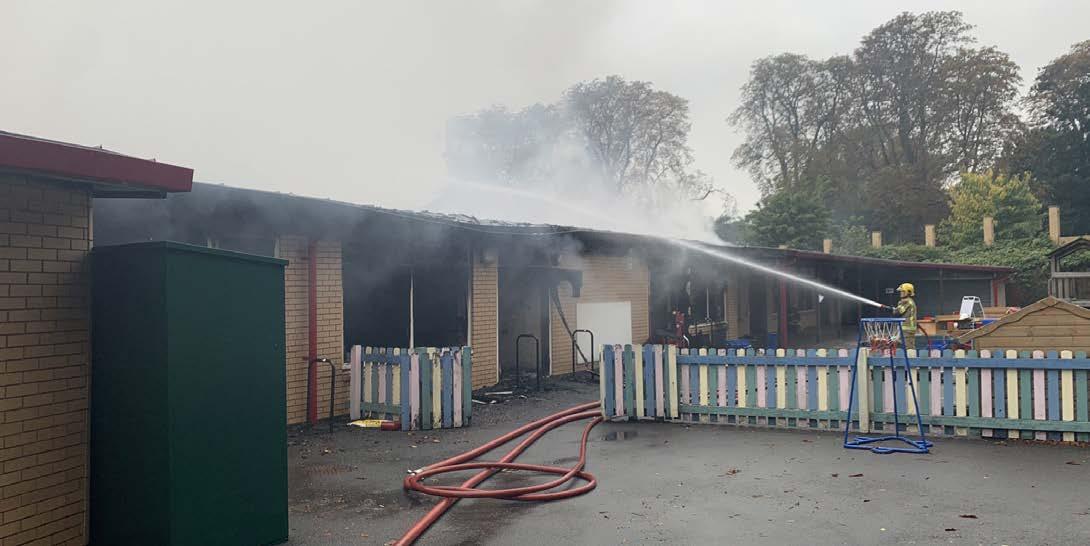
In October 2020, a devastating fire tore through Ravensdale Infant and Nursery School in Mickleover, Derby, leaving the community in shock and the school in ruins. Derbyshire Fire and Rescue Service was called to the scene in the early hours of the morning.
Adam Bleakman, one of the incident commanders that night, recalled the events: “At 01.36 on Monday 5th October 2020 Derbyshire Fire and Rescue Service received the first of eleven 999 calls to reports of a ‘fire outside’ at Devonshire Drive, Mickleover, Derby. On arrival crews
located the fire which was well developed at the front of the school and was spreading towards the rear. As the incident progressed, a resourcing and command structure was put in place to deal with the fire and its wider impacts.”
It took 12 fire engines and two aerial ladder platforms to bring the blaze under control. A ‘stop’ message was sent at 17:47 that same day, confirming the fire had finally been extinguished.
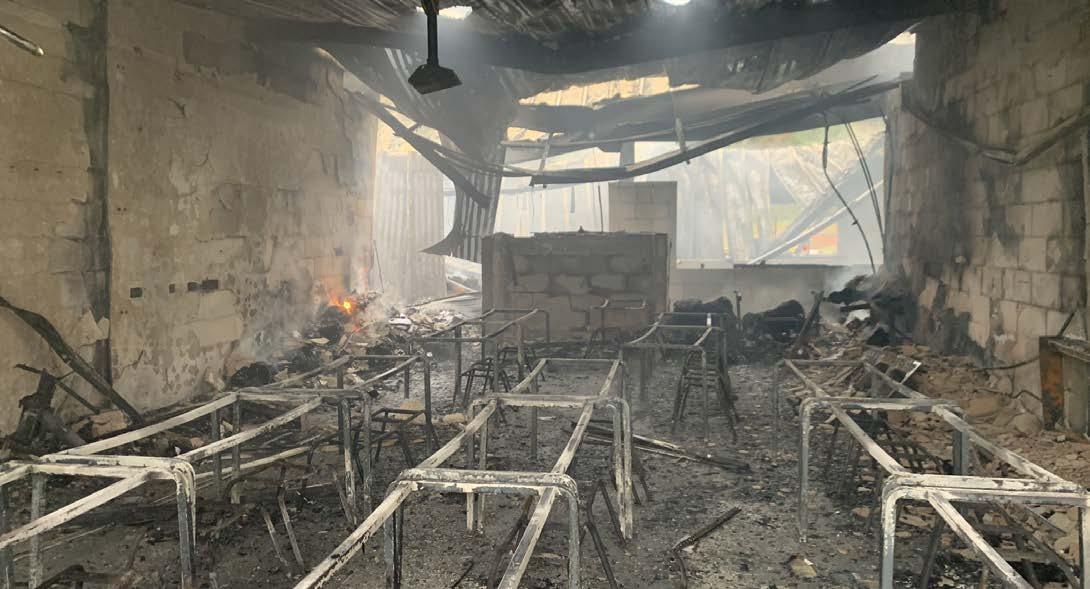
Despite the firefighters’ efforts, the infant school could not be saved. Everything
inside was either damaged or destroyed. An 18-year-old man was later charged with arson in connection with the fire. The rebuilding effort cost an estimated £6.9 million, and the school reopened to 270 pupils nearly two years later, in June 2022. The new building has been fitted with sprinklers following a Derby City Council pledge to install sprinklers in all schools undergoing renovation or refurbishment.
At BAFSA’s annual conference and AGM on 6th November, Head Teacher Lorna Blanchenot spoke with Terry McDermott of
the National Fire Sprinkler Network about the long-lasting effects of the 2020 fire and the school’s remarkable recovery.
Ahead of the conference, Lorna reflected on that tragic night and its lasting impact.
“I have been teaching since 1991 and have taught in a range of Primary Schools in Milton Keynes, Thailand and Derby. I joined Ravensdale Infant and Nursery School as the Deputy Head Teacher in January 2015 and then became the Head Teacher in 2017. On October 5th 2020 we were the victim of an arson attack which completely destroyed the school. After being called to the school
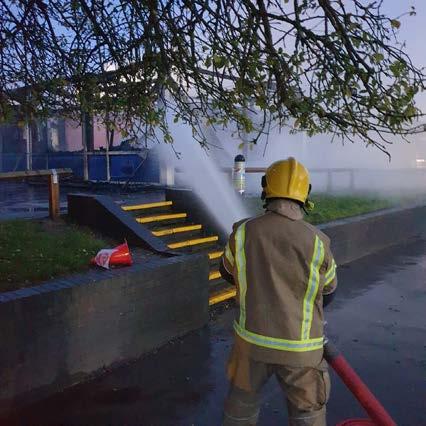
“The human cost was equally significant. The effects of the fire were devastating for the whole community and the toll was particularly felt within school – in 2023, three years after the fire we only had 16/45 original staff remaining.”
at 1.45am, I watched as it burnt down throughout the night.”
She explained that the building, a CLASP structure with no sprinklers, allowed the fire to spread rapidly. “Although the fire crews did all they could to control and stop the blaze, it spread through the school at a lightning pace. The building was a clasp building with no sprinklers. It took 20 months and around £8 million to re-build the school, but at least another two years for us to be settled back into our new building, fully resourced and staffed.”
The human cost was equally significant.“The effects of the fire were devastating for the whole community and the toll was particularly felt within school –in 2023, three years after the fire we only had 16/45 original staff remaining.”
Despite the heartbreak, Lorna says the rebuilding process has brought the school and community closer than ever.
“The senior leadership team played a significant role in the design and re-building of the school and now feel very fortunate to have a beautiful building in which we welcomed our community back together in June 2022. And it is fitted with sprinklers.”
Today, Ravensdale Infant and Nursery School stands as both a modern learning environment and a symbol of resilience. Thanks to the lessons learned from that night, Derby City Council has pledged that all new and refurbished schools will now be fitted with sprinklers ensuring that such devastation is never repeated.
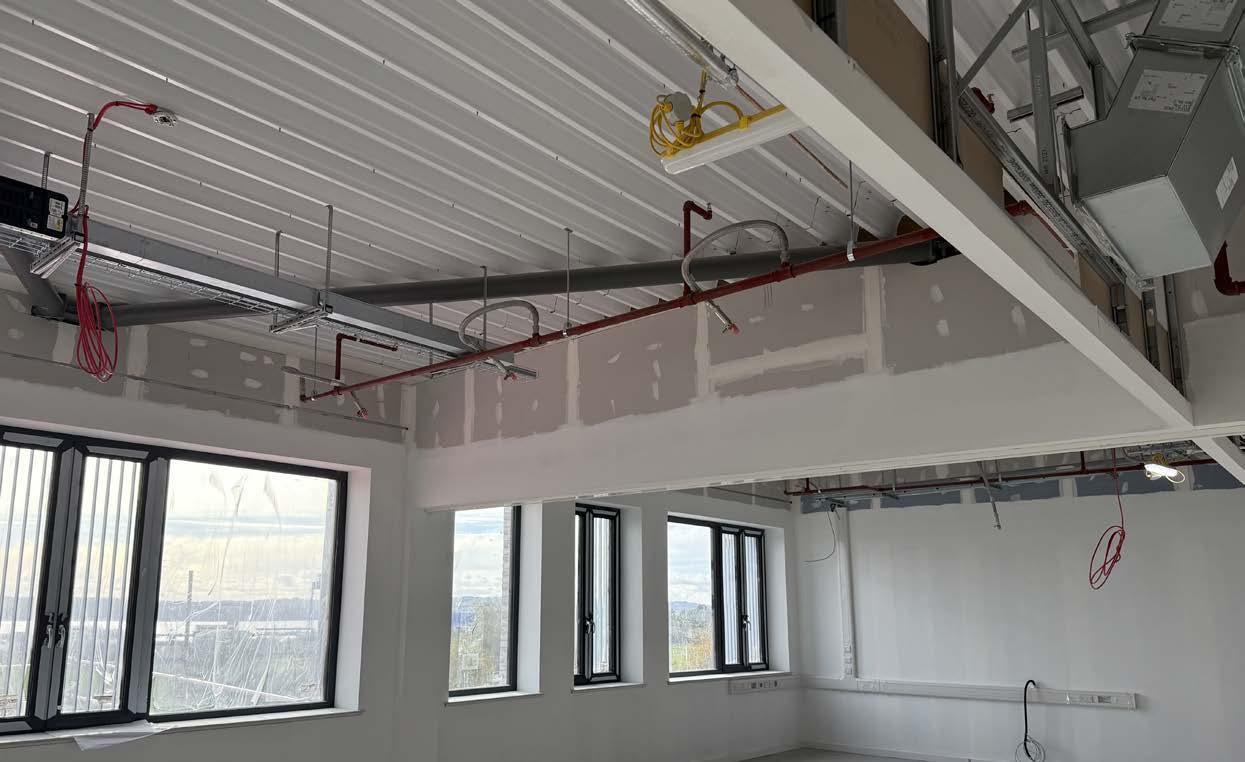
BAFSA’s
Alan Crichton gives an overview of two new courses coming on stream with BAFSA next year
In response to the Building a Safer Future report, the British Automatic Fire Sprinkler Association (BAFSA) has been leading efforts to strengthen professional qualifications within the UK sprinkler industry. The aim: to ensure that designers, installers, and supervisors can demonstrate competence through nationally recognised qualifications in line with global standards seen in Europe, Australia, and the United States.
This initiative began with the creation of:
ABBE Level 2 Certificate in Fire Installation
ABBE Level 3 Award in Inspection and Commissioning of Commerical Fire Sprinkler Systems
ABBE Level 5 Diploma in System Classification and Design of Pre Calcuated Commercial Fire Sprinkler Systems.
BAFSA is now extending this programme to cover advanced areas of system design, including both high-rise and storage applications.
A comprehensive programme of new qualifications is currently in progress, including:
Sprinkler Design for High-Rise Commercial Buildings, incorporating Full Hydraulic Calculation (FHC) design for non-storage occupancies
Sprinkler Design for Storage Systems, covering roof and rack installations, ESFR (Early Suppression Fast Response) systems, and CMSA (Control Mode Specific Application) systems.
These courses are designed to ensure that UK designers and engineers meet modern standards and can competently address the growing complexity of sprinkler systems in commercial, high-hazard, and high-rise environments.
Developing a new national qualification typically takes 18 to 24 months, depending on course size and complexity. Design qualifications, in particular, often take longer due to updates in British Standards (BS EN 12845 series) and related guidance.
For example, the Sprinkler Design for Storage Systems course was paused to align with the development of BS EN 12845-2, with further updates to BS EN 12845-1 expected to begin in January. These standards updates ensure that new qualifications reflect the most current industry requirements.
High-Rise Sprinkler Design & Full Hydraulic Design (Unit 4)
The next qualification nearing completion is Unit 4 – High-Rise Sprinkler Design & Full Hydraulic Design for Non-Storage Systems. Currently 80% complete, the course will soon undergo peer review by a working group comprising representatives from:
The Fire Protection Association (FPA)
Major insurance companies
A third-party accreditation organisation
BAFSA’s Technical Committee
Once the review is complete, feedback will be incorporated and the training
materials finalised including workbooks and assessment documents before final sign-off.
Unit 4 – High-Rise Sprinkler Design & Full Hydraulic Design for Non-Storage Systems focuses on the design of sprinkler systems for tall buildings and complex occupancies where FHC methods are required. It is aimed at designers working on projects such as high-hazard process areas, schools, retail premises, and other non-storage environments.
Participants will study:
Classification of special hazard and risk categories
System requirements for high-rise buildings
Pipe sizing using FHC methods
Water supply configurations for high-rise and FHC pump houses
High-rise system design principles Hydraulic calculations
Design of non-storage systems using full hydraulic methods
By the end of the course, candidates will be able to:
Understand the need for special design requirements for special hazard risks.
You will be able to demonstrate your knowledge of simple hydraulic formulas and demonstrate you can carry out manual calculations.
You will be able to design a high-rise system.
You will be able to carry out hydraulic calculations for non-storage sprinkler systems
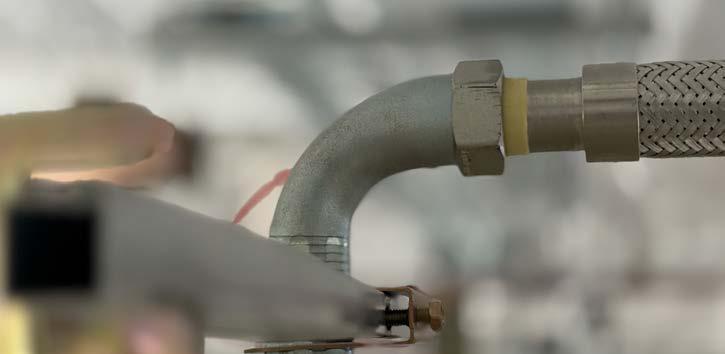
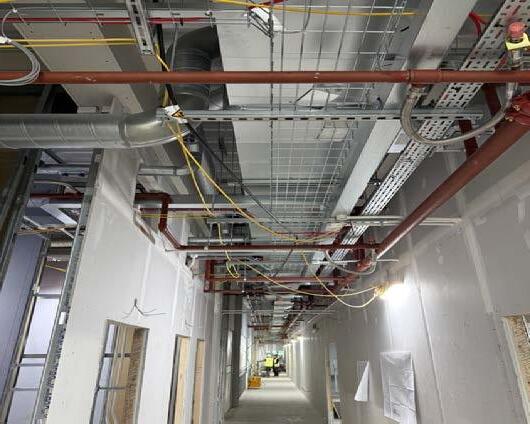
The above learning outcomes are all theory; these skills will need to be put into practice to classify a sprinkler system and also for the design of pre calculated sprinkler systems.
To ensure that candidates are suitably prepared, the following entry criteria will apply:
Successful completion of the LPCB Basic Competence Review, or Completion of the BAFSA Classification and Pre-Calculation Course, and At least one year’s experience in fire sprinkler design involving FHC systems Experience with high-rise system design is preferred but not essential
All BAFSA qualifications are submitted as customised awards through ABBE, meaning BAFSA retains ownership and control of delivery through ABBE-approved centres. During the approval process, BAFSA submits:
Full teaching and learning materials
Course plans and assessments
Model answers and marking guides
ABBE then reviews the content, assigns a qualification level, and links it to an appropriate CSCS card for professional recognition.
Although still in development, the course is expected to run for 10 weeks, at one day per week, followed by a post-course design submission for assessment.
22-23 April
Fire Sprinkler International (FSI) European sprinkler conference organised by the European Fire Sprinkler Network (EFSN) Paris firesprinklerinternational.com
28-30 April
The Fire Safety Event UK largest Fire Trade Show NEC, Birmingham firesafetyevent.com
18 June
BAFSA Annual Challenge Day (BAFSA Members only) Mottram Hall , Cheshire champneys.com
19th November
BAFSA Conference and AGM Venue TBC bafsa.org.uk
ABBE Level 3 Award Inspection & Commissioning of Commercial Fire Sprinkler Systems
Start dates: 23rd March 2026 17th August 2026
ABBE Level 5 Diploma Classification & Pre Calculated Commercial Fire Sprinkler System Design (Experienced Workers) 5 Day Course
Start dates: 2nd February 2026 11th March 2026 August 2026 date TBC
ABBE Level 5 Diploma Classification & Pre Calculated Commercial Fire Sprinkler System Design (New Entrants)
Every Monday for 15 weeks starting: 31st August 2026
Exam dates (held at BRE, Garston) 11th March 2026 10th September 2026
BAFSA Refresher FHC course
Course start date: 2nd March 2026
January 21st 10am–12.30pm Hall & Kay
Hall & Kay Fire Engineering, Sterling Park, Clapgate Lane, Birmingham, England, B32 3BU.
March 25th – online 10am–12.30pm
May 27th – online 10am–12.30pm
July 29th – online 10am–12.30pm
September 23rd – online 10am–12.30pm
19th November 10am–12.30pm
Same day as BAFSA AGM Venue to be confirmed.

Fabricating Your Design With Engineering Excellence