BACKCOUNTRY JOURNAL

THE NEXT CHAPTER
Over the past 10 years, I’ve had the privilege of watching Backcountry Hunters & Anglers grow from a small and scrappy grassroots organization into the North American powerhouse for our wild public lands, waters and wildlife. But what stands out most from the past decade isn’t the milestones we have reached — it’s the people who made it all possible. From local chapter events and stewardship projects to evening chapter and staff meetings to sharing campfires with volunteers who traveled across states or farther to make their voices heard, I’ve been continually inspired by the dedication and grit that fuels this community.
Some of my most treasured memories come from our Rendezvous gatherings and seeing hundreds of passionate members and chapter leaders come together each year to celebrate our mission, debate hard issues, raise a glass and recommit to the work ahead. Those events reminded me again and again that BHA isn’t defined by offices or titles, but by a shared belief that wild places matter. And throughout these years, we’ve seen real conservation wins — expansions of public access, defense of critical habitats and meaningful policy victories at both state and federal levels. Each success was a testament to the collective strength of our members and partners who refuse to sit on the sidelines.
These past 10 years have shaped me more than I ever expected. They’ve deepened my connection to the land, strengthened my belief in the power of community and given me experiences I’ll carry for the rest of my life.
After 10 years serving as BHA’s vice president of operations, I’m filled with gratitude as I step away from my role. It has been the honor of a lifetime to work alongside our dedicated staff, the North American board, chapter leaders and the countless volunteers who give this organization its heart. Together, we’ve protected the wild public lands and waters that define our North American heritage — places that have shaped me deeply and that I now have the joy of sharing with my two boys as they grow up hunting, fishing and exploring the backcountry.
BHA’s future is bright. With Ryan Callaghan at the helm as the new president and CEO (read the announcement on page 16 if you missed that news), and an incredibly passionate team and volunteer base driving the mission forward, I have full confidence this organization will continue to lead the charge for conservation, access and stewardship. Though my role is changing, my commitment to the work and to this community remains unwavering. Thank you for the trust, collaboration and camaraderie over the past decade; it has been an unforgettable journey.
As I begin a new chapter, I do so with immense pride in what we’ve accomplished together and deep gratitude for every person who played a part in this journey.
-Frankie McBurney Olson,
outgoing Vice President of Operations
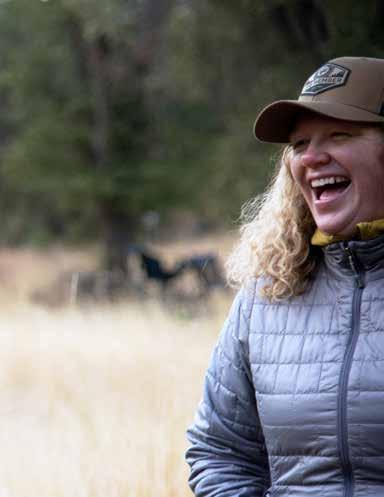
BHA has been blessed with no shortage of leaders. From the CEO to volunteers in the field, whether pulling fence or testifying before Congress, our grassroots community has always risen to the moment. Time and again, BHA has been powered by conservation leaders who do not shy away from the work.
Leadership is not always front-facing. Often, it happens behind the scenes. For the past decade, Frankie McBurney Olson has been that steady, behind-the-scenes leader — keeping the wheels turning and helping build BHA into the public lands and waters force it is today. From identifying and hiring leaders at every level of the organization to ensuring BHA remains a highly accredited and respected nonprofit, Frankie has exemplified professionalism and steadfast leadership during a period of tremendous growth.
As I step into my new role as president and CEO, and as Frankie departs BHA for a new leadership chapter of her own, we owe her a tremendous debt of gratitude. Thank you, Frankie. We wish you nothing but the best in what comes next.
While it is difficult to lose a leader like Frankie, I am comforted by the knowledge that BHA remains full of leaders — some of whom are still waiting for their opportunity to step forward. 2026 will be a pivotal year for BHA as we work to galvanize and unite a broad coalition, cementing our public lands and waters as fundamental to our freedom as Americans. Will you lead with us?
-Ryan Callaghan, President and CEO
Photo: Nadia Marji
Make a meaningful impact on the future of our wild public lands, waters, and wildlife by giving to BHA. Every contribution, regardless of size, plays a crucial role in protecting the wild spaces that enrich our lives!
W A Y S T O

GIVE
ONE-TIME OR RECURRING DONATION
JOIN THE CAMPFIRE SOCIETY
APPRECIATED SECURITIES OR STOCK
RETIREMENT PLAN BENEFICIARY
REQUIRED MINIMUM DISTRIBUTIONS
MEMORIAL OR HONORARIUM
“OUTDOORS FOR ALL” SCHOLARSHIP

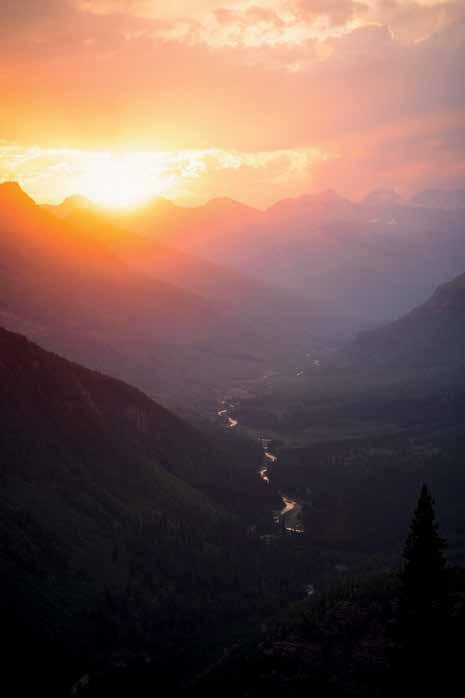


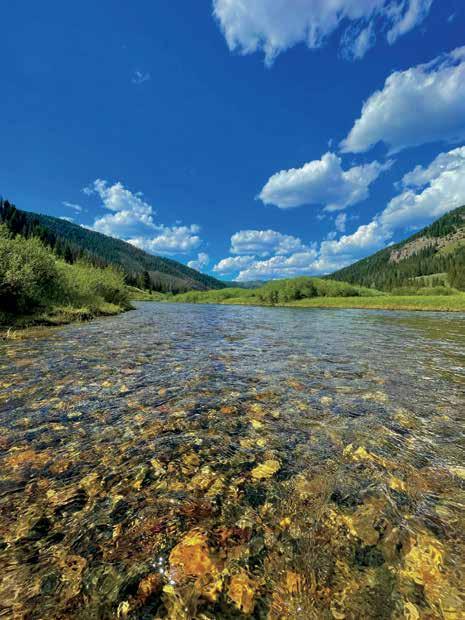
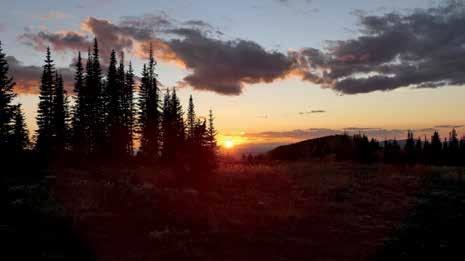
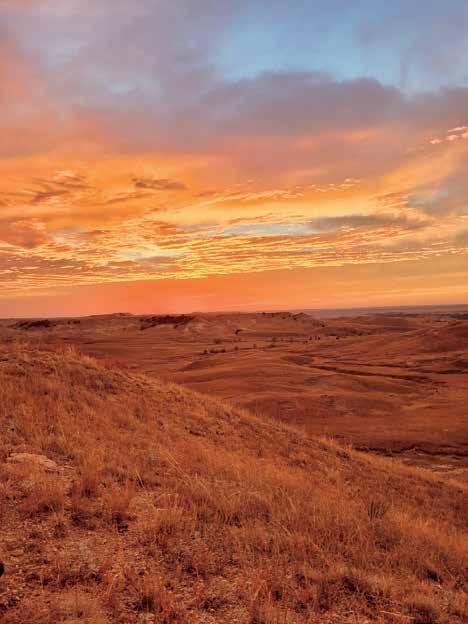
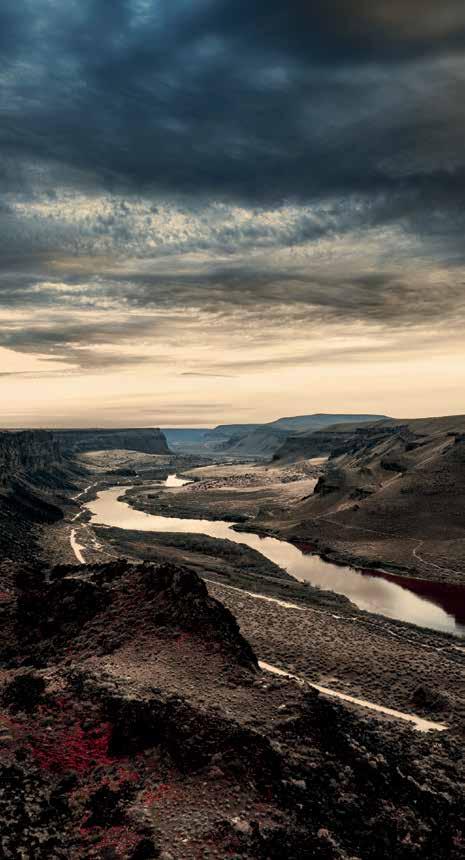
Now is Our Time
“Here is your country. Cherish these natural wonders, cherish the natural resources, cherish the history and romance as a sacred heritage, for your children and your children’s children. Do not let selfish men or greedy interests skin your country of its beauty, its riches or its romance.”
-Theodore Roosevelt
BY HAL HERRING

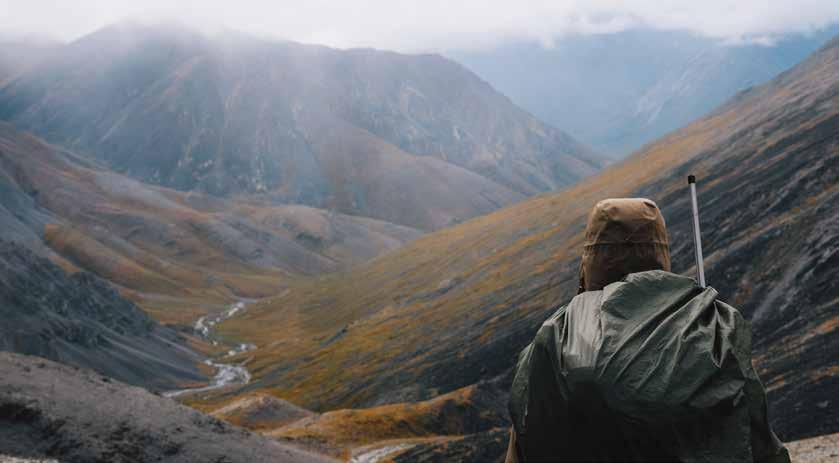
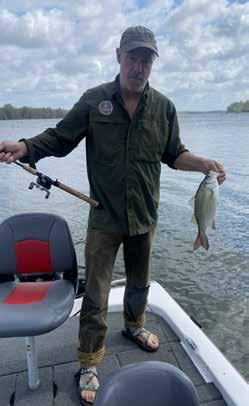
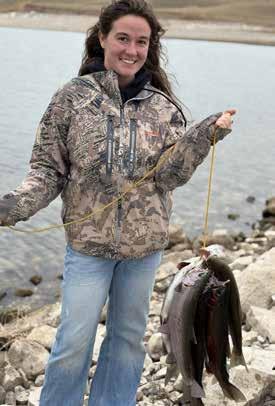
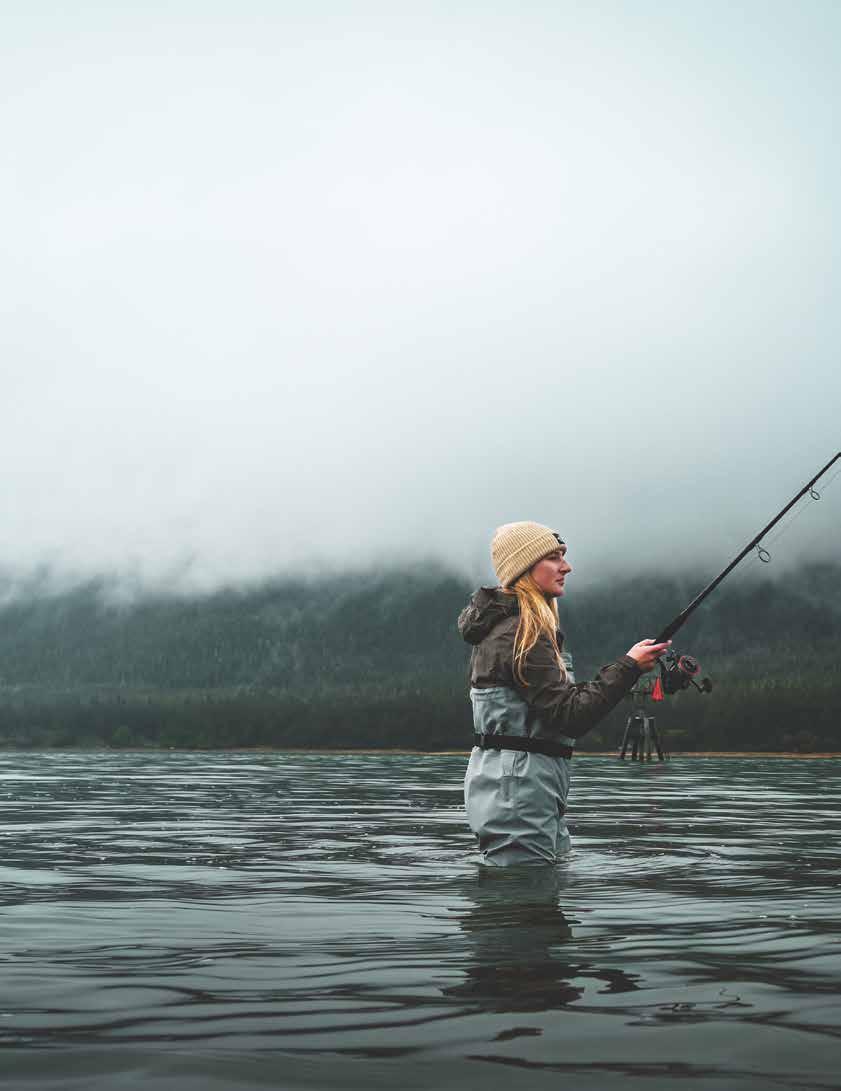
How lucky can two people be? In mid-October, we needed some trout for the smoker, and to put in the freezer for the coming winter. Deer and elk season was coming, and Indian summer was ending, with hard frosts at daybreak, and the cottonwoods going from brilliant yellow fire to bare branches. My daughter and I chose a morning when the sun was out and the wind had finally died down, and we drove to a reservoir west of town.
The lake was low — a severe drought lingering in this part of Montana, with home wells going dry and rogue irrigators taking all of our local creek until it was dry and its bed white as old bone, every fish dead. So we parked the car at the access site, let the dogs out, and hiked the fishing gear across the rubble and mud of the lake’s normal bottom. The dogs stopped to loudly crunch a pile of old blue crawdad claws and bodies, suddenly starved for chitin, I guess. This was a meat-fishing trip for us, no fly rods, just spinning rigs and nightcrawlers on bottom rigs or under a slip bobber.
By noon, the mountains had disappeared in a whiteout and the winds were pushing the lake into an icy froth, but we had six big Arlee- and Eagle Lake-strain rainbow trout on the stringer. Stocked as fingerlings each year by our state fish and game agency, these trout grow thick and heavy on the myriad insect hatches, crawfish, silver suckers, crustaceans, and other life that thrives in these cold waters born of snowmelt high in the Lewis and Clark National Forest. Filleted, brined, smoked, and shredded to remove all the bones, these trout are a kind of superfood, their flesh ranging from brick red to orange, the base for fish cakes and dips and added to everything from salads to fried rice, through hunting season and beyond. They’re the fuel that gets us up into the high country to get an elk or to drag a whitetail out of the river bottom. Sometimes it’s hard for me to believe, given what I know of the rest of the world, that we live in a nation, and are part of a society, that values fishing and clean water enough to create and fund something like this, with fish to catch and public access to what is otherwise just a big publicly funded water-storage project for agriculture.

People argue about American exceptionalism. I don’t. I’ve lived my whole life and raised my kids to adulthood in a country where we fished and hunted and spent months roaming at will on public lands; where all of my adult life, federal environmental laws cleaned up our waters and our air, and protected wildlife, wetlands, and wilderness; where state agencies staffed by hardworking Americans have made it possible for us to fish and hunt for our food and for the health of our minds, bodies, and souls. My family’s experience, this life we’ve led, this stringer of big trout, are Exhibit A, B, and C of a successful and exceptional nation.
Back in the truck … we turn up the heat and flex coldreddened hands over the defroster vents. The noon news comes blaring over the radio, the Montana segment about more layoffs in the U.S. Forest Service, a new bill introduced by U.S. Sen. Mike Lee to eviscerate the Wilderness Act — with a brief mention that his most recent proposal to sell off most of our public lands had failed. There’s a bill introduced by our state Legislature to lower the water-quality standards for the Gallatin River, and a rush to permit exploration by a Canadian company for “rare earth minerals” in the roadless headwaters of the West Fork of the Bitterroot, a plan to entirely rescind the Roadless Rule on national forests, and so on. When the national news comes on, it’s even worse, soaring prices for beef, water shortages, conflicts over data-center construction, masked federal agents clashing with protesters on the streets of our cities, chaos in Washington, D.C.
I punch the dial to AM 560, KMON country, and we get Merle Haggard singing, “Turn me loose, set me free … Somewhere in the middle of Montana … you can keep your retirement and your so-called Social Security … Big City, turn me loose and set me free ...”
Merle’s simple ode to freedom floods me with sudden anxiety. Although I have been turned loose in the “middle of Montana” for over three decades, I also never saved any money for retirement and have paid very little into Social Security. Maybe, given the uncertainties of life in the U.S. right now, a full-time job in the Big City would have been a better choice for me.
Uncertainties, indeed. Anxious times. But there is a remedy
My family’s experience, this life we’ve led, this stringer of big trout, are Exhibit A, B, and C of a successful and exceptional nation.
for uncertainty and anxiety, and it lies in action. Because of my life choices, I know things about our country and our history that others may not. Chances are, if you are reading this, you know, too. Like why we have our public lands, and why it is so important to our nation that we keep them, and prioritize their management and stewardship for all Americans, present and future. Like why we Americans, uniquely in the world, chose to restore our populations of fish, wildlife, and birds, and clean up our rivers and air, fighting tooth and nail against the forces of greed and indifference that would have ruined the beautiful nation in which we live.
This is, and has been, a pragmatic choice. As Theodore Roosevelt said, “The conservation of natural resources is the fundamental problem. Unless we solve that problem, it will avail us little to solve all others.” But it is also, foremost, a work of spirit and soul. It is the foundational work of the citizen, and the patriot, to safeguard our nation’s natural beauty and liberty and the resources that undergird all economy, for us to enjoy, build upon, and to pass on, better than we found them to those who follow us. We hunters, anglers, and wanderers of wild places know these values in ways that many Americans have forgotten or never had the chance to learn.
In the lifetime of any living American, there has never been such a melee of concentrated assaults on our hard-won heritage of conservation, public lands, hunting, fishing, and the liberty that they provide. We’ve always known that these dark energies were part of our nation — part of all nations, part of humanity. That there were, among us, people who cared nothing for wildlife or clean water or air and considered any attempt to protect these resources as simply an impediment to their plans for evergreater profits. We knew that there were Americans who believed wholeheartedly that our public lands should all be sold to the highest bidder, that our federal government was hopelessly corrupt
and deserving only of destruction, that agencies like the EPA or the U.S. Fish and Wildlife Service or state game and fish agencies were ridiculous and worthy only of being abolished. We knew that there existed, in some minority of our people, a vision of our country, not as a grand experiment in balancing individual liberty and the common good, or as a beacon of hope in a troubled and teeming world, but merely as a vast storehouse of resources — land, energy, water, minerals, human beings, and our very labor — to be exploited by the chosen until it was all ruined and empty.
We believed that such a dark view existed only on the fringes of our society, and that it was too grim and preposterous to gain enough traction in our politics or in reality to impact our lives and the lives of our children. We believed that the relentless disciples of mammon were simply misguided and that they were few. We erred mightily in that belief. In the luxury of having so much, we underestimated how easily it could all be lost — or taken.
This is the time of our awakening. The sunlight is blinding at first — I admit it. I would prefer a little shade, but that’s not what we need right now. We who know and love America’s rivers, mountains, swamps, prairies, and the liberty we’ve had to experience these treasures were born for this moment, for both the gift and the burden of this unique responsibility. We have been given a nation beautiful and rich beyond imagination, liberty and adventure unparalleled; skies teeming with waterfowl and rivers and lakes a-tremble with fish; deer, elk, and bear in wilderness and local woodlot alike. To whom much is given, much is expected, as the old truism goes. I will join all of you in this, the best work of our lives.
Hal Herring is an award-winning journalist, host of BHA’s Podcast & Blast, and author of a forthcoming book on America’s public lands.
Photos:
Hal Herring
“The more clearly we can focus our attention on the wonders and realities of the universe about us, the less taste we shall have for destruction.”
~ Rachel Carson
THE VOICE FOR OUR WILD PUBLIC LANDS, WATERS AND WILDLIFE
NORTH AMERICAN BOARD OF DIRECTORS
Dr. Christopher L. Jenkins (Georgia) Chair
Katie Morrison (Alberta) Vice Chair
James Brandenburg (Arkansas) Treasurer
Don Rank (Pennsylvania) Secretary
STAFF
Ryan Callaghan, President and CEO
Ed Anderson (Idaho)
Bill Hanlon (British Columbia)
Jim Harrington (Michigan)
Hilary Hutcheson (Montana)
Jeffrey Jones (Alabama)
Nadia Marji, Vice President of Marketing and Communications
Katie DeLorenzo, Western Field Director
Chris Hennessey, Eastern Field Director
Dre Arman, Regional Stewardship and Habitat Connectivity Manager
Brian Bird, Chapter Coordinator
Chris Borgatti, Eastern Policy and Conservation Manager
Kylee Burleigh, Digital Media Lead
Tiffany Cimino, Membership and Community Development Manager
Trey Curtiss, Strategic Partnerships and Conservation Programs Manager
Bard Edrington V, Habitat Stewardship Coordinator
Mary Glaves, Chapter Coordinator
Makayla Golden, Habitat Stewardship Coordinator
Andrew Hahne, Habitat Stewardship Coordinator
Contributors in this Issue
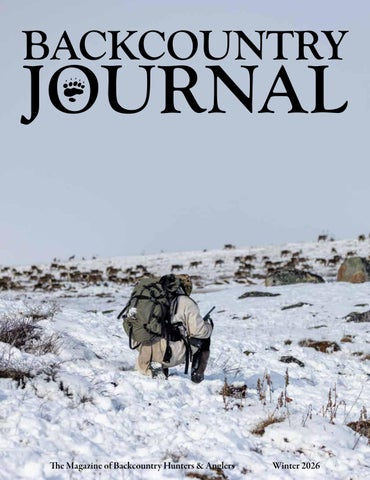
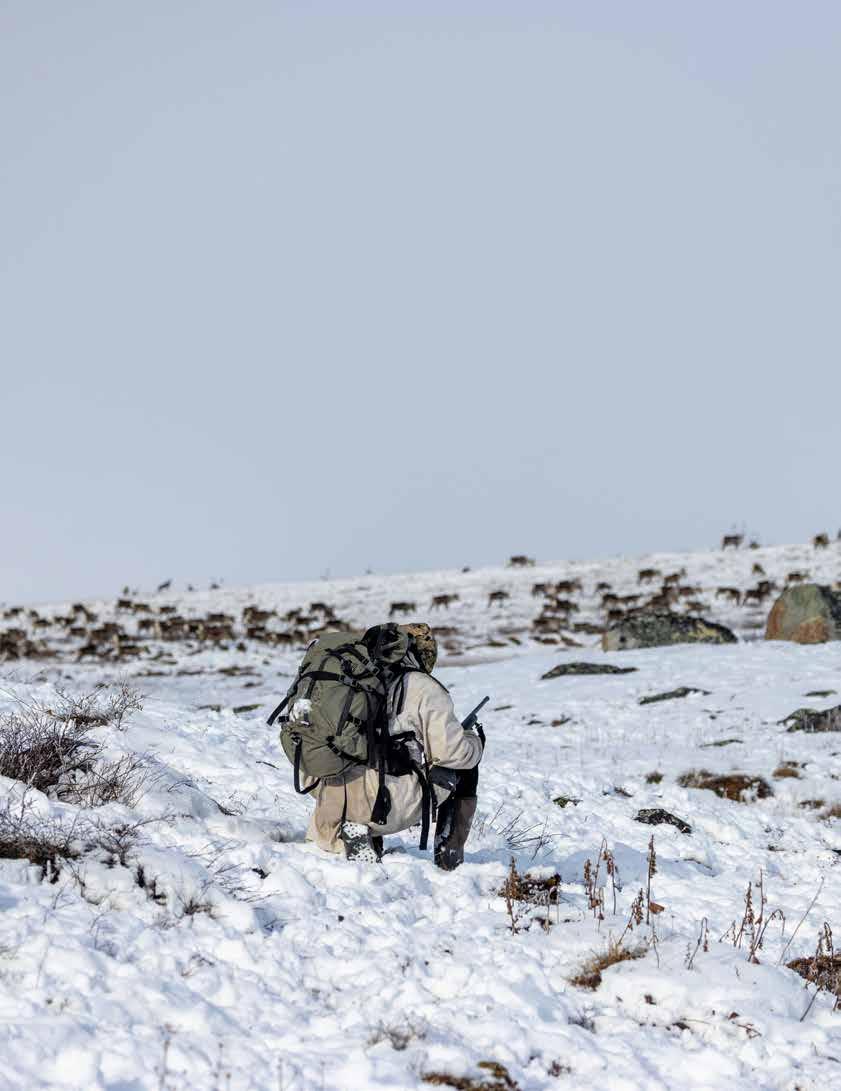
On the Cover: Photographer Mark Lindberg’s son, Zane, stalks caribou in the Brooks Range of Alaska. “The interesting story behind this photo is that we actually blew this stalk — not because of anything we did, but because, moments after the photo was taken, my son spotted a grizzly stalking the caribou from the other side. We ended up in a brief standoff with the bear before he false-charged us. After taking one last photo of the charging bear, I quickly switched from my camera to my .300 Win. Mag., and fortunately the bear turned at about 50 yards.” Mark and Zane’s trip and photography have been instrumental in BHA’s efforts to oppose the proposed Ambler Road.
Above Image: Kyle Klain
Emily Bennett, Adam Berkelmans, Charlie Booher, Paul Bramble, Striker Brown, Leslie Alan Coates, Jacob Collins, Jamin Davis, Alec Boyd-Devine, Ridge Durrant, Todd Gilgrin, Andrew Hardy, Hal Herring, K.C. Huxtable, Allen Morris Jones, Tom Jur, Kyle Klain, Mark Kenyon, JJ Laberge, Kaden McArthur, Benjamin Alva Polley, Wendi Rank, Kelly Reynolds, Garrett Robinson, Daniel Sheats, Jeremiah Watt
Mark Kenyon (Michigan)
Matt Shilling (Minnesota)
Peter Vandergrift (Montana)
J.R. Young (California)
Michael Beagle (Oregon) President Emeritus
Aaron Hebeisen, Chapter Coordinator
Jameson Hibbs, Chapter Coordinator
Bryan Jones, Armed Forces and Stewardship Programs Manager
Maisie Kroon, Operations Associate
Jonathan Lucas, Habitat Stewardship Coordinator
Josh Mills, Corporate Conservation Partnerships Coordinator
Devin O’Dea, Western Policy and Conservation Manager
Brittany Parker, Chapter Coordinator
Jack Polentes, Policy and Government Relations Senior Manager
Max Siebert, Operations Coordinator
Joel Weltzien, Chapter Coordinator
Zack Williams, Editorial and Brand Manager, Backcountry Journal Editor
BHA HEADQUARTERS
P.O. Box 9257, Missoula, MT 59807 www.backcountryhunters.org admin@backcountryhunters.org (406) 926-1908
Backcountry Journal is the quarterly membership publication of Backcountry Hunters & Anglers, a North American conservation nonprofit 501(c)(3) with chapters in 48 states and the District of Columbia, two Canadian provinces and one Canadian territory. Become part of the voice for our wild public lands, waters and wildlife. Join us at backcountryhunters.org
All rights reserved. Content may not be reproduced in any manner without the consent of the publisher.
Published January 2026. Volume XXI, Issue I
Journal Submissions: williams@backcountryhunters.org
Advertising and Partnership Inquiries: mills@backcountryhunters.org General Inquiries: admin@backcountryhunters.org
JOIN THE CONVERSATION


WHERE THE WORLD FEELS BIG AGAIN
BY JACOB COLLINS
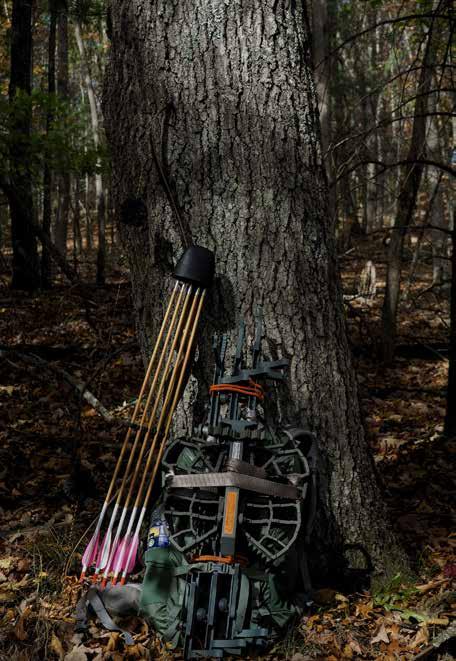
A red cloud hangs in the beam of my headlamp. It dissipates in the cool morning air of October in Appalachia. Not quite freezing, but plenty cool near the banks of a freestone stream. On the tailgate of my truck, I quietly begin my prep for the day ahead, checking the contents of my pack and finishing my morning coffee before cinching down climbing sticks and a platform onto my bag.
It’s early archery season in the state of Virginia. I’ll be spending most of the early morning hours sneaking through hollows and ridges full of big timber and laurel thickets. Loaded with supplies for a full day’s hunt and a Bear Super Grizzly bow, I begin my ascent up a long draw lined by rhododendrons.
In spite of the hike, it’s the easiest way up this mountain without tipping off a passing whitetail. What these hills lack in elevation, they make up for in steep climbs and tough walking. My waypoint is in the vicinity of a long bluffline perched atop a system of ridges.
The world around me is completely dark past the sea of stems and trunks lit by the luminous red beam of my headlamp. I find a suitable hickory tree, begin my climb and wait for daylight to reveal the world around me.
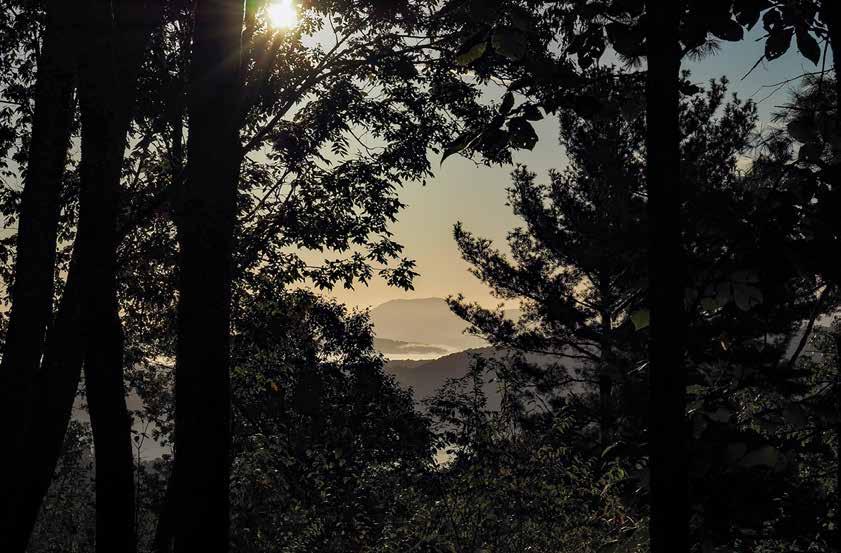
Golden sunlight drapes slowly across the mountain in shades of ochre. A world of odd shadows, void of color beyond bluish hues of gray and black, begins to dissipate. The forest reveals itself to a muted chorus of songbirds and the shuffle of squirrels rooting through leaves below. Revealed through a thin window framed by white pine and yellow poplar are thousands of acres of rolling mountaintops with hollows blanketed by a low-hanging fog.
My viewshed is unbroken and undeveloped to the human eye. All of it is public, huntable, and conserved by the 2001 Roadless Area Conservation Rule.
Overlooked
When you mention federal roadless areas, most outdoorsmen and women immediately think of Alaska’s Tongass or large tracts of open country west of the Mississippi. They aren’t wrong. But they might be overlooking the hundreds of thousands of acres in the eastern United States protected by the 2001 Roadless Rule.
Almost 400,000 of those acres are in my home state of Virginia. In fact, I’ve spent a good chunk of my life hunting, fishing and foraging these bastions of wild country without much thought. Many of my friends, family and neighbors have done the same.
These hundreds of thousands of acres in the public trust have been a mainstay of Appalachian culture — not just in my state but across the entire region.
Blanketed in Silence
The morning hours pass without much action. I watch as a lone spike passes slowly by as the sun begins to warm the air, his sights set on the white oak acorns lining the well-worn trail cut into the hillside by years of use. He saunters along and disappears behind a wall of rhododendrons, leaving my world the same way he first appeared — a manifestation of the mountain.
As morning shifts to midday, I pack up my stand and decide to scout my way around into a new location. Carefully, I sidehill along the ridgeline, keeping the wind in my face and pausing frequently to listen.
The crunch of leaves can be deafening among the natural amphitheaters of topography. A sense of quiet blankets these uniquely large tracts of eastern roadless country. No sounds other than the murmuring of a crow or the occasional song of a towhee drift through the fall woods. Among the hundreds of acres of
Photo: Jacob Collins
When you mention federal roadless areas, most outdoorsmen and women immediately think of Alaska’s Tongass or large tracts of open country west of the Mississippi. They aren’t wrong. But they might be overlooking the hundreds of thousands of acres in the eastern United States protected by the 2001 Roadless Rule.
unbroken big timber, there is no hum of the interstate or bark of a distant dog — increasingly rare in the modern world.
Pulled from my daydream by the steady shuffle of leaves, I turn my sights to the peak of the ridge above me. Rhythmic and steady. Too heavy to be a gray squirrel. Quickly nocking an arrow, I drop to a knee next to the nearest tree. My sights narrow on the rootball of a fallen oak tree about 40 yards above me. The tangled mess of roots and dirt obscures my view of the small bench behind it.
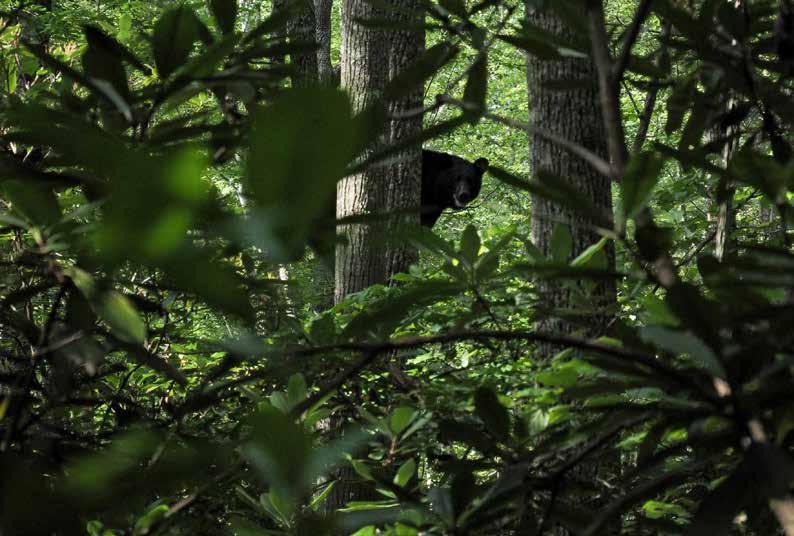
A dark black form begins to appear and withdraw behind the uprooted tree, bobbing and weaving. Small in comparison to the buck I had pictured in my subconscious. The ball of black fur quickly turns to two and three. A small sow black bear and her two cubs dig through the leaves in search of fall’s fodder.
Our paths had already crossed, too close for either to slip by unnoticed. Like a good mother should, she snaps her jaws in my direction. The clacking of her teeth echoes across the oak-covered bench. In an instant, she and her clutch retreat another 30 yards before climbing a tall hickory with impressive speed. Bark rains down onto the forest floor as they make their escape.
Perched atop the crook of a heavy limb, the trio watches in silence as I make my own exit.
The History of the 2001 Roadless Rule
In January 2001, the Clinton administration — during its final days in office — announced plans for a system of Roadless Rule protections. The new initiative would set aside 58.5 million acres of federal forests for protection from future commercial logging and road-building. It didn’t eliminate existing roads, just kept new ones from being built.
Despite the progressive environmental sentiments, the new rule had more to do with pragmatic economics and watershed protections. There just wasn’t enough money to be made by logging backcountry areas to justify the construction of new Forest Service roads. The tight budget often allotted to the U.S. Forest Service to manage the existing roads was a recipe for mismanagement. The thinking behind the new Roadless Rule was twofold: save valuable taxpayer dollars and preserve what undeveloped backcountry this nation had left.
The rule wasn’t enacted without its fair share of legal challenges and public input. Less than a month after its announcement, the newly inaugurated Bush administration paused all programs enacted in the final months of Clinton’s term. The Roadless Rule and its moratorium on resource extraction were targets at the center of those actions.
Legal challenges over the states’ role in forest management persisted in the coming years during George W. Bush’s time in office. Debate was particularly heated in Western states where oil and gas leases were being issued. In 2013, a federal court dismissed a challenge to the 2001 rule in Alaska’s Tongass National Forest. This attempt and the subsequent decision solidified the rule’s relationship with the states and acted as its final legal challenge.
Between 2020 and 2023, Trump and Biden played an executive tug-of-war over the 9.3 million acres of Alaskan roadless protections — Trump’s administration pulling the plug on protections and Biden reinstating them.
Mountain Ghosts
Lost in thought, I move along the draw, careful to stay below the ridgeline and conceal my silhouette. I slowly work toward a small spur where I found a collection of horned trees the previous winter.
Somewhere, trapped between thoughts of black bear cubs and spooked deer, the clear snap of a limb halts my progress. Though the wind is in my favor, I know I’ve been moving too quickly through an area likely to hold a mature whitetail. I freeze.
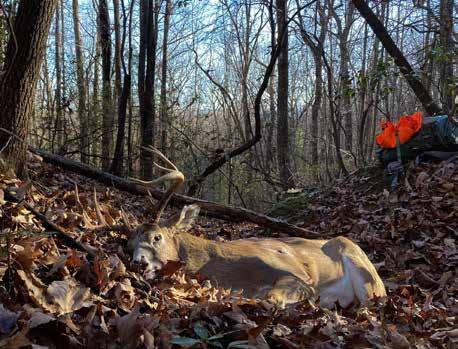
I watch as a flash of gray bounds through a thicket of wild grapevines — inexplicably silent over the dry leaves and fallen limbs. Like a ghost, the buck makes his escape without much fanfare or drama. The big ones always do. Simply dissipating into the seemingly endless maze of timber. Never once do I see antlers, but I’ve spent enough time in these hills to know what I’d done.
Knowing well that I’d blown my chance in that area, I make my way into a more familiar saddle and begin my evening sit. The evening is dead quiet. I spend most of my time mulling over my mistakes, thinking about why I choose to hunt these places.
Deer density is low. Giant bucks aren’t lurking atop every ridge, and the ones that do grow in these areas are much smarter than me. I could hunt spots closer to agriculture — there I’d see twice as many deer and hike a quarter of the mileage. I can recall hunting the mountains with my dad as a kid, wishing we had an alfalfa field to look over — just like the ones I’d seen on the Outdoor Channel.
It took me a while to get it.
Rescinding the Roadless Rule
News regarding America’s roadless areas remained fairly quiet after Biden’s reinstatement of protections in Alaska’s Tongass National Forest. However, in August 2025, the U.S. Department of Agriculture announced plans to move forward with the process of rescinding the 2001 Roadless Area Conservation Rule, affecting more than 44.7 million acres of National Forest System lands.
The process required an initial public comment period that ended this past September. Despite there being no official summary of the results yet, the Center for Western Priorities found that more than 99% of the 183,000 comments sampled were in opposition to rescinding the rule. Those were only a sample of the more than 625,000 comments submitted.
At the time of writing, despite public backlash, no changes have been made to the USDA’s plan to rescind the 2001 Roadless Conservation Rule. The proposed rule and a draft of the Environmental Impact Statement (EIS) are set to come out in March 2026 along with a second public comment period.
Big Again
The woods around me lose their color and fade into shades of blue as the sun dips below the skyline. By the time my feet are back on the ground and my gear is packed away, the only available light shines from above — a sky lit by stars and moon, framed by the
black canopy. The world is quiet other than the ghostly howl of a distant screech owl. I make my way back to the truck, the world once again reduced to the glow of my headlamp. I think about my love for these mountains. How lucky I am to be able to visit places where the world feels big again.
BHA member Jacob Collins is an outdoor writer and photographer from Southwestern Virginia. His work centers around hunting and fishing, public lands, wildlife management, and the men and women who call Southwest Virginia home.
Stay tuned to BHA emails and social media for the announcement of the spring 2026 comment period and your chance to again speak up in favor of the Roadless Rule.
C F ONSERVATION IRST BANK
















Photo: Jacob Collins
BACKCOUNTRY JOURNAL
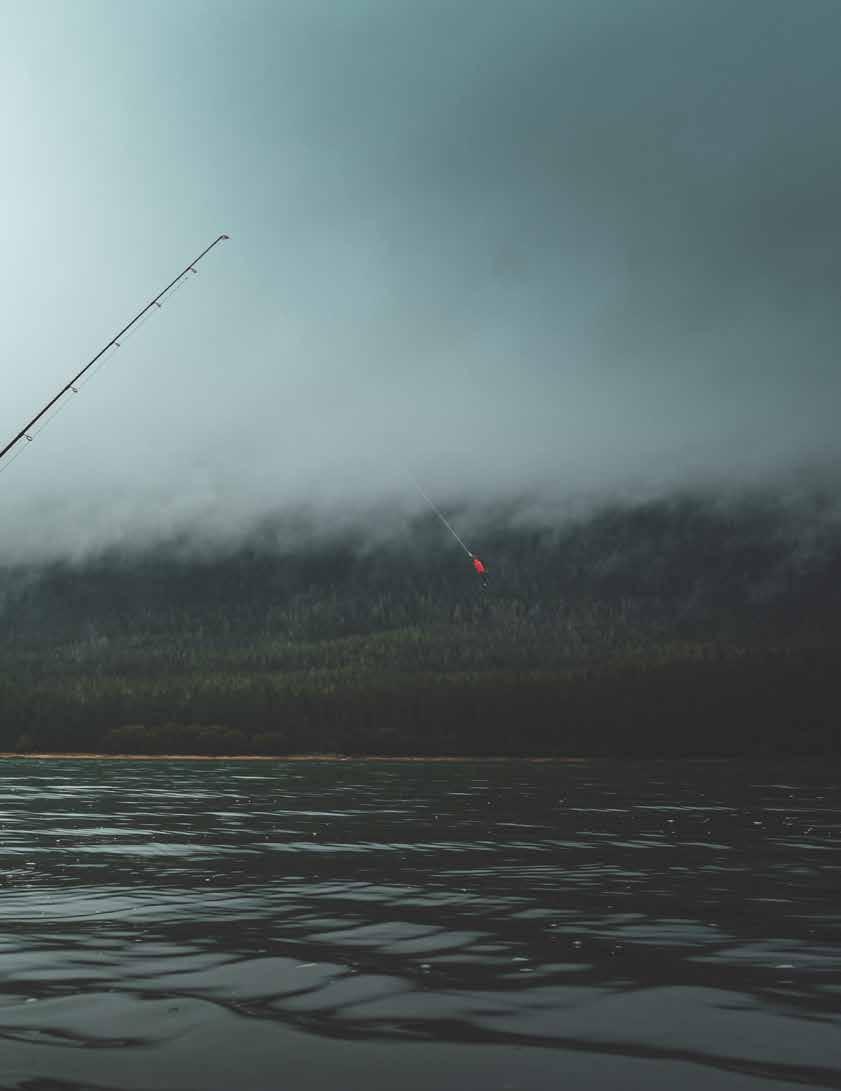
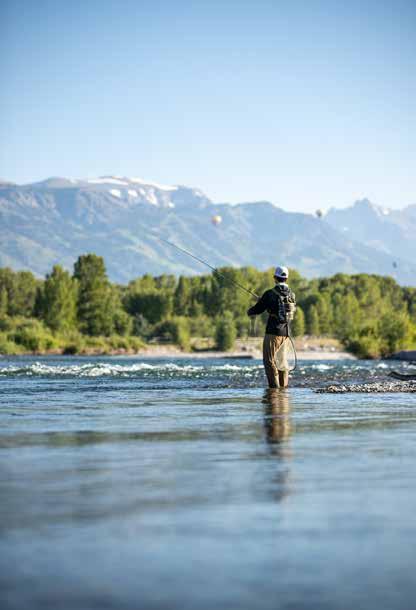
Photo: Alec Boyd-Devine, 1st Place in Fishing on Public Waters category, 2024 Public Lands and Waters Photo Contest
IN CASE YOU MISSED IT: WELCOME, CAL!
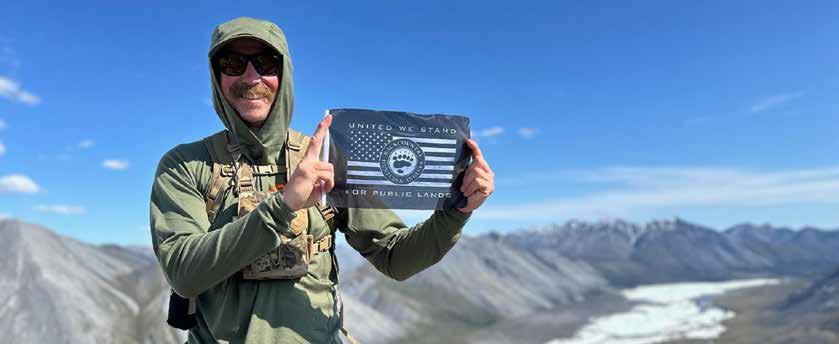
As we come into a new year and gather around our winter issues of Backcountry Journal, we’re excited to share news that hits close to home for our community. Ryan “Cal” Callaghan — longtime BHA supporter, former chair of our North American Board and a familiar voice in the conservation world — has stepped into the role of BHA president and CEO as of Jan. 1, 2026.
“This is a best-case scenario for BHA,” said Chris Jenkins, chair of BHA’s North American Board of Directors. “Cal has been a steadfast voice for public lands and conservation for years. His leadership, authenticity, and deep connection to the hunting and angling community make him the perfect person to guide BHA into its next chapter.”
Cal will continue contributing to MeatEater, where many of us first came to know his work, primarily by hosting Cal’s Week in Review podcast. There he’ll continue sharing top conservation priorities with his large, established audience at MeatEater.
“Cal has been a foundational member of the MeatEater team since the beginning,” said MeatEater founder and Chief Creative Officer Steven Rinella. “He’s been a moral compass, a true conservationist who is unwavering in his principles as a public lands advocate. When he came to me with the news that he intended to take on this role, I was proud of him and happy for BHA. BHA will benefit from the leadership of such a genuine, authentic defender of our lifestyle. Here at MeatEater, we’re very supportive of Cal’s mission,” added Rinella.
Many in our community already know Cal’s reputation as a trusted voice for conservation — shaped by years guiding, hunting, and fishing across the West; by helping define First Lite’s conservation ethos in its early days; and by his leadership at MeatEater. His career reflects the same values that ground BHA: access, stewardship, fair chase, and a commitment to the places that make us who we are.
When Cal returned from a coastal grizzly hunt in Alaska this past fall — living the wild values that run through BHA’s mission — he shared the following with our members:
“I am beyond excited to join BHA and kick ass on behalf of our wild public lands, waters, and wildlife,” said Callaghan. “North America’s public lands, and our access to them, have motivated and guided me throughout my life, from a seasonal employee and guide to a small-brand leader at First Lite to vice president of conservation at MeatEater and, most importantly, as a BHA volunteer, where the
member community and staff work tirelessly to conserve the myriad tangible and intangible values our public spaces provide: adventure, challenge, love, heartbreak and food, to name a few.
“I’m committed to building on the momentum of the incredible BHA community as a nonpartisan voice leading the charge for conservation. In the months ahead, I’ll focus on empowering our members, expanding our reach, and strengthening partnerships across the political spectrum that drive real conservation results. Our community is strongest when we rise above division and stand united, for public lands and waters that define us. Together, I know we can secure lasting wins for wildlife, habitat, and access. MeatEater will remain a key part of my life, and I’m proud to continue representing the brand and its audience as we work toward these shared goals.”
As we settle into 2026, we’re grateful to have Cal at the helm and proud to continue this work alongside all of you — the volunteers, members, mentors, and public land owners who bring BHA’s mission to life.
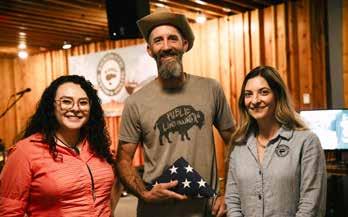
BHA’S BARD EDRINGTON V EARNS SPECIAL RECOGNITION
In November, Bard Edrington, BHA’s New Mexico stewardship coordinator, received special recognition from U.S. Sen. Martin Heinrich for his tireless commitment to improving wildlife habitat and advocating for the hunters and public land owners in New Mexico.
Did you know? Bard is also a recording artist—his songs are influenced by the old time music of the Appalachian mountains and Delta blues. Listen on Spotify or Google him!
Photo: Kyle Klain
Photo: Kaden McArthur

CONGRESS USING CONGRESSIONAL REVIEW ACT TO OVERTURN RESOURCE MANAGEMENT PLANS
BHA expressed deep concern following the Senate’s passage of H.J.Res. 104, a measure that overturns the Bureau of Land Management’s (BLM) Miles City Resource Management Plan (RMP) in Montana.
Congress’s recent use of the Congressional Review Act (CRA) to overturn resource management plans marks a dangerous shift in how America’s public lands are governed. The Senate’s passage of H.J.Res. 104 is the first time Congress has ever used the CRA to scrap a land or resource management plan. The decision undermines years of public input, jeopardizes science-based stewardship, and destabilizes management across 1.7 million acres in Montana — while setting a precedent that could impact more than 160 million acres nationwide.
“These plans are built through years of local engagement, environmental review, and compromise among hunters, ranchers, energy developers, and conservationists,” said BHA Western Policy and Conservation Manager Devin O’Dea. “Using the Congressional Review Act as a shortcut to scrap these plans opens a Pandora’s box for public lands, putting habitat restoration and hunting access at risk, something that could be avoided through the established RMP amendment process.”
Because the CRA bars agencies from issuing a “substantially similar” plan after repeal, long-term management tools could be locked away even when wildfire hazards, habitat needs, or mineral access require updates.
As anticipated, two other CRA resolutions, H.J. Res. 106 and S.J.Res. 80, targeting Alaska’s Central Yukon Resource Management Plan and the National Petroleum Reserve-Alaska Integrated Activity Plan, promptly followed in passing both the House and Senate. The Central Yukon Plan in particular has built-in special area management to conserve some of Alaska’s most iconic species, like Dall’s sheep, caribou, and moose.
BHA urges hunters, anglers, and all public land owners to contact their elected officials to oppose the misuse of the CRA to overturn resource management plans and instead support a local, stakeholder-driven process for resource management planning. Visit BHA’s Take Action page at backcountryhunters.org/get-involved/take-action to let your voice be heard.
MARK KENYON JOINS NORTH AMERICAN BOARD
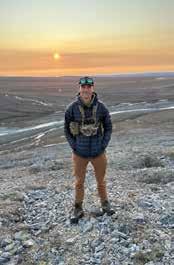
Mark Kenyon is the author of That Wild Country: An Epic Journey Into the Past, Present, and Future of America’s Public Lands, a lifelong outdoorsman, a passionate advocate for wildlife and wild places, and one of the hunting and fishing community’s most prominent voices through his podcast, Wired to Hunt, and his work as a leading contributor at MeatEater. In addition to his role with Backcountry Hunters & Anglers, he sits on the national board of directors for the National Deer Association and Sportsmen for the Boundary Waters. He is the 2025 recipient of the BHA Ted Trueblood award, for exceptional communications work informing and inspiring people for the benefit of public lands, waters, and wildlife.
Kenyon splits his time between Michigan and Idaho, and is the father of two wild young boys who love hunting, fishing, backpacking, and exploring the wild world with their Dad, and husband to a very patient wife.
RECENTLY ON THE PODCAST & BLAST
BHA’s new President & CEO Ryan Callaghan joins Hal as they discuss the critical moment we’re in for the conservation of public lands and waters, and how BHA is poised to stand united in their defense.
Then, join us for an in-depth conversation with Dr. Kevin Fraley, to learn more about the afformentioned use of the Congressional Review Act to overturn the Central Yukon Resource Management Plan and others.
Tune into those and more deep dives into the conservation world on BHA’s Podcast & Blast with our host Hal Herring, wherever you get your podcasts.
Photo: Mark Kenyon



























KYLE KLAIN,
SANTA FE, NEW MEXICO
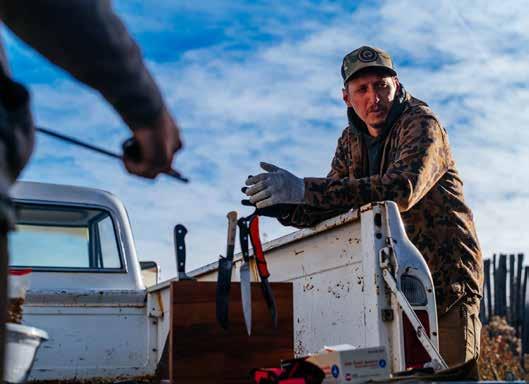
Why are you a BHA member?
I grew up in Oregon and built my adult life in New Mexico, two places where public land is the common ground that shapes who you become and who you surround yourself with. The friends I trust most, the choices I have made, the prism through which I see the world — all of it traces back to time spent in country that belongs to all of us. Anything that shapes you deserves some measure of return, and public land is no exception.
There is a war being waged against public lands on a scale we haven’t seen in ages, where access is narrowed, opportunities sold off, and the idea of shared ownership by all replaced by profit and privilege for a few. I did not want to sit in the bleachers and hope someone else handled it. I wanted to be on the front lines. BHA is one of the few groups willing to meet those pressures head-on, without apology. If these places made you who you are, you owe them more than performative gestures. You owe them work. That is why I am a member.
As the New Mexico Chapter Policy Chair, is there one issue you’re particularly passionate about? Why is it so important to you?
Access and equitable access drive a lot of what I do in this role. It is about whether an ordinary New Mexican can travel the length of a river without running into a barrier of private exclusion. It is about whether the chance to hunt elk remains a public opportunity or slides into something bought, sold and reserved for the lucky few. These questions shape the future of who gets to belong in the outdoors. If we shrug at the erosion of access or allow opportunity to turn into a commodity, we lose more than just a sort of recreation. We lose the shared stake that holds the whole system together.

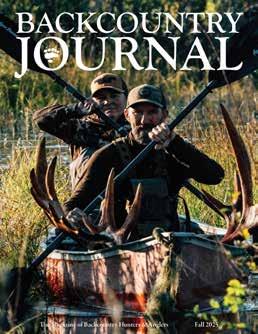
You’ve generously given a lot of time and talent to BHA through sharing your photography (and writing), including the cover of the Fall 2025 Backcountry Journal. What role do you see photography playing in helping BHA achieve its mission?
For BHA, photography becomes a kind of proof — proof that these places exist, that people depend on them, and that they can be lost if we are not paying attention.
Most people will never read a commission report or sit through a land board meeting (and I don’t blame them!), but they will stop for a photograph that carries truth in it. That moment of recognition is often the first step toward caring, and caring is the first step toward action.
Any tips for others wanting to contribute to conservation work through photography?
Start close to home. Most of the real conservation fights are happening in ordinary places where people fish after work or take their kids to camp. Photograph those spots. Show what they look like now and who uses them.
Do not chase perfection. Chase honesty. You do not need the newest camera or the perfect light. You need curiosity, patience and a willingness to stand in a place long enough to understand what matters about it. Once you find that, share it — not for hollow internet points, but to build a record of why these lands deserve defenders.
THE #1 WHITETAIL HUNTING APP
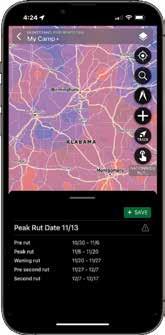
WHITETAIL RUT MAP Unlock the most extensive Rut Map in the country
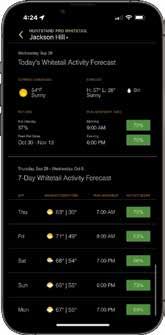
WHITETAIL ACTIVITY FORECAST Plan your hunt around peak movement times
Join millions of hunters who use HuntStand to view property lines, find public hunting land, and manage their hunting property. Enjoy a powerful collection of maps and tools — including nationwide rut dates and a 7-day whitetail activity forecast with peak deer movement times.

WHITETAIL

Download and map for FREE!





BACKCOUNTRY BOUNTY
BHA’s Backcountry Bounty is a celebration not of antler size but of BHA’s values: wild places, hard work, fair chase and wild-harvested food. Send your submissions to williams@backcountryhunters.org or share your photos with us by using #backcountryhuntersandanglers on social media! Emailed bounty submissions may also appear on social media.
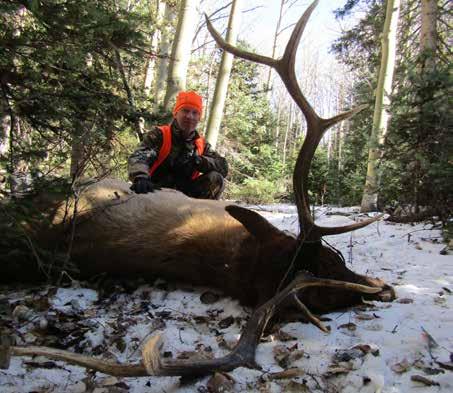
Hunter: David Lien, BHA member, CO chapter co-chair
Species: elk | State: Colorado| Method: rifle | Distance from nearest road: two miles | Transportation: foot
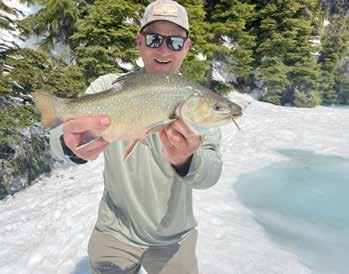
Angler: Kyle O’Shea
Species: brook trout
State: Oregon
Method: ice fishing (in June) | Distance from nearest road: five miles Transportation: foot
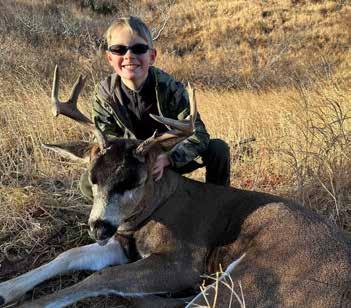
Hunter: Oscar Chelmo (9), BHA family member
Species: Sitka blacktail
State: Alaska
Method: rifle
Distance from nearest road: three miles Transportation: foot
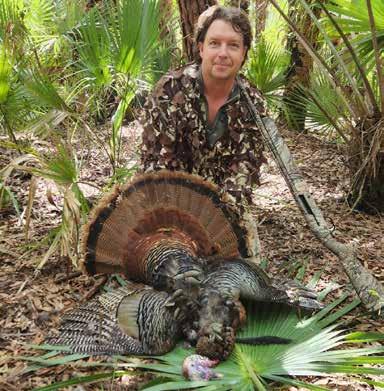
Hunter: Gavin Macphail, BHA member | Species: Osceola turkey | State: Florida | Method: shotgun | Distance from nearest road: one mile |Transportation: foot

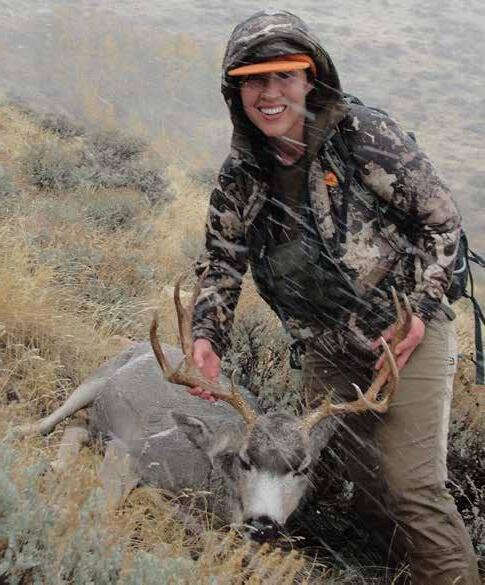
Hunter: Jenner Harsha, BHA member
Species: mule deer | State: Nevada Method: rifle | Distance from nearest road: one vertical mile | Transportation: foot

SAFETY FIRST
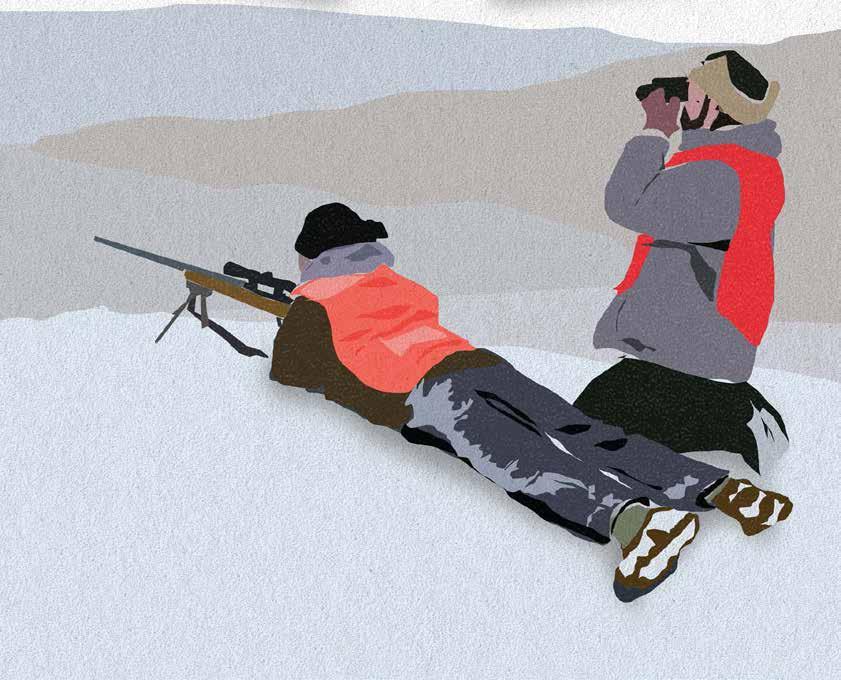
BY ALLEN MORRIS JONES
When you first learn to hunt, it will be so exciting and fun that it will be easy to forget what a big responsibility it is. If you’re not careful, the tool in your hands—whether it’s a rifle, shotgun, or bow—can hurt or even kill you or another person. Never forget that.
To be a good hunter, you need to always keep at least four rules in mind. Learn them and remember them so that they become second nature. You should know them so well that you don’t even have to think about them.
Number One
Treat every gun like it’s loaded. This is so important. When accidents happen, it’s often because somebody thought their gun was safely unloaded.
Number Two
Always point the gun away from people and in a safe direction, usually at the ground.
Number Three
Keep your finger off the trigger until you’re ready to shoot. In fact, keep your finger entirely outside the trigger guard.
Number Four
Know what your target is and what’s behind it. Don’t ever shoot if you don’t know where the bullet is going to land.
Bonus Rule
Never, ever, EVER let your friends handle your gun, not unless you’re sure they already know what they’re doing.
This story was excerpted from Good Hunting for Kids, which is available from Farcountry Press at farcountrypress.com.
A storyteller from way back, Allen Morris Jones has written eight other books, including the Spur-Award winning Montana for Kids: the Story of Our State, and A Quiet Place of Violence: Hunting and Ethics in the Missouri River Breaks. He’s written some poetry, too. He and his wife live in Bozeman, Montana, with their teenage son.





Chapter News & Updates
ALASKA
• The Alaska Chapter Board gathered for its second annual board retreat near Denali, hosted by a board member, where they shared wild game, went dog mushing and ptarmigan hunting, and worked on 2026 chapter planning.
• USGS scientist Heather Johnson discussed challenges facing Arctic caribou populations during a BHA Pint Night at Double Shovel Cider Co. in Anchorage.
• The Alaska Chapter featured three public lands pale ales in September with events in Juneau, Anchorage and Fairbanks, thanks to Forbidden Peak Brewing, Black Spruce Brewing Co. and Double Shovel Cider Co.
ARIZONA
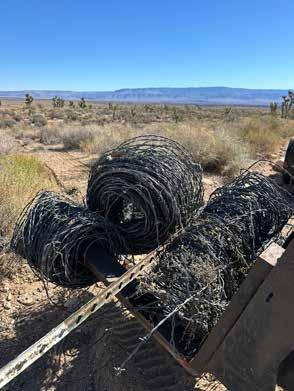
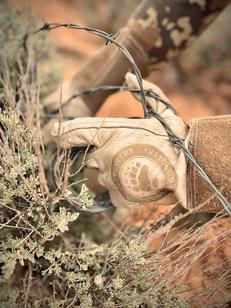
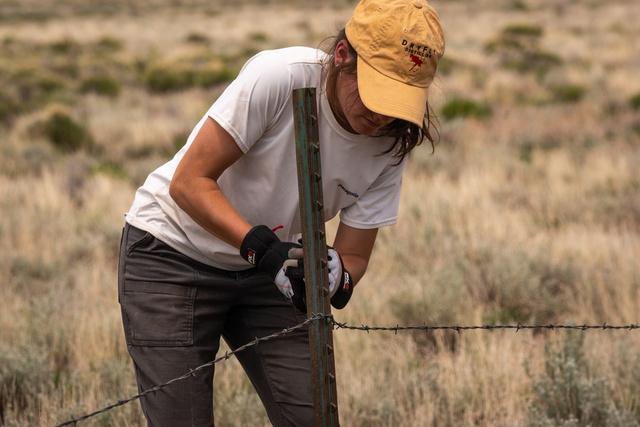
• On Oct. 18, eight BHA volunteers from Arizona, Utah and Nevada removed 2.3 miles of barbed-wire fence on Grand Canyon–Parashant National Monument. Their boots-onthe-ground stewardship improved habitat connectivity across roughly 5,400 acres of public land.
ARKANSAS
• With new Interior orders threatening the 60-year-old Land and Water Conservation Fund, Jim Taylor partnered with the LWCF Coalition to educate lawmakers in Washington, D.C., and make the case for its continued protection.
• The year’s biggest Pint Night, hosted by Pack Rat Outdoors owner and board member Rick Spicer, featured live bands and cold brews. The event sold out at 200 tickets and raised thousands through ticket sales and BHA merchandise.
• Looking ahead, major upcoming events include the Big Buck Classic (Jan. 23–25), the spring Field to Table dinner, and the Black Bear Bonanza on March 7, 2026.
ARMED FORCES INITIATIVE
• With support from Weatherby, Vortex, Mystery Ranch and FHF Gear, the annual sweepstakes that coincides with Veter-
ans Day in November was a huge success. Funds raised from the sweepstakes will help AFI continue planting the seeds of conservation and stewardship in the military community in 2026.
• For anyone interested in learning more about the AFI program, episode 88 of the Wild Life Outdoors podcast features the AFI National Board regional managers, who did an excellent job spreading the word about this impactful program.
BRITISH COLUMBIA
• The British Columbia Chapter Board received a presentation on a recent epizootic hemorrhagic disease outbreak in southeastern B.C. and is supporting education efforts on the issue.
• Members continue to represent BHA on various working groups throughout the province — including those focused on chronic wasting disease, elk conflict and the Kaska–B.C. Land Use Planning project — to promote access and wildlife conservation values.
• Region 2 hosted a successful waterfowl night with partner groups in October.
CALIFORNIA
• The California Chapter drafted a comment letter to the California Department of Pesticide Regulation regarding limiting anticoagulant rodenticide poisonings of nontarget species, such as pigs and bears.
• The chapter is seeking to expand its leadership board. Interested members can reach out to California@backcountryhunters.org to become more involved.
• The chapter hosted a Backcountry In Your Backyard event in Pasadena in coordination with the Minority Outdoor Alliance and Durrell Smith to introduce newer hunters to wild food and the conservation community.
Photo: Game of Horse, Alec Boyd-Devine, 2024 Public Lands and Waters Photo Contest
COLORADO
• BHA is a member of the Colorado Stream Access Coalition, advocating for the public’s right to float, fish, boat and swim in Colorado’s rivers and streams.
• The chapter successfully removed an illegal trail in August outside Durango, which impacted seasonal closures for big game and peregrine falcon nesting. Details are available in the BHA blog post, “Animas Mountain Trail Removal 2025 Project.”
• The chapter continues its defense of elk habitat. For the latest update, see the Oct. 21 Colorado Times Recorder letter, “Colorado’s Elk Need Big Wild Country.”
FLORIDA
• The Florida Chapter hosted its annual South Florida small game hunt at Dinner Island WMA on December 13.
• The chapter is developing an initiative to oppose a proposal to create a new national park on lands currently managed as wildlife management areas. The park proposal is viewed as detrimental to existing hunting and fishing opportunities.
• The chapter has been awarded a grant through the Fish & Wildlife Foundation of Florida to host a series of youth archery workshops across the state. This marks the second time the chapter has received the grant.
GEORGIA
• The Georgia Chapter successfully hosted a series of events, including the Mobile Hunters Expo in Dalton, the Season Opener at Sitka Atlanta, the Public Lands Pale Ale launch at Terrapin Brewery in Athens, and the Pheasant Tail Simplicity book launch and raffle at Patagonia Buckhead.
• The chapter welcomes new board members Wesley Bowman, Norman Hassell, Bennet Jacobs, Michael Mayne and Jay Willis. It looks forward to their contributions in increasing visibility, engaging and recruiting new BHA members, supporting fundraising events and elevating conservation issues across the state.
IDAHO
• Come say hello at several events this winter, including the Western Idaho Fly Fishing Show and the Idaho Sportsman Show. See the website events listing for more details.
• After a successful first year of the North Idaho Public Land Packout Pop-Up series, the chapter looks forward to hosting it again next summer. If you know of a public land spot that needs a little TLC, email or DM us.
• The Idaho legislative session is in full swing, and the chapter will keep members updated on all important developments.
ILLINOIS
• Lake Shelbyville Archery Park (LSAP) has been a huge success, with archers enjoying it nearly every day. The Illinois Chapter will host a Spring Shoot in 2026, so keep an eye on Illinois Chapter events. Sponsorship inquiries can be sent to Illinois@ backcountryhunters.org.
• The Illinois Chapter continues to work on clarifying unclear Illinois stream access laws to ensure public access to waterways.
• Support the Illinois Chapter by gifting a membership, sponsoring the organization or hosting an event.
INDIANA
• The Indiana Chapter hosted a “Learn to Process Gamebirds” event in collaboration with the English Springer Spaniel National Amateur Championship in Terre Haute.
IOWA
• The Iowa Chapter hosted a pint night at Confluence Brewing Company on August 9, achieving record attendance for one of its pint nights.
• The chapter contributed to a public land acquisition of 250 acres along the Skunk River in collaboration with Story County Conservation.
• The chapter also contributed to the acquisition of the Wooly Tract, a 422-acre property located in Madison and Clarke counties.
KANSAS
• On October 11, the Kansas Chapter teamed up with Friends of the Kaw to remove tires from the Kansas River near De Soto.
KENTUCKY
• The Kentucky Chapter hosted the inaugural Bourbon, Bands and Public Lands conservation and music Festival. First Far West (Josh Rinkel and Laura Orshaw), Michael Prewitt and Logan Halstead headlined, while about 20 conservation partners and vendors were showcased to celebrate Public Lands Month.
• The Murray State Collegiate Club’s new leadership team has established a regular meeting schedule, hosted a Wood Duck Box project on the Clarks River Refuge, and celebrated Public Lands Day with a cleanup, dinner and movie.
• The Kentucky Chapter has also hosted 15 additional conservation projects, Pint Nights and social and educational events.
MICHIGAN
• The Michigan Chapter mobilized opposition to HB 4851, which would have forced the sale of public lands in counties or townships where state-managed land exceeds 50 percent. The chapter launched a blog, coordinated outreach, and rallied members to defend public access.
• The chapter also challenged the proposed $50 million Copperwood Mine subsidy in the 2026 state budget, citing serious environmental threats to Lake Superior and surrounding public waters. Michigan BHA submitted formal letters, activated member engagement, and advocated for responsible stewardship.
MID-ATLANTIC
• The Mid-Atlantic Chapter is actively planning and will host Muster in the Mountains in Virginia in June 2026.
• The chapter continues to facilitate and identify partnerships to expand opportunities related to R3, stewardship, and other initiatives throughout the region.
MINNESOTA
• The Minnesota Chapter held four CWD informational pint nights across the state. During these events, the DNR demonstrated proper lymph node extraction and answered questions about CWD.
• The largest BHA gathering in the Midwest, the North Country Icebreaker, will take place at Breezy Point on January 24, 2026. The event will feature darkhouse spearing, ice fishing demonstrations, a wild game cook-off, raffles and a banquet.
• Visit the Minnesota Chapter booth at Pheasant Fest, Feb. 20–22, and meet our team.
MISSOURI
• The Missouri Chapter sent out a survey in early December asking members statewide what they would like to see more of from the chapter. Thanks to all who participated!
• Using those results, chapter leadership met in December for a planning session to review what went well in 2025 and discuss goals for 2026. The chapter looks forward to another great year—stay tuned!
MONTANA
• The Montana Chapter launched a statewide push to protect Montana’s 6.4 million acres of Inventoried Roadless Areas, giving hunters and anglers clear ways to take action. More information is available on the chapter’s web page.
• Stewardship wins include volunteers removing 2.7 miles of old fencing in the Big Hole, improving habitat near Roundup, and maintaining momentum with pint nights, campus events and river cleanups across the state.
NEBRASKA
• Last fall, the inaugural Public Lands Hero Award given by the Nebraska Chapter was presented to Adam Kester for his dedication and sustained service in improving and increasing access to public lands.
• Nominations for the next Public Lands Hero Award in Nebraska can be submitted by email to Nebraska@backcountryhunters.org.
• Stay tuned for more information on an upcoming volunteer fence removal project at the Valentine National Wildlife Refuge.
• The Nebraska Chapter welcomes new board member Collin Kelly of Elkhorn.
NEVADA
• The Nevada Chapter hosted its third annual Range Day, helping members get sighted in for the season.
• The chapter also held a backpacking clinic featuring pack dumps, wild game (goat) breakdown and pack-out demonstrations, as well as a goat birria cooking demo and lunch.
• In addition, the chapter hosted multiple pint nights and sent nearly 100 postcards from members to elected officials in support of public lands.
NEW ENGLAND
• The New England Chapter had a booth at On the Water’s Striperfest, where hundreds of attendees learned about BHA’s work supporting striped bass management and shoreline access.
• In Massachusetts, the chapter hosted a successful Learn to Clam event on a local National Wildlife Refuge.
• The Rhode Island team sponsored and provided mentors for the Rhode Island Fish & Wildlife youth waterfowl hunt in late October.
• In Maine, the chapter will host BHA-focused trivia events during the winter months. Check the website for event listings.
NEW JERSEY
• The New Jersey Chapter volunteered at a mentored squirrel hunt hosted by New Jersey Fish and Wildlife on October 24 at the Assunpink Wildlife Management Area. Ten mentees participated in a seminar covering safety, tree identification and squirrel biology, followed by an evening hunt. The evening concluded with a butchering demonstration.
• The New Jersey Chapter is developing a plan to propose expanded hunting opportunities on Sundays during the hunting season. The goal is to create a mission statement and encourage members to contact their assembly representatives to support a bill allowing Sunday hunting. Stay tuned to New Jersey Chapter social channels for events and information on Sunday hunting.
NEW MEXICO
• For the second year, New Mexico Chapter volunteers worked with the New Mexico Department of Game and Fish at the Marquez/L Bar Wildlife Management Area to remove old fencing. Approximately 1.5 miles of barbed wire fencing and
T-posts were removed, improving this critical elk calving area by reducing potential entanglement risks for elk calves.
• The New Mexico Chapter also hosted a membership appreciation night, which concluded with a surprise honor from Senator Heinrich recognizing Bard Edrington V for his stewardship work and support of wild spaces.
NEW YORK
• The New York Chapter teamed with the New England, Mid-Atlantic and North Carolina chapters to promote a sustainable striped bass fishery, issuing an Action Alert to encourage comments on Addendum III of the management plan.
• The New York Chapter partnered with Common Roots Brewing in Glens Falls for a Public Lands Pale Ale Pint Night.
• The chapter also hosted another successful conservation fundraiser at Filson’s NYC flagship store, supported by Velvet Buck Wine.
NORTH CAROLINA
• It’s time for the annual Trashy Squirrel Hunt, held in January and February! Check social media for information on events near you.
• Join the North Carolina Chapter at the Dixie Deer Classic at the NC State Fairgrounds in Raleigh, February 27–March 1. The chapter will be representing BHA with merchandise, raffles and information on public lands advocacy in the state.
NORTH DAKOTA
• The North Dakota Chapter continues to engage with state officials regarding the use of the CRA in the North Dakota BLM Resource Management Plan. The chapter believes the use of the CRA will negatively impact both conservation and energy industry priorities.
• The chapter hosted two hunters from Georgia for a duck hunt in central North Dakota, fulfilling a BHA online-auctioned hunt.
• The chapter continues to work with North Dakota stakeholders to encourage a travel management plan process in the Little Missouri National Grasslands, a plan currently paused by the administration.
OHIO
• The Ohio Chapter had a busy September with several habitat improvement and stewardship projects, including the Cuyahoga River Cleanup, Spring Valley Hack & Squirt, East Fork Invasive Removal, and assisting with the release of lake sturgeon back into the Cuyahoga River at Sturgeon Fest.
OKLAHOMA
• In September, the Oklahoma Chapter partnered with Quail Forever and the National Wild Turkey Federation on a habitat improvement project at Deep Fork Wildlife Management Area.
• The chapter also partnered with SHOT The 3D Experience as a chapter sponsor. Their mission is to provide shooters, regardless of skill level, with the best 3D experience and atmosphere possible. The chapter is excited for this opportunity.
• The chapter will host a Pint Night in December at Cooper & Mill Brewing Co. in Bartlesville.
OREGON
• The Oregon Chapter’s New/Newer Adult Hunter workshops help new hunters build skills, knowledge and confidence through hands-on training and mentorship in a welcoming, inclusive environment. By removing barriers to entry, the workshops provide a clear pathway into hunting, connect participants with experienced mentors and the community, and strengthen Oregon’s hunting traditions. These workshops are
a key priority for the Oregon Chapter and are essential to sustaining the future of hunting in the state.
PENNSYLVANIA
• On November 20, Pennsylvania Chapter leaders and friends gathered to celebrate the retirement of policy advisor John Kline. John’s work with the chapter led to many significant accomplishments, including the repeal of the Sunday hunting ban earlier this year. The chapter wishes him all the best as he transitions to full-time grandpa.
• The chapter collaborated with Stick City Brewing in Mars, Pennsylvania, to host a Pint Night celebrating the launch of the second-year run of Keystone Backcountry IPA on October 11. Thanks to Stick City’s generosity, 20 percent of proceeds will be donated back to the Pennsylvania Chapter.
SOUTH DAKOTA
• The South Dakota Chapter has partnered with Hunt LeadFree SD as the lead sportsman’s voice to promote a new nonlead ammunition pilot program in the Black Hills.
• Chapter members testified to oppose the closure of access to Cattail-Kettle Lake, helping to prevent the bill from passing.
• The South Dakota Chapter is growing, adding two new board members and continuing to seek applications for a stewardship coordinator, event coordinator, social media manager, treasurer and other open board positions.
SOUTHEAST
• The Southeast Chapter held another successful Perdido River Family Float & Fish Canoe Trip on October 11–12. Although the water was low, the weather was perfect, and the chapter looks forward to hosting the event again next year.
• The chapter continues to monitor developments at Big Creek Lake in Mobile County, Alabama, where the local water and sewer authority has cut off public access. Contact chapter leaders for more information on this issue.
• The Southeast Chapter is seeking leaders. Reach out to get involved!
TENNESSEE
• The Tennessee Chapter sponsored and hosted an engaging booth at the Wildlife Expo, connecting with attendees and sharing Backcountry Hunters & Anglers’ mission of public land conservation and ethical hunting.
• The chapter supported a member-led butchering clinic that provided hands-on instruction in wild game processing, giving participants valuable field-to-table skills.
• Chapter socials strengthened community ties through events like the Tight Lines Pint Night with author Neil Norman in Northeast Tennessee and a Middle Tennessee Pint Night and Potluck at Flytes Brewing, celebrating the release of Public Lands Pale Ale.
TEXAS
• Texas Chapter BHA’s fourth annual Conservation Conversation in October was a major success, featuring an engaging lineup of guests who highlighted the value of Texas public lands and their importance for future generations.
• Members across Dallas, Houston and South Texas have enjoyed productive pint nights, connecting over local conservation issues and chapter priorities.
• Looking ahead, the Texas Chapter is preparing to attend the Houston Fishing Show in February, continuing outreach and strengthening support for public lands and waters statewide.
UTAH
• The Utah Chapter will team up with chapter partner Springbar at the Western Hunting and Conservation Expo from February 12–15. Stop by the booth to say hello!
• The chapter’s Party for Public Lands, featuring wild game sampling, drawings and auctions, live music and campfire stories, will be held Friday, February 13, at the Clubhouse in Salt Lake City. Tickets are available on BHA’s website.
• The Utah Chapter is starting the year by welcoming new board members and engaging in the Utah legislative session, focusing on bills related to public lands, public waters and wildlife.
WASHINGTON
• The Washington Chapter celebrates a successful 2025, engaging more than 200 people through conservation projects, skills events and community outreach. Volunteers contributed over 2,200 hours to habitat restoration, trail work, wildlife surveys and clean-ups statewide. From planting thousands of native plugs to removing trash, fencing and invasive species, the chapter demonstrated strong, hands-on stewardship throughout the year.
• Save the date for the Black Bear Bonanza on April 11 in Leavenworth, Washington. This full-day bear awareness event will feature hands-on education, safety demonstrations, youth activities and expert-led sessions on bear biology, conservation and the role of regulated hunting.
WEST VIRGINIA
• On September 13, the West Virginia Chapter assisted the WVDNR and the West Virginia Deer Association with the Burnsville Wildlife Management Area Habitat Day.
• Visit us January 23–25; the chapter have a booth at the West Virginia Hunting and Fishing Show in Charleston.
• The chapter will host the second annual West Virginia Sportsmen’s Capitol Conservation Day in Charleston on February 17. WVBHA leads monthly meetings to plan logistics and rally supporters for the event.
• The chapter also continued monitoring state legislation while the session was in progress.
WISCONSIN
• The Wisconsin Chapter closed out 2025 with strong dedication to public lands advocacy, hands-on habitat work and expanding its community of public lands supporters.
• Board members represented BHA on committees with the DNR and various conservation groups on topics including the Wisconsin Conservation Congress, Cherish Wisconsin Outdoors Fund, Knowles-Nelson Stewardship Program, state conservation funding, Sandhill Crane hunting and CWD.
• The chapter organized over 350 hours of habitat improvement work, sent more than 2,600 emails and phone calls to state legislators on policy issues such as Knowles-Nelson funding and Sandhill Crane hunting, and mentored over 30 new hunters in their conservation journey.
WYOMING
• The Wyoming Chapter volunteered to support the Wyoming Women’s Antelope Hunt in early October.
• The chapter also teamed with the Cloud Peak Backcountry Horsemen to clear approximately 10 miles of trails on the north end of the Bighorn Mountains.
Find a more detailed writeup of your chapter’s news along with events and updates by regularly visiting www.backcountryhunters.org/chapters or contacting them at [your state/province/territory/region]@backcountryhunters. org (e.g. newengland@backcountryhunters.org).


S T E W A R D S H I P
I M P A C T S U M M A R Y 2 0 2 5
At Backcountry Hunters & Anglers (BHA), we believe true conservation looks like speaking up for public lands and waters and showing up to care for them firsthand.
BHA’s Stewardship program is dedicated to improving the health and resilience of fish and wildlife habitat on public lands and waters, and maintaining and improving access to these places for current and future generations to hunt, fish, and recreate.
100 Signs Installed to Encourage Responsible Recreation
Wildlife Sur veys Conducted for Bighorn Sheep, Mountain Goats, & Wild Turkey
Habitat Infrastructure
1+1 Guzzlers Installed & Repaired
29 Bird Boxes Placed 17 15 Zeedyk Rock Structures Built Wire Reef Units Made
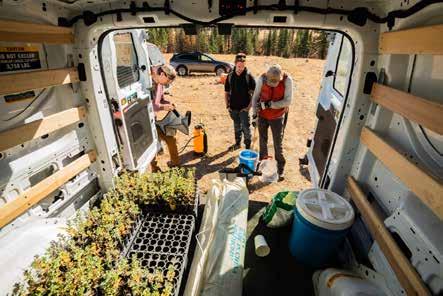
2,023 Native Trees, Shrubs, & Forbs Planted
350.5 Gallons of Native Seeds Collected
Public Land Packouts
263
451 55-Gallon Bags Filled Tires Removed
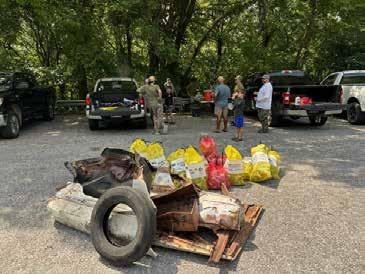
16.58 Tons of Trash Collected

3
BHA Stewardship staff – and volunteer members – work hand in hand with agency partners at federal and local levels to increase workforce capacity, expedite project timelines, maximize positive conservation outcomes, and connect people to the wild lands and waters we advocate for. To learn more about BHA’s Stewardship program that puts boots on the ground for the wild public lands, waters, and wildlife that belong to us all, visit:
1,658
34.88
12,680 Total Volunteers Hours of Boots-on-the-Ground 81 Miles Inventoried Miles of Fence Removed 7.7


3 MILLION OYSTERS AND A NEW MISSION: AFI’S WORK ON THE CHESAPEAKE BAY
BY GARRETT ROBINSON
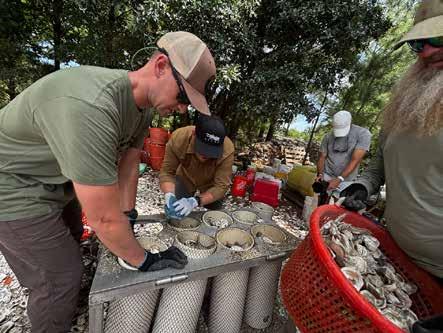
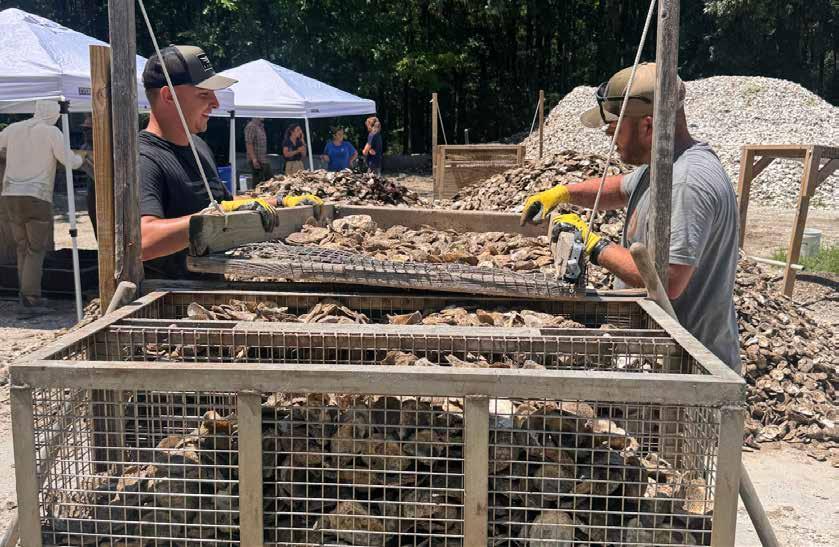
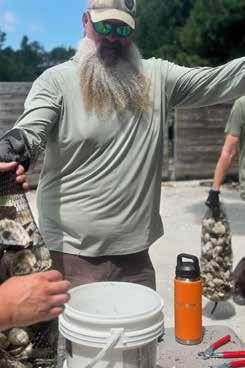
This past summer, BHA’s Armed Forces Initiative and the Chesapeake Bay Foundation brought nine service members together on the Chesapeake Bay to rebuild oyster habitat and illustrate the connection between stewardship and outdoor opportunity. Oysters are a keystone of the Chesapeake ecosystem. An adult oyster filters about 50 gallons of water each day, removes excess nutrients and provides three-dimensional reef structure for forage species. By the end of the week, participants had prepared substrate for approximately 3.5 million to 3.7 million oysters that will eventually filter roughly 175 million gallons of bay water per day. Those numbers translate to cleaner water, more submerged aquatic vegetation and better conditions for gamefish prized by Mid-Atlantic anglers — all of which support a more resilient ecosystem.
This AFI project came to life through a partnership with CBF. Early in 2025, the AFI board approved a first-of-its-kind stewardship project, selecting Chesapeake Bay as the focus. Having grown up in the watershed, I knew CBF’s reputation and reached out to them first. I quickly secured a meeting with their Discovery Program manager, Capt. Bart Jaeger. Going in, I was unsure what to expect, as CBF is a conservation nonprofit but not necessarily a hook-and-bullet organization like BHA. My uncertainty vanished when Bart enthusiastically supported setting up an event with AFI.
Over the next five months, a team from BHA and CBF built
a robust plan to introduce veterans to conservation efforts on the bay. The beauty of the project was not only that veterans would be on the ground doing stewardship work, but also that it marked the beginning of a new partnership between BHA and CBF. As planning progressed, an opportunity arose to fund the event through Sitka Gear’s Ecosystem Grant program. AFI applied and won, securing full funding for an event that had previously been in doubt.
CBF proposed two project days that would introduce participants to both their Maryland and Virginia oyster restoration programs. This would provide the broadest possible introduction and maximize hands-on stewardship. Planning was thorough but not without risk. AFI had never attempted something at this scale, and there was concern about whether we would recruit enough participants. In the end, all 10 spots were filled by a mix of activeduty service members, guardsmen, retirees and veterans from the Army, Coast Guard, Marine Corps and National Guard. They traveled from as far as Washington state and as close as Maryland. We were joined by two BHA staffers, Bryan Jones and Brian Bird, who helped facilitate the week’s agenda. Photographer Harrison Creed of Sitka Gear and videographer Win Huffman of Venator Outdoors volunteered to capture the event.
Arriving Monday at our Airbnb, as with every AFI event, the group quickly bonded, joking about which service branch was the best. The humor mixed seamlessly with enthusiasm for the work ahead, reinforcing why AFI members are a powerful stewardship force.
Photos: Jamin Davis
“In the end, we will conserve only what we love, we will love only what we understand, and we will understand only what we are taught.”
– Baba Dioum
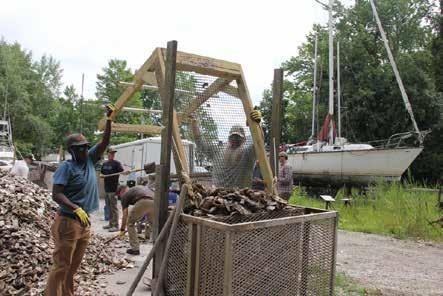
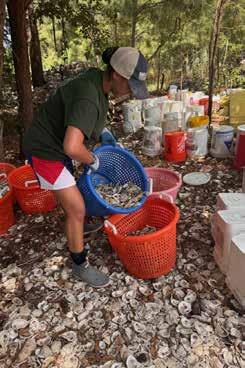
The next morning was hot and muggy following the prior evening’s thunderstorm. We assembled at CBF’s Maryland Oyster Restoration Center in Shady Side. A mountain of oyster shells awaited us beside cleaning stations resembling a prospector’s camp. After a briefing by CBF’s Maryland Oyster Restoration coordinator, Kellie Fiala, we began cleaning oyster shells. It was backbreaking work in 100-degree heat and high humidity, but our AFI team set a record for the number of oyster seeding baskets filled in a single day.
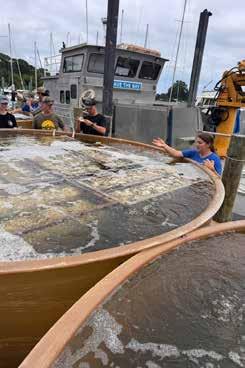
After lunch, CBF staff gave us a tour of the facility, including the soaking tanks used to seed oyster spat (larvae) onto shells. These tanks, resembling above-ground pools, hold cages where spat attach to shells. After seven to 10 days, they are ready to be placed on sanctuary oyster reefs. Our team was responsible for preparing substrate for nearly 3 million oysters. Hearing those numbers and the impact of the day’s work was astounding.
The following morning, we had a hearty breakfast before traveling to Virginia Beach, a relaxing trip that helped set the tone for the next day’s work in a new location.
Our final workday began with a tour of the Brock Environmental Center, CBF’s Virginia oyster restoration hub and one of the world’s greenest buildings. Elevated 14 feet above sea level, the center is a prototype for resilient coastal construction and has achieved Living Building Challenge certification. Jackie Shannon, CBF’s Virginia oyster restoration manager, briefed us on the day’s work: filling net bags with oyster shells. Unlike Maryland’s system, the Virginia team uses small net bags roughly the size of a 20-pound ice bag. We filled enough bags to load two pallets, representing about 700,000 oysters once deployed on Virginia reef sites. We also toured CBF’s mobile oyster barge, which can
grow up to 15 million oysters annually in its onboard tanks. One barge was deployed to the Hampton River to complete a fiveacre oyster reef project. As in Maryland, the scale of the work impressed everyone.
We ended the week with a team dinner featuring oysters and other Chesapeake Bay fare. The next morning, we boarded a charter with Aquaman Fishing Charters for a half-day trip targeting Spanish mackerel and bluefish. The outing was a fitting close to a week of hard work, allowing everyone to see firsthand the connection between healthy reefs and thriving fisheries. The real takeaway, though, was leaving with a renewed sense of purpose — a new mission in conservation.
The impact on me is deeply personal. When people ask why I dedicate so much time to BHA’s Mid-Atlantic Chapter and AFI, the answer is not easy to explain. At its core, it is restorative work essential to healthy ecosystems. For our military community, it goes further. Every time we put on work gloves, we are restoring something in ourselves. Conservation gives us purpose and meaning when we might otherwise feel adrift. It gives us a mission worth fighting for — a future for generations to come.
Garrett Robinson served 26 years in the United States Marine Corps, retiring as a Master Gunnery Sergeant in July 2023. He serves as the Vice Chair of the Capital Region Chapter and as the Policy Chair for the Armed Forces Initiative National Board. Currently he, his wife and daughter live in Northern Virginia where he enjoys opportunities to get in the backcountry every chance he gets.

The Roads (More or Less) Traveled
BY CHARLIE BOOHER
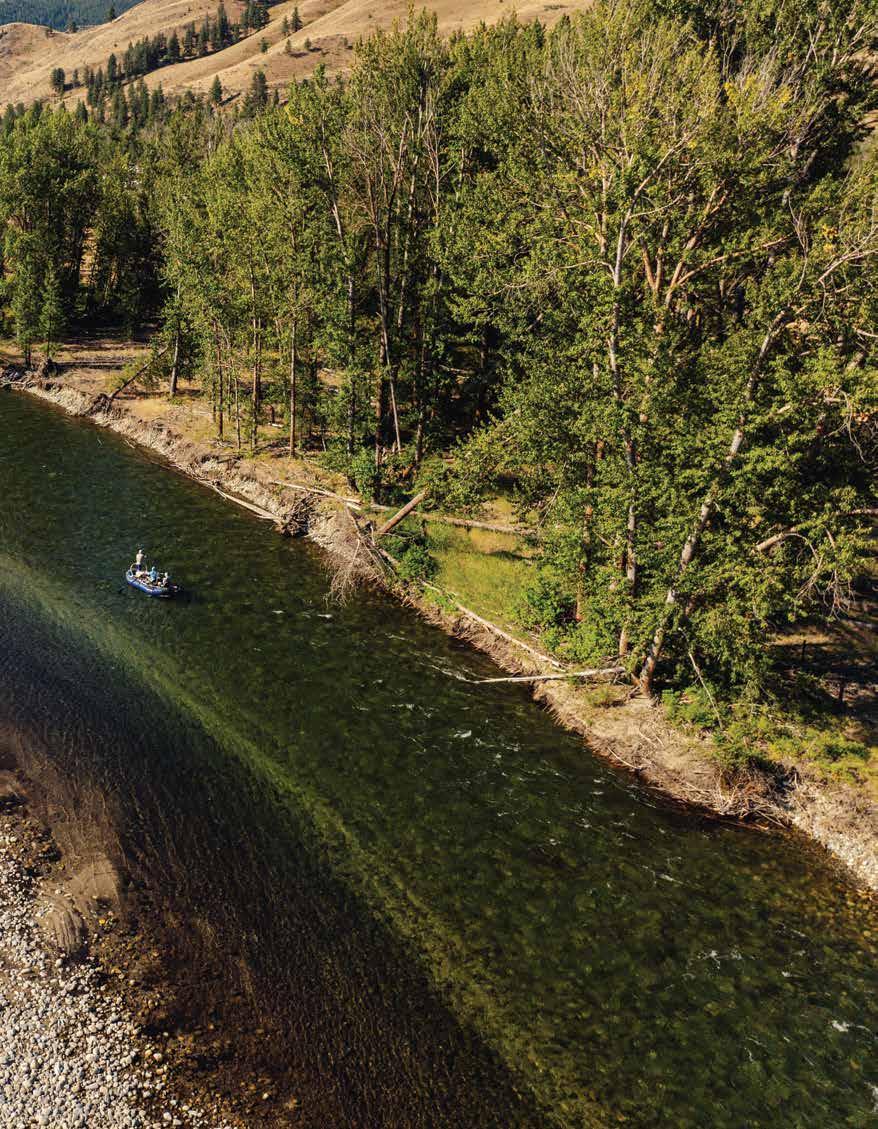
For many of us who hunt, fish, or explore the backcountry, roads can stir mixed feelings. Roads make access possible, but they can also compromise the qualities that make wild places wild. They help land managers fight fire and restore habitat, yet they can also fragment wildlife corridors and disturb watersheds. Frequent use of roads by vehicles ranging from mountain bikes to log trucks and dozers cause their own spectrum of issues. Nowhere are roads more controversial than on our National Forest System.
Our national forests represent a convergence of values. They are home to some of the continent’s most productive wildlife habitats, the headwaters of our cleanest rivers, and millions of acres of country that sustain our collective outdoor heritage. But they also function as working lands that support grazing, timber harvest, mineral extraction, and rural economies that depend on these industries. Holding all this together, often unnoticed, is a massive network of roads.
The question is not whether roads are good or bad. The question is where roads belong, who can use them and when, and how we make these decisions.
There are, without question, places that are too steep or too special to have roads built through them. Likewise, there are other places where wildlife habitat and local communities suffer because of a lack of access.
The U.S. Forest Service manages more than 265,000 miles of roads across the National Forest System. To put that in perspective, only California and Texas maintain more miles of roadway than the federal agency charged with managing our forests. Of that total, about 65,000 miles are suitable for passenger cars; the rest are rougher routes that range from well-graded gravel to little
more than two-tracks. Those roads serve many purposes: they allow for wildfire suppression and prescribed burns, enable grazing permittees and timber contractors to access allotments, connect rural communities, and provide the public, notably hunters (and some anglers), with an easier way to reach the country we love.
From a wildlife management perspective, roads also serve an important purpose. They allow biologists to reach field sites, hunters to retrieve harvested game, and land managers to conduct treatments that maintain healthy forests and rangelands. After catastrophic wildfires, they enable salvage operations that reduce future fuel loads and restore habitats. For local economies, they are lifelines. But none of that changes the fact that in the wrong places, roads cause real harm.
The Forest Service itself has long recognized that roads come at a cost. Poorly located or neglected roads accelerate erosion and damage watersheds. They can fragment habitat and reduce the effectiveness of security areas for species like elk and mule deer. They also degrade the sense of solitude that defines a true backcountry experience. Unplanned or unauthorized routes, often created by repeated off-road vehicle use, can multiply those impacts many times over.
These problems prompted the Forest Service to adopt a much stronger approach to travel management over the last two decades. In 2001, the agency issued its “Roadless Rule,” which directs land managers to ensure that only necessary roads are constructed and that priorities for maintenance or decommissioning are set through public involvement and planning. Four years later, the 2005 Travel Management Rule required every national forest to designate which roads, trails, and areas are open to motor vehicles and to close everything else to cross-country travel. The intent was simple but profound: to move from a system of unmanaged use to one of
Photo: Jeremiah Watt
deliberate, transparent planning.
At the heart of this modern approach is a concept known as the “minimum road system.” Each national forest is required to identify the smallest network of roads needed for safe, efficient travel and for the protection, management, and utilization of the forest’s resources. In other words, the agency must determine which roads are truly necessary to meet its land management objectives and which ones are not. The idea was not necessarily to eliminate roads, but to right-size the system, reducing environmental impacts while maintaining access for the work and recreation that depend on them.
Roads can enhance access, but they can also erode the quality of that access if every ridgeline and basin can be reached by vehicle.
values. Roads can enhance access, but they can also erode the quality of that access if every ridgeline and basin can be reached by vehicle. In heavily roaded landscapes, wildlife behavior changes; animals retreat to smaller, more pressured pockets, and the character of the hunt shifts from pursuit to convenience. Many of us seek out the country where the map shows fewer lines and more contour. Ensuring that some portions of our national forests remain truly remote is part of safeguarding fair-chase, ethical hunting and our backcountry experiences.
As of this writing, both of these overarching policies are currently being proposed for repeal. That means that the nationwide, “blanket” approach to road planning may go away.
Backcountry Hunters & Anglers is actively working to oppose these repeals and will continue to stand united in favor of the Roadless Rule and the Travel Management Rule. But if those rules do disappear, we need to be prepared for how we can still effectively impact travel management planning.
This is where, in the absence of a blanket rule, forest planning becomes even more important. Under the National Forest Management Act, every national forest is required to develop and operate under a forest plan. In theory, these plans guide how lands will be managed for wildlife, recreation, timber, and other uses over a span of 10 to 15 years, depending on the forest. They describe desired conditions for habitat and watershed health and identify how much development and access is compatible with those goals. Travel management planning at this level, the process of deciding where roads are needed and where they should not be, is an extension of that process. In practice, many of these plans have long expired and consistent legal interventions at the project level have reduced the ability of the Forest Service to execute on the visions outlined in these plans.
For hunters and anglers, the forest planning process is where access and stewardship intersect. Public involvement allows us to advocate for maintaining essential roads that provide reasonable access to hunting areas, while at the same time for closing or rehabilitating redundant roads that degrade habitat or diminish fair-chase hunting opportunities. When forest plans are updated, or when travel management plans are revised, it’s an opportunity for sportsmen and women to weigh in with practical, experiencebased input about where road access supports management, as well as where it undermines the very resources we value.
Any conversation about roads must also account for maintenance and funding. Decades of budget shortfalls have left the Forest Service with an enormous backlog of road maintenance needs, exceeding several billion dollars. Many existing roads are deteriorating faster than they can be repaired. When culverts fail or drainage systems collapse, sediment can choke trout streams and damage spawning beds. These neglected roads often become liabilities rather than assets. Identifying a minimum road system is therefore not only about ecology, but also fiscal responsibility. We ought to keep the roads we truly need, and invest in their upkeep, while removing those we can no longer justify or afford.
For the hunting community, this approach aligns closely with our
Yet it’s equally true that some roads are indispensable. Firefighters need them to reach ignition points and create new lines. Biologists use them to monitor elk and deer populations. Land managers rely on them to implement habitat projects that maintain meadows and restore riparian zones. Access is a conservation tool when it enables good stewardship, and when roads are planned and maintained with intention, they serve that purpose well.
The goal, then, is balance. Roads are neither the enemy nor the answer. They are simply another form of infrastructure that must be managed thoughtfully as part of a larger land stewardship strategy. Forest plans and travel management decisions provide the structure for doing that work. They are public, science-based, and rooted in the recognition that roads have consequences, both positive and negative.
We, as hunters and anglers who value backcountry experiences, have a role to play in shaping that balance. By engaging in local forest plan revisions, by attending travel management planning meetings, and by supporting restoration, reclamation, or decommissioning of legacy roads to improve habitat, we can help ensure that our national forests retain accessibility and integrity. We can advocate for funding to maintain essential routes while promoting the decommissioning of those that no longer serve a valid purpose. And we can remind decision-makers that access means more than motorized entry, it means maintaining the ecological conditions that sustain wildlife, clean water, and solitude.
The public lands we treasure were never meant to be static, even if we often hold them in our minds as such. They require active management, constant care, and the willingness to adapt as conditions change. Roads are part of that story: tools that can either serve conservation or undermine it, depending on where they are sited and how they’re used. Our responsibility is to help guide those choices toward a future where access, habitat, and wild country coexist. That balance is the essence of responsible stewardship. Roads are a part of that story, but it is up to us to determine the role that they’ll play.
BHA member Charlie Booher is a consultant at Watershed Results who specializes in natural resource conflict resolution. He has the great privilege of representing some of this country’s oldest, largest, and most generous conservation organizations in Helena, Montana and in Washington, D.C. Charlie is an Associate Wildlife Biologist and a Professional Member of the Boone and Crockett Club. Outside of the office, you can find him hiking in the mountains of Western Montana and re-learning how to hunt and fish in the Northern Rockies.





Stalked by a Silent Killer
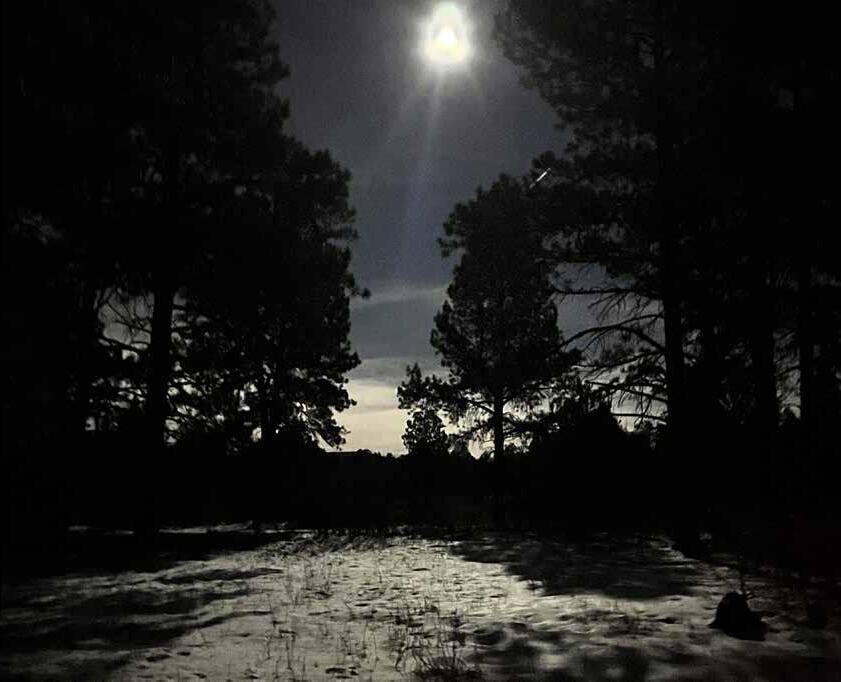
BY BENJAMIN ALVA POLLEY
It was a crisp Sunday morning, Dec. 1, the last day of Montana’s big-game hunting rifle season.
I drove more than an hour through darkness, far from medical services, with spotty cell reception. The pain in my abdomen had been increasing for days, and grim possibilities loomed in my mind.
I didn’t want to give up on the season, especially on the final day — tormented by a season of missed opportunities, including a giant mule deer.
The primal call of the wild surged within me, overpowering caution. The persistent pain in my abdomen was no match for my instinct to hunt, to provide food for my family and stock the freezer for winter.
The night before, the pain had surged unexpectedly while I was home alone, as my wife was out visiting our niece and nephew. We had just returned from picking out a Christmas tree, its scent lingering in our living room. I had taken my rifle for a short walk after the tree hunt. Initially dismissing the discomfort as gas or constipation, it soon became unbearable. I remembered the importance of listening to my body, a lesson learned the hard way.
As the pain intensified, radiating near my navel, I retreated to bed, anxiety gnawing at me. It felt sharper than constipation, something ominous lurking beneath. Tossing and turning in the dim light, I wondered if I had eaten something bad or if a serious illness was about to strike. Our family had just enjoyed Thanksgiving, so why
was I the only one suffering? Worries washed over me, drowning out any hope of sleep.
Barely managing two or three hours of rest, I got up before 5, my determination flickering like a candle flame — I still planned to hunt. The pain had lessened enough for me to make coffee, eat a small breakfast and drive to an area teeming with whitetails and elk.
As dawn broke, I ascended the trail, pausing to breathe deeply and soak in the tranquil surroundings. Fresh snow blanketed the hills, making a slight squeak and crunch beneath my feet.
Reaching the edge of a picturesque meadow framed by towering trees, I spotted signs of rutting activity — stripped bark from the frenzied bull elk of September and whitetail bucks driven by instinct. The deer rut was in full swing. Willow shrubs surrounded the damp meadow, while towering trees provided shelter. Just a year ago, I had harvested a four-by-four whitetail buck here, providing sustenance for my family and friends.
As the sky lightened, revealing the meadow’s beauty, ravens stirred in their treetop roosts, flying above as a nearby deer snorted and fled, startling the ravens. Nausea churned in my stomach, tight knots of anxiety gripping me.
I questioned my ability to steady the crosshairs of my rifle, wondering if I had the strength to process an animal if I was fortunate enough to shoot one. A friend later remarked that if I had shot something, the burden of carrying it would have spelled my end.
I pressed on, stalking from tree to tree like a shadow, unaware
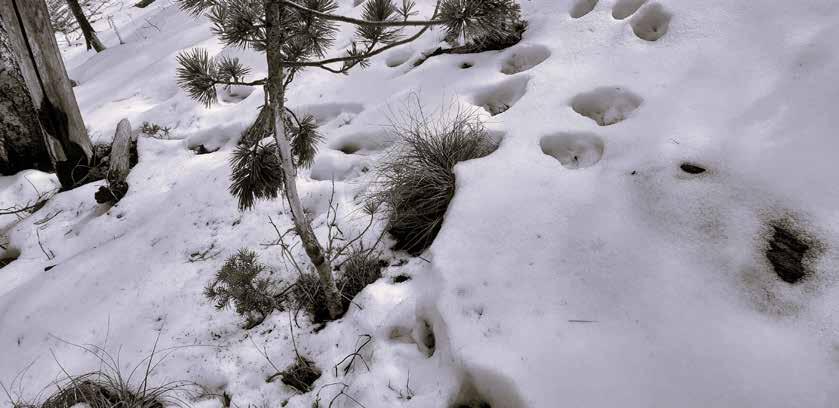
that an unseen force was also pursuing me. The hairs on my neck prickled in response to a silent threat, as if a phantom entity clawed at my insides.
Following a game trail that wound uphill, I paused, leaning my rifle against a sturdy tree. The crisp air was fragrant with pine and fir as I dropped my backpack, seeking relief by digging a small cat hole. Yet the persistent ache in my body lingered like a shadow I couldn’t shake. Was it time to concede my hunting dreams for the season? I thought just a little farther, clinging to my resolve.
After battling my inner demons for another hour, I settled beside a stout tree, back pressed against the rough bark. As the last hunting day approached, the pain in my belly escalated, reaching a seismic intensity. Each step felt like a struggle against waves of discomfort. Why was I clinging to the hunt despite the pain? I sensed something was wrong within me, a warning I could no longer ignore. Finally, I faced the truth and prepared for the daunting trek back.
Summoning my strength, I staggered toward the vehicle, just a mile away, as a buck snorted softly nearby before vanishing over the hill.
Upon reaching my car, I unloaded my gear with a mix of urgency and dread. The winding road blurred past as I drove, realizing something was seriously wrong. I texted my wife, “Something is drastically wrong with me. I’m heading home early.” Panic surged as I rummaged through my pockets — I had dropped my ID and insurance card. The thought of needing them at the ER filled me with dread.
I whipped a U-turn and raced back to the trailhead — nothing lay where I had parked earlier.
I was determined to avoid the fallout of making another trip back, especially if the weather changed. Fearing they would be lost forever, I sighed, slipped on my orange hunting vest, grabbed my bear spray and left my rifle behind. Clutching my stomach, I retraced my steps, hunching against the pain.
I had made a loop earlier, but which way should I go this time? I considered backtracking, but the steep incline deterred me, so I chose the gentler ascent. Navigating the snow-covered path, I noticed boot prints from the previous day marred the surface. I had to discern which tracks were mine, aided by faint lines on the map I downloaded on onX. I recalled pulling my phone from my jacket pocket earlier, needing to unzip and check the topography repeatedly. Remembering Richard Nelson’s wisdom, “Every animal knows more than you do,” I had aimed to be quiet, aware of the
wildlife around me. I had placed my phone in my pants pocket, where my ID and insurance card were also tucked away.
Every move made me envision the cards slipping from my grasp. Were they nestled in the snow where I sought relief, or near the tree that steadied me? With determination, I scoured those spots and every footprint in between, retracing my path through the serene woods, haunted by thoughts of where the cards might have vanished.
An hour later, as I descended the last hill, I spotted my insurance card leaning against a snowberry bush, its colors muted in the snow. Five feet beyond lay my driver’s license. Gratefulness surged within me, echoing the deep gratitude I had felt in navigating the treacherous waters of taking another life — a small success achieved through sheer determination. With renewed purpose, I continued.
Back at the car, I sped toward the highway, my heart racing alongside the engine. I pushed the speedometer to 85 in a 70 zone, the landscape blurring past. Just as I felt the thrill of the wind rushing by, I spotted the highway patrol, lights flashing as it sped in the opposite direction. Luck was on my side.
Then my phone vibrated with a ping, snapping me back to reality: “Where are you? Are you alright?” I realized it was an hour later than I had initially texted my wife.
I quickly fired off a few voice texts. “I think I have appendicitis.”
“Why, where does it hurt?”
“Two inches above my navel and all around it.” Panic gripped me as the first tears streamed down my face, mingling with my fears.
“Pull over. I can come get you,” my wife texted urgently, sinking my heart. She researched symptoms, suggesting that if it were acute appendicitis, the pain should be localized to the lower right side, not centralized.
“No, I can make it. I’m still more than half an hour away, but I’m in a lot of pain,” I replied, agony coursing through me.
“I’ll find a walk-in clinic,” she offered. In the meantime, she texted friends who had faced similar battles. One suggested heading straight to the ER.
Another recalled how his daughter thought she needed surgery but only required Gas-X after a costly ordeal. Doubts swirled in my mind.
When I arrived in Missoula, my wife rushed me to the ER. I collapsed onto the lobby floor, frustration and discomfort mingling below my abs. Ten minutes later, they called me back to an exam room.
Photo: Zack Williams
The staff performed an MRI, checked my vitals and asked about my pain level with practiced concern. While waiting for the results, my wife offered me an energy bar, reminding me that it had been eight hours since I’d last eaten. Against my better judgment, I accepted.
When the doctor returned, his face grave, he informed me that my appendix was inflamed, on the verge of rupture and I needed immediate surgery. They also discovered a hernia that had been present for more than a decade. He assured me I could be in surgery within the hour, then inquired about my last meal. He advised me to refrain from food to prevent choking or developing pneumonia during anesthesia. It became apparent that the timing wasn’t right; surgery was delayed another six hours, and I might have to spend the night.
I endured a long wait, survived a half-hour surgery and emerged through a grueling six-week recovery. Amid this haze of medical emergency and relief, I remained haunted by the shadow of that giant muley buck, forever etched in my memory. It was like the eternal question you hear as an NPS employee being asked by tourists, At what age do the deer become elk? That was the animal.
Benjamin Alva Polley is a place-based storyteller. His words have been published in Rolling Stone, Esquire, Field & Stream, The Guardian, Men’s Journal, Outside, Popular Science, Sierra, and other publications, and can be seen at benjaminpolley.com.
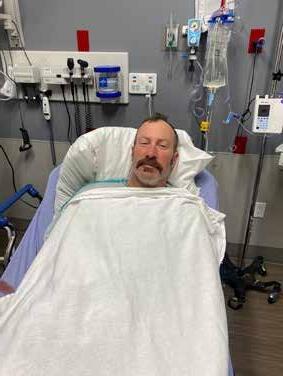
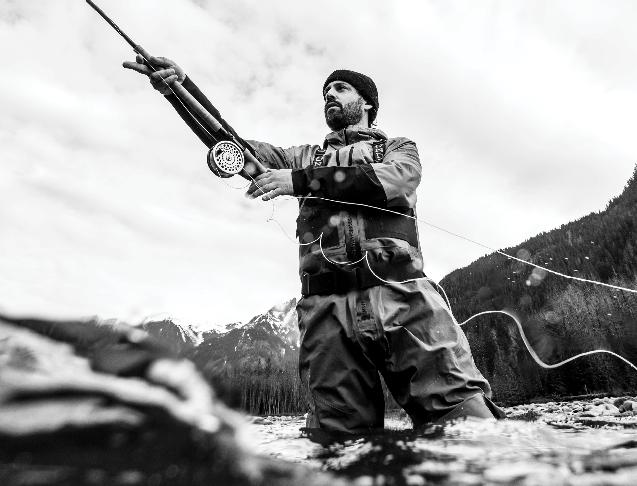
VECTOR ZIP WADER
Designed for mobility and built to take a beating, it redefines what serious anglers should expect from their gear.”
Photo: Benjamin Alva Polley

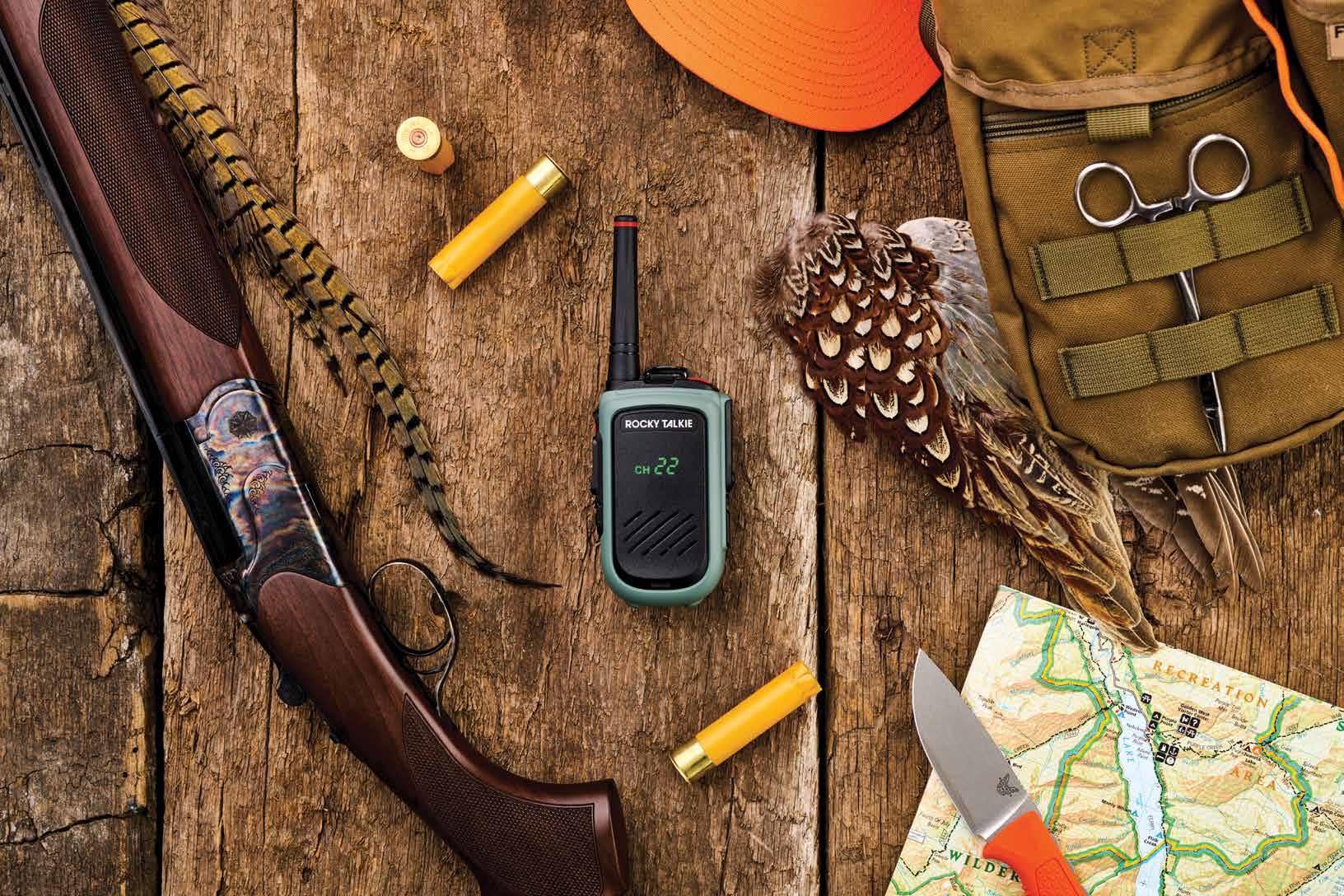
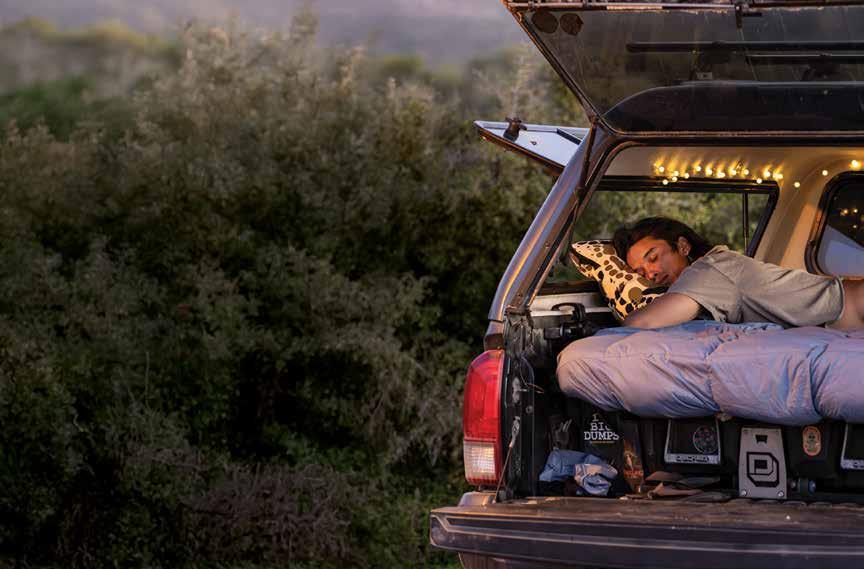
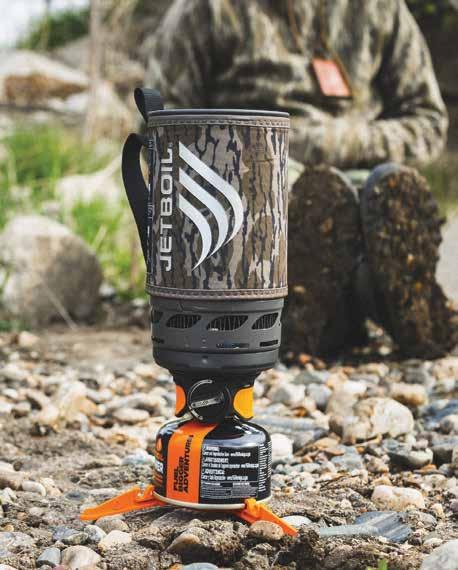

BACK IN THE SADDLE
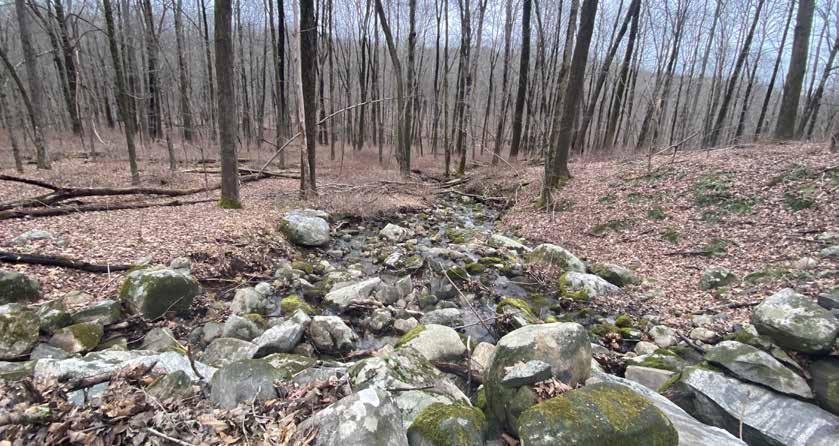
BY STRIKER BROWN
It had been almost three years since my last season in the whitetail woods. Overseas military duty had taken me far from the uniquely American experience of expansive public land hunting opportunities. So when the orders finally came to return stateside, I couldn’t wait to get back into the woods. I’ve had the good fortune of a career that, whether I like it or not, gives me the unique opportunity to explore new parts of the country every few years. When I found out I was getting stationed in New York, I was excited to see what outdoor adventures lay ahead in a fresh new state.
My initial concern was that public land availability in the southern portion of the state would be scarce, if not nonexistent, given the region’s dense population. I couldn’t have been more wrong. My initial internet scouting eventually led me to hunting opportunities on state lands managed and operated as part of New York’s Lower Hudson Watershed. The watershed serves as one of the largest drainage areas on the Eastern Seaboard, encompassing a 12,800-square-mile basin to meet New York City’s significant freshwater demands. Numerous opportunities for outdoor recreation also exist on the watershed’s more than 135,000 acres of public land. What I didn’t realize at the time was the key role bowhunting played in preserving the overall health and integrity of the Lower Hudson Watershed.
Healthy Forests Equal Clean Drinking Water
It’s all too easy to not give much thought to where one’s water comes from. In most parts of the country, we turn on the tap and water is readily available at little to no charge. This allows us to easily forget the scarcity and value of our planet’s most precious resource. Everything that goes into providing readily available and clean drinking water is also often overlooked.
With restrictions on firearms hunting and a lack of historic natural predators such as wolves, the white-tailed deer population in certain areas of the Lower Hudson Watershed had ballooned. Like many
things in nature, balance is key, and an overabundance in one area often has consequences in others.
As I continued to research my local bowhunting opportunities, it became clear that many forests within the watershed were being adversely impacted by the overpopulation of deer. Healthy forests are key to maintaining the integrity of a watershed, since forests help maintain clean drinking water in a variety of ways. A forest canopy slows rainwater before it reaches the forest floor, preventing erosion, which is especially important during heavy downpours. Rainwater is then naturally filtered as it moves through the soil, with tree roots keeping sediment from being washed into streams and absorbing nutrients that would otherwise pollute the waterways.
Forests grow in distinct layers, each playing a vital role in longterm ecosystem management. The understory is the nursery of the forest, where young saplings grow to replace the large mature trees that will inevitably fall. Without a healthy understory, the forest cannot successfully regenerate. My initial scouting trips revealed a clear “browse line” through the forests where the understory had been completely consumed by deer eating everything within reach. Many of the local forests within the watershed lacked any evidence of the seedlings or shrubs needed to one day regenerate the forest. The result was woods that appeared unnaturally open. One plant that was in abundance was Japanese barberry, an invasive species that had clearly thrived in the overbrowsed landscape and overtaken the forest at the expense of native flora.
Lower Hudson Watershed: New York State Department of Environmental Conservation (accessed 1 February 2024).
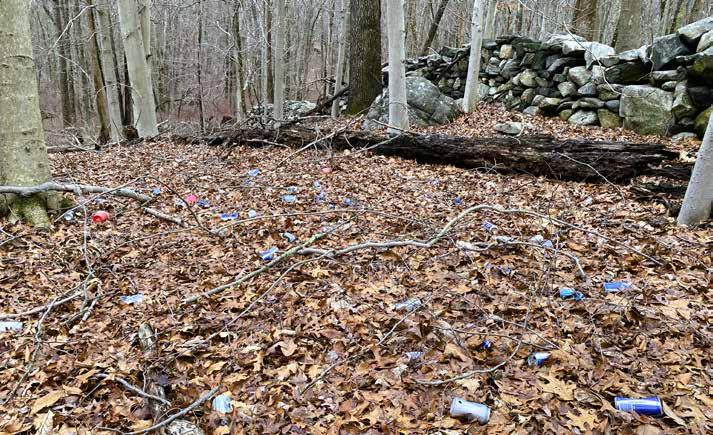
Making a Plan
For someone who lives for bowhunting, I became immediately intrigued when I realized that sizable portions of the Lower Hudson Watershed were not open to firearms hunting. Not having to compete with gun hunters meant significantly better odds for punching an archery tag in a brand new state. After extensive scouting and thorough research of local county and municipal regulations, I called my brother.
“Book your ticket,” I said. “We’ve got conservation work to do.”
My brother and I share a desire to hunt and fish in as many new states as possible. So when I told him I thought I had found a couple of overlooked areas that seemed to be hidden gems for bowhunters, he was already packing his bags. As a nonresident, he was able to obtain a New York bowhunting license and tags for under $150 — a small investment we hoped would pay major dividends. He booked his trip for mid-November, aiming to coincide with the peak of the rut.
ridgelines and creek bottoms, we consistently fought a losing battle with the wind. Hunt after hunt, we found our wind shifting constantly in every direction. Rather than waste hours hanging in a tree with our scent blowing everywhere, we elected to put the legwork in until we found a spot that wouldn’t be futile. We found areas that looked great but couldn’t be hunted because of the swirling winds, and other areas that had consistent, reliable wind yet no sign of any deer activity. But as is often the case in bowhunting, patience and persistence start to pay off.
Eventually we stumbled across a unique flat between a thick creek bottom and an elevated ridge. For reasons unbeknownst to me, the wind seemed to provide a steady, reliable breeze blowing away from the thick bedding area. But it didn’t take long to realize we weren’t the first folks to find the area intriguing. Across the flat lay a considerable number of old sun-faded beer cans, a painful reminder of human irresponsibility in what would have otherwise been a pristine forest.
After a shower and a hot meal that night, we sat down to discuss the day’s scouting and make a plan for the following morning.
“Let’s hunt the Beer Can Stand,” my brother said.
With my brother’s arrival, we didn’t waste any time getting into the woods. We were far from the only bowhunters in the county, and my early-season hunts had proven to be much more difficult than I initially anticipated. But sweet November has its magic, and we knew that if we spent enough time in the woods, the odds of at least one of us punching our first archery tag in a new state were worth betting on.
Like my early-season hunts, the initial days of our trip largely yielded frustrations. Hunting in a diverse geography of hills,
“Scenery sucks, but at least the wind is good.” I chuckled. There wasn’t an actual “stand” in the location, but I liked the name because it rhymed, and I couldn’t deny it was an apt way of describing our newfound hunting spot.
“The Beer Can Stand it is,” I said as we made a plan to get set up before first light the next day.
The next morning we quietly slipped back into the area. The wind remained consistent, cooperating for the first time during our trip. We were saddle hunting and had identified two trees we liked that were somewhere between 100 and 150 yards apart. After getting set
Sweet November
Photos;
Striker Brown
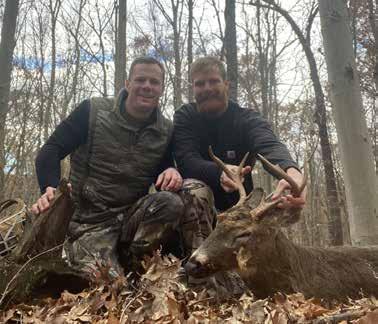
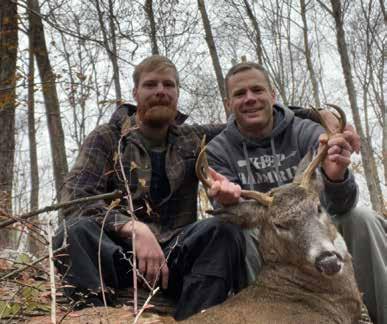
Often, frustrations pile on top of disappointment, and you feel like the worst hunter to ever set foot in the woods. But on a few rare occasions, the stars align, and you’re reminded why you continue to choose the bow.
up, I quietly hung in the cold, predawn darkness, awaiting the first glimpse of sunlight, listening to water tumbling through the creek below.
Within the first half-hour of daylight, I caught movement through the woods. As I strained to see through the forest, my eyes eventually focused on what I realized was the large fork of an antler halfway between my brother and me. At first, the buck appeared as if he was going to slip between the two of us, maintaining a safe distance from us both. But just as the buck seemed certain to remain out of reach, he stopped dead in his tracks and made a 90-degree turn, walking straight toward my brother.
My knees shook uncontrollably as I watched him drop out of view. As I sat there with my heart pounding in my ears, I remember feeling relieved that the pressure to make a good shot wasn’t on me and instead was riding on my brother’s shoulders. Eventually I began to wonder if the deer had slipped past him before he was able to get a shot.
“Thomp-thwack!”
The sound of my brother’s bow echoed through the woods, followed by the distinct crack of an arrow impacting a rib cage. I caught sight of the buck as he tore off in the direction from which he came. I waited and listened, but we never heard the sound of the buck crash and couldn’t be sure how far he’d gone. As a result, we stayed put for the rest of the morning, hoping to keep the woods quiet and not accidentally push the buck farther.
Several hours later, we met at the point of impact. The initial blood left uncertainties, and my brother’s arrow hadn’t passed through, so we were unsure of the hit. After taking up the trail for 30 or 40 yards, my brother froze and held up his hand in my direction. He slowly stepped backward toward me.
“I just saw him,” he said. “Slowly walking in the opposite direction away from us.”
Disappointed and frustrated, we knew we only had one option:
back out and return later so as to not push the wounded buck farther.
After a hot sandwich and fresh socks, we outlined our plan.
“Go hunt. I’ll track my buck, and you can come help me after dark if I haven’t found him by then,” my brother said.
It was a proposition I found hard to argue against. I was still itching to punch my first New York tag, and I knew my brother was more than capable of tracking alone.
“OK,” I agreed.
His buck had run in the opposite direction of the thick bedding area, so I knew he’d be tracking a considerable distance from where we’d hunted that morning. So back to the Beer Can Stand I went.
The majority of the evening passed uneventfully. The sun was setting and light was fading fast. I hadn’t heard from my brother, which I knew meant his tracking wasn’t going well, and I was eager to climb down and help him look for his deer. Then, out of nowhere — in that indescribable way deer appear from thin air — a doe materialized from the thick cover of the creek bottom.
As she walked straight toward me, my heartrate quickened. Straining to remain as still as possible, I saw antlers inching through the brush behind her. With his head down and nose to the ground, the buck followed the doe directly toward my tree. The scene could have been out of a painting. How quickly the evening’s events had changed: no activity to a storybook depiction of the whitetail rut unfolding right before me.
The doe continued to walk directly toward my tree. I was frozen in place, unable to reach for my bow. Before I knew it, she was under me with the buck still facing me from only 7 yards away. I worried the deer could hear my heartbeat.
The doe slowly turned and began to walk away from my tree. The buck angled to follow her, turning broadside and looking away. I made my move, drawing back and settling my pin.
“Thomp-thwack!”
The Unimaginable Public Land
Bowhunting is a roller coaster of emotions. Often, frustrations pile on top of disappointment, and you feel like the worst hunter to ever set foot in the woods. But on a few rare occasions, the stars align, and you’re reminded why you continue to choose the bow.
We ended up having to track both deer farther than we had hoped. The trail was painfully slow, instilling uncertainty at every turn and providing only the slightest glimpses of hope. I still remember the flood of emotions when we recovered each deer: relief and gratitude, followed by feelings of excitement and satisfaction now allowed in. Finally able to dismiss our fears of failure, the positive emotions took hold like a strong drug.
Eventually disbelief set in.
“Dude … did we just double?” we said, staring at each other with eyes wide and mouths agape.
Three months earlier, back in late summer, I had brought my 4-yearold daughter along for one of my preseason scouting trips. On that particular day, we had gone into the woods without her wearing any type of hat, hair tie or ponytail — a learning experience for me as a girl dad. My daughter’s preferred hairstyle can only be described as that of a feral warrior princess, and as a result, I spent the majority of our time untangling briars and sticks out of her hair.
When we got home, I grabbed a fistful of hair ties and threw them into my backpack, vowing to never make the same mistake again. I had all but completely forgotten about that scouting trip as my brother and I sat in the woods notching our New York tags for the first time. State law requires deer to be tagged before moving them, and I had apparently overlooked packing anything to attach our tags with.
As I dug through my bag looking for nonexistent zip ties, I found the wad of various pink- and purple-colored hair ties. I laughed as I offered the pile of ponytail holders to my brother.
“Choose wisely,” I said.
I found it funny how much thought each of us put into which hue of pink served best as our tag tie.
The End of the Beer Can Stand
Several months later, in early spring after the snowpack had melted, my wife, daughter, dog and I all made the hike back to the Beer Can Stand — the successful hunt creating a bond with the land that had provided. I had promised myself that after the season was over, I was going to head back to the Beer Can Stand to clean up the area. As we bagged up the aluminum cans, I recounted to my daughter the particulars of the hunt.
After our cleanup was complete, we hiked out toward our vehicle. I looked back over my shoulder one last time at what was no longer the Beer Can Stand. I smiled. Only our public land double, and the memories made at the Beer Can Stand, remained.
Commander Striker Brown is currently serving on active duty in the United States Navy. He is presently stationed in Washington where he enjoys pursuing outdoor adventures across the Pacific Northwest with his wife and three daughters.
The opinions and views expressed here belong solely to the author and do not necessarily reflect those of the Department of the Navy. Any appearance of external links, products, or endorsements does not constitute endorsement by the Department.
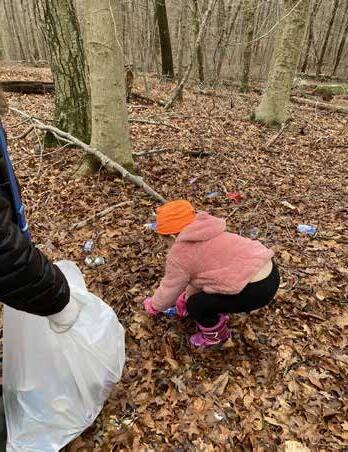

Photo: Striker Brown
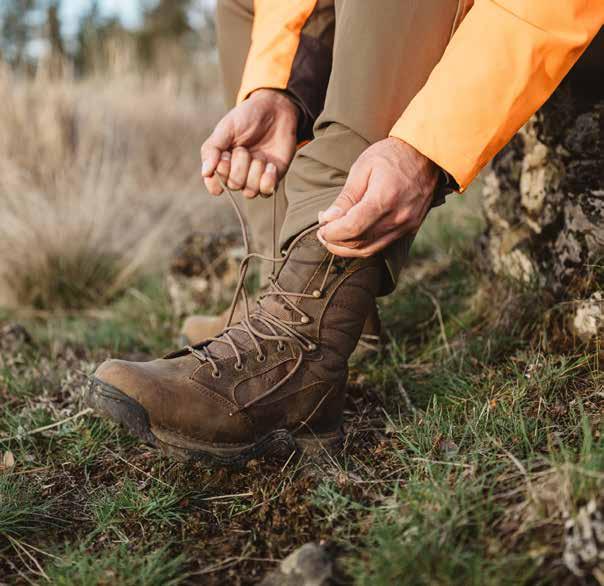

MILES OUT OF SERVICE STILLNESS BROKEN BY THE CHASE EVERY STEP IS EARNED THROUGH BRUSH AND TIMBER THE WILDERNESS PROVIDES
INNOVATION FOR THE PATH AHEAD
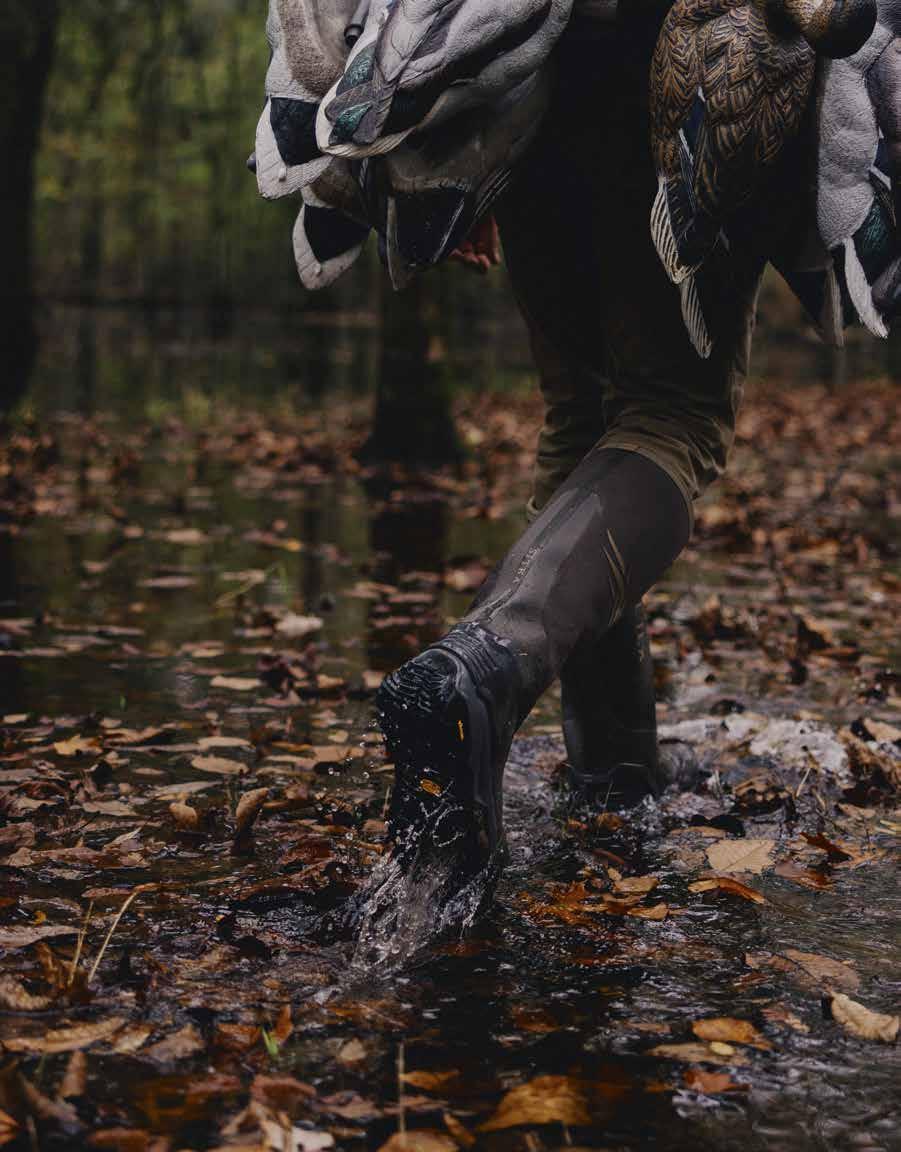
ULTRALIGHTWEIGHT COMFORT
FULL GORE-TEX CONSTRUCTION
SITKA APEX TREAD SYSTEM FOR MAXIMUM TRACTION
TEMPERATUREREGULATING INSULATION
Canyons and Hallways: Loneliness, Awe, and a Bird Dog
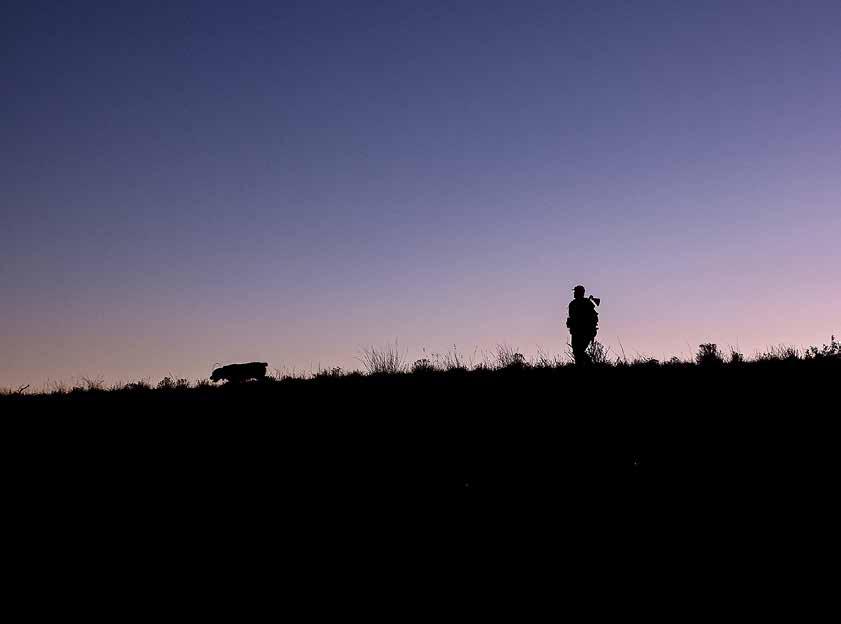
BY DANIEL SHEATS
I drove a long way to stand at the edge of this canyon. After humming down the highway south from my home in Santa Fe, New Mexico, through a couple of hours’ worth of rolling creosote bajadas, I turned west and wound into the mountains, gaining altitude. Patches of grass and cholla emerged in the landscape. I pulled off the pavement and onto a dirt Forest Service road; rocks pinged and rattled jazz rhythms in my wheel wells. Thin grasslands soon spread wide in the foothills.
As the road grew worse, the country got better. The grass reached shin-high, and before long pockets of dry, knee-high meadow appeared in the draws. Oaks and juniper gathered in the sheltered stretches. Patches of prickly pear spotted the drier, sunbaked slopes. I idled past an overflowing stock tank spilling a small stream into a dry creek bed. The water quickly disappeared under the sandy ground as if escaping something predatory.
On the other side of the ridge, the topography flattened out for a half mile then plunged into a large, rough canyon running west to east. On the canyon’s south-facing slopes, sotol stood tall over barrel cactus, ocotillo, soaptree, yucca, and more prickly pear. The north-facing slopes and draws protected stands of juniper and pine in the tall grass, and the wash two hundred feet below held islands of mixed juniper, locust, and oak. Though broken cliffs shaded much of the canyon floor, I parked near a sloping ridge, steep yet walkable, that dropped into the canyon below, difficult and good desert quail country.
I stepped out of my truck. It was silent, the kind of silence that has weight, is heavy. The high cloud cover kept the December air crisp, even at mid-morning. To the west, four thousand feet higher, fresh snow dusted the peaks. I released my two-year-old griffon, Gamble, from the kennel in the truck bed. He shook off the drive and marked his turf. I gathered my backpack and double checked everything I needed for a day of hunting: shells, jacket, human first aid kit, dog first aid kit, human food, dog food, GPS, and plenty of water for the both of us. A few side canyons hid seasonal tinajas that would help cool the dog later in the day. I walked over to the edge of the canyon and looked down.
To the east, the canyon fed into the steep foothills and then out to the bajadas. To the west, up the ravine, several draws converged and cover trees grew thick at the confluences. Mountains built up farther west beyond the canyon, growing ragged, harsh, and impossible.
I didn’t see anyone coming in or going out, and I didn’t see anyone, or even cattle, over the miles of steep rolling grasslands and arroyos spread out to the south and west. Only once had I bumped into other hunters here: a few young men in a side-by-side, a dog kennel in the back; the hunters stayed off their feet and on the two-track. Fine by me. Besides my dog, who nosed a light breeze, creeping at heel, I was alone in a rolling sea of desert, a breaking crest of mountains above me, not quite frozen in time.
In his upland hunting classic, The Hunter’s Road, Jim Fergus proposed that “[i]t takes time to settle into rhythms of the land and of the hunt, but if you love country, you will never really be lonely, and if you love to hunt, you will certainly never be bored.” This is
a beautiful, comforting sentiment. For me, it is not so simple.
Last year, my first full season with Gamble, I determined to get him on plenty of wild birds, develop a solid point, and not worry so much about his steadiness. I wanted him to learn to love hunting by exposing him to rich and rugged country where vibrant quail would spark the 150 years or so of breeding embedded in his DNA. So, I chased wild birds and I praised him effusively when a point and a retrieve came together, no matter how reckless. When he started acknowledging me with a subtle shift in his eyes while locked in on birds, waiting for me to approach and flush a covey, I knew we were becoming a team.
Because I was concerned about safety with a wild and unsteady pointer, I hunted mostly alone. Unlike Fergus, I was sometimes lonely. When hunting was slow toward the end of the season, I was bored, frustrated, so much so that I thought I may be bad luck in some cosmic sense, that the dog deserved a better hunter behind him. This, despite having some manic, bird-filled days earlier in the fall. Maybe Fergus was right that “[i]t takes time to settle into rhythms of the land.” If so, I had not settled properly. I now know my earnestness and doubt doesn’t mean I don’t love to hunt or don’t love the desert. Far from it. I dream of this place. Sometimes I simply dream of the birds flying, no convoluted plot to untangle, no first-person narrative, or even an awareness of my presence. It’s beautiful to dream without an ego to mess thing up.
After reflecting, though, I now see loneliness less as an affliction to be pushed away, and more as something that may be tangled up with moments of beauty and awe. Dr. Dacher Keltner, a Professor of Psychology at the University of California, Berkeley, and an expert on human emotion, published a book on awe in 2023. He defined this emotion as “the feeling of being in the presence of something vast that transcends your current understanding of the world.” Keltner further refines the concept of awe by exploring events that inspire this emotion, such as music, near death experiences, religious experiences, and being in nature. In the chapter on nature, Keltner explains that his research found a “pattern of awe,” including vastness, mystery, and the dissolving of boundaries between self and the world.
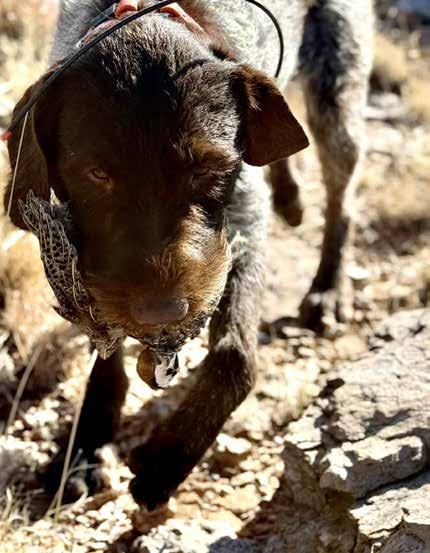
“It takes time to settle into rhythms of the land and of the hunt, but if you love country, you will never really be lonely, and if you love to hunt, you will certainly never be bored.” This is a beautiful, comforting sentiment. For me, it is not so simple.
Keltner also discusses how awe interfaces with ego. The psychological concept of the “default self,” he explains, is the part of us that “is focused on how you are distinct from others, independent, in control, and oriented to competitive advantage.” Keltner also notes that scientists can see this egocentric part of your brain, called the default mode network, quiet down when someone experiences awe. The quieting of the “default self” helps us feel connected to the broader world, advancing a feeling of “oneness.” I believe that this process can work in reverse: being alone can help the “default self” go quiet, making us more open to awe. When no one is around, there are no eyes to judge. You’re not as concerned about missing
that hard shot, about your dog breaking on the fall, about not finding birds to pursue. If you want to look for arrowheads instead of chasing those Scaled Quail over the hill, no one will look at you funny. Competition is muted and curiosity speaks up. You create a little more space for awe to find you when your ego spills out of your ears. Monks, if they would ever read this, probably would smirk at me, a mere 500 years behind the times.
If there is enough space between your hunt and your ego, wild things can happen. Last year, after stepping into that same canyon, Gamble and I dropped off a grassy mesa after chasing some quail and descended into a tight gully cutting down over several hundred yards back into the bottom. I scrambled below rock plunges where the gully flattened out and found myself in a slot canyon with a thin line of juniper growing under the 20-foot walls. When I passed under an overhanging branch, something big and alive above my head noiselessly dropped and veered away, almost alien, startling. I felt like the water fleeing underground at that stock tank.
Photo: Daniel Sheats
I
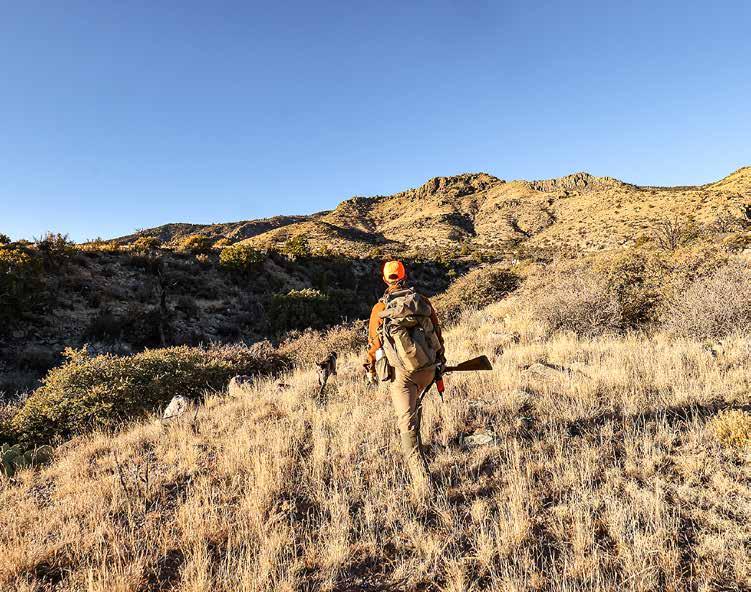
When owls fly, they are silent. Evolution designed their wings to mute the sounds of vibrating air moving passed their wings; owls are the unheard predator. I tried to identify the species quickly— raven sized, night-hawk-like wing beats—but it was gone as soon as it appeared. Then I flushed another. Then another. Five. Six. Seven. As I continued to walk down the canyon, they pulsed through the space like moths at a porchlight: landing, perching, flushing, again and again. I tried to memorize identifying colors, markings, and distinct feathers so I could note the bird in my life list later. Yet, by the time I emerged from the gully into the canyon bottom, I had stopped with all the science and just watched the owls pivot around me until one flew by me so closely, I seemed to be able to see every detail of every feather at once as it swept back into the slot canyon. If you’ve ever seen a Van Gogh painting in person from a foot away, the feeling was similar: infinite textures entwined. I have no idea how long this walk with the owls lasted or what specific species those owls were, long-eared or short-eared. I’m also not sure how many quail I killed that day, but I am grateful for that time with the owls. This was awe: vastness, mystery, the dissolving of boundaries between me and the world.
Later that year, I came across the poem, “We Astronomers” by Rebecca Elson, an actual astronomer as well as a gifted writer:
We astronomers are nomads, Merchants, circus people, All the earth our tent. We are industrious. We breed enthusiasms, Honor our responsibility to awe.
But the universe has moved a long way off. Sometimes, I confess, Starlight seems too sharp,
And like the moon
I bend my face to the ground, To the small patch where each foot falls,
Before it falls,
And I forget to ask questions, And only count things.
I felt as if Elson had watched me from the edge of that gully with the owls, and cheered me on, helped me stop trying to count, identify, and distance myself from what it felt like to be in that space
Photo: Paul Bramble
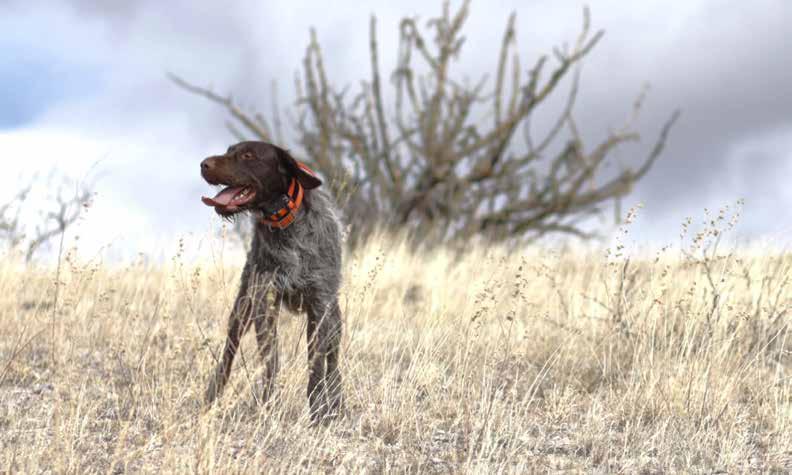
at that time. She knew what is was like to fight the “default self,” the onus of science, numbers, and of success to find a way to immerse oneself into a world where awe is possible.
The problem is that between moments of awe, loneliness can feel fixed, permanent. You can doubt your connection to place. But, I remind myself now that loneliness is not a cell, it is a hallway. Sometimes the hallway is long and it’s frustrating to manage your way forward, to settle into the country, without retreating back to what you know, to habit, to numbers. But, if we are patient and observant, doors will materialize along the walls. If we check the doors and enter those that open, we can find something that brings us closer to awe and connectedness. That day last year, I had entered the room full of silent owls hawking through a desert canyon.
Daniel Sheats is an experiential learning educator based in Santa Fe, New Mexico. Dan grew up hunting and fishing the marshes surrounding his family’s dairy farm in Delaware and now chases upland birds and waterfowl across the Southern Rockies and High Desert.
Photo: Paul Bramble

THANK YOU, BHA SUPPORTERS
NEW LIFE MEMBERS
CORPORATE PARTNERS
PLATINUM
CHAPTER CORPORATE PARTNERS
ALASKA
Alaska
Denali
FishHound Expeditions
Wild
Wildfish Cannery
COLORADO
Budges
IDAHO
INDIANA
K
Lewis & Grant Auctions
R.L.
Speckled
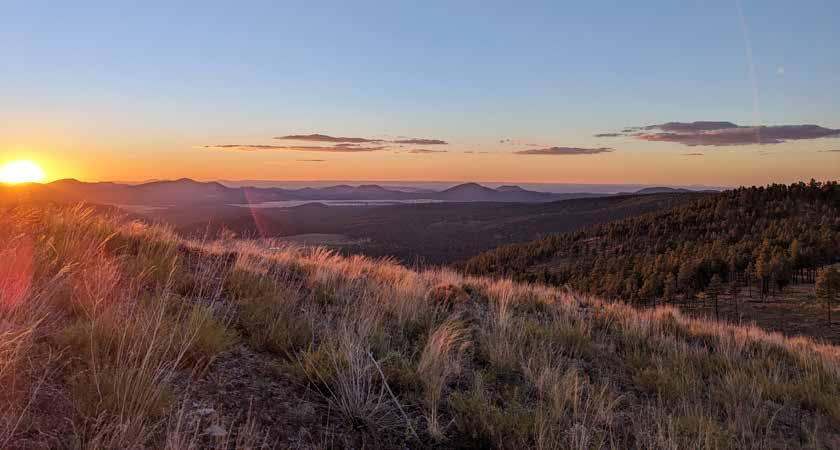
A Hunt Down Memory Lane
BY ANDREW HARDY
Driving down the dirt road, there is only that false light before dawn, the kind that isn’t quite sure if the sun is rising or setting. This is the last trip I will take on this dirt road. It’s late January, quail season ends on Feb. 9, and given my family’s schedule, I doubt I will make it out again. I’m driving toward my spot, nestled in the desert of central Arizona. It’s the spot I go to when I need success, and while sometimes I only pull out one or two, it’s always been fruitful.
In May, my family and I are moving to Alaska. It’s been a dream of ours for a long time. I didn’t grow up in Arizona. My dad was in the Navy, and we moved from place to place. As a kid, I was outdoorsman-curious. Sporadically, I would do something to pique my interest — trout fishing with my dad, duck hunting with my uncle, etc. But between high school, college and my first job in the Navy, I felt I never had time to truly explore my outdoors itch. We moved here for work after getting out of the Navy, and Arizona has been where I finally explored what it means to hunt. So, in some ways, I feel I did grow up here. It’s where I’ve taken my first steps in an unexplored world, learning bit by bit and experience by experience.
As I pull off the forest road at the wash I always stop in, I feel the memories flood me. Cold air slaps me in the face, and as I prepare to hunt, the nostalgia tugs at me. Locking my Jeep, I am reminded of the places it has taken me and the memories it’s created: getting it detailed because elk blood had soaked into the trunk carpet, shearing a shock driving over scree on a bear hunt, sliding in the snow on elk hunts and subsequently covering the Jeep in red mud once the snow melted.
I scramble out of the wash, hiking up the hill to the east. The scars on my shin and the holes in my pants are a testament to how many times I have walked this path. Many, many times, until I learned that gaiters will keep out the pricks and preserve my pants. Cresting over the top, I see the familiar landscape stretch before me. It looks devoid of life, though the signs are there if you know where to look. Cactus wrens make their morning call, cottontail scat dots the land, and faint game trails run through the creosote bushes. All these things I have learned from years of hiking the desert.
I think back to my first times walking the bush and the people who taught me how to hunt: Oscar, Bubba and Tick. They took me under their wings and taught me about MOA, glassing, calling predators and countless other things. Other lessons I taught myself — or more likely the land taught me — as I slowly but surely figured out what not to do through many fruitless hours of hunting. I think about the ones that got away, especially the widest mulie buck I have ever seen. Bowhunting, I stalked him for over a mile, and then spooked him 100 yards away because I got too eager, moved too fast and slid unceremoniously on my butt down the hard Arizona rock. Now the memory brings a smile to my face.
Hiking east, I crest the next ridge; this also brings a smile to my face. Almost exactly where I cross it is the spot where I shot a quail over my brother-in-law’s dog. I still don’t know if it counts or not. She spooked a covey 100 yards away from me as she chased them willy-nilly, and they happened to fly directly toward me. No point, no hold and certainly not steady to wing and shot — but there was a dog and a dead quail.
Arizona has been good to us, and we have grown and thrived together as a family. Now my kids are just old enough to start camping and exploring with us. The ample public space, mild winters and beautiful landscapes have set the tone for their own love of the outdoors. Even now, my kids ask when the next time will be that we camp. I owe a debt to the wonders of Arizona’s public lands for providing my kids with a seemingly endless playground.
Over my shoulder, I hear the call of male Gambel’s, so I turn around and head toward it. In front of me, I finally see a small covey — maybe eight or nine birds flush — but they are too far out for a shot. Now the game has really begun. They flush back up and over the ridge, confirming my long-standing belief that quail are always moving either away from you, uphill or, most times, both. I pick up my pace to clear the ridge, blood pumping in my ears, but slow and start my “quail walk” that I have learned helps to flush stragglers: five quick steps, then a 10-second pause, repeated ad nauseam until I can convince the quail that I am a predator closing in and they bolt.
As usual, the first one flushes right after I restart from the pause and, as usual, I absolutely biff my first shot — too excited to even come close. A second bird flushes soon after, and I miss again,
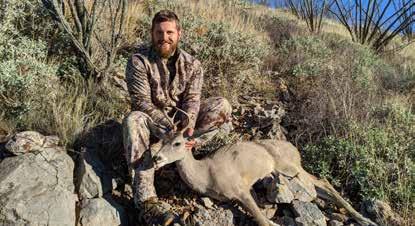
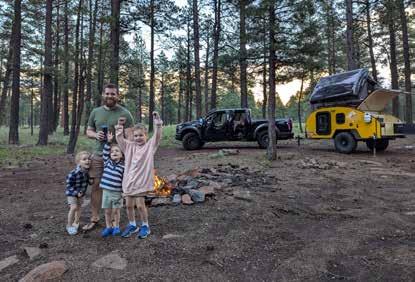
though at least this time I remember to aim. Nothing else stirs, so I continue the walk down the ravine, the same ravine where rain once soaked me to the bone the one time I, of course, forgot to bring my rain jacket.
At the base of the ravine, I hear a noise south of me — something scurrying up a hill. I pop over the finger of a ravine and see a doe mule deer slipping away. Like usual, I am in awe of the ease with which they traverse terrain that makes me regret skipping workouts. They slip away over the ridgeline, and I know they have disappeared even if I were to instantaneously teleport to the top of the ridge. My favorite deer to hunt, Coues, are even better escape artists. Weeks of my life have been spent watching them step behind an ocotillo bush and then seemingly turn invisible. Memories of those hunts are poignant now, all the good and bad turning to great — as time typically does with challenging experiences.
Snapping to, I start walking back the way I came, and it happens. A male Gambel’s flushes. I track him with my bead, take a slight lead and shoot. A puff of feathers and a falling bird confirm I actually aimed this time. Something else happens when I scramble over and pluck him from the bush: I know it’s done. For whatever reason, emotions overwhelm me, and I decide it’s enough. I will leave the rest for others to chase. I sit down, look at the Mazatzals rising before me and savor the bittersweetness of it all. Everything these deserts have taught me — experiences given to me, my own growth — all of it is sharp, and for the moment cuts deep into my emotions. The beauty of the land, its own intrinsic value, is heavy.
What causes such visceral, emotional reactions? It’s a tie to the land — something innate that lives in us. And that’s the wonderfulness
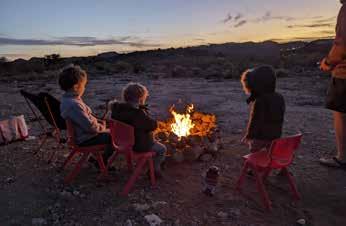
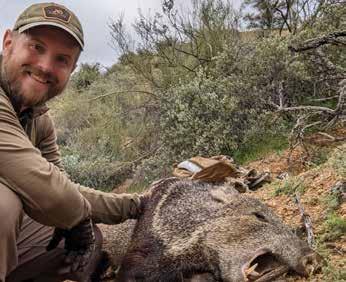
of public land, accessible for all no matter their background. How precious is that? A place where we can be reminded that all people are created equal and are endowed with certain unalienable rights: life, liberty and, yes, the pursuit of happiness. My hope, as a father and as an uncle, is that my sons, nieces and nephews get to create connections and memories in the same way that I have. But that requires preserving and stewarding the land. Once it’s gone, it will never come back, and all of our children will miss out on the joy, peace and wellness that come from experiencing it.
I walk back to the Jeep in silence, in my own head and thoughts. Driving back to civilization, I decide that I will mount my quail — the only one — as a memento of my time on the public lands of Arizona.
I call my wife to let her know, and she asks incredulously, “Are you done already?” A simple question, but I choke up remembering that yes, this really is being done. I only manage a “Yeah” before I have to stop myself from letting it all go. My wife, understandingly, leaves it at that, sensing the moment and just says, “Okay, I love you.” I hang up and drive toward home, new memories and new places.
After five years as a Navy submarine officer, Andrew Hardy found his passion for public lands conservation while living in Arizona. He and his family now reside in Alaska, where he serves as the Alaska Chapter’s events and outreach chair.
ACCESS REDEFINED
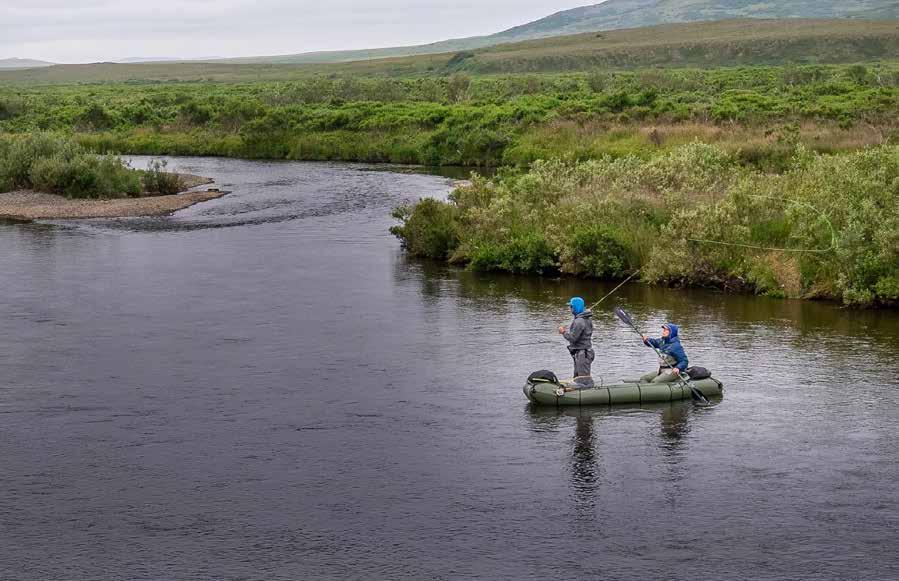
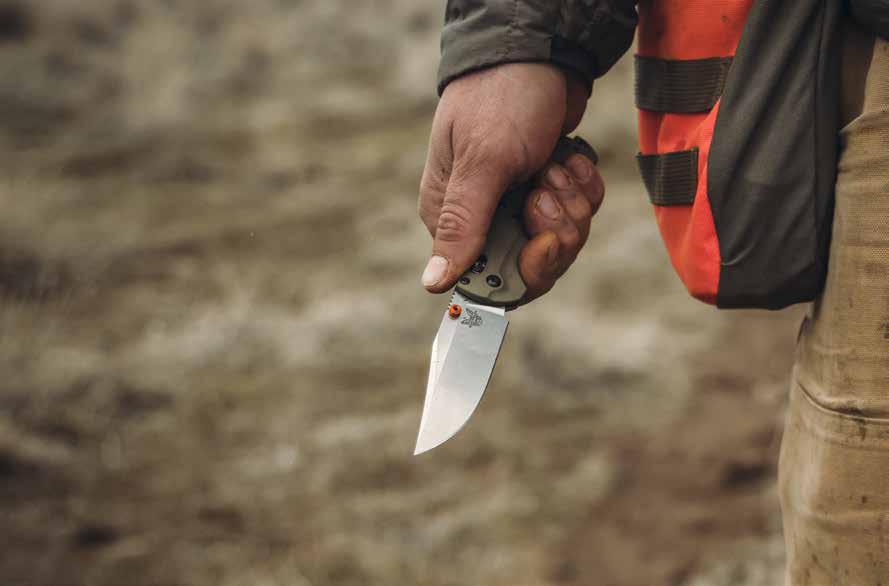
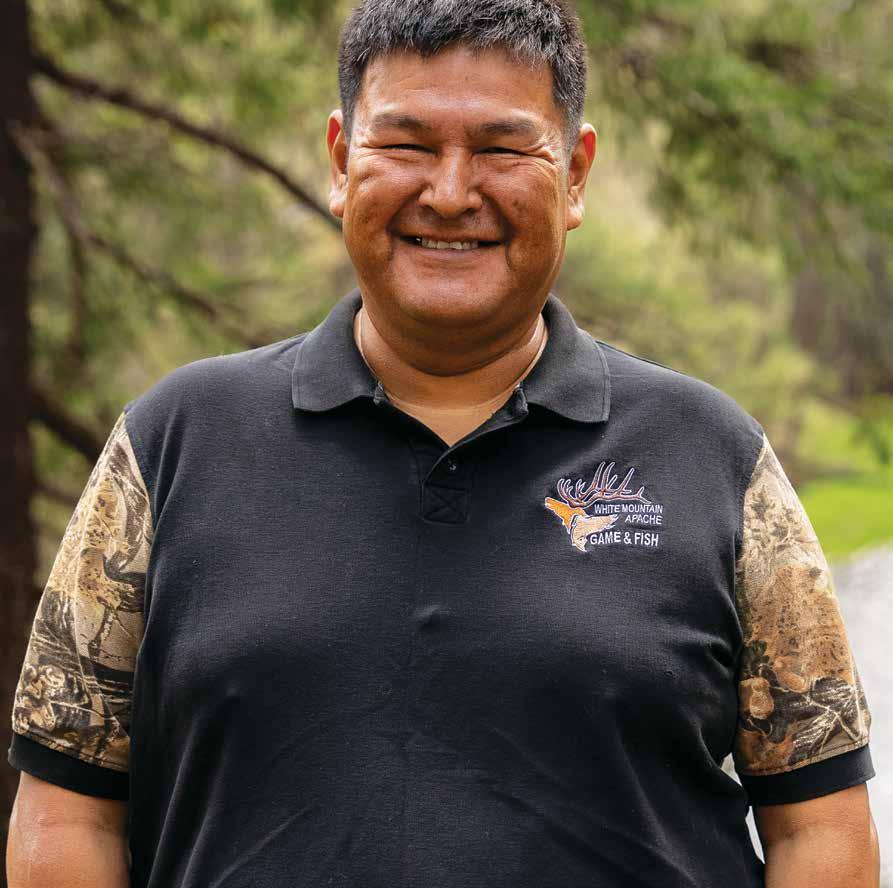





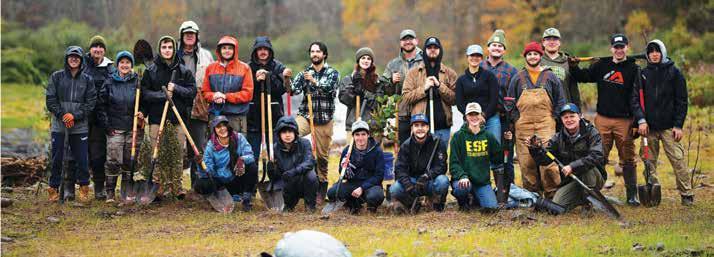
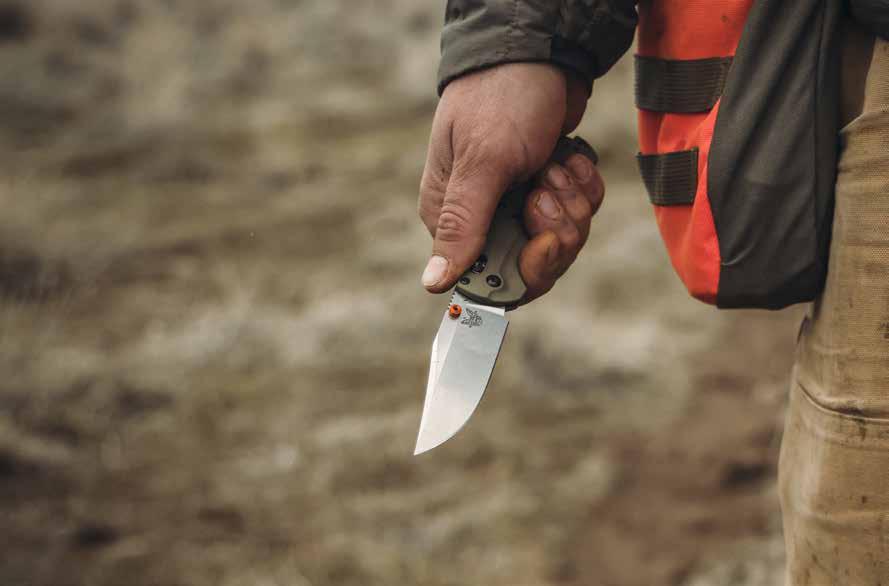


Please support Trout Unlimited and make a positive difference for our shared rivers.
Matt Rustin, USFWS and member of the San Carlos Apache
SKY RUNNING ROOSTERS
BY LESLIE ALAN COATES
When my hunting buddy and I decided to meet in Lindsborg, Kansas, for our final upland hunt of the season in late January, I never expected to see pheasants running upside down across the sky.
We were venturing into the uncharted, pushing past our favorite reservoir haunt and seeking unfamiliar places.
The Walk-In Hunting Access (WIHA) map served as our bingo card, working our way from one highlighted square to the next. Pulling to the side of the road near the WIHA signs, evidence of tracks — boot and paw — combined with spent shells and bird feathers suggested we were late. Hunting public lands has unique challenges.
The first few places we investigated were grazed to the nub. We nearly stuck the truck in a large drift of snow on a “limited maintenance” road. Pulling into a turnaround, I was surprised by how deep it had accumulated, but the ground was still frozen enough to support our escape. Driving to another location, promising on the map, we observed another pickup truck with blaze orange on the dash and dog boxes in the bed leaving the area. I offered the “Kansas wave,” cordially lifting my index finger as we passed.
Finally, we approached a field of turned-up soil with little evidence of cover or food. The WIHA sign stood tall and alone, like a sentinel waiting for grass to grow, but satellite imagery on our phones suggested a walk might reveal habitat beyond view. We unloaded ourselves and the dogs, who stretched out and sniffed both sides of the road where only a few scrubs of grass pushed through a blanket of snow. We broke open our shotguns, dropped in shells and started walking along the dubious pathway. The black mud of fertile soil extended to our right and left as far as we could see, but in this season not a stick of chaff emerged from the ground. If we were in Disney’s The Lion King, I would assume the evil Uncle Scar managed it.
As we crested over a slight roll in the landscape, the heart of the property emerged. Before us, several grass draws from multiple directions met in a bottom full of cattails — prime pheasant habitat. I don’t remember a shaft of light from the heavens illuminating it before us, but there may as well have been. We closed our guns and exchanged a hopeful glance.
The dogs jumped into the nearest draw and began their work. Both of them are mixed-breed rescues, but over the years they have learned to hunt. Kadence is a black Lab/shepherd mix who took a little time to figure out the game but has developed a knack for pointing bobwhite quail and trailing pheasants. Pippin, a reddish
wirehaired mix, pointed as a young pup but somehow lost track over the years. He remains a great retriever and flush dog. His tail wags several discernible patterns decodable to the strength of bird scent and has become a dependable system of bird detection. If we can keep them close, we do well.
The dogs heated up as we closed in on the cattails. Pippin, out in front, showed no sign of slowing, so I put a hustle in my walk. I wanted to make my way to the opposite side of the stand where I assumed birds would release. He dove into the cattails and disappeared. To get to the other side, I needed to walk around an array of prairie grass drifted in snow and then up a terrace. I cut the corner around the nearest end, head up, looking for flying birds.
My next step disappeared into knee-deep snow. I hiked my second leg around and proceeded to plant it even deeper. I was stuck, one arm flailing and the other holding my gun away from danger, executing a poor impersonation of Captain Hook. I pulled and grunted, searching for a misplaced superpower in the recesses of my will. Just then, I watched a hen pheasant break from the cattails approximately where I was hoping to be. I tried to hurry but had no options. I struggled and strained, wobbling, but my only option was to lie down and roll, hoping to unfold myself from the bind.
Meanwhile, birds were beginning to release from their cover, flushing and cackling their signature racket. I gasped, watching pheasants upside down across a snow-covered sky, releasing across an overhead pasture. I had nothing to do but wallow in the snowdrift. When I finally extricated myself from the self-inflicted trap, I bounded to the well-trodden release point and looked down to discover pheasant tracks by the dozens.
The afternoon was full of long-tailed roosters, and we managed to shoot a few. My gratitude and pride for the WIHA program in Kansas surged. Even on the final day of the season, after hunters had beaten the path of open land everywhere, we were able to find a corner of the world with enough cover to hold a few birds. I am grateful to the farmers who participate in the program, and I applaud the government program advocates and managers. I may even, someday, learn to appreciate the unique opportunity of watching pheasants running upside down across the sky, safe from a fool-footed hunter pursuing in haste.
Leslie Alan Coates is a BHA member living in the suburbs of Wichita, Kansas. A theater teacher, outdoors enthusiast and writer, rarely a weekend goes by when he is not in rehearsal, pursuing wild game or trying to put it all into words.

Photo: istock
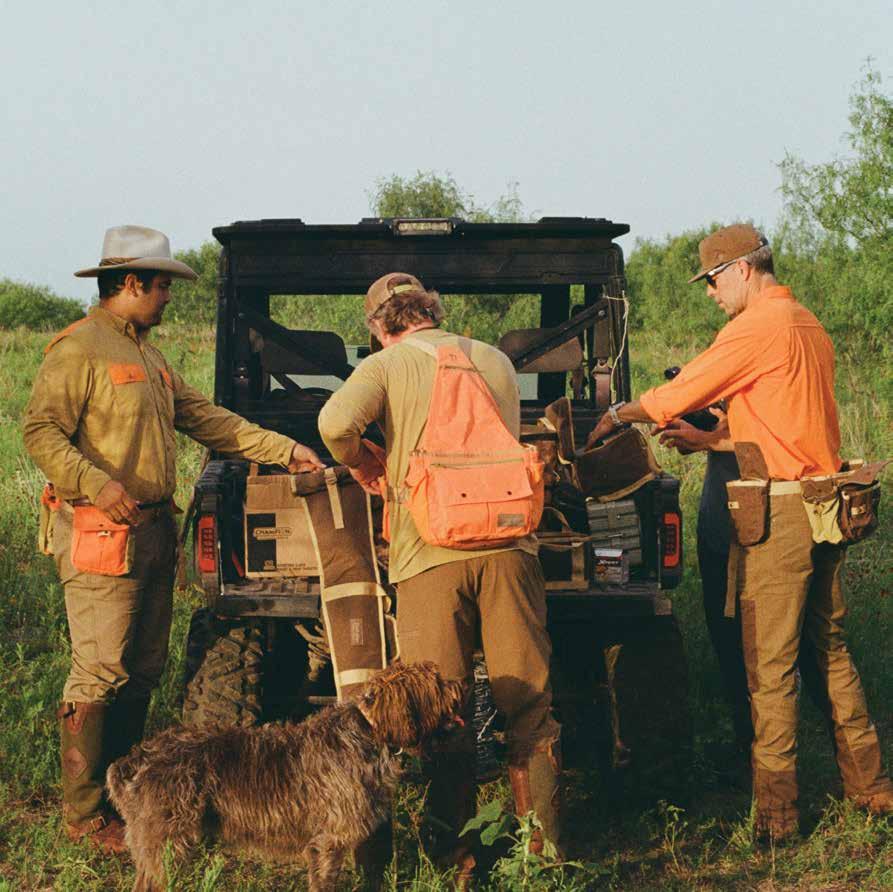
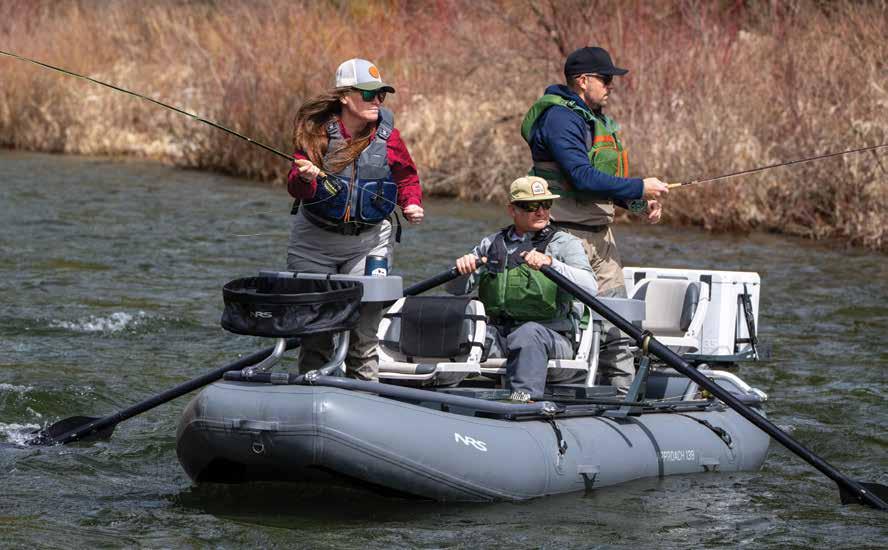
Spread out the map and circle those little-explored waters that ignite your imagination. The Approach 138 expands your access to harder-to-reach fisheries with a design that’s easy-to-launch, adaptable for flat and moving water, and fully featured for angler comfort and convenience. Every inch is crafted for versatility, rowing performance, and stealth, with quality backed by decades of craftsmanship. The NRS Slot Rail frame system lets you fine-tune seat, oar, and gear placement for balance, comfort, and control. Welded PVC construction, continuous-curve tubes, and a high-pressure drop-stitch floor provide a stable casting platform and reduce drag, excelling even in shallow, technical water. Padded dry box seats, rod holders, anchor system, and motor mount come standard. Whether you’re running a full-luxury setup on a finger lake or stripping it down for a backcountry mission, the Approach adapts to how you fish. Where you Catch the Adventure™ is up to you.

THE HUNTER’S ARENA
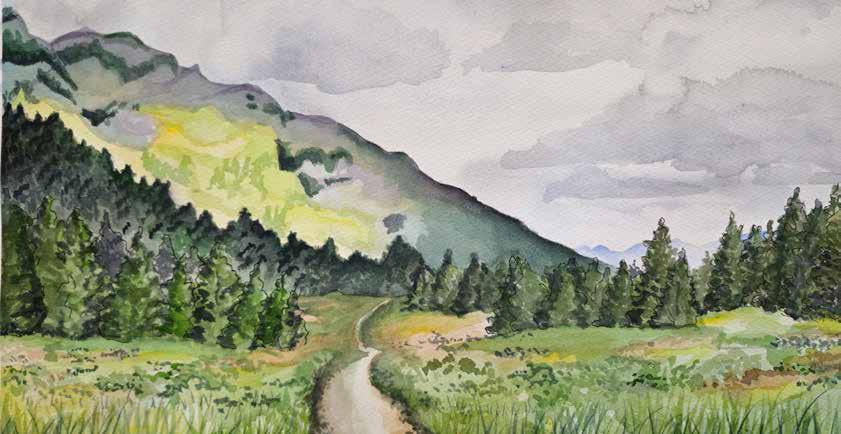
BY K.C. HUXTABLE
The Hunter’s Arena is more than a place. It’s a venue to learn, to grow and to face the dust and the sweat, the blood and the tears, nature and beast, self and fears. It tests a man and fills the heart.
A savage experiment right from the start where thoughts drift from boredom, to fear, to loss, to rapid excitement that makes you toss your hands around while trying to steady a trigger, a bow. Then just when you’re ready: HE JUMPS! Dammit. Another one blown. Just when you fancy to let out a groan the flies start to bite and the wind shifts again. The temperature dropping nearly to ten as the sun disappears over the crest. At least you can say you gave it your best.
Doubt will set in, just as expected. You must push through and cannot be affected by this emotion, so pure and raw. Self-doubt is not entirely a flaw, it’s part of us, what makes us real. Back to the hunt. Back to the zeal. Back to the arena, the ultimate fight between man, emotions, feelings, and fright that hunger and pain will crush your will to win, to succeed with an ethical kill.
When man meets the wild with goals in his mind he cannot imagine what he may divine from days spent afoot, traipsing the land. A thought keeps him going: “Yes, I CAN.” But man is arrogant to think he controls all of the factors to reach his goals.
When out of the blue your efforts reveal your quarry preparing to make a deal. Here you are with decisions to make, Nerves to steady, a breath to take.
A press of the trigger while closing one eye, and through your glass you watch it die.
A life extinguished. A sad jubilee. A quiet reverence while knelt on a knee. A tear emerges from high on your cheek as you open your mouth and silently speak a prayer. An oath. A quiet devotion. Heart and mind swelling with endless emotion that snaps you back to the task ahead. The work has begun. Your journey has led you to this moment with flesh, hide, and skull, a loaded pack and knife now dull.
And home you go with stories anew. But more importantly the sense you can do what you promised you could. To live this life through struggles and doubt, turmoil and strife. You owe a debt to the wind, rain, and dirt for making you tough, but forcing a flirt with emotions so tender you bury them deep in your day-to-day life of noises and beeps. You give thanks and praise to the wild and free for all it has done to let you see the point of it all. The blessings, the charge to give up the stressors which seem so large but really don’t matter. What matters is now. You close your eyes and whisper a vow: To live and to love and to never let go of what matters the most. And to see and to grow into more than yourself. To guard these places of flora and fauna and magical spaces with righteous conviction, with nerves of steel, so future children, and more, can feel the magic and wonder of wild and free, the wind off the hills and the smell of the trees that form the Arena.
BHA member K.C. Huxtable is a father, a husband, and a lifelong student of the woods. He values a challenge and learns best from failure; for these, wilderness is the BEST arena. Connect on Instagram @huxman_outdoors.


OUTLET
BY WENDI RANK
I think I’ve been tolerant.
I’ve had Styrofoam containers filled with worms in my kitchen fridge. Antlers dangling from the backyard shed, drying in the autumn sun.
I’ve had three hunters arrange boxes of caribou on my lawn. A November wedding anniversary spent alone year after year.
I’ve slept in a tent.
For an entire weekend.
And, in what was one of the more anxiety-producing moments of my life, I had BHA members spend the night at my house.
Now, have I complained about all of this? Of course I have.
But for our purposes today, we’ll pretend I’ve never complained.
Our garage has one outlet. That outlet can accommodate four plugs.
One is for the chest freezer, full of game meat and a large box with a frozen Bavarian pretzel.
Weird that I know where the game meat came from, but not the Bavarian pretzel.
One plug is for the upright freezer, also full of game meat.
One plug is for the garage refrigerator. It’s stocked with waffles, soda, and a six-pack of blueberry beer someone brought to a cookout in 2007.
The last plug is for the heavy-duty outdoor cable. In October, it powers the Halloween lights in all their purple and orange and dancing skeleton glory.
This year, just as I was pulling the Halloween lights from storage, my hunter arrived home with two hundred pounds of moose meat.
Talk about words I never thought I’d say.
He stacked that meat in the chest and upright freezers.
But the upright freezer, well. It was having none of it. Throughout the weekend, a faint beep beep beep emanated from the freezer.
And, yes. When I heard it through the wall shared by the garage and kitchen, I thought it was something supernatural.
When I realized the freezer was signaling its distress, I ran
for the garage, frantically texting my hunter. “The freezer’s not freezing!” I typed. “It’s too warm!”
And while I have panicked about a BHA camper sleeping in the bed of his pickup, I never thought I’d panic about the temperature of a game freezer.
But panic I did.
If nothing else, my years in BHA have taught me the work in every ounce of meat a hunter brings home.
My hunter met me in the garage. We agreed the piles of meat in the upright freezer were hindering its ability to cool properly.
“Here,” I said, opening the waffle-soda-blueberry beer refrigerator’s freezer. I crammed the Bavarian pretzel against the waffles. Then I suggested the squirrel, pheasant, and other small game meat could squeeze in beside the pretzel, the waffles.
With those out of the way, I hoped the upright freezer would regulate better.
I know. I’m very magnanimous.
Maybe you guys could remember that when you hand out those BHA awards next year.
Still, the upright freezer continued to struggle, the beep, beep, beep pulsing through the garage walls.
Abruptly, the distress signal stopped. My hunter announced the problem was fixed. We moved on with our lives.
For me, that meant stringing the Halloween lights.
I opened the garage to retrieve the Halloween lights, itself a frightening experience thanks to the snakes and skinks occasionally taking residence. On this day, a dead mouse I discovered during my hunter’s moose hunting trip still lay desiccated in the corner.
My hunter suggested I instruct our teenage son on handling dead mice.
That, my friend, is your job. It’s bad enough “I put your worms next to your coconut water” is in my repertoire. “Here’s how to dispose of a dead mouse” will never leave my mouth.
The garage door opened to reveal the heavy-duty outdoor holiday light cable coiled, unplugged, on the floor.
I groaned. Squeezing between our eighty-seven game freezers to plug it in is a game of Twister I do not relish.
Except – wait. All four of the outlets were occupied.
Scanning the garage, I noticed a square-ish disc balanced on the upright freezer. An antenna extended from one corner of the disc. A plug behind it wound down to the outlet.
This is what fixed the upright freezer’s rebellion? A little square set to DEFCON 1?
Where – where would I plug in the Halloween lights?
Thinking again of the work that moose meat signified, I grabbed the outdoor cable. I dragged it past the dead mouse to the outlet in the backyard, the one next to the deck.
I snaked it through the bushes – apt word, considering snakes have been known to shed skins there – over the fence, and into the front yard. I strung the Halloween lights.
Yeah. I definitely deserve an award.
BHA life member Wendi Rank is an indoors enthusiast from Pennsylvania. Wendi works as a columnist for American Community Journals
BHA member JJ Laberge is the creator of Clade & Genus, an online comic that focuses on the business of nature. His inspiration comes from spending time in the outdoors within Northern Ontario’s vast public lands pursuing whitetail, moose, ruffed grouse and woodcock. You can find Clade & Genus on



Comic:

CANADIAN LUMBERJACK MOOSE BURGERS
BY ADAM BERKELMANS
This giant burger will give you the energy to chop down a tree — or three.
Stacked with Canadian bacon, maple syrup, foraged mushrooms and squeaky Québécois cheese curds, this is truly Canadian fare — though our friends south of the border are welcome to enjoy it too.
Inspired by the lumberjacks who used to roam the Northwoods, felling trees and sending the logs down rivers toward Ottawa, this burger combines elements of the big breakfasts, poutines, moose meat and forest mushrooms that would have made up much of their diets.
In the Outaouais (“OO-ta-why”) and Ottawa Valley region — an area surrounding Ottawa, Canada’s national capital, and spreading outward into both Quebec and Ontario — many of those same foods can be found today, including hearty lumberjack breakfasts, gut-busting poutines (Québécois French fries smothered in cheese curds and gravy, pronounced “poo-TIN”), gorgeous forest mushrooms and lots of moose meat, which makes its way into dishes like pâté chinois, stews, tourtières, roasts and, of course, burgers.
“Canadian” bacon is something you don’t see much of up here, though I tend to spot it a lot while traveling through the States. You’re much more likely to find peameal bacon (in my region, anyway), cured pork loin rolled in pea or cornmeal. I did manage to find some Canadian bacon (cured and smoked pork loin) for this recipe, which I thought fit nicely.
The mushrooms actually go into the burger rather than on top. Doing this adds tons of extra flavor, umami and moisture to the burger — which is important since we’re using lean moose meat. On that note, you can swap the moose for deer or elk if that’s what you have available in your region. Wild mushrooms are by far the best to use, but if you don’t forage, or they’re out of season, try using store-bought oyster or cremini mushrooms.
I realize cheese curds may be tough to find outside Ontario, Quebec, or Wisconsin, so if you’re having trouble sourcing them, feel free to use shredded farmer’s cheese or mozzarella.
I must insist you use real maple syrup for this burger, though; the use of any sort of table syrup knockoff will result in the Royal Canadian Mounted Police showing up at your door and politely insisting you swap it for the real stuff. Fake syrup is for hosers, anyhow.
I kept my additional burger toppings simple with nothing but some arugula, but you could add raw or cooked onion, tomato, ketchup, mustard — whatever tickles your fancy. Bonne dégustation!
Ingredients
• 2 pounds ground moose
• 6 ounces fresh wild or store-bought mushrooms (morel, lobster, chanterelle, black trumpet, oyster, etc.), minced — I used lobster mushrooms
• 1 tablespoon butter
• Kosher salt
• Black pepper
• 8 thin slices Canadian or peameal bacon
• 7 ounces cheese curds, roughly chopped
• 4 brioche buns
• 1/2 cup maple syrup
• Green lettuce or arugula
Preparation
1. Melt the butter in a cast-iron skillet over medium-high heat and add the mushrooms. Season with a pinch of salt and pepper and fry for about 5 minutes, or until soft. Let cool, then add to a bowl. Add the raw ground moose meat to the bowl and gently combine it with the mushrooms.
2. Fry the pieces of bacon in the same skillet until crispy. Set aside.
3. Form the meat-mushroom mixture into burger patties, season generously with salt and pepper, and fry in the skillet over medium-high heat until brown on both sides and done to your liking on the interior (I like it medium, about 140°F).
4. When the burgers are nearly cooked, add the cheese to the tops of the patties and put a lid on the skillet for about a minute to melt it.
5. Toast the buns. Top with a burger patty, two slices of Canadian bacon and a drizzle of maple syrup. Add any other accoutrements you like. Enjoy!
BHA member Adam Berkelmans, also known as The Intrepid Eater, is a passionate ambassador for real food and a proponent of noseto-tail eating. He spends his time between Hull, Quebec, and a cozy lake house north of Kingston, Ontario. When not cooking, he can be found hunting, fishing, foraging, gardening, reading, travelling, and discovering new ways to find and eat food.



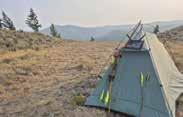
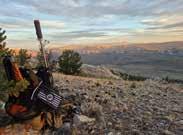
Context
My fall of 2025 was shaped by the events of the preceding summer — months defined by an all-out battle for the future of our shared public ground. We’d beaten Sen. Mike Lee’s outrageous attempt to steal our lands outright, but the attacks kept coming: the Roadless Rule, the Public Lands Rule, Ambler Road. Every time I set foot in the woods or on the water, I felt the weight of those threats.
Still mentally fried from the summer’s advocacy campaign against the attempted sale of 3 million acres of our land, I pitched my tent under the hazy glow of late-summer smoke for the archery elk opener and hung a United We Stand flag on the back. It was good to be in the woods — I needed it. Waking hours before sunrise to bugles bouncing off the hills helped lift the fog. I didn’t seal the deal on a bull that weekend, or in September, but I came close. And those woods were intact — for now — though recission of the Roadless Rule could change that.
In early October, I stepped away from hunting to float a wild, roadless stretch of river for fall steelhead. We floated, fished, cooked last year’s elk backstraps I’d saved for the occasion and camped under the stars. It was a liminal trip through an old favorite haunt. The proposed land sales had included the small pieces of BLM land we camped on as “expendable.” My memories of past trips mixed with worry for the future. This place sure didn’t feel expendable.
A few weeks later, I made a dash down to BLM land to try to fill an antelope tag. I’d chosen this unit and waited five years to draw because of the opportunity to hunt a large roadless tract of badlands. The ongoing efforts to overturn the Public Lands Rule — which puts conservation on equal footing with other uses of BLM land — occupied my thoughts as I glassed rugged canyons and rocky outcroppings in solitude. After finding and killing a nice antelope buck at 7,000 feet among scattered whitebark pine, I hoped this unique habitat, near where BHA stewardship volunteers have removed problematic fencing in recent years, would still be wild the next time I drew the tag.
The antelope had long since been broken down and was in the freezer when, early one morning, I spotted a distant bull elk from my glassing knob. I circled miles around a private inholding within national forest land to close the distance. The hunt to finally kill my first bull took everything I had. After miles of side-hilling and route-finding, I struggled to relocate the little burn pocket where the bull had bedded. From new angles, everything looked different. I crept over blowdown, peeking over the crests of small hills. Hours passed.
Finally, through a small hole in the timber, the vegetation on the opposing hillside looked familiar. I picked apart the burn through my binoculars and spotted a patch of golden brown tucked behind a large blowdown. It had to be him — but I couldn’t see a head, just a tan patch. Determined yet unable to close the distance quietly, I built a stable shooting position, settled in and waited, assuming the presumed elk would eventually stretch his legs.
I had no idea how long that wait would be. Hours slipped by, the patch of brown never moving, and doubt crept in. Then came snow, then dense fog. The hillside vanished. The cold worked its way in. Was the elk still there? Was it even an elk? Should I risk sneaking closer, even though the odds were bad? Should I give up and move on? Not patient by nature, I dug deep.
Two more hours passed. A slight thinning of fog revealed the bull — it had been him all along — now standing and feeding, though still blocked by timber. Then the fog thickened again, and he disappeared. Still, I stayed. The light was fading. I made peace with the idea that the bull had a guardian angel, placing fog and trees between us.
Mystically, five and a half hours after I first settled in, with only eight minutes of legal shooting light left, the fog thinned again, revealing a broadside bull in the open. I steadied the crosshairs and pressed the trigger. Within a minute, the fog returned as quickly as it had parted, the hillside was gone and darkness followed. I crossed a steep ravine and found the elk by headlamp within a few yards of where I’d last seen him.
As I broke down the bull, still in disbelief at how it all came together, a more hopeful thought entered: Maybe with a little more clarity in Montana — and thanks to BHA’s hard work — next time I’d be able to corner cross a more direct route to the bull.
And maybe, just as we saw last summer, a diverse coalition will continue to unite around public lands and waters, making it clear these places are not only not for sale — they are to be unanimously treasured. While it may sometimes feel otherwise, our work at BHA is tangible. Sometimes it’s obvious — pulling a fence, picking up trash. Other times it’s quieter — writing a letter, calling a lawmaker in D.C. Either way, every trip into wild public lands and waters reminds us why it matters. And as Hal Herring said, “Now is our time.”
-Zack Williams, editor