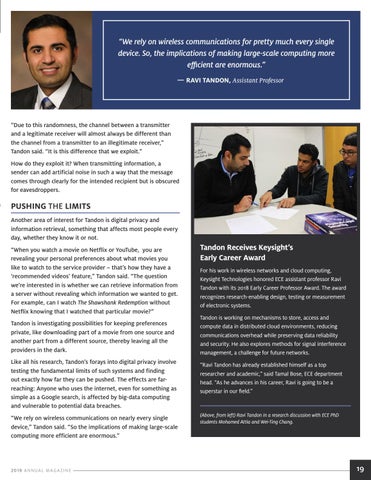
“We rely on wireless communications for pretty much every single device. So, the implications of making large-scale computing more efficient are enormous.” — RAVI TANDON, Assistant Professor
“Due to this randomness, the channel between a transmitter and a legitimate receiver will almost always be different than the channel from a transmitter to an illegitimate receiver,” Tandon said. “It is this difference that we exploit.” How do they exploit it? When transmitting information, a sender can add artificial noise in such a way that the message comes through clearly for the intended recipient but is obscured for eavesdroppers.
PUSHING THE LIMITS Another area of interest for Tandon is digital privacy and information retrieval, something that affects most people every day, whether they know it or not. “When you watch a movie on Netflix or YouTube, you are revealing your personal preferences about what movies you like to watch to the service provider – that’s how they have a ‘recommended videos’ feature,” Tandon said. “The question we’re interested in is whether we can retrieve information from a server without revealing which information we wanted to get. For example, can I watch The Shawshank Redemption without Netflix knowing that I watched that particular movie?” Tandon is investigating possibilities for keeping preferences private, like downloading part of a movie from one source and another part from a different source, thereby leaving all the providers in the dark. Like all his research, Tandon’s forays into digital privacy involve testing the fundamental limits of such systems and finding out exactly how far they can be pushed. The effects are farreaching: Anyone who uses the internet, even for something as simple as a Google search, is affected by big-data computing and vulnerable to potential data breaches. “We rely on wireless communications on nearly every single device,” Tandon said. “So the implications of making large-scale computing more efficient are enormous.”
2019 ANNUAL M AG A ZINE
Tandon Receives Keysight’s Early Career Award For his work in wireless networks and cloud computing, Keysight Technologies honored ECE assistant professor Ravi Tandon with its 2018 Early Career Professor Award. The award recognizes research-enabling design, testing or measurement of electronic systems. Tandon is working on mechanisms to store, access and compute data in distributed cloud environments, reducing communications overhead while preserving data reliability and security. He also explores methods for signal interference management, a challenge for future networks. “Ravi Tandon has already established himself as a top researcher and academic,” said Tamal Bose, ECE department head. “As he advances in his career, Ravi is going to be a superstar in our field.”
.
(Above, from left) Ravi Tandon in a research discussion with ECE PhD students Mohamed Attia and Wei-Ting Chang.
19