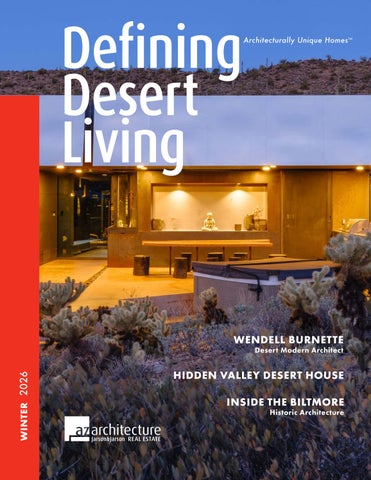
Defining Desert Living
WENDELL BURNETTE


IN HIS OWN WORDS
Editor’s Note:
Welcome to the New Year. As I write this, I’m enjoying a postcard-perfect Arizona day, crisp, clean air, intense reflected sunshine, and perfectly balanced temperatures. The desert feels filled with optimism.

Scott Jarson, Editor
EDITOR / PUBLISHER
Debbie Jarson
Scott Jarson
CONTRIBUTORS
Debbie Jarson
Scott Jarson
Andrew Jarson
Elyse Pidgeon
ART DIRECTION
ps:studios inc.
COVER IMAGE
The “Hidden Valley Desert House”
Photo: Andrew Jarson
ADVERTISING
info@azarchitecture.com
Our fall brought the gift of generous rain to the Valley, a blessing of nature that we are now enjoying together. Mountains are so atypically green that, for a moment, you might imagine yourself in the craggy highlands of Scotland. And yet, the desert reminds us exactly where we are, with early blooms bursting in intense yellows, reds, corals, and oranges, placing us squarely back in the Sonoran Desert.
In this winter issue, we explore several Valley icons. We take a deep dive into the history and lore of the world-famous Arizona Biltmore Resort, examining the artistry and architecture of Albert Chase McArthur alongside the innovative block designs of Frank Lloyd Wright. It feels especially fitting during our winter season, when Arizona’s sun continues to draw visitors to the resorts that first introduced this place to so many.
Part of our mission is to celebrate the architects and designers who contribute so profoundly to our visual landscape. In this issue, we highlight the work of architect Wendell Burnette, FAIA, through a heartfelt conversation that captures his sincerity and design ethic. We also honor the memory of a dear friend and contributor, Luis Salazar, whose work was perfectly attuned to our region and whose presence will be deeply missed.
As always, we explore the real estate market with you, sharing homes we have sold and a selection of special properties currently available. As we mark our twenty-second year as a brokerage in 2026, Debbie and I remain guided by the same belief that inspired us nearly forty years ago: that design and place matter. That commitment continues today, strengthened by experience and energized by a team bringing fresh ideas and perspective.
On a personal note, I like to begin each New Year with a word to help guide my thoughts and actions. For 2026, that word is GENUINE. In a world increasingly shaped by replicas and digital noise, I remain committed to authenticity in how we work and how we connect. I hope you feel that genuine spirit throughout these pages, and we invite you to join us on that journey
az architecture/Jarson & Jarson members are proud supporters of the Frank Lloyd Wright Building Conservancy, The Arizona State University Art Museum, Phoenix Art Museum, Taliesin Foundation, Local First Arizona, and AIA Phoenix Metro Allied Member.

Photography: Andrew Jarson


In the midst of our Valley there are cool, irrigated citrus groves in the shadow of Camelback Mountain, along with pockets of Spanish revival, adobe, and mid-century modern ranch homes. There are forests of giant saguaros in the foothills to the north, an area that is known for cutting-edge architecture, and rows of majestic date palms lining streets of historic homes in central Phoenix. All of this makes for a rich, urban landscape that includes modern in-fill architecture, loft projects and stunning high-rise towers. All coexisting within the dramatic backdrop of our unique Sonoran Desert.
azarchitecture understands the contrasts and architectural nuances that set unique homes apart. From Frank Lloyd Wright to Case Study, Eames to Al Beadle, azarchitecture speaks the language of modern architecture.
PHOTOGRAPHY: Robert Murray

ON THE SHELF
BALMUDA SPEAKER

A Bluetooth-compatible speaker with a 3-function interior lighting feature that follows the rhythm of your tunes. balmuda.com
URA WATER PITCHER

A reinterpretation of the traditional botijo, reimagined for contemporary use. The side opening allows it to be filled and cleaned, while the upper opening serves for pouring. adorno.design
STADIA TABLE CLOCK

The STADIA CLOCK by Studio re.d redefines the boundaries of industrial design and aesthetic refinement. adorno.design
HOUSE SLIPPER

French Corduroy exterior. Soft sherpa lining ensures your feet stay warm and comfortable throughout the day. Italian suede soles offer a perfect balance of durability and grip. topdrawershop.com

DESK BRUSHES
SHAKER BOX

Crafted from thin Cherry wood strips and fastened with copper rivets, these containers showcase purposeful design without excess. wmscoshop.com
BOTANIC SCULPTURE
These brushes are the creation of Jamie Lea Bertsch, a New York-based artisan who brings historical crafting techniques into contemporary homes. wmscoshop.com
MYCELIUM BOWL NO.1

This bowl, by Solaterre in Austria, was organically grown from the mycelium of a regional medicinal mushroom and is comparable to wooden bowls for storing and serving dry food. adorno.design

Artist Beverly Penn creates intricate bronze sculptures of natural plant forms that question the fragile balance between the natural world and manufactured environments. lisasettegallery.com
THE ARCHITECTURE OF WILL BRUDER

In celebration of more than fifty years in practice, renowned architect Will Bruder, FAIA, presents a definitive selection of his most exemplary projects. oroeditions.com

The Architecture of Will Bruder William P Bruder, FAIA
By Scott Jarson
In celebration of more than fifty years in practice, renowned architect Will Bruder, FAIA, presents a definitive selection of his most exemplary projects in The Architecture of Will Bruder. This long-awaited monograph is richly illustrated with hundreds of stunning photographs, drawings, and original sketches that illuminate the depth and rigor of Bruder’s architectural vision.
Influenced early on by Frank Lloyd Wright, Paolo Soleri, Bruce Goff, and Gunnar Birkerts, Bruder opened his own design studio in 1974. His self-built house and studio, perched on the desert edge of Phoenix, garnered national attention and received Architectural Record ’s Record Houses of 1977 design award—an early signal of a career that would help define architecture in the American Southwest.
A pivotal turning point came with his Fellowship in Architecture at the American Academy in Rome. Several months of intense reflection, working from a studio overlooking the city and traveling throughout Europe to study historic and contemporary architecture, profoundly shaped his approach. Returning with renewed perspective, Bruder soon won the commission to design the 280,000-square-foot Phoenix
Central Library, which opened in 1995. That project marked a major milestone and was followed by a wide range of cultural, civic, and private commissions, along with extensive opportunities to travel, lecture, and teach. In 2021, the Phoenix Central Library was honored with the AIA 25Year Building Award.
This superb collection is organized into two distinct sections: pre–Rome Prize projects presented in black and white, and post-Rome projects dating from 1987 forward, presented in color. Six scholarly essays complete the volume, offering critical insight into Bruder’s work and legacy.
This is a must-have book not only for those who find Bruder’s work alluring; it is a pivotal monograph that beautifully frames the journey, process, and achievements of this accomplished artist and architect, whose life’s work coincides with arguably the most creative period of architecture in Arizona.
Bruder’s work simply is the foundation upon which the “Arizona School” of architecture was built. This singular monograph is beautifully presented, well curated, and artistically detailed, thanks to Bruder’s complete involvement in the book’s design.
I’ve been waiting nearly a lifetime for a monograph of the work of Will Bruder. This book does not disappoint. Focused, selective, and curated, it is a superb addition to any architectural library. Kudos, Will.
For more information visit: https://oroeditions.com/product/the-architecture-of-will-bruder

OUR UNIQUE VISUAL
WENDELL BURNETTE:
A Conversation with the Architect

BY SCOTT JARSON

Hidden Valley Desert House -- Photography: Andrew Jarson
Architecture is often discussed through finished work, photographs, plans, and awards, but far less often through the lived experiences that shape an architect’s way of thinking. This conversation with Wendell Burnette traces a lineage that runs from early self-study and apprenticeship to the deserts of Taliesin and, ultimately, to a practice grounded in material intelligence, restraint, and empathy for place.
Burnette’s work has long been associated with the American Southwest, yet what emerges here is not a regional cliché but a disciplined inquiry into how buildings are made, how they age, and how they belong. In dialogue with Scott Jarson, the discussion moves fluidly between memory, mentorship, construction, and ethics, revealing an architecture shaped as much by building sites and budgets as by ideas and aspiration.
What follows is not a retrospective, but a reflection on continuity, evolution, and the enduring relevance of architecture that is both functional and poetic.
Scott Jarson: Wendell, I really appreciate this opportunity to talk. I have been wanting to include a conversation with you in our magazine for some time. You were telling me a bit about your origin story the other day. What first brought you to Arizona?
Wendell Burnette: Yes. You asked what first drew me toward architecture and where I grew up. I knew I wanted to be an architect very young, around five, and by age thirteen I was serious. I had a drafting table and spent weekends at the Nashville Public Library teaching myself architecture. I was looking at architecture and starting my self-study.
Interestingly, one of the projects I emulated on my drafting table as a teenager was The Dome in the Desert by Paolo Soleri. So I knew fairly early that I wanted to do this. I’m not sure. It was just in me somehow.
SJ: That’s amazing given our mutual connection to Soleri, mine in being a neighbor, and yours having ultimately lived in that dome for a spell.
Photography: Andrew Jarson
WB: What brought me to Arizona was that I had submitted to several universities, but I also had an early mentor, William Mims, in Nashville. I started working for him when I was a junior in high school, and then in my senior year I worked about thirty hours a week.
I was very early hanging out at construction sites, collecting CocaCola bottles to make a little money. I was doing that at a house that Mims had designed and was building for himself behind the apartment complex where I lived with my mother and sister. I actually got busted by the police. I was there in the evening, and they decided not to press charges.
A couple of years later, I met him at church and told him I wanted to work in an architecture office. Mims had apprenticed at Taliesin shortly after Wright died. His house was very Wrightian. He had a practice in Nashville and a place called Oak Towers, which were Cor-Ten steel buildings similar to the John Deere factory that Eero Saarinen did. That’s where I worked. I started running blueprints, and my senior year I was involved in a very interesting project for Native Americans called the Calumet Center.
I applied to several universities but also to the Frank Lloyd Wright School of Architecture. I was accepted for an interview and flew out to Arizona in May, before I had even graduated high school. I stayed at the Safari Hotel, walked around with the sun burning a hole in my head, then went out to Taliesin West. Mrs. Wright asked how soon I could start. I said, “As soon as you want. I graduate at the end of May.”
That summer, I took a Greyhound from Nashville to Taliesin in Wisconsin. When I later came to Taliesin West and lived in a sheepherder’s tent, I fell in love with the Sonoran Desert, the rawness, the light, the legibility of it, the flora and fauna. It was utterly strange and fantastical.
SJ: It’s hard for me to keep perspective because I grew up here, but I’ve got to imagine that as a big change for you. Our desert is profoundly interesting to me to this day, but it must have been quite a mind trip to have been from the part of the country you’re from, then landing in this environment and starting a new level of education. Very intense, right?
WB: It was intense. That first time at Taliesin, experiencing the architecture in the context of the place it was designed for, I always say it’s interesting to me that Wright came here and essentially redefined his architecture.
It was a huge pivot, a huge break, and a huge evolution that, now, I think Frampton would define as critical regionalism. His work certainly always had a relationship to place, but I think it’s here where Wright really did something that was kind of out of thin air, different, brilliant, and deeply resonant with this place. This desert camp and all of that.
I spent three years at Taliesin, including one summer when I stayed in Arizona as part of a skeleton crew. We slept on the roofs at night, watching monsoons roll in. When I left to go back to Nashville to continue working with William Mims, I already knew I wanted to practice here. I knew I wanted to be in this place.
I was just like, for sure, I’m coming back here. So I went back to work in Nashville from ’83 to ’85. This was during postmodernism.

Wendell Burnette Residence -- Photography: Andrew Jarson

The only thing being published that was modern, in the sense of what I think of as modern, was Richard Rogers and Norman Foster’s work. That was the only work in the publications that seemed to have much to do with what Wright was talking about.
I later learned they were major fans of Wright and had traveled across the country with the Storrer book in hand (William Allin Storrer, The Architecture of Frank Lloyd Wright: A Guide to Extant Structures), going to see all of Wright’s buildings, something I later did as well. When I went to work with Will Bruder, I learned he had done the same thing. It’s interesting that Rogers and Foster went to school together at Yale, then both ended up working on the California coast, Richard Rogers with Rafael Soriano, and Norman Foster with Anshen & Allen.
Then I saw an issue of Architecture magazine, I think March 1984. I’ve got it somewhere around here; it’ll be on our revamped website coming out at the beginning of the year. On the cover was Bisbee, Arizona. Inside that magazine were two pages on Judith Chafee, two pages on Fred Osmon, and two pages on Will Bruder.
SJ: Yes, that was a pivotal issue, highlighting early Arizona School ideas.
WB: I saw those pages, and I was already thinking I wanted to come back here. So I contacted Will, I wrote him a letter and asked if I could visit his studio. I was coming out to take an exam, and I made an appointment. It was a brief meeting, but I went to the New River studio and heard him talk about materiality, structure, mechanical systems, lighting—building systems and their integration.
I had never heard anyone, in the flesh, talk about architecture the way he did. I already had an affinity for the work when I saw it in the magazine, and then when I heard him speak about what was behind the work, I knew. I followed up with him, and later I was coming out again the next May for another exam.
I had already begun the licensing process in Arizona. Somehow, through a fluke, they allowed me to sit for my exams at twenty. I nearly passed. Not long after, Will called and said, “I just let go of two

people. I’d like to hire you as the technical heavy.”
I came out, interviewed at the New River studio, and he offered me the job. When I got back to Nashville, my fiancé at the time, Deb Dusenberry, saw my face and knew we were moving. I started in the summer of ’85.
SJ: What was it like when you started at the New River studio? You had this experience at Taliesin, another remote desert site, and then you’re working in a remote desert studio again. Was there a parallel between those experiences?
WB: Absolutely. I’ve always felt there is a direct parallel between Will’s work and my experience at Taliesin East and Taliesin West. From my perspective, his work extended that lineage, obviously with other influences, but particularly in his exploration of geometry.


People don’t talk about this much with Wright, but there’s also a deep exploration of materials, construction methods, and the integration of building systems. For me, there was a straight line of continuity. Not that Will is overly Wrightian, but when people ask me about the connection, I say it is very deep but abstract.
It is about empathy for place, architecture that is resonant with place. Wright was doing that, even if he didn’t use that language. He talked about materiality, space, and light. What I saw in Will’s work was a completely new and evolved interpretation of those ideas.
SJ: One of the things I admire about your work is your knowledge of materials and construction. It’s uncommon to find someone so well educated in how things actually go together. You hit the right places at the right times, and you were deeply involved in construction early on at the studio.

WB: That’s true, and I think it’s important to put this in the context of postmodernism. Some things that came out of postmodernism were valuable—urbanism, connecting with people—but what I didn’t like was the lack of expressed structure, the hiding of systems, and materials that wouldn’t stand the test of time.
I knew instinctively that wasn’t for me. That’s why I was drawn to Rogers and Foster. They were bucking the system. Will was doing the same thing. He was here; I wanted to be here; and I was always interested in construction.
Another architect I was drawn to was David Hovey in Chicago, because he was building the work. Later, David came here. I was partly responsible for suggesting to Will that we build the projects and that we do construction management.
The first project I cut my teeth on was the Weiss Residence. It was the project I started on when I first arrived, very early in the process. Will was having trouble getting contractors to build the work, and I think he saw that I had a genuine passion for construction. I couldn’t have done it without all of Will’s knowledge. He had built his own house and studio that way.
We were living in it, working in it, and I said, “Why don’t we start doing this too?” That’s why I went to work for Will, that’s how he talked about architecture.
SJ: We were pleased to have represented the recent sale of the Weiss Residence. The construction and details have held up very well.
WB: I knew that I wanted to know how to build. I also wanted to know how to work with clients. I wanted to understand how architecture happens, the whole thing. I could see that Will was doing that.
I’ve always said I wouldn’t know what to do with a blank canvas. As an architect, I’d just stare at it. I revel in being creative within parameters, within building codes, budgets, constraints, clients, and sites. Everything. I enjoy pushing the envelope of what’s possible within those limits.
I’m always thinking: what is it made of? How was it made? How is that resonant with the material culture of a place? How is it economically feasible? What are the economics of a project? How do you prioritize things simultaneously, functionally and poetically? How do you have your cake and eat it too?
Floating Matatov Meditation -- Photography: Jason Roehner
”Poetics—the spirit or soul of a building—are part of its function, whether it’s a public building or a private residence. It should speak to people. It should be aspirational. It should allow people to feel good about themselves and their lives, and to feel touched in some way. And part of that isn’t just how it feels, but how it works.”
I would argue that poetics, the spirit or soul of a building—are part of its function, whether it’s a public building or a private residence. It should speak to people. It should be aspirational. It should allow people to feel good about themselves and their lives, and to feel touched in some way. And part of that isn’t just how it feels, but how it works.
SJ: As you say that, it strikes me that part of the magic is working within constraints and making it real. That’s deeply part of the talent. You’ve always managed to do that. This was around the time you built your own house—not just designed it, but did nearly every aspect of construction. That was pretty early, wasn’t it?
WB: Yes. After working with Will for about five years, I started thinking seriously about building my own house and starting my own practice. I looked near the New River studio and elsewhere, but we were working on a house close to where I eventually built mine. That’s when I became aware of the Sunnyslope community called Cinnabar Canyon, right up against the Phoenix Mountain Preserve.
That project solidified my voice. Initially it was conceived in castin-place concrete, but it didn’t work structurally or thermally. I discovered Integra masonry block: a post-tensioned, insulated system that combined structure, insulation, and finish. We exposed it, stack-bonded it, and let it reflect the desert light.
The house is organized around what I call the American tatami mat—the 4×8 sheet of plywood. It’s my interpretation of Wright’s grid, grounded in material economy. I was building it nights and weekends while the Phoenix Central Library was coming out of the ground during the day. When both projects were completed, the library was published, and my house became a Record House. That’s when I started my own practice.
SJ: Amazing. It feels like yesterday.
WB: Some days it does. Some days it doesn’t.
SJ: What were the first projects on your own?
WB:The house’s publication led directly to two projects: the Schall Residence, also called the Urban Courtyard House, and what became known as the Dialogue House. Those two commissions allowed me to leave Will’s studio and launch my own practice.
SJ: That’s coming right out of the gate. Looking at the last few years, not a retrospective, but what stands out as most meaningful?
WB: That’s hard. It’s always the most recent project. I’m very grateful for the opportunities I’ve had. Some very exciting projects didn’t happen, but I’m proud of the work regardless.
We give everything our all. It’s a small practice, four to eight people. Sometimes I collaborate, and that really began with the Central Library. Learning how to collaborate successfully to meet functional and aspirational goals has been essential.
Architecture is a collaborative art. It always takes a client—whether an individual, a city, or a community. It also takes material suppliers, subcontractors, and contractors engaged early. That collaboration helps us draw to the budget, meet expectations, and maximize value.
Ultimately, the goal is to create something people care about, something they’ll fight to preserve because it means something to them or their community. I’m very interested in buildings with long lives. That’s the first rule of sustainability: good design—functional and poetic—so you’re not constantly replacing buildings.

SJ: Yeah, that may be where the magic lies, in my opinion, your ability to be global and local at the same time.
WB: And I think we have to be. I mean, somebody asked me about the Telescope House—what was the thing I was proud of most.
This was Fred Bernstein, the great writer in New York, who was writing an article for The Wall Street Journal, which was the first thing that came out. And I said the thing I’m most proud of is that it’s a small house.
And yet it’s an impactful house. The owners wanted to design an experience that they could share with others, and that they would be able to experience, and that others could experience, the landscape and an architectural response to that landscape.
So I do think we can build with less impact on the environment by building small, or doing adaptive reuse, or doing a remodel instead of tearing down a house. We’re engaged in a very exciting multi-year, multi-phased remodel where we’re working within the constraints of the existing house, and the only new thing we built is a 150-squarefoot meditation pavilion.
SJ: You just got singled out for that structure. It got a well-deserved award.
WB: Yes, it just won an AIA Honor Award. We submitted it as a component design award, but at the discretion of the jury, they elected to take it out of that category and give it an Honor Award for Distinguished Architecture. I think one of the reasons is that it was only 150 square feet.
So there’s an exception to what I just said earlier. We tried to make that a point—that’s all we’re doing here. The rest is a remodel. There was this little corner of the site that was unused, and the client has a practice of meditation. It started out as a deck but then got a little more involved. It still can be open air.
Christopher’s at the Wrigley Mansion is a 1,300-square-foot restaurant. It’s about breathing new life into the Wrigley Mansion, which is on the U.S. Register of Historic Places. It’s a Phoenix ‘Point of Pride.’
Jamie Hormel wanted to breathe new life into the Wrigley Mansion and wanted more people to enjoy this Phoenix “Point of Pride.’ It’s an iconic site, arguably the best site in all of Phoenix, and it’s a piece of history. I’m very interested in history.
At Amangiri, we got letters. I remember one from a high school student. She wrote a two-page handwritten letter describing exactly the narrative we had talked about, what stories people
Telescope House -- Photography: Jason Roehner

would go home with. If I have one regret, it’s that we’re not more successful in getting more architecture built that people can engage with. It’s nourishment.
SJ: You’re highly regarded as a “desert” architect. Do you think there’s still an Arizona School of architecture? Is there something that one can do here, architecturally, that people can take and learn from and use in other locations?
WB: Yes, and I think there are a lot of us working on that. And it extends to other desert locations, even urban sites. One of our projects this year, this summer, is a flat site in central Phoenix. And I’ve always dreamt about having this commission: no view. A flat site in central Phoenix, and it’s just about framing the desert sky.
SJ: I feel like there are moments where we drift away from that conversation, and then fresh people come along and do good work and bring that conversation back to the table. What’s your feeling about the next 10–15 years.
WB: Well, I think there’s an incredible foundation here. It starts with the landscape, with the desert. It attracted Frank Lloyd Wright, Paolo Soleri, many artists—James Turrell, Robert Irwin, Robert Smithson, Walter De Maria, Donald Judd in West Texas.
And then it attracted all these other architects, including myself and my mentor, Will Bruder.
What I know is that it can evolve, and it can address these issues. If the pendulum swings too far the other way, somebody’s going to want to swing it back.
I think most of us have our heart in the right place. There are a lot of architects whose heart is in the right place, and there are architects who haven’t been born yet who will feel the same way. Somehow, we find a way to continue this tradition, but in a more impactful way.
I’ve always said in some of the studios I’ve taught that the more people are exposed to architecture, the more they’re going to cherish it and the more they’re going to fight for it.
SJ: Wendell, I want to say thank you for making this a better place and for leaving a visual landscape for us that is enduring and beautiful. I deeply appreciate the work you do.
WB: Thank you. That means a lot coming from you. Thank you for wanting to talk. It’s always a pleasure.
Christophers Restaurant -- Photography: Bill Timmerman
ON THE MARKET

PUEBLO REVIVAL — 2 ACRE PARADISE VALLEY ESTATE
This exceptionally rare 2-acre Paradise Valley legacy estate offers a private desert compound with two Santa Fe Pueblo Revival adobe-style residences designed by master builder Dan MacBeth, whose work includes the Hermosa Inn restoration. The homes showcase authentic Southwestern character with thick sculpted walls, hand-crafted doors, exposed beams, carved corbels, and traditional Saltillo tile floors, blending historic charm with modern livability. READ MORE
Price: $6,895,000

ADOBE-INSPIRED MASTERPIECE — THE BOULDERS
An exceptionally rare opportunity to own 2.5 pristine acres within the prestigious guard-gated community of The Boulders. Mature desert landscaping and a dramatic courtyard arrival set the stage for this Adobe-inspired architectural masterpiece, designed by renowned architect Terry Kilbane. READ MORE
Price: $3,295,000

CONTEMPORARY DESERT MODERN HOME — TRILOGY AT VERDE RIVER
Clean air, desert beauty, golf, fitness, pools, restaurants, friends, community, mountain views, and sunsets all await you here. The clean, modernist elevation is defined by metal architectural overhangs and stacked stone exteriors, geometric concrete hardscape, and softscape curated specifically to soften and frame the views. Patios galore, shade, water features, outdoor fireplaces, and vignettes beckon you to the eternal indoor-outdoor living of Arizona. READ MORE
Price: $2,495,000

ALFRED NEWMAN BEADLE — DESERT RANCH ORIGINAL
One of only a handful of Alfred Newman Beadle residences ever designed and built within the remarkable Desert Ranch Development, this home holds a unique place in Arizona’s modernist history. Created by Beadle for the original developer, it stands as a masterful expression of desert modernism, now thoughtfully reimagined and renewed for contemporary living. READ MORE
Price: $2,125,000

HIDDEN VALLEY DESERT HOUSE – WENDELL BURNETTE, FAIA
Desert Modern Architecture: Nestled on a five-acre slope in Cave Creek, the Hidden Valley Desert House is a “long pavilion for living” designed by Wendell Burnette, FAIA. This exceptional home features superb materials, detailed construction, and a unique plan, making it a masterwork of living design. READ MORE
Price: $2,100,000

CONTEMPORARY ARCHITECTURE – BOULDERS 7TH FAIRWAY
This Desert Contemporary residence at The Boulders offers subtle echoes of Santa Fe style reinterpreted in a clean, modern design. A stunning custom home overlooking the breathtaking fairways and rugged desert terrain, it embodies the essence of genuine Arizona living. The Boulders is world-renown for its beautiful surroundings, resort-style gated Living and first rate golf courses and irreplaceable community. READ MORE
Price: $1,795,000

BILL TULL MODERN - CAREFREE
Hidden within a cathedral of ancient saguaros, this exceptional adobe-inspired residence is sited on 1.2 pristine acres within one of Carefree’s most discreet, preservation-forward gated enclaves—where architecture and custom homes are woven carefully into the desert rather than imposed upon it. The setting is serene and elemental, offering sweeping sunsets and close-range views of Black Mountain that feel both dramatic and deeply personal. READ MORE
Price: $1,695,000

PHOENIX HOMESTEADS HISTORIC ADOBE
Step back in time to an era when craftsmanship and community defined what it meant to live in Arizona. This authentic 1937 hand-built adobe, located in the charming Phoenix Homesteads Historic District, captures the enduring spirit of early desert living. Thick earthen walls, shaded patios, and a lush irrigated lot create an atmosphere that’s both timeless and serene—an escape just moments from the heart of the city. READ MORE
Price: $1,345,000
ON THE MARKET

REFINED URBAN LIVING – HISTORIC CORONADO AREA
Completed in 2019, this contemporary home blends sleek modern design with the charm of one of Phoenix’s most vibrant historic neighborhoods. Enjoy the convenience and peace of mind that newer construction provides, while being just steps from Coronado Park and minutes from downtown arts, entertainment, and major freeways. READ MORE
Price: $869,900

PALMA VIVA – HISTORIC ROOTS, MODERN LIVING
Set in the heart of Arcadia along the Arizona Canal, Palma Viva is a community unlike any other in Phoenix. Beneath a canopy of towering date palms, this 1,441-square-foot patio home offers an atmosphere that feels both secluded and connected; a place where the desert’s beauty meets Arcadia sophistication. READ MORE
Price: $674,900

CORTE BELLA’S SIGNATURE ENCANTO RESIDENCE - SUN CITY WEST
Discover why life in Corte Bella feels like a resort getaway made even more exceptional by this meticulously updated Encanto Model. From front to back, the home is framed by thoughtfully curated landscaping that sets a welcoming, refined, and effortlessly serene tone. Inside, high-end finishes, designer touches, and modern conveniences elevate every space, while the chef’s kitchen stands as the true heart of the home crafted for creativity, connection, and everyday ease. The reimagined interior flows gracefully for both entertaining and relaxed living, offering a sense of sophistication without sacrificing comfort. READ MORE
Price: $635,000

SPECTACULAR 2.65-ACRE VIEW LOT – GUARD-GATED EAGLES NEST
Perched atop one of Fountain Hills’ most breathtaking vantage points, this 2.65-acre homesite offers an unrivaled opportunity to create an architectural masterpiece that lives in harmony with its stunning desert surroundings. Nestled within the exclusive, guard-gated enclave of Eagles Nest, this rare lot sits at the edge of pristine McDowell Mountain Preserve land, offering endless privacy, serenity, and direct access to Arizona’s untamed beauty. READ MORE
Price: $485,000


Photography: Andrew Jarson
INSIDE THE ARIZONA BILTMORE
BY ELYSE PIDGEON
A Private Historic Tour of a Desert Icon
In September, our team had the incredible opportunity to explore one of Arizona’s most iconic landmarks: The Arizona Biltmore. A private historic tour led by the hotel’s resident historian, Ashley Johnson. What followed was an unforgettable evening filled with stunning architecture, history, and a speakeasy straight out of the Prohibition-era.
A Vision Born from Desert Dreams
The Arizona Biltmore’s story really began in 1910, when brothers Warren and Charles McArthur moved from Chicago to Arizona and launched the McArthur Brothers Mercantile Company, selling Dodge cars to the growing population here in the desert.
They quickly shared a bigger dream: to turn Arizona into a tourist destination! Their first move? Converting one of their Dodge trucks into a makeshift RV dubbed the “Wonderbus,” which they used to give tours of Arizona landmarks. Next? Build a luxury hotel. To bring the idea to life, they enlisted their older brother, Albert Chase McArthur, a talented architect trained under none other than the highly influential architect Frank Lloyd Wright.
The Wright Influence (and Some Confusion)
While Albert led the project, he invited Wright to serve as a consulting architect, sparking decades of speculation about who deserved credit for the resort’s iconic design. What we do know is this: Wright’s influence is unmistakable, particularly in the resort’s most distinctive feature: its textile blocks.

Palm Trees or Music Notes?
Many believe the patterns in the signature textile blocks resemble palm trunks, but according to Albert’s original sketches, this was not the only inspiration, as there were many references to musical notes as well. Albert was deeply interested in music theory and later, after the project was complete, pursued extensive research into color theory and its relationship with music and design. Thus each of the 34 different geometric configurations and the shifting light and shadow they cast were created to reflect movement, rhythm, and harmony—much like a musical composition.
Originally molded onsite using desert sand and canal water, these blocks are still repaired today using nearly the same method and with custom molds to match the original patterns. Look closely, and you might spot recently replaced blocks by their slightly different color tone, which we were told is the hardest element to match.
The Grand Opening… and the Hidden Past
FUN NOTE:
The Arizona Biltmore opened on February 23, 1929, with a celebration so grand it had to be extended over three days. Designed as a winter escape for Midwesterners, the hotel quickly became a destination for the rich and famous.
Our tour began with the Aztec Room, the original ballroom, with an eye-catching hand-applied 18-karat gold-leaf ceiling and copper beams. This space later also served as a movie theater and a flexible event space for private parties, including a party put on by President Reagan and First Lady Nancy Reagan during their 1952 honeymoon at the resort.
We continued on into the Gold Room, the hotel’s original main dining room and home to what is said to be the second-largest gold-gilded ceiling in the world (just behind the Taj Mahal). The 7,000 square-foot space was originally configured for fine dining, a nightly dinner service with space for a live orchestra and dancing. A large mural by Maynard Dixon, The Legend of Earth and Sun, hangs here (commissioned for the hotel’s opening) with a companion piece painted by his wife, Edith Hamlin, later added.
This room was the elegant and fitting backdrop to the 25th anniversary Frank Lloyd Wright Building Conservancy celebration, where Scott and Debbie Jarson were awarded the Wright Spirit Award in recognition of their conservation work surrounding the David and Gladys Wright House in the Arcadia area of Phoenix.


Inside the Mystery Room: A Hidden Speakeasy
Next came the showstopper: the Mystery Room. Located on the second floor and omitted from the original blueprints, this room was used as a secret speakeasy during the Prohibition era, virtually invisible from the outside.
It is said that if law enforcement was spotted approaching at night, a lookout would redirect a rooftop spotlight to beam through the room’s skylights, signaling occupants to hide the alcohol and quickly disperse.
Today, the space still holds its original charm: a functional fireplace, fine block details, and a hidden bar behind a bookshelf. A staircase that once led to a gambling room is now sealed off and used as an administrative office, but the room itself can still be reserved for small gatherings and is a highlight of the historic tours. The lead up to the room was a prime example of the Wright-inspired architectural principle of “compression and release”—low hallways that open into spacious, dramatic rooms that take your breath away. You have to see and experience it in person to truly appreciate it.
The History Room: The Clever Decoy
On the third floor is the History Room, referred to as the “decoy room” during our tour. Unlike the originally hidden speakeasy, this room was always visible in floor plans, perhaps designed to mislead any unwanted guests or authorities, positioned as the first place to look for illegal gatherings. Today, it holds historical artifacts, including a wooden key that was dropped from a plane during the hotel’s opening ceremonies. The dents? From hitting the roof.


The Legacy Continues
As the tour came to a close, we walked through Renata’s Hearth, the resort’s Latin-inspired restaurant, where original wood floors still remain. Then into the Wright Bar, home of the original Tequila Sunrise, created in the 1930s by bartender Gene Sulit. His version, made with tequila, lime juice, soda water, and crème de cassis, differs from today’s modern layered cocktail but still remains on the drink menu.
Outside, we stepped onto one of the resort’s great lawns, where Ashley pointed out the cottages once used by guests’ nannies in the early days of the hotel, remodeled in the 80s, but with the original architecture preserved. Nearby is the new Saguaro Pool, a serene, adult-only space inspired by the historic Catalina Pool, once frequented by Marilyn Monroe.
Today, the Arizona Biltmore is home to seven pools, four hot tubs, and more modern amenities. Yet with careful renovations and a deep respect for its original design, the Biltmore continues to shine as a beloved historic landmark, recognized for its signature textile blocks, Wright’s timeless influence, and a history as colorful and intricate as the resort itself.
Planning a visit? Be sure to sign up for a guided history tour.
There is much more to learn not covered in this write up, and our guide was very knowledgeable, pointing out several of the framed photos in the hallways as he guided us through and shared the stories behind them.
The “Jewel of the Desert”

Photography: Andrew Jarson
Brick and Steel detailed patio/entry designed by Architect Luis Salazar.

IN MEMORY OF LUIS SALAZAR
By Debbie Jarson
The Arizona design community lost someone special with the passing of architect Luis Salazar, a creative spirit whose work and presence left an enduring mark on the Valley. Luis was more than a gifted architect. He was fun to be around, endlessly curious, and deeply human in everything he did. From the first conversation, it was clear that his approach to design was rooted in art, empathy, and a genuine love for people and place.
Luis brought a humanist touch to every project, whether residential or commercial, creating buildings that felt both thoughtful and alive. His work throughout the Valley remains part of our daily landscape, and we often think of him fondly when driving past the homes and buildings he designed. An accomplished photographer as well, Luis saw the world through a creative lens in every sense. Each year, we eagerly anticipated his original holiday mailings featuring one of his photographic prints, small works of art that reflected his eye, his generosity, and his joy in sharing beauty.
We were fortunate to experience his talent personally when he transformed our former 1970s ranch house into a warm and comfortable desert modern home. That transformation remains an enduring part of the house to this day and a lasting reflection of Luis’s sensitivity as a designer. He was also a wonderful communicator who loved to talk, and our conversations flowed easily from architecture to art to life itself. Time spent with Luis was always engaging, thoughtful, and often filled with laughter.
Luis lived an interesting and varied life, shaped by friendship, travel, and exploration. His early service in the Peace Corps spoke to his curiosity about the world and his commitment to meaningful experience, qualities that stayed with him throughout his life and career. He leaves behind not only a remarkable body of work but also memories of a man who lived creatively, connected deeply, and enriched the lives of those who knew him. His legacy continues in the spaces he shaped and in the hearts of a grateful design community.

Photo Courtesy of Marc Desplaines
Photo Courtesy of Mychaeltodd Robinson-Hokerk

HIDDEN VALLEY DESERT HOUSE
LISTING FEATURE BY SCOTT JARSON

Nestled on a five-acre slope in Cave Creek, the Hidden Valley Desert House is a “long pavilion for living” designed by Wendell Burnette, FAIA. This exceptional home features superb materials, detailed construction, and a unique plan, making it a masterwork of living design.
The design, seemingly straightforward, surprises with its details: From the ground, the home is anchored on a solid plinth with stepped, local concrete masonry walls and a monolithic hand-applied plaster-style coating. Above, a large shade canopy appears to float, offering shelter. The upper roof canopy features a deep, mill-finish stainless steel fascia that screens solar panels and mechanicals, echoing the landscape and sky.
Approaching the home, a concrete stepped path leads to a dramatic gathering space. Water features are on the west, with ponds, while the east includes a fire-pit for cool desert nights. Solar orientation and photovoltaic panels make this home eco-friendly.
Generous living is abundant here. The main level includes a chef’s kitchen with a coffee nook, opening to an outdoor gathering space. The great room features a dining area and built-in A/V wall. An intimate space includes a fire feature and wine column, converting to an outdoor patioroom. A hidden transition wall reveals a private meditation room with a view of the Koi pond shared with the Owners
Suite. The Owners Suite opens outdoors, keeping the bath and sinks secluded. A Japanese-style bath includes a wood soaking tub and handmade wooden sink.
The plan offers three bedrooms plus extra exercise and office spaces, easily convertible for any needs. Guest rooms are on the lower level for privacy. The home includes a large protected pet run. Artfully sighted, the primarily south-facing home is surrounded by mature Saguaro, with a unique ecology featuring a teddy bear cholla field to the east. The home is elevated for sweeping views from the Phoenix Valley to the south, with the Continental Mountains to the east reflecting the sunset sky.
The architect’s statement encapsulates the home’s serenity and harmony: “For our clients, this house was about purging/simplifying their life and also about an indoor/outdoor house for their Koi, Rhodesian Ridgebacks, and one cat and their very specific way of living.” We are certain you’ll find this home the perfect definition of Desert Living.
The Hidden Valley Desert Home is highly published.
You can view more details about this great home at azarchitecture.com

The “Hidden Valley Desert House”
Photography: Andrew Jarson

PUEBLO REVIVAL -PARADISE VALLEY ESTATE
LISTING FEATURE BY SCOTT JARSON

Pueblo Revival – 2-Acre Paradise Valley Estate
This exceptionally rare 2-acre Paradise Valley legacy estate offers a private desert compound with two Santa Fe Pueblo Revival adobe-style residences designed by master builder Dan MacBeth, whose work includes the celebrated Hermosa Inn restoration. The homes showcase authentic Southwestern character with thick sculpted walls, hand-crafted doors, exposed beams, carved corbels, and traditional Saltillo tile floors, blending historic charm with modern livability.
The two-acre grounds are curated in a natural desert style reminiscent of a private botanical garden, providing serene outdoor spaces and sweeping views of Camelback Mountain and the iconic Praying Monk. Designed as a true estate compound, the residences allow flexible multi-generational living, with attached garages and an oversized freestanding 2,800 SF four-car garage with an RV bay, accommodating 8+ vehicles—ideal for collectors, hobbyists, or luxury entertaining.
Located within the historic Old Adobe Subdivision and adjacent to the Hermosa Inn (original home of cowboy artist Lon Megargee), this estate combines architectural integrity, heritage, and Paradise Valley luxury. It is a rare opportunity to own a two-acre compound where

architecture, landscape, legacy, and lifestyle converge, offering privacy, space, and enduring value in one of Arizona’s most coveted neighborhoods.
Take a video tour and learn more about this home at azarchitecture.com

Photography: Andrew Jarson
LOOKING BACK

STEINER RESIDENCE – AL BEADLE ARCHITECT
Designed by Al Beadle in 1955, the fully renovated Steiner Residence blends original Mid-Century Modern details with thoughtful updates. Located on Phoenix’s historic Sherran Lane—often called “the last country lane in the city”—this is timeless design with true architectural pedigree. READ MORE
Price: $1,975,011

DESERT-INSPIRED CONTEMPORARY – MCDOWELL MOUNTAIN VIEWS
This desert-inspired contemporary with superb McDowell Mountain views is set on a premier nearly acre corner homesite in the sought-after Pima Acres subdivision. Custom-designed by a California architect and influenced by Wright’s curvilinear works, the home was envisioned as a modern desert shelter seamlessly connected to its natural landscape and glorious vistas. READ MORE
Price: $1,969,000

MODERN LUXURY IN BILTMORE HILLSIDE VILLAS
A 24 hr guard gated community nestled against the stunning Phoenix Mountain Preserves. This single-family home is on one of the highest interior premium lots in the community. Enjoy exquisite mountain views from the front and city light views from the back. Step inside through a stunning entrance that leads to an expansive family and dining room with backyard and city views—perfect for entertaining! READ MORE
Price: $1,750,000

NOVAK HOUSE -- ALFRED NEWMAN BEADLE ARCHITECT
Completed in 1994, this stunning home is positioned on a uniquely compact mountain site that makes the most of breathtaking panoramic views of the surrounding mountains and the expansive cityscape of Phoenix. Beadle’s design philosophy is evident in every corner of the house, with the sharp, triangular form blending seamlessly into the natural landscape. The architecture defies traditional norms with its distinctive angular design, maximizing the use of space while minimizing its impact on the environment. Beadle called this home “Hawk’s Nest.” READ MORE
Price: $1,100,000
LOOKING BACK

ADOBE INSPIRED CUSTOM SOUTHWEST HOME IN THE HEART OF GOLD CANYON
Custom Southwest Home in the Heart of Gold Canyon on nearly 2 acres with sweeping VIEWS of the Superstition Mountains and lush Arizona Desert. Perfect for those seeking serenity, privacy, acreage, and breathtaking mountain VIEWS. READ MORE
Price: $1,010,000

DREAMY DRAW ESTATES DESERT JEWEL
Hidden custom jewel in the gated estates at Dreamy Draw. This 2,802 SF home offers 2 bedrooms, an office, a den, 2.5 baths, and dramatic views of the Phoenix Mountain Preserve. A vaulted foyer opens to bright, flowing living spaces with skylights and beautiful patio doors. The split floor plan features a spacious gathering room, fireplace, dining areas, and a well-equipped granite kitchen with an island and walk-in pantry. READ MORE
Price: $775,000

TUDOR-STYLE BUNGALOW – FQ STORY HISTORIC DISTRICT
This classic home, nearly 100 years old, has an incredible story to tell. The charming home has been completely updated inside and out. Tudor-style bungalow details: a sweeping gable extends over the driveway to create a protected entrance, and lovely coved ceilings & restored casement windows bring in natural light throughout. Original materials and architectural details are used carefully, keeping the spaces uncluttered and open. READ MORE
Price: $675,000

JEWEL BOX INSIDE AND OUT
Extensively remodeled with NEW Roof, HVAC, Bathrooms, Appliances and Pool Upgrades. N/S exposure and resort-style backyard featuring mature trees, privacy, an entertainer’s dream! Outdoor kitchen boasts BBQ, marble bar, fridge, stove, sink, fire ring, TV & misting system. Pebble Tec pool/spa w/ waterfall, resurfaced pool deck, outdoor fireplace & firepit. READ MORE
Price: $675,000
LOOKING BACK

QUONSET HUT REIMAGINED—BUILDER-CRAFTED RENOVATION
This former WWII-era Quonset hut has been meticulously detailed, renovated, and reimagined into a delightful dwelling that celebrates industrial heritage and mid-century design with refined craftsmanship and imaginative flair. READ MORE
Price: $411,000

LUXURY RESORT LIVING –BILTMORE GREENS
Experience luxury resort living at its finest at the exclusive 24/7 guard-gated community of Biltmore Greens! Most of the rooms wrap around a meticulously manicured patio w/fountain & spa. Take the spiral staircase to the observation deck where there are breathtaking 360-degree views of the city & mountains. Ideal for entertaining. This lock & leave location is just steps from the Historic Biltmore Hotel. PHOTO 2025 ARMLS
Price: $1,352,500

SOUTHWESTERN LASALLE CAVE CREEK
Built in 2006, reflecting southwestern Santa Fe architecture, with stucco and wood elements, amazing wrought iron entry door, open floor plan featuring travertine flooring, granite countertops & alder cabinetry. PHOTO 2025 ARMLS
Price: $1,160,000

SANDS MCCORMICK TOWNHOME
Charming 2-bedroom home on a cul-de-sac bordering greenbelt in Sands McCormick! Fabulous location, generous floor plan and exterior spaces, directly along the Scottsdale Greenbelt.
Price: $675,000

ALFRED NEWMAN BEADLE -DESERT RANCH ORIGINAL
LISTING FEATURE BY SCOTT JARSON

Alfred Newman Beadle—Desert Ranch Original
One of only a handful of Alfred Newman Beadle residences ever designed and built within the remarkable Desert Ranch Development, this home holds a unique place in Arizona’s modernist history. Created by Beadle for the original developer, it stands as a masterful expression of desert modernism, now thoughtfully reimagined and renewed for contemporary living.
Painstakingly renovated over the years, this residence honors its Beadle pedigree with clean lines, balanced massing, and a seamless indoor-outdoor connection. Set on more than two pristine desert acres, the home retains its original integrity; low horizontal forms, signature overhangs, ground-level glazing, and the timeless “Beadle Box” floorplan, while embracing modern comfort through a carefully crafted expansion.
A dramatic entry introduces open, light-filled interiors where floor-to-ceiling glass and integrated en-suite baths create a sense of calm sophistication. The chef’s kitchen— meticulously updated—anchors the home, opening to private patios and desert views. A generous primary suite offers abundant closet space and tranquil connection to the outdoors. Every surface reflects enduring quality: handtroweled colored stucco, a commercial-grade roof, and a custom sailcloth porte cochère that defines arrival in style.
Outdoors, the architecture meets the landscape in a series of shaded terraces, serene courtyards, and a pebble-

finished pool, perfectly framed by mountain vistas. The property includes a newer, detached, three-car garage with glass doors and a dedicated shop area, ideal for collectors or creative pursuits. This amenity, rare among Beadle homes, adds practicality without compromising design integrity.
Cherished and improved over decades, the home stands as a living testament to both architectural vision and meticulous stewardship. Located amidst pristine desert preserves, near premier golf, hiking, and the refined amenities of Cave Creek and North Scottsdale, it is a rare fusion of design pedigree and desert luxury.
Take a video tour and learn more about this home at azarchitecture.com

Photography: Andrew Jarson
TESTIMONIALS

“Jarson & Jarson are THE resource when buying or selling contemporary homes of design distinction. They have vast experience in the field, knowledge of what is “happening” before it is even “happening”, high professional standards, and good support staff. You always feel that you are getting their full attention and that they want to make what can be a stressful transaction as smooth, and, yes, fun as it can be. Bravo!”
“Let me start by saying the Jarsons of Azarchitecture were not our first agents.
We called them when our contract ended with another agency.
The Jarsons understood our property the first time they saw it. Through a brief discussion on pricing we settled on a number we all liked.
They also knew what potential buyers would appreciate about our property. They worked diligently to sell our home in a timely way.
In a short period of time we found our perfect buyer.
Selling through Deb and Scott was a positive experience.
I would not hesitate to recommend them as the team you want to handle your sale.”
Murray and Rosen Yourick

Louise Roman


theairsite.com


KNOWLEDGE & EXPERIENCE
azarchitecture/Jarson & Jarson is the only Real Estate firm in Arizona that specializes in the sales and marketing of Architecturally Unique Homes.© Since 1990, Scott & Debbie Jarson, have stood by their original mission to celebrate and honor design & architecture. They remain devoted to adding value to architect-designed properties and are committed to celebrating, encouraging and promoting good design.
Over many years, azarchitecture/Jarson & Jarson Real Estate have been defining desert living by searching out homes, from modern to historic, that add enjoyment and harmony to our clients’ lives.
A keen aesthetic sense and a deep appreciation for the Valley’s rare and diverse architecture define their commitment to marketing unique properties like no other firm. azarchitecture/Jarson & Jarson Real Estate remains deeply committed to historic preservation and are proud EcoBroker ® Affiliates.
Whether you are buying, selling, or just an enthusiast of architecture, remember to contact azarchitecture/Jarson & Jarson Real Estate — the Valley’s true expert in Architecturally Unique Homes.© Meet our team or contact us to learn more about how we can help you.