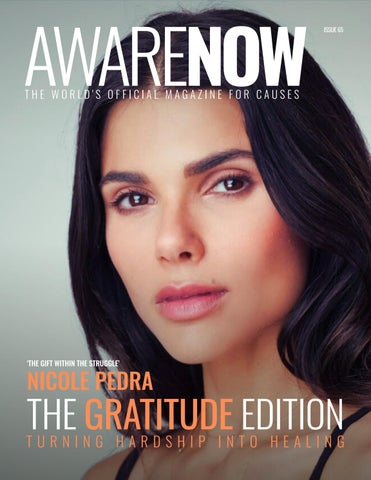
AWARENOW
ISSUE 65
THE WORLD'S OFFICIAL MAGAZINE FOR CAUSES
‘THE GIFT WITHIN THE STRUGGLE’
NICOLE PEDRA
THE GRATITUDE EDITION
TURNING HARDSHIP INTO HEALING
THE GRATITUDE EDITION ON THE COVER:
NICOLE PEDRA
AwareNow Magazine is a monthly publication produced by AwareNow Media™, a storytelling platform dedicated to creating and sustaining positive social change with content that inspires and informs, while raising awareness for causes one story at a time.
006 YUMI AND MONSTER
046 THAT FUNNY FEELING
KAM REDLAWSK
GABY MONTIEL
012 THE HOUSE THAT HEMP BUILT CODY LEY, HEMP FOR HUMANITY
018 THE GIFT WITHIN THE STRUGGLE
050 MINDSET SHIFT DR. PATTI BEVILACQUA
058 FINDING HAPPY
NICOLE PEDRA
PETER SAMUELSON
030 THE WEIGHT OF HOPE
066 HAVE MS WILL TRAVEL
MICHAEL BURNS
038 YOU ARE LIFE’S ALCHEMIST PAUL ROGERS
042 AND SO IT BEGINS DR. ROB PACE
ALLIÉ MCGUIRE
068 STRENGTH IN THE SHADOWS NINA HOBSON
076 AUTUM DAYS SAVANNAH LIBERTY
078 UNFOLDED KEVIN HINES
084 THE NEW FOUNDATION ELIZABETH BLAKE-THOMAS
088 BACK TO THE STARTING LINE LEYNA LUTTRULL
094 RAGING AGAINST DENIED CARE SANDY PRUETT PROJECT
098 BECAUSE OF PETER STEVEN NISBET, SHIELDS & STRIPES
102 LIBERATION THROUGH LEARNING SONJA MONTIEL, DR. CASSANDRA VILLA
SUBSCRIBE FOR FREE: AWARENOWMEDIA.COM/SUBSCRIBE www.IamAwareNow.com
gratitude: (n.) the conscious practice of recognizing what remains, even when life feels defined by what was lost and choosing to turn that recognition into action Gratitude, in AwareNow, is not passive appreciation; it is purpose awakened. It is the engine of the Human Cause. Gratitude is often misunderstood as something soft or simple. But true gratitude, the kind time instills in you, is a quiet form of strength. It is the moment you stand back up after life has knocked you down. It is the choice to focus on what you still have, and to use what you have left to make a difference for someone else. Few people embody this truth more deeply than Nicole Pedra. Her story is not framed by her hardships, but by what she created from them. Nicole chose gratitude as her path forward, not as a denial of pain, but as an act of defiance against it. She transformed her struggles into healing, her healing into purpose, and her purpose into service. She stands as a reminder that gratitude is most powerful when it moves beyond words and becomes action. That is why she graces the cover of this edition. And that is why she stands at the heart of the AwareNow original documentary Because I Can, a film about resilience, humanity, and the courage to keep going, not because it is easy, but because someone else might need your story to find their way. But Nicole’s story is only the beginning.
Across these pages, every article in The Gratitude Edition reveals a different expression of what it means to rise. Some stories honor the people who show up for others even when no one sees them. Some highlight the moments where hardship became a catalyst for hope. Others remind us that gratitude does not erase our struggles. it transforms them into something worth sharing. Together, these voices form a chorus of resilience, compassion, and truth. They remind us that gratitude is not a single act, but a collective movement strengthened by every human willing to live with purpose, to heal forward, and to lift someone else as they climb. This edition is a testament to gratitude as a lived practice: thankful for what we have, courageous with what we have left, and determined to use both to change the world. Always Aware. Always Free. AwareNow, more than ever.
ALLIÉ McGUIRE CEO & Co-Founder of AwareNow Media Allié McGuire began her career as a performance poet, transitioned into digital storytelling as a wine personality, and later produced the Hollywood Film Festival. Now, as co-founder of AwareNow Media, she uses her platform to elevate voices and champion causes, connecting audiences to stories that inspire change.
JACK McGUIRE President & Co-Founder of AwareNow Media Jack McGuire’s career spans the Navy, hospitality, and producing the Hollywood Film Festival. Now, he co-leads AwareNow Media with Allié, focusing on powerful storytelling for worthy causes. His commitment to service fuels AwareNow’s mission to connect and inspire audiences.
WAIVER/DISCLAIMER
The views and opinions expressed in AwareNow are those of the authors and do not necessarily reflect the official policy or position of AwareNow Media. Any content provided by our columnists or interviewees is of their opinion and not intended to malign any religion, ethnic group, political group, organization, company, or individual. Stories shared are not intended to vilify anyone or anything. Their intent is to make you think. * Please note that you may find a spelling or punctuation error here or there, as our Editor-In-Chief has MS and lost vision in her right eye. That said, she still has perfect vision in her left and rocks it as best as she can. www.IamAwareNow.com
Monster is just a metaphor. KAM REDLAWSK
ARTIST, AUTHOR, ADVOCATE, DESIGNER & SPEAKER Photo Courtesy: Kam Redlawsk 6
www.IamAwareNow.com
FEATURE STORY WITH KAM REDLAWSK
YUMI AND MONSTER A BOOK AND A BRIDGE FOR DISABILITY
Beyond a book, ‘Yumi and Monster’ is a story that serves as a bridge between ability and disability. In the transition of former versions of ourselves to present versions, where we meet our monsters where they’re at, not in confrontation but in companionship, this tale is one that brings new levels of comfort and compassion with bold advocacy and brilliant artistry from the one and only Kam Redlawsk. ALLIÉ: First of all, Kam, I am incredibly honored to have you read your book, Yumi and Monster for AwareNow. It’s a story that means so much to me and to many. Before you read, I’d love to learn a bit more about how this book came to be. How long has this been in the making? KAM: About seven years—from concept stage to the final book on the shelves. ALLIÉ: Seven years… wow. And the artwork is just as brilliant as the storyline—absolutely stunning. Even the red in Yumi’s hair feels like a signature of you.
YUMI AND MONSTER EXCLUSIVE INTERVIEW WITH & READING BY KAM REDLAWSK
CLICK, TAP OR SCAN
TO WATCH NOW
7
www.IamAwareNow.com
Photo Courtesy: Kam Redlawsk 8
www.IamAwareNow.com
“It’s really a relationship with yourself.” ALLIÉ: (continued) I keep searching for the right words to explain how much this book means to me and how much it’s already meaning to so many others. Because we all have a monster of some kind in our lives, something we can’t quite outrun or ignore. And somehow, you’ve turned that reality into a story that invites us to see the softness inside the struggle. What you’ve created is beautiful… and deeply needed. I can’t thank you enough for the gift this book is and for the gift you are. KAM: Oh, thank you. Yeah. I mean, obviously this was supposed to be about disability, but it was really important that it was inclusive enough that it actually included everyone. And it was kind of a struggle for a while because, from the beginning, it was called Monster and Me, and I worried that people would think I was calling disability a monster or struggle itself a monster. That’s why I tried to make him as cute as possible. I wanted people to love him, and I didn’t want kids to be confused, like, “She seems so distraught with this guy around. I’m scared of this guy that’s named Monster.” So that’s why I designed him to be super cute. I really wanted Monster to feel accessible so we’re not viewing our situations only as adversaries. Even though they’re difficult, it doesn’t mean we don’t still struggle with them, but it is easier to work with it when you realize it’s a relationship. It’s really a relationship with yourself. That’s also why it was really important to me to keep it just the two of them. They wanted to add more characters, and I wanted it to be just Yumi and Monster, because really it’s just Yumi. Monster is a metaphor. So yes, it was important that everyone could understand this as a relationship. Ultimately, Yumi has empathy for Monster at the end. And that’s really empathy for herself, and empathy for her situation. You might have known that this came about in 2012 when I had fallen. I imagined him. I saw him in the doorway. His foot was kind of stuck out of the doorway after I’d just fallen, and I was putting it together and thought, “Oh. He’s the one. He’s the reason for all my falls.” And that’s kind of how it happened. ALLIÉ: It’s wild… out of a fall came a story that so many people are going to fall in love with. And what you just shared (the idea that it’s a relationship) lands so deeply. Because in these pages, you can actually feel that relationship evolving. And that’s exactly what it’s like to live with a disability or any kind of adversity. It becomes this living, shifting relationship you navigate. There are moments of frustration and moments of grace, and you show all of that. The good, the hard, the human. So now that the book is out… what’s next? Where do you go from here? KAM: Well, now that it’s out, I want to pitch it as an animation, because that’s how I saw it originally. The animation I see differently. I made this book very cute. But for animation, I’m a big Tim Burton and Coraline person. I’m really into dark fairy tales like Pan’s Labyrinth and things like that. So I see it as much darker, but still loving, hopeful, and, you know, tender—just with character designs that are a little more… intense. So, pitching it as an animation is one thing. Since finishing this book, which I actually finished it in 2023, I don’t know if you heard, but I had a bit of publishing drama. As soon as I finished the book, in December 2023 and January, the publisher dropped the book because they’d let go of my editor. So it actually came out a year later. 9
www.IamAwareNow.com
Photo Courtesy: Kam Redlawsk 10
www.IamAwareNow.com
AwareNow Podcast
YUMI AND MONSTER Exclusive Interview with Kim Redlawsk https://go.awarenowmedia.com/podcast/yumi-and-monster
TAP/SCAN TO LISTEN
“…we can only do what we can.” KAM: (continued) It ended up working out, though, because my editor took my book with her to her next publisher. She’s been an amazing support, and she took it with her. So, long story short, I’d finished drawing this a while ago. Since then, I can’t hold a pen anymore. Now I’ve been practicing drawing with my finger. I want to return to my personal surreal art and develop that, maybe doing more finger illustrations instead of illustrating another whole book. I keep saying I’m probably not going to illustrate another book… although I did just post a Shel Silverstein–inspired sketch yesterday and thought, “Hmm, maybe it would be cool to do a Shel Silverstein type book based on disability and life.” It could be poems and illustrations… maybe an MS character, showing something specific about how they move through life; or someone with migraines, constantly dealing with headaches; someone with whatever their “monster” is so you get a glimpse of how they do it. I could really see a book like that. With the time and function I have left, I want to go back to my personal surreal art and develop that, and maybe do some finger illustrations. I’m also being encouraged to write a memoir. I have a ton of novel-to-film ideas. I’m really interested in storytelling now, and I’ve been consulting on some film scripts. I’d love to get into film—who knows? Maybe doing novels-to-film is the pathway there. And of course, I’ll write more picture books. Lots of plans. I want to do installation art as well, built around disability and the human condition. We’ll see. As you know with your body, we can only do what we can. So… we’ll see what happens. ∎
Follow Kim on Instagram: @kamredlawsk Explore her work online: www.kamredlawsk.com Get your copy of ‘Yumi and Monster’: https://go.awarenowmedia.com/book/yumi-and-monster
11
www.IamAwareNow.com
We’ll start to open up a lot more doors for innovation in a more regenerative and healing economy. CODY LEY
FOUNDER OF HEMP FOR HUMANITY Photo Credit: Hemp For Humanity 12
www.IamAwareNow.com
LIONBEAR VENTURES: ‘COURAGE & CAUSE’ EXCLUSIVE INTERVIEW WITH CODY LEY
THE HOUSE THAT HEMP BUILT
HOW ONE FARMER IS GROWING THE FUTURE OF SUSTAINABLE HOUSING Most of us don’t look at a plant and see a home — but Cody Ley did. As a farmer, chemist, builder, and founder of Hemp for Humanity, Cody is redefining what’s possible when nature and innovation work together instead of apart. In this conversation, we explore how one seed can spark a movement, reshape a supply chain, and quite literally build a healthier way to live. ALLIÉ: Cody, take me back to the very moment that this clicked for you, the moment that you looked at a plant and thought this could be a home. What sparked that connection between hemp and housing in your mind? CODY: Yeah, the story probably starts back when I was just growing up in childhood. There was a time where we lived on an industrial farm, a conventional agriculture, and we lived in worker housing and so I was able to see firsthand the effects and impacts of conventional agriculture on our planet and also the state of what would be considered low income housing. And it wasn't until my senior year in college when I learned about what this plant could do, that it kind of did click for me where I did my senior thesis on bioplastics, and so that's where I learned about the industrial hemp plant and how it can produce a biomass locally that while it's healing the soil, it can supply
THE HOUSE THAT HEMP BUILT EXCLUSIVE INTERVIEW WITH
CLICK, TAP OR SCAN
TO WATCH NOW
13
www.IamAwareNow.com
It’s a way to connect our built environment to the natural environment. CODY LEY
FOUNDER OF HEMP FOR HUMANITY Photo Credit: Hemp For Humanity 14
www.IamAwareNow.com
“We can have a healthier soil and healthier agricultural industry that supports healthy homes and healthy and affordable housing.” CODY: (continued) materials for everything from textiles, plastics, bio composites, and housing. And so that's when I realized the connection that we can have a healthier soil and healthier agricultural industry that supports healthy homes and healthy and affordable housing. So that's what inspired me to bring those things together. It’s a way to connect our built environment to the natural environment. ALLIÉ: The built environment to the natural environment. I love that. Let's get technical here. For those of us, including myself, who hear Hempcrete and imagine, I don't know, like a house that smells like a dispensary or - can you explain in real human terms what Hempcrete actually is and why it's a game changer for the way that we build? CODY: Absolutely. So it is an important distinction to know that the type of hemp that we're talking about, industrial hemp is grown for fiber and grain, so there's no psychoactive oils or cannabinoids in the plant. So it has to reach a certain level or percentage of cannabinoids to be considered industrial hemp. So it has to be below 0.3% in its oil content. And what we're really growing for is the biomass, the fiber. So what we do is we can take the stalk of the plant, it grows 16 foot tall on average and produces over four tons of biomass per acre. So it's really high yielding and cellulose dense. And so what we can do is we can take that plant, we can separate the fibers that can be sold into other industries like textiles, nonwovens other biocomposite industries, and then we can use what's left over, which is called the herd. It's the inner woody core of the stalk. And we can mix that with two other simple ingredients, one being a cementitious lime based binder, and the other is water. So we mix those ingredients together and what we have is a non-structural infill installation material, and that installation material has amazing performance benefits. One, it's carbon negative, it's also really energy efficient. It can lower energy costs by 40% to 70%. It's also fireproof, it's mold resistance, and it creates, what I like to call, a living wall system where it can work with the environment, it adjusts and acclimate to what the outdoor environment is doing and keeps your indoor environment really pleasant to be in. ALLIÉ: Wow. It sounds like it's this super material of sorts. CODY: Yeah, when it's used properly, it definitely has a lot of potential to make a big difference. ALLIÉ: So you've built a supply chain from the ground up literally, from seed to structure. Cody, what’s been the most meaningful moment for you in working with local farmers, researchers, and engineers, to make all of this possible? CODY: I definitely think, in terms of developing all the supply chain, we definitely have a long way to go, but we have done everything from farming to processing to building with it. And I would say that the culmination of it all in what we're doing right now is the farm to frame initiatives. I think the highlight for me is when we do our community engagement events. So right now we're in the process of engaging and educating the community on this material, the impacts it can have on our communities and our local economies. And, yeah, the most meaningful interactions to me are when I'm speaking to real builders in the community and real community members that are looking for housing and learning about how this solution can affect them in a positive way. Our most recent one in Detroit at an urban farm 15
www.IamAwareNow.com
This is opening up the doors for an entire biomaterial economy… CODY LEY
FOUNDER OF HEMP FOR HUMANITY Photo Credit: Hemp For Humanity 16
www.IamAwareNow.com
AwareNow Podcast
THE HOUSE THAT HEMP BUILT Exclusive Interview with Cody Ley https://go.awarenowmedia.com/podcast/the-house-that-hemp-built
TAP/SCAN TO LISTEN
CODY: (continued) called Sanctuary Farms, we did this event and it was amazing. We had a panel of people from the community; builders, people who worked in the city, people who work in workforce development. And to see the energy around our conversation and everybody around it just supporting and chiming in, it really felt like a moment where it was validating like, what we have can really help a lot of people. And to see the community gather around it was really impactful for me and it was a definitely a highlight of this whole journey. ALLIÉ: That's awesome when you can get so many people so supportive. So when you step into a hemp based home, what's the first thing that you'll feel? Not just the chemistry behind it, not just the specs, but just like that human experience of being in a space that, as you were alluding to, breathes differently. CODY: That's a great question. It's a different feeling. It's kind of hard to describe or put a finger on, but yeah, I guess my point of reference is like a lot of the buildings that we are existing in right now are all built to be watertight, airtight, and they're built with materials that oftentimes contain all these toxic chemicals that are not really safe for human consumption and are slowly off-gassing into our indoor environment. So when you step into a hemp home, I think there's like softness. I think this is the best way to describe it; softness or warmness. It's just a more pleasant feeling when the walls around you are living and breathing and adjusting to the humidity and keeping that indoor air quality really good. And also the sound dampening, like you don't have the tininess of a normal stick built fiberglass insulated home. Without getting too much into the weeds on it, I think it just resonates better with people in the home and the planet around it. I think it's a really special feeling. ALLIÉ: Well, it sounds amazing, and we certainly could use a little more softness in our lives and in our society. So one more question for you today here, Cody. If the future of housing started on your farm in Michigan, paint the picture for me. What does Michigan and maybe the whole world look like 10 years from now if hemp built homes become the norm and not the exception? CODY: I think what we would see is not only more resiliently built homes, but we'd be operating in more resilient local economies where not only are we producing our homes from local farmers, but we're producing the things that we need, like food, shelter, and fuel. So I think what we're showcasing and using housing for is a tool to really show is the power of bio-based materials in revitalizing our small town main streets and offering us ways to be more resilient and work together to produce the things that we need. Because it really opens up the door, obviously, we're showcasing hemp because, like I said, it's a high yielding biomass, it's highly regenerative and it's really cellulose dense. This is opening up the doors for an entire biomaterial economy where we can take agricultural waste and turn it into consumer product goods that we use every day, like, paper cups and plastic wrappers and houses. So, I think that as this really starts to build and take off, we'll start to open up a lot more doors for innovation in a more regenerative and healing economy. ∎
Learn more about Hemp for Humanity: www.h4h.earth
17
www.IamAwareNow.com
I am still worthy. NICOLE PEDRA
ACTRESS, MODEL & MS ADVOCATE Photo Courtesy: Nicole Pedra 18
www.IamAwareNow.com
EXCLUSIVE INTERVIEW WITH NICOLE PEDRA
THE GIFT WITHIN THE STRUGGLE FINDING PASSION AND PURPOSE WITH MS
There’s a rare kind of grace that comes from living with something that tries to take everything from you. Nicole Pedra knows that grace well. Diagnosed with multiple sclerosis, she’s learned that gratitude isn’t just a feeling—it’s a practice. A model, actress, and fierce advocate, Nicole has turned what could have been a closed door into an open invitation for others to find strength in vulnerability. Now, as one of the main cast members in ‘Because I Can’, she’s sharing her story so others might find pieces of their own strength reflected within it. Because when gratitude becomes your lens, even the hardest days hold their own kind of beauty. ALLIÉ: You have spoken before, Nicole, about how MS changed what you prioritize. But how has it changed how you love? How has it changed the way you show up for others, and even the way you show up for yourself? NICOLE: Oh, this is a great one. Prioritizing myself is not as easy as showing love for other people. I have had this disease for 27 years now, and I have learned to adapt so I can still do the things I want to do. In the last few years especially, I try much harder to prioritize my own health. I try to stop feeling like I need to please people. I try to stop worrying about whether something might make someone uncomfortable.
THE GIFT WITHIN THE STRUGGLE EXCLUSIVE INTERVIEW WITH NICOLE PEDRA BY ALLIÉ MCGUIRE
CLICK, TAP OR SCAN
TO WATCH NOW
19
www.IamAwareNow.com
The way I love people now is by realizing that the little things matter a lot. NICOLE PEDRA
ACTRESS, MODEL & MS ADVOCATE Photo Courtesy: Nicole Pedra 20
www.IamAwareNow.com
“When you are 10, all you want is to be like your peers. You want to feel included. I did not want to be the ‘weird sick girl’…” NICOLE: (continued) The way I love people now is by realizing that the little things matter a lot. Some of my friends really do not like when plans get canceled, and I understand that. So when I commit to a plan, I push myself to follow through. I do still cancel sometimes, of course, but I have certain friends who feel most loved simply by my showing up. It tells them they matter. It has also given me the ability to really listen. I will talk to a 90-year-old man who speaks slowly and trips over his own thoughts. I will talk to a toddler who takes forever to say what they want. All the quiet moments, the pauses, the effort to get the words out, teach you something. I love listening and noticing what people are really trying to say. ALLIÉ: And that is perhaps the most beautiful and honest way to love: to listen. Let’s look back at the version of yourself before MS. You were diagnosed at 10 years old. When you look at that little girl now, what did you see in her eyes then that you do not see now? NICOLE: That I am still worthy… In 1998, there was not much known about MS. Mental health was not widely recognized or accepted. My mom was told not to tell anyone because no one wanted to “label” a child with MS. People were ignorant. They did not understand invisible illnesses. The belief was that I would not be able to get a job if people knew I had MS. That plants a narrative in your mind that something is wrong with you and that you should be ashamed. I hated myself for a long time. I carried this attitude of “No one is ever going to want to be with me anyway, so I might as well do whatever I want.” I fought everything. When you are 10, all you want is to be like your peers. You want to feel included. I did not want to be the ‘weird sick girl’. Even though no one deserves to be teased, you still know enough to think, “I do not want that to be me.” Kids do not understand MS. When I was hospitalized, I was on oral steroids for an entire summer. I had Solumedrol several times. Pediatric MS hits differently. It is like getting hit by a truck. You get multiple symptoms at once, and they are usually more severe because your body is still growing. You get hospitalized more. You have more flare-ups. The only saving grace is that neuroplasticity helps kids bounce back better. But all the in-and-out of doctors’ offices, the weight gain, the missed school, the moon-shaped face, all of it made me stand out. People noticed. In fourth grade, everyone knew I was gone for a week and a half. Kids made cards for me, but I was still the odd one out. I remember losing friends in middle school. I remember being excluded from things without understanding why. I remember being removed from a talent show dance because I had gained weight and looked different. Kids do not know what MS is. The only people I knew with it were my friends’ parents. I remember thinking, “I am a kid. Why am I getting something adults get?” ALLIÉ: I can imagine how different her eyes must have looked then compared to yours now. So let’s flip that. What do you see in your eyes today that she never could have imagined? NICOLE: That this disease could actually bring me purpose. I never thought I would do anything related to MS. I did not want anyone knowing. I did not want to be labeled. I looked like everyone else. I was fun. I knew how to hide things. Honestly, a wobbly leg is not that noticeable. 21
www.IamAwareNow.com
Whatever comes next, I can handle it. NICOLE PEDRA
ACTRESS, MODEL & MS ADVOCATE Photo Courtesy: Nicole Pedra 22
www.IamAwareNow.com
NICOLE: (continued) People will tell me, “You look great,” and they do not notice that I am wobbling constantly. But when I post an online video and wobble while unloading the dishwasher, someone will comment, “I saw your wobble.” I go back to watch what they are talking about. Sometimes they notice things that the average person never would. ALLIÉ: Let’s shift gears for a moment. Gratitude often shows up in disguise. Can you share a moment recently when you were frustrated or afraid and later realized it was actually a gift? NICOLE: That is a hard one. Honestly, my diagnosis as a whole has a silver lining. I posted this recently: If you could go back to the moment of your diagnosis and erase your chronic illness, but also erase every person you met afterward, every relationship, every lesson, every moment of growth, would you do it? To me, nothing is as valuable as having to overcome a challenge. There is only one way forward, and that is through it. ALLIÉ: Yes. The diagnosis becomes a blessing in disguise once you can recognize it as one. And now you can. NICOLE: It is funny because I went to school for public health, but I never planned on working in public health. I wanted to go into pharmaceutical sales. I thought I was taking the long route. I remember teaching refugees about health literacy. Things like how to understand what is happening in the doctor’s office, why you should bring someone with you, why you should take notes. Basic hygiene concepts that are second nature to us but completely new to people coming from different countries. It is interesting that my life circled back. Now healthcare, accessibility, and awareness are everything to me. I want people to feel empowered and confident. Not only confident in their decisions, but confident that they can handle what comes next. Recently, I felt a decline. I sent my neurologist a long message describing every symptom. I asked him if the neuroplasticity that helped me as a child will eventually decrease enough that I will be hit with something big. I wanted his honest answer. I knew a time would come when I would feel myself decline. Things get more frustrating. I found myself thinking, “Please do not let this happen.” But then I stopped and thought, “I cannot control if it happens. I can only control how I deal with it.” I already survived the worst parts of my life. Whatever comes next, I can handle it. ALLIÉ: Exactly. You cannot control MS, but you can control your response. That part belongs only to you. So let’s talk about the documentary we are both part of, Because I Can. You are not only sharing your own story. You are helping tell a collective one. What have you learned about how your story can inspire courage in others to tell their own? NICOLE: Living with this condition for so long gives people hope. It shows them that someone has already walked the path ahead of them. I would have loved to see someone diagnosed at 11 or 14 or 15 who was now 40. That alone would have changed everything for me. My dad once said that he did not know if I would be in a wheelchair by 16. That was the understanding people had about MS. It was seen only as a disability. MS progresses differently in kids than adults, and I bounced back well. But the belief was always that disability was only a few years away… What was the question again? ALLIÉ: How does your story empower others to tell their own? NICOLE: I think it gives people permission. Permission to say, “I do not care if I have this. I am going to speak up because others are struggling too.” That in itself is empowering. And the only way we shift the culture around women’s health is by advocating for ourselves. When we advocate, we do not just change the culture. We change the outcomes. ALLIÉ: Yes. Sharing becomes its own kind of caring.
23
www.IamAwareNow.com
We need to be more conscious about how we respond to people. NICOLE PEDRA
ACTRESS, MODEL & MS ADVOCATE Photo Courtesy: Nicole Pedra 24
www.IamAwareNow.com
AwareNow Podcast
THE GIFT WITHIN THE STRUGGLE Exclusive Interview with Nicole Pedra https://go.awarenowmedia.com/podcast/the-gift-within-the-struggle
TAP/SCAN TO LISTEN
NICOLE: And the mental health piece matters too. So many kids are embarrassed to admit they are sad or depressed. I love those commercials where a kid gets hurt and his friend asks how he is doing. The kid says it has been hard lately, and the friend completely normalizes it. That is what we need more of. We need to be more conscious about how we respond to people. Instead of saying, “Everyone feels that way, don’t be a baby,” we should be saying, “I understand. What can I do to help?” Those words matter. ALLIÉ: I love the nuance of that. “What can I do to help?” Instead of “Can I help?” One is passive. One is present. NICOLE: Exactly. “Can I do anything to help you? Can I make this easier? Do you want me to grab groceries for you?” You should never feel bad about what you accomplish in a day when you are already dealing with so much. Validation and encouragement matter. They show awareness of the hardship. ALLIÉ: One last question. If gratitude were a person sitting across from you right now, what would you say to her? What would you say to Miss Gratitude? NICOLE: I would say thank you for making my middle school and teenage years miserable, because those years taught me how to overcome a lot. I was a rebellious teenager. I did not live at home for seven months during my senior year. I was impulsive. I was angry. I talked back constantly. I felt like no one understood me. But adversity creates character. I am grateful I went through that stage when I did, because it made me a more caring and understanding adult. And that is how I am able to show up for others now. Sometimes it is hard to relate to people if you have never gone through something difficult yourself. ALLIÉ: It becomes a way to connect… a way to find our way back to each other. NICOLE: So gratitude, thank you for teaching me in the school of hard-knock life. ∎
Find & follow Nicole on Instagram: @nicolepedra Learn more about Nicole’s story as an AwareNow Ambassador: www.awarenowmedia.com/nicole-pedra
25
www.IamAwareNow.com
Every one is a part of everyone.
FIND STORIES, STATS & SUPPORT
FOR THE CAUSES THAT TIE US ALL TOGETHER WWW.TABLEOFCAUSES.COM
Miles to go before we sleep…
I fought. I fought for everyone I knew. MICHAEL BURNS
WORLD RECORD BREAKING POWERLIFTER & CANCER SURVIVOR Photo Courtesy: Michael Burns 30
www.IamAwareNow.com
EXCLUSIVE INTERVIEW WITH MICHAEL BURNS
THE WEIGHT OF HOPE POWERLIFTING PAST CANCER
Michael Burns is no stranger to heavy lifting—both in the gym and in life. After being diagnosed with small cell lung cancer, he fought through chemotherapy and radiation, refusing to let go of his passion for powerlifting. Today, cancer-free and holding multiple state records, he stands as living proof that resilience and faith can move far more than weight. ALLIÉ: Looking back at the moment when you were first diagnosed with cancer, my first question for you today, Michael, is this: what was the hardest truth you had to face, and how did you find the strength to keep lifting both in the gym and in life? MICHAEL: I think the first thing that came to my mind was that I was scared to death. My uncle died of the same thing. My cousin died of the same cancer. So in my eyes, I felt like I was being given a death sentence. With that, I decided I was going to fight. I figured I would win either way. Either we would kill it with everything they put in my body, like the chemo and the radiation, or if I died, then either way, the cancer would be gone. That was my determination, and I dug deep.
THE WEIGHT OF HOPE EXCLUSIVE INTERVIEW WITH MICHAEL BURNS BY ALLIÉ MCGUIRE
CLICK, TAP OR SCAN
TO WATCH NOW
31
www.IamAwareNow.com
Was I scared? Absolutely. MICHAEL BURNS
WORLD RECORD BREAKING POWERLIFTER & CANCER SURVIVOR Photo Courtesy: Michael Burns 32
www.IamAwareNow.com
“I lost two good friends to cancer, so every time I go up on that platform to lift, I lift for all of them. For everyone fighting cancer. For those who lost the battle and for those still battling. That is why I lift. I want to inspire people.” MICHAEL: (continued) I was surrounded by a huge group of friends and family, and even perfect strangers who prayed for me and encouraged me. I took all of that with me, and I kept lifting. I kept working. I kept going to the gym. Was I scared? Absolutely. I was scared because I did not know how my body would react to everything they were giving me. Chemo kills everything. It kills the good along with the bad. But I tried to add humor into it. When I went to treatments, I would wear shirts to make people smile. I had one with a stick figure sitting on the floor with his knees up and his whole body on fire. It said, “I’m fine, everything is fine.” My last day of chemo, I wore a Charlie Brown shirt and did the Charlie Brown dance while hooked up to the chemo just to make people smile. I remember my first day of treatment. I did not even have my port in yet. They had just hooked up the IV. You can wheel those things around anywhere, and I had to use the bathroom. I came out, and my nurse was standing there. She was amazing. She asked if I was feeling okay, and I said, “Wow, that stuff works fast,” because I already had no hair on top of my head. I thought for sure the chemo had taken it, but I never lost my hair. She got a kick out of that. I fought. I fought for everyone I knew. I lost two good friends to cancer, so every time I go up on that platform to lift, I lift for all of them. For everyone fighting cancer. For those who lost the battle and for those still battling. That is why I lift. I want to inspire people. ALLIÉ: That is beautiful. And to your point, chemo may kill everything, but it did not kill your spirit. Humor really is its own kind of medicine. You leaned on it not just for yourself but for others. Powerlifting requires both physical and mental strength. How did your battle with cancer change your relationship with your body, your mind, and the way you define strength now? MICHAEL: I fought with myself every day. My doctor told me, “You cannot lift stupid weight.” I said, “Define stupid weight.” What is stupid to me might not be stupid to you. Everyone has a different idea of what stupid weight is. He sent me to his physical therapist. The first thing they asked was if I had a picture of myself lifting. I showed them one. They zoomed in on my neck, and they said, “What do you see?” I said, “I see my veins popping out.” They said, “Exactly. And what is hooked up right there?” I said, “My port. It is under the skin.” They said, “Right. Nothing is holding that in except your skin. All that pressure could blow it out, and if it does, you are dead.” I said, “Oh. Okay.” But I still went to the gym. I still did not know what stupid weight was. I remember lifting something and hearing people yelling across the gym, “Burns, put it down!” I said, “Okay.” 33
www.IamAwareNow.com
Do not give up. Not ever… MICHAEL BURNS
WORLD RECORD BREAKING POWERLIFTER & CANCER SURVIVOR Photo Courtesy: Michael Burns 34
www.IamAwareNow.com
MICHAEL: (continued) Back to your question. It was mentally overwhelming. I could not do what I used to do. I had worked so hard. I was supposed to go to England in 2023 to compete at Worlds, and I could not because of the cancer. But I had to do something. I could not just sit and wait. I was either going to beat this or die fighting it. I could not stay home doing nothing. How did it change me? It forced me to face the mental side of strength every single day. My body could not do what it did before, so I had to push through mentally. My wife helped a lot too. She made sure I had what I needed, even stuff cancer patients drink to help keep food down. I do not think I could ever drink one again, but I did it back then. Every day I got up and every day I went to the gym, I reminded myself of my goal. My goal was to beat cancer and re-qualify so I could get back on that platform. ALLIÉ: Let’s talk about the platform. Let’s talk about World Records. Tell us about that. MICHAEL: I earned my World Records in February 2024. I went to Michigan, did a meet, and smashed my old records. I broke every one of my state records and set new ones. It was a battle because I was not lifting my heaviest weights yet, but mentally I was focused. I told myself, “I am lifting this. No matter what.” For the first time ever, I had all green lights. I hit every lift. In powerlifting, you get three attempts for squat, three for bench, and three for deadlift. I had never hit all of them before. That day, I did. I qualified for Worlds. When I went to Worlds in November, I was terribly sick. I did not realize until the drive home that it was the flu. I thought the cancer was back. My wife drove straight home without stopping so I could get to the hospital. After Worlds, I was depressed. I felt like everything I worked for had fallen apart. But I got back into the gym and got my head right. Like you said, lifting is physical, but it is also mental. You look at the weight and think, “I could just get a forklift for this. Why am I doing it myself?” But you push anyway. We went to Nationals in July, and I hit World Records. I smashed them. I squatted 640 pounds. I still watch the video. My wife was there. My kids were there. My sister, my niece, my son’s fiancé. Everyone. At those competitions, there are two platforms: Red and Blue. My wife told me that when I went up for my third attempt, which was for the world record, even the other platform stopped lifting and started cheering for me. Everyone was screaming and yelling for me to get that lift. It was incredible. People heard my story. My singlet has a cancer ribbon, and it says “Burn Strong,” and on the back it says “Platform Ready.” After hearing my story, they interviewed me. They did a full piece on me and what powerlifting has done for my life. I hit three world records that day. My total was around 1,560 pounds. And I want to keep going. ALLIÉ: Just keep going. And how wonderful to have your family there, celebrating with you and supporting you. After beating cancer and setting records, what message do you hope your story leaves behind for someone who just received a diagnosis and feels like giving up? MICHAEL: Do not ever give up. Not ever… I tell everyone they can use my story. I do not care about fame or money. I just want to inspire people not to give up. There were days I did not want to go to the gym. I was exhausted. I had chemo. I had radiation. I felt terrible. I never threw up, but I had no energy at all. And I still went to the gym. Maybe I was not lifting 640 pounds. Maybe I was only lifting 125. But I was still doing it. You have to dig in. You will have days when you are tired and do not want to fight anymore. But you have to look around at the people who love you. Fight for them. Fight for yourself. Fight so your life can be longer and so the people who love you do not have to lose you. 35
www.IamAwareNow.com
AwareNow Podcast
THE WEIGHT OF HOPE Exclusive Interview with Michael Burns https://go.awarenowmedia.com/podcast/the-weight-of-hope
TAP/SCAN TO LISTEN
MICHAEL: (continued) Losing someone is devastating. I have lost two friends to cancer. Survivor’s guilt is real. I struggle with it every day. At Worlds, one of the spotters came up to me afterward. I did not know his story at all. His mom had died of cancer. He hugged me and cried, and I cried too. These two huge grown men standing there hugging and crying. Because he saw me fighting and it meant something to him. That is why I share my story. Even if someone is not into powerlifting, I want them to move their body. Go to the gym. Walk on a treadmill. Lift a two-and-a-half-pound dumbbell. I will still be right there cheering for them. The sport I am in is the best in the world, in my opinion. Even though you compete against others, everyone is still cheering for you. No one says, “Is that all you can lift?” They help you. They give you tips. They want you to succeed. And if powerlifting is not your thing, that is completely fine. I help people in the gym all the time. I make programs for them. I answer questions. I just want to help. ALLIÉ: It’s the power of community. Powerlifting has it. The cancer community has it. It’s ‘community’ that helps us lift each other. MICHAEL: Absolutely. And we need more of that. Especially men. We are terrible at it. We push everything down. We pretend we are fine. I cry. I do not care. If someone mocks me, we will both be crying. I am kidding, I would not hit anyone. But seriously, men need to lean on each other more. Whether it is cancer, mental health, anything. Reach out. Lean on your people. There is enough negativity in the world. We need more positive. So, I am just trying to make the world a little better each day. I know it sounds like a sales pitch, but it is true. Lifting weights or not, I want to leave a mark. I do not need a statue or anything like that. I want people to remember me as someone who tried to help. Someone positive. I want to leave a legacy for my kids, my grandkids, and my great-grandkids to be proud of. Not fame or money. Just impact. When I went through treatment, my heart broke every day. Everyone there had cancer, but everyone had a different story. I met a man who was diagnosed the same day he lost his house in a fire. I hugged him. Another man was in his second round. The cancer was in his brain, and he was getting radiation so he could die with mental awareness. Those stories stay with you. That is why I want people to fight. Fight until your last breath. Never ever give up. I think it was Sylvester Stallone who said it. It is not about being knocked down. It is about how many times you get back up. Because life will knock you down. We just have to keep getting up. ∎
Learn more about Michael Burns as an AwareNow Ambassador for Cancer: www.awarenowmedia.com/michael-burns
36
www.IamAwareNow.com
Nothing is wasted—not our mistakes, not our pain, not our waiting. PAUL S. ROGERS
TRANSFORMATION EXPERT, AWARENESS HELLRAISER & PUBLIC SPEAKER 38
www.IamAwareNow.com
‘RELEASE THE GENIE’ EXCLUSIVE COLUMN BY PAUL S. ROGERS
YOU ARE LIFE’S ALCHEMIST A JOURNEY THROUGH SHADES OF BECOMING Release the genie fact: The Genie tells Simon what to do. The word “alchemy” evokes a magical process of transforming non-precious metals such as lead into gold. It all began in the Greco-Egyptian period, with a revival in Europe during the Middle Ages. The study of alchemy paved the way for the development of modern chemistry, but it eventually declined as a science due to technological advancement. Alchemy’s guiding principle is “equivalent exchange”: you cannot obtain something without sacrificing something of equal value. This means that you can’t create something from nothing; you have to start with an existing base material or value. Value is a subjective concept, depending on what the alchemist determines is valuable to them. The process of alchemy mirrors our own life paths, as we ourselves are the raw material. We begin full of potential, but also burdened with impurities such as fear, pride, doubt, and pain. The alchemical journey invites us to embrace life’s trials not as punishments, but as fires that purify us. Through challenge and introspection, we begin the mystical work of turning our inner base into something amazing. There are four stages in the alchemy process, which are as follows. The first stage is the blackening. It is the initial stage of breakdown and darkness. It is a time of confusion, loss, or disillusionment. Many people experience this phase when life no longer makes sense. It could be when a relationship ends, a dream collapses, or a truth is revealed that can’t be ignored. Whilst painful, this darkness is essential. It dissolves the illusions that once defined us. In the ashes of what we thought we were, the seed of something new begins to stir. An alchemist does not run from the blackness. Instead, they sit within it, trusting the process and recognizing that chaos and suffering are the beginning of transformation. From darkness comes the whitening. Here we begin to see light again. It is the gentle dawn after a long night. At this stage, the alchemist washes away the impurities that burdened them, and the heart begins to open for forgiveness, clarity, and renewal. In this discovery stage, the alchemist begins to realize that not everything that was lost was meant to remain, and not everything broken needs to be mended in its old form. The fog of confusion and indecision grows thin, and new possibilities and perspectives seem to emerge as if by magic. In modern terms, this is a period of acceptance; things still hurt, but our relationship to the pain has changed. We are able to take those first steps into our new reality. The third stage is known as the yellowing. The alchemist is transitioning from those first few shaky steps, still unsure that the light will stay. Confidence begins to grow. This might no longer be a false dawn but the start of something new. We want to shout out in excitement, but we don’t want to jinx it. It is at this moment that we begin to perceive meaning in what was once nothing but suffering. Our purpose becomes clearer, and our energy no longer seems at odds with our authenticity. In this stage, the alchemist learns that true power is gentle, and that wisdom grows from humility. We begin to sense the transformation through our new thinking and habits. The gold promised at the beginning of the process seems a lot closer than it did before. If we can only stay on this path, who knows what could happen. 39
www.IamAwareNow.com
AwareNow Podcast
YOU ARE LIFE’S ALCHEMIST Written and Narrated by Paul Rogers https://go.awarenowmedia.com/podcast/you-are-lifes-alchemist
TAP/SCAN TO LISTEN
“We emerge from the alchemy process with a deep knowing that it’s actually when we believe that we can see it.” The fourth and final stage is known as the reddening. This symbolizes the perfection of the work, the union of opposites, and the culmination of transformation. This is where lessons become lived truth. We feel that life is an effortless harmony. We no longer battle against the flow but are content to participate in it. What seemed a dream at the beginning is now a way of life. We understand that our new existence requires work every day to continue to walk the path, safe in the knowledge that our previous indulgences of taking life for granted no longer bind us. When we reflect on our own experiences through this lens, we see that the process of alchemy is alive in every human journey. It shows us that nothing is wasted—not our mistakes, not our pain, not our waiting. The value of what we have to give up in the beginning seems to be almost impossible. We stubbornly hold on to the belief that if we can’t see it, we can’t believe it. We emerge from the alchemy process with a deep knowing that it’s actually when we believe that we can see it. ∎
PAUL S. ROGERS Transformation Expert, Awareness Hellraiser & Public Speaker www.awarenowmedia.com/paul-rogers PAUL S. ROGERS is a keynote public speaking coach, transformation expert, awareness hellraiser, life coach, Trauma TBI, CPTSD mentor, train crash and cancer survivor, public speaking coach, Podcast host “Release the Genie” & best-selling author. His journey has taken him from corporate leader to kitesurfer to teacher on a first nations reserve to today. Paul’s goal is to inspire others to find their true purpose and passion.
40
www.IamAwareNow.com
OFFICIAL AWARENOW T-SHIRT AVAILABLE ONLY ONLINE.
AWARENOWMEDIA.COM/MERCH (HAT AND ADORABLE CHILD NOT INCLUDED.)
The truth is, our minds aren’t broken. They’re just not always tuned correctly. ROB PACE, MD
NEUROLOGIST AND CREATOR OF THE RESONANT MIND www.IamAwareNow.com
‘THE RESONANT MIND’ EXCLUSIVE COLUMN BY ROB PACE, MD
AND SO IT BEGINS
LEARNING TO TUNE THE BRAIN NO ONE EVER TAUGHT US TO USE Welcome to ‘The Resonant Mind’. Get ready to explore the hidden harmonics of the mind — where neuroscience, personality, music, and consciousness spiral into one unified pattern. This space is dedicated to the science of resonance and the human experience. Let’s start with a “who, what, when, where, and why” introduction. WHO I'm Rob. I'm a neurologist, however I'm not doing this because I'm a neurologist. Rather, I became a neurologist because I've been obsessed with this sh*t since I was a little kid. Mind, consciousness, thinking, all those things. I've studied and learned about these from a variety of different angles. From neuroscience to psychology to sociology and beyond, there are connections and parallels that tie together our human experience.
WHAT This channel is about understanding your mind as a system of resonance, not a box of thoughts. We're going to explore what thoughts actually are, how emotional states change the thoughts that you have access to, why identity isn't fixed, what eigenpatterns are, why consciousness feels so chaotic sometimes, how to navigate our inner world with clarity, and how to tune our mind on purpose. If you've ever felt confused by your own brain, you're not alone, and you’re in the right place.
AND SO IT BEGINS CREATED AND HOSTED BY DR. ROB PACE
CLICK, TAP OR SCAN
TO WATCH NOW
43
www.IamAwareNow.com
WHEN The when is now. We're building this in real time. This isn't a polished and arranged thesis. This is an evolving project. So expect growth, iteration, and a lot of learning together. We're going to attack this from a few different angles. We'll do YouTube for deep dives, TikTok for shorter concepts. A couple books are in the works for full architecture around specific subjects. All of these are geared to lead to tools that can actually be used. All the same message, different formats, one mission: tune our minds.
WHY The ‘why’ is the heart of this channel. Navigating our mind is f*cking hard. Nobody hands you a manual. And most of us are taught the wrong model from the start. We blame ourselves for thoughts we didn't choose. Emotions we didn’t ask for show up and consume our days. Identities we never consciously built take over years, decades or sometimes our entire lives. Personally, I have wasted way too much of my time on this planet struggling with my mind. Depression, anxiety, insecurity, guilt, doubt, blah blah blah blah blah. But learning how the brain creates these experiences has made mine much much easier to navigate. And now I want to share what I've learned in a way that's actually useful. The truth is, our minds aren't broken. They're just not always tuned correctly. And once we understand how the tuning works, everything gets easier. That's why this channel exists… to help us, to help you, stop fighting your mind and start understanding it.
HOW I love teaching. However, I’m also a nerd who gets really excited when talking about these things. So, I may go off on a few tangents that seem unrelated from time to time. However, I’m told that I have sort of a “Mr. Miyagi” style of teaching - it may not be clear why I'm telling you something, but 10 minutes later (or 10 videos later) everything kind of clicks. I also despise the way that doctors tend to communicate. To be completely honest, I think that half of medical school is just learning terminology to make us sound smarter than we really are. None of that here. If I’m not making sense, tell me. I’ll figure out a way to rephrase so that anyone can understand. Patterns will reveal themselves over time. Not everything will make sense immediately, but it will in the end - just stay curious. So, if you want to understand your mind in a way that finally feels true, useful, if you want to stop fighting your thoughts and start tuning your consciousness, welcome to ‘The Resonant Mind’. Let's figure this sh*t out together. ∎
ROB PACE, MD Human, Neurologist & Creator of ‘The Resonant Mind’ robpaceneuro.com Exploring the hidden harmonics of the mind — where neuroscience, personality, music, and consciousness spiral into one unified pattern, Dr. Pace created ‘The Resonant Mind’ dedicated to the science of resonance, eigenpatterns, and the human experience.
44
www.IamAwareNow.com
Now we just say we tried. GABRIELLA MONTIEL
SINGER, SONGWRITER & OFFICIAL AWARENOW AMBASSADOR FOR MUSIC & ARTS 46
www.IamAwareNow.com
FEATURE STORY BY GABRIELLA MONTIEL
THAT FUNNY FEELING A COVER FOR CONVERSATION
A while ago, there was a trend on social media where people were rewriting the lyrics to That Funny Feeling by Bo Burnam (later redone by Phoebe Bridgers) to fit the image of the modern day. These covers usually discussed politics, war, and social injustices in a tone similar to Burnam’s original irony to match the horrific duality we see online. From comedic to suddenly tragic, first world to war, then back to pop culture references, the song captures desensitization and ignorance seen both online and in real life. This is my own rewrite of Bo Burnam’s song, covering January of this year to very early October. Clouds melting to smoke all while My teachers’ house burns down Watching my friends kill themselves On top of homework mounds W.H.O. can really help U.S. Laughing priests off of the stage So desperate for saviors In three carved bullets we praise There it is again That funny feeling That funny feeling There it is again That funny feeling That funny feeling C is for care some more please Love’s up for debate ICE cold coca cola Hear the target lock in place 47
www.IamAwareNow.com
Christmas is coming Green trees, red bloody grass Mourn for four days While kindergarden’s back in class There it is again That funny feeling That funny feelling There it is again That funny feeling That funny feeling Sydney has some great jeans now It fits bad on my race Comforted by tissues Amazon drops at my place Taylor’s new album sparks thoughts Of civil war My stomach turns and AI says I’m rotting from my core There it is again That funny feeling That funny feeling There it is again That funny feeling That funny feeling Past books written predictions Banned as they all come true X equals domination I’ll fail Algebra 2 Stripped of rights, is the Strip alive? No one sheds a tear Everything is easier If we’d all disappear 48
www.IamAwareNow.com
AwareNow Podcast
THAT FUNNY FEELING Cover Written & Performed by Gaby Montiel https://go.awarenowmedia.com/podcast/that-funny-feeling
TAP/SCAN TO LISTEN
Blue and red make purple Used to hold it close to me Until I realized that black and white Is all we see Angry and pissed enough To hear the rebel’s cry Scared and watered down to youth Now we just say we tried There it is again That funny feeling That funny feeling There it is again That funny feeling That funny feeling ∎
GABRIELLA MONTIEL Singer, Songwriter & Official AwareNow Ambassador for Music & Arts www.awarenowmedia.com/gaby-montiel Gaby Montiel has been nationally recognized as a soulful singer songwriter. As a recording artist, Gaby performs throughout southern California and has been requested to write and record songs for social advocacy organizations like AwarenessTies and Fear of Return. In April 2023, she performed as the youngest female music artist for the national Chick Singer Night Showcase at the Ventura County chapter. She recently performed for 300 art and music high school students in the Oxnard School District for the Oxnard Performing Arts Center, leading a songwriting workshop for 89 music students. She was also selected as the youngest singer songwriter for the West Coast Songwriter Association's Winter Showcase in 2024 as well as the only youth to be selected amongst 20 globally for Successfully Magazine.
49
www.IamAwareNow.com
For me, MS doesn’t stand for ‘multiple sclerosis’. It stands for ‘mindset shift’. DR. PATTI BEVILACQUA
MS WARRIOR, AUTHOR AND SPEAKER Photo Courtesy: Dr. Patti Bevilacqua 50
www.IamAwareNow.com
EXCLUSIVE INTERVIEW WITH DR. PATTI BEVILACQUA
MINDSET SHIFT
FROM LOST DREAMS TO LIVING FEARLESSLY WITH MS At 23, Patti Bevilacqua’s dream career as a PE teacher was cut short by a diagnosis of multiple sclerosis. What felt like an ending became the beginning of a powerful new story… one that led her to earn a PhD, step onto the TEDx stage, and inspire thousands as a resilience educator. Today, Dr. Patti Bevilacqua shows the world that MS doesn’t just mean multiple sclerosis. It means ‘mindset shift’. ALLIÉ: Before MS reshaped your world, you were living your dream job — tell me if I’ve got this right — as a high school PE teacher at age 23? Yes? Can you share a glimpse, Patti, of who you were in that season of your life?
PATTI: I was valedictorian of my university class. I was the first one to get a teaching job, and it was perfect. I was a high-achiever, a goal-setter, and I had never heard the word no. Everything was falling into my lap. Two male PE teachers, two female PE teachers, 650 kids in the school, coaching girls’ volleyball and rugby.
MINDSET SHIFT EXCLUSIVE INTERVIEW WITH DR. PATTI BEVILACQUA BY ALLIÉ MCGUIRE
CLICK, TAP OR SCAN
TO WATCH NOW
51
www.IamAwareNow.com
I was living my dream. DR. PATTI BEVILACQUA
MS WARRIOR, AUTHOR AND SPEAKER Photo Courtesy: Dr. Patti Bevilacqua 52
www.IamAwareNow.com
“I treat MS like a tenant in my basement suite… I negotiate with an unruly tenant I can’t get rid of.” PATTI: (continued) When I stepped into the gym as Ms. Bevilacqua… it was magic. I taught running, jumping, and square dancing like I was in the Olympics. And instead of being a teacher with a whistle, I used a microphone. My greatest gift was my ability to connect with my students. I have over 700 members on Facebook. 627 of them are former students. They visit, they camp in our backyard, some took our puppies. They’re a huge part of our life. I was on fire. There was nothing else. I even married the other PE teacher. I was living the dream. ALLIÉ: It sounds like it. So what was it like when that dream was suddenly interrupted? PATTI: Like someone punched me in the gut. I was a person who lived on Plan A. It took a while to understand what the diagnosis meant, but I realized everything I wanted was gone. I had no Plan B. I always thought I’d retire after 35 years as a teacher. Maybe not PE forever, but still teaching. It felt like a punch in the gut because it wasn’t my choice. Something else was making the choice for me, and that had never happened in my life. I stayed in the gym for five more years that were the best five years of my career. We took students to Ireland, England, Wales, Scotland. But after three years, I got quite sick. Paul wasn’t going to leave me home alone while he went to work, so he drove me to my parents’ house, and I stayed there for about eight months. I eventually returned to teach social studies at another school. But I was in a portable classroom, watching my dream unfold on the field without me, talking about the Magna Carta with passion I didn’t feel. I didn’t want to be there. When I left the gym, I went in at 11 PM, cleaned out my desk, and left. I never went back. It took a long time to let go of that part of my life because I was reliving it every time I told the story. Now, I tell it as the beginning. Because you know what? I’m on Plan N, and I’m loving life. I’ve done more in the last five years than I ever could have done had I stayed in teaching. It doesn’t replace it; it’s just different. I still move every day, but now I’m moving my mind, my heart, and my passion. I was in a research trial. I was two rounds in when it ended because there was no significant difference between drug and placebo. I was on the placebo. And I was on fire. That’s when I realized: it was my mindset. For me, MS doesn’t stand for ‘multiple sclerosis’. It stands for ‘mindset shift’. ALLIÉ: That is powerful. What’s also powerful is how you’ve spoken about becoming a ‘negotiator’ with the voice inside your body. As someone living with MS myself, I can say that inner voice can sometimes sound more like an enemy than a partner willing to negotiate. PATTI: Absolutely. ALLIÉ: So how did you learn to change that conversation? And what does that negotiation look like on a hard day? PATTI: First, I need to say: I’m pretty excited about my life today. Was it easy? No. Did it just happen? Absolutely not. Do I have bad days? Oh yes. But I learned to listen to my body. I respect MS, and I’m grateful every day that it continues to be kind to me. I treat MS like a tenant in my basement suite. Sometimes the rent is late. Sometimes the music is too loud. There’s chaos. And landlords can’t always evict renters. So, I have to negotiate… I negotiate with an unruly tenant I can’t get rid of. I’ve given it space to live. I’m not fighting it, pushing it out, or cursing it. okay, sometimes I curse, but I still hold space for it. 53
www.IamAwareNow.com
It’s an invisible toolbox I carry with me. DR. PATTI BEVILACQUA
MS WARRIOR, AUTHOR AND SPEAKER Photo Courtesy: Dr. Patti Bevilacqua 54
www.IamAwareNow.com
“Is it easy? Hell no. But by changing your mind, you can enable yourself to enjoy a life you never thought possible.” ALLIÉ: And the way you say that… that you choose to hold space for it. That shifts you back into the driver’s seat. You’re making a conscious decision: “I grant you space.” PATTI: Exactly. I don’t know where it came from. No one suggested it. It just made sense, and it has served me well. You may not have a tenant in the basement — maybe it’s an invisible backpack full of bricks. Everyone has something. But by holding space for MS and being grateful, everything changed. Before MS, I was a good person and I really liked myself. After MS, I am an amazing person and I love myself because I live with multiple sclerosis. MS gave me empathy and compassion. Yes, I had those before — I was raised that way — but now the stakes are higher: my health, my daily functioning. My only hope is that someone hears or reads something I say and plants their own seed. You won’t find this in a pill bottle, IV bag, or lab. You find it in yourself. Is it easy? Hell no. But by changing your mind, you can enable yourself to enjoy a life you never thought possible. And if one day I end up in a wheelchair? I have no idea how I’ll feel. I’ll deal with it if it happens. ALLIÉ: You talk about negotiating, giving grace, holding space. There’s another word I want to talk about: strategies. Many people with invisible disabilities carry a weight — a brokenness — that comes and goes. You reframe that with: “My body needs new strategies.” I love that. What shifted inside you? And how do you help others do the same? PATTI: It’s an invisible toolbox I carry with me. Heat affects me, so I choose my seating. It’s about decisions and being assertive. I was raised Italian Catholic — you didn’t speak up. Now at 59, I am very clear about what I want and what I can give. And if something is a big deal to others, I need their support. Strategies have to be about you. A woman in Ireland hadn’t left home for seven years because her family didn’t know taxis for wheelchairs existed. I looked up the MS Society near her and said, “Connect with them. Get the tools you need to participate in life.” That’s it… Give yourself the tools that allow you to participate in life. ALLIÉ: Yes. A carpenter can’t create without tools — neither can we. PATTI: Let me tell you something. My first year of teaching, after my diagnosis, I would sit in the prep room staring out the window. One day a teacher walked in and said, “Patti, do you know why you have MS?” I snapped around: “No, but you’re going to tell me. Go ahead.” He said, “You have MS because you were so great in your previous life that the universe had to give you a challenge this time so you could lift others up.” And, Allié, that’s an honor. ALLIÉ: It is an honor to take a challenge and use it as a catalyst. It’s wasn’t, “What can’t I do because of this?” but “What can I do with this?” 55
www.IamAwareNow.com
AwareNow Podcast
MINDSET SHIFT Exclusive Interview with Dr. Patti Bevilacqua https://go.awarenowmedia.com/podcast/mindset-shift
TAP/SCAN TO LISTEN
ALLIÉ: (continued) One more question. You turned MS — Multiple Sclerosis — into Mindset Shift, which I will carry with me forever. If you could hand one tool from your mindset toolkit to someone newly diagnosed — something they could hold onto in those overwhelming early days — what would it be and why? PATTI: I relate to you because I have MS too, and it took me years to get here. If I can shorten that for you, here’s what I want you to remember. When you’re driving into your city and there’s construction, sometimes it’s fixed in two days, sometimes months. But eventually, things feel normal again. Your life is not over. It’s just temporarily under construction. Give yourself grace. Dig deep. Pull up your socks. Feel every emotion, but don’t let them define you. Don’t lose yourself. Don’t let the disease become your identity. And asking for help is not weakness — it’s how you live a fuller life without unnecessary struggle. ALLIÉ: The help you’ve given so many — by showing up, sharing your story, sharing how you’ve gotten here — will continue to help so many more. PATTI: That’s the plan. ALLIÉ: You helped me today. PATTI: I’m glad. Our narrative is huge. We are storied people. Your story is written to where you are today. If you don’t like it, you can rewrite it as you move forward.. That’s okay. My dad was a coal miner for 47 years. When I left teaching to go back to school, he was upset — “You have a good job; you’ll never get fired.” But it wasn’t working for me. It took a long time to get here, and if I can shorten that time for anyone, I will. ∎
Find & follow Patti on Instagram: @fearlesswithms
56
www.IamAwareNow.com
If you lift people up, and they lift others up, and so on, that, to me, is immortality. PETER SAMUELSON
FILM PRODUCER, PHILANTHROPIST & FOUNDER OF STARLIGHT CHILDREN’S FOUNDATION Photo Courtesy: Peter Samuelson 58
www.IamAwareNow.com
EXCLUSIVE INTERVIEW WITH PETER SAMUELSON
FINDING HAPPY
THE UNSCRIPTED PATH TO PURPOSE Peter Samuelson has lived a life that spans red carpets and real-world rescue, building stories on screen while rewriting the stories of children who were never given a fair beginning. From producing films to founding First Star, his path hasn’t followed the script. It’s been shaped by purpose, grit, and an unshakable belief in what’s possible for young people. In this conversation, we go past the résumé and into the reason, exploring how a man who spent decades making movies discovered what it truly means to make meaning. ALLIÉ: You started in film but somehow ended up building hope for thousands of kids through First Star. Looking back, Peter, where did that shift happen… from creating movies to creating change? PETER: I was raised by two wonderful parents who taught me early that life is a circle where you give back what you can. I remember being six years old, licking stamps for my parents’ charity appeals. I grew up believing we have an obligation to leave the world better than we found it. Filmmaking ended up being the perfect training ground. Each film is a start-up: new crew, new city, new problems to solve. You learn not to accept failure. If the front door is locked, you look for a window. Eventually, I realized I could
FINDING HAPPY EXCLUSIVE INTERVIEW WITH PETER SAMUELSON BY ALLIÉ MCGUIRE
CLICK, TAP OR SCAN
TO WATCH NOW
59
www.IamAwareNow.com
Photo Courtesy: Peter Samuelson 60
www.IamAwareNow.com
“I came here with an invitation from a producer who got me a visa, then a green card, then eventually I raised my hand and became a citizen. Ever since, I’ve tried to honor that gift by lifting what and who needs lifting.” PETER: (continued) take that toolkit and apply it to long-term social problems and to approach them laterally, pilot a solution, prove it works, and then replicate it. That became my life’s privilege. No one wants a tombstone that says, “Made a billion dollars” or “Lived in a big house.” What matters is legacy. It’s the ripples on the pond. We create that through our children, grandchildren, and through organized philanthropy. My gratitude to America runs deep. I came here with an invitation from a producer who got me a visa, then a green card, then eventually I raised my hand and became a citizen. Ever since, I’ve tried to honor that gift by lifting what and who needs lifting. ALLIÉ: You’ve helped foster youth find belonging through education. What’s one story that still stays with you that has maybe even changed you? PETER: When we started the First Star Academies, we housed, educated, and encouraged high-school aged foster youth who we called our ‘scholars', which sounds better than ‘kids’. It’s a four-year program: grades 9 through 12. And the outcomes are astonishing. Only 9% of American foster youth go to college, but 89% of our scholars did this past June. A 10x uplift. Education gives them more than academics. It gives stability. It gives role models. It gives family for kids who have been deprived of unconditional love. I thought I’d teach a videography class, but the class I’m proudest of is one I created: Random Acts of Kindness and Pay It Forward. It’s two 90-minute sessions. In the first, I ask: “You see an elderly woman asleep on the sidewalk. Do you slip a dollar under her arm? Wake her and give it to her? Or walk on by?” It sparks deep conversations about the Golden Rule which is something found in 174 religious texts. It’s about the human instinct for justice and balance. Then I ask, “What if you’re an atheist?” And they always say, “An atheist still has a heart.” I introduce them to the second law of thermodynamics: closed systems fall apart without external energy. Families, communities, even planets collapse without care. Then I tell them something extraordinary will happen the next day thanks to a donor: each student receives $200, not to keep, but to give away. They write a 300-word essay about who receives it and why. The essays are extraordinary. One student wrote: “I’m adding $10 of my own. That’s $210 which is three times $70. It costs $70 at the shelter to save a dog from being euthanized. I’m saving three puppies because last time I was there, I looked into a beaten dog’s eyes and saw my own.” Another wrote: “My mom is in prison for two years, three months, and seven days. She did very bad things, including to me. But I love her. She hates the shampoo they have there, so I’m putting the money in her account so she can buy better toiletries.” 61
www.IamAwareNow.com
Happiness for me comes from invention. PETER SAMUELSON
FILM PRODUCER, PHILANTHROPIST & FOUNDER OF STARLIGHT CHILDREN’S FOUNDATION 62
Steven Spielberg (left) & Peter Samuelson (right) Photo Courtesy: Peter Samuelson www.IamAwareNow.com
“Hatred corrodes everything. It makes the hated hate back, and civilization crumbles.” PETER: (continued) These essays show me the hearts of young souls and give the kids something they rarely experience: agency. Foster youth often have none. They’re moved from placement to placement with zero control. But this class? It makes them stand taller. They give. They follow up. They learn that philanthropy sometimes works and sometimes doesn’t, but trying matters. And they become a foot taller in spirit. ALLIÉ: These stories are beautiful, and I’ll carry them now too. Your life swings between Hollywood glitz and realworld grit. Let’s talk about the unpolished times. When things got messy or uncertain. What kept you grounded? PETER: I believe I have a relationship with the life force… call it what you will. I also feel deeply the fragility of civilization. We’re obligated to help it along, especially now when cruelty and “othering” seem louder than compassion. At First Star, you see America’s real mosaic: every race, every religion, every background. Child abuse and neglect know no borders. And these kids are magnificent kids. They are the future. It hurts me to see fear of the “other” being exploited. Fear is prehistoric. We visited the Neanderthal caves in France once, and I imagined early humans: cold, hungry, terrified of the valley across from them. Then a leader comes along and converts fear into hatred. “Follow me,” he says. “They deserve to be hated.” That still happens today. And it’s absurd. The people doing the hating are the grandchildren of immigrants—Irish, Italian, whatever. They wouldn’t like it if Native Americans said, “Learn Navajo. This is our country. Go back where you came from.” America’s strength is its diversity. I’m not a partisan ideologue. I’m a centrist. I’m fiscally conservative, but deeply committed to compassion, charity, empathy. Hatred corrodes everything. It makes the hated hate back, and civilization crumbles. One reason I wrote the book, Finding Happy, was pattern recognition from decades of mentoring. Young people come with the same universal problems: “I’m being bullied… I’m terrible at math… How do I find love?” I realized those issues, combined with my own mistakes, could guide a self-help structure. There’s a chapter on risk: what’s a good risk versus a bad one? I nearly killed myself twice as a young man doing idiotic things because, neurologically, young men operate from the amygdala (the fight-or-flight brain) until their mid-twenties. Logic and long-term thinking haven’t fully set in. That’s why we send young men to war. Older men and women would say, “Sergeant, that looks dangerous. You go first and let us know.” Through that lens, I started shaping the book by using stories from my life to help young adults see themselves more clearly. ALLIÉ: It sounds like an incredible mission. After everything, from the films to the foundations, to the impact, what does happy actually mean to you now? PETER: I break happiness into three parts: short-term, medium-term, and long-term. Short-term? A tub of chocolate ice cream, a spoon, something good on the screen, and no interruptions. Medium-term? More tubs of ice cream, more films. Long-term is trickier. There are three chapters in the book called The Meaning of Life at the beginning, middle, and end. The essence? Once you have the basics, such as food, shelter, health, etc., the heart of happiness is volunteering. Selflessness. There’s even a chapter called Selflessness Can Be Selfish, and I mean that in a good way. People often look for love in bars or on apps. I suggest something different: do what I did. Volunteer. I didn’t know I’d find my wife through charity work, but I did. When my cousin and I granted a wish for a dying child, I gathered a group at my house to talk about forming a charity. I thought: I need a lawyer, a graphic designer, someone who knows hospital politics, and an accountant. I’d been on one date with a beautiful young accountant, so I called her and said, “Remember me? Please come.” That became date number two. When the lawyer asked what to name the charity, it was she who said, “What about the Starlight Children’s Foundation?” Inspired by the children’s rhyme: Starlight, star bright… And the graphic designer immediately imagined a child reaching for a star. That was 42 years ago. Since then, Starlight has become a leading children’s charity across multiple countries, raising and spending over a billion dollars to make seriously ill children happy. Then Steven Spielberg and I founded Starbright. Then First Star. Then several more for seven in total. 63
www.IamAwareNow.com
Photo Courtesy: Peter Samuelson
PETER: (continued) Happiness for me comes from invention. It’s imagining a new solution to an intractable problem, daring to build it, finding the funding, proving it works, and replicating it. In entrepreneurship (profit or nonprofit) you imagine the thing already exists, then reverse-engineer the steps to make it real. We need more of that mindset in philanthropy. Too many charities stay small: “We’re in Akron because I live in Akron.” Well, Starbucks didn’t stay on one corner. If it works in Akron, it can work elsewhere. Volunteering is also the easiest way to become an entrepreneur. Charities crave help. Raise your hand with a good idea, and you’ll suddenly be the vice president of that initiative. And you’ll meet people. Your network grows, your joy grows, and so does your purpose. Legacy isn’t money. It’s the ripples on the pond. If you lift people up, and they lift others up, and so on, that, to me, is immortality. ALLIÉ: Seven charities. So much hope. So many stories. Let’s close this way: looking back at 22-year-old you, what would you tell him about success and happiness that you wish he had known? PETER: First: find people to help, and find pathways to help them. In the book, I talk about organizing your life. There’s a tool called a spider graph: you in the center, with lines radiating out to each challenge, then to the people blocking you, then to those who could help, then to possible solutions. When you see your life visually, you can focus better. Organization gives you a massive advantage. Most young adults aren’t organized. You don’t have to be faster. You just have to be organized. Second: don’t kill yourself. Literally. I nearly did at 22. I was a production manager on The Return of the Pink Panther in Marrakech. I heard a kitten crying inside what I thought was a cabinet. It was actually a four-story pipe duct. At three in the morning, I took off my clothes and climbed down the pipe to rescue it. The kitten ran away. And I realized I couldn’t climb back up. I spent two hours inching my way out, covered in muck, thinking, “I’m going to die in a pipe duct in North Africa because I didn’t think this through.” 64
www.IamAwareNow.com
AwareNow Podcast
FINDING HAPPY Exclusive Interview with Peter Samuelson https://go.awarenowmedia.com/podcast/finding-happy
TAP/SCAN TO LISTEN
“History bends slowly, but it bends toward the light.” PETER: (continued) I survived, but the lesson stayed with me. Use your prefrontal lobe. Think about the move, not just about the moment. Third: take risks anyway. Life is an envelope. You can sit cross-legged inside it forever, never poking the pencil through. You’ll be safe, but you won’t live. Or you can poke in every direction. Sometimes the pencil goes through and reveals something you’re not meant to pursue. Pull it back. Try another direction. Keep poking until you find what and who gives you joy. With Finding Happy, that’s all I’m trying to do: be helpful. And the emails I get (hundreds of them), they lift me up as much as I try to lift those who write to me. It’s the circle again. ALLIÉ: I love how we began this conversation with you mentioning a circle and ended there too. Thank you for everything you’ve shared… your life, your work, and your story. PETER: My gratitude to you for having me. I hope this helps someone. I hope the book helps. And I believe we’ll get through the dark patches. History bends slowly, but it bends toward the light. Our job is to give it a little shove. ∎
Learn more about Peter online: www.samuelson.la Get your copy of Finding Happy: https://go.awarenowmedia.com/book/finding-happy
65
www.IamAwareNow.com
When one race ends, another begins. ALLIÉ MCGUIRE
CO-FOUNDER OF AWARENOW MEDIA & AMBASSADOR FOR MS 66
www.IamAwareNow.com
PERSONAL STORY BY ALLIÉ MCGUIRE
HAVE MS WILL TRAVEL A MISSION TO KEEP MOVING
What do you do when you’ve crossed a finish line? You find another finish line to cross. When it comes to living, loving, and running, when one race ends another begins. Last year, I ran the 8K at the Philadelphia Marathon Weekend to film the story of my journey with MS. It’s a documentary, Because I Can (www.becauseicanfilm.com). But, as it turns out, whenever you cross a finish line, there’s always another finish line waiting to be crossed. This year, I flew back to Philadelphia to run the 8K again. This time, it wasn’t about filming my story, it was about inviting others to be part of a story bigger than myself. This year, in addition to finishing the race, I ran to finish this film and invited the world to join me on this journey. While prepping for this 8K, I created the world’s largest virtual 5K. I asked people from across the country and around the world to register for the Because I Can Virtual 5K (www.becauseican5k.com) and do their own 5K their way by walking, running, biking, rolling, etc. The response has been extraordinary! People of all ages and all abilities from all over have been signing up to support and be part of the story that has become more than a film. It’s become a movement. I’ve received messages, photos and videos from people with multiple sclerosis and those without who have found connection with our message and common ground with one another. You see, at the end of the day, we all have something we can’t outrun. We all have a ‘hill’ we’re running up, whether it be MS, cancer, diabetes, anxiety, depression, you name it… Here’s the thing. No matter what hill we’re running up, we don’t have to run alone. With all that said (as I wipe away tears while I type this), we will keep going… because we can. We’ll keep running, walking, biking, rolling and moving. We will keep showing up as best we can because we can. And we’ll do it together. And we’ll not stop. So, the Because I Can Virtual 5K that was supposed to end this month will continue. It will continue with no assigned end date. Every new registration will support the needed budget to finish this film. Every sign up will also support the National MS Society with a $5 donation being made. Traveling to Philadelphia reminded me that isn’t not the destination that matters most. Truly, it’s the journey. And on this journey, we’re never alone. The communities we create become the companions we carry with us, not always in person, but in purpose. I invite you to take this journey with me. I’m not sure what finish line I’ll be crossing next, but I know that wherever and whenever it is, I won’t be crossing it along. Sign up to do your 5K your way (www.becauseican5k.com), or if you want to run, walk or move with me in person, send me an email (allie@awarenowmedia.com), as I’m already looking for my next adventure. ∎
Become part of the Because I Can movement: www.becauseican5k.com P.S. For my MS warriors out there, should travel be part of your journey, here’s my gift to you:
Because I Can: The MS Travel Companion https://go.awarenowmedia.com/publication/because-i-can-ms-travel-companion
67
www.IamAwareNow.com
I am somebody who is so passionate about my beliefs sometimes to my detriment. NINA HOBSON
SECURITY & EXECUTIVE PROTECTION EXPERT Photo Credit: Ashley Balderrama 68
www.IamAwareNow.com
EXCLUSIVE INTERVIEW WITH NINA HOBSON
STRENGTH IN THE SHADOWS FINDING LIGHT IN LOSS AND COURAGE IN TRUTH
From the frontlines of law enforcement to the front rows of icons, Nina Hobson has spent her life protecting others—royalty, rock stars, and everyday citizens alike. But when corruption crept into the very system she served, she risked everything to expose it, turning her badge into a beacon for truth. Behind the strength of a protector lies the story of a woman who has faced danger, loss, and betrayal… and still chooses courage, again and again. ALLIÉ: You’ve spent much of your life keeping others safe; heads of state, artists, and entire communities. You’ve protected those who spend their lives in front of the lens. So first question for you today is, what was it like Nina, to suddenly turn the lens inward when you decided to expose corruption from within the very system that you once defended? What was that like? NINA: That was probably the hardest job I've ever done in my life because it was my own. And it took me two years to really decide to do that because obviously there was a moral dilemma, there was legal issues, there was everything going on. I think also the hard part for me was that I made a decision very early on. I didn't want to involve anyone else. I just wanted it to be me and then if it went wrong or I ended up in prison, which was really the reality that I knew I was getting into, then that was all on me. And so again, I turned in the lens on me. Obviously at the time when I was doing it, I was so secretive and so under anybody's radar. But obviously I knew that when that came out, that would
STRENGTH IN THE SHADOWS EXCLUSIVE INTERVIEW WITH NINA HOBSON BY ALLIÉ MCGUIRE
CLICK, TAP OR SCAN
TO WATCH NOW
69
www.IamAwareNow.com
I knew what I was doing was for the right reasons. NINA HOBSON
SECURITY & EXECUTIVE PROTECTION EXPERT Photo Credit: Ashley Balderrama 70
www.IamAwareNow.com
“Waving bye to my kids every time I was going undercover, was absolutely the hardest thing I’ve ever done.” NINA: (continued) be the moment that suddenly there would be interest in me. And even to this day, I find that really kind of entertaining because it's the last thing I am or who I am. But I knew what I was doing was for the right reasons. ALLIÉ: And those unfamiliar with the story behind it all, can you share just what this whole situation was, that you had to be brave to share? NINA: Of course. I love the police force. The police force made me who I am today, and what I found very difficult working in there was that there were some bad apples. I want to stress that there are very few bad apples. To be a police officer, it's a hard job, it's commitment, it's sacrifice. And I wanted to expose the bad things in order to make it easier for the good cops to do their job and so I made the decision to film secretly for a year within the organization to be able to expose those things and hopefully make a difference to members of the public, and definitely make a difference to my colleagues all in a good way. ALLIÉ: Absolutely. The fact of the matter is that whistle blowing cost you nearly everything; career, reputation, even safety. Looking back now, what do you remember most about that moment that you decided to act and what it cost you personally to tell the truth and what did it give you though? NINA: I remember the very first morning, I was driving in with a camera and I actually pulled over at the side of the road and threw up. I was so like, am I doing the right thing? Am I doing this for the right reasons? And that's something I ask myself every day. And it certainly wasn't because I wanted to be famous. I could have done many other things to achieve that. But I decided it was for the right reasons. Now, the one person that I did tell I was doing this- so I was married at the time, I'm not any longer, but I was married to a cop at the time, so obviously I didn't tell him. It was too much of a risk. But I did tell a lawyer and I said, hey, this is what I'm going to do. And the lawyer said, absolutely no way. You cannot do this. He said, I have no defense for you. You'll have breached the official secrets act. At best you will go to prison for five years, and at worst you will go to prison for 25 years so you cannot do this under any circumstances. And I said, thank you for your advice. I'm doing it because I believe that I need to do it. So the whole time I knew that that was the reality. Whenever I was in the police station, I thought that maybe this is the day, this is the day I get taken to prison and I don't get to see my kids. Waving bye to my kids every time I was going undercover, was absolutely the hardest thing I've ever done. And knowing that maybe I won't see those kids for a little while, because I sure as hell wouldn't want them coming to see me in prison. But again, I am somebody who is so passionate about my beliefs sometimes to my detriment. But I was determined to try and make a difference and so I did the undercover and I knew it was going to cost me my career and my career had been incredibly successful. And again, that was a decision, do I risk my career or give up my career to do this? And I felt so strongly about it, obviously I did. And when I left, I remember the day I sat at my coffee table at home, no job, lots of tears, a great response from the public when that show came out. I had letters from all parts of the world saying, you've been the voice that we can't be and the fact that you want to make a difference for an organization that so often is criticized with its flaws. So that was the first thing that kind of made me realize, you know what, I did this and I did a good job. 71
www.IamAwareNow.com
I think I am just that protector now. NINA HOBSON
SECURITY & EXECUTIVE PROTECTION EXPERT Photo Credit: Ashley Balderrama 72
www.IamAwareNow.com
NINA: (continued) And then I was sat having a down moment, like, what do I do now? And a gold envelope came through the letterbox because we had letterbox in those days, and it was a card that said that, I was a finalist in the Woman of the Year, which is a big deal in the UK for services to the country. And that was the moment I kind of validated everything that I had done and I realized I would do this again. I just want to say I didn't win, thank goodness. I was so embarrassed to be in this room of amazing people. But yeah, that was kind of a moment where I knew I had really done the right thing. ALLIÉ: Wow. I just wonder how many people in your position would have, especially when you have a lawyer saying, no, you absolutely can't and yet you did because you knew you had to. So let's get a little deeper here. You've protected so many, yet you've shared that you lost someone that you couldn't save. Would you want to share that and how maybe that helped you to find strength and protection and purpose in a whole different way? NINA: Yeah, and if I get emotional, I apologize. It's actually the anniversary of that next week. So, it's my brother, and my brother was my hero. He was two years older than me. I remember somebody was bullying me at school and my brother went and punched him. He also had really cool, hot friends, and I'm the youngest sister. He was like, you’re absolutely not dating any of my friends. He was my absolute hero. And one day I was feeling kind of miserable and I rang him and I said, hey, can you meet me for a coffee? And he said, sure. And we met and we had a coffee, and we went out to the car park and, you know, he'd been my older brother. He was like, “I am always here for you, call me whenever you need to. I've got you sis.” We had lost my parents fairly early on, both of them to cancer actually. And so he was my whole world, and he gave me a hug in the car park of this little restaurant where we'd met and said, “I'll see you soon.” And the following morning I received a call to say that he had committed suicide. And I was like, that's absolutely not possible. I saw him last night, he told me he was always going to be here for me. I went to the scene and yes, it was very true. No one was playing a really sick joke on me. And I had to now deal with the loss of my best friend, my hero and also I didn't understand any of it. I grew up in a world and a society probably where suicide is an easy way out, suicide is for weak people. And suddenly there's my brother, my hero, my strength has committed suicide and I had no answers for any of it. I didn't see that he'd been depressed. I'd never seen the changes in his behavior because he was always obviously super strong with me. And when he committed suicide, he really meant to commit suicide. There was no, this is a cry for help. The way that he had done things, this was the one and only time this was going to happen to him. It wasn't anything other than I'm out. So it was obviously a very hard road, and I think looking back now, I got strength from that. And I talk about it because it was and still is a taboo subject and it's like people don't talk about it. We talk more about mental health, thank goodness than we ever did. I have really concerns about the younger generation and what their life is like due to Instagram and social media and this instant gratification that is so much part of their lives. But for my brother, and I think now, I feel even more that I want to save people and maybe I need to go to therapy, but I want to save people. I think it’s triggered by the fact I couldn't save my brother. Had he opened up to me, had he told me every day, I think things would've been so different. I could have helped him but the reality was I couldn't help him. So now my life is very much about helping people and whether that's saving a rhino or rescuing a sex trafficked child, or protecting a celebrity or a CEO or somebody who is at risk, I think I am just that protector now. He’s definitely given me strength to do that even more than I was before. ALLIÉ: From being your strength to giving you strength. NINA: And when I'm in that moment of, oh I don’t know how this is going to go, my brother is called Craig, and I would often say what would Craig do? And he was a lovable rogue. He was that charismatic guy that walked in a room. And actually it's so bizarre because my son is like him in every way. So I still kind of see him living through my son, because my son is also a lovable rogue. He lives on in every way and he pushes me in every way. And I'm like, what would Craig do right now? And I know what the answer would be, he would sort this out because that's what he did and that's what I do. 73
www.IamAwareNow.com
AwareNow Podcast
STRENGTH IN THE SHADOWS Exclusive Interview with Nina Hobson https://go.awarenowmedia.com/podcast/strength-in-the-shadows
TAP/SCAN TO LISTEN
ALLIÉ: Nina, thank you so much for sharing that. Your life, my goodness… from undercover operations in the UK to, as you just referenced, anti-poaching work in Zimbabwe, to the fight against sex trafficking, your path has been this battle between darkness and light. Where do you find hope when the world shows you its very worst? NINA: You do see the dark all the time in our role. But I see hope in so many things. My kids are my heartbeat and they have been my grounder force throughout all of this. When you rescue a child, it's very hard to like any part of the world. You're like, this is the worst thing that anyone can do. And then you get home to your own family and you have to tell your son to pick up his washing off the floor and you are texting your daughter how to make spaghetti bolognese. So they keep me grounded, but I think I see hope in everything because if I didn't, what would life be for somebody who is seeing darkness all the time? I actually went to a counselor once and said, hey, is there actually something wrong with me? Because I have seen all of this bad part of life, but I'm actually so normal and I can still see so much good in the world too. And even the rhinos, I'll use them as an example, the fact that we have to go and deal with the poaching. But you know what, we have a team of volunteers who go and deal with that poaching. We go and rescue sex trafficked children and I look around the room when we're doing that and I'm like, wow, these people are amazing. That gives me hope that there are such good people in the world and continue to be good despite all the horrible things that happen and we see. I'm very fortunate that I'm able to have a balance of both. ALLIÉ: One more question for you, Nina. You've proven that leadership and protection isn't about gender. It's about grit, intuition, and clearly as I've found speaking with you today, about heart. What would you say to this next generation of women who want to step into roles where fear has too long held the door closed on them? NINA: If you want to do something, do it. That's what I say to everyone in every situation. And in our role, seek out a mentor, find that woman who has opened the door and go and knock on their door and say, “Hey, you know what? I want to be the next you.” Definitely nothing to me is about gender. Look, there's a time and a place in my role in security. I'm not the right person because I'm a slight built female. There's a time and a place where I am the right person. There's a time when I can go in the bathroom with the person I'm protecting. And hey, that's where a stalker might go if that's where they expect there's no security. So to the next generation, you can do it regardless of what it is you want to do. If you are a female in a man's world, you can do it, and please do. Do it and make a difference. And keep saying, you know what? I'm good at my job because I'm good at my job. I'm not bad at my job because I'm a female. I'm not good at my job because I'm a male. I'm good because I'm good. Keep that mindset and go do it and take over the world. ∎
Connect with Nina on LinkedIn: www.linkedin.com/in/nina-hobson-298177192
74
www.IamAwareNow.com
76
www.IamAwareNow.com
ORIGINAL POEM BY SAVANNAH LIBERTY
AUTUM DAYS
IN POETRY, N’S AND RHYMING ARE OPTIONAL I was her age when poetry first took my hand and whispered that feelings were worth writing down. Now I watch my niece, Savannah, discovering that same secret… that words can become windows, mirrors, and little lanterns we carry into the world. She wrote this poem with a heart wide open, and I could not be more proud. Here is her voice, unfiltered, unspellchecked, and luminous, reminding us that beauty is everywhere if we’re brave enough to name it. - Allié Autum days make my heart glow with light. They make me feel joyful throgh the hopeful mist. Summer days make me feel beatiful in my own way that nobody could imagine. Winter days are soft, beatiful things. They make me feel proud and storng. Spirng days are the most beatiful sights. They make me renemder that everone matters. The world is not prefect but still beatiful ∎
77
www.IamAwareNow.com
Music like this reteaches your nervous system to hope. KEVIN HINES
SUICIDE PREVENTION ADVOCATE & SPEAKER 78
www.IamAwareNow.com
‘BE HERE TOMORROW’ EXCLUSIVE COLUMN BY KEVIN HINES
UNFOLDED
FAITH, FRISSON & THE SOUND OF HEALING Every so often, a body of work arrives that doesn’t just play in your ears… It moves through your entire nervous system. That’s what happened the first time I pressed play on Xania Monet’s debut album, Unfolded. I listened straight through. No skips. No background noise. Just me, the music, and something greater than myself. By track three, I had chills. By track six, I was crying. I was not just listening. I was feeling. My body reacted before my thoughts could form words. Scientists call this frisson, the neurochemical surge that causes goosebumps, or piloerection, when we encounter beauty so profound that it overwhelms our senses. For me, it was spiritual. It was scientific. It was sacred.
Where Soul Meets Science Unfolded is the creation of Telisha Nikki Jones, a Mississippi poet and entrepreneur who brought the persona of Xania Monet to life using AI music generation tools. But what is inside this album is pure humanity. Across twenty-four tracks, Jones pours her lived experience into poetry that feels like it was lifted straight from her journal. Titles like “Friends Ain’t Supposed to Fade Like That,” “They Don’t Love Like Grandma Did,” and “I Tried to Be Her” read more like whispered prayers than song names. Musically, the album floats in the space between R&B, soul, and confessional storytelling, with velvet harmonies, aching piano lines, and a voice that cuts through your ribcage to remind you what it means to feel alive. The tone is vulnerable yet resilient, like a testimony shared under soft light. Even knowing the singer is an AI generated construct, you feel the pulse of the woman who wrote it. You feel a human heartbeat wrapped in code.
A Journey Through Mental Health and Faith Each song on Unfolded feels like a step along the path toward mental wellness. Every track is honest, unfiltered, and covered in the presence of faith. ● “Friends Ain’t Supposed to Fade Like That” confronts grief and loneliness. It explores the invisible ache that appears when people drift away. It is a song about acceptance and about letting God close doors so new ones may open. ● “They Don’t Love Like Grandma Did” is nostalgia wrapped in melody. It reminds us that unconditional love, the kind our elders embodied, is medicine for the soul in a digital age that often confuses connection with attention. ● “I Tried to Be Her” explores identity, shame, and the exhausting race to live up to someone else’s version of who you should be. The freedom in its final chorus feels like spiritual release. It feels like the moment you stop pretending and start healing. ● “Social Media Lies” is a sermon disguised as a slow jam. It calls out the hollow validation we chase through screens. Real love, real faith, and real life do not happen in pixels. ● “Back When Love Was Real” aches with longing but ends in renewal. It is a quiet hymn for anyone learning to trust again, and to believe that love and God can still be pure. ● “We Only Link at Funerals” may be the most haunting. It combines humor, heartbreak, and hard truth in a single breath. It is a wake up call to love people while they are still here.
79
www.IamAwareNow.com
If technology becomes a megaphone for hope, then faith is still the hand holding the mic. KEVIN HINES
SUICIDE PREVENTION ADVOCATE & SPEAKER 80
www.IamAwareNow.com
“It reminded me that healing is not just psychological. It is physical. It is divine.” Each track speaks to a layer of the human mind, whether it is anxiety, identity, grief, or forgiveness. Yet every one of them circles back to hope. And hope, to me, is faith in motion.
When the Body Believes Before the Mind The physiological side of this experience fascinates me. That shiver down your spine is your autonomic nervous system responding to awe. Your brain floods with dopamine, the feel good neurotransmitter, while the emotional circuits in your amygdala and prefrontal cortex light up like fireworks. But beyond science, what I felt listening to Unfolded was worship. It reminded me of standing in the back of a church, listening to a choir rise to the rafters. It reminded me that healing is not just psychological. It is physical. It is divine. Music like this reteaches your nervous system to hope. It shows your body what it feels like to believe again.
Faith, Technology, and the Future of Feeling In a world that often feels divided between faith and innovation, Unfolded proves that they can coexist beautifully. Jones used technology not to erase humanity but to amplify it. She gave her truth a new vessel, one capable of carrying her pain and her poetry to places that her own voice might never reach. That is what makes this record revolutionary. It is not about the tool. It is about the intention. If technology becomes a megaphone for hope, then faith is still the hand holding the mic.
Why Unfolded Matters Now ● It bridges art, emotion, and neuroscience. It shows that the mind, body, and spirit are inseparable when it comes to feeling truth. ● It reframes AI as an instrument of empathy. The machine may produce the sound, but the message still flows from a human heart. ● It gives voice to the voiceless. For anyone living with pain, depression, or trauma, Unfolded is both mirror and medicine, a reminder that brokenness can still become beauty. ● It redefines faith for a digital generation. You do not need to separate God from technology. You simply need to invite Him into it. 81
www.IamAwareNow.com
In My Words: The Sound of Healing Listening to Unfolded from start to finish felt like watching faith rebuild itself inside me. It reminded me that music can be therapy, prayer, and revelation all at once. This is not just an album. It is a mental health devotion in sound. Every time I felt the goosebumps rise, I knew my body was bearing witness to truth. And sometimes, those chills are the soul’s way of saying: “God’s in this one.”
The Open Question: Humanity, Harmony, and the Age of AI As breathtaking as Unfolded is, it raises a deeper question that we must face as artists, believers, and human beings. Are we stepping into an era where real singers, actors, and creators will be replaced by the flawless precision of code? Are we trading authenticity for efficiency, and human vulnerability for digital perfection? Or, and this may be the miracle hiding in plain sight, are we expanding the aperture of creation itself? Maybe the truth is this. When human imagination meets the limitless potential of artificial intelligence with heart and humility, something transcendent can happen. Maybe we are not losing the human element. Maybe we are evolving it. Still, as I sat there covered in goosebumps, I could not help but wonder: If a machine can make us feel this much, how much greater must God be, the One who has given us the capacity to feel at all? ∎
Find & follow Kevin on Instagram: @kevinhinesstory
KEVIN HINES Suicide Prevention Advocate & Speaker www.awarenowmedia.com/kevin-hines Kevin Hines is a storyteller. He is a best selling author, global public speaker, and award winning documentary filmmaker. In the Year 2000, Kevin attempted to take his life by jumping off the Golden Gate Bridge. Many factors contributed to his miraculous survival including a sea lion which kept him afloat until the Coast Guard arrived. Kevin now travels the world sharing his story of hope, healing, and recovery while teaching people of all ages the art of wellness & the ability to survive pain with true resilience. His motto: #BeHereTomorrow and every day after that.
82
www.IamAwareNow.com
I honor her by allowing this new version of myself to grow. ELIZABETH BLAKE-THOMAS
STORYTELLER, PHILANTHROPIST & OFFICIAL AMBASSADOR FOR HUMAN TRAFFICKING AWARENESS 84
www.IamAwareNow.com
‘MEDICINE WITH WORDS’ EXCLUSIVE COLUMN BY ELIZABETH BLAKE-THOMAS
THE NEW FOUNDATION THE GRIEF & GRACE THAT RESHAPED ME
I lost my four-legged daughter, soulmate, best friend, partner, and plus-one sixteen weeks ago. She passed unexpectedly at thirteen from a heart attack. My previous articles explain the initial shock in detail. I saw the squirrel sitting on the curb. She did not move much, and I realized something was wrong. She tried to crawl, and I noticed her leg was broken. She was beneath the tree she must have fallen from. She reminded me of Chai. She looked at me as if she needed my help. I had no idea what to do, but I knew I could not leave her to die alone. I found a small stick and gently stroked her. She did not move. She rolled over and looked peaceful. A woman walking by said she had a cat carrier and a blanket, and that she would take the squirrel to the local vet. Suddenly, the squirrel sat up as if she knew help had arrived. She was not ready to die. She had simply been enjoying the comfort of being cared for. She dragged herself into the carrier on her own, and the woman took her with her. That thirty-minute interaction stirred something deep within me. When I left Chai in her oxygen chamber to breathe, I did not realize that would be the place where she would pass. I had promised myself that I would never again leave an animal to die alone. I saw Chai’s face in the squirrel and knew she needed love first. I spoke to her and told her she would be okay. Suddenly, I began to cry uncontrollably. I never imagined that a moment like this could bring back so many memories and emotions. It has now been sixteen weeks since Chai passed. This amount of time feels impossible. I could not live half an hour without her, yet somehow I have lived sixteen long weeks without her physical presence. Each morning, I wake with her ashes on my chest while holding her toy squirrel. I place them on her chair, which still sits on my bed. I have not removed the shopping list for her from the whiteboard. Her bowls near the back door are still filled with water. I have small bags that carry her ashes when I leave the house. There is one for the daytime and one for evenings, the same way she had her own routines when she was physically here. I have started going out twice a week during the day. Last Saturday, I went out at night for the first time. I managed a couple of hours. Saturday nights still feel too hard. I do not know how I will handle them while reliving her passing, but I am trying. My clothes look different and feel different. I do not want to be who I was. I have no idea what this new normal is supposed to be. I only know how I feel. I feel different. I feel sad. I feel alone. I also feel as if I have been handed a completely new slate. Beginning again is the scariest idea of all. Chai gave my life structure. She gave me routines and boundaries and ways of living that centered around her. Now everything feels undefined. I have realized that my grieving process is not what most people would call neurotypical. The way I feel, analyze, and replay experiences is not typical either. The way I feel I let her down weighs on me all day. I cannot grasp the idea that she is never coming back and that I will never see her again. It makes no sense to me. I replay every last moment we shared as if I am watching a movie that never stops. Chai was my bandage. When she died, that bandage was ripped away and left an open wound. Here is why. From birth until age twenty-four, life was a whirlwind of experiences that created deep emotional trauma. At twenty-five, I had my daughter. She became my first bandage without me realizing it. She became my purpose. I poured everything into raising her to be the kind, emotionally aware, thoughtful person I always wished I could have been. She grew to be far more emotionally mature than I was. 85
www.IamAwareNow.com
Whatever I choose to do will be right for me. ELIZABETH BLAKE-THOMAS
STORYTELLER, PHILANTHROPIST & OFFICIAL AMBASSADOR FOR HUMAN TRAFFICKING AWARENESS 86
www.IamAwareNow.com
When she turned ten, we moved to Los Angeles. That was when Chai became my next bandage. For half my life, I have had something or someone holding me together. When Chai passed, something inside me came undone. I found myself in a painful and unsafe emotional place that I did not know how to navigate. The only thing I could do was sit with it and let myself feel everything. Once the intensity settled, I felt an instinct to fix myself and understand how I had arrived at this point. The foundation I built my entire life on had collapsed. I realized I no longer had any foundation at all. I knew I needed professional help. I needed someone who could help me understand who I am and why I think and feel the way I do. I chose to undergo an adult autism assessment. While waiting for the results, I felt fear and hope at the same time. I hoped for a positive diagnosis, not because I wanted a label, but because I needed a new foundation. If the results were negative, I feared I would have no explanation for why I feel the way I do. I feared I would have to consider myself broken. The results came back positive. I am Level 1 on the autism scale. Relief moved through me instantly. For the first time in my life, I felt heard and seen. I learned that my processing speed is unusually high. I learned that I was experiencing autistic burnout. I learned that my intense empathy and my literal way of thinking had names and explanations. My sensory overload and need for patterns also made sense. Suddenly, every piece of my life clicked into place. It felt as if the sky opened and light finally reached me. This discovery was not about making excuses. It was about understanding myself so that I could grant myself grace. My brain does not work like other people’s brains. Now I know that. Imagine waking up every morning with your brain fully active before your eyes open. Imagine your thoughts patterning and counting and replaying memories. Instead of fighting it, I now tell myself it is okay. This is how your mind works. Let it move. Forgive yourself. All the questions that haunted me finally became clear. Why I never fit into friend groups. Why certain sounds and spaces overwhelm me. Why I eat the same foods for days. Why I own seven of the same hat in different colors and ten of the same dress. Everything has an explanation now. My world was turned upside down when Chai passed, yet I also discovered the foundation I needed in order to rebuild. Chai led me to this discovery. She was my savior in a physical sense while she was alive, and she continues to save me in a different way now that she is gone. I am forever grateful for her presence, her love, and the lessons she gave me. I honor her by allowing this new version of myself to grow. Missing her does not stop. My heart is still broken. That will never change. But the foundation I am building now exists because of her. She is part of everything I do and everything I am. There is a small glimmer of hope beside the broken pieces of my heart. It is faint but present. That hope is guiding me toward whatever this new life may become. The love I felt for her feels even more powerful now that it is blended with hope. The firsts still feel heavy. The first Halloween without her. The first Thanksgiving. The first Christmas and New Year. I do not know what those days will feel like or how I will move through them. What I do know is that I do not owe anyone an explanation. Whatever I choose to do will be right for me. For now, I write and create and paint and sing. I do all of it in honor of Chai and in honor of this new foundation that is slowly forming inside me. ∎ ELIZABETH BLAKE-THOMAS Storyteller, Philanthropist & Official Ambassador for Human Trafficking Awareness www.awarenowmedia.com/elizabethblakethomas Elizabeth Blake-Thomas is a British award-winning storyteller and philanthropist based in Los Angeles. She is the founder and resident director of entertainment company Mother & Daughter Entertainment, whose motto is “Making Content That Matters”, putting focus on each project starting a conversation amongst viewers. She is also the creator of the healing methodology Medicine with Words which is designed to help “spring clean” your mind and help free yourself from unnecessary noise so that you can live a more purposeful, peaceful life. She is the author of Filmmaking Without Fear which is a multi-medium resource curated for indie filmmakers. Her FWF podcast is available on all streaming platforms, and the book of the same name is available on Amazon. She is a regular on panels at Sundance, Cannes and Toronto International Film Festival, Elizabeth mentors wherever possible, ensuring she sends the elevator back down to all other female storytellers.
87
www.IamAwareNow.com
It was a reminder that I once sat at death’s door and was given the keys to life… LEYNA LUTTRULL
APOTHECARY, SPEAKER, HUMAN TRAFFICKING PREVENTION ADVOCATE & AWARENOW OFFICIAL AMBASSADOR Photo Courtesy: Leyna Luttrull 88
www.IamAwareNow.com
PERSONAL STORY BY LEYNA LUTTRULL
BACK TO THE STARTING LINE RECLAIMING HEALTH, PURPOSE, AND THE RUNNER WITHIN I’m about 2 blocks in when it hits me, I am grossly unprepared for this 5k… I can feel the heaviness in my chest, hear the sound of crunching leaves beneath my feet and the heat of the autumn air beating down on my sweatshirt, forming beads of sweat under the fabrics as the wind moves threatens with each gust to take my hat from my head. How did I let it get this far? I was once fit, athletic, spending long hours in the gym to sculpt each muscle and long days beating the pavement with each stride towards the goal of defining my health. In 2019 I had a health scare that shook me to my core. Faulty breast implants took my neurological function and mobility, reducing me to a shadow of the person I was in my youth. My once firm grip and model-esque walk were replaced by tremors, seizures, neuropathy, and bouts of paralysis. I spent hours at doctor appointments, regurgitating my list of symptoms over and over only to be met with blank stares and handed a list of possibilities and no real solutions. One late night I stumbled across a post on Facebook from a friend who shared how her breast implants had made her so ill she could barely function any longer and upon removal she found most every symptom had been erased, some overnight, others slowly correcting the further she went in her healing journey. I read her words typed on the screen in my hand through blurred eyes as my tears fell down and every health issue she mentioned struck panic and confusion within myself. Could this be it? Could the answers to my crumbling self possibly lie within my own body? Could my quest to make myself feel better outwardly have caused me to decay inwardly? I sheepishly messaged her and asked her for guidance to comprehend the gravity of her statements: “Breast Implants could make you sick.” She graciously answered my questions without judgement and understood my hesitation at believing, no one had ever told me this narrative. I spent the next two years researching, joining support groups online, looking into any possible solution other than removal. My health continued to break away from me until I felt the only possible solution was to take the chance and remove them, knowing that if I only gained 30% of my life back, it was better than losing it from my own insecurities. In 2021 I found a doctor, scheduled my appointment and took the leap. Only after I woke up from the surgery did they tell me that they found my implants had been growing into my rib cage, which the doctor believed had been a contributing factor to my heart arrhythmias and fluctuation. It took over 3 months before I could start to exercise again and every symptom I had struggled with no longer existed in my day to day life. I felt a renewed sense of self, a determination to achieve health goals and new accomplishments I had never considered. I was going to run a 5k. 89
www.IamAwareNow.com
I again traded comfort for goals, lethargy for obstacles. LEYNA LUTTRULL
APOTHECARY, SPEAKER, HUMAN TRAFFICKING PREVENTION ADVOCATE & AWARENOW OFFICIAL AMBASSADOR Photo Courtesy: Leyna Luttrull 90
www.IamAwareNow.com
“I sought to reclaim the years of my life that had been stolen by a crumbling body.” I searched out local races, downloaded apps, and charted areas in my town that would challenge me in ways I had never before. Hills and rough terrain, high school tracks under the night sky, each new pathway getting me closer to the goal I never knew I would desire. I found an accountability partner. We texted back and forth screenshots of the apps navigating us and teaching us how to run, cheering each other on no matter the time or distance. The day came faster than we were ready for and we ran the course, hand in hand across the finish line. I found another 5k, this time competing with my daughter. I cared little about the time, I felt alive and vindicated with each passing event. My health was my focus, signing up for sword-fighting classes, using my newly found cardio passion as my banner in life. I sought to reclaim the years of my life that had been stolen by a crumbling body. So how did I end up here? Struggling with each step under the autumn air on a mile stretch to the local store? How did I lose the drive and passion? Was it life and busy work that forced me to keep my running shoes just out of reach? Was it the balancing of kids and schedules that had replaced determination I once championed in myself? No. As I reflected on my journey to the store I was hit with the realization that I had stopped creating goals. As I conquered each one in the past I relished in the sense of accomplishment and settled into patting myself on the back instead of creating new goals, new challenges. I traded training for sleeping in, laps around the track for late night dinners until the glow of the television. I had let it all slip away simply because I could. Recently a friend told me of a race she was attending and all of the wonderful awareness it was bringing. Little did she know I had been slowly revisiting the idea of running again. When she extended the offer for me to join, I jumped at the opportunity to help her cause and spend time with her. I laughed as I shared with her about how I had done nothing to prepare, but as our conversation ended I planned to make an effort to get ready for the big day. One day went by, two, a week, I again traded comfort for goals, lethargy for obstacles. A simple walk to the store jarred my reality as I counted the steps and processed the signals my body screamed at me, sweat, labored breathing, each growing ache an outcry of how far I had slipped away from my old, healthy habits. I felt shame and quickly told myself that mental defeat would not help, I moved from the emotion of sadness to sifting through a Rolodex of happy memories. 91
www.IamAwareNow.com
Photo Courtesy: Leyna Luttrull 92
www.IamAwareNow.com
“Only 5 days away from a 5K with no training in over a year, I know that starting now is better than never starting at all.” I allowed the sound of my feet moving under me to play the sounds of my feet crossing finish lines, while controlling my breathing I was reminded of counting my breaths in my past training. By the end of the walk, my home in the distance became the ribbon, the walk became the accomplishment. I write this with a renewed sense of self. Only 5 days away from a 5K with no training in over a year, I know that starting now is better than never starting at all. It was a reminder that I once sat at death’s door and was given the keys to life, realizing that I had taken that gift for granted again. So today, I run. I lace up my sneakers and hit the pavement, the hills, allowing myself to feel every creak and moan of a body jarred into action again. I stretch and prepare, taking deep breaths and allowing the air to move through my hair, welcoming me as an old friend. I don’t expect a miracle or an award winning race time, I simply take in the cool breeze and allow myself to feel the excitement with each step towards a renewed mindset. I joined this race November 8th to remind myself that I am not waiting on life to happen, it is waiting on me to join. A resurgence of determination won’t be found on the cushions of my couch or scrolling on my dimly lit phone. While I am able, I must honor the gift of a new life that was granted to me years ago. Why now? Because I have been reminded of who I am. I’m reminded that with the time I have left on this earth, I will allow myself to experience a sense of accomplishment and create goals that uplift my mental and physical being. Why race? Because I can. I can and I will. ∎
Learn more about Leyna and her story: www.awarenowmedia.com/leyna-luttrull
93
www.IamAwareNow.com
What once lived in whispers now fuels reform. ANONYMOUS
SANDY PRUETT PROJECT 94
www.IamAwareNow.com
‘A COLLECTIVE VOICE FOR CHANGE’ EXCLUSIVE COLUMN BY SANDY PRUETT PROJECT
RAGING AGAINST DENIED CARE VOICES FORCED INTO SILENCE UNTIL NOW
A mother locks her bedroom door, cycling between guilt and fear, wondering why her own child thinks she is an imposter. A spouse calls hospital after hospital, begging someone to admit their partner, but the answer is always the same: not sick enough, not yet dangerous enough. A sister searches for her brother, knowing police won’t be the help he needs. He walks around whispering prayers and threats in the same breath. The air is charged; something is about to break. These are not isolated incidents; they happen every day, in every city and town across the country. This is what denied care looks like in a nation that fails to treat brain disorders. When someone close to us develops a brain disorder, what medicine calls Severe Mental Illness (SMI), families are catapulted into an unfamiliar world. The terror doesn’t register until you’re inside it. Fear is unrelenting. Getting care is nearly impossible. Sustaining it, even harder. SMI affects roughly four percent of the population, including conditions such as schizophrenia and bipolar disorder with psychosis. Most people with these illnesses experience anosognosia, a brain-based loss of insight that prevents them from recognizing they are ill or in need of care. This is not denial; it is a medical symptom. Yet some, aware of their illness, hide it out of fear, pride, or the hope that self-control can substitute for care. The Sandy Pruett Project was born from lived experiences of denied care. It gives a voice to those affected by untreated psychosis and advances urgent legislative reform. Sandy Pruett, a fictional person, speaks for millions living with fear, grief, and determination in equal measure; for every caregiver told to wait until danger, and every family forced to watch a loved one fade while the system mistakes neglect for liberty. Our stories are devastating. Leaders are out of reach and out of touch. We search tirelessly for help and find only a maze of dead ends. When headlines follow an act of violence by someone with SMI, the question is always the same: “How could this happen?” The truth is that families have spent years begging for help and being turned away by laws that deny treatment until danger is proven. These tragedies are not mysteries. The law defines danger, not psychosis, as the threshold for care. A person may qualify while jumping from a bridge or holding a gun, but not five minutes before. Under this standard, a person is not considered dangerous, trapping police, hospitals, and families in a waiting game that often ends only after someone is harmed. We would never apply that logic to diabetes, cancer, or dementia, yet it governs every response to severe mental illness. This system fails everyone, not just those whose illness turns violent. Most people with SMI will never harm anyone, yet they live at constant risk, often delusional, terrified, and homeless. Far more die by suicide than commit acts of violence, obeying voices that tell them to jump or run, not realizing those commands could kill them. Substance use is often a survival response, used to quiet delusions, numb fear, or endure life on the streets after treatment has been denied, while untreated psychosis continues to injure the brain. 95
www.IamAwareNow.com
“The goal is not just to share stories but to organize them into evidence that drives change.” For many families, speaking publicly isn’t an option. Stigma still carries real consequences, and in some cases, so does danger. Loved ones in psychosis can turn their fear toward those closest to them, forcing families to lock bedroom doors or move to confidential addresses. Even when safety isn’t the reason, silence becomes an act of protection: for jobs, communities, and the loved ones who don’t recognize their illness, or those who have rebuilt their lives and choose privacy instead. Through these stories, policymakers and the public can see the real-world consequences of systemic neglect. What once lived in whispers now fuels reform. This project is a bridge between private suffering and public accountability, transforming silence into evidence and heartbreak into advocacy. Its impact lies not in sympathy, but in recognition, a kind that drives policy. Legislators who read these accounts begin to see the same cycle: families begging for help, hospitals releasing people still in psychosis, law enforcement intervening instead of clinicians, and loved ones trapped in a revolving door of jail, homelessness, and short hospital stays, without a path to sustained treatment. Walk down a city street and you’ll see what denial of care creates. A man talks to voices only he can hear. A woman sleeps beneath a bridge she once drove across to work. These aren’t acts of choice or defiance, but the predictable result of an untreated brain disorder. Well-intended civil liberties laws were written to prevent wrongful confinement, yet they now deny care for our most vulnerable. We can prevent abuse without confusing inaction for compassion. Involuntary commitment and court-authorized medication are withheld when they should be used early to restore decision-making and dignity. The Sandy Pruett Project continues to grow, its stories filterable by the point of denied care. Each written story is also available in audio form, making them easier for lawmakers, journalists, and the public to absorb, giving families a voice in rooms they’re rarely allowed to enter. The goal is not just to share stories but to organize them into evidence that drives change, ensuring access to treatment that restores stability and safety for our loved ones, their families, and the communities around them. Until that change comes, families live with a grief that never ends, mourning people who are still here, but not here. With the stroke of a pen, lives could be restored, families reunited, and grief postponed for its proper time. We are a nation asking the wrong question, not “how could this happen,” but “why do we allow it to continue?” ∎
Have a story about untreated Severe Mental Illness? Anonymously share it here: www.sandypruettproject.org/share-your-story SANDY PRUETT PROJECT www.sandypruettproject.org The Sandy Pruett Project is an independent, anonymous, family-driven platform born from heartbreak, silence, and unanswered pleas for care. Behind every statistic is a family struggling to get lifesaving treatment for someone they love. Independent, anonymous, and family-driven, this project exists solely as a platform for families to tell the truth about untreated Severe Mental Illness—without fear. These stories reveal what happens when laws fail: families blocked by privacy rules, courts that confuse anosognosia with choice, hospitals discharging without follow-up, and police left to do a doctor’s job. Legislators have the power to stop this cycle, but only if they hear the truth from those who live it.
96
www.IamAwareNow.com
I thank him every day for saving me. STEVEN NISBET
EXECUTIVE DIRECTOR & CO-FOUNDER OF SHIELDS & STRIPES Photo Courtesy: Steven Nisbet 98
www.IamAwareNow.com
PERSONAL STORY BY STEVEN NISBET
BECAUSE OF PETER
THE SACRIFICE THAT BUILT A MISSION OF HEALING Some days weigh heavier for some than others. For me, that day is today: October 8. Six years ago, my team and I were conducting mountain rescue training in Idaho, an often benign training evolution that usually ends in banter about skill and really cool pictures. This one ended in the team working as hard as we could to try and save our friend's life after the anchor being used failed, resulting in him falling 60+ feet. That day will haunt me, the guys that were with me, and his family forever. I wish every day that it were different. But if you knew Peter, you'd know he would want good to come from his sacrifice. In that pursuit of good, Shields & Stripes was founded.
99
www.IamAwareNow.com
Photo Courtesy: Steven Nisbet 100
www.IamAwareNow.com
“I’ll be damned to have his loss be in vain…” I am often asked why I started, but never why I continue... why I fight so hard to make this succeed. Here's why: I'll be damned to have his loss be in vain, and his impact is destined to be in the thousands. So, with every program we finish, I make sure that they know his legacy will live with us. The reason they were able to be treated by our team was because of his sacrifice. That is why his Ops Initials are on the coin we present; a part of him is with each of them. And now they carry the burden of spreading the good news. But that is not Peter's greatest impact after his loss. His greatest impact was not just restoring my faith, but finding it. Without him, I'd still be the lost sheep—a seed fallen upon stone, destined to die. But now I am on fertile ground, bearing fruit for others, and feeding them the gift he has given me. I wish every day that things were different. And I thank him every day for saving me. Today, I will be remembering what he has done for me. ∎
Learn more about Shields & Stripes: shieldsandstripes.org
101
www.IamAwareNow.com
You’re a woman, you’re brown, and we don’t have a lot of money. So you need to work three times as hard. Your education is everything…everything. ROBERT VILLA
CASSANDRA’S FATHER www.IamAwareNow.com
‘PEQ PERFORMANCE’ EXCLUSIVE COLUMN BY SONJA MONTIEL
LIBERATION THROUGH LEARNING THE STORY OF DR. CASSANDRA VILLA
Dr. Cassandra Villa’s educational journey began not in a classroom, but in one conversation with her father at the family kitchen table. At just five years old, the day before kindergarten, her father sat her down and spoke words that would shape her life: “You’re a woman, you’re brown, and we don’t have a lot of money. So you need to work three times as hard. Your education is everything…everything.” With no preschool experience, Cassandra entered kindergarten with a mission. Her parents, Jenny and Robert Villa, were her first teachers. Both parents lacked formal education as her father was pushed out of school in tenth grade and her mother was reading at third grade level. And yet, they instilled in her a deep reverence for learning. Growing up in Pacoima, a community rich in culture and grit, Cassandra learned to navigate life with awareness and determination. Her parents taught her to never quit, to be a go-getter, and to know her surroundings. As the youngest of four daughters, she carried the legacy of her family’s strength and sacrifice. Education was not just a path to success. It was a means of survival, liberation, and dignity. In fourth grade, Cassandra was asked by her mother to help write a letter to the welfare office to say they no longer needed food stamps. Her mother’s gray spellchecker, once a source of childhood embarrassment every time she pulled it out of her purse to learn every word she didn’t understand, became a symbol of courage and resourcefulness. By third grade, Cassandra began to notice the differences from her classmates. While her classmates were just learning multiplication and handwriting, she had already mastered them, since her parents had rigorous expectations at home. Her teacher, Miss Moreno, saw something special in Cassandra and advocated for her to be tested for GATE (Gifted and Talented Education). That single act changed Cassandra’s trajectory. She transferred to a magnet school, where she encountered peers from vastly different backgrounds, many with parents who were doctors, lawyers, and college graduates. The contrast was stark. Cassandra found herself in a competitive academic environment that demanded even more of her. But she rose to the challenge. Her early awareness of social and economic disparities sharpened her resolve. Despite the pressure, Cassandra found joy in learning. Her love of words blossomed through books, word searches, Wheel of Fortune, and even neighborhood games of Lotería. She initially dreamed of becoming a medical doctor since she attended a medical magnet high school that had students participating in hospital rotations. And while her diligence and focus earned her a place in college, her medical pursuit changed when she met a Chicana English professor, Dr. Tiffany Ana Lopez, who introduced her to literature that reflected her own identity. It was a revelation. She changed her program to a double major in English and sociology, captivated by stories from Chicana, Black, and Indigenous voices. “I became so curious about how literature could be used as a social document and how this document works in society.” College also became a place of grief and healing. During her undergraduate years, Cassandra’s mother was diagnosed with stage four cancer. While her mother was undergoing chemo treatment, Cassandra was applying to the University of Southern California, the only graduate school program she applied to. “I didn’t have time, money, or emotional capacity to apply to more graduate programs. I remember my mother resting on my lap while I was completing my application.” 103
www.IamAwareNow.com
Ethnic studies is about understanding, solidarity, and the restoration of humanity. DR. CASSANDRA VILLA
EDUCATOR, CONSULTANT & ADJUNCT PROFESSOR 104
www.IamAwareNow.com
Cassandra’s mother passed away before she graduated with her bachelor degree. The loss was devastating. She stopped attending classes, questioning the very purpose of her academic journey. But one professor, Dr. Tiffany Lopez, whom Cassandra calls her “academic mother” stepped in. She advocated for Cassandra with other faculty, attended her mother’s funeral, and was the first to hug her while Cassandra was mourning. It was mentors like her professor that provided space for another turning point. Instead of education being a responsibility and a path to liberation, it became “a spiritual anchor,” as Cassandra described. In the darkest moments of her life, Cassandra was accepted into USC’s Master of Arts Teaching Program with nearly full financial support through the Leo Buscaglia Memorial Scholarship. Her experience as a teacher started with her first student-teaching placement in South Central Los Angeles. Cassandra’s students taught her what it truly meant to be culturally responsive and ensure that students are seen, heard, and cared for. Her teaching experience and her mentor, Dr. Carl Cohn, a legendary superintendent and educator at the time, launched her into enrolling in a PhD program at Claremont Graduate University. At just 25, Cassandra was one of the youngest in her cohort. Her doctoral journey ran parallel to a personal one filled with heartbreak. Her father, grieving the loss of his lifelong partner, struggled with depression and relapsed into addiction. Cassandra found herself living two lives. By day, a scholar and educator. By night, searching for her father in alleys and parks, trying to bring him home. Her faith became her north star. Recently baptized, Cassandra described the experience as one of deep peace and clarity, surrounded by her father and family, who witnessed a moment filled with healing and hope. Today, Dr. Cassandra Villa is a professor, curriculum developer, trainer, facilitator, and speaker. Her work on cultural proficiency, equity, and culturally responsive practices expands across the educational ecosystem, from students to superintendents, and everyone in between. In her ethnic studies classroom, Dr. Villa helps students see themselves in it. From the Delano Grape Strikes to Mendez v. Westminster, from Malcolm X and Yuri Kochiyama to the Black Panthers’ blueprint for community care, Dr. Villa connects past movements to present realities. Her students explore immigration, identity, and intersectionality through contemporary figures like Bad Bunny, and they engage in community circles, family interviews, and project-based learning rooted in their own neighborhoods. The result? Healing. Belonging. Empowerment. 105
www.IamAwareNow.com
AwareNow Podcast
LIBERATION THROUGH LEARNING Written and Narrated by Sonja Montiel https://go.awarenowmedia.com/podcast/liberation-through-learning
TAP/SCAN TO LISTEN
For the adults who resist ethnic studies, Dr. Villa has one request before making an opinion: “Please take a course. Please do your reading. Because ethnic studies isn’t about division. In fact, it’s completely opposite of that. Ethnic studies is about understanding, solidarity, and the restoration of humanity.” That’s why every one of her students, from different ways of life, have embraced their learning with open minds and hearts. Looking ahead, Dr. Villa’s vision is clear. Her mission is to spread liberation through education, just as her father taught her when she was five. She opens doors for others, speaks names in rooms where every student can resonate, and plants seeds that will eventually change the educational ecosystem for good. Her next chapter includes writing her first children’s book, Go Mija Go, a tribute to her family’s legacy and resilience. Her father and mother, and even the spirit of her grandmother who picked onions in the fields of Newhall, California, will be in its pages. In all the projects coming up that Dr. Cassandra Villa engages in, she will call people in, not out. For her, the work is not performative, it’s personal. “It’s the car iño, the care, that makes the impact of my work real.” ∎
Dr. Cassandra Villa continues to walk in the legacy of her parents, her village, and our shared mission via her lifelong career commitment to serving students, creating more equitable spaces for all, and providing young people with the tools to navigate and impact society and the world. Her message emphasizes the importance of cultivating belonging for all our students via love, accountability, and ensuring every student is seen, valued, and understood. Learn more about Dr. Villa and her work: https://www.scholarsystem.org/dr-cassandra-villa https://www.linkedin.com/in/cassandra-villa-ph-d-2046895a https://www.instagram.com/dr.villa818 SONJA MONTIEL Co-Founder of PEQ Performance Consulting www.awarenowmedia.com/sonja-montiel SONJA MONTIEL (MA Education) is a cofounder of PEQ Performance Consulting LLC and cohost of “The DH Effect” podcast. She and her partner, Hilary Bilbrey, guide individuals, families, and teams to consistently reach successful outcomes through positive and emotional intelligence strategies. During Sonja’s 23 years working with thousands of teens and young adults worldwide, she began to witness many societies creating an unhealthy hyper-achieving culture that misguides our young people in their pursuit of living a life of fulfillment. Sonja is changing that narrative highlighting educators around the world who dare to think differently about education. (www.peq-performance.com)
106
www.IamAwareNow.com
AD