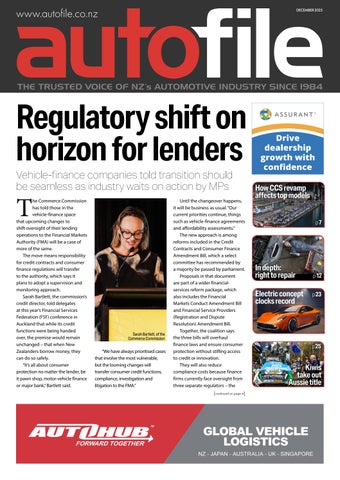
Vehicle-finance companies told transition should be seamless as industry waits on action by MPs
The Commerce Commission has told those in the vehicle-finance space that upcoming changes to shift oversight of their lending operations to the Financial Markets Authority (FMA) will be a case of more of the same.
The move means responsibility for credit contracts and consumer finance regulations will transfer to the authority, which says it plans to adopt a supervision and monitoring approach.
Sarah Bartlett, the commission’s credit director, told delegates at this year’s Financial Services Federation (FSF) conference in Auckland that while its credit functions were being handed over, the premise would remain unchanged – that when New Zealanders borrow money, they can do so safely.
“It’s all about consumer protection no matter the lender, be it pawn shop, motor-vehicle finance or major bank,” Bartlett said.
“We have always prioritised cases that involve the most vulnerable, but the looming changes will transfer consumer credit functions, compliance, investigation and litigation to the FMA.”
Until the changeover happens, it will be business as usual. “Our current priorities continue, things such as vehicle-finance agreements and affordability assessments.”
The new approach is among reforms included in the Credit Contracts and Consumer Finance Amendment Bill, which a select committee has recommended by a majority be passed by parliament.
Proposals in that document are part of a wider financialservices reform package, which also includes the Financial Markets Conduct Amendment Bill and Financial Service Providers (Registration and Dispute Resolution) Amendment Bill.
Together, the coalition says the three bills will overhaul finance laws and ensure consumer protection without stifling access to credit or innovation.
They will also reduce compliance costs because finance firms currently face oversight from three separate regulators – the
[continued on page 4]
Sarah Bartlett, of the Commerce Commission
LOAD IT SHIP IT TRACK IT CLEAR IT DELIVER IT !
BIGGER IS BETTER
move to new, much larger premises means we are to offer even more services to our dealer clients
to door ro-ro vehicle shipping from Japan and Australia
Containerised vehicle shipping from anywhere in the world
Vehicle tracking
VEHICLE SHIPPING
Approved MPI transitional facilities and cleaning services
GENERAL FREIGHT
VEHICLE TRACKING
SHIPPING SCHEDULE
We are specialists in transporting and exporting all types of Vehicles, Commercial trucks, vehicles of Special Interest and other RORO Heavy Cargo & Machinery.
it all off is Jacanna’s SmartTrade Rewards Programme, you can earn points for almost any reward you choose
We have developed a worldwide network of Agents who understand the commitment required to service our demanding market.
www.jacanna.co.nz
Tel: +64 9 825 0888
Finding out where your vehicle is at any one time of the process, gives you the ability to manage the collection and processing of documents and payment on time.
TRS and shipping services from Japan to New Zealand. www.jacanna.co.nz
info@jacanna.co.nz
Tel: +64 9 825 0888
Return to training by industry, for industry
Verna Niao explains what the future holds for MITO with radical changes imminent
On January 1, 2026, MITO will return to industry ownership, marking the beginning of a new era for industry-led training in New Zealand.
For decades, MITO has been proud to support trades training by helping more than 30,000 Kiwis gain nationally recognised qualifications, and build skills that power our automotive, transport, extractives, drilling, mining, quarrying, gas and logistics sectors.
Our industries and trades make a significant contribution to the economy. We’re in every community and part of everyday life – from the vehicles we drive, to roads we travel and the resources that keep our country moving.
When MITO moved under Crown ownership in 2021, the structure of industry training changed. Now, with the government’s support, MITO will return to industry ownership.
This transition reflects a strong partnership between industry and government of a shared commitment to ensuring New Zealand’s vocational education system remains responsive, innovative and aligned with the needs of business.
It also acknowledges the importance of co-investment, with the government and employers working together to train our workforce to drive future growth.
Employers are the cornerstone of this system. They invest time, resources and expertise to train the next generation often while managing the day-to-day pressures
of running their business.
MITO’s role is to support that effort by ensuring government investment complements the considerable contribution made by employers. Together, we create opportunities for thousands of New Zealanders to build rewarding, lifelong careers.
Industry training can sometimes be less visible than classroom or online study, yet it represents around half of all tertiary education in New Zealand. That figure highlights just how vital employers are in developing our national skills base and how important it is that we continue to back them.
It’s been a tough few years for many. That’s why MITO has continued to stand beside learners and employers through initiatives such as our Manaaki Fund for those learners experiencing hardship, expanded learner support services and our ongoing advocacy for Apprenticeship Boost, which is the government’s funding for first-year apprentices.
Encouragingly, we are beginning to see green shoots of growth across several industries.
As we look ahead, the challenge – and opportunity – for employers is clear, and that’s to take on the next apprentice or trainee. MITO offers free support to help businesses find and guide their next learners. There has never been a better time to train. MITO is proud to back our industries, employers and learners as we enter a new era of working in partnership with the government to deliver training that is run by industry, for industry.
DIRECTORS
Darren Wiltshire dazzz@autofile.co.nz ph. 021 0284 7428
Brian McCutcheon brian@autofile.co.nz ph. 021 455 775
DESIGNER
Adrian Payne arpayne@gmail.com
EDITOR
Darren Risby ris@autofile.co.nz
JOURNALISTS
Matthew Lowe matthew@autofile.co.nz
Sue Brebner-Fox sue@autofile.co.nz
MOTORSPORT
Mark Baker veritas.nz@xtra.co.nz
Visit www.autofile.co.nz to subscribe to Autofile magazine and have it delivered monthly in print. The subscription rate is $78 plus GST for 12 issues per year.
Autofile magazine is also available online as a readable file or downloadable as a PDF.
Back copies dating to 2017 can be found on the website where you can subscribe to our Insight email alerts.
Copyright: Published monthly by 4Media Ltd
All statements made, although based on information believed to be accurate and reliable, cannot be guaranteed, and no liability can be accepted for any errors or omissions. Reproduction of Autofile in print or digital format in whole or part without written permission, whether by copying or any other means, is strictly forbidden.
All rights reserved. ISSN 0112-3475 (print) ISSN 2350-3181 (online)
Chris Revell, the FMA’s licensing manager, agreed the move would simplify things for providers by creating one authority to deal with as well as eliminating duplication.
“Licensing focuses not only on the suitability of lenders, but also on their operational and conduct obligations,” he told FSF delegates. “Completing assessments will involve several factors, but especially our evaluation of business models and governance.”
Revell said the legislation included three key areas – fit and proper operators, capability and the likelihood of contravening regulations.
“Everyone involved in the sector will already understand the fit and proper conditions,” he added. “But summarising capability, basically we’re asking what a good provider would do given the requirements and evidence of that, such as good record-keeping and maintaining sound policies.
“While it might sound daunting, it’s just about running a good business because we want things to be as simple as possible for entities in the finance space to understand and comply with.”
Jill Pitches, the Commerce Commission’s certification services manager, told the event on November 6 there were 535 lenders in the vehicle sector, with 440 being certified and the remaining 95 exempt.
“About one-third of those have just a single director and another third have two directors or senior managers,” she noted. “Current certification continues up to
Our strength comes from knowing our customers’ needs, understanding and fulfilling them
the changeover. When it moves to licences, these will be issued automatically.”
Sharing the stage was Anita Frazer, the FMA’s head of licensing and regulatory services. She told delegates three core principles would be carried over – fairness, integrity and efficiency.
“The authority’s role is to regulate the conduct of lenders around interactions with clients. Our approach will be to understand what makes the biggest difference to not only clients, but also for businesses.”
Frazer added different parts of the industry had different needs. “We will continue to work with various sectors to ensure we’re raising trust and confidence in providers and the wider finance sector.”
Michael Hewes, director of deposit taking, insurance and advice, was the third member of the FMA’s on-stage team. He said the authority would be at the forefront of supporting the industry.
“We have supervisory tools, but the model we’ll use is engagement, monitoring and response and enforcement,” he explained. “It’s not about wielding a big stick. It’s working to support industry members. The monitoring phase is probably where most questions arise.
“In action, it’s just a case of setting a scope of engagement and that would start with an information request, having a document client file review, conducting interviews, then releasing findings and actions, before getting feedback from participants and closing the loop.”
Hewes added that process would involve constant feedback. “We will provide significant
notice, at least four weeks, before any monitoring and we’ll talk to providers during the process.
“If we were to identify noncompliance or expose risks, engagement would still take place to give operators an opportunity to correct issues. All of that should help lower the need for more serious interventions. We will be open and approachable.”
Besides streamlining regulation, the coalition’s bills will bring other changes to the Credit Contracts and Consumer Finance Act (CCCFA) to make it simpler for people to access credit.
Parts of the act that don’t fit with the new regulatory approach, such as the due-diligence duty for directors and senior managers, will be removed once the proposals become law.
ENGAGING WITH SECTOR
The FSF has previously described proposals outlined in the bills as “necessary and welcome”.
Lyn McMorran, executive director, says the conference’s session on regulatory change went well, with the Commerce Commission and FMA representatives answering all questions that came their way.
The organisations also recently ran a series of roadshows across the country to explain the transition and work being done ahead of the shift.
“The engagement from the FMA and commission has been good,” adds McMorran. “The FMA, in particular, has been keen to understand the non-deposit-taking lending sector – that’s vehicle lenders and people like that who don’t take deposits from the public – because it hasn’t had any exposure to it up to now.
“It’s good the FMA is trying to
From left to right, Chris Revell and Anita Frazer of the FMA, Jill Pitches and Sarah Bartlett of the Commerce Commission, and Michael Hewes of the FMA
get an understanding of how those lenders operate, their needs and how they’re different to deposit takers.”
McMorran told Autofile the main bugbear at present for the FSF, its members and regulators is the lack of a timeframe for when the handover will take place.
“We don’t know. The Commerce Commission and FMA can’t tell us because it’s all subject to the CCCF Amendment Bill going through parliament and being enacted.
“We’re reasonably happy with where the select committee landed with changes to the bill. Now it’s just sitting there. It worries us not knowing when the bill is going to get through the process and be passed.
“We would like to see a reasonable level of urgency from politicians so people can get on with it. The regulators can’t do the things they need to because they don’t know when they will have the mandate.”
While the industry waits for the bill to have its second and third readings, the commission remains the regulator for credit contracts and consumer finance.
It’s still following up on some open cases and investigations, with at least a couple understood to relate to car finance. It will continue with those until the new system comes in, which is when responsibility for them transfers to the FMA.
The latter has more expertise and experience in regulating financial services. For example, it has broader powers such as stop and enforcement orders, warning letters and litigation through to criminal charges.
“Having a wider range of tools means the FMA can take action more effectively and swiftly than
the Commerce Commission when it sees bad behaviour,” says McMorran.
The regulatory handover will bring other changes for FSF members. Directors and senior managers of consumer lenders must currently be certified by the commission as fit and proper. Those people will automatically be transferred to the FMA’s licensing regime at the appropriate time.
However, McMorran notes questions remain about what the conditions will be and how much may have to be paid in levies.
“For now, lenders just need to continue doing what they do and ensure they’re fully compliant and keeping good records.
“The act itself is not changing drastically other than the change of regulator, so it’s business as usual and don’t break the law.
“It’s looking doubtful the bill will get passed this year, but we hope it gets through before parliament starts concentrating on next year’s election.”
LEARNING LESSONS
“Our environment constantly changes be it war, trade, pandemic, politics or regulatory. Rather than see that as a threat, we need to be prepared and even welcome it. Change presents an opportunity to set out our purpose, which is essential because if we don’t the regulators do.”
That was the message from Diane Tate, chief executive officer of the Australian Finance Industry Association, to those attending the FSF’s conference.
Australia’s royal commission into the lending sector, and industry reforms that followed, caused upheaval for many reasons across the ditch, not least because of confused messaging.
“We were told to make finance
available to all – but not to lend to everyone, to act ethically without defining what that meant and protect the vulnerable while somehow magically enabling them to access finance more easily.
“Businesses need regulations that are easily understood. Members of the sector will tell you they want efficient, ethical, responsible and fair practices, and that aligns with what consumers want too.
“Reputation is all in a regulated industry and self-regulation, keeping checks on your own polices and standards, is critical to that. In one study, seven out of
every 10 customers said they’d quit their non-bank lender if they didn’t have standards.”
Australia and New Zealand, Tate argued, were supportive of balanced regulation. However, the situation became so confused after Australia’s reforms that in two court cases, around responsible lending and unfair trading practices, it was ruled that interpretations of the law were wrong.
“Something is amiss when the people charged with upholding the law are getting told by the courts that they are wrong.”
Tate said it was critical regulatory systems were fair to all parties because the lending sector was an important part of the economy. “We are the ones that oil the wheels, who allow the finance that businesses rely on. We need to regulate for growth so that can continue, and our economies can expand and provide the revenues and jobs our countries require.
“The lending sector isn’t some kind of bogey trading on the weak,
[continued on page 6]
EASY APPLICATION
Submit two downloadable forms and simply send to us for review.
COMPETITIVE INTEREST RATES & FEES
Our partnerships give us the ability to offer superb lending rates.
EFFICIENT SERVICE
Hear back from our team about finance in as little as 24 hours.
NZ BASED
Autobridge is New Zealand based and covers the country, so we are never far away when you need us.
www.autobridge.co.nz 09 320 5646
Delegates at this year’s FSF conference in November
but bad players can damage the reputation of the sector. It’s the old ‘it only takes one bad apple’ story. That’s why no one should fear oversight, even if it isn’t always perfect. If it means fewer bad apples, that’s a good thing.”
SECURITY ESSENTIAL
As technology advances at a staggering rate, it’s becoming easier for hackers and cybercriminals to infiltrate companies and the gateway into systems is often a simple email.
Peter Bailey, KPMG’s director of cyber-security, said: “This is a big business, one that New Zealand should not kid itself it’s exempt from with international players launching thousands of attacks every day.”
He highlighted the case of Jaguar, which is still coming to grips with an attack that has cost it billions of dollars. Hackers obtained staff details, installed malware to disrupt systems and customer data was leaked alongside employee
records after a ransomware attack.
The company’s supply chain was impacted and 100,000 jobs were put at risk as the British government was forced to step in and provide support.
It was only able to restart production after prioritising upgraded IT systems. Some 5,000 businesses have been impacted and experts say a full recovery won’t kick in until January.
Bailey said cyber-crime is a sophisticated business.
“It’s widespread in south-east
Asia where talented programmers are being lured into what they think are tech jobs, only to have their passports seized and be forced into launching attacks.”
He conceded cyber-security was one of those things that gets talked about so often a degree of fatigue creeps in. “But it’s always about risk mitigation. There’s no magic security dust, so I’d advise everyone in the lending sector to remain vigilant and regularly review online protections.”
FRIENDS & FOES
Shane Jones, NZ First’s deputy leader, and Act’s Todd Stephenson might serve alongside each other in the coalition, but their visions don’t necessarily align.
Detailed to share party perspectives on supporting growth and ensuring balance in the lending sector, both accepted the government has no option but to rein in spending.
The pair met on solid ground during their conference debate when it came to bureaucracy, saying red tape hampered businesses, not least in lending where previous regulations were unworkable, leaving companies uncertain how to proceed and with unmanageable costs.
Stephenson said Wellington bureaucrats didn’t care if an employee had to fill in yet another form, having little understanding that all the requirements came at a cost in terms of time and labour.
Jones went further, damning regulations that scuppered projects.
“We make everything too bloody hard. If you want to build more, you need more money, so you need to make it easy to achieve that.”
Stephenson said companies should welcome regulatory changes, which would make it easier to do business. “They will clear the way for making it easier to get finance because red tape will be swept away.”
Jones pointed out moves to restore more freedom in the financial market sector were taken after feedback from the industry. “But there’s more we can do yet to get regulations right for our financial and banking sector.”
Extra online
Visit autofile.co.nz for more in-depth reports from the conference.
Turn to page 28 for FSF award-winner photos
“We make no apology for being focused on growth,” Stephenson told FSF delegates.
“Our priorities remain repairing the economy, job market and getting government spending under control. We’ve had to make some tough decisions, but can now focus on growth, employment and infrastructure.”
Jones acknowledged the criticism infrastructure spending had been hit too hard. “But we can’t continue to spend the way we had been. That meant everything was up for review, which meant some projects were reviewed.”
Both agreed further reform around credit regulations would be beneficial, Stephenson arguing access to capital remained a major barrier for lenders, and the Reserve Bank review and wider banking inquiry would ultimately make it easier to access overseas investment, weakening the power the big banks wielded over the wider industry.
NZ First’s position was also that the “big Aussie banks” were too dominant at a time when they were reducing services yet reporting massive profits.
“To be honest, most politicians shy away from confronting the banks, but we say finance at local levels is worth supporting.”
Coalition MPs Shane Jones, left, and Todd Stephenson
Action set to cool price rises
Taking two years to implement a new-look clean car standard (CCS) is being hailed as a sensible way to revamp a scheme that large parts of the industry say is costing New Zealand hundreds of millions of dollars without reducing emissions.
The government passed legislation last month that will cut fees for new and used imports by about 80 per cent for 2026 and 2027. It has also pledged to complete a full review of the CCS, with recommendations set to go before cabinet by June next year.
From January 1, penalties under the scheme will drop from a top rate of $67.50 to $15 per gram of carbon dioxide (CO2) for new vehicles and from $33.75 to $7.50 for used imports.
The coalition is also aiming to protect CO2 credits by ensuring
Toyota RAV4 GX 2.5PH/4WD
Toyota Hilux SR5 Cruiser TD DC
Mitsubishi ASX LS 2.0P/CVT
$1,350
$6,075
Kia Seltos LX 2.0P/IV $4,658
Nissan Navara Pro-4X 2.3D/4WD/7AT
Mitsubishi Triton DC VRX 4WD 6AT 2.4DT $1,823
Ford Everest Platinum 3.0D/4WD
$8,775
The government says these are “indicative and based on publicly available information about models. In practice, charges may vary”. The old charges for 2026 were based on $67.50 per gram of CO2 while the new charges are based on $15g.
that none expire before December 31, 2028.
The Motor Industry Association (MIA) has welcomed the move and says the changes will restore balance, support emissions progress, and address an economic and environmental problem that has become unsustainable for the market and consumers.
It notes the scheme, introduced in early 2023, was designed to lower
emissions by influencing the type and mix of vehicles crossing the border.
However, while the CCS has pushed forward the supply of EVs, buyers haven’t committed to such cars at the same pace.
be electric but sales are closer to one-in-10. From 2026, the target tightens to about one-in-four.
Aimee Wiley, MIA’s chief executive, says the cap on CCS
The standard’s settings for this year anticipate about one-in-five new light passenger vehicles to
new-vehicle industry forecasts show compliance costs are likely to be about $125 million in 2025 and would have risen to around
[continued on page 8]
$153m in 2026 if the fees remained the same.
“We aren’t stepping back from environmental goals,” adds Wiley. “We are repairing a system that was costing hundreds of millions of dollars without reducing emissions. This is climate action that will work.
“Importers unable to earn enough credits have been drained financially, putting vehicle prices at risk and limiting the ability to invest in the technologies that genuinely lower emissions.”
She explains a two-year transition is essential because the first year allows the reset to be completed, while the second provides time for legislative changes, consultation and industry preparation. New vehicles often have long lead times, so the sector needs certainty to plan and order appropriately.
“A shorter or rushed process would risk further disruption,” says Wiley. “A two-year window is needed to rebuild a credible and workable clean vehicle standard. This approach protects consumers today, and gives importers the space needed to prepare for a new and improved system.”
The MIA highlights that consumers have shifted towards hybrids since the clean car discount (CCD) ended but many of those vehicles will attract penalties from 2026.
With a large share of the market
USED IMPORTS – EXAMPLES OF REVISED CCS CHARGES FROM 2026
2014 Toyota Aqua DAA-NHP10
Toyota C-HR DAA-ZYX10
Toyota Prius DAA-ZVW30
2014 Nissan Note DBA-E12
Vezel DAA-RU3
2014 Honda Fit DAA-GP5
2014 Mazda Axela DBA-BMEFS
2014 Nissan X-Trail DBA-NT32
The above figures are based on fees for the CCS pay-as-you-go system, which most used importers operate under. These will be $6/gCO2 from 2026, while the fleet average is moving to $7.50/gCO2. The reduced CCS penalties will not automatically mean a drop in sticker prices on yards.
Source: VIA
in the hybrid category, and the low uptake of battery EVs and plug-in hybrids (PHEVs) expected to continue, the gap between targets and consumer behaviour risks widening.
Epps points out about 70 per cent of used imports are currently penalised and half of those charges are more than $1,000, which means buyers in the $10,000 to $15,000 price bracket often walk away or trade down, slowing fleet replacement.
“When policy pushes supply in one direction but demand doesn’t follow, strain becomes severe,” says Wiley. “Prices rise and choice shrinks, businesses face increasing costs and consumers ultimately carry the burden.
“That’s exactly what’s been happening. Without intervention, prices would likely have risen sharply in the months ahead and many affordable models would have disappeared from the market while emissions remained largely unchanged.”
The Imported Motor Vehicle
Industry Association (VIA) describes the coalition’s decision to cut penalties for used imports as a “sensible circuit-breaker” that will take the heat out of prices while the system is reviewed.
“Our members have supplied evidence and case studies that got us here,” says Greig Epps, VIA’s chief executive. “We thank ministers and MPs who listened.”
He suggests the lower penalty rate should stabilise retail pricing to keep buyers in the market, accelerate the refresh of the fleet, and improve emissions and safety outcomes.
VIA wants next year’s review of the CCS to fix the scheme’s underlying architecture, especially the weight adjustment used in the target-setting algorithm.
“A key problem is weight adjustment,” says Epps. “It distorts outcomes for practical family cars. Judge vehicles on their actual emissions and let credit trading work across the whole market. That’s how you deliver affordable, lower-emitting cars faster.”
Meanwhile, the Motor Trade Association (MTA) says reducing the CCS fees for two years is one of the most significant shifts in vehicle emissions policy since the scheme was introduced.
With the consumer-focused CCD gone, the CCS is one of the few levers the government has to influence the supply and demand of new and used vehicles, whether electric or not.
Lee Marshall, chief executive,
Toyofuji vessels Voyage
JAPAN
ZEALAND Moji Osaka Nagoya Yokohama Auckland Lyttelton
adds: “While this move will provide immediate relief for dealers and consumers, it raises important questions about the long-term direction of emissions policy –crucial for business continuity and planning.
“The danger in moving to such extremities is that it sets us up for an equally radical swing back in the future given the lack of a bipartisan approach to the issue.
“The automotive industry shouldn’t be a political football. Businesses need consistency to plan around as manufacturing allocations and product mixes are sometimes locked in years in advance.”
As for the CCS review, he says this will provide the industry with another opportunity to help shape the future of emissions policy and the MTA encourages members and stakeholders to make their views heard.
Chris Bishop, Minister of Transport, announced the changes in the Land Transport (Clean
“The
Vehicle Standard) Amendment
Bill (No 2) on November 17 and the legislation was passed by parliament three days later.
He says the government acted quickly to put the temporary measures in place to avoid the risk of an estimated $264m in net charges faced by vehicle importers being passed on to households and businesses.
“The standard has helped lift fuel efficiency, but market conditions have changed, and
Loans as diverse as our customers
A multi-tier auto lending solution for new and used vehicles for business and personal use
Consumer. Commercial. Wholesale. Lending criteria, fees, terms and conditions apply
there’s a supply shortage of cleaner used vehicles and demand for new EVs has dropped,” he explains.
“The system isn’t working with 86 per cent of importers unable to meet the standard without incurring additional charges on the vehicles they are bringing in. The danger is these extra costs will be added to vehicle prices.
“These changes mean Kiwis can still upgrade to cleaner, more fuelefficient cars, while giving us the space to make sure the standard is actually workable and delivers a long term, sustainable path to lower emissions that fits New Zealand’s needs.”
Trade Me Motors is backing the reforms, saying the adjustments strike a better balance between environmental ambitions and the realities of global vehicle supply.
Over the past year, rising clean car standard penalties on top of international competition for used stock – particularly from Japan – have contributed to higher average vehicle prices and
a declining supply of imports to our shores.
Steve Vermeulen, industry relations manager, says recalibrating the scheme will help restore access to the types of vehicles most New Zealanders rely on and make them more affordable.
“In essence, the revised penalties mean more choice and more affordable pricing for Kiwis as we all recover from a tough financial climate.”
He adds the CCS is wellmeaning. But the pace and scale of its targets have resulted in unintended consequences, especially for used-vehicle supply where New Zealand depends on overseas production decisions.
“As a market, we have no control over what cars are produced. The originally proposed CCS, while ambitious in its environmental goals, has contributed to a much narrower window of vehicles that could be supplied at reasonable costs.
“For everyday New Zealanders,
[continued on
revised penalties mean more choice and more affordable pricing for Kiwis,” says Steve Vermeulen
Stock challenges continuing
Turners Automotive Group says it has again shown its ability to perform in a challenging market by posting record results despite “subdued consumer conditions”.
It reports progress is being made across its core businesses and, with the wider economy showing some signs of recovery, its “strategy and capital discipline position is to drive further growth”.
Net profit before tax (NPBT) came in at $30.4 million for 2025/26’s first-half for a year-onyear jump of 13 per cent. NPAT climbed by 13 per cent to $21.9m.
Group revenue rose by five per cent to $219m with expansion across automotive retail, finance and insurance more than offsetting “softness” in credit management.
Overall earnings before interest and tax increased by 10 per cent to $34.1m reflecting
stronger divisional performance, improved vehicle margins and cost discipline.
“Delivering record profit in a challenging environment is an achievement,” says chairman Grant Baker. “It reflects the strength of our diversified model and disciplined execution across every part of the business.
This drove margin growth on owned stock and improved operational efficiency during the six months up to September 30. Lease and import unit sales dropped, while overall demand has been “patchy, consistent with a two-speed economy”.
cent jump in profit compared to the same period last year. Its loan book grew by 13 per cent, supported by strong origination and improving credit quality. Net interest margin remained stable, aided by easing funding rates as the company pushed for a higher proportion of the market.
“Turners continues to grow shareholder returns while investing for the future. Our balance sheet gives us the flexibility to keep building on this momentum.”
The automotive retail division has seen a major uplift in marketing spend with the launch of the Tina 2.0 campaign.
Drive Smarter Decisions With Your Data
AutoBI empowers automotive and materials-handling businesses with costeffective, cloud, fully outsourced reporting, business intelligence (BI) and AI.
Our tailored solutions convert integrated data into actionable insights, driving growth, efficiency, and smarter operations through visual dashboards and analytics.
New Zealand’s used-car market continues to show resilience despite registered dealer numbers declining to their lowest level since May 2012.
Sourcing vehicles “remains challenging across the industry”, but margins benefited from disciplined buying and tighter inventory management.
Finance was Turners’ biggest “growth engine” with an 18 per
[continued from page 9]
that has meant fewer options and incrementally higher prices at a time when households can least afford it.
In contrast to supporting the government’s intervention, Drive Electric says the CCS changes are incredibly disappointing and will hamper increased adoption of EVs.
Kirsten Corson, who chairs the industry group, says if the coalition wants to drop costs for consumers it should be trying to accelerate the uptake of low and zero-emissions models.
“The irony of the government’s decisions is that EVs are more cost-effective to run than other vehicles and can help Kiwis save money. It costs $3 to charge an electric car off-peak overnight but it’s about $20 to put 6.9 litres of petrol in a car.
“It also doesn’t matter whether you’re a petrol, diesel or electric vehicle importer, what the industry needs is consistency because they’re ordering vehicles 12 months in advance, so this latest set of changes to the
Solid expansion continued in insurance with 10 per cent premium growth from digital distribution and market gains.
Servicing and repairs leveraged strong brand recognition, and the business’ expansion continues with new VTNZ partnerships. When it came to credit management, half-year corporate debt load was down and lower than expected. Clients have been finding it harder to consistently meet repayments, which reflects the economy.
standard is incredibly hard for whatever side of the industry you’re involved with.”
Drive Electric views the amendments as the latest setback for efforts to increase EV uptake. Corson highlights that the coalition has axed the CCD, introduced road-user charges for BEVs and PHEVs, increased ACC levies for EV owners and altered the CCS targets.
She fears the new laws will also result in older, less efficient cars staying in the fleet for longer.
“The government has mindfully changed policies and created a penalty for a plug,” says Corson. “Other countries are trying to support EV uptake but in New Zealand we’re creating barriers. It’s an embarrassment.
“When you compare us to Australia, they have got a $100 penalty fee and we have now reduced ours to $15. It means we will become a dumping ground for high-emissions vehicles, which will stay on our roads for several decades.”
Grant Baker
BUY SMARTER. SELL FASTER. STAY AHEAD.
Hundreds of vehicles auctioned every week and nearly 1,500 users ready to trade.
Auction Online gives you real-time access to the true used-vehicle market, nationwide. Buy, sell and manage stock from anywhere – fast, transparent and competitive.
Whether you’re clearing trade-ins, moving aged stock or filling your yard, our streamlined auction platform simplifies every step.
• Nationwide dealer network
Almost 1,500 users actively buying and selling.
• Real-time pricing transparency
Live bidding ensures you always hit true market value.
• High stock turnover
Hundreds of vehicles auctioned every week across NZ.
• Purpose-built dealer platform
Designed specifically for franchise & independent dealers.
• Fast, simple, secure Seamless listings, bidding and purchasing from one platform.
Join Auction Online today and start trading smarter
Consumer laws in spotlight
Adealership group and a number of marques have advised politicians that any overhaul of right-torepair rules should carve out a separate set of regulations for the automotive industry.
Their comments came as a select committee considered submissions on the Consumer Guarantees (Right to Repair) Amendment Bill, which sought to require manufacturers to make repair parts and information available to New Zealanders to extend the lifetime of products.
While the intent of the proposals received general support, many of those linked to the automotive sector say a onesize-fits-all approach would risk jeopardising the safety of repairers, technicians and vehicle users.
Their concerns will have been allayed after the member’s bill, which was put forward by Green Party co-leader Marama Davidson, was dismissed from parliament in October after she was late to its scheduled second reading by a few minutes.
It means any reforms of the Consumer Guarantees Act (CGA) are off the table for now, although the topic is likely to rear its head again in the future with Davidson saying she will not give up on trying to change the current legislation.
As a result, those who made submissions this year will hope their arguments are considered if and when officials draft any subsequent proposals.
Davidson’s bill would have replaced the guarantee as to repair and access of spare parts in the CGA. Instead, her proposals involved manufacturers having to ensure facilities for fixing goods and parts were available for a reasonable period post-purchase.
Manufacturers would also have had to provide buyers, upon request, with information, parts, software and other tools used for diagnosing, maintaining or repairing goods.
The
The industry’s three main organisations, the Motor Industry Association, Imported Motor Vehicle Industry Association and Motor Trade Association, all voiced concerns about the practicality, costs and safety of the proposals.
Individual companies also had their say on Davidson’s bill, with most stating the car industry would benefit from bespoke legislation rather than broad changes applying to all consumers.
SAFETY KEY ASPECT
The Giltrap Group stated its strong opposition to the right-to-repair proposals and urged members of parliament to “consider an approach that prioritises safety, security, accountability and industry integrity”.
Its submission was made by Greg Fleming, of European Motor Distributors, which is part of the group and represents 19 automotive brands.
“The bill presents significant challenges that would impact every aspect of our operations, from ensuring consumer and vehicle safety to protecting our intellectual property and maintaining industry compliance,” he says.
“As an organisation that invests heavily in training, safety standards and authorised repair networks, we have serious concerns about the unintended consequences of granting unrestricted access to critical repair information, software and tooling without appropriate safeguards.
“The Consumer Guarantees
(Right to Repair) Amendment Bill introduces serious public and repairer safety risks, compromises industry accountability and lacks sufficient enforcement mechanisms.
“While reducing waste and repair costs are valid objectives, they must not come at the expense of safety, reliability or industry integrity.”
Fleming adds that vehicles have become increasingly complex, integrating advanced safety systems, proprietary software,
Reducing waste and repair costs are valid objectives but they must not come at the expense of safety
– Greg Fleming, European Motor Distributors
high-voltage systems and specialised repair methods.
He believes the bill lacked critical oversight mechanisms to ensure repair quality, vehicle compliance and repairer accountability, which would create a high risk of incorrect and unsafe repairs and potentially lead to malfunctions, failures or accidents.
“If unqualified individuals or
inadequately trained independent repairers gain unrestricted access to these systems, the potential for dangerous, low-quality repairs increases, and puts repairers, vehicle operators and road users at risk.”
Another area of concern highlighted by Fleming for any overhaul of the CGA is brand integrity.
He says a brand is more than just a product and represents decades of investment in research, safety and customer experience while upholding specific values.
Fleming believes the bill would have undermined brand identity by forcing manufacturers to relinquish proprietary repair methodologies and tools, diminishing the value of authorised service networks.
“Individuals and independent repairers have no obligation to maintain quality standards and do not contribute to a brand’s technological advancement, training programmes or consumer safety initiatives, yet they would gain unrestricted access to sensitive safety and security information.”
The Giltrap Group proposed an alternative approach to rightto-repair rules from the one that went before parliament, saying a more balanced framework should be pursued to enhance consumer rights without sacrificing safety and accountability.
Fleming says if the bill had proceeded then access to repair information should have been limited to vetted and trained repairers who meet established safety and competence standards. He also called for manufacturers to retain control over repairs affecting safety systems, emissions and structural integrity.
SUPPORT FOR BILL
The Low Volume Vehicle Technical Association (LVVTA) backed the intent of the Consumer Guarantees (Right to Repair) Amendment Bill, but says practical issues in it would
parts and distribution centre of European Motor Distributors, part of the Giltrap Group
have needed addressing to ensure it worked for consumers and professionals.
It notes the proposals appeared to state only the consumer would be entitled to request repair information from a manufacturer.
the automotive industry, and would have imposed substantial challenges and costs.
Gavin Young, after-sales manager, notes in his submission that vehicles are complex products, particularly with the
[continued on page 14]
The LVVTA says the bill could have improved repair choices and accessibility for consumers
major financial burden on Hyundai NZ in managing and storing parts inventory for every model ever sold, including those no longer in production.
“As a result, we would then have no option but to factor these additional expenses into new vehicle and parts pricing, making them more costly for customers.”
While the bill sought to promote consumer choice in vehicle maintenance and repair options, Young says it overlooked several critical aspects related to safety, parts quality, durability and overall long-term performance.
A lack of provisions specifying the mandatory qualifications or certifications needed to perform complex repairs on vehicles’ safety systems was also a concern.
He suggests officials need to
work closer with the industry to ensure any legislation includes detailed, more realistic and balanced guidelines tailored for the sector to “safeguard customer safety, protect manufacturer and dealer investments, and maintain the integrity of warranties and performance standards”.
Submissions from Isuzu Utes NZ and Renault NZ were almost identical, and put forward by service manager Lance Roskilly.
He notes the proposed amendments took a broad approach but lacked the necessary specifics for the car industry, which significantly differ from the context of common household appliances and simpler equipment.
“While it may seem reasonable to provide repair information and spare parts for such appliances,
the same logic cannot be directly applied to vehicles, especially with the rise of EVs,” explains Roskilly.
“Vehicles are inherently more complex, and their maintenance, diagnostics and repair require specific expertise to ensure safety for all involved – technicians, drivers, passengers and other road users.”
He adds dealer networks for the two marques have invested in facilities, resources, technical equipment and staff training to meet these challenges over the years.
As official distributors for Isuzu and Renault, the companies note stock of replacement parts is maintained while a model or variant is still in production, typically for six to eight years.
Parts remain stocked for a few more years after production ends, particularly for high-volume models still in use.
Roskilly says the bill lacked clear definitions of what would have constituted a “reasonable” timeframe to hold parts. It could have burdened companies with the significant financial responsibility of managing and storing parts for every model ever sold.
This would likely have led to higher costs for New Zealanders because those expenses would be passed on through increased vehicle and parts pricing.
information to third-party requesters, we would be placing our own network at a significant financial disadvantage.
“Our global and local IT systems are not set up for third-party access, and implementing these changes would require substantial investments in IT infrastructure and ongoing resources, which would increase costs for third parties wanting access.”
As for the push to allow thirdparty repairers, he says such a move could result in substandard service, while the use of nongenuine parts may compromise vehicle safety and performance.
COMMITTEE’S VERDICT
While the amendment bill faltered after Davidson’s late arrival in the house for its second reading, a select committee had already recommended by majority that the bill not be passed.
Parmjeet Parmar, chairperson of the economic development, science and innovation committee, presented a report to parliament on August 18 noting the committee received 1,250 submissions on the bill and heard oral evidence from 42 submitters.
Roskilly was also unhappy the bill suggested manufacturers would have had to provide maintenance and repair information, including sensitive vehicle-security codes, and at no charge unless the consumer requested paper copies.
“Our authorised dealers already pay for access to repair manuals and diagnostic platforms. If we were to supply the same
More than 95 per cent of submitters supported the bill and its general aims, with nearly two-thirds of those backing it as introduced and others recommending changes such as widening or narrowing the range of products and sectors affected.
“Submitters opposed to the bill voiced concerns about negative commercial effects, unintended consequences, health and safety, and the complexity of implementing it,” says Parmar. “Some agreed with the general objectives but disagreed with the bill’s approach.”
Hyundai NZ says vehicles are complex products, particularly with increasing volumes of EVs.
From left, the marque’s Kona Series II, Ioniq 6 and Ioniq 5
Marama Davidson
Save time. Sell faster.
Dealers use AutoGrab’s MyListing module daily to see how their listings are performing, gain insight into what competitors are doing and improve their business profitability. Your Listings. Made simple.
Going green with old parts
Recycling an increasing number of car parts as they reach the end of their life is still firmly on the agenda as members of the industry seek to build on the success of Tyrewise.
The country’s first regulated product stewardship scheme marked its first year of operation in September by surpassing its initial goals with nearly 4.5 million end-of-life tyres (ELTs) collected and transformed into fuel or repurposed for other products.
Auto Stewardship NZ (ASNZ) is the governance organisation for Tyrewise and contracts the 3R Group, which is based in Hawke’s Bay, to manage the scheme.
It’s also the owner of the Battery Industry Group (BIG) scheme for 5kg-plus batteries, including those found in EVs, which the Ministry for the Environment (MfE) also declared as priority products in July 2020.
Mark Gilbert, who chairs ASNZ, says its trustees have recently met to put plans in place to speed up a strong circular economy through the “environmentally sustainable stewardship” of all automotive components.
With a design application for BIG with the government for review, the trustees are now keen to build on the success of their first two major projects and make progress in developing other vehicle-related stewardship schemes.
“We have stood Tyrewise up and that has built a large network of participants in the vehicle sector,” Gilbert told Autofile. “While an extended producer responsibility structure can be similar across all vehicle parts, the different nuances of each part require a unique management system.
“With EV batteries, the scheme design considers their complexity, safety and handling relevant to chemical composition and type, which changes frequently.
“We needed to understand their componentry, what recyclers and those repurposing them can or can’t do with them, what
Progress is being made to establish a stewardship scheme for large batteries, including those from EVs
capacity we have in New Zealand and consider proximity to markets that will take back products, such as black mass for reuse into new batteries.”
Plans are being developed globally for a passport scheme, whereby each unit will have unique identification enabling access to sustainability, traceability and performance data across the battery’s lifecycle. This will also help efforts to create a circular economy for products.
“There are more EVs coming
The industry needs to have a clear strategy for whatever end-of-life part it may want to target – Mark Gilbert
schemes”, was needed because of a market failure to deal with ELTs.
He says it’s now widely supported by the supply chain and he anticipates similar industry backing will be needed for projects involving other vehicle parts at end of life. Bumpers, plastics, lubricants and refrigerants are among the items under scrutiny to better manage their recovery.
Gilbert says the experience of ASNZ’s trustees and those within Tyrewise’s supply chain should prove invaluable to helping other
effort into these things. That’s why a successful scheme has the whole supply chain in the room so we can bake the cake with everyone’s ingredients going into it.
“That’s a reason why Tyrewise’s design has been so successful. From the get-go, no one was trying to do this alone.”
Gilbert, who has more than 30 years’ experience in the car industry, is one of six trustees at ASNZ.
into the country, and cars already in the fleet have batteries,” adds Gilbert. “Increasingly, manufacturers are wanting to reincorporate recovered materials back into production.
“We are progressing large batteries with the MfE and we’re keen to keep that moving along. A final scheme requires cabinet support, but at least things are happening in the background.”
Gilbert says Tyrewise, which he describes as the “gold standard of international tyre stewardship
operations come to fruition.
“The benefit of working with Auto Stewardship is we understand the need for scale and collaboration,” he explains.
“You can’t do all these things individually. The industry needs to come together and have a strategy for whatever end-of-life part it may want to target. We’ve got the smarts after putting Tyrewise together to assist different sectors if they want a scheme.
“No one manufacturer on its own has the scale to invest time and
The others include Sturrock Saunders, president of the Motor Trade Association (MTA) and chairman of MITO, David Vinsen, chief executive of the Imported Motor Vehicle Industry Association from 2003-23, and professional director Samantha Sharif, who sat on MTA’s board for eight years from 2015.
Completing the ASNZ board are Peter Ryan, chief operating officer at Vector, and Peter Holley, CEO of Mission Estate Winery.
Gilbert notes all have valuable professional skills. “We’re able to potentially add to the number of trustees with a specialist or someone with knowledge of whatever area the industry might wish us to move into.
“We can have up to 10 trustees. The door is always open as we bring other products under our structure. We’re looking forward to reconnecting with all industry bodies and helping them lead the way as extended product responsibility becomes more critical for automotive importers.”
Time to refuel, rethink, reinvent
If 2024 was about embracing digital fundamentals, 2025 was when Kiwi car dealers got sharper about performance.
From shifting media mixes to automating lead attribution, this year’s most impactful campaigns weren’t necessarily the flashiest – it was those built on better data, faster feedback loops and clearer returns.
We kicked off 2025 by mapping out the digital road ahead. January’s piece in Autofile forecasted rising ad costs and evolving buyer behaviours. It urged dealers to build resilience by investing in first-party data, attribution foundations and flexible creative strategies.
February followed up with a call to action, which was audit before you accelerate. By assessing platforms, tracking, creative and partner alignment, several dealers uncovered costly blind spots. One Auckland-based franchise discovered more than 60 per cent of its Google Ads’ budget was pointing to broken landing pages. A quick fix doubled its conversion rate.
March reminded us digital wasn’t a one-size-fits-all game. We explored how buyer behaviour has shifted with longer research windows, multiple devices and a growing preference for finance-first browsing. Traders who adapted by
running always-on retargeting and lead nurturing saw up to 38 per cent better costper-lead outcomes versus traditional burst campaigns.
By April, the spotlight turned to digital partnerships. One standout case study came from a regional group that consolidated its ad-tech stack under a single partner. The results were better budget control, clearer reporting and a 22 per cent uplift in appointment bookings thanks to reduced platform overlap.
JAMES HENDRY Director, sales and operations AdTorque Edge NZ
May zoomed out to review our media landscape. Streaming audio, retail media and digital outof-home continued rising, while traditional radio and TV fragmented. Dealers willing to test newer formats, including YouTube Shorts and Spotify Ads, achieved more targeted reach at a lower cost per engagement.
June and July focused on the power of video. We showed how Kiwis increasingly expect walkarounds, test-drive clips and finance explainers before stepping onto yards. In one example, a Wellington dealer used automated
templates to produce more than 200 model-specific videos in a month, saving time and lifting engagement on listing pages by 47 per cent.
August challenged traders to pause and benchmark. Are your results good or just better than last month? We shared a customisable set of KPIs by channel, format and funnel stage. A South Island dealership using this discovered its retargeting click-through rate was 1.7 times above national averages, prompting a strategic budget shift that delivered stronger return on investment.
Come September, we brought it all together by mapping the modern buyer’s journey. Rather than expecting a lead to convert after a single click, top-performing dealers layered their media with awareness via YouTube, mid-funnel traffic from Meta and bottom-funnel conversions through branded search. One business using this approach saw average time to sale drop by 5.4 days.
In October, we examined budget strategy in a post-iOS world. With
INVENTORY VIDEOS
FIND OUT MORE
tracking limitations, smarter dealers shifted budget incrementally not away from Meta, but towards channels proven to drive branded search and customer relationship management (CRM) engagement. A Hamilton-based business, which reduced its Meta budget by 20 per cent and reallocated to digital audio and Google Display, saw a 31 per cent drop in cost per lead.
November tackled the holy grail of linking clicks to vehicles sold. Traders who implemented automated UTM tracking and CRM integration began tying deliveries back to their source campaigns. One dealership discovered that 80 per cent of its final sales came from search-based leads, not social, a statistic that fundamentally changed its media mix.
Each of these lessons speaks to a larger truth. The future of digital success lies in attribution, agility and alignment. As AI, automation and audience fragmentation accelerate in 2026, dealers who win won’t necessarily be the biggest spenders. They’ll be the best at connecting data, partners and messages to the outcomes that matter.
Thanks for reading during 2025. Here’s to another year of sharper clicks, better leads and more cars on our roads.
Industry movers
MICHELE COMELLI has become president of Ferrari Australasia with responsibility for the company’s operations, strategy and growth on both sides of the Tasman.
Comelli, pictured, has worked for the company since 2004. His roles have included head of Ferrari South Europe, senior sales manager in the US and head of international marketing at the company’s headquarters in Maranello.
His technical and engineering background includes contributions to Scuderia Ferrari Formula 1 where he was part of the constructors’ championship-winning campaigns in 2007 and 2008.
Comelli says: “Australasia has one of the most enthusiastic Ferrari communities in the world. Together with the talented team at Ferrari, we will continue to nurture our extraordinary community and write the next chapter of Ferrari’s legacy in New Zealand and Australia.”
He has succeeded Jan Hendrik Voss, who held the position for five years. Voss has now become president of Ferrari Mainland China, Hong Kong and Taiwan.
BILGEN TUG has joined Nissan Oceania as director of brand and customer experience from Maserati where she was global brand manager based in Italy.
In her previous role, she was responsible for developing strategy, driving model profitability, and creating alignment between all global functions and regions on product, marketing communications, customer experience and commercial.
Tug, pictured, has taken on her new role from Sriram Padmanabhan, who is now leading a future-ready transformation project for Nissan India.
Andrew Humberstone, Nissan Oceania’s managing director, says: “We recently launched our new brand strategy ‘defy ordinary’ and are well under way with this rollout.
“Bilgen’s experience in managing global brand marketing will be crucial to further our position in Oceania.”
GREGOIRE OLIVIER has been promoted to become head of Stellantis in Asia-Pacific and China.
He was previously head of China strategy and operating officer for China from 2021, and was responsible for the company’s liaison office to Leapmotor.
Olivier began his career as a civil servant in France in 1984 and was appointed adviser to the Prime Minister for Industry and Environment there in 1990.
He then held leadership roles in metal and electronics businesses in Greece and the US before joining a French aerospace company.
ALISTAIR SCOTT has joined Heartland Bank as chief automotive and asset finance officer.
With more than 30 years’ experience in the car industry, he was most recently managing director for Jaguar Land Rover’s Asia-Pacific region overseeing operations in 16 markets.
Changes at the top of transportation group
Intelligent Transport Systems New Zealand (ITSNZ) has announced the appointment of Kim Mundell as its new executive officer.
Mundell, who has taken on the role on a part-time basis, is looking forward to helping the organisation deliver the Asia-Pacific ITS Forum for 1,000-plus international delegates in May 2027 at the New Zealand International Convention Centre in Auckland.
for his leadership and commitment.”
In other changes, Armin Guttke has stepped down as chairman to focus on family, but remains a board director.
Antony Dixon has been appointed as the organisation’s new chairman. ITSNZ says he brings “strong governance experience and a passion for advancing our work”.
HIKMET HONOURED
Mundell is the chief executive officer and founder of Mandeville Ltd, which began operating in August 2011. It focuses on project work for associations in revenue generation, growth strategies, events, publishing and leadership.
She has also been executive officer at the NZ Cold Storage Association since December 2024, and became congress event director and magazine publisher for eMental Health International Collaborative in October 2023.
Her previous workplaces include the Australasian Institute of Digital Health, Health Informatics NZ, WasteMINZ, Healthy Life Media, the NZ Herald and Fairfax Media.
Mundell has replaced Simon McManus, who left ITSNZ in August after nearly eight years in the role to become chief executive officer of the Temporary Traffic Management Industry Steering Group.
Scott’s expertise spans senior roles in sales, franchise management and business development in the UK, Asia, Latin America and Australia.
McManus, who has been awarded life membership for exceptional service and contribution to ITSNZ and the broader intelligent transport community, was a “cornerstone” of the association’s development by helping shape its T-Tech events and strengthening industry connections.
“His dedication, professionalism and passion for intelligent transport have made a lasting mark on our organisation and sector. Our sincere thanks to Simon
Mohammed Hikmet has been inducted into the ITS World Congress’ hall of fame for his contribution to ITS and autonomous vehicle (AV) technology.
Hikmet is the co-founder and executive chairman of HMI Technologies, and chairman of Ohmio, which are based in Pakuranga, Auckland.
He set up HMI Technologies in 1999 and later established Ohmio, and has since led both to become internationally recognised innovators. Hikmet’s missiondriven approach has delivered world firsts, including the largest 3D-printed AV shuttles, and the deployment of driverless vehicles at airports such as JFK, Schiphol, Brussels and Christchurch.
“I’m deeply humbled and honoured to receive this recognition, which holds immense value for me personally,” says Hikmet. “My thanks to New Zealand, the country I proudly call home. It is because of the New Zealand support and spirit that our hard work has translated into the international success we celebrate today.”
Hikmet and his brother got HMI Technologies off the ground after leaving war-torn Iraq during the 1991 Gulf War.
He was named EY New Zealand Entrepreneur of the Year 2019 and was a finalist for the global title the following year.
Kim Mundell
Reset to restore scheme’s balance
The Motor Industry Association (MIA) welcomes the government’s decision to introduce transitional financial relief and undertake a full review and overhaul of the clean vehicle standard (CVS).
The changes restore balance to the scheme, and address an economic and environmental problem that had become unsustainable for the market and consumers.
The standard was designed to lower emissions by influencing the type and mix of vehicles imported into New Zealand. It pushed the supply of EVs forward rapidly, but Kiwis haven’t shifted at the same pace so the gap has continued to widen.
For 2025, the standard expects around one-in-five new light passenger vehicles to be electric. Actual sales this year are closer to one-in-10.
From 2026, the target tightens again to around one-in-four new light passenger vehicles.
Importers cannot earn credits when customers aren’t buying the vehicles that create them, forcing many into costly credit purchases or penalties.
At $67.50 per gram of carbon dioxide (CO2) for new vehicles, industry forecasts show compliance costs are likely to total some $125 million this year.
None of this goes to the government or emissionsreduction initiatives. It circulates between companies and is ultimately transferred offshore. It has all become a costly
compliance market rather than a policy to cut pollution. Importers unable to earn enough credits have been drained financially, putting vehicle prices at risk and limiting the ability to invest in technologies that genuinely lower emissions.
SHIFT TO HYBRIDS
AIMEE WILEY Chief executive officer, Motor Industry Association
Consumers have continued to move strongly towards hybrid technology since the clean car discount ended.
In terms of CO2 reduction, hybrids sit between traditional petrol and diesel vehicles and zero-emissions models. They offer certainty, fuel savings and practical benefits, which is why they have become dominant in the market.
However, the CVS is designed to drive a rapid shift towards zero and very low emissions. Under the current settings, many hybrids will attract penalties from 2026.
With a large share of the market in the hybrid category and the low uptake of EVs expected to continue, the gap between the targets and real-world behaviour is widening.
Electric models remain more expensive upfront, and concerns about cost of ownership, charging availability, real-world range and technology certainty mean many households and companies aren’t yet adopting them.
In a competitive market, this is normal demand behaviour and
reflects the reality of buyers’ budgets. Regulation cannot force consumers to buy vehicles they don’t want or cannot afford.
When policy pushes supply in one direction but demand doesn’t follow, strain becomes severe, prices rise and choice shrinks. Companies face increasing costs and consumers ultimately carry the burden.
Without intervention, prices would likely have risen sharply in the months ahead and many affordable models would have disappeared from the market while emissions remained largely unchanged.
STABILITY REQUIRED
The government’s decision to cap its CVS penalties at $15/gCO2 for two years for new vehicles from January 1 provides financial relief and market stability while the policy is rebuilt.
The industry isn’t stepping back from environmental goals, but a system that was costing our country hundreds of millions of dollars without cutting emissions is being repaired.
A full two-year transition is essential. The first year allows the reset to be completed. The second year provides time for law changes, consultation and industry preparation.
New vehicles often have long lead times, so the sector needs certainty to plan and order.
A shorter process would risk further disruption.
For consumers, the CVS reset reduces the risk of sharp price hikes and helps preserve choice at a time of cost-of-living pressures.
For businesses, it brings relief from unsustainable compliance costs, and restores some confidence to plan and invest. For climate progress, it protects the direction of travel while allowing the rebuild of a system to deliver real CO2 reductions.
WORKING FOR FUTURE
The MIA supports progress towards a cleaner fleet, but that progress must be achievable and grounded in actual market behaviour. The direction remains towards reducing emissions, but the pathway must be workable.
This approach protects consumers and gives vehicle importers the space needed to prepare for an improved system. It supports environmental progress and economic stability at the same time.
The MIA plans to work closely with the government to design a more effective CVS, version two. The goal is a framework that remains ambitious in intent while being grounded in real-world demand, supporting customer choice and delivering measurable emissions reductions over time.
We welcome government leadership in restoring balance and setting up our country for progress, and will continue placing industry expertise at the centre of decisions that shape the future of transport in New Zealand.
Leading the conversation
The month that was... December
December 16, 1996
We don’t want to say…
Winston Peters’ announcement that New Zealand First would form a coalition with National came as no surprise and was a relief for most in the car industry, and it had been predicted he would jump into bed with Jim Bolger.
“Peters can have the best of both worlds by extracting maximum concessions from National by using Labour’s availability as a bargaining chip and then supporting the Nats without getting touched by any anti-government sentiment that develops over the next three years,” Autofile commented.
This could put Peters where he wanted to be in 1999 – in line for the PM’s job. The industry reacted cautiously to a NZ First-National coalition deal.
The Motor Industry Association’s Perry Kerr said most members were generally happy with the outcome although the nuts and bolts of policies were not yet known.
John Nicholls, chair of the Imported Motor Vehicle Dealers Association, added it was still early days. He said the make-up of the cabinet would be of interest to the sector, particularly the question of who would hold the transport, consumer affairs and justice portfolios.
December 3, 2004
Offshore checking ‘essential’
The transport service delivery agent awarded the prized border-check role in the new entrycompliance rules should provide its inspection services offshore, according to the Imported Motor Vehicle Dealers Association (IMVDA).
Having the “zone of independence” checking onshore could spell the end for New Zealand’s compliance industry as it was currently structured, warned David Vinsen, the IMVDA’s chief executive.
He said: “We have the strongest of strong preferences for that role to be performed offshore so existing compliance companies could take up the responsibility, subject to strict auditing procedures, for red and greenlane compliance roles. This ties in with work being carried out offshore by Customs and the Ministry of Agriculture and Forestry.”
Autofile understood the AA and On Road had tendered to take the role offshore, but VTNZ’s tender for the border-check role specified an onshore operation.
In other news, head-protecting airbags saved lives in side-on crashes, new safety-related crash-test research showed.
December 1, 1997 MP acts against dealer
Harry Duynhoven, New Plymouth’s MP, made a direct approach to the Motor Dealers Licensing Board as he sought to have the licence of one of his car-dealer constituents revoked. He said he was sick of the way people were being ripped off and deceived.
As a local MP and Labour’s transport spokesman, he had received a host of complaints about the trader concerned. He believed 11 out of 12 vehicles investigated had been clocked.
If Duynhoven’s approach to the licensing board was successful, similar action could be taken against other dealers including one in Auckland allegedly responsible for selling 67 wound-back cars.
In other news, Statistics NZ reported the value of sales by registered traders was down by $750 million to the end of September, which was on-track for a $1 billion drop in 1997 compared to 1996.
Used Car Market’s David Cooper was somewhat puzzled by those figures. His business operated in the more affluent Auckland suburbs of Remuera and Epsom.
“We haven’t had a downturn this year,” he said. “September and October were quite good, while November has been excellent.” Cooper added those being hardest hit were “unlicensed wholesalers, many of whom have closed”.
December 8, 2006
China top market by 2020?
An academic at a government think-tank said China was expected to surpass the US as the world’s top market by 2020 with output htting 15 million units.
In an Economic Daily report, Zheng Xinli, communist party member, said China’s motorvehicle production would likely grow by 10 per cent annually in coming years with 60 per cent being cars.
In 2019, China’s factory output rose by 12.6 per cent over 2004’s total to 5.71 million units, according to the China Association of Automobile Manufacturers.
Zheng mentioned homegrown Geely and Chery as two companies poised for expansion. He said: “Their success is evidence the Chinese industry can wholly depend on its own efforts to make automotive products based on its own intellectual property.”
Chery was exporting its low-priced vehicles to about 30 countries, mostly developing nations. Geely founder and chairman Li Shufu said in September 2002 he hoped to sell cars in America by 2008. Shares in Geely had surged by 165 per cent in 2006.
Policymakers need reality check
Anyone in the car industry could tell this story without notes. We’ve been in the same meetings, heard the same proposals and delivered the same explanations – government after government, policy team after policy team.
A safety or emissions feature appears overseas and suddenly New Zealand must mandate it immediately.
And every time, we give the timing that works of five years after NZ-new and 10 years after Japan makes it mandatory, whichever comes second. There are no hidden source markets, no secret EV supply somewhere else. Japan is the supply source and we all know it.
We don’t give these timings because we like older cars or to protect our patch although, yes, the five-year NZ-new offset keeps things fair. We say it because every exporter, importer, dealer, transporter and finance company has witnessed the same patterns for more than 20 years. We’re not theorising and somehow we are still explaining it.
Everyone in this industry knows the affordability ceiling. The average Kiwi can afford about $12,000 or $250 per fortnight. That figure hasn’t shifted in 20 years because incomes haven’t moved, while the cost of living has pushed the other way.
Vehicles enter the affordability window at 10-12 years old, which is when supply meets the consumer. That’s not because anyone prefers it but because the market dictates it. Yet every new
policy team wants to model its way around this as if the answer isn’t visible on every yard in New Zealand.
Traditionally, and I say traditionally because the past few years have been anything but normal, our sector has supplied roughly half of all cars imported and around 80 per cent of everyday folk purchasing one have opted for used.
KIT WILKERSON Head of policy and strategy kit@via.org.nz
Zealanders should be upgrading into.
People in our industry hear this and nod. Outside of it, we keep having to restart from zero. While we’re trying to explain all of this, policymakers calmly tell us to “just bring in 2020 stock”, which – being polite – feels a lot like being told to eat cake.
rising imports and faster renewal. They don’t. Debt is not a fleetrenewal strategy, but it’s treated as one.
That’s who we serve, not luxury buyers or corporate fleets but ordinary households trying to stay mobile in a country with inconsistent public transport and rising living costs.
When regulations ignore these market fundamentals, it isn’t just industry margins that suffer, it’s also these families. They first feel it when supply tightens, prices rise and choices shrink.
It feels a lot like being told to eat cake
Then comes the part it’s dumbfounding we even have to explain and that’s we cannot import features that didn’t exist when the vehicle was built.
If AEB didn’t appear widely in Japan until the 2020s, it will not be in the 2014 stock that an average family can afford.
We cannot retrofit Japan’s entire 2010s output to suit New Zealand regulations. We can only supply what Japan built.
Early mandates don’t pull the fleet forward, they cut off supply. They remove exactly the cars New
This industry has never resisted technology. When Japan builds them and those vehicles hit the affordability window, we import them in volume. Hybrids? We brought them in as soon as they were viable. Advanced safety technology? The same. EVs? They will arrive in mass numbers as depreciation and supply allows. The constraint isn’t willingness or ideology, it’s availability and affordability.
Yes, households can exceed the $12,000 ceiling by stretching repayment terms. We’ve all watched five to seven-year loans become normal. But that’s not evidence of affordability improving, just collapsing household budgets.
When policymakers rely on debt expansion to bridge the gap between aspiration and reality, the results are predictable – prices rise, import volumes fall, turnover slows and the fleet ages.
If long-term debt were a viable workaround, the data would show
Everyone in our sector already knows the first-order realities. These are the fixed national price-point, the 10 to 12-year depreciation window it demands, the competitive auction environment in Japan and our fleet being shaped entirely by original equipment manufacturers’ decisions made 10-15 years ago.
These are structural facts, but policy teams routinely apply manufacturer-focused economics to a market that simply isn’t one. That’s how we end up with policies that cannot work and outcomes that surprise only those who designed them.
Here’s the part that stings. On the rare occasion we get someone inside government to genuinely understand this system, they are often moved on not because they were wrong but because they’re suddenly seen as “too close to the industry”.
Across the entire sector, the fundamentals are clear, consistent and widely understood.
None of this is controversial in the industry. But until policymakers begin from that shared reality, we’ll keep repeating ourselves, the fleet will behave exactly as it always has and everyday New Zealanders will continue to pay the price.
Technology enters the fleet when Japan builds it and when Kiwis can afford it, not before. Until policy reflects that, nothing will change.
Getting gassed up for mobility
Hyundai describes its allnew Nexo as a “cutting edge” mid-size SUV that marks a significant milestone in hydrogen mobility.
It is targeting more than 700km of range from a five-minute top-up of the fuel-cell electric vehicle (FCEV), while safety has been a focus of the car’s development.
The second-generation Nexo reflects Hyundai’s expertise in hydrogen mobility and 27 years of fuel-cell technology experience.
The model also underscores its commitment to a diversified vehicle strategy, which includes not only full electric and hybrid cars, but also FCEVs to offer a wider choice to consumers.
The new fuel-cell system and powertrain enhancements deliver significant performance boosts around the fuel cell (FC) and power electronics (PE) systems.
The motor system complements these enhancements, increasing the PE’s output and battery capacity. As a result, total output has been elevated from 135kW to 190kW and the battery’s output has doubled to 80kW.
These changes contribute to a faster 0-100kph acceleration time of 7.8 seconds compared with 9.2 seconds for the previous Nexo.
The hydrogen fuel-cell stack now delivers maximum gross power of 110kW, a 16 per cent
increase, while the new electric motor provides up to 150kW.
The stack boasts better performance at low temperatures and durability. The “wake up” stack anti-freeze function and other system changes enhance yearround starting.
The all-new Nexo also offers increased fuel-storage capacity without compromising cabin space.
The system’s all-electric range offers enhanced efficiency, as well as an increased hydrogen tank capacity – which now stands at 6.69kg, up from 6.33kg in the previous iteration – and increased gas-storage density.
Aerodynamic improvements and airflow enhancements reduce drag and improve efficiency.
The vehicle’s advanced noise, vibration and harshness performance is bolstered by the likes of active noise control-road,
noise cancelling and soundabsorbing tyres, and improved refinement especially during acceleration and on rough roads.
The Nexo’s pioneering e-handling system uses motortorque control to improve handling. By adjusting output, it optimises grip to boost steering response and stability.
The FCEV utilises a smart regenerative system to enhance driving convenience by automatically adjusting regenerative braking based on navigation data and distance to vehicles ahead.
Available globally, this system uses extended map information to adapt to conditions, such as speed cameras, turns and speed bumps.
And it reduces driver intervention by managing deceleration during coasting with adjustable vehicle-distance settings.
SYSTEMS FOR DRIVERS
Consumer-centric features include a column-type shift lever that allows for greater interior space and delivers extra storage in the centre console.
The Nexo’s route planner helps motorists reach their destinations by including charging stations into routes when energy levels are low.
It shows the state of fuel at waypoints and adjusts distance to empty based on air-conditioning use and displays an energy flow chart.
The cockpit’s curved display combines a 12.3-inch driver information cluster and a 12.3-
inch infotainment monitor. The system supports software updates and features generative AI voice recognition.
The latter integrates advanced AI capabilities and automatically enters conversation mode for seamless interaction.
The head-up display projects essential information, such as autonomous driving data, rear-side safety alerts and a speedometer onto the windshield.
Much like Hyundai’s EVs, the Nexo features a vehicle-to-load function that provides versatile power solutions inside and outside.
Inside, an outlet on the centre console allows users to plug in electronic devices and appliances, powered by the high-voltage battery.
A digital centre mirror enhances rear visibility by utilising a cameramonitor system, offering improved night visibility compared with traditional optical mirrors and a cleaning system that sprays washer fluid directly onto the camera.
A digital side-mirror system is available in place of traditional opticals, which enhances horizontal blind-spot detection.
The built-in Cam 2 Plus offers high-quality video capture via front and rear cameras.
The in-car fingerprint authentication system enables fast identification for electronic payments and personal ID, while just a finger is needed for the keyless engine start.
Deliveries of Hyundai’s new Nexo will start in global markets later this year.
Hyundai’s all-new FCEV
Concept clocks distance record
Mercedes-AMG’s highperformance GT XX has set a distance record for an electric car by travelling for 5,479.8km in 24 hours.
The independently verified time was set at the Nardo test track in Italy. The concept achieved a claimed average speed of 299kph and stopped only to rapid charge at up to 900kW.
The fully electric, all-wheel-drive hypercar previews the next GT four-door coupe.
It’s said to offer “an impressive insight” into the forthcoming fourdoor series production model, and features three axial-flux motors,
a high-performance battery and “technical solutions earmarked for use in the subsequent models” as early as 2026.
Built on Mercedes-Benz’s AMG Electric Architecture (AMG.EA), the GT XX offers peak power output of more than 1,000kW and can reach a top speed of about 360kph.
Its battery pack remains in an optimal temperature range even during intense driving, enabling not only on-road performance but also “extremely” fast charging. The model can receive sufficient charge in five minutes to travel 400km.
The concept’s axial motors are more compact, lighter and powerful
Plugged in for speed
Ferrari’s 296 Speciale A is designed to offer “the most exhilarating openair driving experience” in the marque’s production spider range.
The exclusive limited-edition model combines motorsportderived features with advanced hybrid technology, creating an engaging and highly performance vehicle.
Ferrari is aiming for the midrear engined plug-in hybrid to become the range’s benchmark in terms of top-down driving thrills.
The 296 Speciale A takes the agility and responsiveness of the 296 GTS to “extreme” heights.
Its twin-turbo engine is coupled with an electric motor, short wheelbase and dynamic control systems.
The drivetrain delivers combined power output of 656kW, which is 37kW more than the 296 GTS and a record for a rear-wheeldrive production Ferrari.
than conventional electric motors, developing higher sustained power outputs and torque.
There are high-performance electric drive units, one at the front and other at the rear, and the motors and transmissions are oilcooled inside them. Two inverters, one per motor, are water-cooled.
The Formula 1-inspired high performance battery pack in the GT XX delivers what Mercedes-AMG describes as “high power output with exceptional
The design of each cell facilitates high charging and discharging power. In all, there are more than 3,000 cells in the concept hypercar.
In profile, the low-slung coupe sports a long double-bubble roof, muscular rear haunches, and 21-inch forged aluminium wheels with their own adaptive and Bluetooth-controlled aerodynamic blades.
Inside, the GT XX offers only the essentials with dual LCD screens for instrumentation and infotainment,
The V6’s power output is 515kW at 8,000rpm – 27kW more than the model this special is based on. The electric motor delivers 132kW in the new extra-boost mode.
The 296 Speciale A has a top speed of 330kph and a 0-100kph time of 2.8 seconds. It kicks on to 200kph in 7.3 seconds.
Only 50 up for grabs
The Corvette Stingray R is a limited-edition 2026 model launch edition destined for New Zealand and Australia.
Boasting a carbon-fibre roof and 20-spoke gloss black forged aluminium wheels with a red stripe and red brake calipers, it’s based on the 3LT coupe.
General Motors Specialty Vehicles is kicking off the updated 2026 Chevrolet Corvette with this exclusive model down under. Only 50 units will be available with deliveries slated for early 2026.
The mechanics of the 3LT base car are unchanged, so it’s more or a package of options in
factory right-hand-drive format. Priced from $245,000, upgrades include carbon flash trim and badging, GT2 seats and red seatbelts.
There’s also a three-screen layout up front offering Chevrolet Connected Services, including built-in Google connected infotainment, and a reconfigured centre console. Exterior colours now include metallic silver and white.
“The Stingray R has been crafted to pay homage to the Corvette’s rich racing heritage,” says Tristan Stead, of GM Australia and New Zealand. “It delivers exclusivity and an elevated driving experience.”
Payne secures victory in Adelaide
It’s been a tough year on and off the track for New Zealanders in the Repco V8 Supercars, but Matt Payne has served notice of his 2026 championship title intentions.
In the days before the Bathurst endurance race, Brad Jones Racing announced it would part ways with Kiwi Jaxon Evans at the end of this season
Ryan Wood led for much of the way at Mount Panorama before his vehicle failed and he remained at the front of the championship to the very end.
Payne won Bathurst in October. However, he fell out of title contention as the pointy end of the championship loomed.
Richie Stanaway, meanwhile, was dropped by PremiAir Racing later that month to be replaced by Jayden Ojeda.
The Ryco Enduro Cup is part of the main championship. It kicked off with a gruelling 500km at The Bend Motorsport Park in South Australia where Brodie Kostecki and Todd Hazelwood combined to deliver a commanding victory for Dick Johnson Racing.
The pair converted a strong early pace and flawless strategy into the win, leading home a Ford podium with Cam Waters and Mark Winterbottom second and Payne and Garth Tander third.
Next was Mount Panaroma. As always, it was a stand-out in an eventful season. Payne took the chequered flag and delivered a first Bathurst 1000 victory for the blue oval since 2019.
“It wasn’t an easy race, that’s for sure,” he recalls. “There were times where it was very marginal. I tried not to get caught up in all the noise and just concentrated on navigating probably the most atrocious conditions the race has ever had.”
Robbie Stokes claimed the finale of this year’s New Zealand Rally Championship by finishing one minute and 15 seconds ahead of Ben Hunt.
However, it was Hunt who secured his fourth national title
at Whangarei to end this term on a high.
Stokes had been fighting his brother Robbie for the lead throughout November 7-9’s event until a puncture on stage 16 saw him drop time.
He finished fourth. Instead,
Payne’s victory from 18th on the grid, in what’s now regarded as one of the circuit’s greatest races, is a career highlight for the 23-year-old.
At the next round, Mostert became just the third driver in the championship era to clean-sweep Surfers Paradise after fending off Broc Feeney in a thrilling twohorse race.
Then at Sandown, the balance shifted dramatically. Mostert won the opening sprint with team-mate Wood holding on to second until the final few laps, being passed by Will Brown.
In the main race, Payne and Waters tangled, each blaming the other for the incident. With 31 laps to go, Payne lunged past Waters
Jack Hawkeswood grabbed a podium in the debut event for his new Toyota Yaris Rally2.
Meanwhile, Pukekohe’s Nick Hall has become national champion of the New Zealand Offroad Racing Championship for the second time with a series of final-round wins against more powerful trucks.
Richard Crabb and Gary Baker drove their American Pro 4s to outright wins, but Hall was the
for third place at turn one. The Kiwi sailed beyond the apex and ran wide onto the corner exit apron, allowing the Aussie to slip back up the inside.
They rubbed panels side-byside on the approach to turn two. Waters then dived up the inside at turn four, his right-rear wheel locked with Payne’s left front on the exit. Waters emerged with a puncture and Payne damaged his steering.
With that, Payne’s championship hopes were extinguished. However, it’s a measure of his professionalism that he rebounded hard at the final round in Adelaide. As Mostert took the title, Payne won the incidentpacked race.
fastest over two days at TECT Park near Tauranga.
On the second day, Hall won his class and finished 11th overall in the series’ final race, a 150km forest enduro.
He is part of a three-generation off-roading dynasty. Hall’s father Kevin is a former racer and champion, while his son Aiden is a front-runner in class three for cars with 1.6-litre engines.
Matt Payne on his way to victory at the V8s’ finale in Adelaide
Kiwis win Australian rally title
In their 20th season of competing together, Hayden Paddon and John Kennard took out the 2025 Eroad Australian Rally Championship (ARC) at the final round in Tasmania.
The New Zealanders had won four of the five previous rounds and, in theory, only needed to finish eighth or better to lift the title.
They started the 217km Burnie-based final round on the weekend of November 8-9 with an impressive 85-point lead, looking likely to win the championship. However, as is often the case in rallying, it wasn’t that simple.
After a relatively smooth run through the rain on the Saturday’s eight stages, the Kiwis held a comfortable second place overnight, just 7.4 seconds behind event leaders Harry Bates and Coral Taylor.
“It was a strong day,” says Bates. “Day one at Rally Tassie was a really good for Coral and I in the car. The stages ended up in very good condition despite all the rain we had. In fact, they were in even better condition than last year, so I think the rain was a nice benefit to the stages.”
Paddon and Kennard played it safe the whole event through, carrying several kilogrammes of parts and two spare tyres in their vehicle in case a mechanical failure or punctures put their title challenge at risk.
Then, a few stages from home on the rally’s second and final day, the Hyundai i20 stopped on the roadside during an open-road touring section.
The front-left suspension had
partially collapsed and making “a helluva noise”. It broke partway through the second run and the event’s longest stage at 44km.
Agonisingly, the team had to carefully continue on the damaged suspension, trying to go fast enough to stay in contention while preserving their car.
“That’s probably the slowest way we’ve ever won a championship,” quips Paddon.
mates Lewis Bates and Anthony Mcloughlin were next best after 14 stages, while Paddon and Kennard limped home third overall.
“We’re really happy to get the result over the line,” says Paddon. “There was a lot of pressure over the weekend just to finish.
“The performance wasn’t really an aspect we needed to push for and it’s always a bit more nerveracking when it’s like that. Things
The Rally Tasmania finale was won by Bates and Taylor, who ended an up-and-down campaign with a crushing victory.
It was a frustrating year for the three-time ARC champion. However, a faultless weekend behind the wheel of the Toyota GR Yaris Rally2 handed Bates his first chequered flag of the season – a win that saw him continue his remarkable streak of winning an event in the championship every year since 2016.
It was a Toyota one-two as team-
can happen that are outside your control, which almost did happen with our broken damper.
“It’s great to bring home the result and win the championship. It’s great to do this for the whole team. Everyone has put in a lot of work this year.”
The Australian title win is Paddon’s first, while he and Kennard are only the second crew from New Zealand to win it.
“To put our name alongside our hero Possum Bourne feels somewhat surreal,” enthuses
Paddon. “It’s very cool and something the whole team can be proud of, especially being on the road travelling around Australia and doing it all on what was pretty much a shoestring budget.”
Kennard, who has sat alongside Paddon at a national and international level, says it was “really cool” to take out of the series.
“It’s great to come to a new championship and do well, especially against a field that’s really competitive and at events that are really well run,” he adds.
“We paced ourselves over the weekend. We had a good title lead. As we were going through, we wanted to push, but there was too much to risk. We had a buffer, so we didn’t want to risk it.
“I can tell you though, it was still quite stressful. This is my 20th year as Hayden’s co-driver, so I think it’s cool that after all this time we’re still competitive and still winning championships together.”
Paddon adds he was thrilled with the support from Kiwi fans and the special presence of his grandmother Esther at the Tasmanian finale.
The Paddon-Kennard partnership is one of Kiwi motorsport’s most remarkable and enduring.
Over the past 20 years, they have amassed more than 30 New Zealand Rally victories, six national championships and two European Rally Championship titles, a unique feat for non-Europeans. They also notched up a World Rally Championship win in Argentina in 2016 and are the only racers from our shores to ever do so.
Paddon and Kennard contending with wet Tasmanian conditions
John Kennard, left, and Hayden Paddon with the ARC trophy
Tribunal orders trader to fix car after subframe was damaged because of incorrect jack use
Background
Liam Macmillan purchased a 2015 Mazda Atenza with an odometer reading of 59,000km from Maxmatch Autos Ltd on May 18, 2024, for $17,485.
Twelve months later, he discovered it had structural damage, which he claimed was present when it was bought so he wanted the trader to pay for repairs.
The dealer denied it occurred while the car was in its possession and said Macmillan hadn’t proven the damage was present when it was supplied.
The case
Macmillan drove the Mazda without incident until May 2025 when he took it to North Shore Mazda for its annual WOF, which it failed due to a bent front subframe.
The technician showed him the damaged area while the Atenza was on a hoist. There was a circular indentation where the bend had occurred, and a corresponding and matching mark on the under tray.
Both were consistent with the incorrect use of a vehicle jack, according to the mechanic, who explained it had been placed in the centre of the front subframe, which was a structurally weak area not designed to bear the car’s weight.
It was also noted that if the bend had resulted from a collision, corresponding damage to the bumper, radiator supports and potentially the radiator would be expected. But none showed any signs of impact.
The technician added other inspectors at the workshop believed the car wouldn’t have passed its compliance inspection had it been in that condition at the time of entry into New Zealand.
The Atenza got through compliance in January 2024 and underwent a WOF in March 2024.
Macmillan bought the car about two months later, and speculated the damage most likely occurred between the warrant inspection and purchase. He noted the mags and callipers appeared to have been spray-painted, and suggested this would likely have required the Atenza to have been jacked up.
He claimed that he hadn’t had any accidents in the car and had done nothing which would have caused this damage.
Macmillan’s evidence was he hadn’t had it jacked up or serviced it anywhere else during his ownership, so he considered the damage had occurred prepurchase.
Macmillan contacted the trader’s director, Anayet Ullah, who said he didn’t consider Maxmatch Autos was liable but offered to help him find a more affordable repair service at his cost.
He also took the Atenza to VTNZ for testing. Its report, dated August 6, 2025, stated the car had failed its inspection due to the front subframe structure being damaged and that a panel beater’s report was required. Macmillan paid $86 for the report, which he wanted reimbursed.
The buyer also produced a quote from Michies Automotive for repairs in the sum of $2,650. It also charged $76 to provide that because the Atenza had to be placed on a hoist.
Ullah didn’t challenge the fact the damage existed or it had been
caused by the vehicle being placed on a jack. He also didn’t dispute the fact that the car needed repairs. His position was the problem wasn’t pre-existing at the time of sale.
The finding
The tribunal applied the usual civillaw standards and expectations in this matter.
The evidence confirmed the Atenza had damage to its subframe. The issue the adjudicator had to decide on was whether Macmillan had proven on the balance of probabilities that the issue was pre-existing.
Ullah said no jack was used when the mags were painted and the damage didn’t occur while the car was in the trader’s possession.
However, the damage had been caused by the improper use of a jack. The tribunal accepted the buyer’s oral evidence that he hadn’t had an accident in the Mazda and hadn’t used a jack to raise it.
Macmillan’s evidence was corroborated by the fact there was no problem with the Atenza that was consistent with any crash.
The adjudicator ruled that the purchaser had proven what he was claiming was more probable than not and the damage must have occurred pre-supply.
Whether it was caused by the trader, a contractor or was present when the vehicle came into New Zealand and somehow not picked
The case: Twelve months after it was supplied, the buyer discovered his 2015 Mazda Atenza had structural damage after it failed a warrant of fitness (WOF) inspection. He wanted the trader to repair the car because he said the issue had occurred prior to purchase. The trader refused to fix the vehicle, claiming that the purchaser hadn’t proven the problem was present at purchase.
The decision: The trader was ordered to remedy the damage at its own expense.
At: The Motor Vehicle Disputes Tribunal via video link.
up by compliance or before its WOF remained unknown.
The tribunal considered Macmillan had proven his case by establishing that he wasn’t responsible for the Atenza being incorrectly jacked up.
On that basis, it found that a reasonable consumer wouldn’t expect to encounter such a fault which meant the vehicle failed the guarantee of acceptable quality under section six of the Consumer Guarantees Act (CGA).
That was because Mazda hadn’t been as free from minor defects or as durable as would have been expected by a reasonable purchaser given its age, price and mileage.
Macmillan was entitled to a remedy and wanted an order from the tribunal for the dealer to repair the damage to the car.
Pursuant to section 18(4) of the CGA, he was also entitled to reimbursement of his diagnostic charges and the VTNZ charge.
The trader had to uplift the Mazda from the buyer at its cost and perform the repairs that were set out in Michies Automotive’s quote. It also had to reimburse the buyer for diagnostic fees.
A 2015 Mazda Atenza
Oops: Buyer blames dealer for ‘negligently’ installing camera after backing into handrail
Background
Jessica Chu purchased a 2015 Hyundai ix35 from Precision Enterprises Ltd on March 7, 2025.
She claimed a reversing camera negligently installed at the rear of her car had become dislodged and caused her to reverse into a metal handrail because she couldn’t see it.
Chu had successfully made an insurance claim to fix the damage but wanted to recover the $1,000 excess. She also claimed back losses associated with the fact she believed her premiums would increase.
The trader said the reversing system was properly installed by its contractor, and Chu should have checked her side mirrors and not relied on the camera.
The case
The issue for the tribunal to decide on was whether the vehicle failed the CGA’s guarantee of acceptable quality by having a negligently installed camera.
As part of the sale agreement, Precision agreed to fit an aftermarket system, which had been integrated into the rearview mirror.
Three months post-purchase, while reversing at low speed in a car park, Chu claimed the camera shifted position slightly to display a misaligned image behind the vehicle. As a result, she didn’t see a staircase and metal handrail next to a wall before backing into the handrail.
After the incident, Chu noticed the reversing camera appeared to be fixed to the ix35 with an adhesive tape rather than a mounting system. She claimed this installation method meant the car failed to meet a reasonable standard of durability, particularly for such an accessory’s intention.
She was familiar with the way the reversing camera operated and the image displayed in the rearview mirror.
Chu lived around a 20 minutedrive from the car park and had no need to use the camera on her journey there.
She said the system was working on the previous occasion she used the vehicle because she reversed it onto her driveway, so she believed the camera had become dislodged during the trip to where she parked.
Ali Ramadan, Precision’s director, said a photo of the Hyundai’s back end provided by Chu showed the smashed rearglass window and he was dubious about the rest of the damage.
During the hearing, the tribunal’s assessor said a closer inspection of the picture showed the point of impact was the boot lid. It and the car’s badge had large creases in them.
The adjudicator was advised the rear window’s glass would have shattered because of the crease in the boot lid, not because it was the point of impact.
The photograph also showed the camera, which had been fitted just below the point of impact, had become dislodged from the number plate. It could be seen that it had been fitted using adhesive tape.
Precision submitted an invoice for the after-market system. It claimed its contractor, JSI Ltd, which it had used many times before for this purpose, had installed the camera correctly.
The installer said in a written statement: “We affixed the camera using 3M industrial double-sided tape, specifically chosen for its weather resistance and structural strength with no drilling or holes made in the vehicle’s structure, which could cause damage to the vehicle.”
Precision claimed Chu had a responsibility to check behind her using the side mirrors and not just by relying on the reversing camera. Chu said she did that.
The finding
The tribunal’s assessor advised that, when properly installed, a reversing camera should pick up everything behind the vehicle on a parallel and that the distance from the obstacle would determine what could be seen.
He advised most systems would have picked up the stairs and handrail, but Chu said if the camera hadn’t been dislodged that she would have been able to see them. Had the camera not been dislodged, the tribunal concluded it was in working order on that basis.
The assessor also advised that ideally the camera would have been affixed to the vehicle by screws rather than a strong adhesive tape.
But the fact the camera had been dislodged didn’t mean it wasn’t correctly installed. There was a real probability, which the
The case: The buyer wanted to recover from the dealer the $1,000 insurance excess she paid after crashing her vehicle into a metal handrail. She said the accident occurred because the reversing camera was negligently installed. The trader countered that by saying the owner was responsible for using the car’s side mirrors and should not rely on the reversing camera.
The decision: The tribunal dismissed the purchaser’s application under the Consumer Guarantees Act (CGA).
The Motor Vehicle Disputes Tribunal via video link.
tribunal couldn’t discount, and that was the reverse camera was dislodged during the accident.
The most telling piece of evidence in favour of that was the camera was fixed to the Hyundai just below the point of impact. Its placement strongly supported the conclusion it was shifted during the incident and not before.
Even if the camera had been affixed to the car with screws and didn’t become detached because of the accident, it wouldn’t have changed the outcome.
That was because the tribunal considered Chu couldn’t have been correctly checking the reversing camera’s image and side mirrors to notice the handrail and staircase.
The buyer was trying to back up her vehicle at night in a contained car-park area and the adjudicator considered a reasonable person would have taken even greater care to check there were no obstacles behind her or to the side.
The tribunal didn’t consider the camera being affixed to the vehicle using an adhesive meant it failed the guarantee of acceptable quality. It ruled it became dislodged at the time and the accident must have been caused by a careless act or omission on Chu’s part.
Order
The application was dismissed.
Lending awards salute innovation
Companies and employees have been honoured by the Financial Services Federation (FSF).
This year’s awards ceremony and dinner at MOTAT’s Aviation Hall, Auckland, fell during the FSF’s 60th year.
Some 200 people went along with Scott Simpson, Minister of Commerce and Consumer Affairs, opening the event on November 5.
The awards focus on customer care, innovation and positive community impact as opposed to having categories based on financial performance.
Avanti Finance’s strategic delivery team took home the team spirit award for its “clear focus on impactful change that matters”, say the judges in their citation.
They add the team is committed to transparency and has delivered a range of improvements from small beginnings to become fundamental to the overall business.
Money Sweetspot scooped the award for innovation with the social lender building what the judges describe as a “courageous business
model” from the ground up. Backed by charities, it provides reset debt consolidation loans to help individuals facing hardship.
Finance Now won the community impact award sponsored by Equifax with the judges impressed by its commitment to and the thought put into developing initiatives.
These include running a volunteering programme and supporting the likes of Auckland City Mission, Conservation NZ, I Am Hope, Women’s Refuge and Invercargill Food Bank.
When it came to individuals, Aarti Pundir, of Speirs Finance Group, was voted 2025’s rising star, sponsored by Autosure. She started in the industry in a customer service phone role before climbing the ranks at Speirs to commercial manager in a relatively short time.
The judges say Pundir brings fresh energy and perspective to interactions and represents the next generation of finance professionals – “humble, confident, capable and deeply customer-focused”.
Mary-Anne Kirkness, of MTF Finance, secured the leadership
award sponsored by Provident Insurance. This category was a close-run race, but it was Kirkness’ work with financial mentors and hardship, commitment to leadership training and clear future initiatives that stood out.
The workplace champion award, sponsored by Experian, was won by Bryce Grove, of SG Fleet, with the panel impressed by his commitment to people and his ability to empower others to thrive.
Grove has many years of service with the company and goes above and beyond the requirements of his day job to encourage events and initiatives.
Lyn McMorran, executive director of the FSF, says: “We started these awards five years ago because we were tired of bad players hogging the spotlight for the wrong reasons when there are so many good people in the specialist lending sector who play an important role in ensuring people have options that best suits their needs.
“Specialist lenders are no longer on the periphery. There are 1.5 million New Zealanders who are customers of FSF members. This is a moment to acknowledge that.”
The awards judges were Andrew Mitchell, financial mentor team lead at the Salvation Army, Susan Taylor, chief executive of Financial Services Complaints Ltd, and Luke Ford, finance partner at Chapman Tripp. Visit autofile.co.nz for the citations in more depth.
Avanti Finance’s strategic delivery team with Lyn McMorran, second left, of the FSF
Aarti Pundir, of Speirs Finance Group, and James Searle, chief executive of Autosure
Mary-Anne Kirkness, of MTF Finance, with Steve Owens, CEO of Provident Insurance
Bryce Grove, second right, with colleagues from SG Fleet
Money Sweetspot staff with, far right, Scott Simpson The Finance Now team led by CEO Hadyn Halls, right
The FSF hosted about 200 people at MOTAT’s aviation hall
10,247
Imported Passenger Vehicle Sales by Make - November 2025
Imported Passenger Vehicle Sales by Model - November 2025
Group notches up record growth
The Geneva Group has reported an unaudited pretax profit of $6.1 million for the first half of 2025/26, which is up by $2.4m compared with the same period last year.
The company says all its divisions contributed positively to the result for the six months to the end of September with its New Zealand lending operations returning to profitability. The performance underscores its operational turnaround and strategic momentum.
Quest Insurance continues to perform well with net premium income topping $29.6m in the first half, 23 per cent up from $24.1m a year ago. This business’ combined underwriting result of $7.3m represented a rise of 28 per cent from $5.7m over the same timeframe.
“Strong operating cash flows have lifted Quest’s cash holdings by $3.1m, up eight per cent, reinforcing liquidity despite a 28.5
per cent year-on-year decline in investment income to $700,000 due to falling interest rates,” reports the company.
“Its solvency coverage ratio remains strong at 134 per cent, reflecting prudent capital management and continued profitability.”
Quest was given a credit rating of “bb+” with a stable outlook from AM Best in late October, reaffirming its financial position and operational stability. The group’s rating remains at “B” with a stable outlook.
Geneva’s New Zealand lending operations reported a $100,000 net profit before tax (NPBT) for the first half, which was a $1.4m increase from 2024’s corresponding period.
“The improvements are due to increased net interest income of $100,000, reduced funding costs of $700,000 driven mainly by reductions in the official cash rate over the past 12 months, and stabilised and improving
Used Imported Passenger Registrations - 2021– 2025
Sales steady
Some 6,782 used-imported passenger vehicles were registered in November for a drop of 1.9 per cent compared to 6,912 in the same month of 2024. The year-to-date total is now 78,333. Toyota’s Aqua topped the models’ ladder with 766 units and a market share of 11.3 per cent. The Prius was second on 476 and Corolla third with 358. Next up were the Nissan Note on 294 and Mazda Axela with 266.
loan-book quality,” explains the company. “Gross receivables at $108m were down by $10m, or nine per cent.
“For lending, we remain focused on driving receivable volumes through targeted introducer re-engagement and ensuring our pricing strategy remains competitive to support sustainable growth.”
The Tonga lending operation continues to perform well. NPBT
increased by 21 per cent to $1.3m in the first half. Its loan book has grown steadily to sit at $11m, up 29 per cent from a year ago.
The group’s Westpac funding facility decreased by $6m to $80.8m, while funding from wholesale investors fell by $250,000 to $16.3m.
It now remains focused on driving performance across all business areas during the financial year’s second half.
“In lending, a targeted reengagement programme with key introducers is under way to rebuild origination volumes through quarters three and four,” it says.
“Insurance operations continue to benefit from strong policyholder growth and improved claims management. The group’s balance sheet is well-positioned to support lending growth.
“Meanwhile, ongoing system enhancements are delivering measurable improvements in scalability and cost efficiency.”
Stock pressure from Irish market
Competition is hotting up for used-imported vehicles from Japan meaning there’s less choice for dealers in New Zealand.
One example of a country increasing its market share is Ireland, which is now taking almost three times as many second-hand cars from Japan than the UK.
An analysis of registration data by Irish vehicle-checking company Cartell shows such imports into the Emerald Isle from Japan rose by 19.8 per cent to 26,942 units in 2025’s first three quarters. Those from the UK fell by 20.9 per cent
over the same timescale from 12,379 in 2024 to 9,790 this year.
Japan now supplies almost three times as many used cars to Ireland as the UK and in September alone sales of the country’s used exports into Ireland climbed by 56.6 per cent compared with the same month of last year.
“As import costs and conditions from the UK remain unpredictable, the market has adapted fast,” says Wesley Littleford, commercial operations manager at Cartell.
“Japan has emerged as a stable, affordable source.”
Petrol hybrids accounted for
almost one-quarter of all used imports from Japan to Ireland, up from 22.2 per cent up until the end of quarter three. Petrol-only models represented 65.1 per cent for a 72.5 per cent decline.
Diesels rebounded from 872 units to rise by 152.6 per cent to 2,203 to make up 8.9 per cent.
Six to nine-year-old models from Japan accounted for 51.1 per cent and 13,762 units, with those at 10-plus years coming in at 36.8 per cent.
Among those cars imported by Ireland, Volkswagen was the most popular brand led by the Golf and Polo with 3,858 and
2,588 respectively. Toyota ranked second. Audi came third with its A3 second on the models ladder with 2,043 registrations. Honda’s Fit came third on 1,612. Interest in pure EVs remained low with just 19 crossing the Irish border.
HUNDRED UP FOR UK
Some 5,693 used passenger vehicles were imported into New Zealand last month to bring the year-to-date total to 70,719.
The total included 5,395 from Japan and 138 from Australia. In addition, there were 104 arrivals from the UK, 23 from the US and 20 from Singapore.
Illegal dealer flouts judgement
An unregistered trader has been fined $10,000 after illegally selling 40 cars while banned.
Kenneth Cumming, of Timaru, pleaded guilty to three charges under the Motor Vehicle Sales Act (MVSA).
They were laid by the Ministry of Business, Innovation and Employment (MBIE) regarding 19 cars he sold in 2022, eight in 2023 and 13 in 2024.
The 44-year-old beneficiary’s latest offending comes after he was convicted in 2021 of illegally trading 38 vehicles between 2017 and 2020 for which he was fined
$100 and barred from trading for five years.
MBIE investigated Cumming after receiving a complaint about large-scale sales on Facebook Marketplace. It sent a compliance letter to him in March 2025, which he ignored, before taking the matter to court.
Under the MVSA, it is an offence to sell more than six vehicles in a 12-month period without being registered. Penalties include fines of up to $50,000 for an individual and $200,000 for a company.
Judge Dominic Dravitzki, during sentencing in October, said Cumming had “essentially ignored”
SECONDHAND CAR SALES - November 2025
his ban, which ran until 2026, and his response to questions from MBIE was described as “belligerent”.
He ordered the defendant to pay his $10,000 fine at $20 a week, noting he had limited financial circumstances on a benefit income and “may not have made a lot of money out of this car dealing”.
Jyoti Issar, investigations manager of occupational regulation at MBIE, says there has been a concerning increase in unregistered trading, particularly online.
He adds: “This case sends a clear message that repeated offending will not be tolerated and significant
penalties will apply to those who ignore the law.”
Issar says such activity puts consumers at risk and undermines the integrity of the motor-vehicle industry.
DROP IN TRADE
There were 16,241 second-hand cars sold by dealers to the public in November for a 4.2 per cent dip from 16,949 in the same month of 2024.
Trade-ins came in at 13,563 for a 5.3 per cent increase from 12,879 over the same timescale and private sales totalled 39,886, which was down by 4.8 per cent.
new cars
New
Passenger Vehicle Sales by Make - November 2025
New Passenger Vehicle Sales by Model - November 2025
Staff set for States training
As part of developing its leadership team, made up mostly of dealer principals, the Colonial Motor Company is sending a Ford contingent on a study trip to the US next year.
The schedule includes attending the North American Dealer Conference and visiting the Ford Motor Company in Detroit.
Those going will engage in training, workshops and seminars as part of a “rare and invaluable learning experience at a global level”, says chief executive Alex Gibbons.
Key personnel movements over the past year have included Alex Delaney becoming dealer principal at Fagan Motors. He replaced Keith Allen, who worked for Colonial since 2005.
Paul Shanks, a long-serving service manager, is now boss at Ruahine Motors. Shanks has filled the shoes of David Wills, who spent 32 years running dealerships and is now helping to mentor the company’s newer dealer principals.
RAV4 leads way
The Toyota RAV4 is set to be crowned as the country’s best-selling model of 2025 with 1,257 registrations in November for 10,393 so far this year. Ford’s Ranger is second overall with 8,892. New passenger-vehicle sales came to 10,247 last month for a year-on-year rise of 14.5 per cent from 8,950. Second on the models’ ladder was Mitsubishi’s ASX on 558 and third was the Ford Everest with 527.
The launch line-up includes two Geely SUVs, the Starray EM-i Super Hybrid and fully electric EX5, and the Riddara RD6, an all-electric ute.
Zeekr is Geely’s premium electric performance brand with the store offering its X, 7X and 009. The site also represents commercial EV brand Farizon and stocks its SuperVan.
CHARGING IN JAPAN
Richards Burns has taken over at the helm of Avon City Motors in Christchurch. His appointment came with John Luxton, who has been with Colonial since 1990, now working to establish the JAC brand across the South Island.
At the group’s head office, chief financial officer Paul Stephenson is retiring at the end of 2025 after
six years. He will be succeeded by Sebastian Black, who has previously worked for Ezi Car Rental NZ and Armstrong’s.
STORE AT CENTRE
Ebbett Automotive has officially opened a dealership at a shopping centre in Te Rapa, Hamilton, with the site offering models from three brands.
Geely, Zeekr and Farizon are available at Ebbett The Base, with the concept store being led by
Toyota is installing more high-speed EV chargers at its dealerships in Japan.
It already has around 400 and about 3,800 normal chargers, but plans to boost its fast chargers to 500 by the end of March.
“We do not focus on achieving a set number,” says a spokesman. “Rather, we install them based on needs and usage.”
By 2030, the Japanese government plans to make 30,000 high-speed chargers available
nationally at convenience stores and other public places. It projects about half of Japan’s 20,000 automotive dealerships will have them by the end of this decade.
Nissan reports about 90 per cent of its franchises are equipped with fast chargers and Mitsubishi says around 94 per cent of its locations have them.
Toyota’s chief executive officer, Koji Sato, says the company may have to revise its target of selling 1.5 million EVs annually by 2026.
Overall, the company built and sold record numbers of vehicles for seven straight months, which was driven by a rebound in petrolelectric hybrid demand even as it dealt with US President Donald Trump’s 15 per cent tariffs on cars and vehicle parts.
PARALLEL SYSTEM
Omoda Jaecoo has unveiled the sporty Omoda 4 Ultra. Featuring the Omoda 4’s already “cyber mecha” design, the variant has a yellow colour option, distinct rear spoiler and larger 19-inch alloys.
The 4 Ultra has the latest iteration of the company’s super hybrid system, dubbed SHS-H. Unlike the J7 SHS and Omoda 9 SHS, which run a plug-in hybrid set-up, the 4 Ultra is powered by a series-parallel hybrid system.
Production is slated for 2026 with timings for New Zealand to be confirmed.
manager Ben van den Engel (Jnr).
New Passenger Vehicle Sales by Motive Power - November 2025
Geely’s electric Riddara RD6 can be purchased at a shopping centre in Hamilton
Retested models get top ratings
The Toyota Hiace and Mitsubishi Outlander have received major updates to their safety specifications after being submitted for retesting and reassessment against ANCAP’s most stringent 2025 criteria.
The results demonstrate the proactive approach adopted by both companies to ensure their products remain competitive.
When first released in New Zealand and Australia in 2019, the H30 series Hiace achieved five stars against criteria in place at the time. Six years on, Toyota has upgraded it by adding expanded crash protection and avoidance features.
There have been enhancements to vehicles manufactured from
June 2025, enabling it to achieve top performances in the more demanding mobile progressive deformable barrier frontal offset and far-side impact tests. Both were included in the test regime in 2020 after the Hiace’s original 2019 assessment.
Key upgrades to the van include a centre airbag to reduce occupantto-occupant injury risk, emergency lane keeping, intelligent adaptive
New Commercial Sales - 2021– 2025
cruise control and advanced speedsign recognition.
Its AEB system is now capable of intervention in intersection, crossing and head-on scenarios. Extended vulnerable road-user protection means it can now detect and respond to motorbikers, pedestrians and cyclists.
The ZM series Outlander was first released down under in 2022 when it achieved five ANCAP stars. Updated petrol variants made from April 2025 and plugin hybrids from July 2025 have gained better restraints, centreairbag effectiveness and whiplash performance.
There’s also expanded AEB capability including turning
New Commercial Sales by Make - November 2025
New Commercial Sales by Model - November 2025
and motorcycle detection, a direct driver-monitoring system and broadened lane-support functionality.
“Our test and scoring protocols are updated every few years,” says Carla Hoorweg, chief executive officer of ANCAP. “Safety should continually evolve.
“These reassessments confirm the Hiace and Outlander remain some of the safest fleet and family models on the market – five stars then and five stars now despite tougher tests.”
The reassessment pathway has been available since 2018 and is open to any marque. To qualify, a manufacturer needs to show there have been significant changes. Criteria also apply when such changes are negative – for example, by removing key features.
Other models that have
undergone reassessment after upgrades include Toyota’s Hilux and Isuzu’s D-Max.
WARRANTIES BOOST
GMSV has introduced a five-year unlimited-kilometre warranty paired with five years of 24/7 roadside assistance across its Chevrolet Silverado range.
This ups the ute’s standard warranties from three years. Jess Bala, managing director of GM Australia and New Zealand, says: “We know our owners love to use their Silverado during the working week and on the weekends. Its warranty coverage now matches their appetite for adventure.”
used commercials
The new warranties apply to all S 1500 LTZ and ZR2, and 2500 HD models, delivered from the start of October.
TWO VANS IN TOP FIVE
There were 3,368 new commercials sold in November for a year-on-year increase of 5.3 per cent from 3,197.
Ford’s Ranger was the topselling model with 1,030 units to secure 30.6 per cent of the market.
The Toyota Hilux was second with 621 and Mitsubishi’s Triton was third on 203 for 18.4 and six per cent respectively.
Two vans completed the top five with the Hiace on 183 and Mercedes-Benz Sprinter on 155. The new MGU9 was 14th on 33, one ahead of Kia’s Tasman.
There were also 367 used commercials registered, which was down by 20.6 per cent.
Used Commercial Sales by Model
Used Commercial Sales - 2021– 2025
Receivers appointed to businesses
Daily sales up
Imports of new cars in November came in at 8,480. This was up 25.2 per cent from 6,771 in the same month of last year but 9.3 per cent lower than 9,352 units in October.
Registrations of 10,247 new passenger vehicles were completed last month, which was 14.5 per cent more than the 8,950 in November 2024 and 4.2 per cent lower than October’s total of 10,695.
The numbers have resulted in new cars still to be registered falling by 1,767 to 66,145.
Daily sales, as averaged over the previous 12 months, stand at 271 units per day – up from 243 a year ago.
November’s results mean stock at-hand has dropped to 244 days if sales continue at the current rate. In the same month of 2024, it stood at 298 days.
An Auckland dealership specialising in late-model European vehicles and an associated repair business have been put into receivership.
Beacham European, which operated from a showroom on Great South Road in Penrose, along with Beacham Parts and Service, have had receivers appointed by Prime Finance Ltd.
Alexander Beacham, the sole director of both companies, has been placed into receivership by the finance company.
The moves come after Prime Finance exercised its powers in a term loan agreement dated January 14, 2025, and a general security agreement dated May 16, 2025, with Beacham and his two companies. Adam Botterill and Damien Grant, from Waterstones, are the joint receivers.
An application from Inland Revenue to put Beacham Parts and Service into liquidation has also been filed in the high court.
Beacham says the companies were “winding up” after not trading for about a year and are separate from Beacham Special Vehicles Ltd, which is run by his father in Hawke’s Bay.
The appointment of receivers happened days before a highcourt judgement ordered Beacham European to pay the new owner of its former showroom at 491 Great South Road more than $61,000.
The $2.6 million property was sold in a mortgagee sale this year to 491GSR Ltd, which issued a notice to Beacham European to vacate the site. It claimed it had a lease until 2033 and applied to the court for urgent relief to prevent
the cancellation of the lease.
After a hearing in July, Justice Laura O’Gorman found there was no basis for the claim and the application shouldn’t have been made. Beacham European was ordered to pay $61,314.50 in costs to 491GSR.
DEBUT ON LIST
Assurant has been included on Forbes’ list of the World’s Best Employers 2025, marking its first appearance in the rankings.
The company says this underscores its commitment to creating an “exceptional employee experience, fostering career development and building an inclusive, empowering culture”.
Subhashish Sengupta, chief people officer, adds: “This recognition is a testament to our commitment to fostering
Dealer stock of new cars in New
a supportive culture where employees feel valued and empowered to make a difference.”
The World’s Best Employers list is based on an independent global survey conducted by Forbes with Statista, a statistics portal and ranking provider. More than 300,000 staff from 50 countries participated, rating “willingness to recommend” on a scale of one to 10, workplace culture and overall reputation.
DEALERSHIP MOVES
Midway Motors, which was based in Dunedin for more than 45 years, is now operating in nearby Mosgiel.
The dealership opened in Kaikorai Valley Road before the family of Chris Henderson, managing director, took it over the following year. He bought it off his father 20 years ago.
Henderson describes the new premises in Gladstone Road as a “smaller, boutique-style yard”.
The shift came after he was
approached by fuel distributor NPD and agreed to lease it the old site.
He says it was the right time to downsize with the used-car market being “very difficult”. The move has halved the company’s overheads.
ELECTRIC DELAYS
Porsche expects to launch a crossover above the midsize Cayenne initially with internal combustion and plug-in hybrid (PHEV) powertrains instead of the model being all-electric.
It adds the development of a platform for EVs in the 2030s is being rescheduled and launching certain fully electric models has been put back. Porsche has attributed its decision to market conditions and has yet to confirm when the new crossover, codenamed K1, will be released.
While it previously said the Cayenne and Panamera would be available well into the next decade with combustion and PHEV
powertrains, new generations of successor models have been added to their model-cycle plans.
Porsche also will include a combustion-engine option for highend versions of the next-generation 718 Boxster and Cayman.
Stellantis, meanwhile, has canned its PHEV Jeep Gladiator 4xe, which was slated for release in the new year. The all-electric Ram 1500 was recently axed. Elsewhere, Chrysler, Alfa Romeo and Maserati have all dropped plans to go EVonly by 2030.
DROP IN EMISSIONS
Seasonally adjusted industry and household greenhouse gases decreased by 1.5 per cent and 287 kilotonnes in this year’s June quarter, reports Stats NZ. Those emitted by industry dropped by 1.5 per cent and 258kt. By comparison, GDP fell by 0.9 per cent over the same period. Household emissions fell 0.6 per cent or by 12kt.
Stock levels fall
There were 5,693 used cars imported last month, a decrease of 18.9 per cent from November 2024 when 7,024 units crossed our borders. However, the latest figure was up by 4.2 per cent from 5,462 in October.
Some 6,782 units were registered in November, which was the second-lowest monthly figure of the past year.
This was down 1.9 per cent from 6,912 in the same month of 2024 and a drop of 3.2 per cent from October’s tally of 7,009.
With 1,089 fewer used cars imported than registered last month, unregistered stock on dealers’ yards or in compliance shops came to 3,259 units.
The total was 71.3 per cent lower than 11,359 units a year ago and it has fallen in each of the past five months after hitting a high of 10,951 in June. Average daily registrations for October were 234 compared to 283 a year ago.
BE SEEN WHERE THE INDUSTRY LOOKS FIRST
Since 1984, Autofile has been the heartbeat of New Zealand’s motor industry news. By advertising with us, you’re not just gaining exposure — you’re joining a trusted network that informs, connects and drives the industry forward.