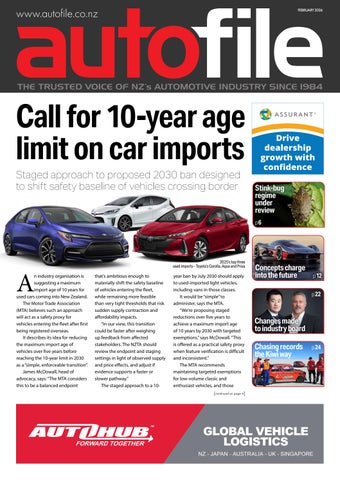
Staged approach to proposed 2030 ban designed to shift safety baseline of vehicles crossing border
An industry organisation is suggesting a maximum import age of 10 years for used cars coming into New Zealand.
The Motor Trade Association (MTA) believes such an approach will act as a safety proxy for vehicles entering the fleet after first being registered overseas.
It describes its idea for reducing the maximum import age of vehicles over five years before reaching the 10-year limit in 2030 as a “simple, enforceable transition”.
James McDowall, head of advocacy, says: “The MTA considers this to be a balanced endpoint
that’s ambitious enough to materially shift the safety baseline of vehicles entering the fleet, while remaining more feasible than very tight thresholds that risk sudden supply contraction and affordability impacts.
“In our view, this transition could be faster after weighing up feedback from affected stakeholders. The NZTA should review the endpoint and staging settings in light of observed supply and price effects, and adjust if evidence supports a faster or slower pathway.”
The staged approach to a 10-
year ban by July 2030 should apply to used-imported light vehicles, including vans in those classes.
It would be “simple” to administer, says the MTA.
“We’re proposing staged reductions over five years to achieve a maximum import age of 10 years by 2030 with targeted exemptions,” says McDowall. “This is offered as a practical safety proxy when feature verification is difficult and inconsistent.”
The MTA recommends maintaining targeted exemptions for low-volume classic and enthusiast vehicles, and those
[continued on page 4]
2025’s top three used imports – Toyota’s Corolla, Aqua and Prius
LOAD IT SHIP IT TRACK IT CLEAR IT DELIVER IT !
BIGGER IS BETTER
move to new, much larger premises means we are to offer even more services to our dealer clients
to door ro-ro vehicle shipping from Japan and Australia
Containerised vehicle shipping from anywhere in the world
Vehicle tracking
VEHICLE SHIPPING
Approved MPI transitional facilities and cleaning services
GENERAL FREIGHT
VEHICLE TRACKING
SHIPPING SCHEDULE
We are specialists in transporting and exporting all types of Vehicles, Commercial trucks, vehicles of Special Interest and other RORO Heavy Cargo & Machinery.
it all off is Jacanna’s SmartTrade Rewards Programme, you can earn points for almost any reward you choose
We have developed a worldwide network of Agents who understand the commitment required to service our demanding market.
www.jacanna.co.nz
Tel: +64 9 825 0888
Finding out where your vehicle is at any one time of the process, gives you the ability to manage the collection and processing of documents and payment on time.
TRS and shipping services from Japan to New Zealand. www.jacanna.co.nz
info@jacanna.co.nz
Tel: +64 9 825 0888
Regulator needs to ’tow’ line with rules
Shortcuts by transport agency on vehicles should worry us all, says Malcolm Yorston
The NZTA recently proposed a special exemption to allow the newly upgraded model of a utility vehicle to tow up to 4,500kg, which is well beyond the usual 3,500kg limit most of us are familiar with.
undermines confidence that the system is fair.
DIRECTORS
Darren Wiltshire dazzz@autofile.co.nz ph. 021 0284 7428
Brian McCutcheon brian@autofile.co.nz ph. 021 455 775
DESIGNER
Adrian Payne arpayne@gmail.com
On the surface, that sounds like a niche, technical issue.
But in reality, it tells us something important and worrying about how transport law is being made in New Zealand.
The problem isn’t whether this particular ute is capable. Modern light commercials are getting stronger, heavier and more sophisticated. Around the world, we’re seeing vehicles and suspension packages legitimately certified to tow heavier loads, backed by robust testing and international standards.
The real concern is how the NZTA is choosing to recognise that capability here – and that’s through a model-specific exemption for one single variant instead of a transparent, vehicleagnostic rule change that applies equally to all marques and configurations. It amounts to a major policy shift being slipped in through a side door.
Exemptions are meant to be exceptional and temporary, a bridge while formal rules are updated and not a substitute for doing that work.
Once the regulator starts carving out special treatment, model by model and brand by brand, it invites lobbying and
The NZTA’s consultation process in this case has only added to those concerns. Interested parties were asked to respond by filling out a rigid online form with a handful of pre-set questions and very limited space to comment.
There was almost no supporting documentation, no clear policy rationale and no named contact person for clarification. Unless you already knew how to reach the right people at the agency, it was hard to see how you could put forward a comprehensive submission.
That isn’t what good public consultation should look like.
A modern regulator needs to be transparent about why it’s acting, what evidence it has relied on, what options it considered and how it intends to treat similar cases in future.
It should invite open submissions and not confine people to tiny text boxes. It should also be especially careful when using broad discretionary powers in technically complex areas.
There is a better way. If the transport agency believes some modern utes can now safely tow 4,500kg, it should say so openly and initiate a rule amendment to reflect that reality.
The updated rules should define performance-based criteria, such as structural strength, braking and stability, and specify what evidence is acceptable
EDITOR
Darren Risby ris@autofile.co.nz
JOURNALISTS
Matthew Lowe matthew@autofile.co.nz
Sue Brebner-Fox sue@autofile.co.nz
MOTORSPORT
Mark Baker veritas.nz@xtra.co.nz
Visit www.autofile.co.nz to subscribe to Autofile magazine and have it delivered monthly in print. The subscription rate is $78 plus GST for 12 issues per year.
Autofile magazine is also available online as a readable file or downloadable as a PDF. Back copies dating to 2017 can be found on the website where you can subscribe to our Insight email alerts.
Copyright: Published monthly by 4Media Ltd
All statements made, although based on information believed to be accurate and reliable, cannot be guaranteed, and no liability can be accepted for any errors or omissions. Reproduction of Autofile in print or digital format in whole or part without written permission, whether by copying or any other means, is strictly forbidden.
All rights reserved. ISSN 0112-3475 (print) ISSN 2350-3181 (online)
independent vehicle inspection specialists
W We of fer a full range of ser vices
• Entry Certification for imported cars
• Vehicle Appraisals
• WoF/CoF Inspections
• Road User Charges
• Registration & Relicensing
• Exhaust Emission Testing
www.vinz.co.nz
MALCOLM YORSTON Technical services, Imported Motor Vehicle Industry Association
imported for disability and mobility use. It warns exemptions should be narrowly defined, time-limited when appropriate and subject to periodic review.
“The MTA supports the intent to lift the safety of vehicles entering the fleet. For used imports, the key implementation challenge is feature-by-feature verification at source and at the border can be inconsistent, particularly for older vehicles and trim-dependent features.
“If compliance settings are too complex or set ahead of availability, the risk is reduced turnover and unintended fleet-ageing effects.”
Newer vehicles are materially more likely to include modern crash-avoidance and occupantprotection technologies, and a 10year rule would be straightforward to administer.
The idea of a rolling age ban has been flagged by the MTA in its submission on government proposals to mandate some safety features as part of reforms to our
land-transport rules.
If approved, all light and heavy vehicles crossing the border could need to have automatic emergency braking (AEB) and lane-keep support systems, while acoustic alert is being considered for electric and hybrid models.
As for new and used heavy vehicles, mandatory electronic stability control (ESC) and anti-lock braking are on the table.
For ADAS
integrity, the NZTA should avoid over-reliance on borderpresence checks
The MTA supports the proposed requirements for new light vehicles because most imports already have these technologies given New Zealand’s reliance on global platforms designed to meet
– James McDowall
international expectations.
It recommends a “pragmatic” lead-in for new cars to provide time for regulatory guidance, systems updates, and supply-chain and run-out management for the minority of noncompliant variants.
“When the NZTA identifies cohorts with genuine compliance constraints – for example, lowvolume variants or specialist vehicles – it should retain discretion for time-limited, tightly defined transitional relief,” says McDowall.
“For clarity, the MTA recommends motorcycles and mopeds are excluded from any AEB or lane-support requirements because these systems aren’t practicable for motorcycles or mopeds.”
It supports the proposals for heavy vehicles. New models are generally designed to global standards, so requirements such as AEB and lane-departure warning should be feasible with lead-in times and clear definitions.
PRE‑SHIPMENT INSPECTIONS
If the NZTA applies ESC requirements to trailers, the MTA recommends excluding those designed and made for payloads of less than 10 tonnes.
This is because, in practice,
[continued from page 3]
whether it comes from a manufacturer or an accredited independent test service.
Any vehicle that meets those criteria should be eligible, whether it’s new, used, distributed by the official franchise or brought in through an independent importer or remanufactured here in New Zealand. That’s what vehicleneutral regulation looks like
technology availability and integration on lighter trailers are variable, while immediate application risks disproportionate compliance costs and supply problems.
The agency could instead signal future intent, focus first on higher-risk trailer categories and applications, and work with industry on a pathway that reflects readiness and measurable benefits.
If these safety features become compulsory, more vehicles in New Zealand will have them sooner, says the coalition, which could help lower the number and seriousness of crashes that cause most deaths and serious injuries on our roads.
There is no draft amendment rule accompanying the proposals. Making these features compulsory would require changes to four land-transport rules – heavyvehicle brakes 2006, light-vehicle brakes 2002, steering systems 2001 and vehicle equipment 2004. Decisions on the way forward should be made by the middle of this year.
WORKABLE REGIME NEEDED Mandating advanced driverassistance systems (ADAS) only improves safety if they are maintainable and verifiable during the life cycle of vehicles, warns the MTA, so policies need to prioritise practicable verification pathways.
A simple dashboard “tell-tale” presence check isn’t a reliable proxy for whether ADAS and related systems are operating correctly. However, testing or calibrating every used import at the border isn’t practicable.
and how we avoid entrenching brand-specific privileges.
This is about more than one ute and one exemption. It’s whether we want a transport system built on clear rules, open processes and equal treatment or one shaped by quiet carve-outs for those who know the system.
The NZTA still has time to choose the former. It really should take it.
Instead, the NZTA could build on existing entry-certification tools to target higher-risk cases without creating an unworkable regime.
The agency already requires diagnostic checks and declarations for systems, including ADAS, when warning lamps indicate a fault. These can be used to address imports flagged for faults.
Higher-risk triggers could be defined for extra scrutiny on vehicles identified as accidentrepaired in source-market documents, for example, or those with evidence of front-end structural repairs.
McDowall says: “When such triggers exist, the NZTA should require stronger evidence of system integrity than a presence check.
“When verification is uncertain, it should use standards-based evidence and recognised safety ratings to streamline compliance decisions for common models while keeping the administrative burden proportionate.”
As for in-service vehicles, ADAS integrity risk is elevated after crash repairs, replacing windscreens, bumpers and sensors, and by work on steering and suspension geometry. These can disturb camera and radar alignment, and may need recalibrating as specified by original equipment manufacturers (OEMs).
Warrant and certificate of fitness settings for mandated systems should be strengthened to ensure inspectors can verify warning lights are not on and, when feasible, apply diagnostic interrogation for mandated systems consistent with the NZTA’s existing approach to electronic safety systems.
The MTA adds minimum standards for ADAS calibration should be endorsed after common disturbance events with consumers informed when it’s required. There needs to be work undertaken with the industry on training pathways, equipment expectations and an accreditation framework for calibration providers to cut the risk of poor-quality outcomes.
In addition, the NZTA should
From July 1, 2027 No more than 13 years old
From July 1, 2028 No more than 12 years old
From July 1, 2029 No more than 11 years old
From July 1, 2030 No more than 10 years old
The MTA has suggested this as a possible schedule for a 10-year rolling age ban by mid-2030
ensure regulations don’t mandate systems that cannot realistically be verified, recalibrated or repaired here. When access to OEM specifications or software is a barrier, it should work with other agencies and industry on solutions.
RISK-BASED AUDITING
The MTA suggests a risk-based audit approach as a workable middle ground when stronger assurance than ADAS presence checks is needed, but universal testing is deemed impractical.
This would involve the NZTA targeting a small number of higher risks for deeper verification rather than simply imposing a universal border test.
These risks include repaired and accident-repaired vehicles, those flagged for structural damage, and repeat noncompliance patterns among importers and compliance providers.
Audit tools could include reviewing documents, diagnostic interrogation when available and follow-up inspections if indicators suggest system integrity is compromised. The results of audits can then be used to refine guidance and improve compliance.
McDowall says: “For ADAS integrity, the NZTA should avoid over-reliance on border-presence checks. A better approach is to build on existing diagnostic
declaration tools at entry, define higher-risk triggers, and strengthen in-service settings so systems remain functional and maintainable over the life of the vehicle.
“This balanced package will lift the safety baseline of vehicles entering the fleet while remaining
workable for consumers and industry.
“We support initiatives that improve road safety and reduce deaths and serious injuries. Our focus is on settings that are practical, enforceable and aligned with real-world supply and servicing capability so benefits are realised in practice.”
The MTA is also calling for public education and implementation mitigations to ensure motorists understand ADAS functions, their limitations and safe use.
EASY APPLICATION
Submit two downloadable forms and simply send to us for review.
Our partnerships give us the ability to offer superb lending rates.
EFFICIENT SERVICE
Hear back from our team about finance in as little as 24 hours.
NZ BASED
Autobridge is New Zealand based and covers the country, so we are never far away when you need us.
www.autobridge.co.nz 09 320 5646
The MTA wants the age profile of cars arriving at Port of Auckland to change
Changes for stink-bug regime
There are differing views in the industry on the suggestion of implementing year-round heat treatment for vehicles coming from Japan to reduce risks posed by brown marmorated stink bugs (BMSBs) and other exotic pests.
The government is also being warned that introducing such a policy would need to be backed by robust evidence.
The Ministry for Primary Industries (MPI) has sought feedback on how applying the biosecurity measure throughout the year before cars cross New Zealand’s borders would impact imports and associated businesses.
It raised the issue as part of consultation on a new draft import health standard (IHS) for vehicles, machinery and parts but says there are no plans to
implement extra heat-treating requirements yet.
The Imported Motor Vehicle Industry Association (VIA) says it supports efforts to modernise the IHS, which is set to be updated for the first time since August 2021.
As for the potential impacts of year-round treatment for used vehicles from Japan, chief executive Greig Epps notes there is no settled consensus in the sector.
“Members see commercial gains from predictability and smoother operations that a 12-month setting could bring,” he explains.
“We also acknowledge heat treatment may act as a barrier against a range of hitch-hiker organisms beyond BMSBs and industry stakeholders have highlighted practical risks from multiple taxa, not only stink bugs. However, new mandatory treatment – if poorly targeted or unsupported by evidence – would add cost and delay to lower-value vehicles.”
Epps says if the MPI were to contemplate introducing a yearround requirement, it should be based on a robust, pest-specific risk case that’s published for scrutiny.
The material should identify the rules’ target organisms and show why a year-round setting reduces risk versus the current seasonal regime, which runs from September 1 to April 30.
The government would also be called on to confirm safe heat parameters for modern cars, and set up a quality assurance, traceability and claims process.
VIA suggests a broader regime would require a staged rollout of the policy and targets for when the system would be reviewed for its effectiveness.
“Given present market fragility, if a year-round mandate isn’t necessary for biosecurity it should not proceed. If the MPI’s analysis shows a genuine biosecurity need covering a broader suite of
hitch-hiker organisms, VIA is open to a targeted, evidence-based approach that meets safeguards and is implemented in a staged, audited manner.”
Epps adds the association would welcome the government running a technical workshop for the industry to review the available evidence, should the MPI explore year-round treatment further.
RISK COUNTRIES
The MPI’s plan to update the IHS includes adding Uzbekistan to what’s known as schedule three and aligning requirements for used parts with those for used machinery.
Officials say some stakeholders proposed used vehicles from Japan should be subject to heat treatment throughout the year. But after reviewing available evidence, it was determined “year-round treatment isn’t justified from a biosecurity riskmanagement perspective”.
The ministry adds: “Compliance levels for Japanese used vehicles are high and most contaminants detected, such as plant material and seeds, cannot be effectively managed through heat treatment or fumigation.
“Given there has been no significant change in the biosecurity risk profile of used vehicles from Japan, we are not extending heat treatment beyond the current seasonal regime.”
Adding Uzbekistan to schedule three will take the number of risk countries on it to 39. Japan is already subject to these IHS requirements.
However, other jurisdictions where stink bugs are native, such as China, South and North Korea, and Taiwan, remain off the list.
The MPI says it has assessed several other countries, including those in the native range of the insects and the UK, Chile, Argentina, Morocco and Algeria.
“Based on the current assessment, there is no indication these countries need to be added
“This conclusion is supported by factors such as the absence of strong evidence of establishment, low interception rates at the New Zealand border, native predators and competitors limiting population growth, and limited distribution and population density.
“The MPI will continue to monitor emerging risks, maintain enhanced inspections and engage with national plant protection organisations. These conclusions will be reviewed if new information becomes available.”
Other changes to the IHS include aligning the requirements for used parts with those for used machinery. This means used parts from cars and outdoor or targeted indoor machinery exported in full container loads will no longer require treatment outside the high-risk season.
“During the risk season, a treatment and cleaning
declaration will be required consistent with requirements for whole machinery. This ensures biosecurity risks, such as seeds and plant material not addressed by BMSB-specific treatments, are managed.
“Parts imported under an MPIapproved system will be exempt from the cleaning declaration requirement as these systems already ensure parts are free from biosecurity contaminants.”
Allowing new non-fully enclosed trailers to be on the list of commodities that can use a manufacturer’s declaration to be excluded from BMSB requirements is also in the draft standard.
As part of its consultation, the MPI sought views on the readability of the rewritten IHS, and VIA says the document’s reformatting and clearer structure are welcome improvements.
“We encourage the MPI to maintain plain-language summaries alongside legal text and publish flow charts covering
common scenarios, such as exJapan finished vehicles, used parts consignments and re-exported vehicles, to reduce interpretation variance,” adds Epps.
When it comes to improving compliance outside “system pathways”, VIA supports targeted education and enforcement that focuses on risk.
The association suggests
publishing checklists aligned to the IHS, expanding approvedsystem pathways for small consignors, and considering a light-touch, secure-supply accreditation for audited and proven low-risk operators.
An MPI spokesperson told Autofile it hopes to issue the provisional IHS for vehicles, machinery and parts around March or April. Once that happens, submitters have 10 working days to notify the MPI’s directorgeneral if intending to request an independent review.
“Reviews are limited to whether specific scientific evidence was given sufficient consideration.
“If no review is requested within 10 working days, the provisional IHS is confirmed and the final IHS is issued.
“A six-month transition period will be implemented during which the old or new import requirements can be used. After this, the new requirements in the IHS must be followed.”
JEVIC vehicle inspectors working in Japan
Call for mileage-based tests
Changing the frequency of warrant and certificate of fitness inspections for the light fleet should focus on distance travelled as much as the age of vehicles, according to feedback on plans to overhaul the regime.
There are also concerns from parts of the industry that extending the intervals for warrant of fitness (WOF) checks means some cars may go twice as long between professional inspections.
The Imported Motor Vehicle Industry Association (VIA) notes basic issues – such as tyres, brakes and structural rust – risk being left unattended for longer, which may pose problems for older models because “age-related issues can accelerate”.
The government has proposed introducing biennial WOFs for cars aged from four to 10 years before moving them to annual inspections. It’s also considering the first warrant for new vehicles lasting four years instead of three.
Any changes are expected to be signed off in May.
Greig Epps, chief executive officer, says VIA supports modernising the testing regime and isn’t opposed in principle to altering inspection frequency. However, it’s cautious about
extending WOF intervals unless there’s strong evidence safety and other outcomes will be maintained.
He adds: “We also don’t support shifting the first WOF for New Zealand-new vehicles from three to four years unless paired with a distance-based trigger because wear is driven by kilometres as much as time.
“We agree with the AA that distance travelled is a better proxy for wear and tear than age alone, and any reduced-frequency model should be built around kilometres travelled with the odometer providing a practical trigger.”
VIA also recommends a hybrid approach for the four to 10-year cohort. This would retain annual WOFs for higher-kilometre vehicles,
such as those used for commercial purposes, while allowing longer intervals for those travelling less.
“We are cautious about proposals to extend WOF intervals – for example, from annual to two-yearly – unless there’s strong evidence that safety and other outcomes will be at least maintained,” says Epps.
The change must also be considered in the wider regulatory and behavioural context, not in isolation.
“We’re not seeking to defend the current regime for its own sake.
“Our concern is cost-cutting or ‘international alignment’ arguments, if applied without a New Zealand lens, risk undermining other policy goals.”
VIA’s submission explains used imports are typically aged eight to 12 years and the WOF system is critical in how those units are managed during the rest of their life here.
It supports a modern, efficient regime that maintains or improves road safety, emissions and endof-life policy objectives, and uses inspections to educate owners.
“We note the Associate Minister of Transport has pointed to overseas practice – including Europe’s two-yearly checks, and some Australian and Canadian jurisdictions relying on change of ownership or defect-triggered inspections – as part of the case for longer intervals,” continues Epps.
“Those comparisons need to be treated carefully. They sit in different legal, insurance, enforcement and maintenance cultures, and don’t operate under our no-fault ACC settings.”
VIA argues inspection frequency carries more weight here than in more litigious countries because many motorists rely on regulatory requirements to tell them when cars need checking.
The AA has noted some motorists here wait until inspections to be told what needs doing to their vehicles
Toyofuji vessels Voyage
Moji
Any changes to the WOF regime are due to be signed off by the government in May
“We request the NZTA publishes key data and modelling underpinning any decision so industry and the public can understand and test the reasoning.”
The consultation material suggests four to 10-year-old light vehicles are a relatively low-risk group at inspection time, but VIA highlights official data that tells a different story.
It notes there were 38,497 fails out of 175,529 WOF inspections – equivalent to about 22 per cent –for four-year-old, New Zealand-new vehicles in 2024.
Across all NZ-new and used imports aged four to 10 in the same year, 450,303 out of 1,785,851 tests were fails, about 25 per cent, with faults mostly related to tyres and brakes.
Epps says these are car parts consumers wouldn’t want degrading for two years at a time and NZTA statistics already show
We request the NZTA publishes key data and modelling underpinning any decision
– Greig Epps
a large volume of safety-relevant defects emerging in the current 12-month inspection cycle.
Therefore, doubling the interval for WOFs would increase the time that defects remain undetected and unfixed by owners who treat inspections as their primary maintenance trigger.
He notes other NZTA data shows that at entry and in the first years in this country, “used imports at WOF time perform as well or better than NZ-new at the same age”.
SAFETY ASSURANCE
The Motor Industry Association (MIA) supports the coalition’s proposals and points out New Zealand’s inspection rules stand up well when compared with many other countries.
Aimee Wiley, chief executive officer, says: “Modern light vehicles benefit from improved design, safety systems and build quality.
“Our members consider that extending the initial WOF period to four years is reasonable and
consistent with contemporary reliability and performance.”
She describes the move to biennial inspections for vehicles between four and 10 as an acceptable balance between safety assurance and compliance costs. With appropriate enforcement and continued education on maintenance, the MIA doesn’t expect such a change to materially degrade the fleet’s safety in these age bands.
“We also note that even with annual inspections beyond 10 years, New Zealand’s in-service inspection regime remains comparatively robust by international standards, particularly when compared with several OECD jurisdictions that have limited or no regular in-service inspection requirements,” adds Wiley.
“As vehicles age, the likelihood of wear-related faults and degradation of critical components increases. Annual inspections provide an appropriate safety net at this stage of the vehicle life cycle.”
[continued on page 10] and there are fears longer gaps between checks will allow faults to compound.
Loans as diverse as our customers
Maximum battery-charge warning
Volvo has launched a safety recall campaign for the EX30 made from 2024-26 with chassis numbers 000462 to 605888.
The call-back, which was issued here on January 5, follows investigations identifying “that in very rare cases overheating of the battery cells may occur”, according to the NZTA’s website.
Owners have been advised to limit the HV-battery charge level. This can be done via the settings menu in the vehicle display. Go to charging, target battery level and then “set the charge level to maximum 70 per cent”.
In Australia, some 2,815 EX30 owners are affected. The federal transport department there published a recall notice on January 9 for all variants in the model’s year range of 2024. It warns the fault identified
[continued from page 9]
As for making light rentals less than five years old complete a certificate of fitness (COF A) once a year instead of every six months, the MIA says this should also apply to comparable light passenger service vehicles, such as school buses, “to avoid distorting competition”.
Higher penalties for people operating vehicles with worn or failed safety-critical items need to be accompanied by a campaign to highlight the importance of regular maintenance beyond simply “passing a WOF”.
This should encourage routine self-inspection of tyres, lights and other visible safety items by drivers and riders, and provide practical guidance on how and how often to check key components. “Such an approach would help embed a culture of proactive maintenance and support better compliance outcomes, rather than relying solely on deterrence through higher penalties,” explains Wiley. Despite general support for
in the battery of the SUVs could cause a fire. The notice adds: “Due to a manufacturing issue, the cell modules installed in the highvoltage battery may overheat at high charge levels.”
Drivers can continue to use affected vehicles while waiting for Volvo to develop a solution, but should ensure they do not fully charge its battery.
“When a remedy is available,
the WOF and COF proposals for light passenger and light commercial vehicles, the MIA has reservations about applying the same approach to motorbikes and mopeds.
It suggests a first WOF for twowheelers should last three years and be followed by 12-monthly inspections because members believe the current inspection periods already push the limits of acceptable safety margins.
Among the key concerns is that “motorcycle owners often carry out their own maintenance and use franchise dealers or service providers less frequently than light-vehicle owners”.
“Motorcyclists are among the most vulnerable road users. While many riders understand the inherent risks of motorcycling, safety-critical maintenance is sometimes viewed as a discretionary or costly expense that can be deferred. Inadequate or infrequent inspection can have disproportionately severe consequences for this group.”
owners will be contacted by Volvo requesting them to schedule an appointment to have the repair work carried out free of charge.”
The Swedish carmaker began warning drivers about the issue in other jurisdictions in late December and early January. In the UK, Volvo issued a statement advising motorists the battery issue didn’t affect all EX30 models and was yet to cause serious injuries.
It says: “While the number of reported incidents is very small –representing around 0.02 per cent of the cars we have identified as potentially affected and we have no reports of related personal injuries – we are treating it very seriously.”
Meanwhile, Volkswagen NZ issued a recall in December for some Touaregs from model years 2019-25. Models with hybriddrive systems and of a limited production period may have deviations in the high-voltage battery system.
And some model-year 2019 Ram 1500s have been called back because the curtain airbag inflator on about 17 units may rupture because of compressed gas rapidly escaping. This could potentially propel some material into the cabin, which may cause injury to occupants.
Brand reveals plans
GWM’s new managing director has outlined the marque’s strategy for this year on both sides of the Tasman.
Andrew Gao says its plans down under are based on four areas. These are strengthening its model line-up, the importance of its dealers, enhanced after-sales capability and evaluating customer experience.
He adds the brand will roll out “compelling new products” during 2026 that are “locally tuned and optimised” specifically for New Zealand and Australian customers.
operations through expanded parts warehousing and enhanced technical training.
“These initiatives will underpin our long-term commitment to delivering better vehicles, superior driving experiences, and outstanding value and service.”
Gao, who has succeeded Charles Zhao, has nearly 15 years of experience with the company having joined it in 2011 before relocating to Australia in 2014.
“Our dealer network is central to delivering a best-in-class purchasing and ownership journey, and we will continue to invest in providing it with the tools, systems and resources required to succeed,” says Gao.
“In parallel, we are focused on improving our after-sales
His senior positions have covered sales, network development, product and brand functions, providing him with an understanding of the local market and GWM’s global strategy.
“I thank Charles for the strong foundations he has established,” says Gao. “I look forward to leading this organisation as we continue to build a healthy, sustainable and growing business.”
An EX30’s powertrain
Andrew Gao
BUY SMARTER. SELL FASTER. STAY AHEAD.
Hundreds of vehicles auctioned every week and nearly 1,500 users ready to trade.
Auction Online gives you real-time access to the true used-vehicle market, nationwide. Buy, sell and manage stock from anywhere – fast, transparent and competitive.
Whether you’re clearing trade-ins, moving aged stock or filling your yard, our streamlined auction platform simplifies every step.
• Nationwide dealer network
Almost 1,500 users actively buying and selling.
• Real-time pricing transparency
Live bidding ensures you always hit true market value.
• High stock turnover
Hundreds of vehicles auctioned every week across NZ.
• Purpose-built dealer platform
Designed specifically for franchise & independent dealers.
• Fast, simple, secure Seamless listings, bidding and purchasing from one platform.
Join Auction Online today and start trading smarter
Fast charge into the future concepts
The industry did it tough in 2025, but that didn’t stop creative juices from flowing
The Concept AMG GT XX with its cutting-edge technology, endurance and hyper-fast charging provides an insight into an upcoming four-door model.
The all-wheel-drive hypercar features three axial flux motors, a highperformance battery and an “abundance of technical solutions earmarked for use in the subsequent seriesproduction models” as early as 2026.
“The Concept AMG GT XX is the next milestone in the history of AMG,” according to Michael Schiebe, chief executive of Mercedes-AMG.
In profile, the low-slung coupe sports a long doublebubble roof and 21-inch forged aluminium wheels with adaptive aerodynamic blades.
Built on the marque’s electric architecture known as AMG.EA, the innovative electric motors enable high power from an extremely compact package, offering peak power output of more than 1,000kW and a top speed of 360kph.
Its battery pack remains in an optimal temperature range even during intense driving and enables the car to receive sufficient charge in just five minutes to travel 400km.
The motors are packaged into two high-performance electric-
drive units, one at the front and one at the rear.
The motors and transmissions are oil-cooled in the drive units. Two inverters – one per motor –are water-cooled. Meanwhile, the Formula 1-inspired battery pack delivers “high power output with exceptional repeatability”.
Mercedes-AMG says the design of each of the 3,000 cells facilitates high charging and discharging power. The battery is set between the axles in a skateboard style arrangement for optimal weight distribution.
At the front, there’s a 10-segment grille flanked by rectangular auxiliary lights.
Inside, the GT XX offers only the essentials with dual LCD screens, a steering wheel reminiscent of the AMG One, motorsport style dashboard and door cards, and 3D-printed carbonfibre seating.
STINGRAY INSPIRED
Aerodynamics are key for the all-electric California Corvette concept leading to a sinewy two-tone body, red underneath signalling power and grey on top for modesty.
The lightweight General Motors design means you can see through the holes in the grey body to explore the carbon-fibre suspension arms, springs and dampers, and even the electric motors are visible beneath the surface.
These channels direct air under the nose and through tunnels to the massive rear diffuser, and there’s a central spine that runs the vehicle’s length, unsurprisingly inspired by the shape of a stingray. With no direct production intent, the t-shaped prismatic battery
allows for a lower seating position because the battery isn’t the typical skateboard-style underfloor unit.
The California sits incredibly low, with a narrow cabin that tapers towards the rear end to emulate the streamlined look of past Corvettes.
A production version may run a three-engine electric drivetrain, with features including an active aerodynamic spoiler and an air brake, and roll on 21-inch front wheels and 22-inch rears.
Access is via a dramatic singlepiece front-hinged canopy and the interior doesn’t exist.
But thanks to a virtual-reality headset, the inside is revealed as reminiscent of a fighter-jet cockpit with an augmented-reality headup display that puts important information in the driver’s field of vision while avoiding the need for giant screens.
MASH-UP FOR GAMERS
Hyundai has dubbed the Insteroid as a “thrilling glitch in the automotive matrix”, which means they had fun with this one.
The concept has the vibe of a designer’s feverish dream that somehow made it past the top brass.
The teaser images show a car that’s almost comically aggressive compared to the little Inster it’s based on. Essentially, it’s an Inster on steroids.
Mercedes-AMG’s GT XX concept
The California Corvette
Electric Hybrid C-DM system, which
Chery’s Journeo Concept
Hyundai’s Insteroid
concept, some of its technologies and design elements are expected to be integrated into Chery’s upcoming Omoda and Jaecoo models.
CAR YOU CAN AFFORD
Volkswagen unveiled the ID.Every1 last year. It’s an electric concept with a price tag that won’t require selling off some organs.
Just like the iconic Beetle, VW is going back to its roots by producing a people’s car priced at roughly €20,000 – or about NZ$40,500 – when it eventually launches in 2027.
The ID.Every1 represents the brand’s ambitious push to create an “affordable all-electric entry-
level mobility concept car”, which it plans to turn into an entry-level, all-electric production model.
It is based on the group’s new modular electric drive (MEB) platform with front-wheel drive.
Thomas Schafer, chief executive of VW passenger cars, says: “The ID.Every1 represents the last piece of the puzzle on our way to the widest model selection in the volume segment.
“We will then offer every customer the right car with the right drive system, including affordable all-electric mobility.”
Kai Grünitz, Volkswagen’s board member for development, describes this approach to be “customer defined vehicles”, explaining the
car can be “individually adapted to [motorists’] needs” even postpurchase.
It’s like buying a vehicle that, instead of depreciating the moment it’s driven off the lot, actually gets better over time. Perhaps that’s an idea almost as revolutionary as the electric drivetrain itself.
The concept vehicle has a top speed of 130kph, is powered by a newly developed electric-drive motor with 70kW and offers a range of at least 250km.
Measuring 3,880mm long, the ID.Every1 has space for four people and a luggage compartment volume of 305 litres.
VW says it wants to have nine new models by 2027, including the ID.Every1, and become the technologically leading highvolume manufacturer with the safest, most innovative and bestselling vehicles by 2030.
RUGGED REINVENTION
Genesis’ X Gran Equator is the brand’s first adventure concept with its exterior emphasising clean lines and uncluttered surfaces.
A bold exploration of Defender and Land Cruiser rivals, it sports a long bonnet, linear headlights and a silhouette that “defies” traditional SUV conventions, while dark wheelarch cladding and 24-inch wheels underscore its off-road readiness.
Luc Donckerwolke, chief creative officer of Genesis, says: “This concept is an exercise in harmonising contrasts by
combining elegance with ruggedness and the spirit of exploration with refined comfort.
“It represents the orchestration of true off-road competence and luxury, designed to enable the discovery of the world’s most breathtaking landscapes.”
Inside, there is a contrast between analogue architecture and digital technologies as well as seating for four.
OFF-ROAD GIANT
Audi’s Q6 e-tron off-roader features two electric motors with a combined power output of 380kW and an ability to climb gradients of up to 100 per cent.
The daring design, which looks like a life-size remote-controlled car with a roof tray on top, features newly designed portal axles that increase torque at the wheel by 50 per cent.
The German marque says this lowers the concept’s speed to 175kph, but enables it to climb gradients up to 45 degrees.
Four portal axles were developed from scratch and are integrated into wheel-hub assemblies at the front and rear axles. It also stands on 33-inch high-performance tyres and has enhanced ground clearance of 160mm.
“The Q6 e-tron offroad concept is a reinterpretation of quattro,” says Gernot Dollner, chief executive officer. “The model shows the potential that our platform for allelectric vehicles has.”
VW’s ID.Every1
The Genesis X Gran Equator
Audi’s Q6 e-tron off-roader
EVERY DAY WITHOUT ALICE COSTS YOU LEADS, SALES AND CLARITY
Built five years ago to track leads, ALICE has grown into New Zealand’s first fully integrated automotive intelligence platform. With over 700 dealerships, we provide unmatched visibility into stock, marketing, websites & operations. We don’t just track leads. We provide the intelligence to sell more cars.
KNOW WHICH LEADS ARE WORTH CHASING
MOVE STOCK FASTER WITH AUTOMATED UPDATES
SEE EVERY DOLLAR SPENT, SEE EVERY DOLLAR EARNED
Unlocking your hidden multiplier
In last month’s article, we talked about response time speed, AI prioritisation and smarter creative execution.
Even the strongest leadhandling process can only perform as well as the marketing ecosystem feeding it. In 2026, that ecosystem can no longer rely on short bursts of stock promotion or occasional brand activity.
To stay competitive, dealerships need both running together and all the time as separate but connected engines in one larger funnel.
This is where many dealers still fall back into an old pattern. When the month gets tight, they pause their brand spending to push stock. When stock pressure eases, they swing back to brand. It’s a practical short-term fix, but a damaging long-term habit.
Each time the focus swaps, campaign learning resets, optimisation slows, CPMs – the cost per 1,000 advert impressions – rise and the entire funnel loses efficiency. What looks like a budget-saving tactic actually costs more over the course of a year.
To avoid this cycle, dealers should treat brand campaigns and stock campaigns as two fundamentally different and equally essential layers.
Brand campaigns build recognition, trust and familiarity. They reassure buyers your business is active, local, reputable and easy to deal with.
Stock campaigns, by contrast, create immediate demand via the likes of test-drive bookings, enquiries, finance conversations and showroom traffic. The objectives, optimisation goals and creative requirements are different.
JAMES HENDRY Director, sales and operations
AdTorque Edge NZ
A brand video about your team, values or customer experience isn’t a substitute for a sharp, modelspecific offer. Likewise, a stock push designed to move SUVs quickly cannot shoulder the long-term job of brand building.
Yet the real power comes when these two streams run continuously, side by side. Based on UK research, a 60/40 split or dealer brand versus retail messaging is the most profitable long-term mix.
This provides a steady, always-on brand layer and stock campaigns that sit alongside it perform far better. Cost per click drops, conversion rates rise and retargeting becomes dramatically
more effective. Buyers already recognise the name, trust the finance messaging and believe the reviews.
A short walkaround video, a carousel of fresh arrivals or a “just delivered” customer moment reaches thousands of locals. Even if they don’t enquire today, they remember the dealership tomorrow. That visibility reinforces the brand’s credibility and makes future brand content stick more strongly.
Over time, this builds momentum and is the same strategic model used by leading dealer groups whereby brand lifts stock, stock lifts brand and each cycle makes the next one more efficient.
Equally important is the creative itself. Many dealers treat content as a “set and forget” exercise, running the same video long after it has fatigued. In today’s digital environment, brand familiarity comes from consistent presence, but effectiveness comes from freshness.
Updated visuals, new customer stories, revised finance messaging
EVERY DAY WITHOUT ALICE COSTS YOU LEADS, SALES AND CLARITY
or refreshed “we’re local” creative keep the narrative alive.
Buyers may see your brand 20 or 30 times in a month, but stale content dulls the impact of every one of those impressions also harming future campaign cutthrough or impact when creative is eventually updated.
When dealers run both campaign types together –continuously, deliberately and with refreshed ad creative – the impact is unmistakable. Stock turns faster, cost per lead drops, retargeting pools expand and finance enquiries increase. In addition, the dealership begins to feel “everywhere” in the shopper’s research journey, not because they spend more but because they spend smarter.
The lesson for 2026 is clear, and that’s brand and stock campaigns are not interchangeable. Neither can achieve its full potential alone.
However, when they run in parallel, always on, continually learning and consistently refreshed, they form the kind of momentum that doesn’t just generate leads, but builds a durable, defensible market presence. In a year defined by accelerating digital competition, that momentum may be the most valuable advantage a dealership can create.
Expanded system to improve data
This year marks an important step forward in how New Zealand manages information about vehicles entering its fleet.
MIAMI – the Motor Industry Association Model Information system – now hosts all new vehicles, including motorcycles, light and heavy.
The expansion is more than a technical change because it’s a strategic shift that brings greater consistency, efficiency and insight to the way our sector meets regulatory obligations.
MIAMI is a key tool and the digital backbone for entry and registration compliance in New Zealand.
In a nutshell, it’s the web-based system through which importers submit key vehicle attributes to the NZTA including model details, carbon-dioxide emissions, fuel type, test-cycle information and VIN notifications.
That information then links directly into the motor-vehicle register, Fuelsaver, Rightcar and importers’ accounts for the clean car standard. In practical terms, better data in means better data out.
Originally developed to support light vehicles, MIAMI has evolved alongside the regulatory framework it serves.
The decision to host all new motorbikes and heavy vehicles in addition to light models on a single platform reflects the maturity of that framework and need for a more integrated approach.
One system, one set of processes and one source of truth for all new vehicle types delivers
clear benefits for both the industry and regulator.
From an industry perspective, the advantages are immediate. Streamlined processes reduce duplication, remove confusion and provide greater predictability for importers who are operating in what’s a complex and fastchanging environment.
AIMEE WILEY Chief executive officer, Motor Industry Association
A single platform also makes it easier to embed policy changes and technical updates in a coherent way rather than relying on a patchwork of legacy systems. The result is a cleaner, more logical compliance pathway that supports timely decision-making and reduces the risk of error.
Usability has been a central focus of this work. Compliance should be rigorous, but also needs to be clear and practical.
safety features across all model types.
As the system expands, that capability becomes more important.
The capturing of consistent information on safety equipment, emissions performance and technical specifications at the point of entry lays the groundwork for a more informed conversation about the fleet we are building for the future.
In my view, this is where the real long-term value sits. Better data, collected once and collected well, supports better decisions.
It allows the government and industry to track how technology is changing, how quickly higher safety and lower-emissions models are entering the market, and where there may be possible gaps or emerging risks.
Our shared objective is a process that’s efficient to use, delivers reliable information, and supports New Zealand’s wider transport and climate objectives.
As an industry, we understand that expectations on us are rising. There’s a clear focus on emissions, safety and the overall quality of vehicles entering the fleet. That focus is appropriate and requires an equally strong commitment to the systems that sit behind compliance.
MIAMI is one of those systems. Its expansion to cover all new vehicle types is an important milestone in our collective effort to lift performance, improve transparency and support evidence-based policymaking.
Looking ahead, MIAMI will continue to evolve. As new technologies emerge, as standards are refined and as data needs become more sophisticated, the system will adapt.
What will remain constant is its core role, and that’s to provide a single, reliable channel through which New Zealand captures the information it needs about the vehicles on its roads.
By bringing all vehicle categories into MIAMI, we have been able to simplify the user journey and make the system more intuitive. That matters for organisations large and small, and it ultimately supports better alignment between regulatory intent and real-world behaviour.
A key strength of MIAMI is its ability to accommodate richer and more detailed data sets, including
Over time, insights drawn from MIAMI will help shape more effective policy, target investment more accurately and measure progress with greater confidence.
The expansion of MIAMI is also a reflection of the partnership between industry and regulator.
The MIA has worked closely with the NZTA to ensure the system is robust, future focused, and aligned with the clean car standard and other regulatory requirements.
Bringing all new motorcycles, light vehicles and heavy vehicles into MIAMI isn’t simply an IT change. It’s an investment in the infrastructure that underpins trust in our regulatory system, confidence in our data and clarity in our obligations.
It strengthens the foundation on which the new-vehicle sector will navigate the next phase of transition in technology, policy and consumer expectation.
Leading the conversation
Information in MIAMI links into the motorvehicle register, Fuelsaver, Rightcar and clean car standard accounts
Upturn may be some way off warns expert
Kiwibank chief economist Jarrod Kerr is predicting interest rates to fall further and for the value of assets to climb, eventually.
“Everyone knows most were heads down in 2024, firefighting while orders and sales dried up and profitability took a hit. We were told to hang in there and survive because it would be ‘thrive in ’25’.
“But that failed to eventuate. That recovery just hasn’t happened. The growth isn’t there, so much so that some are saying the economy is worse than 2024’s recession.”
Kerr told delegates at the Financial Services Federation’s annual conference that his best offering of a catch phrase for this year was “fix in 2026”, anticipating a turnaround would eventually start to take hold.
“One of the worst outcomes is we’ve lost good people to our other labour market, the one across the Tasman. But we’re seeing banks and other lenders getting back into the market, adding a little water to initial green shoots.”
Another factor given New Zealand’s size was US President Donald Trump’s tariffs war.
“You need to look at this from way back in 1820, 200-odd years. For the first century, 90 per cent of American government revenue came from tariffs. There was no income tax until 1913.
Jarrod Kerr
“Optimism is beginning to emerge. If you cut interest rates far enough, they put more money into people’s pockets and asset markets will rise.
“If you’re paying six to seven per cent, and it falls to five to six, you tend to shrug and save that difference. But when it falls to four per cent, that raises confidence. It tends to see people and businesses willing to spend.”
He laid much of the blame for the sluggish economy at the central bank’s door. “The recession we’ve been through, and which continues to linger, was engineered by the Reserve Bank when it kept interest rates high for too long. Other countries moved sooner, so you need to ask why we are the only country still in a bad space.”
Kerr told the conference he believed former Reserve Bank governor Adrian Orr paid the price for his failure to cut, a stand that meant the coalition was presiding over an economy shedding jobs and seeing companies falter.
“Higher tariffs are Trump’s way of paying for tax cuts. It might generate revenue, but most tariffs slowly fall to about 10-15 per cent because anything above that forces customers to look for alternatives.
“Our US exports revolve around beef and I don’t see Americans stopping eating burgers. Eventually, falling tariffs will boost trade again.”
After World War Two, liberal trade agreements led to globalisation although recent slowdowns and protectionism had caused “slowbalisation”.
“Smaller economies like ours can be hit by relationship changes with trading partners, part of the reason we’re chasing deals with emerging markets in Asia and India,” said Kerr. All of which keeps the government focused on interest rates and getting inflation under control.
Award-winning NZ Roadside Assistance
He added inflation was trending back down to the two per cent mark, a position that could only help fuel recovery.
“It’s bleak when your optimism is based on the premise things can’t get worse and a turnaround is about to start. Ultimately, we just have to hurry up and wait for that to happen.”
The month that was... February
February 10, 1997
Mitsi jobs axe first nail in coffin?
Would Mitsubishi be the next local assembler to follow Ford and pull out of New Zealand? That was the question being asked following the marque’s bombshell decision the previous week to cull 80 positions from its Porirua plant.
The announcement followed hard on the heels of major price cuts, which were aimed at boosting demand amid a continuing decline in its market share.
Of the total number of people who were to lose their jobs, 65 were assembly line and parts department workers on the hourly payroll. The other 15 were a mixture of salaried parts department clerks, plant supervisors, marketing staff and general managers. The cuts reduced Mitsubishi’s employees by 15 per cent from a total of 518.
Rob Greenfield, general manager of corporate, insisted the move to reduce staff numbers wasn’t the first step towards closing its Porirua facility although all indications were that was a possibility following Ford and Mazda’s assembly plant shutdown in March 1997.
He said: “We are committed to assembling in New Zealand and will remain committed for as long as possible. What we’re trying to do is to ensure the number of vehicles we produce remains consistent with market demands.”
February
2,
2007
Bad year for Ford
Ford announced its worst 12-month period in its 103-year history with a worse-than-expected fourth-quarter loss. It added it would cut production and lose market share until September.
The number-two US carmaker posted a net loss for the period of almost US$5.8 billion – some NZ$8.4b – or US$3.05 a share on the back of falling ute sales and charges for staff buyouts when compared to a loss of US$74 million, or four US cents per share, in the previous year.
The losses from continuing operation amounted to US$1.10 a share, wider than Wall Street’s expectation of 94c. For the full year, Ford posted a record net loss of US$12.7b, which was well above its previous record of US$7.39b in 1992 when the industry was reeling from the aftermath of the American economy going into recession.
Ford was hit hard in 2006 by losses in the truck and SUV market, motivated mostly by high petrol prices and interest rates. These drove customers away from large-vehicle purchases. Argus Research reported Explorer and F-Series sales were significantly down.
February 25, 2005
Registration expiry warning
It was 12 months since most dealers had to be registered as part of the Motor Vehicle Sales Act, meaning it was time for most to renew their licences.
The Ministry of Economic Development issued a warning in its monthly newsletter.
It stated: “It is important to ensure the renewal of your motor-vehicle trader registration is completed before the expiry of your current registration. You will commit an offence if you continue to trade when your registration has expired.”
The warning explained dealers were liable for fines of up to $50,000 for trading with an expired licence. That rose to $200,000 for dealerships.
Sarah Steele, business adviser for Companies Office, which administered trader registrations, said renewals had been coming in steadily. “It’s been going fine and there are plenty coming back. Some people have been slow in sending their statutory declarations through, but it’s running quite smoothly.”
She added 2,518 people were registered as traders with a further 721 going through the renewal process and 552 would have to renew in March. “Now is the peak time for renewals.”
February
26, 2010
Saab is saved
Saab was finally sold to supercar maker Spyker after a drawn-out sales process by General Motors.
The company exited liquidation before the deal, which secured the future of Saab Automobiles, and its new boss, Spyker’s chief executive officer Victor Muller, was a happy man.
He said: “We will be concentrating all our efforts into reviving Saab, and transforming it into a sustainable and profitable company with the confidence to be bold.
“We will reinforce the emotional experience between Saab drivers and their cars, and will focus on Saab’s historical strengths in the fields of independent thinking, aircraft heritage, ecological performance and motorsport.
“With a well-funded business plan in place, we’re looking forward to working with Saab’s management on realising that plan and bringing exciting new products to our customers.”
Jan Ake Jonsson, Saab’s chief executive, said: “We aim to get back to the execution of our business plan, starting with the introduction of the new 9-5 later this year. With the continued support of employees and business partners, I’m confident we will succeed.”
Ownership starting to slip away
Most New Zealanders take a simple idea for granted. And that’s if you buy something, you own it, can use, repair and sell it, or pass it on as long as it’s safe and legal.
That assumption underpins household wealth, small businesses and trust in markets, but that premise is weakening when it comes to cars.
A risk is emerging quietly via a broader international trend with well-intentioned sustainability policies overlapping manufacturer control. If we don’t put safeguards in place early, we may discover too late ownership has been replaced by permission.
New Zealand is exposed. We don’t make vehicles and rely heavily on used imports. The system has worked well for decades. It keeps prices lower, gives consumers more choice and supports thousands of jobs.
Openness is the system’s strength. If cars meet our safety rules, they can come in. Independent experts inspect and certify them, owners can repair and resell them, there’s competition, and value is spread across importers, dealers, repairers and consumers.
No specific rule threatens this, but a pattern. Overseas governments, particularly in the European Union and Japan, are trying to solve real problems.
These include preventing endof-life vehicles being dumped in poorer countries, stopping large EV batteries from going to landfill and reducing environmental harm. The risk lies in how such goals are being pursued.
To improve sustainability, new frameworks increasingly rely on digital records, lifecycle tracking and expert certification.
Rules require proof a car is “fit for continued use”, and pre-export and passports track the history of EV batteries.
KIT WILKERSON Head of policy and strategy kit@via.org.nz
There’s growing momentum to extend this thinking to whole vehicles by officially recording software, repairs and compliance history. Taken individually, these ideas can sound sensible. Together, they shift control upstream.
Modern vehicles are no longer just mechanical objects. They depend on software, batteries, sensors and data systems only manufacturers fully control. Regulators have no independent access to this information so the “expert” is the manufacturer.
This is how manufacturers can quietly control what enters the market. Not through an obvious ban, but via systems that decide whether a car is supported, transferable, serviceable or exportable. Once those decisions depend on such controlled data, rights that used to be automatic become conditional.
For Kiwis, the consequences are easy to underestimate. If a manufacturer effectively controls whether a vehicle is treated as “acceptable” by key decisionmakers, it can lose value because of an offshore update, digital status change or policy decision.
Finance can dry up and resale
can be restricted. Ownership still exists on paper, but in practice not so much.
Resale values affect household wealth, borrowing power, insurance costs and ability to upgrade. Slowly undermining resale drains money from ordinary folk without a single tax being raised.
This isn’t simply a “new versus used” contest. It’s about who controls inputs that make vehicles repairable, insurable, financeable and resaleable.
The risk to the used import and sales market is more serious because that market depends on freedom at every step.
If access to essential inputs – diagnostic tools, security keys, software validation or battery authorisation – become conditional on manufacturer-controlled permissions, competition can be weakened without any rule banning independent operators.
Small importers, dealers and repairers cannot compete if they must rely on gatekeepers with incentives to preference their own channels.
It’s tempting to think it comes down to trust, but car brands are corporations. They are legally required to maximise profit for shareholders. We cannot rely on them to protect affordability or survival of independent businesses if doing so conflicts with commercial interests elsewhere.
This isn’t about bad intentions, it’s about predictable incentives. In
that context, restricting exports or on-selling can make commercial sense even if a car is perfectly fine.
This logic doesn’t stop with waste rules or batteries. The same approach can extend to resale approval, repair recognition, software validation and how long a vehicle stays “acceptable” to use. Competition doesn’t disappear overnight, it fades as access to essential inputs becomes conditional.
This is not yet a crisis and that’s why action is possible.
Safeguarding our market doesn’t mean rejecting sustainability, safety or technology, but setting clear boundaries. Decisions about whether cars are fit for use here should be made under our law, and by New Zealand-recognised and independent experts.
Digital records, such as battery and vehicle passports, should provide information and not permission. The right to repair and resell lawfully owned cars should be protected, and data generated here shouldn’t be used to quietly reshape our market without public oversight.
If we wait until these overseas systems are fully normalised, pushing back will be framed as unsafe or anti-environment. By then, permission will already have replaced ownership by default.
This isn’t just about cars. It’s about whether Kiwis continue to own what they buy, if small businesses can compete, and whether our markets remain open and fair. Those are worth safeguarding and the time to do so is now.
Industry movers
VERNA NIAO has been made chief executive of MITO Ltd. She joined the training organisation as executive director in 2022 when government reforms took it under the umbrella of Te Pūkenga – the NZ Institute of Skills and Technology.
“Industry ownership will enable MITO Ltd to respond to workforce development needs with speed and agility,” says Niao. “The strength of training is based on the investment our employers make in growing talent. Our priority is to ensure they are supported.”
Sturrock Saunders, board chairman, adds: “Verna’s commitment to delivering value for employers and learners has driven MITO’s success since she started.”
In addition to automotive, MITO covers the commercial road transport, mining, quarrying, drilling, gas and logistics industries.
JESSIE HUTCHINS has joined Avanti Finance as auto relationship manager for the Bay of Plenty and Waikato.
With seven years’ experience in the lending, banking and car sectors, she has held roles at Westpac and BNZ as well as being a business manager at Turners. Her expertise includes navigating complex lending scenarios, developing creative solutions and cultivating dealer relationships.
Hutchins has developed a deep understanding of dealership operations, customer needs and fast-paced nature of finance to “provide practical, results-driven support” to Avanti’s network.
RUSSELL PEDERSEN and MARK QUIRK have been praised for their “dedication, leadership and significant contributions” to Ford NZ.
In 1999, Pedersen joined Ultimate Ford in the Bay of Plenty before taking on the top job there in 2017. His blue-oval career spans longer than that and he was also a “steadfast” member of the marque’s national dealer council. He retires at the end of May.
Quirk, who retires at the end of March, has led Wanganui Motors since 2006 after joining the business in 1988. He has “always embodied the spirit of the brand and his contributions will be greatly missed”. Both franchises are owned by the Dyke Group.
MIKE MacPHEE has been promoted to president of Australia and New Zealand (ANZ) and Europe, the Middle East and Africa for General Motors.
He’s working with teams to accelerate the development and delivery of commercial growth strategies. Jess Bala, managing director of GM ANZ, is among those reporting to him.
In his most recent role, MacPhee helped Chevrolet climb from ninth to second for US EV sales and achieved growth in its market share over the past three years. Before that, he was marketing director of Chevrolet Trucks.
He started his career with GM in Canada in 2007, and held field, marketing and sales roles before leading sales and marketing for Buick-GMC.
Board member praised for work and advocacy
Frank Willett’s contribution to the Imported Motor Vehicle Industry Association (VIA) has been applauded following his retirement from its board as Autohub NZ’s representative.
Willett stepped down from the role late last year following his departure from daily operations at the company and for the Heiwa Group.
His connection with the association goes back many years as a member, staff member and, more recently, as a director.
to get involved have helped strengthen the association’s work,” he adds.
“On behalf of the board, council and members, we thank him for his long service, support for the association and contribution to the wider industry.”
Jim Shi, managing director and chief executive of Autohub NZ, has been appointed by VIA’s board to fill the casual vacancy created by Willett’s resignation.
Greig Epps, VIA’s chief executive, describes Willett as a “consistent and passionate advocate” for keeping the doors open for used imports and for businesses reliant on the sector.
“Frank’s industry knowledge, straight talking and willingness
Epps says: “Jim brings strong commercial experience and a clear commitment to supporting our ongoing advocacy efforts. We look forward to his contribution around the board table.”
Shi’s appointment will be confirmed at VIA’s annual general meeting in June.
Co-founder moving on
Amos Banbury has left One Partner Ltd, which trades as Better Finance, to return to dealership life full-time.
As a founder of the company, he has made an “enduring” contribution and played a key role in shaping its growth.
“Amos was instrumental from day one,” says Samuel Cavanagh, founder and director. “He helped build not just the foundations of the business, but also the culture and capability of the team we have today –20-plus advisers, supported by strong systems and structure, delivering great outcomes for customers.
“I’m grateful for what Amos has put into building Better Finance and I wish him every success in his next chapter.”
Banbury adds: “It’s been a pleasure building One Partner alongside Sam and working with such a talented team. I’m proud of what we’ve created and the quality of service the team delivers.”
He has gone back to his passion for motorbikes and will be “focusing 100 per cent” on the Casbolts dealership in Christchurch.
A planned transition is under way at Better Finance with its service continuing as normal for customers and partners.
Mark Quirk
Russell Pedersen
Frank Willett
Jim Shi
Amos Banbury
Models get half-year makeover
Ford says its updated “2026.50” Everest and Ranger line-up will bolster the models’ market positions by delivering extra performance, sharper looks and smarter technology.
Key improvements include the extended availability of the threelitre V6 turbodiesel engine across more variants.
Mathew Slade, marketing director of Ford NZ, says: “The Everest has become a favourite of adventure-ready families. We’ve listened to customers and added a new entry model, the Active.
“The Ranger has always set the standard for capability and versatility, and we’re raising the bar again. We are giving people more value, more power and clever features.”
The Everest and Ranger’s powertrains are optimised for responsive performance. The V6 turbodiesel, with 184kW of power and 600Nm of torque, is now available on more variants.
ADDITIONS TO LINE-UPS
Its two-litre sibling has been boosted with a new timing chain and updated fuel-injection system. It delivers 125kW of power and 405Nm of torque with peak torque at 1,750rpm.
Ford’s 10-speed automatic transmission is standard on all variants and offers real-time adaptive shift scheduling. The powertrain ensures all Everests and Rangers – except for the Raptor –maintain maximum braked-towing capacities of 3,500kg.
As for design, chrome has been replaced with gloss and matteblack finishes. The darkened look applies to exterior and interior elements, including blackened trim and darkened accents and wheels for the Ranger XLT, Wildtrak and Platinum.
For the first time, an XLT cabchassis will be available with a driver-assist technology bar, which packages advanced systems such as blind-spot information.
The Wolftrak joins the Ranger series with its 17-inch asphalt-black wheels, long-legged sports hoop and LED headlamps.
This limited edition with automatic stop-start will be offered exclusively with the V6 and as a double-cab pick-up.
It features include advanced full-time four-wheel drive, allterrain tyres, pro-trailer back-up assist, 360-degree camera with trailer guidance and heavy-duty terrain management with rotary dial including two extra drive modes – mud-rut and sand.
The Wolftrak also has cargo management, two front tow hooks, folding mirrors with heaters and puddle lamps, and an overhead auxiliary switch bank for accessories.
Returning to the ute range is the three-litre Tremor in response to customer demand for greater power and torque. It has robust underbody protection, advanced full-time four-wheel drive, 17-inch alloys, large wheel-arch mouldings and a 30mm increased track.
This variant’s advanced off-road suspension and steering have Bilstein position-sensitive dampers with external reservoirs, springs that – in conjunction with the tyres – deliver 26mm in extra ground clearance and heavy-duty electric power-assisted steering gear with shielding.
Features with the Tremor include trail-turn assist. When enabled off-road and at low speeds, this
reduces its turning radius by applying brakes to the inside rear wheel when tackling tight bends or turning in narrow areas.
Then there’s trail control, which is also available on the Raptor. This allows the driver to focus on steering during off-road and low-speed use by controlling acceleration and braking to maintain a set speed. Rock-crawl drive mode provides optimal slowspeed traction and momentum on loose surfaces.
The Ranger Sport is no longer available in the 2026.50 model range while the Everest Trend is being replaced by the Active as an entry model.
Available with a two-litre powertrain, the latter’s standard features include leather-accented seats, 12-inch infotainment screen, 18-inch alloys, privacy glass, tyre-pressure monitoring and LED headlamps.
The Sport, Wildtrak and Platinum continue as variants. The Everest Sport will be available with two and three-litre powertrains, while the Wildtrak and Platinum come with the V6.
Full specifications of the Ranger and Everest line-ups will be published closer to arrival with first customer deliveries slated for mid-2026.
The Ranger Tremor and Everest Active, below
Chasing history the Kiwi way
Six years of relentless “can-do” effort in design, engineering and innovation have paid an incomplete dividend for Reg Cook and his team of volunteers at the world’s largest salt flats.
Their goal late last year was to break multiple FIA land-speed records and put New Zealand engineering back on the global motorsport map, but it was far from easy.
From early September, a fleet of four vehicles made in Aotearoa was based at Bolivia’s unforgiving Uyuni Salt Flats with Cook believing it’s the best place for record attempts exceeding 800kph.
He and his Cook Motor Racing (CMR) team battled constant delays, freight issues, unpredictable weather and the logistical challenges of operating in a developing country. Despite these hurdles, their determination never wavered.
“We faced setback after setback, but Kiwi persistence is a powerful thing,” says Cook. “We were there to finish what we started and that was to prove what’s possible when a small team from the bottom of the planet takes on the world’s biggest challenge.”
The cars used were a 1959 Mini, Nissan Coupe, and massive streamliners Wairua 1 and 2 that would take aim at the main records.
In test runs, the Coupe called Cookie unofficially surpassed an existing FIA land-speed record
by clocking 320kph against the previous 247kph benchmark.
With all four cars fully tuned, camp established and a sanctioned date confirmed for mid-November, the team was finally ready to try to make history.
Cookie smashed existing records on November 27, and Cook became the first New Zealander to set and then reset an FIA landspeed record.
“The record for Category A Group 1, two-litre unlimited before was 247kph,” he beams. “Our first run broke that. Our second run broke our first record at 293.995kph. Our third run broke that record at 295.67. Then our fourth run in Cookie was 297.995kph.”
However, after three postponements and weeks of costly delays, CMR’s self-funded campaign was running on fumes.
Every step of the project had been driven by Cook’s personal investment and the dedication of his volunteer crew – a reflection of resourcefulness and passion.
Then it was time for New Zealanders to get behind them.
A Givealittle page set up to help the crew raised further funds towards the $174,000 needed to help the team stay on the salt and complete their world-record attempt. The appeal netted $45,000.
In official timed runs, it was the two smaller cars that set new records.
After the Nissan Coupe clocked
up a record in the two-litre class, the 1959 Mini – running an original 998cc A-series engine fitted with a twin-cam head –went faster than any Mini in the world has ever done.
The two big streamliners showed their potential but ran out of days to log official runs. Cook was pleased with the results, especially with the clear potential of the newer Wairua 2.
“It showed amazing aero potential on very low power,” he enthuses. “No other streamliner has showed this kind of potential on its first run. The second and final test run at 40 per cent power clearly showed a front-wheel-drive design will work in the future.”
Cook says his team proved beyond doubt that “everything and anything is possible when Kiwi can-do and number-eight wire mentality prevail”.
In the end, though, the team ran
out of time to lock down the runs needed to safely reach 800kph. A planned four-week campaign had stretched out to 10.
“Wairua 2 is absolutely a contender to become the fastest piston engine wheel-driven car of all time, just not yet,” says Cook.
“Unfortunately, instead of a sixday official timed event FIA officials had to leave after three days, not giving us enough time to continue with runs of Wairua 2.
“It’s great to be home after twoand-a-half months of drama and delays, extreme highs and lows. As expected, Kiwi resilience helped us make history.
“We didn’t meet all our goals, but we set records despite everything thrown at us. It seems we have unfinished business.”
RESULTS FROM BOLIVIA
Cook’s Mini, with its original 1959 shell and 998cc engine, set a FIA land-speed record of 278kph. The Nissan Coupe with a naturally aspirated engine set a two-litre record of 297.67kph.
Wairua 1 broke the FIA record on its first low-power test run, beating the existing best time of 408.77kph by getting up to 508.55kph. Wairua 2 set a speed of 500kph on its first test run.
Wairua 1 laid mostly bare
The world’s fastest Mini
Reg Cook in the cockpit
The Nissan Coupe being set up for
American claims top race series
Acompressed fourweekend format for the country’s most prestigious singleseater championship produced a cliff-hanger battle for the title.
The 2026 Castrol Toyota Formula Regional Oceania Trophy, which attracted 19 drivers from here and overseas, got off to a flying start on January 10 at Hampton Downs for Louis Sharp.
The 18-year-old Kiwi shot past pole-sitter Ugo Ugochukwu into the first turn of lap one of race one and wasn’t headed.
Then fellow New Zealander Zack Scoular was victorious in the reverse-grid race before Ugochukwu took out races three and four on the second day.
The finale at the north Waikato circuit was red-flagged on lap one after a mid-pack clash left Supercars star Ryan Wood and world rally champion Kalle Rovanpera on the sidelines.
In the second round at Taupo, all the victories went to Antipodeans. Wood took two wins from four starts, the second being the Denny Hulme Memorial Trophy.
The other chequered flags were claimed by Aussie James Wharton and Scoular off pole. The latter also equalled the lap record of 1:24.303 set by Will Brown last year.
The series then headed south for round three at Teretonga near Invercargill where the weather was miserable.
Brit Freddie Slater scored his first series win race one with Jin Nakamura second. Third was Rovanpera, revelling in the windy, low-grip conditions.
The second race was rained off, leaving the two Sunday races to complete the weekend.
Championship leader Ugochukwu was back in the winner’s circle with a dominant victory in race three.
Superior speed in the wet saw him speed away from secondplaced Wood early on and take a comfortable chequered flag despite two safety cars and a single-lap dash right at the end on a drying track.
The weekend’s final race provided no clear indication of 2026’s likely champion. Slater led the field as Ugochukwu slotted into second. But the big loser was Wood, back in 11th and well out of title contention. He battled up to ninth before going wide at turn one letting Fionn McLaughlin through.
Then Ugochukwu used his push-to-pass overboost to get past Slater, who struggled with grip as his tyres deteriorated.
Sharp in third closed in on Slater as the rain again came.
The conditions claimed Seb Manson, who smacked the tyre
wall between turns two and three, tearing off three wheels.
At the final restart with eight laps to go, Ugochukwu went off the outside of turn one, letting Slater into the lead and bumping Sharp up to second.
Slater’s win boosted him up to second overall, halving Ugochukwu’s lead in the process. Sharp and Wood were the top Kiwis in fourth and fifth.
The final weekend at Highlands, Cromwell, began with a make-up race to replace the one lost at Teretonga.
hopes of continuing that record with a win. He narrowed the gap to Ugochukwu to 18 points with three races remaining. Then the latter edged closer to the title with a dominant victory.
On the final day, Kanato Le claimed his first win in the 2026 trophy with a fine lights-to-flag victory, which moved him to sixth on the points table.
In a critical race for the championship leaders, Slater cut Ugochukwu’s series lead by three points to 26 with only the grand prix remaining in which Scoular produced the finest drive of his career in his final single-seater race. Slater and Ugochukwu were the only drivers able to take the title and, although Slater did everything he could, the former just had to finish better than 13th to secure the title.
The American started well back in the field but carved through to the top 10 and took the trophy with a ninth-place finish. The grand prix came to an end with a lap and a half remaining when Trevor LaTourette put his car into a wall.
Series champion Ugo Ugochukwu
Kiwi Zack Scoular, NZGP winner
Tribunal decides buyer was ‘misled and suffered loss’ due to dealer’s conduct over deposit paid
Background
Ryan Mclean purchased a 2021 Ford Ranger for $49,990 from Sunday Consignment Ltd in July last year. As part of the sale, he traded in his 2017 Ford Focus RS for $40,000 and provided a $1,000 deposit to hold the ute.
The deposit was to be refunded to him once the sale had been concluded, but he claimed the dealer didn’t do that.
Instead, the trader used the money to repair the windscreen of the Focus, which had a crack at the time of trading in. Mclean applied for Sunday Consignment to return the deposit in full.
The case
As part of the sale agreement for the Ranger, the parties agreed Mclean would provide a $1,000 refundable deposit “simply to hold” the ute, which he did on July 5, 2025.
The vehicle offer and sale agreement (VOSA) was signed by both parties three days later. The deposit wasn’t deducted from the balance payable, presumably on the understanding it would be refunded post-supply.
The trade-in was subjected to the dealer’s “final inspection and satisfaction at its sole discretion” of the Focus and its valuation was “subject to final appraisal”.
On Mclean’s behalf, his partner delivered the Focus to the dealer and collected the Ranger on July 10. Relevantly, there was no discussion regarding a reduction in the trade-in’s value, refusal to accept it or the possibility of retaining the deposit to cover any future repairs to it.
The dealer said it noticed a crack in the windscreen after the
Mclean immediately.
At the hearing, the trader provided a copy of an email to Mclean dated July 10. It stated: “Nice and easy handover this morning. We noticed there was a large crack in the windshield that wasn’t mentioned to us. Please book to get this fixed under your insurance.”
The email initially went to the buyer’s junk folder, so he didn’t respond until July 15 when he asked for a photo of the problem and said he would follow up with his insurance broker.
The trader sent a photograph to Mclean on the same day, but didn’t tell him it was going to retain the deposit “as security” for the work until July 19.
A couple of days later, Mclean said the Focus should be taken to an “account window repairer” so he could make a claim under his insurance policy. The tribunal noted he hadn’t done anything about the claim after the email exchange on July 15.
The dealer didn’t take the car to a repairer as recommended by Mclean because it had already sold it to a third party and advised that party to invoice it $1,000 for any windscreen repair costs.
The third party replaced the part at a cost of $1,309 and invoiced the trader on
Sunday Consignment hadn’t refunded the buyer’s deposit.
The finding
The tribunal was satisfied the dealer had engaged in misleading conduct in breach of section nine of the FTA.
The agreement between the parties was for the deposit to be refunded after the Ranger was supplied. It was only necessary to hold the ute and was unrelated to the traded-in Focus.
No agreement was made at any point between the parties allowing Sunday Consignment to retain the deposit for the windscreen repair.
The tribunal was satisfied the dealer’s representation that the deposit was only necessary to hold the ute and would be refunded following the sale was misleading because the $1,000 was ultimately not returned.
In reaching this conclusion, the adjudicator noted the trader wasn’t entitled to retain the deposit. Mclean hadn’t agreed to that and there was no prior arrangement between the parties regarding the condition or repair of the trade-in’s windscreen.
The decision to apply the deposit towards repair costs was made unilaterally by the dealer after the two vehicles had already
The case: The buyer wanted the $1,000 deposit he paid to the trader refunded as agreed after he was supplied with a Ford Ranger. The dealer said the money had been used to remedy a crack in the windscreen of the Ford Focus the consumer had traded in as part of the transaction.
The decision: The tribunal upheld the purchaser’s application under the Fair Trading Act (FTA) and ordered the dealer to refund its customer’s $1,000 deposit.
At: The Motor Vehicle Disputes Tribunal via video link.
been exchanged and the contract concluded.
It was ruled Mclean was misled and suffered loss caused by the trader’s conduct. He incurred a loss by paying a deposit he was advised was refundable, and bought the ute and traded in his Focus under the belief the $1,000 would be returned.
The tribunal was satisfied Mclean suffered this loss as a direct result of being misled by the dealer, which unilaterally retained the deposit contrary to the terms agreed on by the parties.
Remedies in section 43(3) of the FTA need to be exercised to give effect to the policy of the act, which includes protecting consumers’ interests. The objective of this section is to do justice to parties in the particular circumstances of each case.
The tribunal was satisfied the dealer should compensate Mclean for his loss by fully reimbursing the deposit he paid.
The buyer requested interest be awarded on the $1,000. However, he provided no evidence he lost any interest or otherwise suffered any loss on that amount during the time it was held by the dealer, so that part of the claim was dismissed.
Order
The dealer had to refund the deposit to the applicant.
A 2017 Ford Focus RS
Consumer fails at ‘first hurdle’ to prove ute was damaged by flooding before trader supplied it
Background
Hayden Te Awa Fenton purchased a 2013 Ford Ranger for $29,990 from Pearce Brothers Ltd on October 14, 2021.
He claimed it was sold to him with flood damage. He added the dealer should have disclosed that information before it was supplied and he suffered loss because he wouldn’t have purchased the ute had he known about the damage.
The buyer wanted Pearce Brothers to fix the damage or provide compensation, but the trader said the vehicle wasn’t damaged when it was sold.
The case
Te Awa Fenton bought the ute for $29,990 when it had 228,354km on the clock. Fourteen months later, on December 21, 2022, it was inspected by Henderson Mechanical & Tyres for a warrant of fitness (WOF) and servicing.
Its invoice contained no reference to suspected flood damage, excessive rust or a muddy interior. It only noted the need to repair rust on the side-step brackets and seal panel. These issues didn’t result in a WOF failure and were addressed as part of the general service.
The Ranger’s registration lapsed on December 27, 2023. The buyer explained he allowed this to happen because he and his partner were sharing another vehicle at that time. Subsequently, he experienced a medical incident which prevented him from using it for an extended period.
In preparation for being cleared to drive, Te Awa Fenton asked his grandfather to assist in having the ute reregistered.
As part of that process, the Ranger went through a certification inspection on March 3, 2025.
At the time, the odometer was recorded
as on 246,392km or 18,038km postpurchase.
VTNZ inspected the ute and failed it. Its report stated: “Refer to repair certifier, suspected water damaged. Mud and rust under carpets, muddy inside door etc, whole interior. Under-body corrosion.”
Photos provided by the buyer showed extensive rust under the vehicle and what appeared to be silt in the interior of the door panels. He said the flood damage wasn’t caused by the Auckland Anniversary Weekend weather events of 2023 or anything else during his ownership.
The tribunal was advised although a significant amount of water flowed down the buyer’s driveway where the Ranger was parked during those 2023 floods, it didn’t pool. Instead, it continued underneath, past the vehicle and drained toward the rear of his property.
He said he didn’t drive the ute off-road or through water, except for the occasional surface water encountered on public roads.
Pearce Brothers maintained the Ranger wasn’t flood-damaged when it was supplied. The trader argued if it had been, signs of such damage – such as electrical faults –would likely have appeared shortly post-sale or at some point during the 18,038km driven by the buyer before he allowed its registration to lapse.
It showed no records for the ute as to any damage or statutory write-off status.
The buyer sought repairs to the vehicle or financial compensation. He said he was entitled to that because he claimed the dealer engaged in misleading or deceptive conduct by failing to disclose the Ranger had flood damage when supplied.
The finding
The sole issue requiring the adjudicator’s consideration in this case was whether Pearce Brothers had engaged in misleading conduct in breach of section nine of the Fair Trading Act.
When considering such issues before it, the tribunal applies usual civil-law standards and expectations, which means it’s for the party bringing the application to prove claims on the balance of probabilities.
They must establish what they’re claiming is more probable than not. That’s referred to as the burden of proof. Independent witnesses, corroborating documents reports and photographs can be an important part of discharging this burden.
With the Motor Vehicle Disputes Tribunal, independent mechanical diagnoses are particularly helpful especially when a fault with a vehicle is alleged.
It this case, it was ultimately the buyer’s responsibility to
The case: The consumer claimed his Ford Ranger had flood damage that created rust on its side-step brackets. He wanted the trader to repair the ute or compensate him for it. The trader said the vehicle had no such problems when supplied and it wasn’t liable for any loss.
The decision: The tribunal dismissed the application because the buyer failed to prove, on the balance of probabilities, that the vehicle was flood-damaged when it was purchased.
At: The Motor Vehicle Disputes Tribunal via video link.
allegations as to any faults, the cause of those issues and any monetary loss or damages incurred – were more likely than not.
For the purchaser to succeed with his application, he had to first prove on the balance of probabilities the Ranger was flooddamaged when it was supplied.
The adjudicator ruled he had failed to do so. The only available supported evidence before the tribunal was the CarJam report for the ute, which noted no records for the vehicle as to any damage or statutory write-off at any point.
If flood damage had existed and been significant, it might have been noted in the Ranger’s history on that report.
The WOF and service carried out in December 2022 identified no issues related to flood damage. This suggested that, at that time, the ute wasn’t showing signs typically associated with such a
The tribunal accepted water damage had occurred to the Ranger. But in the absence of any other information to help it determine the likely date it happened, it had to find the consumer had failed at the first hurdle to his claim.
Order
The application was dismissed. The buyer did not prove the vehicle was flooddamaged when supplied.
Getting charged via floor plate
Porsche will soon be offering a “radically simple and userfriendly way” of topping up its electric cars without a wall box or control unit.
It is the first marque to bring to market an 11kW system with a one-box base plate and the 2026 all-electric Cayenne will be the first model series that can be ordered with it fitted.
The process has reached the level of wired AC charging and the efficiency of energy transfer from the grid to the battery is up to 90 per cent.
Measuring 117cm long and 76cm wide, the floor plate can be installed in a garage, carport or even in the open air after being connected to the mains.
Porsche says around 75 per cent of all charging of its EVs takes place at home and its pioneering system is as easy to use as putting a cellphone in a charging cradle.
If ordered, an electrician from the company will install the inductive floor plate and hardware on the car enables contactless charging.
Its receiver unit is mounted on the underbody between the front wheels to protect it from stone chips and the elements.
The EV only has to be parked above the base plate for the contactless transfer of energy to take place.
The car automatically lowers itself into place a few centimetres above the base plate, which has motion and foreign object detectors to halt the process if a living creature gets between the two or if a metallic object is on the plate and heats up.
The system is integrated with
the My Porsche app so charging can be tracked, while a special view in the surround-parking function makes it easier to steer the Cayenne to its optimal position.
When above the floor plate and the parking brake is activated, the process begins and owners need to do nothing else.
Energy is transferred through the air via a magnetic field by utilising inductive charging, which is already in use with smartphones and electric toothbrushes.
A transmitter coil made of copper and ferrites in the base plate alternates current flows through this coil, which generates a magnetic field.
In the car’s secondary coil, which acts as a receiver unit, the magnetic field generates alternating current. A rectifier then converts this into direct current so the Cayenne’s high-voltage battery can store it.
Porsche’s wireless charging will launch in Europe this year with other markets to follow.
BEATING EV FIRES
Renault has developed a system that it says can help dampen fires in EVs as quickly as those with internal combustion engines (ICEs).
The company is making its Fireman Access patents freely available to the car industry if manufacturers and parts suppliers obtain a free licence via an open collaborative platform. In return, licensees must agree any upgrades will be made available to other members of the community.
Fireman Access allows the emergency services to put out an EV blaze in about the same time as an ICE vehicle.
The system works by placing an adhesive disc over an opening in the casing of the traction battery, effectively sealing it for normal use.
If the vehicle catches fire and flames spread to the battery, a powerful jet from the fire hose dislodges the disc and drenches the cells in water.
This is the only fast and effective
way of stopping “thermal runaway”, which happens when rising temperature causes new fires from cell to cell.
Renault says that in this way a battery fire can be put out in just a few minutes compared with several hours and 10 times as much water without this feature.
The system is now fitted on fully electric and plug-in hybrid models sold by Renault, Dacia, Alpine and Mobilize.
STEERING INTO FUTURE
Tesla’s Cybercab is being slated for production in 2026 with chief executive Elon Musk saying it will serve the robotaxi fleet. It’s also expected to go on sale as a subUS$30,000 car for the retail market.
The two-door driverless vehicle won’t have human controls such as a steering wheel and foot pedals, said Musk at its unveiling in October 2024.
Some analysts question whether it will be fully driverless. “Autonomy is further away than a lot of people expect,” says Sam Fiorani, vice-president of global forecasting at AutoForecast Solutions. “By 2030, you’re still going to have a steering wheel and a driver, even in Teslas.” Visit autofile.co.nz for the full story.
A camouflaged 2026 electric Porsche Cayenne being driven over the charging floorplate
Tesla’s Cybercab, unveiled in 2024, is slated for production this year
An overhead view on the infotainment screen guides the driver to the correct position
9,038
Januar y 2026
Imported Passenger Vehicle Sales by Make - January 2026
Imported Passenger Vehicle Sales by Model - January 2026
Mega agency to steer transport
The government has announced plans to merge the Ministry of Transport with several other departments.
It will be known as the Ministry of Cities, Environment, Regions and Transport (MCERT).
It will bring together the ministries of transport, environment, housing and urban development, and local government functions from the Department of Internal Affairs.
“The agency will be at the heart of tackling some of New Zealand’s greatest economic and environmental challenges – from housing affordability, our infrastructure deficit and adaptation to climate change,” says Chris Bishop, who holds the transport, housing, RMA reform and infrastructure portfolios.
“The government has ambitious and complex reforms under way from congestion pricing and electronic road-user charges for all vehicles to Local Water Done Well.
“Underpinning it all is planning and local government reform.”
Bishop adds responsibility for many reforms currently spans multiple agencies, and he believes the change will reduce duplication and overlapping responsibilities.
MCERT is set to be fully operational by July 2026. Visit autofile.co.nz for reaction.
‘POWERFUL COMBINATION’
PartsTrader has agreed to be acquired by Enlyte, the parent of Mitchell’s automotive physical damage division.
The companies say the planned deal creates a powerful combination designed to drive new levels of efficiency, transparency and intelligence in collision repair.
Sales rise
There were 7,604 used-imported cars registered last month for an increase of 3.2 per cent compared to 7,370 in January 2025.
measurable value for repairers, insurers and suppliers. Enlyte is the ideal landing spot to accelerate momentum.”
Toyota’s Aqua topped the ladder with 781 sales to claim a market share of 10.3 per cent. The Prius was second on 468 and Nissan Note third with 362. Next up were the Corolla with 341 and Mazda Axela on 273. The top three marques last month were Toyota with 2,640 units, Nissan with 1,144 and Mazda on 1,084.
its own leadership, and maintain connectivity with information providers, estimating systems, suppliers and partners while establishing a strategic partnership with Mitchell set to deliver enhanced value.
The collaboration is expected to strengthen workflows, streamline parts selection and expand datadriven capabilities. The deal is slated to close in 2026.
CHANGES AT THE TOP
Brent Alderton, director of land transport and group general manager of regulatory, has moved to a new role at the NZTA – strategic adviser in the chief executive’s office.
PartsTrader will become an independent and wholly owned subsidiary of Enlyte, which is based in San Diego, California.
The former will operate with
Used Imported Passenger Registrations - 2022– 2026
“This represents the next phase of our growth story,” says Steve Messenger, chief executive of PartsTrader.
“We have built an open marketplace that provides real and
His contribution to regulatory has included expanding the commercial-vehicle safety centre and changes to the agency’s operating model.
Mike Hargreaves is stepping up from deputy director of land transport into the roles of director of land transport and group general manager.
Business momentum building up
The chairman of 2 Cheap Cars is predicting full-year net profit after tax (NPAT) of more than $3 million following an uptick in performance.
Michael Stiassny says business momentum built up during the latter part of the third quarter of 2025/26 and early into the fourth. This has been underpinned by better vehicle margins, and “robust” finance and insurance penetration rates.
“Recent government adjustments to carbon credit rates under the clean car standard are further bolstering margins,” he adds. “As inventory accepted under
the new settings is sold, these benefits are set to continue.”
As a result of this improving performance, 2 Cheap Cars now anticipates its second-half NPAT to reach or exceed $2m and the full-year figure to be at least $3m. Its announcement to the NZX on January 15 notes these forecasts remain subject to final audit and standard year-end adjustments.
Stiassny says: “While the board maintains a prudent stance on the broader economic environment, recent profitability gains provide momentum as the financial year concludes.”
Meanwhile, the “two-speed
economy” is expected to persist into 2026, bringing some uncertainty around the pace of recovery in demand and broader economic rebuild. Despite this, Turners is on-track to deliver another record full-year result with net profit before tax forecast at around $60m for 2025/26.
Todd Hunter, group chief executive officer, says: “Our business performed exceptionally well through the first half. We’ve strengthened every part from sourcing and lending quality to capital efficiency.
“As the economy recovers, Turners is well-positioned to deliver
USED IMPORTED PASSENGER VEHICLE ARRIVALS
further record years underpinned by brand strength, a motivated team and reliable execution.”
Growth opportunities continue to build across the business. In automotive retail, branch expansion and a recovering lease market are expected to lift volumes, with improved vehicle pricing likely to support margins as the economy strengthens.
CROSSING THE BORDER
There were 5,139 used passenger vehicles imported into New Zealand during January. The total included 4,966 from Japan and 92 from Australia.
Imported Passenger
Code to cut economic harm
The Financial Services Federation (FSF) and Good Shepherd NZ have issued a code of practice to help lenders prevent and reduce harm for people experiencing economic harm from family violence.
For members of the FSF, economic abuse means people might not know about debt they are responsible for or their customers may suddenly be unable to make payments.
The code outlines responsibilities which member organisations will consider to better meet the needs of these clients and reduce the impact of economic abuse.
“We know organisations such as those that belong to the FSF are committed to supporting customers experiencing harm, so working together has allowed us to create a code of practice we hope will help,” says Lyn McMorran, the federation’s executive director.
Tania Pouwhare, chief executive of Good Shepherd NZ, adds economic abuse can be less visible than other forms of family violence, so it’s important lenders and service providers can spot it and have appropriate processes in place to support their customers.
The guidelines are the result of a partnership between the two
SECONDHAND CAR SALES - January 2026
organisations, reflecting a shared commitment to support those experiencing economic harm from family violence.
The code of practice’s co-design with FSF members aims to ensure its responsibilities keep staff and customers safe, and recognise the business context these organisations work in.
Good Shepherd NZ, in collaboration with the FSF, its members and family-violence specialists, has also developed a resource to outline how responsibilities in the code can be met in practice.
“Family violence situations are
complex,” says Pouwhare. “Staff might want to help but often don’t know the right way to go about it. The companion resource provides options and examples for how organisations may respond to situations when customers experience economic abuse.”
MIXED RESULTS
There were 16,267 second-hand cars sold by dealers to the public in January for a 0.8 per cent increase from 16,137 in the same month of 2025.
Trade-ins came in at 13,583 for a 1.3 per cent rise from 13,414 and private sales totalled 41,095.
new cars
New Passenger Vehicle Sales by Make - January 2026
New Passenger Vehicle Sales by Model - January 2026
Sales rise as economy stabilises
The new-vehicle market strengthened last year to finish ahead of 2024, reports the Motor Industry Association (MIA).
Registrations tracked higher on an annual basis from June with strong activity in the spring after a difficult start to 2025.
Overall, the year marked a period of stabilisation with activity recovering from earlier lows but remaining below longerterm averages, says Aimee Wiley, the MIA’s chief executive.
“Activity lifted from mid-year and finished ahead of 2024 supported by easing financial conditions and improving confidence, but demand remains measured,” she adds.
Trade jumps
Registrations of new cars totalled 9,038 in January for an increase of 12.2 per cent from 8,052 in the same month of last year.
dominant by share, although their market share fell on an annual basis. Hybrid and PHEV uptake rose with new products arriving. BEVs also increased share from a low base.
Toyota’s RAV4 was the top model with 641 units. Next up were Mitsubishi’s ASX with 492 and its Outlander on 363. Kia Stonic has 354 sales and the Corolla Cross 334. Last month’s number-one marque was Toyota with 1,868 units. Second spot was claimed by Mitsubishi on 1,070. Kia was third with 990.
differed across the passenger and commercial segments, reflecting variations in use, cost considerations and operating requirements,” explains Wiley.
Passenger-vehicle registrations finished 2025 ahead of 2024. Demand improved steadily over the 12-month period moderated by pressure on household budgets and cautious purchase timing.
Light commercials also ended the year slightly higher than the previous one.
Business and fleet replacement demand remained supportive as regional and rural activity provided a degree of resilience resulting in this segment holding up better than more discretionary areas of the market. Annual sales of heavy commercials remained weak.
“Motive-power trends in 2025
In the light passenger-vehicle segment, petrol hybrids increased their share year on year, plug-in hybrids (PHEVs) recorded a higher share than 2024 and battery electric vehicles (BEVs) remained “broadly stable”.
“The growth in hybrids reflects their increasing availability at lower prices, improved fuel efficiency and suitability across a range of everyday uses. As a result, hybrids are emerging as a sweet spot for many by delivering emissions reductions without the higher upfront costs or infrastructure considerations associated with full electrification.”
As for light commercials, petrol and diesel models remained
New Passenger Registrations - 2022– 2026
This reflected a measured transition as availability expands, and business owners assess suitability, cost and infrastructure readiness.
Wiley points out economic conditions improved during 2025’s second half “to provide a more supportive environment for vehicle demand”.
GDP returned to growth in the September quarter and business investment showed early signs of recovery including in transport equipment. Interest rates eased during the year with the official cash rate reduced to 2.25 per cent by November.
Lower borrowing costs are flowing through to households and businesses, although labourmarket conditions remain soft and consumer spending uneven. Confidence improved towards year-end to support larger purchasing decisions.
Wiley says: “The 2025 calendar year didn’t signal a return to previous market highs, but did mark a reset to more stable levels of demand. Activity finished higher than in 2024, supported by easing financial conditions and improving confidence.
“Overall, the data points to a market recovering gradually, with households and businesses remaining selective about the timing and scale of investment decisions.”
MARQUE WINS TOP AWARD
Kia has been voted “best of the best” at the Roy Morgan New Zealand Customer Satisfaction Awards.
The top accolade is reserved for the single brand with the highest overall satisfaction across all industries. The marque was also named car manufacturer of 2025.
About 7,000 people were asked to rate their satisfaction with brands and service providers across 22 industry categories.
“It’s a huge privilege to be recognised as winner of car manufacturer of the year as well as taking the overall best of the best award, especially considering it’s voted for by thousands of Kiwis,” says Todd McDonald, Kia NZ’s managing director.
“Our achievement underscores the strength and trust in the brand, not only in the vehicles showcased in showrooms but in those who make it possible.
“Central to this success is Kia’s robust network, which ensures customers receive exceptional service. Together with the dedicated team at head office, our dealers form the backbone of our growth and reputation.”
New Passenger Vehicle Sales by Motive Power - January 2026
Vans secure platinum ratings
The Ford Transit, Toyota Hiace and Farizon SV have been awarded top gradings in ANCAP’s commercial van safetycomparison assessments.
The full-size Transit has achieved a platinum rating with an overall collision-avoidance score of 93 per cent. This surpasses scores achieved by all previously assessed NB category vans, including the Mercedes-Benz Sprinter and eSprinter assessed in 2024.
Ford now holds the highest scores across the NA and NB categories after the Transit Custom’s top grading in the smaller van class.
The Transit comes with more comprehensive advanced
driver-assistance systems than its predecessor. It boasts autonomous emergency braking (AEB) – carto-car, pedestrian, cyclist and backover – lane support with emergency-lane keeping, speed
assistance and driver monitoring as standard. The previous Transit, assessed in 2020, achieved gold.
The recently updated Hiace has achieved platinum with a crashavoidance score of 90 per cent.
New Commercial Sales - 2022– 2026
This improved on gold, and applies to van and crew-van variants made from June 2025.
The Hiace is equipped with collision-avoidance systems equivalent to Toyota’s cars by delivering robust AEB and lanesupport performance. It achieved full points for its forward car-to-car detection, intervention and lane keeping.
The fully electric Farizon SV has made its down-under debut with a platinum grading thanks to an overall score of 84 per cent. ANCAP reports it delivers high levels of overall performance with some limitations noted, such as the lack of AEB backover and speedassistance system.
Commercial Sales by Make - January 2026
New Commercial Sales by Model - January 2026
“Ford’s Transit has set a benchmark for active-safety performance among larger vans,” says Carla Hoorweg, ANCAP’s chief executive officer.
“The updated Hiace demonstrates great progress in the smaller van segment with improvements delivering a balanced and high-performing result. Farizon’s entry reflects the high standard consumers and fleets expect.”
INNOVATION AWARD
Manufacturing and engineering firm Premcar has won the top prize at the SAE-A Mobility Technology Excellence Awards.
The Society of Automotive Engineers – Australasia presented the Melbourne-based business with the corporate innovation award for its Warrior by Premcar
new-vehicle enhancement programme with Nissan.
Bernie Quinn, chief executive officer, says: “Nissan’s Warrior by Premcar range is all about applying the best new-car engineering and development experience to elevate world-class vehicles to conquer tough local conditions for customers.”
The range comprises two off-road models engineered and developed by Premcar specifically for conditions down under. The PRO-4X Warrior and Patrol Warrior are secondary manufactured by Premcar before being sold by the marque’s dealer network.
Nissan South Africa launched the PRO-4X Warrior to critical
used commercials
acclaim in 2025, becoming the first market outside Australia to sell this Navara variant.
“Australia is still home to worldclass new-vehicle engineering and design capabilities,” adds Quinn. “Premcar is working to advance local automotive engineering and manufacturing, especially for the benefit of generations to come.”
HIACE INTO TOP THREE
There were 2,769 new commercials registered in January for a year-onyear monthly increase of 0.8 per cent from 2,790.
The Ford Ranger was the bestselling model with 688 units.
Nissan’s Navara came second on 405 and the Toyota Hiace was third with 255.
There were 389 used commercials registered last month, up by 5.7 per cent.
Used Commercial Sales by Make - January 2026
Used Commercial Sales by Model - January
Marque focuses on off-road
Daily sales climb
Imports of new cars in January came in at 6,431. This was up 11.7 per cent from 5,756 in the same month of last year but 28.6 per cent lower than the 9,010 units in December.
Registrations of 9,038 new passenger vehicles were completed last month, which was 12.2 per cent more than the 8,052 achieved in January 2025 and 41.4 per cent higher than December’s total of 6,392.
The numbers have resulted in new cars still to be registered falling by 2,607 to 65,597.
Daily sales, as averaged over the previous 12 months, stand at 271 units per day – up from 239 a year ago.
January’s results mean stock at-hand has dropped to 242 days if sales continue at the current rate. In the same month of 2025, it stood at 292 days.
AChinese brand is making its debut in New Zealand with two new SUVs – the compact X55 and medium-sized B30 – with more models to be added later.
The BAIC Group has established vehicle and knock-down factories in more 30 countries and regions, while its products are available in more than 80 markets.
It also has manufacturing partnerships with Mercedes-Benz and Hyundai in China.
Rick Armstrong, founder and executive director of Armstrong’s, which is distributing the brand in New Zealand, says: “BAIC is a strong and large player with segment-leading products in its domestic market.
“As part of our assessments, we undertook test drives to evaluate the driving experience
in its products and they are outstanding. In addition, we’ve seen its advanced manufacturing capabilities, which optimise robotics for quality.
“Our local BAIC product offering sits in the heart of the market. It provides consumers with a choice of powertrains and capabilities to serve their needs.”
Wang Jianhui, chairman of BAIC International, adds: “Our collaboration with Armstrong’s is a foundational part of our strategy to expand in Oceania and mature, highly regulated markets.”
BAIC products are already on sale in some right-hand-drive jurisdictions, such as South Africa, Indonesia and Malaysia.
Simon Rutherford, CEO Auto Distribution Holdings Ltd, a division of Armstrong’s, says: “The off-road prowess BAIC has built
over many years is combined with advanced technology and manufacturing expertise in these latest models to deliver an outstanding package.”
“I drove the new X55 Petrol and B30 Hybrid at BAIC’s proving ground and was impressed with the torque and smooth power delivery and all-round capability of the vehicles,” adds Shiguang Guo, general manager of BAIC and group vice-president for Armstrong’s. “The vehicles are competitive with established nameplates in the market.”
DRIVING NEW PLATFORM
Two appointments have been made ahead of an automotive platform’s launch here this month with Matthew Hansen named as editor and Dave Kavermann as motoring journalist.
Dealer
CarExpert NZ is a joint venture between Trade Me and CarExpert, and focuses on new-car reviews, comparisons, purchasing guidance and market insights tailored for the Kiwi market.
“These appointments set the tone for the leading automotive journalism CarExpert NZ will stand for,” says Damon Rielly, CarExpert’s chief executive. “[That’s] local knowledge, editorial independence and a commitment to helping people buy the right car without the runaround.”
Hansen is leading editorial direction. He is responsible for in-depth new-car coverage across different platforms.
His background includes co-founding motorsport outlet Velocity News and most recently being Stuff’s motoring editor.
Kavermann has experience in radio, and charity public relations and communications. He worked in new-car sales after leaving school and co-founded a motorsport
annual with his father. He later became a Motorsport NZ and V8 Supercar photographer, which led to him working at the NZ Herald.
CarExpert’s expansion into this country follows its success in Australia. Its coverage will be distributed via its own online platform, and through Trade Me Motors and Stuff.
BOOST TO PROFITS
Colonial Motor Company is predicting a further increase to its half-year profit after a strongerthan-anticipated end to last year.
The business announced on December 17 that its anticipated trading profit before tax for the six months to the end of 2025 would be at least 20 per cent ahead of the same period a year earlier.
Ash Waugh, chairman, issued a fresh update on January 28.
“Following a stronger than anticipated December result, that guidance can be increased to a profit for the half-year to be at least
30 per cent ahead of the previous comparative six months.”
This means Colonial’s half-year profit is likely to be about $9.1 million, up from $6.9m for the six months ending December 31, 2024.
TAKEOVER IN PLACE
NZ Commercial Distributors (NZCD), owned by the Keith Andrews Group, has taken over distribution, parts supply and technical support for Mercedes-Benz Vans with the 34site dealer network continuing to operate nationwide.
The handover to NZCD, previously known as Fuso NZ, follows several months of work between the marque, key fleets and dealers. The transition was first announced in July.
Diane Tarr, managing director of Mercedes-Benz Vans AustraliaPacific, says: “We appreciate the dedication and expertise of every party involved, as well as the collaborative efforts that made this possible.”
Registrations up
There were 5,139 used cars imported last month, a decrease of 22.9 per cent from January 2025 when 6,667 units crossed our borders.
The latest figure, the lowest tally since August last year, was also down by 23.7 per cent from 6,734 in December.
Some 7,604 units were registered in January, which delivered the sector its best monthly figures of the past year.
The total was up 3.2 per cent from 7,370 in the same month of 2025 and was a rise of 13.5 per cent from December’s result of 6,702 units.
With 2,465 fewer used cars imported than registered last month, it means stock levels have fallen in eight of the past 12 months. They are now well down from the 10,157 units seen a year ago.
Average daily registrations for January came in at 234, which also represented a drop when compared to 264 a year ago.
Dealer stock of used
BE SEEN WHERE THE INDUSTRY LOOKS FIRST
Since 1984, Autofile has been the heartbeat of New Zealand’s motor industry news. By advertising with us, you’re not just gaining exposure — you’re joining a trusted network that informs, connects and drives the industry forward.