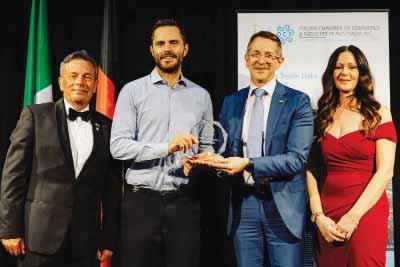
Arthur Stanley, Dr Neil Gibson, Wayne Goldsmith, Gwen Luscombe
Printed in Australia
Newstyle Printing Pty Ltd
41 Manchester Street, Mile End, SA 5031
T: 08 8154 3600, www.newstyleprint.com.au
subscriptions
Annual subscriptions cost $99 in Australia and New Zealand. T: 02 8227 6486 subscribe.ausleisure.com.au
Members of AALARA, APOLA, ARI NSW, ARQ, ASSA, AUSactive, ExerciseNZ, GCA, IAKS ANZ, LIWA Aquatics, the Sports and Play Industry Association, SWIM Coaches & Teachers Australia, the VMA and Royal Life Saving GSPO subscribers receive the magazine as a membership benefit.
The views contained in Australasian Leisure Management are not necessarily those of Leisure Media Limited or the Editor.
While every care is taken with advice given, Leisure Media Limited and the Editor can take no responsibility for effects arising therefrom. Views expressed by contributors may be personal and are not necessarily the views of their employers or professional bodies/associations.
Australasian Leisure Management is an Australian product, Australian owned and printed in Australia.
From the Publisher
The Challenge of Climate Change
Last month, Australians were presented with a sobering assessment of what global heating means for the nation’s future, and also with a plan - taking into account both politics and science - of what the Federal Government intends to do about it.
The first document, the National Climate Risk Assessment (NCRA) assessed the climate risks facing the nation while the second document, the National Adaptation Plan (NAP) outlines how the government will coordinate adaptation efforts, focusing on 11 priority risks identified in the assessment, which include threats to coastal communities, critical infrastructure and ecosystems.
That the leisure industry is not recognised in either report is no surprisegiven governments consistently overlook its economic, financial, employment and community benefits. Yet, while many sectors of the industry are directly impacted by climate change they are finding solutions.
Across the country, climate change is increasingly influencing how outdoor activities - attractions visits, outdoor events, parks and sport - are planned and delivered, against a future marked by heat stress, unpredictable weather and rising operating costs.
For Australian sport, the challenge is already visible on the field. Rising temperatures and more frequent heatwaves are forcing sporting bodies to reschedule competitions, modify training programs and introduce stricter player-welfare policies.
Elite events such as the Australian Open and cricket fixtures now include heat-stress protocols, while community sport often faces cancelled matches and declining participation in the hottest months. Floods and droughtsalso threaten playing surfaces, prompting councils and clubs to invest in improved drainage, irrigation efficiency and, in some cases, synthetic turf.
At attractions, longer, hotter summers affect visitor comfort and attendance patterns, while storms and flooding create operational uncertainty.
In response, operators have expanded shaded and indoor attractions, enhanced water management systems and introduced sustainability programs to offset energy and water use.
Yet these adaptations come at a price, with rising insurance premiums and higher utility costs challenging long-term profitability.
For outdoor events and festivals, weather unpredictability is now one of the biggest risks to viability. Prolonged heat, flash storms and bushfire smoke have caused recent cancellations and site evacuations.
Organisers are strengthening contingency planning, investing in shade structures, cooling stations and real-time weather monitoring, while insurers are demanding more detailed risk assessments before granting coverage.
These pressures increase production costs but are essential to maintaining audience safety and confidence.
Audiences and communities are increasingly conscious of environmental impact and expect operators to demonstrate leadership on sustainability. Many organisations are now setting emissions-reduction goals, improving waste and water management and embedding sustainability into procurement and facility design.
The broader economic implications are significant. Climate-related disruptions can reduce visitation and revenue, while infrastructure resilience and insurance costs climb.
As Australia’s climate continues to warm, the industry’s long-term success will depend on its ability to adapt - designing facilities, events and experiences that are safe, comfortable and environmentally responsible. The sectors that lead on resilience and sustainability are likely to be the ones that thrive in a changing climate.
Nigel Benton, Publisher
Subscriptions
Subscribe to this magazine for just $99 (in Aus/NZ) for 12 months/six issues. subscribe.ausleisure.com.au
EACH COURT SAVES 124 CANS OF OLD PAINT FROM LAND FILL
FROM
YOUR SHED TO THE CENTRE COURT
Paintback helps Australians responsibly dispose of unwanted paint by diverting
Just one standard Laykold court will save 124 x 1 litre cans of paint from
Get in touch with us today to find out how you can achieve Grand Slam quality courts... now with recycled paint.
NEWS
Some of the industry headlines over recent months. Daily industry news can be read at www.ausleisure.com.au
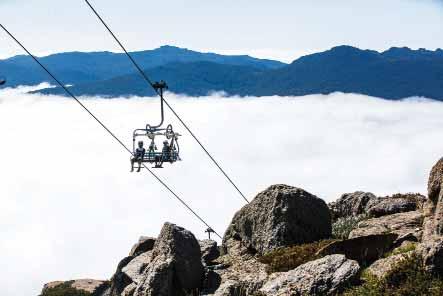
Australian snow season closes after solid winter
Australia’s 2025 snow season has officially drawn to a close, following several months that delivered strong natural snowfalls, steady cold conditions and some of the best skiing and boarding seen in recent years.
The strong season helped major resorts extend operations well into October, drawing healthy visitation numbers through the school holidays and early spring. Visitor feedback and resort reports suggest that demand for accommodation and lessons remained high throughout the winter, supported by new events and expanded terrain offerings at Perisher, Thredbo and Buller.
Families seek answers as Coronial Inquest into 2019 White Island deaths opens
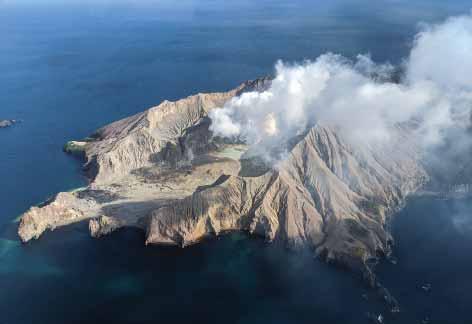
The long-awaited Coronial inquest into the 22 deaths resulting from the 2019 Whakaari/White Island eruption has formally opened, marking the next chapter in efforts to untangle one of New Zealand’s worst volcanic disasters.
Commencing with proceedings in Whakatāne District Court before relocating to Auckland, the first phase of hearings are expected to span six to eight weeks.
This initial phase will focus on the events of 9th December 2019, the emergency response, medical treatment, causes and timing of deaths and the circumstances of those who remained on the island following the eruption.
Surf Life Saving Australia launches national celebration of surf lifesavers
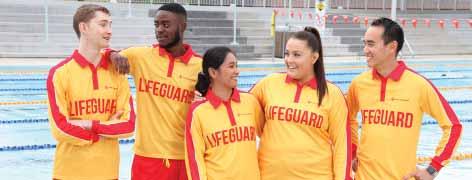
Surf Life Saving Australia (SLSA) has announced that it is launching a first ever celebration of surf lifesavers, with ‘Red & Yellow Day’ to be staged on 4th March 2026.
Noting that the event will be “a nationwide celebration of the volunteers who dedicate their time, energy, and courage to keeping Australia’s beaches safe”, SLSA advise that “Red & Yellow Day will invite all Australians to show their support for surf lifesavers, the men and women who show up, season after season, in selfless service.”
Insurance Council report calls for reform of state laws to combat rising insurance costs
The Insurance Council of Australia (ICA) has called for urgent reforms to outdated state and territory laws that are driving up insurance costs for businesses and community organisations across the country.
A newly released ICA white paper highlights that statebased civil liability laws, some of which have not been reviewed in almost 25 years, are adding unnecessary pressure to sectors that rely heavily on public liability insurance with amusement and theme parks, festival operators, live music venues, caravan parks and waterparks - which accommodate large numbers of patrons - particularly affected.
For these businesses, insurance remains a critical safety net, enabling them to operate securely and continue providing services to the public.
Brisbane City Council has released a tender seeking a long-term operating partner to design, build and operate the popular Chermside Aquatic Centre.
The City of Port Phillip has opened the Port Melbourne Skatepark designed by Baseplate and Playce Pty Ltd and delivered by Grind Projects Pty Ltd.
Professional esports gaming brand ZOWIE, under BenQ Corp, has launched its first ZOWIE Zone in Australia, now open at WY Gaming in central Sydney.
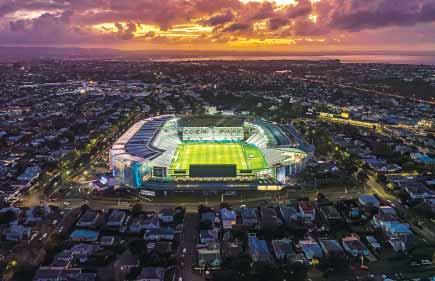
The West Stand at Auckland’s Eden Park has been renamed the Novo Nordisk West Stand after a new partnership was sealed with the global healthcare company.
The construction of the new hydrotherapy pool at Lakeside Leisure Centre in Tuggeranong is now complete, delivering an important health and wellbeing service for south Canberra.
The AFL, in partnership with the Victorian Government, has announced that it is seeking development partners to lead a transformation of the western side of Melbourne’s Marvel Stadium.
Aiming to deliver a new 17,000-seat capacity indoor arena and mixed-use housing precinct in inner city Brisbane, the Queensland Government has announced the opening of a procurement process to transform the suburb of Woolloongabba.
Works have commenced on transforming AFL’s Richmond FC’s home venue, Punt Road Oval, through a redevelopment that will deliver an elite training and administration facility built within a brand-new Jack Dyer Stand.
The planning contract to progress detailed design development of the Perth Entertainment and Sporting Precinct has now been awarded to an alliance comprising Seymour Whyte, Civmec and Aurecon, who will work closely with the Office of Major Infrastructure Delivery.
The Western Australian Government, in partnership with WA Cricket, has announced BlueFit as the new operator/ manager of the new aquatic and health facility within the historic WACA Ground precinct in East Perth.
A massive new urban park - ngarrak nakorang wilam parkconnecting to the Dandenong trail has been announced for Melbourne’s east.
Greater Western Sydney AFL club, the Giants, have opened their new aquatic facility - designed by Populous - at the club’s high-performance training headquarters in Sydney Olympic Park.
Having attracted 300,000 visitors since opening in November 2024, the operation of Brisbane immersive attraction Bluey’s World has been extended to March 2026.
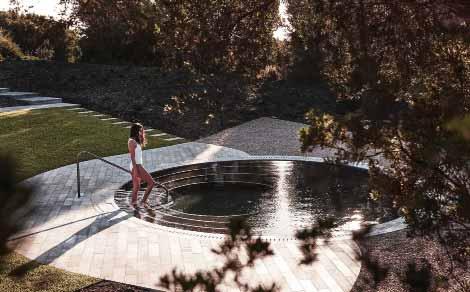
After 130 years, Hepburn Bathhouse and Spa - located in the Victorian spa town of Daylesford has officially reopened following a stunning $1.7 million refurbishment.
The Western Australian Government has formally announced the creation of the Exmouth Gulf Marine Park - a decision hailed as one of the most significant conservation moves in the state’s history.
Darwin Entertainment Centre has been renamed AANT Centre following a 10-year naming rights deal with the Automobile Association of the Northern Territory.
The reimagined Newcastle Art Gallery, designed by awardwinning architects Clare Design, in collaboration with Smith and Tzannes Architects and Arup Engineers will be revealed in February 2026 following its major expansion.
Aiming to support activity and wellbeing in its local community in the Adelaide Hills, the new Summit Aquatic and Leisure Centre has opened in Mount Barker.
The Shire of East Pilbara has advised that the long-anticipated Nullagine Aquatic Centre is on track to open before the end of the year, with final construction works now progressing.
The City of Gold Coast has put a call out to domestic and international investors to join a public-private partnership to deliver a new 12,000 capacity indoor arena in Southport.
Development Victoria has revealed that builders have been appointed to deliver major upgrades at the Bendigo Showgrounds and Bendigo Stadium (commercially known as Red Energy Arena).
The recently redeveloped Stirling Leisure - Inglewood has been named Facility of the Year at LIWA Aquatics’ 2025 Western Australian Aquatic Recreation Industry Awards.
Sydney to host Water Polo World Cup Finals in 2026
Sydney has been announced as host of the 2026 World Aquatics Water Polo World Cup Finals, with both tournaments set to take place at the Sydney Olympic Park Aquatic Centre from 20th to 26th July next year.
Being staged in Australia for the first time, the event will see the world’s top eight men’s and women’s national water polo teams compete for World Aquatics’ World Cup crowns.
Financial lifeline for Derrimut 24:7 Gym
Social media and rewards entrepreneur Adrian Portelli has reportedly stepped in to rescue the struggling Derrimut 24:7 Gym chain, securing a major stake in the business that has been facing mounting debts and site closures.
The fitness group, which runs 25 gyms across Victoria and South Australia, is understood to owe $12.5 million to the Australian Taxation Office while also facing unpaid staff wages and a lengthy list of creditors.
The Australian Securities and Investments Commission (ASIC) is understood to be proceeding with a notice of application for a winding up order for the group.
Demolition underway at once popular Manly Waterworks
Demolition works have commenced at the Surf n Slide attraction on the West Esplanade in the Sydney harbourside suburb of Manly.
A statement on the attraction’s website, previously known as the Manly Waterworks, advised that with engineers having “deemed the structure no longer safe for sliders” it had been forced to close.
Opened in 1981, Manly Waterworks was sited next to the now demolished Manly Sea Life Sanctuary (previously known as Oceanworld Manly) which closed in 2018.
Court levies $450,000 in fines over man’s death at Sydney rock climbing gym
A failure of safety equipment that led to a man falling 12 metres to his death at the Sydney Indoor Climbing Gym has led to the operating company and two of its directors being fined a total of $450,000.
Two of the three directors of Crestville Holdings, which operates the facility in the Sydney suburb of St Peters, were fined $84,375 each in the NSW District Court in August, after they pleaded guilty to breaching their health and safety duties and exposing 28-year-old Andreas Araya to risk of death.
The company was also fined $281,250, after it pleaded guilty to failing to uphold duties under the Work Health and Safety Act 2011.
The pleas followed the Court hearing details of critical safety equipment failures and missed checks that led to the man plunging 12 metres to his death in October 2021.
Swimming Australia launches strategy to help Australians find their place in sport
Swimming Australia has launched what it says is a “landmark initiative” that “signals a new horizon for swimming in this country”.
Aiming to help more Australians to find their place in sport and enjoy the benefits of being involved, the Swim Well Strategy is the first public facing national participation and sport growth strategy for swimming. Also described as a “watershed plan”, the strategy represents a unified commitment to ensure swimming continues to thrive across communities, clubs and swimming pathways.
Troubled North Sydney Olympic Pool development will not be ready for summer
The delay plagued redevelopment of the North Sydney Olympic Pool will not see the facility opened to the public until early 2026, almost five years since the project began.
While builders, Icon Constructions, are set to hand the project over to the Council before the end of the year, it will take another two to three months for the Council to ‘commission and operationalise’ the pool.
In addition, the final cost for the project is expected to be in the region of $122 million, almost double the original estimate.
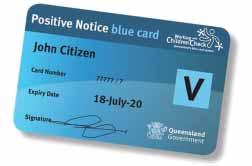
Queensland Government’s Blue Card legislative changes set to have wide impact
Changes to Queensland’s Working with Children Check are impacting operators and businesses in attractions, carnivals, outdoor activities, play, recreation and sport.
The Queensland Government’s changes to what is known as its Blue Card system aims to enhance regulation as part of a broader effort to enhance child safety and protection.
Viva Leisure reports best results in its history
Viva Leisure Limited has announced its financial results for the year ended 30th June 2025, delivering the strongest performance in its history and further strengthening its position as a market leader in the Australian fitness industry.
With its network expanded to 491 locations with 620,902 members, the ASX listed company has recorded revenue of $211.3 million - up 30% on the prior corresponding period for the previous year - and $99.1 million EBITDA - up 29.7%.
ACQUISITIONS
Geoff Lord’s Belgravia Group has announced the acquisition of the Outdoor Education Group (OEG), the recreation provider that runs hundreds of programs for 50,000 students at schools across Australia.
Sunshine Coast Lightning has announced a change in ownership with the Global Sports Fund Management Group becoming the team’s new Super Netball licence holder.
Ticketek Entertainment Group (TEG) has acquired Eventfinda, the New Zealand-founded ticketing and events discovery platform.
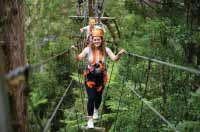
Seb Packer, founder of naturebased tourism operator TreeClimb and Managing Director of The Climb Group Pty Ltd, has acquired Merlin Entertainments’ Otway and Illawarra Fly attractions.
Parramatta’s Riverside Theatres now ‘Live at PHIVE’
Set to launch new productions in the coming months, the Discovery Space at Parramatta’s PHIVE is transforming into a brand-new black box theatre, delivering a full theatre while the Riverside Theatres are redeveloped.
New Zealand’s community sport Rebounds
Sport club membership in New Zealand has rebounded by 12% since its pandemic low in 2021 according to a pioneering report: The State of Community Sport in New Zealand.
The result of seven years of research, the report draws on findings from the National Sport Club Survey (NSCS), a joint initiative of the New Zealand Amateur Sport Association Inc. (NZASA) and Auckland University of Technology (AUT).
Victorian Government releases guide to grow Wellness Tourism
The Victorian Government has unveiled a new guide to help businesses and investors create wellness tourism destinations and experiences, supporting further growth across Victoria’s tourism sector.
‘A guide to wellness tourism investment: from concept to reality’, aims to support tourism operators through the process of developing, planning and operating wellness tourism businesses.
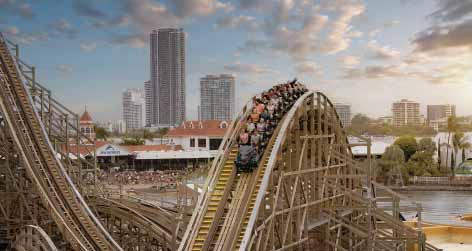
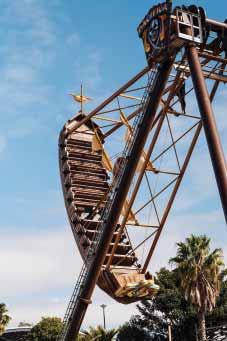
Rainbow’s End launches new pirate ship
Rainbow’s End has welcomed guests to its brand-new Pirate Ship, Pacifica - named for the final ocean she sailed to reach her new home.
The original Pirate Ship at Rainbow’s End was a firm favourite for almost 40 years before being decommissioned in 2017 due to the limited availability of replacement parts.
However, after repeated requests from fans, Rainbow’s End began work in late 2022 to bring a brand-new replacement.
Legends and ASM Global unite under Legends Global brand
Legends and ASM Global have announced that they have united their brands as Legends Global.
Building on Legends’ acquisition of ASM Global in August 2024, the company delivers an unrivalled, fully integrated solution of premium services with a white-label approach.
The comprehensive services of Legends Global cover the entire lifecycle of venues and events - feasibility and consulting, owner’s representation, sales, partnerships, venue management, hospitality and merchandise, as well as content and booking.
Tasmanian Premier Jeremy Rockliff vows to proceed with Hobart Stadium
Tasmanian Premier Jeremy Rockliff says his government will press ahead with the planned new Hobart stadium for the state’s AFL expansion team despite the Tasmanian Planning Commission’s recommendation that it not be built.
The Commission’s report warned the project would saddle the state with escalating debt reaching $1.8 billion within a decade and deliver few benefits, with a cost-benefit ratio below 0.5.
HOYTS leads Australian cinema market resurgence in 2025
HOYTS Cinemas is leading the Australian cinema market resurgence in 2025, delivering double-digit growth and strengthening its position as the country’s number one cinema circuit.
Australian cinema box office revenue is up nearly 8% yearon-year. From 1st January to 31st July 2025, the Australian box office reached $607.7 million, a strong lift from $563.2 million during the same period last year. HOYTS Cinemas delivered standout results growing market share to 27.2%, rising from 26.4% year-on-year.
BeWell Brands partners with O-Studio
Newly formed franchising group, BeWell Brands, has announced a joint venture with O-Studio, a fast-growing recovery and wellness concept from New Zealand, that will back its Australian debut in early 2026.
This partnership marks an expansion in BeWell Brands’ strategy to expand its reach beyond its current brand, Jetts Fitness, into holistic health and recovery experiences that complement and enhance its traditional gym offerings.
National Aquatic Industry Workforce Report shows increasing number of women in leadership roles
The newly released National Aquatic Industry Workforce Report 2025 shows that women now hold 54% of senior leadership roles in the industry, with more than half of respondents agreeing the aquatic industry offers good career opportunities.
While highlighting women’s growing roles in senior leadership positions and career opportunities in the industry, it also identifies significant risks.
One in four aquatic workers report experiencing occupational violence and aggression (OVA) frequently, nearly half say they feel unsafe at times in their role, and almost one in five describe their safety fears as very high.
Tourism NT and Major Events to merge into new entity from 2026
Two of the Northern Territory’s key organisations driving tourism and events will merge to form a single, dynamic entity - ‘Tourism and Events NT’ - as part of the NT Government’s Rebuilding the Economy Strategy.
A Bill will be introduced in the October NT Parliament sittings to amend the Tourism NT Act 2012, formally establishing the new entity and Advisory Board from 1st January 2026.
Tourism NT and NT Major Events Company will come together under one umbrella, streamlining operations and enhancing the Territory’s ability to market tourism and events with greater impact.
Contemporary music a key driver for ticket revenue growth
Live Performance Australia’s latest Attendance and Revenue Report has contemporary music to be a key driver for ticket revenue growth.
Growth in ticket revenue and attendance for Australia’s live performance industry in 2024 was concentrated in a few key categories and states and territories.
The Report shows total revenue was $3.4 billion, a 6.9% increase on the previous year. Ticketed attendance was 31.4 million which was a 4.6% increase over 2023.
Federal and Queensland Governments sign intergovernmental agreement for 2032 Games infrastructure
The Federal and Queensland Governments have signed the Intergovernmental Agreement that will guide how they will collaborate on delivering the Brisbane 2032 Olympic and Paralympic Games.
The Australian Government has allocated a capped contribution of $3.435 billion to the $7.1 billion Games Venue Infrastructure Program, which will see 17 new or upgraded venues delivered across Queensland.
This includes the main 63,000 seat stadium at Victoria Park and the National Aquatic Centre.
STRONG Pilates reaches its 100th studio milestone
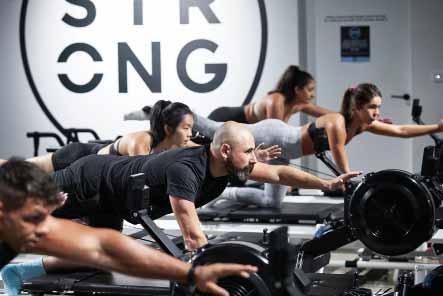
Australian fitness franchise, STRONG Pilates founded by Michael Ramsey and Mark Armstrong in 2019, has reached a major global milestone with the launch of its 100th studio in New Jersey, USA.
STRONG Pilates which offers Pilates with cardio and strength training, is one of Australia’s fastest-growing fitness exports, set to reach over 300 studios globally within the next four years.
Western United sidelined from 2025/26 A-League season
Western United’s place in the A-League Men’s and Women’s competitions has been put on hold for the 2025/26 season, with the club officially placed into ‘hibernation’ following financial and legal issues engulfing its ownership structure.
The Australian Professional Leagues (APL) confirmed the decision following the liquidation of WMG Football Club Limited, Western United’s owner and operator, and amid ongoing appeals against Football Australia’s decision to revoke the club’s A-League licence.
Pickleball Australia highlights growth of the sport in Australia
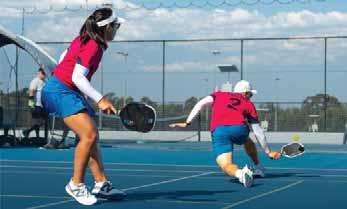
Pickleball Australia has released statistics which highlight the growth of pickleball in Australia with the data showing there are now 321 clubs and affiliates; and over 530 venues with more than 3300 sessions each week.
There are also 98 Pickleball Australia sanctioned tournaments currently scheduled for 2025 throughout Australia.
Pickleball Australia explains the reasons for this exponential growth in the sport as “it’s easy to learn, highly Inclusive fun, social and competitive and encourages intergenerational activity.”
Aventuur secures institutional investment for Perth Surf Park
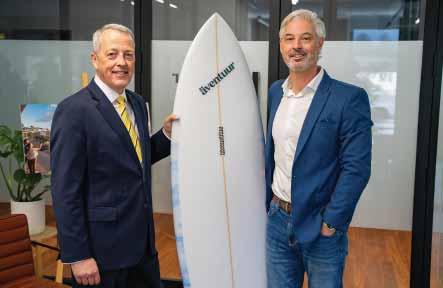
Aventuur has announced that it has secured institutional investment from the Royal Automobile Club of Western Australia (RAC), along with further investment from existing project partner Wyllie, for the Perth Surf Park.
The funding will enable construction to commence later this year, with a public opening planned for late 2027.
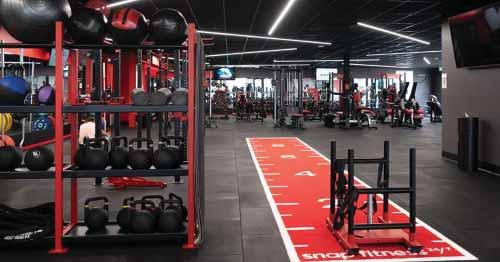
Snap Fitness opens 10 new clubs in as many weeks across Australia and New Zealand
Snap Fitness is celebrating a remarkable growth milestone, opening 10 new clubs in just 10 weeks.
The rapid expansion reflects the strong demand for the Snap Fitness brand, recognised for its state-of-the-art club layouts, dedicated wellness spaces and its proven 24/7 model that delivers flexibility and value to members.
The brand notes that despite cost-of-living pressures, Australians and New Zealanders are continuing to prioritise their health and fitness.
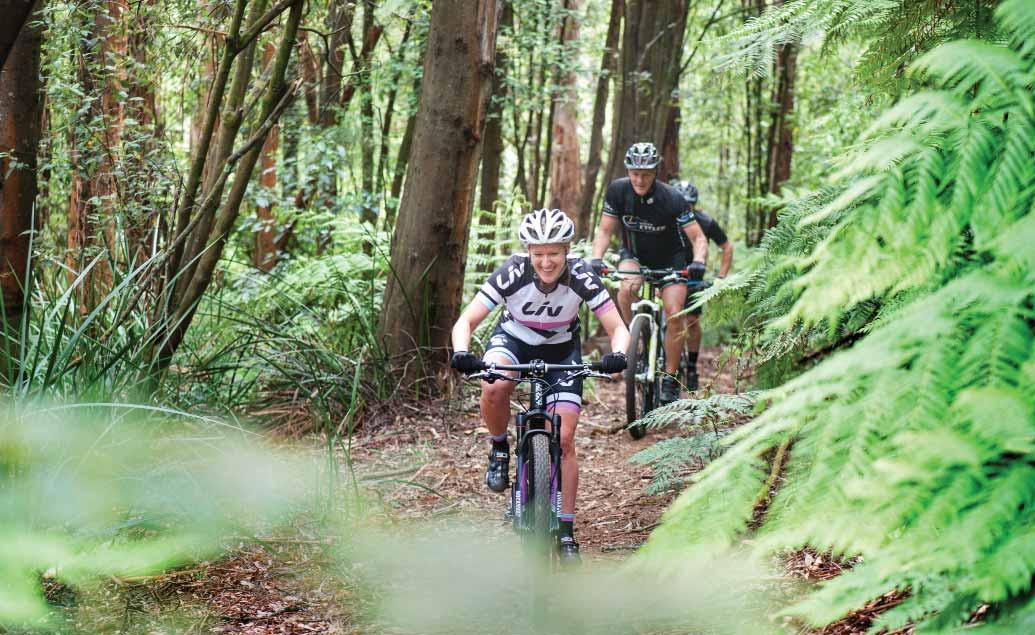
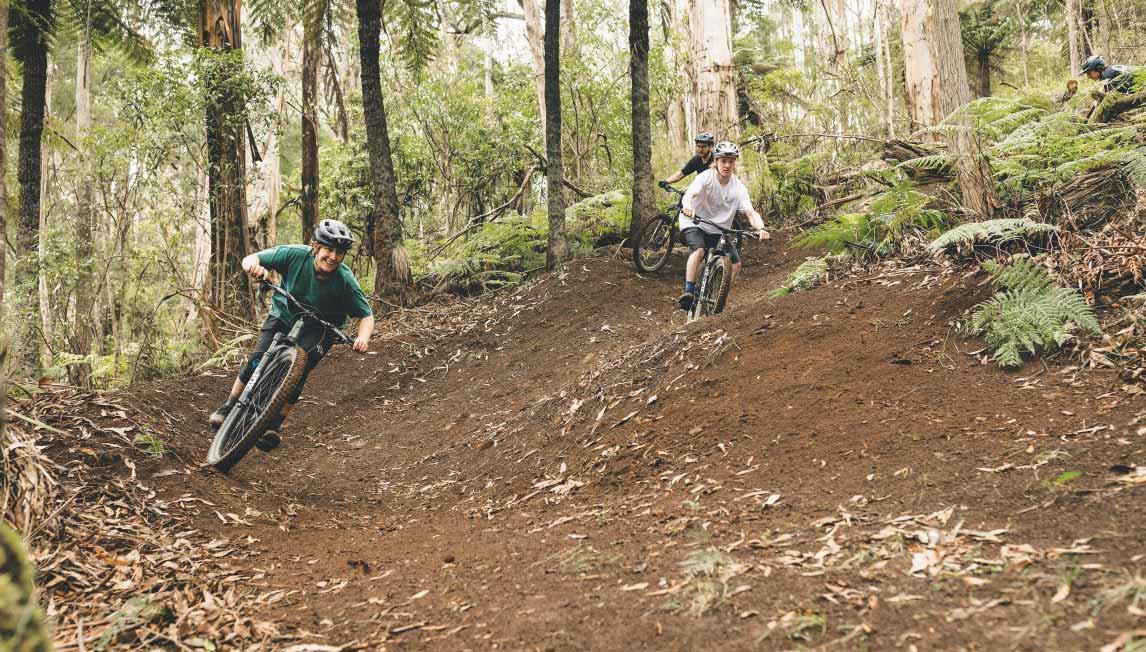
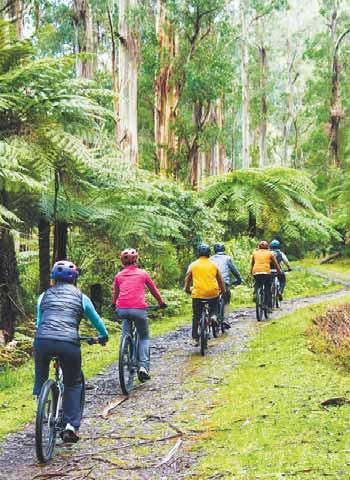
New guidelines for New Zealand Mountain Bike Trail Design
Aimed at improving safety, consistency, sustainability and accessibility, Recreation Aotearoa has released updated New Zealand Mountain Bike Trail Design Guidelines, supported by a new, easy-to-use Trail Builders’ Handbook. These resources provide clear, practical advice for land managers, trail designers, builders and auditors.
The updated guidelines were developed in partnership with the Department of Conservation (DOC), Ngā Haerenga New Zealand Cycle Trails, ACC, Sport NZ, and the wider mountain bike community.
www.ausleisure.com.au
ROI 4 Events launches disruptive insurance scheme for mass participation sport
Event organisers across Australia’s mass participation sector now have the opportunity to obtain a major cost-savings with the launch of a new insurance scheme by ROI 4 Events.
Branded Events Cover and delivered in partnership with global broker Howden, the scheme has been specifically designed for mass participation events and is already demonstrating dramatic reductions in premiums.
Federal funds for community sporting facilities to deliver local action on climate change
The Federal Government has announced that it is to invest $50 million over four years to help up to 500 sports clubs take climate action with upgrades like better shade and drainage, batteries and energy upgrades to lower bills and climateproof their facilities.
The funding takes into account how sporting clubs are already feeling the impact of climate change, with the recently released National Climate Risk Assessment noting that more frequent and more intense extreme weather events will impact sport and recreation.
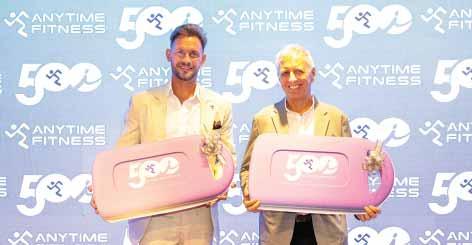
Anytime Fitness Asia marks 500th club milestone with openings across eight markets
Anytime Fitness Asia has achieved a historic milestone, achieving growth to 500 clubs across the region.
To mark the occasion, eight clubs across eight markets hosted synchronised grand openings on the same day earlier this month, highlighting the scale and unity of the brand’s fast-growing network.
With Anytime Fitness Asia recently recognised as the Overall Winner - International Franchisor of the Year at the 2025 Franchising and Licensing Association (FLA) Singapore Awards, the 500th club milestone further underscores the brand’s leadership and credibility in the region.
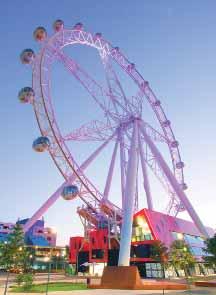
New backers set to reopen Melbourne Star Observation Wheel
New investors are to back Ferris wheel operator Skyline Attractions in the reopening of the Melbourne Star Observation Wheel.
Collectively contributing $11 million in a deal that has already gained approval from liquidators and creditors, the funding from Swiss and American backers will see the attraction turn again after having closed in September 2021.
The new ownership group has committed to having the wheel turning again by the end of 2026.
Inaugural NSW/ACT Diversity and Inclusion in Leisure Forum to highlight pathways to equity
The Belgravia Foundation has announced that tickets are now available for the 2025 Diversity and Inclusion in Leisure Forum NSW/ACT, taking place on Wednesday 19th November at Aerial, University of Technology Sydney.
Expanding on previous editions held in Melbourne, the Forum will see leaders from across the aquatic, fitness, recreation, sport and community sectors gather to shine a spotlight on the role of the industry in creating more equitable, welcoming and accessible environments.
Hammon Family Named as new Sydney Zoo owner and operator
Sydney Zoo has announced that its Board has endorsed family-owned tourism and attractions group Hammons Holdings as buyer of Sydney Zoo.
The proposed acquisition
would see Hammons Holdings acquire the shares of Zoo founders, John and Jake Burgess, and other shareholders, subject to a period of due diligence.
Hammons Holdings, a third-generation family-owned operator of leading Australian attractions including Scenic World and Sydney’s BridgeClimb, is a founding investor in Sydney Zoo.
NRL’s Wests Tigers settle on 15-year venues strategy
Wests Tigers have secured a landmark 15-year stadium strategy that will see the club’s NRL and NRLW fixtures played at both Leichhardt Oval and Campbelltown Sports Stadium, backed by more than $100 million in government and council funding.
The announcement follows confirmation of a $50 million redevelopment of Campbelltown Stadium, alongside the previously announced $50 million upgrade of Leichhardt Oval.
From Entry to Exit: Never Lose Track
Visitors
Leading the Pack
The last few years have seen PerfectGym dominate the software market in aquatic and recreation facilities while also making significant inroads in the private fitness club market. Matt Inglis, PerfectGym Country Manager for Australia and New Zealand and recently appointed Vice President of Global Leisure, talks to Nigel Benton on how the business has got there
In 2016, Matt Inglis - then in his late twenties and already a decade into his career with a major industry software provider - decided to start over.
Having reached what he called “the ceiling” of his previous role, he left the security of full-time employment to explore new opportunities thinking that “I could always go deliver newspapers if it didn’t work out.”
After several months consulting on projects including the Arthur’s Seat Eagle chairlift and Gumbuya World, he was approached by a long-time industry contact from Austria’s Gantner, whose access control systems he had implemented years earlier.
Inglis recalls “he told me about two guys in Poland with a really good software platform for aquatics and fitness who wanted to expand internationally. So they flew out, we spent a few weeks together, and the rest is history. We set up the Australian arm of PerfectGym Solutions that same year.”
From the outset, the approach was hands-on. The company brought out members of development teams to Australia for many months to work with Matt and the local team to create and to learn how local councils, swim schools and fitness operators worked, with Inglis noting “it was very startup-likeagile, experimental, but with the stability of an already proven international platform behind us."
Brisbane’s Total Fusion uses PerfectGym as its data backbone (above) and Matt Inglis with the PerfectGym team at the 2025 AusFitness industry summit (below).
Inglis adds "the goal was not to replicate existing systems but to reimagine them for the local environment - from how billing and memberships were structured to how gyms managed memberships and councils managed bookings and compliance. Over time we’d present at conferences and get feedback that it was obvious this software was designed by people who actually used it.
“That was the biggest compliment.”
Entering the Market - and Building Trust
The first Australian clients came from the fitness industry, with Genesis in Cairns and Fit n Fast among the early adopters. These early projects built credibility and helped refine the product before the company pivoted toward the broader aquatic and recreation market in 2018.
“I’d come from a leisure background, and I knew that’s where the real challenge was,” he explains. “We decided to build PerfectGym into a true leisure management platformcloud-based, customer-centric, and mobile-first.”
By 2019, the company had secured its first local government client, by way of collaborating with Marcus Cook, of Shepparton Council, who saw the potential of what PerfectGym would bring to the market.
Inglis notes that “he believed in what we said we could achieve, and supported us in our maiden foray into local government leisure.
“Our first council demo was then with Colac Otway, and I remember being nervous.
“At the end, John Clark - who at the time managed their aquatic centres and is now with Aligned Leisure - said, ‘there’s good news and there’s bad news. The good news: this product is what the market needs but the bad news is I’m leaving for Brimbank City Council.’
“As a result of that established connection and first demo, John called me a few months later, and provided us with an opportunity to enter the metropolitan leisure space - which we did successfully. In parallel, we worked closely with the City of Maribyrnong,”
From there, PerfectGym gained traction with councils including, Ballarat, Brimbank, Shepparton, Yarra and Whitehorse - a cluster that helped establish the company as a viable alternative to traditional on-premise solutions.
The COVID Catalyst
Like most in the industry, PerfectGym faced uncertainty when the pandemic hit in early 2020. Fitness centres closed overnight, revenue streams vanished, and client operations went into hibernation. Yet the company’s pivot into leisure management the year prior proved decisive.
“JobKeeper didn’t apply to local councils, but council staff still had to keep working - often redeployed into different roles.
“We saw that while everything was shut, it was actually the perfect time to implement new systems. You couldn’t interrupt a customer experience that didn’t exist at the time.”
The result was a wave of digital transformation across the sector. Councils used the downtime to modernise, moving
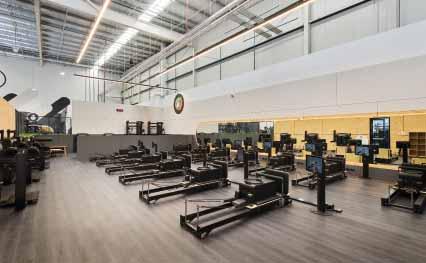
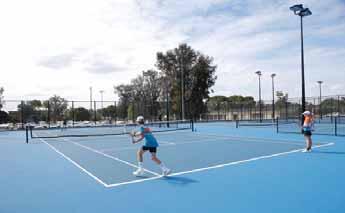
PerfectGym client: Revo Fitness.Jim Elphick Tennis Centre at Bolton Park. Credit: City of Wagga Wagga.
PerfectGym clients embrace a smarter, more connected future. Upper Hutt City Council (above left) and Planet Fitness (above right)..
Kensington Community Aquatic and Recreation Centre. Credit: City of Melbourne. PerfectGym is the technology partner to both the City of Melbourne and YMCA Victoria.
Stawell Sports and Aquatic Centre. Credit: Northern Grampians Shire Council.
from long-standing desktop systems to PerfectGym’s cloudbased platform. “We grew by around 200% during 2020,” he says. “It was surreal - while the world was pausing, we were busier than ever.”
The company’s largest early test came with the City of Cockburn in Western Australia, home to Cockburn ARCone of the country’s biggest aquatic and recreation centres. Travel restrictions meant the entire system migration and golive had to be completed remotely. “We launched every single function - from access control to swim school iPads - without a single person on site,” he recalls. “It was a 12-hour marathon across time zones, but it worked. That client’s just renewed for another 10 years, which is pretty special.”
From Start- Up to Market Leader
From those early days, PerfectGym’s Australian presence has grown exponentially. The company has now implemented systems across almost every YMCA association in the country - South Australia, New South Wales, Victoria, the Northern Territory - with Queensland the only exception.
Inglis advises “YMCAs are incredibly diverse. They operate everything from community pools to large multi-site facilities. To have their trust across states really validates our approach.”
The company’s staff numbers have expanded from four at
the start of the pandemic to nearly 30 today, with offices and remote support across Victoria, Queensland, South Australia and Western Australia.
Annual growth has averaged between 30 and 35% since 2020, supported by large-scale projects with operators including Aligned Leisure, Clublinks and state sports centre trusts.
The Power of Partnership and Integration
As technology has matured, so too have client expectations. The days of standalone systems are over, replaced by an ecosystem approach that values integration and open data.
Inglis notes “interconnectivity is the biggest shift we’ve seen.
“Operators don’t want a siloed system. They want their CRM, finance, access control, booking, and customer engagement tools all talking to each other.”
He points to examples such as VenuesWest in Perth, where PerfectGym forms part of a broader ‘data lake’ alongside Salesforce and other platforms. “It means the system isn’t the whole picture - it’s part of a bigger one,” he says. “That’s becoming a must-have, not a nice-to-have.”
The same thinking applies to bespoke operators like Brisbane’s TotalFusion, which uses Perfect Gym as its data backbone while building its own customer-facing applications. “They’ve built an entire app ecosystem around our API,” he explains. “Our role is to power the core while giving them the freedom to innovate on top.”
Digital Evolution and the Role of AI
While automation and paperless workflows are now standard expectations, the next phase of innovation is being driven by artificial intelligence - not as a buzzword, but as a tool for insight.
“AI isn’t a silver bullet,” he cautions. “But it can help operators make better decisions. For fitness, that might mean predicting member churn. For leisure, it could mean modelling swim school progression or class utilisation - helping centres schedule smarter and use their finite space more effectively.”
The focus, he says, is on using technology to empower decision-making rather than replace it. “Leisure centres can’t just build another pool when they reach capacity. But they can
Aerial view of Cockburn ARC.
Kensington Community Aquatic and Recreation Centre. Credit: City of Melbourne. PerfectGym is the technology partner to both the City of Melbourne and YMCA Victoria.
analyse patterns, understand progression bottlenecks, and plan accordingly. That’s where data intelligence makes a difference.”
Going Global - and Staying Grounded
In 2024, PerfectGym’s parent company was acquired by Germany’s Sport Alliance - one of Europe’s largest fitness and recreation technology groups, with over 10,000 studio clients across Germany, Austria and Switzerland. The move elevated Inglis to a global leadership role overseeing leisure strategy across multiple markets, including the UK and North America.
Inglis says “we are really excited for what we can bring to the UK Leisure Market.
“It’s a mature market but still behind in terms of digital transformation. The model we’ve built in Australia - working closely with councils, addressing compliance, and understanding the community side of leisure - translates really well there.”
Other markets, from Canada to parts of Europe, share similar community infrastructure and governance structures, with Inglis adding wherever there’s public provision of leisure - pools, gyms, recreation centres - there’s a need for what we’ve built here.”
Despite the global brief, the Australian operation remains the blueprint, with Inglis emphasising “this is where we proved the model works.
“We built locally, we listened, and we adapted. That approach will always stay at the heart of what we do.”
A Maturing Market, Still Evolving
Almost a decade on from its launch, PerfectGym is no longer the challenger but one of the market’s leading platforms. Yet its founder’s focus remains the same: innovation through understanding.
Inglis explains “what’s kept us relevant is that we never stop rewriting parts of the software.
“We’re constantly modernising to keep clients ahead - so they’re never left behind with technical debt or systems that can’t evolve with them.”
For an industry that balances community expectations, governance demands and commercial realities, that adaptability matters. Its digital transformation may have
accelerated under extraordinary circumstances, but it shows no signs of slowing down.
Inglis concludes “operators today expect mobile-first, cloudbased, and customer-focused solutions.
“The technology is only part of it - it’s about helping the industry deliver better experiences, smarter operations, and stronger connections to community. That’s what we’ve tried to do from day one.”
Matt Inglis was talking to Australasian Leisure Management
Publisher Nigel Benton.
Parramatta Aquatic Centre Credit: City of Parramatta.
PerfectGym partners with Community Leisure Management (CLM) at Mount Albert Community and Leisure Centre. Credit: CLM.
James Croll talks to Ludo’s Bart Wildash to find out how a quiet technology company is reshaping the way Australians experience their most iconic events
There’s nothing quite like the Royal Easter Show in Sydney or the Ekka in Brisbane. The whiff of hot chips and fairy floss, the echo of cattle calls, the tug of children begging for showbags. For generations, these events have been cultural touchstones, where city and country meet.
But for all their magic, they’ve also been notorious for some less-rememberable experiences: the queues, the clunky ticketing, the cash-only stalls and the lack of clarity for organisers and vendors about what money was flowing where.
This is the pain point a division of Sendrato, the global eventtechnology firm best known for its festival wristbands, set out to solve. The division is called Ludo, and it has quickly become the name behind the visitor-experience revolution sweeping through Australia’s largest public events.
Bart Wildash (pictured left), Ludo’s Chief Product Officer (CPO) and co-founder advises “our aim is to deliver a better visitor experience, increase efficiency, and drive revenue growth.
“When you make life easier for the visitor, the organiser, and the exhibitor at the same time, everyone wins.”
Sendrato was born from
a curious team of engineers, scientists and developers in Europe who wanted to use wearables and RFID to make largescale festivals safer and more enjoyable. Their wristbands became iconic at music events like Tomorrowland.
When the team turned its gaze to Australia, they saw a different kind of live event; sprawling agricultural shows, where hundreds of thousands of visitors descend on grounds that blend carnival rides, farm showcases and retail trade stalls.
The challenges were real, and the solution was to build a platform handling payments, engagement, and reporting in one place. That vision became Ludo.
Sydney’s Royal Easter Show rides (above); Sendrato ticketing vendor machine (below right); and Bart Wildash, Ludo’s Chief Product Officer (CPO) and co-founder (below left).
The problems that needed fixing
Before Ludo, shows were plagued by three recurring problems:
•Revenue friction between exhibitors and organisers, often settled with manual reporting after the event.
•Inefficient payments, with cash, EFTPOS and wristbands often requiring separate systems.
•Lack of data, leaving organisers guessing about visitor flows, dwell time, or where revenue spikes were happening. A result - visitors waited in queues, organisers struggled with planning and exhibitors lost sales.
Wildash recalls “we heard again and again: no one wants to queue for ride tickets anymore. Families want to plan ahead, pay securely, and spend more time enjoying the event. That’s what we set out to build.”
Three Pillars of Ludo’s Success
There are three main pillars to Ludo’s impact: automatic revenue splitting; its payment terminals; and a highly efficient back-office application.
Automatic revenue splitting
Early on, Ludo recognised the need to solve a key commercial issue - how to split revenue fairly and efficiently. At the heart of every showground is a delicate balance. Vendors make sales; organisers take a percentage. Until recently, this was managed with paper receipts and manual reconciliation.
Ludo’s platform automates the process. If a stallholder at the Ekka agrees to keep 75% of sales while the show takes 25%, the system does the split instantly. For organisers, this means predictable income streams. For exhibitors, it means peace of mind and transparency. No disputes. No waiting weeks for settlement.
Wildash explains “it used to be a pain point for both sides. Now everyone sees their numbers in real time. That transparency builds trust, and trust fuels participation.”
The benefit to visitors? More vendors, more diversity, and smoother operations on the ground.
Payment terminals that just work
Perhaps the biggest pillar of Ludo’s success is its unified hybrid payment solution. At an event as sprawling as the Easter Show, visitors expect to pay any way they like: By wristband, Visa, Amex, mobile wallet. Vendors, meanwhile, don’t want three devices cluttering their counter.
Ludo’s terminals accept it all. They’re assigned to vendors with a simple onboarding process, backed by in-person training before the event. By the time gates open, stallholders know exactly how to use them.
The system blends Sendrato’s festival-grade wristbands with mainstream card payments. Parents can preload funds for kids, while adults tap phones or cards at will. For the visitor, it means confidence - every stall takes every method. For vendors, it means instant transactions even in remote corners of the showground. And for organisers, it means no lost revenue.
Wildash notes “whether you’re tapping a wristband or swiping Amex, that’s the level of reliability visitors expect, and vendors deserve.”
Back-office intelligence and real-time data
The third element is perhaps the most powerful: The backoffice application that turns raw transactions into actionable intelligence.
Every sale, every ticket redemption, every wristband tap feeds into a secure dashboard. Organisers see revenue flows by stall, by category, even by hour. They know which rides attract families early, which food vendors spike at night, and which showbags sell out by midday. This transforms strategy. Staffing can be redeployed in real time. Marketing messages can be targeted. Crowd management becomes proactive rather than reactive.
Security underpins it all. Credit card data is tokenised, never touching the organiser’s servers. Advanced ticketing allows families to pre-purchase ride credits, cutting queues and smoothing cashflow.
Wildash adds “it’s about moving from anecdote to evidence.
“You don’t just think an area is busy, you know. That helps you act faster, and it makes the visitor experience better.”
Explaining its adoption of the technology, Sydney Royal Easter Show Head of Operations, Shane McGrath says “we needed to elevate our visitor experience, and we found a partner in Sendrato capable of delivering everything we envisioned on a digital platform.”
Together, Ludo’s three pillars have delivered five key benefits:
•No queuing: Tickets and credits are pre-purchased.
•Advanced payments: Organisers benefit from cash flow before the gates open.
•Transparency: Exhibitors see sales and revenue splits in real time.
•Flexibility: Terminals process payments anywhere, with or without storefronts.
•Insights: Organisers finally understand visitor journeys and spending patterns.
For visitors, that translates to shorter waits, more time at attractions, and a sense of control. For organisers, it’s efficiency and growth. For vendors, it’s reliability and trust.
human-centred
While the technology is sophisticated, Ludo’s success lies in keeping it human-centred. Their mobile apps are built with user experience first, offering interactive maps, digital wallets, family management tools, and instant information.
Visitors can plot their day, top up their children’ wristbands, and never feel lost in the sprawl of a 200-hectare showground. Exhibitors can engage audiences directly. And organisers can communicate through targeted notifications, driving crowds to quieter areas or alerting families to upcoming parades.
As a parent to a young family, Wildash says he brings empathy to designing for families at crowded events. “I’ve stood in those queues, held tired kids and juggled phones and a variety of paper tickets. That is why we design for functional, minimal and high-capacity performance.”
At the Sydney Royal Easter Show, more than 120,000 visitors can be onsite in a single day. Ticketing, redemption, sales and payments all need to operate flawlessly, with no downtime.
Today, Ludo’s self-service kiosks and mobile app handle more than 80% of visitor spend at crowded outdoor events, taking pressure off staff and letting guests stay in control of their day.
Digital wallets typically drive 40% greater spend compared with standard card or cash, while also creating a far richer fingerprint of customer behaviour. That gives organisers the confidence to redeploy staff or adjust marketing in real time.
Although agricultural shows and music festivals have been the proving ground, the same efficiencies apply across the industry - aquatic centres, stadiums, attractions and theme parks can all benefit from automated revenue splits, frictionless payments and live data flows. These systems have been battle-tested in Australia’s and Europe’s biggest events and are now ready for the wider industry.
Wildash goes on to say “we grow through innovation but our ‘North Star’ is always simplicity. If we do our job right, visitors barely notice the tech, they just have a better day. For organisers, it’s a different story. They gain instant visibility over what is happening across their grounds: Every dollar, every footstep, every queue. Revenue splits happen automatically, crowd flows are mapped in real time, and our clients are now operating a precision-tuned system.”
James Croll manages partnerships for Australasian Leisure Management.
Further details on Ludo and its visitor experience solutions can be found at www.sendrato.com/ludo/home
Splashing out of The Maze
Nigel Benton explores Outback Splash’s evolution and pursuit of excellence
Driving north from Perth into the Swan Valley, it’s easy to see why locals and tourists alike are drawn to Outback Splash.
What began as a humble maze park on the edge of the city has evolved into one of Western Australia’s most distinctive and resilient attractions, balancing family entertainment, safety excellence and an ever-expanding vision - all while facing challenges with approvals and regulations due to its location in a rural, bushfire-prone area.
First opened to the public in 1981, the attraction became a favourite destination for local families who enjoyed picnicking, daily sheep shearing shows and exploring the park’s main attraction, a 2500 metre² timber labyrinth, which was one of the largest mazes in the world at the time of its construction.
In July 2006, local business owners Paul and Nicole Woodcock of the Funday Entertainment Group (FEG) purchased The Maze with a vision to invest in new features and enhance its operations to cater for Perth’s fast growing northern suburbs.
Becoming a Waterpark
According to the attraction’s key management team members, the transformation to what is now Outback Splash began with a single idea - adding water.
Eli Barlow, Funday’s Chief Operating Officer and Marketing Manager, recalls "one of the team members suggested to Paul (Woodcock) that he should add a waterslide. So Paul and his brother-in-law, Phil Dixon, headed to the AALARA (Australian Amusement Leisure and Recreation Association)
conference, met with waterpark architect Alan Griffith, and started mapping out what the concept could be.”
As a result, when The Maze’s first water attraction - the Splash Island waterslide playground - opened in December 2013, everything changed.
Barlow recalls “it was immediately popular and became the chapter one of the park as we see it today.”
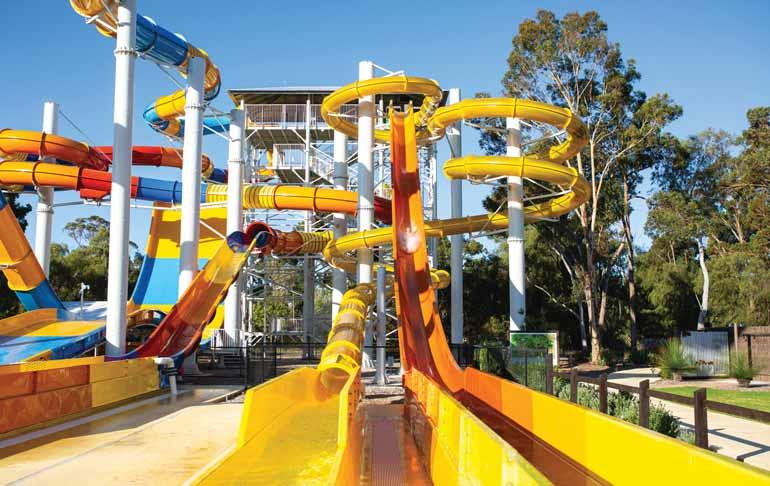
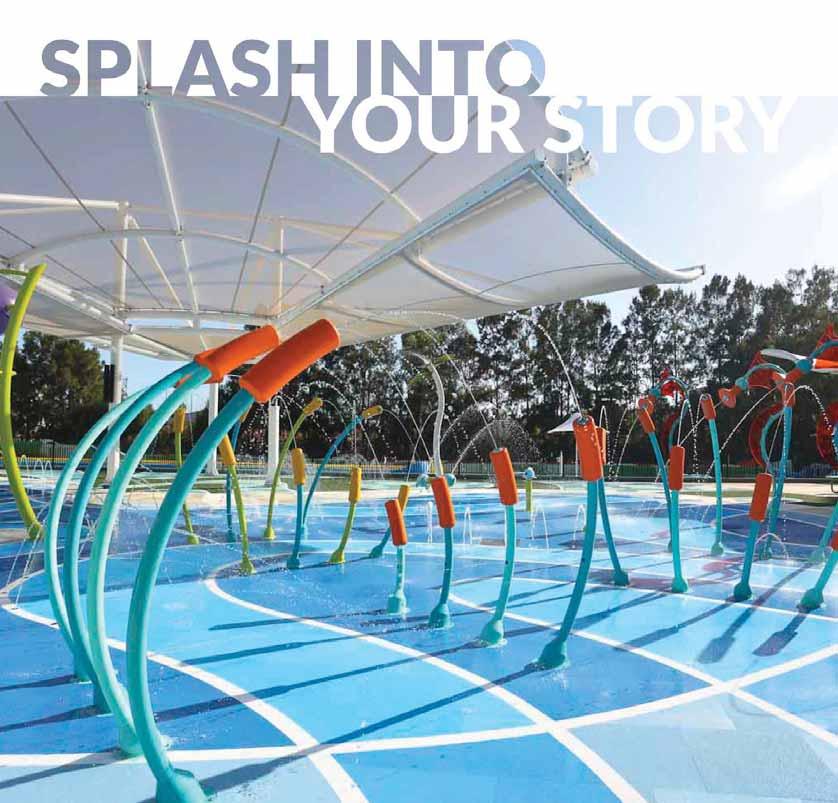
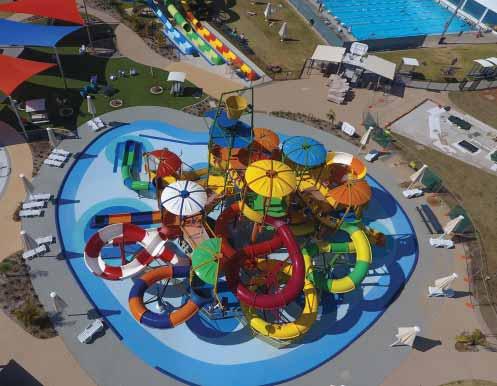
Since then, the attraction has continued to grow, with major new developments every two to three years. Octopus Bay Kids Splash Zone followed in December 2016, and in 2019 a six-storey slide tower featuring four new waterslidesdesigned and constructed by Polin Waterparks and Swimplex Aquatics - was unveiled. That same year, the park officially rebranded as Perth’s Outback Splash.
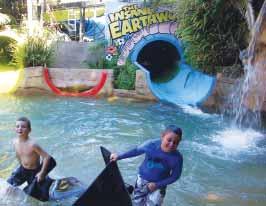
Outback Splash's water slide tower, featuring The Wall, Blackout, Gold Rush and The Wedgie (above) and its Hedge Maze (below).
Every facility has a story to tell. Journeys from concept to grand celebrate.
Surfaces are the largest features present at any venue. They take up
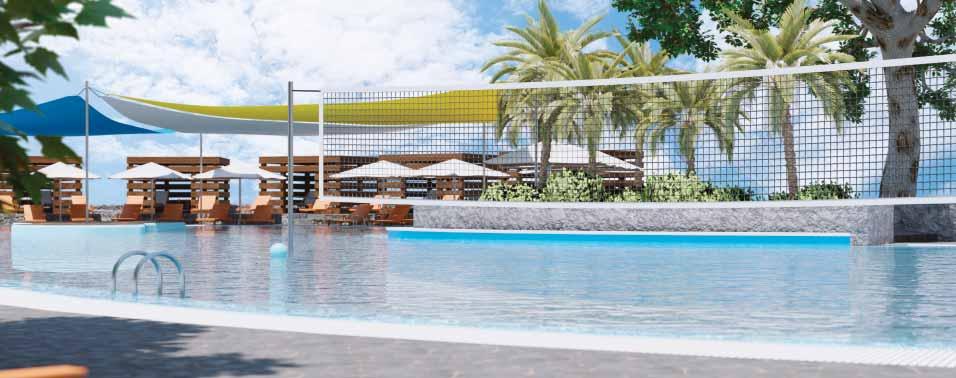
For the 2023/24 season, 'The Lagoon’ - a resort-style pool created by Commercial Aquatics, surrounded by tropical gardens and lavish amenities - was introduced.
While the park’s popularity continues to grow, progress has not come easily.
Barlow notes “the hurdles in getting the plant applications approved are many.
“We’re in a high-risk bushfire-prone area, part of our land is a traditional Indigenous Australian site, another part is classified as Bush Forever, and through the property runs a deep underground natural gas pipeline.
“So really, the entire site can’t just be touched freely - it’s taken incredible care and patience to develop each phase.”
Consolidation and the Guest Experience
Outback Splash currently holds approval for a new slide tower, a main entrance building, and an upgraded car park. However, after years of continuous expansion, 2025/26 is about consolidation.
Barlow explains “we’re focusing on getting our guest experience right, ensuring the park presentation is where we want it to be. It’s about fine-tuning everything we’ve built.”
That focus also extends to team development. This season, Outback Splash introduced Front Line 30, a 30-week training and leadership framework for seasonal team members. Designed in-house, the program combines safety, customer service and operational excellence with the park’s other core values - fun, family, and integrity.
Barlow explains “Front Line 30 is about helping our team understand not just what to do, but why it matters. It’s changed the way we train, and it’s given our people the confidence to deliver world-class service, even in their first season.”
The program has since become a cornerstone of Outback Splash’s approach to staff culture, reinforcing consistency, safety awareness and pride across every department.
A Turning Point for Safety
Like all major attractions, Outback Splash faced defining challenges.
In November 2014, an incident on one of Outback Splash’s waterslides prompted a major review of its safety systems and a renewed emphasis on safety procedures and training.
Barlow explains “it was a moment for us to refocus.
“We already had procedures in place and were operating within the health code, but from that moment on we’ve worked closely with DRA Safety and spent a huge amount of time building our safety culture. Each year, our training and processes get better.”
Outback Splash now partners with leading aquatic safety trainers, including Matt Nelson's NAQUATICSS, to deliver lifeguard and operations training that rivals national benchmarks.
Barlow says “our team training is second to none."
Chloe Dixon, Outback Splash’s Head of Administration and Operations, agrees.
Describing that the park’s reputation for safety now extends into the broader aquatic industry, she advises “we’ve had people from aquatic centres reach out asking how we train our lifeguards.
“They’ve noticed that our team members bring a level of excellence back to their pools that’s different to what they’re seeing elsewhere. That’s been a huge point of pride.”
The Seasonal Challenge
Operating in Western Australia brings both advantages and complications. The park’s season typically runs from late September through Easter - around seven months of operation - before closing for winter maintenance.
Staffing, as with most seasonal attractions, is a constant balancing act.
Dixon states “staffing can be challenging in a seasonal business, and our location adds to that, but we’re passionate
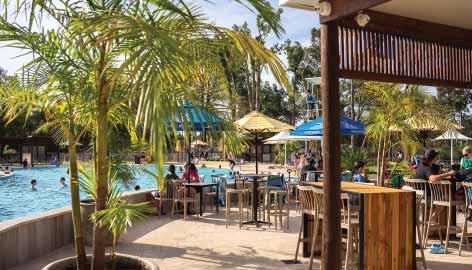
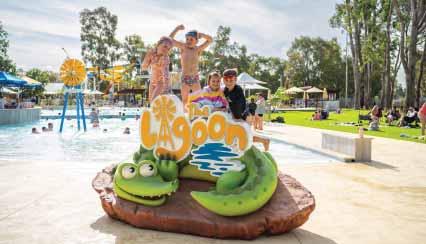
Outback Splash's The Lagoon opened in 2023.
about growing our people. We bring in a lot of young staff - often university students - and focus on giving them transferable skills. We understand that for many, this isn’t a lifelong career, so we want them to leave with experience that benefits them wherever they go.”
The approach appears to work. Around half of each season’s team returns the following year, which management credits to strong culture and development opportunities.
Dixon notes “they love the environment here. We put a lot of time into training, mentorship, and creating a culture people want to return to.”
Many team members also work year-round, splitting time between municipal pools in winter and Outback Splash in summer - an arrangement that benefits both sides.
Dixon adds “it’s great for them, and great for us. It means we retain good people and they gain more diverse experience.”
WaterParks and the Aquatic Industry
While community aquatic centres often focus on swimming, fitness and structured programs, Outback Splash represents a different kind of operation - one that blends entertainment, safety and technical maintenance at scale.
Barlow explains “the way an aquatic centre manages their venue versus how a waterpark does is quite different.
“We have dedicated teams making sure our water is perfect, our attractions are maintained and everything functions exactly as it should. It’s not about saying one model is better than another, but it highlights how different the two environments are.”
That growing distinction is becoming increasingly relevant as more aquatic and recreation centres add waterslides, splash pads and small water features to attract families.
Barlow goes on to say "we’ve had centres reach out asking how to maintain waterslides or repair fibreglass
“As more community venues move into that space, they’ll likely need to rethink their models a little.”
A Growing Brand and Loyal Audience
The past two years have been strong ones for Outback Splash, with record membership growth and a renewed focus on value.
Barlow states “last year we introduced three tiers of membership and saw our biggest take-up ever - about 30% growth.
“This year we’ve refined it again, and we’re also moving to peak and off-peak ticket pricing, similar to what some other parks are doing.”
Partnerships with major local brands such as RAC and HBF have also supported outreach campaigns and loyalty programs.
However, cost-of-living pressures and changing consumer habits have presented new challenges, with Barlow adding “we were surprised last year by how many guests were seeking discounted tickets.
“It’s clear that disposable income is impacting visitation patterns, and we’re monitoring that closely.”
Advising that visitation remains largely domestic, Barlow comments “about 4 to 6% of our visitation is interstate or international with those visiting friends and relatives making up most of that.
“It’s different from the Gold Coast model - we’re a self-drive destination, and Perth’s geography makes us unique in that sense.”
At the group level, Outback Splash is part of FEG’s broader portfolio that includes Wanneroo Botanic Gardens, the Leapfrogs restaurant, and the newly opened Lavender Estate.
As peak season approaches, Outback Splash employs around 70 Team members at its quietest and over 120 at its busiest - with the 2025/26 season expected to be its biggest recruitment drive yet.
The Maze that Started It All
Despite the dominance of its water attractions, Outback Splash remains rooted in its origins as a maze park.
Barlow states “people love mazes … but they don’t always want to pay to go in them!
“They’re beautiful, they invoke nostalgia, and they’re funbut the upkeep is enormous. We’ll send a team into the hedge maze and not see them for a month.”
Still, the park remains committed to preserving its heritage, with Barlow adding “our timber maze was once the largest of its kind in the southern hemisphere and it’s something we want to keep in our master plan.”
Fire safety is an added and unusual challenge in mazes, with Barlow saying “you have to think about how to evacuate from what is basically a large wooden puzzle.
“It’s part of what makes running this place so unique.”
Looking Ahead: Isolation, Innovation and Ambition
As the team prepares for another season, their vision remains ambitious - to match the standards of the world’s best waterparks, from the Gold Coast to Bali, while operating in what is often called the world’s most isolated city.
Barlow continues “we’re trying to perform at an international standard. When people visit, their expectations are the same as if they were at Wet’n’Wild or Waterbom. We have to meet that.”
It’s a mission built on continual improvement, collaboration and pride with Barlow concluding “each season, we aim to deliver the best training, the best guest experience, and the best operations we’ve ever achieved.
“It’s a credit to our owner for continuing to invest - but mostly, it’s the team. They want to get better every year. And we want Outback Splash to be known as the gold standard in Western Australia for safety, guest experience, and aquatic operations.”
Australasian Leisure Management Publisher Nigel Benton was speaking to Eli Barlow and Chloe Dixon of Outback Splash/Funday Entertainment Group.
Riders on one of Outback Splash's raft waterslides.
Outback Splash's Splash Island water playground.
The Mystery of Mazes
Perhaps the original amusement attraction, mazes date back thousands of years, with their origins rooted in ancient mythology, religion and art long before they became playful garden features.
From the Labyrinth of Knossos on Crete, described in Greek mythology as an elaborate structure built to contain the Minotaur, maze-like designs have been discovered in ancient Egyptian tombs, Etruscan pottery and Roman mosaics, often used as symbolic or decorative motifs rather than physical structures. By the Roman era, floor labyrinths were incorporated into villas and bathhouses, and later into Christian cathedrals across Europe, where walking a labyrinth represented a metaphorical pilgrimage.
The first true hedge mazes - walkable, three-dimensional structures designed for amusement -emerged in Renaissance Italy during the 15th and 16th centuries.
These evolved into intricate garden mazes in France and England by the 17th and 18th centuries, such as the famous Hampton Court Maze (planted in the 1690s), which became the model for mazes across the world.
Australia’s history with hedge and garden mazes dates back to the mid-19th century, when European settlers brought the tradition to the country. Early examples were typically found on large private estates and botanic gardens, reflecting Victorianera tastes for ornamental landscaping and formal design.
The modern era of maze attractions began in the 1970s and 1980s, aligning with the growth of regional tourism and family leisure experiences. Ashcombe Maze on Victoria’s Mornington Peninsula, planted in 1970, is often cited as Australia’s oldest surviving hedge maze and set the benchmark for the commercial maze attractions that followed. Around the same time, new mazes were developed in Tasmania and Western Australia, often tied to emerging garden tourism and the back-to-nature leisure trends of the period.
Examples such as Ashcombe Maze and Lavender Gardens
on Victoria’s Mornington Peninsula, the Tasmazia complex in Tasmania’s Promised Land, and Western Australia’s Yallingup Maze - are now established visitor icons, expanding beyond their original hedge formations to include additional gardens, picnic areas and themed play zones.
In addition, newer mazes and labyrinth projects are appearing in botanic gardens, wineries and wellness retreats, where designers are adapting the traditional format to suit Australian plant species and contemporary expectations. Some use native hedging plants for drought resilience, while others experiment with mosaic paving, low stone walls or wildflower borders that support pollinator habitats. These innovations position the maze not just as a nostalgic attraction but as a modern expression of landscape design and environmental sensitivity.
At Outback Splash, Eli Barlow advises “mazes seem to be something that people enjoy revisiting repeatedly, which is beneficial for the attraction.”
Since he joined Outback Splash in 2014, Barlow has seen a significant increase in visitation from 20-30,000 to over 100,000 per year by turning the maze into more of an attraction. Nigel Benton
Western Australia’s Yallingup Maze (above). Credit: Facebook; and Granties Maze, Australia’s most recently opened maze attraction located in Gerringong, NSW (below).
Leading with Purpose
Sarah Clarke shares her journey of culture, challenge and change at the University of Auckland’s Hiwa facility
I have a belief that culture in an organisation isn’t what you say - it’s what you do, every day, together - a mantra that has been part of my personal journey leading the creation of Hiwa, a transformative aquatic facility and team at Waipapa Taumata Rau, University of Auckland.
As the Aquatics Manager, I’m part of a Senior Leadership Team that operates without a traditional Centre Manager. This collaborative leadership model allows us to bring our individual strengths together to shape something truly unique. For me, Hiwa has been more than a project, it’s been a proving ground for intentional leadership, culture-building, and innovation.
Stepping into this newly created role and building from the ground up, rather than inheriting an existing team or facility, has given me the opportunity to reflect on my 27-year career, drawing on the lessons learned from both successes and challenges.
Hiwa: More Than a Facility
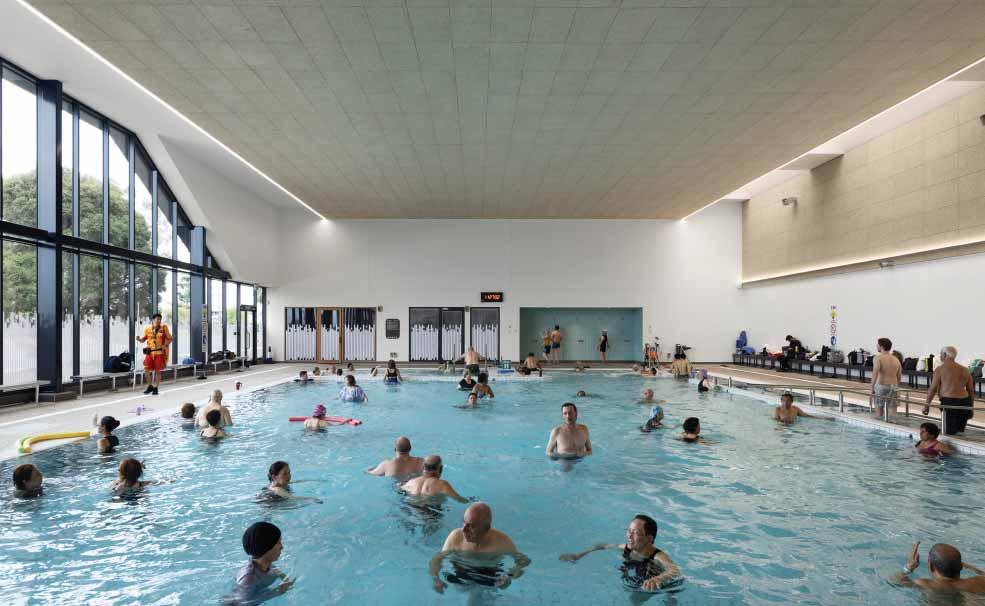
Hiwa means vigorous, active, and robust; words that perfectly describe both the facility and the aspirations we hold for our team and university community. Spanning 26,000 square metres (almost four rugby fields), Hiwa took over a decade to realise and was designed to enrich campus life by connecting learning, sport and social spaces.
The Aquatic Hall is a striking and thoughtfully designed
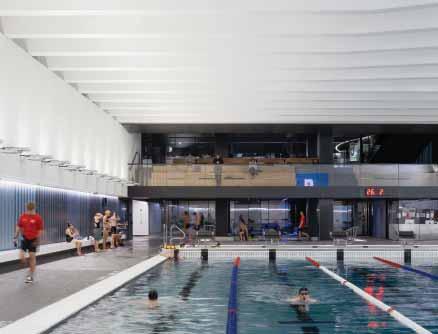
space, located on the lower level of the eight-story facility. Despite being underground, the pool hall is light and bright and showcases impressive architectural features.
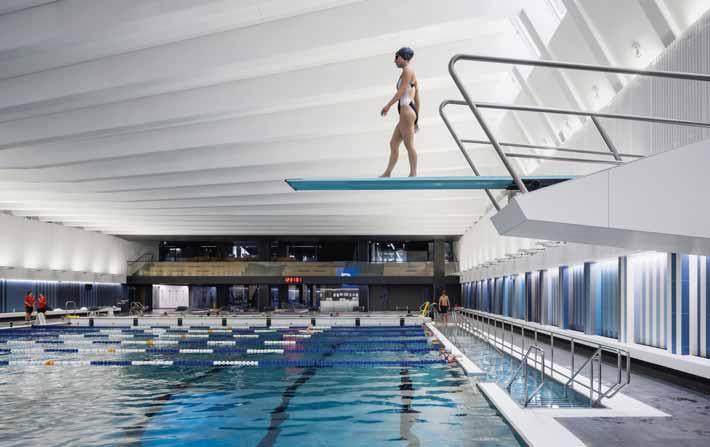
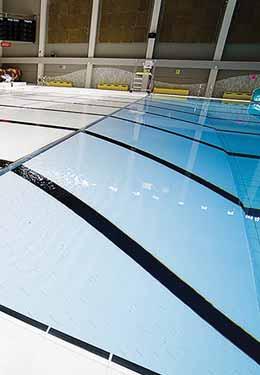
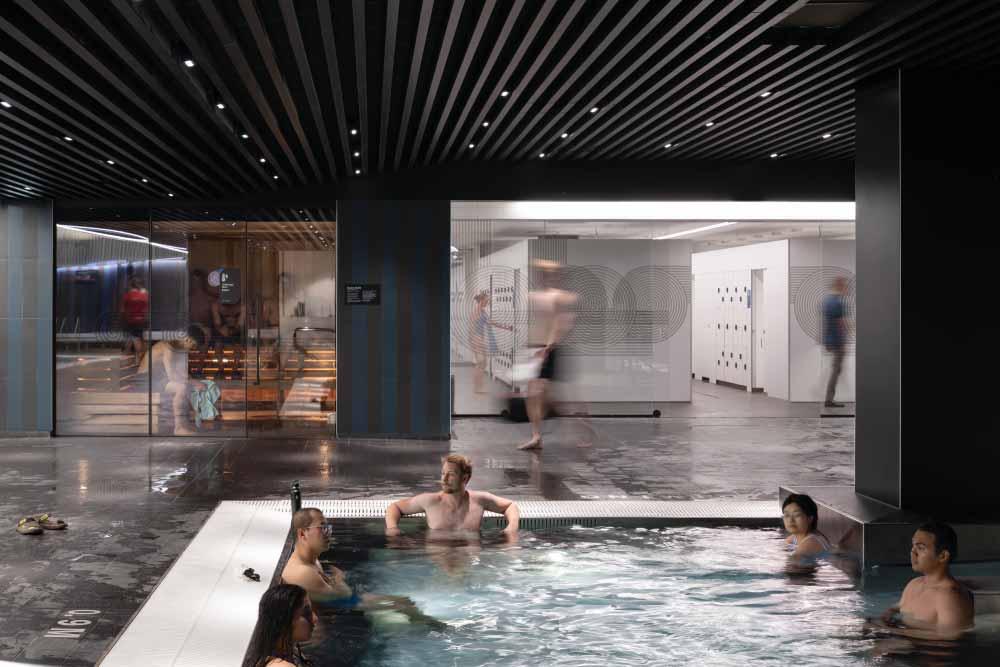
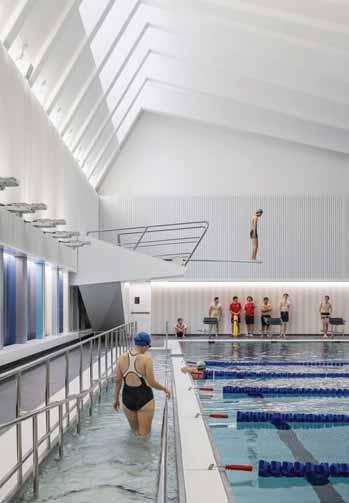
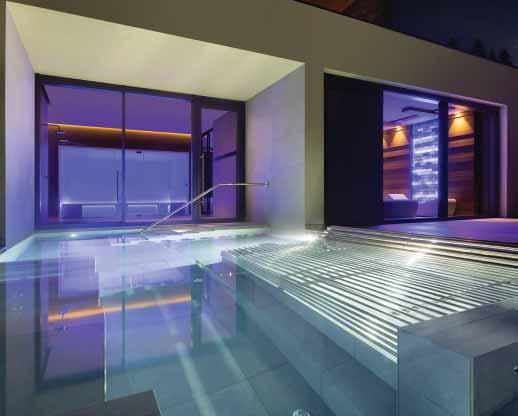
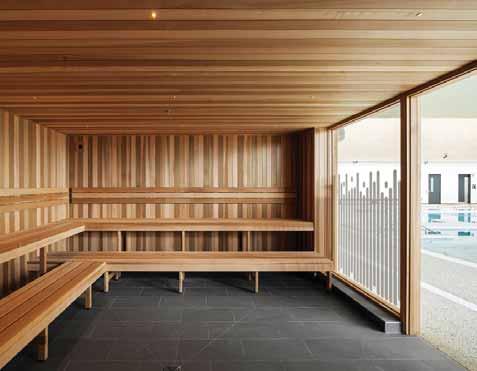
The hall includes a sauna, spa, and a dedicated dive well equipped with one and three metre springboards. Its centre piece is a versatile 33-metre pool, divided by a movable bulkhead to create a 25-metre lap pool alongside an eightmetre-wide shallow section with a moveable floor. This flexible design allows the main pool to be reconfigured to accommodate a wide range of aquatic sports and activities.
But for me, Hiwa is more than bricks and mortar. It’s a symbol of opportunity, growth, and the power of leading with purpose.
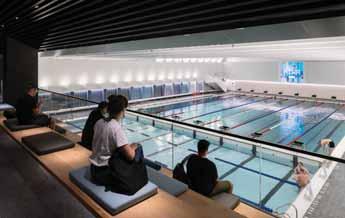
The main pool at the University of Auckland’s Hiwa Recreation Centre (above and bottom) and Aquatics Manager Sarah Clarke (below).
No Facility, No Team - Just Opportunity
Starting without a facility or team might sound daunting, but I saw it as a rare opportunity to build something meaningful from day one. I led the development of our operational framework, recruitment strategy, and cultural foundations, all before the doors even opened.
We faced challenges: recruitment complexities, operational design decisions, delays in practical completion,
and the unknowns of usage and access. I leaned into these challenges, using them as fuel to create a strong, valuesdriven foundation.
Hiring with Purpose
Recruitment was one of the most critical steps. I led individual interviews for our Aquatic Team Leader and senior lifeguards and facilitated an assessment centre for part-time and casual
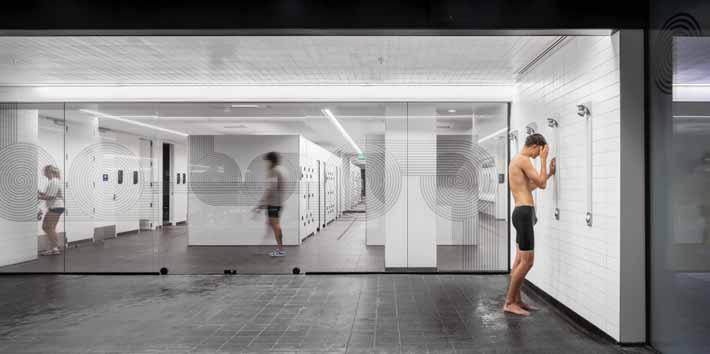
Hiwa's shower and change rooms.
staff. This approach allowed me to observe candidates in action and include voices from human resource, customer support, and sport in the selection process.
A recurring theme in interviews was burnout and lack of support in previous roles. I knew we had to do better, and that started with hiring people who aligned with our values and vision. I championed a recruitment process that prioritised empathy, professionalism and potential.
Onboarding with Impact
With no pool available due to construction delays, we had to get creative. I supported my Aquatic Team Leader in designing a weeklong training programme, delivered with the help of an external trainer and assessor. We then partnered with the wider aquatic network to support shadow hours ready for opening.
A collaborative whiteboard session, led by the Aquatic Team Leader, gave the team the opportunity to co-create our values and working style. I intentionally stepped back from leading this session, allowing it to be team-driven rather than manager-led.
This early engagement was key. It helped us build trust, connection, and buy-in before we even opened our doors.
Culture by Design
We didn’t leave culture to chance. From the beginning, I led efforts to build it intentionally through listening, inclusion, and shared leadership. Our team review sessions gave everyone a voice, and we acted on feedback from both staff and customers.
One moment that stuck with me was when our senior lifeguards thanked my team leader and me for reading and responding to shift handovers-something they hadn’t experienced before. It was a small act, but it spoke volumes about the culture we were creating.
Together, the team developed standard operation procedures (SOPs) for the operations of the new aquatic facility, and I encouraged the team to suggest improvements. Whether reviewing operations, refining systems, or evolving processes, our team feels heard and empowered.
Leadership in Action
To me, leadership isn’t about titles, it’s about fostering a culture of support, celebration, collaboration, and professionalism. I implemented regular full facility standups to build understanding, communication and trust across teams, and to recognise contributions both big and small.
I also see creating space for emerging leaders to step up, lead meetings, and shape our direction as important. As
Hiwa's spa and sauna (above) and the facility's main pool and viewing area (below).
a senior leadership team we’re intentional about stepping back and encouraging our teams to lead from within. That openness has been a gamechanger.
Performance and Impact
How do we know what we’re doing is working? In just six months, the results have been incredible:
• Over 14,000 memberships
• 21,000 weekly visits
• More than 600,000 total users
• Reaching 28,000 users out of a 50,000 strong campus community
These numbers aren’t just metrics, they reflect the trust, engagement, and relevance Hiwa has built within our campus. We’ve already met our 2030 goals for reach and engagement, and we’re just getting started.
Looking Back to Move Forward
Has everything gone perfectly? Of course not. There have been challenges, missteps, and ongoing learnings. But reflecting on this journey, I’ve learned some powerful lessons:
• Build culture from day one
• Listen and act with purpose
• Lead with people at the centre
• Grow leaders from within
• Stay anchored in values, even as we scale Sarah Clarke is Aquatics Manager at the University of Auckland’s Hiwa Recreation Centre. She presented on Hiwa at Recreation Aotearoa’s 2025 Waves Conference.
Belgravia Group is a family owned, family run, multigenerational business servicing Australia and New Zealand.
Divided into activity-based and business services, Belgravia Group is delivering sport, fitness and wellbeing opportunities to improve the lives of as many Aussies and Kiwis as possible and bestpractice business support solutions allowing existing and emerging businesses to reach their peak.
Established 1990.
www.belgraviagroup.com.au
Shielding Pools, Protecting Communities
How AlgaeShield® has transformed the control of algae at a major South Australian aquatic centre
Commercial aquatic centres are the beating heart of many communities, offering spaces for competition, recreation, fitness and learning. But beneath the surface, operators face a relentless challenge: keeping water pristine in the face of high swimmer numbers, long operating hours and demanding water chemistry.
For the operator of a major South Australian aquatic centre, these pressures resulted in a persistent and costly problemsevere algae growth, especially in the 4.8-million-litre indoor diving pool.
The Hidden Cost of Algae
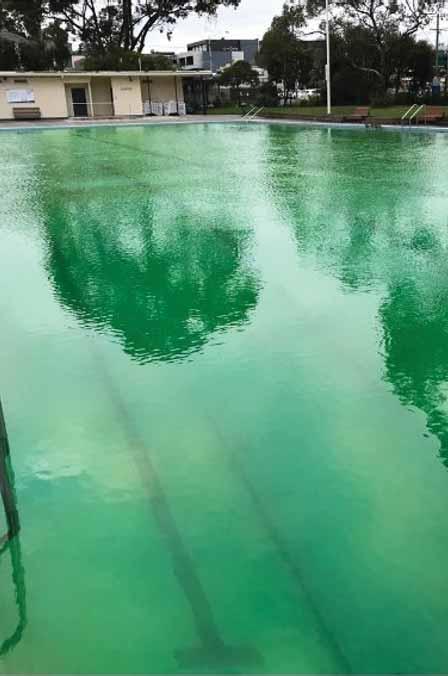
Algae outbreaks are more than an aesthetic issue. They can quickly lead to customer complaints, damage a facility’s reputation and create significant operational headaches. In this customer example, the diving pool was particularly vulnerable. Despite rigorous cleaning and chemical dosing, algae would reappear every few weeks, leaving unsightly stains and triggering a cycle of manual scrubbing and chemical application.
The conventional approach relied on a quaternary ammonia-based product. While this treatment could kill the top layer of algae, it failed to eliminate the problem at its root. Algae became resistant, requiring ever more frequent dosing and scrubbing. The cycle was costly and unsustainable, with annual operating costs reaching approximately $30,000. Staff were stretched thin and the physical demands of constant cleaning raised occupational health and safety concerns.
Searching for a Smarter Solution
Recognising the need for a more effective and sustainable approach, the customer partnered with IXOM, a leader in water treatment and Earth Science Labs Global for chemical innovation. IXOM’s reputation for reliability, safety and environmental stewardship made them an ideal partner for tackling the algae challenge. Their solution: AlgaeShield®, a nextgeneration algaecide developed by Earth Science Labs Global.
AlgaeShield® was designed to break the cycle of regrowth and reduce the burden on pool maintenance teams. Its advanced formulation allows it to disperse evenly throughout a pool with minimal effort, eliminating harmful algae within 48 hours of application and providing residual protection for up to nine weeks under normal conditions. Unlike traditional treatments, AlgaeShield® doesn’t stain surfaces, foam or interfere with chlorine, bromine or salt systems.
The South Australia Trial: Immediate and Lasting Results
In October 2022, the pool operator trialled AlgaeShield® in its diving pool. The process was straightforward: one initial brushing to remove visible biofilm, followed by a single application of AlgaeShield® poured directly into the water. The product dispersed on its own, reaching into all the hardto-clean areas where algae typically regrows.
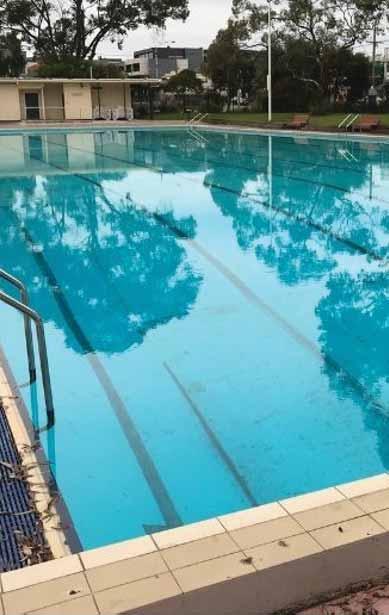
The results were immediate and impressive. Within 48 hours, algae was eliminated. Over the next six to nine weeks, no regrowth was observed. The need for constant brushing
was virtually eliminated, freeing staff to focus on other tasks and reducing occupational health and safety risks.
Key outcomes:
Improved water quality:
-No stains, clearer water and a better swimming experience.
-The algae were completely eliminated, there was no evidence of re-growth.
-Residual copper concentrations were well below Australian Swimming Pool standards, but still provided continuous protection against regrowth.
56% net cost saving
Operating costs dropped from $30,000 to $13,200 per year.
Reduced manual cleaning
The staff only needed to brush down the pool on the initial treatment and have not needed to do so since the treatment program began. This has resulted in lower occupational health and safety risks for staff
Membership retention
Cleaner pools and better water quality contributed to higher member satisfaction.
For this pool operator, the benefits of AlgaeShield® extended far beyond the bottom line. Improved water quality meant fewer customer complaints and a more enjoyable experience for swimmers, coaches and families. Staff morale improved as the burden of constant cleaning was lifted, allowing them to focus on delivering programs and services that enrich the community.
The reduction in chemical handling and manual labour also contributed to a safer workplace, addressing key occupational health and safety concerns. With less time spent on reactive maintenance, the pool operator could invest more in proactive facility management and member engagement.
A Model for the Industry
This pool operator’s experience demonstrates that the endless cycle of algae outbreaks and costly maintenance is not inevitable. With AlgaeShield®, aquatic centres can achieve cleaner pools, safer working conditions, and significant cost savings - all with less effort.
For pool operators across Australasia, AlgaeShield® offers a smarter, more sustainable approach to algae control. The results from the trial speak for themselves: happier swimmers, healthier pools, and a brighter future for community aquatic facilities.
The Science Behind AlgaeShield®
AlgaeShield’s® effectiveness lies in its unique chemistry. AlgaeShield’s® formulation allows it to self-disperse throughout a pool with minimising application effort. This, combined with near 100% bio-available copper, reduces AlgaeShield® treatment concentrations compared to alternatives.
Unlike conventional treatments that only attack the surface layer of algae, AlgaeShield® penetrates and bleaches the entire colony, ensuring complete eradication. It controls harmful algae within 48 hours of application and its residual effect protects for six to nine weeks under normal conditions. Its residual effect means that pools remain protected for weeks after application, reducing the need for frequent dosing and manual intervention.
The product is compatible with a wide range of pool systems, including chlorine, bromine and saltwater setups. It does not produce foam or scum, and it leaves no stains on pool surfaces - a critical advantage for facilities that pride themselves on presentation and water clarity.
Supporting Sustainable Operations
As energy costs rise and environmental expectations grow, aquatic centres are under increasing pressure to operate sustainably. AlgaeShield® supports these goals by reducing chemical usage, lowering labour demands and minimising the environmental impact of pool maintenance. Its long-lasting protection means fewer interventions, less waste and a smaller carbon footprint.
IXOM is committed to supporting operators with training and resources to integrate AlgaeShield® into their maintenance schedules. Further trials are planned across municipal and regional pools, with a focus on quantifying long-term savings in labour hours, chemical use and environmental impact.
Conclusion: A Cleaner, Safer, Smarter Way Forward
The experience with the South Australian pool operator proves that the endless cycle of algae outbreaks, re-dosing, and scrubbing doesn’t have to be the norm. With AlgaeShield®, operators can achieve:
• Cleaner surfaces
• Safer working conditions
• Lower operating costs
• Happier customers
And they can do it all with less effort and greater confidence. For more information on AlgaeShield® and its applications, contact Brendan Murray (IXOM) on 0422 003 721, brendan.murray@ixom.com or via the IXOM website, www.ixom.com.
Before (left) and after (right) the use of AlgaeShield®.
Geoff Lord to be recognised with Beyond Activ Lifetime Achievement Award
Geoff Lord, Chairman and Chief Executive of the Belgravia Group, is being recognised with Beyond Activ’s Lifetime Achievement Award.
The award will be presented at Beyond Activ’s Melbourne event being held in December.
This award follows Lord being honoured with the Chair’s Award at the 2024 AUSactive Awards.
In his role at the Belgravia Group, which he founded in 1990, Lord is responsible for, and has ownership (or part ownership), of an array of businesses including Belgravia Leisure, Belgravia Health and Fitness (including Genesis Health and Fitness, Coaching Zone and Ninja Parc), JUMP! Swim Schools, Recreational Gymnastics Australia, BK’s Gymnastics, Belgravia Pro, Belgravia Outdoor Education, Australian Sports Camps, The Dance Society and the Sports Community along with industry supplier Novofit, registered training organisation Belgravia Academy and GymbaROO.
WA CITS appointments
The Western Australian Government has appointed Chad Anderson as the new Director General at its Department of Creative Industries, Tourism and Sport (WA CITS).
WA CITS has also appointed Steve Tuohey to the role of Senior Communications Officer.
Don Elford departs Legends Global
Don Elford has departed his role as Director, Global Partnerships (APAC) at Legends Global.
Announcing Elford’s departure, Harvey Lister AM, Chairman and Chief Executive for APAC MENA at Legends Global, stated “Don has led the Global Partnership division for APAC and MENA and built a long-term legacy of brilliant brand partnerships, naming right opportunities and relationships across many of our venues.
“These accomplishments reflect Don’s dedication and impact in the industry, and we wish him every success in his future endeavours.”
BlueFit appointments
BlueFit has announced the appointment of Josh Mahoney as its new Chief Operating Officer, further strengthening its executive team as it continues to expand across Australia.
Mahoney joins BlueFit after more than two decades in professional sport, most recently holding senior executive roles at the AFL as General Manager - Football Performance.
The facility management company has also recruited Matt Frost, formerly of Technogym, as General ManagerHealth Clubs.
VMA’s 2025 Venue Management School scholarship recipients
The Venue Management Association (Asia and Pacific) [VMA] has announced its 2025 scholarship recipients for its Venue Management School and Leadership Institute. The scholarships have been awarded to:
•Emerging Leader Scholarship (sponsored by Event Health Management) - Emily Bollom (above left), Senior Event Manager, ICC Sydney/Legends Global
•Gareth James Scholarship (supported by Melbourne Park) - Felicity Duff (above centre),
Convention and Arts Centre Manager, Devonport City Council
•Innovation Scholarship (sponsored by Advantage Training) - Alexandra Tibbetts (above right), General Manager, Canberra Theatre Centre
Vale: Anti Kajlich, 1943 to 2025
Australasian Leisure Management is saddened to learn of the death of Anton (Anti) Kajlich, a visionary and enduring figure in the global water polo and aquatics community.
Anti was a lifelong water polo player - representing the Czechoslovakian National Team and earning multiple FINA World Masters medals.
Professionally, he was the founder of Anti Wave, a company that transformed water polo equipment through innovative designs for goals and racing lanes, as well as providing high quality lane ropes, starting blocks and Swim Walls.
Raised in what is now Slovakia, after fleeing Czechoslovakia in 1967 he became an All-American goalie at University of California Berkeley in the USA, where he earned the university’s first sports scholarship for water polo.
In business, Anti designed and patented the world’s first Anti Goal in 1974, which became the world’s best-selling water polo goal. Later he developed his patented wavecalming racing lanes.
Relocating to Brisbane with his wife and family in 1981, he established Anti Wave’s global headquarters in the city.
Anti Wave will endure, with his son, also named Anton Kajlich, continuing to innovate in aquatic sport equipment.
From the margins to the mainstream
Designed for wellness, recovery and access,
John Tuxworth explores the growing demand for hydrotherapy pools
Across Australia and beyond, from suburban councils to elite training hubs, investment in warm-water pools designed for recovery, rehabilitation and wellbeing is on the rise. The demand is clear, expectations are rising, and aquatic design is adapting to meet a broader vision of health.
Hydrotherapy pools - the controlled, therapeutic use of water - have become a defining element in the next generation of aquatic infrastructure.
Built to relieve pain, aid recovery, and restore movement, they now serve diverse users across the lifespan: older adults maintaining mobility, athletes recovering from injury, and community members seeking relief from chronic conditions.
While some facilities focus on general wellness, others are formally certified hydrotherapy pools built to Australian Standard AS 3979-2006, incorporating stringent requirements for access, safety and communications.
Evolving Users, Expanding Purpose
Older Australians are one of the biggest drivers of demand. As populations age, accessible forms of exercise and rehabilitation are increasingly vital, particularly in regional communities where allied health services are limited. At the same time, elite sport has embraced hydrotherapy as a cornerstone of recovery, with temperature-controlled plunge, hot and recovery pools becoming standard in highperformance environments.
For local governments, the trend offers both opportunity and challenge. Traditional leisure and lap-swimming models are being reshaped by a growing appetite for wellness and recovery services. Aquatic centres that once relied on swim schools and casual visits are now integrating physiotherapy rooms, saunas and warm-water programs into their offeringcreating a more holistic community asset.
The outcomes are tangible. Brimbank Aquatic Centre in Victoria, a 6-Star Green Star facility attracting 1.5 million visits annually, found its 20 x 10 metre warm-water pool with ramps and spas became the busiest part of the complex, with demand far exceeding forecasts.
Similarly, the Blacktown Exercise, Sports and Technology Hub (BEST) in NSW demonstrates how the principles of hydrotherapy apply in elite sport, featuring three therapy pools at varying temperatures - recovery at 28°C, hot at 38°C and a cold plunge at 12-14°C - designed for athlete rehabilitation and performance optimisation.
Design Details
Designing a hydrotherapy pool isn’t as simple as heating the water. Details make a substantial difference.
Equitable access requires more than a ladder. Pools must include steps plus either ramps, hoists, or lifts. Hoists may feel cumbersome, so ramps and lifts are often chosen for dignity. Handrails are a key safety component and can be
Three pools at Blacktown Exercise, Sports and Technology Hub offer contrasting temperatures for athlete recovery.
recessed in some locations to facilitate side entry and to minimise entrapment risk. The use of full (instead of cut) tiles reduces the incidental risk of skin wounds which could result in the requirement to temporarily vacate and close the pool.
Pool layout is another factor. Rectangular shapes are far more versatile for treatment than curves. Nominally 2 metre2 is allowed per user to prevent overcrowding, and a depth between 1100 and 1300mm is best for hoists and lifts. Flat floors are acceptable for pools less than five metres in length and for longer pools a slope of 1:30 is required.
The Australian standard requires at least one wet edge for formal Hydrotherapy pools, however a full perimeter is recommended where feasible so as to optimise
water treatment. Surrounding concourses must be of appropriate width and slope away from the pool to minimise contamination, include separate drainage, and employ slipresistant surfaces.
Environmental design also matters. The National Construction Code (NCC) requires covers for indoor heated pools. If tight on space then the cover can be integrated with the pool edge. Higher ceilings reduce stuffiness and allow space for the larger air handling systems. Acoustic absorption softens harsh echoes. Safety systems such as alarms, telephones, and underwater cameras add reassurance. Lighting should be even and diffused, with windows placed to avoid glare.
Water treatment systems need to accommodate use. Separate systems for each pool body minimise cross-contamination and maintain temperature. Faster water turn-over rates are required for hygiene, especially in hospitals and schools.
Climate control is crucial. Hydrotherapy pools should have water temperatures between 33.5 and 35°C for comfort. Air should be slightly warmer at the surface, with humidity capped at around 60%. HVAC systems must handle significant warm-water evaporation and keep air moving without creating draughts at user level.
Finally, durability is key. Hydrotherapy rooms are warm, humid, and chlorinated - conditions that result in a highly corrosive environment. Stainless steel and epoxy coated structural and services elements stand up best. Sensitive mechanical and electrical equipment should be isolated or protected.
Having delivered aquatic projects across Australia and internationally, I see that collaboration is key with it being essential to
Warm-water program pool (above) at Brimbank Aquatic Centre - the busiest spot in the complex and the enticing Brimbank sauna (below) Credit: Williams Ross Architects.
talk with operators, visit built facilities and always work with experienced teams.
Design decisions - even small ones - directly shape human outcomes.
Delivery
The design and construction of hydrotherapy pools necessitate teams with experience. Aquatic designers know the standards and can balance safety with user needs. Multidiscipline consultants are best for integration of structural, services, and sustainability requirements. Experienced contractors are vital for enabling compliance and durability.
The Bigger Picture
Hydrotherapy pools are more than infrastructure; they are part of a broader health and wellbeing response. For older Australians, they represent dignity and independence. For athletes, they are essential tools of recovery and resilience. For communities, they expand the role of the aquatic centre from recreation hub to holistic wellness destination.
As local governments and providers adapt to shifting demographics and expectations, hydrotherapy’s role will only continue to grow.
The challenge for designers, operators and policymakers is to ensure that each new facility not only meets technical standards but delivers on its deeper promise - to help people move, heal and connect through the restorative power of water.
Architectural Engineer John Tuxworth is Chief Executive of the Built Environment Collective (BEC).
One of Australia’s leading aquatics designers, delivering projects nationwide and across the globe, BEC’s integrated design model brings together aquatic, structural, services and sustainability expertise to reduce project risk and improve user outcomes.
This multi-disciplinary approach, allows facilities to balance compliance with function - ensuring that accessibility, safety and comfort are built into the pool from the start.
AS 3979-2006
Hydrotherapy pools
AS 3979-2006 Hydrotherapy pools (Reconfirmed 2018) sets out recommendations and requirements for the design, construction, and operation of pools used by people with conditions requiring hydrotherapy and for the management of these individuals - covering the safety and therapeutic needs of users.
It also provides recommendations for the management of persons with specific health conditions in these pools.
Hydrotherapy pools certified to AS 3979-2006 must meet strict requirements for access, safety and water treatment.
The standard was developed by the Standards Australia Committee MS-051 and superseded AS 3979-1993, aiming to standardise practices in the Australian hydrotherapy industry.
Without staff, we have nothing
Greg Campbell explains how education and culture is driving Quayclean’s ongoing growth
It was once said opportunity is borne from adversity.
Quayclean Australia Chief Executive, Mark Piwkowski (pictured right), didn’t exactly have this in mind when the world was slowly emerging out of the hazards of the global Covid-19 pandemic earlier this decade.
But as the wheels of industry began to regain pre-pandemic momentum, Quayclean, one of Australia’s leading cleaning, hygiene and waste management services providers, was quickly generating new business opportunities.
As demand for expert services was growing, Piwkowski realised the company was short of senior leaders to effectively manage its expanding number of sites.
Rather than looking outside the company to hire new leaders, Piwkowski knew there was talent and capability within his workforce, but they needed expert guidance and tutelage to reach their potential.
To fill this leadership void, the Quay Academy was created in 2021.
Piwkowski explained “we wanted to establish deep cultural behaviors within our workforce and develop credible, authentic leaders who were role models - could ‘walk the talk’ - and follow through on their promises.”
With his executive leadership team understanding that leadership drives culture, and culture drives performance, Piwkowski recalled “developing culture, leading teams at any level and developing authentic leaders is everyone’s business
at Quayclean. No matter what the position an employee has in the organisation, they have ownership and responsibility for their actions, and are accountable for the leadership that they demonstrate.”
Piwkowski turned to the late Simon Weatherill to head the Quay Academy and help develop Quayclean’s next generation of new leaders.
The highly experienced Weatherill was the former longserving Chief Executive of the Melbourne Sports Hub which encompasses the Melbourne Sports and Aquatic Centre (MSAC), State Netball Hockey Centre (SNHC) and Lakeside
Quayclean Academy at Sydney's Allianz Stadium (above), Anthony Duffy, leader of the Quayclean Academy (opposite) and Quayclean's Dattatray Patel and Minu Perera at the UK's Royal Ascot (far right).
Stadium, as well as MSAC Institute of Training, a specialist training institute for the sport and recreation industry. He had also established Weatherill Leadership.
Sadly, Weatherill passed away in early 2023 and the Quay Academy is now headed by distinguished venues industry leader, Anthony Duffy.
Duffy has an impressive record as an educator having served as a lecturer at the University of Technology in Sydney, a long-serving instructor at the Venue Management School (VMS), and is a former Dean at the Leadership Institute (LI).
Piwkowski noted “Simon left a fantastic legacy with his pioneering work, and we are fortunate to have Anthony on board to help develop our next generation of leaders.”
Throughout his career, Duffy has worked closely with frontline staff and has adopted an operational approach with the Quay Academy to help emerging leaders through a variety of real-life scenarios.
Over 100 Quayclean staff have participated in Quay Academy programs since its inception. Last August, 28 emerging Quayclean leaders attended workshops in Sydney and Melbourne, with the group assembling again in Brisbane in November 2024.
Among the Quay Academy ‘graduates’ have been Dattatray Patel, Head of Operational Systems and Assets, and Minu Perera, Event Contract Manager at Adelaide Oval.
Patel has held several roles within Quayclean including
NSW Regional Manager and was appointed NSW Operations Manager in 2020 where he held responsibility for overseeing major events such as the Sydney Royal Easter Show. In June 2025, he was promoted to a newly created executive leadership role of Head of Operational Systems and Assets.
Perera was a part-time venue supervisor at Adelaide Oval before being promoted as the venues’ Event Contract Manager last year where she is now responsible for major events including the AFL’s highly successful Gather Round celebrations.
The career and leadership development of Patel and Perera continued in recent months when they were selected to undertake a six-week International Exchange Program in the United Kingdom.
The program was created in 2023 by Quayclean Executive General Manager Operations, Tom Mills, and CleanEvent
UK’s Operations Manager, Jay Adderley, to further develop emerging leaders’ skills and enable them to gain further industry knowledge and insights.
In the UK, Patel and Perera worked at some of the biggest events such as Royal Ascot, the British Formula One Grand Prix, Robbie Williams and Guns and Roses concerts at Co-Op Live and Wembley Stadium where they led teams during highpressure events which strengthened their decision-making and people management skills.
Piwkowski advised “the International Exchange program is a wonderful extension of the Quay Academy. The knowledge gained in England is passed on to assist our teams as we continue to expand our onsite leadership groups to ensure our site operations are totally efficient and highly effective.”
Patel said he and Perera adapted quickly to new environments and built strong relationships across diverse teams, commenting “we gained hands-on experience with venue operations, event planning, and cleaning systems in the UK. We also observed and documented waste management strategies, equipment usage, and staffing models across different venues.”
Perera said the International Exchange program pushed her outside her comfort zone, adding “working in a completely different country, with new people, unfamiliar work ethics, and different systems was a real challenge.
“Facing these daily challenges helped me re-evaluate my strengths, such as my adaptability, problem solving ability, and capacity to work under pressure.
“I picked up several smart cleaning methods that I now plan to implement at my own sites in Australia. I also had the opportunity to speak with different clients, understand their
expectations, and learn more about their views on cleaning, waste management, and how their venues operate.
“These interactions gave me deeper insight into international standards and strengthened my confidence as a professional in this industry.”
Quayclean’s commitment to staff education extends further beyond the Quay Academy and International Exchange programs with two staff members selected each year to undertake the two-year Venue Management School program conducted by the Venue Management Association.
The VMS course combines expert-led workshops, peer learning, and real-world application to strengthen capability across all venue types and career stages and empower our team members to thrive in the venue industry.
Additionally, Quayclean is a sponsor of the VMA’s Mentor Program which is designed to empower and drive professional growth for both mentors and mentees and help shape the future of the venue management industry.
The self-guided 12-month program offers a personalised experience through an online matching process where experienced professionals are paired with motivated trainees who are looking to learn and grow.
Piwkowski says the company’s all-round approach to staff education and development has been very rewarding, stating “it thrills me to see the career progression of so many hardworking and dedicated individuals over the past five years.
“It was a bold step to establish the Quay Academy and the International Exchange Program, but the skills they have gained leaves them and the company with a tremendous legacy.
“We have witnessed a raft of benefits such as consistency in behaviours, standards and compliance. We have also seen improved employee performance and productivity, increased job satisfaction and organisational culture, staff stickability, genuine work satisfaction, and staff that are better able to cope and adapt to change.”
Going on to say that one of the over-arching out-takes of the programs is producing energetic staff who are engaged, happy, and productive, Piwkowski concluded “many customers comment that our staff are smilers and always seem happy. They ask, how do we achieve that, and why is the Quayclean culture so infectious?
“The answer is simple - a consistent and persistent investment in our teams. Because without our staff, we have nothing.”
Greg Campbell is the Founder of PRISM Strategic Communications.
Quay Academy graduates 2025Dattatray Patel at Liverpool FC's Anfield.
Minu Perera at the F1 British Grand Prix.
Moving Forward
Bodyfit Chief Executive Nat Grosvenor shares some insights into the group’s growth
Founded in 2013, Bodyfit currently operates eight gyms in NSW – seven in Sydney and one in Shellharbour.
Nat Grosvenor (pictured below), who joined the group as a Club Manager in 2019 before successive promotions saw her take on the role of Chief Executive in 2021, leading the family-owned business with support from a dedicated team, loyal members and the Fitness Passport community along with valued corporate, not-for-profit and community partners.
Explaining her role she advises “I am in a privileged position to be the founders’ key decision maker and representative. The trust, faith, autonomy and confidence they have is never lost on me.
“My stewardship commenced just before COVID. This presented us with time to work on strategy. And for us it
was about getting all our foundations and fundamentals built which were inadequate at the time. We needed to transform the organisation with a ‘start-up’ mindset and approach. We were able to focus on our growth strategy through rebranding, establishing adequate support systems, operational infrastructure, organisational culture and most importantly acquiring the right people who can execute effectively and are aligned with the Bodyfit vision and values.
“Our advocacy and equity for our brand were incredibly strong. This provided the leverage for me to drive us forward. Core values don’t change. They were embedded into our ethos from day one. Our growth was built on the back of a clear purpose and a commitment to community.”
Maximising Space
With Bodyfit aiming to offer an all-in-one community huboffering members the perfect environment to train, recover, and connect with a full mind and body experience in one
Bodyfit offers an all-in-one community hub - delivering an environment to train, recover, and connect with a full mind and body experience. Images credit: Bodyfit.
TECHNOGYM BIOSTRENGTH™
SUPERIOR RESULTS, FASTER.
Avoid the most common strength training mistakes and supercharge your workouts. Thanks to the patented Biodrive system, select your goal and automatically receive the optimal resistance and biofeedback for it, along with the correct workload, range of motion, tempo, and rest time. Biostrength adapts to you for +30% results in the same time.
space – its recent expansion in the heart of Glebe’s vibrant Tramsheds precinct, features a state-of-the-art, 650 square metre space, offering premium facilities designed to cater to diverse fitness and wellness needs. Working within this smaller space was made possible by refining the Bodyfit business model, with Grosvenor stating “you have to decide what your prototype model will be with an 80/20 rule and then decide how best to replicate it and make it commercially viable. For us, this meant a decision to shrink our gross floor area.
“Bodyfit has opened five new locations over the last five years and these decisions were based on revenue per square metre versus your cost per square metre.
“We have big box facilities such as the 2,500 square metre property at Miranda and the 1800 square metre property at Auburn. However, for Bodyfit, proximity in high traffic prominent retail environments is a priority therefore the large scale model doesn’t make sense.”
Franchising
Grosvenor’s strategy for Bodyfit has always been part of a vision to become franchise ready and shares “in terms of our growth and innovation over the last six to seven years, to have that as part of our growth strategy meant that we had to rework everything internally in our business.
“Whether you franchise or not, if you have that as your focus, it forces your hand to make sure that your business is well systemised, supported and structured. So I believe that you have to have that mindset and approach to scale and perform as a business at optimum levels.
“Integrity is so important to me. Part of taking our time on the franchise journey was to make sure that we had predictable, profitable and replicable business models to set a future franchisee up for nothing but success.
“The Franchise Model reflects on the brand all the time - this I am fiercely protective of. So while we are ready to Franchise, there are amazing opportunities available to us to continue to grow as a family-owned business. We are set to open our ninth location in 2026 at Merrylands, which is incredibly exciting.”
Innovation
On innovation within the Bodyfit Group, Grosvenor notes “to innovate means change. To change, you have to encourage and empower others to be curious and to do the thinking, the research and the work as well as make mistakes.
“The collaboration and the collective opportunity to drive innovation and decisions on the back of individual perspectives is really important. You have to really foster confidence in your working environment. For me, innovation requires an unwavering commitment to continuous improvement - that’s a critical component of my expectations of my team.”
Grosvenor highlights that “we also have to be aware of what our competitors are doing. We are all looking for a differentiator.
“Importantly, innovation should be driven by our customers, we must ensure we are well aligned with their needs and expectations.”
Digital ecosystems and relationships
By partnering with Wexer, adopting a digital offering and merging them with in-person services, Bodyfit has created a hybrid model that delivers for members wherever they are. These platforms are not only scalable - they’re deeply customisable, offering data-rich insights that help Bodyfit refine programming, measure engagement, and stay responsive to member needs.
While many consumers are very tech savvy they have different levels of expectations for personalisation and utilisation.
To stay relevant, Bodyfit uses segmentation and data analytics to understand how different age groups consume content, engage with tech, and pursue wellness. Whether it’s Gen Z members craving variety and on-demand access, or Baby Boomers prioritising mobility and recoveryBodyfit adapts its content, communication, and services accordingly.
This ability allows the brand to create multi-generational fitness journeys without compromising consistency or
Bodyfit offers an all-in-one community hub - delivering an environment to train, recover, and connect with a full mind and body experience. Images above and opposite. Credit: Bodyfit.
quality. It also helps foster inclusivity, ensuring that no matter someone’s age, background, or fitness level, there is a place for them at Bodyfit.
Grosvenor shares “the most important thing is to know your customer - to ask, listen, and then act and respond based on what they’re telling you their expectations are.
“Something as simplistic as discovering that over 70% of our members are exploring our website purely on their mobile device has now driven a big web development project for us because we are looking at our mobile version of our web, and it’s inadequate.
“It means you’ve got to have the product to meet your customers’ expectations. You’ve got to look from a UX (user / member experience) perspective, and you’ve got to continuously evolve, adapt and move.
“In terms of technology, we’ve still got a lot of opportunity in terms of the utilisation and the optimisation of what our existing ecosystem provides which is so exciting.
“When you think of innovation, you think of vertical integrations and scale, but I think sometimes innovation can come from exploring via the depth and dexterity of what you already have.
“So, in evolving our offerings, experience and processes, we commenced the development and implementation of our AI adoption roadmap. Initially, we are building out a lot of automation in our sales processes, sales funnel and experience. We’re looking to provide our customers with a low touch but high impact yet personalised experience.”
Grosvenor highlights “you have to make sure that the decisions are right in terms of who your third parties are and who your suppliers are when it comes to innovation as well, because there’s a heavy reliance on having the right relationship for them to be able to guide and shape you as well as their continued investment and development path to suit your business objectives.”
Grosvenor adds “there’s a lot of reliance on relationships. Relationships run the world. Getting our relationship matrix right was paramount in our journey.
“As a bootstrapper, Bodyfit didn’t have the big budget accessible to many of the large fitness chains. Digital ecosystems are never finished. They’re constantly evolving and that requires a lot of capital.
“Self-generation means we have to be innovative in the way we utilise our resources.
“We chose a CRM that had an OpenAPI capability allowing us to hand select specialised tech partners to plug in and build out our ecosystem.
‘We now have a really sophisticated and customised tech stack that’s built on a bootstrapping budget purely by OpenAPI. That was one of my greatest findings.
“It’s so important for your business to do the Research and Development because you know your business best. You don’t want to buy today’s solution. It must future proof your business as well.
“We waited until the purpose fit options we required became available. By waiting, we’ve saved a lot of money as well, and we now have a far better solution which will serve us into the next growth phase.”
Future of Fitness
Grosvenor says that the time when we don’t speak about ‘fitness’ anymore has arrived. Umbrella terms representing a holistic approach such as ‘wellness’ and ‘wellbeing’ are here to stay. This disruption to our industry is welcomed and vital to impacting both the physical and mental health of our communities.
She is also encouraged to see that the fitness industry is looking outside of its traditional confines, for example looking at recovery, hospitality, tourism and retail sectors, explaining “the fitness industry is merging into other sectors and we’re learning from those other sectors and we’re applying our learnings.
“The fitness industry is really starting to wake up in terms of innovation as a sector, which is encouraging. My greatest learnings in terms of innovation in particular tech have always come from outside of our sector such as retail and other consumer-driven sectors.
“The fitness industry will be driven in terms of continuous innovation, mergers, acquisitions and collaborative affiliation with tech providers, brand and product partners.”
Nat Grosvenor was talking to Australasian Leisure Management Editor Karen Sweaney
Surf Life Saving and the social contract
Samuel Cornell asks if the system of watching people between opening hours on select areas of sand on specific beaches is failing
It’s almost a cliché; Australia loves its beach culture. Flags, bronze medallions, sun-bleached heroism, volunteers in red and yellow on sand in summer. Yet we are also a nation that drowns. Our self-image as a nation of water lovers and swimmers sticks out incongruously against our annual drowning statistics. For all our pride in being water people, we drown with grim regularity.
In Australia in 2024/25, 357 drowning deaths were recorded - a 27% increase on the 10-year average, according to the National Drowning Report 2025 (Royal Life Saving SocietyAustralia, in partnership with Surf Life Saving Australia). Of these, 154 deaths (43%) occurred in coastal environments, including 82 at beaches - around 23% of all drownings nationwide. The burden was heaviest among older adults: one-third (33%) of all drowning deaths were people aged 65 or over, with the highest rates in those aged 75 and above.
Every single death occurred where no lifesaver or lifeguard was present - either at unpatrolled beaches, more than one kilometre from help, or outside patrol hours. That might provide comfort to those who undertake branding and public relations for organisations such as Surf Life Saving Australia. No deaths between the flags. No drowning on a very small section of coastline patrolled on a minority of days and limited time frames each year, by volunteers.
But for so many people each year, by not being in the right place at the right time - by not conforming to what tradition and a system demands of them - it is the end of their lives.
The institution of Surf Life Saving
Founded in the early 20th century, Australia’s Surf Life Saving movement began as a volunteer-based effort to protect swimmers on popular beaches, such as those in the Eastern Suburbs of Sydney. Originally, membership of a club was male only; many of whom had served or been affiliated with the Australian Defence Force.
Indeed, Surf Life Saving was heavily shaped by military influence, particularly after the First World War. Even today, the organisation’s culture continues to reflect this legacy. Chain of command, parade-like discipline, ceremonial flags, and
Mona Vale Surf Life Saving members on duty at Mona Vale Beach in Sydney’s north (above) and Burning Palms Surf Life Saving Club members training to march with the surf reel on Wanda Beach in Sydney’s south (below). Credit: Shutterstock.
club hierarchies are still prominent. The language of ‘service,’ ‘duty,’ and ‘rescue readiness’ lends itself to a quasi-military framing, despite the fact that many volunteers are teenagers doing weekend patrols during summers and holidays.
Since its formation, Surf Life Saving has grown into a national icon - part sporting club, part emergency service, part heritage brand, part educational training provider, part function room and cheap bar, part Church for many.
With over 300 clubs and tens of thousands of volunteers (many of whom are children, or parents of those children involved in Nippers programs), surf lifesaving is woven into the identity of sections of coastal Australia. But for all its cultural capital, it operates within strict boundaries: designated beaches, specific seasons, and limited hours. The promise is simple - we’ll save you, if you swim here (between our flags) at the right time. But that promise excludes far more people than it protects.
Safety on select beaches
A report published by the University of New South Wales Beach Safety Research Group in December 2024 showed that of the 757 beaches in NSW only 189 are patrolled - less than 25%. And these patrols mostly occur in urban areas.
Most of the coastline, including large swathes of national park and remote areas with beaches, are completely unpatrolled. In many locations, even when lifesaving services are present, it is for very specific and select times of the year, such as on a Saturday between 9am and 5pm - if these locations can muster enough volunteer lifesavers.
The report also found that time coverage is thin. 88% of patrol hours occur between October and April, from May to August, patrols drop off almost entirely. In winter, only 16 beaches are patrolled - nearly all in Sydney or Newcastle. This isn’t a comprehensive public health and safety system for a society that visits and uses the beach all year round.
It’s a hollow façade on an emergency service. The police don’t only investigate crimes committed in front of their own
station. Fire brigades don’t respond only to fires on weekdays between 9am and 5pm. But Surf Life Saving’s operational model is constrained by limited geography, season, and tradition - not by risk.
This very conditional social contract, implemented mainly by goodwilled volunteers, would be reasonable if it wasn’t being sold to the Australian public as the sole practicable method of beach life saving service, but the way Surf Life Saving markets itself, you’d be forgiven for thinking otherwise.
Preserving optics, not necessarily lives
At what point does an institution become more invested in preserving its image than fulfilling its purpose? The fact that no one drowns ‘between the flags’ is routinely celebrated, but it also reflects how limited the system’s reach truly is. Like a police department boasting low crime rates near its station, Surf Life Saving seems focussed on maintaining visibility and order in very limited locations, rather than confronting broader risk and visitation across the coastline.
Considering the awful number of drowning deaths that Australia continues to witness, such as drownings over Easter 2025, should we be asking if we are more invested in preserving the idea of Surf Life Saving, preserving an institution, traditions, than actually saving lives?
We should question whether the current beach safety model is outdated, and shouldn’t be afraid or ostracised for it. Traditions have their place. They help to build a sense of community, of cohesion, and of shared experience. But they can also restrict progress and, if they become dogma, they can enable a rigidity of thinking that only allows for conformity and that which benefits the status quo.
The red and yellow flags are certainly symbolic to many Australians, especially those with close ties to Surf Life Saving, but are they also merely symbolic in terms of protection? They signal safety, but that safety comes with a narrow set of conditions.
Image has been invested heavily in. Millions have been
Nippers learning to catch waves on rescue boards at Terrigal Beach on the NSW central coast. Credit: Shutterstock.
spent installing Emergency Response Beacons (ERBs), but they’re poorly understood: fewer than 30% of beachgoers know what they are, and half of them can’t explain how they work. Some people are more likely to enter the water when they see one - assuming they’re a sign of active safety (such as a beach surveillance system) rather than a last-resort device with wildly variable response times. What’s more, response times to ERB activations vary wildly - averaging eight minutes but up to 24 minutes, especially in regional areas.
Who gets to be saved?
Across the 2024/25 year, drowning deaths rose sharply, with every adult age group over 45 experiencing higher-thanaverage drowning rates. Males, older Australians, people in regional and remote areas, and those from disadvantaged communities remain vastly over-represented. Inequities persist: Residents of regional and remote areas drown at nearly three times the rate of those in major cities, and drowning rates double among Australians living in the most disadvantaged areas.
Despite significant reductions in drowning deaths among children and in settings like pools, lakes and rivers, beach fatalities have proven far more stubborn. Long-term data shows that beach drowning rates have not declined at all. In fact, there’s been a 26% increase in beach drowning numbers over the past two decades
Despite a fresh new public campaign featuring actor Angus Sampson - and years of previous efforts like ‘Think Line’ and ‘Give an F About the Flags’ - beach drowning deaths have not declined over the long term. That raises a blunt question: why are we still funding more of the same?
Even within the messaging, gaps are obvious. Many international visitors don’t understand what ‘swim between the flags‘ actually means. Terms like ‘shore break’ or ‘shore dump‘ mean little to people new to the language or beach culture. And younger Australians are increasingly unreachable through conventional TV ads. A TikTok influencer might have more impact than a TV star with some audiences that matter like young males.
What if you can’t swim between the flags? What if you don’t know where the flags are, or can’t get to them? What if you’re new to the country, or don’t speak the language, or simply believe the whole beach is public and safe?
The current social contract offloads risk to individuals,
expecting them to make the one and only decision that the system agrees with. It assumes knowledge, access, and conformity to a specific set of behavioural norms. And when people drown outside that narrow window of beach use, the system more or less absolves itself. It instead turns to praising itself.
This is not protection. It’s public relations. And it seems quite unethical.
Instead of debating whether Surf Life Saving should branch into flood rescue or drone surveillance, maybe we need to ask a more uncomfortable question: why are we failing at the one thing it’s meant to do - prevent people from drowning at the beach?
Maybe it’s time to rethink what water safety actually means in Australia. That includes expanding patrols to where the risk is highest, not just where the population is densest. It means acknowledging that drones, beacons, and polished media campaigns don’t replace highly trained people who can pull someone from the water when it counts.
And it means recognising that the factors leading someone to drown at a beach usually begin far from the shoreline - whether it’s missing out on swimming lessons, poor information, or simply deciding to drive to an unpatrolled spot on a hot day.
Rethinking water safety in Australia means focusing on risk, not ritual. It means funding trained lifeguards, not symbolic campaigns. And it means addressing the long chain of decisions - well before someone enters the water - that decide who gets to be saved.
We have to ask, is the system failing, or is it functioning exactly as designed?
Samuel Cornell is a PhD Candidate within the UNSW Beach Safety Research Group and School of Population Health at the University of NSW.
The Beach Safety Research Group at UNSW Sydney, is a multidisciplinary team of researchers and practitioners dedicated to keeping people safe at the beach.
It serves as a unifying hub to advance the science of safety in the beach and coastal environment and draws on a variety of disciplines and research approaches, collaborating with external academic colleagues and beach safety organisations to design and conduct high-quality research that helps inform beach safety practice, education programs and policy.
Surf lifesaving flags at Broadbeach, Gold Coast, Queensland. Credit: Shutterstock.
Be a part of a sector-wide movement towards greater inclusion!
Aerial Function Centre
University of Technology Sydney
WEDNESDAY 19TH NOVEMBER 2025
10AM – 4PM
TICKETS ON SALE NOW
Proudly supported by:
Not Science Fiction
The adoption of AI in sport is transforming training through data-driven insights and machine learning to create personalised programs, analyse performance and prevent injuries. Dr Neil Gibson explains
At this year’s VMA conference, Adam Driussi, co-founder of data analysis firm Quantium and Chair of the NRL’s Canterbury Bulldogs gave a masterclass in how to use artificial intelligence (AI).
Indicating that coaches at the Bulldogs use AI, while not going into specifics - something I don’t blame him for - after all, why give away secrets that might give an advantage to opponents?
However, it does raise the question of how AI is impacting the coaching process and skills required for coaches to be successful in modern day sport, for anyone can write a strategy - but it’s the team that brings it to life.
Noting this, an early adopter of AI would suggest that bringing things to life covers three key areas; determining pattens of play, developing effective coaching cues, and informing selection.
Determining patterns of play
One of the great advances in AI is its ability to recognise patterns in data. AI, according to research, is more accurate and consistent in the diagnosis of cancerous growths than human doctors when interpreting medical scans. This ability to recognise patterns in data is helping coaches analyse the performance like never before.
Sports teams have, for many years, employed performance analysis staff whose job it is to film training and competition, tag the footage and compile statistics on the players. These statistics are then compared to performance indicators with the aim of informing the coaching process.
In rugby league that may include tackles in different areas of the field, number of tries scored on the last tackle, metres made by opponents after attacking kicks, spacing between players in the defensive line, and which players have the most influence in different periods of the game (to inform interchange strategy). Until now these statistics have been compiled using spreadsheets or, for the more technologically savvy, coding platforms like Python designed specifically to handle larger data sets.
AI has changed this and provided clubs and coaches with the ability to analyse even larger data sets which in turn is improving the accuracy and validity of the inferences they make. Most of us who watch sport will feel like we have a grasp on the tactics that different teams adopt. Unfortunately, these opinions are limited by our biases, something coaches, even at the highest level are not immune to.
By employing AI to analyse performance using millions of data points from both training and competition, coaches can gleam a far deeper understanding of the game, how it is played, and the patterns of play adopted by different teams. This information can be used to generate a model of what successful performance looks like for a team against different opponents. When teams deviate from the model that underpins successful performances, the coach can use targeted feedback to help the players get back on track.
Developing effective coaching cues
Coaches will give countless pieces of feedback to their players in every session. The veracity of which, until now, has been hard to assess. AI is helping coaches in two main ways when it comes to providing effective feedback.
The first is providing an objective record of what the coach says during sessions. Most of us who have used online meeting software will be aware of the functionality that allows users to transcribe what was said using an AI powered note taking tool. These transcripts have revolutionised minute taking and confining shorthand to the annals of history. The same is true of coaching. When AI is used to transcribe what a coach says, it can provide invaluable insights.
Every coach will have areas in which he or she wants individual players to focus or improve on. Equally, he or she will have a specific objective they want to achieve in each training session. These objectives can only be achieved when there is consistency in the coaching cues provided which help guide the athletes toward an intended outcome.
Changes in performance over time are the function of reinforcing positive behaviour so that incremental improvements are made. If the coaching cues are sporadic and lack clarity it is unlikely that performance will change. When coaches receive feedback on the consistency of their coaching cues on a daily, weekly, and monthly basis they can
Canterbury Bulldogs training session.
better assess whether what they say aligns to the goals and objectives they have set. This is not a new approach. Coaches have used psychologists to assess how effective they are in their interactions with players. Psychologists however have relied on their professional intuition and lacked the ability to assess the multiple interactions that occur over the course of a season. AI is changing that.
The second way is to use AI to analyse whether the players are adapting to the coaching cues provided. That is, when feedback is clear, consistent and in line with the coach’s intent, does it help players learn and develop? When footage from enough training sessions and matches are analysed using AI, coaches can start to see how players are responding to the cues provided.
In short, AI is providing a tool to assess how coachable and adaptable players are when provided with targeted feedback. In this way AI is helping clubs and coaches answer the ageold question of how much potential a player has. When we quantify and track subtle changes in performance, we are better able to assess whether players are improving and responding to feedback.
Players who are not yet of a standard to play first grade but show an ability to learn new skills and adapt to different criteria may be a better prospect than someone who is more technically advanced but unable to respond to the training environment provided. AI is helping to identify the tortoise as well as the hare.
To inform selection
Recruiting players used to be the domain of scouts located in various parts of the country providing recommendations on who to sign. AI is changing this approach, moving beyond the data led approach to recruitment that was the topic of Moneyball, a book by Michael Lewis chronicling the Oakland A’s and their general manager, Billy Beane.
Clubs can develop a blueprint of what a successful player looks like for each position using statistics and analysis
powered by AI. Once they have this blueprint it can be used to search for players who fit the criteria using video footage from teams located anywhere in the world.
Once recruited, AI is helping coaches decide which players to select in the starting team and who are best suited to the interchange bench. Some players may have skills better suited to playing against opponents who have a specific style of play.
AI can tell you this. Some players may have a bigger impact on the game when introduced from the bench rather than forming part of the starting line-up, again, AI can help you identify who these players are.
AI can also help you decide which players are able to operate effectively in more than one position in instances where a reshuffle of the squad is required. This season the Canterbury Bulldogs have elected to move their scrum half to hooker during the second half to accommodate the newly signed Lachlan Galvin (pictured left). This move requires the player who started in the hooker position leaving the field. It is not hard to imagine that this decision, at least in part, is being informed by data and AI’s ability to analyse it.
These approaches are not science fiction. The only limit that clubs face is their willingness to adopt the technology and how much they are willing to invest in platforms that allow them to build AI into their working practises.
Dr Neil Gibson is the Project Director for Blacktown International Sportspark and Blacktown Exercise Sports and Technology Hub.
AI Graphic (above) Credit: Shutterstock and Canterbury Bulldogs' Lachlan Galvin (below). Credit: bulldogfans instagram.
Wheels in Motion for Warburton Tourism
Gwen Luscombe looks at how the opening of Warburton Bike Park’s first 30 kilometres of trails is set to propel Victoria’s Yarra Ranges region into becoming one of Australia’s premier mountain biking destinations
What began over a decade ago as a vision shared by passionate local mountain biking enthusiasts has evolved into a transformative project that promises to bring a big boost to the local economy. The Warburton Bike Park, from its initial proposal in 2010 to the Parks Victoria’s Healthy Parks Healthy People program, had an ambitious but clear
vision: create Australia’s best mountain bike trails while simultaneously bringing economic and social revitalisation to the region.
Over the following years, this initiative gained momentum through extensive feasibility studies, detailed planning work, community consultation, and comprehensive environmental impact investigations.
Once complete, the Park will offer more than 100 km of trails of varying terrain to suit a wide variety of riding styles and abilities. When complete, it’s expected to feature 66 trails across Mt Donna Buang, Mt Little Joe and Mt Tugwell.
With the first 30 km having opened in July, both a shuttle service and additional trails are set to open in early 2026, delivering riders to the trails on Mount Donna Buang and Mt Tugwell.
The transition from the Warburton Mountain Bike Destination project to Warburton Bike Park marks a significant milestone; it’s a shift from construction phase to operational reality. This evolution reflects not just a change in branding, but a maturation of the project into what’s ready to become one of Australia’s most significant mountain biking destinations.
Warburton Mountain Bike Trail (above and opposite) and mountain bikers experiencing the Warburton Mountain Bike Trail (below). Credit: Cam Mckenzie.
Boosting the Local Economy
The economic impact of Warburton Bike Park extends far beyond the immediate mountain biking community. While Yarra Ranges Council has indicated that exact numbers can be tricky to predict and that visitation will likely be seasonal, they believe when all stages of the project are complete, the trail network is expected to inject more than $31 million a year into the local economy, creating a sustainable foundation for long-term benefits in the region.
Also at its completion, the destination is projected to attract 140,000 annual visitors, 54,000 of them expected to be overnight visitors, generating an estimated $28 million in regional spending. This influx will create a ripple effect throughout the local economy, supporting existing businesses while encouraging new enterprises to establish themselves in the area. From accommodation providers and restaurants to bike shops and tour operators, the entire service industry stands to benefit from this tourism boom.
Speaking following the opening of the first trails, Tourism East Chief Executive, Louise Scott advised “this projected growth represents more than just numbers on a page.
“It’s a transformative opportunity for our entire region.”
“The anticipated visitor spending will be an exciting catalyst driving sustainable economic development across our communities.
“Our tourism partners share our vision of creating top-tier infrastructure while preserving what makes our destination so special. Every dollar invested today in accommodation, dining, and recreational facilities will multiply throughout our local economy,” he says.
Locally-based leisure tourism business, Warburton Adventure Co is just one such business looking forward to the expected growth, particularly with the popularity of their guided cycling tours in the region.
Liesel Maddock, co-founder of Warburton Adventure Co, advises “we’re really excited about what this means for our community.
“More overnight guests and adventure groups mean we can expand our guided experiences, employ more local guides, and showcase even more of what makes the Yarra Valley so special.”
World-Class Infrastructure
The scale and quality of Warburton Bike Park’s infrastructure reflect its ambition to compete on the world stage. Featuring 123 kilometres of trails across 57 different routes and offering experiences for riders of all skill levels, it will suit families seeking gentle adventures to seasoned professionals pursuing more challenging terrain.
Once both stages are complete, the project will be eligible for designation as a Gold-Level Ride Centre by the International Mountain Bike Association, making it the only Australian Gold-Level centre and one of only three outside the USA. This designation would position Warburton as a mustvisit destination for mountain biking enthusiasts worldwide, significantly enhancing its profile in the global tourism market.
The infrastructure development includes two strategically located trailheads at Wesburn Park and Mount Tugwell, complete with essential amenities such as car parking, picnic areas, toilets, and bike wash stations.
Environmental impact was also considered with construction elements including a bridge over Old Warburton Road, 17 smaller bridges to protect waterways and 35 sections of boardwalk for both rider experience and environmental protection.
Wider Community Benefits
Economic considerations aside, Warburton Bike Park represents a significant investment in community health and wellbeing. The project directly addresses the growing need for accessible outdoor recreation opportunities that promote active lifestyles and mental health benefits. The destination aims to deliver health and wellbeing benefits and new recreational opportunities for residents and visitors of all ages.
The trails will serve multiple community segments, from local families seeking weekend adventures to enthusiasts looking for regular exercise opportunities. This inclusive approach ensures that the facility serves not just visiting tourists but also becomes an integral part of daily life for residents, fostering stronger community connections and promoting healthier lifestyle choices.
The project’s emphasis on family-friendly experiences is particularly significant for community development. The destination offers family-friendly experiences that leverage the destination, creating opportunities for intergenerational activities while introducing young people to outdoor recreation and environmental stewardship.
Sustainable Development
Protecting the area’s significant natural and cultural environment and minimising potential impacts is central to the project’s development.
Importantly, no walking tracks are to be closed and no existing walking tracks were converted for mountain bike use, demonstrating respect for existing recreational users and maintaining the area’s diverse appeal. This approach ensures that the mountain bike trails complement rather than compete with established recreational activities.
The park’s connection to existing trail networks, including the popular Lilydale-Warburton Rail Trail and the O’Shannassy Aqueduct Trail, creates integrated recreational experiences that extend visitor stays and encourage repeat visits.
Warburton Bike Park demonstrates how community-driven initiatives can evolve into transformative regional development projects. The collaboration between local advocates, government agencies, and environmental stewards has created a model that other regional communities can emulate. The project shows that sustainable tourism development can simultaneously preserve natural environments, strengthen local economies, and enhance community wellbeing.
Having welcomed its first riders in July, Warburton Bike Park
stands as a testament to the power of vision, collaborative planning and international recognition as a world-class mountain biking destination.
Gwen Luscombe is an award-winning journalist and a former recipient of the Write It Fellowship with Penguin Random House Australia. She is also a Publisher’s Australia Bell Award-winning editor.
Mountain bikers experiencing the Warburton Mountain Bike Trail (above, credit: Cam Mckenzie) and cycling along Warburton Mountain Bike Trail (below).
Experience Co makes trio of leadership appointments to drive growth
Aiming to expand its adventure tourism business, Experience Co has announced three key leadership appointments spanning “the reef, the bush and the boardroom”.
The appointments see Jason Moore (opposite left) take on the role of General Manager of Reef Unlimited, Ben Brown (opposite centre) become General Manager of Wild Bush Luxury and Nicole van Niekerk named Head of Marketing.
People NEWS in Brief
Lisa Agic has been promoted to the role of Customer Service Manager at AUSactive.
Juliet Alabaster has been named as the new Chief Executive of Brisbane’s City Parklands.
Exercise & Sports Science Australia has appointed Mark Anderson, former Chief Executive of Collingwood Football Club, Swimming Australia and Hockey Australia, to its Board of Directors.
Former Greens leader Adam Bandt has been appointed as the next Chief Executive of the Australian Conservation Foundation effective January 2026.
Sunshine Coast’s Maroochydore Surf Life Saving Club has elected Victoria Berry as its first female President.
Having served in the role on an interim basis, the Football Victoria Board has announced the permanent appointment of Dan Birrell as Chief Executive.
IAKS ANZ has announced the appointment of Matt Body as Chairperson of its Board of Directors, succeeding Yvette Audet.
Olympic gold medallist Dr Lauren Burns has been appointed as Chair of the Victorian Institute of Sport.
Aligned Leisure has appointed John Clark to the role of Group Operations Manager, where he will oversee a portfolio of Aligned Leisure partnerships.
Beach volleyball Olympian Natalie Cook has been announced as an ambassador for the FIVB Beach Volleyball World Championships, Adelaide 2025.
Softball Australia has appointed Alex Dandanis as General Manager for the 2027 Women’s Softball World Cup.
Saraniya (Sara) Dhurga has been named Managing Director at Beyond Activ - APAC.
Mark Falvo has taken on the role of Chief Operating Officer - Netball World Cup 2027 at Netball Australia.
Paul Flynn, is the new General Manager - Representative, Brand & Commercial at Nunawading Basketball.
Sport technology ticketing innovator INTIX has appointed Judd Goldstein as its new Chief Executive.
Dr Samantha Hamilton has been named as the new Director of the South Australian Museum.
The Board of Vicsport has announced that Chief Executive Lisa Hasker will depart the organisation at the end of 2025.
Brodie Hicks is the new Head of Operations at the National Health and Fitness Academy.
Gymnastics Australia has confirmed the appointment of Tom Humphries to the role of Chief Operating Officer.
The Legends Global-managed Brisbane Convention and Exhibition Centre has appointed Cliff Jones as Facilities Director.
Paralympics Australia has appointed former Queensland Government Minister Kate Jones to the role of Vice President.
Brad Loxley has started a new position as Group Operations Manager at Parques Reunidos.
Myzone has appointed leading behaviour change specialist Dr Heather McKee as Motivation Science Advisor.
Audit, risk and compliance auditor Shaun McKeogh has been acknowledged by the International Association of Amusement Parks and Attractions with the 2024/25 IAAPA Service Award Asia Pacific.
Datis Mohsenipour has been promoted to the role of Vice President Sales and Marketing at Xplor Recreation.
Untitled Group, Australia’s largest independently-owned music and events company, has appointed Dan Morgan as Artist Manager.
Ken Mori has joined Matrix Fitness Australia as Senior Procurement Officer.
Legends has appointed Matt O’Neil as Chief Marketing Officer of the combined Legends and ASM Global business.
AUSactive has appointed Ekaterina (Katya) Osipova to its Board of Directors, following the retirement of longserving Board Member and former Chair, Jayne Blake.
TEG has announced the promotion of Jessie Parker to Festival Director of Laneway Festival, following her successful tenure as General Manager.
The NSW Government has appointed renowned arts leader Brett Sheehy as Festival Director of leading multiartform event, Vivid Sydney.
Hoops Capital, owners of basketball’s Sydney Kings and Sydney Flames, has announced the appointment of Mark Thompson as its new Chief Executive.
SUPPLIER
Eden Park advises of 24/7 Software partnership
Auckland’s Eden Park, New Zealand has partnered with incident management, operations and communication technology specialists 24/7 Software.
Advising of the link, Eden Park Chief Executive, Nick Sautner wrote “this partnership represents another important step in how we continue to enhance the experience for everyone who visits our venue.
“As New Zealand’s national stadium, we host hundreds of thousands of visitors each year across sport, music and community events.
“Keeping everyone safe, informed and supported is at the heart of what we do, and this partnership will help us take that to the next level.
“24/7 Software’s platform will give our teams real-time visibility across the venue, allowing us to respond faster, communicate more effectively, and enhance every guest experience from arrival to departure.
“This collaboration reflects Eden Park’s ongoing commitment to innovation and operational excellence. It’s about giving our people the tools and technology to perform at their best and ensuring every event is seamless, safe and memorable from start to finish.”
Myrtha Pools and Technogym back business groups advancing Italy’s links with Australia
Leading Italian founded industry brands - Technogym and Myrtha Pools - have strengthened their ties with the Italian business community in Australia, reflecting the growing cooperation between the two nations in aquatics, fitness, innovation and wellness.
Technogym Australia was recently honoured with the Italian Legacy Award at the Italian Chamber of Commerce and Industry in Australia (ICCI) Gala Dinner and Awards (pictured above).
The recognition highlights Technogym’s contribution to promoting Italian innovation and craftsmanship within Australia’s fitness and wellness industries.
In a separate development, Myrtha Pools has joined the Australia Italy Business Association (AIBA) as a Leading Sponsor.
Furthering Myrtha’s presence in Australia, where more than 200 public pools have been built using its technology, the partnership between Myrtha and AIBA reflects a shared commitment to innovation in sport and infrastructure, with an eye toward future opportunities around the Brisbane 2032 Olympic and Paralympic Games.
Contact Myrtha Pools Australia Country Manager Chiara Cenati on 0499 715 085, E: chiara.cenati@myrthapools.com, www.myrthapools.com
Contact Technogym on 1800 615 440, E: info.au@technogym.com, www.technogym.com
Adelaide-based point-of-sale (POS) provider MyVenue has advised of an extension of its partnership with the State Farm Stadium in Glendale, Arizona, USA.
The Stadium, home of the Arizona Cardinals, selected MyVenue as its POS provider in 2021 and has since used the platform to deliver a seamless in-venue commerce experience at high-profile events, headlined by football’s Big Game in 2023.
The end-to-end POS solution powers more than 580 fixed and handheld devices across concessions, premium levels, and 140 luxury suites, as well as mobile ordering locations supported by KDS, real-time inventory control, performance dashboards and event reporting.
Contact MyVenue on E: hello@myvenue.com, www.myvenue.com
MyVenue extends POS Partnership with Arizona Cardinals
Fluidra Commercial secures National SPASA Award for movable floor system
The installation of Fluidra Commercial’s Movable Floor System has been awarded the Australasian SPASA Award for Commercial System.
This award recognises Fluidra’s leadership in delivering innovative aquatic solutions, operational efficiency and strong community outcomes. Innovation in action
The multi-level Movable Floor System is a breakthrough in aquatic facility design, providing unmatched flexibility and accessibility.
At Carnegie Aquatic Centre, the Fluidra system is used several times each day, creating opportunities for the Glen Eira community to enjoy more accessible, inclusive, and diverse aquatic programs. The technology ensures the pool remains a hub for wellbeing, recreation, and lifelong learning.
LES MILLS YOGA launches to help clubs tap into fast-growing wellness category
LES MILLS YOGA™ has launched and has been crafted to support clubs in unlocking the booming wellness market. With consumer demand for activities that enhance both their mental and physical wellbeing helping to drive the global wellness economy to an all-time high of US$6.3 trillion, LES MILLS YOGA has been launched as a new series of workouts designed to help clubs seamlessly scale their yoga offering and tap into the fast-growing wellness category.
Designed to remove common yoga pain points such as class consistency, accessibility for new members and Instructor availability, LES MILLS YOGA enables operators to scale their yoga offering with a turnkey solution that’s tailored to modern member needs and easy to implement. Contact 02 6282 8192, E: ask@lesmills.com.au, www.lesmills.com.au
Felton Industries launches new sheltered grandstand seating range
Felton Industries, Australia’s leading designer, manufacturer, and supplier of premium Australian-made aluminium outdoor furniture, has announced the availability of its new Sunsafe Select and Sunsafe Comfort sheltered grandstands range.
The new range provides different length, accessibility, and colouring options for greater customisation, comfort, inclusivity, and structural safety for sport clubs, schools, event venues, and community spaces across Australia.
The new range builds on Felton’s existing grandstand range, introducing a high-quality integrated shelter and enhanced configurations, including wider footwells, additional length, and new accessibility options. The Sunsafe sheltered grandstands range is engineered for all weather conditions, offering seating capacity for up to 60 people with protection from harsh UV rays and increased ease of access.
Australian made Coolsheet offers renewable heat for pools and resorts
Coolsheet, an Australian-made renewable heat manufacturing startup, has installed its pilot commercial-scale PV-Thermal (PVT) system at the North Sydney Olympic Pool redevelopment.
By integrating solar electricity with decarbonised process heat, Coolsheet delivers a compelling climate-tech solution for lowgrade thermal load facilities such as aquatic and recreation centres, hotels and resorts.
The integrated system capacity has a dual output of 114 kWe electrical and 2-3 times that figure for thermal energy capacity, simultaneously from the same footprint.
Contact Doug Smith of Coolsheet on 0425 111 222, E: doug@coolsheet.com, www.coolsheet.com
SUPPLIER NEWS
Vortex spotlights
30 years in aquatic play
Canadian-based Vortex Aquatic Structures International is celebrating three decades of transforming how children and families experience play in urban environments, water parks, and resorts around the world.
As the pioneer of the first Splashpad® and the developer of award-winning innovations, Vortex has delivered 12,000 installations in over 50 countries across five continents. In addition to its projects in prestigious destinations, the company works closely with cities to create inclusive aquatic play spaces where children can interact, develop cognitive and physical skills, and strengthen community bonds. Headquartered in Montreal, Vortex now employs nearly 250 people and operates regional offices in the United States, Spain, and the Netherlands, with a strong global distribution network.
In 2024, the company expanded its European operations with the acquisition of Dutch-based Watergames & More, doubling its regional revenue within a year and expanding its local manufacturing and service capabilities.
Contact Vortex’s Australian distributor PlayRope on 1800 767 529, E: info@playrope.com.au, www.playrope.com.au
INTIX named Australian Athletics’ official ticketing partner
INTIX, Australia’s largest independent provider of sports ticketing solutions, has been announced as the official ticketing partner for Australian Athletics.
This multi-year agreement covers all events not dependent on a venue contracted provider, powering ticketing and access control for Australian Athletics competitions.
Welcoming the partnership, INTIX advised “we are excited to deliver a seamless, branded experience to enhance fan engagement and streamline event management.”
Contact INTIX on E: help@intix.com, www.intix.com.au
GameDay launches new suite of AI-powered solutions to transform Sports Administration
GameDay, a market leader in the provision of sports and event software has launched GameDay IQ - AI Powered solutions to transform sports and events administration management.
GameDay provides software to customers throughout Australia, New Zealand, United Kingdom and the wider APAC and EMEA markets.
Artificial intelligence, or better known as AI, is a set of technologies that enable computing software to perform a variety of advanced functions, including the ability to see, understand and translate language, analyse data, make recommendations and assist with creation through simple prompt-based interactions.
GameDay, along with many technology companies across all sectors is already making use of AI, investing in AI-powered technology and building products and solutions with AI-assisted tools.
Contact GameDay on E: info@stacksports.com, www.stacksports.com
Eventbrite launches innovative Tap to Pay feature
Global event management and ticketing service, Eventbrite has responded to the dynamic shifts in event payments and launched Tap to Pay in Australia - seamlessly integrated with the Eventbrite Organizer app.
This innovative feature, included for all users at no cost, allows event organisers to effortlessly accept cashless payments, both at the door and beyond, without any additional costs. Enabling contactless payments directly on their mobile devices not only eliminates the need for dedicated payment hardware, but also opens the door to substantial revenue growth.
Key advantages for event organisers
•Cashless Convenience Tap to Pay: Caters to the preferences of the majority of consumers for cashless transactions, using cards or mobile wallets.
•Efficient Setup: By eliminating the need for clunky card readers, on-site payments just got a lot faster and cheaper. Contactless payments can be accepted at the door securely through Tap to Pay, accessible directly on the Eventbrite Organiser app.
•Integrated Insights Transaction: Data seamlessly syncs with the Organiser app, providing a comprehensive view of event sales and attendee interactions.
Crocpad Commercial Ice Baths offer flexible cool water recovery options for facilities
Offering a premium, portable cold-therapy experience tailored for both rigorous athletic recovery and everyday wellness, Crocpad’s range of ice baths and chillers offer a compelling option for facilities seeking robust, user-friendly and adaptable cold-therapy solutions.
Meeting growing demand from a range of facilities ice therapy products, Crocpad’s ice baths and chillers are created using ultra-durable, skin-friendly PVC and thick drop-stitch fabric (ranging from 5 cm to 10 cm depending on the model).
The large recovery tub or ‘ice pod’ accommodates users comfortably, with generous dimensions (up to 450 litres, around 150 cm × 76 cm × 70 cm), while the lockable thermalshield lid and temperature-resistant capabilities (down to -20 °C) ensure prolonged cold exposure for effective muscle recovery, reduced inflammation, and enhanced mental clarity - benefits that are increasingly valued across leisure, wellness and sporting environments.
Crocpad’s Boreon 300 PRO and 1000 PRO series Ice Bath Chillers elevate the experience through smart, energyefficient temperature control.
These Wi-Fi-enabled units can chill the water down to approximately 3°C, with the higher-end model even delivering heating and ozone filtration for a broader range of therapeutic applications, making them well suited to facility managers, recovery studios and high-performance environments.
Contact Crocpad’s Tony Tanios on 02 7911 3260, E: t.tanios@crocpad.com.au, www.crocpad.com.au
Life Floor completes first installation in Fiji
Leading aquatic play surfacing company, Life Floor, has advised of their first installation in Fiji - at the Sofitel Fiji Resort and Spa on Denarau Island.
Completed in April, the 130 metre² installation at the tropical vacation destination in the heart of Fiji has been designed with imagery of the Teteva - the Fiji Airways logo - a symbol inspired by traditional Fijian Masi artwork that represents the spirit of Fiji and its national carrier.
In essence, the Teteva is a visual representation of Fijian culture and values. Fiji Airways’ use of it shows their commitment to connecting people and promoting tourism within the island nation.
Prior to Life Floor, the children’s splash pad at the Niu Beach Club amenity was surfaced with EPDM rubber which had become worn and patchy in some areas. As a result, the Resort owner chose Life Floor’s tiles to improve both safety as well as the space’s overall aesthetic.
Contact Grant Burgess of Life Floor (AUS & NZ) on 0459 169 769, E: info@lifefloor.com.au, www.lifefloor.com.au
Axess installs new passenger gates for Wellington Cable Car
Recent upgrades at the historic Wellington Cable Car have seen the replacement of the passenger gates at the attraction’s Lambton Terminal by the Australasian team at Axess AG.
Undertaken during winter maintenance upgrades, the gate replacement was integrated with the operation’s IBIS Technology POS system with on-site support from Aiscorp Ltd.
The gate replacement also prompted the repolished and sealing of the floor in the Lambton Terminal.
Commenting on the installation, Team Axess Australia Managing Director, David Brown advised “(there were) lots of challenges working on such a historic venue with a limited window to complete the works. However, the end result was nothing short of spectacular.”
Axess has also released its SMART GATE 600, offering the next generation in intelligent access control, designed to build on its proven predecessor while delivering even greater performance. As visitor and venue-manager requirements evolve - driven by technological advances, heightened security needs, regulatory changes, and a focus on usability - the SMART GATE 600 rises to the challenge.
Engineered for high-traffic environments such as stadiums, exhibition centres, museums and attractions, it combines refined mechanical design with seamless integration and robust reliability. Contact Axess’ David Brown on 0411 726 330, E: d.brown@teamaxess.com, www.teamaxess.com
Image courtesy of The Roving Rovas.
Advertising Inquiries
Nigel Benton
M: 0411 551 731
E: nigel@ausleisure.com.au
James Croll
M: 0488 090 904
E: jcroll@ausleisure.com.au
Gillian Doreian
M: 0488 983 102
E: gillian@spasa.com.au
SUPPLIER NEWS
Johnson Fitness and Wellness Australia partners with Chill Bunny to launch premium recovery products
Leading fitness equipment distributor, Johnson Fitness & Wellness Australia, has announced a partnership with emerging recovery brand Chill Bunny to bolster wellness category with high-performance ice baths and saunas
The partnership sees the Chill Bunny range now available via the Johnson Fitness website, marking a new chapter for the distributor’s commitment to health and recovery.
Founded in late 2023, Chill Bunny has quickly gained recognition for its robust, architect designed recovery equipment, manufactured by leading refrigeration and heating engineers in Australia. Headquartered in Bondi Beach, Chill Bunny has already made waves in Australia’s top bathhouses, gyms, and recovery studios thanks to its commitment to durable design, high performance, and understated coastal aesthetics.
The initial product lineup available through Johnson includes:
•Residential Ice Bath & Chiller Combo (0.8HP)
•Pro Ice Bath & Chiller Combo (1.5HP)
•Three-Person Indoor Infrared Sauna
•Three-Person Outdoor Infrared Sauna
Each unit is crafted with premium materials to withstand Australia’s harshest conditions while delivering consistent thermal performance for both hot and cold therapy.
Contact 1300 760 601, www.johnsonfitness.com.au
ClubStrong Saunas to be distributed by NovoFit
NovoFit has announced its distribution of a new commercial sauna solution from ClubStrong™ Saunas from Wellness USA.
The first fully featured, red-light infrared sauna engineered specifically for hightraffic facilities, the ClubStrong Sauna is designed to perform day after day with key features including:
▪Commercial-Grade Build: Reinforced Canadian Hemlock construction, heavyduty hinges, and engineered benches designed to withstand constant use.
▪Advanced Wellness Technology: Patented dual-emitter infrared system, gemstone infrared emitters, Himalayan salt integration and immersive red-light chromotherapy.
▪Full Spectrum Experience: Mid + far infrared, natural energies and multi-sensory enhancements deliver consistent, rejuvenating heat and light therapy.
▪Variety for Every Space: Available two, four and six person models. NovoFit was also named Commercial Wellness Equipment Supplier of the Year at the recent 2025 AUSactive National Awards. Contact NovoFit on1800 628 824, E: info@novofit.com.au, www.novofit.com.au
Send your supplier news to leisure@ausleisure.com.au
The 13,000+ leisure industry buyers, decision makers and professionals who read Australasian Leisure Management make purchasing decisions on over $3 billion worth of products and services each year.
In a survey of leisure industry decision makers and professionals, 80% of respondents said they consider purchasing products and services advertised in Australasian Leisure Management.
The upcoming November/December 2025 issue will include features on
• Energy efficiency in aquatic centres
• Fitness club trends in 2026
• Theme park’s use of AI
• 365 day operations in venues
• Remote and regional pools
• Access control and entry management
Advertising Deadline: 21st November, 2025.
To discuss advertising opportunities contact Nigel Benton, E: nigel@ausleisure.com.au; James Croll, E:jcroll@ausleisure.com.au; and Gillian Doreian, E: gillian@spasa.com.au