![]()


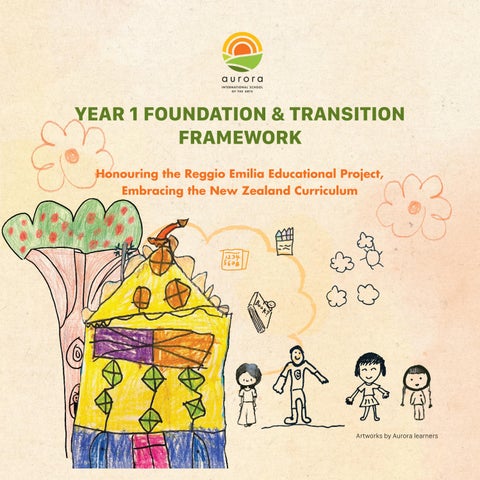
Honouring the Reggio Emilia Educational Project, Embracing the New Zealand Curriculum
This Foundation and Transition Framework articulates Aurora’s strategic approach to learning in Year 1 and establishes a coherent pathway from early childhood education into primary school.
This framework is written for both families and educators because we understand education as a shared journey.
• At Aurora, Families are valued partners who contribute essential knowledge of their children and engage in ongoing dialogue with the school. Our education frameworks draw from the Reggio Emilia Educational Project, Te Whāriki, and the New Zealand Curriculum, and this document explains how these perspectives guide daily classroom life in practical and meaningful ways. Shared understanding grows through conversation, documentation, and seeing children’s thinking made visible. Through this process, families and teachers build a common language around learning and development.
• For educators, this framework provides a shared professional reference point. It supports coherence, intentionality, and alignment across classrooms, ensuring that the transition into Year 1 feels like continuity in learning rather than a sudden shift in expectations.
Our approach is grounded in the Reggio Emilia Educational Project and aligned with the New Zealand Curriculum. At the heart of this work is the image of the child described by Loris Malaguzzi — a child who is strong, capable, curious, and rich in potential. We believe children actively construct knowledge through relationships, exploration, and dialogue.
This document makes visible the principles and values that guide our teaching. It clarifies how our image of the child shapes curriculum design, learning environments, relationships, and assessment during this important stage of growth.


Year 1 is designed to feel familiar and reassuring while gently introducing new expectations. Children are not rushed into formal schooling, nor are they left without guidance. Instead, they are supported to grow in confidence, independence, and readiness at a developmentally appropriate pace.
At Aurora, Year 1 is a transition year, not an abrupt shift from preschool to formal schooling.
Children entering Year 1 bring with them strong foundations in:
• Curiosity and wonder
• Communication and expressive language
• Social connection and belonging
• Learning through exploration and inquiry

Rather than replacing these foundations, Year 1 builds upon them, while gradually introducing the knowledge, skills, and dispositions required for success in Year 2 and beyond.
This approach reflects research-informed best practice and aligns with:
• The principles of the Reggio Emilia Educational Project, which honours the child as capable and competent
• The intent of the New Zealand Curriculum, which supports structured progression while valuing key competencies and holistic development
In this way, Year 1 becomes a bridge — connecting early childhood’s relational, inquiry-based learning with the increasing academic depth of the Primary years.


Children in Year 1 continue to learn best through a Reggio Emilia experiences, which places the child at the centre of learning and recognises children as capable, curious, and competent learners.
At Aurora, Reggio Emilia is not a programme but a pedagogical approach that shapes how learning is designed, observed, and valued.
Key Reggio principles that remain central in Year 1 include:
• The image of the child as strong, capable, and full of potential
• Learning through relationships with peers, teachers, and the environment
• Play as a primary vehicle for learning, exploration, and meaning-making
• The environment as the third teacher, intentionally designed to provoke curiosity
• The 100 Languages of Children, valuing many ways of expressing understanding
• Pedagogical Documentation: making thinking and learning visible and to guide the next steps
Children in Year 1 continue to learn best through:
• playful pedagogy, inquiry-rich, and relationship-focused practices
• exploration and experimentation
• dialogue, collaboration, and reflection
• active, hands-on experiences


In Year 1, your child continues to learn through play, creativity, dialogue, and investigation. Learning is not separated from joy or curiosity; it grows from them. Educators observe carefully, listen deeply, and introduce new skills at moments when children are developmentally ready, ensuring that learning is meaningful and connected rather than imposed.
As children enter their Primary years, the Reggio Emilia Educational Project does not diminish — it deepens. The image of the child as capable, competent, and rich in potential continues to guide how curriculum is designed and experienced.
You may see:
• Play as Research and Intentional Inquiry
Children engage in dramatic play, construction, artistic expression, and outdoor exploration as forms of investigation. Play is understood as serious intellectual work. Educators extend thinking through questions, dialogue, modelling, and reflection, supporting children to move from exploration toward increasing conceptual understanding.
• The Environment as the Third Teacher
Classrooms and outdoor spaces are carefully designed to provoke curiosity, problem-solving, collaboration, and creativity. Open-ended learning materials are intentionally selected and arranged to invite exploration, hypothesis-building, and sustained engagement.
• The Hundred Languages of Children
Children communicate and construct meaning in many ways — through drawing, building, movement, storytelling, music, writing, and conversation. Expression is not limited to written language. Children’s voices, theories, and interpretations are valued and revisited as part of the learning process.
Educators document children’s conversations, processes, and evolving ideas through video, photographs, transcripts of dialogue, learning stories, and displays. Documentation is a tool for reflection, assessment, and shared understanding within the learning community.
Teachers/Educators position themselves as researchers alongside children. They observe closely, interpret children’s thinking, and respond intentionally. New skills and academic concepts are introduced thoughtfully, building on children’s interests while guiding them toward increasing depth and complexity.
In Year 1, the Reggio Emilia Educational Project evolves within the context of Primary education. Children grow in confidence, independence, and academic capability while maintaining a strong sense of agency, belonging, and intellectual curiosity.
Year 1 becomes not a departure from early childhood philosophy, but its maturation within a structured academic framework.

Reggio Emilia, Te Whāriki, and the New Zealand Curriculum are sometimes viewed as separate approaches. At Aurora, they are understood as complementary ways of thinking about children, learning, and progression over time. This document makes our thinking visible, so families and teachers can share a common understanding of how learning through playful pedagogy in Year 1 builds strong foundations for future learning.
At Aurora, they are understood as complementary ways of thinking about children, learning, and progression over time. This document introduces these ideas in clear, practical ways so families and teachers can build a shared understanding of how learning in Year 1 is both playful and purposeful, and how it supports children’s development in the years that follow.
Te Whāriki Contributes:
• a holistic view of the child
• learning dispositions (confidence, curiosity, communication)
• learning through play and relationships
The New Zealand Curriculum Contributes:
• clear learning areas
• achievement objectives
• progression and continuity across year levels
In Year 1, these frameworks co-exist. The how of learning remains grounded in Te Whāriki, while the what of learning becomes increasingly explicit through NZC-aligned outcomes.


Year 1 learning at Aurora is organised through five interconnected dimensions rather than isolated subjects. These dimensions reflect a holistic, Reggio-inspired understanding of learning while intentionally introducing the knowledge, skills, and progressions of the New Zealand Curriculum.
Each dimension explains what learning looks like in practice, why it is approached this way, and how teachers intentionally support children’s growth as they move into the Primary years.
Language as a tool for thinking, relationship, and meaning-making.
Children develop early reading, writing, and oral language skills through storytelling, discussion, play, shared reading, and purposeful writing experiences. Literacy is woven into inquiry, play, routines, and relationships.
Why we approach literacy this way
In the Reggio Emilia Educational Project, language is central to thinking and connection. Children learn language most deeply when it is meaningful and connected to their experiences. Confidence, comprehension, and communication are prioritised over speed or comparison.
Foundations being built for Year 2
• Strong phonemic awareness
• Growing confidence with decoding and high-frequency words
• Ability to write simple sentences with meaning
• Listening, retelling, and expressing ideas clearly

To nurture these foundations, our Year 1 learning includes:
• oral storytelling and discussion
• phonemic awareness through songs and games
• shared and guided reading
• writing through drawing, labelling, and early sentences
How teachers support and extend learning

Teachers provide explicit instruction through small groups, model reading and writing, and intentionally revisit skills within the context of playful pedagogy.
Mathematics as a way of understanding patterns, relationships, and the world.
Children explore numbers, patterns, measurement, and problem-solving through hands-on activities such as building, sorting, cooking, and outdoor exploration.
Why we approach mathematics this way
Mathematics is about making sense of the world. Children understand mathematical ideas more deeply when they use materials, talk through their thinking, and solve real problems.
Foundations being built for Year 2
• Secure number knowledge
• Understanding of addition and subtraction concepts
• Early measurement and spatial awareness
• Ability to explain mathematical thinking
How these foundations unfold through everyday learning
Mathematical thinking is developed through:
• number knowledge
• patterns and relationships
• problem-solving
• measurement and spatial awareness
How teachers support and extend learning
Teachers introduce mathematical language, guide problem-solving, and provide targeted instruction within meaningful contexts.
Inquiry as co-constructed learning driven by children’s questions.
What this looks like for your child

Children investigate the world through curiosity-driven inquiries, exploring science, social understanding, and design through questions and exploration.
Why we approach inquiry this way
Inquiry builds thinking skills, engagement, and understanding. Children learn to ask questions, test ideas, and reflect on discoveries.
Foundations being built for Year 2
• Observing and describing
• Asking questions and making predictions
• Recording learning through drawings and words
• Connecting ideas across learning areas
How these foundations unfold through everyday learning
Inquiry learning encourages children to:
• ask questions
• explore ideas
• observe patterns and change
• make sense of the world
• Collaborate and negotiate

Inquiry draws from science, social sciences, and technology, and is closely linked to literacy and mathematics learning.
How teachers support and extend learning
Teachers scaffold inquiry, model thinking routines, and guide reflection and documentation.
Learning as relational, grounded in belonging and participation
Children develop independence, collaboration, emotional awareness, and responsibility through daily routines, group work, and learning interactions.
You will see children:
• Growing in self-management and independence
• Working collaboratively with peers
• Developing emotional regulation and resilience
• Taking responsibility for materials and shared spaces

Why we approach learning this way
Strong social and emotional skills support all learning. Children who feel safe, confident, and connected are better able to engage academically.
Foundations being built for Year 2
• Increased independence and self-management
• Ability to work collaboratively
• Emotional regulation and resilience
• Responsibility for routines and materials
How these foundations unfold through everyday learning
Year 1 supports children to:
• grow in independence
• collaborate with others
• manage emotions and routines
• develop confidence as learners

These skills directly support readiness for Year 2, where greater independence and self-management are required.
How teachers support and extend learning
Teachers explicitly teach routines, model social skills, and guide children in reflecting on behaviour and choices.

Reggio Lens: The Hundred Languages of Children
What this looks like for your child
Children express understanding through art, music, movement, drama, physical play, and swimming. These experiences support wellbeing, confidence, and cognition.
Why we approach learning this way
Children communicate and learn through many languages. Creative and physical experiences strengthen thinking, coordination, and emotional wellbeing.
Foundations being built for Year 2
• Physical confidence and coordination
• Ability to express ideas creatively
• Engagement in structured movement activities
• Confidence in water and basic swimming skills
How these foundations unfold through everyday learning

Children learn and express understanding through multiple languages, including:
• visual arts
• music
• drama and dance
• movement and physical play
Physical Education focuses on movement confidence and physical literacy, including swimming, rather than health theory. Creative expression and movement support wellbeing, communication, and engagement.
Teachers design environments and experiences that build skills progressively while maintaining joy, safety, and engagement.
These five dimensions are interconnected. Literacy supports inquiry. Mathematics emerges in investigation. Creative expression deepens understanding. Social and emotional growth underpins all learning.
Year 1 at Aurora is therefore not a collection of subjects, but a coherent learning experience — one that honours the Reggio Emilia Educational Project while intentionally introducing the structure and expectations of Primary education.
It is a bridge between early childhood and the wider academic journey ahead.


Your child will begin building strong foundations in reading, writing, and mathematics through play, small-group learning, and everyday experiences, without pressure, comparison, or loss of joy.
Academic learning in Year 1 is intentional but developmentally appropriate.
Teachers introduce foundational skills through intentional teaching within a Reggio-inspired pedagogy, including:
• small-group learning
• modelling and shared practice
• repeated exposure in playful contexts

Children are not expected to master all skills at the same time. Progress is viewed as a continuum, with individual pathways respected.


"Learning and teaching should not stand on opposite banks and just watch the river flow by; instead, they should embark together on a journey down the water. Through an active, reciprocal exchange, teaching can strengthen learning and how to learn.”
Loris Malaguzzi

Learning grows gradually. Each year builds on the one before it, so children feel confident and capable as expectations increase.
At Aurora, children experience a carefully designed progression from early learning into the New Zealand Curriculum.
Rather than a sudden shift, learning develops across three connected stages:
Preschool (Frangipani & Gerbera)
Learning through play, relationships, and exploration
• Strong focus on wellbeing, belonging, and communication
• Learning dispositions such as curiosity, confidence, and resilience
• Rich oral language, imaginative play, and inquiry
Gentle transition
Year 1 (Foundation / Transition Year)
Playful pedagogy with intentional skill-building
• Reggio Emilia principles remain central
• Play and inquiry continue as primary learning modes
• Teachers introduce explicit literacy and numeracy foundations
• Children grow in independence, routines, and learning stamina

• Learning outcomes are aligned to NZC Level 1, taught through meaningful contexts
Increasing independence and structure
Applying skills with confidence

• Stronger focus on reading, writing, and mathematics application
• Inquiry continues, with increased structure and reflection
• Children are ready for longer learning blocks and independent work
By the end of Year 1, most children will demonstrate readiness for Year 2 through:
• growing confidence in reading and writing
• secure number knowledge and problem-solving strategies
• ability to participate in structured learning experiences
• increasing independence and learning stamina
Readiness is understood holistically, not solely through academic measures.

Progress is understood through observation, conversation, and children’s work. Assessment helps teachers support learning; it is not used to label or compare children.
Teachers use a range of approaches to understand and support learning:
• observation and learning stories
• work samples and documentation
• light, age-appropriate assessments
• professional judgement and moderation
Assessment is used to inform teaching, not label children.
Partnering in a Reggio-Inspired Learning Journey
Families play a vital role in supporting children’s learning.
Helpful ways to support Year 1 learners include:
• reading and talking together daily
• encouraging play and creativity
• valuing effort and curiosity
• maintaining routines that support wellbeing
Partnership between home and school strengthens children’s confidence and success.
The Year 1 Curriculum Overview provides detailed progression of learning expectations aligned to the New Zealand Curriculum.
It should always be read alongside this Foundation & Transition Framework, which explains how those outcomes are approached in practice.
Together, these documents reflect Aurora’s commitment to:
• holistic development
• playful, meaningful learning
• strong foundations for future success
This document reflects Aurora International School of the Arts’ values, philosophy, and commitment to high-quality learning for every child.


AURORA INTERNATIONAL SCHOOL OF THE ARTS
11 - 11A - 13 - 15 - 15A Tran Ngoc Dien Street, An Khanh Ward, Ho Chi Minh City, Vietnam.
+84 (028) 3744 2991 | info@auroraschool.vn | www.auroraschool.vn