Clinical Trial Services by
ProRelix Research
Clinical research programs often face multiple operational and scientific hurdles, such as slow patient enrollment, evolving regulatory expectations, rising study costs, and coordination difficulties across international sites. Ensuring data accuracy, maintaining compliance, and keeping studies on schedule becomes increasingly complex as trials progress through different phases and therapeutic areas
As a global Contract Research Organization, ProRelix Research brings the expertise needed to overcome these challenges through comprehensive Phase 1 to Phase 4 clinical trial services Our integrated team ensures streamlined operations, precise regulatory guidance, advanced data management, and patient-centric approaches resulting in faster timelines, higher data integrity, and consistently inspection-ready outcomes
Phase 1 2 3 and 4 Clinical Trials: Complete Overview
Every phase contributes to a drug’s journey from early discovery to real-world use Our expert teams provide integrated services including regulatory strategy, patient recruitment, site management, monitoring, biometrics, and pharmacovigilance.
Phase 1 2 3 to 4 Clinical Trials List
● Phase 1 Clinical Trials Safety, tolerability, PK/PD
● Phase 2 Clinical Trials Dose response, initial efficacy
● Phase 3 Clinical Trials Large-scale confirmation of efficacy & safety
● Phase 4 Clinical Trials Post-marketing evidence & long-term monitoring
Each phase builds evidence that guides regulatory decisions and real-world adoption.
4 Phases of Clinical Trials & Their Significance
Phase 1 Clinical Trials
Early-phase studies that determine safety, dosing range, and pharmacokinetics ProRelix Research collaborates with early-phase units to deliver fast, efficient first-in-human programs
Phase 2 Clinical Trials
Focused on refining the dose and assessing preliminary efficacy We use biomarker-driven designs, targeted enrollment, and risk-based monitoring for accelerated timelines
Phase 3 Clinical Trials
Large, multicenter studies that validate a drug’s efficacy and safety. Our global operational systems ensure high-quality data and regulatory-ready submissions
Phase 4 Clinical Trials
Conducted after market approval to evaluate long-term outcomes, real-world use, and comparative effectiveness Ideal for lifecycle management and label expansion
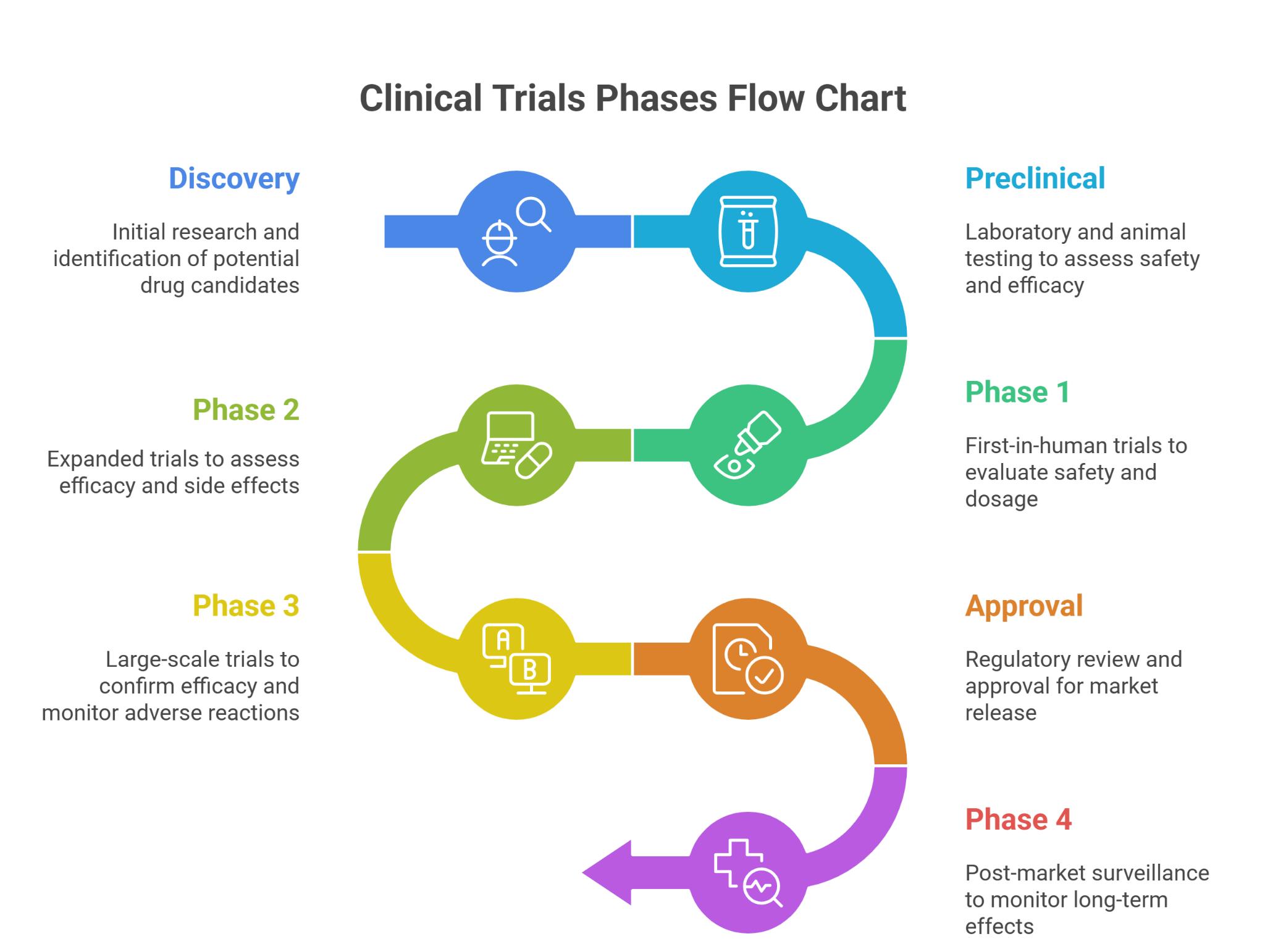
Clinical Trials Phases Flow Chart
The clinical development journey follows a structured pathway designed to ensure safety, efficacy, and long-term therapeutic value.
Discovery → Preclinical → Phase 1 → Phase 2 → Phase 3 → Approval → Phase 4
ProRelix Research supports each stage with advanced eClinical systems, expert oversight, and globally coordinated trial operations
Phase 1 2 3 to 4 Clinical Trials for Cancer
Oncology studies require precision, biomarker-based design, and rapid adaptation
ProRelix Research provides:
● Dose-escalation & expansion cohort expertise
● Immuno-oncology trial capabilities
● Global oncology site networks
● Rare cancer and precision medicine studies
● Real-world evidence support for post-approval programs
Phase 3 vs Phase 4 Clinical Trials: Key Differences
Aspect Phase 3 Clinical Trials Phase 4 Clinical Trials
Objective Confirm efficacy & safety
Population Large, controlled
Outcome Supports approval
Setting Study sites
Monitor long-term, real-world use
Broad, real-world
Supports lifecycle management
Real-world healthcare settings
Phase 3 determines approval. Phase 4 determines long-term value.
Phase 3 and Phase 4 clinical trials serve distinct yet complementary roles in the drug development lifecycle. Phase 3 focuses on confirming a therapy’s efficacy and safety in large, controlled patient populations, generating the robust evidence required for regulatory approval. In contrast, Phase 4 takes place after market authorization, evaluating long-term safety, real-world effectiveness, and broader patient outcomes across diverse healthcare settings. While Phase 3 determines whether a treatment is ready for approval, Phase 4 determines how it performs in everyday clinical practice and helps support ongoing risk–benefit assessment, label expansion, and post-marketing surveillance.
Why Choose ProRelix Research for End-to-End Clinical Trial Services?
● Global multi-therapeutic expertise
● Rapid and targeted patient recruitment
● Advanced data management and statistical services
● Fully integrated TMF, QA, and PV systems
● Cost-efficient, timeline-driven project execution
● Seamless support from Phase 1 to Phase 4
FAQs
1. What are the 4 phases of clinical trials?
Phase 1 evaluates safety, Phase 2 assesses dosing and efficacy, Phase 3 confirms efficacy at scale, and Phase 4 monitors long-term real-world outcomes
2. What is the main purpose of Phase 1 clinical trials?
To determine safety, tolerability, and pharmacokinetics in humans
3. What happens in Phase 3 clinical trials?
Large patient groups are studied to confirm efficacy and safety before regulatory approval
4. Why are Phase 4 clinical trials important?
They track long-term safety, effectiveness, and real-world performance after a drug is marketed.
5. What is the difference between Phase 3 and Phase 4 clinical trials?
Phase 3 supports approval; Phase 4 evaluates long-term use after approval