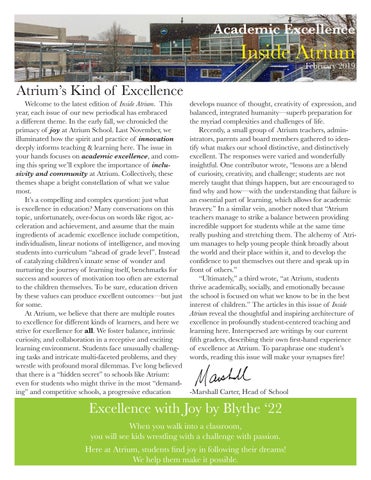
Academic Excellence
Inside Atrium February 2019
Atrium’s Kind of Excellence
Welcome to the latest edition of Inside Atrium. This year, each issue of our new periodical has embraced a different theme. In the early fall, we chronicled the primacy of joy at Atrium School. Last November, we illuminated how the spirit and practice of innovation deeply informs teaching & learning here. The issue in your hands focuses on academic excellence, and coming this spring we’ll explore the importance of inclusivity and community at Atrium. Collectively, these themes shape a bright constellation of what we value most. It’s a compelling and complex question: just what is excellence in education? Many conversations on this topic, unfortunately, over-focus on words like rigor, acceleration and achievement, and assume that the main ingredients of academic excellence include competition, individualism, linear notions of intelligence, and moving students into curriculum “ahead of grade level”. Instead of catalyzing children’s innate sense of wonder and nurturing the journey of learning itself, benchmarks for success and sources of motivation too often are external to the children themselves. To be sure, education driven by these values can produce excellent outcomes—but just for some. At Atrium, we believe that there are multiple routes to excellence for different kinds of learners, and here we strive for excellence for all. We foster balance, intrinsic curiosity, and collaboration in a receptive and exciting learning environment. Students face unusually challenging tasks and intricate multi-faceted problems, and they wrestle with profound moral dilemmas. I’ve long believed that there is a “hidden secret” to schools like Atrium: even for students who might thrive in the most “demanding” and competitive schools, a progressive education
develops nuance of thought, creativity of expression, and balanced, integrated humanity—superb preparation for the myriad complexities and challenges of life. Recently, a small group of Atrium teachers, administrators, parents and board members gathered to identify what makes our school distinctive, and distinctively excellent. The responses were varied and wonderfully insightful. One contributor wrote, “lessons are a blend of curiosity, creativity, and challenge; students are not merely taught that things happen, but are encouraged to find why and how––with the understanding that failure is an essential part of learning, which allows for academic bravery.” In a similar vein, another noted that “Atrium teachers manage to strike a balance between providing incredible support for students while at the same time really pushing and stretching them. The alchemy of Atrium manages to help young people think broadly about the world and their place within it, and to develop the confidence to put themselves out there and speak up in front of others.” “Ultimately,” a third wrote, “at Atrium, students thrive academically, socially, and emotionally because the school is focused on what we know to be in the best interest of children.” The articles in this issue of Inside Atrium reveal the thoughtful and inspiring architecture of excellence in profoundly student-centered teaching and learning here. Interspersed are writings by our current fifth graders, describing their own first-hand experience of excellence at Atrium. To paraphrase one student’s words, reading this issue will make your synapses fire!
-Marshall Carter, Head of School
Excellence with Joy by Blythe ‘22 When you walk into a classroom, you will see kids wrestling with a challenge with passion. Here at Atrium, students find joy in following their dreams! We help them make it possible.
Middle Schoolers Integrate Disciplines by Julia Schroeder At the beginning of each year, incoming sixth graders experience an expectedly steep learning curve. Between switching classrooms, widening social circles, and adapting to several different teaching styles/expectations, the first months of Middle School signal a distinct shift away from younger ways of thinking and doing. To ease this transition by highlighting cross-curricular themes and concepts, Middle School teachers Laura Page and Julia Schroeder joined forces this fall to co-create a new “Water Around the World” unit. This unit, which bridged the 6th grade science and English Language Arts (ELA) curricula, allowed students to explore the seemingly straightforward substance of water from a variety of perspectives. In ELA, study was rooted in the whole-class reading of A Long Walk to Water, by Linda Sue Park. This text follows the dual narratives of Nya and Salva, who are fictional and real children, respectively, living in South Sudan. Both stories are marked by scarcity; Nya must walk for miles every day to gather enough fresh water for her family’s survival, and Salva is a “Lost Boy” who not only struggles to find food and water, but also a place to call home. As students became acquainted with these characters in ELA, they created annotated water cycle diagrams in science, using photos from National Geographic Photographers to recognize and describe how water moves through evaporation and transpiration, condensation, precipitation, and collection processes. Students drew a striking parallel between this cyclical ‘journey’ of water and Salva’s more unpredictable journey across national borders and between refugee camps. They labeled cut-out footprints with events from the book and arranged them on a poster to visually map out Salva’s literal steps forward as well as his inner growth. Meanwhile, in science, sixth graders researched the amount of water available on Earth, and they were surprised to find out what a tiny percentage is actually freshwater! After that global overview, students zoomed in on specific regions, looked at specific causes and effects of water availability, and identified different patterns of precipitation around the world. They also explored an interactive dataset showing the proportion of populations worldwide with access to clean water––and how that access has changed over the last thirty years. Back in ELA, students were able to apply this data to their understanding of Salva and Nya’s lives: one as it actually played out in the 1980s, and one as it might unfold in the present day. They also compared and contrasted the two characters by completing Venn diagrams, writing paragraphs with transitional words and phrases, and creating two-voice poems from both perspectives. Students simultaneously flexed their creativity in science class as they considered ways to engineer solutions to real-world water availability and cleanliness problems. After gleaning inspiration from existing examples and testing the ability of different materials to filter dirty water, students designed their own simple water filters. To culminate the unit, students watched a live-streamed, joint interview with Salva (now in his mid-40s) and author Linda Sue Park, and in doing so, learned more about what steps forward have been taken since the end of the novel. They were especially interested in hearing about “Water for South Sudan,” the humanitarian organization Salva founded to raise money for drilling wells and increasing sanitation measures in his home country. By pairing this heightened sense of inspiration with a specific call to action in science class, students collaboratively brainstormed and sketched innovations to help some part of the world obtain, store, or filter water. This unit encouraged students to use a substance we often take for granted––water––as a window into our wider environment, the people who inhabit it, and the science that governs it. From this intersection of story and science, students were able to dig deep and hit a wellspring of understanding.
Excellence Exemplified by the 4th/5th Grade Engineering Unit by Liz Perekrests and Julie Perry
For some, the term “academic excellence” is defined by achieving high grades and performing superior work in relation to one’s peers. In Atrium’s 4th and 5th grades, academic excellence took on a completely different meaning during this fall’s Engineering Unit, defined by thoughtful planning, creative innovation, collaboration and yes–even failure.
Some of our projects included:
During the Engineering Unit, Visionators were introduced to and practiced the engineering process of identifying a problem, researching and collecting data, brainstorming possible solutions, sketching ideas, building prototypes, testing and evaluating their designs, communicating their ideas to “clients” and team members, and redesigning additional iterations. Their first challenge was to design and build a more durable grocery bag while staying within a budget. Many first attempts failed, causing frustration among some. Students soon realized there was often much to learn from each failed attempt, and each failed attempt led to improved designs and new ideas. As one student proclaimed, “Today, I learned it’s okay to fail!” What a great lesson to learn: that with failure comes new knowledge.
•
Their second challenge began by researching the design of a Mars Rover and how it lands gently on Mars, and adapting similar design ideas to land a water balloon safely to earth from a 30-foot drop. Students practiced critical thinking, problem solving and innovative design skills, resulting in multiple iterations and some extremely creative solutions. Plastic grocery bags were used as parachutes, blown up ziploc bags for cushioning, and toilet paper rolls for landing gear! The unit’s capstone project involved students touring and observing others throughout Atrium through an “empathy lens”, considering what others at Atrium might need to help them be happy, successful and organized. Their job was to create a physical prototype for a client, whether a teacher or another student, and get feedback. After creating different versions and sketches, with collaboration and consensus, students settled on a final design.
• • • • •
A violin holder A device to clean the turtle tank A fidget for fidgety first graders An iPad holder for the Library An adjustable basketball hoop that younger children can reach A computer cord organizer for fourth grade
Students enhanced their Engineering Unit experience with a field trip to MIT, a visit from a female NASA scientist, and learning about the design process directly from design professionals at the Richard Lewis Media Group (RLMG). RLMG is a nationally-known design firm with offices just up the street from Atrium. The firm designs multimedia learning exhibitions for museums all around the world. During their visit to our classroom, they shared with us images of their current projects, exposing the students to real-life applications for engineering skills. They also discussed the process of receiving feedback from customers and incorporating that constructive criticism into their next iterations. As each student demonstrated academic excellence in the form of empathy and social responsibility, collaboration with partners, receiving feedback, persistence, and innovation, they learned what being an engineer is all about while being immersed in an environment that felt joyful, meaningful and intellectually challenging.
Curriculum by Danny ‘22 Curriculum. It’s just a small part of Atrium, but it makes a huge impact on everyone. It makes people smile. It makes synapses fire. And best of all, it grows your knowledge.
Kindergarten Snapshot: Sink or Float? In kindergarten, students spend the year asking, “What about water?” With water as their theme, the class begins by exploring water’s properties before learning about the water cycle and the ways water moves. Throughout the year, kindergarteners visit the Charles River to make observations about the river and how it feeds nearby life, as well as making models of a watershed. Recently, Hikers finished their unit on sink/float in theme. Merry Murray began a lesson by asking students why things sink or float, based on their previous experience and discussions in the classroom. Bader answered, “If it sinks, the water can’t hold it and water will go to the side. If it floats, the water can hold it. If something sinks, then the water is weaker than it is, but if it floats, the water is stronger.” “Some light things in water can hold up, like a human in a pool,” Cam explained. Raphael added, “Most of the stuff with air in it will float.” Merry Murray reminded students that they learned that big things can float but little things can sink, and vice versa. She asked them what happens with metal, and after a great deal of discussion, the class decided to do a test. Merry Murray took a penny and dropped it into a bucket of water. After watching it sink, she issued the classroom a challenge: design an aluminum foil boat that floats and can carry pennies, then continue to add pennies until the boat sinks. One student asked if they could ask their friends for ideas, and Merry Murray told the class, “The best engineers get ideas from other engineers—think about that as you improve your design.” Students clustered around bins filled with water and busily began building boats. Some students were able to immediately build a boat that floated and held pennies, while others took multiple iterations. As they worked on their challenge, Hikers talked to each other, asking for and making suggestions to their fellow classmates. When students’ boats floated with pennies inside, their friends’ reactions were just as excited as their own. As children built their boats, there was only minimal frustration when their designs sank. Most children considered their design flaws and tried to improve them for their next boat. When the challenge ended, students had built numerous designs with varied degrees of success. Raphael said, “My first one floated but didn’t hold any pennies. Then I tried to build it new. I turned it into a canoe and it held more pennies.” Benjamin said, “I made it into a ball first and it sinked. Then I made it into a square with sides. I wanted to make it have bigger sides so it wouldn’t sink.” “Mine didn’t work on the first try,” Kenzie explained. “It was a square first, then rolled it up like a candy, then a second square. It worked because it was big and had air.” Merry Murray said, “Children were so proud when they were able to engineer a successful boat after their multiple attempts. As a group, we talked about how engineers are most successful when they make a mistake and learn from it.”
Projects by Sammy ‘22 Have your children ever gotten bored of all day just learning unhelpful stuff? Did you know that when you’re bored you tend to forget things more often? Well, here at Atrium we take that into consideration and we make learning fun, fast and fantastic! And what combines fun, fast and fantastic better than cool educational projects? At the Atrium School every class has from one to two big projects. (Well…every class except PreK but they have four medium-sized projects.) Projects can range from models to posters to going outside and exploring the world around you. Hands-on learning is something that is extremely valued at Atrium. It helps students to learn more with freedom! Here are some of the projects at Atrium: the RAPP projects in third grade. For the RAPP project everyone chooses something to study and then people do a presentation. In fourth and fifth grade we did the house projects where you study a house in a certain country and make a house to present at a breakfast. And in second grade you do the hero project. I think one of the most memorable projects is the hero project. In the hero project we each choose a hero (a person who did a lot in the time of slavery or segregation and many other things) and study them. At the end of the project everyone puts on a presentation in costume. The presentation consists of walking into the room in costume from the “time machine” and while you’re in the time machine your teachers will hand out notecards with questions to ask you (there are at least 15). This project is for the second grade and it is a really fun and a good learning experience. At Atrium we try to take many things and make them better––as you know, nothing can be perfect and you can always set a higher goal. And at Atrium we do set higher goals in hopes to make them happen, and that way no one gets bored, projects keep evolving and getting better and adding new things, and sometimes changing. Atrium makes school fun, fast and fantastic with cool projects making school a fun learning experience!
Hands-On Work by Ptolemy ‘22 Do you like sitting in front of a textbook all day long? Atrium prioritizes hands-on work. Theme is a changing theme we work on. Theme is 80% hands-on work. We built and tested small paper bags to learn about the engineering process. We are currently doing the egg drop challenge, where we put a fragile object in a contraption and drop them off the roof. People scream a lot in excitement. In math we build visuals to represent problems. We also solve real life problems like packing the most rectangular boxes into a truck, and then make a poster and directions on how to do it.
An Evening of Conversation with Darnell Moore Thursday, March 7 at 7:00 p.m.
Join us for An Evening of Conversation with Darnell Moore, author of No Ashes in the Fire: Coming of Age Black and Free in America, followed by a book signing. Darnell Moore’s book No Ashes in the Fire was recently named one of The New York Times’ 100 Notable Books of 2018. He is an award-winning author and activist, and No Ashes in the Fire is a memoir about his life as a gay black man in America. This event is free and open to parents of students at independent schools. Books will be available for purchase and signing after the discussion.
Class Themes by Joaquin ‘22 Have you ever wondered what’s unique with Atrium School? You’ve probably heard so much great stuff that you’ve probably heard of before. Bet you’ve never heard of Theme class. We have great hands-on learning and other researching and educating tactics in general. The best learning happens when classes explore a common theme in projects, making models, and researching the topic and discussing and sharing it together. All grades have a theme including our PreK class. Having a grade theme not only separates Atrium from other schools but helps educate your children, preparing them for the adult world. Learning with a theme allows your child to get a taste of being an adult. At Atrium we don’t just teach your child how to multiply, we explain why your child needs to know how to multiply, and how multiplication works. As a parent you want your child to get the big picture, and at Atrium we value that.
www.atrium.org | 69 Grove St., Watertown, MA 02472 | 617-923-4156