

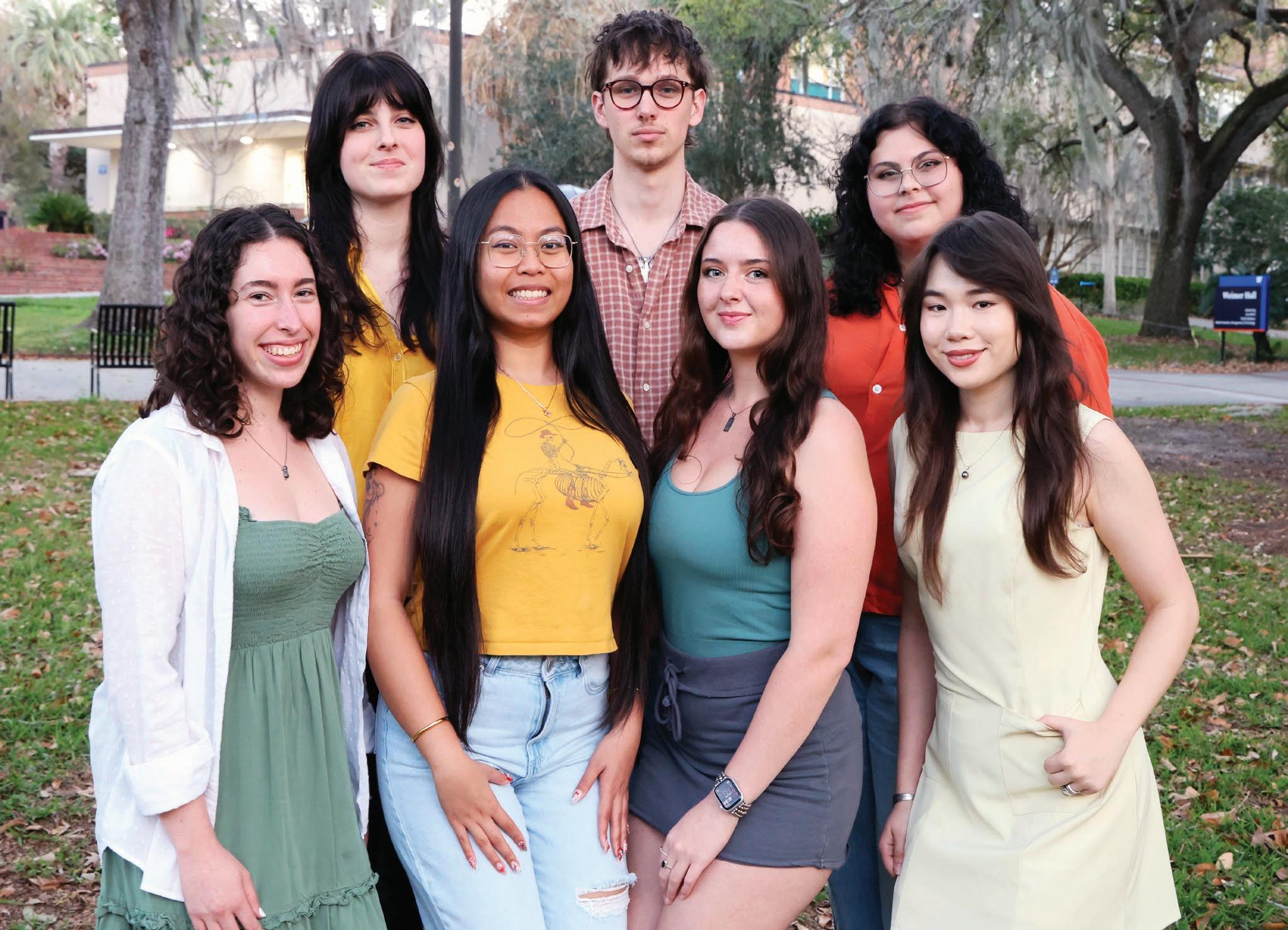
Welcome to the sixth print issue of Atrium, a narrative nonfiction magazine produced by University of Florida students.
Our mission is simple: to tell true Florida stories. Our focus is on issues important and unique to the Sunshine State. Our hope is that through the prose, photography and poetry on our pages, we are able to share the voices of those who have not always been heard.
Atrium is named after the open space in Weimer Hall, home of the College of Journalism and Communications at the University of Florida. The atrium allows the Florida sun to shine in, bringing light into the heart of our building. Similarly, we hope our namesake magazine will help illuminate the heart of our state.
Happy Reading!
Atrium would not be possible without the support of the University of Florida College of Journalism and Communications.
Special thanks to Associate Dean for Undergraduate Affairs Ted Spiker, without whom Atrium would be but a dream; CJC Dean Hub Brown; and Department of Journalism Chair Harrison Hove.
Funding for Atrium comes from the Harold A. (Hal) Herman Endowment Fund, and the Department of Journalism Magazine Fund.
Editor-in-Chief
Delia Rose Sauer
Managing Editors
Alissa Gary
Kylie Williams
Multimedia Editor
Anna Edlund
Design Editor
Jack Vincent
Copy Editor
Alexandra Burns
Web Editor
Tarryn Nichols
Content Manager
Pristine Thai
Social Media Director
Anna Edlund
Layout Designers
Emma
Gabi Frazer
Isabel Kraby
Maria Ribas
Marla Tokie
Tarryn Nichols
Illustrators
Chloe Abreu
Chloe Santiago
Gabi Frazer
Priscilla Oliveira
Photographers
Lily Hartzema
Madilyn Gemme
Marta Rodriguez
Riana Morales
Sophia Bailly
Taylin Huffman
Advisers
Cindy Spence
Ted Spiker
Founder
Moni Basu
design by DELIA ROSE SAUER
introduction by DELIA ROSE SAUER
Welcome
in motion. Swaying palms cut into the Southern skies, bending to the brink of collapse as the ocean breeze pushes through. Speeding cars bite at each other on endless highways. Within the capitol’s ivorycolored walls, lawmakers debate decisions that could enrich or disrupt our lives. Sapphire waves lap at sun-kissed sand. There’s a familiarity in the cyclical dance.
Our communities flourish in knowing the only constant in the state is change. In bumper-to-bumper standstills, drivers look out the window to ranches and plains or to stretches of suburbia. Construction is a never-ending cycle, as more skyscrapers split our cities’ horizons.
From the snowbirds flying down to escape bitter winters to the tourists flocking to explore the coastal frontier, Florida is a patchwork tapestry of identities. Our state is filled with reminders of our contentious history, but it beams with opportunities for a vibrant future.
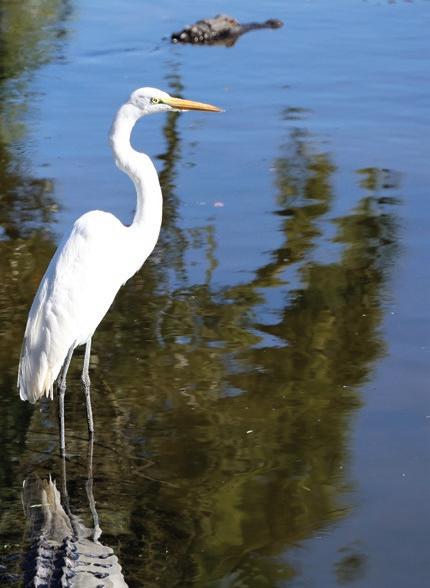
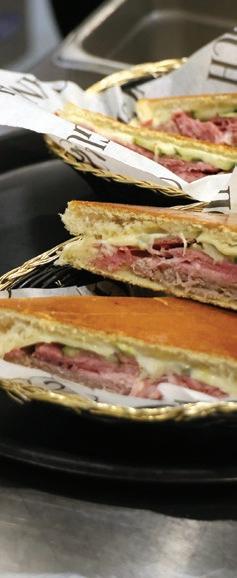
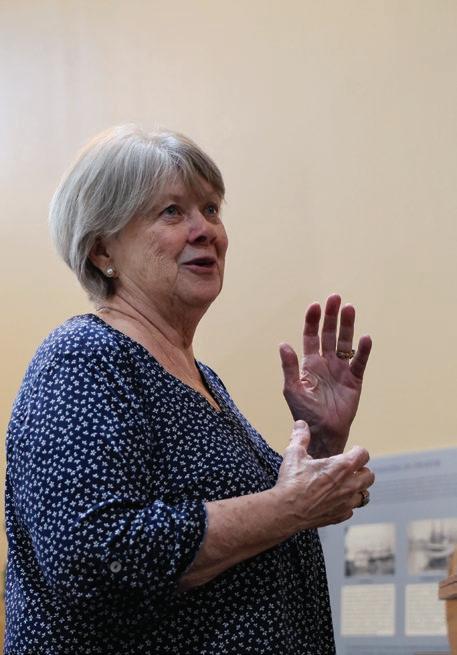
In this issue, our stories capture what makes Florida so colorful: a simple sandwich that unfolds into a layered memory of where food and culture intersect, the tipping of the scales of the life of a Florida alligator, and a woman determined to keep local history alive from within restored bricks built for war.
Calling Florida home means witnessing all its moments — the beautiful and ugly and strange.
design by MADILYN GEMME

poem by TARRYN NICHOLS illustrations by DELIA ROSE SAUER

By 10 p.m., we had talked and laughed and gasped
Until our bodies were welded to the couch.
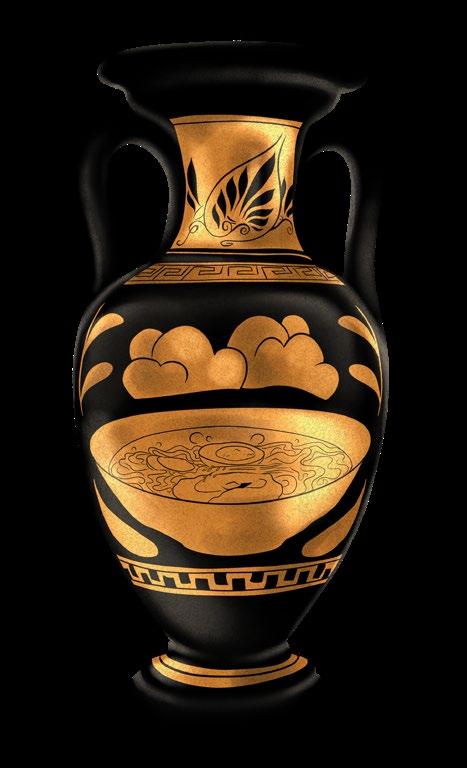
“Ramen?” she proposed. “Hell yeah,” I rasped, As we broke from the mold of our comfortable slouch.
We should have known what this night had in store; Not ramen, but a whole lot more. Even parking downtown was a real ordeal—
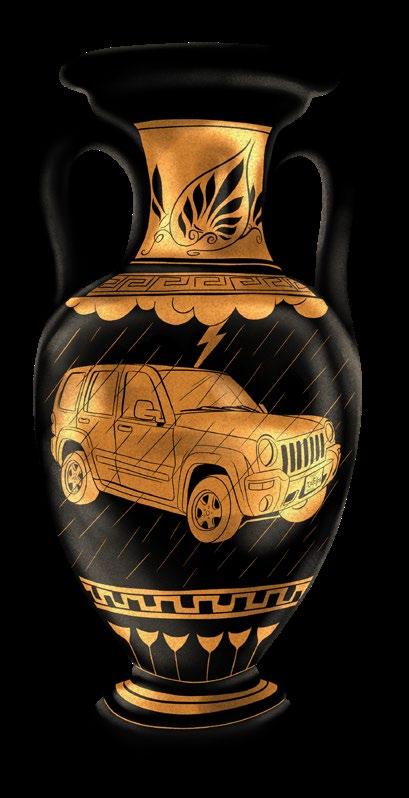
We ditched the Jeep in a distant nook and called it “ideal.”
We were 10th in the queue, an eternity-long wait; No food in a girl’s stomach leaves lots of room for hate…
Our second mistake, we later reflected, was leaving in the rain as we retraced our steps to everywhere except the car, in vain.
The rain beat down steady and chilled us to the bone, as 911 guided us in circles like an evil genie in a phone!
At 12, the holy white of a Jeep Liberty gleamed through the cold; Battered by the elements, we were pioneers finding gold.
Converse soaked to the soles, skin pasted to our clothes, We split puddles like Moses on our drive to Trader Joe’s. Our cheekbones, cold as tombstones to the touch, thought soup was a mild ask (we deserved at least that much).

Jaded, red-eyed, and jinxed as we were, We traded tired glances when we heard an ugly purr.
Smoke poured from the vents like a fog machine on speed dial
Just in time, we steered left as the fumes rose like bile.
At a tiny gas station, we escaped the white foam,
But had no food, no phone, and no goddamn way home.
A thickly bearded man yelled in an even thicker accent
“Come inside while he checks the car... is what I think he meant?”
Two hours of reggae, dirty tile floors, and a side of Newports
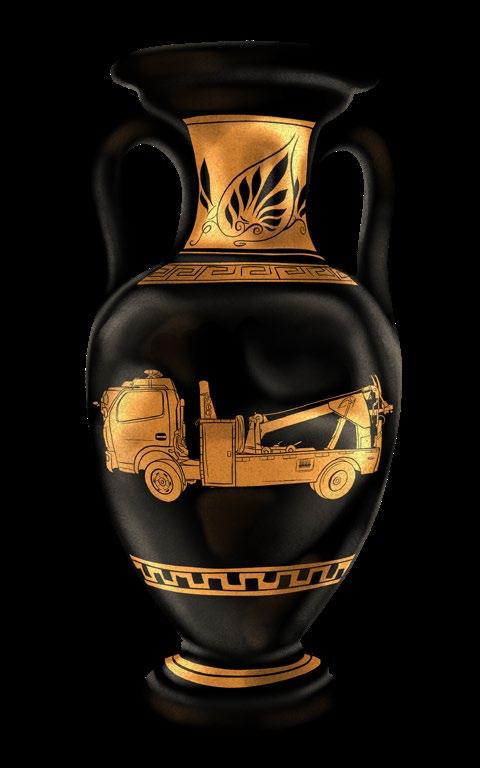
When the tow truck came, our morale was on life support.
Our driver looked just like Donald Glover with less hair:
“This is my last day, I’m goin’ back to school!” he declared.
The whole way home, we spoke about the future like kids
My friend Izzy is a talker, and talk she sure did!
She rambled about her school like a used car salesman:
“It’s a golden paradise on the beach, you’ll never wanna leave, man!”
He nodded and pondered, as if imagining the coastline.
I did not interject with “Izzy, don’t you do school online?”
She sold him that environmentalist beach lover’s wet dream
Until we reached my driveway, awash with a silvery gleam.

story by PRISTINE THAI
photos by ALISSA GARY and SOPHIA BAILLY illustrations by CHLOE ABREU
MY MOTHER NEVER liked the beach. Chaotic, she’d complain, as a woman who loved order above all else. Too full of noisy people and clinging sand and the salt-laden stench of the ocean.
Still, growing up in San Diego, I successfully begged her to drive me half an hour to the shores of La Jolla Bay a few times. I quickly learned I was a poor swimmer and cut my losses after nearly drowning in two feet of water. Instead, I settled for the sand, building amateur castles and trawling the shore for seashells.
Most of all, I remember my mother’s face –– perennially pained. Grimacing between forced smiles, always ready to leave. Stormy and overcast despite the California sun. The car ride home was quiet, suffocated by disappointment and heat-induced irritability.
I stopped asking to go to the beach by the time I turned 10.

My family moved to Orlando on New Year’s Day in 2019. I was 15. I hated my new life in Florida. I hated the unrelenting humidity and the constant rain. I hated the mosquitoes that terrorized me the second I went outside. I hated being the new girl at school who had no one to sit with for the umpteenth time.
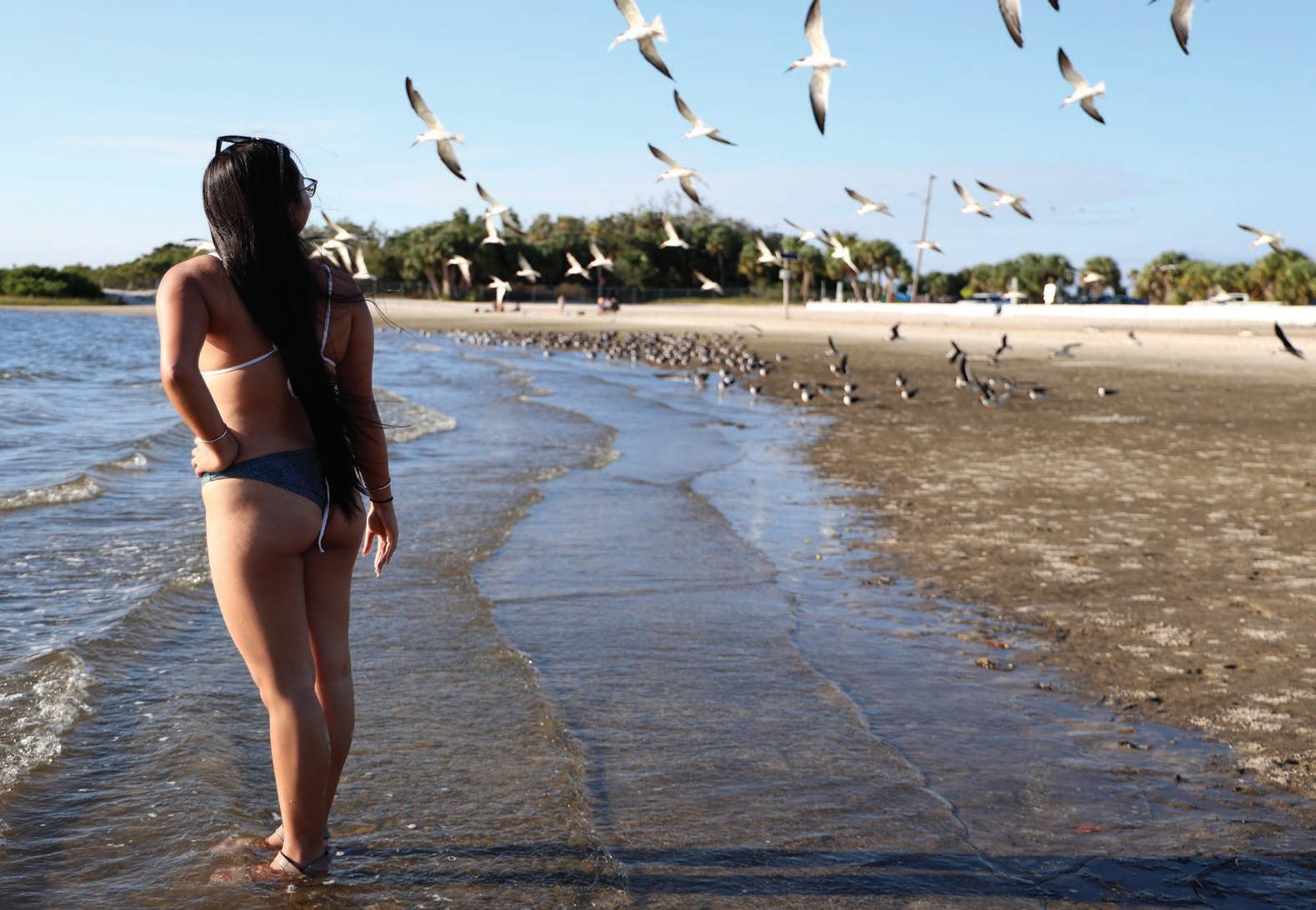
Without my own car, I spent three and a half years confined to my painfully suburban neighborhood. I didn’t participate in the vibrant culture scene downtown. I missed out on Disney World and Halloween Horror Nights, despite living less than half an hour away. And not once did I touch the ocean.
It’s my last “never-have-I-ever” that leaves people slack-jawed. They ask me, incredulous, “How long have you lived here?” Six years, I respond. “And you’ve never been to the beach?” Not in Florida.
Their disbelief is rational. How can you be a Floridian without partaking in the quintessential Floridian thing?
I look for excuses. Maybe I don’t feel like a true Floridian because I didn’t grow up here. Maybe I never had the time or an invite. Maybe I’m like my mother, and I don’t even like the beach.
I didn’t mind my landlocked existence.
Only during my senior year of college did I realize the urgency. In less than a year, I’d graduate and leave without completing the rite of passage that naturalizes someone as a Floridian. Even with my contempt for this state, I suddenly grew desperate to prove I belonged here.
So carpe diem. Let’s go to the beach.
The sand — dry, chalky, an off-white ivory color –– was smooth and soft. I had never felt sand that didn’t dig into the arches of my feet with a vengeance.

Rain spattered against the windshield as my friends and I drove east, cruising through small cities and towns. We passed Interlachen’s tiny police department, church cemeteries in Palatka, gas stations, fruit stands and rural mansions with horses and hunting dogs. The forecast didn’t look too good. We kept driving.
Once my friends discovered my quest, I was inundated with suggestions on where to go, ranging from deep in the panhandle to Miami Beach.

We chose St. Augustine only because it was the shortest drive amid our overbooked calendars.
The rain let up, and the sky peeked out somewhere past Hastings. The universe bestowed upon me a beach day. Unfortunately, St. Augustine Beach proper was overflowing with visitors. We went south to Crescent Beach for a less overwhelming introduction.
As we made our way down to the beach, the nostalgic smell of children’s sunscreen wafted around me. Blanket-like stratus clouds blocked the worst of the sun, but the damp, rainpromising heat remained, making my fingers stick together. I could see for miles in every direction, the horizon unobstructed by mountains, so unlike the West Coast.

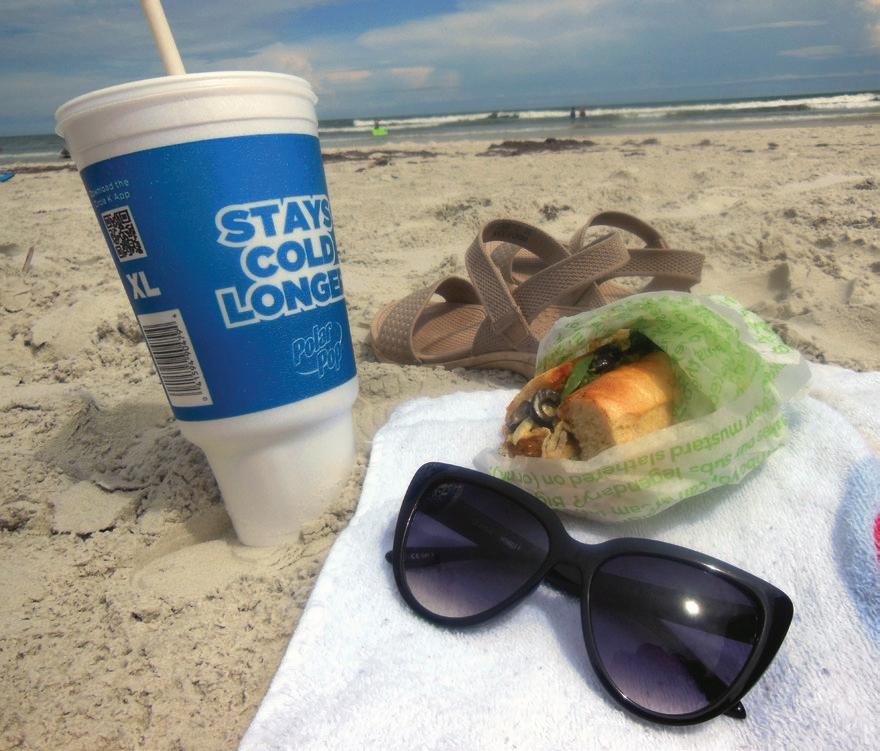
The sand — dry, chalky, an off-white ivory color –– was smooth and soft. I had never felt sand that didn’t dig into the arches of my feet with a vengeance. I laid out my towel against the wind and unpacked my beach tote: a wide-brimmed sun hat, a pair of sunglasses I bought that
week and a 44-ounce cup of Dr Pepper & cream soda. The most important treasure was a spicy falafel Publix sub, because a Pub sub on the beach is a sacred ritual.
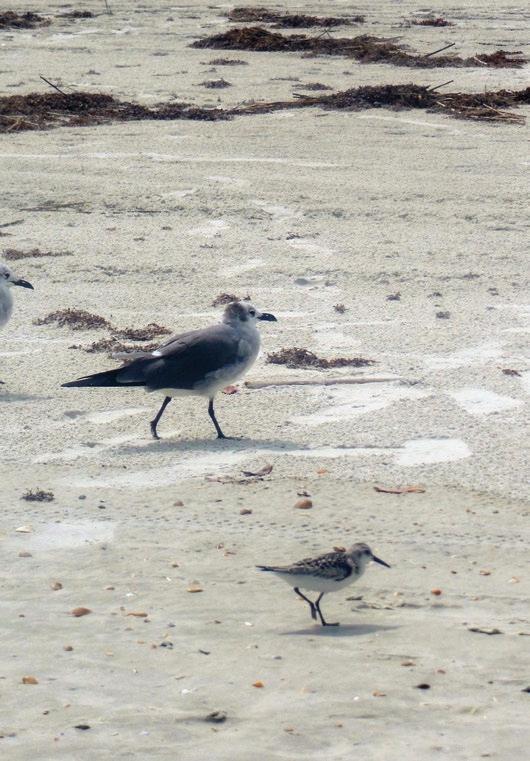
I meandered down the shoreline, dipping in and out of the tide. I followed flocks of whistling sandpipers as they scurried back and forth between waves. They didn’t appreciate me slinking closer to snap photos of them. I had better luck photographing fragments of seashells and seaweed cast ashore.
My favorite beach discovery was a small kingdom of sand castles. It had delicately carved windows, drizzled-on spires and a classic moat. Bright plastic buckets and shovels were half-buried nearby, abandoned by the towers’ architects. I bent down to take pictures when a little girl, maybe 6 or 7 years old, ran behind me toward the fortress.
“Do you like my sand castles?” she asked quietly without stopping, as if she didn’t expect me to answer. I turned around to smile at her.
“I do! They look amazing.” Her face lit up instantly. It reminded me of myself, playing sand carpenter in La Jolla all those years ago. I wished someone had told me they liked my sand castles back then. Maybe I would’ve loved the beach sooner.
That’s what the ocean was for, anyway, to wash it all off at the end.
slicing through the forest.
We passed through Crystal River, with its kitschy gift shops and palm trees wrapped in string lights, before reluctantly continuing to our real destination: Fort Island Gulf Beach. I wanted a taste of Florida’s west coast. For miles, all we saw were swamplands giving way to marshes. As we neared the end of Fort Island’s peninsula, I wondered where the ocean was. We turned a corner, and I gasped. The ocean had been beneath us the whole time, cleverly hidden by dense wetland vegetation.
The beach was tinier than I expected; I could have walked the length of it in a minute or two. We shared the beach with fewer than a dozen people. It was low tide, and little piles of salt deposits and bird poop dotted the intertidal zone. My mother, ever the germaphobe,
would’ve turned the car around. But we stayed.
Fort Island’s sand was just as powdery-soft as Crescent Beach’s. There were no shells but plenty of feathers from the flocks of birds occupying the sand. I worked up the courage to wade into the shallow water. It was darker than the east coast’s but not as swampy as I feared.
I commented on the little holes in the sand under the water. That’s where the crabs live, my friend said. I froze. What crabs? Did they pinch? She laughed and said they wouldn’t come out to bite me. But there were hermit crabs out, if I was brave enough to hold one.
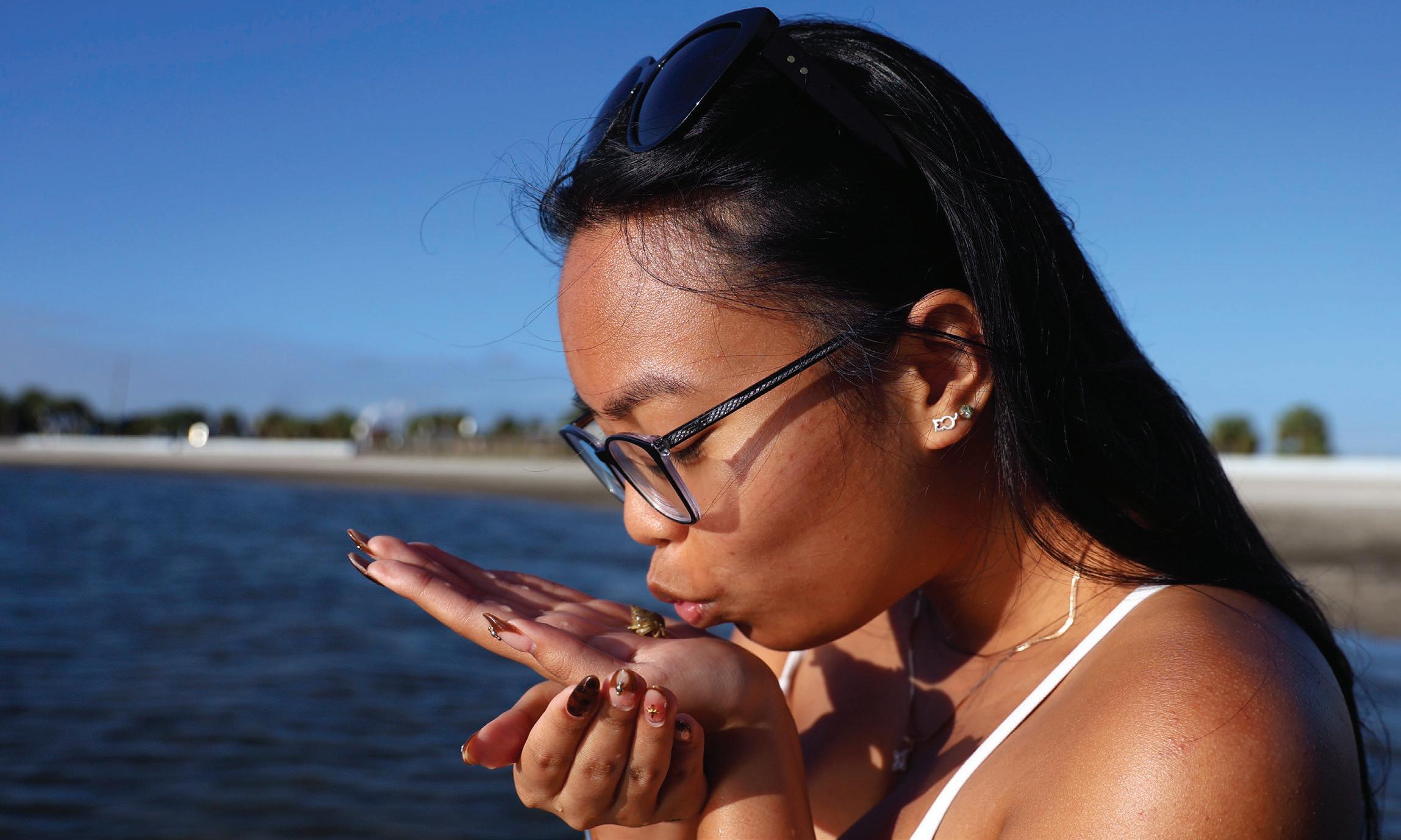
She scooped one up and put it gently into my palm. Holding it close to my face, I peered inside to see tiny claws and legs curled up tight. “Let it wake up,” my friend said. I waited.
The shell turned over, and out came the hermit crab, clearly disgruntled, waving its claws and chattering its mouth. It kept falling off the sides of my hands, tucking and rolling toward the ocean. It was adorable. I loved it. I gave it a little air kiss before letting it go. I wanted 50 of them.
We spent a few more moments hunting for more hermit crabs to bother, sticking our hands in the goopy sand and clouding the water. Schools of tiny fish darted through the shallows, which my untrained eyes only spotted after my friend pointed them out by their shadows. I picked up loose feathers, algae-covered rocks and smaller pebbles I mistook for potential hermit crabs.
It was like seeing a tiny new world at my feet. My mother always discouraged me from getting my hands dirty — she didn’t name me
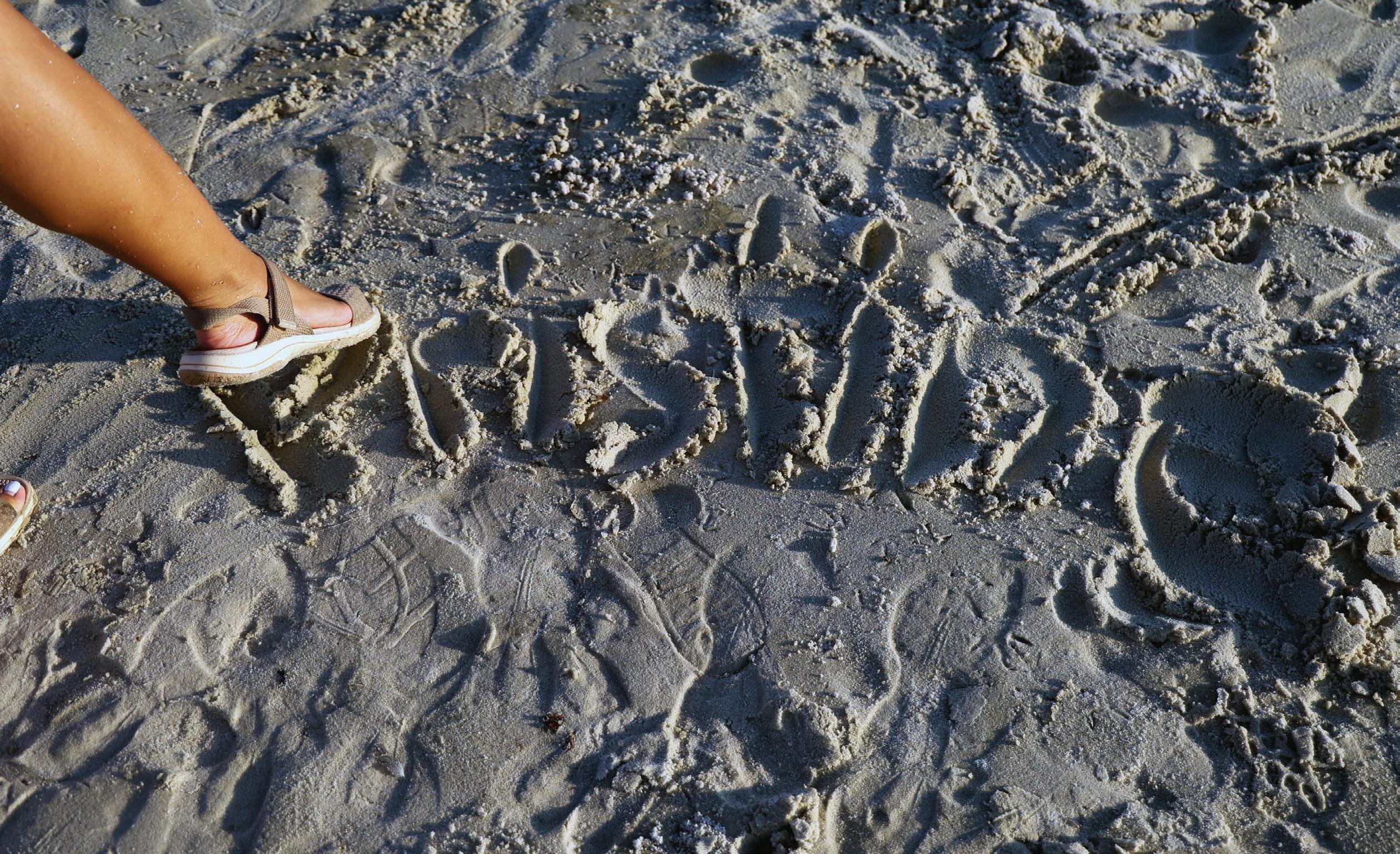
Pristine for nothing — but I couldn’t help exploring; that’s what the ocean was for, anyway, to wash it all off at the end.
If this was the real Florida — secluded coves, half-murky waves, flora and fauna at your fingertips — I liked it. Maybe not as much as Florida’s east coast, with its seashells and sunshine, but there was something wilder here.
Back in the parking lot, I got in the car with my waterlogged sandals and sand-speckled legs. Warmth radiated from under my sun-kissed skin as we got back on the highway. Katy Perry’s “California Gurls” came on the radio, and I laughed. Of course, I
was wearing Daisy Dukes and a bikini top while listening to this song on the opposite coast.
My friends interrogated me on my beach experiences, helping me remember what I enjoyed most and how it felt to get away from my busy life in Gainesville.
I was most grateful for the tranquility. Walking onto the sand felt like stepping into another dimension — one where my classes, my job and my stress didn’t exist. For a few treasured hours, the beach was our peaceful little paradise.
Our conversation drifted from beach reads and mystery books to work-life balance and what we’d do with ourselves after graduation. The car ride home bubbled with laughter
and satisfaction. There was something special about being with people who cared enough to make sure I got to go to the beach.
Maybe the California girl liked being a Floridian after all.
poems by CATALINA MARTINEZ-WITTINGHAN
illustration by PRISCILLA OLIVEIRA
I don’t trust red jeeps or drive with the windows down anymore, and there’s a stretch of 16 I tense up when I pass.
I found your voicemail from three years ago.
I wish I could say it touched some part of me, but you left an empty house, so I have nothing more to break.
That voice that once carried the weight of the world could pass me in the street, and I might have the misfortune to say I would recognize it in a millisecond, but not know what world it carries now.
I had the fortune of being girls with you.
We braided hair, laid in grass, spit out confessions of shame and joy and fear and love, and we thought we knew everything. That our fate was spelled out in the stars, we would know each other in every life.
Now I know the only thing that is promised is uncertainty, that I’ve never known how to read stars, and I’ve never before understood the importance of a year or what that word truly meant until now:
It is the concept of how much we change from point to point.
I can see it. I know the change. It ripples in every reflection and is traced in each footprint I leave behind.
I am not sorry for how I responded to the change, only sorry it had to.
I’ll remember your laughter and the lost time spent daydreaming, but I will no longer reorganize the past like a puzzle I can still solve.
It’s almost summer:
The last season I had with you— the first one I’ll have without. I cannot wait to see how I change.
design by EMMA GRACE HENNE
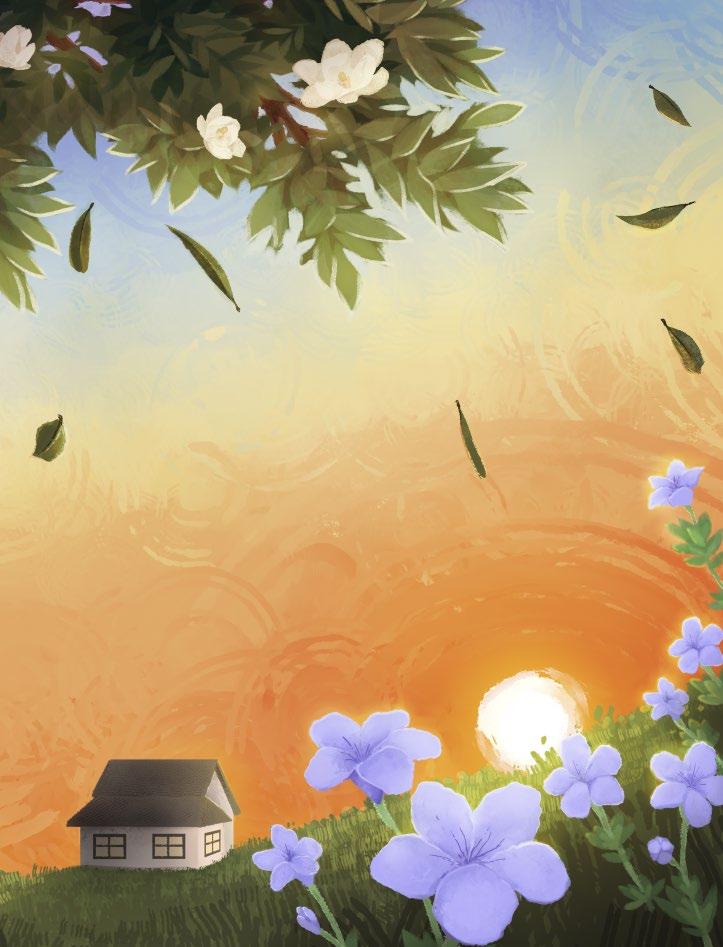
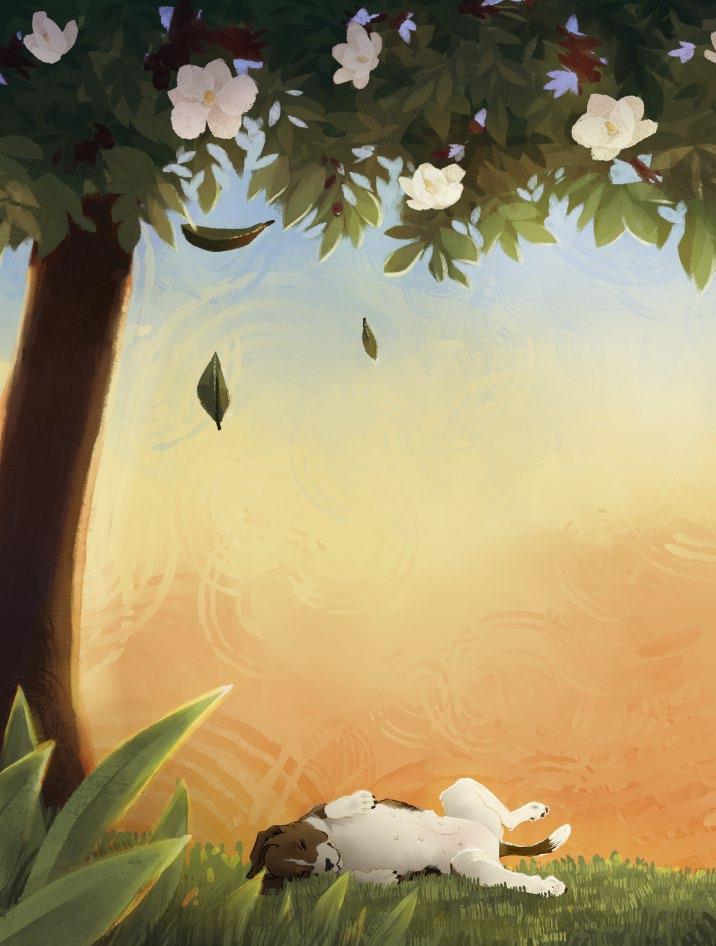
I grew up holding onto rope swings and praying for perfect timing but now my baby blanket is buried in the yard with my dog under a Southern Magnolia, and I sit in the living room watching my mom eat her dinner at the table and my dad in the kitchen.
I lie in bed, and my mind lies about loud memories and familiar faces, and the only way to turn her off is to swallow down the empty promise I say every morning.
So I’ve lost the energy that was once found in family dinner and blissful ignorance, and I blame my absence for my parents’ separate rooms, and they blame me for all the dirt and dust in between.
They ask me to fix it, they put this old, sad house in my hands and tell me it’s my job to keep it safe, and all I can do is race down Interstate 20 and pray I get pulled over before I reach my destination.
When I was 17, I thought I knew everything. I was invincible. Through hail and sleet and storms I stayed dry, and I kept everyone around me dry too.
When I was 17, I didn’t know loss. Now I’ve lost more than I ever thought I’d have, and my dog is buried in my baby blanket in my childhood home’s backyard. She is buried under a tree. Under a Southern Magnolia that collects rain and moss and heat.
When I step outside, the humidity slaps me in the face.
I remember I am not 17 anymore.
I drive over rebuilt roads and past abandoned homes in a dying car. I’ve handed out parts and called them spares to hide the emptiness they leave behind.
I lay Southern Magnolias down at the grave of a woman I met twice, and I fall asleep to the smell of that tree and the pink threads it’s sewn in my mind.
A feeling you can’t put into words, an identity you can’t name
story
by NOOR SUKKAR illustrations by DELIA ROSE SAUER
“DID YOU SPILL ANY secrets when you got your wisdom teeth out?” I hit send before hiding my phone between my textbook and my laptop. I’m 16, sitting on the kitchen counter and staring at my AP Chemistry homework. My mother lies in her bedroom a few feet away. I can’t focus; I’m getting my wisdom teeth out tomorrow.
“I can’t remember, why?” my friend replies.
“You’re the only person I know who’s out, so I’m trusting you when I say I may be bi-curious,” I write. If I’m going under, I cannot come out. With my mother sitting in the same room, my teeth won’t be the only thing I’d lose.
I can’t just think, I need to know. But I have no way of being sure –– whether I’m gay or whether the anesthesia will numb the pain or worsen it.
I only know one queer Arab through the family friend grapevine: Nada Ayyash. After years of “doing things very boy-like,” Nada thought, “there’s no way she [their mother] doesn’t know.” Almost a year ago, their mother interrogated them regarding their gender expression and sexuality.
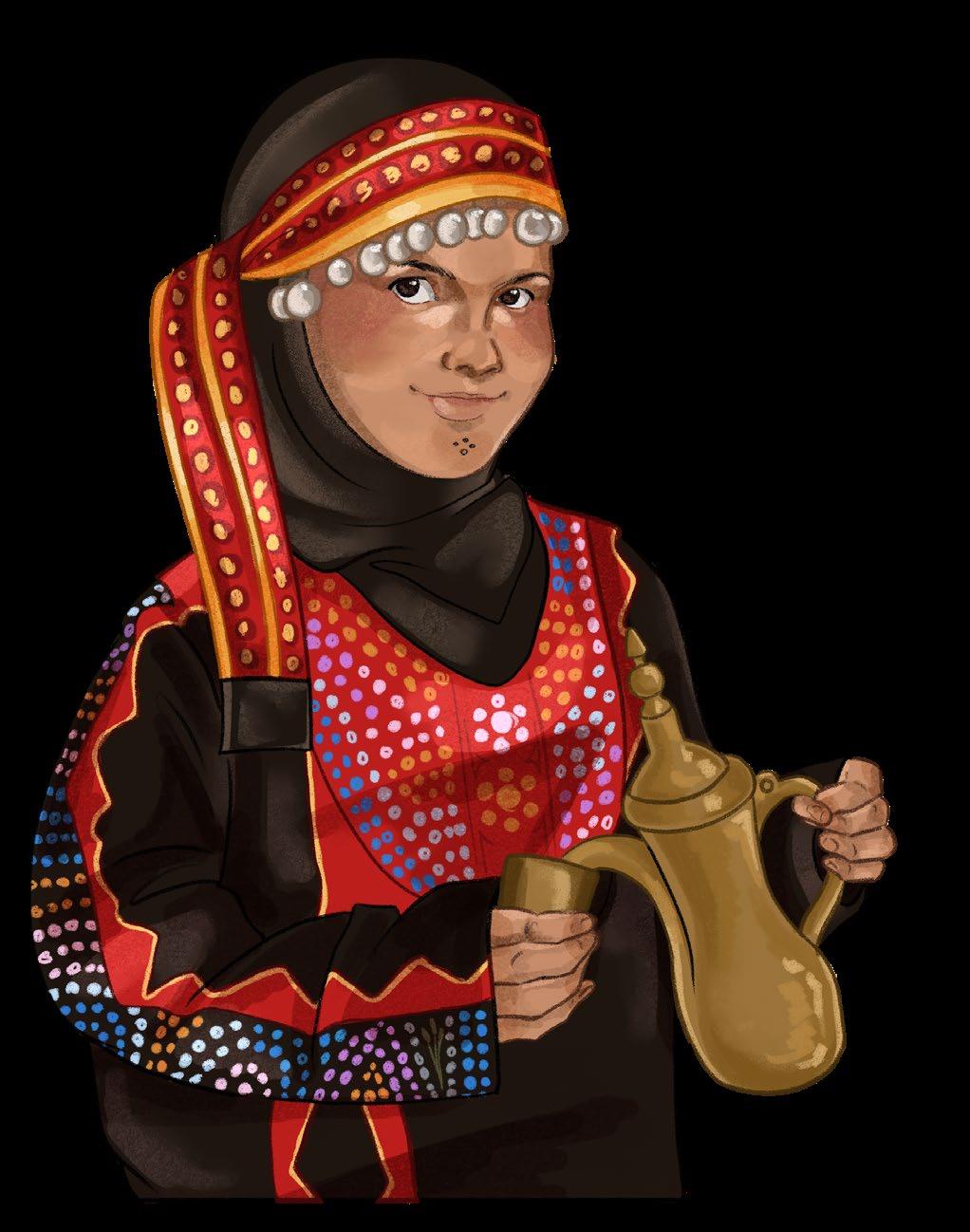

“Look at my baby photos … I’m wearing jerseys. I’m wearing sports. I’m wearing snapbacks. It’s all there,” they
A pansexual, non-binary identity in an Arab household wasn’t acceptable.
“I basically don’t have a daughter anymore,” their mother said.
Unwelcome and disowned, Nada hasn’t spoken to her since.
I could suffer the same fate. The hypothetical cycled in my thoughts as I sat in the dentist’s office.
“We’re just going to numb your gums,” the dentist said. “We don’t put patients under for the procedure here.”
Thank god for the New York City healthcare system.
I swallow the bloody saliva of truth.
Every summer, my mother, sister and I packed half of our belongings to fly to Amman, Jordan. We would practice our Arabic, roam the streets of the underdeveloped city and down unholy amounts of hummus.
We attended dozens of “3azoomehs,” or social gatherings, where we’d feast, dance and play. We foraged through wooden closets stuffed with our clothes. My mother narrowed our options down to “conservative clothing.” Our jean shorts and tank tops collected dust in Florida, despite the scorching Amman summers. Frustrated, I realized being Arab coincided with being Muslim.
“It’s 3ayb,” my mother scolded us
Between our broken Arabic accents and our frozen expressions, we heard the same joke every year: “These kids are definitely American.”
design by DELIA ROSE SAUER
My disdain, my isolation, dissolves like the last taste of mint on my tongue.
anytime we wished for our normal clothes. She often resorted to using the Arabic word meaning “shame.” It’s a quick response to enforce cultural norms, a word stronger than “no.”
At a “3azoomeh,” I could tell which family member was which based on their signature dish, whether it was rice-stuffed eggplant or mansaf, a Jordanian dish made from lamb or goat cooked in a fermented dried yogurt sauce.
Before being rewarded with a mouth-watering dinner, I had to answer a series of questions successfully.
“How’s your dad doing?”
Answer wisely.
“You’ve gotten chubbier.”
Swallow your truth.
“What’s new in the states?”
Respond selectively.
In the corner of our eyes, my mother sent us signals. A glistening smile of confidence if we responded correctly. A bold stare if what we said was “3ayb.” Between our broken Arabic accents and our frozen expressions, we heard the same joke every year: “These kids are definitely American.”
For Arabs like my family, being a cultural hybrid involves blending our ancestral culture with American culture to create new, distinct identities. It manifests in a combined language, music, cuisine and social practices pieced together.
a study giving it a name: bicultural identities. It can feel like a negotiation between inherited traditions and the experiences of living in a new homeland.
But, which one is my homeland?
Mouth full of Andes mints, I’m surrounded by addicts inside a Culver’s in my college town of Gainesville, Florida. We just got out of a Narcotics Anonymous meeting. Seated like children in a school cafeteria, we exchange random pieces of our lives.
“So, Noor, where is that name from?” someone asks me.
“It’s Arabic,” I say. “I’m Arab.”
She proceeds to list dishes she loves that may or may not originate in the Middle East. I scrape at the bottom of my cup, yearning for the minty flavor to linger as I mistake her curiosity for ignorance.
“You know, I think it’s stupid that people don’t like mint ice cream because they say it tastes like toothpaste,” I interrupt.
I wonder if their grandmas’ grocery lists
“Dude, I love mint,” she says. “Some Brazilian dishes I’ve had, they like put it in like everything.”
Well, I guess for every Jidda in the states, there’s an Abuela.
I smile and look up from my cup.
“My grandma would make black tea with mint all the time,” I say.
The others’ eyebrows furrow.
“Exactly!” she agrees.
My disdain, my isolation, dissolves like the last taste of mint on my tongue.
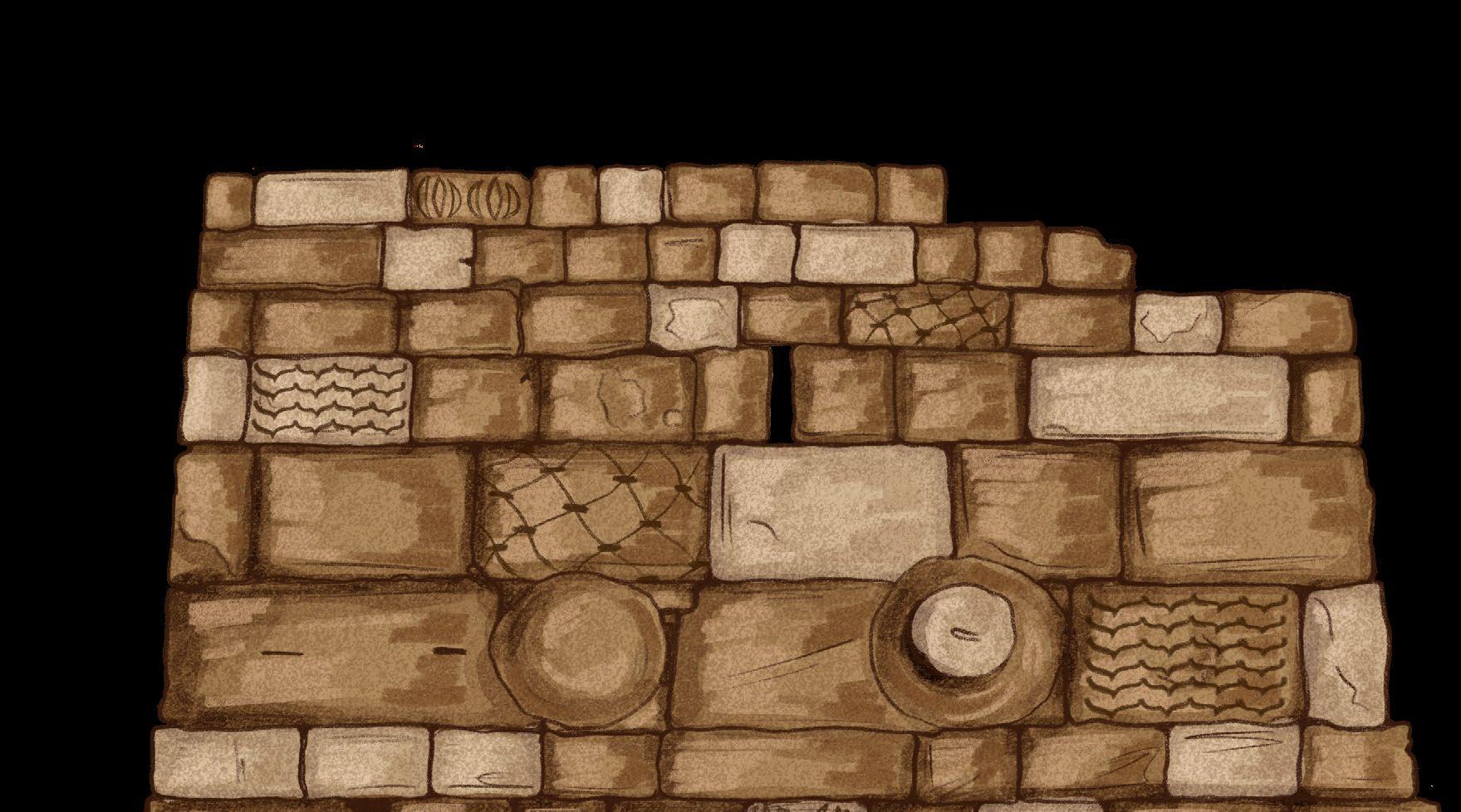
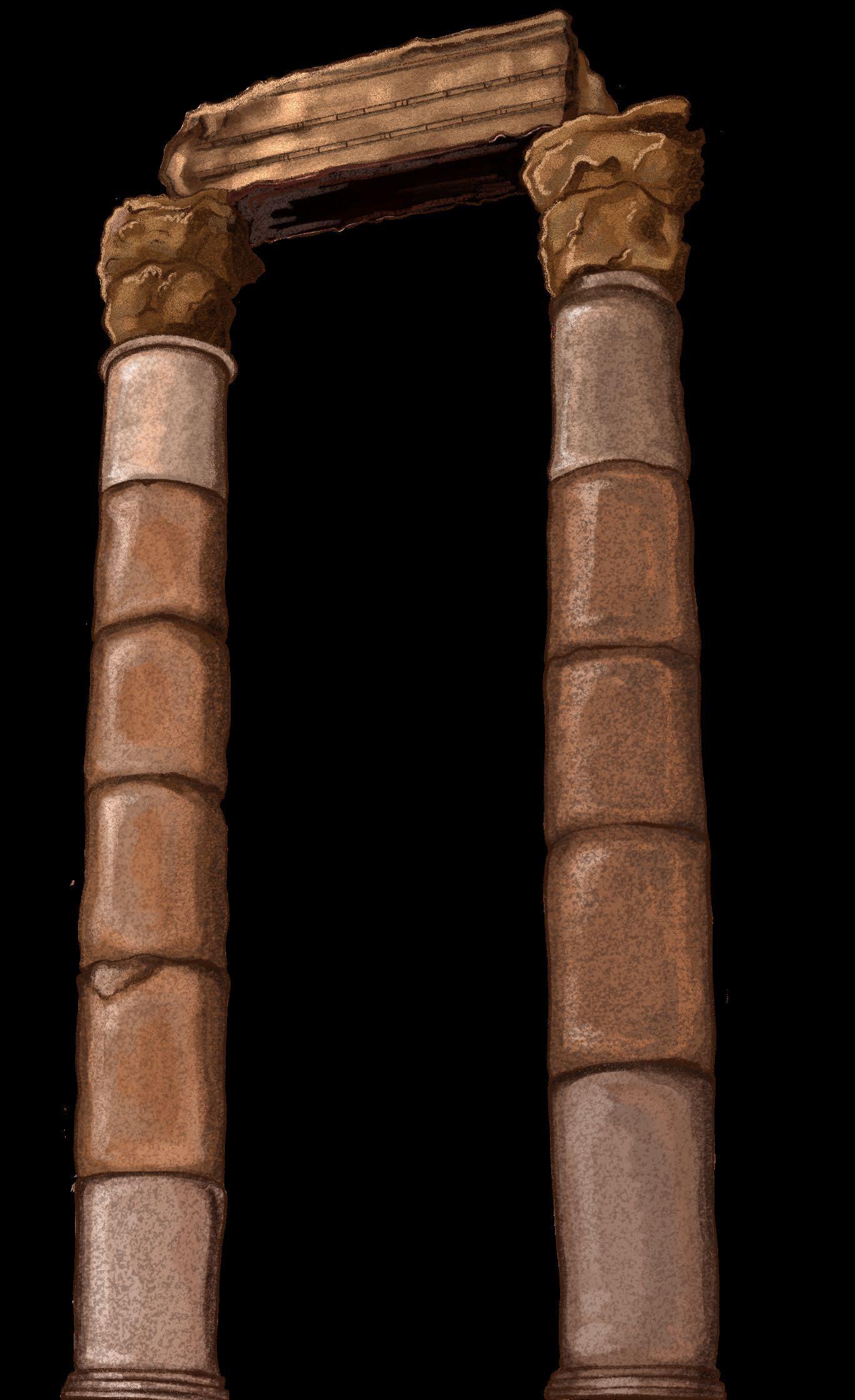
My provocation was merely an attempt at connection.
My younger sister and I slurp the last of our Shirley Temples in a booth over from the adults’ table, where clouds of smoke puff out between gossip and Arab slang. My mother’s eyes bat toward us, a wordless warning to behave. My dad watches the Miami Heat game on the flat-screen TV inside his buddy’s Mediterranean restaurant. He passes off the hookah pipe as the commercial break comes on.
The restaurant lights go dim, and the sparkle of a belly dancer’s bedazzled bra catches my eye. The familiar beat of a Tableh accompanied by shakers reverberates against her hips. “Shik Shak Shok” is turned up on the speakers, my favorite.
Only several years old, I stare in awe, ready to shake my hips the moment she notices me. My youthful eyes admire her sultry gaze, and my mother hands me a dollar bill. I slip the bill into the crevice the dancer makes accessible to me. My cheeks burn when she smiles at me.
These nights were regular weekend routines for a while, a manifestation of the Arab culture I knew. The smoke, the shish kabobs, the seduction. A third space between Amman, Jordan, and Hollywood, Florida.
I stand by the Shake Smart at the University of Florida’s student union. I have 20 minutes to wake myself up before my three-hour evening class. As I scroll on Instagram, I’m interrupted by two women decorated in floral dresses.
“I love your hair!” one of them exclaims.
I thank them with a smile and am met with an invitation to their Bible study.
Their energy is too pure to shrug off. I let them finish their pitch before I respond, “Thank you, but I stand firmly in my belief in Islam.”
Where’d that come from? Do I?
Their smiles don’t waver as one of them asks, “And what does that practice look like for you?”
I don’t know. I just am who I am.
The frog in my throat no longer croaks; it leaps out of my mouth as I explain my existence.
The frog in my throat no longer croaks; it leaps out of my mouth as I explain my existence.
“I believe faith is an individual practice, and I like to practice spirituality outside of the culture of organized institutions of religion,” I say. A revelation I have faith in something above all else.
They nod and offer another invitation in case I ever find myself curious. I thank them, wishing them luck in spreading their faith as they leave.
“For Noor?” The Shake Smart employee sets my shake down at the pickup counter.
With a salivating appetite and a satiated soul, I savor the sweet, refreshing treat.

over 280 letters hold the story of an army air force soldier who disappeared during world war ii over 280 letters hold the story of an army air forces soldier who
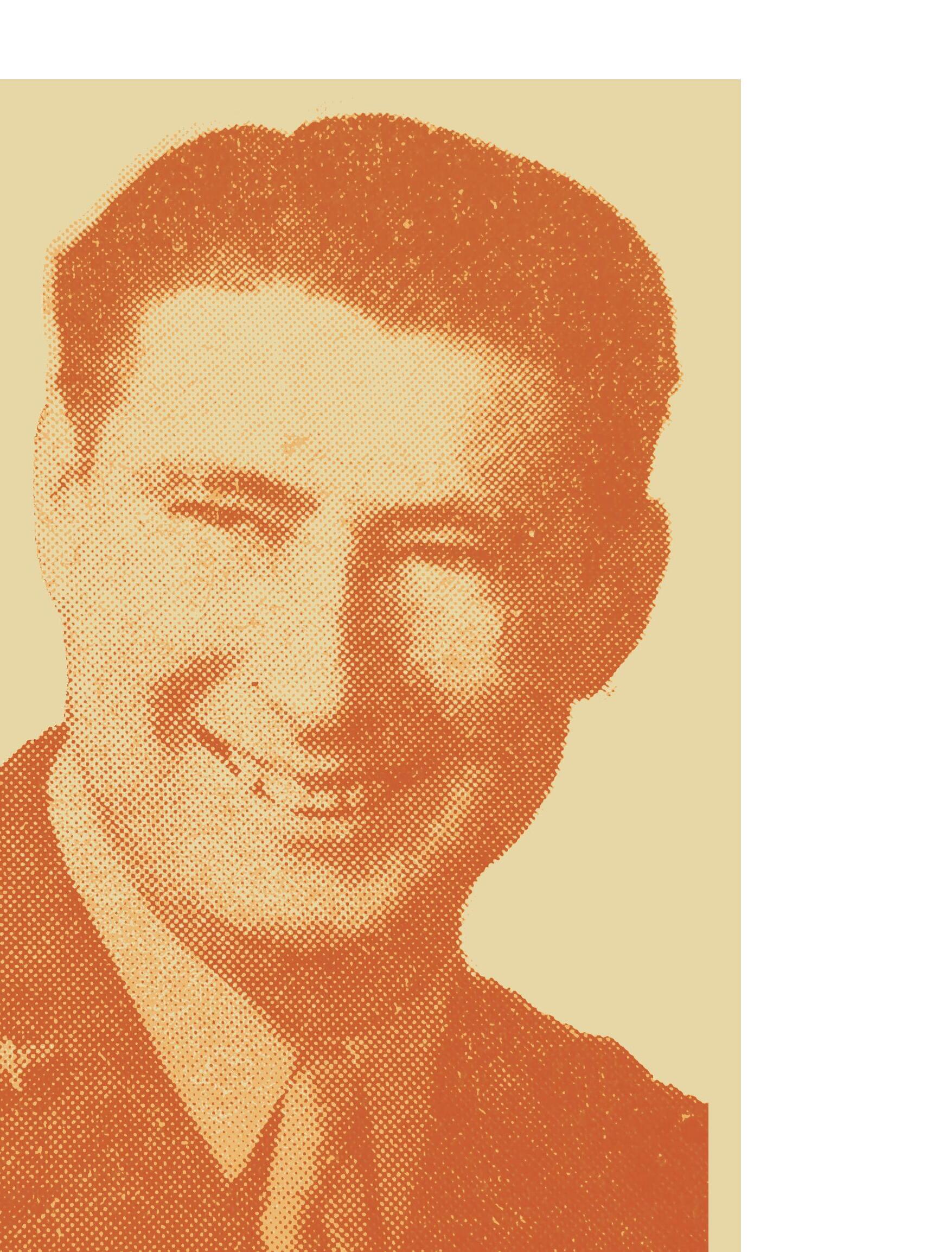
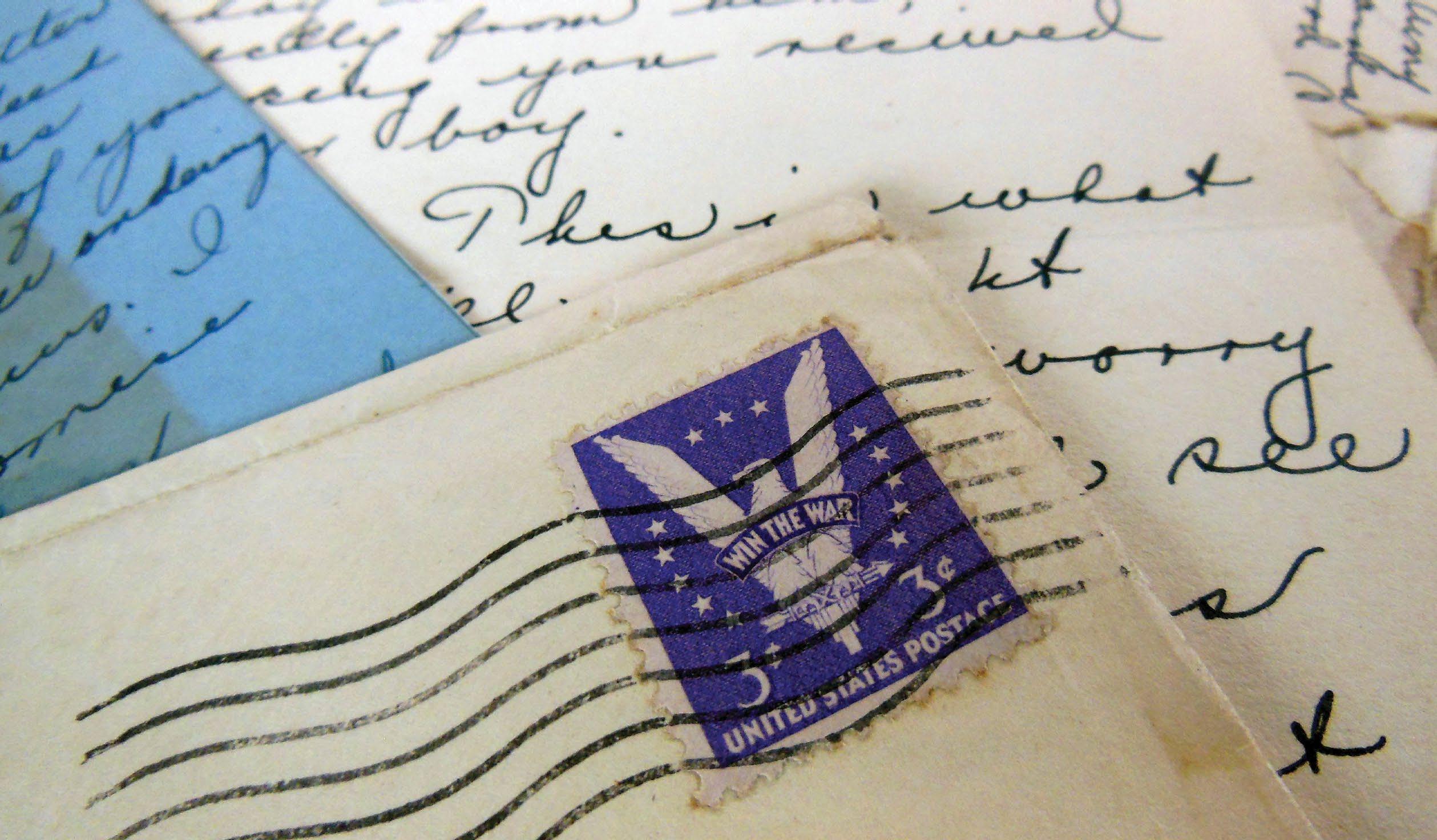

In March 1942, Luther Edward Smith Jr. packed his bags, said goodbye to his parents and shipped off to join the war.
The U.S. entered World War II three months earlier, and the teenage Jacksonville native figured he’d be drafted. He wanted to have a choice in the matter and hoped to become a pilot. So, he traded his job as a telegraph operator for an Army Air Forces uniform and left home to start military training in Montgomery, Alabama.
To his family and friends, Smith Jr. was just Ed, Bub or Snuffy, a teasing reference to the long-running “Barney Google and Snuffy Smith” comic strip. Ed was only 19 years old when he joined the nearly quarter of a million Floridians who served in the war.
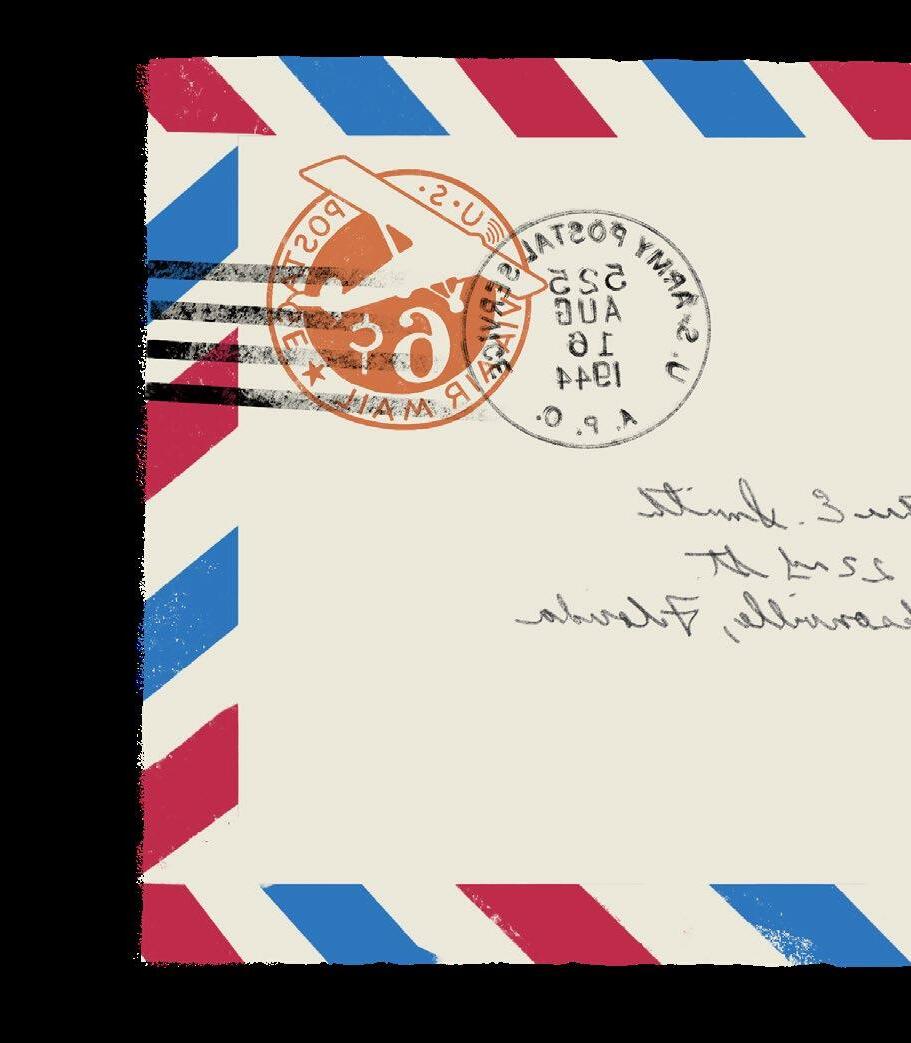
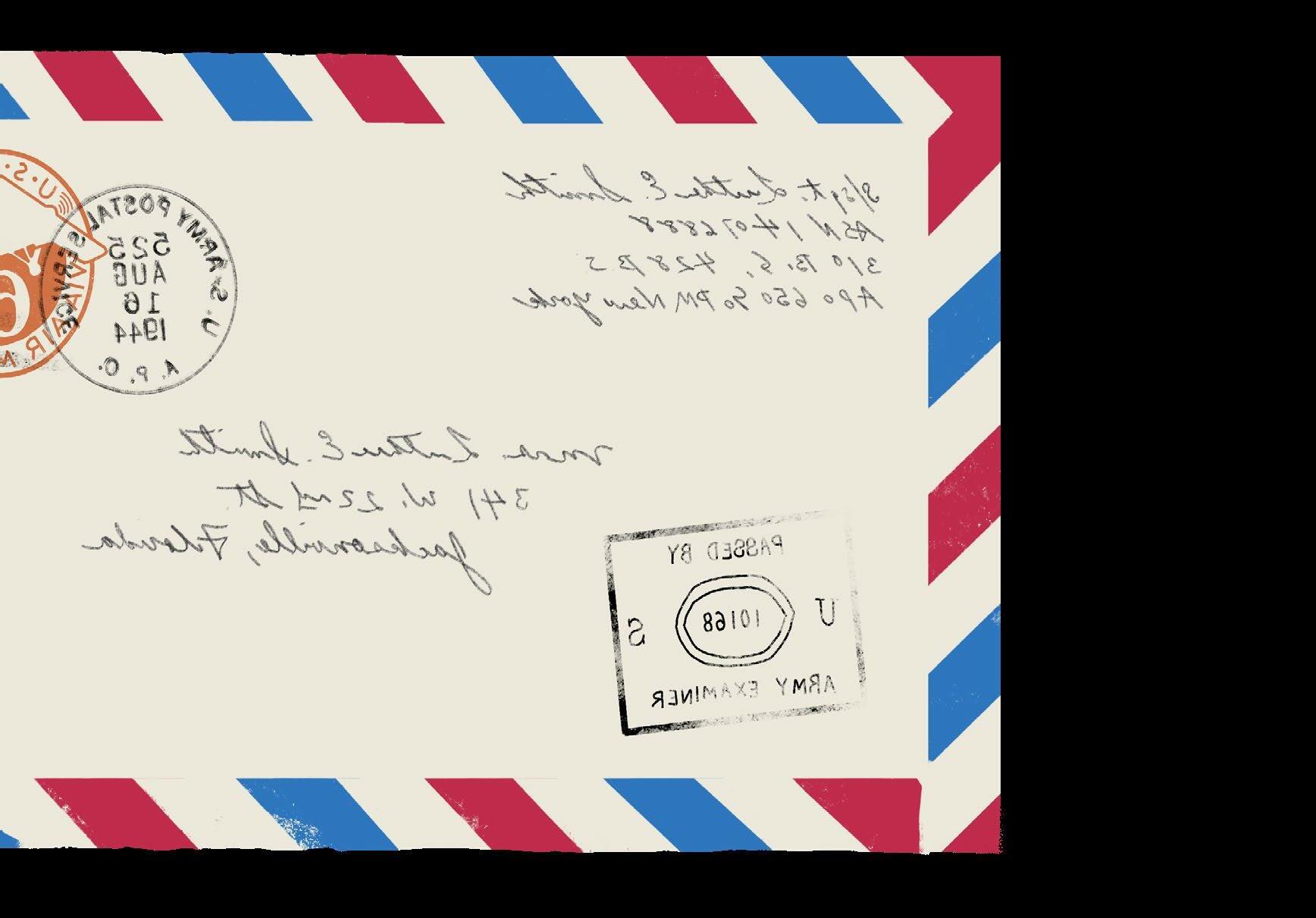
Training moved him from army base to army base across eight different states. In letters to his parents, Luther Edward Smith Sr. and Evelyn Lois Smith, he tried to predict where
he’d go next. He ranked prospective camps by how close they were to home. Ocala, Florida, and Douglas, Georgia, were only a few hours’ drive away. Other options like Jackson, Mississippi, or Bennettsville, South Carolina, were much less appealing. Each time he was transferred, he provided his parents with his new mailing address.
“I sure hope you continue to send me a letter each day,” Ed wrote in July 1942 from Maxwell Field in Alabama, “as it does me good to hear from home regularly.”
Ed penned home prolifically about his life during training, sometimes twice a day. He ran miles and miles cross-country, learned to send and receive Morse code, and took classes on everything from radio procedure to mathematics. He’d spend every spare minute at night studying, and he even packed handbooks in his briefcase to read as he waited in line for flight practice.
He wrote about missing his mom’s
home-cooked meals. He wrote about his plans to visit Jacksonville on his few days off. He wrote about how he liked being on kitchen duty, even if it meant waking up at 4 a.m., because it was better than standing in parades, which were marching drills so strict he could only move his toes.
After two months of pre-flight school, Ed started primary training in September 1942 and finally went up in the air.
Flying was not as easy as it looked, he wrote during his first week. He succeeded at climbs and descents but struggled to make turns, and it was cold in the open-air cockpit.
“I don’t know if I am ever going to
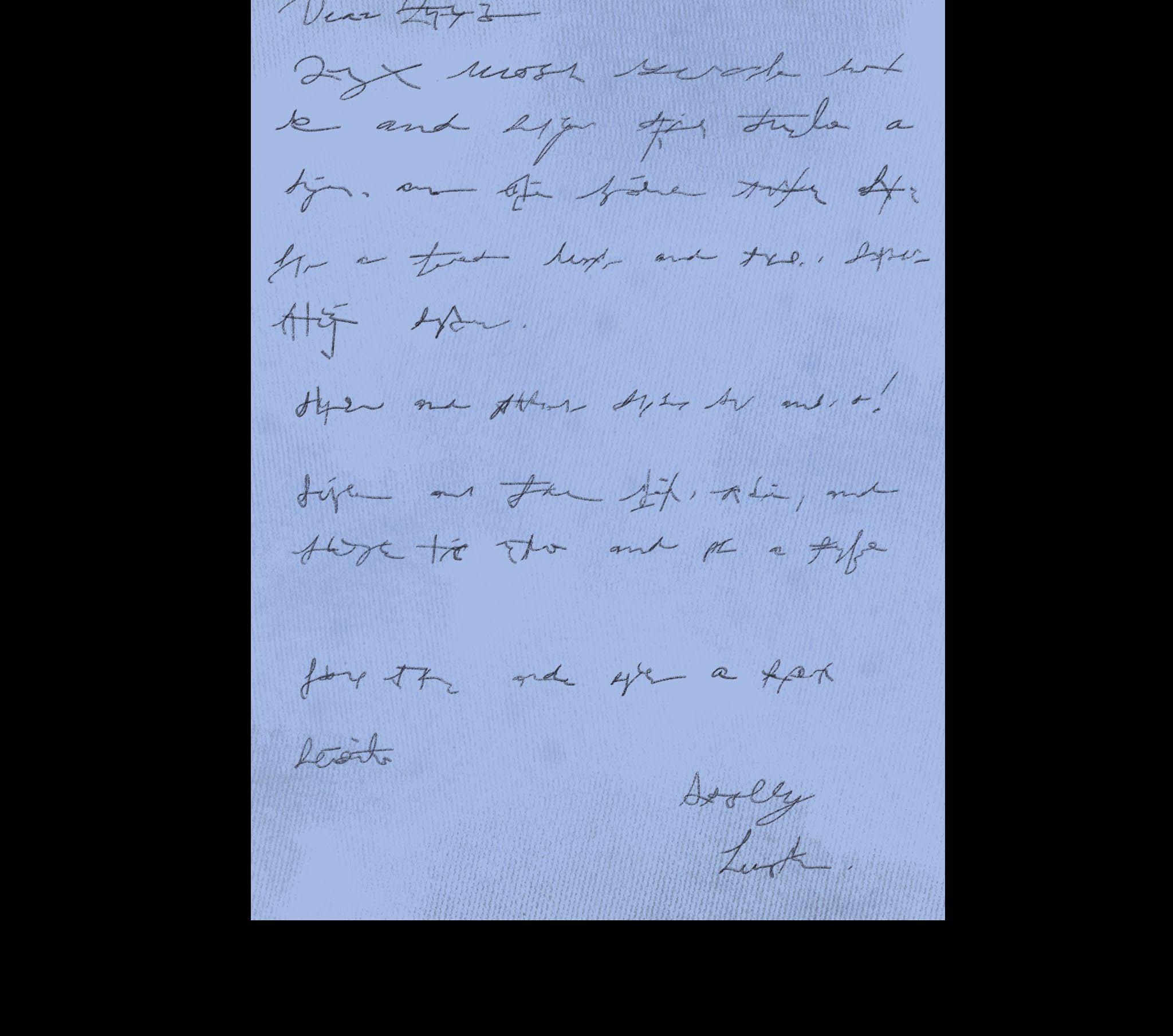
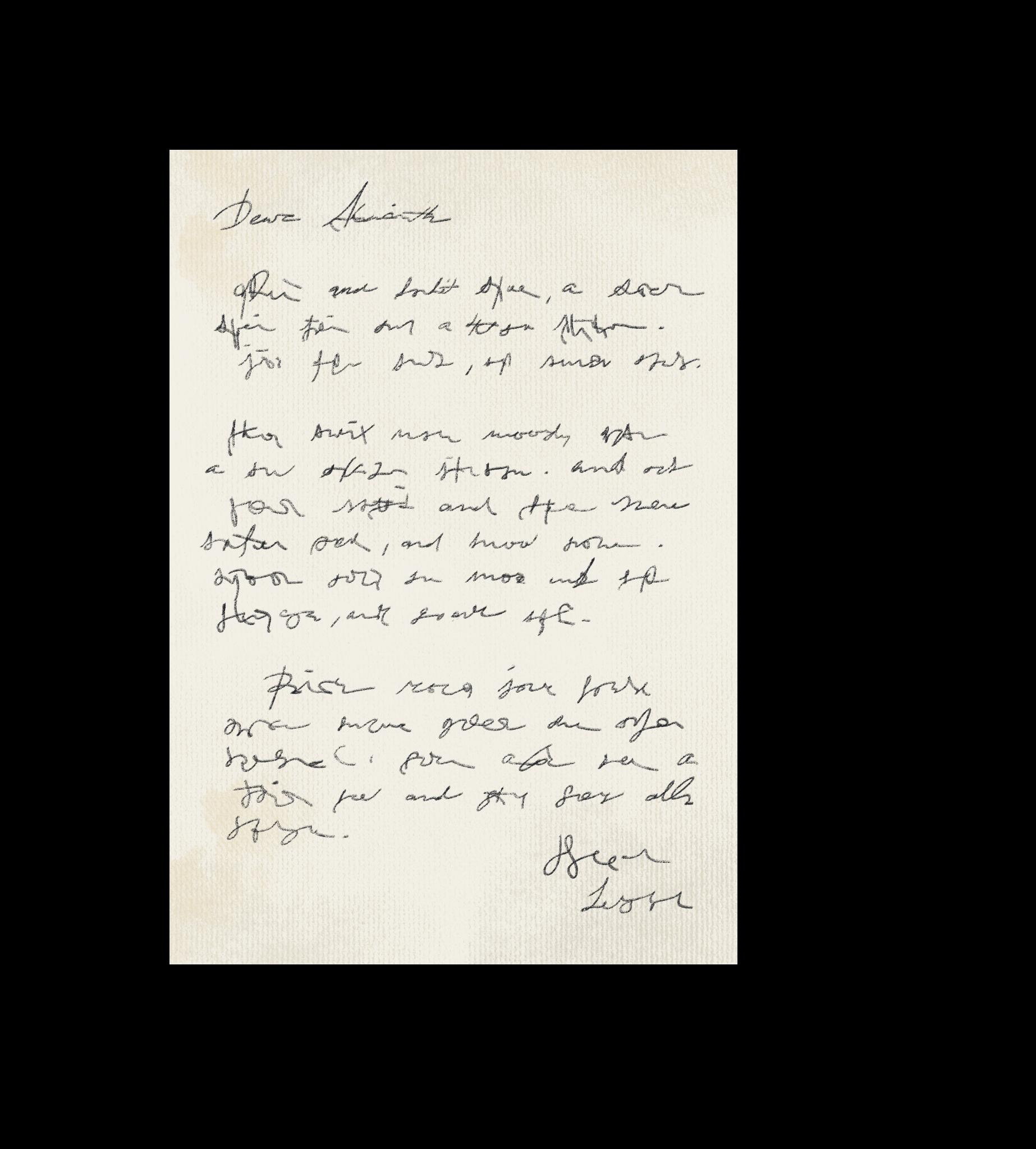
be able to fly one of those things,”
He addressed most of his letters to his mother, Evelyn, although his parents always read them together. In October 1942, his father
“Your work is cut out for you; it’s a hard job, but anybody can do an easy job,” Luther Edward Smith Sr. wrote. “No use being just an ordinary anybody doing something just anybody can do. Be a
treasure trove of information.”
“These are key documents in helping us understand what day-to-day life was like,” he says.
As he moved through training, Ed sent home money along with his letters. He asked his parents to use his earnings to buy war bonds and not to send gifts because he was getting by just fine. They sent him sweaters, cigarettes, hard-to-find candy and a new radio anyway.
“Oceans of love to the sweetest sugar in the world,” his mother signed off on a letter to her only child in October 1942.
Correspondence from home was vital for soldiers, who often went months or years without seeing their loved ones, said George Cressman, a World War II historian at the Camp Blanding Museum in Starke, Florida. Letters connected soldiers to their old lives, giving them an escape from the
“Perhaps the only point of joy and relief that soldiers got was that mail
battalion dedicated to clearing the
Beyond serving as a lifeline for wartorn soldiers, letters help historians struggles and triumphs not captured by government records, which often
The Army Air Forces’ needs changed as the war progressed, and Ed was no longer allowed to continue his pilot training. But he knew he belonged in the sky. He’d flown over 200 hours without being airsick once. So, he shifted to being a radio operator and gunner aboard bomber planes.
By April 1944, Ed neared the end of his training and prepared to join the war effort in Europe. He tied up loose ends before he left. He drafted a will just in case, although he doubted he’d ever need it.
He added that, unlike his peers, many of whom were tying the knot before shipping off to the front lines, he had no intentions of “getting mixed up with anyone.” He wanted to wait until his return from overseas to get married. Besides, he wrote, he hadn’t yet met anyone he’d like to marry, not when he spent long and grueling hours at the Columbia Army Air Base.
After completing advanced training in the summer of 1944, Ed was
“No use being just an ordinary anybody doing something just anybody can do. Be a flyer and be a good one.”
awarded the rank of Staff Sergeant and stopped in Brazil and West Africa on his way to the European theater.
“Right now it’s a battle between me and the mosquitoes,” he wrote, “and I am beginning to think that they are winning.”
Once he arrived in Corsica, a French island off the west coast of Italy, it got harder to talk about his life in the war zone. Soldiers knew any specific information about their war activities would be redacted by military censors, so they resorted to censoring themselves. Instead, Ed wanted to know how his parents were doing, saying he was anxious to get updates from them when mail came less and less frequently.
He asked them to send small luxuries like cigars, rubber bands, cashews and tins of sardines. Soldiers often requested commonplace items, as scarcity defined the European war theater by August 1944. There were no places to buy anything because there was nothing to sell. Everything Ed received was rationed. Most of all, he missed having fresh milk the way he
did when he was home.
He started counting the combat missions he went on. Compared to others in his squadron who had flown as many as 70 missions, he figured he had far to go, but he wasn’t concerned. The missions based out of Corsica were safer, he told his parents, because they had better planes and maintenance.
“There is nothing to worry about,” he wrote on Sept. 7, 1944, “because it is very seldom anyone gets hurt.”
A little over two weeks later, on Sept. 23, Ed was a crew member on a B-25 bomber flying over Altare, Italy. It was the week of his 22nd birthday. At 10:45 a.m., the plane came under enemy fire from the Germans. One of its engines failed, and it started losing altitude. The plane disappeared into the clouds, and Ed was gone.
In early October, the War Department sent Ed’s parents a telegram, informing them that their son was missing in action. Preoccupied by the intensity of the war, the military had no details about where Ed could


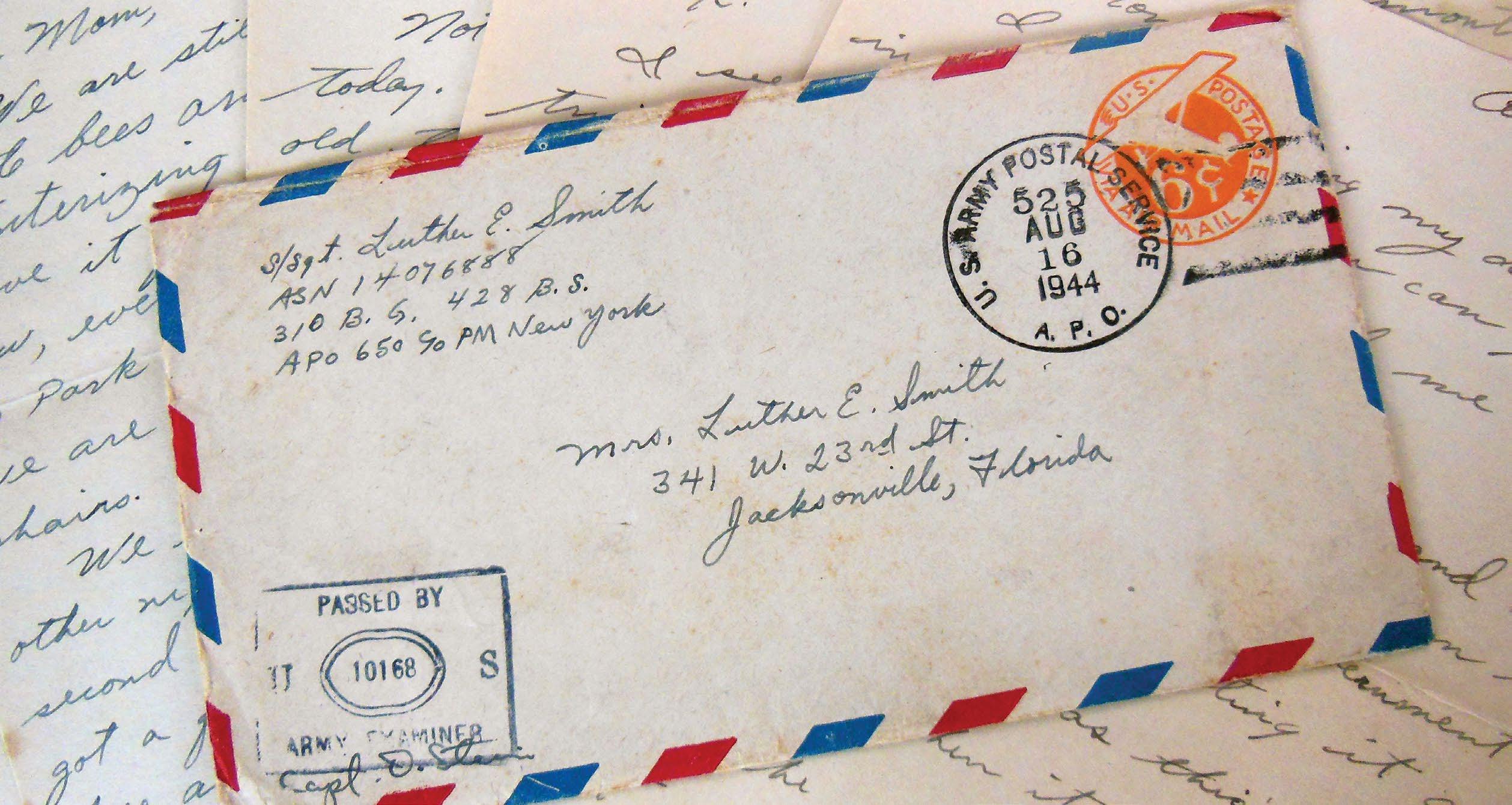
be, leaving his parents clueless about his status — and whether he was even alive.
As the Smiths navigated the grief of their son’s disappearance, condolence letters came flooding in. Everyone, from family friends to the telegraph company Ed worked at before he enlisted, wrote to express their sorrow.
The War Department finally released the names of the five other missing crew members on Ed’s bomber just after Christmas 1944, including the addresses of their next of kin. Evelyn, Ed’s mother, wrote to each of the crew members’ mothers in California, Colorado, Delaware, Indiana and Ohio.
Despite being scattered across the country, the mothers were desperate to share what little they gleaned from second-hand accounts and rumors. They found community in their despair, exchanging photos and news clippings of their sons. They talked about the presumed posthumous medals they had to accept on their sons’ behalf, though their deaths remained unconfirmed. Every time the mothers heard tragic news about the other sons, they said they couldn’t eat or sleep, feeling as if that son was their own.
Months later, the crew’s copilot and bombardier were found alive and returned home. Between the trauma of staying alive and the government prohibitions on sharing unofficial information, neither survivor could offer details on the mothers’ missing sons. Not until a crew member was declared dead could they share


Every time the mothers heard tragic news about the other sons, they said they couldn't eat or sleep, feeling as if that son was their own.
what they knew about him.
Nearly a year to the date that Ed’s crew went missing, the armorer’s mother finally received confirmation that her son was killed. She was thankful the war was over, but she bitterly resented that American soldiers had been lost to it.
“I guess mothers’ love and prayers and tears cannot protect them against all the evil inventions of civilization,” she wrote.
“I’m so glad this war is over,” wrote another mother just after the V-J Day armistice on Aug. 15, 1945. Her son was still missing. “Glad because of other mothers, that they can be spared of what I’ve gone through. I did not celebrate, like so many others. It was victory for our country, but not for me.”
Shortly after the anniversary of their sons’ disappearance, she and Evelyn were told the War Department had ultimately recorded their sons as being presumed dead. Evelyn was in shock. How could the military presume the death of her only child without telling her everything that was known about what happened to him?
the Institute on World War II and the Human Experience at Florida State University, said families would usually receive their loved one’s death benefits relatively quickly. However, “the government was sort of overwhelmed,” he said, so there wasn’t a real effort to reach out and support families who were grieving.
It was almost worse for the families whose loved ones were missing in action rather than found dead, Piehler added. They often had to delay mourning and funerals for years until they got confirmation of death, if they did at all. Nearly 72,000 World War II service members remain missing today.
Ed was posthumously awarded several medals, including a Purple Heart. It’s unclear when his remains were found and repatriated, but records show he was buried at Arlington National Cemetery in Virginia.
For at least a year after his death confirmation, Evelyn continued to receive letters from people who knew her son. Ed’s best friend had died in another bombing mission the same month. His mother wrote to Evelyn that although she’d never met Ed in person, her son spoke of him “so often

design by MARIA RIBAS
story by ANNA RODENBERG
photos by RIANA MORALES
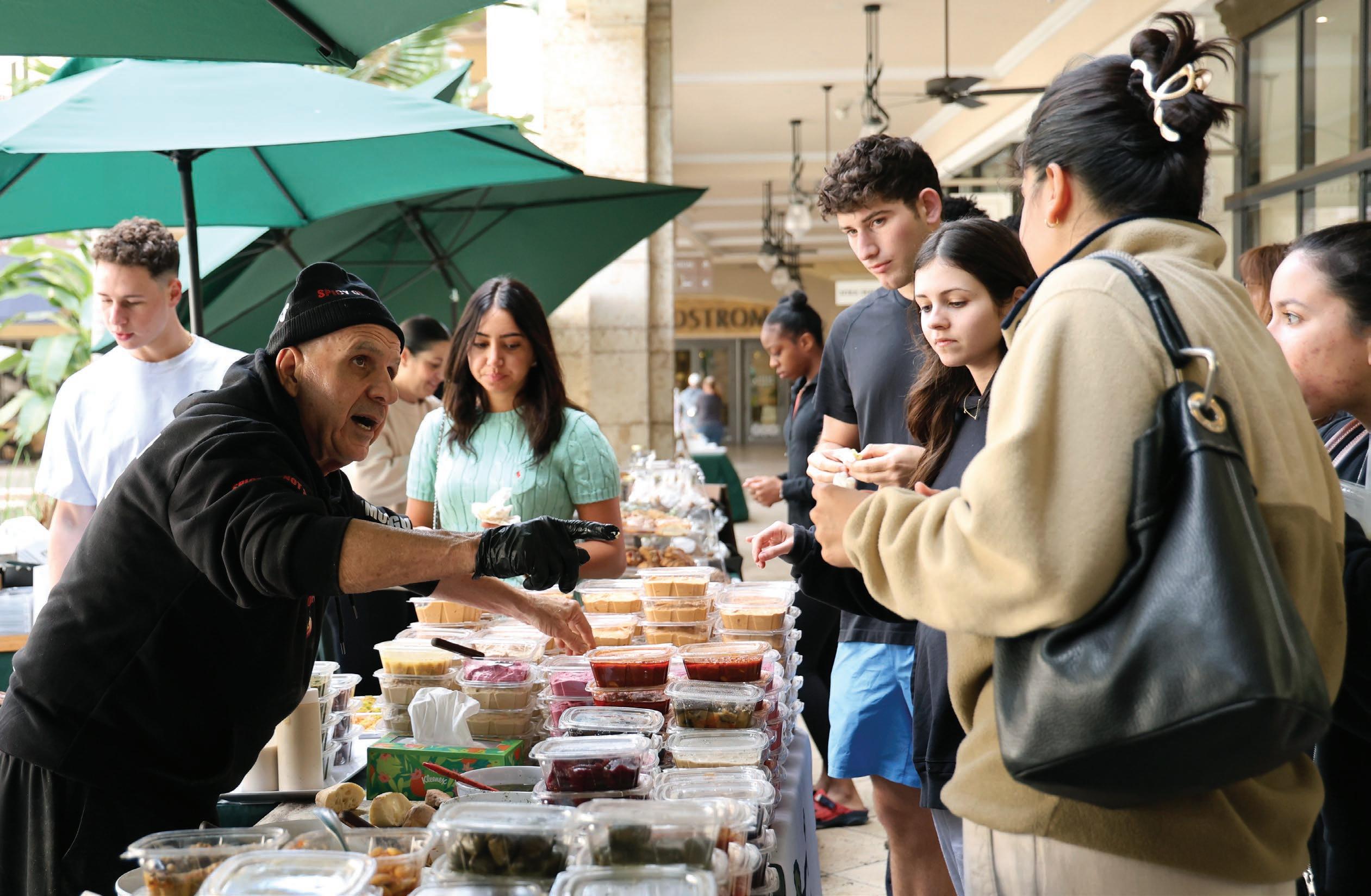
By 10 a.m., a line is already winding through Merrick Park’s pale stone floors and sun-washed walls. Palm leaves shift gently above the hum of conversation. Less than a dozen people stand just beyond an assembled booth about 10 feet long. For a moment, it felt as if every set of footsteps across the mall’s stone floors was heading straight toward him.
But Albert Bensadoun hasn’t finished setting up. The folding tables are half-covered in a forest green tablecloth. Containers of measured ingredients are still stacked in plastic crates, and the welcome signs aren’t in position. But it doesn’t matter. Albert, 70, moves with a rehearsed speed.
In a city often defined by Latino culture, Albert’s success in Coral Gables tells a different immigrant story, one shaped by

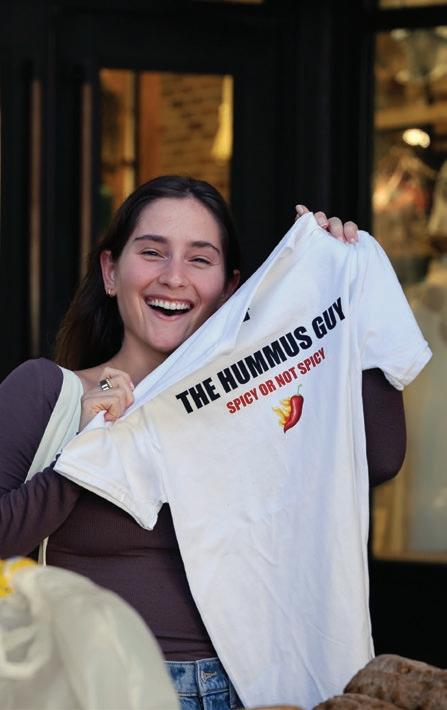
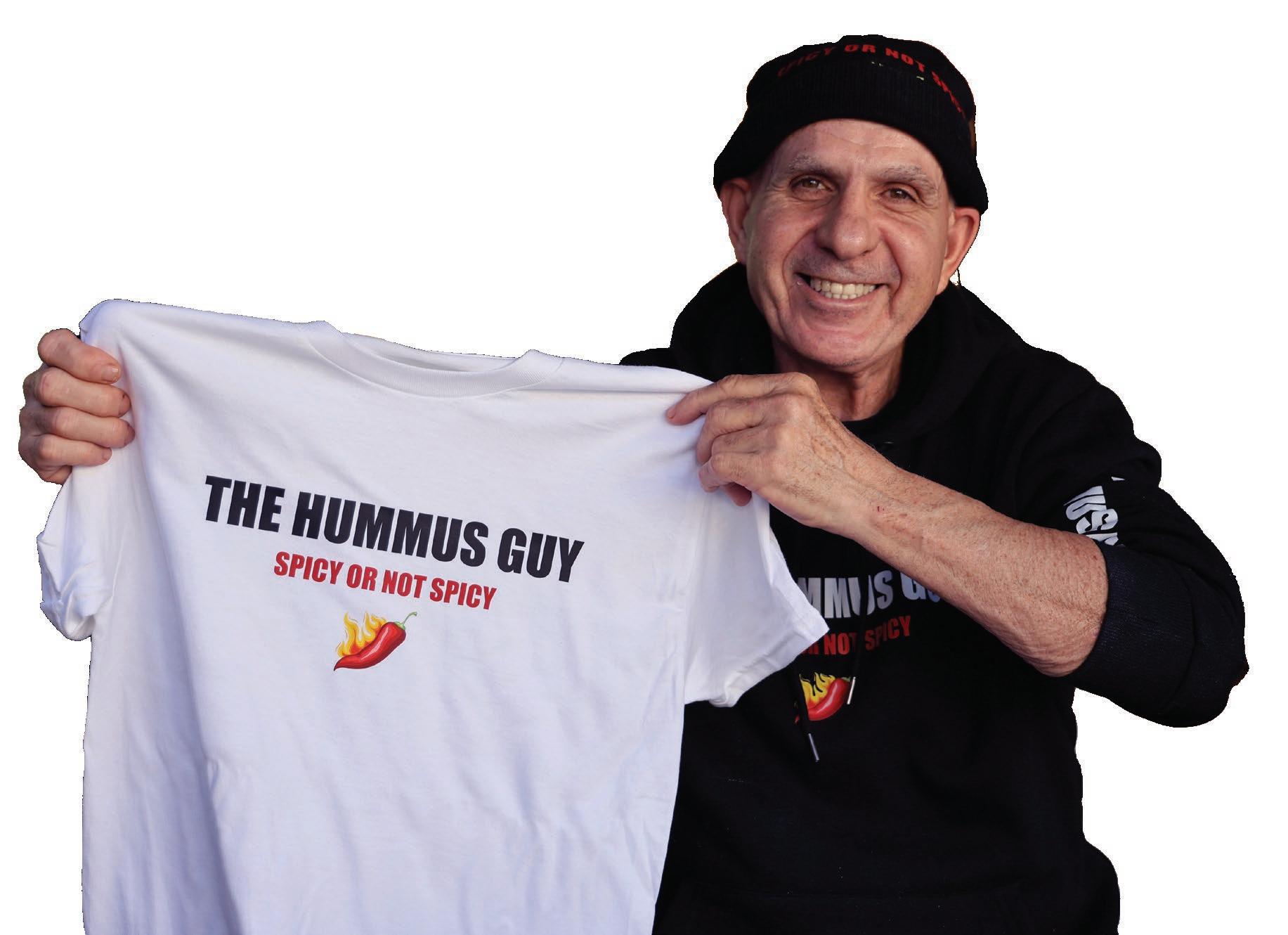
Albert Bensadoun holds up a shirt he created as part of his merchandise line in Coral Gables, Fla., Sunday, Feb. 8, 2026. (Riana Morales/ Atrium Magazine)
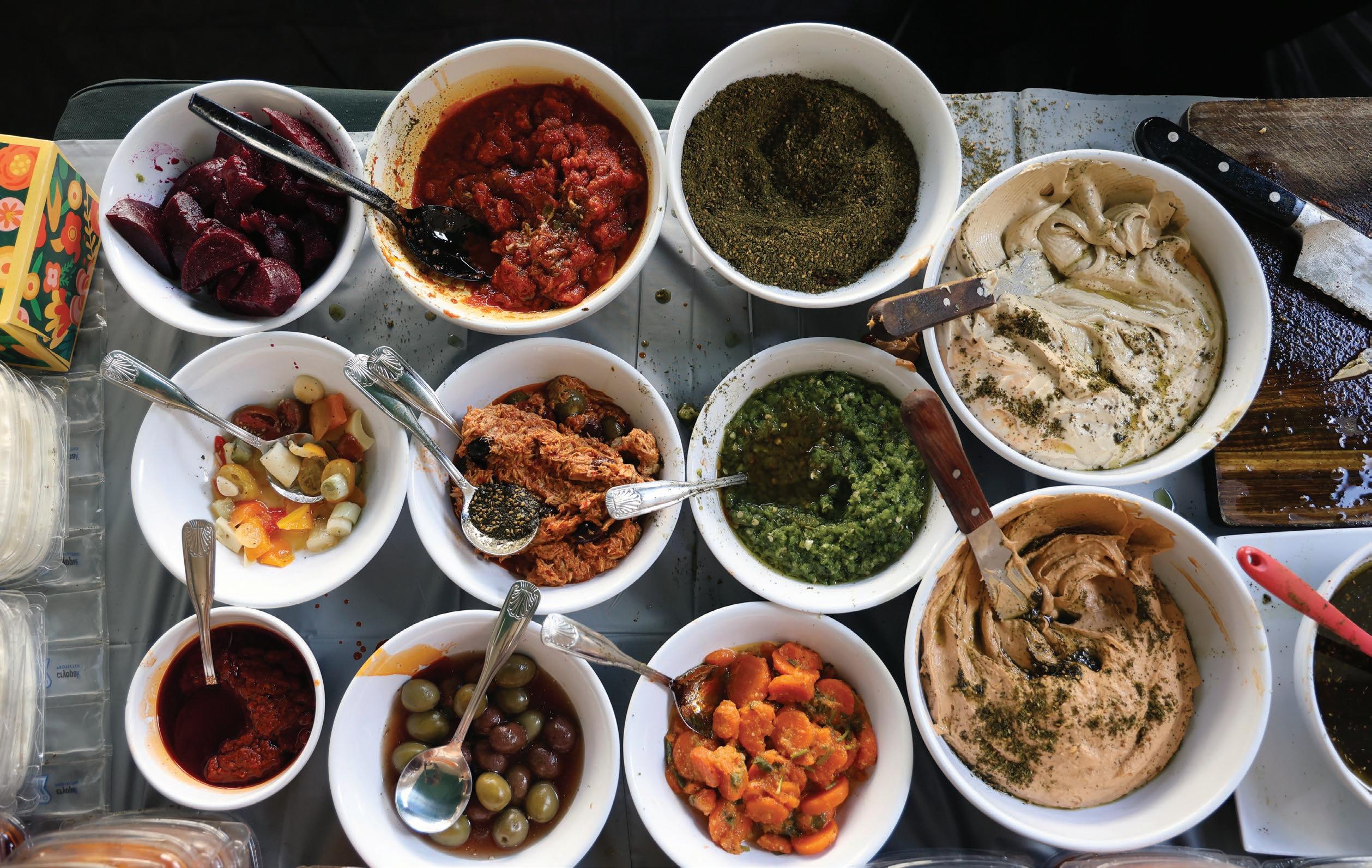
Moroccan influence. He stands before a colorful spread of the familiar foods of his home — the pots of hummus and olive oil are the foundation of his life in Miami as he competes with a world filled with novelty and noise. He doesn’t need to reinvent the wheel; bringing his authenticity to each plate is what keeps his customers lining up every weekend.
Red tomatoes are stacked in baskets, some still latched onto the vine. Loaves of bread are packed tight in the small oven underneath the table, the crusts toasting to a honey-golden shade. Above, containers of rosy beet hummus are stacked in small, plastic towers. Inside each of them, a swirl of olive oil cuts through the dense color.
Fresh mozzarella sits in
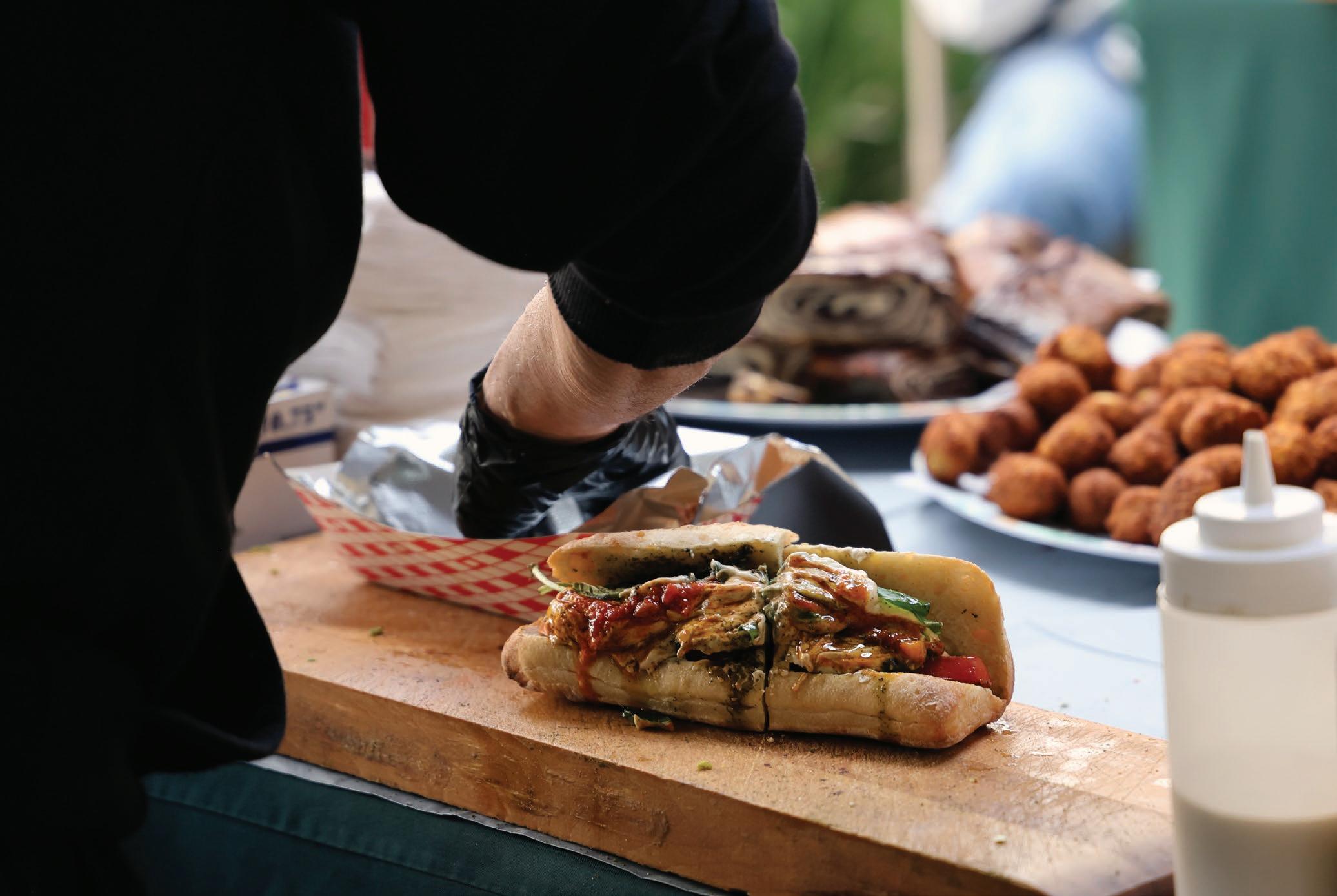
tubs, soft and glossy, ready to be sliced. The smell of fresh bread and grated garlic mingles with the aroma of roasted vegetables. Passersby eye the collection of red, pink and ivorywhite dips. Albert presses sandwiches together with practiced hands before passing them across the counter into waiting palms.
Regulars greet Albert with easy smiles and affectionate nods,
voices overlapping as they pick up conversations right where they left off. A few newcomers hover at the edge of the table, unsure what to order.
Albert’s voice cuts through the crowd.
“Spicy or no spicy?” Albert asks.
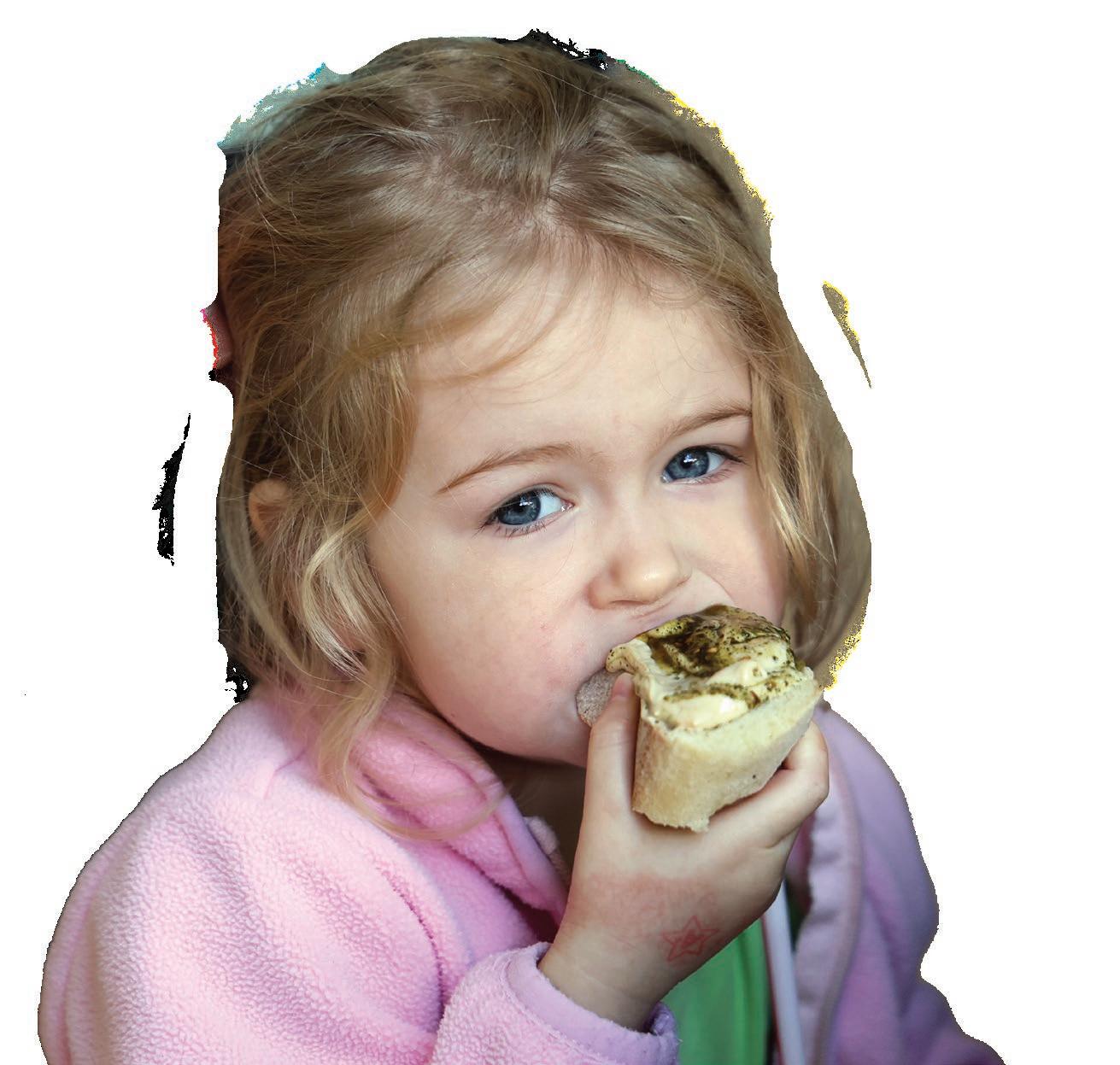
And before they can answer, he holds out a warm piece of bread smothered with a thick layer of hummus. He doesn’t wait for permission. He knows his product, so he approaches a potential customer, certain they’ll want a bite. He’s right nearly every time.
Albert has been surprising people his entire life.
Born in Kenitra, Morocco, he was raised surrounded by the flavors that define his business. Olive oil.
Za’atar. Freshly baked bread. Carefully prepared sandwiches. At 11 years old, Albert moved to Montreal to reunite with relatives. There, he learned to speak seven languages fluently: Arabic, Hebrew, French, English, Spanish,
Portuguese and Italian.
In 1980, Abert moved from Canada to Fort Lauderdale and launched a T-shirt business that followed the state’s ebb and flow of tourist seasons. He made all of his own designs (and claims to have invented the crop top).
Albert printed designs on the spot in front of customers, turning the act of buying a shirt into an experience. He catered to teenagers and college students, and during spring break, he made sure to set up where the crowds were thickest, catching the steady stream of tourists passing through. He was well aware that personality matters just as much as product when you’re building a business.
“All my life, I worked with young people,” Albert says. “It keeps me young.”
By 1987, he relocated to Panama City Beach to open seven T-shirt stores. When he reached his 50s in 2010, he decided to sell the business.
He left the Panhandle and traveled back to South Florida with a clear intention to bring the bread and hummus business to life.
He had learned what worked and what didn’t. He knew manufacturing meant machinery, permits, staff, space — layers of costs that stacked up before a single dollar was earned. He didn’t want layers. He wanted margins.
“The best business in the world is to buy and resell,” he explains. “So I buy, and I resell. I know a bread costs me $1-$5. I sell it for five. I know that’s it. There’s no manufacturing.”
Becoming his own boss wasn’t just a financial strategy. It was temperament. He opened the hummus stand because it was familiar to him and always drew a crowd.
Now, he’s been in business for 50 years.
“I’m not afraid of opening up business,” he says. “Because I’m very consistent. Very positive.”
Consistency wasn’t glamorous. It meant showing up every day. On cold mornings, on rainy afternoons, on days when he felt more tired than motivated. He came anyway, unlocked the stand and got to work. It meant believing in a product before anyone else did. It meant looking at a space and seeing potential. He wasn’t afraid of risk because he trusted himself more than he trusted a larger system.
“Every business that I did, I was very successful,” he says, “Because I have a lot of imagination.”
So he turned to what he always knew: food. Albert, who is Jewish, noticed that kosher businesses always sold bread. So he began importing organic bread from Montreal. At first, that was all he sold.
Then came olive oil. Then za’atar for dipping.
He created a secret vinaigrette. He refined a Moroccan salad. He added hummus. Then sandwiches. His menu was set in stone, every item was rooted in the cuisine he grew up with — simple, bold and unapologetically traditional.
“I stick to what I do,” Albert says. “I don’t change … I’d rather one bird in my hand than two in the air.”
who had opened a new market in Pembroke Pines. Joe offered Albert a vending space by the registers. Albert took it.
“Albert, I’m in the vegetable business,” he recalls Joe telling him. “I don’t want to sell no breads. I have no time … but I got two registers here. I’m brand new. Once you come just put your bread and start selling.’”
“No problem,” Albert said with a chuckle.
The first setup was simple. No banner. No polished display. Just neatly stacked loaves — olive, tomato and walnut — at two loaves for $5.
When Joe prepared to close for good, Albert met Iris Casanova, who ran a farmers’ market. He told her he sold bread, and she didn’t need much convincing. Over time, she began to
maybe 15 or 20 containers of hummus. Set up the table. Olive oil. Small dipping tray. Bread knife. Same system. And he sold out. And again the next day.
“Where’s your bread?” Iris asked when visiting his tent.
“I sold out,” he told her.
When she opened a market in Islamorada, he drove down every Friday with 15 or 20 boxes. He sold out every time.
Fridays were his busiest, but he made sure to leave early so he could get home before the Sabbath. Iris understood and let him pack up early.
Customers who met Albert there still remember the early days. They’d come back the next week and say, “Is the bread man there?”
And in those early market mornings
He still works every weekend, prepares everything himself and approaches
— under a tent, knife in hand, olive oil glinting in the sun — he realized something simple.
“So it’s a commitment of myself towards what I do and the flavors that I sell. That’s what attracts everybody.”
He made his way to the farmers’ markets at Merrick Park in Coral Gables over 15 years ago. Business was slow at first. But Albert showed up every weekend. He talked to people. He offered samples. He knew what worked — and trusted himself.
He churned through 300 to 400 containers of hummus every Saturday and Sunday, selling out most weekends. The scale of his operation increased over the years, but his method stayed the same. He just needed more hands on deck.
Sarah Mayer, 45, has worked with Albert for seven to eight years. She connected with him through her brother, who worked for Albert during his T-shirt venture. Her brother asked
the business owner if he had any opportunities for his sister.
Albert didn’t hesitate. He offered to train her and to teach her the business from the ground up. Now, he hopes she’ll soon run a weekday market of her own.
Sarah moves seamlessly behind the counter, helping assemble sandwiches with steady hands before slipping back into the warehouse to restock supplies, returning just as quickly as she left. Now a full-time employee, she handles nearly every transaction, helps craft sandwiches, restocks produce and fills whatever gaps come up.
“Whatever is missing,” Sarah says, smiling, “I’m the other hand.”
Each week unfolds across two locations: CocoWalk in Coconut Grove and Merrick Park in Coral Gables.
In CocoWalk, his table costs him $60 to operate. He takes space in one of the many stretches of grass and
patchy dirt, shaded by trees that sway in the breeze from the nearby bay. Sunlight filters through the leaves, casting soft patterns on the ground. People stroll by at an easy pace ––neighbors walking their dogs, friends catching up, families enjoying the outdoors.
At Merrick Park, his table costs him $400. The stand’s atmosphere is elevated. Small fountains murmur between polished stone walkways, and wide storefront windows are trimmed in cream and gold. The walkways are clean but bustling as shoppers bounce from designer store to store and couples dine at square tables draped in white linen. No matter the backdrop, Albert’s energy remains the same because wherever Albert and his hummus go, the crowd follows.
At Coconut Grove, the demand is relentless.
The work is long and physical. Setting up alone takes about three
hours, and once the market opens, the pace doesn’t slow.
“It gets tiring because you have no breaks,” Sarah says.
When they run out of product at one location, customers are told to return the next day to the other location. Sarah, a Florida native with Egyptian parents, is drawn to the fresh air and fresh ingredients, something she knows the customers appreciate. Nothing feels processed or rushed. The mozzarella is soft and clean. The hummus is made from scratch.
She enjoys watching people experience it for the first time, and some tell her it’s the best thing they’ve tasted that week. “It’s homemade,” she says. “Today, everything is processed. We’ve lost the taste of real food.”
To keep up with the crowd he serves every weekend, making roughly $10,000 in just two days, Albert has to be meticulous. Mondays through Thursdays are spent preparing the food. Fridays are reserved for final touches. By the weekend, everything is ready.
Demand for his food stems from a loyal customer base, including University of Miami students and longtime Miami residents who build their weekends around visiting his stall.
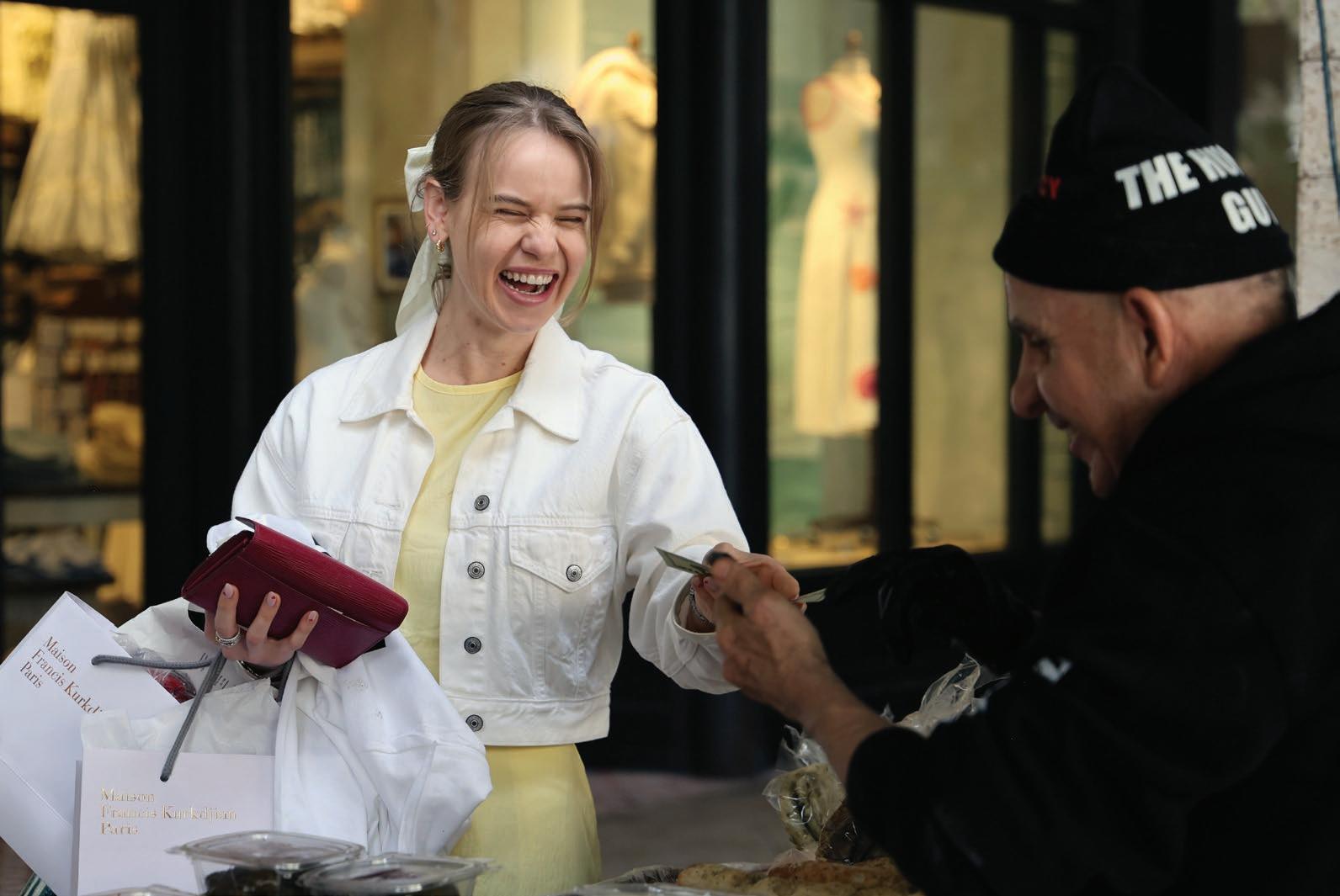
Victoria Castells, a 38-year-old Miami native, makes a beeline for Albert’s delicacies every Sunday. “I go and get the same sandwich,” she says. “It’s amazing — it’s the best sandwich I’ve ever had. When I wake up on Sunday, I look forward to getting the sandwich.”
Albert returns her smile. “You’ve been coming here for 10 years?”
Victoria nods. “Yeah. And you know exactly how I like it.”
“Of course,” he says. “You always get free falafel.”
“Really? I didn’t even notice!”
“Yep,” Albert says. “Every Sunday.”
Melissa Rodriguez, a freelance content creator, discovered Albert about five or six years ago. She still visits nearly every weekend and has watched Albert’s business evolve.
“Farmers’ markets are tough,” Melissa says. “He just seems like a very hardworking and energetic and nice guy … If
you’re just walking by, he calls you over and gives you free samples … He’s kind of a businessman.”
Albert has been trying to build an audience to better his business. Students from the University of Miami began posting videos of him on TikTok — short clips capturing his energy and his signature quips. One video reached more than 20,000 views in less than a week.
Suddenly, Albert wasn’t just a local favorite. Compared to his usual traffic, he was viral.
His lines grew longer. New customers arrived already knowing his name. Albert became the “Hummus Guy.” He printed T-shirts featuring his new brand, “Breadman America,” calling back to his old business.
Despite his local virality, Albert hasn’t changed. He still works every weekend, prepares everything himself and approaches customers with the same line.
“Spicy or no spicy?”
Albert still moves with purpose behind the table. When a group of college students steps up, laughing but uncertain of what to order, he doesn’t rush them. He leans forward slightly and asks where they’re from. When one mentions it’s their first time at the market, he nods and starts building something for them before they even fully decide.
He hands one of them a small piece
— they’re
he’s Built.
to taste — golden hummus spread thick across the top — and waits for their reaction. When they smile, he smiles wider. He asks questions. He gives advice when it feels right. It’s never just a transaction. He’s teaching without announcing it, encouraging without preaching.
By the time they walk away, food in hand, they’re not just customers — they’re part of something he’s built.
And Albert is already turning to the next young face in line, ready to do it all again.
“I love to give,” he says. “I don’t want to be cheap with people.”
At Merrick Park, his line still hasn’t stopped winding. A customer tastes the hummus, pauses, then turns back around to get more.
Albert smiles.
He already knew they would.
Jillian Silvera listens closely as Albert Bensadoun describes his variety of products in Coral Gables, Fla., Sunday, Feb. 8, 2026. (Riana Morales/Atrium Magazine)
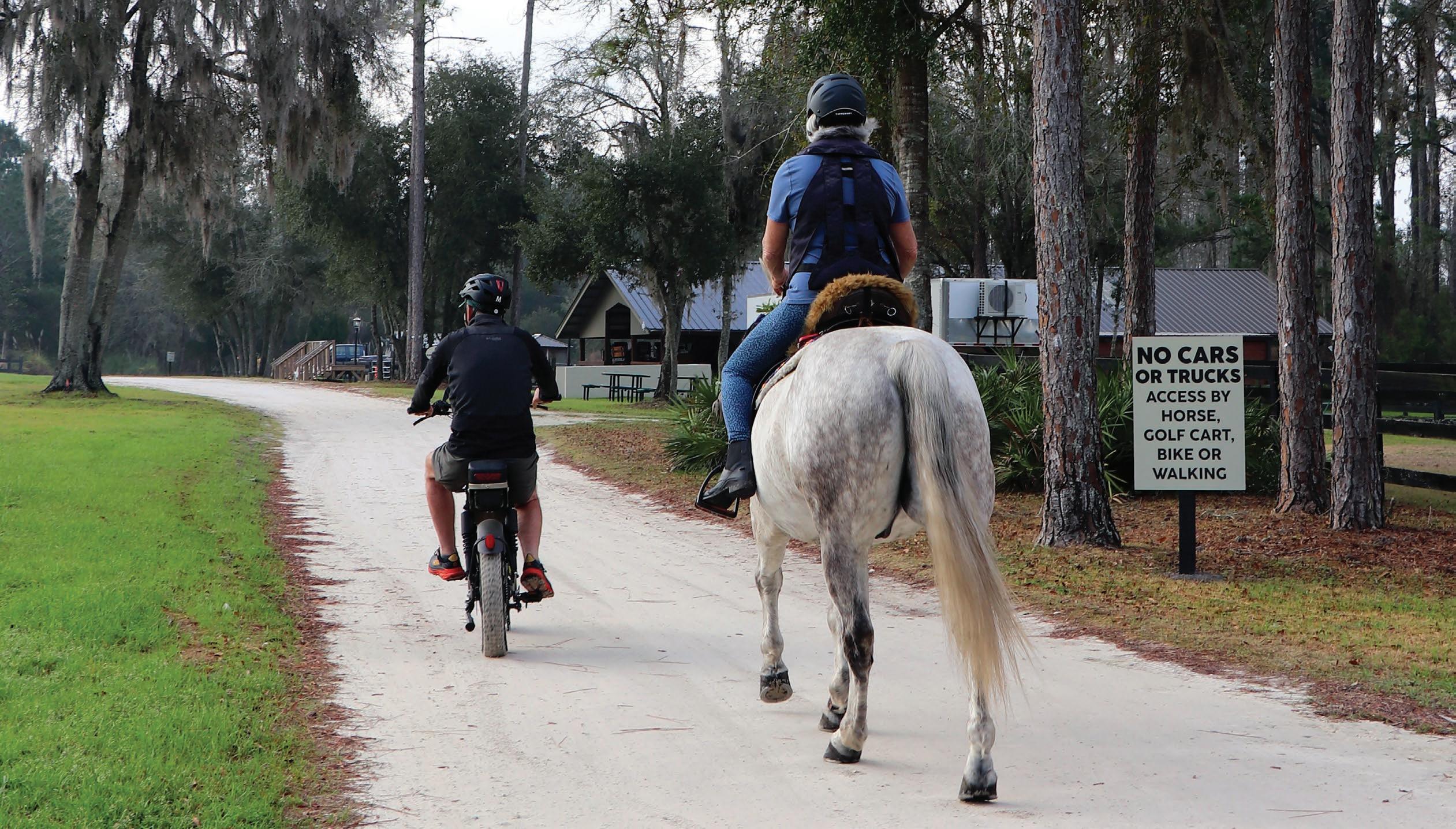
Regina Broughton rides her horse, Remington Steele, while Jeff Broughton trails beside her on an electric bicycle in Bronson, Fla., Saturday, Feb. 21, 2026. (Lily Hartzema/ Atrium Magazine)
The breeze in February is cool enough that the Floridian wilderness feels inviting instead of punishing. For the Broughtons, it’s worth traveling over 500 miles to reach.
At Black Prong, engulfed by the Goethe State Forest, the winter air feels pure and clean. The quiet announces itself slowly along curving
trails that stretch into the forest, the shuffling of feet against gravel and the neighing of horses cutting through the stillness.
The entrance to Black Prong feels less like a campsite and more like a luxury retreat in the woods. The drive through Bronson is filled with long, arching trees and acres of land where cows roam freely. Upon arrival, visitors
design
by MARLA
TOKIE
Glampers find their escape in a pocket of luxury hidden in a forest
story
by
SARA CHUJFI
photos by MADILYN GEMME and LILY HARTZEMA
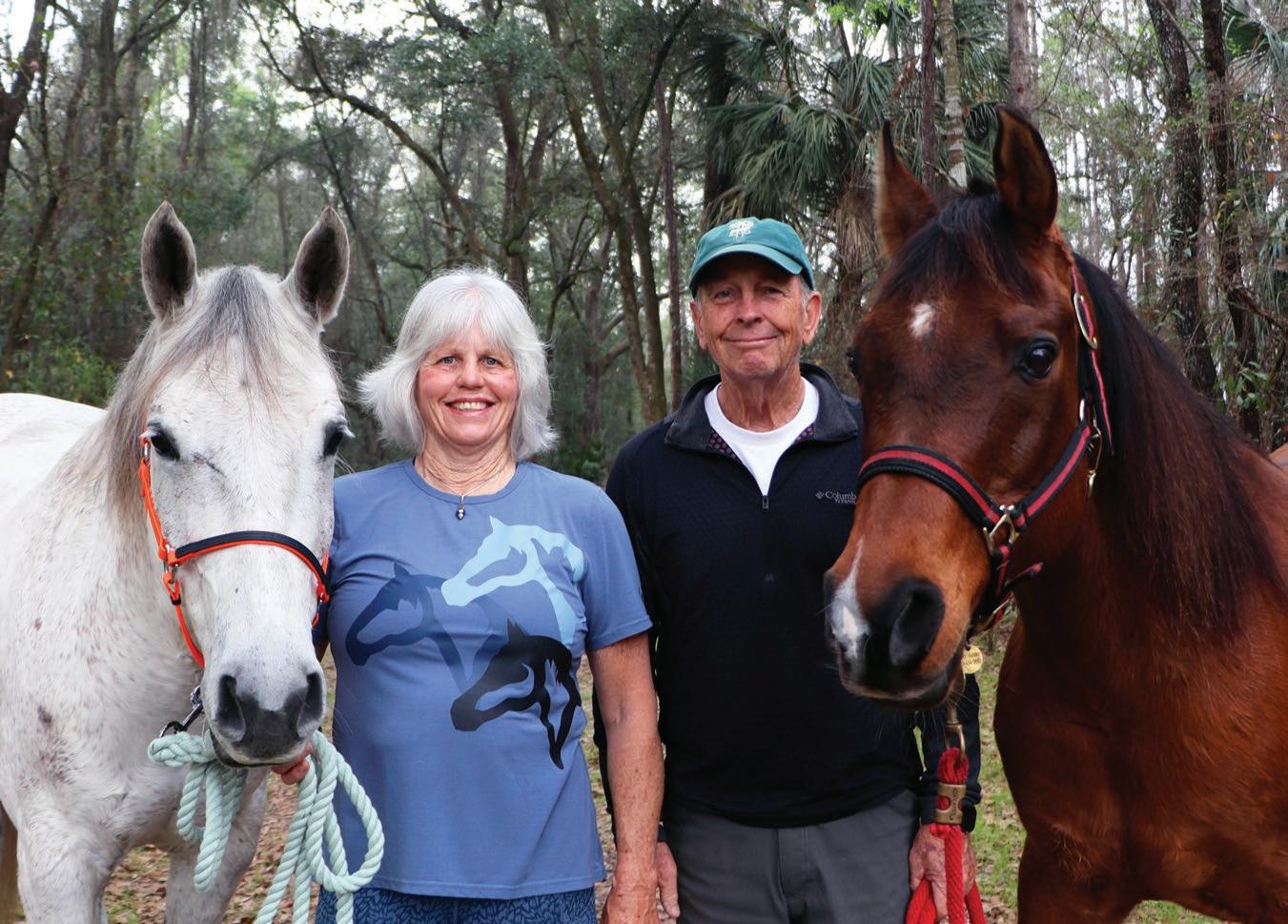
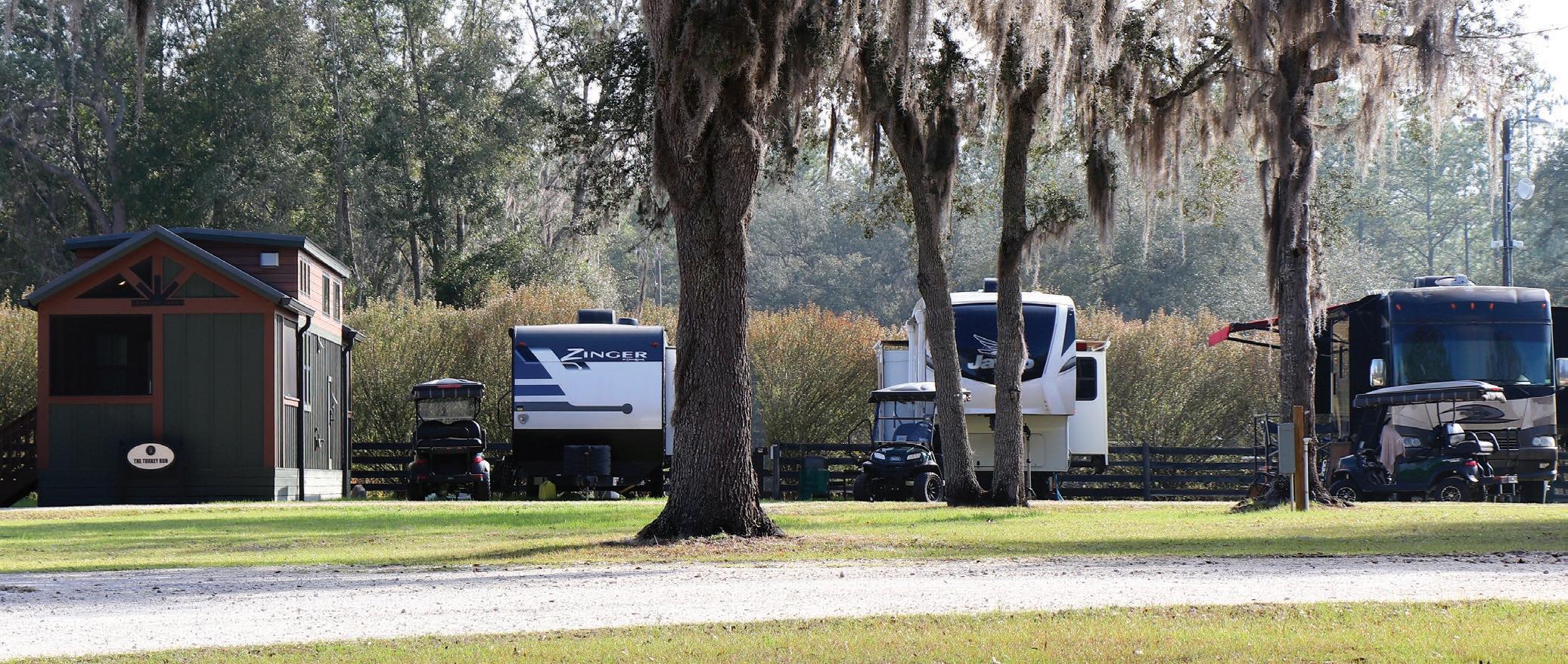
are immediately engulfed in greenery, with gravel trails stretching out in all directions. They ride their golf carts and horses toward their campsites, which consist of RV pads, cottages or cabins. Regina Broughton, 68, tends to her horses, two large Arabians ––one silver-grey and another caramelbrown. They loom over her with their defined muscles and huge eyes, but she caresses Remington “Remi” Steele as if he were a large dog. Her husband, Jeff, 72, feeds Lucky Sunday treats. This is their third year making the voyage from Tennessee to Florida,
lugging their trailer through a 10-hour trip. In Tennessee, February is cold, Regina says. But in Florida, February is riding weather.
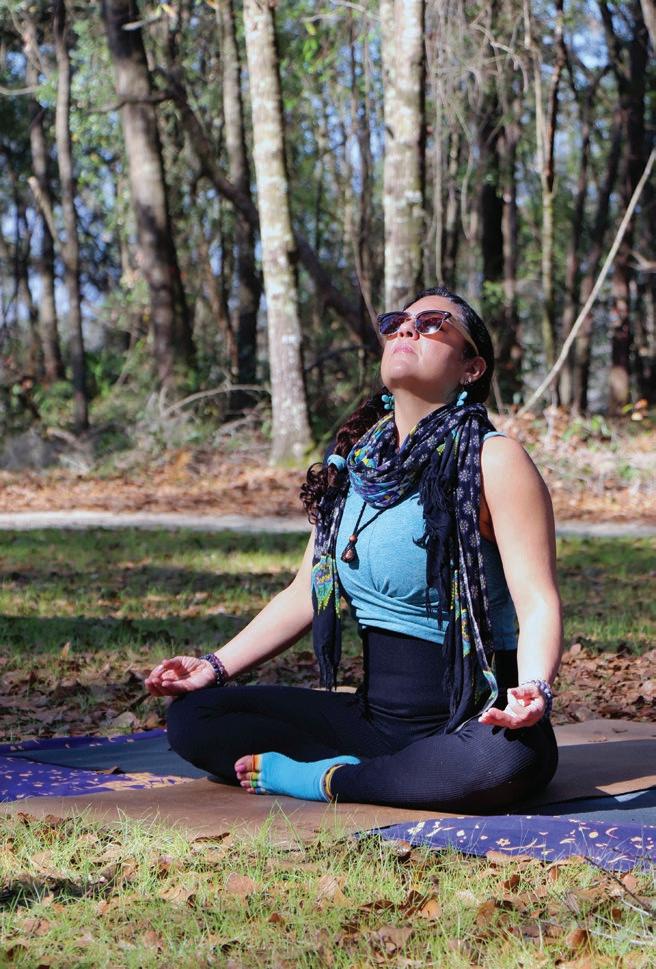
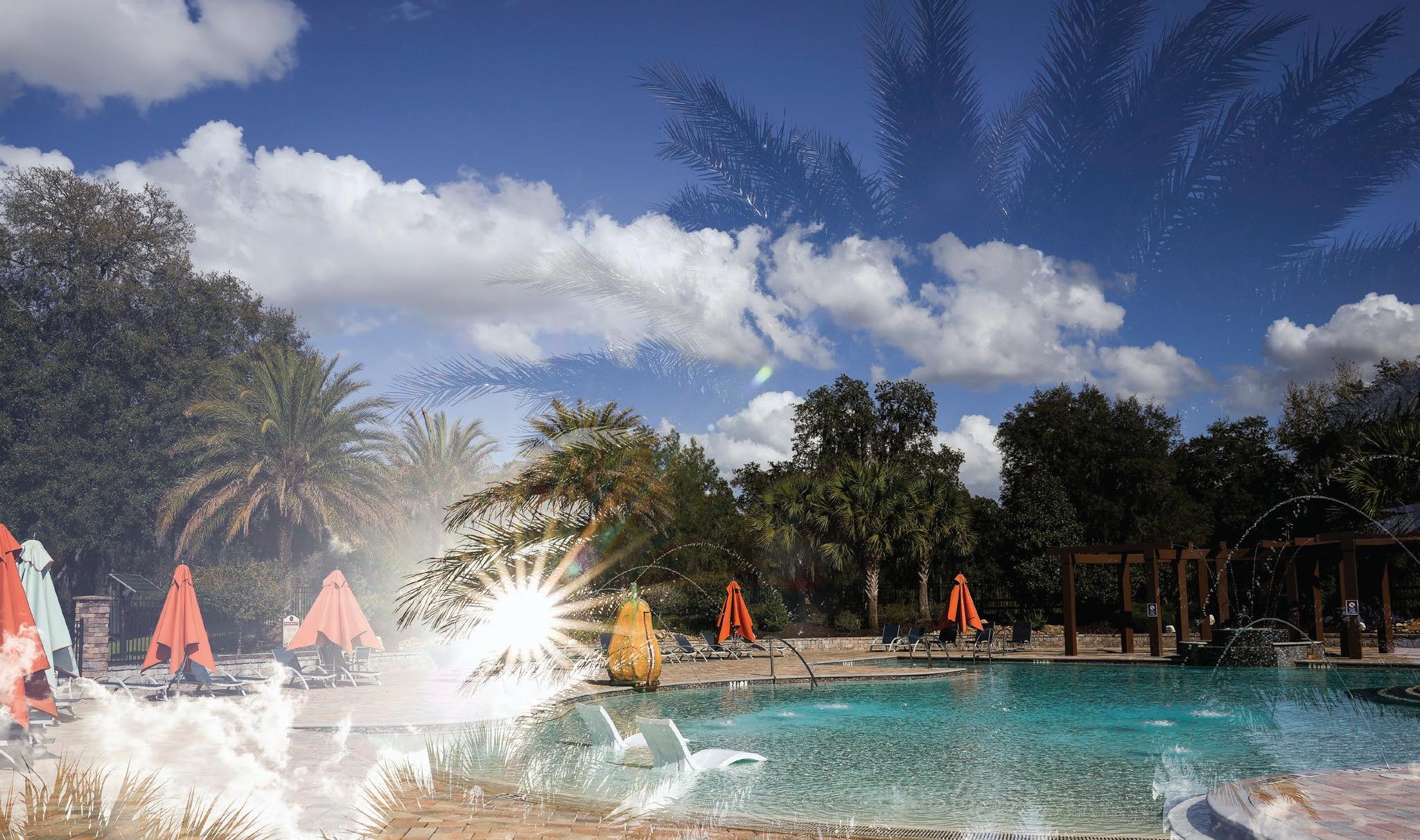
The Broughtons embrace the Florida winter for the entire month of February, where they vacation at Black Prong, a luxury camping and horse riding site near Williston. There, they get to enjoy the cold season without sacrificing time outdoors. Glamping, or glamorous camping, promises nature without its rough edges: Sleep near the wind, but keep the comforts of air conditioning. In a post-pandemic Florida, state parks, springs and forests make that promise come true. There are more than 300 glamping sites that stretch along Florida’s natural wonders, from the Everglades to the springs.
Glamping offers comfort while changing how campers experience the outdoors. With amenities at an arm’s reach, even the indoorsy-types can experience Florida’s outdoors in a catered, comfortable way. For those who found their escape from pandemic-induced isolation in the luxurious outdoors, glamping has turned into a new and lasting tradition.
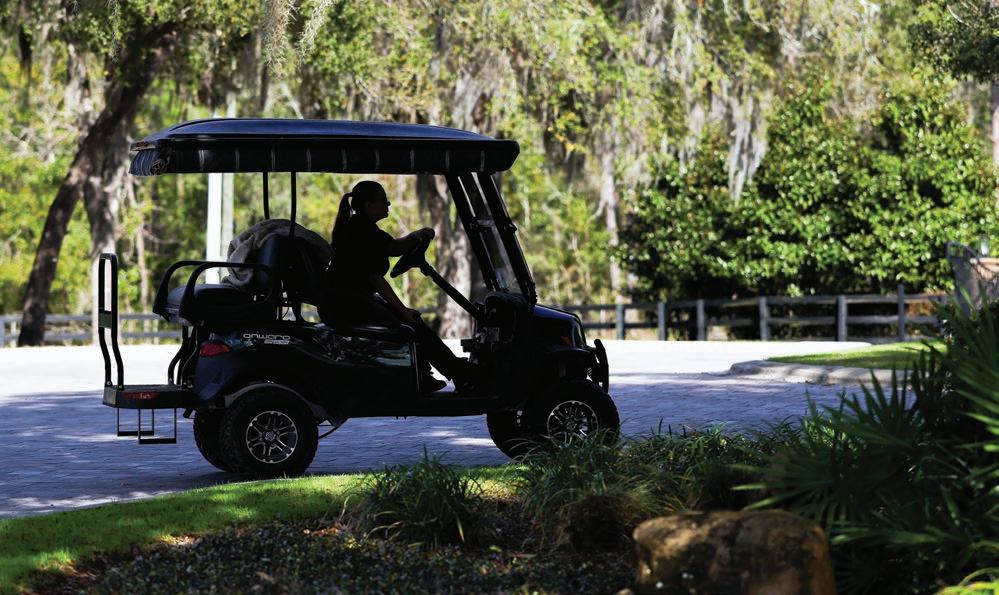
Black Prong sits on miles of forest trails through Goethe State Forest. Guests navigate the grounds in golf
“But there’s a whole lot of Florida that is really, really beautiful … that people don’t necessarily think about.”
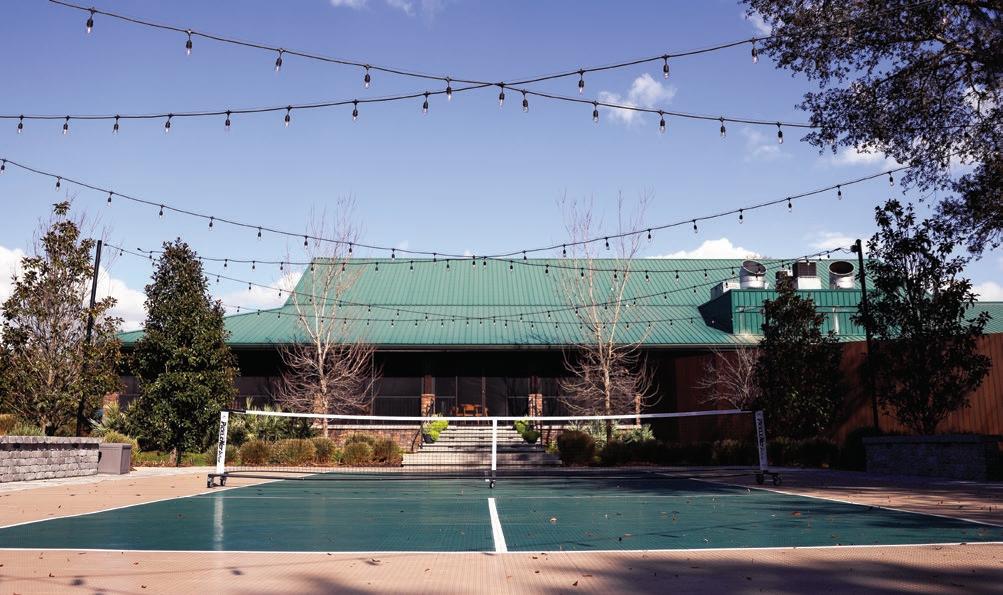
carts. They can enjoy a beach-entry pool, hot tub, a gym and pickleball courts. They can even have a delivery of a fire pit and s’mores.
The Broughtons are not there just for the amenities. They have camped the traditional way before — setting up in horse camps and hauling gear to sites where the days end as soon as the sun sets. Those trips worked when it was just about the riding, but not for month-long stays.
Glamping facilitates the camping experience — but at a price. A nightly stay at Black Prong can range from about $110 to $440, depending on the accommodation, with extra fees for amenities.
For the Broughtons, who have stayed in their fair share of horse camps around the country, Black Prong was the perfect balance between nature and comfort. They heard about it the way many horse riders do ––
through other riders. Their first trip down showed them how easily they could spend a month outdoors.
The Broughtons are used to longdistance drives, having explored campsites from Virginia to Gator Country. They bring along their horses and their cat, Jiggy. The pair of Arabians is known for their endurance and their beauty. “They’re good travelers,” Regina says. “They sleep back there like kids in a car seat.”
At Black Prong, the couple settles into a different rhythm. Regina rides five or six days a week, for as long as 10 miles a day. Most mornings, she is on the trail before the day fully warms. Remi moves steadily through the forest, his hooves striking the gravel in a slow rhythm. They have occasional run-ins with cyclists, turkeys and rattlesnakes. She enjoys how the trails stretch far in front and behind her as she goes. Jeff opts for different
amenities — the spa, restaurant and bar.
On mornings when Regina meets with friends to ride, Jeff trails beside her on his electric bike. She meets with friends also vacationing in nearby sites, some from back home in Jamestown and others she’s met during her month at Black Prong. Her new friend and cottage neighbor, Micki, is visiting from Michigan. Jeff will ride along on the gravel to return to the property, where he can enjoy the slow morning pace that a place like Black Prong provides.
Some afternoons, they venture off the property for lunch in Homosassa Springs. They sometimes treat themselves to carriage rides along the property. Together, they tend to Remi and Sunday in the stalls by their cottage, enjoying their time together away from the Tennessee winter.
Both the Broughtons are satisfied at Black Prong, the horse person and the not-horse person. It’s what they prefer instead of staying somewhere in Tennessee, Regina says.
Four years ago, Zoe Bowden’s days were filled with emails and advising appointments as an undergraduate adviser and communications specialist at the University of Florida. But with a degree in animal science with an equine specialization, she found her way to Black Prong, which was just beginning to shift from a traditional
equestrian venue to a space for nature lovers. Her role at Black Prong grew along with the resort, which now offers itself to anyone who wants to feel “tucked into nature,” not just horse owners.
Some areas of the grounds are lined with high-end RV pads, while others look like a cottage with neighboring horse stalls. A glamping accommodation doesn’t matter to Zoe. What matters is the ease, the amenities and being outdoors without being intimidated by untamed nature.
“When people who aren’t from Florida think of the state, they often think of Miami, Disney, the beach,” she says. “But there’s a whole lot of Florida that is really, really beautiful … that people don’t necessarily think about.”
The desire to trade the constant noise of everyday life for something quieter only grew stronger during the pandemic, when being outside became safer than gathering indoors.
Christopher Craig, a professor at Murray State University and lifelong camper, researches glamping trends. He found the pandemic pushed many people toward outdoor travel for the first time. National surveys conducted by Kampground of America, a North American camping network, found that camping surged during lockdown.
“With the onset of the pandemic … you saw a great interest among a
really diverse range of folks because we need to get outside and be away from people,” Craig says. A lot of people didn’t have their own equipment or hadn’t grown up camping, so glamping became an easy entry point. Even after the pandemic, interest in glamping has remained higher than before.
The journey to Black Prong isn’t always hundreds of miles. Kathy Vliet, 73, makes the drive from Alachua in about an hour. She visits on weekends with her group of friends and neighbors and their dogs, Oakley, Winston, Gillie and Tucker, drawn by the quiet and the space. For Vliet, a veterinarian who now works as a mobile vet across North Florida, the appeal is practical as much as aesthetic.
“That’s the best part, it’s so dogfriendly,” she says.
But as glamping expands across Florida, not every development is met with the same excitement. Kathy mentions a proposed Margaritavillethemed glamping site planned for Orange Lake in Marion County — a project that has sparked pushback from conservation advocates.
“It’s highly controversial,” Kathy says. Although the plans for RV sites were approved, advocates worry about building a beach-themed resort on such a fragile natural area. The pushback reflects the larger question of how to make nature accessible without harming it.
The line between camping and glamping is becoming less distinct.
“[Camping and glamping] it’s kind of merging,” Craig says. People might still want to cook outside and spend time in nature, but they’re bringing nicer food, better gear or choosing places that offer a few more comforts.
Sarah Phinney, 35, a travel influencer and content creator based in Florida, understands that access is a point of interest to her viewers. During the pandemic, when traffic reporting went quiet as a result of lockdown, she left behind her decade-long work in broadcast news and transitioned to online content, covering parks and hidden corners of the state.
Phinney says places like Black Prong
can help people appreciate Florida’s wild spaces — but they also raise questions about how tourism affects them. Sites built near forests and springs inevitably affect the space over time, something visitors are becoming more aware of.
“If people are not getting out of their bubble … they’re not going to see why it’s so important that we keep this land protected,” she says.
The sound of clacking horse hooves is a better sound to wake up to than traffic, Phinney says. She deems it a good reset.
Regina Broughton reaches toward Remi with a smile. “They’re very similar to dogs,” she says. Some horses, she explains, are the kind that always
want to be near you — “always in your pocket.”
Even after a month at Black Prong, she isn’t bored. Between the long rides through the forest, spotting occasional wild hogs and quality time spent together, the days move at a pace she enjoys.
Beyond the cottages and through the trees, a golf cart hums back toward an RV pad, bringing glampers home after a day in the Goethe State Forest. The silence settles all around, the kind that invites someone to stay for a while.
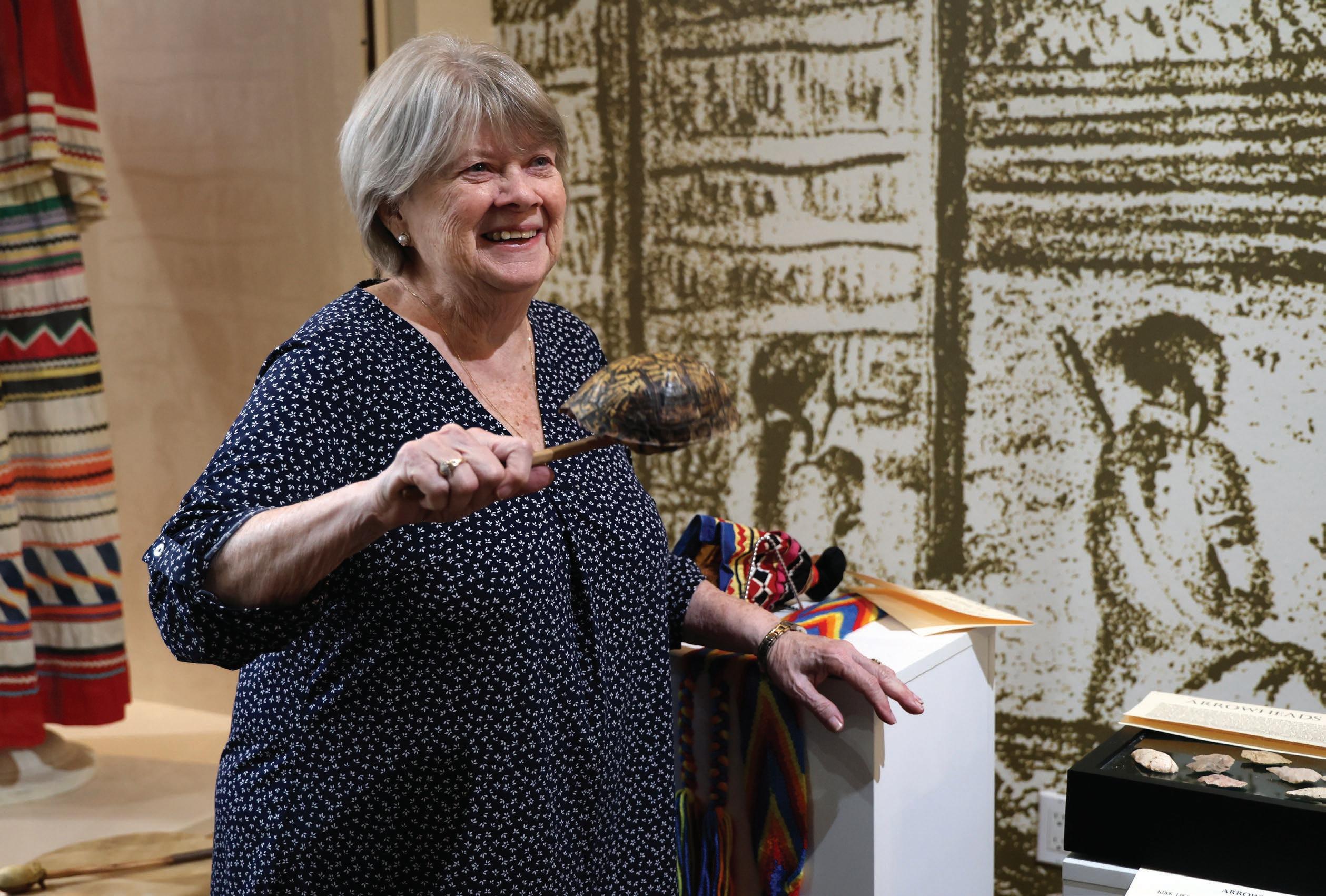
Linda Kranert remembers the gentle sound of critters scurrying off in unseen directions as she stood within the mossed-over threshold of a building all but reclaimed by nature. Faded brick arched into vaulted ceilings, interrupted by a tree surpassing its stone boundary. The light from the ceiling gap fell on the dusty ground as patches of grass twisted their way between once-impenetrable walls.
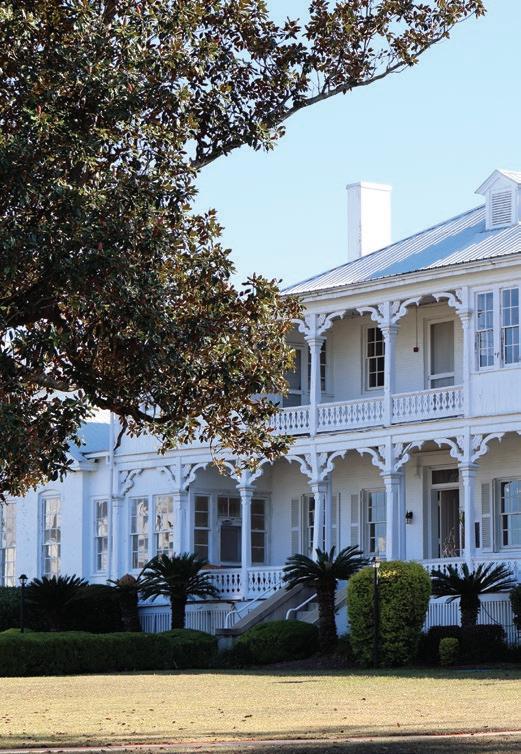
Much like the quiet city of Chattahoochee, Florida, the building was tucked away, a secret on the grounds of a hospital.
story by CHLOE ABREU photos by DELIA ROSE SAUER
Linda, a 77-year-old museum coordinator and grant specialist, found the deteriorating building, the Apalachicola Arsenal Powder Magazine Museum, beautiful. There was an untold history in the cracked and engraved bricks.
Before the arsenal became Linda’s life’s work, she lived with her husband in Tallahassee. Bored studying for an exam, Linda resorted to flipping through job listings in the office of her husband, who was an attorney for the hospital. Her fingers leafed through the pages until one stopped her.
“I could do that job,” she said aloud. Her husband turned around. “What job?”
“Medical unit supervisor,” she answered.
Two weeks later, Linda received a phone call from the hospital for an interview for a job she never applied for. She called her husband for an explanation.
“Well, you said you wanted to do that job,” he said.
“No,” she corrected, “I said I could do that job.”
She went to the interview anyway and landed the position.
As part of her onboarding as a new employee, she was given a tour of the Florida State Hospital grounds. The
image of the brick building lingered as she told her boss, Marguerite Morgan, how much she liked it.
“Don’t get used to it,” Marguerite said. “It’s going to come down soon.”
“That shouldn’t happen,” Kranert remembers thinking to herself.
She wanted to do something, but Linda didn’t have a background in historic preservation. She attended the University of Miami, where she initially majored in physical education before switching to English. She didn’t yet know the building’s connection to the Civil War or how it became part of the hospital grounds. What she did know, standing in that overgrown ruin, was that it deserved to survive.
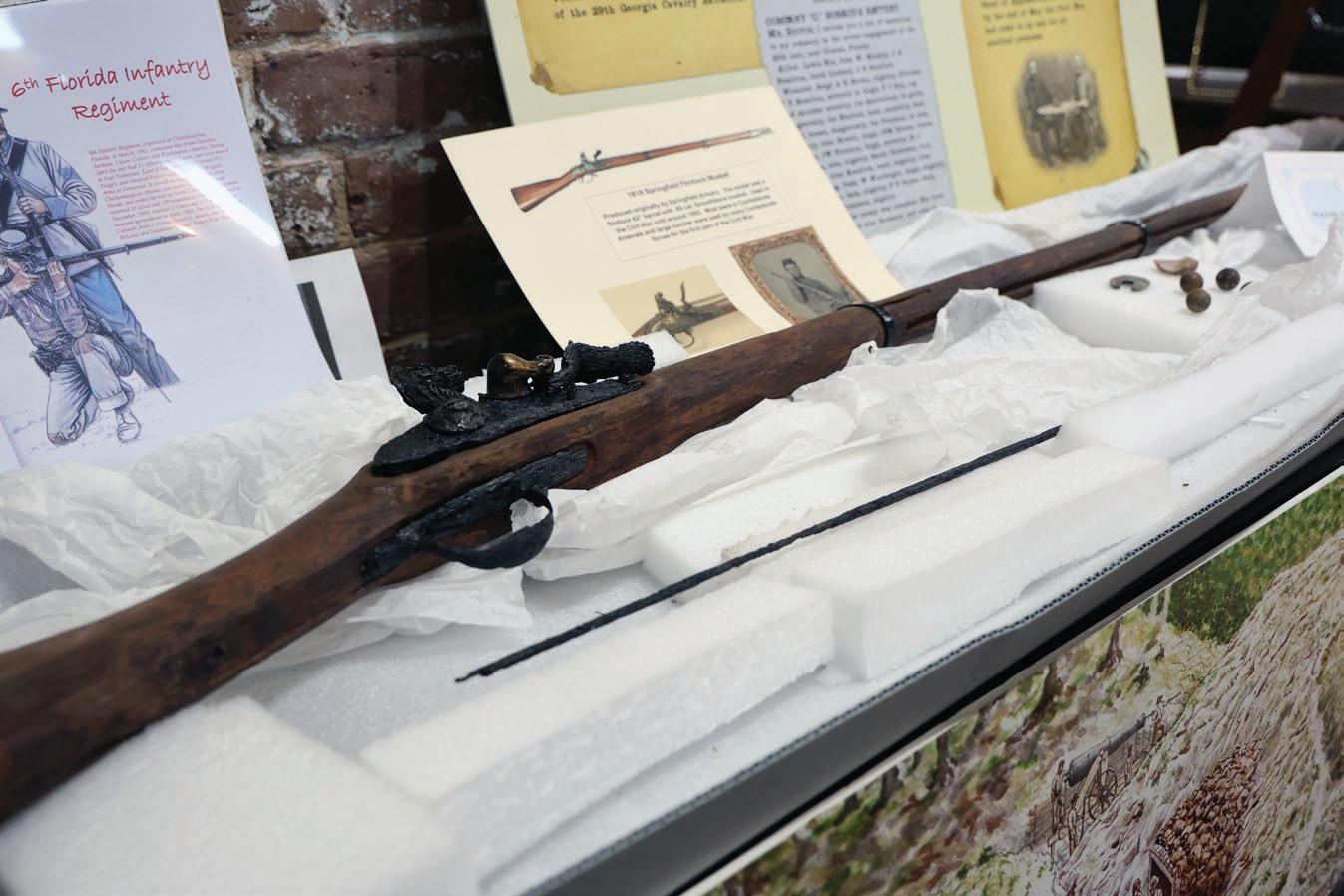
A 19th-century wooden musket, similar to the ones used by the arsenal’s infantry regiment, is on display in Chattahoochee, Fla., Tuesday, Oct. 14, 2025. (Delia Rose Sauer/Atrium Magazine)
The grounds were a time capsule, unchanged since the 19th century. Buildings at the forefront of the hospital grounds shine a stark, sanitary white, unlike the metallic windowfilled monoliths of modern hospitals.
But Linda was more curious about the crumbling powder magazine inside, a Civil War-era ammunition storage center, about half a mile away. Determined to save it, Linda discovered the Department of State’s Special Category Grant, a competitive grant providing state funding to support local, regional and statewide efforts in historic and archeological preservation.
Linda saw her opportunity, and something stirred inside her. “I loved history when I was a kid,” she says. “Restoring and saving history for me is one of my favorite things.”
Marguerite, Linda’s boss, remembers the early days of Linda’s restoration efforts. The push to save the powder magazine was built on paperwork, intuition and passion on Linda’s part, all of which Marguerite got to experience firsthand.
“Linda’s very persuasive,” Marguerite
says. “She can get stuff out of people you wouldn’t think would give anything.”
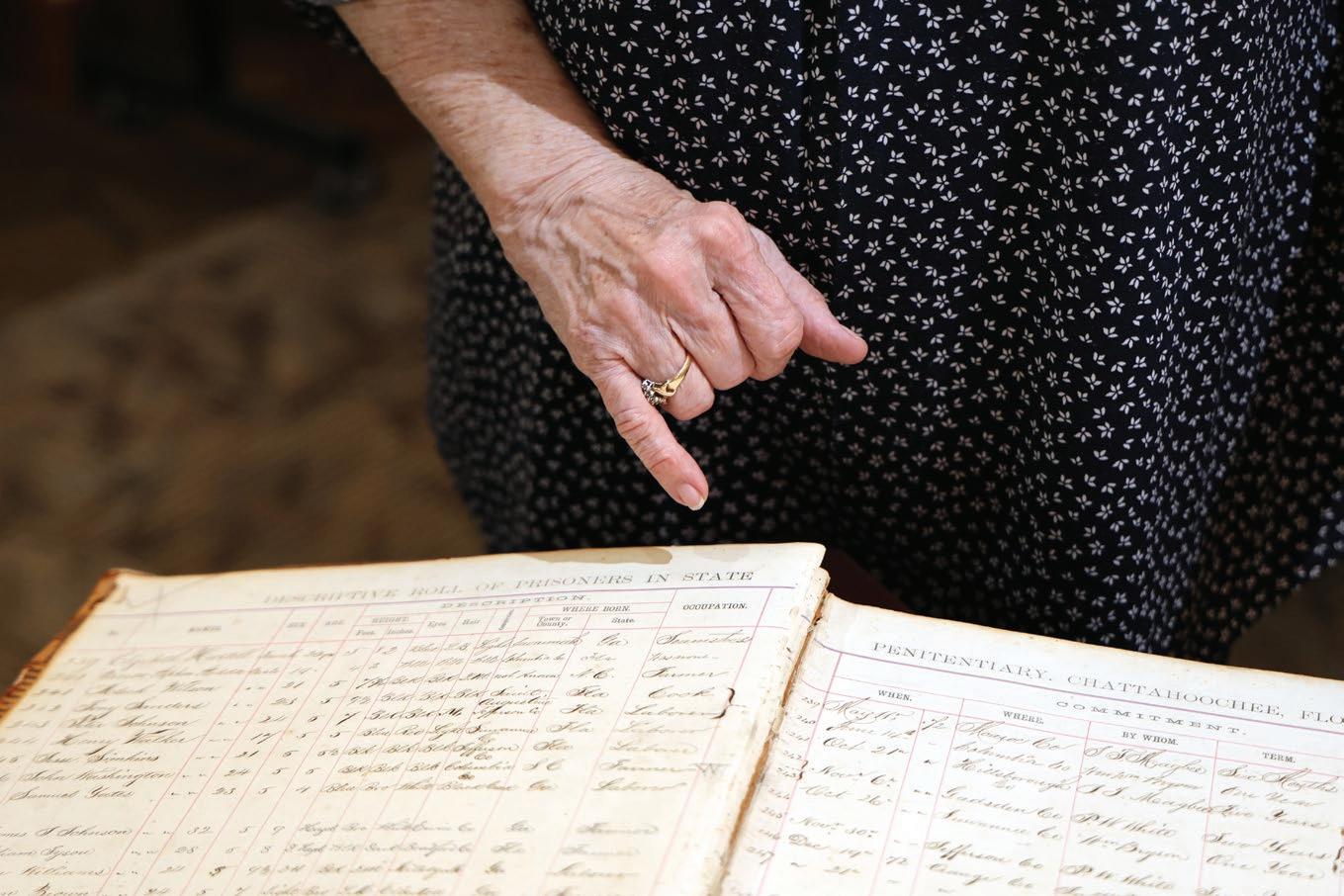
Linda’s persuasiveness became a tool in her grantwriting, the weapon behind her restoration. Her words influenced the grantors to care about the powder magazine as much as she did. To draft a grant, Linda catalogued the building’s needs like a doctor diagnosing a patient’s symptoms. Then she worked to procure the right medicine, or the grants, to meet the building’s needs. Linda figured out what she needed to convince those who approve them. For a building like the magazine, its historical significance is a convincing factor.
Linda used a three-step routine for her research into the building’s history. Step one, she lounged in her living room, the light of her laptop illuminating her face as she typed her first question into Google. Step two, she verified each source individually. A screen was not always enough, so Linda flipped through books. Sometimes, she recruited experts, such as museum and history professionals, to scan through material to make sure it could be used in the grant. “I don’t
just take it upon myself,” Linda says. “It needs to be justified by people that are knowledgeable or more knowledgeable than I am.”
Step three, Linda built a narrative tailored to the person providing the grant.
“You have to write it to the person that’s giving you the grant, and have to know what it is they fund so that you can word your grant to coincide with what they’re looking for,” Linda says.
She wrote her first grant for the arsenal in 1993, which marked the beginning of a restoration effort that would be completed in 2013. Through five more grants, local partnerships and persistence, the building received a long-awaited remodel. The floors were redone with wood, ridding them of the dust, dirt and grass that carpeted the ground. The building was insulated, and with it came an eviction notice for the creatures tucked away in corners and under debris.
The tree that broke through the ceiling was removed, and an artisan restored the brick barrel-vault ceiling to its former glory. The columns, along with much of the other restoration work, were done by Department of
Corrections inmates who helped throughout the facility.
While living in Orlando, Linda was invited to the grand reopening of the Apalachicola Arsenal Powder Magazine Museum. Shortly after, she received a call from Marguerite Morgan along with an invitation to lunch in Tallahassee.
The two met at a Chicken Salad Chick restaurant, where Marguerite dropped a two-inch stack of paper on the table, and Linda’s shoulders jumped. She assumed it was hospital paperwork, but Morgan’s intent was clear.
“Finish what you started,” Marguerite told her.
Linda paused at the question. “Finish what I started?”
“Yes, the powder magazine...,” she said.
Linda laughed. She had no intention of commuting from Central Florida. Marguerite assured her she could telecommute. Linda agreed and worked as a volunteer before she received another call.
“You’re working too hard,”
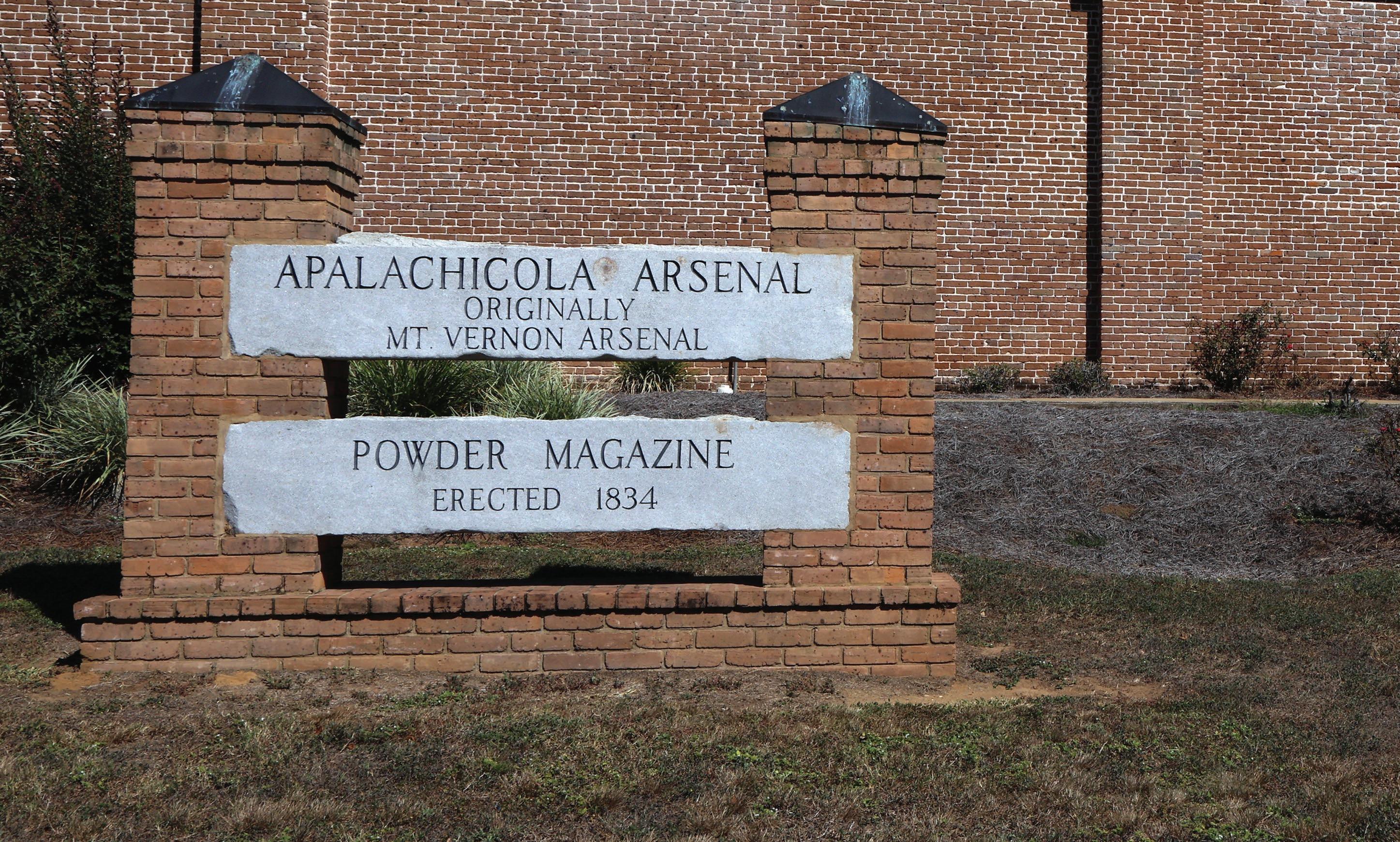
The Apalachicola Arsenal Powder Magazine’s brick exterior stands as the entrance to the Apalachicola Arsenal Museum in Chattahoochee, Fla., Tuesday, Oct. 14, 2025. (Delia Rose Sauer/Atrium Magazine) 2014
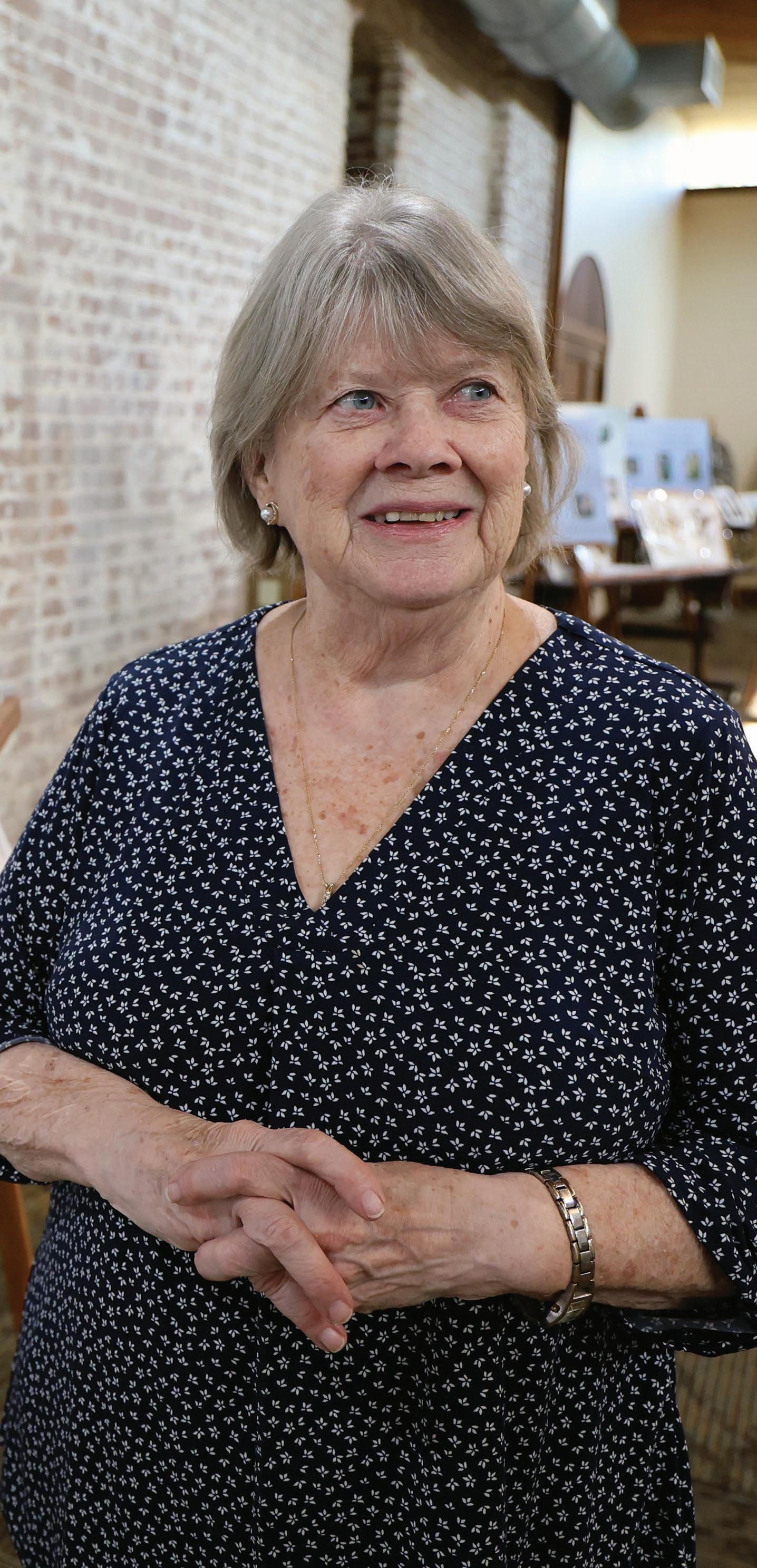
Marguerite told her. “I’m going to put you on the payroll.”
Linda was drafted into securing the funding to convert the now-restored arsenal into a time capsule capturing Chattahoochee’s history. After moving to Tallahassee and working 20 hours a week, Linda reacquainted herself with the arsenal’s past.
The arsenal was built in 1834 — the only arsenal in the state of Florida. Only three buildings remain from the original. The brick was made by Benjamin Chaires, one of Florida’s first millionaires, who paved the streets in Jacksonville.
Linda was not alone in transforming the space into a museum. Tristan Harrenstein, a 42-year-old public archeology coordinator for the Florida Public Archeology Network in the North Central Region, contacted Linda near the opening of the Arsenal Museum in 2014.
Tristan walked into his small office building, its historical floorboards creaking with age as odd shapes jut out, evidence of previous renovations. What used to be a tenant farmer building for Alfred B. Maclay Gardens State Park in Tallahassee, Florida, became a base for the Archeology Network where Tristan works. Linda’s passion immediately caught Tristan’s attention a couple of years after the Arsenal Museum’s grand opening. Her energy and drive encouraged Tristan to help her in any way he could, from providing connections and programming ideas to brainstorming donation policies for museum displays.
Tristan says he is often a listening ear as Linda talks through issues and ideas. “Right from the start, I realized that this is someone who’s doing some good work with a really, really cool facility … and I want to support this in any way I can,” Tristan says.
Today
Nowadays, a large part of Linda’s work consists of organizing events in Chattahoochee. She especially enjoys those made for children. Kid-friendly
"I've loved history since I was a kid," Linda says. "Restoring and saving history for me is one of my favorite things."
literary events like tea parties themed around Dr. Seuss, “The Secret Garden” or “A Little Princess” are popular. Exhibits also contain elements that involve children, like the food exhibit’s Spam carving contest.
The museum’s support network extends far beyond the workings of professional historians and archeologists, into the near reaches of the local community. David Pippin, a 56-year-old business owner, sits at the front desk of his service shop, Pippin’s Tire & Auto Services, which was built in 1954 by David’s grandparents as a service station. The sound of customers briefly fills the shop with every bell ringing from the open door. The business’s familiar rhythm has been home to David for more than three decades.
Five minutes down the road from the Apalachicola Arsenal Museum, David has watched the arsenal come back to life. He was responsible for helping deliver one of the key features of Linda’s Native American exhibit, a preserved dugout canoe that was donated from Tallahassee. David, who has U-Haul access through his service station, made the special delivery and has gone on to sponsor events from the museum, including a recent Spamcarving contest inspired by a traveling food exhibit.
“It’s a hidden gem,” David says of the museum. “It’s off the beaten path, but once you get there, oh my gosh, it’s so wonderful.”
A group visits the museum, and Linda leads them through the various exhibits, showing off her intimate knowledge of every inch and artifact. Her knowledge is vast, from powder magazine remains and hospital relics to Native American artifacts. A member of the group pauses in his tracks
momentarily, eyes glued somewhere close to the ceiling.
“There’s grandpa’s name!” he says.
There was a Joe and a C.C. Newberry carved into the brick. It was his grandfather who had worked at the hospital, and the discovered history puts a smile on Linda’s face.
She laughs at the irony that she, a girl from New Jersey, was the one to preserve a Confederate arsenal.
“There are hidden parts of people’s lives that are in there and should be recognized and appreciated,” Linda says. “I kid them all the time and tell them it took a damn Yankee to get them off their butts to save the building.”
Surrounding the center of the museum, shaped by the arsenal’s rectangular outer walls and a roof installed as part of the original restoration, the museum prides itself on its permanent exhibits. One section focuses on the arsenal and powder magazine itself, detailing the history of the infantry stationed there through writings and relics.
Around the corner, stories of local Native American cultures, such as the Seminole and Creek tribes of the region, are highlighted through canoe remnants, turtle-shell instruments and recreations of traditional clothing. Another section gives a glimpse into the historical interiors of the hospital ground buildings down the road.
From December 2024 to November 2025, Linda’s curated exhibit focuses on the history of cuisine. Sprawled across picnic-cloth tables, Linda displays vintage cookbooks, offers free food samples and showcases antique kitchen tools.
In a nearby room, the Arsenal Museum displays the Smithsonian’s Water/Ways Exhibit, one of the six
museums to host the exhibit. It drew over 800 visitors, many from outside Chattahoochee.
Courtney Piper Junçaj, a 31-year-old Florida State University graduate and former intern at the arsenal, worked at the museum between 2018 and 2019 and offered guidance on labeling and arranging exhibits. She remains friends with Linda after her internship tenure.
In the conference area off the right side of the museum, the two worked in tandem. Cookies and snacks would crowd their round table, and a kettle steaming expelled the scent of prepackaged tea bags. The wrappers pile up inside the nearby trash can. The pair spent hours researching, planning new exhibits and reviewing grants.
“She is a spitfire, in the best way possible,” Courtney says of Linda. “That museum is only there because of Linda.”
Linda wishes more young people would take an interest in the museum. Someone from a younger generation with enough passion, she says, could “take it and run with it.”
“Chattahoochee is mostly comprised of elderly people,” Linda says. “It’s a challenge.”
She jokes that the town’s historical society is made up of three active members, not including herself.
Walking through the arsenal today, the vaulted ceilings still create a natural chill in the air. The arches have outlived wars, hurricanes and decades of neglect. Linda lingers by the entrance, the frame of bricks creating a window into the interior.
“It’s a facility that does wonderful things,” she says. “Art therapy … the occupational group … restoring and saving history for me is one of my favorite things.”

Kylie Williams
Our story began in 2021, when then-University of Florida professor Moni Basu wanted to amplify Florida’s underrepresented voices. She recruited journalism students to combine their reporting experience with literary writing techniques to explore life in the Sunshine State. Basu pioneered the values we still hold today: in-depth narrative nonfiction storytelling told through beautiful writing and reporting.
Atrium was born.
We published our inaugural issue in 2021, artfully introducing audiences to the lives, longings and struggles of their Florida neighbors. Since then, we’ve published an annual print edition and year-round reported stories, personal essays, photo essays, audio features and poetry on our website, atriummag.org.
Atrium Magazine consistently wins awards from major organizations — including the Florida chapter of the Society of Professional Journalists and the Association for Education in Journalism and Mass Communication — for its original, captivating and true Florida stories.
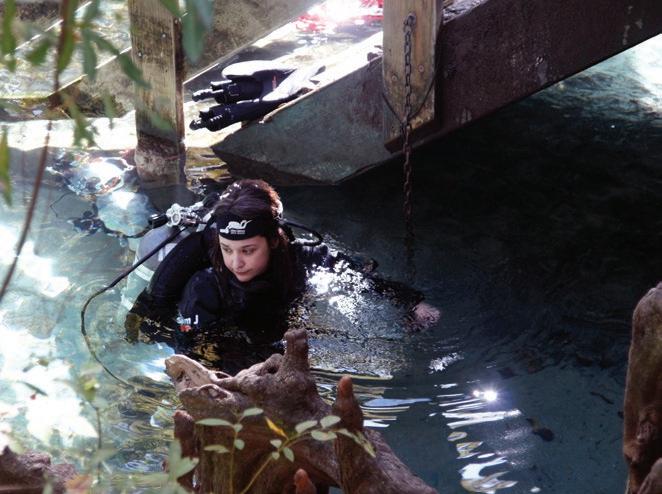
Cave divers find an otherworldly peace in the quiet, hidden depths of Florida’s springs. They’re also finding that developers, pollution and water pumping are threatening to cave the whole system in.
story
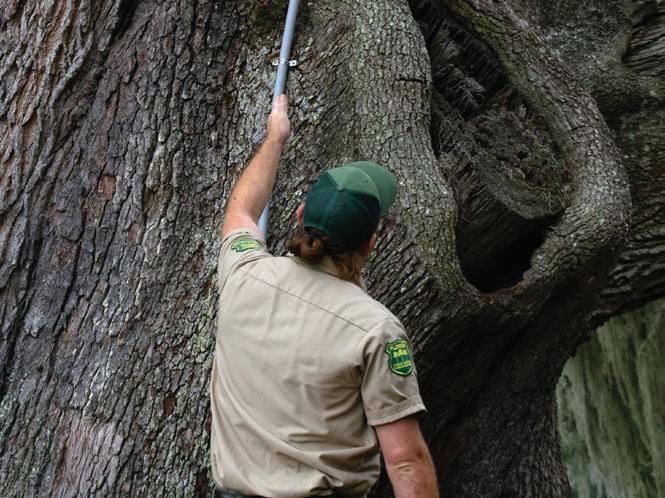
The largest trees of their species, champion trees draw tourists who marvel at their expansive size. But when lightning, parasitic plants, fires and simple old age creep up, it’s caretakers who keep the champions standing.


design by ALISSA GARY
A love letter to the Cuban diaspora hidden between two slices ofbread
story, photos and illustrations by
DELIA ROSE SAUER
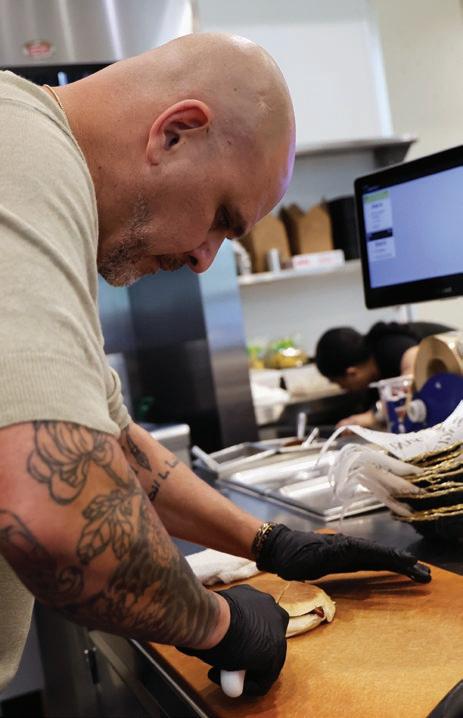
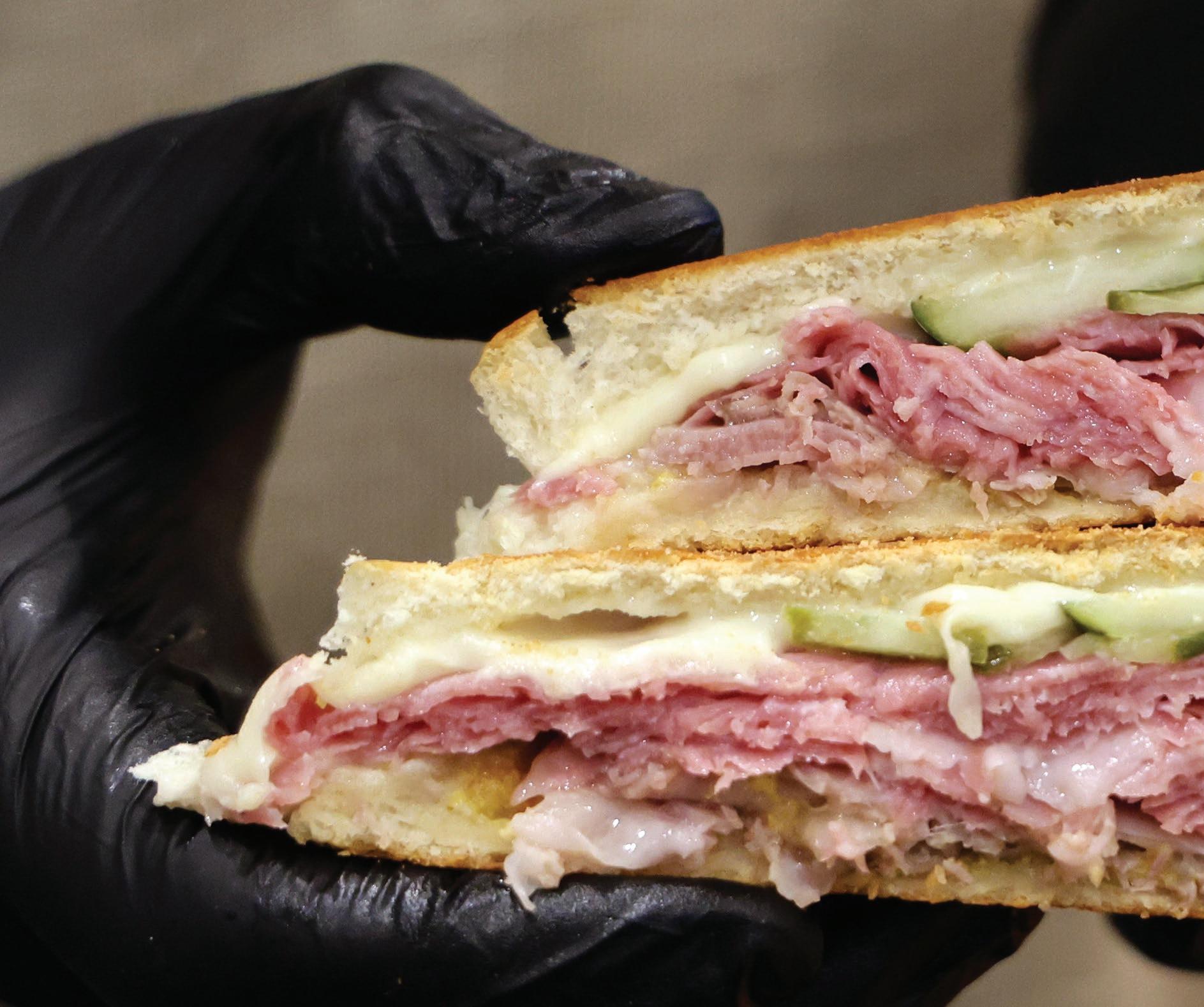
The assembly line of latexgloved hands crammed into the small kitchen is efficient. On one end, hot oil crackles. Pale croquetas, breaded and ready to be browned, descend inside a metal basket, triggering an explosion of glistening bubbles.
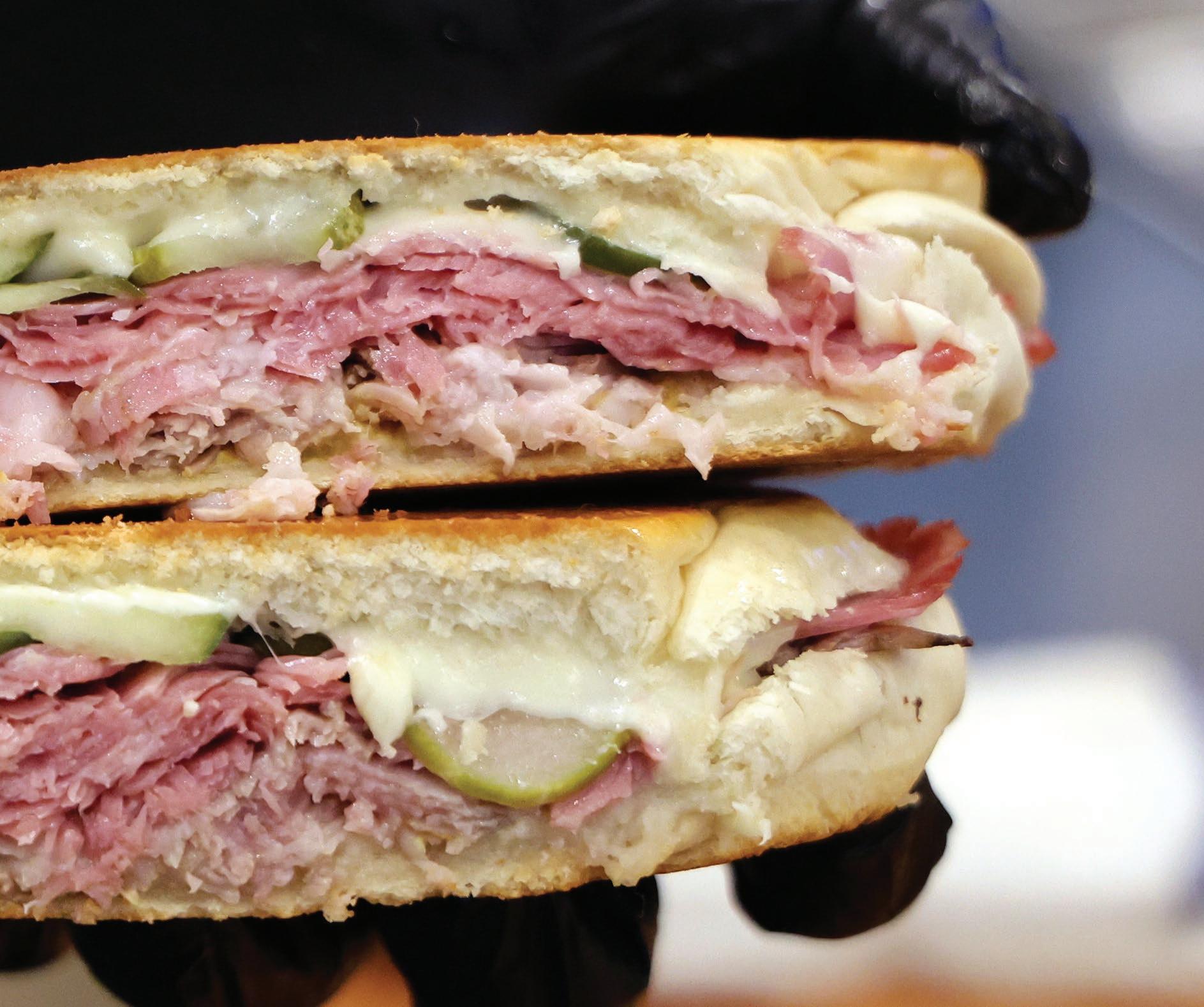
On the other end of the line, where the humidity from the open window, or ventana, blends with the heat of the “planchas,” a flat-top griddle with metal plates, workers paint layers of lard on top of Cuban bread. At the next station, they stack thinly sliced lechon, or pork, and ham. They arrange
the pickles over the baby-blanket-pink meat. Finally, they plop two slices of Swiss cheese before gluing the sandwich closed with a heaping spread of house-made mustard. Someone else snatches the sandwich and presses it between the heavy plancha plates. Press. Slice (diagonally –– the only acceptable way). Wrap. Serve.
At Sanguich, a Cuban sandwich lunch counter in Little Havana, the assembly line operates from 10 a.m. to 6 p.m. Inside, the bar seats are always full as customers chat with the women in la ventanita, stir cafecitos and tear into their sandwiches. Outside,
Miami, the Cuban sandwich is what pizza is to New York City.
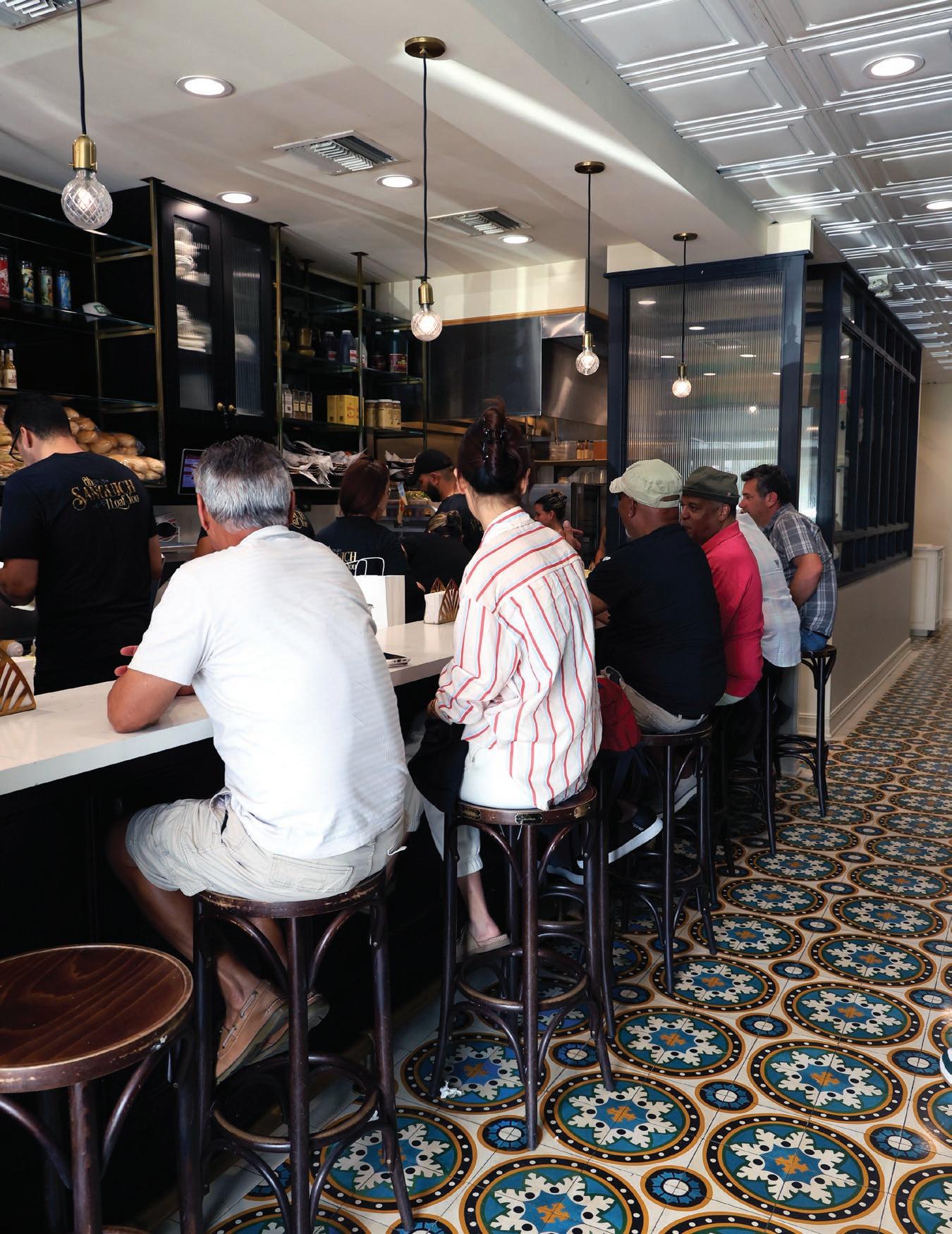
customers in a rush wind through the small parking lot with squinting eyes as they avoid Miami’s blaring sun. No one needs a menu if they aren’t tourists; it isn’t the first time they’ve sat on Sanguich’s wooden stools.
In Miami, the Cuban sandwich is what pizza is to New York City. A time capsule of some of the most iconic Cuban flavors, the sandwich acts as a quick, savory-but-sweet bite that offers a taste of home for multiple generations of Cubans. As Miami continues to transform into a bustling, multicultural hub, the sandwich remains an artifact of the Cuban diaspora, evolving alongside Miami’s cultural landscape.
The meaning of the Cuban sandwich is defined by experience, one to be explored. From the older generations of Cubans who remember “mixtos” made with thin bread and whatever meats they preferred from the island, to the newer generations of Latin American immigrants exploring the time capsule that is Miami’s Cuban culture, some treat the sandwich as something that can never be altered, only perfected. But for others, it’s a conduit for a greater identity, one that exists on the hyphen in front of the word American.
Daniel Figueredo, the 49-year-old co-founder of Sanguich, works behind the line whenever he visits one of his four locations –– soon to be five. Behind his thick-framed glasses, he can’t enter the cubby of a kitchen at the Little Havana location without greeting the shop’s regulars. He leans down, hunching to hug a familiar face. He asks about the food. He offers a cafecito or croqueta on the house, and his customers try to refuse. It’s a common routine, Daniel says. But nothing can beat Cuban hospitality, especially when it comes from the desperate need to feed your neighbor. The regular eventually admits defeat. Daniel rushes to the kitchen to fulfill the order.
Daniel can’t get to work without also greeting every employee. He claps the plancha operator on the back, a bright smile stretched across his face.
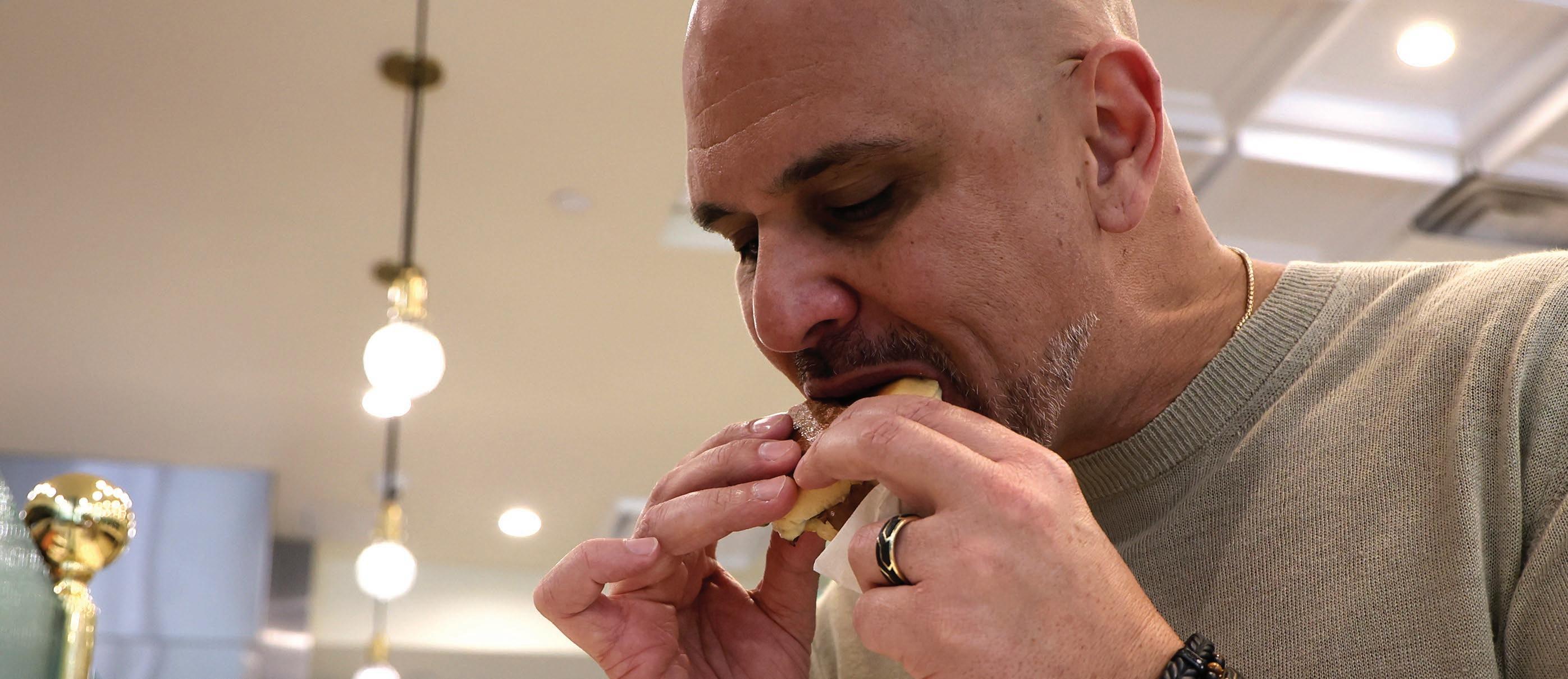
He shuffles toward the dish pit, and after dipping his arms elbow-deep in muddied water, a woman approaches from behind.
“Andrea!” He immediately brightens. He hesitates for a moment, not wanting to dirty her uniform, and decides to hug her from the side, the Sanguich logo wrinkling as they draw each other close. “¿Cómo estas?”
Daniel recognizes faces like a game of Guess Who. As he delivers sandwiches, he recalls each name, something he believes is a necessary connection in a city like Miami. The bond between owner and customer is less common thanks to the yearly influx of snowbirds, tourists and families who decide to make the move to Miami, a horde of unfamiliar faces that have begun replacing longtime locals and natives, who are often pushed out of the city due to increasing prices and too little space. He flies from table to table, end to end of the restaurant, built with his own hands with help from generations before him. As he prepares to open his fifth location in Aventura, he’s as busy as ever as he tries to keep the humble sandwich alive for newer generations who don’t understand the significance of the ham, pork, pickles and cheese.

Sanguich was an idea born on a Friday in 2006. Daniel opened his front door to welcome his friends for their weekly cigar club, which they called “The Bastards.” The smell of tobacco filled his home as his friends sliced cigar tips and lit the leafy stubs. Beads of condensation dripped onto the shared table, the ice in their glasses of scotch slowly melting as they smoked and ate and laughed into the early hours of the morning.
Daniel took pride in serving his friends sandwiches. Sometimes it was a grilled cheese, other times it was a Cubano. Sober or drunk, they’d insist on one thing: He had to break into the food business.
“That doesn’t make sense,” he told them. That didn’t stop him from scribbling the plans, trademarking a sandwich shop idea under its original name, Meltwich, where he would sell grilled cheeses. Nearly a decade later, he met his wife, Rosa Romero, through a friend. She was an executive paralegal, and after they hit it off, Daniel shared his idea.
“That’s a really cool idea,” Rosa said. “But I think it should be Cuban sandwiches.”
He agreed. But the concept stayed in limbo. They’d draft plans and brainstorm, but Daniel’s position as a director of business development for
a manufacturing company based in Colorado and Rosa’s paralegal work came first. The idea of Meltwich, which would later become Sanguich, collected dust until 2015, when Rosa gave birth to their first daughter, London. In a moment where Daniel was holding his daughter close, bouncing her in his arms, he was suddenly compelled to dial Rosa. He waited as it rang, all while looking down at his future, his family. Rosa picked up.
“Hey,” Daniel began. “Remember that Cuban sandwich shop we wanted to start?”
“Yeah,” Rosa replied.
“Well, I quit my job,” he said. “It starts today.”
“Great,” Rosa responded. “What’s for dinner?”
The two of them got to work. Sanguich began as a food truck in 2017, where the couple sold Cubanos at the Coconut Grove Arts Festival. That same year, they won the Calle Ocho Cubano Wars, an event where chefs compete to make the best Cuban sandwich. The first permanent location, the shop in Little Havana, opened in 2018.
Business moved quickly. Sanguich’s promise was to focus on producing every component of the sandwich in-house. From the mojo to the pickles to the mustard, all were
The Cuban sandwich evolves to welcome others into a home, just as her father did.
products of Daniel and Rosa’s team. But by prioritizing a more artisanal interpretation of the sandwich, the restaurant sacrificed speed and cost. Making the sandwich was slow and expensive.
“It goes against everything that we know that a Cuban sandwich should be,” Daniel says. Instead, the sandwich needed to be cheap and fast, mirroring its roots in Cuba, where the sandwich was a quick meal for factory workers.
The next decision was to industrialize the humble process of creating a Cuban sandwich.
To do so, Sanguich capitalized on its loyal consumer base, both tourists and locals alike. When tourists began to outnumber locals, the couple expanded their locations into less touristy areas.
really the ham and pork –– gets made.
Daniel is protective of his production line. Throughout the building, as employees slice bread and pork, reggaeton and dembow blast on the speakers. Everyone communicates in an unpredictable pattern of English that jumps to Spanish or the other way around. He steers the helm, pacing from the entrance of his barn-door office to the freezer where the ham marinade and mojo steep.
A trio of Cuban sandwiches is flipped before being pressed between the two hot plates of a plancha in Miami, Fla., Thursday, Oct. 9, 2025. (Delia Rose Sauer/Atrium Magazine)
The closest thing Sanguich has to a headquarters is its location in Little Haiti, where the ventanita is misspelled and reads “La Ventnita de los Parados.” Inside the white, concrete warehouse is where the sausage ––
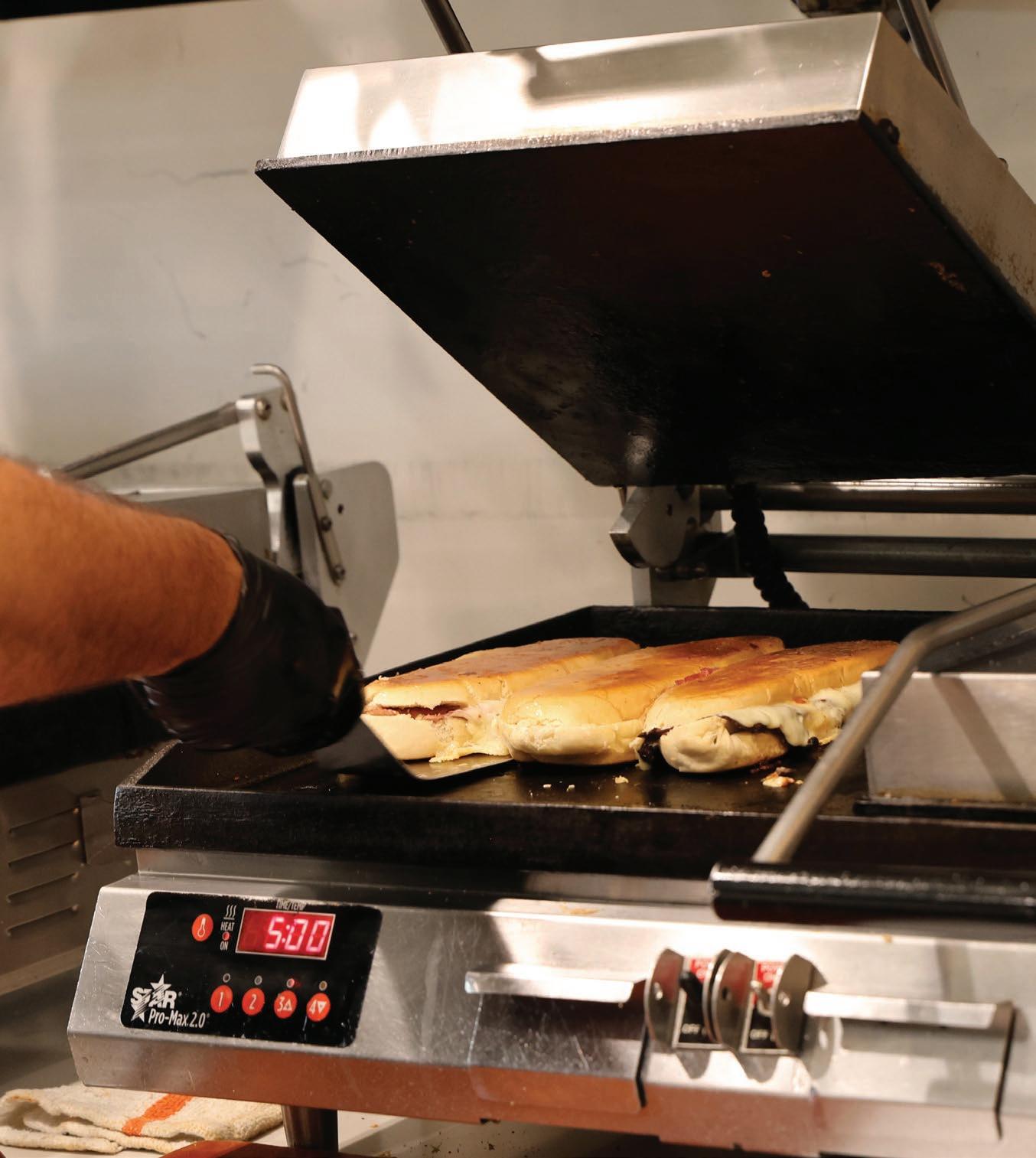
He describes it as a scaled process of marinating, injecting, slicing and serving everything by hand. The hands are just helped by machines meant to streamline the process. When too many customers lined up to get a taste of one of Miami’s best-rated Cuban sandwiches, Daniel patented “La Plancha,” a black and gold, wide sandwich plancha with a rolling mechanism to press sandwiches down. With it, they sold 1,300 sandwiches in a day.
“Recipes are the same, process is the same. The machines help us expedite,” he says.
And it worked. Sanguich holds a spot on the Michelin Guide as a Bib Gourmand, an award given to affordable restaurants that serve high-quality food. The South Florida Sun Sentinel, Miami Herald and Bon Appétit have listed it as some of the best Cubanos Miami has to offer. By transforming the familiar traditional process of throwing the sandwich together, Sanguich did what some say Cubans have mastered: It adapted. The restaurant didn’t have the luxury of time. To keep up with locals and tourists, Daniel and Rosa had to adjust tradition. All that matters is that the flavor and history are preserved.
Daniel has seen his sandwich bring older generations, those who left their home behind, back to Cuba. He recalls greeting a customer, an elderly Cuban gentleman. He drank in the blue, black and golden Cuban tiles, decorative squares of cement with vibrant colors and mosaic patterns mirroring designs native to Spain, the shop’s custom sconces and the familiar smell of garlic and coffee beans. “This reminds me of
Cuba,” he told Daniel.
Daniel smiled back.
With every location, he wants Sanguich to be a place where a millionaire and a retiree can share a cafecito and appreciate Cuba’s roots. They don’t have to be Cuban themselves anymore.
“Miami is no longer Cuban,” Daniel admits. “Miami’s international … My job now is to be Cuban American and be an owner of a Cuban sandwich shop. My job is to protect that at all costs.”
For many Cubans and Cuban Americans, the Cuban sandwich is a common indulgence. For me, it was a concept, an idea of a heavenly combination of flavors I’ll never fully understand. My American-born self developed something that would never exist in Cuba, or so my grandmother likes to tell me: allergies. Nine pages of them to be exact, including dairy, eggs, nuts, soy and the occasional oddball, mango, chickpeas and mustard. The cultural cornerstone, the Cuban culinary classic, was always in sight but out of reach.
Visiting the local ventanita is a relatable memory for any Cuban raised in Miami. As a child, my mom held me close as we approached the ventanita at La Carreta, a famous Cuban restaurant empire in South Florida. Her hand reached down to shield me from cigarette smoke and the soaring spit of boisterous elderly Cuban men as they cracked raunchy jokes on a Saturday morning. I didn’t understand what they meant, and my mom refused to explain.
My mom would force me to accompany her to the ventanita to practice my mumbled Spanish, where I would butcher my pronunciation by “eating” any s or d sounds. Skipping those letters is a recognizable trait of the Cuban accent. Despite my mom having Vivaporu at arm’s reach and spending two days making black beans at my request, she didn’t want me
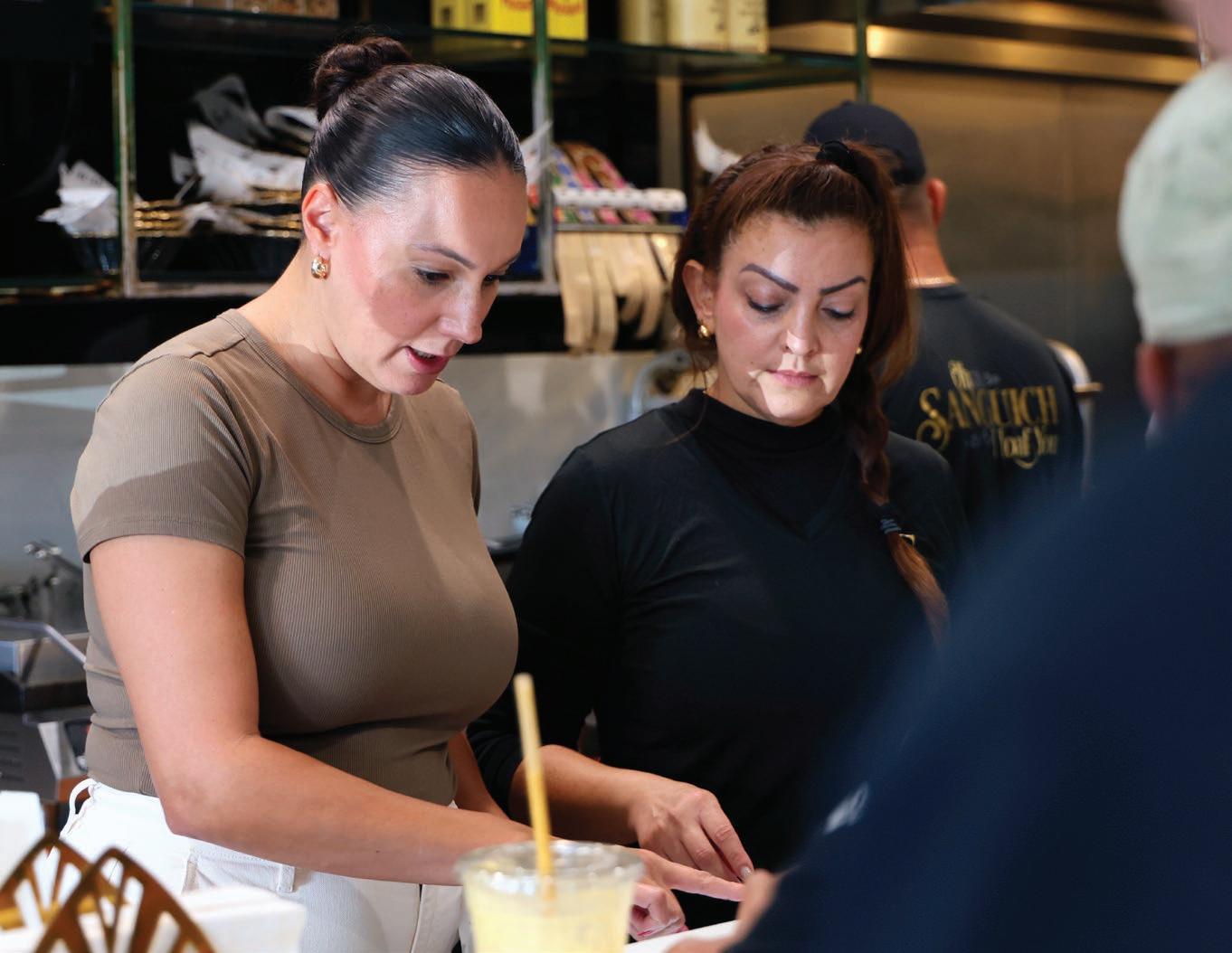
sounding Cuban. I was born in Miami –– in America –– so I must speak Spanish neutrally.
I never understood her, but my mother knew best. So I obliged.
At the ventanita, I balanced on my sparkling Twinkle Toes shoes as I peered into another world. The women inside chattered like a flock of birds, their red lipstick and thick eyeliner always perfect despite spending hours packed in a heated pocket that smelled of butter and coffee. They clanked the espresso machine and pressed on the oiled plancha, crushing slices of Cuban bread until they bubbled with crisp, golden edges.
In a rare occurrence, my mom ordered a Cuban sandwich with a café con leche. The ventanita lady, with her wrinkled blue eyeshadow and gray smile, shot her head toward me, her brown eyes trying to predict my order.
I beat her to it. “Una tostada sin mantequilla, por favor,” I told her.
She made a face, a contorted expression that confused me. “¿Sin
mantequilla?”
I nodded. She laughed, and my mom was not pleased. “Ella es alergica,” my mom said.
The woman waved a hand, grabbing a piece of parchment paper to protect my slice of Cuban bread from the dangers of a buttered plancha.
We collected our order, returned to the parking lot, and I entered the backseat of my mother’s black SUV. I squirmed, as 8-year-olds often do, as the hot leather pressed against my exposed skin, regretting my decision to wear shorts inside a dark car during a Miami summer.
I watched as my mom tore open her sandwich, unsatisfied. She split it open, and the smell of sweet ham and citrus attacked my nose. It was too early to smell anything other than coffee.
“They put too much ham,” my mom complained, showing me the crosssection of her sandwich in the rearview mirror.
I nodded and agreed, as if I knew any better.
“There’s not enough pickles!” She added. “This isn’t what it’s supposed to be.”
I nodded again. She took a bite anyway.
The Cuban sandwich is often a connection to a memory. A memory of sun-kissed skin, ocean breezes and the close community they left behind. For others, it’s a shared meal with family long gone.
Bárbara Cruz was 5 years old when she arrived in the U.S. from Cuba. Processed in the Freedom Tower and relocated to California, she was a stranger in a strange land. She didn’t know English. She was perplexed by the culture, confused as to why teachers thought she was drinking beer when her mother packed a bottle of Malta with her lunch.
She remembers cracking her eyes open on a Saturday morning after moving to Miami before starting high school. She rose to the melody of her father’s puttering around the house, hands itching to find something to fix. He got her out of bed, and their routine began. Bárbara fixed herself up to join her father at the American mom-and-pop hardware store ––Lowes and Home Depot weren’t a thing yet, she recalled.
“Come with me,” he’d say in Spanish. “So you can help translate.” But he couldn’t run his errand without stopping by a ventanita. “¿Qué tu quieres?” The lady asked with the fondness of a mother.
Bárbara pursed her lips; her father had already ordered a colada, a small stack of plastic cups at the ready. “Un cubano,” she said.
It was a rare occasion. She knew she’d receive an earful from her mother, who’d get frustrated every time her father allowed her to sneak a Cuban sandwich during their visits. She always said it would ruin her appetite for lunch.
With a café con leche in hand to dip her sandwich in, she trailed at
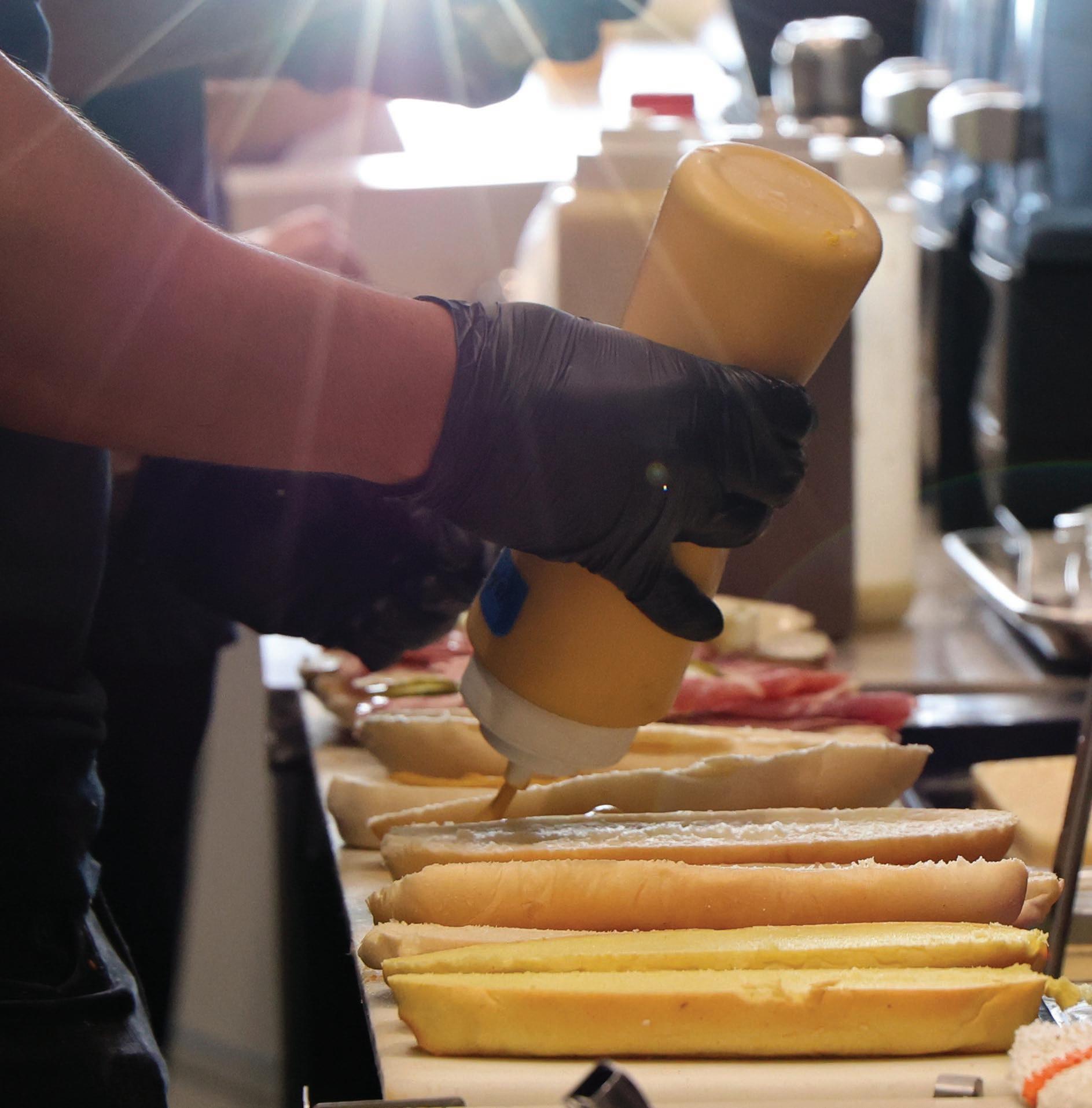
Oct. 9, 2025.
(Delia Rose Sauer/ Atrium Magazine)
her father’s hips as he strolled into the hardware store. He’d place the nuclear-hot styrofoam cup down on the counter, the American owners watching from behind the register. They’d gather, and despite his broken English, coffee was a universal language.
His calloused hands poured the steaming espresso into three little cups, and he slid them toward the owners. And they’d drink together.
Bárbara understands the universal language of food. In Miami, where Venezuelans and Colombians have made the arepa mainstream and thousands of other immigrants have brought their own cuisines, the Cuban sandwich evolves to welcome others into a home, just as her father did.
Bárbara, now a social science education professor at the University of South Florida, co-authored a
book cataloguing the history of the Cuban sandwich called “The Cuban Sandwich: A History in Layers.” Most people believe the sandwich found its start in Tampa or Miami, depending on who you ask. The rivalry between the two cities comes from what actually makes up the sandwich.
The Miami sandwich is what Sanguich defines as the classic: Cuban bread, ham, mojo pork, Swiss cheese, pickles and mustard. In Tampa, there’s one extra ingredient: salami. Yet, the Cuban sandwich is not a product of either city. It truly began in Cuba under a different name, with undefined boundaries of what could be inside — a “mixto.”
Sandwich vendors would roam the streets outside of Cuban factories, mirroring the sales pitch of a classic “manisero,” a peanut salesman.
found herself drowning in research.
that was basically a classic modified
historians theorize that workers would purchase quick sandwiches from salesmen or wander into shops and ask for whatever was fresh.
It wasn’t until Cubans crossed the Straits of Florida, bringing along their lunchtime traditions, that a proper Cubano began to appear in the U.S. during the early 1900s. But as Tampa and Miami argue as to who can claim the modern-day Cubano, Bárbara has seen the sandwich pop up in places beyond Florida.
While working on the book, Bárbara
the interesting habit of pocketing restaurant menus. Inside, she struck gold. The professor had swiped a cafeteria menu from the U.S. Capitol Building, which Bárbara dated to before 1921, that listed a Cuban sandwich for 15 cents. The ingredients inside were unknown.
It’s more than a Cubano, Bárbara believes. From its birth in Cuba to its widespread fame across the country, the sandwich has matched the planet’s ever-evolving tastes. She knows of a South Korean restaurant owner based in Seoul who created a Cubano with kimchi. She recalls eating a sandwich
The sandwich is no longer for native Cubans; on the island today, none of the necessary ingredients are available
Bárbara says. The sandwich belongs to anyone who can recognize the comfort of a
lot of people,” Bárbara says.
when you ate it, where it was
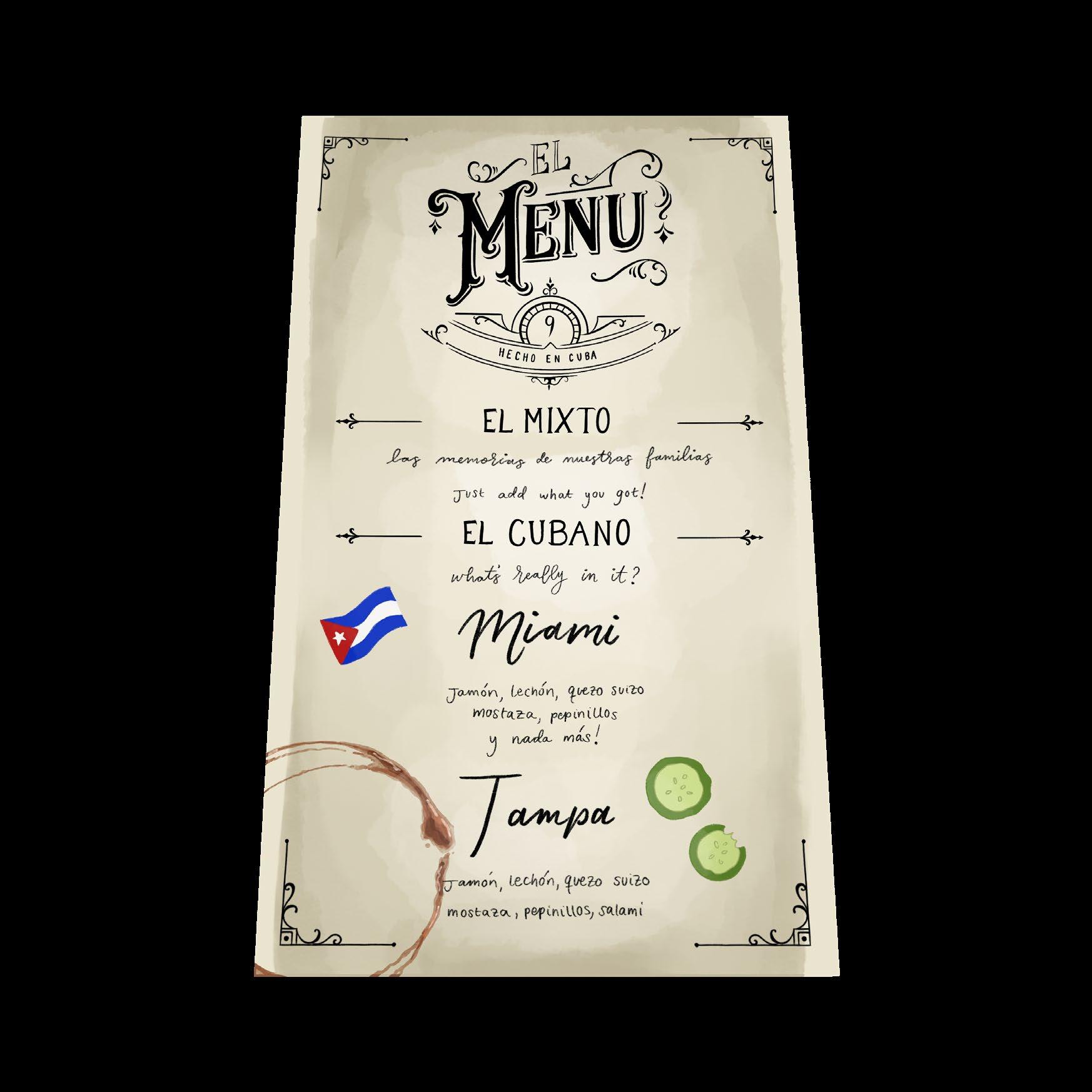
food writer based in Miami, is deeply connected to the Cuban Broward County, where he spent his days in the strip mall where his parents owned a jewelry shop.
order a Cuban sandwich,” his father often asked him. “Make sure that
Knowing the passion behind the sandwich, when he broke into the food reporting scene, he was wary of writing about the famous dish. He finds debates on its origins tiresome,
thing: “It codifies, in a very physical and literal way, the parts of Cuban culture,” he says.
Carlos has found himself sitting down on counters and tables across Miami, ordering the same item: a Cuban sandwich. It encompassed his life. In his quest to review the best sandwiches of the city, he befriended the owner of Versailles, Felipe Valls Jr., arguably the most famous Cuban restaurant in the U.S.
A couple of years ago, he called Valls with a request. He was done pressing one sandwich at a time, and by the time he was ready to eat, his wife and three daughters’ dishes were already
clean. He needed to buy a commercial plancha.
“For what?” Valls asked over the phone.
“For my house,” Carlos said. He was away, somewhere in the Bahamas or Caribbean. Carlos didn’t recall. “I’ll be back in two weeks, and then I’ll look into it,” Valls replied.
Two weeks later, he received a voicemail.
“I’m eating a sandwich that I just made on your press,” Valls said. “Come get it.”
Now, Carlos is a proud owner of a commercial plancha from Versailles, for which he searched for custom metal plates in Hialeah, with a golden name tag, “La Planchita.” He’s made so many Cuban sandwiches at home, he’s convinced his wife is sick of it.
In Latin Cafe 2000, a Cuban chain restaurant in Miami, he orders his usual, a Cubano. As the waitress brings it to his table, asking if he needed anything else, he snaps a picture of the sandwich he’s eaten too many times to count. It’s cut vertically. Not diagonally. He doesn’t seem to care.
He deems the sandwich a love letter to all generations of Cubans. He doesn’t care if the sandwich has salami or not. All that matters is that it represents the familiar flavors that make any Cuban, and any tourist, melt into the next bite. And that it doesn’t have mayo. Or the ridged marks of a panini press. Besides that, most ingredients inside a Cuban sandwich are fair game.
He compares the sandwich to the Beatles. People can experiment, come up with new risks. At the end of the day, you resort to the classic. As Miami shifts away from being predominantly Cuban, he’s witnessed an overlap between cultures fighting for space in the city.
Now, there’s a Florida food culture, where Cubano variations reflect a new clientele. Tinta y Café, a Miami coffee house, serves a sandwich with French mustard and mortadella on a baguette, not Cuban bread. Empanada Harry’s Bakery and Cafe, also based in Miami,
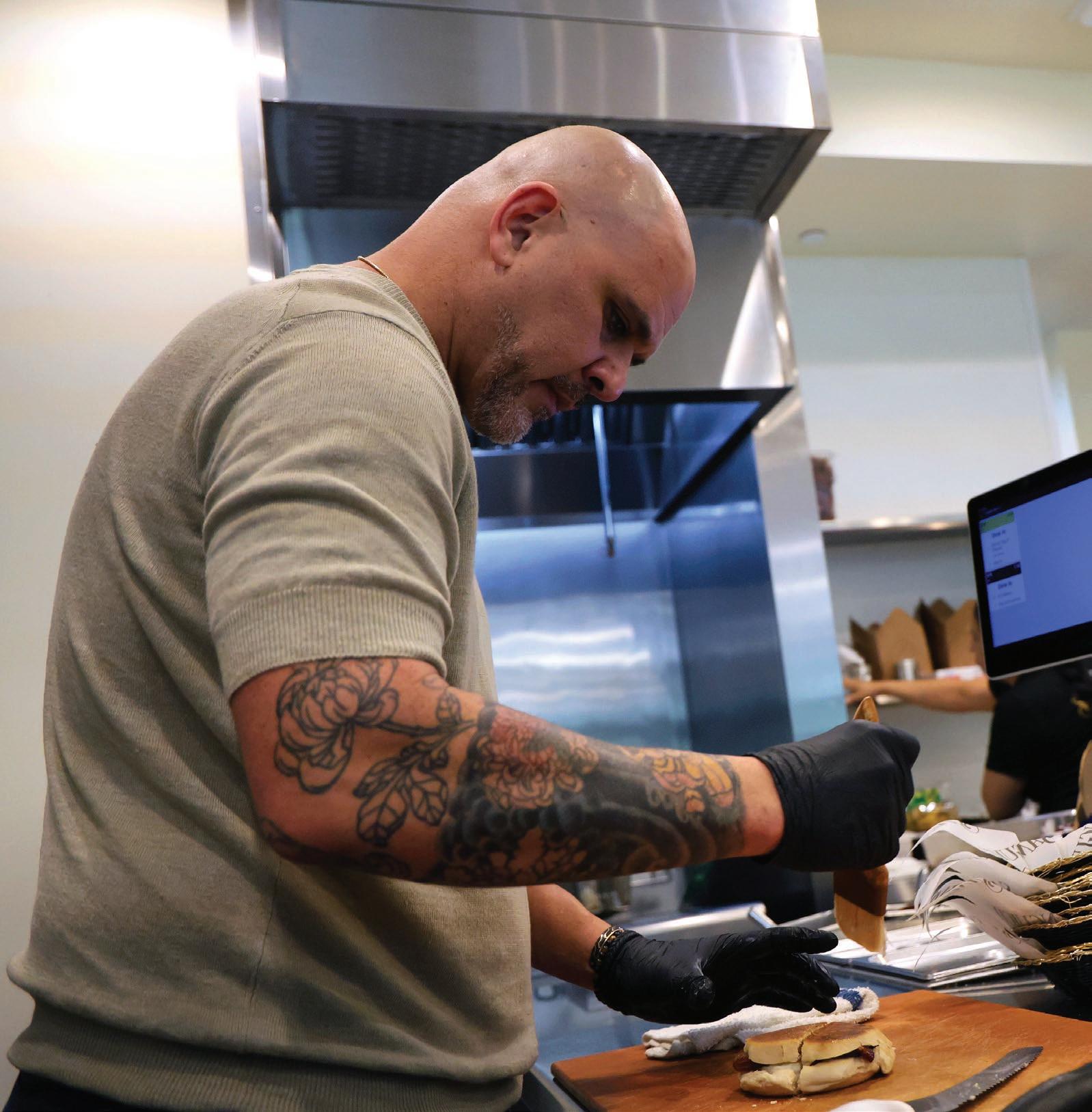
offers a Cuban sandwich empanada. In Jacksonville, an Italian restaurant named after the Spanish painter Pablo Picasso sells a classic Miami Cuban sandwich in a city where around 1% of the population is Cuban.
Inside Sanguich’s Coral Gables location, my mom sips from a tile-white cafecito cup. She offers me a drink. I’ll never decline free coffee. Rosa scurries throughout the restaurant, greeting each table with a grin. She occupies herself by exchanging stories with customers and asking about regulars and their children.
“Are you nervous?” my mom asks me.
“Nah,” I say. I’m ready.
A waitress places a green basket
before me. “Gracias,” my mom and I say together. In a quiet jinx, I take another sip of her espresso as a tax. The branded paper crinkles as I stare down at the sandwich in front of me. Rosa promised Sanguich could make an allergy-friendly Cubano. The bread was brushed with lard, not butter. They skipped the smear of mustard and the twin slices of cheese. Between crispy golden slices of sourdough Cuban bread lies the ham, mojo pork and pickles I’ve spent my whole life hearing about.
My mom sorts through her own sandwich, showing me the crosssection in the same way she used to, no longer from the rearview mirror. “This is a good cross-section,” she says proudly. She loves seeing Cubans succeed. “And there’s no mayo.”
She’s still hung up on the one restaurant I told her about that serves a
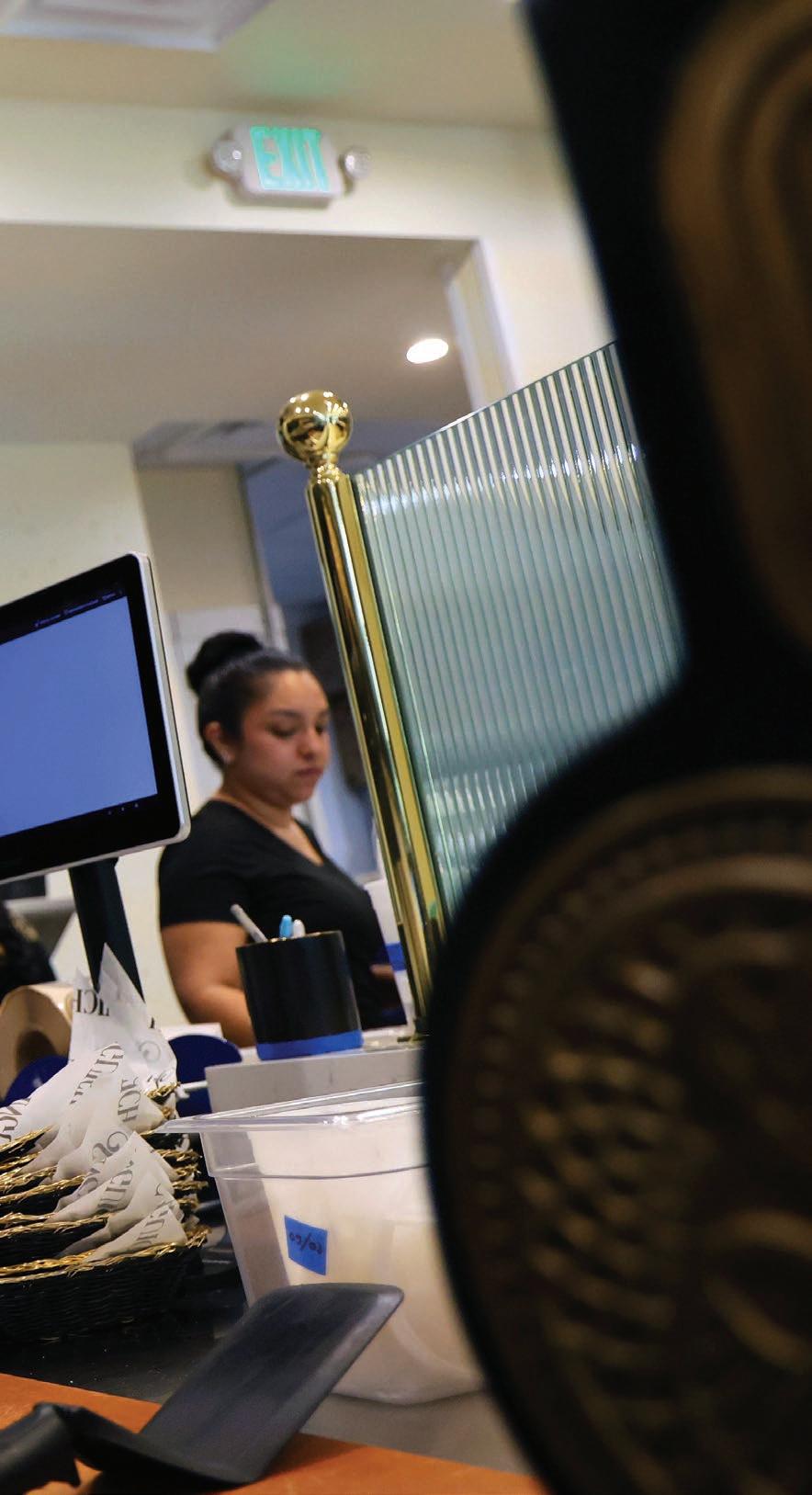
Cubano with mayo.
I laugh as I bring the sandwich to my mouth. The heat from the bread kisses my fingers, and the citrus pierces through my congested nose. Finally, after 21 years of not being able to experience one of the most quintessential Cuban foods, I get to take a bite.
And I finally understand. It clicks why my mother picks out the layers of meat in an overstuffed sandwich. It has to be perfect because the feeling of home is perfect. It connects me to her island, both familiar and unfamiliar. The tang of the pickles cut through the savory pork and ham. The toasted bread adds texture. I didn’t know a sandwich could be that good. I was only ever used to plain white bread and a couple of slices of turkey or ham. I look over at my mom, and she can’t contain her joy. She’s just as excited as
Between crispy golden slices of sourdough Cuban bread lies the ham, mojo pork and pickles I’ve spent my whole life hearing about.
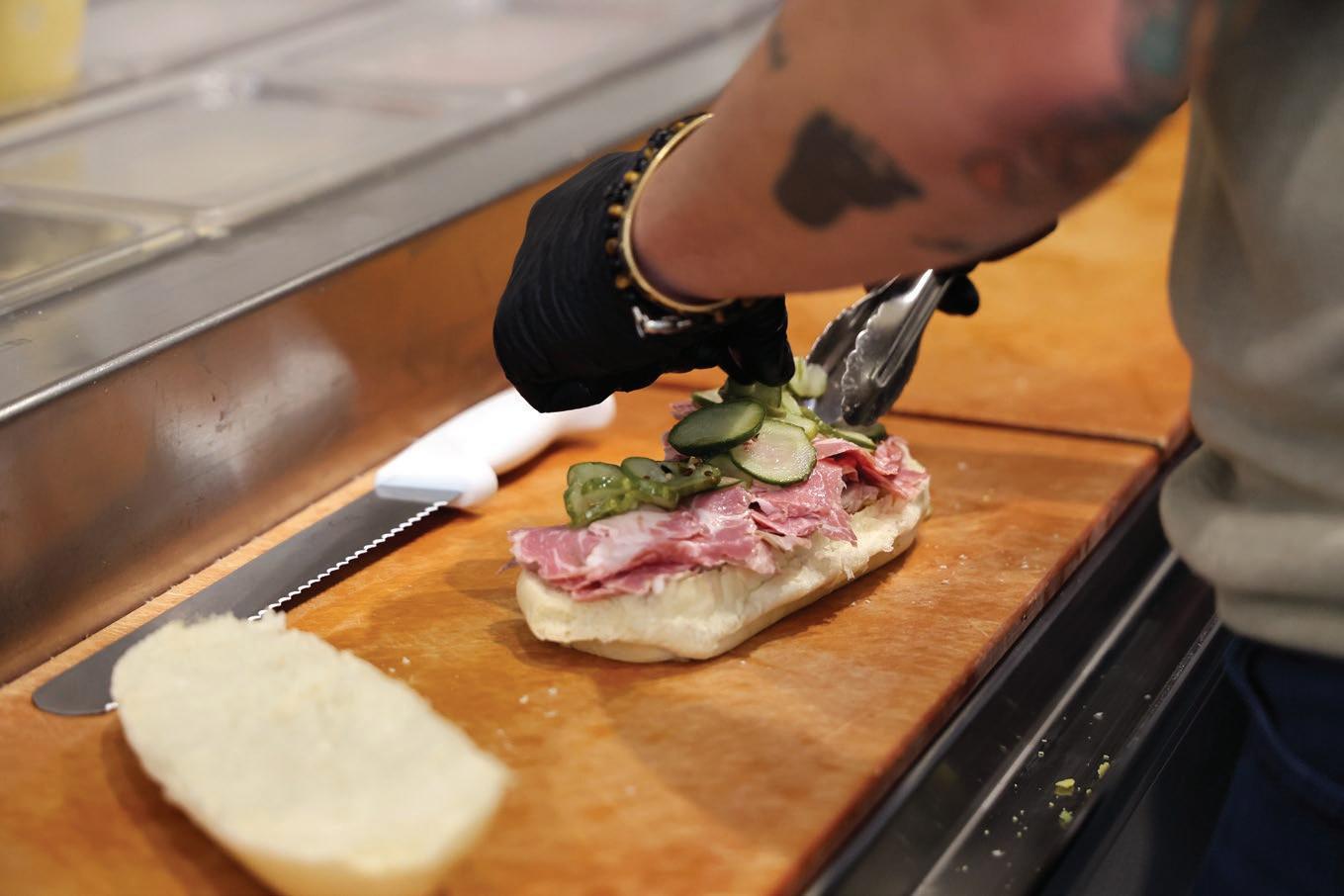
I am.
“What do you think? Is it as good as you expected?” she asks. Her voice is tense, as if she’s waiting for me to be disappointed, as if the sandwich didn’t really mean anything to me.
“Yes,” I tell her. “I love it, mama.”

On a clear September morning, Dylan Fay steps out of his truck and onto a thicket of wild flora. He pulls out a neon-orange vest and throws it over his forest-green T-shirt. He hands me one, too, so passersby in the Etoniah Creek State Forest know we’re there on official business. He leads the way through a short brush toward a family of budding pine trees and starts counting.
The forest is quiet except for the crunch of our footsteps cracking twigs. We inhale the smell of dry leaves and clean air. As Dylan prepares to wrap his measuring tape around a tree trunk, a bird chirps overhead. He peers upward — he thinks he recognizes the call and confirms it using a birding app on his phone. He returns to logging the tree’s measurements on his specially designed forestry tablet.
The work is methodical but freeing. As a state forester, Dylan is accustomed to trekking vast expanses of prickling grass and towering pines, counting the trunks along the way. At 31, it’s his job to take stock of and shape the forest — he plants seeds today that, over decades, will grow into trees.
“I get to spend the day doing what I love, being outdoors,” Dylan says. “And, more generally, I get to not just play in the woods, but I get to shape the forest and manage it for future generations, and hopefully leave it better than I found it.”
story and photos by ALISSA
GARY
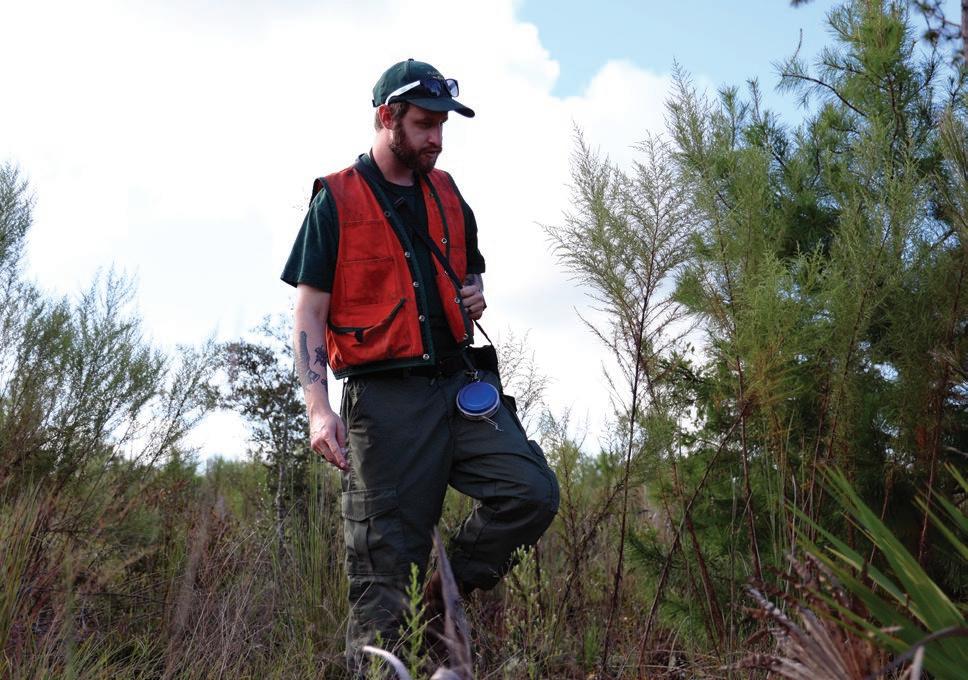
Dylan counts young sand pine trees in Etoniah Creek State Forest in Florahome, Fla., Friday, Sept. 26, 2025. He’s tasked with counting, measuring and managing trees to construct the forests of the future. “It’s more just kind of like you’re flying your own ship,” he says, “but I definitely like it here.” (Alissa Gary/Atrium Magazine)
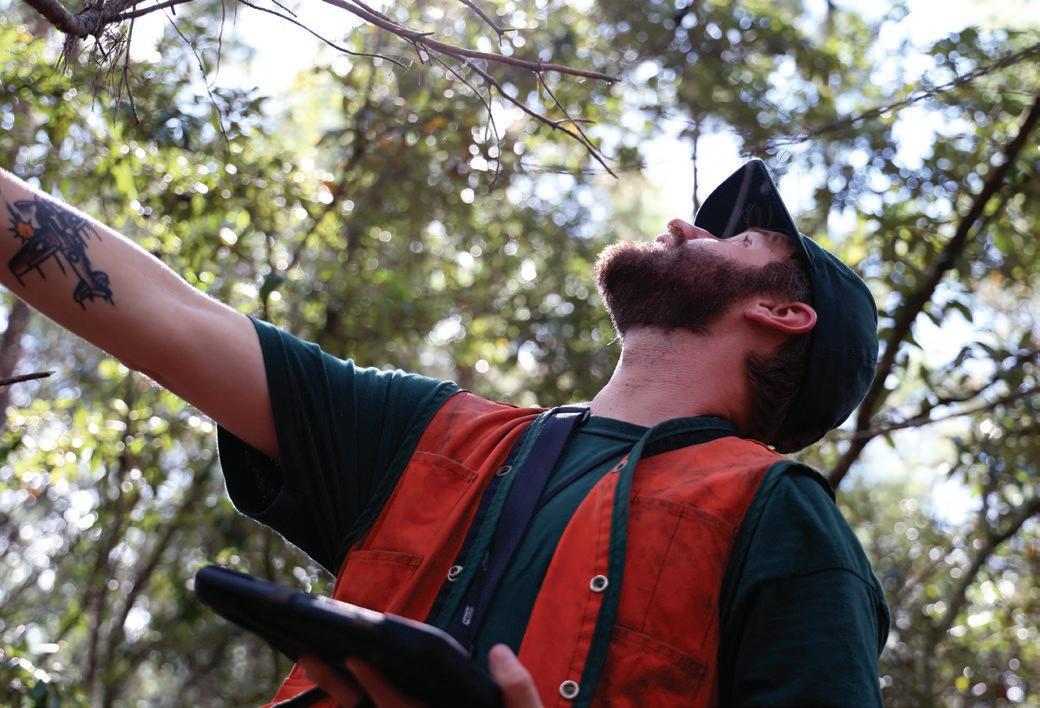
Dylan surveys the height of a tree in Etoniah Creek State Forest in Florahome, Fla., Friday, Sept. 26, 2025. Among his favorite trees is the longleaf pine — “that’s like the default forester answer,” he says. The tree, which is native to Florida, supports wildlife and plays an important role in the forest ecosystem. (Alissa Gary/Atrium Magazine)
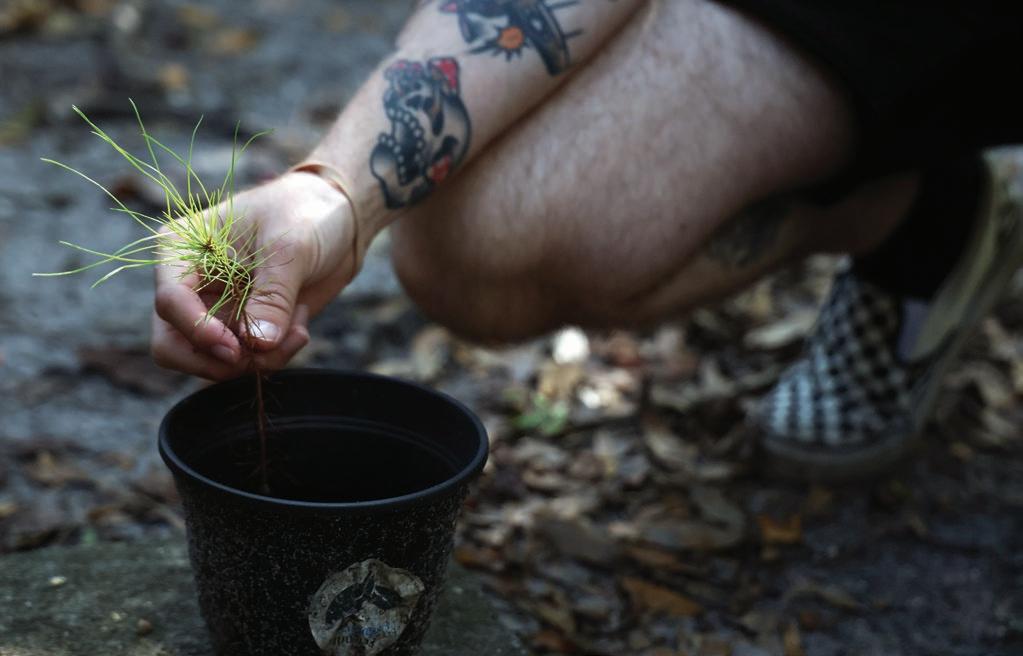
Dylan shows off his “baby” — a pine tree he planted from seed — in his backyard in Gainesville, Fla., Saturday, Oct. 18, 2025. On a cool October afternoon, he rakes leaves in his backyard, where he occasionally raises trees. Crispy, fallen leaves became stuffing for Halloween pumpkin-shaped trash bags that sat near the front door. (Alissa Gary/Atrium Magazine)
Dylan looks out the window in the main office of the Etoniah Creek State Forest in Florahome, Fla., Friday, Sept. 26, 2025. After graduating from the University of Florida, he found freedom in managing the forest. “I just hug trees all day,” Dylan says. (Alissa Gary/Atrium Magazine)
design by ISABEL KRABY
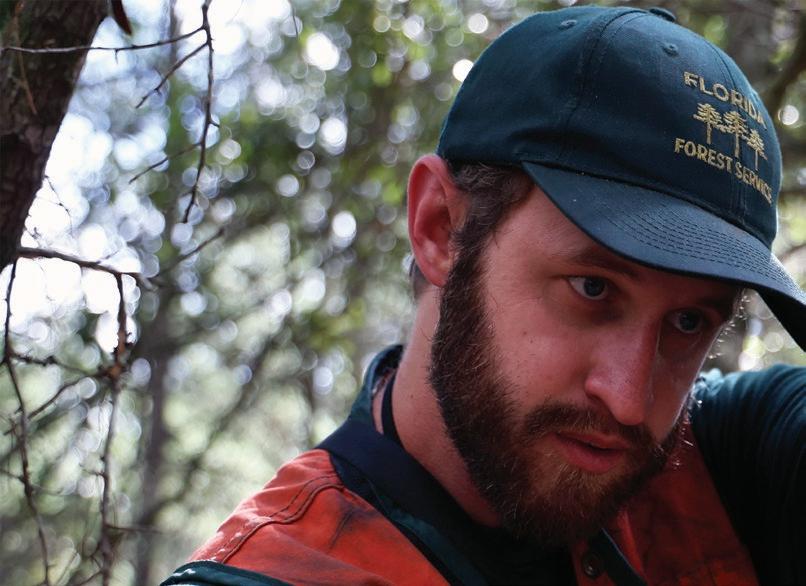
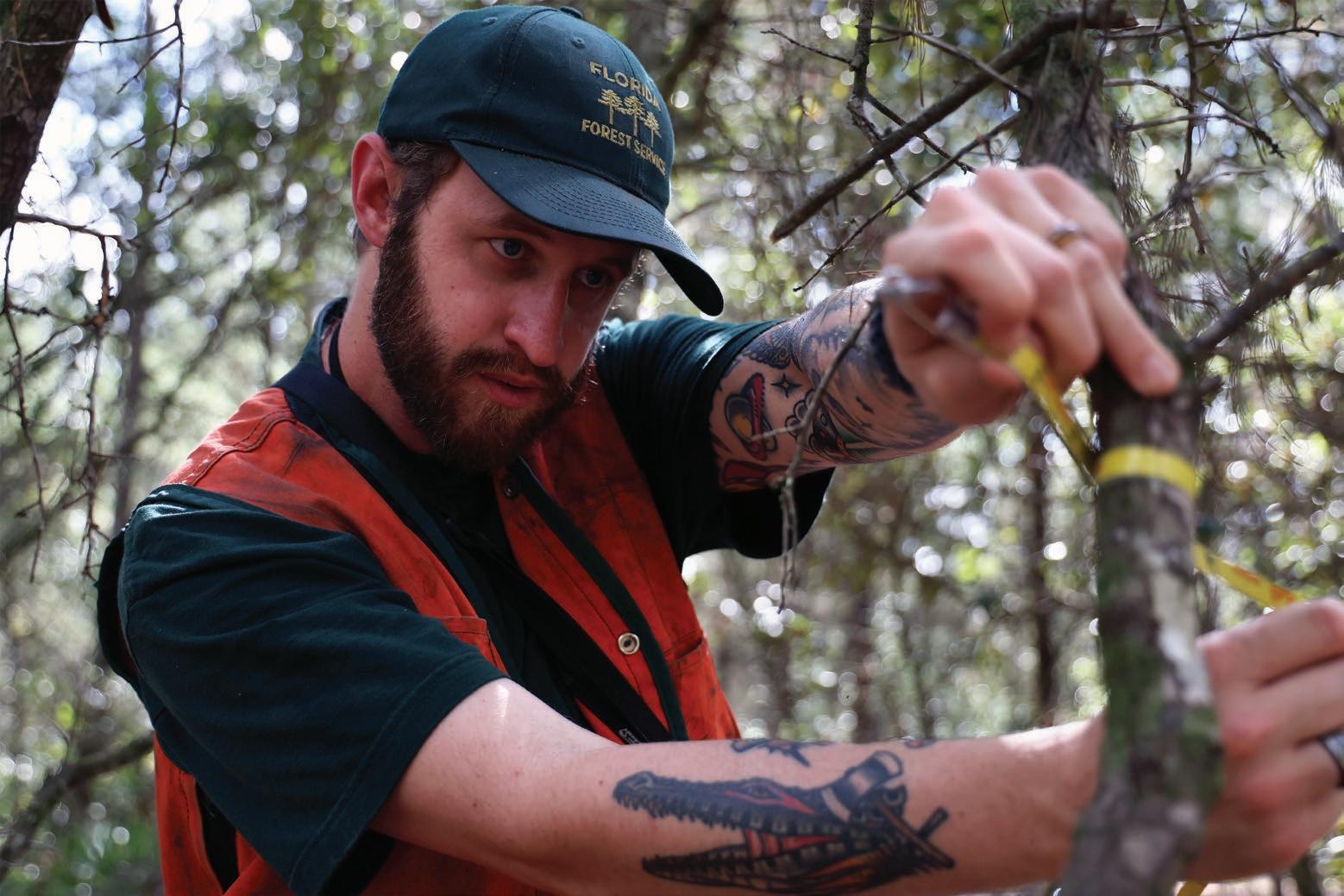
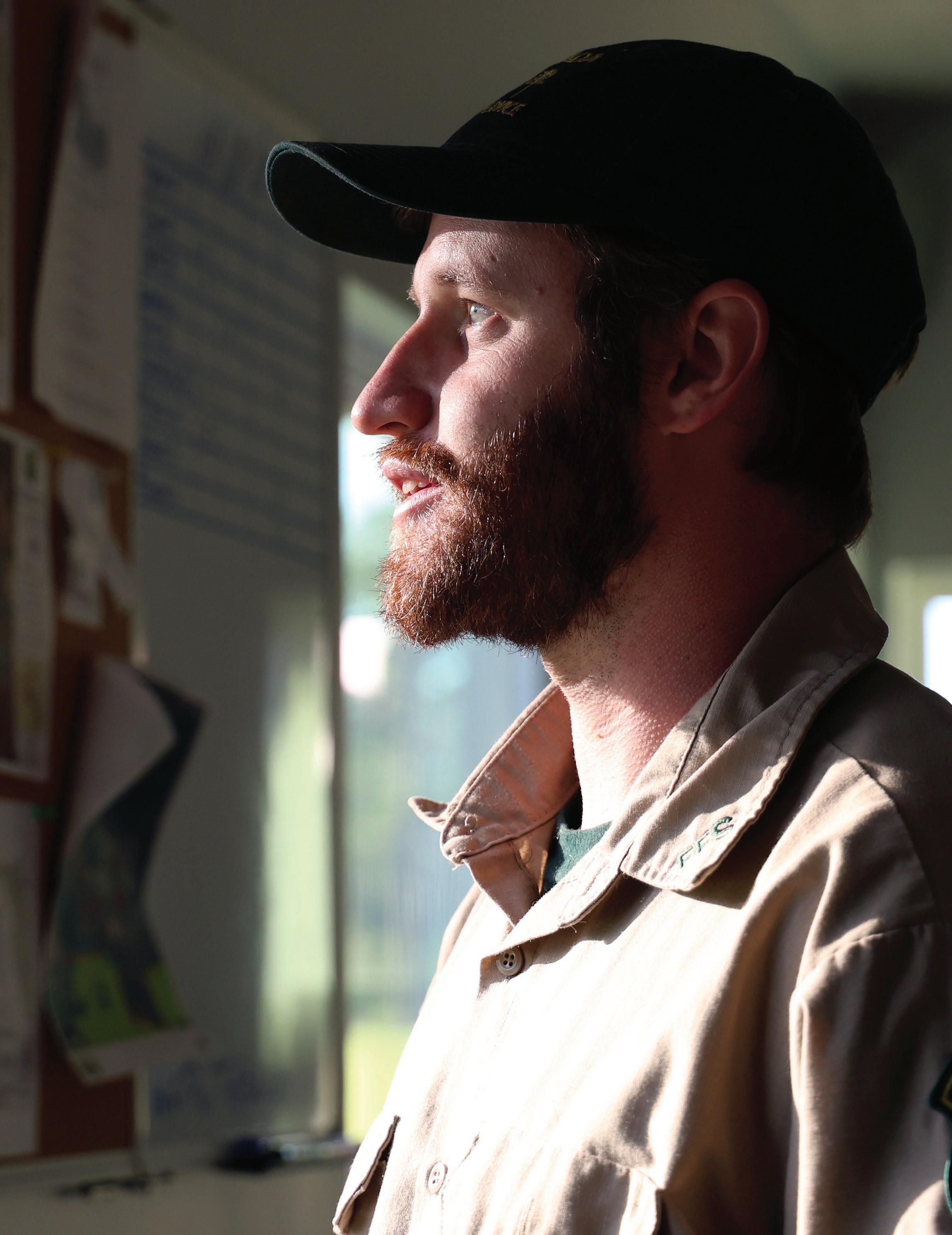
Dylan measures the width of a tree trunk in Etoniah Creek State Forest in Florahome, Fla., Friday, Sept. 26, 2025. Growing up in St. Petersburg, Fla., Dylan didn’t consider himself an outdoorsy person. But he sometimes traveled hours to the nearest parks and forests, piquing his interest in exploring Florida’s wilderness. “I kind of took over the personality of an outdoorsy person, because I’m like, ‘Oh, this is fun. I want to be that person,’” Dylan says. (Alissa Gary/Atrium Magazine)
Saturday, Oct. 18,
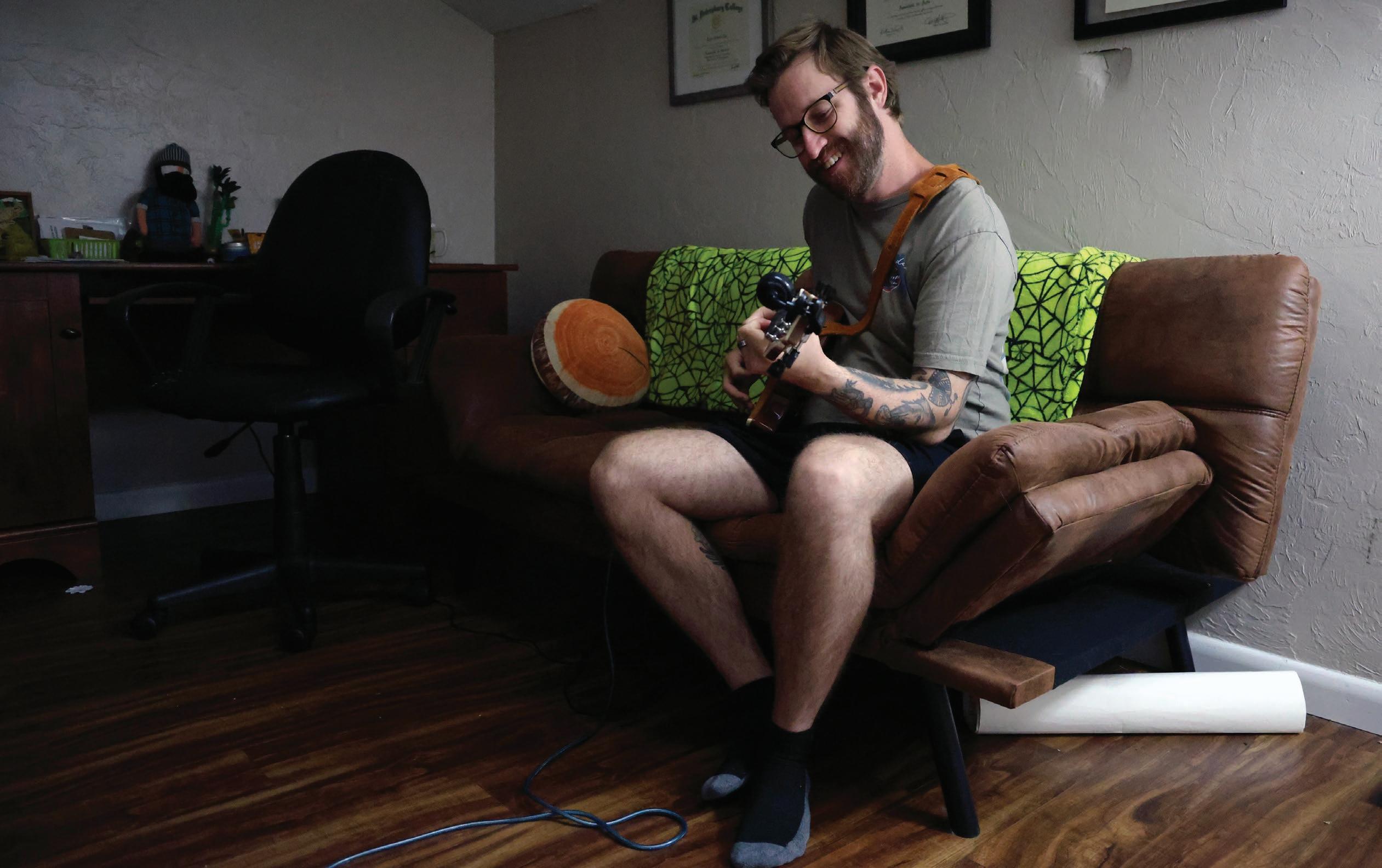
Saturday, Oct. 18,
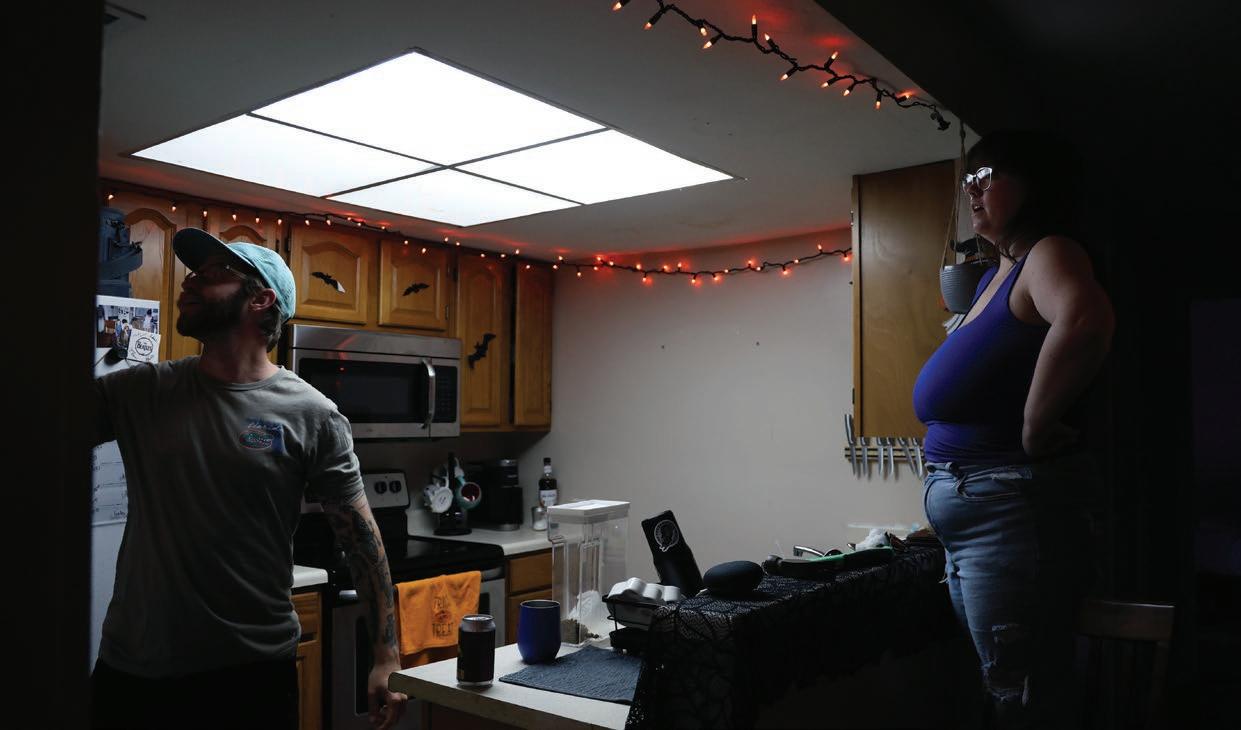
Dylan hangs Halloween-themed string lights on his kitchen wall while his girlfriend, Angela Carten, looks on in Gainesville, Fla., Saturday, Oct. 18, 2025.
The couple met while working at Best Buy, where they sometimes worked overnight shifts together.
After spending time together outside work, the relationship “blossomed from there,” he says.
(Alissa Gary/Atrium Magazine)
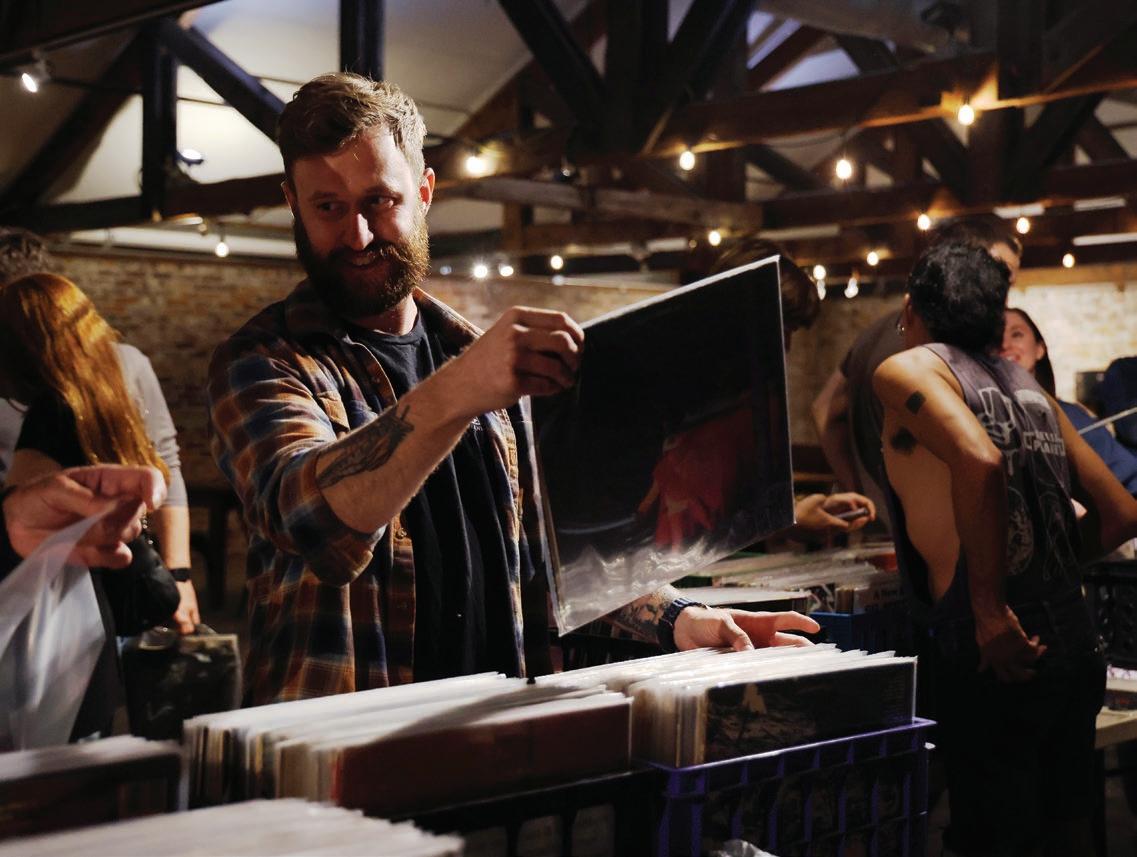
Dylan smiles as he chats with a fellow record-shopper at a vinyl sale at Cypress & Grove Brewing Co. in Gainesville, Fla., Friday, Nov. 21, 2025. Aside from spending his free time outdoors, biking and hiking, Dylan shops for records and enjoys music.
(Alissa Gary/Atrium Magazine)
Dylan browses records at a vinyl sale at Cypress & Grove Brewing Co. in Gainesville, Fla., Friday, Nov. 21, 2025. His long-term goal in life is to “grow roots,” he says. After Angela graduates from college, it matters less where they live than what they want to do with their lives. “Whether it’s recreating or staying at home, I think we want to just do the things that make us happy,” Dylan says. (Alissa Gary/Atrium Magazine)
text by ALISSA GARY design by ISABEL KRABY
Florida is known for its pristine beaches and tourist traps. But the state’s official mascots represent its wild spaces, from native flora and fauna.
Florida’s birds became the subject of controversy this year as state legislators considered replacing the northern mockingbird, the state bird for more than a century, with the flamingo. The scrub jay, Florida’s only endemic bird species, could also become the state songbird.



The black-and-yellow butterfly became a state symbol in 1996 and is often spotted flitting through the Everglades.
Human encroachment has all but extinguished the Florida panther from its home — but state wildlife management works to bring the animals back from the brink of extinction.
As underwater coral colonies fossilize, they become colorful quartz geodes over tens of millions of years, scattered throughout Florida bays and riverbeds.
The orange blossom’s tiny, fragrant white petals have represented Florida and its signature citrus industry since 1909.
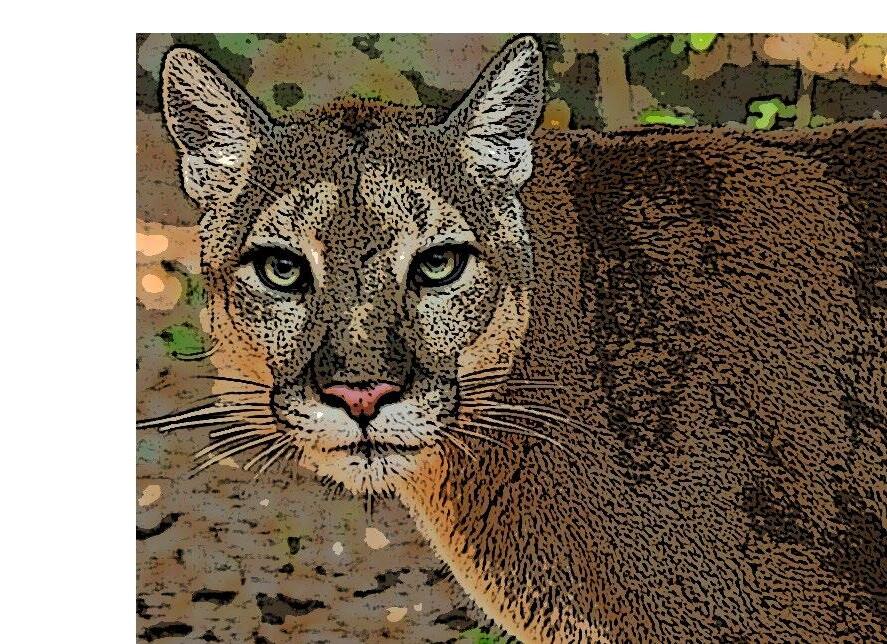

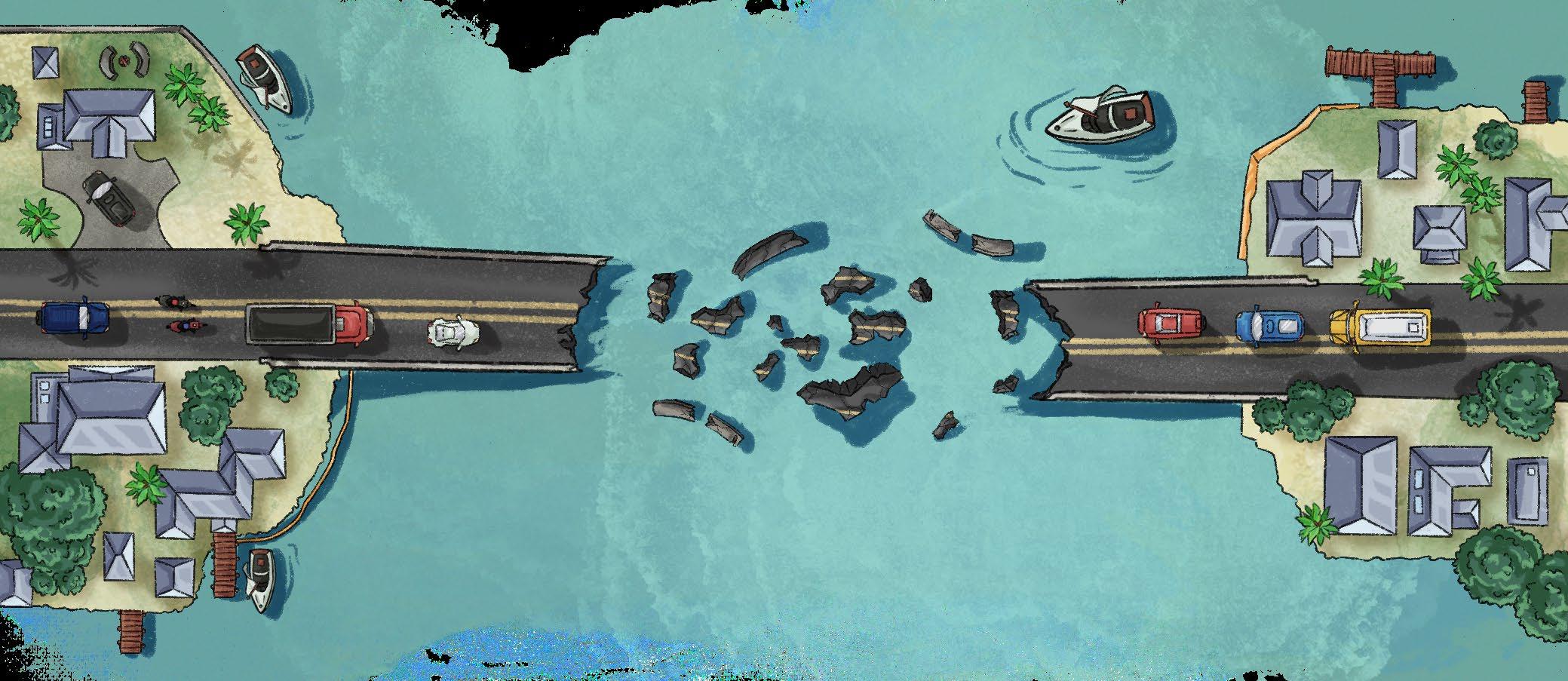
Pine Island relies on one roadway for connection to Florida’s mainland. But when that lone tether is severed, residents are left stranded.
story by AUSTYN BOLIG
photos by MARTA RODRIGUEZ illustration by CHLOE SANTIAGO
Awooden plank bridge once connected Little Pine Island and Big Pine Island, stretching from one edge of land to the next. A part of the sole roadway from the island to peninsular Florida, the bridge served the community from 1927 up to its retirement in 1978. Its unburdened lumber, splintered from decades of service, was purchased by Maurie and Dan Stevens for $500.
Some of the trusses from the wooden bridge still sit on the Stevens’ property, now owned by their grandson, 49-year-old Craig Stevens.
When Hurricane Ian struck the island in 2022, it washed out Pine Island Road, the only roadway off the island. As of December 2025, it is still under construction. When natural
disasters snap the tether, residents are left trapped, and everyday routines turn impossible for months at a time.
Pine Island is Florida’s largest island on the Gulf coast, spanning about four times longer than the Las Vegas strip.
The road to Pine Island crosses over an open grate drawbridge in Matlacha, where car tires sing as plywood signs proclaim: This is where island time begins. It’s regarded as the “fishingest bridge in the world.”
Yet the island is still tiny compared to many of the Gulf’s booming coastal towns. There are a few grocery stores on the island. Traffic is governed by one four-way stop. There are no red lights.
Pine Island’s seclusion complicates everyday tasks. Hurricane season only makes it worse. Staci Stevens, a
45-year-old realtor, has lived on the island for almost two decades. When Hurricane Ian spun its way toward Florida, her husband, Craig, was concerned. As the storm approached, he turned to his wife.
“I have this feeling about this one,” Craig said.
On Sept. 26, 2022, Hurricane Ian churned in the Gulf, and the Stevens and their neighbors prepared for the worst. On the 27th, Lee County issued a mandatory evacuation order. The Stevens weren’t going to leave. Instead, they cracked open their box of camping gear and dug out batterypowered lights for their four children. Staci stocked up on nonperishables in the summer, buying canned goods she usually doesn’t let the kids eat. The family filled up gas tanks in case
design by GABI FRAZER
Pine Island is Florida’s largest island on the Gulf coast, spanning about four times longer than the Las Vegas strip.
the roof blew off the island’s Circle K again.
On the morning of Sept. 28, Staci took a work call on her iPad, her internet connection already unreliable as the storm inched closer. She left her colleagues with a warning and told them they might not hear from her for a week or two.
She let the dogs out into the yard around 11 a.m. Rain pelted the grass as Hurricane Ian arrived.
Staci’s home sat on a small hill on the family’s palm tree farm. Water cascaded down her pasture in a familiar pattern, inundating banana and palm trees with salty water. Their
home was over a mile inland in every direction, but the water surrounded it in waves, swallowing their driveway as it lapped at fenceposts.
“There’s no way that’s water from the bay,” she murmured.
Craig knew the pattern like the back of his hand, but it was never this close.
“It’s 100% from the bay,” he said.
The water receded before it reached the palms near their front porch, easing the family’s fears. When the Stevens woke up the next morning, Pine Island’s streets had become highways for side-by-sides, all-terrain vehicles with two rows of seats and a roof, well-suited to drive over uneven terrain and washed-out roads. The drivers on the side-by-sides carried news. “The bridge is down,” they warned.
Even with an influx of supplies, such as clean water and energy bars, the Stevens struggled to decide what to do with Craig’s parents.
With no road off the island, there was no reliable access to emergency services.
Craig’s parents, along with other vulnerable residents, were evacuated to the mainland. Some left by boat, while others were airlifted.
Residents took a bus from the Stevens’ marina to the airfield. As they waited in the shade of the marina’s porch, they grew restless with no electricity or reliable cell signal, rattling off the same few questions.
“When can I leave?”
“I don’t know. When the bus gets here,” Staci responded.
“When’s that going to be?”
“I don’t know.”
“I need to call my son or my daughter.”
“You can try,” Staci lamented. “But I can’t guarantee that you’ll get a hold of anybody.”
“Where am I going?”
“I don’t really know,” Staci said.
Staci’s younger children, Finn, 13, and Marina, 9, helped sort supplies as more resources arrived by boat. They snuck oatmeal cream pies with neighborhood kids during a day’s work. Organizations like World Central Kitchen handed out hot meals daily, often pulled pork, for almost six months.
A temporary bridge was installed a week and a half after the storm. But it wasn’t a permanent solution. Coastal bridges are difficult to navigate, especially when they’re temporary.
When understanding how bridges withstand hurricanes, Jennifer Bridge,
Staci Stevens emphatically retells a story at her family’s marina in St. James City, Fla., Sunday, Oct. 26, 2025. (Marta Rodriguez/Atrium Magazine)
an aptly named civil and coastal engineering professor at the University of Florida, always asks, “Is it a one in 700-year storm or is it a one in 1,500year storm?” Risk assessment is crucial in designing bridges, but the stronger the structure, the more expensive it becomes.
For islands like Pine Island, the cost of building a new bridge for a one-in10,000-year storm may not be worth it, even as engineers consider building codes and coastal phenomena like salt in the air, or scour, when water erodes sand around an object.
“Were the bridges under-designed?” Jennifer asked. “Not necessarily.”
Bridges are designed to withstand certain loads, Jennifer said. When the structure is tested to its limit, engineers deem it a design-level event, like Hurricane Ian. And with such an event, there can be issues.
By July 2024, the island’s severed tether remained a problem. Construction of a new bridge in Matlacha reduced traffic to a single
lane shared by both directions. Residents were told the reduction would only last four months. It lasted nearly a year.
The bottleneck exacerbated the island’s seclusion. Cars took two hours to cross the bridge. Nothing wider than 12 feet could traverse the roadway, so residents who tried to replace their mobile homes couldn’t receive them.
The bridge opened up to two lanes in April 2025. The construction on Pine Island’s new multimillion-dollar bridge is ongoing, but the Florida Department of Transportation told residents the new bridge will be able to withstand “storm surges from a Hurricane Ian-level event.”
Even severed from the mainland, the Stevens fared relatively well after Ian. Other residents couldn’t say the same. Harold Haskins, 79, and his wife, Agnes, 74, moved into a double-
wide on a canal in Pine Island Cove, a 55-and-over mobile home park, after moving from up north 21 years ago. While the island has no beaches, it has waterfront properties, like the lot
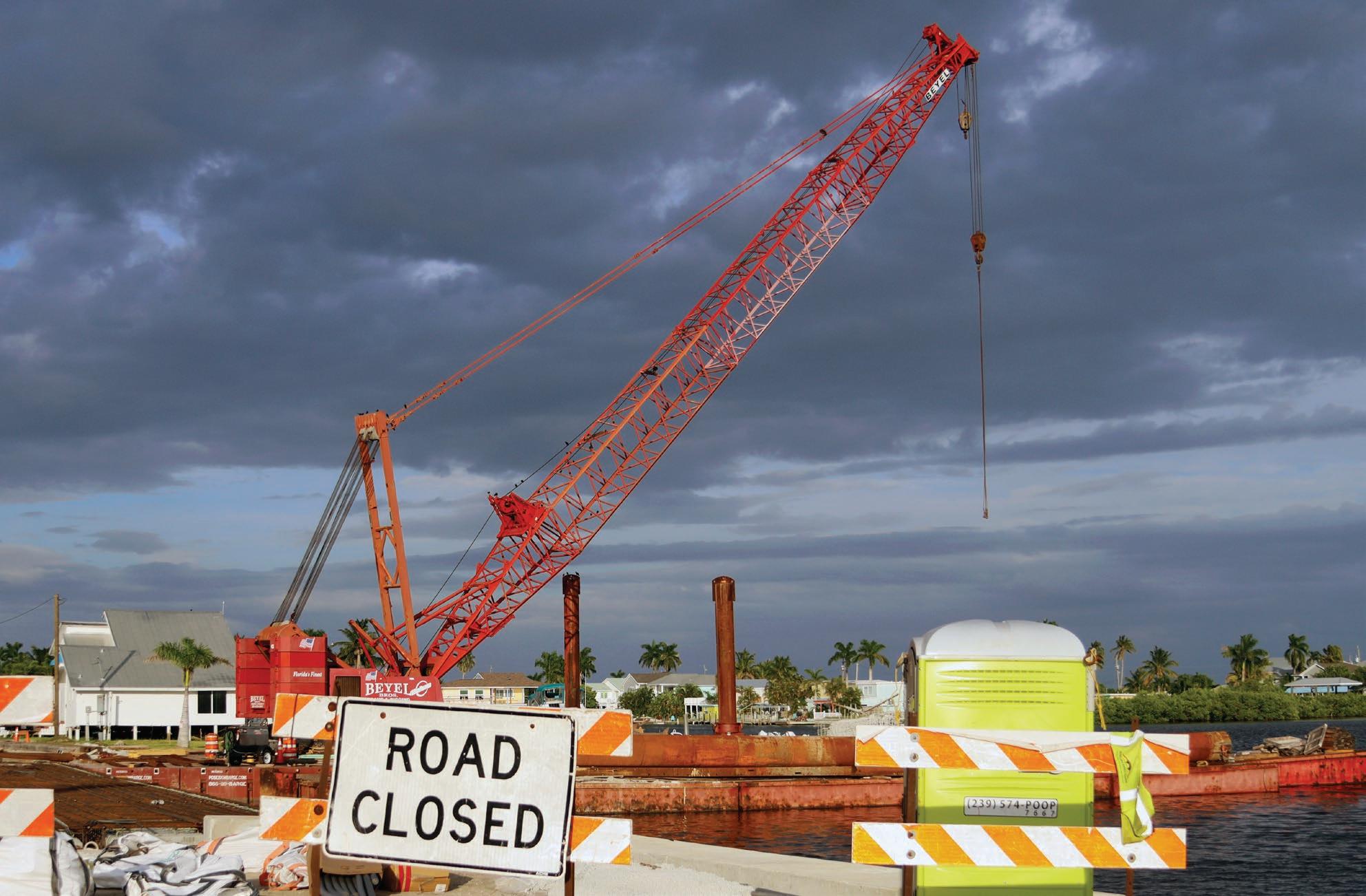
Construction continues on a bridge in Matlacha, Fla., Sunday, Oct. 26, 2025. (Marta Rodriguez/Atrium Magazine)
Harold lives on. When he bought the house, his neighbors said the water hadn’t reached their home in over 50 years.
Before the storm, Harold called the Holiday Inn in Cape Coral to book a room. The couple scrambled, gathering up paperwork and jewelry before they hit the road.
The bridge’s deterioration meant Harold and Agnes couldn’t return home for 10 days, he said. In the meantime, three feet of water had seeped into their home, soaking everything inside. The storm had peeled the roof off like a tin can. In the days they waited to return, mold had festered in the home Harold once loved. Defeated, the Haskins returned to a friend’s home in Cape Coral, where they lived for a few weeks.
Eager for a home, the couple searched for a new mobile home and were told they’d have to wait a year. They opted to rebuild their trailer instead, renting a mobile home on
the mainland for $2,000 a month while remodeling. Thirteen months and $200,000 later, his trailer in Pine Island Cove was livable.
He remembers the kindness of the community that helped him while he worked on his house. People stopped by with sandwiches, water and Gatorade.
“I was surprised, really, at how many people were trying to help us,” Harold said.
The storm’s woes persisted after his home was repaired. With traffic backed up from Matlacha to Burnt Store Road, a distance of over two miles, Harold sat in his car with nothing to do but swear as he waited to cross the only single-lane bridge that could take him home. Sometimes, he’d wait up to an hour.
Some residents were fortunate to return to the island before the bridge was resurrected.
Larry Jinks, 58, took all the normal precautions leading up to the
hurricane, but sandbags weren’t enough to keep the church he pastored from being flooded.
Larry moved to Pine Island 15 years ago to become the pastor at First Baptist Church of St. James City. He has his modus operandi for hurricane season — stacking sandbags and moving furniture inside to batten down the hatches.
“We’ll do what we can, and we’ll come back in a day or two and resume life,” he remembered thinking.
Larry and his wife, Gina, didn’t expect to evacuate until the forecast shifted with Pine Island in Ian’s sights, so they decided to stay in Fort Myers with a friend.
Larry rushed back to the island after the storm, preparing the church as a center for aid while Gina stayed on the mainland. Larry couldn’t cross either bridge, so a fisherman took him across the water.
The fisherman navigated as Larry sat on an ice chest, wind striking his
Residents were told the reduction would only last four months. It lasted nearly a year.

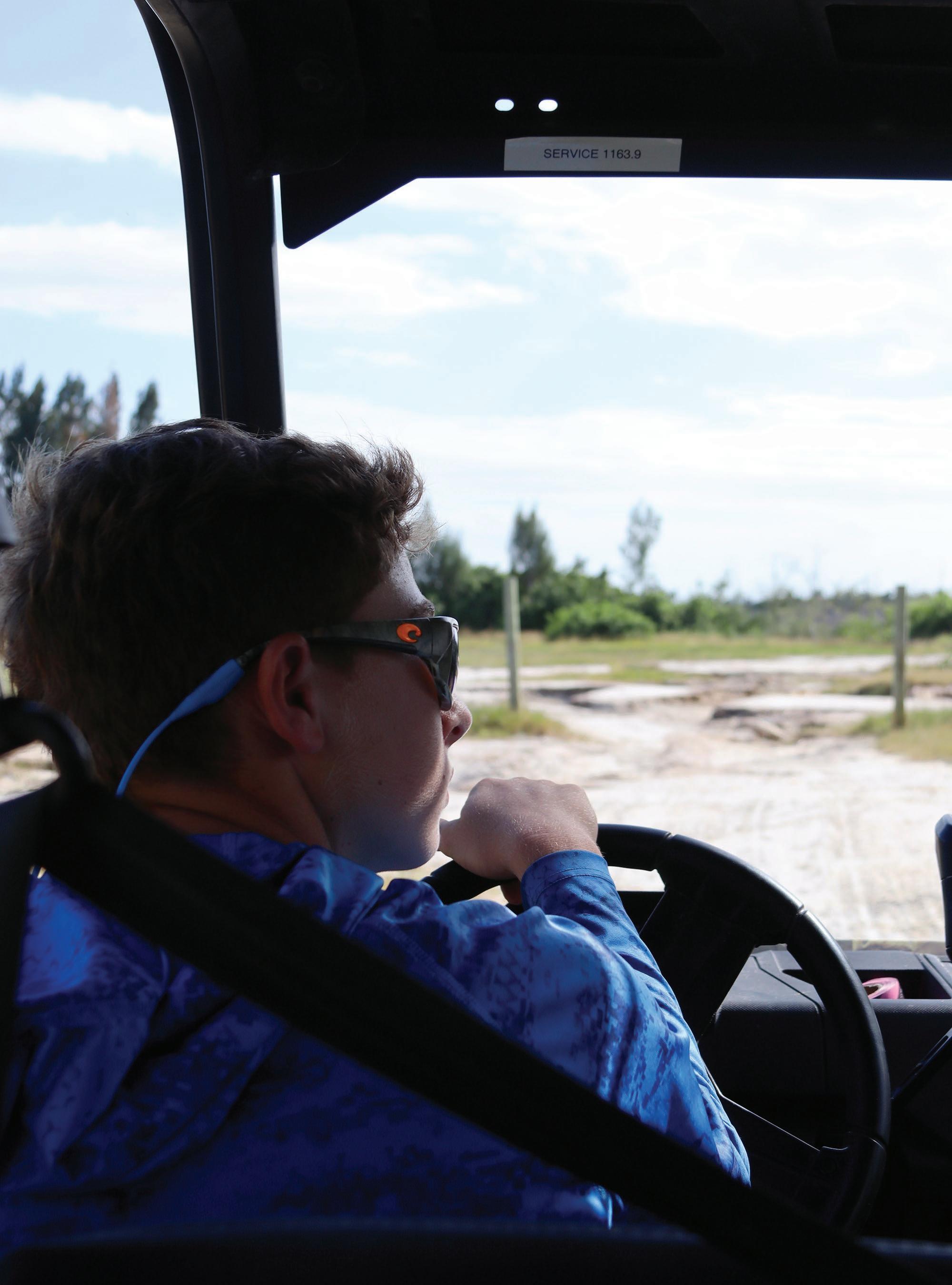
face as the motor hummed. He faced forward, collapsed buildings and washed-away roads passing in his periphery.
“This can’t be real,” Larry thought. The boat docked at what was left of the Yucatan Waterfront Tiki Bar & Grill on the island. As Larry disembarked, he watched people mill about, unsure what to make of the chaos as they exchanged bewildered expressions.
Ian had not spared the First Baptist Church of St. James City. A $1 million yacht rested in the middle of the street. The church’s windows were shattered. The cars in the parking lot had taken on three feet of water, and the building had flooded. Most of the picnic tables
under the church’s pavilion were washed away.
The building’s tile floors survived, unlike its drywall or outlets. Storm surge had tousled rows of pews and soaked the piano.
Four streets south of the church’s destruction, Larry’s home shared a similar fate. It was inundated by five feet of water. As he took it all in, Larry’s new reality felt nightmarish.
He held a service in the parking lot the next day, amid the rubble. Around a dozen residents prayed together and sang the hymn, “Because He Lives,” as an American flag flapped in the breeze.
With his home, church and vehicles all flooded, Larry had nowhere to sleep. A local pastor friend lent him a
Finn Stevens drives a side-by-side down a dirt road on his parents’ palm tree farm in St. James City, Fla., Sunday, Oct. 26, 2025. (Marta Rodriguez/Atrium Magazine)
car to sleep in for a few nights.
The sanctuary was clean enough to be used as storage for incoming supplies a week and a half after the storm. Bottles of water were mounded up in a corner next to diapers and hygiene items. By early October, Lee County and FEMA parked trailers at the church with laundry machines, bathrooms and showers for the community.
“We got everything that we needed, when we needed it,” Larry said.
Thanks to videos Larry and his wife posted to Facebook, people from as far as Canada and Arizona slept on cots in the church’s social hall to help Larry rebuild. For the next four to five months, the church met outside under a pavilion, only missing a few Sunday services when the site was used to hand out aid.
Five feet of water burst into Larry’s home on the island, so he raised it seven feet. He hopes to do the same for the church. It’s estimated to cost $700,000 to raise the building, and a campaign Larry began in February 2025 has raised over half of that.
Three years after the hurricane, life on Pine Island has found a new normal. New faces mill around town, Staci Stevens’ kids still won’t eat pulled pork, some residents still live out of RVs and much of the island’s mangroves are missing leaves.
Finn Stevens’ biggest problem is the same as most other 13-year-olds.
As he drove a side-by-side down a dirt road, Finn peered at his mom through his camouflage Costa sunglasses. “Do I have to go to school tomorrow?” he asked.
“Yes,” Staci answered immediately.
as a beaming Florida sun reheats a chilly winter morning, the reptiles at Gatorland Orlando sunbathe throughout the park.
Savannah Boan, their platinum blonde leader, struts down the elevated boardwalks in gator skin boots, summoning them as an owner would a puppy.
“Hey, Bungee!” Savannah calls. “Hey, come here.”
A 9-foot-long American alligator dismounts from his sun spot and waddles through shallow water toward
Prairie Preserve State Park.
Not all Florida alligators end up as lucky as Bungee, fed by conservationists in an enclosure. Wild alligators hear the clanking metal of hooks and harpoons as often as awed gasps. The animals are at the mercy of state regulators, hunters and conservationists who hold conflicting ideas about how to make the animals most profitable.
What was once a simple process
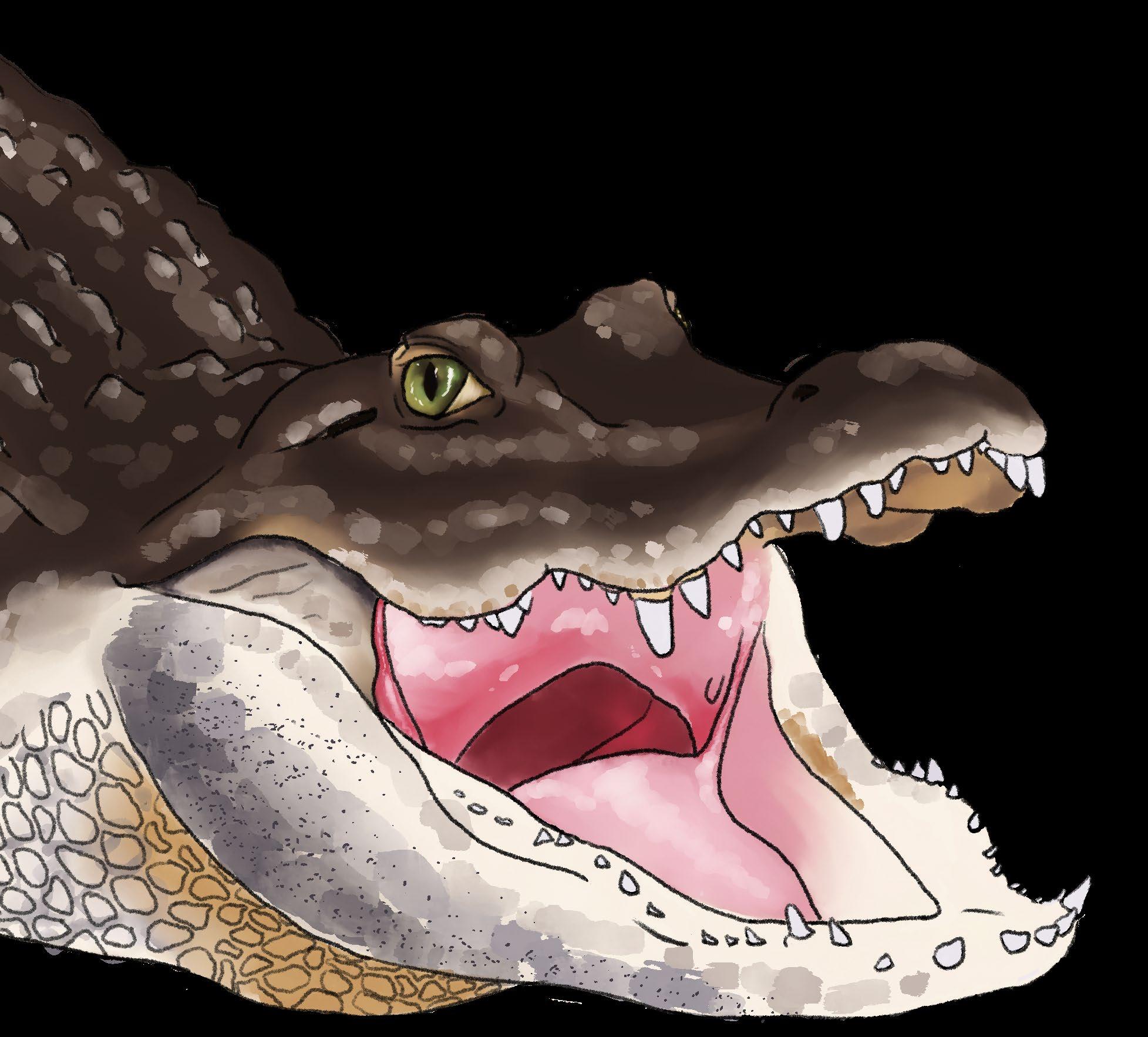
In April 2025, Ron Sanderson was alerted to photos of an alligator living near Paynes Prairie’s busy pier in Gainesville, Florida, circulating on Facebook. Hours later, Kim Titterington called.
“Hey, have you heard about this alligator out at Paynes Prairie?” asked Kim, a reptile rehabilitator known as “Swamp Girl.”
“You know, somebody just called me about it,” Ron said.
“Well, I’m in town,” Kim said. “I’m going to go look.”
Ron, 64, receives calls about alligators almost every day. He’s licensed to trap alligators through Florida’s Statewide Nuisance Alligator Program and caught more than 200 alligators in 2025. Trappers are only allowed to catch alligators deemed a “nuisance” by the Florida Fish and Wildlife Commission, although the line between nuisance and naturally existing is blurred.
Ron had ample experience with nuisance alligators in Paynes Prairie, a preserve overflowing with people who toss scraps at the alligators, unaware it’s a death sentence. Once gators associate humans with food, they lose their instinctive fear of predators. They wander into human paths, and that’s when Ron starts receiving calls. As he
puts it, “a fed gator is a dead gator.”
Ron and Kim ventured to meet the alligator dominating their social media feeds. There, they met Bungee, a rope coiled tightly around his top jaw. Despite his impairment, the alligator caught a turtle and ate it with surprising dexterity. Ron figured the rope would eventually wear down and fall off, so they left.
About two months later, the rope never loosened. Calls kept coming, now from Paynes Prairie leadership, reporting Bungee as an official nuisance, accompanied with a permit to catch him. It was go time.
Ron and three other trappers drove along the long, skinny highway splitting Paynes Prairie in half, flanked by marshy land as far as the eye can see. They pulled the truck and pullbehind trailer into a balding grass patch.
He knew Bungee wouldn’t be an easy catch. Standing on a pier suspended above the water, he was too high to reel the alligator into safety.
Although Ron witnessed Bungee gorging on a turtle, he guessed parkgoers lacked faith in him and fed him pity picnic scraps. He threw peanutbutter-stuffed pretzels in the water to test his theory, and Bungee bit. Ron threw a rope down, but Bungee — a practiced escape artist — slashed in
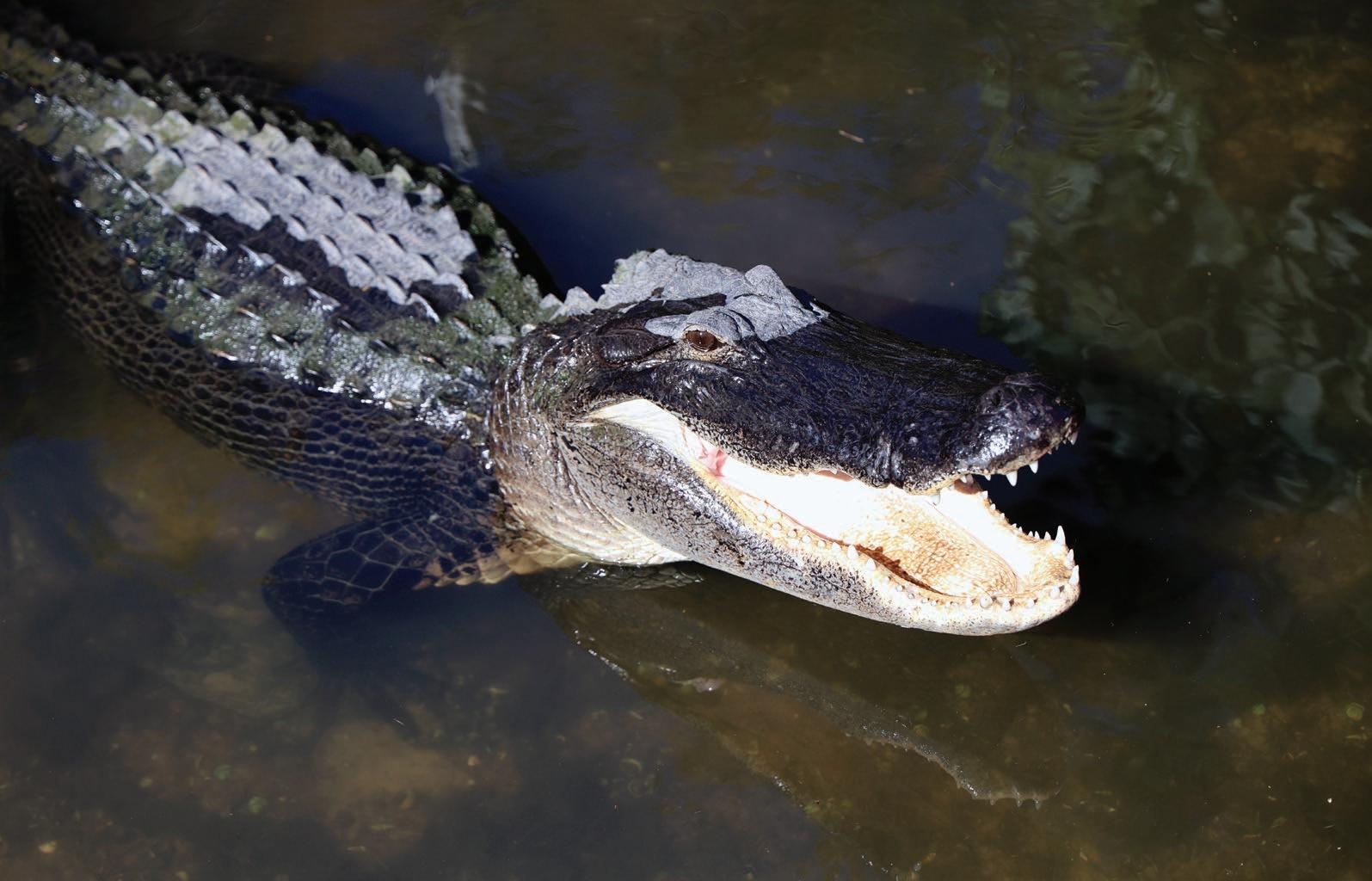
the water and slid away.
The team returned the next day, armed with treble hooks, or threepronged hooks that latch onto the alligator’s thick skin. It took three treble hooks, but Ron finally hoisted Bungee from the shallow waters.
They removed the hooks and freed his top jaw. Ron inspected the culprit: not a rope, but a bungee cord cinched so tightly it left half-inch indentations along the alligator’s jaw. It could
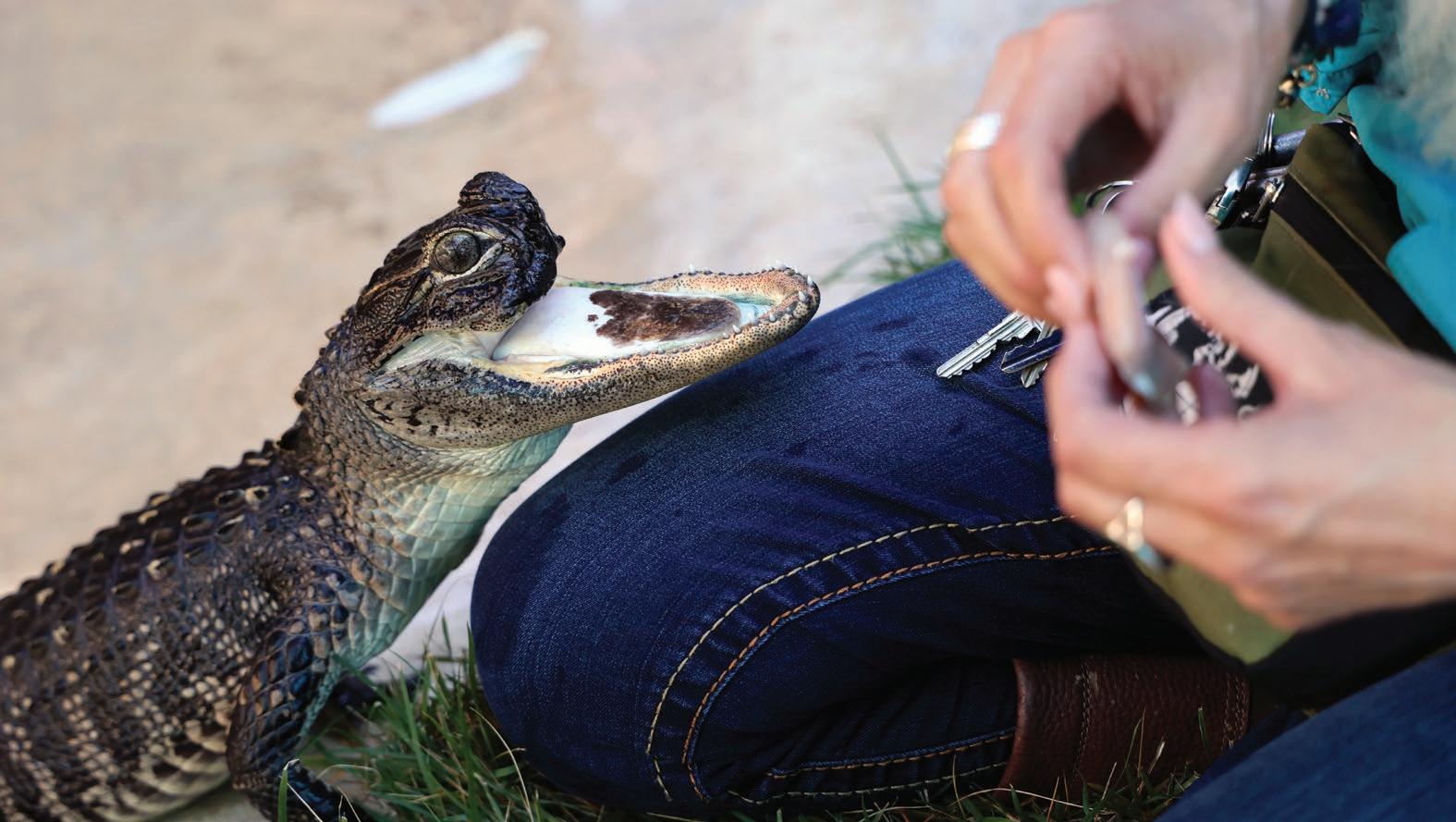
have cut off his circulation if they had waited longer. The team taped his mouth, and Ron kept a piece of the bungee, which now hangs on the dashboard of his black pickup truck.
The trappers loaded Bungee into the pull-behind trailer, which already held four other alligators caught that day. On the phone, Ron dialed Savannah Boan, a crocodilian enrichment coordinator and handler at Gatorland.
“Do you want it?” Ron asked. “You know he’s under 10 feet, but this is a really cool story.”
Gatorland typically rescues alligators 10 feet and longer, Ron says.
“I’m in,” Savannah said.
Gatorland doesn’t back down from a challenge. Jawlene, a 4-and-somechange-foot alligator who is missing her top jaw, is one of the park’s shining stars. Known as the “Alligator Capital of the World,” Gatorland is home to more than 2,000 alligators and a highly trained team to care for them all. Ron knew Bungee would be right at home. Ron met Savannah outside Gatorland, about a 2-hour drive from Bungee’s former home in Alachua County. A team of staff trailed behind
as Florida’s population swells and its waterways attract tourists and developers, people forget alligators are the original Floridians.
her, tasked with filming the transfer for Gatorland’s YouTube subscribers.
They unlocked the hatch of Ron’s trailer. A staff member dragged an eager Bungee out by his tail, placing him on the asphalt. He hurled a hiss through his jaw tape at the team who saved his life.
It took six men and Savannah to corral Bungee. Together, they carried him to the shore of his new home in the ponds of Gatorland, careful to avoid his sharp claws. Savannah straddled his back, and a veterinarian inspected the damage to Bungee’s jaw, concluding it would heal on its own. The team scrubbed him down with a disinfectant and unwrapped the tape from his jaw.
“Alright, Bungee,” Savannah exclaimed. “Go out and get ‘em, man.”
Bungee launched into the water, blending in with the gaggle of alligators if not for his scarred jaw.
In a sea of khaki at Gatorland, Savannah is impossible to miss, with
lime-green eyeshadow, swinging pigtails and a voice that echoes across the park. The alligators noticed her within the first week she arrived in 2016.
“When I first started working here, there weren’t any females that were working with the big crocs and alligators,” Savannah recalls. “So they would not acknowledge me at all.”
But Savannah didn’t care. She hadn’t applied to Gatorland for seven years to be discouraged by a little alligator misogyny.
“I talked like a man,” Savannah says. “I lowered my voice, and then they started paying attention.”
Eventually, she spoke in her typical octave as her bonds with the animals grew stronger. Now, she has a litter of pond puppies she can beckon with her call.
Savannah can pick her favorite gators out of the crowd — and so can her loyal YouTube fanbase of more than 800,000 subscribers. Her
connection to crocodylia enamors audiences worldwide, with even fans from Germany making a trip in hopes of laying eyes on their favorite alligators beyond the screen.
Some videos feature alligators choosing Savannah’s lunch; others capture thrilling rescue missions scattered with alligator facts. The millions of views she garners funnel dollars that go toward Gatorland Global, the conservation leg of the theme park founded in 2018.
Cuban crocodiles were the first success of the Gatorland Global project. Before Savannah began working for the nonprofit, she flew to Cuba, not a lick of Spanish in her repertoire, to find the endangered species. She roamed through towns on a mission to find anyone who studied the reptile. Now, Ricardo and his girlfriend Chainsaw, two Cuban crocodiles, live at Gatorland. Ricardo is one of Savannah’s favorites.
“I think he’s got one of the best
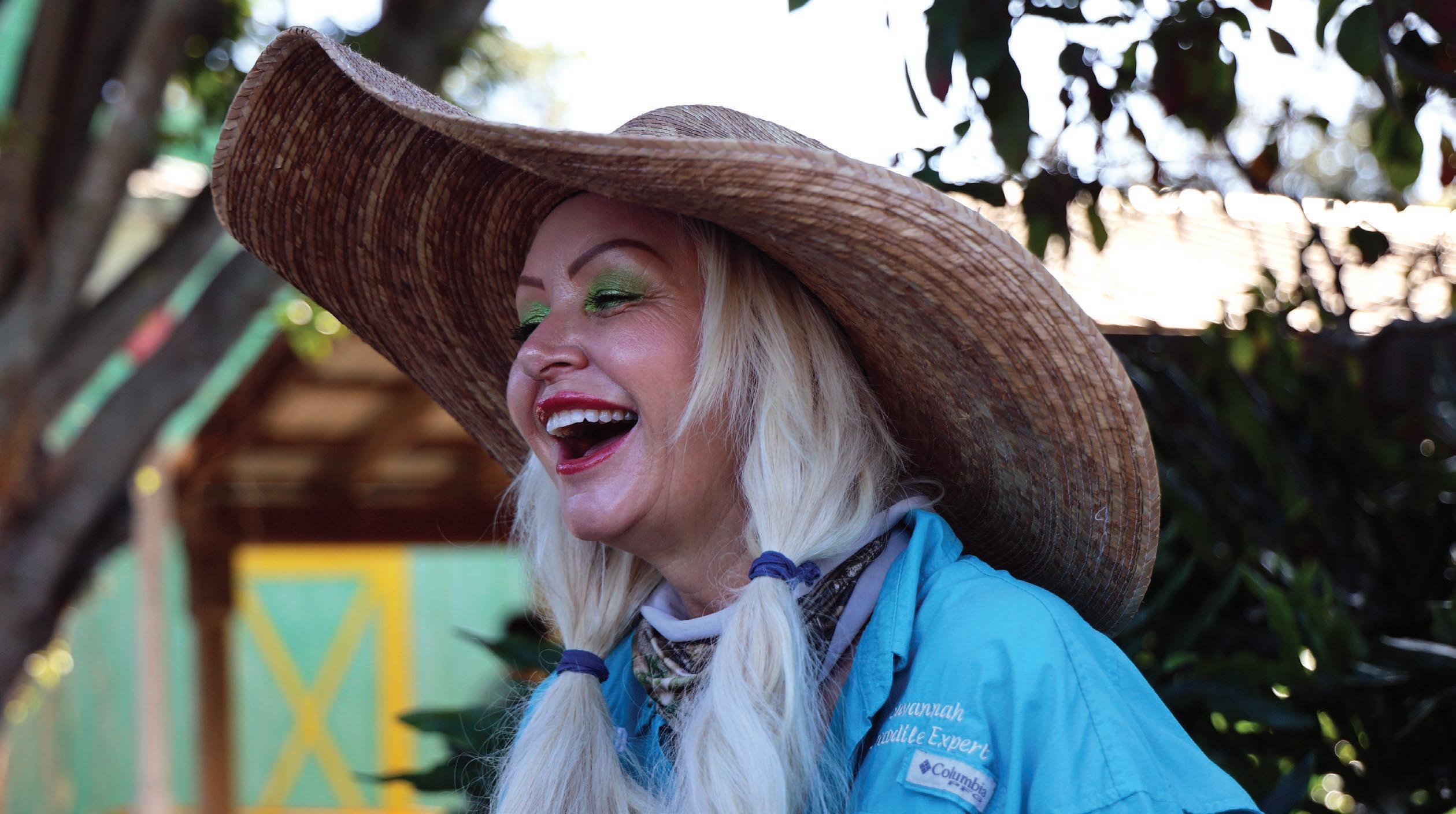
Savannah Boan laughs while speaking to children who recognized her from her YouTube videos while roaming Gatorland in Orlando, Fla., Wednesday, Nov. 5, 2025. (Delia Rose Sauer/ Atrium Magazine)
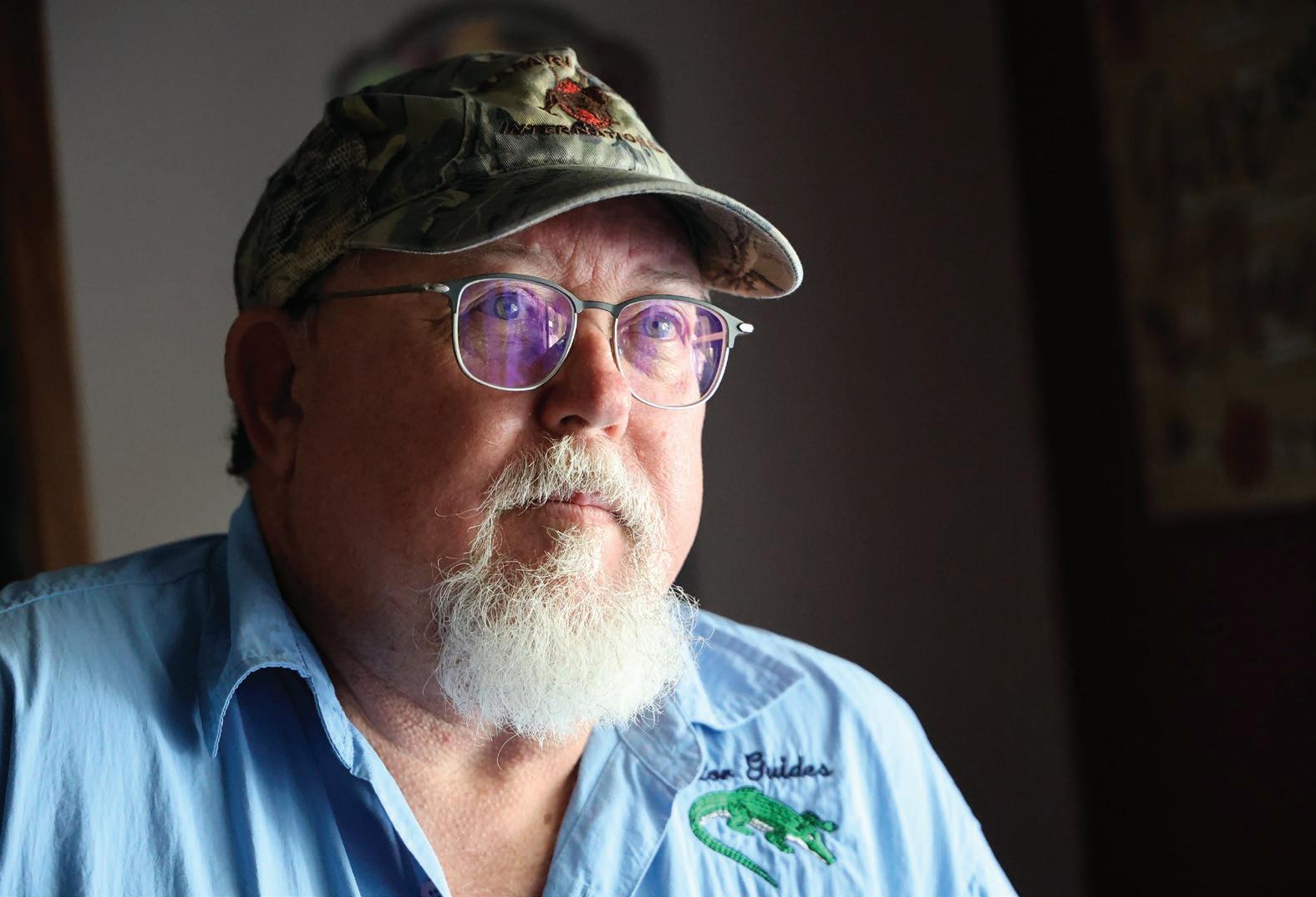
personalities,” Savannah says. “When he used to live in the back ... he would come out of the water and hide behind the trees and pop off to the side — a little peekaboo kind of thing.”
As Savannah points to Lyle, the 15-foot Nile crocodile that inhabits an area of the lake no mere alligators dare to venture to, a couple who traveled from Germany in hopes of meeting Savannah and a few of their favorite reptiles ask her for a photo. They had arrived just in time, because as the shutter clicked, the loudspeaker turned on. The Gator Jumparoo was about to begin.
Veterans, had a hand in raising it. Inside his home, Confederate soldier dolls, a map of the “Confederate States of America” and a poster of “Gone With the Wind” line his walls.
Scattered among the Confederate clutter are relics of Phil’s livelihood: gator skins. Wallets and notebooks sit in plastic bins. Dozens of speckled belts hang on hooks. Rolled-up dyed skins line the shelves.
Phil is a nuisance alligator trapper. He works in Hillsborough County, fulfilling permits and harvesting the skins for his Etsy shop. Phil and Ron met more than 30 years ago, trading tips on how to better trap alligators.
Visitors crowd around the enclosed pond as staff emerge with buckets of raw chicken, dressed in comically Southern attire and sporting even more comically fake Southern accents. They dangle the bait from a platform above the water, and alligators launch into the air to snatch it. Savannah laughs along, but just as quickly, she gently reminds a father that he can’t perch his toddler on his shoulders to watch. Care didn’t just apply to the reptiles.
Using alligators for entertainment is not a novel idea. In some parts of Florida, alligator entertainment brings visitors onto airboats, sliding through swamps on the lucky side of a harpoon.
On the drive to Tampa, a towering Confederate flag dominates the sky over the I-4 and I-75 junction.
Phil Walters, a 66-year-old member of the Sons of Confederate
The nuisance trapping business is not lucrative — trappers earn $50 per alligator. With the cost of gas and equipment, excursions can leave trappers in a deficit. They used to sell hides to luxury fashion brands, but when consumer preferences shifted to unscarred leather, alligator farms emerged, where the reptiles are bred in captivity.
“There’s no place to sell alligators,” Phil says. So, he got innovative.
Phil, like Savannah, profits from alligator entertainment. But his money comes from killing them.
During the open alligator hunt season, which lasts August through November, Phil sells spots on his airboat for a hands-on hunting experience. Guided by a professional, his passengers get to kill alligators themselves.
“I’m selling the thing the whole way through,” he says. “I’m the only guy in the business that does that.”
Phil’s hunts are raw and dirty. When he’s out on the water, it’s not playtime. Everyone has to listen to Phil, because it’s a matter of life and death.
The first mishap, he’s nice. The second, he’s loud. The third, he’s Captain Phil. And in his words, no one wants to meet Captain Phil. His hunts attract a wide clientele of thrill-seekers, many lacking any hunting experience, especially not high-stakes alligator hunting.
As Phil stands in his upstairs guest room lined with alligator skins, he
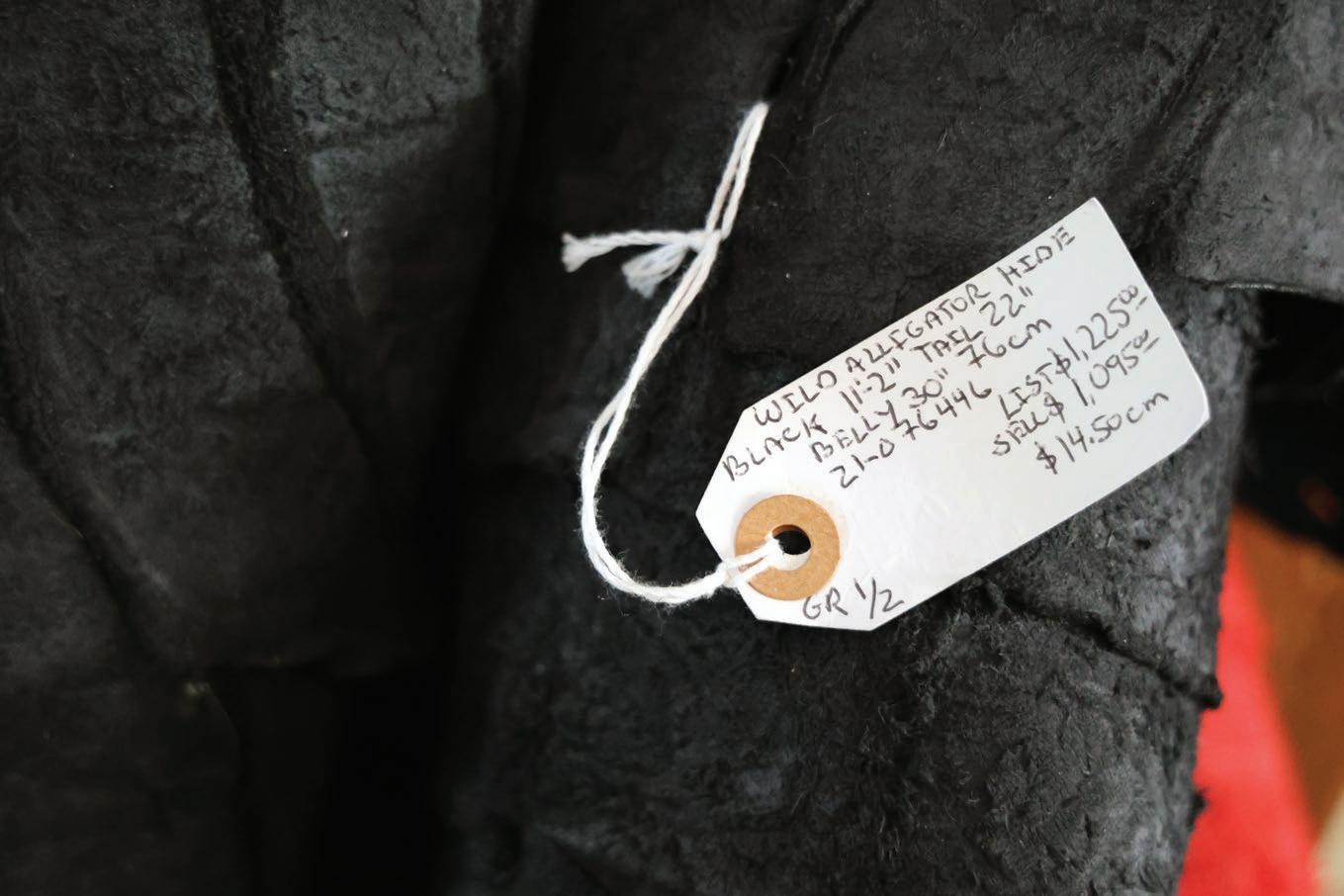
leans near a taxidermied alligator head — Phil calls it “Dead,” but he actually names his catches after politicians before delivering the final blow, such as “Honest Abe.” The scar on his leg is another artifact of a memorable hunt, one that lives on through animated retellings in bars, each drink destined to add a foot or two to the gator they slaughtered.
It was a few years back when a few men from North Carolina hired Phil to help them seek an impressive catch. The group set out on Phil’s airboat in South Carolina, with GoPros, treble hooks, harpoons and knives at the ready.
After hours on the murky water, the sun turned the passengers into true red necks as they finally spotted a “big ass gator” in the distance.
“Don’t let my wife see this,” one of the men exclaimed. He was a neurosurgeon with hands worth millions, Phil says.
Phil dug for his “swamp people hook” — a treble hook fastened to a rope — and tossed it into the water, wrapping the rope around the alligator. But the 13-foot beast was not going down easily. As Phil struggled, the hook fastened atop its head like a horned weapon, making the already angry animal even more dangerous.
After several minutes of tiring the alligator out, the men managed to get it on the boat. Phil instructed them to
sit on it, and in the frenzy, the hook plunged into his calf.
“When he [the alligator] did that, I go ‘poof’ into the lake,” Phil remembers.
As Phil waded in the water, the men scrambled to help, all running to the end of the boat. At that moment, Captain Phil exploded. He wasn’t going to watch these men sink his boat by throwing it off balance.
From the water, he commanded the crew to sit on the alligator and tape its mouth. With the catch secured, he shimmied his way onto the boat. After decades of alligator hunting, this was a first. There was more of his blood in the boat than the alligator’s.
“Get that knife and stick it in,” Phil yelled. “Kill that S.O.B.!”
The alligator died, and Phil was bleeding profusely. Luckily, the surgeon wrote him a prescription on board.
Phil’s hunts draw in a plethora of white-collar professionals who want to try his lifestyle for a day. But they get to walk away, leaving the blood-stained boat and alligator carcass behind. They don’t participate in the endless hours trappers like Phil spend chasing elusive alligators.
The intricacies that exist between a tourist’s spectacle and a trapper’s mundane day-to-day work are where the true alligator business lies.
In an industry where one business decision could mean life or death for an alligator, the struggle between morality and monetization is tricky. For some trappers, the two are unrelated.
“The market is what dictates it,” Ron says. “And there’s nothing moral about it.”
Ron dedicates his life to trapping alligators. As a police officer in the ‘80s, he was trained by the FWC to respond to nuisance calls. After the nuisance alligator program was established, he switched career paths to pursue the reptiles. He used to kill the
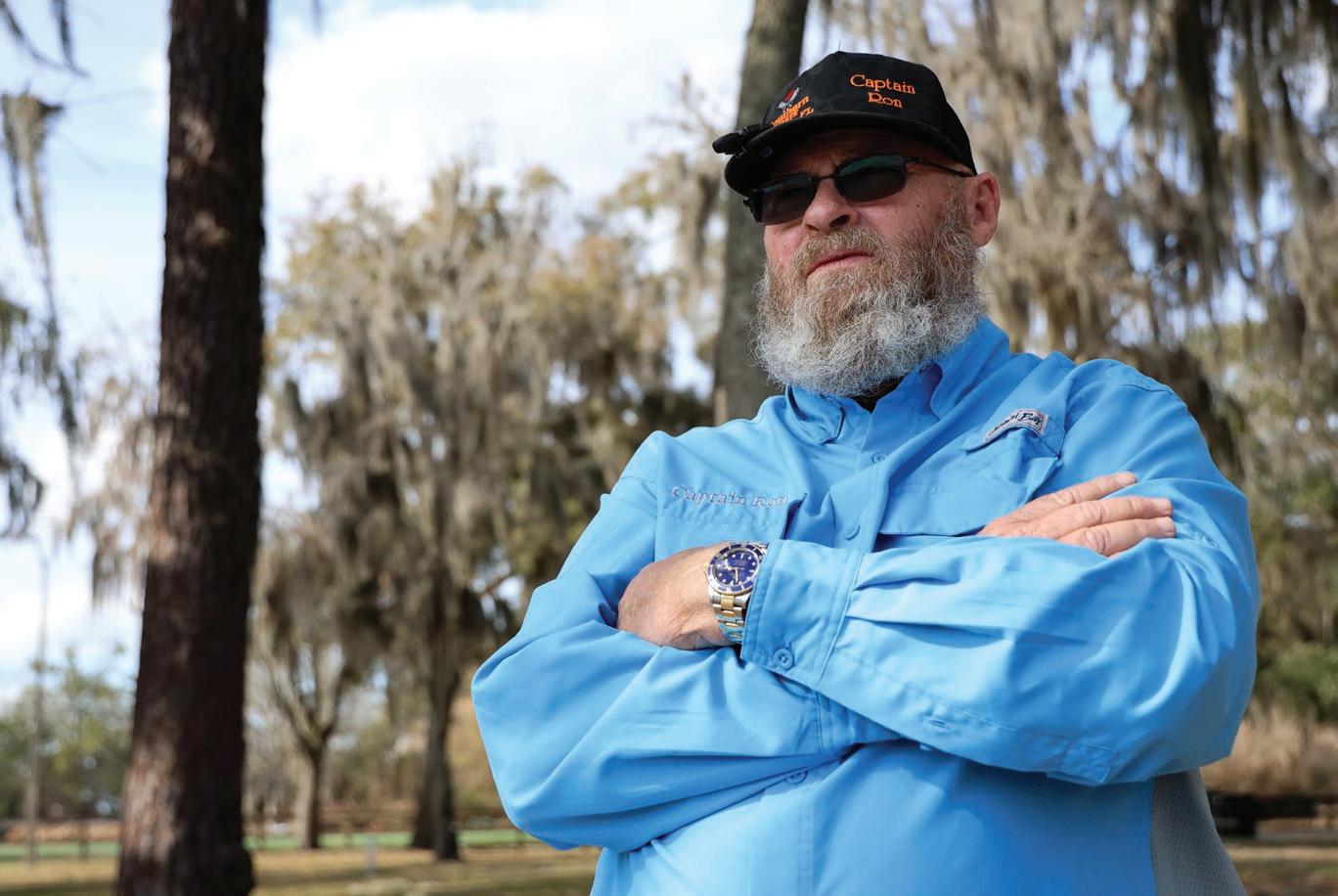
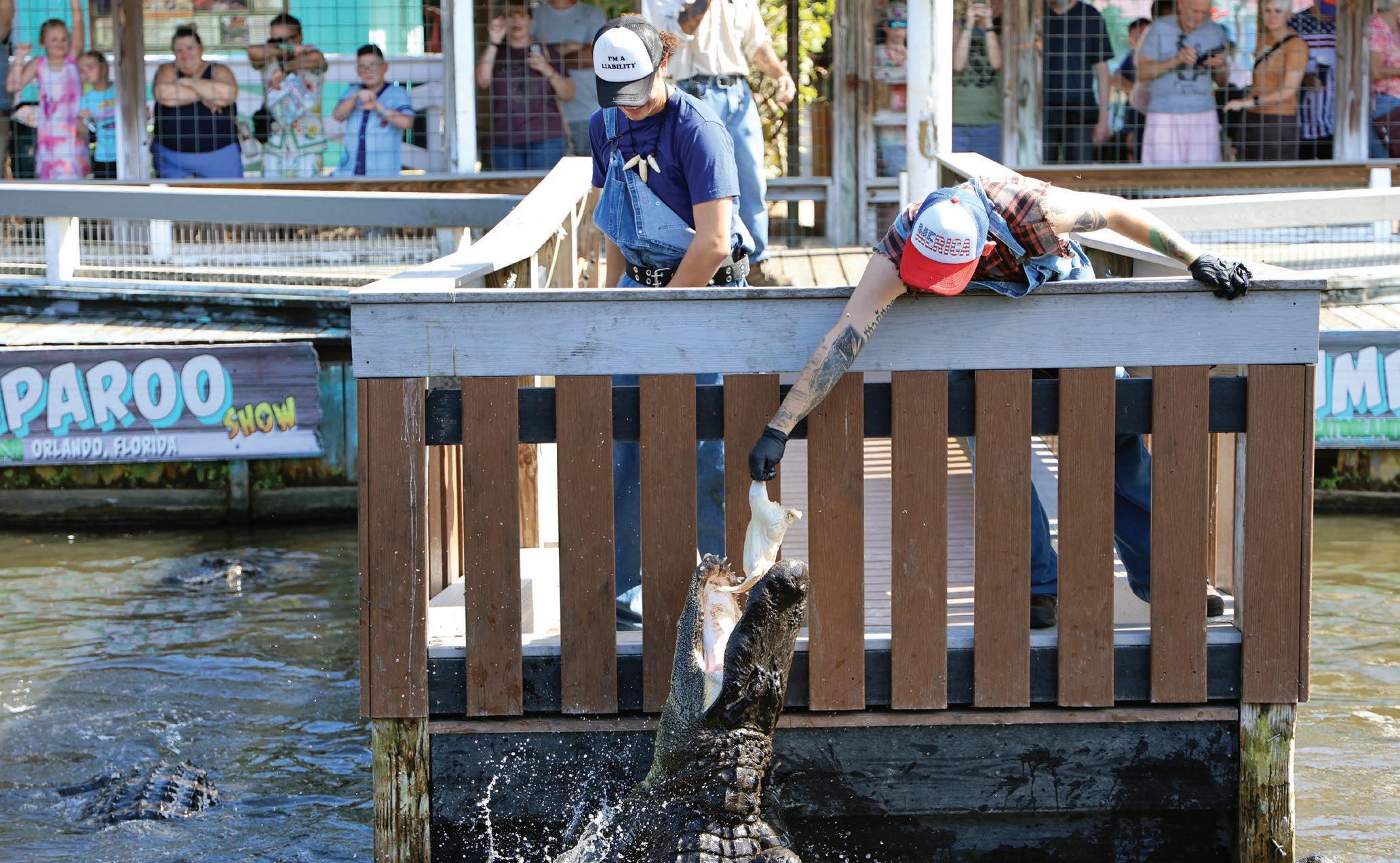
majority of his catches, selling them to hide and meat processors. Now, it’s more lucrative to hand over the alligators, alive, to farms across Florida. He prefers it anyway — catching a living alligator is more thrilling for him.
When an alligator is deemed a nuisance, there is no path back to the wild. Trappers can’t relocate alligators over 4 feet long, so their options are reduced to sanctuaries, for-profit hunting farms or to process and sell their goods.
What constitutes an alligator as a “nuisance” is a matter of perspective. Jim Darlington, the curator of reptiles at the St. Augustine Alligator Farm Zoological Park, pointed out that humans are invading what was naturally alligator territory. Crocodylia, the order that includes alligators and crocodiles, have been roaming the Earth for more than 80 million years.
Humans, or homo sapiens, have only been around for about 300,000 years.
As Florida’s population swells and its waterways attract tourists and developers, people forget alligators are the original Floridians. Ponds alligators once called home become neighborhood swimming spots. When alligators remain in their cityswallowed habitats, residents call for their removal.
For Savannah, education is the key to keeping alligators wild. She teaches her viewers and visitors about alligators’ natural behaviors and the importance of leaving them alone. Education can be the difference between being labeled a nuisance or a natural fauna.
“My heart is always with the alligators in the wildlife,” Savannah said.
As Bungee wades in his shallow pond, hundreds of other alligators
swim together in the Breeding Marsh just across the boardwalk. Big Kyle, about a 13-foot American alligator, blind in one eye, dominates the back portion — no one dares to try him, except for Jaws. Jaws is a spunky old alligator, Savannah’s favorite. He’s always trying to fight, but he never wins. He is in a solitary enclosure now — the only one at Gatorland. They’ve crafted their own pseudowild hierarchy, alligators claiming territory and breeding partners and fighting to assure they keep them. But they will never truly be wild again. If they were, Bungee probably wouldn’t be alive. If the cord hadn’t killed him, the other alligators could have sensed his weakness and taken advantage. Bungee prefers to sunbathe across from the Breeding Marsh, reachable by a short swim under the boardwalk. It’s more secluded there.
design by ALISSA GARY
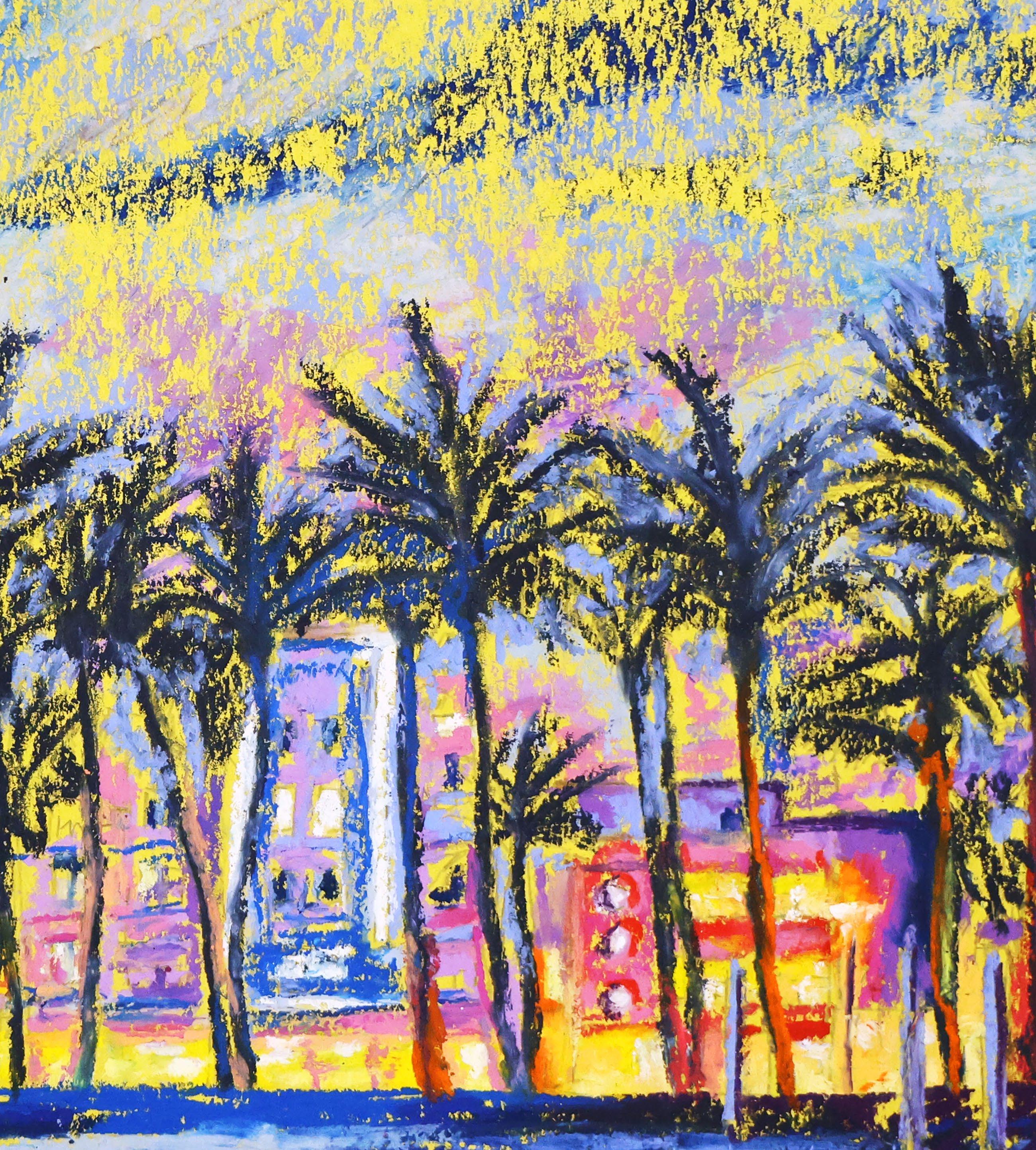
Growing up in South Florida meant gazing out the window of my parents’ car as we cruised up the Turnpike. Somewhere on the familiar drive to Oviedo to visit family friends, my eyes glazed over between Port St. Lucie and Yeehaw Junction. The pine forests stretched like pulled taffy into a green blur as I drifted into an uncomfortable half-sleep.
My nap felt like a blink, but hours had passed. I was jostled awake by a pebble in the road. I peered out the window and realized we had left “the
middle of nowhere,” as my dad called it, and arrived in firm Disney territory. As we drove past theme parks and never-ending suburbs, an enormous Gandalf-shaped building emerged in my line of sight, followed by a massive concrete ice cream cone, and then an equally large orange dome, and in my groggy stupor, I wasn’t sure whether I was hallucinating. Did I really see that?
The roadside discoveries became faint memories as I grew older. While I never forgot the strange places we passed, I tucked them away as if they were visions I had in a dream.
It’s memories like these that beg us to ask, “What was that place? What’s inside?” But we rarely stop to indulge the question, distracted by the rush to reach our destinations. This collection answers those questions. It celebrates the wacky, bizarre and often beautiful places that give Florida its personality, from a longstanding rural gas station to an eclectic, rainbow-painted restaurant off the Gulf Coast. And yes, it showed me the wizard-shaped building I passed growing up was, indeed, real.
introduction by ALISSA GARY illustration by GABI FRAZER
Apeeling bumper sticker pasted near the service station’s door — which never stays shut for long — reads, “Meet Me at Chiappini’s.” Its compact interior is populated by odd features that raise eyebrows, among them, a “No Spitting” plaque bookended by two glassy-eyed deer mounts above the entrance. The fine bucks are part of a posse of taxidermied donations from locals, including a coyote swallowing a turkey head, a grinning wild hog and a hornet nest hanging in the corner like a paper disco ball.
Founded in 1935, Chiappini’s is a social center located on the corner of Melrose’s only stoplight, said Robin Chiappini, 74, who co-owns the all-inone gas station, corner store, bait shop, beer garden and music venue with his brother Mark, 68. They’re the third generation to operate Chiappini’s, following their father, Francis, and their grandfather, Papa Joe.
“When you’re on this side of the counter, you can tell people all kinds
of different things,” Robin says with a spark in his eyes, deep gray like a Florida thunderstorm. “And they believe it!”
Patrons parade inside to give Robin a solid hug or buy a pack of Yuengling. Some stomp into the store with mudcoated boots and hair matted with sweat. Parents with wide-eyed children drop in for an after-school snack and a pack of 305s. A lady in gingham drops off homemade pepper jelly.
With arms open wide, Robin welcomes most guests like a long-lost brother.
“You need a hug? We’ll give you a hug,” Robin says. “You need a slap in the face? We can probably do that, too.”
Chiappini’s runs an old-fashioned tab system that some locals avoid paying off. A decade ago, a health inspector was taken aback when he learned smoking was still allowed inside and gave the brothers a week to get right. And they did.
The station has a nostalgic musk,
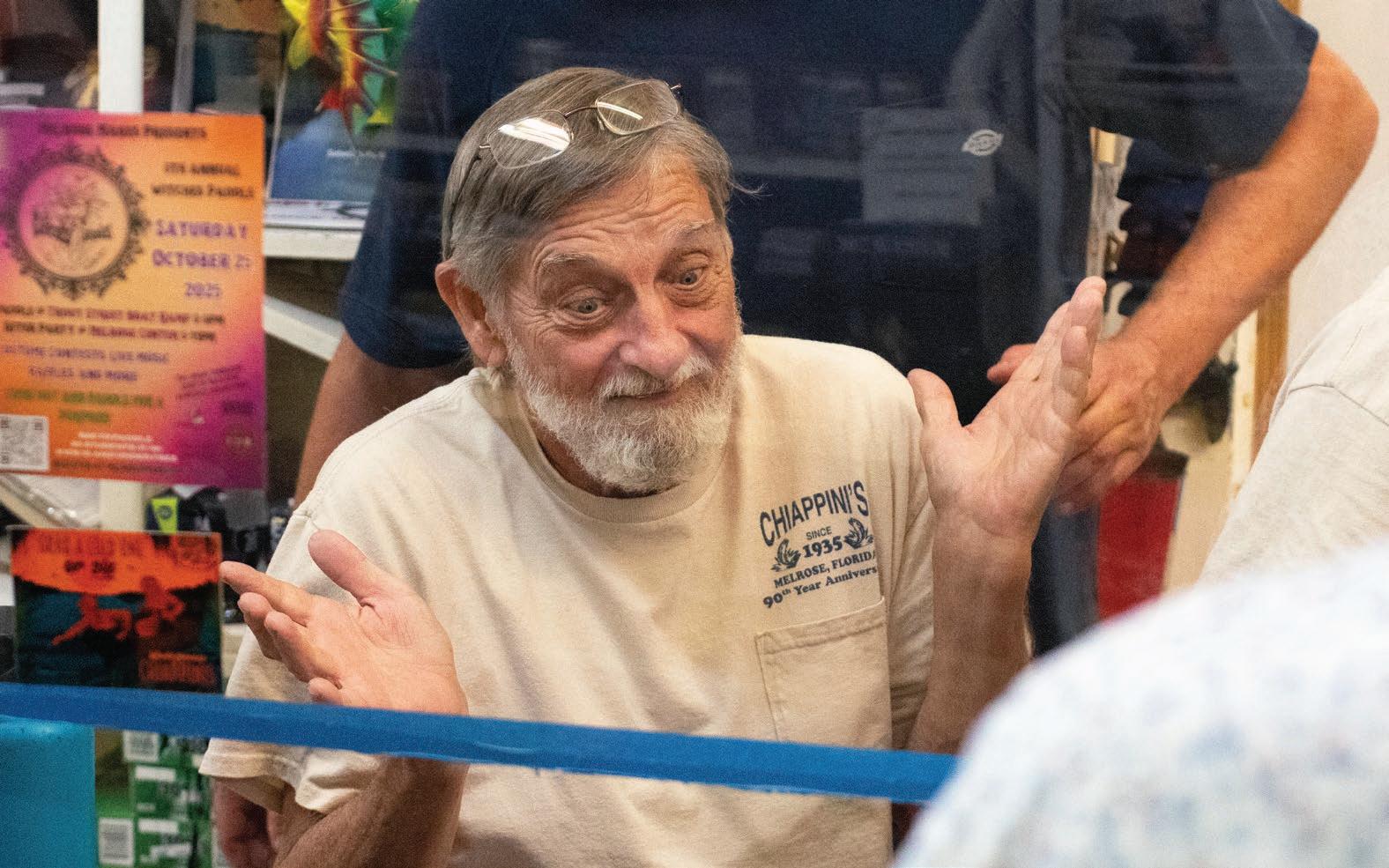
story by TARRYN NICHOLS photo by JACK VINCENT
but modern Melrose is a metropolis compared to the town memorialized on its pegboard walls. Back in the day, Robin reminisces, you could tell who was coming down the one-lane dirt road by the sound of their car.
“Everybody knew everybody,” Robin says. “Now…I can’t remember faces. I can’t remember names.”
Chiappini’s has evolved like Melrose. It used to be half the size it is today, with a back wall lined with booths and wooden stools that soldiers from Camp Blanding, a nearby military training center in Starke, would crack over one another’s heads during brawls. During World War II, a juke box played five songs for a nickel. High school girls would find their after-school escape in the music when dancing was banned at the time. Papa Joe always guarded the door.
Mirroring his father, Francis Chiappini prized community. During the Jim Crow era, the station demarcated east and west Melrose. Black customers who came from the east, like his childhood best friends, were served through a side door instead of the front counter. Robin remembers his father’s hatred of the law.
A DeConna ice cream freezer now buzzes in place of the juke box. The floss picks, vape pods and logo-emblazoned beer koozies are a far cry from the stockings and soap Chiappini’s would once sell out of every weekend –– but the store always supplies what the community needs.
“It’s got a lot of memories,” Robin says, casting a proud glance from behind the scratched wooden counter. “It’s basically where everything goes on.”
design by ATRIUM STAFF
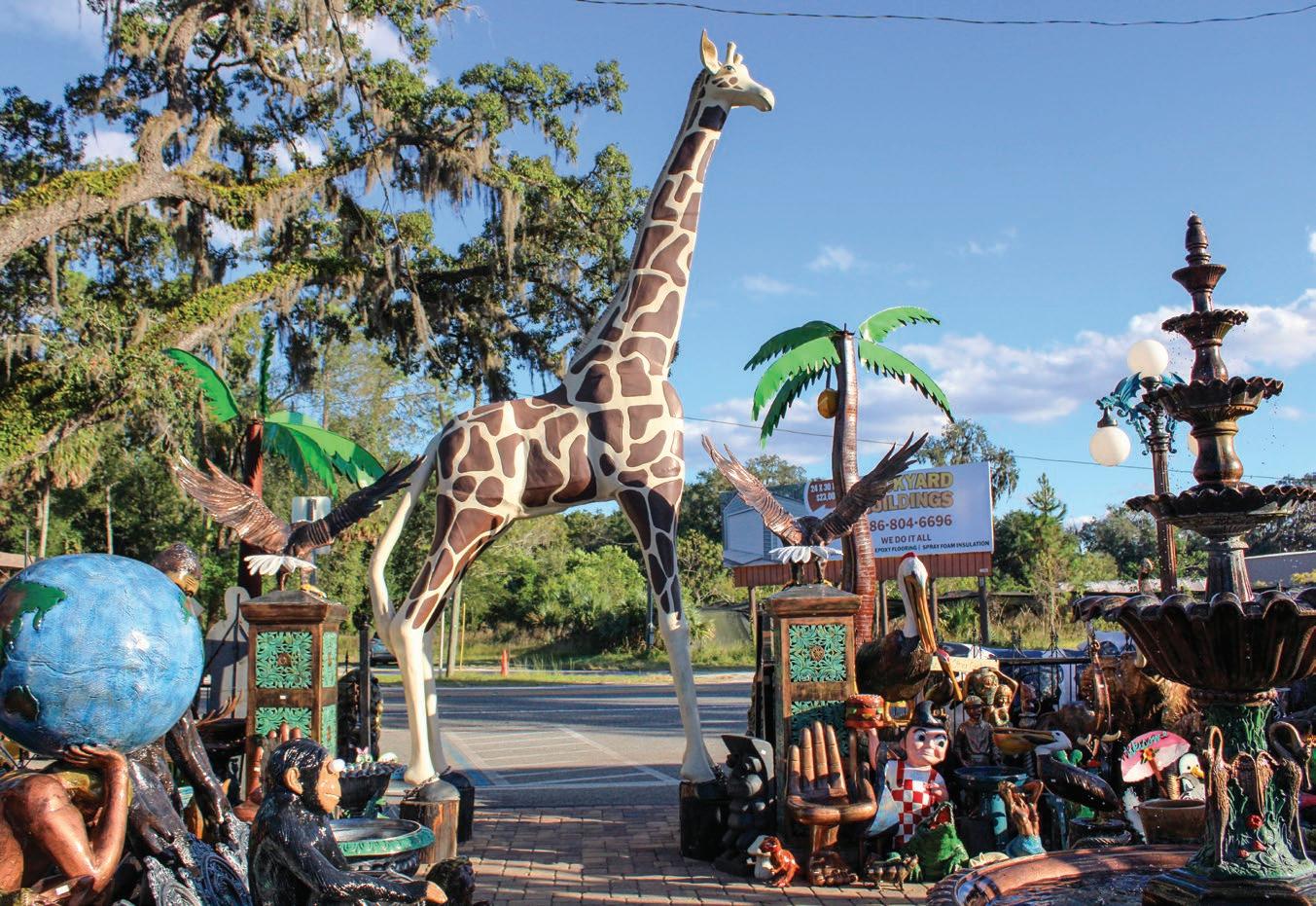
A giraffe stands tall as it peers over an entrance to Barberville Yard Art Emporium in Pierson, Fla., Thursday, Oct. 30, 2025. (Taylin Huffman/ Atrium Magazine)
story and photo by TAYLIN HUFFMAN
Winding down a two-way road lined with bearcrossing signs, light pours through towering pine trees and gaps of wide open fields where horses graze. A sudden array of vibrant metals and giant statues emerges from a miles-long sea of greenery,
entrancing passing drivers.
Located a few miles from the Ocala National Forest sits the Barberville Yard Art Emporium. The 3-acre plot is flooded with thousands of unique pieces ranging from mythical creatures to a 20-foot-tall giraffe, turning the heads of passersby. Upon entering the emporium, a group of funky aliens cast a warm welcome to customers.
Walking through the crammed maze of clutter, guests peruse an array of vintage-looking mailboxes while others dodge a zoo of aluminum animals.
Visitors curious enough to stop and explore the roadside attraction may be intrigued by the faces of smirking suns. They can even rest on handcrafted teakwood benches as sounds of whining power tools and employee chatter fill the air.
Carlos Pendola, 72, retired from a career in car sales when he decided to leave the bustling city of Miami for Barberville. When he bought the emporium’s property in 2010, it was a simple roadside produce stand selling honey, boiled peanuts and a small
collection of yard art. But Carlos had bigger plans. He laid red and orange pavers over the dirt before growing his vast collection of eccentric items, some imported from international artisans and others created on-site.
“You won’t see anything exactly the same repeated,” Wesslie says.
On each corner sits an oddity with its own story: furniture made from Indonesian teakwood, lively Talavera ceramics crafted in Mexico, recycled aluminum statues custom-colored with automotive paint.
To Wesslie Pendola, Carlos’ 45-year-old son, the emporium is a therapeutic atmosphere surrounded by bright hues and natural sunlight. With its status as a roadside landmark for those driving through Central Florida, Wesslie sees guests from all over the country stop by for a visit.
“We try to bring happiness, well-being to the houses,” he says.
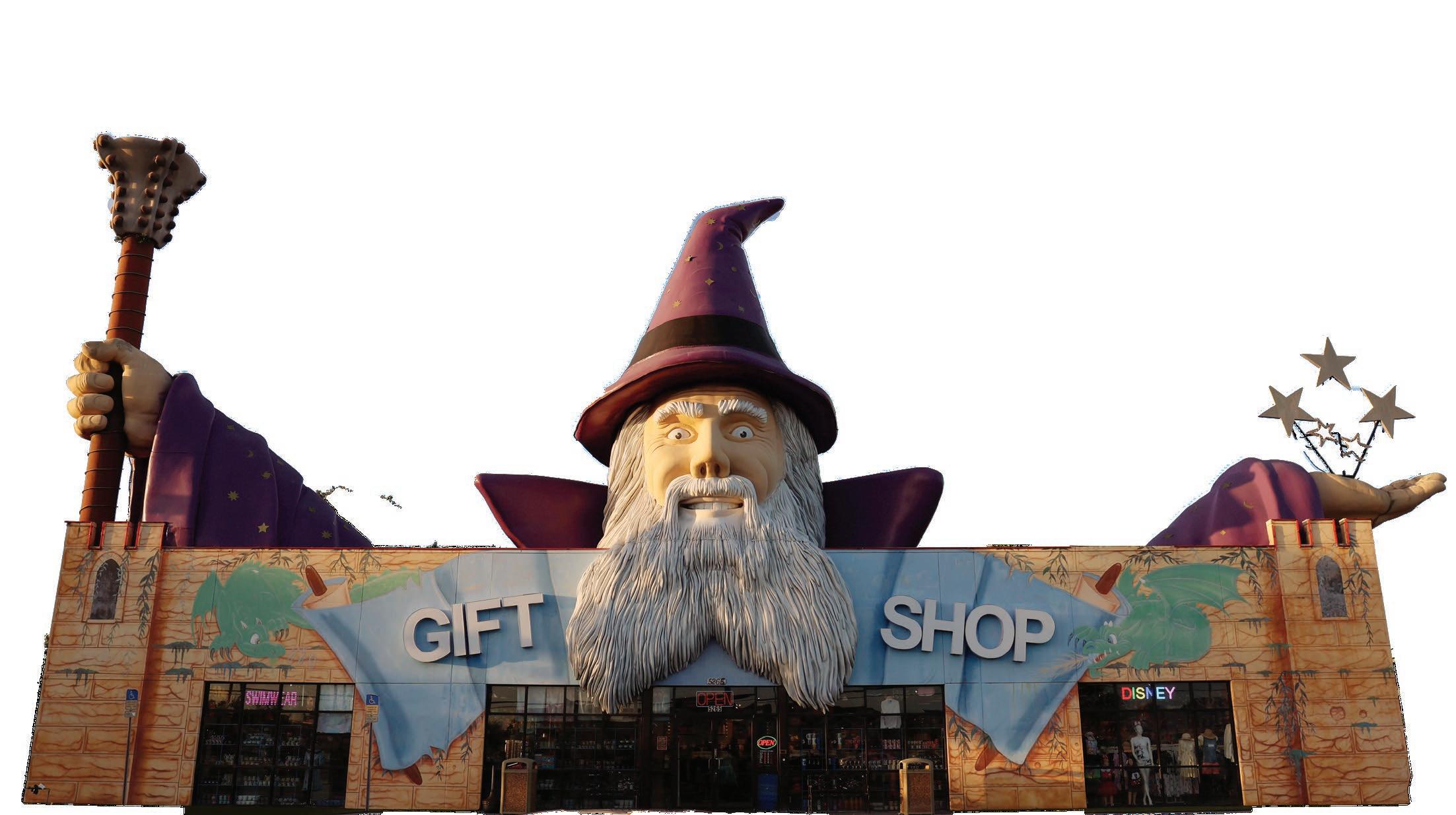
In the grand wizard’s left hand, he grasps a staff several stories tall, and a galaxy of stars hovers over the palm of his right. The kink in his purple wizard hat droops, pointing onlookers toward his purpose: to be the face of a magical gift shop. Yards of a yarn-like white beard drape over an LED “Open” sign, shining as bright as the stars he collects. He welcomes Orlando tourists and curious locals to the Jungle Falls Gift Shop –– an emporium of merchandise unlike any other.
As the sun sets, stadium lights illuminate his castle.
Through the shop’s double doors, staff ensure he’s cast his spell on visitors.
The Kissimmee landmark has made eye contact with passersby for at least two decades, staff say. For locals, it’s
a quick stop shop for holiday gifts. For tourists, it’s a way to collect souvenirs and avoid the ever-increasing prices of Disney theme parks. But the wizard’s open arms and gargantuan smile are just the start of the magic.
Caged in wood, Zultan the Fortune Teller’s sights lock on everyone who enters. With wandering eyes, visitors’ hurried skips into the belly of the wizard turn into a slow step. They circle ocean-colored tiles that swirl around the shop like a lazy river. Packed racks cage the aisles, where visitors are overwhelmed with trinkets.
Florida-themed snow globes, snorkels, shot glasses and suitcases line the shelves. The more strange collectibles, embalmed baby “sharks,” “genuine alligator heads” and Donald Trump costumes, offer a glimpse into the oddities the shop sells.
With a sweet old smile, Naeem Chowdhury, a manager for The Magic Castle Gift Shop, greets customers in his branded uniform, sporting a patch
that reads, “May I help you?”
As an employee for seven years, Naeem, 64, appears out of thin air when needed. He kneels as he takes stock of inventory, hovering near the knife display crammed between Disney-themed snow globes and the candy shelf lined with coconut patties and gourmet taffy.
One of his employees rearranges trendy TikTok trinkets, like 3D-printed fidget toys, under the register. As a family approaches, she steps back behind the counter to complete their winding journey. From the corner of his eye, Naeem watches the small child peering over the checkout counter in excitement.
“It’s not all about the money,” Naeem says. “When I can see their smile and then go with a happy face…a very good feeling. That’s why I’m working here.”
The walls of the Bubble Room Restaurant are crowded with collectibles, and pockets of empty space are barely visible. Bubbling Christmas lights, a replica of Dorothy’s ruby slippers and a 6-foot-tall Mickey Mouse are only a few of the items catching a customer’s attention as they wander the restaurant, entering a dream-like world of perfectly curated tableaus and non-stop spectacle.
The Bubble Room Restaurant on Captiva Island is not just an eatery, but a portal into a world of the eclectic, nostalgic and wonderfully bizarre. Established in 1979, the restaurant invites its guests to taste its classic dishes, such as the “Mahi Brando” or
“Marilyn Mignon”, and feast their eyes on its whimsical interior.
Every trip to the Bubble Room is an exciting gamble; each dining room is a different experience. A meal in the “Captain Nemo Room” is a nautical escape. Meals are shared amid colorful aquariums, with a nautilus ship from the 1954 film “20,000 Leagues Under the Sea” suspended from the ceiling. In the main dining room, guests dine under countless photographs of old Hollywood stars while a model train chugs on a track looping around the vintage memorabilia-filled walls.
General Manager Rachel Peach says the eclectic decor has been present since the beginning. But a few new oddities are added to its ensemble
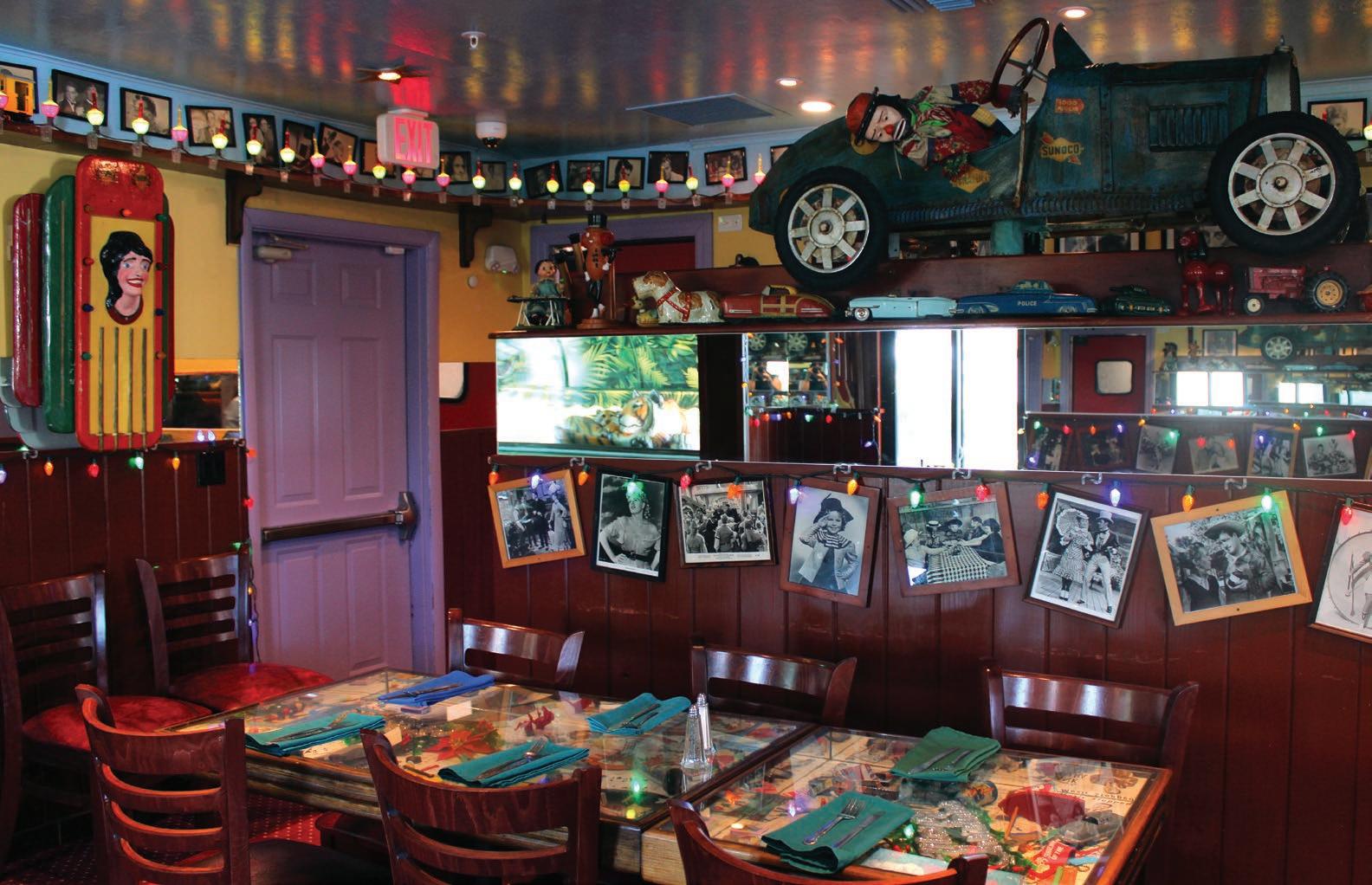
story
MARLA TOKIE
every year. The antique pieces are rare, sourced mostly from auctions by the owner, who is an avid collector.
Patrons often visit the Bubble Room for its unique ambiance — but they stay for the desserts. The restaurant has seven cake flavors, such as red velvet and orange crunch, two kinds of pie and a torte. At the busiest times of the year, the restaurant is baking up to 500 cakes a day, Rachel says.
When Hurricane Ian slammed Southwest Florida in 2022, the restaurant’s bubble popped. The painstakingly decorated dining rooms were flooded with about 2.5 to 3.5 feet of water, forcing the restaurant to close. Back-to-back hits from Hurricanes Helene and Milton set restoration efforts back months. The restaurant had to be re-gutted, and the damaged decor sent away for repairs and returned.
“It’s kind of like being kicked when you’re already down,” Rachel says.
It took about three years for the Bubble Room to recover before reopening in July 2025. Through community support, its famous cakes kept flowing. Other restaurants opened their kitchens to the Bubble Room, and the restaurant’s ice cream parlor and cafe, “Boops by the Bubble Room,” remained open throughout the recovery.
Revitalized, guests are reunited with glistening Christmas lights. The train churns through the dining room as the restaurant’s doors welcome passersby into the Bubble Room’s wonderfully bizarre world.