Olympic Linen files for bankruptcy
PHILADELPHIA —
Central Laundry Inc., doing business as Olympic Linen, filed for bankruptcy in February, reports the Service Employees International Union (SEIU).

The Lansdowne, Pa.based laundry filed its petition while it faces wageand-hour lawsuits filed in a private action by workers and a separate U.S. Department of Labor complaint, according to SEIU.
Low-wage industrial workers filed a class action lawsuit in 2014 alleging wage theft, says SEIU. In the ongoing complaint, workers claim Olympic did not pay the minimum wage or overtime required by state law for all hours worked.
In addition to the workers’ lawsuit, the Labor Department also sued the company, claiming Olympic paid below the minimum wage and failed to pay the overtime premium, thereby violating the federal Fair Labor Standards Act, SEIU says.
In the bankruptcy filings, SEIU notes, the Labor Department is listed as a creditor owed $1.4 million. The bankruptcy petition does not list the amount claimed in the private action, Knolly Arnold et al v. Central Laundry Inc.
American Laundry News contacted Olympic Linen seeking comment but its representative was unavailable as of press time. ALN
BY MATT POE, EDITOR
CHICAGO — Richard Warren, manager of the Conway, Ark., facility of Linen King, sees that one of the biggest “headaches” for textile rental companies is that, many time, when a customer goes on a rental program, they “lose all sense of responsibility.”
“If employees use napkins or pillowcases to polish their shoes, it’s OK. If some item appears to be overly soiled, it’s OK to discard it,” he says. “In both cases, that’s the wrong assumption.”
“We spend a great deal of time trying to educate our customers to maximize the service that we’re providing,” says Seth Gershman, director of marketing and communications for Unitex Textile Rental Services in New York. “We’re really trying to add value to the service since a lot of customers have to pay additional fees when it’s not coming back to us.”
Misuse of rented textiles and linens in a healthcare setting is a major issue, but he sees that the problem goes deeper.
Gershman says that until textile misuse becomes a big enough issue for healthcare management and administration to start seeing the dollar figures associated with the loss, his grassroots initiatives to educate the customer has minimal effect.


“We try, and we do a lot of things to try to talk to the user,” he says. “We talk to the nurses, the CNAs, the staff that’s really the day-to-day user. However, until there’s real pressure put on them by management, it’s really tough for us to make any inroads.”
One thing that Unitex and most textile rental companies do, according to Gershman, is monitor the usage closely so that the company knows exactly what it’s sending and what it’s getting back.
“We have a pretty good gauge
on who’s being responsible and who is not being responsible,” he says. “When administration starts getting bills in the six figures for lost linen, then they start really tak-
ing notice, and we’ve been able to help with the education process.”
Gershman finds that a lot of
Solutions to misuse of rental textiles start with end-users Healthcare scrubs affect patient care perception
BY MATT POE, EDITOR
RICHMOND, Ky. — It’s common to see healthcare employees wearing scrubs.
What used to be reserved for doctors and nurses is now even worn by front desk staff.
In recent surveys, the wearing of scrubs was key to patient care perception. However, too many colors and styles have made the use of scrubs confusing to patients and frustrating for laundries.
Today, more healthcare facilities are moving toward scrub programs to make staff more identifiable and to make processing easier.
Janice Larson, vice president of

clinic resources and consulting for Encompass Group, explored this topic during the Association for Linen Management’s (ALM) webinar titled Hospital Trends: How Uniform Programs Affect Patient Outcomes.
In addition, American Laundry News received input from two textile manufacturers and distributors on changing scrub materials and styles.
Larson says that scrubs were first worn by doctors in the operating room (OR). From there, wearing scrubs spread to OR nurses. By the 1980s, scrubs had spread to the rest of the hospital, she says.
“The scrubs were provided to all
clinical staff throughout the hospital and laundered by the on-premises hospital laundry” Larson says. “Eventually, scrubs spread to nonclinical staff, such as housekeeping, dietary and transport.”
Because of the widespread use of scrubs and the cost pressure of providing and maintaining them, processing began to change. On-premises laundries (OPLs) started to close, according to Larson, and processing moved to commercial laundries. Scrubs in departments other than a critical few, such as the OR and central sterile services, were then purchased and laundered by the employees.
While wearing scrubs made
life easy for healthcare employees, problems began to appear when it came to the patients.


“Patient satisfaction surveys started to show that patients had difficulty identifying staff,” Larson says.
She shared one scrub color-code list from a healthcare provider that had color instructions for a mindboggling 18 departments.
A 2012 University of Pennsylvania study on registered nurses (RN) and 60 patients showed that professional status and quality care is linked to uniform style and color, says Larson. Almost 80% of
Association IMPACT
ALM’s renamed educational conference debuts in Arizona.
Panel of Experts
Our experts tackle how to limit linen loss and employee hoarding.
AP RI L 2016
News
Late
www.americanlaundrynews.com Volume 42, Number 4 INSIDE [6]
The Newspaper of Record for Laundry & Linen Management
[2] See TEXTILES on
Page 10
[4
Columnist at Large Eric Frederick explores textile philosophy by laundry type.
]
See SCRUBS on Page 11
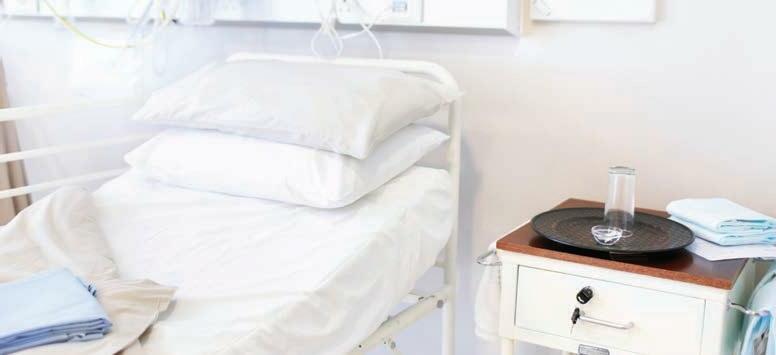
Misuse of rental textiles is, for all practical purposes, money tossed in the trash for both rental companies and customers. (Image licensed by Ingram Publishing)
ALM makes ‘IMPACT’ with 2016 conference
 BY MATT POE, EDITOR
CHANDLER, Ariz. — The Association for Linen Management (ALM) decided to rename its annual conference IMPACT, and the 2016 IMPACT Educational Conference did make an impact Feb. 28 through March 2 at Wild Horse Pass Hotel & Casino near Phoenix.
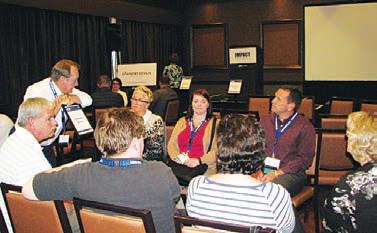
“We named the conference IMPACT because we want our members to know how they can be impacted, and how they can make an impact on their company and the industry, as well as understand the factors that are, and will be, having an effect on their daily work lives,” says Randy Wendland, CLLM, ALM president and corporate director textile management services of ABM Healthcare Support Services in St. Clair Shores, Mich.
The rebranded conference included three days of educational sessions (general sessions and breakouts), time to meet with exhibitors and speakers, and networking events.
“I think [the conference] was good on all levels,” says ALM Executive Director Linda Fairbanks.
“The educational sessions were tremendous. I walked away from them with ideas to change the way the association is doing some things.”
Educational offerings, sponsored by Laundry Design Group LLC, included three general sessions for all attendees. The first kicked off education at the conference Monday morning. Titled A Conversation Among Leaders, the session featured industry representatives and the audience discussing topics ranging from the possibility of textile mills returning to the United States to industry accreditation that helps ensure clean linens.
Lynne Sehulster, Ph.D., M(ASCP), from the Centers for Disease Control and Prevention, keynoted the second general session Tuesday morning, presenting Laundry Effectiveness in Infection Control Perspective
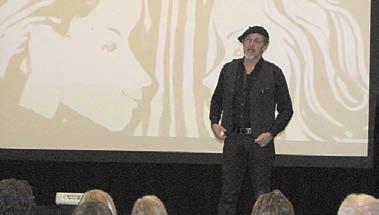
Joe Castillo, who was a finalist on America’s Got Talent in 2012, keynoted the final general session
Wednesday afternoon. He employed a unique storytelling method using music and sand art to encourage attendees to allow themselves to be creative to solve problems.
Besides the all-attendee general sessions, there were 15 breakout sessions for those registered for the conference. Topics covered during the daily sessions included linen room management, labor and more on infection control.
In between sessions, attendees visited with exhibitors in the HUB. Tuesday, those in attendance had the opportunity to hear from exhibitors in between food courses during Lunch and Learn sessions, as representatives moved between table stations to talk about their products and services.
Social events throughout the conference gave everyone a chance to network.
A Welcome Reception Sunday night, sponsored by Medline Industries LLC at the hotel, allowed colleagues to reconnect face-to-face.
Tuesday evening featured a Wild West Party at Rawhide Western Town, complete with mechanical bull, quick-draw contests and target shooting, sponsored by MIP Inc.
The conference ended with the closing banquet featuring dueling pianos sponsored by Applied Silver Inc.
Historically, ALM has announced the winners of the Heywood Wiley Manager of the Year and the Allied Tradesperson of the Year awards at its closing banquet, but Wendland says that the award program is being re-evaluated.
IMPACT also gave ALM a chance to take care of association business during its 76th annual business meeting, which took place first thing Monday morning.
During the meeting, Cindy Molko, director for linen and central services at Mayo Clinic in Rochester, Minn., was elected the association’s next president. Nathan Rivers of Bay Pines (Fla.) VAMC was elected vice president.
Representatives from ALM’s various chapters also voted to adopt revised bylaws, which includes
Publisher
Charles Thompson
Phone: 312-361-1680
E-Mail: cthompson@ ATMags.com
Editorial Director
Bruce Beggs
Phone: 312-361-1683
E-Mail: bbeggs@ ATMags.com
Editor
Matt Poe
Phone: 231-740-2842
E-Mail: mpoe@ ATMags.com
Digital Media Director
Nathan Frerichs
Phone: 312-361-1681
E-Mail: nfrerichs@ ATMags.com
Advisory Board
Jim Buik • Richard Griffin
Greg Gurtler • Phil Hart
Janice Larson • Tom Marks
Gerard O’Neill
Richard Warren
Production Manager
Roger Napiwocki
National Sales Director
Donald Feinstein
Phone: 312-361-1682
E-Mail: dfeinstein@ ATMags.com
Main Phone: 312-361-1700 Fax: 312-361-1685
Subscriptions
630-739-0900 x100 www.americanlaundrynews.com
American Laundry News (ISSN 1091-9201) is published monthly. Subscription prices, payment in advance: U.S. 1 year $46.00; 2 years $92.00. Foreign, 1 year $109.00; 2 years $218.00.
Single copies: U.S. $9.00; Foreign $18.00.
Published by American Trade Magazines LLC, 566 West Lake Street, Suite 420, Chicago, IL 60661. Periodicals postage paid at Chicago, IL, and at additional mailing offices.
POSTMASTER, Send changes of address and form 3579 to American Laundry News, Subscription Dept., 440 Quadrangle Drive, Suite E, Bolingbrook, IL 60440. Volume 42, number 4. Editorial, executive and advertising offices are at 566 West Lake Street, Suite 420, Chicago, IL 60661. Charles Thompson, President and Publisher. American Laundry News is distributed selectively to qualified laundry and linen management and distributors in the United States.
© Copyright AMERICAN TRADE MAGAZINES LLC, 2016. Printed in U.S.A. No part of this publication may be transmitted or reproduced in any form, electronic or mechanical, without written permission from the publisher or his representative. American Laundry News does not endorse, recommend or guarantee any article, product, service or information found within.

Opinions expressed are those of the writers and do not necessarily reflect the views of American Laundry News or its staff. While precautions have been taken to ensure the accuracy of the magazine’s contents at time of publication, neither the editors, publishers nor its agents can accept responsibility for damages or injury which may arise therefrom.
MEMBERSHIPS
changes to terms of service by association officers.
Molko and Rivers will start their respective terms, and the bylaws will take effect, July 1.
“I’m very excited and pleased at the status of the association,” says Wendland.
Besides business, attendees also had a chance to engage in a philanthropic activity. Everyone who registered was encouraged to donate
textiles to be given to the Salvation Army Phoenix. Conni USA sponsored the IMPACT CommUNITY event, and more than a ton of sheets and towels were provided to the local Salvation Army.
Graham Skinner, regional laundry director of Mission Hospital in Asheville, N.C., had this to say about the 2016 IMPACT: “This is probably the best ALM conference I’ve been to.” ALN
2 APRIL 2016 | AMERICAN LAUNDRY NEWS www.AmericanLaundryNews.com
INSIDE: April 2016 • Vol. 42 | No. 4 [8] Tools of the Trade [16] Career Track [18] Trade Ticker [19] Calendar of Events [20] Classified Advertising [21] Source Directory
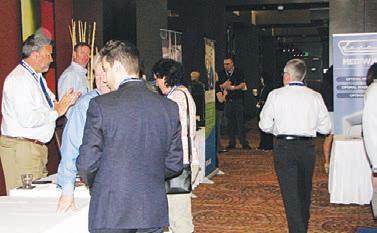
ALM IMPACT attendees visit with exhibitors in the HUB. (Photos: Matt Poe)
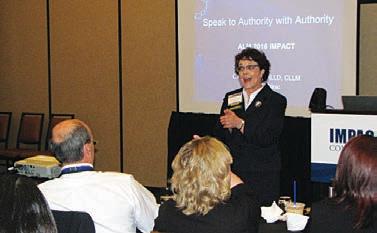
Cindy Molko of Mayo Clinic, and ALM’s president-elect, conducts a session on Speaking to Authority with Authority
Issues and Answers Discussion Groups gave those attendees with similar issues a chance to discuss solutions.
Sand story artist and America’s Got Talent finalist Joe Castillo talks about creative solutions.
“
They have done everything they promised and more.”
– John Ambrose Magliocco, Arrow Linen, Garden City, NY
From

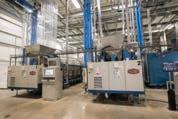
Arrow Linen first purchased their three Milnor CBW® tunnels two decades ago to replace conventional washer-extractors in their original laundry located in Brooklyn, NY. Since then, Arrow’s business grew to warrant a second laundry. In 2013, Arrow expanded operations–and raised their roof 11 feet! Arrow could have chosen any manufacturer to equip their new washroom, but they knew that would get longevity, durability, and accountability with Milnor.
Arrow’s customers’ restaurant linen requires frequent color and soil change formulas, but the quality is not compromised. Corporate Engineer Frank Park boasted the tunnels “have increased our workload over 40% without increasing energy, water, or labor costs we experienced when we converted the conventional washers to CBW® tunnels over 20 years ago. The major improvements from the CBW® to PBW™ are far superior washing capability with only 50% water consumption.”
To find out how PulseFlow® can cut your water bill in half, contact an authorized Milnor distributor or call 504-712-7656.
www.milnor.com / pellerinmilnor
Scan to read Arrow’s success story.
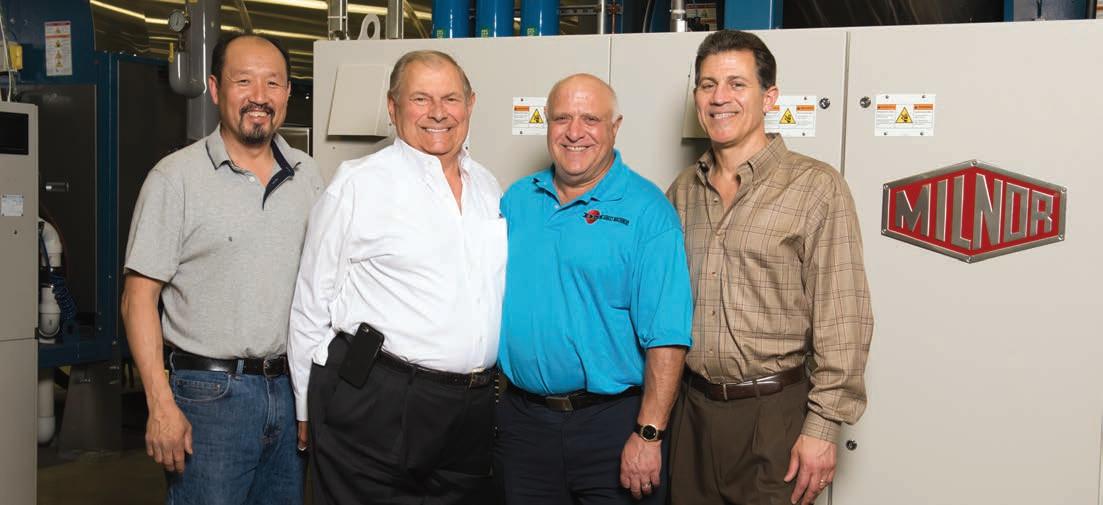
left to right: Frank Park, John Ambrose Magliocco, Ron Hirsch, and John Anthony Magliocco
Taking linen info inventory
Call this issue of American Laundry News your textile and linen information resource.
A majority of the articles in this month’s edition deal with topics that laundries, textile rental companies and others need to know about.
In the cover story on the textile rental business and customer service, Editor Matt Poe spoke with several companies and quickly identified a common concern—misuse and abuse of textiles. Company representatives shared ideas to help educate customers to reduce linen loss and costs.
Poe also learned about some of the more interesting ways that rental customers have misused and abused product.
(Hint: They usually involved
The Director’s Chair BRUCE BEGGS
using a textile for a purpose other than what was intended. And, sometimes, the misuse occurred because the end-user didn’t know how to use the linen item properly.)
In terms of the textiles and linens themselves, Poe
hones in on healthcare scrubs. Specifically, his article examines how color-coding programs add to favorable patient perception and offer a sense of professionalism to those inside a healthcare facility.
To add to the discussion, Poe reached out to manufacturers and distributors of scrubs to learn about the latest materials and styles.
If you need expert advice on limiting linen loss and hoarding, our Panel of Experts tackle the issue, from purchasing to processing textile goods.
Taking inventory can be a laborious task, yes, but would you rather have sufficient par levels on hand or have to process certain items twice in a given day to satisfy the need? ALN

TRSA, Universal Unilink enter into partnership
ALEXANDRIA, Va. —
The Textile Rental Services Association (TRSA), a domestic and international textile services association, and Universal Unilink, a group of North American independent textile services operators, are entering into a partnership, TRSA reports.
“TRSA is constantly seeking to partner with organizations that believe expanding, protecting and professionalizing the textile services industry benefits all companies regardless
of size or market,” says TRSA President and CEO Joseph Ricci. “This partnership with Universal Unilink will help the industry better share best practices that improve safety and increase productivity.”
Through their partnership, TRSA and Universal Unilink will jointly promote services to improve the safety and performance of their member companies.
“Universal Unilink is dedicated to offering exceptional business tools, purchasing services, training and networking opportunities to the independent [operator],” says Allan Fowler, Universal Unilink president.

“TRSA’s lobbying effort on behalf of the industry is critical in today’s environment of increasing regulations; this alliance gives our independents a stronger voice. We welcome eligible TRSA members to join our ranks and, conversely, this relationship provides special incentives for our members to join TRSA.”
According to TRSA, the combined organizations reach more than 250 national, regional and independent operators in North America and around the world, providing professional development and industry news, trend and best practices, as well as networking opportunities and access to industry suppliers. ALN
Textile philosophies by laundry type
T extile replacement costs are the second largest cost in operating a laundry, trailing only the cost of labor.
I have been in the healthcare laundry business since 1972 and have had the opportunity to see a number of different management philosophies in dealing with this expense. To me, the key factors that must be considered are customer needs, quality of textiles versus expected life (cost per use), and the need to have a consistent product presentation.

I belong to and work with a number of different groups that support the laundry/linen industry. Each one defines its goal in a different way.
Provider-owned laundries more often than not see themselves as a part of the patient care team and look for textiles that will enhance the patient experience and look good. They want to do this at a reasonable cost, but cost is not the overriding factor. Many providers are willing to purchase higher-end textile products in order to present a visible difference between them and their healthcare competitors. The greater the competition between healthcare providers in a geographical area, the greater the desire to differentiate themselves.
A good example of a textile product in this area is the purchase of a 100% polyester thermal spread that holds its size and color during its lifetime, and the color is selected specifically because it blends well with the interior designs in the hospital. Because the product takes less energy to process and has a longer useful life, a facility can even justify a custom color if needed.
The second general type of laundry is the large co-op-type laundry. The overriding management concern in this type of laundry is to keep the cost as low as possible. Sometimes, all the hospitals in an area belong to the same co-op, so another major concern is to prevent the abuse of textiles from one facility to raise the cost to all the facilities. The concerns of the nursing staff at the member hospitals are subordinated to the need to keep the costs down.
A good example here is where one co-op I know removed all pockets from scrub apparel to prevent sharp objects from puncturing the press cushion on the tunnel washers. My scrubs are completely reversible, and each top has three pockets per side. Yes, what the textile manufacturer calls a fully reversible sixpocket scrub does cost more but it fits the needs of all male and female staff. One scrub style fits all.
Traditionally, co-op laundries use white poly-cotton blend thermal spreads because they are the least expensive to buy. These white thermal spreads perpetuate the traditional bland, sterile-looking hospital environments most hospitals are trying to get away from.
•
•
•
WEBSITES
The commercial laundries’ major focus is making sure they maintain a certain bottom-line profit margin. This can be accomplished by tightly controlling how much linen is delivered to each facility. Their major emphasis in textiles is making sure they can allocate linen loss to each customer. One laundry in my area is putting RFID identification chips into their linen so they can accurately track how much is sent and returned. These systems will allow the laundry to more accurately charge out linen loss. Often, the commercial laundry will buy a less expensive gown while still charging replacement costs based on the better-quality gown offered previously.
A marketing ploy that has become popular over the last five to 10 years is treating surgical scrubs like a uniform rental program. The vendor places exchange lockers into the healthcare facility and restocks these lockers on a weekly basis. Each employee is given a certain number of scrubs in his/her particular size. The healthcare facility is responsible for all lost scrubs and pays a weekly rental fee per week. This program was developed as a possible answer to the problem of scrub losses but does not reduce cost or increase user satisfaction.
4 APRIL 2016 | AMERICAN LAUNDRY NEWS www.AmericanLaundryNews.com
From
COLUMNIST AT LARGE Eric L. Frederick, RLLD
Problems
Top Stories Appearing on AmericanLaundryNews.com for the 30 Days Ending March 15 (WE) = WEB EXCLUSIVE NEWS • R&B Wire Products Marks 70th Anniversary • Tingue, Brown & Co., Talley Machinery Integrate into ... • WASH Acquires Distributor Great Lakes Laundry • ALM’s 2016 IMPACT Educational Conference Kicks Off (WE) • Clean Show Management Relocates to New Offices
• Have Bottlenecks? Time to Look at Big Picture • Eric Frederick: The Power of a Smile and a ‘Good Morning’ • Healthcare Laundry Equipment Installed ‘Cleanly’ at Institute
Laundry Equipment Financing Made Easier OUR
AmericanDrycleaner.com:
Dependable Cleaners: Three Generations of Ownership ...
COLUMNISTS/FEATURES
•
SISTER
From
•
R&B Wire Products
70th Anniversary
Marks
From AmericanCoinOp.com:
Clean Show Management
to New Offices
Relocates
Up Some
See FREDERICK on Page 15
Clearing
Tax Misconceptions
Organizations seek to promote safety, performance
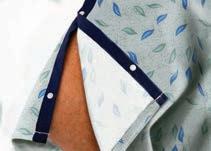
Lowering patient health risk is the highest goal. Imaging procedures can present varying amounts of risk and anxiety to patients, by the awkward and untimely process of changing gowns for each test.









With the ONEGOWN by ADI, there is no longer the need to change gowns. Fitted with plastic snaps; guaranteed to withstand 700PSI extraction during institutional washing, the ONEGOWN will not interfere with imaging studies. Let us help you keep patients comfortable and safe!




HEALTHCARE SOLUTIONS 800 820 2221 | imagine@americandawn.com | americandawn.com
PANEL OF EXPERTS
Manage linen misuse, loss—save money
linen purchase and infusion.
Good linen management is essential in achieving savings in the laundry operation. In many instances, the practice of reducing linen purchases below appropriate levels has caused higher laundry operational costs, and likewise an increase in linen expenditures may in some cases be the best action plan to reduce overall related production costs.
While proper chemical usage and machine formula times will contribute to ensuring maximum linen life, a good linen management plan helps to minimize labor and utility consumption and prevent linen hoarding or stockpiling.
The best way to limit hoarding is to instill confidence in the facility’s workers that linen will always be available in sufficient quantities when and as required. Simply making fewer linen purchases without regard for actual linen par levels leads to a vicious cycle wherein well-intentioned employees feel the need to stockpile linen out of fear that they will be caught “empty-handed” when additional linen is required during their shift.
Time and again, we also see the issue of not having enough linen in the loop causing an adverse effect on laundry washroom production and its related labor and utility costs.
While health departments typically require three par to be on site and in circulation, we have often participated in linen inventory efforts where we have found one par or less of critical, daily-use items in circulation. This situation will inevitably cause some linens to be required to be processed twice in a given day to satisfy patient needs.
Apart from the negative effect that this can cause on certain linen’s appearance, the resulting under-loading of washers due to low par levels will inevitably upend labor and utility costs, which, when combined, will far exceed the cost of an appropriate
A thorough understanding of the legitimate daily linen requirements of one’s facility, gathered through direct communication with nursing staff on a wing-bywing/shift-by-shift basis, along with a well-conceived and -performed linen inventory, inclusive of stockpiled linens under mattresses, chair cushions and behind ceiling tiles, will allow for the establishment of accurate linen par levels and a resulting reduction of hoarding and washer under-loading.
Effective par-level analysis that includes periodic linen usage review and inventory control is an essential and necessary component of proper linen management. The mission is not to see how little can be spent on linen, but how best to ensure that the right amount is spent on it accordingly.
afraid of not getting enough product, which leads to “hoarding.”
Finger-pointing between service and production never leads to a positive resolution. So, where is the disconnect and how can we resolve it?
1. Get the facts through route and customer product inventory reconciliation.
tion and service team manager should be engaged on a daily/ weekly basis.

• Daily Check-in Shortage
will subside. This ultimately will reduce your overall merchandise costs while improving customer satisfaction and retention.
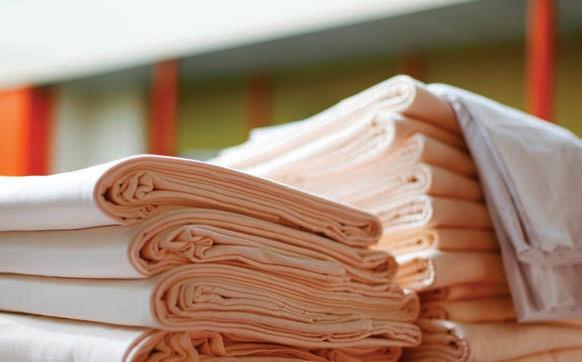
Have you ever wondered where those thousands of new napkins and tablecloths go that are put into service every holiday?
Shouldn’t last year’s brand-new, pink napkins put into service cover most of this year’s needs?
Now think about routine customer overstocks. If every customer was overstocked an average of 10 shop towels, napkins or sheets a week, that’s 520 pieces per customer, per year, on one route. Now, what if you had 1,000 total customers? That’s over a half a million pieces a year in overstocked product that is neither billed nor accounted for.
What if you were to survey your route service reps and ask, “How satisfied are you with the production department providing complete product loads on a consistent basis?” What would they say? Route service reps are trying to meet customer product needs. They normally have the customer’s best interest in mind; however, there are times the billed inventory does not match the physical inventory. They may be
• Route Reconciliation: How consistent is your route reconciliation linen process? Consider having a route reconciliation audit of your returning vehicles on a regular basis. Match up the inventory load sent out for the day with the physical returns. If you do it two to three weeks in a row, you’ll get a clear assessment of your product inventory loads versus returns.
• Customer Reconciliation: You should be asking a number of questions. Is your service management team completing consistent customer reconciliation inventories? How do you capture and analyze the findings? Do you track trends? How thorough and accurate are they? Who do you do them with? For example, you should consider customer inventory reconciliation audits more often with table linen accounts that provide catering services.
2. Production/Service Communication—The produc-



Feedback: The route service reps have a voice through their daily service check-ins to provide detailed written feedback to their direct manager. That should be consolidated into one communication report that is sent to the production management team.
• Service Team Meetings: The production manager being involved in service department meetings is an effective way to bridge the communication gap between the service team and production. It leads to a better partnership, as well as sending a message that production is generally interested in taking care of their “customer,” the service team.
3. Communicate the facts. Whether it’s route service reps providing specific shortage information on their daily load or it’s the production manager sharing data from their route reconciliation audits, providing factual information versus anecdotal stories is the way to address shortage perceptions from both perspectives.
When the route service reps believe that production and service are one team, and they consistently receive 100% complete loads, much of the linen hoarding
Linen costs are typically two to three times depreciation costs for plant and equipment, so it is no small expense. We tend to take care of the plant and equipment because it is typically large, fixed in position, and it is always on site. Linen is exactly the opposite, and, therefore, its costs are harder to control.
All of my experience tells me that the biggest bang for the buck in reducing linen cost is on site at the customer’s location. This would include education of customer personnel in the proper handling of linen and taking inventory of linen on hand (a great way to find linen stored by hoarders). Charging for lost and abused linen always has an immediate and positive impact on linen costs. Dumpster dives that recover linen improperly disposed of at
6 APRIL 2016 | AMERICAN LAUNDRY NEWS www.AmericanLaundryNews.com
“What laundry processing ideas do you have that can help my company’s linens last longer? Or ideas to limit linen loss or hoarding?”
See EXPERTS on Page 12
Consulting Services
Chris Mayer Performance Matters, Plymouth, Minn.
Chemicals
Supply
Scott Pariser Pariser Industries Inc., Paterson, N.J.
Equipment Manufacturing
Mike Diedling
Pellerin Milnor Corp., Kenner, La.
(Image licensed by Ingram Publishing)







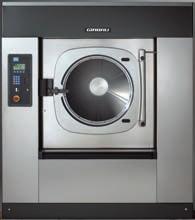
















BETTER. SPEND LESS. Your clients expect the highest quality – and they should. Girbau Industrial washers and dryers provide a high-caliber clean while extending linen life. Add an Ironer to your equipment mix and linen is perfectly ironed straight from the washer. It feels soft and looks crisp, which is what your clients expect. Thanks to Girbau Industrial laundry equipment, you’ll heighten laundry productivity using less labor, while decreasing utility costs. Even better? Clients will thank you! Contact Girbau Industrial for a FREE ESTIMATE to see how you can deliver more productivity to your laundry while increasing product quality! (800) 256-1073 • www.girbauindustrial.com INDUSTRIAL
LOOK
Tools f the Trade
New collection of antimicrobial medical apparel introduced


LifeThreads® LLC has launched a second-generation product line of medical apparel for use by doctors, nurses, healthcare professionals and patients, the company reports.
The new Contego Collection, which follows last year’s introduction of LifeThreads’ Classic Collection, is treated with an EPAregistered antimicrobial active ingredient that protects the fabric from harmful pathogens found within institutional medical environments, according to the company. In addition, LifeThreads says that all of its garments are fluid-resistant, offering healthcare employees protection against blood, urine, vomit and other bodily fluids.
Contego offers new styles with stretch tops, pants and cargo pants that are available now in six different
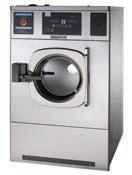
Continental Girbau Inc. has added the new 70-pound G-Flex Washer to its line of hard-mount flexible-speed washers, the company reports. The G-Flex line now includes 40-, 55- and 70-pound models.
Superior programmability, including G-force, brings premium program and process flexibility to laundries at an affordable price point, according to Joel Jorgensen, Continental vice president of sales and customer services.
“G-Flex Washers deliver the flexibility of six programmable extract speeds, including 100, 140 and 200 G-force, at an affordable value,” says Jorgensen. “There are other washers on the market that offer flexible G-force, but they are typically

Penn Emblem offers a line of mending material that extends the life of apparel, the company reports. The material helps fix fabric rips and tears, while reducing the frequency of uniform replacement.
According to the company, every patch is finished with PennBond, a durable adhesive that heat-seals the mend in place. PennBond-backed garment repairs are said to with-
colors—black, pewter, white, wine, royal blue and navy blue. Three additional colors—ceil blue, hunter green and eggplant—debuted in March, the company says.
“With the introduction of our new Contego Collection, we are challenging the status quo by offering a new line of highly styled, comfort-plus medical apparel with contemporary colors that medical professionals have been requesting for years,” says Karan Jhunjhunwala, founder and CEO of LifeThreads. “Our new wide range of garment colors supports coding schemes used increasingly in institutional settings to make it easier for patients to identify caregivers.” www.life-threads.com 800-406-1220
Pillow management keys in new guide
The Pillow Factory division of Encompass Group reports that it has published its Pillow Management Program Guide
“Because pillows are such a common part of everyday life, we tend to think there’s nothing very complicated about them. But in the healthcare environment, that’s just not the case,” says Michelle Daniels, Encompass director of marketing for The Pillow Factory.
“We’ve learned a lot about the selection, management, use, and care of a healthcare facility’s pil-

lows. We’ve put all of the key points in this concise guide. We think it’ll be a great tool for anyone managing healthcare inventories.”
www.encompassgroup.net 770-626-2061
eStores launched for work apparel
more expensive, high-end machines. Now, thanks to G-Flex Washers, laundries can benefit from superior program flexibility, durability and performance at a value price.”
G-Flex Washers generate extract speeds reaching 200 G-force, while most other hard-mount washers reach speeds of 75-100 G-force, the company says. In turn, adds Continental, G-Flex laundry loads take less time to dry, which improves laundry productivity and cuts natural gas usage and labor time.
www.continentalgirbau.com 800-256-1073
stand industrial laundering and rugged job sites.


Penn Emblem says it stocks dozens of fabric colors and weights to match workwear. Also, customers can choose from pre-cut patch shapes and sizes or select a roll of mending material to custom cut. www.pennemblem.com 800-793-7366
G&K Services Inc. has introduced online eStores for businesses to manage their work apparel and accessory purchase programs, the company reports.




The eStores provide online access for employees to order and replace their own uniforms and accessories with product and color options coordinated with the company’s brand.
The eStores are tailored to the customer and its brand, from a home page featuring the cus-
tomer’s logo, to the customer’s preapproved items available for order, according to the company. After setting up an eStore, employees can go to their company’s unique website 24/7, search for the products they wish to order, and quickly buy products, all with a couple clicks. www.gkservices.com 800-452-2737
Portable platform scale introduced
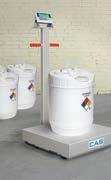
Alliance Scale Inc. introduces a fully portable platform scale that features 304 stainless steel construction, overload protection and a batteryoperated digital indicator, the company reports.
The Alliance/CAS Transit TR-Series Portable Platform Scale has two fixed and two swivel poly bonded 4-inch wheels, two OSHA-orange safety handle grips and a digital indicator with a numeric keypad, which makes the scale ideal for weighing chemical products, according to the company. www.alliancescale.com 781-436-0432
8 APRIL 2016 | AMERICAN LAUNDRY NEWS www.AmericanLaundryNews.com
washer touts flexible extract programmability
Hard-mount
ALN_Tab_1-4_H.indd 1 3/3/16 2:52 PM
Mending material extends apparel life, company says
When dealing with laundry stains, your reputation rides on getting the outstanding results The Laundry Two deliver. RiteGo® laundry spray spotter quickly penetrates to absorb collar & cuff stains, perspiration, ground-in soil and more, all without brushing. Turn to Laundry TarGo® to remove any tough oil based stains that remain behind.
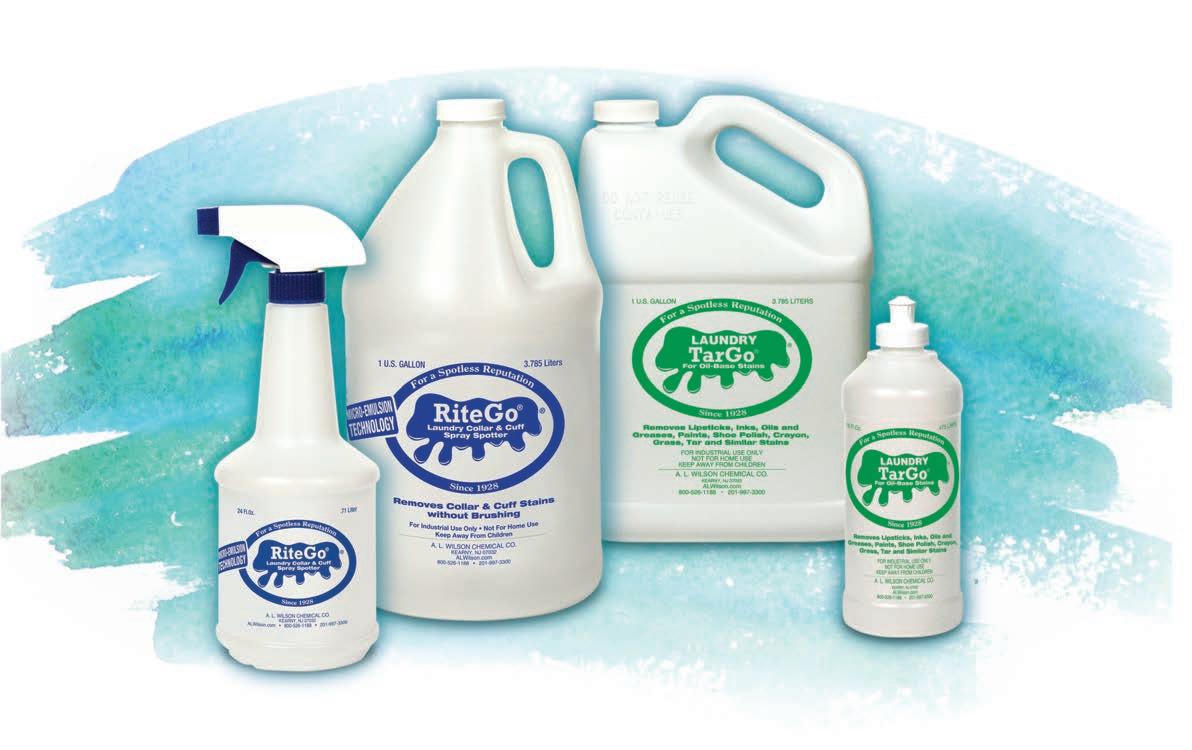
Use The Laundry Two with confidence on shirts, wedding gowns... anything you're washing or wetcleaning.
Both Laundry TarGo and RiteGo are chlorinated-solvent free, biodegradable, noncombustible and California 2013 VOC and Prop-65 compliant.
Use them to deliver stain-free laundry and wetcleaning. You'll build your reputation for quality - which is what keeps customers coming back.
FROM COLLARS AND CUFFS THE LAUNDRY T WO ™ ARE RIGHT FOR YOU! TO THE REALLY TOUGH STUFF... FROM COLLARS AND CUFFS THE LAUNDRY T WO ™ ARE RIGHT FOR YOU! TO THE REALLY TOUGH STUFF... To learn more, visit ALWilson.com or call 800-526-1188 A. L. WILSON CHEMICAL CO.
a STAIN WIZARD at ALWilson.com
Become
A HISTORY OF EXCELLENCE, A FUTURE OF POSSIBILITIES
A & B Wiper Supply is now Monarch Brands. We have changed our name to better reflect the full breadth of high quality and valuepriced textiles from manufacturers around the world. From global textile sourcing to private label programs, we have you covered, whatever your needs may be. Leverage our experience and purchasing power to find the perfect blend of quality and price point for your company.
Textiles
customers don’t have any meaningful internal education or training on linen.
“We were just at a nursing home and talking to staff about the use of the linen,” he says. “We supply them with bath blankets. The purpose of those is to substitute for three regular towels when a patient’s being bathed.
“Not a single person on the staff knew that that’s what it was for. They were using them as a blanket for the bed. Instead of using a regular thermal blanket, they were using a bath blanket. We went in and explained to staff that the product they’re using, they’re misusing.”
“They’re not making Halloween costumes out of the sheets,” Gershman continues, “but they’re using the linens to clean up spills, clean the floor. If there are leaks, they’ll put our linens on the pipes to hold water.”
Another common misuse he sees is the linen on the windowsill to help seal the window better.
Then there are the door jambs.
“They’re really good for door jambs. Take some linen, take a nice towel and stick it in there. That always works pretty well,” Gershman says with a dry chuckle.
It’s not just misuse of textiles that Ben Pincus, president, BLC Textiles Inc., Mineola, N.Y., sees as a problem in the food and beverage industry. It’s also non-use.
“For example, what we see as a disturbing trend right now is a lot of the fine-dining establishments are taking the tablecloths off of the table and using their tables, which is very unsanitary and harmful to the enduser,” he says. “We are seeing a shrinking pie in terms of the table linen itself.”
Pincus calls the linen abuses that he sees at restaurants “age-old.” For example, using bar towels to clean grills, using tablecloths to wipe up spills, or putting them on the floor causing concrete stains.
“We’ve seen every type of misuse you can see, but anything that mutilates the linen is abuse,” he says.
Education is vital because often the endusers have a complete lack of understanding that the textile is rented, according to Gershman. The product is owned by a textile rental company, and the users don’t understand that the cost to replace the item is significantly more than it is to rent the item.
“To give a ballpark figure, it costs about $4.50 to replace a sheet but 50 cents to rent a sheet. If you’re getting thousands of sheets a day in your order, if a percentage of that isn’t coming back to us, you can imagine the kind of numbers you’re dealing with,” Gershman says.
Sometimes, the misuse will create a stain that can’t be removed from the linen.
“The purpose of the linen is for patient care, so if you’re using it for anything else, then you’re wasting our service,” he says. “We’re not servicing linen for the maintenance crew at the hospital, but they tend to get their hands on our product quite a lot and use it for cleaning instruments, covering instruments, cleaning spills, using it as a coating on a bench where they’re doing some sort of work. It doesn’t necessarily permanently ruin the item, but that’s not what it’s for.”
“The rental company must be as aggressive when establishing boundaries, in these cases, as the customer is at establishing their boundaries,” Warren says. “When there are clearly defined communications, there is a better chance of a positive relationship.”
Gershman says that his most effective edu-
cational efforts take place face-to-face with a customer. One useful method, that he notes other companies do as well, is setting up “linen awareness days.”
Gershman says his company picks a date and sets up a table by a high-traffic area, by an elevator bank or in the cafeteria. On the table are textile marketing materials that are put together about the service his company offers and some of the issues that it has seen at that particular location.
“We create a board that we pin up lots of slides on that have usage graphs on them, along with different pieces of literature on what the hospital might be spending, how many pounds of linen we’ve been sending them, what the average would be compared to what they’re using,” he says. “We’ll try to give the staff an idea of how they stack up.”
Gershman adds that linen awareness days often work better with follow-up efforts to keep presenting the same messages. It’s not a one-time, get information to the staff and kind of cross your fingers and hope that it works.

“I like to follow up with what I call inservices,” he says. “We’ll go in by unit, get the staff together, whoever handles the linen, and have a 5- to 10-minute presentation, a Q-and-A. We give them information, but they also give us a lot of good information to help find where some of the problems are occurring. You may find out that you’re not even servicing the right product to the unit. We’ve done them very aggressively at hospital systems that have had long-term issues, and we’ve really had to work hard to get the messages out.”
Another method Gershman uses is to help hospitals set up linen committees. He says they try to get representation from several different units and departments. The committees meet quarterly (if possible) and discuss all of the linen issues.
“At several big systems, I work directly with the marketing departments to do some co-branding of pieces where we’ll have our message and the hospital logo and messages on the same pieces,” he says. “The hospital will then circulate it internally, or use the local intranet to circulate slides on what we’re working on.”
Finally, Gershman notes that his company has full-service teams that are in the hospitals, talking with them about any type of service issue besides usage. Part of that would be discussing if they’re having issues with loss.
“Again, for these initiatives, we typically need to have upper-management endorsement and support in order for this to really stick,” he says. “Like I said earlier, unless we have really good buy-in from the people signing the checks, the message will go in one ear, it may stay in the ear for a few days, but eventually it’s going to come out and you’re back at square one.”
Pincus sees textile use education as difficult when it comes to the restaurant market.
“It’s everyone’s responsibility, ours included, to try to control textile costs from the raw cost perspective and from the life of the product … when people are confident
10 APRIL 2016 | AMERICAN LAUNDRY NEWS www.AmericanLaundryNews.com
or
monarchbrands.com to learn more.
Call 800-333-7247
visit
Continued from Page 1
“I LIKE TO FOLLOW UP WITH WHAT I CALL IN-SERVICES. WE’LL GO IN BY UNIT ... AND HAVE A 5TO 10-MINUTE PRESENTATION.”
—SETH GERSHMAN, UNITEX TEXTILE RENTAL SERVICES
they’re getting full use of the product, they’ll definitely go with the best product they can get their hands on,” he says.
“The companies that use the linen products really need to educate their employees about the money that is wasted through carelessness,” Warren says. “In safety training, you have to preach and preach and preach, but when it starts to take traction, the accidents go down. Proper linen use must be approached in the same manner.”
The programs that BLC Textiles has created include slicks, posters and other materials to help train the end-users on the do’s and don’ts of linens. However, Pincus finds that many in the industry think it’s a waste of time to try to train them—that the efforts fall on deaf ears.
“My feeling is that the abuses that happen are mainly contained in the kitchen. If that’s the case, then giving people slicks and other items they can add to pay stubs, and making the posters to hang on the wall in the kitchen, reinforce the message,” he says.
On the textile rental company side, Pincus thinks education also falls on the drivers,
Scrubs
Continued from Page 1
the patients said they felt it was important to identify the RN. The problem was that 43% couldn’t identify them. Uniform color was the preferred identification method, but patients didn’t know the color code.
A 2013 study by Vestagen Technical Textiles Inc. confirmed the color-coding preference.

“Of patients and family members surveyed, 89% said it would be helpful if the scrubs were color-coded by role,” Larson says.
However, she also says the study showed that having between four and eight colors was optimum for a program. The top four roles that participants said should be color-coded were nurses, doctors, housekeeping and laboratory employees.
Color-coded scrub programs are widespread today, says Larson. An informal survey of 600 nurses showed that more than 60% of respondents said that their facility had a designated, color-coded scrub program. The most common color worn by the nurse respondents was blue, at 59%. Other common colors were black, white, green, gray and purple.
Larson says that there are several reasons a color-coded scrub program is a positive thing. For one, the healthcare administration sees the program as presenting a more professional image. The departments within the facility become easily identifiable and distinguishable for staff, patients and visitors. And Larson says it can be part of the hospital’s or health system’s branding initiative.
The cons related to scrub programs?
“The number of colors can get out of hand, as we’ve seen,” says Larson. “Many nurses complain that it limits self-expression, and some staff feel that it is discriminatory.”
STYLES AND PROCESSING
As healthcare institutions adopt and adapt color-coded scrubs initiatives, manufacturers are also keeping pace with scrubs styles and materials, which can be beneficial to laundries.

Scott Delin, vice president of healthcare sales for Fashion Seal Healthcare in Seminole, Fla., sees a few other factors influencing the scrub market.
“In the acute segments, hospital stays con-
account managers and service departments to keep sharing that linen loss and destruction is everyone’s responsibility.
One method that Pincus has found to be helpful for education is for the customer to see the result of linen abuse.

“If you can bring soiled linen back that is abused to a restaurant, or a customer of any variety, and show them the abuse, sometimes that can help,” he says.
In the end, Pincus says linen misuse and abuse and customer education is a difficult road, one that’s definitely an uphill battle all of the time.
“It’s a multi-tentacled type of approach,” he says. “I think you have to try everything, and then, at the end of the day, if abuse is so heavy that the account isn’t profitable, laundries have to take a close examination of that. Sometimes that’s a tough pill to swallow, but if somebody is heavily abusing the product and you’re not recouping your costs very well, or if they don’t pay for the losses and/or the product in general, it’s time to examine whether they’re worth continuing.” ALN
tinue to be reduced for procedures, thus driving par levels and rental revenues down,” he says. “This is forcing laundries to search for ways to replace that lost revenue and recapture those lost dollars. More non-acute facilities are popping up and creating new opportunities for laundries.”
With this change, Delin says, the styling of uniforms is changing as well. He says that “less intimidating” and more retail-inspired styles are being sought out by the everyday employee.
“Today’s uniforms are more consumerfriendly and appealing to the end-user who previously would only purchase in off-site retail stores,” says Delin. “These retailinspired, laundry-friendly uniforms are possible thanks to the introduction of new fabrics, colors and styles.”
Steve Kallenbach, director of market solutions for ADI American Dawn in Los Angeles, says that new fabric types help extend the life of scrubs and other healthcare textiles.
“Any product in spun poly versus a blend will last longer—in shape, fading, shrinking and weight,” he adds.
Another area of change that Delin sees happening is more laundries looking to direct-sell in an effort to offer a more branded and consistent look within a facility.
As scrubs change in materials and styles, and scrub color-coding programs continue, it’s important that healthcare facilities keep in mind patient perception, along with laundry processing needs.
www.AmericanLaundryNews.com AMERICAN LAUNDRY NEWS | AP RI L 2016 11 In addition to customer favorites, we now carry even more products to service your needs. Download our full catalog at monarchbrands.com. • Institutional Sheets
Cabana & Spa Towels
First Quality Collections
Eclipse Towel Lines
Route Ready Bar Mops
Performax Microfiber Lines
Microfiber Cloths & Mops
SmartChoice Wet Mops
Poly Spun Napkins
Personalized Product Lines NEW OFFERINGS INTRODUCTORY SPECIALS • Save up to 70¢/dozen when you eliminate pre-washing and counting these 32oz bar towels • Soft packed, optically white, and ready to use • Pre-packed bundles of 25 Promote your brand 24/7 with complimentary logo label embroidery! • Personalized microfiber products, terry towels, and bar mops • Ultimate control over inventory • Carry your own product line • Free advertising for your brand Call us to learn how you can carry your own lines for no additional cost! CUSTOM SOLUTIONS • Wide variety of colors • Price breaks for bulk orders • 16”x16” microfiber cloths • Use for wet or dry cleaning 35¢ MICROFIBER CLOTHS • Commercial quality microfiber looped flat mops • 80% Polyester, 20% Polyamide • Cut your cleaning costs without sacrificing quality • 18” long with Velcro backing 95¢ SMARTCHOICE WET MOPS $3.25/doz ROUTE READY BAR MOPS Call 800-333-7247 or visit monarchbrands.com to learn more.
•
•
•
•
•
•
•
•
•
ALN
Patients prefer color-coded scrubs to make healthcare staff more readily identifiable, surveys show. (Image licensed by Ingram Publishing)
the customer location always help to get the customer’s attention and cooperation.
Some of the things we can do in the laundry to control linen costs may not be as significant, but the fact that they take place within the processing facility makes them easier to monitor and control.
Some of the things that can be done to extend linen life in soil sorting include:
• Sorting goods into as many different washing categories as practical to minimize overwashing of items.
• Differentiating between rewash and stain treat, again to minimize over-washing of rewash items.
• Returning (via a customer service representative) items found in soiled goods (watches, rings, silverware, keys, cash, wallets, etc.) and at the same time returning goods found to be abused. Give the customer a chance to “fix the problem” and charge for abused linen if
the problem continues. The washroom offers the most opportunities in the plant to extend linen life by:
• Establishing/verifying optimum washing formulas for regular washing, as well as stain treatment.
• Washing new goods separately rather than washing with goods already in service.
• Checking daily for foreign objects (knives, nails, files, pens, etc.) in washer cylinders.
• Measuring water and chemical use daily and matching back to pounds processed. This is a

great early indicator of trouble in the wash process.
• Calibrating chemical pumps for accurate delivery quantity.
• Not extracting all goods for the same amount of time.
End extraction when water being extracted is reduced to a trickle.
Dryers also offer opportunities to conserve linen by:
• Reviewing dryer programs/dry times to minimize time in the dryer. The biggest cause of lint is over-drying.
• Checking daily for foreign objects (knives, nails, files,
pens, etc.) in dryer baskets.
• Removing all debris from dryer basket perforations to restore air flow and minimize dry times.
• Calibrating temperature sensors to assure proper heat exposure to goods.
• Weighing lint daily and matching back to pounds processed. This is a great early indicator of trouble in the wash, extract and dry process.
Finally, some linen that has been designated for ragout can be repurposed. This includes making napkins out of tablecloths and pillowcases out of sheets.
W
hen we think of inventory control, we typically picture the cage around the storeroom that prohibits entrance to unauthorized personnel. The days of simply making sure the cage is locked (and considering that to be sufficient inventory control) are long gone. Merchandise and inventory control involves so much more.
It has to be centered on quality product, efficient production management, fiscal responsibility and meeting the expectations for quality of the customer. The umbrella of proper merchandise control includes every facet— from the plant to the customer and back again. In other words, it involves choosing the right textile to buy, keeping your textiles rentable and getting your textiles back.
All too often, acquisition cost is the only consideration when purchasing textiles. There are many more factors that should be involved in this process. Make sure you include processing costs of a particular textile, as well as value of scrap/ragouts. Additionally, you should recognize your audience for proper textile decisions.
One of the most forgotten considerations when choosing a different textile is the possible difference versus current market standards. Is the packaging different? Would that slow down or decrease/improve productivity? Is the labeling different? Would that have an effect on customer requirements? Is the weight/ color/fabric truly the same and how would it affect your situation? What is the value or use of the scrap/ragout? What is the life cycle, and how does that impact true “cost”?
Price: Simply put, you should consider more than acquisition costs. Price has many factors. In other words, a certain product “price” could be twice that of
12 APRIL 2016 | AMERICAN LAUNDRY NEWS www.AmericanLaundryNews.com
Continued from Page 6 Experts
Textiles
Steve Kallenbach
NEXT GENERATION, INDUSTRY LEADING NPE-FREE TECHNOLOGY • Best-in-Class Cleaning Performance • Excellent soil removal on tough industrial and heavy food soils • Wide-ranging temperature e cacy • Maximizes wash-aisle e ciencies and plant productivity • Produces brighter, softer, longer-lasting textiles • Ultra-concentrated, multi-surfactant detergent system Spectrum TM Wash it Forward. 800.272.1974 WWW. WASHINGSYSTEMS .COM Delivering comprehensive technological innovations in the cleaning, processing and servicing of textiles. ALN_Jr Page.indd 1 2/12/16 11:24 AM
ADI American Dawn, Los Angeles, Calif.
another. Yet, if the life cycle is double, the true cost could actually be lower.
Placement: One of the most common negative effects on linen is using a great textile in the wrong application. It won’t take long to see that using a yellow shirt in a diesel garage will ensure that you won’t have a longlasting, rentable uniform.
Process: We all know the negative effects that even the simplest error can cause to our textiles. Avoiding those mistakes is paramount, but being able to recognize the negative effects is just as important. Knowing how to identify issues that range from redeposition to bleach damage to excessive pilling will help you maximize your time, profits and textile life.
You should work with your chemical company and your textile provider on a troubleshooting guide that will help point you in the right direction at a moment’s notice. While the chemistry of a formula can be perfect for a textile, machine or operator malfunction can cause devastating impacts.
Proper merchandise/inventory control means somebody has to take charge and be accountable— a job that won’t be easy. Most importantly, this person needs to know that their job is not a popularity contest, as it’s based on establishing “command and control.” Internal control includes all of the following:
• Security—Keep your inventory secure. Limit access to approved personnel. Post your policy document for all to see. Take it seriously.
• Product Flow Control & Reconciliation—Create and use merchandise flow forms. Nothing leaves without the approval document, and that applies to all associates and managers.
• Internal Training—Make sure all employees know the rules of your internal control process. Create a document for orientation explaining the rules. If necessary, terminate when theft is discovered—no exceptions. Do consistent retraining at regular production meetings.
• Offer “Employee Purchase”— For example, charge employees cost plus 10%. Give people good reason to be honest.
• Plant Monitoring—Use cameras, or at least imply that they are in use.
• Injection Management— Injections should be limited to specific days/times and should be monitored and adjusted carefully.
• Inventory Your Goods—At a minimum, inventory should take place semi-annually. More often if results are poor/ unfavorable. Less often if results are good/favorable. You may have a linen “black
hole” that regular inventory can/will help you discover.
• Route Controls—Production works hard to get the product ready for delivery. Make sure your routes and managers are taking due care of products after they take custody, especially with regard to quality presentation. Also, make sure you are using load sheets.
• Customer Controls—Work with your customers to make sure they are treating your products as intended. Take inventories at the customer site. Massive inventory costs
can be hidden in “out-of-control” delivery management.
• Route Audits—Should be unannounced, random and regularly done. Pre-audit outgoing, count incoming soil, count clean return and balance versus the initial load sheet to find any missing goods.
• Customer Audits—Same rules apply. Many quality auditors have paid for themselves from the savings created from their efforts. This isn’t about “policing” customers but rather providing intended
inventories.
• Route Contests & Amnesty Programs—Give your team the opportunity to account for inventory inaccuracies. Offer full commission or other incentives to balance inventory to the invoice. In other words, simply charge for everything that is being delivered. Make it a contest. Involve the entire team in the winnings. Post the results. This can be also be one of the most profitable organic growth contests a company can have. After all, it’s really
about getting the money for goods already delivered. There is no real cost in the end, because you are already paying for it.
• Sample Orders—Create and use a “no-charge” invoice policy. Samples are part of the cost of doing business—but should always be documented. This will also allow for proper follow-up on the potential sale.
Implementation may seem daunting, depending on your cur-
www.AmericanLaundryNews.com AMERICAN LAUNDRY NEWS | AP RI L 2016 13
UPGRADE YOUR CHALLENGE PACESETTER CLM leads the way in dryer technology and provides an upgraded replacement for your old Challenge Pacesetter Our Model 165 fits the Challenge Pacesetter footprint perfectly and gives you technology that no one else o ers, including a fully integrated production management system. • Upgraded heat system with improved efficiency and lower emissions • Micro-Command III PLC upgrade with LAN and Blue Tooth communications • PLC now prepared for flow process management systems • 2-stage variable speed basket drive with 3-port load door. • Soft start to reduce component wear, lower utility use. • Heavy-gauge basket, includes removable steel basket panels • Long-lasting ceramic coating available on removable basket panels. • Configurable exhaust location • Configurable control/burner location Call CLM to replace your Challenge Pacesetter dryers, or for information on our broad range of industrial dryers. 323-232-2417 Model 165 shown with Tumble Green® configuration See Us at Booth 2560 at The Clean Show 211 Erie Street, Pomona, CA 91768 | T: (323) 232-2417 | www.clmco.com ALN_Jr Page.indd 1 11/18/14 2:36 PM 0515aln_CLM.indd 1 4/13/15 4:46 PM See EXPERTS on Page 14
rent level of controls already in place. We strive to be good, not necessarily perfect. And the entire merchandise control process does not necessarily need to be implemented all at once. Start with the “low-hanging fruit.” Most of these recommendations aren’t pretty much common sense, just a revisitation of what we probably know is “right.”
Iam reminded of my fatherin-law, who spent 42 years in our industry as a plant manager and finally VP of purchasing for National Linen Services, retiring in 1993. As you can imagine, many a Sunday dinner was dedi-


cated to this very topic, and the question is just as pertinent today as it was 20-plus years ago. While we had many a lively discussion, he and I came to no firm conclusions at that time.

I recently read that, in the healthcare industry alone, linen loss is exceeding $840 million annually with nearly 90% of linen products not reaching its useful life. Staggering data indeed. For years, the question has been geared toward not eliminating loss, but rather making it more manageable. With these numbers, any tangible improvements would




be noticeable and helpful to budgets across the country.
The contributors to all of this are incidental loss, theft and damage to the textiles, which can include everything from chemical issues to mechanical and procedural.



There are stabilizing variables that can be suitably controlled with a keen eye toward improving:

1. Having stock levels that are high enough to support the business, but not at the total expense of the budget.
2. At time of purchase, quality
of piece goods and construction.
3. Regular equipment maintenance.
4. Employee and end-user training.
5. Security of goods.


One of the first thoughts that I have often discussed is to make sure that stock is solid, and par levels are enough to satisfy the critical needs of the patient or guest. First and foremost, the satisfaction level of our end-user must be met, or exceeded. By having appropriate stock, one can also assume that each piece will be processed less frequently, thus extending the overall life of the product.

Today’s fabrics have higher levels of technology, including moisture-wicking, mechanical stretch, odor-control and anti-microbial characteristics. They may also include a higher level of polyester that can assist with a faster drying time, strong color retention and user comfort. However, one must weigh the additional upfront purchase costs with the expected life cycle of the garment. Is there a cause/effect issue with more comfortable fabrics actually lending themselves to potential loss?
Laundry machinery has traditionally been in service for an extended period of time, and maintaining equipment via regular operational efficiencies is key to this long life cycle. However, it can also assist with preservation of textiles. Everything from hospital laundry chutes tearing items to ensuring the chemical balance is appropriate to maintain tensile strength help maintain textiles for a longer period of time. Remember, the higher the temperature, the more frequently items are washed, chemical harshness—all cause fabric degradation and will reduce in-service time.
To chip or not to chip? As technology surrounding RFID chips increases and simplifies, is this a good method to track goods through the system and thus reduce overall loss by providing checks and balances within the laundry as well as locations being serviced? As this technology evolves and the chips continue to last longer and provide data, I think utilization will increase.

As it was nearly 30 years ago when I began my career, I firmly believe that this topic will continue as we struggle with the critical requirements of patient satisfaction and thus client satisfaction versus the critical budgetary and profitability needs of our own business.

A strong partnership with vital suppliers, from equipment to chemicals to linens and uniforms, built from understanding your critical needs and then providing consulting solutions, will assist in the process. Each industry contains a variety of subject matter experts to draw from as you work through the balance of customer







14 APRIL 2016 | AMERICAN LAUNDRY NEWS www.AmericanLaundryNews.com
care and profitability. ALN Continued from Page 13 Experts AdvaCare™ Disinfectant is the most comprehensive EPA registered laundry disinfectant in the market. 800.553.8683 | laundry@ecolab.com | www.ecolab.com With AdvaCare™ Disinfectant, you can ensure a COMPLETE KILL against 12 harmful pathogens that can lead to infection and even death. SUPERBUGS ON THE RISE! WARNING Is your linen protected? Enterococcus faecalis (VRE) (ATCC 51299) Carbapenem resistant Klebsiella pneumonia (KPC)(A TCC BAA-1705) HIV-1 Virus Methicillin-resistant Staphylococcus aureus (CA-MRSA) (ATCC BAA-1556) Methicillin-resistant Staphylococcus aureus (MRSA) (ATCC 33592) Staphylococcus aureus (ATCC 6538) NEW CLAIM Pseudomonas aeruginosa (ATCC 15442) Acinetobacter baumannii (ATCC19606) Listeria monocytogenes (ATCC 49594) Klebsiella pneumoniae (ATCC 4352) Salmonella enterica (ATCC 10708) Escherichia coli 0157:H7 (ATCC 43895) SUPERBUG NEW CLAIM SUPERBUG EPA-REG. # 1677-193 ALN_Jr Page.indd 1 3/4/16 3:03 PM Uniforms/ Workwear Manufacturing Carl Rocco Uniform Advantage, Plantation, Fla.
arise with scrubs not coming back from the laundry, employee changing sizes, and increases in shifts an employee may work. Often, employees end up taking the soiled scrubs home to process. This self-protection move by the employees only increases the laundry vendor’s profit margin.




To summarize my opinions based on more than 45 years in the business: Healthcare laundries owned by a single provider or network—Textiles are a functional part of the effort to provide good healthcare. Emphasis on cost per use and how the textile product enhances the patient experience. Textile costs are to be kept at a reasonable level, and laundry management works closely with hospital staff to increase the functionality of the textile products. Laundry management works cooperatively with medical staff to explore new medical textiles as they become available.
Co-op laundries—Emphasis on purchasing textile products at the lowest acquisition costs. All member hospitals must use the same products. Generally, less likely to test or recommend testing any advanced medical textile product. Management time spent on containing costs and making sure textile products are appropriately allocated between owners. Co-op laundry management will get involved with innovative products when they are purchased by the interested facility and all they have to do is process it. Any extra costs for processing the linen will be directly allocated back to that facility.
Commercial laundries Emphasis is on the bottom line. Textile products are purchased at a low cost and systems developed to enhance revenue by charging for lost linen. Program development is driven by appearing to address customer issues but actually improve bottom-line revenue. Commercial laundries are willing to process and work with new, innovative textile products when the hospitals insist, and they can find a way to make it highly profitable.
There are a number of excellent healthcare linen providers in this country, but the type and quality of linen they purchase is based on their textile philosophy.

ALN
Eric Frederick is director of laundry services for Carilion Laundry Service, Roanoke, Va., and a past president and manager of the year of the Association for Linen Management. You can reach him by e-mail at efrederick@carilion. com.
AmeriPride Services displays its XL Hybrids electric-fit F-59 service truck
INDIANAPOLIS — AmeriPride Services, a textile rental and supply company, displayed its F-59 service truck upfitted with the XL3 Hybrid Electric Drive System at the NTEA Work Truck Show here in early March, the company reports.
AmeriPride says that hybridelectric F-59 trucks are the latest on-road deployment of XL

Hybrids technology by the company, which already operates a fleet of service vehicles with XL3 systems in North America.


“Our technology partnership with XL Hybrids has yielded tangible results for our corporate fleet that are helping AmeriPride reduce our carbon footprint and save money,” says Banny Allison, fleet manager at
AmeriPride Services.
“AmeriPride is implementing a variety of sustainability programs across North America, including alternative fuel vehicles, heat reclamation systems in the plants, solar power, mat and paper recycling, water conservation and more.
“The fuel efficiency from XL Hybrids technology can also
















help improve the productivity of our drivers who can go longer between fill-ups and potentially make more product deliveries.”

Over the projected 8- to 10-year life of these vehicles with XL Hybrids technology, AmeriPride is tracking to reduce more than 15,000 gallons of fuel and more than 140 metric tons of CO2 ALN
Overalls, scrubs, isolation gowns, aprons – and the list goes on and on. The Kannegiesser FA-X Folding Robot automatically adapts to a never-ending range of workwear, including garments with reflective materials. It’s outfitted with a patented folding process, garment recognition sensors and advanced controls. Our manual model also comes with an ergonomically friendly feeding station, and our fully automated robot can be used with the XMT, the most energyefficient steam tunnel in the industry. Either way, there’s no limit to what it can handle.


www.AmericanLaundryNews.com AMERICAN LAUNDRY NEWS | AP RI L 2016 15
THE LEADER IN LAUNDRY TECHNOLOGY
kannegiesser-usa.com 800.344.0403
Infinite folding possibilities from one smart robot.
FA-X 900 Folding
FA-X M
Tunnelfinisher XMT 5th Generation ALN_Jr Page.indd 1 3/3/16 10:09 AM
Robot
Folding Robot
Continued from Page 4 Frederick
Western State Design promotes Hyrn to VP
HAYWARD, Calif. —Western State Design Inc. (WSD), a distributor of commercial/industrial equipment representing Pellerin Milnor Corp., Chicago Dryer Co., Dexter Laundry and American Dryer, has promoted Todd Hyrn to vice president, the company reports.

WSD says Hyrn previously served as director of operations for the company and has been serving on the company’s management team for 25 years.
“The company has made substantial changes that will benefit all of us at Western State Design, and Todd has played a very important role in the company’s growth and success,” says Tom Marks, executive vice president. “Todd has been a tre-
Track Career
mendous asset to Western State Design, and we are proud of his accomplishments.”
“This promotion recognizes his contributions and all of his accomplishments to the company,” says Dennis Mack, president. “Todd has demonstrated great leadership in the company, and his exceptional experience has led to our success.”
Fashion Seal Healthcare promotes Schwartz


SEMINOLE, Fla. — Fashion Seal Healthcare, a brand of Superior Uniform Group Inc., has promoted Dan Schwartz to director of operations, Fashion Seal Healthcare®, the company reports. Schwartz will be responsible for directing business and product development for the company’s laundry and distributor markets.
“Dan has shown himself to be a very strategic and focused member of our team,” says Michael Benstock, CEO of Superior Uniform Group. “As a
director, he is perfectly positioned to bring our company tremendous benefits.”
Schwartz joined the company in 2011 as a management trainee and then joined the global sourcing team, where he was a valuable resource in the successful launch of the company’s manufacturing operations in Africa, the company says. In 2014, he advanced to client services supervisor where he successfully managed major accounts for the company’s laundry and distributor markets.
Prior to joining Superior Uniform Group, Schwartz held positions at Wells Fargo Insurance Services and Marjam Supply Company, both in the
New York City metro area.
He has a bachelor of science degree in political science and government from Syracuse University, according to Fashion Seal Healthcare.
Tingue appoints Cote New England sales representative
SADDLE BROOK, N.J. — Laundry product supplier Tingue has named Ron Cote sales representative for the New England region encompassing Massachusetts, Rhode Island, New Hampshire and Maine, says the company.
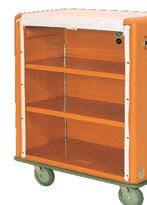
Promoted from his position as flatwork ironer installation technician, and a former corrections industry veteran, Cote offers the laundry parts, carts and equipment that keep com-


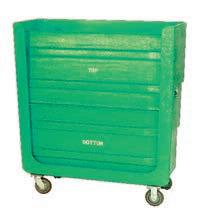

mercial laundries, textile rental companies, hotels, resorts and other laundries operating safely, efficiently and at peak production, according to Tingue.
Cote also offers guidance on product specification and provides expert, on-site installation.


“Ron has already proven his ability in helping our laundry customers keep their finishing equipment up and running, so it was natural to expand his role at the earliest opportunity,” says Matt Vacca, regional sales manager.
Adds Cote, “Our laundry customers are New England-tough, hard-nosed operators who just want to get the job done, and I’m happy to take on that responsibility.”
Cote resides in Dracut, Mass., with his wife and three children.
AmeriPride Services appoints safety and sustainability officer
MINNEAPOLIS — AmeriPride Services, a textile rental services and supply company, has














ALN_Jr_half.indd 1 3/17/16 10:56 AM 650-NX Turn-About Laundry Cart Now is the Perfect Time to Order
is the ONLY molded cart to pass independent laboratory testing for NFPA fire codes.
of durable fiberglass
the cart life at least TWICE that of a poly cart. EASY to maneuver even in tight spaces. Built with quality components to LAST YEARS longer than other carts. L-55 Linen Carrier 610-M Bulk Linen Delivery Cart 2460-40 Platform Utility Cart M c C LURE INDUSTRIES, INC. 800-752-2821 • www.mcclureindustries.com email: info@mcclureindustries.com $872$1632 RetailBasePricing. Discountsonmultiple cartorders! 0416aln_McClure_Jr_half.indd 1 1/29/16 5:15 PM
Sani-Trux
Made
making
Hyrn
Schwartz
16 APRIL 2016 | AMERICAN LAUNDRY NEWS www.AmericanLaundryNews.com
Cote
appointed Brian Keegan to a new role as safety and sustainability officer (SSO), the company says.
Keegan reports to Bill Evans, AmeriPride’s president and CEO, and will be responsible for the overall leadership of the organization’s safety and sustainability programs and the further integration of these initiatives with the company’s business objectives.
“Safety and sustainability is a top priority for us and will continue to be so in the future,” says Evans. “This move helps us to elevate the importance and visibility of safety and sustainability throughout the company and industry, while leveraging Brian’s considerable strengths and leadership in this area.”
According to AmeriPride, Keegan has more than 28 years of industry experience in various roles, including production operations, engineering, fleet operations, supply chain, environmental compliance, health and safety. He has been with AmeriPride
since 2007 and recently chaired the Textile Rental Services Association’s Governmental Affairs Committee.

According to Evans, Keegan is a key member of the senior leadership team and has made many impactful and lasting contributions to the company and the industry.
Tana appointed HK Laundry Equipment OPL sales specialist

ARMONK, N.Y. — HK Laundry Equipment Inc. appointed Ralph Tana as OPL sales specialist, the company reports.

The company says Tana will be working closely with the other HK sales representatives and with OPL and institutional customers throughout the Hudson River Valley and Connecticut.
Tana comes to HK with a wealth of sales experience from the waste hauling industry,

according to the company, which adds that he was a top-achieving sales representative and brings a wealth of knowledge of the consultative sales process to his new position.
Tana and Andrew Hager will be assisting OPL customers with their laundry needs and requirements and providing solutions to their problems with equipment, productivity and energy conservation, the company says.
Loomis Brothers Equipment Co. fills management spots

FENTON, Mo. — Loomis Brothers Equipment Co. has named Carl Rees its vice president of strategic accounts and Matthew Lamons its sales and marketing manager, the company reports.

In his new position, Rees will be responsible for companywide equipment sales to large commercial, industrial and healthcare laundries, as well as some key OPL accounts, says Loomis Brothers.

Loomis Brothers is the authorized dealer for Pellerin Milnor and Chicago Dryer Co. through-


out Missouri, Kansas, southern Illinois, northern Indiana and several large laundries in Oklahoma and Iowa.
Rees has been in equipment sales with Loomis Brothers for 35 years and has been the recipient of Pellerin Milnor’s “Key Man” award for outstanding dealer sales a record-setting 10 times.
“I’m excited to be able to work with our large laundry customers to help them identify opportunities for increasing plant efficiency and productivity,” Rees says.
Dale Loomis, president of Loomis Brothers, says, “Carl’s vast experience in laundry design, plant operations and modern equipment technology are invaluable assets for our customers and is why Carl has been so successful throughout his career. In his new position, we are very excited that we will be able to offer his expertise to help all of our large laundry customers across our entire area of service.”
Lamons will be responsible for growing the company’s sales to OPL and vended laundries in its Missouri, Kansas, Illinois and Indiana region, according to the company.
Loomis Brothers is also a dealer for American Dryer, Huebsch and Maytag.
According to the company, Lamons started with Loomis in 2007 as its vended laundry specialist and later as an OPL territory sales representative.
“Matt’s work ethic and dedication to customer satisfaction have earned him respect from his customers, vendors and coworkers,” says Loomis. “Matt brings high-energy enthusiasm and new ideas to our sales and marketing efforts, and we are looking forward to his leadership in his new position.”
The company says Lamons earned a bachelor of science degree in business administration from the University of Central Missouri and an MBA from Maryville University. ALN
Clean Indoor Air Lint Scrubbers

• True lint scrubbing vacuum. Captures the lint and dust contaminates from the air by capturing and eliminating dust and lint.
• No need to blow it around.
• Saves labor used to clean feeding, finishing and folding equipment.
• Employees work in a cleaner and safer environment.
• Assist with compliance to OSHA directive CPL 03-00-008 combustible dust explosions and fires act of 2008.
• Superior HP maximizes the lint suction in the production area.
• Arrives completely assembled, ready to hang, plug in and start collecting lint.
• Upward exhaust pulls lint, dust and hot air away from associates, expensive equipment and controls.
• Available with bacteria killing UV light for soiled or contaminated lint.

www.AmericanLaundryNews.com AMERICAN LAUNDRY NEWS | A PRI L 2016 17 www.energenics.com 800-944-1711 1470 Don St. Naples, FL 34104
DON’T BLOW LINT AROUND, ENCAPSULATE AND ELIMINATE THE LINT
RESULTING IN OPTIMUM INDOOR
AIR QUALITY
LINT SCRUBBER 6000 (lowest profile) LINT SCRUBBER 8000 (maximum coverage)
0416aln_Energenics Lint Scrubbers tab hlf.indd 1 1/28/16 3:35 PM
Lamons
Keegan Rees
Tana
Fibertech Inc. installs Ferry RS-4000 rotational molder
ELBERFELD, Ind. — Plastic material-handling product manufacturer Fibertech Inc. has installed a new Ferry RS-4000 rotational molder, the company reports.
Fibertech says the installation includes a Ferry automated platform system, one of the first of Ferry’s new generation of machine/platform combinations.
The platform design was a collaborative effort between Fibertech and Ferry to develop a plan to minimize floor space and to maximize operator safety and functionality, according to the company. The RS-4000 machine includes Ferry’s IRT Process Management System to optimize the cure process.
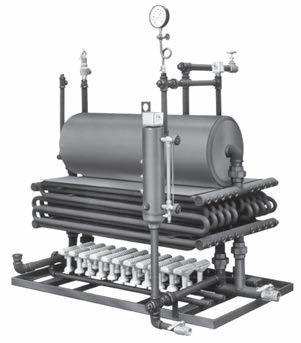
According to Fibertech, the company has grown its cus-




tomer base and expanded its location here, and the new Ferry RS-4000 will allow the company to expand into other markets, offer quicker delivery times and run larger parts.
Fibertech says it manufactures high-quality, customengineered plastic products such as bulk containers, laundry carts and plastic lockers.
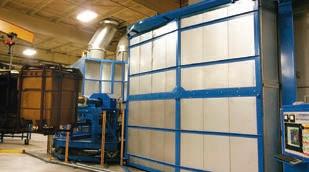
Standard Textile product line earns ‘Innovative Technology’ designation

CINCINNATI — Standard Textile’s DermaTherapy® line of textiles and apparel, designed to address the critical and costly issue of skin breakdown due to moisture, friction and sheer, has received an Innovative Technology designation from Novation, the company reports.
Novation is a healthcare services company that serves the more than 100,000 members and affiliates of VHA Inc., UHC, Children’s Hospital Association and Provista.


The designation was based on reviews of DermaTherapy technology, extensive published clinical trials, and clinician testimonials by hospital experts who attended Novation’s Innovative Technology Expo in November, according to Standard Textile.
The company says that DermaTherapy is evidence-based, patented, silk-like bedding and patient apparel. Formal clinical studies assessing the performance of DermaTherapy products have included more than 2,000 patients, according to the company.
“We know that the way to address rising healthcare costs is through innovation, and Standard Textile remains committed to bringing our customers bold technology that helps
people live a healthier, more gratifying life,” says Norman Frankel, executive vice president of sales, Standard Textile.
UKIAH, Calif. — “The Cart Guys®” at Maxi-Movers™, the manufacturing division of Chem-Tainer Industries, reports that construction of the company’s new 7,000-square-foot factory in Northern California is nearing completion.
“Knock on wood but this project and site selection’s been a breeze thus far,” says Christopher Glen, director of Maxi-Movers. “The people here are great, and we’re excited to become a part of their community. This factory nicely complements our plant in Los Angeles, boosting the West Coast’s manufacturing capacity, which particularly benefits our Pacific Northwest customers by reducing delivery times and freight costs.”
The additional California facility will be Chem-Tainer’s 11th factory, bringing its total number of manufacturing sites capable of offering full product lines to serve the textile and linen processing industry to 20, according to the company.

“Maxi-Movers urgently needed to increase production capabilities to meet this decade’s rapidly accelerating demand, so new molding operations were a necessity,” says Glen. “Strategically, our coverage zone now fully blankets the U.S., and we can better serve our customers in South Central and Northwest with even more convenient shipping points. It’s just one of those unique circumstances where everybody wins. I’m excited to be a part of it and eager to
A PARKER BOILER SHOULD BE THE LAST BOILER YOU EVER HAVE TO BUY Tel: (323) 727-9800 Fax: (323) 722-2848 5930 Bandini Blvd, Los Angeles CA 90040 103 Series Internal View Shown Never a Compromise for Quality or Safety sales@parkerboiler.com www.parkerboiler.com Steam Boilers 101-105 Series Indirect Fired Water Heaters 209-211 Series We expect 15 to 25 years from our interchangeable tube bundles, and 30 to 40 years of life our more out the boiler. We normally expect 10-25 years out of the copper heat exchanger, 30 to 40 years out of the boiler. Thermal Liquid Heaters 207 Series We expect 30 to 50 years out of our thermal fluid heater models We are asked by many new and existing customers on what is our projected life expectancy of our products. We are not always the lowest initial price but know we have one of the lowest cost of ownership of any boiler manufactured in North America. These facts are based on our 90 plus years of boiler manufacturing, feedback and experiences from our end users, service departments, and all of our representatives and dealers worldwide. These life spans are based on our boilers being installed properly, and do receive our minimal recommended care, are applied to the correct application, and include the proper maintenance and water treatment programs. A S M E S or H On all of the above units we have continued to build, and will continue to have available any part of the pressure vessel, burners, cabinet, and controls meaning that for as long as a customer wants, they will be able to infinitely repair their equipment rather than replace the equipment. 10x13.5 add-mar16.indd 1 3/4/2016 3:12:22 PM ALN_Jr_half.indd 1 3/7/16 9:10 AM Connect With Us PARISER INDUSTRIES, INC. www.pariserchem.com 91 Michigan Ave. info@pariserchem.com Paterson, NJ 07503 800-370-SOAP (7627) USA LAUNDRY CHEMICAL SOLUTIONS FOR YOUR EVOLVING INDUSTRY For over 40 years, Pariser Industries has been dedicated to providing our customers the best Quality Laundry Products, Value and Consistent Performance, Wash after Wash. Our Service and Expertise Spans the US, Canada and Caribbean in these industries: Hospitality • Resort/Cruise Ships • Hotels • Party Rental Companies Healthcare • Nursing Homes, Assisted Living • Surgical Centers • Hospital Scrubs and Clinic Linens • Veterinary Sports Athletic Garments • Athletic Team Uniforms • Health Club Towels Pariser has the products and reliable service to help you achieve clean, hygienic linens in an efficient and economical manner. For a Free Customized Estimate call 800-370-SOAP (7627) ALN_Jr_half.indd 1 11/9/15 9:37 AM 18 APRIL 2016 | AMERICAN LAUNDRY NEWS www.AmericanLaundryNews.com
Maxi-Movers expands in California— expanded in Texas, Georgia in ’15
The RS-4000 machine includes Ferry’s IRT Process Management System. (Photo: Fibertech Inc.)
announce the next phase, when appropriate to do so.”



Construction of an additional Californiabased manufacturing facility caps off a busy time of growth, the company says.
“This past spring, we celebrated the opening of a newly constructed factory just outside Atlanta,” says Tony Lamb, vice president of Chem-Tainer Industries. “It was important to accomplish our goals for the Georgia plant in their entirety and use that momentum to concentrate on completing a new factory in Texas on schedule summer ’15.”
Distributor Belenky expands OPL offerings with IPSO





AKRON, Ohio — Laundry equipment distributor Belenky Inc. was recently added to the IPSO distributor network, the company reports. As an IPSO dealer, Belenky will offer an extensive line of on-premises and vended washers and dryers to customers in a territory that encompasses northern Ohio north of I-70.


Belenky has had a long history of success with other Alliance brands, including UniMac, Huebsch, and Speed Queen, says Rob Minster, president of the distributorship.
“Alliance Laundry Systems is a proven leader and innovator in the on-premises laundry business,” Minster says. “We want to offer our customers only the best equipment available. Knowing that IPSO has this backing makes IPSO a great choice for our customers.”
Belenky has been in business for more than a century, with parts and service departments in Ohio.
New Tingue organization integrates Tingue, Brown & Co. and Talley Machinery
PEACHTREE CITY, Ga. — Tingue, Brown & Co. has integrated its sister company Talley Machinery into a new organization consolidating the two laundry brands as Tingue, the company reports.

Established to present the laundry industry with a single, unified name brand serving as a single source for laundry products and equipment and services, Tingue now offers access to the former Talley Machinery’s flatwork ironer parts and rebuild services, Maxi-Press membranes and Norman Control equipment via the company’s team of Tingue sales representatives.
Representatives will also offer ironer supplies, laundry carts and bags, sling system components and accessories from the former Tingue, Brown & Co., the company says. The Tingue sales team, which numbers more than 30 representatives, serves North American laundries by providing product specification guidance and on-site installation services.
According to the company, the new Tingue organization builds on the foundations of two companies that share histories spanning more than a century since their founding in 1902.
The newly formed Tingue also encompasses laundry cart manufacturer MODRoto, consulting firm TBR Associates, and Tingue Canada, offering the Tingue product line to Canadian laundries, according to the company.
Calendar



April
4-5 Jensen USA
Annual Service Seminar for L-Tron Washer/Extractor Systems
Panama City, Fla. Info: 850-271-5959
5-6 Jensen USA
Annual Service Seminar for DTX Tumbler/Dryer Systems
Panama City, Fla. Info: 850-271-5959
11-14 Textile Rental Services Association Production Management Institute (PMI) Dallas, Texas Info: 703-519-0029
12-14 Jensen USA
Annual Service Seminar for Flatwork Finishing Systems Panama City, Fla. Info: 850-271-5959
Info: 706-637-6552
19-21 Jensen USA
Annual Service Seminar for Senking Batch Washing Systems (Tunnel-Press-Dryers) Panama City, Fla. Info: 850-271-5959
27-30 Textile Care Allied Trades Association 2016 Annual Conference Ponte Vedra Beach, Fla. Info: 973-244-1790
May



11 Textile Rental Services Association
5th Annual TRSA Safety Summit with CSC Network Kansas City, Mo. Info: 703-519-0029
16-20 Association for Linen Management American Laundry & Linen College (ALLC) Richmond, Ky. Info: 859-624-0177 ALN ALN
17-19 Independent Textile Rental Association 2016 Mid-Year Training Conference and Exhibits Oak Brook, Ill.
It’s not just print anymore. BY MATT POE, EDITOR Coast Veterans Health Care System (GCVHCS) hosted an open house in late January to unveil its new Textile Processing Facility here. The facility located at the Biloxi VA Medical Center marks the first time since Hurricane Katrina destroyed the GCVHCS laundry system and other military stations, according to the U.S. Department of Veterans Affairs (VA). “We are very excited about our new state-of-the-art, stand-alone McAdory, chief environmental management service for the The new facility, which also houses dietetic services, has the “Our employees love this facility, and am, as well as others, still in awe of its capability and operation,” says Anthony Gayden, laundry plant manager for the facility. Center and Gulfport VA Medical The two campuses had been in operation since the 1930s, but by 2004, plans were in place to expand program. Then, on Aug. 29, 2005, Hurricane Katrina devastatsurge destroyed the Gulfport VA laundry that processed millions of pounds soiled goods for the hospital and military stations in immediately transferred the Biloxi site, which had only sustained minor damage. Laundry Late News INSIDE [8 24] on Page SHAWNEE MISSION, Kan. — It’s the “hot-button” issue of the and hospitality environments. Specifically known by such names as Methicillin-resistant Staphylococcus (MRSA), Carbapenemresistant Enterobacteriaceae (CRE), Clostridium difficile (C. diff) or norovirus, these types of superbugs cost tions. Death and prolonged illness Companies that provide linen implicated in the chain of infection more than once. While the problem has been typically linked more and more launderers are proactively signing up for certification or accreditation to prove that their facilities follow the highest processing standards possible. Understanding how customers ity in the 21st century. This article attempts to provide perspective on view its impact on future operations. THE BILLION-DOLLAR In 2009, the Centers for Disease Control and Prevention (CDC) report estimated that the over(HAIs) to U.S. hospitals ranged from $28.4 billion to $33.8 billion to $45 billion [adjusting to 2007 dollars using the CPI for inpatient hospital services]. Those are seriously big numbers. From the human perspective, according to the same report, number to be one in 25 patients contracting an HAI each year. And most sobering, nearly 100,000 deaths result from HAIs annually. healthcare to help minimize pathogen contamination. The new Biloxi VA Medical Center opens new textile processing facility Infection control will change healthcare laundry 4 on Page Xeros signs deal with New York City’s eLaundry.com — New York City-based eLaundry.com has signed a deal to add Xeros polymer tems to its business, Xeros reports. The deal is reportedly in excess of $1 million. “Xeros has been great ness. Xeros’ green and enables us to dramatically reduce our water, energy and detergent usage while ing results for our customers,” says Charles Sakkal, owner of eLaundry.com. Xeros laundry services, according to the company, eLaundry.com will introon delivery vehicles and throughout the business. on-demand laundry service and consumers in New They include hotels, spas, salons, colleges and universities, health clubs and processes more than 3.6 million pounds of laundry per year, according to the Xeros says its laundry system replaces up to 80% of the water with 1.5 million polymer beads that cleaning. at Large at the power of “Good morning.” Company Directory Laundry services return to Gulf Coast VA 10 years after Hurricane Katrina Directory
Laundry News can now be viewed on tablets and other mobile devices – great ways to stay on top of the latest industry news and updates. www.americanlaundrynews.com
Record for Laundry & Linen Management 0416aln_Digital Issue jr half.indd 1 3/10/16 4:51 PM ALN_Jr_half.indd 1 2/10/16 2:22 PM www.AmericanLaundryNews.com AMERICAN LAUNDRY NEWS | AP RI L 2016 19
American
The Newspaper of
Importer
PARTS FOR SALE
Field Service Technician
For over five generations, Ellis Corporation has been a leader in manufacturing and supporting industrial laundry, wastewater and energy recovery equipment. Due to increased sales and our desire to offer our customers valued support, we are searching for additional Field Service Technicians.
Primary Job Responsibilities: Provide start-up, training and repair services of Ellis and Vega equipment in the field as well as maintaining a high level of customer satisfaction through proper communication with the customers.

Requirements:

~ High School Diploma or equivalent required


~ Must have and maintain a valid driver’s license
~ Must possess or obtain a valid passport within one month of hire
~ Must possess strong communication skills
~ Project management experience helpful
~ Technical vocational schooling a plus; electro-mechanical preferred
~ Knowledge of Windows and Microsoft Office software products preferred
Physical Demands:
~ Must be able to travel approximately 85% overnight (home most weekends)
~ Position requires frequent kneeling and bending and considerable use of hand tools
~ Must own and carry a tool kit with hand tools and basic test equipment
Ellis Corporation offers an excellent benefits package including health, dental, vision and 401K, along with a friendly work environment. Salary commensurate with experience.
Please send resume with salary requirements to:
Ellis Corporation Attn: HR Manager 1400 W. Bryn Mawr Ave. Itasca, Il 60143 hr@elliscorp.com • (630) 773-5902 fax www.elliscorp.com
Call Sam 800-693-5426 or e-mail: skahen@royalblueintl.com
20 APRIL 2016 | AMERICAN LAUNDRY NEWS www.AmericanLaundryNews.com
Advertising EQUIPMENT FOR SALE EQUIPMENT FOR SALE AMKO AMERICA, INC. Remanufactured Finishing Equipment Delta Ironers, Omega Folders & Towel Folders PARTS, IRONER SUPPLIES & NEW EQUIPMENT ALSO AVAILABLE “NEW” SELF CONTAINED IRONERS
(561) 863-9696 AmkoAmerica@yahoo.com POSITIONS AVAILABLE POSITIONS AVAILABLE DISTRIBUTOR OFFERINGS www.ineedjpequipment.com 800/925-3236 QUALITY IRONING LINES ~ READY TO GO • Chicago Pik Quik, 2002/2006/2008 • Jensen Logic Feeder, 2009 • Jensen Logic Feeder, 3 Station, 2005 • Chicago Edge with Vac, 2003 • Jensen Self Contained Thermal Ironer, EXG-12, 2004, 48” Roll • Lavatec Steam Ironer, 2 x 48, 2003 • Jensen Silverline Plus, 4 Lane, BNR Controls, 2006 • Jensen Classic S Folder, Single Lane w/ dual Stacker/Conveyors, 2005 • Chicago Skyline with dual Stacker/ Conveyor,2003 • 2015 Inwatec Hurricane Mat Roll Machine, reporting capability of number and sizes of rolled mats, pass thru machine • 2005 Braun Small Piece Folder, Meter wide, Return to Feed, B&R Controls • 900lb Ellis Completely Reconditioned, New controls by Ellis • Chicago Air, 1992 “Expect Excellence” JP Equipment, Inc. buys and sells used industrial laundry equipment. We have been in the used industrial laundry business since 1998 and sell equipment worldwide. What separates us from most of our competitors is that we own almost all of our equipment outright giving us the flexibility to sell equipment “as is”, cleaned and tested, or fully reconditioned. We also sell equipment on consignment. We provide unparalleled service whether you are buying or selling equipment,
Call Craig Lloyd toll free at 877.295.5693 between
– 9 p.m. EST. Please
ADVANCE YOUR CAREER The Griffin Group, Inc. “Recruitment Specialist” Need to FILL a position? Call Deana Griffin 888-235-2365 www.thegriffingroup.cc deana@thegriffingroup.cc ® QTY DESCRIPTION 1 Edge Spreader Feeder 2000 1 Pik-Quik Sheet Separator 1 Milnor 170lb Soft Mount 2000, Washer Rebuilt 1 Milnor Washers; 60lb, and 140 lb Rebuilt 1 Milnor 120lb Steam Dryer 1 275lb Milnor Open Pocket Rebuilt 2003, Excellent 1 CFS 150lb Colmac Steam Tunnel 1 Mini Neptune Vacuum Feeder 1 450lb Washex Open Pocket 2002 1 Single Lane Skyline Folder, Rebuilt 1 Braun 2 Roll 32 Steam Ironer 1 Braun Omege 2-Lane / Crossfolder w/Accumulator 1 Braun Rear Discharge Towel Folder 1 Reconditioned Jensen Ultima 36 – 2-Roll Steam Ironer 1 Reconditioned Challenge Pacesetter 1 Washex 700lb Side Loader (1995) For Pricing call Ron Hirsch 516.938.4300 • 516.315.7426 Hicksville, NY • www.directmachinery.com FOR NEW OR USED LAUNDRY EQUIPMENT, DM IS YOUR SOURCE FOR ALL YOUR NEEDS EXCELLENT CONDITION Stanco Industries, Inc. Serving The Textile Trades Since 1970 800-932-3769 k for Mike or Deb KEEPING IT GREEN SINCE 1970 WE ARE LOOKING FOR THE FOLLOWING EQUIPMENT: WASHING • DRYING • FOLDING FEEDING • IRONING • FINISHING MATERIAL HANDLING • BOILERS CONTINUOUS BATCH WASHING STACKERS • CART DUMPERS DON’T BE LEFT WITHOUT POWER Emergency Generators Available 50KW to 1000KW Natural Gas & Diesel Stanco Industries, Inc. 800-932-3769 Ask for Mike or Deb or e-mail: stanco2626@aol.com www.StanCoInd.com The trusted source for quality pre-owned We Specialize in Used Industrial Laundry Equipment Sales, Service and Installations. IN STOCK EQUIPMENT FOR SALE: Qty Chicago Century 2 Roll x 52 Complete Finishing Line inc. King Edge, Skyline & Pik-Quik 1 Chicago Skyline Folders 6 Braun Omega Sheet Folder 130” wide 1 Chicago King Edge & Kannegiesser Feeders 3 Jensen P50-16 Complete Tunnel System 1 Challenge 400 lb Gas Tunnel Dryers 6 We BUY & SELL all major brands. www.pspindustrial.com Email: info@pspindustrial.com Main: 1.800.517.1432 / 305.517.1421 Much more in stock! Please visit our website for our complete inventory Company Page Company Page A.L. Wilson Chemical Co. 9 ADI American Dawn 5 Consolidated Laundry Machinery 13 Direct Machinery Sales Corp. 20 Ecolab 14 Energenics Corp. 17 Girbau Industrial 7 The Griffin Group, Inc. 20 Integrated Environmental Solutions (IES) 19 J.P. Equipment 20 Kannegiesser USA 15 LaundryCareers.com 20 Lavatec Laundry Technology 24 Leonard Automatics 16 McClure Industries 16 Monarch Brands 10, 11 Pariser Industries 18 Parker Boiler 18 Pellerin Milnor 3 PSP Industrial 20 Royal Basket Trucks 8 Stanco Industries 20 Washing Systems, Inc. 12 INDEX OF ADVERTISERS PARTS, PARTS, PARTS Huge stock of parts for most laundry equipment & boilers. Also traps, valves and lubricants. Overnight delivery. Steiner-Atlantic, 800-333-8883 Fax: 305-751-8390 parts@steineratlantic.com www.steineratlantic.com WASHEX PARTS Hard-to-find Washex parts, on-site rebuilding, tech support. LAUNDRY PARTS CENTER 800-352-4492 Fax: 305-827-3991
Classified
Contact:
building a new laundry or upgrading an existing facility.
9 a.m.
visit www.laundrycareers.com to review current industrial/institutional laundry management openings.
EQUIPMENT GROUP Dealers in all Types, Makes & Sizes of pre-owned Laundry Processing Equipment & Supplies * buy * sell * liquidate * locate * * rigg & transport * email: loustanley69@hotmail.com Phone: 260 409-2547
INTERNATIONAL
PART-TIME/FT SALES REPRESENTATIVE
of Institutional Linen goods desires salesperson with textile sales experience to textile rental, commercial, healthcare and hospitality laundries.
territories
Excellent commissions, all
available
.com
AMERICANLAUNDRYNEWS
For more classifieds visit:
www.























www.AmericanLaundryNews.com AMERICAN LAUNDRY NEWS | AP RI L 2016 21 Source Directory A convenient guide to sources of products and services APPAREL FINISHING CARTS, TRUCKS & BASKETS Source Directory listings in American Laundry News are sold on an annual basis at the following rates: All Major Credit Cards Accepted 2016 Listings RegularBoldface All CapsAll Caps, Boldface Four Line Listing per Year $885 $1,110 $1,110 $1,175 Display and additional line rates available upon request CARTS, TRUCKS & BASKETS CARTS, TRUCKS & BASKETS AmericanLaundryNews.com More than unique visitors monthly! 5,250 CARTS, TRUCKS & BASKETS GO TO: www.AmericanLaundryNews.com WANT TO SEE MORE LISTINGS? Enclosed_Carts_6.25x3:Layout 1 6/18/14 4:23 PM Page 1 UTILITY: USEFUL, PROFITABLE or BENEFICIAL 800.304.4600 www.FIBERTECHINC.net We Create Environmentally Responsible Solutions DOBERMAN TUFF LAUNDRY CARTS www.dobermantuff.com 706-376-4793 ♦ RUGGED ♦ DURABLE ♦ QUALITY FINISHES TUFF STUFF, NOT TUFF PRICES 2460-30 SPRING PLATFORM UTILITY CART M c C LURE INDUSTRIES, INC. 800-752-2821 • www.mcclureindustries.com email: info@mcclureindustries.com Spring Platform Internal Mechanism FEATURES: • 1-piece molded construction • reinforced bottom • poly Hi-Tech casters • thread guards • 9 colors • spring platform • nestable
















22 APRIL 2016 | AMERICAN LAUNDRY NEWS www.AmericanLaundryNews.com Source Directory listings in American Laundry News are sold on an annual basis at the following rates: All Major Credit Cards Accepted 2016 Listings Regular Boldface All Caps All Caps, Boldface Four Line Listing per Year $885 $1,110 $1,110 $1,175 Display and additional line rates available upon request Source Directory A convenient guide to sources of products and services FLATWORK IRONERS FLATWORK IRONERS Knowhow In Action Your Tingue rep is a fully trained master of finishing equipment operation, maintenance and installation. Call for: • Pads, covers, belts, waxes, tapes and more • Carts, trucks, baskets and bags • Parts, rebuilds and repairs 800.829.3864 www.Tingue.com TalleyMachinery.com MODRoto.com TBR-Associates.com To website C & W EQUIPMENT (800) 443-3573 FLATWORK IRONER SPECIALISTS REMANUFACTURED IRONERS: Super Sylon Sylon Hypro’s Super Pro Jensen SS700 SS800 Ultima Lavatec UPGRADE KITS: Chain Drive Conversion Vacuum Systems Herringbone Conversion Canopies Inverters Side Covers Roll Springs Jensen Drives SUPPLIES: Aprons Pads Covers Belts Waxes Cleaners PARTS/REPAIRS: All Brands New/Refurbished/Hard to Find COMMITTED TO EXCELLENCE Pellerin Milnor Corp. P.O.
LA
504-467-9591,
504-468-3094 www.milnor.com DRYERS – 100 POUNDS OR MORE Pellerin Milnor Corp.
www.milnor.com DRYERS – 100 POUNDS OR LESS CARTS, TRUCKS & BASKETS CART-WASHING SYSTEMS Sani Wash - McClure Industries, Inc. 9051 SE 55th Ave., Portland, OR 97206 800-752-2821, www.mcclureindustries.com, info@mcclureindustries.com DRYER BOOSTER & EXHAUST FANS ENVIRONMENTAL SOLUTIONS Gardner Machinery Corporation
Box 33818,
MATERIAL HANDLING / CONVEYORS M.I.T. POLY-CART 211 CENTRAL PARK WEST, NEW YORK, NY 10024 800-234-7659, FAX: 212-721-9022 WWW.MITPOLYCART.COM Diversified Plastics, Inc. 1309 Highway 917 West, Latta, SC 29565 800-768-7636, www.dpirotocarts.com E-mail: sales@dpirotocarts.com Fax: 843-752-7798 www.energenics.com ENERGENICS KARTWASHERS FULLY AUTOMATIC KARTWASHER PREMIER W/TOUCHPAD 1470 Don St. • Naples, FL 34104 • 800-944-1711 Designed to wash and sanitize all popular laundry carts • Automatic two minute cycle • Dries and sanitizes • Minimum water useage Concentrates wash effectiveness on the cart interior Fast automatic washing, sanitizing and drying insure optimum cleaning • 15 second detergent wash and sanitizing rinse cycle • Adjustable automotive car wash style drying Our sturdy workhorse holds more laundry on the same, classic footprint and fits neatly into your cart fleet. Optional, lockable, waterproof lid and door. Call now for free quote. DEPENDABLE We Put More Into Our Carts So You Can, Too! Call 800.829.4535|questions@MODROTO.com | MODRoto.com 72P www.olekbelts.com 1-800-869-2683 Free www.olekbelts.com We’re your flatwork finishing and conveying O.E.M. Belt Match H.Q. Get the real thing for a Lot less $$$. O.E.M. Needlefelt Ironer Pads too! Better Belts, Better Prices, Better Service Visit our Website or Call 1-800-869-2683 For free, no obligation, price quotations and for your Free copy of our Product Catalog with over 40 samples. Ironer pads, covers, aprons, guide tapes, carts, slings, cleaners, waxes & more… FLATWORK SUPPORT • Wash Temperature Reduction • Tunnel Washer Experts • EPA Regulations • Environmental Concerns • Infection Control • Waste Water Treatment New Horizons In Ozone Solutions, Inc 508-831-4229 wet-tech.com
Box 400, Kenner,
70063
Fax:
P.O. Box 400, Kenner, LA 70063 504-467-9591, Fax: 504-468-3094
P.O.
Charlotte, NC 28233 Ph.: (704)372-3890; Fax: (704)342-0758 www.gardnermachinery.com
Pellerin Milnor Corp.
P.O. Box 400, Kenner, LA 70063 504-467-9591, Fax: 504-468-3094 www.milnor.com
Pellerin Milnor Corp.
P.O. Box 400, Kenner, LA 70063 504-467-9591, Fax: 504-468-3094 www.milnor.com
Pellerin Milnor Corp.
P.O. Box 400, Kenner, LA 70063 504-467-9591, Fax: 504-468-3094 www.milnor.com
Pellerin Milnor Corp.

P.O. Box 400, Kenner, LA 70063 504-467-9591, Fax: 504-468-3094 www.milnor.com







www.AmericanLaundryNews.com AMERICAN LAUNDRY NEWS | APRIL 2016 23 Source Directory A convenient guide to sources of products and services Source Directory listings in American Laundry News are sold on an annual basis at the following rates: All Major Credit Cards Accepted 2016 Listings Regular Boldface All Caps All Caps, Boldface Four Line Listing per Year $885 $1,110 $1,110 $1,175 Display and additional line rates available upon request PARTS PARTS PARTS & SUPPLIES • Door Handles • Door Locks • Print Boards • Bearing Kits • Drain Valves • Shocks • Heating Elements • Inlet Valves and more! QUALITY LAUNDRY PARTS, GREAT PRICES For questions and custom orders email info@FrontecStore.com (941)726-0808 • Door Handles • Print Boards • Bearing Kits • Drain Valves • Shocks • Heating Elements • Inlet Valves and more! For questions and custom orders email info@FrontecStore.com (941)726-0808 • Hotel • OPL • Coin Op • Dry Cleaners • Industrial • Commercial • Cruise Industry Dry or Wet Style Filters to Work with “ALL” Dryer Sizes or Multiple Situations, Fiberglass or Stainless and Custom for Unique Situations! Lint Filters Model Big and Small – We’ve got a model for you! In-line Duct” Models – the Lint Lasso and Lint Sock –in production since 2011 All manufacturing done on premise 800-826-1245 www.cleancyclesystems.com • ccsystems@tqind.com LINT COLLECTORS & FILTERS
WASHERS – CONTINUOUS BATCH WASHER-EXTRACTOR – 100 POUNDS OR LESS WASHER-EXTRACTOR – 100 POUNDS OR MORE SMALL-PIECE FOLDERS MAT ROLLERS
PRESSES – EXTRACTION RFID GO TO: www.AmericanLaundryNews.com TO PLACE YOUR AD ONLINE MISSED OUR DEADLINE? PACKAGING SYSTEMS & SUPPLIES www.energenics.com ENERGENICS CORPORATION TALK TO OUR DESIGN AND ENGINEERING STAFF ABOUT YOUR NEEDS 1470 Don St. • Naples, FL 34104 • 800-944-1711 ›› Our In-Line Lint Filter mounts inside, saves space! ›› OPL Duct Mounted Lint Filters 1,000 to 2,700 CFM ›› Fiberglass or Stainless Steel Dry Filters ›› Hundreds Sold Annually