Washing Systems completes recapitalization
LOVELAND, Ohio —
Washing Systems LLC, a provider of chemicals and technical services to the commercial laundry processing industry, has completed a recapitalization with Gryphon Investors, a San Francisco-based private equity firm, the company reports.

Terms of the transaction were not disclosed.
According to the company, the partnership with Gryphon will provide Washing Systems with increased resources to fuel growth within the commercial laundry industry.
The Washing Systems executive management team, including CEO Bobby Fisher and President Terry Shoreman, retain a significant ownership position in the company and will continue to lead the business, managing all day-to-day operations.
“We are entering an exciting stage of the company’s evolution,” Fisher says, “looking to create more opportunities for our people and, most importantly, to serve our existing customers even better.
“We are very excited to partner with Gryphon to pursue these initiatives, and we look forward to delivering even more innovative technologies in our products and services for the benefit of our customers.” ALN
Patient care at stake when moving processed healthcare linen
 BY MATT POE, EDITOR
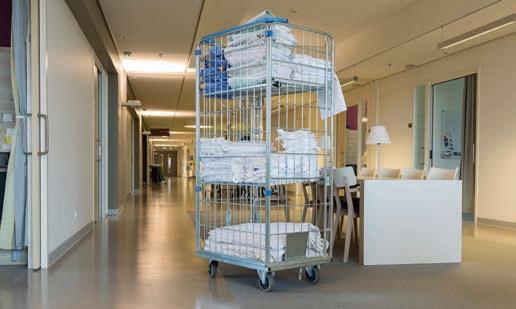
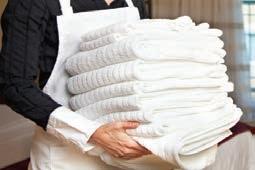
CHICAGO — After linens and textiles are processed, it’s important that the goods remain clean from the laundry to the customer or to the shelf—and to the end-user.
Clean transport is even more important when it comes to healthcare linens.
“If your healthcare organization and those in the laundry industry are not doing known, evidence-based clean procedures at 100%, that could have an impact on the patient level,” says Dr. Fontaine Sands, an associate professor at Eastern Kentucky University.
In other words, if hygienically clean healthcare linens aren’t transported and moved properly, they could become contaminated and possibly lead to patient infection.
Appropriate transportation systems, packaging/storage means and handling methods are key to maintain the cleanliness of healthcare linens.
According to Randy Wendland, CLLM, corporate director textile management services/ TSR at ABM Healthcare Support Services in St. Clair Shores, Mich., the integrity of clean
linen starts within the processing plant—the laundry.
Wendland says that processes must be in place to ensure cleanliness of work areas,
Have bottlenecks? Time to look at big picture
BY MATT POE, EDITOR
CHICAGO — A bottleneck is defined as “a point of congestion or blockage.”
Most laundries have encountered points in operations where workflow suffers from congestion, slowing or even stopping. Those are bottlenecks in the process, which can reduce cost-effective operations.
There are many reasons a bottleneck can develop. J.R. Ryan, president of laundry consulting firm TBR Associates, Saddle Brook, N.J., says bottlenecks are constraints created either internally by equipment, people and policies, or externally by market demand being greater than capacity.
He says bottlenecks occur when a process downstream has less capacity than a preceding process.
“Think of your daily commute to or from work: Is there always a roadway or intersection where traffic builds up, causing everyone to slow down or even come to a stop?” he asks. “This is a bottleneck.”
Chip Malboeuf, president of Turn-Key Industrial Engineering Services Inc. in Charlottesville, Va., says that bottlenecks appear in many different areas throughout different laundry operations.
“It is hard to say definitively ‘it is X,’” he says. “We do, however, see common themes causing bottlenecks.”

One common theme Malboeuf
says his company encounters deals with actual throughput based on finished product making it out the door and to the customer. Bottlenecks caused by equipment malfunctions, downtime and lack of operator training result in rework for the laundry, Malboeuf says. The rework places additional pressure on the troubled areas to process the same items two and sometimes three times.
“This rework exacerbates the lack of machine and/or employee capacity,” he says.

Lack of production scheduling is another cause of bottlenecks in the process, says Malboeuf.
“One department over-produces, causing downstream bottlenecks,” he says. “The old phi-
losophy of ‘see bag, wash bag’ in the soil area creates bottlenecks throughout the finishing areas of the laundry.”
For Ron Hirsch, president of equipment distributor Direct Machinery Sales Corp. in Hicksville, N.Y., the biggest problem contributing to laundry bottlenecks has to do with production and workflow.

“A good laundry is a study of time and motion,” he says. “It is important to make sure that the equipment works in conjunction with all phases of the operation. For instance, if the washroom outpaces the finishing floor, the work can pile up to a point that the
Find out what happened at the ‘new’ HX trade show in NYC.

JANUARY 2016 Late News
processing stations, finishing equipment and material-handling devices.
www.americanlaundrynews.com Volume 42, Number 1 INSIDE [12] See MOVERS on Page 11
The Newspaper of Record for Laundry & Linen Management
Panel of Experts
Meet our newest Panel members who are ready to answer questions.
[4] See BOTTLENECKS on Page 10
Columnist at Large Eric Frederick suggests setting hard-to-reach goals for 2016.
[6
(Photo: ©iStockphoto/AlbyDeTweede)
]
HX Show Report
Survey: Managers say 2015
CHICAGO — When asked to rate their company’s business in 2015, the majority of managers who took American Laundry News’ most recent Your Views survey rated the year either “good” or “great.”
And 2016 also looks good to respondents in terms of achieving priorities.
One writes, “We are growing.”
“Continuous business improvements helped build great efficiencies,” another respondent writes.
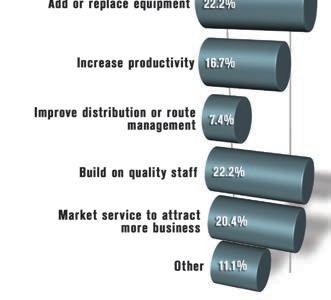
When asked to rate their business in 2015, almost 53% of respondents answered that the year was “good,” while 20% said business was “great.”
Just 25.5% answered that the year was “average.” Only 1.8% saw business in 2015 as “below average,” and no one responded that the year was “poor.”
What made 2015 a good year for the majority of laundry managers who took the survey? There were many events that were the “best” of the year.
Some had success with upgrades.
“We re-lamped the entire plant with incentive money from others,” writes one respondent.
“Machines kept working, and adjusted chemical usage to a lighter footprint, more environmentally friendly,” adds another.
One respondent had it particularly good when it came to equipment: “Upgrades and new installations were completed without any glitches.”
“By changing our shifts—going from five 8-hour shifts to four 10s, we have been better able to manage our sometimes volatile volumes,” a respondent writes. “By changing our hours of operation, we have more overlap staff, which has also helped to facilitate the surges that we often experience.”
Other survey takers cited employees for being “the best thing that happened” to their laundry/linen operation.
“Our personnel was excellent in handling problems and working with our suppliers,” a respondent writes.
Another adds, “I was blessed with good workers, and experiments were tried and proved to be beneficial.”
Of course, sales and business improvements made the highlight reel for some laundry managers.
“Through sales efforts, we were able to add a few new high-volume customers,” writes a respondent.
“Continuous business improvements, which helped build greater efficiencies,” another writes.
The majority of those who took the survey (74.6%) expected the year to turn out like it did; for 21.8%, the year didn’t meet expectations.
Of course, not everything went according to plan (or well) in 2015. Those who took the survey offered a list of “worsts” for the year. These included:
• “Low growth rate compared to previous years.”
• “No administrative cooperation.”
• “Received a new dryer and after six months of having it, we are having a heating error problem with it.”
• “The aftermath of an embezzlement scheme by our former controller.”
• “We seem to struggle with hiring and maintaining our per diem staff, which we rely on heavily for two shifts a week and our vacation/sick leave coverage.”
• “We had three months of 24-hours-per-day, emergency operations due to a shutdown of our sister laundry. The problem being that
their records for processing their customers’ linens were inaccurate or incomplete. This led to customer dissatisfaction and a disorganized processing.”
Despite the setbacks, most managers indicated that their companies achieved at least some set goals for 2015. In fact, 32.7% answered, “We accomplished all of our goals,” while 65.5% indicated, “We accomplished some of our goals.”
Only 1.8% of respondents said their companies didn’t set any goals for the year. No survey taker indicated, “We didn’t accomplish any of our goals.”
When it comes to goals, a majority of respondents indicated that there is a decent chance that their laundries will accomplish their No. 1 priorities for 2016.
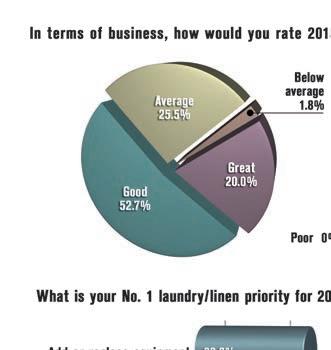
Almost 67% indicated that “there is a good chance” the laundries will reach that priority. The share of managers who gave a 50-50 chance to achieve those goals were 31.5%.
What are those No. 1 priorities? Answers were fairly even in several categories. Both answers of “add or replace equipment” and “build on quality staff” garnered 22.2% of responses. Following closely was “market service to attract more business” at 20.4%.
Close to 17% of survey takers are looking to “increase productivity,” and 7.4% want to “improve distribution or route management.”
More than 11% chose the “other” category, offering a variety of different priorities for 2016.
“Increase awareness of the importance of innovative, reliable and accurate chemical dispensing systems,” writes a respondent.
“Train other for jobs in the laundry industry,” another writes.

One survey taker has a more specific priority in mind: “Add additional capacity, equipment and space.”
Finally, one respondent puts it simply: “Profitable growth.”
While the Your Views survey presents a snapshot of readers’ viewpoints at a particular moment, it should not be considered scientific. Due to rounding, percentages may not add up to 100%.
Subscribers to American Laundry News e-mails are invited to take the industry survey anonymously online each month. All managers and administrators of institutional/OPL, cooperative, commercial and industrial laundries are encouraged to participate, as a greater number of responses will help to better define operator opinions and identify industry trends.
Publisher
Charles Thompson
Phone: 312-361-1680
E-Mail: cthompson@ ATMags.com
Editorial Director
Bruce Beggs
Phone: 312-361-1683
E-Mail: bbeggs@ ATMags.com
Editor
Matt Poe
Phone: 231-740-2842
E-Mail: mpoe@ ATMags.com
Digital Media Director
Nathan Frerichs
Phone: 312-361-1681
E-Mail: nfrerichs@ ATMags.com
Advisory Board
Jim Buik • Richard Griffin
Greg Gurtler • Phil Hart
Janice Larson • Tom Marks
Gerard O’Neill
Richard Warren
Production Manager
Roger Napiwocki
National Sales Director
Donald Feinstein
Phone: 312-361-1682
E-Mail: dfeinstein@ ATMags.com
Main Phone: 312-361-1700 Fax: 312-361-1685
Subscriptions
630-739-0900 x100 www.americanlaundrynews.com
American Laundry News (ISSN 1091-9201) is published monthly. Subscription prices, payment in advance: U.S. 1 year $39.00; 2 years $73.00. Foreign, 1 year $89.00; 2 years $166.00.
Single copies: U.S. $7.00; Foreign $14.00. Published by American Trade Magazines LLC, 566 West Lake Street, Suite 420, Chicago, IL 60661. Periodicals postage paid at Chicago, IL, and at additional mailing offices.
POSTMASTER, Send changes of address and form 3579 to American Laundry News, Subscription Dept., 440 Quadrangle Drive, Suite E, Bolingbrook, IL 60440. Volume 42, number 1. Editorial, executive and advertising offices are at 566 West Lake Street, Suite 420, Chicago, IL 60661. Charles Thompson, President and Publisher. American Laundry News is distributed selectively to qualified laundry and linen management and distributors in the United States.
© Copyright AMERICAN TRADE MAGAZINES LLC, 2016. Printed in U.S.A. No part of this publication may be transmitted or reproduced in any form, electronic or mechanical, without written permission from the publisher or his representative. American Laundry News does not endorse, recommend or guarantee any article, product, service or information found within.
Opinions expressed are those of the writers and do not necessarily reflect the views of American Laundry News or its staff. While precautions have been taken to ensure the accuracy of the magazine’s contents at time of publication, neither the editors, publishers nor its agents can accept responsibility for damages or injury which may arise therefrom.

MEMBERSHIPS
2 JANUARY 2016 | AMERICAN LAUNDRY NEWS www.AmericanLaundryNews.com
Association for Linen Management
INSIDE: January 2016 • Vol. 42 | No. 1 [6] HX: The Hotel Experience ‘Debuts’ in New York Manufacturers of laundry machinery, textiles and chemicals displayed hospitality and food and beverage products [8] Tools of the Trade [18] Trade Ticker [20] Classified Advertising [21] Source Directory
to meet
ALN
‘good,’ poised
goals in 2016
“
They have done everything they promised and more.”
– John Ambrose Magliocco, Arrow Linen, Garden City, NY
From

Arrow Linen first purchased their three Milnor CBW® tunnels two decades ago to replace conventional washer-extractors in their original laundry located in Brooklyn, NY. Since then, Arrow’s business grew to warrant a second laundry. In 2013, Arrow expanded operations–and raised their roof 11 feet! Arrow could have chosen any manufacturer to equip their new washroom, but they knew that would get longevity, durability, and accountability with Milnor.
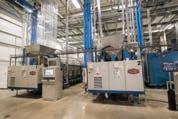
Arrow’s customers’ restaurant linen requires frequent color and soil change formulas, but the quality is not compromised. Corporate Engineer Frank Park boasted the tunnels “have increased our workload over 40% without increasing energy, water, or labor costs we experienced when we converted the conventional washers to CBW® tunnels over 20 years ago. The major improvements from the CBW® to PBW™ are far superior washing capability with only 50% water consumption.”
To find out how PulseFlow® can cut your water bill in half, contact an authorized Milnor distributor or call 504-712-7656.
www.milnor.com / pellerinmilnor
Scan to read Arrow’s success story.
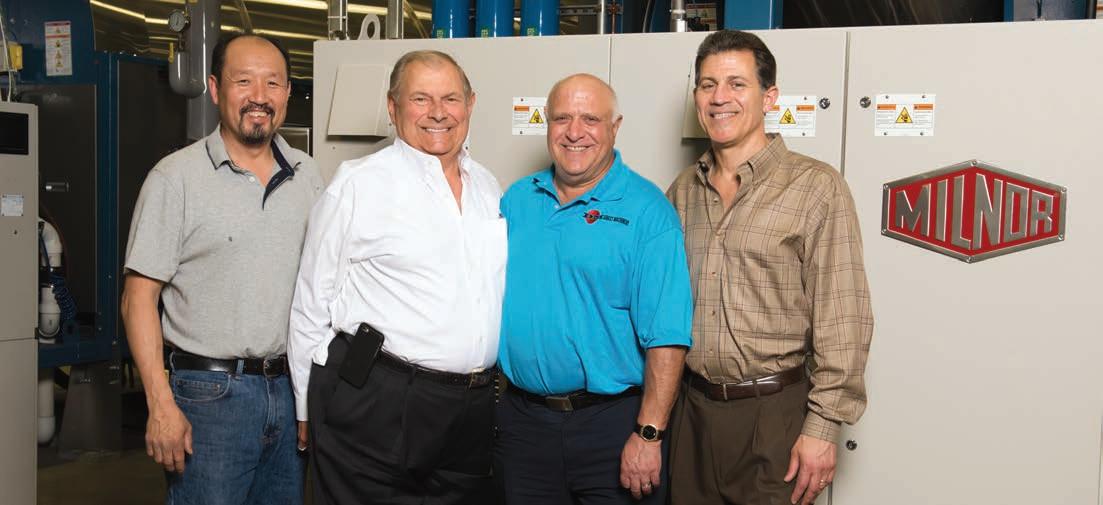
left to right: Frank Park, John Ambrose Magliocco, Ron Hirsch, and John Anthony Magliocco
Time to work on ‘new you’?
For many people, the new year is the time to work on the “new you.” Maybe this year, you’ve “resolved” to improve plant operations or increase business for your laundry.
In this issue of American Laundry News, there are several articles that can help you reach your goals.
Perhaps your facility has too many “bottlenecks”—workstations where the processing gets backed up. Editor Matt Poe spoke with laundry consultants and distributors to find out what causes bottlenecks in a laundry operation and how to help make the process flow more smoothly.
Or maybe you process laundry at or for a healthcare facility. Have you noticed linens not
The Director’s Chair
B RUCE B E GG S
reaching the patients in as hygienically clean a state as they could? That could result in potential patient health risks.
Poe spoke with some healthcare laundry professionals to learn how processors can keep
linens as clean as possible during transport—from the plant or onpremises laundry all the way to the patient in his or her room.
Being that it is a new year, that means a new Panel of Experts is ready to share expertise and provide insight regarding a variety of laundry/linen-related topics.
In this issue, nine experts representing segments from Commercial Laundry to Equipment/Supplies Distribution introduce themselves, describe their backgrounds and share their initial insights.
American Laundry News is proud to provide this content, and more, to help you work on the “new you.”
Here’s wishing you a happy and prosperous new year! ALN
ARTA prepping for 2016 education conference
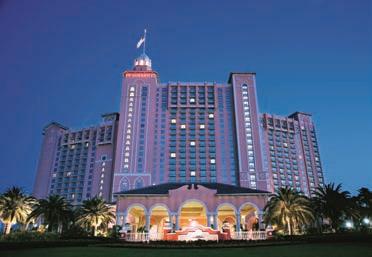
MISSION, Kan. — The American Reusable Textile Association (ARTA) will stage its 2016 Education Conference March 9-11 at the J.W. Marriott Grande Lakes Resort (pictured) in Orlando, Fla.
This year’s conference will focus on infection prevention, new technology and marketing opportunities, according to the association.
The day-and-a-half agenda also includes tabletop exhibits, a welcome reception by MIP/Encompass and a sponsor reception.
Optional activities include a March 9 plant tour of Disney’s Fourth Laundry Operation (FLO) and a golf tournament.
“Laundry operators have many options for professional development, but if you are serious about providing healthcare linen services on any scale, this is a must-attend event,” says ARTA President Ed McCauley, United Hospital Services, Indianapolis.
“Since 1982, ARTA has offered education and support for healthcare laundry executives, especially regarding surgical textiles.”
ARTA says its conference is open to members and nonmembers, as well as all sister associations.
To register, or to learn more about the event, visit the ARTA website, www.arta1.com ALN
Set hard-to-reach goals this year
I t is that time of the year when we look back on all that happened in 2015 and look forward to the new year.
Every year, we set goals for the new year: what we want to accomplish in our personal life and what we want to accomplish as part of our management life. Some goals are easily measured, while others are not.
Too often, we pick out goals that can easily be reached just so we can show our boss that we have accomplished our goals. I would like to suggest this year that you set hard-to-reach goals and really push yourself and your organization.
Education is the key to continued success, both for you as a manager and for your staff. Do you have a college degree? Based on my knowledge of the industry, the answer is most likely no. The best jobs are saved for those who have operational experience and have a college degree. Are you willing to set educational goals for yourself that will stretch your time management skills and most likely take several years to complete?
Have you looked at the educational needs of your staff and have you helped them to set goals to develop new skills? What programs are offered by your organization, your local colleges and your professional associations? The stronger the crew under you becomes, the more that can push you up the ladder.
Have you incorporated team-building skills into your management-training program? Properly coordinating the movement of linen through the laundry is a daily challenge and requires constant teamwork. Have you challenged your staff to constantly look for better ways to produce the daily required textile products?
Have you looked at expanding your laundry operations and determined what niches are available with a minimum of competition? One area that is ripe for the taking is the nursing home industry. Many of these facilities currently run in-house laundries because of the need to process patients’ personal linen. If your staff can determine a cost-effective way to handle the personal linen, then you will have more additional business than you can handle.
Nursing home business is good business, because it is constant and unchanging. Many in-house nursing home laundries do not have the capacity to process reusable incontinent pads and clothing protectors (adult bibs). These items can be quickly added to the mix.
If this sounds interesting to you, then set a goal to visit a number of nursing homes in your area in order to learn what works best for this segment of our industry. Understanding the needs and challenges facing your customers is the first step in developing an effective product mix and marketing plan for that part of the industry.
Set a goal to examine and incorporate some of the new, 100% polyester linen items into your facility. The longevity and reduced utility costs associated with these items make this a wonderful area for study. (For the past two years, I have used a 100% polyester thermal spread and a 100% polyester contour sheet, with excellent results.)
Using one of last year’s proposed production-improvement ideas, set a goal to initiate at least one major workflow redesign to reduce labor costs and increase efficiency. This may involve a dramatic change in procedures, changes in the expectations on the part of the end-users and a capital investment in a piece of equipment.

Realize that, every year, we must prove our value to our boss or our customers. Those laundries that simply maintain the status quo will become a footnote in the annals of time—lost to a commercial laundry, taken over by contract management or simply closed because no one sees particular value in what they are doing.
The concept that there is safety in not rocking the boat has been proven wrong time and time again.
Dare to improve your operation. Dare to set goals that are difficult to reach and then stretch to reach them. Then, you will have developed the management skills that will provide you and your staff with job security.
Eric Frederick is director of laundry services for Carilion Laundry Service, Roanoke, Va., and a past president and manager of the year of the Association for Linen Management. You can reach him by e-mail at efrederick@carilion.com.


4 JANUARY 2016 | AMERICAN LAUNDRY NEWS www.AmericanLaundryNews.com
From
COLUMNIST AT LARGE Eric L. Frederick, RLLD
ALN
Top Stories Appearing on AmericanLaundryNews.com for the 30 Days Ending December 15 (WE) = WEB EXCLUSIVE NEWS • ARTA Prepping for 2016 Education Conference • Univar to Distribute DuPont Professional-Grade Enzymes ... • HX: The Hotel Experience Trade Show Debuts • MIP Inc. Promotes Lund to President and CEO • Fire Destroys Texas’ Lone Star Linen (WE) NEWS (CONTINUED) • La Tavola Fine Linen Rental Taps Black as CEO, Completes...
• Small Changes Can Make Big Differences
Eric Frederick: Textile Distribution
Cougar Pride: On Field and In Laundry OUR SISTER
From AmericanDrycleaner.com: • Outerwear Accompanies Arrival of Cooler Weather
Closer Look: A. L. Wilson Chemical Co.
AmericanCoinOp.com:
Coin-Op 101: Site Selection Strategies
Continental Girbau Welcomes New Distributors to Network
COLUMNISTS/FEATURES
•
•
WEBSITES
•
From
•
•
(Photo: J.W. Marriott Grande Lakes Orlando)






























800 821 2221 | imagine@americandawn.com | americandawn.com
by TM The LunchkinTM is intended to extend the color o ering of The Greenie. Six additional colors to replace paper napkins in any lunch setting. Beyond the environmental benefits of The Greenie, The Lunchkin creates a fine dining experience -- at lunch. And the cost is about the same or less than paper napkins! Made in USA Fabric
Milliken. Made in USA Fabric By Milliken.
Replaces single use paper napkins at a lower cost
Creates a better dining experience and sets you apart in the marketplace
Lasts over 100 wash cycles
Never ironed, less energy use
Saves up to 5 billion pounds of trash per year Signature Plus is a registered trademark for Milliken & Company for fabrics. • Smaller 15” x 12” Lap Size
Your table linens touch every Customer at every event. Your linen needs to speak their language… fresh, clean, safe, consistent, reliable, and yes - elegant. They count on it. Together, ADI and Milliken have set the standard of linen excellence for decades. USA made Signature Plus fabric. Soft luxurious hand, consistent long-lasting color. Whites that stay white, and colors that stay bright. ADI American Dawn. The world’s leading supplier of Milliken Signature table linen products. Count on us. The Greenie® is America’s choice to replace paper napkins! At breakfast and lunch, if every American uses reusable linen napkins instead of paper, we can save 60,000,000 trees per year! That means cleaner air, less water use, less energy use, less waste in landfills, less toxic paper production chemicals. And the best part... Money raised through the sale of this product is given back - to educate our children on keeping the planet clean and safe. 84% of Americans prefer cloth vs paper at the table. The Greenie® Because it’s the right thing to do.
Lunchkin
By
•
•
•
•
•
HX: The Hotel Experience trade show ‘debuts’
BY RICHARD MERLI
NEW YORK — Manufacturers of laundry machinery, textiles and chemicals introduced new and improved cost-saving products at HX: The Hotel Experience— Rooms to Restaurants, a threeday event here at the Jacob K. Javits Convention Center in midNovember.
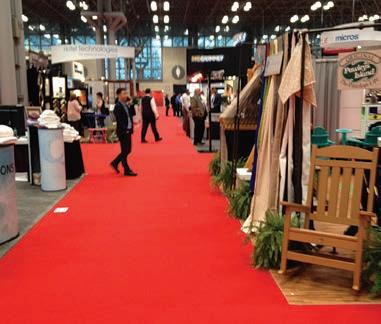
Many of the new products are designed to reduce energy and water consumption for cost-conscious managers of hotel laundries.
Exhibitors also networked and forged new relationships with laundry managers and hotel owners and executives at HX, formerly The International Hotel Motel & Restaurant Show (IHMRS).
HX, North America’s largest trade event for the hospitality industry, drew more than 12,000 people this year, according to Missy Stearns, marketing manager for ST Media Group, the show’s management company.
Among machinery manufacturers, UniMac featured its OPTispray Rinsing Technology, available on all UniLinc cycles, which is designed to minimize the water required to rinse a load and to reduce cycle time with
more effective rinsing. OPTispray uses spray-rinsing power to leave 22% less wash chemical residuals behind, according to Scott Peregoy, regional sales manager for UniMac, a brand of Alliance Laundry Systems, based in Ripon, Wis.
The company also offered its TotalVue management reporting system, which enables laundry and hotel managers to remotely monitor the performance of specific machines and multiple laundry locations from any Internetenabled device by logging into the system website. Managers can track utility expenses, labor usage, efficiency, equipment utilization and productivity—how much laundry is being processed through a facility in a given period of time.
Pellerin Milnor Corp., which shared exhibit space with Chicago Dryer Co. at HX, has also enhanced its washing technology to reduce laundry costs for hotels, according to Joseph Leo, vice president of sales and marketing for PAC Industries Inc., a Milnor distributor.
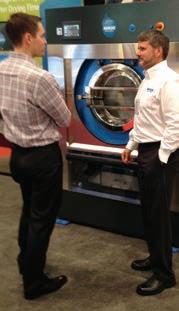
Milnor’s RinSave water-saving feature allows for the washerextractor basket to reach a precise G-force, which slings the wash liquor—including water, chemicals and soil—out of the goods after a wash step. Standard on all rigid-mount washer-extractors from 40 to 165 pounds in capacity, the feature is designed to save up to two rinses per load and reduce fill-rinse time.
Floor traffic was slow on Sunday, the opener of the threeday show, according to Mats Bruce, executive vice president of B&C Technologies, manufacturer of commercial laundry machinery for hospitals, hotels and prisons, based in Panama City, Fla. B&C’s washer-extractors range in capacity from 30 pounds all the way up to 475 pounds and are well-suited for on-premises hotel laundries.
However, traffic at the B&C exhibit more than doubled the next day, says Bruce.
Electrolux promoted its high-
spin 450 G-force washers, designed to achieve faster drying times and lower gas consumption.
“Hotel managers want to save money on energy and gas by using more efficient equipment,” says Bianca Beres, customer care sales specialist for Laundrylux, distributor of the Electrolux and Wascomat brands, and based in Inwood, N.Y.
It was a productive show for Hamilton Engineering Inc., manufacturers of boilers and hot water heaters, according to Josh Reasoner, south central regional sales manager for the company, based in Livonia, Mich. It was the first time exhibiting at the hotel show for Hamilton, which is seeking to expand into the hotel market.
“We’ve gotten some very good quality leads and feedback at the show,” says Reasoner.
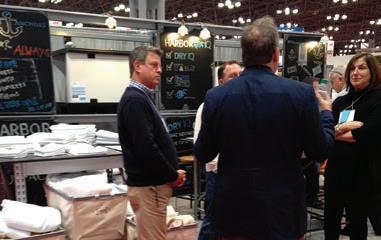
The same could be said for Xeros Inc., makers of the Xeros washing machine, which uses specially designed polymer beads in place of large volumes of hot water to remove stains from linen and fabrics. Its first-generation system was designed to reduce water consumption in the wash process by up to 80% and energy use by up to 50%.
“We had a good quality of leads at the show,” says David Kaupp, vice president of marketing for Xeros, whose U.S. offices are located in Manchester, N.H. “Many hotel managers are interested in reducing their laundry costs and extending linen life.”
Xeros now has more than 150 laundry installations in the U.S. Manufacturers of laundry chemicals and related systems also highlighted recent innovations in cost savings for the hotel industry.
Ecolab exhibited its Aquanomic low-temperature chemistry laundry program, which combines with a pre-programmed Smart Wash process to reduce water and energy usage by up to 40%.
The company also exhibited its StainBlaster Stain Management Program, which is formulated to
eliminate extra-tough stains, such as makeup, blood and grease, and to minimize linen replacement costs by extending the life of the linen. The stain management program includes a variety of pre-spotter sprays and Power Pak formulas.
“It was a great show and an opportunity for us to highlight some of Ecolab’s key innovations,” says Nicole Goodman, marketing communications manager for lodging at Ecolab, based in St. Paul, Minn. “The outcome was great.”
Similarly, Proctor and Gamble offered its Tide Professional
Coldwater System, designed to reduce the energy used to heat water in washers by up to 75% and the water used in washers by up to 40%.
“Energy and water savings are a key in the hotel market,” says Greg Elmore, Northeast region manager for P&G Professional, based in Cincinnati.
Manufacturers of institutional textiles also introduced innovations and new support services for hotel laundries.
For instance, Harbor Linen introduced Dry IQ, a new line
6 JANUARY 2016 | AMERICAN LAUNDRY NEWS www.AmericanLaundryNews.com ALN_Tab_1-4_H.indd 1 12/1/15 1:49 PM
HX attendees learned about new linens in the hospitality and foodservice industries.
New laundry machines were on display at the show. (Photos: Richard Merli)
See HX on Page 19
HX attendees had a new show floor layout to explore.
TWO ARE BETTER THAN ONE.
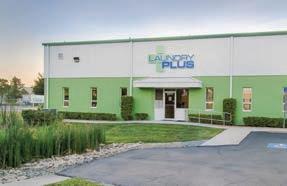
Happy with the productivity, efficiency and flexibility of his first Girbau Industrial (GI) tunnel system, Rick Rone of Laundry Plus maintains the decision to invest in a second identical system was a no-brainer. He likes the security they bring.
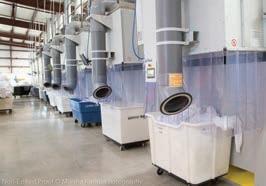



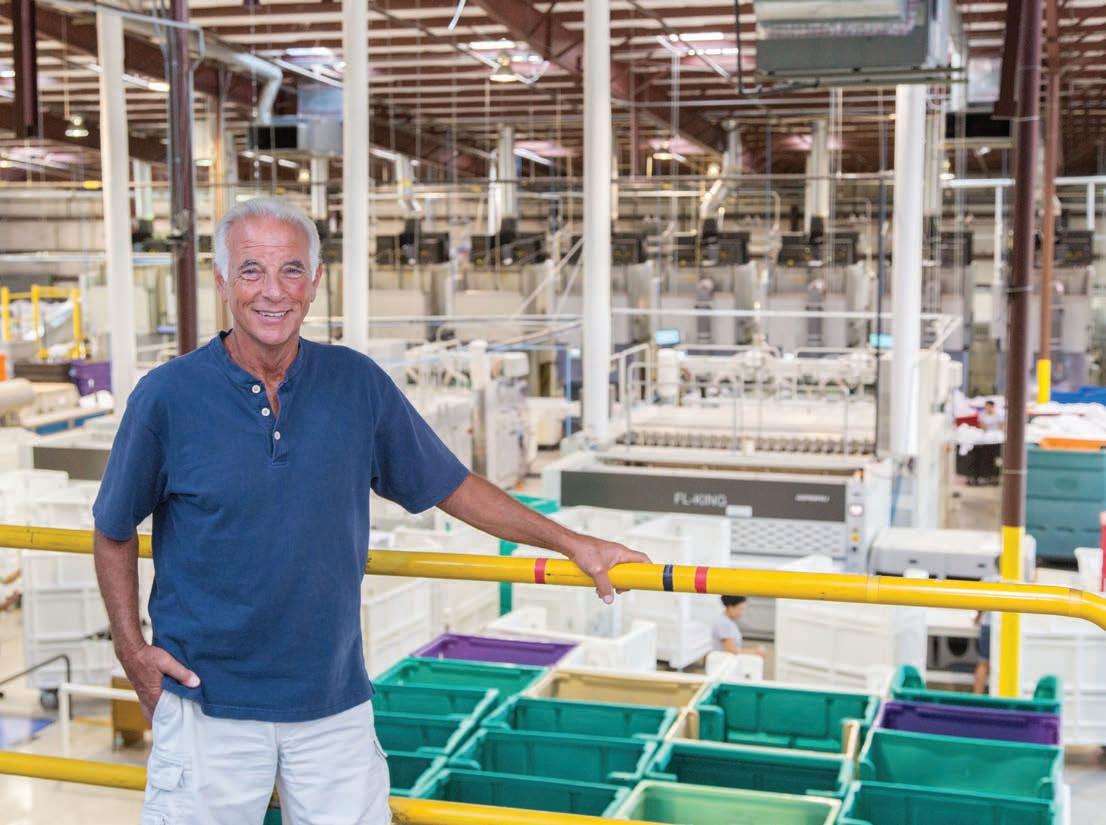
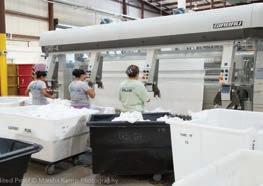
By adding a second GI tunnel system and moving equipment from two buildings into one, Rone enjoys streamlined production. The new plant – with its arsenal of high-performance equipment – opens the floodgates to new business, ensures backup in case of a mechanical failure, and allows Rone to launch a new linen rental program.



Since moving to the new plant and installing its second tunnel, another ironing line and additional open-pocket washers, Laundry Plus has boosted pounds of laundry per operator hour (PPOH) by 15-18 percent.


LAUNDRY SOLUTIONS FOR WET
ON-PREMISE
CONTACT GIRBAU INDUSTRIAL TO SEE HOW WE CAN INCREASE YOUR PPOH!
CLEANING,
& INDUSTRIAL LAUNDRIES
Rick Rone
www.girbauindustrial.com • (800) 256-1073 INDUSTRIAL
Laundry Plus, Bradenton, Florida
Tools f the Trade
New polymer textile technology said to help control infection
Bio-Spear, an organo-silane, is a new technology that, according to producer Nanoshield Solutions, when polymerized to a textile, will provide protection lasting up to 100 washings.
Infection control is increasingly becoming one of the most important functions in textile care management, says Nanoshield Solutions. It adds that with superbugs becoming stronger and more prevalent, the need for effective products has never been greater.
The company points to recent studies that show bacteria and viruses that cause infections are prevalent everywhere. Even after cleaning and disinfecting, within minutes the bacteria and viruses start to populate the textiles and within an hour are back as strong as before the cleaning process, Nanoshield Solutions says.
The company says Bio-Spear forms a covalent
bond with the textile. Attached to this molecule is a carbon chain with a positively charged nitrogen ion. This carbon chain forms a “spear,” and the nitrogen ion attracts the negatively charged bacteria and viruses. The carbon spear punctures the cell membrane of the pathogen, and the nitrogen ion electrocutes the cell.
Nanoshield Solutions says Bio-Spear does not lose strength, and the “spear” is ready for the next kill.
Normal cleaning of the textile will remove the dead pathogens, dust and dirt so that the “spears” are not buried, according to the company, which adds that since this is a mechanical kill, it leaves little chance of pathogens developing resistance giving rise to superbugs.
www.nanoshieldsolutions.com 800-906-2590

Sales tool app created to define client needs, solutions
G. A. Braun Inc. recently developed a mobile application on the Apple iOS platform that will assist its sales and project managers in creating a client’s profile, calculating workload needs, crossreferencing product solutions and generating a cost analysis, the company reports.
Some of the features within the app’s profile tool, the company says, include the capability to capture site survey data and annotate and draw measurements onto photos.
Braun says the reference section features commonly used reference materials, such as conversion charts, and includes industry expertise articles from various laundry publications. There is a reporting tool section within the app, according to the company. This section aids the sales manager in provid-

ing client partners with timely operational analysis.
“This tool represents the continual improvement culture throughout our entire organizational processes and practices,” says Joe Gudenburr, president of G. A. Braun. “We are committed to providing our customers with industry-leading quality products and services that add value for our clients, and enhance their level of satisfaction. This is the second iOS application that we have developed (the first being our product overview app), and we will continue to leverage technology to bring us closer to our clients, help us define their needs and provide solutions to those needs.”


www.gabraun.com 800-432-7286
Dickies now offers cargo pants for men and women in the hospitality industry, the company reports.
Dickies Women’s Relaxed Server Cargo Pant sits slightly below the waist, and is perfect for long days on the job, as it resists wrinkles, has care stain release and is fade-resistant, the company says. Additionally, the pants offer a reinforced key loop, and double pen clip—functional and stylish.
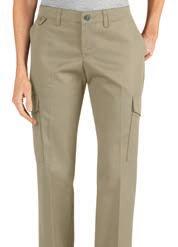
The Industrial Straight Leg Cargo Pant is built to work, Dickies says. According to the company, the pants resist wrinkles, have easy care stain release and have wider, stronger belt loops, a reinforced key loop and a double pen clip.
The pants are offered in an array
of colors, including black, desert sand and navy, Dickies says. www.dickies.com 866-411-1501
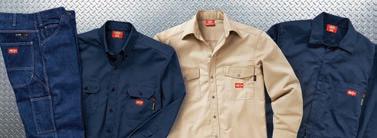
Flame-resistant, arc-rated apparel added to product catalog
G&K Services Inc., a provider of uniforms and facility services programs, has added Dickies® FR apparel to its catalog of flameresistant (FR) rental uniforms, the company reports.
“We’re excited to add Dickies, a brand name known for producing innovative, tough and comfortable clothing, to our flame-resistant product line,” says Dave Euson, G&K’s vice president of marketing and sales. “G&K is committed to providing our customers safety
apparel that combines protection and durability with the added value of superior customer service.”
Manufactured by Workrite Uniform Co., the Dickies FR product lineup includes a navy lightweight coverall, a snap-front shirt available in khaki and a buttondown shirt available in khaki and navy, says the company. Customers can also choose either Dickies FR relaxed fit jeans or carpenter jeans. www.gkservices.com 800-452-2737
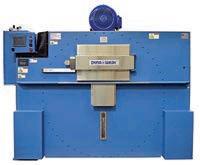
EDRO Corp. has created a line of water-extractors for the hospitality industry. DynaWash® three-pocket, end-loader washerextractors are based on a patented “3-D” basket design, the company reports.
The basket physically separates the load, leading to reduced tangling of sheets and linens in hotel, motel and resort washrooms, according to the company.
EDRO says the basket design delivers a dynamic wash action that maximizes whiteness retention and tensile strength. It also assures the ideal wash action for outstanding laundering results and long machine life.
The company says the “D” describes the shape of each of the three compartments comprised of a flat,


perforated floor for easy loading and unloading; topand bottom-angled baffles for increased load separation and balancing stability; and a fully perforated outer basket wrap with lifting rib for mechanical action and wash water saturation.
According to EDRO, the basket construction also lowers the machine’s center of gravity, allowing for a compact frame and base with a reduction in vibration transmission.
The company says the range is available in 100-, 150-, 200-, 300- and 400-pound models in rigid- or soft-mount configuration.
www.edrocorp.com 800-628-6434
Manufacturers: Have you introduced a new product? Revamped your system? Released a new catalog? E-mail your product news, along with a high-resolution image, to mpoe@atmags.com and we’ll consider publishing your news free in Tools of the Trade.
Trifecta, a solid detergent for institutional laundering, is specially formulated for washing athletic (and other) uniforms effectively without color transfer or damage to the fabric, according to Sunburst Chemicals.
The company says Trifecta’s special formula is powerful enough to clean ground-in clay, grass, blood stains and tough odors from uniforms— even at the low (90-110 F) temperatures recommended by uniform manufacturers.
Sunburst also says Trifecta works effectively in soft- or hard-water conditions.
www.sunburstchemicals.com 800-899-7627

8 JANUARY 2016 | AMERICAN LAUNDRY NEWS www.AmericanLaundryNews.com
Men’s and women’s cargo pants created for use in hospitality industry
Solid detergent formulated for institutional, athletic laundering Three-pocket, end-loader washer-extractor basket design reduces tangling of sheets, linens in hospitality industry
When dealing with laundry stains, your reputation rides on getting the outstanding results The Laundry Two deliver. RiteGo® laundry spray spotter quickly penetrates to absorb collar & cuff stains, perspiration, ground-in soil and more, all without brushing. Turn to Laundry TarGo® to remove any tough oil based stains that remain behind.
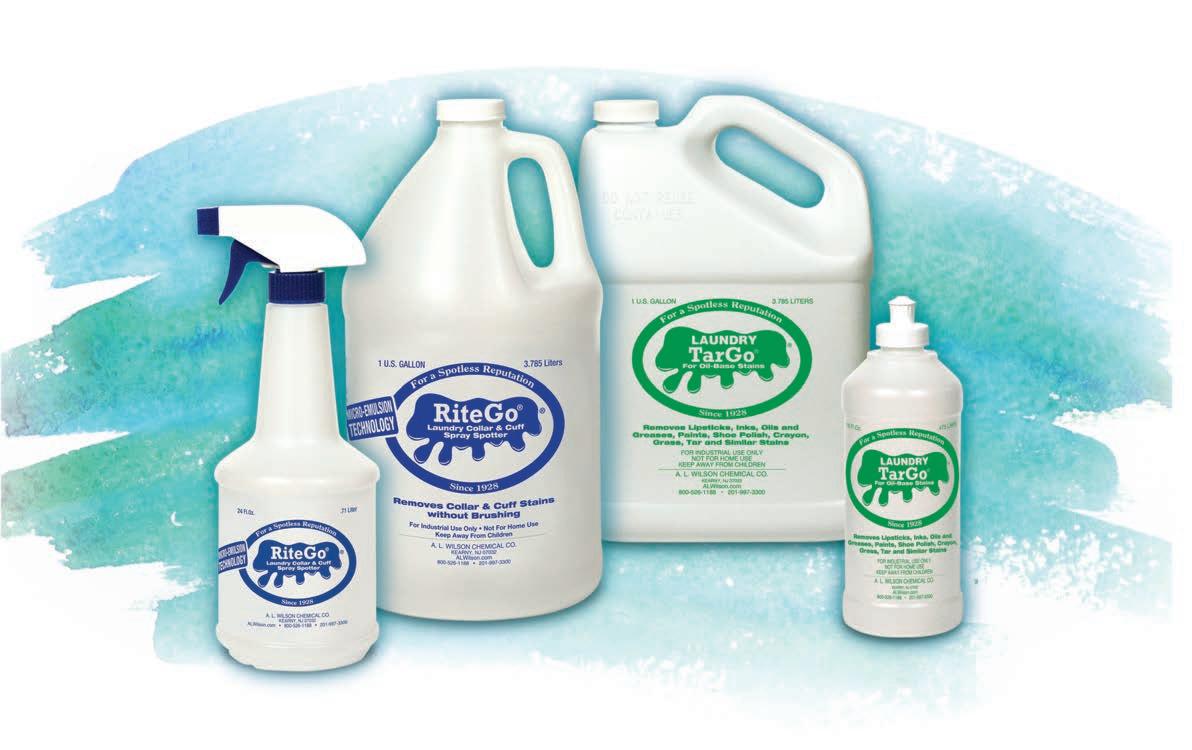
Use The Laundry Two with confidence on shirts, wedding gowns... anything you're washing or wetcleaning.
Both Laundry TarGo and RiteGo are chlorinated-solvent free, biodegradable, noncombustible and California 2013 VOC and Prop-65 compliant.
Use them to deliver stain-free laundry and wetcleaning. You'll build your reputation for quality - which is what keeps customers coming back.
FROM COLLARS AND CUFFS THE LAUNDRY T WO ™ ARE RIGHT FOR YOU! TO THE REALLY TOUGH STUFF... FROM COLLARS AND CUFFS THE LAUNDRY T WO ™ ARE RIGHT FOR YOU! TO THE REALLY TOUGH STUFF... To learn more, visit ALWilson.com or call 800-526-1188 A. L. WILSON CHEMICAL CO.
a STAIN WIZARD at ALWilson.com
Become
A HISTORY OF EXCELLENCE, A FUTURE OF POSSIBILITIES
A & B Wiper Supply is now Monarch Brands. We have changed our name to better reflect the full breadth of high quality and valuepriced textiles from manufacturers around the world. From global textile sourcing to private label programs, we have you covered, whatever your needs may be. Leverage our experience and purchasing power to find the perfect blend of quality and price point for your company.
Bottlenecks
operators have trouble moving and working the equipment.”
While Malboeuf says that “it is hard to definitively say ‘it is X’” causing the bottleneck, he does have ideas to help laundries locate problem areas in their operations. One of the best ways to identify bottlenecks, he says, is to step back and observe from the “10,000-foot level.”
This view, according to Malboeuf, includes observing cart and sling movement, observing the amount of work-inprocess, observing the speed that goods pass through departments and so on. The idea, he says, is to take a holistic view of the operation.
“One of the quickest ways to identify a bottleneck is to look at the work-in-process in your facility,” Malboeuf says. “Typically, the process with the most work-in-process in front of it is a bottleneck.”

Another method Malboeuf recommends is to identify capacity constraints by running a capacity model of a facility. Using production requirements, production standards and equipment data, laundry managers can identify constraints. It is an objective way of identifying laundry inefficiencies, he says.
After the “theoretical” capacity of a process has been calculated, the laundry needs to look at the actual production throughput of the process, according to Malboeuf.

“Then ask yourself if the actual production levels are close to the theoretical production levels,” he says. “If there is a difference between theoretical and actual, you have inefficiencies at or around the constraint. Once you identify the problem, you can follow the steps to exploit, subordinate and elevate the constraint.”
Getting maximum production is essential for eliminating bottlenecks, says Hirsch. He notes that every manufacturer can quote the expected productions that each machine can achieve and will usually have numerous references to back up the expected numbers.
Ryan recommends a five-step method (also known as the Theory of Constraints) for eliminating bottlenecks:
• Step 1: Identify the bottleneck. A simple method is to find where work is piled up, waiting to be processed. Often, this occurs in the soil sorting, wash or finishing areas.
• Step 2: Exploit the constraint. Increase the total capacity or throughput of the bottleneck to get more work done in that department in the same amount of time.
• Step 3: Subordinate everything else to the constraint. Try adjusting the schedule. There’s no sense in having people waiting downstream of the bottleneck.



• Step 4: Elevate the constraint. If the bottleneck remains in the same place, then do whatever is necessary to eliminate the constraint. This step often includes making a considerable investment in time, money and/or effort.
• Step 5: Repeat. When a bottleneck is eliminated, a new one may appear—go and find it.
Malboeuf, who also advocates using the Theory of Constraints to open up bottlenecks, places special emphasis on the final step of the process: repeat.
“We tell clients that you don’t ever eliminate bottlenecks from your operation, you move them around,” he says. “As you resolve one bottleneck, you are sure to create another bottleneck somewhere else in the process. This is why it’s a journey and not a destination. There are always opportunities for improvement, and identifying and reducing bottlenecks is part of the process.”
However, sometimes it isn’t easy for a laundry to identify and eliminate bottlenecks. In many instances, says Malboeuf, operators can’t “see the forest for the trees” because they are so deeply entrenched in the day-to-day challenges of filling orders.
That’s why he suggests laundries take advantage of “another set of eyes.”

“The extra eyes can come in the form of cost groups, industry mentors, consultants, etc., who will look at your operation from an objective point of view,” says Malboeuf.
“Having an objective viewpoint many times will spark conversations and questions about ‘Why do you do it this way?’”
“A trained eye is very important to detect the bottlenecks,” agrees Hirsch. “Skilled distributor salesmen and knowledgeable manufacturers are specifically trained to recognize these issues and can come up with simple resolutions or specific equipment remedies that can solve these problems.”
Outside sources, Malboeuf says, not only teach a laundry what to look for, but they can train staff how to fix the problems once they are identified.
“Once you and your team learn the process and techniques, you can then use these teachings, like the Theory of Constraints, to continuously improve the processes throughout the operation,” says Malboeuf.
Hirsch has several suggestions to help a laundry have a good operation, in order to avoid bottlenecks altogether. One is to have a proper flow from soil to the washroom to the finishing department to the shipping department. If the flow is simple and easy, then the work can be easily produced without any limitations, he says.
He also recommends staging work so that it can be brought to the production equipment quickly and efficiently. Also, have production requirements for each piece of equipment.
Along those lines, Hirsch recommends monitoring production on an hourly basis and posting the numbers so the operators can see their progress. Many manufacturers even have pacing lights so managers can easily monitor if the operators are on the proper pace. However, he also suggests making the work environment comfortable to work in and making the task of operating the equipment as easy as possible.
Hirsch says that a well-run laundry with good production flow and numbers will contribute to an efficient and cost-effective operation. The bottom line is the bottom line, when it comes to bottlenecks.
“By eliminating bottlenecks and getting the throughput needed, a laundry will be cost-effective and produce work at the lowest possible cost,” he says.
10 JANUARY 2016 | AMERICAN LAUNDRY NEWS www.AmericanLaundryNews.com
ALN
Continued from Page 1
Call 800-333-7247 or visit monarchbrands.com to learn more.
(Image licensed by Ingram Publishing)
“Quality is the issue,” Sands says. “Do you know what you are supposed to do? Are you doing it every single time?”
An important step in the process is to keep processed healthcare linens covered.



“After clean linens have been placed in bulk containers or exchange carts, properly sized, impervious covers need to be utilized to ensure 100% coverage during transportation,” Wendland says.
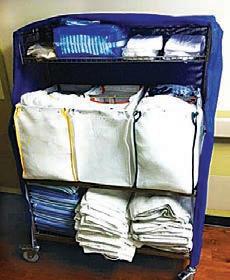
He stresses that whether the linens are being transported to the end-users from off site or on premises, proper container covers must be utilized to ensure that no contaminants are introduced to the clean linens. Also, Wendland says if reusable covers are used, a cleaning process must be used for them on a pre-established frequency.
Jeff Scott, manager of on-site services for Ecotex Healthcare Laundry Services based in Washington state, agrees that it is important to ensure that all clean linens are delivered in a sanitized cart and that the linens remain covered from the point of assembly to point of use.
“Ecotex has found that clean and sanitized laundry carts combined with a plastic cover have proven the most effective means of meeting these guidelines,” says Scott. “We sanitize all laundry carts and transport vehicles between uses, every time. In addition, all laundry carts are covered immediately after assembly at our various plants.”
When it comes to transporting clean healthcare linens from an outside laundry to the healthcare facility, transportation methods vary slightly. However, generally speaking, says Scott, healthcare linen needs to be protected from outside contamination, and vehicles need to be sanitized between loads.
Scott says that the journey between plants and the end-users can be challenging. Vibration and outside influences can cause linen to shift or even fall off packaged containers.
“Goods fall off of shipping containers in transit due to vibration or improper loading. Items are sometimes placed on cleanlinen carts once delivered to the customer that are inappropriate and may cause contamination,” Scott says.
He stresses that great care needs to be taken to ensure processed linens are loaded in a neat and orderly fashion and are securely placed in delivery vehicles. Scott says that his company trains its drivers and on-site delivery personnel to immediately report any incidents and to immediately place into soiled-linen containers any item that they feel may have been contaminated.
“This includes returning entire shipments if there is a chance of contamination,” he says.
When the clean linen gets to the client, storage remains a challenge due to space
restrictions in some cases, according to Scott.
“It is imperative to communicate with our customers regarding storage at point of use. Once clean linen is delivered to its intended destination, the provider loses control over its ultimate cleanliness,” he says. “Whenever possible, we recommend self-contained storage that is not open to the general public.”
Some of the challenges Wendland sees on-site when it comes to maintaining the integrity of clean healthcare linens in transport include wire racks and exchange carts stationed in corridors and open nurse server storage areas.
“I’m always concerned with properly fitted covers used on wire-rack exchange carts, as well as after-market solid bottoms,” he says. “Also, Velcro closures versus zippers. Velcro does not make an impervious barrier.
“Nurse server storage areas permit excessive opportunities for many hands to be touching and potentially contaminating the linens.”
Wendland is seeing progress being made in on-site transportation and storage concerns at healthcare facilities. More solid poly carts are being used in place of wire racks, he’s noticed. Also, he has seen that wire racks are being re-tasked for either non-movable storage or non-linen items.
“Where possible, exchange carts were relocated in a more secure area other than in corridors,” Wendland says.
“Nurse servers continue to be a challenge.”
If a laundry is having difficulty maintaining clean healthcare linen during transportation, how can it correct the problem?
“I would have to ask about the transport method and the route,” says Wendland. “What are the factors contributing to the problem? Are they mechanical, environmental, procedural or human? From that point, it will be easier to diagnose, then solve the problem.”
“Ecotex is a fully HLAC-accredited laundry, as well we hold [TRSA] Hygienically Clean certification. This means that all phases of our operation are closely monitored, analyzed and recorded,” says Scott. “We believe that our customers benefit from these accreditations and certifications as a means of ensuring that all guidelines are followed and that goods arrive ready for use. This applies directly to how we transport goods.”
When it comes to transporting clean healthcare linen, Wendland focuses less on accreditation and more on employee training.
“There is concern regarding laundries being ‘accredited,’ yet there is minimal credentialing requirements for the leaders and managers of laundries or linen distribution departments. The best way to ensure that the integrity of the linens is maintained from ‘processing to enduser’ is to have trained and knowledgeable employees,” he says. ALN
www.AmericanLaundryNews.com AMERICAN LAUNDRY NEWS | JANUARY 2016 11
Continued from Page 1 Movers In addition to customer favorites, we now carry even more products to service your needs. Download our full catalog at monarchbrands.com. • Institutional Sheets • Cabana & Spa Towels • First Quality Collections • Eclipse Towel Lines • Route Ready Bar Mops • Performax Microfiber Lines • Microfiber Cloths & Mops • SmartChoice Wet Mops • Poly Spun Napkins • Personalized Product Lines NEW OFFERINGS INTRODUCTORY SPECIALS • Save up to 70¢/dozen when you eliminate pre-washing and counting these 32oz bar towels • Soft packed, optically white, and ready to use • Pre-packed bundles of 25 Promote your brand 24/7 with complimentary logo label embroidery! • Personalized microfiber products, terry towels, and bar mops • Ultimate control over inventory • Carry your own product line • Free advertising for your brand Call us to learn how you can carry your own lines for no additional cost! CUSTOM SOLUTIONS • Wide variety of colors • Price breaks for bulk orders • 16”x16” microfiber cloths • Use for wet or dry cleaning 35¢ MICROFIBER CLOTHS • Commercial quality microfiber looped flat mops • 80% Polyester, 20% Polyamide • Cut your cleaning costs without sacrificing quality • 18” long with Velcro backing 95¢ SMARTCHOICE WET MOPS $3.25/doz ROUTE READY BAR MOPS Call 800-333-7247 or visit monarchbrands.com to learn more. Covered linen carts help keep healthcare linens clean. (Photo: Encompass Group)
PANEL OF EXPERTS
2016 Panel ready to share and learn
arrive at my last 10 years in the business.

Ivery much appreciate the opportunity to serve on the American Laundry News Panel of Experts.
I hope to learn at least as much from the other experts and readers as I’m able to share from my own experience.
Our family has spent the last 40 years in the commercial laundry business, and I’ve taken a rather beneficial and circuitous route to
Prior to coming back to commercial laundry, I spent 16 years in corporate America running call centers and working as a process improvement consultant/ project manager with a focus on customer service and technology implementation. I’ve run teams and departments for GEICO (U.S. and overseas), AAA and First Data, among others. Prior to and during that time, I also served as a field artillery soldier and officer in the Army National Guard.
These experiences were instrumental in the development and growth of our company, CleanWash Laundry Systems, from several Laundromats into a










regional commercial, industrial and dry cleaning equipment distributor with multiple manufacturing brand lines covering the Midwest, and an e-commerce parts and supplies site, clslaundry.com, covering the world.


















We now carry, install and service top loaders to tunnels, and my experience in consulting and technology has helped us develop a lean corporate structure with experience and talent we can share with our customers.
My military experience has provided me with a “nothing is impossible” mentality. Using that mentality, our company routinely accomplishes what others have determined can’t be done. Having almost been killed a few times
helps put getting a big piece of equipment through a little door in perspective. These attributes have resulted in our company installing and servicing everything from small Laundromats to large prison and hospitality installations.
My specific laundry focus has been the implementation of technology in order to reduce operational expenses as well as improving labor processes. I have a bachelor of arts in history from the University of Iowa, which, given the amount of time we revisit the past in our industry, seems apropos.
In 2015, CleanWash was all about growth. We doubled the number of our service techs, and tripled our installations, customer
base and revenue. Growth brings excitement but also challenges.
As with other businesses, small and large, I find our greatest challenge to be the allocation of capital across multiple priorities and needs. Too often we focus on saving the most on the short-term issue while failing to recognize that the extra spent today can generate greater long-term savings and profit.
For example, as we see utility costs decline today, it’s important to recognize this as an opportunity to use part of the savings to improve efficiency, because the one constant is that prices won’t stay low.
12 JANUARY 2016 | AMERICAN LAUNDRY NEWS www.AmericanLaundryNews.com
Our new panelists introduce themselves and their operations, share their accomplishments and discuss the challenges of their industry segments
See EXPERTS on Page 14 ALN_Tab_half.indd 1 12/3/15 9:05 AM
Equipment/ Supply Distribution
Todd Santoro
CleanWash Laundry Systems Inc., Omaha, Neb.
RATHER THAN DEBATE WHETHER OR NOT TIME IS MONEY,






WE’LL JUST SAVE YOU BOTH.
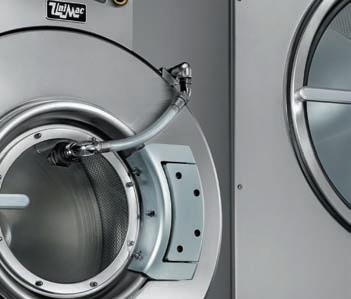
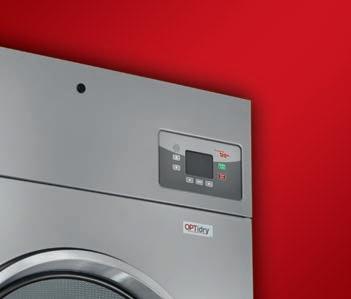
On-premises laundry has to be done on time and on budget. And nobody saves more time and money than UniMac®. Revolutionary UniLinc™ controls monitor your laundry’s performance, allowing you to pinpoint areas where you can increase efficiency, and reduce labor, utility and maintenance costs. Unprecedented 400 G-Force extraction and a spray rinse with 200% quicker fill time put even more money back in your pocket by further reducing operating expenses and maximizing throughput. Industry-exclusive OPTidry™ Over-dry Prevention Technology introduces cutting-edge sensors that automatically stop the tumbler once the ideal dryness level is reached, saving up to $2,000 in utilities, $6,000 in labor costs and decreasing the need for linen replacement with 31% less fiber loss. These groundbreaking innovations combine with unmatched durability and performance to provide commercial laundries of all sizes with the absolute lowest cost of ownership in the industry.
CUSTOMIZED FINANCING designed specifically for on-premises laundry. Contact an authorized UniMac distributor today to run a laundry operating analysis and see how you can cut costs and save money. Visit UNIMAC.COM/TIMEANDMONEY or call 1-800-587-5458.







I look forward to your questions on how we—the Panel and readers alike—can help our organizations be better.
part of our business into its own division.
Over the eight years as uniform manager, moving into division manager, I learned a great deal about operations and logistics, in addition to customer service excellence and emerging technologies in our industry.
When Angelica acquired the Hempstead operation, I was asked to lead a team that would implement many of the systems we developed in Hempstead. Over the next several years, I worked in more than 30 plants implementing new software and then layering in best practices to improve our service, efficiencies and bottom line.
We all face similar challenges in the industry, but as daunting as some of these challenges may seem, our industry has to evolve, and I see opportunities everywhere I turn. I feel honored to be selected for this Panel, and hope to contribute in ways you find useful and insightful.
ply company with nine plants from Los Angeles to Boston).

Chronologically, I worked as a staff industrial engineer for plants in Cleveland, Dayton, Indianapolis and Toledo; as the operations manager for their Los Angeles plant; and as area manager in Chicago. I was also the director of operations for Tulsa Linen Service (based in Tulsa, with plants in Tulsa, Enid and Oklahoma City, Okla., and Fayetteville, Ark.).
how much water does it use) to the very complex where the customer wants to add a machine or replace an existing one, to expand an existing laundry or build a new one.
I’m the assistant vice president of FDR Services Corp., a regional healthcare laundry and uniform rental company based out of New York and serving the acute and sub-acute healthcare market in the mid-Atlantic and Northeast.

I’ve been working in the industry for 19 years, starting out as inside customer service at FDR. From there I eventually grew into an account executive role, learning the sales and service side of the business. I was promoted to uniform manager, overseeing our Hempstead uniform operation. I was responsible for growing that
When we completed that project, I was asked to assume the role of regional director of linen management. I worked closely with the operations and services teams in the New York and New England markets to better manage our linen and resources.

Prior to rejoining FDR in 2013, I worked extensively on RFID and how to best leverage this technology in our industry. The past several years have been incredibly rewarding. I am working in virtually all facets of our business. Being part of the FDR team again has been a welcome change, and I am amazed at how much I am still learning from the team around me.
I’m the manager of the applications engineering group at Pellerin Milnor Corp. As of November, I celebrated 45 years in the laundry industry. I am an industrial engineer by education, and I’ve spent time on the laundry side of the industry as well as the equipment manufacturing side. As one of the original recyclers, the laundry industry has a great story to tell. I am fortunate to be a part of that industry, and I am honored to have been selected for the Panel of Experts.
My laundry experience was initially with Morgan Services Inc. (a Chicago-based linen sup-

The education I received in those various positions provide me with invaluable insight for what I do today at Pellerin Milnor. Founded in 1947, Milnor has evolved from a company making a single product (a 30-poundcapacity centrifugal extractor for shirt laundries) for local markets to a company that makes washerextractors (25 to 700 pounds capacity), dryers (30 to 550 pounds capacity), and tunnel washers (1,500 to 10,000 pounds/hour capacity) and sells to a worldwide market. That growth came from innovation (43 patents issued since 1950) and staying attuned to customer needs.
My applications engineering group doesn’t design equipment; we design the laundries the equipment is installed in. We field questions ranging from the very simple (like the weight of a machine or
We use site visits, factory visits, GoToMeeting sessions, conference calls and internal design sessions, all as a means of developing the best possible solution for our customer. We take the task of developing a solution for our customer very seriously and take great pains to get it right.
The world economy is finding its legs, and that is reflected in the activity of the laundry industry entering again into a strong growth phase. For 2015, we worked on almost 300 new projects, and a like number of projects carried over from the previous year. Preparation for Clean ’15 and the show itself were major events for us last year. Education for our group was an important part of our year. Two members attended PMI, and I was the instructor for a class. We also attended several seminars and webinars.
Our industry is simply a fantastic space in which to work, isn’t it? Over the past 37 years, I’ve met so many talented, passionate, professional experts, who teach me new things every day. There’s never
14 JANUARY 2016 | AMERICAN LAUNDRY NEWS www.AmericanLaundryNews.com
For over 50 years U.N.X. INCORPORATED has been involved in the development of products that not only solve quality problems that exist at the moment, but also provide long term benefits to the customer and the environment in which we live. U.N.X. was built on the foundation of improving the industry in which we participate. U.N.X. prides itself on being an industry leader with state-of-the-art products and dispensing equipment, and our plans for the future are extraordinary. With a Research and Development team second to none, U.N.X. is in a position to provide the industry with the most technologically advanced products and dispensers as possible. U.N.X. INCORPORATED 707EArlingtonBlvd Greenville,NC27858 (252)756 8616 www.unxinc.com ALN_Tab_half 10/9/12 2:40 PM Page 1 See us at the Clean Show • Booth #2502 0513aln_UNX.indd 1 4/26/13 10:48 AM ALN_Tab_half.indd 1 8/6/13 11:38 AM Continued from Page 12 Experts Textile/Uniform Rental Craig Bower FDR Services Corp., Hempstead, N.Y. • • • • • • Equipment Manufacturing Mike Diedling Pellerin Milnor Corp., Kenner, La.
a dull moment, and every day something “new” comes along— whether it’s a market opportunity, a problem to solve, a new product or process, or just a fresh twist against an age-old issue. I love this industry and feel so fortunate to be able to work with all of you, every day.
That’s why, now, it is such an honor to serve on this Panel of Experts for the coming year. It’s my second time on this Panel, and I must say, I have missed it.
My business experience in our industry started at the age of 9, when I became my father’s janitor at his local garage in the Midwest. He issued me work uniforms and told me I would wear them with pride—showing up on time, buttoned up, clean and ready for important work. Given my physical size at 9, I can say without a doubt that I truly learned the importance of garment “fit” in the uniform business, and how that factor impacts one’s pride at work.
Later in my life, at 21, my father’s route service representative was terminated by his company, Todd Uniform. With some family coaxing, I interviewed for that job, and the rest is history—promoted on to stockroom manager, plant manager, sales manager, assistant plant manager and finally opening a new plant in Los Angeles.
After four years as GM, I moved to Aramark as a group GM to run its plant system in Southern California. Another five years later, I followed my passion to move to the supplier side and became a territory manager for Red Kap.
Ten years later, I asked for an early retirement from VF (with continued consulting) to start my own direct-sale product company, called Image Apparel-Brand Identity Solutions, serving the middle of the market. I sold that company to my partner at the time, and then another partner and I started a work apparel manufacturing company called Basic Apparel.
Just after that venture, I joined ADI American Dawn, as a territory manager. Two years ago, I was promoted to director of market solutions. I am honored to be a part of the ADI team.
I have also been honored to teach at TRSA’s EMI and PMI, as well as many industry conferences, associations and collegiate settings, both inside and outside our industry. These have been fantastic opportunities to learn as well as teach.
In advance, I thank you for engaging, thank the rest of the Panel for contributing, thank
American Laundry News for hosting and thank my company for allowing me this opportunity. They call me “KBach,” and I’ll see you next month.
It is my distinct honor to serve as an American Laundry News Panel of Experts member for 2016. As the sales leader for UA ImagewearSM, I am tasked with attracting talent, developing team members, creating positive situations for our clients to purchase, new client relationships and creating an outstanding experience for


every customer touch point.
I was introduced to the uniform industry nearly 20 years ago by my father-in-law, a 40-year veteran of the textile rental industry, and have been fortunate to serve in a variety of different customer-facing roles.
Over the years, I have had the privilege of learning from some of the industry’s true thought leaders and covered a diverse range of markets, from healthcare to quick-service restaurants.
I began my career with UA Imagewear in 2014. For more than 30 years, the company has been synonymous with apparel that is stylish, functional, comfortable and durable. Today, we design, manufacture and distribute corporate image apparel and uniforms for healthcare, hospitality, gaming, culinary/food service, spa, resort and retail industries.
We provide flexible, comprehensive solutions to address complex product and service issues.
By offering a vast selection of high-quality, long-lasting products, paired with a proven track record of successful uniform program implementations, we deliver tailored solution packages that meet our clients’ business needs.
Our company has built a substantial retail business by providing locations throughout the country, and a robust Internet presence. What began as a single storefront
www.AmericanLaundryNews.com AMERICAN LAUNDRY NEWS | JA NU A RY 2016 15
UPGRADE YOUR CHALLENGE PACESETTER CLM leads the way in dryer technology and provides an upgraded replacement for your old Challenge Pacesetter Our Model 165 fits the Challenge Pacesetter footprint perfectly and gives you technology that no one else o ers, including a fully integrated production management system. • Upgraded heat system with improved efficiency and lower emissions • Micro-Command III PLC upgrade with LAN and Blue Tooth communications • PLC now prepared for flow process management systems • 2-stage variable speed basket drive with 3-port load door. • Soft start to reduce component wear, lower utility use. • Heavy-gauge basket, includes removable steel basket panels • Long-lasting ceramic coating available on removable basket panels. • Configurable exhaust location • Configurable control/burner location Call CLM to replace your Challenge Pacesetter dryers, or for information on our broad range of industrial dryers. 323-232-2417 Model 165 shown with Tumble Green® configuration See Us at Booth 2560 at The Clean Show 211 Erie Street, Pomona, CA 91768 | T: (323) 232-2417 | www.clmco.com ALN_Jr Page.indd 1 11/18/14 2:36 PM 0515aln_CLM.indd 1 4/13/15 4:46 PM See EXPERTS on Page 16 Textiles Steve Kallenbach ADI American Dawn, Los Angeles, Calif. Uniforms/ Workwear Manufacturing Carl Rocco Uniform Advantage, Plantation, Fla. • • • • • •
Thank you for the opportunity to participate on this Panel. I greatly anticipate a series of insightful and interesting discussions.
over time has grown to include a nationwide network of 30-plus retail locations.
Our industry faces numerous challenges presented by an everchanging economy and dynamic healthcare environment, and I look forward to hearing how you are evolving your business to respond to the transforming landscape of our industry.


It is an honor to have been selected to serve on this Panel

for 2016. I am the manager of the environmental services department at Wheaton Franciscan HealthcareFranciscan Woods, a 120-bed transitional care facility. I began my career with the organization 17 years ago and became the department manager in 2009.

We launder the personal clothing of all of our patients and residents on-site, and the service is available eight hours a day, six days a week. We wash, dry and return all the clothing within 24 hours. Our operation also maintains inventories and provides labels on all clothing for our patients and
residents.
In 2015, our goal was to make a better system for handling the labeling, and the changes we made have had positive outcomes. We have made the process easier for those who use it, and it helps us get the clothing back to the correct person.
It remains a challenge to keep the items in house that we launder, as they are sometimes mistakenly sent out to our system’s main laundry service, which handles bed linens and towels. Things that go out can be difficult to get back in a timely fashion.
In the following months, I look forward to being able to share with you my insights on our laundry process. I am always open for suggestions on how to make the process better for all those that we serve.
Ihave been in the laundry industry since 1989. Not a day goes by that I don’t learn something new about this interesting business that we are in.

My company currently processes about 70,000 to 85,000 pounds a day of hospitality goods. Laundry Plus is operational seven days a week and 365 days a year. In the particular segment of the industry that I have chosen to specialize, quality and service are the two prime factors.
Laundry Plus has approximately 100 full-time associates who work four, 10-hour days a week.







I started in the Laundromat segment of the business, first opening one store and eventually adding many more. During my education in that business, I learned of the industrial side, and with my background in manufacturing, I found the industrial segment to be more in tune with my skill set, as well as my ideology of providing the ultimate in quality service.
Upon opening Laundry Plus, it became obvious that I had found a business that could provide a service to the hospitality industry that was severely needed. My formal education in this business is lacking, but the “school of hard knocks” has proven to be an exceptional venue for higher learning. I am honored once again to have been asked to participate on this Panel of Experts.
Iam pleased to be a part of American Laundry News’ Panel of Experts, and recognize that my selection is entirely a result of my association with the many talented people I have had the privilege to work with at Pariser Industries for the past 40 years.

Along with my late father, Al Pariser, the founder of our family business (and a former Panel of Experts member), and my brother, Andrew, we have worked together to build a diversified national chemical

16 JANUARY 2016 | AMERICAN LAUNDRY NEWS www.AmericanLaundryNews.com
manufacturing Continued from Page 15
ANSWER TO A HIGHER CALLING Verifying Processes, Quantifying Outcomes The ONLY restaurant linen supply certification: • Developed by the industry for the industry • Endorsed by epidemiologist and healthcare professionals • Based on 10 years of laundry certification experience • Adhering to established worldwide testing protocols and standards Customers are demanding third-party review of cleaning processes. TRSA Hygienically Clean – Food Service offers unmatched credibility. See the standards and apply today at www.hygienicallyclean.org. ALN_Jr Page.indd 1 12/4/15 4:07 PM Chemicals
Pariser Pariser Industries
Long-Term Care Laundry
Franciscan Healthcare
Wis.
Experts
Supply Scott
Inc., Paterson, N.J.
Kathrine Flitsch Wheaton
Brookfield,
Commercial Laundry Rick Rone Laundry Plus, Bradenton, Fla.
and service-oriented company that provides, among other items, innovative product systems and technical services to laundry applications of all sizes.

In addition to laundry products, Pariser Industries also manufactures and services chemical systems for dry cleaning, wet cleaning, housekeeping and water treatment applications.


Our approach is similar in all regards, in that our mission is focused upon the need to understand our customer’s business and related concerns and work diligently to provide cost-effective product options, along with consultation on best industry practices.
The challenges that we routinely face include the need to cross-train our technical representatives on the various approaches to customer service across the various classes of trade that we serve, mindful of the fact that while the approach and mission is generally the same, the environment and vocabularies will vary greatly, not only from industry to industry, but from one size laundry application to another.
Our goal is to offer a broad line of product innovations supported by a competent and concerned group of professionals who understand our customers’ needs for quality results, operational efficiencies, worker and environmental safety, and bottom-line profitability.
As our industry’s needs and regulations are constantly changing, it is incumbent upon us to continuously evolve and remain open to new and innovative methodologies that enhance our customer’s experience with our programs, while being mindful of our history and what has worked well for us and our clients in the past.

worked as a route service rep and also a sales rep selling mats door to door before and during college. After graduating, I started with G&K Services and transferred to Northern California and Seattle in sales, service and general management roles. I transferred back to G&K Corporate to lead the new Service Marketing Department.
I was later tasked with managing the linen division, which G&K was considering selling, due to profit erosion. The challenge was to prove that flat-linen revenue could be profitable within an industrial uniform company.
Our team rallied and was able to take the division from virtually break even to an operating profit of 18%. The company decided to take the division off the market, noting that with the right product, pricing and customer target strategy, it was possible to be even more profitable than any industrial uniform business.
I later took over the corporate new business development team, running the facility services division in various markets throughout the United States. With a national linen and uniform company, I led the service mar-
keting and product development effort in North America. One of the initiatives was to spearhead the development of a customer product penetration strategy.
I was given the opportunity to launch the initiative, starting up a new North American sales force
It’s an honor to be selected to the Panel of Experts. I am a senior consultant for Performance Matters, which is a strategic consulting partner for textile rental services companies that offers proprietary tools guaranteed to boost revenue and profits with minimal investment. We focus on implementing processes and optimizing revenue opportunities, while integrating a team-based approach to drive results.
I represent the third generation in the commercial laundry industry. Previous generations led the sales and marketing effort for ALSCO/AmeriPride, formally known as American Linen Supply Company.
I have more than 28 years of uniform, linen and facility services rental/direct sales experience. I

www.AmericanLaundryNews.com AMERICAN LAUNDRY NEWS | JANUARY 2016 17
kannegiesser-usa.com 800.344.0403 THE LEADER IN LAUNDRY TECHNOLOGY Precision finishing, any way you fold it. Revolutionize your laundry and linen business with Kannegiesser flatwork finishing. Our system includes an efficient multi-station feeder and highperformance ironer that handles linens measuring up to 158” wide. And our precision folder is capable of single- and two-lane folding and stacking, for a precise, Kannegiesser finish you can count on – every single time. EMQ 40 Multi-Station Feeder HPM II 40 High-Performance Ironer CFM II 40 Precision Folder ALN_Jr Page.indd 1 12/4/15 2:09 PM See EXPERTS on Page 19
Consulting Services
Chris Mayer Performance Matters, Plymouth, Minn.
Lavatec awarded project for U.S. military base
BEACON FALLS, Conn. — Lavatec Laundry Technology Inc. has been awarded a contract by the U. S. Government to provide new laundry equipment to the Camp Kinser airbase in Okinawa, Japan, the company reports.
Camp Kinser serves as a major logistics facility and is one of nine United States Marine Corps bases located on the Japanese island.
“This is terrific news, and we are proud to be awarded this project,” says Keith Ware, Lavatec vice president of sales. “The Camp Kinser project involved a very detailed and selective bid process with the camp’s purchasing group. Having operated our tunnels for the past 20 years, the laundry team was well aware of the durability and efficiency of our Lavatec equipment. We are very satisfied with their decision and looking forward to completing delivery and installation requirements.”

Lavatec says it will replace two, 110-poundmodule tunnel washers and 10 dryers, along with an extraction press and centrifuge that have been in place for more than 20 years.
The company says it has partnered with ETECH to install a clean-side rail system that
will be completely new, while the soiled side will be modified as part of the installation.
The equipment is scheduled for delivery in February and installation is expected to be complete by the end of the first quarter, according to Lavatec.
La Tavola Fine Linen Rental taps Black as CEO, completes recapitalization
NAPA, Calif. — La Tavola Fine Linen Rental has tapped industry veteran Jeff Black as CEO, the company reports. The company also has completed a recapitalization in support of future growth plans.

Terms of the private transaction were not disclosed.
Black has previously served as CEO for Classic Party Rentals and in key corporate roles at Aramark, where he honed his skills in outsourced operations, uniforms and linen, and specialized customer service, the company says.
Herb and Betsy Stone, who founded La Tavola Linen Rentals in 2007
to fill a niche in the marketplace for high-end linen rentals, will continue to be involved in product design and overall vision for the company, says Black.
“The brand has an incomparable reputation in the marketplace for their high level of taste, depth of offerings and customer service,” Black says. “We intend to maintain the integrity of the brand and continue to work to exceed our customers’ expectations every time.”
La Tavola Fine Linen Rental completed the recapitalization with Frontenac Co., according to La Tavola. Frontenac is a private equity firm that focuses on investing in family- and owner-operated businesses.
“As a leader in its market niche, La Tavola is a profitable, budding and attractive opportunity with significant growth potential,” says Paul Carbery, a managing partner at Frontenac. “With Jeff Black at the helm, we are confident the company will reach new levels of success. He is a collaborative leader who is passionate about this company, the team that makes it up and the events industry as a whole.”
Joe Rondinelli, a vice president at Frontenac, says, “La Tavola Fine Linen Rental has an exceptional reputation in the events industry and we are excited they chose to partner with Frontenac. We look forward to working with Jeff, Betsy, Herb and the entire team to open new showrooms and introduce new, high-quality linens.”
Univar signs deal with DuPont to distribute OPTIMASE® enzymes
DOWNERS GROVE, Ill. — Univar Inc. has entered into an agreement with DuPont for the distribution of DuPont™ OPTIMASE® professional-grade enzymes for industrial and


institutional cleaning applications in the U.S and Canada, the company reports.


“We are pleased to expand our offering to now include DuPont’s innovative enzyme biotechnologies, which are essential to formulating more environmentally responsible industrial and institutional (I&I) cleaning formulations,” says Debra Bailey, industry director, Univar household and industrial cleaning. “As the distributor of DuPont’s professional-grade enzymes, together with our robust portfolio of basic chemicals and specialty products, and extensive North American distribution network, we are uniquely positioned to provide customers with a total solution for optimizing formulations and addressing key performance and environmental challenges within the industrial and institutional cleaning market.”
According to the company, DuPont™ OPTIMASE® professional-grade enzymes provide formulators with a bio-based solution for delivering optimal cleaning performance, while helping customers meet their goals to lower their environmental footprint and overall operating expenses.
“We are very excited to be partnering with Univar to serve the North American I&I market,” says Siddhartha Shenoy, global I&I marketing manager for the home and personal care business at DuPont. “We recognize the many challenges facing our industrial and institutional customers today, with constant pressures of having to do more with less. This is why we want to provide new biotechnology options to the I&I industry. We are excited to collaborate with Univar and deliver innovative products that will inspire more environmentally responsible and efficient cleaning solutions.” ALN
Tri-State Technical Services and TLC
18 JANUARY 2016 | AMERICAN LAUNDRY NEWS www.AmericanLaundryNews.com
LAUNDRY COMPANIES WE’LL HELP YOU DO IT RIGHT.
Black
TRI-STATE
Equipment have rebranded. We are the same reliable company, dedicated to serving our clients needs and are now doing business as TLC Tri-State Laundry Companies. Please visit our website at www.tlctristate.com. Our territory expands seven (7) states along the East Coast. We represent the finest lines of new and preowned equipment. Our market includes Commercial, Industrial, Institutional, Hospitality, Health Care, Dry Cleaning, Coin Operated Laundries and more. We have a host of seasoned Professionals in every division, to assist you in area of design and layout, equipment, service, parts and installation. Please call our office at your earliest convenience and be sure to say hello to our most recent additions, to include David Chadsey, Vice President of Sales and Bob Halpin, Regional Sales Manager, covering the metro Atlanta and North Georgia segment of our business. It is all about YOUR needs. Give us a call and “weʼll help you do it right" Have you heard? Proud distributors of 800-241-5459 www.tlctristate.com ALN_3rd Page.indd 1 12/9/15 8:57 AM
of bath towels, hand towels and washcloths, a 70-30 blend of cotton and polyester fabric engineered for faster drying, maximum durability and minimum shrinkage.
The company also introduced its Laundry IQ program, a new service and “value-add proposition,” designed to make staff experts or consultants available to visit laundries and diagnose problems or to provide “full-blown throughput analysis,” according to Jason Quint, vice president of finance for Harbor, based in Gibbsboro, N.J.
Interestingly, Harbor repurposed racking materials from one of its warehouses to create a nautical theme for its exhibit.
The company used the symbol of an anchor to demonstrate that its products are always in stock for its customers.

“Everyone tends to have the same type of exhibits at the show,” says Quint. “We wanted to do something different to stand out from the crowd.”
Welspun, a manufacturer of sheets and towels, used the HX show to introduce its Hygro cotton sheets and towels, made from a proprietary spinning technology, which produces hollow-core cotton yarn for advanced airflow and absorbency. Headquartered in Mumbai, India, Welspun has manufacturing plants in Anjar and Vapi, in Gujarat state, India.


Although hospitality represents only 5% of Welspun’s total business worldwide, “hotels are a growth area for us,” says David Dee, senior vice president of product development and sales for Welspun Hospitality Solutions, based in New York.
Commercial laundries also had a footprint at the show, in the hopes of offering their services to hotel management.
Olympic Linen Service, which serves institutions in New York, New Jersey and Delaware, took booth space to offer its services to hotel managers “who are interested in subbing out their linen work,” says Nick Nakos, account specialist for Olympic, who described booth traffic at the show as “good.”
A far larger, national player in the hospitality market is the new PureStar Linen Group, recently formed from the merger of Atlantic City Linen; Brady Linen Services in North Las Vegas; and Royal Hospitality Services in Somerville, Mass., outside of Boston. PureStar exhibited at the HX show for the first time as part of an effort to launch its new brand in the hotel market and to offer its services to hotel management and large hotel groups seeking expertise in outsourced linen services, according to Terry Satchwell, executive vice president.
PureStar’s 15 laundries employ

more than 3,000 people and process some 1.7 million pounds of linen per day for more than 200 leading hospitality clients across the U.S. and in the Bahamas and Cancun, Mexico.
The PureStar family of companies will seek growth opportunities in the hospitality industry in different U.S. cities, according to Eric Goldberg, co-CEO of PureStar. Its goal is to double in size within the next five years, he says. ALN
Richard Merli, who resides in Brooklyn, N.Y., is a former editor of American Laundry News.

Experts
of more than 50 people, solely focused on adding high-margin products within the existing customer base.
With Performance Matters, my main responsibility has been to help develop our High Performance Team Training Program. Through our e-learning platform, this low-cost training program levels the playing field
for independent and familyowned laundries. They’re now receiving superior service and sales training that was previously not available to them before. It’s a highly gratifying experience to be making a positive contribution

with our independent textile rental clients and the overall industry.
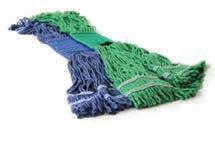
I’m excited for a fantastic 2016 with American Laundry News and providing insights that can be used in your businesses going forward. ALN

www.AmericanLaundryNews.com AMERICAN LAUNDRY NEWS | JANUARY 2016 19
ALN_Jr Page.indd 1 11/24/15 10:45 AM Continued
from Page 6 HX
Continued from Page 17
PARTS, PARTS, PARTS
Huge stock of parts for most laundry equipment & boilers. Also traps, valves and lubricants. Overnight delivery. Steiner-Atlantic, 800-333-8883 Fax: 305-751-8390 parts@steineratlantic.com www.steineratlantic.com

Equipment Sales – Kansas City



Loomis Bros. Equipment Company is seeking a highly motivated sales professional to take over a well-established sales territory. Large existing account base plus great opportunity to grow market share in OPL and vended laundry markets throughout Kansas and western Missouri. Representing Milnor, Chicago and other top brands. We offer excellent income potential and good benefits. Send resume in confidence to: dloomis@loomisbros.com WASHEX

20 JANUARY 2016 | AMERICAN LAUNDRY NEWS www.AmericanLaundryNews.com
parts, on-site rebuilding, tech support.
CENTER
Classified Advertising PARTS FOR SALE EQUIPMENT FOR SALE EQUIPMENT FOR SALE AMKO AMERICA, INC. Remanufactured Finishing Equipment Delta Ironers, Omega Folders & Towel Folders PARTS, IRONER SUPPLIES & NEW EQUIPMENT ALSO AVAILABLE “NEW” SELF CONTAINED IRONERS Contact: (561) 863-9696 AmkoAmerica@yahoo.com POSITIONS AVAILABLE DISTRIBUTOR OFFERINGS www.ineedjpequipment.com 800/925-3236 EQUIPMENT FOR SALE: • Rennco CF4000 Single Lane Bar Towel Bagger, 2009 • 400lb Braun OP W/E, 1996, Single motor drive • 250lb Jensen OP, ready to ship • 2005 Chicago Air • 900lb Ellis, 1998 • 400lb Challenge Dryer, Gas, P/T, 1998 & 1995 • Chicago Tristar 32 + Chicago Fastrack • Chicago Tristar 24 PCS w/OPL • Chicago Imperial Ironer, IMP36, Gas, 2001 • 900lb Ellis Completely Reconditioned, New controls by Ellis • 150lb Lavatec Press, LP582, 2001 • Economizers for 50HP and 70HP Boiler • 50HP Parker Boiler, 2005 • Chicago Edge 2000 • 60lb Milnor Washer Rigid-mount, 2006 • Chicago Pik-Quik, 2008 “Expect Excellence” JP Equipment, Inc. buys and sells used industrial laundry equipment. We have been in the used industrial laundry business since 1998 and sell equipment worldwide. What separates us from most of our competitors is that we own almost all of our equipment outright giving us the flexibility to sell equipment “as is”, cleaned and tested, or fully reconditioned. We also sell equipment on consignment. We provide unparalleled service whether you are buying or selling equipment, building a new laundry or upgrading an existing facility. Call Craig Lloyd toll free at 877.295.5693 between 9 a.m. – 9 p.m. EST. Please visit www.laundrycareers.com to review current industrial/institutional laundry management openings. ADVANCE YOUR CAREER The Griffin Group, Inc. “Recruitment Specialist” Need to FILL a position? Call Deana Griffin 888-235-2365 www.thegriffingroup.cc deana@thegriffingroup.cc ® QTY DESCRIPTION 1 Edge Spreader 2000 1 Pik-Quik Sheet Separator Milnor Washers; 60lb, 100lb, and 140lb Rebuilt 1 Mini Neptune Vacuum Feeder 1 Unipress Single Buck Lightning Shirt Unit 1 450lb Washex Open Pocket 2002 1 275lb Milnor Open Pocket Rebuilt 2003 1 Single Lane Skyline Folder 1 Braun 2 Roll 32 Steam Ironer 1 Braun Omege 2-Lane / Crossfolder w/Accumulator 1 Braun Rear Discharge Towel Folder 1 Milnor 120lb Steam Dryer 1 Braun Rear Discharge Towel Folder 1 Reconditioned Jensen Ultima 36 – 2-Roll Steam Ironer 1 Reconditioned Challenge Pacesetter 1 Forenta 2013 Single Buck, Sleever and Collar Cuff 1 Washex 700lb Side Loader (1995) For Pricing call Ron Hirsch 516.938.4300 • 516.315.7426 Hicksville, NY • www.directmachinery.com FOR NEW OR USED LAUNDRY EQUIPMENT, DM IS YOUR SOURCE FOR ALL YOUR NEEDS HOSPITAL LAUNDRY CLOSING EXCELLENT EXCELLENT CONDITION Stanco Industries, Inc. Serving The Textile Trades Since 1970 800-932-3769 k for Mike or Deb KEEPING IT GREEN SINCE 1970 WE ARE LOOKING FOR THE FOLLOWING EQUIPMENT: WASHING • DRYING • FOLDING FEEDING • IRONING • FINISHING MATERIAL HANDLING • BOILERS CONTINUOUS BATCH WASHING STACKERS • CART DUMPERS DON’T BE LEFT WITHOUT POWER Emergency Generators Available 50KW to 1000KW Natural Gas & Diesel Stanco Industries, Inc. 800-932-3769 Ask for Mike or Deb or e-mail: stanco2626@aol.com www.StanCoInd.com The trusted source for quality pre-owned We Specialize in Used Industrial Laundry Equipment Sales, Service and Installations. IN STOCK EQUIPMENT FOR SALE: Qty Chicago Century 2 Roll x 52 Steam Ironer 1 Chicago Skyline Folders 6 G.A Braun 250 lb Open Pocket W/X 2 Jensen Silverline Plus Folder 1 Jensen P50-16 Complete Tunnel System 1 Challenge 400 lb Gas Dryers 6 We BUY & SELL all major brands. www.pspindustrial.com Email: info@pspindustrial.com Main: 1.800.517.1432 / 305.517.1421 Much more in stock! Please visit our website for our complete inventory Position available Floor Manager for laundry plant in Newark, NJ experience at least 5 years references a must fax resume to 973-424-0901
PARTS Hard-to-find Washex
LAUNDRY PARTS
800-352-4492 Fax: 305-827-3991




















www.AmericanLaundryNews.com AMERICAN LAUNDRY NEWS | JA NU A RY 2016 21 Source Directory A convenient guide to sources of products and services APPAREL FINISHING CARTS, TRUCKS & BASKETS Source Directory listings in American Laundry News are sold on an annual basis at the following rates: All Major Credit Cards Accepted 2016 Listings RegularBoldface All CapsAll Caps, Boldface Four Line Listing per Year $885 $1,110 $1,110 $1,175 Display and additional line rates available upon request CARTS, TRUCKS & BASKETS DOBERMAN TUFF LAUNDRY CARTS www.dobermantuff.com 706-376-4793 RUGGED DURABLE QUALITY FINISHES TUFF STUFF, NOT TUFF PRICES CARTS, TRUCKS & BASKETS AmericanLaundryNews.com More than unique visitors monthly! 5,250 CARTS, TRUCKS & BASKETS l-800-275-2436 l-800-275-2436 maxi-movers.com Email:sales@maxi-movers.com Rugged, non-marring trucks in 14 sizes up to 63.5 cu. ft. capacities. Need to deliver hanging garments? Ask about our removable, adjustable hanger bars for Bulk Trucks! M7070 M7084 BULK DELIVERY TRUCKS Chm #9745 ALN Bulk Delivery '16:Layout 1 12/1/15 GO TO: www.AmericanLaundryNews.com MISSED OUR DEADLINE? Enclosed_Carts_6.25x3:Layout 1 6/18/14 4:23 PM Page 1 Choose your favorite low-cut front for ergonomic access, roll safe and easy on advanced poly base with premium casters—all included as standard. Easy Reach, Easy Roll Call 800.829.4535 or visit MODRoto.com for a FREE QUOTE. 72P 72N Leadership in Every Cart








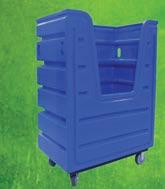









22 JANUARY 2016 | AMERICAN LAUNDRY NEWS www.AmericanLaundryNews.com Source Directory listings in American Laundry News are sold on an annual basis at the following rates: All Major Credit Cards Accepted 2016 Listings Regular Boldface All Caps All Caps, Boldface Four Line Listing per Year $885 $1,110 $1,110 $1,175 Display and additional line rates available upon request Source Directory A convenient guide to sources of products and services FLATWORK IRONERS FLATWORK IRONERS Knowhow In Action Your Tingue rep is a fully trained master of finishing equipment operation, maintenance and installation. Call for: • Pads, covers, belts, waxes, tapes and more • Carts, trucks, baskets and bags • Parts, rebuilds and repairs 800.829.3864 www.Tingue.com TalleyMachinery.com MODRoto.com TBR-Associates.com To website C & W EQUIPMENT (800) 443-3573 FLATWORK IRONER SPECIALISTS REMANUFACTURED IRONERS: Super Sylon Sylon Hypro’s Super Pro Jensen SS700 SS800 Ultima Lavatec UPGRADE KITS: Chain Drive Conversion Vacuum Systems Herringbone Conversion Canopies Inverters Side Covers Roll Springs Jensen Drives SUPPLIES: Aprons Pads Covers Belts Waxes Cleaners PARTS/REPAIRS: All Brands New/Refurbished/Hard to Find COMMITTED TO EXCELLENCE Pellerin Milnor Corp. P.O. Box 400, Kenner, LA 70063 504-467-9591, Fax: 504-468-3094 www.milnor.com DRYERS – 100 POUNDS OR MORE Pellerin Milnor Corp. P.O. Box 400, Kenner, LA 70063 504-467-9591, Fax: 504-468-3094 www.milnor.com DRYERS – 100 POUNDS OR LESS • Hotel • OPL • Coin Op • Dry Cleaners • Industrial • Commercial • Cruise Industry Dry or Wet Style Filters to Work with “ALL” Dryer Sizes or Multiple Situations, Fiberglass or Stainless and Custom for Unique Situations! Lint Filters Model Big and Small – We’ve got a model for you! In-line Duct” Models – the Lint Lasso and Lint Sock –in production since 2011 All manufacturing done on premise 800-826-1245 www.cleancyclesystems.com • ccsystems@tqind.com LINT COLLECTORS & FILTERS ★ Our In-Line Lint Filter mounts inside, saves space! ★ Fiberglass Wet Filters - 6,000 to 40,000 cfm ★ Fiberglass or Stainless Steel Dry Filters ENERGENICS CORPORATION Talk with our Design and Engineering Staff about your needs. Hundreds Sold Annually. 800-944-1711 www.energenics.com CARTS, TRUCKS & BASKETS Energenics Corp., Kartwasher 1470 Don St., Naples, FL 34104 800-944-1711 www.energenics.com CART-WASHING SYSTEMS Sani Wash - McClure Industries, Inc. 9051 SE 55th Ave., Portland, OR 97206 800-752-2821, www.mcclureindustries.com, info@mcclureindustries.com Sani Wash - McClure Industries, Inc. 9051 SE 55th Ave., Portland, OR 97206 800-752-2821, www.mcclureindustries.com, info@mcclureindustries.com DRYER BOOSTER & EXHAUST FANS ENVIRONMENTAL SOLUTIONS • Wash Temperature Reduction • Tunnel Washer Experts • EPA Regulations • Environmental Concerns • Infection Control • Waste Water Treatment New Horizons In Ozone Solutions, Inc 508-831-4229 wet-tech.com Right Company Right Cart LAUNDRY CARTS 800.304.4600 www.FIBERTECHINC.net M.I.T. POLY-CART 211 CENTRAL PARK WEST, NEW YORK, NY 10024 800-234-7659, FAX: 212-721-9022 WWW.MITPOLYCART.COM Diversified Plastics, Inc. 1309 Highway 917 West, Latta, SC 29565 800-768-7636, www.dpirotocarts.com E-mail: sales@dpirotocarts.com Fax: 843-752-7798
MATERIAL HANDLING / CONVEYORS


Gardner Machinery Corporation
P.O. Box 33818, Charlotte, NC 28233 Ph.: (704)372-3890; Fax: (704)342-0758 www.gardnermachinery.com



PRESSES – EXTRACTION
Pellerin Milnor Corp. P.O. Box 400, Kenner, LA 70063 504-467-9591, Fax: 504-468-3094 www.milnor.com
RFID


WASHERS – CONTINUOUS BATCH


Pellerin Milnor Corp.
P.O. Box 400, Kenner, LA 70063 504-467-9591, Fax: 504-468-3094 www.milnor.com
WASHER-EXTRACTOR – 100 POUNDS OR LESS
Pellerin Milnor Corp.
P.O. Box 400, Kenner, LA 70063 504-467-9591, Fax: 504-468-3094 www.milnor.com
WASHER-EXTRACTOR – 100 POUNDS OR MORE


Pellerin Milnor Corp.
P.O. Box 400, Kenner, LA 70063 504-467-9591, Fax: 504-468-3094 www.milnor.com
INDEX OF ADVERTISERS

Company Web Site Page Company





A.L. Wilson Chemical Co. www.alwilson.com 9
ADI American Dawn www.americandawn.com 5
Consolidated Laundry Machinery www.clmco.com
Direct
Girbau Industrial www.girbauindustrial.com
The

J.P.
Kannegiesser USA www.kannegiesser.com
Kemco
LaundryCareers.com www.laundrycareers.com
Lavatec Laundry Technology www.lavatec-laundry.com 24
Monarch Brands www.monarchbrands.com 10, 11
Pellerin Milnor www.milnor.com 3
PSP Industrial www.pspindustrial.com 20
Royal Basket Trucks www.royal-basket.com 6
Stanco Industries www.stancoind.com 20
Tri-State Laundry Companies www.tlctristate.com 18
TRSA www.trsa.org 16
Unifair Laundry Expo www.laundryexpo.cn 12
UniMac www.unimac.com 13
U.N.X. Inc. www.unxinc.com 14
Venus Group www.venusgroup.com 19
www.AmericanLaundryNews.com AMERICAN LAUNDRY NEWS | JANUARY 2016 23
A convenient guide to sources of products and services Source Directory listings in American Laundry News are sold on an annual basis at the following rates: All Major Credit Cards Accepted 2016 Listings Regular Boldface All Caps All Caps, Boldface Four Line Listing per Year $885 $1,110 $1,110 $1,175 Display and additional line rates available upon request PARTS PARTS & SUPPLIES information or contact us: info@FrontecStore.com FRONTEC STORE • Door handles • Door locks • Print boards • Bearing kits • Drain valves And MORE! www.frontecstore.com For more information or custom orders contact us: info@FrontecStore.com ALN 5/28/15 8:11 PM
Source Directory
Web Site Page
15
Machinery Sales Corp. www.directmachinery.com 20
7
Griffin Group, Inc. www.thegriffingroup.cc 20
Equipment www.ineedjpequipment.com 20
17
Systems www.kemcosystems.com 18
20
For more classifieds visit: .com www. AMERICANLAUNDRYNEWS