Modernizing SpaceBased Nuclear Command, Control, and Communications
JU
LY 2024 Peter Hays and Sarah Mineiro
“If I take nuclear command and control and spread it across 400 satellites … how many satellites do I have to shoot down now to take out the U.S. nuclear command and control?”
— Gen. B. Chance Saltzman, Chief of Space Operations (CSO) United States Space Force (USSF)1
Abstract
US nuclear command, control, and communications (NC3) is a bedrock for nuclear deterrence and the US-led, rules-based international order that it supports. Like the rest of the US nuclear arsenal, NC3 is in the midst of a modernization overhaul. The space-based elements of NC3, however, face different geopolitical, technical, and bureaucratic challenges during this modernization. Geopolitically, the two-nuclear-peer challenge, China’s perception of NC3 and strategic stability, and the prospect of limited nuclear use call into question the sufficiency of existing and next-generation NC3. Technically, Russia and China are developing more sophisticated counterspace weapons, which hold at risk space-based US NC3. Bureaucratically, the US Department of Defense (DOD)’s shift to a proliferated space architecture may not be appropriately prioritizing requirements for systems that are essential for NC3 missions. To address these challenges, space-focused agencies in the DOD need to ensure that nuclear surety is not given short shrift in the future of space systems planning.
Introduction
The NC3 system is one of the most opaque, complex, hardened, least understood, and perhaps least appreciated foundations for nuclear deterrence and strategic stability. While each military service is busy developing and attempting to resource its instantiation of combined joint all domain command and control (CJADC2), NC3 has not yet enjoyed this same focus and attention. As security
1. Quoted in Jon Gertner, “What Does the U.S. Space Force Actually Do? Inside the highly secretive branch responsible for protecting American Interests in a vulnerable new domain,” New York Times Magazine November 8, 2023.
dynamics and technology developments continue to evolve, the United States must commit appropriate resources and focus to ensure the continuing effectiveness of NC3. In simple terms, NC3 is the protected and assured missile, air, and space warning and communication system enabling the command and control of US nuclear forces that must operate effectively under the most extreme and existentially challenging conditions—employment of nuclear weapons. The 2022 US Nuclear Posture Review explains the five essential functions of NC3: “detection, warning, and attack characterization; adaptive nuclear planning; decision-making conferencing; receiving and executing Presidential orders; and enabling the management and direction of forces.”2
The NC3 system must never permit the use of nuclear weapons unless specifically authorized by the president, the only use-approval authority (negative control), while always enabling their use in the specific ways the president authorizes (positive control). Risk tolerance for NC3 systems is understandably nonexistent; there can be no uncertainty in the ability of the United States to positively command and control its nuclear forces at any given moment. The DOD and Department of Energy’s National Nuclear Security Administration use the term “nuclear surety” to describe their comprehensive programs for the safety, security, and control of nuclear weapons that leave no margin for error. The requirement for nuclear surety is constant, but it is becoming more difficult to deliver because
threats to US NC3 systems are increasing, due to geopolitical, technical, and bureaucratic trends and developments.
The geopolitical environment has shifted in significant ways since current US NC3 systems were deployed. The spacebased elements of NC3 are now threatened in unprecedented ways, due to Chinese and Russian testing and deployment of a range of counterspace capabilities that can hold space-based NC3 systems at risk. As demonstrated by the current war in Ukraine, even regional conflicts can manifest long-standing questions and concerns about NC3 in a multipolar and increasingly complex global security environment. Layer in China’s quantitative and qualitative rise in strategic nuclear weapons delivery systems and the unwillingness of China’s leadership to have basic discussions about strategic stability, and the 1960s architecture that is the foundation of US NC3 systems seems to be growing increasingly inadequate to deal with the geopolitical challenges of today and tomorrow. The reality is that the current NC3 system and architectures were predicated upon a bipolar nuclear geopolitical situation that no longer exists. Today, a multipolar, globally proliferated, and largely unconstrained nuclear weapons environment requires integrated deterrence across domains, sectors, and alliances.
While the geopolitical environment has evolved, so too has the technology available to deliver NC3 capabilities. Many of the current NC3 systems were developed decades ago using analog technology but are now being updated to dig-
2. Department of Defense, “2022 Nuclear Posture Review,” October 2022, https://media.defense.gov/2022/Oct/27/2003103845/-1/-1/1/2022-NATIONAL-DEFENSE-STRATEGYNPR-MDR.pdf, 22.
The E-4B National Airborne Operations Center, which provides travel support for the Secretary of Defense and their staff to ensure command and control connectivity outside of the continental United States. Credit: US Air Force
ital interfaces, switches, and underlying network topologies. This transition will enable enhanced capabilities, but it will also open more threat vectors that can be exploited via various cyber means through all segments of the system. As the space-based systems that are part of the NC3 system are being comprehensively upgraded, whether for missile warning (detecting and characterizing a missile), missile tracking, or delivering persistent assured communications, the DOD must work to eliminate exploitable cyber vulnerabilities and maintain distributed end-to-end network and supply chain security.
Additionally, almost all the DOD’s bureaucratic structures that acquired the current NC3 systems have changed, sometimes in radical ways. Primary responsibility for acquisition of important elements of the NC3 system are now divided between several organizations that are not focused on nuclear surety, making it a significant challenge to achieve effective integration and unity of command and effort across this structure. Moreover, the overall architecture for US space systems is transitioning toward a hybrid approach that uses commercial, international, and government systems and capabilities to enhance space mission assurance. The benefits of this hybrid approach seem clear for most mission areas, but it is not necessarily optimal for NC3. The DOD must ensure that nuclear surety remains a foundational and non-negotiable requirement for next-generation NC3 systems and cannot allow this requirement to be out-prioritized by other important considerations or become adrift in new bureaucratic structures.
Given the importance of the capabilities, evolving geopolitical and technical threats, and the diverse units planning modernization of the system, the United States must think carefully about the best ways to acquire the next-generation, and generation-after-next, of space-based NC3 to continue delivering nuclear surety in a new landscape that is characterized by a breathtaking degree and pace of change, troubling factors which seem likely to persist or even accelerate. The 2022 US Nuclear Posture Review reaffirms the US commitment to modernizing NC3 and lays out key challenges:
We will employ an optimized mix of resilience approaches to protect the next-generation NC3 architecture from threats posed by competitor capabilities. This includes, but is not limited to, enhanced protection from cyber,
space-based, and electro-magnetic pulse threats; enhanced integrated tactical warning and attack assessment; improved command post and communication links; advanced decision support technology; and integrated planning and operations.3
This paper characterizes the existing NC3 system and focuses on its space-based missions and elements. It describes how orbital dynamics shape space security and examines the emerging geopolitical, technical, and bureaucratic challenges to the extant NC3 system. Finally, it analyzes how ongoing modernization programs are addressing these challenges and offers some recommendations.
What is the NC3 system?
The nature of NC3
Department of the Air Force (DAF) doctrine defines the NC3 system as “the means through which Presidential authority is exercised and operational command control of nuclear operations is conducted. The NC3 system is part of the larger national leadership command capability (NLCC), which encompasses the three broad mission areas of: (1) Presidential and senior leader communications; (2) NC3; (3) and continuity of operations and government communications.”4 The current NC3 architecture is comprised of two separate but interrelated layers. The DOD’s 2020 Nuclear Matters Handbook describes it as follows:
The first layer is the day-to-day architecture which includes a variety of facilities and communications to provide robust command and control over nuclear and supporting government operations. The second layer provides the survivable, secure, and enduring architecture known as the “thin-line.”5
The thin-line uses several communication technologies and pathways to provide “assured, unbroken, redundant, survivable, secure, and enduring connectivity to and among the President, the Secretary of Defense, the CJCS [Chairman of the Joint Chiefs of Staff], and designated commanders through all threat environments to perform all necessary command and control functions.”6 Assessments of space-based NC3 tend to focus most on the ways these systems support the thin-line; this assured connectivity is an essential foundation,
3. 2022 Nuclear Posture Review.
4. Air Force Doctrine Publication 3-72, “Nuclear Operations,” LeMay Center, December 18, 2020, https://www.doctrine.af.mil/Portals/61/documents/AFDP_3-72/3-72-AFDP-NUCLEAR-OPS.pdf, 17.
5. Office of the Deputy Assistant Secretary of Defense for Nuclear Matters, Nuclear Matters Handbook 2020 [Revised], https://www.acq.osd.mil/ncbdp/nm/NMHB2020rev/chapters/chapter2.html
6. Nuclear Matters Handbook 2020.
but any comprehensive analysis must also consider the contributions of space systems to broader NC3 functions. Moreover, the highly integrated nature of modern command, control, communications, and battle management (C3BM) systems necessitates the integration of NC3 capabilities into a broader system-of-systems across the C3BM enterprise. For the DAF, this integrated system-of-systems is the DAF Battle Network and includes more than fifty-five programs and $21.5 billion in procurement as part of the broader DOD CJADC2 initiative.7
To instantiate a survivable communications network, the NC3 system is comprised of terrestrial, airborne, and space-based systems. Satellite terminals like the Family of Advanced Beyond Line-of-Sight Terminals (FAB-T) ensure that the satellite communications, cryptographic keys, and actual control functions of the network are available to the necessary decision-makers during nuclear conflict.8 Boeing was the original contractor for the FAB-T program, but a February 2023 report delivered to Congress from Frank Calvelli, the assistant secretary of the Air Force for space acquisition and inte-
gration, indicated that FAB-T had fallen more than a decade behind schedule under Boeing and that a new sole-source contract for FAB-T was awarded to Raytheon in 2014.9 Allowing FAB-T to fall more than a decade behind schedule is an indication of the DOD’s reduced emphasis on NC3 in the post-Cold War era.
Satellite command post terminals in airborne command centers like the E-4B National Airborne Operations Center and the E-6B Looking Glass Airborne Nuclear Command Post (ABNCP) on the Navy’s Take Charge and Move Out (TACAMO) aircraft ensure that national decision-makers can command and control nuclear forces even if key ground sites and decision-makers come under attack.10 TACAMO aircraft can link national decision-makers with “naval ballistic missile forces during times of crisis. The aircraft carries a Very Low Frequency communication system with dual trailing wire antennas” and can also perform the Looking Glass ABNCP mission, which facilitates the launch of US land-based intercontinental ballistic missiles using a robust and survivable airborne launch-control system.11
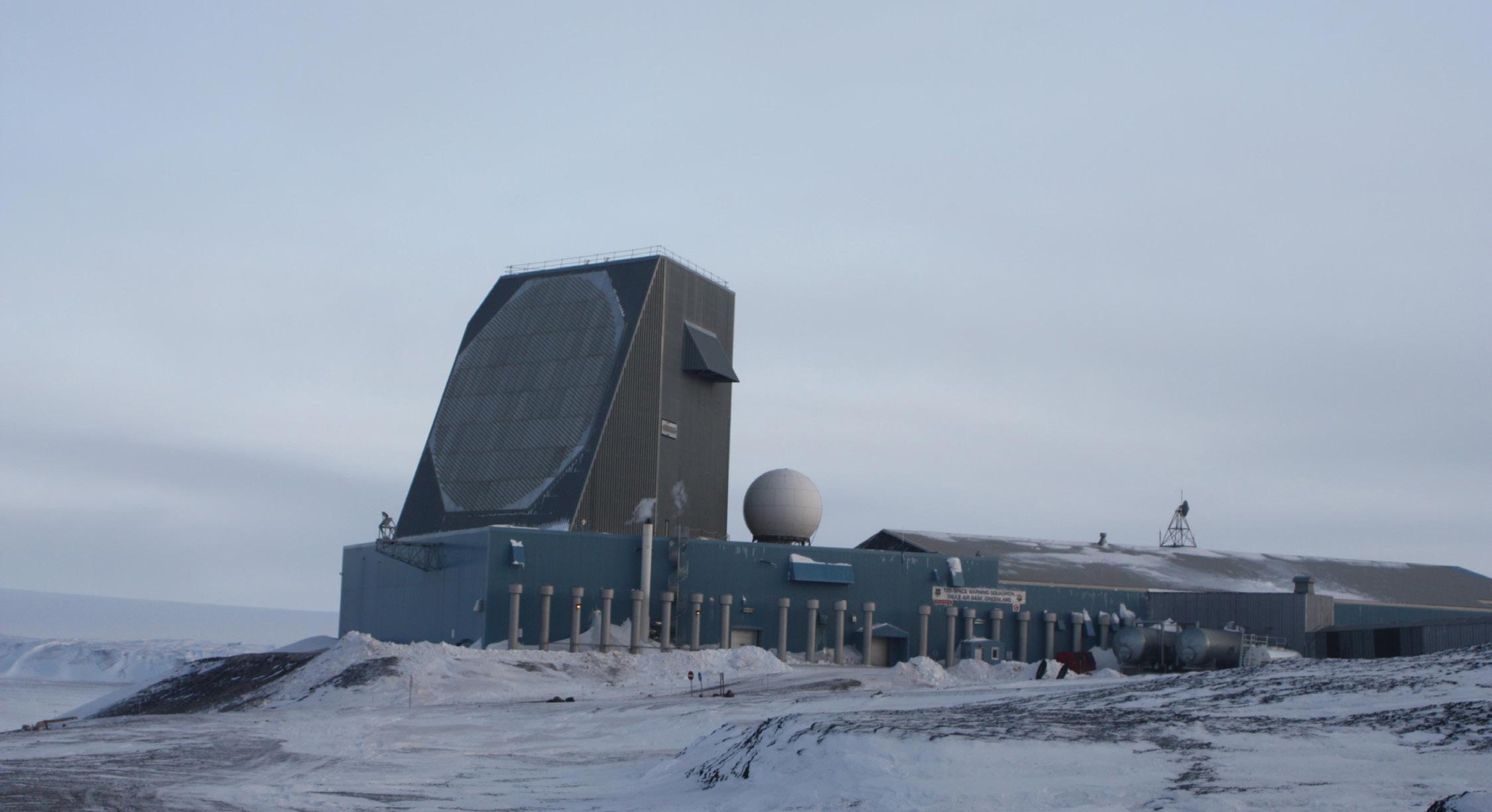
An Upgraded Early Warning Radar (UEWR), a dual-sided ballistic missile early warning radar, at US Space Force’s northernmost base in Greenland. Credit: US Space Force
7. Information provided by Maj. Gen. John Olsen, PhD, Space Force operations lead for CJADC2 and C3BM. For the past three years, General Olsen has served as the lead airborne emergency action officer and an instructor/evaluator on the Looking Glass Airborne Nuclear Command Post.
8. In “Air Force Awards Raytheon $625 Million Contract for Nuclear-Hardened Satcom Terminals,” Sandra Erwin indicates the US Air Force Nuclear Weapons Center awarded this contract to deliver an unspecified number of nuclear-hardened satellite communications force element terminals to connect B-52 and RC-135 aircraft with Advanced Extremely High Frequency (AEHF) military communications satellites. Space News, June 28, 2023, https://spacenews.com/air-force-awards-raytheon-625-million-contract-fornuclear-hardened-satcom-terminals/
9. “Air Force Awards Raytheon $625 Million Contrac.” In 2020, Raytheon became part of the RTX Corporation.
10. Air Force Fact Sheet, “E-4B,” https://www.af.mil/About-Us/Fact-Sheets/Display/Article/104503/e-4b/; NAVAIR Fact Sheet, “E-6B Mercury,” https://www.navair.navy.mil/product/E-6B-Mercury
11. NAVAIR Fact Sheet, “E-6B Mercury.”
Current NC3 missions and space systems
Space systems provide three capabilities that are essential for the NC3 enterprise: missile warning/missile tracking (MW/ MT), assured communications, and nuclear detonation detection. Space-based MW/MT uses infrared sensors to detect missile launches worldwide. This can be the first warning of an attack and, when combined with other attack indications from systems using different phenomenologies, provides high confidence that an actual attack is underway. This warning is essential for initiating other steps that may include moving the president, conferencing with senior leaders, and determining response options. Today, the space-based infrared system (SBIRS) provides MW/MT. SBIRS consists of the space segment of geostationary Earth orbit (GEO) satellites, highly elliptical orbit (HEO) sensors, legacy Defense Support Program (DSP) satellites, and the associated worldwide deployed ground systems. SBIRS satellites were first launched in 2011, and the sixth and final satellite was launched in August 2022.12 In 2017, then-Commander US Strategic Command (USSTRAT-
COM) Gen. John Hyten famously described SBIRS satellites as “big, fat, juicy targets,” pledging that USSTRATCOM would no longer support acquisition of such NC3 systems and that “we are going to go down a different path. And we have to go down that path quickly.”13 The Missile Defense Agency (MDA) (and its predecessor organizations) has, since the 1980s, conducted several experiments and developed prototype capabilities supportive of MW/MT/missile defense and adaptive nuclear planning. MDA’s prior efforts include Delta 180, Midcourse Space Experiment/Space-Based Visible, and Space Tracking and Surveillance System.14
Assured, survivable communications capabilities are essential for the president to conduct conferences with senior leaders and exercise command and control over nuclear forces. Space-basing enhances survivability and enables global communications. The Advanced Extremely High-Frequency (AEHF) system currently provides many communication links for nuclear command and control. AEHF provides “survivable,
12. The original plan for SBIRS called for eight satellites; the seventh and eighth satellites were cancelled in 2019 after work began on the next-generation system.
13. Sandra Erwin, “STRATCOM Chief Hyten: ‘I Will Not Support Buying Big Satellites That Make Juicy Targets,’” Space News, November 19, 2017, https://spacenews.com/stratcomchief-hyten-i-will-not-support-buying-big-satellites-that-make-juicy-targets/
14. Dwayne A. Day, “Smashing Satellites as Part of the Delta 180 Strategic Defense Initiative Mission,” Space Review, July 17, 2023, https://www.thespacereview.com/article/4622/1; Jayant Sharma, Andrew Wiseman, and George Zollinger, “Improving Space Surveillance with Space-Based Visible Sensor,” MIT Lincoln Laboratory, March 1, 2001, https://apps. dtic.mil/sti/pdfs/ADA400541.pdf; Missile Defense Agency Fact Sheet, “Space Tracking and Surveillance System,” August 23, 2022, https://www.mda.mil/global/documents/pdf/ stss.pdf
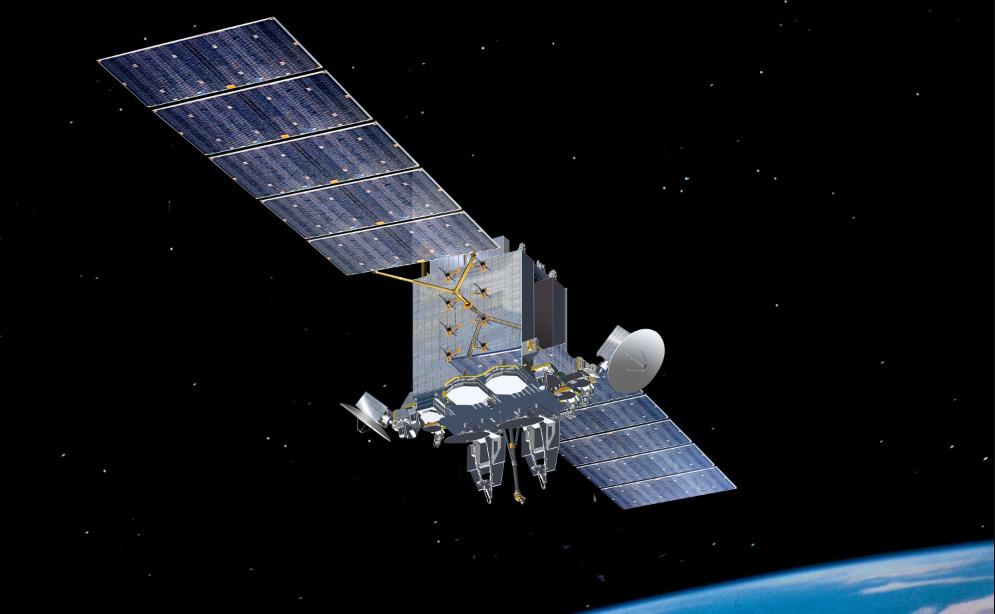
A rendition of the Advanced Extremely High Frequency (AEHF) System, a space-based communication system. Credits: US Space Force
global, secure, protected, and jam-resistant communications for high-priority military ground, sea and air assets.”15 AEHF replaced the Cold War-era Milstar system; the first AEHF satellite was launched in 2010, and the sixth and final satellite was launched in March 2020.
A final space capability providing important support to NC3 is data about the location of nuclear detonations worldwide. This information is essential for effective and adaptive planning in a nuclear conflict. The United States Nuclear Detonation Detection System (USNDS) currently provides this capability.16 As described by the DOD, “the USNDS is a worldwide system of space-based sensors and ground processing equipment designed to detect, locate, and report nuclear detonations in the earth’s atmosphere and in space. The USNDS space-based segment is hosted on a combination of global positioning system (GPS) satellites, DSP satellites, and other classified satellites.”17 The enhanced detection capabilities of the Space and Atmospheric Burst Reporting System (SABRS-2) payload were first deployed in 2016.
How the attributes of space and space systems shape space security
Comprehensive analysis about modernizing space-based NC3 cannot be complete without a baseline understanding of the attributes of space and space systems that shape the most appropriate modernization paths and trade-offs. NC3 systems were first moved to space in the 1960s because this domain provides unique speed and positional advantages, persistent emplacement, and a global perspective. These developments were highly effective and efficient, despite the considerable expense of developing reliable space hardware and the great energy required to move a satellite above the atmosphere at the bottom of Earth’s gravity well and to accelerate it so it can sustain the specific orbit for which it was designed. Orbital dynamics, along with the lack of traditional cover and concealment measures available on Earth, means satellites can be more easily detected, tracked, and targeted than terrestrial forces, which are routinely able to maneuver and hide.
Attributes of space launch and orbital dynamics also drive space technology and operations in significant ways. Traditional satellite architectures have been shaped by several factors, including the costs and dangers of space launch (still the most hazardous part of satellite operations), significant limitations on capability to service satellites, perceived economies from custom-building very small numbers of increasingly ca-
pable and large satellites, and the ability of just a few of these highly capable satellites to perform a variety of key missions very competently. Due to these factors, several countries, and the United States in particular, in the past chose to develop and operate a very small number of highly expensive, sophisticated, and exquisitely capable satellites. Each of these attributes adds to the vulnerability of legacy satellite architectures and exacerbates temptations for enemies to negate them because these orbital assets are so fragile, so few, increasingly important, operate in highly predictable ways, and cannot today be repaired, refueled, or upgraded on orbit.
Another important defining characteristic of most space systems is that they are dual use, meaning that they can be used for both civilian and military applications. This dual-use characteristic has been inherent since the earliest days of space technology development and is highlighted by a description of Wernher von Braun (the leading space technology pioneer) as a “dreamer of space, engineer of war.”18 The hybrid space architecture under development by the United States is an integrated system of both government (civil, national security, intelligence) and commercial (industry) elements that is also inherently dual use, particularly when the government procures commercial goods and services. This architecture can also be extended to international and institutional (interagency, academia) allies, coalition members, and partners. Dual-use considerations sometimes create difficult balancing and trade-off issues, as the United States and other countries attempt to promote space technologies and activities considered to be benign, while limiting similar capabilities or actions that may be threatening or destabilizing.
An implication of the dual-use nature of space systems is that any satellite that can transmit or maneuver could be sent toward a potential collision (known as a conjunction) with a nearby satellite or used to jam satellite transmissions, making it a simple anti-satellite (ASAT) weapon. Such use is not likely to be as effective as a purpose-built ASAT weapon, but increasing development of in-orbit servicing, assembly, and manufacturing (ISAM) and active debris removal (ADR) capabilities may blur and complicate distinctions between commercial, civil, and military applications and operations. Similarities between ASAT systems and some of the technologies and operations of ISAM and ADR systems are so great that analysts worry that widespread development of these beneficial commercial and civil capabilities would also create significant but latent ASAT potential.19 The dual-use characteristic of satellites or
15. United States Space Force Fact Sheet, “Advanced Extremely High-Frequency System,” July 2020, https://www.spaceforce.mil/About-Us/Fact-Sheets/Fact-Sheet-Display/Article/2197713/advanced-extremely-high-frequency-system/
16. United States Space Force Fact Sheet, “Space Based Infrared System,” March 2023, https://www.spaceforce.mil/About-Us/Fact-Sheets/Article/2197746/space-based-infrared-system/; National Nuclear Security Administration, “NNSA delivers enduring space-based nuclear detonation detection capability,” March 22, 2018, https://www.energy. gov/nnsa/articles/nnsa-delivers-enduring-space-based-nuclear-detonation-detection-capability
17. Department of Defense Office of Inspector General, “Evaluation of the Space-Based Segment of the U.S. Nuclear Detonation Detection System,” September 28, 2018, https:// www.dodig.mil/FOIA/FOIA-Reading-Room/Article/2014314/evaluation-of-the-space-based-segment-of-the-us-nuclear-detonation-detection-sy/
18. Michael J. Neufeld, Von Braun: Dreamer of Space, Engineer of War (New York: Vintage, 2008), is the authoritative assessment of von Braun’s contributions and legacy.
19. See, for example, Brian G. Chow, “Space Arms Control: A Hybrid Approach,” Strategic Studies Quarterly 12, no. 2 (Summer 2018): 107-32; and James Alver, Andrew Garza, and Christopher May, “An Analysis of the Potential Misuse of Active Debris Removal, On-Orbit Servicing, and Rendezvous & Proximity Operations Technologies” (capstone paper,
spacecraft is perhaps the single largest factor that complicates space security considerations, making it more difficult for analysts to determine ways to incentivize desired applications, constrain malign potential, and consider how these factors shape space superiority.
Dedicated or dual-use capabilities can strengthen capability, capacity, resilience, and security, but security is an ambiguous and relative concept. Analysts use the term “security dilemma” to describe the relative and interactive aspects of security and study them as a cause of war and one of the central problems of international relations.20 The characteristics of space and satellites exacerbate some of these issues and make their relative contributions to security more ambiguous and elusive. Accordingly, modernizing space-based NC3 in the context of these technical and political issues is a complex endeavor that may promote or inhibit cooperation under the security dilemma.21
On this subject, strategist Brad Townsend builds from earlier analysis and applies it directly to space, finding that the current space security situation is less dire than some originally predicted.22 CSO Saltzman acknowledges that the security dilemma is a concern but notes that weapons are not inherently offensive or defensive: “Weapons are just weapons. And the operations that you choose to undertake with those weapons makes them more offensive or defensive.”23 As described in a 2023 New York Times Magazine profile of the US Space Force:
The important question, as [General Saltzman] saw it, was this: At what point does a buildup of defensive weapons in space constitute an ability to conduct offensive operations so that someone else feels threatened?
“There is a balance here,” he said. “And this is about stability management. What actions can we take to protect ourselves before we start to cross the line and maybe create a security dilemma?” The line, he suggested— harder to find in space, no doubt, and at this point not clearly defined—had not yet been crossed.24
A final attribute of space capabilities is rapidly evolving due to the burgeoning commercial space sector: the value of com-
mercial space systems in supporting a wide range of military operations. These contributions have grown exponentially, as illustrated by the stunning successes of the Ukrainians in defending their country following the Russian invasion.25 Commercial space capabilities provide critical information that strengthens worldwide support for Ukraine, supply communications connectivity that is essential for coordinating many Ukrainian military operations, and demonstrate that states do not necessarily need to own and operate space systems to use them effectively.
These characteristics of space and space systems are driving the United States toward a wholesale reorientation of its national security space enterprise that is focused on improving resilience and advancing better transparency- and confidence-building measures (TCBMs) for space governance. The current enterprise-wide modernization and recapitalization of government space systems provides resilient, robust, and responsive solutions, seeking to take advantage of new capabilities and technologies through approaches including highly proliferated constellations in multiple orbits; in-plane and multi-orbit, multi-node cross-links; and shorter development and deployment cycles. Helpful TCBM steps include the United Nations Committee on the Peaceful Uses of Outer Space’s promulgation of twenty-one guidelines for the long-term sustainability of space activities, the North Atlantic Treaty Organization’s declaration that space is a fifth operational domain where attacks could invoke Article 5 defense obligations, the DOD’s tenets of responsible space behavior in space, and the pledge by the United States that it will no longer conduct destructive direct-ascent (DA)-ASAT tests that has now been joined by several other countries and adopted by the United Nations General Assembly.26 These steps and others seem to be generating momentum toward greater consensus and more specifics on what constitutes responsible behavior in space, which will facilitate the “naming and shaming” of parties that do not act in responsible ways. Nonetheless, these efforts also highlight just how far the space governance regime is from governance regimes in other domains that include much more specific obligations and robust verification mechanisms, rather than voluntary guidelines and pledges.
George Washington University, 2019), https://swfound.org/media/206800/misuse_commercial_adr_oos_jul2019.pdf
20. Some of the earliest and most influential analyses of the relative and ambiguous characteristics of security include John Herz, “Idealist Internationalism and the Security Dilemma,” World Politics 2, no. 2 (January 1950): 157-80; and Arnold Wolfers, “‘National Security’ as an Ambiguous Symbol,” Political Science Quarterly 67, no. 4 (December 1952): 481-502.
21. Robert Jervis, “Cooperation Under the Security Dilemma,” World Politics 30, no. 2 (January 1978): 167-214. In this seminal article, Jervis applied game theory approaches to scenarios commonly used to analyze causes of war such as Stag Hunt and Prisoner’s Dilemma, positing that two variables are primary determinants of how likely or unlikely it is that states can achieve cooperation: 1) whether offensive or defensive capabilities have the advantage; and 2) whether analysts can distinguish between offensive and defensive capabilities. Applying this framework creates a 2 x 2 matrix in which Jervis labels situations where offense has the advantage, and analysts cannot distinguish between offensive and defensive capabilities as “doubly dangerous” and situations with the opposite conditions as “doubly stable.” Some disagree, but unfortunately, today most analysts perceive that the doubly dangerous situation corresponds most closely to the current characteristics of space. Jervis finds that this situation “is the worst for status-quo states. There is no way to get security without menacing others, and security through defense is terribly difficult to obtain.”
22. See Brad Townsend, “Strategic Choice and the Orbital Security Dilemma,” Strategic Studies Quarterly 14, no. 1 (Spring 2020): 64-90; and Brad Townsend, Security and Stability in the New Space Age: The Orbital Security Dilemma (Milton Park, UK: Routledge, 2020).
23. Gertner, “What Does the U.S. Space Force Actually Do?”
24. Gertner, “What Does the U.S. Space Force Actually Do?” Interior quotes are from General Saltzman.
25. See, for example, Benjamin Schmitt, “The Sky’s Not the Limit: Space Aid to Ukraine,” Center for European Policy Analysis, May 19, 2022, https://cepa.org/article/the-skys-notthe-limit-space-aid-to-ukraine/; David T. Burbach, “Early Lessons from the Russia-Ukraine War as a Space Conflict,” Atlantic Council, August 30, 2022, https://www.atlanticcouncil.org/content-series/airpower-after-ukraine/early-lessons-from-the-russia-ukraine-war-as-a-space-conflict/; and Jonathan Beale, “Space, the Unseen Frontier in the War in
Geopolitical challenges to the current NC3 system
Two elements of the changing international security environment pose a challenge to the current NC3 system beyond what it was designed to face—principally, the nature and number of nuclear-armed countries which the United States seeks to deter using its nuclear arsenal and the increasing risk of limited nuclear use. The People’s Republic of China (PRC), the “pacing challenge” for the DOD, is currently engaged in a significant nuclear breakout. This has two key consequences for NC3. First, the increased focus on, and risk of nuclear conflict with, China raises the salience of Beijing’s possible lack of understanding of or appreciation for the principle of noninterference with space-based NC3 that Washington and Moscow arrived at during the Cold War. The second challenge posed by China’s nuclear breakout is the so-called two-nuclear-peer problem.27 The United States may need to deter or, if deterrence fails, restore deterrence against two nuclear peers which may aggress against the United States or its allies in coordination, in sequence, or in overlapping timeframes. This
development may raise the requirements for survivable NC3. Finally, US government documents evince a growing concern that Russia and China may be lowering the threshold for limited nuclear use to achieve their aims in a conflict with the United States or its allies, potentially requiring a graduated US nuclear response. These developments create a challenging environment for effective NC3 operations.
US Vice President Kamala Harris announces a new US pledge to not destructively test direct-ascent anti-satellite weapons during a visit to Vandenberg Space Force Base in April 2022. US Space Force photo by Michael Peterson.

The NC3 system is arguably the most important communication system that the US maintains and is the bedrock of nuclear deterrence. As such, deliberate degradation or destruction of these capabilities is a “red line” (meaning an unacceptable action that could trigger a nuclear war) for senior US decision-makers. Disruption, degradation, or denial of NC3 capabilities could have strategically destabilizing effects for the United States, as well as the allies that depend on US extended deterrence commitments to ensure their security. Japan, the Republic of Korea, and NATO allies all tangibly benefit from US extended strategic deterrence commitments that are predicated on assured NC3; confidence in US extendUkraine,” BBC News, October 5, 2022, https://www.bbc.com/news/technology-63109532
26. Report of the Committee on the Peaceful Uses of Outer Space, Sixty-Second Session, June 2019, 54-69, https://www.unoosa.org/res/oosadoc/data/documents/2019/a/ a7420_0_html/V1906077.pdf; NATO’s decision to consider space an operational domain like land, sea, air, and cyber is helpful, but it added caveats weakening Article 5 obligations for attacks in space: “A decision as to when such attacks would lead to the invocation of Article 5 would be taken by the North Atlantic Council on a case-by-case basis.” See NATO, “NATO’s Overarching Space Policy,” January 17, 2022, https://www.nato.int/cps/en/natohq/official_texts_190862.htm?utm_source=linkedin&utm_medium=nato&utm_campaign=20220117_space; and Secretary of Defense, “Tenets of Responsible Behavior in Space,” July 7, 2021, https://www.spacecom.mil/Newsroom/ Publications/Pub-Display/Article/3318236/tenets-of-responsible-behavior-in-space/. On April 18, 2022, Vice President Kamala Harris announced that the United States will no longer conduct destructive tests of DA-ASAT missiles (https://www.whitehouse.gov/briefing-room/statements-releases/2022/04/18/fact-sheet-vice-president-harris-advances-national-security-norms-in-space/). Through October 2023, thirty-seven other countries including Australia, Canada, France, Germany, Japan, New Zealand, South Korea, Switzerland, and the United Kingdom have made similar pledges. On December 7, 2022, 155 countries in the United Nations General Assembly voted in favor of a resolution calling for a halt for this type of ASAT testing, while nine voted against the resolution (including China and Russia) and nine (including India) abstained. Ching Wei Soo, Direct-Ascent Anti-Satellite Missile Tests: State Positions on the Moratorium, UNGA Resolution, and Lessons for the Future, Secure World Foundation, October 2023, https:// swfound.org/media/207711/direct-ascent-antisatellite-missile-tests_state-positions-on-the-moratorium-unga-resolution-and-lessons-for-the-future.pdf 27. For more, see Madelyn Creedon, chair, and Jon Kyl, vice chair, The Final Report of the Congressional Commission on the Strategic Posture of the United States, October
ed deterrence commitments is undermined if states question whether NC3 will always work as needed.
The first key development in the international security environment posing challenges to NC3 is the changing nature and number of nuclear-armed states which the United States seeks to deter using its nuclear arsenal. China’s growing importance as a nuclear competitor presents a challenge to space-based NC3 because Washington and Beijing do not have a mutual understanding of red lines surrounding NC3 assets that is comparable to the understanding Washington developed with Moscow during the Cold War. The current NC3 system evolved based on important assumptions about strategic nuclear bipolarity between two superpowers with a shared understanding about red lines and at least a nominal commitment to reducing the risk of strategic miscalculation in decisions about using nuclear weapons.
China presents strategic challenges that cannot be met with the approaches used for Russia. The United States and China do not maintain regular strategic security dialogues designed to reach shared understanding about critical issues, such as red lines on disrupting NC3. Whereas Russia and the United States generally agree that degrading, denying, disrupting, or destroying systems associated with NC3 is destabilizing and potentially a precursor to nuclear exchange, there is no such understanding with China, and Chinese leaders may even see value in such uncertainty.28 Additionally, China has chosen
to remain outside of strategic arms control treaties and dialogues, ostensibly because it fails to see a strategic benefit to being bound to the terms of such agreements and is unwilling to submit to a stringent verification regime. Instead, China has been pursuing rapid quantitative and qualitative growth in its entire nuclear force structure and C3BM systems, while also concurrently developing and fielding counterspace and cyber weapons that could be employed against US spacebased NC3 systems. Specifically, China’s first deployment of its own ballistic missile early warning satellites and putative move toward a nuclear launch-on-warning posture could be quite destabilizing.
With China’s rapid nuclear modernization, the United States faces a possible two-nuclear-peer problem of deterring simultaneous, sequential, or overlapping aggression from both China and Russia. China has achieved a strategic breakout with its rapid expansion in scope, scale, and capabilities for strategic nuclear weapons, including their own nuclear triad in development and operations. China is expected to field a nuclear arsenal of at least one thousand deliverable warheads by 2030, a number which may continue to grow, and presents considerable challenges for effective NC3 in various two-nuclear-peer conflict scenarios.29
An additional geopolitical challenge to NC3 is the increased likelihood of limited nuclear use by Russia or China. Limited nuclear use—that is, nuclear employment less than a full ex-
2023, https://armedservices.house.gov/sites/republicans.armedservices.house.gov/files/Strategic-Posture-Committee-Report-Final.pdf
28. Department of Defense, Military and Security Developments Involving the People’s Republic of China 2023, October 2023, 103-13, https://media.defense.gov/2023/ Oct/19/2003323409/-1/-1/1/2023-MILITARY-AND-SECURITY-DEVELOPMENTS-INVOLVING-THE-PEOPLES-REPUBLIC-OF-CHINA.PDF
29. Military and Security Developments Involving China 2023.
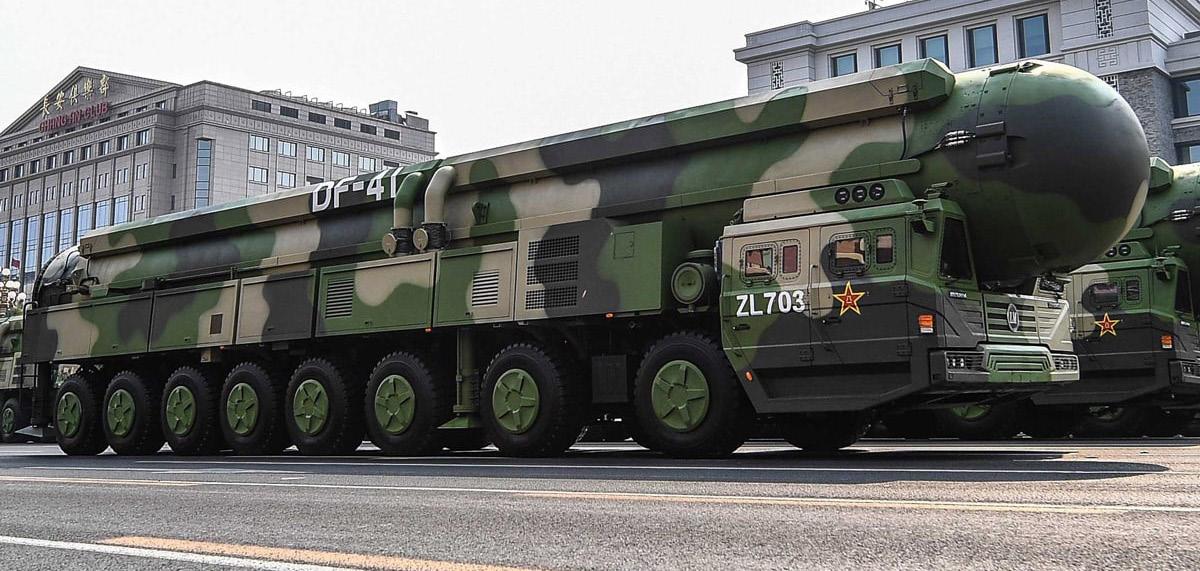
The DF-41 land mobile missile on parade. The DF-41 is one of China’s most advanced intercontinental ballistic missiles and a significant component of its nuclear breakout. Courtesy Chinese People’s Liberation Army.
change against strategic targets in either party’s homeland— poses challenges to NC3 because NC3 elements may need to survive several limited exchanges while maintaining the ability to characterize attacks in detail to enable the National Command Authority to order responses that convey clear messages of resolve and restraint in a graduated manner. Recent world events and US government analysis demonstrates concern that both Russia and China are considering limited nuclear use strategies. President Vladimir Putin’s Russia has backslid toward destabilizing activity in which the employment of “tactical nuclear weapons” has been contemplated to an unprecedented extent. As reported by the BBC, “In February 2022, shortly before invading Ukraine, President Putin placed Russia’s nuclear forces at ‘special combat readiness’ and held high-profile nuclear drills.”30 As the conflict in Ukraine continued, Putin made this statement: “If the territorial integrity of our country is threatened, we will, without a doubt, use all available means to protect Russia and our people. This is not a bluff.”31 Even before the Russian re-invasion of Ukraine, scholars and analysts had grown concerned that Russia would consider using nuclear weapons in a limited way in Europe.32
As will be described in more detail in the following section, the problem of limited nuclear use is particularly nettlesome when considering that the nuclear taboo since Nagasaki may be weakening. Uncertainty caused by the latest round of threatening rhetoric and dynamic saber-rattling over Ukraine clearly reemphasizes the need for a robust, assured NC3 system that can operate through all contemplated nuclear scenarios, including nuclear detonations in space and regional nuclear exchanges. These kinds of unprecedented scenarios highlight tangible architectural threats to the system as it currently exists, even with the strategic competitor with whom the United States has the most historical basis for reducing miscalculation.
Nuclear dynamics have moved far beyond the nuclear bipolarity of the Cold War; today’s world is robustly multipolar with the peer competitors or peer adversaries of the United States having an “unlimited partnership” that is further complicated by their alliances and relationships with other emerging nuclear powers. The NC3 architecture as designed in the 1960s surely did not contemplate India, Pakistan, North Korea, and others potentially using nuclear weapons which the United States would need to be able to detect, characterize, respond to, and operate through. The physical architecture, data throughput capacity links, and even geographic and temporal constraints of the NC3 system all require upgrading and expansion to ad-
dress today’s far more complex and challenging geopolitical environment.
Counterspace threats to space-based NC3
Accelerating development, testing, and deployment of a range of Chinese and Russian counterspace capabilities significantly challenges the ability of space-based NC3 to continue delivering nuclear surety. Other states, including Iran and North Korea, also possess some limited counterspace capabilities, but these capabilities are considerably less worrisome than those of China and Russia and are not the focus of this paper.
The DOD recognizes significant threats to its space systems from Russia and China, including to space-based NC3. As one of the authors has argued:
By describing space as a warfighting domain, the 2018 National Defense Strategy marked a fundamental shift away from legacy perspectives on uncontested military space operations and aspirations for free access and peaceful purposes espoused in the Outer Space Treaty. America’s potential adversaries, particularly China and Russia, now view space—from launch, to on-orbit, the up- and downlinks, and the ground stations—as a weak link in U.S. warfighting capabilities. Conversely, the United States for generations believed space to be a permissive environment and did not make major investments in defensive capabilities, even as almost all modern military operations became increasingly reliant on space capabilities. These facts, coupled with the reemergence of great power competition, have led adversaries to believe that by denying U.S. space-enabled capabilities, they can gain strategic advantage over U.S. response options—making those options less assured, less opportune, and less decisive.33
Most disturbingly, US adversaries, particularly China with its lack of interest in strategic arms control and seeming disregard for traditional norms surrounding stability and deterrence, may now perceive that undermining the efficacy of space-based NC3 may be one of its most attractive options for gaining strategic advantage. These are destabilizing conditions in that: adversaries may believe they can deter U.S. entry into a conflict by threatening or attacking U.S. space capabilities. This may even embolden adversaries to employ a space attack as a “first salvo” in anti-access/area-denial (A2/AD) strategies. This is a potentially dangerous situation that has moved past an inflection point and is
30. BBC, “Ukraine War: Could Russia Use Tactical Nuclear Weapons?” September 24, 2022, https://www.bbc.com/news/world-60664169
31. Nina Tannenwald, “The Bomb in the Background: What the War in Ukraine Has Revealed About Nuclear Weapons,” Foreign Affairs, February 24, 2023, https://www.foreignaffairs.com/ukraine/bomb-background-nuclear-weapons
32. See, for instance, Matthew Kroenig, A Strategy for Deterring Russian Nuclear De-Escalation Strikes, Atlantic Council, April 24, 2018, https://www.atlanticcouncil.org/in-depthresearch-reports/report/a-strategy-for-deterring-russian-de-escalation-strikes/
33. Peter L. Hays, “Is This the Space Force You’re Looking For? Opportunities and Challenges for the U.S. Space Force,” in Benjamin Bahney, ed., Space Strategy at a Crossroads: Opportunities and Challenges for 21st Century Competition, Center for Global Security Research, Lawrence Livermore National Laboratory, May 2020, 20. The following five paragraphs draw substantially from Hays’ chapter cited here.
starting to create strategic disadvantages rather than the strategic advantages space traditionally provided the United States. From a Clausewitzian perspective, the Space Force must also consider whether current U.S. space strategy may be approaching a culminating point where it becomes counterproductive to continue either offensive or defensive space operations in wartime [unless it has deployed a far more resilient architecture].34
China has reformed its military and developed significant capabilities to hold at risk US space assets. As part of its 2015 military reforms, China established the People’s Liberation Army (PLA) Strategic Support Force (SSF).35 The SSF combines space and counterspace capabilities, electronic warfare, and cyber operations in one organization and enables the PLA to be more effective in its approach to space as a warfighting domain. “The PLA views space superiority, the ability to control the space-enabled information sphere and to deny adversaries their own space-based information gathering and communication capabilities, as critical components to conduct modern ‘informatized warfare.’”36 In the words of a recent DOD report to Congress on protection of satellites:
The PRC views counterspace systems as a means to deter and counter outside intervention during a regional conflict. The PLA is developing, testing, and fielding capabilities intended to target U.S. and allied satellites, including electronic warfare to suppress or deceive enemy equipment, ground-based laser systems that can disrupt, degrade, and damage satellite sensors, offensive cyberwarfare capabilities, and direct-ascent anti-satellite
(DA-ASAT) missiles that can target satellites in low Earth orbit (LEO). The PRC has launched multiple experimental satellites to research space maintenance and debris cleanup with advanced capabilities, such as robotic arm technologies that could be used for grappling other satellites. In 2022, the PRC’s Shijian-21 satellite moved a derelict satellite to a graveyard orbit above geosynchronous Earth orbit (GEO).37
The Shijian-21 demonstration was particularly threatening to US space-based NC3, as it indicated a potential capability to grapple and move or disable noncooperative satellites; many of the most important US NC3 systems are in GEO.
The PRC continues to seek new methods to hold U.S. satellites at risk, probably intending to pursue DA-ASAT weapons capable of destroying satellites up to GEO.
As the PRC has developed and fielded these counterspace weapons, it has simultaneously promoted false claims that it will not place weapons in space and, along with Russia, has proposed at the United Nations a draft of a flawed, legally-binding treaty on the nonweaponization of space that is inherently unverifiable and unenforceable.38
For decades, Russia has developed doctrine and pursued capabilities to target US satellites, including NC3 systems.
Russia reorganized its military in 2015 to create a separate space force because Russia sees achieving supremacy in space as a decisive factor in winning con-
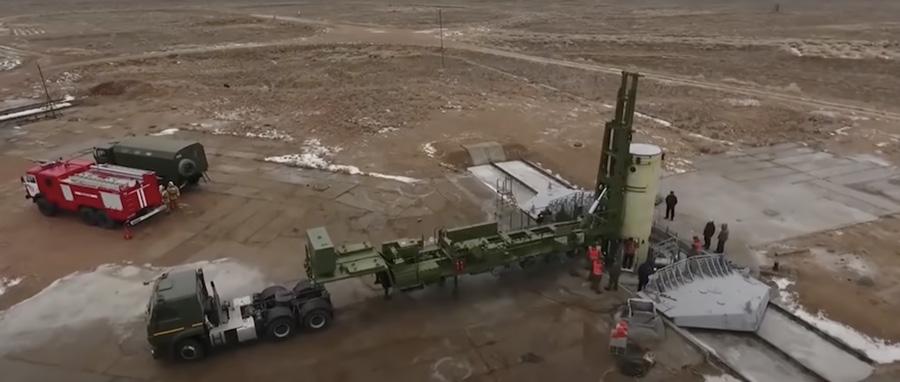
Launch preparations for the Russian Nudol system, which serves as both an anti-ballistic missile interceptor as well as an anti-satellite weapon, 2021. Russian Ministry of Defense
34. Hays, “Is This the Space Force You’re Looking For?,” 20. Internal citations omitted.
35. Military and Security Developments Involving China 2023, 70.
36. Military and Security Developments Involving China 2023, 70; In April 2024, the Strategic Support Force was dissolved and split into three independent units: the PLA Aerospace Force, the PLA Cyberspace Force, and the PLA Information Support Force. Namrata Goswami, “The Reorganization of China’s Space Force: Strategic and Organizational Implications -- The rationale behind the new ‘Aerospace Force,’” The Diplomat, May 3, 2024, https://thediplomat.com/2024/05/the-reorganization-of-chinas-space-force-strategic-and-organizational-implications/
37. US Department of Defense, “Space Policy Review and Strategy on Protection of Satellites,” September 2023, 2-3, https://media.defense.gov/2023/Sep/14/2003301146/-1/-1/0/
flicts. Although Russia has a smaller fleet of satellites than China, Russia operates some of the world’s most capable individual ISR [intelligence, surveillance, and reconnaissance] satellites for optical imagery, radar imagery, signals intelligence, and missile warning. Russia increasingly integrates space services into its military, though it wants to avoid becoming overly dependent on space for its national defense missions because it views that as a potential vulnerability.
Russia is developing, testing, and fielding a suite of reversible and irreversible counterspace systems to degrade or deny U.S. space-based services as a means of offsetting a perceived U.S. military advantage and deterring the United States from entering a regional conflict. These systems include jamming and cyberspace capabilities, directed energy weapons, on-orbit capabilities, and ground-based DA-ASAT missile capabilities.
In November 2021, Russia tested a DA-ASAT missile against a defunct Russian satellite, which created more than 1,500 pieces of trackable space debris and tens of thousands of pieces of potentially lethal but non-track-
able debris. The resulting debris continues to threaten spacecraft of all nations in LEO, astronauts and cosmonauts on the International Space Station, and taikonauts on China’s Tiangong space station.39
In a most disturbing scenario, the efficacy of commercial LEO satellites in supporting Ukraine could lead the Russians (or the Chinese in a Taiwan invasion, for instance) to assess that the greatest military effectiveness from the limited use of nuclear weapons would be to detonate just one in LEO. A high-altitude nuclear detonation (HAND) would raise the peak radiation flux in parts of the Van Allen radiation belts by three to four orders of magnitude, cause the failure in weeks to months of most if not all LEO satellites not specifically hardened against this threat, result in direct financial damages probably approaching $500 billion and over $3 trillion in overall economic impact, and present daunting response challenges, since the attack would be outside of any state’s sovereign territory and not directly kill anyone.40
Modernization plans for space-based NC3
While the NC3 system currently appears to be sufficiently redundant, capable, and secure, it must be modernized to keep
Navy
the initial operational
of the Nuclear
3.
39. “Space Policy Review and Strategy on Protection of Satellites,” 3. Internal citations omitted.
40. Defense Threat Reduction Agency, Advanced Systems and Concepts Office, “High Altitude Nuclear Detonations (HAND) against Low Earth Orbit Satellites (‘HALEOS’),” April 2001, https://spp.fas.org/military/program/asat/haleos.pdf. No satellites are known to be hardened against these nuclear effects. Estimates on financial damages from General Olsen. For further details about the threat from HAND and a discussion on a potential licensing requirement for commercial LEO satellites to be hardened against residual radiation effects following a HAND, see Peter L. Hays, United States Military Space: Into the Twenty-First Century (Maxwell AFB: Air University Press, 2002), 101-03. National security communications adviser John Kirby told reporters at a White House news conference that Russia “is developing an anti-satellite weapon capability, describing it as a
US
VADM David Kriete, then-deputy commander of US Strategic Command announced
capability
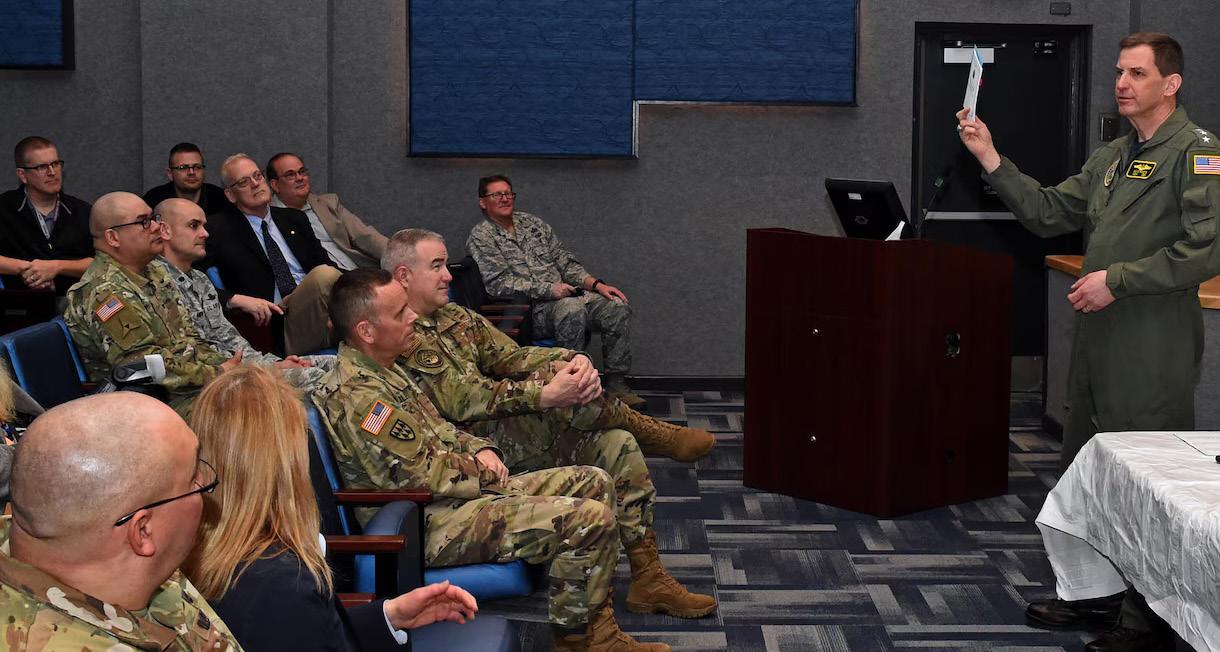
Command, Control and Communications Enterprise Center in April 2019. USSTRATCOM photo.
pace with the evolving geopolitical environment, technical developments, and planned modernization of the nuclear triad (submarines, bombers, and land-based missiles). As described by the DOD’s Nuclear Matters Handbook:
In July 2018, the Secretary of Defense and the Chairman of the Joint Chiefs of Staff formally appointed the USSTRATCOM Commander to be “the NC3 enterprise lead, with increased responsibilities for operations, requirements, and systems engineering and integration.”
USSTRATCOM has created an NC3 Enterprise Center inside the command’s headquarters at Offutt Air Force Base, Nebraska. On November 5, 2018, Commander, USSTRATCOM stated, “It is imperative that the U.S. government modernize its three-decade-old NC3 in a manner that accounts for current and future threats to its functionality and vulnerabilities.” The NC3 Enterprise Center is developing and evaluating NC3 architectures and approaches for modernization.41
In earlier congressional testimony, General Hyten had simply stated that “nuclear command and control and communications, NC3, is my biggest concern when I look out towards the future.”42
No nuclear weapon delivery platform can execute its mission without NC3, but the NC3 system is so complex that a former commander of USSTRATCOM stated it includes over 204 individual systems.43 While many space systems contribute ISR data that supports NC3, this analysis focuses just on the space systems that were designed for and dedicated to supporting NC3. Focusing on space systems in this way is, however, becoming increasingly difficult, as the DOD works to modernize both its overall space architecture and space-based NC3. Modernizing the ground- and air-based NC3 systems supporting the triad remains on a relatively straightforward path, but the path toward modernizing space-based NC3 is being reconsidered within the context of broader changes to deploy a more resilient hybrid space architecture overall. This requires consideration of different factors and trade-offs than those that shaped legacy US space-based NC3. Defense planners must now consider the value of disaggregated, diversified, and distributed systems supporting just NC3 versus
entangled systems supporting many mission areas; the role of proliferation and protection; the proper timing and phasing of deployments; appropriate ways commercial systems and deception might support space-based NC3; and the many challenges associated with balancing and integrating across an increasingly complex NC3 enterprise. A recent detailed analysis of these complex factors and trade-offs from Wilson and Rumbaugh presented the troubling finding that “the U.S. decision to disaggregate its nuclear-conventional satellite communications capabilities poses strategic consequences, but it may not have been a strategic decision.”44 An even more detailed report analyzing just the sensor requirements and trade-offs for missile defense against hypersonic threats is over one hundred pages long.45 As the DOD’s work to field a resilient, hybrid space architecture proceeds apace, it is not always clear that the requirement for nuclear surety in spacebased NC3 has been analyzed and weighted appropriately.
The DOD has major programs and plans in place to modernize systems supporting the NC3 missions of assured communications and MW/MT. For assured communications, the plan is to augment and eventually replace AEHF with the Evolved Strategic Satcom (ESS) program by the 2030s.46 ESS will operate in GEO and will provide a worldwide and Arctic protected, secure, and survivable satellite communications system supporting critical networks for strategic operations. The ESS system is being acquired by Space Systems Command (SSC); it “is the first DOD hybrid space program that is leveraging alternate acquisition pathways for each of its segments” under the adaptive acquisition framework that the DOD implemented in 2020.47 ESS satellites are currently being acquired using a middle-tier acquisition (MTA) down-select rapid prototyping competition between Boeing and Northrop Grumman. In May 2024, SSC announced it is seeking proposals for the development and production of four ESS satellites through a competitive contract award; the program is projected to cost about $8 billion.48 The ESS Program Office plans to transition from the MTA-rapid prototyping pathway to a tailored major capability acquisition (MCA) pathway beginning with the award of the ESS space segment production contract. The space segment is being designed to deliver an integrated
serious threat.” Sandra Erwin, “White House Confirms It Has Intelligence on Russia’s Anti-Satellite Weapon, But Says No Immediate Threat,” Space News, February 15, 2024, https://spacenews.com/white-house-confirms-it-has-intelligence-on-russians-anti-satellite-weapon-but-says-no-immediate-threat. On April 24, 2024, Russia vetoed a UN Security Council resolution that would have reaffirmed its obligation not to station nuclear weapons in space in any manner, as stipulated in Article IV of the OST. Jeff Foust, “Russia vetoes U.N. resolution on nuclear weapons in space,” Space News, April 25, 2024, https://spacenews.com/russia-vetoes-u-n-resolution-on-nuclear-weapons-in-space/
41. Nuclear Matters Handbook 2020, 28.
42. “Military Assessment of Nuclear Deterrence Requirements,” House of Representatives, Committee on Armed Services, HASC Hearing No. 115-11, March 8, 2017, https://www. govinfo.gov/content/pkg/CHRG-115hhrg24683/html/CHRG-115hhrg24683.htm
43. Yasmin Tadjdeh, “JUST IN: Stratcom Revitalizing Nuclear Command, Control Systems,” National Defense, January 5, 2021, https://www.nationaldefensemagazine.org/articles/2021/1/5/work-underway-for-next-generation-nuclear-command-control-and-communications
44. Robert Samuel Wilson and Russell Rumbaugh, “Reversal of Nuclear-Conventional Entanglement in Outer Space,” Journal of Strategic Studies 47, no. 1 (September 15, 2023): 3.
45. Masao Dahlgren, Getting on Track: Space and Airborne Sensors for Hypersonic Missile Defense, Center for Strategic and International Studies, December 2023, https://www. csis.org/analysis/getting-track-space-and-airborne-sensors-hypersonic-missile-defense
46. Department of Defense Fiscal Year (FY) 2024 Budget Estimates, Air Force Justification Book Volume 1, Research, Development, Test & Evaluation, Space Force, March 2023, PE1206855SF, 263-76, https://www.saffm.hq.af.mil/Portals/84/documents/FY24/Research%20and%20Development%20Test%20and%20Evaluation/FY24%20Space%20 Force%20Research%20and%20Development%20Test%20and%20Evaluation.pdf?ver=BQWN2ms9pfLNN_gvIz4mQQ%3D%3D
47. Space Systems Command Media Release, “Evolved Strategic SATCOM Program Uses Innovative Competition to Drive Acquisition of Threat-Focused Software,” May 2, 2023, https://www.ssc.spaceforce.mil/Portals/3/Documents/PRESS%20RELEASES/Evolved%20Strategic%20SATCOM%20Program%20Uses%20Innovative%20Competition%20
system capability that is resilient, flexible, cyber secure, and utilizes a modular open system architecture to support NC3. The ground “segment is leveraging a series of Software Acquisition Pathway contracts for subsets of mission capability in agile software sprints”; in May 2023, Lockheed Martin and Raytheon each won $30 million contracts to develop prototypes of the ground system for ESS.49 Use of alternate acquisition pathways and competing teams of contractors is designed to spur innovation and speed, “allowing development to stay ahead of changing strategic need.”50 The first prototype payloads are due to launch in 2024. Much depends on validating the performance of the prototypes and successful integration of the separate acquisition pathways for the space and ground segments.
Specific details regarding how MW/MT capabilities will be improved are complex and evolving. Efforts are now divided between three separate organizations: SSC, the Space Development Agency (SDA), and the MDA. MW/MT is “the first capability area to be redeveloped through a resilient-by-design approach.”51 As advocated by General Hyten and explained in a report to Congress: “This effort assessed architectures designed to meet future warfighting performance needs, establish resilience against modern military threats, and ensure cost parameters, resulting in recommendations on numbers of satellites and diversifying capabilities across orbital regimes.”52 Using a Combined Program Office construct, SSC, SDA, and MDA are teaming to develop and implement a system-of-systems integration strategy for MW/MT and missile defense (MD) constellations of satellites in LEO, GEO, medium Earth orbit (MEO), and polar orbital regimes.
These efforts to develop next-generation overhead persistent infrared (NG-OPIR) capabilities are designed to provide MW/ MT capabilities that can support MD for evolving intercontinental and theater ballistic missile threats using satellites in various orbits that are more survivable against emerging
threats. “SSC’s Resilient MW/MT-MEO space and ground efforts pivot the Department of the Air Force’s legacy missile warning force design to a more resilient multi-orbit approach to counter advanced missiles, hypersonic glide vehicles, and fractional orbital bombardment threats.”53 SCC’s NG-OPIR will be deployed in GEO (Next Generation OPIR GEO or NGG) and Polar (Next Generation OPIR Polar or NGP) orbits.54 The original plan called for three NGG satellites and two NGP satellites; in its fiscal year 2024 request, the USSF cut the number of NGG satellites to two, and Congress has subsequently requested more information about the analysis underlying this change to the NGG program structure.55 Lockheed Martin was awarded the contract to build NGG satellites and ground systems projected to cost $7.8 billion, and Northrop Grumman won a $1.9 billion definitized contract to build two NGP satellites; the first NGP is to be launched in 2028.56 Both the NGG and NGP programs are expected to transition from the rapid prototype MTA pathway to the MCA pathway in 2024. Additionally, SSC announced that, in November 2023, it “completed the critical design review for six [MW/MT/MD] satellites built by Millennium Space Systems that will go in MEO, clearing the way to start production ahead of a first scheduled launch by late 2026.”57
The SDA, an independent space acquisition organization that was established in March 2019 and became part of the Space Force in October 2022, is leading parts of the effort to field resilient-by-design MW/MT capabilities via new proliferated space architectures. SDA’s business model values speed, simplicity, and resilience, while lowering costs by “harnessing commercial development to achieve a proliferated architecture and enhance resilience”; SDA plans to deliver a new layer (or tranche) of LEO satellites to support various missions every two years.58 The first satellites in the Tranche 1 Tracking Layer are to begin launching in late 2024 and will include “28 satellites in Low Earth Orbit (LEO) optimized for use by Indo-Pacific Command to monitor Chinese and North Korean missile
to%20Drive%20Acquisition%20of%20Threat-Focused%20Software.pdf?ver=9hYpAExEQifvYTYBilFG2g%3D%3D; Department of Defense Instruction 5000.02, “Operation of the Adaptive Acquisition Framework,” June 8, 2022, https://www.esd.whs.mil/Portals/54/Documents/DD/issuances/dodi/500002p.PDF
48. Evolved Strategic Satellite Communications (ESS) Space Vehicle (SV) Development and Production,” GOVTRIBE, May 4, 2024, https://govtribe.com/opportunity/federal-contract-opportunity/evolved-strategic-satellite-communications-ess-space-vehicle-sv-development-and-production-fa880724rb004; Sandra Erwin, “Space Force Planning $8 Billion Satellite Architecture for Nuclear Command and Control,” Space News, October 25, 2023, https://spacenews.com/space-force-planning-8-billion-satellite-architecture-for-nuclear-command-and-control/
49. “Evolved Strategic SATCOM Program”; Sandra Erwin, “Lockheed, Raytheon to Develop Ground Systems for Nuclear-Hardened Satellite Communications,” Space News, May 3, 2023, https://spacenews.com/lockheed-raytheon-to-develop-ground-systems-for-nuclear-hardened-satellite-communications/
50. “Evolved Strategic SATCOM Program.”
51. “Space Policy Review and Strategy on Protection of Satellites,” 9.
52. “Space Policy Review and Strategy on Protection of Satellites,” 19.
53. Department of Defense Fiscal Year (FY) 2024 Budget Estimates.
54. Space Systems Command Media Release, “Next-Generation Overhead Persistent Infrared Program Selects Mission Payload Suppliers,” March 1, 2022, https://www.ssc. spaceforce.mil/Portals/3/Documents/PRESS%20RELEASES/Next-Generation%20Overhead%20Persistent%20Infrared%20Program%20Selects%20Mission%20Payload%20 Suppliers%20v4.pdf; Northrop Grumman, “Next Gen OPIR Polar (NGP),” https://www.northropgrumman.com/space/next-gen-polar
55. Courtney Albon, “Congress Queries Space Force Plan for Fewer Missile Warning Satellites,” Air Force Times, July 12, 2023, https://www.airforcetimes.com/battlefield-tech/ space/2023/07/12/congress-queries-space-force-plan-for-fewer-missile-warning-satellites/
56. Theresa Hitchens, “Space Force Polar-Orbiting Missile Warning Satellites Move Toward Production,” Breaking Defense, May 24, 2023, https://breakingdefense.com/2023/05/ space-force-polar-orbiting-missile-warning-sats-move-toward-production/; Courtney Albon, “Northrop Missile-Warning Satellites Pass Early Design Review,” C4ISRNET, May 24, 2023, https://www.c4isrnet.com/battlefield-tech/space/2023/05/24/northrop-missile-warning-satellites-pass-early-design-review/
launches.”59 In September 2023, SDA issued a solicitation for the Tranche 2 Tracking Layer that will provide MW/MT capabilities by using infrared sensors for near-global continuous stereoscopic coverage and incorporating missile defense fire-control-quality infrared sensors on a selected number of satellites.60 The Tranche 2 Tracking Layer is being designed to have some capabilities against advanced missile threats, including hypersonic missile systems, and is scheduled for first launch in April 2027.
MDA’s current MW/MT/missile defense (MW/MT/MD) program is the HBTSS (Hypersonic and Ballistic Tracking Space Sensor), an experimental early warning mission to “demonstrate the sensitivity and fire-control quality of service necessary to support both the emerging hypersonic threat kill chain and dim upper stage ballistic missiles.”61 Two HBTSS satellites were launched on February 14, 2024; the system is intended to work with SDA’s Tracking Layer, track dim targets not visible with current sensors, and provide near-global coverage. A DOD press release about the HBTSS launch indicated:
MDA, the U.S. Space Force and SDA are collaborating to develop HBTSS as a space sensor prototype demonstration providing fire-control quality data required to defeat advanced missile threats. Ultimately, this data is critical to enabling engagement by missile defense weapons, including engagement of hypersonic glide-phase weapons. This “birth-to-death” tracking by HBTSS will make it possible to maintain custody of missile threats from launch through intercept regardless of location.62
It is laudable that the DOD is moving in innovative ways so quickly and comprehensively to field MW/MT/MD capabilities designed to be more resilient and address evolving missile threats. However, it is not clear from unclassified sources how the various significantly different approaches will meet stringent nuclear surety requirements for MW/MT. Operationally, the new approach will require the USSF to transition from its decades of experience in interpreting high-fidelity infrared data from a few exquisite sensors toward developing improved understanding of new missile threats based on lower
57. Unshin Lee Harpley, “USSF to Start Production on New Missile Warning Satellites for Medium-Earth Orbit,” Air & Space Forces, November 29, 2023, https://www.airandspaceforces.com/ussf-new-missile-warning-satellites-medium-earth-orbit/. Full acronym spellings omitted.
58. Space Development Agency, “Who We Are,” https://www.sda.mil/home/who-we-are/
59. Theresa Hitchens, “Budget roadblock delaying Pentagon satellite program to track hypersonic missiles,” Breaking Defense, March 1, 2022, https://breakingdefense.
Hypersonic and Ballistic Tracking Space Sensor (HBTSS). Image courtesy of the US Missile Defense Agency.
fidelity inputs from many more sensors. Effectively integrating across these proliferated sensors acquired by separate agencies to produce an MD “kill chain”63 is likely to be an even more significant challenge that will require focused attention and resources. In the words of one missile defense scholar:
It remains unclear, however, how many HBTSS or HBTSS-derived payloads will eventually be fitted to SDA’s Tracking Layer constellation. While MDA requested $68 million for the program in FY 2023, funding is expected to decline after demonstration activities conclude and responsibility for fire control transfers to SSC and SDA. Following this transition, SDA aims to launch four HBTSS-derived sensor payloads as part of its Tranche 1 activities and an additional six fire control sensors in Tranche 2. Further developmental spirals, the priority accorded to the hypersonic defense mission, and SDA’s responsibilities for supporting missile defense, however, have not yet been publicly defined.64
It is difficult to manage acquisition programs to meet requirements for cost, schedule, and performance. Unfortunately, however, it can be far more difficult to integrate effectively across separate systems to achieve required performance for an enterprise such as NC3. Tensions can arise between acquisition and integration objectives, which are made more acute when separate systems are acquired by separate organizations (as is the case for space-based NC3), and present daunting challenges for achieving nuclear surety.
Much of the work to integrate various MW/MT/MD efforts will be performed by the ground segment. The largest ground system effort is the USSF’s Future Operationally Resilient Ground Evolution (FORGE), a complex program to develop a new ground system for NG-OPIR that is projected to cost $2.4 billion.65 SSC has divided the FORGE program into various thrusts that include FORGE command and control, Next-Gen Interim Operations, FORGE Mission Data Processing Application Framework, Relay Ground Stations, and E-FORGE. Integration across these various thrusts within FORGE to advance unity of effort and meet nuclear surety requirements will be a significant challenge. An additional challenge relates to Assistant Secretary Calvelli’s space acquisition tenet that calls for delivery of the ground segment before launch of the space segment, a goal that may be difficult for FORGE to meet.66
There are modest programs to modernize elements of the USNDS.67 It should be noted that, as a hosted payload, USNDS does not always enjoy a high priority, and the schedule for its fielding can slip, depending on the priority of its host satellite. Additionally, a former commander of USSTRATCOM has raised concerns about the ability of USNDS data to support NC3 in timely and effective ways.68 Overall, even while modernization efforts are underway, the geopolitical and technical challenges to the system are increasing and will require generation-after-next space-based NC3.
Conclusion and recommendations
The modernization of space-based NC3 is of vital importance to US national security objectives. While maintaining constant responsibility for enabling the employment of the world’s most capable nuclear arsenal, NC3 must be modernized to meet the significant changes and challenges presented by the evolving geopolitical and technical environment. Adding to the complexity of this modernization effort is an evolution in national security space architectures and their relationship with commercial providers of dual-use space services. The DOD must maintain a focused and sustained commitment as well as adequate resources to meet the range of daunting challenges that are entailed in modernizing space-based NC3.
As the DOD instantiates CJADC2 programs that are working to integrate sensors and shooters on complex kill webs, the modernization of NC3 systems must continue to meet unique requirements for positive and negative control unlike any other command-and-control system. The recognition of these unique requirements drives special emphasis on understanding deterrence scenarios and objectives, technical capabilities, and potential commercial contributions.
Based on the preceding analysis, this paper presents the following recommendations:
1. The United States should continue to support the modernization of space-based NC3, with specific tailoring that enables adapting to changes in the geopolitical threat environment, harnessing hybrid architectures and the evolution of national security space architectures, and meeting deterrence objectives across a range of increasingly challenging potential scenarios.
com/2022/03/budget-roadblock-delaying-pentagon-satellite-program-to-track-hypersonic-missiles/
60. Space Development Agency, “Tracking,” https://www.sda.mil/tracking/
61. “Hypersonic and Ballistic Tracking Space Sensor Phase IIb Awards,” MDA Press Release, January 22, 2021, https://www.mda.mil/news/21news0001.html
62. “MDA, SDA Announce Upcoming Launch of the Hypersonic and Ballistic Tracking Space Sensor and Tranche 0 Satellites,” DOD Press Release, February 14, 2024, https://www. defense.gov/News/Releases/Release/Article/3676902/mda-sda-announce-upcoming-launch-of-the-hypersonic-and-ballistic-tracking-space/
63. “Kill chain” is a term commonly used by the DOD to describe the ISR and C3 capabilities and processes needed to find, fix, track, target, engage, and assess the effectiveness of strike operations.
64. Dahlgren, Getting on Track, 73. Internal citations omitted.
65. Theresa Hitchens, “Space Force Taps 4 Firms to Vie for Missile Warning C2 Prototype,” Breaking Defense, November 9, 2023, https://breakingdefense.com/2023/11/spaceforce-taps-4-firms-to-vie-for-missile-warning-c2-prototype/
66. Summer Myatt, “How Frank Calvelli’s 9 Space Acquisition Tenets Aim to Transform Space Procurement,” GovConWire, January 10, 2023, https://www.govconwire.com/2023/01/ frank-calvellis-9-space-acquisition-tenets-aim-to-transform-space-procurement/
a. Modernization efforts for space-based NC3 systems must adhere to the strict need for nuclear surety at all times, while also exploring areas where technological innovation should be embraced.
b. LEO satellites supporting NC3 should be hardened against residual radiation effects following a HAND to strengthen deterrence against this type of attack.
c. More study on the specific deterrence scenarios and objectives for space-based NC3 systems is needed. The variance in scenarios, objectives, and threats (nonkinetic and kinetic) should drive modernization priorities.
d. More study is needed on the nuclear surety implications for the current exploration of disaggregation as a means to ensure resiliency.
2. As one of the authors has argued previously, “A whole-of government approach is then needed to assess the commercial viability [and military utility] of those [space-based] services upon which the U.S. government intends to rely, either wholly or in part, and the government must act to improve the commercial viability of these services.”69
a. The government should act to improve the commercial viability of the services deemed necessary through flexible contracting mechanisms and/or procurement.
b. The DOD should maintain unity of effort for spacebased NC3 acquisitions regardless of whether the specific effector or system is ground-, air-, or sea-based.
c. The United States should continue supporting and advancing international approaches to strengthen deterrence of attacks on commercial space capabilities and improve protection measures for these systems.
3. The DOD should recognize the significant challenges and potential incompatibilities it faces in rapidly and simultaneously developing modernized space-based NC3 and fielding an overall hybrid space architecture that is far more resilient.
a. Integrating systems developed by separate organizations with sometimes divergent priorities into a unified NC3 system-of-systems that meets nuclear surety requirements is a novel challenge for space-based NC3 and will require focused attention to overcome. Additionally, NC3 and CJADC2 systems-of-systems must be distinct, but also integrated for national unity of command and effort.
b. Acquisition approaches that emphasize speed, use of commercial-off-the-shelf components, and fielding of ground systems before satellite launch are highly appropriate for deploying a resilient hybrid space architecture but may present dangerous incompatibilities with nuclear surety requirements. The DOD must not rush to deploy space-based NC3 that is not well integrated, suffers from avoidable supply chain and cybersecurity vulnerabilities, and contains other weaknesses that hackers and adversaries can exploit during the decades the next generation of space-based NC3 is likely to be in operation.
67. Modernizations include the Integrated Correlation and Display System and the Space and Atmospheric Burst Reporting System-2 and -3. Space Systems Command Media Release, “Space Systems Command’s Next-Generation Nuclear Detonation Detection System Completes System Requirements Review,” June 8, 2023, https://www.ssc.spaceforce.mil/Portals/3/Documents/PRESS%20RELEASES/Space%20Systems%20Command%E2%80%99s%20Next-Generation%20Nuclear%20Detonation%20Detection%20 System%20Completes%20System%20Requirements%20Review.pdf?ver=IOge6OkS_Rtl1saZF-nJLA%3D%3D
68. Written communication to author.
69. Hays, “Is This the Space Force You’re Looking For?,” 21.
About the authors
Peter L. Hays is an adjunct professor of space policy and international affairs at George Washington University’s Space Policy Institute, space chair at Marine Corps University, and a senior policy adviser with Falcon Research. He supports the space staff in the Pentagon and has been directly involved in helping to develop and implement major national security space policy and strategy initiatives since 2004. Dr. Hays serves on the Center for Strategic and International Studies Missile Defense Project advisory board, was a term member of the World Economic Forum’s Global Agenda Council on Space Security from 2010 to 2014, and is a member of the editorial board for Space and Defense and Astropolitics. He earned a PhD from the Fletcher School at Tufts University and was an honor graduate of the USAF Academy. Dr. Hays served as an Air Force officer from 1979 to 2004; transported nuclear weapons worldwide as a C-141 pilot; and previously taught international relations, defense policy, and space policy courses at the USAF Academy, School of Advanced Airpower Studies, and National Defense University.
Sarah Mineiro is a senior associate (non-resident) for the Aerospace Security Project at the Center for Strategic and Interna-tional Studies. Sarah Mineiro is the founder and CEO of Tanagra Enterprises, a defense, intelligence, space, science, and tech-nology consulting firm. Over her career Sarah has worked in venture capital (VC)-backed private industry and in the executive and legislative branches of government. Previously, Sarah was the senior director of space strategy for Anduril Industries, a hypergrowth VC-backed defense unicorn specializing in AI/ML-enabled defense technologies. Sarah was the staff lead for the Strategic Forces Subcommittee for the House Armed Service Committee (HASC). She led the subcommittee’s activities of all Department of Defense and Military Intelligence Program space programs, US nuclear weapons, missile defense, directed energy, and hypersonic systems.
The views expressed in this paper are those of the authors alone and do not represent the official position of any US govern-ment organization.
Acknowledgments
The authors would like to acknowledge Robert Soofer and Mark Massa for their comments on earlier drafts of this paper.
The Scowcroft Center for Strategy and Security’s work on nuclear and strategic forces has been made possible by support from our partners, including Los Alamos National Laboratory, Northrop Grumman Corporation, the Norwegian Ministry of Defense, the Swedish Ministry for Foreign Affairs, the United States Department of Defense, the United States Department of Energy, the United States Department of State, as well as general support to the Scowcroft Center. The partners are not responsible for the content of this report, and the Scowcroft Center maintains a strict intellectual independence policy.
CHAIRMAN
EXECUTIVE CHAIRMAN EMERITUS
PRESIDENT AND CEO
EXECUTIVE VICE CHAIRS
VICE CHAIRS
TREASURER DIRECTORS
Jarosław Grzesiak
HONORARY DIRECTORS
The Atlantic Council is a nonpartisan organization that promotes constructive US leadership and engagement in international affairs based on the central role of the Atlantic community in meeting today’s global challenges. © 2024 The Atlantic Council of the United States. All rights reserved. No part of this publication may be reproduced or transmitted in any form or by any means without permission in writing from the Atlantic Council, except in the case of brief quotations in news articles, critical articles, or reviews. Please direct inquiries to: Atlantic Council
1030 15th Street, NW, 12th Floor, Washington, DC 20005
(202) 463-7226, www.AtlanticCouncil.org