
Global Foresight 2036

GLOBAL FORESIGHT 2036
About the Atlantic Council Strategy Papers series:
The Atlantic Council Strategy Papers series is the Atlantic Council’s flagship outlet for publishing dynamic, forward looking strategic thinking. The papers are authored by a range of established and leading authorities from within and outside the Atlantic Council.
Launched in 2015, the series, housed in the Scowcroft Center for Strategy and Security, has covered a wide range of topics, from strategies for countering the challenges posed by China and Russia to the future of security in space to preserving US dollar dominance. It includes the Council’s Global Foresight series, a yearly assessment of driving forces and various trends influencing the world in the decade ahead, as well as the Global Strategy series, which is an annual paper that provides actionable recommendations for how the United States and its allies and partners can lead, revitalize, adapt, and defend a rules-based international system.
As General Brent Scowcroft noted, the concept of strategy is simple—articulating a goal and a plan to achieve it—but doing good strategy work in practice is difficult. The Atlantic Council Strategy Paper embodies his commitment to providing sustainable, nonpartisan strategies with clear frameworks and recommendations to help current and future policymakers rise to the challenges facing the United States, its allies, and partners and achieve a more peaceful, prosperous, and free world.
About the Global Foresight series:
Global Foresight is an annual strategic foresight series produced by the Atlantic Council’s Scowcroft Center for Strategy and Security. The series aims to generate original and provocative insights about the world and its future. Although it is impossible to predict with certainty how the years ahead will unfold, it is useful to develop a deeper understanding of how trends and uncertainties—drivers of change—might shape the future. Global Foresight is designed to assist in identifying and comprehending these driving forces today and what the consequences of that change—both positive and negative— might be for the world writ large over the coming decade.
ATLANTIC COUNCIL STRATEGY PAPERS
Editorial Board
Executive Editors
Frederick Kempe
Alexander V. Mirtchev
Editor-in-Chief
Matthew Kroenig
Editorial Board Members
James L. Jones
Odeh Aburdence
Paula Dobriansky
Stephen J. Hadley
Jane Holl Lute
Ginny Mulberger
Hon. Stephanie Murphy
Dan Poneman
Arnold Punaro
The Scowcroft Center is grateful to Frederick Kempe and Alexander V. Mirtchev for their ongoing support of the Atlantic Council Strategy Papers Series in their capacity as executive editors.
This report is written and published in accordance with the Atlantic Council Policy on Intellectual Independence. The authors are solely responsible for its analysis and recommendations. The Atlantic Council and its donors do not determine, nor do they necessarily endorse or advocate for, any of this report’s conclusions.
ISBN-13: 978-1-61977-545-9
COVER: The Guggenheim Museum Bilbao. Jorge Fernández Salas/Unsplash
© 2026 The Atlantic Council of the United States. All rights reserved. No part of this publication may be reproduced or transmitted in any form or by any means without permission in writing from the Atlantic Council, except in the case of brief quotations in news articles, critical articles, or reviews. Please direct inquiries to:
Atlantic Council, 1400 L Street NW, 11th Floor, Washington, DC 20005

Introduction
Global Foresight 2036 is the fifth edition of an annual series produced by the Atlantic Council’s Scowcroft Center for Strategy and Security. Like the previous four editions, Global Foresight 2036 ’s central purpose is to provoke deeper thinking about what the future might hold. Provocation is a central tenet of the foresight discipline, which also warns that the future is impossible to predict. Instead of prediction, the discipline instead insists that we prepare ourselves for an array of possible futures, including futures that may astonish and perplex us. My evergreen hope, therefore, is that this year’s edition will shed much-needed light on the complexities of 2026 and, in so doing, help us revisit our assumptions and expectations about the coming decade.
Global Foresight 2036 —an Atlantic Council Strategy Paper—contains three main analytical components. The first consists of findings from our fourth annual survey of leading geostrategists and foresight practitioners from around the world. These experts, drawn from the Atlantic Council network, were surveyed about the state of world affairs out to 2036, a decade hence. Although some of the survey questions differ slightly from year to year, this year’s edition, like the others, asks about the core drivers of change in the global system: geopolitics and war, peace, and conflict; governance and institutions; democracy and rights; science and technology; Earth systems, energy, and climate change; and more. The report’s second component consists of six “snow leopards,” which were first identified in Global Foresight 2022. Then, as now, snow leopards are defined as under-the-radar phenomena that might have unexpected yet critically important impacts in the future. This year, the Atlantic Council’s younger staff spotted six snow leopards, ranging from nature-based solutions to neurotechnology to private firms going to war. (Foresight emphasizes hearing from all corners, including youth.) The third component is new to this year’s edition. First launched on the Global Foresight 2036 digital version, this component consists of three videos featuring the Atlantic Council’s technology experts discussing the future of artificial intelligence (AI). Their insights are captured here in edited and condensed excerpts from our video conversation.
Global Foresight 2036 is the latest installment of what has become the Atlantic Council’s most widely read long-form publication. The series’ popularity underscores that provocative, insightful, creative, and forward-looking thinking resonates with people around the world. As always, it is my hope that you, dear reader, find illuminating insights in this fifth edition of Global Foresight, and that the time you spend perusing it proves of great value to you.
Peter Engelke Senior Fellow for Foresight Scowcroft Center for Strategy and Security Atlantic Council
Welcome to 2036

What the world could look like in ten years, according to nearly 450 experts
China eclipses the United States economically. A diminished Russia’s war in Ukraine becomes a frozen one, while conflict over Taiwan turns hot and threatens world war. More countries acquire nuclear weapons. A democratic depression coincides with the decline of today’s multilateral system. Cryptocurrencies challenge the dollar. Artificial intelligence matches or even surpasses human capabilities. NATO endures, but fundamentally changes.
These are just some of the future scenarios that geostrategists and foresight practitioners pointed to when the Atlantic Council’s Scowcroft Center for Strategy and Security surveyed them in November and December 2025 on how they expect the world to change over the next ten years.
We found respondents generally in a dark mood, with 63 percent expecting the world in 2036 to be worse off than it is now. Just 37 percent think that it will be better off ten years hence—roughly on par with the results of this temperature-check question in the previous year’s survey.
The 447 survey respondents were citizens of 72 countries—the highest number of countries represented in the four years we’ve been conducting our annual Global Foresight survey.1 Roughly half were citizens of the United States, more than one-fifth were from Europe, and just under a fifth were from countries in the so-called Global South. Respondents skewed male and older (roughly three-quarters were male and a similar proportion were over 50 years of age) and were dispersed across the private sector, nonprofits (think tanks, advocacy groups, non-governmental organizations), government, academic or educational institutions, independent consultancies, and multilateral institutions.
So what kind of world do these forecasters envision in 2036? Below are the survey’s ten biggest findings.
MOST RESPONDENTS THINK CHINA WILL SURPASS THE US ECONOMICALLY, AS CONCERN ABOUT A TAIWAN CONFLICT RISES AND 40 PERCENT FORESEE ANOTHER WORLD WAR
Most survey respondents do not believe that the United States will be the world’s dominant power in 2036, with only seven percent saying that it will be. And while an even smaller percentage (four percent) believe that China will be the dominant global power, the great majority of polled experts (around nine in ten) believe that these powers will compete for supremacy either in a bipolar world largely divided into China-aligned and US-aligned blocs or in a multipolar one with multiple centers of power.
The survey results indicate widespread perceptions that China will wield considerable power over the coming decade. While nearly three-quarters of respondents predict that the United States will be the world’s leading military power in 2036, most respondents (58 percent) expect China to be the world’s top economic power within the next decade—with only 33 percent saying the same about the United States. Similarly sized minorities expect either China or the United States to be the leading power in technological innovation (47 percent for the United States, 44 percent for China) and diplomatic influence (38 percent for the United States, 33 percent for China), suggesting they could be peer competitors in these domains. The message respondents appear to be sending is that, by 2036, the “China rising” era will have given way to a “China risen” one, characterized by a significant erosion in US power in certain respects and an end to the US-dominated world order. (A deeper dive into the data reveals that Global South respondents rate China’s future power higher than respondents from other regions do; see finding 10 below.)
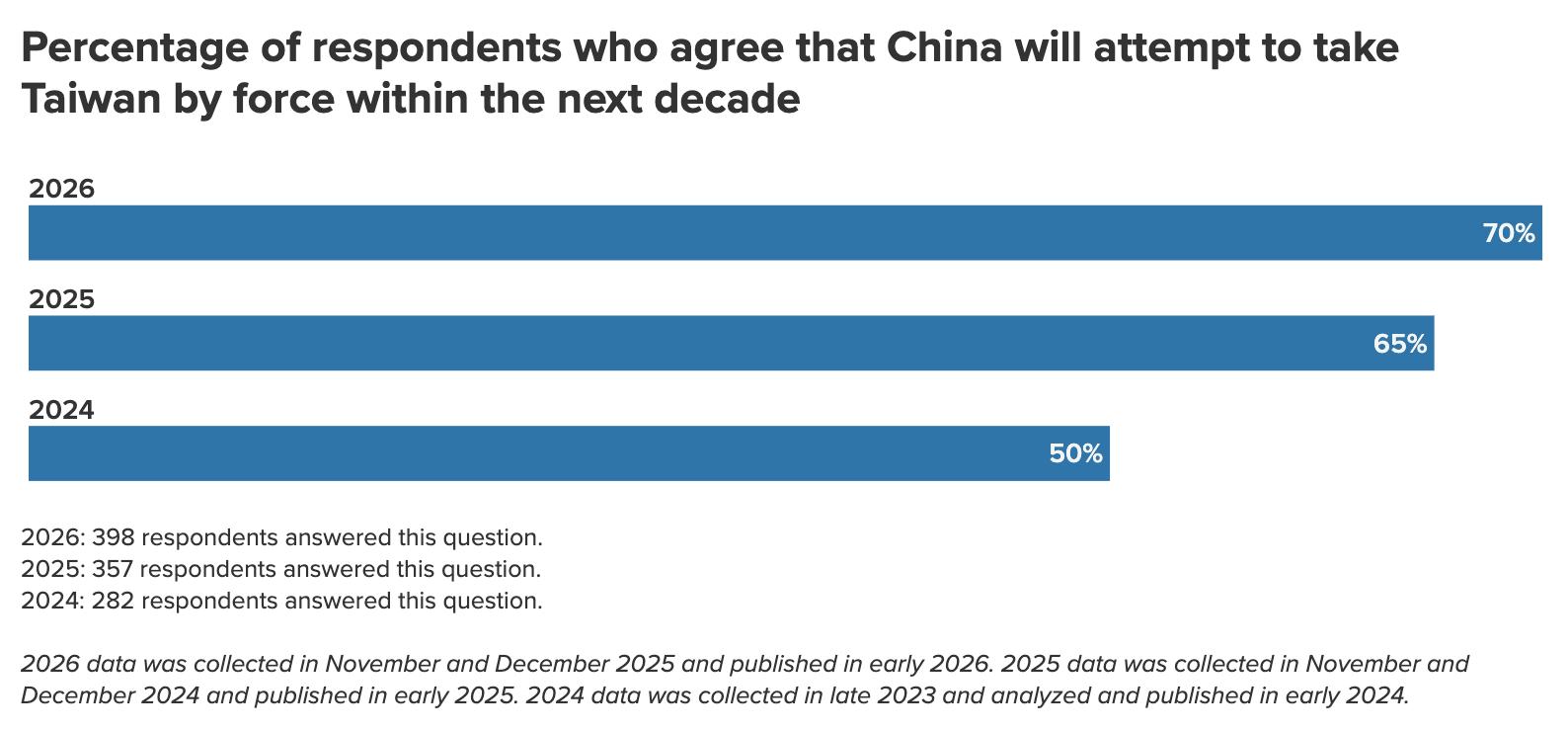
More than two-thirds of respondents (70 percent) believe that China will try to forcibly take Taiwan in the next decade—up from 65 percent in our previous year’s survey and 50 percent two years ago, signaling an increasing likelihood of this scenario materializing.2 The intensity of this concern seems to be growing as well: Twenty-one percent of respondents “strongly agree” that China will attempt
to forcibly retake Taiwan over the next decade, up from 15 percent who felt this way in our previous two surveys.3
And what starts in Taiwan wouldn’t necessarily end in Taiwan. In keeping with the top finding from our previous year’s survey, more than 40 percent of respondents envision another world war, involving a multifront conflict among great powers, erupting over the next decade.4 And within that group, 43 percent think the likely trigger will be in Taiwan or the East/South China Seas—the most-cited origin point for such a conflict, with Eastern Europe (25 percent) and the Middle East (13 percent) in second and third place. This result suggests that growing competition between China and the United States, if improperly managed, will become a global powder keg.
EXPERT INSIGHT
DEXTER TIFF ROBERTS: China “could easily be derailed”
It’s clear that most respondents believe that China is poised to unseat the United States as the global economic superpower over the next ten years, challenging the United States on multiple fronts from currency to international institutions to political stability.
It’s also obvious that Beijing is feeling a newfound confidence as it leverages the international trade chaos wrought by President Donald Trump’s tariffs to position itself as a global leader advocating for a more open international trading system. Of course, Beijing continues to use a host of protectionist measures—from industrial subsidies to non-tariff barriers favoring domestic companies—to tilt the field in its favor.
But China’s ascent to economic supremacy could easily be derailed by its limited progress in shifting from export-driven growth to a more sustainable, consumption-driven economy.5 China’s present model is facing ever larger challenges as countries push back against a flood of Chinese electric vehicles, solar panels, and electronics.
DEXTER TIFF ROBERTS , founder and publisher of the newsletter Trade War on Chinese economics and politics, former China bureau chief and Asia News Editor at Bloomberg Businessweek, and nonresident senior fellow at the Atlantic Council’s Global China Hub
MARKUS GARLAUSKAS: Military power alone won’t deter China
The clear majority of respondents who assessed that China will attempt to take Taiwan by force in the next decade included those respondents who also assessed that the United States would be the strongest military power at the time—suggesting many respondents believe overall military power alone is insufficient to deter Beijing.
Given that Beijing has ramped up its aggressive rhetoric and military exercises against Taiwan, which are starting to look like dress rehearsals for an attack, now is the time for action.6 To strengthen deterrence, the United States and its allies should improve intelligence to provide timely attack warning, posture forces to decisively win a first battle against China,
and establish a victory plan to prepare for a long war.7 Meanwhile, the United States should encourage Taiwan to further strengthen its defenses and mobilize the whole of its society to deter China.8
While Taiwan was most commonly cited as the flashpoint for a potential global multifront war in the coming decade, only one respondent cited the Korean peninsula, which suggests respondents are underestimating the potential for a larger war to start with North Korean aggression there. As we explored in a report based on a tabletop exercise, either a conflict in the Taiwan Strait or on the Korean Peninsula could escalate into a broader war, including nuclear escalation.9

MARKUS GARLAUSKAS , former national intelligence officer for North Korea on the US National Intelligence Council and director of the IndoPacific Security Initiative of the Atlantic Council’s Scowcroft Center for Strategy and Security
JOSH LIPSKY AND JESSIE YIN: A day may come when the United States is not the world’s largest economy, but it won’t be in 2036
The experts are very likely wrong on this one—or at least, they’re missing crucial context.
This idea that China was on track to take over the United States as the world’s largest economy was conventional wisdom in Washington (and New York) before the COVID-19 pandemic. Before 2020, Bloomberg Economics expected China to surpass US nominal GDP by the early 2030s.10 Even during the pandemic, many were impressed by the resilience of China’s economic growth when other major economies faltered. As late as 2022, Goldman Sachs predicted that China would overtake the US economy around 2035.11 But economists have been re-adjusting their predictions across the board. In 2023, Bloomberg Economics changed its forecast and projected that it would take until the mid-2040s for China’s economy to catch up to that of the United States.12 Simply put, Beijing’s economy in 2026 isn’t what it was in 2020.
While China’s growth has slowed down from pre-pandemic expectations, the United States has actually outperformed previous growth projections. In 2019, the International Monetary Fund projected that China’s GDP growth would hit 5.5 percent in 2024, while the United States would only grow by 1.6 percent.13 In 2024, however, the United States grew by 2.8 percent, while China grew by 5 percent.14 It’s definitely strong growth coming out of Beijing, but the United States’ nominal GDP was $10 trillion more than China’s in 2024. This makes it less likely, as China’s growth slows, that it will surpass the United States in 10 years. Assuming that 2025 growth rates continue, China would surpass the United States in nominal GDP in 2041. And some experts question the veracity of the growth numbers China releases, with some suggesting a 2025 growth rate as low as 2.5 percent.15
Economic forecasting is not a precise science, but there are a few factors to look at when it comes to forecasting China’s economic growth vis-a-vis the United States. Let’s break down some of these factors behind China’s economic slowdown. Beijing is dealing with the sticky negative effects of its prolonged real estate slump—a sector which used to be a major
driver of economic growth and investment.16 As the housing market struggles, consumer confidence remains low, and local governments are bogged down by debt. The country also has a population crisis on the horizon. By 2060, it’s projected that there will be around 70 elderly dependents for every 100 working-age people.17 China remains a strong export-driven economy with a high-tech sector that is continuing to innovate, but Chinese high-tech firms are only one sliver of its overall economy, and we’re still seeing the vast majority of AI investments worldwide being directed towards the United States. Indeed, it’s the United States that is leading the development of the most important technology of the twenty-first century.
None of this is to downplay the strengths of China’s economy or to neglect the headwinds that are facing the United States, but so far, the data doesn’t suggest that China will overtake the United States as the world’s largest economy by 2036.


JOSH LIPSKY, chair, international economics at the Atlantic Council and the senior director of the Atlantic Council’s GeoEconomics Center
JESSIE YIN , assistant director with the Atlantic Council’s GeoEconomics Center
2
EXPECT NATO TO ENDURE BUT UNDERGO FUNDAMENTAL CHANGES
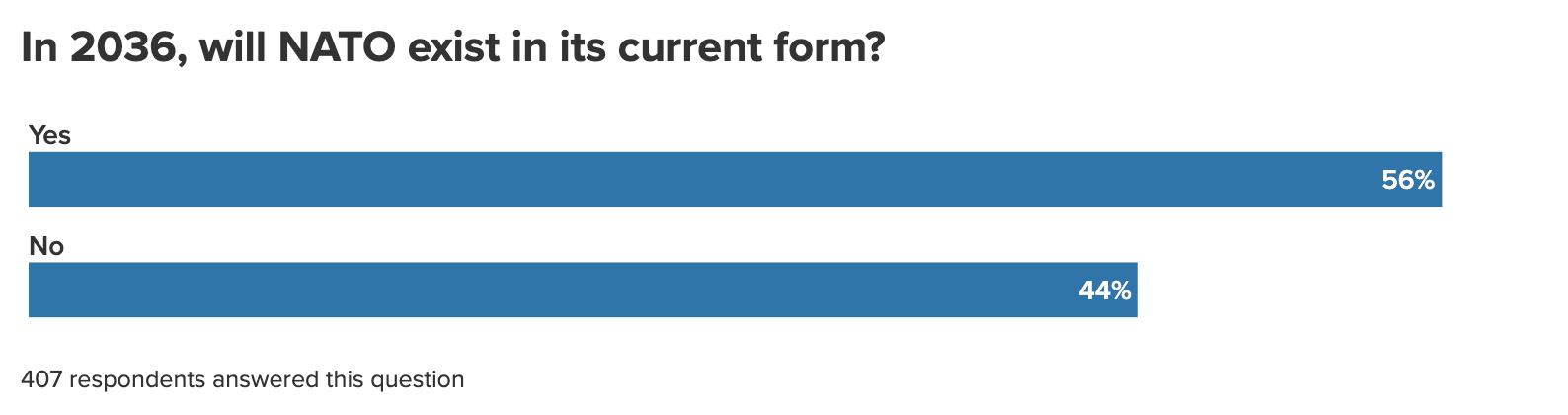
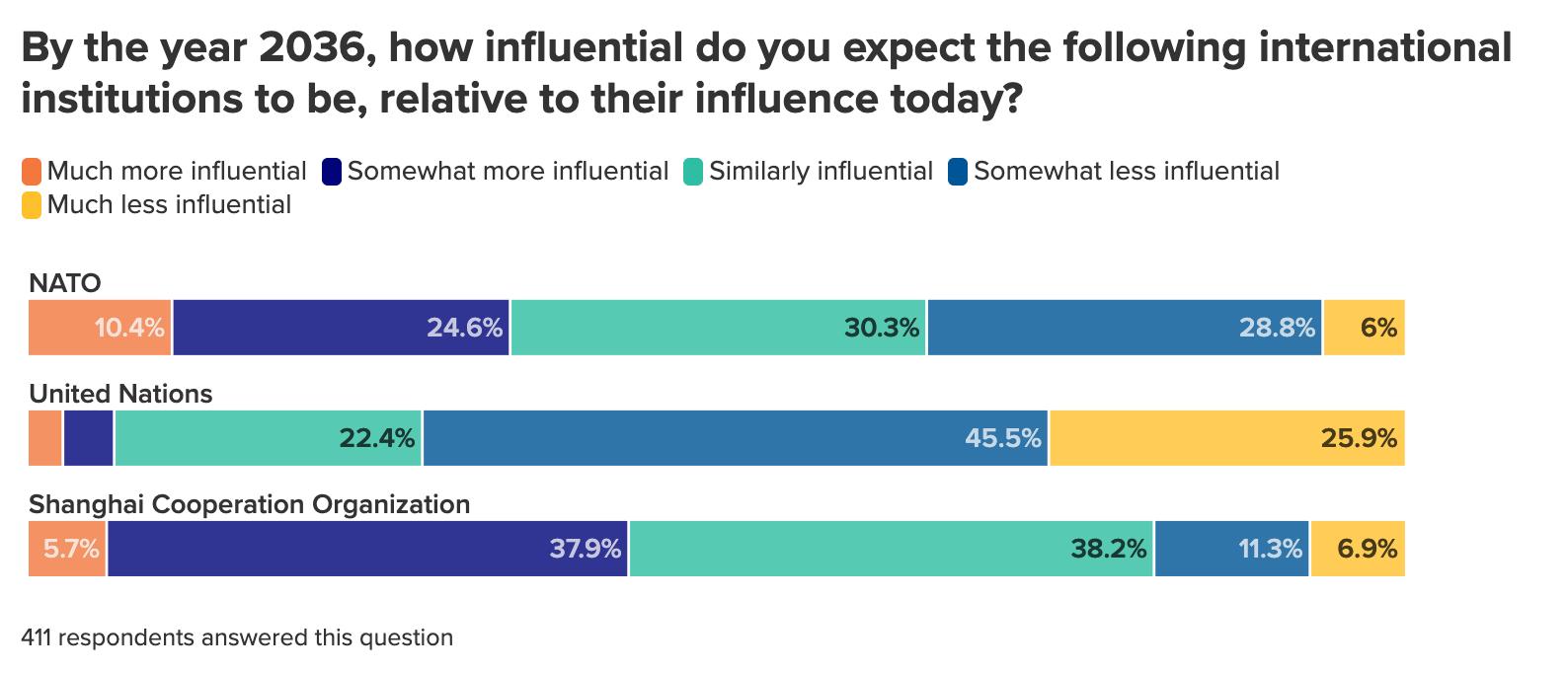
Amid major ups and downs for NATO in the first year of the second Trump administration—from commitments to ramp up defense spending at The Hague summit in 2025 to the standoff between Denmark and the United States over the status of Greenland—survey respondents are split evenly on whether the Alliance will grow more influential (35 percent) or less (35 percent) in ten years’ time.18 Behind these equivocal answers about NATO’s future power, however, is a clear and substantial measure of doubt regarding the future of the Alliance itself: Nearly half of respondents (44 percent) believe that NATO will no longer exist in its current form in 2036. Among this group expecting fundamental change, half (51 percent) anticipate that a reconfigured NATO will be less influential than the current alliance.
This finding likely relates to the part that the United States is expected to play in the Alliance going forward. A significant minority of respondents—39 percent—don’t envision the United States, by the year 2036, still having the central, commanding role in NATO that it has had since the Alliance’s founding, though the majority (61 percent) believe the United States will remain in this position. Among the group that envisions the United States no longer retaining its dominant role in the Alliance, 65 percent expect a coalition of states to take a leading role in NATO if Washington steps back, with smaller but still significant percentages citing Germany (33 percent), Poland (20 percent), France (19 percent), and the United Kingdom (18 percent) as potential Alliance leaders. (Respondents could choose more than one answer.)
Respondents also indicated that several NATO member states without nuclear weapons might acquire them by 2036. Among the 85 percent of survey respondents who think that at least one new country or territory will obtain nuclear weapons within the next decade, about 30 percent expect Turkey to do so, 24 percent Germany, and 15 percent for Poland. This may reflect an assessment that a possible US withdrawal of its nuclear umbrella from Europe or from its leading role in the Alliance could prompt these NATO member states to go nuclear.
Notably, of the respondents who believe that the United States will be the world’s leading military power a decade from now, 70 percent think that the United States will retain its security alliances and partnerships in Europe, Asia, and the Middle East; among those who think another power will lead in the military field , that figure drops to 49 percent. Similarly, among those in the camp of the United States as the leading military power in 2036, 67 percent expect Washington to maintain a central role in NATO relative to just 39 percent who see another country or bloc leading militarily. These findings indicate a link between US military leadership and the maintenance of the country’s alliances and partnerships around the world.
EXPERT INSIGHT
IAN BRZEZINSKI: NATO “will not function” without Washington
The polling serves as a troubling warning sign. It reflects frustration with the long-term failure of European allies to fulfill their defense obligations and the Alliance’s failure to leverage its massive overmatch in power over Russia to end Vladimir Putin’s invasion of Ukraine on just and enduring terms. Another factor is surely the Trump administration’s determination to dilute US military commitment to and leadership in NATO. The Alliance simply will not function in the absence of robust leadership from Washington and a demonstrable commitment of force that inspires confidence in US allies and fear in US adversaries.
The good news for NATO is that the Europeans are now finally increasing their defense spending with haste, the United States continues to have vital interests in Europe that justify the aforementioned leadership and commitment, and the American public expect that of their government. Polls consistently show that some 65 to 75 percent of the American public believe that the United States should sustain or increase its commitment to NATO. That is what gives me an optimistic outlook about NATO’s future.19

IAN BRZEZINSKI , former US deputy assistant secretary of defense for Europe and NATO policy and resident senior fellow with the Transatlantic Security Initiative in the Scowcroft Center for Strategy and Security
MANY RESPONDENTS ENVISION A DIMINISHED RUSSIA HEADING TOWARD A FROZEN CONFLICT IN UKRAINE
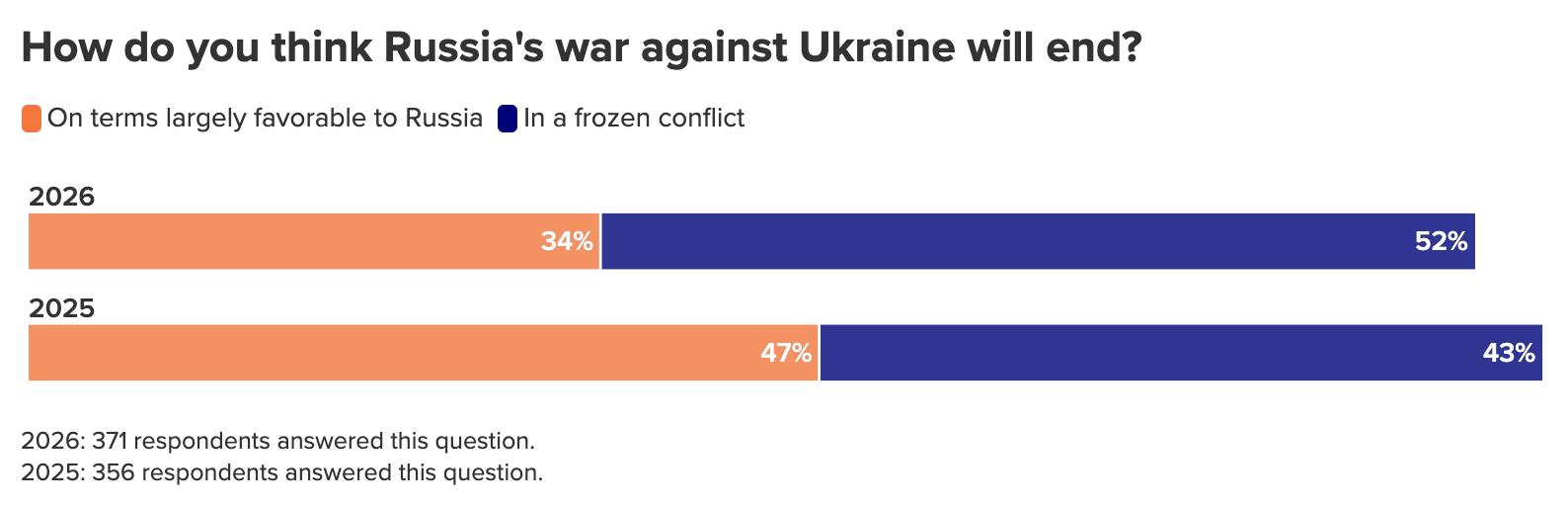
A high-profile, US-led push for a final negotiated settlement to the war in Ukraine dominated headlines while this year’s survey was in the field. Despite that, respondents shifted in the direction of anticipating a frozen conflict. Just 34 percent of respondents think that the war will end on terms largely favorable to Russia, down substantially from the nearly half of respondents (47 percent) who answered that way in our previous year’s survey. Conversely, slightly more than half of respondents (52 percent) now think the war ultimately will turn into a frozen conflict, up from 43 percent a year ago.
Meanwhile, respondents believe that Russia is destined to be a lesser power. By 2036, respondents expect minimal Russian clout across all five metrics of power tested in the survey. Just 2 percent of those surveyed believe that Russia will be the world’s leading country in cultural or soft power by 2036 and 1 percent say the same regarding military power. In all other areas, the figure rounds down to 0 percent. Respondents also cited Russia more than any other world power as a candidate to break up internally as a result of developments such as revolution, civil war, or political disintegration, with 36 percent expecting such an outcome relative to 30 percent in the previous year’s survey. 20 (The latest figure is only slightly below this question’s high of 40 percent of respondents forecasting Russia’s breakup a few years ago, shortly before Yevgeny Prigozhin staged a rebellion against the Kremlin.)21
Russian weakness, however, doesn’t necessarily reduce the danger it poses in Ukraine and beyond; in fact, it could increase the threat. Among the minority of respondents (22 percent) who expect a state or terrorist group to use nuclear weapons in the coming decade, 60 percent believe that Russia will do so, making it the most-cited actor.
EXPERT INSIGHT
JOHN
HERBST: Only
pressure on Putin will lead to durable peace
Contrary to pundit chatter, in 2025 US policy largely did not veer in Putin’s direction. It has jumped back and forth between criticizing and placing pressure on Ukraine and Russia. It is fair to say that the US president seems reluctant to hammer Putin for his clear rejection of numerous American ceasefire and peace proposals, and rarely criticizes Putin without also hitting Ukrainian President Volodymyr Zelenskyy. Yet Trump still has sanctioned Rosneft and Lukoil, Russia’s two largest oil firms. And he continues to provide essential military intelligence to Ukraine that has enhanced the effectiveness of Ukraine’s very successful attacks on Russia’s hydrocarbon production, with serious impact on Russia’s revenue and its staggering economy.
If the White House policy continues, it is safe to expect another year like 2025—at most minor gains for Putin on the battlefield, at a terrible cost in casualties, and with no strategic success and more strain on the Russian economy. The Ukrainians will muddle through because Western support will be at least adequate, and because they have no other choice if they want to live freely as Ukrainians.
If Team Trump is able to digest the lessons of the past year, the United States will provide more support for Ukraine—with the sale of more advanced weapons, including Tomahawks— and put more pressure on the Kremlin in the form of sanctions. The administration would also embrace the position some of its members spoke about publicly a year ago and use its influence to persuade Belgium and other influential players to provide remaining frozen Russian state assets to Ukraine. This combination of measures, if pursued consistently for many months, would 1) weaken Moscow’s position on the battlefield and 2) increase the odds of Putin accepting terms to establish a durable peace, which is Trump’s stated aim and something Putin would only agree to under duress.

JOHN HERBST, former US ambassador to Ukraine and senior director of the Atlantic Council’s Eurasia Center
AI COULD MATCH HUMAN CAPABILITIES WITHIN A DECADE, AS CONCERNS ABOUT THE TECHNOLOGY’S IMPACT MOUNT
Survey respondents expect artificial intelligence (AI) to progress rapidly over the coming decade. A clear majority (58 percent) believe that, by 2036, the world will have gone beyond today’s predictive and generative AI systems to achieve artificial general intelligence (AGI), which is defined in the survey as “an artificial intelligence system matching or exceeding the cognitive abilities of human beings across any task”—one of the most ambitious goals AI companies are currently pursuing.
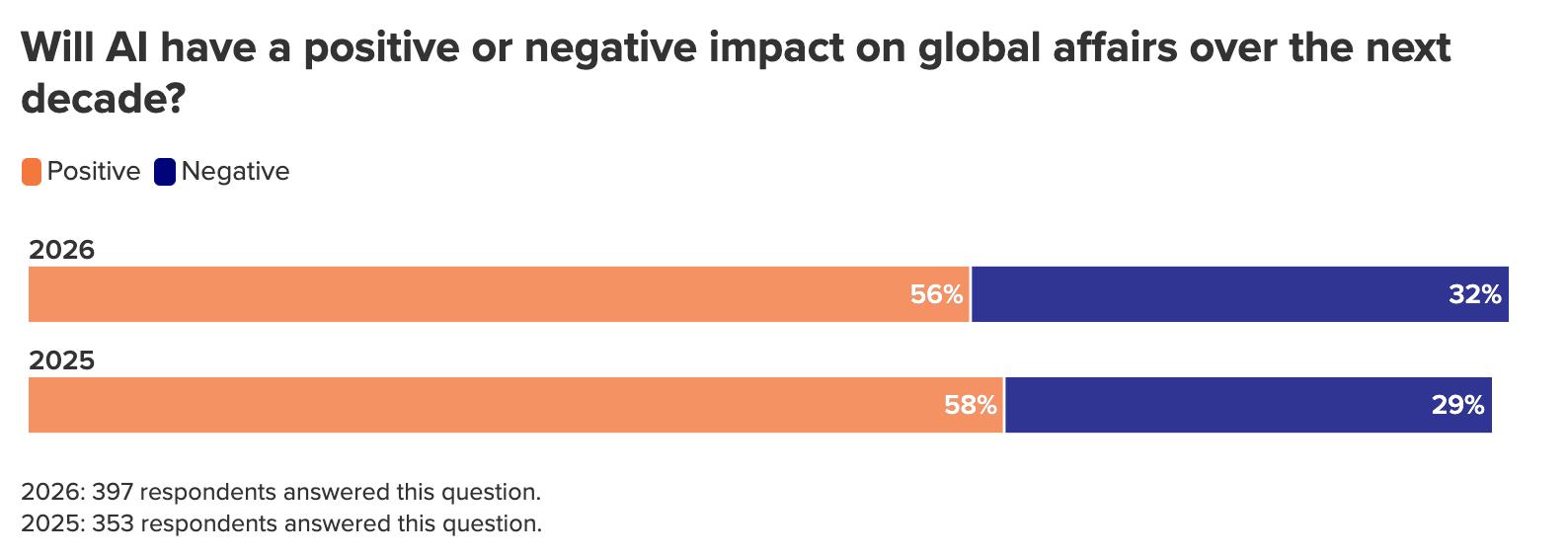
Fifty-six percent expect that AI will have a positive effect on global affairs over the next decade, relative to 32 percent who do not—overall a substantially more optimistic outlook than, for example, the general public in the United States has. 22 Although there is a clear gap between positive and negative expectations, that distance is closing amid increasing concerns about the technology. In the previous year’s survey, the figures were 58 percent and 29 percent, respectively, meaning that the gap between positive and negative assessments of AI’s impact has declined from 29 percentage points to 24 percentage points. 23
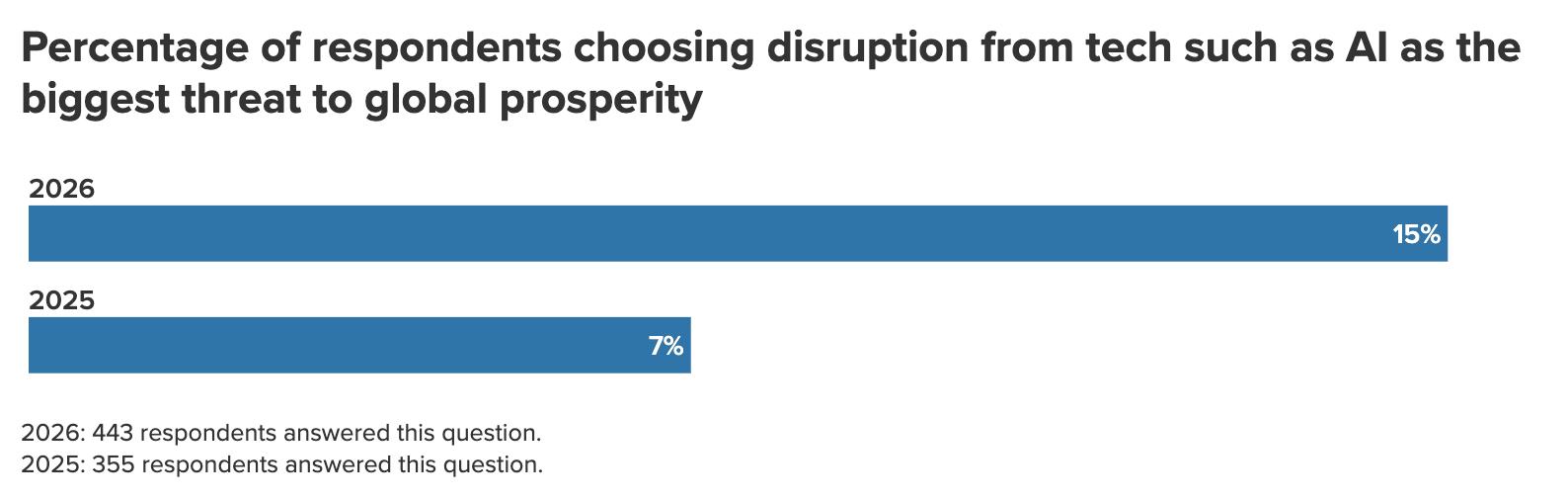
Similarly, while worries about AI’s economic impact remain low among respondents, they are growing. Fourteen percent of respondents now see job losses and economic disruption due to advancements in technology such as AI as the single biggest threat to global prosperity in the coming decade. That’s more than double the previous year’s figure of 6 percent. 24
When it comes to social media, our survey respondents have expressed consistently negative views about the technology’s impact on the world—perhaps because social media is now a mature technology with clear downsides, in contrast with the positive expectations people had for the technology fifteen or twenty years ago. Views about AI could follow a similar course if its downside impacts ultimately outweigh its positive ones.
EXPERT INSIGHT
TESS DEBLANC-KNOWLES: We don’t know if we’re on track for AGI
It is not certain that we’re going to get to artificial general intelligence with current trajectories, and there’s also a tremendous amount of uncertainty about which approaches would get us to more generalizable and true reasoning capabilities—or whether those capabilities are even possible to achieve. What we’re seeing with each generation of the current models is higher performance, but it is not clear that training on larger and larger swaths of data, using more compute, is necessarily going to get us to that breakthrough capability of true artificial thinking.

TESS DEBLANC-KNOWLES , senior director of the Atlantic Council Technology Programs
BRACE FOR MORE COUNTRIES WITH NUCLEAR WEAPONS—INCLUDING IRAN DESPITE THE ISRAEL-IRAN WAR—THOUGH NOT NECESSARILY NUCLEAR USE
Our respondents overwhelmingly expect greater proliferation of nuclear weapons over the next decade, with 85 percent believing additional countries or territories will acquire these arms during that timeframe. The most-cited next entrant in the nuclear club is Iran, selected by 66 percent of those anticipating the spread of nuclear weapons—indicating a widespread assumption that the war waged this past summer by Israel and the United States to destroy Iran’s nuclear program did not definitively extinguish that program or Tehran’s nuclear ambitions. This finding may also explain why the second-most-cited actor to obtain nukes in the next ten years (chosen by 53 percent of those expected nuclear spread) is Iran’s rival and neighbor Saudi Arabia.
But many surveyed experts also foresee nuclear proliferation beyond the Middle East. Those who imagine additional nuclear powers emerging also point to East Asia (with 47 percent citing South Korea, 37 percent Japan, and 11 percent Taiwan) and to non-nuclear NATO members as mentioned in our second finding above.
Respondents appear to believe that this nuclear proliferation will occur in the absence of global governance to curb the spread of these weapons, with only 4 percent expecting the greatest expansion of global cooperation over the next decade to occur in the realm of nuclear nonproliferation.
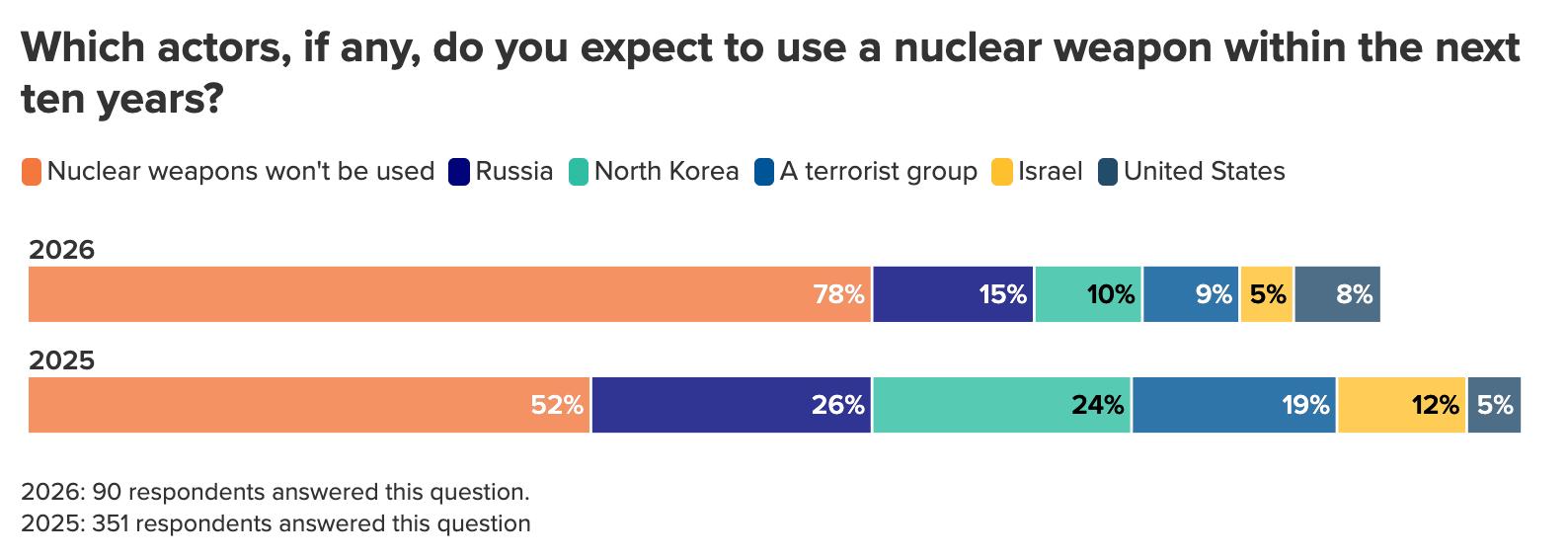
Even with this likelihood of proliferation, however, respondents seem less concerned that nuclear weapons will actually be used over the next ten years, with 78 percent of respondents predicting no nuclear use relative to 52 percent who said the same in the previous year’s survey. 25 Among the fifth of respondents who are forecasting nuclear use, 60 percent envision Russia employing such weapons, with 42 percent pointing to North Korea and, notably, 34 percent citing the United States.
The reduced expectation of nuclear use may stem from assessments that particular actors seem less likely to take such a drastic step relative to assessments a year earlier. For example, 15 percent of all respondents expect Russia to use nuclear weapons in the next ten years—down from 26 percent in the previous year’s survey. For North Korea those numbers dropped from 24 to 10 percent, for
terrorist groups 19 to 8 percent, and for Israel 12 to 5 percent. The only actor registering a notable increase is the United States, with 8 percent of all respondents foreseeing US nuclear use. That’s up from 5 percent in the previous year’s survey.
EXPERT INSIGHT
AMY WOOLF:
Growing concern about China’s nuclear arsenal—and US deterrence
The results present a somewhat contradictory picture. More than 80 percent of the participants expect more nations to acquire nuclear weapons in the coming decade, but nearly the same percentage (78 percent) expect that nuclear weapons will not be used in conflict. It’s possible these responses reflect reduced concern about Russia potentially using nuclear weapons in Ukraine. It does, however, raise questions about why respondents believe more nations would seek nuclear weapons in the absence of circumstances where they might need to employ them in a conflict.
The answer to this conundrum may be evident in respondents’ concerns about the potential for proliferation in Asia, where 47 percent of those anticipating nuclear proliferation expect South Korea to acquire nuclear weapons and 37 percent expect Japan to do so. These numbers likely reflect continuing concerns about a threat environment that includes China’s regional ambitions and the growing nuclear arsenals of both China and North Korea.
They may also reflect concerns about the reliability of US extended nuclear deterrence and credibility of the US commitment to come to the defense of allies. In Europe, this concern has led to occasional discussions among US allies about developing an independent nuclear deterrent. Respondents may have considered whether the nuclear threat environment and proliferation risks might evolve in response to ongoing changes in US national security goals and frequent threats of US military intervention. If the United States is seen as a threat to stability, it could become a source of nuclear risk rather than the foundation of a stable nuclear order.

AMY F. WOOLF, former specialist in nuclear weapons policy at the Congressional Research Service of the US Library of Congress and nonresident senior fellow with Forward Defense in the Scowcroft Center for Strategy and Security
RESPONDENTS ARE FORECASTING A MORE AUTONOMOUS EUROPE, BUT ONE THAT STILL LAGS BEHIND CHINA AND THE US ACROSS MOST MEASURES OF POWER
Our latest survey offers mixed results for Europe and the European Union (EU). Respondents are bearish on the EU’s prospects for joining the top tier of global powers. No respondents forecast the EU becoming the world’s foremost military power in 2036, which isn’t surprising given its history as an economic union. Yet respondents are also pessimistic about the EU’s prospects for becoming the world’s foremost economic power (only 3 percent expected this) or tech power (5 percent) in ten years’ time. Just 8 percent of respondents predict that the euro will make the biggest inroads into the US dollar’s dominance over the next decade. Cryptocurrency, the renminbi, and gold all rated higher as challengers to the dollar. A significant minority of respondents (22 percent) foresee the EU breaking apart by 2036.
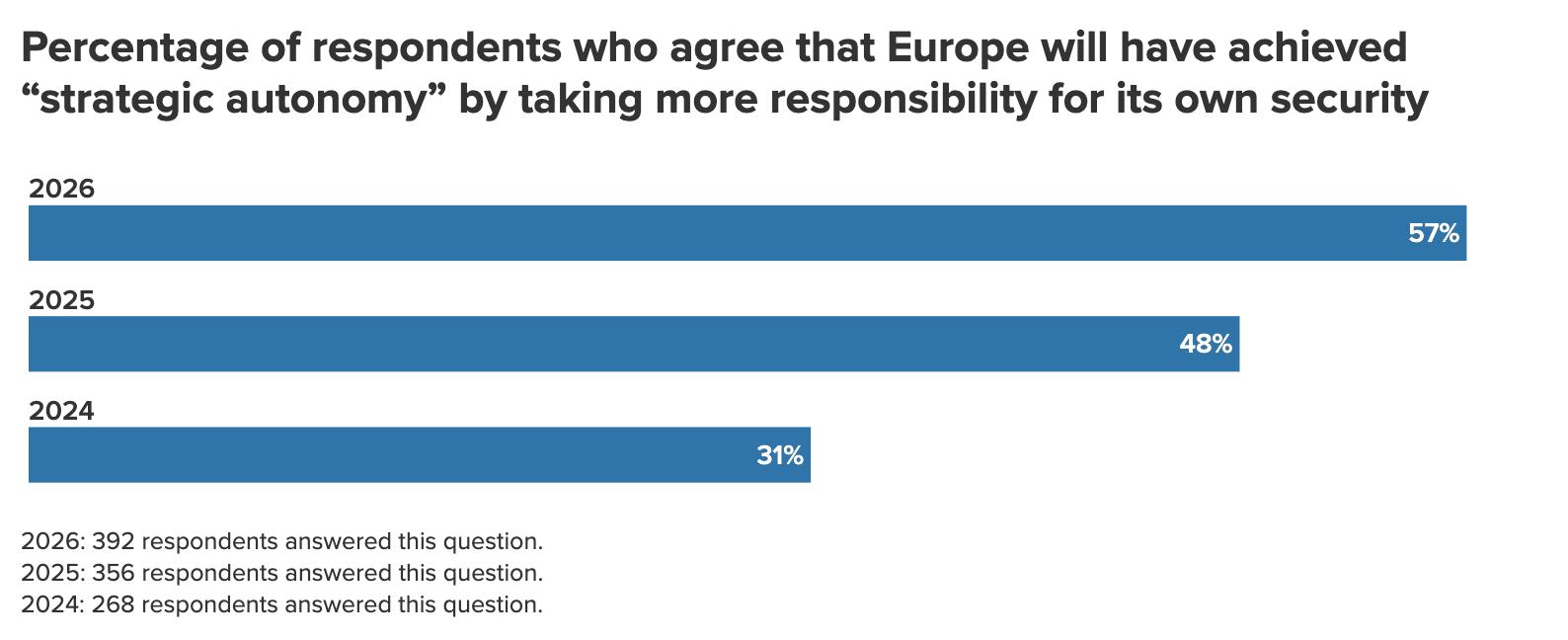
However, there is another more bullish side to the ledger. A substantial portion of respondents envision the EU as an important player in the diplomatic arena (17 percent say the EU will be the world’s foremost diplomatic actor in 2036). Thirty percent believe the EU will be the leading power in cultural or soft power, just below the percentage that say the same of the United States and nearly twice the percentage that foresee China occupying this position. For three years now, Global Foresight survey results have also shown steadily rising expectations that Europe—not necessarily defined in this instance as the EU—will have achieved “strategic autonomy” by 2036 through taking more responsibility for its own security, with 57 percent of respondents answering to that effect in our latest survey. That’s up from 48 percent in the previous year’s survey and just 31 percent the year before that. 26
EXPERT INSIGHT
JÖRN FLECK: Europe is facing “simultaneous abandonment and entrapment”
The survey results about Europe’s quest for strategic autonomy seem to track the prevailing sentiment on the continent about its future in a brave new world of power politics.
A year into the Trump administration’s second term, the terms of Europe’s debate about greater sovereignty have changed under the impression of simultaneous abandonment and entrapment by the United States. Europeans still remember last year’s disconcerting Oval Office meeting with the Ukrainian president and the freeze of US military and intelligence support for Kyiv— even if it was ultimately temporary. That episode accelerated a fundamental shift for Europeans as they faced up to some deeply uncomfortable and costly realities about the continent’s posture in a new geopolitical era without predictable US support. French politicians and strategists could hardly hold back their collective “told you so.” But even among former skeptics of “strategic autonomy” in Central and Northern Europe, there has been a growing realization that Europe has to rapidly address capability gaps and grow its independent military, economic, and technological means to confront an aggressive Russia, an exploitative China, and a disruptive America.
In fact, we can see this already happening. In her September 2025 State of the European Union speech, European Commission President Ursula von der Leyen called for Europe’s “independence moment” after launching a slew of defense-related initiatives including the “Rearm Europe 2030” plan and “Security Action for Europe” to mobilize fresh cash for European defense spending.27
The policy follow-up to this realization has been more mixed. Europe has stepped up financially and politically to keep Ukraine in the fight against Russia. It has proposed a package for €800 billion in new defense spending. European NATO countries have committed to new spending and capability targets.28 Some, like Poland, are already meeting them. Others are obliterating long-held orthodoxies—for example, Germany with its half-trillion-euro surge in defense investment. Beyond defense, the EU has sought to address its economic competitiveness, diversify its trade relations, counter China’s unfair economic practices, boost investment in technology and research and development through a restructured multi-annual budget, and more. But as so often happens in Europe, fragmentation, national interests, and pet projects, plus weak leadership from Brussels to Berlin to Paris, are holding back a more ambitious and concerted drive toward greater autonomy in any one area.
The survey responses share the contradictions and ambiguities of Europe’s political realities around strategic autonomy. Over a fifth of respondents believe the EU could break up over the next decade—not exactly a boost for building up European capacity. Even more strikingly, only miniscule minorities see the EU becoming the leading global power when it comes to diplomatic influence, the economy, or technology. Without Europe-wide coordination and leadership in at least some of these categories, European sovereignty will remain little more than an aspiration.

JÖRN FLECK , senior director of the Atlantic Council’s Europe Center
RESPONDENTS SEE WATER WARS COMING, AS GLOBAL WARMING SURPASSES KEY THRESHOLDS AND CLIMATE COOPERATION COOLS
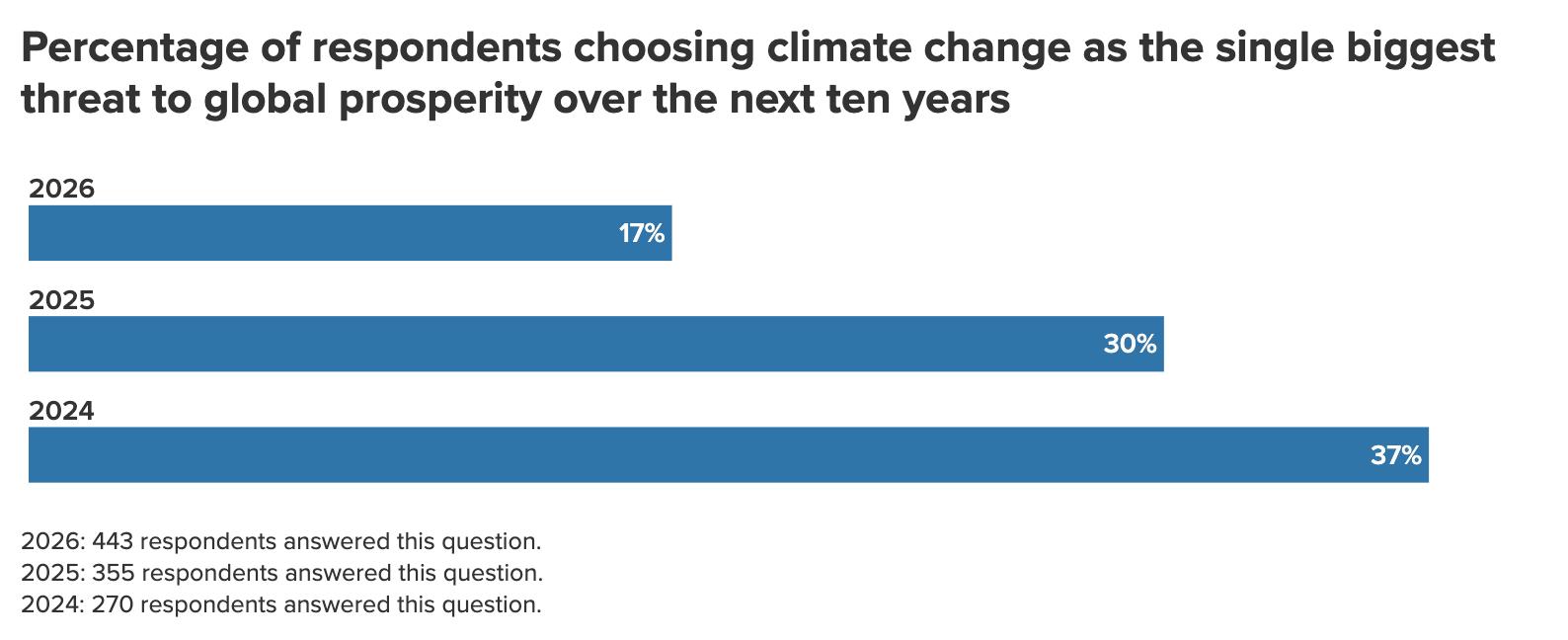
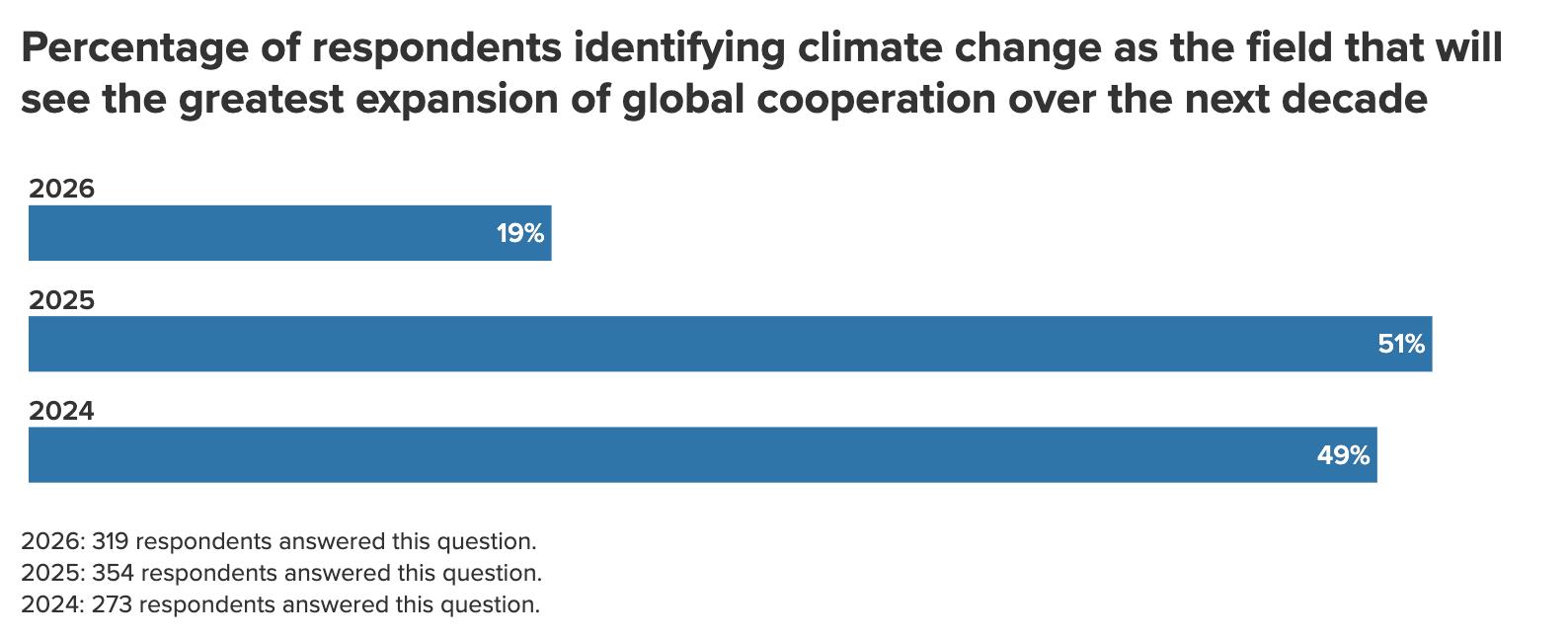
Our polling results surfaced some warning signs for climate change as a priority item on the global policy agenda. For the first time in three years of asking this question in Global Foresight surveys, climate change is not the leading perceived threat to global prosperity over the next decade. In our latest survey, just 17 percent of respondents cite climate change as the single biggest threat, relative to the 30 percent who mention war between major powers. That’s roughly half of the percentage of respondents who identified climate change as the biggest threat in our past two surveys. Moreover, only 19 percent of respondents now believe that climate change will generate the greatest increase in international cooperation over the coming decade, just behind technology governance (20 percent) and well down from the 49 percent of respondents who listed climate change just two years ago.
These findings on international climate action contrast with respondents’ forecasts about the changing climate itself. More than 80 percent of respondents expect the world to become hotter, including at least one year over the next decade where the global average temperature is 2 degrees Celsius (or more) warmer than preindustrial levels. The 2-degree increase is a threshold beyond which scientists believe the climate will become less stable; the central goal of the Paris climate accord, negotiated a decade ago, was to limit warming to 1.5 degrees Celsius—a temperature level that was passed in 2024.
This pessimism about limiting global warming may be connected to another finding: Only 40 percent of respondents think that global greenhouse-gas emissions will have peaked and begun to decline by 2036 (up only slightly from our prior year’s survey). Perhaps because of the expectation of rising temperatures, 57 percent of respondents think that public support for action to counter climate change will have increased by 2036. But as our findings indicate, that surge in public support may not correspond with more cooperation at the global level on these issues.
Likely anticipating this hotter, drier, and more unstable climate, two-thirds of respondents (64 percent) expect a war to be fought, at least in part, over access to fresh water in the next decade.
EXPERT INSIGHT
KATHLEEN EULER: When climate impacts feel “remote,” effective action gets harder
Climate change remains a threat—whether or not it is perceived as an urgent one. This is clear from the science and the 80 percent of respondents who anticipate a hotter world, which will mean more deaths, illnesses, and dramatic, untenable changes to our infrastructure, economies, and way of life.
Yet climate change is increasingly absent from the global news cycle. Headlines are crowded with concerns about AI, immigration debates, and extreme weather events that are ironically often climate-driven but rarely identified as such. Climate change, as a result, feels to some like an abstract, remote threat rather than an immediate one. We can only process so many crises each day, but climate change is a constant undercurrent. Unfortunately, deprioritizing climate change only intensifies its consequences, leading to more costly disasters and losses in the not-far-off future.

KATHLEEN
EULER , deputy director of the Atlantic Council’s Climate Resilience Center
MANY EXPERTS ANTICIPATE INTERNATIONAL INSTITUTIONS DECAYING AS DEMOCRACY WEAKENS
There’s been a lot of speculation recently about whether the decades-old rules-based international order is collapsing. Our survey respondents suggest we should prepare for such a reality. They express little confidence that today’s multilateral architecture will be influential a decade hence.
The international system put in place at the Congress of Vienna in 1815 endured, with modifications, for nearly a century. The international system associated with the Treaty of Versailles and related treaties ending World War I lasted a much shorter time. The international infrastructure that arose after World War II, including the United Nations (UN), regional security arrangements and alliances such as NATO, and the Bretton Woods economic institutions not only weathered the Cold War but came through it with enhanced authority.
Eighty years on, respondents seem to assess these bodies as increasingly creaky. An overwhelming majority of respondents (71 percent) believe that the UN will become less influential in the coming decade, compared with just 6 percent who say the opposite. For the Security Council, the UN’s most powerful body, 58 percent expect a decline in influence by 2036 and only 9 percent a rise.
On the economic front, survey participants also are much more likely to expect the post-World War II global financial institutions to grow less influential by 2036 than they are to anticipate them becoming more influential. A majority of respondents (65 percent) foresee the World Trade Organization losing influence relative to only 11 percent who imagine it gaining influence. For the World Bank, the equivalent figures are 50 percent and 14 percent; for the International Monetary Fund, 41 percent and 14 percent. Perhaps even more remarkable, only 5 percent of respondents cite declining trade as a result of protectionism as the biggest threat to global prosperity over the next ten years—a decline from the 14 percent who said the same in the previous year’s survey. 29 The fact that this decline occurred after Trump dramatically increased tariffs on countries around the world indicates, apparently, minimal concern about the decline of free trade as a challenge to global prosperity. 30
This year’s survey also shows that nearly half of respondents (44 percent) believe that over the coming decade the current democratic recession will deepen into a democratic depression. In contrast, only 24 percent foresee a democratic renaissance during that timeframe.
Predictions about the decline of the international order intersect with those of global democratic decline. Respondents expecting a democratic depression are more likely to foresee core international bodies losing influence over the coming decade than those who forecast a democratic renaissance: from the UN (77 percent vs. 60 percent) and UN Security Council (64 percent vs. 53 percent) to the World Trade Organization (71 percent vs. 48 percent), International Monetary Fund (50 percent vs. 27 percent), and World Bank (53 percent vs. 44 percent).
Respondents who envision continued democratic decline have less faith that over the coming decade major-power war will be avoided, global cooperation will expand, and minority rights around the world will be protected. The vast majority of those anticipating a worsening democratic recession (83 percent) believe that the world overall will be worse off in ten years’ time, whereas 66 percent of those expecting a democratic renaissance think the world will be better off a decade from now.
EXPERT INSIGHT
MATTHEW KROENIG: US leadership and the strength of democracy worldwide are intertwined
Many respondents predict democratic decline, decaying international institutions, a risk of major-power war, and generally fear the world will be worse off in ten years’ time. These findings make sense given emerging challenges to US global leadership coming from both without and within.
The US-led, liberal international system has produced unprecedented levels of global peace, prosperity, and freedom over the past eighty years. In this timeframe, we have witnessed zero great power wars, a quintupling of per capita gross domestic product in the United States and dramatic growth in global GDP, and a tenfold increase in the number of people living in liberal democracies. 31 Contrary to a common perception that US grand strategy went off the rails in the post-Cold War world, the data show that the world was safest, richest, and freest during America’s unipolar moment in the 1990s and 2000s.
Unfortunately, these indicators have leveled off and begun to decline in the 2010s and 2020s. Global democracy, for example, has declined in each of the past nineteen years. 32 Our respondents project a continued diminution of US leadership and a corresponding acceleration of these negative trends in the decade to come.
MATTHEW KROENIG, former US official in the Department of Defense and the intelligence community during the Bush, Obama, and Trump administrations, and vice president and senior director of the Atlantic Council’s Scowcroft Center for Strategy and Security
THE DOLLAR IS LIKELY TO REMAIN THE WORLD’S CURRENCY OF CHOICE, BUT KEEP AN EYE ON CRYPTO
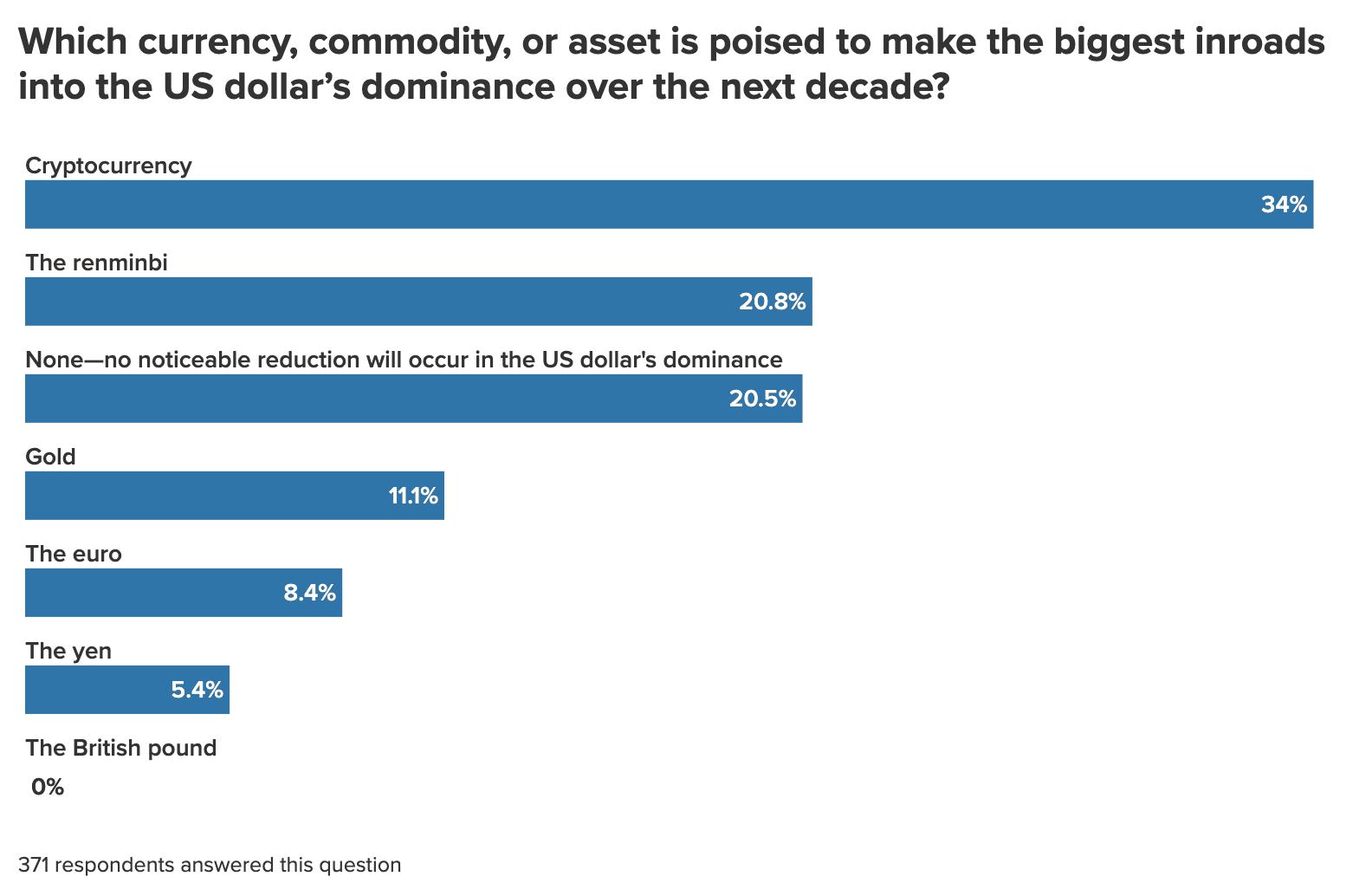
Economists are engaged in an intense debate right now about whether the US dollar can hold on to its status as the world’s leading reserve currency—a position it’s held since World War II. (The Atlantic Council’s GeoEconomics Center tracks the dominance of the dollar on an ongoing basis.)33 Although the dollar is likely to remain the world’s currency of choice in 2036, our survey results indicate that it won’t go unchallenged. About 80 percent of respondents expect other currencies, commodities, or assets to make inroads into the dollar’s dominance over the next ten years.
The most-cited asset expected to make the biggest inroads into the dollar’s dominance is not a national currency but rather cryptocurrency (34 percent of respondents), with a further 11 percent saying that a commodity—gold—will pose the greatest challenge (we conducted the survey before Bitcoin suffered a precipitous decline in value, dimming optimism about crypto’s future prospects—for the time being at least). 34 Contrast those findings with those for other national currencies besides the dollar: Twenty-one percent of respondents predict that China’s renminbi will make the biggest gains relative to the dollar, while just 8 percent say the same for the euro and 5 percent for the Japanese yen, with no votes for the British pound.
Respondents who foresee China as the world’s leading economic power a decade from now are more likely to imagine the dollar’s dominance eroding. But they are split on its most formidable challengers, with higher figures for China’s currency but also the Japanese yen and gold.
EXPERT INSIGHT
ALISHA
CHHANGANI: Dollar
dominance under increasing threat
The dollar has had a turbulent year, down more than 9 percent against major currencies in 2025. 35 Against that backdrop, it is interesting that survey respondents see cryptocurrency as the greatest threat to dollar dominance.
The concern is understandable. Crypto’s volatility and recurring crises have coincided with the growth of a “grey economy” where crypto-assets increasingly facilitate sanctions evasion, tax avoidance, and illicit trade beyond US oversight. This undermines the effectiveness of US financial sanctions, a cornerstone of dollar dominance. At the same time, the rise of dollar-backed stablecoins, alongside the United States’ first stablecoin regulation (the 2025 GENIUS Act), suggests Washington increasingly sees these crypto-assets as a way to preserve dollar dominance and bolster demand for dollar assets such as US Treasuries, even as the long-term risks and global spillovers are not yet fully understood.
When it comes to China, the survey results align with reality. While Beijing has been discreet about diversifying away from the dollar, it continues to do so methodically. Its wholesale central bank digital currency (CBDC) project has tested transactions in the digital renminbi, and China’s Cross-Border Interbank Payment System (CIPS) has expanded significantly over the past five years, reducing reliance on dollar-based payment infrastructure. 36
Still, the dollar’s status remains stable. Data from the Bank for International Settlements shows the dollar on one side of 89 percent of all foreign-exchange trades. 37 Its liquidity keeps it embedded in the plumbing of global markets. Ultimately, the foundations of dollar dominance still lie in trust in US political and legal institutions, including the preservation of central bank independence, which has come under increasing threat.

director
Center
ALISHA CHHANGANI, associate
at the Atlantic Council’s GeoEconomics
THE GLOBAL SOUTH SEES THE FUTURE DIFFERENTLY
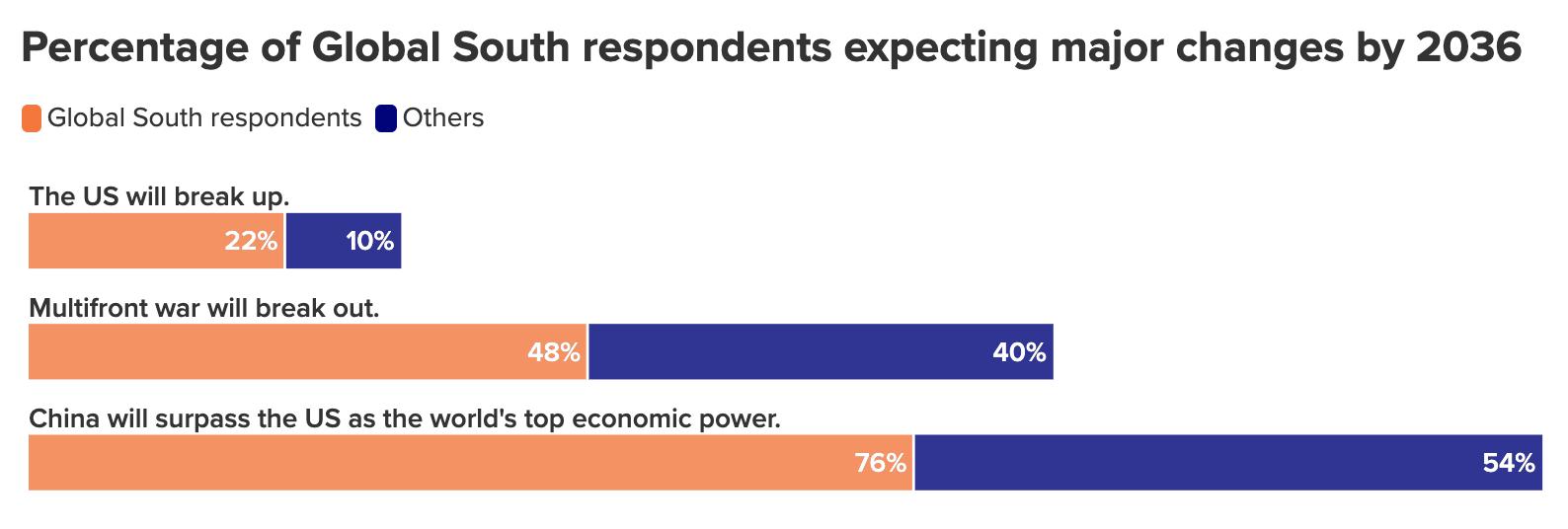
Roughly one-fifth (18 percent) of this year’s survey responses came from citizens of countries located in what is often called the Global South. Although it’s an inexact and contested term, the Global South is a useful shorthand to describe countries that are outside the wealthiest group of industrialized nations. While respondents in this category are heavily weighted toward Latin America and the Caribbean (54 percent of the Global South group), forecasts from geostrategists and foresight practitioners across the Global South countries differ from those in the Global North in significant ways.
For example, respondents from Global South countries are much more likely to rate Russia’s chances in its war in Ukraine higher than other survey participants: Forty-six percent say that the outcome will be on terms favorable to Russia, versus 31 percent who say the same among the rest of the pool. Those from the Global South are also much more likely to see China as a leader in key fields, with 76 percent expecting it to be the top economic power by 2036 compared with 54 percent who feel that way among the rest of the respondents. Global South experts also are more skeptical about the longevity of US power, with only 60 percent of this group expecting the US to retain military dominance over the next ten years relative to 76 percent of other respondents. Remarkably, 22 percent of respondents in the Global South expect the United States to break up internally in the next ten years, compared with 10 percent of other respondents. Those from the Global South are more likely than respondents from elsewhere to expect a global multifront war in the coming decade (48 percent relative to 40 percent) as well, with a larger proportion expecting such a conflict to be sparked by events in the Middle East (35 percent compared with 8 percent).
EXPERT INSIGHT
JAMES MAZZARELLA:
Concerns about US stability may reflect Global South history
The percentage of respondents from the Global South who expect the United States to break up internally in the next ten years is more than twice as high as that of respondents from outside the Global South. Similarly, 76 percent of Global South respondents expect China to overtake the United States as the world’s dominant economy, compared with 54 percent for the rest of the respondents.
These expectations may be due to a combination of factors. One is the US withdrawal to a position of greater economic isolation. Another is the perception that the United States is pulling back from humanitarian engagement in the Global South, and that it is undergoing a period of political discord—an assessment that may reflect the Global South’s own experiences with weak institutions.
Perceptions aside, political discord as a factor is measurable, especially when examined alongside data from the Freedom and Prosperity Indexes. 38 Among “high freedom” countries since 1995, no country has experienced a greater decline in freedom than the United States. The decline is driven by institutional erosion and executive aggrandizement. Because some developing countries in the Global South have more recent history with political discord and breakdown than others, it is very possible that Global South respondents view political developments in the United States as existential threats to America’s unity, while others living in countries with stronger institutions have different understandings of and greater faith in the resilience of American democracy.

JAMES MAZZARELLA , former senior director for global economics and development at the National Security Council, now senior director of the Atlantic Council’s Freedom and Prosperity Center.


MARY KATE AYLWARD, publications editor, Atlantic Council
Mary Kate Aylward was an editor at War on the Rocks and Army AL&T before joining the Council. She was previously a junior fellow at the Carnegie Endowment for International Peace.
PETER ENGELKE, senior fellow, GeoStrategy Initiative, Scowcroft Center for Strategy and Security, Atlantic Council
Peter Engelke is a senior fellow with the Atlantic Council’s Scowcroft Center for Strategy and Security as well as a senior fellow with its Global Energy Center. Engelke was on the adjunct faculty at Georgetown University’s School of Continuing Studies, a member of the World Economic Forum’s Global Future Council on Complex Risks, an executive-in-residence at the Geneva Centre for Security Policy, and a Bosch fellow with the Robert Bosch Foundation.


URI FRIEDMAN, senior editorial director, Atlantic Council
Uri Friedman is also a contributing writer at The Atlantic, where he writes a regular column on international affairs. He was previously a senior staff writer at The Atlantic covering national security and global affairs, the editor of The Atlantic’s Global section, and the deputy managing editor of Foreign Policy magazine.
PAUL KIELSTRA, freelance analyst
Paul Kielstra is a freelance author who has published extensively in fields including business analysis, healthcare, energy policy, fraud control, international trade, and international relations. His work regularly includes the drafting and analysis of large surveys, along with desk research, expert interviews, and scenario building. His clients have included the Atlantic Council, the Economist Group, the Financial Times Group, the World Health Organization, and Kroll. Kielstra holds a doctorate in modern history from the University of Oxford, a graduate diploma in economics from the London School of Economics, and a bachelor of arts from the University of Toronto. He is also a published historian.

Six ‘snow leopards’ to watch for in the decade ahead

Panthera uncia —the snow leopard that inhabits high mountain ranges in Central and South Asia—is one of nature’s best-camouflaged animals. The majestic cat’s beautiful white coat, with gray and black spots, blends seamlessly into the rocky and snowy landscape in which it lives. Known as “the ghost of the mountains,” it seems to appear out of thin air. The reality, of course, is the snow leopard has been there all along, an unseen sight.
In world affairs, there are numerous under-the-radar phenomena that are difficult to spot but crucial to understand given their capacity for disruption and transformation. Like the Himalayan cat, these metaphorical “snow leopards” may appear invisible but in fact are all around us: early-stage technologies that, if developed and scaled, might yield revolutionary results; social movements that, while just beginning to gather strength, could have enormous political consequences in the years to come; demographic trends that only a few experts study but that could overhaul societies in the long run; ecological changes that are not yet fully understood by scientists but could portend disaster ahead should they worsen. These phenomena present underrated risks or opportunities. Each of them could reshape the future. Some already are. We just need to know where to look.
Each year, our Global Foresight series identifies a new set of snow leopards. In this year’s edition, as in previous editions, this challenging task fell to the Atlantic Council’s younger staff, who are well-positioned to identify trends, events, technologies, and other forces that their older colleagues might overlook. They scrutinized the world around them and came up with a list of underappreciated but potentially world-changing phenomena.
In the years to come, keep an eye on these six snow leopards.

The tech companies altering the course of conflicts
When businesses are first movers on the battlefield
When Russia invaded Ukraine in February 2022, among the first responders were a conglomeration of cyber and tech companies of all sizes. 39 These companies did critical work to ensure that Ukraine’s cyber defenses held up against an unprecedented onslaught of Russian cyberattacks. Combined with assistance from allied governments, such efforts helped keep the lights on in Ukraine.40 But the companies’ interventions amounted to entering a conflict of their own volition, without a state’s authorization or direction—which triggered profound geopolitical risks.41
The private sector participating in conflict is nothing new; governments have contracted with private companies in war and peacetime for centuries.42 But three elements are new: First, cybersecurity companies have begun entering interstate conflicts without the authorization of or at least direction from states. Second, these companies effectively possess state-grade capabilities—and, with that, the ability to make world-changing decisions—but without the policy, legal, or risk frameworks states erect around such capabilities to constrain their use. Third, states, citizens, and businesses are increasingly dependent on these companies’ infrastructure and services in peacetime and for cyber defense in conflict.43 Microsoft recognized this in a June 2022 reflection on the company’s assistance to Ukraine, declaring that the technology sector has an “inevitable” role to play in the “cyber defense of nations.”44
The risks of this kind of private-sector involvement in conflict are already emerging. Civil society has raised questions about whether cyber and tech companies constitute combatants under international humanitarian law, particularly where their capabilities intersect with state capabilities—as when, for example, private firms identify exploitable vulnerabilities (or “zero days”) in other companies’ software code.45 As states and others increasingly contest privately owned digital infrastructure,
PHOTO: Altum Code/Unsplash
ideologically motivated cyberattacks (“hacktivism”) have also risen—creating heightened risks of retaliation.46 The whims of tech executives also have geopolitical consequence. In September 2022, for example, Elon Musk reportedly cut internet access in Ukraine provided via his Starlink satellite technology, disrupting a key Ukrainian counteroffensive. In response, a British member of parliament decried the “dangers of concentrated power in unregulated domains.”47
Where these risks could amount to world-changing impact is during a potential Chinese invasion of Taiwan, and both Taipei and Beijing are clearly paying attention. Musk’s reported decision to cut Ukraine’s internet access was one reason Taiwan set up its own satellite internet infrastructure.48 There is some evidence that the Chinese state also is learning lessons from Russia’s war in Ukraine about the role of US cyber and tech companies as a source of advantage in conflict.49 This development might not be so concerning were it not for the significant business dependencies that Apple and other US tech giants have in China, which could muddy decision-making during any period of conflict.50 The clarity and unity of purpose seen in cyber companies’ efforts to help Ukraine cannot be guaranteed in the future.51
This is an issue that the international security community must address through dialogue and policy development with the private sector.52 Goals should include firmer guardrails and improved accountability mechanisms—or outright deference to states as primary decision-makers. Such dialogue will prepare states and industry to jointly navigate future conflicts and collective preparedness without generating unintended consequences when the private sector jumps ahead of states.
NIKITA SHAH, former senior resident fellow, Cyber Statecraft Initiative, Atlantic Council Shah is a former senior resident fellow at the Cyber Statecraft Initiative. Nikita has ten years’ experience as a national security professional in the UK Government, across the operational agencies and central policy Departments with a deep specialism in cyber security and the role of cyber capabilities in conflict.

The migrants moving in loops, not lines
Leave, learn, return—and start a business?
Many countries have experienced migration as a driver of “brain drain”—a one-way outflow of human capital. But a more dynamic pattern is reshaping global talent flows in some parts of the world.53 A growing number of migrants who work or study overseas are returning to their home countries with new skills—a pattern known as “brain circulation”—or staying closely connected to their home countries and turning their global experiences into new opportunities there.54
Brain drain refers to the loss that occurs when a country’s citizens, especially highly skilled and educated workers, pursue opportunities abroad. Host countries often gain productivity, tax revenue, and innovation—except when migrants are pushed into low-skilled work (such as when immigrants holding master’s degrees work at jobs requiring a high-school diploma), a phenomenon known as “brain waste.”
Another concept, “brain gain,” captures the positive effects of emigration for sending countries: the prospect of opportunities abroad motivates more people to pursue higher education, most of whom remain at home. Those who do leave often continue to contribute through remittances and stronger trade ties.
But these concepts overlook the circulation of talent that is quietly changing the geography of opportunity worldwide. “Brain circulation” first became visible in countries such as India and China, where engineers and entrepreneurs who had lived and worked in the United States returned and used their US career experience to start businesses at home.55
What began as a modest trend in the early 2000s is accelerating as travel and digital connectivity become more accessible. The circulation of skilled, educated workers is now remaking national and regional economies. Studies show that returning immigrants tend to be more entrepreneurial and
resilient than their peers and are significantly more likely to start businesses.56 Migrants return with expertise and global exposure they could not have acquired domestically.
Central and Eastern Europe illustrates how transformative this loop can be. After experiencing decades of outward migration, Central and Eastern European countries are now registering rising return flows.57 Romania, for example, has had three consecutive years of positive net migration driven by returning citizens. They launch startups, invest in local ecosystems, and open doors to new practices and global markets, sometimes with the support of government financing programs.58 Such ventures are helping power a regional boom. In 2024, startups in the region raised nearly €3.7 billion, a 56 percent increase from the previous year.59 Nearly half of that total—more than a billion euros— came from companies whose founders studied or worked abroad, or worked at big multinational companies.
At a time when many countries are grappling with aging populations, talent shortages, and relentless competition, this loop of leaving, learning, and returning is becoming a critical source of national advantage. Brain circulation offers a replicable model for countries that need to catalyze growth and sustain innovation. Countries that recognize this opportunity build policies and institutions that drive people, skills, and capital to move in loops, not lines, so that yesterday’s emigrants become tomorrow’s nation-builders.60 The future belongs to dynamic societies that treat mobility as a renewable resource, turning migration into a story of shared prosperity and, ultimately, into the backbone of a global innovation system that can respond to challenges and opportunities no country can tackle alone.

ULIANA CERTAN, assistant director, european engagement, Global Energy Center and Romania Office, Atlantic Council
Certan is an assistant director for European engagement at the Atlantic Council’s Global Energy Center and Atlantic Council Romania. She helps advance the Council’s strategic focus in Central and Eastern Europe, supporting initiatives that strengthen energy security, infrastructure connectivity, regional stability, and democratic resilience.

The underwater forests helping heal the climate
Big seaweed could be big business
In the waters off one-third of the world’s coastlines grows a powerhouse plant: kelp.61 Towering kelp forests capture twenty times more carbon dioxide (CO2) than do land forests of equivalent size.62 They promise lower-cost and lower-carbon ways to feed the world’s population, and they protect coastlines from the effects of more powerful storms. As scientists and policymakers increasingly turn to nature-based solutions to take on climate change, these colorful stalks of algae may be the next big thing.63
Kelp forests can remove one ton of carbon emissions from the atmosphere for about $20 to $85. To do the same with direct-air-capture machines costs $1,000 per ton. Not only is kelp an incredible carbon sink, it drives other forms of environmental conservation and protection.64 The stalks reduce the size of tidal waves by up to 60 percent, prevent soil erosion, and absorb agricultural runoff. Studies show that kelp supports the development of the biogenic aerosols that help clouds form, reducing the temperature of water, soil, and air.65 Kelp also is an ingredient in biodegradable biopolymers, which can replace petroleum-based plastics.
In the food and agriculture sectors, kelp is both a nutritional food source and a protective habitat for hundreds of plant and animal species, including commercial fish such as cod, crab, octopus, and lobster.
And it doesn’t stop at seafood: Sprinkling seaweed on cattle feed can reduce cows’ methane emissions between 40 and 80 percent. Kelp can be processed into natural, liquid biostimulants for agriculture, which can reduce the need for artificial fertilizers that release greenhouse gases.66 These
PHOTO: Erick Morales
Oyola/Unsplash
kelp-based treatments also could reduce the large amounts of water required by many high-value cash crops like almonds, avocados, strawberries, and grapes.
Beyond the environment and agri-food industries, kelp generates health and cosmetic products, attractive tourist destinations for snorkeling, and critical supplies for indigenous communities.67
Kelp, however, faces an uncertain future due to predators, pollution, and marine heatwaves induced by climate change.68 Efforts to regrow damaged kelp forests off the coast of California offer a prime example for other coastal governments. Scientists and conservationists are planting specific kelp varieties that grow three times faster and absorb double the amount of CO2 compared with other kelp.69 When this kelp matures, by some calculations it could absorb as much CO2 as the global aviation sector emits. Kelp could help the state meet its target of reaching net-zero emissions by 2045—five years sooner than the target set in the 2015 Paris Agreement.70
To help kelp survive in warmer oceans, scientists use remotely operated vehicles and motorized growing lattices, raising the kelp toward the water’s surface during the day to absorb sunlight and lowering it into deeper, more nutrient-rich water at night.71
The effects of climate change on the world’s coral reefs have grabbed headlines. The United Nations Decade on Environmental Restoration has increased attention on coral-reef, mangrove, and seagrass restoration efforts.72 But so far, there has been limited funding focused specifically on kelp growth and management.73
Global cooperation on kelp will be crucial for future climate efforts, as new research proves that oceanic carbon sinks are 15 percent larger than land sinks.74 But even in the absence of such coordination, expect continued momentum for work on kelp. Kelp and seaweed farming is the fastest-growing global aquaculture industry, increasing 6.2 percent per year over the last twenty years.75 Countries in Asia, particularly China and Indonesia, produce 98 percent of farmed seaweed by volume globally, but there is enormous potential for growth and applications in Europe, Africa, and the Americas.76 And with a $500 billion market, kelp has plenty of potential to combat climate change, mitigate the biodiversity crisis around the world, and develop a more profitable and sustainable “blue economy.” 77

GINGER MATCHETT, assistant director, GeoStrategy Initiative, Scowcroft Center for Strategy and Security, Atlantic Council
Matchett is an assistant director for the GeoStrategy Initiative in the Scowcroft Center for Strategy and Security. She assesses global trends and future security threats, working on global environmental, food, and water security, as well as great power competition. She graduated with a degree in international studies from American University’s School of International Service with a specialization in global security, conflict, and governance.
The crumbling human rights order
Are we going back to the bad old days?
In recent years, an alarming number of countries have withdrawn from or defied human rights treaties and humanitarian conventions.78 Global norms about how human beings should be treated were a key part of the international system that arose after World War II, including the 1948 adoption of the Universal Declaration of Human Rights.79 Specialists have said for years that this postwar system is under stress.80 But the consequences for individuals are underappreciated. If the postwar order was a bulwark against the horrors of the twentieth century, the idea that ordinary citizens should be protected from unrestrained state power was a load-bearing pillar. The weakening of that pillar is ominous and risks a future with fewer human rights than exist today.
The retreat from human rights is happening at two levels: through actors exiting treaties, and through changes in the societal expectations that those treaties both reflect and reinforce.
Consider the developments of just this past year. In 2025, the United States, Israel, and Nicaragua withdrew from the United Nations Human Rights Council, reducing the reach and legitimacy of one of the few multilateral bodies tasked with universal monitoring of rights.81
That same year, Lithuania, Estonia, Finland, Latvia, and Poland withdrew from the 1997 AntiPersonnel Mine Ban Treaty, while Lithuania separately pulled out of the 2008 Convention on Cluster Munitions.82 Proposals for other NATO members to take similar steps further highlight the erosion
PHOTO: Salya T/Unsplash
of norms against weapons that can indiscriminately harm civilians long after conflicts end.83 These shifts are coming as countries facing new security pressures increasingly prioritize military flexibility over humanitarian restrictions. The withdrawing states—all of which border Russia or Belarus—have cited the dangers they are confronting in the wake of the Kremlin’s full-scale invasion of Ukraine, which has been rife with human rights abuses.84 In light of the withdrawing countries’ statements, it seems unlikely that any would have withdrawn had Russia not invaded Ukraine—which underscores the snowball effect of diminishing postwar humanitarian norms, and why each violation matters.
Norms may be intangible, but after 1945 countries codified many of them into binding commitments in an effort to build a better world with such norms at its core. Once these norms are weakened, as appears to be occurring now, they may never recover. This diminishes international law, emboldens perpetrators of human rights violations and war crimes, fuels cycles of impunity, and leaves civilians increasingly vulnerable. The cumulative effect is a weakened global system of accountability at precisely the moment when conflicts and authoritarian forces are on the rise.

SARAH WALLACE, former program assistant, GeoStrategy Initiative and Adrienne Arsht National Security Resilience Initiative, Scowcroft Center for Strategy and Security, Atlantic Council
Wallace is a former program assistant for the GeoStrategy Initiative and Adrienne Arsht National Security Resilience Initiative in the Scowcroft Center for Strategy and Security. She specializes in intercultural communication, peacebuilding, international security, and human rights.

The cultural erasure driven by AI
Out of the dataset, out of mind
We know who we are because of our memories, our history, and our stories. Today, artificial intelligence (AI) is becoming an important part of how people store information, as generative AI tools are woven into search engines, social media platforms, and everyday interfaces like virtual assistants. The material these generative AI tools draw from to answer our questions or summarize our emails shape how people understand the world.
The current generation of AI, however, is built on Western-centric datasets that are disproportionately produced, curated, and governed in North America and Western Europe, largely in English. Knowledge that is oral, community-held, locally archived, or produced outside these systems is far less likely to be captured. Optimized for volume rather than nuance, these systems put cultures that fall outside dominant data flows at risk.
The phenomenon of cultural erasure can take two forms: omission, where cultures fail to appear entirely, and simplification, where complex traditions are reduced to stereotypes.85 The cases of small and developing states illustrate these risks most vividly. Much of the intangible heritage of the world’s island states, for instance, remains under-digitized, preserved instead through oral storytelling, music, ritual, and collective memory. When generative AI encounters such cultures, it often only reflects what can be easily retrieved from training data. For example, AI-generated media depicting “Caribbean culture” tends to reproduce a narrow canon of beaches, rum, and steelpan. Missing are the complexities: linguistic diversity and multi-ethnic histories that define the region’s melting-pot identity. For the people living in these small states, AI-driven “data colonialism” shapes how the world sees them and, potentially, how they see themselves.
If AI advances to a point where it becomes the default lens through which people encounter culture, then nations and cultures underrepresented in AI training data risk losing authorship of their own stories. The version that survives may be the one defined by external markets. Indigenous groups, minority-language speakers, and marginalized communities around the world all face this threat.
But small island states can use their position at the United Nations and elsewhere to elevate concerns around cultural data representation and press for international standards, compelling actors who can shape the global AI ecosystem to take action.86 These nations can play a catalytic role in making cultural representation a priority for technology governance, even if the power to execute change lies elsewhere.
Preventing cultural erasure means embedding diverse heritage into datasets, creating frameworks and metrics that assess cultural harm through an interdisciplinary lens, and ensuring AI governance treats cultural erasure as seriously as issues such as information manipulation or digital privacy. The question is not just whether AI models are accurate, but also whether they reinforce or erode the cultural foundations communities rely on. As artificial intelligence increasingly shapes what the world finds, learns, and imagines, we must confront a pressing question: If a culture isn’t in the dataset, can it survive the AI era?

DOMINIQUE RAMSAWAK, associate director, communications, Digital Forensic Research Lab, Atlantic Council
Ramsawak is the associate director of communications at the Atlantic Council’s Digital Forensic Research Lab, where she develops and implements strategic communications to highlight research on disinformation, digital policy, and technology. She holds a master’s in law and diplomacy from The Fletcher School, specializing in AI policy and technology governance.

The neurotechnology that could read your mind
Whether you want it to or not
The next tech disruption could be the human mind paired with cutting-edge neurotechnology. New kinds of neurotech create pathways for communications between the human brain and external devices, some implanted in the brain.87 Recent developments in neurotech that don’t require an implant—and could eventually even be portable—signal a future in which there could be ways to read someone’s thoughts, with or without their permission.
One such development is a semantic decoder that translates the brain’s electromagnetic waves into a continuous stream of text capturing what someone is thinking about, with varying degrees of precision.88 Currently, the decoder works with a trained model—a version of the large language models powering chatbots—using brain activity measured on a functional magnetic resonance imaging (fMRI) scanner. Earlier versions required a user to lie down in an MRI machine for the better part of a day to train the system.89 In 2025, researchers tested a version of the decoder that only requires an hour of training. Developments like these, coupled with investments expected to surpass four billion dollars in 2025, indicate the potential for additional advances in the field.90 And if neurotech follows the trajectory that computers followed—the first computers took up an entire room; now billions of people carry one in their pocket—portable systems may be possible in the future.
While the idea of something invading your thoughts might be alarming, there are both positive and negative potential applications of this technology. Any patient with a medical condition that makes it difficult or impossible for them to speak—Parkinson’s disease, aphasia, the aftereffects of a stroke— could benefit. So could patients suffering from post-traumatic stress disorder who find it difficult to speak about their trauma.
Ethical considerations must also be taken into account. While it’s hard to predict exactly how this technology will evolve, laws protecting neural data privacy will be needed. In November 2025, UNESCO adopted the first global ethical framework for neurotechnology, seeking to ensure “neurotechnological innovation benefits those in need without compromising mental privacy.” 91
In 1992, the physicist and theologian Ian Barbour observed that all technological advances are multifaceted in nature, acting as a liberator, a threat, and an instrument of power.92 That framework will hold true for the neurotech transformations we’ll experience in the years ahead.

TATEVIK KHACHATRYAN, assistant director, events, Atlantic Council
Khachatryan is an assistant director for events at the Atlantic Council. She holds a master’s degree in public diplomacy and global communications from the Maxwell School of Citizenship and Public Affairs. Her work bridges diplomacy and technology, examining the impact of digital innovation while also maintaining a distinct focus on the South Caucasus.

AI and the future
Three years since ChatGPT launched, a combination of hype and fear has made it hard to think clearly about our new age of artificial intelligence (AI). But AI has the potential to change the world—from energy to geopolitics to the global economy to the very production and application of human knowledge. If ever we needed clear-eyed analysis, it’s now.
At the Atlantic Council, our experts in the Atlantic Council Technology Programs spend a lot of their time thinking about how AI will shape our future—and they have the technical literacy essential to the task.93 So, as part of our annual Global Foresight report on the decade to come, we asked them our most pressing questions: How will AI evolve over the next ten years and beyond? 94 How can we use AI to forecast global affairs? And—let’s be real—will this thing replace us?
Then our experts put AI chatbots through their paces, presenting them with questions from our Global Foresight survey of (human) geostrategists and foresight practitioners about what the world will look like by 2036.95 Check out the results of this experiment and our experts’ broader insights in the short videos at the QR code, along with edited and condensed highlights from our conversations.
“ How good is AI at predicting the future?
I would not trust today’s AI systems to reliably forecast global affairs. I think that comes down to the fact that, so often, global events don’t follow predictable patterns. That’s because so much of global geopolitics is driven by human decisions.
TESS DEBLANC-KNOWLES, senior director of the Atlantic Council Technology Programs
When you’re asking [AI] to predict the future, you’re asking it a big, unbounded question. What large language models (or LLMs), which is what the current generation of generative artificial intelligence is built on, are good at doing is next-word or next-token prediction.96
TREY HERR, senior director of the Atlantic Council’s Cyber Statecraft Initiative
Right now, I think any policymaker would be very poorly served by, say, pulling up an LLM and asking, “What’s going to happen next?” That’s not really the strength of these modern systems.
EMERSON BROOKING, director of strategy and resident senior fellow at the Atlantic Council’s Digital Forensic Research Lab
It is not a crystal ball. In technical terms, AI is probabilistic. It is not predictive or deterministic. A fundamental barrier for artificial intelligence is that it cannot experience the real world. Some of us may be familiar with Plato’s allegory of the cave. AI is kind of like those cave dwellers experiencing the world as shadows and echoes. They’re not living real experiences, and so are limited in that sense. We can, however, envision a world where AI models and human forecasters work together to make better predictions.
TRISHA RAY, associate director and resident fellow at the Atlantic Council’s GeoTech Center
If you asked an AI system to predict the outcome of the Super Bowl, you could equip the model with data from past seasons, the teams, the performance of the players, and the trajectory of those teams over the course of the season. Feed it all of the accurate data of today’s teams and players, and it might come out with some kind of approximation of the top contenders to win the Super Bowl. But the system is not going to be able to predict that rogue tackle that creates a season-ending injury for a star player, or the interpersonal dynamics among the team that can either supercharge their pathway to the championship or totally derail it.
TESS DEBLANC-KNOWLES
AI’s limitation is that it cannot produce new information. It can’t expand the universe of knowledge that we’re currently training on. What it can do is identify novel insights, identify trends that may have taken humans a lot of time to manually produce or see.
GRAHAM BROOKIE,
Atlantic Council vice president for technology programs and strategy
Today’s AI systems are well-suited for predictive tasks where there are stable patterns and there’s a good amount of historical data to train the systems on. So this bears out in near-term weather prediction, traffic patterns, predicting maintenance needs for an airplane or some other complex manufacturing system.
TESS DEBLANC-KNOWLES
“ How will AI evolve over the next decade?
The growth of AI capability over the past few years has essentially been predictable: It continues to increase exponentially as we devote exponentially more processing power and energy to its needs. But that can’t go on indefinitely. I think soon there will be something that feels like a ceiling.
EMERSON BROOKING
The bubble that is this market is going to pop, and we’re going to see some of these firms fail. You’re going to see others rise up and succeed. Now this could have some really harmful financial consequences for real people, as well as markets in the US, in Western Europe, and elsewhere. But the side effect of that is likely that there is a lot of infrastructure, a lot of computing resources, a lot of talent that’s suddenly available and looking for work and looking for ways to be useful. And that kind of thing can be a really powerful driver of innovation.
TREY HERR
Another very significant risk to the progress of AI is trust. I think this is particularly salient in the United States, where recent polls have shown that 60 percent of American adults don’t trust the output of an AI system to be fair and unbiased. I think there’s a scenario where with that baseline level of distrust, if that’s then followed by, say, a series of accidents that could be blamed on AI, or destructive news around AI, then consumers will lose confidence in the technology and businesses will [assume] a higher level of risk in adopting the technology, which will then lead to a cooling in investment and in markets.
TESS DEBLANC-KNOWLES
You could imagine in ten years an absolutely fantastical, extremely powerful tool assisting you in every aspect of daily life and essentially knowing what you want at all times. But my greater concern, if that is the future, is then who will have access to this tool? Because for AI [tools] to be this capable, they will be immensely energy intensive. They will be extremely expensive. And the current moment we’re in now—in which there’s been a real focus on making AI as accessible to as many people as possible—I wonder how much longer that will last and if we might create these exquisite systems but have them accessible only to a very few people.
EMERSON BROOKING
We’re seeing a lot of attention today on building what are called “world models.” Instead of predicting the next word, these models are predicting the next action in the world. If we’re able to move in that direction, then we’re really going to see the true impact of AI across society by breaking AI out of this computer interface into robotics that can take on more tasks.
TESS DEBLANC-KNOWLES
What is possible is that in the future, we’re going to see a larger application of small language models that are built for specific purposes and have that contextual knowledge, or are hooked up to a very relevant database, so that when you log in, you’re logging into a geopolitical chatbot as opposed to a general purpose tool. [There is] a much higher likelihood that it’ll be able to give you good answers. We’re a ways off from that, though.
TREY HERR
Any predictions for how AI will change over the next year specifically?
“ “
One of the trends I would look out for in 2026 is countries going all in on sovereign AI. The principle driving this trend toward sovereign AI is quite simple: It’s governments saying we need to control AI before it controls us. Now, what is sovereign AI? It is a model of AI development, driven by four characteristics: One, adherence to national laws. The second is national security. The third is economic competitiveness, where there’s a desire for the development and deployment of these models to benefit the home economies. And then the fourth and most interesting one is value alignment—the belief that these models have to adhere to a certain set of ideological and constitutional rules. But here’s a not-so-well-kept secret: It is not possible for a country to build the entire AI stack indigenously.
TRISHA RAY
There are two trends we should look out for. The first [is] indicators of the continuing sophistication of these tools. In particular I would focus on the context window—the amount of information that [these tools] have direct access to at any one time. When ChatGPT launched, the context window was about 4,000 characters, not very much. A year later, it was 100,000. Today some of the most popular consumer-grade models have a context window of up to 2 million. That is still a drop in the bucket next to the information that these machines will need to actively hold in order to be truly revolutionary and effective. If we can start to see somehow, through maybe some clever engineering, exponential growth in that context window, then we might actually be on a path to something we describe as artificial general intelligence.
The other [trend involves] the financing, political conditions, and even the actual energy costs that are associated with these systems. As these elements begin to shift, some of the AI companies that so far have been able to have these continuing rounds of open financing with ever-higher valuations, if they start to reach some sort of ceiling—that will start to send shocks through this whole system, which may affect AI development in a very different way.
EMERSON BROOKING
How revolutionary is AI?
AI is changing the way that we interact with things that we touch every single day. In ten years, I think that you will see more AI in commercial landscapes, in security landscapes, or even in warfare. I think it’s highly likely that we achieve general artificial intelligence. That doesn’t necessarily mean that killer robots are going to govern all of us.
GRAHAM BROOKIE
What we’re seeing is one of the most significant changes in digital technology easily in the last fifty years, probably since the creation of the personal computer. Before the PC, you had to go somewhere to an institution and ask for time on a computer. And then suddenly with
personal computers, you had them in your office, in your living room. You didn’t need an institution. It just inverted the relationship and inverted a huge power dynamic. AI has done the same thing. It’s put the ability to do complex research and production of knowledge into every single person’s hands.
TREY HERR
Artificial intelligence, the way we use it now, is not transformational yet. I would say AI is more a continuation of the digital revolution. It’s exciting for sure, but not society-shaking as of yet. If we think about the industrial revolution, it changed the way we live, changed the way we work, and even changed our politics. It shifted the nexus of economic growth from farms to cities. And if we just reflect on the role that AI plays in our economy right now, it is not at the stage to be called an AI revolution. Yet.
TRISHA RAY
Will AI replace humans?
“Humans can think. Generative artificial intelligence models can’t think. That’s a really, really crucial distinction. It’s easy to anthropomorphize something that will chat with you.
TREY HERR
Humans understand context. They understand cause and effect. Humans also have creativity to think through different scenarios that might not be present in prior events, where an AI system is not going to be able to creatively think of a new event.
TESS DEBLANC-KNOWLES
As more and more time passes and the use of these tools becomes normalized, it may be that AI is never all that good at predicting the future, but that it feels good enough at doing it—and predicting the future is so hard anyway—that we turn that task over to AI; that human beings, with our extraordinarily capable and irreplaceable brains, give up on some of that higher-order thinking and try to let these machines do more and more of the job. And no matter how capable AI becomes, I see that as a tragedy.
We could reach a really strange point where people are using these tools and basically relying on them to tell them what to do and how to live their lives, and they’ve essentially outsourced a lot of higher-order and critical thinking to these tools, having forgotten or having never known that no matter how omniscient these tools seem to be, they themselves are creations from limited human-created data sets and human processes designed in a particular moment in time.
We could find ourselves trapped in some kind of recursive loop where the future and the horizon of possibilities keeps getting narrower and narrower, because that is what the machine is telling us is possible—that machine that was only trained on what humans knew to be possible.
EMERSON BROOKING




GRAHAM BROOKIE, vice president and senior director, Atlantic Council Technology Programs
Brookie is the Atlantic Council’s vice president for Technology Programs and strategy, as well as the senior director of the Digital Forensic Research Lab. In his role as vice president, Brookie oversees the Atlantic Council Technology Programs working to shape an era of increasing geopolitical competition and rapid technological change.
TESS DEBLANC KNOWLES, senior director, Atlantic Council Technology Programs
DeBlanc-Knowles is the senior director of the Atlantic Council Technology Programs. Prior to joining the Atlantic Council, deBlanc-Knowles served in multiple roles across government, driving national artificial intelligence (AI) policy. As the National Science Foundation’s special assistant for AI, she shaped the agency’s AI investment strategy and oversaw implementation of AI-related executive and legislative directives.
EMERSON BROOKING, director, strategy and resident fellow, Digital Forensic Research Lab, Atlantic Council
Brooking is director of strategy and resident senior fellow at the Digital Forensic Research Lab of the Atlantic Council Technology Programs. In this capacity, Brooking oversees the center’s efforts to identify, expose, and disrupt foreign information manipulation. He also leads their work to foster information resilience around the world.
TREY HERR, senior director, Cyber Statecraft Initiative, Atlantic Council
Herr is senior director of the Cyber Statecraft Initiative, part of the Atlantic Council Technology Programs, and assistant professor of global security and policy at American University’s School of International Service. Previously, Herr was a senior security strategist with Microsoft handling cybersecurity policy.
TRISHA RAY, associate director and resident fellow, GeoTech Center, Atlantic Council
Ray is an associate director and resident fellow at the Atlantic Council’s GeoTech Center. Her research lies at the intersection of geopolitical and security trends in relation to emerging technologies. Prior to the Atlantic Council, Ray was a fellow at the Center for Security, Strategy and Technology at the Observer Research Foundation in India.
Appendix – The Global Foresight
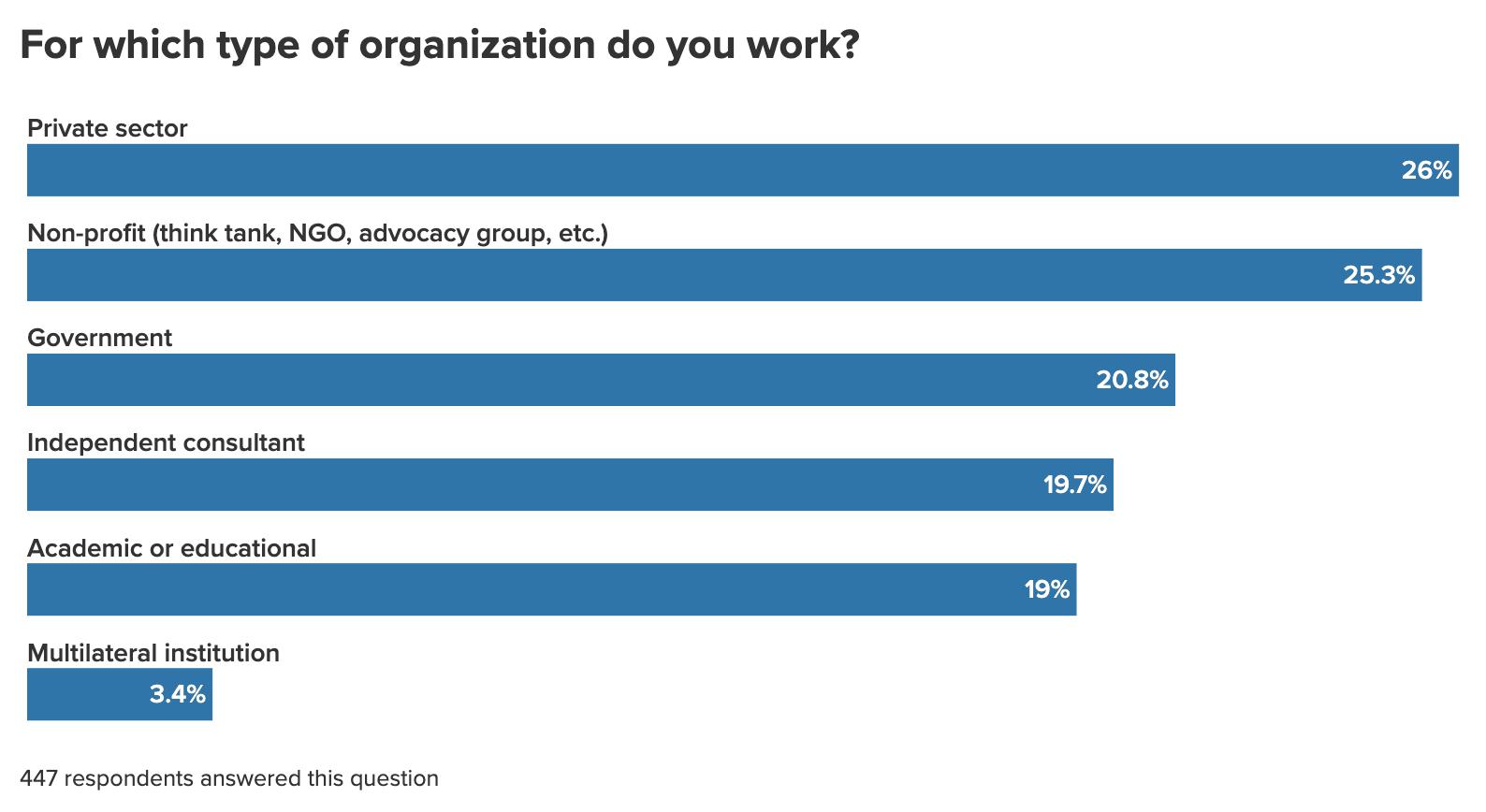
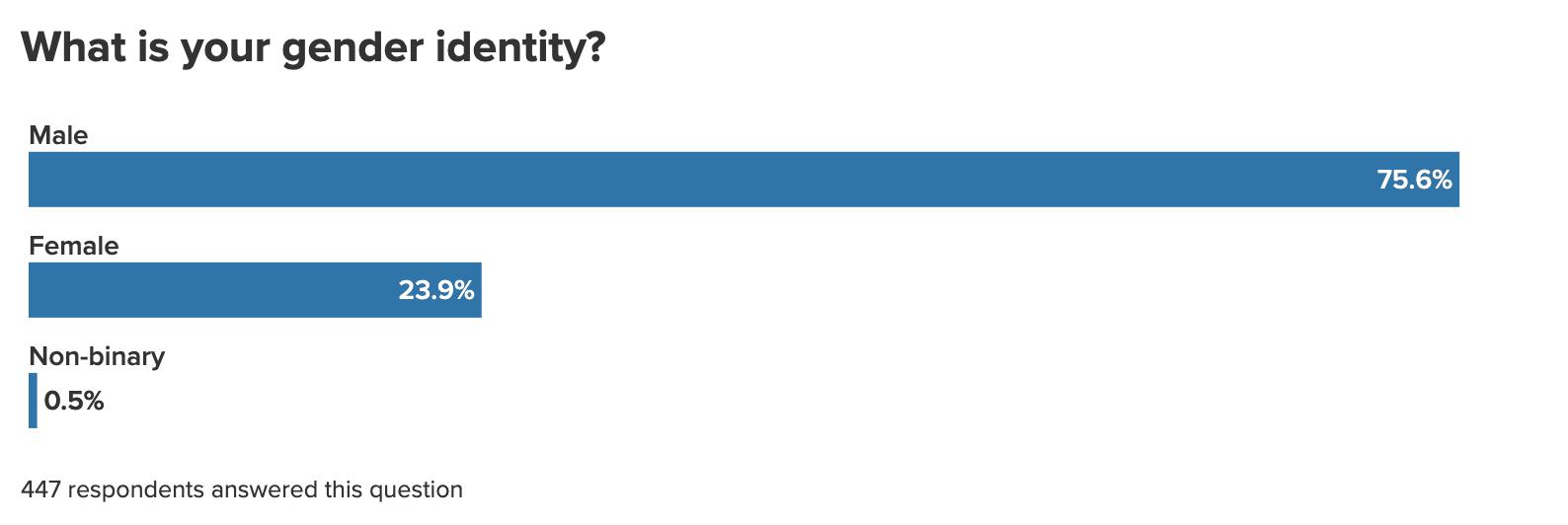
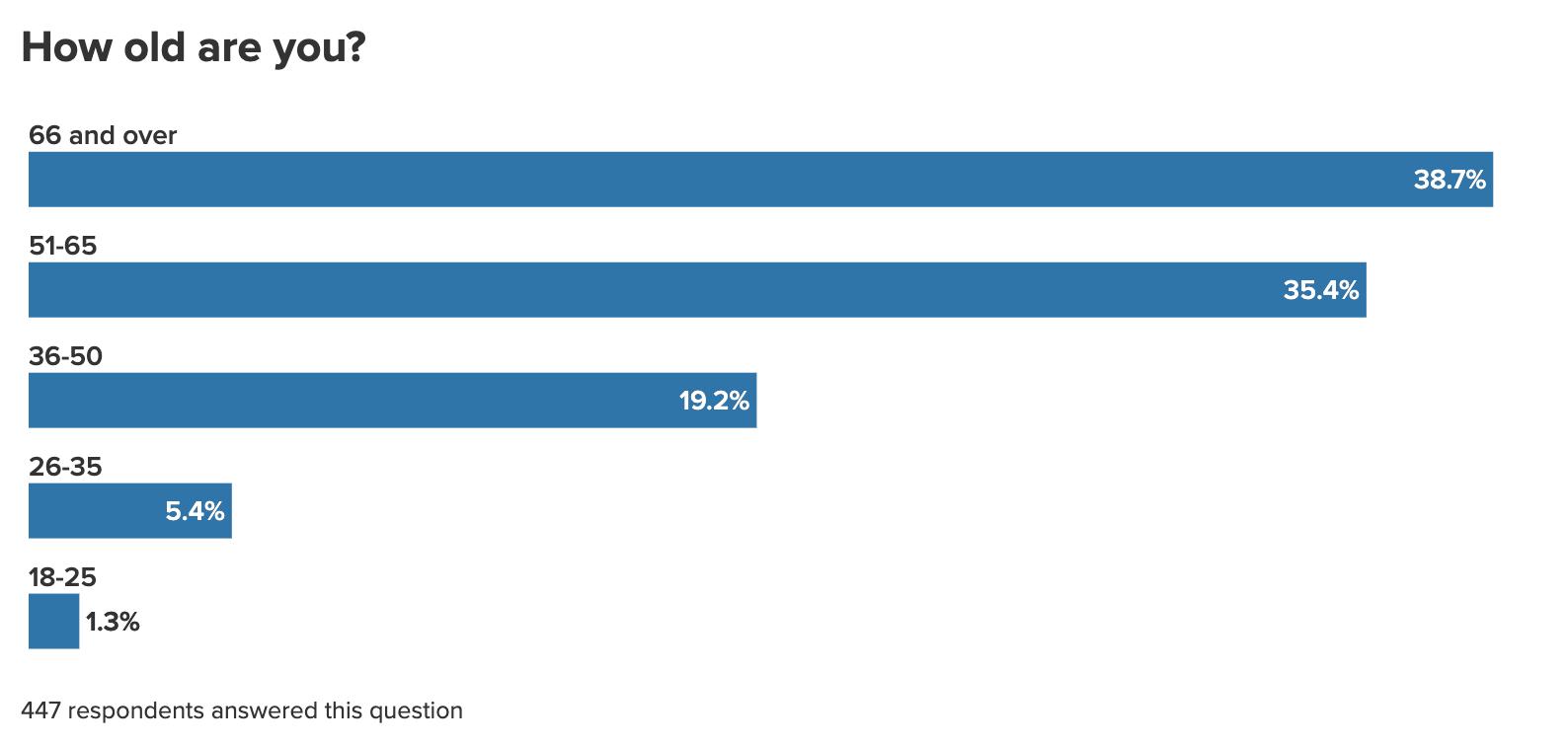
Survey questions
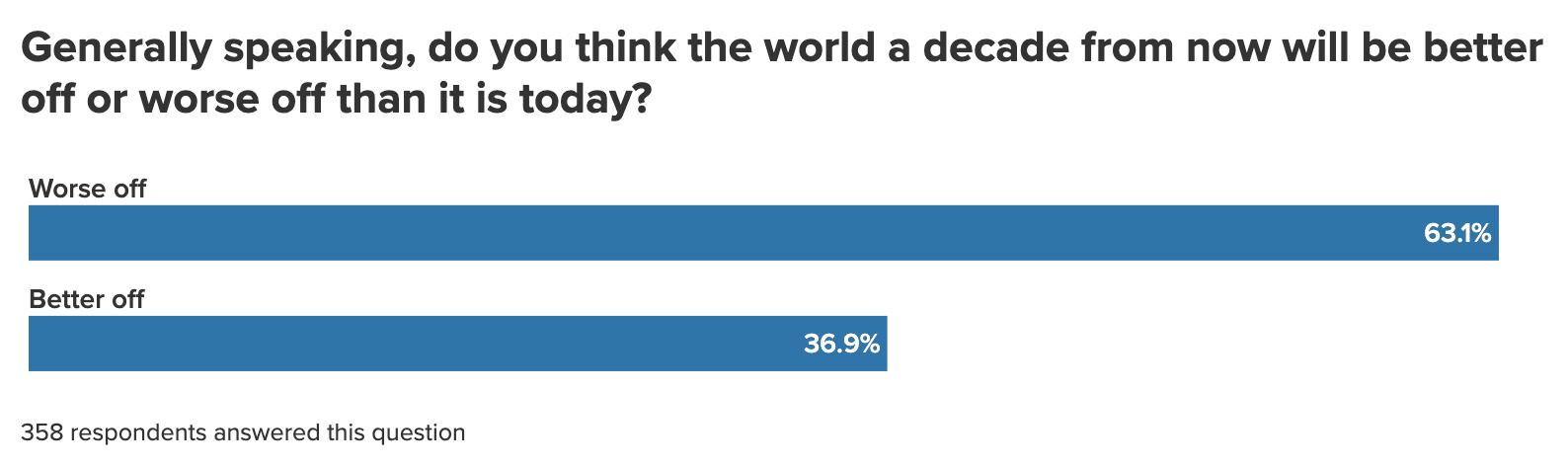
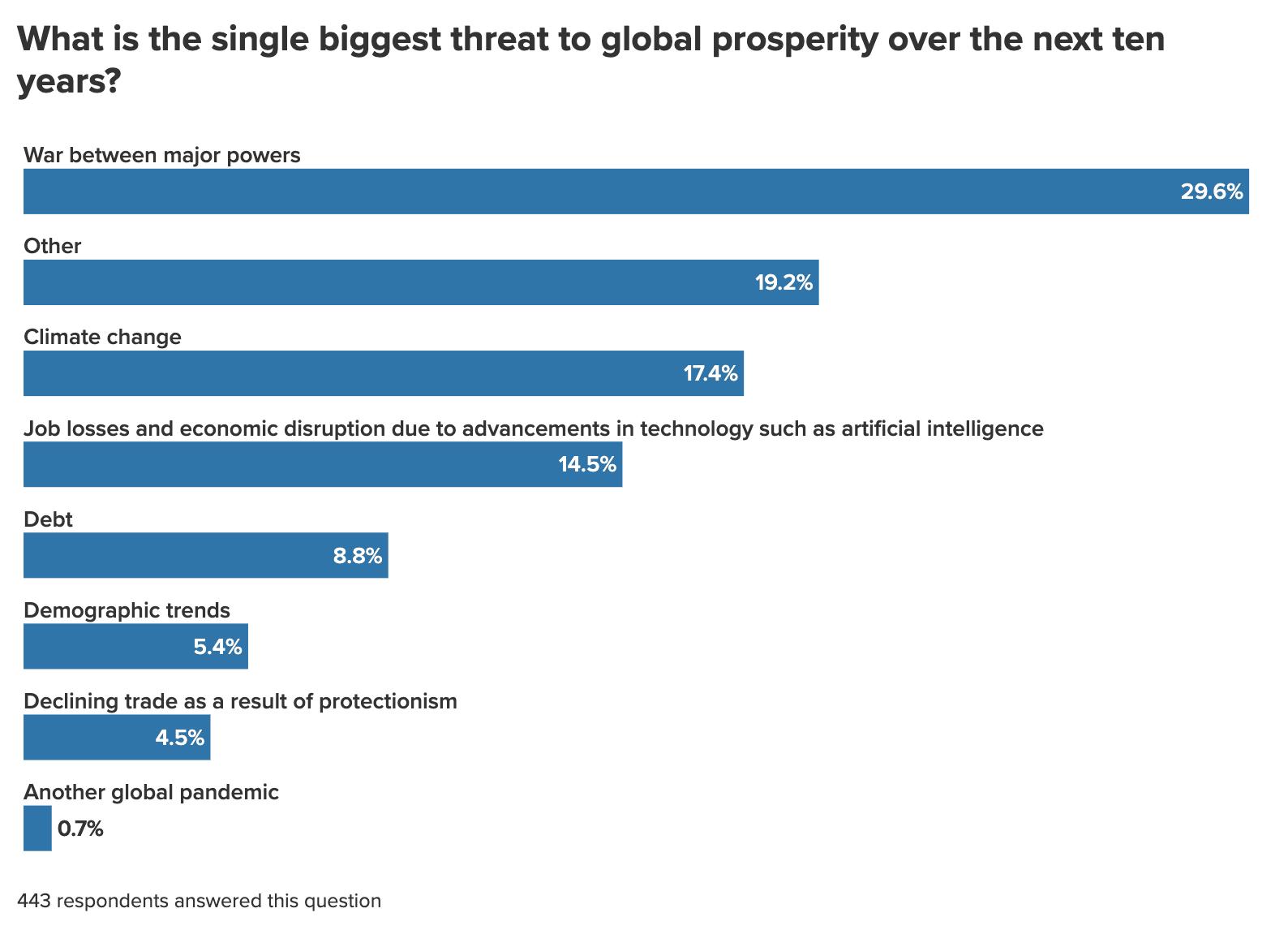
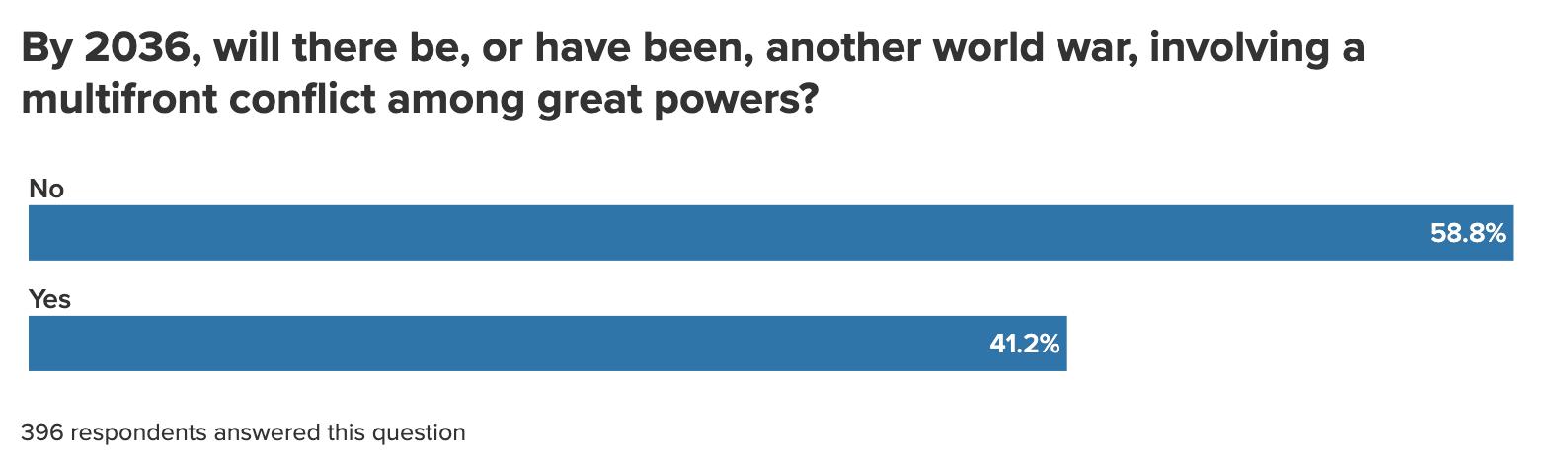
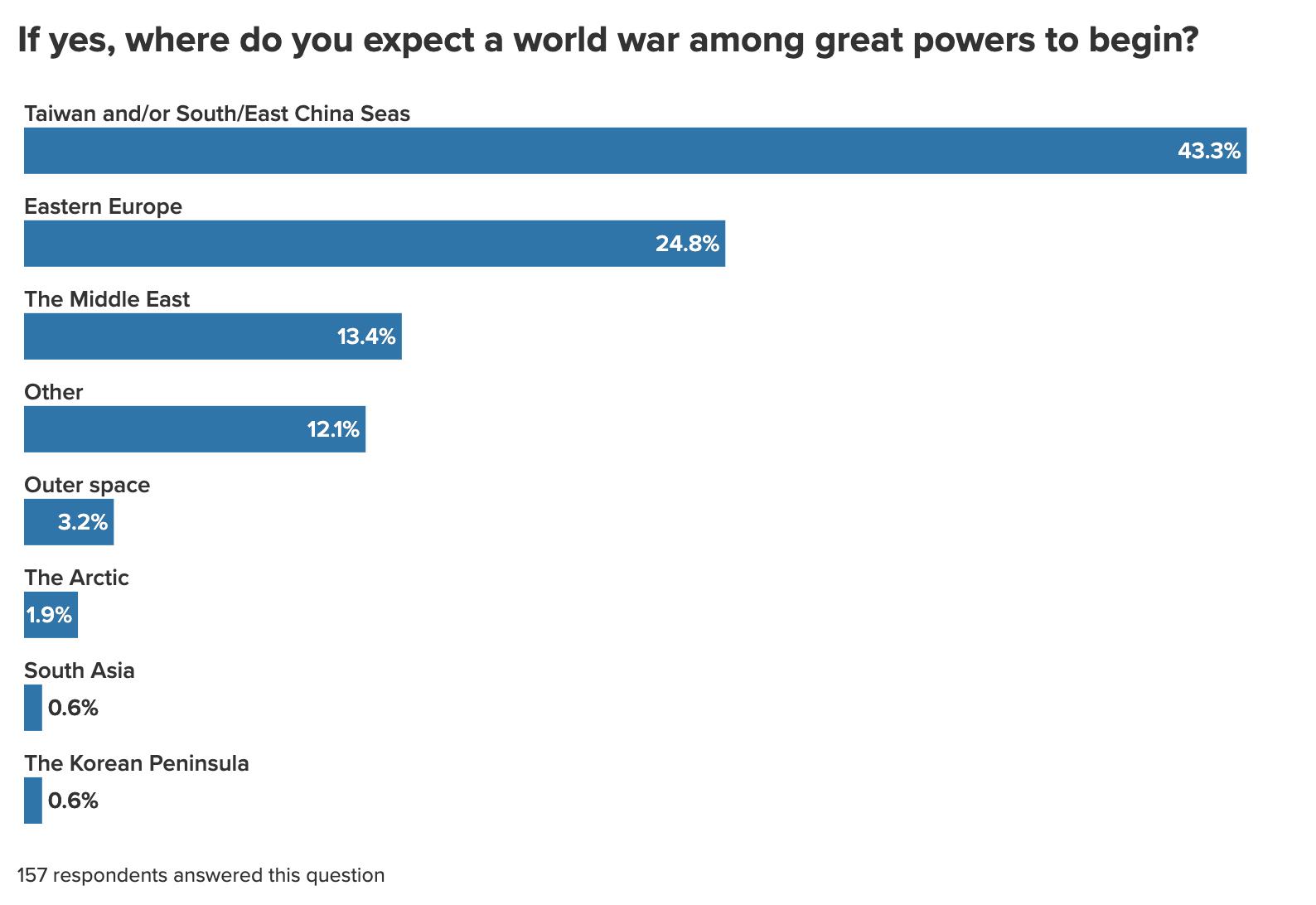
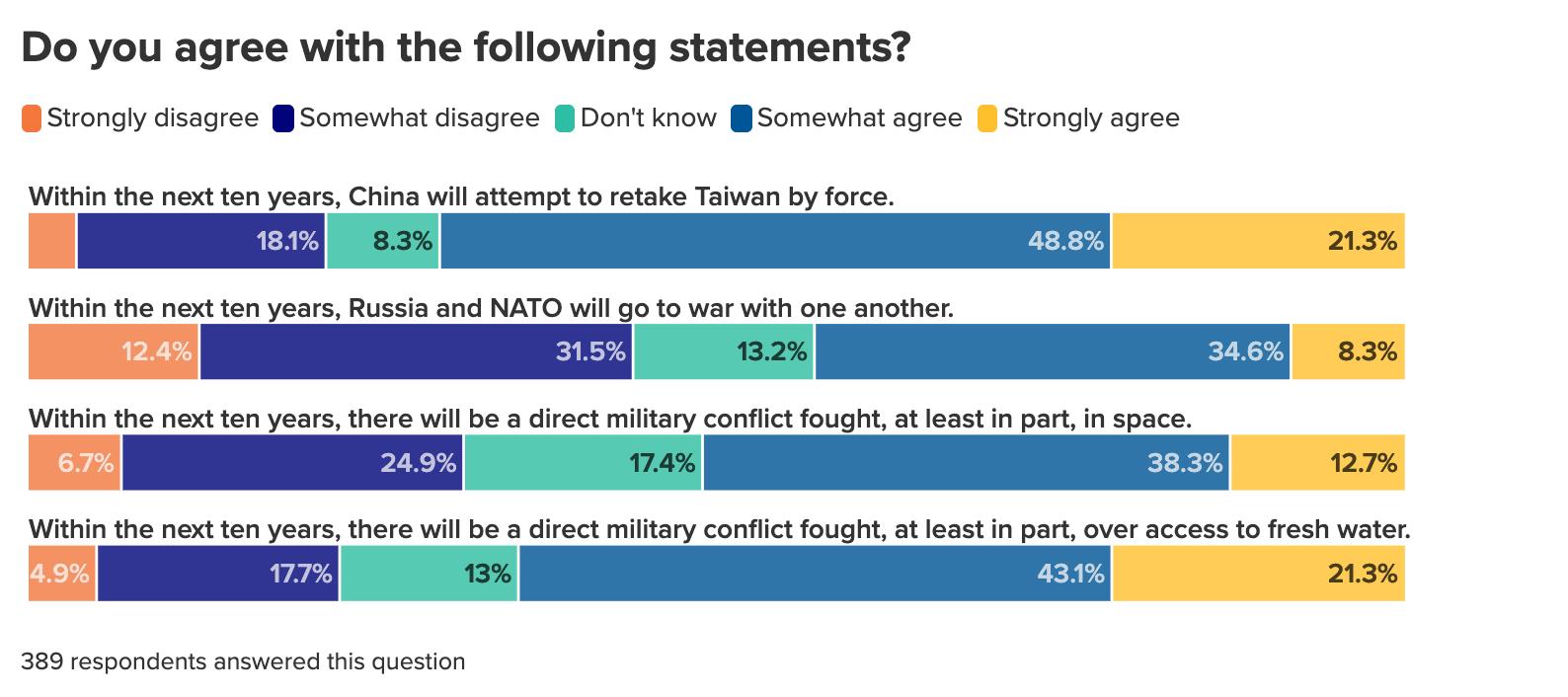
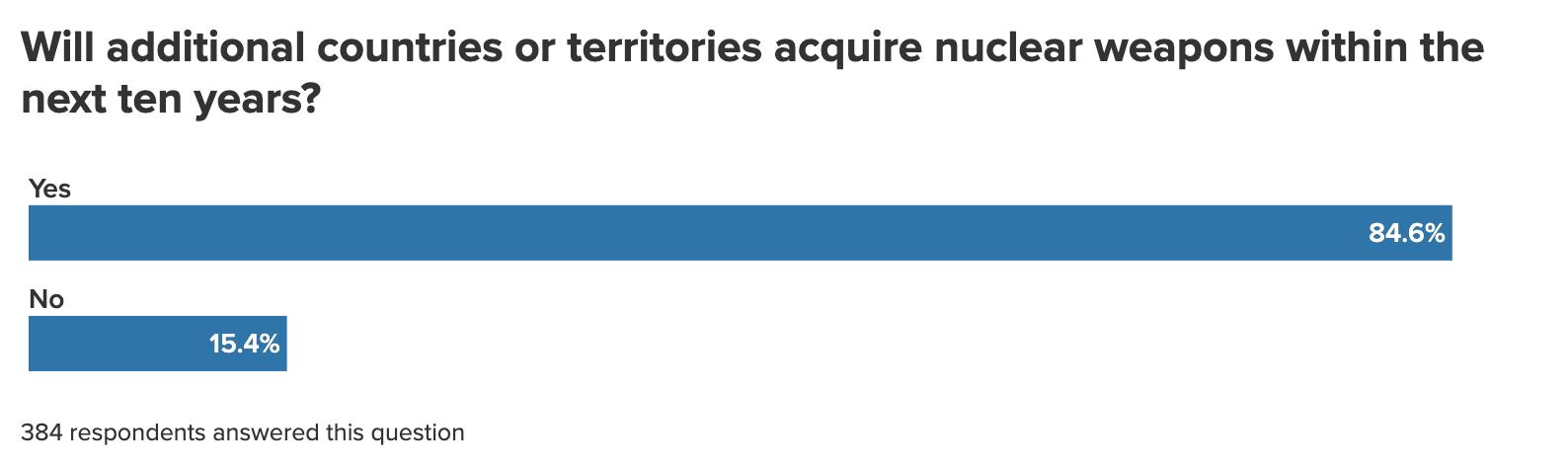
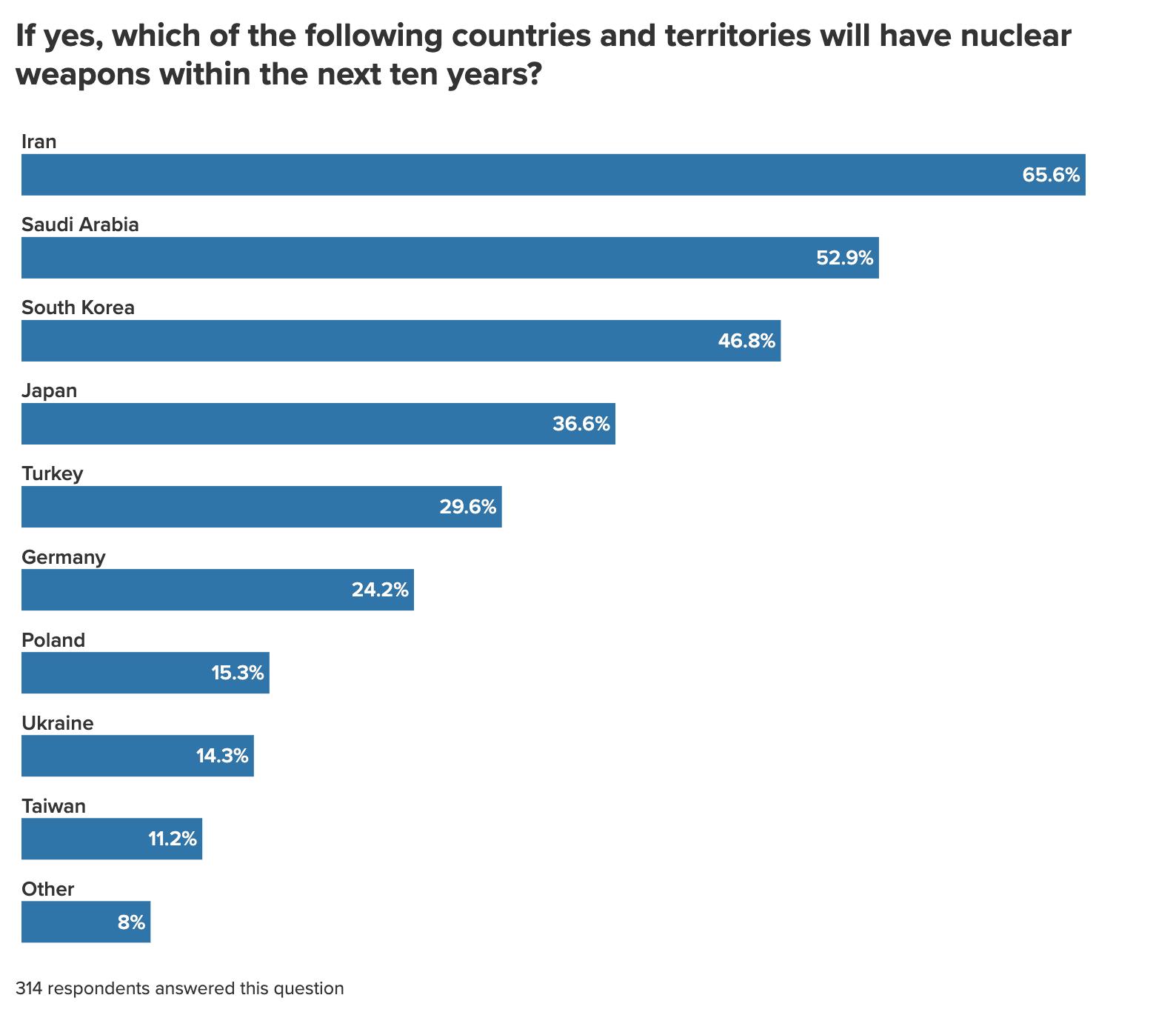
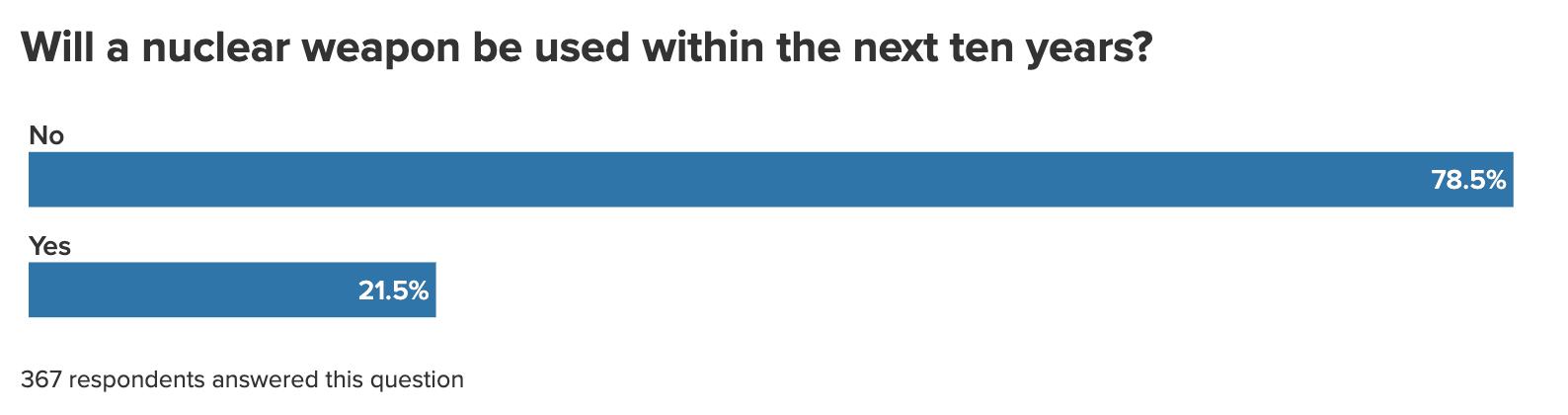
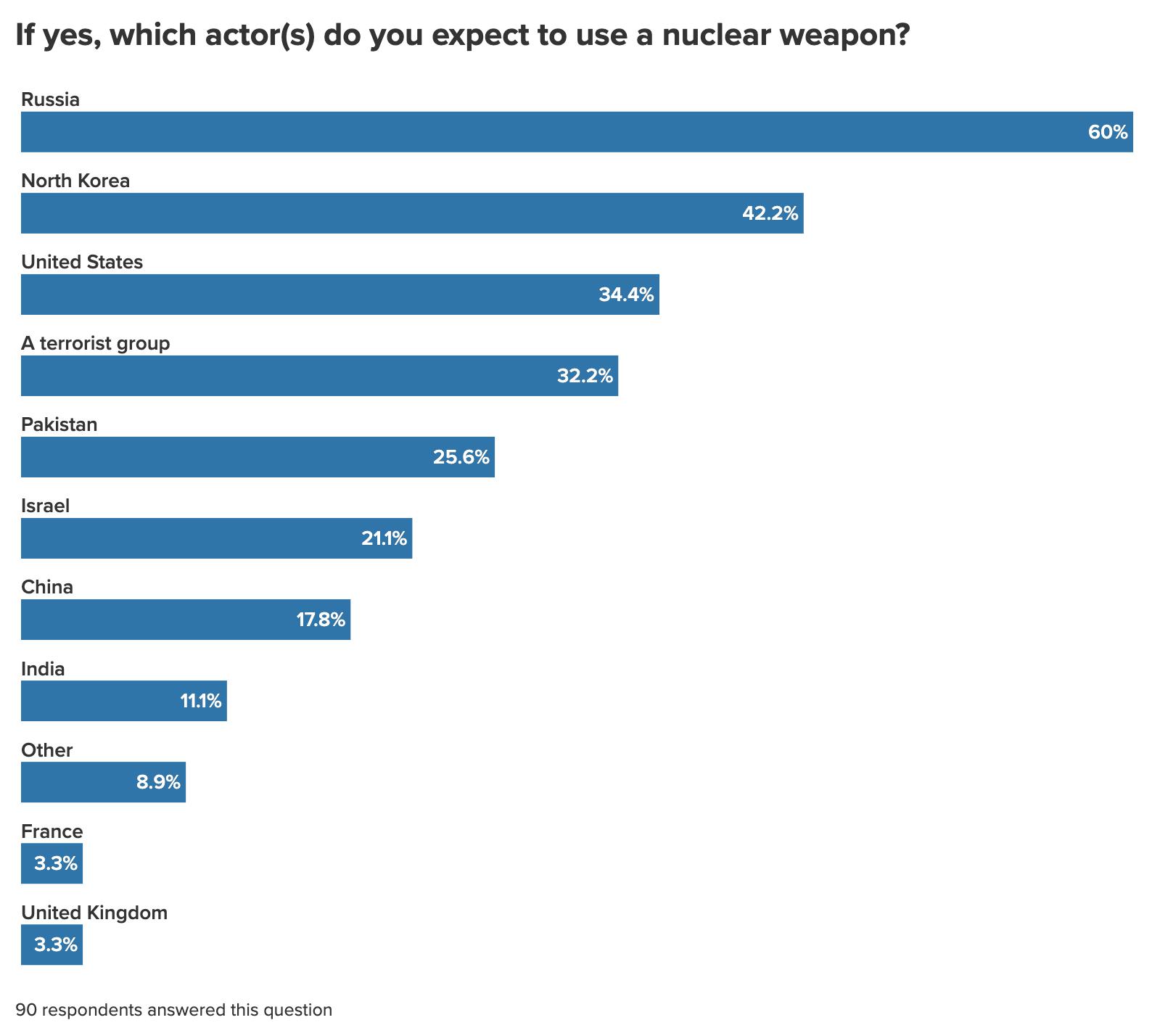
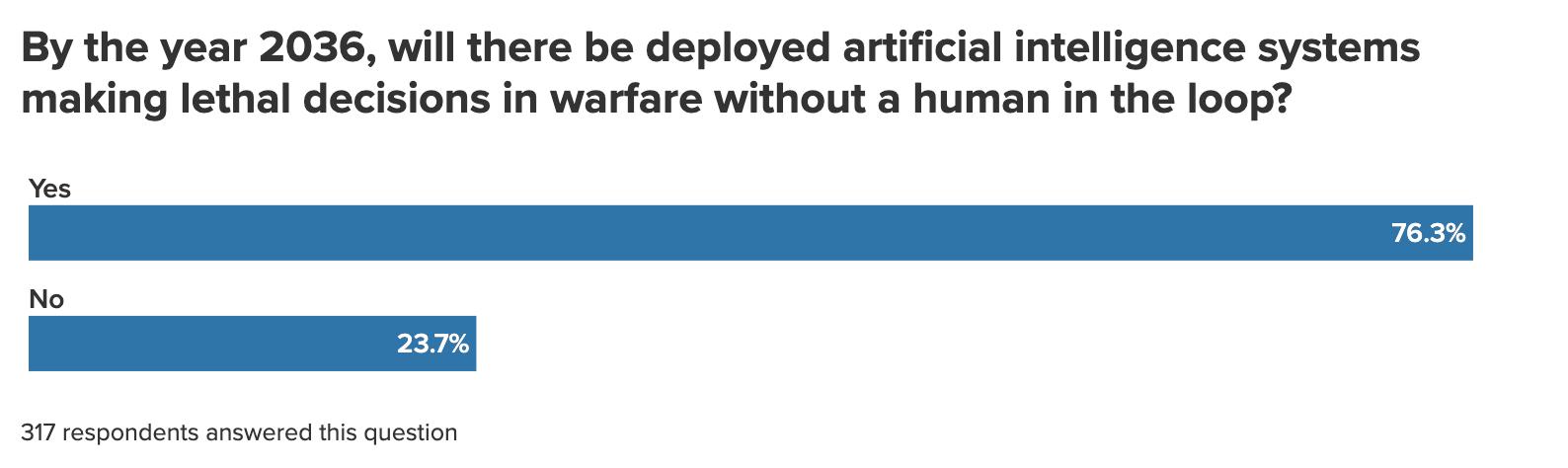
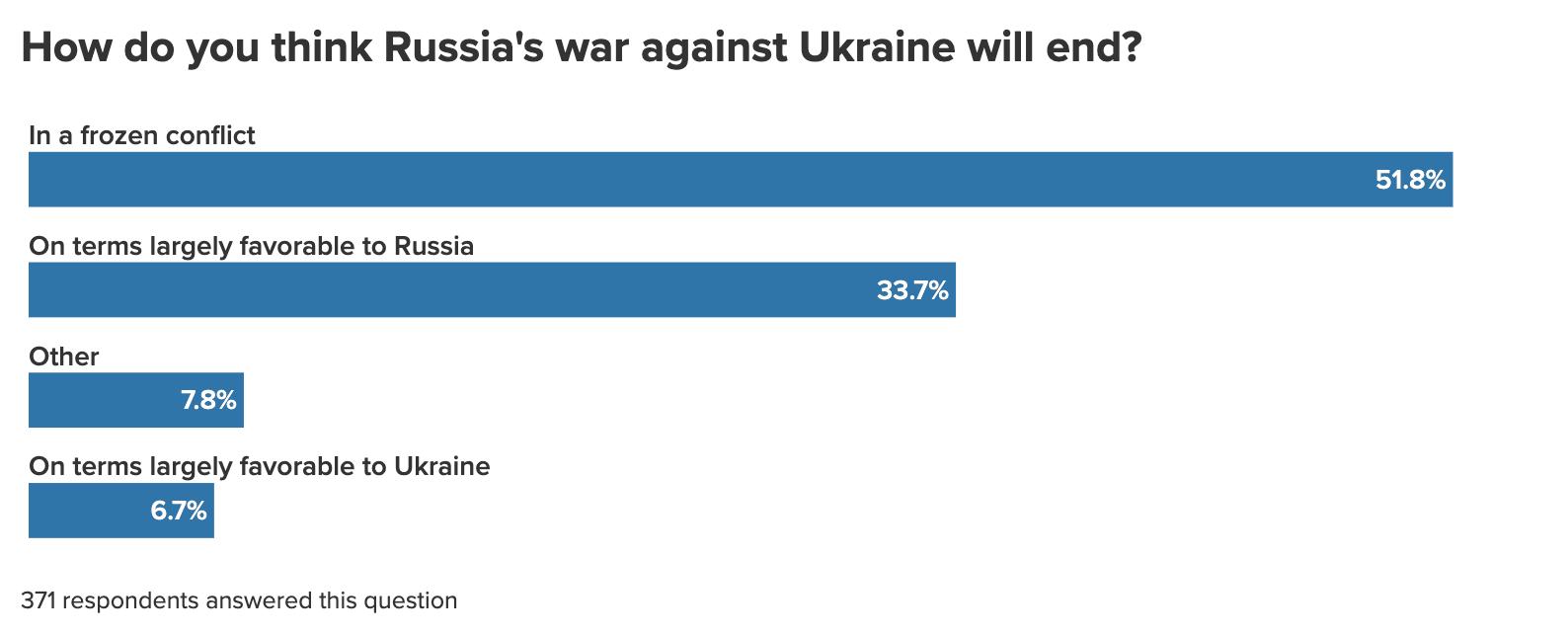
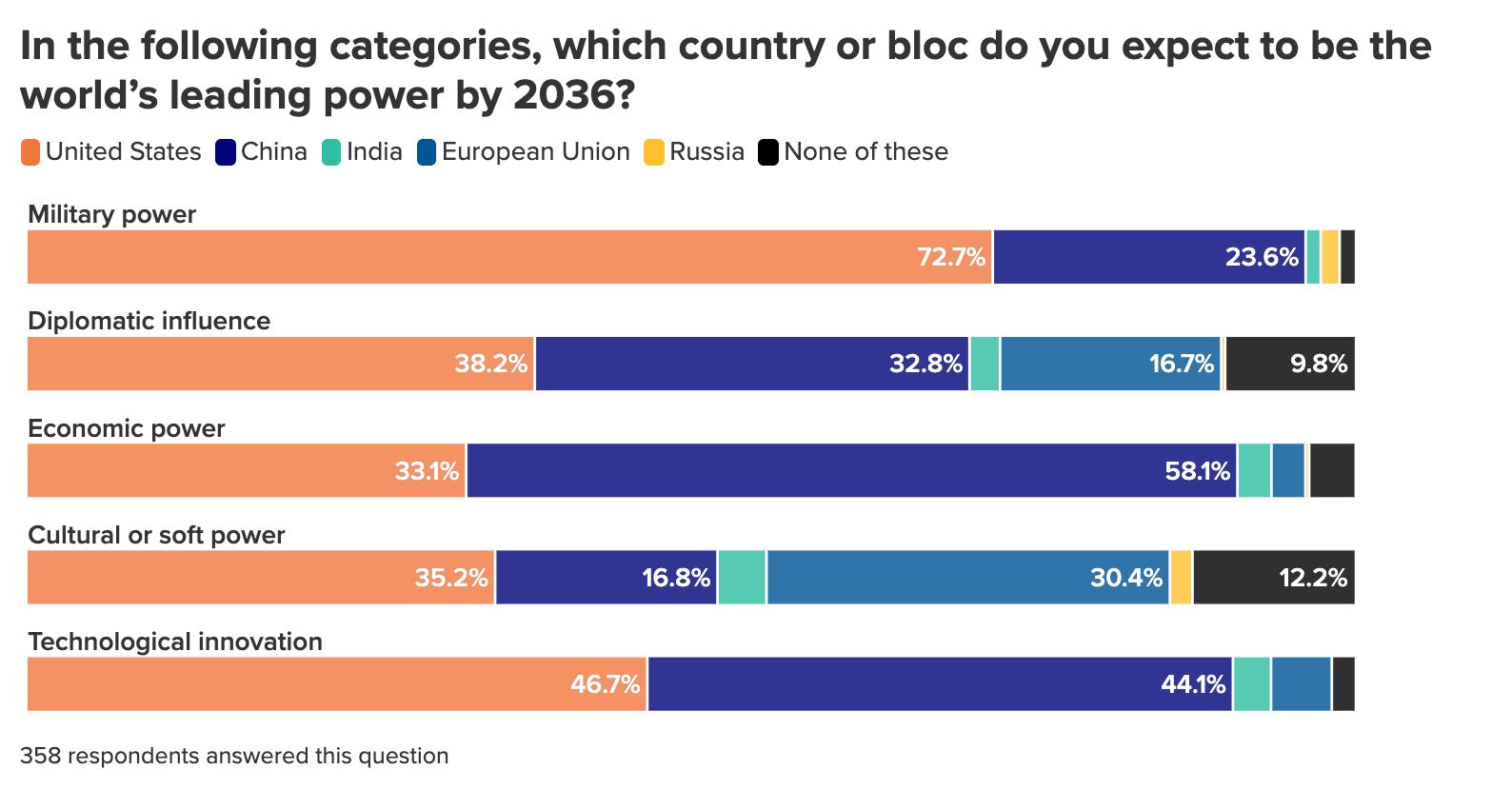
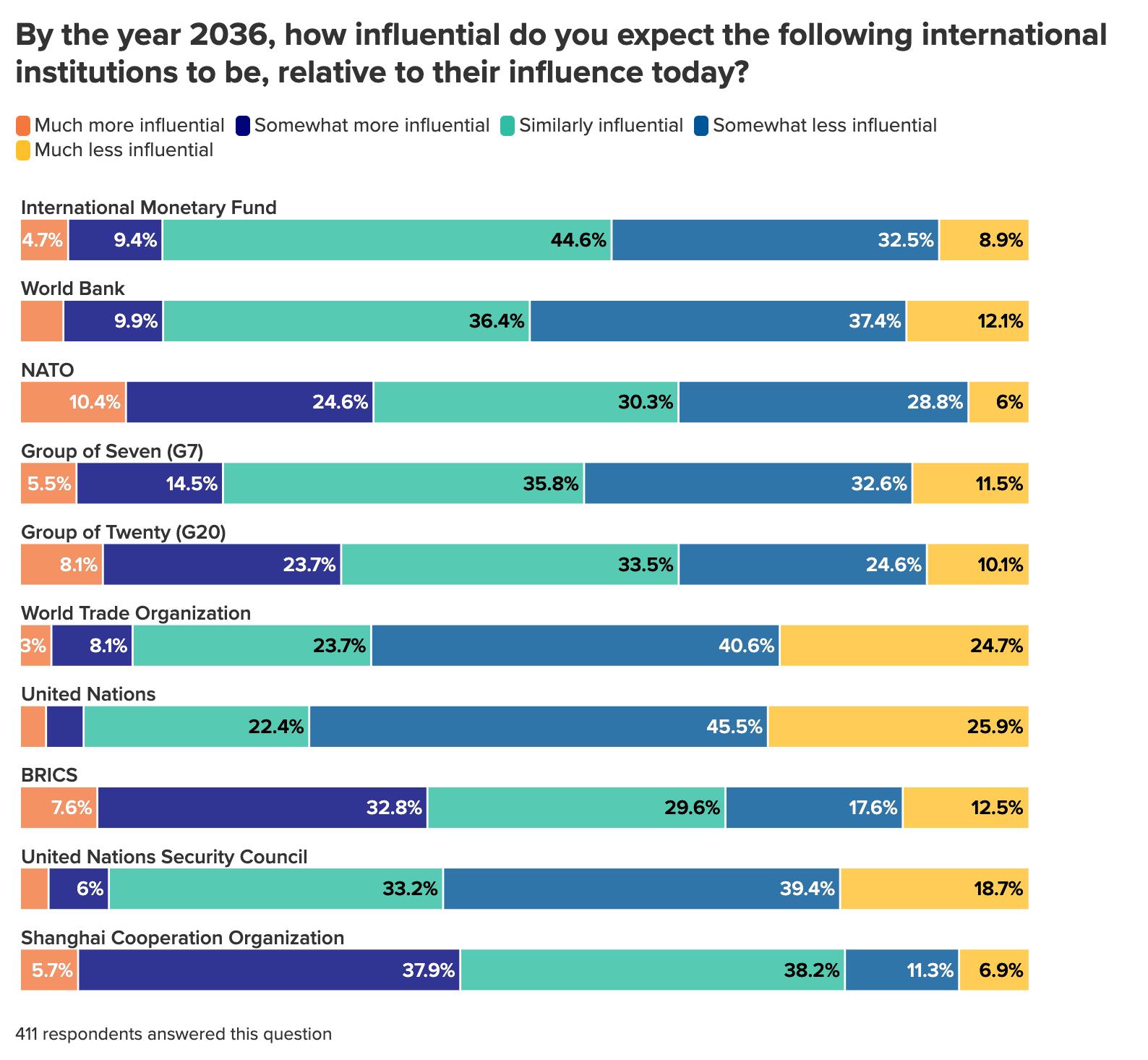
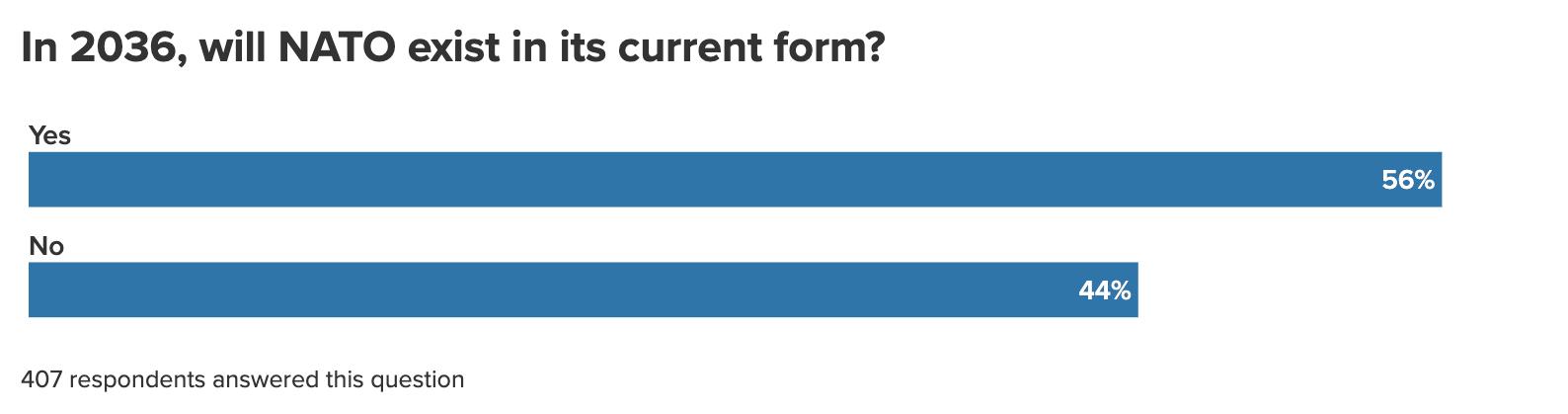
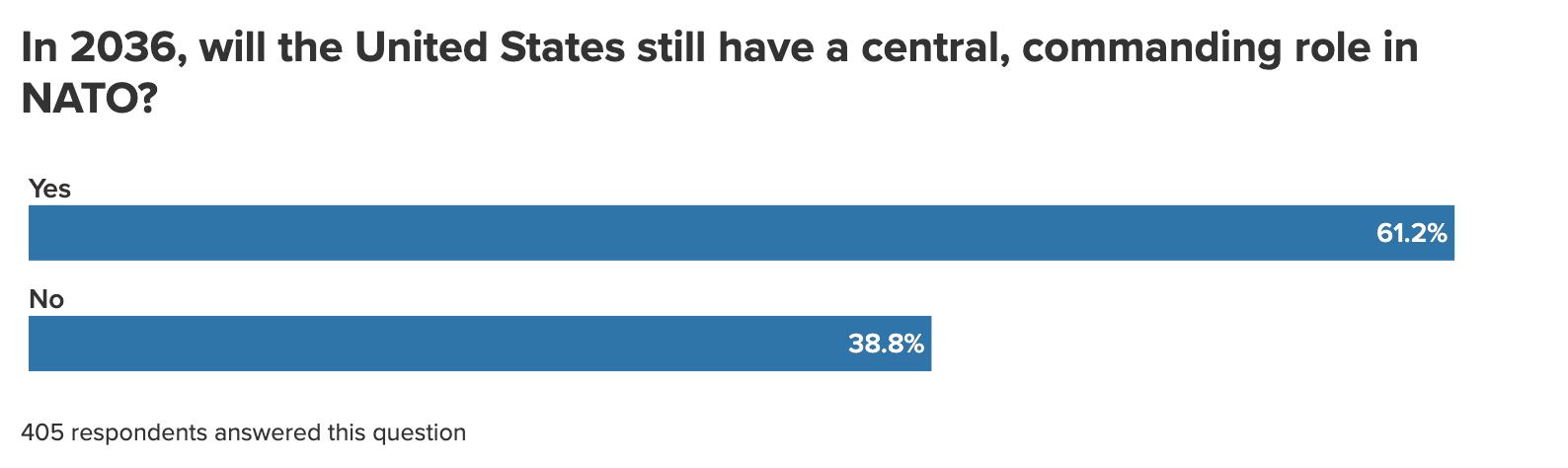
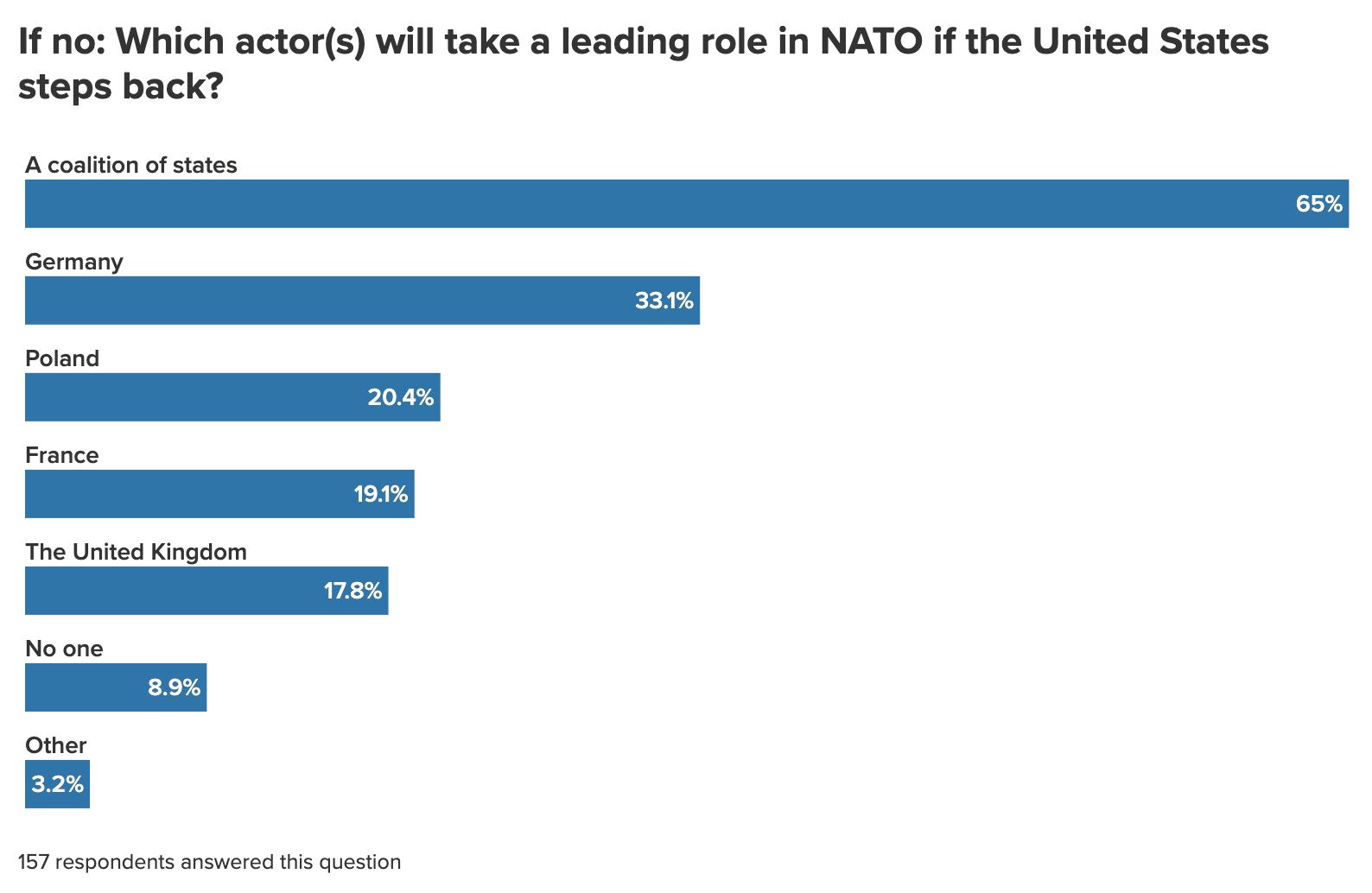
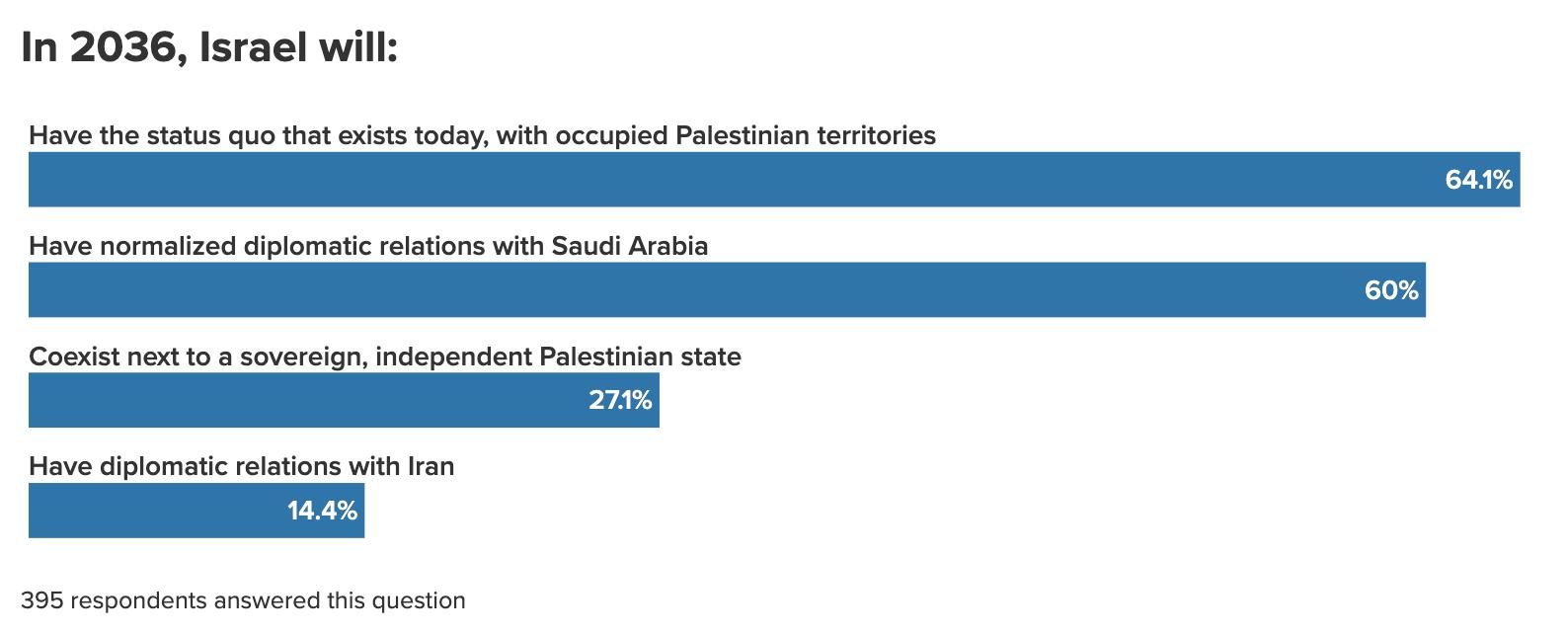
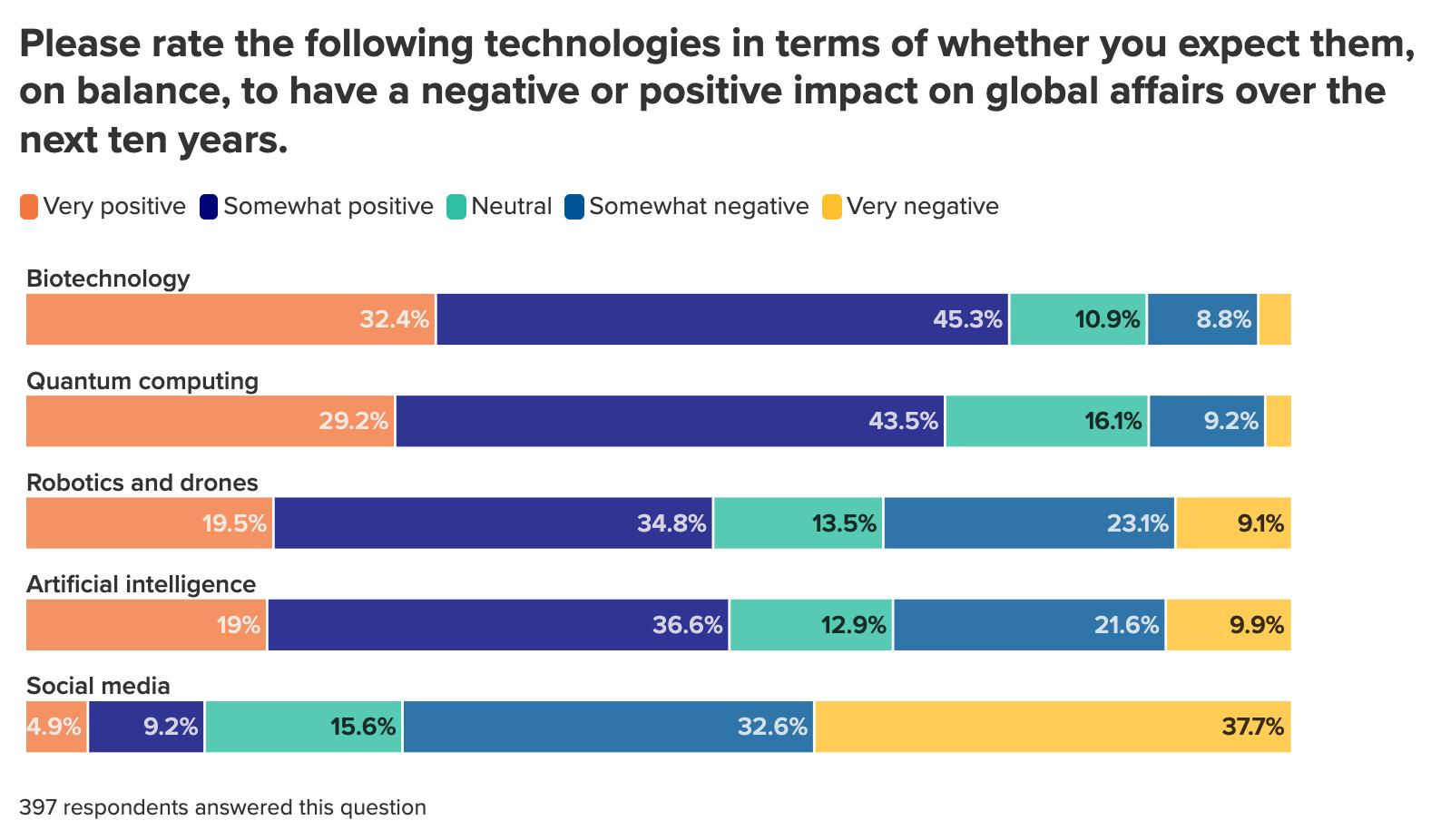
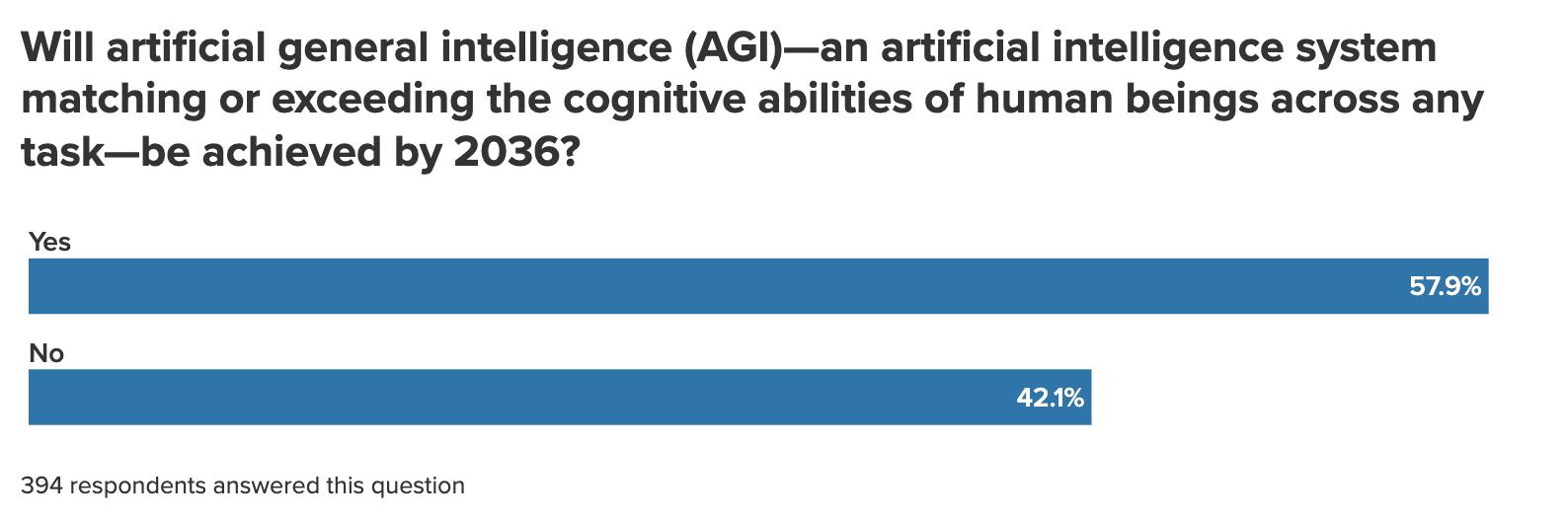
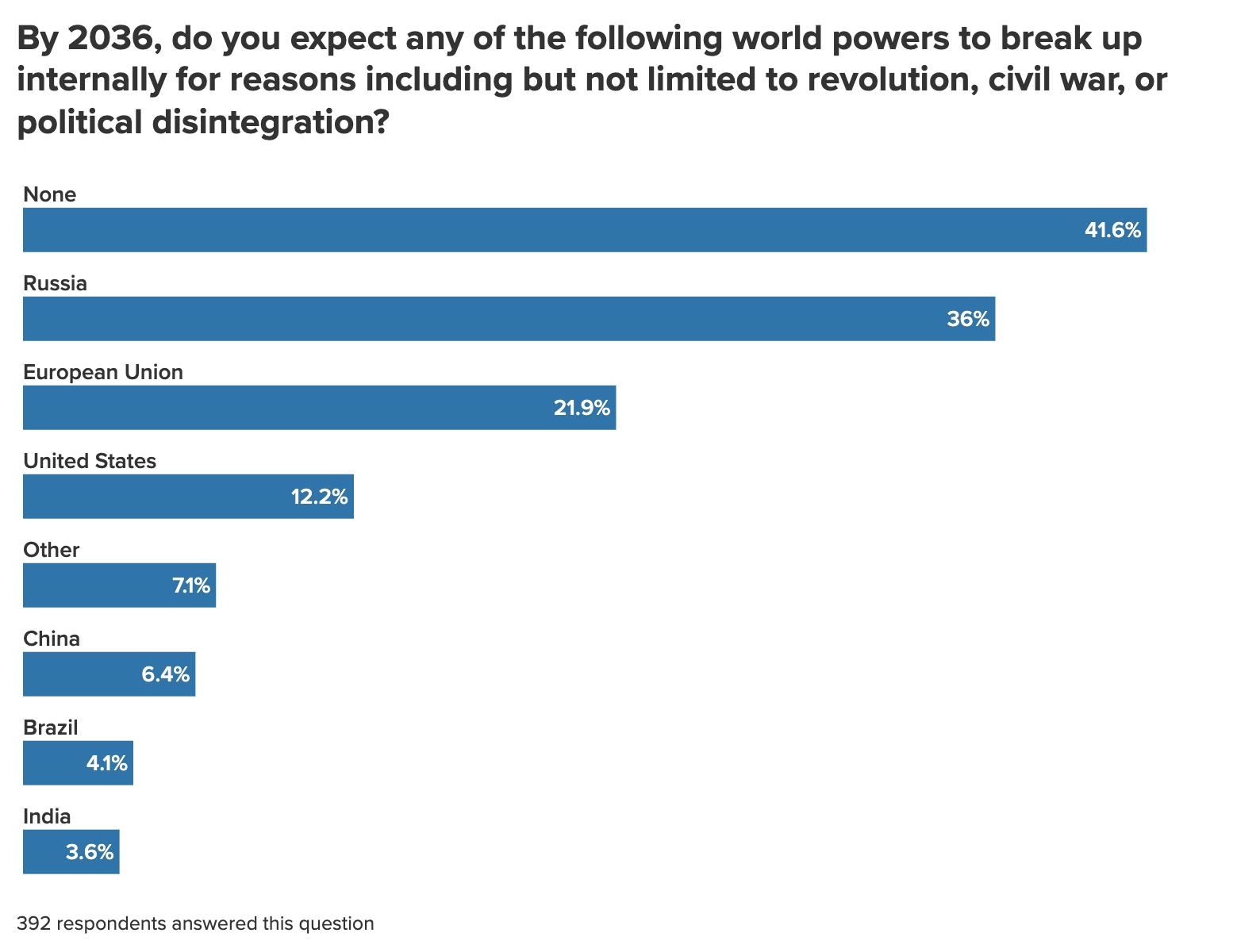
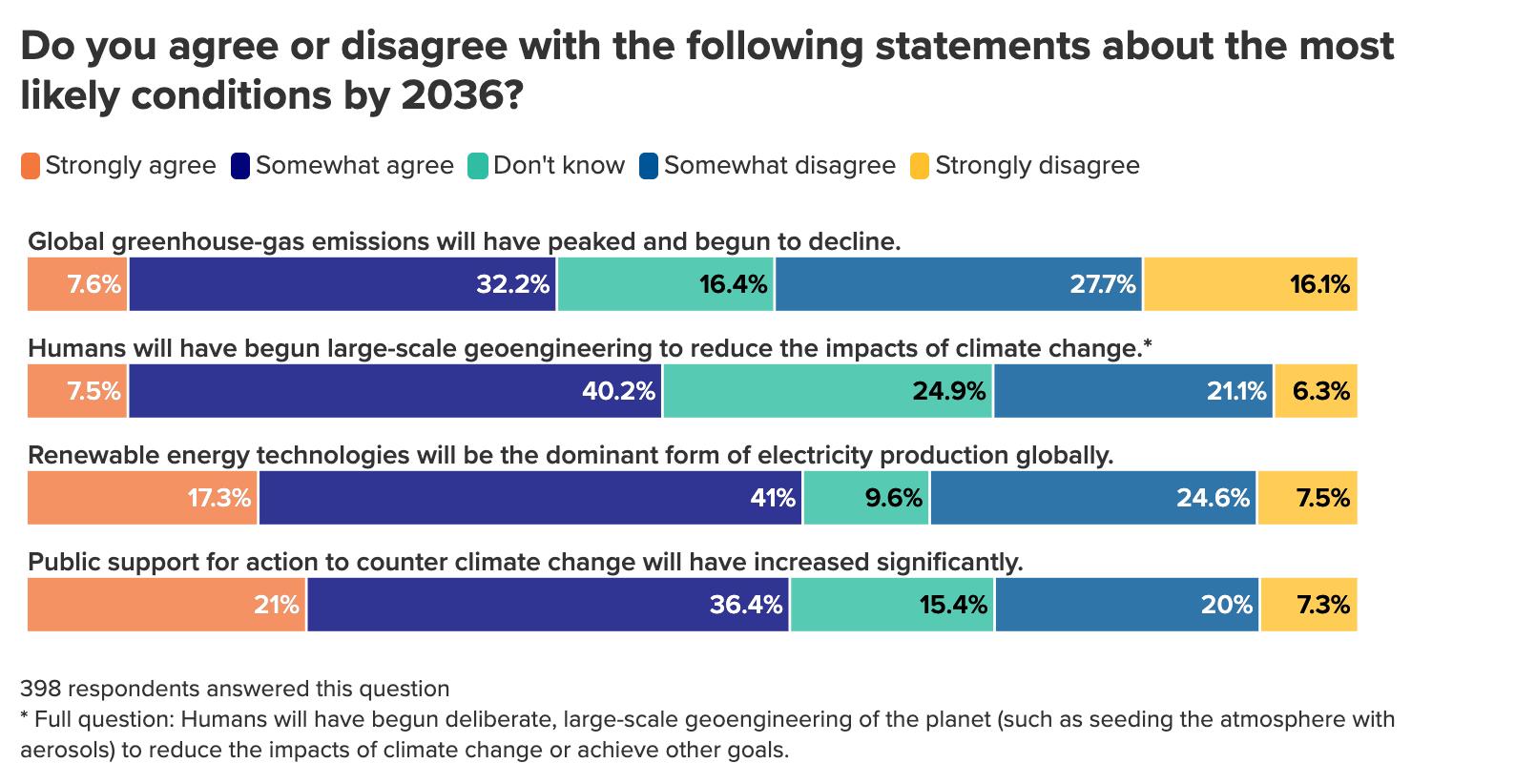
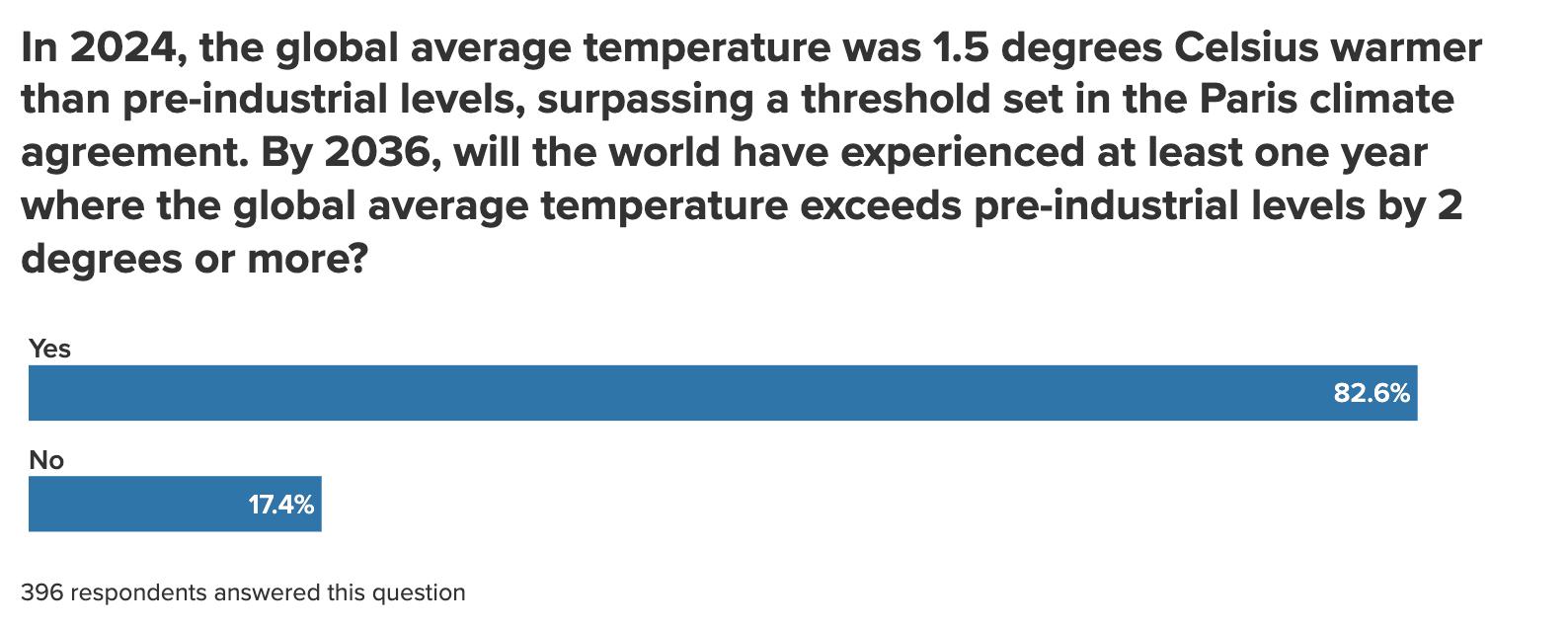
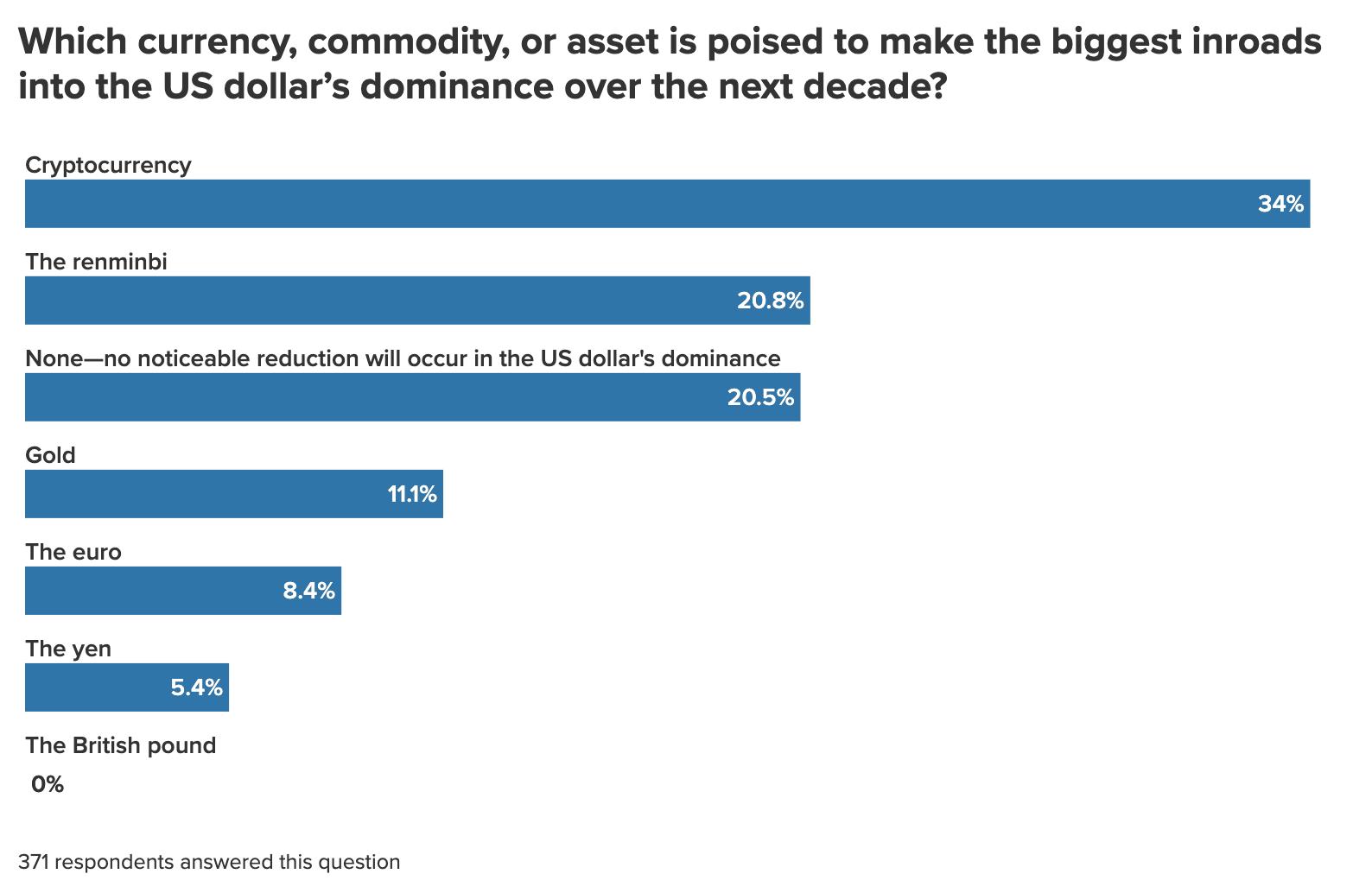
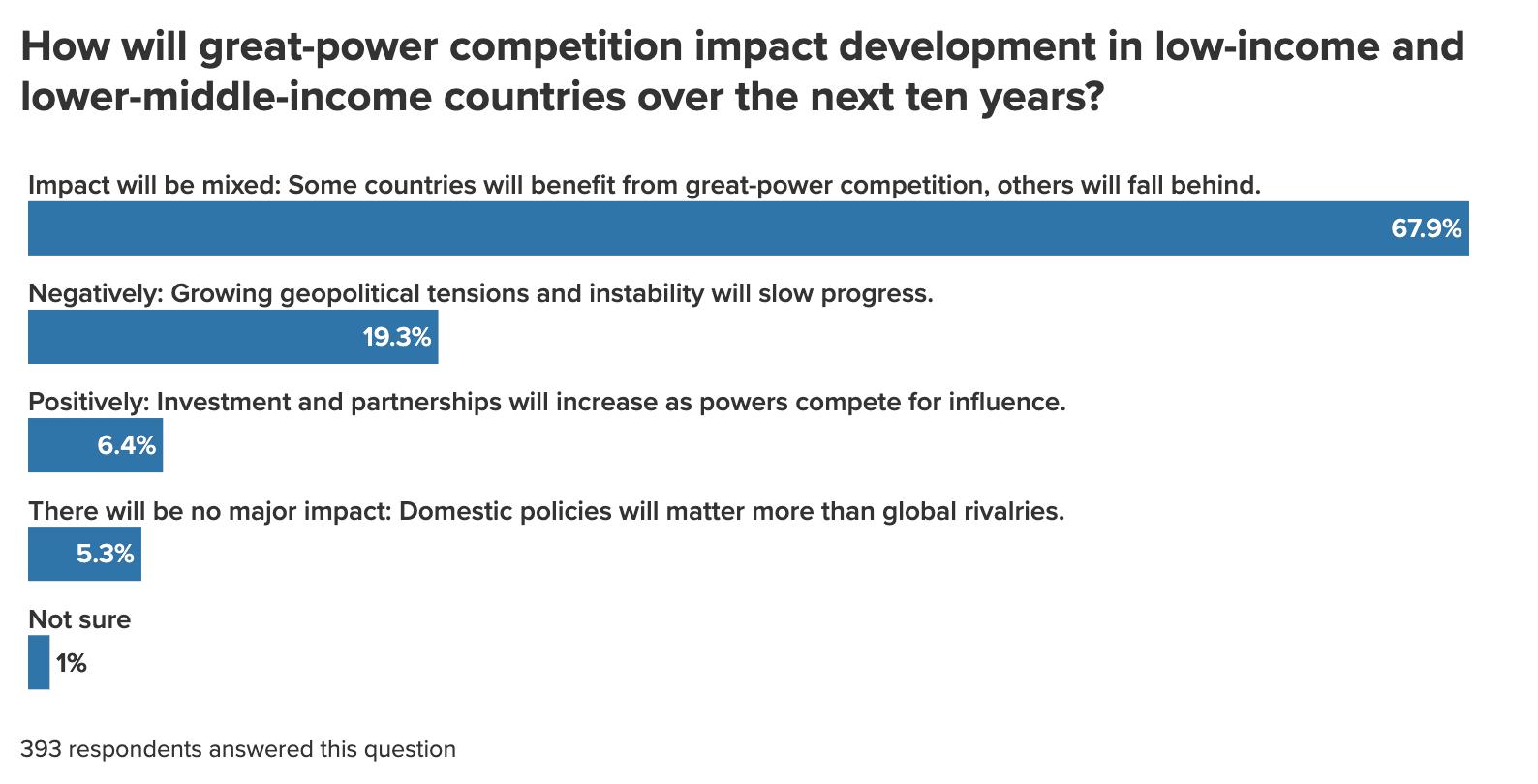
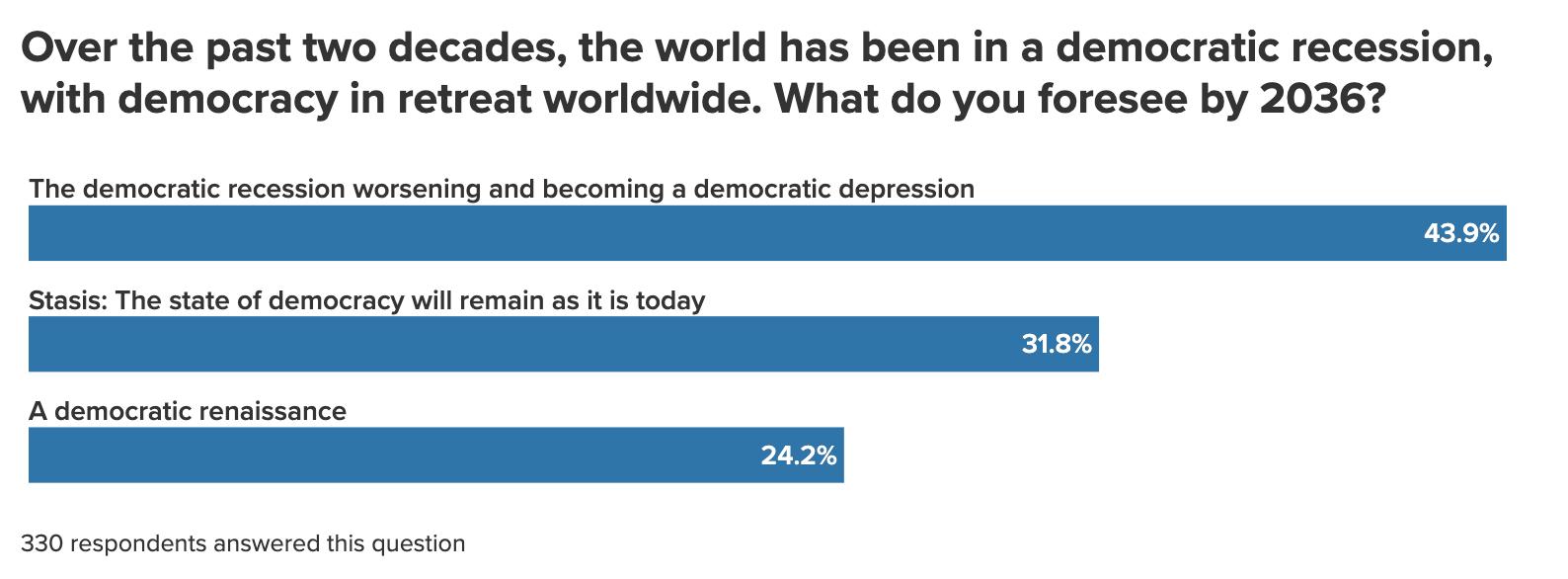
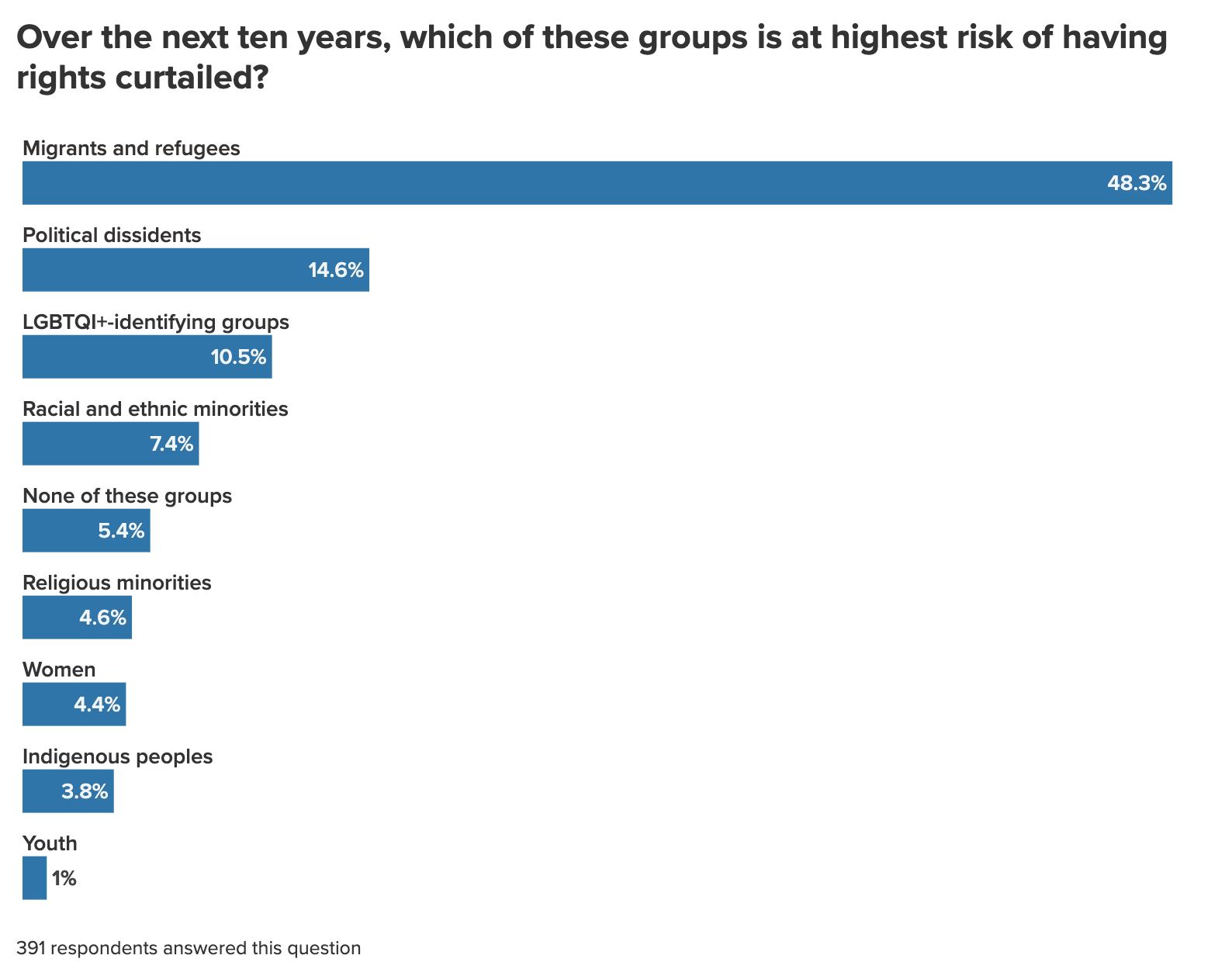
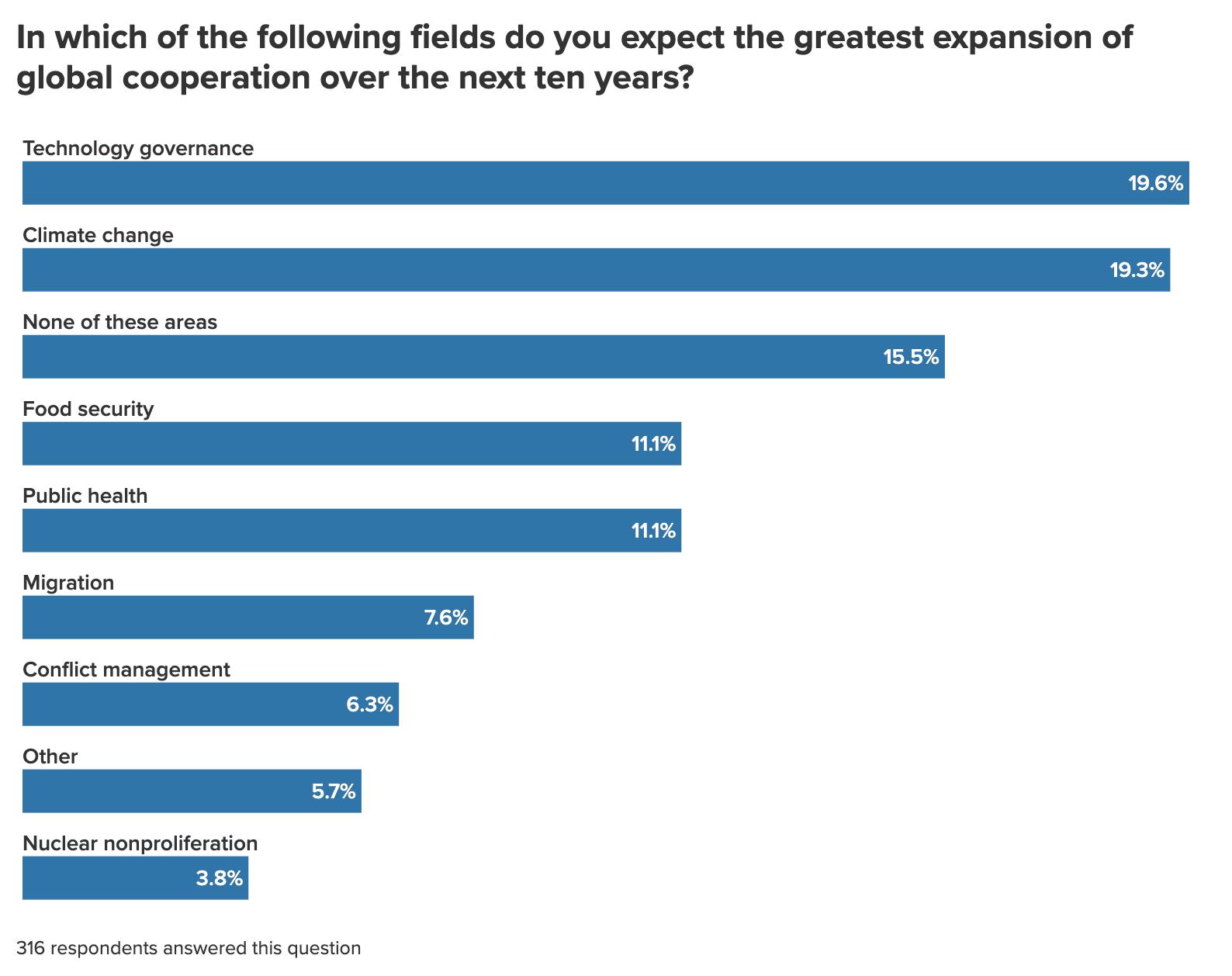
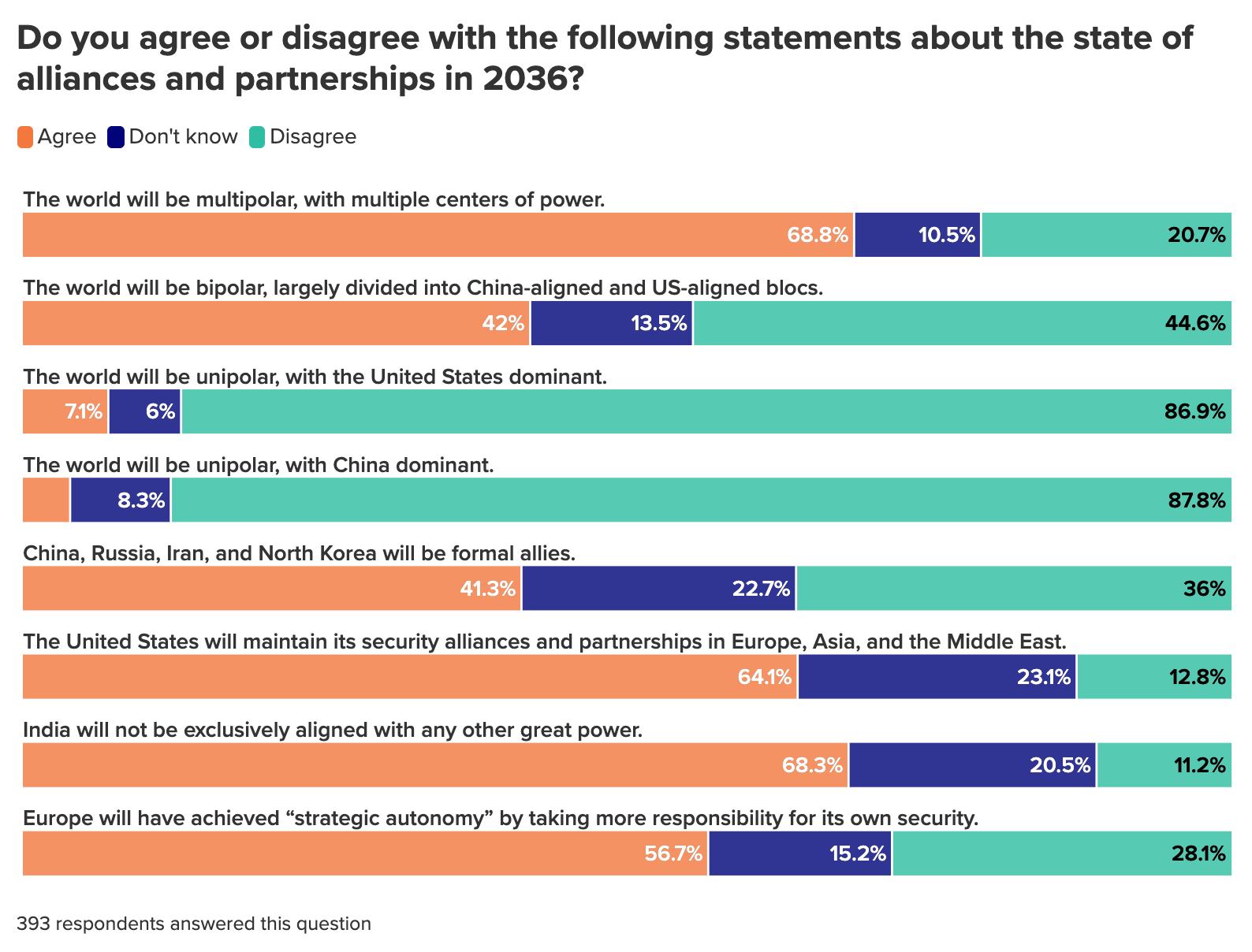
Endnotes
1 “Global Foresight,” Atlantic Council, https://www.atlanticcouncil.org/programs/scowcroft-center-for-strategy-and-security/ geostrategy-initiative/foresight-geostrategy-initiative-scowcroft-center/global-foresight-atlantic-council/.
2 Mary Kate Aylward, Peter Engelke, Uri Friedman, and Paul Kielstra, “Welcome to 2035: What the world could look like in ten years, according to more than 350 experts,” Atlantic Council, February 12, 2025, https://www.atlanticcouncil.org/contentseries/atlantic-council-strategy-paper-series/welcome-to-2035/#conflict; Mary Kate Aylward, Peter Engelke, Uri Friedman, and Paul Kielstra, “Welcome to 2034: What the world could look like in ten years, according to nearly 300 experts,” Atlantic Council, January 12, 2024, https://www.atlanticcouncil.org/content-series/atlantic-council-strategy-paper-series/welcometo-2034-what-the-world-could-look-like-in-ten-years-according-to-nearly-300-experts/#china
3 Aylward et al., “Welcome to 2035.”
4 Aylward, “Welcome to 2035.”
5 Daniel H. Rosen, Logan Wright, Oliver Melton, and Jeremy Smith, “China’s Economy: Rightsizing 2025, Looking Ahead to 2026,” Rhodium Group, December 22, 2025, https://rhg.com/wp-content/uploads/2025/12/Chinas-Economy-Rightsizing2025-Looking-Ahead-to-2026.pdf
6 Adam Kozloski, “China is carrying out ‘dress rehearsals’ to take Taiwan. Here’s how the US should respond,“ Atlantic Council, June 9, 2025, https://www.atlanticcouncil.org/blogs/new-atlanticist/china-is-carrying-out-dress-rehearsals-to-taketaiwan-heres-how-the-us-should-respond/.
7 Scott D. Berrier, “Deterring Chinese aggression takes real-time intelligence,” Atlantic Council, February 13, 2025, https:// www.atlanticcouncil.org/in-depth-research-reports/issue-brief/deterring-chinese-aggression-takes-real-time-intelligence/; Bradley T. Gericke, “Win fast or lose big against China,” Atlantic Council, April 10, 2025, https://www.atlanticcouncil.org/indepth-research-reports/issue-brief/win-fast-or-lose-big-against-china/; Brian Kerg, “The United States needs a victory plan for the Indo-Pacific,” Atlantic Council, April 29, 2025, https://www.atlanticcouncil.org/in-depth-research-reports/issue-brief/ the-united-states-needs-a-victory-plan-for-the-indo-pacific/
8 Markus Garlauskas, “Dispatch from Taipei: Now is the time to encourage Taiwan’s assertiveness, not hold it back,” Atlantic Council, November 24, 2025, https://www.atlanticcouncil.org/dispatches/dispatch-from-taipei-now-is-the-timeto-encourage-taiwans-assertiveness/; Marvin J. Park, “Defending Taiwan means mobilizing society, not just the military,” Atlantic Council, April 24, 2025, https://www.atlanticcouncil.org/in-depth-research-reports/issue-brief/defending-taiwanmeans-mobilizing-society-not-just-the-military/
9 Markus Garlauskas, Lauren D. Gilbert, and Kyoko Imai, “A rising nuclear double-threat in East Asia: Insights from our Guardian Tiger I and II tabletop exercises,” Atlantic Council, May 12, 2025, https://www.atlanticcouncil.org/in-depthresearch-reports/report/a-rising-nuclear-double-threat-in-east-asia-insights-from-our-guardian-tiger-i-and-ii-tabletopexercises/; Markus Garlauskas, “Toplines: The United States and its allies must be ready to deter a two-front war and nuclear attacks in East Asia,” Atlantic Council, February 7, 2025, https://www.atlanticcouncil.org/in-depth-research-reports/ report/toplines-the-united-states-and-its-allies-must-be-ready-to-deter-a-two-front-war-and-nuclear-attacks-in-east-asia/
10 ARTICLE IS BEHIND A PAYWALL. I CANNOT ACCESS BIBLIOGRAPHIC INFO. https://www.bloomberg.com/news/ articles/2023-09-05/china-slowdown-means-it-may-never-overtake-us-economy-be-says?embedded-checkout=true.
11 “The global economy in 2075: growth slows as Asia rises,” Goldman Sachs, December 8, 2022, https://www.goldmansachs. com/insights/articles/the-global-economy-in-2075-growth-slows-as-asia-rises
12 SAME BLOOMBERG ARTICLE AS PREVIOUS; CANNOT ACCESS GIVEN PAYWALL. https://www.bloomberg.com/news/ articles/2023-09-05/china-slowdown-means-it-may-never-overtake-us-economy-be-says?embedded-checkout=true
13 “World Economic Outlook: Growth Slowdown, Precarious Recovery. Statistical Appendix,” International Monetary Fund, April 2019, https://www.imf.org/-/media/files/publications/weo/2019/april/english/tablea.pdf
14 “World Economic Outlook: A Critical Juncture amid Policy Shifts,” International Monetary Fund, April 2025, https://www.imf. org/en/publications/weo/issues/2025/04/22/world-economic-outlook-april-2025
15 Rosen et al., “Rightsizing.”
16 Jeremy Mark, “China’s property slump deepens—and threatens more than the housing sector,” Atlantic Council, January 28, 2026, https://www.atlanticcouncil.org/blogs/econographics/chinas-property-slump-deepens-and-threatens-more-thanthe-housing-sector/
17 “Old-age dependency ratio,” United Nations Population Division / Data portal, accessed February 24, 2026, https:// population.un.org/dataportal/data/indicators/84/locations/156/start/1990/end/2065/table/pivotbylocation?df=abaf491f-b2144bb0-babd-ff4a23dd6351
18 “NATO Defense Spending Tracker,” Atlantic Council, accessed February 24, 2026, https://www.atlanticcouncil.org/ commentary/trackers-and-data-visualizations/nato-defense-spending-tracker/; Christian Bjørn Følsgaard, Daniel Fried, and Rachel Rizzo, “Everything you need to know about Trump’s Greenland gambit,” Atlantic Council, January 8, 2025, https:// www.atlanticcouncil.org/blogs/new-atlanticist/everything-you-need-to-know-about-trumps-greenland-gambit/
19 Dina Smeltz and Craig Kafura, “Americans Endorse US Commitment to NATO, Though GOP Support Has Dipped,” The Chicago Council on Global Affairs, June 20, 2025, https://globalaffairs.org/research/public-opinion-survey/americansendorse-us-commitment-nato-though-gop-support-has-dipped
20 “The Global Foresight 2025 survey: Full results,” Atlantic Council, February 12, 2025, https://www.atlanticcouncil.org/ content-series/atlantic-council-strategy-paper-series/the-global-foresight-2025-survey-full-results/
21 Mary Kate Aylward, Peter Engelke, Uri Friedman, and Paul Kielstra, “Welcome to 2033: What the world could look like in ten years, according to more than 160 experts,” Atlantic Council, January 20, 2023, https://www.atlanticcouncil.org/contentseries/atlantic-council-strategy-paper-series/welcome-to-2033/
22 Colleen McClain et al., “How the U.S. Public and AI Experts View Artificial Intelligence,” Pew Research Center, April 3, 2025, https://www.pewresearch.org/internet/2025/04/03/how-the-us-public-and-ai-experts-view-artificial-intelligence/
23 Atlantic Council, “2025 survey: Full results.”
24 Aylward et al., “Welcome to 2035.”
25 Atlantic Council, “2025 survey: Full results.”
26 Atlantic Council, “2025 survey: Full results”; “The Global Foresight 2024 survey: Full results,” Atlantic Council, January 12, 2024, https://www.atlanticcouncil.org/content-series/atlantic-council-strategy-paper-series/the-global-foresight-2024survey-full-results/
27 Ursula von der Leyen, “State of the Union 2025,” European Commission, September 10, 2025, https://commission.europa. eu/strategy-and-policy/state-union/state-union-2025_en
28 Atlantic Council, “NATO defense spending tracker.” Accessed February 24, 2026.
29 Aylward et al., “Welcome to 2035.”
30 “Large increase in new tariffs but also measures to ease global trade, WTO report shows,” World Trade Organization, December 2, 2025, https://www.wto.org/english/news_e/news25_e/trdev_02dec25_225_e.htm
31 “Real gross domestic product per capita,” Federal Reserve Bank of St. Louis, February 20, 2026, https://fred.stlouisfed. org/series/A939RX0Q048SBEA; “Global GDP over the long run,” Our World in Data, May 16, 2024, https://ourworldindata. org/grapher/global-gdp-over-the-long-run?time=1950..2024; “People living in democracies and autocracies, World,” Our World in Data, undated, accessed February 24, 2026, https://ourworldindata.org/grapher/people-living-in-democraciesautocracies?time=1945..latest
32 Yana Gorokhovskaia and Cathryn Grothe, “Freedom in the World 2025: The Uphill Battle to Safeguard Rights,” Freedom House, February 2025, https://freedomhouse.org/report/freedom-world/2025/uphill-battle-to-safeguard-rights.
33 “Dollar Dominance Monitor,” Atlantic Council, accessed February 24, 2026, https://www.atlanticcouncil.org/programs/ geoeconomics-center/dollar-dominance-monitor/
34 Gregory Zuckerman and Vicky Ge Huang, “A New Crypto Winter Is Here and Even the Biggest Bulls Aren’t Certain Why,” The Wall Street Journal, February 6, 2026, https://www.wsj.com/finance/currencies/a-new-crypto-winter-is-here-and-eventhe-biggest-bulls-are-worried-82019de4
35 Ayesha Rascoe, “Why the dollar fell over 9% in 2025, and what to expect in 2026,” NPR, January 4, 2026, https://www.npr. org/2026/01/04/nx-s1-5662540/why-the-dollar-fell-over-9-in-2025-and-what-to-expect-in-2026
36 Alisha Chhangani, “What to watch as China prepares its digital yuan for prime time,” Atlantic Council, January 15, 2026, https://www.atlanticcouncil.org/blogs/econographics/what-to-watch-as-china-prepares-its-digital-yuan-for-prime-time/.
37 “Global FX trading hits $9.6 trillion per day in April 2025 and OTC interest rate derivatives surge to $7.9 trillion: Triennial Survey,” Bank for International Settlements, September 30, 2025, https://www.bis.org/press/p250930.htm
38 “Freedom and Prosperity Indexes,” Atlantic Council, accessed February 24, 2026, https://freedom-and-prosperity-indexes. atlanticcouncil.org/
39 Matthew Prince, “Steps we’ve taken around Cloudflare’s services in Ukraine, Belarus, and Russia,” The Cloudflare Blog, July 3, 2022, https://blog.cloudflare.com/steps-taken-around-cloudflares-services-in-ukraine-belarus-and-russia/; “UA Crisis - ESET Response Center,” ESET, accessed February 24, 2026, https://www.eset.com/us/ua-crisis/; “Ukraine Crisis Resource Center,” Sophos, accessed February 24, 2026, https://www.sophos.com/en-us/content/ukraine-crisis-resource-center; “Safeguarding Ukraine’s data to preserve its present and build its future,” Amazon News, June 9, 2022, https://www. aboutamazon.com/news/aws/safeguarding-ukraines-data-to-preserve-its-present-and-build-its-future; Matt Olney, “Cisco stands on guard with our customers in Ukraine,” Cisco Blogs, March 3, 2022, https://blogs.cisco.com/news/cisco-stands-onguard-with-our-customers-in-ukraine; Michael Hill, “How security vendors are aiding Ukraine,” CSO, March 2, 2022, https:// www.csoonline.com/article/572163/how-security-vendors-are-aiding-ukraine.html
40 Stephanie Pell, “Private-Sector Cyber Defense in Armed Conflict,” Lawfare, December 1, 2022, https://www.lawfaremedia. org/article/private-sector-cyber-defense-armed-conflict; Dina Temple-Raston and Sean Powers, “Exclusive: How a defendforward operation gave Ukraine’s SBU an edge over Russia,” The Record, October 20, 2023, https://therecord.media/ illia-vitiuk-interview-ukraine-sbu-defend-forward; “UK boosts Ukraine’s cyber defences with £6 million support package,” Foreign, Commonwealth & Development Office of the United Kingdom and The Rt Hon James Cleverly MP, November 1, 2022, https://www.gov.uk/government/news/uk-boosts-ukraines-cyber-defences-with-6-million-support-package; “U.S. Support for Connectivity and Cybersecurity in Ukraine,” US Department of State, May 10, 2022, https://2021-2025.state. gov/u-s-support-for-connectivity-and-cybersecurity-in-ukraine/
41 Christine H. Fox and Emelia S. Probasco, “Big Tech Goes to War,” Foreign Affairs, October 19, 2022, https://www. foreignaffairs.com/ukraine/big-tech-goes-war.
42 Steve P. Mulligan, “Letters of Marque and Reprisal (Part 1): Introduction and Historical Context,” Congressional Research Service, February 26, 2025, https://www.congress.gov/crs-product/LSB11272; Nick Robins, “The corporation that changed the world: how the East India Company shaped the modern multinational,” Asian Affairs 43(1), 12–26, 2012, https://doi. org/10.1080/03068374.2012.642512
43 Emma Schroeder with Sean Dack, “A parallel terrain: Public-private defense of the Ukrainian information environment,” Atlantic Council, February 27, 2023, https://www.atlanticcouncil.org/in-depth-research-reports/report/a-parallel-terrainpublic-private-defense-of-the-ukrainian-information-environment/; Jocelinn Kang and Dr. Jessie Jacob, “Connecting the Indo-Pacific: The future of subsea cables and opportunities for Australia,” Australian Strategic Policy Institute, September 2024, https://ad-aspi.s3.ap-southeast-2.amazonaws.com/2024-09/Connecting%20the%20Indo-Pacific%20 -%20The%20future%20of%20subsea%20cables%20and%20opportunities%20for%20Australia_0.pdf?VersionId=. LcTT0ZYi0Nab6DeTCLgQ8M1a15m42nD; Felix Richter, “Big Three Hold Dominant Lead in Accelerating Cloud Market,” Statista, February 9, 2026, https://www.statista.com/chart/18819/worldwide-market-share-of-leading-cloud-infrastructureservice-providers
44 “Defending Ukraine: Early Lessons from the Cyber War,” Microsoft, June 22, 2022, https://cdn-dynmedia-1.microsoft.com/is/ content/microsoftcorp/microsoft/msc/documents/presentations/CSR/Defending-Ukraine-Early-Lessons-from-Cyber-War.pdf
45 Jonathan Horowitz, “The Business of Battle: The Role of Private Tech in Conflict,” Lawfare, September 17, 2024, https:// www.lawfaremedia.org/article/the-business-of-battle--the-role-of-private-tech-in-conflict; Jonathan Horowitz, “Private Companies in Cyber Operations During Armed Conflict,” Lieber Institute, January 13, 2022, https://lieber.westpoint.edu/ private-companies-cyber-operations-armed-conflict/; Winnona DeSombre Bernsen, “Crash (exploit) and burn: Securing the offensive cyber supply chain to counter China in cyberspace,” Atlantic Council, June 25, 2025, https://www.atlanticcouncil. org/in-depth-research-reports/report/crash-exploit-and-burn.
46 Schroeder with Dack, “A parallel terrain”; “Heightened threat of state-aligned groups against western critical national infrastructure,” National Cyber Security Centre of the United Kingdom, May 1, 2024, https://www.ncsc.gov.uk/news/ heightened-threat-of-state-aligned-groups
47 Joey Roulette, Cassell Bryan-Low and Tom Balmforth, “Musk ordered shutdown of Starlink satellite service as Ukraine retook territory from Russia,” Reuters, July 27, 2025, https://www.reuters.com/investigations/musk-ordered-shutdownstarlink-satellite-service-ukraine-retook-territory-russia-2025-07-25/
48 FULL BIBLIOGRAPHIC INFO IS BEHIND A PAYWALL. “Why Taiwan Is Building a Satellite Network Without Elon Musk,” The New York Times
49 Zoe Haver, “China’s Government Is Learning From Russia’s Cyberattacks Against Ukraine,” Insikt Group, March 18, 2022, https://www.recordedfuture.com/blog/chinas-government-is-learning-from-russias-cyberattacks-against-ukraine
50 Sam Bresnick, Ngor Luong, and Kathleen Curlee, “Which Ties Will Bind? Big Tech, Lessons from Ukraine, and Implications for Taiwan,” Center for Security and Emerging Technology, February 2024, https://cset.georgetown.edu/publication/ which-ties-will-bind/; Emma Schroeder, “Building the digital front line: Understanding big tech decision-making in Ukraine,” Atlantic Council, November 17, 2025, https://www.atlanticcouncil.org/in-depth-research-reports/report/building-the-digitalfront-line/
51 Schroeder, ”Building”; Jon Bateman, Nick Beecroft, and Gavin Wilde, “What the Russian Invasion Reveals About the Future of Cyber Warfare,” Carnegie Endowment, December 19, 2022, https://carnegieendowment.org/russia-eurasia/ posts/2022/12/what-the-russian-invasion-reveals-about-the-future-of-cyber-warfare
52 Fox and Prabasco, “Big Tech.”
53 Andrés Solimano, “Talent Circulation Across Countries: A Review of Issues and Experiences,” IMC Working Paper IMC-RP 2025/2, February 2025, https://investmentmigration.org/wp-content/uploads/2025/05/Talent-Circulation-Across-CountriesA-Review-of-Issues-and-experiences-FR.pdf; Gi-Wook Shin and Kelsi Caywood, “Countering Brain Drain through Circulation and Linkage: Illustrations and Lessons from China and India,” International Migration Review 0(0), 2025, https://doi. org/10.1177/01979183251371676.
54 Chen Chen, Aude Bernard, Ryan Rylee, and Guy Abel, “Brain Circulation: The Educational Profile of Return Migrants,” Population Research and Policy Review 41(1), 387-399, 2022, doi:10.1007/s11113-021-09655-6.
55 AnnaLee Saxenian, “Brain Circulation: How High-Skill Immigration Makes Everyone Better Off,” Brookings, December 1, 2002, https://www.brookings.edu/articles/brain-circulation-how-high-skill-immigration-makes-everyone-better-off/
56 Anatolie Coşciug, “To Be or Not To Be a Samsar: Motivations for Entrepreneurship among Romanian Returnees Involved in the Transnational Trade in Used Vehicles,” Central and Eastern European Migration Review 11(2), 85-100, December 7, 2022, https://ceemr.uw.edu.pl/vol-11-no-2-2022/articles/be-or-not-be-samsar-motivations-entrepreneurship-amongromanian-returnees; Zane Vārpiņa, Marija Krūmiņa, Kata Fredheim, and Anders Paalzow, “Back for business: The link between foreign experience and entrepreneurship in Latvia,” International Migration, March 23, 2023, https://doi.org/10.1111/ imig.13136.
57 Craig Turp-Balazs, “Geopolitics meets growth: Central and Eastern Europe is no longer Europe’s peripheral backyard,” reinvantage, February 26, 2025, https://reinvantage.org/emerging-europes-reinvention-is-a-wake-up-call-for-investors/; Marek Grzegorczyk, “The great reversal: How CEE and the Baltics are luring back talent,” Beyond Emerging Europe, January 16, 2025, https://emerging-europe.com/the-great-reversal-how-cee-and-the-baltics-are-luring-back-talent/
58 Elena Ghinita, “Homecoming: The CEE Startup Founders Who Chose To Return,” The Recursive, December 1, 2023, https:// therecursive.com/homecoming-the-cee-startup-founders-who-chose-to-return/; Avni Rudaku, Asdren Toska, Kimberly Gleason, and Jusuf Zeqiri, “Returned entrepreneurs and ability to generate innovations: Case of Kosovo,” International Journal of Sustainable Development and Planning 18(9), 2911-2921, https://doi.org/10.18280/ijsdp.180929; Alin Croitoru, “Diaspora start-up programs and creative industries: Evidence from Romania,” Transylvanian Review of Administrative Sciences 63E, 2021, https://rtsa.ro/tras/index.php/tras/article/viewFile/661/651
59 Nicoleta Pirvu and Alexandru Agatinei, “Venture in Eastern Europe: 2024 Report,” How To Web, February 10, 2025, https:// www.howtoweb.co/venture-in-eastern-europe-report-2024/?utm_
60 Mirel Bran, “Romania seeks to bring back its expatriates trained in high-tech sectors,” Le Monde, November 10, 2024, https://www.lemonde.fr/en/international/article/2024/11/10/romania-seeks-to-bring-back-its-expatriates-trained-in-high-techsectors_6732281_4.html.
61 Aaron Eger et al., “The Kelp Forest Challenge: A collaborative global movement to protect and restore 4 million hectares of kelp forests,” Journal of Applied Phycology 36, 951-964, October 9, 2023, https://link.springer.com/article/10.1007/s10811023-03103-y
62 Evan I. Schwartz, “Underwater Forests Return to Life off the Coast of California, and That Might be Good News for the Entire Planet,” Smithsonian Magazine, December 2025, https://www.smithsonianmag.com/science-nature/underwaerforests-return-life-coast-california-might-be-good-news-entire-planet-180987639/
63 Bethan C. O’Leary et al., “Embracing Nature-based Solutions to promote resilient marine and coastal ecosystems,” NatureBased Solutions 3, 2023, https://doi.org/10.1016/j.nbsj.2022.100044
64 Selma Christensen, Maria Potouroglou and Katherine Pedder, “What Is Kelp and Why Is it Vital to People and the Planet?,” World Resources Institute, May 2, 2023, https://www.wri.org/insights/what-kelp-forests-protect
65 Schwartz, “Underwater.”
66 Schwartz, “Underwater.”
67 Christensen, Potouroglou and Pedder, “Kelp.”
68 Claire Griffiths, “Kelp forests could suffer massive losses by 2100 as ocean heatwaves intensify,” UCLA Institute of the Environment and Sustainability, April 3, 2025, https://www.ioes.ucla.edu/article/kelp-forests-could-suffer-massive-losses-by2100-as-ocean-heatwaves-intensify/.
69 Raymond Zhong, “How to Revive California’s Underwater Forests? Smash a Spiky, Hungry Foe,” The New York Times, October 21, 2025, https://www.nytimes.com/2025/10/21/climate/california-kelp-restoration.html?searchResultPosition=1
70 Schwartz, “Underwater.”
71 Pascal Kwesiga, “Is seaweed the future of flying?,” BBC, November 25, 2021, https://www.bbc.com/future/article/20211119can-flying-ever-be-carbon-neutral
72 ”Global review of marine restoration projects and funding sources,” United Nations Environment Programme, August 2023, https://www.unep-wcmc.org/en/news/global-review-of-marine-restoration-projects-and-funding-sources.
73 “Into the Blue: Securing a Sustainable Future for Kelp Forests,” United Nations Environment Programme, April 2023, https:// wedocs.unep.org/items/41e38d3f-e98d-45bf-8475-0defbfbc8d9e
74 Pierre Friedlingstein et al., “Emerging climate impact on carbon sinks in a consolidated carbon budget,” Nature 649, 98103, 2026, https://www.nature.com/articles/s41586-025-09802-5
75 United Nations Environment Programme, “Blue.”
76 “Global Seaweed New and Emerging Markets Report 2023,” World Bank Group, August 16, 2023, https://www.worldbank. org/en/topic/environment/publication/global-seaweed-new-and-emerging-markets-report-2023.
77 Gemma Conroy, “Why Earth’s giant kelp forests are worth $500 billion a year,” Nature, April 18, 2023, https://www.nature. com/articles/d41586-023-01307-3
78 “The State of the World’s Human Rights: April 2025,” Amnesty International, April 28, 2025, https://www.amnesty.org/en/ documents/pol10/8515/2025/en/.
79 “Universal Declaration of Human Rights,” United Nations, December 10, 1948, https://www.un.org/en/about-us/universaldeclaration-of-human-rights
80 G. John Ikenberry, “The Liberal International Order and its Discontents,” European Journal of International Relations 38(3), May 10, 2010, https://doi.org/10.1177/0305829810366477
81 “Withdrawing the United States from and ending funding to certain United Nations organizations and reviewing United States support to all international organizations,” The White House, February 4, 2025, https://www.whitehouse. gov/presidential-actions/2025/02/withdrawing-the-united-states-from-and-ending-funding-to-certain-united-nationsorganizations-and-reviewing-united-states-support-to-all-international-organizations/; Özge Karsu, “Israel Announces Withdrawal from UN Human Rights Council,” American Society of International Law, March 7, 2025, https://www.asil.org/ ILIB/israel-announces-withdrawal-un-human-rights-council; “Organisations denounce Nicaragua’s withdrawal from Human Rights Council, absence from Universal Periodic Review,” International Service for Human Rights, March 26, 2025, https:// ishr.ch/latest-updates/nicaragua-organisations-speak-out-against-the-states-decision-to-withdraw-from-the-human-rightscouncil-and-absent-itself-from-the-universal-periodic-review/
82 “Five European States Withdraw from Mine Ban Treaty,” Human Rights Watch, July 1, 2025, https://www.hrw.org/ news/2025/07/01/five-european-states-withdraw-from-mine-ban-treaty.
83 Dan Rice, "NATO Must Abandon the Cluster Munitions Convention," Center for European Policy Analysis, March 25, 2024, https://cepa.org/article/nato-must-abandon-the-cluster-munitions-convention/
84 Haroon Siddique, “Russia has committed flagrant human rights abuses in Ukraine since 2014, rules ECHR,” The Guardian, July 9, 2025, https://www.theguardian.com/world/2025/jul/09/russia-has-committed-flagrant-human-rights-abuses-inukraine-since-2014-rules-echr
85 Rida Qadri, Aida M. Davani, Kevin Robinson, and Vinodkumar Prabhakaran, “Risks of Cultural Erasure in Large Language Models,” arXiv, January 2, 2025, https://doi.org/10.48550/arXiv.2501.01056.
86 Erica Simmons, “How Small Island Developing States could shape the protection of culture and creativity in the age of AI,” UNESCO Global AI Ethics and Governance Observatory, February 22, 2024, https://www.unesco.org/ethics-ai/en/articles/ how-small-island-developing-states-could-shape-protection-culture-and-creativity-age-ai
87 “What Is Neurotechnology? A Brain-Tech Guide,” Society for Brain Mapping and Therapeutics, accessed February 25, 2026, https://www.worldbrainmapping.org/what-is-neurotechnology-a-brain-tech-guide/
88 “Brain Activity Decoder Can Reveal Stories in People’s Minds,” University of Texas at Austin News, May 1, 2023, https:// news.utexas.edu/2023/05/01/brain-activity-decoder-can-reveal-stories-in-peoples-minds/
89 “Improved brain decoder holds promise for communication in people with aphasia,” Science Daily, February 6, 2025, https://www.sciencedaily.com/releases/2025/02/250206134613.htm
90 Laura Bernáez Timón and Virginia Mahieu, “Neurotech consumer market atlas: How the sector is making moves into the mainstream,” Centre for Future Generations, June 16, 2025, https://cfg.eu/neurotech-market-atlas/#ftnt26.
91 “UNESCO adopts first global ethical framework for neurotechnology,” digwatch, November 7, 2025, https://dig.watch/ updates/unesco-adopts-first-global-ethical-framework-for-neurotechnology
92 Ian G. Barbour, “Views of Technology,” pp. 7-20 in Beyond Computer Ethics, compiled by Philip Rogaway, March 29, 2009, https://web.cs.ucdavis.edu/~rogaway/classes/188/materials/reader-fall09.pdf
93 “Atlantic Council Technology Programs,” Atlantic Council, accessed February 25, 2026, https://www.atlanticcouncil.org/ programs/actech/
94 “Global Foresight 2036: The authoritative forecast for the decade ahead,” Atlantic Council, February 10, 2036, https://www. atlanticcouncil.org/content-series/atlantic-council-strategy-paper-series/global-foresight-2036/
95 Atlantic Council, “Welcome to 2036.”
96 Xabier Lareo, “Large language models (LLM),” European Data Protection Supervisor, accessed February 25, 2026, https:// www.edps.europa.eu/data-protection/technology-monitoring/techsonar/large-language-models-llm_en
Atlantic Council Board of Directors
CHAIRMAN
*John F.W. Rogers
EXECUTIVE CHAIRMAN EMERITUS
*James L. Jones
PRESIDENT AND CEO
*Frederick Kempe
EXECUTIVE VICE CHAIRS
*Adrienne Arsht
*Stephen J. Hadley
VICE CHAIRS
*Robert J. Abernethy
*Alexander V. Mirtchev
TREASURER
*George Lund
DIRECTORS
Stephen Achilles
Elliot Ackerman
*Gina F. Adams
Timothy D. Adams
*Michael Andersson
Ilker Baburoglu
Alain Bejjani
Colleen Bell
Peter J. Beshar
*Karan Bhatia
Stephen Biegun
Linden P. Blue
Brad Bondi
John Bonsell
Philip M. Breedlove
R. Nicholas Burns
David L. Caplan
Samantha A. Carl-Yoder
*Teresa Carlson
*James E. Cartwright
Christopher Cavoli
John E. Chapoton
Ahmed Charai
Melanie Chen
Michael Chertoff
George Chopivsky
Wesley K. Clark
Kellyanne Conway
*Helima Croft
Ankit N. Desai
*Lawrence Di Rita
Dante A. Disparte
Denelle Dixon
*Paula J. Dobriansky
Joseph F. Dunford, Jr.
Joseph Durso
Richard Edelman
Oren Eisner
Stuart E. Eizenstat
Mark T. Esper
Christopher W.K. Fetzer
*Michael Fisch
Alan H. Fleischmann
Jendayi E. Frazer
*Meg Gentle
Thomas H. Glocer
John B. Goodman
Sherri W. Goodman
Marcel Grisnigt
Jarosław Grzesiak
Murathan Günal
Michael V. Hayden
*Robin Hayes
Tim Holt
*Karl V. Hopkins
Kay Bailey Hutchison
Ian Ihnatowycz
Keoki Jackson
Deborah Lee James
*Joia M. Johnson
*Safi Kalo
Karen Karniol-Tambour
*Andre Kelleners
John E. Klein
Ratko Knežević
C. Jeffrey Knittel
Joseph Konzelmann
Keith J. Krach
Franklin D. Kramer
Laura Lane
Almar Latour
Yann Le Pallec
Diane Leopold
Andrew J.P. Levy
Jan M. Lodal
Douglas Lute
Jane Holl Lute
William J. Lynn
Mark Machin
Marco Margheri
Michael Margolis
Chris Marlin
William Marron
Roger R. Martella Jr.
Judith A. Miller
Dariusz Mioduski
Richard Morningstar
Georgette Mosbacher
Majida Mourad
Mary Claire Murphy
Scott Nathan
*Julia Nesheiwat
Edward J. Newberry
Franco Nuschese
Robert O’Brien
*Ahmet M. Ören
Ana I. Palacio
*Kostas Pantazopoulos
David H. Petraeus
Elizabeth Frost Pierson
*Lisa Pollina
Daniel B. Poneman
Robert Portman
Dina H. Powell
dddMcCormick
Michael Punke
Ashraf Qazi
Laura J. Richardson
*Gary Rieschel
Charles O. Rossotti
Harry Sachinis
C. Michael Scaparrotti
*Ivan A. Schlager
Rajiv Shah
Wendy R. Sherman
Gregg Sherrill
Kris Singh
Varun Sivaram
Walter Slocombe
Christopher Smith
Clifford M. Sobel
Michael S. Steele
Richard J.A. Steele
Mary Streett
Nader Tavakoli
*Gil Tenzer
*Frances F. Townsend
Melanne Verveer
Tyson Voelkel
Kemba Walden
Michael F. Walsh
*Peter Weinberg
Ronald Weiser
*Al Williams
Ben Wilson
Maciej Witucki
Neal S. Wolin
Tod D. Wolters
Jenny Wood
Alan Yang
Guang Yang
Mary C. Yates
Dov S. Zakheim HONORARY DIRECTORS
James A. Baker, III
Robert M. Gates
James N. Mattis
Michael G. Mullen
Leon E. Panetta
William J. Perry
Condoleezza Rice
Horst Teltschik
*Executive Committee
Members
List as of January 1, 2026
The Atlantic Council is a nonpartisan organization that promotes constructive US leadership and engagement in international affairs based on the central role of the Atlantic community in meeting today’s global challenges.
© 2026 The Atlantic Council of the United States. All rights reserved. No part of this publication may be reproduced or transmitted in any form or by any means without permission in writing from the Atlantic Council, except in the case of brief quotations in news articles, critical articles, or reviews. Please direct inquiries to: Atlantic Council
1400 L Street, NW, 11th Floor, Washington, DC 20005
(202) 463-7226, www.AtlanticCouncil.org