
Pre-packed Evolve® Process columns
Quick start supplement
Evolve® 300–600 mm Process columns


Pre-packed Evolve® Process columns
Quick start supplement
Evolve® 300–600 mm Process columns
This column has been pre - packed to Customer specification and is now presented as a ready - to - use unit. This manual is presented as a quick start guide to using these prepack units.
For further guidance and information , please refer to the specific Evolve ® P rocess column user guides , which can be found on the Astrea Bioseparations ’ website : https://www.astreabioseparations.com/
Evolve® Process columns are designed specifically for use in biopharmaceutical applications. The materials of construction have been specially chosen to ensure that the entire flow path is non-metallic. This has the following advantages:
• Eliminates the risk of corrosion and process contamination
• Allows the use of high concentration sodium chloride solutions and guanidine hydrochloride
• Prevents product inactivation through metal contact
Columns of these diameters (300–600 mm) are fitted with hydrophilic polyethylene bed supports. These are manufactured from high density polyethylene and modified so that the internal and external surfaces are permanently hydrophilic.
The column can be used in pilot- or production-scale chromatographic processes.
Overview; please refer to specific user guides for further details.
Wetted-flow path column components
Connections
Cleaning/sanitization
Recommended storage Condition
Shelf life
Column tube
Flow cells, flow tube, flow-tube adapters
Pipe spool
Bed supports:
Adjuster seal (300 mm & 350 mm)
Adjuster seal (450 mm & 600 mm)
Tube seals, bed support seals Sanitary clamp seals
Acrylic
Polypropylene
Polypropylene
Polypropylene
Hydrophilic polyethylene
Santoprene® EPDM
EPDM
Santoprene®
Inlet/Outlet: 25 mm (3/4”) sanitary clamp fittings
For packed resin/adsorbent, see appropriate user guide
Column hardware, sodium hydroxide (0.5–1.0 M)
Sodium hydroxide (0.1 M) + ethanol (20%)
Peracetic acid (300 ppm)
2–30 °C (dependent of packed resin/adsorbent). Packed column may be stored in any compatible solvent (refer to the Chemical Compatibility table) and dependent of resin/adsorbent
Up to 2 years (dependent of packed resin/adsorbent)
All materials in contact with the process stream have been selected for their suitability for use in equipment utilized in biopharmaceutical applications and so either conform to relevant sections of FDA code of Federal Regulations vol. 21 170-199 and/or passed USP class VI test for in vivo toxicity.
For further information and certificates of material compliance, please access technical guides on Astrea Bioseparations’ website.
Evolve® Process column are designed for use with a wide range of aqueous solutions commonly used in chromatography applications. A guide to the chemical resistance is provided in the appendix of this quick start guide. The information contained in this time has been compiled from a wide range of sources and from material supplier databases.
The non-metallic flow path permits the use of halogenated solutions such as NaCl and guanidine hydrochloride.
Two documents are provided with the column:
• A Certificate of Quality which gives the manufacturing date of the column hardware and the serial number of the column
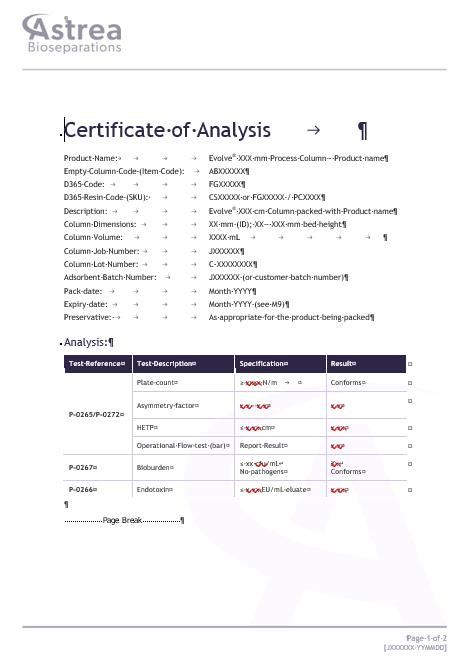
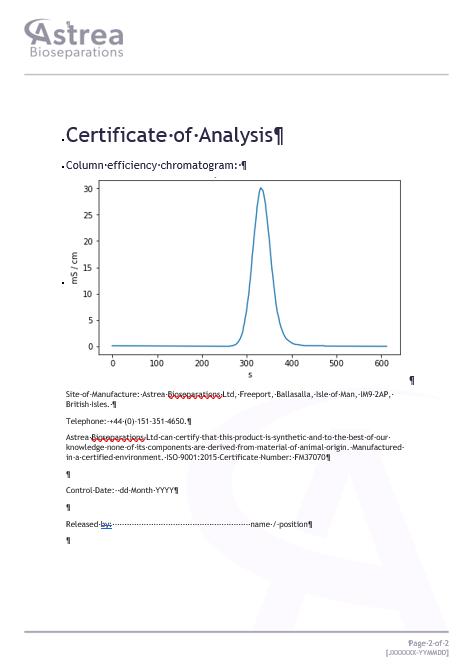
• A Certificate of Analysis which provides the test information and performance of this prepacked unit. It also provides information of the resin and date the column was packed
An example of the C ertificate of Analysis is shown below.
Example of a Certificate of Analysis
The following safety guidelines are presented:
General
The safety rules in this document are intended as a guide for the safe operation of the column.
All operation and service personnel working with the equipment should be familiar with this information prior to system start up.
Evolve® Process columns are designed and manufactured with consideration to accepted safety standards. We advise the following:
1. Ensure the maximum rated operating pressure cannot be exceeded by installing overpressure safety device(s).
2. Include over or under temperature protection devices if it is possible that temperature deviations could mean that the column operated outside the temperature range of the equipment, or where temperature deviation could present a hazard (for example, freezing of process or storage solutions).
3. Ensure that no air is introduced into the column during any column operation (for example, by using a bubble trap). Air inclusion is often detrimental to chromatography processes, but the column is categorized under Pressure Equipment Directive (EU)/The Pressure Equipment (Safety) Regulations 2016 (UK) on the basis that no gas is present.
Care should be taken when handling the columns. Columns whether empty or pre-packed with resin are heavy and require mechanical handling and lifting assistance equipment. Mechanical handling equipment or manual handling aids should be utilized to safely lift or move or position the column or its subassemblies. This will avoid potential damage to the equipment and injury to personnel.
It is essential that good practice is adopted regarding the use of appropriate slings and associated equipment, and to ensure the safety of personnel and prevent damage to equipment.
It is assumed that the user has available a hoist with hook and slings.
1. Ensure the rated capacity of the lifting equipment is sufficient to lift the column.
2. Ensure the lifting eyes are orientated in line with the slings. If they are not, there is a possibility of bending the eyes.
3. Ensure the shoulder of each lifting eye is in contact with the surface of the load (top plate) and the eye is securely fastened.
4. Use only one sling leg to each lifting eye.
5. Do not fit the sling hook directly to the lifting eye: use a shackle.
6. Ensure the slings are sufficiently long. The included angle should not be more than 60º. Slings which are too short suffer excessive tensile load, which may lead to damage to the lifting eye or the sling. As a rule, ensure the slings are longer than the horizontal distance between the lifting eyes.
These instructions are intended to supplement users’ existing lifting practices rather than replace them and should not take precedence over Company or national standards.
1. Only qualified personnel should operate this column
2. Do not operate column beyond its maximum rated pressure or outside rated temperature limits.
3. Do not dismantle the column while it remains under pressure.
4. Do not stand on any part of the column.
5. Take care when handling heavy assemblies and column components. Use lifting eyes and appropriate lifting equipment.
6. Do not operate faulty or damaged equipment. Ensure proper maintenance and service procedures have been performed.
This manual lists those substances for which the columns are compatible. If substances not listed are to be used, the user must consider their effect as the integrity and safety of the column could be compromised.
Users of these chromatography columns must ensure that the maximum operating pressure is not exceeded. It is recommended that an over-pressurization protection device such as a Pressure Relief Valve or equivalent is utilized.
On receipt, the packing crate will have the following attached:
• Instructions on how to uncrate the column
• A Certificate of Quality and serial number label. Remove and retain the Certificate of Quality
The column is heavy and correct manual handling equipment must be used to remove the item from the packing crate. Follow the instructions as shown on the external of the crate, removing the panels in the correct order.
Within the crate there are separate boxes which contain the tool kit, connection kit, and spares kit. This should be located and removed from the crate and retained.
The column is transported with its feet lowered. After removal from the crate, the column feet should be raised to allow the column to be moved into its location using the fitted wheels.
Once the column is in its final location, any plastics bagging can now be removed.
Before use, it is essential that the column is leveled. This ensures even flow and effective air removal. To facilitate this, columns are fitted with height adjustable feet, and a spirit level is provided. Adjustment of the feet also increases ground clearance.
Before attempting to adjust the height of the support foot, identify the flat portion of the thread on each column foot.
1. Position the spirit level on the top of the column. Ensure the bubble is located within the central portion.
2. Turn the spirit level 90 degrees and check the level again.
3. To level the column, use the correct spanner/wrench adjust the height of the foot until the bubble is aligned.
4. This needs to be done in two directions.
1. Identify the inlet port of the column. This is central port at the top of column.
2. Removing the sanitary caps on the inlet by unclipping the sanitary clamp. The sanitary clamps are reusable and are removed by pushing one of the rachet end perpendicular from the other ratchet end (please note the rachet ends are one directional).
3. Connect the inlet of the column to a chromatography system that has been cleaned and primed and set at a slow rate to minimize any risk of air entering the column with 25 mm tri-clamp (TC) sanitary fitting. A 4-port, 2-way valves can also be used to create this connection. Suitable TC or sanitary gaskets can be used to from a seal the 25 mm TC sanitary connection from the chromatography system. Fit and tri-clamp or sanitary clamp around the two sanitary fitting flanges and secure firmly (if re-using the click clamps, press the two rachet ends together).
The column is transported containing a storage/preservative solution (ethanol-based solution or other); please consult the relevant user guide of the packed resin/adsorbent . This will need to be flushed out prior to use. The recommended flow rate is 50% of operational flow rate (e.g., if the operation flow rate is 120 cm/hr, set the initial flush flow rate at 60cm/hr using an appropriate equilibration buffer solution). Allow at least 3 column volumes of the buffer to flow through until the eluent matches the pH and conductivity of the buffer/solution entering the column.
The following are not prescriptive; please refer to the specific resin/adsorbent user guide with respect to flow rates, pressure recommendations and other process conditions. Thorough investigation of these parameters at a small scale is recommended to identify optimal conditions and level of flexibility that can be tolerated with respect to the chromatography resin/adsorbent, buffer choice, and process conditions.
• Filter all buffers and feed stream through an appropriate filter 0.22 µm is recommended
• Do not exceed the maximum operating pressure limit for the size of Evolve® Process column regardless of whether the resin/adsorbent can withstand higher values. See table below for maximum operating pressure limits
• The inlet of the column is located at the top and central of the column, outlet is at the bottom and central of the column. Depending on column size flexible hose and/or pipe spool will be connected to the bottom outlet
The column is normally operated with a flow direction of top to bottom, however for certain operations, e.g., cleaning in place (CIP), the column may be operated in a reverse flow.
The flow rate table provides a quick reference guide to determine linear (cm/hr) to volumetric flow rates (L/min) in the respective Evolve® Process columns.
Please refer to the appropriate resin manufacture’s user guides for the recommended flow rates.
Cleaning
NOTE: Do not use abrasive cleaning materials or pads, as these may score plastic components.
The extensive solvent and chemical resistance of the column components allows the use of a wide range of clean-in-place (CIP) solutions, including:
• Sodium hydroxide (0.5–1.0 M)
• Sodium hydroxide (0.1 M) + ethanol (20%)
• Peracetic acid (300 ppm)
Care must be taken when choosing a cleaning solution for the column, refer to the chemical compatibility guide. It should be noted that exposure to concentrations of above 20% alcohol solutions (ethanol, isopropanol, etc ) should be avoided due to an incompatibility with the acrylic tube
Storage
For in-process storage, the packed column may be stored in any compatible solvent (refer to the Chemical Compatibility table). Choice of a particular solvent will usually be dictated by the chromatographic media; refer to media manufacturer’s data. Common storage solutions include 0.1–0.5 M sodium hydroxide or 0.1 M sodium hydroxide + 20% ethanol, both of which are suitable for long term (several months) storage with Evolve® Process columns.
Columns should be kept in a cool, dry, dust-free location and protected from light. Exposure of acrylic column tubes to direct sunlight for prolonged periods or sterilization with ultraviolet lights may reduce the mechanical strength of the tube.
As this column is provided as a pre - packed unit , if further advice or if performance is not as expected , it is recommended that you contact our Field Application
S pecialists :
fas@astrea-bio.com
This troubleshooting guide focuses solely on issues related to the column hardware, providing general advice on possible causes and suggested actions.
There are numerous factors that can cause excessive back pressure in chromatography, such as problems with the chromatography system (e.g., partial valve failure), issues with the media packed bed (e.g., over compression, consolidation, or bed fouling), the process fluid, or problems with the column.
Sudden decreases can result from bed collapse or cracking, flow instability, or pumping issues.
When troubleshooting sudden pressure increases or decreases, ensure that pressure readings are always taken at the same location so that accurate comparison can be made.
This troubleshooting guide focuses solely on issues related to the column hardware.
Restrictions to inlet/outlet pipework
Incorrect seal size used to connect pipework
Post column valve blockages
Bed support blockages
Loss of pressure
Possible cause
Column leakage/seal failure
Ensure correct connections and diameter of pipework used
Ensure correct pipework seals used
Ensure valves fitted to column are correct functioning
Blockages can occur due to viscous or particulates containing feed streams. If situation is not remedied by running cleaning cycles, please contact technical support
Suggested actions
Contact technical support
Care should be taken not to introduce air into the column by ensuring:
• Bubble traps are used upstream of the column
• Media and buffers are not vigorously stirred
• All connections are primed before made and all buffers are degassed
Possible cause
Suggested actions
Air inclusion after packed bed formed Flow in reverse direction until air is removed or any dry patches become wetted. Always requalify the packed bed after this procedure
Leakage from inlet/outlet of the column
Possible cause
Damage to flow tube adaptor or pipe spool from using incorrect clamp or excessive clamp force
Suggested actions
To view our Evolve® Process column user guides please visit: https://www.astreabioseparations.com/en/resources/user-guides/
For further enquiri es, please contact: sales@astrea-bio.com
Acrylic columns are ideally suited for aqueous-based applications. See the table below for detailed compatibility information.
Resistance Resistant; suitable for continuous use
Not resistant; not recommended
Limited resistance
No information available
Notes General All solvents are at 100% concentration unless noted otherwise
Concentrations: % refer to w/w
All data is referenced to room temperature (15 – 25 ºC)
Chemical
1,2-dichloroethane
Acetic acid 25%
Acetone 5%
Acetonitrile
Ammonia aqueous <25%
Ammonium Sulphate 10-40%
Benzyl alcohol 1%
Benzyl alcohol 2%
Butanol
Calcium chloride 2
Calcium hydroxide 30%
Calcium hypochlorite
Chloroacetic acid 50%
Chloroform
Chromic acid 10%
Citric acid
Copper sulphate
Dichloromethane
Dimethyl formamide
Dimethyl sulfoxide 10%
Disodium phosphate
Ethanol 20%
Ethanol 70%
Ethylene glycol (1,2-ethanediol)
Formaldehyde 50%
Glycerol (Glycerine)
Chemical compatibility cont.
Chemical
Guanidine hydrochloride 6 M
Hydrochloric acid 10%
Hydrofluoric acid
Hydrogen peroxide
Industrial methylated spirit (IMS)
Methanol 20%
Methanol 50%
Methyl chloride (Chloromethane)
Methyl ethyl ketone (MEK)
Methylene chloride
Nitric acid 10%
Nitric acid 70%
Peracetic acid 300 ppm
Phosphoric acid
Potassium hydroxide 2 M
Iso-propanol 20%
Iso-propanol 40%
n-propanol 20%
Sodium acetate
Sodium bicarbonate 20%
Sodium carbonate
Sodium chlorate
Sodium chloride 2 M
Sodium chloride 6 M
Sodium hydroxide 0.5 M
Sodium hydroxide 2 M
Sodium hypochlorite 200 ppm
Sodium nitrate
Sodium sulphate
Trichloroethene (Trichloroethylene)
Triton® X-100 surfactant
Urea 6 M
Zinc chloride