
A RESOURCE FOR PARENTS, CARERS AND TEACHERS
Proudly brought to you by NSW Police Legacy


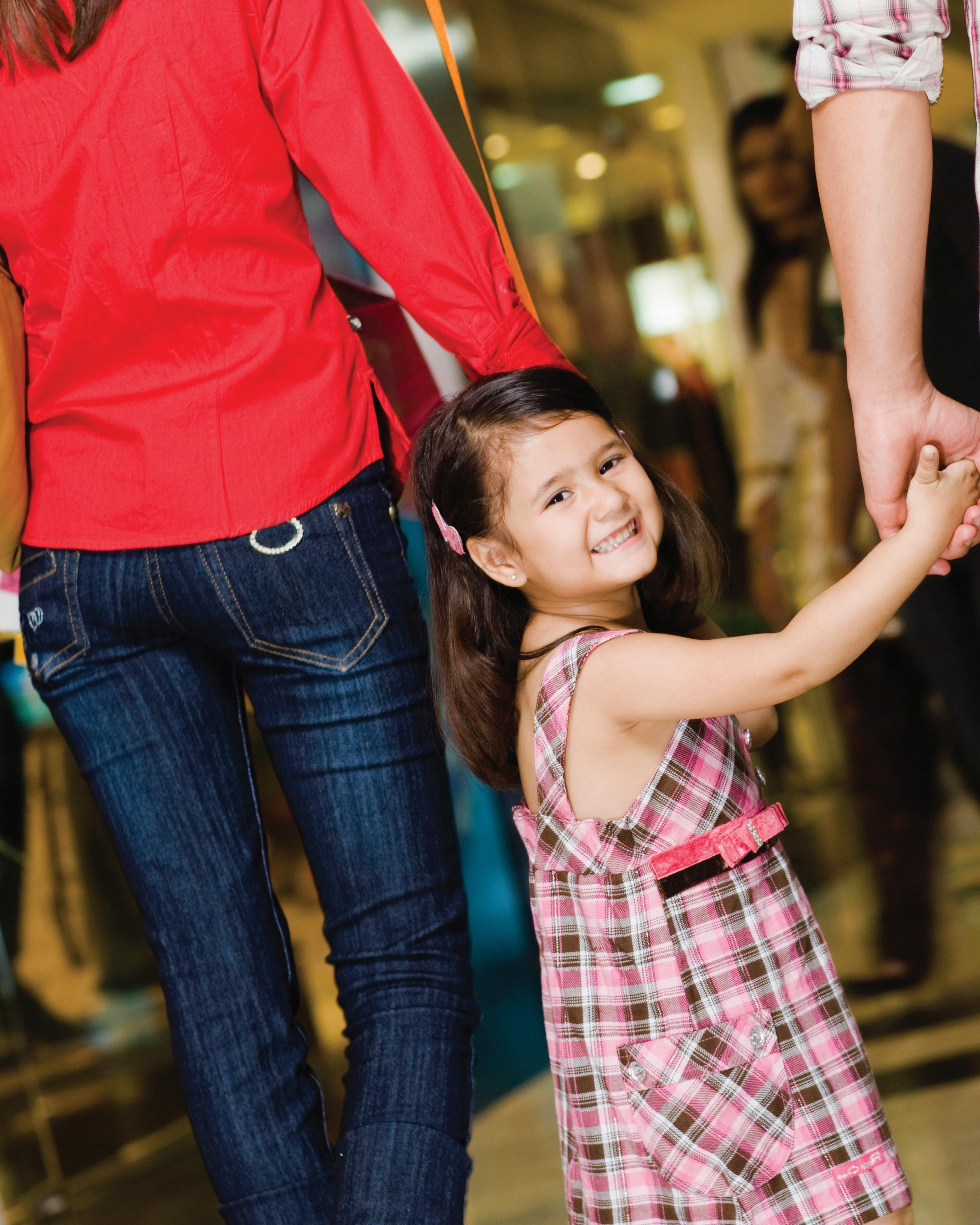
Always hold mum or dad’s hand when crossing the road.
As one of Australia’s leading insurance providers, we are committed to helping our local communities and are proud to support the good work of NSW Police Legacy.
Be safe. Because it matters.
FROM HIS EXCELLENCY GENERAL THE
As a Patron of New South Wales Police Legacy, I am honoured to be associated with the Child Safety Handbook
Making New South Wales a better and safer place for our children is a responsibility for the whole community. This handbook includes everything we need as a community to protect our most valuable and vulnerable resource – our children. From preventative measures at home to safety outdoors, from cybersafety to dealing with peer presures, this handbook is a resource for every family, school community organisation. I applaud New South Wales Police Legacy on its continuing commitment to child safety.
General The Honourable David Hurley AC DSC (Ret’d) Governor of New South Wales

There is no higher priority than protecting our children, and because of this, I am very proud to support NSW Police Legacy’s Child Safety Handbook
The greatest tool available to combat youth vulnerability is through knowledge. The Child Safety Handbook is an excellent tool designed to communicate prevention strategies to parents, families, friends and citizens.
The following pages contain important information that can save lives and I encourage you to take the time to read through them thoroughly.
I congratulate NSW Police Legacy for its invaluable work and commitment to providing such a valuable resource to help protect the youngest members of our society.

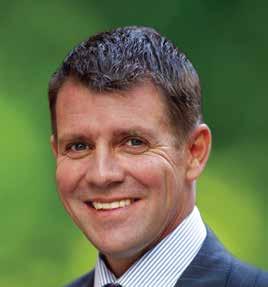
Mike Baird MP Premier of New South Wales
ThinkUKnow Australia Commonwealth Bank and agencies. It aims to raise challenges they may face
Information for parents:
ThinkUKnow Australia is a partnership between the Australian
Datacom and the Commonwealth
Australia is a partnership between the Australian Federal Police, Microsoft, Datacom and the Bank and is delivered in collaboration with NSW Police Force and other Australian law enforcement aims to raise awareness amongst parents, carers and teachers of how young peoplemightusetechnology,the may face and how to help them overcome these challenges. for parents: our website, www.thinkuknow.org.au, for information and raising children in a digital age. your child’s school to book a ThinkUKnow presentation by booking form on our website, or calling 1300 362 936 business hours. our monthly e-newsletter to stay up-to-date on the latest issues.
• You can visit our website, advice on raising children
and
Police Force and other Australian law enforcement agencies. It aims to raise awareness amongst parents, carers and teachers of how young people might use technology, the challenges they may face and how to help them overcome these challenges.
Information for parents:
• Encourage your child’s completing the booking during business hours.
ThinkUKnow Australia is a partnership between the Australian Federal Police, Microsoft, Datacom and the Commonwealth Bank and is delivered in collaboration with NSW Police Force and other Australian law enforcement agencies. It aims to raise awareness amongst parents, carers and teachers of how young peoplemightusetechnology,the challenges they may face and how to help them overcome these challenges.
Information for parents:
• You can visit our website, www.thinkuknow.org.au, for information and advice on raising children in a digital age.
• Encourage your child’s school to book a ThinkUKnow presentation by completing the booking form on our website, or calling 1300 362 936 during business hours.
• Encourage your child’s school to book a ThinkUKnow presentation by completing the booking form on our website, or calling 1300 362 936 during business hours.
• Subscribe to our monthly e-newsletter to stay up-to-date on the latest trends and issues.
How ThinkUKnow can help:
• Subscribe to our monthly e-newsletter to stay up-to-date on the latest trends and issues.
How ThinkUKnow can help:
• You can visit our website, www.thinkuknow.org.au, for information and advice on raising children in a digital age.
• Inform parents, carers and teachers on the benefits of technology.
ThinkUKnow can help: parents, carers and teachers on the benefits of technology awareness of the challenges of technology parents to help their child overcome challenges online ongoing conversations around cyber safety, security and ethics partnership approach to creating a safer online environment
• Raise awareness of the challenges of technology.
• Inform parents, carers and teachers on the benefits of technology
• Empower parents to help their child overcome challenges online.
• Raise awareness of the challenges of technology
• Empower parents to help their child overcome challenges online
• Encourage ongoing conversations around cyber safety, security and ethics.
• Encourage ongoing conversations around cyber safety, security and ethics
• Promote a partnership approach to creating a safer online environment.
• Promote a partnership approach to creating a safer online environment


• Subscribe to our monthly
How ThinkUKnow can
• Inform parents, carers
• Raise awareness of the
• Empower parents to help
• Encourage ongoing conversations
• Promote a partnership


FOREWORD BY CHAIRPERSON
NSW Police Legacy is honoured to provide the Child Safety Handbook to parents of primary school children throughout the State. This free handbook has attained an outstanding reputation as an invaluable resource guide for parents to help educate their children about key health and safety issues confronting our children today.
NSW Police Legacy, in conjunction with Associated Media Group of Sydney, has been publishing this handbook for over 5 years and it gives me great pleasure that we are able to continue to provide this outstanding and current reference guide.
I would especially like to extend our gratitude to the organisations whose advertising in this book has made it possible to produce the Child Safety Handbook as well as enabling NSW Police Legacy to continue to support the bereaved families of deceased Police Officers across New South Wales.
Paul Bousfield Chairperson NSW Police Legacy



POLICE
Youth and vulnerability go hand in hand. Our children’s innocence, inexperience and uninhibited sense of adventure, the very qualities that we find most endearing, can sometimes combine to put them in harm’s way.
As parents, family and concerned citizens it is this knowledge that harm can come to children that should give us cause to examine what we can best do to help keep them safe.
To NSW Police Legacy’s great credit, its Child Safety Handbook responds in a practical way to the myriad dangers facing children, whether they be at home, school or out and about. Tips and information are provided for parents and ideas for children.
All importantly, the Handbook’s emphasis is on prevention. Our children are precious and all of us who live and work with them will find information in these pages that we can use to keep them out of trouble and safe.
This edition of the Child Safety Handbook, continues NSW Police Legacy’s tradition of community support. Its work, tireless and worthwhile, has the support of all police officers. Well done and thank you to NSW Policy Legacy and to the businesses that have supported this publication.

Andrew Scipione APM NSW Commissioner of Police
The NSW Ombudsman handles complaints about the provision of community services for children, reviews the complaint-handling systems of service providers, and oversees agencies’ investigation into allegations of a child protection nature against employees.
www.ombo.nsw.gov.au
is committed to improving transport safety in NSW and supports Police Legacy’s Child Safety Handbook
You can’t always be with your kids when they’re online, but Google SafeSearch can.
There are some things on the internet no child should see. So it’s good to know that SafeSearch allows you content from your search so your family can explore the wonders of the internet more safely. And because SafeSearch lock ensures it can only be turned off with a password. For more ways on how to stay safer online go to google.com.au/safetycentre
You
can’t always be with your kids when they’re online, but Google SafeSearch can.
There are some things on the internet no child should see. So it’s good to know that SafeSearch allows you to filter adult content from your search so your family can explore the wonders of the internet more safely. And because kids will be kids, SafeSearch lock ensures it can only be turned off with a password. For more ways on how to stay safer online go to google.com.au/safetycentre
SAETY AT SCHOOL 10 - 11
Bullying
What is bullying?
What can I do if my child is being bullied?
How do I know if my child is being bullied?
What if my child has witnessed bullying?
What if I think my child is displaying bullying behaviour?
Help your child be resilient
Beyond bullying
What will my school have in place to deal with bullying?
SAFETY 14 - 15
What is child abuse?
Neglect
Sexual abuse
Physical abuse
Emotional abuse or psychological harm
Possible signs of abuse
How do I know if a child or young person is being abused?
Possible signs of neglect
Signs in children or young people
Possible signs of physical abuse
Signs in children
Possible signs of sexual abuse
Signs in children or young people
Possible signs of emotional abuse
Signs in children
Reporting suspected abuse or neglect
What will Community Services do?
SAFETY AT HOME 16 - 31
Home Alone
Answering the phone
Answering the door
Parent’s guide to online safety
Cyberbullying
Trolling
Too much time online
Inappropriate, offensive & illegal content
Safeguards
Help and resources
Window Safety Checklist
Button Battery Safety
Toppling Furniture
Blind and Curtain Cord Safety
Basic First Aid
Allergic Reactions
Asthma Attacks
Bleeding
Poisoning
Sprains & Strains
Cuts & Bruises
First aid for cuts
Burns & Scalds
First aid for burns and scalds
DRSABCD action plan
Choking
Safe Play in Backyards
Surfacing
Swings
Trampolines
Cubby Houses
Water Safety
Safe backyard play
Safety with dogs
Safe in the sun - a reminder
Pool safety
FIRE, FLOOD & STORM SAFETY 32 - 41
Fire Safety
Smoke Alarms
Cooking Fires
What to do in case of a fire
Fire Safety Equipment
Barbeque Safety
LPG & Cylinder Safety
Plan a Safe Escape
Bush Fire Safety
Prepare / Act / Survive
Storm, Flood and Tsunami Safety
Stormsafe
Floodsafe
Your emergency checklist
Tsunamisafe
STREET SMART 43 - 55
Keeping safe in crowds
Dealing with strangers
Ferry Safety
Road Safety
Keeping your children safe
Pedestrian Safety
Skateboards and rollerblades
Cycling Safety
Safety in Cars
Basic Safety
What you must not do
General safety in the car
Being seen clearly
Driver Distraction
Driveway safety
Kids in Cars – WARNING
Flying objects and cargo barriers
Other safety tips
School Bus Safety
Train Safety
Safety Hints
Rail Crossing Safety
Dirtbikes, minibikes and mini quad bikes
HEALTH AND SAFETY 56 - 63
Children’s Mental Health and Wellbeing
What is children’s mental health?
What are the warning signs of mental health problems in children?
When to seek help?
Mental illness and parents and carers
What kinds of mental health difficulties do children experience?
Dental health
Brushing teeth: getting started
Brushing teeth: steps
Healthy eating forchildren
Teach your child healthy habits for a healthy life
What are the dietary Guidelines?
Foods to limit: discretionary choices
Encouraging healthy habits
Serve sizes
Food allergy or intolerance?
Signs & Symptoms
Anaphylaxis Food
Diagnosis
Management & Treatment
Common Food Allergy signs and symptoms
Immunisation
The facts
Why, when and where to vaccinate
Side effects
OUTDOOR SAFETY 65 - 71
Playground safety
Safety on trampolines
Local council playgrounds
Kids on farms
Play safety
Water safety
Vehicle safety
Safety around animals
Other farm hazards
Farm Water Safety
Water Awareness
Keep Watch @ The Farm
Beach Safety
Sun Safety
Suncreen
What is SPF?
Boating safety
DRUG AWARENESS
Talking to your kids aged 15-17
72 - 73
Binge drinking – putting things in perspective
Talking to your kids aged 9-14
Top 10 tips for parents
Produced, published and distributed on behalf of NSW Police Legacy by: Associated Media Group Pty Ltd 33-35 Atchison Street
St Leonards NSW 2065 T: 02 8416 5294 www.amgroup.net.au
NSW Police Force Fire & Rescue NSW
NSW Education & Communities eSafety Commissioner SES NSW
To support future editions of this handbook T: 02 8416 5294 E: cshb@amgroup.net.au
Copyright © NSW Police Legacy Ltd - Dec 2013
2016 – 1st edition
DISCLAIMER:
TRIPLE ZERO (000)
For emergencies or life threatening situations
NAME PHONE NUMBER WEBSITE
A
Alcohol & Drug Information & Counselling Service (24 hours)
Alcoholics Anonymous Australia
POLICE ASSISTANCE LINE (131 444)
For non emergencies
K
1800 422 599 yourroom.com.au/
1300 222 222 www.aa.org.au/
Anaphylaxis Australia 1300 728 000 www.allergyfacts.org.au
Australian Childhood Foundation (counselling for children affected by abuse)
Australian Cybercrime Online Reporting Network (ACORN)
Australian Drug Foundation (information)
1800 176 453 www.childhood.org.au
1800 1234 00 www.acorn.gov.au
1300 85 85 84 www.druginfo.adf.org.au
B Beyond Blue 1300 22 4636 www.beyondblue.org.au
C
Child Protection Helpline 132 111 www.community.nsw.gov.au
Crime Stoppers Hotline 1300 333 000 nsw.crimestoppers.com.au
D
Dental Hospital Service (Emergency Only) (02) 9293 3333 www.health.nsw.gov.auoralhealth
Department of Community Services (DOCS) Helpline
132 111 (24 hrs) www.community.nsw.gov.au
Domestic Violence Line 1800 65 64 63 www.domesticviolence.nsw. gov.au
Domestic Violence Advocacy Service 1800-810-784 www.1800respect.org.au
F Family Drug Help
1300 660 068 www.familydrughelp.com.au
Family Drug Support Australia 1300 368 186 (24/7) www.fds.org.au
Family Relationship Advice Line 1800 050 321 www.familyrelationships.gov.au
Fire & Rescue NSW 000 www.fire.nsw.gov.au
G
Gender Centre (services for people with gender issues) (02) 9569 2366 www.gendercentre.org.au
H Health Helpline (24/7) 1800 022 222
I I can Quit 13 7848 (13 QUIT) www.icanquit.com.au
Indigenous Women's Legal Contact Line (Domestic Violence) 1800 639 784 www.wlsnsw.org.au
J Juvenile Fire Awareness and Intervention Program
1800 600 700. www.fire.nsw.gov.au
CRIME STOPPERS (1800 333 000)
To provide crime information anonymously
Kids Help Line 1800 55 1800 www.kidshelpline.com.au
L
Life Line 13 11 14 (24 hours) www.lifeline.org.au
M
Marine Rescue NSW 02 9450 2468 or call 000 marinerescuensw.com.au
Mensline Australia 1300 789 978 (24/7) www.mensline.org.au
Mental Health Foundation 1800 011 511 (24/7)
Mission Australia Help Line 13 11 14 www.missionaustralia.com.au
N
National Security Hotline 1800 123 400 www.nationalsecurity.gov.au
NSW Rural Fire 1800 679 737 www.rfs.nsw.gov.au
O
Office of the e-Safety Commissioner 1800 880 176 esafety.gov.au
P
Parent Line 1300 1300 52 www.parentline.org.au
Poisons Information Centre 131 126 (24 hours) www.poisonsinfo.nsw.gov.au
Q
Quitline – for counselling 13 7848 (13 QUIT) quitnow.gov.au
R
Rape Crisis Centre 1800 424 017 www.nswrapecrisis.com.au
Rape & Domestic Violence Counselling Line 1800 737 732 / 1800 RESPECT www.1800respect.org.au
Relationships Australia 1300 364 277 www.relationships.com.au
S
Salvation Army Care Line 13 72 58 / 13 SALVOS salvos.org.au
State Emergency Service (SES) 132 500 www.ses.nsw.gov.au
Sexual Assault Crisis Line 1800 806 292 www.sacl.com.au
Suicide Call Back Service 1300 659 467 (24/7) www.suicidecallbackservice. org.au
Sydney Childrens Hospital Randwick (02) 9382 1111 www.schn.health.nsw.gov.au T
The Childrens Hospital Westmead (02) 9845 0000 www.schn.health.nsw.gov.au
Translating and Interpreting Service 13 14 50 (interpreter over the telephone) www.immi.gov.au/tis
W
Womens Legal Service NSW (Domestic Violence) 1800 801 501 www.wlsnsw.org.au
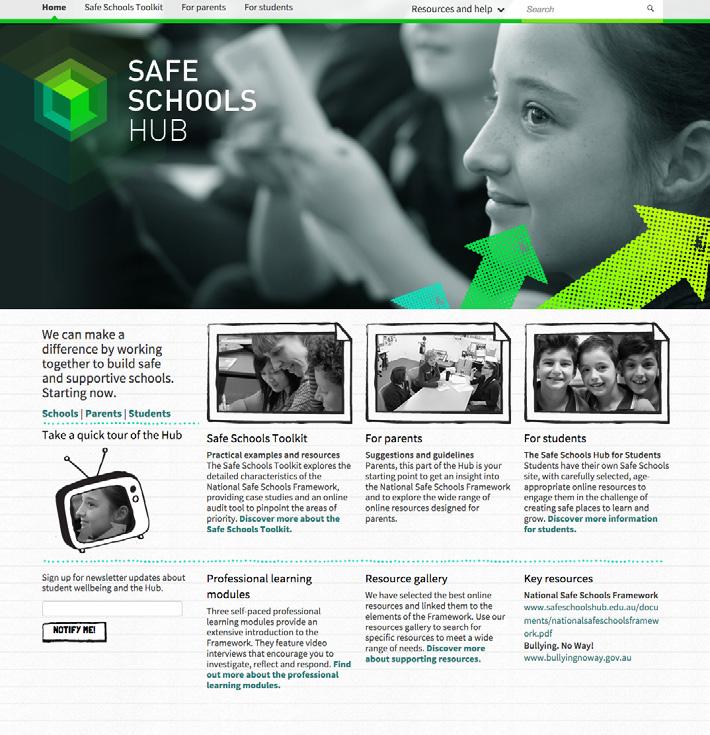
The National Safe Schools Framework provides Australian schools with a vision and a set of guiding principles that assist school communities to develop positive and practical student safety and wellbeing policies.
The National Safe Schools Framework (the Framework) is a key resource now available at the Safe Schools Hub. The Framework provides school communities with a vision, a set of guiding principles and the practical tools and resources that will help build a positive school culture.
Building on the original 2003 Framework, a revised Framework was endorsed by all ministers for education in December 2010. The Australian Government collaborates with state and territory governments to support the Framework as part of a national approach to make sure our school communities are safe and supportive.
To support schools to implement the Framework the Australian Government has worked with Education Services Australia to deliver the Safe Schools Hub. The Hub is an online one-stop shop that provides school communities including teachers, school leaders, students, parents and specialist professionals with a range of safe
school strategies and resources that are underpinned by the Framework.
The Framework is based on the following overarching vision:
All Australian schools are safe, supportive and respectful teaching and learning communities that promote student wellbeing.
The vision is supported by guiding principles for safe, supportive and respectful school communities. These guiding principles emphasise the importance of student safety and wellbeing for effective learning in all school settings.
Australian schools:
• affirm the rights of all members of the school community to feel safe and be safe at school
• acknowledge that being safe and supported at school is essential for student wellbeing and effective learning
• accept responsibility for developing and sustaining safe and supportive learning and teaching communities that also fulfill the school’s child
protection responsibilities
• encourage the active participation of all school community members in developing and maintaining a safe school community where diversity is valued
• actively support young people to develop understanding and skills to keep themselves and others safe commit to developing a safe school community through a whole-school and evidence-based approach
www.safeschoolshub.edu.au www.education.gov.au

Your child has the right to feel welcome and safe at school. We’re working hard to make sure our school communities are nurturing and supportive places where all students can learn and develop into caring, resilient and confident adults.
It may seem obvious what bullying is, but there is a difference between students ‘not getting on’ and bullying each other. Learning how to resolve conflict and negotiate with people who have
different personalities and opinions are important life skills that parents and schools need to help students develop.
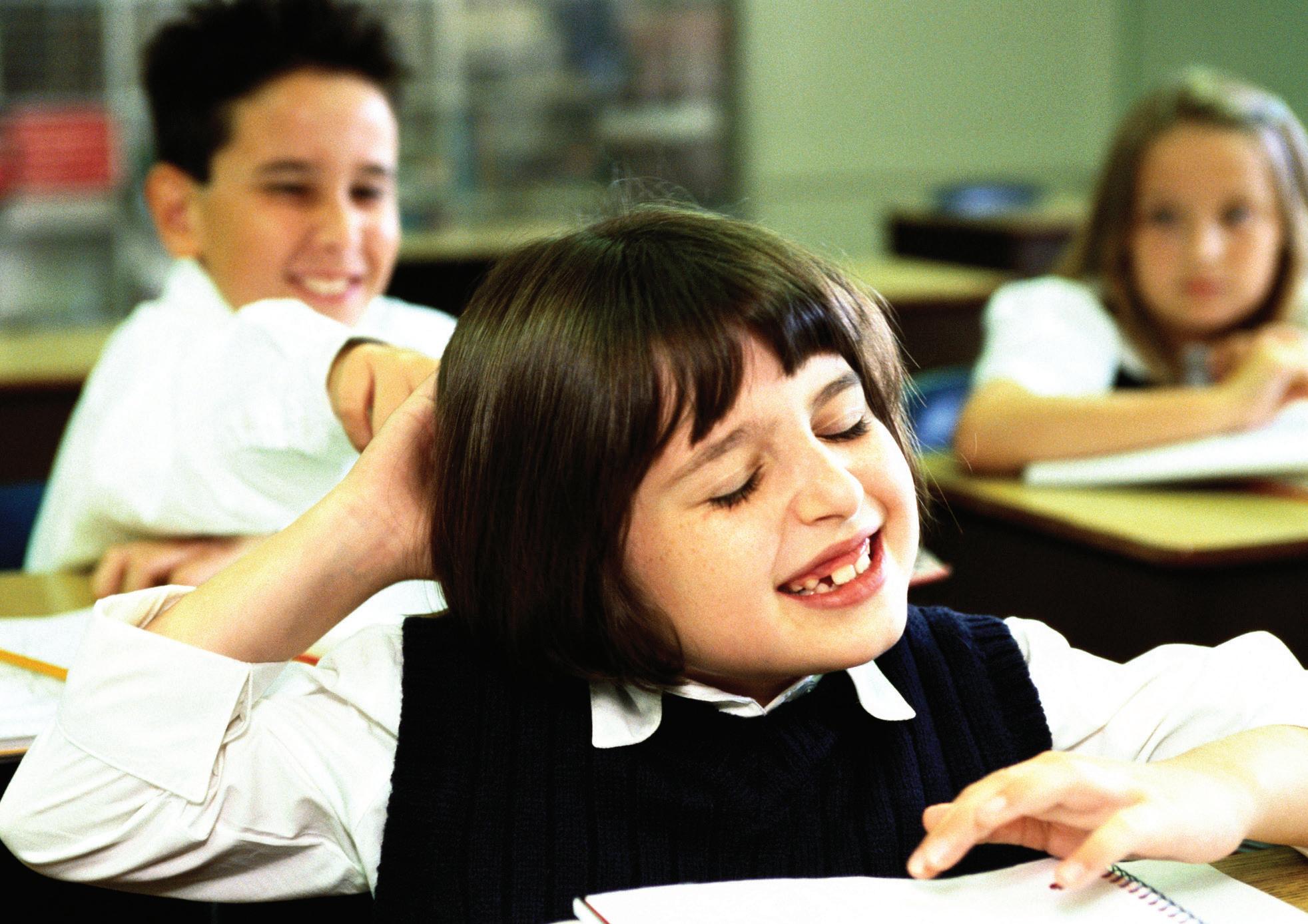
Bullying is repeated verbal, physical, social or psychological behaviour that is harmful and involves the misuse of power by an individual or group towards one or more persons. Cyberbullying refers to bullying through information and communication technologies.
Bullying can involve humiliation, domination, intimidation, victimisation and all forms of harassment including that based on sex, race,
disability, homosexuality or transgender. Bullying of any form or for any reason can have long term effects on those involved including bystanders.
Bullying can come in many forms for example:
• Being hit, tripped, kicked, pinched etc.
• Being called names, teased, put down etc.
• Being threatened, stalked, gestures etc.
• Being ignored, having rumours spread about you, excluding someone etc.
• Insulting someone in chat
rooms, sending cruel or threatening emails/text messages; using the web, chat rooms or mobile phones to spread rumours or threaten someone or information about someone etc.
All forms of bullying between students are taken seriously by NSW public schools. However, any school situation that is causing your child concern, whether or not it fits the definition of bullying, should be reported to the school. Although the term “bullying” has a specific meaning and a school’s Anti-bullying Plan sets out the processes for preventing and responding to student bullying, schools also have a range of policies and practices, including welfare and discipline policies that apply to student behaviour generally.
What can I do if my child is being bullied?
If your child is being bullied it is not always easy for you as a parent to know when and how to support.
The first step is to stay calm and try and get all the facts. While it may be a case of bullying, it might also simply be the result of poor communication by one or both
Some of the signs that a child is bullied may include:
• unwillingness or refusal to go to school
• not doing well at school
• becoming withdrawn
• being tearful
• loss of confidence
• sleeping problems
• refusing to talk about what’s wrong
If your child seems depressed, unusually upset or physically injured in some way and is unwilling to discuss it with you, consider talking to your school counsellor or your family doctor. Your child may benefit from specialised assistance.
children. Kids often speak before they think and misunderstandings happen easily, especially online. By taking the time to understand the situation and remaining calm, you are helping your child.
Sometimes, as a first step, your child may just want some advice about things they could do the try to manage the situation. At other times it is important that action is taken immediately. It is important to:
• Listen calmly to your child.
• Show concern and support.
• Let your child know that telling you about the bullying was the right thing to do.
• Find out where and when it has been happening, who has been involved and if anyone else has seen it.
• Discuss the things your child has already done to try to solve the problem and suggest other things your child might try.
• Report the situation to your child’s school.
• Work with your child’s school to solve the problem.
• Encourage your child to report any further bullying incidents to a teacher they trust at the school.
• Let your child know how much you disapprove of bullying and why.
Technology has increased the ways bullying can happen. Mobile phones, emails, websites, chat rooms, social networking sites or instant messaging can all be used to bully others. If you believe your child is being cyberbullied, don’t ban them from the technology. Technology has an increasingly important role for young people both for their social development and in their learning. Discourage them from rereading the upsetting messages or comments because it compounds the hurt and throws the whole incident out of perspective. Do try to find ways for them to enjoy themselves away from the computer, doing the things that make them feel good about themselves.
Children often worry about being labelled “a dobber” and beg parents not to tell the school. However, bullying is a serious matter which is unlikely to be resolved if it’s ignored. Schools are able to manage the situation and provide effective support when they have all the facts. As a parent or caregiver, you have an important part to play in helping your child, and the school deal with bullying.
Don’t approach the other students involved. No parent will appreciate you reprimanding their child and it will always make the situation much worse than if you remain calm and go through the right channels by contacting the school.
Your school’s Anti-bullying Plan will outline how bullying can be reported at your school, but you can always make an appointment with your school principal.
You may like to take your partner or a friend with you to the meeting, and that’s normally fine too. Just let the principal know. If you need an interpreter, the school can arrange that. Be sure to tell them when you make the appointment.
Tell the school. Bullying also hurts other students as well as the student who has experienced the bullying. Bystanders who observe bullying or are pressured to join in are also likely to be affected and will need support. It’s important for all children to understand that bullying isn’t okay, even if they are not directly involved. If your child has witnessed bullying you can help them, and help to keep other children safe by encouraging them to ask a teacher for help. This is very important if anyone’s safety is in jeopardy. Students should always think about their own safety and the safety of other people when deciding what to do.
You could also encourage your

When you take out life insurance for yourself, TAL provides critical illness cover for your children at no additional cost.
Discover more about Australia’s life insurance specialist at tal.com.au
To find out more about the work of ACYP please visit www.acyp.nsw.gov.au
child to do any one or a combination of the following depending on the circumstances:
• Tell the person doing the bullying that what they are doing is bullying.
• Tell the person doing the bullying to stop.
• Refuse to join in with the bullying.
• Tell other bystanders not to encourage the person doing the bullying.
• Support the person who is being bullied.
• Encourage the person being bullied to tell their parents or a teacher.
What if I think my child is displaying bullying behaviour?
Discovering that your child has been displaying bullying behaviour can come as a huge shock for parents. Your first reaction may be defensive. However, children who engage in bullying behaviour also need support to learn how to behave appropriately. Stay calm and discuss the issue with the principal of your child’s school. Work together with the school to make it clear to your child that bullying isn’t okay and to develop support strategies for your child. It may also be useful to make an appointment with the school counsellor.
your child be resilient
Kids can sometimes focus on what’s going wrong in their lives, and be less aware of the other friends, hobbies, sports and activities they enjoy. A few hours with friends can remind your child that there are good people around who care for and support them.
Sometimes bullying or cyberbullying can involve criminal behaviour such as violence, threats, intimidation or inciting violence. If you or your child has received threats of physical or sexual violence or has been physically attacked you should immediately consider contacting your local police as well as
your school for assistance. The school may report a matter to the police as well.
What will my school have in place to deal with bullying? Parents and schools work together to help students develop good citizenship and the communication and relationship skills that help prevent bullying behaviour. At school your child will be learning about their rights and responsibilities and will be supported to develop the skills to treat others with respect, communicate their ideas and feelings appropriately and deal with conflict.
The NSW Department of Education and Training requires all NSW government schools to have an Anti-bullying Plan that complies with the Bullying: Preventing & Responding to Student Bullying in Schools Policy. You can ask for a copy of your school’s Plan from your school. Many schools also make their Anti-bullying Plan available on their websites.
The school’s Anti-bullying Plan will explain what is considered to be bullying behaviour and how that behaviour is viewed by the school. It will outline what responsibilities schools, students and parents have to prevent and respond to bullying behaviour, how bullying can be reported and what will happen when it is.
Your school will take action when it has been reported that a student has been bullied by another student at school or during a school activity that is held away from school.
The school can also take action in response to bullying behaviour between students outside of school hours or off the school premises where there is a clear and close connection between the school and the conduct of the students.
The response of the school to a reported incident of bullying or cyberbullying will depend on the details of the particular incident and may range from support to disciplinary action.
Remember the school will need time to investigate and to talk to teachers and other students.
All NSW public schools have access to school counsellors who can help children deal with problems and become more resilient.
School counsellors are experienced teachers who have a degree in psychology and graduate qualifications in school counselling. They can help students who are feeling sad or anxious, or are having difficulties in their relationships with other students.
School counsellors may work across more than one school, so you will need to speak with the principal to organise an appointment for your child.
Parent Line is a telephone counselling, information and referral service for parents of children ages 0 to 18, who live in New South Wales. Parents, grandparents and carers anywhere in the state can call Parent Line on 1300 1300 52 for no more than the cost of a local call. W: www.parentline.org.au
KIDS HELPLINE
Tel 1800 55 1800 - 24 hours a day, 7 days a week for advice on child health and parenting. W: www.kidshelpline.com.au
All children have a right to live free of violence and abuse. Unfortunately, child abuse and neglect continues to be an issue throughout Australia.
Child abuse and neglect has debilitating consequences not only for children, but for their families and communities.
Child abuse and neglect can happen to any child or young person in any family. It hurts and has lasting, damaging effects. Children who experience abuse and neglect may become unhappy and angry adults with low self-esteem. Some children even die because of the abuse.
Sometimes children are hurt or are at risk of harm because:
• their families do not have adequate support
• their carers are experiencing a lot of stress from unemployment, illness, isolation or loneliness
• their parent(s) have not experienced good parenting themselves.
There are different forms of child abuse.
These include neglect and physical, emotional and sexual abuse. Neglect is the continued failure by a parent or caregiver to provide a child with the basic things needed for his or her proper growth and development, such as food, clothing, shelter, medical and dental care and adequate supervision.
Physical abuse is a nonaccidental injury or pattern of injuries to a child caused by a parent, caregiver or any other person. It includes
injuries caused by excessive discipline, severe beating or shaking, bruising, lacerations or welts, burns, fractures or dislocations, attempted strangulation and female genital mutilation. Sometimes these injuries are fatal.
Emotional abuse is behaviour by a parent or caregiver that destroys a child’s confidence resulting in significant emotional disturbance or trauma. This can include a range of behaviours such as excessive criticism, withholding affection, exposure to domestic violence, intimidation or threatening behaviour.
Sexual abuse is when an adult or someone who is bigger or older involves a child in a sexual activity by using their power over a child or taking advantage of a child’s trust. Often children are bribed or threatened physically and psychologically to make them participate in the activity.
Children and young people have a right to be safe in their own homes and in the community. Protecting children and young people from harm is everyone’s business. Children and young people will only be protected from abuse and neglect if responsible adults take action on their behalf.
Reporting your concerns about a child or young person’s safety or well being is the first step in preventing or stopping the abuse and protecting children from further harm. It also gives the NSW Department of Community Services (DoCS) the chance to help families in situations where a child or young person may be at risk.
Signs in children
• facial, head and neck bruising
• lacerations and welts from excessive discipline
• explanation for an injury offered by the child is not consistent with the injury
• other bruising and marks which may show the shape of the object that caused it eg. belt buckle, hand print
• bite marks and scratches
• ruptured internal organs without a history of major trauma
• fractured bones, especially in children under three years old
• burns and scalds
• head injuries where the child may show signs of drowsiness, vomiting, fits or retinal haemorrhages, suggesting the child may have been shaken
• multiple injuries or bruises
• swallowing poisonous substances, alcohol or other harmful drugs
There are common physical and behavioural signs for each type of child abuse and neglect
The presence of one of these signs does not necessarily mean neglect or abuse.
When considering if a child has been neglected or abused, it is important to keep in mind the life circumstances of that child, such as:
• social or geographic isolation of the child or family, including lack of access to extended family
• abuse or neglect of a sibling
• family history of violence, including domestic violence
• physical or mental health issues for the parent or caregiver affecting their ability to care for the child
• the parent or caregiver’s abuse of alcohol or other drugs affecting their ability to care for the child.
If you recognise signs of abuse or neglect in a child you know, even your own child, contact DoCS’ Helpline immediately on 132 111.
POSSIBLE
Signs in children
• poor hygiene ie. child consistently unwashed
• scavenging or stealing food
• extended stays at school, public places or other homes
• extreme longing for adult affection
• low weight for age
• untreated physical problems eg. untreated sores, nappy rash or urine scalds
• rocking, sucking or headbanging
• anxiety about being abandoned
• failure to thrive and develop
• focus on basic survival
• poor or pale complexion and poor hair texture.
POSSIBLE SIGNS OF PHYSICAL ABUSE
Signs in children
• facial, head and neck bruising
• lacerations and welts from excessive discipline
• explanation for an injury offered by the child is not consistent with the injury
• other bruising and marks which may show the shape of the object that caused it eg. belt buckle, hand print
• bite marks and scratches
• ruptured internal organs without a history of major trauma
• fractured bones, especially in children under three years old
• burns and scalds
• head injuries where the child may show signs of drowsiness, vomiting, fits or retinal haemorrhages, suggesting the child may have been shaken
• multiple injuries or bruises
• swallowing poisonous substances, alcohol or other harmful drugs
for daily functioning
• extreme attention-seeking behaviour
• other behavioural disorders eg. bullying, disruptiveness, aggressiveness
• exposure to domestic violence.
Signs in children
• describing sexual acts eg. ‘______ hurts my wee-wee’
• telling you about it, directly or indirectly
• self-destructive behaviour eg. drug dependency, suicide attempts, self-mutilation
• going to bed fully clothed
• anorexia or over-eating
• bruising or bleeding in the genital area
• sexually transmitted infections
• bruising to breasts, buttocks, lower abdomen or thighs
• adolescent pregnancy
• contact with a known or suspected perpetrator of a sexual assault
• unexplained accumulation of money and gifts
• persistently running away from home
• regressive behaviour eg. sudden return to bedwetting or soiling
• sexual behaviour inappropriate
If you think that a child or young person is being neglected or physically, sexually or emotionally abused, you should immediately report it to DoCS.
POSSIBLE SIGNS OF EMOTIONAL
All types of abuse harm children psychologically, but the term ‘emotional abuse’ is behaviour that destroys a child’s confidence.
Signs in children
• feelings of worthlessness about life and themselves
• inability to value others
• lack of trust in people
• lack of people skills necessary
Possible signs of child abuse and neglect are outlined above.7
You can make a report by phoning DoCS’ Helpline on 132 111 for the cost of a local call, 24 hours a day, 7 days a week (TTY 02 9633 7698).
Your report will be totally confidential – we won’t tell anyone who reported the abuse or neglect to us and you don’t have to tell us your name if you don’t want to.
There is no particular age at which children can be safely left at home alone. As parents, we decide that based on our child’s maturity and our own individual circumstances. Start with giving them short periods of time alone at home and gradually increase the duration, ensuring your child knows how to contact you or another responsible nearby adult in case of an emergency. Here’s how you can help prepare and keep them safe:
Tips for parents:
• Installing an answering machine enables your children to hear who is calling and then decide to answer or not.
• If you or your child receives obscene or threatening phone calls, hang up immediately, notify your local police and the phone company.
Tips for children:
• Always say to the person calling “My parents can’t come to the phone. Can I take a message?”
• Never say your parents aren’t home to anyone who calls, comes to the door, or you chat with online.
• Never tell your address to the person calling or contacting you online.
• Never answer the phone by saying your first name or last name.
• If the person calling asks for you by name, say “Who would you like to speak to?”.
• If the person calling asks you “What number is this?” say to them “What number were you trying to call?”.
• You don’t have to speak to anyone or tell them anything.
• If someone says something rude or threatening to you, hang up immediately and contact your parents.
Tips for parents:
• Install a lockable screen door and a peephole in the front door.
• If it is night, leave the outside light on.
• Ensure all emergency numbers, including a reliable relative’s or friend’s, are listed by the phone.
• Practise ‘pretend-dialing’ emergency numbers from your list, with your child. Rehearse what they should say.
Tips for children:
• Keep the screen door locked.
• Always ask “Who is it?” before answering the door.
• Always look through the peephole before answering the door – if it’s a stranger, or someone you don’t trust, you can pretend you are not at home.
• If you do not know the person or if it is a person you do not trust, do not let them in. If they do not leave, call the police and call a neighbour or a trusted nearby adult.
• Make sure you know where all the emergency numbers are kept near the phone and practise pretending to dial them.
Call the police immediately. Telephone your parents, your neighbour or another adult you trust.
With the aim to help guide children and young people toward safe, enjoyable experiences online, the Office of the Children’s eSafety Commissioner (the Office) hopes to encourage behavioural change—where Australian children and young people act responsibly online—just as they would offline. To achieve this, we hope to both educate and help prevent harmful online behaviour from occurring in the first place. As parents, you know your child better than anyone, and have the best opportunity to help educate them so they can explore, safely.
Cyberbullying is the use of technology to bully a person or group with the intent to hurt them socially, psychologically or even physically.
Cyberbullying behaviour may include:
• abusive texts and emails
• hurtful messages, images or videos
• imitating others online
• excluding others online
• humiliating others online
• nasty online gossip and chat.
By reporting it, talking about it and supporting each other, we can stop it.
For many children and teenagers, their online life is an important part of their social identity. They can’t just ‘switch it off’. Many young people do not report cyberbullying to their parents as they fear that they might lose access to their devices and the internet.
Young people may also be concerned that parents’ actions will make cyberbullying issues worse, so it is important for you to remain calm and supportive.
Trolling is when a user intentionally causes distress by posting inflammatory comments online.
• Trolling differs from cyberbullying in that trolls aim to gain attention and power through disruption of conversation by encouraging a defensive reaction from those they attack. Cyberbullying usually focus-



parents checkthe check KEEP KIDS SAFE #
es less on the reaction of the victim, and more on the feelings and authority of the bully. Cyberbullying is usually repeated behaviour, while trolling can be one-off.
As a parent, you can help your child and encourage them to take control of the issue.
Talk to them about cyberbullying before it happens. Together you should work out strategies to address any potential issues and reassure your child that you will be there to support them.
• Report the cyberbullying material to the social media service where it happened.
Social media services should remove cyberbullying material that has been reported and is in breach of their terms and conditions. Most social media services have a reporting area on their website. The Office website also provides information about how to report material on various services.
• Collect details of the cyberbullying material. You might need to do this before you report it to the site. A simple way to collect this information is by taking a photo or screenshot or copying the URL.
If you submit a complaint to the Office about cyberbullying material, you need to provide this information.
Report cyberbullying to the Office of the Children’s eSafety Commissioner.
• Block the person. We recommend that you help your child block or unfriend the person upsetting them, so they cannot continue to upset them whilethe material is being removed.
• Remember that if your child has been involved in cyberbullying, and seems distressed or shows changes in behaviour or mood, it may be advisable to seek professional support through Kids Helpline.
Kids Helpline is a free and confidential online and phone coun-
selling service for young people, available 24 hours a day, 7 days a week on 1800 55 1800.
esafety.gov.au/reportcyberbullying
To many parents it seems as though children and young people are constantly online. Often they seem to be engaged in more than one task at a time; for example, downloading and listening to music while studying and chatting with friends or sending messages on their mobile phones.
The number of hours that children and young people spend online can vary significantly. There is no guideline for the ‘right’ amount of time for children to spend online, however, if their online activity appears to impact negatively on their behaviour or wellbeing, or that of the family, it may be time to discuss expectations and establish time limits. It’s important to remember that some of the time your children spend online may be related to their education.
• The longer you wait to address the issue, the more difficult it can be to overcome. So if you see an emerging problem arising from excessive use, act on it right away.
• Talk to your child about the concerns you have and monitor what games, apps and devices are bought or used by your child.
• You may like to install a program on the device your child is using which can be adjusted to limit the amount of time an internet connection will be available on that device.
• Consider implementing family agreements about the amount of time your children can spend online.
A similar approach can be used
to limit access to devices.
• If your child seems particularly anxious or irritable, or you notice them seeming isolated from friends or other activities, there may be an underlying mental health issue. Talk to your child’s school or your GP if your concerns extend beyond screen time.
esafety.gov.au/timeonline
Inappropriate,offensive or illegal content may include topics, images or other information that are prohibited in Australia or could be damagingto young people online.
Children and young people may not deliberately seek out inappropriate content. They may inadvertently access content while undertaking online searches, they may seek it out, or be referred to it by others.
Young people with smartphones might also be able to discover content that may be blocked by home and school internet filters.
Offensive or illegal content may include topics, images or other information that are prohibited in Australia or could be damaging to young people online. Offensive or illegal content can expose children to concepts that they are not ready to manage and that may breach social and cultural norms. Some content can be distressing for children.
They may not report it to parents or teachers as they may be ashamed of what they have seen, particularly if they sought it out.
This is content that may:
• Include footage of real or simulated violence, criminal activity or accidents, promote extreme political or religious views or be sexually explicit.
This can include illegal images of child sexual abuse.
• Promote hate towards individuals or groups on the basis of race, religion, sexual preference or other social/cultural factors, instruct or promote crime, violence or unsafe behaviour, like bomb or weapon making, anorexia, drug use, gaining unauthorised access to computers, fraud or terrorism.
What can I do?
• Encourage your child to tell you about inappropriate content they have come across andmake a complaint about specific content.
• Limit their exposure to inappropriate content by supervising their online time where possible.
• Install filters, labels and safe zones that enable you to reduce their risk of exposure to unsuitable or illegal sites.
• Keep them connected to trusted friends and family online and offline.
• Help your child use search engines to locate websites. Consider developing a list of favourites for younger children.
• Reassure your child that access to the internet will not be denied if they tell you about seeing inappropriate content.
• If you are worried, or your child is vulnerable, please seek professional support.
• Report inappropriate content to the site administrator.
• The Office can investigate complaints about content that may be illegal or prohibited. Reportthis content to esafety.gov.au/ reportillegalcontent
If a child has access to an internet-enabled device, they also have access to an extensive amount of content across the web.
There are many ways parents can help their children to explore safely.
• Put in place online safeguards and parental controls-settings, filters and products that helpblock certain content so that you are better able toprotect what your children see online. Parental controls are available for most devices in the form of pre-installed settings that you can activate, or via the installation of free or commercial software.
Some examples are:
+ Customisable computer accounts set up for your children.
+ Settings that you can apply to your computer to restrict access to downloads, apps, purchasing, games and to set internet usage time limits.
+ Settings you can apply to your
At 60°C, hot water can cause a full thickness burn in less than a second.*
At Sydney’s Westmead Hospital alone, more than 360 kids aged four or under are treated every year for scalding –often from hot tap water.
If you’re replacing bathroom fittings or installing a new hot water system, remember that Australia’s maximum hot water delivery temperature is 50°C.
AGL can make sure your hot water is delivered safely with a temperature controlled hot water unit.
All our continuous flow and storage tanks are 50°C limited, or if you would like to adapt your existing system we can install a tempering valve to deliver water at a safe temperature.
* Source: Kidsafe New South Wales Inc, ‘Hot water burns like fire’. April 2010.

router to restrict access to online content.
+ Apps or settings applied to your child’s mobile phone to restrict access to browsers, apps, social networking sites, inappropriate content, photo and/or video sharing sites, streaming, and gaming.
+ Commercial or free internet filters which can alert you to contact from strangers outside of approved social networks, restrict access to inappropriate content, monitor your child’s online activity, restrict online usage times, and track GPS location, calls, SMS and contacts.
• Remember that no single parental control tool is 100 per cent effective. Some content and sites can be encrypted in such a way that they are not recognised by parental controls, or a tech-savvy child may have the ability to bypass parental controls.
You can also:
• Encourage and model good behaviours with your kids around their use of connected devices, for example not bringing devices to the dinner table.
• Set healthy limits about how much time is spent online each day, and for what purpose.
• Implement boundaries such as only using devices in a ‘safe space’, like the living room, or having an open door policy when children use devices or computers in the bedroom. Be prepared to stick to these boundaries yourself.
• Learn to understand the devices your children use, and talk to them about the importance of staying safe online and being aware of the behaviours of themselves and others.
• Establish and maintain trust. It’s hard to monitor your children’s online activity at all times so trust is important. Further information about discussing these issues with your children can be found at: esafety.gov.au/chatterbox esafety.gov.au/safeguards
Check out the following support services and resources to help you keep your family safe online.
The Office’s website contains information and related links to support parents in keeping kids safe online. Resources include practical, action focussed advice, videos, games, support, and research-based information, and everything is free of charge. esafety.gov.au
Many schools have detailed policies and procedures in place to help support children online, including how to manage issues like cyberbullying, sexting and other online concerns.
The Department of Education policies in each state provide information for students, teachers, parents and the broader community to help raise awareness and counter the inappropriate use of technology. For more information, contact your child’s school.
If you suspect or know that a child is being negatively impacted by things happening to them online, consider seeking professional support for them.
Kids Helpline service provides free, confidential online counselling for children and young people. Kids Helpline also provides young people experiencing problems online with free and private web chat counselling. kidshelpline.com.au or phone 1800 55 1800
eHeadspace is a confidential, free and secure space where young people aged 12 to 25 or their family
can chat, email or speak on the phone with a qualified youth mental health professional. eheadspace.org.au
Parentline provides a counselling, information and referral service for parents that operates seven days a week between 8am and 10pm. parentline.com.au or phone 1300 30 1300
Lifeline provides free 24-hour crisis counselling and information about support services. lifeline.org.au or phone 13 11 14.
Crimestoppers or your local police can assist with concerns about children’s personal safety. crimestoppers.com.au or phone 1800 333 000
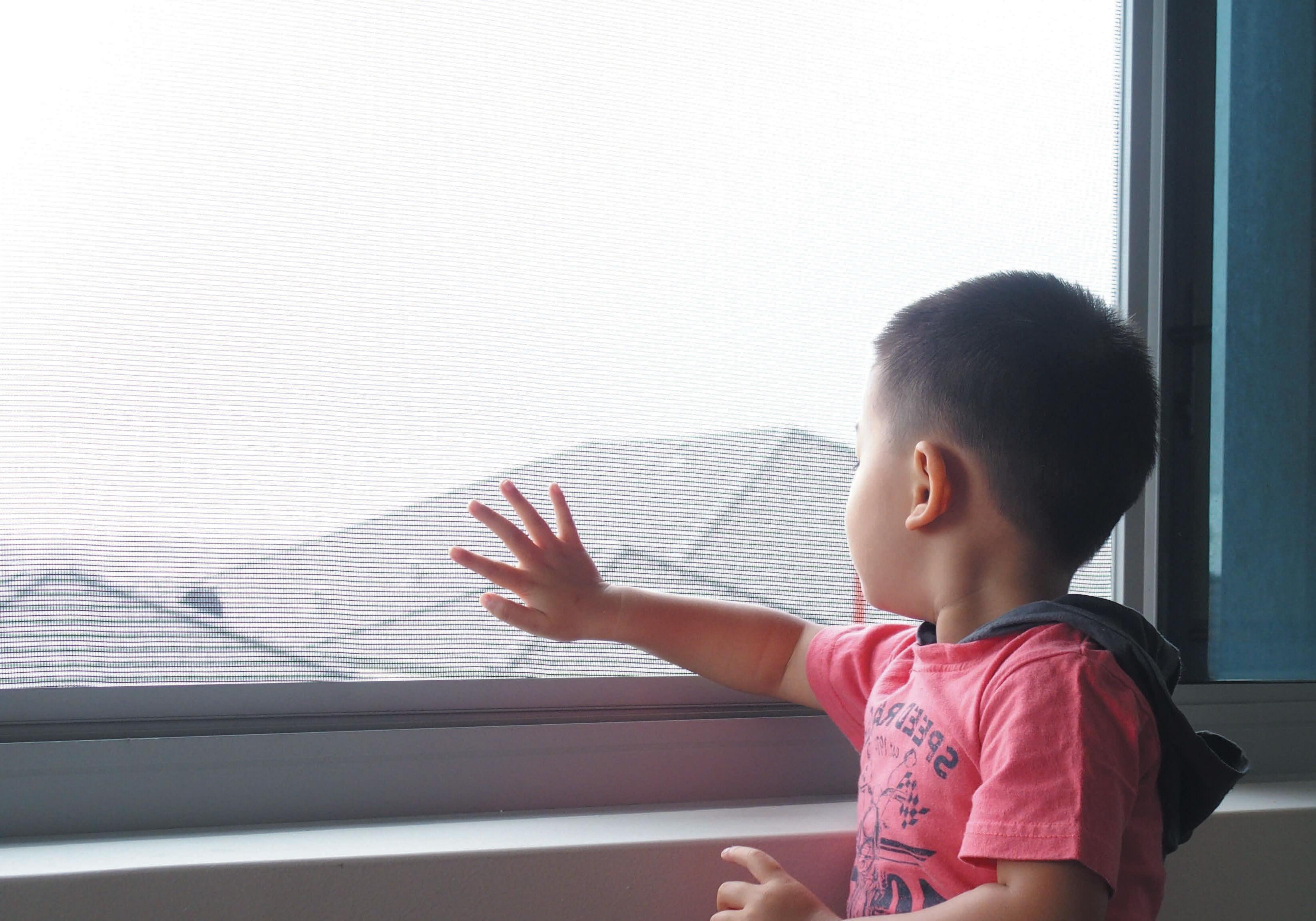
The fall prevention screening solution that keeps your children safe
Maintains full window ventilation with insect prevention
No restricted openings like alternate solutions available
Meets the requirements of the National Construction Code to prevent children falling from windows
Unique, patented retention system with reinforced mesh
Designed and distributed by Alspec - Australia’s leading supplier to the flyscreen industry.
Find your Licenced KidScreen Dealer at:
kidscreen.com.au
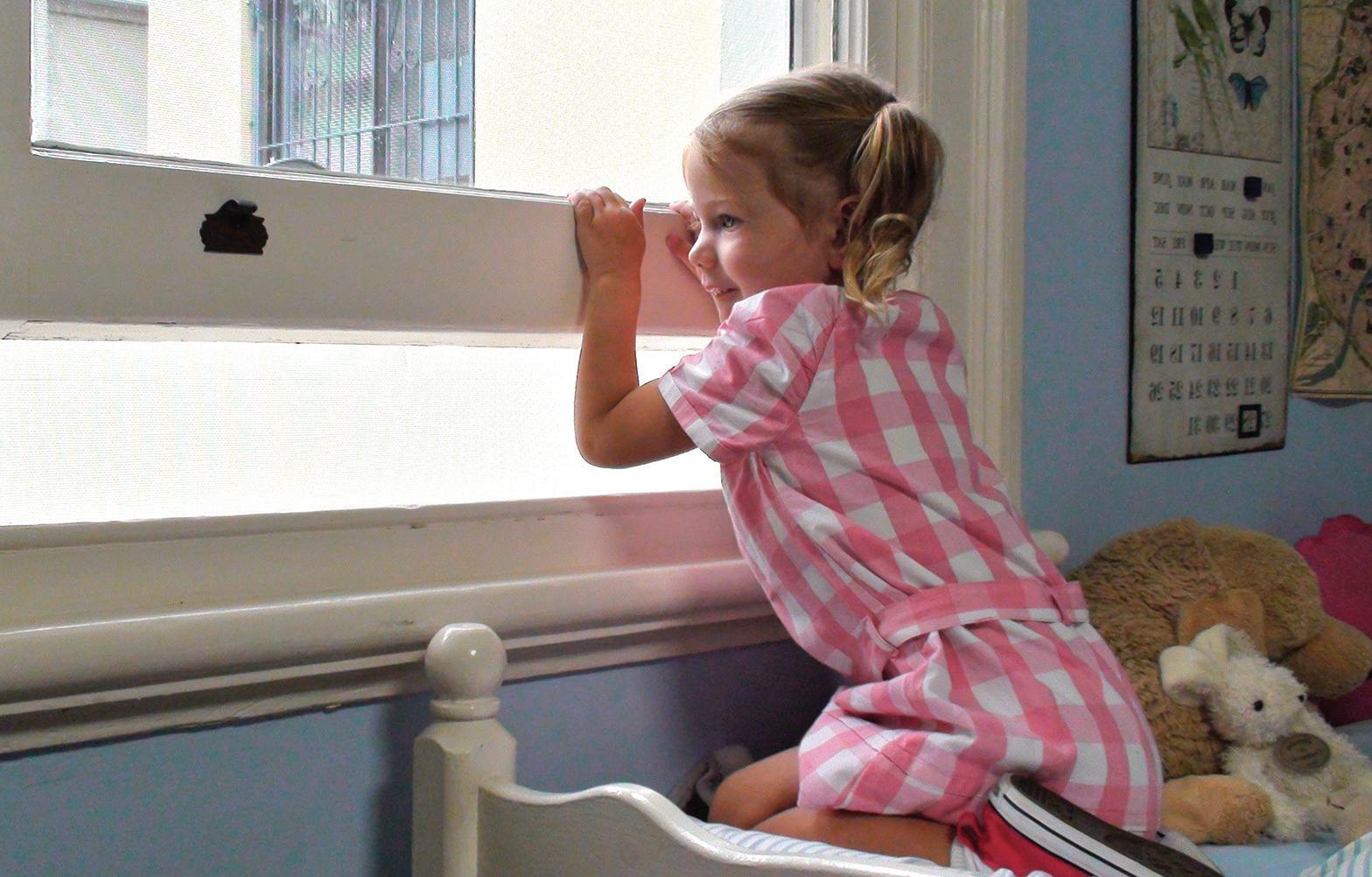

Preventing falls out of windows is as important as learning how to use one in an em ergency. Unattended children run the greatest risk of falls and injuries, so the be st first step is to watch your children as they play. Nothing can sub stitute for careful supervision.
Fires and falls are among the leading causes of injury and death in young children. While some falls occur from windows, it is important to realise that in the event of a fire, a window can also save a child’s life. This iswhy windows play a critical role in home safety.
Has your family determined an emergency fireescape plan?
Determine your family’s emergency escape plan and practice it regularly. In the plan, include two avenues of escape from every room. Remember children may have to rely on a window to escape a fire. Help them learn to safely use a window under these circumstances. Make sure you have identified a safe meeting place outside.
Do you keep windows shut when children are around?
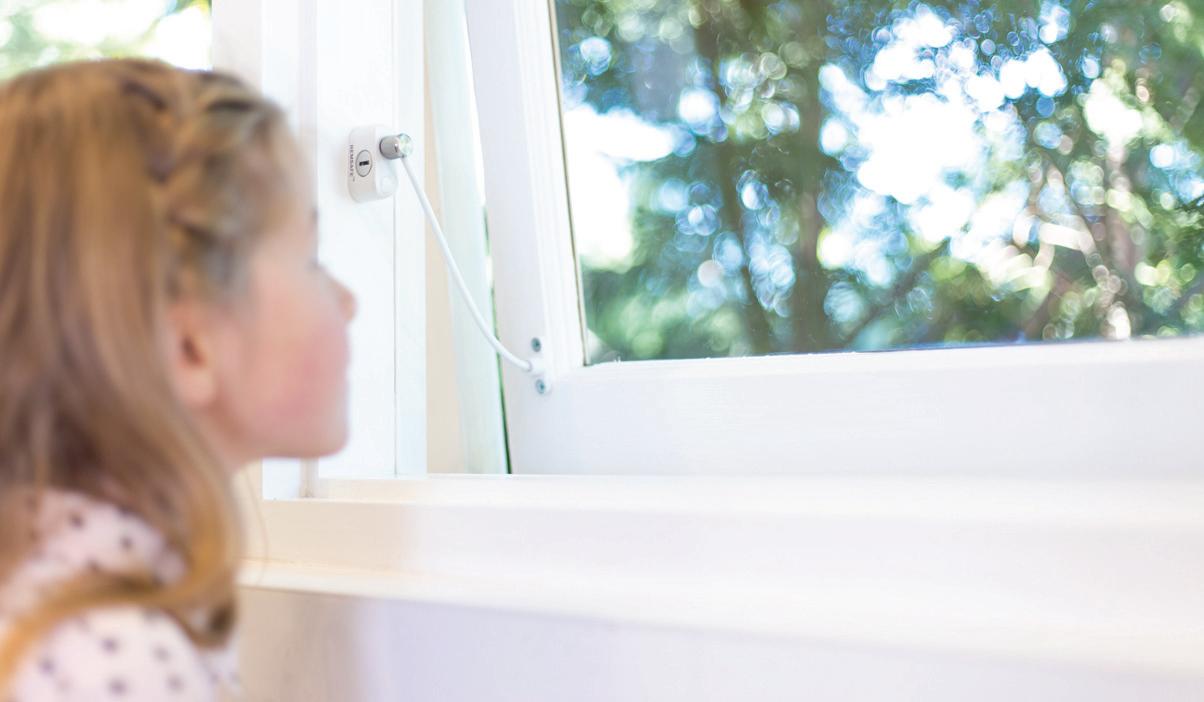
You should keep your windows closed and locked when childrenare around. When opening
windows for ventilation, open windows that children cannot reach or those with restrictors fitted. Also, set and enforce rules about keeping children’s play away from windows and/or glazed doors. Falling through the glass can be fatal or cause a serious injury.
Do you leave, or have you left, windows open because you thought the insect screen provided a safeguard from a fall?
Don’t rely on insect screens to prevent a fall. Insect screens are designed to provide ventilation while keeping insects out; theyare not designed to, nor will they prevent a child’s fall from a window.
Is there furniture placed under or near windows in your home?
Keep furniture — or anything children can climb — away from windows. Children may use such objects as a climbing aid.
Small children have died or suffered serious injuries from unstable furniture. Small children can be trapped under furniture; unable to breathe or be hit/struck by falling furniture. You can prevent death or injury to small children when choosing and securing furniture in your home. There are simple ways to prevent death or serious injury to small children when choosing and securing furniture in your home by anchoring furniture.
Buy Safe
• Purchase low-set furniture or furniture with sturdy, stable and broad bases.
• Look for furniture that comes with safety information or equipment for anchoring it to the walls.
• Test the furniture in the shop— make sure it is stable. For example, pull out the top drawers of a chest of drawers and apply a little pressure to see how stable it is; make sure the drawers do not fall out easily.
Use safe
• Attach, mount, bolt or otherwise secure furniture to walls and floors.
Are your windows fitted with key locks, vent locks or dead locks?
Make sure that keys to all locked or restricted windows and doors are accessible in case of emergency. Each and every window and door must be able to be opened quickly when required.
Inspect your home’s windows carefully. Are any windows in your home painted or nailed shut?
Never paint or nail windows shut. You should be able to open them to escape in an emergency.
For more information visit awa.org.au
• Do not put heavy items on top shelves of bookcases.
• Place televisions at the back of cabinets or secure them to the wall.
• Discourage small children from climbing on furniture.
• Do not put tempting items such as favourite toys on top of furniture that encourage children to climb up and reach.
• Do not place unstable furniture near where children play.
• Put locking devices on all drawers to prevent children opening them and using them as steps.
For more information on toppling furniture, visit www.productsafety. gov.au/anchorfurniture

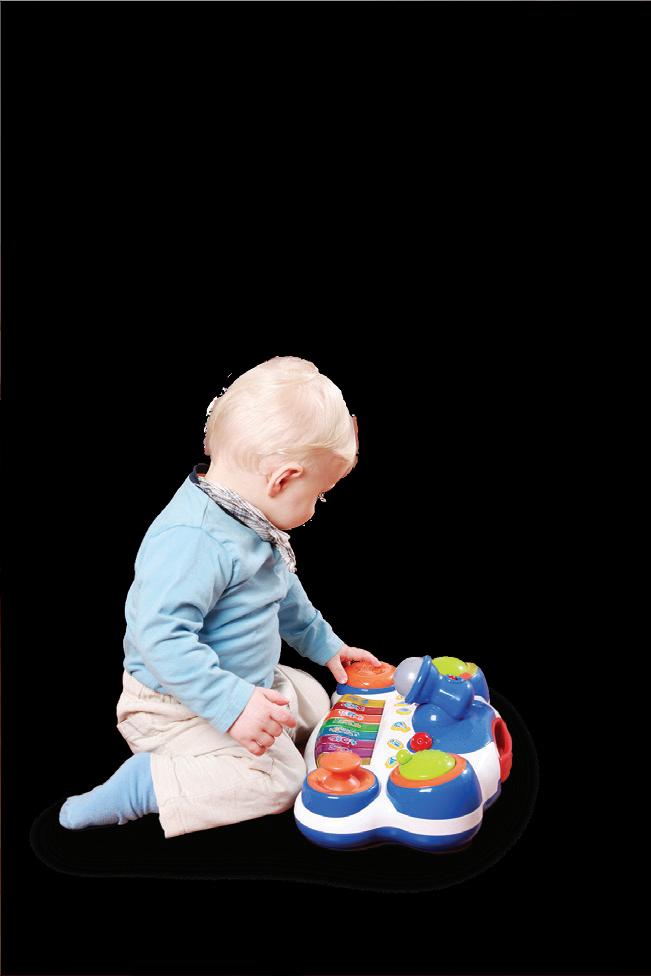
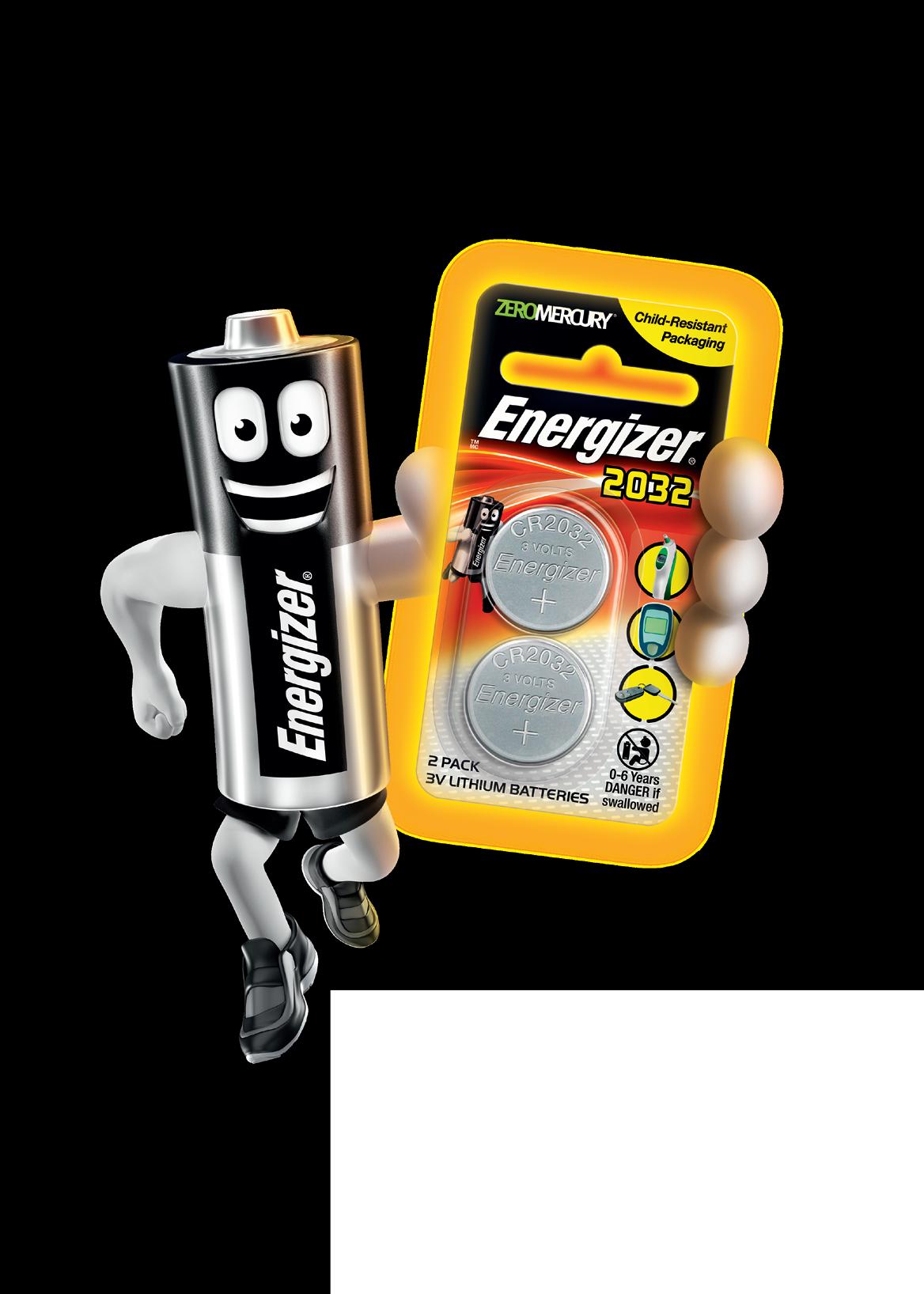






• In Australia, an estimated 4 children per week present to an emergency department with an injury related to a button battery. Kids under 5 years old represent the greatest risk.
• When a coin-sized lithium button battery gets stuck in a child’s throat, the saliva triggers an electrical current. This causes a chemical reaction that can severely burn the oesophagus in as little as two hours.
• Symptoms of coin-sized button battery ingestion may be similar to other childhood illnesses, such as coughing, drooling, and discomfort.
• Once burning begins, damage can continue even after the battery is removed.
Kids under 4 are at the greatest risk. Many coin-sized button batteries can appear “invisible” to parents because devices come with the batteries already installed. To keep your children safe:
• Look in your home for any items that may contain coin-sized button batteries.
• Place devices out of sight and out of reach of small children.
• Keep loose or spare batteries locked away.
• Share this life-saving information with caregivers, friends, family members and babysitters.
Keeping these batteries locked away and secured in devices is key, but if a coin-sized button battery is swallowed, you should follow these steps:
• Go to the emergency room immediately. Tell doctors and nurses that it might be a coin-sized button battery.
• If possible, provide the medical team with the identification number found on the battery’s pack.
• Do not let the child eat or drink until an X-ray can determine if a battery is present.
• Do not induce vomiting.
TheBatteryControlled.com.au Poisons Information Centre: 13 1126 For more information visit productsafety.gov.au
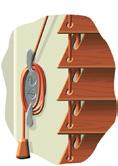
Take these four simple steps to ensure that blind and curtain cords/chains are out of reach of children, particularly from children under six.
1. Check your blind and curtain cords
a Check for loose or looped cords that your child can reach from the floor or by climbing on furniture.
a Immediately tie cords out of reach and move away any furniture children might climb on to reach them.
a Do this anywhere you are staying, including on holiday.
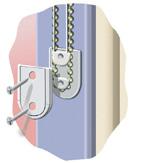
2. Secure your cords out of reach
a Buy cleats or tensioning devices for securing cords from a hardware store or curtain and blind shop.
a Use screws to fix each cleat or tensioning device in a place that is out of reach of children.
x Never secure these devices with materials that may fail when a load is placed on them, such as double-sided tape or glue.
If you cannot fix your unsafe cords and chains out of reach yourself, get a reliable tradesperson to do it for you. If you are renting your home, seek help from your landlord or agent.
3. Choose safe blinds and curtains
Buy new curtains and blinds which:
a comply with the national mandatory standard a have warning labels to remind you of dangers to children
a provide a way to secure cords/ chains so there are no loops or
strands that children can reach, or a operate without exposed cords/chains.
4. Keep children away from all cords/chains
a Move anything a young child can sit in, stand or climb on (like cots, highchairs, beds, sofas, tables, chairs and bookshelves) away from cords/ chains—even those tied around a cleat, as your child may be able to untie them.
x Do not let children play near cords/chains they can reach.
x Never leave children alone in a room with cords/chains they can reach.
For more information contact ACCC & BMAA

Signs & Symptoms
• Swelling and redness of the skin.
• Itchy, raised rash (live hives).
• Swelling of the throat.
• Wheezing and/or coughing.
• Rapid, irregular pulse.
• Tightness in the chest.
• Headache.
• Vomiting and/or abdominal pain.
• Dizziness or unconsciousness.
1. Follow DRSABCD :
• Check for Danger
• Check for Response
• Send for help
• Clear the Airway
• Check for Breathing
• Start CPR chest compression
• Apply Defibrillator. See chart page 26
2. If the patient is carrying an adrenaline autoinjector, it should be used at once. Let them administer the adrenaline autoinjector themselves, or ask them if they require assistance to do so.
3. Call 000 for an ambulance.
4. Keep patient in lying or sitting position. Observe and record pulse and breathing.
Unconscious
If patient is unconscious, check for breathing and response, and prepare to give CPR if necessary.
WARNING
Anyone having a SEVERE asthma attack needs URGENT medical treatment. Call triple zero (000) for an ambulance.
What to do
Unconscious patient
1. Follow DRSABCD. Conscious patient
2. Help the patient into a comfortable sitting position. Be calm and reassuring. Don’t leave the person alone. Help them to follow their action plan.
3. Give 4 puffs of a blue/grey reliever. Use a spacer if available. Shake the reliever inhaler before each puff.
4. Give 1 puff at a time with 4 breaths after each puff.
5. Wait 4 minutes. If no improvement, give 4 more puffs.
6. If the person still cannot breathe normally call for an ambulance and say that someone is having an asthma attack.
7. Keep giving 4 puffs every 4 minutes (as above) until the
ambulance arrives.
Where permitted under local State or Territory regulations, and if necessary use another person’s reliever inhaler, or use one from a first aid kit to assist a patient with a severe asthma attack. If someone is having difficulty breathing, but has not previously had an asthma attack, assist in giving a reliever until an ambulance arrives.
For severe external bleeding:
• wear gloves, if possible, to prevent infection
• do not apply a tourniquet
• if an object is embedded in or protruding from a wound apply pressure either side of the wound and place pads around it before bandaging
• give nothing by mouth.
What to do
Unconscious casualty
1. Follow DRSABCD.
Conscious casualty
1. Follow DRSABCD.
2. Lie the casualty down and remove or cut their clothing to expose the wound.
3. Apply direct pressure over
the wound using a pad or your hands (use gloves if available). Instruct the casualty to do this if possible.
4. Squeeze the wound edges together if possible.
5. Raise and support the injured part above the level of the heart. Handle gently if you suspect a fracture.
6. Apply a pad over the wound if not already in place and secure by bandaging over the padded wound.
7. If bleeding is still not controlled, leave initial pad in place and apply a second pad and secure with a bandage.
8. Check circulation below wound.
9. Ensure an ambulance has been called.
It can be difficult to tell whether the injury is a fracture, dislocation, sprain or strain. If in doubt, always treat as a fracture.
Signs & symptoms
Sprain
• intense pain
• restricted mobility
• rapid development of swelling and bruising.
Strain
• sharp, sudden pain in region of the injury
• loss of power
• muscle tenderness.
What to do
1. Follow DRSABCD.
2. Follow the RICE management plan:
• REST the patient and the injured part.
• Apply ICEPACK (cold compress) wrapped in a wet cloth to the injury for 15 minutes every 2 hours for 24 hours, then for 15 minutes every 4 hours for 24 hours.
• Apply COMPRESSION elastic bandage firmly to extend well beyond the injury.
• ELEVATE the injured part.
3. Seek medical attention if no improvement.
• If the cut is severe, stop the bleeding by applying direct pressure to the wound. Use a pad made of any material until a sterile dressing is available.
• Raise and support the injured limb, taking particular care if you think a bone may be broken.
• Bandage the pad or dressing firmly to control bleeding until the ambulance arrives.
If the wound is dirty, wash it in clean running water then dry it and the surrounding skin with a sterile dressing or a pad of clean non-fluffy material. Cover the cut completely with a sterile dressing held in place with a cotton bandage or adhesive plaster.
Any child who has received any kind of burn should be taken immediately to a doctor. Severe burns can lead to shock and major infection if not treated correctly. Burns (scalds) can be caused by hot liquid, food, vapour or steam. They are among the most serious, painful and long-term injuries. Hot drinks account for about 42 per cent of all child scald injuries, hot foods and oils about 13 per cent and hot water 45 per cent.
Beware the hot tap
80 per cent of all hot tap water scalds occur in the bathroom. More than a third of these accidents are caused by hot water in the bathtub, with a further third happening when the hot tap is running. In most homes, the hot water is set on about 70ºC, a temperature which poses an extreme threat to youngsters. At 70ºC it takes less than half-a-second to cause a full skin thickness scald in tender skin. At 60ºC it takes 1 second. At 55ºC it takes 30 seconds. And at 50ºC it takes five minutes before the child is scalded.
The ideal maximum, safe temperature for hot tap water is 50ºC.
The maximum bathing temperature for young children is 38ºC.
The first thing to do in an emergency
• Get the person out of the water and flood the affected skin with cool water.
• Give first aid for burns and scalds (see below). Burns may also be caused by contact with flame, hot objects or chemicals, by electrocution, radiated heat, frozen surfaces, friction or radiation. Barbecues, gas stoves and open fires are prime hazards and they should never be left unattended. If someone is burned on the face they could also have trouble breathing, although this may not happen immediately. A person who has inhaled smoke
SIGNS & SYMPTOMS
Signs and symptoms depend on the nature of the poisons which may be ingested, inhaled, absorbed or injected into the body.
• Abdominal pain • Drowsiness • Burning pains from mouth to stomach• Difficulty breathing
• Tight chest • Blurred vision • Odours on breath
• Change of skin colour with blueness around the lips • Sudden collapse
MANAGEMENT
Unconscious patient
1. Follow DRSABCD. See chart page 26
2. Ensure call for ambulance has been made— triple zero (000).
3. Call fire brigade if atmosphere contaminated with smoke or gas..
Conscious patient
1. Follow DRSABCD. See chart page 26
2. Listen to patient give reassurance but not advice.
3. Try to determine type of poison taken.
4. Call 13 11 26 for Poisons Information Centre.
5. Send any vomit, containers and/or suicide notes with patient to hospital.
WARNING
DO NOT induce vomiting unless advised to do so by Poisons Information Centre.
DO NOT give anything by mouth.
Wash substances off mouth and face with water.
Poisons Information Centre 131 126
In an emergency call triple zero (000) and ask for an ambulance
Ensure the are is safe for yourself, others and the patient
or fumes should receive medical attention as soon as possible.
The first thing to do in an emergency
• If a person’s clothes catch alight, stop them moving or running around. Movement will fan the flames. Remember: stop, drop, roll, manage.
• Give first aid for burns and scalds (see below).
R S
A B C D
Check for response–ask name–squeeze shoulders
No response Response
Make comfortable
Check for injuries
Monitor response
Call triple zero (000) for an ambulance or ask another person to make the call
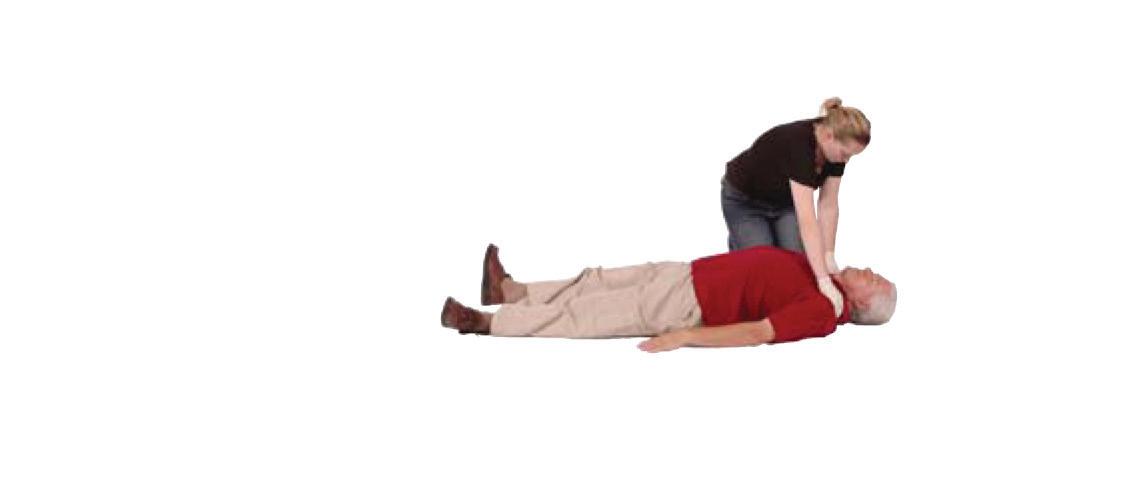
1. Ensure it is safe to approach the patient.
2. Extinguish burning clothing –smother it with a blanket, jacket or use water. In the case of a scald, quickly remove wet clothing from the affected area.
3. Hold the burnt area under cold running water until the skin returns to normal temperature –do this for at least 20 minutes.
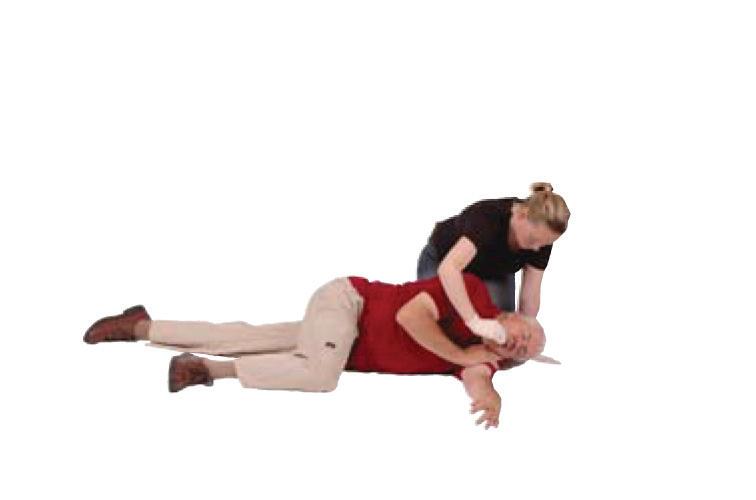
Open mouth–if foreign material present
Place in recovery position
Clear airway with fingers
Open airway by tilting head with chin lift
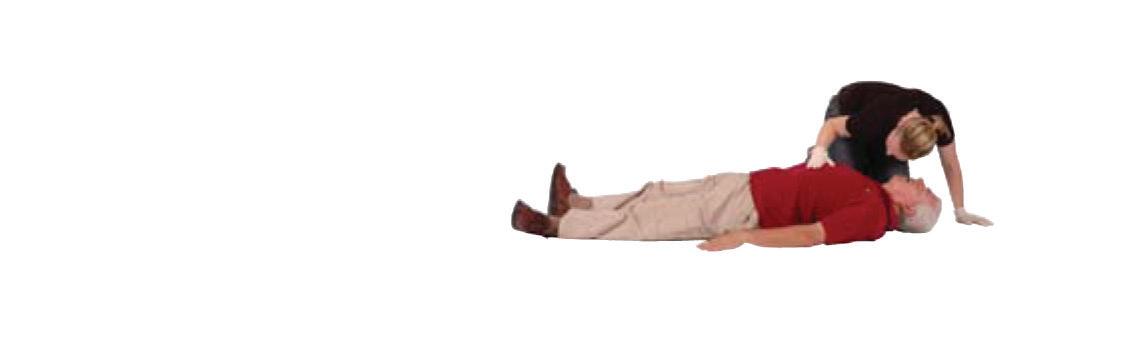
BREATHING
Check for breathing–look, listen, feel
Not normal breathing
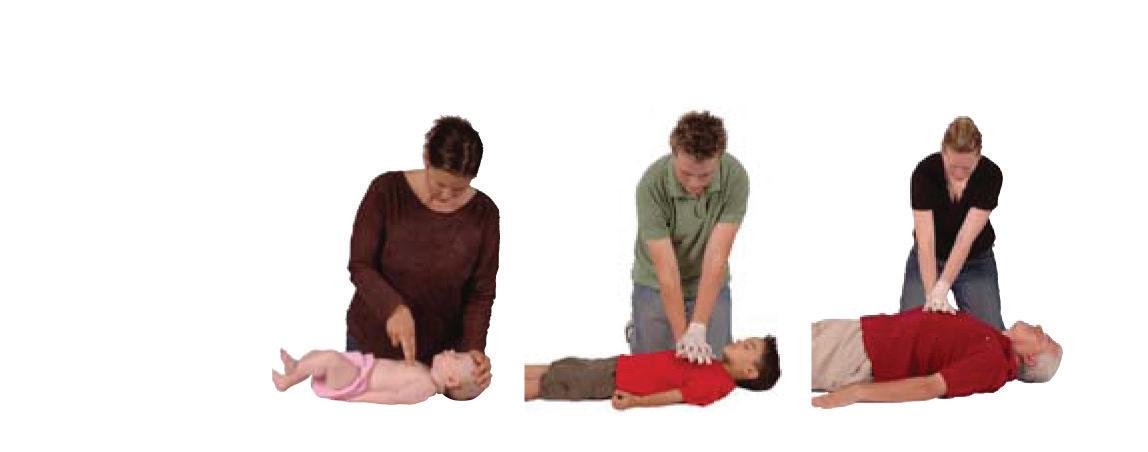
Start CPR
CPR
Normal breathing
Place in recovery position
Monitor breathing
Start CPR–30 chest compressions: 2 breaths
Continue CPR until help arrives or patient recovers
DEFIBRILLATION
Apply defibrillator if available and follow voice prompts
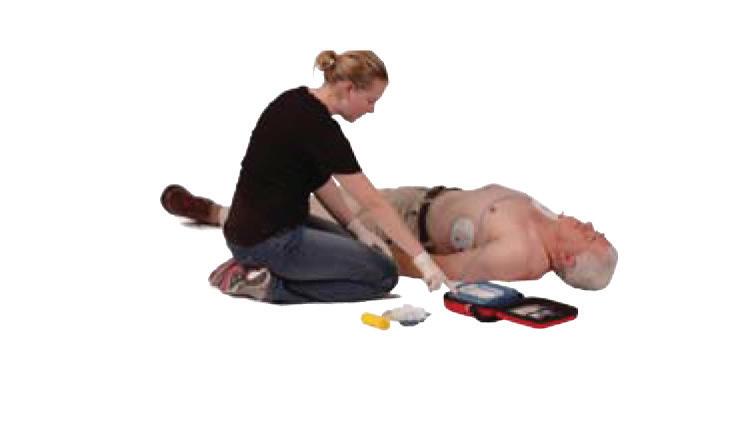
4. Remove jewellery and clothing from burnt area – leave it if stuck.
5. Cover the injury with a non-adherent burns dressing – if you don’t have one, use aluminium foil, plastic wrap or a wet clean dressing.
Resuscitation can save a life, so it’s a good idea to learn first aid. St John Ambulance, Red Cross and a number of private first aid training companies run courses which also include information on resuscitation. Workcover can provide a list of accredited companies. Make a list of emergency numbers to keep near the telephone. Below are some suggestions for numbers to include. You can find the others in your local phone book.
Police / Fire / Ambulance
• local police • Poisons Information Centre • Council • Children’s Hospital, family doctor • Health Nurse • neighbours • relatives.
6. Seek medical aid urgently. When to seek medical advice: In the case of a child being burned, you should always consult a doctor immediately.
Extensive burns are dangerous and may be fatal. For adults, you should seek medical aid if:
• The burn is deep, even if the patient feels no pain.
• A superficial burn is larger than a 20-cent piece.
• The burn involves the airway, face, hands or genitals.
• You are unsure of the severity of the burn.
For more information visit www.stjohn.org.au
MANAGING A CHOKING ADULT OR CHILD (OVER 1 YEAR)
Signs & symptoms
• Clutching the throat.
• Coughing, wheezing, gagging.
• Difficulty breathing, speaking, swallowing.
• Making a whistling or ‘crowing’ noise or no sound at all.
• Face, neck lips, ears, fingernails turning blue.
MANAGEMENT
1. Encourage adult or child to relax and cough to remove object.
2. Call triple zero (000) if coughing does not remove the blockage, or if patient is an infant.
3. Bend patient well forward and give 5 back blows: with heel of hand between the shoulder blades—checking if obstruction is relieved after each back blow.
4. If unsuccessful, give 5 chest thrusts: place one hand in the middle of patient’s back for support and heel of other hand in the CPR compression position and give 5 chest thrusts, slower but sharper than compressions.
Check if obstruction is relieved after each chest thrust.
5. If blockage does not clear: continue alternating 5 back blows with 5 chest thrusts until medical aid arrives.
If patient becomes unconscious:
• call triple zero (000) for an ambulance,
• remove visible obstruction from mouth
• commence CPR
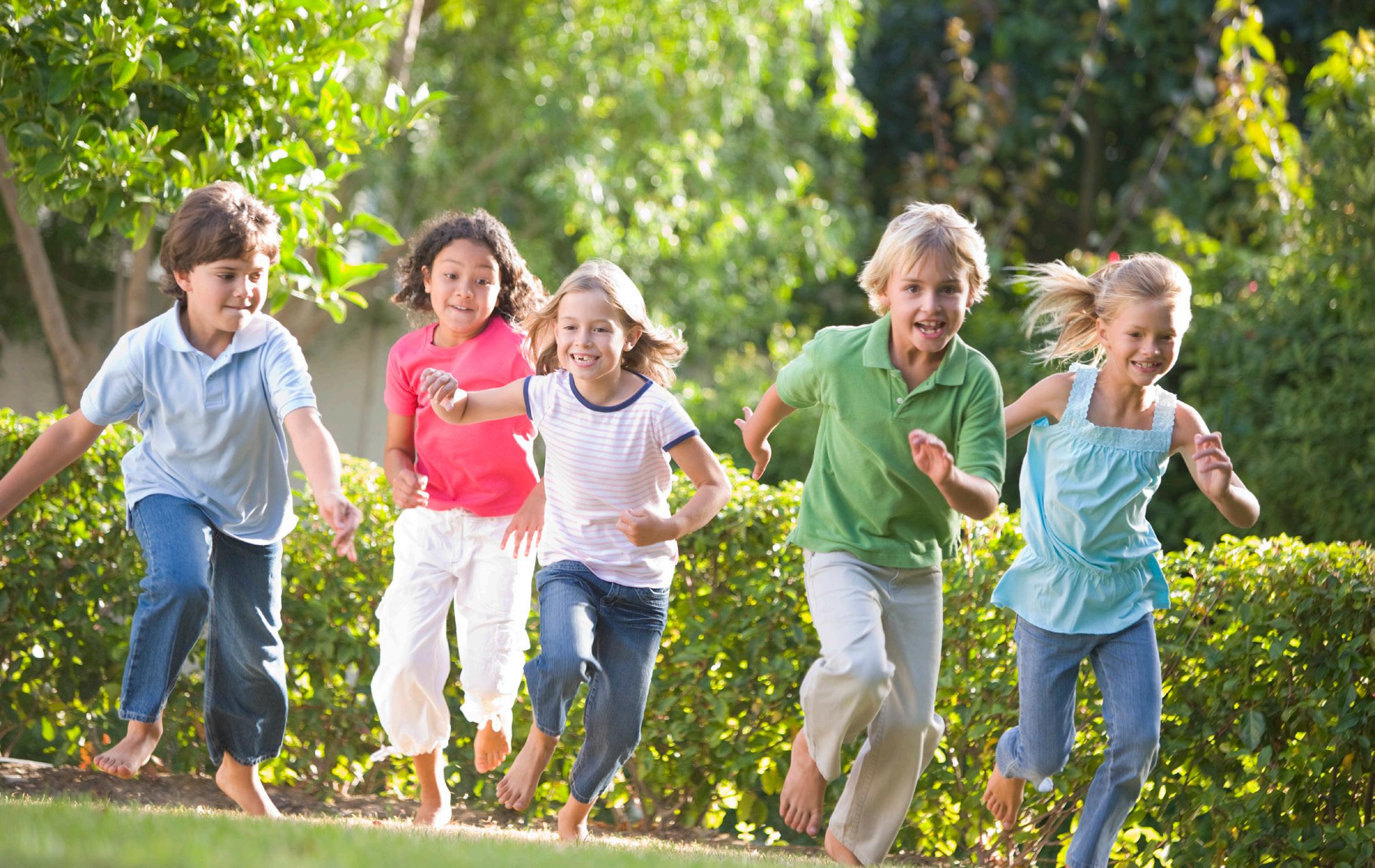
Play is an essential part of growing up. Children learn and develop as they play. Providing a safe and creative play environment is the best way to help them grow. Many childhood injuries happen in and around the home, especially in the backyard and garden. Falls from play equipment cause most of the injuries in backyards.
There are Australian Standards for playground equipment and trampolines. Equipment manufactured and installed to these Standards can reduce the number and severity of play related injury.
It is important for parents to ask the question “Does it comply with the Australian Standard?” before purchasing backyard play equipment items for their children. Look for the Australian Standard ‘tick’ logo.
Falls are the leading cause of injury in playgrounds. Australian Standards provide the maximum fall height of play equipment - the distance from which a child could fall to the ground. The recommended maximum fall height for any play equipment is:
• 1m for children 0-3 years of age
• 1.8m for children 3-5 years of age
• 3m for children over 5 years of age
Equipment with a fall height greater than 0.6m above ground level should have a soft surface (impact attenuating material) under and around it to cushion any falls and prevent the risk of head or other serious injuries.
Asphalt and concrete are not a suitable surface underneath or around play equipment.
For play equipment in domestic backyards such as elevated cubby houses or forts, swings, slides, trampolines and rocking items, provide a soft surface under and around the equipment (impact area). Grass is suitable if well maintained, however can
wear quickly in high use areas such as under swings and at the end of a slide. Consider installing playground mulch in these areas.
The impact area should cover the entire falling space which is the area under and around the play equipment onto which a child is likely to fall. The guideline for backyards is:
• 1.5m for 0-6 years
• 2.5m for older children.
• Ensure swing frames are securely anchored into the ground. It is recommended that surfacing such as mulch is used in the falling space of the swing.
• Swing seats should be made of a soft flexible plastic or rubber.
• Chain links can entrap and crush fingers. Look for a swing that uses a short link chain or chain covered with a plastic/ rubber sheath.
• Ensure the connections of the swing at the seat are not sharp or have protruding parts which could injure the child’s hand or catch clothing.
Trampolines require active supervision. Parents and carers need to implement safety measures to reduce the risk of injury.
• The trampoline should comply with Australian Standard AS 4989. Look for the Australian Standard ‘tick’
• Safety pads are installed adequately to cover the frame and springs.
• Netted trampolines are recommended as fall hazards have been minimised
• Locate the trampoline on a flat, soft surface and secure it to the ground.
• Arrange a safety zone around the trampoline of 2.5m for open trampolines and 1.5m for enclosed trampolines.
• Make sure there is a clearance of 5 metres above the trampoline bed.
• Do not let children access the trampoline by using chairs,
ladders or planks.
Safe use of trampolines:
• Allow only one child at a time
• Provide constant adult supervision.
• Older children need firm guidelines on proper use of the trampoline and skill development.
• Teach your child to jump in the centre of the mat and to focus their eyes on the trampoline to help to control bounce.
• Teach your child to climb on and off the trampoline rather than jumping off.
• Regularly check the condition of the trampoline frame, springs and bed for tears, rust, detachment and general weakening of the structure.
A cubby house is great for imaginary play. When purchasing and/or installing a cubby house consider the following:
• A cubby house set up at ground level reduces the risk of falls
• The design and location of the cubby house should not allow
children to climb onto the roof or surrounding structures
• If the cubby house is elevated or has climbing equipment or a slide, then a falling space with soft surfacing is recommended
• To avoid head entrapment, gaps between vertical rails should measure less than 89mm for metal or plastic rails, or less than 75mm for timber rails
• Ensure that there are no sharp edges or splinters
• Do not use CCA or creosote treated timber
Water play is fun and can be provided in a variety of ways.
• Supervise children at all times when they are in or around the water
• Always stay within arm’s reach of your child when they are in water
• Learn basic first aid and resuscitation
• Keep pool gates closed at all times
• A pool fence is required for por-
Keep the backyard clear from rubbish and remove any trip hazards
• Keep tools, equipment and chemicals locked away
• Choose play equipment that has the Australian Standard ‘tick’ logo
• Position play equipment in an area that is shaded, easily supervised and accessible
• Ensure all play equipment and bikes are appropriate to a child’s age, size and developmental stage
• Ensure play equipment is strong, sturdy and securely anchored.
• Secure any ropes top and bottom so they are not slack and cannot form a noose
• Play equipment should not have sharp edges, splinters or protruding parts that could pierce skin, or tangle in a child’s hair or clothing
• Regularly check play equipment for wear and tear
• Remove loose cords from children’s clothing so they don’t get caught in equipment
• Supervise young children on and around play equipment at all times
• Fence play areas off from driveways and garages/carports
• Ensure pool gates are self-closing, self-locking and well maintained. Regularly inspect fence panels and gates and leave nothing nearby for a child to climb
• Remove any plants that may harm or cause illness in children
• Supervise animals near children at all times
• Don’t leave lawn mowers and electrical equipment unattended
table pools that can hold more than 30cm of water
• Cover garden ponds with wire mesh
• Empty containers such as buckets and wading pools when not in use
SAFETY WITH DOGS
Dogs are wonderful pets however they are responsible for some serious injuries to young children.
• Always supervise children near dogs
• Show children how to behave with dogs
• Choose a dog breed suitable for children
• Keep dog bowls out of reach FINAL REMINDER:
• Separate play areas from driveways
• Supervise children around vehicles
• See if children are near the vehicle before you go
When children spend time in the backyard, they often spend time in the sun. Children need to be protected from the sun. Too much sun during childhood can cause skin cancer as they get older. The younger any sunburn occurs, the greater the risk.
So, to stay safe in the sun:
• Stay out of the sun during the hottest times of the day, in general between 10am and 3pm
• Provide good quality shade in the backyard so that children can play out of the sun. This may be a verandah, a pergola, a large leafy tree or a children’s cubby.
• Children need clothing that gives them a natural protection from the sun. Hats, with a neck flap and a brim or visor, and long-sleeved shirts are good. Cottons and lycras are good sun-protective materials.
• Use an SPF 30+ sunscreen on parts of the body that are exposed to the sun. Mild sunscreens are often better for
young children with sensitive skin.
• Young babies have very sensitive skin and are best kept out of the sun until they are at least 12 months old.
• Drowning is a leading cause of preventable death in children under 5 years of age
• On average, over the last decade, a child under 5 years of age drowned every week in Australia
• For every drowning death it is estimated that three children were admitted to hospital as a result of an immersion incident
• For children under 5 years of age, home swimming pools are the most common site in which drowning occurs
• Children less than one year of age most frequently drown in bathtubs
• Children drown all year round
Fence / Gate / Maintain
• Maintain your pool barrier and gate
• Provide a Child Safe Play Area
Creating a barrier between your child and the body of water is one of the most effective ways of preventing drowning. Pool fencing has been shown to save children from drowning. Fencing must isolate the water body (including swimming pools, spas and wading pools) from the house and should be regularly maintained with a gate that self-closes and self-latches. Any object a child could use to climb over a barrier should be removed.
Pool fencing has been shown to save children from drowning Visit www.homepoolsafety.com. au for your home pool safety checklist that will help you maintain your fence and gate in good working order.
A child safe play area can be created inside or outside the house and will also restrict a child’s access to water. Inside the house, doors and windows should be locked to prevent the child being able to wander away and the bathtub should be emptied immediately after use and the bathroom door kept shut.
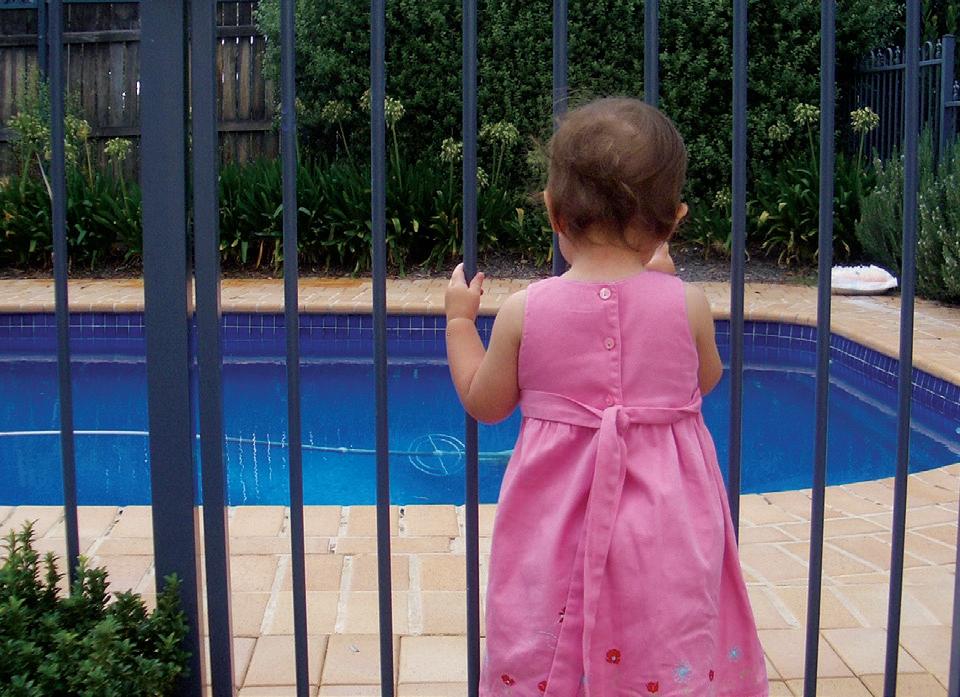
On average, over the last decade, a child under 5 years of age drowned every week in Australia
1. It’s the law to have at least one working smoke alarm installed on every level of your home. This includes owner occupied homes, rental properties, relocatable homes, caravans and camper-vans or any other residential building where people sleep.
1. It’s the law to have at least one working smoke alarm installed on every level of your home.
1. It’s the law to have at least one working smoke alarm installed on every level of your home.
This includes owner occupied homes, rental properties, relocatable homes, caravans and camper-vans or any other residential building where people sleep.
This includes owner occupied homes, rental properties, relocatable homes, caravans and camper-vans or any other residential building where people sleep.
2.Fire & Rescue NSW recommends the installation of photoelectric smoke alarms, ideally hard-wired and interconnected.
3.There are different types of smoke alarms available:
2.Fire & Rescue NSW recommends the installation of photoelectric smoke alarms, ideally hard-wired and interconnected.
• Standard battery-operated alarms.
3.There are different types of smoke alarms available:
• Mains-powered smoke alarms.
• Standard battery-operated alarms.
•Smoke alarms with ten year lithium batteries.
• Mains-powered smoke alarms.
• Strobe light and vibrating pad alarms. These are available for people who are deaf or hard of hearing.
•Smoke alarms with ten year lithium batteries.



Help us, help you stay safe by following these simple smoke alarm guidelines:
to have at least one working smoke installed on every level of your home.

includes owner occupied homes, rental relocatable homes, caravans and camper-vans or any other residential building people sleep.
2.Fire & Rescue NSW recommends the installation of photoelectric smoke alarms, ideally hard-wired and interconnected.
3.There are different types of smoke alarms available:
• Standard battery-operated alarms.
• Mains-powered smoke alarms.
•Smoke alarms with ten year lithium batteries.
• Strobe light and vibrating pad alarms. These are available for people who are deaf or hard of hearing. For more information contact the Deaf Society of NSW on 02 8833 3600
4.The Australian Standard symbol on the packaging shows if the alarm is approved and safe.

For more information contact the Deaf Society of NSW on 02 8833 3600
• Strobe light and vibrating pad alarms. These are available for people who are deaf or hard of hearing.

4.The Australian Standard symbol on the packaging shows if the alarm is approved and safe.
For more information contact the Deaf Society of NSW on 02 8833 3600
5. Your local Fire & Rescue NSW station will be happy to give you advice on which type is best suited for you.
4.The Australian Standard symbol on the packaging shows if the alarm is approved and safe.
5. Your local Fire & Rescue NSW station will be happy to give you advice on which type is best suited for you.
1.Avoid fitting smoke alarms in or near your kitchen or bathroom.
bathroom.
Rescue NSW recommends the installation photoelectric smoke alarms, ideally hard-wired interconnected.

different types of smoke alarms available: battery-operated alarms.
Mains-powered smoke alarms. alarms with ten year lithium batteries.
light and vibrating pad alarms. These are for people who are deaf or hard of hearing.
information contact the Deaf Society 02 8833 3600

Australian Standard symbol on the packaging alarm is approved and safe.
Fire & Rescue NSW station will be happy advice on which type is best suited for you.
smoke alarms in or near your kitchen
position is on the ceiling between and living areas.
to the minimum requirement, Fire NSW recommends installing smoke bedrooms where people sleep.
smoke alarms need to be installed electrician.
install smoke alarms in accordance with manufacturer’s instructions.
cult for you to fit one yourself, contact Fire & Rescue NSW station for help. happy to install your smoke alarm you.
2.The ideal position is on the ceiling between sleeping and living areas.
3.In addition to the minimum requirement, Fire & Rescue NSW recommends installing smoke alarms in all bedrooms where people sleep.
4.Hard-wired smoke alarms need to be installed by an electrician.
5. Your local Fire & Rescue NSW station will be happy to give you advice on which type is best suited for you.




1.Avoid fitting smoke alarms in or near your kitchen or bathroom.

2.The ideal position is on the ceiling between sleeping and living areas.
3.In addition to the minimum requirement, Fire & Rescue NSW recommends installing smoke alarms in all bedrooms where people sleep.
4.Hard-wired smoke alarms need to be installed by an electrician.

5.Always install smoke alarms in accordance with manufacturer’s instructions.

6.If it is difficult for you to fit one yourself, contact your local Fire & Rescue NSW station for help. They’ll be happy to install your smoke alarm

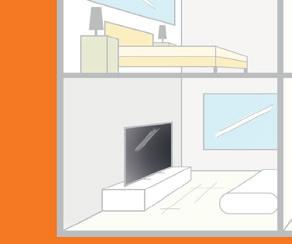



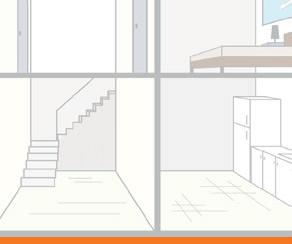




1.Avoid fitting smoke alarms in or near your kitchen or bathroom.
2.The ideal position is on the ceiling between sleeping and living areas.
5.Always install smoke alarms in accordance with manufacturer’s instructions.
6.If it is difficult for you to fit one yourself, contact your local Fire & Rescue NSW station for help. They’ll be happy to install your smoke alarm battery for you.
3.In addition to the minimum requirement, Fire & Rescue NSW recommends installing smoke alarms in all bedrooms where people sleep.
4.Hard-wired smoke alarms need to be installed by an electrician.
5.Always install smoke alarms in accordance with manufacturer’s instructions.


1.Test your smoke alarm batteries every month by pressing and holding the test button for five seconds. Replace batteries every 12 months.
2.Vacuum dust off alarms every six months.
3.Replace smoke alarms with a new photoelectric alarm every ten years or earlier, if specified by the manufacturer.
For more information on smoke alarms, visit: fire.nsw.gov.au and planning.nsw.gov.au
1.Test your smoke alarm batteries by pressing and holding the test five seconds. Replace batteries
2.Vacuum dust off alarms every six
3.Replace smoke alarms with a new alarm every ten years or earlier, by the manufacturer.

6.If it is difficult for you to fit one yourself, contact your local Fire & Rescue NSW station for help. They’ll be happy to install your smoke alarm battery for you.



MAINTAINING YOUR SMOKE ALARM
1.Test your smoke alarm batteries every month by pressing and holding the test button for five seconds. Replace batteries every 12 months.
2.Vacuum dust off alarms every six months.
3.Replace smoke alarms with a new photoelectric alarm every ten years or earlier, if specified by the manufacturer.
For more information on smoke alarms, visit: fire.nsw.gov.au and planning.nsw.gov.au
For more information on smoke alarms, visit: fire.nsw.gov.au and planning.nsw.gov.au
to
Watch how to shop to replace your smoke
The leading cause of home fires in NSW is leaving cooking unattended.













backyard barbie can be a common cause of fires











































YOU‘RE TWICE AS LIKELY TO DIE IN A HOME FIRE IF YOU DON’T HAVE A WORKING SMOKE ALARM.
FIRE & RESCUE NSW RESPONDS TO



THE MISUSE OF HEATERS, CIGARETTES AND CANDLES ARE COMMON CAUSES OF FIRES.

4500 4500
FIRE & RESCUE NSW RESPONDS
4500 4500
RESIDENTIAL FIRES EACH YEAR. HALF OF THESE FIRES START IN THE KITCHEN, MOSTLY DUE TO UNATTENDED COOKING.
RESIDENTIAL FIRES EACH YEAR. HALF OF THESE FIRES START IN THE KITCHEN, MOSTLY DUE TO

WHEN YOU’RE ASLEEP, YOU WON’T SMELL THE SMOKE FROM A FIRE.

THE MAJORITY OF DEATHS OCCUR WITH FIRES THAT START IN THE LOUNGE ROOM OR BEDROOM.
THE MAJORITY OF DEATHS OCCUR WITH FIRES THAT START IN THE LOUNGE ROOM OR BEDROOM.
A bush fire survival plan can help you make important decisions about what to do during a fire - like when to leave, what to take and what to do with animals.



The Lil Larrikkins pack has been developed to help explain to students the dangers of bush fires and give them age appropriate actions to help them and their families better prepare and become more resilient for bush fire events.




The NSW RFS, together other national bush fire agencies, created the Lil Larikkins Bush Fire Safety Program to assist primary school teachers to educate students about bush fire. The package includes tools such as comprehensive notes and lesson plans to help empower primary school students to take stock of their surroundings and community and learn more about the unique Australian environment in which we live.
To access the resources or for more information visit: www.rfs.nsw.gov.au/lillarikkins
Our volunteers make a difference in their communities not just by fighting fires, but also by helping families prepare themselves and their homes for a bush fire.
can support teachers and students by presenting skills-based sessions to students, assisting in school emergency planning and working with the wider school community to be prepared for a fire event. If you would like a member of the NSW RFS to visit your school please contact your local Fire Control Centre or visit www.rfs.nsw.gov.au/schoolsenquiry

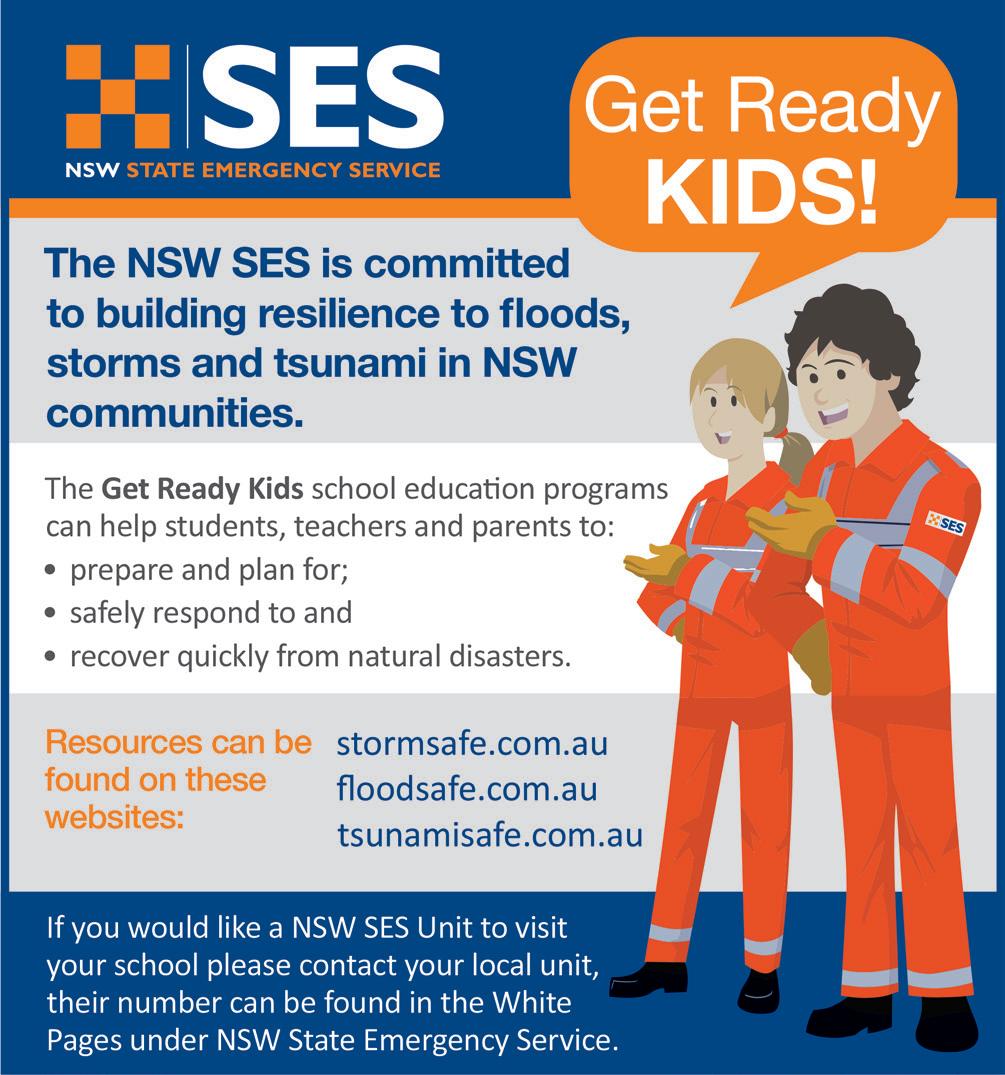


Are you at risk?
Storms can happen anywhere, at any time of the year. It is important to prepare your family and prepare your property now and stay prepared all year round. Storms are the most costly natural disaster to affect NSW, causing an estimated average of $217 million dollars damage annually.
(Source: BTE 2008)
During storms it is important to protect your family and property from the major impacts such as strong winds, hail and rising water levels (flash flooding).
Damaging winds can bring down trees, branches, power lines, remove roofs and blow around outdoor items, for example outdoor furniture and trampolines
• Hail can injure people and damage property
Heavy rainfall can cause water to:
• damage exposed homes and belongings
• rise rapidly, flooding homes, property and roads
• drain rapidly making floodwaters, drains, and other water courses a safety hazard
Damaging surf can be unsafe and flood homes and properties in coastal areas
You may also be indirectly affected by storms; access roads may be blocked or you have no power, utilities or telephone connection.
There are eight simple things that you can do now to prepare your home and help reduce the potential damage caused by severe storms.
1. Maintain your yard and balcony. Secure or store items that could blow around in strong winds
2. Clean your gutters, downpipes and drains regularly to prevent blockages
3. Trim trees and branches that could potentially fall on your home or property
4. Fix any damage to your roof, including broken or missing tiles
5. Check your insurance policy is current and adequate
6. Make a Home Emergency Plan for your family that outlines what you would do in an emergency
7. Prepare an emergency kit with essential items in case you lose power or need to leave home in an emergency
8. Listen to your local radio station and other media for weather warnings
When a STORM WARNING is broadcast
Servere Weather Warnings and Severe Thunderstorm Warnings are issued by the Bureau of Meterology to alert communities to the threat of severe weather. When a warning is issued for your area (but before the storm
Your emergency kit provides items you might need if you lose power or need to leave your home in a hurry. Your emergency kit contents:
A portable radio with batteries
A torch with spare batteries
A first aid kit
Candles and waterproof matches
Important papers including emergency contact numbers
Copies of any emergency plans
A waterproof bag for valuables
When leaving or evacuating your property, place into your emergency kit
Medications
Supplies for your baby
Supplies for any other people in your care
Appropriate clothing and footwear
Food and drinking water
arrives), there area few things you can do to help protect your family ad property;
• Move indors, bringing children and pets with you
• Park your car under secure cover and away from trees, powerlines and drains.



During a storm
During a storm, there are simple things you can do to help protect your family:
• Never enter or travel through floodwater
• Stay indoors, clear of windows
• Stay clear of creeks, drains, causeways, gutters, streams, fallen trees, power lines and damaged buildings

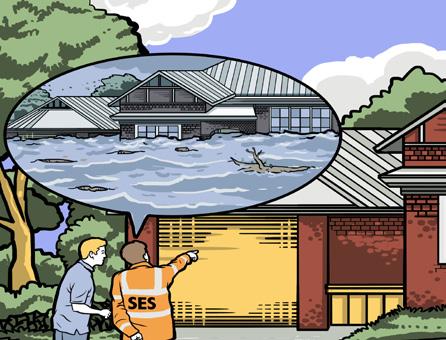
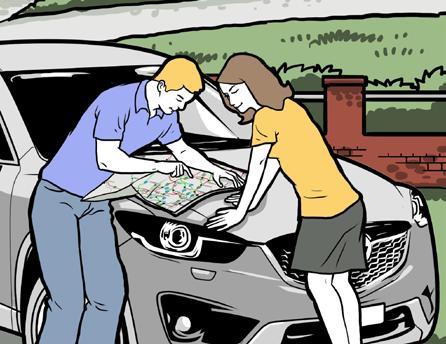
• If driving, put your hazard lights on and pull over to the side of the road keeping clear of drains, causeways, streams, creeks, trees and power lines
• If outdoors, seek secure shelter away from drains, causeways, streams, creeks, trees and power lines
• Listen to your local radio station and other media for information, updates and advice
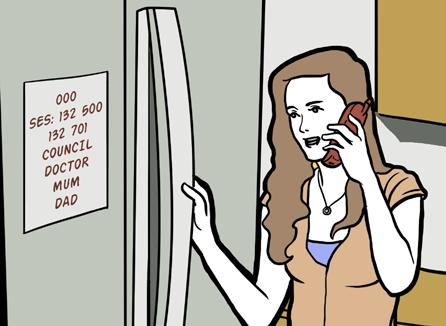
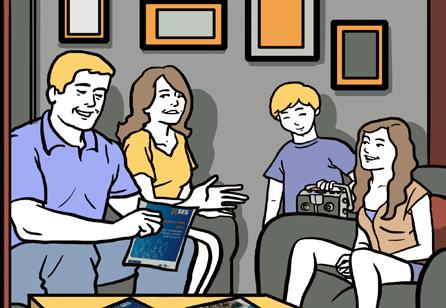
• For emergency assistance in floods and storms, call the NSW SES on 132 500
After the storm
• Keep listening to your local radio station for information, updates and advice
• Check your house or property for damage
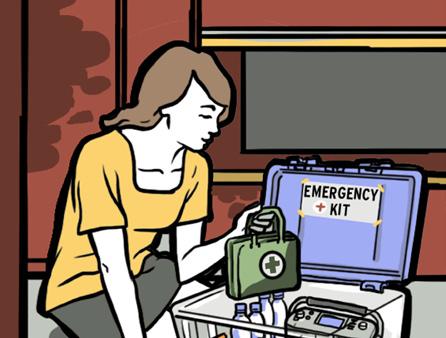
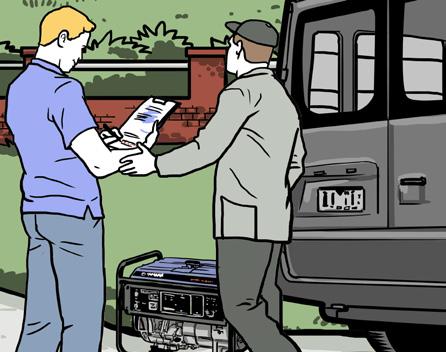


• Stay clear of creeks, drains, causeways, gutters, streams, fallen trees, power lines and any damaged buildings
• Check to see if your neighbours need help
• Do not go sightseeing as this may hinder recovery efforts or put yourself and others at risk.
Are you at risk from floods?
If you live close to a creek, river, major stormwater drain or in a low-lying area, you may be at risk from flooding even if you have not experienced it personally.
Evacuation warning
To prepare for possible evacuation:
• Stack possessions, records, stock or equipment on benches and tables, placing electrical items on top
• Secure objects that are likely to
float and cause damage
• Relocate waste containers, chemicals and poisons well above floor level
• Activate your Home or Business FloodSafe Plan
• Locate important papers, valuables and mementos.
• Place them in your Emergency Kit
• Keep listening to your local radio station for information, updates and advice
• Keep in contact with your neighbours
• Be prepared to evacuate if advised by emergency services
• Act early as roads may become congested or close
Evacuation orders
When you leave:
• Turn off the electricity and gas at the mains before you leave and turn off and secure any gas bottles
• Take your pets with you
• Never enter or travel through floodwater
• Keep listening to your local radio station for information, updates and advice
• Follow your Home or Business FloodSafe Plan
• Follow all instructions given by emergency services
During a flood
How do I prepare when flooding is about to happen?
• Never drive, ride or walk through floodwater
• Listen to your local radio station for information, updates and advice
• Locate and check you Emergency Kit
• Move pets and agisted animals to high ground
• Stack possessions, records, stock or equipment on benches and tables, placing electrical items on top
• Secure objects that are likely to float and cause damage
• Relocate waste containers, chemicals and poisons well above floor level
• Activate your Home or Business FloodSafe Plan
• Be prepared to evacuate if advised by emergency services
• Act early as roads may become congested or close.
What is a Tsunami?
A tsunami is a series of waves generated by a number of causes including:
• Vertical movement of the sea floor as the result of a large earthquake
• Submarine or coastal volcanic eruptions
• Meteor impacts
• Coastal landslides and slumps, either land-based or submarine
Know your warnings You should know the warning types, warning signs, and the official warning channels that may be used, to indicate a tsunami is approaching.
Know where to go
Find the safest route to travel in the event that you might need to evacuate and identify the point at which your evacuation route may be cut In many locations, it is likely that you will need to evacuate by foot due to congestion on roads Find out where any evacuation centres could be set up in your area. If you prefer, check with friends and relatives outside the affected area to organise a place to go
Know who to call
• For emergency help in tsunami, call the NSW SES on 132 500
• Keep local emergency numbers handy (in your phone or wallet)
• In a life-threatening emergency, call 000 (triple zero)
WHEN A TSUNAMI WATCH IS ISSUED
The first stage of the process for warning you about a tsunami is a ‘tsunami watch’ phase. This means that there is the potential for an identified undersea earthquake to cause a tsunami threat to Australia. If there is a threat, the Bureau
• Keep in contact with your neighbours and make sure they are aware of the Flood Warning
will issue a National Tsunami Watch. If there is no threat, a National Tsunami No Threat Bulletin will be issued. If there is a possibility of a Land Threat Tsunami emergency services may commence evacuations immediately.
People in affected areas:
• Locate your Emergency Kit and add any medications, important papers, special items for babies, elderly, clothing, food and water
• Locate your Emergency Plan
Keep listening to your local radio station or other media for any updates and advice
• Follow advice given to you by emergency services
It is important to act early on warnings as tsunami can reach the coastline quickly and follow the advice of emergency services.
Marine and
Foreshore Warning
• Get out of the water and move away from the immediate water’s edge of harbours, coastal estuaries, rock platforms, and beaches
• Boats in harbours, estuaries and in shallow coastal water should return to shore. Secure your boat and move away from the waterfront
• Vessels already at sea should stay offshore in deep water until further advised
• DO NOT go to the coast to watch the tsunami
• Check that your neighbours have received this advice
Keep listening to your local radio station and monitor other media for updates and advice.
For emergency help in floods and storms call the SES on 132 500. Visit www.ses.nsw.gov.au
For life threatening emergencies call 000.
For FloodSafe, StormSafe and TsunamiSafe information and information on volunteering, call the SES on 1800 201 000
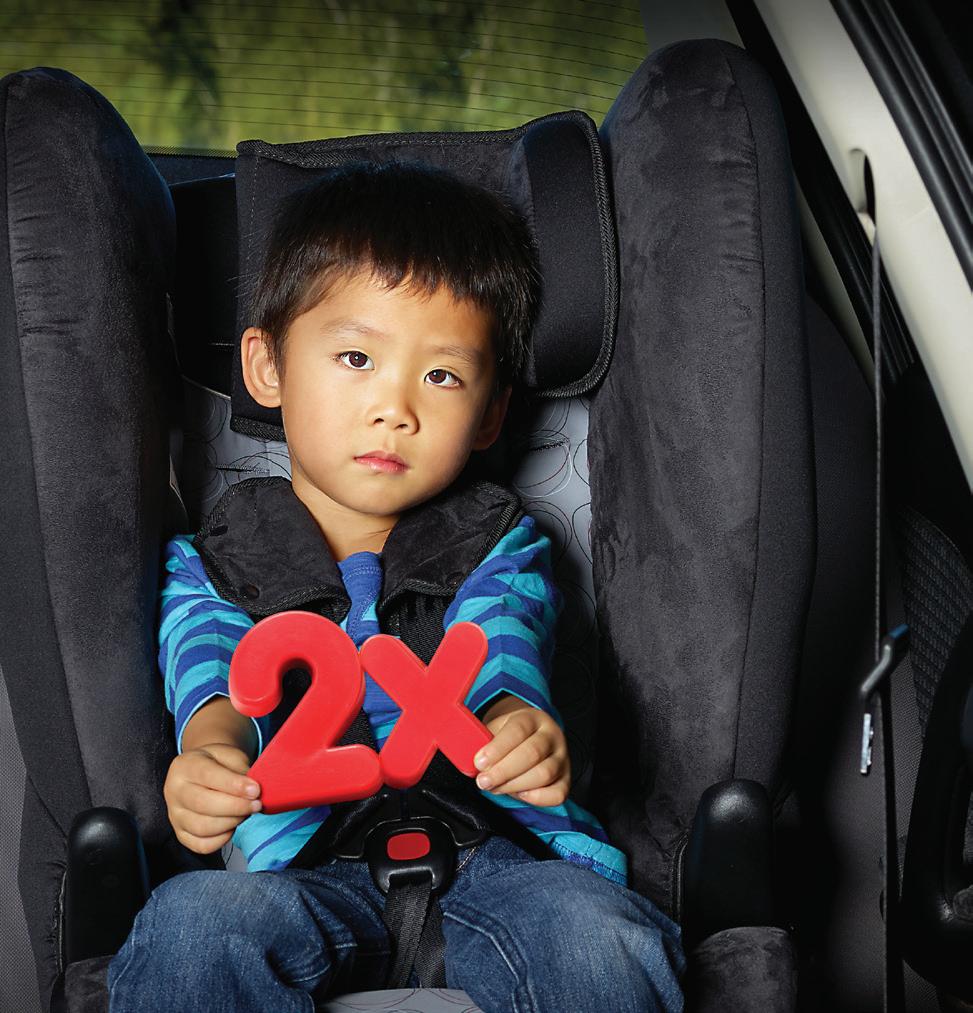



Any parent who has had a child wander away while in a crowded place knows that having a lost child is a very scary situation. Since kids are adventurous, having a lost child is relatively normal, but thankfully there are ways to protect their safety while you are out.
FOLLOWING ARE SOME TIPS ON KEEPING KIDS SAFE AND NEARBY WHILE IN A CROWD.
• Take a picture on your phone before you leave the house. If you are separated from your child when you are out, a digital photo from your phone (taken
the day of the event or travel) can be utilised by police to immediately get your child’s face out to other law enforcement officials. In addition to their face, you’ll have a photo of exactly what they were wearing, as well as what they look like.
• Teach children to identify help if they are separated from mum or dad. While it’s easy to tell children to find help, young children may have a difficult time understanding just what “help” means. To kids, any adult might mean help, and it’s important for parents to teach children just who they should be looking for. You can do this by pointing out policemen,
firemen, or security guards when you are out. Teach children to recognise store employees as well (look for name tags or someone behind the counter).
• All children should know their full name, address and telephone number.
• Try to keep your kids in sight at all times. Never send them to the bathrooms alone, even if they’re old enough to use them without help.
• If you are in a crowded location, establish an easy to find meeting spot just in case anyone gets separated from you.
• Using a safety harness is another possibility to keep
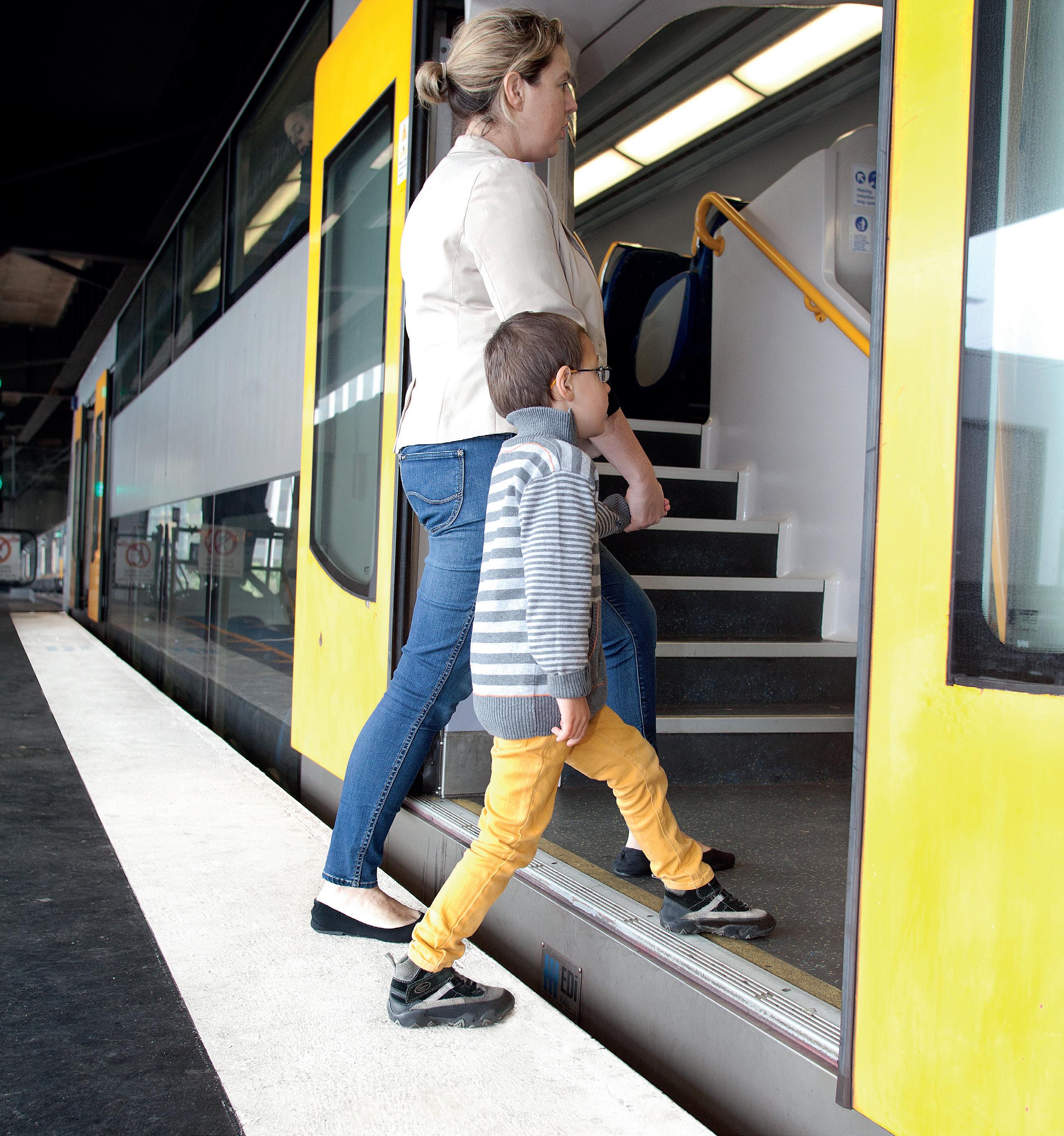
Take care when stepping on and off the train.
Teaching children how to be safe around trains is just as important as teaching them to look both ways before crossing the road. Use this 10-minute checklist the next time you and your child catch a train. The good habits they learn from you could save their life.
✓ Always stay off train tracks
If you drop something on the tracks, never try to get it yourself. Jumping onto the tracks is very dangerous because a train might be coming. Always ask station staff for help to get it back.
✓ Remember trains can’t stop suddenly or swerve
A train travelling at 60km per hour (the same speed as a car on a main road) takes the length of two and a half football fields to stop! Even if a driver sees you, they may not be able to stop in time. Because they travel on tracks, they can’t swerve if something is in their path.
✓ Always use a bridge, overpass or crossing
Tracks are for trains only. Bridges, overpasses and pedestrian level crossings are for people. When you have to get to the other side of the tracks, always use the bridge, overpass or pedestrian level crossing to get there safely.
✓ STOP, LOOK, LISTEN,
Be extra alert before you cross at a pedestrian level crossing:
STOP behind the gate or yellow line. LOOK left and right for trains coming. LISTEN for trains – they might be closer than you think.
THINK is it safe to cross? Am I holding an adult’s hand?
If there is no danger, you can walk. Keep on looking left, right and ahead.
If the pedestrian level crossing has lights or bells, never cross while they are flashing or ringing. Always wait until they finish, then STOP, LOOK, LISTEN and THINK before you cross.
Only cross at pedestrian level crossings designed for people to cross. Walk between the double yellow lines on the footpath and keep looking left, right and ahead.
✓ Stay behind the yellow line
When you are walking on the platform or waiting for a train, stay well back from the yellow line in case you accidentally slip or get pushed. Always walk, and wait behind the yellow line.
There is a gap between the train and platform – when you get on and off the train you could fall into the gap and get hurt. Always hold an adult’s hand and watch where you step.
The platform is not a place to run, bounce balls or play games. You can do that at the park! Always walk, and hold an adult’s hand on the platform.
If you need help or feel unsafe, ask staff on the train, station staff or police. They are there to help you.
In an emergency, look for the orange Emergency Help Point button on the train or platform and press it. When staff answer, tell them what happened – it’s just like talking on the phone. They can see you on camera and will send someone to help.
If you ever feel unsafe: MOVE to another carriage or a safer part of the station.
REPORT what you’re afraid of. Tell the adult who is with you, station staff or a police officer, or press the Emergency Help Point button. You can also call Triple Zero (000)
toddlers from wandering away, since in most cases, they aren’t old enough to know that it is dangerous to walk away.
• Teach your children to struggle with anyone whom they don’t know, or whom they don’t trust, if they are trying to grab or force the children to go with them
• Tell children to make a lot of noise if they’re scared. They have probably been told lots of times not to yell. Tell your children when they think they might be in danger, forget all of that advice! That’s the perfect time to be noisy!
When you’re walking home from school, a person in a car pulls up and asks you for directions. At the park, someone says he needs you to help look for his lost puppy. These people may seem friendly, but no matter what they say to you, they have one thing in common: They’re strangers. Most strangers aren’t dangerous and wouldn’t do anything to hurt kids. Unfortunately, though, some strangers can be dangerous, and it’s impossible to tell who’s OK and who’s not. A dangerous person doesn’t necessarily look scary or mean — the person might look nice.
TO FOLLOW THESE BASIC SAFETY RULES ALL THE TIME:
• Stick With a Friend – it’s more fun and safer to do things with friends. Take along a buddy when you walk to school, bike around the park, or go to the store. Travelling with a friend whenever you can is a good idea, and travelling with a bunch of kids is even better.
• Let Grown-Ups (and Only Grown-Ups) Help Strangers – it’s nice to help people. But remember: Strangers should ask adults, not kids, for help.
• If a Stranger Pulls Up in a Car and Offers you a Ride, Don’t
Get In. You probably know that rule, right? But that’s not all of it. It’s also important to avoid a stranger’s car completely. If a stranger asks you to look in the car, don’t do it. Don’t put your arm in the window to take something or point to something. Don’t agree to come closer to see a pet or to get a toy that’s offered.
• If a Stranger Offers You a Toy, Some Candy, a Stuffed Animal, or Anything Else, Don’t Ever Take It. Even if it’s something you really want, if the offer is coming from a stranger, you should ignore the person and walk the other way.
• If a Stranger Walks Up or Pulls Up in a Car and You’re Too Far Away to Hear the Person, Don’t Go Closer, Even If the Person Waves You Over. Just get away. Run the opposite way that the car is heading. Get to an adult you know, a police officer, a security guard, or one of your safe spots as fast as you can if the stranger comes toward you.
• What If a Stranger Comes To Pick You Up From School, Sports, Dancing Lessons, or the Park? This is no different from any other time — a stranger is a stranger, so don’t get in the car. Even if the stranger says that your parents sent him or her, or that there’s an emergency and you must get in the car and go to the hospital, turn right around and tell an adult what happened. Your parents would have told you if someone else was coming to pick you up, and if an emergency really did occur, they would send someone you already know, not a stranger.
• Even if The Stranger Knows Your Name, Don’t Be Fooled. There are lots of ways to find out kids’ names, even when someone doesn’t know them or their families.
• Trust Your Instincts – kids need to follow the rules of street smarts all the time with every stranger, even if the situation
seems fine. And if your instinct is telling you something is dangerous or just not quite right, get out of the area, tell an adult, or a police officer or call 000.
Catching a ferry is a great way to add fun and excitement to family outings – which makes it tempting to play on wharves and on board. Running around can be dangerous. With so much water around, it’s important to be careful. Be at the wharf at least five minutes before your ferry is due to leave so you have time to board safely, and remember that ferries are not playgrounds.

• Don’t run around on the wharf, and don’t go near the edge. Hold an adult’s hand when you get on and off.
• Yellow and black stripes on wharves mean danger. Stay away from them – they are a no-go zone.
• Don’t run around on board, and never climb on or over railings. It is easy to fall over, and you could even fall into the water.
• Look for the big orange Emergency Help Point on wharves. In an emergency (like someone falling into the water) press the button and talk into it like a
phone. Staff can see you and talk to you, and will send someone straight away.
• Tell the ferry crew if you feel like you are in trouble or need help. They are there to keep you safe.
• Small children need a helping hand to get through ticket gates. When you travel as a family, or with a pram or stroller, use the wide gates.
• Keep a firm hold while you are on the wharf, and use the brakes.
• Larger prams and strollers may not fit on gangways and will
need to be collapsed before boarding.
• If possible on board, collapse and store strollers and prams, and sit your child on your lap or on the seat next to you.
• If you prefer to keep your child in the pram or stroller, put the brakes on and hold it firmly at all times.
Ferries are just one type of public transport in NSW you and your family can use. You can also travel on trains, buses and light rail. What they all have in common is how much they care about the safety of you and your family. Please follow any special rules they have to keep you safe.
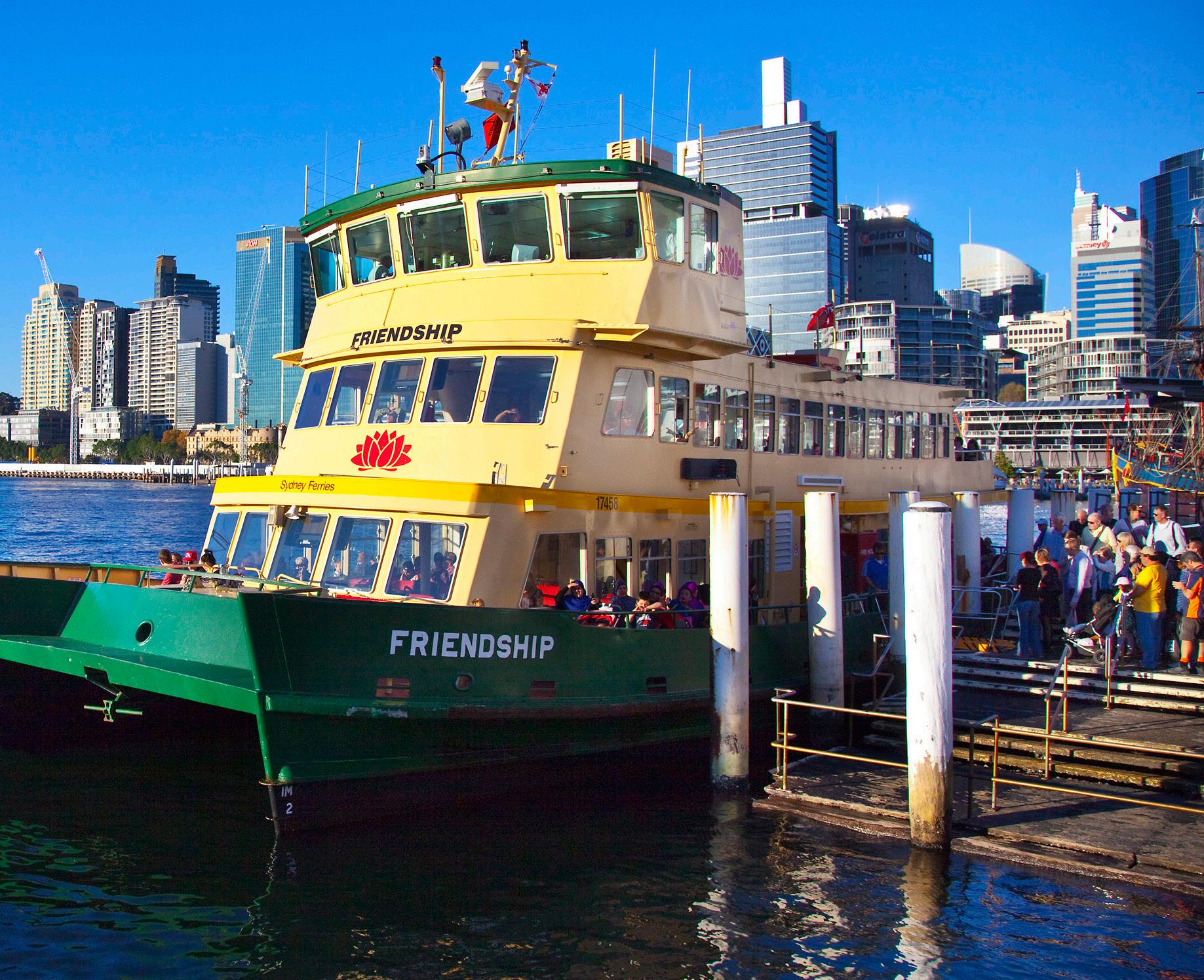




KEEPING YOUR CHILDREN SAFE
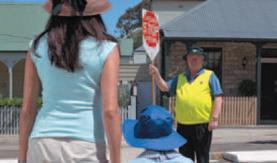
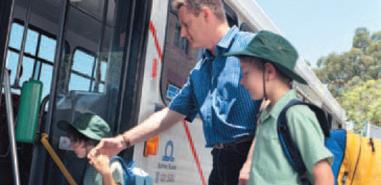
Children are vulnerable road users. They are at risk in the traffic environment because of their size, their difficulty in judging speed and distance and the fact that they may behave unpredictably.
More than one million children in NSW travel to and from school each day by car, bike, public transport or as a pedestrian. Each form of transport poses potential hazards. The RTA has introduced a program of 40km school zones and also funds the Road Safety Education Program in NSW schools. But this alone is not enough; you can help by following some simple safety steps and by regularly reinforcing important road safety messages with your children.
PEDESTRIAN SAFETY
Each year, kids, just like you and your friends are killed and injured playing near or trying to cross the road. Often they just forgot to look or are distracted by other things.
HINTS FOR KIDS TO REMEMBER:
• Use a pedestrian crossing where possible. Take care whenever you cross. Cars don’t always stop, even when they should.
• Children aged up to 10 years old should always be supervised when near traffic. Children aged up to 8 years old should always hold an adult’s hand when crossing the road or walking near traffic.
• Always look for the safest place
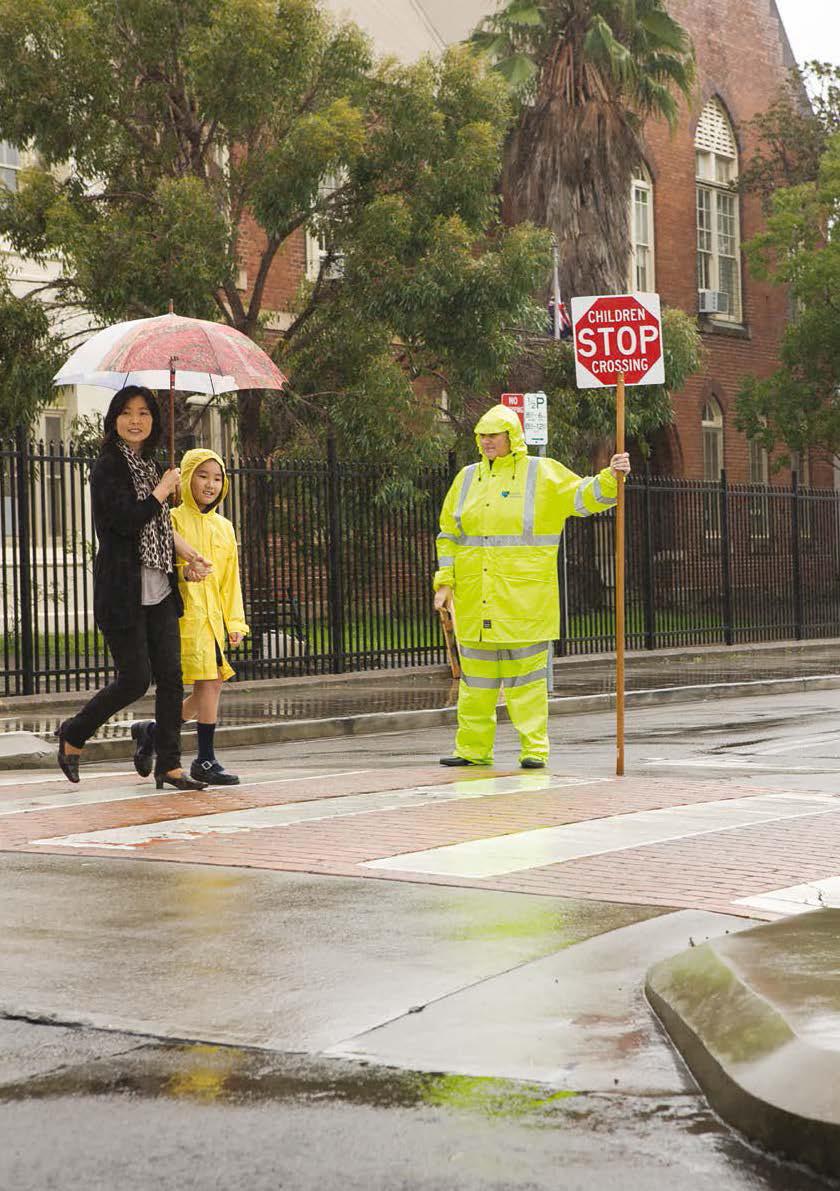
to cross the road. Traffic lights or a pedestrian crossing are the best.
• Cross in a group with your friends. A group or pair is more visible than a person on their own.
• When crossing a road STOP, LOOK for any traffic, LISTEN for any approaching cars and WAIT until there is no sign of traffic before you cross the road. Even if you are crossing at a traffic light.
• Cross the road completelyroads are not places where you can play.
• Never run out onto the road without first looking, even if it is a quiet street.
• Don’t cross between parked cars - often drivers can’t see you
and you can’t see them.
• Always walk on the footpath. If there isn’t one, walk on the side of the road towards approaching cars not on the road.
• Don’t forget to look out for cyclists who may be riding their bikes on the footpath.
• At night, carry or wear something light in colour so that drivers can see you more easily.
You must stay off the road when riding your skateboard or skating on rollerskates or rollerblades. Keep to the footpath or bikepath or head down to your local park and only use the road when you need to cross.
When crossing the road, stop,
look and listen and wait until the road is clear. Don’t use your board when crossing as you have less control. Even the most experienced rollerbladers or skateboarders have crashes. Protect yourself from injury by always wearing a helmet and protective clothing. Never hold onto a moving vehicle when on your skateboard, rollerskates or rollerblades. There’s a high risk of injury.
Riding your bike is a fun way to get around but it can be dangerous if you’re not careful. Every year more than 200 young cyclists are killed or injured. In many cases, they weren’t wearing helmets or following the road rules.
• Make sure your children always wear a helmet when riding a bike – it’s the law. A helmet will save your life and will greatly reduce your chances of being killed or badly injured in a crash. And let’s face it, almost everyone has had a crash, at least once. Remember if the Police see you not wearing a helmet, you could receive a fine.
• Children aged up to 12 years should ride their bikes on the footpath or away from the road – around 10% of child road casualties are cyclists. Older children should use the bike lane.
• Be cautious when riding on the road - remember motorists can’t always see you so don’t expect them to stop for you.
• Always ride your bike on the left hand side of the road, as close

paul@hillbrick.com.au
Opening Hours: Mon - Fri 8:30am - 5:00pm Sat - 8:30am - 1:00pm
to the kerb as possible.
• Be courteous. Drivers don’t do anything that could put yourself or other people in danger.
• Like car drivers, you have to obey all traffic signs and traffic lights.
• Leave at least one metre between you and the traffic.
• Use hand signal to let drivers know if you’re turning or stopping.
• Never ride your bike across a pedestrian crossing.
• Do not double anyone. Let your friends walk beside your bike if necessary.
• Keep your bike in control by keeping one hand on the handle bars at all times.
• Be visible on the road! Wear light coloured or reflective clothing when you are riding your bike, especially at night.
• Drivers will also see you more easily if your bike has a flag and reflectors on both front and rear.
• If you’re riding at night, have proper front and rear lights fitted otherwise people cannot see you.
• Make yourself heard on the road - check your bike has a horn or a bell.
• Check your tyres and brakes regularly. You don’t want the tyre to blow out or your brakes to fail when coming down a hill.
• Ride a bike that is the right size for you.
BASIC SAFETY
You must do:
The overriding basic rule for the safety of children in cars is for every child to use the right restraint on every trip. Over the past 20 years, our road toll has dropped dramatically. Today, Australia is one of the safest countries in which to drive. There are now new national road rules for keeping children safer when travelling in the car.
• All children under seven must be secured in a child restraint or booster seat when travelling in a vehicle.
• Small children don’t understand the dangers of not using a child restraint.
• Remind children that the car won’t start until everyone is buckled up.
• Children should be instructed to not undo their seat belts until you say they can - when you have reached your destination and the car is stopped.
• Check that older children have not accidentally undone the restraints of their baby brother or sister.
• Babies up to six months of age must be restrained in a rearward facing restraint.
• Children from six months to under four must be restrained in a rearward facing or forward facing restraint. Children under four years of age must not be in the front row of a vehicle with two or more rows.
• From four years to under seven children must use a forward facing restraint or booster seat. Children over four years of age can only sit in the front row of a vehicle with two or more rows when all other seats are occupied by children of a lesser age in an approved child restraint. For detailed information on correct child restraint visit ‘Seat Me Safely ‘ on www.kidsafensw.org/ roadsafety/seat_me_safely.html
• If your child is too small for a restraint specified for their age, they should stay in their current restraint for as long as necessary.
• If your child is too large for a restraint specified for their age, they may move to the next level of restraint
• It is important to check that the restraint is properly fitted.

• Children must use a child restraint on every trip.
• Children should always get in and out of the car using the Safety Door which is the rear kerb side door.
• Do not carry a child on your lap. It is impossible to hold onto a child in an accident and it is illegal.
• Do not put two children in one seat belt as it is not safe and is illegal; in a crash they can be injured by colliding with each other.
• Do not sit a child on an adult’s lap with the seat belt around both of them. The child is likely to be crushed by the adult’s weight against the seat belt and it is illegal.
• Let children ride in the luggage space of cars. This is also illegal and very dangerous. All children must be restrained in an
appropriate child restraint.
Drive carefully, take rests, take care in the heat
Fasten your seat belt and make sure every-one is safely and appropriately restrained before starting the car. Many accidents are the result of driver error and fatigue. Rest stops help restore concentration, and beat drowsiness. Babies, toddlers and children lose fluid quickly so it is important when travelling on hot days, to allow extra time for stops and to provide plenty of cool water or fluids.
Never leave your child in a car for any period of time without adult supervision.
Drivers need to be able to see clearly. All sunblinds on backside windows and the rear window
must allow 35 per cent light transmission. Make sure they are securely fastened and can’t distract you. Never use a nappy in the side windows to keep the sun off the baby; it will block the driver’s view. Window signs - such as baby on board should be out of the line of sight.
Don’t let your children’s behaviour distract you. Keep them occupied by talking or singing to them; provide soft toys to play with. On long trips, provide unspillable drinks, healthy snack foods; and avoid milk-based drinks for carsick-prone children. Take regular driver breaks and let the children out to run around.
Small children are at risk from moving vehicles in low speed ‘off road’ locations such as driveways, yards and car parks. While

driveway fencing and improvements to vehicle design may be helpful, supervision of children is critical whenever a vehicle is to be moved - hold their hands or hold them close to keep them safe.
Tragically one child, often a toddler, is run over in the driveway of their home every week in Australia.
Studies have tested the rear vision of a number of popular cars and results show that there is a large “blind zone” behind most cars.
What can you do to keep your child safer?
• Always supervise any children whenever a vehicle is to be moved - hold their hands or hold them close to keep them safe.
• If you’re the only adult around and need to move a vehicle, even just a small distance, put
children securely in the vehicle with you while you move it.
• Encourage children to play in safer areas away from the driveway and cars - the driveway is like a small road and should not be used as a play area.
• Limit a child’s access to the driveway – for example use security doors, fencing or gates
Why are children at risk?
• Never leave a child unattended in a car
• If you have to leave the car, even for a minute, always take the children with you
The temperature inside a parked car can be more than 30 degrees hotter than outside. Children are particularly at risk because they lose fluid quickly. Dehydrated children are at risk of suffering potentially life threatening heatstroke. There are a number of situations that can lead to an incident; changes in a normal routine or the keys being accidentally locked inside can result in a child being left in a car unintentionally. Parents sometimes choose to leave their child unattended, thinking they will only be gone for a few minutes. This can easily turn into ten to fifteen minutes and because the temperature rise in a vehicle is so rapid, even a short amount of time can place them in extreme danger.
• Create a ‘look before you leave’ routine whenever you get out of the car
• Leave something in the back seat that you will need to take with you (e.g. handbag or laptop) as a reminder that you have a child with you
• Remember that large cars heat up just as fast as smaller ones
• Lock cars and secure keys out of reach of children to prevent children gaining access to and playing inside the car
When cars brake suddenly, or are in a crash, flying objects cause many injuries. Items on the parcel shelf are particularly dangerous. Even light items such as tissue boxes can become a force 20 times their own weight. A book can become a 10kg missile. So keep that parcel shelf clear.
Vehicles which have cargo areas that open directly into passenger space or which have a back seat which can fold down are particularly risky.
Unrestrained luggage moving forward can cause split seats to collapse, injuring passengers.
A cargo barrier will protect your passengers
Station wagons, hatchback cars and panel vans especially, need this protection. Only cargo barriers approved to Australian Standards should be used and installed by an approved fitter. If

5,000 30+
Every year across Australia, approximately 5,000 children have to be rescued from cars.
The temperature inside a parked car can be over 30 degrees hotter than outside.
70°C 4 75%
Even on a cooler day, temperatures inside a car can reach well above 70°C
you do not have a cargo barrier, consider having one installed. In the meantime, pack luggage so it is spread evenly and as low as possible. Don’t pack luggage higher than the back of the seat.
of total temperature rise occurs within the first 5 minutes of parking a car.
Three quarters of children rescued from cars are aged under four years old.
• Check your child’s restraint harness to make sure they can’t reach and open doors while you’re driving.
• Cigarette lighters can pose a risk to children so please remove them.
• Use the child locks on rear doors to stop children opening them.
• Do not smoke in your vehicle with children as this is illegal.
Every day, more than a million NSW school children travel to and from school in safety - many of them by bus. The school bus is an extremely safe form of transport for school students.
Traffic congestion outside the school can increase when many families resort to driving short distances to and from school.
• Hold your child’s hand and walk together to the bus stop or bus interchange in the morning.
• If you cannot be with your child, organise for another trusted adult to take your place.
• Meet your child AT the bus stop or bus interchange after school. NEVER wait on the opposite side of the road.
• Wait on the footpath until the bus has been driven away.
• Together, choose the safest place to cross the road, and:
• STOP! One step back from the kerb.
• LOOK! For traffic to your right, left and right.
• LISTEN! For the sounds of approaching traffic.
• THINK! Whether it is safe to cross.
• Explain each action in turn as you cross safely.
Talk with your child about what to do:
• If you are delayed and cannot meet them as usual.
• If they catch the wrong bus.
• If they get off the bus at the wrong bus stop.
• Until they are at least 10 years old, children do not have the developmental maturity re-
quired to cross the road safely without holding an adult’s hand There is a 40km/h speed limit for traffic passing a school bus that is picking up or setting down school children. The speed limit is for all traffic travelling in the same direction as the bus, whether the bus is stationary or moving. The 40km/h speed limit must be observed when the rear ‘wig-wag’ lights on the bus are flashing. Flashing headlights on these buses also alert oncoming motorists that children are close. Information reproduced with permission of the Transport Roads and Maritime Services –www.rms.nsw.gov.au
• Keep behind the yellow lines.
• Mind the Gap between the platform and train doors.
• Hold onto small children when boarding and leaving the train.
• Pay special attention when the platform is crowded or when travelling to large events.
If you are travelling with a pram or stroller, we recommend you either strap the infant into the pram/ stroller, or remove the infant from it completely to board the train.
• Always keep a firm hold of your pram anywhere on stations and trains.
• Always apply pram brakes when you are at the station or on the train.
• Ensure your child is securely strapped into the pram.
• Park the pram parallel to the edge of the platform, not pointing towards the tracks.
• Board the train near the guard’s compartment so they can see you when closing the train doors.
• Don’t rush – allow plenty of time for your journey.
• If you require assistance, please ask Sydney Trains staff - they are there to help you.

Air Conditioning Systems MSZ-GL SERIES

One Of The Most Energy Efficient Air Conditioners


5.5 Star Energy Rating *only applies to GL 25 model For more information on our products Phone:1300 280 625 please visit www.mitsubishielectric.com.au » Super Quiet Only19dB *19dB only applies to GL 25 and 35 models » Anti-Allergy Enzyme Filter » 24 Hour Timer
For more information on the MSZ-GL model please scan the QR Code.
Always cross train tracks using a footbridge or underpass, or at designated pedestrian railway crossings. Crossing anywhere else is illegal and extremely dangerous.
• Stop, look, listen and think at level crossings.
• Obey the safety signs at every railway crossing and cross at marked crossings only.
• Stay on the path. Listen and look in both directions for approaching trains.
• If the red lights are flashing or the gate is closed, a train is coming so keep clear of the tracks.
• Never jump fences, gates or barriers. This is extremely dangerous and it is very likely the oncoming train is close to the crossing.
• If a train is coming, wait for it to pass and then stop, look and listen again before crossing as another train may be approaching.
• You might not hear a train, especially when using your earphones or mobile phone. Never assume a train is a long way off.
• Don’t ride bicycles, skateboards, skates or roller-blades across any pedestrian crossing.
• Never assume that it is safe to cross when the lights are still flashing. Even if a train has passed, there may be another train coming in the other direction. Only enter the crossing when the lights have stopped flashing or the gate has opened.
It takes a lot to stop an eight-carriage train travelling at 100kmh. The braking distance for a train is approximately five football fields (500m).
Information reproduced with permission of Transport Sydney Trains – www.sydneytrains.info

Children nowadays are getting more adventurous and open to trying out big toys that were previously only available for adults. But since the kids really don’t know much about the realities of being a responsible driver, it’s your duty as an adult to educate your kids about safety tips to avoid accidents and injuries. After all, bike riding should be fun and enjoyable. There are some guidelines and tips you can give your kids regarding the practice of safety measures when riding bikes.
• First, you can teach your kids to always wear protective clothing and gear to protect them from harm and injuries. Getting the right accessories and proper riding apparel is something you mustn’t skimp on, as these are good investments to ensure your kid’s safety.
• Instill responsible riding in your child. Before you allow your child to ride bikes, you might consider
teaching them the basics of driving, as well as some rules. This is to inculcate responsible riding even at a young age.
• Prepare your child for emergencies. In case something goes wrong or your child gets injured, it helps to teach him or her about basic first aid.
• Always remind your child that there are some rules concerning where he is allowed to ride and where he is not. Accidents can happen if your kid takes his bike on public roads like streets or parks. In some areas, riding on these roads is illegal, so inform your kid on where he can take his bike to avoid harm from coming your way.
• Since most kids are adventurous, they most likely want to explore the terrain with their bikes. That’s why it helps to teach your kid to memorise your phone number and address, which is extremely helpful if he gets lost. In the first place, go over the area with your child first, so he or she becomes familiar with it as much as possible.
WHAT IS CHILDREN’S MENTAL HEALTH?
Mental health is about the way a child thinks and feels about themselves and their world. It’s about how they handle their everyday lives, including making and keeping friends, keeping up with school work and getting along with family members. Like our physical health, there are times we feel well and happy, and times when we don’t feel so great. As children develop and grow they can experience some bumps along the way, which may influence their thoughts, feelings and behaviours.
WHAT ARE THE WARNING SIGNS OF MENTAL HEALTH PROBLEMS IN CHILDREN?
Children do not show symptoms of poor mental health in the same way that adults do and symptoms must be considered in terms of their developmental stage. It can be difficult to distinguish between normal developmental behaviours and emerging mental health problems as children’s behaviour can change quickly as they grow. For example, children may find it hard to concentrate and may lose interest in school work and play. Some may even refuse to go to school, while others complain of feeling bored or lonely, even when they have friends. Changes in behaviour may be gradual or may happen quite suddenly.
The Children’s Hospital Westmead provides a number of fact sheets for parents on specific mental illnesses, such as; anxiety, disruptive disorders, depression and anorexia nervosa. For more information visit: http://www.chw. edu.au/healthykids/
Parents or carers are often the first to recognise that their child is experiencing difficulties with their emotions or behaviour. When children are experiencing ongoing distress they may have difficulties with coping, getting on with others, and keeping an interest in what they are doing. It is important to take note of any significant changes in your child’s usual pattern of behaviour including their eating and sleeping patterns.
When the behaviour is distressing to your child and those around him or her, and persists over a period of time or across situations (e.g. at home and at school) then it is time to get support or advice.
It is important to speak with an experienced professional
who works with children and understands mental illness. The services available to you may vary depending on where you live but may include; GPs, community health centres, Child and Adolescent Mental Health Services, private and school counsellors and Medicare Locals. Getting effective help early often prevents more serious problems developing at a later stage.
It may also be useful to find out about how you child is behaving in the school environment.
One in five adults experienced a mental illness in the previous 12 months (Australian Bureau of Statistics, 2007), some of these people are parents. If you’re a parent with
Children’s mental health difficulties are generally classifi ed as being one of two types: ‘internalising’ and ‘externalising’. Children with internalising diffi culties show behaviours that are inhibited and over-controlled. They may have a nervous or anxious temperament and be worried, fearful and/or withdrawn. Children with externalising diffi culties show behaviours that are undercontrolled. They may have a more challenging temperament, shown in impulsive or reactive behaviour. Sometimes this pattern can lead to diffi culties with attention, aggression or oppositional behaviour.
Externalising behaviours cause diffi culties for others as well as for the children themselves. It is not uncommon for children to show behaviours associated with both internalising and externalising patterns of behaviour. The typical features associated with each pattern are summarised below.
Features associated with children’s ‘internalising’ difficulties include:
• nervous/anxious temperament
• excessive worrying
• pessimistic thinking
• withdrawn behaviour
• peer relationship diffi culties (eg can be isolated).
Features associated with children’s ‘externalising’difficulties include:
• challenging temperament
• reduced problem-solving skills
• attention diffi culties, hyperactivity
• oppositional behaviour (eg doesn’t like to be told what to do; won’t follow rules)
• aggressive behaviour.
Children with ADHD often show severe externalising difficulties. Children with other serious behaviour problems also show externalising patterns of behaviour, such as persistent aggression. Children with severe internalising diffi culties may be diagnosed with an anxiety disorder or with depression.
Mental health professionals who may help with children’s difficulties
School psychologist/school counsellor
Talk with your child’s school about the possibility of seeing the school psychologist or counsellor. School psychologists and counsellors provide assessment and support for children with mental health diffi culties. They advise parents and carers and school staff about helping individual children and may recommend specialist services outside the school.
General practitioner (GP)
Your family doctor will give advice and help you decide whether further investigation and treatment is needed. A doctor’s referral is needed to be able to claim the Medicare rebate for mental health treatment from other professionals.
a mental illness and need some support, it’s important that you get help as early as possible. There are also services and programs to support you, if you are a carer or have a family member who is experiencing a mental illness.
The National Children of Parents with a Mental Illness (COPMI) Initiative aims to promote better mental health outcomes for children (0-18 years) of parents with a mental health problem or disorder. Information for family members across Australia where a parent has a mental illness and for people who care for and work with them can be found on their website - www.copmi.net.au/
REFERENCES
Australian Bureau of Statistics (2007) National Survey of Mental Health and Wellbeing: Summary of Results. ABS, Canberra. Children and adolescents need sufficient nutritious foods to grow and develop normally. Growth should be checked regularly for young children. Physical activity is important for all children and adolescents.
About children’s teeth
About children’s teeth

front of each tooth.
The 32 adult teeth replace baby teeth between the ages of 6 and 20 years. Supervise and help clean children’s teeth until 8 years. Brush teeth and gums twice a day, once in the morning and once at night before bed.
Brushing Children’s Teeth (in pictures)
Brushing teeth: getting started
Baby teeth can arrive in any order. All baby teeth usually arrive by three years. Start cleaning teeth as soon as they come through. Use a clean, damp face washer to clean baby gums and back and front of each tooth.
Brushing teeth: getting started
Brushing teeth: getting started
The 32 adult teeth replace baby teeth between the ages of 6 and 20 years. Supervise and help clean children’s teeth until 8 years. Brush teeth and gums twice a day, once in the morning and once at night before bed.
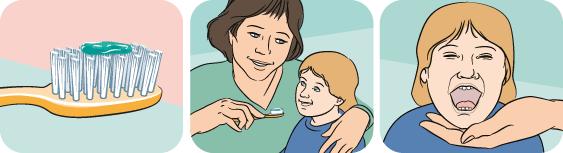
Under 18 months, don’t use toothpaste. From 18 months to 6 years, use a pea-sized amount of low-fluoride toothpaste. From 6 years, use a pea-sized amount of standard fluoride toothpaste. Use a soft small child’s toothbrush.
Under 18 months, don’t use toothpaste. From 18 months to 6 years, use a pea-sized amount of low-fluoride toothpaste. From 6 years, use a pea-sized amount of standard fluoride toothpaste. Use a soft small child’s toothbrush.
Sit or stand behind your child in a brightly lit place, ideally in front of a mirror. This lets your child see what you’re doing. It’s easier to sit toddlers on your lap.
Sit or stand behind your child in a brightly lit place, ideally in front of a mirror. This lets your child see what you’re doing. It’s easier to sit toddlers on your lap.
Sit or stand behind your child in a brightly lit place, ideally in front of a mirror. This lets your child see what you’re doing. It’s easier to sit toddlers on your lap.
Brushing teeth: steps
Under 18 months, don’t use toothpaste. From 18 months to 6 years, use a pea-sized amount of lowfluoride toothpaste. From 6 years, use a pea-sized amount of standard fluoride toothpaste. Use a soft small child’s toothbrush.
Use your free hand to support your child’s chin. Ask her to open up and say ‘ah’. Check for any signs of decay, such as a white or brown line on the teeth close to the gums. Check for plaque build-up on teeth around the gum line.
Use your free hand to support your child’s chin. Ask her to open up and say ‘ah’. Check for any signs of decay, such as a white or brown line on the teeth close to the gums. Check for plaque build-up on teeth around the gum line.
Use your free hand to support your child’s chin. Ask her to open up and say ‘ah’. Check for any signs of decay, such as a white or brown line on the teeth close to the gums. Check for plaque build-up on teeth around the gum line.
Brushing teeth: steps
Brushing teeth: steps
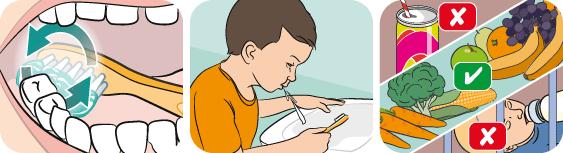
backwards and forwards on all chewing surfaces. Take the most care with the back teeth.
Using small circular motions, brush all sides of each tooth and the gums. Brush backwards and forwards on all chewing surfaces. Take the most care with the back teeth.
Using small circular motions, brush all sides of each tooth and the gums. Brush backwards and forwards on all chewing surfaces. Take the most care with the back teeth.
rinse out the mouth. Rinse toothbrush, and put somewhere your child a bottle of milk, formula or juice in bed. Always

After you’ve finished brushing, your child should spit out any leftover toothpaste, but don’t rinse out the mouth. Rinse toothbrush, and put somewhere clean to dry.
After you’ve finished brushing, your child should spit out any leftover toothpaste, but don’t rinse out the mouth. Rinse toothbrush, and put somewhere clean to dry.
Avoid giving your child sugary snacks or drinks, especially between meals. Avoid giving your child a bottle of milk, formula or juice in bed. Always take away bottles after feeding.

© Raising Children Network
juice in bed. Always take away bottles after feeding.
When children eat breakfast, their memory is better and they find it easier to concentrate over the course of the morning1.
A protein-rich breakfast is better Eating any breakfast is better than none at all, but research shows that eating a protein-rich breakfast has additional benefits2,3. Children who eat a proteinrich breakfast (such as one containing eggs) have lower levels of hunger throughout the morning and are better able to manage their appetite for the rest of the day compared to children who eat a low protein breakfast (such as toast with jam or a glass of juice)4
What makes eggs so good for breakfast?
Eggs are versatile, tasty and filling – all important criteria for children to enjoy eating them for breakfast. Eggs are a highly nutritious whole food, a natural source of 11 different vitamins and minerals, including vitamin A, iodine and iron as well as providing omega-3 fatty acids. And of course, eggs are a good source of high quality protein, which supports their growth and development4 and keeps children fuller for longer3

Teach your child healthy habits for a healthy life
What are the dietary Guidelines?
The Australian Dietary Guidelines provide up-to-date advice about the amount and kinds of foods that we need eat for health and wellbeing. They are based on scientific evidence and research. The Australian Dietary Guidelines of most relevance to children are included below:
Guideline 1:
To achieve and maintain a healthy weight, be physically active and choose amounts of nutritious food and drinks to meet your energy needs.
• Children and adolescents should eat sufficient nutritious foods to grow and develop normally. They should be physically active every day and their growth should be checked regularly.
Guideline 2:
Enjoy a wide variety of nutritious
foods from these five food groups every day:
• Plenty of vegetables of different types and colours, and legumes/beans
• Fruit
• Grain (cereal) foods, mostly wholegrain and/or high cereal fibre varieties, such as breads, cereals, rice, pasta, noodles, polenta, couscous, oats, quinoa and barley
• Lean meats and poultry, fish, eggs, tofu, nuts and seeds, and legumes/beans
• Milk, yoghurt, cheese and/or their alternatives, mostly reduced fat (reduced fat milks are not suitable for children under the age of 2 years) And drink plenty of water.
Guideline 3:
Limit intake of foods containing saturated fat, added salt, added sugars and alcohol.
a. Limit intake of foods high in saturated fat such as many biscuits, cakes, pastries, pies, processed meats, commercial burgers, pizza, fried foods, potato chips, crisps and other savoury snacks.
• Replace high fat foods which contain predominately
saturated fats such as butter, cream, cooking margarine, coconut palm oil with foods which contain predominately polyunsaturated and monounsaturated fats such as oils, spreads, nut butters/pastes and avocado.
• Low fat diets are not suitable for children under the age of 2 years.
b. Limit intake of foods and drinks containing added salt.
• Read labels to choose lower sodium options among similar foods.
• Do not add salt to foods in cooking or at the table.
c. Limit intake of foods and drinks containing added sugars such as confectionary, sugar-sweetened soft drinks and cordials, fruit drinks, vitamin waters, energy sports drinks.
Guideline 4:
Encourage, support and promote breastfeeding.
Guideline 5:
Care for your food; prepare and store it safely

‘Discretionary choices’ are called that because they are not an essential or necessary part of our dietary patterns. Discretionary foods are high in kilojoules, saturated fat, added sugars, added salt, or alcohol. If chosen, they should be eaten only sometimes and in small amounts.
Examples of discretionary choices include:
• Sweet biscuits, cakes and desserts
• Processed meats and sausages
• Ice-cream, confectionery and chocolate
• Meat pies and other pastries
• Commercial burgers, hot chips, and fried foods
• Crisps and other fatty and/or salty snacks
• Cream and butter
• Sugar-sweetened cordials, soft drinks and sports drinks.
It is also important to remember that young children (less than 3 years of age) can choke on hard foods. To prevent this from happening:
• Sit with them when they eat and don’t give them hard foods such as popcorn, nuts, hard confectionary or crisps.
• Cook or grate hard fruit and vegetables to soften them.
• Remove all bones from fish or meat.

Childhood is a time of learning. Children who grow up in families that enjoy a variety of nutritious foods from the Five Food Groups are more likely to make their own healthy choices as they get older.
You can help by teaching your whole family to:
• Choose ‘everyday foods’ for home and school from the Five Food Groups.
• Save discretionary choices for special occasions.
• Provide a variety of types and colours of fresh vegetables and fruit that are in season.
• Enjoy reduced fat varieties of milk, yoghurt and cheese (once they are 2 years or older).
• Eat mainly wholegrain cereal foods and breads.
• Drink plenty of water instead of sugary drinks like cordial, energy drinks, sports drinks, fruit drinks, vitamin waters and soft drink.
• Eat a healthy breakfast every day.
• Learn about how foods are grown and where they come from.
• Try new foods and recipes – help with cooking and preparing foods and drinks too.
• Turn off the tv and computer at mealtimes – make this family time.
• Wash their hands before eating or cooking.
• Be physically active – play outside, walk the dog or run around at the local park.

Many people think they are allergic to a food when in fact they are intolerant. Unlike food allergies, intolerances do not involve the body’s immune system. Slower in onset and not life threatening, food intolerance symptoms include headaches, bloating, wind, nausea, mouth ulcers or hives.
Symptoms that occur several hours after a food is eaten are more often as a result of an intolerance or enzyme deficiency rather than a food allergy. A food allergy is not:
• The inability to digest a food
• An aversion to a food (disliking a food)
• Food poisoning
• A reaction to a food additive
Signs & Symptoms
The signs and symptoms of a food allergic reaction may occur almost immediately after eating or most often within 20 minutes to 2 hours after eating. Rapid onset and development of potentially life threatening symptoms are characteristic markers of anaphylaxis.
Allergic symptoms may initially appear mild or moderate but can progress very quickly. The most dangerous allergic reactions (anaphylaxis) involve the respiratory system (breathing) and/or cardiovascular system (heart and blood pressure).
If you suspect a food has caused a reaction, avoid that food, talk with
your doctor and have it investigated. If you know you have a food allergy, then always avoid that specific food trigger.
If you, your child or someone you care for has a reaction to any food, seek medical advice. If you are worried about a serious reaction, call an ambulance or go directly to hospital.
Anaphylaxis is the most severe form of allergic reaction and is potentially life threatening. It must be treated as a medical emergency, requiring immediate treatment and urgent medical attention.
Anaphylaxis is a generalised allergic reaction, which often involves more than one body system (e.g. skin, respiratory, gastro-intestinal, cardiovascular). A severe allergic reaction usually occurs within 20 minutes of exposure to the trigger and can rapidly become life threatening.
A person who is suspected of having a food allergy should obtain a referral to see an allergy specialist for correct diagnosis, advice on preventative management and emergency treatment. Those diagnosed with severe food or insect allergy must carry emergency medication as prescribed as well as an Action Plan for Anaphylaxis signed by their doctor. Food allergic children who have a history of eczema and/ or asthma are at higher risk of severe allergic reactions.
Mild to moderate allergic reaction
Hives, welts or body redness
Swelling of the face, lips, eyes
Vomiting, abdominal pain (these are signs of a severe allergic reaction/anaphylaxis in someone with severe insect allergy)
Tingling of the mouth
Administration of adrenaline is first line treatment of anaphylaxis.
Anaphylaxis is a preventable and treatable event. Knowing the triggers is the first step in prevention. Children and caregivers need to be educated on how to avoid food allergens and/or other triggers.
However, because accidental exposure is a reality, children and caregivers need to be able to recognise symptoms of an anaphylaxis and be prepared to administer adrenaline according to the individual’s Action Plan for Anaphylaxis.
Research shows that fatalities more often occur away from home and are associated with either not using or a delay in the use of adrenaline.
In Australia, adrenaline can be purchased on the PBS in the form of autoinjectors known as the EpiPen®.
More information on prescription is available through ascia www.allergy.org.au
The adrenaline autoinjectors are intramuscular injections that contain a single, pre-measured dose of adrenaline that is given for the emergency treatment of anaphylactic reactions. The devices are for use by lay people and is available in two doses, Epipen® or EpiPen® Jr.
Please consult your doctor for more information on allergic reactions, accurate diagnosis and management strategies. Visit www.allergy facts.org.au or call 1300 728 000 Information reproduced with the permission of allergy facts.org.au.
Severe allergic reaction- ANAPHYLAXIS
Difficult and/or noisy breathing
Swelling of the tongue
Swelling or tightness in the throat
Difficulty talking and/or hoarse voice
Wheeze or persistent cough
Persistent dizziness or collapse in its place
Pale and floppy (in young children)
VACCINATE WITHOUT DELAY TO HELP KEEP DISEASE AT BAY
The Facts
Vaccines provide the best protection if they are completed on time. Delaying vaccination when your little one is feeling off colour is a normal response. But the truth is, even if they have a runny nose or slight cold they can still receive their shot. Timely vaccination is the best way to protect your child from serious diseases.
Why Vaccinate
• Vaccination is the best way to protect your child from serious disease.
• By vaccinating you are protecting your child as well as the broader community.
• The more people who vaccinate their children, the greater our ability to control serious vaccine preventable diseases.
When to vaccinate
The NSW Immunisation Schedule recommends that children are vaccinated at the following ages:
• Birth
• 6–8 Weeks
• 4 Months
• 6 Months
• 12 Months
• 18 Months
• 3½–4 Years
It is important to vaccinate your child on time.
So book ahead, make an appointment with your doctor or immunisation service provider and save the date to vaccinate.
Vaccines are safe and effective. The benefits of immunisation far outweigh any risks. However, like other medicines, a vaccine can sometimes cause side effects. These are usually mild and short-lasting and involve pain, swelling and redness at the
injection site. Serious side effects are very rare.
If you have any concerns about possible side effects, speak to your doctor or immunisation service provider.
Keeping records
You will need to provide records of your child’s immunisations for child care, preschool and for school enrolment. Contact the Immunisation
Register on 1800 653 809 to obtain an Immunisation History Statement. Where to vaccinate
Vaccinations are provided by:
• GPs
• Aboriginal Medical Services
• Some local councils
• Some community health centres
If you are unsure about what services are available in your area, you can contact your nearest Public Health Unit on 1300 066 055







• Children using playground equipment can experience many health, social and cognitive benefits.
• Although children sometimes fall from playground equipment, you can reduce the risk of injury by keeping an eye your children, encouraging the use of age-appropriate equipment and allowing them to explore creative but safe ways to move.
• Maintain a soft surface under and around all play equipment to a depth of 300mm.
Play is an important part of a child’s development. Playing outside in the fresh air can be fun and adventurous, particularly when there are playmates. However, many Australian children are less active than they should be.
Create safe play areas for children – separate play areas from driveways and roads. Young children must be within eyesight of an adult at all times while outdoors. The backyard or local playground provides lots of scope to run, climb, swing, explore and play imaginary games. With careful planning however, play environments can be challenging and safe for children.
Being outdoors encourages all types of free play and helps children understand their environment. Playgrounds provide children with a range of experiences and opportunities including:
• being physically active
• being challenged and taking risks
• socialising with friends
• learning to cooperate
• using their imagination
• playing independently. A well-designed playground will stimulate a child’s imagination and encourage them to explore new dimensions to play.
Almost three-quarters (70 per cent) of injuries in playgrounds are the result of falls. Most playground injuries are minor, such as scratches or bruises. However, sometimes, playground injuries result in fractures. Other rare but serious injuries include spinal and head injuries. Climbing can be fun but the high drops might increase the risk of injury. Given their own time and space, most children will safely and gradually increase the distance they can climb. To help make landings safer, you can check to see if the ground beneath the equipment is made of loosely filled materials such as mulch or sand, rather than harder materials.
With well-thought-out planning, play environments can be made safe for children and injuries can be avoided.
To protect children, it is important to:
• Plan ahead for active time and aim to get children outdoors as often as possible in safe environments.
• Limit their play to equipment appropriate for their age and abilities.
• Supervise them at all times.
• Be a role model of active but sensible play and encourage them how to use the equipment creatively, but safely.
• Make sure that the children drink enough fluids. Provide water to enable children to rehydrate after playing, or if it is particularly hot, during play.
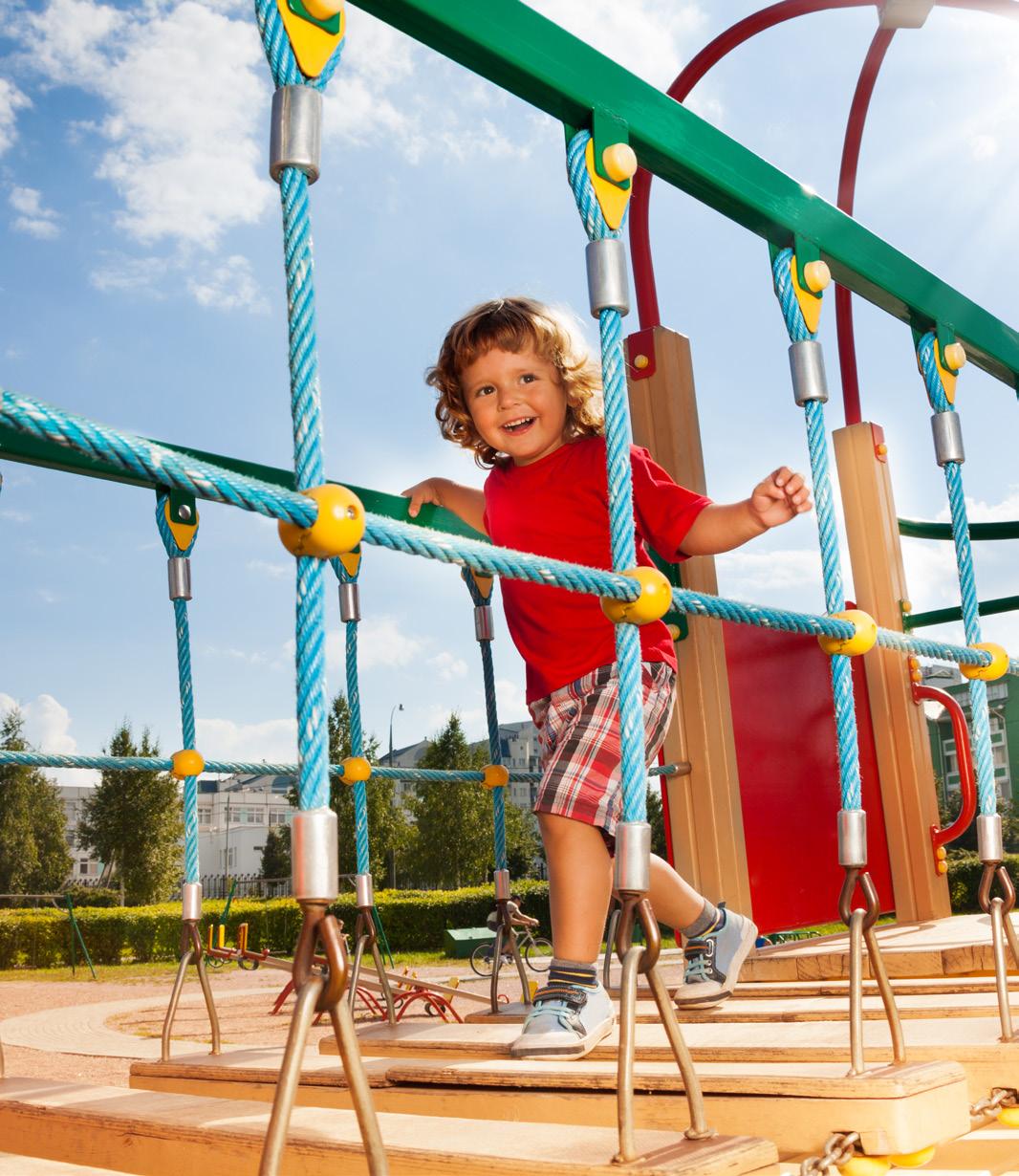
• Modify play for a sick or injured child if they are well enough to express an interest.
• Place less emphasis on competing and more on creativity, socialising, having fun and participation.
• With the exception of the winter months, protect your child from the sun with appropriate clothes, a cap and sunscreen.
Playground equipment at home
Safety suggestions for your backyard playground include:
• Any raised platform should be made secure by a guard or handrail.
• Cover all hooks, nails or bolts.
• Rubber surfaces provide better grip than metal or wood.
• Check the equipment regularly for signs of wear and tear.
• Use mulch, river sand or other soft materials (such as rubberised surfacing) underneath the play equipment to a depth of 300 mm to offer a softer landing in case of falls.
• Consider less risky play equipment, such as a sandpit.
Safety on trampolines
Trampolines can be amazing for children’s balance, coordination and fitness. Hundreds of Australian children are taken to hospital every year for trampoline-related injuries, such as cuts, sprains and fractures. To minimise the risk of injuries from trampolines, it is important that children are supervised by an adult while playing on a trampoline.
Safety guidelines include:
• Supervise – watch children at all times, and take extra care with younger children as they are more prone to serious injury.
• Regularly check the mat and net don’t have holes, springs are intact and securely attached at both ends, frames are not bent,
leg braces are locked
• Hazard-free surrounds – make sure the area around the trampoline is free from hazards like fences or garden furniture and there is an overhead clearance to avoid objects like trees and wires.
• Safety padding – always use safety padding on the frame. Cover the springs with padded mats. When buying a trampoline, look for one that meets Australian Standard AS4989-2003, a voluntary standard that requires the frame to have padding.
• Trampolines are not suitable for children under six years of age. Consider the trampoline as sports equipment, not a toy.
• Make sure the trampoline is in good order and replace worn parts promptly. If the trampoline is outside and exposed to


sun and rain, check regularly for signs of rusting and other damage.
• Sink the trampoline into the ground for greater stability; this also provides a lower fall height.
• Drinking or eating while bouncing should not be allowed because of the possibility of choking on food.
• Bare feet provide better grip.
• Make sure there is only one child at a time on the trampoline.
• Encourage and remind the child to jump in the centre, not near the sides.
• Teach the child to get on and off the trampoline slowly and safely.
• Clear the area around the trampoline of any obstacles, toys and debris.
Local council playgrounds Equipment in a public playground generally caters for children of all ages. Your child might be at risk of injury from a piece of equipment designed for older children. Safety tips include:
• Make sure your child only uses equipment that is appropriate for their age, strength and coordination.
• Remind your child to be aware of other children playing, particularly near swings or other moving pieces of equipment.
• Contact your local council if the equipment needs repair or maintenance work.
Things to remember
• Children using playground equipment can experience many health, social and cognitive benefits.
• Although children sometimes fall from playground equipment, you can reduce the risk of injury by keeping an eye your children, encouraging the use of age-appropriate equipment and allowing them to explore creative but safe ways to move.
• Maintain a soft surface under and around all play equipment to a depth of 300mm.
Tips to help keep kidssafe on farms environment. Dangers come especially from farm machinery, chemicals, water and animals.
Farms provide a wonderful environment for children to grown up in and to visit. However, they are working environments and there can be many dangers and hazards for children. These safety tips are aimed at reducing injuries so that farms continue to be great places to live, learn and have fun.
For younger children
• Create a safe, secure, supervised play area with self closing gates for younger children away from farm activities. These are also useful for visiting children who may not be aware of farm hazards.
• Ensure family members and visitors are aware of the safe play area and keep gates closed at all times.
• Teach children the difference between safe play areas and work areas.
• Separate driveways and turning circles from home and play areas.
For older children
• Establish and reinforce safety rules for such as ‘out of bounds’ areas.
• Ensure they let adults know where they are going on the farm.
• Teach children the difference between safe play areas and work areas.
Farms have many water areas and these can be very hazardous to children.
Tragically drowning is the main cause of deaths for children on farms - most occurring in dams.
• Reduce any access for children to dams and waterways.
• Ensure wells, sheep dips, tanks,
troughs and any containers are covered.
• Check dams and creeks for change in conditions such as higher water levels and debris.
• Teach children basic water awareness and safety skills.
• Adults on farms should have current first aid training.
• Place CPR charts around the home and working areas.
Vehicles and machinery are an essential part of farm life. Unfortunately they are also a leading cause of injury.
• Children should not ride on tractors or in the back of utes.
• Children should not ride quad bikes or be carried as passengers on quad bikes.
• Always supervise children when vehicles are being moved. Hold hands with young children.
• Ensure all children are appropriately and correctly restrained when travelling in vehicles on the farm.
• Take keys out of vehicles and machinery when not in use and put out of reach of children.
• Always ensure children wear helmets and other protective equipment when riding bikes.
• Check that the bike is suited to the child’s size and ability.
It is important to remember that all animals can be unpredictable even those we keep as pets. Children should be encouraged to respect animals and learn how to care and interact safely with them.
• Ensure that all animal pens and stockyards are inaccessible to young children.
• Match farm jobs involving ani-
Rural properties can be fun places for children to live and visit. However, farms are both a home and a workplace, and children may be at risk when playing or helping out.
mals to your children’s age and development.
• When riding a horse, children should wear an approved helmet that fits correctly.
• Select the horse carefully and always supervise.
• Always store hazardous products such as poisons, chemicals and pesticides in line with regulations or manufacturer’s instructions.
• Choose appropriate child proof containers to store chemicals and poisons. Do not use soft drink bottles or other containers that may be mistaken by children.
• Ensure power tools and other dangerous machinery are unplugged when not in use and stored safely away from children.
• Some farm machinery is very loud which can damage ears. Consider the location of the equipment and keep protective safety equipment in easy to reach places.
• Ensure firearms are stored appropriately and correctly as
specified by law at all times.
• Provide adequate shade coverage to protect young children from the sun.
• Create a safe fenced play area for children away from farm activities.
• Always supervise children on the farm particularly around water and animals.
• Keep dangerous goods locked safely away.
• Always use appropriate restraints for all children when travelling in vehicles.
• Be a good role model for children in vehicles and around the farm.
• Establish and enforce farm safe rules.
For more information you can also visit:
mynrma.com.au farmsafe.org.au royallifesaving.com.au
FARM WATER SAFETY
Q. Where do toddlers commonly drown on farms?
A. The most common location for
toddler drowning deaths on farms are dams. However, the farm environment has a range of other water locations including dams, troughs, irrigation channels, water tanks and swimming pools.
Q. How many children drown on farms?
A. On average 4 children under the age of five drown in farm dams every year and there are approximately 3 hospitalisations for every drowning death.
Q. How do I keep my child safe?
A. In rural areas, it is not always feasible to fence off large water bodies such as lakes or dams, so Royal Life Saving suggests parents create a Child Safe Play Area. Royal Life Saving has also developed the Keep Watch @ The Farm program which provides information and useful resources to improve parent/carer awareness of drowning prevention strategies on farms.
Q. What is a Child Safe Play Area?
A. A Child Safe Play Area is a carefully planned, designated location which is securely fenced and helps to prevent a young child from entering the farm without adult supervision. Pool fencing requirements, including appropriate ‘child resistant’ gates and latches, can be used as a guide in planning a safe play area. For more information visit www. keepwatch.com.au for Fact Sheet No. 6 Child Safe Play Areas.
Q. Why do parents leave their children unsupervised?
A. There are many reasons why a parent’s attention can be diverted from their child. Busy lifestyles, phone calls, visitors, preparing meals and other siblings are just some of the things which demand attention. The Keep Watch program advocates for supervision to be supported by fenced Child Safe Play Areas, water awareness and resuscitation skills.. been educating Australian parents and carers on how to keep their children safe when in, on, or around the water in a variety of locations. We are now tailoring the approach to locations with specific hazards – like those found on a farm.
Keep Watch @ The Farm is aimed at preventing children under 5 years of age from drowning by getting parents and carers to undertake four simple actions:
Ensure that when your child is in, on, or around water they are within arms’ reach and have your undivided attention at all times. This may include holding their hand when walking near a dam.
Ensure that where possible there is a barrier between your child and the water. This may be an effective and well maintained pool fence or a child safe play area on a farm.
Enrol your child in a water familiarisation class such as Royal Life Saving’s Swim and Survive
Wonder Program. When new people arrive at your farm, ensure that they are made aware of the hazards and risks the farm environment may pose to children.
Be prepared to respond in an emergency. Enrol in a resuscitation course and update your skills annually.
If required, any response is better than nothing. Just push and blow, and as soon as possible call ‘000’.
On average 4 children under the age of five drown in farm dams every year and there are approximately, 3 hospitalisations for every drowning death.
The farm environment has a range of water locations such as dams, troughs, irrigation channels, water tanks and swimming pools. Easy access to water and a lack of direct adult supervision by parents or carers have been the main factors in the farm drowning deaths of children.
Q. How safe are Australian beaches?
A. Going to the beach is a popular pastime in Australia, but it can be a dangerous place. On average, one person has drowned every week at an Australian beach for the last 5 years and on average 10 people are rescued every day. International tourists and those who are unfamiliar with the beach are at a greater risk of drowning.
Q. What hazards are there at Australian beaches?
A. There are a number of dangers at Australian beaches. These include: rips, tidal and runback currents, waves, drop offs, sand bars, marine stingers, submerged objects, other people and surf craft.
Q. What is a rip and how do I recognise one?
A. Rips are one of the most
common hazards at Australian beaches. Rips are fast-flowing currents where the water flows out in the direction that causes the least resistance. Recognising a rip is the first step in being able to avoid being caught in one. To recognise a rip look for discoloured water, brown in colour due to sand being stirred from the bottom, foam on the surface that extends beyond the breaking waves, a ripple appearance when the water around is generally calm, debris floating with the current and waves breaking larger and further out on both sides of the rip.
Q. What do I do if I’m caught in a rip?
A. If you are caught in a rip, do not panic, remain calm. If you are a poor or non-swimmer then you should go with the rip, float and wave and wait to be rescued. If you are a weak or tired swimmer then you should swim parallel to the shore and then return to shore when conditions allow. If you are a strong swimmer you should either swim parallel to the shore or angle your body diagonally across the current, returning to the shore through the breaking waves.
Q. What can I do to keep myself safe at the beach?
A. When at the beach you should always swim between the red and yellow flags. Never swim at unpatrolled beaches and never swim alone. If you do get into trouble, don’t panic, float and wave and wait to be rescued. Be aware of your limitations and evaluate your skills and fitness at a safe environment such as a public pool prior to swimming at the beach, to make sure you’re physically capable of swimming in the surf. Refrain from drinking alcohol before swimming and never swim at night.
Q. I’m worried about being stung at the beach, what do I do?
A. To keep yourself safe, wearing a stinger suit (neck to ankles) or a rash vest, swim in
areas which are surrounded by stinger nets, heed warning signs, swim at patrolled beaches, use caution entering the water, avoid swimming at beaches during stinger season if possible (usually September to May) and supervise children as they are more vulnerable to stings.
Suncreen
Cancer Council Victoria recommends using SPF30 or higher broad-spectrum, water-resistant sunscreen. However sunscreen alone will not provide adequate protection against overexposure to ultraviolet (UV) radiation. Cancer Council recommends five steps to protect against sun damage during the daily sun protection times (when the UV level is 3 and above):
1. Slip on sun-protective clothing.
2. Slop on SPF30 or higher sunscreen – make sure it is broad-spectrum and water-resistant. Put it on 20 minutes before you go outdoors and re-apply every two hours.
3. Slap on a hat – that protects your face, head, neck and ears.
4. Seek shade.
5. Slide on sunglasses – make sure they meet Australian Standards. UV levels are most intense during the middle of the day. Check the daily sun protection times, available:
• on the free SunSmart app
• online at sunsmart.com.au or bom.gov.au/weather/uv
• in the weather section of newspapers
• as a free website widget. The sun protection times show when the UV Index is forecast to be 3 or above.
Sunscreens with a sun protection factor (SPF) of 4 and above are listed on the Australian Register of the Therapeutic Goods Administration. Products can only be listed on the register if they comply with the Australian/New Zealand Standard for sunscreen products (AS/NZS 2604:2012). The highest SPF for sunscreen available in Australia is SPF50+. The SPF number is only a guide to a sunscreen’s protection.
How long a person will take to burn depends on the time of day, time of year, amount of UV reflection, how cloudy it is and their skin type.
In laboratory conditions, when used as directed, SPF30 sunscreen filters 96.7% of UV radiation and SPF50 filters 98%. Both provide excellent protection if they are applied properly.
It’s important to teach kids about safe boating right from the start of their boating life. Teaching them about safe boating practices such as navigation, safety equipment and emergency procedures will ensure they have a safe and enjoyable time on the water.
Some things to consider when introducing your children to boating include:
• Showing them around the boat, where all safety equipment is located and how to use it in case of an emergency
• Teaching them the rules about keeping a good lookout, keeping a safe distance from others, travelling at a safe speed and reducing wash
• Educate them about keeping all parts of their body inside the vessel when the boat is underway.
Lifejackets save lives and are the most important piece of safety equipment on any recreational vessel.
Every person on board must have access to a lifejacket that is the correct size and in good condition. New rules apply in NSW and lifejackets must be work in many situations, including if you are:
• Under 12 years of age at all times on a vessel under 4.8 metres and in open areas of vessels under 8 metres when underway
• On all boats less than 4.8 metres when boating alone, at night, on open (ocean) waters or on alpine waters
• On a personal watercraft (PWC)
• On canoes and kayaks in many circumstances
• Being towed ie water-skiing, wakeboarding, tubing etc
• Instructed to by the skipper. Older children are encouraged to wear an appropriate lifejacket at all times, especially when in open areas of a boat.
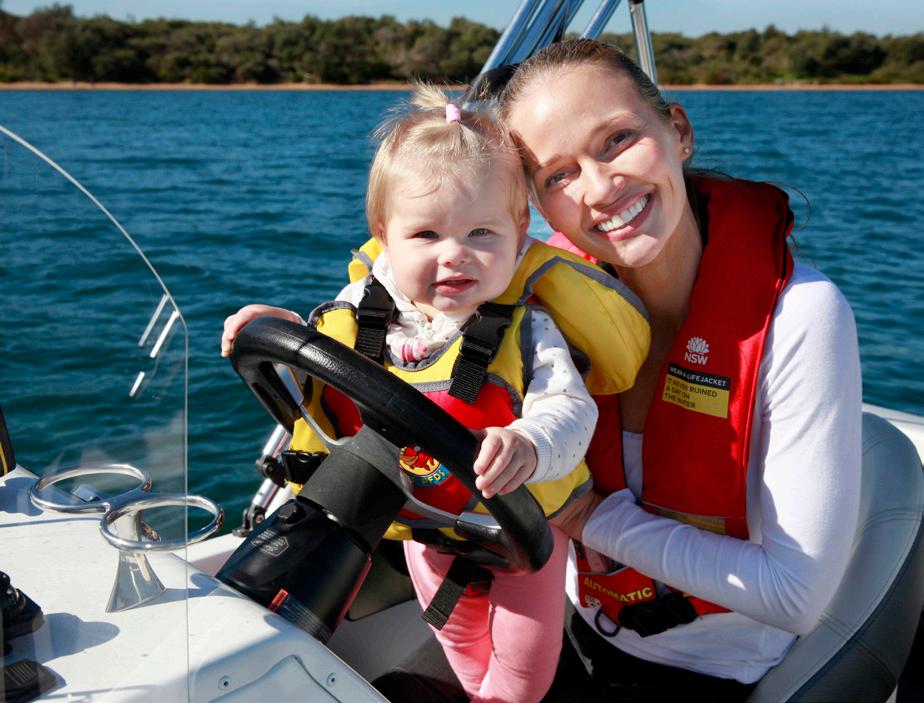
The skipper of every boat is responsible for the safety of their vessel and the people on board. As the skipper, take time to ensure the boat is ready and consider the safety issues associated with your activity and the waterway.
Be mindful that hazardous situations can develop with
children on board, so ensure you are aware of all children’s positions and movements on the boat at all times.
For more information on boating safely with children, visit rms.nsw.gov.au/maritime or call the info line 13 12 36. Further information on lifejackets can be found at rms.nsw.gov.au/lifejackets or lifejacketwearit.com.au.








Talking to your kids aged 15-17
For some parents, talking to your teenager about alcohol and setting rules and boundaries to keep them safe, can be daunting. Many parents feel that it’s their responsibility to create strategies and educate their children on when, where and how to drink. However some parents can struggle with how to provide this guidance.
It’s vital that parents keep the lines of communication open through the teen years. Make sure you have frank discussions about alcohol.
• Debunk some of the popular and unhelpful myths – e.g. not every parent provides their child with alcohol.
• Be prepared. Teenagers will raise the topic of alcohol if and when they’re ready to talk. Be ready to have the conversation and address their queries –that’s when they’re most open to hear your advice. Remember to plan what you want to say to them ahead of time.
• Be aware of your own role modelling when it comes to alcohol. Parents play a crucial role in shaping their children’s attitude and behaviours towards alcohol by being role models for their kids.
Tips for the talk
• Pick your time. The car can be a great place and time for constructive conversations –they’re a captive audience and there’s also the benefit that they don’t have to be facing you.
• Be consistent in your own behaviour. It’s easier for teens to model their behaviour on positive role models when it’s consistent.
• Draw the line between adult activities and child activities. Don’t be afraid to let your child know that some things aren’t appropriate for teens. If you believe that drinking alcohol is
only something that adults do, make sure they hear your views on the matter.
• Challenge unfounded statements. If your child tells you that ‘everyone else drinks’, ask them to provide proof.
• Challenge their beliefs. Be aware that teenagers are likely to want to drink alcohol believing it will help them fit in. They need to know they can fit in without drinking.
• Don’t be afraid to ask for help. Your GP or local health professional is available for you and your teen.
Binge drinking – putting things in perspective
Binge drinking is not just about the number of drinks you have –it’s about drinking with the specific intention of ‘getting drunk’.
Binge drinking receives a great deal of media attention and can lead to shaping teens beliefs that this is the norm. There’s no denying that there are many young people who drink in risky ways, but there are many teenagers who are trying their best to keep themselves and their friends as safe as possible.
Remember: kids absorb your drinking.
Australian research shows that in 2011 around 63% of 17 year olds were not considered to be current drinkers, so this finding may challenge the belief that everybody is doing it. However of those 17 year olds who were considered to be current drinkers, around 19% drank in a risky way (more than 4 drinks) at least once in the week before they were surveyed.
That means there’s only a minority of kids who are binge drinking – but they’re still obvious and influential.
Some young people ‘preload’ to save money – quickly drinking
large amounts of alcohol at home before heading out. Often they’re already intoxicated before they walk out the front door. By the time they get to where they’re going their judgement is clouded, causing them to continue drinking more than they intended to, so they don’t save money at all.
If your teen really believes getting drunk every weekend is normal, there could be other factors at play. Perhaps there are other influences in their lives (peers, older siblings, relatives) or problems that you’re unaware of. Don’t be afraid to ask the tough questions.
Kids are interested in what’s going on around them and seeing how their role models use alcohol is part of this. So it’s important to start talking to your kids about alcohol. And the right time to start is right now.
Research shows that parents have the greatest impact on shaping their children’s attitude to alcohol and future drinking behaviour. The role alcohol plays in your life will have an effect on them too.
They might ask you about alcohol and what it’s like to drink it. Always answer honestly.
• Talk to your child about alcohol and the importance of drinking in moderation. Explain what happens to the body when you drink too young and too much.
• Set rules – the most important one being not to drink. Be sure to discuss this rule and agree on the consequences if not followed.
• Teach them to say ‘no’ and that not everyone drinks.
• Ask them how they feel about you drinking alcohol. What attitudes have they already formed about it? It will help you reflect on your own drinking behaviours and open up the lines of communication.
Don’t turn a foolie this Schoolies Schoolies. It’s a little word for a big week. It’s the holiday Year 12s all over Australia have been waiting for. But above all, it’s the chance to celebrate the end of school…finally. Hold up. Before you race out there, make sure you’re prepared. Not knowing the risks or what to do in an emergency can turn things ugly, fast.
Wherever you’re planning on spending schoolies, it’s always good to have a plan. Around alcohol people can change and the risks are high.
So here are a few tips for a fun, safe Schoolies Week:
• Let your parents know where you’re staying and who you’re going with.
• Keep in contact with your parents throughout the week – so they know you’re safe (they’re less likely to hassle you then too)
• Register as a school leaver with the local council (or schoolies organisation) in the area you’re visiting.
• Always have your phone on you (and charged!)
• Put your ‘in case of emergency number’ (ICE) in your phone.
• In an emergency call 000.
• Keep money aside for emergencies.
• Eat before you drink – preferably carbohydrate-rich food such as rice, bread, pasta, pizza etc. It’ll help slow the rate your body absorbs alcohol.
• Be extra cautious with drinks. Avoid drinks with high alcohol content and beware of drink spiking – don’t let your drink out of your sight.
• Pace your alcohol intake and hydrate with non-alcoholic drinks like water.
• Stay with friends and keep an eye out for one another.
• Don’t drink drive or get into a car with anyone who’s been drinking.
• Avoid risky situations such as swimming after drinking or getting into arguments and fights. for more information visit “drinkwise.org.au
Here are 10 ways to encourage your kids to talk about drugs with you.
1
Be an active part of their lives
Make sure you set aside time to spend with your kids. Take an interest in their interests and establish a routine for doing things with them. Spending time as a family is important, like eating together every day. When they go out, don’t be afraid to ask where they’re going or who they’ll be with.
2
Listen to your kids
Showing that you’re prepared and willing to listen will help your kids feel more comfortable about listening to you. During a conversation try not to interrupt them or react in a way that will stop whatever you’re discussing. Encourage them to feel comfortable about telling you their problems, and ask for their input on family decisions to show that you value their opinions.
3
Be a role model
When it comes to drugs there’s no such thing as ‘do as I say, not as I do’. If you take drugs yourself you can’t expect your kids to take your advice. It’s important not to underestimate the influence your behaviour has on them, particularly when it comes to alcohol or tobacco, or misuse of medications.
4
Be honest with them
It’s natural that you won’t necessarily know everything about drugs. So while it’s important to be informed, you shouldn’t pretend to have answers to every question. Be prepared to say ‘I don’t know but I’ll find out for you’. If you’re honest and clear about where you stand, your kids will find it easier to be honest with you.
5Pick your moment
Make sure you pick the right time to discuss drugs with your kids, by looking for natural opportunities as they arise. This might be when you’re all watching TV, or when they’re talking about someone at their school or in their friendship group.
6Be calm
When it comes to talking about drugs, being calm and rational is important, as well as not overreacting. Make sure not to ridicule or lecture, as this could make future discussions about drugs more difficult and make your kids more resistant to talking about them at all.
7Avoid conflict
It is difficult to solve a problem where there’s a conflict. Try to see their point of view while encouraging them to understand yours. If a confrontation does develop, stop the conversation and come back to it when you’re both calmer.
8Keep talking
Once you’ve had a discussion about drugs it’s important to have another. Start talking to your kids about drugs early, and be willing to talk to your kids about the issue at any time.
9Set clear boundaries
Generally kids expect and appreciate some ground rules. By actively involving them in setting the rules you can encourage them to take more responsibility for sticking to them. Once you’ve decided on these rules, enforce them, and let your kids know the consequences of breaking them. Discuss and agree to ways your kids will act if they find themselves in situations where drugs are present. For example, let them know that you’ll always collect them if they need you to, whatever the hour. However, make it absolutely clear that you would rather they didn’t put themselves in a situation where they are likely to be exposed to drugs in the first place.
10Focus on positives
Be sure to reward your kids’ good behaviour and emphasise the things they do well. Encourage them to feel good about themselves and let them know that they deserve respect and should also respect themselves.
Approximately 260 children die and 58,000 are hospitalised every year due to unintentional injury in Australia
There is no higher priority than protecting our children and Police Legacy* continues their commitment to child safety. The greatest tool available to combat youth vulnerability is through knowledge. This handbook is for every family and includes everything we need as a community to protect our most valuable and vulnerable resource – our children.