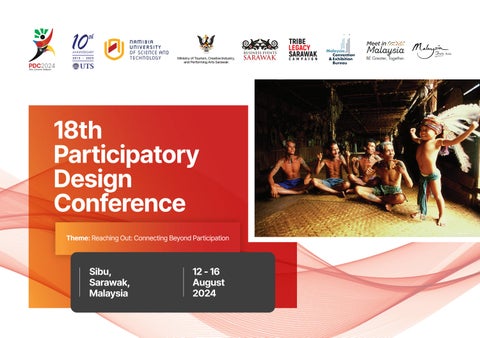
Participatory Design Conference
Theme: Reaching Out: Connecting Beyond Participation
Sibu, Sarawak, Malaysia
12 - 16
August 2024
Participatory Design is about the direct involvement of people in the co-design of the technologies they use. Its central concern is how collaborative design processes can be driven by the participation of the people affected by the technology designed. It has a focus on enabling communities to take charge and shape their own future by facilitating the concept of multidisciplinary collaboration in practical ways. PD brings together the members of two communities: designers and users, who both advocate and adopt distinctively participatory approaches in the development of information and communication artefacts, systems, services, and technology.
Participatory Design Conferences (PDC) have been held every two years since 1990 and have formed an important venue for international discussion of the collaborative, social, and political dimensions of technology innovation and use. PDCs bring together a multidisciplinary and international group of software developers, researchers, social scientists, managers, designers, practitioners, users, cultural workers, activists and citizens who both advocate and adopt distinctively participatory approaches in the development of information and communication artifacts, systems, services and technology. A central concern has always been to understand how collaborative design processes can be driven by the participation of the people affected by the technology designed.
1990
Seattle, WA, USA
1st Participatory Design Conference, 31 March - 1 April 1990.
1994
Chapel Hill, NC, USA
3rd Participatory Design Conference, 27 October - 28 October 1994.
1998
Seattle, WA, USA: Broadening Participation
5th Participatory Design Conference,
12 November - 14 November 1998.
2002
Malmö, Sweden: Inquiring into the Politics, Contexts and Practices of Collaborative Design Work
7th Participatory Design Conference, 23 June - 25 June 2002.
2006
Trento, Italy: Expanding Boundaries in Design
9th Participatory Design Conference, 1 August - 5 August 2006.
1992
MIT, Cambridge, MA, USA
2nd Participatory Design Conference, 6 November - 7 November 1992.
1996
Cambridge, MA, USA
4th Participatory Design Conference, 13 November - 15 November 1996.
2000
New York, NY, USA: Designing Digital Environments
6th biennial Participatory Design Conference, 28 November - 1 December 2000.
2004
Toronto, Canada: Interweaving Media, Materials and Practices
8th Participatory Design Conference, 27 July - 31 July 2004.
2008
Bloomington, Indiana: Experiences and Challenges
10th Participatory Design Conference,
1 October - 5 October 2008.
2012
Roskilde, Denmark: Embracing New Territories of Participation
12th Participatory Design Conference,
12 August - 16 August 2012.
2016
Aarhus, Denmark: Participatory Design in an Era of Participation
14th Participatory Design Conference,
15 August - 19 August 2016.
2020
Manizales, Colombia: Participation(s) Otherwise
16th Participatory Design Conference,
15 June - 19 June 2020.
2010
Sydney, Australia: Participation :: the Challenge
11th Participatory Design Conference, 29 November - 3 December 2010.
2014
Windhoek, Namibia: Reflecting connectedness
13th Participatory Design Conference, 6 October - 10 October 2014.
2018
Hasselt and Genk, Belgium: Participatory Design, Politics and Democracy
15th Participatory Design Conference,
20 August - 24 August 2018.
2022
Newcasle, UK: Embracing Cosmologies: Expanding Worlds of Participatory Design
22nd Participatory Design Conference, 19 August - 1 September 2022.
Past PDCs Events
of accepted/submitted submissions of past PDC (2018 - 2020)
of Workshops and Tutorials, Explatory Papers, and Full Papers of Past PDC
Introduction to
We are delighted to invite you to participate in the upcoming Participatory Design Conference 2024, to be held in Malaysia from 12 - 16 August 2024. Over the past three decades, the Participatory Design Community has been at the forefront of research and change initiatives aimed at promoting democratic values and allowing organizations and societies to develop based on a broad set of opinions and stakeholders.
The emerging Information and Communication Technologies (ICTs) have played a vital role in both supporting and challenging participatory design initiatives. They offer powerful tools for change, but also present significant obstacles to maintaining democratic values. The arenas around this duality of ICT potentials have changed and diversified over time.
In many regions of the world, access to participation infrastructures - both technological and non-technological - continues to be a challenge. In other regions, issues of investment in and success with change initiatives are tightly connected with living socio-technical infrastructures, ranging from Open-Source-Platforms to Makerspaces and Social Media.
We aim to explore how participatory design can bridge the gap between different stakeholders and communities, and promote meaningful and sustainable change. We encourage you to submit papers, posters, workshops, demos, and panels that address this theme.
We invite submissions on a wide range of topics related to participatory design, including but not limited to:
We also welcome contributions that explore the following sub-themes:
Reaching out to underrepresented groups in participatory design processes. Building bridges between academic researchers, practitioners, and community members.
Exploring the potential of participatory design to connect different domains, such as art and science, or technology and culture. Using participatory design to connect different geographies and cultures, and promote cross-border collaboration. Leveraging participatory design to address global challenges, such as climate change or social inequality.
Co-design processes and methods.
Participatory design in different domains, such as health, education, and social innovation.
Ethics and social responsibility in participatory design.
Participatory design and technology, including AI, IoT, and VR.
Participatory design and sustainability. Participatory design and social justice.
All submissions will be peer-reviewed and selected based on their relevance, originality, and quality. Accepted papers and other contributions will be published in the conference proceedings and made available in the ACM Digital Library.
The conference will feature keynote speakers, paper and poster sessions, workshops, and other interactive formats that encourage dialogue and collaboration among participants. Additionally, we will organize social and cultural events to showcase the beauty and diversity of Malaysia.
Theme
The Participatory Design Community now looks back on three decades of research and change initiatives to allow organizations and societies to develop based on a broad set of opinions and stakeholders. In this time, the emerging Information and Communication Technologies have been both a challenging arena to maintain democratic values and an important set of tools to support initiatives for change.
The arenas around this duality of ICT potentials have changed and diversified. In many regions of the world, access to participation infrastructures-technological as well as non-technological continues to be a challenge, while in other regions issues of choice of investment in and success with change initiatives are tightly connected with living socio-technical infrastructures from Open-Source-Platforms over Makerspaces and Social Media.
Phenomena of and challenges for participation as a democratic foundation of the organization of mankind has grown past ritual modes of involving the underprivileged in (technological) projects and decisions they are affected by. It has turned into a continuous effort to improve the capacities to act towards change in an informed way. PD has been very much in the realm of academics, and practitioners, such as in areas of user experience, user interface design, and moved into areas such as ICT4development.
Yet there should be awareness and understanding from the different sectors, not only, academia and industry, also from government, NGOʼs and the general public. Creating that understanding especially amongst non-traditional “connoisseurs” of PD, such as, government, will help to develop products and services which promote equity, fairness, diversity besides improving effectiveness efficiency and usability. This engagement also helps in creating opportunities to involve communities who may be underserved, such as, rural communities and poor neighbourhoods.
The capacity to find ideas, orientation, and advice for change initiatives can be improved by many academic disciplines and discourses and by experiences with a large variety of change practices and domains. It requires technological tools, interfaces, and skills as well as experiences in the social practice of communication, coordination, and community building.
It requires awareness of the political context as well as an attitude of sensitivity towards stakeholder interactions and conflict potentials. Most importantly, it requires considerations and reflections beyond the notion of participatory design as a methodology in singular projects, but as a driver in setting agendas in technology developments (such as AI), considering technical opportunities and constraints, in an effort to establish resilient initiatives and communities of change, with societal impact. Thus, the PDC 2024 in Malaysia aims at growing new alliances with research communities and stakeholders and practitioners that allow for a structured exchange to inform change initiatives – local and global. In an effort to re-shape participation at the conference, new communication, funding and presentation models will be explored to create connections with related academic, activists as well as practitioners and interested people and communities.
Conference Chairs
Programme Chairs
Full Papers Chairs
Tariq Zaman
University of Technology
Sarawak, Malaysia
Rogério Abreu de Paula
International Business Machines Corporation (IBM)
Margot Brereton
Queensland University of Technology, Australia
Heike Winschiers-Theophilus
Namibia University of Science & Technology, Namibia
Short and Exploratory Papers Chairs
Kasper Rodil
Aalborg University, Denmark
Vincenzo DʼAndrea
University of Trento, Italy
Publication Chairs
Chiara Del Gaudio Carleton University, Canada
Amanda Anne Geppert
University of Chicago, USA
Workshops Chairs
Naska Goagoses
Carl von Ossietzky Universitat
Oldenburg, Germany
David Lamas
Tallinn University, Estonia
Mika Yasuoka Jensen
Roskilde University, Denmark
Asnath Paula Kambunga
University of Copenhagen, Denmark
Daniel Tan Yong Wen
University of Technology
Sarawak, Malaysia
Industry Chairs
Daria Loi
AntiVirus Advanced SeT (Avast)
Community Chairs
Colin Stanley
Namibia University of Science & Technology, Namibia
Doctoral Colloquium Chairs
Rachel Charlotte Smith
Aarhus University, Denmark
Eunice Sari
UX Indonesia, Indonesia
Gary Loh Chee Wyai
University of Technology
Sarawak, Malaysia
Maurizio Teli
Aalborg University, Denmark
Chris Muashekele
Marcus Foth
Situated
Action and Exhibition Chairs
Lizette Reitsma
Malmö University, Sweden
Aalborg University, Denmark
Queensland University of Technology, Australia
Garen Jengan
Long Lamai Community, Malaysia
Leonardo Parra-Agudelo
Universidad de los Andes, Colombia
Emily Crompton
Manchester Metropolitan University, UK
Uariaike Mbinge
Omukuendata Matriclan and Okoto Patriclan, Otjisa, Namibia
Nuraini Binti Daud
University of Technology
Sarawak, Malaysia
Artful Integration Chairs
Joyce Yee
Northumbria University, UK
Student Volunteer Chairs
Communication Chairs
Marly Muudeni Samuel
Glasgow School of Art, UK
Mariacristina Sciannamblo
Sapienza University, Italy
Lale Dilbas
Dokuz Eylul University, Turkey
Participation Chairs
Yoko Akama
RMIT University, Australia
Mela Bettega
University of Lisbon, Portugal
Places Chairs
Yang Bong
University of Nottingham, UK
Social Media and Website Chairs
Reem Talhouk
Northumbria University, UK
Cheng Haw Yih
University of Technology
Sarawak, Malaysia
Jaydon Farao
University of Cape Town, South Africa
Shaimaa Lazem
SRTA-City, Egypt
Michael Chamunorwa
Carl Von Ossietzky
Universität, Germany
Borneo The Host Island
Borneo is the world's third-largest island, located in Southeast Asia and shared by three countries: Indonesia, Malaysia, and Brunei. The island is home to one of the most ancient rainforests on earth, which is over 130 million years old. Borneo's rainforest is known for its unique flora and fauna, including the iconic orangutan, proboscis monkey, and pygmy elephant. Borneo is also famous for its diverse and vibrant indigenous cultures, each with their own traditions, languages, and beliefs. Borneo is a must-see destination for anyone interested in exploring the natural beauty and cultural richness of Southeast Asia.
Malaysia The Host Country
Malaysia is a vibrant and multicultural country located in Southeast Asia, known for its natural beauty, delicious cuisine, and friendly people. The country is divided into two parts: Peninsular Malaysia and East Malaysia (located on the island of Borneo). Malaysia offers visitors a diverse range of experiences, from modern cities and tropical islands to ancient rainforests and traditional villages.
Sarawak
The Host State
Sarawak is the largest state in Malaysia, located on the island of Borneo. It is known for its diverse indigenous cultures, ancient rainforests, and stunning natural beauty. The state is home to over 40 different ethnic groups, with a significant portion of the population identifying as indigenous. Visitors to Sarawak can experience their unique customs, traditions, and cuisine, including the famous kek lapis, a layered cake that comes in a variety of flavors and designs. With its rich cultural heritage and breathtaking landscapes, Sarawak is a fascinating destination that offers a diverse range of experiences for visitors.
Sibu The Host City
Sibu is a vibrant city located in Sarawak, Malaysia, on the banks of the Rajang River. It is known for its bustling markets, delicious food, and rich cultural heritage. What makes Sibu truly unique, however, is its diverse population of indigenous communities who have lived in the Rajang River Basin for generations. More than 15 ethnic groups call this region home, including the Iban and Melanau. These communities have their own unique cultures, traditions, and ways of life that visitors can experience firsthand by visiting their traditional longhouses, attending cultural events, or trying their local cuisine. The Rajang River Basin is also home to some of the oldest rainforests in the world, offering visitors the opportunity to explore stunning natural landscapes and encounter rare wildlife. With its rich cultural heritage and stunning natural beauty, Sibu is an ideal destination to host your conference.
University of Technology Sarawak (UTS)
The Host Institution
The University of Technology Sarawak (UTS) is a full-fledged university located in Sibu, Sarawak, Malaysia. It was established in 2012 as the University College of Technology Sarawak (UCTS) and was upgraded to a university in 2021. UTS is wholly owned by the State Government of Sarawak through Yayasan Sarawak (Sarawak Foundation). UTS is committed to providing students with affordable world-class university education that nurtures creative and entrepreneurial leaders through a broad education in science and technology. UTS offers 34 programs under six schools, with an emphasis on developing programs in collaboration with industries, local communities, government policy institutions and local and international organizations. It has produced over 2,600 graduates with an average employability rate of 99.1%, making it one of the highest employability rates in Malaysia.
The UTS campus boasts state-of-the-art facilities and a unique post-modernist neo-futuristic architectural style. UTS is the first university in Malaysia to be awarded a Green Building Index "Platinum Index" rating and has participated in the UI Green Metric University Ranking since 2020.
Diverse educational pathways and the push for transdciplinary learning continue to reflect its role as a state-owned university, where novel pedagogies and teaching approaches such as
Organisers
Sponsors
For further details about PDC 2024 and the call for papers visit the conference website: