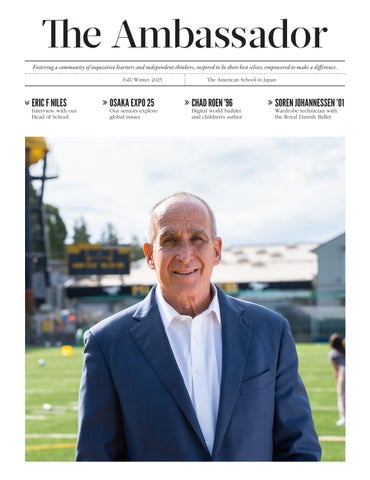
The Ambassador Fostering a community of inquisitive learners and independent thinkers, inspired to be their best selves, empowered to make a difference. Fall/Winter 2025
ERIC F NILES
Interview with our Head of School
OSAKA EXPO 25
Our seniors explore global issues
The American School in Japan
CHAD ROEN ’96
Digital world builder and children's author
SOREN JOHANNESSEN ’01 Wardrobe technician with the Royal Danish Ballet
Stay Connected
ASIJ: Home Since 1902 It is a privilege to connect with alumni, some who meet ASIJ friends weekly at Tokyo cafes, and other who haven't set foot in Japan for decades. Regardless of where life takes you, a shared sentiment shines through: ASIJ will always feel like home.
Our Alumni Services Alumni Directory Alumni Portal Regional Alumni Connect Networks Regional Receptions Class Reunions ASIJ Alumni Connect Industry Meetups Internship & Job Listings ASIJ Alumni Impact Award ASIJ Young Alumni Changemaker Award The Ambassador Magazine Monthly Newsletter Yearbook Archive Transcript Services
Don’t miss out! Contact us: alumni@asij.ac.jp https://asij.ac.jp/alumni (+81) 0422-34-5300 ext 710
Follow us on social media: asij_official asijtokyo asij the-american-school-in-japan
In this Issue Features
08
Leading with Kindness
20
An interview with Head of Schools Eric F Niles.
12 14
The Big Blue
First graders explore the ancient dyeing technique of aizome.
Deep Learning, Deeper Connections
The senior class heads to the Osaks Expo at the start of their Deep Learning Seminar II course.
24 28
World Building
Chad Roen ’96 talks about his career in VFX and his new children's book.
Well Dressed
Soren Johannessen ’01 on his wardrobe career with the Royal Danish Ballet.
Strength and Courage Award We speak with winner Olivia Lee ’25.
28
A Place that Feels Like Home Zelda Edmunds ’05 explores Third Culture Kid identity.
More 03 \\ Head of School Message 04 \\ Highlights 30 \\ Giving Impact 46 \\ Alumni Events 50 \\ Reunion Round-up 55 \\ Upcoming Reunions 57 \\ Upcoming Events 59 \\ Artifact 60 \\ Lost Alumni 61 \\ Class Agents 62 \\ Sayonara 62 \\ The Big Short
Chief Advancement Officer Anne Cunningham Director of Communications Matt Wilce Director of Giving Nikki Torchon Alumni Coordinator Isabella Rogovin Data Specialist Catherine Iwata Digital Communications Officer Zelda Edmunds ’05 Graphic Designer Johnson Lin Student Intern Keito Fukuma ’26
Editorial Inquiries communications@asij.ac.jp alumni@asij.ac.jp — The American School in Japan 1-1-1 Nomizu, Chofu-shi Tokyo 182-0031, Japan The Ambassador is published by The American School in Japan ASIJ alumni, families, faculty, and friends receive The Ambassador
2
THE AMERICAN SCHOOL IN JAPAN
It's not every day that one graces the cover of a magazine and although it's not necessarily something I aspired to, I am happy that being featured in The Ambassador provides you all with the opportunity to get to know me better. I hope that the interview here gives you a better sense of my values, a fuller picture of my background, and aspirations for the great school I joined this past August. During these first few months of school, I’ve enjoyed the opportunities I have had to interact with students and faculty, start to learn from parents what they love about ASIJ but also where they think we need to focus more, and engage with alumni from across the decades. I’ve been able to see firsthand the great work our students and teachers are doing in and out of the classroom and the Portrait of a Learner competencies take root and spread throughout the school. I hope you’ll see the evidence of that in some of the stories told here, from the hands-on experience our first graders had with traditional aizome dyeing to the trip our senior class took to kick off their Deep Learning Seminar II course. I’ve often observed that it is moments like these that students will remember years from now as they look back on their time at school. As the subjects of our alumni interviews both attest to, the impact of great teachers and meaningful experiences can be ongoing and profound. It is heartening to see that both Chad and Soren, who are featured here, continue to pursue the passions they discovered in school professionally as adults. As we approach the holiday season, I am looking forward to attending my first Winterfest as well as meeting the young alumni who plan to visit us while they are back in Tokyo. Wherever you are in the world, know that ASIJ will always be your home. Wishing you and your families happy holidays,
Eric Niles
Head of School
THE AMBASSADOR \\ FALL 2025
3
ASIJ
Highlights
ATHLETICS
Smashed it! Our Varsity Tennis Team were put through their paces by guest coach proplayer Tamaki Takagi (Australian and French Open singles). She led a master class with six other guests, guiding students through rotations designed to build a specific skill. Our guest coaches included Cecilia Tammling (USTA 4.5 ranked player), Yushi Katayama ‘99, Matt Cheng (former Taiwan junior No. 1 and junior Davis Cup player), Michel Tarna ’98 (former NCAA Division 1, ranked All-Japan player), Steve Ho (gold medalist at Taiwan National Games), and Wei-Ju Chen (winner Asian Junior Singles Championship, Davis Cup Team, Taiwanese National Team).
4
CAMPUS
ARTS
CAMPUS
Halloween
Have you seen Chuck?
Spirit Day
Spooky season arrived at ASIJ in the form of many K-pop Demon Hunters this year! From our littlest Mustangs at the ELC to our high school students, both campuses were filled with creative costumes, parades and activities, and plenty of Halloween spirit.
From its improvised pre-show to its concept of 30 short plays performed in random order over an hour, this year’s fall play surprised and delighted audiences in the Blackbox. Our student performers mastered multiple roles to bring Too Much Light Makes the Baby Go Blind to life. With quick-paced scenes, creativity, unexpected twists, and audience participation, this year’s production was a unique experience for cast, crew and the audience.
Spirit Day 2025 was one to remember! With the YUJO tournament wrapping up its final day, the energy across campus was electric. Our Varsity Football team brought home a big win on their field against the Waseda Bacchus, while our middle school soccer teams played their hearts out all morning. The Chofu campus was alive with Mustang pride, fun activities such as Sumo, and incredible Black and Gold spirit.
THE AMERICAN SCHOOL IN JAPAN
ASIJ
Highlights
LEARNING
Into the Woods Amid campfires and mountain trails at Lake Sai, nestled below Mount Fuji, Grade 4 students embarked on a brand-new camping adventure— learning to pitch tents, cook and clean together, and navigate challenges like rafting and hiking. Along the way, they connected their Earth Systems learning to Japan’s unique landscapes and returned home with confidence, gratitude, and stronger connections to one another.
LEARNING
ART
ATHLETICS
Accelerated Learning
Tomorrow! Tomorrow!
Running Up That Hill
On Wednesday, Nov 5, Dr Gediminas Sarpis, introduced the fascinating science happening at CERN, where researchers study the substructure of matter — what everything in the universe is really made of. He answered questions from high school students and shared what it is like working at the European Organization for Nuclear Research, home of the world’s largest particle accelerator.
Little orphan Annie made her ASIJ debut when the middle schoolers took to the stage in Annie Jr. The talented cast and crew of over 60 students were supported by the high school lighting, sound and stage crew, and stagecraft class. If you missed the show, catch the recording on ASIJTV on Youtube.
The high school cross-country team concluded its season strongly, showcasing remarkable depth and drive. The boys' team dominated the season, winning three championship titles, and the girls' team delivered an astounding performance, finishing second in the Asia Pacific Invitational race. Altogether, the team brought home four trophies, including the individual division trophies, as well as the overall and relay trophies. THE AMBASSADOR \\ FALL 2025
5
Leading with Kindness Head of School Eric F Niles speaks to Matt Wilce about his journey from Capitol Hill to the classroom, connecting with young learners and the value of kindness and connection in shaping our future.
As our elementary school students come off the bus in the morning, it’s not uncommon to hear one of them say, “Good morning, Eric!” as they walk past the adults greeting them outside. Their salutation is directed at Head of School Eric Niles, who stands outside most mornings to welcome them to Chofu campus. One of the perks for Eric of working at his first school to encompass the lower grades has been getting to know students at the Early Learning Center and Elementary School. From the first week of school, when fourth graders made an appointment to ask about his workspace as they designed their own classroom layout, to joining the Kindergarten as they learned about the autumn moon viewing and dango making, he’s embraced the opportunities to engage our youngest learners. “I've been loving being able to make a connection with really young kids, which I've worked really hard to do, and it is a joyful part of my day,” Eric says. He notes that he always lamented the fact that The Athenian School in Danville, California, where he was Head of School for 15 years, didn’t have those grades and that he had pushed the school to consider adding an elementary program. “When you're taking an approach like we are
6
THE AMERICAN SCHOOL IN JAPAN
at ASIJ with Portrait of a Learner and you think about those competencies, you have to start at the beginning — younger kids are really sponges. And so if the first time you get them is in sixth grade or ninth grade, it's not that you can't make headway on those things, it's just you're making up for lost time,” he says. “If you can have a kindergartener who is thinking about and acting in ways to collaborate, communicate, or have a particular mindset, they grow into different sixth graders and different ninth graders. So I'm loving and actually being able to watch that scope and sequence happen.” Before we sat down to talk, I invited the fourth graders who had spoken to him about their classroom design to suggest some of the questions for our interview. They wanted to know whether Eric was a good student. “I was a good student in that I knew how to check the boxes,” he says. “I would say honestly, that compared to the schools I've had a privilege of working in, like ASIJ or Athenian, that my education was fairly uninspiring, fairly traditional, with lots of memorization, and I was good at that. So I would say I was good at school the way it was defined.”
THE AMBASSADOR \\ FALL 2025
7
At the trustee breakfast in September, Eric challenged trustees to imagine what newspaper headline we might see about ASIJ ten years from now. MW: So what does make a good student?
MW: So what is Eric’s origin story?
EN: “First of all, it's not defined by grades, by me,” Eric says. “I think a good student is someone who aims for mastery. Who thinks, how do I get really good at something?” he notes, adding that mastery in writing looks very different whether you’re in fifth grade, a senior, or middle-aged. He believes a good student is someone who thinks “How do I really push myself to be excellent? How do I find ways to speak up?” That can look different for different students, he acknowledges, saying that “some might feel really comfortable raising their hand in class, others may feel more reticent. But there are other ways to speak up. There are other ways to find your teacher. There are other ways to ask questions that are not so public, but let your voice be heard and take up space in a class and really push yourself to really understand, see connections, and do your best.”
EN: “At a young age I knew I wanted to be a lawyer and so even though I don't practice law, I don't ever regret getting that education and I loved my time in law school,” he says referring to his time earning a law degree from UCLA which he attended after graduating with BS in Economics from the Wharton School of Business at the University of Pennsylvania. “I think the big part of my journey was when I turned down a job in a big New York law firm and I just decided that it wasn't the life I wanted to live,” Eric says. “And so it was there that I pivoted to try to work in Washington, DC. I tell my kids all the time that I worked for $8 an hour at the National Capitol YMCA while I was trying to get a job.” Which he did, becoming a congressional staffer to Al Swift, a congressman from Washington State. Other than doing some campaigning there, it was not a state Eric had a particular connection to, but once he’d proved himself he moved from being a generalist to serving as legal counsel to the congressman’s subcommittee.
When I reported back to the fourth grade class on his answers following the interview, they were surprised—their consensus when we took a vote was that Eric had not been a good student. When I asked why they thought that, the answer from one of the students was that “it would be a better origin story for him.”
8
Eric with elementary school principal Marc L'Heureux and first graders showing off their aizome T-shirts.
THE AMERICAN SCHOOL IN JAPAN
“I think law is not so much about specific laws as much as it is a way of thinking, of recognizing that very few issues are black and white, that there's a lot of gray in the world,” Eric says. “The hardest issues are when two things that are right bump into each other. Everyone talks about right versus wrong, but those are actually the easy ones. The hard ones are where two things that you really care about, such as freedom
Eric and Margaret in 1995, his first year of teaching at Midland School, CA.
of religion and free speech, bump into each other. Those are the issues that really you grapple with,” he notes. “I like to think that law school really framed the way I think about issues. When something's happening at school, I often will ask myself, ‘What principles are at work here? What are the big overriding issues?’ And then try to figure out, how do I apply those principles to the situation that is before me?” Although Eric acknowledges that he loved his work in Congress and the impact of watching how politics worked, when Congressman Swift decided not to seek another term in 1994, Eric took the opportunity to consider what he wanted to do next. “I had always dreamed about traveling around the world,” Eric says, noting that his father had always encouraged him to do so. However, his father was ill with cancer at the time, so Eric delayed any travel to spend as much time with him as possible. “I never wanted to do it while he was alive and sick, and when he died, it sort of made me consider it again. I always knew that he wanted me to do that.” So on New Year's Day in 1994, Eric set off to travel around the world for a year, which he did for 11 months with his wife Margaret, who was at the time his girlfriend. The daughter of a New York Times correspondent, Margaret (who uses they/them pronouns) had spent their childhood in Poland and Israel and had taken a study year in Greece during their time at Marietta College in Ohio. “Margaret grew up all over the world. I didn't,” Eric says, noting that he hadn’t seen or understood the world, which led to his desire to “put a backpack on my
back and travel around the world.” It was that adventure–which included a brief repatriation following a serious case of malaria that resulted in a marriage proposal during his recovery–that was ultimately Eric’s journey to a teaching career. After he had recovered from his illness, the newly engaged couple returned to Southeast Asia, travelling from Thailand up to India. “It was in the midst of that trip, actually, in northern India, that we went to visit a school called the Woodstock School, north of Delhi in the hill stations,” he says. “We thought we'd just spend a day there and continue to head north in India and we found the equivalent of an Airbnb I suppose, long before there was such a thing.” The planned day turned into a month as the couple took meditation classes, exercised, and read. “It was in the course of that trip where I said to Margaret, ‘I think I want to be a teacher’ and I think I want to do that in a boarding school,’ and I knew where the teaching part came from. My mom was a teacher, and so there were teachers in my family. And so I knew that piece about wanting to live a life of service,” he says. As for the desire to work in a boarding school, Eric’s not positive where that came from, but as they finished their travels and returned home he started applying to boarding schools to teach. Eric began his career pivot at the Midland School in Los Olivos, California, where he taught for three years before taking the role of Dean of Students for another three. The
THE AMBASSADOR \\ FALL 2025
9
10
THE AMERICAN SCHOOL IN JAPAN
co-ed boarding high school occupies a stunning 2,860-acre site in Santa Barbara County complete with its own farm and provides an educational experience that seamlessly blends sustainability and outdoor education into its curriculum. From there he moved to Emma Willard School, a private collegepreparatory day and boarding high school for young women in Troy, New York, where he first served as Dean of Students before taking on the role of Assistant Head. Following that came a 15-year tenure as Head of the Athenian School located at the base of Mount Diablo, in Danville, California. The co-ed grade 6-12 school is a founding member of Round Square, an international organization of schools whose philosophy is influenced by the German educator Kurt Hahn, who helped found the Outward Bound organization and the United World College movement. This explains the 26-day adventure trip that is a graduation requirement at Athenian. Along the way, Eric and Margaret started their own family and saw their daughter, Hannah, and son, Cade, thrive in the progressive educational communities in which they were fortunate to live and work. Both children ultimately followed in their grandmother’s and father’s footsteps and Hannah is currently a teacher in Oakland, California, while Cade is an educator in Minneapolis, Minnesota. When asked how he thinks his children would describe him, Eric responds with the words “quiet, but caring.” He adds, “I think they would say that I'm ethical and that morality and kindness really matter to me. That I really want them to do good in the world but I didn't ever need them to be anything in particular. I want them to work hard for themselves, to do good in the world, and to have a happy life.” After raising their family, Margaret also shifted their career focus to become an interfaith chaplain. Through this work, Margaret has supported critically and terminally ill across various faith traditions and individuals in the San Francisco homeless community. In addition, they served on the board of the Interfaith Council of Contra Costa County. With their children grown and beginning their own careers, the opportunity to look for new challenges presented itself. “We didn't get to a point in our lives where we said we needed to move overseas,” Eric says. “It just so happened that there was this bold and visionary school with a storied history, with an amazing group of kids, with an incredible group of faculty that happened to be here in Tokyo. And I was lucky enough to get the job, and we were lucky enough to come here.” He goes on to recognize some of the other things that attracted him to ASIJ, saying that “the school was really thoughtful in creating its mission and its vision, which makes a case about the nature of education, the ways in which the world is changing incredibly quickly, and the ways that ASIJ—as great as its reputation is—would need to change to make sure that we're keeping up with the needs of our children.”
One of Eric’s invitations to trustees and employees before the summer was to read Imaginable by Jane McGonigal, a book that aims to develop and train the power of imagination in its reader. Her work on strategic foresight and future thinking offers a practical, hopeful approach to anticipating change—and imagining bold responses. After asking several groups to imagine different future scenarios for ASIJ as he began engaging with the community, we turned the tables and asked Eric his vision for ASIJ’s future. Noting that he already sees that Deep Learning is happening, that the Portrait of a Learner competencies are being centered, and teachers doing really interesting work with students, he says he expects “that will become way more transparent ten years from now.” Eric adds that he thinks we will “talk about the competencies less, but just know that they're happening. In some ways it's most powerful when we as adults, as coaches, know that we are developing them in students and we don't have to say that it's happening.” He goes on to posit that ASIJ “will have partnered with AI because I think that's what we'll have to do, but acknowledge that there's this whole host of human skills that AI will not do and cannot do and that’s what we need to be fostering.” He believes that “the Portrait of a Learner is designed to inculcate human skills and those outcomes will be very easy for people to see when they come here and meet our students. People will see that the school is alive with learning and that the relationship between student and student and teacher and student is as strong, if not stronger, than ever.” Circling back to our friends in fourth grade, their final question for Eric was how does a head of school help students learn better? “I think in many ways my roles are both direct and indirect. And so one is that I hope I model something for students. And— this is a continuing journey for us — creating a place where they feel a sense of belonging at ASIJ, that every student feels like they belong here because that is a prerequisite for learning.” He goes on to talk about the impact of hiring great teachers, ensuring “that the people in their classrooms really know, value, and care for them and that I also model those attributes.” During his first few weeks at school Eric met with a group of fifth graders who wanted to talk about kindness. “I couldn't believe it,” Eric says. “We talked for 40 minutes about their commitment to kindness and my experience and Margaret's experience with kindness in our lives and service in our lives. I left there knowing that I had taken the right job, but also incredibly hopeful for the world.”
THE AMBASSADOR \\ FALL 2025
11
The Big Blue With the help of the Japan Center and our partners from Myojo Gakuen School Koenkai, our first graders explored the ancient dyeing technique of aizome
Our first graders spent this fall exploring the meaning of community, their role as members, and the factors that contribute to a positive and thriving community. Through their changemakers unit “How can we make our community a better place?” students looked at their own impact on others and thought about the environmental consequences of using paper towels. This led them to explore sustainable solutions such as cloth handkerchiefs which they connected to Japanese culture through their aizome dying project. Aizome is the traditional art of indigo dyeing, which uses natural dye derived from the leaves of the Japanese indigo plant, which are harvested, dried, and then composted over several months to create a fermented material called sukumo. This sukumo is mixed with natural ingredients like lye (from wood ash), lime, wheat bran, and sometimes sake, to create a living, alkaline dye vat through a controlled fermentation process. When fabric is dipped into the yellowish-green
12
THE AMERICAN SCHOOL IN JAPAN
solution and then exposed to the air, the dye oxidizes, turning the material a rich, distinct blue known as Japan Blue. This ancient, natural dyeing method is prized not just for its deep color and durability, but also for the beneficial properties of the dye, which include being antibacterial, insect-repellent, and UV protective. Our partners at Myojo Gakuen School Koenkai in Kichijoji are involved in preserving this craft by having its students participate in the full process of aizome, from cultivating and harvesting the indigo plants on the school's grounds to preparing the sukumo and actually dyeing their own items, which serves to teach them about traditional Japanese culture, sustainability, and the local community's agricultural history. Two volunteers from the school, Ichinose-san and Shibuya-san, were invited by the Japan Center to guide our first graders in trying the dyeing process.
Students learned how to create patterns using folding, clipping and knotting techniques on the fabric before it was dyed. The next step was soaking the fabric in water and then wringing it out.
The fabric was dyed three times for 30 seconds each with a rest period in between before getting rinsed twice in water for several minutes.
Once students had thoroughly rinsed their fabric, it was hung up to dry and they could see how successfully their designs had turned out.
THE AMBASSADOR \\ FALL 2025
13
Photo by Keito Fukuma ’26.
Deep Learning, Deeper Connections Matt Wilce follows the senior class to the Osaka Expo as they explore global innovation and culture, ask challenging questions, and discover personal passions and new connections.
14
THE AMERICAN SCHOOL IN JAPAN
ASIJ’s our Deep Learning Signature Program is a two-year culminating experience for every grade 11 and 12 student. In the first year, students explore how they learn, both individually and collectively, through Harkness seminars, guided inquiries, and collaborative action projects. High school principal Amy Zuber Meehan explains the rationale for the course, saying, “ it was the recognition that content mastery alone no longer prepares graduates to sufficiently thrive. We wanted every student to leave knowing how they learn, understanding their strengths, and having the courage to dive into authentic contexts and know they will be OK.” The capstone year builds on this community foundation, with students designing and managing self-directed individual inquiries in areas of personal interest. “The Expo is an opportunity for countries around the world to come together and to show where they are bringing inquiry, exploration, innovation into solving issues or concerns that they feel are relevant to their own countries and also to the wider world,” Brendan Sarsfield, one of the Deep Learning Seminar teachers on the trip, comments. “Our class is all about students engaging with something that's meaningful for them, but engaging in a way which is quite deep, that prompts as many questions as they give answers. So the opportunity to go to Expo to see how countries mirror that sort of approach is a really valuable one.”
Hamburger vending machines, video-phones, holograms and moon rocks — some of the things that captured the imagination of visitors 55 years ago to the world’s fair in Osaka. Expo ’70 was more than just a world’s fair; it was a coming-of-age for a nation that had rebuilt itself at astonishing speed and a symbol of Japan’s aspirations for the future. Tens of millions streamed through corporate pavilions and experimental habitats, riding a wave of curiosity about computers, space travel, and the conveniences of tomorrow. Not only did many ASIJ families attend the event, several alumni worked at Expo ‘70 including John Powles ‘66 who staffed the Canadian Pavillion. For postwar Japan, the Expo crystallized an era of high growth and shared optimism, recasting memories of scarcity into aspirations for design, technology, and global belonging. Half a century later, Osaka is hosting the world again, with this year’s Expo showcasing cutting-edge technology and culture from around the globe. ASIJ’s senior class took the opportunity to explore the site and kick off their own discovery as they began their Deep Learning Seminar II course.
ASIJ visited the Expo on a day in which attendance was over 220,000. “Being out amongst the masses gave our students a feeling like they were a part of something big. But throughout the trip, it was also the small moments that stood out such as kids tackling that hugely important culinary question: Japanese or western breakfast?” associate principal Andy Jones noted. He was impressed by the myriad ways that kids engaged in the learning process on the trip, even before they arrived at the Expo site. “Students were debating: how do they feel about visiting a site on a manmade island where the main event is within a beautiful wooden structure that cost ¥34 billion to construct? If the Expo focuses on building a better future, how sustainable was the approach to it in the first place?” Through the work of our Japan Center, ASIJ was lucky to secure access to several pavilions, including those of Germany and the the United States, bypassing the usually long lines to enter. Last year, the Japan Center and Middle School hosted a visit by the Osaka Expo team that included a presentation by Dr. Hiroshi Nishimura, who is in charge of the Expo's Sustainability Initiatives, which paved the way for the opportunities for our seniors to explore at the Expo. “The German Pavilion's focus on the circular economy offered a perfect opportunity for students to engage with a complex, authentic challenge,” Mariko Yokosuka, Japan Center Director, explains. “The experience goes beyond a simple tour; it is a direct application of the Deep Learning program's emphasis on solving real-world problems. By
THE AMBASSADOR \\ FALL 2025
15
Kai ‘14 and Lee McGuire ’22 outside the US pavillion.
The Grand Ring, the largest wooden architectural structure in the world was the symbol of Osaka Expo 25. exploring a pavilion designed as a model of sustainable construction, students can apply their critical thinking skills and see how a community-focused initiative can address a global issue like sustainability.” Brendan explains the approach taken in Deep Learning Seminar II, saying “we want students to be digging deep in a way that actually opens out their thinking and expands their thinking and allows them to see something they might be passionate about, but from a new perspective or a different perspective. And the German Pavilion, I think, did that. It took one theme. It could have gone just down an ecological route, but it went through a whole range of different approaches.” The US Pavilion prompted students to think about the way the United States chose to represent itself and how that related to their own identities and opinions, leading to some thought provoking questions and discussions. Just as in 1970, one of the key focuses was space exploration. Steve Sundberg ‘74 recalls that “the big draw for us was seeing the Apollo 11 capsule suspended from the ceiling of the moon crater-shaped US Pavilion,” while Andy Lund ‘81 remembered the moon rock as the big attraction. That same piece of the moon was back in Osaka this year, as part of the culminating part of the exhibition relating to space that also included an impressive rocket launch simulation, it proved to be a highlight for many visitors from school and beyond.
16
THE AMERICAN SCHOOL IN JAPAN
Our guide through the pavilion was Kiara Royer ‘20, who attended ASIJ’s early Learning Center, and we were joined by alumnus Kai McGuire ‘14 who was responsible for protocol and VIP visits to the pavilion. Kai, who previously worked in the Biden administration (see Fall 2023 Ambassador), was happy to be back in Japan after studying and working in the United States for an extended period. “The presence of alumni at the pavilion was a great demonstration of how students could leverage their network and apply their skills to make meaningful contributions in the future,” Mariko comments. It was actually Kai’s brother Lee McGuire ‘22 who joined the Expo team first as one of the youth ambassadors hired to work in the pavilion. Lee, who worked at the site through the spring until July, describes the six-month long event as a combination of “the Olympics, a theme park, and the United Nations.” Taking a semester off from his studies at George Washington University where he’s majoring in international affairs, he told us when we spoke to him in the spring that “being able to interact with the US-Japan alliance in a handson way feels super meaningful.” Lee, who comes from a bicultural American and Japanese background, was able to leverage his language skills and personal attachment to the relationship between the two countries to find extra meaning in the role. He told us that the aim of the US Pavilion was to imagine what the two countries could create together and to take visitors on a journey that celebrates exchanges and professional opportunities, innovation, travel and diversity,
ASIJ students interact with displays at the German Pavillion.
and space exploration. Lee also noted that baseball star Shohei Ohtani is heavily featured — something our students were quick to notice. The final exhibition that students toured as a group was the ammonite-shaped Pasona Natureverse Pavilion, with its focus on cutting-edge Japanese technology which provided students with an inspiring look at how creativity and research can be used to solve real-world problems and witness the host country's innovation firsthand, navigating the complexity and ambiguity of the future. The highlight for most students was seeing the state-of-the-art iPS cell-derived myocardial sheets and tiny iPS heart beating in their tubes of culture liquid. Students also had the opportunity to explore the pavilions of other countries, sometimes those that connected to a part of their own identity or interest. Andy Jones observed that this prompted “deep conversations where students wondered aloud about visiting pavilions of countries whose values were not aligned with their own. Was visiting this country’s pavilion a show of support for things they didn’t agree with?” Senior Cocoro told us, “I think seeing how different cultures express themselves is really interesting. I think it's important for schools to teach the fact that there are so many different perspectives, and I think deep learning does that really well.” Fellow student Christina Samson went to Expo with a concept for her Deep Learning project in mind, knowing that she was interested in architecture. “I want to design some
flood resilient type housing for families in the Philippines because that's my hometown. And so I wanted to combine the architecture side and the engineering side and try to do something within that,” she says. “Going into the Expo, I was just really excited to see all sorts of architecture because I think each pavilion was informed by the culture and the architecture of their country—and so I got to witness all of that.” She found the sustainability efforts, the materials that were used, and the structures and shapes inspiring. “The Philippines [Pavillion] was shaped like a basket to incorporate traditional basket weaving techniques. And so I think I'll definitely draw from a lot of those things I saw, like the different types of architecture and I’ll try to weave some cultural aspects into my project, hopefully.” After a packed day at the Expo, the seniors decamped to the AWL Keihoku retreat center in rural Kyoto Prefecture to reflect on their experiences and bond as a class. Christina tells us it was a great way for the students to connect as a grade, saying, “it was a really rare opportunity for us to all be in the same place at the same time and especially outside of school.” She noted that one of the morning activities where students wrote reflections and then shared them with others during walks in the forest was particularly impactful. “I think that activity really reinforced it for me, because I was in a group with two people I barely knew, and they were just willing to hear my story, and I was willing to hear theirs,” she says. “And so it felt really genuine. And I think that carried a really positive energy into the year.”
THE AMBASSADOR \\ FALL 2025
17
Osaka 2025 Exposures On their return to Tokyo, students in the SUPA Creative Nonfiction classes composed short reflections on their experiences during the Expo trip. The following pieces are taken from that collection.
Photo courtesy of Upe Abukeviciute ’26
The Moment Before by Jack Draper
Photo courtesy of Kabir Mehta ’26
India Standing Tall in Japan by Kabir Mehta Walking into the India Pavilion at the Osaka Expo felt like stepping into two worlds at once. The entrance, anchored by a quiet Bodhi tree and the glow of lotus patterns, pulled its visitors into something ancient and familiar. But just a few steps later, a scale model of Chandrayaan 3 (the first Indian rocket that made it to the moon), a reminder that India isn’t just carrying history, it’s planning the future. What struck most wasn’t a single display, but the contrasts living side by side: hand-painted mehendi (henna) patterns near AI demonstrations, temple design courtyards opening into LED ceilings. It felt like a living metaphor for India as a country itself. Layered and misunderstood, sometimes messy, but very much alive. Even with small flaws, the pavilion left visitors with a sense of pride. Pride that India could present itself not only as a country rooted in tradition but also as an upcomer in science, medicine, and sustainability. The India Pavilion didn’t just showcase the nation’s deep history – it revealed where the country is going and why its people can stand proud of it.
18
THE AMERICAN SCHOOL IN JAPAN
Enter Australia. The breeze hit me, cool and salty, like it was carrying the whole ocean in its arms. It reminded me of the beach, of those endless days spent buried in sand. Chameleon, kangaroo, koala, each one tucked away, hiding like we were playing a game of hide and seek. The more I looked, the harder they were to find. But there was always that little glimmer, the way the breeze would ruffle their fur or feathers, just enough to catch my eye. I snapped a photo to make sure I could remember the moment, to prove I had seen it for real. The kangaroo stood by the water, shaded by a tree, its movements slow like it knew I was watching. The chameleon was almost invisible, blending into the branches, hiding harder than the rest. And the koala, well, it was all curled up in the leaves, like it was part of the tree. It took a second before I realized it wasn’t just the leaves hiding it, but how still it was. If I stepped too far right, I’d end up in the water. Too far left, rocks. I could feel the wind shift again, like it was reminding me this wasn’t just another postcard, this was real. I could almost hear the photos in my phone buzzing to life, the stillness of the animals captured in frames. The sounds around me were calm enough to make me want to sleep right there on the grass. But then I moved through the door into the Australian pavilion. And just like that, I was hit with the opposite. Music blasting, tables stacked high with food, people everywhere, moving, shouting, laughing. The air felt heavy with heat and food smells. All around me, the pulse of the crowd was so different from the quiet breeze. But maybe that was the point, everything that had come before was setting me up for this, for a place where everything was turned up to the max.
Dancing Flames by Mirabel Lee I watched as the fire danced with the wind, crackling and flickering to the beat. It’s base was a vibrant red color that gradually changed to orange, followed by yellow as the flames traveled to the top and flew away in sparks. Some of it’s sparks would land on us, but it didn’t hurt. As harmful, vicious, and uncontrollable fire has the power to be, it’s sparks flew towards us as if it was simply trying to get to know you. Many of us were standing around the fire either roasting the marshmallows on skewers that were just long enough to feel the heat, taking pictures, talking to friends, or everything all at once. The pictures don’t do a justice. The moment felt too sacred to post them, but they still didn’t capture it all. It wasn’t only the fire. I’m surrounded by people I see nearly everyday, and yet have never talked to. It’s a strange ‘I know you, and you know me, but we don’t know each other.’ It’s even stranger to think that by next year, I probably won’t see most of these people ever again. Where am I going to go? Where will my friends be? Will they still be my friends? No, focus on the fire. As the night grew, we gave the fire more space to dance, and slowly moved further away from it. My friends and I sat on a set of rocky uneven stairs that were cold to the touch, and if it wasn’t for the fire we wouldn’t have been able to see it. We sat there for what was probably only an hour, but I like to stretch the moment out in my head. We sat there,
watching the fire dance while talking and wishing we could stretch out this time for as long as possible. I would tell you what exactly we talked about if it didn’t feel so sacred, but I also wouldn't know how. This is what is feels like to be in the moment. We just sat there, with the occasional interruptions of teachers coming to take photos, or someone actually needing to use the stairs. To our right, was the only thing still fully litthe main house. It looked like something out of a painting. You could see into the house through the windows and make out the furniture, tables, and see other people in there. Some were sleeping, while others eating. In front and to the left were all trees and hills: one to the girls cabin, and another to the boys. Thanks to the fire, we were still able to find our paths. By the fire stood some of my other classmates and the creator of the fire. He stood there admiring his creation watching it sway with the wind and he seemed so proud. He took care of it by feeding it more wood or giving back the wood that it dropped around the side, patiently taking care and followings it’s rhythm. The fire could have stayed up dancing all night into the day, but as curfew creeped closer, we all had to retire, including the fire.
THE AMBASSADOR \\ FALL 2025
19
World Building Matt Wilce talks to digital artist Chad Roen ‘96 about building worlds for film and game platforms and his debut as a children’s author.
20
THE AMERICAN SCHOOL IN JAPAN
Chad Roen ’96 on the red carpet of the Visual Effects Society Awards.
For Chad Roen ‘96, a two-decade veteran of Hollywood’s visual effects (VFX) industry, the world is now less about the meticulously rendered "final frame" that makes it into a movie and more about the dynamic, real-time experience. Chad, whose résumé includes blockbusters like Avengers: Infinity War (2018), and Oscar winner for Best Visual Effects The Curious Case of Benjamin Button (2008), and a highly coveted Visual Effects Society Award nomination, made the career-defining jump from cinema to the cutting edge of interactive digital worlds. Chad now works with Epic Games, the studio behind the global phenomenon Fortnite and the powerful Unreal Engine. His role is to push the boundaries of real-time 3D environments, blending the visual fidelity of Hollywood with the interactivity of gaming. His current focus is particularly high-profile: helping build immersive digital worlds for Disney following their $1.5 billion investment into the gaming company, a project that promises to change how audiences interact with beloved intellectual property forever. At the announcement of the deal, Robert A. Iger, Chief Executive Officer of The Walt Disney Company, commented that, “this marks Disney’s biggest entry ever into the world of games and offers significant opportunities for growth and expansion. We can’t wait for fans to experience the Disney stories and worlds they love in groundbreaking new ways.” Chad’s involvement in the project marks the latest evolution in a creative career rooted in his unique experience at The American School in Japan.
Chad’s path to the digital frontier star ted, perhaps unexpectedly, in Tokyo. He arrived at ASIJ in the eighth grade, a significant life change driven by his parents—his father David Roen (FF ‘91-’00, P ‘96) who taught fifth grade and his mother Sheila Roen (FF ‘91-’03, P ‘96) who taught middle school language arts—who took their first and only overseas teaching contract. The move was initially met with resistance from the middle schooler. “Initially, I was reluctant to move... nervous and scared, angry. I had all the feelings that you'd expect when the parents of a 13-year-old tell them ‘you're about to leave everything behind,’” Chad recalls. He was leaving behind the familiar comforts of the United States for a foreign culture and a brand-new school—something many in the ASIJ community can no doubt relate to. Those feelings quickly evaporated thanks to the welcoming environment where feeling "out of place" was the norm, not the exception. “The sense of community they had at ASIJ, the feeling that everybody's kind of from somewhere else or a little bit out of place, made it just a great place to land,” he explains. This shared experience made adapting easy and allowed Chad to discover his passions. He embraced the full high school experience, finding a balance between academics and extracurricular life. He played football—something he notes he probably would never have tried back in Los Angeles—performed in several school plays, and enjoyed the freedom that came with navigating the Chofu area and
THE AMBASSADOR \\ FALL 2025
21
Chad with Ki Nimori (FF ‘60-02, P ‘83, ’84), the art teacher who inspired him. the surrounding city. But it was within the walls of the art studio that Chad found a pivotal outlet and the inspiration that would shape his later career, particularly the influence of his art teachers, Ki Nimori (FF ‘60-02, P ‘83, ’84) and Greg Vikse (FF ‘90-15). “Without question, Ki Nimori is very high on the list, if not top of the list,” Chad says when asked who had an impact on him in high school. Emphasizing the profound impact Ki had on his artistic worldview, Chad notes that his philosophy was to cultivate potential rather than police style. “He met every student artistically where they were... when I came in, it wasn't just acceptable that you were good. It was, okay, what do we do to make you better? How do we encourage that?” A real turning point came when Ki, known for his "old school" training and expertise in traditional media like drawing and sculpting, began experimenting with the era's new digital tools. Chad walked into the art room one day to find his teacher hunched over a computer, exploring early graphic design and digital art programs. “I was like, ‘What are you doing?’” Chad says. “That stuck with me for a long time... to see him just sort of be like, ‘Okay, but this is what’s happening now.’ It really sort of broadened my outlook as to what art could be and how we express ourselves.” This moment cemented the idea that an artist must always be willing to adapt and embrace emerging technology. While art was always a core passion, Chad had initially dismissed it as a viable career path, heading off to the University of California Davis campus with his major undeclared, thinking that finding success and a regular paycheck in a
22
THE AMERICAN SCHOOL IN JAPAN
creative career might be a challenge. It wasn’t until he saw Luc Besson’s visually groundbreaking film The Fifth Element (1997) that Chad had the light bulb moment that working in the digital arts could be an option. “I saw that and I immediately had the realization: hundreds of people made this beautiful, creative, exciting, dynamic movie, and there's tons of visual effects, and that's their job. I want that job,” he says. Vocalizing this ambition led to a pivotal internship at Digital Domain, the very effects house responsible for The Fifth Element’s iconic visuals. His first visible work was far from a galaxy-spanning sci-fi epic; it was on a Missy Elliot music video, creating a bizarre but memorable shot where she seemingly swallows a Matchbox Lamborghini. That seemingly small entry point launched a highly successful 20-year career in VFX, working on titles for nearly every major studio that included Night at The Museum (2006), Pirates of the Caribbean: At World’s End (2007), and Transformers: Dark of the Moon (2011). As a modeler, Chad was a digital architect, responsible for building the complex 3D assets that would eventually become characters, spaceships, or entire cities on screen. While his work led to career highs, including his time contributing to the massive Marvel cinematic universe with films like Guardians of the Galaxy (2014) and Ant-Man (2015) the nature of the work—executing a director’s vision on tight deadlines—meant personal creative freedom was often sidelined. In 2020, Chad took his deep technical and artistic skills to the rapidly expanding gaming sector, moving to Epic Games. The move represented a fundamental change in philosophy. In cinema, the work is finalized and fixed; in real-time engines like Unreal, the environment is dynamic, constantly responsive,
Chad was nominated for a Visual Effects Society award for his work on the Nidavellir Forge in Avengers: Infinity War. and persistent. Chad is now responsible for pushing the boundary of what these engines can achieve in terms of visual fidelity and interactive scale, especially as they relate to building enduring, explorable digital environments for major intellectual property holders, such as the Disney brands Marvel, Pixar, Star Wars, and Avatar. This innovative work also requires navigating the inevitable shift toward generative AI. Chad, however, is unfazed by the advent of these new tools, seeing them as simply the next step in the creative lineage that began in Ki Nimori’s classroom. "The mentality of visual effects is always building tools to make the artist's life easier," he notes. "AI is one more thing that makes it that much easier to be creative." Instead of fearing job displacement, he views AI as a powerful accelerant, allowing artists to bypass tedious, repetitive tasks and jump straight to high-level concepting and execution. For a world builder, this means unprecedented speed in creating digital assets. Despite the high-stakes, technologically advanced nature of his work at Epic, Chad realized he still craved a project purely driven by his own imagination—a chance to be the sole author of the final result. “My own creative expression was very seldom part of the final result,” he explains of his movie work, where his job was to perfectly realize a director’s specific vision. This desire for creative expression led him to a deeply personal project: a children’s book. Inspired by the simple, joyful act of reading to his daughter, Raya, he wrote and created the imagery for Mr. Crow's Babblezoo: Terrific Tongue Twisting Tall Tales (www.babblezoobook.com). Combining his artistic abilities with the linguistic precision inherited from his English teacher mother, he created something that
Chad and his daughter Raya show off his book Mr Crow's Babblezoo is silly, engaging, and subtly educational, weaving in clever vocabulary words for young readers to seek out. Chad also credits two classmates, Erica Yamada ‘96 and Kevin Aschman ‘96, in helping bring his vision to reality. Erica, who is a speech pathologist, has used Babblezoo with her students and provided Chad with invaluable feedback, while Kevin helped Chad build a business plan to move Babblezoo and Mr. Crow Books forward. For current ASIJ students considering careers in gaming, visual effects, or any future-facing digital field, Chad’s advice is simple and direct, echoing the lessons learned watching Ki Nimori embrace a new computer: “Don’t wait to create.” He stresses that the gatekeepers of the past are gone. The accessibility of tools now—YouTube tutorials, free software versions, and AI generators—makes formal schooling less of an "absolute" prerequisite for entry than creative output. “If you're talented and you work hard and you create things, that is enough to impress people in my industry,” he affirms. The goal for young creators should be to develop a portfolio that speaks for itself, constantly generating content and showcasing a mastery of the modern creative toolkit. Ultimately, Chad connects his dynamic career back to the community that fostered his ambition and encouraged his artistic independence. When asked what our school means to him, he took a beat to think before answering: "ASIJ is the place that made me who I am."
THE AMBASSADOR \\ FALL 2025
23
Well Dressed Isabella Rogovin speaks with Soren Johannessen ’01 about his career as a wardrobe technician with the Royal Danish Ballet, his time at ASIJ, and his thoughts on belonging within a transient community.
Photo courtesy of Trine Brandt-Lassen
24
THE AMERICAN SCHOOL IN JAPAN
The Royal Danish Theatre produces 800 annual shows. As a former ballet student myself and lover of the craft, it is always a joy to talk to someone with whom you have a shared language. This experience is often mirrored when I observe ASIJ alumni speak to each other. Whether it's the love/hate relationship dance-world people have for The Nutcracker or the taste of ASIJ’s ginger chicken and the smell of the high school gym, the shared experience of having gone through something so specific creates a type of bond that is lasting and impactful no matter where one lands after ASIJ. While Soren’s creative journey did not start or end in Japan, the four years that he spent at ASIJ had a significant impact on who he became and how he views the concept of community: “I felt at home at ASIJ; and starting this job, especially with the ballet, you really get this feeling of this community—that sort of community within a community because you have this closed world.” Soren treasures his time in Japan, and now living in Denmark, knows how special his community is because, “the feeling[s, at ASIJ and in ballet, are] kind of the same: that you enjoy it while it lasts because... you never know how long it's going to be there.”
Soren left ASIJ after his sophomore year of high school and finished high school in Denmark. He did two years of design school, completed a brief stint as a library worker, and then found The Royal Danish Theatre, where he says he “found my job calling because working at a theater, especially with ballet, where there are a lot of dancers from all over the world, it seemed very much like a continuation of going to ASIJ. So it sort of feels quite natural.” The Royal Danish Theatre has drama, opera, and ballet, as well as one of the oldest opera chorus orchestras in the world, dating back to 1448. Soren works in the costume department, one of the oldest departments in the theater. He started with drama, spent eight years with the opera, and has now been with the ballet for the last ten years, emphasizing, “that is where I belong.” At ASIJ, Soren worked on the high school plays and musicals producing costumes. He credits faculty member Chris Kaltenbach (FF’97-’02) for getting him involved. At that time, the theater would often rent costumes. He remembers for the show The Wiz, “some of them really didn’t work,” so he and the team invented costumes with whatever they could find in the basement of the theater, “and that was sort of the start
THE AMBASSADOR \\ FALL 2025
25
The 1999 art club with Greg Vikse (FF ’90–’15) in the center and Soren on the right.
of it,” explaining how his passion started. The theater wing’s set-up isn’t quite the same today; the costume closet Soren remembers now houses props and some set pieces. Fellow theater kids might remember that the basement costume and dressing rooms used to be accessed via a spiral staircase in the back of the workshop next to the stage. Soren’s love of ballet and supporting the production through the organization and care of the costumes is apparent and magical to witness as he lights up describing his daily processes. The costumes are often the final touch of what makes the story come to life and it is an honor to speak with someone who takes such ministrations of his work. Day to day, Soren doesn’t regularly sew or wash costumes, but every day is a puzzle and a race against the clock to get it all ready for the show every night. Each day he receives the “green list” which tells the team who is on for the show and then they have about an hour to locate the specific pieces sized to different dancers, and do any last touches to ensure everything is ready to go for morning rehearsal. And every night he gets to watch his work create magic on stage. "That's the great thing, you have this product. At the end of the day, there are 1,200 people sitting, watching, and you give them that. So it's a really giving job...it brings a lot of people a lot of joy,” he describes. One of the incredible things about working with The Royal Danish Ballet is the sheer number of shows they put on every year. Last year, the company did over 100 shows of 10 major productions. Each production has different costume needs and each show, depending on casting, may have different
26
THE AMERICAN SCHOOL IN JAPAN
leads. “The old ones are more fun…sometimes people think that modern costumes are easier, but often they’re more difficult. They look like nothing. But having something look like nothing is actually really difficult,” Soren explains. For every show of colorful tights and leotards, there is one with gloves, boots, and swords. At the start of this season, the company did an old fashioned show by August Bournonville, a 19th century choreographer who founded the Danish ballet style, which is all about fast footwork and a calm upper body, famously seen in La Sylphide, one of the world’s oldest ballets. The costumes for the show were inspired by 17th century Baroque paintings. Soren quips that they were, “very heavy. I mean, not good for dancing, but really beautiful costumes.” For those who love ballet like Soren and I, you know that, “it's a living art form,” as Soren says, and every show brings something new to be dazzled by. The company is currently performing Swan Lake and Soren fondly remarks, “it's never the same show, even though you’ve seen it 50 times.” Soren loves going to both the ballet and the opera, and travels around the world to see as many as he can, “collect[ing] opera houses.” He believes that living abroad led him to this career, saying, “I think it's very important that when you live abroad and travel, finding your home where you are—finding a place you fit—is important.” When one’s community is spread across that world, that experience creates a different kind of closeness that is unique to the international school experience. “Some friends of ours all live in this one little village in Denmark [they have for] generations, and they think, ‘how
The Royal Danish Ballet produces about 100 shows annually. can you be a family when you live in different countries?’ But we're together in a different way.” The ability to feel together even while distanced, Soren continues, is “why it feels so natural to be at the theater because it's sort of the same. Being together, there is like an expiration date. You don't know when it is, but you know it's going to expire. So you're together more intensely and that makes you more open [to connecting].” He felt this same impermanence at ASIJ. As an international, transient community, you never know how long your friends, classmates, and teachers will be there, forcing you to enjoy the moment as it is. Soren describes his time at ASIJ as a melting pot, where "everybody comes with different countries, different backgrounds. You have a common thread and it’s kind of the same in a ballet company. You have dancers from all over the world, different backgrounds, different ages.” He thoughtfully continued, “I think about all the school buses in the morning on the expressway, going to this place. It’s like that when you go through the stage door: you go into this different world where everybody’s together…it just feels really natural.”
Last year, The Royal Danish Ballet ran 10 major productions including The Nutcracker, Sleeping Beauty and contemporary pieces.
THE AMBASSADOR \\ FALL 2025
27
Strength and Courage Award Isabella Rogovin spoke with Olivia Lee ’25, recipient of the tenth annual Strength and Courage Award for overcoming personal challenges and her work with Enough is Enough and Students Advocating for Gender Equality.
This past May saw Olivia Lee ’25 receive the tenth annual Strength and Courage Award during the High School’s award presentation. The award comes with a million yen contribution to the recipient's higher education costs and is presented annually to an ASIJ senior who can demonstrate specific and significant applications of the ASIJ core values of Character, Courage, and Compassion. Olivia demonstrated extraordinary courage in facing personal challenges with strength and grace. “Olivia reminds us all that doing the right thing can oftentimes be the most difficult choice to make,” commented
28
THE AMERICAN SCHOOL IN JAPAN
ASIJ’s Safeguarding Coordinator Emily Hopwood. As part of Olivia’s healing, she turned to advocacy and took on key leadership roles in the high school clubs Enough is Enough and SAGE (Students Advocating for Gender Equality). While reflecting on what it means to her to win the Strength and Courage Award, Olivia said, “it acknowledges my journey, but also, all the people who made Enough is Enough possible. It was me and so many other peers along the way. And also everyone who was strong enough to share their story. It wasn’t just my story. It validates everyone’s stories.”
Students are nominated for the Strength and Courage Award by faculty, counselors, administrators, and their peers. These candidates are then invited to submit a personal statement and letter of recommendation describing the ways in which strength and courage played a role in their lives, and in a project or initiative they led. Submissions are reviewed by the Safeguarding Advisory Committee composed of students, counselors, administrators, parents, and members of the Board of Directors, and the committee also interviews the nominees. Emily praised Olivia’s work on campus saying, “She has been instrumental in continuing [Enough is Enough’s] mission to raise awareness about sexual harassment in our community. Her work has created space for difficult but necessary conversations and has helped make ASIJ a more compassionate, informed, and inclusive place.” Olivia joined the student-led Enough is Enough initiative during its inaugural year in 2023. The purpose of the club is to spark change in how the community approaches sexual assault. The group brings awareness to “the small stuff” in addition to larger incidents. “It is not something you really talk about on a daily basis, but it’s also something we notice is constantly happening around us,” she explained. Enough is Enough is trying to change the culture that as a society, Olivia reflected, “we kind of let pass by because it is so normalized…but this shouldn’t be normalized.” In 2023, Enough is Enough collected anonymous stories from high school students and compiled them into a video. Olivia remembered, “[the video] shifted something in everyone's minds…the video was very heavy but it did spark a lot of conversation. And for me, I noticed a bunch of people just stopped making jokes in the hallways. The impact was right away.” Over the next two years the club evolved to work with advisories, the regularly scheduled meetings between gradelevel groups and a teacher advisor to provide academic, social emotional, and future-planning mentorship, to create lesson plans to continue to educate the community. Enough is Enough advisory lessons have included scenario practice and sharing tools to handle difficult social situations. In the 2024-25 school year, Olivia led a video with a different approach. While the club’s first video focused on stories, this year’s highlighted statistics. The group gathered data from the student body population with questions like “have you ever been catcalled?” The survey brought to light the alarming frequency of these incidents. This restarted the conversation of sexual assault and harassment and Olivia noted that, while “people could be uncomfortable talking about it, they also were engaged.” Sharing data from the community demonstrated how these situations are present in students’ lives and not just something seen online. Enough is Enough is about starting these uncomfortable conversations and making a safer community.
Olivia with her friend Naomi Druker ’25. Enough is Enough continues to recruit members who genuinely care and want to discuss what they notice on campus. The club gives students the space to speak honestly. During the group meetings, engaged members are excited to garner change. They discuss what is going well on campus, what could be improved, and how to best approach the students and community. Olivia is also a member of SAGE, a long-time ASIJ club that she joined because “it felt safe and inviting.” The club partners with the Asian University for Women to raise scholarship money for women who might otherwise not be able to afford college tuition. The students get to see the impact of their work when they meet the scholarship winners. Olivia reminds students to, “always turn to your friends and teachers.” She credited her friends for making her the person she is today. She laughed at herself while remembering that if someone had told the grade-nine version of her to go and talk to a teacher, she would have said no! But through her journey, Olivia realized that everyone on campus is “genuinely there for you.” She now knows that “there is always someone to talk to here at ASIJ…it is a really inclusive community.” Olivia is now attending the University of California, Berkeley, and looks forward to joining similar initiatives and also making an impact on that campus.
THE AMBASSADOR \\ FALL 2025
29
SUPPORTING THE NEXT GENERATION OF GLOBAL LEADERS OUR GIFTS, THEIR FUTURES I THINK MY TEACHERS WERE EXCELLENT I give because I was fortunate to have had the opportunity to attend ASIJ, and I think my teachers were excellent. Mr. Bryant was a dynamic person; enthusiastic, friendly and positive. Even before I took a class with Mr. Bryant, he made an impact on me. One day, Mr. Bryant noticed that I was walking down the hall with my head down. When he saw this, he simply encouraged me. I think about that moment with Mr. Bryant to this day. I took US History and Japan Seminar with Mr. Gallagher. His classes were tough but also fun and interesting. Mr. Gallagher was humorous and approachable. He encouraged his students to take an interest in current events and to read all of the sections in the newspaper. For me, that meant reading something other than the articles in the sports section."
—Jerry Livingston '81
OUR SON IS THRIVING This is our son's sixth year at ASIJ, and over these years, we have witnessed his remarkable growth — from a little kindergartener into a confident fifth grader who is thriving academically, athletically, and socially. None of this would have been possible without the dedication and support of the teachers and staff, for which we are truly thankful. It is precisely because of this positive experience that our family has chosen to contribute to ASIJ each year for the past six years. Looking ahead, we are excited for our son to continue receiving such an excellent education and to keep growing in the years to come."
— Jiangfeng and Ting Wang P’33
30
THE AMERICAN SCHOOL IN JAPAN
EMPOWER OUR YOUNG CHANGEMAKERS
In Grade 2, students explore the concept of sustainability, focusing on recycling and responsible consumption in their two interdisciplinary units, "Waste Warriors: Our Mission to Recycle," and "Responsible Consumers: Discovering Our Role and Impact." To enrich this learning experience, last year’s second-graders participated in the Japanese tradition of washi paper-making led by local artisan Moena Kubo. After learning about this centuries-old practice, students engaged fully in the process, from preparing materials to forming sheets of paper.
Hands-on experiences like this support learning and creativity, and exploring Japanese culture helps students to learn more about ASIJ’s home country’s heritage. By engaging with local traditions like washimaking, students not only gain an appreciation for the cultural roots of the country they live in but also strengthen their own sense of belonging within the wider Japanese community. They can then use that cultural window to understand more about their own culture and identity, recognizing the unique mosaic of their own backgrounds while feeling grounded in their current home in Japan.
A LESSON IN GIVING The American School in Japan is formed as a gakko hojin (incorporated educational institution) under Japan’s Private School Law, and is a non-profit, tax-exempt entity. The School’s primary governance documents are its Act of Endowment and Bylaws, which establish a multi-tiered governance structure involving a Board of Directors, a Board of Trustees, and two independent Statutory Auditors. Every year, ASIJ community members directly impact ASIJ’s ability to provide an exceptional education through donations. Gifts made to ASIJ in US dollar and Japanese yen are tax deductible. You can choose how to direct your 2025-26 ASIJ Annual Fund gift: •
Greatest Needs: Meet the moment and support immediate priorities to make a difference where it is needed most.
•
Beyond the Classroom: Support enriching co-curricular opportunities in the arts, Japanese culture, and athletics.
•
A Legacy of Academic Excellence: Empower exceptional teaching and inspire students to be prepared to thrive and lead in a dynamic world.
•
Student Success: ASIJ is where every student is known, valued, and cared for; your gift helps to nurture programs that build belonging.
THE AMBASSADOR \\ FALL 2025
31
GIFT CLUB MEMBERS 1902 Founders Circle ¥5,000,000 and more
Anonymous Reo & Ai Kasai Phi & Masumi Le Ayanori & Miriam Mitsui Shane & Nao Predeek Roy Ryu ‘77 Jinly Zee ‘90 & Kazuya Tsujita
Black & Gold Society
¥2,000,000–¥4,999,999 Anonymous Archie & Yoko Ciganer Albeniz Daniel ‘89 & Yuko DiCicco Richard & Stephanie Folsom Eiji & Hiromi Imai Steve & Yuriko Lai Shoji & Junko Tsuboyama John & Fumie Winebarger
Lantern Society ¥1,000,000–¥1,999,999
Jeff & Akiko Acton David Asikin & Ayumi Chikamoto Dale & Megumi Caldwell Jeff & Miki Galvin Taka & Aiko Go Koji & Ai Kikura Eungjin Jeremiah Kim & Hyungha Gweon Mai Kitamura Morgan Laughlin & Rumiko Sato-Laughlin Yumiko Murakami & Todd Moses Yo & Nozomi Nagami Akinori & Mariko Nakano Hiroko Nishikawa Fu & Ming-Xia Fu Andy ‘90 & Makoto Ogawa Junichi & Aoi Okada Thierry Porté Lenore Reese & Joshua Isenberg Keita Shiotani Saori & Tom Silecchia Charles & Emi Smith Kunio & Eriko Tahara Tomomichi & Yoko Takahashi Kurt & Sayaka Wagner CJ Wang & Lina Bair
32
THE AMERICAN SCHOOL IN JAPAN
Duan Wang & Chelsea Shi Roger & Toshimi Wright Tatsuo & Miho Yoshikawa
Meguro Circle ¥500,000–¥999,999
Anonymous (3) Shigeki & Noriko Adachi Takashi & Haruka Arikai Andrew & KT Barous Jeff & Seiko Bernier Pascal Buckley & Stephanie Waugh Jack Chang & Cindy Zhong Rick Cohen ‘69 & Barbara Topper-Cohen Basil & Chieko Dan Mark & Miwako Drabkin Mami Handa Mary Harada ‘81 & Greg Peterson Keiji & Mayumi Hattori Shinichiro & Suzuko Hori Takuzo & Hanako Izawa Mary ‘70 & Shohachi Katayama Taro & Reiko Kondo Wei Ku & Mina Utsuki The Latner Family Nancy & David Michels Hiroki & Yukina Morita Mariko & Hiro Nakamura Kirk & Mariko Neureiter Shogo & Yuki Nishida Tetsuji ‘98 & Eri Okamoto Kirk & Agnes Ouellette Paul Pang & Ellie Huang Chiman Park & Alice Seo Chris Park & Chloe Cha Ken & Debbie Reilly Kenneth Rosenbaum Hiko & Yoko Sakamoto Kenjiro & Keiko Sano Erika Sloan ‘04 & Kevin Schaeffer Jonathan & Amanda Stradling Hideto & Ayaka Tanihara Stephanie & Jon-Paul Toppino Maiko Uda Hasumi & Teppei Hasumi Frank Yang & Lina Chen Akira & Fumie Yorisue Yoshi & Nancy Yoshitsugu Frank Zhang & Susan Huang
Head of School’s Circle ¥200,000–¥499,999
Anonymous (2) Jordi Agud Ruiz & Raquel Vila Viñas Taro & Sayoko Bhasin Michael & Keiko Bidinger Reina ‘99 & Josh Boaz Jerry & Kiyoko Carter Kieron Cashell & Kotoha Haga Cram & Anya Chavali Charles Chen & Samantha Cao Jill ‘63 & Hung Cheng Casey Christianson ‘04 Andrew & Chitose Conrad Justin & April Cook Anne Cunningham Eric & Misa Edmunds Masato & Yoshiko Edo Sariel Engel & Olla Honigman Jim & Mika Fink Michael & Kayoko Foley Fuyuki & Tomoko Fujiwara Lalaka ‘93 & Jin Fukuma Tak & Natsumi Furukawa Seth Graham & Akemi Suzuki Eddie & Chi Guillemette Corey & Yasuko Gustin Noriko ‘07 & Akinori Hashimoto Matthew Hassan & Mari Ojima Toru & Miwako Hayasaka Andrew & Mika Hershon Ernie ‘70 & Aya Higa Mats & Hiroe Holjo Kimberly Hsia Jason Hyland & Andrijana Cvetkovikj Yasutaka & Kanako Inoue Riei & Kaoru Ishizeki Hiroyuki & Harumi Kamano Stephen & Kaori Kampa Yasuyuki & Aya Kanda Johannes & Lisa Kaps Minsu Kim & Yoonha Lee Terumi & Takashi Kobayashi Partha & Lia Kumar Elad & Saori Lachovitzki Benjamin & Aki Lang Kevin & Stephanie Lee Hailin Li & Yan Dai Nan Li & Ye (Emily) Bai Sam Ma & Veronica Quan Aki Matz Matsudaira Chad Miller & Cathy Kitahara Kristen & Richard Miller ‘97 Jim Muir & Miwa Kanai
Noriko Murai & Bill Yeskel Kensuke & Maiko Murashima Norihiko & Keiko Namba Tetsuya ‘94 & Kiyoko Nishimi Stephen & Karen O’Neill Noriyuki & Naho Ogawa Jisa Oh Hikaru & Yoshiko Okada Marcus & Kazuko Okuno Robert Oshima ‘68 Catherine Piez ‘82 & Mark Whatford Kathy Pike Albert & Kara Piscopo John & Shoko Possman Alan Roth & Blair Perilman David Sancho Shimizu & Risako Shima Joseph Schmelzeis ‘80 & Yuko Mizutori Schmelzeis Susan & Theo Seltzer Shunsuke & Saeka Suzuki Andrey Svininnikov & Yasuko Svininnikova Max Taffel ‘04 & Allen Yang Yoshiro & Rie Takahashi Yuriko Takahashi Anton ‘84 & Philip Anton Jay & Yuki Talbot Kiyotaka Tanaka & Shiho Watabe Nakao Tawara Robin ‘67 & Ludd Trozpek Hironobu & Maki Tsujiguchi Ko & Misato Umeno Daniel Wichert & Tomi Osawa Bill & Akane Wiswell Wengang Wu & Mingzhu Jiang Simon Xiao & Lesley Wang Satoshi & Erina Yamagata Paul & Afifah Yamasaki Jack Yan & Natsuko Moriyama Ayako Yashiro
Mustangs League ¥100,000–¥199,999
Anonymous (6) Rei & Rumi Aiba Maki Ando ‘90 & Chadly Boujellabia Yasu & Izumi Ashikawa Lisa Bastick ‘82 Jamie Becchetti & Kyoko Okada Selim Benba & Deniz Aygun Benba Brian & Ayako Bender Miyuki Benning Jason & Nagisa Block David Boatwright ‘73
Kristian & Miki Bradshaw James & Ali Buford Ian Burkheimer & Yoko Inaba Alan Cannon & Fuyumi Kitakado Marc Chapman ‘95 & Yoshiko Matsuhisa Changyu Chen & Ai Nakao Stephen & Candice Chen Katie & Doug Chuchro Julie ‘73 & John Clough Magnus Damm Roxana Daver & Peter Massion Jeff & Deanne Dornoff Hiroaki & Nao Ehira Andra ‘83 & John Ehrenkranz Daniel ‘92 & Erin Fillion Dave ‘89 & Anne Fruehling Kenta & Noriko Fujii Yuka & Daisuke Fujiwara Taro & Keiko Fukuzaki Yoshiko Furukawa-Lee & Michael Lee Nilay Gami & Monika Sharma-Gami Eric & Ayako Golden Kozo & Jitsuko Hanada John ‘94 & Ellie Hanawa Eiji Hayakawa & Paula Tashima Michie Hisada Hiroaki Hishida & Kyungmi Kim Ken & Yuriko Imai Yoh & Anna Imoto Katsuo & Asami Inoue Victor Ishikawa Katagiri & Kaori Ishikawa Makoto Iyobe & Claire Chen Osamu & Mami Kagawa Jun & Akane Kaneko Rika & David Jun Kasamatsu Tadashi & Mena Kato So & Haruko Kikuya Jon & Sachiko Kindred Mike King & Makiko Nishimura Michael Kinstle & Teruko Iida-Kinstle Hideki Kinuhata & Vicki Chen Eita & Miyuki Kitani Manami & Masatoshi Kobayashi Shuhei & Sayako Koga Junji & Aya Koike Preeti & Vivek Kothari Fred ‘67 & Naomi Kurata Hiroshi Li & Sherry Sun Dick ‘65 & Gemma Lury Nasir & Chie Majid Katsuhiko & Sachiko Mano Buddy ‘85 & Hitomi Marini Nina Marini ‘88 Yuhka Mera ‘81 Michael & Jennifer Min Hiroshi & Junko Miyashita Frederick ‘83 & Kendra Morgenstern Nykkol Mozee Okabe ‘02
Ikutaro & Mika Nakajima Amane & Chizuru Nakashima Kozo & Minako Nakatani Tetsu ‘84 & Ayumi Nakayama Brian ‘85 & Aileen Nelson David & Tina Nishida ‘85 Bill Novy & Thi Huong Giang Le Ryuzo ‘99 & Tomoko Ogawa Aisa Ogoshi & Sam Baillie David Okamoto ‘86 & Ferne Martin Arthur & Kaya Ozeki John & Mimi Plum Shuangliu Qi & Shasha Shi Farida Rahman ‘68 Kay Richardson ‘76 & JS Wynant Yutaka & Kyoko Sano Junichi & Rachel Zhang Sato Matthew ‘87 & Jennifer Sclafani Ichiran Seki & Iris Wu Robert Sharp ‘87 & Ann Trinca Kotoe ‘03 & Tomohiro Shirakawa Gary Smith & Amy Jeng Billy So Yoshitaka & Mizuki Sugihara Shoko Suto Linda Suzukawa-Tseng ‘72 Yuko Takada Hal & Tomoko Takahashi Hiro & Yuka Takeda Sayo & Eiji Takizawa Rick ‘67 & Catherine Tanaka Michel ‘98 & Chie Tarna Ted & Lia Tawara Sayumi Terao ‘07 & Hiroshi Horikoshi Lara Tilley-Bouez ‘01 Kei Toki & Jie Cao Carol Tsuchida Ikushin Tsuchida & Elaine Yang Sally Turner ‘66 Tom & Sachiko Ueki Jianfeng & Ting Wang Andrew ‘63 & Katherine Wardlaw Richard Watanabe & Deni Cheng Neil & Andi Weingarten Anne ‘63 & T. Wayne Weld-Martin Dave Wilson ‘71 Bob & Mary Gene Woods Di Wu & Lu Jin Melanie Xu ‘15 Yasuyo Yamada An Yan & Grace Hu Masato ‘98 & Mariko Yokosuka Charles Zhang & Shirley Shen
Tomodachi Club ¥50,000–¥99,999
Anonymous (3) Rusty ‘76 & Lori Anderson Jeffrey & Miwa Annis Matthew & Nagako Aoyagi
Yumi Araki ‘06 Matt ‘90 & Amie Barry Jim ‘68 & Patty Bartlett ‘69 Dan & Ruth Bender Michael & Noriko Benner Kenichiro Bernier ‘19 Yeongnam Chae & Yunji Jeong Luyi Chen & Ruby Xu Richard Chuang & Stephanie Hong Peter & Pam Cooper Ozgur & Ozge Demirkol Taiichi Doi & Fanglin Ho Robert & Hitomi Early Jonathan & Liu Epstein Gonzalo Esparza Pedroza & Martha Esparza Gaucin Tamara Fou ‘14 Julius & Momo Goldsmith Samuel Gordon & Tomoko Katayama Gordon Fumiko Goto Michael ‘89 & Yuki Green Frank ‘65 & Ann Guillot Wayne Guo & Rachel Zhong David & Michiko Hamaty Gary Hansjergen ‘65 Jim & Marti Hardin Ian Ho & Sandra Wong Keiko & Masayuki Ishido Yu & Yoshino Ishihara Narumi & Yuki Ito Taeko & Katsuhiro Ito Tetsuya & Sofia Kaneko Ryotaro & Junko Kato Jun & Noriko Kawahara Keiji & Yuiko Kawamoto Jungin & Yunjoo Kim Toshiki & Masayo Kitao Takashi & Toshiyo Kobayashi Kei Kuwahara ‘09 Marc & Heidi L’Heureux Nick & Holly Lane David ‘86 & Kaori Lee Karen & Robert List Hideyuki & Marina Liu Sonia Livdahl ‘04 & Daniel Song Jerry ‘81 & Bonnie Livingston Aaron & Chiho Lloyd Hiroko Lockheimer Akira & Yuko Makita Mary Margaret Mallat & David Deck Paul ‘72 & Amy Manierre Lee Marsden ‘68 Bill ‘63 & Betsy Martino Toyokazu & Naomi Matsumoto Kevin & Nobuko McNeeley NingNing Minamisawa Toshizumi & Junko Mizuno Eelco Modderman & Emily Hengeveld Chris & Kumiko Moores Ryosuke & Rie Morii
Paul ‘74 & Susan Nagata Greg Nakamatsu ‘86 Naoya & Hitomi Nakamura Eiko Narita ‘94 Reiko Niimi ‘75 Emi Nishikawa Hideo & Kazuko Niwa Mori Nixon & EunYoung Choi Yusuke & Junko Oba Tak ‘96 & Satomi Okamoto Cami Okubo & Roger Gula Mark ‘78 & Rebecca Oline Roy Prieb & Miho Walsh Kelley Rahn ‘09 Stephen ‘64 & Kimiyo Rice Alberto Rinon & Kyoko Matsushita Eric Ristow Davide & Haruna Rossi Tokuya ‘89 & Maiko Sano Lynn ‘73 & John Savarese Richard & Cynthia Schlichting David & Masako Semaya Fumiko Shiobara & Hideyuki Hiramoto Nick & Yumiko Silver Kris Sisneros & Tomoko Sisneros (Yasutake) Alan & Emi Sorba Darren & Sally Spencer Nathan Sult ‘75 & Beth Tarter David & Aude Sun Erimitsu & Tamami Suzuki Mark & Grace Swaine Yoshiyuki & Mayu Takanashi Kyoko & Roy Takano Wakana Tanaka Toyoko Tasaki ‘86 & Kenichi Katayama Ryan Timms & Aya Yamaura-Timms Kosaku & Yurifa Tsuchida Tugrul & Ezgi Tufan Yun Wang & Jill Quinh Shinsuke & Kanako Watanabe Chuck ‘79 & Debbie Whitehead Tom & Misty Whitson Gene & Janet Witt Takeshi & Marina Yamaguchi Toru & Chihiro Yamaguchi Shingo & Ann Yamanaka Atsushi & Akari Yamashita Yuichiro & Miki Yamazaki Jenni Yoshida ‘91 Jessica Zhang & Changming Zhao Yanning Zhou & Jie Kong Amy Zuber Meehan & Phil Meehan
THE AMBASSADOR \\ FALL 2025
33
ALUMNI DONORS 40s ’42 ’49
Dick Lury Mary Meyer
Albert Kobayashi Geoff Smith
50s ’51 ’52 ’53 ’56 ’57 ’58 ’59
Joanna Nicol (Strother)
Meredith Potter (Woods)
’62 ’63
’64 ’65
Leon Fattal Stirling Rasmussen
’69
Will McCoy
Dave Bergt
’70 ’71
Fred Meyer Jill Cheng (Tsui)
Bill Martino Louise Meller David Perry Andrew Wardlaw Anne Weld-Martin
Stephen Rice Frank Guillot Gary Hansjergen
THE AMERICAN SCHOOL IN JAPAN
Virginia Kerr
Fred Kurata Julia Lockwood Mary Muro Yokokawa Rick Tanaka Robin Trozpek (Weeks)
Jim Bartlett Lucia Buchanan Pierce
Patty Bartlett (Van Wyk)
Rick Cohen Suzi Neff Yo Usui
’72
Ellen Gadsby
Ernie Higa Debbie Huskins Mary Katayama (Sung)
Jan Blizzard (Schaale)
Kathy Holloway Steve Johnson Craig Moore Jim Sanoden Terry Shorrock Steve Weiss Dave Wilson
Karin Flynn (Jagel)
Mark Francischetti Ann Gleason Paul Manierre Bruce Morgen Brad Rainoff Sandy Schriever Linda Suzukawa-Tseng
Andy Lund Yuhka Mera Michitaka Soga Bob Walsh
David Boatwright
Julie Clough (Van Wyk) John Greer Connie Kleinjans Jody Kroehler Magnuson Brian Moody Carolyn Moss Lynn Savarese (Ashby) Karen Smith (Frost) Tory Thomas
’82 ’83
Lisa Bastick
Catherine Piez
Sue Duke
A-Lan Reynolds (Von Hornlein)
Paul Nagata
Andra Ehrenkranz (Bowman) Lungwen Kang Joe Krisher Fred Morgenstern
’75
Erik Jagel
’84
’74
’76
Jon Kidder Reiko Niimi Susan Snook (Kistler) Nathan Sult Ernie Wakamatsu
’77 ’78 ’79
Andy Honaman
Mitzi Kuroda Roy Ryu
Mark Oline
Tara Smith Norman Stephens
Chuck Whitehead
80s ’80 ’81
’85
’86
Jeff Ewing Mary Harada (Che) Joel Hinz
Jerry Livingston
Susie Brennan (Burks) Erin Callanan
Ethan Berkove
Deanna Elstrom (Ciarlante) Susan Gehrig (Brooks) David Lee Greg Nakamatsu David Okamoto Michael Slovin Toyoko Tasaki
’87 ’88
Tom Cavanaugh
Ivar Eimon Joseph Schmelzeis Will Walsh
Caspar Appeldoorn
Tetsu Nakayama Yuriko Takahashi Anton
Buddy Marini Brian Nelson Tina Nishida (Yamano) Sandra Orton-Tweed
Rusty Anderson Judy Boatwright Stewart
Andy Feldman Liz Horwitz (Yanagihara) Paul Kidder Miriam Rich Kay Richardson Sally Schaffer
70s
Andrew Haines
Bonnie Harris (Bongard) Beth Sapala (Danker) Kei Zehr (Uramatsu)
Daniel Marsh
Sally Turner (Noll)
Glenn Colville Lee Marsden Toni Mullen (Dyktor) Robert Oshima Farida Rahman Tal Vivian
Ted Matsumoto
Nancy Kurahashi (Nagase)
34
’68
Nancy Eills (Brewer)
60s ’61
’67
Barb Kurtz (Hester)
Jeannette Nielsen (Elsener)
’60
’66
’73
’89
Kari Kohl (Wilkinson)
Mike Sanders Matthew Sclafani Robert Sharp
Minako Abe
Peter Durfee Nina Marini David Morgenstern Chris Munson Barbara Wakat
Daniel DiCicco Dave Fruehling Michael Green
Tokuya Sano Brett Sparrgrove
90s ’90
00s Maki Ando Matt Barry Heather Curnut
Bapi Ghosh Ako Krisher (Inatomi) Yasu Nakayoshi Andy Ogawa Jinly Zee
’91
Patrick Kaser Gaylynn Nakamatsu Jason Wolf
’00
’01 ’02
Jenni Yoshida
’92
Daniel Fillion Chris Harvey
’03
’93
Allison Christopher (Babb) Matt Clark Lalaka Fukuma (Ogawa) Mayumi Nakayama
’94
’95 ’96
’97 ’98
’99
’04
Marc Chapman Genji Jacobs Anonymous
Eugene Huo Tak Okamoto
Emilie Ewart (Fisher)
’05 ’06
James Jones
Reina Boaz
Ryuzo Ogawa
Sarah Thomas-Polak
Lara Tilley-Bouez Matt Woods
Anna Delia (Tuttle)
Shino Kido Nykkol Mozee Okabe Kelly O’Brien
Brent Keese
Mariko Ohno Kotoe Shirakawa Sean Sloan Paul Yamasaki
Ryan Butz Casey Christianson
’10 ’11 ’12 ’13 ’14 ’15 ’19 ’20 ’21 ’22 ’23
David Forster
Justin Marut Mimi Takano
Alexander Heideman Julie Keese Rei Morikawa Takuya Wakayama Erica Nakayama Cooper
Tamara Fou
Melanie Xu Kenichiro Bernier Emma Rekate Xi’an Benning Taiga Lewis Aaryan Kumar
Shuji Wakutsu Yumi Araki
Tai Dirkse Michael Thornton Rie Uchida Calvin Yong
’07
Noriko Hashimoto (Nakao) Jaclyn Keese Patrick O’Hearn Yayori Takano Sayumi Terao Kohei Wakutsu
Richard Miller Pamela Pontius
Shinobu Morohoshi Tetsuji Okamoto Michel Tarna Masato Yokosuka
Andrew Joslyn
Kaz Kawaguchi Ryan Kearney Akane Robinson (Wada) Jon Sack
Sonia Livdahl Jason Mothersill Erika Sloan Max Taffel
Michael Corcoran
Katherine Greig John Hanawa Kate Holland (Franke) Jeffrey Huo Eiko Narita Tetsuya Nishimi
Misato Suzuki Ashley Teslik
’08 ’09
Laura Conwill Will Bender
Kei Kuwahara David Lintvelt Kelley Rahn
THE AMBASSADOR \\ FALL 2025
35
DECADE CLUBS Quadruple Decade Club Jan ‘71 & Craig Blizzard David Boatwright ‘73 Rick Cohen ‘69 & Barbara Topper-Cohen Andrew ‘60 & Lisa Haines Andy ‘81 & Denise Lund Carolyn Moss ‘73 & Daniel Hawkins Joanna Nicol ‘52 Jeannette Nielsen ‘59 Margaret & Henry Pietraszek Sally Schaffer ‘76
Triple Decade Club
Peter & Pam Cooper Leon ‘57 & Suzanne Fattal Patty Floch & Ken Bruzek Mark Francischetti ‘72 Jeffrey Huo ‘94
Larry James Pamela Jones-Morton, PhD Paul ‘76 & Terry Kidder Albert ‘42 & Betty Kobayashi Jody Kroehler Magnuson ‘73 & Clark Magnuson Jerry ‘81 & Bonnie Livingston Dick ‘65 & Gemma Lury Will ‘59 & Lynne McCoy Yuhka Mera ‘81 Mary Meyer ‘65 John & Mimi Plum Thierry Porté Mike ‘87 & Jun Sanders Mid & Carol Squier Jeffrey Tunis Bob Walsh ‘81
Double Decade Club
Lucia Buchanan Pierce ‘68 Alan Cannon & Fuyumi Kitakado Tom & Cheryle Coopat
Sue Duke ‘83 Emilie ‘97 & Jake Ewart Esther Harte Eugene Huo ‘96 Mitzi Kuroda ‘77 & Stephen Elledge Frederick ‘83 & Kendra Morgenstern David & Tina Nishida ‘85 Richard & Fran Snell Max Taffel ‘04 & Allen Yang Sally Turner ‘66 Matt Wilce & Sho Suzuki
Decade Club
Anonymous Ethan ‘86 & Kyra Berkove Jeff & Seiko Bernier Glenn ‘68 & Dianne Colville Daniel ‘89 & Yuko DiCicco Andra ‘83 & John Ehrenkranz Jonathan & Liu Epstein Katherine Greig ‘94 Andy ‘77 & Katy Honaman Liz ‘76 & Barry Horwitz
Eiji & Hiromi Imai Hiroyuki & Harumi Kamano Bill ‘63 & Betsy Martino Louise Meller ‘63 & Jay Lukowski Eli & Chizu Mendoza Scott & Mary Miller Toshizumi & Junko Mizuno David Morgenstern ‘88 Amane & Chizuru Nakashima Hiroko Nishikawa Fu & Ming-Xia Fu Tetsuya ‘94 & Kiyoko Nishimi Catherine Piez ‘82 & Mark Whatford Lenore Reese & Joshua Isenberg Miriam Rich ‘76 Richard & Cynthia Schlichting Joseph Schmelzeis ‘80 & Yuko Mizutori Schmelzeis Susan & Theo Seltzer David & Masako Semaya Nathan Sult ‘75 & Beth Tarter Kunio & Eriko Tahara Yuko Takada Polly Phillips Vasché & Burt Vasché Alejo & Lusan Yao Jinly Zee ‘90 & Kazuya Tsujita
ENDOWMENT One new fund was established within the endowment in 2024-25: MARE Fund | for Japanese language and culture programming Mariko and Hiro Nakamura
We appreciate and recognize the donors who made gifts in 2024-25 to the below funds: The Equinox Fund Peter Lee and Ann Tang
36
THE AMERICAN SCHOOL IN JAPAN
General Endowment Robin ’67 and Ludd Trozpek
Strength and Courage Fund Gaylynn Nakamatsu ’91
Zee Family Fund Jinly Zee ’90 and Kazuya Tsujita
EMPLOYEE DONORS Current Employees Anonymous (3) Tricia Apel Warren Apel Rieko Armstrong Katrina Baker Peter Baker Meena Beardsley Miyuki Benning Maka Black Elk Sanne Bloemarts Sayako Bryson Sean Bryson Ryan Butz ‘04 Barb Callaghan Amy Carey Ryan Carey Christy Carrillo Milan Claudio Polly Cline Shayne Cokerdem Diane Cokerdem-DePriest Raquel Constenla Rigel Crockett Anne Cunningham Pip Curtis Lennie Davis Tamera Davis Tai Dirkse ‘06 Carmen Dolman Casey Doumitt Ivar Eimon ‘80 Cory Evans-Klock Bart Fabianowicz Kate Fabianowicz Andy Faulk Laura Faulk Emily Fichardt Hardi Fichardt Misael Fisico Meagan Frazier Yoshiko Furukawa-Lee Jessica Ganet David Gardner Pia Gardner Bapi Ghosh ‘90 Miwa Ghosh Kiranmayi Gorantla
Kathy Gruzynski Caroline Haddad Jim Hardin Jeff Harrison Manon Harrison Nick Heidt Naoko Hirasawa Chris Hopper Taeko Ito Catherine Iwata Ken Iwata Laurel Janewicz Andy Jones Paloma Julian Koji Kadotani Erin Kahle Saori Kakihara Christy Kaneko Iku Kano Aileen Kanoh Catherine Kim Mary Koizumi Ako Krisher ‘90 Leah Kuykendall Matt Kuykendall Heidi L’Heureux Marc L’Heureux Meenakshi Lahad Tracie Landry Kathleen Lewis-Workman Johnson Lin Karen List Leah Llamzon Craig Macek Debby Macek Annie Markovich Natalia Martinez Justin Marut ‘10 Ai McShane Phil Meehan Shinobu Morohoshi ‘98 Carl Murray Jilene Murray Ikuko Nakayoshi Yasu Nakayoshi ‘90 Becky Naughton Ryan Naughton Anjali Nirmalan Craig Noon Yumi Noon Bill Novy
Mariko Ohno ‘03 Cami Okubo Sayaka Osabe Tanya Pachter Zoë Paraskevopoulos Nami Pettit Josh Raub Jamie Richard Damaris Rivera Jon Sack ‘00 Leila Sakagawa Jared Sell Joy Sell Todd Sessoms Mihoko Shimada Leah Shy Kate Sikora Minako Sugiya Sarah Sutter Ryosuke Suzuki Kyoko Takano Mimi Takano ‘10 Yue Takigayama Nicola Takizawa Andy Thiel Tia Thiel Jeff Torchon Nikki Torchon Ali Trainor Ty Trainor Koshiro Tsuji Miho Vargo Srilalitha Venkatesh Prasad Marc Vermeire Suzanna Voigt Amy Vriend Pete Vriend Kyoko Wakutsu Russell Walsh Matt Wilce Scott Wilcox Sheila Wilcox Cory Willey Dee Willey Frazer Wilson Min Wu Bronwyn Yamasaki Mariko Yokosuka Amy Zuber Meehan
Former Employees Dan Bender Ruth Bender Pam Cooper Peter Cooper Clee Edgar † Jenn Eng Patty Floch Dan Gogerty Lana Gogerty Marti Hardin Joe Hoffman Susan Huber Pamela Jones-Morton, PhD Miranda Liu Claire Lonergan Mary Margaret Mallat Margaret Pietraszek Carol Prewitt Dave Prewitt Josh Reckord Nancy Reckord Fran Snell Richard Snell Carol Squier Mid Squier Polly Phillips Vasché Deborah Vermeire Randy Wanless Gene Witt Janet Witt Mary Gene Woods
THE AMBASSADOR \\ FALL 2025
37
PARENT DONORS Anonymous (16) Minako Abe ‘88 & Michael Shelton Jeff & Akiko Acton Shigeki & Noriko Adachi Jordi Agud Ruiz & Raquel Vila Viñas Akshay & Shuchandrima Ahuja Rei & Rumi Aiba Jeffrey & Miwa Annis Matthew & Nagako Aoyagi Takashi & Haruka Arikai Rieko & Ryan Armstrong Giovanny & Rie Arroba Yasu & Izumi Ashikawa David Asikin & Ayumi Chikamoto Avi & Tal Baingold Peter & Katrina Baker Andrew & KT Barous Jack Basaly & Regy Makary Sean & Madeleine Batson Meena & Steve Beardsley Jamie Becchetti & Kyoko Okada Selim Benba & Deniz Aygun Benba Brian & Ayako Bender Michael & Noriko Benner Taro & Sayoko Bhasin Rachel Bibee & Uriah Cooper Michael & Keiko Bidinger Jason & Nagisa Block Sanne Bloemarts & Pieter Terpstra Christopher & Miki Bonsi Kristian & Miki Bradshaw Denis Bregeon & Karine Desperques Rick & Ayumi Brown Sayako & Robin Bryson Pascal Buckley & Stephanie Waugh James & Ali Buford Ian Burkheimer & Yoko Inaba Dale & Megumi Caldwell Barb Callaghan & Evan Resnick Christy Carrillo & Tim Littlefield Jerry & Kiyoko Carter Kieron Cashell & Kotoha Haga Yeongnam Chae & Yunji Jeong Jack Chang & Cindy Zhong Cram & Anya Chavali Changyu Chen & Ai Nakao Charles Chen & Samantha Cao Luyi Chen & Ruby Xu Stephen & Candice Chen Eunjo Chon & Kyung Eun Jang Richard Chuang & Stephanie Hong
38
THE AMERICAN SCHOOL IN JAPAN
Katie & Doug Chuchro Archie & Yoko Ciganer Albeniz Simon Clancy & Yuki Hikage Shayne Cokerdem & Diane Cokerdem-DePriest Justin & April Cook Eduardo Costa & Susana Murteira Rigel Crockett & Ariel Janzen Magnus Damm Basil & Chieko Dan Lennie & Tamera Davis Ozgur & Ozge Demirkol Daniel ‘89 & Yuko DiCicco Taiichi Doi & Fanglin Ho Mark & Miwako Drabkin Russell & Tiffany Duncan Peter ‘88 & Megumi Durfee Robert & Hitomi Early Masato & Yoshiko Edo Hiroaki & Nao Ehira Sariel Engel & Olla Honigman Jonathan & Liu Epstein Gonzalo Esparza Pedroza & Martha Esparza Gaucin Kate & Bart Fabianowicz Laura & Andy Faulk Hardi & Emily Fichardt Jim & Mika Fink Michael & Kayoko Foley Eric Frost & Erica Finsness John Fu & Ai Ito Kenta & Noriko Fujii Manabu & Aki Fujita Fuyuki & Tomoko Fujiwara Yuka & Daisuke Fujiwara Lalaka ‘93 & Jin Fukuma Daisuke & Naomi Fukumoto Taro & Keiko Fukuzaki Tak & Natsumi Furukawa Yoshiko Furukawa-Lee & Michael Lee Jeff & Miki Galvin Nilay Gami & Monika Sharma-Gami David & Pia Gardner Taka & Aiko Go Renaud Gocsei & Aya Higashio Eric & Ayako Golden Julius & Momo Goldsmith Carlos Alejandro Gonzalez Gonzalez & Alicia Andrea Murrieta Fernandez Tristan & Brad Goodrich Samuel Gordon &
Tomoko Katayama Gordon Fumiko Goto Natsuki & Aika Goto Seth Graham & Akemi Suzuki Thomas & June Grant Michael ‘89 & Yuki Green Eddie & Chi Guillemette Wayne Guo & Rachel Zhong Corey & Yasuko Gustin Caroline & Scott Haddad David & Michiko Hamaty John ‘94 & Ellie Hanawa Mami Handa Kenjiro & Ryoko Harada Masatomo & Tomoko Harigaya Jeff & Manon Harrison Noriko ‘07 & Akinori Hashimoto Matthew Hassan & Mari Ojima Keiji & Mayumi Hattori Dustin Havenar & Inna Caron Eiji Hayakawa & Paula Tashima Toru & Miwako Hayasaka Andrew & Mika Hershon Akihito & Tomoko Hirasawa Naoko & Taku Hirasawa Michie Hisada Hiroaki Hishida & Kyungmi Kim Ian Ho & Sandra Wong Mats & Hiroe Holjo Shinichiro & Suzuko Hori Eiji & Hiromi Imai Ken & Yuriko Imai Yoh & Anna Imoto Yasutaka & Kanako Inoue Yuko & Hisashi Inoue Atsuko & Yuichiro Ishibashi Keiko & Masayuki Ishido Victor Ishikawa Katagiri & Kaori Ishikawa Riei & Kaoru Ishizeki Narumi & Yuki Ito Taeko & Katsuhiro Ito Ken & Catherine Iwata Makoto Iyobe & Claire Chen Takuzo & Hanako Izawa Andy Jones & Erin Kahle Osamu & Mami Kagawa Saori Kakihara & Yongjin Chang Stephen & Kaori Kampa Yasuyuki & Aya Kanda Jun & Akane Kaneko Tetsuya & Sofia Kaneko
Youjong Kang & Haejin Kwon Johannes & Lisa Kaps Reo & Ai Kasai Rika & David Jun Kasamatsu Ryotaro & Junko Kato Tadashi & Mena Kato Kirk & Sharmaine Kauffman Kaz ‘00 & Maki Kawaguchi Jun & Noriko Kawahara Keiji & Yuiko Kawamoto Koji & Ai Kikura So & Haruko Kikuya Catherine & Mark Kim Eungjin Jeremiah Kim & Hyungha Gweon Jungin & Yunjoo Kim Minsu Kim & Yoonha Lee Mike King & Makiko Nishimura Michael Kinstle & Teruko Iida-Kinstle Hideki Kinuhata & Vicki Chen Mai Kitamura Eita & Miyuki Kitani Toshiki & Masayo Kitao Manami & Masatoshi Kobayashi Norio Kobayashi & Margaret Yu Takashi & Toshiyo Kobayashi Terumi & Takashi Kobayashi Shuhei & Sayako Koga Taka & Yoko Kohata Junji & Aya Koike Taro & Reiko Kondo Preeti & Vivek Kothari Wei Ku & Mina Utsuki Matt & Leah Kuykendall Elad & Saori Lachovitzki Steve & Yuriko Lai Benjamin & Aki Lang Phi & Masumi Le David ‘86 & Kaori Lee Kevin & Stephanie Lee Peter Lee & Ann Tang Rian Heungsil & Soojean Lee Jerry Levin & Minako Sakurai Hailin Li & Yan Dai Hiroshi Li & Sherry Sun Nan Li & Ye (Emily) Bai Zhibin Li & Yanqi Wang Hideyuki & Marina Liu Aaron & Chiho Lloyd Sam Ma & Veronica Quan Akira & Yuko Makita
Katsuhiko & Sachiko Mano Buddy ‘85 & Hitomi Marini Aki Matz Matsudaira Akira & Yumi Matsuya Enrique Mazon & Suheir Nasereddin Ronald & Shontrease McKinley Kevin & Nobuko McNeeley Ai & Rory McShane Nancy & David Michels Chad Miller & Cathy Kitahara Kristen & Richard Miller ‘97 Michael & Jennifer Min NingNing Minamisawa Ayanori & Miriam Mitsui Hiroshi & Junko Miyashita Tomoya & Megumi Mizogami Shinichi & Ayaka Mizuta Eelco Modderman & Emily Hengeveld Chris & Kumiko Moores Ryosuke & Rie Morii Ricardo Morisco Tasca & Mariana Bechara Tasca Hiroki & Yukina Morita Jim Muir & Miwa Kanai Yumiko Murakami & Todd Moses Kensuke & Maiko Murashima Yo & Nozomi Nagami Ikutaro & Mika Nakajima Maki & Dai Nakamura Mariko & Hiro Nakamura Naoya & Hitomi Nakamura Akinori & Mariko Nakano Kozo & Minako Nakatani Tetsu ‘84 & Ayumi Nakayama Yasu ‘90 & Ikuko Nakayoshi Norihiko & Keiko Namba James & Stacey Nation Shogo & Yuki Nishida Mori Nixon & EunYoung Choi Craig & Yumi Noon Bill Novy & Thi Huong Giang Le Stephen & Karen O’Neill Yusuke & Junko Oba Masato & Akari Ochi Noriyuki & Naho Ogawa Ryuzo ‘99 & Tomoko Ogawa Aisa Ogoshi & Sam Baillie Jisa Oh Mariko Ohno ‘03
Hikaru & Yoshiko Okada Junichi & Aoi Okada Tetsuji ‘98 & Eri Okamoto Cami Okubo & Roger Gula Nao & Rie Okuda Kirk & Agnes Ouellette Arthur & Kaya Ozeki Tanya & Ben Pachter Paul Pang & Ellie Huang Chiman Park & Alice Seo Chris Park & Chloe Cha Mark Park & Jung Hwang Petar & Bojana Petreski Nami & Isaac Pettit Albert & Kara Piscopo Shane & Nao Predeek Roy Prieb & Miho Walsh Shuangliu Qi & Shasha Shi Josh Raub & Mihoko Shimada Lenore Reese & Joshua Isenberg Ken & Debbie Reilly Alberto Rinon & Kyoko Matsushita Davide & Haruna Rossi Alan Roth & Blair Perilman JP & Anna Said Pullicino Leila & Kenichi Sakagawa Hiko & Yoko Sakamoto David Sancho Shimizu & Risako Shima Kenjiro & Keiko Sano Junichi & Rachel Zhang Sato Jeff & Ikuko Schrepfer Ichiran Seki & Iris Wu Heather & Shuhei Sekiguchi Todd Sessoms & Jessica Ganet Fumiko Shiobara & Hideyuki Hiramoto Keita Shiotani Leah Shy & Frazer Wilson Kris Sisneros & Tomoko Sisneros(Yasutake) Charles & Emi Smith Gary Smith & Amy Jeng Billy So Hisaya & Kinuko Sobajima Chris & Leslie Sobotka Alan & Emi Sorba Darren & Sally Spencer Jonathan & Amanda Stradling Yoshitaka & Mizuki Sugihara David & Aude Sun Tao Sun & Ying Dong
Shoko Suto Erimitsu & Tamami Suzuki Kenichi & Akira Suzuki Ryosuke & Sara Suzuki Shunsuke & Saeka Suzuki Andrey Svininnikov & Yasuko Svininnikova Mark & Grace Swaine Kunio & Eriko Tahara Fumiko Tajima Keiichi & Yuko Tajima Hal & Tomoko Takahashi Tomomichi & Yoko Takahashi Yoshiro & Rie Takahashi Yoshiyuki & Mayu Takanashi Hiro & Yuka Takeda Yue & Hiroaki Takigayama Hiroyuki & Yukari Takizawa Sayo & Eiji Takizawa Kiyotaka Tanaka & Shiho Watabe Wakana Tanaka Hideto & Ayaka Tanihara Michel ‘98 & Chie Tarna Toyoko Tasaki ‘86 & Kenichi Katayama Ted & Lia Tawara Sayumi Terao ‘07 & Hiroshi Horikoshi Andy & Tia Thiel Philippe Thirouard & Akiko Kikuchi Ryan Timms & Aya Yamaura-Timms Kei Toki & Jie Cao Jeff & Nikki Torchon Ty & Ali Trainor Shoji & Junko Tsuboyama Carol Tsuchida Ikushin Tsuchida & Elaine Yang Kosaku & Yurifa Tsuchida Hironobu & Maki Tsujiguchi Tugrul & Ezgi Tufan Maiko Uda Hasumi & Teppei Hasumi Tom & Sachiko Ueki Hajime & Junko Ueno Ko & Misato Umeno Miho & Keith Vargo Marc & Deborah Vermeire Pete & Amy Vriend CJ Wang & Lina Bair Duan Wang & Chelsea Shi Jianfeng & Ting Wang Yun Wang & Jill Quinh
Richard Watanabe & Deni Cheng Shinsuke & Kanako Watanabe Hai Wei & Nicole Wang Neil & Andi Weingarten Daniel Wichert & Tomi Osawa Scott & Sheila Wilcox Cory & Dee Willey John & Fumie Winebarger Bill & Akane Wiswell Robert Wray & Takako Morishima Roger & Toshimi Wright Wengang Wu & Mingzhu Jiang Simon Xiao & Lesley Wang Satoshi & Erina Yamagata Takeshi & Marina Yamaguchi Toru & Chihiro Yamaguchi Yumi Yamaguchi Shingo & Ann Yamanaka Atsushi & Akari Yamashita Yuichiro & Miki Yamazaki An Yan & Grace Hu Jack Yan & Natsuko Moriyama Frank Yang & Lina Chen Ayako Yashiro Chris Yeh & Shino Torigoe-Yeh Masato ‘98 & Mariko Yokosuka Akira & Fumie Yorisue Tatsuo & Miho Yoshikawa Yoshi & Nancy Yoshitsugu Pedro & Gypsy Zacharias Jinly Zee ‘90 & Kazuya Tsujita Charles Zhang & Shirley Shen Frank Zhang & Susan Huang Jessica Zhang & Changming Zhao Liangping Zhang & Yuki Fu Yanning Zhou & Jie Kong Amy Zuber Meehan & Phil Meehan
THE AMBASSADOR \\ FALL 2025
39
ALUMNI AND FORMER STUDENT PARENT DONORS Anonymous (6) Jordi Agud Ruiz & Raquel Vila Viñas Jeffrey & Miwa Annis Matthew & Nagako Aoyagi Rieko & Ryan Armstrong Avi & Tal Baingold Sue Barber Jim & Sue Barrett Jim ‘68 & Patty ‘69 Bartlett Jack Basaly & Regy Makary Dan & Ruth Bender Michael & Noriko Benner Miyuki Benning Jeff & Seiko Bernier Jan ‘71 & Craig Blizzard Christopher & Miki Bonsi Denis Bregeon & Karine Desperques Susie ‘85 & Sean Brennan Catlan & John Brinsley Ian Burkheimer & Yoko Inaba Dale & Megumi Caldwell Alan Cannon & Fuyumi Kitakado Amy & Ryan Carey Christy Carrillo & Tim Littlefield Marc Chapman ‘95 & Yoshiko Matsuhisa Eunjo Chon & Kyung Eun Jang Shayne Cokerdem & Diane Cokerdem-DePriest Andrew & Chitose Conrad Justin & April Cook Tom & Cheryle Coopat Peter & Pam Cooper Jeannette Cosby Roxana Daver & Peter Massion Daniel ‘89 & Yuko DiCicco Jeff & Deanne Dornoff Bryan & Christa Douglass Eric & Misa Edmunds Deanna ‘86 & Peter Elstrom Jonathan & Liu Epstein Gonzalo Esparza Pedroza & Martha Esparza Gaucin Daniel ‘92 & Erin Fillion Jim & Mika Fink Richard & Stephanie Folsom Manabu & Aki Fujita Bapi ‘90 & Miwa Ghosh Dan & Lana Gogerty Kiranmayi & Ramana Gorantla Eddie & Chi Guillemette Corey & Yasuko Gustin
40
THE AMERICAN SCHOOL IN JAPAN
Caroline & Scott Haddad Esther Harte Matthew Hassan & Mari Ojima Beatrice & Kenneth Hermann Ernie ‘70 & Aya Higa Akihito & Tomoko Hirasawa Michie Hisada Ian Ho & Sandra Wong Mats & Hiroe Holjo Susan Huber Jason Hyland & Andrijana Cvetkovikj Katsuo & Asami Inoue Atsuko & Yuichiro Ishibashi Yu & Yoshino Ishihara Francisco & Kyoko Izawa Genji ‘95 & Moko Jacobs Larry James Jay & Adrianne Johnson Saori Kakihara & Yongjin Chang Stephen & Kaori Kampa Mary ‘70 & Shohachi Katayama Jack & Pamela Keese Jon & Sachiko Kindred Taka & Yoko Kohata Taro & Reiko Kondo Partha & Lia Kumar Marc & Heidi L’Heureux Meenakshi & Samir Lahad Nick & Holly Lane The Latner Family Morgan Laughlin & Rumiko Sato-Laughlin Phi & Masumi Le Eun & Angela Lee Kathleen & Steve Lewis-Workman Leah & Larry Llamzon Hiroko Lockheimer Dimitri Lorenzon & Laura Huizi Craig & Debby Macek Nasir & Chie Majid Mary Margaret Mallat & David Deck Toyokazu & Naomi Matsumoto Eli & Chizu Mendoza Nancy & David Michels Scott & Mary Miller Masashi & Kayo Mizobuchi Toshizumi & Junko Mizuno Frederick ‘83 & Kendra Morgenstern Noriko Murai & Bill Yeskel Yumiko Murakami & Todd Moses Amane & Chizuru Nakashima
Mayumi Nakayama ‘93 Yasu ‘90 & Ikuko Nakayoshi James & Stacey Nation Brian ‘85 & Aileen Nelson Kirk & Mariko Neureiter David & Tina Nishida ‘85 Emi Nishikawa Hiroko Nishikawa Fu & Ming-Xia Fu Hideo & Kazuko Niwa Stephen & Karen O’Neill Marcus & Kazuko Okuno Kirk & Agnes Ouellette Arthur & Kaya Ozeki Chiman Park & Alice Seo Margaret & Henry Pietraszek Kathy Pike Albert & Kara Piscopo John & Mimi Plum Thierry Porté John & Shoko Possman Dave & Carol Prewitt Josh & Nancy Reckord Lenore Reese & Joshua Isenberg Ken & Debbie Reilly Damaris Rivera & John Fahy Yutaka & Kyoko Sano Richard & Cynthia Schlichting Jeff & Ikuko Schrepfer Susan & Theo Seltzer David & Masako Semaya Saori & Tom Silecchia Nick & Yumiko Silver Ronald & Toshiko Slattery Charles & Emi Smith Richard & Fran Snell Hisaya & Kinuko Sobajima Darren & Sally Spencer Marco Spola & Elena Fangazio Mid & Carol Squier Susan Sullivan Linda Suzukawa-Tseng ‘72 Yuko Takada Kyoko & Roy Takano Nicola & Takao Takizawa Jay & Yuki Talbot Hiroshi & Michiyo Tanimoto Andy & Tia Thiel Stephanie & Jon-Paul Toppino Jeffrey Tunis Hajime & Junko Ueno Yo ‘69 & Mariko Usui Srilalitha Venkatesh Prasad & Venkatesh Prasad Sharma
Marc & Deborah Vermeire Kurt & Sayaka Wagner Ernie ‘75 & Yuko Wakamatsu Kyoko & Hiroshi Wakutsu Linda Wardell Tom & Misty Whitson Albert & Ineke Wierman Scott & Sheila Wilcox John & Fumie Winebarger Gene & Janet Witt Bob & Mary Gene Woods Paul & Afifah Yamasaki Alejo & Lusan Yao Pedro & Gypsy Zacharias
COMMUNITY DONOR Gifts were made to ASIJ in honor of ASIJ Faculty and Staff Toru & Miwako Hayasaka Kris Sisneros & Tomoko Sisneros (Yasutake)
Gifts were made to ASIJ in memory of Leslie Crandall Jill ‘63 and Hung Cheng
Amy Carey and Barb Callaghan Kozo & Minako Nakatani
Bill Jacobsson Jerry ’81 & Bonnie Livingston
Christy Carrillo and the ELC Team Yoshiro & Rie Takahashi
John Hsia ‘57 Kimberly Hsia
Ray ’50 † and Vicki Downs Jill ‘63 and Hung Cheng
George Wright and Marian Dobbs Roger & Toshimi Wright
Heidi L’Heureux and Miwa Ghosh Natsuki & Aika Goto Yoko and Yoshisada Narita Eiko Narita ’94
Grandparents Gloria Gellai Jon & Sachiko Kindred Nakao Tawara Yasuyo Yamada
Friends
Anonymous (3) Kimberly Hsia Hiroyuki & Harumi Kamano Eric Ristow Kenneth Rosenbaum
Matching Corporations
Alcon Labs Japan Goldman Sachs Japan Co., Ltd. Google Cloud Japan Google GK Google Japan Indeed Japan Microsoft Netflix Salesforce T Rowe Price Japan KK
Gift-in-kind
CHANEL G.K. Coca-Cola (Japan) Co., Ltd. Dave ’89 & Anne Fruehling Jim & Marti Hardin Masato & Akari Ochi
Kyoko Takano Kei Kuwahara ’09
THE GATE SOCIETY Irene Anderson ‘74 & James Somes Dave ‘60 & Jeannine Bergt Frederick Cohen ‘69 Peter & Pam Cooper Thurman Dennis † Ray Downs ‘50 † Vicky Downs Bruce Forgrieve ‘77 Kenneth Glazier ‘67 † Mary Harada ‘81 Frederick Harris † Robert Haven † Ann Hesselink ‘71 Abigail Hoffsommer 1927 † Walter Hoffsommer 1929 † James Huddle ‘70 Pamela Jones-Morton, PhD
Julia Ludlow-Ortner ‘72 & Robert Ortner Dick Muhl Kerry & Lynn Nichols David Nicodemus 1933 † David Proctor Hideko Shibata ‘66 Ronald Snyder † John Sullivan † Carl Sundberg ‘77 Chizu Suzuki ‘64 George Ting ‘64 Robin ‘67 & Ludd Trozpek Jeffrey Tunis Brent Ware ‘74 † deceased
THE AMBASSADOR \\ FALL 2025
41
Entrance to the Chofu campus circa 1964.
42
THE AMERICAN SCHOOL IN JAPAN
A Place that Feels Like Home Zelda Edmunds ‘05 explores Third Culture Kid identity and how the shared experiences alumni have across generations make ASIJ feel like their emotional homeland.
It was one of the first cool mornings after a demandingly hot summer. I made my way to the front of the high school building, which generations of ASIJ students have walked past for decades on their way into another school day. A group of 1970s alumni were gathered there, speaking with Eric F Niles, ASIJ’s new Head of School. For some of these alumni, this is the first time they'd seen campus since they graduated over fifty years ago. Attention to the conversations being had was mingled with glances around at the spaces, familiar yet bigger and newer. The flag poles before us were flying the same four flags that they had for decades: the United States, Japan, the United Nations, and ASIJ. Walking through the high school building entrance past the intersection of hallways, one of the alumni asked, “Didn't the book lockers used to be here?” Peering into the library, another reflected on how different it looks today, with what I expect was a tinge of relief that it was still in the same location. And the historic ASIJ gate, standing proudly in the courtyard, prompted the question: “Was it always there?” The familiar sense of the past tangled together with the present as they lingered in memory.
The ASIJ gate holds significant symbolism for our school and for students past and present. It not only survived the school shut-down of the 1940s during World War II, but the gate made the transition from the downtown Meguro campus to the promising suburbs of Chofu in 1963. It’s a symbol not only of entry and access, but of heritage, adaptability, and resilience. It remains positioned as a dependable frame between worlds. It's no surprise that visiting alumni almost always make their way to the gate when they arrive on campus. It’s a physical manifestation of the experience of traversing place and time. When I looked through my lens to take the photo, in front of my camera were not my elders, but younger versions of themselves smiling and laughing together as they waved small ASIJ flags, and chanted together, “Once a Mustang, always a Mustang!” When I inquired what it was about ASIJ that led to them still connecting with each other today, half a century after they graduated, Paul Kidder ‘76 answered, “It really is kind of a shared experience. Anybody that went to ASIJ, you already kind of know what they went through. And there's
THE AMBASSADOR \\ FALL 2025
43
Paul Nagata ’74 and Lisa DeYoung Jastram ’74 at their 50th Reunion in San Francisco.
Lisa DeYoung Jastram ’74 with Patricia Lynn Harbour ’74 at their Nashiville Reunion which she wrote about in 2004.
a really good chance when I meet somebody who went to ASIJ that we're going to get along pretty well, because you can be fairly assured they’re going to have a lot of the same shared values.”
which she reflects on the experience of reconnecting with other alumni at reunions: “For those of us who grew up as Third Culture Kids, going to our high school reunions is really about going home. Home to people who understand our unique background. Home to people who knew us in our formative years when we came of age. Home to a place where we are instantly accepted into the family.”
Paul, who started at ASIJ in Grade 2—just three years into the campus move to Chofu—went on to say, “[ASIJ] started as home. So there was never anything to compare it to. But I can tell you that the culture here, frankly, was magical. Some of the most interesting people I met in my life, I met here.” As an alumna who began in early elementary school myself, I can appreciate the expression that ASIJ started as home. Many of my oldest memories are from ASIJ spaces. I was surprised then when I asked what ASIJ meant to them, that the alumna in the group who had spent just three years at ASIJ Marcia (Reynolds) Skall ‘75, responded with tears starting to form, “ASIJ was transformational for me. I came here and my eyes were opened by the quality of the teachers, meeting different people, having different experiences, and I just became a different person. I became much more worldly. And that has stayed with me and really has helped me become who I am today.” Belonging to your Furusato This year, as our advancement team looks more closely at what ASIJ connections have meant for alumni and what the sentiment of belonging feels like across the generations of our community, we decided to check back in with an alumna who has been thinking about these themes for the better part of a century, Lisa DeYoung Jastram ‘74. In 2004 Jastram wrote a piece in The Ambassador titled “Going Home,” in
44
THE AMERICAN SCHOOL IN JAPAN
The concept of home can feel complicated for many students and alumni, particularly those who grow up as what has become known as Third Culture Kids. Coined in the 1950s by Ruth and John Useem, sociologists living in India with their children, the term was originally used to describe children, particularly those from western societies living outside of their country of nationality. It has since expanded to include anyone living outside of their parents’ home cultures, nationalities, or customs and traditions. Being a Third Culture Kid often means carrying a quiet sense of in-betweenness, and for some a feeling of being an outsider no matter where you are. In her book, Growing up in Transit: The Politics of Belonging at an International School, Danau Tanu brings attention to the impact of feeling recognized within the language we use. "The term ‘Third Culture Kid’ can act as a powerful narrative tool to help those with a transnational upbringing locate an emotional homeland," she wrote. Since 1902, ASIJ has strived to create such a space where the connected feeling of an emotional homeland can live through the experience and expression of students, even when it’s difficult to feel it in the world beyond. Lisa is a living example of this. Now over fifty years after she graduated from ASIJ, not only does she moderate the 1970s
Class of ’75 alums: Mark Bragg, Kim Neve, Tracy Katayama Esse, Paul Kidder, Jeff Pagliuca, Marcia Reynolds Skall and Reiko Niimi. Facebook page with over 800 members, but she’s hosted multiple reunions, visited with alumni across the United States and the world, and opened her house to ASIJ community members more times than she can count. When I asked her how she would reflect on the sentiment she shared over two decades ago about ASIJ reunions, she said, “The word I like to use is furusato,” using the Japanese term for your family's hometown. “It's deeper than just a homecoming. Furusato is more. It's where you go. It's your roots… Every reunion I go to, you don't just fall back into what it used to be, the jocks and the cheerleaders and the behind-the-library crowd. Now we are so equal. And we all just say, ‘Remember riding the Bochi Bullet [the train from Musashi-Sakai] and remember Mr Tanner?’ And especially since we are all at retirement age, we don't even talk about what we do [for work] anymore. You feel like you've come home to your family.” It’s undeniable that something foundational to a sense of belonging, something that can be hard to put words to, happens when you’re together with ASIJ family—I expect you feel it too. The ecosystem of our community lives in little moments between one another. It’s built in the laughter of first graders as they’re learning to spell a new word, in the curiosity of a middle schooler inspired by their teacher, in the tears of a graduating senior as they walk through the ASIJ gate with their best friend, and it’s in the hearts of alumni gathered around the world. For Third Culture Kids, being asked “Where’s home?”can be a dreaded question that's answered in convoluted explanations or inauthentic simplifications. So at this year’s
alumni reception in Tokyo when Reiko Niimi '75 answered what ASIJ means to her today, her response resonated with me. She reflected on the notion that ASIJ is a place where people don’t ask where you’re from. It serves as a reminder that when you're with fellow alumni, the insatiable desire to feel like you belong can dissipate, when you realize you’re already home. This sense of connection was brought to life in a poignant way in the spring of 2024 when Grade 5 students worked with musician Kathryn Claire [Lorish] ‘97 on writing a new school song. When I entered the music room, I started filming without knowing what was unraveling, but I could tell that it mattered, whatever it was. Goosebumps popped up on my arm as I heard one of the students suggest the melodic depth to match her classmates’ lyrics, “The power of the Black and Gold is guiding me.” After weeks of Kathryn working with students to capture in song what it means to be a Mustang, the final piece perfectly captured what we consistently hear from people across the generations: “With my friends, they feel like family; no matter where we come from, we're community.”
Explore more of the voices and perspectives behind ASIJ’s Third Culture Kid experiences in our latest podcast episode. Find ASIJ Audio wherever you listen to podcasts.
THE AMBASSADOR \\ FALL 2025
45
ALUMNI
Reunions
2025 Tokyo, Japan
ALUMNI RECEPTION
Top: 1980s Alumni Bottom: Alums from 2010 onwards THE AMERICAN SCHOOL IN JAPAN
ALUMNI
Events
Yinsei Chitani ’68 and Farida Rahman ’68 arrive at the reception.
Our annual Tokyo Alumni Community Reception on October 3 at Meiji Kinenkan was a lovely evening with alumni from the ‘60s to the ‘20s — shoutout to the ‘80s for the largest turn out! Our numbers swelled this year with the addition of members of the Class of 1975, who were in Tokyo for their reunion, as well as some other visiting alumni who were able to attend. We also welcomed a record number of alumni parents including many parents of our recent Class of 2025 graduates. Head of School, Eric F Niles, enjoyed the opportunity to engage with such a broad representation of our community at his first major alumni event. The event saw Mustangs from every era come together to celebrate their continued connection to the School. To paraphrase one alumna: “Being in a room of Mustangs is a place where no one asks where you’re from.” And it's clear that ASIJ alumni feel a sense of home together.
Joe Schmelzeis ’80, Head of School Eric Niles, Yuko Mizutori Schmelzeis, and Ernie Higa ’70.
THE AMBASSADOR \\ FALL 2025
47
ALUMNI
Events
1990s Alumni.
There was a great turn out of parents of alumni, many of whom are alumni themselves.
Margaret Niles speaks with David and Nancy Michels P ’23, ’24, ’27. 48
THE AMERICAN SCHOOL IN JAPAN
Jenny Cooke ’99.
ALUMNI
Events
Yinsei Chitani, Farida Rahman and Mariko Oka from the Class of ’68.
Deanna Elstrom ’86 (P ’23, ’24), alumni coordinator Isabella Rogovin and Miki Takashima–Ryo ’02.
Matthew Romaine ’97, Ken Melichar ’08 and Ko Kikuchi ’01 (P’37).
1970s alumni.
THE AMBASSADOR \\ FALL 2025
49
ALUMNI
Reunions
2025 Tokyo, Japan
2002-2008 CLUSTER REUNION The Classes of 2002–2008 gathered on the Chofu campus in June 2025 for a special cluster reunion, initiated to mark the Class of 2005’s 20th anniversary. It brought together over 30 alumni and their families for a day filled with nostalgia, reconnection, and family fun. Among those in attendance were alumni who flew in from across the globe, mingling with others who came from across town. “When I think of ASIJ, I think of a home for change makers.” Nick Harris ’05 who organized the event reflected on afterwards. “I spoke to people that were working with governments in Africa, I spoke to people that were working for NGOs in Japan, I spoke with someone who is quite big in the AI space. These examples can go on and on where, you know, essentially everyone is in a different part of the world doing different things. A very unique thing about ASIJ is that people really do live everywhere.”
50
THE AMERICAN SCHOOL IN JAPAN
In the lead-up to this reunion, Nick coordinated ten former and current teachers and staff to send video messages of celebration. And on the day, alumni were excited to see familiar faces among the crowd. Peter Vergel [P ‘06, P ‘10] and Steve Harris [FF ‘97-’14, P ‘05, P ‘08, P ‘13] both spoke to the group, reminiscing about the collective personalities of the years represented and reflecting on how special it was to see everyone “all grown up.” Flipping through old yearbooks and memorabilia on display was followed by a group stroll through campus. Laughter mixed with delight as children of alumni played in the sprinklers and enjoyed popsicles on the hot June day. Whether it was their first visit since graduation or one of many, the day served as a vibrant reminder that the bond of the Mustang spirit endures.
ALUMNI
Walking down memory lane looking at old Chochin.
Reunions
Class of ’06, Alice Yamazaki, Meme Yanase, Satomi (Honda) Mallinson, Yumi Araki, and Tai Dirkse.
Aya McMillan '05, Momo Cunneen '05, and Colin Suzuki Harris '05.
’05 class agents Tatsuya Izumi and Nick Harris.
Mayumi Daigo (FF ’01–’07), Stephen Harris (FF ’97–14 P ’05, ’08, ’13), current staff member Tamaki Suzuki and current faculty Peter Vergel (P ’06, ’P10).
THE AMBASSADOR \\ FALL 2025
51
ALUMNI
Reunions
REUNIONS
’74
50th Reunion Chicago May, 2025
The Class of 1974 celebrated its 50th cluster reunion in Chicago, IL, in May 2025. The event was a tremendous success. “We can attest to the fact that Mustangs remain proud Mustangs as they scatter around the world,” the organizers happily shared. Participants thoroughly enjoyed reconnecting, sharing life stories, exploring Chicago in self-organized groups, and engaging in program activities. A special thank you to the reunion organizers: Steve Sundberg, Mirja Hanson, Yen King, Dayne Kono, and Susan Schlegel. Additional photos from the event can be found on their website, 50th.asij74.com.
’87
38th Reunion Utah October, 2025
A testament to the strength of ASIJ connections, the Class of 1987 reunited for their 38th reunion in Park City, Utah.
52
THE AMERICAN SCHOOL IN JAPAN
ALUMNI
’85
Reunions
40th Reunion Portland July, 2025
The Class of 1985 recently marked their 40th anniversary since graduating from ASIJ by gathering for a lively four-day reunion in Portland, OR. Alumni enjoyed a packed itinerary of events, including group dinners, hiking excursions, a pedal bar adventure, and a scenic happy hour cruise. This memorable celebration was made possible by the hard work of the organizing committee: Sandra Orton-Tweed, Dave Sheehan, Karen Savereide, and Pam Elliott Moore.
’00
25th Reunion Tokyo July, 2025
The Classes of 2000 (with 1999 and 2001) recently organized a fantastic reunion in Tokyo, Japan, to celebrate their 25th anniversary since graduation. Despite the July heat, the event drew a great turnout of over 40 people. The itinerary was packed with memorable activities, including a full campus tour (complete with custom walking instructions for slow and fast walkers from Tama Station!), an evening at a jazz bar, a group dinner, and a trip to a Fujisan Winery. A huge thank you to Gary Yamada ’00, Paulene Kawasjee ’00, and Aimee Singer ’00 for all their hard work organizing the celebration!
’20
5th Reunion New York City August, 2025
Arman Balian and Celine Maeda-Tarumoto planned an incredible three-day reunion in New York City to celebrate five years since the Class of 2020’s graduation. The event featured picnics on the East River and in Central Park, as well as a night out in Manhattan. It was a wonderful opportunity for the class to finally reconnect in person after the difficulties of the COVID-19 pandemic disrupted the end of their high school careers.
THE AMBASSADOR \\ FALL 2025
53
ALUMNI
Events
ALUMNI EVENTS Young Alumni Gathering Alumni from the Classes of 2010-2024 gathered at ASIJ’s Early Learning Center (ELC) in downtown Tokyo to reconnect, network, and reminisce. The event featured a lively speed networking activity, encouraging participants to share stories, make new connections, and strengthen ties within the ASIJ community. Thank you to our speakers Chisei Mizuno ’14 and Yosuke Higashi ’14 for sharing their experiences working in America and Japan and their expertise on how AI has impacted software engineering across industries.
London Alumni meet-up In September, alumni gathered in London at Ye Olde Mitre Pub. Thank you to Deanna Elstrom ’86 for organizing! In attendance were Jessica Connors ’90, Amanda Barlow ’85, Mariko Miyamoto ’93, Kai Laughlin ’15, and Andreas Elstrom ’24.
San Francisco Alumni meet-up Robert Sharp ’87, Daniel Brandt ’92, and Lisa Katayama ’97 hosted “a wild and crazy night” of networking and reminiscing in San Francisco with members of the Classes of 1980-2021 in attendance.
54
THE AMERICAN SCHOOL IN JAPAN
ALUMNI
Upcoming Reunions
Class of 2001 25th Reunion 2026 (tent.)
Tokyo, Japan Class Agents Kyoko Minegishi and Haruna Abe are working to plan a Tokyo reunion to celebrate the Class of 2001’s 25th reunion, likely in June or November 2026. To RSVP, please reach out to Kyoko (kyoko.minegishi@ gmail.com) or Haruna (runa.abe@gmail.com).
Class of 1981 45th Reunion Oct 2026
Tokyo, Japan The Class of 1981 is planning to gather in Tokyo, Japan, in the Fall of 2026. The planning team includes Debbie Krisher Steele, Joyce Stewart Parker, Sherry Davis Tighe, Lee Bowman, and Yuhka Mera.
Class of 1996 30th Reunion June 19-20, 2026
Park City, UT The Class of 1996 plans to meet up Friday night, have daytime activities on Saturday, and a formal dinner Saturday night. Organizers are currently looking for a headcount; please Richard Gilbert (Rkgilbert@hotmail. com) and Dennis Hudachek (dahudachek@gmail.com), even if you are a “maybe.”
THE AMBASSADOR \\ FALL 2025
55
ALUMNI
Upcoming Reunions
Class of 1995 30th Reunion Nov 14-16, 2025
Washington, DC Depending on when you receive this edition of the Ambassador, this reunion may already be in progress. We are so excited to hear more from the Class of 1995 following their three-day reunion weekend!
Class of 1966 60th Reunion May 14-17, 2026
Franklin, TN The Class of 1966 is planning a 60th reunion in Franklin, TN. As the reunion planners put it, “we are not going "gentle into that good night;” we shall keep doing reunions as long as we can.” The reunion will include David Bradford’s BBQ, beautiful weather, and lots of Mustang Spirit! Please reach out to Annie Campbell (campbell.annie@ gmail.com) with any questions.
56
THE AMERICAN SCHOOL IN JAPAN
ALUMNI
Upcoming Events
HOME FOR THE HOLIDAYS?
Tokyo Alumni Bonenkai 2025 Dec 4, 2025, 7:00–9:00pm
Yona Yona Beer Works, Ebisu Log into your Mustangs Online alumni account for more details and to buy a ticket.
Alumni Soccer Game Jan 3, 2026, 12:00–4:00pm
Chofu campus Email alumni@asij.ac.jp or log into your Mustangs Online alumni account to RSVP. Players and spectators are welcome to sign up for the alumni soccer game at Chofu. Hot chocolate and high energy guaranteed!
THE AMBASSADOR \\ FALL 2025
57
ALUMNI
Upcoming Events
High School Class Comps featuring College-Aged Alumni Jan 9, 2026, 11:00am
Chofu campus Will you be home for the holidays? Do you miss competing in the legendary class competitions? Or just miss being surrounded by Mustang Spirit? If you are hoping to visit ASIJ, all ASIJ graduates Classes of 2022–25 are welcome to visit campus, reconnect with teachers, and enjoy lunch on ASIJ on Jan 9. RSVP required, email alumni@asij.ac.jp.
Alumni and High School Jazz Band Performance Jan 9, 2026, 9:30am - 2:00pm
Chofu campus
Calling all alumni musicians! This year’s High School Jazz Band invites you to join an ASIJ Alumni Jazz Band performance. All alumni are welcome to join, regardless of how recently you have played your instrument. Alumni musicians will rehearse with the high school jazz band at 9:40am, and perform with them at 1:00pm. (For College-Aged Alumni, there will be time for you to join Class Comps) If you have any questions please reach out to current jazz band director Jeff Torchon (jtorchon@asij.ac.jp).
58
THE AMERICAN SCHOOL IN JAPAN
Artifact
On their recent trip to the US Pavillion at the Osaka Expo, our seniors saw the same moon rock that many alumni also encountered back at Expo 70. While we may not have a lump of the moon in our archive, we did find a piece of photographic film from the Apollo 11 mission in 1969. The attached certificate documents the film's journey to and from the moon, but after it returned to earth we’re unsure how it made its way to ASIJ. If anyone knows the story of how this piece of history ended up at school, please let us know.
THE AMBASSADOR \\ FALL 2025
59
SOME OF THESE MUSTANGS HAVE BOLTED!
HELP US BRING THEM BACK TO THE HERD We’re trying to reconnect with several "lost alumni" — classmates from your year for whom we have no current email or mailing address on file. If you know how to get in touch with someone on the list, and they're willing to be "found" please let us know — or feel free to encourage them to reach out to us directly so we can update their contact information.
60
THE AMERICAN SCHOOL IN JAPAN
’96
Ayame Goto Hayato Nogaki Jay Edson Sei Yoshioka Chihiro Yaginuma Joe Kokubu Lisa Napoli Beth Goldstein Colette Randall Hiroko Nagumo Sarah Schwenzer John Muscari Sam Shah Paul Nash
Liz Osborne Rika Shimada Ryan Amlin Cori Dean Mari Kawaguchi Rotem Agmon Steve Van Derhoff Pete Davidson Shin Iwasaki Stassen Henderson Chad Arthayukti Sarah Nielson Brooke Bryant Maya Jo
ALUMNI
Class Agents
To learn more about upcoming events and get in touch with your class agents, log into the Mustangs Online alumni portal.
1955 William L. Cryderman 1956 Mei Sun Li Sandra L. Maclver Thompson
1974 Class Agent Welcomed 1995 Pearl Maddox Vos 1975 Reiko E. Niimi 1996 Sunny Shimizu Elizabeth M. 1976 Yanagihara 1997 Vicky Carter Chen Horwitz
2010 Class Agent Welcomed 2011 Hannah T. Siegel Philip T. Tseng
2012 1957 Charles C. Wu 1977 Carl E. Sundberg Rose E. Hastings 2013 Lia Camargo 1958 Class Agent Welcomed 1978 Deanna Adams Smith 1998 Kacie E. Rosenberg Andrew Deck Leviton 1959 Class Agent Welcomed 1979 Class Agent Welcomed 2014 Akira Camargo Naomi D. Hayase 1999 1960 David E. Bergt Sayuri Sekimitsu 1980 Margaret Meiers Tamina M. Plum 1961 Isao Okada Herring 2015 Mina F. Hattori 1981 Sherry L. Davis Tighe 2000 Gary T. Yamada Kiki Skagen Munshi Haruka Higo Paulene Kawasjee 1982 Lisa Bastick Katherine C. 1962 Bauernschmidt 2016 Ray M. Hotta Aimee Singer Clarke 1983 George Mimura 2017 Andy Takagi 1963 William L. Martino 1984 Class Agent Welcomed 2001 Haruna Abe Kyoko Minegishi Nancy Wu 2018 Hikari Shumsky 1985 Sandra L. Orton Tweed 2002 Anna L. Tuttle Delia 1964 David Bonner 2019 Kenichiro Bernier 1986 Diane E. Stewart Wack Mifumi Asano 1965 Scott Hutchinson 2020 Arman Balian Robert L. Sharp 1987 Tyler Beesley 2003 Susan Broe Parmelee Celine MaedaTarumoto Sergei P. Hasegawa 1988 Jason Mothersill 2004 Annie Nichols 1966 Campbell 2021 Karen Fukuda 1989 Linnea M. Hasegawa 2005 Tatsuya Izumi Joshua Inahara Grenda F. Penhollow 1967 Moss Samantha Fritz Hurd Nick Harris 2022 Nio Kwan 1990 Kentaro K. Relnick 2006 Tai Dirkse 1968 Nicholas D. Connor Ellie Reidenbach Mana Sasaki Kalohelani Maiko Galles David T. Sakamoto 1991 2023 Ryan Haddad Carly Baird 2007 Jeff Kelsch Laura B. Hertenstein 1992 1969 Swanson Tomo Ishikawa Sarah Godfrey
Daniel Brandt
1970 Daniel Garnitz 1993 Briney Burley 1971 Kathy K. Kobata Mayumi Nakayama 1972 Linda Suzukawa-Tseng 1994 Midori Kano Margaret R. 1973 Leif Neve MacCallum
Rosalind E. Onions
2008 Miles Bird Jemil Satterfield
2009 Caitlin E. McHose Ashley Teslik
Seung Joon Sung
2024 Anna Ito
Campbell Little Shaan Shah
2025 Arisa Enokido Arnab Karmokar Sopheen Lee
Want to volunteer as a class agent? alumni@asij.ac.jp
THE AMBASSADOR \\ FALL 2025
61
ALUMNI DON-MICHAEL BRADFORD ’66, passed away on July 22, 2025. He was born in Graham, TX. When he was eight years old, his parents were sent to Japan. After graduating from ASIJ, he traveled around the world visiting Southern Baptist Missionary churches and then graduated from Texas State University. He then enlisted in the Air Force Reserves. In 1972, he was commissioned as Second Lieutenant and entered into Civil Engineering. He was later promoted to Colonel and was sent to the Civil Engineering Group at Kadena Air Base, Okinawa, Japan, which was the largest civil engineering unit in the US Air Force. He was the first commander to speak fluent Japanese. His family remembers him as “a bright light.”
MARGARET LINTON FIELDS FF '79-'88 P’79 passed away on June 9, 2025, at the age of 88. An engaged parent, Margaret ran the ASIJ Social Studies Resource Center after her daughter's graduation in 1979. During that time, she helped lead the ASIJ travel club and formed lifelong friendships. After returning to her native Australia in 1988, she continued to travel the world. When at home, she took pride in hosting her friends at her beloved McMahons Point, Sydney, apartment with its view of the Opera House. She loved children, ballroom dancing, music, and photography. She is survived by her daughter, son-in-law, granddaughter, and numerous friends and nieces, all of whom will continue to raise a glass each year to "Margaret/Marnie/Mom" on her birthday, August 20.
JAMES CLIFTON “CLEE” EDGAR FF ’76-’79 passed away on March 27, 2025, after a brief but courageous battle with melanoma. Clee was a student at Upland Country Day School, PA, graduated from St. Mark’s School, MA, and then the University of North Carolina at Chapel Hill. He majored in history and played Varsity lacrosse. He later returned to Upland to teach and coach, and founded the boys’ lacrosse program there. After a career of teaching, including at ASIJ from ’76-’79, he again returned to Upland as Head of the Upper School. Clee and his late wife Suzanne shared 50 years of marriage. His favorite activity was spending time with his daughter, Kde [sic], son-in-law, Steve, and grandson, Cooper.
JOHN CLARK GINGERICH ’70 passed away on June 1, 2025. John Clark lived in Oklahoma, Iowa, Ohio, Japan, and Kansas. He graduated from the University of Missouri with a degree in journalism and then worked as a reporter. John Clark bravely started his own publication, Back Pages, a Kansas City, MO, magazine driven by a mission to foster community within the Midtown area. When he wasn’t working on the magazine, he spent time in his darkroom, bringing his photographs of urban scenes to life. His family remembers his gentle nature, wit, and always-present twinkling eyes.
SUZANNE BARBER EDGAR FF ’77-’79, passed away on July 30, 2018. Suzanne graduated from Kennett High School and Southern Seminary Junior College, and attended West Chester University. Suzanne coached multiple sports at Upland Country Day School, and joined her husband Clee working at ASIJ. After their time in Tokyo, Suzanne returned to the States and worked at Everything but the Kitchen Sink gift and accessories store for 38 years. Suzanne’s creativity and vision extended to her gardens, where she spent many happy days with Clee creating a beautiful and welcoming setting. She was a fiercely loyal friend who was happy to share laughter and tears, support and direction, and was always game for a day of shopping, cookie baking, or dinner and drinks with the girls.
62
Obituaries
THE AMERICAN SCHOOL IN JAPAN
KENNETH GLAZIER ’67 passed away on October 16, 2025. Ken’s sister Ginny Babal ‘70 shared that he passed peacefully in his sleep and that he had fond memories of his time at ASIJ. She discovered a whole folder of old Hanabi papers in a folder in his bookshelf when we were cleaning things out back from when he was the editor. In his role of Vice President of Suzlon Wind Energy Corporation oversaw the installation of commercial wind turbines, predominantly in the Midwest and Pacific North West.
LAWRENCE RICHARD “DICK” HAGE FF ’72–’74 passed away on October 6, 2025. Dick was born in St Paul, Minnesota, and after serving in the Marine Corps, he returned home to attend the University of Minnesota. He taught for over 30 years at several schools, including The Blake School and ASIJ. His family will remember his gentleness and the many wonderful experiences they shared together.
ALUMNI GORDON HAGEN ’53 passed away on February 6, 2025. Gordon was born in Minnesota. Following WWII, the family moved to Tokyo, though Gordon ultimately graduated from Central High School in Crookston, Minnesota. He then attended St. Olaf College and enlisted in the Army after graduation. He later attended George Washington Law School at night while working full-time for the Federal Government and then worked for the Department of Housing and Urban Development. Gordon found his passion in planting trees and in 1990 opted for early retirement to grow his expanding arboretum. The same year, he married Roberta Davids and became the stepfather of two young boys. Together, they traveled on “plant trips,” bringing back thousands of trees and perennials, which he would grow in his nursery and eventually plant in the former pastures and fields.
DAN JONES ’60 passed away on September 6, 2025. Dan and his wife, Paula, moved from Florida to Colorado to be near their son, Chris, and his family. He was a “wonderful, intelligent, and insightful person.”
ROBERT "ROB" JORDAN '81 passed away on August 8, 2023. Rob was born in Wilmington, DE. He attended ASIJ for five years, from 1976 through graduation in 1981. He was a project manager for Leon N. Weiner & Associates in Elkton, MD. Rob loved being outdoors, going to the gym, and taking his boat and jet skis out on the Chesapeake. He was a motorcyclist, mountain biker, horse rider, and scuba diver, among other things. He was able to fix anything, especially if it had a motor. His family and friends remember he was always there to help others, and they will miss him.
Obituaries PHILLIP TRACKWELL ’68 passed away on April 25, 2025. Phillip had been struggling with Parkinson’s for a while. He and his wife Katherine split their time between Singapore and Washington State.
EUGENE “GENE” J. WERLICH P’79,’81,’83 passed away on May 17, 2025. Gene grew up in Minneapolis, graduated from DeLaSalle High School, and joined the Air Force. Gene went to the University of Minnesota. While there, he married the love of his life, Roberta Bertsch. In 1968, he took his family to Japan, and served there for 20 years as the senior executive of American Subsidiaries. In 1987, they returned to the United States, and Gene established an OEM parts manufacturing supplier to Ford and the transplant Japanese Auto Assemblers, serving for 12 years as president of Rocknel Fastener in Rockford. Retiring in 2002, Gene and Roberta toured America in their motorhome for four years. They particularly loved trips with their grandchildren. Settling in Waconia, Minnesota, Gene and Roberta started the Young at Heart Club for seniors, and Gene served as the Secretary of Friends for four years at the Waconia Library. They also played Japanese Mahjong with friends every week in their home.
Please submit obituaries of relatives or classmates to alumni@asij.ac.jp
SKIP TEMPLETON ’71 passed away on February 16, 2024. He was known by friends and family as "a wonderful man, who enjoyed his time in Japan."
THE AMBASSADOR \\ FALL 2025 2024
63
The Big Short Big questions, Short answers
High school Deep Learning Seminar II and art teacher Brendan Sarsfield joined ASIJ in 2015 and is known by colleagues and students for his sense of humor. Hailing from the UK, Brendan has extensive training with degrees in Art and Design, Fine Art, and a Masters in Sculpture from the Wimbledon School of Art. Where are you from? Liverpool in the North West of the UK (I should put up a disclaimer here: I don’t follow "soccer"... which I guess is the reason I was asked to leave.) What kind of student were you in school? Rebellious, a bit confrontational. I’d have spent a lot of time chatting with "Mr Jones," Assistant Principal in High School. Generally I was quite frustrated by the experience of school. Why did you choose to work at a school? It was an evolution rather than a decision, from professionally working as an artist to being asked to run workshops in schools and colleges, on to part time lecturing, through into full time lecturing… then a switch to secondary teaching to facilitate living in different parts of the world. Along the way I have worked in a variety of educational establishments, from universities to an art specialist high school. From a "last chance saloon" (a school for those on the verge of juvenile detention), to even a three month spell teaching art on a prison ship! Through it all I have valued the opportunity to help others overcome challenges and elevate themselves. If you weren’t at ASIJ, what would you do? I most likely would have stayed working as a professional artist. I may not have had as many hot dinners, but I would have continued to explore my own artwork in greater depth than I have been able to. I would have liked to get involved in working to support those with physical or mental impairment who use visual art as their voice. I admire the honesty and power of their work. It is something I am looking forward to doing when I retire. 64
THE AMERICAN SCHOOL IN JAPAN
What is your favorite thing about Japan? My wife… with close seconds being the landscape, which I find deeply inspiring, the food, which is without doubt incredible, and the architectural diversity, which I greatly enjoy. Thinking about it, the key element for me that makes Japan truly unique is the people. What is your favorite thing about ASIJ? This goes back to what makes Japan unique: it is the people. But also, it has been the intentional shift to empower students to bring greater agency to their learning. What advice do you give your students? It does depend on the student… anything from "stop drinking the paint," to advice given not in soundbytes, but I hope in actions "whilst you cannot control what happens to you in life, you can choose how you respond."
practice. Truly "blessed" are those who get on with it. Who are your favorite writers? Dylan Thomas, Spike Milligan, Jaroslav Hasek, Dario Fo, Pablo Neruda, Laura Esquival, Viktor Frankl, Italo Calvino... I am also partial to a word or two from Joseph Conrad. I read a lot—I just noticed that it’s mostly male writers!— but these are the ones whose works I most frequently revisit. Which living person do you most admire? I think you have to admire anyone who is still living, so many aren’t living any more… so kudos to all those who manage to do it. When and where were you happiest? I believe that being happy where you are, at exactly the time that you are in, is the best way to experience the world. When and where was I the happiest ? ... Now… no... now! No! ... Now!
Which words or phrases do you most overuse? I think the students would better answer that… but in my mind I imagine it is something erudite, eloquent, or high brow, such as: "listen to the bald man." Which talent would you most like to have? I can’t honestly answer that because I’m not a believer in talent. I believe in sustained attention and genuine engagement. I feel that talent is a word that is a deflection used by those who really don’t wish to put in the effort. It suggests that ability is a "gift" from on high. “If I’m not bestowed there is little I can do." It is the antithesis of what I strive to do each day. I believe in a focus on cultivating growth through persistence, reflection, and deliberate
Illustration by Mina Goto ’27
NOW A VA
ILABL E
WEAR YOUR MUSTANG PRIDE SHOP ASIJ MERCHANDISE AT THE MUSTANG MARKET, IN PERSON OR ONLINE shop.asij.ac.jp
asij-mustang-store.myshopify.com
For customers in Japan
For international customers
*Models are wearing ASIJ Classic Line Hoodies
Advancement Office The American School in Japan International School Services PO Box 5910 Princeton, NJ 08543 USA Address Service Requested
© The American School in Japan