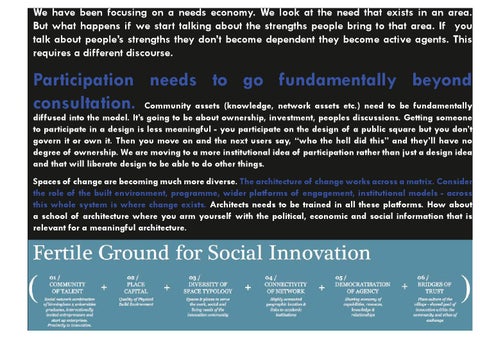
We have been focusing on a needs economy. We look at the need that exists in an area. But what happens if we start talking about the strengths people bring to that area. If you talk about people’s strengths they don’t become dependent they become active agents. This requires a different discourse.
Participation needs to go fundamentally beyond consultation. Community assets (knowledge, network assets etc.) need to be fundamentally
diffused into the model. It’s going to be about ownership, investment, peoples discussions. Getting someone to participate in a design is less meaningful - you participate on the design of a public square but you don’t govern it or own it. Then you move on and the next users say, “who the hell did this” and they’ll have no degree of ownership. We are moving to a more institutional idea of participation rather than just a design idea and that will liberate design to be able to do other things. Spaces of change are becoming much more diverse. The architecture of change works across a matrix. Consider the role of the built environment, programme, wider platforms of engagement, institutional models - across this whole system is where change exists. Architects needs to be trained in all these platforms. How about a school of architecture where you arm yourself with the political, economic and social information that is relevant for a meaningful architecture.